
Katie Kenney
When the normal everyday person thinks about Christmas she normally doesn’t think about the birth of Jesus. Most people are concerned with traditions, food, and gifts. Today, more people are concerned with getting gifts than giving them. Many things have changed, like how many people view Christmas religiously, the importance of buying expensive gifts, and the amount of rest people get. The focus on what is most important has shifted. Spending time with family that haven’t been visited in some time is less important than making sure your house looks like it’s from a Hallmark Christmas movie to some people. How many gifts a person gets and how much the presents cost may be more valuable than the celebration of the birth of Christ to someone you know. We, as a people group, have developed and changed over the course of decades and centuries, so much so a widely celebrated holiday is completely different. By that I mean Christmas used to be a very public celebration, but it is now kept to families and parties with a limited amount of people at them. If that has changed then what else has?
It has come to my attention many children under the age of ten have phones, computers, tablets, and TVs much more expensive and much nicer than anything I had when I was as old as they are. I can’t even imagine what it is like for my parents and grandparents who have literally grown up having no cell phone or laptop to see kids of ten years play inside with video games as their form of entertainment instead of outside like they did. Young people, children and teenagers, seem to have a great want for electronic devices as a whole. Today’s generation has a better knowledge of electronics and how they work. Some people want to improve their knowledge and see what they can create and do with it. Others just want to have devices to entertain them and unintentionally keep them distracted from things outside of the Internet, even though almost everything is online today. This can keep teenagers who are not believers away from God and His word or even give them false information about who He is. Their want of physical things renders them unable to receive God’s promises.
Everyone has seen a little kid have a full out temper tantrum in a public store sometime in their lives. Most of the time, these tantrums happen because the child has been told he can’t have something. Around Christmas, when mothers take their kids with them to places like the grocery store, the amount of outbursts from children increase. This is because small toys and decorations are put out, which gives kids more things to want. They don’t care about making their dad a finger painting and giving it to him on Christmas; they care about getting new toys and playing with them immediately after they open the box it came in. The focus in children’s eyes during Christmas time seems to be about what they want. Many children are asked what they want for Christmas and what they will do with it if they get it. During times of war, kids didn’t get to tell what they wanted and why. They didn’t get to ask for a multitude of toys they wanted because there wasn’t enough resources or time to make the toys.
The Bible says good deeds will not get you into Heaven, but your faith will. This is specifically said in Ephesians 2:8-9, “For by grace you have been saved through grace. And this is not your own doing; it is the gift of God, not a result of works, so that no one may boast.” This means the things you do will not help you get into Heaven, but the faith and trust you put into God will allow you to pass through the gates of Heaven. Unfortunately, this is often forgotten all year ’round, especially during Christmas. Stories about Santa say you have to act well and do good things so you can get presents from him. If you aren’t seen as a good kid then you are punished and coal is put into your stocking instead of candy. This makes kids think from a very young age the only way they can receive good things is by doing good things. Now doing good acts is not at all bad, but thinking the things you do will get you places, like Heaven, is not a good mindset to have.
In a history class, you are obviously taught different things about different time periods. During the time of WWII, people were definitely less greedy than they are now. Children understood, to a certain extent, they couldn’t have everything they wanted because it was to be given to someone else or there wasn’t any more of what they wanted. All of the resources we have today were not available to them because of the state they were in. It was hard to be happy during Christmas because almost everyone knew someone in the war, fighting for their country and their lives. Jews in countries where Communism had control were unable to do the practices and traditions they believed in. They couldn’t even say they were a Jew without having some form of harm inflicted upon them. They had to stuff down their beliefs in order to live sometimes. Across the world, people were unable to buy gifts for everyone they knew because there were less jobs and less money, not even dealing with the fact more weapons were made than toys because of the war.
Going along with the fact religion was hard to express in certain European countries during WWII, religion was hardly spread to other people. Evangelism was minimal because Communist leaders said no religion was allowed and if you said you belonged to one then you could be sent to a concentration camps, possibly many different ones, or even killed on sight. No one in their right mind would tell others about Jesus in the middle of a common place where Communist soldiers walked around. Today, people do that: they hold meetings in public parks, or other places not secretive, and talk about Jesus. People stand out in the winter cold to tell people who happen to walk by them about the joy of Jesus Christ. Evangelism is more prominent than it was before because many people have more freedom to evangelize. They are not as scared to share the gospel.
Santa is a widely known fictional being who brings people gifts in the middle of the night. Many children believe in him, or believed in him at one point in their childhood, and they found great joy in the idea of him. Jesus is the Son of God who rose from the dead and has cleansed us of our sins. He has given us the opportunity to live forever with Him after we die if we have faith and believe in Him even though we cannot see Him. Unfortunately, some people prefer Santa to Jesus, even people who no longer believe in Santa. A reason people do not believe in Christ is because they do not want to commit to things in the Bible like the Ten Commandments, even though He can bring peace and joy to them. With Santa, there is only one commitment: to be good. This can seem quite appealing, causing people to like the concept of Santa more than they like the concept of Jesus. Most people like to do things the easy way and tend to lean toward the side of less work, which in this case is Santa. However, just because something takes less work does not mean it is better than something that takes a lot of hard work, no matter how hard people try to make that true. Being a Christian takes more work than saying you don’t believe in God, but being a believer is a much better life than going without knowing about God.
On social media, young people seem to care less about the things important to religion or important to the betterment of the world and more about making funny images to share with their friends or getting a certain amount of attention on their pictures they’ve posted. This means some things, like the religion in Christmas for example, can be forgotten. Because of a survey, we know only 39% of young adults ages 18-29 see Christmas as a religious holiday, comparing to 66% of adults aged 65 and older. This shows the value of Christmas has changed over time. The importance of Christmas is looked over or seen as useless by 61% of young adults, which is quite obviously more than half. Those who are older, specifically those who are older than 64, see Christmas is a religious holiday more than adults who are in their twenties. What happened? How did a whole generation just decide Christmas had nothing to do with Jesus Christ? Perhaps they were influenced by those you do not believe online. Maybe they were told if they viewed Christmas as a religious holiday they were stupid or less than those who didn’t view Christmas religiously. It may also be possible they think they will look cooler if they say they don’t believe. Either way, this may mean the percentage of young adults who see Christmas as a religious holiday will drop even lower in the following years.
Around Christmas, it is common for people to be more stressed than they usually are. There is a lot of running around to find the perfect gift, the biggest Christmas tree, or the prettiest home decorations, which can take a toll on someone. If you are struggling to find the one thing your friend asked you for, it might make your stress levels rise. Many stores try to alleviate this stress by being open 24/7, or maybe they’re just doing it for business purposes, but it doesn’t always help. Some stores also allow online shopping so you don’t have to go out in the Christmas shopping rush that looms over people’s heads. However, some people just like to physically go out and shop for what they need or want, even though it might cause them more stress. Many people try to shop early for Christmas presents and ask for Christmas lists a couple months before December. For example, on Black Friday, a multitude of people go out and buy all sorts of things because practically everything is on sale in some way, shape, or form. It is seen by many as a great opportunity to do most, if not all, of their Christmas shopping. It can be quite stressful because there are so many people trying to buy the same things as you when the items are limited. Many people just want to get their shopping over with, but that can just bring more worry and stress. If you try to get everything done before the “rush” then you are rushing yourself, which isn’t the best idea if you are trying to make every little thing about the presents you are giving absolutely perfect.
In 2014, the average American spent $860 on Christmas presents for people they know. This means the amount of money spent for Christmas gifts had increased by 35% in the last thirty years before then. Over time, the prices of the majority of items has increased. If something is expensive then it is most often seen as a better product than an extremely similar product with a smaller price. Because of that, people may buy more expensive things even though they don’t need to or it isn’t in their budget. Speaking of budgets, how come people have bought things that have increased in price over time when the average American income has only increased 6.5% since 1985? That just doesn’t fit well with the increase in the amount of money spent for Christmas gifts. People are buying things that cost a lot of money or that add up to a lot of money, but not everyone has the money to do so and live without having to knock some things down on their priority list.
On Christmas Eve, it is tradition for some families to drive around their neighborhoods to look at homes decorated with Christmas lights or inflated Santa Clauses. Many families also go to light set-ups like the one in Newport News Park on the weeks before Christmas. It is very common for American families to hang lights on the outside of their house, whether it be on the trim of their roof or the bushes and trees in their yards. Some families are more passionate than others and have an overwhelming want to have the best decorated house on their street. They want to outdo everyone else they know or see. This concept can be seen in the movie Deck the Halls, in which two neighbors compete against each other to see who can have the brightest Christmas lights that may be seen in space. Christmas lights are incredibly important to some people, more important than socializing with people they haven’t seen all year. Over time tangible things like lights and gifts have been focused on more than things like family and the birth of Jesus. You can be ridiculed greatly if you don’t have a Christmas tree somewhere in your house and will be told why you should have one, but if you don’t celebrate Christmas religiously than it is less common for someone to tell you why you should. Decorations seem to be more important than the real reason why Christmas is even celebrated.
In conclusion, Christmas has changed drastically in ways not in plain view for everyone, but if you think about it then it is quite obvious. When you look back and see how different Christmas was it makes you wonder how different Christmas will be in the following decades. The changes that have been made, from main focuses to decorations to beliefs, can be seen as bad, as good, or as the development of our world. Change isn’t inherently bad, but when changes are made to shift the focus away from Jesus and the truth He gives onto things of our human world, it isn’t the best change possible. All of the changes made that don’t fit with what the Bible tells us can be changed again. We have the opportunity to change things back to what God wants, instead of what our human brains want.
Bibliography
Mazza, Juliana. 22WWLP. LIN Television Corporation, 25 Dec. 2014. Web. 26 Sept. 2016. http://wwlp.com/2014/12/25/christmas-has-changed-over-the-decades/.
Pruitt, Sarah. History. A&E Television Networks, 24 Dec. 2013. Web. 24 Sept. 2016. http://www.history.com/news/christmas-traditions-past-and-present.
 Redeeming Pandora
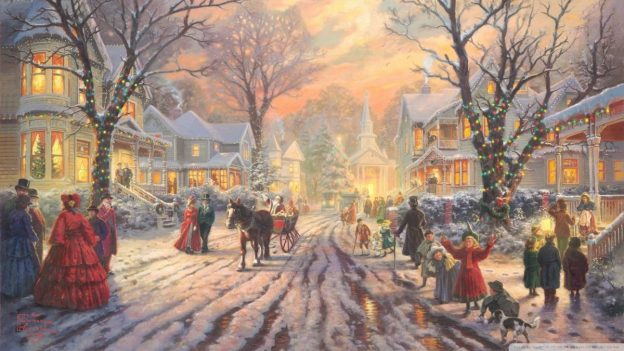
I love the image you’ve used at the top of your post. 😍
What is it called please, so I can look it up? Many thanks.
LikeLike
It is a free Thomas Kincaid picture; I’m not sure which site it was from, but thanks for your interest in the post!
LikeLike