Tag Archives: jared emry

Modern Era Love

J. R. Emry

Love as a dying anachronism. The human replaced in all musterable vigour through that descension into the post-human. The post-human concerns itself not with the likes of love, but instead with its daily, if not hourly, orgies; love as cannibalism of the other, the mutilation of the self, and the destruction of the person as phenomena. “Eros demoted from god to buffoon” (Gallagher 207). Yet, indeed, Eros upheld as the maxim of love, so that none other love may remain at all.

The production of the post-human by the removal of the heart; the making of the individual. The person as defined by the relation to the other. The individual as that which is demarcated from the other is set distant from the person. Individualization, an act of despair by which the self is systematically destroyed in pursuit of living suicide, if not suicide proper. The radical individual as the willful un-person. The leveling of person to the individual by equal measures as the removal of the second story from a house; a reduction away from higher orders (Stern). A leveling proceeding from the basis that a person is systematically taught to recognize significance from demarcation and by their own humanity see the similarity of human nature in others — thus to see insignificance in the self. In insignificance — despair! The person demarcates away humanity for significance; the removal of the heart to be without a chest (Lewis). From human to post-human, ever greater individualization sought by the increasing of category and selection to the infinite. No longer content to man or woman, the boundaries artificially blurred and the content within rendered meaningless. The phenomena of personal death, that is spiritual death, as result of the love of self, wherein that love is hatred.

In making the self a void of the person, the newfound individual inflicts mutilation by means of the laceration on some, if not all, aspects of their being. The infliction on the heart immediate by degree of laceration by even mere thought. The infliction on the mind immediate by degree of laceration. The psyche escapes from nothing. The infliction of the body by laceration of the flesh taken at any subsequent time. The so-called “sex change” as the culmination of three kinds of lacerations; the unmaking and destruction of the body to make in accord with the unmaking and destruction of the mind for reason of furthering the unmaking and destruction of the heart. To make what isn’t of what is. To make what shouldn’t of what should. Love of the self, wherein that love is hatred, defined by cruelty brutality against the self.

The sexual revolution having already taken root by the onset of the digital age finds amplification and completion of the pornographization of all culture. That what the hippies of the 1960s called “Free Love,” that polymorphic perversity, the idea therein that authoritarianism is the result of sexual repression thus that the subjugation of all to the sexual act even at the most base as a means to an end and the end contained in itself. The sexual revolution aims for dissonance and the disassociation of sex from all reality; the breakdown of the human spirit by means of the divorce of the body and the brain, reducing all to mere calculators and copulaters.  Feminism as the end of the female; setting forth the corrupted male as the ideal for both sexes. Homosexualism as the end of the relation; setting forth the dehumanized object as the ideal for both sexes. Once an act of creation, intercourse is reduced to an onanism, stagnant and infertile. As the most basic act of creation, reproduction is eroded, by necessity all acts of creation replaced by the fruitless. No longer will order be brought forth out of chaos. All the arts become impotent pornographies; bombastic in their obscenities. “They castrate and bid the geldings be fruitful” (Lewis 26). The fundamental goal of art changed from beauty to revolution; the malicious revolution against all existence. The distinction between the post-human and the mass murderer only differentiated by passivity. The inversion of the object with the subject as means of moral inversion necessitated by the creation of the individual from the death of the person. The dead abhor the living and so act as cannibals. In this way, the observance of feminism is absolutely equivalent to self-depersonalization; the integration of the former into society as equivalent to the leveling of all in society to inhuman states.  In this way, the support of homosexualism is absolutely equivalent to the support of pedophilia; the acceptance of the former the acceptance of the latter. This as the love of the other, wherein that love is hatred, defined by cruelty and brutality.

The post-human seeks the destruction of the human in others and the self. This destruction claimed as an act of love all the while blurring the heart between the body and mind until it dissipates. The mind for the disconnect of the presence by distraction, by amusement, by fun as an end to itself. The body by means of the gratification of the passions at the instant. All made digital for the heart is analog. Here, beyond good and evil, civilization is known to be dead. All events are proceeded by prophecy, herein the physical death shall follow this spiritual death. “You may suddenly understand it all someday — but only when you yourselves hear “hand behind your back there!” and step ashore on our Archipelago” (Solzhenitsyn 518).

Bibliography

Gallagher, M. (1989). Enemies of Eros: How the Sexual Revolution is Killing Family, Marriage, and Sex and What We Can Do about It. Chicago, IL: Bonus Books.

Lewis, C. S. (2013). The Abolition of Man. Exciting Classics.

Solzhenitsyn, A. I. (1978). The Gulag Archipelago Three: Katorga; Exile; Stalin is No More V-VII. New York: Harper & Row.

Stern, K. (1985). The Flight from Woman. New York: Paragon House.

An Introduction to Moral Nihilism

Jared Emry

There are three major kinds of nihilism: moral nihilism, epistemological nihilism, and political nihilism. Political nihilism derives its root in the same way as the word annihilation. It is the idea “all social and political structures should be destroyed.” Epistemological nihilism is the idea “there is no truth.” Moral nihilism is the idea “there are no values.” These types of nihilism could be all accepted by a person, but any person could easily accept one type and reject the others. They may overlap in a person, but each type is discrete and unique from each other. The confusion of these terms needs to be eliminated before discussing any one individually (Joyce 1). Unfortunately, the term moral nihilism still is vague and slovenly to the point of being both useless and meaningless. For the sake of discussion the term will be defined as to refer to a collection of philosophies that claim there are no moral facts. It is also necessary to trace major moral nihilist thoughts and arguments behind them.

Fyodor Dostoyevsky, in his landmark book The Brothers Karamazov, has Ivan Karamazov state “if God is dead, then everything is permissible.” Many of those in the current skeptic and atheist communities would and do openly reject this dictum as it seemingly remains as either a pragmatic or a metaethic for the need of God; however, this rejection is an offhand dismissal. While Dostoyevsky is an Orthodox Christian and the text could be interpreted as a shameless strawman for atheistic metaethics, Atheism does not necessarily lead to moral nihilism, nor is that an accurate representation for the book (Joyce 2). The novel presents characters from all walks of life and their perspectives on existence. Ivan is the most tortured of them all and not due to his atheism. Ivan is brilliantly analytical and comes to the conclusion people only care about right and wrong insofar as there exist consequences, especially eternal ones. He desires to embrace goodness, but he can’t logically justify it. He gives up on love, happiness, and humanity. He cannot reconcile himself to his disbelief. He cannot reconcile morality with reality. It seems the only way to save values is to betray them. He is left mad and without redemption. His logic is never refuted; rather the disbelief is too much of a burden. It is not a claim atheism leads to moral nihilism for whatever reason. The consequences of the human psyche are irrelevant to the cold mathematics of nihilism. The sentiment here is mirrored by Camus in L’Homme Révolté and Sartre in Existentialism and Humanism. Dostoyevsky’s dictum may be popular in that god is Buddha’s trapdoor — the only exit by which humanity can escape from nihilism. On the other hand, it could be described without a theistic premise, in which the question is what the nature of moral permissibility actually is. This all presupposes the natural intuition of morality found in humans is something that should be doubted.

What justification do we have for moral skepticism? The common standard of justified belief in skepticism is if any contrary hypothesis cannot be ruled out, then that belief is not justified. The skeptic only has the burden of showing for a belief, there is a contrary hypothesis that cannot be ruled out. More specifically there are two basic issues in question that highlight a general cause for analysis of greater depth (Joyce). The first is the pervasiveness of moral disagreement. The second is ability of the sciences to explain moral beliefs in terms of biosocial terms without endorsing moral premises. If morality exists as a property, why is there a lack of moral uniformity across cultures and between individuals? Is active euthanasia moral? Is abortion moral? These are dichotomous and are prominent examples of moral disagreement.  Is there really direct and non-inferential access to the nature of morality if disagreement is so common? If moral belief can be described entirely outside of moral terms and described better, then why the need of such terms? It would seem the questions need answering.

Moral skepticism can also be reached by an argument of regress. Moral beliefs must be justified either inferentially or non-inferentially. A non-inferential argument may be easily dismissed with Occam’s Razor. It seems implausible moral judgments are valid without inference for known disagreements (Loeb 282). Furthermore, moral judgments are subject to framing effects, misleading emotions, and are the product of processes independent of truth. The other option is inferential justification, which may take three forms. First, a moral belief may be justified with no normative premises. The naturalists who make this claim must still rely on suppressed normative premises. Evolutionary biology, psychology, sociology, or general culture can explain moral beliefs, but do not inherently appeal to any moral fact. The naturalist argument relies on the suppressed premise all acts with features they deem immoral are morally wrong, but from what do they deem those features? It can still easily be denied due to prior moral assumptions (Bedke). Second, a moral belief may be justified with some non-moral normative premises. The idea here is theoretically all unbiased and rational people would make the same decisions if placed in the same circumstance and thus allege said beliefs are true. All factors required in such judgments are controversial. How are impartiality, rationality, and relevance decided? (Brandt) The differing theories for each factor would seem to point to suppressed moral premises. The third option is to justify moral beliefs with moral premises. The obvious flaw here is all moral premises are moral beliefs that must be justified. The most common denial would be such justifications must either be infinite or circular. Contamination of the premises with the conclusion gives little reason for the doubter to accept the premise. However, some have proposed a branching tree of premises that together form a coherent whole that can be internally proven. The suppressed premise here is coherency is a suitable replacement for truth. A system may be internally coherent but bears no reflection on externalities. Many internally coherent systems may conflict with each other, which gives rise to doubt concerning which internally coherent system is actually true. Additionally, social contexts are unable to justify moral belief as social contexts are corruptible and no solitary link can be made to affirm social context as truth. These are all the options by which moral beliefs may be justified, and the valid conclusion is there are no justifiable moral beliefs. This conclusion can only be avoided by tackling at least one of the premises covered here.

This skepticism can be taken further by asserting a hypothesis that cannot be ruled out. Moral nihilism is capable of explaining any moral beliefs exist the way they do accurately through evolutionary biology, psychology, sociology, or general culture. A coherent system that creates accurate predictions cannot refute nihilism either. One must rule out moral nihilism to be justified in any moral belief, yet not justified in the denial of moral nihilism. Justification of moral belief requires the denial of moral nihilism. It could be said the belief “genocide is wrong” requires the denial of this moral nihilism and until such time as this denial is justified “genocide is wrong” is an unjustifiable belief. “Genocide is wrong” isn’t a controversial moral belief and so it is plausible this extends to most other moral beliefs and controversies. How can nihilism be denied? A claim may be held against nihilism lacking meaning or internal coherency, yet it remains meaningful and coherent in light of all theories of language. Furthermore, common moral beliefs cannot justify this denial regardless of how obvious they may seem, for this denial is countered by simply pointing to the fact many people do reject moral beliefs and a seemingly coherent system does not speak to the external world. Additionally, all arguments pointing to moral nihilism as being incompatible with non-moral facts can be dismissed for crossing the is-ought barrier. Yet, people reject these conclusions without being able to refute them. The kneejerk reaction might to simply call this nihilism or this skepticism irrelevant. In fact, many people do accept forms of moral nihilism due to a lack of defensible moral theories. It seems relevant because people really do reasonably hold to this skepticism and it does directly confront the moral belief in question. To call it irrelevant is to simply dismiss these people and to not question an underlying belief without justifiable cause.

Moral skepticism and moral nihilism support each other adequately but are not necessarily reliant upon each other, especially due to the diverse nature of moral nihilism. While moral nihilism can be roughly defined as a rejection of values, especially moral values, the method or reason of rejection may vary. Moral nihilism includes all three major theses of moral-antirealism, yet possibly includes other meta-ethical theories. These are non-cognitivism, error theory, and non-objectivism. Non-cognitivism can be boiled down to the idea when people say a moral declaration, they do not intend to express moral truth. Instead of moral truth, people proclaim only their feelings in regard to an action or features associated with an action. Non-objectivism holds morals are constituted by thought alone, but this is not to be confused with subjectivism, as subjectivism is a mere type of non-objectivism. Nor should non-objectivism be confused with moral relativism, which may or may not be nihilist in nature depending on its presentation. However, non-objectivism’s status as moral nihilism is controversial on both sides of the aisle. Error theory is the traditional form of nihilism and perhaps the form that carries the most weight.
Error theory claims there are no objective values and denies it on a similar principle by which an atheist rejects god. Nihilism may be seen as a disjointed whole, against which all strands may need substantial arguments. Either moral judgments aim at telling truth, or they do not. If they do, all claims necessarily fail. If not, moral judgments are inherently separate from truth. However, perhaps it is better to look at traditional nihilism.

Error theory has its unique arguments that may supplement moral skepticism. The previously mentioned argument from disagreement can be expanded (Brink). If we start with the empirical observation many moral disagreements exist, then the demand of moral superiority must also be demanded of epistemological superiority — at least in regard to morality. Why do some cultures or individuals lack this epistemological access to moral knowledge? Many who try to answer find the reason for their claimed superior access may not like the answers they find. Furthermore, it would be more logical that the moral beliefs arose as a result of those answers and not the other way around (Mackie). A second argument stands more uniquely, rather than supplementary, to moral skepticism in the form of what is known as the argument from queerness. The idea here is morality, as a property, is unlike all other properties in universe and is therefore weird. Morality must be described as being observable in a way fundamentally different from all other properties. Morality requires a special faculty by which to operate, whereas all (or at least most) other properties are operated by normal faculties of observation. Morality requires a foreign method of knowing (Mackie).

The existence of moral nihilism, like all nihilism, rests in the negation of commonly accepted beliefs and axioms. It is as various in form as all the things it attempts to negate. It also stands as a brooding giant in philosophical discussions, as it demands attention and yields no ground. It purports what seems obvious to humanity stands on shaky ground. The proposition seems alien to us. If we cannot accept it and we cannot refute it, do we stand on mere faith? Are we to be mad like Ivan Karamazov in our inability to reconcile our human psyche to our reason? Richard Joyce proposes even if morality is a delusion, that delusion must be maintained. For now, however, can modern society cope with such a fundamental in question?

Bibliography

Ayer, A. J. Language, Truth, and Logic. N.p.: n.p., n.d. Print.

Bedke, Matthew S. “Might All Normativity Be Queer?” Australasian Journal of Philosophy 88.1 (2010): 41-58. Web.

Brandt, R. “The Definition of an ‘Ideal Observer’ in Ethics.” Philosophy and Phenomenological Research 15 (1954): 407-13.

Brink, David O. “Moral Realism and the Sceptical Arguments from Disagreement and Queerness.” Australasian Journal of Philosophy 62.2 (1984): 111-25. Web.

Joyce, Richard, and Simon Kirchin. A World Without Values: Essays on John Mackie’s Moral Error Theory. Dordrecht: Springer, 2010.

Joyce, Richard. “Nihilism.” International Encyclopedia of Ethics. 2013. Print.

Loeb, D. Moral Realism and the Argument from Disagreement. Vol. 90. N.p.: n.p., 1998. Print. Philosophical Studies.

Mackie, J. L. Ethics: Inventing Right and Wrong. Harmondsworth: Penguin, 1977.

Lebensunwerten Lebens

Jared Emry

The Holocaust was a eugenics program that attempted to cleanse the Aryan race and society as a whole. Eugenics is the concept of breeding out traits considered to be inferior or the root of disease — societal, genetic, or otherwise. The use of eugenics through methods of sterilization and euthanasia became a solution to what was perceived by many to be a serious problem. Eugenics was incredibly popular in the world at the time. It was practiced throughout much of the western world in the form of sterilization. Hitler started the Nazi eugenics program only five months into the office of chancellor in 1933, and he began it as a sterilization campaign aimed at the mentally ill. The practice continued in some parts of the U.S. until at least the late ’60s. Starting with the mentally ill, the Holocaust spread to political dissidents, followed by certain races and homosexuals.  In this way, psychology was the primary tool used by the Nazis to justify and fuel the propaganda of the Holocaust.

The idea of Aryan domination first found a foothold in Alfred Ploetz’s The Efficiency of our Race and the Protection of the Weak. Ploetz originally argued the Jews were equal and indispensible, but revised his opinion after deciding Jews were too individualistic and lacked nationalism. Later, psychiatrist Alfred Hoche wrote Die Freigabe der Vernichtung Lebensunwerten Lebens, which spoke of euthanizing “life not worth living.” His idea was the mentally ill are merely shells of humans and they are massive burdens on society, financial and otherwise. Dr. Hoche even calculated the specific average financial cost of each mentally ill person’s burdens society per year (Cornwell 89). These calculation became central in Nazi propaganda. His work led to the euthanizing of mentally ill patients began, but the Nazis were forced to ban the practice because of public outrage. Despite the ban, most psychologists continued to kill their patients based on their beliefs in eugenics. Dr. Elizabeth Hecker was one such doctor who continued to kill her test subjects when she was through with them, she is even now still lauded as a pioneer of developmental psychology. Eventually, Alfred Hoche recanted after a close relative of his was disposed of.

The Holocaust started with the disposal of the mentally ill, but it moved past that. Prior to 1934, the Nazis had a neutral stance on homosexuality. Ernst Röhm, head of the SA, and many other officials were openly homosexual. Röhm was popular, became politically ambitious, and started to grow his own paramilitaries. Hitler and Himmler responded by filling the newspapers with rumors Röhm was working to stage a coup backed with planted evidence and used those rumors as a justification for a party purge. Himmler feared a conspiracy and thus the Holocaust grew to include the homosexuals (Oosterhuis 195). Despite that, homosexuals did not face the same severity of persecution as Nazi psychologists thought and proved homosexuals could be quarantined and rehabilitated. Again, the Nazis turned to the psychologists for justification. Mental illness is functionally definable as any culturally unacceptable deviancy or idiosyncrasy, and so with homosexuality considered to be a mental illness and also life not worth living. In this sense, the Holocaust never did move past the disposal of the mentally ill.

The Jews were next in 1935 and the justification was a little harder to reach. The breakthrough came when, “Erich Jaensch began organizing his biopsychological typology work around a notion of a superior ‘Northern integration type’ (the ‘J’ type), whose attributes he contrasted with an inferior ‘Jewish-liberal dissolution type’ (the ‘S’ type). The ‘S’ type — which he increasingly called the Gegentyp (‘anti-type’) — was described as intellectually rigid and abstract, yet with a tendency to become easily fragmented” (Harrington).

These results which purposefully aligned with the preexisting anti-Semitic ideology of the Nazi party were used as a justification and a source for anti-Semitic propaganda and the wholescale persecution of the Jews at the national level.

The corruption of science didn’t end with psychiatry.  The biologist Adolf Meyer-Abich gave a guest presentation at John Hopkins in 1933, where he showed a film depicting the Fuhrer principle in bacteria colonies. He failed to comprehend why the American scientists did not take the documentary seriously (Harrington 357). However, psychology fundamentally uses the culturally normative ideology as its basis for inquiry into both society and individual persons (Strous 8). Psychology, unlike the hard science, adopts an ideology and then builds evidence in support of that ideology rather than attempting an objective observation with analysis appropriate to the evidence. The field adopted the Nazi ideology as naturally as it adopts any ideology. In fact, it was in the Third Reich where psychology was first treated seriously by a governing authority and by a people as a whole with the Vordiplom Prüfung. The Vordiplom Prüfung, or the Diploma Examination Regulations, became the first professional qualification exam for psychology in 1940 making psychology a legitimate profession as it remains today. Even the modern qualification exams are nothing more than updates of Vordiplom Prüfung (Geuter 199).

The majority of psychologists intimately involved with the Holocaust would never see a second within the walls of a prison. Whether they had directly been involved with the killing or if they had merely claimed to have empirically proven scientific justification for the killing, they were given the most leniencies at the Nuremburg Trials. More psychologists and psychiatrists were prosecuted than any other group of professionals, but they were absolved of guilt because the courts believed the sterilization and euthanasia was legal. The majority of psychologists intimately involved simply chose to ignore their past, pretend nothing had happened, and repress their history (Oosterhuis). Dr. Elizabeth Hecker, who had maintained the first adolescent psychiatric clinic that tested and killed any children deemed delinquent or abnormal after being studied or experimented on, was never punished for her crimes. Instead, Dr. Hecker was elected an honorary member of the German Association of Child and Adolescent Psychiatry. Many others continue to be cited and quoted in modern medical articles without mention of the highly unethical and torturous nature of their studies (Langsdorff).

The evolution of psychology as a profession under the rule of the Third Reich and the aid it provided to the Third Reich is clearly demonstrated historically.  Psychologists provided Nazi Germany as a standard by which they could justify their worst atrocities, including the holocaust. The Nazis were given a position by which they could claim their opposition was both anti-science and a form of social disease requiring extermination. Any group they disliked could, and were, written off as antisocial and destroyed. But did this tendency to facilitate and organize the destruction of individuals with twisted scientific rationale end with the Third Reich?

Works Cited

Cornwell, John. Hitler’s Scientists: Science, War and the Devil’s Pact. New York: Viking, 2003.

Geuter, Ulfried. The Professionalization of Psychology in Nazi Germany. Cambridge: CUP.

Harrington, Anne. “Metaphoric Connections: Holistic Science in the Shadow of the Third Reich.” Social Research, 1995-07. 62:2.

Langsdorff, Maja. Die Geheimnisse um J. H. Schultz, Die Rolle des Autogenen Trainings und seines Begründers im Nationalsozialismus.

Oosterhuis, Harry. “Medicine, Male Bonding and Homosexuality in Nazi Germany.” Journal of Contemporary History, 1997-04. 32:2, p. 187-205.

Strous, R.D., “Psychiatry during the Nazi era: ethical lessons for the modern professional.” Annals of General Psychiatry, 2007-02-27.

Driesch’s Mechanics and Life

Jared Emry

[Hans] Driesch defined a machine as “a typical configuration of physical and chemical constituents, by the acting of which a typical effect is attained” (102). The main issue with Driesch’s definition is the question of what typical means, because the difference between typical and atypical is the basic distinction within the definition. Additionally, all his proofs lie on this line between typical and atypical as set by the definition. Dictionary.com defines typical as “pertaining to, of the nature of, or serving as a type or emblem; symbolic.”

Driesch makes the argument that because life can have relatively atypical results, it cannot be mechanistic in nature. One of the atypical results is cells can be transplanted from one region that will develop into organ A to another region that will develop into organ B and yet both organs will still be formed properly. Another atypical result is cells can similarly be implanted, but from another related species and those cells will still allow the first creature to form its organs while the cells remain uniquely the same. A third atypical result is the organism grows despite the external pressure placed on it to prevent it from forming in the required three dimensional space typically thought to be needed.  This is atypical because a machine typically acts in regard to three dimensional space and has to be constructed in regard to three dimensional space and thus cannot have function at right angles to that plane.

There are two kinds of possible definitions for typical in the context of Driesch’s definition of a machine: a mathematical definition and a practical definition. The difference between the two options is predictive identifiability versus the possibility of absolute variable cognition. Predictive identifiability is the idea typicality is based on major traits that can be known in such a way as to perceive the most likely outcomes. Typicality, based upon a predictive identifiability definition, would be the use of variables of greater hamegin (perception of having relative influence on a given outcome) to analyze probable outcomes while combining the variables of lesser hamegin into a statistical average based on observations. The possibility of absolute variable cognition is the idea that typicality is the standard all relevant variables can be known well enough to create a formula that allows all possible outcomes to be known based on the inputs of all the relevant variables. In this form, typicality refers to all possible outcomes associated with necessarily anything and to be atypical would be to be unnatural. Also, the possibility of absolute variable cognition is not necessarily practical due to the difficulty of manipulating variables and the possibility the variables can’t be cognitively understood. The practical definition refers to predictive identifiability, whereas the mathematical definition refers to the possibility of absolute variable cognition. Driesch’s usage of typicality seems to be more closely related to the former rather than the latter. Essentially, Driesch’s concept of Entelechia could be seen as covering up the minor and relatively unknown or unknowable variables with a constant; it may not be the most precise or accurate way to describe any given biological entity, but it allows for identifiable outcomes to be predicted.

The use of the possibility of absolute variable cognition as the standard for typicality in Driesch’s definition is at best a topicality violation or at worst a strawman fallacy. Driesch is not directly implicating the supernatural in his theory and is still using the word “typical.” If he were to mean the word “typical” with a possibility of absolute variable cognition kind of definition, then he wouldn’t have to even use the word “typical” because it would be redundant. His description of how life responds in an atypical way also shows how there is distinction to be made in the natural world between typical and atypical. The only option that remains is typicality as predictive identifiability.

The use of predictive identifiability in Driesch’s definition of a machine must be applied to discern what is typical and what isn’t. While Driesch does not claim Entelechia is supernatural, he does make it apparent it is unknowable on certain levels; a distinction is made between the ability of the human to know Entelechia and the reality of Entelechia. Similarly, even if the functionality and causality of Entelechia is known, it still does not necessitate absolute variable cognition. It would still require the knowledge of how each and every variable interact in order to create each possible outcome. If such knowledge is beyond human compression, the use of predictive identifiability is a must. These distinctions are more than enough to create the need for distinct classifications. What is beyond human capability cannot be equally regarded with that which is within. According to Driesch’s definition, there cannot be a machine that is unknowable for a machine must always produce typical outcomes relative to known inputs. At the moment a machine can produce an atypical outcome, it can’t be classified properly as a machine. In this way, biologic entities cannot be considered to be mechanistic because it is impossible to know the entirety of life’s causalities, functions, and outcomes. The definition does not require that something that isn’t a machine is life; other options may include inanimate objects, a planet, or the universe.

The machine is classified by its definition based primarily upon the possibility of human comprehension in regards to a set of variables interacting in a three-dimensional space. Driesch’s idea of a machine does not require a concept such as Entelechia because it is fully knowable; the machine can have absolute variable cognition.

Works Cited

Driesch, Hans. The Science and Philosophy of the Organism; the Gifford Lectures Delivered Before the University of Aberdeen in the Year 1907. London: A. and C. Black, 1908. Print.

“Typical.” Dictionary.com. Dictionary.com, n.d. Web. 20 Oct. 2014.

The Daykeepers

Jared Emry

The Mayan civilization had a profound view of the world where everything was parallel, chiasmatic, and cyclical. The rising and falling of each star in the night sky are considered in their religion and their rituals are calendric. The traditional Mayan priest is known as an aj q’ijab’, which roughly translates to “day keeper” (Tedlock 7). For the Maya, the marking of time was sacred and all things had a proper place in time.

The central problem in writing histories of Mesoamerican people groups is the majority of written works by the people are now lost and various conquering groups tried to civilize the people by attempting to eradicate their culture and replacing it with their own. Many of the indigenous people also ended up being killed by foreign diseases or slaughtered for gold. Native scribes and scholars were targeted for persecution above any other demographic. The few western scholars who understood the importance of the indigenous literature faced persecution for their attempts to record the indigenous culture, like Fr. Andrés de Olmos and Fr. Bernardino de Sahagún who faced heavy censorship and the destruction or hiding of their manuscripts. Primary documents are scarce and translation is difficult. Many cultures relied on oral tradition. In most cases, the few remaining texts are simply unreadable because the written text hasn’t been deciphered. Fortunately, the Mayan language was fully writable and is now readable. Prior to 1952, the written language was known to be hieroglyphic and the hieroglyphic meanings of the words were known and the hieroglyphics could be translated, but in the process the words lost their parallel meanings. The Mayan language also uses a phonetic structure alongside or with the hieroglyphics. The written languages of surrounding civilizations, including the Aztecs, were pictorial in nature and thus incapable of carrying complex or abstract ideas; contrasting with the complexity of the Mayan texts that were more than capable of carrying the full range of the language. Despite many references to great texts that contained centuries of their history in the journals of the Spanish zealots who burned the books and defaced the writings that were placed in stone, only four incomplete codices are known to survive from the pre-Columbian times. Luckily, a few early translations into Latin texts by Mayan nobles and hidden by village elders for centuries (2-15). Out of the little that remains of Mayan literature, the most significant work is the Popol Vuh which was written by a handful of Quiche Mayans as they watched their civilization dismantled. It is an epic that contains their mythology, their culture, their history, and their philosophy mixed together for the purpose of preserving their heritage.

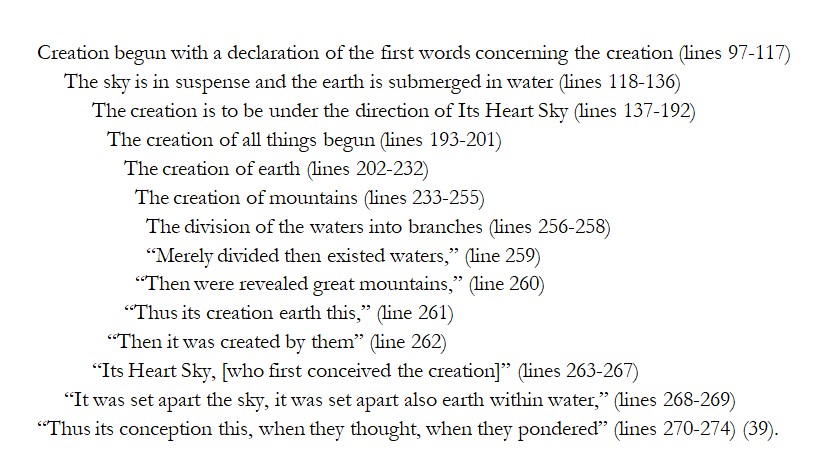
The Mayan creation mythology is recorded in chiastic structures. While chiastic structure is common in ancient writings, the Mayans mimic the chiastic structures in their religious rituals. It is one of the several forms of parallelism that the Mayans incorporated into their poetry. An example of this chiastic structure illustrates how this appears:

As is illustrated by the example, the story is reversed and told again once it is finished. The Popol Vuh is filled with such chiastic structures with each story being told in a manner and retold backwards. Another interesting factor about the stories are that they are told entirely in what translates to gerunds. It is present tense while the story weaves itself together — twisting and turning chiastically. It is a form of grammatical parallelism where all parts of the text are being taken to be in unity with each part. These parallels are then capped with a singular phrase that binds the sets of parallels together (37-40). Essentially the grammatical parallelism uses language to cause things to appear temporally equal.

Another form of parallelism found in the Mayan mythology is an association of two seemingly unlike things into a binding unity (39). For example, in the myth of the world tree, each compass direction is associated with a color and a god (Phillips and Jones 14). The world tree grew out of the center of the world and branched off in various directions. At the four corners of the globe (it might be noted here the Mayans knew the world was round), new trees would grow in association to new eras. Each era would have a new tree, a new color, and a new god associated with the tree. At the fifth era the cycle would begin anew. At the beginning of each era, more gods would appear and would need to be added to the pantheon.

In their mythology, the Pleiades are associated with protohumans, known as “The Four Hundred Boys,” who are revered as the gods of drunkenness (27). Due to the mythological connotations attached to the Pleiades, the Daykeepers watch the sky to see when the Pleiades rise and fall in order to divine when the proper rituals concerning that portion of the mythology should be done (Tedlock 89-93). Similarly, devotion to time is still found in their calendric divination practices (57, 68). The Daykeepers are known to spread maize over a calendar and to read the placement of the maize on the calendar as a form of divination.

The Mayan Calendar itself the divination would be performed on can be imagined as a series of three gears. The innermost gear would have thirteen notches each correlating to a day in one of the twenty months in the Sacred Almanac. An outer gear would have 20 symbols relating to each month, and they display the name of the day. It would take 260 days for the Almanac to complete itself. There is also a third gear, however, which could be imagined as being outside the other two gears but still attached to the outer gear. This large gear represents a 365-day cycle. This large gear contains a solar calendar of eighteen months that each have twenty days. An additional five days known as the “sleep” evened out the solar calendar. These two calendars in conjunction creates a fifty-two-year cycle that allows each day within the cycle to be uniquely named. This means that a day is only paralleled once every 52 years (Magnificent 31-31). The Mayans also kept other calendars, the most significant being a calendar of Venus. They used complex calculations (the Mayans had the number zero, which added to their astronomical and mathematical prowess) to map out the planet’s 584-day year and its gestation periods in order to properly merge it with the Sacred Almanac and the Solar Calendar (131). These calendars add significant amounts of parallels to time keeping due to the way new parallels may be found based off the combinations of the calendars examined. These parallels were considered sacred as they pertained directly to the mythical stories.

The parallels in the Mayan mythology and histories likely pertain to the parallels in their timekeeping. The Daykeepers spent their lives watching the calendars, and they were the ones who wrote the histories. The chiastic structures and the large amount of linguistic parallels in the ancient Mayan writings show the cyclical nature of the Mayan view of time. The calendars repeat themselves just as their mythologies do. They believed each and every action done could be predicted by their calendars and the proper timing for things were therefore integral to the nature of their world.

Bibliography

Goetz, Delia, Sylvanus Griswold Morley, and Adrián Recinos. Popol Vuh: the Sacred Book of the Ancient Quiché Maya. Norman: University of Oklahoma Press, 1950.

The Magnificent Maya. Alexandria, Va.: Time-Life Books, 1993.

Phillips, Charles, and David M. Jones. The Mythology of the Aztec & Maya. London: Southwater, 2006.

Spencer, Lewis. Mystical Books of the Mayans. Whitefish: Kessinger Publishing, 2010.

Stuart, David. The Order of Days: The Maya World and the Truth about 2012. New York: Harmony Books, 2011.

Stuart, Gene S., and George E. Stuart. Lost Kingdoms of the Maya. Washington, D.C.: The Society, 1993.

Tedlock, Dennis. Popol Vuh: The Definitive Edition of the Mayan Book of the Dawn of Life and the Glories of Gods and Kings. New York: Simon and Schuster, 1985.

Thompson, J. Eric S.. Maya History and Religion. 1st ed. Norman: U of Oklahoma Press, 1970.

Euclid’s Logical Architecture

Jared Emry

In Euclid’s Elements, Euclid follows a certain architecture for how he structures his logic. Mathematics at its core is pure logic. It is not bound to anything but itself. The logical architecture is in itself the framework of any particular theoretical mathematical reality. In math, the framework can be endlessly changed, but everything else is based upon extrapolation of that framework. Euclid provides a framework and much extrapolation upon the framework throughout the elements. Although this structure can be seen throughout the Elements, focus will be drawn to the first book. And due to space and time constraints, the structure will mainly be focused on the context, up to the twelfth proposition, in relation to the whole, from the definitions to the postulants and from the common notions to the propositions.

When Euclid begins to set up the theoretical reality of the Elements, he begins with three fundamental types of truth. The first of type of truth is definition. The definitions are truths of the factual level. This is this and that is that. It identifies basic parts of his theoretical reality in the same way a scientist tries to reduce the universe into fundamental scientific facts or laws. The first definition is a point is that which has no part. The second definition is a line is a breathless length. These two definitions are fundamental to Euclid’s Elements. They are not based upon each other and can be seen as foundational laws. We also see extensions to some definitions in later definitions. The definitions are the basis on which geometry is extrapolated and other fields in math are based. However, these definitions should not be seen as constant; they are free to be changed to create a new theoretical reality of mathematics.

The second of the three fundamental types of truth are the postulates. A postulate can be defined as a fundamental principle accepted as self-evident without proof. The postulates are claims to be considered true regardless. These can be thought of as a special revelation the same a religion may claim special revelation from a God. Euclid’s postulates are necessary for his theoretical reality to make sense. Some philosophers thought the foundations of reality are ultimately unknowable and only the individual can decide what foundational theory is true for them. Similarly, mathematics in general can have postulates that may seem to concur with reality or not. Since mathematics is pure logic, it is not constrained by any physical reality. Euclid provides in his Elements a definite special revelation of the foundations of his theoretical reality with these postulates. The postulates can almost be viewed as a form of religious dogma or worldview Euclid uses to explain the operations of his theoretical reality. They are Euclid’s five commands. They dictate certain things are possible and these things be considered fact. The first of these is to draw a straight line from any point to any point. This could be said differently as it is possible to create a straight line between two points. The second in the same fashion could be said differently as it is possible to create a straight line so it is straight. However, these slight rephrasing may disrupt some of Euclid’s nuances.

The third of the three fundamental types of truth are the common notions. The common notions are generally accepted logics. They are common for they are generally understood by human sentience. And they are notions because they are abstract reasoning. The common notions reflect the general revelation of man. Man understands the universe he lives in has general rules for functioning. In Euclid’s Elements, these are those rules. For example, the fifth common notion is the whole is greater than the part. It makes sense to the common understanding of sentience a whole is greater than the part, because it is not known to them an example otherwise. The common notions could be left out and more could be added. They act more as a shove toward logical extrapolation, a gentle guide toward the laws of the theoretical reality Euclid is creating in his Elements.

The fourth part of Euclid’s Elements is the propositions. Propositions are hypotheticals that can either be disproven or proven. An assertion is examined through the use of the common notions in the light of the definitions and the postulates. It takes the provided truths and logically analyzes them to see whether or not another truth can be extrapolated from them. Each proposition expands upon the foundation to create multiple and exceedingly more profound layers in the theoretical reality. This profoundness can be seen through the elegance of the each proposition alone, but they can also be overlaid to show their interactions and how they have built upon each other. Each proposition adds to the complexity of raw extrapolated logic. It is from this superposition of the layers Euclid’s theoretical reality can be seen as truly elegant. Euclid takes the layers a step at a time, first proving one thing, and all necessary corollaries and other needed propositions on the layer, before taking the next step up.  The ultimate layer of the first book is with proposition forty-seven, the Pythagorean Theorem. The Pythagorean Theorem is well known for being mindlessly memorized as a2+b2 =c2. Although the Pythagorean Theorem taught in that simple algebraic form, it is based on tons of logical extrapolation from several dozen propositions. It should be remembered there are no numbers or variables in the Elements and it is built only by extrapolation and inquisitive shape line arrangements. The Pythagorean Theorem is proven by comparing lines together in context of the previous propositions.  Euclid’s Elements are intuitive at their core.

Euclid’s logical architecture in the Elements provides insight to the complicated, because it is the process from the simple to the complicated. It is easier to climb a staircase one step at a time rather than trying to jump from the bottom of a staircase to the top. The book leaves the reader to find the theoretical universe behind the words but gives the reader freedom for his own intuition to guide him. In Euclid’s Elements, intuition is the only path to understanding. To be intuitive with logical frameworks is to find the heart of mathematics. Euclid makes it easy to grasp and to love the pursuit for that reality. On this staircase, each step is provided, but the steps have to be made not memorized. Unlike the bulky mimic taught in many math classes, mathematics is imaginative, fantastical, and intuitive.  In this elegance lies the heart of beauty itself, for mathematics is best defined as “the art of expression.”

Bibliography

Devlin, Keith, Ph.D. “What Is Mathematical Thinking?” Devlin’s Angle. Mathematical Association of America, 1 Sept. 2012. Web. 02 Feb. 2015.

—. “Will the Real Geometry of Nature Please Stand Up?” Devlin’s Angle. Mathematical Association of America, 2 Sept. 2014. Web. 02 Feb. 2015.

Lockhart, Paul, Ph.D., and Keith Devlin, Ph.D. A Mathematician’s Lament: How School Cheats Us Out of Our Most Fascinating and Imaginative Art. Jackson: Bellevue Literary, 2009. Print.

Extrasensory Perception

Jared Emry

Already, at the title, the mere claim the topic of extrasensory perception may seem irrational and even pointless to discuss. If one were to do a Web search on the subject, it is likely one would find hundreds of sites without good credentials of any kind willing to impart their secret knowledge, often for a slight fee. These sites may be taken as representative of the subject matter, but they’re not. These sites tend to be fraudulent in nature, and one’s opinion of the subject matter should not be based on such things as these sites are filled to the brim with exaggerated claims and bogus studies in order to make money (Stein). Even without such a negative, yet extremely popular, influence, the claims of extrasensory perception may seem bizarre and baffling to the point they should be rejected offhand. However, as Einstein once said in a letter to Jan Ehrenwald, “It seems to me, at any rate, that we have no right, from a physical standpoint, to deny a priori the possibility of telepathy. For that sort of denial the foundations of our science are too unsure and too incomplete” (Frazier 63-64). This concept is known is otherwise known as Clarke’s Law. When a distinguished but elderly scientist says something is possible, he is almost certainly right. When he states something is impossible, he is almost certainly wrong. It would seem rather than denying extrasensory perception a place for discussion under the enlightenment of science it would be far more rational to explore the topic to see if it is researchable or to see if a phenomenon actually does exist. As our level of technology increases, perhaps phenomena currently difficult to study may be the next frontier of science. After all, the black hole was only recently considered to be mere science fiction and any scientist caught taking such things seriously would be politely ridiculed. Rationally, who could expect objects of infinite density, mass, and gravity could exist? The entire Earth would have to be collapsed into the size of a golf ball. Yet science has since proven these astronomical monsters do exist. If people weren’t scanning the heavens for them, they would still be a laughing matter. But what exactly is extrasensory perception? To know that, it is best to start with the history of extrasensory perception and its terminology. The potential benefits for scientific analysis should be examined so as to know whether or not the field is worth any extra attention.

Parapsychology really began in the British Isles during the middle of the 19th century. Some of the people who were involved in the field at that time included such names as Sir Arthur Conan Doyle, William James, Lord Rayleigh, Henry Sidgewick, and C.D. Broad. They studied such things as mediumship, telepathy, the Riechenbach Phenomena, and apparitions. While many scientists would subscribe to the belief in the validity of the field, it also became widely criticized by many scientists, splitting the scientific community more than ever before. Above all else, the field became incredibly popular in the masses. Harry Houdini even took it upon himself to try to prove parapsychology was false, although many people thought he could legitimately cast magic with strange occult powers. This era developed little to no substantive proof for anything in the field of parapsychology (Kurtz).

In 1930, Duke University opened up its parapsychology unit. Duke wasn’t the first university, but it spawned a new era in parapsychological research known as the Rhine Era. For the parapsychology laboratory, Duke University employed psychologists William McDougall, Karl Zener, Louisa E. Rhine, and J.B. Rhine. The era would be named after J.B. Rhine, who would become the most well-known parapsychologist ever. His name would become as well known as Einstein’s for a decade (Berger). J.B. Rhine would be one of the first to attempt to rigorously study parapsychology and quickly realized the study of Extrasensory Perception was at the time the only part of parapsychology that had a possibility for study in a laboratory setting. Initially the results of the Duke experiments were quite successful, but soon they discovered methodological errors in their studies. The studies would be fixed of those methodological errors and repeated only to have more methodological errors. The Rhine Era was a continuous cycle of refining methodologies for laboratory studies, and with each cycle the results diminished (Laycock 28-31). After the Rhine Era, the studies broadened to include more topics. The research publically known continued to show no significant results; however, other studies were done in secret.

In the late 1940s, with the defeat of the Nazis, the United States government began to secretly and systematically bring Nazi scientists back to the United States and even sometimes away from the Nuremburg Trials. Many scientists were given amnesty in return for sharing the Nazis’ technological secrets (National Archives). This program was known as Operation Paperclip. The goal was to keep Nazi scientists away from the Soviet Union. NASA was a product of Operation Paperclip, as the Nazis were the first to develop rocket technology, so much of NASA’s original group of scientists were former Nazi scientists. However, Operation Paperclip had a darker side to it. In addition to Nazi rocket scientists, they also brought over and employed Nazis who were involved in Nazi mind control experiments. These brainwashing specialists were employed by the CIA in a collection of programs often collectively referred to as Operation MKUltra (Lasby). MKUltra was declassified in 1975 by the U.S. Congress shortly after CIA Director Richard Helms managed to destroy all but 20,000 documents in 1973 (CIA). MKUltra and its many subprojects were experiments into human behavioral engineering; many of these experiments were highly illegal and unethical. The CIA would collect unwitting American and Canadian citizens for human experimentation that often resulted in severe neurological and psychological damage. The subjects of the human experimentation would be subject to many varieties of altered mental states brought on through various means including, but not limited to, hypnosis, hallucinogenic drugs, insulin induced comas, LSD, sensory deprivation, isolation, verbal abuse, and even sexual abuse. “The frequent screams of the patients that echoed through the hospital did not deter Cameron or most of his associates in their attempts to depattern their subjects completely” (Mark ch. 8). In subproject 119, scientists implanted electrical devices into people in order to try to take control of motor function and human behavior. In subproject 68, lead by Dr. Ewen Cameron, patients were placed into comas, sensory deprived, and forced to listen to repeating tapes for months on end. Dr. Cameron’s experiments included the sexual abuse of children. His subproject and other subprojects would manage to obtain film of high-ranking American government officials committing sexual acts on children and blackmail those officials in order to maintain funding (Goliszek 170-171). He would become president of the American, Canadian, and World Psychiatric Association.

How do these atrocities relate to extrasensory perception? Firstly, any significant research into extrasensory perception during altered states would have been researched in this program. Secondly, the work done (and probably still being continued under another codename) by Operation MKUltra prompted the U.S. Army to start Project Stargate. MKUltra lead to many strange and bizarre projects concerning parapsychology and extrasensory perception, but Project Stargate has more easily available information concerning it. Project Stargate was a remote viewing project that lasted until 1995. Remote viewing is a type of extrasensory perception that involved subjective locating abilities. The Stargate Project involved soldiers and some civilians being isolated from news reports and current events and asking them in to find out about enemy movements while in a trance. The final public report of the Stargate Project proclaimed that,

Even though a statistically significant effect has been observed in the laboratory, it remains unclear whether the existence of a paranormal phenomenon, remote viewing, has been demonstrated. The laboratory studies do not provide evidence regarding the origins or nature of the phenomenon, assuming it exists… even if it could be demonstrated unequivocally that a paranormal phenomenon occurs under the conditions present in the laboratory paradigm, these conditions have limited applicability and utility for intelligence gathering operations (Mumford).

While the specifics pertaining to results of these tests are widely unknown, they are still a significant portion of the history of extrasensory perception.

Modern-era parapsychology has become rare in the United States. The only two universities in America that continue to study parapsychology are the University of Virginia and the University of Arizona. The University of Virginia is studying near-death experiences and the possibility of survival after death. The University of Arizona is studying mediumship. Mediumship includes a little extrasensory perception. There are also a variety of private institutions in America that study parapsychology, and they do tend to have occasional studies into extrasensory perception. In Europe, parapsychology has had substantial increases in research funding. The University of Edinburgh has become somewhat famous for the Koestler Parapsychology Unit and is currently offering degrees in parapsychology for anyone who has two masters degrees in two other fields of psychology and completes all of their parapsychology courses. Parapsychology has also started to be augmented by other fields of psychology in recent years to try to provide theoretical framework (Zusne). Overall, there is no known research that substantiates the claim of extrasensory perception. To claim the government managed to succeed with their secret tests would be a conspiracy theory that would require far more substantiation. For more than a century research has been poured into this subject without any fruitful results.

As previously mentioned, there are several kinds of extrasensory perception, and they can be categorized into types. These types are telepathy, clairvoyance, and trans-temporal cognition (Encyclopedia Britannica). Telepathy is the transmission of thoughts between at least two people. Clairvoyance is a general term for several subtypes of the ability to know or be aware of objects or events that shouldn’t be known because the senses haven’t been exposed to them in what would generally be considered the natural way. Trans-temporal cognition is a broader term for precognition and retrocognition. Precognition is the ability to see into the future. Retrocognition is the ability to see into the past (Parapsychological Association).

Telepathy is essentially thought reading. There are several forms of telepathy. One of these forms is emotive telepathy, which is the ability to influence others with emotions. However, latent telepathy is typically considered to be the most frequent form. Both of these along with classic telepathy are the only pure forms of telepathy. Telepathy is often studied with Gansfeld effects, or other uses of sensory deprivation in order to try to increase the ability of extrasensory perceptions. Earlier experiments made use of Zener cards. Experiments tend to have two subjects, one of whom is given a picture in one room and the other is in another room and is supposed to try to know what the other is thinking subconsciously. Testing is done by marking the time by when the photos appear and what the sensory deprived subject says to be seeing or feeling (Parapsychological Association).

Clairvoyance is the sixth sense. It has many subtypes as follows: clairalience, clairaudience, claircognizance, clairgustance, clairsentience. True clairvoyance is the ability to actually see the objects or events that should be out of sight. True clairvoyance includes remote viewing. The subtypes each relate to the other senses, with the exception of claircognizance. For example, clairalience refers to the sense of smell, and clairgustance refers to the sense of taste. They all generally operate in the same way, but each to its own sense.  Claircognizance, on the other hand, is more of a general feeling. A good example of claircognizance would be the feeling one is being watched, which is a common phenomena currently being researched. While claircognizance is an intrinsic knowledge, it defers from trans-temporal cognition in that claircognizance only gives knowledge about the present. It may be likely claircognizance is more similar to trans-temporal cognition than the other forms of clairvoyance (Parapsychological Association).

Trans-temporal cognition is both retrocognition and precognition. It is the ability to know the past and the future. All evidence for this must be anecdotal in nature. Currently, there is no proof it is anything other than a confirmation bias and self-fulfilling prophecy. Recently, thanks to new technologies, social media, and mass data storage, it may be possible to start new experiments by observing old data collected in order to objectify the anecdotes (Alcock).

Extrasensory perception is part of the field known as Parapsychology. Parapsychology encompasses telepathy, precognition, clairvoyance, psychokinesis, near-death experiences, reincarnation, apparitional experiences, and similar claims. Contrary to popular belief, Parapsychology is not concerned with UFOs, Bigfoot, paganism, or witchcraft. Like many forms of psychology, parapsychology is a pseudoscience (pseudo is a prefix meaning false). A pseudoscience is anything that takes the form of science but isn’t. In other words, a pseudoscience can be empirical and based on statistics (Panskepp).

One of the key parts of what demarcates science from pseudoscience is the idea of falsifiability. For example, if one were to examine an instance where a man saved a child from drowning that was being drowned by another man from both Freud’s and Adler’s differing theories, we would get different results of which both are equally valid. Freud would claim the second man is suffering from psychological repression stemming from the Oedipus Complex and the first had attained sublimation. Adler, on the other hand, would claim both men simply had feelings of inferiority, which drove one man to save another and also drove the other man to kill. The observation in this case confirms the theory, both opposing theories. This is pseudoscientific as there is nothing that could prove either theory to be false (Popper). For something to be truly scientific, it must be falsifiable, refutable, and testable. In science a prediction must be made, like Einstein’s prediction light can bent by gravity. That is testable during a solar eclipse by observing the light of stars behind and nearby the sun during an eclipse. If the effect isn’t observed, then Einstein’s theory is refuted, thus it is refutable. Since Einstein is either correct or incorrect, it is falsifiable. Therefore, Einstein’s theory of relativity is true science. Psychology fails to meet the standards of science (Kuhn). Technically, however, psychology is an accepted science but is considered a soft science, which is merely a way to separate the stigma of the field being called a pseudoscience (Popper). The reason for this is just because it is pseudoscience doesn’t necessitate it being not true or helpful. Certainly psychology is thought to be helpful for many people, but it isn’t scientific. It uses many aspects of science to attain a level of empirical thought, but it relies on a confirmation basis, and the theories are mostly inherently improvable. It would be hubris to throw out psychology on the basis it isn’t always scientific. Additionally, psychology does have a few parts to it that are scientific (although, admittedly, quite a bit of the earlier scientific portions of psychology were unethical). Psychology’s credibility only came about by advances in other fields of science, particularly neurology and biology. Similarly, parapsychology currently fails at not being falsifiable or refutable.

If there hasn’t been any known substantiated research and if extrasensory perception is a pseudoscience that will defy any attempts at true scientific analysis, then why continue devoting funding and time to studying extrasensory perception? This is a good question. Parapsychologists always start from the assumption the phenomenon of extrasensory perception and other phenomena are real. There is an inherent confirmation bias in parapsychology that prevents answers from being found. Whereas in the past, some pseudosciences were able to achieve the rank of soft science, or even hard science in the case of chemistry, by managing to create a substantial theoretical framework and laboratory data, parapsychology will never be able to achieve that level of credibility. By always looking for the confirmation and not considering the null data, parapsychology has crippled itself. Yet, this doesn’t necessitate the subject matter of extrasensory perception shouldn’t be studied. It would be a fallacy to assume because the field extrasensory perception is relegated to is corrupt and unscientific extrasensory perception shouldn’t be studied scientifically at all. Unfortunately, until recently, the critics and skeptics of parapsychology have done very little in the way of running tests themselves in order to refute the phenomena the parapsychologists claim exist. There is a new field of psychology that has recently been established known as anomalistic psychology that attempts to study these purported phenomena from a purely scientific view (French). Anomalistic psychologists don’t rely on a confirmation bias and therefore are free to explore all possibilities, and they have made great strides in doing so. Wiseman and associates did a study on apparitions and alleged haunting that showed environmental factors caused people to more likely see apparitions. These environmental factors included levels of lighting, local electromagnetic fields, and other similar factors. In one case, they found a fault line in the earth was emanating certain ions underneath a house and causing hallucinations to anyone in proximity to the house and the effect of the ions increased with exposure. Hauntings and apparitions aren’t normally considered to be part of extrasensory perception, but this was brought up to make an example of the successes of anomalistic psychology. Unfortunately, there have not yet been anomalistic psychological studies into extrasensory perception. It is here encouragement for study into extrasensory perception is warranted and needed (Wiseman).

Extrasensory perception has eluded researches for more than a century because of a confirmation bias that has existed since research has begun. Only recently have researchers taken the study beyond the pseudoscience, and it is now time for research to truly begin into the paranormal. This line of research is of the utmost importance as the results would either change all we scientifically know about the nature of the universe, or it will do nothing more than cast away doubt. Either way, the research is necessary.

Bibliography

Alcock, James E. Parapsychology, Science or Magic?: A Psychological Perspective. Oxford: Pergamon, 1981. Print.

Berger, Arthur S., and Joyce Berger. The Encyclopedia of Parapsychology and Psychical Research. New York: Paragon House, 1991.

“Extrasensory Perception (ESP) (psychology).” Encyclopedia Britannica Online. Encyclopedia Britannica, n.d. Web. 8 Nov. 2014.

Frazier, Kendrick. Paranormal Borderlands of Science. Buffalo, NY: Prometheus, 1981. Print.

French, Chris. “Nature.com.” Soapbox Science. Nature.com, 19 Dec. 2011. Web. 25 Nov. 2014.

“An Interview with Richard Helms.” Central Intelligence Agency. Central Intelligence Agency, 08 May 2007. Web. 24 Nov. 2014.

Goliszek, Andrew, Ph.D. In the Name of Science: A History of Secret Programs, Medical Research, and Human Experimentation. New York: St. Martins, 2003. Print.

“Historical Terms Glossary.” Glossary of Psi (Parapsychological) Terms. Parapsychological Association, 2006. Web. 1 Nov. 2014.

“Koestler Parapsychology Unit.” Koestler Parapsychology Unit. University of Edinburgh, n.d. Web. 5 Nov. 2014.

Kuhn, Thomas S. The Structure of Scientific Revolutions. Chicago: U of Chicago, 2012. Print.

Kurtz, Paul. A Skeptic’s Handbook of Parapsychology. Buffalo, NY: Prometheus, 1985. Print.

Lasby, Clarence G. Project Paperclip German Scientists and the Cold War. New York: Atheneum, 1975. Print.

Laycock, Donald, David Vernon, Colin Groves, and Simon Brown. Skeptical: A Handbook of Pseudoscience and the Paranormal. Ed. David Vernon. Canberra: Canberra Skeptics, 1989. Print.

Marks, John. The Search for the “Manchurian Candidate”: The CIA and Mind Control. New York: Times, 1979. Print.

Mumford, Michael D., Andrew H. Rose, and David A. Goshin. An Evaluation of Remote Viewing: Research and Applications. Palo Alto, CA: American Institutes for Research, 1995. Print.

Panksepp, Jaak. Affective Neuroscience: The Foundations of Human and Animal Emotions. New York: Oxford UP, 1998. Print.

Popper, Karl R. Conjectures and Refutations; the Growth of Scientific Knowledge. New York: Basic, 1962. Print.

“Records of the Secretary of Defense (RG 330).” National Archives and Records Administration. National Archives and Records Administration, n.d. Web. 19 Nov. 2014.

Stein, James D., Ph.D. The Paranormal Equation: A New Scientific Perspective on Remote Viewing, Clairvoyance, and Other Inexplicable Phenomena. Pompton Plains, NJ: New Page, 2013. Print.

“The VERITAS Research Program.” Laboratory for Advances in Consciousness and Health. University of Arizona, n.d. Web. 5 Nov. 2014.

Wiseman, Richard, and Caroline Watt. Parapsychology. Aldershot: Ashgate, 2005. Print.

Zusne, Leonard, and Warren H. Jones. Anomalistic Psychology: A Study of Magical Thinking. Hillsdale, NJ: L. Erlbaum, 1989. Print.

Indie Game Development

Jared Emry

Independent video games, or indie games, have started to receive more attention since about 2005.  Indie Gaming and Development has become a popular hobby for many people.  Some popular indie games include Uplink, Minecraft, and Amnesia.  Indie games are created by individuals or small teams and are therefore different from the typical game created by the larger companies.  Instead of hundreds or thousands of people working on a single project, there could only be a handful of people working on a game.  These individuals may work alone or gather a small team to build a game.  This is a guide to developing such a game.  There are three parts to a good game that must be observed: concept, aesthetic, and gameplay.  Indie games are partially unique by the fact anyone can create one, which creates a demand for guides such as this.  The concepts of this guide could very well guide the creation of any game and therefore the indies as well.

Indie games are often conceptually unique in the industry.  Uplink, for example, mimics a new operating system on your computer as you play the part of a freelance hacker.  PC Format called it, “A true original, paranoia has never been so much fun….”  In the game you have to upgrade your computer, get new software, and try to become an elite hacker.  The player roams the Internet (a fake in-game Internet) and hacks corporate and government systems in an effort to fulfill anonymous contracts for money.  The player can choose which side to be on as the story begins; will he help ARC create the virus known as Revelation, or will he help Arunmor make the counter-virus, Faith.  The player can even work for both corporations at the same time.  The game is done in the style of hacking seen in Hollywood and is truly unique.  Indie games must be conceptually unique.  This does not mean the game needs to be experimental, like Slave of God; the game merely needs to be original.  For example, Slave of God is an experimental game that relies on psychedelic textures and flashing lights to provide a unique gameplay and maybe a seizure.  Experimental games are usually radical departures from orthodox gaming.  Another example of an experimental game would be a game known as Roulette.  Roulette is a video game that consists of video segments of actors acting out a game of Russian Roulette.  The player takes part in the game of Russian Roulette against an actual video.  This game relies on the dark suspense of Russian Roulette, but without anyone being harmed in the process.  Vesper.5 is another experimental indie game that has become popular.  It tries to portray the concept of ritual.  The game is designed in such a way the player can only take one step a day through the game’s world.  The game takes a minimum of 100 days to complete, so it requires the game to be treated ritualistically to be completed.  What David Reimer once said is still true, “Reinventing the wheel is a trap.”  Trying to make the next Polybius may be a high and mighty goal, but changing the basis of something is no easy task.  Certainly experimental games can be successful and earn a cult following, however the wheel does not have to be reinvented for a good indie game to be created.  Being innovative is good, but don’t strain yourself trying to make something entirely new.  The concept is the broad view of the game: it contains the game’s world, mythologies, and the characters that inhabit it.  Don’t let the effort of forever trying to come up with something new under the sun stop you from creating a concept at all.  Work with what you know and then expand.  The indie game must be conceptually unique or original.  Start with the orthodox form of a typical game in the genre you want to work with.  If you are making a first-person shooter, then you might want to play Doom, Wolfenstien3D, or Quake; those games are the basis of the modern first-person shooter.  Use the form (but not necessarily using the same engine) used for those games.  The form is really just the basic flow of the game’s plot and how its story is typically told.  From this basis the story is woven.  The concept contains additions to the form and its originality.  The concept can range to just about anything.  Once you have started working with more orthodox concepts, the unorthodox will probably be easier.  The concept is just an idea that can be manifested into the game.  The better a developer is, the better concept he can use to symbolically portray the concept in the video game.

The second part is the aesthetic component of the game.  Some indie games like Amnesia have AAA-quality graphics, however this is not necessary.  The graphics need to match the game.  Amnesia’s AAA graphics were suited to the game, which is part of what made it so good.  Amnesia used light effects and foggy aesthetic touches to maximize the game’s suspense and horror.  The music it used fit the old castle with its creepy undertones and sound effects.  Amnesia could not have been done in 8-bit or 16-bit; it had to be done with a certain level of graphical (and audio quality) sophistication or else it would have lost the elements that made it so good.  Uplink’s menu-based system similarly relied mostly on just pictures that popped up when a button was clicked.  These graphics were equally stunning and fitting to the game, and the music made you feel like a hacker.  Uplink also relied on these aesthetic qualities for the game, but they were not the same graphics that Amnesia used.  Uplink’s concept would simply have not worked in an Amnesia aesthetic.  Similarly, all game concepts must be linked to an appropriate aesthetic.  If you want to make a sci-fi, you need sci-fi-looking stuff and sci-fi-sounding stuff because belief cannot be totally dismissed from the game.  The aesthetics must capture the belief of the player.  Capturing belief does not rely on the realism of the graphics but on consistencies.  An 8-bit sci-fi game would be unbelievable if the graphic for a sword was used instead of a ray gun; the same holds true for all types of graphics.  A sword simply is not a ray gun.  The belief can be captured by trading out the sword for a graphic of a gun.  It needs to be understood the graphics are a symbolic representation of the world of the game.  The game does not need to be as realistic as possible because the graphics are merely symbolic.  The game is not in the graphics; it is in the concept.  The aesthetics are the symbols used to portray the concept.  The game must use the aesthetics that best portray the concept.  The graphics should not be understood as simply one texture (or group of pixels) moving across another because a computer script simply moves it, but as a representation of a life with its own background and mythology.  The story told is real.  The aesthetic links the concept to the player.  The indie game, Space Funeral, uses a 16-bit graphic and a similarly situated soundtrack to create a disturbing yet comic aesthetic.  If Space Funeral had been in Amnesia’s or Uplink’s aesthetics, the game would be terrible.  Even though the story would be told, the concept would be lost.  The aesthetic qualities of the game must match the concept.  The aesthetics must always be polished and excellently done, but the quality (referring to resolution and type, not to the excellence of the graphics themselves) must match the game.  This area is also where the difference between indie games and typical games is most pronounced.  The major game publishers only cater to newer graphics.  8-bit, 16-bit, and other outdated graphics are not to be found on the popular new consoles (except in packaged classic games).  This methodology wrongly closes the door to different kinds of game play, however indie games provide a solution by providing new games with older graphics styles.

The third part is gameplay.  Gameplay needs to be good, or the game will be too frustrating, too repetitive, or too easy for anyone to care about.  If you want the concept of the game to be remembered by the players, then you need to make the gameplay suitable and memorable.  There are three kinds of players: players with skill, players with money, and players with time.  Each section of players can obviously overlap.  A good gameplay needs to target at least one of those groups, and a better gameplay maximizes the target range.  If the gameplay fails to reach any of those groups, then the game might still be able to get a cult following (which is pretty cool).  The gameplay must stay true to the concept and is always subservient to the concept in a good game.

There are two ways gameplay must be good.  First, the controls must be working at a very high standard.  If a player cannot control the avatar (the player’s representation in the game’s world), then the player cannot interact with the world properly and therefore cannot be immersed into the world; a disconnect is created.  A game is always a mental contest, either against another player or against a computer.  If the game does not provide a method for the mind of the player to effectively control the avatar, then the game does not provide a fair ground for the mental contest.  The player must compensate for the computer’s shortcomings in order to play against the computer.  It is possible to successfully compensate, but it detracts from the gameplay.  This kind of mistake in gameplay will rarely produce a cult following.  Another mistake in this first way gameplay must be good is grammar and spelling.  Spelling and grammar errors separate the player from the game because language is the gateway to reality (a topic for another time).  A game with bad grammar and spelling is at the very least unprofessional and shows bad quality or lack of interest between the developer and his game.  Luckily, this grammar rule is sometimes waved by the players for translations, especially hacked translations.  Glitches and bugs can often lead to a bad gameplay.  If the glitches or bugs are harmful to the players’ interactions in the world, these glitches and bugs negatively affect the gameplay.  However, there is an occasional glitch or bug that can actually help the game by providing something interesting for the players to examine and play with.  These glitches and bugs tend to be rare and cannot be purposefully programmed into the game.  Along with the glitches and bugs are the Easter Eggs  Easter Eggs are small details programmed into the game that reference something else iconic to pop-culture or to specific cult favorites; they are typically meant to be hard to find and are kind of like purposeful bugs in my opinion.  A few well-placed Easter Eggs are always nice.

The second half of the gameplay equation is more abstract and far more relative.  It is best described in examples because a set definition would be nearly impossible.  The best gameplay always temporarily absorbs the player into the game and immerses him in the events of the virtual world.  The way it is done is extremely hard to define.  The gameplay must here balance the flow of the game.  The pace of the game must be suited to the concept.  The leveling, upgrading, available currency, costs, monster difficulties, skills, and everything else in the game must be balanced.  This gives the game consistency, which allows the player to stay immersed by not providing anything too easy as to bore the player or too difficult for the player to complete.  Challenge must be in the game, but the game cannot be extremely frustrating or impossible as to keep the players away.  Goldilocks likes everything to be just right.  The game must entice the player with the wonder of what might lie behind the next corner or the next hill and urge the player onward through the game.  Without challenge, the secret behind the next corner is diminished of its potential wonder and sentimental worth.  The harder the challenge and the greater the risks, the greater the payoff is to the player.  The reward should always be suitable to the task.  What the gameplay looks like is extremely varied, from Unmanned (a game meant to follow the average day of the average person in the U.S. Army, from waking to sleeping) to Diablo (where the player runs around hacking and slashing stuff with a weapon).  Gameplay is also damaged by repetition. Final Fantasy would be stupid if the only enemies ever fought were slimes.  New elements throughout the game help make a game continue to be interesting and immersive.  The Elder Scrolls IV: Oblivion is a good example of great gameplay.  Oblivion is not an indie game, but the gameplay rules still apply.  The player controls the avatar through a vast world, making decisions and fighting monsters.  The gameplay is good in Oblivion because the controls are suitable, easy to learn, and effective.  The game is immersive and allows its aesthetics to be enjoyed through the gameplay.  As the player progresses through the game and levels up, the monsters also level up.  The strengthening of the monsters alongside the player makes sure battles don’t become boringly easy.  The battles are maintained at a challenge and risk is continually present.  On top of that, the game also adds more monsters as the player progresses allowing for new and more interesting battles.

The Legend of Zelda: Skyward Sword, another non-indie game, is a great example of a game with a skewed gameplay.  In Skyward Sword, the controls of the Nintendo Wii stopped the avatar from being fully controllable, which is bad because the avatar is supposed to be the player incarnate in the virtual world.  The avatar should be responsive just like someone’s real body.  On top of that unfortunate mistake, the game also featured a character that acted as a guide.  Unfortunately, the character appeared constantly and bluntly told the player what to do next. This forced break for help not only makes the pace of the game choppy, it destroys most of the challenge of having to figure the game out by itself.  As Sid Meier says, “A game is a series of interesting choices.”  If the player is told what to do, the challenge and joy of interacting with the world and learning its unique physics and laws become null.  The sense of adventure, exploration, and discovery are instantly killed.  The game kills the reason for playing the game.  The game also fails on adding more interesting developments throughout the game.  The tools are often tedious to use and can’t be easily used to influence the battles, which leaves the battles almost unchanging and dull.  The player’s avatar does not go through any significant changes to stimulate new and exciting gameplay.  Many of the items and their upgrades are cheap compared to the available currency, causing the game’s economy to be boring and allowing the character to upgrade fully early in the game, which leaves the player with less interest later in the game.  Even the unlockables sidequest common in Zelda games lacked good gameplay: Ocarina of Time had the golden skulltullas to collect, Twilight Princess had the Poe’s spirits, and Link’s Awakening had the secret seashells.  In those three games, the player had to struggle throughout the entirety of the game and look in unconventional places through the entire world for the unlockables sidequest.  This style of the sidequest promoted good gameplay by encouraging the players to think out of the box and look for them in unconventional spots.  The player would have to search for the entire length of the game, adding an extra layer of gameplay goodness for the entirety of the game.  It is also extremely difficult to achieve finishing those three sidequests because of the vast number and diversity of the items.  In addition, as the player found more of the items, a better reward would be unlocked.  Each reward was extremely valuable and very helpful to the player, promoting the player to want to try to get more of the items and thus promoting good gameplay.  Skyward Sword on the other hand fails in its unlockables quest.  The items are not scattered throughout the world but localized in a small portion of the map.  The only thing preventing the player from getting them all at once is the game only lets them appear once parts of the story are completed.  The collection of the items becomes more of a chore because the player must return to the area and look around for more.  Another way the unlockables quest became a chore is the player is forced to do chores to receive the item.  Yes, the hero must clean up a house, move pumpkins, and cheer some people up.  Instead of exploring the world, the player is forced through painful and often boring little tasks irrelevant to the game as a whole.  A few of the items are collected in the exploration way, but these few are insignificant in comparison.  The unlockables are also just as unimpressive and worthless, especially the final one.  Most of the rewards are simply more money, which is unnecessary because the world is already overflowing with it.  The final unlockable was a greatly increased wallet size, but by that time in the game the player has already bought everything he needs and the wallet can do nothing more than hold all of that extra money that is unneeded.  In Ocarina of Time, the few players who strive to get all the skulltullas are rewarded with an infinite source of money, something the player can at least put to use in the many minigames.  The difference in the excellence of the gameplay is often determined by things people might consider to be small details.  It is the details that determine the gameplay.  The gameplay ensures the aesthetics can be properly observed, experienced, and known.

The gameplay allows for the aesthetic to be properly known and the aesthetic allows for the concept to be known.  The video game is a link to the conscious.  It is a medium of ideas, just like reading a book.  It links the minds of the players to the developers, just like reading a book links the mind of the reader to the mind of the writer.  Indie games are different from the typical game made by one of the larger companies, though.  Indie games are made by one person or a handful of people.  Non-indie, typical, games can be made by up to a few thousand people.  Whereas the player of the typical game can only know the general worldview of the mass of developers, the indie gamer has a much more personal encounter.  The indie gamer is more likely to be able to see the art of the game because there is a more direct link between the artist and the gamer.  The video games aren’t worthless, as postulated by many parents who believe their child is wasting his life over video games.  Because the games are symbols of ideas, the games are real.  A game developer is just as much an artist as a painter or musician is.  He often has to work with other artists including painters (game art) and musicians (soundtrack), just as a playwright has to work with his crew.  The indie game developer will often have to both do the game art and soundtrack by himself or enlist help from others, but nevertheless he retains control over his game and shapes it in the form he desires.  The indie game developer is an artist.

The Illegitimization of the American Government

Jared Emry

All natural and technological processes proceed in such a way that the availability of the remaining energy decreases.  In all energy exchanges, if no energy enters or leaves an isolated system, the entropy of that system increases.  An economy based on endless growth is unsustainable.  There are no exceptions to the second law of thermodynamics.  The Federal Reserve tries to sustain the unsustainable.  The Federal Reserve depends on several economic illusions in order to operate the monetary system.  These illusions are unsustainable.  Today we live in a country separated from its roots.  We live in a country that has denied even the most basic human rights and liberties for a false national security.  There are many manifestations of this denial: from the ignorance bred in the schools to the suspension of the writ of habeas corpus, trial by jury, the incarceration of the Japanese citizens during the Second World War, and the many illegal wars.  However, the root of many of these problems lies directly at the feet of the monetary policy and the closely related direct taxes.  All other issues are paid for from the currency handled by the Federal Reserve, they supply the money.  The U.S. Federal Government is illegitimized by its immoral, impractical, and technically illegal practices concerning its illusory monetary policies.

Several terms must be defined and will be defined through Ludwig von Mises’s book Omnipotent Government: The Rise of the Total State and Total War.  Etatism or statism is a system of sociopolitical ideas which holds no counterpart in older history and is not linked up with older ways of thinking with regards to the technical policies it recommends; a national policy in which the nation strives for autarky for the betterment of the nation without any considerations for the wellbeing of foreigners or other nations and is incompatible with the ideals of free trade; may with some justification be called “neo-mercantilism;” appears in two forms, interventionalism and socialism (27, 53-57, 77, 95-96).  Interventionalism is a national policy of getting involved in other nation’s politics or economics (53).  Socialism is a national policy of denying individual rights to property (70-71).  Etatism is the antonym of (classical) liberalism or libertarianism.  Liberalism is the philosophy of liberty, free markets, limited government, democracy, and parliamentarianism (xii, 37-38, 131-35).  Parliamentarianism is a method of dividing the power in the government to create a balance of oversight and redress.  Chauvinism is a presumption of the superior qualities or achievement of one’s own nation (2).  Patriotism is the desire for good for one’s nation (2-3).  Nationalism is a doctrine recommending a certain type of action and the policy by which the action is consummated with the action being an infliction of harm on another country for promoting the welfare of the nation (2-3, 137-140).  A nation is a soul or moral principle that daily confirms its existence by manifesting its will to political cooperation within the same state.  A monetary policy is the method employed by the state to control the currency.  A monetary system is the currency’s natural habitat, the economic sphere the currency has influence over.  Inflation is the artificial increase in the supply money and credit.  A free market is an economic system that is unregulated or minimally regulated.

First, the illegitimization of the Government through its monetary policies will be shown through the fact America’s currency is not backed by anything substantial.  Second, the illegitimate income tax will be shown as criminal with its relation to the monetary policy.  Third, the American government will be shown to have been illegitimized by dividing the laws against themselves.  Fourth, the idea America requires its military hegemony to be funded by the current monetary policies will be disproven.  Fifth, the proposal economic growth, and the economic hegemony be maintained, can only result from the current monetary policies.

The illegetimization of the Federal Government has only existed since the creation of the Federal Reserve, in 1913, and ends when the Federal Reserve is ended.  After the Federal Reserve is unchartered and abolished, the American government will begin regaining is legitimacy.  The history of the Federal Reserve started with its founding in the progressive era (1900-1940s), but its cause really started just after the American Civil War.  After the War Between the States, the presidents tried to maintain a gold standard for the currency.  The populists desired a more elastic monetary base, silver.  The banks wanted even greater elasticity so they could increase their profits.  They also wanted to socialize their risks.  Their solution was the Federal Reserve.  It was popularized by Jacob Shiff in 1907.  In 1910, a  J.P. Morgan senior partner Henry Davison, John D. Rockefeller’s man in the senate Nelson Aldrich, central banking advocate Paul Warburg, National City Bank vice president Frank Vanderlip, and the Assistant Secretary of the Treasury A. Piatt Andrew came together and conceived the Federal Reserve.  By 1913 their plan had become a reality.  The entire monetary system of the United States was put into the hands of a few major bankers.  From then on, the United States monetary system has done nothing more than serve their interests.  Hans Sennholz called that fateful day “the most tragic blunder ever committed by congress.  The day it passed, old America died and a new era began” (21).  The private banks gained the power to change the monetary base which allows them to cause inflation to give themselves financial liquidity in times of need while insulating themselves from the consequences of their over extension of credit and bad loans.  The status quo of bankers becoming rich at the expense of the nation has remained the same since the Federal Reserve was founded.  The issues surrounding the United States monetary policy is important for every citizen to know because it is ineffective to discuss the American economy without understanding and considering fundamental issues about the money itself (Paul, End the Fed 1).

The first argument is the currency itself is not backed by anything substantial.  The currency is based on the United State Federal Government’s ability to pay off its debt.  In essence it is backed by the GDP or gross domestic product.  The currency is based off the income the Government makes from taxing its people.  The indirect result of this is the U.S. Dollar is backed by the future income of its citizens.  The people have their futures held as collateral by the Fed.  Secondly, the monetary policies are constructed over bogus wealth multipliers through fractional-reserve banking in which $1,000 suddenly becomes an illusory $10,000.  The magic multiplier works by taking money from a depositor and loaning it out.  For example, if a depositor deposited $10 in a bank, the bank would use that money to loan $1 to ten investors who all will hopefully make a profit and add more money to the system.  But who has the money at that point?  The bank has essentially pretended to double the money when the money doesn’t really exist.  If the depositor took back their $10, then the ten investors fail because they never had money in the first place.  These fractional-reserve tactics were the main cause of the Great Depression (12-32).  Fractional-reserve banking is normally too risky for the average bank to practice.  However, the Federal Reserve creates a scenario that allows for the fractional reserve banking by making it profitable regardless of risk.  The Federal Reserve is a central bank that socializes the losses that would typically be placed on the member banks.  The member banks are able to make a large profit by loaning out money.  The risk is gone because more money will be printed by the Federal Reserve if the bank begins to fail.  In an economic boom the member banks are able to loan as much as they want.  In an economic bust the member banks are sustained by the Federal Reserve at the expense of nonmembers.  Ludwig Von Mises explains how it affects the individual,

The clients of the expanding bank receive additional credits, they expand their business activities, they appear on the market with an additional demand for goods and services, they bid up prices.  Those people who are not clients of the expanding bank are not in a position to afford those higher prices; they are forced to restrict their purchases.  Thus there prevails on the market a shifting of goods from the nonclients to the clients of the expanding bank.

(Human Action 437)

The system is designed in such a way that the banks take money from the poor and give it to the rich.  The Federal Reserve allows the member banks to expand and profit on the backs of American workers.

Second, the income tax is essentially an indirect violation of the right to life.  The income tax by nature is the government putting a claim on everything a person has.  In a nation where the government has instituted an income tax the individual’s right to the freedom of disposition disappears.  This form of direct taxation has been part of socialist and communist planning since Karl Marx first observed an income tax is the greatest weapon in the fight for communism (Paul, End the Fed 172).  The tax redistributes the wealth and places collective rights over individual rights.  When a nation institutes such a task, it is literally saying what you own doesn’t belong to you but to the government.  The income tax denies the concept of private property.

The right to private property is just an extension of the right to life.  The right to life is an empty title if the materials needed to sustain life are unavailable.  The materials to sustain life come through labor.  The energy put into the labor is part of the life-force of the laborer.  The title of life is passed on to the materials needed to sustain life.  Therefore, the laborer has a right to the materials he created because he has a right to life.  He also maintains the right to dispose of the materials as he sees fit because he owns them.  This concept also applies beyond mere sustenance.  Whatever work someone puts into something is part of their life and is theirs.  Viewed this way, all rights are offshoots of the original right to life at their fundamental levels.  For example, stealing is a sin because it violates a person’s right to property.  Essentially the act of stealing is taking all of the time and effort, or lifeforce, the person used to obtain an object.  The thief has not only stolen an object but also has caused time the victim could have spent in a better way to be wasted.  The victim only has a set amount of time on earth and must either go without the object of his desires or attempt to get another.  Either way the thief has done irreparable damage by causing the victim to lose a portion of his life to receive nothing.  In a similar fashion all sins man can do to another man all someway relate back to harming someone’s right to life.  Another great example is of this theory comes from the sacrament of marriage.  When two people are married, their bodies become the property of their spouse.  In this way adultery is fundamentally using property without the permission of the owner.  Also by the same logic, since God owns everyone and everything, everything is His property.  He gets to determine how we can use that property.  Violating His holy Word is misusing His property and so He is entirely justified in punishing the trespassers how He might see fit.  In God’s case He has an infinite lifeforce that can never be exhausted.  This theory also highlights virtues.  The virtue of true generosity becomes an act of willingly giving part of one’s life away.  Obedience becomes an act of willingly giving a portion of one’s life to another.  Thrift becomes the act of not wasting one’s life over expensive material possessions.  Selflessness becomes the act of putting other people’s lives above oneself.  The description of the virtues does not change much with the new perspective, highlighting how the theory syncs with traditional views on virtue.

The income tax violates the right to life because it violates the right to property by denying the freedom of disposition.  Property rights are nothing without the freedom of disposition.  If you can’t do anything with something you own, it can’t really be yours.  The income tax specifically targets the freedom of disposition.  Taxpayers may receive compensation in the form of “free” healthcare or “free education,” which certainly may be valued at the same price as the tax, but the taxpayers lose their right to decide what they wanted to spend that money on.  No government can establish a valid claim to the citizens’ lives because the title to one’s life comes from a transcendent authority beyond this world, whether the authority is merely a natural law based on one’s evolutionary desire to live or a deity.  Unfortunately, the United States government decided for itself it had a valid claim on the American people’s lives when the Sixteenth Amendment passed.  Now the government does not respect your right to property; it merely recognizes you have need of some of the products of your labor.  If you take a look at your income tax report you will see the government gives you set allowances to fit what it sees as your needs.  Since the government does not recognize your rights to the products of your labors, there is nothing stopping the government from taking all but what is needed to survive.  The only thing that stops them from taking everything is the fact you don’t produce anything once you are dead.  This can clearly be seen by taking a quick look at some statistics.  In 1913, a person who had no dependents would pay on average $20 for every $5,000 he made.  By 1950, a person in the same situation would have to pay an average of $964 for every $5,000 made.  Unfortunately, the buying power of the dollar also decreased over that span of time and so that $5,000 wouldn’t go as far.  This same trend in the income tax has continued since its beginning and every step has been down the road to serfdom.  Slavery is nothing more than a total income tax.  If one forces another to work with a threat of harm and takes all the person labored for, then that person is being taxed of what they labored for.  The owner of the slaves gives the slaves enough to live on, not because the owner believes the slave has a right to it, but because he needs to make sure the slave can continue another day.  The same principle is the basis behind the income tax (Chodorov 7-14).

Third, any system where the law is divided against itself is illegitimized.  The highest laws are based on a single concept: the right to life.  Murder is a crime because it directly violates someone’s right to life.  Stealing is wrong because it deprives someone of the extension of their life, which is known as property.  All essential, unalienable, natural, human rights are based on the right to life.  Any law, Constitutional amendment, policy, or regulation that conflicts with these basic fundamentals of the law is divided against the law.  This is why any evil the government does in America is said to be “unconstitutional,” even if the evil legally exists within the Constitution.  The United States Constitution enshrines the primary concepts of the natural right and so when people say something is “unconstitutional” they mean it violates those fundamental rights and is therefore evil.  The income tax is a perfect example of this concept.  The income tax has been added to the Constitution in the form of an amendment, but it is still often rejected as being robbery.  The income tax is robbery.  It plunders from one group and gives it freely to the next.  A people who are intent on getting something-for-nothing from government cannot cavil over the infringement of their rights by that government.  If the price demanded for getting something-for-nothing is their rights, the people will gladly accept.  The income tax takes directly from the laborer’s paychecks to create the illusion they received something free from the government when in fact they themselves and their fellow citizens paid for it already.  They may get something of value in return for sacrificing their incomes to the government, but they lose their rights in the process.  In this way, the people are desensitized to the evils around them (Bastiat 1-8).

Fourth, the opponents to my theory that the government is illegitimized by its monetary policy say the government requires the revenue from the Federal Reserve and the income tax.  They say the government requires the money to retain its hegemony and without the hegemony more things like 9/11 will happen (Paul, End the Fed 80-95).  There are several flaws in that line of thinking.  The invalidity of those theories can best be seen when their imperialistic ideologies are contrasted to the ideology behind the American Republic.  “The Framers did not design the American republic for imperial greatness, but when it functions as intended, it produces something even greater than empire: a free society with limited government and the rule of law” (Federici 6).  Empire is defined by one attribute: conquest.  Conquest does not necessarily refer to taking land but could also be the spreading of an ideology through force.  David Gelenter argues for continued American imperialism saying, “America’s participation in World War I was her attempt to act like the new chosen people, to set forth on a chivalrous quest to perfect the world; to spread liberty, equality, and democracy to all mankind” (147).  He continues saying the U.S. “must use the evil of war to spread the good of liberty, equality, democracy” (156).  The central reason behind this claim is nothing more than nationalistic hubris.  It is essentially a claim it is better to be dead than not living in an America-like environment.  This American imperialism, or Americanism, is vastly different from the republic the Framers created.  An America-styled republic, as created by the Framers, focuses on local, modest goals: the family, the soul, the church, the neighborhood, other communities.  It emphasizes the greatness of the common man, the individual, and how he interacts with his society.  Michael Federici sums up this idea succinctly,

What is at issue is the meaning of greatness.  According to one view, of which the Framers were representative, personal moral character is an essential attribute of a certain kind of greatness….  Using power to promote the common good and lead men to virtue makes it consistent with true greatness.  George Washington is a great man because he, unlike most rulers, did not lust for power as an end in itself and was willing to share it and use it for the common good.  George III is said to have called Washington “the greatest man in the world” because he put down the Newburgh Conspiracy; he refused great power because he knew it would be destructive to republicanism in America.  He chose the modest path, a different kind of greatness, the greatness of Cicero and Cato and other men who risked their lives in efforts to save the republic from empire (9).

Imperial greatness is fundamentally contradictory to Republican greatness.  Imperialists measure greatness by how far the ideology spreads, regardless of casualties.  The imperialist version of greatness coincides with power monopolies or hegemonies.  These monopolies can be based off races (the Aryans of Nazi Germany), epochs (the atomic age), or nations (imperial Rome).  The group with hegemony can use their newfound power to deter and coerce other groups with credible threats or promises.  Hegemonies naturally exist in all areas of life and or normally harmless and short-lived.  The problem occurs when the cards are stacked to create a perpetual hegemony for the sake of power; this problem is a central problem to imperialism.  Essentially, power for power’s sake is the measure of imperial greatness.  The greatness of the republic and the greatness of the empire are mutually exclusive.  “To argue for American empire is to argue against the American constitutional heritage; it is to import a pedigree of thinking, politics, and government that is alien to and destructive of America’s constitutional order….  The emergence of the American constitutional order cannot be understood apart from its growing out of opposition to empire” (Federici 10).  America cannot both be the Republic it claims to be and still have the attributes of an empire; they are fundamentally incompatible.

If the Federal Reserve is taken out of the picture, then the government would have to fall back toward its constitutional limitations.  American imperialism would have to decline significantly.  The system of illusory money from policies, such as the fractional-reserve banking, the excessive printing of more currency, and the income tax, has sustained the military hegemony long enough.  The United States has managed to stay at war for roughly seventy-five consecutive years and the wars need to stop for three reasons.  First, imperialism is the cause and effect of the war.  “Empire means conquest, and conquest means tensions, violence, and war” (Federici 10).  The wars are often used as an excuse for imperialistic pursuit of more wars, i.e. the war on terrorism and the war on drugs.  It is a cycle.  America conquered Iraq based on a presupposition Iraq might possibly be infringing on American nuclear hegemony, an entirely imperialistic cause.  The Iraqi invasion greatly increased tensions in the neighboring countries, which lead to an invasion of Afghanistan, droning over Pakistan, Iran, and other countries, and several civil wars throughout the region.  There will probably be a war with Iran soon.  Second, the current wars in the Middle East help cause terrorism and do not solve for terrorism.  By going to war in the Middle East, the military causes collateral damage that can provoke otherwise peaceful people to take arms against the United States.  A peaceful Muslim may turn violent against the United States if a drone accidentally kills his family.  The wars are likely to increase the number of people who want revenge on the United States.  If those few people decide to get their revenge and carry out an act of terrorism, the U.S. Military will respond and kill more people.  A cycle of bloodshed is created that makes the war endless until the entire country is strictly subjugated.  There will always be terrorists in the world because men will continue to do evil things.  Third, the spending required maintaining the military can’t be sustained on a collapsing economy.  The change in the monetary policies will necessarily put a stop to the wars and solve for the harms more efficiently by not causing a hate cycle.  Thus, the end of American imperialism is a good thing not a bad thing.

Fifth, the opponents to my theory also propose without the current monetary policies America cannot maintain its economic hegemony.  Unfortunately America’s economic hegemony is probably already doomed.  “There should be no means of avoiding the final collapse of a boom brought about by credit expansion” (Mises, Human Action 570).  The only two possible outcomes now are based on whether we collapse the economy or wait for it to collapse itself.  If we collapse it now by correcting our illusory system now, we reap the consequences of our actions before the consequences become worse.  If we wait for the economy to have a total collapse later, we will face the full force of an economy being destroyed.  Either option would cause something that would look like a Great Depression, however that is an illusion.  In reality, the illusion of wealth would be destroyed, and America would be left as its true self; the nation would have to go through a kind of withdrawal from the economic high it has been experiencing.  The first option would not be nearly as bad as the second, and maybe the system could be gradually released to try to allow some economic healing on the way down to the economic base, but the current policies will force a cold turkey style of change and cause massive withdrawal.  Ben Bernanke, the man running the Federal Reserve, believes he can avoid this depression through continuing his policies, but the law of entropy shows the futility of such actions (Paul, End the Fed 95-113).  Essentially, America may lose its economic hegemony temporarily, but that is entirely necessary to prevent a worse collapse and to allow the economy to heal naturally.  If it isn’t done, America’s economy won’t be able to heal.  The Congress’s and the Federal Reserve’s illusory money and inflationary policies are destroying the system and will continue to destroy the system.  Historically, every time any nation has tried to use fiat money to grow, it falls shortly thereafter.  For example, the Byzantine Empire had a gold standard for about 600 years.  The currency remained stable the entire time, and their economy thrived.  Emperor Nicephorus III grabbed control over the monetary system and devalued it in order to wage a war with the Turks.  In turn the war with the Turks was his justification for devaluing the currency.  Ironically, the devaluation of their currency created economic chaos which allowed the Turks to win the war (143).  As long as the Federal Reserve remains in control with its magic money, America’s economy will not be improving.  Rest assured, the banking elite will alter the numbers the best they can to make everything appear fine while the economy will be dying.  The longer the Federal Reserve is in charge, the longer the balance will be shifted.

The Federal Government is illegitimized by its monetary policies.  The citizens of any country run by an illegitimized government should protest against the flagrant miscarriage of justice caused by the policies.  In 1 Kings 12, the people of Israel were in a similar situation and protested.  However, one should not stone the Internal Revenue Service Agents like they did to Rehoboam’s Tax Collector (Chodorov 1-2).  There is a better way to change the system.  The Framers left an emergency escape.  Although the balance has shifted in favor of the Federal Government, the balance between the states and the Federal Government still exists.  Although States’ Rights have been diminishing since the Civil War, the states can still repeal the Sixteenth Amendment, the Federal Reserve can be abolished, and a gold standard can be reinstituted.  Unless the states, as we know them, are abolished, the revolution will happen eventually because it is in the self-interest of the fifty political institutions.  The will for change merely needs to be generated.  The individual citizen can contribute to this will by becoming politically active at either the state or the local levels of politics.  Spreading awareness may also be helpful to the cause.  Action should be taken soon before the window of opportunity closes, but the American people must make their tradition for freedom a priority; the American people must want to be free (Chodorov 75-81).

Works Cited

Bastiat, Frédéric. The Law. Irvington-on-Hudson, NY: Foundation for Economic Education, 1950. Print.

Bernanke, Ben S. National Economics Club, Washington D.C. 21 Nov. 2002. Speech.

Chodorov, Frank. The Income Tax, Root of All Evil. New York: Devin-Adair, 1954. Print.

Federici, Michael P. “Imperialism Destroys the Constitutional Republic.” Thesis.

Mercyhurst College, 2007. Imperialism Destroys the Constitutional Republic. National Humanities Institute’s Center for Constitutional Studies. Web. 27 Feb. 2013. <http://www.nhinet.org/federici20-1.pdf&gt;.

Frum, David, and Richard Norman Perle. An End to Evil: How to Win the War on Terror. New York: Random House, 2003. 239.

Gelernter, David Hillel. Americanism: The Fourth Great Western Religion. New York: Doubleday, 2007.

Paul, Ron. End the Fed. New York: Grand Central Pub., 2009. Print.

—. The Revolution: A Manifesto. New York: Grand Central Pub., 2008. Print.

Sennholz, Hans F. Money and Freedom. Spring Mills, PA: Libertarian, 1985. Print.

Von Mises, Ludwig. Human Action: A Treatise On Economics. Chicago: H. Regnery, 1966. Print.

—. Omnipotent Government. New Haven: Yale UP, 1944. Print.

The Pledge of Allegiance

Jared Emry

The Pledge of Allegiance continues to be widely accepted in America.  Some people dislike it, but most of them just want it tweaked to leave out a part they don’t like.  Almost everyone agrees to keep the pledge in schools, camps, and other areas where children might be.  Unfortunately, few people know anything about the history of the pledge or the implications of the pledge in relation to its history.  It is also worth noting the effect such a pledge can have on a nation that is brought up saying it.

The author is an important subject to study when trying to understand the purpose of the pledge.  The Pledge of Allegiance was written by Francis Bellamy in 1892.  Bellamy was a Baptist preacher who spoke a social gospel but was forced out of his position for his teachings.  He later stopped attending church.  His most famous sermon was entitled “Jesus was a Socialist.”  Francis Bellamy was also known as one of the greatest advocates of public education, which fit perfectly with his ideas of economic egalitarianism.  Bellamy also joined the Nationalist movement, which sought to create government-owned monopolies of public service including education, healthcare, and transportation.  Nationalism has been defined as “the aim to promote the wellbeing of the whole nation or some groups of its citizens by inflicting harms on foreigners,” especially by “discrimination in the economic sphere” of life.  He became a major player in the Nationalist movement.  Francis and his cousin Edward were honored by the movement by having hundreds of Nationalist “Bellamy Clubs” appear throughout the country.  Francis Bellamy and his colleagues saw the best way to enact change in the nation was through the de-privatized school system.  Bellamy also happened to be one of the first people to mix the ideologies of Nationalism and Socialism.

He published his original version of the pledge in the Youth’s Companion magazine, the magazine Bellamy worked for in its premium department.  The magazine was an ardent supporter of the schoolhouse flags movement and began to popularize the use of America’s flag in the class room while selling flags to schools as a premium to magazine subscription.  By the time the pledge was published, Bellamy had already sold 26,000 flags.  His pledge became an immediate hit.  The pledge was aimed directly at the children of the nation in order to promote his ideologies.  Bellamy thought of his pledge as a vaccine against “insufficiently patriotic Americans” and immigrants.  He wrote “every dull-witted or fanatical immigrant admitted to our citizenship is a bane to the commonwealth.”  The original pledge was phrased “I pledge allegiance to my Flag and the Republic for which it stands, one nation, indivisible, with liberty and justice for all.”  The pledge originally was said with the kids standing outside in military formation.  The kids started with a military salute followed through with the arm extended toward the flag with the palm facing downward.  The salute was named the Bellamy Salute.  This same salute continued to be the official salute for the pledge until the 1940s, when it was discontinued because the National Socialist (Nazi) party in Germany used an almost identical salute.  The salute was replaced with the right hand placed over the heart.  The Nazi salute and the Italian Fascist salute were supposedly based off an ancient Roman salute; however, there is no Roman text about such a salute, and the only Roman artworks that feature salutes all have salutes that bear little, if any, resemblance to the Nazi or Fascist salute.  The oldest known reference to that kind of salute is Bellamy’s Salute.

There may be great similarities between the Nazi Salute and the Bellamy Salute, but there must be a reason as to why such totalitarian governments would adopt a similar salute.  The reason can best be found in the Third Wave Experiment.  In 1967, Ron Jones, a history teacher, was attempting to explain how even democratic societies can become a dictatorship.  The sophomore class believed society had become too educated to fall for the appeal of tyranny.  Jones was also unable to get the students to understand how the German people could plead ignorance to the Holocaust.  He decided since he could not explain the concept to the students, he would show it to them.  He began a movement based on a few simple concepts.  The movement was called the Third Wave, and it was explicitly stated to the students the movement was meant to eliminate democracy.  The name came from the “fact” every third wave in nature is stronger, larger, and generally better than all other waves in a sequence.  The” fact” was a lie Jones made up in order to have the movement be based in a false assumption.  Using the “fact” as an example, Jones told the students the individuality in democracy was a drawback.  He initiated a short pledge for the movement: “Strength through discipline, strength through community, strength through action, strength through pride.”  On the first day he drilled them on proper seating until the class could enter the classroom and quietly take their seats within 30 seconds.  At the end of the first day, the students were given a few rules.  They had to be sitting at attention before the bell.  They had to stand to answer or ask questions.  They were allowed only three words to ask or answer while having to start each question or answer with “Mr. Jones.”  On the second day the class became a fully disciplined community, and he gave them a salute similar to the Nazi salute.  On the third day, the movement moved beyond the class of 30 to 200 students throughout the school, and each student was given a job.  Some students built a flag, other students created member cards.  Some students were even told to prevent non-member students from entering their classes.  The students even reported other members who failed to comply with the movement’s rules.  The students would police each other without prompting.  On the fourth day, Ron Jones stopped the experiment because he was losing control over it.  The significance of this experiment was it focused almost entirely on a pledge and a salute.  In three days a high school teacher had created a mini Nazi Germany in a California high school.  Psychologically, a group of people chanting and acting together in a certain way reinforces the behavior.  As Dr. Philip Zimbardo put it, “It is the perversion of the incredible power of the human mind that can do almost anything, all the magical things the mind does in terms of creativity, can be perverted to justify any evil or any transgression.”  The Pledge of Allegiance creates the same group mentality as it was designed to by Bellamy.  The difference is the Pledge of Allegiance has been around for more than a hundred years instead of three days.  The effect the Pledge of Allegiance has had must be exponentially greater than that of the pledge of the Third Wave.

Instead of directing the focus on one man, the Pledge of Allegiance directs the focus to the state in general.  Initially the Pledge reinforces the idea of the state as being the authority, with the newest version even claiming divine right in the monarchial sense.  The Pledge pushes for obedience to the state from the earliest years of childhood.  It is indoctrinating children into the values of the state.  The Pledge specifically refers to “liberty and justice for all,” but there is nothing to prevent those words from meaning anything.  All of the worst regimes in history promised liberty and justice.  The Pledge allows for the current leader of the country to define what that means.  In essence, the pledge is a dangerous weapon.  Fortunately for America, the leader has never called for some of the radical, violent, and oppressive policies that were in the Third Wave Experiment.  Unfortunately, America’s record isn’t that clean.  Since the Pledge appeared, America happened to lock up all the Japanese Americans during WWII, re-segregate the public schools, and go into a few dozen illegal wars.  Look at the anti-terror hype following 9/11.  American rights were suddenly thrown out the window in pursuit of justice.  The Patriot Act allowed for surveillance of all citizens and the recent NDAA now allows for the assassination of American Citizens.  The state claimed to be going to war for “justice.”  The state now claims it is striving for the “freedom (or liberty) from terrorism” while violating basic human rights including liberty in the classical sense.  The state merely has to warp the definitions of a few words in order to change the entire nation.  All of this can be linked directly to the Pledge of Allegiance.

The Pledge of Allegiance is dangerous because it is nothing more than a method of indoctrination to accepting a status quo.  If the Pledge of Allegiance isn’t there to teach the students something, then why is it a required part of the school day in all public schools?  Its sentimental value is basically worthless in school because the elementary school kids are just being introduced to it.  It must have a purpose for it to be included in the curriculum.  The logical assumption is it is there for the children to learn.  The purpose of the children learning this pledge can only be one thing, and that one thing is its stated purpose.  The purpose of the Pledge of Allegiance is to act as an inoculation against the virus of unloyalty or “insufficient patriotism” to the state.  Patriotism can be defined as the desire for good for one’s country.  The point of insufficient patriotism is indefinable as an absolute and must be entirely subjective to the authority, and patriotism cannot be measured.  The Pledge can produce only a blind patriotism: patriotism focused on what the authority considers to be patriotism.  The Pledge shifts the patriotism from the country to the government; from the people to the state.  This is the curse of the Pledge.

The Pledge of Allegiance is a dangerous tool that can be used to shape generations.  The Pledge is inherently designed to have kids become used to country planning, something only found in heavily socialistic or nationalistic societies.  The Pledge is introduced before the children are old enough to really begin thinking for themselves, and so the ideologies in the Pledge are reinforced in the children’s minds.  Nazi Germany, Fascist Italy, Maoist China, and other such regimes have all used similar pledges resulting in hundreds of millions of deaths worldwide.  The implications of the Pledge are enormous yet vastly ignored.

You thought that you were the elect.  That you were better than those outside this room.  You bargained your freedom for the comfort of discipline and superiority.  You chose to accept that group’s will and the big lie over your own conviction.  Oh, you think to yourself that you were just going along for the fun.  That you could extricate yourself at any moment.  But where were you heading?  How far would you have gone? … Through the experience of the past week we have all tasted what it was like to live and act in Nazi Germany.  We learned what it felt like to create a disciplined social environment.  To build a special society.  Pledge allegiance to that society.  Replace reason with rules.  Yes, we would all have made good Germans.  We would have put on the uniform.  Turned our head as friends and neighbors were cursed and then persecuted.  Pulled the locks shut.  Worked in the “defense” plants.  Burned ideas.  Yes, we know in a small way what it feels like to find a hero.  To grab a quick solution.  Feel strong and in control of destiny.  We know the fear of being left out.  The pleasure of doing something right and being rewarded.  To be number one.  To be right.  Taken to an extreme we have seen and perhaps felt what these actions will lead to. — Ron Jones

Bibliography

http://libcom.org/history/the-third-wave-1967-account-ron-jones.

https://www.youtube.com/watch?v=XaHCGYjz6Z8.

Kubal, Timothy. Cultural Movements and Collective Memory : Christopher Columbus and the Rewriting of the National Origin Myth. Basingstoke, Hampshire, Great Britain: Palgrave Macmillan, 2008.

Mises, Ludwig Von. Omnipotent Government, the Rise of the Total State and Total War. New Haven: Yale UP, 1944.

“The Pledge of Allegiance — A Short History.” Oldtimeislands.org. Retrieved February 2, 2013.