Tag Archives: destiny phillips coats

Who’s Your James Bond?

Destiny Phillips Coats

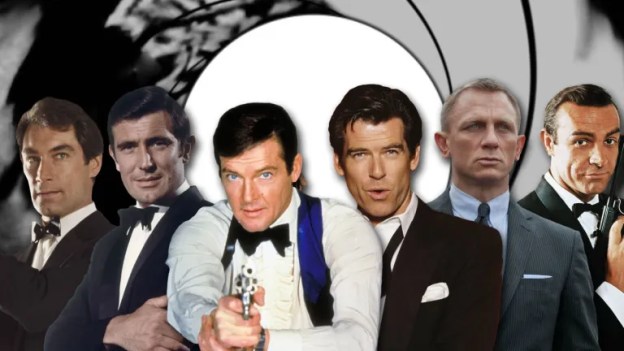
Who is James Bond? James Bond is a sixty-four-year-old British secret service agent, played by six different film actors since his birth in the first Ian Fleming novel of 1953. Because the James Bond character in the novels has been so memorable, the actors who have played this character have been so as well. Anyone who is a Bond fan probably has his own personal favorite “James Bond.” So again, the question is posed: Who is James Bond to you? Is he Sean Connery, George Lazenby, Roger Moore, Timothy Dalton, Pierce Brosnan, or Daniel Craig? This article will walk through which actors played in which movies, which novels those movies spun from, details about the contracts the actors had to sign to play the character, and who is arguably the most famous “James Bond” and why.

From my last set of research, I learned there were 39 novels and 26 films about James Bond’s many adventures. With my most recent research, I have learned there are 42 novels and 25 James Bond films. Because books can cover much more than a movie in greater detail, the films do not hit on every single escapade of Mr. Bond. A few of the films were also remakes of the same excursions as previous movies. All the movies are inspired by the films directly. Most are directly titled after the book they seek to visualize. In the case of Skyfall, there is no Fleming novel entitled Skyfall but many of the scenes and themes are redone from previous films. For example, Bond appearing dead and receiving an obituary is taken from the story You Only Live Twice.

The first actor to take to the screen as James Bond is Sean Connery. Connery’s first Bond film was Dr. No in 1962. He was born to a working-class family in 1930 in Edinburgh, Scotland. He joined the Royal Navy when he was just 16 years old. While in the navy, he got two tattoos. One reads “Mum and Dad” and the other “Scotland Forever.” A stomach ulcer cut his military service shorter than he intended. Upon moving back home, Connery took on many trades. To balance his work life, he took up bodybuilding as a hobby. This would be the bridge that would cross him into acting. Connery’s highlight of his bodybuilding career was his third-place achievement in the Mr. Universe competition in the year 1950. After this success, it took eight years of modeling, small theatrical parts, and work for him to land a supporting role in Another Time, Another Place with actress Lana Turner. This success got him to his first James Bond movie that would change his life forever. Sean Connery would go on to play in five more Bond films and 43 other movies. Connery is said to be one of the greatest actors of all time, earning an Academy Award, two BAFTA awards, three Golden Globes, and knighted Sir Thomas Sean Connery by Queen Elizabeth. Connery is a true testament of how hard work, determination, and humble beginnings can aid anyone in reaching one’s goals.

Five out of six actors who played 007 starred in more than one movie. The famed one-hit wonder who played Mr. Bond is George Lazenby. Lazenby is also the only Bond actor who is not of British Isle decent. Born in 1939 in Australia, Lazenby peaked in his acting career as James Bond at age 29 in the 1969 film On Her Majesty’s Secret Service. With no prior movie roles, Lazenby was a used car salesman who had a small screen career appearing on television commercials for Big Fry’s chocolate bars. Like Connery, George Lazenby had a pretty successful modeling career in London prior to his role as James Bond. When Lazenby heard the news of Connery’s departure from the film series, he did his best to earn the role as Mr. Bond. Buying a tux, Rolex, and getting a haircut like Connery before auditioning for the role all paid off for Mr. Lazenby. After the success of landing the role passed, things no longer looked up for him as Mr. Bond. George Lazenby did not get along with the directors of the film nor his co-stars. He accused Diana Rigg of eating garlic on purpose before their kissing scenes. After the film was released, he received nothing but bad press. He was called a mediocre replacement to the great Sean Connery. A quotation from an article on BBC America explains Lazenby’s departure from the Bond series in more detail:

Lazenby announced that, despite being offered a contract calling for him to perform additional Bond films, he was departing the role. Lazenby’s agent seemingly had convinced him that Bond wasn’t cool enough to survive into the sure-to-be even more swinging 1970s and that he was made for even bigger things. The Bond series producers, already fed up with Lazenby’s oversized sense of entitlement, were happy to see him go.

His prediction about the success of the series could not have been more wrong. After his negative publicity from the film, Lazenby struggled to find other roles.

The third actor to take to the silver screen the same amount of times as Sean Connery is Roger Moore. Moore, now 89, starred in his first bond film Live and Let Die in 1973 at the age of 46. Moore was born in England in 1927. His acting career started in the ’40s and ’50s during his appearances on Broadway. Like Connery, Moore quit school and began work at Publicity Picture Productions at age 15. He started there as an animation apprentice. This would seem like a dream job a young actor would do everything possible not to ruin. Unfortunately, Roger Moore got himself fired shortly after getting hired. Based on his looks, he landed a small role in his first film Caesar and Cleopatra in 1945. Based on his performance in this film, the director decided to enroll and fund him at the Royal Academy of Dramatic Arts. Like many young men living during this time, his career was cut short due to the military draft. At age 18 Moore was stationed in Germany for three years. There he married his first wife of four. After serving his time, he went back to London to continue his career as an actor. He landed a role on The World by the Tail, which made his acting career take off. He signed a contract with MGM for $250 a week but was cut short because of the lack of popularity his films had at MGM. He later signed with Warner Bros. With them he started acting as a television star on The Alaskans and The Saint, the series that landed him the role of James Bond.

Similar to George Lazenby, Timothy Dalton did not have an extremely successful Bond career. Dalton starred in two James Bond movies starting with The Living Daylights in 1987. Dalton, born in 1946 in Wales, was a Shakespearean actor who landed a role in The Lion in Winter in 1946. His role in sci-fi show Flash Gordon landed him his role as James Bond. At a young age, many thought Dalton would join the military and serve like his father. After seeing a performance of Shakespeare’s Macbeth at 16 years old, Dalton made a career of performing in theater. After much success as a young adult, Dalton was approached about succeeding Connery in the James Bond series at 22; however, he turned the offer down because of his young age and experience. Despite his initial “no,” he developed his talent to a place he thought was good enough for the Bond franchise and played 007 19 years later. His first Bond film was a success though the second was a flop, causing his five-film contract to fall by the wayside.

Mr. Pierce Brosnan, born in Ireland in 1953, assumed his role as James Bond in 1995. Brosnan played in four Bond films starting with GoldenEye. After a rough childhood in Ireland, Brosnan moved to London and joined a theater school. Studying there and landing several roles on London’s stage, he moved to Los Angeles, where he starred as the lead role in the detective series Remington Steele. He received an offer in 1986 to play Bond while in his contract with Remington Steele. Because he could not get out of it, his first opportunity as Mr. Bond passed him by. After the show ended, he finally landed a role as 007 after his success with American film projects in between. After his four successful films, he decided to pass the torch to the most recent Bond film star, Daniel Craig.

Finally, my personal favorite, Daniel Craig assumed the role of James Bond in 2006 in the film remake of David Niven’s spoof Casino Royale. Born in Chester, England in 1968, Craig moved to London at age 16 to join a performing arts school. His first performance in a film was The Power of One in 1992. His career took off after the miniseries Our Friends in the North. This contract landed Craig many more film opportunities that put his career on a linear path to stardom. After working with Stephen Spielberg on the film Munich, Craig landed his role in 2006 as 007. After performing in four successful Bond films, questions of his return to the series or a new Mr. Bond are still in the balance.

Most millennials would probably call Daniel Craig or Pierce Brosnan their “James Bond.” Does this mean the younger generations cannot truly appreciate the personality, style, and artistry the other four great film stars gave to Mr. Bond before these two?  No, of course not. It is simply a matter of opinion. The best part about this opinion question is, no matter who a person calls Mr. Bond, all six actors brought 007 to life in a way only Ian Fleming himself could have anticipated. They are in sync with how he claimed his novels would affect the spy entertainment category: “I am going to write the spy story to end all spy stories,” he said, and the James Bond novels and films have done just that.


Bibliography

“Daniel Craig.” Biography.com. A&E Networks Television, 2 Nov. 2015. Web. 11 Dec. 2016.

“The Official Website of Sir Sean Connery.” Sean Connery.com, 11 Dec. 2016. Web. 11 Dec. 2016.

“Order of James Bond Books.” OrderOfBooks.com. Order of Books, n.d. Web. 11 Dec. 2016.

“Pierce Brosnan.” Biography.com. A&E Networks Television, 2 Apr. 2014. Web. 11 Dec. 2016.

“Roger Moore.” Biography.com. A&E Networks Television, 4 Nov. 2015. Web. 11 Dec. 2016.

Rozen, Leah. “50 Years of James Bond: George Lazenby, One-Hit Wonder?.” BBC America. New Video Channel America, n.d. Web. 11 Dec. 2016.

“Timothy Dalton.” Biography.com. A&E Networks Television, 14 Oct. 2014. Web. 11 Dec. 2016.

The Origin of Bond

Destiny Phillips Coats

“Name’s Bond. James Bond,” is one of many famous quotations from Ian Fleming’s 1953 novel character James Bond or agent 007, a British secret intelligence agent. Ian Fleming was born on May 28, 1908 in London, England. Fleming’s book character has taken the entertainment world by storm over the last 64 years. Fleming’s exciting adventures of James Bond have inspired many other writers to develop exciting narratives about Mr. Bond that would also enthrall its audiences. EON Productions, a film production company, is known for producing films associated with James Bond and his many endeavors. Most of the world is familiar with these films, but not so much with the origins of Mr. James Bond found in the original novels by Ian Fleming. This essay seeks to inform readers of the origin and development of its beloved hero, Mr. 007.

To know where the character came from, we must uncover what inspired the author. Believe it or not, Ian Fleming himself and some of his friends were his inspiration for James Bond. Fleming served in the British Naval Intelligence Division during World War II, where he met many agents from his division and elsewhere that were involved in similar adventures as his character 007 would be. He chose this subtle name, Mr. James Bond, to contrast the exciting adventures he would have on his many missions. Fleming once said, “When I wrote the first one in 1953, I wanted Bond to be an extremely dull, uninteresting man to whom things happened; I wanted him to be a blunt instrument … when I was casting around for a name for my protagonist I thought by God, (James Bond) is the dullest name I ever heard.” Ian Fleming gave 007 many similar attributes and likes he himself had. For example, Mr. Bond’s love for gold and gambling were inherited from his author Mr. Fleming. Fleming used names of friends, acquaintances, and old lovers as names for supporting characters in his books. Fleming’s real life and friends played a big role in the making of the most famous secret agent story of all time. Fleming is quoted proclaiming the future success of Mr. Bond to one of his friends saying, “I am going to write the spy story to end all spy stories.” Whether they believed him then or not, it is obvious to us he spoke nothing but the truth.

Fleming wrote the first book, Casino Royale, while in Jamaica in 1952 with his pregnant fiancée. After two months of writing, Fleming asked his friend William Plomer to proof his story. Plomer enjoyed the manuscript. Fleming took his novel to Jonathan Cope who did not like the book very much. On the word of Fleming’s brother Peter, an accredited author, Fleming’s first novel was published in 1953 by Gildrose Publications under Mr. Cope. Jonathan Cope would then publish all of Fleming’s works as the years went on. Because of the success of his book, Fleming bought the publication company. Gildrose desired to have many authors pen stories of James Bond under a common name “Robert Markham,” but unfortunately the idea fell through. Fleming wrote ten James Bond novels and two short story compilations over 12 years.

Ian Fleming died of a heart attack in 1964 as a result of a drinking and smoking problem. Despite his death, Ian Fleming’s legacy lived on among other writers such as Christopher Wood and Kingsley Amis. In his honor, the publishing company was renamed Ian Fleming Publications in 1999. Gildrose honored Fleming’s wishes to not let the James Bond legacy die by handpicking authors to continue the serious up to the present time.

The next James Bond author was John Gardner. Gildrose Publication signed a contract with Mr. Gardner in 1981. He then wrote 16 James Bond novels, two of which became films made by EON Productions. His last Bond novel was published in 1996. Gildrose asked Raymond Benson, an American, to write the next series of Bond novels. Like Gardner, Benson was asked to bring James Bond into the modern era. He did this; however, he was criticized for Americanizing Mr. Bond. Despite criticism, he was praised for returning to Fleming’s original James Bond roots. He wrote his first novel, Zero Minus Ten, in 1997. Benson left Ian Fleming Publications in 2002 after three of his novels were made into films. The next three novelists chosen by Ian Fleming Publications contributed one novel each to the James Bond series. The most recent novelist, Anthony Horowitz, was tasked with creating the thirty-ninth James Bond novel. He used compilations of Fleming’s short stories for inspirations to create the most recent Bond book, Trigger Mortis, released in September 2015. As Ian Fleming Publications has maintained the written Bond series over the last 64 years, EON Productions took on the task of turning James Bond’s adventures on paper into a visual fantasy land for all to emjoy for decades.

Based on Fleming’s novels, James Bond was visually developed in his first film Dr. No in 1962 by EON Productions. Bond’s appearance according to the book and even more so in the movies are a fitted suit, gun, fancy car, and cool gadgets. Iconic images of James Bond include him in a suit with either a cigarette, gun, alcoholic beverage in hand, or a combination of the three. There have been eight actors who have played the character of James Bond on screen in a total of 25 movies and 1 spoof over the last 54 years. The first being Sean Connery, then David Niven, George Lazenby, Roger Moore, Timothy Dalton, Pierce Brosnan, and, most recently, Daniel Craig.  Four other men have been noted for portraying James Bond on the radio and in the first television episodes: Barry Nelson, Bob Holness, Christopher Cazenove, Michael Jayston, and Toby Stephens. Often the changing of an actor to the same character can anger and cause distaste for the series with the public. However, the love for James Bond has only grown over the years to the point his actors will be remembered and honored for all time.

Sean Connery, the first face of James Bond, is arguably the most famous 007 actor. In his first film, Dr. No in 1962, the classic James Bond theme music was played. This music was written by Monty Norman and performed by the John Barry Orchestra. Another essential of the Bond movies is a song played by a well-known artist during the title sequence of the production. The most recent song was Sam Smith’s “Writings on the Wall” in the 2015 bond film Spectre. These songs have become not only hits by the artists who sing them but also will forever be symbols of James Bond productions.

Classic James Bond items like his gun, car, and gadgets have changed over the course of Fleming’s writings in the ’50s and ’60s and the movie adaptations from the ’60s to the present. For example, a fan of the Bond novels in the ’50s, Geoffrey Boothroyd, suggested a change to Fleming of Bond’s weapon, the Beretta 418, because it was a “lady’s gun.”

In thanks, Fleming gave the MI6 Armorer in his novels the name Major Boothroyd and, in Dr. No, M introduces him to Bond as “the greatest small-arms expert in the world.” Bond also used a variety of rifles, including the Savage Model 99 in “For Your Eyes Only” and a Winchester .308 target rifle in “The Living Daylights.” Other handguns used by Bond in the Fleming books included the Colt Detective Special and a long-barreled Colt .45 Army Special (Daily News Dig).

Also Bond’s cars have ranged from Bentley to bus and BMW to Aston Martin.

Bond’s most famous car is the silver gray Aston Martin DB5, first seen in Goldfinger; it later featured in Thunderball, GoldenEye, Tomorrow Never Dies, Casino Royale and Skyfall. The films have used a number of different Aston Martins for filming and publicity, one of which was sold in January 2006 at an auction in the US for $2,090,000 to an unnamed European collector (Daily News Dig).

Interestingly, Fleming’s novels and first screenplays consisted of very few gadgets. The films developed by EON Productions are what we thank for the extensive and exciting briefings with Q Branch, Bond’s tech support from whom agent 007 receives his many trinkets that aid him in fighting crime and completing his missions. Thanks to the creativity of Ian Fleming, his fans, Ian Fleming Publications, and EON Productions, we have a series that has lived on for over 60 years and hopefully will continue for generations to come.

Novel after novel and movie after movie, James Bond has landed a place in the hearts of men, women, and children from 1953 to 2017. Over the course of these 64 years, James Bond has been developed by 7 authors, 12 actors, one publishing company, and one entertainment group. There are 42 James Bond books and 26 films. A new James Bond actor is being chosen as of this writing, along with the making of another action-packed film. Unlike many other series, James Bond is an entertaining work known for being adapted by many. Ian Fleming meant it when he said, “I am going to write the spy story to end all spy stories,” and we can all agree that this is exactly what he did.

Bibliography

Daily News Dig. “James Bond History — Discover The Secret Agent’s Origins And More.” Daily News Dig. Daily News Dig, 29 Nov. 2013. Web. 09 Oct. 2016.

Fandom. “James Bond Books.” James Bond Wiki. Wikia, n.d. Web. 09 Oct. 2016.

“James Bond — Ian Fleming.” Ian Fleming. Ian Fleming Publications, 2016. Web. 09 Oct. 2016.

“Who Played James Bond: A Complete History.” Who Played James Bond: A Complete History. 007 James, n.d. Web. 09 Oct. 2016.

He is Real and He is Risen

Destiny Phillips Coats

Faith is an important part of everyday life whether one is an atheist, Buddhist, or Christian. All worldviews and religions are based on a premise or ideal. For that worldview or religion to hold true, humans want to see evidence; however, everything humans believe cannot be scientifically proven with evidence all the time. Nevertheless, we should always try to uncover the truths we can to be closer to the reason why we are here. As a Christian, this is extremely important. With the current vehement attack on religion by secularists around the world, Christians are constantly being questioned if their “Jesus” is real more and more often. It is vital believers of any religion can properly defend themselves against false truths and claims made against them by others. One aspect of Christianity all believers must defend is the case and point of Jesus Christ. The points brought up in the following paragraphs will prove the resolution of the Christian faith Jesus of Nazareth (called Christ) was executed by order of the Roman Governor (Pontius Pilate), was buried, then was resurrected and appeared in bodily form to His followers. There will be six points of proof confirming this resolution. The proofs are as follows: prove the authentication of the New Testament by including the date it was written and if the authors wrote from close experience about the events in which they wrote, prove Jesus was a real man who walked upon the earth, prove Jesus made the claim to be the promised Messiah, prove Jesus was crucified by Pontius Pilate for the crime of blasphemy brought on Him by the Jews, prove Jesus died by means of crucifixion, and prove Jesus resurrected. Not only believing these proofs but knowing it for oneself to be true can work wonders in his daily walk, the way he evangelizes, and again his personal relationship with Christ. For some, just to believe something is not enough. This essay presents reasoning and evidence why one should believe in the existence, death, and resurrection of Jesus Christ, our Lord and Savior.

To affirm this resolution, I would like to first prove the authentication of the New Testament.  In doing this, one would need to know the date the New Testament was written and if the authors wrote from close experience about the events in which they wrote. Jesus’ birth marks A.D. 0 on history’s timeline, so all His actions on the Earth would have been done in the first century; therefore, the New Testament would be the most accurate if also written in the first century. Good thing for Christians, it was. Per the book New Evidence That Demands a Verdict, the New Testament was written in “A.D. 50-100” (McDowell 38). It reads

John Ryland’s manuscript, found in A.D. 130, is located in the John Ryland’s Library of Manchester, England (oldest extant fragment of the New Testament). Because of its early date and location (Egypt), some distance from the traditional place of composition (Asia Minor), this portion of the Gospel of John tends to confirm the traditional date of the composition of the Gospel about the end of the 1st century (38).

All manuscripts we have today of ancient writings or documents are copies of copies; therefore, trying to disprove the validity of the New Testament with the argument it is not the original text is disqualified (Hamilton). In comparison to most ancient writings, the New Testament is easily considered the best attested in terms of the number of copies and the variety of documents available to sustain or contradict it (McDowell, New Evidence 38). For example, Homer’s Iliad was composed in 800 B.C., but the earliest copy found was in 400 B.C. and there are only 643 copies. That is a 400-year gap! The New Testament was composed between the years A.D. 50-100 and fragments were found in A.D. 114. Books were found in A.D. 200, most of the New Testament was discovered in A.D. 250, and finally the complete New Testament was revealed in A.D. 325. On top of that glorious information, there are 5,366 copies (38)! Knowing this, there is no reason why someone cannot believe or at least consider the authenticity of the New Testament. Also, there is proof the authors of the New Testament wrote from close encounters with the main character, Jesus. “The writers of the New Testament wrote as eyewitnesses or from firsthand information” (51). An example of this is Luke 1:1-3:

Inasmuch as many have undertaken to set in order a narrative of those things which have been fulfilled among us, just as those who from the beginning were eyewitnesses and ministers of the word delivered them to us, it seemed good to me also, having had perfect understanding of all things from the very first, to write to you and orderly account, most excellent Theophilus (51).

McDowell quotes F. F. Bruce, who said,

The earliest preachers of the gospel knew the value of…first-hand testimony, and appealed to it time and time again. “We are witnesses of these things,” was their constant and confident assertion. And it can have been by no means so easy as some writers seem to think to invent words and deeds of Jesus in those early years, when so many of His disciples were about, who could remember what had and had not happened.

And it was not only eyewitnesses that the early preachers had to reckon with; there were others less well disposed who were also conversant with the main facts of the ministry and death of Jesus. The disciples could not afford to risk inaccuracies (not to speak of willful manipulation of the facts), which could at once be exposed by those who would be only too glad to do so. On the contrary, on the strong points in the original apostolic preaching is the confident appeal to the knowledge of the hearers; they not only said, “We are witnesses of these things,” but also, “As you yourselves also know” (Acts 2:22). Had there been any tendency to depart from the facts in any material respect, the possible presence of hostile witnesses in the audience would have served as a further corrective (51-52).

Next, I will uncover evidence for why one should accept the facts Jesus of Nazareth truly walked upon the Earth. This argument tends to be easy to prove because so many secular sources outside of the Bible reference the man who Christians call Christ (Hamilton). The excerpt known as the “Testimonium of Josephus,” which comes out of book 18 of Josephus’ Jewish Antiquities is enough to prove this point. Josephus was a Jewish scholar captured by the Romans during the first Jewish revolt against Rome. He was made mediator and interpreter for the Romans during the remainder of the revolt. Two of his writings are The Jewish War and Jewish Antiquities. A portion of the “Testimonium of Josephus” reads, “Now there was about this time Jesus, a wise man, if it be lawful to call him a man, for he was a doer of wonderful works, a teacher of such men as receive the truth with pleasure. He drew over to him both many of the Jews, and many of the Gentiles. He was the Christ…” (McDowell, New Evidence 125). Other writers such as Cornelius Tacitus, Suetonius, and Thallus mention this man, Christ, in their writings. Tacitus, a Roman historian who lived from A.D. 55-120, wrote during the reign of Nero concerning Christ. “…the persons commonly called Christians, who were hated for their enormities. Christus, the founder of the name, was put to death by Pontius Pilate, procurator of Judea in the reign of Tiberius: but the pernicious superstition, repressed for a time, broke out again, not only through Judea, where the mischief originated, but through the city of Rome also” (120-121). Tacitus’ misspelling of Christ, “Christus,” was a common error made by pagan writers of the time (120).

The claim was made by Jesus that He was the promised Messiah. Claiming to be the Son of God or Messiah was considered blasphemy in the Jewish religious system and punishable by death, hence why Jesus was ultimately crucified. Jesus often referred back to the Old Testament prophecies about Himself when hinting to his followers about who He was. Luke 24: 27 reads, “And beginning with Moses and all the Prophets, he interpreted to them in all the Scriptures the things concerning himself.” Also, Luke 24:44 declares, “Then he said to them, ‘These are my words that I spoke to you while I was still with you, that everything written about me in the Law of Moses and the Prophets and the Psalms must be fulfilled’” (McDowell, Carpenter 97). McDowell says, “the Old Testament contains sixty major messianic prophecies and approximately 270 ramifications that were fulfilled in one person, Jesus Christ. It is helpful to look at all these predictions fulfilled in Christ as his ‘address.’ Let me explain. You have probably never realized the importance of your own name and address, yet these details set you apart from more than six billion other people who also inhabit this planet” (98). “Certainly God was writing an address in history that only his Messiah could fulfill. Approximately forty men have claimed to be the Jewish Messiah. But only one, Jesus Christ, appealed to fulfilled prophecy to substantiate his claims, and only his credentials back up those claims” (99).

Jesus was crucified by Pontius Pilate for the crime of blasphemy brought on Him by the Jews. The two main groups of Jewish leaders at the time were the Pharisees and Sadducees. On views concerning the Messiah, these two groups were not on the same page but came together when they had a common problem, Jesus Christ. They also had different purposes when it came to governing their Jews (Hamilton). The Pharisees believed the reason the Jews were under oppression by the Romans was because God would not send the promised Messiah until they were worthy enough.  In accomplishing their worthiness, the Pharisees used violent methods for the Jews to strive for purity amongst other people. Therefore, there was such hatred and strife between the Jews and Gentiles throughout history and the Bible. When Jesus came on the scene, He began to break down these barriers the Pharisees had set between the Jews and other people groups. Jesus ministered and dwelt amongst tax collectors, prostitutes, and criminals. In the eyes of the Pharisees, this was completely absurd and totally broke down all boundaries they had worked so hard to set between “God’s people” and others (Hamilton). The Sadducees, on the other hand, were more concerned with staying in good graces with their oppressors at the time, the Romans. The Romans did not care or were not concerned with who the Jews worshipped unless it conflicted with political rule. The promised Messiah did exactly that. The Messiah for the Jews was the one who the Jews believed was going to come and set them free from their oppressors. This in turn threatened the political rule of the Romans and threatened the well-being of the Jews under their rule. During Passover, Jesus rode into Jerusalem on a donkey as the Jews surrounded him and called Him “Messiah,” “Hosanna,” the “Christ.” These names carried meaning far more than we credit them with today, which is why the authorities felt threatened. This caused the Pharisees and Sadducees to come together to take down a common enemy (Hamilton). Book 18 of Josephus’ Jewish Antiquities reads, “He was the Christ, and when Pilate, at the suggestion of the principal men among us, had condemned him to the cross, those that loved him at the first did not forsake him; for he appeared to them alive again the third day; as the divine prophets had foretold these and named from him are not extinct at this day” (Hamilton).

With Josephus being a Jew himself, when he writes “us,” he is referencing other Jews (Hamilton). Cornelius Tacitus, a Roman historian who lived from A.D. 55-120, wrote during the reign of Nero concerning Christ,

But not all the relief that could come from man, not all the bounties that the prince could bestow, nor all the atonements which could be presented to the gods, availed to relieve Nero from the infamy of being believed to have ordered the conflagration, the fire of Rome. Hence to suppress the rumor, he falsely charged with the guilt, and punished with the most exquisite tortures, the persons commonly called Christians, who were hated for their enormities. Christus, the founder of the name, was put to death by Pontius Pilate, procurator of Judea in the reign of Tiberius: but the pernicious superstition, repressed for a time, broke out again, not only through Judea, where the mischief originated, but through the city of Rome also .

McDowell, New Evidence 120-121

Also, inspired by another Roman Historian Suetonius, McDowell writes, “Assuming Jesus was crucified in the early thirties, Suetonius, no friend of Christianity, places Christians in the imperial city less than twenty years later, and he reports that they were suffering and dying for their conviction that Jesus Christ had really lived, died, and risen from the dead” (122).

Proving the death of Christ is not something debated upon because of the gruesome medical analysis of a Roman crucifixion. The crucifixion process consisted of a flogging or scourging and then the nailing to the cross. Flogging or scourging was done while one was stripped of clothes. The person would be beaten with a leather whip that had pieces of broken bones and iron balls on the end of the whip before being hung on the cross. The victim subjected to the cross would be flogged within inches of his life. The Jews would only allow forty strikes from the whip to the victim. This confirms the account from the Gospels Jesus obtained thirty-nine strikes during his flogging. At this point in the process, the victim could easily die from blood loss or shock from the pain. In the case of Jesus, He did not. After this, the victim had to carry his cross to the venue where he would be hung. Once he reached the chosen spot, he was nailed to the cross near the top of his wrists and feet. The most common cause of death was suffocation. This was because the body weight of the victim was being pulled down by gravity making it hard to breathe. To exhale, the victim would have to push up from his feet, which caused excruciating pain. Eventually, the victim would give up and die. If it took too long for the person to die, the Roman guard would break the knees of the victim so he would suffocate faster (Gidley). This was not done with Jesus because He was already dead after six hours of being on the cross.  But to confirm His death, they pierced Him in the side of His abdomen with a spear. The Babylonian Talmud reads,

It has been taught: On the eye of Passover they hanged Yeshu. And an announcer went out, in front of him, for forty days (saying): “He is going to be stoned, because he practiced sorcery and enticed and led Israel astray. Anyone who knows anything in his favor, let him come and plead in his behalf.” But, not having found anything in his favor, they hanged him on the eye of Passover (King).

Another version of this says, “Yeshu of Nazarene.” “Yeshu” is Greek for “Jesus” and “Nazarene” makes further connection to Jesus Christ. Also the “hanged” is a reference to crucifixion. Luke 23:39 reads, “One of the criminals who were hanged railed at him, saying, ‘Are you not the Christ? Save yourself and us!’” (McDowell, New Evidence 123-124).

The final part to prove of the resolution concerning Jesus’ resurrection is the most difficult to prove, but nonetheless, it has been done. First off, a whole religion took off from this man Jesus who claimed to be the Messiah. The thing that made Jesus significantly different from all the other claimed Messiahs was His resurrection. The other twelve “Messiah Movements” before and after Him dissipated after their deaths, but Jesus’ movement took off because of His incredible death and resurrection. To discredit the resurrection, one would have to come up with an explanation for why the tomb came up empty. The tomb was empty because Christianity would not have been validated if the body had been in the tomb for people to see the disciples were lying; therefore, this “Jesus” would have been just another fake. The Talmud proclaims the disciples stole the body, but that can be easily disproved. When people die for faith, this means they genuinely believe what they believe is absolute truth. For the disciples to steal the body knowing Jesus was not resurrected but all end up dying for his sake would be idiotic (Hamilton). The appearances are also confirmation of how we know Jesus was raised from the dead. Jesus appears to the disciples, James (his step brother), the apostle Paul, and 500 witnesses (1 Corinthians 15:3-7). People try to disprove the appearances by saying they made it up or they had hallucinations (Hamilton). First of all, hallucinations are sourced from previous events or thoughts. If none of these people ever thought or considered a resurrection or a picture of the way his new body looked, how then could they give such vivid accounts and descriptions of how he looked? Also there is no way so many people who were not associated with each other could have had the same hallucination. Then there is the whole theory they made it up. This can be disproved with the fact Paul, who saw Jesus, was actually an enemy of Christians previous to his so-called “hallucination.” He persecuted them on a regular basis. But after his encounter with Christ, he became one of the greatest people of the faith and wrote the majority of the New Testament (Hamilton). As stated above, in the “Testimonium of Josephus” Josephus wrote, “For he appeared to them alive again the third day; as the divine prophets had foretold these and ten thousand other wonderful things concerning him” (McDowell, New Evidence 125).

As a Christian, writing this essay has not only increased my faith in what I believe to be true but also has given me the ability to witness to nonbelievers with a better knowledge of what it is I am striving to convince them. The evidence provided above is clear and adequately affirms the resolution Jesus of Nazareth (called Christ) was executed by order of the Roman Governor (Pontius Pilate), was buried, then was resurrected and appeared in bodily form to His followers.

Believers with questions of any faith should always desire or seek out truth for what they believe. If one is to travel upon this journey and comes out on the other end less convinced, he must consider his faith. Thankfully in my case, I gained a deeper understanding and love for the great attention God put into helping people who desire to know Christianity is valid.


Works Cited

Gidley, Robert. The Facts of Crucifixion. The Cross Reading. n.d. Web. 11 Dec. 2013.

Hamilton, Seraphim. Summit Christian Academy, Yorktown. 9, 11 Dec. 2013. Lecture.

King, Kevin. The Hanging of Yeshu. Rabbinic Literature. n.d. Web. 22 Jan. 2014.

McDowell, Josh. The New Evidence That Demands a Verdict. Nashville: Thomas Nelson, 1999. Print.

—. More Than a Carpenter. Carol Stream: Tyndale House, 1977. Print.

Two Worldviews Outside of Christianity

Destiny Phillips Coats

As young believers in a Christian environment, we often forgot the rest of the world does not think the same as we do. 32 percent of the world is composed of Christians across the globe. 63 percent of Americans claim to be affiliated with a church. That is 247 million people out of roughly 321 million people. With those huge numbers and big percentages, why does it seem like around the world, but specifically America, Christianity is being vehemently opposed? This is because there are strong competing worldviews in direct opposition to Christianity. One’s worldview affects the way he sees himself and those like him, those different from him, and the world itself. Two opposing worldviews to Christianity today are Islam and Marxism. As young Christians, it is extremely important to understand these main worldviews before we enter the adult world so we can be knowledgeable when spreading God’s word and understanding the times.

In examining both of these worldviews, one must know the key terms that build the worldview itself up. When an American hears “Islam,” words like religion, Allah, terrorist, and Muhammad are things that come to his mind. Things like this come to their minds because when America as a nation has interacted with Islam, it is typically associated with these words also. Personal encounters with Islam will cause individuals to have more, less, or different words be associated with Islam also. What is Islam in and of itself? Islam is defined as a theistic worldview centered on the life of the prophet Muhammad that derives its understanding of the world thought the teachings of the Quran, Hadith, and Sunnah. Key words to understanding this definition are theistic, Muhammad, Quran, Hadith, and Sunnah. Theistic is an adjective for something that believes in the existence of god. In the Muslim religion, there is one “true” god. Islam originated from revelation given to Muhammad from the angel Gabriel. Gabriel is an angel from the Christian faith. Muslims, Islam’s followers, believe themselves to worship the same god as the Jews. “God” in Arabic is “Allah.” The Quran is the holy book of Islam. It is full of dictations from Muhammad, which Muslims believe is the direct word of Allah. The “Hadith” is the oral history of Muhammad’s teachings, rulings, and the actions of himself and his early companions. The Sunnah is the specific part of the Hadith describing Muhammad’s exemplary actions. This definition of Islam as a worldview explains where the ideas that shape the worldview come from. Muslims view themselves, others, and the world per the teachings found in their main doctrine, the Quran.

Unlike Marxism, Post Modernism, and Secularism, Islam is not only a worldview but also a religion. Because of the religious practices and teachings of Islam, a perception of life itself is also developed. The three perceptions worldviews deal with are oneself and those like him, others, and the world. “Islam” translated to English is “submission to the will of god.” Based upon the Quran, the world itself is divinely created by the one true Allah. They see the world in complete “submission” to Allah. Because everything is in submission to Allah, everyone is a Muslim at birth. Muslims see themselves as inherently Muslim. They are in submission to Allah. If Islam claims everyone is Muslim, how does it explain the lack of the whole world worshipping Allah as one Islamic body of believers? Those who do not believe in Islam are seen to be in rebellion against Allah. Based on the Islamic worldview, the world is divinely created and in submission to Allah; people themselves are born inherently Muslim; those who deny Islam are in rebellion against Allah. If an entire group of people see everyone unlike them, in rebellion to their deity, what is the action to be taken? In the Quran and exemplified in the Hadith, Muslims are to wage jihad or “holy war” against those in rebellion against Islam.

According to Islam, jihad has two meanings. Translated to “struggle” in English, jihad is both the inner spiritual battle of every Muslim to fulfill his/her religious duties and the outer, physical struggle against the enemies of Islam. Just like any other religion, practices and rituals come with being a part of Islam. These include following Shariah Law and participating in the Five Pillars of Islam. This is the inner jihad. The outer jihad is to physically fight against those who do not believe in or submit to Allah. Do all Muslims believe they are called to fight against those who do not agree with their worldview? No. The population of Muslims who actually wage war on “infidels” or nonbelievers is very little, but those who do are simply following the teachings of their worldview. Both forms of jihad are justified in the Quran. Examples are in Surrahs 3-5.

And their Lord hath heard them (and He saith): Lo! I suffer not the work of any worker, male or female, to be lost. Ye proceed one from another. So those who fled and were driven forth from their homes and suffered damage for My cause, and fought and were slain, verily I shall remit their evil deeds from them and verily I shall bring them into Gardens underneath which rivers flow — A reward from Allah. And with Allah is the fairest of rewards (Surrah 3:195).

This passage is one of many that claims those who fight and perish for the name of Allah will be pardoned from all sin and greatly rewarded by Allah. A lot of Americans think because a very small percentage of Muslims are openly radical, the faith of Islam itself is not a threat, just those specific jihadists (those who practice the outer holy war against infidels). However, what is the danger of a worldview that believes everyone is in direct rebellion against god and is to be warred against? The one word answer is terrorism. Does every Muslim seek to destroy the lives of infidels? No. But Muslims look at the life of Muhammad and his followers like Christians do the first century church. They desire to emulate them. Muhammad and his followers spread Islam by military conquest. They used violent force to convert people to their faith, thus creating a culture of people who believe in Islam as a worldview. They used fear to create Islamic societies. Like the Christian religion, Islam shapes the way you think. The way one thinks will have a huge bearing on his actions. Because of the early Caliphs and how they interpreted their religion, they acted violently toward nonbelievers, creating one of the strongest empires the world has ever seen. What is to stop Muslims today from rising and waging war on all the world for the sake of Allah? People around the world cannot afford to think groups like ISIS, Al-Qaeda, and political powers in Iraq are simply all about power. What they are doing is tied to their faith, their worldview. If the rest of the world is not careful, we will find ourselves fighting a battle we welcomed into our own backyard.

Often people think Communism died with Stalin. That is not true. The average person also is not completely aware of what Communism means or where it comes from. Communism is a societal structure that flourishes under the worldview developed by Karl Marx, Marxism. Marxism is an atheistic and materialistic worldview based on the ideas of Karl Marx that promotes the abolition of private property, public ownership of the means of production (i.e., socialism), and the utopian dream of a future communistic state. Key terms to understanding Marxism as a worldview are communism, socialism, class struggle, atheistic, and materialistic. Communism is the Marxist ideal of a classless and stateless utopian society in which all property is commonly owned and each person is paid according to his or her abilities and needs. Socialism is an economic system based upon governmental or communal ownership of the means of production and distribution of goods and services. Class struggle is the economic and social differences between the upper and lower classes. Atheistic is a descriptor meaning a thing does not believe in the existence and or relevance of God. Materialistic is a descriptor meaning a thing believes nothing exists except the material world we can see and observe.

Like Christianity and Islam, Marxism as a worldview tells a
“metanarrative” — a single, overarching interpretation (or grand story) of reality. Christianity and Islam start with divine creation. Because Marxism is atheistic, it cannot entertain divine creation. The only thing left to believe is evolution. Marxism’s “holy book” is The Communist Manifesto written by Karl Marx himself. Marx starts his metanarrative with the world history of class struggles. In this first portion of the manifesto, Marx explains the historical misfortunes of the world as a struggle between the rich and the poor or the “bourgeoisie” and the “proletariat.” He gives example of master and slave, lord and serf, and upper and lower class. What is the cause for class distinctions? Money! Money is the deciding factor between the bourgeoisie and the proletariat. So to Marx, the problem and solution for mankind is economics.

Before Marx’s time, democracies, republics, feudal systems, monarchies, and dictatorships had been tried. None seemed to work because of the corruption of the bourgeoisie from their money. Marx concluded in a society where everyone works, one is paid according to that work and what he needs to live, with nothing more and nothing less; everyone can be happy and equal. This is communism. Communism is a societal structure in which there is no such thing as “mine” but instead “ours.” Everything within society belongs to the people. No matter how much more work one does over another, he walks away with only what he needs. Everything is owned by everyone. The strong make up for the weak and everyone gets their fair share. This seems all good and fine until one stops and thinks. How many people are going to be willing to release all their revenue to benefit those who did not work for it? Not very many. Marx knew this. He knew communist perfection or “utopia” (an imagined place or state of things in which everything is perfect) could not be obtained without violent overthrow of the bourgeoisie by the proletariat, the oppressor by the oppressed.

The societal enemy of Marxism is the rich or bourgeoisie. The economic enemy of Marxism is capitalism. Capitalism is an economic system in which capital assets are privately owned, and the prices, production, and distribution of goods and services are determined by competition within a free market. Two words that obviously make capitalism an enemy of Marxism are “privately” and “competition.” Marxism is all about the abolition of private anything and everything. Competition implies there will be someone on top and someone on the bottom. Marxism desires for all people to be on an equal playing field at all times. If communism calls for the equal distribution of wealth always in perfect harmony, how does one get there from capitalism? The answer is socialism. According to Marx, socialism is the path to communism and will inevitably always end up at the communist utopia. Socialism is a word more of us are familiar with. Recent presidential candidate Bernie Sanders is a proclaimed socialist. Europe is governed by a social democracy. China and North Korea are governed by a cross between communism and dictatorships with an economic combination of socialism and capitalism as well. We can see from these few examples Marxism is not dead but very much alive and well in influential parts of the world. So as a worldview, how does Marxism view its followers, outsiders, and the world?

Marxism’s view of the world is evolutionary. Evolution is progressive — always moving forward and getting better. If the social end in Marxism is communism, they view the world and people as always progressing toward socialism and eventually to communism. Marxists believe the world will inevitably arrive at utopia through a communist state. Marxist claims those who believe and drive society to this social end is the oppressed, the proletariat. Everyone against this inevitable social end is the rich, the bourgeoisie. The problem with Marxism is not its diagnosis for the world but rather its prescription and treatment. Because Marxism is atheistic, good and evil, moral and immoral do not have a universally understood standard. Instead, good or moral is anything and everything geared toward the advancement of the proletariat and the eradication of the bourgeoisie. Bad is everything in opposition to the proletariat. This definition of good and bad justifies all behavior that progresses the proletariat agenda. This is what must concern the world. Today it might seem like people desiring marriage equality and cheap affordable all-inclusive health care is a simple policy fix. But if a generation of people viewing good as what supports the agenda they have, a violent overthrow like that of Germany during WWII will overtake hundreds of modern day societies.

Unlike Islam, it is not our job as Christians to wage war on nonbelievers. God tells us in Scripture not all of mankind will come to the knowledge of Him. We know there will be those who vehemently deny the faith. We know there will be people who try to manipulate the faith to suit their own ideologies. With that knowledge, what must we do? We are called to love all those who are made in the image of God and spread the Gospel with everyone regardless if they become believers or not. Both Islam and Marxism seek to wrongfully control mankind. Islam seeks to war against all in opposition to it. Marxism claims all actions, no matter how vile, are good if they progress to communism. Moreover, Marxists believe the only way to reach utopia is through violence. What an oxymoron: violence will bring about peace? That goes completely against the current natural order of violence and disorder creating more violence and more disorder. Islam and Marxism believe all who are opposed to them deserve death and punishment. Christianity proclaims those who do not believe are to be loved and witnessed to until the point of death. God does not call us to wage war against His opposers, but rather show them love, thus revealing His character. Scripture contains all the tools necessary to build a case for itself against any argument. God foresaw all the ideas His truth would face. Because God declared we “are the head and not the tail,” we can always come out on top in any argument or situation if we present the truth contained in the Scriptures. However, it is our duty to also understand what we are up against so we might be able to defend the hope within us properly and adequately.

Abortion: Divisive in Nature

Destiny Phillips Coats

In America today, we are all familiar with the term abortion. We hear about it on the news, in school, on television, at church, and in the public square. We hear the terms pro-life, pro-choice, and Roe v. Wade often as well, especially during last year’s election. Currently in my sociocultural class, we are discussing modern issues that should concern the modern Church (body of Christian believers). These issues include marriage equality, new forms of gender roles, right to privacy, infringement upon free speech, the ACA or “Obamacare,” college discrimination laws, and abortion. Although we are going over abortion’s effect on the country currently in class, I did some outside of class digging to uncover the history of abortion for myself to put my knowledge to the test. During this quest of discovery, I realized I knew very little about the subject.

Per Meriam Webster’s Dictionary, a “simple” definition of abortion is a medical procedure used to end a pregnancy and cause the death of the fetus. With that definition in mind, let us start at the beginning, the very beginning. Abortions have been practiced since ancient times. The first recorded abortion dates to 1550 bc in Egypt. The Ebers Papyrus, also known as Papyrus Ebers, is an Egyptian medical papyrus (a material prepared in ancient Egypt from the pithy stem of a water plant, used in sheets throughout the ancient Mediterranean world for writing or painting on, also for making rope, sandals, and boats) of herbal knowledge dating to c. 1550 BC. Abortions at its early points in history were performed through strange physical practices that were not very effective — jumping up and down, the drinking of strange herbal elixirs or potions, and the killing of the baby post-delivery. Overtime the science of abortion has evolved immensely. Since abortion is an old practice like homosexuality, murder, bestiality, etc., why is it within the last 41 years becoming legal in the United States of America?

Most of America 50 years ago would easily say the United States was founded on Christian/Godly principles found in Scripture. Why is this? The Founders were living in a Christian world. One of the big reasons America was founded was for religious freedom. Was this because the Founders wanted to practice witchcraft and such? No, the Puritans and Protestants wanted to live in a new land, free of religious persecution from England. Puritans and Protestants are Christians. They are not a part of the Church of Scientology, the Church of Satan, or Hinduism. They are indeed denominations of Christianity. If most of the world was Christian at this time in world history, that would then also mean many things would be considered horribly immoral. Abortion was included among these things. Psalm 127:3 (ESV) “Behold, children are a heritage from the LORD, the fruit of the womb a reward.” Now if most of the world believes children are a heritage or “gift” from God, how many do you think will rally behind those who desire to murder them in the womb? Not very many would. Furthermore, 1 Samuel 2:6a declares “The LORD kills and bring to life.” The Bible is full of Scriptures concerning all aspects of life in the womb and how it is divinely ordained by God. Abortion was doomed to be a forbidden practice in everyone’s eyes. With that said, how did we get to where we are today?

Because of sin — specifically Modernism — we now live in a Secular Western world. Secularism as a worldview is atheistic in nature believes mankind will only progress to something better, and relative/personal truth is what individuals are to be governed by. As American society has moved farther and farther away from Biblical standards of morality, it has become clearer and clearer the intentions of our government to make everything under the sun legal. However, our legal system is way more deceptive than just making something a law on no grounds. They instead have falsely laid abortion’s foundation in our new “living” Constitution. The premise upon which abortion lies in the Constitution is the “right to privacy.” This “right to privacy” was discovered by the Supreme Court in the 1920s in the 4th Amendment of the Bill of Rights. The 4th Amendment reads

The right of the people to be secure in their persons, houses, papers, and effects, against unreasonable searches and seizures, shall not be violated, and no warrants shall issue, but upon probable cause, supported by oath or affirmation, and particularly describing the place to be searched, and the persons or things to be seized.

Reading this personally I see nowhere a direct claim to a “right to privacy” outside of the inability of government to come into your property and unlawfully search it. The argument used for the “right to privacy” is privacy itself is the underlying meaning of all the Amendments. Protection of beliefs, the home, property, personal information, etc. listed in the Bill of Rights are now considered private matters protected by the Constitution. Because of this perception of the Amendments, the Supreme Court named privacy as a “right.” Rights are defined as legal, social, or ethical principles of freedom or entitlement. Entitlement is defined as the belief one is inherently deserving of privileges or special treatment. The word entitlement is very key in understanding why people now believe privacy is a “right.” Entitlement implies one is deserving of it (the entitlement itself). If a right is an entitlement, and privacy is a right, then everyone is required to have their own personal “right to privacy.” This “right to privacy” is fine when it falls in alignment with what the Bill of Rights has clearly laid out in its text, but in the 1920s the Supreme Court applied it to things not enumerated in the Bill of Rights. The first application of this new right was to a marriage and now has been applied to the practice of abortion.

The two cases leading up to the final decision made by the Supreme Court in 1973, legalizing abortion was Doe v. Bolton and Roe v. Wade. Doe v. Bolton was a case in which a married Georgia woman, Doe, claimed the reasoning behind her denial for an abortion under the current Georgia state laws in 1971 were “unconstitutional.” Doe claimed Georgia state law regarding abortions was in direct opposition specifically with the 14th Amendment. The 14th Amendment was adopted in 1868 as a response to the emancipation of African Americans and their rights to all rights and freedoms Whites had from the Constitution. Now one can logically infer taking an Amendment aimed at protecting African Americans from injustice and applying it to a case concerning abortion is a stretch. In this case, the courts ruled in favor of Doe because of what would take place in Roe v. Wade. Roe v. Wade was a case brought to the Supreme Court concerning a single pregnant woman, Roe, who desired to be granted an abortion outside of the current abortion laws for Texas. Her defense claimed abortion fell under the “right to privacy” that had been discovered and applied to other rulings in recent years made by the Supreme Court. In a majority vote of 7-2, the Supreme Court changed the course of America by making abortion of any kind legal.

At this point in history, abortion was a procedure taken up until the end of the first trimester or first 12 weeks of pregnancy. As of today, abortion is legal up until birth. Matter of fact, partial birth abortions were banned in 2003. To better understand abortion in and of itself, we need to uncover the different types of abortion that must be taken dependent upon the different stages of pregnancy. During the first trimester one can have a surgical abortion: manual vacuum aspiration (MVA), or medical abortion: the abortion pill (mifeprex). After the first trimester, surgical abortions are the only option. Abortions have evolved a lot since ancient times, but no matter how it is done it is all murder one in the same.

Medical abortions are abortions in which a form of medication, a pill, can be taken to terminate a pregnancy. Surgical abortions are a surgical procedure must take place to physically remove the baby from the womb. Surgical abortions range from vacuum procedures in which the pregnancy is chemically terminated and the contents of the child are sucked out of the womb, all the way to partial birth abortions in which the child is killed after she has partially departed from the womb during labor, and her first breath has not yet been taken. Partial birth abortions were determined illegal in 2003; however, Presidential candidate Hillary Clinton was intent on legalizing it again.

We now know what abortion is, when it started, when it became legalized, and its different forms. But what are the two positions on this issue? Anyone who goes outside her door has heard the words pro-life and pro-choice. What do they mean? Without looking at specific statements made by both groups, we can decipher from the verbiage used “pro-life” means for or supporting life and “pro-choice” means for or supporting choice. Pro-life argues the unborn child is alive and abortion is a form of murder. Pro-choice argues a woman has the right to choose to terminate her pregnancy because she is in complete control of what goes on in her body. These are two very different arguments. One argues for life and the other for choice. Logically we can see why the two groups are at such odds and will never truly come to a decision on the matter. The two groups are arguing different things. They will always butt heads. To better understand how we as believers should feel about the subject, we need first to look at what God has said concerning this issue.

As Christians living in a very secular world, we are constantly hitting road blocks concerning ideas that make us nervous when in the public arena. Often Christians are faced with an opportunity to speak out on subjects of much controversy but do not out of fear or lack of understanding of what God has revealed in His Word concerning it. At the beginning of Scripture, we read God bringing forth life. He created all life known to man in six days. In 1 Samuel, we see Hannah go before God barren, pleading with Him for a child to whom she would dedicate back to Him. God answered her prayer with Samuel and she in return honored her promise to the Lord by giving him to Eli to live under the teachings of the priest. Because of David’s sin with Bathsheba, God took away the life of their son. Because of Pharaoh’s wickedness, the Angel of the Lord took away the first-born son of all the Egyptians who did not cover their doors with the blood of the lamb.  Mary was impregnated by the work of the Holy Spirit and gave birth as a virgin to King Jesus. Throughout the entirety of Scripture, we see God is the giver of life and He is the one who takes it away. To affirm the doctrine implied by pro-life, life begins at conception. God granted Hannah the ability to have a child. God made Mary pregnant with baby Jesus. God declares children are His gifts to us.

Most Christians agree on this topic but many are shaken on the subject of rape. “What if someone is raped and becomes pregnant? Some people cannot bear to carry a product of a traumatic experience.” A lot of reasoning is given in support of abortion after rape by nonbelievers and believers alike; however, believers have no excuse to come to this terrible conclusion. Why? God declares in Deuteronomy 24:16, “Fathers shall not be put to death because of their children, nor shall children be put to death for the sins of their fathers. Each one shall be put to death for his own sin.” Rape falls under the category of “sin of their father.” When believers support the “rape argument,” they are going in direct opposition to God being the giver of life and a child is not to be punished for the sins of their father.

Pro-choice I believe is another struggle for believers to negate. The whole premise of a pro-choice believer is the body belongs to the woman and she alone has the right to control all things that occur. “And if a house is divided against itself, that house will not be able to stand” (Mark 3:25). When a believer who dresses inappropriately, uses foul language, practices fornication, constantly breaks God’s laws, etc. is observed by nonbelievers and then claims pro-choice is in direct opposition to the faith, on what grounds are they not to be judged by those who affirm pro-choice? By claiming the faith and then walking completely outside its principles and teachings when it is convenient for them, their witness/words are meaningless. They are a house divided. If we want women to understand our bodies are not our own, we as believers must walk out our day-to-day lives honoring our bodies as God would want us to. 1 Corinthians 6:19 says, “Or do you not know that your body is a temple of the Holy Spirit within you, whom you have from God? You are not your own.” This Scripture is not only applicable to abortion in negation of pro-choice but is to be applied in all domains of life on Earth. Our body should reflect God in how we dress, how we talk, carry ourselves, and even what/how we eat. We as believers must walk this principle out in every aspect of our lives so our words against pro-choice are stronger.

Talks about abortion are not few and far between in our society today. It is a divisive subject in which people are often afraid to speak out. Educators even encourage students not to write concerning this subject, because it is so commonly written about. However, I encourage everyone to do some digging about abortion. For this topic, unfortunately there are only two sides — for or against. There is no in between. Our society has lost its moral compass that was once the Church. Of course, there are many reasons why that has occurred. The most basic answer without pinpointing specific times throughout history is sin. Things are going to get worse before they can get better, but it is not our job as believers to retreat into our churches and stand by. We are called to consider the full counsel of the Word and apply those principles to our everyday lives. We are to be the moral compass of society. Therefore, it is so important the church be united on divisive subjects like abortion. For those who think they know about abortion and how they think they are supposed to feel, go on a journey of discovery to uncover the truths of what God says about it. Furthermore, discover what God has said in His Word concerning all divisive topics that burden believers today.

Bibliography

“Abortion: Legal Until Birth — Why Pro-Life?” Why ProLife. World Press, 16 Feb. 2016. Web. 01 Nov. 2016. By an Amendment to Her Complaint, Roe Purported to Sue. “Roe v. Wade.” LII / Legal Information Institute. Cornell University Law School, n.d. Web. 25 Oct. 2016.

“Abortion in the Ancient and Premodern World.” About.com. Education. About Education, 28 July 2016. Web. 25 Oct. 2016.

“Abortion Procedures During First, Second and Third Trimester.” American Pregnancy Association. American Pregnancy Association, 02 Sept. 2016. Web. 25 Oct. 2016.

“FindLaw’s United States Supreme Court Case and Opinions.” Findlaw. Find Law, 2016. Web. 25 Oct. 2016.

Linder, Douglas O. “The Right of Privacy: Is It Protected by the Constitution?” Exploring Constitutional Conflicts, n.d. Web. 25 Oct. 2016.

Where Does Christmas Come From?

Destiny Phillips Coats

“Jesus is the reason for the season.” That is a quotation we in the Church have heard many times. Christmas from a Christian perspective is the day of the year set aside to honor the birth of our Lord Jesus Christ. Nativity plays and special church gatherings/services are designed specifically to honor Jesus on Christmas —His “birthday.” In Scripture Christmas is not a designated holiday like the Passover or Rosh Hashanah celebrations of the Jewish culture. So where then did this initial celebration come from along with the famous traditions millions of families have adopted as their own on the Christmas holiday? The answer is pagan rituals. Many Christmas traditions done all throughout the world and within the Church are indeed of pagan origin. Keep on reading for the specific origins of the Christmas holiday itself, Christmas trees, festivals/gatherings, Santa, gift giving, caroling, and a few traditions outside the States.

December 25th was first recognized as Christmas Day sometime around 273 AD. The first recordings of a “nativity” celebration by the Roman Church were in 336 AD. Because the Bible or other historical accounts do not exactly specify the actual date of Jesus’ birthday, we can never really know when He was really born. As Christians of the modern era, we could not imagine not celebrating Christmas because of its significance. The early Church however, felt the holiday was of complete irrelevance because it has no Scriptural backing. As the Church began to evangelize to pagan peoples, to keep their winter festivals they changed the focus to Jesus and over time the holiday was adopted.  But before a specific date could be settled upon, it was custom Jesus’ birth celebration was originally combined with the Epiphany celebration.

Epiphany or Theophany, also known as Three Kings’ Day, is a Christian feast day that celebrates the revelation of God in his Son as human in Jesus Christ. In Western Christianity, the feast commemorates principally the visit of the Magi to the Christ child, and thus Jesus’ physical manifestation to the Gentiles. Moreover, the feast of the Epiphany, in some Western Christian denominations, also initiates the liturgical season of Epiphanytide. Eastern Christians, on the other hand, commemorate the baptism of Jesus in the Jordan River, seen as his manifestation to the world as the Son of God.

As time went on and evidence appeared from various historians of Christ’s birthday supposedly on December 25th, the day was then adopted by the Church as the day upon which his birth should be celebrated.

Similar to now, early Christians desired to convert nonbelievers to Christianity to grow the church and fulfill “The Great Commission.” The early Church dealt with mainly two other competing religions of their time, Judaism and Islam. However, most of their time working to convert nonbelievers was spent on the polytheistic people groups that occupied most of the world at the time, pagans. “Paganism is a term that developed among the Christian community of southern Europe during late antiquity to describe religions other than their own, Judaism, or Islam — the three Abrahamic religions.” Specific Christmas traditions inherently pagan are the decorating of a tree, feasts/festivals, mistletoe, and decorating with lights.

The Christmas tree as we now know it, is traditionally a green tree picked out by a family to be placed in the home, decorated, and the designated spot for presents. Decorating indoors with greenery during the winter solstice dates all the way back to the Roman Empire. It was first seen as a Christian Christmas ritual in the 17th century by Germanic pagan converts. During this period on Christmas Eve a nativity play of Adam and Eve was performed in churches as a way to honor/remember creation. A tree was used during this play called the “Paradise Tree” and decorated with fruit to represent the tree of the knowledge of good and evil.

The winter solstice is an astronomical occurrence that marks the shortest day and the longest night of the year. Paganism celebrates this day with a festival gathering. Festival gatherings throughout the winter months were also very common in paganism due to the cold nature of the season. Agriculturally speaking the harvest is during the fall so the time to “eat, drink, and be merry” is in the winter season. Also because the winter is very cold, the desire to congregate and be warm was a catalyst for many different types of pagan festivals then kept and altered slightly during the spread of Christianity.

Another pagan ritual is mistletoe. It originates from Norse mythology and folklore dating back to the eighth century. The Norse god Balder was the best loved of all the gods. His mother was Frigga, goddess of love and beauty. She loved her son so much she wanted to make sure no harm would come to him. So she went through the world, securing promises from everything that sprang from the four elements — fire, water, air, and earth — that they would not harm her beloved Balder. Leave it to Loki, a sly, evil spirit, to find the loophole. The loophole was mistletoe. He made an arrow from its wood. To make the prank nastier, he took the arrow to Hoder, Balder’s brother, who was blind. Guiding Hoder’s hand, Loki directed the arrow at Balder’s heart, and he fell dead. Frigga’s tears became the mistletoe’s white berries. In the version of the story with a happy ending, Balder is restored to life, and Frigga is so grateful she reverses the reputation of the offending plant, making it a symbol of love and promising to bestow a kiss upon anyone who passes under it.

Decorating with lights is now viewed as a fun family affair. Everyone participates in putting lights up, going to look at various lights around neighborhoods, and people even go to festivals of lights. Lighting our homes and various buildings during the winter months originates with pagans lighting bonfires and candles during the winter solstice to celebrate the anticipated return of light back to the earth. The god Sol Invictus was also celebrated with lights during the winter months. The early Christians adopted this ritual and changed the meaning to be a representation of Jesus as “the light of the world,” the light that guided the Magi to Jesus in the early first century AD. In our every-increasingly secular world, putting up lights on houses is just a common tradition amongst families during the Christmas season.

In elementary school I remember vividly getting in trouble for telling other children Santa Claus was not real. There was one instance I was made to write a formal apology to a classmate for denouncing the existence of Santa. Santa Claus, the omniscient gift giver who travels the world in one night to deliver presents, has existed since the third century. Santa Claus is the English version of the Dutch “Sinter Klaas” or Saint Nicholas. St. Nicholas died supposedly on December 6 AD 342. December 6th was then a day set aside for a feast in his honor. Saint Nicholas was born in Turkey in AD 282 in the city Patras. He came from a wealthy family and was made the Bishop of Myra at a fairly young age. Because of his generosity and acts of kindness on earth like giving gifts to the poor, the Dutch believed he returned on December 6th to give out presents or punishments. From this belief of the Dutch other tales were developed in his remembrance and variations of it have been told over the course of history. Dependent upon the country, “Sinter Klaas” is honored differently. The two main tales told after his death are titled The Three Daughters and The Children at the Inn.

The first story shows his generosity. There were three unmarried girls living in Patras who came from a respectable family, but they could not get married because their father had lost all his money and had no dowries for the girls. The only thing the father thought he could do was to sell them when they reached the age to marry. Hearing of the imminent fate, Nicholas secretly delivered a bag of gold to the eldest daughter, who was at the right age for marriage but had despaired of ever finding a suitor. Her family was thrilled at her good fortune and she went on to become happily married. When the next daughter came of age, Nicholas also delivered gold to her. According to the story handed down, Nicholas threw the bag through the window and it landed in the daughter’s stocking, which she had hung by the fire to dry. Another version claims Nicholas dropped the bag of gold down the chimney. By the time the youngest daughter was old enough for marriage, the father was determined to discover his daughters’ benefactor. He, quite naturally, thought she might be given a bag of gold too, so he decided to keep watch all night. Nicholas, true to form, arrived and was seized, and his identity and generosity were made known to all. As similar stories of the bishop’s generosity spread, anyone who received an unexpected gift thanked St. Nicholas.

Another one of the many stories told about St. Nicholas explains why he was made a patron saint of children. On a journey to Nicaea, he stopped on the way for the night at an inn. During the night he dreamt a terrible crime had been committed in the building. His dream was quite horrifying. In it three young sons of a wealthy Asian, on their way to study in Athens, had been murdered and robbed by the innkeeper. The next morning he confronted the innkeeper and forced him to confess. Apparently the innkeeper had previously murdered other guests and salted them down for pork or had dismembered their bodies and pickled them in casks of brine. The three boys were still in their casks, and Nicholas made the sign of the cross over them and they were restored to life.

From these tales people practiced gift-giving during the winter months and telling the tale of Saint Nicholas. The version of Santa Claus we have today has been tainted from the original version because of the immersion of the Christian society into the pagan cultures near the end of the first millennium. Sometimes in America we think our version of everything is universal everywhere. The American version of Santa Claus is an example of something that is not. Dependent upon the country, different tales have been passed down and changed by generations and generations of people.

Caroling is a time for people to gather in groups and sing songs about Christmas. Caroling is often done by choir groups or churches who travel through neighborhoods or various venues to share the gift of song with others. Caroling, believe it or not, is also a pagan ritual. The word “carol” means to sing and dance. During the first millennium many cultures “caroled” throughout the year as a means to celebrate during certain occurrences or praise acts of their gods or nature. Caroling during the winter months was originally a big part of the winter solstice festival. Tons of people would gather in a village square to sing and dance, praising nature for the return of longer days and shorter nights. When the Christians began converting the pagans, they found it very difficult to break them away from the many gatherings and rituals throughout the year. These evangelists instead tried to change the purpose of these festivals to be about Christ is some way. The most popular festival with a change of focus is our modern day Christmas. By changing the focus of the winter solstice festival, they also gave them Christian songs to sing during the winter months. These are our modern day “carols.”

The way one is brought up takes a huge role in the way she acts and the things she does. Similarly, where one is born geographically can often determine what one will do come certain times of the year. This is true for the Christmas holiday. Worldwide this holiday is a celebration of the birth of Christ, the arrival of Santa Claus, a celebration of the winter solstice, honoring of Saints, and many other things. We know how we celebrate here in the States, but what about other nations? In Sweden, Finland, and Denmark the beginning of the Christmas season begins on December 13th with the celebration of Saint Lucia.

The St. Lucia Day holiday is considered the beginning of the Christmas season and, as such, is sometimes referred to as “little Yule.” Traditionally, the oldest daughter in each family rises early and wakes each of her family members, dressed in a long, white gown with a red sash and wearing a crown made of twigs with nine lighted candles. For the day, she is called “Lussi” or “Lussibruden” (Lucy bride). The family then eats breakfast in a room lighted with candles.

The Germanic people groups of the early centuries brought us the tradition of decorating Christmas trees. The pagan ritual of decorating greenery during the winter solstice was a big part of their culture they did not let go after the spread of Christianity. Christmas trees were introduced to the English after the union of England’s Queen Victoria and Germany’s Prince Albert. Christmas trees first appeared in Pennsylvania in the 1820s upon the arrival of German immigrants. These are just two of the many example of people all around the world who have added to the history of the Christmas holiday we all so dearly enjoy.

It is hard to believe one of the top two most popular Christian holidays, Christmas, is inherently pagan. In the church, Christmas is all about Christ and celebrating His coming. In the world, Christmas is about Santa Claus, buying gifts, gatherings, and good food. The secular view of the Christmas holiday is focused solely on individuals, while Christians try their best to make it all about Jesus. How well are we, Christians, doing at trying to make Christmas about Christ?

With our consumer-based society, fast-paced life, and desire for instantaneous possession of material things, the purpose of Christmas I believe has been lost. The original purpose of the winter celebration was to honor the winter solstice —pagan. But the holiday we celebrate today as the Church is similar in practice but very different in focus — Christ. However, I do believe some of the Church has lost that focus. Christians are raising their children to believe in Santa Claus, causing their whole holiday to be about receiving presents instead of celebrating our Lord and Savior’s birthday. Churches have caught on to the new title of “X-mas” for the holiday. This is new title completely removes Christ from the picture. So, should we celebrate the Christmas holiday as believers even though it is inherently pagan? I believe so. Why? Because we have a new focus for which we celebrate. The problem comes when we as the Church forget this focus and fall in line with what the world is doing on this holiday. Always remember, “Jesus is the reason for the season!”

Sources

Names of God

Destiny Phillips Coats

As a young believer I have been exposed to many names of God. I find myself learning new ones all the time. Very rarely, however, have I personally taken the time to study and understand the different names of God, their meaning, relevance, and know where they are in the Scriptures. In my relationship with the Lord, I am always in need of Him in different ways. God of course foresaw this need and named Himself in Scripture tons of different ways so I could see Him aiding me in all aspects of my life. I know I am not the only person who needs God to take on different roles dependent upon situations in this life. God is Comforter, Provider, Protector, Peace, Deliverer, Shepherd, Foundation, and Counselor. This paper will uncover the meaning, relevance, and references for these eight names of God applicable to all at any stage of life.

We as believers can find ourselves often calling out to God, “Lord I need you.” God in his omniscience put in Scripture His many names so we can see God fulfilling all roles we desire Him to fill in this life. Names of God also describe God’s persons as the Father, Son, and Holy Spirit. One of these many names is Comforter. The name Comforter is in direct reference to the Holy Spirit. The Holy Spirit was sent to indwell within believers after the ascension of Jesus once His mission was complete. “But the Comforter, [which is] the Holy Ghost, whom the Father will send in my name, he shall teach you all things, and bring all things to your remembrance, whatsoever I have said unto you” (John 14:26). In this Scripture, Jesus is speaking to His disciples concerning the Holy Spirit, the Comforter, who will be sent from the Father to aid them in remembering Christ’s teachings. Earlier in this chapter, Jesus is expressing to the disciples He will leave to prepare a place for them in Heaven. The disciples are disheartened by this and ask Jesus how they will know the way to Heaven without Him. He responds to them with John 14:26. Jesus is explaining to them they will not be left alone and to their own sinful nature because God the Father will send them the great Comforter to guide them and indwell among them in this life. This aspect of God is encouraging in those times when we feel like we have been left to our own devices. Thanks to the Holy Spirit within each of us, we are reminded by His presence and Scriptures like these that we are not alone. We are being comforted by the almighty God within us, the Holy Spirit, our Comforter.

“Look at the birds of the air, that they do not sow, nor reap nor gather into barns, and yet your heavenly Father feeds them. Are you not worth much more than they?” (Matthew 6:26). God the Father is a Provider. Every Christian can pinpoint a time in their life when they worried because they thought they would lack in something. Whether it be money, food, clothes, or knowledge there will be tons of times in our lives when we will think, “I do not have the tools to do this.” Coming to the realization sometimes we cannot always provide everything we need leaves us feeling anxious and worried about what will happen because of our lack. Thanks to the Scriptures, we can read Matthew 6:26 and many other passages and be reminded the same God who created everything with a purpose and feeds the birds every day, will also take care and provide for us. A bird is not a joint heir with Christ, yet the Father provides for it. This is an encouraging reminder no matter how big or small our needs are, the Father will always be our Provider.

When a person accepts Christ into their heart and becomes a Christian, she becomes in that moment a child of God and a coheir with Christ.

But when the fullness of time had come, God sent forth his Son, born of woman, born under the law, to redeem those who were under the law, so that we might receive adoption as sons. And because you are sons, God has sent the Spirit of his Son into our hearts, crying, “Abba! Father!” So you are no longer a slave, but a son, and if a son, then an heir through God.

Galatians 4:4-7

In an ideal family construct one of the father’s duties is to protect his children. This obligation on our natural father is adopted from our heavenly Father. Another role God the Father takes on is that of a Protector. In Ephesians 6:10-20 one can find listed the whole armor of God. This armor’s purpose, laid out in the chapter, is 1) to “be able to stand against the schemes of the devil” (Ephesians 6:11b) and 2) to “be able to withstand in the evil day, and having done all, to stand firm” (Ephesians 6:13b). God knows being a Christian in this world is not easy. He knows what it takes to defeat the enemy. He foresaw the difficulties we would face and the battles we would fight. God did not leave us to our own defenses; instead, as a Father who loves His children, He equipped us with tools to protect ourselves. God gave us a belt, breastplate, shoes, shield, helmet, and sword. He is our Father, our Protector.

In Judges 6:17 we find Gideon asking the Lord for a sign He indeed is speaking with God. Once it is confirmed to him he is speaking with the Lord, Gideon proclaims God to be “Jehovah Shalom,” which translates to “God is Peace.”

Then Gideon perceived that he was the angel of the Lord. And Gideon said, “Alas, O Lord God! For now I have seen the angel of the Lord face to face.” But the Lord said to him, “Peace be to you. Do not fear; you shall not die.” Then Gideon built an altar there to the Lord and called it, The Lord Is Peace. To this day it still stands at Ophrah, which belongs to the Abiezrites.

Judges 6:22-24

In the verses prior to those quoted above, Gideon is full of fear. The Lord in fact appears to Gideon while he is hiding from the Midianites. The Lord approaches Gideon calling him a “man of valor” (Judges 6:12). The Israelites during this time were being oppressed by the Midianites. A lot of God’s people were living in fear. When people are afraid, they often worry and are anxious. When we worry, it is hard to find rest. After the Lord appeared to Gideon, he built an altar and named it “Jehovah Shalom.” He proclaimed the Peace of God over an altar because he experienced peace in God’s presence during a time of trouble. God speaks all throughout Scripture of the peace we can find in Him. This is an example of God the Father being our Peace, but what about the Son? “Come to me, all who labor and are heavy laden, and I will give you rest. Take my yoke upon you, and learn from me, for I am gentle and lowly in heart, and you will find rest for your souls. For my yoke is easy, and my burden is light” (Matthew 11:28-30). Here Jesus is calling those who are worried, burdened, and anxious telling them they can find rest or peace in Him. God’s role as our Peace is found in both the Son and the Father.

Throughout the entirety of the Old Testament, readers see how God repeatedly delivered the Israelites from the hands of their oppressors. God delivered the Israelites out of Egypt. God gave the Israelites Judges to lead them in battle and delivered them from the hands of many other people groups. God sent His son, Jesus, to deliver all of mankind out of bondage from sin. In Psalm 18, David is proclaiming the glory of God by expressing Him as his deliverer. “I love you, O Lord, my strength. The Lord is my rock and my fortress and my deliverer, my God, my rock, in whom I take refuge, my shield, and the horn of my salvation, my stronghold. I call upon the Lord, who is worthy to be praised, and I am saved from my enemies” (Psalm 18:1-3). The Israelites saw God as their deliverer time and time again, yet they fell away from Him. They grumbled and complained when they felt He had forsaken them when in reality, they had forsaken Him. Despite their unfaithfulness, God in His mercy delivered them out of the hands of their enemies. God is the same God yesterday, today, and forever. He is and forever will be our Deliverer.

“Shepherd,” as defined by Dictionary.com, is “a person who herds, tends, and guards sheep; a person who protects, guides, or watches over a person or group of people.” Scripture proclaims God the Father and Son to be shepherds to believers. Psalm 95:7 proclaims God the Father to be our Shepherd who guides us. “For he is our God and we are the people of his pasture, and the sheep of his hand.” The study of God as a shepherd is not uncommon amongst believers. I personally have attended many Sunday school lessons learning about what a shepherd is and how God is the Great Shepherd. The love of God for all is expressed in the parable of the Lost Sheep taught by Jesus.

See that you do not despise one of these little ones. For I tell you that in heaven their angels always see the face of my Father who is in heaven. … What do you think? If a man has a hundred sheep, and one of them has gone astray, does he not leave the ninety-nine on the mountains and go in search of the one that went astray? And if he finds it, truly, I say to you, he rejoices over it more than over the ninety-nine that never went astray. So it is not the will of my Father who is in heaven that one of these little ones should perish.

Matthew 18:10, 12-14

This parable tells us God cares for all His sheep/believers. There are millions of Christians all around the world. God’s love for all is equal. He notices when one of us is left behind or falls astray. God does not only think of the majority when guiding us through life. God considers each and every one of His children at all times. God sees us get lost. God sees us fall back. God notices us each individually and He is searching for us, calling us back to Him. He loves us enough to go out of His way to bring us back to Him and under His protection. He is our Shepherd.

“Jesus, you’re my firm foundation. I know I can secure. Jesus, you’re my firm foundation. I put my hope in your Holy Word.” Many of us recognize these lyrics to “Firm Foundation” written by Don Moen. This song is rejoicing in Jesus’ role as our Foundation. Jesus tells a parable about a man who builds his home on sand and another who builds on a rock.

Everyone then who hears these words of mine and does them will be like a wise man who built his house on the rock. And the rain fell, and the floods came, and the winds blew and beat on that house, but it did not fall, because it had been founded on the rock. And everyone who hears these words of mine and does not do them will be like a foolish man who built his house on the sand. And the rain fell, and the floods came, and the winds blew and beat against that house, and it fell, and great was the fall of it.

Matthew 7:24-27

Jesus is telling us here those who build their lives upon His teachings will be wise, but those who do not are foolish. Jesus’ words are recorded in Scripture. Scripture is special revelation given to man from God. These teachings are to be the foundation of which we are to build our lives. Jesus is the center of our faith. Satan throws arrows at us. Trials and tribulation will come upon each and every one of us. No matter what comes our way, if our lives are built upon the teachings found in Scripture, we will not fall or be shaken. Jesus is our firm Foundation.

“For to us a child is born, to us a son is given; and the government shall be upon his shoulder, and his name shall be called Wonderful Counselor, Mighty God, Everlasting Father, Prince of Peace” (Isaiah 9:6). Here, Isaiah is prophesying about Christ. Isaiah calls Jesus a Wonderful Counselor, the last name of God to be discussed in this paper. During this period, the Israelites were being taken into captivity by the Assyrians. Isaiah was speaking of the character of the coming Messiah who would free God’s people from the chains of sin. The word “wonderful” here is to describe Jesus as awe encompassing. The meaning of the word has definitely been watered down since this time but the conclusion can still be drawn the Christ is indeed wonderful. The Messiah was going to be the everlasting King of Israel. A king is to be a counselor. In this time the king was the highest form of leadership. A “counselor,” defined by Dictionary.com, is “an advisor.” A counselor’s job is to give advice or impart wisdom among those who need it. Isaiah is proclaiming Christ to be an awe encompassing king who will provide great wisdom. Scripture is our guide to life on Earth. Within Scripture is wise counsel from the Lord through His role as the Father and Son. Scripture is our form of God’s “wonderful” counsel we are to reference for every situation life presents us with. If we seek God’s counsel in this life, we will be amazed at the richness of God’s wisdom that will be displayed in our lives. Jesus is our Wonderful Counselor.

Just like there is Scripture we can go to for every situation in life, there are also names of God that show us the ways He can fulfill all our needs. God the Father loved us so much He desires for all of us to be with Him at all times. If one believer goes astray, He will do all that is necessary to bring us back to Him. By shepherding us, God protects us from harm, delivers us from the pain of sin, and provides all of our needs. God gave us Scripture with His teachings upon which we are to build our lives. If we are founded in His teachings, we will uncover the wise counsel of the Lord that will give us peace when Satan tries to combat us with life’s trials. But no matter what we face, God sent the Holy Spirit to be with us, to comfort us every day until we join Him in all of His glory.

Should America Enforce Conscription?

Destiny Phillips Coats

As of 2015, 321.42 million people inhabit the United States of America. Of those 321.42 million, about 2.3 million people are active duty military, national guard, or reserves as of 2010. This means less than 1% of America’s population makes up its military. The United States of America has the third largest population in the world following China in first and India in second. America is the number 1 global military power out of 126 militaries in the world but is second in active duty population to China. Fifty-five percent of China’s population is actively serving their military. Why is there such a huge difference between two of the top military and global world leaders in the ratio between population and active military? The one-word answer is conscription. Conscription, according to Oxford Dictionaries, is “compulsory enlistment for state service, typically into the armed forces.” Data from 2011 lists 64 countries who are under mandatory conscription, 13 under emergency conscription, and 88 not under any form of conscription. China does indeed require all of their citizens, age 18-24, to serve 2 years in the military. The United States does not require their citizens to serve in the military; however, within 30 days of males’ 18th birthdays they are required to register for selective service in the military. This means under national emergency, all men are subject to draft into active duty military service. Thus, America falls under the category of emergency conscription. This paper will uncover some pros and cons to required conscription and it will also entertain the question of America operating under the construct of required conscription.

“This we’ll defend” and “Army Strong” are both very popular military slogans known nationally in America. “This we’ll defend” is the official motto of the United States Army and the latter, “Army Strong,” is the official recruiting slogan of the Army. These two phrases suggest key aspects of the army branch of the military that also flow over into the other military branches, reserves, and guards. If things like unity, strength, and protection are all implied by these two slogans alone, what does the military actually say about itself and what it stands for? According to the Web site for the United States Army their motto states, “The U.S. Army’s mission is to fight and win our nation’s wars by providing prompt, sustained land dominance across the full range of military operations and spectrum of conflict in support of combatant commanders.” This is the purpose of our army. To protect our nation, the military is purposed to teach certain skills necessary to be learned so those in the military can protect in the best way possible. Amongst learning how to protect the nation at home and abroad, the military teaches values and skills that will never be learned in the same way anywhere else. By requiring all men to serve the military for a 2-year term, we could strengthen our military, increase jobs, teach survival skills, and core values like honor, respect, and discipline on a mass scale like never before.

Probably the most obvious effect of required conscription is an increase in military size. The number of men turning 18 every year is 4.2 million. In just 5 years, the size of the military could potentially increase by 15%. By requiring conscription there would no longer be a need to advertise for people to join the military; it would be a requirement. Each military branch could then save thousands of dollars yearly spent on advertising and spend that money other places where it is needed. Increasing the size of the military also broadens the variety of people to choose from for certain military positions. By having more people to choose from, the best possible candidates can be chosen to perform certain duties. In the military there is a place for everyone, and an increase in the pool of candidates can thus strengthen weaker areas of the military due to possibly a lack of interest to pursue a military career for that field.

By increasing the number of people in the military, job opportunities would then open for people who might not have had plans before. The military has 12 branches including 5 active duty branches, and seven part-time duty of 5 reserves and 2 guard branches. The military offers numerous jobs from medicine to language translation, teaching to combat training. The military’s jobs are differentiated by branch, active or part-time reserves, then by specific trades/skills. People entering the military have many opportunities to learn valuable life skills, how to stay fit, and choose from a variety of jobs available to them based on their skills. The military also offers many training programs to help skilled tradesman learn a desired craft that might not necessarily pursue a college degree, but through that military training can seek and obtain employment in a specific field due to their training acquired while in service to the military. The branches of the United States military do not merely just make jobs available to people in the service, but they also train and equip those who will leave the service and pursue careers in other organizations through great military training.

A real world example of someone who obtained a job solely through their specific military training is my dad. Like millions of teens upon graduation, my father did not know what he wanted to do with his life. He decided to join the Navy branch of the military. While in the military, he showed skills in areas of mathematics. He received special nuclear science training during his six-year service in the Navy. A little while after exiting the military, he landed a job at Dominion Power and has worked his way up to being a Senior Nuclear Reactor Operator, working alongside or over people who went to universities and obtained engineering degrees, amongst other things, and spent thousands of dollars on that educational training. Now, is my father better or less than those who went to universities because he instead got free training from the military and has obtained a position of equal or more authority? No, but it does mean my dad is a prime example of how the military’s specific training in a certain field can equip men and women to obtain good jobs within and outside the service.

Basic Military Training, or BMT, is another way the military equips people for life by strengthening people physically, mentally, and emotionally.

Sandwiched between enlistment processing and technical training, Basic Military Training is an intense training program designed to prepare you for those times when national requirements place duty ahead of self. Getting the most out of basic training demands your highest level of personal focus, effort and teamwork. You’ll hear us calling it BMT, “summer camp,” and a few other things depending on company. Whatever you call it, get ready for eight and a half weeks that will turn you, at the very least, into a well trained and ready Airman. By graduation, you’ll meet the fitness requirements that make airmen physically durable in almost any situation. Basic Military Training is designed to teach you the critical importance of discipline, teamwork and foundational knowledge you’ll need to succeed as an airman. It will also prepare you physically as a warrior in the profession of arms. Successful completion earns you the privilege of proudly wearing the blue uniform of the most powerful Air Force in the world. Prior to reporting for duty, you should begin your training at home. Following a recommended workout schedule, 3-5 times per week for at least the six weeks before you attend BMT will help you get ready for the challenges you’ll face in basic training and beyond. Basic Military Training will challenge you physically and mentally. You’ll learn to follow instructions, help others and work as a team. You will grow with each success, and you’ll gain confidence in your ability to achieve all of your dreams and goals.

This is a description of BMT from the United States Airforce. It emphasizes teaching values like honor, confidence, personal focus, teamwork, and more. It explains how the trainee will be in great physical shape allowing him to be successful in almost any situation an airman could face while in the service. These character traits gained in training and the physical demand of the 8-week BMT period in the Airforce are very similar to the attributes and physical shape attained after the training in the other BMTs of the other branches of military. A similar focus by all branches of the military just from the first 6-8 weeks upon entrance into the service shows the dedication and the great purpose of the military as a whole along with great intent of the individual branches. If these are all the many great things those in the service will learn right off the bat, how much more will they learn if they stick in the service? Intense training aimed at obtaining honor, trust, teamwork, and dedication will stick with a person throughout the remainder of his life. By requiring all men to join the service for at least a two-year period, these qualities can be potentially instilled in every American male life. These positive characteristics would only benefit the individuals, and because individuals make up a society, they would then benefit American society as a whole.

If conscription were in place in America, all men would come from a similar background. All men would be knowledgeable about national crisis procedures, have elite training in survival, combat, or even a specific skill/trade. It also develops valued characteristics like honor, discipline, teamwork, hard-work, trust, and focus among many other emotional and physical skills. Conscription would increase jobs and strengthen/grow our military. It would give men an opportunity to develop a skill or trade they did not know they had or never considered as a possible career path. Required conscription also helps men with no direction after high school, giving them an opportunity to see where they could possibly fit into society.

All of these are the positive side of conscription, but what are the cons to required conscription? The two most dominant cons to mandatory military service (in my opinion) are it interferes with other forms of education and it could greatly weaken the quality of the nation’s military. A less dominant con (in my opinion) to conscription is it takes away free will.

From about age 5 to 18, children are required by law to attend school. During those developmental years, young people are deciding what it is they would like to do with their lives. After secondary education, young adults are presented with a multitude of opportunities: continue their education at a junior college or university, join the military, go straight into the work force, stay home and do nothing, or be homeless. This is a wide range of options for an 18-year-old to consider. For about 14 years of the majority’s life, a person is in required schooling. The big word here is “required.” For roughly 13 years of peoples’ lives they are required by law to attend school. Graduating from high school and deciding the course of one’s life is the first real opportunity a person has to decide what will occur throughout his life. That is a huge deal. America prides itself on being a free nation comprised of a free people who can choose the course of their lives. Mandatory Military Service takes away this free choice after the transition from child to adult, when the full ability to exercise all rights comes into play — including freedom of choice. Those in opposition of this con would say two years in the grand scheme of things is not a lot of time. Also, required conscription can just be looked at as another two years of required schooling for men.

One of the more pressing cons is the interference with other means of education. Mentioned earlier was the process of thinking/determining what one will do with their life all through their required schooling and especially during one’s high school years. Men who desire to make careers in medicine or specific science fields among other things, are hindered in that process to start on that specific education by conscription. Colleges would then be predominantly female for post-secondary education. Men would also have a late start on jumping straight into the industrial/economic system after high school. The counter argument in favor of conscription would be again, two years in the grand scheme of things is not that much time off. Also in the military, skills training and classes offered for certain jobs can be used as transfer credits dependent upon the program offered within the service. Also, by being a part of the military a person could potentially enjoy the service and consider it as a career path he never otherwise would have thought about.

The last con of mandatory military service is it weakens the quality of military service. Because the military is strictly volunteer based, the mass majority of those who enlist are making their own conscious decision to endure the physical and mental hardships that come with the sacrifice of military service. The majority of these volunteers understand the choice they are making to serve and also have a desire/drive to serve their country. This as a result makes the attitude of most people in the service to be determined to serve in the best way they can for the country. By requiring people to serve in the military, the service could potentially lose the mass majority hard-working attitude typically consistent through all of its trainees. Just like in school, some students do not want to be there, but they have to be there. Many students do not participate whole heartedly, and it is shown through their grades and their behavior at school. Requiring those with a resilient attitude toward conscription/military service could potentially cause a rise in military unproductivity and poor quality of certain troops/regimes/branches etc. The counter to this argument is that similarly to school, a set standard must be obtained while in the military during the required conscription. If that standard is not upheld, that person can be dishonorably discharged from the military, similar to being expelled from school.  Similar to the negative repercussions of an expulsion on a transcript, there would definitely be negative repercussions to being dishonorably discharged from the service. This would give incentive to those in the service to at least perform well for that required conscription period out of fear of negative repercussions on their record.

Lots of pros and a few important cons have been laid out to better understand conscription and its benefits to a society. It opens opportunity to learn, develop skills and character traits, build unity within a nation, but it also is a big sacrifice. It takes away two years of a young man’s pursuit of his personal career to serve his country and potentially risk his life. That is a hard thing to come to grips with voluntarily and would be immensely harder to understand involuntarily. This is a situation where a decision can only be made by seeing whether the benefits outweigh the drawbacks, and that is for the American people to decide.

Web Sites Utilized

Study Hard and Study Well

Destiny Phillips Coats

How many people would honestly say they are always excited to study? From my experience, I do not think many would say they are. For most people, studying is a pain, a hassle, and a boring-but-necessary  activity. If one desires to do well in school, or in a discipline, she must study. Numerous study tips and tricks have been developed over the years to make studying more enjoyable and easier for students. Schools find study tips and tricks so important most schools have implemented in their curricula a “Study Skills” class, purposed to teach students the proper and most helpful ways to study. As a student who has gone through this type of class, studying while listening to music was never proposed to me. Am I the inventor of this crazy study phenomenon? — no, probably not. However, I would love to share my personal experience and research with you, to possibly make future students’ study sessions a little more enjoyable.

Growing up in a home with four other very loud people, it is sometimes very hard to find a quiet place where I can dive into my books. Come do your chores! Where’s my shirt?! MOM! Stop that Tim! All these things and more are screamed outside my door at the most inconvenient of times — when I am studying. Times have definitely changed since I was in elementary with the constant advancement of technology. At 10 years old, all I could think about was getting a CD player for Christmas. Now seven-year-olds are begging their parents for phones, iPods, tablets, and computers. All this is to say, music is readily available to children of all ages through different formats. My favorite type of music growing up, surprisingly, was classical. I was a competitive dancer as a child who listened to classical music constantly in dance class. I eventually learned to love it! Classical music made hard dance classes more bearable because of the soothing tones of classical music. It took me a while to realize this genre of music could soothe and calm my mind during study sessions. Probably due to anger and frustration, I would close my door during my study sessions because of the crazy amounts of noise in my house. I would then turn on my radio to my favorite classical music station. When I studied, I found myself doing this on a regular basis. Pretty soon, I found it difficult to study without music. The music did three things for me: 1) calmed my mind to focus, 2) drowned out noise in the background, and 3) made studying more enjoyable.

In multiple ways people become distracted while doing a task. I like to classify distractions into three categories: auditory, verbal, and thought distractions.  From my own personal experience, I desire a quiet environment to eliminate auditory and thought distractions and a still environment to eliminate visual distractions. As I have talked and observed others’ productivity in different study environments, I have seen this to be true for them as well. Who desires a noisy or distracting background while they are studying? No one does. It has been scientifically proven we as humans are capable of multitasking, but no matter how hard we try, our full attention cannot be placed on more than one thing at a time. Our mind processes everything we hear and see no matter if we want it to or not. It is a natural involuntary brain function; therefore, in a study session it is important to keep the mind focused on as few things as possible. A way to drown out background noise like talking or the clicking of a keyboard is to play soft music through headphones.

Auditory distractions take our attention/focus away from a task because we hear things that do not pertain to what we are doing. I truly believe auditory distractions are the hardest distractions to cope with during a study session. Studying is a voluntary action. We as students must choose to study. Hearing, on the contrary, is an involuntary action. Humans do not have the ability to turn on and off the function of hearing. They can, however, put themselves in an environment where certain noises or verbiage is not used or encountered. Because hearing is something we cannot control, being in an environment where people are talking or making noise can cause students to lose focus during a session, causing them to waste huge amounts of time. For example, I have been in multiple situations where I was writing a paper and people were talking in the background. From their noise, I in turn lost my focus and typed words they were saying instead of my generated thoughts about my paper. In some cases, I have caught myself as this mistake occurred, but there have been times where I have not noticed until I was rereading my paper later. This is an example of how auditory distractions can be very detrimental in our productivity as students as we study, causing us to lose focus and waste time.

Because we are all different, we all are attracted to different things. Similarly, we all like different types of music. Studying to heavy metal probably will not get most people to their goal of memorizing 50 vocab words by the end of their two-hour study period. However, many genres of music could be great background to a productive study session. Within the many genres of music are tempos — fast and slow. Anyone’s favorite type of music can then become the background to a relaxing and enjoyable study session — but which one is the best?

Classical music can be basic in the number of instruments or very complex if played by a large orchestra. Listening to solo piano music relaxes the mind with its smooth rhythms and tones. Neither lyrics nor various sounding instruments are used, so it’s easy to focus on other things while hearing a soothing repetitive noise, like piano, in the background to a study session. This light music in the background would not be some students’ preferred silence, but for others it can be more soothing and easy to study to when their constantly-generated thoughts are the only things they can hear. In my personal experience, my mind constantly thinks about tons of random things no matter what topic I am trying to focus on. Classical music has helped me drown out my random thoughts and background noise, leaving me solely to focus my mind on what is in front of me. This version of a peaceful background has aided me in being the most productive during my study sessions. Some people might say classical is boring, it puts me to sleep, or I cannot sing along. These all might be true, but under different circumstances than purely listening to music, one can potentially find classical to be the most enjoyable and helpful while studying.

In the previous portions of this paper you have read about ways to minimize visual distractions by choosing a prime location to study in. Music as a study aid could be seen to contradict the entirety of my paper, but not if it is classical. Classical minimizes auditory and thought distractions by drowning out random noises around you, your thoughts, and the chatter of others near you.

Now to take a quick step outside the realm of music, the other component to calming the mind for a great study session is to have little-to-no movement surrounding the student. This is an example of limiting/expelling visual distractions. Unlike our ears, ours eyes give us two options: see or do not see. If your eyes are open, you will see everything within your sphere of vision. If your eyes are closed you see nothing. How many people study with their eyes closed? Not many, therefore the only option when studying is to keep them open. For me, kids walking or moving around a lot in a room is just as distracting as someone talking to her neighbor beside me in class or my mom on the phone at home. Like I mentioned earlier, the mind can only focus on one thing at a time completely. Movement is distracting, plain and simple. The question is why? Why is it so easy to be distracted while studying? Ultimately, I believe it is because studying at its core is boring. Studying is not something we want to do; it is something we have to (should) do. Anything outside of studying is distracting to us because it is what we would rather be doing. What can be done to avoid catching your attention on something else within your peripheral view? First things first, find a space that is typically slow in traffic. At school this is sometimes hard to do when you are typically assigned classes or pick a study hall open to other students. In a school environment or environment where people are around I recommend you sit in a seat in the front that faces a wall. Sitting behind other students puts them in your direct line of sight. If they finish their work, or have nothing to start with, them talking to their neighbor or fiddling with their things can be distracting to see as well as hear. Listening to music can drown out this noise and facing another direction where there will be little-to-no movement is the best way to avoid visual distractions.

What do you do if you are at home? A classic study area in most homes is the kitchen table. At my house my brothers and I all brought our homework to the kitchen table after school. Our mother would then join us to act as our stand-in teacher at home. This of course was great when her help was needed to complete a basic assignment. Now that I am older, listening to others get help from a teacher can be distracting while I am trying to work on my own materials. I have now graduated to studying in my room or wherever I choose. In my opinion you need to study in a room with the fewest possible distractions. For me this means I will study in my room, on the floor, with the door closed, facing the other side of my room. Why so specifically in that location, facing that direction? Once again, students need to minimize distraction. The best way to do this is to prepare for the worst. With a family of five who has no respect for personal space, I have learned to take many precautions when preparing to study. In my house, my room is the farthest away from a television. Growing up I was never allowed to watch TV in my room or during the school week. This tradition from my elementary years has stuck with me all the way to my last year of high school. It is extremely important not to study near a TV. If you are near a TV when you get frustrated or take little breaks, the temptation to turn on the TV is so close to you. Sometimes we tell ourselves we will take a five-minute break. If television gets involved, that five minutes turns into a 30-minute show or a two-hour movie we just could not turn away from. Do NOT tempt yourself. Put it as far away as possible and you will reap the benefits of that productive study session later.

I do not have the luxury of have a desk in my room to do work. This is primarily because my room is big enough for one small human like myself and that is about it. The next ideal location to study would be your bed, right? No! Because I am human and a student I love to sleep as much as possible. Throughout the school year I get about 7 hours of sleep per night. That is not enough; therefore, I am tired when I return home from an 8-hour school day. Going to my bed to study is just asking to be unproductive. All I can hear is my bed calling out to me asking me to sleep peacefully and get some rest. How do I avoid this temptation? I instead sit on the floor. Sitting on the floor gives me a lot of space to spread out my notes and textbooks while also keeping me awake. The floor is hard, similar to a chair and in direct opposition to a nice soft bed keeping my focus on the task at hand versus taking a nap.

As of this writing, I am now in my room, away from noise and on the floor, away from my bed. What else can I do to avoid visual distractions? Close the door and face the other direction! I of course would advise locking the door, but some parents do not allow locked doors, which is totally fine, so instead just face the other direction. By closing your door, you are establishing a closed area where it is solely you and your books. You will not be distracted visually by what is going on outside your door because you cannot see it! Stopping there is perfect for some. For me, however, I cannot look at the door. Looking at the door is another form of distraction and temptation. Looking at the door causes me to think about leaving and doing something else, thus I can be tempted to do just that — abandon my study session. So, I have to face the other way. This is a perfect example of calming your mind as best you can to get rid of as many visual distractions as possible to make for the most productive study session possible.

God’s intelligent design of man includes five senses: smell, taste, sight, touch, and hearing. Our senses allow us to interact with/experience things from the outside world. Because there are so many ways to interact outside of ourselves involuntarily visually and aurally, it is very easy to become distracted by things passing over our eyes and through our ears. Another way to be distracted is with our thoughts. God made us intellectual beings, giving us the ability to mentally walk through any situation. These abilities are dually a blessing and a curse when one is trying to study. Hearing random noises, seeing people having fun in front of you, or thinking about what we are doing later are all issues we come across as students trying to study. Do we wish all these distractions went away so we can accomplish our tasks? Of course, but we do not wish our sensory functions to disappear completely. Instead, we figure out ways to work around these distractions and best utilize our God-given abilities. By reading this paper, I hope you have possibly developed new ways to approach your study sessions to eliminate/minimize auditory, visual, and thought distraction as best you can so your future study sessions can be as best as humanly possible!

No Morals No Hope No Purpose

Destiny Phillips Coats

A popular question amongst people and a topic of much debate is “would the world be better off without religion?” As a believer, one would immediately scream “no” in response. Personally I ask myself why couldn’t there only be one religion, Christianity? Unfortunately, mankind will never be in a position of agreement on “God or no God” until Christ’s return. So the question remains. Three very distinct reasons I believe the world needs religion (Christianity) are because without it, there would be no moral standard, no hope, and no purpose to life.

Society teaches everyone knows right from wrong. They credit this “sense” to one’s conscience — internal awareness of a moral standard in the mind concerning the quality of one’s motives. Our moral code is actually attributed to our craftsman making us in His image. God gave Adam all the keys necessary to be good, but he chose an absence of God that lead to his new nature of evil. Society believes mankind is good. We are beings that strive to do the right thing and want to achieve perfection. This could not be more wrong. This goes not only in direct opposition to Scripture but also with the patterns of humanity. A lie is classified as an untruth. The truth is classified as a part of reality. At a young age, man is instructed on how to be good yet they fall short and act bad without being instructed to do so. Children are not taught to lie, they are taught to be honest; however, they lie anyway. When babies are born they do not think of others. They are selfish. As toddlers learning to interact with other children, they must be told to share. Children will fight over a toy instead of taking turns. These are both examples of how even at the purest form of life, we know how to be selfish and dishonest. We are naturally inclined to evil.

The oldest manuscripts are the Dead Sea Scrolls — Scripture. Regardless of whether people accept Christianity or not, basic moral beliefs were developed out of Scripture. The Ten Commandments are found in Exodus 20:1-17. Six of these 10 commandments are still the main part of humanity’s moral code. The only ones not followed by all of humanity are those that talk specifically of loving/honoring God. This is due to mankind’s desire to deny the existence of something bigger than itself to which it “might” be accountable. Genesis 6:5 — “And GOD saw that the wickedness of man [was] great in the earth, and [that] every imagination of the thoughts of his heart [was] only evil continually.”

Hope is defined as desire accompanied by expectation of or belief in fulfillment. Mankind does not look to the future without having some type of understanding of hope or faith. Without God humanity would not have a concept of hope. Mankind is a finite being with finite understanding. Hope does not fit within the confines of “reality.” Hope is enacted when something is unsure. Hope is a desire for something to occur. Hope is not just a desire/wish, but also it is a trust put in something. Hope is an action. Hope is something one does. One hopes for something because of something else — faith. Without faith we cannot hope. These two things coincide. They are married to each other. Society continuously tries to separate them time and time again because they do not want to follow the path hope and faith truly take them on. One cannot hope without faith, and faith does not exist without hope. Everyone puts faith in something and hopes for something. To say they don’t is a lie that would contribute to the evil of humanity. Atheists believe in something. That belief is their faith. The reason they say they have no beliefs/faith is because believing in nothing is a depressing reality they do not want to come to grips with. Mankind will always deny a truth to conform to its own desires because of selfishness and pride.

Without morals, without hope, why live? When a creator creates a creature, he creates that thing with its own purpose. To fulfill purpose, creatures must know why they exist; therefore, they must interact with their creator. The idea creation is here at random intimates there is no purpose to it. It just happened. Without purpose, why should man care about himself, others, animals, or the environment? Chance is not a logical phenomenon, it has no rhyme or reason, it is random.  Order does not follow chaos.

Self-worth is obtained only when that being understands its value. Value is determined by the craftsman. If we are the craftsmanship of chance and chaos, then we have no value. We are a byproduct of randomness. There is nothing exciting about that. This is the reality of Atheism — a life without self-worth, hope, or purpose. Unfortunately Atheists lie to themselves when they say they believe in nothing. They actually believe in chance. Chance logically takes you to a place where self-worth does not exist. If one does not value himself, he cannot truly value others; therefore, valuing others does not truly exist. Atheists would probably deny every claim in this paper about how they feel and believe; I would agree with them. This would probably shock them. I do not believe there is such a thing as true Atheism. Atheists do not believe in God or spiritual being, the only thing left for them to believe in is science. Science is the observation of things that can be observed. Science does not provide hope, values, morals, or purpose, yet Atheists think they understand these things. They don’t. This is because they deny religion (Christianity). God has created us in His image. No matter how much we try to deny His imprint on us, we can’t. Therefore, we all hope, we all value something, we all believe/put faith in something. The difference between Atheists and religious people is Atheists deny someone besides themselves is in control because they do not want to be held accountable for their evil. Deep down they know their “good” will never outshine the evil in their hearts, and for that they wish not to be punished.

To live in a world without religion would be to live in a world of chaos and darkness. The heart of man is full of evil. Children are not taught to be selfish, lie, disobey, complain, and manipulate. They are born knowing how to do these things. Man foolishly claims he is good because he does not want to be accountable for his obvious evil nature.

Coming to the conclusion you are evil is not an easy thing to do, but we must if we are to find a way to fix it. People say “if it’s not broke, don’t fix it.” This phrase only applies to things that are unbroken. We are broken beings! Instead of denying this fact we need to look for a way out of our broken state. God gives us that way out.

Book after book we have read this year in some way has torn down Christianity. The authors of these books think they have done a sufficient job of destroying a religious practice with their logical truths that are in fact fallacies. These authors wrote in a time of much human discovery and advancement. By observing “man’s abilities” they concluded “logically” over time man was the pinnacle of creation and the supreme being. The multitude of sins listed in this paper goes back to the initial sin that started it all with Adam — pride. Adam and Eve ate of the fruit because they desired to become more like God. Feuerbach, Marx, Engels, Nietzsche, Darwin and others were so proud of the ability of the mind they denied the Creator that gave them the ability to reason, think, value, love, and have purpose. A world without religion is a sad one. One I wish to not be a part of but at the rate of society’s decline, I very well may be.