Category Archives: Archives

Reflections on Europe

Emily Grant Privett

Year after year, Summit seniors depart on what they think will be the adventure of a lifetime.  Years of studying all lead up to this one, momentous event.  Despite what they tell you, the “Grand European Tour” is not as glamorous as one would expect.

We started our trip with a seemingly endless, 3-hour bus ride to Dulles International Airport in Washington, D.C.  Checking in to our airline gave us all our first taste of international experiences.  Being checked in by a French airline attendant made the idea of this trip a little bit more real to everyone.  Needless to say, I, along with the rest of my group, was excited to take flight to France.

Having never been into Dulles Airport, I had no idea what to expect.  We embarked on our first tram of the trip.  We made our way to our terminal and had a few hours to kill.  We walked the seemingly endless terminal a few times, investigating the stores and getting a snack or two.  Finally, it was time to board the plane.  Our group could hardly contain our excitement, as we would be landing in Paris in a number of hours.

Every year the teachers will tell you this, but every year they are right!  Try to sleep on the plane.  I know it’s difficult, but it would make your life so much easier.  We climbed off of our plane as it was dark and rainy in Paris, France.  We were all so excited and, despite our lack of sleep, we were pumped and ready to start the day.  This was the first time I had been to a place where English isn’t the primary language.  When you land, be prepared to have a major culture shock.  It’s different there.  Going through customs was an experience, as for the first time I wasn’t someone entering my own country.  The people working in customs didn’t speak English very well, so you basically have to just follow what everyone else is doing and pray that they know what’s going on.

After what seemed like a lifetime waiting in line, we headed to the baggage claim.  We all waited, hoping that none of our baggage had been lost.  Luckily, all of our bags made it.  Then we left to meet our tour guide for the next two weeks, Paula.  None of us really knew what to expect.  Without Paula, we would have been completely lost the entire trip.  She was our lifesaver!  It was once we met her that our jet lag began to set in.  She gave us all the opportunity to get money for the next few days.  We had no time to be tired.  It was go, go, go from here on.  We were finally there.  Everything was surreal.  This was where we had to push ourselves to carry on.

We then found our bus to the hostel.  Having never stayed in a hostel before, I had no idea what to expect.  My first impression of our Parisian hostel was that it was rather nice.  It has a modern feel to it.  The dining room overlooks a canal.  While we were there, we were to leave our things in the downstairs club, then to eat breakfast, and finally, hit the road.  When I heard the word “club” I had no idea what to expect.  I walked downstairs to find that in this hostel is an actual club.  My opinion of the hostel suddenly changed.  What once seemed clean, safe, and fun became dirty, loud, and smelly.  The stench as we walked downstairs was overwhelming.  There was obviously a party down there the night before, as a man was still passed out on the couch.  The floor was sticky and stickers of popular rock bands covered the walls.  This proved to me that Europe was going to be much different than anything I had seen in America.

After leaving our baggage downstairs, we had our first taste of a European breakfast.  There was hard bread, cereal, and a variety of spreads to choose from.  I decided to go for the bread with a pat of butter.  I found it rather delicious.  I believed that I enjoyed European breakfasts.  But after two days of eating bread nonstop, I would have given anything for a piece of fruit.  Still, to this day, I can’t eat bread.  I’ve had enough!  Also at this breakfast, I filled up my water bottle, as we had a long, strenuous day ahead.  It was at this point that I realized that the Parisian water made me feel sick.  When in Paris, buy the bottled water.

It was then time to head out for our first day of adventure.  We were all excited.  It was time for our first real experience in a foreign city — the Paris Metro.  When I say experience, I mean experience.  We walked down the road to the nearest stop.  As we walked down the stairs, Paula stated that we were about to enter Paris from one of the best ways.  When she said this, we all got a sudden burst of energy.  We could only imagine how we were going to enter the city.  Because of this, the dirtiness and smelliness of the metro seemed unimportant.  I was too focused on being in a new and exciting place.  After stopping at our respective stops and starting to get an idea of how the metro worked, we walked out into the reasonably fresh French air.  It may have been misty outside, but we didn’t care.  We then walked around a large building and caught a glimpse of the Eiffel Tower.  We were all stunned.  Everything felt so surreal.  We were no longer tired anymore.  We were in Europe.  After getting our pictures, we made our way under the tower to our bike tour location.

The bike tour is something like no other.  To tell you the truth, this was probably my least favorite part of the trip.  It was cold and wet.  We saw a number of really cool locations, but I found myself unimpressed with the French scenery.  Everything was covered with dirt; I saw very little grass on the trip.  The locals didn’t seem very nice, as one woman told us off for standing in her way.  I had heard that Paris was the least favorite, so I didn’t have high expectations, but with this bike tour my expectations were proved correct.  Everything in Paris looks the same.  The buildings are all grey, everything covered with dirt.  It’s all roads that all look similar, other than different-looking store fronts.  The Parisian scenery was reasonably unimpressive.

After our tour, Paula gave us free time.  With this “free time” she basically strongly encouraged we each tour some art museum.  I can’t remember what it’s called, but I know it’s part of the Louvre.  We saw Monet’s Water Lilies but other than that, I was too tired to really pay attention to anything else.  No one really enjoyed the museum as most of us were only interested in one thing, sleep.  It was at this museum that the jet lag really set in for all of us.  It was at this point that I felt myself slip into a different state of consciousness.  It was something I had never felt before.  Never in my life had I been awake for 36 hours, and never will I do it again.  I felt myself shut off.  I was living in a fog.  Everything just sounded like white noise.  It was the strangest sensation I had ever felt.  The pure exhaustion inflicted by this trip is difficult to push through.

Finally we were back at our hostel and in our rooms.  The rooms were nice and reasonably clean.  At that point, I didn’t really care what my room looked like.  I woke myself up by taking a nice shower, as we were all covered with dirt and felt disgusting from our bike tour.  We were forced to go to dinner, which was definitely not worth going to.  It was a strange beefy substance covered with a strange sauce, all served over rice.  Everyone ate only enough to be allowed to leave.  We all hurried off to bed not long after dinner was served.

The next day was definitely my favorite of the days in Paris.  The weather was much nicer, and it was a bit warmer.  After having a little more sleep, I had a bit more appreciation for the country we were in.  This day we met up with our fabulous tour guide, Malcolm, and went on a tour of the Louvre.  For those who haven’t had the opportunity to meet Malcolm, he is an elderly British man.  He was full of life and so much fun.  We had fun listening to his “ghastly” jokes about random artwork in the museum.  He was definitely one of the highlights of the trip.

While we were at the Louvre, I was stunned by its size.  It is huge!  Our guide said it has over 8 miles of galleries.  We had a tour that lasted a little over an hour and we saw many a quarter of a wing of the museum.  There is no way I had enough patience to make it through the entire museum.  It was really cool being there.

Later that day we had the opportunity to spend some free time shopping.  I, along with 3 others from our group, walked from the Louvre down the Champs Elysees.  We got to spend the afternoon exploring the street and investigating all of the expensive designer shops that reside there.  It is like the Time Square of Paris.  It is really long; trust me, I walked the entire thing!  It was during this afternoon of shopping that we had our first experience with pickpockets.  A girl on the metro tried to reach into a member of our group’s pocket.  If she would have thought through the situation more, she would have been successful, but she decided to try it on a reasonably empty train.  Paris was the only place we experienced issues with pickpockets.  Everywhere else had much more respectful people.

That night, we made our way to the Eiffel Tower.  After waiting in line to buy tickets, we boarded the elevator-like lift to the first and second levels.  We stopped at the second level, as several members raced up the stairs to meet us.  We got our pictures, and then got in line to make it to the top.  Once we made it, it was pretty amazing being able to see the entire city from one place.  Everything seemed so small.

It was while we were on the third and top level that an alarm started going off.  Not being able to speak French, and unable to understand what the English voice was saying, we didn’t panic.  We continued our business as usual.  No one was moving as if there were a real emergency, so we didn’t really worry about it.  When it was time for us to find our way down the tower, we stopped at the first floor.  To our surprise, it was like a ghost town.  There was absolutely no one there.  The alarm was still going off, and there was no one in sight.  Struck with confusion and panic, we didn’t know what to do.  Luckily, we discovered that the restaurant on this floor was still open, the place where we were all to meet.  Otherwise, we would have been stranded on the ground.  From this restaurant, we watched the sun set over the city before heading down to watch the Eiffel Tower sparkle in the darkness.  It was at this point that Paula handed us a strange pair of glasses.  These glasses split the light into different colors so every time the tower would flash, bright colors would erupt from it.

The next morning we went on a tour of several churches in the area.  It was sad that churches there had become places of tourism instead of places of worship.  I realized here that Europe wouldn’t be the same as America, in the sense of Christianity.  You don’t encounter churches everywhere that people regularly attend.  Churches in Europe were mostly historical locations.

That afternoon we embarked on our second real experience of the trip — the overnight train to Rome.  I definitely did not know what to expect going into it.  In my cabin was Julie, Emma, Emma’s mother, Emma’s brother Drew, and his friend Stephen.  It was definitely an adventure.  After arranging our luggage, we sat down and tried to relax in our small room.  It was three bunks tall, and I probably could have touched both side walls at the same side.  The widows didn’t open, and it was poorly air conditioned.  The boys claimed the top bunks and immediately began to set up their room for the night.  They decided to have a “mixer,” consisting of only the two of them of course.  Our rather peaceful ride through the countryside of France and Italy was interrupted by strange techno music and a flashing strobe light.  Luckily, their party didn’t last long, as both of them were asleep in a number of minutes.

It was also interesting walking on the trains.  You never know when you will hit curves and bumps and be easily thrown off of your feet.  Good balance is necessary when spending a long amount of time on a train.  When you enter these trains, make sure you are with people that you don’t mind spending a long amount of time with, because you are basically trapped with them for about 16 hours.  Luckily, my group was a rather fun clan to spend so much time with.

We stumbled off the train, after having been relatively motionless for the past day.  The weather was perfect — the sun shining, the temperature warm.  We arrived at our home for the next few days.  We stayed at a convent.  The nuns were really nice, and they had delicious breakfast!  Although, when you climb in the elevator to your room, you can only have one person and her luggage.  A friend and I climbed in the elevator at the convent with both of our suitcases and it dropped.  It was definitely one of the scariest moments of the trip.  After that experience, I didn’t ride in another elevator until it was necessary.  After dropping our things off, we climbed on our bus to “seize the day” — a phrase Paula used quite often.  We stopped at the Coliseum.  It was amazing!  Being immersed in so much history was a phenomenal experience.  We walked through the Forum and saw so many ancient buildings.  Being surrounded by structures that were several times the age of our country was so amazing!  It was almost a feeling unable to be expressed by words.  All of those buildings could only leave you with awe.  It was just amazing!

That night we walked around the city.  We saw the famous fountains of Rome as well as the Spanish Steps.  Rome at night is just like it is in the movies.  There are little, quaint, roadside restaurants on the back streets.  Live music is playing while the people eat.  Rome was the first place that I went where what you see in Hollywood is similar to what you see in real life.

The next day we got to tour the Vatican.  It was interesting to see all of the history of the church in one location.  The Sistine Chapel was definitely my favorite part of the Vatican.  It was different than I expected it would be.  It was a lot smaller.  I imagined it being long, but it was reasonably short.  It was one big room with a bunch of people standing around.  The details were so spectacular.  It was really cool to see all of these paintings and structures that I had only seen in pictures, in person.  Seeing all of them first-hand was definitely not something that I would trade for anything.

Everyone will tell you that the worst day for walking will be the first day in Rome, but for me, it was definitely this day.  My feet were hurting so much from walking in Paris.  Standing around in the museums made my feet really hurt.  When you go on this trip, make sure you bring good, comfortable shoes that you don’t mind walking in for an incredible amount of time.

It was also this day that I had my first taste of Italian gelato.  It is so delicious!  That day I had so much gelato.  That was definitely not one of my brightest ideas.  The fruity flavors were the best, though.  One of the only ways to make it through all of the heat and walking is with the gelato.  The food was definitely one of the best things about Italy.

The next day, we sadly had to leave this beautiful city to head to Florence.  Although it was beautiful and surrounded with lots of Renaissance history, Florence was not one of my favorite places.  It was old and rather dirty.  The buildings were tall and the roadways were narrow.  It was definitely very different from Rome.  I think the fact that we had just left Rome made this city seem less impressive that it would have been if we went to Florence first.  In the main parts of the city, it felt very old.

One redeeming factor of the first day in Florence was the safety pin game.  Although many gave up toward the end of the day, it was a very competitive thing toward the beginning.  Paula charged us to stay positive throughout the day.  We were each given a safety pin.  If we were heard saying the word “no,” or any form of it, our safety pin would be taken away by the one who caught us, much like as if one were at a baby shower or something.  It was very competitive at the beginning of the day and ended with our very own Emma McNally, victorious, with all of the pins dangling from her shirt.

Despite the rather old feel of the city, it was one of the best places for shopping.  For those going on this trip to buy souvenirs, Florence is definitely the first place that has things worth buying.  It is fun to bargain with the workers on the street.  It is really busy, so be sure to stay with a group.  The number of street shops is seemingly endless.  It is definitely a place worthy of checking out.

The second day we stayed in Florence, we were bused off to a Tuscan vineyard.  The experience here was beautiful.  We were given the opportunity to take a tour of the vineyard, as well as the castle on the property.  From the top, we could overlook the beautiful countryside.  This was followed by a horseback ride through the hills of the beautiful area.  After our ride, we all sat at a big table and ate an endless amount of fresh pizza.  It was so delicious!  This was definitely one of the high points of the trip.  We all got to sit at a table and discuss what we had seen and experienced throughout the trip so far.  We went back to the hostel relaxed and ready for the next day.

Venice was next on our itinerary.  This was the place that I was least looking forward to.  Having an irrational fear of boats, I was ready to get this day over with.  Although having a reputation of being a beautiful city, I didn’t find it very enjoyable.  The roads, if you can call them that, were all dark and not very well lit.  There was little fresh air.  The alleys were dirty.  And to my dismay, boats were everywhere!  There are no vehicles on the island.  The only way to get from one place to another is by walking or floating, neither of which, at this point, I was very excited about.  But, like Florence, Venice has another of the best shopping locations.  Authentic Venetian masks and blown glass are everywhere.  It was really fun to explore the street for an afternoon.

The day ended with the thing I was least excited for, the gondola ride.  I do admit that my fear of boats is somewhat irrational, but when it comes to tippy boats, I completely freak out.  I’m proud to say that I took the gondola ride well, despite my death grip on the side of the boat.  I may have been the last one on and the first one off, but I attacked my fear of boats head on.

The next morning we were woken up early in the morning, after very little sleep, in order to board our boat to catch our train.  The streets of Venice are why you want to bring a small suitcase.  You will be told several times to bring the smallest suitcases possible.  When you arrive in Venice, you will either regret your decision to not listen or be glad that you did listen.  Venice is covered in cobblestones and bridges.  After going up and down about ten flights of stairs, you will want a small suitcase!  One thing you don’t think about when packing is that you have to carry everything with you everywhere.  I had a duffle, a carry-on, and my day bag.  I was dying after carrying my bags over like five bridges.  So, when Mr. Rush tells you to bring a small suitcase, bring a small suitcase!

Finally after we finished our trek over the streets of Venice and boarded our boat, we arrived at the train station.  This day was a day full of train rides, all leading up to the climactic 4-minute train transfer.  We spent all day practicing getting on and off trains.  Everyone had their doubts about making the train in which we had four minutes to transfer.  It took us a good ten minutes at best to get off one train and on another.  Finally, when it was time for our train, we made it!  We had all been anxiously anticipating this train transfer, and, proudly, we caught our train.  That was one of the best feelings of that week.  We arrived in Rothenberg.

Rothenberg was definitely the most peaceful and enjoyable part of our trip.  We were given a full day to relax, sleep, shop, explore.  This old, walled town looked as if it came out of a Grimm’s Fairy Tale.  It was like we were in a movie.  The experience here was definitely one to remember.  We stayed in a small bed and breakfast owned by Klaus and his father.  They were so nice to us.  The breakfasts they served were delicious.  The rooms were nice and clean.  The town was very quaint and safe.  We were given the day to do what we wanted to do, free from chaperones.

That night we all met up to go on the Night Watchman tour.  That was so much fun.  He was hilarious and still gave us a good history of the city.  We walked around in the icy cold as he showed us unique parts of the city.  The tour with the Night Watchman was one of the highlights of the entire trip.

Germany was the country of bus rides.  We took busses everywhere.  Because of those busses, I learned to sleep in the most uncomfortable of positions.  They were reasonably enjoyable, as they were often entertaining.  Loud songs generally filled the back seat.  The silence was often filled with those singing in the rear of the bus.

We took a bus to Wittenberg.  This day was started off by stopping at Wartburg Castle.  The death hill was terrible, as the air was cold and the dirt road was steep.  Once at the top, we took a tour of the castle.  We learned about the history and got to see the room in which Martin Luther translated the Bible into German.  We then added onto our Luther experience by arriving in the town of Wittenberg.  We saw Martin Luther’s house and much of the town in which he lived.  The place in which we stayed was an old castle, and there was actually a historical dig going on in the back.

That night we all got a chance to sit around and play cards.  We listened to music and got a chance to talk about what we had seen, and for the first time on the trip we got the chance to really spend time together.  We just got to sit around and enjoy ourselves.

The next and final day, we headed into Berlin.  We started it off with a tour of the concentration camp.  It was really interesting to see where all of the devastation happened.  It was surreal to see the place where so many people died and were tortured.  Though much of the camp hadn’t survived over time, it was sad to see the buildings that still existed.  We walked through the same gate that the inmates there walked through.  It was strange to think that everyone knew what was happening in those camps, but everyone would pretend like they had no idea.  I found it interesting how the people in Rome, during the early days of this world, were searching for knowledge.  Everyone was looking to find answers.  When we were in Paris, we saw that people were making answers for things.  They got tired of wondering and created answers.  They wanted that knowledge.  And finally in Germany, once they had knowledge, like of what was going on in the world, they fought against and denied that knowledge.  They didn’t want to know what they did know.

After our tour of the camp, we got on our bus and drove all around the city for the rest of the day.  We stopped at popular points of interest such as the Berlin wall and Checkpoint Charlie.  It was definitely much more relaxing than much of the other tours had been.  We got to just sit and listen.  It was probably the most enjoyable tour of the trip.  Our guide was very energetic and excited about what he was telling us.  Berlin was definitely very interesting, and I wish we had more time there.

We set up our rooms in our hostel, only to be torn apart again in a short number of hours.  We woke up very early for our 7am flight to Paris.  From Paris, we headed back home.  I was definitely ready to step foot on the homeland.  The entire past two weeks felt like a fog.  Everything goes by so fast you aren’t given much time to appreciate what you saw.  Now, having been home for a month or so, I can fully appreciate everything I saw and learned and do hope to return one day.

Believe it or not, this is just a brief overview of what happened on the grand tour of Europe.  It obviously isn’t as glamorous as the itinerary makes it sound.  Don’t take this as me saying that the trip isn’t worth going on, because it definitely is.  But there will be times where you just have to go with the flow.  Sometimes the day isn’t planned out fully.  Complaining will get you nowhere.  In the moment, you may be in pain, or cold, or hot, but after it’s gone, all of the trouble that you went through was totally worth it compared to the experience you will take away from it.  One important thing I wish I took time to do on this trip was taking the time to thoroughly enjoy what I saw.  “Seize the day” as Paula says, but enjoy the moment.  The trip will be fast-paced, and there is absolutely nothing that can be done about that but take the time to take in what you see.  Everything from those two weeks is kind of foggy because I didn’t take the time to take in the details about every situation.  Also, take pictures of memories, not necessarily things.  I have so many pictures of buildings and art, but I have very few pictures of things that I really want to remember.  The Europe Trip is one that is really worth going on.  Being introduced to other cultures was an experience that I wouldn’t trade for anything.
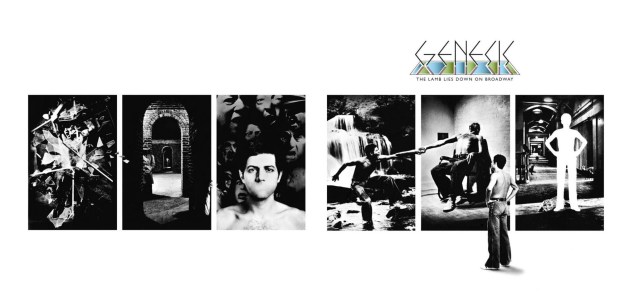
It’s Only Knock and Knowall, But I Like It — The Lamb Lies Down on Broadway: Gabriel’s Genesis Retrospective, pt. 6

Christopher Rush

The Lamb Lies Down and Gabriel Bows Out

After the success of Selling England By the Pound, the follow-up album would be an important landmark in the direction of Genesis.  Unfortunately, a variety of factors contributed to the end of the Golden Age of Genesis.  For the first time, the creative process was changed: Peter Gabriel wrote most of the lyrics for Lamb apart from the band, as they wrote most of the music separately.  When the two sides came together, the joining of lyrics and music was not as seamless as it had been before.  Though some members of the band were somewhat relieved that the thematic content of Lamb was different from the mythical, mystical stuff that dominated so much of their previous albums (at least, for the most part), the collaboration process brought more frustration than camaraderie.  Additionally, Gabriel was absent for much of the creative sessions, helping his wife during her debilitating pregnancy.  Though this was admirable and certainly the right thing to do, it helped strain the relations of the band.  Before the tour even began, Gabriel’s time with the band was technically over, though he did stay around long enough to complete the tour.  This helped to further the rifts in the band, since Gabriel’s on-stage characters and costumes overshadowed, at least critically, the musicianship of the other band members.  The lengthy Lamb Tour, in effect, finished off the Golden Age of Genesis.  As he sings in “In the Cage,” the sweat (not sweet) has turned sour.  They have come, in an odd, unfortunate way, full circle since From Genesis to Revelation.

In order to give The Lamb Lies Down on Broadway an appropriate tribute and analysis, frankly, we would need an entire issue of Redeeming Pandora solely for that purpose.  If you thought “We Didn’t Start the Fire” takes a lot of footnotes to explicate, that is nothing compared to the voluminous amount of annotation necessary to delve into the mysteries and wonders of Gabriel’s fecund erudition.  Lamb almost makes Joyce and Eliot seem obtuse.  Without trying to sound proud, I don’t even understand it all myself, though I’m doing my best.  For the sake of time, and an attempt to give some semblance of respect to what is rightly considered one of the best concept albums of all time, we shall offer an admittedly superficial exploration of some of the main ideas explored throughout the album.  If time permits (and the journal continues), look for a more elaborate analysis of this monumental work in the future.  Certainly more consideration needs to be given to the fantastic musical aspects of the album in addition to the lyrical narrative outline with which we will concern ourselves for now.  In the meantime, listen to the album (many, many times) and read Gabriel’s story in the liner notes to tide you over until we meet again.

Part One

Lamb is a concept album, as mentioned before.  The concept is much larger and expansive than a simple declarative sentence can encapsulate, but the basic story is the journey of self-discovery of Rael, the Imperial Aerosol Kid, Puerto Rican graffiti artist in New York City, though he thinks he is trying to save his brother John.  Against that basic frame story, we meet mystical creatures like Keats’s Lamia, Lilywhite Lilith, and the Colony of Slippermen.  Sprinkled throughout this mystical, mythical tale, Gabriel alludes to Wordsworth (“I wandered lonely as a cloud”), Motown (“I got sunshine”), and classical comedy (“Groucho with his movies trailing”), and just about everything else under the sun and subway.

The liner notes tell us “a lamb lies down.  This lamb has nothing whatsoever to do with Rael, or any other lamb — it just lies down on Broadway.”  Eh.  Maybe.  It might not be Van Eyck’s lamb, but it probably means something (everything in this album does, right?).  Rael emerges from the steam and shadows, spray-painting R-A-E-L, as part of his attempt to make a name for himself.  Discontent with his seemingly purposeless life, and that no one notices him and his work Rael wonders if it might be better to be a fly waiting to smash into a windshield.  Soon, mists arise and Rael finds himself in a cage.  His brother John appears but turns away and won’t help him.  The cage disappears, and Rael spins down underground to see the Grand Parade of Lifeless Packaging (mankind, obsessed with materialism and consumerism).  He tries to save his brother John from turning into a lifeless advertisement, but suddenly he is back in New York City, at least he thinks he is.  During his confusion, we get some of Rael’s backstory: his reform school days, his pyrotechnic tendencies, his time running with a gang, his commitment to being tough (pictured by shaving his hairy heart and cuddling a porcupine), and his first “romantic” encounter, which, despite the fine instruction he got from a book on how to succeed in such endeavors, ended in total failure.  Romeo kissed by the book; Rael did everything else by it — neither ended well.  These reflections come to a close; John is nowhere to be found.

Suddenly Rael is in a corridor with lambswool under his naked feet (far too many lamb references for it to mean nothing).  One cannot hide from the present in one’s memory, Rael decides.  He spots some people crawling along the carpet in the direction he must go, heeding the call: “We’ve got to get in to get out.”  He follows the carpet crawlers (people, not bugs) up the stairs into a chamber of 32 doors.  Looking at all of these doors, Rael ponders what he needs in life, deciding he needs “someone to believe in, someone to trust.”  His whole life has been one of rebellion and individualism; it’s time for a change.  It’s not about wealth: he can’t really trust either rich men or poor men.  Countrymen seem more trustworthy than townmen, for diverse reasons.  Every door seems to lead him back here, to a waiting room of fearful, solitary indecision.  Priests, magicians, academics, and even his parents send him in different directions, “[b]ut nowhere feels quite right.”  Rael decides that he’ll trust someone “who doesn’t shout what he’s found. / There’s no need to sell if you’re homeward bound.”  Rael finally accepts he can’t live in fear anymore.  He’s ready to trust — but whom?

Part Two

“The chamber was in confusion — all the voices shouting loud.”  Rael sees Lilith, a pale, blind woman who needs Rael’s help as much as he needs hers.  He leads her through the crowd into more darkness, and she leaves him to face his fear.  “Two golden globes float into the room / And a blaze of white light fills the air.”  Rael is blinded, tosses a stone in front of him in defense against an approaching whirring sound, glass breaks, the cavern collapses, and Rael is trapped in the rubble.  This is where the album really gets weird.

Rael finds himself in the waiting room of the Supernatural Anaesthetist, who happens also to be a fine dancer.  The gas he emits leads Rael down a long passageway until he enters a new magnificent chamber.  “Inside, a long rose-water pool is shrouded by fine mist.”  From the waters rise three Lamia, beautiful women with snake tails below the waist.  Entranced by the anesthetic and their beauty, Rael “trusts in beauty blind” and enters the pool.  Initially it seems the Lamia die and give their carcasses to Rael for food.  Soon we discover it was all a trick.  Rael glides along like the Lady of Shallott until the water around him “turns icy blue” and he arrives at the Colony of Slippermen.

The Slippermen are slimy, bumpy creatures — all victims of the Lamia’s ploy, and Rael is becoming one of them.  The Slippermen point Rael in the direction of his brother John and the only cure for becoming a full Slipperman: castration by Doktor Dyper.  Rael and John are reunited and quickly agree to the rather drastic “cure.”  What’s left over after the operation is placed in “a yellow plastic shoobedoobe,” a storage tube, so what was removed can be used again in emergency situations.  Suddenly, the dark cloud that first captured Rael in New York City returns, this time morphing into a giant Raven that steals his shoobedoobe.  Rael goes after the Raven, but John abandons him again for the “safety” of the underworld.  Rael is about to catch up with the Raven when he drops the tube into a river in a ravine.  Rael watches it float away.

Rael decides to chase after it; just as he’s about to catch up with it, he sees the way out of this surreal underground prison: a window opens up back to New York City.  Rael heads for the exit only to hear his brother cry for help down below in the ravine.  Faced with the most important decision of his life, Rael plunges into action: abandoning the way back to freedom and home, he, like Huck Finn, risks staying “forever in this forsaken place” to rescue his brother.  After an exciting and dangerous chase, Rael finally pulls his brother to safety … only to find he has not rescued John but Rael himself.  The epilogue to the album, “it.,” intimates that “Rael” is a minor anagram of “Real.”  Broadly speaking, the concept for this concept album is about living one’s life wisely and selflessly — but choose wisely, because the time to decide is now.  Certainly some parallels exist to Pink Floyd’s The Wall, but enough differences exist for the two monumental albums to be considered separate entities, both of great value beyond diverse aesthetic experiences.  The Lamb Lies Down on Broadway reminds us of important truths about the brevity of life and the importance of making wise and selfless decisions in the time we are given.

“It’s Only Knock and Knowall, but I Like It”

Lest they be taken too seriously, though, Gabriel closes the album with the last of his Genesis-era multi-layered ironies: “Yes it’s only knock and knowall, but I like it.”  A subtle Rolling Stones allusion conveys Gabriel’s mission (if I may use such a weighty word) on not only The Lamb but also his entire Genesis career: satire (knock) and erudition (knowall) have been combined to present serious ideas in an enjoyable musical medium, combining great lyrics for slow, moving emotional songs and lengthy epic-like narratives (both apocalyptic and diverting) with masterful musicianship (far too often overlooked at the time and even today).  The album and Peter Gabriel’s tenure with the greatest progressive rock band of all time fade out, putting a knowing smile on our faces.  He wouldn’t have it any other way.

With Peter Gabriel’s departure from the group, the course of Genesis took a major turn to survive … but survive it did.  Like M*A*S*H had to adapt to the departures of Henry Blake and Trapper John, Genesis adapted (as it already had, with its early line-up changes before the classic lineup) for a new time and a new direction.  After a lengthy search and no suitable replacement found for Gabriel, Phil Collins became the official frontman of the band, and the rest, as they say, is history.  The next two albums, A Trick of the Tail (one of my favorites) and Wind and Wuthering (influenced by Wuthering Heights), continued the concept album approach for which classic Genesis is so noted.  It was not until Steve Hackett’s departure before …And Then There Were Three in 1978 that Genesis began to fully morph away from the king of progressive rock into the radio-friendly creator of pop rock smash hit singles in the 1980s many people think of when they hear the band’s name.

Hopefully this brief survey of the Peter Gabriel era of Genesis has inspired you to go back to the band’s progressive rock roots and hear for yourself (perhaps not for the first time) the creative beginnings of the band before it was defined by “Invisible Touch.”  Genesis is one of the most enjoyable and moving bands (lyrically and musically) of the modern musical era, with a history far richer than you may have known.  Start from the beginning, and work your way to the end.  And then do it again.  You will be glad you did.

Israel and the Church

Seraphim Hamilton

An error that drifts around Christian circles is what I call “hyper-supersessionism,” which maintains that, not only is the Church the New Israel, the physical descendants of Abraham are essentially irrelevant to biblical prophecy.  This is a false idea.  The Church is the organic continuation of old Israel.  The olive tree was not cut down and replaced, but those Jews who rejected Jesus as Messiah were cut off for their apostasy, and those Gentiles who accepted Jesus as Messiah were grafted into the olive tree and became sons of Abraham by their faith in Messiah.

With this in mind, read the words of Christ and Peter:

Acts 1:6-8: So when they had come together, they asked him, “Lord, will you at this time restore the kingdom to Israel?”  He said to them, “It is not for you to know times or seasons that the Father has fixed by his own authority.  But you will receive power when the Holy Spirit has come upon you, and you will be my witnesses in Jerusalem and in all Judea and Samaria, and to the end of the earth.”

This seems to imply that the Lord will one day place the land back in the hands of Israel — true Israel.  At the moment the land is possessed by the apostate Jews who were cut off from true Israel because of their rejection of Messiah.  However, I believe that their return to the land does have some significance in biblical prophecy.

Zechariah 12:10-11: And I will pour out on the house of David and the inhabitants of Jerusalem a spirit of grace and pleas for mercy, so that, when they look on me, on him whom they have pierced, they shall mourn for him, as one mourns for an only child, and weep bitterly over him, as one weeps over a firstborn.  On that day the mourning in Jerusalem will be as great as the mourning for Hadad-rimmon in the plain of Megiddo.

The Prophet Zechariah writes that at some point the inhabitants of Jerusalem will look on the LORD, whom they pierced, and they will mourn.  They will plead “Lord, have mercy!”  This implies a turning to God on the part of the ethnic Jews.  Combine this with Romans 11:25-27: Lest you be wise in your own conceits, I want you to understand this mystery, brothers: a partial hardening has come upon Israel, until the fullness of the Gentiles has come in.  And in this way all Israel will be saved, as it is written, “The Deliverer will come from Zion, he will banish ungodliness from Jacob”; “and this will be my covenant with them when I take away their sins.”

So, at some point, ethnic Israel will cry out to the Lord and repent for rejecting their Messiah.  They will be grafted back into the tree of true Israel, and thus, the Nation of Israel will be converted to an Orthodox Christian state.

A Few Misconceptions about Military Funding

Tanner Rotering

When you think of your children’s future, what comes to mind?  Do you imagine them having a quality education, a successful career, a happy family, a safe home, and all the freedoms that we enjoy today?  Do you imagine them as happy, healthy, and financially secure?  Regretfully, while this is how we like to think of our children’s future, the truth is much more menacing.  We often take for granted the many freedoms and privileges that we as Americans have, and if we are not more careful concerning the preservation of these freedoms and privileges, others will not hesitate to take them away from us.  Currently America is headed toward a very unsightly demise, and we have to do something about it.

The current military expenditures of the United States Federal Government are not adequate to ensure the security of the United States.  Despite the relative peace that Americans enjoy in the modern age, the choices made in the near future concerning America’s military budget have the potential to permanently alter America’s direction.  With the rising national debt and the recurrent national deficit, well-intentioned reformers risk cutting the programs in the federal government that are most important to the well-being of the United States and that are most in need of federal funding.  In the midst of the “War on Terror” many ill-advised officials are crippling America’s long-term security by stripping the military of its large-scale conflict capabilities in order to make way for a counter-insurgency focus.  Despite inflation and the costly wars in Iraq and Afghanistan, the military budget is left underfunded due to an alleged lack of funds while President Obama’s controversial health care plan, the trillions of dollars in stimulus money, and countless entitlements are funded without a second thought by many in Congress.  Without a strong military, America is susceptible to countless threats in the modern world, many of which, while not openly hostile to the security of United States, are still a threat to American interests.  If America cannot retain its current status as leader of the free world, there will be no free world.  Thus, in order to avoid this grim prospect, it is imperative that the United States Federal Government substantially increase the federal military budget.

The purpose of this paper is to refute a few common misconceptions concerning the military budget.  When the issue of increased military funding is brought up, several common arguments are made against such an increase.  The first of these arguments states that because we are already spending more money on our military than the rest of the world combined, we do not need to spend any more.  This argument is founded on the critically false assumption the amount of money spent by the military has a one-to-one correlation to both the quantity and quality of the forces produced and maintained by the military.  In other words, people who make this argument often do not realize that the “higher-tech” something is, the more expensive it is, and thus, when the budget is limited, the military generally has to make sacrifices in quantity in order to attain the higher quality (and vice versa).  Because of this trade-off, the military must maintain a balance between more expensive advanced technology and less expensive conventional technology — between technology and numbers.  It is also important to recognize that, because there are multiple combat scenarios in which the United States may have to deploy its military forces, not all technologies are constructed for the same purpose.  More advanced technology is often procured and maintained in order to fulfill very limited and yet very important roles.  For example, certain military UAVs (Unmanned Aerial Vehicles) are outstanding for collecting intelligence and for eliminating certain targets, but currently they are not a competitive form of technology for air superiority; much less advanced manned-aircraft is still capable of out-performing modern UAVs in air-to-air combat.  Because the United States Military has to maintain a careful balance between the quality and the quantity of its forces, because it has multiple roles to fill pertaining to defense, and because a unique technology is often required for each specific combat scenario, the current military budget cannot be assumed to be fully designated to one single aspect of its defense procurement.  Thus, while the United States Military may be spending more money than all of the other nations on earth put together, it cannot then be assumed that America could, for example, easily be victorious in a war with every other nation, because not all of America’s military funding is spent on preparing for this one scenario.  Most countries are not as committed to so many objectives world-wide as is the United States.  Even if there were only one simple objective toward which every nation devoted its military budget, spending a specific amount of money in one nation is not going to bring the same results as spending that same amount of money in another nation.  There are too many variables involved in the process to make such a simple comparison.  These variables include the price of materials, the items purchased, the price of labor, the procurement process, etc.  Thus it should be clear military spending cannot be correlated on a one-to-one ratio to military preparedness for every possible conflict, and thus, one cannot assume because we spend more money than any other nation on earth, we are also better matched for any conflict with any other nation on earth.  One should not judge the benefits of any policy purely by the amount of money spent to achieve its end.

A second common argument some will present for why we should not increase military expenditures asserts that, because of our massive national debt and incessant national deficit, we ought to be cutting military spending rather than increasing it.  While the national debt and the national deficit are certainly significant problems, that does not necessarily mean we should cut every government program.  Instead we should carefully determine which programs ought to have their funding cut, and which programs ought to remain the same or have their funding increased.  National security must not be compromised.  We cannot risk the existence of the United States for the financial security of the United States.  It would do us no good to save a large sum of money by cutting back our military budget in order to reduce the deficit if such an action threatened the existence of the United States as a nation.  There are many alternative programs which can be cut instead of the nation’s already underfunded military program.  Max Boot, in “Impact of Past Defense Cuts Should Warn of Risks” at washingtonpost.com argues that our current defense budget is “eminently affordable.”  At less than four percent of America’s gross domestic product, he says, the relative amount of money which the United States spends on defense is significantly less than it has been throughout the past century.  Citing the example of the “post-Cold War drawdown,” Boot also draws attention to the historical impacts of cutting the defense budget.  While it would be beneficial to eradicate any truly wasteful spending within the military’s budget (though one must be careful what one classifies as wasteful), it is not feasible such an action would free enough money to cover all of the gaps in the military budget.  Thus, in spite of the mounting national debt, we must still increase the funding for the United States Military.

Finally, the third counterargument makes the claim that, because the United States has been able to quickly develop new technology and prepare for conflict in the past, America should postpone any large military budgetary increase until a conflict which necessitates such an increase presents itself.  The fundamental flaw with this argument is the fact it completely ignores the new pace of warfare that has developed as a result of the tremendous technological breakthroughs in the past century.  While a purely reactionary defensive policy may have been sufficient to maintain security in the past, it is no longer a feasible strategy for the 21st century; warfare has developed much more of an emphasis upon preemption.  In the past, America has relied largely upon its geographical insulation to act as a temporal buffer from conflict.  Because the United States is separated from much of the world by the Atlantic and Pacific Oceans, historically the United States has been either left alone or has had a substantial amount of time to prepare for battle because of the tremendous amounts of time it would take to cross the ocean by ship.  In the modern world, however, America does not have the privilege of either remaining isolationist or of waging war purely on a reactionary basis.  Because of the interconnectedness of the modern global economy and because of significant advances made in the technology of warfare, the American military must be ready to take action upon a moment’s notice.

American interests are so tightly interwoven with the well-being of countless other economies worldwide that America cannot afford to sit back and not take action when an ally or even a competitor’s security is threatened.  In order to protect America’s trading options, the American military cannot wait until American soil is threatened, but instead it must always be fully capable of deploying anywhere in the world to meet any potential threat.

Modern technology also plays a role in the necessity to anticipate hostilities before they actually occur.  Because modern technology enables quicker communication, quicker mobilization, better networking, faster calculations, faster vehicles, more precise munitions, longer flight times, more powerful weapons, and a whole range of other benefits, the pace of warfare is based upon much shorter time frames.  For example, in World War II, in order for American forces to attack the Japanese homeland, American aircraft carriers had to sail within several hundred miles of the Japanese islands to enable a successful bombing mission.  Because the aircraft had much smaller combat radii than modern aircraft, they had to be deployed much closer to their destination, and this took time.  Modern aircraft, on the other hand, can fly around the world without having to land to refuel.  This means we have to always be prepared to defend ourselves because we don’t have months to prepare while the enemy gets their forces into position.

The fact that technology was much less complex than it is now has significant implications for strategy as well.  In former decades military weapons like airplanes and tanks could be designed, constructed, and sent to the battlefield fairly rapidly.  The technology wasn’t very complex, and it didn’t involve nearly as many components as it does today.  A single company could produce the machines of war largely within its own facilities with its own materials.  In modern times, however, military weapons not only take much longer to develop, perfect, and produce, but the manufacturing process incorporates innumerable intricate, highly specialized parts which are produced by a large variety of companies.  It is no longer reasonable to assume America would be able to design and construct such complicated machines of war on a purely reactionary basis after we have perceived a threat.  It takes the military many years to develop the modern weapons of war, and to expect it to happen overnight is preposterous.

Proponents of this third counter argument may argue that instead of focusing on simply having the “best” technology, we should focus instead on obtaining the technology that best exploits the weaknesses of our enemies.  While it is true taking advantage of opponents’ weaknesses is a valuable tactic in war, proponents of this theory, like Martin Van Creveld in Technology and War, often take it too far.  They claim that because the fundamental principle upon which technology is founded is a system of consistent cause and effect in which an action will always create the same outcome, and because conversely war is founded upon the inconsistencies and unpredictability of one’s opponents, technology and war are fundamentally opposed in their natures (311-320).  Proponents of such theories are not arguing that technology should not be used in war, but that the value of technology is strictly limited to the ability with which it can exploit the enemy’s weakness.  This is not completely accurate, however.  Clearly the human element of warfare adds a sense of unpredictability, but this does not mean anything which utilizes consistency is then necessarily opposed in nature.  Though warfare often involves a series of variables, the laws of physics are constants that can be utilized by means of technology to predict and limit the impact of the variables.  Most will recognize that though the formation of technology is based upon the uniformity of natural causes, the application of technology is more flexible.  Therefore, technology and warfare are not fundamentally opposed in nature since technology can be used in harmony with warfare.

Because of technology’s unique ability to limit the impact of various unknowns in warfare, its applications are much broader than simply exploiting an enemy’s weakness.  Often a superior technology is useful because of factors completely independent of an enemy’s weakness.  For example, radar (when it was first invented) was not useful simply because it exploited a specific weakness of the enemy.  It was useful because it provided vital intelligence concerning enemy positions.  There wasn’t some fundamental flaw unique to the tactics or technology of the enemy that gave value to the technology of radar; it was a new capability all together that could be used by either side.  Some might argue the very fact the enemy could be detected by radar was a weakness, but before radar this was not a problem.  Instead, radar created this weakness in the enemy by creating an advantage for the developing nations.  Thus technology does not have to only exploit enemy weaknesses, but instead it can actually create enemy weaknesses.  Further, technology often has strategic military power completely independent of a specific conflict and should be developed preemptively in order to gain a tactical advantage.  The only way these technologies can be adequately funded, though, is by increasing the military budget.

Though it may be hard for us to imagine a scenario where very desperate measures would be required of us, world stability can falter in the blink of an eye, leaving us in a situation in which we wish we had spent more money ensuring our security.  The unthinkable has happened before.  Remember Pearl Harbor?  Despite the general complacency concerning our security, America was taken completely off guard.  This time, however, we cannot afford to wait to begin preparation until we have been attacked.  Because of the incredible advances in technology in the modern age, warfare is contingent upon much shorter timeframes.  With the advances made in rapid deployment capabilities, precision targeting, efficient communication, and sophisticated weaponry, preemptive modernization is critical to the security of the United States.  Thus, it is absolutely imperative that the United States Federal Government substantially increase the federal military budget.

The Lunatic, the Lover, and the Poet

Alice Minium

The Intervening Variable of Here and There

I write to you equipped with the story of a phenomenon of nature that I will share with you — it is a keyhole through which we may peer into the nature of the human psyche, the nature of our minds, the nature of art and aesthetics, the nature of reality, and the truth about transcending the ordinary limitations of human consciousness.  It is a story that has cyclically endured throughout history, from the era of Aristotle to the drastically different era in which we live today.  It is a truth indicative of human nature, and it bequeaths unto us an essential, largely untapped understanding of psychology.  It is a circumstance of nature that it is vital for you to know, so that you may fully understand and know yourself.  Understand the nature of your mind and why things are the way they are.  Allow your thought processes to flow as fluid, flexible, and unrestrained, and allow yourself to be enlightened — but don’t get too lost in yourself.  Don’t lose touch with the outside world.  Think too much and you might go crazy … or maybe you already were.  Maybe you know what it feels like.  Maybe it’s always lingering in the back of your mind, in that dark corner into which you shove all the ugly things you cannot let the world see.  You loathe the lurid black hole monster that has taken up residence in your brain like a tumor that is not a tumor, but a finger — a natural part of you from which you cannot escape.  You loathe that black hole monster.  But it is he who sweeps you up in his storm of intoxicating emotion that leaves beautiful, elegantly-crafted sonnets behind as the rubble.  It is his provocation that inspires the intricate sketches that fill your notebook.  You lose yourself in him, or perhaps you truly know yourself, or perhaps you truly know some things about life that people were just not supposed to know.  There is so much in your head, and it secretes as art.  Maybe creation is the only tactic you know to help you stay sane.  Creation is dangerously similar to destruction.

Creativity is dangerously similar to madness.

As the human race, one thing we are most classically ignorant about is ourselves — and what it means to be a human.  This is a topic on which most of us know very little.  The relationship between creative genius and psychological instability is obvious, but not completely understood by us at all.  We find ourselves in a chicken or the egg scenario.  Here I will explain both that the chicken and egg are of the same nature and exactly how they are related to one another.  I will be exploring many different theories upheld by many different individuals, but I will not present you with my own personal speculation as a means of hopefully convincing you this is true.  The case I present here will rely fully and completely on logical deductions and factual evidence, including over ten clinical studies conducted by highly educated, highly reputed psychological experts.  Ultimately, I encourage you to view the case I will present with objective, unpresuming eyes, and take from it what you will.  The verdict is yours, but I will lay the evidence before you, encourage you to trace the validity of my arguments, and I stand here fully confident that you will reach the same conclusion that I did myself.

Personally, I find any standard dictionary to be habitually ineffective at encompassing the full essence of a concept with its overly formal and unspecific definitions.  I have drawn upon a few other sources that will give us a more complete grasp of the meanings of the two essential words I would like to clearly define for you — the first is “creativity,” or, in other words, “creative genius.”  Dr. C. E. Shalley, author of the psychological journal article “Effects of Productive Goals, Creativity Goals, and Personal Discretion on Individual Creativity,” defined creativity as “comprised of three major components: the required ability or expertise in a particular field, the innate or intrinsic motivation towards further exploration and development, and the cognitive processes to conceive and synthesize novel ideas.”  Dr. Prentky, a fellow psychiatrist featured in the same psychiatric journal, elaborated by saying that “the main primary traits of creativity are fluency and flexibility of thinking, originality, redefinition, and elaboration.”  When he says “elaboration,” he is referring to the unconscious process of expanding, embellishing, and simultaneously extrapolating a minute detail, usually one of the repressed psyche.  There are many components to creativity, but these two definitions are an accurate basic skeleton on which we may rely.  I will expand more on its nature, its features, and its origins when I present my major points of argument.

The second term that it is essential we define is “madness.”  In this presentation, “madness” may be interchangeable with the term “psychological abnormalities” or “mental illness.”  These words can mean many different things, so I would like to define them for you as clearly as possible.  Dr. Caroline Koh from the National Institute of Education at the Nanyang Technological University in Singapore is an expert at research on this topic, and she conjured up a very accurate and efficient explanation of these terms: “Madness is commonly described as an altered, abnormal, deviant state of mind or consciousness.  The various forms of mental disorder are generally of two kinds. The first being the condition of neurosis, which describes the milder forms of mental disorders such as phobias, depressions, obsessions, compulsions and hypochondria.  The second type of aberrant mental condition, psychosis, includes severe forms of mental illnesses, whereby the patient loses contact with reality and shows irrational and irresponsible behavior.  Psychotic afflictions include delirium tremens, manic depressive disorder and schizophrenia.”  In this presentation, we will be dealing more with psychotic afflictions than neurotic afflictions.  However, both branches of psychological abnormalities are relevant and applicable to this case.

The relationship between creativity and psychopathology is tied together by artistic temperament, or, in other words, the moods, personality, and the way artists see the world.  The artistic temperament, or condition of the artist, is what determines the psychological risk.  You could call the artistic temperament the intervening variable of the relationship.  An intervening variable is a hypothetical internal state that is used to explain the relationship between observed variables when they do not appear to have a definite connection, but simultaneously have no existence apart.  In other words, we cannot say for sure whether creativity drives you crazy or if madness inspires you to be creative, but we can acknowledge the two are connected in a certain way based on the condition of the artistic temperament — if the artist is very mentally ill, she may also find herself bursting with creativity, or vice-versa, depending on other situational and circumstantial determinants in addition to her brain chemistry.  The concept of an intervening variable is difficult to understand at first — a few other examples are intelligence, motivation, and intention, if that helps you to grasp the concept any better.  Either way, the nature of this relationship will become clearer as we progress.

The correlation between madness and mental illness actually has a name: the Sylvia Plath effect.  Psychologist Dr. James C. Kaufman coined this term in 2001 to refer to the phenomenon that creative writers suffer disproportionately from severe mental illness — more so than other types of writers, and more so than any other types of people.  2001 is fairly recent, but Kaufman was not the first to acknowledge this pattern in human psychology.  Plutarch, Greek historian who lived from 46 to 120ad, described in his annals the Greek hero Archimedes from an intriguing perspective: “Archimedes was a combination of natural endowment, hard work, and divine inspiration — a personality which indulges in behavior which is distinctly unusual … in anyone else, we would be rather tempted to call it mad.”  A fellow Greek, the great Aristotle, seemed to agree with Plutarch, writing, thousands of years ago, that “No great genius has ever been without some divine madness.”  Almost two thousand years later, William Shakespeare echoes their tune: “The lunatic, the lover, and the poet are of imagination all compact.”

Enough with the quotations.  It is simply a fact that a remarkably great percentage of our favorite innovative artistic geniuses have been afflicted with dark psychological pain.  No expert on the topic will deny that.  But now let’s get to the important part — why?

The first point of argument I will make is that the thought processes of exceptional artists and the mentally ill are similar in their operations and appear to be of a similar origin.  I will prove this point by explaining  the ideas of translogical thinking, conceptual overinclusiveness, Janusian thought processes, and homospatial thought processes.  I will also touch on the influence of Dr. Albert Rothenberg, a psychiatrist who has published books on the topic and is considered an expert, and his colleague, Dr. Prentky.  Finally, I will elaborate on a neurological study conducted at Harvard University and the University of Toronto in September 2003 that gives us a concrete biological basis for the connection of creativity to mental illness by testing something called Latent Inhibition.  I will explain what Latent Inhibition is, how it works, and why it is incredibly significant to this case.

Dr. Prentky is one of many psychologists who has devoted his career to the understanding of this topic.  Like the others, he postulates that the creative and the mad operate the same way on a neurological level.  “Creativity and psychopathology share a similar origin,” he explains, “hence the biological link; that creative individuals and psychotics have some common personality traits and thinking reflecting a predisposition to psychosis.  One of them is vague, highly intuitive thought processes, and imprecise and inappropriate speech.”  Other common personality traits Prentky could have mentioned are peculiarity, introversion and an inclination to solitude, rejection of common cultural standards, a tolerance for irrationality, oft-disturbed moods, and the tendency to connect concepts in an unusual or unexpected manner.

Prentky declares that the most significant similarity between creatives and psychopaths is the loose, unrestricted boundaries of their thought processes.  In other words, their perception of the world is not restrained by the limitations of cultural prejudices that intellectually suppress most people in any given period of time.  You could say our creatives and psychopaths think “outside the box.”  This could be for many reasons.  Prominent among possible reasons is the fact that both of these people groups are comprised of individuals very different from their peers in very important ways.  Even if they manage to have healthy social relationships, they are still, always, unlike everybody else in their psychological tendencies and the way they think (or, brain chemistry).  When one feels like an outsider, one is not sucked up into the blindness afflicting everyone who has bought into the massive ruse.  Many “crazy” artists in the past have had ideas way beyond their time (for one example, Leonardo da Vinci), because, abstinent from the habitual worldviews and mindless conditioning of their neighbors, they were more in touch with their inner consciousnesses and were capable of perceiving truth and concocting ideas that others could not comprehend and would have, in no way, dreamed of.

A more technical and precise term for this unique cognitive process they have in common is the term “translogical thinking.”  Dr. Albert Rothenberg concluded from years of studies that this is definitely a psychological trait creatives and psychopaths share.  Translogical thinking, as you may have deduced from its name, is a type of conceptualizing in which thinking processes transcend the ordinary mode of logical thinking.  It involves two different thought processes, the first being the Janusian and the second being homospatial.

Janusian thinking is the process of combining paradoxical or antagonistic objects into a single entity.  The homospatial process is, in Rothenberg’s words, “the essence of a good metaphor.”  It involves superimposing or uniting multiple, discrete objects.  These two processes constitute the method of creative thinking.

Although the creative and the psychopathological share these significant traits, obviously, there are characteristics to distinguish them from one another, and they are important to note.  The fundamental difference between the creative and the mentally ill is the amount of control the individual has over his or her thought processes.  The creative thinker is deliberate with her thought processes and is capable of deftly managing them.  The psychotic thinker’s thought processes are sometimes inexplicably capricious, and she is incapable of controlling them; rather, they can easily overpower her at any time.

This might sound like a dramatic difference, and it is, but creatives and psychotics have more fundamental similarities than incompatibilities.  Perhaps the most compelling chunk of evidence for this argument is the 2003 Harvard-Toronto study involving Latent Inhibition.

Latent Inhibition is defined (by the Journal of Personality and Social Psychology) as an animal’s unconscious capacity to screen from conscious awareness stimuli previously experienced as irrelevant to its needs.  You are surrounded by a near-infinite amount of stimuli at all times, and there is no way you could consciously take notice of all of those things.  Toronto Psychology Professor Jordan Peterson says, “This means that creative individuals remain in contact with the extra information constantly streaming in from the environment.  The normal person classifies an object, and then forgets about it, even though that object is much more complex and interesting than he or she thinks.  The creative person, by contrast, is always open to new possibilities.”  The lower one’s LI is, the lower the ability to filter out irrelevant stimuli that interfere with focused thought processes.  Consequently, the study showed, the lower one’s LI is, the more exceptional cognitive flexibility he or she displays, which leads to creative achievement.  This study was groundbreaking, because, for the first time, the scientists were able to conclude that highly creatives and people suffering from psychotic illness both were characterized by very low levels of Latent Inhibition.  Instead of connecting thoughts by basic logic, translogical thinking comes into play, and their neurons transmit signals to several other neurons people would not normally associate with one another, and they interpret information a different way.

The low level of Latent Inhibition is a concept that explains so much about the relationship between creativity and psychological abnormalities.  Low LI can also be a characteristic of many forms of psychoses, including the early stages of schizophrenia.  As one’s LI decreases, one may become fixated on meaningless ideas that feel almost religiously important, and one starts to slip away from reality.

Harvard researcher Shelley Carson thinks this makes perfect sense.  “Scientists have wondered for a long time why madness and creativity seem linked.  Many of us hypothesize that Latent Inhibition may be positive when combined with high intelligence and good working memory, but negative otherwise.  It seems likely that low levels of Latent Inhibition and exceptional flexibility in thought could predispose to mental illness under some conditions and to creative accomplishments under others.”

Low LI could explain someone’s unique ability to discover something beautiful or spectacular within what most people consider unremarkable or potentially not even notice.  It explains the ability to perceive the world with intensified acuity, the ability to transcend the mental or psychological inhibitions of a culture or time, and the ability to interpret stimuli differently to extract unique abstractions from seemingly dissimilar concepts.

Pablo Picasso, the legendary Spanish artist from the early twentieth century, preferred to live amongst chaos rather than a clean, organized home environment.  He attested his reason to be that objects, when strewn about, appeared to have unusual visual relationships to each other.  Picasso considered this artistically stimulating, as he did not perceive his surroundings in a typical manner — a clock as a clock, or a shoe as a shoe, but instead, his brain interpreted the objects as they appeared to him at that time in color and form, not as objects purely related to the functionality of his everyday life.

One of his most well-known sculptures, Bull’s Head, was an arrangement of the seat and handlebars of a bicycle that Picasso envisioned as shaped like the head of a bull.  He was able to transcend his mind’s human instinct to interpret handlebars as “rods upon which you exert force in order to control the direction or maintain stability of a vehicle,” and uninhibited by that instinct he was able to see the essence of handlebars for what they were — elongated cylinders.  Out of their ordinary context, he equated them to the existence of other similar objects, such as a bull’s horns.  This example parallels the science behind a low Latent Inhibition and a high creative ability to see the world in an abnormal way.

Anne Sexton, a Pulitzer Prize-winning poet, practiced a similar albeit more abstract approach to transcending our natural instinct to overpass and not analyze stimuli that are not relevant for survival.  Dr. Mary Baures, a psychologist who personally spent time with Sexton, recalls her methodology.  “She taught us about images and metaphors.  They were more powerful when you found connections between unlike things — a fist and a fetus, eyelids and riding boots, a tongue and a fish, flies and small black shoes, a girl curled like a snail.  She showed us how to ‘image-monger’ by spewing out a torrent of metaphors in a process she called ‘storming the image.’  We would ‘unrepress’ by creating an unconscious for an object, like a can of Coke.  The more we ‘unrepressed,’ the more rapid our associations became.”

Creativity is fundamentally dependent on communication with the inner psyche, although it is usually not conscious unrepressing.  It brings you, in an artistic sense, to intelligence with your deepest, most unacknowledged, most primitive thoughts and feelings.  Abandoning thought-association patterns ingrained by your environment simplifies and, in a way, purifies the way you experience the essence of a thing.  Raw simplicity and awareness like this brings you back to the most basic, fundamental brain activity, to which every person can relate.  The catharsis of connecting with and unrepressing these deeply repressed elements is what might make one feel “moved” by a particularly effective specimen of art or music.

This is also the idea behind the form of expressive psychotherapy called art therapy, in which the emotionally damaged patient will draw, paint, sculpt, write, or compose his own creative art to begin to heal and indirectly address the patient’s deeply repressed psychological tensions.  Art therapy shows us that creative thought and emotional pain are deeply intertwined, which brings me to my second major argument.

Art and creativity require utterly consuming devotion and deeply personal contact with one’s primitive self (cravings, feelings, and emotions), which naturally puts one at the constant risk of walking the edge of sanity and insanity — because inner turmoils breed excellent, passionate art.

The twentieth-century poet John Berryman said it exceptionally well: “I do strongly feel that among the greatest pieces of luck for high achievement is ordeal. Certain great artists can make out without it, but mostly you need ordeal.  My idea is this: The artist is extremely lucky who is presented with the worst possible ordeal which will not actually kill him.  At that point, he’s in business.  Beethoven’s deafness, Goya’s deafness, Milton’s blindness, that kind of thing.  And I think that what happens in my poetic work in the future will probably largely depend not on my sitting calmly on my ass as I think, ‘Hmm, hmm, a long poem again?  Hmm,’ but on kinds of other things short of senile dementia.  At that point, I’m out, but short of that, I don’t know; I hope to be nearly crucified.”

This is a fact all creative individuals know very well.  Tragedy results in excellent creative output.  Even any amateur writer would admit that his writing is more poignant and powerful when he has been through an emotional disaster, or just had a bad day.  Anne Sexton said, “Poetry led me by the hand out of madness.”  Creativity is very healing for the mentally ill and is often a coping mechanism, but constant contact with one’s inner psyche and the total  immersion in one’s work that is characteristic of both the creative and the psychopathological when involved in projects, produces an increased chance for one to slip out of touch with reality and into disillusion.  Dr. Maureen Neihart elaborates, “Creativity involves a regression to more primitive mental processes, that to be creative requires a willingness to cross and recross the lines between rational and irrational thought.  Inspiration always requires regression and dipping into irrationality in order to access unconscious symbols and thought.”

By nature, individuals in artistically creative professions must be more sensitive, unlike scientists, who work with logic.  Art, on the other hand, is raw humanity.  Creative individuals are more susceptible to a greater spectrum of emotions and perceptions, which makes them more susceptible to all emotions, especially the violent ones, because they are the ones that fuel artistic inspiration.

Skill is one part talent and ninety-nine parts blood, sweat, and tears.  People who wholeheartedly devote their lives to creative endeavors might sacrifice just as much as people who devote their lives to Olympic sports.  With creative work, it’s not obvious when you over-exert yourself or drive yourself crazy from isolation, pressure, and immersion in the fantasy world you are forced to inhabit.  For child prodigies, or any adults who throw themselves into their work, it is easy to lose touch with the real world.  If you are straining yourself mentally, your risk for danger is even more glaring than that of the Olympic athletes.  If you damage yourself mentally, the consequences will be so much more detrimental.  It’s all the same thing, except in this instance, the game is inside your head.

I would now like to refute an alleged objection to my thesis: the argument that creativity is a product of logic, and mental illness, by definition, is characterized by a lack of rationality.

At first glance, this argument looks like a reputable objection — until you stop and think about it.  First of all, creativity does not come directly from logic.  Logic leads to practicality, and if creativity was based on logic, it would be a function of practicality, which is incompatible with its primary concern being not survival, but innovation and aesthetics.  Creativity is the ability to transcend the ordinary.  Also, in complete contradiction to this point, it could be said that artistic creativity, in a way, actually stems from illogic — it is characterized by a disconnect with reality, and its lack of concern for logical things and greater interest in creating beauty serves no survival purpose whatsoever, which supposedly goes against our evolutionary nature as humans, which makes it perfectly compatible with mental illness.

Or, if you want to approach it in a slightly less brash manner, you could refute the statement “creativity is a product of logic” with the already affirmed statement “creativity is a product of translogic.”  Therefore, even if mental illness does encompass irrationality, it also encompasses translogic, what is needed for creativity and what truly matters.  You have to look at it from a broader perspective.

Another objection to my thesis that has been raised by many is this: “Not all creative prodigies are crazy, so there is not necessarily a correlation between creativity and being crazy.”

I would like to respond to this objection with the results of a scientific study performed by a certain Dr. J. Eysenck in the 1980s.  After testing 21 males for a correlation between their level of creativity and their level of psychological abnormality, he found a mostly positive correlation, except not an exclusively positive correlation.  Dr. Eysenck concluded that creativity and psychosis have a greater probability of being connected, but not in all circumstances.

“Psychosis” is the condition of being psychotic, but “psychotism” is the ability to potentially develop psychosis under certain situations.  While psychosis and creativity were not always linked, psychotism and creativity absolutely were.  Eysenck’s final word was that creative individuals are naturally predisposed to insanity, but they are not necessarily insane.  Today this is known as “Eysenck’s P-factor.”

Obviously not all creative geniuses are mad, but that does not change the fact that a great percentage are, and the rest of them are at least genetically predisposed to it as a result of their exceptional creativity, whether it is active or not.  Famous Impressionist Salvador Dalí knew this indeed when he said, and I quote, “The only difference between me and a madman is I am not mad.”

There is no consistent pattern of which one induces the other.  Creativity and madness mutually reinforce each other, according to their natures as inherently related essences.  Now, we have established that the processing styles of creative and psychotic brains are methodically similar and similar in origin, as understood by conceptual overinclusiveness, translogical thinking, and the evidence of the Latent Inhibition effect.  We have also affirmed that the nature of art puts one in danger of intense emotional experiences, because that enhances art, so psychological vulnerability is and always will be an associated risk.  I have refuted the objection that creativity and madness are not related because creativity is logical and madness is illogic by firstly explaining that creativity is not a product of logic, and by secondly explaining that creativity does not require logic but translogic.  I also refuted the allegation that creativity and madness are not related because not all creative people are crazy, and not all crazy people are creative, so they cannot be intrinsically tied together.  I shared the results of a scientific study in which they determined that creativity and madness, if you suffer from one, make you highly likely to be predisposed to the other, and that all the creative are not necessarily actively psychotic, but all of the creative are psychotismic — capable of developing psychosis under the right given circumstances.  Therefore, the connection holds irrefutable and strong.

I would like to say I understand every aspect of this phenomenon, but the truth is, we actually only know so very little.  And if these creative geniuses, these exceptional and elite, are of a higher consciousness than us average humans — who are we to judge the estate of their psychological health?  We know so very little.  But at most, we can cherish what we have learned about art, about suffering, and about humanity itself.  And we can constantly strive to learn more.  Not everyone gets to be exceptional, and you will never be the most beautiful poet, the most talented pianist, the most up-and-coming graffiti artist, and for a moment, that kills you inside.  But, actually, maybe being a prodigy entails a whole lot more than I imagined.  Marcel Proust said, “Everything great in the world is created by neurotics.  They have composed our masterpieces, but we don’t consider what they have cost their creators in sleepless nights….”

The almost-prophetic whisper of the gifted novelist Janet Fitch reminds us, “Nobody becomes an artist unless they have to.”  Yet each one of us secretly yearns to venture out into the sea of darkness, to explore what it might contain…

Be an artist.  Fear no pain.

Bibliography

Barron, Frank. The Creative Personality: Akin to Madness, 1972.

de Manzano, O., et. al. “Thinking Outside a Less Intact Box: Thalamic Dopamine D2 Receptor Densities Are Negatively Related to Psychometric Creativity in Healthy Individuals.” PLoS, 2009.

Eysenck, H. J., Genius: The Natural History of Creativity. Cambridge: CUP, 1995.

Koh, Caroline. “Reviewing the Link between Creativity and Madness: A Postmodern Perspective.” National Institute of Education: Nanyang Technological University Singapore, 25 Sept. 2006. Web.

Marano, Hara Estroff. “Creativity and Mood: The Myth That Madness Heightens Creative Genius.” Psychology Today, 2007.

Neihart, Maureen. “Creativity, the Arts, and Madness.” Talentdevelop.com. Social and Emotional Development of Gifted Children, 1998. Web.

Prentky, R. A. “Creativity and Psychopathology — Gamboling at the seat of Madness,” in J. A. Glover, R. R. Ronning, and C. R. Reynolds, eds., Handbook of Creativity. New York: Plenum Press, 1989.

Richards R., et. al. “Creativity in Manic-depressives, Cyclothymes, Their Normal Relatives, and Control Subjects.” Journal of Abnormal Psychology, 1988.

Rothenberg, A. Creativity and Madness — New Findings and Old Stereotypes. Baltimore: The John Hopkins University Press, 1990.

Shalley, C. E. “Effects of Productive Goals, Creativity Goals, and Personal Discretion on Individual Creativity.” Journal of Applied Psychology, vol. 76, 1991.

Simba, a Modern-Day Hamlet?

Emily Grant Privett

It known by nearly everyone that William Shakespeare is popular for his famous storylines and excellent characterization.  Over the past several decades, America has lost touch with Shakespeare’s British classics, all until Disney released its version of a modern day Hamlet: The Lion King.  Shakespeare’s story of responsibility and revenge was adapted by a children’s company, carrying the timeless story to a new generation.

The first and greatest similarity is that of Simba and Hamlet.  At a young age, both of our protagonists share a similar fate.  Similarly, the fathers of both Simba and Hamlet are killed.  Simba is born the son of a king.  He is undeniably born with a great deal of responsibility.  Simba loses his father early in his life, the years that he needs his guidance most.  Both deal with their share of troubles.  Also, both delayed their responsibility as much as possible.  Neither wanted to take responsibility for their royal heritage, and both in fact, ran away from their responsibilities for a short time.

Also, the father of Hamlet and Mufasa share a similar characterization.  The father of Hamlet once ruled Denmark.  His land was peaceful and prosperous.  Mufasa had a very similar rule.  Under him, the animal kingdom was happy.  There was peace.  The land was safe.  Simba enjoyed his early days in the Pride Lands.  He focused on his son and the responsibilities he would soon take on.  After each of them die, they both become a ghostlike spirit, haunting their sons.  They tell them to avenge their deaths and to take responsibility, overthrowing what their uncles had accomplished.  They serve as a reminder and an encourager.  Although neither tells their son exactly what action to take, they both strongly imply the responsibility their sons have.

The villains of the two stories also are directly related to each other.  Both Scar and the King, Claudius, play similar roles.  Both used the murder of their brother to usurp the throne of their respective kingdoms.  Scar and Claudius put on false faces, making them seem like much better people than they actually turn out to be.  They pretend to be friendly and caring.  Both enjoy the new life as king.  They celebrate the new power they recently acquired.  Claudius holds celebrations and parties to bring himself power.  Scar uses his recently gained power to take control of the Pride Lands.  He sends his army across them in order to have a grasp on all of the Pride Lands.  Both of the new kings abuse their new-found power, both leading their kingdoms to turmoil.  It is from this point that the characters begin to take different paths.  Scar maintains his evilness throughout the rest of the story.  Claudius, on the other hand, feels guilt for his actions.  Both, on the other hand, admit their wrongdoing.  Claudius, though, attempts to repent for his wrongdoing whereas Scar boasts in the way he overcame his rather naïve brother.  In the end, the two villains meet their end in the way that they killed their brothers.  Scar is thrown down into the ravine, to be trampled on by the hyenas.  Claudius is poisoned.

The characters of Nala and Ophelia are the only two that really differ.  Nala is adventurous and rather naughty.  She fights against Scar’s rule and doesn’t mind lying to find a little adventure with Simba.  Ophelia is very obedient and passive.  She does whatever her father instructs her to do.  She accepts whatever happens to her.  She even rejects the one she loves because her father instructed her to.

The characters of Rosencrantz and Guildenstern loosely relate to the characters of Timon and Pumbaa.  Although they aren’t a very similar comparison, they both prove to the protagonist that fun and happiness can be found.  They provide a relief from the main plot lines of the stories.  They both provide a relief from the responsibility that both Simba and Hamlet face.

William Shakespeare is one of the most influential writers of all time.  It is obvious that his writings have been utilized and respected throughout the ages.  Many of his stories are the basis for many stories today.  The Lion King is an obvious example of this.  The fact that Shakespeare’s stories have survived through so many generations proves that the writings of William Shakespeare aren’t going to disappear anytime soon.

You Play the Hobbyhorse, I’ll Play the Fool — Selling England By the Pound: Gabriel’s Genesis Retrospective, pt. 5

Christopher Rush

Those Eggs are Now Scrambled

Fresh from the success of the greatness of “Supper’s Ready” and Foxtrot, Genesis was poised to create their most successful album (according to certain systems of measurement) with the nonpareil Selling England By the Pound: at once a culmination of the pastoral motifs and ideas as far back as Trespass and a full maturation of the band’s musical abilities.  I have admitted already Selling England By the Pound is my favorite Genesis album; hopefully that does not hamper your desire to listen to it or any other Genesis albums.  Some of the nostalgia factor may be in evidence here, not only in the compositions by the band, but also in the universal recognition of the quality of the album, since this is the last typical Gabriel-era Genesis album, considering the unusual nature of his last effort, The Lamb Lies Down on Broadway.  Though it seems they did not know at the time this was to be their last such classic album, enough heart and soul are poured into every song on this album to make their lack of prescience irrelevant.  Much more politically satirical than they’ve been before, Selling England By the Pound is truly Genesis at its best.

“Dancing with the Moonlit Knight”

Though this is the last “typical” Gabriel-Genesis album (by which I mean the last album driven by epic narrative songs of radio-unfriendly length), it begins differently than all the others: with the voice of Peter Gabriel, a capella, singing/calling “‘Can you tell me where my country lies?’ / said the unifaun to his true love’s eyes.”  From the first we are brought into a midsummer-night’s dream-like world of political satire, mythical beasts, and economic uncertainty.  “‘It lies with me!’ cried the Queen of Maybe /— for her merchandise, he traded in his prize.”  England is resting with the Queen of Maybe, uncertain where it is going, perhaps forgotten what it is and has been.  The Wordsworthian assault on trading one’s prize for the merchandise of Maybe echoes the poet’s searing line “We have given our hearts away — a sordid boon” too much to be ignored (except by those Gabriel is satirizing).  Despite the Elizabethan/idyllic music that begins to accompany Gabriel here, before the end of the first stanza of the album we are confronted with a pessimism even sadder (despite its much smaller scope) than the overpowering sorrow of “Watcher of the Skies” — perhaps because the music is so simple and soft the pathos is even more palpable.  Sic transit exordium.

Immediately the scene shifts to another Genesis prototypical British scene: “‘Paper late!’ cried a voice in the crowd. / ‘Old man dies!’  The note he left was signed / ‘Old Father Thames’ — it seems he’s drowned; / selling England by the pound.”  Newsies hawk their papes, youth and age continue their cycles, the water flows, and England fades into the twilight — if nothing is done to stop the acceptance of life just existing, sacrificing the important, the beautiful, on the altars of productivity, technology, and utility.  It’s not right to make money off stories of people in unfortunate circumstances — by doing so, we are selling our own dignity.  A culture with too much license start to consider themselves “Citizens of Hope and Glory,” and as “Time goes by” they think “it’s ‘the time of your life.’”  This sort of overly-simplistic thinking meets with appropriate caution: “Easy now, sit you down. / Chewing through your Wimpy dreams, / they eat without a sound; / digesting England by the pound.”  Life is not about having enough to get by, enough to enjoy for the day — enough food for today cannot be the standard for “the time of your life,” in part because it is too self-centered a perspective to be genuinely good.  The “Wimpy dreams” is an allusion both to the Wimpy fast-food chain in the United Kingdom as well as the George Wimpey housing company for dream homes.

The change of tune at this point makes for a good bridge between the early musical motifs and the clangorous (but in a good way) chorus to come.  In this bridge, Gabriel expresses the conflicting (and both erroneous) perspectives on what makes “the time of your life.”  “Young man says ‘you are what you eat’ — eat well. / Old man says ‘you are what you wear’ — wear well.”  Again the point is made that immaturity believes the only thing important in life is to enjoy the physical sensations of the moment; if bodily desires are satiated, nothing else is important for life is transitory and ephemeral — so says invincible youth.  Old age, conversely, believes the good life is about one’s status in society, evidenced a great deal by one’s appearance, particularly by the name-brand apparel one wears.  The mediating voice neither rejects nor approbates either point: instead, Gabriel simply enjoins the audience to do both: eat well and wear well — neither is “the right answer,” but neither are they bad advice as component parts of “the time of your life” as it truly is in relation to others and the well-being of society as a whole.  Beyond intake and appearance, a more crucial factor is knowing who you are or “what you are,” not placing as much importance on what others think or say, “bursting your belt that is your homemade sham.”

The chorus is a rousing return to the multi-layered aspect of this opening song, back to the metaphorical characters framing the counter-point of typical British life: “The Captain leads his dance right on through the night — join the dance… / Follow on!  Till the Grail sun sets in the mold. / Follow on!  Till the Grail is cold. / Dancing out with the Moonlit Knight, / Knights of the Green Shield stamp and shout.”  Britannia, the Moonlit Knight takes us on a cosmic turn to the past and present of merry old England.  The Green Shield stamp is a subtle allusion to the Green Shield Trading Stamp Company designed to encourage consumerism by enabling the purchase of gifts through the stamp system (a kind of precursor to the credit card rewards programs so popular today).

Speaking of credit cards, after the fast-paced musical interlude, Gabriel uses a different voice for the slightly menacing carnival-barker bridge: “There’s a fat old lady outside the saloon; / laying out the credit cards she plays Fortune. / The deck is uneven right from the start; / and all of their hands are playing a part.”  The juxtaposition of tarot cards and credit cards is even more applicable today than it was forty years ago, as we are ever-increasingly saturated with the farcical notions of credit.  The best credit score is actually 0, since it means you don’t owe anyone anything and thus are not a servant to the lender.  Perhaps the sub-zero prime mortgage crisis could have been averted had more people heeded Genesis’s warning that Fortune is not based on credit any more than a crystal ball can tell your future: the deck of credit cards is uneven, not in your favor.  Paying with money that does not exist is not a sign of wealth — it is a sign of folly.  The multiple meanings of “hands” after that is another example of Gabriel’s fully-mature lyrical skill.  In few words he has brought several layers of meaning through his symbols.

From that mystical scene we return to the chorus, blending, like a merry-go-round, clanging band music and medieval/pastoral animal imagery: “You play the hobbyhorse, / I’ll play the fool.  We’ll tease the bull / ringing round and loud, loud and round.”  The album is now a game, lightening the mood while subverting our attention away from the political and social satire that will undoubtedly continue.  “Follow on!  With a twist of the world we go. / Follow on!  Till the gold is cold. / Dancing out with the Moonlit Knight, / Knights of the Green Shield stamp and shout.”  Intentionally our views of the world will be twisted and the gold will cool (so much currency talk in this song) and no more coinage to go in the pay slots.  The music then mirrors this predicted winding down; after another rousing and different musical break, the momentum fades and decrescendos into another musical box-like cadence, like stars twinkling out in the ending night.

“I Know What I Like (In Your Wardrobe)”

The fading guitar sprinkles meld into Tony Banks’s Mellotron hum imitating a lawnmower.  “I Know What I Like” is Genesis’s first commercial single success, essentially the only one of Gabriel’s career as their front man.  Though Phil Collins’s turn in the years ahead would see the band’s shift to a more radio- and commercial-friendly incarnation with many single hits, “I Know What I Like” helped form the nascence of that forthcoming mutation, so those who “blame” Genesis’s transformation on Phil Collins ignore the earlier evidences of that progression.  This song remained popular in the band’s live concert repertoire, eventually becoming the framework to the enjoyable lengthy medley of tunes from the Gabriel and early Collins years later in the band’s career.

Like so many others in their early canon, this song is a frame story.  The lawn mower lies down for a lunchtime nap, recalling the conversations he overhears both during his lunch break and, most likely, throughout his workday as a whole.  The song is based on the cover painting The Dream by Betty Swanwick (the band had her add the lawn mower machine to it; it was not in the original version of the painting).

The chorus, preceded by the utilitarian motto of the lawn mower “Keep them mowing blades sharp…” is the most recognizable couplet to the passive Genesis fan from the Gabriel era: “I know what I like, and I like what I know; / getting better in your wardrobe, stepping one beyond your show.”  It’s a rather occluded couplet: why the lawn mower knows what it is in the wardrobe of the people whose lawns he mows is never explained.  If he’s spending so much time observing their outfits, can he really be that good of a lawn mower, ever distracted by his customers’ speech and apparel?  Being unfamiliar with colloquial British expressions, I am incapable of sussing out what “stepping one beyond your show” truly means; I suspect it has something to do with the ever-increasing appearance of affluence of the members in the neighborhood, but I am completely open to correction.

Further in the lawn mower’s lunchtime reflections, he recalls segments of a previous phone conversation with Mr. Farmer: “Listen, son, you’re wasting time; there’s a future for you / in the fire escape trade.  Come up to town!”  That the lawn mower overhears so many different snippets of conversation throughout his workday indicates he is a popular lawn mower (despite the contradictions indicated above).  This is further demonstrated by the phone call asking him to make a better life for himself in what is suggested to be a more lucrative, and thus better, position in what only the British would call “the fire escape trade.”  Despite the seeming advantages in such a movement, the anonymous lawn mower rejects such an offer, after recalling an even older memory of advice he had received in his youth: “Gambling only pays when you’re winning.”  Though he may consider himself “a failure,” and should logically jump at the chance for a better job, he considers the fire escape trade a gamble that will not pay off, so he resigns himself to his present position.  His life as a lawn mower will forever be recognized, failure or not, by the way he walks.  The unusual Eastern beat and melody fades out of this unusual, quirky song slightly reminiscent of “Harold the Barrel” but much more humorous and lighthearted.

“Firth of Fifth”

A play on the common name of the River Forth in Scotland (the “Firth of Forth”), “Firth of Fifth” is about as quintessential “Genesis sound” as any one of their numbers in the Gabriel era gets.  Here, the full maturity of the band’s musical skills is in evidence from the downbeat.  Tony Banks’s introduction surpasses even “Watcher of the Skies” in proficiency and downright impressiveness.  The mixture of 2/4, 13/16, and 15/16 time signatures reminds us piano dilettantes what the instrument is capable of in expert hands.  Additionally, Steve Hackett’s guitar work and Peter Gabriel’s flute work complement the complex and driving melodic lines throughout all nine minutes of this mighty piece.

Lyrically, the song has not aged as well as others in the Gabriel era, but it is better than most seem to recall.  It is a return to the over-ambiguous lyrics of the very early days, admittedly, but it still has enough coherent connotations to make its mythical subtext enjoyable and believable.  Deeper assessment of the words discovers that it can be read as a mixture of Psalm 23, Isaiah 53, and John 10 (with a sprinkling of Romans 1): the people of the world are sheep, who, despite the obvious signs and demarcations in place from the foundations of the universe, refuse to travel the path to freedom.  The sheep are overcome by many dangers in nature and myth (Sirens, Neptune), until the great Shepherd returns to save them fully.  The most coherent aspects of the lyrics are the beginning and end of the words, true.  The middle sections are rather opaque and should probably be taken as furtive aspects of the impressive (if not rationally comprehensible) creative accomplishments of the Shepherd Himself.  As a whole, this song can be one of the most enjoyable of Genesis’s entire output, despite the elusive lyrics at times — their progressive rock skills musically overpower any confusion about the words.  The words that do make sense are Biblically sound and encouraging, despite the seemingly pessimistic final couplet: “The sands of time were eroded by / The river of constant change.”  Consider it another grouping of words going more for the aural effect than the rational cohesion of their denotative meaning, especially with the rest of the song.  By themselves, they are akin to the apocalyptic language of “Watcher of the Sky,” but almost don’t seem to fit fully in this song, which may account in part why Banks doesn’t consider this lyric with much fondness.  They are still comparatively young lads at the apex of their initial popularity, after all, and the song, as mentioned above, as a whole is great.

“More Fool Me”

The second Genesis song led by Phil Collins (the first, as you recall, was “For Absent Friends” from Nursery Cryme), “More Fool Me” is the sparsest number on the album with only Collins’s vocals and Mike Rutherford’s acoustic guitar.  It is a highly enjoyable change of pace on the album (not that the other songs aren’t enjoyable), especially coming before the lengthy British satire “The Battle of Epping Forest.”  It is a relaxing, folk-like ballad about an optimistic young man who, with a self-effacing humor, believes that everything with his girlfriend who has just walked out on him will end up all right.  It’s probably the quietest of the quiet Gabriel-era songs, especially at the beginning.  It needs no further comment: listen and enjoy.

“The Battle of Epping Forest”

“Taken from a news story concerning two rival gangs fighting over East-End Protection rights,” according to the liner notes, “Epping Forest” is a mixture of “Giant Hogweed” and “Harold the Barrel,” with the medieval-modern British satirical tone pervasive throughout the present album.  The album as a whole oscillates between border-line cynicism and tongue-in-cheek optimism.  “Epping Forest” leans more toward the latter, until the climax of the song.  The song is overtly self-explanatory, even for social criticism.  It certainly doesn’t need the extensive footnoting that T.S. Eliot or even Jonathan Swift requires.  It’s a lengthy song and some may justifiably conjecture that it is too lengthy — a lot of words are sung by Gabriel in these almost twelve minutes.  The quirkiness of the song allows Gabriel to use a variety of personas during the different combat scenes, as well as the neighborhood episodes.  The comedic tensions of gangs fighting to “protect” the poor, with the multiple meanings of “protection” throughout the song, are among the highlights of the lengthy number.  The diverse musical motifs and tempos also provide good variety, without which the song would become tedious (some may say “even more tedious,” but that’s unnecessarily harsh).

The various scenes display the album’s blending of modern and antique England.  The “Robin Hood” scene is the cleverest lyrically; the Reverend looking for used furniture following the “Beautiful Chest” sign leads to near Benny Hill-like comedy, though Gabriel rescues it (to a degree) from sheer objectification.  The musical breaks during the different vocal sections are further signs of the band’s musical skill.  Were “Epping Forest” not on the same album as “Firth of Fifth” and “Cinema Show,” it would probably have achieved more notoriety.  The ending is a lyrical pyrrhic victory matched by the music: the story is unsure who wins the fight (since both sides essentially wipe each other out), and the ambiguous and uncertain melodic irresolution demonstrates that well.  This is one of the better unities of the lyrics and music during the song; it isn’t always so appropriately blended.  Altogether, it’s a clever song that occasionally (and only then briefly) suffers from the weight of its own vast and sundry intentions.

“After the Ordeal”

I do not understand why Tony Banks and Peter Gabriel were against including this song on the album; I can understand why Steve Hackett would eventually quit, since the other band mates seemed to consider his compositions (such as this one) so poor.  Did they forget about “Horizons”?  This is a great song, doubly so since it is a completely believable transition from the end of “Epping Forest” to “Cinema Show.”  Without this, the transition would be fine, but with it, the album has another lyric-free achievement celebrating their musical greatness.  Gabriel even gets some keen moments of flute solo work in.  Regardless of the band’s derisive assessment of it, “After the Ordeal” is an enjoyable, cathartic musical number.

“The Cinema Show”

With a harpsichord-like introduction recalling to mind strains of “The Musical Box,” Genesis begins the last (and arguably best) of its Gabriel-era epic numbers.  The sweet, dulcet tones supporting the gentle lyrics at the start of the song may even surpass the beginning of “Supper’s Ready” (nothing surpasses its ending, of course).  The satire here is devoid of cynicism, which is a bit of a relief after the lengthy “Epping Forest.”  The clever multi-layered diction is here in full, and the names of the characters evoke both Shakespeare and e.e. cummings: Juliet and Romeo are prototypical Britishers.  Gabriel’s impressive but all-too rare synesthesia ability returns as well: “Home from work our Juliet / Clears her morning meal. / She dabs her skin with pretty smells / Concealing to appeal.”  Gabriel couples both his sensory word play (skin is usually about touch, but here it’s about the source of her perfume) with his clever paradoxes as seen with the battle to preserve peace in “Epping Forest” (“concealing to appeal,” certainly one of the most intelligent lines in all of Gabriel’s tenure with the band).  “‘I will make my bed,’ / She said, but turned to go. / Can she be late for her Cinema show? / Cinema show?”  Juliet, despite being a lovely, typical girl (in no derogatory way), has enough procrastination in her to make her even more appealing.  Who wouldn’t want to hang with a girl more concerned with enjoying genuine leisure than incessant cleanliness, willing to put the bed making off until after a movie?

The Romeo of “Cinema Show” is like Shakespeare’s Romeo, once he has seen Juliet at the Capulet party at the end of act 1.  This song, in fact, could easily be a musical version of an understood scene between acts one and two, with modern accoutrement.  The contrast of Juliet waiting to make her bed (as in, put the sheets back in order) because she’ll just get back in it by herself after the movie, with Romeo’s desire to make his bed with Juliet (as in, have Juliet in it, too), is yet another great example of Gabriel’s subtle lyrical skill (though Banks and Rutherford wrote the song, admittedly).  Describing Romeo as a “weekend millionaire” is a trenchant commentary on the dating scene.  Yes, Juliet is a part of it with her “concealing to appeal” perfume, but we have no reason to believe she is looking to spend her post-motion-picture evening with anyone or anywhere but her yet-to-be-made bed.  Gabriel’s final observatory question, “Can he fail, armed with his chocolate surprise?” is a fitting end to the gentle send-up of this aspect of contemporary British life (a scene still relevant today, even in America, much more so than “Epping Forest”).  How could a typical lothario possibly not succeed by offering a woman chocolates, a completely original idea!

The music picks up speed and motion, and Gabriel changes the scope of the exploration of modern love (in Elizabethan garb — or the other way around, if you prefer).  From Shakespeare we travel further back to Ovid.  Much has been said of the influence of T.S. Eliot’s The Waste Land — no doubt Banks and Rutherford (and the others) read it in school growing up in 1950s-60s England, in addition to the classics they must have read in public school, perhaps good old Charterhouse School, where Genesis was formed.  Even so, the lyrics are not intended to be as obfuscatory as Modern Eliot was.  Ovid’s Tiresias is helpful enough to understand the gist of what Gabriel is saying.  (If you have not read either The Waste Land or Metamorphoses, you should do so after finishing this journal.)

Father Tiresias, we are told by all sources, spent time as both a man and a woman: “‘I have crossed between the poles, for me there’s no mystery.’”  For this experiential perspective on the differences between the genders he lost his eyesight, according to some.  What is not so clear in this song, we are told by some critical sources, is the meaning of Tiresias’ encoded language next.  “Once a man, like the sea I raged. / Once a woman, like the earth I gave. / And there is in fact more earth than sea.”  At first hearing it may seem Tiresias is commenting on the sheer population difference between men and women in the world: women outnumber men on the earth.  (Not even Tiresias would literally think the globe consisted of more land than sea, would he?)  However, the meaning, we are told, is something different: “there is in fact more earth than sea” means that women enjoy making love more than men do, on a physical level at least.  If that’s true (the right interpretation of Tiresias’ words, not necessarily the authenticity of the interpretation), the fact Juliet is not interested in any physical conclusion to the cinema date with Romeo who is very much looking forward to such an encounter, makes the tale full of humorous and unexpected twists and turns.

The other great aspect of this final epic number from Gabriel’s tenure as Genesis’s front man and flautist begins at the seven-minute mark.  The final four instrumental minutes of the number begin with one of Banks’s finest melodic/solo lines.  Without trying to sound too effusive, the line is soaring, evocative, and uplifting.  The rhythm section soon buttresses Banks’s work with a catchy, driving, syncopated support.  Eventually, the motif works its way through enough variations to everyone’s satisfaction, winding down as so many of Genesis’s lengthy numbers do, returning from its 7/8 beat to its original 4/4 time.  The melodic line returns to a variation of “Dancing with the Moonlit Knight,” bookending the album brilliantly and blending into the final epilogue number.  Since “Aisle of Plenty” was not played on tour, the live concert version of “Cinema Show” received a new, self-contained ending, just as good in its own way.

“Aisle of Plenty”

As a reprise of “Moonlit Knight,” “Aisle of Plenty” is clearly a coda for Selling England By the Pound, uniting the album as one of the best concept albums of the progressive rock genre.  In fewer than one hundred seconds, Gabriel demonstrates his uncanny lyrical ability to pun and satirize in rapid fashion.  It’s doubtful Tess is the Queen of Maybe, thus making the connection to the first song musical and thematic, not directly lyrical/character-driven.  The idea of being lost away from home is clearly a thematic premise throughout the album.

“‘I don’t belong here,’ said old Tessa out loud. / ‘Easy, love, there’s the Safe Way Home.’ / — thankful for her Fine Fair discount, Tess Co-operates / Still alone in o-hell-o / — see the deadly nightshade grow.”  Gabriel sings of three different grocery store chains (Safeway, Fine Fair, and Tesco) as well as the large Co-op (The Co-operative Group) that dominates British retail life.  Though Safeway and Fine Fare do not exist anymore, Tesco is the second-largest profitable grocery chain in the world (after Wal-Mart).  I can attest to the reasonable prices and fine quality of their goods (the last time I had some shepherd’s pie from Tesco, it was quite tasty and filling and cost only 69p, VAT).  The title of the song is another example of Gabriel’s multi-layered diction, though this time the pun is more overt.  The “sceptered isle” of England, having traded in its prize for the merchandise of the Queen of Maybe has become the grocery store “aisle” of cloying affluence.  The seeming pessimism is furthered by the final lines, “Still alone in o-hell-o / — see the deadly nightshade grow.”  The nightshade, kin to the essential foodstuffs of British living (potatoes, tomatoes, and eggplants), is the poisonous member of that family, which is slowly and maliciously taking over (somewhat reminiscent of “Giant Hogweed” two albums before).  Also, the nightshade could be another double-meaning reference, in that Tess, satisfied that she has her goods and safety, closes the nightshade on her window to the dangers and economic/social factors in turmoil outside.  If Tess represents mainstream England (and what is more “mainstream” than commercial grocery store chains), it has clearly not learned its lesson.  At the dawn of a new day, the hawkers return in full force:

ENGLISH RIBS OF BEEF CUT DOWN TO 47p LB

PEEK FREANS FAMILY ASSORTED FROM 17 ½p  to 12p

FAIRY LIQUID GIANT — SLASHED FROM 20p TO 17 ½p

TABLE JELLYS AT 4p EACH

ANCHOR BUTTER DOWN TO 11p FOR A ½LB

BIRD’S EYE DAIRY CREAM SPONGE ON OFFER THIS WEEK.

Peek Freans was a biscuit and related-confectionary brand, now subsumed under United Biscuits and Kraft Foods.  Fairy Liquid is a Procter & Gamble washing-up liquid now genericized (like Xerox and Kleenex) to mean any liquid washing-up product in the United Kingdom.  Anchor is a New Zealand dairy company popular in the United Kingdom (and other places).  Bird’s Eye is the international frozen foods magnate, of course (though I’m not sure what a “dairy cream sponge” is).

“It’s Scrambled Eggs”

“It’s Scrambled Eggs” are the final words from the liner notes.  We must go on living, but we can’t be solely concerned about the price of living in our own little communities, as if our own material needs are the only causes worth investigating and fighting for.  Selling England By the Pound does not offer many direct solutions to any of these problems, but it does give us strong reminders of the dangers of living only for ourselves.  The music of the album is among the best of Genesis’s career; the lyrics likewise display the great skill (for the most part) of the band’s mature output.  Collectively, the album is a phenomenal work.

With this album, Genesis clearly eradicates any doubts about their greatness not only as a progressive rock band but as musicians and writers at large.  The unity of the album is stupendous, maintaining and morphing its satirical needs brilliantly throughout a variety of subjects.  As the last of the typical Gabriel-era albums, Selling England By the Pound proves that by abandoning the limiting restraints of their initial management, Genesis could incorporate myth, satire, literature, and imagination into something astounding.  Though they may have burned up their reserve of epic music, scrambling all their lengthy creativity eggs, it was well worth it.  With a combination of pungent social satire, classical allusions, and pervasive self-effacement (“You play the Hobbyhorse, I’ll play the Fool”; “More fool me”), Selling England By the Pound is as close to a perfect album as any can get, and it is undoubtedly worth listening to and enjoying again and again.

Jehovah’s Witnesses

Seraphim Hamilton

I am by nature an argumentative person.  I love a good debate.  By debate, I mean debate, not fighting.  Fighting is yelling insults at each other masked as “arguments.”  A debate is a rational gunfight where logic and evidence are the guns.  Because of my nature, I invited missionaries from the Jehovah’s Witnesses over to talk to them about their faith.  For those unfamiliar with the Witnesses, their basic beliefs are:

1. God is one person, the Father.

2. Jesus Christ is the Son of God because he is the first creation of “Jehovah God.”

3. The divine name “Jehovah” [it’s really YHWH] is the proper name of God that should be used.

4. Jesus Christ was the Messiah sent by Jehovah, who was crucified on a torture stake, not a cross, providing for the salvation of mankind.

5. On the third day, Jehovah disintegrated Jesus’ body and raised Him to “spirit life.”  In other words, the resurrection was not a bodily resurrection, but Jesus was simply a spirit.

6. The 144,000 are a group of Jehovah’s Witnesses selected from eternity past by Jehovah to rule with Christ in the Heavenly Kingdom forever.

7. Other Jehovah’s Witnesses who have attained some level of salvation will live on an earthly kingdom.

8. Damnation is annihilation of the soul; there is no conscious suffering.

9. The Day of the Lord is imminent, where the world will be judged and the damned annihilated.

In addition, JWs use a special translation of 66 books of the Bible called the “New World Translation,” which has been translated specifically to support JW doctrines and to mask orthodox Christian doctrine.

Well, here’s how the argument went.  During the first meeting, we simply went over our present beliefs and they gave me a small book entitled “What Does the Bible Really Teach?”  This book is intended to prove that the Bible teaches JW doctrine.  I read the book for the next meeting, and we delved into what I really wanted to discuss: the deity of Our Lord and Savior Jesus Christ.  As expected, they took me to Colossians 1:15, which says “He is the image of the invisible God, the firstborn of all creation.”

According to JWs, this passage demonstrates that Jesus was the first creation of God the Father, thus “firstborn.”  In response, I pointed them to three things:

1. In the Hebrew Scriptures, The Prophet King David is called the “firstborn,” though we know that he was actually the youngest son.  This implies that “firstborn” is simply a title denoting the heir to the kingdom.

2. An ancient Jewish rabbi named Benchai refers to YHWH God as “firstborn.”  If firstborn really denoted that the figure in question was created, how could an Orthodox Jew use this title of the LORD Himself?

3. The Greek word used for “firstborn” here is prototokos.  If Paul wished to convey the idea of “first-created,” the much clearer Greek word would be protoktizos.

So, what was the JW response?  Move to another verse: “Well, in the Book of John, Jesus even says that Jehovah God is greater than he is!”  John 14:28: You heard me say to you, “I am going away, and I will come to you.”  If you loved me, you would have rejoiced, because I am going to the Father, for the Father is greater than I.  “As we can see,” the Witnesses stated, “the Father and the Son are not the same.  And, on top of that, Jesus Christ proclaims that Jehovah God is greater than he is!”

In their argument I could see two clear misunderstandings of the orthodox doctrine of the Trinity.  “First of all,” I told them, “no Trinitarian argues that the Father and the Son are identical.  They are two distinct persons, as the Holy Spirit is a distinct person from the Father and Son.  The Trinity is one in essence, but it is not one in personhood.  Secondly, while the Son is functionally subordinate to God the Father, this does not refute His ontological equality with God the Father.  When Christ states that the Father is greater than He is, He is speaking of His functional relationship with the Father.”

Most Witnesses don’t understand what the doctrine of the Trinity actually is.  They tend to picture it as the modalistic heresy, which teaches that God is one person who simply manifests in three forms.  First proposed by the ancient priest Sabellius, it was condemned by the Church but has enjoyed recent revivals among certain sects of Pentecostals.  I could see that they were confused.  “Well, we really don’t see evidence from the Bible that Jesus Christ is equal with Jehovah God.”

I wanted to talk with them about their use of the divine name, and then I wanted to give them biblical support for Christ’s deity.  “In that New World Translation that you use, the name ‘Jehovah’ is used several places in the New Testament.  Why is that, considering that in no place in the original Greek New Testament is the divine name actually used?  The New Testament authors simply used ‘The Lord.’”

“The New Testament did use the divine name originally.  It was removed by biased translators.”

I asked them which manuscripts of the New Testament used the divine name.  “Considering that we have over 5,000 Greek manuscripts of the New Testament, and none of them use the divine name, how could you say that?”  They told me that several manuscripts had the divine name.  “No, that is simply not true.  The tetragrammaton [the Hebrew divine name YHWH] is nowhere used in the Greek New Testament,” I replied.  “I have a book upstairs by Bruce Metzger and Bart Ehrman called The Text of the New Testament, which deals in detail with the manuscripts of the New Testament.  Would you like me to get it and show you?”  They assured me that this was not necessary.

“Well, even though there may be no manuscript evidence of the divine name, it was clearly removed by biased copyists.”

“That’s untenable for two reasons.  First, there are many streams of textual tradition from a geographically diverse area, and none use the divine name.  The systematic conspiracy to destroy the divine name would have to spread across thousands of miles and be perfectly coordinated.  For a conspiracy of that magnitude to leave no evidence is impossible.  Second, even in the pre-Christian Greek Septuagint translation of the Old Testament, the divine name is replaced with ‘The Lord.’  This is because by ancient Jews and ancient Christians, the divine name was regarded as so holy that it was not usually written down.”

They decided to try a different tactic.  “Look at the Gospel of John,” they said.  John 17:25-26: O righteous Father, even though the world does not know you, I know you, and these know that you have sent me.  I made known to them your name, and I will continue to make it known, that the love with which you have loved me may be in them, and I in them.  “As we can see, Jesus states that he made known the name of Jehovah to the people.”

I responded, “That’s not what He says at all.  First, if Jesus was talking about the divine name, why is there no place in the Gospels where Christ actually uses that divine name?  Second, it is clear from the context that He is speaking of making the general knowledge of God the Father accessible to the people.”

Silence again.  I changed the subject.  “Let’s talk about the biblical evidence for the deity of Christ.”  They had to leave soon, but I wanted to give them two verses of Scripture that demonstrated that Christ was God.  “Well, first, let’s go to the book of Hebrews.  In heaven we can see a conversation between the Father and the Son.  The author quotes passages of the Hebrew Scriptures where the Father is speaking.  Hebrews 1:5: For to which of the angels did God ever say, ‘You are my Son, today I have begotten you’?  Or again, ‘I will be to him a father, and he shall be to me a son’?  As we can see, in this context, the Greek theos clearly refers to God, not merely a lesser angelic being.  The important thing in this chapter is when God the Father tells the Son: (Hebrews 1:8) But of the Son he says, ‘Your throne, O God, is forever and ever, the scepter of uprightness is the scepter of your kingdom.’  The same Greek word, as we can see, is used in the immediate context to refer to both God the Father and the Son.  The Father even addresses the Son as ‘God’ and speaks of His eternal reign.”

“Well,” the Witnesses replied, “Jesus Christ can be spoken of as ‘a god’ meaning that he is a very powerful being, but not as ‘Almighty God,’ because there is only one ‘Almighty God.’”

I could see that they still did not understand the doctrine of the Trinity.  “But you see,” I said, “I completely agree that there is only one Almighty.  In fact, the ancient creeds of the Orthodox Church use that precise terminology [I refer to the Athanasian creed].  The persons of the Trinity are one God in essence.  Secondly, this cannot refer to a lesser god because the author uses the precise same Greek term in the same immediate context to refer to both God the Father and God the Son.”

There were a few moments of silence, so, to break the awkwardness, I asked to move to the next verse.  They agreed.  I took them to the Book of Revelation: “Let’s look at the beginning of John’s Apocalypse.  The Apostle writes of God (it is unclear whether this is the Father or Son speaking): (Revelation 1:8) ‘I am the Alpha and the Omega,’ says the Lord God, ‘who is and who was and who is to come, the Almighty.’”

The Witnesses agreed that this was clearly a reference to God.  I then took them to the end of the Apocalypse.  Revelation 22:12-13: Behold, I am coming soon, bringing my recompense with me, to repay everyone for what he has done.  I am the Alpha and the Omega, the first and the last, the beginning and the end.  “As we can see, the Apostle is actually using a framing device.  He opens the Apocalypse with a declaration from God that He is the Alpha and the Omega, and ends it with a declaration from the Lord Jesus Christ that He is the Alpha and the Omega.  We know that Revelation 22 has Jesus speaking because the speaker says ‘Behold, I am coming soon.’  There are three options.  One, there could be two Alphas and Omegas.  We know from the Bible that this is false.”  They agreed.  “Two, there could be two gods.  We know from the Bible that this is false.”  They agreed again.  “Or three, there could be one Alpha and Omega who exists in three persons.”

They were silent for a few seconds.  Slowly, they answered, “Well, we agree that in verse twelve, Jesus is speaking, but in verse thirteen the speaker changes to Jehovah God.”  I asked them how they came to that conclusion.  They replied that they knew from the rest of the Bible that Jehovah is not the same as Jesus, so that is the only logical conclusion.  I didn’t have time to reply, because they had to get to a meeting, so we said farewell and agreed to meet again in a few weeks.

Our next meeting only had one of them there.  We dove right into the discussion.  I had brought along a book called Putting Jesus in His Place, which is a systematic case by two New Testament scholars for the deity of Jesus.  I opened first to 1 Peter 3:14-15:…Have no fear of them, nor be troubled, but in your hearts regard Christ the Lord as holy….  “Let’s compare this passage of scripture to a passage from the Prophet Isaiah: (8:12-13) Do not call conspiracy all that this people calls conspiracy, and do not fear what they fear, nor be in dread.  But the LORD of hosts, him you shall regard as holy.  Let him be your fear, and let him be your dread.”  While these passages look somewhat different in English, the original Greek New Testament and the Greek Septuagint language is almost identical:

1 Peter 3: ton de phobon auton me phobethete mede tarachthete kurion de ton christon hagiasate

Isaiah 8: ton de phobon autou ou me phobethete oude me tarachthete kurion auton hagiasate

I showed him the Greek text.  “As we can see, Peter almost directly quotes the Prophet Isaiah, merely replacing YHWH with ‘Christ the Lord’ indicating that the Lord God and the Lord Christ are equal.”

The Witness responded, “Well, Peter is simply making the same point as Isaiah is.”  I asked him what that point was.  “Well, it’s to serve the Lord God.”

“Exactly!” I exclaimed.  “And that only works if the Lord Christ is God in flesh.”  He changed the subject.  I’m not sure what he was about to get at, but he began saying,

“Well, because Jesus used to be a man…”

“Wait.  Did you say, ‘used to be’?”

“Well, yes,” the Witness replied.  “He is now only a spirit, because as the Bible says, it is sown a natural body, it is raised a spiritual body.”

I knew the exact verse he was talking about from arguments with secularists over Paul’s doctrine of the resurrection.  “Let’s go to 1 Corinthians 15 then.  The Apostle Paul states: (1 Corinthians 15:44) ‘It is sown a natural body; it is raised a spiritual body. If there is a natural body, there is also a spiritual body.’  However, the Greek here for spiritual is pneumatikos. The suffix tikos indicates that Paul is talking about spiritual in orientation, not substance.  That is, it is a glorified, supernatural body, not an incorporeal spirit.  Paul uses the same Greek word in Galatians 6:1: ‘Brothers, if anyone is caught in any transgression, you who are spiritual should restore him in a spirit of gentleness.  Keep watch on yourself, lest you too be tempted.’  Paul here mentions ‘spiritual people’ here, who are to counsel the others.  He obviously is referring to Christians in their local churches, not incorporeal spirits.  He means Christians who are filled with the Spirit of God.  This is what pneumatikos means.  It has nothing to do with the substance of the body.”

“But,” the Witness countered, “Paul says in 1 Corinthians 15:50 ‘I tell you this, brothers: flesh and blood cannot inherit the kingdom of God.’”

“Well, Paul is using an ancient Semitic idiom here.  ‘Flesh and blood’ is an idiom that does not refer to physicality, but to corruption.  This is why Jesus says that He is made up of flesh and bone in the Gospel of John.  Paul is simply saying that corruption cannot enter the kingdom of God.”

I then asked him to turn to 1 Timothy 2:5.  We turned there: “For there is one God, and there is one mediator between God and men, the man Christ Jesus.”  I explained, “The Apostle Paul states that the figure that presently mediates between God and men is in fact a man.  He uses the present tense, which demonstrates that Jesus Christ is in fact still a man.”

The Witness changed the subject.  He asked me to turn to 1 John 4:8 and read that passage: Anyone who does not love does not know God, because God is love.  “Now, your parents love you.  Would they want you to be confused?”  Not sure where he was going with this, I answered that they would certainly not.  “So why would God require one to do all this deep study to come to a true understanding of His Word?”

“Well, my answer is twofold,” I responded.  “First, God has not left us alone but has sent the Spirit of Truth into the Orthodox Church’s tradition so that it may guide us to the correct interpretation of Holy Scripture.  Second, it would actually be much more confusing if you are right.  The Bible clearly states that the Word was God.  It clearly states that the present mediator between God and man is a man.  It clearly states that Jesus rose from the dead in a body of flesh and bone.  If none of these things are actually true, it seems to require a lot more mental gymnastics for your interpretation of the Bible than it does for mine.”

The Witness answered, “I don’t really see that at all.”  In response, I told the story of Jewish Orthodox Christian Fr. James Bernstein.

“Young James had come to believe that Jesus was God’s Messiah, but he was not sure whether the New Testament taught His deity.  He wanted to see if the New Testament was clear enough that the New World Translation could not even mask it.  Thus, he purchased a New World Translation Bible and read the entire New Testament.  After reading it for himself, he concluded that even the NWT clearly taught the deity of Christ.  This is but one example of a man coming to the deity of Christ by himself without picking up over a hundred books on the subject.”

Silence again.  “Let’s talk more about the deity of Jesus,” I said.  He agreed to discuss it some more.  I brought out Philippians 2:5-11: Have this mind among yourselves, which is yours in Christ Jesus, who, though he was in the nature of God, did not count equality with God a thing to be grasped, but made himself nothing, taking the form of a servant, being born in the likeness of men.  And being found in human form, he humbled himself by becoming obedient to the point of death, even death on a cross.  Therefore God has highly exalted him and bestowed on him the name that is above every name, so that at the name of Jesus every knee should bow, in heaven and on earth and under the earth, and every tongue confess that Jesus Christ is Lord, to the glory of God the Father.

“Now, the Greek word for nature here is morphe.  Daniel Wallace, a highly regarded scholar of the Greek language, states that this is one of the strongest ways to express Christ’s deity.  Morphe refers to internal attributes and characteristics, and Paul says that Jesus possesses the internal attributes and characteristics of deity.”

“But,” the Witness countered, “how can Jesus be the same as God the Father if God the Father exalts him?”

“The first thing we must understand, as I’ve mentioned, is that God the Father and God the Son are distinct persons in one being, and therefore can communicate with each other and exalt each other.  Second, as Richard Bauckham explains [I had the book in front of me]: ‘The verb does not indicate that God has exalted Jesus to a higher status than he had previously occupied (whether in pre-existence or in mortal life), but that God has exalted him to a higher status than that of anyone or anything else, i.e., to the pre-eminent position in the whole cosmos.’  Basically, God the Father is eternally exalting the Son to the pre-eminent position in the universe, just as the Father eternally begets God the Son and eternally spirates the Holy Spirit.”

Our time was up; the JW had to get to a meeting.  We shook hands and he politely informed me that we are at a stalemate and that unless we come to an agreement, there is no real point in discussing this further.  He asked me to call him back if we ever came to agreement on this issue.  I understood his point here and accepted.  We bade farewell, probably for the last time.

Thus, folks, that is my experience with JW missionaries. I hope you’ve learned something from it.

Superhighway of the 20th Century

Alice Minium

The twentieth century is arguably the chronological home to more significant advancements by mankind than any era before it.  It was an era of evolution in every way — evolution of war, evolution of science, evolution of arts, evolution of medicine, evolution of consciousness, and evolution of technology.  When confronted with the question of which of these monumental advances was the most instrumental in the evolution of history — which of these discoveries is the one that will change the course of the history books — one is almost taken back at the enormity of the events to choose from.  However, when one removes oneself from his immediate mindset and looks at these events in light of the grand scheme of time, the answer is blatant and simple — the invention of the Internet.

The ease of communicating information affects everything, primarily the speed, agility, and encompassment of the development of modern thought.  If all the great minds of the present day can collaborate their ideas and work together to expand and elaborate on them with the instantaneous exchange of facts, research, data, theories, and evidence, progress will accelerate at lightning speed.  If open sharing and universal access to an infinitely vast library of intellectual property is a fact of life for everyone, and we all have access to everyone else’s ideas, new aspects of the universe, science, math, and invention will be discovered daily.  With this ability, the collective mind of the present day will reach a consciousness and complexity it never has before.  Technology will advance rapidly, and mankind will become universally more informed.  Free thinking is now an option for anyone, as a database comprised of billions of diverse opinions and taboo information are available at the click of a mouse.  Real-life activity also becomes sub-relevant to survival as opposed to the way that it was — you can watch movies, do your homework, shop for groceries, read the news, plan a vacation, listen to music, talk to your friends, pay your bills, and fulfill the duties of your job all without abandoning your couch.  The invention that makes all this possible has changed absolutely everything, including the direction of mankind itself.  With free sharing via the Internet, we are all connected.  Your mind is not completely your own.  Yet, simultaneously, more of the world belongs to you than has ever belonged to a generation before us.

In 1950, the first portable digital computer is invented.  In 1960, work on hypertext and the related sharing of war-related information via technology is deeply in progress in an operation called Project Xanadu.  In 1962, JCR Licklider fantasizes a global network of inter-connected computers, and he and his colleagues introduce ArpaNet — the prescursor to the Internet.  In 1971, Ray Tomlison makes the sending, receiving, and forwarding of data messages on ArpaNet a reality — he calls this exchange of information “e-mail.”  In 1973, Ethernet is developed at Xerox PARC technologies.  A “bulletin board”-like program for companies to exchange information is born in 1979 — it is available in most large corporate environments by 1982.  In 1984, Jim Thatcher develops the IBM screen reader and letters and names can now be translated into IP numbers and addresses.  In 1991, World Wide Web files become publicly available on the Internet.  In 1993, the Internet is declared free for anyone to use.  The first popular web browser, Mosaic, was released.  In 2011, it is estimated that there are approximately 2 billion people accessing the Internet at any given second.  From a Yahoo-attempted index in August 2007, it is estimated that there are currently 29.7 billion Web pages active on the Internet today.

There have been thousands of monumental events in the twentieth century, but pause and consider which ones truly changed your life.  The Internet transformed not only the extent of what we are capable of as the human race, but also the way we see the world as a whole, and the way our children will see the world.  The Internet changed everything.  One might argue that the Internet is not as significant as an invention that might demolish man’s existence, like the atomic bomb.  However, consider the wise words of modern-day physicist Richard Dawkins: “We humans are an extremely important manifestation of the replication bomb, because it is through us — through our brains, our symbolic culture and our technology — that the explosion may proceed to the next stage and reverberate through deep space.”  The Internet is our atomic bomb, and we don’t know where it’s taking us next.

Necessary Precautions

Tanner Rotering

Airsoft, which is the recreational use of imitation firearms capable of firing plastic BBs, is a rapidly growing pastime in the United States.  Ranging from target practice to organized war gaming, the many uses of airsoft paraphernalia are highly appealing to those looking for an exciting way to incorporate the great outdoors, strategy, athleticism, friends, and, of course, guns into one glorious activity.  Yet there are very real dangers associated with this sport that are important to be aware of, even if you do not intend to play airsoft.  Airsoft is an extremely enjoyable activity and a wonderful way to spend time with friends, but if you are not willing to take the necessary precautions to ensure others’ and your own safety, then you don’t deserve to use an airsoft gun.  Without a proper understanding of the dangers of even holding an airsoft gun, you risk your safety, the safety of those around you, your freedom, and even your life.

The first precaution necessary when playing airsoft is avoiding the obvious risk of bodily damage to the participants.  Airsoft guns are capable of firing BBs at very high speeds often ranging anywhere from one hundred to five hundred feet per second depending on the power of the gun and the mass of the BB used.  While being shot by one of these BBs will not inflict any serious bodily harm, they can leave a pretty serious welt in some cases, occasionally even breaking the skin.  If you get shot in the eye, however, it’s a whole different story.  Being shot in the eye by an airsoft gun can lead to anything from temporary damage or eye surgery to permanent blindness, but even if you are fortunate enough to endure such an injury without any permanent effects it will still hurt like crazy!  Despite what one is inclined to think about the odds of such an injury, there are countless instances around the country of such accidents, but at the same time, there is an extremely easy and extremely effective way of avoiding them: wear your eye protection.  Eye protection options range from impact resistant glasses, to high strength goggles, to paintball masks.  Personally, I would strongly dissuade the use of any eye protection that does not completely wrap around the eyes in such a way that blocks BBs from coming in at any angle.  Also make sure that your eye protection is strong enough to withstand countless impacts from a very high-powered gun.  If your eye protection isn’t strong enough to withstand anything you might possibly encounter on the battlefield or shooting range, even if you are not being shot at, then do not shoot at all.  Also remember that ricocheting BBs can be just as dangerous as BBs shot directly at you.  You just don’t want to take any chances.

Though it is important to remember to always wear eye protection, it is just as important that you ensure that everyone remotely near where you are firing is also wearing the appropriate eye protection.  Whenever you play airsoft, you are responsible not only for your own protection, but also for that of everyone around you.  Imagine the guilt that you would have if you blinded your friend for life.  It simply is not worth the risk of so drastically reducing the quality of life for your friend for the rest of his life simply because of the inconvenience of making sure that he wears his eye protection, not to mention the fact that you could have to pay the medical bills.  Sure, you might look a little paranoid and your friend might even get mad at you for asking him to take these precautions, but any true friend would recognize that this short term inconvenience far outweighs the long term implications of the potential alternative.  Again, if the necessary precautions are not being taken, don’t play.  Too many times I have seen people wearing eye protection for ninety percent of the time, but taking it off just because they are only watching the conclusion of a match.  Until all guns have come to a cease fire and are put on safety as well as are pointing away from any human target, it is imperative that all eye protection remains on.

The second necessary precaution when playing airsoft is avoiding the risk of bodily damage to the public and of physical damage to property.  Always be careful of where you play airsoft.  For example, don’t shoot your airsoft gun in a place where there will be people who do not have the proper protection on even if they are not participating in the fun.  Just because they aren’t smart enough to go out and join you doesn’t mean they don’t have value as a human being.  In addition, if someone does happen to wander too near to your airsoft activities, make sure that you take the time to inform them of the situation and of the need for eye protection.  In addition to ensuring the safety of the public, it is also important to ensure the safety of the surrounding property.  Generally, it’s not a good idea to play airsoft around automobiles since the paint and windows can easily be chipped or cracked.  Also, don’t shoot in the direction of housing in order to avoid denting the siding, cracking windows, or chipping wood.  Finally, make sure that if you are having an airsoft battle, your opponents don’t have to risk damaging personal property if they are to have a chance at hitting you.

Finally, the third necessary precaution, and perhaps the most important, is ensuring that you are abiding by all federal, state, and local laws and regulations regarding the sale, possession, and discharge of airsoft guns.  If nothing else, you should at least be aware of these two federal laws since they will be applied universally no matter where you are in the United States.  First is the law mandating that you must be 18 years or older in order to purchase an airsoft gun (though you do not have to be 18 to legally use an airsoft gun).  Thus, if you are not yet 18, make sure that you get your parents to purchase any airsoft gun you want.  The second law that you should know is extremely important and is perhaps the most important thing that you could possibly learn from this article.  Whenever you purchase an airsoft gun it should always come with a blaze orange tip attached to it.  As you may or may not be aware, this orange tip is often the only distinguishing factor that makes it recognizable as an airsoft gun and not a real gun!  Federal law states that “No person shall manufacture, enter into commerce, ship, transport, or receive any toy, look-alike, or imitation firearm (‘device’) covered by this part as set forth in Sec. 1150.1 of this part unless such device contains, or has affixed to it, one of the markings set forth in Sec. 1150.3 of this part, or unless this prohibition has been waived by Sec. 1150.4 of this part.”  This particular law goes on to specify the specific markings (of which one is required) as either, one, “A blaze orange…solid plug permanently affixed to the muzzle end of the barrel as an integral part of the entire device and recessed no more than 6 millimeters from the muzzle end of the barrel,” two, “A blaze orange…marking permanently affixed to the exterior surface of the barrel, covering the circumference of the barrel from the muzzle end for a depth of at least 6 millimeters,” three, “Construction of the device entirely of transparent or translucent materials which permits unmistakable observation of the device’s complete contents,” or four, “Coloration of the entire exterior surface of the device in white, bright red, bright orange, bright yellow, bright green, bright blue, bright pink, or bright purple, either singly or as the predominant color in combination with other colors in any pattern” (note that the law does specify a very specific “blaze orange” color in the full text for the first two distinguishable features).  Though it is difficult to find a definitive answer on whether it is lawful to remove the orange marking on the end of airsoft guns after the purchase, I would strongly advise against it for several reasons.  First of all, the phrase “permanently affixed to the muzzle end of the barrel as an integral part of the entire device” leads one to believe that the marking is intended to be permanent and not to be removed.  Though this does not definitively state that it cannot be removed after purchase (as this law is about the commerce regarding such imitation firearms), it could also be argued that if you intend on transporting your airsoft gun, then the appropriate marking should remain intact.

In addition to the legal reasons why you should leave the orange marking on your gun intact, it should also be common sense.  Because airsoft guns are often so incredibly realistic looking, to take off the orange tip would be to remove the gun’s ability to be distinguished from a real firearm.  If people in your community see you brandishing a gun that they believe to be real, it is highly likely that they will be highly distressed and potentially even call the police.  Also, in many instances, when the police encounter an individual with what appears to be a genuine firearm, they simply do not have the time to carefully inspect it to determine its authenticity.  In many cases, out of concern for their own lives or out of concern for the lives of others, police have been forced to shoot and even kill individuals who were brandishing airsoft guns because they were not able to distinguish it from a real weapon.  Often the police have to make split-second decisions in these sorts of things, so it is important that you leave your orange tip on your airsoft gun at all times, even if it will make you a little more visible during an airsoft match.  After all, most of us would rather be seen and shot by an airsoft BB than by a real bullet.

There are also various state laws worth researching if you plan on “airsofting” locally.  Though you hopefully won’t have to deal with the implications of these laws specifically, ehow.com also references a few interesting local laws on the subject.

Virginia does not require a permit to buy or carry airsoft guns either.  If they are misused, however, state law considers airsoft guns the same as firearms.  Using an airsoft gun in a robbery or other crime is a Class 1 misdemeanor, punishable by a year in jail and a $2,500 fine — the same as with a real gun.  Criminal use of a gun, including airsoft, on or within 1,000 feet of a school is a Class 6 felony; the penalty may range from one to five years in prison.  State law also specifically absolves police officers of civil liability if they shoot in defense of self or others — even if the suspect’s gun is airsoft.

Though I am not sure if this is federal, state, or local law, it is also illegal to brandish or use your airsoft gun in any public place.  No matter where you play, however, always ensure that you know the laws beforehand.

Before concluding I believe that it would be appropriate to tell a short story about a personal experience of mine concerning wise airsoft gun usage.  Just a short time ago, I felt like performing a few minor adjustments on my very own airsoft gun.  It being a nice day outside, I, like many times before, decided to do a little target practice next to the woods adjacent to my church.  After receiving permission from my pastor and his wife, who were actually at the church at the time, I proceeded to begin the process of adjusting my scope.  To my great satisfaction, I was able to successfully place the cross-hairs almost precisely where the BBs were going.  Thinking it wise to test my gun out at a longer range, I began to slowly position myself farther and farther back from the woods, which I was shooting into, and closer and closer toward victory Boulevard (from which my church is only about 75 yards).  About thirty minutes later I was in the process of taking off my scope, when lo and behold — [Wheeeeeeeeeee-Whoooooooooo] — along comes not one, not two, not even three, but FOUR police cars!  As I slowly turned around, my heart sinking, it began to dawn on me that, yes, they were indeed coming for me.

As the police stepped out of their vehicles and fanned out toward me, I began thinking about what they might say.  After all, I wasn’t breaking any laws, was I?  No, I don’t believe I was breaking any laws, but, as it turns out, a woman driving by on Victory Boulevard had called in some Hooligan with a gun about to shoot up a local church.  What a thought; and yet, she didn’t know any better than to think I was holding a real fully automatic assault rifle.  I did have the orange tip on my gun, but the woman driving by was likely not able to see it easily from the distance and the speed at which she was driving by; though even if she had seen the orange tip, she might not have recognized that it indicated that my gun was not a real firearm.  This just goes to show that you have to be extremely careful where and how you use your airsoft gun.  Many people do not realize the difference between a real gun and an airsoft gun, especially if there is not an orange tip attached.  I count myself very blessed, however, first, because I was not actually holding the gun when the police showed up (since that would have increased their need for caution and potentially escalated the tension and possibility of me being shot), and second, because I had my orange tip firmly attached to the end of my barrel.  For, what do you know, one of the officers informed me that the reason he was able to identify it as an airsoft gun was by the orange tip.  For all I know that little piece of brightly colored plastic could have saved my life.

Needless to say, everything turned out all right.  I wasn’t arrested, though the police did write down some of my information; I apologized to the police and to the woman who called me in for my lack of wisdom and for causing all that trouble, and my pastor and his wife decided to allow me to continue to reside in their house.  I will say, however, that I plan on being much more careful where I decide to shoot my airsoft gun from now on.  I hadn’t technically done anything illegal, but deciding to use my gun so close to a heavily traveled roadway definitely was not a very wise decision.  I also felt really awful for causing so much trouble for the police department that had to dispatch officers to what, as they may have thought, could have been a serious firefight.  Also, as one of the officers told me, if they had got into an accident responding to the call, things could have gotten much more serious.

So what you can you learn from all of this?  First of all, always be mindful of the physical safety of those you play airsoft with as well as yourself, by always wearing your eye protection.  Second, be wary of those around you who are not necessarily going to involved in the airsofting, but who could be put in harm’s way, as well as the personal property you could potentially damage and have to pay for.  Third, always be informed of and abide by all federal, state, and local laws concerning airsoft guns.  Finally, don’t just think about what is legal; think about what is wise.

Bibliography

“Airsoft Gun Laws and Safety: Find Airsoft (air Guns, Air Soft) Information.” Accident and Injury Center — Accidents and Injuries. Web. 16 May 2011. Web.

“Airsoft Guns Vs Paintball — Differences and Regulations.” Federal Firearms Laws. 07 June 2009. Web. 16 May 2011. Web.

Custodio, Philip. “Laws Regarding Airsoft Guns in VA | EHow.com.” EHow | How to Videos, Articles & More — Trusted Advice for the Curious Life | EHow.com. Web. 16 May 2011. Web.

“US Airsoft Law — Airsoft Forum.” AirsoftForum.com — Airsoft Forum and Military Simulations. 31 Mar. 2004. Web. 16 May 2011. Web.