Author Archives: Christopher Rush

Unknown's avatar

About Christopher Rush

Christopher Rush graduated from Emmaus in 2003. After 15 years teaching high school in Virginia, he has returned to Emmaus and Dubuque to take over the English Department. His wife, Amy, is also an Emmaus graduate (2000). They have two children, Julia and Ethan.

The Social Side of Poverty and Literature in the Industrial Revolution

Michaela Seaton Romero

Poverty played a major part in Industrial Revolution in British life, as many of the people were poor.  Poverty affected many different aspects of their lives, social, medical, and intellectually.  Being such a hard time to live in, there were people who were inspired by the poverty as it affected their lives.

In Victorian England, 80% of the people were considered working class, at least 25% living below the poverty line.  To become middle class, you had to have at least one servant.  Very few were upper class, and they were also the most literate.  Most everyone was affected by poverty in some way or another.  Factories were the bane of the poor folk.

By the 1800s, factories were the main employer of the poor.  Factory life was appalling.  Often, children worked in such places, and they suffered for it.  Children’s growth was stunted by being forced to stand in one place for hours on end, deprived of sunlight and exercise.  In 1833, P. Gaskell wrote The Manufacturing Population of England.  He described the horrible conditions the workers suffered from as a result of their jobs, like bowed legs, flat feet, curved spines, muscle loss, and other such deformities. 

In the 1800s about 53% of the population was literate, a drastic increase from the 1500s when only 6% was literate.  In a large part, the Gutenberg press helped this happen.  By being able to produce literature much more quickly than before, more people learned to read.  Even still, the poor people had the lowest reading percentage.

Most of the literate people were in the middle or upper class, as the poor people did not have time to go to school, instead working between 48- and 70-hour weeks.  If a person was poor, but literate, he was very unusual.  Usually, the literate person was a male and had been to only some school, going in and out as life allowed.  They probably could not write much, perhaps just their name.  There just wasn’t incentive to learn to read; there was incentive to work and stay out of debtor’s prison.

Until 1870, Britain did not take care of the people’s education; that was the job of the churches and families themselves.  Parents had to pay fees for their children to go to school, and often poor families simply couldn’t pay it.  To the middle or upper class, the fees were minimal, but oftentimes the poorest family couldn’t even put food on the table, so paying for schooling was out of the question, as was buying literature.

Even though literacy was low among the poor, literature still affected their lives through music.  Music and songs were often sung by poor people at any event; even if only a street organ was being played, a whole flock of people might be seen dancing about him.  Poor people had very little free time, working from dawn to dusk, but plays were a popular pastime.  It was cheap, and for a little bit you could squeeze into a gallery seat to see a play.  Seating in the gallery was loud, bad smelling, and crowded, but it still exposed people to literature of the period.

Not only did literature affect poor people, poverty affected literature.  One major author who shows this is Charles Dickens.  He himself worked in a boot blacking factory, and his father had been thrown into debtor’s prison.  He also saw others being horribly treated in workhouses.  Those horrors still haunted him, and his books showed this, such as in Oliver Twist.  Oliver Twist was born into a workhouse, unwanted and unloved.

Literature in the written form was not very common among the poor.  The middle and upper classes were the most literate.  Even still, literature was in people’s lives, through songs and the theatre.  It cannot be said literature never impacted the poor people, nor can it be said poverty never affected literature.  Poverty and literature both fed off each other.

Bibliography

“Biography.” Charles Dickens. Web. 9 Oct. 2014. <http://www.shmoop.com/charles-dickens/childhood.html>.

“British Literature.” Wikipedia. Web. 9 Oct. 2014. <http://en.wikipedia.org/wiki/British_literature>.

C. Allen, Robert. “Progress and Poverty in Early Modern Europe.” Nuffield College, 1 Jan. 2004. Web. 9 Oct. 2014. <http://www.nuff.ox.ac.uk/users/allen/povprog3NEW.pdf>.

“Charles Dickens as Social Commentator and Critic.” The Victorian Web. Web. 9 Oct. 2014. <http://www.victorianweb.org/authors/dickens/diniejko.html>.

“The Condition of the Working Class in England.” Wikipedia. Web. 9 Oct. 2014. <http://en.wikipedia.org/wiki/The_Condition_of_the_Working_Class_in_England&gt;.

Del Col, Laura. “The Physical Deterioration of the Textile Workers.” The Life of the Industrial Worker in Nineteenth-Century England. Web. 9 Oct. 2014. <http://www.victorianweb.org/history/workers2.html>.

“England Music.” England. Web. 9 Oct. 2014. <http://www.englandforever.org/england-music.php#.VDaSP2BX-uY&gt;.

“Entertainment.” Learning Georgians. Web. 9 Oct. 2014. <http://www.bl.uk/learning/histcitizen/georgians/entertainment/entertainments.html>.

Lambert, Tim. “Daily Life in 19th Century England.” Web. 7 Oct. 2014. <http://www.localhistories.org/19thcent.html&gt;.

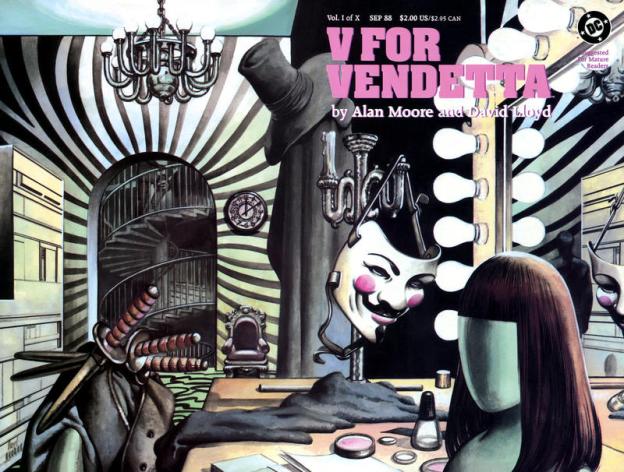
Anarchy in V for Vendetta

Alex Touchet

The character V from the book V for Vendetta, written by Alan Moore, has become more than just a graphic novel character.  He has grown to be a symbol for freedom; he is the face of rebellion against tyranny.  The “hacktivist” group Anonymous has even adopted the Guy Fawkes mask as their icon.  The visage of the fictional terrorist has evolved beyond a mere picture; Moore’s creation has transcended the world of fiction and become an internationally recognized metaphor for individual rights, activism, and anarchy.  Sadly, many people wrongly associate the word “anarchy” with a mental picture that looks like a scene out of movies such as The Purge or Lord of the Flies.  These people visualize a nation ruled by lawlessness, disorder, and chaos.  This is a fairly shallow interpretation of the goals V intended to achieve in Moore’s dystopian England; in fact, those cinematic examples are not in any way an accurate representation of true anarchy.  What does anarchy really mean?  Does V qualify as an anarchist?  Are his actions in accordance with anarchist values?  Does V intend to institute an anarchist society after the fall of England’s totalitarian government?  This paper will evaluate all of these questions and attempt to provide an objective viewpoint through which the reader can effectively evaluate anarchy as presented in Moore’s novel.

The word “anarchy” is defined by the Oxford English Dictionary as the “absence of government and absolute freedom of the individual, regarded as a political ideal.”  The word’s roots come from the Greek word “anarkhia.”  The word stems from “anarkhos,” which effectively means “without a ruler.”  It is important to note this explicitly says without a ruler; it does not imply terms like “chaos” or “disorder.”  This correctly contradicts a common view of anarchism, which interprets the political view as promoting a land of “Do whatever you want.”  This should not be defined as anarchy; instead, it is an example of something called “omniarchy.”  An example of this view can be found in the movie The Dark Knight.  The Joker is often called an anarchist.  This is completely incorrect.  “Whereas anarchists want to do away with the coercive hierarchy of any person over any person, the Joker wishes to impose upon all a coercive hierarchy of each person over each person.  In a very literal sense, the Joker wants what Hobbes called the war of all against all, the entire breakdown of society, the reign of chaos” (Peak).

In reality, anarchy’s vendetta is to create a land of “Do whatever you want as long as it does not interfere with the natural rights of other individuals.”  A person who imposes himself as a hierarchical authority over another person is in violation of this basic concept.  The main goal of true anarchists is to create a society in which no individual is imposing himself over another.  Therefore, all anarchists must follow the rule of the nonaggression axiom.

This term essentially means any initiatory violence or violation of another human’s natural rights is prohibited.  However, except in the case of some anarchopacifists such as Leo Tolstoy, most anarchists do not prohibit retaliatory violence.  In the case of person A attempting to rape person B, if person B were to pull a gun on person A, he/she (the victim) would not be in violation of the nonaggression axiom.  It is important to note the retaliatory aggression must be equal to the initiatory aggression, because otherwise, the original victim would be imposing himself or herself upon the aggressor as a hierarchical authority and therefore be in violation of basic anarchist ideology.

Now that the exact meaning of true anarchy has been adequately defined, the next step in understanding it in context of Moore’s novel is to decide whether or not V is a true anarchist, or if he is just attempting to impose an anarchist society upon England.  For V to fit the anarchist prototype, he must meet the previously outlined qualifications.  The most important of these qualifications is his actions in relation to the nonaggression axiom.

For V to be a real anarchist, he must act without initiating a violation of other individuals’ rights.  Remember this does not include retaliatory action, just initiatory action.  It would be easy to claim since V is a terrorist, he immediately violates this precept.  The buildings or locations he destroys, in order, are the Larkhill Resettlement Camp, Parliament, Jordan Tower, and the Post Office Tower.  He generally destroys these buildings during times when he was unaware of any human occupation: for instance, the Parliament building has been unused for years, and most likely unoccupied at the hour at which it was blown up.  When he blows up the Resettlement Camp, it is not specified whether or not anyone is killed or injured, other than in the instance with the mustard gas.

The author of an article appropriately titled “Is V an Anarchist?” claims this terrorism in itself is not in violation of the nonaggression axiom because it does not qualify as theft.  “While the state claims ownership of [the buildings], we must remember that the state acquires all of its property through expropriation, through usurpation, through theft.  The state’s so-called ‘ownership’ over these buildings is, according to the theory of property we posit above, completely illegitimate.  The buildings are actually in a Lockean ‘state of nature,’ and since they are not properly owned by anyone, V’s destruction of them cannot properly be considered theft” (Peak).

The only recorded death via bombing is of the man named Etheridge.  It could be argued he is effectively a criminal because of his involvement with the state, but it is unknown whether or not any of his individual actions are immoral enough to merit death.  Remember retaliatory action should, in violence and/or severity, never surpass the initiatory actions that preceded it.  Since V could not have been aware of this specific man’s acts, his death is not justified in regard to the anarchist theory of retaliatory ethicality.  Would V, still unaware of the man’s acts, have been justified in killing Etheridge if he had indeed committed acts worthy of execution?  This is up for debate.  It is my personal opinion V is indeed guilty of murder in this case, even if unknowingly so, and therefore violates the nonaggression axiom.

Another problem with claiming V is a true anarchist is his treatment of the individuals who were involved with his imprisonment.  He systematically kills many of them in a form that resembles coldblooded murder.  While it is arguable the execution of many of these people is justified retaliation for their actions involving the prisoners at the Larkhill Camp, the novel does not specifically mention their exact actions against specific individuals and so makes it difficult to determine if they meet the non-pacifist anarchist qualifications for execution. 

A third example of V not upholding anarchist values can be seen in his treatment of Evey.  He does not allow her to leave his base of operations, effectively imprisoning her against her will.  This is an obvious violation of her individual rights.  More importantly, V subjects Evey to extensive physical and psychological torture, which, even as an attempt to open her mind, still qualifies as torture.  While V obviously believes his ends justify his means, his actions violate the nonaggression axiom and therefore remain unethical in nature.  It is safe to say V does not personally meet the requirements for a truly anarchist individual; however, this is not to say his intentions for dystopian English society are not anarchistic.

One of V’s most relevant quotations in relation to his intentions for society come from his public announcement during the prologue of Book Three: “For three days, your movements will not be watched….  Your conversations will not be listened to … and ‘Do as thou wilt’ shall be the whole of the law.  God bless you … and goodnight” (Moore 187).  It would be easy to take from this V’s motives are in line with those of the Joker’s, since he apparently wishes to create a state of disorder, confusion, and chaos.

However, V’s endgame is not to create chaos merely for the sake of an omniarchy; instead, he believes it is “a stage … society must go through … before anarchism can be realised” (Peak).  He specifically tells Evey on page 195, “This is not anarchy, Eve.  This is chaos” (Moore).  It is clear V understands the fundamentals of an anarchist society and is attempting to create such a society by teaching its citizens what happens without order.  He believes through this process England will realize the only true path to freedom is through voluntary order, which is an important part of anarchistic values.

In conclusion, V has been shown to violate anarchistic values and therefore does not qualify as a true, purely anarchistic individual.  While this is the case, it is still possible his intentions for a future England are really anarchistic.  This has been shown by his treatment of the general public in England and by his logic he presents to Evey when she confronts him about how he sent English society spiraling into chaos.  It is safe to say V does indeed intend to create a free anarchist society, even if he does not meet every qualification for such a society himself.  This can be quantified as a result of his own personal vendetta against the people who imprisoned and experimented upon him; his violation of anarchist principles stems not from a disregard of anarchy but from V’s own individual motives and prerogatives.  It would be appropriate to conclude V intends to create a truly anarchist society from the remains of the tyrannically-ruled English people; his real endgame is not only to have his vengeance but to free society from those who impose themselves upon it and its citizens.

Works Cited

“Anarchy.” Oxforddictionaries.com. Oxford English Dictionary. Web. 6 May 2011.

Moore, Alan, David Lloyd, Steve Whitaker, and Siobhan Dodds. V for Vendetta. New York: DC Comics, 2005.

Peak, Alex. “Is V an Anarchist?.” Alex Peak. Web. 6 Oct. 2014. <http://alexpeak.com/twr/vfv/anarchism/&gt;.

—. “The Joker is Not an Anarchist.” Alex Peak. Web. 8 Oct. 2014. <http://alexpeak.com/ww/2008/016.html&gt;.

V for Vendetta: A Synopsis

Dale Martin

Caveat Emptor: Several plot spoilers occur in the ensuing abbreviated synopsis.  It also contains rather mature content.  Read at your own risk.  Don’t let this spoil you for reading the real thing.  It’s even better.

V for Vendetta is a brilliant book written by Alan Moore.  The setting for the book is a post-nuclear war in the early nineties.  The book presents the reader with an ever-changing plot that ends in the perfect way for this type of book.  V for Vendetta is one of the greatest works of post-apocalyptic comics that has ever come from Britain.

The book starts with a woman who is not yet name getting dressed in rather provocative clothing.  She is listening to propaganda by the ruling government.  The government at this time is called Norsefire.  They have weeded out any potential resistance and have full control of the country.  Norsefire controls people through five branches.  The Eyes see everything that goes on in the city of London.  The Ears listen to all communication throughout the city.  The Nose and the Mouth regulate the air waves.  The Fingers are the enforcers of the other branches.  They truly do the work of the rest of the branches.  They all follow the leader who relies on “Fate,” a computer that tells him how to rule the country.  Another person is preparing to go out as well as the woman.  The woman walks out onto a street known for prostitutes.  She finds a man sitting there waiting and she proceeds to ask him if he wants to have sex.  Now the law at this time forbids prostitution and the punishment was death (and whatever the Fingers did to you before they killed you).  The woman unknowingly had asked one of the Fingers to comply with prostitution.  He proceeds to let her know her mistake and calls over his friends for some pre-judgment fun with the woman.  To the woman’s delight a man with a mask jumps and kills three of the Fingers and saves the woman.  She passes out during the excitement and awakes to the man standing near her, making sure she is all right.  He is still wearing the mask and welcomes her into his home.

The man calls himself V and is in the process of overthrowing the government.  He has started with the abduction of the main voice of the Mouth.  We learn this man once worked at a resettlement camp, which is equal to the Nazi German concentration camps.  We also find V was at one of these camps and was a victim of this man’s ill treatment of the residents at the camp.  We also discover a clue to V’s name: he was in a test room labeled number five in Roman numerals.  V begins to mentally torture the man by making him recall the past, and to culminate the torture he burns the man’s precious collection of dolls in front of his face.  Later we find the man is mentally unstable and is practically useless to the government.  The woman, who by now we know is named Evey, begs V to allow her to help in his work.  V unwillingly allows her to help him. She is to become a play toy to the bishop of the church in England.  She does this and is nearly raped, when she makes a move on the bishop and runs away.  Then comes V to the rescue and takes the bishop to another room to have a talk.  Just before this incident occurs the greatest quotation in the book is said concerning the bishop and his “midnight snacks.”  The butler to the bishop states “The unrighteousness may not have peace but the righteous can get a piece whenever they want too.”  Of course, this not true but this almost makes sense of what the bishop is doing.  He claims to be a teacher of God, yet does the things he wants.  Now the bishop’s punishment administered to him by V is death by a communion wafer poisoned with cyanide.  Evey is distraught to find she was an aide to a murder.  V states she wanted to help despite his warnings.  Evey has an argument with V that ends with V dumping her off on some random street.  She is picked up by a kind man who takes care of her for a while.  They have a relationship, but he was in some shady business and is killed.  Evey, angry at this outcome, attempts to murder the man who killed him.  She is stopped.

During V’s little vacation of sorts we find V has killed a woman who was ultimately the cause for his insanity.  As a result, her lover who works with the government, decides to hunt him down for this.  We also find V has killed every single person who worked at the resettlement camp that were previously thought to be accidents.  We then find Evey about to commit a murder but is stopped by a masked man.  Evey awakes in a jail cell charged with attempted murder, which is true except she is charged as an accomplice of V, which is false.  She is tortured and tortured until finally she would rather have death than to have life through a lie.  Then she is set free.  She finds out V had constructed this to free her from the confinement of happiness.  V, now having finished his theatrical performance of the destruction of the government, has set in place everything and begins to tell Evey things that seem random at the time but come together at the end.  We see the lover of the doctor previously killed has caught up to V and is high on LSD.  To his amazement he succeeds in mortally wounding V.  Now V passes the rights to Evey and asks of her to give him a Viking burial.  This consists of a train packed full of explosives.  The government, which is now in ruins tries to recover now knowing that V is dead, or so they thought, when they see another V continuing the legacy.  The new V in the process of the confusion saves another person and so the story begins again with a new V and a new student.

The Use of Impression Management Tactics

Nicole Moore Sanborn

As in any industry, many problems exist in the industry of business and in what is commonly referred to as “the business world.” Interviews are a major tool used within the realm of business to get to know people as well as determine job capability. It is important to note here that interviews are widely used, so this is not just an issue within business. Within interviews, it is common for interviewees or applicants to attempt to alter how interviewers perceive them with what are called impression management tactics. Impression management tactics are a concern within interviews and many believe the use of these tactics is a serious problem. Many argue against the use of impression management tactics, saying they sway the interviewer toward the applicant too much and thus alter who is employed. The problem of the use of impression management tactics within interviews needs to be observed more thoroughly and addressed. Once addressed, a solution should be executed. The best and primary solution to the solving the issue of the use of impression management tactics is increasing interview structure, thereby giving the employers more control and ways to better detect the use of impression management tactics.

Some classify impression management tactics in two forms: verbal and nonverbal. Verbal impression management tactics can further be classified into self-focused tactics (directing the conversation towards themselves) and other-focused tactics (directing the conversation to the interviewer or the company). Within self-focused verbal impression managements there are more subcategories: self-promotion (demonstrating qualifications), exemplification (convincing the interviewer that the applicant’s behavior can be used as a model for others), and discussing how the applicant is responsible for past achievements (Chen, Chiu, and Tsai, 2005). According to Aleksander Ellis, Bradley West, Anne Marie Ryan, and Richard DeShon (2002), another definition for impression management tactics is “a conscious or unconscious attempt to control the images that are projected in social interactions” (p. 1200).  Ellis et al. (2002) claims there are two broad categories displaying types of impression management tactics: assertive and defensive. Ellis et al. (2002) defines assertive tactics as self-promotion tactics and ingratiation tactics. The self-promotion tactics are the same as the ones listed above, with the emphasis being to display competence and intelligence and make a favorable impression to the interviewer. Ingratiation tactics are essentially the “other-focused” tactics above, that is, when an applicant seeks to evoke interpersonal liking and establish good rapport with the interviewer. Defensive tactics, however, are designed to protect or repair one’s image. Defensive tactics include excuses, justifications, and apologies. Defensive tactics are used less often than assertive tactics. Defensive impression management tactics are most commonly used to justify past behavior and potentially to spin a negative quality in the applicant’s favor (Ellis et al., 2002). 

The traditional interview has historically been scrutinized and left suspect to whether or not it truly examines and determines the qualifications and the preparedness of the applicant for the job position. More structured interviews are becoming more and more common, and researchers favor them because they are less prone to issues such as impression management (Ellis et al., 2002). A wide array of topics and actions fall under the term “impression management tactics.” They are exactly as they sound: tactics applicants use to manage their impression before their interviewer. What does impression management look like? The first aspect of impression management is in making the first impression. Robert Lount, an assistant professor at Ohio State University, says “First impressions matter when you want to build a lasting trust. If you get off on the wrong foot, the relationship may never be completely right again” (Quast, 2013, par. 3). According to the Image Consulting Business Institute, image management is “the ongoing, pro-active process of evaluating and controlling the impact of your appearance on you, on others, and the achievement of your goals” (Quast, 2013, par. 4). Lisa Quast (2013), contributor to Forbes magazine, lists five things to consider when making a positive first impression: attire, calculated verbal communication, evaluation of non-verbal communication, wariness of attitude, and scrutinization of grooming, including hair, makeup, and cleanliness. 

According to Ellis et al. (2002), the relationship between an applicant’s use of self-promoting tactics and higher interview ratings is a result of a theory called the attribution theory. Attribution theory suggests that humanity has an inherent need to understand the behavior of other individuals and evaluate the cause of other individuals’ actions (Ellis et al., 2002). Thus, the interviewer, when evaluating an applicant, may attribute actions during the interview to the use of self-promoting impression management tactics and maintaining their overall image. Because the interviewer attributes an applicant’s actions to impression management tactics, the theory is titled attribution theory.

Why is the use of impression management tactics an issue? Many believe the use of these tactics is an issue because the use of tactics may sway the interviewer one way or the other in their review of the applicant. Suppose a well-spoken individual applies for a job and uses impression management tactics during their interview. Meanwhile, another individual who is less well spoken but better qualified walks into the interview and either does not use impression management tactics or does not use them as well. If the interviewer favors the first individual over the second individual due to the use of impression management tactics (tactics which made the first individual more likeable or appear more qualified), the use of these tactics could become an issue.

When observing the negative aspects of the use of impression management tactics, one must consider industry. Some employment opportunities have a “customer-contact requirement.” (Chen, Chiu, and Tsai, 2005). Sales representatives must prove job competence when talking to customers. Journalists must be able to present themselves well to conduct interviews. Public relations and marketing employees must network and expand the horizons of the company. Essentially, there is a customer-contact requirement in many job and business settings. However, employment opportunities for scientific research jobs or jobs in the engineering field have less of a customer-contact requirement. While these people must know how to present themselves, they do not go out and talk to the public or other businesses on a daily basis, and thus the ability to use impression management tactics well is far less important. Impression management tactics are also less of a problem in these fields. This paper observes business-specific interviews, where employees are required to be in contact with customers more frequently. Thus, impression management tactics affecting and intervening with employment decisions is more widespread in the realm of business.

This poses an issue for interviewers. If the applicant uses impression management tactics to sway the interviewer to approval, the issue of authenticity within the interview arises. Karl Nunkoosing (2005) discusses the issue of truth and authenticity in interviews. In his essay, the interviewer is considered a researcher. The interviewer is indeed a type of a researcher, gathering information from stories about applicants. Nunkoosing poses the issue of the “researcher” or the interviewer only basing employment decisions off of the stories applicants tell. He argues that not only does the applicant choose the aspects of life he or she is most interested in telling, but also that a person may “have a well-rehearsed story totell” (Nunkoosing, 2005, pg. 701). The issue of impression management even boils down to what stories are told.

Amy Gallo (2012), author in the Harvard Business Review, cites John Lees, a career strategist and author of books about interviews. Gallo says that Lees dismisses the advice to “be yourself” in an interview. He emphasizes being the best version of you. His advice essentially screams the use of impression management tactics to put your best foot forward in an interview setting. However, simply because one is being the best version of themselves does not mean they are being a false version of themselves. It must be pointed out here, however, that impression management tactics do not necessarily fabricate someone’s personality. The issue of the use of impression management tactics swaying the interviewer ties into Lees’ advice to “put your best foot forward” and persuade the interviewer to favorably judge. The issue is that you do not know if the applicant is lying about their personality, tendencies, or capabilities to appear favorable. In some extreme cases, lying is a possibility. Other times, resources could be wasted attempting to figure out whether or not the applicant is lying. Companies have more important issues to attend to than to figure out whether or not an interviewee is being hurtful. Thus, the use of impression management has the potential to be a problem in many facets of business.

Another aspect that must be taken into consideration is the type of questions being asked in an interview. Ellis et al. (2002) divide interview questions into two types: situational and experiential. These two types of questions are commonly referenced in many other sources. Experiential interview questions are questions about an applicant’s past experience and focus on what has already been accomplished. Ellis et al. (2002) hypothesizes that more self-promotion tactics are used in answering experiential questions. This makes sense, as self-promotion tactics include self-promotion (qualification focused) and exemplification (saying they could be a model for behavior) tactics. When an applicant focuses on his or her past achievements they will focus on why they are qualified for the job and look to past achievements to prove he or she can be a model employee. Situational interview questions focus on the future, where the interviewer asks the applicant what they would do if put in a specific future situation. The use of more ingratiation tactics is expected (Ellis et al., 2002) in answering situational questions, specifically justification, where the applicant would justify their behavior in a future situation the interviewer asked about. Because different tactics are used when different questions are asked, it can be difficult to determine the totality of the effects that the use of impression management tactics has on interviewers. The use of impression management tactics is a problem nonetheless that needs to be solved so that interviews are based more on the qualities and qualifications of the applicant rather than on how much the applicant persuaded the interviewer to act favorably toward them.

The best solution to the issue of using impression management tactics in interviews is increasing the structure of interviews. Before interviews can be restructured, the current structure of interviews must be observed. According to Northwestern University (2013), every interview follows a similar structure. In each interview, there is the arrival of the applicant (nonverbal cues are utilized here), the introduction to the interviewer, an information exchange, and the wrap-up. Within the information exchange aspect, four different question types are asked: behavioral, closed-ended, preference, and follow-up questions. Behavioral questions focus more on past behavior of the applicant and experiences, while closed-ended questions typically have brief answers and are where the interviewer has more control. Behavioral and preference questions are more open-ended and are where the applicant can typically take charge. Preference questions are exactly as they sound: the interviewer asking about the preferences of the applicant. Follow-up questions are typically asked in response to an applicant’s answer to a specific question and are where the interviewer can take charge and direct the conversation. The introduction and wrap-up aspects of the interview are quite similar, as both typically involve a handshake and either introductions or farewells. However, in the wrap-up, the employer typically asks the applicant if they have any questions. At this time it is important for the applicant to demonstrate how interested they are in the job position as well as how serious they are about getting hired (Northwestern, 2013). Even in structured interviews the basic layout above remains. According to the online Business Dictionary (2014), a structured interview is a “fixed format interview in which all questions are prepared beforehand and are put in the same order to each interviewee” (BusinessDictionary.com, 2014). Structured interviews are said to provide precision and reliability that is required in certain situation (BusinessDictionary.com, 2014).

One way to decrease the effectiveness of the use of impression management tactics is to know how to spot types of employees the company is not looking to hire. Carol Goman (2013), contributor to Forbes.com, writes about how to spot a liar during an interview. While outright lie detection is not directly related to impression management tactics, some of these tips can also be used to spot the use of impression management tactics. She suggests watching for stress signals and watching the applicant’s eyes. By watching for stress signals, the interviewer can observe when the applicant attempts to calm himself down and attempt to manage the interviewer’s impression of him. When this is observed through noticing the applicant’s eyes, the interviewer can guard himself from impression management tactics. Another tip is to notice when the applicant isn’t really answering the question, but is finding a way to avoid the direct question that was asked. This can be an attempt to cover something up or manage an impression (Goman, 2013).

The final two tips Goman gives are to listen to vocal stress and detect emotions hidden by smiles. If it seems obvious that the applicant is stressed or is covering up a feeling by smiling, impression management tactics are most likely being used to either cover something up about the applicant or give a false impression of who he or she truly is. Admittedly, the interviewer could exaggerate detecting these signals (they could think the applicant is lying and be wrong), and signs of stress could simply be related to the fact that the applicant is in an interview for a position they are trying to obtain. As a result, these tips for lie detection as they relate to impression management tactics are only the beginning of the solution to decrease the efficacy of the aforementioned tactics. 

As previously stated, the best solution to combat the efficacy of impression management tactics is to increase the structure of the interview. Now that the structure of interviews has been explained and tips for interviewers to use to detect the use of impression management tactics have been given, how to structure the interview will be discussed. As explained earlier when defining impression management tactics, the issue is also an issue of industry, and this paper is business specific. Beth Leech of Rutgers University writes about techniques for how to ask questions in interviews (2002). The first step is for the interviewer to establish rapport. Rapport in this sense is not simply making the applicant feel comfortable. The interviewer should appear professional and generally knowledgeable about the applicant, without knowing too many specific details but appearing to know the basics of the applicant. Leech also discussed question wording in interviewers. The words used in the questions being asked should be non-judgmental, non-suggestive, non-presumptuous and non-threatening. If the interviewer knows the applicant did not like their old boss or was in a sticky job situation or maybe messed up in a previous place of employment, the interviewer should watch the question working. If the question seems accusatory, the applicant is likely to put up walls and engage in impression management tactics to attempt to control the situation. When non-suggestive words are used in a question, the applicant is more likely to give the interviewer more information (Leech, 2002). Thus, wording and what angle the interviewer is coming from plays a role in an applicant’s use of impression management tactics. Interviewers should carefully consider how questions are worded to get the most honest answer from their applicants.

When structuring interviews, question type is imperative. Question type can be the key to controlling the interview and can be used to determine whether or not the applicant is engaging in impression management tactics. Pulakos and Schmitt (1995/2006) say that two types of interview questions are experience based questions and situational questions. Situational questions discuss the future, where the applicant explains what he or she would do in a future situation while on the job. Experience-based questions, however, look to past experiences and actions to determine the preparedness of the applicant. An example of a situational based interview question is as follows: “What actions would you take in a situation where you know another employee is faking the books or embezzling money from the company?” An example of an experienced based interview question could be “What have you done in the past that has prepared you to organize the books and financial records of the company?”

Pulakos and Schmitt (1995/2006) conducted a study to determine whether situational questions or experienced based questions are better to determine future job performance. It is important to note here that applicants can and will still use impression management tactics when answering each question type. The goal is to find a solution where the interviewers are more in control and aware of the use of impression management tactics, thereby rendering the tactics less effective. Pulakos and Schmitt (1995/2006) found that although situational questions were viewed as potentially better to determine job performance, their hypothesis was incorrect. Experience-based questions were a better predictor of job performance, according to the meta-analyses and statistical analysis of the data collected (Pulakos & Schmitt, 1995/2006). Therefore, experienced-based questions should be used to better predict job performance. Interviewers should ask these questions and watch for the use of impression management tactics.

Although applicants can choose which experiences to discuss in the interview and manage their impression as such, looking to past experiences is a better predictor of job performance, as previously stated. Employers should be aware that impression management tactics will be used but should be able to detect them better. Therefore, to be more in control of the interview, despite the use of impression management tactics, interviewers should primarily ask experience-based questions. This way the interviewer can close in on the applicant and make a judgment as to whether or not he or she is telling the truth. If enough experience-based questions are asked, the interviewer will get a broader sense of who the applicant truly is by controlling the interview and forcing the applicant to tell of enough past experiences. The interviewer will still have to watch for the use of impression management tactics.

Impression management tactics are commonly used in interviews, specifically in the business world. Impression management tactics have various categories, and applicants apply these tactics depending on the question being asked (situational or experiential). The use of impression management tactics is considered a problem because the use of these tactics sways the interviewer more favorably toward that applicant. This, in turn, raises questions about if the applicant was really a better applicant than those who did not use impression management tactics. There are many tangible solutions to the issue of the use of impression management tactics in interviews, the primary one being interview structure. The use of impression management tactics will not cease to exist because likeability will always play a role in an interviewer’s decision-making. An applicant cannot be chosen based on measurable qualities alone. However, with increasing interview structure, interviewers will be more aware of the use of these tactics and there will be less wondering about whether or not the applicant swayed the interviewer into employing him or her when someone better suited for the job also applied.

References

BusinessDictionary.com. Structured interview. Retrieved from http://www.businessdictionary.com/definition/structured-interview.html.

Chen, C., Chiu, S., &, Tsai, W.. (2005). Exploring boundaries of the effects of applicant impression management tactics in job interviews. Journal of Management, 31 (1): 108-125.

Ellis, A., West, B., Ryan, A., &, DeShon, R.. (2002). The use of impression management tactics in structured interviews: A function of question type? American Psychological Association, 87 (6): 1200-1208.

Gallo, A.. (2012). Stand out in your interview. HBR Blog Network. Retrieved from http://blogs.hbr.org/2012/09/stand-out-in-your-interview/.

Goman, C.. (2013). Seven tips for spotting liars. Forbes. Retrieved from http://www.forbes.com/sites/carolkinseygoman/2013/05/20/7-tips-for-spotting-liars-at-work.

Leech, B.. (2002). Asking questions: Techniques for semi-structured interviews. Political Science and Politics, Volume unlisted (4): 665-668.

Northwestern University. (2013). Structure of an interview. Retrieved from http://www.northwestern.edu/careers/students/employment-skills/interviews/structure-of-an-interview-.html.

Nunkoosing, K.. (2005). The problems with interviews. Qualitative Health Research, 15 (5): 698-706.

Pulakos, E., &, Schmitt, N.. (2006). Experience-based and situational interview questions: Studies of validity. First published online 7 December 2006. Reprinted from 1995, Personnel Psychology, 48 (2): 289-308.

Quast, L.. (2013). Five tips to create a positive first impression. Forbes. Retrieved from http://www.forbes.com/sites/lisaquast/2013/09/09/5-tips-to-create-a-positive-first-impression/.

The Great Depression

Daniel Coats

The Great Depression is remembered as one of the darkest periods in American history ever.  A period where life was hard and desperate and where there was little hope for recovery.  Consequences and effects from the Great Depression are still affecting America today and America will never be the prosperous flourishing country it used to be.  Instead America is reinventing itself since this horrible era.  The people of America had and still have pioneer spirits and stayed positive throughout the depression and that is how America got through the depression and picked itself back up and darted for the top.  (Although nowadays we are going downhill again.)  This unfortunate tragedy was so devastating that it affected many other countries, especially Europe.  Because of God’s grace, leadership, and a plan, America was able to turn around and recover after many years of unemployment and poverty.

In October 1929 the stock market crashed, which triggered the Great Depression.  This caused investment and consumer spending to plummet which lowers industrial output extremely meaning more unemployed citizens because of failing businesses. The main reasons behind the stock market crashing was actually happening during the “roaring twenties” when America was prospering. During this era income increased from 74 billion dollars in 1923 to 89 billion dollars in 1929.  Although this seems great, the “Coolidge Prosperity” of the 1920’s was not shared evenly among all Americans (McElvaine 38). “According to a study done by the Brookings Institute, in 1929 the top 0.1% of Americans had a combined income equal to the bottom 42%; That same top 0.1% of Americans in 1929 controlled 34% of all savings, while 80% of Americans had no savings at all” (McElvaine 38). While the disposable income per capita rose 9% from 1920 to 1929, those with income within the top 1% enjoyed a stupendous 75% increase in per capita disposable income (McElvaine 39).  As you can see this is a recipe for disaster.

Why was there this large and increasing difference from the rich and the middle class?  Wages for jobs in manufacturing only grew 8% while productivity increased four times as fast.  Production costs dropped and wages grew very slowly.  Corporate gains grew 62 percent!  Obviously money is not being distributed evenly. Henry Ford is a big example of corporate gains over wages growing.  He made 14 million dollars a year while his workers were making an average of 750 dollars.  In today’s money Henry would be making over 300 million dollars while his workers would be making around 18,000 dollars.  This is absurd and was happening all over the U.S during the roaring twenties and into the depression.

Although it seemed that the Depression will finally come to an end with Franklin D. Roosevelt’s social security bill being passed and with industries beginning to hire people, unfortunately it did not work as well as everyone wanted it to.  In fact, it didn’t really improve at all until the United States decided to take action and join forces with the Allies in World War II.  Millions of jobs were created when the United States decided to up their game on defense and when the Japanese bombed Pearl Harbor, millions of more jobs were created when the U.S actually declared war after the fatal attack against the U.S.  By the time the War ended, the U.S was back on top and the Great Depression was pretty much wiped out.

Lessons that can be learned from the Great Depression are when bad times come and there’s not much people can do individually about it, stay active with people and stay active in the community.  It is easier to get through things with fellow friends and people.  That is the main thing that kept people alive and hopeful and strong during the Great Depression.  As well as having a positive mind set through hardships, people need to be wise financially.  Now that Americans have credit, it is easier to have debt.  Back then if you had no money, you had no money.  Nowadays people can borrow and borrow and get deep into debt which not only hurts themselves but also the economy.  We have already almost gotten into another Great Depression in 2007 (The Great Recession).  If America does not want to go through another terrible era like this again Americans must become financially savvy and work together.

Bibliography

“Great Depression, The.” History.com. A+E Networks, 2009. Web. 12 Oct. 2014.

McElvaine, Robert S. The Great Depression: America 1929-1941. N.p.: n.p., 1984. 38-39. Print.

“Timeline of the Great Depression.” PBS. WHRO, n.d. Web. 12 Oct. 2014.

The Role of God vs. The Role of the gods

Sydney Harris

We’ve recently read the Iliad in English class, which is the epic tale of bravery, courage, and vengeance.  The story depicts the quest for honor and glory among the gods and men.  This story is a Greek and Trojan tale, so therefore includes Greek and Trojan gods and goddesses in them.  Divine intervention was a major part in Homer’s Iliad.  The gods that are seen most in this book are Zeus, Hera, Athena, and Poseidon.  Most of the gods have favorites and are on a particular side to win.  Although, as the just and highest god, Zeus is equal in loyalty to both the Greeks and Trojans.  Even when his son Sarpedon is about to die, for example, he lets the outcome go unaltered.  The gods in the Iliad are extremely active in the lives of their people in a very obvious and straightforward way.

As Christians we have one deity we look to for help and wisdom, and that is God.  God is also very involved in our lives and cares deeply for us.  He wants our praise and worship like the Greek gods but doesn’t do harm to us if we don’t.  He is jealous but doesn’t show His wrath upon us like the gods repeatedly do throughout that time period and in the book.  He doesn’t pick sides and is only doing and deciding what is right and good.  He answers our prayers like the gods in the Iliad do but not always the way we want Him to. He has been very evident in the history of this world, nation, and personal lives of everyone who accept Him.

History has opened a lot of doors for questions in relation to where is God when you need Him or how He lets bad things happen.  As Christians we struggle with answering this question for people and frankly ourselves.  In the Bible it states God is all-powerful and wise and just.  So, when bad things happen, we wonder how a wise and loving God would do such a thing.  We also know the earth is Satan’s domain, and he wishes to kill, steal, and destroy.  God doesn’t use His power over Satan because He knows he won’t stop, and He is righteous and will never force us to worship Him.  Bad things happen because sin entered the world through Adam and Eve and cannot be completely removed until Jesus comes back and recreates a new Heaven and Earth.

In history the Greek gods and goddesses have been known to not be perfect and make a lot of mistakes.  They have bad tempers, do what they want with humans, and don’t care for anyone but themselves.  The only way they would show mercy to you is if you were their child (or a demi-god), or you gave them sacrifices.  These gods committed adultery, murder, and a list of other things any normal deity figure would not do.  The Greek and Trojan people had no concept of one god making the whole universe and everything in it, so they made up their own gods.  They knew the stories and theories they made weren’t true, but they compromised the truth so they could do what they wanted.

The Christian God is the only way to Heaven or anything after death through His Son Jesus, who died for our sins.  He made the Heavens, Moon, Stars, and everything in it.  Our God is personal and real, the main difference between the two.  He wants to be involved and relevant in each single person out of the billions of people He uniquely created for a purpose.  He cares enough about us to give us rules and regulations and abides by them, earning our respect.  We have a reverent fear of God, but the gods only create a natural fear in their believers.  A lot of religions today are about works and just the religion, not the relationship.  That’s what Christianity is all about, the relationship we create with our Heavenly Father and how we share His love with others while we are on this planet.

Transcendentalism

Luke Kline

Transcendentalism began to develop in the 1820s. It was the idea that our human spirits were involved with yet went beyond the natural world.  The natural world is not the only real thing.  Transcendentalists tend to view nature as a way of communicating the condition of the human soul.

An example of the transcendentalist worldview is displayed in Walt Whitman’s poem “The Ship Starting.”  Whitman uses extremely figurative language and personifies ordinary natural objects to represent human souls.  In the poem the ship represents humans sailing on the vast ocean.  The vast ocean represents the ever-changing and unpredictable life of humans.  Upon reading this poem literally one may just observe a narrative about a large ship sailing on the ocean.  However, each item in the poem represents something bigger than itself.  Everything is a symbol for something else.  This is the embodiment of transcendentalism itself.

For transcendentalists nothing is merely physical.  Spiritualism and divinity are a part of all aspects of life.  This is why you will rarely find a transcendentalist writing literally.  Almost everything in their works stands for something else.  The natural world represents the spiritual world.

Another aspect of transcendentalists is the idea of individualism.  Every individual is made equal and all are called to a certain purpose.  An excellent example of this worldview is found in another of Whitman’s poems entitled “I Hear America Singing.”  In the poem Whitman describes all different types of people performing their duties.  Everyone is “singing” while they perform their duty.  This can be interpreted as everybody is happy and satisfied with what they are doing.  Another aspect of a transcendental view of human nature is revealed here.  It is that all humans are inherently good.  When people perform their duty there should be no grumbling and complaining.  By fulfilling their duties they are good and satisfied.

Besides secular aspects, transcendentalists also have their religious views of religion.  In general, they tend to denounce the traditional creeds and traditions of the church.  Rather, they seek to find God in their soul and in spirit.  Instead of studying the Bible to receive the Holy Spirit, they desire a special revelation from God Himself.  Transcendentalists are firm believers in oracles and direct inspiration from God.  Here we again observe this reoccurring idea of putting aside the physical world and searching for the true things of the spiritual world.

Finally, the idea of coming out of the old and into the new is prevalent in a transcendentalist’s worldview.  Transcendentalists were not satisfied with the church or the political parties.  When the movement commenced, many separated themselves from church and state and sought fellowship with people who had the same mindset as them.  This idea of embracing the new is what caused them to not take faith in the “old church” and seek God in His present day being.  Transcendentalists support modernization of religion.  With all this, it is clear to see that transcendentalism centers around the idea of change and the embracing of new things.

Bibliography

Miller, Perry. The American Transcendentalists: Their Prose and Poetry. New York: Doubleday Anchor. 1957. Print.

Whitman, Walt. Leaves of Grass. Philadelphia: D. McKay, 1900. Print.

Hard vs. Soft Science Fiction

Chris Glock

Like most genres of literature, science fiction can be divided into sub-genres.  Of these sub-genres there is hard sci-fi and its opposite hard sci-fi.  Of these two genres there are many famous writers and works in each.  The line between the two is very grey with varying levels of hardness and softness as opposed to having just hard and just soft.

Science fiction is a fictitious genre that focuses on real and hypothetical science.  Usually science fiction takes place in the future, however there is a good number occurring in a modern setting and some even taking place in the past.  People often lump science fiction under the fantasy genre of which many sci-fi books could fall.

Hard science fiction had a focus on scientific fact or accuracy.  This definition however says nothing about the actual literary content of the book, which is why to many people it is not as alluring as soft science fiction.  Because of this hard sci-fi is sometimes scrutinized for putting scientific accuracy above all else.  People who aren’t fans of this sometimes see them as textbooks filled with knowledge rather than an entertaining story.

A great example of this hard science fiction is “Day Million” by Frederik Pohl.  This book tells the story of Don and Dora from the future, day one million to be precise.  While like all books it has a plot and main characters, they serve only to keep readers interested.  The book primarily talks about how different life is in the future.  Don is cybernetic and has a metal body, while Dora is some sort of modified human with gills and a tail.  At the end they both get married then never see each other again, this is because they both download the other’s personality into their minds so that they can see, hear, and feel, the other at any given moment.  That is the entirety of the plot; much more attention and detail goes into describing how this futuristic world functions.

Soft science fiction in contrast is any work of literature set in a fictitious scientific setting despite how inaccurate or realistic it is.  Many people prefer this, and for a good reason, too: without being held to the realism set by hard science fiction, the writers have easier times creating and interesting and captivating story for their audiences.  These books also tend to be better known as people who aren’t fans of the scientific side of them can still find the story fascinating.

A famous work of soft science fiction is H.G. Wells’s The Invisible Man.  It tells how a man named Griffin turns himself invisible; while conducting research, Griffin gets himself in trouble with the town.  He is then chased down and killed by everyone in the town.  This is soft science fiction because, while it does have scientific principles, it is used as a backdrop to the rest of the story.  The book doesn’t even mention how Griffin had become invisible except for it had been an accident during an experiment.

Bibliography

Blish, James B. “Surface tension.” N.p.: Gnome Press, 1957. Print.

Clarke, Arthur C. “Childhood’s End.” N.p.: Ballantine Books, 1953. Print.

Pohl, Frederick G. “Day Million.” Lanham: Scarecrow Press, Inc., 1979. N. pag. Web. 11 Oct. 2014. <http://www.sfcenter.ku.edu/Sci-Tech-Society/stored/day_million.pdf&gt;.

Wells, Herbert G. The Invisible Man. N.p.: C. Arthur Pearson, 1876. Print.

Hi There!

Christopher Rush

Welcome back!  Your dreams, indeed, were your ticket out, but here we are together again, wouldn’t miss it.  How are we doing?  Same as always.  We are back in the saddle once again.  We have shaken off the dust, polished the fine silverware, and wound our pocketwatches for a new season.  How are you doing?

I know what you’re thinking: “Why?  You ended on top, masters of your field!  It ended so beautifully, so heartwarmingly optimistically — there’s no chance to be as great as it once was!”  Easy, now.  In a world in which Monty Python can reunite to sold-out shows, Rush can be inducted into the Rock and Roll Hall of Fame, Batman is finally released in Blu-ray in its entirety (the Adam West version, of course), and Bob Seeger, AC/DC, U2, and Pink Floyd(!) can release new albums, surely we, too, are allowed to do something unexpected and unhoped for.

At the beginning of series two, I made a list (in approximately 28 seconds) of the various topics I wanted to write about, including every entry in the much-beloved “Forgotten Gems” series.  During series two and three, I wrote them all.  The journal and I accomplished everything we set out to do.  It was a rewarding yet tiring experience.  New opportunities came along, people grow old, things change, many factors that need not be enumerated here (or ever) … it was time for a break.

And yet here we are again.  Yes, despite the positive surprise occurrences mentioned above, the world is much different, darker, angrier, more confused place than it was when we left (a world in which the Forces of Darkness are met not by Armies of Light but by apologetic open letters), but what better reason to return and bring more hope back to a world that needs it so much?  We don’t have to be what we once were — we won’t even try.  We’ll just be who we are now, not trying to emulate ourselves or “the good ol’ days,” and see the world perhaps not as it is but as it should be, making Cervantes (O’Toole’s Cervantes, at least) proud as we go.

Reedeming Pandora is no longer an elective, and thus we will be different by necessity.  Instead of having the same core group of seniors contributing work each issue, we will expand our horizons and broaden our vision.  Most of the diverse selections will be the sundry projects from Honors English students, grades 10-12.  This relates to the general change of the Honors program in English: instead of having all Honors students do the same task each quarter, students are pursuing individually-tailored courses of study, what we’ve informally nicknamed “More Better Different.”  Along with this freedom comes a variety of ways students are proving their learning.  Some will be papers, some will be modified slideshows, some will be … I have no idea what some will be.  This is awfully exciting.  We are trying to bring that freshness into Redeeming Pandora.

True, this spontaneity may make it difficult to advertise what will occur from issue to issue, as even I don’t have much of a plan for what to write about, but as we like to say around the office, our motto at Summit is “Keepin’ it Fresh.”

As always, we will welcome the contributions of old friends (alumni), and perhaps we will see contributions by new friends (who may or not be alumni or even people who have never been to Summit).  Perhaps we will revisit some old series like Forgotten Gems, perhaps we will pay more attention to the world around us now.  We’ll find out together.  There are truly no lines on the horizons (other than the limitations of the printed page, of course).

One thing I do know, we will continue to bring laughter and warmth and hope to your lives and ours.  It’s not the time to give up and allow the darkness free reign over the world and our souls.

So buckle up, boys and girls!  The band is back together.  It’s Magic Time.

Cue the Collective Soul (believe me, it sounds better than it reads):

Welcome all, welcome all

Welcome all my friends.

Welcome all, welcome all

Welcome all again.

Welcome all, welcome all

Welcome all my friends.

Welcome all, welcome all

Welcome all again.

Welcome all again

Welcome all again

Welcome all again

Welcome all again!

“I am a part of all that I have met…”

Christopher Rush

All times I have enjoyed / Greatly

I have known for some time I wanted to end this journey with a reflection on where I have been and how I have gotten here.  That others have done this same thing for this final issue is the last in a satisfying series of co-incidents this journal has enjoyed throughout the years.  For instance, I knew going into the second year I wanted the fifth cover to be an homage to The Beatles’ White Album, and then Connor Shanley wrote an article about The Beatles.  Last issue, without consulting each other, Thorny and The Nighthawk both wrote about troubled youths.  It’s been an interesting journey these last three years, that’s for certain.  One can tell what I have been most pressingly interested in at the time — it’s almost been a kind of journal of my pastimes … in all that free time I have.  It’s time now, though, to go back even further, to see what influences have been strongest over the years.  These lists will not include family and friends, as that would be both unnecessary (as their influence has been far greater and more significant) and dangerous (for fear of leaving out someone important due to the vagaries of the memory).  Instead, to mine own self shall I be true and look at what else really matters: the games, music, movies, and shows that have helped shape the man I have become.  (By the way, if you are still waiting for that in-depth analysis of The Lamb Lies Down on Broadway, check out the frighteningly-impressive work of Jason Finegan, Scott McMahan, and other members of Paperlate on “The Annotated Lamb Lies Down on Broadway” at http://www.bloovis.com/music/lamb.html.)

The Games

The point of this, if one exists, is to mention and possibly briefly discuss the early, formative events, so the more recent games (Uncharted, Assassin’s Creed) will be left on the backburner.  Other games have already been lauded and mentioned in other articles, so consider new entries here as additions to earlier lists, not a supersession (I am in no way a supersessionist, as you should know by now).

Our first video game experiences predated the Nintendo Entertainment System.  We spent great hours learning and playing on the old Texas Instruments TI-99/4A system with cartridges that slid into the main front slot.  I got fairly good at TI Invaders, as well as a few other games not too many people still alive have heard of.  We didn’t have too many of the “classic” games, such as Frogger or Donkey Kong or BurgerTime, but we had great games that challenged our mathematic skills as well as hand-eye coordination, and we learned and played and had a good time doing it.  I wish we still had that machine and those games — they are more enjoyable and worthwhile than many of the games the kids play today.  Those days ended around Christmas of 1988, with the arrival of our Nintendo Entertainment System.

Super Mario Bros. 1-3, Super Mario World, Super Mario 64)

Our first game was Super Mario Bros./Duck Hunt, which was a great change, obviously.  Again, I wish we still had a working system (though I think my brother has a new console and still is playing the old games).  The first three Super Mario Bros. games were all different, which still impresses me, even though I know more about how they were made, how they were copies of this and that, and other ins and outs of the business.  That the creative team would do such drastic things with each new iteration of the series is far more creative and, if I may, courageous than most of the designers out there today, who simply cash in one golden goose without trying to invent or create beyond “improving CGI,” which is an oxymoron for another time.  I’ll never forget the first time I got to the last level of Super Mario Bros.  It was a Sunday afternoon, and Andy was hanging out, and I was so excited I ran upstairs to tell my mom I made it to the last level.  I ran back down, tripped over the controller cord, pulling the NES power cord out from the wall, shutting off the game.  That was rough.  I eventually got back and won some later time.  For many of us, though, the words “but our princess is in another castle” still brings an edge of frustration.  SMB2 was so different it was like a new kind of thing — not just a new game, but a new kind of gaming experience.  I remember Adam calling me when he got to the last level; I ran up the street to go to his house and watch him beat the game.  I have since beaten it as well, but the “it was all a dream” thing never sat too well.  The potions, the coins, the power-ups, riding the eggs … great stuff.  I usually play as Peach, which just makes sense, since you often want her flying/hovering ability far more than Luigi’s reckless jumping or Toad’s rapid uprooting skills or Mario’s averageness.  My first experience with SMB3, as for most, was the classic movie The Wizard, ridiculously underrated.  It looked so different: new power-ups, overworld maps, whistles … what was all this?  I first played the arcade version at Skate Country.  Goombas on wheels?  Flying capes?  This was intense.  The best part was not that it was easier (going from a cape, to big Mario, to small Mario, to dying) but that you could do more: the easier play allowed for more actual playing of the game, more things to do, more challenges and fun to be experienced.  When the SNES came a few Christmases later, naturally we played World quite a bit.  The added complexities, saved games, Yoshi, each addition made it worth playing and enjoyable.  The same can be said of 64 when that arrived a few more Christmases later.

A Link to the Past, Ocarina of Time

I certainly played Legend of Zelda, and even beat it a few times, but I never got too far into Zelda 2 — this is especially interesting considering my already-discussed penchant for RPGs.  I never really got into it, in part because I never owned 1 or 2, they were always borrowed or rented, and RPGs are tough to get into when not personally owned.  When A Link to the Past came along a few years later, I was deeply affected.  That may sound silly, but considering the game’s vast scope, its great story and characters, the driving themes of heroism and self-sacrifice and growing up, the overt contrast of light/good and dark/evil, it came at just the right time.  Let’s not forget the music.  I would definitely play Link to the Past right now if I could.  I’m sure I will set up the SNES and play it within the next two years, once we can get Ethan to stop pulling every cord he sees.  Likewise, Ocarina of Time is just about everyone’s all-time favorite if not all-time top 3, and deservedly so.  It’s such a rich game; it completely stands up to multiple playings — it is everything you could want in a video game.  It was the reason I wanted a Nintendo 64.  It came out when we were in college, but it was still in that early time when the ol’ high school gang still hung out together, and being at home to play N64 wasn’t too childish a thing to do, especially when you were playing Ocarina of Time.  I will certainly get this out and play it again and pass it on to my kids, if the Lord tarries.

  • Dragon Warrior 1, 4
  • Final Fantasy 1-3
  • ChronoTrigger

I don’t know if more needs be said about these classic RPGs.  I have discussed their influence and greatness other places, and to do them justice would require far more time than we have here.  I never owned Dragon Warrior 2 or 3, so I didn’t get too far in them when I rented them, but Dragon Warrior and 4 were enjoyed immensely.  We have discussed the Final Fantasy games already.  ChronoTrigger is another near-perfect game.  With multiple optional storylines, multiple ways to play and finish the game, the marvelous New Game+ option, not to mention the layers and layers of gaming and characters involved, ChronoTrigger is another all-time favorite.  If I could only play ChronoTrigger, FF3, Dragon Warrior 4, Ocarina of Time (or Link to the Past), and Super Mario Bros. 64 (or World), for the rest of my life, I could be thoroughly satisfied with them.  Of course, I enjoy the other games on this list, and everything else (and more), but those would quite possibly satisfy me.

  • Super Metroid
  • GoldenEye
  • Bases Loaded II
  • Déjà Vu
  • StarTropics
  • Stanley Cup
  • Super Mario Kart
  • Super Off Road
  • Breath of Fire II
  • Earthbound
  • Secret of Mana
  • Illusion of Gaia

These are both twelve representative games of that time long ago, as well as the dozen other games that probably took up the most of my time.  With TMNT 1 and 2, and, and, and….  Obviously GoldenEye came later than the rest, and that was a whirlwind of a success.  It was required for all college campuses, apparently, even those that didn’t allow tvs, and perhaps it still is.  Super Off Road was another Skate Country favorite, unless the bullies were around to make it not fun in any way.  I spent a great deal of time playing many seasons of Bases Loaded II and Stanley Cup.  I never got as far as I felt I should in Earthbound, especially considering its comical and slanted take on typical RPG aspects (hiding its thoroughly uncomical aspects).  Considering I prefer ketchup only on my cheeseburgers or cheese only on my pizza, I never got very good at using the condiments with my food.  I should break that out again (though RPG time is a rarer than a Future Enterprise).  Illusion of Gaia, despite being fundamentally unbiblical (in its “origin of life on Earth” message), was an annual favorite — so much so, for several years I required myself to complete it before going to bed every Christmas Eve.

Secret of Mana and Breath of Fire II were other non-FF or DW RPGs that had their quirks and distinctions that seemed worth my time, but I never had the dedication to follow them all the way to the end, but they are still worth mentioning as influential games here.  Super Mario Kart was one of those games I enjoyed without enjoying it, if that makes sense.  I played it, despite not being a fan of racing games.  I don’t like the tension or the timing … plus I’m not a fan of driving, so that is part of it.  But I still enjoyed it, in a way.  Maybe I just like winning.

I would certainly be eager to pick up and play Déjà Vu or StarTropics right this moment, if the opportunity presented itself.  I believe StarTropics is available for Wii download, but I refuse to play it on the Wii controller (and I’m not too keen on spending so much money for a “classic” controller).  Déjà Vu was different — I liked the challenge, I liked the detective aspect, I even liked the computer-like point-and-click mechanisms driving the game.  Maybe I wouldn’t like that as much now, though … perhaps I would play it again on the computer, or it does seem like it would be great Wii controller material.  I’ve been ridiculed for playing StarTropics, but I never minded that.  It was one of the first games I actually bought, and I was so excited about it — and it did not let me down.  I have been let down by games before (Kabuki Quantum Fighter, I’m talking to you), but this did not let me down, even with the totally far-out ending I did not see coming at all.  I never played the sequel, but I didn’t have to.  This was sufficient for a great experience.  And Super Metroid is … Super Metroid.  What else needs be said?

  • Ultima: Underworld
  • Wing Commander II: Vengeance of the Kilrathi
  • Indiana Jones and the Fate of Atlantis
  • Return to Zork
  • King’s Quest V: Absence Makes the Heart Go Yonder!
  • TIE Fighter
  • Robin Hood: Conquests of the Longbow
  • SimTower
  • Maniac Mansion II: Day of the Tentacle

Between the NES and SNES days were the computer days (which did actually continue beyond the SNES days).  These 9 games represent that period of time, though not too many else could be added here (beyond what was mentioned in earlier articles).  I would be willing to play any of these games right now, especially Ultima: Underworld or Fate of Atlantis.  Those are excellent games.  The rest, too, are great, but if I had to pick only two (for whatever reason), I’d pick those.  I’d have a difficult time picking between them, so please don’t make me do that.  I wasn’t very good with a mouse or joystick, though … bad peripheral vision, I suppose.

Obviously these are not the only games I played growing up.  Let’s not forget the many family game nights of Trivial Pursuit, Careers, Pit, Hail to the Chief, cards (and many more).  I could not list all the games I/we played, since many of them have been forgotten.  I played my share of Double Dragon, Battletoads, Marble Madness (I marvel sometimes how deep the anticipation for that game was), DuckTales, Jordan vs. Bird, Captain America and the Avengers, Double Dribble, NES Golf, a whole lot of Mega Man, Goof Troop, Chip ’n Dale Rescue Rangers, Adventure Island, Ogre Battle, Perfect Dark, et cetera, et cetera, et cetera.  I have written previously about many of the computer games of my youth, which need not be mentioned again here.  These are the most influential, really, as far as games that captured and expanded my imagination (though I’m possibly being a bit generous for Secret of Mana and Breath of Fire II).  I’m not sure Bases Loaded II really captured or expanded my imagination, but it was fun to play — though filling up pages and pages of password codes to remember my season progress wasn’t too much fun.  And yet somehow I still had time to study the Bible, spend time with family and friends, play sports, be outside, watch tv, read books … maybe there were more hours in the day back then.

The Music

I got “into” music rather late, in the sense in which you probably think of being into music — though I was surrounded by music almost continuously.  I spent more time listening to classic comedy than music (Jack Benny, Fibber McGee and Molly, Great Gildersleeve, Abbott and Costello, Martin and Lewis, Red Skelton, among others).  Thus, some of these influences have been more recent in their fuller maturity, but they are included here for the benefit of posterity.  As always, this is not an exhaustive list of my collection or influences, but these are the immediate “name the bands who’ve influenced you/you take great delight in” selections.

  • U2
  • Collective Soul
  • The Beach Boys
  • The Beatles
  • AC/DC
  • The Police
  • Sting
  • Rush
  • Genesis
  • Pink Floyd
  • Peter Gabriel
  • Phil Collins
  • Led Zeppelin
  • Moody Blues
  • Queen
  • Līve
  • Steve Winwood
  • Doobie Brothers
  • Dave Matthews Band
  • Journey
  • Def Leppard
  • Jethro Tull
  • Deep Purple

These fellows don’t need explaining, do they?  I’m not doubting we live in an age of contemporary musicians who have merit or skill or beauty in their souls.  I just don’t know who they are or listen to them, and I’m not going to start (unless you buy me one of their albums).  And no offense to the Rolling Stones or Aerosmith or Bryan Adams or Credence Clearwater Revival or The Kinks or the rest of the gang … you know I have many of your albums.  Yet these are the most immediate 22 groups/artists that I could easily rattle off if you asked me to.  Of course, if you asked me to, I just might change my mind and … never mind.  Deep Purple is still not in the HOF as of this writing.  Rush has only been in for a couple of months.  I don’t understand some people.  If you have created one of the top 3 most recognizable guitar riffs in the history of Rock and Roll, that alone warrants entry into the Rock and Roll Hall of Fame (and Museum).  Someday I might get into Fleetwood Mac, or The Grateful Dead, or The Eagles, but that may have to wait for less hectic season of life.  Let me know what that approaches, please.

The Movies

  • The Court Jester
  • Animal Crackers
  • Abbott and Costello Meet Frankenstein

That’s the list.  You ask me what my favorite movies are I will tell you those three.  I could watch The Court Jester probably every day.  I don’t because I don’t want to wear it out (among other reasons), though I’m starting to suspect I couldn’t do that.  It’s not perfect, but it is about as perfect as movie as one can get.  Just when you think it has finished with great scenes and great moments … then the final swordfight scene occurs.  It is quite likely the best movie of all time — it is what movies are for.  I need to bring back, at least, the annual tradition of watching this on my birthday with my family and McDonald’s.  I will forever treasure that day with, well, the Class of 2010, let’s say.  That was a good day.  Animal Crackers, likewise, has its flaws, and I can easily go without the first few minutes and the last few minutes, but the parts in the middle, the parts with the Marx Brothers, are movie magic.  It’s intellectuality that surpasses almost all of the “academic excellence” of the past half century or so (I’m looking at you, Ivy League).  It is also very funny, just as The Court Jester is very funny.  They don’t make actual funny movies like these any more.  Meet Frankenstein is also superb, with some of the best Abbott and Costello moments in their career.  You can’t go wrong with these three movies.

Then there’s an ever-increasing tie for fourth place (not including movies we watch at school), some of which regularly receive a good deal of love from me:

  • The Good, the Bad, and the Ugly
  • It’s a Mad, Mad, Mad, Mad World
  • Star Wars IV-VI
  • Casablanca
  • The Adventures of Buckaroo Banzai
  • Indiana Jones 1-4
  • The Muppet Movie
  • The Great Muppet Caper
  • The Chipmunk Adventure
  • Fierce Creatures
  • How to Steal a Million
  • McClintock!
  • Dr. Strangelove
  • The Lion in Winter

This, too, could go on indefinitely, but this is the immediate group that springs to mind (somewhat) immediately.  Clearly just about any movie starring the Golden Age (or so) of film stars is worth knowing: William Powell, Cary Grant, Carole Lombard, Richard Burton, Peter O’Toole, Gregory Peck, Humphrey Bogart, Katharine Hepburn, Audrey Hepburn, Myrna Loy, Clark Gable, David Niven, Steve McQueen, John Wayne, Maureen O’Hara, The Marx Bros., Abbott and Costello, Martin and Lewis, Bob Hope, Bing Crosby, Peter Sellers, Rex Harrison, Jimmy Stewart, Doris Day, Julie Andrews, James Garner (and so on).

The Shows

  • Babylon 5
  • M*A*S*H
  • MST3K
  • Red Dwarf

That is most likely my top four all-time.  It will take something mighty impressive to break into those.  I have extolled their merits enough over the years, if not in writing then certainly in person, so nothing more needs be said here.  Don’t get me wrong — I’m one of the biggest Star Trek fans you’ll ever meet, so those are definitely lifetime favorites as well.  These are, as before, the best of the best, the shows that have given me the most happiness in a lifetime that has been mostly happy (which is said to inform not to brag).  The rest of this list is pretty impressive, too, I think.  You couldn’t go too wrong dedicating yourself to this list (give or take a few additions here and there).  This group has more recent works, but that happens sometimes.  You’ll notice the bias is far more heavily in favor of long-gone shows — which makes sense, remember, considering the whole purpose of this article is to revisit the things of the past that have helped shape my present and will continue to direct my future.

Science Fiction

  • Star Trek (all, but DS9 is my favorite)
  • Battlestar Galactica (recent)
  • Stargate SG-1
  • Lost
  • Farscape
  • Highlander: The Series

I grew up on Star Trek, pretty much.  That’s not a bad way to live one’s youth.  It took a while before we owned any: the beginning experiences were renting VHS tapes from the library.  Somewhere around the 25th anniversary, channels started broadcasting them, so we started recording them.  One particularly enjoyable summer I was allowed to stay up at night and pause through the commercials, enabling us to get 8 episodes on a tape instead of the 6 from programming it to record.  I have programmed quite a number of VCR recordings over the years, let me tell you.  Shortly thereafter, we started watching TNG, which was a good experience as well, again with me usually staying up to pause through the commercials then everyone watching it together the next night during/after dinner.  The only TNG episode I saw as a first-run show was “All Good Things….”  Better late than never, I always say.  We got in on DS9 from the beginning, which was a good idea, though we missed a few season 1 episodes here and there.  It seemed to be a Sunday night staple, so I stayed up and recorded it, and then we watched it usually the next day together.  I liked it from the beginning, though it took me some time to get as into it as I still am today, just as it took the show a season or so to find its own identity.  By the last season, I was in college, but I still was able to come home and tape it Sunday nights, since that was free laundry night, so I’d record it then drive quickly back to Emmaus before curfew.  I couldn’t make it all the way to the end of the season, though, so it was a few years before I finally saw the end, when my wife organized the whole family to get the set for me for Christmas.  That was a memorably Christmas break.  The Star Trek universe always seems to go well with school breaks.

Highlander is a good show that became a regular part of my early high school after school life, just as Adam West’s Batman had was a few years earlier.  I don’t think I had seen the movies yet, but I was into the show for some reason.  I even spent a fair amount of time programming my TI-82 to broadcast the theme song.  I probably should have paid more attention in Algebra II class; I admit that now.

Obviously Battlestar Galactica and Lost (another hard-to-quantify show) are more recent episodic experiences.  I didn’t get in on them from the beginning: I’m a bit of a late starter now, having been burned a few times on shows that should have gone on longer (see Brisco County, Jr. below, or Earth 2, or Space Rangers or Covington Cross or The Good Guys or Push, Nevada), but I’m glad they had the loyal fan base from the beginning to allow them to tell their entire stories from beginning to end.  Of course, if I had known Ron Moore was in charge of BSG, I may have noticed it earlier, but I’m here now, so it’s a success as far as I’m concerned.  Lost is better than many people give it credit for, and the last episode is not a disappointment (except for maybe the window and a few lines here and there): the last episode simply iterates more clearly what the entire series had been saying from the beginning, more or less.  Anyone who disagrees has wholly missed the point of the show, pure and simple.  B5 is better, but BSG and Lost are experiences worth having.

SG-1 is another show that became a fairly regular family experience but not until I was in college, so I didn’t get to see it too often.  I have them all on dvd, but for some reason every time I try to watch it through, I get stopped somewhere in season 4.  I promise I will do my best to get through the whole story.  And someday I’ll watch FireflyFarscape is certainly the most grown-up science fiction show I’ve ever seen to date, and it’s probably not for everyone, and it certainly did build upon the foundations of earlier sci-fi shows and would never have existed in a society less … well, the word “profligate” comes to mind, but it’s not that saucy (well, not every episode — it’s not for kids, really — but it’s a good show).  It definitely deserved its final season … it’s hard to forgive the Sci-Fi channel for prolonging SG-1 and cancelling Farscape, especially when it only needed one more season.  That may be a subconscious part of the reason I can’t push through SG-1.

Mystery/Action

  • MacGyver
  • I Spy
  • Adventures of Brisco County, Jr. (tough to categorize)
  • Nero Wolfe
  • Monk
  • Psych
  • A-Team
  • 24
  • Alias

Clearly this is a broad category.  24 and Alias are more recent shows, obviously (I was in on 24 from the beginning, though I haven’t seen every season; and I didn’t start watching Alias until after it was over), but they are still “good,” in their way.  It’s hard to wholeheartedly advocate for them, certainly not as easily as more family-friendly (most of the time) ’80s shows such as Remington Steele; Scarecrow and Mrs. King; Magnum, PI; Murder, She Wrote and the like, but they are enjoyable in their way.  I can wholeheartedly advocate I Spy and MacGyver, though — that’s easy.  I don’t know if you can find much of anything wrong with either of these shows, though I wouldn’t necessary let small children watch them (as can be said for everything on this list).  Top-notch shows, both.  The A-Team is another good ol’ show that makes you realize when you watch it again “oh, that’s a fair amount of stern language, and though no one really ever dies or gets shot, that’s a fair amount of violence.”  It’s not for legalists.  It’s hard to find much fault with the Maury Chaykin/Timothy Hutton Nero Wolfe mysteries, other than the fault of the show being cancelled three or four seasons too soon.  It will make you want to read the books and imagine them as the characters.  Surely you don’t need me to extol the merits of Monk or Psych (though clearly the earlier seasons of Psych were better on the whole than these last couple — it may have peaked in season 2).  Brisco County, Jr. was way ahead of its time.  If I told you the creative team who brought you most of Lost was responsible for BCJr., would that encourage you to watch it?  It is a part sci-fi, part western, part romance, all fun sort of show.  How often do time travel and westerns mix?  That’s right.  But Brisco County did it superbly.  The show tells a fairly complete story in its one season, but it certainly could have given us a couple more seasons worth watching, if only to resolve Dixie and Brisco’s romance.

Comedy

  • Barney Miller (somewhat difficult to categorize as well)
  • Cosby Show
  • Newsradio
  • Perfect Strangers

If you haven’t seen Barney Miller, go get the whole set.  It’s worth it.  The outfits will clue you in to ’70s fashion, and so will the theme song, but the show and its characters stand the test of time.  In an era that celebrates cops being above the law or just as dirty as the criminals they arrest (too many shows to mention), this is one show that values integrity, compassion, and justice.  You don’t need me to tell you about The Cosby Show, do you?  Like M*A*S*H, Psych, and Newsradio, season 2 of Cosby is a season I could watch pretty much every day and never get tired of it.  Newsradio is a modern classic ’90s sitcom with a who’s who of future stars and Kids in the Hall veteran Dave Foley and SNL veteran Phil Hartman (who sadly was killed between seasons four and five).  It’s one of those rare shows that is mostly clean and almost always family-friendly (provided your kids are not under 12), except for a couple of episodes here and there.  And it’s usually really funny.  Perfect Strangers needs to come out on dvd (beyond seasons 1 and 2).  This is an embarrassment to the entire industry.  It may have lasted a little too long, as some shows are wont to do, but it was a solid, enjoyable show from beginning to end, pretty much, with great moments, great lines, and, of course, the shower remodeling episode.  Get this out on dvd, people!

“Kids Shows” (Superior to most Grown-Ups Shows today, I warrant you)

  • Fraggle Rock
  • Muppet Babies
  • The Muppet Show
  • Thundercats
  • M.A.S.K.
  • Mysterious Cities of Gold
  • Pirates of Dark Water
  • SuperFriends
  • G.I. Joe
  • Transformers
  • X-Men
  • Batman (Adam West and The Animated Series)
  • Scooby-Doo (you could add most of the Hanna-Barbera family as well: Space Ghost, Birdman and the Galaxy Trio, Herculoids, Wacky Races, Laugh-a-Lympics, Thundarr the Barbarian, Josie and the Pussycats, Hair Bear Bunch, Hong Kong Phooey, Jabberjaw, Smurfs, Shirt Tales, Galtar, Pound Puppies, and a few more.  I could really go for some Shirt Tales right about now.)
  • Chipmunks, Heathcliff, Garfield, you know, the gang.

Have anything to say against these?  I didn’t think so.

British Invasion

  • As Time Goes By
  • Blackadder
  • Sherlock Holmes (Jeremy Brett, natch)
  • Doctor Who (original)
  • Cracker (Robbie Coltrane)
  • Prime Suspect (Helen Mirren)
  • A Bit of Fry and Laurie
  • Jeeves and Wooster
  • Whose Line is it Anyway? (UK edition, especially)

If you think American crime shows are intense, give the original Prime Suspect and Cracker a try.  If you want a decent, laid back, calm and quiet and thoroughly enjoyable show, watch As Time Goes By.  If you want intelligent, occasionally saucy humor (of a British flavor), watch Blackadder, WLIiA?, and A Bit of Fry and Laurie (I assume you don’t need me to tell you about Monty Python, though you should check out Beyond the Fringe or The Goon Show).  If you have never read P.G. Wodehouse, or at least can’t get enough Steven Fry or Hugh Laurie (and who can?), watch Jeeves and Wooster.  And Doctor Who is Doctor Who.  I haven’t seen too much of the reboot, and I’m sure it’s great, but until I see it, I can only speak about the original.  Jeremy Brett’s Sherlock Holmes is unmatched, no question there.  I’m not saying everything British is better than everything American, but they certainly are good at making and exporting culture.

Misc.

  • Pardon the Interruption
  • Centennial

Enough said.

You could easily add a few shows that I really was into for a time that we come back to once in a while: Cheers, Wings, Remington Steele, Scarecrow and Mrs. King, Dick Van Dyke Show, Mary Tyler Moore Show, Bob Newhart Show.  Recently we’ve been getting (back) into some older classics: Murder, She Wrote; Magnum, P.I.; Father Dowling; Andy Griffith Show; Little House on the Prairie; and others of that ilk.  I’m sure Bones and NCIS will remain family staples for a while, at least.  It sure would be nice to see ProStars and Hammerman again someday, too.

The Books, The Poems, The Plays

Come on, son.  Haven’t I given you enough book lists already?  Oh, you want the works that shaped me?  Child, please.  “If you don’t know me by now, you will never never never know me.  Oooooo….”  Break out a summer reading list.

That which we are, we are

Well, that was fun, huh?  There you have it: the pop culture side of me, give or take.  “More we could say.”  It has been a good ride, Faithful Readers.  I appreciate you spending some time with us over the years.  As the song goes, “Somehow I know we’ll meet again / Not sure quite where, and I don’t know just when / You’re in my heart, so until then … / It’s time for saying goodbye.”  Probably my least favorite song of all-time.  I’ve never been one for long goodbyes, so we should wrap this up before it gets too maudlin.

This journey is ending, but another one is beginning.  Such is the way of things.  “Come, my friends, / ’Tis not too late to seek another world.”  Hopefully this journey has helped temper our heroic hearts.  With God’s grace, we are being made strong by time and fate, not weak, “strong in will / To strive, to seek, to find, and not to yield” … strong to pursue faith, hope, and love.

Though we have said this journal was mainly about hope, it was also about faith and, most importantly, love.  I trust we have made that clear.

Now get out of here, and go pursue Truth, Beauty, Faith, Hope, and Love.

As always, we’ll be here for you when you get back.

We have always been here.