
Mortimer Adler
“A list of books should not be regarded as a challenge which you can meet only by finishing every item on it. It should be regarded as an invitation which you can accept graciously by beginning wherever you feel most at home.” – Mortimer Adler
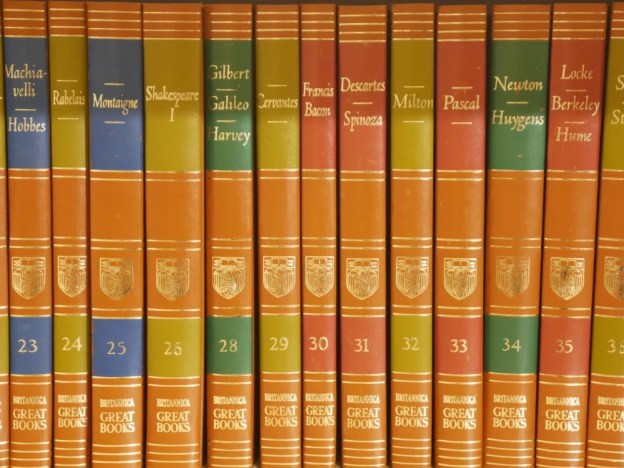
The late great Mortimer J. Adler, of whom I’m proud to be the most ardent living support, in likely his most popular yet least rightly understood book, How to Read a Book, concludes with an impressive litany of the Great Books, dolloped with a smattering (or smattered with a dolloping if you prefer) with a smaller list of (for him) contemporary Good Books that hadn’t existed long enough to fully warrant a place on the Great Books list. As he himself noted in the excerpt above, while he encourages us to read them chronologically, he is perfectly fine with us not reading the entire list, for the key is reading books well, not just widely reading poorly (quality, not quantity as we put it). The Great Books he recommends are listed numerically in mainly chronological order; the Good Books are enumerated second; the individual works indicated “especially” are Mr. Adler’s recommendations. Mr. Adler originally included publishers and series that made these works available in his day, but as most of those publishers and series are long out of print, we’ll just ignore that part.
The Great Books
- Homer
- Iliad
- Odyssey
- The Old Testament
- Aeschylus
- Tragedies (esp. House of Atreus, Prometheus Bound)
- Sophocles
- Tragedies (esp. Oedipus the King, Antigone, Electra)
- Euripides
- Tragedies (esp. Medea, Electra, Hippolytus, Bacchae)
- Herodotus
- History (of the Persian Wars)
- Thucydides
- History of the Peloponnesian War
- Hippocrates
- Collections of Medical Writing
- Aristophanes
- Comedies (esp. Lysistrata, Clouds, Birds, Frogs)
- Plato
- Dialogues (esp. Republic, Symposium, Phaedo, Meno, Apology, Lysis, Phaedrus, Protagoras, Gorgias, Cratylus, Sophist, Philebus, Theaetetus, Parmenides)
- Aristotle
- Works (esp. Organon, Physics, Metaphysics, De Anima, Ethics, Politics, Rhetoric, Poetics)
- Euclid
- Elements of Geometry
- Cicero
- Orations
- Republic
- Laws
- Tusculan Disputations
- Offices
- Lucretius
- Of the Nature of Things
- Virgil
- Aeneid
- Horace
- Odes and Epodes
- The Art of Poetry
- Livy
- History of Rome
- Ovid
- Metamorphoses
- Quintillian
- Institutes of Oratory
- Plutarch
- Lives
- Tacitus
- Dialogue on Oratory
- Germania
- Nicomachus
- Introduction to Arithmetic
- Epictetus
- Discourses
- Lucian
- Works (esp. The Way to Write History, The True History, Alexander the Oracle Monger, Charon, The Sale of Lives, The Fisherman, Dialogues of the Gods, Dialogues of the Sea-Gods, Dialogues of the Dead)
- Marcus Aurelius
- Meditations
- Galen
- Of the Natural Faculties
- The New Testament
- St. Augustine
- Of the Teacher
- Confessions
- City of God
- Volsunga Saga (Nibelungenlied)
- Song of Roland
- Burnt Njal (Icelandic saga)
- Maimonides
- Guide for the Perplexed
- St. Thomas Aquinas
- Of Being and Essence
- Summa Contra Gentiles
- Of the Governance of Rulers
- Summa Theologica
- Selected Writings
- Dante
- The Divine Comedy
- Chaucer
- The Canterbury Tales
- Thomas à Kempis
- Of the Imitation of Christ
- Leonardo da Vinci
- Notebooks
- Machiavelli
- The Prince
- Erasmus
- The Praise of Folly
- Colloquies
- St. Thomas More
- Utopia
- Rabelais
- Gargantua and Pantagruel
- Calvin
- Institutes of the Christian Religion
- Montaigne
- Essays (esp. Of the Education of Children, Of Friendship, Of Cannibals, Of Solitude, Of Experience, Of Moderation, Of Books, Of Custom Upon Some Verses of Virgil, Apology for Raymond de Sebond)
- Cervantes
- Don Quixote
- Edmund Spenser
- The Faerie Queene
- Francis Bacon
- The Advancement of Learning
- The Novum Organum
- The New Atlantis
- Shakespeare
- Plays
- Galileo
- Dialogues Concerning Two New Sciences
- Harvey
- On the Motion of the Heart
- Grotius
- The Law of War and Peace
- Hobbes
- Elements of Philosophy
- Leviathan
- Descartes
- A Discourse on Method
- Geometry
- Principles of Philosophy
- The Passions of the Soul
- Corneille
- Tragedies (esp. The Cid, Cinna)
- Milton
- Areopagitica
- Paradise Lost
- Samson Agonistes
- Molière
- Comedies (esp. The Miser, The School for Wives, The Misanthrope, Tartuffe, Tradesman Turned Gentleman, The Imaginary Invalid, The Affected Ladies)
- Boyle
- The Sceptical Chymist
- Spinoza
- Political Treatises
- Ethics
- Locke
- Letter Concerning Toleration
- Two Treatises of Civil Government
- Essays Concerning Human Understanding
- Some Thoughts Concerning Education
- Racine
- Tragedies (esp. Andromache, Athaliah)
- Newton
- Mathematical Principles of Natural Philosophy
- Opticks
- Leibnitz
- Discourse on Metaphysica
- New Essays Concerning Human Understanding
- Monadology
- Defoe
- Robinson Crusoe
- Moll Flanders
- Swift
- Battle of the Books
- Tale of a Tub
- Journal to Stella
- Gulliver’s Travels
- Montesquieu
- Persian Letters
- Spirit of Laws
- Voltaire
- Candide
- Philosophical Dictionary
- Toleration
- Berkeley
- A New Theory of Vision
- The Principles of Human Knowledge
- Fielding
- Joseph Andrews
- Tom Jones
- Hume
- A Treatise of Human Nature
- Enquiry Concerning Human Understanding
- History of England
- Rousseau
- Émile
- The Social Contract
- Confessions
- Sterne
- Tristram Shandy
- Adam Smith
- The Theory of Moral Sentiments
- The Wealth of Nations
- Blackstone
- Commentaries on the Laws of England
- Kant
- Critique of Pure Reason
- Prolegomena to any Future Metaphysics
- Critique of Practical Reason
- Critique of Judgment
- Gibbon
- The Decline and Fall of the Roman Empire
- Stendhal
- The Red and the Black
- The Federalist Papers (along with The Articles of Confederation, The Constitution of the United States, and The Declaration of Independence)
- Bentham
- Comment on the Commentaries
- Introduction to the Principles of Morals and Legislation
- Goethe
- Faust
- Poetry and Truth
- Ricardo
- The Principles of Political Economy and Taxation
- Malthus
- Essay on the Principles of Population
- Dalton
- A New System of Chemical Philosophy
- Hegel
- Phenomenology of Spirit
- Science of Logic
- Philosophy of Right
- Philosophy of History
- Guizot
- History of Civilization in Europe
- Faraday
- Experimental Researches in Electricity
- Lobachevski
- Theory of Parallels
- Comte
- General View of Positivism
- Balzac
- Works (esp. Le Père Goriot, Cousin Pons, Eugénie Grandet, Cousin Betty, César Birotteau)
- Lyell
- The Antiquity of Man
- J. S. Mill
- System of Logic
- Principles of Political Economy
- On Liberty
- Of Representative Government
- Utilitarianism
- Autobiography
- Darwin
- The Origin of Species
- Thackerey
- Works (esp. Vanity Fair, Henry Esmond, The Virginians, Pendennis)
- Dickens
- Works (esp. Pickwick Papers, Our Mutual Friend, David Copperfield, Dombey and Son, Oliver Twist, A Tale of Two Cities)
- Claude Bernard
- Introduction to Experimental Medicine
- Boole
- Laws of Thought
- Marx
- Capital (along with The Communist Manifesto)
- Melville
- Typee
- Moby Dick
- Dostoevski
- Crime and Punishment
- The Idiot
- The Brothers Karamazov
- Buckle
- A History of Civilization in England
- Flaubert
- Madame Bovary
- Galton
- Inquiries into Human Faculty and Its Development
- Riemann
- The Hypotheses of Geometry
- Ibsen
- Plays (esp. Peer Gynt, Brand, Hedda Gabler, Emperor and Galilean, A Doll’s House, The Wild Duck, The Master Builder)
- Tolstoi
- War and Peace
- Anna Karenina
- What is Art?
- Dedekind
- Theory of Numbers
- Wundt
- Physiological Psychology
- Outline of Psychology
- Mark Twain
- Innocents Abroad
- Adventures of Huckleberry Finn
- A Connecticut Yankee in King Arthur’s Court
- Henry Adams
- History of the United States
- Mont-Saint-Michel and Chartres
- The Education of Henry Adams
- Degradation of the Democratic Dogma
- Charles Peirce
- Chance, Love, and Logic
- Collected Papers
- William Sumner
- Folkways
- Oliver Wendell Holmes
- The Common Law
- Collected Legal Papers
- William James
- Principles of Psychology
- The Varieties of Religious Experience
- Pragmatism
- A Pluralistic Universe
- Essays in Radical Empiricism
- Nietzsche
- Thus Spoke Zarathustra
- Beyond Good and Evil
- The Genealogy of Morals
- The Will to Power
- Georg Cantor
- Transfinite Numbers
- Pavlov
- Conditioned Reflexes
- Poincaré
- The Foundations of Science
- Freud
- Three Contributions to a Theory of Sex
- Introductory Lectures on Psychoanalysis
- Beyond the Pleasure Principle
- Group Psychology and the Analysis of the Ego
- The Ego and the Id
- Civilization and Its Discontents
- Thorstein Veblen
- The Theory of the Leisure Class
- The Higher Learning in America
- The Place of Science in Modern Civilization
- Vested Interests and the State of Industrial Arts
- Absentee Ownership and Business Enterprise in Recent Times
- Lenin
- Imperialism
- Proust
- Remembrance of Things Past
- G. B. Shaw
- Plays Pleasant and Unpleasant
- Man and Superman
- Androcles and the Lion
- Boas
- The Mind of Primitive Man
- Anthropology and Modern Life
- Dewey
- How We Think
- Democracy and Education
- Experience and Nature
- The Quest for Certainty
- Logic
- Bergson
- Time and Free Will
- Matter and Memory
- Creative Evolution
- Two Sources of Morality and Religion
- Whitehead
- A Treatise on Universal Algebra
- An Introduction to Mathematics
- Science and the Modern World
- Process and Reality
- Adventures of Ideas
- Santayana
- Scepticism and Animal Faith
- Realm of Essence
- Realm of Matter
- Realm of Truth
- Russell
- Principles of Mathematics
- Thomas Mann
- The Magic Mountain
- Joseph in Egypt
- Einstein
- The Theory of Relativity
- Sidelights on Relativity
- Adventure of Scientific Thought
- Trotsky
- The History of the Russian Revolution
- Joyce
- Ulysses
- Maritain
- Art and Scholasticism
- Degrees of Knowledge
- Freedom in the Modern World
- True Humanism
Hot diggity, I’m excited just looking at those lists. I hesitate to tell you how many (few) of these I’ve read so far. People seem to think English teachers have read all the books in the world (strange how they never assume mathematics teachers have counted every number in the world). I’ll be content (so far) with saying I’ve heard of almost all of the authors Mr. Adler recommends. Of course, then come all the authors after World War 2…. Better get started on these.
If you need a break from reading, and sure we all do once in a while, turn the page for another list of sensory experiences that may tickle your fancy, as the kids say.

