
Christopher Rush
Man at Play
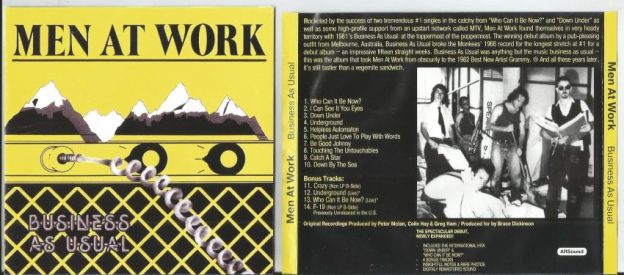
Of all the albums we’ve explored in the Forgotten Gems series (and its ill-defined offshoot Overlooked Gems), Business as Usual by Men at Work is likely the album I’ve least listened to. One of them had to be, statistically, so that’s not a big deal, but it is significant enough for me to mention it. I’ve had it for some time, though I certainly did not listen to it when it immediately came out (like some albums we’ve explored) though mainly because I was one year old at the time. When the series was first conceived, I knew immediately the entire lineup of albums I wanted to explore, which we did in our initial run before our hiatus. Now, though, as we have the time to luxuriate in whatever fancy comes our way, I have noticed my listening habits, while not necessarily “expanded,” have broadened enough to focus on the peripheral music of my youth, giving it more due attention now as I am slightly more mature than I was when such music first entered my awareness. Boy, that was a complicated sentence. The point of which is to say I have been listening to this album acutely lately, and I have been favorably impressed by it, especially as it is timely for us even thirty-five years on.
Side One
I am using the LP designation here not because I own it but simply for ease of reference. I own the remastered 2003 compact disc release with bonus tracks. Such is one convenient feature of coming late to an album such as this: nice bonus tracks (though we will leave the argument of digital sound quality versus vinyl quality sound alone for now).
“Who Can It Be Now?” is one of the two songs you likely remember from this album and the group, even if you don’t immediately recall the band name or album title (or even, like me, the names of the band members). One of the driving forces of this series has been “the entire album is good, not just the famous tracks,” and while that is certainly true here for this album, let’s not overlook how good the famous songs are just because they are famous — that is also too easy to do; as odd as it sounds, we don’t always appreciate the songs we like (and not just because radio deejays told us to like them). Certainly this song gives us the distinctive Men at Work sound: Greg Ham’s saxophone. Such is not to say they were the only band with a significant saxophone component, but Greg Ham’s saxophone riffs on “Who Can It Be Now?” announce this is not just the same-old pop-rock experience, even if the song has become commonplace. Certainly Colin Hay’s Australian timbre adds to the distinctive nature of the band and the album, and their nationality certainly informs a good deal of the social issues discussed on this album and others (as it always does for every artist). Lyrically, it seems like a simple “Go away, I’m tired” song buoyed by a catchy musical score, but the tail-end of verse two gives us a glimpse of the deeper lyrical skill of Colin Hay. There may be some connection to Pink Floyd’s The Wall, here: the “he” knocking all this time may be the narrator himself, not an external force, if the narrator is a hidden psychological facet of the main person. “I’ve done no harm, I keep to myself; / There’s nothing wrong with my state of mental health. / I like it here with my childhood friend; / Here they come, those feelings again!” If the “he” knocking is the conscious mind of the narrator trying to rescue the actual singing voice person, perhaps the knocking is a positive thing after all, and the whole song is a deep exploration of identity, health, sanity, and society. The Pink Floyd connection would be then if the knocker is a friend or someone trying to help the person come out of the shell/supposed security that may be doing more harm than good. The bridge, though, could disabuse this interpretation, sending it all into a Kafka Trial-like or Dostoyevsky Crime and Punishment-like situation. Or the person is just bonkers and paranoid. In any event, there’s more to it than just a catchy pop/new wave song.
“I Can See It in Your Eyes” has a dreamlike quality about it, caught up in a prescient awareness of the impending future, memories of the distant past, and a sharpening awareness of the present. The electronic sounds undergirding it aid the mystical, introspective aspects, which is rather impressive considering how early on in the electronic music age this came to us. As the narrator’s understanding strengthens throughout the song, I’m not sure if we are to grow in sorrow for him or appreciation, as his ability to appraise the situation and her needs/desires does not imply deeply felt regret: he may be ready to move on to something more as well, now that he is a more cognizant person himself. Losing her could be what they both need. (Personally, I found this song ironically refreshing as I recently threw away a number of old high school photographs days before hearing it again, and I, too, did not feel sad about it — it was very freeing. I have my memories and other photographs; I don’t need to keep all the stuff of the past.)
“Down Under” is an odd one. It’s the other famous one you remember, the jaunty groove with a chorus that makes you think it’s a patriotic song about how proud they are to be Australian. But that’s not really what it’s about. Australia, like all countries, has a complicated past, and this song tries to remind us about that, not encourages us to wave flags and slam a Foster’s into us as fast as possible in blind devotion and celebration. The narrator of the song is some travelling drug addict (“head full of zombie”; “Lying in a den in Bombay”) who benefits greatly from the kindness of strangers, many of whom give him food, and despite their generosity and international camaraderie, he still thinks he is superior to others because of his material prosperity and his country’s prosperity — a prosperity, like all 1st World countries’, derived at least in historical part from plunder, conflict, stereotyping, oppression, and the like. Not to forget the gender distinction of women in a positive light and men doing nothing but plundering and chundering (vomiting). But still. It’s a catchy tune, and the song does not want us to think so wholly lowly of Australia as I may have just made it out to sound. It’s a song that reminds us our patriotism must be tempered by a proper understanding of history, for good or ill.
The quintessential Men at Work/Greg Ham saxophone shines through in “Underground” as well, so much so you may think this “Who Can It Be Now?” if you aren’t paying enough attention immediately, though you’ll recognize it as Men At Work instantly. This is a very clever song, one of the more overtly political commentary tracks on the album. The opening lines tell us we have a responsibility not to give in to the Decision Makers and Thought Police (or whomever) who have taken over: keep fighting the good fight. The eponymous “underground” seems to be where the rich and powerful live now that life on the surface of the planet has become some post-apocalyptic 1984/V for Vendetta dystopia of bureaucratic food lines and gun control. The end of the song seems like we are on some sort of commando raid among the wealthy elite in the underground, adding to the dynamic atmosphere and energy of the number, always driven by the saxophone line.
I would normally pronounce the title of the next song “helpless aww-TOM-a-tahn,” but that’s not how the song says it: “helpless auto-MAY-ton.” We can forgive this pronunciation, as it occurs, I think, solely to fit the metrical pattern of the lyrical line, and since Homer did that all the time and Shakespeare and Milton did that all the time, surely Men at Work can do it here. I’m no expert on New Wave music, but I suspect this song may be the most New Wavy of the album; at least it’s the most sci-fi contemporary of the album, coming out around the same time as John Sladeck’s Roderick and a little after Asimov’s Bicentennial Man (though several other robot-themed movies and novels had been out for some time, certainly). It does have that mechanical sound to it, indeed, driven by the synthesized sounds of the keyboard. I don’t have proof the band read any of those, but it is odd how this song came out at a time when robotics was seeing not just a resurgence but the beginnings of palpability (Data on Next Generation is only about five years away). This song sounds a little different as well being sung not by Colin Hay but by saxophone/flute/keyboard man Greg Ham. In our present age of all-powerful and frightening cyborgs and Terminators and Information Superhighway-powered Drones and Probes, a song about a “helpless” automaton seems even more bizarre. Sure, some of the rhymes may seem a little forced, but don’t they usually, though?
Side Two
Side two opens with a song seemingly innocuous, especially in the relative shallowness of its verses, but the song has become frighteningly more relevant today than when it first came out: “People Just Love to Play with Words.” We live in an age in which it seems each year They decide to redefine some term or concept or idea: marriage, love, justice, family, words ending in –phobic, respect — all sorts of words, for good or ill, have been redefined lately, and while it has not been “playing,” and has very serious ramifications for all of us who have a more accurate grasp on reality, it has a similar sort of capriciousness to it (albeit a more anti-traditional vindictive capriciousness, if such a thing is possible). I certainly don’t want to delve too much into contemporary political commentary (longtime readers surely know by now I have very little involvement in the “now” anyway), but it has been a very bizarre thing to witness, a phenomenon more manifest by this song, even if the song did not intend to prophecy the deconstructive 21st century.
“Be Good Johnny” may seem naïvely simple, but it is another clever song from Men at Work making this album far richer than most think it is (which, of course, is the point of this article). This is a prequel to “Johnny B. Goode,” in which young Johnny is being confronted by all sorts of authority figures who assume living life their way is the way to go. Now, we have just lamented somewhat the current trend of rejecting tradition (a trend that has been around for so long it has effectively become a tradition itself, ironically), but the traditions of this song are not really good ones: they’re just the safe, convenient anti-individual sort of thing Society wants you to do (as good-intentioned as the grownups may be) — don’t rock the boat, do the things we all love doing (football, cricket), learn a trade not important beautiful life things — those sorts of “traditions.” Instead of all that palaver, young Johnny just wants to dream and yet he still manages to be a good boy and honor his parents, even if he isn’t on some sort of fast track to a lucrative career. The catchiest part of the song is the repetitive but fun chorus, even though the chorus consists solely of tendentious authoritative advice, none of which Johnny needs. Combined with the dialogue and various musical sections, this is a very good song.
The middle of the second side is another overtly socio-political commentary track, “Touching the Untouchables,” and I admit I suspect my interpretation of this song could be way off. Surely our initial thoughts when hearing or reading the title of the song is “it’s about India,” but I don’t think it’s directly about India. Since Men at Work are from Australia not England, I’m not sure there’s an immediate visceral/historical connection there — though, it could have some connections to the caste system, indeed; Colin Hay is a very intelligent songwriter. It seems to me this song is about the financially struggling, the homeless, the downtrodden of society, the ones we sort of think we want to help, but as the song says “in the end you know / You turn away.” It’s an important message, yet even in its criticism it does not descend into excoriation. “What can I say?” is the response to “You turn away,” not “What a filthy unchristian hypocrite you are, rich guy!” Musically, it’s very much a product of its time, with a Police-like reggae/New Wave rhythm, but it’s very distinct from the Police, especially in the saxophone triplet-like interjections during the chorus — they are very hard to describe and initially seem out of place, but the more one listens to the song the more these bizarre sounds fit completely with the complete musical/lyrical experience.
One gets the sense by this point the album is slowing down. “People Just Love to Play with Words” is jaunty, “Be Good Johnny” is only slightly slower if at all, “Touching the Untouchables” uses a much different reggae-like 6/8-feel, all leading into “Catch a Star,” another reggae/not-reggae song with a grove totally distinct from the rest of the album (I almost said “fresh,” there, sorry). It’s the most “traditional love song” on the album, and since it sounds nothing like a traditional love song nor musically what the title may imply rhythmically or tempo-wise, that’s saying something about Men at Work’s creativity (even if only for such a vibrant yet brief period). In a world of isolation and complication and destruction, it’s nice to have someone you love with you along life’s journey. I’m not sure if the “star” is the sweet boo the narrator has by him through this thing called life, but that interpretation works for me — maybe it’s something like having successfully wished for love on a falling star, he caught the star and got his wish fulfilled. I don’t know. But it’s a nice number and not worthy of being denigrated as an album filler.
Finally, “Down by the Sea” shows how patient the band can be. “Underground”’s longer-than-expected introduction previewed this for us as well. It may seem disproportionate to call Men at Work a “patient” band here, since most of the album offerings are about 3:30 long with “Down by the Sea” the only truly long number (almost seven minutes), and as a band they only released three albums in just over five years of corporate existence (with most of this crew not even on the third album), but since numerical statistics are poor support for authentic temperament, I eschew those in favor of focusing solely on this song as proof the band could sustain a musical and lyrical experience if they wanted to. It’s somewhat hard to tell how many verses this song has (four, maybe five), considering the interludes or pre-choruses or choruses or whatever the kids are calling them are so different from each other. Musically, the band blends exceptionally well on this final dream-like number. Jerry Speiser’s drums are exceptionally complementary here (their sound throughout the album has a distinct ’80s quality about them, especially in the timbre and duration of the cymbal crashes). Greg Ham’s wind instruments are almost lyrical themselves; John Rees’s bass and Ron Strykert’s guitar likewise support the entire tonal experience. It’s quite tempting to call this my favorite song on the album, in part because it is so unlike the rest of the album, and yet these ten distinct songs all sound wholly and quintessentially Men at Work songs. That the song is about languorously living on the beach with no cares is icing on the cake, as the kids say. And you know how much I love the ocean.
Man at Rest
There’s nothing “usual” about this album: the songs are all distinct yet united, the sounds are noticeably familiar yet refreshingly unexpected. The lifestyles and experiences sung of are both cautionary and introspective. Put aside the labels; ignore the overly-familiar “greatest hits” aspects that lend to too-easily-trite pseudo-appreciation. This is a top notch album from a time when experimentation and synthesization threatened to replace “great” with “different” for different’s sake. Get this album and enjoy it again and again. Perhaps it will take you back to a simpler time, clarify your thinking about life and love and government and society and individuality, or better yet encourage you to go live by the sea and cast away your worries and your cares. What more could you want from an album?
2022 P.S. – I now do own the album on vinyl, if that makes you feel better. If it doesn’t, it’s still true.

