

Tag Archives: matthew nalls

The Frontier of Space is a Worthy Challenge that will Benefit America

Matthew Nalls

We meet in a time of rapid change. Our epoch is one of significant knowledge, but also one of significant ignorance. What mankind knows now is nothing compared to what mankind does not know now. We have come a far way as well. Condense with  me the last 50,000 years of man’s recorded history into only half of a century. In these terms, by the end of the first 40 years, advanced man learned to use animal skins to cover them. Then 10 years ago, man constructed outside shelters. Five years ago, man learned to write and invented the wheel. Christianity began less than two years ago. This year, the printing press was created. Less than two months ago, the steam engine provided a new, revolutionary source of power while Newton explored the meaning of gravity. Last month, we invented electric lights, telephones, automobiles, and even airplanes. Only last week was penicillin developed, followed by television and nuclear power. In the words of John F. Kennedy, “This is a breathtaking pace” (Kennedy, par. 6-8).

Now, this condensed history of man should illustrate to us one thing in particular. In his unending quest for knowledge, man is determined. Man will not stop until he has answered every question he has regarding God’s creation. Thus, man will look to space when he seeks to satisfy his desires for knowledge and progress. The question is simply a matter of when, and my humble recommendation is we pursue this now. The exploration of space is a worthy challenge that will benefit America.

To understand this thesis, it is essential to understand what space exploration actually means, what NASA is, and what the terms “private sector” and “habitable planet” refer to. Space exploration is the investigation and expedition into the universe beyond Earth’s atmosphere, and the use of information gathered to increase knowledge of the cosmos (Logsdon, “Space Exploration”). A key leader in space exploration, the National Aeronautics and Space Administration is an independent agency under the executive branch of the United States government. NASA focuses on aeronautic and aerospace research, while spearheading the American space program. NASA’s vision states, “We reach for new heights and reveal the unknown for the benefit of humankind” (sec. 1). The “private sector” refers to the section of the economy not directly controlled by the government (“Private Sector”). Finally, the term “habitable planet” refers to a planet that lies in a habitable zone, the “orbital region around a star in which an Earth-like planet can possess liquid water on its surface and possibly support life” (“Habitable Zone”).

Space exploration encompasses a lengthy history, which I will now summarize. Since the earliest days of recorded history, man has gazed at and beheld the stars above him. Early astronomers grappled with Earth’s place in the cosmos since antiquity, while space made special appearances in several religions as well. The most notable of these religious appearances is in Christianity, as shepherds and wise men were led to the birth of Jesus by a brilliant star. While man studied the galaxies above him, he could not truly be among them until only the 20th century. Following the close of the Second World War, man finally took his place among the stars. 202 miles above the Earth’s surface, Russian cosmonaut Yuri Gagarin became the first human to orbit the Earth during April of 1961 in his ship, Vostok 1 (Redd, sec. 4). He was succeeded by the American astronauts Alan Shepard and John Glenn in 1961 and 1962 respectively.

These journeys into space were the culminations of an intense technological and scientific contest between the United States and the Soviet Union during the Cold War. Each superpower desired technological superiority over the other. To “win” this competition, President John F. Kennedy set an ambitious goal for America in 1961, declaring America would land a man on the moon and safely return him within the decade.  Although President Kennedy would not survive to see it, on July 20th, 1969, Neil Armstrong left man’s first footprints on the moon. This lunar mission was subsequently followed by six more Apollo missions until 1972 (Redd, sec. 6).

By the 1970s, satellites purposed with facilitating communication and easier navigation experienced wide usage. In the 1980s, such communication expanded to include TV and radio broadcasting. Satellites were then used for a variety of purposes: The Aerospace Center for Space Policy Analysis observes, “Satellites discovered an ozone hole over Antarctica, pinpointed forest fires, and gave us photographs of the nuclear power-plant disaster at Chernobyl in 1986. Astronomical satellites found new stars and gave us a new view of the center of our galaxy” (par. 9). From 1972 to 2011, space shuttles also experienced a wide usage as they were utilized in twenty-four successful missions to space in the 1980s alone. The International Space Station began initial assembly in orbit in 1998 and was completed in 2011, allowing astronauts and researchers to conduct experiments outside of the Earth’s atmosphere (par. 11).

These illustrate the promising progress of man’s exploration into space. Unfortunately, when the Space Shuttle Program ended in 2011, so did America’s vision of exploration into space. Republican Representative from Texas Lamar Smith, who was Chairman of the House Science Committee in 2016, points out the steady decline of government funding that supports this assertion. He states, “President Obama’s 2017 budget proposal shrinks our deep space exploration programs by more than $800 million … this proposal shrinks space exploration priorities within NASA’s budget” (par. 28-30). NASA’s funding in the past 51 years also demonstrates this declining commitment. Under President Lyndon B. Johnson, at its height, NASA funding took up 4.4 percent of total U.S. spending in 1966, standing at around $31 billion of a $708 billion federal budget (when adjusted for inflation up to 2014) (8-24; InsideGov, sec. 1-3). In 2016, this percentage dropped to a mere 0.48 percent of total U.S. spending, standing around $19 billion of a $3.54 trillion federal budget (InsideGov, sec. 1).

I will now address the relevance of this issue to the American people. Currently, space exploration is under intense scrutiny and dispute because Americans no longer invest exploration with the priority it once boasted. Americans now question the relevance and financial return of space exploration. Americans ask, “Why should exploration to lifeless planets and empty expanses be important to me?” They ponder, “Why is a decrease in funding for exploration necessarily a ‘bad’ thing?” The answer is quite clear: because space exploration directly affects every American household in the country technologically, financially, and culturally. Space exploration, or lack thereof, impacts both you and me. It impacts the direction of the nation and the course of world history. Space exploration stimulates the economy and the creation of new technologies. Furthermore, all mankind shares in every milestone of discovery ever achieved, not only those few individual pioneers. A plaque that currently sits on the moon left behind by the crew of Apollo 11 says it all: “HERE MEN FROM THE PLANET EARTH FIRST SET FOOT UPON THE MOON, JULY 1969 A.D. WE CAME IN PEACE, FOR ALL MANKIND” (“NASA”, sec. 1).

My thesis is the exploration of the frontier of space is a worthy challenge that will benefit America. I will confirm this thesis with four arguments. First, America will experience a sense of unification, which is especially necessary today. Second, space exploration will move forward whether America moves with it or not. Third, technological growth will occur. Fourth, if Christians are to understand God’s creation, it is essential they support space exploration. I will also refute three counterarguments against space exploration. First, space exploration is not worth the investment. Second, the private sector should lead exploration, not NASA. Third, there are no habitable planets for man to live on.

My first argument supporting the pursuit of this thesis is America will experience a sense of unification, which is especially necessary today. “We meet in an hour of change and challenge, in a decade of hope and fear” (Kennedy, par. 1). These words, although uttered by President John F. Kennedy over half a century ago, could not be more true today. Our country is riddled with conflict, strife, and tension. To release this pent-up tension, America is crying out in protest and demonstration. In some cases, these protests turn violent. America is not free from the weight of intense domestic disagreement; however, this is not the first time America has experienced such strife. In 1967, nearly 100,000 people marched on Washington D.C. while another 50,000 people amassed before the steps of the Pentagon (“Thousands Protest,” par. 1). Enter the Space Race. On Christmas Eve of 1968, three American astronauts became the first humans to orbit the moon and transmit communications back to Earth. Frank Borman, Jim Lovell and Bill Anders read from the Book of Genesis in one of the most widely-viewed televised programs of the time. This reading united America for a short time at the end of yet another turbulent year, in which both President John F. Kennedy and Martin Luther King, Jr. were assassinated. If America pursues space exploration now, this benefit will repeat itself. National support for such exploration will be potentially greater now than in the 1960s and 1970s. The Economist supports this assessment, explaining, “Today polls suggest more Americans know Mr Armstrong’s name than in 1970 — his exploits are taught at school, and celebrated in such works as The Right Stuff, a hit book and film. The moon landings are popularly remembered as a bright spot in a bleak period” (1). Not only will Americans once again take pride in the technological feats and discoveries made by their nation, but America will benefit from space exploration, as she will experience renewed unification in a time when she needs it most. American astronaut Edgar D. Mitchell attests to this feeling of unification, as he states, “You develop an instant global consciousness, a people orientation, an intense dissatisfaction with the state of the world, and a compulsion to do something about it. From out there on the moon, international politics look so petty. You want to grab a politician by the scruff of the neck and drag him a quarter of a million miles out and say, ‘Look at that, you (expletive)’” (Tyson 3). In a time when leaders across the county call for unity, such unification will come from looking at ourselves from the outside. As Edgar Mitchell observed, only when we view ourselves from the outside will we be able to solve problems causing societal division.

My second argument is space exploration will move forward whether America moves with it or not. This fact is one which has been understood since early space exploration. As President John F. Kennedy remarked in 1962, “The exploration of space will go ahead, whether we join in it or not” (par. 4). Space exploration now will benefit America in the future. America will have a greater stake in progress or discoveries made in the vastness of space, much like she did when landing on the moon. America is still the only country to ever have achieved this feat, which illustrates the technological superiority she once boasted.

To wait will put her behind other countries capable of reaching the stars such as Russia, Canada, France, or Germany. America is currently slipping into this disadvantage, as American astronauts are transported to space in Russian rockets. America is dependent upon other space agencies (Berger, par. 4). Furthermore, other space agencies are ramping up their programs while America’s plateaus. For example, the country of Brazil is looking to grow independent of other countries in the means of communication. The country seeks to send numerous satellites into orbit to safely transmit government and military communications, rather than relying on satellites manufactured and owned by other countries (Haynes, par. 1). While America continues to rely on others, even countries like Brazil are throwing off this dependence in search of space technological independence. Thus, it is essential for America to step up in its pursuit for space. Even Wernher von Braun, the aerospace engineer who was the Chief Architect of the Apollo missions, knew this in the 1960s. When asked about a trip to Mars, he explained half a century ago, “What curious information will these first explorers carry back from Mars? Nobody knows, and it’s extremely doubtful that anyone now living will ever know. All that can be said with certainty today is this: the trip will be made” (Whipple 21-23).

My third argument is technological growth will occur. The people of the United States currently use numerous technologies developed from the Space Race. Among these technologies are laptops, satellites used to operate TVs, cell phones, radios, power tools, global positioning systems, and even ear thermometers (Lockney). As obstacles rose in the path of exploration, science rose to meet such challenges. Through research and development undertaken by NASA and contracted companies, the invention and implementation of advanced technology allowed astronauts to overcome such obstacles. The products used by Americans today are the marketed versions of these technologies.

Such products have also protected life on Earth. The European Simulation Language is a key example of this protection. Developed in the 1980s, the European Simulation Language is simulation software designed for the European Space Agency yet is also used in a variety of other engineering applications. In one such application, the software was used by a waterworks company located in the United Kingdom to design a water filter. This water filter is purposed with preventing the spread of a harmful bacteria known as Cryptosporidium, which claimed over 100 deaths in America from 1993 to 1994. Using the software, the company designed a system known as rapid gravity filtration, which is now used across the globe in numerous countries to protect from this lethal bacteria (Rootes 11). As America attempts to explore the unknown frontier of space, she will continue to encounter such obstacles and will continue to develop such new technologies that will be used on Earth. This progress will usher in an increased rate of beneficial technological progress in America.

Such technologies will improve the quality of life on Earth through being applied to issues “back home.” For further example, the application of power tools has produced efficiency and productivity in areas such as home development and factory production. In our local area, these tools have significantly benefited shipbuilding. Furthermore, the increasing use of cell phones has allowed for a revolutionary new age of communication. Finally, the application of global positioning systems has increased the efficiency and lethality of American military forces when coordinating assaults. Therefore, not only will the invention of new technologies allow America’s brave pioneers to continue their exploration into space, but it will also solve problems and improve the quality of life on Earth.

One issue which may be resolved through future exploration is cancer. Currently, space agencies are researching methods of preventing astronauts from developing cancer from exposure to harmful radiation particles in space. These particles simply multiply when reacting to a ship’s hull, are found throughout space, and are also known to cause cataracts and lead to Alzheimer’s. According to estimates by NASA, astronauts spending 6 months aboard the International Space Station will already have exceeded the Department of Energy’s worker radiation exposure annual limit due to these particles. Those who will make the trip to Mars will also exceed this limit within merely 180 days (Wired Staff, sec. 2). The solution space agencies develop to combat this obstacle may yield results to those suffering on Earth, as historical precedence shows.

My fourth argument is if Christians are to understand God’s creation, it is essential they support space exploration. It is essential for Christians to support this exploration for two reasons. First, Christians are called to be stewards over the Earth, and (ironically) space exploration will help them accomplish this. Genesis 1:28 states, “And God blessed them. And God said to them, ‘Be fruitful and multiply and fill the earth and subdue it, and have dominion over the fish of the sea and over the birds of the heavens and over every living thing that moves on the earth.’” Space exploration allows man to more effectively accomplish this task of stewardship through the technologies which result from it. For example, pollution remediation technology is now available to consumers and industries thanks to earlier space research undertaken by NASA engineers. This technology, known as Petroleum Remediation Product, uses thousands of tiny balls of beeswax to clean oil spills. Crude chemicals within oil are absorbed and trapped within the beeswax, while water is filtered out as it cannot enter the revolutionary microscopic capsule that holds the beeswax in its shape (Lockney, sec. 18). Thus, thanks to space exploration, man is now a better steward over the Earth, as he better protects the sea from the harmful effects of oil spills on the environment.

Second, man is commanded in two places of the Bible to understand space and all it contains. 1 Corinthians 4:1 explains, “This is how one should regard us, as servants of Christ and stewards of the mysteries of God.” Currently, space is a vast mystery to man. While man feels he knows plenty regarding space, as he sees it through images such as those captured by the Hubble Space Telescope or watches science fiction fantasies based off of it such as Star Wars or Babylon 5, there is still a plethora of knowledge man does not have regarding what space contains. Scientists still ponder hundreds of questions regarding black holes, potentially habitable planets, asteroids, resources on other planets, and even extraterrestrial life. Thus, if man is to be a steward over the mysteries of God, a commendable place to continue this stewardship is space. Psalm 8:6a affirms this, stating, “You have made him to have dominion over the works of Your hands.” Space is a result of the works of God’s hands and is something we have anything but dominion over. Therefore, this thesis will benefit Christians in America particularly, by making them better stewards over the Earth and the other “mysteries of God.”

While the heavens above appear alluring to the eye, several valid counterarguments exist against space exploration. The first counterargument I will refute states space exploration is simply not worth the investment. There is little financial return from it, critics claim. To facilitate further space exploration, an increase in funding for NASA is required. Thus, opponents may question the worthiness of increasing NASA funding and ask where such funding will come from.

NASA is projected to receive $19.3 billion from the $4 trillion federal budget in fiscal year 2017. While an increase to this current spending may worry some in a time when federal debt stands at nearly $20 trillion, it is important to consider the returns on such an investment. According to a study undertaken by the Space Foundation, nearly $10 is added to the economy per every $1 invested in NASA (Dunbar). The foundation estimates in 2005 nearly $180 billion was contributed to the economy. The majority of this was contributed by companies with research contracts from NASA. As space exploration leads to the invention of new technology, companies purposed with researching such technology for NASA subsequently market the revolutionary technology they invent. Products invented and marketed by the companies contracted to research include goods and services used throughout the globe such as ATMs, freeze-dried food, CAT scanners, weather and communication satellites, power tools, and even heart defibrillators. A 2002 study by Professor H.R. Hertzfeld of George Washington University shows the financial return for companies marketing such items. After studying 15 companies, Hertzfeld observed companies received $1.5 billion from a $64 million research and development investment from NASA. Essentially, the 15 companies made a total profit of $1.5 billion from the $64 million research and development contract they had. Thus, from a financial standpoint, the investment is worth the return (par. 1).

Furthermore, an increase in NASA funding would lead to the creation of jobs, which lead to economic stability. According to an article published by The Pew Charitable Trusts, nearly 420,000 were working for NASA in 1966 during a time when America was wholly determined to reach for the stars. This workforce has since waned to a mere 18,000 working for NASA in 2013, according to its fiscal year 2013 report (Clark, par. 5). This significant decrease in jobs is not totally attributed to the increased use of technology as well. In December 2012, a report from the Aerospace Industries Association predicted the 5,000 jobs lost from a funding decrease of only 8.2% (par. 2). Thus, an increase in funding for NASA would work in reverse. A funding increase leads to a rise in jobs to support space exploration missions. Such job creation would prove beneficial for an economy struggling with the weight of unemployment. Furthermore, such job creation would lead to a “trickle down” effect. As new jobs arise, especially to operate new technology, new skills will need to be known in order to adequately fulfill the new jobs. Thus, to train employees to adequately fulfill the new job, employees will need to be trained. Therefore, need arises for new teachers, professors, and trainers in schools and other preparatory fields. The new skills learned here may also enhance the value and knowledge of the employee, as the employee may bring these new skills with him if transferring to another program, field, or company.

Such an investment in NASA funding would similarly lead to a technological benefit. As NASA continued to sustain financial relationships with private companies and contracted more companies thanks to increased funding, simply more technological progress will result. This progress will not only lead to its own financial return as outlined above but will also continue to make America a scientific pioneer while solving problems on Earth as well. Any space exploration generated technology used today, which range from enriched baby food, to water purification devices, to even LEDs, proves this. The creation of the artificial limb is a clear example of this process. Environmental Robots Incorporated developed artificial muscle systems in 2004 with robotic sensing and actuation capabilities. While these systems were originally designed for NASA to use during space robotic and extravehicular activities, they are now  adapted to serve as functionally dynamic artificial limbs to civilians (Lockney, sec. 3).

The second counterargument I will refute is the private sector should lead exploration, not NASA. According to astrophysicist and cosmologist Neil deGrasse Tyson, NASA should be the ones to lead space exploration, as private companies could not effectively lead space exploration on their own. He explains:

The private sector could never lead a space frontier, period. It could never happen because the space frontier is expensive, dangerous and has unquantified risks. Combine all three of those together, and you cannot establish a capital market valuation of that activity. You can’t say who is going to invest and what is the return because you don’t know what the return is. You can’t get investors, so there’s no business model (2).

Now, rather than private sector companies leading in the space frontier, history shows the financial success of private companies supporting NASA. We outlined several of these financial successes already. NASA puts together a plan, contracts companies to make this plan possible by researching or inventing new technologies, then executes the plan using those technologies. Typically, after companies have developed the necessary technology, as discussed earlier, they reap financial benefit from marketing this technology. A perfect example of this cooperation is the work being undertaken to once again transport astronauts into low-Earth orbit or transport them to the International Space Station in American spacecraft. NASA desired to send her astronauts to complete low-Earth orbit missions in American designed and manufactured spacecraft, as astronauts typically hitch a ride with the Russians. To accomplish this goal, NASA contracted two companies: SpaceX and Boeing. The companies were each purposed with building a spacecraft to fit this mission. Boeing specifically designed the CST-100 Starliner spacecraft, which underwent several tests with NASA engineers at NASA’s Langley Research Center in Virginia on August 24, 2016 (par. 1-3). With private companies supporting NASA as it paves the way into space, as seen with Boeing, we can continue to guarantee an efficient rate of progress. Furthermore, private companies will make greater profit through supporting, rather than leading, the exploration effort. Tyson continues, “Once the patents are given, then [private companies] can make a buck off of it and do it for cheaper and more efficiently than the government … with tourism or mining or (anything else). Go for it, but you can’t have one without the other” (par. 4).

The third counterargument is there are no habitable planets for humans to survive on. This argument is invalid for two reasons. First, while a planet may initially be unable to support life on its surface, man can still survive on the barren planet through the means of colonization, thus, technically making the planet habitable. Second, there are numerous potential habitable planets scientists have already discovered. Therefore, we cannot accurately assert there are no habitable planets in our vicinity.

The planned colonization of Mars is a perfect example of man making a planet habitable. NASA suggests in the plans it released in 2015 detailing its vision for Mars, “Humans will be living and working on Mars in colonies entirely independent of Earth by the 2030s.” NASA’s report cites the early colonization of North America as colonists grew independent as they learned to live off the environment and resources around them. While Mars certainly lacks the abundant resources North America boasted, NASA still expects colonists on Mars to survive likewise and will empower them with the ability to do so. NASA admits Mars’s environment is certainly more hostile than North America’s but expects to have technology developed by the 2030s to give colonists the capability of living off the planet’s environment (NASA rept. 7-14), thus making Mars a habitable planet.

Concerning the second point that makes the argument false, there is a surprisingly lengthy list of potentially habitable planets in our galaxy. The University of Puerto Rico organized these planets into a list based on distance from our solar system. This list includes all 44 potentially habitable planets currently known to exist, all either the same size or larger than Earth. Likewise, none of the 44 planets are smaller than Earth either. The closest of these is the planet Proxima Centauri B, which is only 4.2 light years away from Earth. In astronomical terms, a lightyear is “a unit of length equivalent to the distance that light travels in one year in a vacuum or about 5.88 trillion miles” (“Lightyear”). The farthest of these is the planet Kepler-62 f, which is 1200 light years away from Earth (sec. 1). While scientists do not know for certain if these planets are habitable or not, the shortlist of 44 shows the assumption there are no habitable planets whatsoever may be incorrect.

Thus, as our proud nation realized decades ago, for man to continue his determined search for knowledge, he must look to the stars. Above him in the glistening heavens lie the solutions to problems that plague him here on Earth. He will not be daunted by the hazard and risk that await him outside of the Earth’s atmosphere. Rather, he will take pride in the pursuit of intellect he carries on. He will remember he is not the first to carry this torch. Leif Erickson, Christopher Columbus, Lewis and Clarke, and Amelia Earhart are only a few of those who furthered this quest for knowledge, as he will soon do as well. Let’s affirm this goal of man and not lose sight of this destiny of exploration. After all, was the New World not discovered by those who explored? Were the colonies not established by those seeking new frontiers? Was the United States of America not founded by those who pursued the exceptional? America cannot remain a “city on a hill” if she does not pioneer the exploration of this vast frontier that lies before her. We are equipped with the means to accomplish this goal, as our nation unleashed the motivation and genius of man unlike any other country on this planet. Therefore, we must re-embark on this journey of revolutionary proportions now. As we create a better world for future generations through the exploration of this frontier, as we take the next step upon man’s “greatest adventure,” as we push forward in the pursuit of knowledge, we ask our Father’s blessing of “Godspeed.”

Bibliography

“1966 United States Federal Budget.” Insidegov.com. N.d. Web. 5 Feb. 2017.

“2016 United States Federal Budget.” Insidegov.com. N.d. Web. 20 Feb. 2017.

“A Brief History of Space Exploration.” The Aerospace Center for Space Policy Analysis. N.d. Web. 4 Feb. 2017.

Berger, Eric. “For Russia’s Space Program, 2016 May Be a Make-or-Break Year.” Ars Technica. 5 Jan. 2016. Web. 6 Dec. 2016.

Clark, Maggie. “Thanks to John F. Kennedy.” Stateline. The Pew Charitable Trusts, 20 Nov. 2013. Web. 30 Jan. 2017.

Dunbar, Brian. “NASA Administrator Griffin Discusses Value of the Space Economy.” NASA. 17 Sept. 2012. Web. 22 Mar. 2017.

Haynes, Brad. “Brazil Ramps up Domestic Space Satellite, Rocket Programs.” Reuters. 22 Mar. 2017. Web. 22 Mar. 2017.

Hertzfeld, H. R. “Measuring the Economic Returns from Successful NASA Life Science Technology Transfers.” The Journal of Technology Transfer. U.S. National Library of Medicine, 27 Dec. 2002. Web. 22 Feb. 2017.

Holy Bible: English Standard Version. Wheaton, IL: Crossway Bibles, 2001. Print. English Standard Version.

Kennedy, John F. “Rice Stadium Moon Speech.” Rice University, Texas. 12 Sep. 1962. Public Address.

Kremer, Ken. “Obama Administration Proposes Smaller 2017 Budget…” Universetoday.com. 13 Feb. 2016. Web. 5 Feb. 2017.

Launius, Roger and Andrew Johnston. Smithsonian Atlas of Space Exploration. Piermont, NH: Bunker Hill Publishing, 2009. Print.

Lexington. “America and the Space Race.” The Economist. 2 Aug. 2014: 1. Print.

“Light Year.” Merriam-Webster. N.d. Web. 21 Feb. 2017.

Lissauer, Jack J. “Habitable Zone.” Encyclopædia Britannica. 24 Sep. 2016. Web. 21 Feb. 2017.

Lockney, Dan. “NASA Technologies Benefit Our Lives.” Nasa.gov. NASA Spinoff Transfer Technology Program. N.d. Web. 20 Feb. 2017.

Logsdon, John M. “Space Exploration.” Encyclopædia Britannica. 14 April 2016. Web. 4 Feb. 2017.

National Aeronautics and Space Administration. Nasa.gov. MLA, Nov. 2015. Web. 2 Feb. 2017.

National Aeronautics and Space Administration Budget Estimates. F.Y. 1966. NASA HQ Digital Library. Web. 5 Feb. 2017.

“Private Sector.” Investopedia. N.d. Web. 21 Feb. 2017.

Redd, Nola Taylor. “Yuri Gagarin: First Man in Space.” Space.com. Purch, 24 July 2012. Web. 20 Mar. 2017.

Rootes, J. “Down to Earth.” Nature (2001): 1-527. ESA. June 2001. Web. 22 Mar. 2017.

Ryan, Molly. “Will NASA Fall off the Fiscal Cliff?” Houston Business Journal (2012): n. p. The Business Journals, 13 Dec. 2012. Web. 30 Jan. 2017.

Siceloff, Steven. “NASA Chooses American Companies to Transport U.S. Astronauts to Intern.” NASA. 02 Mar. 2015. Web. 22 Feb. 2017.

“The Habitable Exoplanets Catalog.” Planetary Habitability Laboratory @ UPR Arecibo. Google Sites, 22 Feb. 2017. Web. 20 Feb. 2017.

“Thousands Protest the War in Vietnam.” History.com. A&E Television Networks. N.d. Web. 22 Feb. 2017.

Tyson, Neil deGrasse. Space Chronicles. New York: Norton, 2012. Print.

Whipple, Dr. Fred L. “Can We Get to Mars?” Collier’s. 30 Apr. 1954: 21-23. Print.

Wired Staff. “The 12 Greatest Challenges for Space Exploration.” Wired. Conde Nast, 16 Feb. 2016. Web. 22 Mar. 2017.

Twilight Struggle

Matthew Nalls

A work of true skill and inspiration, Twilight Struggle is a two-player board game that simulates the silent war between the two great superpowers of the United States of America and the Union of Soviet Socialist Republics. The illustrated board game incorporates events from the early stages of the Cold War to the later stages of the war during the course of the game in due chronological order.

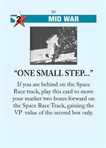
The game incorporates these events through action cards that are used to dictate the flow of the game. These cards can help or hinder each player, as some cards work toward the sole benefit of the USSR player, the US player, or both. Examples of such cards are “Allende,” “CIA Created,” and “‘One Small Step…”’ respectively. Allende, a Socialist physician, was popularly elected in the country of Chile to lead its first socialist government. When played, this card grants two “influence” to the USSR in the country of Chile on the map. Influence points determine control over the war and the regions on the board. Hence, the card is a USSR benefit card, as the card essentially gives USSR influence in the region. Likewise, “CIA Created” is a US-benefit card, as the card recounts the creation of the Central Intelligence Agency. This card allows the US to put one “influence” on the board, and see the opponent’s hand. This card works exclusively for the US, as the CIA was not a Russian organization. The converse would be considered for “Allende.”

Unlike these two kinds of cards, other cards benefit either player. On July 20th, 1969, Neil Armstrong became the first man to step foot on the moon. During this, he uttered the unforgettable phrase, “That’s one small step for man; one giant leap for mankind.” The “‘One Small Step…’” card signifies the work put in by NASA to catch up to Soviet technologies regarding the Space Race in order to land a man on the moon. This card allows the player to catch up two spaces in the Space Race part of the game. Therefore, it can benefit either player.

The Space Race is its own course made up of several achievements. These achievements include “Animals in Space,” “Man in Space,” “Lunar Orbit,” and ultimately “Space Station,” among several others. To move along this path, one must either discard a card or obtain a Space Race-specific card. These achievements benefit the player, as the majority give Victory Points to the first player to land upon them. These Victory Points ultimately decide the outcome of the game, as the first player to reach twenty Victory Points “wins” the Cold War. This is not as easy as it sounds. If the US player is at five Victory Points, and the USSR player earns five Victory Points, both players are not at five Victory Points. Rather, the USSR player has just reeled the US player back to zero Victory Points. This would be the same case even if the roles were switched.

Along with detailed and historically-accurate cards, Twilight Struggle also incorporates “initial influence.” For the US and the USSR, at the beginning of the game, both sides already boast influence in certain countries. This “initial influence” is a reflection of the power each side wielded in certain regions during the early stages of the actual Cold War. Furthermore, to preserve the chronological accuracy of the war, certain cards cannot be played until certain stages of the game. As Allende took power over Chile in 1973, his card is not available until the game progresses to the “Mid-War” stage of the game. Until such stage of the game, “Allende” and other “Mid-War” cards are not available for play. Similarly, “Late-War” cards are not available until the respective stage is met as well.

Regarding detail, historical and chronological accuracy, and incorporation of key events, Twilight Struggle sets high standards for other board games. Although not every part of the Cold War could be fit into the game, such is understandable and not unexpected. Twilight Struggle still provides a thorough retelling of the Cold War through the game-changing cards it does include.

As for the excitement and player enjoyment factors, I had the special privilege of playing renowned board game passionatus Mr. Rush in two exciting practice rounds. In both rounds, I opted to play the role of the USSR in their struggle against the “free” filthy capitalist pigs. The first practice round took time; however, this was understandable as it was necessary to become accustomed to the processes of the game. When grown accustomed, the game soon took off in a tense, back-and-forth exchange. Repeatedly, it became necessary for me to reel the US back to zero Victory Points during the round. The outcome of this round is not of importance.

The second practice round was one of emotions ranging from determination, excitement, disappointment, and disdain. At the tail end of the “Early-War” stage of the game, the US was boasting a significant lead in Victory Points. Fortunately for the USSR, I possessed a “scoring card” which would attribute numerous Victory Points to the USSR for domination in a region. During the beginning of the round, I strategically allocated certain amounts of growing influence in the South American region. With this scoring card in hand, I was prepared to return the war back to even terms. Unfortunately, a small-font, hidden, between-the-lines, tucked away rule prevented the USSR from a major comeback. This ultimately led to a miserably disappointing defeat, or so I thought. In blinding reality, my opponent ruthlessly cheated during our game, which was a key factor of this defeat. The “UN Intervention” card is a specialized card that can help either player. The card allows one to discard another card in his hand, and use the operation points from the card without triggering the event. My opponent misled me, and wrongly interpreted this respective card. Rather than nullifying a card in his own hand, he used “UN Intervention” to nullify a card I played that round, and mercilessly utilized its operation points. As a result of this, game-changing cards were nullified on several occasions, ultimately leading to the untimely demise of the USSR.

Nonetheless, upon the completion of our two enjoyable games, I had come to an appreciation for the game. Twilight Struggle boasts strategy, history, drama, and excitement all in one bundle. The game does not take hours to churn out an end result, nor does the game “zip by” before one realizes the game is actually completed. The game’s creators had the goal of enjoyment in mind, and they achieved this goal with marked skill and detail. My personal experience was so enjoyable I have taken up playing the game online with others across the globe on the website “Chantry.” I highly recommend this game for both casual and committed board game players, and especially for those looking for a fun and exciting, yet simple game.

Are Fossils Really an Indicator of the Origin of Species?

Matthew Nalls

Published on the 24th of November, 1859, the study entitled On the Origin of Species gave name to a growing movement known as “evolutionism.” Written by scientist Charles Robert Darwin, an English geologist and naturalist, the study revealed what was interpreted as reasons for the differing traits and characteristics in animals. Essentially, the study “proved” the origin of species, and the origins of the differences in species, came through the process of evolution. Charles Darwin utilized several key arguments during this study. One of these arguments revolved around paleontology and the study of fossils. Darwin boldly claims paleontology (the study of ancient life, whether such life be animal, plant, or bacterial) amply supports the theory of evolution. Darwin explains: “On the other hand, all the chief laws of paleontology plainly proclaim, as it seems to me, that species have been produced by ordinary generation: old forms having been supplanted by new and improved forms of life, produced by the laws of variation still acting around us, and preserved by Natural Selection.”

Darwin also goes on to state through paleontology “[w]e can understand how it is that all the forms of life, ancient and recent, make together one grand system: for all are connected by generation…. Why ancient and extinct forms often tend to fill up gaps between existing forms.” Through recent discoveries in the realm of paleontology, this assumption made by Darwin has become absurd.

In The Origin of Species, Darwin explains there are some difficulties with his theory regarding paleontology. Through Natural Selection, it is implied each species is connected to a parent species. Consequently, implied by this idea is the fact there must have been an innumerable mass of links between extinct, ancient, and living species, Darwin acknowledges this implied truth, stating, “So that the number of intermediate and transitional links, between all living and extinct species, must have been inconceivably great.” Unfortunately for Darwin, the major animal groups of the time appeared complete in what were the earliest fossil records known in the 1800s. This layer of fossil was known as the Cambrian, also known as the Silurian. The Cambrian left no room for his vast amount of “intermediate and transitional links.” To counter this, Darwin claims his transitional links may have existed in strata deeper below the Cambrian stratum. As the Cambrian stratum is the lowest known fossil level at the time, nothing deeper than it is known. Darwin’s claims have no evidence, yet also have no contrary evidence, either. Darwin interestingly admits that, as a result of no evidence supporting his claim, “the case at present must remain inexplicable; and may be truly urged as a valid argument against the views here entertained.”

Quickly covering his tracks after such an admission, Darwin argues both Pre-Cambrian fossils and Cambrian were broken apart through sedimentary forces, and attacks the imperfections in the geological records of the time. First, Darwin claims shells and bones, specifically in the ocean, are destroyed constantly as opposed to the view such fossils were safe under oceanic sediment. Second, Darwin undertakes an assault on the geological record, and the notion only a small part of the glove has been “geologically explored with care.” This is where Darwin’s arguments have become absurd in light of recent discovery. Regarding the destruction of Pre-Cambrian and Cambrian soft-bodies, Darwin argues:

No organism wholly soft can be preserved. Shells and bones will decay and disappear when left on the bottom of the sea, where sediment is not accumulating. I believe we are continually taking a most erroneous view, when we tacitly admit to ourselves that sediment is being deposited over nearly the whole bed of the sea, at a rate sufficiently quick to embed and preserve fossil remains…. The remains which do become embedded…will when the beds are upraised be dissolved. I suspect that but few of the very many animals which live on the beach between high and low watermark are preserved.

Albeit in Darwin’s time, the earliest known world was the Cambrian era, Pre-Cambrian discoveries have been made. Encyclopaedia Britannica records:

The earliest evidence for the advent of life includes Precambrian microfossils that resemble algae, cysts of flagellates, tubes interpreted to be the remains of filamentous organisms, and stromatolites (sheetlike mats precipitated by communities of microorganisms). In the late Precambrian, the first multicellular organisms evolved, and sexual division developed. By the end of the Precambrian, conditions were set for the explosion of life that took place at the start of the Phanerozoic Eon (Windley).

Such Pre-Cambrian discoveries disprove Darwin’s first notion soft-bodied organisms would be instantly destroyed during the Pre-Cambrian epoch, whether covered in sediment or not. Flagellates, algae, and the remains of tubes are all parts of soft body creatures. The same must be assumed for the Cambrian era as well.

Regarding his second notion of the geographical record, Darwin claims the record is not nearly as extensive as necessary. He claims, “Only a small portion of the surface of the earth has been geologically explored, and no part with sufficient care…the number of both specimens and of species, preserved in our museums, is absolutely nothing compared with the incalculable number of generations which must have passed away….” Interestingly, Darwin is technically right. There is a problem for him concerning the geographical record; however, the amount of fossils unearthed was never the problem. Scientists have discovered a point of massive increase in the amount of unearthed fossils at a point in the Cambrian strata. This increase is known as the “Cambrian explosion.”

The problem itself is the fact without any genealogical records or DNA, linking extinct species to others is impossible. On top of this, intermediate species are still missing even in the Cambrian strata. Although there has been a recorded explosion in fossils, little to none of these fossils provide a visual representation of the process of evolution or show a direct correlation between living and extinct creatures. David B. Kitts, the Head Curator of the Department of Geology at the Stoval Museum, explains, “Despite the bright promise that paleontology provides a means of ‘seeing’ evolution, it has presented some nasty difficulties for evolutionists, the most notorious of which is the presence of ‘gaps’ in the fossil record. Evolution requires intermediate forms between species and paleontology does not provide them…” (Journey, par. 2). N. Heribert Nilsson, an evolutionist and professor at Lund University in Sweden, adds:

My attempts to demonstrate evolution by an experiment carried on for more than 40 years have completely failed…. The fossil material is now so complete that it has been possible to construct new classes, and the lack of transitional series cannot be explained as being due to scarcity of material. The deficiencies are real, they will never be filled (Journey, par. 3).

From these findings, although Darwin is correct in the idea there is a problem with the geological record, he believes there is a problem for the wrong reason. This different problem has severely injured Darwin’s claims. With a Cambrian fossil explosion, yet no room left for intermediate fossils to be discovered in completed animal phyla, there is subsequently no room for Darwin’s notions either. Intermediate fossils would not conform to completed phyla, and none have yet to be discovered.

Based upon discoveries made after the publishing of Charles Darwin’s study The Origin of Species, it is clear Darwin’s fossils are not indicators of the origin of species. Contrary to the belief of Darwin, Pre-Cambrian fossils do exist, including soft-bodies. Darwin’s intermediate fossils are not present in this stratum. Contrary to his beliefs again, his intermediate fossils are not present in the Cambrian stratum either. Although there was a fossil explosion, Darwin’s intermediate fossils were not a part of the party. Paleontology, as explained previously by David B. Kitts, offers no evidence for evolutionists seeking answers from paleontology. Rather, paleontology illustrates the lack of evidence of evolution, through being unable to locate Darwin’s “M.I.A” intermediate fossils.

Works Cited

Sunderland, Luther. “Problems with The Fossil Record,” The Journey. 3 March 2015. Web.

Windley, Brian F. “Pre-Cambrian Time.” Encyclopaedia Britannica. 3 March 2015. Web.

The Space Race: A New Frontier

Matthew Nalls

Coming upon the heels of World War 2, a new, almost entirely hushed war “roared” to life by 1946.  A fierce duel between the United States and Soviet Russia ensued for nearly five decades, which English author George Orwell deemed a “cold war” in his book You and the Atomic Bomb.  This term stuck, and the war descended into infamy known precisely as the Cold War.  Despite the ominous state of the Cold War at the time, one invaluable benefit emerged from the silent struggle: The Space Race.  Beginning in the 1950s, the Space Race became a heated contest between the two superpowers.  The goal was to achieve undeniable scientific and technological superiority in space, the new arena of competition.  What made this contest a benefit to society was the rapid necessary technological advances made at the time.  These breakthroughs scientifically pushed society along faster than at any recorded time in history, all while making its own history in the process.

In 1957, Soviet Russia took the lead in the first leg of the race.  On October 4th, carried into space by a Soviet R-7 intercontinental ballistic missile from Kazakhstan, the first satellite-probe achieved orbit around the Earth.  Known as Sputnik, the rough Russian translation for “traveler,” the satellite shocked, frightened, and even terrified Americans.  Although its purpose was to study the upper atmosphere of the Earth, as the first man-made object put into orbit, coincidentally by a rival and hostile country on the back of a powerful ballistic missile, it is not difficult to understand the fear Americans across the country faced.  To their benefit, the United States was not far behind in the launching of its own satellite, known as Explorer-1Explorer-1 achieved its own orbit in 1958, serving as an equalizer in the tense match between the two countries.

Despite this step in leveling-out with the Russians, the United States again found itself in second.  In April of 1961, Soviet Russia put the first human into space.  Yuri Alekseyevich Gagarin spent a total of one hour and forty-eight minutes in space in his spacecraft, Vostok 1.  After completing his set orbit and surviving an intense re-entry into the atmosphere, Gagarin became a sacred Soviet icon.  One month later, Alan Shepard became the first American to achieve orbit in space.  The United States’ supposed preeminence in science and technology came under doubtful questioning.  To not only combat this scrutiny, but also to restore and inspire American morale, President John Fitzgerald Kennedy boldly proclaimed the United States would be the first to successfully transport the first humans to the Moon and safely return them.  In an inspirational speech at Rice Stadium in Houston, Texas on the notably hot day of September 12, 1962, President Kennedy confidently exclaimed: “We choose to go to the Moon! … We choose to go to the Moon in this decade and do the other things, not because they are easy, but because they are hard; because that goal will serve to organize and measure the best of our energies and skills, because that challenge is one that we are willing to accept, one we are unwilling to postpone, and one we intend to win….”

Through increasing NASA’s budget by nearly 500 percent, significant progress was made regarding achieving President Kennedy’s vow to the world.  On July 16, 1969, Neil Armstrong, Edwin Aldrin, and Michael Collins set off on the Apollo 11 mission to the Moon.  On July 20th, the three intrepid voyagers successfully landed on the cold surface of the Moon, becoming the first men to set foot upon another world.

By the return of Apollo 11, and the collapse of Soviet Russia’s space program afterward, new technologies were discovered and utilized, and the Space Race essentially ended.  Subsequently, the breakthroughs made during the Space Race paved the way for future technology to be forged.  For every major feat made by the two countries, new technology needed to be created to achieve each feat.  This technology, which would generally become exploited worldwide, included satellite TV, satellite navigation, the laptop, power tools, smoke or carbon monoxide detectors, telemedicine (and other health applications), non-reflective displays, ear thermometers, and many more applications.  The technology seen and produced worldwide sprouted from products created to overcome obstacles faced by both countries’ space programs (i.e., power tools to collect moon samples, laptops as small, yet powerful onboard computers, satellite communications to stay in contact with astronauts).

With this evidence, it is safe to agree through every milestone made during the Space Race, certain benefits in the realm of science and technology came from it through the discovery and creation of modern technologies, among certain other ways.  These technologies further advanced society along, serving as the catalyst to forge the technologically advanced society many live in today, all while making it plausible to argue the same could be achieved today if space exploration were as competitive and “interesting” as it was during the Cold War era.

Bibliography

Mead, Rob. “10 Tech Breakthroughs to Thank the Space Race for.” Techradar. Future PLC, 20 July 2009. Web. 19 September 2015.

Podelco, Grant. “Kennedy’s Famous ‘Moon’ Speech Still Stirs.” Radio Free Europe. Radio Liberty, 12 October 2012. Web. 19 September 2015.

“Space Race.” National Cold War Exhibition. Royal Air Force Museum. N.d. Web. 9 September 2015.

“The Space Race.” The History Channel. A+E Networks Digital, N.d. Web. 9 September 2015.

Feuerbach’s Misconceptions

Matthew Nalls

In 1841, Ludwig Andreas von Feuerbach published the work The Essence of Christianity.  This treatise aggressively and seemingly mercilessly critiqued and assaulted the essence of what Christianity stood for.  Although not the only religion targeted, Christianity fell under significant doubt and pressure as Feuerbach struck critically and systematically with experience as a philosopher.  Admittedly, Ludwig Feuerbach forges some strong arguments and states valid points.  Despite this, Feuerbach makes significant misconceptions and upholds incorrect contentions during his attack as well.  One of these incorrect contentions made specifically deals with faith and miracles.  Feuerbach states:

The miraculous act — and miracle is only a transient act — is therefore not an object of thought, for it nullifies the very principle of thought; but it is just as little an object of sense, an object of real or even possible experience.  Miracle is a thing of the imagination; and on that very account is it so agreeable for the imagination is the faculty which alone corresponds to personal feeling, because it sets aside all limits, all laws which are painful to the feelings, and thus makes objective to man the immediate, absolutely unlimited satisfaction of his subjective wishes (131, emphasis added).

Essentially, Feuerbach argues miracles are something of a “sugar pill effect on steroids.”  Also known as the “Placebo Effect,” the sugar pill effect occurs when an individual believes in an item or occurrence enough to the point he begins to experience or regard the item or occurrence as real or true.  This is the first misconception made by Feuerbach.

In stout opposition to Christian belief, Feuerbach holds miracles occur basically because man wishes them to occur (or believes they will occur like the Placebo Effect) so much to the point, in their minds or “imagination,” the miracle occurs. He states, “Miracle is an essential object of Christianity, an essential article of faith. But what is miracle?  A supra-naturalistic wish realised — nothing more….  Accordance with subjective inclination is the essential characteristic of miracle.  It is true that miracle produces also an awful, agitating impression, so far as it expresses a power which nothing can resist, — the power of the imagination” (128).

Unfortunately for Feuerbach, there is an essential flaw in his reasoning.  Miracles are performed through the grace and unquestionable power of the Holy Spirit, and only through the Holy Spirit.

According to Feuerbach’s reasoning, it is plausible to conceive the notion if one believes in an unreal thing enough, the thing is then real.  A “miracle,” defined by Feuerbach as “a thing of the imagination,” is the transportation from the “unreal” thing into a “real” thing.  Hence, Feuerbach argues since man felt and longed for Lazarus to rise from the dead, and Lazarus rose from the dead, man’s feelings are enough to serve as the catalyst for the occurrence of a miracle in their minds.  In contradiction to this notion, man simply does not hold the same almighty power as God does.  It is common knowledge a miracle is a supernatural act, an act that works around the laws of nature.  Man undoubtedly cannot work around the laws of nature, as all humankind is bound by them.  God, however, can work around the laws of nature and has worked around these laws before.  The laws of nature do not bind the Holy Spirit.  Hence, He is the one who performs miracles.  If man truly could work around the laws of nature and perform miracles if man literally felt like it enough, then innumerable miracles would occur.  The world would be a strikingly different place.

For example, if one living in a financially depressed or poor state whole-heartily wished for currency, and he wished enough, he would gain currency by which to improve his financial state. Every person in this state would easily uplift themselves into a better state. Likewise, the same would occur for a selfish person who, although living in a rich financial state, still desired more wealth, as long as he wished and felt for this hard enough.  Every person in this respective state would also easily uplift themselves into a better state. This applies to all wants of man.  Husbands, wives, and children would never die, like how Lazarus did not die.  The blind and deaf would always be healed through their own wishes.  The world would be a perfect place, for man could wish for nearly anything if he yearned for it enough.

Unfortunately, because man is in a broken, sinful state in which man experiences selfishness, hostility, and other qualities and furthermore is bound by the laws of nature, miracles cannot be carried out by mankind.  Mankind does not share the same supernatural power as the Holy Spirit.  This is why miracles are not a common occurrence, and in accordance why Feuerbach is mistaken when he declares miracles occur through man’s desires.  Patently, humankind cannot perform miracles unless miracles are performed through them only by the Holy Spirit, as seen in Acts 3:1-10 when Peter and John heal a lame man at the Beautiful Gate outside the temple.

With this, Feuerbach concludes two other interrelated points.  First, Feuerbach declares both faith and miracles to be inseparable.  Second, because both faith and miracles are inseparable, both are subjective as well.  This is where Feuerbach goes wrong.  For this example, it is essential to focus on the faith aspect of Feuerbach’s argument.  “Subjective” has come to mean emotional, non-reliable, or arbitrary knowledge or opinion.  While there is a subjective aspect to faith and desire, this “subjective” is not the kind of “subjective” Feuerbach attempts to portray it as.  He refers to subjective as meaning “imaginative” or “limitless.”  Here is also an objective part of faith Feuerbach avoids mentioning.

To differentiate the two, it is important to define both objective and subjective.  “Objective” refers to a statement or fact completely unbiased and unchangeable.  For example, the statement, “The wall is blue” is an objective statement, as the wall is genuinely blue.  “Subjective” refers to a statement dependent upon the personality or character of the speaker, as a subjective statement generally reflects his perspective or worldview.  A subjective statement cannot be verified through evidence.  An example of this is the statement, “The color blue is the best color.”  There is no way to prove with evidence why the color blue is the best color, as others may not even like the color blue.

In the New Testament, specifically in 1 and 2 Thessalonians, the word “faith” is used in two different ways.  These two different ways are objectively and subjectively.  This is where the difference exists, which Feuerbach avoids.  Objective faith requires an object.  Hence, objective faith is the faith in what one believes.  For Christianity, objective faith is the faith that is the content of God’s Word, His teachings, and His work.  Christianity is an objective faith as the value of belief is not how much one believes in something, but in what one puts that belief: the object of that belief.

Likewise, Christianity is also a subjective faith.  Subjective faith is the personal act of believing and is the faith that arises in one’s self when enjoyed in spirit.  Hebrews 11:1 states, “Now faith is the assurance of things hoped for, the conviction of things not seen.”  In this case, subjective faith is accurately illustrated as the writer of Hebrews describes faith precisely as the assurance and conviction (belief) in what one’s objective belief is, or in what one believes.  Thus, when Feuerbach states, “Faith is nothing else than belief in the absolute reality of subjectivity,” (126) he completely forgoes the objective part of faith.

Finally, Feuerbach makes one other essential misconception regarding faith and miracles.  Feuerbach states, “The essence of faith, as may be confirmed by an examination of its objects down to the minutest speciality, is the idea that that which man wishes actually is … he wishes for a world which corresponds to the desires of the heart, a world of unlimited subjectivity, i.e., of unperturbed feeling of uninterrupted bliss” (127).

Faith is not the notion that which man desires will actually come to pass.  The error made is a fundamental one.  Man is sinful.  Man tends to be greedy, prideful, or immoral.  Hence, man can desire worldly pleasures (i.e., money, drugs, power, sexual pleasure, alcohol, etc.) in the darker corners of his heart.  Despite this, many of these worldly pleasures will no longer be seen upon the second coming of Christ, yet many still believe.  If faith is the idea man’s desires will be made real, the question arises, “Why do many who still hold worldly desires have faith?”  The answer is, simply, faith is not the notion all of man’s desires will come to pass.  Therefore, Feuerbach’s idea of faith is flawed.

Along with strong arguments, Feuerbach makes strong misconceptions, as seen.  Unfortunately, unless searched through deeper, many of these misconceptions prove to be vital support to some of Feuerbach’s critical contentions and contentions made by others pitted against Christianity, as these misconceptions are not studied deeper but merely mistaken for truth.  Hence, it reminds one to be wary against such arguments made against Christianity and to search with focus into the reasoning behind such arguments.  A greater amount of validity combined with even an insignificant amount of invalidity will never forge a valid argument.

Desensitization

Matthew Nalls

“The amount of educational programming on television today is simply desensitizing.  The only reason left to go to school is to see gun violence,” (Humphreys 1) states Martin Chizelwit Humphreys in his book, Some Inspiration for the Overenthusiastic.  In this day and age, Martin Humphreys is not the only one who shares this view reflected by his quotation on desensitization.  Many others take up the call on the subject of desensitization with the same outlook.  In their minds, desensitization is a horrible, vile cancer upon society; one which must be avoided at all costs.  An example of one who shares the thoughts of Humphreys on this matter is Genice Phillips.  On the Web site “Beliefnet,” Phillips is the author of a particularly interesting article on desensitization entitled, “Is Desensitization the Norm in America?” in which she states

When violence, of any kind, splashes across our TV screens during the news, what is our reaction?  For a moment we’re concerned.  If it hits close to home, we’re afraid, overwhelmed by the thought that tomorrow it may be our daughter, our son; it may be us.  But those feelings last for a short period of time, and then, the news moves on.  And so do we…  Our emotions have numbed towards violent occurrences across the country (par. 2).

Phillips’s outlook on desensitization in a corrupted society is nearly exactly homogenous to Humphrey’s thoughts on the matter.  Both authors share the previously stated idea desensitization is comparable to a form of crippling cancer.  Hence, the question is raised, “If more than one person seems to firmly hold this belief desensitization is present and detrimental, what evidence exists upon which they stand?”

Evidence of desensitization runs almost as rampant as desensitization itself.  The majority of officials, authors, scholars, or others who take up arms against the spread of desensitization usually cite the growing “mature”-rated gaming industry as evidence of its spread.  On July 24th, 2006, Iowa State University officials published a report involving studies completed on the link between violent video games and exponential desensitization.  In the findings, the report makes numerous claims based on studied observations, stating:

Research led by a pair of Iowa State University psychologists has proven for the first time that exposure to violent video games can desensitize individuals to real-life violence….  Their paper reports that past research — including their own studies — documents that exposure to violent video games increases aggressive thoughts, angry feelings, physiological arousal and aggressive behaviors, and decreases helpful behaviors.  Previous studies also found that more than 85 percent of video games contain some violence, and approximately half of video games include serious violent actions (sec. 4).

As if the evidence found in this report supporting the link between violent video games and desensitization was simply not enough, the pair of researchers went on to make their own conclusions on the experiment at the end of the report, stating

They conclude that the existing video game rating system, the content of much entertainment media, and the marketing of those media combine to produce “a powerful desensitization intervention on a global level.”… “In short, the modern entertainment media landscape could accurately be described as an effective systematic violence desensitization tool,” he [researcher Craig Anderson] said (sec. 4).

Only one undeniable and obvious fact can be drawn from the findings of the pair of Iowa State University researchers: desensitization is prevalent and highly corruptive upon society by being exuded from violent media.  Based upon the firm conclusion drawn by the researchers, violent media is a tool that would spread desensitization globally.  Something to note, however, is the fact this study was carried out, completed, and published all in 2006; nearly 9 years ago.  The only way to prove the validity of the seemingly-outdated study is to compare it to studies completed in the past three or four years, studies more recent and therefore more “valid” than Iowa State University’s report.

A report published August 12th, 2013 by the University of Texas at San Antonio reviewed evidence again supporting desensitization linked to violent media, seven years after the Iowa State University initial report.  In the report, UTSA scholars describe their findings:

Today, a growing number of children, teens and adults purchase and play video games, supporting an industry that is valued at nearly $80 billion worldwide.  Scholars estimate that more than 85 percent of video games contain some form of violent imagery, and half include what they coin “serious violent actions.”  They also warn that violent video games such as Call of Duty: Black Ops have desensitizing effects on the body’s physiology….  “It is generally accepted within the scientific community that violent video games lead to desensitization, negatively impact psychological functioning and contribute to aggressive behavior” said [UTSA scholar] Cordova (par. 2-4).

As clearly and concisely laid out by the UTSA report, desensitization is still prevalent nine years after ISU’s original report.  Not only does that prove the still-extant validity and relevance of ISU’s findings, but also it proves the point made by ISU researchers when the report stated, “They conclude that the existing … media combine to produce ‘a powerful desensitization intervention on a global level.’”  Desensitization has latched onto the gaming industry like a parasite, as it has abridged continents and grown across the world.  Based upon the findings of both reports, anyone who attests to the valid fact the gaming industry is partly responsible for the spread of desensitization is neither inaccurate nor incorrect.

Thus, based on these findings, the fact desensitization is a crippling cancer upon society, using violent media as one of its means of locomotion, is now feasible.  Both Martin Humphreys and Genice Phillips are correct in their logic regarding the subject of rampant desensitization.  Desensitization is definitely rampant and undoubtedly dangerous.  Now that the question of desensitization’s existence is proven, many turn to face questions begged by the whole of societies across the globe yet, thus far, have unfortunately gone unanswered on a wide scale.  Arundhati Roy, writer and winner of the Booker Prize in 1997, summarizes the questions many ponder on the subject the best, as she states, “Have we raised the threshold of horror so high that nothing short of a nuclear strike qualifies as a ‘real’ war?  Are we to spend the rest of our lives in this state of high alert with guns pointed at each other’s heads and fingers trembling on the trigger?”  While many recognize desensitization as a major threat, only time will tell if and how the world will react to it on a unified scale.

Works Cited

Carnagey, Nicholas. “ISU Psychologists Provide First Study on Violence Desensitization.” Iowa State University News Service. 24 July 2006. Web. 26 Feb. 2015.

Fish, Christi. “UTSA Scholars to Study Desensitization…” UTSA TODAY. 13 Aug. 2013. Web. 26 Feb. 2015.

Health Day. “Violent Video Games May Numb Players to Brutality, Study Says.” U.S. News and World Report. 9 May. 2013. Web. 26 Feb. 2015.

Humphreys, Martin Chizelwit. Some Inspiration for the Overenthusiastic. 2 Nov. 2011. Web. 26 Feb. 2015.

Phillips, Genice. “Is Desensitization the Norm in American Society?” Beliefnet. N.d. Web. 26 Feb. 2015.

Roy, Arundhati. “Quotes on Desensitization.” Goodreads. N.d. Web. 26 Feb. 2015.