
Tag Archives: lia waugh powell

Connections between Line-Drawn Symbols and Words

Lia Waugh Powell

Abstract

To determine whether word repetition or using semantically elaborated sentences is better for memorization, participants were randomly exposed to words presented in either of those two conditions. There was a total of 165 participants. The experiment was conducted online through the Online Psychological Laboratory. Participants were randomly assigned to hear 15 words used in either semantically elaborated sentences, or the words were repeated to them several times. There were line-drawn symbols also presented with each word as a visual aide. Upon completion of the experiment, participants were asked to retrieve as many words as possible through three tasks: free recall, cued recall, and recognition. The results of the experiment were measured using an independent samples t-test. There was no significant difference found in the free recall portion of the experiment between the two conditions. However, there was a significant difference discovered in the cued recall and recognition portion of the exam when comparing both conditions. These results support previous research regarding the importance of the relationship between elaboration and memorization.

Line-Drawn Symbols and Words

Background Research

Discovering new and efficient ways for children to learn has been of interest for both psychologists and educators for years. Learning how children’s brains process information is the key to understanding this task. One of the first important milestones in a child’s life is learning how to read. According to Lee (2016), as parents or educators begin to teach this skill, it is common to use children books that both incorporate a picture of something (an animal or an object) and a single word used to identify the picture below it. As the book is read to the child, the educator often points to the picture and repeats the words that identifies what the picture is. The goal of this exercise is to teach the child to memorize “sight words,” so they do not have to sound out a word, but rather can see it and recall what it says immediately. However, one may wonder what the most effective method to help others memorize words may be. There is the traditional method explained above, where a line-drawn symbol is shown and the word is repeated. Another method is to associate each line-drawn symbol with semantically-elaborated sentences. Semantically-elaborated sentences in this experiment are sentences that give the specified word meaning by linking it to an image or a related idea (Benson, 2003). But is there a difference in memory between those who memorize using word repetition and those who memorize using semantic elaboration? To further evaluate which method is more effective, this study will explore the differences between each technique.

Meltzer and colleagues (2015) conducted an experiment to gain more understanding of the relationship of perceptual short-term memory and semantic mechanisms that led to converting from short-term memory to long-term memory. The authors hypothesized short-term repetition of words under articulatory suppression would lead to higher levels of recalling sentences. Articulatory suppression is the effort to hinder memorization by giving a task to the participant. In this experiment, the task was to either tap fingers in between the words being presented to them, or to count backwards by three. Ultimately it was hypothesized there would be less forgetting when the words were presented in sentences, and the semantically-based sentences would allow encoding within long-term memory.

Twenty local university students participated in their study, with the average age of 21.9. Two tasks were required for the experiment. When the experiment began, the participants were alone in a room and used a computer to be presented audio sentences. The sentences presented to each student were either high in levels of semantic concreteness, or abstract. According to Meltzer and colleagues (2015), sentences high in levels of semantic concreteness contain rich pictorial imagery. In contrast, abstract sentences did not contain sensory information. The first task consisted of the students listening to sentences. After the sentences were heard, the students experienced a 14-second delay. During the delay the students were randomly assigned to either tap their fingers or count backwards by three. After the 14 seconds concluded, the students were asked to repeat the sentence verbatim. For the second task, the sentences were presented again, but the two main words (the subject and verb within the sentence) were visually shown to the students as retrieval cues. The students then had to try and repeat the sentences verbatim.

Upon completion of the experiment, the recall scores were averaged. Meltzer and colleagues (2015) reported they used a subject-wise repeated measure ANOVA to analyze the data. In both tasks, the hypothesis was supported. Auditory suppression seemed to allow enhanced recall of the sentences. Interestingly enough, the semantically concrete sentences as opposed to the abstract sentences indicated higher levels of encoding within long term memory for the participants. The authors concluded the concrete sentences were repeated more accurately than the abstract sentences.

Meltzer and colleagues (2015) offer great insight for this current study. Their findings strongly supported the importance of semantically-elaborated sentences and the commitment within long-term memory. However, one issue within their experiment was they used a within-subjects design. This poses a problem because the participants may have become tired after the first task was completed. Or, the students may have had the opportunity to perfect memorization skills if they caught onto the hypothesis. Thus, those situations could have interfered with the results. The current study attempts to better this experiment by eliminating the potential carry-over effects found in a within-subjects design.

An additional study conducted that augments this current experiment was led by Jesse and Johnson (2016), who aimed to understand if children used initial labeling and audiovisual alignment to learn words. The authors used 48 Dutch toddlers for their experiment that averaged at the age of 25 months. For this experiment six videos were shown to each toddler that had two moving creatures in them, but no speakers. The toddlers’ eyes were also monitored during the experiment to measure attentiveness. One creature was green, the other pink, and both had Dutch names of “Kag” and “Zeut.” Three speakers that participated in the experiment provided voice overs for the videos when they were presented to the children. The speakers were instructed to speak to the children, but not to use any words that could define which character was which (e.g., “Zeut is running,” “Kag is green”).

Both groups of children were exposed to a pre-experiment. The experimental group was shown the character and his name, consistent with the actual video in the experiment. In the control group, the creature was labeled a name in the pre-exposure inconsistent with what was shown in the following video. The authors hypothesized the experimental group of children should learn the creature better as opposed to the control group. Once the videos started, the children heard the speakers say phrases such as “Look at Kag, isn’t Kag cute?”

The results of Jesse and Johnson’s study supported their hypothesis. Using a two-sample independent t-test, it was evident the children in the experimental group not only looked longer at the television screen, but also they learned the novel words used during the experiment. These finding proposed the children in the experimental group used the information they learned in both the pre-exposure phase and the exposure phase to learn words and associate the characters (Jesse & Johnson, 2016). The authors concluded inter-sensory material related to word learning. This means through integrating audiovisual information and connecting words to a meaningful sentence, learning ability is enhanced.

Pertaining to this current study, Jesse and Johnson’s findings suggest purely audiovisual circumstances are enough for word learning. Their study also offers background information on how toddlers learn that may be applied to our current study. While the sample for this current experiment consists of college students and the authors’ toddlers, the authors’ study is relevant because we can do further research in seeing if the same concept applies to more developed brains. However it is a disadvantage that Jesse and Johnson’s research was focused on toddlers rather than a prolonged lifespan development. This current study can add additional findings for Jesse and Johnson’s study because it seeks to understand a larger age range and how the brain better commits words to memory. This is because the focus will be comparing the results of those who memorize better when presented words in semantically-elaborated sentences or through word repetition. While Jesse and Johnson’s study was primarily on word learning, we will elaborate on this with sight word memorization.

Another study relevant to this current one was conducted by Nilsen and Bourassa (2008), which also focused on word-learning performance for beginning readers. The authors were specifically interested in determining if word-learning was promoted using regular (concrete) words or irregular (abstract) words. A regular word was defined as a word that the letter sequence followed typical spelling sound-mapping, such as the word “dream.” In contrast, an irregular word did not follow the typical spelling sound-mapping, such as the word “thread.” In this case, an example of a regular/concrete word would be “elbow,” and an example of an irregular/abstract word would be “temper.” It was predicted the regular/concrete words enable easier recall for children due to their direct sensory reference. To elaborate, it is easier for a child to remember the word “elbow” because it is a body part most every person has. The word “temper,” however, is not easily retrievable because it does not have a direct sensory or visual reference.

In Nilsen and Bourassa’s (2008) study, the authors had a sample of twenty-seven kindergarten students and nineteen first-grade students. The study was conducted over four sessions. 40 words were put into a word bank then separated into four groups. The word groups were presented in several formats: concrete–regular, concrete–irregular, abstract–regular, and abstract–irregular. In each session, the students were presented with one of the word formats randomly assigned to them. Each word was written on an index card that was shown to the student. The authors then read the word to the students twice, and the students in turn repeated the word after the author once. At the end of the session, the students recalled the words they had learned. The students were scored on a scale of 0-10. A score of “0” indicated no words were correctly learned, whereas a score of “10” indicated a perfect word-learning score.

The results of this experiment supported Nilsen and Bourassa’s (2008) hypothesis. The authors used an analysis of variance to examine the outcomes. It was concluded the children had learned the words that had greater semantic-richness more efficiently than the words that were abstract. For the current study, this would support the hypothesis semantics have a large effect on word learning, as well as word memorization. While the authors’ study focused on word learning with children, this current study’s focus is word memorization within adults. However, the two are relational because understanding how children’s brains learn may also enable us to better understand how adults may memorize or learn better as well. This assumption can be entertained because while children are more adult-dependent learners, as they grow older they become more independent learners. This would mean there will be a time when learning is less dependent on the educator and more dependent on the learner. Understanding the beginning methods of how words are integrated into memory may in fact assist in developing more advanced memorization and learning techniques in the future.

Research Goal

The goal of the current study is to investigate if memorization is enhanced when presented with visual line-drawn symbols under two different conditions: word repetition or semantically-elaborated sentences. Previous research has shown the importance of semantics in memorization as well as offered understanding of children’s brain development and how they best learn words. However, this study will focus specifically under which circumstances provide optimal word memory recall for students. To do this, participants will be exposed to 15 line-drawn symbols associated with words in one of two conditions randomly assigned to them. The hypothesis for this study is the learner will be able to memorize the given words presented to them better when presented with sentences that have concrete words within them, rather than when the word is repeated to them. This will help the learner associate a target word with its line-drawn symbol for recall.

Method

Participants

There was a total of 165 (18% male, 82% female) participants from Old Dominion University’s Research Methods in Psychology course. The participants received extra credit for their involvement. Average age of the participants was 27.

Procedure and Materials

This study was conducted online through the Online Psychology Laboratory. It was estimated it should only take 8-10 minutes for the participants to complete the experiment. Upon the participant’s agreement to complete the study, the first task is to specify the participant’s age as well as gender. Then, 15 line-drawn symbols and words associated with them were presented in one of two conditions — either a semantically-elaborated sentence, or word repetition — to the participants. For example, in the word repetition condition, participants would see a line-drawn symbol of a square while they hear the word “Pillow, pillow, pillow.” In the semantically elaborated condition, the participants would see the square and hear “Pillow. The pillow sits on the couch. Pillow.” The condition was randomly assigned to each participant. After the participants were presented the line-drawn symbols and words, they engaged in the memory recall portion of the experiment. The free recall portion was immediately after the presentation of the line-drawn symbols and words. The participants had to document the amount of words they remembered and enter their answer (0 to 15). For the cued recall section, the 15 line-drawn symbols were again presented and the participant had to write down which word they believed was associated with the symbol. Lastly, in the recognition recall, the words given during the presentation were mixed with other random words. The random words used in this part of the study were of the same semantic class. As the words were shown to the participant, the participant had to distinguish which words actually were used to identify the line-drawn symbol throughout the study. The purpose of measuring word recall in three different ways was to portray the findings through various comparisons. Researchers can take the data to compare any of the two tasks, or all three, to understand in which ways memory performance excelled and in which condition.

Demographic items of interest were the participants’ age and their gender. There were two different conditions in which the words were heard. The first condition was word repetition, and the second condition was semantically elaborated sentences. The three memory recall trials were free recall, cued recall, and recognition.

Results

Data were analyzed using SPSS-PC version 22. An independent samples t-test was used to see if a difference in memory between participants who were exposed to word repetition and participants who were exposed to semantically elaborated sentence occurred. The results indicated no significant difference in memory between repetition (M=9.54, SD=3.43) and semantically elaborated sentences (M=8.64, SD=4.21) conditions when memory was measured using free recall, t(162)=1.471, p=0.143).  However, there was a significant difference in memory between repetition (M=12.46, SD=2.50) and semantic elaboration (M=10.72, SD=3.37) when memory was measured using cued recall, t(162) =3.621, p<0.001, and for memory between repetition (M=13.63, SD=1.54) and semantic elaboration (M=12.50, SD= 2.26) when memory was measured using recognition, t(162)=3.603, p<0.001. Based on these results, we can conclude our hypothesis was partially supported, as participants who memorized using word repetition recalled fewer words than participants who memorized using semantic elaboration when tested using cued recall or recognition measures, but not when they were tested using a free recall measure.

Discussion

As noted in the results section, a statistically significant difference was discovered between the results of the participants who participated in either the word repetition condition or the semantically elaborated condition. The results of this study partially support the hypothesis. Therefore, these results suggest the memory retention of words is best when given in a situation in which rich, concrete words are present. Making the word functional as opposed to merely repeating the word can help memorization. The results show what was anticipated: cued recall was the easiest for the participants. Free recall may have not had a significant difference due to the lack of stimuli, such as being presented with the line-drawn symbol in the cued recall portion of the experiment, to help with the retrieval process.

The results of this study are similar to those of Duyck (2003). In this study, participants were randomly assigned to one of three conditions. The three conditions were they were either given target words that were concrete, abstract, or non-words. The non-words were constructed to sound like real words. Once the experiment started, participants heard two words that consisted of one noun and one target word (either a concrete, abstract, or non-word). While the participants were being exposed to the words, they underwent articulatory suppression and repeated the word “the.” Upon the conclusion of the experiment, the participants then recorded the words they could recall.

Ultimately, Duyck (2003) found the participants who endured the articulatory suppression portion of the experiment still recalled a higher amount of words that were concrete. The non-words were recalled the least amount of times. Our studies are similar because both results support the connection between the richness of words used and memorization. While the participants in this particularly study did not undergo intentional articulatory suppression, experiencing articulatory suppression would undoubtedly cause a lapse in memory. However, although participants in Duyck’s study did recall less accurately in that condition, they still ultimately recalled more concrete words than the abstract and non-words. Therefore, Duyck’s study provides further support for our hypothesis.

Another study carried out by Madan (2014) looked into the connection between memory and high-manipulability words. The author hypothesized words were high in manipulability (i.e., words that signified objects that could be functionally interacted with) are easier to memorize than words with low-manipulability. Low manipulability words were described as words that represented nouns. Madan’s participants were undergraduate students. The participants were presented with eight word pairs, with each pair consisting of either two high-manipulability words, two low-manipulability words, or one of each presented in different sequences (HL, LH). As a distracter, in between presentation the participants had to answer simple arithmetic problems.

The results for Madan’s (2014) experiment supported his hypothesis. The words higher in manipulability were the easiest to recall for students. This was especially evident in the free recall portion of his experiment, which is different from the results from the current experiment. This is suspected because the free-recall portion of Madan’s experiment occurred after the cued-recall portion. In relation to this current experiment, Madan’s results support that automatic motor imagery influences memory. This is comparable to the results in the current study because the concept of semantically elaborated sentences improving memory is similar to high-manipulability words. In the semantic elaboration condition for the current experiment, the words were given context in the form of a sentence that related to the line-drawn symbol. Both encourage situations where relatedness is imperative, as well as elaboration.

While the hypothesis was supported for this experiment, there were several potential flaws in this experiment. One could be found in the sample of participants. Due to the sampling of college students, participants may have participated solely for the extra credit opportunity. In this case, data may be skewed due to disinterest in the study (Passer, 2014). The study may also have been performed quickly by the students without truly participating and putting forth the effort. The participants were also mostly female, which did not allow much diversity for gender within the study.

Another flaw is the experiment’s on-line nature. Because this experiment could be conducted from anywhere, environmental factors may take a toll on the participants (Passer, 2014). In some cases, if participants are at home they may have children or others around them that could cause a loss in concentration, which in turn would affect their memory ability. The participants also had the ability to read the background information of the experiment, which could allow the participants to understand the hypothesis. If the participants wanted to score well, they could easily have written down each word during the first phase of the experiment. This would result in a perfect score on the following three tests (free recall, cued recall, recognition), thus presenting false data. One final potential flaw was that although there was a relatively large sample of participants, only 70 of the 164 students were given the repetition condition. This means 93 students were in the semantically elaborated condition. This could explain why the average number of correct answers for the 70 students in the repetition condition was higher than those who were in the semantically elaborated condition.

In efforts to better this study in future cases, it may be beneficial to have participants come to a location where distractions can be eliminated. Monitoring the participants during the experiment would also be beneficial. If further studies are conducted, one may investigate getting a larger number of participants and having the conditions evenly distributed. However, maintaining the between-subjects design by only exposing the participant to one condition rather than both is critical to minimizing other confounds. This is because this particular experiment already contains three tests, and making the participant undergo each condition could result in fatigue or risk grasping what the hypothesis may be (Passer, 2014).

Because the hypothesis was supported in this study, further research on emerging programs that help children memorize words and learn to read more efficiently may be conducted. A new direction that may be explored could be creating experimental children’s books that specialize in teaching those who are between the ages of 1- to 3-years-old sight words. The books could use semantically elaborated sentences that focus on core words for children to know in order to effectively communicate with their caregivers. Because memorization of sight words is enhanced through these sentences, perhaps teaching toddlers these words could facilitate better learning skills — as well as discipline skills — as they age. Further studies may even evaluate the importance of learning sight words at an early age and the connection to the mastery of language in the later years of the child’s development.

This study’s hypothesis was supported by the data from the experiment.  The use of elaboration seems to be more effective with memory than repetition. Other research supports this hypothesis as well. Using these findings can be beneficial for many people including those in the teaching practice as well as parents. Further research may be done to enhance learning environments for developing children as well as for people of all ages.

References

Association Memory Test (n.d) Online Psychology Laboratory. Retrieved from http://opl.apa.org/Experiments/About/AboutAMT.aspx

Benson, E. (2003, July/August). Remembering right. Retrieved April 08, 2016, from http://www.apa.org/monitor/julaug03/remembering.aspx

Duyck, W. (2003). Verbal working memory is involved in associative word learning unless visual codes are available. Journal of Memory and Language,48(3), 527-541.

Jesse, A., & Johnson, E. K. (2016). Audiovisual alignment of co-speech gestures to speech supports word learning in 2-year-olds. Journal of Experimental Child Psychology, 145, 1-10.

Lee, B. Y. (2016). Facilitating Reading Habits and Creating Peer Culture in Shared Book Reading: An Exploratory Case Study in a Toddler Classroom. Early Childhood Education Journal.

Madan, C. R. (2014). Manipulability impairs association-memory: Revisiting effects of incidental motor processing on verbal paired-associates. Acta Psychologica, 149, 45-51.

Meltzer, J. A., Rose, N. S., Deschamps, T., Leigh, R. C., Panamsky, L., Silberberg, A., Madani, N. Links, K. A. (2015). Semantic and phonological contributions to short-term repetition and long-term cued sentence recall. Memory & Cognition, 44(2), 307-329.

Nilsen, E., & Bourassa, D. (2008). Word-learning performance in beginning readers. Canadian Journal of Experimental Psychology, 62,  110-116.

Passer, M. W. (2014). Research methods: Concepts and connections. New York, NY: Worth.
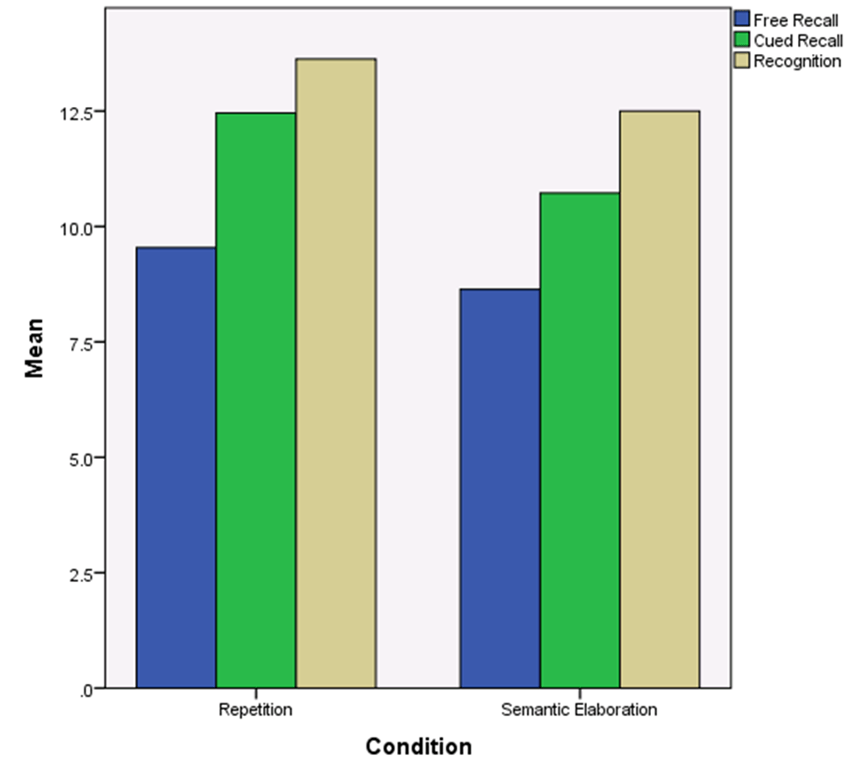
Figure 1. Mean number of words recalled in learning performance by the condition group.
 

Where Are They Now?

Christopher Rush

As part of our year-long wrap-up party, and in honor of our 10th issue, we thought you might be interested in getting a brief update on some of the students who helped make Redeeming Pandora over the years.  This issue we hear from first season’s Emily Grant and second season’s Lia Waugh.

Emily Grant

I am currently a student at Christopher Newport University.  A Chemistry major and a Leadership minor, I spend my time roaming the halls of the science building, procrastinating on writing my lab reports, and avoiding working on papers about the multiple theories of Leadership.  A sophomore, I currently live with former Summit students Julie McIlhaney and Emma McNally.

Lia Waugh

I’m working fulltime at Tidewater Orthopedic Associates Physical Therapy clinic.  I take the patients through their exercises, do different treatments on them (Cold Laser Therapy, Ultrasound), and love every part of it.  My coworkers and boss are great people, and everyone gets along very well and has fun working together.  I can’t think of a more rewarding job than having a patient come in having not been able to walk and being able to watch them progress and walk (and more).  I love that I’m able to directly impact people’s lives, even if it’s just with a smile and making them feel better.  My dream is to end up in the missions field, whether it is medical missions or not.  I just want that incredibly badly.  I do night classes at Thomas Nelson and have not been mugged or shot yet.  It’s not as bad as people think; the work is actually really hard.  But I love my classes; the more I study Biology, the more my love for God deepens.  So that’s where I am!  Eagerly waiting to see where else God leads me.  Even though I’m only a couple of months into college, I’m in awe of seeing how God has used some of my darkest hours to make me into the person He wants me to be.  He truly does make beautiful things out of the dust.

Media’s Negative Portrayal of Women

Lia Waugh Powell

Jena Morrow, a woman affected by an eating disorder, once said, “I am forever engaged in a silent battle in my head over whether or not to lift the fork to my mouth, and when I talk myself into doing so, I taste only shame.  I have an eating disorder.”  This quotation may have little to no meaning to a person who has never experienced the damage of an eating disorder.  With an eating disorder, there is a sense of never being enough, never being happy that consumes you every day.  A constant battle of blinking back tears as your mind reflects on what you ate that day, and you can almost feel the fat being deposited in your body.  You can see the weight gain.  The fear of gaining weight devours you whole, and there is no light at the end of the tunnel.  This occurs every day when you are battling an eating disorder.  That is every day for 8 million people in America alone (S.C. Dept. of Health).  Media have taken the woman’s body and twisted it into the perfect image, an image absolutely unachievable except through Photoshop® and excessive dieting.  The manipulated perception of beauty has driven countless women to developing eating disorders in an attempt to grasp and claim this beauty.  Eating disorders will continue to be a prominent issue in society until media change the way they portray women.

The connection between eating disorders and the media’s influence dates back to the 1800s.  Since the 1800s, the standard of female beauty often has been unrealistic and difficult to attain.  The rich and higher classes were far more likely to be able to conform to the thin and petite stature that was preferred in those times.  Women, typically, have always been willing to sacrifice comfort and even endure pain to achieve these standards, standards developed by what was considered high fashion depicted through European fashion (through whalebone corsets, and encouraging the binding of feet in Chinese culture).  In the 19th century, women with tiny waists and large bustles were valued.  It was desirable for an upper-class man to be able to span a woman’s waist with his hands.  Despite the inflicted pain and resulting health problems, such as shortness of breath (which could lead to pneumonia) and dislocated visceral organs, corsets became the height of fashion.

After corsets, in the 20th century many ideas of beauty changed.  During World War 1, women searched for comfort and power.  They cut their hair short and wore less complicated dresses.  During World War 2, women took to wearing skirts again, highlighting a very feminine look.  Many strove to be like Marilyn Monroe, who was a curvy sex symbol during the 1950s.  In the 1960s, the “thin” culture began to regain popularity when the European model Twiggy became famous.  Her petite frame became the object of affection in society, and ever since, thin has been the most desired body type.

The media began to gain more control over women as technology advanced and became more obtainable by the public, through multiple devices such as commercials on television, billboards, and magazines.  From the time children are first exposed to television, they see constant commercials for new diets to try out and beauty products to make you believe you need that particular product to be beautiful.  Average looking women wearing plain clothes with little makeup on are rarely, if ever, shown on advertisements on television or magazines.  According to the About-Face organization, “400-600 advertisements bombard us everyday in magazines, on billboards, on tv, and in newspapers.  One in eleven has a direct message about beauty, not even counting the indirect messages.”  This means media through advertisements bombard women — media’s perception of what beauty is and should be, rather than what true beauty is, thus causing unrealistic ideas of beauty and causing self-image problems.

With so many media influences, eating disorders have become incredibly popular.  Anorexia, otherwise known as Anorexia Nervosa, is the fear of eating, gaining weight, and/or becoming fat.  There are two types of anorexia: the restricting type and the binge and purge type.  Restricting Anorexia is the weight loss achieved by severe caloric restrictions and excessive exercise.  Binge and purge anorexia is akin to restricting anorexia, including periods of binge eating followed by purging behavior to avoid gaining weight (DSM-IV 65).

Bulimia, also known as Bulimia Nervosa, is an eating disorder characterized by secret episodes of binge eating.  Such activities are followed by inappropriate methods of weight control: self-induced vomiting, abuse of laxatives, and excessive exercise (67).  Bulimia and anorexia are life-long fights.  Once contracted, it is nearly impossible to fully recover from the disorders.

You need to be informed of the media’s influences because your children and my future children are susceptible to the dangers of eating disorders.  20% of people suffering from anorexia will prematurely die from complications related to their eating disorder, including suicide and heart problems (DMH S.C. Dept. of Health).  The fact something as severe as an eating disorder can be caused by the media is frightening.  It is our job to inform others of the negative effects the media can have.  You need to enforce healthy lifestyles in your children’s lives, so they can have positive body images and not go through the emotional stress and physically damaging effects of eating disorders.

To prove eating disorders are influenced by media portrayal of women, I will discuss my own experience with Anorexia Nervosa and explain why media were the main causes for my downfall.  Second, I will demonstrate the elaborate lengths magazines go through to achieve a flawless look through Photoshop® and people on television go through in makeup and the wardrobe department to conceal flaws and enhance specific features.  Third, I will prove the “Sex Sells” campaign pressures women into believing they must look a certain way to be beautiful.  Contrary to these points, the counterarguments of my thesis I will refute are first, the belief eating disorders are purely biological and not influenced by our cultural surroundings, and second, the belief media do not have any “control” over our society and thus women’s health choices.

My first argument supporting my thesis is derived from my personal experience with an eating disorder.  When I was 14 years old, I developed Anorexia Nervosa.  Media caused this because I believed I had to look the way the women did on television and in magazines to be considered beautiful.  I believed I needed to be extremely thin, have perfect legs, abs, and flawless skin.  I was terrified to eat and had an irrational fear of gaining weight.  There were days when I would eat a cracker and do several workout tapes to increase the number of calories I burned.  I would stare for hours at a mirror grabbing at my stomach, thighs, and arms in tears because I could grab fat, which in my mind should not be there.  I remember reading a book in which a girl had an eating disorder and was told she was not skinny or beautiful enough until she was capable of hugging herself to the extent her fingertips touched.  This became my goal.  I was never good enough, never skinny enough.  Eating became something I forced myself to do only because I knew I needed food to survive.  Weight loss would excite me.  I loved being able to feel my bones through my shoulders or feel my ribs when I touched my stomach.  However, if I turned on the television or walked by an issue of Cosmopolitan magazine, all of the weight loss meant nothing.  Seeing glossy magazine covers that showed beautiful women essentially naked with no physical flaws, killed me.  Both commercials and television shows haunted me, such as commercials with Victoria’s Secret models with perfect bodies and with every woman looking flawless.  They had no fat arms, thighs, or stomach.  Their skin was perfect, and their smiles shined brighter than mine ever could be.  I was suddenly reminded I would never be considered beautiful like those women.  I would never be able to have a man love me and think I am beautiful until my body matched theirs.  The media caused my downfall because everywhere I looked, with an already low self-esteem, I saw images of thin women being portrayed as beautiful, and then I would look at myself and see I did not compete with those women.  My body was incredibly flawed, I had large thighs and arms, my face was round, and my waist was not as thin as those on advertisements in magazines or television.

The disorder continued until I strengthened my relationship with Christ.  With a weak relationship, I realized I would never be happy with the way I looked.  To this day, I accept the fact I will never have a perfect body.  However, now I know an almighty God crafted me.  Yet the battle continues within me.  I still cringe at the thought of gaining weight.

Media insert images with unrealistic standards for women to achieve through the television and magazines into the minds of 5 million Americans who struggle with eating disorders, according to the National Institute of Mental Health.  Perhaps even more startling is the 119 percent increase between 1999 and 2006 of the number of children under age 12 hospitalized due to an eating disorder, the vast majority of whom were girls.  These statistics are important to acknowledge because they show the large increase of eating disorders in society for young girls.

My second argument is about the new phenomenon of Photoshop®.  Photoshop® is taking a photograph and digitally altering it.  With Photoshop® you can manipulate any photograph to make it look however you want it to.  In media, Photoshop® is used to make already thin models thinner and to airbrush their skin to give it a flawless finish.  Henry Farid, a Dartmouth professor, told ABC News in 2009, “The more and more we use this editing, the higher and higher the bar goes.  They’re creating things that are physically impossible; we’re seeing really radical digital plastic surgery.  It’s moving towards the Barbie doll model of what a woman should look like — big breasts, tiny waist, ridiculously long legs, elongated neck.  All the body fat is removed, all the wrinkles are removed, and the skin is smoothed out.”  About 99% of images are “photoshopped.”  This means practically every image we see, that our children are exposed to, has been falsified and changed, thus creating an image that portrays women in a artificial manner, encouraging beauty that cannot be achieved because it does not exist.

Like most adults, teenagers believe media influences everyone but themselves.  This is known as the “third-person effect.”  For example, in a national survey of more than 500 teens, nearly three-fourths believed sexual content on television influences teens their own age, but less than one-fourth believed media ever influence their own behavior.  This proves media have a rather strong grip on youth.  With images being “photoshopped” endlessly, there is an unachievable desire to be what the media tell you to look like.  Another example of the extreme measures taken by magazine editors is former American Idol winner Kelly Clarkson’s appearance on the cover of Self magazine.  Clarkson’s magazine cover portrays an at least 20 pound lighter singer, which caused controversy, especially since that particular issue was themed “Body Confidence.”  The magazine responded with the following: “Did we alter her appearance?  Only to make her look her personal best. … But in the sense that Kelly is the picture of confidence, and she truly is, then we believe this photo is the truest we have ever put out on the newsstand.”  Thus in this case, Clarkson’s “personal best” is not what she truly looks like; it is a slimmed down and artificial perception of what she should be.

“The effect (of the media) also appears to be growing.  The researchers’ analysis reveals that, on average, studies conducted in the 2000s show a larger influence of the media on women’s body image than do those from the 1990s,” says Dr. Grabe.  “This suggests that despite all our efforts to teach women and girls to be savvy about the media and have healthy body practices, the media’s effect on how much they internalize the thin ideal is getting stronger,” she says.  “The results are troubling because recent research has established body dissatisfaction as a major risk factor for low self-esteem, depression, obesity, and eating disorders, such as bulimia.  At the same time, women’s displeasure with their bodies has become so common that it’s now considered normal,” says Dr. Grabe.  She hopes that wider recognition of the media’s role will encourage people to see the issue as a societal one, rather than as a problem of individual women as it’s viewed now (Medical News Today).

This article is significant because Dr. Grabe’s beliefs align with my thesis.  Media have a large impact on how society develops, and with their current portrayal of women, eating disorders can become even more popular in the future, even accepted and encouraged through media.  With media continuing to glorify the thin image as beautiful, and women having constant displeasure with their bodies because they compare themselves to those on television and advertisements, eating disorders will become more prominent in society.

For my third argument, I will attest the “Sex Sells” campaign has brainwashed our country and the world for the past 50 years.  The average American woman is 5’4” tall and weighs 140 pounds.  The average female American model is 5’11” and weighs 117 pounds.  Most female fashion models are thinner than 98% of American women (Smolak).  Models are used as sex symbols: whether they are walking down the runway or posing in a photo shoot, the main idea for them to achieve is anything sexual.  Our society revolves around sex from the Victoria’s Secret commercials on television, to a commercial that is focused on a cheeseburger such as Hardee’s most recent commercial featuring a woman in a bikini eating a burger seductively, completely unnecessary.  Sex is tied into everything.  Therefore, children are being raised in a highly sexualized society, believing they have to achieve the bodies portrayed on commercials or magazines and indulge in sex to be happy or accepted.  The media have belittled women to a point where it is acceptable to try and mirror what the media say to look like.  From a Biblical perspective, we as Christians need to emphasize true beauty comes from within.  1 Peter 3:3-4 tells us, “Do not let your adorning be external — the braiding of hair and the putting on of gold jewelry, or the clothing you wear — but let your adorning be the hidden person of the heart with the imperishable beauty of a gentle and quiet spirit, which in God’s sight is very precious.”

To summarize my points, women and future generations need to know the media have constructed worldviews that are not healthy to obtain, especially through eating disorders.  Choosing to live healthily and taking care of your body is important and necessary.  Trying to match some other person’s body that has been retouched is not only impossible but also harmful to oneself.

The first counterargument to my thesis claims eating disorders are biological or passed down through family genetics.  The basis of this idea is that neurotransmitters are linked to eating disorders shown by studies done primarily on the hypothalamus.  Specifically, the ventromedial and lateral hypothalamuses have been shown to direct eating behaviors in humans, as well as in laboratory animals.

The ventromedial hypothalamus has been called the satiety center.  When this part of the brain is stimulated, eating behavior stops, comparable to a feeling of being satisfied.  Conversely the lateral hypothalamus, when stimulated, correlates to eating behavior.  When functioning properly, these two areas operate to keep the body at a specific body weight, termed the set point.

However, damage to either of these regions can cause the set point to be altered.  It is the case then eating will reflect the new set point.  So if this new threshold is lower than normal, the animal can starve itself to death.  Decreasing the level of epinephrine in the ventromedial hypothalamus of rats has been shown to be interrelated with rats exhibiting anorexic behaviors.  Rats have been seen to adopt a low rate of eating, increase their rate of activity, reduce their carbohydrate intake, and respond with overeating.  Therefore, biological issues can cause eating disorders but that is not the solitary issue.  In order for any of what was said to be true, the hypothalamus must be stimulated.  Something must “spark” the change; it cannot happen by itself.  This disproves the counterargument because though there are traces of eating disorders being biological, in order for the disorder to happen the hypothalamus must be triggered.

This trigger could be a feeling of shamefulness or any other negative feeling.  The brain is a very powerful and complex organ.  With an overwhelming sense of never being enough, or believing one is overweight, one’s brain actually can increase the levels of serotonin, thus contributing to depression and emotions.  So while there may be genes that play a role in the level of serotonin within our brains (for some people), the emphasis on the media’s effects should not be dismissed.

The second key counterargument is media actually do not have any effect or influence in society.  Some people honestly believe every decision we make is our own and is not influenced by any opposing forces.  However, this is not true: media have a strong impact on society.  Richard Salent, former president of CBS News, says,  “Our job is to give people not what they want, but what we decide they ought to have.”  This shows the media do indeed have great power and are fully aware of it.

The public is exposed to programming carefully crafted to create thoughts in our minds, whether they are realistic or not.  For example, Reality television shows such as Jersey Shore utilize extreme sexual behavior and excessive drinking as a way to entice viewers into living a lifestyle like theirs.  Many young adults have since begun to practice that lifestyle, endangering themselves and others.  Every decision a person makes, including whether to make oneself throw up, or to stop eating and begin to exercise excessively, is influenced by someone or something else.  The Bible even acknowledges outside influences and how they are indeed dangerous.  Proverbs 4:13 tells us to guard our hearts because they are the wellsprings of life.  Romans 12:2 states to not conform to any patterns of the world or not be influenced by the world.  These examples are important because they show even before media began to have a large impact on society, struggling with conforming to the world and being a part of the world have always been issues.  Today, the world described in the Bible can be aligned with media and how they constantly exploit women through “photoshopped” and highly sexualized images with unnaturally thin statures.  It is unhealthy to compare oneself with such images and people, and women and upcoming generations need to be aware of the effects media have and be able to discern what is healthy and what is not.

It is important to be able to recognize advertisements with emaciated models and models who have been computer enhanced, advertisements that have a large person in them portrayed with negative character attributes, and advertisements that glorify images of people on diets, or advertisements that present people relying on food for stressful situations, loneliness, and frustrations.  Here are some examples how you can recognize unhealthy images, images worthy of protest.  If you find any of these qualities in media advertisements, you can contact the National Eating Disorder Association, which is an association dedicated to helping people with eating disorders and stopping media influences, who will then review your submission.  If they accept your submission for direct action, they will contact you within one week, and if they do not decide to take direct action, they will post all of the information on their Facebook page, which informs those who monitor their page.  In doing so, you will also be informed about harmful media messages and can help keep you aware of the media’s messages.  Partaking in this will help you take control of what messages you allow in your or your child’s life, and can even help other women you have not even met by reporting harmful advertisements and preventing others from seeing them and developing an eating disorder or prevent them from being encouraged to continue with an eating disorder.

Please contact the author for more detailed bibliographic information.

Behind Closed Doors: The Food Industry

Lia Waugh Powell and Kayla Cole Baker

Newspaper headlines and documentaries have recently exposed the horrors and corruptions within the food industry.  Most people today have a basic idea of what goes on behind closed doors in the food industry; few know exactly what happens.  This day and hour, animals are being produced, transported, and slaughtered in larger quantities than ever before.  This high demand creates a need for efficiency and quickness resulting in unfair and inhumane treatment for commercial purposes.

Factory farming, according to the ASPCA, is “a large-scale industrial operation that houses hundreds or thousands of food animals in extremely restricted conditions and treats them as non-sentient economic commodities.”  The mistreatment begins in the process of raising the animals.  Factory farms begin with force breeding, in which animals are made to reproduce at unnaturally accelerated rates.  This causes the animals to become exhausted and stressed, putting their immune systems at higher risk for disease.  Because all of the animals resulting from force breeding need to be stored, the unnatural overpopulation causes them to be cramped into small areas.  They have no room to move, causing animals to get trampled to death or badly injured.  The lack of space makes ventilation sparse and disease easily spreadable.  To control the diseases among animals, the farm workers consistently feed them normally unnecessary antibiotics and hormones.  In addition, these antibiotics are used to kill intestinal bacteria, stimulating growth to speed up production along with the hormones with which they’re injected.

The abuse is far from over with the raising of the animals.  When the farm workers transfer the animals to the slaughterhouse, they still do not treat the animals as if their treatment could inflict pain.  As animals are transferred, they are crammed into trailers, mostly in harsh temperatures.  As cold weather worsens, animals start to freeze to the sides of the trailers.  The skin of the pigs or cows sticks to the side, and when they are roughly being pulled off to enter the slaughterhouse, their skin remains on the trailer.  Many who got sick or injured along the way are forced from the trailers with a bulldozer and piled with the other dead animals, waiting to join them in death.  The U.S. Department of Agriculture says each year about ten percent or nine hundred million animals never reach the slaughterhouse.

After arriving from the farms, the animals are put in line to be slaughtered.  Federal law requires animals be unconscious during processing, but unfortunately, that is not always the case.  The majority of slaughterhouses use electrical wands or what the industry calls a “captive bolt” to make the animals unconscious, but these are not always effective.  An account from a worker of a factory farm recounts, “To get done with them faster, we’d put eight or nine of them in the knocking box at a time.  You start shooting, the calves are jumping, and they’re all piling up on top of each other.  You don’t know which ones got shot and which didn’t.  They’re hung anyway and down the line they go, wriggling and yelling, to be slaughtered, fully conscious.”  Even with this requirement, some observations tell us thirty percent of animals being processed are still conscious while they go through the assembly line.  One worker confessed, “A lot of times the skinner finds a cow is still conscious when he slices the side of his head and the cow starts kicking wildly.  If that happens, the skinner shoves a knife into the back of its head to cut the spinal cord.  This only paralyzes them, it doesn’t stop the pain.”  The blame for this is put on faulty equipment or improper training of the workers.  The U.S. Department of Agriculture conducted a survey among all United State slaughtering houses, showing barely thirty-six percent were using “acceptable” slaughtering techniques.

The inhumane act of slaughtering does not only affect the animals, it takes a toll on the workers emotionally and physically as well.  A worker shares his experience with working in a slaughterhouse: “I’ve taken my job pressure and frustration out on the animals, my wife and on myself with heavy drinking.  With an animal that makes you angry, you don’t just kill it.  You blow the windpipe; make it drown in its own blood, spit in its nose.  I would cut its eye out and the hog would just scream.  One time I sliced off the end of a hog’s nose.  The hog went crazy, so I took a handful of salt brine and ground it into its nose.  Now that hog really went nuts….”  Not only emotionally, the lack of training the staff has acquired can stay with them the rest of their lives.  With bloody floors, sharp instruments, and thrashing animals surrounding, it’s easy to slip and injure yourself.  Without closely paying attention, the heavy machinery could cause major injury.  A worker testifies his observations: “The conditions are very dangerous and workers aren’t well trained for machinery.  One machine has a whirring blade that catches people in it.  One woman’s breast got caught in it and it was torn off.  Another’s shirt got caught and her face was dragged into it.”  Those disabled by machines and complain of the dangers are almost always replaced.

Those in the field of animal processing are not the only people affected by this way of producing.  The consumers eating these meats produced by factory farms are also harmed.  The antibiotics and hormones animals are required to eat because of the conditions they live in have harmful effects in humans who consume them.  The animals are fed these antibiotics all of their lives, and they become part of their body.  When we eat them, we also get the antibiotics and hormones they were given.  Consuming these can create a long-term problem with our own health.  The overdose of antibiotics can build up in our system, creating immunity from medicines used to fight certain strains of bacteria and illnesses.  Overdoses in hormones also affect us negatively.  Too much of a hormone can create growth problems in humans, just as it would make an animal grow unnaturally.  Within the food we eat are also defects as a result of factory farming and inhumane slaughter.  The food product from mass producing farms such as meat, eggs, and dairy products suffers in nutrition.  Using improper slaughtering techniques results in blood-spattered meat only acceptable for low-grade meat products, such as hamburgers.  As for eggs and dairy products, the force breeding and being injected with hormones to speed up the production affects the quality of the product.  There are not as many health benefits and nutrition as a natural, healthy process would produce.

Yet another way factory farming affects the world around us is environmentally.  When hundreds of animals are confined to one area, the surrounding land is harmed.  So many animals create much more waste than land can support, as well as putting chemicals in the air through processing.  This pollutes our soil, air, and water quality.  The excessive amount of waste is stored in waste lagoons, which often leak, admitting the manure into our ground and waterways, adding bacteria.  Side effects from this can result in Blue Infant Syndrome and other diseases.  The manure is also taken by companies to spray as fertilizer, releasing chemicals into the air we breathe and a gas dangerous to those in close proximity to a large amount called hydrogen sulfide.  Side effects range from sore throat to seizures and death.

In an attempt to stop this inhumane slaughtering, Congress recognized the Humane Methods of Animal Slaughter Act on August 27, 1958: “Congress finds the use of humane methods in the slaughter of livestock to prevent needless suffering; resulting in safer and better working conditions for persons engaged in the slaughtering industry; brings about improvement of products and economies in slaughtering operations; and produces other benefits for producers, processors and consumers which tend to expedite an orderly flow of livestock and livestock products in the interstate and foreign commerce.  It is therefore declared to be the policy of the United States that the slaughter shall be carried out only by humane methods.”  Though this held up while the demand for food was in smaller quantities, as it grew so did the inhumane treatment of animals.  This created the need for President Bush to sign into law the “Farm Security and Rural Investment Act of 2002.”  This includes a resolution the Humane Methods of Slaughter Act of 1958 be fully reinforced to prevent this needless suffering of animals.  It also requires the Secretary of Agriculture to track volitions and report them to Congress annually.  This poses the question: if these requirements are laws to be reported annually, why has factory farming continued to be a problem?  According to Arthur Hughes, Vice-Chairmen of the National Council of Food Inspection, the new federal regulations have given slaughterhouses more responsibility to comply with plant operation, but requirements have left them powerless to enforce them.  He explains in an interview, “Drastic increases in production speeds, lack of support from supervisors in plants, new inspection policies which significantly reduce our enforcement authority, and little or no access to the areas of the plants where animals are killed, have significantly hampered our ability to ensure compliance with humane regulations.”

With all of the problems of factory farming evident above, the question comes to mind, “what can be done to change this?”  Simply stepping up for the rights of animals made clear in the Humane Methods of Slaughter Act can change the way these factories are run.  In 1999, McDonald’s and other fast food companies received word of what was happening inside these slaughtering houses. McDonald’s showed up to investigate if the safety concerns were true.  They then set up newer guidelines for workers to follow, but nothing more.  Ways to ensure you are not supporting this horrific issue is by buying products marked as organic or free range.  They both mean cows, chickens, and pigs have not eaten pesticides and are not being raised in factory farms.  This not only does not feed the fast food business money and encourage them to keep producing, but it also supports local farmers.  Another thing to look into is http://www.localharvest.org/, a Web site that allows you to find local farms near you and regularly order fresh produce and other foods with a good cause.

Works Referenced

Bonné, Jon. “Can the Animals You Eat Be Treated Humanely?” Msnbc.com Web. 14 December 2011.

Farm Sanctuary. Farmsanctuary.org. Web. 14 December 2011.

People for the Ethical Treatment of Animals (PETA): The Animal Rights Organization. PETA.org. Web. 14 December 2011.

U.S. Food and Drug Administration Home Page. Web. 14 December 2011.

TBH

Lia Waugh Powell

Without a doubt, Facebook has impacted the lives of thousands upon thousands of people throughout the world.  Through Facebook we are able to connect with family members we haven’t seen for a while, meet long distant family members, share photographs with each other, create and organize events, and share what we are thinking with our friends.  All of those things have changed society; being able to communicate with people has never been easier.  However, people have found a way to make Facebook an unpleasant experience, and this article’s purpose is not to rant but to logically explain and dissect the purposes of people who do such things and offer a way for the people to fix the issues.

1.) Let’s start with the most annoying (in my personal opinion) example of one of Facebook’s annoyances: TBH, LBR.  For those who don’t have a Facebook account, TBH stands for “To be Honest” and LBR stands for “Let’s be Real.”  The essential purpose of this is for people to “like” a person’s status who has posted “TBH” or “LBR” and the person will write on the liker’s wall about what he/she thinks about that person.  It may seem like a fun idea, but it is never used the way it should be.  On average on my newsfeed (I did the math), 1 out of every 9 statuses is TBH or LBR, mostly from the same people, over and over again.  And every response to the TBH post can be summed up as this: “TBH (or LBR), you are really pretty.  We don’t talk that much but I wish we did, we should hang out some time, hit me up.”  This is annoying for numerous reasons.  One reason is because the writers do not really mean what they say.  If they truly missed that person, they would catch up with them, send them a message, text/call the person.  They would not write on their Facebook wall because the person liked their status.  Secondly, as mentioned earlier, these statuses are written by the same people almost every single time, and in response the same people like the status every time.  This harbinger could very well be because of a low self-esteem issue and should not be taken lightly.  Your self worth is not found through how many people like your status and how many people value your opinion.  The people who like your status only want to be told they are pretty and are missed.  Those people should not have to seek out attention through a social media website.  They should put more effort into their friends and family.  If you are a “TBH” liker, please know you do not have to be told constantly you are pretty and likeable.  Focus on other positive areas of your life.  Go out and help other people, because blessing other people will truly fill that void where you feel you are worthless.  You are God’s child; you are by no means worthless, but if you are constantly searching for affection through other people who do not truly care about you, you will continue to feel empty and will never reach the satisfaction you desire.  Your continual liking of TBH statuses proves this point; if it’s the third time you have liked the status and you still do not feel good about yourself, then you must know something is wrong.

2.) Another annoyance found on Facebook are those who upload pictures of themselves every day, and also those who change their profile picture at minimum once a week.  We all do in fact know what you look like.  I am not saying this out of acrimony, out of jealousy, or out of anything negative.  It is just a simple annoying factor of Facebook.  It not only gives off the aura of vanity, but also it seems as if the person is seeking attention.  Every person is unique and beautiful; if you believe you are more beautiful than someone else, you should check your heart, because that is not the humble heart Jesus teaches and calls us to have.  If the person is changing his profile picture constantly because he feels he is not beautiful and cannot find a good picture of himself, that is also wrong.  You should love how God created you, because you were made in His image.  And a Facebook profile picture or a new photo album does not determine your popularity status, and if it does I would suggest you change your group of friends.  Nobody should feel there is a standard to live up to in order to keep his or her friends.  Friends should love you for who you are, not what you look like.  In addition to that, “Charm is deceitful and beauty is passing, but a woman who fears the Lord, she shall be praised” (Proverbs 31:30).  That is the character trait all people, not just women, should seek out, fearing God and honoring Him through your life — not seeking acceptance from other people and “likes” on a profile picture or status.

3.) Additionally, Facebook is not a showcase for when you are having relational problems.  It is already hard to accept when someone dates another person for two days and professes his or her love for the other on Facebook posts … daily.  There is nothing wrong with public displays of affection; they are in a sense sweet.  However, when the pair has only been dating for two days and throw around the word “love,” it honestly should upset people.  The modern idea of love is already corrupted, so when it is consistently abused further, it is disappointing, especially when the couple breaks up every three weeks.  You can always tell a couple is dysfunctional when it is obvious they are fighting because their Facebook status states, “ugh, I’m so upset.  I honestly can’t do this anymore.”  Nobody needs to know you and your significant other are fighting.  If you feel you are mature enough to handle a relationship — a true relationship — you need to act like it.  Relationships should not consist of constant public fights, and you should certainly not break up biweekly.  If that is the state of your relationship, you need to get out.  Relationships should be based on purity, friendship, and love.  God should always be first in your relationships, through prayer and accountability of one another.  In this day and age relationships have been transformed into two people who like each other, and consist of impure morals and unrealistic feelings.  Love is not a feeling; it is not butterflies in your stomachs: it’s a day-to-day choice the person you tell “I love you” to is your treasure.  Biblically, you are called to encourage and stay committed to that person regardless if he/she drives you insane.  “Love is patient; love is kind.  It does not envy, it does not boast, it is not proud.  It does not dishonor others, it is not self-seeking, it is not easily angered, it keeps no record of wrongs.  Love does not delight in evil but rejoices with the truth.  It always protects, always trusts, always hopes, and always perseveres” (1 Corinthians 13:4-7).  Therefore, switching your relationship status on Facebook to “in a relationship” to “it’s complicated” to “single” religiously is completely and utterly immature.  You should not be in a relationship.  Instead, strengthen your relationship with God.  Too often people have this preconception they need a significant other.  Yes, God calls us to have relationships with other people.  Men and women do in fact complete each other.  But that does not mean you always need to be in a relationship.  Nine times out of ten, you have something more important to be focusing on (such as deepening your relationship with Christ).  When God is the center of your life and after much prayer, if you feel God has called you to be in a relationship, then go about it in a righteous manner.  Respect your partner, encourage, love, and help him/her keep his/her eyes on God as well.  If you cannot commit to those things, you should not be in a relationship.

4.) Joining Facebook groups and liking a page will not cure world hunger, cancer, make a guy/girl like you, make you seem more interesting, give you more friends, or help you find a missing child.  Though all of those things might sound good, none will happen.  If you would truly like to help world hunger causes or other troubling issues, plenty of websites exists for you to donate to.  Get educated on the topic and go out and make a difference in this world.  I promise you hands-on experience is better and far more rewarding than liking a Facebook page or group.

5.) Let’s get one thing straight: no person cares if your turnips on Farmville are ready to be harvested.  And no, I do not want to be your neighbor on Farmville, either.  There is NO purpose to Farmville.  My news feed should not subsist of the thousands of notifications of your accomplishments on Farmville, Café World, or Mafia Worlds.  Maybe they are a way for you to relax and unwind, and maybe you think it is fun, but I do understand why people get caught up in them.  Please know there is an option for you not to publish everything onto your Facebook.

6.) Dear Mr. Ushman A’shd Umaya: I do not know you; I do not know how you found me, and though your profile picture of a Disney character is tantalizing, no, I do not want to be your friend.  That situation should suffice enough to annoy anyone.

7.) If you have updated your status more than three times within the past hour, please stop.  Facebook statuses are meant to share your thoughts (particularly interesting, funny, or encouraging ones).  I do not want to know if you are currently reading a book or are standing in line at Food Lion.  Pertaining to this subject, Facebook should not be used as a personal journal.  The world should not know if you are in a fight with your mom, if you just kissed a guy/girl; it should not be used for you to brag about how amazing you think you are, and it should not be used for you to write depressing statuses all the time.  There are so many good things in life, why should you waste time being depressed and sharing your depressed thoughts with others?  Talk to your friends in private if you are having issues, but try to spend your time encouraging other people rather than bringing them down.  When you bless other people, it is like instantaneous medicine for your soul.  “If you have a problem face it, do not Facebook it.”  Gossiping on the Web also should not occur (gossiping at all should not occur).  As of November 3rd, Google expanded its searching realm, and your comments can be found on the Web if someone looks up your name now.  Arguing on Facebook should not occur, either.  It is juvenile and annoying to those who read the dispute (albeit it can be quite entertaining).  Your life issues should, once again, not clash on-line.  Confront the other person in an appropriate and private manner about the offense and move on with life.

In conclusion, your personal life should not be displayed for all to see through Facebook.  Most of these annoyances are based on that issue.  Confront your issues in mature manners and develop and establish social skills from the Bible.  God’s Word contains all the resources and wisdom you need to know to get through life, along with the people He has put in your life.  Facebook is not a journal, nor is it a healthy way for a person to seek attention.  A Facebook “like” should not and will not be as fulfilling as developing a genuine relationship with Christ and other people.

The Real Shakespeare

Lia Waugh Powell

For years the question “Who truly wrote Shakespeare’s plays and poems?” has been asked.  There are many speculations as to who wrote the works, and if Shakespeare really did not write them, why did they cover it up?  The idea of a fake Shakespeare may seem absurd, but scholars have been debating this for over 500 years.  Everyone would prefer to leave Shakespeare as he appears: a vivid poet and playwright who wrote deeply and loved even deeper.  But the oppression of the so-called “artful class” forces us to analyze all the best parts of every writer out of the picture.  This topic has become so heated the movie Anonymous was recently released, based on this controversial topic (though the reviews of the movie reveal that this movie contains many untrue statements and scenarios, thus making it completely inaccurate).

One reason it is suspected Shakespeare was made up, or just a false identity, is because the purported Shakespeare could not have possibly known about all of the things he wrote about.  This is because Shakespeare has such a modest background: he grew up in a working class family, therefore he could not have had the brain capacity to contain all of the knowledge necessary for him to write about what he did, and he could not have had access to the libraries he would need to write as well.  Some scholars also argue Shakespeare could not have traveled much either, which would mean the descriptions of places in his works would be inaccurate. Such as in The Merchant of Venice, Shakespeare could not possibly have written the descriptions of Venice, because he had never been there.  Also, in the 1600s, scholars say 98% of working class families could not even sign their names; Shakespeare has at least six known signatures.  As stated in the credited article of The Observer:

All we know for certain is that Shaxpere, Shaxberd, or Shakespear, was born in Stratford in 1564, that he was an actor whose name is printed, with the names of his fellow actors, in the collected edition of his plays in 1623.  We know that he married Anne Hathaway, and died in 1616, according to legend, on his birthday, St George’s Day.  The so-called “Stratfordian” case for Shakespeare rests on these, and a few other facts, but basically, that’s it.

Into this vacuum, a bizarre fraternity, including Mark Twain, Charlie Chaplin, Orson Welles and Sigmund Freud, have projected a “Shakespeare” written by a more obviously accomplished writer: Edward de Vere (the 17th earl of Oxford), Sir Francis Bacon and the playwright Christopher Marlowe, to name the leading contenders in a field that also includes Sir Walter Raleigh, John Donne and even Elizabeth, the Virgin Queen herself.

One view of who could have written Shakespeare’s works is Christopher Marlowe.  Marlowe was a 16th-century playwright and poet, born in 1564, the same year as Shakespeare.  He was recognized for his exceptional writing abilities in his school years.  Unlike any other candidate to the “who really wrote Shakespeare’s works” debate, Marlowe is the only writer who matched with Shakespeare’s wit and writing style.  When comparing Marlowe’s and Shakespeare’s works, it is obvious both are very similar in the way they sound and how they are presented.  Marlowe’s story is more interesting than that, though.  It is recorded Marlowe was stabbed to death on May 30, 1593.  However, Shakespeare’s plays did not start being published and acknowledged until after Marlowe’s death.  People believe Marlowe’s death was faked, so he could write the plays and poetry.  He faked his death because people wanted to kill him because he was a suspected of being a spy for the Queen and, worse, an atheist and heretic.  Marlowe was even reported as claiming Jesus was a pervert, who engaged in homosexual relationships and was not the Son of Man.  With all of these titles and suspicions from other people upon him, he had no choice but to fake his death so he could continue writing, as Shakespeare.

Another candidate for writing Shakespeare’s works is the Earl of Oxford.  Some logical reasoning that supports this theory is because of the many influential people and foreign places mentioned in the plays and poems are connected to Edward de Vere.  Born in 1550 (14 years before Shakespeare’s birth), he became the Earl of Oxford at the age of fourteen and hid his love for literary works and art because it would not have been acceptable for his reputation in court.  De Vere’s life also is paralleled in many of the plays, such as Hamlet.  De Vere also has the exact education and social class to have the knowledge about politics, other countries, and important historical figures displayed in Shakespeare’s plays.  Another compelling and convincing fact that could prove de Vere is the true Shakespeare is de Vere was once described with “Thy countenance shakes spears”  in a royal court.  This means de Vere could have been acknowledged as “Shakespeare” during his days.  De Vere also spent many years in Italy, and 14 of Shakespeare’s plays occur in Italy.

Sir Francis Bacon is also a candidate for writing Shakespeare’s plays.  This theory was suggested by none other than Mark Twain in the 19th century.  Bacon graduated from Cambridge at the age of twelve.  One piece of evidence that can be used to prove Bacon was the true Shakespeare is that in one of his works he uses the line “All is not gold that glistens,” and in Shakespeare’s play The Merchant of Venice is written, “All that glisters is not gold.”  The interesting part of the Baconian theory is the claim he is the true writer because of Baconian ciphers, cryptograms, and codes found in Shakespeare’s plays.  Baconians say, “Bacon, who was a leader in early scientific thought, and who invented ciphers to ensure posterity would remember him as Shakespeare, inserted secret messages in his plays.”  According to Baconians, an epitaph is on his tombstone: “FRA BA WRT EAR AY.”  This is interpreted as “Francis Bacon wrote Shakespeare’s Plays.”  Though this may seem absurd, this theory is not to be cast aside because proven throughout history many great minds have used cryptograms and such to reveal hidden messages and secrets to those who are supposed to know certain things.

However, none of these, in my opinion, beside de Vere, can truly be the real Shakespeare besides Shakespeare himself.  William Shakespeare was born in April 1564.  He grew up in a working class family and married Anne Hathaway.  He then joined a troupe of actors and traveled all the way to London.  He became one of the leaders in the most recognized theater company at the time, the Lord Chamberlain’s Men.  Shakespeare then wrote plays and became a sharer at the Globe Theater.  Proof of his existence and that he is, in fact, the writer of the poems, is that his name appears on the poems and plays, such as The Rape of Lucrece, Romeo and Juliet, Henry IV, and Hamlet, where his name is signed and attributed to the works.

More proof Shakespeare is the true author is he was an actual actor in a theater company that acted out his plays (The Lord Chamberlain’s Men).  On March 13, 1602, John Manningham recorded in his diary a racy note about Shakespeare and Richard Burbage:

Upon a time when Burbidge played Richard III there was a citizen grew so far in liking with him, that before she went from the play she appointed him to come to her that night unto her by the name of Richard III.  Shakespeare, overhearing their conclusion, went before, was entertained and at his game ere Burbage came.  Then message being brought that Richard III was at the door, Shakespeare caused return to be made that William the Conqueror was before Richard III.  Shakespeare’s name [is] William.

Shakespeare was not just a playwright; he wrote his plays with specific actors and settings in his mind.  This proves he wrote his plays because his characters and settings are all very detailed.  Shakespeare traveled with a specific group of people, he knew their appearances, their strengths and weaknesses, so we can logically assume he wrote accordingly.

William Shakespeare the Globe-sharer is the same person as William Shakespeare of Stratford-upon-Avon.  William Shakespeare, the Stratford-born actor, was titled “gentleman” after his name by right of being granted a coat of arms.  This is proven in a mortgage deed of trust in October 7, 1601 by Nicholas Brend to John Bodley, John Collet, and Matthew Browne, where Bodley was given control of the Globe, which is  described as being occupied by “Richard Burbadge [sic] and Willm Shackspeare [sic] gent.”

The reason the Shakespeare debate is large and ongoing is because Shakespeare’s name is registered so differently.  But in actuality, Shakespeare went through many titles as his social status went up.  As mentioned earlier, Shakespeare may not have had a great social status as a child, thus he could not have been very well educated.  But that really means nothing; Shakespeare may have had the ability to learn quickly, and while he toured with The Lord Chamberlain’s Men, his knowledge of different lands and countries must have expanded while he traveled.  It is inevitable to learn about new things when you are living in different environments.  Interestingly enough, there are even poems addressed to Shakespeare acknowledging him.

To our English Terence, Mr. Will. Shake-speare.

Some say (good Will) which I, in sport, do sing,
Had’st thou not plaid some Kingly parts in sport,
Thou hadst bin a companion for a King;
And, beene a King among the meaner sort.
Some others raile; but, raile as they thinke fit,
Thou hast no railing, but a raigning Wit:
And honesty thou sow’st, which they do reape;
So, to increase their Stocke which they do keepe.

These historical documents are proof Shakespeare was exactly who he is said to be.  Though The Earl of Oxford is very much qualified to have been “Shakespeare” because of his social class, environment in which he was raised in, and his connections to the court and politics, his writing skills were nowhere near as genius as Shakespeare’s were.

Christopher Marlowe was the only man who wrote as eloquently as Shakespeare did, but his life and death are too different from any of the other candidates to be qualified as the real Shakespeare.  He “died” at the age of twenty-nine, but still did not have the experience needed to write Shakespeare’s works, and he is not recognized as an author or actor, nor does he have any historical documents that prove he wrote much of anything besides his own plays, whereas Shakespeare was recorded acting in his own plays and also signed his works.

Sir Francis Bacon also does not have much of a stand on being the true Shakespeare either.  He is recorded as being extremely intellectual and a good writer, but other than that, he is not very well connected to Shakespeare’s plays and poems besides similarities in writing styles.  Another fact to take into account is, why would these authors, all who are well known in society, write anonymously?  In the 1500s and 1600s artists dreamed of being well known, much like today.  So why would anyone, besides Christopher Marlowe who was in hiding, assume a secret identity?  They would most certainly want the credit as the original playwright and poet of Shakespeare’s works.

As a result, Shakespeare is truly Shakespeare, and the conspiracies surrounding his existence and authenticity are made up because we as humans question everything; that is our nature.  Shakespeare, the Shakespeare who still lives in the works of literature that bear his name, would not want future generations to sit around analyzing how his life dictated his writing but rather how his writing applied and influenced our lives and our writing.  Instead of debating who wrote what, we should enjoy Shakespeare’s art.  His literary talents are unique to this day.  No other writer has been able to match his style exactly, and no other writer has captivated the hearts of millions of people throughout the centuries like Shakespeare has.  His works should not be debated over but enjoyed thoroughly in society and appreciated among all literary scholars.

Bibliography

Kathman, David. “The Shakespeare Authorship Page.” Shakespeare Authorship. Web. <http://shakespeareauthorship.com/&gt;.

The Marlowe Society. Web. <http://www.marlowe-society.org/&gt;.

McCrum, Robert. “Who Really Wrote Shakespeare? | Culture | The Observer.” Latest News, Sport and Comment from the Guardian | The Guardian. The Observer. Web. 12 Mar. 2010. <http://www.guardian.co.uk/culture/2010/mar/14/who-wrote-shakespeare-james-shapiro&gt;.

Milner, Cork. “Christopher Marlowe — Shakespeare.” Netplaces. About.com. Web. <http://www.netplaces.com/shakespeare/shakespeares-rivals/christopher-marlowe.htm&gt;.

—. “The Baconian Stance — Shakespeare.” Netplaces. Web. <http://www.netplaces.com/shakespeare/did-shakespeare-write-shakespeare/the-baconian-stance.htm&gt;.

I Bet I Can Make People Mad at Me in 2500 Words or Less

Lia Waugh Powell

Those who know me very well, which in all honesty at Summit only consists of very few people, know I am absolutely in love with studying Systematic Theology.  I never even knew what that meant before I stepped through the threshold of Summit, for which I am very grateful.  I would have been completely unaware of the many topics Christians should be very educated in — predestination, transubstantiation, the meaning of Jesus’ sacrifice, etc.: essentially, the main topics that divide the church to this very day.  For some odd reason, people began to think they could fully understand God and decided if people are against their beliefs and interpretations of what the Bible says, then the people need to leave.  This is where humanity’s biggest issues lie — pride.  We all think we know more than the other person, and we all immediately judge, whether we admit it or not, when someone disagrees with us.

For example, since the time I have been at Summit, I have heard the argument about predestination versus free will countless times: “This person believes that; oh my goodness, they are going to Hell.  How can they believe that?”  “Well, if God is the type to predestine people to Hell or Heaven before they even live, then He’s not a God I want to serve.  That is not love.”  You get my point.  Where I stand on this subject has wavered countless times as I let people manipulate me into believing one thing.  This is why I strongly advise whether you agree or disagree with my stance on this subject, you research and read the Bible yourself and get a good, solid understanding of what you believe.  My beliefs are my beliefs; I am not pressuring you, saying you are wrong, or anything of that nature.  I am simply stating my belief and why I believe it with Biblical support along with other theologians’ ideas and my ideas as well.  Where you stand on the predestination versus free will “argument” is your choice, and it certainly will not affect whether you go to Heaven or Hell.  Just know what you believe and live it out is all I am asking.

Now after that preface, here is my stance.  (Please do not start the “Pie a Senior” Contest again; just leave only my bucket out there to collect the money.)  I believe in predestination.  And here is why: first, we must fully understand the term “predestined,” and we must understand it from a Biblical perspective.  The Greek word for “predestination” (the word from where we derived predestination, the very word in the original text of the Bible) is proorizw (proorizō), which means “to determine beforehand.”  Therefore, no logical arguments can be made against the term “predestination” or misinterpreting it, because that is the very definition used in the original text.

Now, from the time I’ve been at Summit I’ve wrestled with this belief.  If God were a God of love, why would He predestine people?  That is not fair; it does not seem right.  As I was uneducated with the area (I am NOT saying those who are for “free will” are uneducated, do NOT twist my words around, or I will refer you back to this very line), I could not understand nor wrap my mind around this idea.  As I’ve researched it more, I realized my problem.  I envisioned Santa Claus as God.  I envisioned the God who patted my back when I sinned and gave me presents and blessing when I asked.  To me, God loved everyone, and He would fulfill me, give me what I want, and get me into Heaven when I die.  This, unfortunately, is the God multiple people believe in.  But it is incredibly wrong.  Our God is not fair — he is just.  “Fair” means “superficially pleasing” and “just” means “guided by truth and reason.”

Those who are parents, or who have ever babysat a kid, know very well being “fair” is not the way to go in parenting.  For example, Little Susie is 7 years old and could be described as rowdy, loud, and rebellious.  Yet your other daughter, Little Betsy, is 8 years old, more mature, and listens to adults.  Little Betsy would be allowed to attend sleepovers because you can trust her, and you know she will behave.  However, Little Susie cannot attend sleepovers yet, because she is not at the maturity level to leave the house alone.  Susie would see that as unfair, but it is indeed just.  Even though there is only one year separating Susie and Betsy, Betsy is far more mature than Susie is and can be trusted.  Being “fair” is not being wise — it’s being pleasant.  And we do not, as the faulty human beings we are, filled with disgusting sin and drenched with burdens and shame, do not by any means need a “fair” omnipotent power.  If God were fair, He would not truly love us.  Nor would He be a trustable God; I know I would not want to put my faith in a God who blessed people by saying, “Oh hey, Corey hasn’t received a car yet but Missy has, so I should get on that.”  That actually seems a bit lazy.  If God were fair, everyone would receive what they think they deserve.

This brings me to the question, “Why would God create people if He knew some would go to Hell?”  That is also something I struggled with for a very long time.  Here is the deal.  God is God.  How, under any circumstances, can we ever question His actions?  You and I are so far below His intellect and wisdom.  Let me phrase this in a real-life situation the way my pastor once did.

In 2004, Oprah Winfrey gave away 271 free cars, fully loaded with gas and everything, to every person in her audience that day.  Now how would you feel if you had just been on the show a day prior to that?  Or the day after?  A bit gypped?  I know I would.  But if you were to go ask Oprah, “Oprah, what is up with this?  I was just at your show….  Are you sure you don’t have one more set of keys somewhere around here?  One more car?  Even just a free fill up for my gas tank?”  And you know what Oprah would say?  “Nope!”  And you know why?  Because it is her show!  She did not need to buy everyone in her audience a car.  She didn’t need to get them anything.  It’s her show.  She can choose what she wants to do!

And that is where we are with God.  God did not have to give us His only Son to be beaten to a state no man ever should be beaten.  Jesus Christ did not have to come to Earth to experience the heartache and temptations we go through every day.  He did not need to carry a rugged cross only to be hung on it Himself to die for someone as evil and wicked as myself, or for you.  He did not have to have His flesh torn, His hands and feet pierced, nor did He have to be spit on and mocked and hated by many.  But He did, and He did it for you and me.  We have been predestined — OUT OF LOVE — so we may be able to be in the very presence of our God and Savior for all eternity: “For He chose us in Him before the creation of the world to be holy and blameless in His sight.  In LOVE He PREDESTINED us for adoption to sonship through Jesus Christ, in accordance with His pleasure and will — to the praise of His glorious grace, which He has freely given us in the One He loves” (Ephesians 1:4-7).

Also, in scripture God has chosen/appointed people and favored others multiple times.  God loved Jacob, but hated Esau.  God chose David over his other, more accomplished brothers, to defeat the giant.  God favored the Jews.  Those are only some of the examples; I could continue on, but I trust you can also think of some on your own from your own Bible study.  But just because God favors some does not mean He ever rejects anyone who turns his/her heart to Him.  In fact, I am willing to bet my life on the fact God will never turn away someone who truly searches for Him, with all of his or her heart and soul.  But God is also outside of time.  This means He already knows who will accept Him and who will not.  In addition to God predestining us, we must also choose Christ in order to be saved.  “Because, if you confess with your mouth that Jesus is Lord and believe in your heart that God raised Him from the dead, you will be saved.  For with the heart one believes and is justified, and with the mouth one confesses and is saved” (Romans 10:9-10).  You are not saved without giving your life to Christ, but because of God’s sovereignty He already knows who will do so.  For it is said, “No one can come to me unless the Father who sent me draws him.  And I will raise him up on the last day” (John 6:44).

I determined I believe in predestination because it is what I feel is the most Biblical belief.  I do not want to believe in something not supported by scripture, because to me that seems self-righteous.  I have, and always will, lean toward what the Bible says, regardless of my emotions.  However, I do not feel in any way predestination is a “wrong” belief as far as the moral spectrum.  This is because I know God is a just God, as well as a God of love.  I know He knows more than I will ever be able to conjure through my time on Earth.  I know God is a God of order, thus He has a plan, for everything and everyone.  Predestination does not scare me; it does not make me see God as this terrible being.  If anything, it is the exact opposite.  But, my opinion can very well be as faulty as the next; I am not telling you what to believe.  This is what is important to know: I do not deserve grace.  You do not deserve grace.  We deserve to be in a burning lake of fire for all eternity.  Seem a bit harsh?  Reflect on your thought life this past week.  Reflect on the images that passed along your computer screen, or the words you uttered under your breath or to another person.  Reflect on the gossip or lies you spread because someone upset you.  We need to face the facts — we deserve Hell.  The belief in predestination does not mean if you are predestined you can go out and do whatever your heart desires because you are getting to Heaven anyways.  That is unbelievably wrong.  If you claim to be a Christian, you need to live the life.  You can raise your hands in church to a worship song, and you can go get baptized, but those do not mean your heart is aligned with God’s.  Anyone can do those things.  As a Christian, you should be set apart from the crowd, and you should be proud of your love for Christ.  You should display His love to others through your actions and words, and you shouldn’t just be that way on Sunday morning.  We aren’t going to be able to achieve this (obviously) all of the time — but we do need to strive toward it.

The 5 Things the World Needs to Survive – and We are Running Out

Lia Waugh Powell

Whenever we think of scarce yet important resources, oil immediately pops into our minds.  However, the only reason we think of our lack of oil is because it affects us directly — through gas prices.  But oil isn’t the only thing in the world we are running low on, and it’s going to be the least of our issues if these things continue to become more and more limited.

5) Helium

The increasing lack of this gas is not only going to affect children across the globe because their parents can no longer afford balloons for their birthdays — it can potentially shut down this entire “Technology Era” we are in.  The majority of our technology has been created with the help of helium.  This is because helium has the lowest boiling point out of all of the elements on Earth.  Here are some examples of how helium is so critical to our society:

· Helium is used to cool MRI magnets, the tools hospitals use multiple times every day to observe and diagnose many issues from soft tissue damage to tumors.

· Helium is used to create rocket fuel.

You know when you are at the grocery store when the cashier is scanning items?  That scanner’s laser is made from helium.  As you can tell, helium is quite important.

4) Chocolate

Every year over 13 BILLION dollars is spent on chocolate — in the United States alone.  The problem?  The world’s top supplier of chocolate comes from West Africa, tended by slave children.  Even taking out the slavery aspect of it, the average cocoa bean farmer makes 80 cents a day.  Thus, people are getting smarter and realizing that the 5 years it takes to plant and raise a cocoa tree just isn’t worth only 80 cents a day — not to mention the heat in which the workers have to labor.  The area cocoa beans are grown in isn’t so hot either — it’s one of the world’s most politically unstable regions in the world.  It is predicted that in 25 years chocolate can become just as expensive and as rare as caviar is now.

3) Medical Isotopes

Medical isotopes are used about 50,000 times a day in the United States alone.  They provide short bursts of radiation used for diagnosing bone cancer, kidney malfunctions, and issues within the brain.  Around 80% of medical isotope procedures use Technetium-99m, which only lasts about 12 hours.  This makes it impossible to store it, thus it must be produced freshly over and over again.  Though this is such a crucial part to the examination, the industry only has one supplier, Chalk River Laboratories.  Unfortunately, that company shut down two years ago.  The United States and Canada are both in the process of creating new nuclear reactors to safely produce Technetium-99m, but they will not be finished in quite some time.

2) Phosphorus

Though phosphorus isn’t exactly thought of as “Oh my goodness, this is such an important thing to have,” it actually is.  Every living thing relies on phosphorus.  Phosphorus is used to clean water, treat metal, toothpaste, and pesticides.  Most of all, fertilizer is made out of phosphorus.  Without it, there will be no way to sustain the amount of crops needed to maintain the world’s population — and it’s estimated to run out in 30 years.  Sweden is so concerned about the lack of phosphorus we are heading toward, they made a toilet that will extract it from our urine.  That, ladies and gentleman, is indeed desperation.

1) Water

You probably laughed when you read water was running out.  It’s all around us: the ocean and lakes in and around Virginia alone contain enough water for us to enjoy anytime we please.  But, it’s true; the amount of drinkable water in the world is becoming more and more limited, for many reasons.

One reason is pesticides; there are so many that are accidentally exposed into water many fresh water resources have become considered dead.  Even though oceans, lakes, and rivers surround us, only 0.3% of water on Earth is drinkable, and the majority of this water is groundwater.  The U.S. is not doing its share in protecting water, either.  The average American uses 15-30 gallons of water in the shower, 1-2 gallons of water brushing one’s teeth, 10-15 gallons of water while shaving (if water is kept running), 20 gallons in washing dishes, and 5-7 gallons while flushing the toilet.

Reflections on 9/11/01

Lia Waugh Powell

The famous line “We Will Never Forget” is extremely proper — everyone born before the date of September 11, 2001 will never forget where they were when they heard about the terrorist attacks.  I was seven years old sitting in a classroom struggling to read a book aloud in front of my class.  I was so frustrated being in front of my peers and not being able to read as eloquently as they did.  So when the principal of my school ran into our room and quickly made all of us sit in the main hallway where the television was playing, I didn’t mind.  I hadn’t taken into account the tears that were streaming down her face or the gasps of terror that were going on around me.  I was just so happy for the attention to be off of me.  When each of my classmates had taken a seat in front of the television I began to soak in what I was seeing.  I watched a plane hit one of the towers of the World Trade Center.  I saw images of people jumping out of buildings and the people running from a building that had just collapsed.  They were covered in white dust.  Immediately, as a seven-year-old child, I panicked thinking my mom was working in the building that had been struck.  She was due to give birth to my sister that day.  My mom, being my mom, must have known how scared I was because she called the school.  She reassured me that she was okay, and that she wasn’t in the buildings.  She also told me that my uncle, who was coming down from New York to be with us when my sister was born, was all right, too.

2,996 people died that day.  Approximately only twenty people were rescued from the rubble.  On September 4, 2011, I had the privilege to meet the last survivor pulled out from the debris, Genelle Guzman-McMillan.  Her day started off as any other day.  She arrived at work at 8:05 AM.  She got to her office, which was on the 64th floor and started catching up with her friends on what they had done over the weekend.  Then the building shook, and her coworkers all exchanged concerned looks.  She didn’t think it was very important though, because she was from Trinidad and thought it was just an earthquake.  They resumed their day.  No alarms went off.  No warnings were issued — they were completely unaware a plane had just struck 30 floors above.  After an hour or so they felt the building shake again.  This is when Genelle knew something was wrong.  She looked out her window and saw papers flying in the sky and a smoky haze.  Genelle and her friends hurried to their conference room and turned the television on.  This is when they saw there had been a possible terrorist attack, and the planes had struck both of the buildings.  Genelle and her coworkers all decided to walk down the stairs; she then called her boyfriend and told him to meet her outside the building.  As they traveled down the stairs, they were not in a hurry.  They figured the building was sturdy enough —  they even had passed a fireman on the way down who told them they were doing okay and they should be fine.  Genelle was holding her good friend Rosa’s hand to help comfort her.  When they reached the 13th floor, Genelle needed to remove her boots that she had just bought a week prior to 9/11; they were four inches high.  She let go of Rosa’s hand and as soon as she bent over, the walls caved in.  She was pinned to the floor and fell thirteen stories.  She remained conscious the entire time.  She remembers the falling sensation, the people’s screams and cries.  When she hit the ground her head was pinned between two concrete pillars, her legs crossed and her body in a fetal position.  The only thing that was free to move was her left arm.

Genelle told herself repeatedly, “This cannot be happening, it is just a dream.  Just a dream.”  She closed her eyes and opened them again hoping that she would wake up.  The dust was in her nose and mouth.  She realized it wasn’t a dream — she was alive, and a 110-story building had just collapsed on top of her.  She heard a man’s voice call out for help three times — and then it stopped.  Genelle laid under the rubble.  She wanted to cry but her body was incapable of producing tears.  She felt like her head was going to explode.  Genelle recalls extreme temperatures — at one point she was so hot she was sure she was going to burn alive, as if a fire were right underneath her.  And another time she was so cold, her teeth were chattering.  She moved her left arm around to feel around her, looking for anything to pull over her body to keep her warm.  She felt a piece of cloth and pulled on it but could not get it.  She later found out it was a fireman’s body; she was tugging on his coat.  Genelle laid there for 27 hours, giving up the will to survive.  She did not care to live a Christian life before; she always thought she’d get “right” with the Lord around the age of 65.  She didn’t care to live a “conservative” life as Christians do; she’d rather party and get drunk every night.  Suddenly Genelle began to think of her daughter who was 12 at the time.  She began to think of her boyfriend, her family.  She wanted to live, to see her daughter and family again.  She thought of her mother who was a Christian; she always called Genelle and asked her to change her life and follow Christ, and every time Genelle dismissed her.  Genelle decided to cry out to God, begging for his forgiveness and his mercy to pour over her.  She asked God to save her, promising him if he did she would live for him.  She asked for a sign, anything to show her he existed and he loved her, that she would survive. She cried out that same prayer for about an hour.

Genelle then decided to reach her arm up, to feel around so maybe someone would see her.  A hand grabbed hers and said “Genelle, I’ve got you.”  She did not tell him her name, but a wave of relief came upon Genelle.  She said, “Thank you, God,” and then asked his name.  “Paul,” he said.  “I’m going to stay with you until they find you.  I’m not going to let go of your hand.  They will be here soon; I’m not going to leave you.”  Paul held her hand until rescue workers found her.  It took the workers one hour to remove all of the rubble from on top of her.  She had been buried for twenty-seven hours.  A line of people had formed, and they all passed her down to the ambulance.  The people cheered and clapped as she was brought to the hospital.  She was the last person alive to be recovered from the tragedy.  All of her coworkers had died.  When she got to the hospital her boyfriend rushed to her side in tears.  Immediately, Genelle told him to write down the name Paul, the man who saved her life.  He did, and to this day she has not been able to find him.  She believes he is an angel.

When I heard her story, I couldn’t stop myself from crying.  I had met Genelle when I was twelve years old, but I wasn’t mature enough to understand the weight of what had happened to her.  Five years later, she was sitting before me with her husband (her boyfriend during 9/11); they married in November, as soon as she was released from the hospital.  She has two children with him, one is six years old, the other is two.  Genelle’s survival was a miracle.  She survived one of the worst acts of terrorism the world has ever seen.  She fell thirteen stories and had 97 floors crumble on top of her, and she is still fully functional: mentally and physically.  But this Genelle is not the Genelle before September 11, 2001.  She is now a best selling author for her book Angel in the Rubble and travels the world telling people about God and how he saved her.  Her story has saved thousands of souls.  A day so tragic to our nation — God has used to save many people.  We will never forget September 11, 2001.  And we should never forget that only our God can use something so terrible to show his love for us and to bring glory to him.