Tag Archives: kaitlyn thornton abbott

The War on Terror: The Next Step

Kaitlyn Thornton Abbott

September 11, 2001: a day that goes down in infamy; a day that 2,977 Americans lost their lives. Across the globe, countries mourned with Americans; as a country, Americans found a solidarity they had not known before. Neighbors clung to one another, waiting anxiously to see what President George W. Bush would do in response. He, along with many other world leaders, pressured the Afghan government to convince the Taliban to hand over Osama bin Laden (U.S. military intelligence had confirmed he was responsible for coordinating the attacks on 9/11). When the Afghan leaders refused to cooperate, the United States invaded, with the blessing of the international community. Thus, the Global War on Terror was born. There have been several distinct eras of strategies, none of which have effectively worked to produce a long-term gain; so, the question remains: what other strategies have the U.S. military officials not tried, and of those, which direction should we pursue to retain American interests in the region and ultimately declare victory in the “War on Terror?”

Many ideas have come into play regarding the future policies of the war: privatizing the war, and a continuation of the Obama era strategy are common themes expressed from both sides of the political spectrum. Neither of these ideas are long-term conscious, and to assume so does a disservice to the United States and its allies. The steps the U.S. has to take are defining what it means to win; providing task, purpose, and direction to the ground troops; preventing the Taliban and other insurgencies from regaining and retaining key terrain, and ultimately retaining troops in country with no solidified “end date.”

In order to fully understand the concepts addressed in this paper, there are sub-concepts that must be defined and expounded on. Key terms addressed are: The War on Terror, Hearts and Minds Campaign, ROE (rules of engagement), COIN (counterinsurgency) operations, Operation Enduring Freedom, Operation Inherent Resolve, SOF (Special Operation Forces), and joint operations. The legal definition of the War on Terror (Legal, Inc. 2017) states,

The War on Terror is an international military campaign launched in 2001 with U.S. and U.K. invasion of Afghanistan in response to the attacks on New York and Washington of September 11, 2001. It is a global military, political, legal, and ideological struggle employed against organizations designated as terrorist and regimes that are accused of having relationships with these terrorists or presented as posing a threat to the U.S. and its allies.

This term was phased out of official use by the Obama administration, replacing it with Overseas Contingency Operation. However, it is still used in everyday sectors, such as the mainstream media and politicians. The U.S. Armed Forces still utilizes this phrasing in the context of the Army’s Global War on Terrorism Service Medal (Appendix A). Counterinsurgency (COIN) operations (Joint Publication 3-24 ) are “comprehensive civilian and military efforts taken to simultaneously defeat and contain insurgency and address its root causes.” The Hearts and Minds Campaign is an example of COIN operations; the main component of this campaign was humanitarian needs; the Pentagon gave approximately two billion dollars to ground commanders to spend on a myriad of humanitarian needs — essentially, buy the Afghan loyalty, hope it’s a long-term investment, and that the Taliban won’t buy it back (McCloskey, Tigas, Jones, 2015).

Rules of Engagement (ROEs) are a directive issued by a military authority specifying the circumstances and limitations under which forces will engage in combat with the enemy. Operation Enduring Freedom (OEF) was a U.S.-led coalition force with NATO allies that started October 21, 2001, and lasted until December 28, 2014; this was the official combat operation of the War on Terror in Afghanistan (CNN, 2026). Operation Inherent Resolve was formed on October 17, 2014, when the Department of Defense opted to “formally established Combined Joint Task Force — Operation Inherent Resolve (CJTF-OIR) in order to formalize ongoing military actions against the rising threat posed by ISIS in Iraq and Syria (inherentresolve, 2014). Special Operations Forces (SOF) are elite operatives in every branch of the U.S. military that has a specialized set of skills and who were key players used in training Afghan national forces. Joint operations, for the purpose of this paper, are tenets off which to plan and execute joint operations independently or in cooperation with our multinational partners, other US Government departments and agencies, and international and nongovernmental organizations (Joint Publication 3-24). There are key facets to this definition: there’s the national aspect of multi-branch operations (in which the Army, Air Force, Marines Corps, Navy, and Coast Guard perform operations in which assets are drawn from two or more branches); and multinational operations, which are operations where two or more countries are involved in military combat operations.

During the Bush Era (2001-2008), there was a pursuit of unilateralist foreign policy; the administration treated the individual nation-states as a regional “one size fits all” strategy. Iraq and Afghanistan are two distinct culturally significant entities; but then President Bush decided to connect them. To him, the strategy was simple: have a strong military front, destroy Saddam Hussein, destroy bin Laden, and the War on Terror will be over. The main tenets of his goals were simple: prevent another attack on American soil, capture and kill bin Laden, destroy al-Qaeda, and increase democratization of the Middle East as a whole (Katz). Whether or not he was successful is up to interpretation. The first phase of the operation, which was the initial military invasion of Iraq, was successful. U.S. forces quickly cleared the city and gained key territory in Iraq that led the U.S. to prematurely declare a “victory” in Iraq, without declaring a victory in the war. He was also successful in his endeavor to prevent another major terrorist attack on American soil. There have been attacks that ISIS has claimed but nothing to the extent of 9/11. Opponents of the Bush administration would argue he ultimately failed, and his strategy produced a worse environment for his successor to try to navigate (Katz). They argue he failed to capture bin Laden, his right hand, Ayman Al Zawahiri, and other key leaders in the al-Qaeda regime. This led to a follow on failure, which was not destroying all remnants of al-Qaeda. Because they were not destroyed, there was an increase both regionally and globally in signature al-Qaeda attacks. Bush also advocated for a strong democratic presence in the Middle East; instead of focusing in on the countries he had invaded, Bush opted for a regional strategy, which alienated some potential key players in the Global War on Terror, such as Morocco, Bahrain, Oman, Qatar, Yemen, Kuwait, Jordan, and Saudi Arabia (Katz).

President Bush’s successor, President Obama, had a much different view on how to proceed. He made a dramatic shift from the unilateral foreign policy ideals of the Bush administration and instead honed in on a multilateral foreign policy. He campaigned heavily on withdrawing troops and focusing on domestic issues without having to be concerned with being the world’s police. When Bush originally invaded Iraq, Obama was loudly critical of this move and frequently commented on the approach to the War on Terror as a whole. Obama pursued a strategy between 2011 and 2014 called “off shore balancing,” which can be boiled down to four main tenets: an emphasis on withdrawing all ground troops, national forces doing the heavy lifting of operations, increasing drone strikes, and pursuing a medium footprint approach (Hannah, 2017). Proponents of this strategy and the Obama administration would argue this was the most effective way to win the war. They argue there were fewer combat deaths under Obama’s direction, and fewer terrorist attacks as a whole. Those who oppose this strategy would argue Obama’s ROEs made it harder to be more of an effective fighting force on the ground; forcing commanders to not take the prudent risk that military doctrine advises they take (FM 6-0). One of the key failures Obama made was announcing an official withdrawal date of massive amounts of troops from the region. Due to this being a public, and therefore accessible, announcement, terrorist organizations did exactly what any military organization would do: they waited it out until heavy multitudes of American forces left, then attacked with full force. This led to Obama having to readjust his strategy, angering his supporters who expected him to follow through with his promise on withdrawal.

The Trump administration has already made some major shifts in the Obama-era policy. By nominating retired General “Maddog” Mattis, he employed one of the most well-respected men in the armed forces, and Mattis became the driving force behind the defense policies of the Trump Era. He has reduced the ROEs that Obama integrated. There are pros and cons to this, however. It does up the risk of collateral damage, but it also allows commanders who are actually on the ground with the fighting force to be able to make decisions that will ultimately move us toward American interests. Afghan national forces are still being utilized within their own country; Mattis has shifted towards a policy of “training based” operations for them, i.e., utilizing the SOF personnel to train the Afghans to the best of their ability, imparting skills and techniques to effectively combat the Taliban, and any other insurgent groups.

Another key tenet of the Trump strategy is addressing the Pakistan issue. Pakistan has long been known as the harbor state of many terrorist organizations. They have smuggled weapons and provided a safe haven for multiple groups, specifically al-Qaeda. How Trump plans on addressing this issue is still to be determined. Both he and his Secretary of Defense have been extremely tight-lipped on the steps they plan to employ from here on out; however, the influx of troops suggests a withdrawal is far from being a potential strategy (Hannah, 2017).

One potential strategy the Joint Chiefs have discussed is privatizing the war. For the context of this paper, “privatizing the war” will refer to utilizing private defense contractors to execute military missions, which has both pros and cons. Erik Prince, the founder of Blackwater Security, and former Navy Seal, is actively pushing the White House to turn the sole responsibility of the war over to private contractors. Both Secretary of Defense, Jim Mattis, and the current National Security Advisor to the President, retired Lieutenant General H.R. McMaster, have given the nod they are open to bringing the idea to the drawing table, but there has been no admission to what extent. The idea of privatizing the war intrigues strategists, but the cons of utilizing the private sector far outweigh the pros it could potentially have. For example, the Blackwater scandal of 2007 gives reason enough to be hesitant regarding utilizing private contractors as the main effort. In September 2007, several private security contractors fired into a crowd in Nisour Square, Baghdad, killing fourteen unarmed Iraqi civilians (Apuzzo, 2015). While the individuals convicted of the massacre unequivocally argued they were only shooting at insurgents who fired on them, the issue remains: they were convicted in the American criminal justice system, not the military justice system. Military individuals should be held to military standards, especially regarding illegal or unethical acts. Members of the Armed Forces are held to the Uniformed Code of Military Justice (UCMJ), which addresses illegal actions and recommended sentences. Another con associated with the idea of privatizing the war falls back to funding. For example, the military is required to be in whichever country the Pentagon requires. At the strategic level, the goals are established for regions, and commanders take those desired end states and implement them at the ground level. Contractors, on the other hand, don’t answer to the Pentagon. Contractors are exactly that: held by a contract, which is reliant on limited funds for each contract. Once the contract is up, there is no guarantee contractors would want to re-up the contract, and if there is another government shutdown, then there are no funds for those contracts to be paid. In the private sector, if individuals are not getting paid, there is no legal expectation for them to continue to work. The idea of utilizing private contractors provides no long-term commitment to the United States’ end states, which ultimately could do a disservice to the mission. Beyond the potential legal ramifications and unguaranteed funding, the moral questionability rises. As noted above, the Blackwater scandal brought new attention to collateral damage and civilian deaths in the region. In contrast, the U.S. Army had a similar scandal regarding the murder of innocent civilians in 2006 by three lower enlisted soldiers. Contrary to utilizing the U.S. criminal justice system, they were convicted of violating UCMJ; sentenced to life in Fort Leavenworth (the military’s prison), the main proponent of the crime ended up committing suicide (Ricks, 2012). There was heavy scrutiny placed upon the Army and its commanders after this; these soldiers’ higher ups were held culpable in the court of public opinion; their reputations were tarnished. In comparison, the Blackwater scandal left Erik Prince just as wealthy; reputation fully intact. The military, as the Rand Corporation notes, is a distinct entity:

the military is the sum of its experience. When the nation outsources its battles, the military gains nothing in return, no battle-seasoned soldiers, no lessons hard-learned. Many of the contractors who have served in Afghanistan over the past 16 years have been dedicated staff who have placed themselves at risk to serve their country. Nevertheless, at a systemic level, there are numerous unresolved issues associated with contractor performance in Afghanistan. Militaries are massive and often frustrating bureaucracies, but the full measure of their work is not easily replicated in the private sector (Zimmerman, 2017).

On the alternate side of the argument, there are pros associated with the argument: for one, it would be cheaper, Erik Prince claimed it would cost less than ten billion a year, whereas the Pentagon spends approximately forty billion a year on defense aspects. Business Insider reports, “A 2016 Brown University study says wars in Iraq and Afghanistan have cost US taxpayers nearly $5 trillion dollars and counting. And, as the Special Inspector General for Afghanistan Reconstruction has found repeatedly, much of that has been lost to waste, fraud and abuse” (Francis, 2017).

The argument could be made the private sector always outperforms the government: in cost-benefit analysis, in efficiency, and in quality of product. Capitalists would argue regardless of the subject, government is consistently the wrong answer. However, that argument fails to take into account the fact the military is a profession of arms. There is a copious amount of doctrine associated with the military, step-by-step instructions on how to conduct key tasks, and a certain level of bureaucracy, yes; all of those things are associated with the private sector as well — except the doctrine. Military doctrine is not a negative concept that carries the same connotation as regulation. Regulations limit what an entity is allowed to do, or in what scope they are allowed to act in; doctrine, on the other hand, is a guiding principle that gives guidance and direction to leaders — a starting point that everyone begins with, so there is no discrepancies in explanation of executing a mission. The Rand Corporation explains,

In military operations, soldiers utilize doctrine — prescriptions for how to fight particular types of operations — to guide operations. Doctrine is unifying; a way, as Harald Høibak has said, to have “the best team without having the best players.”

Good doctrine specifies a desired end state and is underpinned by a theory of victory. Military contracting is not run on the basis of doctrine, but rather on company policies and procedures (Zimmerman, 2017).

Another policy that could be pursued would be a continuation of the Obama-era policies, with a mixture of Trump’s reduced ROE’s and some shifts in the execution of the policy. The main problem with Obama’s “medium footprint” approach and “offshore balancing” was not a lack of funding or troops available; the issue arises with the declination of the ground troops ability to be soldiers. ROEs are not released for public knowledge. Certain levels of security clearances are required to be able to access that information, or, you must be deployed to receive that briefing. Within this plan, the ideal would be for the U.S. to obliterate all insurgencies to the point their only course of action for hope of individual survival is peace talks and a negotiated settlement between them and the elected government. The key difference with this strategy would be not addressing a definitive end time for combat operations in country. As noted above, that was one of Obama’s key failures, and the Taliban exploited what he made known to both ally and enemy. The biggest departure from the Obama-era strategy would be a monumental shift toward a regional-based strategy. The Trump administration has already initiated this shift; according to Secretary of Defense Jim Mattis,

While we continue to make gains against the terrorist enemy in Syria, Iraq and elsewhere, in Afghanistan we have faced a difficult 16 years … Beginning last month, and for the first time in this long fight, all six Afghan military corps are engaged in offensive operations … During these recent months, there have been fewer civilian casualties as a result of coalition operations, although regrettably, Taliban high-profile attacks on civilians continue to murder the innocent (Defense, 2017).

The idea of addressing the problem as a regional strategy has more pros than cons; addressing the issues of Pakistan and harboring terrorists is a major factory in this strategy; to convince Pakistan they are better off working with the U.S. forces rather than against would be a major foreign policy victory for the United States, something even Obama failed to do. The major issues with this policy is addressing the outlying factors with other players. Pakistan and India have an increasingly aggressive relationship; expecting them to both effectively work with the United States and, by extension, each other, is a tall order. Other factors to this strategy include troop increases; to be an effective fighting force regionally and providing the support that regional actors need, the number would, at the very least, be in the low five figures. This could be considered both a pro and a con; it would increase the spending of the DOD, but it is arguable increasing troops in the short term would allow us to be there for a lesser timeframe than originally proposed. Opponents of this strategy argue this strategy would increase civilian deaths, therefore increasing the terrorism aspect. Afghan nationals want security; they’ll sell it to the highest bidder. If the bidder happens to be the Taliban, then the Afghans will support them. The Taliban grows when they see U.S. forces as the enemy; the more civilians get killed and the more property gets damaged, the more the Taliban will be able to use to recruit young men and even women into their ranks.

The third potential strategy is to completely readjust how we see the war. The only other war the United States has fought that even remotely reflects the War on Terror is the Vietnam War. The Taliban, just like the Vietcong, are fighting an insurgent warfare with guerrilla tactics.  Ambushing American patrols, IEDs (Improvised Explosive Device), and being able to melt into the civilian population are key reasons they are both hard to find and kill.

The U.S. could take a step back from the current strategies and instead implement more special forces operations, focused solely on independent missions, (rather than vague end states established by the Pentagon) and training the Afghan nationals forces. In essence, this strategy would be guerilla warfare: fighting insurgencies with insurgent-type tactics. SFC Galer, an Army Special Forces soldier whose area of expertise is engineering, explains, “Special Forces used to have four sectors in Afghanistan; essentially, they would divide the country in fourths, and the commanding general of Afghanistan would attach us as he or she saw fit. We have a very special set of skills; utilizing the Special Forces to train Afghan National Army is a waste. Utilize Special Forces to train specialized groups to obtain the same goal with less people and do a better job of it.”

All of these potential strategies have merit; they also come with an exceptional amount of criticism. Most of that criticism comes from domestic political polarization and an inherent belief as to whether the United States should even have troops in the Middle East. There was bipartisan support when President Bush originally invaded; patriotism and nationalism soared due to the atrocities seen on September 11, 2001. The idea of revenge was tangible in America. Sixteen years later, 6,915 American lives lost, and the question remains: how much longer will our soldiers, marines, airmen, and sailors be deployed to fight this “War on Terror?” The answer is harsh, albeit simple: until the threat is no longer present. The United States is the greatest military power in the world; the Taliban has no technological capabilities that can touch our prowess in the air, land, or sea. The issue is not military readiness or capabilities; the issue is the United States has not effectively defined what American interests are in the region, which leaves room for the Pentagon to claim our end states have not been met. That is the first step to success.

Defining American interests is difficult; the first step is taking the vague concepts of “promoting democracy in the region” and “ending the Taliban, sister cells, and offshoot groups,” by giving them measurable end states that will be able to be checked off as the military executes the missions and successfully achieving the end states. For the vague concept of promoting democracy in the region: the United States has to define success. The Obama Era focused success as being a shift toward democratic values, promoting human rights such as education for girls or that nation becomes Westernized through infrastructure. The Trump administration is shifting the definition of success to being a regional success; focusing on the ground goals of the military, not built in a context of vague aspects even the generals at the Pentagon struggle to explain what that looks like beyond political talking points.

The Trump administration has already started defining the regional aspect by changing the strategy to “Southeast Asia Strategy.” This still fails to address the issue of who the key actors in that strategy are. Within the idea of a regional goal, the key players need to be Afghanistan, all the countries that border it (Pakistan, Iran, Turkmenistan, Uzbekistan, and Kyrgyzstan), and include India. Afghanistan (the citizens) are concerned with security. To be able to guarantee security for the Afghan people while ultimately moving toward the goal of reducing U.S. presence in the region, the diplomatic aspects of improving relations of Afghanistan with its neighbors must be a top priority for the United States. This falls into the follow-on steps of the recommended strategy.

The Taliban must be obliterated, and the neighboring states must be willing to work with Afghanistan and the United States to ensure no remnants remain. Pakistan cannot be allowed to continue harboring terrorists. Doing so completely undermines the United States and the region’s safety as a whole. President Trump, in August of 2017, addressed the Pakistan problem; the Taliban heard his words and released this statement, “It looks like the US still doesn’t want to put an end to its longest war. Instead of understanding the facts and realities, (Trump) still shows pride for his power and military forces.” They have vowed to continue their fight to remove American forces from the region.

Some would argue the Taliban simply want the war to end and for Americans to remove the troops in the region. Giving into this demand is a win-win: withdraw the troops, terrorist attacks stop. This argument is shortsighted and ignores the logistics of the war, and the second and third order follow on effects of withdrawing. For example, if the U.S. were to simply withdraw all troops from Afghanistan, the Afghan National Army (ANA) would have to pick up the slack; terrorism is like a bacteria: there has to be a certain environment for it to grow and thrive. If the United States leaves, that would create a vacuum of security. The Afghan forces are still ineffective against the Taliban; they struggle to coordinate the logistics of war: weapons, fuel, and ammunitions. Soldiers win battles; logistics wins wars. The lack of ability in the ANA to coordinate the key components needed to fight the Taliban will provide them the exact environment they need to thrive: the promise to the Afghan people they are the only effective ones who can provide security, provoking the anger of the Afghan people who feel abandoned by the United States.

The argument of simply withdrawing has no merit because the Taliban is fighting an inherently different war than the United States is: they are fighting an ideological war. This war is built upon a hatred for the West and everything it stands for. In contrast, the United States is fighting a cultural war, one focused on promoting democracy, protecting human rights, and removing those who pose a threat to those ideals. The U.S. is the international symbol for a strong, victorious Western culture, which is associated with Christianity (whether or not the U.S. has an official religion or is even a majority Christian). So, to continue to stay in power, the Taliban incites hatred of the West and Christian values by tapping into the base of moderate Muslim followers. This is their power: people. Retaining American troops in-country allows for us to continue to promote the Afghan government and provide assistance to the Afghan people. If the Afghan people do not grow to see the United States as the dictators, then the Taliban loses their momentum. The American forces need to start shifting into a view that is a support aspect of the Afghan National Army, not the ones doing the fighting for them. To be able to do this means utilizing key subject matter experts to continue teaching and training the forces, implementing more of a U.S. military style structure to the ANA, so they become an effective fighting force.

In continuation with this plan, American intelligence forces need to become more open with U.S. allies, which would reduce massive terror attacks in the Western world, not just the United States. The European world also need to work with the United States. Some major terrorist attacks since 2001 include, but are not limited to: Bali, 2002, over two hundred dead; Russia, 2002, one hundred seventy dead; Madrid, 2004, one hundred ninety-one dead; Brussels, 2014, four dead; France, 2015, seventeen dead (Graphics, 2015). The Trump administration has ultimately done the United States intelligence community a disservice by its flirtation with Russia; many U.S. allies have decided to keep their intelligence behind closed doors, in fear the United States would share classified information, whether intentionally or not. NATO needs to become more involved in the War on Terror, allocating more troops to be used where needed; promoting a global war on terror means we need to have global allies: not the U.S. fighting the war on behalf of the world. To be able to effectively continue to eradicate terrorism, we have to have the global and military support from allies, instead of simple words of unity and love after yet another major terror attack on Western soil. Europe has faced more terror attacks in the past three years than the U.S. has faced since 2001. Dimitris Avramopoulos, EU Commissioner for Migration, Home Affairs and Citizenship said, (Europol, 2017)

The recent terrorist attacks in Europe are a stark reminder of the need for all of us to work together more closely, and build on trust. Trust is the basis of effective cooperation. Fighting terrorism will remain at the top of our common political priorities for the time to come, not just in Europe but globally. For the safety of our citizens, and for the cohesion of our societies, we need to step up our information exchange and our cross-border cooperation at all levels.

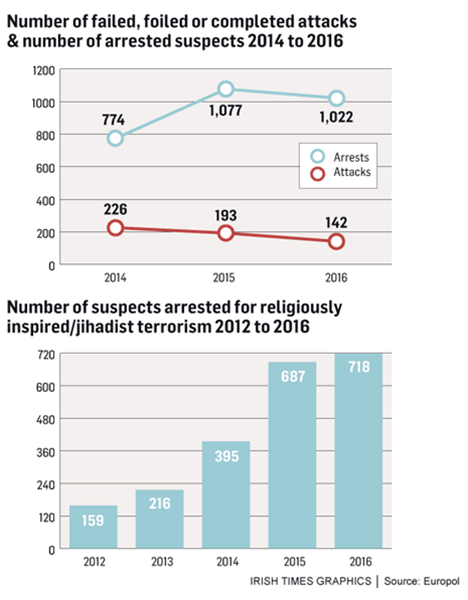
Opponents of sharing intelligence outside of regional structures argue the European Union has thwarted  one hundred forty-two attacks in 2016. According to EuroPol,

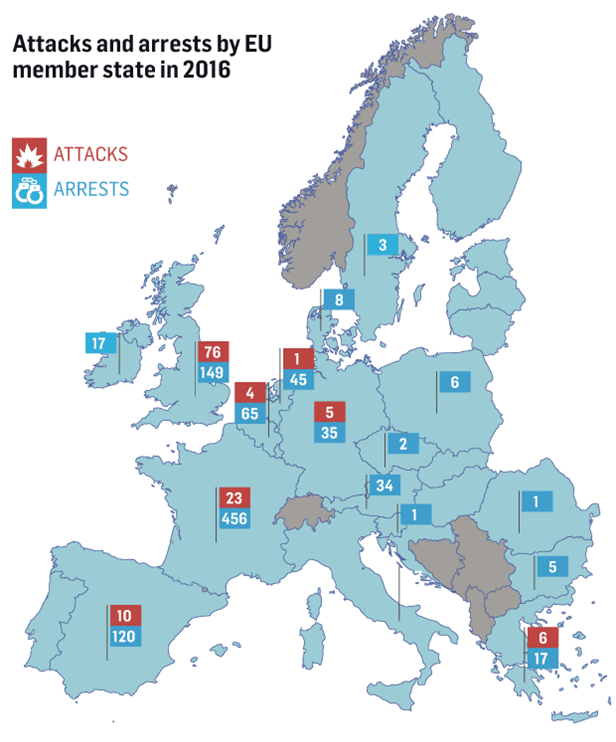
In 2016, a total of 142 failed, foiled and completed attacks were reported by eight EU Member States. More than half (76) of them were reported by the United Kingdom. France reported 23 attacks, Italy 17, Spain 10, Greece 6, Germany 5, Belgium 4 and the Netherlands 1 attack. 142 victims died in terrorist attacks, and 379 were injured in the EU. Although there was a large number of terrorist attacks not connected with jihadism, the latter accounts for the most serious forms of terrorist activity as nearly all reported fatalities and most of the casualties were the result of jihadist terrorist attacks (Europol, 2017).

However, opponents of sharing intelligence with allies by citing the European Union disprove their own point: the EU is a regional structure that is only able to thwart the terrorist attacks it has by utilizing the member states within the organization and sharing intelligence. The EU does discover and prevent many terrorist attacks, and the ratio is impressive. The issue is the EU has still faced more terrorist attacks than the U.S. since 2014, and there is a growing trend (Appendix B). Since 2001, the U.S. has experienced less than twenty major terrorist attacks.

The final strategy component comes with the economic aspect of NATO and the U.N. supplying the funding to Afghanistan to be able to continue to fund its military operations and working with the country to improve its infrastructure that will go toward the Obama-era goal of “nation building.” However, the United States cannot be the ones to bear that burden anymore. Development of Afghanistan is important and should be something the global community strives for. The U.S. did not go to Afghanistan to nation build, nor should we be footing the bill for that process. The U.S. should measure success in Afghanistan when Afghanistan is a stable enough nation to be able to effectively manage its internal and external security, to include being able to eradicate and prevent terror bases from being established in its borders. When Afghanistan is secure in that manner, the U.S. will be able to start the withdrawal of its troops. Until that happens, there is no legitimate reason to remove our military forces in the region, except to bow to political pressure of bringing Americans home. Campaigns are built on the rhetoric as well as the rhetoric of national security. Instead of appealing to domestic pressure, the U.S. needs to focus on the goals it has in Afghanistan and actively work toward achieving them.

If the United States were to remove its troops in the region before tangible progress is being seen in Afghanistan, it would have severe implications on the perception of the United States and its military capabilities. The United States has influence in the region partially because we have so many troops stationed there. If the U.S. wishes to continue its influence on promoting democratic values and honest and fair elections, then the U.S. also needs to retain troops in Afghanistan until the nation has sufficient internal and external security. Another fallout of the U.S. pulling out of the country prematurely is the international perception, from both ally and enemy alike.

For example, in 1973, the U.S. pulled out of Indochina and as a result, there was significant backlash both domestically and abroad; friends feared the U.S. would not be willing to help defend them, and enemies saw it as military weakness and resolve (Katz). The perception created internationally if the U.S. were to withdrawal, would create an emboldened insurgency in the country, and within other heads of state who are not allies of the U.S.

Iran upping their nuclear game, even with the current Iran Nuclear Deal in place, presents an interesting foreign policy problem; countries who resent having American presence in the region would be encouraged to up the ante to pressure American forces to leave the remainder of the region as well, not just Afghanistan. Allies in both the Middle East and the Western world would hesitate before calling on the United States from that point on. Israel, our key ally in the region, is vital. If the U.S. decided to pull out early, we would lose the faith and confidence of the only democratic, capitalist nation in the region (Katz).

China and Russia both would have major geopolitical interests in the region if the United States were to leave the region. Russia has a messy history with Afghanistan (the Soviet-Afghan War of 1979) and is eager to gain world prominence again. China has actively contributed monetarily in the form of humanitarian projects and development assistance, and there are several reasons China has an interest in the country: geographically, it is located the crossroads of Central and South Asia, meaning its placement between India and Russia becomes of great importance militarily to China (Massey, 2016). Second, there is great economic value to Afghanistan; there is a vast amount of the country that remains undiscovered regarding natural resources; China wants to be at the forefront of that search. According to a U.S. report in 2010 (Massey, 2016),

Further untapped natural resources in Afghanistan are supposed to be worth $1 trillion. In particular, Afghanistan has been a source of the gemstone lapis lazulis, which generated roughly $125 million trade value in 2014. But the mining of the stone has led to a conflict in recent years between local security forces and the Taliban as they gained more control over the country. Mining has the potential to generate large amounts of revenue and growth for Afghanistan if the country could establish capacities to impose legal mining.

Currently, the rotations for the Middle East are considered deployments because of the combat related nature of the missions. There are several entitlements military members receive while being deployed to a combat zone. For example, all deployed soldiers, sailors, airmen, and marines receive their base pay, which is based on rank (Appendix C), Combat Zone Tax Exclusion (CZTE), Hostile Fire Pay (HFP), Hardship Duty Pay-Location (HDP-L), Basic Allowance for Housing (BAH), and Family Separation Allowance (FSA). For Afghanistan, this equals out to approximately an additional $100 per day, which excludes the base pay of rank and the cost of living quarters and sustenance. The Fiscal Year (FY) 2018 Overseas Contingency Operations budget is $64.6 billion, which is due to the nature of the jobs in the country and the pay those deployed are entitled to. Temporary Duty (TDY) in contrast, are shorter assignments done on a rotational basis into a specific country, while stationed in another, usually neighboring, country. For example, many units will be officially deployed to Qatar but perform rotational TDYs into Afghanistan. In 2014, the Pentagon attempted to reduce costs of the budget by reducing HFP in non-combatant countries, such as Qatar or Kuwait. Many service members got upset with this change in policy, so much so Congress intervened in the decision; those deployed in what is considered “non-combatant areas” will still receive HFP due to TDYs, but it will be less so than those stationed in Afghanistan. The Pentagon should continue this shift as the nature of the missions change and as the intent from the President and Joint Chiefs comes down to the ground level troops. As the strategy shifts more toward a regional and training based strategy, the pay allowances should be shifted toward non-combatant type pay, only done so when the rotations of TDYs enter into the imminent danger areas. This allows for the DOD to allocate more funds to the development of the training doctrine for the Afghan forces and allows for more trainers and training programs to be developed and implemented.

In essence, Afghanistan is a winnable war. It is a different war than we have ever fought, with a strategy that has been dwelt on for almost two decades; previous administrations have promised the idea of a regional strategy without actually delivering. Pakistan is a consistent problem; their troubled relationship with India causes more harm in the region than good. Pakistan is a major wild card in the War on Terror; they take money from the U.S. with one hand, and in the other provide a safe haven for terrorists. No longer can the U.S. afford to support Pakistan and still achieve the end states set out that ultimately result in a stronger, safer Afghanistan.

The War on Terrorism in Afghanistan is a foreign puzzle anomaly; there are so many aspects to consider, with many moving parts, both state and non-state actors who would be affected by any decision made. The United States can declare victory in Afghanistan and eventually remove troops from the country, but that cannot happen until Afghanistan is a stable nation, which cannot happen until the Taliban is eradicated, as well as sister cells and offshoot groups. Beyond the internal struggles Afghanistan faces, there are the external struggles from other sovereign states who all would love nothing more than to capitalize off the failures of the United States and Afghanistan.

Several strategies have been brought forth to the drawing board regarding the future of the strategy for Afghanistan. Privatizing the war has more negatives associated with it than it does positives, the biggest factor being the monetary aspect of contracts and the potential for a government shutdown; contractors will only work if they’re being paid. Obama’s medium footprint strategy failed to incorporate a regional strategy that utilized regional actors effectively. Reducing the ROEs does come with the potential for collateral damage, but utilizing the Army doctrine of Mission Command (FM 6-0), the Pentagon would provide the intent and commanders would implement it into the missions that meet that intent. The overall strategy the United States should pursue is defining our goals in a more tangible sense, preventing the Taliban from regaining control, preventing any further major terrorist attacks on the Western world, and ensuring Afghanistan becomes a stable nation; one who can defend itself from internal and external security struggles. These strategies can be broken down into further goals: by removing key leaders of insurgent groups and hold key terrain we’ve taken from their control. Once we have key terrain to operate in, we can start to crush new terror groups before they gain prominence in an area through providing security to the Afghan people, therefore removing a desire to turn to the Taliban for the desired security.

Bibliography

“2017 EU Terrorism Report: 142 failed, foiled and completed attacks, 1002 arrests and 142 victims died.” 2017. Europol. https://www.europol.europa.eu/newsroom/news/2017-eu-terrorism-report-142-failed-foiled-and-completed-attacks-1002-arrests-and-142-victims-died (November 21, 2017).

“2017 Iran Military Strength.” GlobalFirepower.com – World Military Strengths Detailed. https://www.globalfirepower.com/country-military-strength-detail.asp?country_id=iran (November 21, 2017).

Apuzzo, Matt. 2015. “Ex-Blackwater Guards Given Long Terms for Killing Iraqis.” The New York Times. https://www.nytimes.com/2015/04/14/us/ex-blackwater-guards-sentenced-to-prison-in-2007-killings-of-iraqi-civilians.html (November 21, 2017).

Developed by NCCM Thomas Goering USN (Retired). 2016. “NCCM Thomas Goering USN (Retired).” 2017 Military Pay Chart 2.1% (All Pay Grades). https://www.navycs.com/charts/2017-military-pay-chart.html (November 21, 2017).

“Effects of South Asia Strategy Already Being Felt, Mattis Tells Senate.” 2017. U.S. DEPARTMENT OF DEFENSE. https://www.defense.gov/News/Article/Article/1332699/effects-of-south-asia-strategy-already-being-felt-mattis-tells-senate/ (November 21, 2017).

Francis, David. 2017. “5 facts about the plans to privatize the war in Afghanistan.” Business Insider. http://www.businessinsider.com/privatizing-war-in-afghanistan-2017-8 (November 21, 2017).

Griffiths, James. 2017. “Trump calls for Pakistan, India to do more on Afghanistan.” CNN. http://www.cnn.com/2017/08/21/politics/trump-afghanistan-pakistan-india/index.html (November 21, 2017).

Hannah, John. 2017. “Afghan president says Trump war plan has better chance…” Foreign Policy. http://foreignpolicy.com/2017/09/01/trumps-afghan-strategy-could-actually-work/ (November 21, 2017).

“Home.” Operation Inherent Resolve. http://www.inherentresolve.mil/About-Us/ (November 21, 2017).

Joint Chiefs. Joint Publication 3-24. Joint Publication 3-24.

Katz, Mark N. “Assessing the Bush Strategy for Winning the ‘War on Terror.’” Middle East Policy Council. http://www.mepc.org/commentary/assessing-bush-strategy-winning-war-terror (November 21, 2017).

—. “Assessing the Obama Strategy toward the “War on Terror”.” Middle East Policy Council. http://www.mepc.org/commentary/assessing-obama-strategy-toward-war-terror (November 21, 2017).

—. “Implications of America Withdrawing from Iraq and Afghanistan.” Middle East Policy Council. http://www.mepc.org/commentary/implications-america-withdrawing-iraq-and-afghanistan (November 21, 2017).

Legal, Inc. US. “USLegal.” War on Terror Law and Legal Definition | USLegal, Inc. https://definitions.uslegal.com/w/war-on-terror/ (November 21, 2017).

Massey, A.M. 2016. “China’s interests in Afghanistan.” China Policy Institute: Analysis. https://cpianalysis.org/2016/09/05/chinas-interests-in-afghanistan (November 21, 2017).

McCloskey, Megan, Mike Tigas, and Ryann Jones. 2015. “U.S. Spent $2B on ‘Hearts and Minds’ in Afghanistan.” The Fiscal Times. http://www.thefiscaltimes.com/2015/05/15/US-Spent-2B-Hearts-and-Minds-Afghanistan (November 21, 2017).

“Military Deployment Pay – Entitlements While Deployed to Iraq, Afghanistan, HOA.” 2015. Military4Life. http://www.military4life.com/military-deployment-pay-entitlements-while-deployed-to-iraq-afghanistan-hoa/ (November 21, 2017).

“Operation Enduring Freedom Fast Facts.” 2016. CNN. http://www.cnn.com/2013/10/28/world/operation-enduring-freedom-fast-facts/index.html (November 21, 2017).

Ricks, Thomas E. 2012. “Back to ‘Black Hearts’: Why this book stands out so much as a study of the Army.” Foreign Policy. http://foreignpolicy.com/2012/06/20/back-to-black-hearts-why-this-book-stands-out-so-much-as-a-study-of-the-army/ (November 21, 2017).

SFC Galer, Joshua. Personal Communication. November, 2017.

“The National Military Strategic Plan for the War on Terrorism: An Assessment.” 2015. HOMELAND SECURITY AFFAIRS. https://www.hsaj.org/articles/170 (November 21, 2017).

“Timeline: Terror Attacks Linked to Islamists Since 9/11.” The Wall Street Journal. http://graphics.wsj.com/terror-timeline-since-911/ (November 21, 2017).

Zimmerman, S. Rebecca. “Is It a Good Idea to Privatize the War in Afghanistan?” RAND Corporation. https://www.rand.org/blog/2017/08/is-it-a-good-idea-to-privatize-the-war-in-afghanistan.html (November 21, 2017).

Appendix A

Appendix B
Appendix C

The Christian Response to Abortion

Kaitlyn Thornton Abbott

As many of you are quite aware, as made evident by my thesis, I am extremely pro-life: in every scenario.  I think life deserves to be valued at every cost, seeing as it is a direct gift from God.  My conviction goes beyond emotional belief, and to the point I will have Micah 6:8 tattooed on my body.  As a Christian, my beliefs are obviously founded in God’s word and proven true by science.  But as a Christian, one has to wonder what the Christ-like response is to abortion, those who perform and have them, and those who advocate the idea.

There are many viewpoints one could take up, and frankly, the viewpoint each one chooses is going to be a direct reflection of what is in his or her heart.  For example, if one chooses to see all those who have committed abortions or who have had abortions are murderers, then his viewpoint is one founded in hate, not in love.  On the other hand, a viewpoint founded in love will react with grace and understanding and forgiveness; just as Christ has already forgiven all of our debts.

The Church has one main job, with many other jobs and missions branching out from that.  Our main job, as the body of Christ, is to “Go and make disciples of all nations.”  But one of the main jobs the church has to do is look after the orphans and widows (James 1:27).  But another job we have is seen in Micah 6:8: “What does the Lord require of you?  To seek justice, to love mercy, and to walk humbly with your God.”  As we can see, we are expected to seek justice.  We are to seek justice for everyone — whether they are slave, free, black, white, young, old, rich, or poor.  As the Church, it is our duty to find true justice — Biblical justice for every man, woman, and child.

Proverbs 31:8-9 says, “Speak up for those who cannot speak for themselves, for the rights of all who are destitute.  Speak up and judge fairly; defend the rights of the poor and needy.”  As the Church, it is our job to speak up for the unborn, seeing as they cannot speak up for themselves.  They are young, just as much as they are poor and needy.  They have become victims — ostracized for being too little, too helpless, not the “perfect” child.  The Church’s mission in our world of hate and glorification of perfection is, and needs to continue to be, to speak up for them but in love.

In love.  Isn’t that the key?  When you hear of a pro-life protest, many conceive the notion of people outside, marching along, with pictures of aborted fetuses on them.  And that is a very accurate picture.  Many radical pro-life believers will go to that extreme (funnily enough, studies have been done that show this method is less effective in reaching the target people group instead of building a meaningful relationship with whom you’re trying to minister).  The Church, as a whole, and the individuals of the church, have the duty to protest, but respectfully, and still hold our Savior high.  People in today’s society tend to respond with hate and act repulsed by a woman who has had an abortion.  This is not the way to act!  Yes, we as the Church hold the belief life is a sacred, good blessing from God.  But we also believe we have been cleansed from our sins.  What does it say of the church if we, as the body, refuse to act as the church ought to?

A woman who has had the trauma of having an abortion goes through a turmoil of emotions.  She is alone, she feels violated, she feels as if she has no support, she feels disgusted with herself; she feels guilty, she believes, if even for a time, that she has killed her baby.  As the Church, why do we continue to make women feel this way?  Now, I am in no way advocating the acts they have done — I see them as morally wrong; I do believe a life was being taken.  But we are called to forgive!  Jesus said in his parable:

Then Peter came to Jesus and asked, “Lord, how many times shall I forgive my brother or sister who sins against me? Up to seven times?”  Jesus answered, “I tell you, not seven times, but seventy-seven times.  Therefore, the kingdom of heaven is like a king who wanted to settle accounts with his servants.  As he began the settlement, a man who owed him ten thousand bags of gold was brought to him.  Since he was not able to pay, the master ordered that he and his wife and his children and all that he had be sold to repay the debt.  At this the servant fell on his knees before him.  ‘Be patient with me,’ he begged, ‘and I will pay back everything.’  The servant’s master took pity on him, canceled the debt and let him go.  But when that servant went out, he found one of his fellow servants who owed him a hundred silver coins.  He grabbed him and began to choke him.  ‘Pay back what you owe me!’ he demanded.  His fellow servant fell to his knees and begged him, ‘Be patient with me, and I will pay it back.’  But he refused.  Instead, he went off and had the man thrown into prison until he could pay the debt.  When the other servants saw what had happened, they were outraged and went and told their master everything that had happened.  Then the master called the servant in.  ‘You wicked servant,’ he said, ‘I canceled all that debt of yours because you begged me to.  Shouldn’t you have had mercy on your fellow servant just as I had on you?’  In anger his master handed him over to the jailers to be tortured, until he should pay back all he owed.  This is how my heavenly Father will treat each of you unless you forgive your brother or sister from your heart.”

(Matthew 18:21-35)

Here we stand — we are liars, we are thieves, we have hate in our hearts (so essentially, we are murderers), we have looked at the opposite gender with lust; we are sinners.  What is just for our sins?  If justice were to be served, I know I’d be burning in Hell.  Our sins are NO better than the woman who has suffered from an abortion, and it is time the Church stands up and welcomes those women into the body with open arms and open hearts.  Our job is to cherish and forgive — just as we have been cherished and forgiven.

People tend to forget about the doctors performing the abortions; instead, our fixations tends to be on those who want the crime being done, not necessarily on the one committing the actual crime (because, technically, the woman is drugged and has no control of what happens).  However, we are not to deem them unworthy, either.  Even the most holy man, the most Godly pastor, is unworthy to stand before God — the Church needs to stop condemning people to Hell because of their sins.  Yes, they have sinned; but so has everyone else on this planet.  Until the church steps up, and opens its arms, and its doors, we can have no hope for the ending of abortion.  Our job is to pray, without ceasing, for God’s justice to be done on this topic.  Our response needs to be in love.  We are a Grace-centered community — not because of us, but because of what’s be done for us.  It’s time the church emulated that response.

The Misconceptions of Disney & Its Negative Effects on Society

Kaitlyn Thornton Abbott

Everyone’s seen the classics: Cinderella, Beauty and the Beast, The Lion King, Peter Pan, The Little Mermaid, and so on and so forth.  I myself have grown up watching these beloved tales — and still do, for that matter.  But the question that needs to be asked is: what subconscious messages are we actually sending our children?  In today’s society, we are so concerned with what our children hear at school, what they read on the Internet, and what they put into their mouths; shouldn’t we be just as concerned with what they are watching, too, even if it just seems to be harmless cartoons?

Let’s address some of the most loved classics — the princesses: Cinderella, Beauty, The Little Mermaid, Snow White, and Jasmine.  Are these princesses really the heroines they appear to be?  Most would say yes — however, as we delve into these plotlines, you will soon see they are not as “princessy” as they appear to be.

Cinderella — the most acclaimed Disney princess, the one everyone wants to be — has some interesting messages she sends along in her story; more than happiness does come to those who wait for it.  She, most particularly of all the princesses, embodies the notion of “love at first sight.”  She meets Prince Charming at a ball, and suddenly, they both are madly in love with each other after dancing one minute dance together and her running off into the moonlight before he sees her for what she truly is — a servant.  This teaches young girls a variety of things: one, never show your man what you’re truly like until you’ve got him hooked; and two, you’re only pretty when you’re all dressed up.  She teaches them finding love is easy — which we all know is very far from the truth.  A key theme noticed in this movie is deception.  Yep, that’s right.  I’m sure you’re reading this with a bit of apprehension — and it’s understandable.  Who wants to think their childhood hero emulated lying to one’s parents and getting away with it as a good thing?  Well, I’m sorry to crush your dreams, but that’s exactly what she does.  Cinderella lies to her stepmother, sneaks out of the house, and then lies to the Prince about who she is; and yet, she still gets her happy ending.  Aren’t we proud of what our daughters are learning?

Beauty and the Beast — ah, a tale as old as time, right?  WRONG.  Sorry, but no.  On the surface we see Belle looking past the Beast’s hairy, monster-like exterior, at his heart and who he is as a person, or, er, Beast.  And while not judging a book by its cover is a fantastic lesson for children, let’s examine the underlying messages.  Belle is strong-willed and defiant when it comes to the expectations of French society, and that is fantastic — don’t conform!  But, on the other hand, what actually happens in the film?  She gets the Beast to change his ways.  Now, in reality, the Beast had bipolar disorder, was a manic depressive, with anger management issues.  He abused Belle, verbally, emotionally, and even physically at times.  He keeps her locked up and refuses to feed her at times, and yet, her sweet, compliant demeanor changes him and turns him into a gentle, handsome, loving man.  SIKE.  Let’s be real — no woman can change a man from abusive to gentle.  That is not something we need to be teaching young girls; and don’t even get me started on the bestiality aspect.

Snow White and the Seven Dwarfs was the first animated movie released by Disney.  As the first heroine on the scene, Snow White sends the strongest message about gender roles.  After being thrown out of her kingdom, she stumbles upon a dirty cottage with seven little men living in it.  Without being asked, the young woman cleans the whole house from top to bottom and begins to take on the motherly role the dwarfs expect of her by cooking meals and continuing to clean up after the men.  In 1937, when the movie was released, this domestic image of women was commonplace and accepted.  But now, more than 80 years later, little girls continue to watch Snow White and assume her submissive role with a smile.

She’s one of the few princesses who is actually born an actual princess, but unlike the other princesses on this list, Princess Jasmine is a supporting character, not the lead.  The movie, as you may be able to guess by the title, is about Aladdin, not her.  Although her existence as a woman who wants to live her life her way rather than according to the laws of men or her palace is an important turning point in the history of the Disney Princess, she is still very much a pawn in the film.  But this really isn’t the worst of it….

Her whole story arc in the film is about whether or not she’ll be married by her next birthday, so the next ruler of Agrabah may be chosen.  She doesn’t get to be the ruler of the kingdom when she becomes queen, even though she is the sole heir.  The Sultan, her father, spends the bulk of the film trying to find a suitable suitor for her.  Additionally, this plot point is integral to the villain Jafar’s master plan as he desires her hand in marriage, not because he loves or cares about her, but for the title and power that would give him if they got married.  But it is important to note she is the only female character in the entire movie.  While Disney improved the message they sent to their viewers, Jasmine was still portrayed as a lonely girl whose only option was to marry in order to not be alone anymore.  She had no friends to help her, besides her pet tiger.

Now that we’ve addressed a few of the prominent Disney Princesses, let’s talk about the messages of some the movies directed to a gender-neutral audience.  For example, when The Lion King, a fan favorite and Disney’s hugely successful animated movie first roared onto the big screen, some astute scribblers on the arts, entertainment, politics and social psychology weighed in with thought-provoking reflections on the underlying messages of the ostensibly simple story.  Some found strong elements of sexism in it.  Some discerned homophobia.  Others found racial stereotypes.  Then there were those who found anarchistic monarchism and the psychology of victimization.  Most of the children for whom the movie was made, however, simply enjoyed its visual beauty, its delightful music, its whimsy and its good, old-fashioned, bloodless combat, where the good guys win in the end.  Of course, there really is more to The Lion King than the surface story.  It’s just that the previous dissectors couldn’t see it anymore than the people who put it together.  Now that the movie has leaped onto the small screen, it’s a good time to set the record straight and explain the real hidden meaning of The Lion King: it’s a political fable of contemporary America.  The first crucial scene in the movie is Scar’s murder of King Mufasa by tossing him off a hill into the path of thousands of stampeding wildebeests.  What is not explained at that point is what started the wildebeests on their stomp: something had panicked them.

Obviously the hyenas did it by yapping such scary warnings as “Health-care reform gonna take away your mama’s choice!  Welfare mothers gonna eat your baby’s peanut butter!  Affirmative action gonna lay off your daddy!  Sex education gonna rape your daughter’s mind!”  Well, once the wildebeests started running, nothing was going to stand in their way.  They trampled Mufasa just like the alarmed voters of this country ran amok and wiped out the dominance of the Democratic Party in Congress last November.

Rather than monarchy, Mufasa obviously represents the New Deal ideal of the free, tolerant, egalitarian, compassionate society that had been evolving in this country since the midpoint of the century.  Scar is a throwback to the days when social conscience was not very much in fashion, and the interests of the rich and the greedy were all that mattered.

The usurper’s natural allies are the hyenas.  It wouldn’t take much stretching of the imagination to identify Scar and his pals with some of the politicians whose stars have ascended of late.  Suffice it to say there are some rapacious lions and scavenging hyenas on the loose in Washington.  And they are easy to spot.

Scar conning Simba into believing he is responsible for his father’s death is analogous to current efforts to convince people who are victims of systemic discrimination, cultural and educational deprivation, and opportunity curtailment that their plight is their own fault.

Simba is fatherless and homeless, but he blames himself, accepts his fate, and consigns himself to a life of purposeless hedonism in the company of a Falstaffian warthog and a foppish meerkat.  Meanwhile Scar and the hyenas turn the Pride Lands into a fascist dictatorship run strictly for the benefit of the strong and the greedy.  Before long the Pride Lands become a wasteland, and the government is a prisoner of the scavengers it used to gain power.  Faith, however, does not die.  It is personified by the mystical old baboon, Rafiki.  It is he who sniffs the wind, realizes that Simba (the hope of the future) is still alive, seeks out the rightful ruler and persuades him to return and restore the kind of rule where the “Circle of Life” is maintained for the benefit of all.

There is, of course, a love story, but it needs no exegesis.  Real love never does.  On a very superficial level, one could sum up the whole movie as Simba’s and Nala’s love story with some political intrigue, humor, and action padded into it.  That’s probably what the people who wrote and produced the political fable intended.  But what do they know?

As a child, I loved the Disney film The Little Mermaid.  For me, the attraction to the film was based on my love of the competitive sport of swimming and Ariel’s abilities as a mermaid.  When I used to obsessively watch The Little Mermaid, I was not aware of the subliminal gender messages the film directs toward young girls and boys.  Personally, I believe most (if not all) girls watch the film to feel the traditional Disney love that accompanies their fairy tales and the Disney Princess films.

After watching the movie again, I was hyperaware of the cultural messages it reinforces in relation to the hegemonic description of what it means to be female.  To some extent, Ariel illustrates individualism and a challenge to patriarchal values by rejecting her role as a princess on her birthday and exploring the unknowns of a shipwreck.  Eventually, Ariel is still dominated by patriarchy and is subservient to her powerful father.  It is not until she witnesses the leadership and kindness of Eric that she decides to sacrifice her aspirations to be with him.

I found issue in the film with the portrayal of Ursula as an angry sinister spinster.  It seems that in Disney films when women are unmarried, have no children, and have powerful tendencies they are portrayed as evil and angry spinsters.  Instead of having a powerful moral female role model, powerful female characters are cast as immoral and wicked and looking to destroy the lives of young girls like Ariel.  It is as if she is competing with Ariel and must use her power to prevent success in the life of a young girl instead of helping her to be successful.  This theme is relevant in many of the Disney Princess films and could be a reflection of patriarchal values: marriage is the ultimate goal of a woman and if you do not follow this you become an unhappy evil woman who has no reason to lead a kind lifestyle.

The character Ariel also presents an interesting reflection of patriarchy.  She is first portrayed as a young active girl who shows interest in knowledge and adventure (generally male characteristics) but the sight of a man causes her to forget about all previous interests to find a way to be with him.  I found it interesting she has no mother or mention of a female role model (even though she has six older sisters).

Because she has no guidance, she gives into the guise of Ursula and makes a major sacrifice.  She loses her voice (literally and figuratively) and submits to dominant society by becoming an object.  She relies solely on her body to prove to Eric that she is worthy of his love.  The issue with this idea is pretty blatant when you think about it from a gendered perspective.

Ariel loses all control and power.  The loss of her voice signals the loss of power and her subordination to men.  She must rely solely on the sexualization of her body, at the age of 16, to seduce Eric into kissing her within the three days they have known each other.  Until then, she is powerless and if her seduction fails then she becomes a pawn to the powerful sinister Ursula.

By supporting the patriarchal perspective on what it is to be an ideal woman, Disney’s The Little Mermaid teaches young girls that a man does not want a vocal, powerful, intelligent woman.  In order to get married and be happy (because that is all that matters in life), a woman must sacrifice her voice, all of her dreams, and she has to rely solely on her oversexualized youthful body.

Although this is what the film portrays, I do not think young girls are aware of The Little Mermaid’s meaning.  Disney films are so successful because of their cutesy characters and fairy tale endings.  When children are young, they are not looking for real life endings to love stories — they want happily ever after.  My issues with these films have to do with Disney’s cross marketing strategies and how these young children are parented.

This article incorporates ideas and sentences from Molly Mahan’s article “7 Disney Princesses That Make the Worst Role Models” from http://www.ranker.com.

Abortion Cannot Be Justified

Kaitlyn Thornton Abbott

A nurse sits in a back room, looking at a baby.  The baby’s seventeen-year-old mother rests in the recovery room.  The nurse empties the contents of the suctioning tube into a bucket and onto the table.  She counts one head, a whole torso, two arms, two legs, ten fingers, and ten toes.  She sees thousands of babies like this a year; babies who were too young to die.  Suddenly, she bursts into tears.  This time it was too much.  She saw the eyelids, the nose; all she could imagine was her own infant at home, sucking on his thumb.  “How is this one any different?” she wonders to herself.  Slowly, she gets herself together and goes back into the operation room and nods at the doctor, signifying everything was accounted for.

This may seem like a made up story, but this is the testimony of a former abortion clinic worker (Meyers 2).  This woman knew the unborn fetus, what the doctors like to call a “clump of tissue,” was an actual human child.  She knew what they were doing was wrong.  This woman knew what my thesis is here to prove.  Abortion cannot be justified, morally or medically, because the fetus is human, very much alive from the moment of conception.

The question “when does life begin?” has echoed across the generations, and each generation takes its turn trying to answer that question.  The problem was, and still is, they ask themselves the wrong question.  The question, “when does life begin?” is inherently flawed.  Life doesn’t begin; it began.  Life began once, at Creation.  The question that needs to be answered is “when does each human fetus gain the status of being biologically alive?”  There is no question: the fetus is human; a human being is a member of Homo sapiens.  When humans reproduce, a monkey is not created, nor is a turtle, nor is any non-human entity; the fetus growing inside the mother’s womb is biologically human.  The question drawn from this understanding is if it is human, is it alive?  And if it is alive, is it a person?  Because the answers to those questions are, yes, the fetus is alive, and yes, it is a person, you will see through my thesis abortion cannot be justified morally or medically.

Abortion is a word thrown around, with a general understanding of the idea.  The concrete definition of abortion, however, is “the deliberate termination of one’s pregnancy.”  The terms going to be associated with this thesis are as follows: morally, justified, life, individual, viability, gestational, and living.  Morally means “in relation to standards of good and bad character or conduct.”  Justified means “having, done for, or marked by a good or legitimate reason.”  Personhood is defined as “the quality or condition of being an individual person.”  Viability is “having attained such form and development as to be normally capable of surviving outside the mother’s womb.”  Gestational is “the period of development in the uterus from conception until birth.”  Also, individual is defined as “a single human being distinct from any other human.”  Merriam Webster defines life as “an opportunity for continued viability,” but speaking from a medical perspective life is defined as “the energy that enables organisms to grow, reproduce, absorb and use nutrients, and evolve, and, in some organisms, to achieve mobility, express consciousness, and demonstrate a voluntary use of the senses.”  The five criteria all organisms must meet to be declared “living” are having highly organized systems, having an ability to acquire materials and energy, having an ability to respond to their environment, having the ability to reproduce, and having the ability to adapt (Stone 2).  Although fetuses may not have the ability to reproduce in the sense of offspring, they reproduce in the sense the cells divide to reproduce more cells to allow the fetus to continue to grow and develop.

The idea of terminating one’s pregnancy dates back to ancient cultures.  Many methods early cultures practiced were non-surgical.  The earliest written record of an abortion was found in the Ebers Papyrus, an ancient medical text drawn from records that date back as early as the third millennium B.C.  The Ebers Papyrus says an abortion can be induced through an herbal tampon, which was the most common practice.  The Egyptian recipe is based on acacia berries and it specifically states that it can stop a pregnancy at any time (“History of Abortion” 2).

Not only was it done in the world of the Egyptians, but it was also a common practice in China.  Folklore speaks of it (mercury potions were said to be used) and royal concubines were documented to have abortions as early as 515 B.C.  They, like the Egyptians, understood the basic concept of activeness during pregnancy.  For example, they realized any action that could result in a miscarriage could be done on purpose to achieve the same result.  Hard rubbing or massage on the uterus, riding a horse, and heavy lifting were all common practices of removing an unwanted pregnancy.  Unwanted pregnancies happened for a variety of reasons, just as they do today; however, these reasons usually stemmed from economic problems and famine.  Other Asian observations, such as Japanese texts, state there were shrines dedicated to the lost and aborted babies.

The Ancient Greeks also practiced abortion and quite commonly, too.  For example, Soranus, a second-century Greek physician, was a strong advocate for abortion, but only in the cases of woman’s health and emotional immaturity.  His methods were said to cause the woman no harm, and all that would physically happen was a miscarriage.  His methods included fasting, bloodletting, energetic walking, riding animals, and jumping so one’s feet hit one’s butt.  He highly disagreed to the use of sharp instruments to terminate a pregnancy due to the risk of harming the woman by perforating her organs (Merino 26).

One of the most extreme methods of abortion during the medieval period was a surgical practice called embryotomy.  Simply put, this was the removing of a dead or alive fetus from the mother’s womb.  This was a fairly common practice whenever complications appeared, and some archaeological discoveries point in this direction.  For example, a decapitated infant with other multiple mutilations found at a gravesite in Dorset buried without the mother shows she probably survived after undergoing an embryotomy, based upon the mutilation of her baby (45).

Abortion dates back to ancient cultures, and the procedures were just as harmful then as they are today.  Abortion is argued it is a woman’s choice, but abortion was tried as a crime in the ancient cultures.  They believed a woman who had an abortion not sanctioned by her husband was undermining his authority and was punishable by death (47).  In many cultures it was not legalized; however, many spoke out against the illegality of it, pushing for changes in the law, based upon the presumption of women’s health.  The issue of legality remained prevalent until 1973 in the case of Roe v. Wade when abortion upon demand was legalized with the defense of “women’s choice.”  Today, 1.21 million abortions occur annually, with nine abortions every four minutes, and one abortion every twenty-six seconds in the United States.

In order to prove my thesis, that abortion cannot be justified medically or morally, I will prove abortion cannot be justified medically because life begins at conception, and I will prove abortion cannot be justified morally because the fetus is alive, and abortion is unjust, and since our society is founded on justice, it is not right.  I will also be refuting three counter arguments to my thesis: it is a woman’s choice to do what she pleases with her own body and her reproductive rights should not be infringed upon, the fetus is not a living entity, and in the case of rape or incest, all abortions are just.

My first point is life begins at conception. Keith Moore explains in his book Essentials of Human Embryology

Human development begins after the union of male and female gametes or germ cells during a process known as fertilization (conception).  Fertilization is a sequence of events that begins with the contact of a sperm with a secondary oocyte and ends with the fusion of their pronuclei and the mingling of their chromosomes to form a new cell.  This fertilized ovum, known as a zygote, is a large diploid cell that is the beginning, or primordium, of a human being (6).

The size of that zygote when first formed is smaller than your fingernail, but the size of the fetus cannot be a determining factor in whether or not the fetus is alive (9).  The embryonic stage is merely that — a stage in development, just as puberty and menopause are stages in development people hit as they age.  Just because someone hasn’t hit puberty doesn’t mean he’s any less of a person than an eighteen-year-old.  In the same way, just because the fetus isn’t fully grown yet, doesn’t mean it isn’t alive and it isn’t a person.  The stage of development is not a deciding factor in whether the fetus is alive or not.  The deciding factor which determines whether life begins at conception is the biological standards all living things must meet, which are having highly organized systems, an ability to acquire materials and energy, an ability to respond to their environment, the ability to reproduce, and the ability to adapt.  The systems the fetus has are exceptionally organized; they have all of the systems you and I do, only less developed, depending on gestational age.  The fetus acquires energy from the mother and continues to grow; the fetus also responds to the mother’s and father’s voices and music.  The fetus may not be able to reproduce in the sense of offspring, but the cells that make up the fetus are continuously reproducing and multiplying, which grows the fetus.  The fetus also can adapt to environments, such as a petri dish to the mother’s womb.

For my second point, I will prove abortion cannot be justified morally.  A federal law in America is not to kill.  If something is alive, then it can be killed.  Being alive means to “continue in existence.”  A fetus will continue on in existence until it is born, if left alone.  People will claim because a fetus is dependent on another human being, not only for nutrients but for simple existence, then they are not to be considered as people.  In today’s world of medicine and technology, however, doctors are able to keep humans existing through the use of respirators and dialysis machines; dependency on a machine or another human can’t determine personhood or lack thereof.  A person is no different from a human and can be defined as such.  Merriam Webster states a person is “a human being, that which is regarded as an individual.”  Every fetus, from the moment of conception, is biologically alive.  The heartbeat that can be heard, the brainwaves that can be measured, and kicks that can be felt are signs of a living human being.  Illegality is formed based off of morality.  Something is made illegal because it infringes upon the rights of another person.  The fetus meets the requirements that fit the definition of a living entity, and therefore it is immoral to abort a fetus.

Justice is a main foundation of our society, and justice is founded upon equality and the value of human rights (Meyers 35).  Justice also proceeds on the idea if there is a clash of rights, then, the right that does the least harm will be the most just.  Injustice is the infringement of any basic human right.  Justice is also a consequence of choices.  The mother and the father were the ones who made the decision to be in a sexually active relationship, and sometimes becoming pregnant is a consequence of that.  That doesn’t mean the child should be the one being punished.  To punish the child for existing is morally wrong because the child cannot help the fact his or her parents had sex and created a baby.  The mother and father are the ones who are responsible for their choices, not the child.  And therefore, it is just to require the mother to bear the weight of her greater responsibility in the circumstance and not require the ultimate price of the child who bore no responsibility for existing at all.

The Declaration of Independence says each American has the right to life, liberty, and the pursuit of happiness because these are innate rights, endowed by our Creator.  The right to life means every human has the right to be born.  No human can take that away from another human.  For us to be under the presumption embryonic fetuses are not human denies one of the simplest biological truths: fetuses are just as human as you or I.  There is no scientific way to deny the fetus growing inside the womb is not human.

Not only does the Declaration of Independence guarantee each and every human individual, which includes the unborn, the right to life, but the Preamble to the Constitution also touches on the subject of the unborn.  The main aim of the Constitution is to “secure the blessings of liberty for us and our posterity.”  This is in reference to the children of the day, but the Constitution and Declaration were not written simply for the people of the time period.  They were also written for the unborn children of the future and future American citizens — whether they are in the womb or out of it.

The first counter argument against my thesis is “It’s a woman’s choice to do what she pleases with her own body and her reproductive rights should not be infringed upon.”  This argues the woman and the baby are the same individual until birth, the baby growing inside her is not its own person, and no law should be written to tell women how to exert their reproductive rights.  What’s interesting about this argument many self-described pro-choice activists tend to give is it’s not solely the woman’s body.  This argument implies because the fetus is developing inside the woman, and the woman provides the nutrition and oxygen for the fetus, the fetus is a complete part of the woman’s body, and she can do with it as she pleases.  While the counter argument is partially correct in stating the fetus is part of the woman’s body, it is necessary to understand it is not solely the woman’s body; it is still another individual.  Simple anatomy and biology show us a woman has one head, two arms, two legs, ten fingers and toes, one heart, one brain, and one of every system her body needs to survive.  As the fetus starts to develop, more of these body parts start to show themselves and continue to develop.  The genetic codes are also distinctly separate.  Every body part that belongs to a woman has a certain genetic code that matches the rest of her body; the fetus, on the other hand, has a separate code, proving its individuality as a separate biological entity.  If the unborn child had the exact same genetic code as the mother, then it would be only her body; however, its genetic code is half of the mother’s and half of the father’s.  As Randy Alcorn says, “A Chinese zygote implanted in a Swedish woman will always be Chinese, not Swedish, because his (the child’s) identity is based on his genetic code, not on that of the body in which he resides.”  The DNA of a child is the defining factor in distinguishing the child from the mother while the child is still in the womb.

The second part of the argument, “it’s a woman’s choice to do what she pleases with her own body and her reproductive rights should not be infringed upon,” is what I will be refuting next.  The main point of this argument is women have the right to choose.  They argue since it is their bodies, they have the right to do with them what they want.  The problem with this argument is while they do have the right to choose what happens to their bodies, it is not wholly the woman’s body being affected.  The child in the womb is the one being affected more than the mother.  The child’s right to life is being taken from him, and he isn’t given the right to choose whether he exists or not.  The pro-choice side is very correct in saying the woman has the right to choose.  But what they refuse to acknowledge is women make their choice when they choose to engage in sexual activity.  Once they engage in sexual intercourse, they are exercising their reproductive rights; women know they are putting themselves up to the risk of getting pregnant.  Once that right is exercised, and the result is a pregnancy, then their rights end because the right to life supersedes the right to not be pregnant.

The second point I’m going to refute is the unborn is just an embryo or a fetus; it is just a product of conception — a simple blob of tissue, not a baby.  This argument says abortion is terminating a pregnancy, not killing a child.  Yes, the “product of conception” is exactly what the opposing side calls it: an embryo, and a fetus.  But those are scientific terms to differentiate between different stages of development for this tiny little human.  Right now it may be an embryo, a few months from now and it’ll be a fetus; give it a few years and she’ll be a toddler, and then a teenager, and so on.  The point here is yes, the pro-choice side is very correct in using the terminology of “fetus” and “embryo,” but that does not mean the fetus is not a person.  Personhood is defined as membership in the human species, not by stage of development within that species.  The law has proven a fetus is person.  Thirty-eight states have fetal homicide laws that give fetuses legal rights and protection if killed against the mother’s wishes.  If a fetus is not a person, then it cannot have rights regarding protection, because they wouldn’t be necessary.  But because the law gives the fetus rights, it makes the distinction of two different bodies, which would mean two different persons.  “If both the woman and the child were killed and we can prove the child was killed due to the actions of the perpetrator, then we charge both,” said Stanislaus County Assistant District Attorney Carol Shipley (qtd. on CourtTV).  This gives the child rights and legal status as a person.  An implication within this pro-choice argument is fetuses are considered alive when wanted by the mother, but when the mother does not want the baby, then the fetus returns to being “just a blob of tissue.”  These children are victims of chance.  If the mother does not want her child, then the fetus automatically loses its personhood, and along with it, its rights and legal status.  Logically, this argument does not make sense if the personhood is dependent on circumstance; the child is either alive or it’s not.

The third point I’m going to refute is in the case of rape or incest, all abortions are just.  This argument argues women should not have to face the trauma of carrying the rapist’s child.  However, pregnancies as a result of rape as exceptionally rare (Ginsburg 765).  A statistical study done by the Department of Justice showed there are approximately two hundred thousand rapes committed a year in the United States.  They found through statistical reasoning only 1 out of every five hundred women raped end up becoming pregnant (qtd. in Ginsburg 769).  The prochoice side is right in saying the woman who has been raped experiences emotional and physical trauma.  And that is very true.  The issue with their argument, however, is the woman is under no obligation to keep her rapist’s baby; there are many routes she can take.  For one, the Safe Haven statute all hospitals or police departments fall under will take the child and place it as a ward of the state; the woman is stripped of her right to ever claim that baby as her own, legally (Meyers 62).  Another flaw with the argument is while it is understood pregnancy from rape is traumatic, it does not statistically support the argument for “abortion on demand.”  One in five hundred a year is not enough reason to allow abortion to be justified.  A third flaw with this argument is the fetus is innocent.  The fetus is not the one who deserves to be punished for the rapist’s acts; the fetus is just as innocent as the mother; there doesn’t need to be two victims because of one man’s crime.  Because abortion cannot be justified on the moral and medical grounds of the fetus being fully human and alive, abortion cannot be justified in the case of rape or incest either; emotional distress and trauma does not exceed the right to life.  Sanctity of life cannot be circumstantial.  If it is a life, and is alive at the moment of conception, the doctor, nor the woman can justify killing it because of the way it was conceived.  Rape is extremely emotional and traumatic.  But so is being aborted.

Throughout this thesis, I have proved abortion cannot be justified morally or medically by showing how the biological evidence proves unborn fetuses are living human persons.  I have also refuted the arguments it is a woman’s choice to do what she pleases with her own body and her reproductive rights should not be infringed upon, the fetus is not a living entity, and in the case of rape or incest, all abortions are just.  Since abortion cannot be justified morally or medically, it can be argued it cannot be justified lawfully either; after all, aren’t our laws based off of moral justification?  Abortions kill a living, feeling child.  The child killed within the womb is no different than the child a new mother holds in her arms.  Pope Benedict XVI said it well when he said, “The fundamental human right, the presupposition of every other right is the right to life itself.  This is true of life from the moment of conception until its natural end.  Abortion, consequently, cannot be a human right — it is the very opposite.  It is a deep wound in society.”  The testimony of the woman who had to count out the aborted baby’s limbs explains through tears what I’ve told you through scientific fact, logical reasoning, and evidence from law: Abortion cannot be justified, morally or medically, because the fetus is human, very much alive from the moment of conception.

Works Cited

“Gestational.” The American Heritage® Stedman’s Medical Dictionary. Boston: Houghton Mifflin, 1995. Dictionary.com. Web. 14 January 2013.

Ginsburg, Faye. Contested Lives. California: University of California Press, 1989.

“Justified.” Op. cit.

“Life.” Op. cit.

Merino, Noel. Abortion. Michigan: Greenhaven Press, 2012. Print.

Meyers, Chris. The Fetal Position. New York: Prometheus Books, 2012. Print.

Moore, Keith. Essentials of Human Embryology. St. Louis: Mosby-Year Book, 1988. Print.

“Morally.” Op. cit.

National Abortion Federation. “History of Abortion.” National Abortion Federation, 2010. Web. 28 Feb. 2013.

Nilsson, Lennart and Lars Hamberger. A Child is Born, 4th ed. New York: Bantum Dell, 2003.

“Personhood.” Op. cit.

Sanger, Alexander. Beyond Choice. New York: Perseus Books Group, 2004.

Stone, Carol Leth. Basics of Biology. Westport, Connecticut: Greenwood Press, 2004. Print.

“Viability.” Op. cit.

The Fascination of Ireland

Kaitlyn Thornton Abbott

Far superior to most European countries, this little island sometimes goes unmentioned when talking about the wonders of the continent.  When talking about Europe, most people will quickly be able to list off their favorite countries (most of which they haven’t been to, but that’s another can of worms).  When talking about Europe, what countries or scenery jump to mind — probably the Eiffel Tower, or London, or Barcelona; all of which are great cities.  But when I think of Europe, my mind is taken on a wonderful adventure into the hills of Ireland, with the water crashing into the cliffs.

When Ireland is discussed, many don’t realize what they’re talking about; see, Ireland is actually two different countries.  There is the Republic of Ireland, and then there is Northern Ireland, which is actually a part of the United Kingdom.  The Republic of Ireland contains four provinces: Ulster (northeast), Leinster (south-eastern), Munster (south-west), and Connaught (northwest).  There are thirty-two counties, twenty-six of which actually belong to the Republic of Ireland.

Ireland has a rich culture and an even richer history.  The first known settlements of Ireland were around 6,000 B.C. when Mesolithic hunter-gatherers migrated over from Britain.  They settled on the eastern coast, since they were hunters and fishers by trade.  There’s little archeological evidence surrounding this history, but their descendants and Neolithic arrivals were responsible for the founding of historical sites such as Newgrange.  The Gaels, a Celtic-speaking people group from Western Europe, settled between 600 B.C. and 150 A.D.  By the time of Christ, the island had been organized into five “kingdoms,” which are known today as the “Five Fifths of Ireland.”  By 400 A.D., two more “kingdoms” had evolved.  Many of these kings raided their neighbors, which included the continent of Europe and Britain.  On one of these raids, a young boy was captured and sold into slavery.  Eventually he escaped but returned to Ireland to bring the gospel.  This man was none other than St. Patrick.  Patrick brought Christianity to the Celtic region, and by the year 600 A.D., it had completely engulfed the nation.

From 837 A.D. on, Viking invasions wreaked havoc on the poor, working Irish families.  Their war ships came up the mouth of the River Liffey.  Five years later, Dublin was taken by force; they attacked the monastic culture and the cities.  They plundered the villages and stole the women in the midst of the night.  But the Irish proved their strength and fought back vigorously, causing the Vikings to flee.  Seventeen years later, however, the Vikings returned under the command of Olaf the White, and they made a permanent settlement in Dublin.  Once English mercenaries set their sights on Ireland, there was no going back.  Mercenaries came under the direct orders of Richard de Clare, 2nd Earl of Pembroke, in 1169.  This original invasion of Ireland opened the door for the next 700 years of direct British involvement and control of Ireland and its people.  In 1177, Prince John Lackland was dubbed Lord of Ireland by his father King Henry II of England.

From the latter half of the twelfth century to about 1400 A.D., many of the Normans moved to Ireland from England and settled on the eastern part of the island, particularly around Dublin.  The Irish strongly resented these colonists, but in 1367, English Parliament enacted a law to keep the two populations separate. England essentially left Ireland to its own devices, operating as it always had until King Henry VIII.  When he removed papal authority, he asserted complete dominance over the island.  The English Reformation was an idea Henry VIII tried to force in Ireland but subsequently failed due to the Irish having no loyalty to the crown.  King Henry continued to question the loyalty of the Irish, and between the years 1534 and 1691, there was a series of Irish military campaigns.  Because of the influx of militaristic movement in Ireland, Scottish and English settlers were sent to live there.  The rise of the Scottish and English presence in Ireland led to a rise of Catholicism, as well.  Eventually, this led to a militaristic and political defeat of Gaelic Ireland.

During the reign of King James I of England, Catholicism experienced a lot of suppression and persecution.  All Catholic organizations such as schools were shut down, and instead the children were taught in the Protestant faith.  Any segregation that had been drawn up due to racial prejudices now shifted to religious lines instead.  The sides were clear: Protestant and Catholic, although a majority of the island leaned toward the Catholic side.  When Cromwell took control of England, he also continued the English hold over Ireland and tried to force Protestantism by taking over all of the Catholic institutions.  Once he died, the Irish struck back at England and, in 1690, regained control of their historic land.  They signed a treaty with London that granted the Irish rights, but, alas, it was rejected by a Protestant-controlled Irish Parliament.  This religious war continued on.  In 1727, no self-proclaimed Catholic was allowed to run for office, nor were they allowed to vote.

The latter half of the nineteenth century did not bode well for the Irish.  Already having suffered an incredible amount of hardship due to restrictions of the British, they then had to face what is known today as the Great Famine.  Essentially, it was caused by a potato blight that attacked all of the crops between 1845-1849.  Over a million Irish men, women, and children died from starvation, and even more fell prey to sicknesses such as typhus.  Over two million immigrated to other countries, such as the United States, the United Kingdom, Canada, and Australia.  Over the course of the famine, a total of six million Irish fled the land.  Because of the diaspora of the Irish, scholars think around eighty million Irish descendants are worldwide (within three or four generations).

Following the famine, however, Catholics in Ireland were slowly gaining in prosperity.  A demand of a national self-government arose, and as the Catholics grew in parliamentary power, they used this as leverage to gain a home government, and in 1914, a home rule bill was enacted, but due to World War I could not be put into effect.  However, throughout the course of the twentieth century, the situation in Ireland remained essentially unsettled.  “The Government of Ireland Act” in 1920 set up separate parliaments for Northern and Southern Ireland, but only the southern parliament ever got anything accomplished or even remotely functioned.  When 1921 rolled around, Britain and Ireland signed a treaty establishing Ireland as a free state, which meant while Ireland had the power to be a self-governing state, it was still considered under British rule.  As a result of the treaty, a civil war broke out between pro- and anti-treaty supporters.  In 1937, the parliament of southern Ireland drafted a new constitution, through which the new state of Eire was born.  This state was a republic in every sense of the word, the only catch was the technicality of the name — they were still under British rule.  This state lasted only eleven years, and the ties between northern and southern Ireland were completely severed; because of these severed ties the Republic of Ireland was born.  In 1972, Northern Ireland was completely dissolved and put under direct British rule.  That same year, Ireland joined the European Economic Community (EEC) along with its neighbors the UK and Denmark.

Ireland’s history isn’t an easy one: it’s struggled and overcome many difficulties, and its culture has had an impact on American society and history as well.  A slight side note, the common phrase you hear “tying the knot” comes from Irish descent.  It was a common practice in Ireland for the pastor, or whoever was doing the ceremony, to have the bride and groom cross arms and a ribbon tied around their right hands; thus, tying the knot.

Ireland’s culture and landscape are painted with its history.  From the waves that crash into the Cliffs of Moher to the rolling hills; from the farmer, to the owner of the local pub; from the songs of the people to the patriotism in their hearts — Ireland is a country like no other; it’s a story waiting to be discovered.

Gangs: True Societal Bottom-Feeders, or Misunderstood Assets?

Kaitlyn Thornton Abbott

What are gangs?  Gangs, by definition, are “an organized group of individuals.”  When gangs are talked about, it usually comes with a negative connotation.  For example, gangs are usually associated with inner cities and trouble.  Albeit, it might be true there is certain criminal-esque intent behind the formation of gangs, there are aspects to gangs in neighborhoods that aren’t necessarily bad, depending on one’s perspective.

Being a part of a gang guarantees one a family environment for the rest of one’s life.  Being a part of a gang ensures everyone has each other’s back, regardless of the circumstance.  For example, Carlos T. Ramirez, Jr. speaks out about his life in one of the most well-known gangs in Texas.  He has spent a majority of his life in prison and explains the pros and cons of being a part of a gang.  When speaking about his life in the gang, he explains how they opened up their arms to him when his home life was not welcoming or loving.  As he gives his testimony about his former gang life, he reminisces about how for the first time in his life, he felt like he was a part of something special.  For the first time, he felt included.  For the first time, he was able to call on people and have them always be there for him.

Another benefit of being a part of a gang is it gives you financial stability.  The best part — it’s not taxed!  No matter what one plunders, and comes to have through the glamorous life of gang membership, the government can’t take it!  It’s like being a pirate, except the swashbuckling rogue has been transformed into a baggy-pants thug.  Who wouldn’t love that life?

Speaking of the thug life, it’s another added benefit of being part of a gang.  If one happens to have fathered a child out of wedlock, nobody is going to mess with that kid if they know the father is a member of a notorious gang.  So, even if the father wants to walk out on his family, one can see he still genuinely cares about his child.  Although most would consider a father walking out on his child an example of bad parenting, they should consider the positives it brings.  For example, it builds character. If children are forced to stand up for themselves without having anyone to fight their battles for them, they learn how to handle themselves and to evade situations that could end detrimentally for them.  It also allows the women to stand up for themselves.  Feminism is a huge part of American society; having a significant other walk out on the family allows them to work and find self-realization.

Many people are hesitant to say gangs are a good faction of society.  However, gangs are really only members of the police force without the badges.  They all share a certain uniform, usually a bandana that marks which group they are a part of.  Also, they all carry weapons.  Every police officer carries weapons not only to protect themselves, but also to protect civilians who might need it, such as people in the Witness Protection Program.  In comparison, gang members carry guns with them as well.  Unless fired on, they usually will not use them except in self-defense or as an act of retaliation, which, essentially is what the military does.

Gangs also encourage physical activity and finesse.  When one sees a gang strolling down the block, rarely does one see an obese member.  They encourage one another, strongly, to stay in great physical shape.  What happens if during an afternoon stroll, they are just suddenly attacked?  They must be in shape to defend themselves against any enemy.  Gang members can be seen at one’s local gym, but usually they will stick to working out in their own homes.  Lots of times, gangs will spend quality time together by playing street sports, like football or basketball.  Not only does this help build the bond between members, but it also gives them the competitive edge it takes to live the lifestyle they have chosen.

Gangs are also fantastic for reducing population.  Inner cities quickly become over populated, and there is usually no motivation to move out of slums.  That’s where our lovely friends come into play.  If they were not there to help with population control, then it would just completely overrun the city, and there would be even more children and mothers homeless.  The gangs really are a huge asset to the community; society would be lost without them.

Now, many people would not agree with my assertion gangs are a helpful part of our communities.  They tend to argue gangs are dangerous, that it only leads to drug usage, violence in the home, coarse language, and traditional values are no longer held sacred; instead they are traded in for casual sex and binge drinking.

Gangs may be dangerous; there is no denial of that.  But realistically, there are much more dangerous things in life than being part of a gang.  For example, driving a car!  It’s a huge, metal, deathtrap one willingly enters multiple times a day.  Not only do you put your own life in danger, you also put others in danger, too!  Being on the road is a much more life-threatening situation than being a part of gang is.  If one were to compare the potential threats of simply driving to work and being in a gang, the results would be astounding.  For example, Drivesafety.net gives the statistics of driving related accidents: there were 30,196 traffic related deaths in 2010.  In gang-related deaths … less than three thousand per year.

Gangs also do tend to run in the drug circles.  But going back to my earlier point, they are making money!  They make glorious amounts of non-taxed money, which they could be saving for their college education.  Not only are they using their God-given talents, they are also learning!  Mixing drugs is a simple matter of chemistry.  For them to create the drugs, they are learning the infinitely valuable lesson of which chemicals can mix with what without exploding.  If that isn’t a valuable life lesson, I’m not sure what is.

The violence in the home isn’t created by the gang presence.  The gang presence is a direct result of the violence found within the home.  When the fathers continue to abuse their children, the children try to find an escape.  Once they find themselves welcomed into the gang, they are taught to fight back.  Self-defense is not morally or legally wrong; so the “violence” caused inside the home life is really created from the parental figures; the gangs are simply a response to how the parents treat their children.

Many people will also argue gangs have given up traditional values and traded them in for casual sex and incessant drinking.  Realistically, that behavior goes far beyond the gang atmosphere.  Casual sex is something Hollywood has taken upon itself to glorify, not only in the movies and television shows it produces, but also in the real lives of the actors and actresses it employs.

All in all, gangs are not the blot on society they are portrayed to be.  Yes, they could use some bettering of their situation, but hey, so could we all.

Christmas in America: Roots and Traditions

Kaitlyn Thornton Abbott

In today’s society, we are surrounded by holiday cheer.  ABC Family hosts their “25 Days of Christmas” special, Christmas trees and lights go up, and once the peppermint mocha hits Starbucks, you know it’s Christmas time.  The holiday season, in my opinion, is the best time of year.  People seem to generally be in a more giving mood — after they move past Black Friday, that is.  But everyone seems to have a different idea of what exactly Christmas is or what it entails.  Every family has a different variation of traditions.  For example, in my family, we always go to the Christmas Eve service at my church and afterwards celebrate with my mother’s side of the family.  Christmas Day, we have our own little Christmas, and then go to dinner and celebrate with my dad’s side of the family.  But for us, as a nation, our traditions usually go hand-in-hand with our religion.  As previously stated, my family and I go to the Christmas Eve service our church offers.  But what are the origins of the holiday we’ve come to know as Christmas?

All around the world, Christians are celebrating the holiday surrounding Jesus’s birth.  Christianity celebrates Christmas on the foundation Christ was born of the virgin Mary.  Mary was living in Nazareth of Galilee and was engaged to be married to Joseph, a Jewish carpenter.  An angel visited her and explained to her she would conceive a son by the power of the Holy Spirit.  She would carry and give birth to this child, and she would name him Jesus.  At first Mary was afraid and troubled by the angel’s words.  Being a virgin, Mary questioned the angel, “How will this be?”  The angel explained the child would be God’s own Son and, therefore, “nothing is impossible with God.”  Humbled and in awe, Mary believed the angel of the Lord and rejoiced in God her Savior.  While Mary was still engaged to Joseph, she miraculously became pregnant through the Holy Spirit, as foretold to her by the angel.  When Mary told Joseph she was pregnant, he had every right to feel disgraced.  He knew the child was not his own, and Mary’s apparent unfaithfulness carried a grave social stigma.  Joseph not only had the right to divorce Mary; under Jewish law she could be put to death by stoning.  Although Joseph’s initial reaction was to break the engagement, the appropriate thing for a righteous man to do, he treated Mary with extreme kindness.  He did not want to cause her further shame, so he decided to act quietly.  But God sent an angel to Joseph in a dream to verify Mary’s story and reassure him his marriage to her was God’s will.  The angel explained the child within Mary was conceived by the Holy Spirit, His name would be Jesus, and He was the Messiah, God with us.  When Joseph woke from his dream, he willingly obeyed God and took Mary home to be his wife, in spite of the public humiliation he would face.  Perhaps this noble quality is one of the reasons God chose him to be the Messiah’s earthly father.  Joseph too must have wondered in awe as he remembered the words found in Isaiah 7:14, “Therefore the Lord himself will give you a sign: The virgin will be with child and will give birth to a son, and will call him Immanuel” (NIV).  At that time, Caesar Augustus decreed a census be taken, and every person in the entire Roman world had to go to his own town to register.  Joseph, being of the line of David, was required to go to Bethlehem to register with Mary.  While in Bethlehem, Mary gave birth to Jesus.  Probably due to the census, the inn was too crowded, and Mary gave birth in a crude stable.  She wrapped the baby in cloths and placed him in a manger.

Hanukkah is a Jewish holiday celebrated for eight days and nights.  It starts on the 25th of the Jewish month of Kislev, which coincides with late November-early December on the Gregorian calendar.

In Hebrew, the word “Hanukkah” means “dedication.”  The name reminds us this holiday commemorates the re-dedication of the Holy Temple in Jerusalem following the Jewish victory over the Syrian-Greeks in 165 B.C.  In 168 B.C. the Jewish Temple was seized by Syrian-Greek soldiers and dedicated to the worship of the god Zeus.  This upset the Jewish people, but many were afraid to fight back for fear of reprisals.  Then in 167 B.C. the Syrian-Greek emperor Antiochus made the observance of Judaism an offense punishable by death.  He also ordered all Jews to worship Greek gods.

Jewish resistance began in the village of Modi’in, near Jerusalem.  Greek soldiers forcibly gathered the Jewish villages and told them to bow down to an idol and then ate the flesh of a pig — both practices forbidden to Jews.  A Greek officer ordered Mattathias, a High Priest, to obey their demands, but Mattathias refused.  When another villager stepped forward and offered to cooperate on Mattathias’ behalf, the High Priest became outraged.  He drew his sword and killed the villager, then turned on the Greek officer and killed him, too.  His five sons and the other villagers then attacked the remaining soldiers, killing all of them.  Mattathias and his family went into hiding in the mountains, where other Jews wishing to fight against the Greeks joined them.  Eventually they succeeded in retaking their land from the Greeks.  These rebels became known as the Maccabees, or Hasmoneans.

Once the Maccabees had regained control, they returned to the Temple in Jerusalem.  By this time it had been spiritually defiled by being used for the worship of foreign gods and also by practices such as sacrificing swine.  Jewish troops were determined to purify the Temple by burning ritual oil in the Temple’s menorah for eight days.  But to their dismay, they discovered there was only one day’s worth of oil left in the Temple.  They lit the menorah anyway and to their surprise the small amount of oil lasted the full eight days.  This is the miracle of the Hanukkah oil celebrated every year when Jews light a special menorah known as a Hanukkiyah for eight days.  One candle is lit on the first night of Hanukkah, two on the second, and so on, until eight candles are lit.

Kwanzaa, a less celebrated holiday but nonetheless renown, is another major holiday celebrated around Christmas time.  The name “Kwanzaa” is derived from the phrase matunda ya kwanza, which means “first fruits” in Swahili.  Each family celebrates Kwanzaa in its own way, but celebrations often include songs and dances, African drums, storytelling, poetry reading, and a large traditional meal.  On each of the seven nights, the family gathers and a child lights one of the candles on the Kinara (candleholder), then one of the seven principles is discussed.  The principles, called the Nguzo Saba (“seven principles” in Swahili), are values of African culture that contribute to building and reinforcing community among African-Americans created by Dr. Maulana Karenga.  Kwanzaa also has seven basic symbols that represent values and concepts reflective of African culture.  An African feast, called a Karamu, is held on December 31.

The candle-lighting ceremony each evening provides the opportunity to gather and discuss the meaning of Kwanzaa.  The first night, the black candle in the center is lit, and the principle of umoja/unity is discussed.  Day 1: Unity/Umoja: to strive for and maintain unity in the family, community, nation, and race.  Day 2: Self-determination/Kujichagulia: to define ourselves, name ourselves, create for ourselves, and speak for ourselves.  Day 3: Collective Work and Responsibility/Ujima: to build and maintain our community together and make our brothers’ and sisters’ problems our problems and to solve them together.  Day 4: Cooperative Economics/Ujamaa: to build and maintain our own stores, shops, and other businesses and to profit from them together.  Day 5: Purpose/Nia: to make our collective vocation the building and developing of our community in order to restore our people to their traditional greatness.  Day 6: Creativity/Kuumba: to do always as much as we can, in the way we can, in order to leave our community more beautiful and beneficial than we inherited it.  Day 7: Faith/Imani: to believe with all our heart in our people, our parents, our teachers, our leaders, and the righteousness and victory of our struggle.

Many other traditions unique to a certain area in the world exist, but these three are the biggest players.  Other traditions we see in America find their roots throughout other cultures, though.  For example, Ireland, like most countries, has a number of Christmas traditions all its own.  Many of these customs have their root in the time when the Gaelic culture and religion of the country were being suppressed, and it is perhaps because of that they have survived into modern times.  The candle in the window is a prime example of this: the placing of a lighted candle in the window of a house on Christmas Eve is still practiced today.  It has a number of purposes, but primarily it was a symbol of welcome to Mary and Joseph as they travelled looking for shelter.  The candle also indicated a safe place for priests to perform mass; during Penal Times this was not allowed.  A further element of the tradition is the candle should be lit by the youngest member of the household and only be extinguished by a girl bearing the name “Mary.”

Christmas is a glorious holiday celebrated all around the world, although not necessarily under that name.  Christmas itself is not as much a holiday as it is a state of heart and mind.

Top Ten Most Irksome Things on Facebook

Kaitlyn Thornton Abbott

1. Instagram-ing Portraits of One’s Food

Maybe my mind has not caught up with the ever changing pace of the teenage culture of today, but to me, it seems a bit outrageous to take portraits of one’s food and post it on the Internet.  The only reasonable explanation I can think of photographing food would be to put it on a cooking/recipe Web site.  There may be a fair few who actually do that, but as a generalization, these photos are “instagramed” and linked to someone’s Facebook account, usually with the title, “Eating healthy!” or, “Mmmmm chocolate #gonnagetfat #sorrynotsorry.”

2. Hashtagging

What are hashtags, anyways?  Most of us hear the word all the time and see the pound (#) symbol with words without spacing and don’t really understand the significance of it.  The Twitter help center defines hashtag: The # symbol, called a hashtag, is used to mark keywords or topics in a Tweet.  It was created organically by Twitter users as a way to categorize messages.  People use hashtags before a relevant keyword or phrase (no spaces) in their Tweet to categorize those Tweets and help them show more easily in Twitter Search.  Clicking on a hashtagged word in any message shows you all other Tweets marked with that keyword.  Hashtags in and of themselves aren’t bad; don’t misconstrue what I’m saying.  For the use of Twitter, they are extremely helpful and relevant.  What is annoying about them is when people translate them over to Facebook.  Instead of using them to sort messages, hashtags have now become the fad on Facebook to describe an emotion, usually after a very emotional status that implies the emotion through the tone.

3. Political Fights/Tangents

If you are connected to any form of a social networking site, you have observed some form of a political rant, tangent, fight, etc.  People feel the need to discuss their political ideology on a social forum so scores of people can see how they know how to run the government much better than the current administration.  People create “memes” to make light of the situation, but it honestly is just a form of disrespect to whoever the meme is of.  Facebook has become the breeding ground for drama and discussions.  Instead of sitting down face to face and discussing the presidential debates, they instead resort to posting their immediate thoughts and emotional responses to Facebook.  For example, and these are just a few I noticed over the past election, “Forget Obama AND Romney; Gary Johnson all the way!”  “Ew, Obama.  You disgust me.”  “Biden, try being respectful during debates.”  “Mitt Romney is the savior of our country!”  And so on and so forth.

4. Everyday Life Status

None of us care that you’re “off to the gym with Susie!” or “dinner time!” or, my favorite, “Breathing in that air!”  I’m sure there are some people dying to know what you’re doing every second of the day, but as a majority, the Facebook community is fairly irritated by these status updates, which means we have to go in and hide you in our newsfeed or delete you.  The latter doesn’t seem too harsh, I’ll admit, but with the amount of Facebook changes that take place, it’s far too difficult to spend the time trying to figure it out every time the privacy settings change.  Now, deleting you seems like a fairly simple conclusion, yes?  The problem that arises here is if someone notices you have deleted them, it becomes a personal attack, feelings become hurt, and their pride is bruised.

5. Facebook Relatives

Many of us have THAT relative, whether it be a grandmother attempting to work technology and be cool, or an over-protective aunt, or even one’s own parent(s).  There is a lot of jesting on the Internet.  Our generation is one rich in sarcasm and quite fluent in it — it’s been adapted into our language; it’s second nature at this point.  Most adults don’t realize this, a lot of the time.  Instead, they take every joke as an insult or the actual attitude the teenager has.  For example, there’s a meme that shows a person with a fist in the air with a speech bubble, 1st quarter: “GET ALL A’s!” and then, the same picture with the words, Rest of the year: “JUST DON’T FAIL!”  I, myself, posted this picture to Facebook merely as a joke — I found it amusing, but my family members did not.  This picture ended up with comments from my mother and father saying they work too hard and pay too much for my education to goof off and not care about my studies.  They went on to say I needed to get off of Facebook and to begin my homework.  Later that evening, an older cousin of mine messaged me, giving me a lecture that went along the lines of, “You’re only a senior.  You have so much more schooling ahead of you.  If you continue to have this attitude you will not get into college, which means you will not get a job, which means you will end up sad, alone, and with twelve cats.”  Point being, adults don’t understand sarcastic humor.

6. Self Portraits

My father asked me the other day why people take pictures in the bathroom mirror.  I honestly could not explain it.  Why people decide to take pictures of their (usually) filthy bathroom mirror astounds me.

Another aspect of self-portraits, or “selfies,” is the now ever-so-famous duck face.  How this is attractive … I don’t know.  What is the duck face, you ask?  Well, the duck face is the face girls make when they’re attempting to look attractive by pursing their lips into a “seductive” kissy face.  It’s really amusing to see this face.

When taking selfies, a lot of people don’t know how to do it appropriately, and, as a result, end up revealing a lot more of themselves than needed.  My advice?  Put on more modest clothing, and we wouldn’t have this issue.

Selfies with you kissing your significant other.  This is annoying; some things need to be private — that is one of them.  Nobody wants to see this; it looks dumb, and when, not if, when, you break up with “the best boyfriend everrrrr,” you’ll realize how dumb these pictures look.

7. Antagonists on Social Media

Although this fits in rather well to the point about political tangents, it is a tad different.  These are the people who specifically post things to start arguments.  Instead of posting uplifting statuses about life, or inspirational quotes, they, instead, decide to post something they know will get people riled up, merely for the sake of their own enjoyment.  Examples of this are, “Cheerleading is not a sport.”  Cheerleaders are some of the most intense people when it comes to defending what they do, of course it’s going to get a rise out of them.  Also, “Women don’t have the right to choose what to do to their body.”  The abortion argument is such a heated topic nowadays, if one even mentions the words “pro-life” or “pro-choice,” an argument will ensue.

The flip side to the antagonists on Facebook are those who post passive-aggressive statuses to the antagonists.  These are the people who see themselves as better than everyone commenting on the status, so they decide it’d be better to make a pointed, yet vague status at the person starting the argument.  It usually includes something along the lines of, “People are so immature when they feel the need to post statuses about _________.”  They completely use circular logic, and it’s quite annoying to have to deal with.

8. PeOpLE WhO TypE LYkE Dis

I sincerely hope that hurt your eyes to read, because it hurt my mind to type.  People who type like that, one, need to learn proper spelling, grammar, and punctuation; and two, need to realize how incredibly obnoxious this is.  Nobody wants to read something that resembles hieroglyphics they have to decipher.  You completely lose the respect of the people you’re trying to converse with, and you project this uneducated image of yourself.  I beg of you, never do this.

9. Game Requests

I am so tired of game requests.  If you want to play games with a few of your friends, by all means, go right ahead.  But for the majority of us, we are tired of game requests.  Farmville, Tetris, Castleville, etc. are clogging up both my newsfeed and my invites page.  I do not want to receive your pumpkin, nor do I want my sheep to eat your carrots, nor do I want to play Tetris.  Stop.  Sending.  These.  I cannot emphasize enough how obnoxious it is having to constantly go in and block not only people, but multiple people who keep sending the same invitation over and over and over.

10. People who have Started Confusing Facebook with Real Life

Facebook is only a projection of what we want people to see.  If you post Bible verses all the time, people will begin to get the impression you are a Godly person.  If you post pictures of you going out and partying, people will get the impression that you’re a partier.  People don’t post about their financial troubles, their gross health issues, or anything too personal.  They only post what they want you to see, and people need to realize Facebook doesn’t give you the whole picture.

This brings me to the last point: Facebook envy.  Stop getting so emotional because you see pictures of your friends hanging out or someone you kind of know posting about how busy they always are.  Don’t get envious of their apparent social life.  Again, you don’t know what else is going on in their life.

New Ending

Kaitlyn Thornton Abbott

I wish I had been born back when the world was simple.  I wish I had born back when the world was still beautiful.  I wish I had been born in the early-mid-1900s.  The times of our grandparents were better times, and it would do our generation well to return to that mindset.  The world of today’s American society and culture is fruitful, full of blessings we can achieve at the press of a button.  But it can’t be denied a negative connotation has come with it.  Philip Wylie summed it up rather well when he said, “Material blessings, when they go beyond the category of a need, are weirdly fruitful of a headache.”  Back in the early-mid-1900s, the mindset of the culture was different.  Every day and age has its own mindset, it’s true.  But the times of our grandparents were better times, and it would do our generation well to go back to that mindset.  Families spent time together, Sundays were the day of rest, kids were healthier, and there were standards.  I want you to take a step back from our perspective and look at this with a third-person point of view.

Answer me this: Is it really better of our generation to become antisocial toward our families and lock ourselves in our rooms with our iPods, computers, and cell phones?  Is it truly a better idea to spend all of Sunday freaking out over that paper that’s due first period Monday morning, or to spend that day doing chores ALL DAY?

We live in better times, so you say.  But is it really better if our generation has to deal with childhood obesity because every little boy out there is stuck inside all day playing Call of Duty: Black Ops?  And lastly, is it truly better if there are no standards in relationships or personal worth?

Cell phones, iPods, laptops: what every kid wants for Christmas.  Why?  So they can be in CONSTANT contact with their friends and because EVERYONE else has one.  But all of those have negative aspects that aren’t publicized but are rather well-known by the parents of almost any teenager.  If someone has a phone, a laptop, or an iPod, there’s no reason to get out of bed and do anything with your family.  This makes kids these days at times socially inept, because all of their social skills are based off of typed words, seen visually instead of having to deal with face to face communication in 80% of their lives, not counting school, according to The Simple Life: Applications Of Living Well by Amy Dacyzyn, the best-selling author of a newspaper dedicated to living without the distractions of today.  If we were to take a time machine and go back to the mid-1900s, we’d be shocked at how they lived.  Dads went to work, and the work day ended at 5 o’clock, on the dot.  They came home to a hot, HOME COOKED (i.e., not fast food) meal, awaiting them, and the family all sat down and ate together.

Geoff Asslet posted this conversation in his blog:

Someone asked the other day, “What was your favorite ‘fast food’ when you were growing up?”  “We didn’t have fast food when I was growing up,” I informed him.  “All the food was slow.”  “C’mon, seriously….  Where did you eat?”  “It was a place called ‘home,’” I explained.  “Mum cooked every day and when Dad got home from work, we sat down together at the dining room table, and if I didn’t like what she put on my plate, I was allowed to sit there until I did like it.”  By this time, the boy was laughing so hard I was afraid he was going to suffer serious internal damage, so I didn’t tell him the part about how I had to have permission to leave the table.

Before dinner, the kids would walk to their friends’ houses, sometimes a couple blocks away, playing outside, riding bikes, playing on the playground and such, using their imagination.  Nowadays, you don’t ever see that; all the imagination takes place inside a video game with 3D graphics and effects.  Dads are working late hours into the night; moms are busy taking kids to soccer practice and ballet lessons and carpooling a bunch of other kids.  Kids are up late hours into the night working on that paper they procrastinated on.  Experts all agree spending quality family time together is ESSENTIAL to a child’s emotional, physical, and mental maturity.  So if we keep heading in the direction we’re heading in, the future could very possibly consist of emotionally unstable, weak, stupid people.  Oh wait….  (Go to Wal-Mart, you’ll see my point.)

Sundays were the day of rest back then.  Families spent time together going to church, hanging up the laundry in the back yard on clothes pins; the kids went out and played before having to come home and go to bed so they could be well rested for school the next day.  Parents didn’t do much except relax before the upcoming week, except for making dinner, that is.  Now, Sundays are the catch-up day, rushing to finish any papers, practice, and football days.  The Merriam-Webster online dictionary defines resting as “to refrain from labor or exertion.”  Does that sound like any of your Sundays?  Or are yours, as well as mine, characterized by homework and chores?

Kids were so much healthier.  As I stated earlier in my first point, kids played outside; they had to WALK or RIDE BIKES to a friend’s house.  That in and of itself is more exercise than most kids in today’s society get.  People, mainly teenagers, are so “busy” they don’t have the time to exercise.  I’m sorry but that’s a load of crud.  They don’t have the time to exercise, because the time they could be doing that is spent on Facebook, video games, or TV.  Back in the day, there was no obesity not medically related.  Kids were outside soaking up the Vitamin D and being ACTIVE.  Childhood obesity was unheard of, unless you had a medical disorder.  They also didn’t have all of the processed junk we have now.  McDonald’s hamburger and fries, a Wendy’s Baconator, which I, for one, love, and Chick-fil-A: all of which have preservatives, salt, fat, and grease in them — lots and lots of it.

We figure into today’s life in the fast lane having fast food seems like a blessing.  And at times, when you’re pressed for time, it is.  But it’s also what kids have come to expect and crave, and it’s leading to a lot of weight problems in our generation.  People were not just physically healthier but mentally as well.  Since they didn’t have the same tools we do, they had to apply their brains a lot more than what’s required today (cough, calculators, iPads, etc.).  We have calculators and computers to do all the thinking for us; we don’t have to.  When my great grandfather was alive, he could go to the store and do a percentage in the store.  Who do you know who can do that today?  Not very many people, I’d say.

1950: people had standards.  In his blog about his childhood growing up in the states, Geoff Asslet comments also about how girls present themselves these days.  I mean, let’s think about it.  Homecoming dresses, for one, make me embarrassed to see girls wearing them — and even things people wear every day?  It’s just ridiculous to see girls giving away their bodies to complete strangers.  And relationships.  For goodness’s sake, what happened to VALUES?!  More teenagers nowadays I know are sexually active than would’ve even been accepted back then!  Yet society promotes promiscuity.  You know it’s culturally mainstream when there’s a Facebook “like” for it.

1950s: Guy comes to the door and asks father’s permission to date his daughter.

1980s: Guy’s at the door and girl just leaves with him.

2000s: Guy calls, “Hey, I’m here.”

2010s: Guy texts girl, “I’m here.”

I mean can you just say WOW?!  How much have the standards of respect changed?

I just want to leave you with this thought: Is it truly better of our generation to be socially inept and inadequately prepared for life after high school because we’re too dependent on technology?  Maria Robinson once said, “Nobody can go back and start a new beginning, but anyone can start today and make a new ending.”  That’s what we need to do now: not try to eradicate what we’ve been blessed with, but use to our advantage instead of wasting our lives on it.

Abortion

Kaitlyn Thornton Abbott

If the question of what you thought about slavery arose, your initial response would be, “It was, and still is, wrong.”  But consider this: Slaves were only property, not humans.  They weren’t a life, merely things; no conscience, no life, no breath.  A slave was an “it.”  They had no voice in court — they were used and seen as nothing.  The masters, or, if you will, the ones who had the choice, were important.  They were the ones who mattered.

Abominable thought process, yes?  Now, listen to today’s argument: It’s my body, it’s not a human, and it’s not a life.  It has no voice.  They don’t have a voice in court; and women have the right to do what they want with their bodies, or property.

What difference do you see between the white man’s 1800s perspective and today’s perspective?  The issues may be very different — in theory.  Realistically, though, they’re the exact same.  Back then, slaves were not seen as humans; neither are fetuses.  They aren’t humans, they don’t have a voice in court, and they belong to their “owners.”  They are allowed to be killed, and no one is stopping it.

If you were appalled at the thought process of Southerners, then you were very right in reacting that way.  It was appalling: Man, God’s glorious creation, was being treated worse than a dog.  They were being abused, mutilated, and thrown away like trash.  Now, ask yourselves this question: How are the aborted fetuses any different than those slaves?

The answer to that question is simple: they aren’t.  Let’s take a look at what the Bible has to say about the subject.  Psalm 51:5-6 says, “Surely I was sinful at birth, sinful from the time my mother conceived me.  Yet you desired faithfulness even in the womb; you taught me wisdom in that secret place” (NIV).  What David is pointing out here is we are the same — we have the exact same identity from the moment we are conceived; we are sinful beings.  He’s also pointing out God desires relationships with the unborn children as well.  The Merriam Webster online dictionary defines relationship as “a state of affairs existing between people having relations or dealings.”  Key word: people.  Merriam Webster also defines people, or, persons, as human beings.

Now, let me guess.  You’re thinking the verse from Psalms is an Old Testament verse, and therefore doesn’t apply to today because it’s not under the New Covenant.  Well, you’re wrong.  Luke 1:41 states, “When Elizabeth heard Mary’s greeting, the baby leaped in her womb, and Elizabeth was filled with the Holy Spirit” (NIV).  Relevance?  Hold on, hold on.  I’m getting there.  Luke 18:15 says, “People were also bringing babies to Jesus for him to place his hands on them.  When the disciples saw this, they rebuked them” (NIV).  The interesting thing here is the same word in Greek for “child” is βρέφος, meaning “infant.”  Kind of interesting how babies and children are translated into the same word.  The point is no matter whether they’ve been born or they’re still in the womb, they’re still considered children, who have a life.

One of the greatest commandments is “Do not murder.”  Even if you don’t believe the Biblical reasoning, it’s one of our laws as a nation, which you can’t deny.  And granted, to murder someone, he or she must be alive.  The scientific evidence is quite overwhelming.

At the moment when a human sperm penetrates a human ovum, or egg, generally in the upper portion of the Fallopian tube, a new entity comes into existence.  “Zygote” is the name of the first cell formed at conception, the earliest developmental stage of the human embryo, followed by the “Morula” and “Blastocyst” stages.  The zygote is composed of human DNA and other human molecules, so its nature is undeniably human and not some other species.  The new human zygote has a genetic composition absolutely unique to itself, different from any other human who has ever existed, including that of his or her mother (thus disproving the claim what is involved in abortion is merely “a woman and her body”).  This DNA includes a complete “design,” guiding not only early development but also even hereditary attributes that will appear in childhood and adulthood, from hair and eye color to personality traits.

It’s also blatantly evident the earliest human embryo is biologically alive.  It fulfills the four criteria needed to establish biological life: metabolism, growth, reaction to stimuli, and reproduction.

Another question that frequently arises: is the human zygote merely a new kind of cell, or is it a human organism, a human being?  Scientists define an organism as “a complex structure of interdependent elements constituted to carry on the activities of life by separately-functioning but mutually dependent organs.”  The human zygote meets this definition easily.  Once formed, it initiates a complex sequence of events to ready itself for continued development and growth.

The zygote acts immediately and decisively to initiate a program of development that will, unless uninterrupted by accident, disease, or external causes, proceed seamlessly through formation of the definitive body, birth, childhood, adolescence, maturity, and aging, ending with death.  This coordinated behavior is the very definition of an organism.  In contrast, while a mere collection of human cells may carry on the activities of cellular life, it will not exhibit coordinated interactions directed toward a higher level of organization.

The science speaks for itself: at the moment of conception, a new entity comes into existence that is distinctly human, alive, and an individual person — a living, and fully human, being.

Some of the most influential pro-choice activists have dug their own grave on this subject too.  For example, pro-choice feminist Naomi Wolfe argued in her article in 1996 the abortion-rights community should acknowledge the “fetus, in its full humanity” and abortion causes “a real death.”  Another example is Kate Michelman, long-time president of NARAL Pro-Choice America, who said “technology has clearly helped to define how people think about a fetus as a full, breathing human being.”

Many pro-choice people will throw out arguments, regardless of the scientific evidence.  For example, “It’s unfair to bring a child into a world where they’re not wanted.”  No.  Just stop.  That is by far the stupidest argument ever to cross someone’s lips.  Every child is wanted by someone — thousands of couples can’t conceive a child on their own and can’t afford the medical procedures to get pregnant.  And on the adoption note: every hospital, police department, and fire houses fall under the Safe Haven statutes.  These statutes ensure any child left there will become a ward of the state; no mother is ever required to raise a child on her own.

Oh, and my favorite, “if abortion is made illegal, tens of thousands of women will die from back alley abortions.”  Please.  Decades before its legalization, 90 percent of abortions were done by physicians in their offices.  Even then, tens of thousands of women weren’t dying from illegal abortions.  What people fail to realize, is that yes, women did die from back alley abortions, and yes, the procedures nowadays are a million times better than an old coat hanger; but, women still die today from abortions.

“Abortion is a safe medical procedure — safer than full-term pregnancy and childbirth.”  Although the chances of a woman’s safe abortion are now greater, the number of suffering women is also greater because of the huge increase in abortions.  Even if abortion were safer for the mother than childbirth, it would still remain fatal for the innocent child.  Abortion can produce many serious medical problems, such as breast cancer, and tears in the reproductive system that prevent a woman from getting pregnant again in the future.

Something people don’t realize is the statistics on abortion complications and risks are often understated due to the inadequate means of gathering data.  The true risks of abortion are rarely explained to women by those who perform abortions, a good majority of whom are in it for the money.

And what about the hard cases, like rape or incest?  What is the difference between the child conceived by rape (which is extremely rare) and the child who was a planned baby?  Nothing.  Absolutely nothing.  The child’s worth is not lessened because of the circumstances; as I have already proved, a child is a living human being at the moment of conception.  The child can’t be blamed for simply existing!  We all believe we have a destiny of some sort to fulfill, and that’s right.  God had a plan laid out for us since before we were born: “Yet you brought me out of the womb; you made me trust in you, even at my mother’s breast.  From birth I was cast on you; from my mother’s womb you have been my God” (Psalm 22:9-10).

Now, I am strongly pro-choice … in the sense it’s your choice to have unprotected sex.  If you consider yourself adult enough to be sexually active, then you need to be adult enough to handle the consequences.  Having an abortion isn’t a consequence, it’s a quick fix.  Life is a beautiful gift we have been given by the Creator of the universe.  He created each “cluster of cells” that is a human being.  Our own Declaration gives us the right to it: “life, liberty, and the pursuit of happiness.”  How dare we take anyone’s rights away from him or her?  And on top of that, how dare we institute the God complexity into our society?  What gives us the right to determine who should or shouldn’t live?  All children conceived have a glorious path for their lives, and it’s not up to us to decide whether or not they should walk that path.  We aren’t God, and we need to stop acting like it.

Bibliography

Kliff, Sarah. “Remember Roe!” Newsweek. 16 April 2010. http://www.news-week.com/2010/04/15/remember-roe.html.

Medline Plus. “Fetal Development.” 15 March 2011. http://www.nlm.nih.gov/medline-plus/ency/article/002398.htm.

Wolf, Naomi. “Our Bodies, Our Souls.” The New Republic. 16 October 1995, 26-35.

http://www.Biblegateway.com.

http://www.meriamwebsteronlinedictionary.com.