Tag Archives: justin benner

The Battle of Baklava

Justin Benner

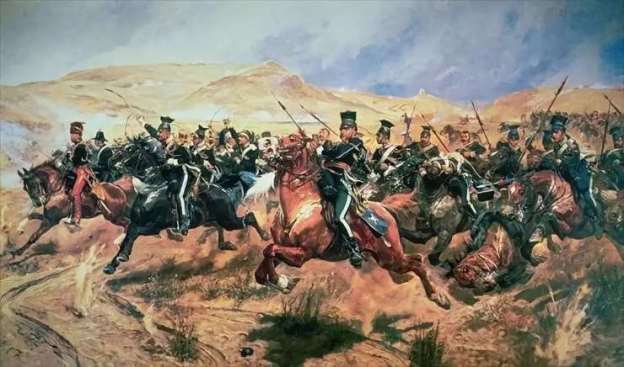
On October 25, 1854 during the Crimean War the Battle of Balaclava was part of the Siege of Sevastopol (1854–1855). This indecisive military engagement of the Crimean War is best known as the inspiration of the English poet Alfred, Lord Tennyson’s “Charge of the Light Brigade.” In this battle, the Russians failed to capture Balaklava, the Black Sea supply port of the British, French, and Turkish forces in the southern Crimea; but the British lost control of their best supply road connecting Balaklava with the heights above Sevastopol, the major Russian naval center under siege.

Early in the battle the Russians occupied the Fedyukhin and the Vorontsov heights, bounding a valley near Balaklava, but they were prevented from taking the town by General Sir James Scarlett’s Heavy Brigade and by Sir Colin Campbell’s 93rd Highlanders, who beat off two Russian cavalry advances. Lord Raglan and his British staff, based on the heights above Sevastopol, however, observed the Russians removing guns from the captured artillery posts on the Vorontsov heights and sent orders to the Light Brigade to disrupt them. The final order became confused, however, and the brigade, led by Lord Cardigan, swept down the valley between the heights rather than toward the isolated Russians on the heights. The battle ended with the loss of 40 percent of the Light Brigade.

This poem is an extremely popular poem. It has been featured in The Blind Side, and was even published in the newspaper after being written. Written shortly after the battle, it outlines one of the biggest military failures for the British.

Half a league half a league,

Half a league onward,

All in the valley of Death

Rode the six hundred:

“Forward, the Light Brigade!

Charge for the guns” he said:

Into the valley of Death

Rode the six hundred.

Tennyson starts at the beginning with the order to charge. “Half a league” in modern terms equates to about 1.25 miles. So the poem starts out by ordering the 600-man Light Brigade to charge the guns a little over a mile away. Tennyson uses Biblical allusions to bring home the sacrifice made by the soldiers by stating “the valley of death.” This is from the Psalm 23, which says: “Yea, though I walk through the valley of the shadow of death, I will fear no evil: for thou art with me; thy rod and thy staff they comfort me.” Clearly there is no belief these men will return from this charge alive.

“Forward, the Light Brigade!”

Was there a man dismay’d?

Not tho’ the soldier knew

Some one had blunder’d:

Theirs not to make reply,

Theirs not to reason why,

Theirs but to do & die,

Into the valley of Death

Rode the six hundred.

This is perhaps the most famous section of the poem. Tennyson starts with a question asking if anyone was dismayed. Not just that, but if anyone thought someone had blundered: clearly there must be some mistake, sending a light brigade to go fight a heavy artillery position over a mile away through a dead man zone makes no sense. One part of this stanza often misquoted is “Theirs but to do and die.” Often people say “to do OR die,” but this gives a totally different and wrong meaning. Tennyson used “to do and die” to show the troops, even in the face of certain death and blunder, will charge for King and country. By saying “to do or die,” you essentially take away the belief they will actually charge. Not only did the light brigade charge, they didn’t question it, or even try to reason themselves out of it; they simply heard the order and went. This takes an extremely large amount of courage and valor.

Cannon to right of them,

Cannon to left of them,

Cannon in front of them

Volley’d & thunder’d;

Storm’d at with shot and shell,

Boldly they rode and well,

Into the jaws of Death,

Into the mouth of Hell

Rode the six hundred.

Flash’d all their sabres bare,

Flash’d as they turn’d in air

Sabring the gunners there,

Charging an army while

All the world wonder’d:

Plunged in the battery-smoke

Right thro’ the line they broke;

Cossack & Russian

Reel’d from the sabre-stroke,

Shatter’d & sunder’d.

Then they rode back, but not

Not the six hundred.

The next two stanzas give a lot of detail on the actual charge itself. We see in the third stanza they are literally surrounded on all sides by cannons. They are being shot at and losing men rapidly, but even with all the odds stacked against them they rode on through the valley of death. It is interesting he uses the terms “jaws of death” and then “into the mouth of hell.” This is another Bible reference this time to Isaiah 5:14: “Therefore death expands its jaws, opening wide its mouth; into it will descend their nobles and masses with all their brawlers and revelers.” He is saying death will literally eat them alive. In stanza 4 we begin to see them draw their swords and begin to reach the line of cannons. Tennyson states they charged while all the world wondered, basically showing no one knew why they charged into a death trap. After they broke through the lines, there was a fight between the Russian Cossacks and the British light brigade. From the last line we can see the Cossacks retreat but not the light brigade.

Cannon to right of them,

Cannon to left of them,

Cannon behind them

Volley’d and thunder’d;

Storm’d at with shot and shell,

While horse & hero fell,

They that had fought so well

Came thro’ the jaws of Death,

Back from the mouth of Hell,

All that was left of them,

Left of six hundred.

“When can their glory fade?

O the wild charge they made!”

All the world wonder’d.

Honour the charge they made!

Honour the Light Brigade,

Noble six hundred!

In stanza 4 we see the immediate aftermath of the skirmish between the Cossacks and the British cavalry. They fought through the far line of the Russian cannons and fought their way out of the jaws of death. The charge amazingly did not wipe out the light brigade but did inflict massive casualties. Most of the force was either dead or wounded. Tennyson wants us to honor the bravery of the 600. They willingly sacrificed themselves on a mistaken order without question.

Liberalism is Detrimental to America

Justin Benner

George Washington once said: “However [political parties] may now and then answer popular ends, they are likely in the course of time and things, to become potent engines, by which cunning, ambitious, and unprincipled men will be enabled to subvert the power of the people and to usurp for themselves the reins of government, destroying afterwards the very engines which have lifted them to unjust dominion” (Farewell Address, 1796). He was very outspoken against political parties and the issues they can cause once established. If we were to bring him back he would probably be ashamed of what we have become. The divide in our nation has become extremely evident. There seems to be no end to the ongoing struggle of power between the Democrat and Republican Party. This power struggle was started due to the rise of Liberalism and started the fight Washington warned us about.

The roots of liberalism can be traced back to John Locke and social contracts. However Liberalism began to take root in America around the time of the Declaration of Independence and really began to show in the writing of the Constitution. One side argued for more government control while another side argued for the rights of the individual. A prime example of this was the struggle between Alexander Hamilton and Thomas Jefferson over the National Bank. Hamilton argued there should be a National Bank. This would expand the power of the government outside of the bounds of the Constitution. Thomas Jefferson did not want a National Bank. He found it to be unconstitutional and thought it would cripple the economy. While these debates were not Democrat versus Republican, the goals were relatively similar. Over time there has been an evolution in the beliefs and arguments of both sides along with the rise and fall of different political parties.

This version of Liberalism we see today is different from the historical or rather classical Liberalism we see throughout history. Classical Liberalism can be defined as “a political ideology which advocates civil liberties and political freedom with representative democracy under the rule of law and emphasizes economic freedom” (Gray 37, 38). Hamilton was a classical Liberal; the Democratic Party are considered Modern Liberals. This new form of Liberalism did not appear until the 20th century. According to the University of Stanford:

What has come to be known as “new,” “revisionist,” “welfare state,” or perhaps best, “social justice,” liberalism challenges this intimate connection between personal liberty and a private property based market order (Freeden, 1978; Gaus, 1983b; Paul, Miller and Paul, 2007). Three factors help explain the rise of this revisionist theory. First, the new liberalism arose in the late nineteenth and early twentieth centuries, a period in which the ability of a free market to sustain what Lord Beveridge (1944:96) called a “prosperous equilibrium” was being questioned. Believing that a private property based market tended to be unstable, or could, as Keynes argued (1973 [1936]), get stuck in an equilibrium with high unemployment, new liberals came to doubt that it was an adequate foundation for a stable, free society. Here the second factor comes into play: just as the new liberals were losing faith in the market, their faith in government as a means of supervising economic life was increasing. This was partly due to the experiences of the First World War, in which government attempts at economic planning seemed to succeed (Dewey, 1929: 551-60); more importantly, this reevaluation of the state was spurred by the democratization of western states, and the conviction that, for the first time, elected officials could truly be, in J.A. Hobson’s phrase “representatives of the community” (1922:49).

This is the form of Liberalism prevalent in America today. The Intercollegiate Review published an article that describes this modern off shoot of Liberalism:

American liberalism is not a closed ideology like Marxism-Leninism or National Socialism, but a very mixed bag with a number of internal contradictions. It is like a compendium of nearly every nonsense that we in the West have produced since the Enlightenment and the French Revolution. In spite of its lack of patriotism it has become part of the American scene, deriving advantage here and there from certain items of American folklore. It can do this because of its intellectual duplicity, which combines a masked elitism with a bogus populism. American liberalism exalts the proverbial three men sitting on cracker barrels in the general store talking politics, but at the same time hides the arrogant contempt the half educated have for the common sense of simple people. What are the com­ponents of this “mixed bag”? Nearly nothing from the Founding Fathers, but a great deal from European democracy, a bit of Marxism, a few items from anarcho-liberalism, and several loans from fashionable trends: philosophic relativism, hedonism, totalitarianism. To thinking persons these internal oppositions might cause concern, but most people tend to feel rather than think. And to many, the approach of American liberalism is agreeable: it is optimistic and carries many promises. Yet unlike a clever pagan existentialism, such as that of Sartre, who told us that life is absurd and that the history of every person is a history of failure, contemporary liberalism is simply ignorant. It ignores the Biblical message that “the mind of every human being from childhood onward is directed towards evil” (Genesis 8:21).

American Liberalism is rooted in an equality-based society. Fair treatment, equal pay, and social utopia are the ultimate goals of Modern American Liberalism. Their plan to achieve this is through expansion of the government and social justice. This goal is becoming a reality in 21st-century America.

In order to avoid confusion I will define a few terms using Merriam-Webster’s dictionary. Liberalism is “a political philosophy based on belief in progress, the essential goodness of the human race, and the autonomy of the individual and standing for the protection of political and civil liberties.” A Liberal is someone who “believ[es] that government should be active in supporting social and political change; relating to or supporting political Liberalism.” And lastly a Conservative is someone who “[believes] in the value of established and traditional practices in politics and society.”

It is important to recognize Liberalism for the threat it is. With a presidential election on our doorstep it is vital to understand what each candidate considers not only important, but what he or she considers true. We cannot afford in such times of worldwide crisis to be uninformed any longer. If we refuse to learn about those who want to hurt us and spread the truth about their intentions and goals then we will not stand a chance when the uninformed go to the poll and vote in someone who does not have our best interests at hand. It is important now more than ever we see Liberalism as detrimental to America.

In order to prove this I will confirm three points: Liberalism seeks to change the Constitution, Liberals are hypocrites, and Liberals are focused on the wrong things. I will then refute two counterarguments: Liberals care for the common man and Conservatives don’t, and Conservatives’ beliefs hold the country back.

My first confirmation point is Liberals seek to change the Constitution. We can see this most clearly in the ongoing struggle about gun control. Liberals seek to restrict and remove the powers associated with the Second Amendment. The Second Amendment states “A well-regulated Militia, being necessary to the security of a Free State, the right of the people to keep and bear Arms, shall not be infringed.”  Presidential candidate Hillary Clinton has come out strongly in favor of what she calls “common sense” gun control. “I don’t know how we keep seeing shooting after shooting, read about the people murdered because they went to Bible study or they went to the movies or they were just doing their job, and not finally say we’ve got to do something about this” (Clinton sec. 1). Her stance is to increase background checks, close loopholes, and ensure the safety of the people is put before the profits of the gun lobby. This, of course, upon first glance seems like a good thing. Ironically the amendment was put there to help citizens keep the government in check, not the other way around. To a Liberal, forcing more regulation and laws to make it harder for criminals and mentally unstable people sounds like a great idea. The only issue is criminals don’t follow laws. Regardless, the stance of “common sense” gun control is quite common amongst Liberals. This is a good example of how Liberals justify fitting the Constitution to their agenda.

Dr. Jill Silos-Rooney, a liberal politics expert, argues law abiding citizens do not have the right to own any weapon. Her position is:

The Supreme Court ruled in McDonald v. Chicago that while private citizens can own weapons, they are also subject to restrictions on those weapons. It’s not your right to build and own a nuclear weapon, nor is toting a pistol in your pocket an unfettered natural right. Minors can’t buy alcohol and we can’t buy cold medicine right off the shelf, because our society decided that we need to protect citizens from drug abuse and trafficking.

She also states “fewer guns overall means fewer crimes overall…. Guns will become more and more difficult to get therefore making it harder for criminals to get their hands on them.” The logic here of making it hard for anyone to get a gun hurts everyone. If all law abiding citizens must turn over their guns, this leaves us with two armed parties: the government and criminals. This puts your everyday American in danger and gives the criminals a wide open target.

Another area in which Liberals seek to change the Constitution is in the expansion of powers. America was founded upon an overseeing federal government and strong states. The duties of the federal government are laid out in Article 1 Section 8 of the Constitution. This is the section that begins with “The Congress shall have Power to lay and collect Taxes, Duties, Imposts and Excises, to pay the Debts and provide for the common Defense and general Welfare of the United States; but all Duties, Imposts and Excises shall be uniform throughout the United States.” Liberal politicians like President Obama, Hillary Clinton, and Bernie Sanders would all have you believe it is the government’s job to provide programs for the people in order to make our lives easier. Some of these government programs include healthcare, social security, and, Bernie Sanders’s favorite, free college. These government programs are nowhere to be found anywhere in the Constitution. They are by very definition unconstitutional. If you go to Bernie Sanders’s Web site, the first thing you will see is this quotation: “No one who works 40 hours a week should be living in poverty.” The implication is it’s the government’s job to fix this. This would add more government programs to an already overburdened, in-debt nation. If you add more spending you have to increase taxes to have money to spend. Free college sounds great until you see the 50-60% income tax from your next pay check.

My second confirmation argument is Liberals are hypocrites. Ann Coulter, a Conservative author and political commentator, said, “Words mean nothing to liberals. They say whatever will help advance their cause at the moment, switch talking points in a heartbeat, and then act indignant if anyone uses the exact same argument they were using five minutes ago” (qtd. In Hawkins par 1). Liberals tend to agree with open mindedness, inclusion, and diversity. They don’t like Conservatives who are close-minded and stand for outdated values, or simply values they themselves don’t hold. This is one reason Millennials are so supportive of the Democratic Party. The issue present is Liberals do not always live up to their own standards.

Al Franken is an example of Liberal hypocrisy. He has been described in high regards by Liberals. Paul Begala, a former Clinton advisor, described him as “a rallying point for Democrats” (Shweizer 60). In the 1990s Franken characterized himself as a “mushy moderate” but since then he has become the host of a nationally heard radio show and has since reclassified himself as a “proud liberal” (61). Franken’s actions have been less than appropriate throughout the years, evident in these key moments: He called Bill O’Reilly a liar to his face at a book expo in 2003 and then proceeded to challenge National Review editor Rich Lowry to a fist fight. He cracked jokes at Senator Bob Dole’s war injuries as well as telling Senator John McCain he “basically sat out the [Vietnam] war” (62). His opinion on Conservatives shows the hypocrisy. He believes Conservatives are “spreading filth, sleaze, and bile through the media apparatus” as well as “extremely mean and nasty…. They lie, distort, manipulate, preach hate, and generally appeal to people’s ‘dark side’” (62). As stated, this man is held in high regard by Liberals but displays very poor character and acts contrary to the values Liberals hold.

Ted Kennedy is another example of Liberal hypocrisy. He was one of the most experienced Liberals of the Senate and had been active for over 40 years. He was relentless and uncompromising in his positions. The Clintons as well as Al Gore and John Kerry proclaimed him to be one of their heroes (Shweizer 70). One issue Senator Kennedy had a strong stance on was taxing the wealthy and cutting off loopholes for tax evasion. If Senator Kennedy were to have followed his own strongly held opinions he would have had his family estate in an American bank and pay a portion equal to that of the other wealthy Americans. However the Kennedy trust fund is actually in Fiji, a small remote island in the Pacific Ocean. Regardless of whether or not he personally put it there, he still bore some responsibility. Having his money there made it possible to avoid scrutiny from the IRS and other federal authorities. Additionally, considering how the current tax system works, the one Kennedy had endorsed as “equal and just,” the tax rate is 49% on any money passed down to children after 2 million. The Kennedy estate after his father died was worth between 300 and 500 million dollars but only paid $134,330.90 (80, 81). Basically his family only paid .04% inheritance tax saving them a lot of money. This is just one of many tax conflicts under Senator Kennedy’s record. For a Senator with such a strong reputation of holding strong opinions, especially on taxes, for this to occur shows he did not meet the same standard he held other wealthy Americans to. This is very harmful to our nation. To have one of our leaders knowingly put money in an offshore account despite vigorously arguing such actions should be illegal shows a very hypocritical nature among our top, beloved leaders. If our nation’s leaders can get away with things they oppose, that sends a message to the American people it’s okay for them, too.

My third confirmation point is Liberals are focused on the wrong things. The Liberal presidential nominees would have the American people believe things like climate change or women’s rights are the biggest concerns of the nation. This simply isn’t the case. According to the New York Times:

Last month, General Joseph Dunford, the incoming chairman of the Joint Chiefs of Staff, told the Senate Russia presented the greatest threat to United States national security. At around the same time, James Comey, the F.B.I. director, declared the Islamic State to be the biggest threat. President Obama has consistently said nuclear terrorism is [the biggest threat].

This tells us, first, the Joint Chief of Staff, the highest ranking military official in our government, says Russia is our biggest threat. Second, the FBI Director, the head of one of the most advanced intelligence agencies in the world, says ISIS is the biggest threat. Only one of these opinions can be true.

Hillary Clinton is a strong proponent of the Climate Change parade purportedly sweeping the Liberals by force. In fact her Web site states “Climate change is an urgent threat and a defining challenge of our time” (Clinton par. 2). Bernie Sanders has a bit more extreme of an opinion:

The scientists are virtually unanimous that climate change is real, is caused by human activity and is already causing devastating problems in the United States and around the world. And, they tell us, if we do not act boldly the situation will only become much worse in years to come in terms of drought, floods, extreme storms and acidification of the oceans. Sadly, we now have a Republican Party that is more concerned about protecting the profits of Exxon, BP and Shell and the coal industry than protecting the planet. While fossil fuel companies are raking in record profits, climate change ravages our planet and our people — all because the wealthiest industry in the history of our planet has bribed politicians into ignoring science (Sanders par. 1).

The Department of Defense has its top issue listed as “Operation Inherent Resolve,” which is the ongoing military operation dedicated to the destruction of ISIS. “As of February 29, 2016, the total cost of operations related to ISIL since kinetic operations started on August 8, 2014, is $6.5 billion and the average daily cost is $11.4 million for 571 days of operations” (DoD par. 2). Senator Ted Cruz holds a bold stance on national security. While Senator Sanders continues to talk about climate change, Senator Cruz states “ISIS seeks to destroy our very way of life. We must defeat them. That starts by calling the enemy by its name — radical Islamic terrorism — and securing the border. Border security is national security.”

From this we can see a couple of things. First we can see the heads of state of our nation’s greatest military and intelligence agencies are telling us ISIS and Russia are the biggest threats to America. However, the Liberal candidates seem to be more interested in talking about climate change, social justice, and how the rich are to blame. Perhaps we should pay more attention to international conflict.

The first counterargument I will refute is Liberals care more about the common man than Conservatives. On Presidential Candidate Bernie Sanders’s Web site he lists 13 ways he will reduce income and wealth inequality in America. The first is “Demanding that the wealthy and large corporations pay their fair share in taxes” (Sanders sec. 1). The theory is by taxing wealthier and larger corporations there will be more government revenue to fund his government programs to help us, the common man. Another key way he plans to help the working class is ensuring no one who works 40 hours a week is in poverty. He does this by increasing minimum wage from $7.50 to $15 by 2020. He would move the cap for taxable income to $250,000 to provide more money and support for the elderly on Social Security. A similar care for the common man is shown by Senator Hillary Clinton. Her plan is “Give working families a raise, and tax relief that helps them manage rising costs, create good-paying jobs and get pay rising by investing in infrastructure, clean energy, and scientific and medical research to strengthen our economy and growth, and close corporate tax loopholes and make the most fortunate pay their fair share” (Clinton sec. 2). Both these candidates have plans to fix things like income inequality, racial divides in America, wealth dispersion, etc. These issues are also at the forefront of their campaigns. Conservatives seem more interested in immigration, national security, and the economic crisis in America. This, however, does not mean Conservatives do not care about the common man.

Presidential Candidate Ted Cruz has shown he cares about the average American with the new policies he will enact as President and with what he has already done in the past as a senator. Three good examples are

1) Rolled out a tax plan to dramatically reduce taxes for American families and individuals, simplify the tax code and spur significant economic growth. 2) Sponsored the Affordable Reliable Energy Now Act (ARENA), to check the President’s overreaching “Clean Power Plan” regulations that infringe on states’ rights, drive up costs for consumers and hamper innovation. 3) Opposed the Internet Sales Tax and spoke against establishment politicians who attempt to impose more unnecessary taxes on Americans (Cruz sec. 5).

One of his major policies he would enact is the Cruz Simple Flat Tax. This is easily accessible from his Web site:

Under the Cruz Simple Flat Tax, all income groups will see a double-digit increase in after-tax income. The current seven rates of personal income tax will collapse into a single low rate of 10 percent. For a family of four, the first $36,000 will be tax-free. The IRS will cease to exist as we know it, there will be zero targeting of individuals based on their faith or political beliefs, and there will be no way for thousands of agents to manipulate the system.

This means low income or middle class families will pay less income tax. This will leave more money in the pockets of the “common man” and help the economy. This would help create jobs all over the country, meaning less unemployment, as well as reduce the amount of people in poverty. By enacting this tax it is hard to justify saying Conservatives don’t care.

The second counter argument I will refute is Conservatives’ beliefs hold the country back. Liberalism is often synonymous with Progressivism. This means Liberals want the country to progress culturally, ethically, etc.  Liberals are all for movements like Feminism, pro-choice, and ecological ones like “going green.” Presidential candidate Clinton has an entire section under her campaign issues on LGBT rights. As president she would fight for federal equal rights to help stop all the unjust discrimination:

Today in America, nearly 65 percent of LGBT individuals report experiencing discrimination in their daily lives. LGBT youth are nearly twice as likely as their peers to be physically assaulted at school, and 74 percent of LGBT students say they’ve been verbally harassed for their sexual orientation. And a recent study found that nearly 50 percent of LGBT elders experienced discrimination when applying for senior housing. Despite this discrimination, 31 states do not have fully inclusive LGBT non-discrimination laws. Hillary will work with Congress to pass the Equality Act, continue President Obama’s LGBT equality executive actions, and support efforts to clarify that sex discrimination includes discrimination on the basis of “gender identity” and “sexual orientation.”

These numbers are far too high and drastic measures should be taken. Bernie Sanders has also taken a strong stance on LGBT rights:

In 1983, during his first term as Mayor of Burlington, Sen. Sanders supported the city’s first ever Pride Parade. He later signed a city ordinance banning housing discrimination.

When he served in the House of Representatives, then-Congressman Sanders voted against “Don’t Ask, Don’t Tell” in 1993 and the so-called “Defense of Marriage Act” in 1996. Sen. Sanders hailed the landmark Supreme Court decisions in 2013 and 2015 which struck down DOMA and recognized same-sex marriage is a right in all 50 states, calling the decisions a “victory for same-sex couples across our country as well as all those seeking to live in a nation where every citizen is afforded equal rights.”

Both Liberal Presidential candidates support LGBT rights, and none of the Conservative Republican candidates will even touch the topic. It would be morally abhorrent to say these statistics are okay. This country cannot move forward until everyone is equal. The question must be asked as to why are Conservatives stuck in the old moral ways.

Conservatives are based in religious roots and believe some version of the following: marriage is between one man and one woman, and to require citizens to sanction same-sex relationships violates moral and religious beliefs of millions of Christians, Jews, and Muslims. Senator Ted Cruz attends a First Baptist Church in Texas, and Donald Trump has pronounced his faith in Christ on TV multiple times. The First Amendment to the Constitution ensures the right of religion and free speech. It is not that Conservatives don’t want to support the rights of the LGBT community, it is that in doing so, they don’t want also to violate their religious beliefs. It’s not that Conservative beliefs are holding back the progress of the nation, but rather Conservatives have a different means to an end. Liberals and Conservatives want the same things: freedom and what they think is best for the nation. The difference is how those are achieved. Liberals want progress by means of social justice and equality for all, while in the process ruining the country. In contrast, the Conservative Party wants to go back to a small government with strict Constitutional interpretation.

In order to prevent Liberals and liberalism from further hurting this great nation we need to inform ourselves. This upcoming presidential election is the most pivotal display to our leadership about the attitude of Americans. We as everyday Americans need to inform ourselves about the policies and beliefs of each candidate in order to make the best decision who should lead this country in such a time of crisis. It is important now more than ever we pick someone who will uphold the values of the Constitution and defend America from all threats both foreign and domestic. If the Liberals had their way and were able to expand the Constitution, then candidates like Bernie Saunders could implement Democratic Socialism. We must conserve capitalism and the representative republic we hold so dear.

We as Christians should be repulsed by what Liberals stand for. Christians need to fill the polls on Election Day and make our opinion heard, not just when a president is being elected, but even for state and local levels. We need more representatives in government who will fight to protect our religious freedoms. Liberals have shown they will support the LGBT community but show no care for the religious community. We need governors, city council members, senators, and congressmen who understand the church and Christians have a huge impact on our nation and trying to silence a large group of people is not wise.

Works Cited

Clinton, Hillary. “Issues.” Hillary Clinton. Web. 8 Feb. 2016. <hillaryclinton.com>.

Cruz, Ted. “Issues.” Ted Cruz 2016. Web. 15 Feb. 2016.

Gray, John. Liberalism. Minneapolis: University of Minnesota Press, 1995. Print.

Hawkins, John. “7 Ways Liberals Are Just as Bad As the People They Hate.” Townhall.com. 10 Jan. 2015. Web. 8 Feb. 2016. <townhall.com/columnists>.

“Liberalism.” Stanford Encyclopedia of Philosophy. 22 Dec. 2014. Web. 23 Mar. 2016.

—. Merriam-Webster. Merriam-Webster. Web. 8 Feb. 2016.

“Operation Inherent Resolve: Targeted Operations Against ISIL Terrorists.” U.S. Department of Defense. Department of Defense. Web. 23 Mar. 2016. <defense.gov>.

Sanders, Bernie. “Issues.” Bernie 2016. Bernie Sanders. Web. 8 Feb. 2016. <berniesanders.com>.

Schweizer, Peter. Do As I Say (Not As I Do): Profiles in Liberal Hypocrisy. 1st ed. New York City: Doubleday, 2005. Print.

Silos-Rooney, Jill, Ph.D. “The Top 3 Liberal Arguments for Gun Control.” About News. 9 Sept. 2014. Web. 1 Feb. 2016. <about.com>.

Von Kuehnelt-Leddihn, Erik. “Liberalism In America.” Intercollegiate Review. Isi.org. Web. 23 Mar. 2016. <home.isi.org>.

“What’s the Greatest Threat to U.S. National Security?” The New York Times. 2 Sept. 2015. Web. 23 Mar. 2016. <nytimes.com>.

Help! I Shot My Drinking Buddy!

Justin Benner

Thomas Hardy was born on June 2, 1840, in Dorset, England, where his father Thomas (1811–92) worked as a stonemason and local builder. His mother Jemima was well-read, and she educated Thomas until he went to his first school at Bock Hampton at eight years old. He attended Mr. Last’s Academy for Young Gentlemen in Dorchester. He learned Latin and showed academic potential. Hardy’s family was poor, and he couldn’t afford a university education. He became “homeschooled” and his formal education ended at the age of sixteen. This is when he became apprenticed to James Hicks, a local architect. Hardy trained as an architect in Dorchester before moving to London in 1862; there he enrolled as a student at King’s College London. Here he won awards from the Royal Institute of British Architects and the Architectural Association. He made the switch to poetry later, according to poets.org:

He trained as an architect and worked in London and Dorset for ten years. Hardy began his writing career as a novelist, publishing Desperate Remedies in 1871, and was soon successful enough to leave the field of architecture for writing. His novels Tess of the D’Urbervilles (1891) and Jude the Obscure (1895), which are considered literary classics today, received negative reviews upon publication and Hardy was criticized for being too pessimistic and preoccupied with sex.

Hardy wrote quite a few war poems based off of World War 1 and The Boer Wars. “The Boer Wars was the name given to the South African Wars from 1880-1881 and 1899-1902 that were fought between the British and the descendants of the Dutch settlers (Boers) in Africa” (spartacus-educational.org). One poem he wrote based of these two wars was “The Man He Killed.” This is a relatively short poem at only five 4-line stanzas. The meaning of the poem says much more. The first stanza reads:

Had he and I but met

By some old ancient inn,

We should have sat us down to wet

Right many a nipperkin!

He starts out by introducing two characters. We have no names, all we really have is they exist. As a whole this first stanza is pointing out a more appealing outcome than what we are most likely going to get. He is saying here if these two had simply met in a bar they could have been drinking buddies and had a blast. But we can see from the tone of this stanza this will not be the case.

But ranged as infantry,

And staring face to face,

I shot at him as he at me,

And killed him in his place.

Hardy immediately cuts to the chase in the second stanza and reveals what the relationship between these two men actually is. They are both in the infantry. They are in the lowest possible ranks of the infantry since they are staring the enemy in the face. This tactic of literal lines of battle was extraordinarily common at the time. It was, however, on the decline since the American Civil War saw the introduction of trench warfare. So we see these two men are on opposite sides of the battlefield staring at each other. Then in lines 3 and 4 we see Hardy shoots at the other man and kills him. It is interesting to note Hardy mentions the fact the other man also shot. He could have said “I shot and killed him,” but instead he says he shot and the other man shot, too. Either man could have won the engagement, but it is really a role of the die — a very accurate statement for the period seeing as the rifled or smooth-bore musket would have been the weapon of choice when he wrote the poem.

I shot him dead because —

Because he was my foe,

Just so: my foe of course he was;

That’s clear enough; although

In this stanza we begin to see Hardy have a mental crisis. It’s reasonable to believe he is asking himself questions like “why did I shoot?” or more specifically “why was he my foe?” You can see him questioning himself in the manner in which the 1st and 2nd lines are written. The dash separating a repetition of the word “because” shows Hardy is questioning his motivations. Even in lines 3 and 4 we see him reassuring himself that yes, he was a foe, of course he was. This is exactly how we sound when we’re reassuring ourselves of something.

He thought he’d ’list, perhaps,

Off-hand like — just as I —

Was out of work — had sold his traps —

No other reason why.

We see here instead of arguing over whether he was actually a foe, he is trying to humanize his enemy. He starts off by thinking maybe he enlisted just because he could. Then in the latter lines he argues this guy he shot enlisted because he had no job and had no money. All he is doing is listing the possibilities for why a dead guy enlisted.

Yes; quaint and curious war is!

You shoot a fellow down

You’d treat if met where any bar is,

Or help to half-a-crown.

He finishes off the poem by a drastic understatement. He describes killing another person as old-fashioned and curious. This is quite the statement for someone who took 3 stanzas to figure out why he killed someone and then why they were in the battle in the first place. To summarize the last three lines, he is basically saying in war you kill people that at a bar you would buy a drink and become friends with. This is the true irony of war. We can see historical examples of soldiers overcoming this “kill or be killed” instinct. One is Christmas Day in WW1 when there was a temporary ceasefire to have Christmas. Perhaps too often we see everyone around us as enemies.

Web Sites Referenced

Humanity: 1, Death: 0

Justin Benner

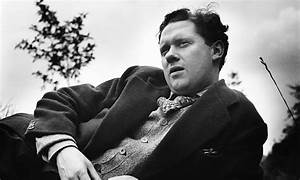
Dylan Thomas was born on October 27, 1914. He left school at age 16 to become a reporter and writer. His most famous poem, “Do Not Go Gentle into That Good Night,” was published in 1952. In 1931, at the age of 16, Thomas dropped out to become a junior reporter at the South Wales Daily Post. His position didn’t last long, since he quit in 1932 and turned his attention away from journalism back to poetry. Thomas soon found success in “And Death Shall Have No Dominion,” published in 1933 in the New English Weekly, marking his first international publication. This poem sent Thomas to England in 1933 to meet with editors of English literary magazines. His published efforts brought Thomas praise and honors, including the 1934 Poet’s Corner Prize. This period was also when his lifelong struggle with alcohol abuse began. To support his family, Thomas worked for BBC as a scriptwriter during World War II. He was exempted from fighting due to a lung condition. Even with this he still struggled financially. He was unable to keep up with taxes he owed. Even with Thomas in high demand for his animated readings, debt and heavy drinking took their toll. He died in New York City while on tour in 1953, at age 39.

“And Death Shall Have No Dominion” was Dylan Thomas’s international breakthrough. This poem has 3 stanzas with no definitive rhyming structure. This poem is definitely a perplexing one upon first read. My first guess as to what this poem was referring to was World War II. I couldn’t however put the pieces together on how it related. This link to World War II is shot down in the first stanza.

And death shall have no dominion.

Dead man naked they shall be one

With the man in the wind and the west moon; 

When their bones are picked clean and the clean bones gone,

They shall have stars at elbow and foot; 

Though they go mad they shall be sane,

Though they sink through the sea they shall rise again; 

Though lovers be lost love shall not; 

And death shall have no dominion.

There is no mention or link to World War II or any other war. It deals more with death than anything else. After doing some research as to the meaning, one possible explanation is such: “The title of the poem is derived from the biblical passage in Paul’s epistle to Romans, chapter 6 and verse 9. The poet showcases the reality of death and also gives it a good meaning. He lets us see the beauty behind death.… The dead persons who have gone ahead of us have timeless values. The memory of our dead loved ones lives with us” (poetandpoems.com). The author, following the logic of this explanation, is trying to tell us death has no victory over man; the loved ones we have lost will always be with us. It does not matter whether they are physically with us, what matters is they are in our hearts. This is a very biblical concept found in 1 Corinthians 15:55, which states “O death, where is your victory? O death, where is your sting?” (ESV). We even see in the 7th line the idea the dead shall rise again. “Though they sink through the sea they shall rise again.” These are very powerful words. This type of poetry would sooth very real hurt in WW2 Britain.

The second stanza is just as deep as the first stanza, yet it deals with seemingly the same issues but in a different aspect of war.

And death shall have no dominion.

Under the windings of the sea

They lying long shall not die windily; 

Twisting on racks when sinews give way,

Strapped to a wheel, yet they shall not break; 

Faith in their hands shall snap in two,

And the unicorn evils run them through; 

Split all ends up they shan’t crack; 

And death shall have no dominion

This stanza is dealing with the sea and presumably the navy. He is talking about all the souls lost at sea during, again presumably, WW2. But even here we see the theme of the dead returning to the living. Death has no dominion in the sea, and the sailors shall be freed from their sunken vessels and released from the temporary prison of death. They are “strapped to a wheel, yet they shall not break.” This stanza, while seemingly gloomy and dark at first, is actually quite the opposite. He is giving the families of the soldiers, and now the sailors, hope of their one day return.

The third and final stanza is more upfront with the reader. It talks about what happens after life.

And death shall have no dominion.

No more may gulls cry at their ears

Or waves break loud on the seashores; 

Where blew a flower may a flower no more

Lift its head to the blows of the rain; 

Though they be mad and dead as nails,

Heads of the characters hammer through daisies; 

Break in the sun till the sun breaks down,

And death shall have no dominion. 

Even in death the author proposes death has no dominion. Once we die, once “a flower may a flower no more / Lift its head to the blows of the rain,” we are free from death and its domain. The author’s point is death is only momentary; even in death we don’t lose our loved ones. We, the survivors of human conflict, will always hold the ones we loved close to our hearts, where death has no dominion. This is true regardless pf the circumstance of loss. This is true about grief. We as humans often refuse to give up on those we love; it is not in our nature to leave behind someone we love. We will defend them and their memory until we one day pass away, too. This is the point the author is making, that death has no dominion over the living, but also it has no dominion over the dead.

Wilfred Owen

Justin Benner

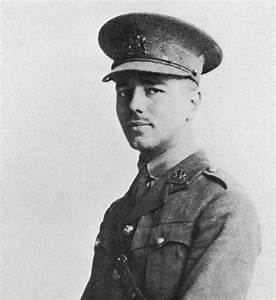
Wilfred Owen is recognized as the greatest English poet of the First World War.  Wilfred Owen from the age of 19 knew he wanted to be a poet and therefore immersed himself into authors like Keats and Shelley.  In late October 1915 he enlisted into the British Military being persuaded by propaganda.  He was deployed to France in 1916 and fought on the front lines.  He slept 70 yards away from a heavy gun that fired almost every minute.  Within a month he had officially seen the worst of the war, and it truly changed his perspective.  This rapid change of perspective led him to write war poetry.  In October 1918 he received the Military Cross but died only a month later near the village of Ors.  He wrote 46 war poems in all in his lifetime (warpoetry.co.uk).

One of his most famous poems is “Anthem for Doomed Youth.”  This short and rather gloomy poem talks about the horrors of trench warfare on the front lines.  Since he enlisted at 19, this poem almost has the ring of a warning poem, trying to keep other young men away from the battle.  The opening line says: “What passing bells for these who die as cattle?”  These passing bells are exactly what they sound like: they are bells rung after someone passes away.  He is comparing the trench warfare in France to the slaughterhouse for cows.  He is making a very vivid comparison.  “Only the monstrous anger of the guns.  Only the stuttering rifles’ rapid rattle can patter out their hasty orisons.”  He sets a very descriptive picture up here.  He is describing the sound of the battlefield with the anger of the guns and the stuttering rifles.  This clearly doesn’t mean rifles stutter, but rather there are simply so many guns on the field shooting at once it sounds like a few stuttering rifles.  Then he says only this extremely loud and unending noise silences their hasty orisons.  Or in other words, it’s so loud you can’t hear the soldiers’ hasty prayers.  “No mockeries now for them; no prayers nor bells; Nor any voice of mourning save the choirs, The shrill, dementedchoirs of wailing shells; and bugles calling for them from sad shires.”  Here he is trying to convey the idea there will be no funeral or mourning for those lost but rather just a loud chorus of bombshells falling.  There is such a bleak outlook on life presented in there lines.  It’s almost as if Wilfred Owen doubts he will make it home alive.

“What candles may be held to speed them all?  Not in the hands of boys, but in their eyes shall shine the holy glimmers of goodbyes.  The pallor of girls’ brows shall be their pall; their flowers the tenderness of patient minds, and each slow dusk a drawing-down of blinds.”  These last few lines really have to do with the effects the war has at home.  The candles refer to the candles one would see at a funeral.  He then switches from the physical candle to the light in a young boy’s eyes as they stare in disbelief at an empty casket.  He is really hitting close to home for a lot of people during this time.  Most if not all men were off fighting in the war, leaving mostly woman and younger men at home to deal with all the domestic problems.  The very last line “and each slow dusk a drawing-down of blinds” is Owen bringing the poem and the metaphorical day to a close.  On the battlefield the end of the day is symbolized by the sun setting whereas at home it’s symbolized by the blinds being closed.  This poem was one of the first he wrote almost immediately after enlisting.  His distaste for the war and the devastation it brought upon Europe is very apparent.

War: Beneficial But Unwanted

Justin Benner

There is nothing better than reading a poem that contradicts the title in almost every way. That’s the way Stephen Crane’s “War is Kind” poem is. It’s not Stephen Cane if it isn’t a graphic or extremely blunt description of war. However, in this poem he takes a slightly different approach. While he still talks about death and blunt descriptions, he is showing war is not kind but rather war is awful and brutal and almost downright inhuman. This is coming from the same author as who wrote The Red Badge of Courage, his most famous — and most brutal — story. This poem is almost a critique on human attitude toward war. Americans in the 21st century are sick of war; when this was written, it was quite a few years post-Civil War. Americans post-Civil War were also very tired of war. Having just fought an extremely bloody Civil War killing hundreds of thousands of men, it is easy to see how American writers might be antagonistic toward war.

“War is Kind” isn’t really a long poem. It stands at a nice 5 stanzas long, each stanza being on average anywhere from 3-5 lines long. It starts off by talking about a woman whose husband has been shot and killed. We can tell by context her husband was most likely in a cavalry unit in the Civil War. The good old cavalry are always the first to die not only in Historical Gaming class but also in literature. But the stanza ends with “Do not weep. War is Kind.” This seems like a rather harsh and unwarranted statement after just having her husband die

In the second stanza Crane makes the statement: “These men were born to drill and die. The unexplained glory flies above them.” This statement makes perfect sense coming from a realist. Realism accepts no deeper meaning in any form of reality so Stephen Crane observes men enlist in the thousands, drill, and subsequently die for “the unexplained glory.” This unexplained glory, I believe, is patriotism. Upon face value, patriotism is simply a reason for men to charge headfirst into almost certain death for glory. So once again Crane’s realism shines through. But he doesn’t stop there with his graphic descriptions. He then goes on in the third stanza about a man who has been shot in the chest and dies grasping his chest and falling into a trench.

The fourth stanza is more symbolic than anything. It starts off describing the flag, but then talks about how war teaches men the “excellence of killing.” War has been a kill-or-be-killed situation ever since the Middle Ages. The “excellence of killing” is in reference to the training a soldier might receive about how when told to fire at the enemy he must obey and shoot, lest he be shot first.

The last stanza talks about a mother, a mother whose “heart hung humble as a button. On the bright splendid shroud of your son.” This mother has lost her son to war. In fact in three out of the five stanzas, the writer switches the affected party. In the first stanza it’s a maiden, in the third it’s a babe (which could be replaced with child or young adult), and the fifth culminates with the mother. Each party is affected by a different death, yet all connected. Each of them has lost a spouse/parent to war, hence the irony in the title.

This poem is a harsh reminder there is nothing pretty about war. War has always existed in mankind ever since man’s downfall. War is an ugly, harsh place where death and fear reign strong. Soldiers during World War I described it as hell. But God can still use war in His grand plan. He told the Israelites to go to war many times in the Old Testament. Even the worst of things in life can turn out for good.

“…a time to love and a time to hate, a time for war and a time for peace…” Ecclesiastes 3:8.

An Account from a Confederate Soldier … Shot Down?

Justin Benner

The Civil War was not a good time to be an American.  This conflict that lasted for a few, bloody years pitted brother against brother, father against son, and family against family.  Most conflicts America has been involved in have not affected us in such a manner.  This is to say the Civil War was a crucial time in our nation’s history.  It helped form racial equality and freedom never thought imaginable.  But this outcome would have been drastically different had the Confederacy won.  Such a victorious Confederate army might have existed if it were not for the thwarting battle known as Gettysburg.  From July 1-3 of 1863, Union and Confederate troops were gridlocked in one of the bloodiest Civil War conflicts.  It was not looking good for the Confederacy by day three, when the Union controlled most of the high ground and hills and began shooting artillery down onto Confederate positions.  It was at this moment when Robert E. Lee made the risky, and debatably ludicrous, decision to attack the strongest Union position.  When this attack failed, the Confederates retreated with great losses.  One might think a Confederate account of Gettysburg would be pessimistic, but the journal entry of Randolph McKim proves this to be quite the contrary.

The journal account gives off a feel the Confederate state of mind was in a sort of “better luck next time” mode.  This was a huge offensive into the north.  He starts off his account with giving the reader details about positioning.  He states things like “…there was a double line of entrenchments….”  These types of statements run throughout the account, probably in an attempt to keep the reader up to date in the events.  This account only covers the third day, as well.  Taking a quick read through you can see any attacks the Confederates made were either repelled or forced retreats due to losses.  The account does not describe any land gains made by the south but rather quite the opposite.  The only reference to any successful advance comes in the last paragraph, in which he says: “We were beaten back to the line from which we had advanced with terrible loss and in great confusion.”  So we see even in the one reference he makes to any successful advance he mentions it was with terrible loss and with not much leadership.  Perhaps the South could have won the battle if they just kept their casualty count to a minimum!  Pickett’s failed charge put the nail in the South’s coffin for the battle that day.  With the North holding the high ground and relentlessly bombarding the South, and the casualty count increasing exponentially, the South had no choice but to retreat back to Confederate-controlled areas.

There are a few conclusions we can draw from this.  One is even though the South was losing, badly at times, they kept trying.  They attacked the Northern positions multiple times, each time with more vigor.  Secondly, the South believed in their cause.  It’s one thing to secede from the Union, but these men and boys were willing to lay down their lives to protect their way of life.  Such a sacrifice can still be seen today in the modern armed forces.  Thirdly, the South was not going to retreat out of Gettysburg until it was absolutely tactically necessary.  If the South didn’t think that, then they would have left Gettysburg by day 2 after suffering plenty of casualties.  The last conclusion we can make is Gettysburg may not have been as huge of a morale loss as we might think.  If that were the case, then the overall tone of the account would be much more negative and criticizing of superior officers.  Instead we see a blow by blow account of the last day of battle from the eyes of a soldier describing how groups of soldiers moved and how the enemy reacted.  Perhaps this soldier should have been a reporter instead.

The Battle for Stalingrad

Justin Benner

The battle for Stalingrad was a heavily decisive battle that took place from September of 1942 to January 31st, 1943.  This battle signifies arguably Russia’s best battle in all of WW2.  However it did come at a cost; that cost was 2 million civilian and military casualties.  This was one of the entire wars bloodiest conflicts.  In the battle, Soviet forces surrounded the entire German army under General Friedrich Paulus, emulating Hannibal’s encirclement and destruction of a Roman army under Aemilius Paulus in 216 B.C.  This city was crucial to both sides due to its strategic location and morale.  Stalingrad was a huge open door to Southern Russia.  The Russians intended to keep it, since it was a huge industrial and transportation hub, while the Germans saw it as a key launch point for future assaults and a heavy morale blow for the Russians, seeing as the city is named after a Soviet dictator.

“Stalingrad was to be assaulted; with oilfields remaining a priority…the sixth army under General Friederich von Paulus was assigned the task of taking the city” (Jordan and Wiest 115).  Lieutenant General Valisy Chuikov was in control of Stalingrad’s defense with the 62nd army.  He had the unfortunate luck of taking command of the 62nd three days before the attack commenced on September 14, 1942.  The battle went on for weeks, with little progress on the German side.  “By November, the 6th army had thrown six major attacks against Stalingrad’s defenders, who were by then confined along some 8km (5 miles) of the river bank around steelworks and armaments factories” (Bishop and McNab 94).  Conditions were described as hellish by soldiers.  One soldier’s diary reads, “When night arrives, on one of those howling bleeding nights, the dogs plunge into the Volga and swim desperately to gain the other bank.  Animals flee this hell; the hardest stones cannot bear it for long; only men endure.”  This only goes to show just how bad conditions were on the banks of the Volga that animals would swim to the other side to flee the barrage of artillery, bullets, and mortar shells.

“While the battle raged, the Soviet High Command prepared a counter offensive.  Operation Uranus deployed over 1.05 million Russian troops, seeking to encircle Stalingrad from north to south” (Jordan and Wiest 116).  It started along the northern front on November 19th, 1942 and started the next day on the southern front.  The forces met and fully encircled the besiegers on November 23rd.  Russia’s plan with this “besiege the besiegers” plan counted on the line not breaking and cutting off supplies to the Germans inside.  When the Germans figured out they were trapped in a Soviet death circle, General Field Marshal Erich von Manstein, commanding officer of the 11th army, which had been placed under the 6th army, felt the best course of action would be to draw the Soviets westwards away from Stalingrad to take the pressure off the 6th army and give General Paulus some time to organize a breakout.  This mission would be known as Operation Wintergewitter (Winter Storm).  However, due to bad weather and a lack of supplies to Paulus’s 6th army, the operation failed.  On January 31, 1943, General Paulus surrendered.

However, the 6th army was almost decimated after the surrender.  They had taken heavy casualties during the fight for Stalingrad, but they would take almost just as many from cold weather, starvation, and disease.  “More than half of the 300,000 men trapped in Stalingrad had been killed by the time of the surrender.  A fortunate few, some 35,000, had been evacuated by air, but the surviving 90,000 men were headed to Siberia on foot…only about 5,000 of the 6th army ever returned to Germany” (Bishop and McNab 95).

This paper was written using 2 different World War 2 history books: Atlas of World War II by David Jordan and Andrew Wiest, and Campaigns of World War II Day by Day by Chris Bishop and Chris McNab.  Atlas has a heavy bias toward the Allies.  That is to say, all Allied victories are made to sound superior or better than the Axis victories.  It does not go into much depth when it comes to timelines and day to day events; however, it does go into the background and strategy of the battle including the aftermath and what it will affect relating to other battles.  Campaigns does exactly as it says.  This book goes heavily into timeline description of day-to-day events and the logic behind them.  It has a neutral feel to it, as it doesn’t give an opinion or even a bias toward either side.  It quite simply shows the facts, whereas the Atlas seems to lean toward Allies’ victories more.