
Jessica Gromley Bain
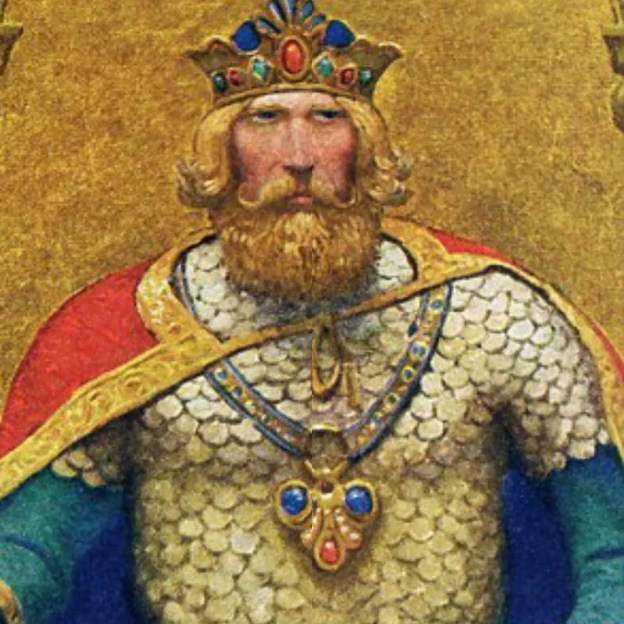
King Arthur is a legendary British King found in folklore and mythological literature. He is looked at as the greatest king of his time. He ruled over a large portion of Europe (England, Wales, Ireland, Scotland, and other smaller places not mentioned), and his kingdom was called Camelot. The kingdom was raised, assembled, and remained powerful as long as Arthur lived. However, his enemies rose against him, and, after being wounded in battle, Arthur died and in a fit of war the kingdom fell.
The values Arthur’s knights stood for lied in chivalry, loyalty, honorability, and trust. At the end of “The Wedding of King Arthur,” Arthur set the laws for the knights of the Round Table for each of his knights to follow, and every knight swore to abide by those laws. “They swore to never use violence without good purpose, never to fall to murder or treason. They swore on their honor to be merciful when mercy was asked and to protect damsels, ladies, gentlewomen and widows, to enforce their rights and never enforce lust on them. And they promised never to fight in an unjust cause or to fight for personal gain. All the knights of the Round Table took this oath. And every year at the high feast of Pentecost they renewed the oath.”
This code was one of the major factors in the success of Arthur and his knights. They worked together to achieve a common goal of peace and liberty. They renewed their oath every year to keep their union strong.
Another factor in the success of Arthur’s kingdom was Arthur hand-picked his knights. He often took into consideration the advice of close friends (as in “The Death of Merlin,” when Arthur asks Sir Pellinore for his help in identifying a selection of honorable knights to fill the empty chairs at the Round Table after having suffered eight losses in battle). However, the ultimate decision lied with the king. He chose no knight he did not trust whole-heartedly.
One other point that could potentially be argued is Arthur’s knights followed God. It is known they believed in God, because it is said in Sir Thomas Malory’s “Merlin” the sword in the stone appeared from Heaven, and all were amazed and eager to see who would pull the sword from the stone. If they did not believe at all, they would have ignored the sign and continued fighting over who should rule. On this note, if the sword was in fact from God, this suggests that Arthur was specifically chosen by God to be king of England. The sword said “Whoso pulleth out this sword of this stone and anvil is rightwise king of all England” and Arthur was the only one able to pull the sword from the stone and therefore he was the rightful king as demonstrated by God. It is also known the people of the time were Catholic, because Thomas Malory’s “Merlin” mentions several times the characters participated in holy services (“So when all the masses were done”; “On New Year’s Day, when holy service was over”; “And when matins and first Mass was over”). However, this is not exactly substantial evidence as to whether Arthur and his knights conducted their affairs according to the explicit orders of God. In fact, whether they were true followers of God is questionable, since they not only consorted with but also took the advice of Merlin the Magician, who was among some peoples referred to as the “Devil’s son.”
Arthur’s success was due largely to the trust and unity between the knights. This unity was the result of their common oath and Arthur having chosen each personally. It is true Arthur made no man a knight who he did not fully believe he could trust.
What would be his fall, however, was the fact he did not always put his trust in the correct people. His most trusted friend had sexual relations with Arthur’s wife, which is a prime example of Arthur’s rather poor taste in friends. Merlin even told him, “Guinevere will be unfaithful to you with your dearest and most trusted friend—” but Arthur did not listen. Despite Merlin’s explicit warning, Arthur chose to marry Lady Guinevere and walked right into inevitable heartbreak. In his defense, Guinevere is said to have been exceedingly beautiful; but that changes little in the final result. He also chose to trust his son, Mordred, another poor choice. Granted, Mordred was Arthur’s son, so the mistake is understandable. Arthur’s end comes in Sir Thomas Malory’s Le Morte d’Arthur. Due to Arthur’s choice to place his trust in the wrong people, he finds himself in battle with Lancelot, because Guinevere’s infidelity has led to her sentence to be burned at the stake. During the course of this short battle, Arthur’s nephews, Gareth and Gaheris, are killed by Lancelot, unable to defend themselves as they were both unarmed. Encouraged by Gareth and Gaheris’s brother, Gwaine, to take revenge, Arthur declares war on Lancelot and thus the foundation of the knights is broken up as each knight must choose a side. On top of all this, while Arthur is off fighting Lancelot, Mordred takes the crown for himself. Upon hearing of this Arthur must return to Camelot, where in a great battle Mordred mortally wounds Arthur. With no leader and no strong military to protect it, Camelot falls. Thus Arthur and his knights fail due to Arthur’s choice to put his trust in the wrong people. He was a great king who made his kingdom great and prosperous, but it was this one flaw which caused him to fail.
Bibliography
Lawrence-Mathers, Anne. The History of Merlin the Magician. Yale University, Yale University Publications, 2012.
Malory, Sir Thomas. King Arthur and his Knights. Oxford, Oxford University Press, 1975.
—. Le Morte d’Arthur. Great Britain, Aldine Press, 1976.
Steinbeck, John. The Acts of King Arthur and his Noble Knights. United States of America, Farrar, Staus, and Giroux, 1993.
 Redeeming Pandora