
Tag Archives: hannah moonis

The Controversy of Gender Politics in The Taming of the Shrew vs. 10 Things I Hate About You

Hannah Moonis

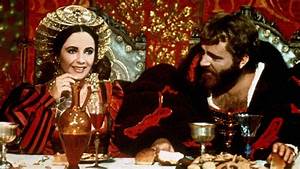
From A Comedy of Errors to Much Ado About Nothing, William Shakespeare composed many comedies throughout the years. Perhaps one of the greatest comedies of his time was The Taming of the Shrew, one of his first plays. This comedy follows the tale of sisters Katharina and Bianca and their various suitors. The elder sister, Katharina, (the “shrew”) is pursued by Petruchio, a man from Verona on a mission to wed and make money. Bianca is courted by many men, but most noticeably, Lucentio (disguised as a tutor) and Hortensio (a friend of Petruchio). Through a series of events, Katharina weds Petruchio and is successfully “tamed” by her new husband. Bianca married Lucentio after Tranio, Lucentio’s servant who disguised himself as Lucentio to convince Bianca’s father to let her marry Lucentio, disguised as her tutor. All ends well for everyone and as a final test, Petruchio shows the other men how obedient his once-wild wife now was. In its modern day film adaptation, 10 Things I Hate About You, the plot similarly follows the story of sisters Kat and Bianca. In a modern day high school a new student, Cameron, arrives and immediately falls in love with Bianca. The girls’ father has a rule Bianca can’t date until Kat starts dating, which Kat claims will never happen. In order to date Bianca, Cameron must pay “bad-boy” Patrick to date her older, quick-tempered sister Kat. Though the two are quite similar in the storyline, the two tales diverge at particular parts. There are two main differences in the plots of these two stories: how Katharina or Kat is “tamed” and the role of gender politics.

The Taming of the Shrew has brought up many controversial topics throughout its long history. One of the most debated topics is whether or not Katharina’s taming was emotional abuse or merely a less violent way to control Petruchio’s wild wife. During Shakespeare’s time, beating one’s wife was becoming more and more frowned upon by society, leading many to argue Petruchio’s psychological methods of taming were more humane and gentle. Katharina is eventually “tamed” and submits to her husband. There are many theories as to what her final speech in Act 5 means; most commonly believed is Katharina is sincere and has been successfully “tamed” by Petruchio. It is unknown if they truly love each other. Quite contrary to the original story, in 10 Things I Hate About You, Patrick “tames” Kat, quite on accident, through the power of love. Only after falling in love with Patrick does she become a more calm and loving person. Though both Petruchio and Patrick pursue Katharina (Kat) for money, Patrick’s actions become much more sincere as the movie progresses. It is up to the reader to determine if Petruchio and Katharina truly loved each other in the end, or if it was simply a woman’s submission to her husband through nonviolent means.
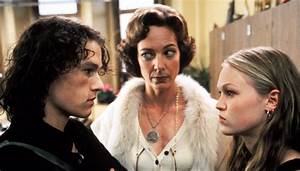
Gender politics plays a huge role in the story of Katharina and Petruchio or Kat and Patrick. Many critics debate whether or not Petruchio’s treatment of Katharina was emotional abuse. Emily Detmer, author of “Civilizing Subordination: Domestic Violence and Taming of the Shrew,” suggests in her book the final speech made by Katharina was a result of Stockholm Syndrome, saying, “Her surrender and obedience signify her emotional bondage as a survival strategy; she aims to please because her life depends upon it.” Other critics such as David Beauregard, author of Catholic Theologies in Shakespeare’s Plays, argues Katharina and Petruchio’s relationship takes on the characteristics of an Aristotelian story and is in no way abusive, but in fact, beneficial to both parties. Beauregard believes Petruchio was acting as a light to Katharina, bringing her into harmony with her own nature, thus teaching her obedience. In the reverse, Katharina also helps Petruchio understand happiness and fortune through her taming according to Beauregard. The gender politics in 10 Things I Hate About You  is decreased in importance from the original story. Kat is portrayed as an angry feminist who finds social constructs to be restricting, hence her reluctance to date. Patrick doesn’t use relatively abusive psychological methods on Kat to make her date him. He may be motivated by money in the beginning, but over time, Patrick shows he actually cares about her, contrary to her previous notions about men. In the end, both Patrick and Kat are happier and much nicer people. Their relationship becomes a symbiotic one, much like Beauregard’s description of Katharina and Petruchio’s relationship, which is definitely not emotionally abusive.

The Taming of the Shrew is responsible for many gender role-based debates. Some say Shakespeare is warming against the cruelty of submissive techniques, even non-physical ones. Others argue Shakespeare is portraying the change in social civility as Petruchio doesn’t physically abuse Katharina. But almost everyone can agree The Taming of the Shrew is controversial. Is it misogynistic? Is it sexist? The debate continues. 10 Things I Hate About You stays largely away from the gender politics portrayed in its source material, possibly because The Taming of the Shrew offends so many people, not just women, in this day and age. George Bernard Shaw in a letter to the Pall Mall Gazette describes the play as “one vile insult to womanhood and manhood from the first word to the last.”

The contrasts between these two stories, The Taming of the Shrew and 10 Things I Hate About You, are a little drastic, the latter taking out what many critics say to be the most important part of the story: the role of gender in society and marriage and the controversial cruelty of men against their wives and women in general. The two tales seems to both send different messages to their audiences. The Taming of the Shrew portrays a woman’s role in life is to submit to her husband with blind obedience. 10 Things I Hate About You shows how love and acceptance reveal one’s true self and essentially makes you a better person.           

Bibliography

Detmer, Emily. “Civilizing Subordination: Domestic Violence and the Taming of the Shrew.” Shakespeare Quarterly 48.3 (1997): 273–294. Web.

Junger, Gil, dir. 10 Things I Hate About You. Perf. Heath Ledger and Julia Stiles. Touchstone Pictures, 1999. Web. 10 Dec. 2015.

Shakespeare, William. The Complete Works of William Shakespeare: The Taming of the Shrew. Mumbai, India: Wilco Publishing House, 2005. 224-47. Print.

Arthurian Legends at their Finest: Contrasting Thomas Mallory’s Le Morte d’Arthur to BBC’s Merlin

Hannah Moonis

Throughout the medieval time period were many versions of Arthur and his knights of the Round Table circulating.  Whether Arthur truly existed is still heavily debated to this day, but if he did exist, he would have been alive between 400 AD and 600 AD.  The main early source that shaped the Arthurian Legends is Historia Regum Britanniae (History of the Kings of Britain) by Geoffrey of Monmouth.  In his book, he told Arthur’s whole story from his conception at Tintagel to his death and final appearance at Avalon.  Characters such as Sir Lancelot, Guinevere, and Merlin have their first appearance as well in Monmouth’s epic tale.  But perhaps the most famous tale of Arthur and his knights is Le Morte d’Arthur by Thomas Malory.  Malory’s version tells of how Arthur was the son of Uther Pendragon but was raised by another family and became king when he pulled Excalibur out of the stone.  Arthur is advised by the magician Merlin and marries Guinevere.  Morgan le Fey also plays a part in trying to betray her brother Arthur and take her rightful place as Queen of Camelot.  Many parts of the legend have been adapted in the modern age in tv shows and movies.  One of these such adaptations is the tv show Merlin.  This show relates the story of Arthur and Merlin in their early years.  There are many differences in Merlin from Malory’s original work.  Most significant are Arthur’s rise to becoming king, the role of Guinevere, and the role of Merlin.

As stated before, in Malory’s Le Morte d’Arthur, Arthur becomes king when he pulls Excalibur out of the stone.  In Merlin, the story is quite different.  Arthur is born and raised as the prince of Camelot in Merlin.  The role of Excalibur does not even come in until much later.  Merlin uses Excalibur to restore Arthur’s faith in himself.  After Morgana (Morgan le Fey) temporarily takes over Camelot, Arthur begins to doubt whether he is the rightful king of Camelot.  Merlin tricks Arthur into thinking only the true king could pull the sword out of the stone, when in reality, it was just Merlin using his magic to release it from the stone.  In Merlin, Arthur becomes king after his father, Uther Pendragon, is murdered.

As Merlin is the tale of Arthur and Merlin in their early days, it doesn’t show many of the stories in Le Morte d’Arthur, but it does address Guinevere’s role.  Guinevere, usually called Gwen in Merlin, is just a servant girl, not a noble or a princess.  She is the maidservant of Morgana and close friends with Merlin.  Even though Arthur and Gwen keep their relationship secret for a while, there is still tension with Lancelot, who is not a knight to begin with.  As opposed to Malory’s tale, Lancelot does not engage in an affair with Gwen, as he respects Arthur too much to hurt him.  After Lancelot dies in Merlin, Morgana, trying to destroy Arthur and his knights, creates a shade of Lancelot that uses magic to make Gwen fall in love with him again.  This cause a rift between Arthur and Gwen and he banishes her.  After seeing her again after Morgana takes over Camelot, Arthur allows her to come back and marries her, making her queen of Camelot (after Uther’s death).  In one episode, Arthur lets Uther’s spirit loose into the world where he wrecks havoc on the knights and tries to kill Gwen, saying Arthur was destroying Camelot by marrying a servant girl.  Needless to say, not everyone approves of Arthur and Gwen’s union.

The character of Merlin in Le Morte d’Arthur was quite different from the character in Merlin.  In Malory’s work, he is a wise, older magician who leads Arthur down the right, and sometimes wrong, path as king.  He can see the future but ultimately lets Arthur make his own decisions, like marrying Guinevere even though he knows it ends badly.  He meets his end when he falls in love with a sorceress named Nenyve, who then imprisons him in stone after learning magic from him.  However, in Merlin, Merlin is the same age as Arthur and becomes his manservant after saving his life.  Quite different from Malory’s tale, Arthur is somewhat arrogant and conceited when it comes to dealing with Merlin in the show.  As time progresses, you see the change as Arthur starts to trust Merlin and take his advice to heart.  Although he is still wise and advises Arthur as king, he cannot reveal his magic to him because magic is banned, unlike in the legends.  Uther banned magic before Arthur became king in what was called the Purge, as he rounded up many magicians and murdered them.  Because of this, Arthur is raised to believe magic was evil.  In one episode Merlin says (disguised as a woman), “There is no evil in sorcery, only in the hearts of men.”  Merlin finally reveals his magic in the last episode where Arthur rejects him at first and then slowly accepts Merlin for who he was and all he did for Camelot before dying.

One of the biggest parts of the legend is Arthur will be reborn one day, “when Albion’s need is greatest,” hence the phrase “Once and Future King.”  In Merlin, Merlin outlives Arthur and is shown in present day waiting for Arthur to return from Avalon.

The Arthurian Legends have so many different versions and stories of Arthur, Merlin, and Guinevere.  The contrasts between Le Morte d’Arthur and Merlin are apparent, even though many of the elements are the same.  The power of Excalibur is clear in both versions.  In Malory’s tale, it is put in the stone by Merlin to show who the true king of Camelot was.  In Merlin, Merlin also puts it in the stone but only to keep anyone else from using it besides Arthur and then to restore Arthur’s faith in himself as king of Camelot.  Guinevere’s role in Malory’s work is to be a light to the knights and part of the love triangle with Arthur and Lancelot.  In Merlin, Guinevere’s role is transformed to serve less of her affair with Lancelot and more with her love of Arthur and her love of Camelot.  Merlin’s character is probably the most evident of change as he is older and falls prey to Nenyve in Le Morte d’Arthur and more of a friend to Arthur instead of just a guide in Merlin.  Though modern adaptations have given their own twist to the story of King Arthur and his knights, the key elements and ideas stay the same.

Bibliography

“King Arthur in Literature.” King Arthur, the legend of the Knights of the Round Table. N.p., 2012. Web. 7 October 2015. <http://www.legendofkingarthur.co.uk/literature-king-arthur.htm&gt;.

“King Arthur’s Round Table Revealed.” HISTORY. AETN UK, 2014. Web. 7 October 2015. <http://www.history.co.uk/shows/king-arthurs-round-table-revealed/articles/the-real-king-arthur&gt;.

Le Morte d’Arthur: Book Summary.” CliffsNotes. Houghton Mifflin Harcourt , 2015. Web. 7 October 2015. <http://www.cliffsnotes.com/literature/l/le-morte-darthur/book-summary&gt;.

Malory, Thomas. Le Morte d’Arthur. N.p.: William Caxton, 1484. Web. 4 October 2015.

Morgan, Colin, Bradley James, Katie McGrath, and Anthony Head, Perf. Merlin . Dir. Julian Murphy and Johnny Capps. 2008. Web. 7 October 2013.