Tag Archives: emily grant privett

Redeeming Europe

Emily Grant Privett

Being in the very first edition of Redeeming Pandora, I found it only appropriate to make one final contribution to the last edition. Back in 2015, I was hired to teach science at Summit Christian Academy. It’s funny how God works, opening doors you didn’t even realize existed. As a terrified college senior, I had absolutely no idea what my next move would be. I was fully reliant on God showing the path He had laid out for me. After being hired at Summit, I knew I one day would want to go on another senior trip. As some may know, my senior trip was filled with highs and lows. I had excellent opportunities to form permanent memories with my classmates, but class dynamics and drama between chaperones put a dampener on the experience. I hoped to one day get to encounter the beautiful cities of Paris, Berlin, and Rome again, but with a new positive perspective. The class of 2018 provided me with that opportunity, giving me the unique chance to travel on the Summit Europe trip twice, once as a student and once as a chaperone. 

In all, this trip was awesome. I had the opportunity to build and fortify relationships with the seniors and a few of their parents. I was able to experience 3 foreign countries with my cousin, who very soon is going away to college. I was immersed in German, Italian, and French culture. I was able to eat tons of incredible foods including, but not limited to gelato, cannolis, fresh pasta, pizza, coffee, schnitzel, and German sausages. I even got to talk to and get to know Mr. Rush more in 2 weeks than I had in the entire 10 years we’d known each other. While the trip was excellent and I made memories I’ll never forget, one thing that comes to mind immediately when I think of the senior trip is that God was with us the entire time. I don’t mean this in the Christian school “God is always with us” sense of the phrase. I mean this in a literal, “I witnessed God’s hand at work” kind of way. Having led the 9th grade trip for 3 years now, I’m well aware when things can go wrong, they will go wrong. We’ve dealt with extreme traffic, broken-down cars, lost phones, arguments, etc. There are few times in life when things have a greater chance of going wrong than when you’re traveling with a group of 29 somewhat inexperienced travelers through 3 foreign language speaking countries for 15 days straight. It was incredible to witness how, over 2 weeks, we experienced no major snags, and the things that did happen to go wrong, worked out in the best possible way.

The best way for me to sum up the Europe trip is to talk about the several providential moments God used to display His handiwork. First, the train from Rome. We were rushed after a tour from the Vatican to walk back to the convent from the train station, grab our bags, and make it back to the train station to buy lunch before our train departed, all in about 45 minutes. We had already set aside bags early that morning, so we just had to quickly collect them. Keep in mind, when traveling with 29 people, the word “quickly” doesn’t exist. Ultimately, we all made it aboard with lunch in hand. Then, we noticed one of the nuns from the convent running down the track trying to flag us down. One of our guides recognized her and met her on the platform. It turns out we had left a baseball and a cell phone at the convent. The nuns who operated the convent didn’t know exactly what time our train left, what platform we’d be leaving from, what car we’d be in, or that the items definitely belonged to us, yet somehow she managed to make it on the platform without a boarding pass and effortlessly find us to hand over our belongings before our train departed.

Our train delivered us to Florence, which brings me to God moment #2. After the mile or so walk through the heat to our hostel, we dropped off our bags and left for a tour of town, complete with a visit to Michelangelo’s David. To get into the museum one must go through security, requiring everyone to remove all personal items to go through the metal detector. Everyone passed through security and continued into the museum. After an hour or so had past, just before we were about to leave the museum, a student, who will remain unnamed, realized his/her money belt was missing. For those of you who haven’t traveled internationally in a large group, a money belt is a small, fanny pack-like pouch one can wear under their clothes that holds all valuables like passports, money, identification, etc. They’re worn to protect valuables from pickpockets, which are pretty common in Europe. Needless to say, a stolen money belt would be a major snag in the flow of the trip, especially since we were leaving the country in a matter of days. The student recognized the missing money belt at the perfect time. The student and Mr. Rush took off to find security, where the money belt was waiting for them, with all valuables inside.

We enjoyed the next few days in Tuscany. The next stop on our trip was Normandy, requiring us to fly into Paris and take a private bus to Bayeux. After a moving D-Day tour in France, we headed to Paris to visit iconic locations like the Eiffel Tower and the Louvre. After our stay in Paris we headed to Munich via train. We arrived at the train station early, but the track our train was leaving from wasn’t announced until just a few moments before it was to depart. Like I said, “quickly” doesn’t exist when traveling with a large group of people and their luggage. Needless to say, we had to rush to our train. This was made more difficult because one student had been having knee problems and was struggling to walk. We made it onto the train, found our seats, and had about 3 hours to relax before the 10 minutes we would have to collect our luggage, get off the train, find our new track, then make it onto our next train to continue onto our final destination. About an hour into our train ride, the train stopped. Our 10-minute connection became even shorter. Eventually the train moved again and an announcement was made we were now 20 minutes behind schedule, meaning we were most likely going to miss our connection. The train to Munich ran every hour or so, and we were instructed we could take the next train and there’d be cars designated for us. When our train finally arrived at the station, we no longer had less than 10 minutes to transfer trains, but instead about 45 minutes. This gave opportunities for bathroom breaks and a more leisurely walk to our new track, which happened to be the platform directly next to the one our train came in on. Suddenly, the stress of transferring trains decreased significantly, especially for the student who was limping the entire way. Then, we were given specific cars that would have open seats. We no longer had assigned seats like we would have on the previous train. We didn’t know what end of the platform our cars would be, and in the interest of making the train, we were instructed to get on the train, whether in the proper car or not, and we’d find our seats from there. When the train pulled in, the cars we needed happened to be directly in front of us, and these cars were first class cars with working WiFi. As we reached Munich, the train slowed. We all began to gather our bags as the screen on the train indicated we were approaching the Munich station. They had made an announcement, but it was in German. A fellow passenger approached our guide and said we were preparing to get off at the wrong stop. In the announcement, they stated there are in fact two Munich stations and the second was the one we’d want to take. Because of God working through that stranger we all remained on the train until the correct stop.

These sum up just a few key God moments we witnessed on the trip. On top of those specific moments, we were warned our trip was going to be “the coldest Europe trip yet.” The weather forecasted rain nearly every day and weather in the 40s and 50s. Though we did have a few days that were wet and chilly, overall, we had beautiful weather. We had two free days on the trip, one in Tuscany and one in Rothenburg. Those two free days, where we had opportunities to walk and explore the small Italian and German towns, had some of the sunniest days and warmest temperatures of the entire trip. Though some of these moments seem small, it really emphasized for me the power of God’s providence. He used the ordinary to demonstrate the extraordinary.

This trip is up there as one of the smoothest and highest-quality traveling experience of each of the 4 times I’ve traveled through Europe. Now, as the self-proclaimed resident Europe trip student/chaperone traveling expert, I’d like to give a few tips to ensure you have the best experience possible.

1. Sleep is for the weak. One thing about the Europe trip you’ll quickly realize is sleep is a rarity on the trip. You’ll probably land at 7am after a long red-eye, sleep deprived, but filled with adrenaline. The first day is the worst. Force yourself to stay awake to push through the jet lag. It does get better, I promise. That doesn’t mean you won’t take any and every chance to try to sleep over the course of the two weeks, so bring a neck pillow.

2. Nobody cares about your complaining. Everyone is cold, tired, and hungry. Your endless complaining about how you didn’t sleep well the night before is only fueling a fire of grumpiness in the group. Keep your negativity to yourself.

3. Respect the guides.  This includes the chaperones. You may not always WANT to go on the tour, or you may not WANT to wake up at 3am to catch a flight, but too bad. Every step of the trip is meticulously planned to provide the smoothest experience possible. Debbie from Journeys of Faith worked extremely hard to pick out the perfect guides, select the most conveniently-located hotels, and arrange private busses to transport you from place to place, making the trip as close to perfect as it can be. No detail has gone unnoticed. Also, your chaperones are there to ensure your trip be safe and smooth. The trip is for the students, but the chaperones are there as bumpers to keep everyone in line. The rules put in place aren’t there to ruin your fun. They’re there to ensure you stay safe. By breaking the rules, you’re putting yourself and your chaperones at risk, which leads me to my 4th tip.

4. You’re not there for you. You’re there for the group. Yes, you deserve to enjoy the trip, but ultimately you’re there with about 20 other people. Keep the needs of others in mind. The group is not going to drop everything to meet your individual desires. Find a small group that wants to do the same free time activities as you. You don’t need to spend the entire trip with the same 4 other people.

5. Go with the flow. Things are going to go wrong. It’s okay. But sometimes, even when things go wrong, they turn out better than they could have. Being flexible when traveling is key. Maybe you won’t have time to eat lunch one travel day. Perhaps you’ll miss a train. But, in the end, everything will be fine. Don’t panic and don’t complain. It’s the job of the guides to figure everything out and they’re doing the best they can.

6. Pack your walking shoes. Imagine a lot of walking, and then add 10,000 steps a day. That’s how much walking you’ll be doing on the Europe trip. Especially at the beginning of the trip, you’ll easily be walking from 8am until 10pm. Over the course of 15 days we traveled about 100 miles on foot alone, not including what we traversed on bike. The trip is non-stop. Even though it’s exhausting, you get to experience so much culture and history. So, bring insoles.

7. Don’t hate, appreciate.  You will see so much. It can be overwhelming at times. When I went on the trip as a senior, I realized I didn’t take time to sit back and reflect on anything. I didn’t gain a true appreciation for what I had experienced until months later. Bring a journal. Take a few minutes each night to write about your daily experiences. Having done this for a few trips now, it’s always fun to look back and be reminded of some of the more meaningful experiences. While on the trip, allow yourself to be impacted by what you see. As Mr. Rush put it, “How are you going to let the trip change you?”

8. The trip is what you make it. Attitude is everything. If you go into the trip with low expectations and negativity, then your trip will be underwhelming. Positivity is key. Be flexible when things go wrong. Don’t get frustrated by the little things. There will be moments when even some of your best friends are going to irritate you. Allow yourself to have some space. Be reasonable. Fifteen days of travel in close quarters can become exhausting. Relax as much as you can. Ultimately, if you go in with a positive attitude, your trip will be a positive experience.

I cannot encourage you enough to go on the Europe trip. Yes, it is pricey, but the accommodations and convenience factor of private busses and tours is well worth it and you’re going to learn more than you can imagine. Several of the seniors remarked they felt they learned more in the first few days of the trip than they did in all of their time at Summit. That isn’t to discredit the quality of education you get at Summit, but instead speaks to the value of literally walking the streets Paul walked and taking steps on the beach where soldiers flooded into France on D-Day. In addition to the valuable cultural experiences and lasting memories formed with your classmates, the Summit Europe trip provides a tactile experience with history, something you can’t get from a textbook.

In all, I’m so blessed to have had the opportunity to travel on the senior trip this year. On top of making lasting memories and learning more than I can fathom, I was most impacted by the enduring sovereignty of God through every moment.
Where Are They Now?

Christopher Rush

As part of our year-long wrap-up party, and in honor of our 10th issue, we thought you might be interested in getting a brief update on some of the students who helped make Redeeming Pandora over the years.  This issue we hear from first season’s Emily Grant and second season’s Lia Waugh.

Emily Grant

I am currently a student at Christopher Newport University.  A Chemistry major and a Leadership minor, I spend my time roaming the halls of the science building, procrastinating on writing my lab reports, and avoiding working on papers about the multiple theories of Leadership.  A sophomore, I currently live with former Summit students Julie McIlhaney and Emma McNally.

Lia Waugh

I’m working fulltime at Tidewater Orthopedic Associates Physical Therapy clinic.  I take the patients through their exercises, do different treatments on them (Cold Laser Therapy, Ultrasound), and love every part of it.  My coworkers and boss are great people, and everyone gets along very well and has fun working together.  I can’t think of a more rewarding job than having a patient come in having not been able to walk and being able to watch them progress and walk (and more).  I love that I’m able to directly impact people’s lives, even if it’s just with a smile and making them feel better.  My dream is to end up in the missions field, whether it is medical missions or not.  I just want that incredibly badly.  I do night classes at Thomas Nelson and have not been mugged or shot yet.  It’s not as bad as people think; the work is actually really hard.  But I love my classes; the more I study Biology, the more my love for God deepens.  So that’s where I am!  Eagerly waiting to see where else God leads me.  Even though I’m only a couple of months into college, I’m in awe of seeing how God has used some of my darkest hours to make me into the person He wants me to be.  He truly does make beautiful things out of the dust.

Reflections on Europe

Emily Grant Privett

Year after year, Summit seniors depart on what they think will be the adventure of a lifetime.  Years of studying all lead up to this one, momentous event.  Despite what they tell you, the “Grand European Tour” is not as glamorous as one would expect.

We started our trip with a seemingly endless, 3-hour bus ride to Dulles International Airport in Washington, D.C.  Checking in to our airline gave us all our first taste of international experiences.  Being checked in by a French airline attendant made the idea of this trip a little bit more real to everyone.  Needless to say, I, along with the rest of my group, was excited to take flight to France.

Having never been into Dulles Airport, I had no idea what to expect.  We embarked on our first tram of the trip.  We made our way to our terminal and had a few hours to kill.  We walked the seemingly endless terminal a few times, investigating the stores and getting a snack or two.  Finally, it was time to board the plane.  Our group could hardly contain our excitement, as we would be landing in Paris in a number of hours.

Every year the teachers will tell you this, but every year they are right!  Try to sleep on the plane.  I know it’s difficult, but it would make your life so much easier.  We climbed off of our plane as it was dark and rainy in Paris, France.  We were all so excited and, despite our lack of sleep, we were pumped and ready to start the day.  This was the first time I had been to a place where English isn’t the primary language.  When you land, be prepared to have a major culture shock.  It’s different there.  Going through customs was an experience, as for the first time I wasn’t someone entering my own country.  The people working in customs didn’t speak English very well, so you basically have to just follow what everyone else is doing and pray that they know what’s going on.

After what seemed like a lifetime waiting in line, we headed to the baggage claim.  We all waited, hoping that none of our baggage had been lost.  Luckily, all of our bags made it.  Then we left to meet our tour guide for the next two weeks, Paula.  None of us really knew what to expect.  Without Paula, we would have been completely lost the entire trip.  She was our lifesaver!  It was once we met her that our jet lag began to set in.  She gave us all the opportunity to get money for the next few days.  We had no time to be tired.  It was go, go, go from here on.  We were finally there.  Everything was surreal.  This was where we had to push ourselves to carry on.

We then found our bus to the hostel.  Having never stayed in a hostel before, I had no idea what to expect.  My first impression of our Parisian hostel was that it was rather nice.  It has a modern feel to it.  The dining room overlooks a canal.  While we were there, we were to leave our things in the downstairs club, then to eat breakfast, and finally, hit the road.  When I heard the word “club” I had no idea what to expect.  I walked downstairs to find that in this hostel is an actual club.  My opinion of the hostel suddenly changed.  What once seemed clean, safe, and fun became dirty, loud, and smelly.  The stench as we walked downstairs was overwhelming.  There was obviously a party down there the night before, as a man was still passed out on the couch.  The floor was sticky and stickers of popular rock bands covered the walls.  This proved to me that Europe was going to be much different than anything I had seen in America.

After leaving our baggage downstairs, we had our first taste of a European breakfast.  There was hard bread, cereal, and a variety of spreads to choose from.  I decided to go for the bread with a pat of butter.  I found it rather delicious.  I believed that I enjoyed European breakfasts.  But after two days of eating bread nonstop, I would have given anything for a piece of fruit.  Still, to this day, I can’t eat bread.  I’ve had enough!  Also at this breakfast, I filled up my water bottle, as we had a long, strenuous day ahead.  It was at this point that I realized that the Parisian water made me feel sick.  When in Paris, buy the bottled water.

It was then time to head out for our first day of adventure.  We were all excited.  It was time for our first real experience in a foreign city — the Paris Metro.  When I say experience, I mean experience.  We walked down the road to the nearest stop.  As we walked down the stairs, Paula stated that we were about to enter Paris from one of the best ways.  When she said this, we all got a sudden burst of energy.  We could only imagine how we were going to enter the city.  Because of this, the dirtiness and smelliness of the metro seemed unimportant.  I was too focused on being in a new and exciting place.  After stopping at our respective stops and starting to get an idea of how the metro worked, we walked out into the reasonably fresh French air.  It may have been misty outside, but we didn’t care.  We then walked around a large building and caught a glimpse of the Eiffel Tower.  We were all stunned.  Everything felt so surreal.  We were no longer tired anymore.  We were in Europe.  After getting our pictures, we made our way under the tower to our bike tour location.

The bike tour is something like no other.  To tell you the truth, this was probably my least favorite part of the trip.  It was cold and wet.  We saw a number of really cool locations, but I found myself unimpressed with the French scenery.  Everything was covered with dirt; I saw very little grass on the trip.  The locals didn’t seem very nice, as one woman told us off for standing in her way.  I had heard that Paris was the least favorite, so I didn’t have high expectations, but with this bike tour my expectations were proved correct.  Everything in Paris looks the same.  The buildings are all grey, everything covered with dirt.  It’s all roads that all look similar, other than different-looking store fronts.  The Parisian scenery was reasonably unimpressive.

After our tour, Paula gave us free time.  With this “free time” she basically strongly encouraged we each tour some art museum.  I can’t remember what it’s called, but I know it’s part of the Louvre.  We saw Monet’s Water Lilies but other than that, I was too tired to really pay attention to anything else.  No one really enjoyed the museum as most of us were only interested in one thing, sleep.  It was at this museum that the jet lag really set in for all of us.  It was at this point that I felt myself slip into a different state of consciousness.  It was something I had never felt before.  Never in my life had I been awake for 36 hours, and never will I do it again.  I felt myself shut off.  I was living in a fog.  Everything just sounded like white noise.  It was the strangest sensation I had ever felt.  The pure exhaustion inflicted by this trip is difficult to push through.

Finally we were back at our hostel and in our rooms.  The rooms were nice and reasonably clean.  At that point, I didn’t really care what my room looked like.  I woke myself up by taking a nice shower, as we were all covered with dirt and felt disgusting from our bike tour.  We were forced to go to dinner, which was definitely not worth going to.  It was a strange beefy substance covered with a strange sauce, all served over rice.  Everyone ate only enough to be allowed to leave.  We all hurried off to bed not long after dinner was served.

The next day was definitely my favorite of the days in Paris.  The weather was much nicer, and it was a bit warmer.  After having a little more sleep, I had a bit more appreciation for the country we were in.  This day we met up with our fabulous tour guide, Malcolm, and went on a tour of the Louvre.  For those who haven’t had the opportunity to meet Malcolm, he is an elderly British man.  He was full of life and so much fun.  We had fun listening to his “ghastly” jokes about random artwork in the museum.  He was definitely one of the highlights of the trip.

While we were at the Louvre, I was stunned by its size.  It is huge!  Our guide said it has over 8 miles of galleries.  We had a tour that lasted a little over an hour and we saw many a quarter of a wing of the museum.  There is no way I had enough patience to make it through the entire museum.  It was really cool being there.

Later that day we had the opportunity to spend some free time shopping.  I, along with 3 others from our group, walked from the Louvre down the Champs Elysees.  We got to spend the afternoon exploring the street and investigating all of the expensive designer shops that reside there.  It is like the Time Square of Paris.  It is really long; trust me, I walked the entire thing!  It was during this afternoon of shopping that we had our first experience with pickpockets.  A girl on the metro tried to reach into a member of our group’s pocket.  If she would have thought through the situation more, she would have been successful, but she decided to try it on a reasonably empty train.  Paris was the only place we experienced issues with pickpockets.  Everywhere else had much more respectful people.

That night, we made our way to the Eiffel Tower.  After waiting in line to buy tickets, we boarded the elevator-like lift to the first and second levels.  We stopped at the second level, as several members raced up the stairs to meet us.  We got our pictures, and then got in line to make it to the top.  Once we made it, it was pretty amazing being able to see the entire city from one place.  Everything seemed so small.

It was while we were on the third and top level that an alarm started going off.  Not being able to speak French, and unable to understand what the English voice was saying, we didn’t panic.  We continued our business as usual.  No one was moving as if there were a real emergency, so we didn’t really worry about it.  When it was time for us to find our way down the tower, we stopped at the first floor.  To our surprise, it was like a ghost town.  There was absolutely no one there.  The alarm was still going off, and there was no one in sight.  Struck with confusion and panic, we didn’t know what to do.  Luckily, we discovered that the restaurant on this floor was still open, the place where we were all to meet.  Otherwise, we would have been stranded on the ground.  From this restaurant, we watched the sun set over the city before heading down to watch the Eiffel Tower sparkle in the darkness.  It was at this point that Paula handed us a strange pair of glasses.  These glasses split the light into different colors so every time the tower would flash, bright colors would erupt from it.

The next morning we went on a tour of several churches in the area.  It was sad that churches there had become places of tourism instead of places of worship.  I realized here that Europe wouldn’t be the same as America, in the sense of Christianity.  You don’t encounter churches everywhere that people regularly attend.  Churches in Europe were mostly historical locations.

That afternoon we embarked on our second real experience of the trip — the overnight train to Rome.  I definitely did not know what to expect going into it.  In my cabin was Julie, Emma, Emma’s mother, Emma’s brother Drew, and his friend Stephen.  It was definitely an adventure.  After arranging our luggage, we sat down and tried to relax in our small room.  It was three bunks tall, and I probably could have touched both side walls at the same side.  The widows didn’t open, and it was poorly air conditioned.  The boys claimed the top bunks and immediately began to set up their room for the night.  They decided to have a “mixer,” consisting of only the two of them of course.  Our rather peaceful ride through the countryside of France and Italy was interrupted by strange techno music and a flashing strobe light.  Luckily, their party didn’t last long, as both of them were asleep in a number of minutes.

It was also interesting walking on the trains.  You never know when you will hit curves and bumps and be easily thrown off of your feet.  Good balance is necessary when spending a long amount of time on a train.  When you enter these trains, make sure you are with people that you don’t mind spending a long amount of time with, because you are basically trapped with them for about 16 hours.  Luckily, my group was a rather fun clan to spend so much time with.

We stumbled off the train, after having been relatively motionless for the past day.  The weather was perfect — the sun shining, the temperature warm.  We arrived at our home for the next few days.  We stayed at a convent.  The nuns were really nice, and they had delicious breakfast!  Although, when you climb in the elevator to your room, you can only have one person and her luggage.  A friend and I climbed in the elevator at the convent with both of our suitcases and it dropped.  It was definitely one of the scariest moments of the trip.  After that experience, I didn’t ride in another elevator until it was necessary.  After dropping our things off, we climbed on our bus to “seize the day” — a phrase Paula used quite often.  We stopped at the Coliseum.  It was amazing!  Being immersed in so much history was a phenomenal experience.  We walked through the Forum and saw so many ancient buildings.  Being surrounded by structures that were several times the age of our country was so amazing!  It was almost a feeling unable to be expressed by words.  All of those buildings could only leave you with awe.  It was just amazing!

That night we walked around the city.  We saw the famous fountains of Rome as well as the Spanish Steps.  Rome at night is just like it is in the movies.  There are little, quaint, roadside restaurants on the back streets.  Live music is playing while the people eat.  Rome was the first place that I went where what you see in Hollywood is similar to what you see in real life.

The next day we got to tour the Vatican.  It was interesting to see all of the history of the church in one location.  The Sistine Chapel was definitely my favorite part of the Vatican.  It was different than I expected it would be.  It was a lot smaller.  I imagined it being long, but it was reasonably short.  It was one big room with a bunch of people standing around.  The details were so spectacular.  It was really cool to see all of these paintings and structures that I had only seen in pictures, in person.  Seeing all of them first-hand was definitely not something that I would trade for anything.

Everyone will tell you that the worst day for walking will be the first day in Rome, but for me, it was definitely this day.  My feet were hurting so much from walking in Paris.  Standing around in the museums made my feet really hurt.  When you go on this trip, make sure you bring good, comfortable shoes that you don’t mind walking in for an incredible amount of time.

It was also this day that I had my first taste of Italian gelato.  It is so delicious!  That day I had so much gelato.  That was definitely not one of my brightest ideas.  The fruity flavors were the best, though.  One of the only ways to make it through all of the heat and walking is with the gelato.  The food was definitely one of the best things about Italy.

The next day, we sadly had to leave this beautiful city to head to Florence.  Although it was beautiful and surrounded with lots of Renaissance history, Florence was not one of my favorite places.  It was old and rather dirty.  The buildings were tall and the roadways were narrow.  It was definitely very different from Rome.  I think the fact that we had just left Rome made this city seem less impressive that it would have been if we went to Florence first.  In the main parts of the city, it felt very old.

One redeeming factor of the first day in Florence was the safety pin game.  Although many gave up toward the end of the day, it was a very competitive thing toward the beginning.  Paula charged us to stay positive throughout the day.  We were each given a safety pin.  If we were heard saying the word “no,” or any form of it, our safety pin would be taken away by the one who caught us, much like as if one were at a baby shower or something.  It was very competitive at the beginning of the day and ended with our very own Emma McNally, victorious, with all of the pins dangling from her shirt.

Despite the rather old feel of the city, it was one of the best places for shopping.  For those going on this trip to buy souvenirs, Florence is definitely the first place that has things worth buying.  It is fun to bargain with the workers on the street.  It is really busy, so be sure to stay with a group.  The number of street shops is seemingly endless.  It is definitely a place worthy of checking out.

The second day we stayed in Florence, we were bused off to a Tuscan vineyard.  The experience here was beautiful.  We were given the opportunity to take a tour of the vineyard, as well as the castle on the property.  From the top, we could overlook the beautiful countryside.  This was followed by a horseback ride through the hills of the beautiful area.  After our ride, we all sat at a big table and ate an endless amount of fresh pizza.  It was so delicious!  This was definitely one of the high points of the trip.  We all got to sit at a table and discuss what we had seen and experienced throughout the trip so far.  We went back to the hostel relaxed and ready for the next day.

Venice was next on our itinerary.  This was the place that I was least looking forward to.  Having an irrational fear of boats, I was ready to get this day over with.  Although having a reputation of being a beautiful city, I didn’t find it very enjoyable.  The roads, if you can call them that, were all dark and not very well lit.  There was little fresh air.  The alleys were dirty.  And to my dismay, boats were everywhere!  There are no vehicles on the island.  The only way to get from one place to another is by walking or floating, neither of which, at this point, I was very excited about.  But, like Florence, Venice has another of the best shopping locations.  Authentic Venetian masks and blown glass are everywhere.  It was really fun to explore the street for an afternoon.

The day ended with the thing I was least excited for, the gondola ride.  I do admit that my fear of boats is somewhat irrational, but when it comes to tippy boats, I completely freak out.  I’m proud to say that I took the gondola ride well, despite my death grip on the side of the boat.  I may have been the last one on and the first one off, but I attacked my fear of boats head on.

The next morning we were woken up early in the morning, after very little sleep, in order to board our boat to catch our train.  The streets of Venice are why you want to bring a small suitcase.  You will be told several times to bring the smallest suitcases possible.  When you arrive in Venice, you will either regret your decision to not listen or be glad that you did listen.  Venice is covered in cobblestones and bridges.  After going up and down about ten flights of stairs, you will want a small suitcase!  One thing you don’t think about when packing is that you have to carry everything with you everywhere.  I had a duffle, a carry-on, and my day bag.  I was dying after carrying my bags over like five bridges.  So, when Mr. Rush tells you to bring a small suitcase, bring a small suitcase!

Finally after we finished our trek over the streets of Venice and boarded our boat, we arrived at the train station.  This day was a day full of train rides, all leading up to the climactic 4-minute train transfer.  We spent all day practicing getting on and off trains.  Everyone had their doubts about making the train in which we had four minutes to transfer.  It took us a good ten minutes at best to get off one train and on another.  Finally, when it was time for our train, we made it!  We had all been anxiously anticipating this train transfer, and, proudly, we caught our train.  That was one of the best feelings of that week.  We arrived in Rothenberg.

Rothenberg was definitely the most peaceful and enjoyable part of our trip.  We were given a full day to relax, sleep, shop, explore.  This old, walled town looked as if it came out of a Grimm’s Fairy Tale.  It was like we were in a movie.  The experience here was definitely one to remember.  We stayed in a small bed and breakfast owned by Klaus and his father.  They were so nice to us.  The breakfasts they served were delicious.  The rooms were nice and clean.  The town was very quaint and safe.  We were given the day to do what we wanted to do, free from chaperones.

That night we all met up to go on the Night Watchman tour.  That was so much fun.  He was hilarious and still gave us a good history of the city.  We walked around in the icy cold as he showed us unique parts of the city.  The tour with the Night Watchman was one of the highlights of the entire trip.

Germany was the country of bus rides.  We took busses everywhere.  Because of those busses, I learned to sleep in the most uncomfortable of positions.  They were reasonably enjoyable, as they were often entertaining.  Loud songs generally filled the back seat.  The silence was often filled with those singing in the rear of the bus.

We took a bus to Wittenberg.  This day was started off by stopping at Wartburg Castle.  The death hill was terrible, as the air was cold and the dirt road was steep.  Once at the top, we took a tour of the castle.  We learned about the history and got to see the room in which Martin Luther translated the Bible into German.  We then added onto our Luther experience by arriving in the town of Wittenberg.  We saw Martin Luther’s house and much of the town in which he lived.  The place in which we stayed was an old castle, and there was actually a historical dig going on in the back.

That night we all got a chance to sit around and play cards.  We listened to music and got a chance to talk about what we had seen, and for the first time on the trip we got the chance to really spend time together.  We just got to sit around and enjoy ourselves.

The next and final day, we headed into Berlin.  We started it off with a tour of the concentration camp.  It was really interesting to see where all of the devastation happened.  It was surreal to see the place where so many people died and were tortured.  Though much of the camp hadn’t survived over time, it was sad to see the buildings that still existed.  We walked through the same gate that the inmates there walked through.  It was strange to think that everyone knew what was happening in those camps, but everyone would pretend like they had no idea.  I found it interesting how the people in Rome, during the early days of this world, were searching for knowledge.  Everyone was looking to find answers.  When we were in Paris, we saw that people were making answers for things.  They got tired of wondering and created answers.  They wanted that knowledge.  And finally in Germany, once they had knowledge, like of what was going on in the world, they fought against and denied that knowledge.  They didn’t want to know what they did know.

After our tour of the camp, we got on our bus and drove all around the city for the rest of the day.  We stopped at popular points of interest such as the Berlin wall and Checkpoint Charlie.  It was definitely much more relaxing than much of the other tours had been.  We got to just sit and listen.  It was probably the most enjoyable tour of the trip.  Our guide was very energetic and excited about what he was telling us.  Berlin was definitely very interesting, and I wish we had more time there.

We set up our rooms in our hostel, only to be torn apart again in a short number of hours.  We woke up very early for our 7am flight to Paris.  From Paris, we headed back home.  I was definitely ready to step foot on the homeland.  The entire past two weeks felt like a fog.  Everything goes by so fast you aren’t given much time to appreciate what you saw.  Now, having been home for a month or so, I can fully appreciate everything I saw and learned and do hope to return one day.

Believe it or not, this is just a brief overview of what happened on the grand tour of Europe.  It obviously isn’t as glamorous as the itinerary makes it sound.  Don’t take this as me saying that the trip isn’t worth going on, because it definitely is.  But there will be times where you just have to go with the flow.  Sometimes the day isn’t planned out fully.  Complaining will get you nowhere.  In the moment, you may be in pain, or cold, or hot, but after it’s gone, all of the trouble that you went through was totally worth it compared to the experience you will take away from it.  One important thing I wish I took time to do on this trip was taking the time to thoroughly enjoy what I saw.  “Seize the day” as Paula says, but enjoy the moment.  The trip will be fast-paced, and there is absolutely nothing that can be done about that but take the time to take in what you see.  Everything from those two weeks is kind of foggy because I didn’t take the time to take in the details about every situation.  Also, take pictures of memories, not necessarily things.  I have so many pictures of buildings and art, but I have very few pictures of things that I really want to remember.  The Europe Trip is one that is really worth going on.  Being introduced to other cultures was an experience that I wouldn’t trade for anything.

Simba, a Modern-Day Hamlet?

Emily Grant Privett

It known by nearly everyone that William Shakespeare is popular for his famous storylines and excellent characterization.  Over the past several decades, America has lost touch with Shakespeare’s British classics, all until Disney released its version of a modern day Hamlet: The Lion King.  Shakespeare’s story of responsibility and revenge was adapted by a children’s company, carrying the timeless story to a new generation.

The first and greatest similarity is that of Simba and Hamlet.  At a young age, both of our protagonists share a similar fate.  Similarly, the fathers of both Simba and Hamlet are killed.  Simba is born the son of a king.  He is undeniably born with a great deal of responsibility.  Simba loses his father early in his life, the years that he needs his guidance most.  Both deal with their share of troubles.  Also, both delayed their responsibility as much as possible.  Neither wanted to take responsibility for their royal heritage, and both in fact, ran away from their responsibilities for a short time.

Also, the father of Hamlet and Mufasa share a similar characterization.  The father of Hamlet once ruled Denmark.  His land was peaceful and prosperous.  Mufasa had a very similar rule.  Under him, the animal kingdom was happy.  There was peace.  The land was safe.  Simba enjoyed his early days in the Pride Lands.  He focused on his son and the responsibilities he would soon take on.  After each of them die, they both become a ghostlike spirit, haunting their sons.  They tell them to avenge their deaths and to take responsibility, overthrowing what their uncles had accomplished.  They serve as a reminder and an encourager.  Although neither tells their son exactly what action to take, they both strongly imply the responsibility their sons have.

The villains of the two stories also are directly related to each other.  Both Scar and the King, Claudius, play similar roles.  Both used the murder of their brother to usurp the throne of their respective kingdoms.  Scar and Claudius put on false faces, making them seem like much better people than they actually turn out to be.  They pretend to be friendly and caring.  Both enjoy the new life as king.  They celebrate the new power they recently acquired.  Claudius holds celebrations and parties to bring himself power.  Scar uses his recently gained power to take control of the Pride Lands.  He sends his army across them in order to have a grasp on all of the Pride Lands.  Both of the new kings abuse their new-found power, both leading their kingdoms to turmoil.  It is from this point that the characters begin to take different paths.  Scar maintains his evilness throughout the rest of the story.  Claudius, on the other hand, feels guilt for his actions.  Both, on the other hand, admit their wrongdoing.  Claudius, though, attempts to repent for his wrongdoing whereas Scar boasts in the way he overcame his rather naïve brother.  In the end, the two villains meet their end in the way that they killed their brothers.  Scar is thrown down into the ravine, to be trampled on by the hyenas.  Claudius is poisoned.

The characters of Nala and Ophelia are the only two that really differ.  Nala is adventurous and rather naughty.  She fights against Scar’s rule and doesn’t mind lying to find a little adventure with Simba.  Ophelia is very obedient and passive.  She does whatever her father instructs her to do.  She accepts whatever happens to her.  She even rejects the one she loves because her father instructed her to.

The characters of Rosencrantz and Guildenstern loosely relate to the characters of Timon and Pumbaa.  Although they aren’t a very similar comparison, they both prove to the protagonist that fun and happiness can be found.  They provide a relief from the main plot lines of the stories.  They both provide a relief from the responsibility that both Simba and Hamlet face.

William Shakespeare is one of the most influential writers of all time.  It is obvious that his writings have been utilized and respected throughout the ages.  Many of his stories are the basis for many stories today.  The Lion King is an obvious example of this.  The fact that Shakespeare’s stories have survived through so many generations proves that the writings of William Shakespeare aren’t going to disappear anytime soon.

Procrastination

Emily Grant Privett

Procrastination is an inescapable force that we all suffer from at one point or another.  I cannot think of anyone who has not put something off until later.  Putting off something, big or small, is a common human action.  A common excuse is that “I will feel like doing it more later” or “I work best under pressure.”  But sadly, these things aren’t really true.  No one feels more inclined to do their work the next day.  Working under pressure just leaves less time for proofreading and the ability to improve one’s writing.  The fact is that procrastinators lie to themselves.

There are different types of procrastinators.  Some people like the rush of working under pressure.  They find it difficult to work without that urge to finish their assignment.  Working under this pressure is what drives their desire to finish the assignment.  It is almost seen as a challenge to them to finish their work.

Another type of procrastinator is one who avoids their project.  Often, people avoid assignments because they are afraid of failure, and in some cases, success.  These sorts of people are very concerned with what other people think of them.  They don’t want to create something that could cause disapproval from others, so they avoid the problem altogether.  They would rather have people think that they lack the effort to accomplish their job than to lack the ability.

The final type of procrastinator is the sort that cannot make a decision.  They cannot make a decision, meaning they are not responsible for the outcome of the events.  They put off making a decision until the very last minute, having then to react in a hasty way.  For example, when thinking of a topic for this article, I was at a loss.  I had no idea what I wanted to write on.  I was unable to make a decision about what to write. Because of this, I put off the writing of this very article.  Until analyzing my own actions, I was acting within this sort of procrastination.

Now that I have defined the different sorts of procrastinators, it is time to explain how procrastination affects people’s lives.  Twenty percent of all people identify themselves as chronic procrastinators.  Procrastination has consumed their life.  It has become their lifestyle.  From not paying bills on time, to waiting until Christmas Eve to buy Christmas presents, these people are greatly affected by their life choices.  Whether one likes to believe it or not, procrastination is not a problem of time management.  Everyone has the same ability to manage their time, but it is whether they chose to manage their time well that is the issue.  Procrastinators are merely more optimistic than others.  We don’t bother to stop what we are doing at the time.  We block the commitments we have on our minds, only to be bothered with them later.

Another problem that procrastinators have is finding common distractions.  These distractions don’t require a lot of commitment on their part, nor do they require a lot of effort.  Personally, Facebook is a common distraction, as it is currently up in another window.  Another common distraction is checking one’s e-mail, as that is up in another window as well.  Any simple thing that can be used to avoid one’s commitments is a worthy distraction used by procrastinators.

Procrastination is capable of destroying relationships in the workplace as well as private relationships.  When dealing with people who don’t do their share of the work until the very last minute, stresses rise.  Tension between group members or team members easily rises.  It takes its toll on the others around one because it shifts the procrastinator’s responsibility on the other.  Avoiding one’s problem is the same as avoiding one’s responsibility.  This is another cause of excess stress between one’s communities.

Finally, procrastination has been proven to affect one’s heath.  During one academic year, it has been proven that procrastinating college students have more compromised immune systems.  It has been shown these students are more likely to get colds and the flu when suffering from procrastination.  Another common health issue is insomnia.  As William James said, “nothing is so fatiguing as the eternal hanging on of an uncompleted task.”  Especially with students, sufficient sleep is extremely important.  With procrastination comes stress.  With stress comes sickness and insomnia.  These two factors lead to a rather unhealthy lifestyle.

Sadly, as a whole, we do not take this problem as seriously as it should be taken.  We see it as a problem, but we don’t do anything to work against it.  Often times, excuses are accepted because procrastination has become such a common problem.  Such a simple problem is often responsible for stress-related problems like the destroying of social and private relationships, as well as health issues.  It’s a shame that such a problem nearly everyone deals with is so accepted.

From the person sitting next to you in Bible and English class, to the struggle you personally have, procrastination is all around us.  I’m not one to say procrastination is wrong and everyone who procrastinates is a terrible person, because that would make me hypocritical, as this very article is the work of a procrastinator.  I am saying though, that procrastination is a common, difficult problem to overcome.  Procrastination steals time away from us.  Whether willing to admit it or not, everyone suffers from procrastination at one point in their life.  Procrastination is something worthy of overcoming, but I’ll work on that later.

TRON

Emily Grant Privett

The once perfect creation of the God of this universe somewhat compares to the once perfect creation of Kevin Flynn, the central character of the Tron movie series.

Kevin Flynn created the world of Tron, a world in which everything is flawless.  It was entirely composed of what Flynn wanted it to be composed of, made from scratch, flawless.  Those residing in it were only those who Flynn designed to be in it.  When this world was first created, all who were in it adored their creator, Flynn.  He was the king of their universe, much like God is the King of our universe.  Flynn felt proud of his accomplishment.  He desired to create and control a perfect world.  Every night he would enter his creation and work more to complete his task.

Also much like the creation of this world, the world inside the Tron game became fallen.  His supposedly perfect creation had become less than perfect.  In order to help continue creating other aspects of this world, even while Flynn was away, he created CLU.  This creation was a replica of Flynn and worked alongside of him, supplementing the creator’s designs with other designs.  Quickly, because CLU spent so much time inside the world, and Flynn spent so much time outside of his creation, CLU gained an unexpected power, something that Flynn was unaware of.  His seemingly perfect creation, one that he had begun to grow very proud of, became corrupted.

The Frankenstein-like creation of Kevin Flynn compares to Satan, the cause of the universe’s corruption.  The world Flynn created changed into something it was never meant to become.  By the actions of this one being, the entire world was different.  It no longer had such a respect for Flynn but began to worship the replica of its creator, a deceiver.  CLU gained power, and eventually he was controlling all in that world, leaving the true creator Flynn with neither recognition nor respect.  The focus on its creator was lost.  Now everyone’s focus was fixed upon CLU, the “sinful” one.  He had his grasp on everyone in this world, using his own army working against the Users.

Having his hand on us, Satan is constantly trying to pull us away from our focus.  Obviously, many have been pulled away from their true and rightful view.  This was all because of the CLU-like figure in our universe.  Having once been good and eventually fallen away, Satan is of similar character to CLU.  He was once working on the side of the Creator.  As time went on, he fell away.  Living as the antithesis to the creator, Satan tugs at us “users” in order to pull us away from what we were brought in to do, often convincing us to follow his commands and not those of our maker.

Sam Flynn is the son of the fantasy world’s creator, Kevin Flynn.  This character enters the world long after it had been created.  When he entered the world, he had no idea what was going on.  In a way, he was in an infant stage of his existence in this fictional world.  As he begins to find his purpose in this world, he realizes that he is there to save his father from this world.  He entered this world to rescue those in the world from the evil of CLU.  It was his self-made duty to protect what his father had created and redeem it from the corruption of the man-made world.  This is seen when he takes Quorra, a discovery of his father, out of the world with him.  He protected her and saved her from the evilness of the creation.

Sam shares a connection between Christ.  Christ is the son of the creator.  He came into our world to redeem us for what we’ve done wrong.  Similar to this, Sam enters the world of Tron to save it from the corruption that it had experienced.  Christ entered this world as a baby, as Sam practically did, as he had to learn and adjust to the world around him.  Sam and Christ both entered their respective worlds in order to redeem the worlds from error.  They went in to help protect and save the creations of their fathers.  Christ overcame the destruction of Satan as Sam overcame the destruction of CLU.  Also, as Sam saved Quorra, a symbol of Christians, taking her out of the corrupted world, Christ saved us, saving a spot for us in heaven.

Quorra is another symbol for Christians.  She doesn’t fall away from the power of Kevin Flynn.  She feels protected around him, as all others of her kind were destroyed by CLU.  She finds it necessary to stay near him and serve him, as he is responsible for her existence.  Quorra leaves the world with Sam, the son of Flynn.

Her escape from this fictional world is similar to the death of us as Christians and entering heaven.  This is not to say that the “real world” in the Tron movie is flawless, or anywhere near perfect, but it is a valid comparison to what happens to us after death.  She is resaved by the son of the creator.  At the end of the movie, she follows him out of the corrupted fantasy world into another realm.  In a way, her world perished, and she had no part of it anymore.  She progressed into her afterlife, the heaven-comparable land.  One major difference though, is that the fantasy land in Tron is similar to the physical world in reality, as the physical land in the movie is comparable to the spiritual world of reality.

The creation of Flynn, Tron, was the hero of this self-created world.  He fought on the side of Flynn, until the power of CLU overcame him.  Created to protect this man-made creation, Tron “fights for the users,” protecting those inside this fantasyland.  As time passes on and Flynn loses his influence to CLU, Tron begins to follow CLU instead of the creator of this universe.  Throughout the second film, Tron follows the commands of CLU, paying no attention to the desires of Flynn.  The movie comes to a redemptive end when Tron finally discovers that he is fighting for evil.  He realizes that he is not acting in the way he was created to act.  Instead of following the one who stole his existence, only using him for evil, Tron follows the one he was intended to follow.  He “fought for the users,” overcoming the source of evil in that world.

The actions of Tron are similar to those of humans.  We constantly live under negative influence, the influence of our CLU-like tempter.  The power of Satan is irresistible for humans.  We are incessantly under his “spell,” as Tron was caught under the “spell” of CLU.  Through our walk, there will be times that we struggle and begin to follow our CLU-like tempter.  We often don’t realize the wrongness of our ways.  Tron, unlike Quorra, fell away from his creator.  He paid no attention to his purpose in that world and turned to the side of darkness.  This always happens to humans, as we are fallen.  Our view changes.  Unlike Tron, man does not often discover his true purpose.  Instead man does not find himself “fighting for the users” but dying to sin without looking for redemption.  Christians are symbolized by Tron while in the fantasyland, as we struggle and fall.  But outside of the world, we become Quorra, redeemed and saved by our Sam-like savior.

Another character similar to one in the Christ story is Zeus.  This character is one who acted once as a friend.  He worked alongside Flynn’s discoveries and wanted to help those that Flynn was trying to protect.  But as time progressed, Zeus fell and gave himself to the enemy.  He became a betrayer.  This man that once worked with Flynn turned against him, attempting to turn him in to CLU, the enemy.  Zeus even attempted to kill Flynn and thought that he had succeeded.

CLU gave Zeus an offer he couldn’t resist.  Because of this Zeus gave himself over to the bad guys.  The offer was that Zeus would receive control over the city for the exchange of Flynn, or the death of Flynn.  This is very similar to the exchange Judas gave for Christ.  They both were responsible for the exchange of a physical thing for the death of another.  Zeus, though, did not succeed in killing Flynn, accidentally letting him escape.  In turn, they both were responsible for or contributed to the death of those, at one time, they looked up to, Judas being more directly responsible for the death of Christ than Zeus for the death of Flynn.

From the Christ-like savior to the Judas-like tempter and betrayer, the world inside the movie Tron and reality carry many similarities.  The Christ story is easily comparable to the story within the movie.  The father of the creator came to save a corrupted world.  Inside it was a perfect world, now overcome with evil.  The story is the same.  Whether one would be willing to admit it or not, the similarities between the two stories are very noticeable.  It is evident that the Christ story of redemption and struggle was an impact on the writers of the second Tron film, Tron: Legacy.

Twelfth Night

Emily Grant Privett

Twelfth Night is an example of Shakespearean “Saturnalian/Satyric” love comedy.  This play is a love comedy.  Comedies usually have aspects of love.  Often in these plays, two lovers must overcome some sort of obstacle; in the end, they often end happily with a marriage or two.  Saturnalia is when characters are released from inhibitions.  It is often based around a holiday.  Satyr is involved in a story that has darkness to it.  It often includes a theme of doomsday.  Also, it may involve foolery or folly.  Characters are often abused, physically or verbally.

Above all, Twelfth Night is an example of a love comedy.  One obvious reason for this is because it ends with marriages and an announcement of love to one another.  Olivia and Sebastian get married, even though Olivia is marrying someone she didn’t intend to.  Sebastian promises to love her and be true to her, and they marry, whether Olivia knows who Sebastian really is or not.  It also ends with Viola and Orsino realizing and expressing their true love for one another.  After this is done, they agree to get married.  These two marriages are followed by a third when Sir Toby Belch and Maria also decide to “tie the knot.”

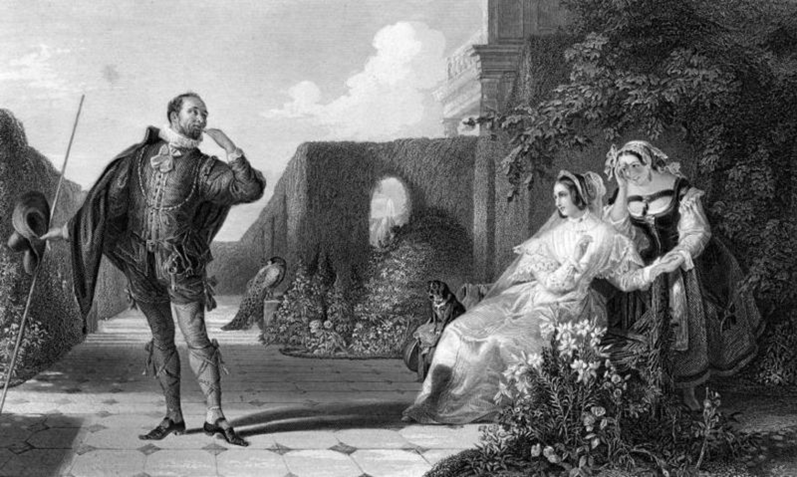
It is also a comedy because Shakespeare involves several aspects in the play.  He uses twins to have mistaken identities.  Both Sebastian and Viola are mistaken to be someone else.  When Viola dresses up as Cesario, she has a very similar likeness to her twin brother Sebastian, later to be mistaken for Cesario.  Sebastian is confused with his twin sister, dressed as Cesario, when Olivia finds him and confesses her love for Cesario/Viola.  Shakespeare also uses Viola dressed as Cesario to serve as a go-between with the duke and Olivia causing a love triangle to erupt.  It includes romance in the fact that several marriages occur.  Shakespeare also involves several characters such as Sir Toby Belch, Sir Andrew Aguecheek, and Feste the Fool to provide slight comical interludes in the play.

Twelfth Night is an example of a Saturnalian love comedy because of the cross-dressing aspect.  Viola disguises herself as a man, Cesario.  The Saturnalian aspect comes into play here because she doesn’t act like herself.  She is free from inhibitions.  She doesn’t feel self-conscious about the way she acts.  She felt free to do as she wished with no hatred or distaste toward her.  Viola finds herself dressing up as a man after washing ashore after a shipwreck.  It is necessary that she makes a name for herself in this new strange land of Illyria, so she dresses up in men’s clothing to make her way in a man’s world.

This play is also an example of a Saturnalian love comedy because it is based around a holiday.  Saturnalia often is based around a holiday.  In this case it is based around Christmas.  The twelfth night is the last day of Christmas.  This is the day in which everything is revealed.  It is on the twelfth night of the Christmas holiday that Sebastian is recognized as Viola’s brother.  It is also the day that the true identity of Viola/Cesario is revealed.  The true feelings of both the duke and Viola are expressed, causing them to get married, alongside other characters in the play.

In addition to being a Saturnalian love comedy, Twelfth Night is also a Satyric love comedy.  This play involves several aspects of Satyr.  One example of this is the use of death.  The entire story begins when Sebastian and Viola are shipwrecked.  Both believe the other to be dead.  Viola, being the first to arrive on land safely, and thinking that her brother is dead, strives to make a new name for herself and dresses herself in men’s clothing.  Sebastian isn’t found for a number of days and eventually finds himself in Illyria, the same place his sister resides.  The entire play is centered on death in the way that both siblings thought that their sibling was dead.  There is an obvious sense of mortality throughout the play.

Twelfth Night is also considered a Satyric love comedy because it involves trickery, foolishness, and folly.  Malvolio is the sort of character that lives to spoil the fun of other people.  He enjoys revealing plans that were meant to be a secret.  Sir Toby and Maria then strive to take the joy Malvolio gets from this away from him.  They concoct a plan to write a false letter from “Olivia” expressing her love for Malvolio.  Malvolio’s character completely changes.  He does anything in his power that will attract Olivia and draw her attention, thinking that she loves him.  He is in pursuit of something that he believes is true but everyone else knows is false.  He acted as a fool, as Maria and Sir Toby acted in ways of folly.

Finally the play is a Satyric love comedy because it ends with the warning of doomsday.  Twelfth Night ends with a song by Feste.  This song discusses life.  He sings about how life progresses.  It talks about how things in life change and don’t make sense.  It is a reflection on the play that precedes it.  It discusses the wind and the rain and how some things matter but others will always remain the same.  It talks about the mortality of man and how everyone is going to grow up, and therefore, everyone will die.  Once again, the theme of coming death has weaved its way into the play.

Twelfth Night not only possesses the characteristics to be a love comedy, but it also involves the aspects of Saturnalia and Satyr.  The Saturnalian aspects come into play when Shakespeare weaves in the idea of the holiday and the ending of the Christmas celebration.  The Saturnalian aspects also include Viola’s dressing up as a man and being free from inhibitions and contempt.  Satyr is involved because Shakespeare uses many dark elements in his comedy.  The theme of death and doomsday is recurring.  There is also a use of foolery and trickery.  Because of these different aspects, Twelfth Night is considered a “Saturnalian/ Satyric” love comedy.

Twilight

Emily Grant Privett

People obsess over the little things.  One of which is Stephenie Meyer’s Twilight, later to be followed by New Moon, Eclipse, and Breaking Dawn.  Since the past few years, one cannot walk the street without hearing about this new vampire and werewolf phenomenon.  It is everywhere surrounded by mobs of teen girls and moms, with the occasional male thrown in here and there.  Why did a book of this genre find so much success?  What is its secret?  Why is there such a following?

When this book first came out, I knew practically nothing about it until I was forced to read it by a friend.  I eventually found myself sucked into the event, soon to be considered a wave of enthusiasm about this series.  Little did I know then what this seemingly simple story was about to become.

This is not to say demeaning things about the readers of these books as I too have been sucked into this pop culture phenomenon they call literature, but this is to stand as an argument to convince those from wasting their precious time with such frivolous activities.  This series may be addicting but is not worthy of your time.

Many young girls find comfort in this series because they find the main character relatable.  Yes, young Bella Swan is your seemingly average high school girl, crushing on the not-so-average high school teen or not teen.  She may be clumsy and quiet.  Bella moves to a new town where she feels to be an outcast.  She is a member of a broken family with her father living in Forks, Washington, and her mother and step-father residing in Jacksonville, Florida.  But if you think that you are a clumsy, clueless, helpless girl, living in a small, wet town surrounded by dangerous creatures and an oblivious police force, you have a sad life, my friend.

The world that our protagonist lives in is a complete and utter fairly tale, not in the sense of the world itself, but by the people, or should I say monsters that reside in it.  From nomadic vampires to werewolves and shape-shifters, this universe is entirely surreal.  The innocent townspeople survive “animal attacks” that really happened to be attacks from hungry vampires.  It is strange that these “hungry vampires” only exist in a few places in the world.  Never do we read about vampires attacking the people of  other states, such as Wyoming or Maine, but they all reside in places like Washington, Alaska, and Europe.

It is also strange that when Bella is told that half of her friends are beasts, she finds it so easy to believe.  After accidentally brushing her hand on Edward, and she feels his icy skin, she automatically starts to think that he is non-human.  If I went up to a friend and was like, “Hey, I don’t eat normal food, and my skin is always cold, and my eyes are weird,” the first thing that pops into her head is not going to be the fact that I’m a vampire.  It’s not even that he told her what he was.  She decided to Google his features and easily “discovered” what he was.  She had to believe what the Internet told her, because everyone always knows that the Internet NEVER lies.

Why are people so obsessed over Edward Cullen?  I’m not going to lie, I had a little obsession over him myself, but the more I think about it, I really can’t give a practical explanation why.  The first time we meet this Edward character he looks as if he is about to explode.  Of course she has to sit with him, and of course she thinks he’s a bit strange.  After missing for the next few days, he appears acting completely differently with different-colored eyes.  Upon further investigation, we discover that he is a complete creep.  He stares at her through her window at night by climbing up a tree outside of her room.  He can’t sit in the same room with her without staring at her.  He is completely obsessive over her existence, and this is all before she discovers what he truly is.  After she finds out he is a vampire, she is completely fine with his actions because she loves him.  I’m not sure about you, but someone who shows up everywhere, stares at me while I’m sleeping, and randomly disappears and reappears, doesn’t sound like a romantic to me.  She is willing to believe anything he tells her.  And like a child, she follows his every action.

Time after time, Edward willingly hurts Bella, knowing what kind of effect it will have on her.  He pulls himself away from her after previously forcing himself on her just a few chapters before.  Who would want to live in the footsteps of someone who would continuously hurt her time after time?  She spends all of her time thinking about this creature that is creepy and cold, no pun intended.  Other than his physical attractiveness, what is really attractive about the character of this being?  The reasons for liking him are few.

She spends the majority of her time around Edward and his vegetarian vampire “family”: Edward, a mind reader; Alice, one who can more or less see the future; Jasper, one who can tamper with emotions; Emmet, the strong one; Rosalie; Esme, the mother figure; and the father figure Carlisle, the doctor.  Stephanie Meyer has a sense of humor when she created this family.  She transcends all stereotypical vampire assumptions.  The vampires never sleep, as assumed about most vampires, but unlike fake vampires, these “real” ones have a crucifix in their home, and their father is a doctor, dealing with blood every day.  It no longer affects him and eventually hardly affects any of the other members of the family.  This family is a group of vegetarians.  Instead of living off of human blood, they survive solely on animal blood, as not to kill off the people.

Bella also finds herself living in the midst of werewolves.  When she’s not spending all of her times around bloodsuckers, she is living among the dogs.  The only beings she associates herself around willingly are non-human.  And of course, what kind of story is it without your classic species conflict?  Vampire against werewolf, and both against man.  Not only is this conflict between the two different beasts, but it also evolves into a love triangle.  Edward and Jacob are enemies fighting over the love of their lives, Bella.  Not only has this character found herself stuck in a relationship with a vampire but also with a werewolf.  Needless to say, the situation got hairy.  One attractive fact about this story is that Bella has two “kind of people” fighting for her with their unconditional love.  The fact that Edward and Jacob are willing to do anything to gain her favor is what interests many.

Alongside these two feuding groups of people, there are vampires that are only concerned about themselves and are human killers.  These are the “weird” vampires.  They aren’t “normal” in comparison to the Cullen family.  They go after Bella, and in order to keep them away, Edward kills James.  James is Victoria’s mate, and obviously when James is killed, Victoria has to come back with a vengeance — how else would there be a sequel?

It is strange that the somewhat stereotypical vampire is the one that we classify as strange or evil in these books.  When a vampire is willing to drink animal blood, work in a hospital, or not mind the smell of garlic, we are completely accepting.  But the instant a vampire appears, one that does what vampires are generally thought to do, we find them utterly revolting and unworthy of life.  Now, this is not to say that their actions are pardoned because of their lifestyle, but this is to say that it is interesting to think that these characters are naturally rejected because they are your usual sort of vampire.

Stephenie Meyer’s pop culture sensation has affected the lives of many and not necessarily in a good way.  A countless number of people have thriving obsessions over the characters, and in some cases, these obsessions have impacted their lives.  There is no real reason why this series has become popular, or at least should be popular.  The story is rather predictable and the characters are weak.  It is sad to see what modern “literature” has become, though not worthy of being called literature.  There is no good, logical reason why this series is so popular, other than its ability for others to somewhat relate to it but only in minor ways.  It is full of love triangles and the main character just floats aimlessly through.  So, having said all of this, there is no real point in wasting time reading this pop culture sensation.  There is no real reason for its popularity and success.

The Here and Now

Emily Grant Privett

Have you ever found yourself tapping your fingers impatiently as you wait for your food to finish cooking in the microwave?  Does it feel as if minutes drag on as you wait at a traffic light?  The culture that we currently reside in is sadly obsessed with speed and convenience.  One isn’t happy unless everything passes quickly and accurately.  The short 30 seconds it takes to heat up your chicken nuggets and the one and a half minutes it takes to wait at the light is seemingly too long.  Technology is the main cause of this.  The world we live in has been affected by new advances in technology.

Technology has spoiled this culture and is in turn a major cause of such impatience.  Every day, new items are being invented that make everyday tasks quicker and easier.  People are becoming lazier and lazier.  Not only does the completion of a certain task feel too difficult, but it takes way too long.  Our culture is concerned with practicality.  Everything must work to make our lives easier.  Any little thing that can be bought to improve life will be used, as if in some way ease, happiness, and relaxation can be bought.  This society is a society of lazy people.  If something doesn’t have to be done, then why do it.  In the same way, if one can find an easier way to do something, then why not take that route.

As previously mentioned, cooking one’s food would be an example of this.  You stand at the microwave waiting for your food to cook.  You have just placed your plate of frozen chicken nuggets in the microwave, and it is only a matter of minutes before you are able to enjoy them.  The light comes on, and the turntable begins to spin.  As this happens, you wait and hope that those chicken nuggets are finished when the timer goes off.  The very last thing you want is to have to wait another 30 seconds because the inside of one of them is still frozen.  The original wait felt long enough; extra time added would be horrible.

One must compare this to the past to really deliver the point.  In recent history, microwaves didn’t exist and only a short time before that, ovens weren’t found in the everyday home.  The only practical way to heat things up was over an open fire.  This may sound simple at first, but heating something over a fire wasn’t as simple as just sticking pieces of food over flames.  To begin with, one would have had to gather wood and start the fire.  After waiting for quite some time for the flames to build, the chicken must be prepared.  There were no pre-packaged, pre-cooked, breaded pieces of chicken.  One must bread and cut the chicken himself.  After this was completed, it was time to stick it over the fire, and it would take quite a while to cook after that.  A simple two minute heating experience now would have been a long hour long process in the past.  Because of the invention of the microwave, or even the oven, mankind has become spoiled and expecting everything to happen faster.

Another example of this is waiting in traffic or sitting at a stop light.  Everyone has sat in traffic before.  When this happens, time feels as if it is dragging along.  One would want to be anywhere but there.  Sitting still or going at a slow speed for less than an hour on the way to Williamsburg feels like a terrible feat.  As before, one must look at a comparison to the past.  Before the car was invented, one was required to travel on horseback, by carriage, or even by foot.  The trip from Summit Christian Academy to Williamsburg would have taken hours.  Back then, one would be lucky to make it in an afternoon, depending on one’s mean of transportation, of course.  One would have probably greatly enjoyed being there in an hour, even if it included waiting in traffic for half of the time.  The change in technology hadn’t affected people of those days yet, when it had taken them hours to go such a short distance.  In times like today, with technology such as ours, waiting in traffic seems like one of the worst things to do, causing it to take us an extra 45 minutes to get somewhere.  When they weren’t able to experience such luxuries, one must have thought how much more convenient it would be to make it there in such a short amount of time, instead of several hours of walking or riding on horse.

The definition of convenience has changed.  In the past, getting from one place to another in a good portion of the day was rather convenient, as compared to now, where arriving at your destination without stopping for any reason would be considered convenient.  Another example of this is the sudden shift in reading materials.  In the past, people were lucky to be able to even get their hands on a book, much less know how to read it and study it.  These days, books are not in short supply and are being replaced with items such as the Kindle and the iPad.  Books were in short supply hundreds of years ago, and now, when people have the opportunity to use them, they give up that ability to use electronic versions of the same material.  Paper books apparently aren’t considered convenient anymore, and having electronic books are a much better choice.  It can hold several books on it at once and is transported much easier.  Technology has taken over society and replaced “old” or “outdated” items and methods with “new” and “fresh” ones that will supposedly make life easier, simpler, more convenient, quicker.

The fact that technology has created something “better” doesn’t mean that the “old fashion way” is bad or not worth doing.  An example of this is mops.  Over the past few years, several companies have created cleaning supplies that work better than the traditional dustpan and broom set, and clean deeper than the ordinary mop.  The have cleaning liquid in them.  It takes away the old inconvenience of cleaning one’s floors.  Just because these new mops and brooms have been created says nothing about the original method.  Using a traditional mop is a perfectly acceptable way to clean one’s floor.  As long as it gets the job done, than what does it really matter?  It is not to say that the change in technology is a bad thing, but to stress the idea that our culture isn’t the same as it once was.  This is a result of the rises in technology that have occurred.

In summary, the actions of humanity have become progressively lazier.  Everything is concerned with convenience, practicality, and speed.  If something doesn’t happen fast enough or good enough, then something must be wrong.  The current culture is a “me” obsessed culture.  Everything concerns the individual.  What can make me happy?  How can this make life easier for me?  Technology is one of the biggest causes of this because it provides the motivation for improvement.  Without it, the world would most likely be in a similar state to what it was hundreds of years ago, living the same sort of lifestyles.  The world will never be the same because of the more recent changes in technology and is currently feeding the human addiction to convenience, practicality, and speed.

Perfection

Emily Grant Privett

Perfection is achieved when something is excellent or complete beyond practical or theoretical improvement and without any flaws, shortcomings, or defects.  It is widely known that only one has achieved true perfection.  That one man is Jesus.  The only reason this was completed was because he was fully God as well.  Ultimate perfection is unattainable.  If this is the case, then why does man in our society attempt to defy his nature and attain perfection?

It is universally known that everyone desires to do everything to perfection.  But it is also universally known that man is always unable to reach that true perfection.  By doing this, man is intentionally trying to become something that he is not.  Only Christ can say with confidence that He is perfect at all things, at all times, and in all places.  No one can live up to the standard he set.

It is important to point out the difference between doing one’s best and trying to attain perfection.  Trying to do one’s best and being one’s best is different from being perfect.  Doing and being one’s best is doing absolutely as well as one can possibly do, whenever one can, all for the glory of God.  As previously stated achieving perfection is making oneself excellent or complete beyond practical or theoretical improvement and being entirely without any flaws, shortcomings, or defects.

Each has his or her own special talents, gifts, and abilities.  This fact is common among all people.  No one can be good at everything.  Romans 12:6 says, “We have different gifts, according to the grace given us.”  Clearly not everyone is good at the same things.  If this is so, then why are people criticized because their best isn’t good enough?  Those criticizing others are not perfect at the task at hand either.  Unless they themselves had reached perfection, then they should not make criticisms about others. As earlier established, none can reach perfection in any field, but Christ.

Each must learn his or her boundaries in their particular field of expertise.  Even one who may be considered a master at his/her field has not reached true perfection.  Each person must learn where he or she has a talent or skill.  One cannot expect to be amazing at something that he has no experience in.  For example, a professional athlete would not be expected to do well at being a hairstylist.  However, he would be expected to show tremendous skill at whatever sport he played.  When dealing with hair, the customer would most likely be extremely unhappy with the outcome, but when playing his particular sport of expertise, audiences would most likely enjoy watching the player.

Having already established that one cannot reach true perfection, it must be pointed out that much of society has a different definition of perfection than the dictionary.  The dictionary definition is long term, being perfect at all times in all places.  The societal definition generally consists of temporary greatness.  One can be good at one thing but is definitely not so in other fields.  Athletes experience this.  In the game of volleyball are several types of maneuvers.  Passing, setting, hitting, and serving are considered the major ones.  One can be an excellent passer, but that has nothing to do with one’s skill in hitting, setting, or serving.  “Perfection” in one field, generally has nothing to do with “perfection” in another field.  Therefore, even the societal definition of perfection wouldn’t consider this perfect.  One may be a “perfect” passer, but perfection in one field isn’t the item in question.  It is like saying one has a perfect report card.  Unless one has reached perfection in each and every class, a report card cannot be perfect.

Another example of this would be taking the SATs.  One can take the test several times and at one point, get a “perfect” score.  The word “perfect” here is taken very loosely.  Do the makers and graders of this test mean that the taker of the test is perfect at everything he/she was tested on? Absolutely not.  The score has nothing to do with the actual person.  It may be a partial reflection of the person taking the test, but the fact that he/she achieved a perfect score has nothing to do with the fact that he/she may have guessed on a few questions, or in the future, may get a question or two wrong.  The SAT is not a test of perfection of the student but perfection of the answers they record.  The answers may all be correct, but that does not mean that the student is perfect in every Math and English subject.

There is no possible way that one can become perfect.  There is no such thing as a perfect athlete, friend, student, parent, family member, etc.  We were all born into a fallen world, and there is nothing we can do to change that.

There is no possible way that one can become perfect.  There is no such thing as a perfect athlete, friend, student, parent, family member, etc.  We were all born into a fallen world, and there is nothing we can do to change that.  We all make mistakes.  If this is a commonly known subject then, why does society push perfection on us? Are they trying to deny our human nature?

The subject of this question is not perfection itself but the definition of perfection.  Society’s view of perfection is doing ones best and trying to do everything the best that it can be possibly done, where the dictionary says that perfection is having no flaws, shortcomings, or defects.  There is no possible better way to do it.  Society mixes the two definitions.  According to society, man can achieve perfection in certain fields, but it is only a temporary thing.  One may get every question correct on a test.  Technically, he achieved perfection, but in the long run he missed several questions over the semester.  The perfection of the student was only temporary.  The possibility of a student being “perfect” in the class is highly unlikely.  The idea of a human, having a perfect existence, is impossible!

Society only looks for the temporary perfection.  They don’t expect true flawlessness in everything, just the issue at hand.  Society only has an interest in the here and now.  The people involved in the situation only desire one to attain perfection at the given time.  They don’t expect one to go home and still be “perfect.”

Now it is time to get down to the final question.  Why do others seek perfection out of us?  It all comes down to each person’s understanding of perfection.  When most people think of perfection, they believe that it means making no mistakes after doing one’s best.  These people seek perfection in other people, because they themselves know that they are incapable of it.  They want to believe perfection is possible.  Striving for perfection and attaining perfection are different.  What they really want is people to strive for perfection, with little intention of the actual attainment of that perfection.  Society is not willing to accept the imperfection in our lives and causes people to seek for perfection in others, what they can’t find in themselves.