
Tag Archives: destiny phillips coats

What is a Cowboy?

Destiny Phillips Coats

When one thinks of the Wild West, many different components come to mind like bison, Indians, farms, horses, whiskey and more.  Film after film and novel after novel have been made that try to capture the perfect idea of the West and what it brings to viewers and readers everywhere.  The most famous constituent of the Wild West is most definitely the cowboy.  In the hearts and minds of children everywhere, they see cowboys as strong handsome men who herd cattle, live on farms, and fight the Indians.  The question is, however, who were cowboys really and how have they influenced literature and film?

The cowboy was a term coined for the cattle herder in Texas during the era of the open range and great cattle drivers of 1886-1896.  Due to the scarcity of cattle up North, the Texans saw promise in the economic value of selling cattle.  In Texas of 1886, a steer worth 4 dollars was valued at 40 dollars in the North.  Cowboys began taking cattle up north to the train station in Sedalia, Missouri to send to their new business partners.

The adventurous and dangerous lifestyle of the cowboy came from the travelling aspect of their job.  With the migration of their cattle, the cowboy crossed over farm land and Indian Territory.  Confrontation indeed arose from the cattle trampling crops and the homelands of the Indians.  These conflicts were inspiration for the stories that portrayed cowboys as lawless and adventurous men who fought the Indians and lived freely in the Wild West.

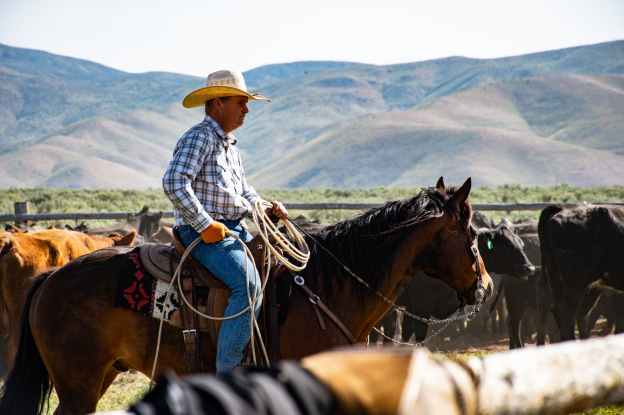
Merriam Webster says the cowboy is “a man who rides a horse and whose job is to take care of cows or horses especially in the western U.S.”  This definition can seem boring in light of our connotation with a cowboy being much more dreamy and adventurous.  Where does the strong, handsome, courageous, and dreamy cowboy come from?  The answer to that question is literature.

The Virginian by Owen Wister, written in 1902, was the first novel that portrayed the cowboy as what we see him today.  This novel about a cowboy who falls in love with an eastern school teacher started a revolution in American literature about the cowboy and his adventures.  Owen Wister was from Philadelphia and graduated from Harvard College.  Experiencing the freedom of the West on a hunting trip inspired him to write The Virginian.  The way he portrays the beauty and free mind of the western citizen inspired others to create stories to take readers on an adventure of the cowboy in the “land of the free” and “home of the brave.”  Countless other books have been written that express the meaning of our connotation of the word “cowboy.”  They include Lonesome Dove, Riders of the Purple Sage, Hondo, All the Pretty Horses, and so many more.  As technology advanced and film making became a part of media, cowboys leaped off the pages onto the big screen.

Cowboys came onto the film scene in 1903 with the making of The Great Train Robbery by Edwin S. Porter.  Cowboys have taken on so many roles and influenced the hearts and minds of Americans for generations. TV shows like Bonanza; Walker, Texas Ranger; and Gunsmoke are just three examples of the numerous western TV series with main characters of cowboys.

The explanation of why cowboys are so amazing and great characters for literature and media is said perfectly in the following excerpt.

The men who worked the cattle in the treeless expanses of the West, at least one-fourth of them blacks, became known as cowboys.  The image of the courageous, spirited horseman living a dangerous life carried with it an appeal that refuses to disappear.  Driving a thousand to two thousand cattle hundreds of miles to market; facing lightning and cloudbursts and drought, stampedes, rattlesnakes, and outlaws; sleeping under the stars and catching chow at the chuckwagon — the cowboys dominated the American galaxy of folk heroes.

More than just the spirit of the cowboy influenced literature and film.  The cowboy’s distinct yet necessary dress has penetrated the realm of American fashion.  Each article of clothing had a purpose for the cowboy.  From the soles of his feet to the top of his head, the cowboy took every opportunity to make use of what he had on the vast plains of the Midwest.  The boots with thick heels and spurs made it easier to rest their feet in the stirrups on horseback and dig into the ground while catching a calf.  The flannel or wool shirt kept him warm during the cool days and nights on the western terrain.  The vest was worn for protection from cold nights in the vast plains of the west.  A bonus to the vest was the many pockets it had, which often carried tobacco.  The bandana often seen in western movies around their necks was used to cover their mouths and noses from dust that circulated in the flatlands.  The wide flexed rim of the hat blocked the hot sun, held water, and even worked as a pillow during a night’s rest on the flat surface of the Midwest earth.  Flannel shirts and cowboy boots have been a fashion trend since the time of the cowboy in 1886-1896.  With the strong influence the West has had on who Americans are and our heritage, cowboy fashion will never go out of style.

With all the portrayals of brave men who love and ride hard in novels, film, and fashion, how do we separate who they really are versus how we see them?  We can’t and we won’t.  The cowboy we love so much has become an American hero, and changing how we see them would be taking a part of our history away.  They are a symbol of American pride and adventure.  They are representative of the free spirit and beauty of the west.  They are inspiration for so many wonderful characters, from Woody in Toy Story to Walker in Walker, Texas Ranger.  Cowboys will never be forgotten.  They were important to society then, now, and forever.

So who is a cowboy?  He is an American hero.

Bibliography

“Cowboys.” History.com. A&E Television Networks, n.d. Web. 04 October 2015.

Merriam-Webster. Merriam-Webster, n.d. Web. 07 Oct. 2015.

“The Ways of the Cowboy.” Ushistory.org. Independence Hall Association, n.d. Web. 04 Oct. 2015.

The Mystery of Prayer

Destiny Phillips Coats

“Out of the pen of Feuerbach, the truth flows.”  This is a false statement.  Throughout the entirety (that we have read) of The Essence of Christianity, Ludwig Feuerbach has made many false statements.  The multitude that has pained me the most are in chapter 12, “The Omnipotence of Feeling, or the Mystery of Prayer.”  As Christians, we believe the complete truth is presented to us in God’s Word.  Anything we hear outside of God’s Word should be judged accordingly with the Word to see if it holds true.  Nine times out of ten, Feuerbach’s “truth” does not.

Feuerbach thinks he has an understanding of Christianity.  A non-believer reading this book would probably be fooled by his big words and long points that fly over the head of the average person.  We (believers) must guard our hearts (Proverbs 4:23) from false truths presented to us.  Not only should we divert from them, but also we must understand how to disprove them with truth: Scripture.

Throughout chapter 12, Feuerbach gives many absolute statements for what prayer is; each time however, he is wrong.  “Prayer is the unconditional confidence of human feeling in the absolute identity of the subjective and objective, the certainty that the power of the heart is greater than the power of Nature, that the heart’s need is absolute necessity, the fate of the world” (123).  This is his first “definition” of prayer.  What does God say prayer is?  Psalm 145:18, “The LORD is near to all them that call on him, to all that call on him in truth.”  Prayer is seeking after God’s heart.  It is revealing to God our heart so He might hear us and commune with us.  In simpler terms, it’s how we communicate with God.  Feuerbach’s idea of prayer is a selfish outpouring of one’s heart to combat the laws of nature; the power of the heart is strong enough to give it all its desires.  God’s Word tells us He will give us the desires of our heart.

Feuerbach says “the power of the heart is greater than the power of Nature … heart’s need is absolute necessity.”  At first glance these could appear to mean the same thing, but just a few words change the meanings of each.  God says He will give us the desires of our heart. He did not say our hearts are strong enough to overcome nature.  That is the root of this first falsehood by Feuerbach.  He did not come to the knowledge God is the creator and He alone has power to give us the desires of our heart.  He instead decided because there is no God, the only explanation for prayer is a selfish outpouring of one’s heart and strong belief the human heart separate from God can make our desires happen.

“Prayer alters the course of Nature; it determines God to bring forth an effect in contradiction with the laws of Nature” (123).  Feuerbach was actually pretty close with this one, but yet so far.  Psalm 107:28-30 says, “Then they cried to the LORD in their trouble, and he delivered them from their distress.  He made the storm be still, and the waves of the sea were hushed.  Then they were glad that the waters were quiet, and he brought them to their desired haven.”  Prayer does change the circumstances around us — nature.  Feuerbach went wrong when he said prayer “determines God to bring … contradiction with the laws of Nature.”  God created the world; therefore, He wrote the laws of nature.  He can choose whether He wants to operate within them or not.  Because He is God, we cannot put earthly limitations on a spiritual being.  He does not have to operate within the limits nature has put upon us.

“Prayer is the self-division of man into two beings, a dialogue of man with himself, with his heart” (123).  Feuerbach got this all wrong.  Prayer is a conversation between believers and the great intercessor, Jesus, who then communicates our desires to God the Father.  Because of sin, mankind has separated himself from God.  God is perfect and cannot commune with imperfect beings.  This is why God sent His son Jesus to redeem us.  God desires relationship with us.  Relationships are built around communication.  Jesus is the redeemer who washed away our sin, so we might be made perfect in Him to once again communicate with God.  This goes to show without a true knowledge of Christianity as a relationship between God and man, head knowledge will cause a person to interpret the things of God (spiritual) with his own (earthly) knowledge.

“It is an extremely superficial view of prayer to regard it as an expression of the sense of dependence.  It certainly expresses such a sense, but the dependence is that of man on his own heart, on his own feeling” (124).  This is the complete opposite of what Christians believe. Christianity in its core is coming to the knowledge and understanding on one’s own, one is nothing.  One must turn from his old ways and become completely dependent on God to fill the void in his heart and to supply all his needs.  We are not co-dependent in our relationship with Christ.  God does not need us.  He wants us.  There’s a difference.  She wants the cookie.  She needs the water or she will die.  God does not need us.  We need God.  Without God, humanity would not exist.  Without a relationship with God and coming to the knowledge of Jesus as our Savior, man is damned for eternity in Hell.  This is an example of how Feuerbach has wrongfully accused Christians of thinking highly of themselves to believe their own hearts can supply their needs.  Even without knowing it, non-believers are solely dependent upon God the Father.  They just choose not to believe it.

“The omnipotence to which man turns in prayer is nothing but the Omnipotence of Goodness, which, for the sake of the salvation of man, makes the impossible possible; is, in truth, nothing else than the omnipotence of the heart, of feeling, which breaks through all the limits of the understanding, which soars above all the boundaries of Nature, which wills that there be nothing else than feeling, nothing that contradicts the heart” (125).  Feuerbach is saying the heart is so powerful it can cause Christians to see/believe the reality they picture within their hearts.  This in a way is true, but not true regarding prayer.  The mind is strong enough to cause people to stumble upon a false reality.  The mind is not powerful enough to make that reality true outside the mind, nor is your heart.  God is the only power that can overcome the constraints of our natural realm.  Only through God can believers have a glimpse of God’s reality.  Hearts alone cannot bring things into fruition, only God can.

Feuerbach’s final false statement in this chapter alone is, “in prayer man turns to the Omnipotence of Goodness; which simply means, that in prayer man adores his own heart, regards his own feelings as absolute” (125).  This can be disproved with intercession.  If prayer was just this shallow definition implying a huge amount of selfishness, why would we believe that by praying for others unselfishly, Christians can bring about change in the lives of others?  It cannot!  Prayer can be used selfishly, but prayer in and of itself is not a selfish thing.

Ludwig Feuerbach constantly makes absolute statements about Christianity when he does not really understand it.  If he did understand it, he probably would have been a believer.  With arguments like these against Christianity, he as a believer could have done exploits for Christ’s kingdom.  Feuerbach is a prime example of wrong interpretation of the Word of God.  It can bring people to the wrong conclusions about the truth.  The only way we can rightly interpret Scripture is with the Holy Spirit.  We must ask for salvation to come to the correct knowledge of who God is.