Tag Archives: christopher rush

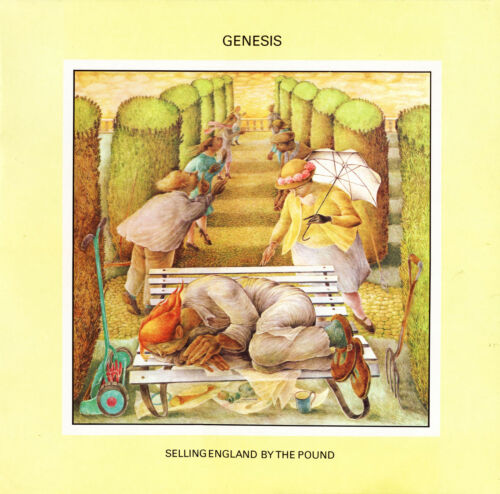
You Play the Hobbyhorse, I’ll Play the Fool — Selling England By the Pound: Gabriel’s Genesis Retrospective, pt. 5

Christopher Rush

Those Eggs are Now Scrambled

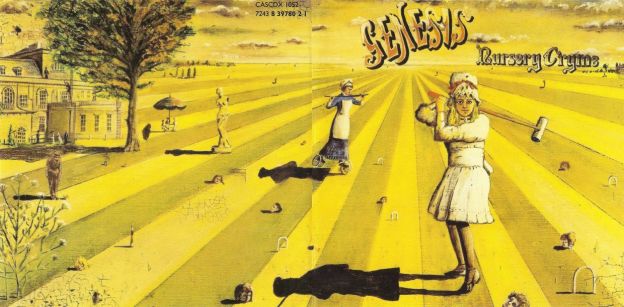
Fresh from the success of the greatness of “Supper’s Ready” and Foxtrot, Genesis was poised to create their most successful album (according to certain systems of measurement) with the nonpareil Selling England By the Pound: at once a culmination of the pastoral motifs and ideas as far back as Trespass and a full maturation of the band’s musical abilities.  I have admitted already Selling England By the Pound is my favorite Genesis album; hopefully that does not hamper your desire to listen to it or any other Genesis albums.  Some of the nostalgia factor may be in evidence here, not only in the compositions by the band, but also in the universal recognition of the quality of the album, since this is the last typical Gabriel-era Genesis album, considering the unusual nature of his last effort, The Lamb Lies Down on Broadway.  Though it seems they did not know at the time this was to be their last such classic album, enough heart and soul are poured into every song on this album to make their lack of prescience irrelevant.  Much more politically satirical than they’ve been before, Selling England By the Pound is truly Genesis at its best.

“Dancing with the Moonlit Knight”

Though this is the last “typical” Gabriel-Genesis album (by which I mean the last album driven by epic narrative songs of radio-unfriendly length), it begins differently than all the others: with the voice of Peter Gabriel, a capella, singing/calling “‘Can you tell me where my country lies?’ / said the unifaun to his true love’s eyes.”  From the first we are brought into a midsummer-night’s dream-like world of political satire, mythical beasts, and economic uncertainty.  “‘It lies with me!’ cried the Queen of Maybe /— for her merchandise, he traded in his prize.”  England is resting with the Queen of Maybe, uncertain where it is going, perhaps forgotten what it is and has been.  The Wordsworthian assault on trading one’s prize for the merchandise of Maybe echoes the poet’s searing line “We have given our hearts away — a sordid boon” too much to be ignored (except by those Gabriel is satirizing).  Despite the Elizabethan/idyllic music that begins to accompany Gabriel here, before the end of the first stanza of the album we are confronted with a pessimism even sadder (despite its much smaller scope) than the overpowering sorrow of “Watcher of the Skies” — perhaps because the music is so simple and soft the pathos is even more palpable.  Sic transit exordium.

Immediately the scene shifts to another Genesis prototypical British scene: “‘Paper late!’ cried a voice in the crowd. / ‘Old man dies!’  The note he left was signed / ‘Old Father Thames’ — it seems he’s drowned; / selling England by the pound.”  Newsies hawk their papes, youth and age continue their cycles, the water flows, and England fades into the twilight — if nothing is done to stop the acceptance of life just existing, sacrificing the important, the beautiful, on the altars of productivity, technology, and utility.  It’s not right to make money off stories of people in unfortunate circumstances — by doing so, we are selling our own dignity.  A culture with too much license start to consider themselves “Citizens of Hope and Glory,” and as “Time goes by” they think “it’s ‘the time of your life.’”  This sort of overly-simplistic thinking meets with appropriate caution: “Easy now, sit you down. / Chewing through your Wimpy dreams, / they eat without a sound; / digesting England by the pound.”  Life is not about having enough to get by, enough to enjoy for the day — enough food for today cannot be the standard for “the time of your life,” in part because it is too self-centered a perspective to be genuinely good.  The “Wimpy dreams” is an allusion both to the Wimpy fast-food chain in the United Kingdom as well as the George Wimpey housing company for dream homes.

The change of tune at this point makes for a good bridge between the early musical motifs and the clangorous (but in a good way) chorus to come.  In this bridge, Gabriel expresses the conflicting (and both erroneous) perspectives on what makes “the time of your life.”  “Young man says ‘you are what you eat’ — eat well. / Old man says ‘you are what you wear’ — wear well.”  Again the point is made that immaturity believes the only thing important in life is to enjoy the physical sensations of the moment; if bodily desires are satiated, nothing else is important for life is transitory and ephemeral — so says invincible youth.  Old age, conversely, believes the good life is about one’s status in society, evidenced a great deal by one’s appearance, particularly by the name-brand apparel one wears.  The mediating voice neither rejects nor approbates either point: instead, Gabriel simply enjoins the audience to do both: eat well and wear well — neither is “the right answer,” but neither are they bad advice as component parts of “the time of your life” as it truly is in relation to others and the well-being of society as a whole.  Beyond intake and appearance, a more crucial factor is knowing who you are or “what you are,” not placing as much importance on what others think or say, “bursting your belt that is your homemade sham.”

The chorus is a rousing return to the multi-layered aspect of this opening song, back to the metaphorical characters framing the counter-point of typical British life: “The Captain leads his dance right on through the night — join the dance… / Follow on!  Till the Grail sun sets in the mold. / Follow on!  Till the Grail is cold. / Dancing out with the Moonlit Knight, / Knights of the Green Shield stamp and shout.”  Britannia, the Moonlit Knight takes us on a cosmic turn to the past and present of merry old England.  The Green Shield stamp is a subtle allusion to the Green Shield Trading Stamp Company designed to encourage consumerism by enabling the purchase of gifts through the stamp system (a kind of precursor to the credit card rewards programs so popular today).

Speaking of credit cards, after the fast-paced musical interlude, Gabriel uses a different voice for the slightly menacing carnival-barker bridge: “There’s a fat old lady outside the saloon; / laying out the credit cards she plays Fortune. / The deck is uneven right from the start; / and all of their hands are playing a part.”  The juxtaposition of tarot cards and credit cards is even more applicable today than it was forty years ago, as we are ever-increasingly saturated with the farcical notions of credit.  The best credit score is actually 0, since it means you don’t owe anyone anything and thus are not a servant to the lender.  Perhaps the sub-zero prime mortgage crisis could have been averted had more people heeded Genesis’s warning that Fortune is not based on credit any more than a crystal ball can tell your future: the deck of credit cards is uneven, not in your favor.  Paying with money that does not exist is not a sign of wealth — it is a sign of folly.  The multiple meanings of “hands” after that is another example of Gabriel’s fully-mature lyrical skill.  In few words he has brought several layers of meaning through his symbols.

From that mystical scene we return to the chorus, blending, like a merry-go-round, clanging band music and medieval/pastoral animal imagery: “You play the hobbyhorse, / I’ll play the fool.  We’ll tease the bull / ringing round and loud, loud and round.”  The album is now a game, lightening the mood while subverting our attention away from the political and social satire that will undoubtedly continue.  “Follow on!  With a twist of the world we go. / Follow on!  Till the gold is cold. / Dancing out with the Moonlit Knight, / Knights of the Green Shield stamp and shout.”  Intentionally our views of the world will be twisted and the gold will cool (so much currency talk in this song) and no more coinage to go in the pay slots.  The music then mirrors this predicted winding down; after another rousing and different musical break, the momentum fades and decrescendos into another musical box-like cadence, like stars twinkling out in the ending night.

“I Know What I Like (In Your Wardrobe)”

The fading guitar sprinkles meld into Tony Banks’s Mellotron hum imitating a lawnmower.  “I Know What I Like” is Genesis’s first commercial single success, essentially the only one of Gabriel’s career as their front man.  Though Phil Collins’s turn in the years ahead would see the band’s shift to a more radio- and commercial-friendly incarnation with many single hits, “I Know What I Like” helped form the nascence of that forthcoming mutation, so those who “blame” Genesis’s transformation on Phil Collins ignore the earlier evidences of that progression.  This song remained popular in the band’s live concert repertoire, eventually becoming the framework to the enjoyable lengthy medley of tunes from the Gabriel and early Collins years later in the band’s career.

Like so many others in their early canon, this song is a frame story.  The lawn mower lies down for a lunchtime nap, recalling the conversations he overhears both during his lunch break and, most likely, throughout his workday as a whole.  The song is based on the cover painting The Dream by Betty Swanwick (the band had her add the lawn mower machine to it; it was not in the original version of the painting).

The chorus, preceded by the utilitarian motto of the lawn mower “Keep them mowing blades sharp…” is the most recognizable couplet to the passive Genesis fan from the Gabriel era: “I know what I like, and I like what I know; / getting better in your wardrobe, stepping one beyond your show.”  It’s a rather occluded couplet: why the lawn mower knows what it is in the wardrobe of the people whose lawns he mows is never explained.  If he’s spending so much time observing their outfits, can he really be that good of a lawn mower, ever distracted by his customers’ speech and apparel?  Being unfamiliar with colloquial British expressions, I am incapable of sussing out what “stepping one beyond your show” truly means; I suspect it has something to do with the ever-increasing appearance of affluence of the members in the neighborhood, but I am completely open to correction.

Further in the lawn mower’s lunchtime reflections, he recalls segments of a previous phone conversation with Mr. Farmer: “Listen, son, you’re wasting time; there’s a future for you / in the fire escape trade.  Come up to town!”  That the lawn mower overhears so many different snippets of conversation throughout his workday indicates he is a popular lawn mower (despite the contradictions indicated above).  This is further demonstrated by the phone call asking him to make a better life for himself in what is suggested to be a more lucrative, and thus better, position in what only the British would call “the fire escape trade.”  Despite the seeming advantages in such a movement, the anonymous lawn mower rejects such an offer, after recalling an even older memory of advice he had received in his youth: “Gambling only pays when you’re winning.”  Though he may consider himself “a failure,” and should logically jump at the chance for a better job, he considers the fire escape trade a gamble that will not pay off, so he resigns himself to his present position.  His life as a lawn mower will forever be recognized, failure or not, by the way he walks.  The unusual Eastern beat and melody fades out of this unusual, quirky song slightly reminiscent of “Harold the Barrel” but much more humorous and lighthearted.

“Firth of Fifth”

A play on the common name of the River Forth in Scotland (the “Firth of Forth”), “Firth of Fifth” is about as quintessential “Genesis sound” as any one of their numbers in the Gabriel era gets.  Here, the full maturity of the band’s musical skills is in evidence from the downbeat.  Tony Banks’s introduction surpasses even “Watcher of the Skies” in proficiency and downright impressiveness.  The mixture of 2/4, 13/16, and 15/16 time signatures reminds us piano dilettantes what the instrument is capable of in expert hands.  Additionally, Steve Hackett’s guitar work and Peter Gabriel’s flute work complement the complex and driving melodic lines throughout all nine minutes of this mighty piece.

Lyrically, the song has not aged as well as others in the Gabriel era, but it is better than most seem to recall.  It is a return to the over-ambiguous lyrics of the very early days, admittedly, but it still has enough coherent connotations to make its mythical subtext enjoyable and believable.  Deeper assessment of the words discovers that it can be read as a mixture of Psalm 23, Isaiah 53, and John 10 (with a sprinkling of Romans 1): the people of the world are sheep, who, despite the obvious signs and demarcations in place from the foundations of the universe, refuse to travel the path to freedom.  The sheep are overcome by many dangers in nature and myth (Sirens, Neptune), until the great Shepherd returns to save them fully.  The most coherent aspects of the lyrics are the beginning and end of the words, true.  The middle sections are rather opaque and should probably be taken as furtive aspects of the impressive (if not rationally comprehensible) creative accomplishments of the Shepherd Himself.  As a whole, this song can be one of the most enjoyable of Genesis’s entire output, despite the elusive lyrics at times — their progressive rock skills musically overpower any confusion about the words.  The words that do make sense are Biblically sound and encouraging, despite the seemingly pessimistic final couplet: “The sands of time were eroded by / The river of constant change.”  Consider it another grouping of words going more for the aural effect than the rational cohesion of their denotative meaning, especially with the rest of the song.  By themselves, they are akin to the apocalyptic language of “Watcher of the Sky,” but almost don’t seem to fit fully in this song, which may account in part why Banks doesn’t consider this lyric with much fondness.  They are still comparatively young lads at the apex of their initial popularity, after all, and the song, as mentioned above, as a whole is great.

“More Fool Me”

The second Genesis song led by Phil Collins (the first, as you recall, was “For Absent Friends” from Nursery Cryme), “More Fool Me” is the sparsest number on the album with only Collins’s vocals and Mike Rutherford’s acoustic guitar.  It is a highly enjoyable change of pace on the album (not that the other songs aren’t enjoyable), especially coming before the lengthy British satire “The Battle of Epping Forest.”  It is a relaxing, folk-like ballad about an optimistic young man who, with a self-effacing humor, believes that everything with his girlfriend who has just walked out on him will end up all right.  It’s probably the quietest of the quiet Gabriel-era songs, especially at the beginning.  It needs no further comment: listen and enjoy.

“The Battle of Epping Forest”

“Taken from a news story concerning two rival gangs fighting over East-End Protection rights,” according to the liner notes, “Epping Forest” is a mixture of “Giant Hogweed” and “Harold the Barrel,” with the medieval-modern British satirical tone pervasive throughout the present album.  The album as a whole oscillates between border-line cynicism and tongue-in-cheek optimism.  “Epping Forest” leans more toward the latter, until the climax of the song.  The song is overtly self-explanatory, even for social criticism.  It certainly doesn’t need the extensive footnoting that T.S. Eliot or even Jonathan Swift requires.  It’s a lengthy song and some may justifiably conjecture that it is too lengthy — a lot of words are sung by Gabriel in these almost twelve minutes.  The quirkiness of the song allows Gabriel to use a variety of personas during the different combat scenes, as well as the neighborhood episodes.  The comedic tensions of gangs fighting to “protect” the poor, with the multiple meanings of “protection” throughout the song, are among the highlights of the lengthy number.  The diverse musical motifs and tempos also provide good variety, without which the song would become tedious (some may say “even more tedious,” but that’s unnecessarily harsh).

The various scenes display the album’s blending of modern and antique England.  The “Robin Hood” scene is the cleverest lyrically; the Reverend looking for used furniture following the “Beautiful Chest” sign leads to near Benny Hill-like comedy, though Gabriel rescues it (to a degree) from sheer objectification.  The musical breaks during the different vocal sections are further signs of the band’s musical skill.  Were “Epping Forest” not on the same album as “Firth of Fifth” and “Cinema Show,” it would probably have achieved more notoriety.  The ending is a lyrical pyrrhic victory matched by the music: the story is unsure who wins the fight (since both sides essentially wipe each other out), and the ambiguous and uncertain melodic irresolution demonstrates that well.  This is one of the better unities of the lyrics and music during the song; it isn’t always so appropriately blended.  Altogether, it’s a clever song that occasionally (and only then briefly) suffers from the weight of its own vast and sundry intentions.

“After the Ordeal”

I do not understand why Tony Banks and Peter Gabriel were against including this song on the album; I can understand why Steve Hackett would eventually quit, since the other band mates seemed to consider his compositions (such as this one) so poor.  Did they forget about “Horizons”?  This is a great song, doubly so since it is a completely believable transition from the end of “Epping Forest” to “Cinema Show.”  Without this, the transition would be fine, but with it, the album has another lyric-free achievement celebrating their musical greatness.  Gabriel even gets some keen moments of flute solo work in.  Regardless of the band’s derisive assessment of it, “After the Ordeal” is an enjoyable, cathartic musical number.

“The Cinema Show”

With a harpsichord-like introduction recalling to mind strains of “The Musical Box,” Genesis begins the last (and arguably best) of its Gabriel-era epic numbers.  The sweet, dulcet tones supporting the gentle lyrics at the start of the song may even surpass the beginning of “Supper’s Ready” (nothing surpasses its ending, of course).  The satire here is devoid of cynicism, which is a bit of a relief after the lengthy “Epping Forest.”  The clever multi-layered diction is here in full, and the names of the characters evoke both Shakespeare and e.e. cummings: Juliet and Romeo are prototypical Britishers.  Gabriel’s impressive but all-too rare synesthesia ability returns as well: “Home from work our Juliet / Clears her morning meal. / She dabs her skin with pretty smells / Concealing to appeal.”  Gabriel couples both his sensory word play (skin is usually about touch, but here it’s about the source of her perfume) with his clever paradoxes as seen with the battle to preserve peace in “Epping Forest” (“concealing to appeal,” certainly one of the most intelligent lines in all of Gabriel’s tenure with the band).  “‘I will make my bed,’ / She said, but turned to go. / Can she be late for her Cinema show? / Cinema show?”  Juliet, despite being a lovely, typical girl (in no derogatory way), has enough procrastination in her to make her even more appealing.  Who wouldn’t want to hang with a girl more concerned with enjoying genuine leisure than incessant cleanliness, willing to put the bed making off until after a movie?

The Romeo of “Cinema Show” is like Shakespeare’s Romeo, once he has seen Juliet at the Capulet party at the end of act 1.  This song, in fact, could easily be a musical version of an understood scene between acts one and two, with modern accoutrement.  The contrast of Juliet waiting to make her bed (as in, put the sheets back in order) because she’ll just get back in it by herself after the movie, with Romeo’s desire to make his bed with Juliet (as in, have Juliet in it, too), is yet another great example of Gabriel’s subtle lyrical skill (though Banks and Rutherford wrote the song, admittedly).  Describing Romeo as a “weekend millionaire” is a trenchant commentary on the dating scene.  Yes, Juliet is a part of it with her “concealing to appeal” perfume, but we have no reason to believe she is looking to spend her post-motion-picture evening with anyone or anywhere but her yet-to-be-made bed.  Gabriel’s final observatory question, “Can he fail, armed with his chocolate surprise?” is a fitting end to the gentle send-up of this aspect of contemporary British life (a scene still relevant today, even in America, much more so than “Epping Forest”).  How could a typical lothario possibly not succeed by offering a woman chocolates, a completely original idea!

The music picks up speed and motion, and Gabriel changes the scope of the exploration of modern love (in Elizabethan garb — or the other way around, if you prefer).  From Shakespeare we travel further back to Ovid.  Much has been said of the influence of T.S. Eliot’s The Waste Land — no doubt Banks and Rutherford (and the others) read it in school growing up in 1950s-60s England, in addition to the classics they must have read in public school, perhaps good old Charterhouse School, where Genesis was formed.  Even so, the lyrics are not intended to be as obfuscatory as Modern Eliot was.  Ovid’s Tiresias is helpful enough to understand the gist of what Gabriel is saying.  (If you have not read either The Waste Land or Metamorphoses, you should do so after finishing this journal.)

Father Tiresias, we are told by all sources, spent time as both a man and a woman: “‘I have crossed between the poles, for me there’s no mystery.’”  For this experiential perspective on the differences between the genders he lost his eyesight, according to some.  What is not so clear in this song, we are told by some critical sources, is the meaning of Tiresias’ encoded language next.  “Once a man, like the sea I raged. / Once a woman, like the earth I gave. / And there is in fact more earth than sea.”  At first hearing it may seem Tiresias is commenting on the sheer population difference between men and women in the world: women outnumber men on the earth.  (Not even Tiresias would literally think the globe consisted of more land than sea, would he?)  However, the meaning, we are told, is something different: “there is in fact more earth than sea” means that women enjoy making love more than men do, on a physical level at least.  If that’s true (the right interpretation of Tiresias’ words, not necessarily the authenticity of the interpretation), the fact Juliet is not interested in any physical conclusion to the cinema date with Romeo who is very much looking forward to such an encounter, makes the tale full of humorous and unexpected twists and turns.

The other great aspect of this final epic number from Gabriel’s tenure as Genesis’s front man and flautist begins at the seven-minute mark.  The final four instrumental minutes of the number begin with one of Banks’s finest melodic/solo lines.  Without trying to sound too effusive, the line is soaring, evocative, and uplifting.  The rhythm section soon buttresses Banks’s work with a catchy, driving, syncopated support.  Eventually, the motif works its way through enough variations to everyone’s satisfaction, winding down as so many of Genesis’s lengthy numbers do, returning from its 7/8 beat to its original 4/4 time.  The melodic line returns to a variation of “Dancing with the Moonlit Knight,” bookending the album brilliantly and blending into the final epilogue number.  Since “Aisle of Plenty” was not played on tour, the live concert version of “Cinema Show” received a new, self-contained ending, just as good in its own way.

“Aisle of Plenty”

As a reprise of “Moonlit Knight,” “Aisle of Plenty” is clearly a coda for Selling England By the Pound, uniting the album as one of the best concept albums of the progressive rock genre.  In fewer than one hundred seconds, Gabriel demonstrates his uncanny lyrical ability to pun and satirize in rapid fashion.  It’s doubtful Tess is the Queen of Maybe, thus making the connection to the first song musical and thematic, not directly lyrical/character-driven.  The idea of being lost away from home is clearly a thematic premise throughout the album.

“‘I don’t belong here,’ said old Tessa out loud. / ‘Easy, love, there’s the Safe Way Home.’ / — thankful for her Fine Fair discount, Tess Co-operates / Still alone in o-hell-o / — see the deadly nightshade grow.”  Gabriel sings of three different grocery store chains (Safeway, Fine Fair, and Tesco) as well as the large Co-op (The Co-operative Group) that dominates British retail life.  Though Safeway and Fine Fare do not exist anymore, Tesco is the second-largest profitable grocery chain in the world (after Wal-Mart).  I can attest to the reasonable prices and fine quality of their goods (the last time I had some shepherd’s pie from Tesco, it was quite tasty and filling and cost only 69p, VAT).  The title of the song is another example of Gabriel’s multi-layered diction, though this time the pun is more overt.  The “sceptered isle” of England, having traded in its prize for the merchandise of the Queen of Maybe has become the grocery store “aisle” of cloying affluence.  The seeming pessimism is furthered by the final lines, “Still alone in o-hell-o / — see the deadly nightshade grow.”  The nightshade, kin to the essential foodstuffs of British living (potatoes, tomatoes, and eggplants), is the poisonous member of that family, which is slowly and maliciously taking over (somewhat reminiscent of “Giant Hogweed” two albums before).  Also, the nightshade could be another double-meaning reference, in that Tess, satisfied that she has her goods and safety, closes the nightshade on her window to the dangers and economic/social factors in turmoil outside.  If Tess represents mainstream England (and what is more “mainstream” than commercial grocery store chains), it has clearly not learned its lesson.  At the dawn of a new day, the hawkers return in full force:

ENGLISH RIBS OF BEEF CUT DOWN TO 47p LB

PEEK FREANS FAMILY ASSORTED FROM 17 ½p  to 12p

FAIRY LIQUID GIANT — SLASHED FROM 20p TO 17 ½p

TABLE JELLYS AT 4p EACH

ANCHOR BUTTER DOWN TO 11p FOR A ½LB

BIRD’S EYE DAIRY CREAM SPONGE ON OFFER THIS WEEK.

Peek Freans was a biscuit and related-confectionary brand, now subsumed under United Biscuits and Kraft Foods.  Fairy Liquid is a Procter & Gamble washing-up liquid now genericized (like Xerox and Kleenex) to mean any liquid washing-up product in the United Kingdom.  Anchor is a New Zealand dairy company popular in the United Kingdom (and other places).  Bird’s Eye is the international frozen foods magnate, of course (though I’m not sure what a “dairy cream sponge” is).

“It’s Scrambled Eggs”

“It’s Scrambled Eggs” are the final words from the liner notes.  We must go on living, but we can’t be solely concerned about the price of living in our own little communities, as if our own material needs are the only causes worth investigating and fighting for.  Selling England By the Pound does not offer many direct solutions to any of these problems, but it does give us strong reminders of the dangers of living only for ourselves.  The music of the album is among the best of Genesis’s career; the lyrics likewise display the great skill (for the most part) of the band’s mature output.  Collectively, the album is a phenomenal work.

With this album, Genesis clearly eradicates any doubts about their greatness not only as a progressive rock band but as musicians and writers at large.  The unity of the album is stupendous, maintaining and morphing its satirical needs brilliantly throughout a variety of subjects.  As the last of the typical Gabriel-era albums, Selling England By the Pound proves that by abandoning the limiting restraints of their initial management, Genesis could incorporate myth, satire, literature, and imagination into something astounding.  Though they may have burned up their reserve of epic music, scrambling all their lengthy creativity eggs, it was well worth it.  With a combination of pungent social satire, classical allusions, and pervasive self-effacement (“You play the Hobbyhorse, I’ll play the Fool”; “More fool me”), Selling England By the Pound is as close to a perfect album as any can get, and it is undoubtedly worth listening to and enjoying again and again.
Letters to the Editor

David Lane and Christopher Rush

We at the Scholarly Journal have enjoyed all the warm responses we have received from our first issues this year.  Your comments and interactions have been encouraging in a variety of ways, as we continue to make Redeeming Pandora part of the cutting edge in scholasticism.  One particular question (well, two, really) is worth addressing here, in the journal itself.  David Lane asks,

“In the future, what works of literature and/or films (if their [sic] are any) of our generation and time period will be remembered as significant?  And what historical events or movements influenced these works?”

That’s a good pair of questions, David Lane.  Let me try to answer those questions with some answers.

The Nature of the Issue

The real difficulty with questions about the contemporary age is that no one, frankly, has any perspective to make any meaningful assessments.  Most of the time period labels we use nonchalantly as if they have always been (“Baroque,” “Modernism,” “Enlightenment,” “Cubism,” as examples) are the product of later history, from the perspective of rhetorical and historical distance.  Some movements, especially in the graphic arts world, are intentional and for them contemporary labels, such as “Fauvism,” but those are rare exceptions.  It’s not as if Charlemagne woke up one morning and thought, “Hmm, we seem to be in the middle of two major periods of time, Classical Antiquity and the forthcoming Renaissance.  We better start calling ourselves ‘The Middle Ages.’”  As we discuss at times in class, genius is rarely recognized in its own lifetime.  Yes, too, there are exceptions (Michelangelo, Tennyson, John Williams), but again, we should be chary of letting the proportionately small exceptions bemuse our understanding of their rarity.  Adding to the confusion and challenge of the task is that current popularity does not always translate into posterity popularity.  In America, the Fireside Poets (Whittier, Holmes, Longfellow, Bryant, Lowell) were the “pop culture” of the early nineteenth century.  Walt Whitman was mostly excoriated, and Emily Dickinson was virtually unknown in her own lifetime.  Now, though, the Fireside Poets are a brief anecdote in surveys of American Literature, if even mentioned at all, and Whitman and Dickinson are heralded as two of the greatest poets of all time.  Similarly in England, Gerard Manley was unknown in his own day but is now considered one of the better, more creative lyrical poets, and not just of his Victorian day.

Sometimes simply the passage of time plays a factor in what is later important and significant.  The Bible itself mentions works that were at least known (if not read) by the Israelites that are no longer extant.  We do not know what happened to them.  Sophocles is reputed to have written over 120 plays, but only seven of them have survived to this day.  For all we know these could have been his seven worst plays.  The digital age threatens to preserve (ironically by eliminating reproduction) the works of antiquity and the present age, but if the dvd manufacturing industry is any indication (just like the digital e-book reader industry), the infatuation with the present will soon eradicate the pretensions of preserving the past in favor of replicating the currently popular.  Admittedly, copyright issues are a factor, but if these “preservers” of the past truly wanted to release what was made in the past instead of what is being currently made, they could.  There truly is no good reason why the complete works of John Ruskin or the entire run of Your Show of Shows is not available, either digitally or not — the concerns of the moneymakers have overridden matters of quality and importance.

Thus we see personal and professional preference becomes a factor in considering what is “significant.”  As is often noted, many times professors will write simply to use their own works as classroom materials and thus increase their own sales.  The importunate atmosphere of collegiate administrators forced to employ published (and continually published) professors is another symptom of the decline of the age as well that must be addressed further, at another time.

Akin to what was mentioned above with the Fireside Poets, cultural movements often affect perceptions of “what is significant” and remembered.  The ancient poets were forgotten (or subsumed under medieval monastic conservationism, at least) for hundreds of years.  The Fireside Poets were the mainstays of home life and textbooks for generations.  This is where your second question concerning the cultural factors comes in.  Modernism intentionally broke from what was done before and considered “art.”  The brief return to traditionalism following World War Two was disrupted by the intelligent (and academic) world giving in to the youthful belligerence of college protesters, especially in the landmark (in a bad way) year 1969, the year that changed pretty much everything (see Slouching Towards Gomorrah by Robert Bork or The Closing of the American Mind by Allan Bloom).  In our own age of multiculturalism, pluralism, and tolerance (outside of classical, Christian enclaves such as Summit, of course), the political pressures of the day require the old canon of Western Civilization be replaced by diversity simply for diversity’s sake, abjuring any objective standards of quality (see Roger Kimball’s insightful Experiments Against Reality: The Fate of Culture in the Postmodern Age).

Part of the issue, too, is the age-old controversy of “popularity versus quality.”  Alexandre Dumas was prolific and popular (thanks, in part, to having a team of people writing for him using his name).  The Three Musketeers is an enjoyable book to read, especially in its unabridged form.  But is it significant?  Is it “literature”?  Leaving aside the question “what is literature?” for now, the issue of popularity as a factor in significance is important.  Not too long ago, America used to read James Michener, James Clavell, Leon Uris, Saul Bellow, Robert Ludlum, and others of that post-WW2/pre-Operation: Desert Shield era.  They were significant for a time, but they seem to have been forgotten rather easily.

One last factor is the growing need in our culture to declare things good or bad, or least celebrate the “now.”  Even people interviewed for  VH1’s I Love the 90s admitted that discussing in 2004 what was important in 1999 did not allow enough time to contextualize what had just happened.  This was made even more absurd by VH1’s need (based solely on the popularity of the other series) to create an I Love the New Millennium, discussing the 2000s before the 2000s were even over!  Even once prestigious celebrations of music and cinema, the Grammy and Oscar awards, have fallen prey to this.  The need to declare what is current as “good” or even “great” is always risky, especially since it seems most people generally agree that the overall quality of movies and television shows today is nowhere near as good as it was decades before (again, exceptions always occur every once in a great while), and this has also been made more absurd by the recent change in nominating ten movies for Best Picture, despite the dearth of actually good movies being made.  Looking back, if we were to place some movies that did not win the Best Picture award against some movies that have won it, most of us would be, hopefully, rather embarrassed.  The Wizard of Oz, The Philadelphia Story, The Maltese Falcon, It’s a Wonderful Life, The Treasure of the Sierra Madre, High Noon, The King and I, The Ten Commandments, To Kill a Mockingbird, Cleopatra, Becket, Dr. Strangelove, Mary Poppins, The Lion in Winter, Butch Cassidy and the Sundance Kid, Hello, Dolly! — that is an A-list of movies if ever there was one, but none of them won the Best Picture Oscar.  Can you tell me that The Hurt Locker, Crash, The Departed, Chicago, Rain Man, or even Driving Miss Daisy, Forrest Gump, and Titanic are truly better movies than those?  Of course not — but the need in our culture to celebrate what is current is definitely a detriment to the issue of understanding what is truly significant.

I admit this has all been anecdotal context and not really an answer, yet.  Nor do I want to sound like nothing good is coming out at all in film, music, or literature.  I have simply tried to clarify the nature of the issue at hand disguising a lengthy caveat that it is not possible to answer this question definitively, since I do not know what future generations of media consumers will regard as meaningful contributions to the “Great Conversation” as we call it.  As another caveat, I must admit that since I am not really a part of “your generation,” and since I have no idea what the kids are listening to these days, I may miss the mark a bit as I try now to more directly answer the topic at hand.  Since this is entirely speculative anyway, I shall offer two potential categories of works that the future may consider significant: 1) works I think will be remembered and 2) works I hope will be remembered.

Works I Think Will be Remembered

As we have already acknowledged, we are living in a very unsatisfied age, one that insists on “new” and “fast” at an unthinkable pace.  Popular music in the twentieth century can be divided by the decade (and even into smaller increments): jazz, swing, big band, rock ‘n’ roll, folk, disco, punk, hair bands, grunge, boy bands, techno, and dance.  Contrast that with the sixteenth century: what substantial differences in music occurred from 1530 to 1590?  Alice posited earlier in this issue that dubstep is the next coming thing, and it may very well be.  Your question, though, is how long will it last?  Based on the track record of the recent past, not long at all.  Our culture does not seem interested in what is good, just what is new, though as Alice explained, dubstep is about intentionally remixing what has already been popular, not even trying to be a completely distinct form.  Thus it is hard to say what will be remembered.  (Even Christian music is guilty of this, as so many “artists” today just tack on inane new choruses to great classic hymns to make money.)  The digital revolution has caused great shake-ups in the music industry, and copyright laws and distribution systems are undergoing substantial changes because of new media venues.  Audio cassettes and compact discs may soon go the way of the reel-to-reel, eight track, and laserdisc formats.  The recent return of vinyl albums is most likely one aspect of the “reboot” fad that may soon burn itself out.  Some bands have had impressive staying power: The Rolling Stones, Aerosmith, and U2 are among those that have lasted for decades, despite the changes in their business — but soon, they too will become too old to rock ‘n’ roll, even if they are too young to die.  It is difficult to see any of the current musicians (sometimes a generous appellation) being recognized by posterity as great contributors to music history: The Beastie Boys, Green Day, Run DMC, Soundgarden, Alanis Morissette, Red Hot Chili Peppers, Smashing Pumpkins, and Coldplay all have a chance.  Nirvana probably will, thanks to Kurt Cobain’s self-slaughter.  Again, though, since I don’t listen to what you kids are listening to, I’m no expert on post-’90s music.

Robert De Niro, Al Pacino, and Jack Nicholson will probably be considered great actors of the day, though none of them can touch Cary Grant, Clark Gable, Laurence Olivier, Richard Burton, Peter O’Toole, and Humphrey Bogart.  As far as film and television shows, as mentioned moments ago, what we may best be known for down the road is our pseudo-nostalgic infatuation with reboots and remixes.  I say “pseudo-nostalgic” because clearly the vast majority of the remakes are not made with much respect or deference to what has come before.  Most remakes are barely recognizable and sometimes offensive, such as Tom Cruise’s treatment of Jim Phelps in the first Mission: Impossible movie.  We have seen Flintstones movies, Brady Bunch movies, a G.I. Joe movie, a forthcoming Smurfs movie, some Transformers movies, Sherlock Holmes, Starsky and Hutch, Miami Vice, Eddie Murphy’s personal phase of remaking everything from I Spy to Dr. Doolittle, a Star Trek reboot, not to mention dozens of comic book hero movies: Spiderman, X-Men, Iron Man, Fantastic Four, Avengers, Captain America, Thor, a few Hulks, and more are undoubtedly on their way.  Yes, there were Batman and Superman movies in the ’70s and ’80s (and always television shows to go with them), and even some of the “classics” are remakes of earlier versions of the same story, but the rapidity of studios “cashing in” on the fad is mindboggling.  This kind of significance is not as beneficial as you may be hoping for, but it has gone on long enough to be remembered as a movement (not necessarily a progression, since it is looking backwards).

Most of the television reboots faded quickly (Dragnet, Knight Rider), but some are more successful: Hawaii 5-0 is still going on, though it’s doubtful it will last as long as the original.  There are others.  Certainly the best reboot lately has been Battlestar Galactica.  Considering the considerable acclaim it received in its four-year run (including a Peabody Award), I think it will be remembered as an impressive show during a time when much of the Western world was asking similar questions.  Those that scoff (guttersnipes with opaque souls, mostly) are people who “don’t get it” because they never tried it due to juvenile and petulantly darn-fool prejudices about “science fiction.”  Sad, really.

Clearly, though, the main contribution (using it generously) by which this generation will be remembered is “reality television.”  We all know by now that it’s not any more “real” than any other programming.  No one doesn’t survive Survivor. No one can get too lost on Amazing Race.  Combining American Gladiators with Circus of the Stars and calling it “reality” is not a major change, but it is new enough to motivate the Emmy to create new categories.  Television has become incredibly self-aware, too, with all the specialty channels’ contest shows about becoming the next big whatever: the next model, the next chef, the next design star, the next idol of pre-pubescent music sharers (read: “copyright-infringing bootleggers and thieves”) all over the country.  You know it has gotten out of control when the so-called reality programs start having “all-star” seasons of fan favorites doing the same thing over again, as if Champions Week on Jeopardy! is not enough.

Turning now to literature, or books at least, the most obvious answer of what is going to be memorable from this era is the Harry Potter series.  Since they couldn’t wait very long to make movies based on them, it will be mildly interesting to see whether the books and movies have the staying power to reach a new generation.  For a time, that children were reading these books was enough comfort for parents as if they had fully completed their roles as parents.  “At least they’re reading,” I heard several times in the early 2000s.  Actually, no.  Just because they were reading does not make it okay.  I suspect if you fed these same children nothing but cotton candy these same parents would not say, “At least they’re eating.”  Reading nothing but Harry Potter books is not a healthy intellectual diet.  I’m not saying they should never be read, nor am I saying you should not read them more than once, nor am I saying that they are Beelzebub’s discharges.  I’m saying that unless kids move from these to other, better books, their parents have not done their job.

At the time of this printing, the Twilight series is making a splash as well.  I do not think, though, that this series will remain as popular as the Harry Potter series; not just because it is shorter, but for reasons similar to those Emily Grant has expressed in a previous issue.  I have not read them nor do I plan on doing so.  Similarly, I have on reliable authority the Eragon series is more hype than substance.  Other recent fads, like the Series of Unfortunate Events franchise achieved some initial acclaim, but it has faded out of mainstream consciousness, it appears.  It may be indicative of the sorrowful nature of our literary culture that movie versions are the key to staying power.  The fate of Phillip Pullman’s trilogy may suffer thanks to the poor reception of the Golden Compass movie.  It wouldn’t be such a bad thing if his trilogy (and everything else he’s written) faded into oblivion, though.

Those are all children’s books (sort of).  Have we any grown-up people fiction or nonfiction that might be deemed significant in the future?  Possibly.  Maya Angelou, Toni Morrison, and Amy Tan will probably maintain their statuses (though they are a bit before this generation) as key contributors to African– and Chinese-American fiction.  Kurt Vonnegut, Jr. and Thomas Pynchon may survive the digital age, thanks to the increasing popularity of things absurd, but again, they are a bit before your time.  Cormac McCarthy has made a significant contribution with his work, and again, having award-winning movies based on his works have helped get people back to his work.  Dan Brown is probably running out of gas, but his Da Vinci Code was certainly significant for at least a brief time, which may be enough to make him noteworthy in the future.  Michael Crichton will probably maintain some cultic significance at the least, also thanks to the movies based on his works.  Neil Gaiman and Orson Scott Card will most likely maintain their statuses as significant contributors to fiction, if not just speculative fiction.  It is too soon to know whether Jonathan Franzen and Steig Larsson will maintain their momentum.  Meta-fiction and multi-media incorporated fiction (beyond the digital reader) will only increase in popularity and social significance in the years ahead.

Chinua Achebe and Salman Rushdie will probably maintain their international staying power for awhile.  John le Carré will most likely be considered significant, even if his popularity goes the way of Robert Ludlum.  Philip Roth, Joyce Carol Oates, Tom Wolfe, and Don DeLillo keep hanging in there, but with the recent passing of John Updike, they may become the next group of forgotten American writers like dos Passos and Bellows.  Harold Bloom will surely outlive them all.

The genre-specific fiction writers of the day may very well make their respective pantheons of fiction.  Stephen King will probably last, thanks to his voluminous output, but I don’t see him achieving any genre-transcending apotheosis.  P.D. James, Kathy Reichs, David Baldacci, Sue Grafton, William Bernhardt, Lilian Jackson Braun, Scott Turow, James Patterson, Janet Evanovich, Patricia Cornwell, Terry Pratchett, George R.R. Martin, Robert Jordan, et al. may soon join the ranks of Asimov, Heinlein, Clarke, Doyle, Christie, Stout, Wells, Verne, and Tolkien.

In poetry, Gwendolyn Brooks, Rita Dove, Garrett Hongo, Naomi Shihab Nye, Ntozake Shange, and Leslie Marmon Silko are most likely going to be featured in anthologies for years to come.  Other than Stephen Sondheim, I have no idea who will be the dramatists of the future.  Now that August Wilson is gone, once Edward Albee shuffles off his mortal coil American theater will completely belong to David Mamet and a new generation of playwrights, whoever those may be.

Comic books and graphic novels have been popular for years, but the recent upsurge of Manga’s popularity may continue for some time.  It is also quite possible that the main figures in graphic novel circles could achieve mainstream popularity and significance: Alan Moore, Frank Miller, Art Spiegelman, Chris Claremont, Neil Gaiman, Bill Willingham, J. Michael Straczynski, Grant Morrison, Garth Ennis, Chuck Dixon, Brian K. Vaughan, and John Byrne, to name a few who are building on the legacies of Stan Lee, Jerry Siegel, Bob Kane, and Will Eisner.

Works I Hope Will Be Remembered

Each generation thinks its things are the best.  The 50s generation loved Lucy and liked Ike.  The 60s listened to Motown, the Beach Boys, the Beatles, and folk music (not to forget Sam the Sham and the Pharaohs).  The 70s petted rocks and discoed with ducks.  You get the idea.  Since I have somehow transferred out of being part of the youth of America, I am probably set in my preferences about what I think is meaningful.  Fortunately for me, and now you, I happen to be right.

Since most of the music I listen to is from before my time, the main musical groups I hope will be considered significant and memorable are a bit before this generation’s time: U2 (this is almost a certainty, thanks to Bono’s humanitarian efforts), Genesis, Rush, The Moody Blues, The Police, and others that need not be enumerated here, since most that I listen to are already significant and will continue to be so even through this digital age.  What can I say, I’m a man of the classics.  The more recent artists I believe are worthy of lasting recognition are the Dave Matthews Band, Live, The Black Crowes, and Collective Soul.  That’s about it.  I’m sure there are some Phish and Dream Theater fans who would disagree; that’s fine.

I haven’t seen a whole lot of movies in the theater in the last few years, either, so I can’t say too much about recent cinema.  Indiana Jones movies are good entertainment, along with the first three Star Wars episodes (by “first three” I mean IV, V, and VI), but the oeuvres of Spielberg and Lucas are assuredly secure already.

Television series that are worth watching again and again (the more recent ones) are, of course, Babylon 5, Mystery Science Theater 3000, Red Dwarf, Farscape, Lost, Alias, Battlestar Galactica, the Star Treks, Quantum Leap, NewsRadio, Cosby Show, Cheers, Perfect Strangers, As Time Goes By, Cracker, Prime Suspect, Fry and Laurie, and Whose Line is it Anyway?  Not many of those may be remembered, but they should be, considering the dilapidated state of entertainment today, especially if you add the halcyon ’80s: MacGyver, Remington Steele, A-Team, Scarecrow and Mrs. King, G.I. Joe, Transformers, Muppet Babies, ThunderCats, Shirt Tales, Littles, Pirates of Dark Water, M.A.S.K., Mysterious Cities of Gold, Smurfs, Inspector Gadget, Ghostbusters, etc.  Stock up on the dvds now.

I don’t know of too many fiction authors, poets, or playwrights other than those enumerated above who should be considered significant.  If Philip K. Dick does not stay popular, things are in seriously bad shape.  Most of the genre-specific elite will stay elite, since their fans keep the home fires burning without the aid of scholarly journals.  I hope some of the seemingly forgotten authors of the recent past (Michener, Clavell, Uris, Bellows) will return not just to popularity but to critical acclaim.  Most of you have heard me extol the praises of ISI (the Intercollegiate Studies Institute) and ISI Books to know I hope they become even more significant in the years ahead.  Other nonfiction authors who should be recognized are Roger Kimball, Fr. James V. Schall, our old friend Michael Wood, Gilbert Meilander, Michael Dirda, Roger Scruton, Christopher Dawson, and Peter Kreeft, to name a few.  Their bibliographies will direct you to the greats of days gone by, as well.

Cultural Influences and Beyond

As we have tried to show in just about every class at Summit, the artistic output of a culture is influenced significantly by the other factors of the day, even when the artists are intentionally trying to reject society and/or tradition.  Our own day has certainly had its share of significant events: the terrorist destruction of the World Trade Center; the wars in Afghanistan and Iraq; the natural disasters in the Gulf Coast, India, Haiti, and Japan; and the presidencies of George W. Bush and Barack Obama, just to name a few.  Certainly these have incited a great number of petulant and partisan responses, from both Conservatives and Liberals.  Like most  political diatribes and satires, they will be passé and outdated within a few years, if they aren’t already.  While kairotic, this sort of work is quintessentially ephemeral.

Some argue we are already post-postmodern, but this is part of the desire to label, quantify, and valuate hampering the overall quality of our era.  As this fad grows, it will itself become a factor in the output of society and will play a role in what is considered significant in the generations ahead.  As we have made clear by now, this is a reactionary age (the need for labeling is a symptom of it), and we probably will be best known for remakes, reboots, and remixes.  I certainly did not foresee in the ’80s that the push toward recycling would overtake artistic output.

In a way, we are thus building off the Modern period’s rejection of what was theistic and traditional, but in an embarrassingly dumbed-down fashion.  By intentionally redoing what was already done (and that quite recently), our age thinks it can do everything better, yet it is tacitly admitting it can’t be creative enough to even try to be original.  The television industry is a key sign of this.  The only channels creating original (as original as can be, considering Solomon’s words so long ago) programming are the non-mainstream channels.  NBC, CBS, and ABC have given up, apparently, on all attempts at being new and fresh (Lost is one of the ultra-rare exceptions, but that’s over now).  This can be seen by the “franchises” and networks’ unwillingness to take risks: Law and Order, NCIS, CSI — procedurals have taken over the industry, and creativity has been abandoned for financial security.  The non-mainstream channels such as Fox, USA, and AMC (I suppose abandoning one’s origins and purpose is a way to be fresh) are the channels trying to be new and creative.  Why Fox gave up on its creative and enjoyable The Good Guys so quickly is a mystery, though this is the same channel that gave up on Brisco County Jr., so we can’t be all that surprised — creativity can only go so far in an industry concerned mainly about “the bottom line.”  The number of series that come and go so quickly these days is an embarrassing testament to the industry’s inability to be patient.  No one remembers the lesson of M*A*S*H, unfortunately.

Another key cultural factor that will affect significant film and literary output is technology.  The infatuation with not-so-special effects is ruining the ability for movies to tell good, enjoyable stories.  Why George Lucas didn’t remember this when making Episodes I, II, and III is a mystery.  Hypertext fiction main become part of the new wave of “writing.”  Beyond digital readers, what iPods are doing for the music industry, iPads may do for the writing industry.  I do not see printing ending within your lifetime, David, since too many billions of dollars are still invested in it (especially in the college textbook racket).  Though some colleges are piloting iPad “textbooks,” it is still too soon for that to become mainstream, especially in neighborhoods and school districts that still don’t have Internet access.  Too many people still like “real” books for them to just go away any time soon.

The socio-political atmosphere in which we find ourselves will certainly influence artistic output as well.  In an era of “No Child Left Behind,” ever-increasing crude oil prices, ever-diminishing test scores compared to the Far East, plagiarism, performance enhancing scandals in every sport, NCAA rules violations commonplace, overcrowded jails, pornography studies in higher education, jobs outsourced at an increasing rate, and cell phone/Internet dependency, the situation looks grim.

Fear not!  God is still in control, Jesus is alive and well, the Church is growing, and the transcendent standards of Beauty, Truth, and Goodness are still as relevant and accessible as ever.  Once in awhile a good album, book, and movie comes out, and the classics are still there, regardless of what the future may bring.  Thanks for the good questions, David.  Keep them coming, Faithful Readers!  Excelsior!

Transformation of Our Minds: What is Reality?

Christopher Rush

Romans 12:1-2 is a continuation of the direction of Romans as a unified letter, especially its immediate context of chapter 11.  It is after the doxology of 11:33-36 that Paul refocuses our response to who God is and what He has done through our spiritual act of worship in 12:1 and our spiritual transformation of our minds in 12:2.  Before we can “dive in” to Romans 12:1-2 (as so many previous chapel speakers have done), it is important to get a grounding in the direction of Paul’s thought, especially since it concerns one of the most rudimentary and therefore essential questions: what is reality?

To an extent, the expression “the real world” is a contradiction in terms.  The universe, mankind, and all of the material world — and even the angels and demons — are artificial, in that they have been created; they have an origin external to themselves.  Thus, when you are eating “all natural food,” you are, in a way, eating something artificial.  The distinction, though, is admittedly tenuous here.  What God has directly created is certainly real: simply, it is important to understand metaphysically that God, a spirit Being with no origin, is ultimate reality, and thus what God is, in attribute and subsistence, is the “most real,” if you will allow the expression.  I am not advocating an ascetic dualism — the body and the material universe are both real and important.  An integral part of our identity/nature as people is our physicality and the sensuous ways we interact with and understand the created material world.  We will receive resurrected physical bodies as part of God’s master plan, re-incorporealizing our souls for eternity.  But as people created in the image of a non-material Being, what most connects us to God are our supernatural, non-physical attributes, those that connect us to what is originally (though without origin) “real.”

A moment ago, I mentioned that the expression “the real world” is a bit of an oxymoron, though only in a causal sense of secondary/created origin.  The world is real, yes, but the problem now is that most often it seems when people use the expression “real world,” they are not actually referring to the “real world.”  What do they mean?  “Once you graduate from high school, you are going to go into the ‘real world.’”  What?  If this is not real — if high school is not real -– why are you wasting your time with it?  I suspect that only those who did poorly at high school consider it not real in their later years; perhaps their high school thought education was something it is not – more in a moment on that issue.  The “real world,” they say.  “You gotta go to college so you can get a degree and training for a job so you can succeed in the ‘real world.’”  Total shash.  Again we see the misunderstanding about the nature and purpose of education but also the complete misunderstanding of “the real world.”  To these people, the “real world” consists only of fruitless, monotonous labor, purposeless existence, taxes, a job — not a vocation, but a job — and financial security.  Financial security!  Zeus is less mythological than “financial security”: let’s get that straight.

What else does the “real world” consist of to these people?  A substantial house that can fit all your needs with room enough for all your pseudo-necessary material things, a serviceable fleet of cars that can get you everywhere you need to get.  At least one graduate degree so you can afford more children and things to put in your ever-expanding house.  But mostly, again, to them the real world is taxes and bills and the need to work some job so you can pay your taxes and bills.  This, to them, is the “real world.”  Who are these people?  Maybe they live in your house.  Sorry about that.  Maybe they snuck into your house when you became a junior and replaced what used to be a reasonable, clear-thinking parent.  In my experience, the people who mistakenly and vociferously think taxes, bills, and a job constitute the majority if not the sum total of the “real world” are what the social scientists call “Baby Boomers,” at least the latter half and most likely the early half of Generation X as well.  The generation that still refers to them as the “Chicago Transit Authority.”  Those people.  The generation that grew up in the affluency of post-WW2 America, who, having grown up with no want other than not going to Vietnam, decided that the goal of life was “personal peace and affluence,” as Dr. Schaeffer so succinctly puts it.  And when they became the adults (and possibly your parents), their primary goal became their children’s happiness.  They feel they are “looking out” for the best interests of their kids because they want them to be safe, secure, successful, and happy.  Unfortunately, the standards of safety and security here are not God’s.  The abundant life Jesus came to impart in John 10:10 bespeaks nothing of opulence, affluence, material security, or even, really, happiness as a distinct, achievable, psycho-emotional phenomenon.

Interestingly enough, Jesus’ great comfort about the abundant life comes directly after, as a contrast, the nature of the Devil as the thief who comes to steal, kill, and destroy (the connection to the thief here in John 10 and the Devil in John 8 is too similar to be ignored).  What a better paraphrase in the 21st century for work of Satan?  “Steal, kill, and destroy” become “taxes, bills, and a job.”  That sounds funnier than I intended, but the point is the same.  Satan, the Father of Lies, desires to steal, kill, and destroy the abundant life given to us by the Good Shepherd — what better way to do it than by deluding us into believing (if not downright coveting) the idea that reality, and the abundant life, is merely about achieving enough social notoriety and material solubility to conquer taxes, bills, and a job?  If we can do that, our lives are a success, according to the puerile standards of the world and the Devil — even “well-intentioned” people.  You must pay your taxes, as Jesus clearly indicated in Matthew; you should pay your bills and be as debt-free as possible, don’t misunderstand me there.  As for a job — better to follow your God-given vocation than just “get a job.”  A job is something from which you can retire — there is no retiring from the Christian life, so we should focus our energies as soon as possible in following our God-given vocation of the connection between both what we do and who we are.  All these are real and important, but not the sum total of the real, real world.  Not even close.

What, then, is the “real world,” you ask?  An adroit question.  Paul addresses that in Romans 11:33-36, the predicatory basis for Romans 12:1-2.  In order to understand what he means in 12:1-2, though, we obviously have to approach it in its context.  The context of the three distinct parts of Romans 11:33-36 is, clearly, chapters ten and eleven.  The main subject of Romans 10 and 11 is the partial, temporary, spiritual hardening of the nation of Israel: “I do not want you to be ignorant of this mystery, brothers, so that you may not be conceited: Israel has experienced a hardening in part until the full number of the Gentiles has come in” (11:25).  Paul tells his Roman audience about the unfulfilled destiny of Israel so they won’t be conceited or “wise in their own estimation” as the NASB puts it.  Who needs to hear that more than the inheritors of Seneca, Cicero, and Marcus Aurelius?  Israel, says Paul, is now what you, the Christians of Rome, used to be, but God is not done with them.  When he says in verse 26 that all Israel will be saved, we do well to remember earlier in Romans 9 that Paul made clear not all “Israelites” are Israelites in the sense Paul uses here.  The Israelites of the promise, here, in chapter 11, are demonstrating God’s mercy — we now have been grafted in to the root of Jesse.  But God is not done with the original plant source yet.  The real Israel, the “more real Israel,” if you will, will be shown mercy (11:31).  11:32 takes us back even further, to the Garden of Eden: “God has shut up all in disobedience so that He may show mercy to all.”  God did not desire sin, but He allowed it and justly punished mankind through its ambassadors in part, it seems here, to show mercy.  Our infralapsarian cousins will tell us this mercy became “emergency plan B,” but Paul disagrees.  The intentional, planned mercy of God of 11:31-32 (its intentionality is made clear by the progression of chapters 9-11) leads to the doxological outburst of vv33-36 — it is not just an interpolation but also a logical and emotional reaction to the mercy of God.  It is this doxology that defines the real world and lays the foundation for our proper spiritual responses in 12:1-2.

What makes it more than an interpolation? you wonder.  You are just rife with impressive questions today.  Paul intimates there is a causal chain in v32 — God desired to show mercy!  What an incomprehensible thought!  No wonder Paul follows up that causal chain (God’s creation sinned, God justly punished in order to show mercy) with a declaration of the inscrutable nature of God’s intellect.  Who but God would go through what He did to redeem mankind (man-un-kind, as e.e. cummings calls us) and show mercy even perfunctorily? let alone from a desire to do so!  Some might suspect that God created man free to sin with the hope he would sin so God could show this eagerly anticipated mercy, but Paul has already squashed that notion back in chapter six: should people keep sinning so God’s mercy can happen even more?  May it never be! says Paul.  Certainly the Bible continually reminds us God desires obedience.  In a paltry analogy, we may desire to be kind and generous to our friends, but we wouldn’t desire them to get into painful circumstances in which we can demonstrate that friendship.  Similarly (though more importantly), God punished mankind for his free will sin, not wanting it to happen though knowing it would, and continued “the plan” to begin His mercy, as inaugurated in the protoevangelium of Genesis 3:15.  It is this paradox of God, the perfect union of otherwise mutually exclusive ideas, justice and mercy, that sends Paul into an outburst of praise.  Before looking more directly at this doxology that leads into our key passage on mental transformation, a brief look at what another inspired, near-Scriptural author tells us of mercy:

The quality of mercy is not strain’d,

It droppeth as the gentle rain from heaven

Upon the place beneath: it is twice blest;

It blesseth him that gives and him that takes:

’Tis mightiest in the mightiest: it becomes

The throned monarch better than his crown;

His sceptre shows the force of temporal power,

The attribute to awe and majesty,

Wherein doth sit the dread and fear of kings;

But mercy is above this sceptred sway;

It is enthroned in the hearts of kings,

It is an attribute to God himself;

And earthly power doth then show likest God’s

When mercy seasons justice. Therefore …

Though justice be thy plea, consider this,

That, in the course of justice, none of us

Should see salvation: we do pray for mercy;

And that same prayer doth teach us all to render

The deeds of mercy.

Perhaps no better commentary on mercy, and thus God’s mercy, exists.  This inscrutable conjunction of justice and mercy (which did not exist in Shakespeare’s Venice) takes Paul into his outburst of praise.  Now we are ready to examine Romans 11:33-36.  Please turn there now if you haven’t already done.  I will be quoting the NASB, to which you can compare your NIV.

v33 Oh the depth of the riches both of the wisdom and knowledge of God!  How unsearchable are His judgments and unfathomable His ways!

v34 For who has known the mind of the Lord, or who became His counselor?

v35 Or who has first given to Him that it might be paid back to Him again?

v36 For from Him and through Him and to Him are all things.  To Him be the glory forever.  Amen.

Verse 33 tells us four things of the nature and source of the planned mercy of God:

1. deep riches of wisdom

2. deep riches of knowledge

3. unsearchable judgments

4. unfathomable ways

Having already discussed the riches of God’s kindness, tolerance, and patience in chapter 2, Paul now distinguishes God’s wisdom and knowledge.  Both are deep (so much so they are boundless) and are both described as riches, i.e., worth attaining and having.  Many have defined wisdom and knowledge as discrete mental/spiritual qualities, yet all remind us of their connection and mutual dependency.  Cardinal Newman reminds us that real knowledge is not simply a passing familiarity with the elements of reality as discrete, isolated events.  You don’t really have knowledge about a monkey wrench if you don’t know what distinguishes it from other tools or even how to use it (being skilled at using it is another issue).  Knowledge is a two-fold comprehension of the elements of reality both in their intrinsically valuable sense and in connection and relation to the rest of the created order of reality.  You don’t have knowledge bout biology if you don’t know what the purpose of life is and how life is part of the created cosmological ecosystem of metaphysical reality.  Knowledge is an understanding of relationships and interconnectedness.  This is the fundamental reason why contemporary post-secondary education in the West is a total failure.  And, probably, why most people think high school isn’t the real world — perhaps it isn’t, if their high school didn’t convey real knowledge.  More so than the permeation of Marxism, the emphasis on discrete courses and majors leading to overspecialization has destroyed our understanding of knowledge itself.  (This is also, incidentally, why watching most news programs today is a complete waste of time — read Amusing Ourselves to Death by Neil Postman for clarification).  Knowledge is understanding how all of reality is connected, in both utility and aesthetics.  Wisdom is the proper use of knowledge: wisdom is knowledge in action.  Paul begins with action and ends with action in v33, reminding us that knowledge by itself is dangerous and ultimately futile, a kind of idolatry.  But while he reminds us that proper action is central to life, he emphasizes the superiority of the unseen — knowledge and judgments — the spiritual aspect of reality, since God is a spiritual Being (and Romans 12:1 tells us to worship spiritually — more we shall say in a moment).

Why does Paul describe God’s wisdom and knowledge as “rich”?  They certainly did not become rich after mankind needed mercy.  God was and is complete and sufficient.  Milton reminds us that God needed and needs no one or no thing.  God did not create man to worship Him because He needed it.  God’s “internal” attributes of wisdom and knowledge were rich before we came along.  They are valuable because they belong to God.  And because we too belong to God and are enjoined to become like Him, we need to value His wisdom and knowledge, undaunted by their bottomless nature.  To a degree, they are attainable, even though they direct and guide what we really can’t search out and fathom: God’s judgments and ways.  It’s possible that Paul distinguishes the wisdom and knowledge of God from His judgments and actions because we are to seek out one pair and worship/revel in the other.  I don’t want to press the point too firmly, since God’s thoughts and actions are connected just as ours are.  It is likely that Paul is setting out a challenge for us to pursue that which we won’t be able to complete but is regardless worth pursuing, since the whole section we are examining today is one long chain of ideas, whose connection will hopefully become more lucid in a moment.

Verses 34 and 35 give three reasons why God’s judgments and ways are inscrutable to us now, highlighting what are not yet in contrast to what His mercy tells us of Himself in v33 and who He is in v36:

1. knowers of God’s mind

2. His counselor

3. lender to God to make Him a debtor

We don’t know the mind of God yet — remember Paul is constructing a remarkable logic chain — hold on for a few more moments.  No one is counselor to the Wonderful Counselor — not then, not now, not to come, but that doesn’t mean He doesn’t want to talk to us.  Through Isaiah we are told God does desire rational discourse and intelligent conversation with us.  Part of the reason David was a man after God’s own heart was because he was after God’s own heart — through music, prayer, petition, and rational dialogue.  Simply, it is not our role to tell God what to do.  But this can get admittedly tricky: the Lord’s Prayer has no “please”s in it, no “please give us this day our daily bread” or “please forgive our debts.”  Jesus seems to welcome us to come boldly before the throne of God with requests: though I would urge two words of caution.  First, both the Old and New Testaments are painfully clear that God is eager to grant requests if they align with His will (which we will get to soon, I promise); second, remember that while you are approaching boldly, you are still approaching a throne – and you are not the one sitting on that throne.

I wonder, though, what God’s tone was like in Genesis 18.  You recall that God has told Abraham He is going to destroy Sodom and Gomorrah, and Abraham, knowing his nephew Lot was there with his family, gets downright uppity with the theophany visiting him on a social-turned-informative tête-à-tête.

v23 And Abraham came near and said, “Wilt Thou indeed sweep away the righteous with the wicked?

v24 “Suppose there are fifty righteous within the city; wilt Thou indeed sweep it away and not spare the place for the sake of the fifty righteous who are in it?

v25 “Far be it from Thee to do such a thing, to slay the righteous with the wicked, so that the righteous and the wicked are treated alike.  Far be it from Thee!  Shall not the Judge of all the earth deal justly?”

Pretty bold words indeed!  But God does not get defensive; He does not respond with, “Excuse me?  Who do you think you are?  Didn’t I just tell you what I was going to do and you are telling me ‘no, you’re not’?”  Based on how long the back-and-forth goes, I can almost imagine a sort of gleam in the tone of this pre-incarnate Christ: “Nope, not for 50.  45?  I can do 45.  40?  That would work.  You want 30?  I can do 30.  20 is no problem either.  10?  Sure, let’s go with 10.”  Perhaps Abraham was feeling bold because he had already enjoyed several occasions of walking and talking with the Lord of all the earth and had received direct promises of what God was going to do with and through him.  But even so, in his boldness, Abraham acknowledges his position: “Now behold, I have ventured to speak to the Lord, although I am but dust and ashes,” he admits with no-doubt genuine sincerity in v27.  And the end of the chapter is especially telling: “And as soon as He had finished speaking to Abraham the Lord departed; and Abraham returned to his place” (v33).  God was willing to continue the conversation until He was finished, patiently (if not humorously) listening to Abraham’s bootless cries.  Yet, the last independent clause perhaps speaks to us on more than one level: Abraham went back to his place physically, having said what he wanted to say, but it’s also quite possible (without stepping too far into linguistic eisegesis) that Abraham “returned to his place” rhetorically as well, not just to his home but also his proper inter-relational spot as the doer of God’s deeds, not the advisor to God’s actions.

Later in the Pentateuch, Moses seems to change God’s mind on more than one occasion, essentially by using the same argument Abraham used above: clearly you aren’t going to punish the good with the bad and act contrary to your nature, are you God?  Perhaps Moses does change God’s mind, but I hesitate to acquiesce definitively.  When Paul asks “who has become God’s counselor?” he is quoting Isaiah 40:13, one of the most encouraging chapters in the whole Bible: “Comfort, O comfort My people” says your God.  It would be easy to say Abraham and Moses were able to talk to God like this because they were Abraham and Moses, and you aren’t them.  That’s too easy.  We are to boldly approach the throne of grace as I said before, but remember who we are positionally, as even the great men of faith Abraham and Moses did.  Reason together with God, but remember that no matter how great your ideas are, He is already enacting the best plan for the good of those who love Him.  It may seem messy and unjust to us at times, but Paul’s quotation of Isaiah here in Romans 11:34 leads to the commands of Romans 12:1-2, as we shall see soon.

Just as we are never in a position to truly counsel God, we are never in a position to be so generous to God that He becomes indebted to us.  Paul recalls a variation of Job 35:7 in this verse; Malachi 3:10 reminds us perhaps even more forcefully how incapable we are at overwhelming God with generosity.  No matter how generous we are to God (the only time we are encouraged to test God’s faithfulness is here in this issue), He is eagerly awaiting to overwhelm us with real generosity.  The basis for His ability to be generous is found in Romans 11:36, as Paul’s causal chain of logic grows ever stronger.  This verse tells us three central things about God in terms of the metaphysical ultimate reality where we began this investigation: “For from Him and through Him and to Him are all things.  To Him be the glory forever.  Amen.”  In addition to the source and nature of God’s mercy, in contrast to who we are now, in relation to reality God is three things:

1. From: Creator/Originator/Giver of all things, spiritually and materially

2. Through: Director/Connector/Conduit of all things

3. To: Receiver/Worthy One who has earned and deserves all

With the implicit self-existing, uncreated ontology of God, v36 affirms for us ultimate reality.  All things had their origin in God, all created things come from God, and all of created reality is purposed to return back to Christ-who-is-God.  Clearly, we can’t be too generous in such a situation.  What do you give the God who has everything, who created the base materials from which all the so-called inventions have ever come?  Paul has anticipated that question in v36: not only do the entire created material and immaterial worlds return to God (though in diverse ways, for even the punishment of the fallen, unredeemed angelic world will accomplish this), but all the glory of the universe returns to Him, not once, not on major holidays, but for ever.  Reality has an intrinsic meaning in its position as the work of God, and it emanates glory back to its source.  Hopkins tells us “the world is charged with the grandeur of God”!  Clearly that is being accomplished in limited fashions as Paul has earlier told us in Romans 8 that the world is groaning in its sinfully damaged state now, waiting the restoration that will come in one sense in the millennial kingdom and more fully in the New Heaven and New Earth.  This, finally, is the real real world: that which has its origin, direction, and completion in Christ-who-is-God.   How much more significant and awesome than the bastardized version advertised incessantly on too many channels, stations, and sites!  Clearly life is not just about getting a job so you can pay taxes and bills and overflow a house with lots of stuff.  (A personal library is another matter, of course.)

Now we are ready to see how this causal chain grounded in ultimate reality culminates in Romans 12:1-2.  Paul reminds his audience of the central, incomplete work being done in Israel and how marvelous God’s grace is through the in-grafting of the Gentile world into that cosmically organic work.  But not just the importance of the deed itself; Paul contextualized the temporary hiatus of Israel as justice in contrast to the mercy of Gentile incorporation, and through the paradoxical intertwining of these apposite opposites, Paul grounds the work of Christ in the flow of His eternal nature and plan: through the disobedience of man-un-kind, God lavishly poured out His generosity in the incarnation of His Son (in part as an invitation to engage in a contest of generosity with His creation) — the embodiment of the logos to continue and redeem the much-missed dialogue between Him and His creation further valuing the physical demi-nature of mankind.  Through this hypostatic union of God and Man comes the hypostatic union of justice and mercy, a gift of unsearchable judgment and a sacrifice of an unfathomable action, grounded in bottomless depths of the valuably priceless wisdom and knowledge of God, who knows without counsel and gives without receipt as the Originator, Conduit, and Receptacle of all reality and all glory for all time.  That is reality and that leads Paul to the conclusion of his logic chain: what then should we do?  If we can’t counsel God, if we can’t give what He doesn’t need, what do we do?  What do we give the God who has everything?  Paul’s answer: the one thing He doesn’t yet have — yourself.

The NIV translation is, as you most likely have in front of you, “Therefore, I urge you, brothers, in view of God’s mercy, to offer your bodies as living sacrifices, holy and pleasing to God — this is your spiritual act of worship.”  Though Paul’s “therefore” may most directly refer to the juxtaposition of justice and mercy from 11:32, it is also a continuation of the thought we’ve just explored in the doxology of v33-36.  Because of God’s eager demonstration of mercy, our response to the Creator of all should be as follows.  Paul continues the heightened tone of excitement initiated by the awareness of God’s eager display of mercy, continued by his epideictic doxology, which he transforms into a hortatory response: now he urges us to respond appropriately and in kind.  Not just an “if you can get around to it that would be swell,” as we so often consider New Testament imperatives of conduct to be.  Not “please pencil this into your Franklin-Covey™ Day-planner when you get the chance”; no.  Paul urges us to do this, and we should obey immediately.

The next phrase is translated in a variety of ways, which is unfortunate, since it is an integral part of Paul’s exhortation.  Mostly it is an issue of preposition.  Many, if not most, of the hermeneutical uprisings in the history of exegetical warfare have been instigated over prepositions, the most notable being the rapture brouhaha centered in the preposition ek in Revelation 3:10.  Tyndale’s version, “I beseech you therefore brethren, by the mercifulness of God, that ye make your bodies a quick sacrifice holy and acceptable unto God which is your reasonable serving of God.  And fashion not yourselves like unto this world: but be ye changed in your shape, by the renewing of your wits that ye my feel what thing that good, that acceptable, and perfect will of God is” … is quite lovely, but not terribly helpful.  The NIV, “in view of God’s mercy,” strikes one as passive at best, a complacent observation virtually synonymous with the just-mentioned “therefore.”  The NASB here says “by the mercies of God.”  It’s doubtful this connects to his motivation of urgency; he has already used the adverbial conjunction “therefore,” which the NIV repeats unnecessarily.  The “by” most likely does not mean “for the reason of.”  The “by,” instead, indicates a second effect of God’s mercy.  Not only does his demonstrated mercy counterbalance His justice and enable us to receive the abundant life in the first place (called “justification”), but it also here enables us to respond appropriately.  What, finally, is that appropriate response?  A free-will offering.

We are to present, firstly, our bodies to God.  V2 deals with the crucial mental aspects of genuine worship, but Paul must continue to develop the appropriate context and deal with the physical first.  Our bodies are to become gifts of sacrificial worship.  These gifts we present have three qualities: living, holy, and acceptable (“pleasing” in the NIV).  God made His preferences clear throughout the Old Testament, especially in the Minor Prophets, that burnt, dead, oily sacrifices are not terribly intrinsically interesting to Him.  God has always been desirous of living, authentic worshippers.  Living things grow, develop, and mature — worshippers must then be the same.  Static, one-time offerings are not what God wants.  In our new position of gifts of worship, we are to live as an offering, one that improves with age and use.  The second attribute, holy, has certainly developed a lot of mystical detritus around it.  It doesn’t mean “perfect,” it doesn’t mean “awesome” — even when spoken in a hushed and apprehensive timbre — it doesn’t mean nearly any of the kabalistic super-spiritual things people use it to mean.  It’s a much simpler and wonderful concept: distinct, set apart, unlike the rest.  Real “holiness” is very quiet.  Some like to say that God’s holiness is the main attribute that drives Him, but that is nonsense.  No one single attribute of God’s works better or more effectively than the rest.  We are to be distinct offerings, devoted solely to the purpose of living a worshipful, maturing life.  We are set apart from the one-use dead offerings replete throughout the Old Testament, surfeiting so much of the contemporary church.  Our lives should appear, in deed and action, since Paul is telling us to offer our bodies, to be doing things unlike what the rest of humanity is doing.  Our actions have a different purpose and a different goal.  Thirdly, these head-to-toe gifts we present are to be pleasing or acceptable to God.  The very existence of this third attribute should clearly remind us that “holy” is not an all-encompassing adjective.  What does it mean to live a life pleasing and acceptable to God? One simple answer is to read the rest of Romans 12.  Following an exhortation that these lives of worship are actually to be lived on one giant altar holding all Christians as one integrated body that need one another (much more than we like to remember), Paul presents a series of aphoristic commands, all of which are mostly subordinate clarifications of verse 9: Let love be without hypocrisy, abhor what is evil, cling to what is good.  We shall return to this list momentarily, as Paul oscillates between examples of physical acts of worship as inaugurated here by verse 1 and mental acts of worship as continuations of verse 2, to which we now turn.  That the NASB calls this gift a “service” of worship and the NIV an “act” of worship needs little further explication; they are quite similar, though “service” does tinge it with a bit more importance, reminding us of the One positionally worthy to be served.

In verse 2 of Romans 12, Paul arrives at the climax of so many chapters of doctrinal development.  Beginning back in chapter one with the pattern of the world, Paul reminds us it is time not only to do something different as holy offerings but to be and think differently as well.  Again the NIV and NASB have different perspectives: the NIV says “do not conform any longer”; the NASB says “do not be conformed.”  Clearly the NIV is more active and aware of the history of sin than the NASB seems to be, but the simplicity of the NASB gets to the heart of the issue a bit faster.  The remedy for dis-conformity is not external, remember.  Paul has transitioned to a different aspect of the worshipful life.  Just as worship is not a one-time has-been drop off, real transformation and sanctification come from the non-physical, from the invisible attributes that make us human, primarily … the mind.

We don’t need to go over what “the pattern of this world” is, do we?  I have a suspicion that most of you have a pretty good conception of what the “pattern of this world” is.  It comes at you incessantly, in sights and sounds and everything else.  We have already talked about the dangers of thinking the “real world” and its pattern is all about utilitarian education and an acquisitive lifestyle as the means to happiness and fulfillment.  Pursuing genuine education, an understanding of real knowledge as a complex of integrated relationship, not for material ends but as an end in itself, is to pursue the pattern of the real world, the spiritual world God created and originally embodied.

Paul is overt that two patterns exist: clearly not all kinds of living or belief systems are acceptable to Paul.  Some actions and beliefs are of the world, some contribute to a sanctifying transformation.  It’s always a dichotomy, isn’t it?  A juxtaposition of two opposing ideas, as we discussed two years ago.  Sometimes the dichotomy is simple: milk chocolate goodness or dark chocolate depravity? enjoying eating at McDonald’s or being a sad, confused moral wastrel? appreciating the nonpareil brilliance of Shakespeare and Homer or living and dying alone and unloved?  Sometimes the choice is easy.  Sometimes the choice is more important but still easy: to be or not to be — the answer is obviously “to be.”  Sometimes the choice is important but difficult: should I love this person who doesn’t care about me or not? and if so, how do I do that?  Life is always about choices, which Paul implies by his exhortation to choose the path of transformation instead of conformation.

The benefits of renewing our minds are two: freedom from the pattern of the world, which always ends in tears and death, and the ability to reason out and understand what God actually wants.  What could be more important than that?  Did you notice the distinction Paul makes between the two patterns?  I know some of you are going to disagree (even though disagreeing with what the Bible says is rarely a good idea), but Paul intimates that it is not the Christian life that leads to boring, mindless, static conformity.  Yes, I know — you were starting to suspect that Christianity is boring and mundane — not so, says Paul.  It is the world that leads to conformity, the safety and security of “fitting in,” being a part of the popular crowd, subordinating your own talents, desires, and individuality for the sake of some Rousseaean “will of the people.”  Remember: one of the primary reasons the world hated Jesus is because He did not fit in with their standards and values.  Despite the pretense and lauding of the James Dean image, the world does not love “the rebel.”  This is why, essentially, the world hates Christianity.  Christianity rebels against the pattern of the world; Christianity seeks renewal and improvement.  Liberalism, despite its own press releases, seeks homogeneity in every aspect of society.  True, the goal of the Christian life is conformity to Christ-likeness, but conformity to perfection and the source of creativity instead of conformity to the dumbed-down, forced egalitarian mindless pap of secular society is hardly comparable.  What is boring about refashioning oneself into the image of reality itself?  The worshipful life of spiritual service is an exciting commitment to endless renewal.  It truly is transformation, not conformation.

As a brief aside, a further word should be said about boredom.  If you are a Christian, you have no excuse for ever being bored, even if you are in math class.  Stop being so erotically attached to being happy and enjoying life and start seeing reality for what it is: a display of God’s glory.  Dr. Johnson reminds us that if you are afraid to be alone, with only your thoughts, unable to be apart from pleasing external stimuli and unable to find meaning and importance in your own minds and whatever situation within which you find yourself, the fault, dear Brutuses, is not in your stars, but in yourselves.  You have a mind given by God; if you are truly renewing your minds as God expects of you, you will never be bored.  If you are, you, not your circumstances, are to blame.  Back to Paul.

It has fascinated me for quite some time that Paul declares this transformation comes from the renewing, not of our spirit or soul, but of the mind.  Initially we might suspect that it should be “the renewing of our soul” — after all, isn’t that the special invisible eternal aspect of us that is going to go to Heaven when our mortal coil has finished shuffling?  I suspect Paul does not tell us to renew our souls because, frankly, we can’t, at least not directly.  Sure, we may talk poetically about Matthew Arnold’s “Dover Beach” reaching into our souls and wrapping it in peace, or we may feel that some aesthetically pleasing sunset or painting wraps our soul in newfound sublimity heretofore non-existent to human experience, but that is mostly just figurative language.  The real conduit to our souls, the primary means of understanding and discerning reality, and thus the primary means of engaging in authentic worship, is the mind.  Paul uses the imperative “be transformed” because of all the supernatural components to human metaphysicality, the mind is that over which we have the most control.  The Bible wouldn’t tell us to take every thought captive if it wasn’t possible.  Similarly, as regenerate Christians, by the never-ending mercies of God, we have the ability to renew our minds.  We can now think clearly and accurately about reality!  That is not to say we will always get every piece of datum correct: being a Christian doesn’t make you an expert on logarithms, character analysis, or even the age of the earth.  What it means is that we can now start the ultimate adventure: knowing God and His reality.

Moments ago we said that much of the remainder of Romans 12 is an elaboration on both what the life of true worship is from v1 and what the will of God from v2 is.  Perhaps it is a coincidence that both our gifts of life-long worship and God’s will itself are “pleasing” or “acceptable,” but I doubt it.  So often we, as Christians, spend too much time lamenting, “what is God’s will for my life?  Why doesn’t He just write down what He wants me to do?”  I’ve got good news for you, young Christian, if you have ever asked those questions.  If you have a Bible open to Romans 12, God’s will for your life is right in front of you.

God’s will begins with proper mental alignment with reality.  Know your role.  V3 enjoins us not to think of ourselves too highly — I take it Vitruvius and Petrarch didn’t read this passage.  Know how you are connected to everyone else: your actions affect others, your choices affect others, you are on the same altar of worship with every other Christian — live in harmony as you transform your thinking by beginning with proper self-awareness and self-understanding as subordinate to God and subservient to fellow Christians.  Whatever skills and abilities you have, you are to use them for the well-being and betterment of those around you.

The great shift to personal worship in v9, as we mentioned before, never strays far from the interconnected nature of Christians as members of one body.  Notice how the dominant theme of the authentic life of worship, instigated by the renewal of our minds, is love.  Whether it is in action or thought, life is all about love.  Perhaps highlighting the centrality of mental-spiritual worship, Paul begins with a list of mental worship commands in v10-12:

Be devoted to one another in brotherly love.  Honor one another above yourselves.  Never be lacking in zeal or diligence, but keep your spiritual fervor, serving the Lord.  Be joyful in hope, patient (“persevere”) in affliction, faithful in prayer.  True, prayer is an action, though genuine prayer (like all genuine actions, as Lennier reminds us) must come from the right mentality and so acts as a good transition to a short list of mostly action-worship commands in v13-20:

Share with God’s people who are in need.  Practice hospitality.  Bless those who persecute you; bless and do not curse.  Rejoice with those who rejoice; mourn with those who mourn.  (Apparently God doesn’t want us to be happy all the time.  Reality is groaning in pain; if we are happy all the time, we are not paying enough attention to the world and people God loves.)  The NASB’s version of v16 connects the flow of thought better to v2: Be of the same mind toward one another; do not be haughty in mind, but associate with the lowly.  Do not be wise in your own estimation.  Returning to the NIV,

v17 Do not repay anyone evil for evil. Be careful to do what is right in the eyes of everybody.

v18 If it is possible, as far as it depends on you, live at peace with everyone.

v19 Do not take revenge, my friends, but leave room for God’s wrath, for it is written: “It is mine to avenge; I will repay,” says the Lord.

v20 On the contrary: “If your enemy is hungry, feed him; if he is thirsty, give him something to drink.  In doing this, you will heap burning coals on his head.”

v21 Do not be overcome by evil, but overcome evil with good.

With this, Paul returns to verses 1 and 2.  The only way we can avoid conformity and the only way we can do anything substantial for the world is to exchange the old, sinful conception of reality for the even older, more accurate, godly conception of reality by doing good.  And we can only do good when we know what it is, when we no longer think inaccurately but engage in a continuous renewing of our minds, motivated always by love.

Love drives these actions and thoughts, love for one’s enemies (the people and their needs, not the worldly pattern they embrace), love for fellow Christians (as evidenced by the commitment to be devoted to one another and of the same mind), and love for the God who created the universe, knowing what His role is and what ours is.  If we do these actions and think about ourselves and reality in these ways, we will be doing the will of God, a will that can be understood and proven through the renewing of our minds, which then guides are actions appropriately.

How do we, finally, renew our minds?  These actions and mental attributes at the end of chapter 12 are effects to the cause, since if we don’t have the proper mindset, we certainly aren’t going to see any point to, let alone actually do, any of the actions we’ve just read.  The entire year has been emphasizing this notion that we have to renew our minds: the theme has been transformation.  Practically, if this is transformation, we must go from some mentality to another.  We know what the world’s pattern is, how the world thinks, what the world values.  We know what God’s pattern is, how God thinks, what God values.  How do we get from A to B?  Death to life?

You can probably guess where I’m going with this.  In order to transform our thinking to God’s, we must enmesh ourselves in his Word.  The blessed man delights in the law of the Lord, upon which he meditates day and night, says Psalm 1.  Once you have committed to studying, memorizing, and meditating on God’s Word, you will be ready to engage in the Great Conversation, the one that takes place in the Realms of Gold — you know, what we spend most of English and Bible class time doing.  The one listed on the summer extra credit pages: begun with Achilles, refashioned by Hamlet, rejected by Julian Sorel and Leopold Bloom, and culminating (essentially) with Londo and G’Kar, the Great Conversation, grounded in the Word of God, is how we think clearly, and how we know who we are, what we want, and why we are here.  I encourage you, as Paul encourages us still through his epistle to the Romans, transform your life by renewing your mind.  Plant yourself by the River of Life in the Realms of Gold: meditate on God’s Word day and night and participate in the Great Conversation.  Read the great works of all time and contribute through your own written responses and creative works.  It is never too late, my friends, to seek a newer world.

But remember: we don’t read to learn about ourselves.  We read the great books not to find “the answers.”  If we did, there wouldn’t be so many of them.  We read, we write, we engage in the Great Conversation because we are to engage in the spiritual and mental conflict of reality.  We are to renew our minds, not our bodies, because, as Paul says in Ephesians, our battle is not against flesh and blood but a continuous battle against the spiritual forces of evil who will try to take you captive through deceptive philosophy.  That doesn’t mean you should avoid it — far from it.  How will you wage a successful defense if you do not know the intellectual terrain upon which the battle is being fought?  We need to read to engage in the ideas of the world — we need to know what they have said, what they consider true.  And the more we read, the more we will understand the nature of the battle, and all the more we will be driven back to the only book that gives real answers to the genuine questions about reality all the other books ask.  A classical education is based on asking questions.  A Christian education is based on the existence of all the right answers to all the right questions.  This education does not end in high school: it is only just beginning.  Explore forever the Realms of Gold, but always return to the Word of God, both incarnate and inspired, the gold standard of what is true, what is beautiful, and what is real.

This essay is adapted from a chapel address given May 21, 2010.

The Supper of the Mighty One — Foxtrot: Gabriel’s Genesis Retrospective, pt. 4

Christopher Rush

No Line (or Apostrophe) on the Horizons

Genius is rarely recognized immediately.  Foxtrot reached only #12 on the charts in England and did not chart at all in America.  These nonsensical historical anecdotes aside, in 1972, Genesis gave us one of the greatest musical experiences of all time: Foxtrot.  The band is in full stride here, continuing its mature sounds and lyrical creativities from the success (if not commercial success) of Nursery Cryme.  If there was indeed a sense of subdued relief at the completion of the diverse and inaugural classic-lineup album, the energy has been refreshed and renewed, as evidenced by the initial archetypal sounds of Tony Banks’s mellotron.

“Watcher of the Skies”

For any fan of good music, all one has to do is hit the play button (or drop the tone arm into the grooves) and emit the unmistakable sounds of Tony Banks’s Mellotron Mark II, and after but one second of the sound everyone will know instantly that this is “Watcher of the Skies.”  It is that recognizable.  The introduction is very good, despite the progression through discordant chords — even Tony Banks detractors have great difficulty in rebutting this powerful and energetic introduction.  The gigantic sound sets the mood for the cosmic powers at play.

The lyric of the song is a strange supernatural tale about a galactic observer (doubtful it’s a supreme being, more likely a cousin or friend of Uatu) who discovers planet earth, apparently at the point of man’s last gasp, almost as if man is about to leave Earth behind — either because he is exterminating himself or because he is about to journey to the stars (but his self-destruction by his own devising is more likely).  The title is taken from John Keats’s delightful “On First Looking into Chapman’s Homer” (the poem that also gives us Keats’s great description of the world of art, literature, and beauty: the “realms of gold”): “Then I felt like some watcher of the skies / When a new planet swims into his ken.”

The story is ambiguous, as indicated in the uncertainty above: at times the words indicate life is going and possibly has been gone from Earth for a long time; other verses indicate that mankind is about to progress to another advanced phase: “Think not your journey done / For though your ship be sturdy, no / Mercy has the sea, / Will you survive on the ocean of being?”  The optimism of man’s potential shifts again in the final verse, along with the potential downfall and isolation to the point of extinction of the Watcher himself: “Sadly now your thoughts turn to the stars / Where we have gone you know you never can go. / Watcher of the skies watcher of all / This is your fate alone, this fate is your own.”

With the immense power of the music of this opening track, finishing up the weight and vastness of the Stephen Vincent Benét-like lyrics, Genesis has satisfied both the audience that believed Nursery Cryme was the cusp of greatness and the audience that knew Nursery Cryme was the beginning of the band’s peak output.  Gabriel’s lyrical skill has surpassed its tentative forays from the early years, building upon his initial attempts at ambiguity mixed with concrete emotional evocation, and achieving the longed-for narrative skill the band needed to complement its musical talents.

“Time Table”

In a way, “Time Table” continues the pattern Nursery Cryme set by alternating the fast-paced epic songs with the more melodic, almost quaint English life ballads.  However, the pattern is not complete, since “Time Table” has a stronger, more emphatic chorus than “For Absent Friends” and “Harlequin.”  Further, “Time Table” is more reminiscent of Trespass — the talk of kings and queens of old draws one back to that sophomore (not sophomoric in any way) effort.  The precision of the language is better than those days, though, especially in the chorus: “Why, why can we never be sure ’til we die / Or have killed for an answer, / Why, why do we suffer each race to believe / That no race has been grander? / It seems because through time and space / Though names may change each face retains the mark it wore.”  Not only is it refreshing that Gabriel is answering his own questions (finally), but also the melodic shifts of the “answer” lines are unlike any other motifs in the song, furthering the band’s connection between the music and the lyrics as integrated and integral aspects of their poetic/musical output.

The verses are reminiscent of Tu Fu’s “Jade Flower Palace” with a dash of Shelley’s “Ozymandias.”  Without trying to imply that Peter Gabriel is a better poet than either of those world masters, “Time Table” is a better lyric than those poems (though I admit I have only read “Jade Flower Palace” in translation — perhaps the original surpasses Gabriel).  The fullness of the title itself is more creative than the simple declaratives of the other two titles.  Initially is the extreme Britishness of the time table itself, harbinger of trains, schedules (with a “shed” sound, not “sked,” of course), and punctuality rivaled only by the Germans.  “Here is a song of the passage of time, how it has been chronicled and organized since the days of Bede and the Anglo-Saxon Chronicle,” says the title.

Four words into the song, though, the title takes on additional layers of significance: “A carved oak table, / Tells a tale….”  The time table is, in fact, an actual table, a carved oak table.  The layering is doubly rich: not only have we the table itself telling the tales by evoking memories “[o]f times when kings and queens sipped wine from goblets gold,” but the table is of carved oak, recalling to mind the aspect of knowing a tree’s age by cutting it down and counting its rings, telling a tale of its age and the weather incidents that affected its development and trunk life.  The title of this song is rich indeed.

The Britishness of the song continues, as the carved oak table tells the tale of English kings and queens and their glory halcyon days of old, when “the brave would lead their ladies out the room / To arbors cool. / A time of valor, and legends born / A time when honor meant much more to a man than life / And the days knew only strife to tell right from wrong / Through lance and sword.”  The subtlety of Gabriel’s lyric is impressive: what starts out as a nostalgic look backward to medieval jousting combats, feasts, and castles suddenly becomes a diatribe against uncivilized barbarity.  It seemed like a civilized time of honor and nobility, but their definition of glory (evinced by Ivanhoe himself) was, fundamentally, “might makes right.”  The chorus, quoted above, furthers the political overtones of the song.  Beyond the medieval imagery, the song is a universal denunciation of all xenophobic military mindsets, British or otherwise.  The winsome music accompanying the “answer” section of the chorus turns out to be an almost ironic response, as if the answer is so self-evident it can’t be answered with a straight face: human nature (barbaric, aggressive) never changes.

Verse two is even more reminiscent of “Jade Flower Palace”: “A dusty table / Musty smells / Tarnished silver lies discarded upon the floor / Only feeble light descends through a film of grey / That scars the panes.”  The narrator cannot even recall the scenes with zestful authenticity anymore; the oak table, once a sign of strength and security, is just a collector of dust.  The cool arbors are replaced by musty smells.  The refulgent gold goblets and chargers are scarring, miasmic, filmy grey memories.  “Gone the carving, and those who left their mark, / Gone the kings and queens now only the rats hold sway / And the weak must die according to nature’s law / As old as they.”  Gabriel works in another great subtle line, as the carved oak table (first carved as an example of craftsmanship, now carved as a memory bank of those who sat and dined, lived and loved there) is shown against the scarring light — the notches of conquests are now the scars of memories and the scars of faded glory.  The strong warriors and leaders fell away, succumbing to the passages of time and the unconquerable reign of nature.  The lament-filled chorus returns and the Trespass-like sounds soon play the memories into oblivion.  The fading dulcimer tones are quite appropriate for the final moods of the song.

“Get ’Em Out By Friday”

In the vein of “Harold the Barrel,” “Get ’Em Out By Friday” is a multiple-narrator story, but the song as a whole is more complex (which does not imply “better”) and more social awareness-oriented like Selling England By the Pound.  Without looking at the words the first time one listens to the song, one might suppose the song is about shipping clerks, but it’s not, unfortunately.  The song has three main characters: John Pebble of Styx Enterprises, Mark Hall of Styx Enterprises (“The Winkler”), and Mrs. Barrow (a tenant).  Not too much time passes before we realize Styx Enterprises is not about the band (especially since the band had not yet reached mainstream popularity) but the Underworld.  Pebble and The Winkler are clearly in league with Satan, but the song is not as darkly supernatural as that accusation implies.

John Pebble is a landowning entrepreneur in the most acquisitive and degrading senses on the word: “Get ’em out by Friday! / You don’t get paid ’til the last one’s well on his way. / Get ’em out by Friday! / It’s important that we keep to schedule, there must be no delay.”  Before the first verse is over, Pebble makes his priorities clear: profit is the supreme good.  The well-being of people, even employees, is irrelevant.  The legality of Pebble’s threat that his employees won’t get paid until they finish evicting all the tenants is suspect, but who knows what wage systems were in place in 1970s England.

Mark “Winkler” Hall follows orders.  “I represent a firm of gentlemen who recently purchased this / house and all the others in the road, / In the interest of humanity we’ve found a better place for you to go-go-go-go-go.”  The Winkler puts the most dangerous spin on economy: the interest of humanity.  The real interest, of course, is Styx Enterprise’s profit interest.  Mrs. Barrow, poor tenant, provides the typical human response (phrased in a typical British way): “Oh, no, this I can’t believe, / Oh, Mary, they’re asking us to leave.”  Since The Winkler is asking them to leave, it’s possible that Styx Enterprises has no legal recourse to evict the people after all, especially since his supreme value of profit does not allow basic human sentiment.  If they had the right to evict them, they would do so immediately, especially without bribing them to move.

Back at Styx Enterprises, Mr. Pebble is upset and flustered: “Get ’em out by Friday! / I’ve told you before, ’s good many gone if we let them stay. / And if it isn’t easy, / You can squeeze a little grease and our troubles will soon run away.”  Like a typical Barney Miller slum lord, Pebble is concerned about immediacy of his plans and is willing to resort to a slightly smaller profit margin (with distributed bribe money) if it forestalls widespread public awareness of their methodology.

Mrs. Barrow’s response to The Winkler is confusing.  She desires to stay in her home so badly she offers to pay twice her current rent, but she allows him to convince her to take 400£s and move to a flat with central heating based on a photograph.  She even admits they’re “going to find it hard” at that place.  Now that Pebble has his way, acquisitiveness rules again: “Now we’ve got them! / I’ve always said that cash cash cash can do anything well. / Work can be rewarding / When a flash of intuition is a gift that helps you excel-sell-sell.”  I’m not certain acquisitiveness is either a gift or a flash of intuition, but pecuniary-minded people think strangely about reality.  The Winkler informs Mrs. Barrow that her rent for her new place has been raised, to which she responds, “Oh, no, this I can’t believe, / Oh, Mary, and we agreed to leave.”

A musical interlude indicates the passage of time, during which Styx Enterprises disappears, and Mr. Pebble has been knighted and now works for United Blacksprings International.  I suspect Styx Enterprises has transformed into UBI, since “Blacksprings” is too like the river Styx to be anything but infernal.  Now that the year is 2012 (in the song), a modern, futuristic name is needed to hide its diabolical business.  In this futuristic world run by Satan’s Pebbles of the world, Genetic Control has declared that people will only be four feet tall, in order to fit more tenants in UBI’s tenements.  The new representative of the common man, Joe Ordinary, who frequents the Local Pub-o-rama (definitely a British expression of the future), recognizes their shady and unscrupulous practices.  As Gabriel sang in “Time Table,” the names have changed but the motivations and methods never do: “in the interest of humanity,” says Joe Ordinary, “they’ve been told they must go-go-go-go.”  The interest is not of humanity, of course, but of the Blacksprings.  Sir John de Pebble rouses The Winkler from some sort of dormancy (is he, after all, a spirit?): he has more work to do.

The end of the song is another layered ambiguity from the lyrically mature Peter Gabriel (whose name is incredibly ironic concerning this song).  According to the liner notes, the last two lines are a memo from Satin Peter of Rock Developments Limited.  Whether “Satin” is an accidental misspelling of “Saint” is unclear, though it could be an intentional Saint/Satan ambiguity (or Gabriel could be prefiguring Bryan Earwood’s typical spelling of “Satan”).  I doubt Gabriel is positing Peter and Satan are the same, and as mentioned before, the song is not as overtly diabolical as this brief treatment may make it seem.  Gabriel’s intelligence is shown by having Peter work for Rock Developments Limited, since, if it is really Saint Peter, Gabriel’s knowledge that he is the rock is impressive, even if he is somewhat derogatorily saying the developments of the rock (perhaps the church herself) are a “limited” enterprise, especially in contrast to the dominance of United Blacksprings International.  The memo itself is again Blakean: “With land in your hand you’ll be happy on earth / Then invest in the Church for your heaven.”  You can figure that one out for yourself.

“Can-Utility and the Coastliners”

Genesis’s range of source material has clearly transcended its scriptural From Genesis to Revelation beginnings.  Trespass gave us, among others, the beast fable of Fang the wolf.  Nursery Cryme showed their penchant for classical myth and Victorian fantasy.  Here, on Foxtrot, Genesis extends their mythical range to the Viking King Canut (Cnut the Great) of Denmark, Norway, England, and parts of Sweden who ruled shortly before the Norman Invasion destroyed most of pre-1066 history.  Cnut’s invasion of England was complete by 1016.  By 1027, Cnut ruled the rest of those northern Norse men territories.  Within a few years of his death in 1035, Edward the Confessor reigned, setting the stage for William the Conqueror thereafter.  The apocryphal story has variations, of course.  Supposedly King Cnut once placed his throne on the shore, tired of his sycophantic court, and commanded the waves to part and not wash upon his throne or his robes to demonstrate his true power (and mock his courtiers who believed the waves would heed him).  Of course the waves did not honor his request and lapped around him.  Some accounts, such as Henry of Huntingdon’s, declare Cnut then placed his crown on a crucifix and gave the glory to the God of the Bible as the deity whom the natural world obeys.  Gabriel’s version here does not have that sort of climax, but it does relate a similar story as a whole.

Gabriel personifies the natural setting, and the musical accompaniment at the beginning is as mellifluous as anything Genesis ever did, opening with one of the most evocative opening lines in their canon: “The scattered pages of a book by the sea, / Held by the sand washed by the waves.”  No more mention is given of what this book was, though it may be fair to assume it is a book about King Cnut.  “A shadow forms cast by a cloud, / Skimming by as eyes of the past, but the rising tide / Absorbs them effortlessly claiming.”  The clouds as “eyes of the past” is a wonderful image, one of Gabriel’s best metaphors.  As the verse continues, the shifting vocalizations and musicality increase as the tide and Cnut’s disappointment swell, leading into one of the most dynamic musical interludes not just of the album but in Gabriel’s entire tenure.  Referring to Cnut as “Can-Utility” is impressively ironic again, since the entire story is about what Cnut could not do, though he was desperate for useful followers and worshippers, not mindless flatterers.  The story follows the climax of Cnut’s experiment, as Hackett and Rutherford’s contributions mimic the waves and Cnut’s emotions.  From reaction to worshipful declarations, the diversity in this song is most impressive.  Instead of the Christian conclusion though (as can be supposed), Gabriel ends with a mysterious tag: “See a little man with his face turning red / Though his story’s often told you can tell he’s dead.”  Much like “Time Table,” “Can-Utility and the Coastliners” (the Coastliners are most likely the unheeded flatterers who resemble fox hunters/hounds on the cover) reminds us of the passage of time during which the power and reigns of even the mightiest and proudest rulers will eventually conquer mortal rulers, no matter how often their stories are told (or re-imagined, as Genesis does here).

“Horizons”

Little needs be said about possibly the most beautiful song of Genesis’s career.  Though the re-mastered cd release calls “Horizon’s,” the title has no apostrophe.  Steve Hackett’s masterful work is a marvelous prelude to the epic “Supper’s Ready,” making the B-side of Foxtrot probably the best B-side in the history of music recording.  It has been noted that Hackett begins with the central theme from Bach’s cello Suite No. 1 in G Major, but he soon progresses to his own baroque-influenced song.  Like all the great soft Genesis numbers, one is almost left with the impression that it is too short, that there should be more song, but that, of course, misses the point entirely.  It is a precisely-structured musical expression of the soul in a beautiful world — any more would be over-indulgence to the point of aural gluttony.  We must re-train ourselves to appreciate and enjoy what is there and ask for no more.

“Supper’s Ready”

Oh, boy.  Time for the great supernatural epic, one of the top-tier songs that defines Genesis’s career (by those aware of the Gabriel era, that is).  Various accounts credit very bizarre sources for the inspiration of this mighty work (many of which do not have the same tone and direction that the song itself has), and the reader can seek those out at his leisure.  Gabriel’s intro of the song in concert gives it a different context as well.  At the outset of this series I indicated we were going to focus solely (as much as possible) on the lyrics and music of the songs themselves — admittedly, though, we have used some liner note stories and other historical references to explain some of the allusions where appropriate, and we will need to do a bit more of that here.  As for The Lamb Lies Down on Broadway next issue…well, we’ll cross that bear when we get to it.  Though we won’t utilize all the interviews and dvd bonus material available for simplicity’s sake, we will use quotations from the 1972-73 concert tour handout that explains (in typical covert Gabriel fashion) the story.  The nearly twenty-three-minute musical epic is divided into seven sections, in a variation of the sonata form.

I. Lover’s Leap

The opening scene of the magnum opus is a calm, quiet evening in a British home of two typical British young lovers (since the episodes that influenced the writing of this song were from Gabriel’s wife, we shall call the main characters a married couple, one woman and one man).  The simple melody and restrained accompaniment hearken back to the folk days of Trespass.  The couple seems to be newly reunited (“I’ve been so far from here, / Far from your warm arms. / It’s good to feel you again, / It’s been a long, long time.  Hasn’t it?”), but it could also (or instead) be a metaphorical separation that is being bridged.  The song opens with the male narrator turning off the television and looking into his wife’s eyes, perhaps for the first time in quite a while, thus necessitating the repeated encouraging line, “Hey my baby, don’t you know our love is true.”  Outside this familial scene the supernatural is coming to life: “Out in the garden, the moon seems very bright, / Six saintly shrouded men move across the lawn slowly. / The seventh walks in front with a cross held high in hand.”  Additionally, the wife is also going through supernatural transitions: “I swear I saw your face change, it didn’t seem quite right.”  The mystical work outside completes the transformation of the couple inside.  The guide summarizes this quiet scene of transformation nicely: “In which two lovers are lost in each other’s eyes, and found again transformed in the bodies of another male and female.”

II. The Guaranteed Eternal Sanctuary Man

“The lovers come across a town dominated by two characters; one a benevolent farmer and the other the head of a highly disciplined scientific religion.  The latter likes to be known as ‘The Guaranteed Eternal Sanctuary Man’ and claims to contain a new secret ingredient capable of fighting fire.  This is a falsehood, an untruth, a whopper and a taradiddle, or to put it in clearer terms, a lie,” says the guide.  The melodic line of this section is recalled at the climax of the song in part seven, though the lyrics there are much more Biblical and life-affirming than the lyrics are here.  The pacing and melody of the sounds in this section, though, are great.  The challenge of this section is to discern whether Gabriel is satirizing (a gentle word for it) Jesus and Christianity (since he wore a crown of thorns during this portion of the song for some live performances); though Gabriel is not an overt Christian, I posit that he is not denigrating Christianity itself but the materialistic, “scientific” versions of it (such as televangelists and others of that ilk), primarily because of the biological science references.  I hope I am not being credulous.

I don’t know if anything should be made of another farmer reference, though it is interesting that Genesis often speaks of farmers (“Seven Stones” from Nursery Cryme, “The Chamber of 32 Doors” from The Lamb Lies Down on Broadway, among others).  The farmer doesn’t seem to have much to do in this section of the song, though; after the brief mention of his skill and concern for his task caring for the natural world (in a Chaucer-like description), the focus shifts entirely to the GESM.  I have no knowledge if Gabriel has read Fahrenheit 451, but it is clever that his fireman, the GESM, “looks after the fire” and doesn’t put out fires.  The guide, quoted above, intimates the secret ingredient to fight fire is some sort of salvation, if the fire is the eternal fires of damnation from the Lake of Fire.  This might contradict my earlier position that the GESM is not an attack on Jesus, but I don’t think it does.  We know that Jesus does not provide falsehoods, untruths, whoppers, and lies about the afterlife — even if the GESM is an attack on the Bible, Gabriel would be wrong, and there would be no need to be concerned, provided we then explained this misconception rationally and thoroughly.  If the GESM is just a type of false gospel promoter, Gabriel is thoroughly correct that the technological, scientific “secret” is “a lie.”

The quiet chorus after the final lyrical and musical climax of this section is difficult to understand: “We will rock you, rock you little snake, / We will keep you snug and warm.”  The quietude of the conclusion transforms into a flute recapitulation of the “Lover’s Leap” melody.  This in turn prepares the way for the third section of the work.

III. Ikhnaton and Itsacon (Its-a-con) and Their Band of Merry Men

“Who the lovers see clad in greys and purples, awaiting to be summoned out of the ground.  At the GESM’s command they put forth from the bowels of the earth, to attack all those without an up-to-date ‘Eternal Life License,’ which were obtainable at the head office of the GESM’s religion,” according to the guide.  Ikhnaton is none other than Akhenaten, the Egyptian pharaoh and husband of Nefertiti, whose “Great Hymn to the Aten” we read in 10th grade.  The GESM conjures him and Its-a-con (furthering the song’s antipathy toward false religion and pseudo-scientific-intellectualism) and a mighty battle rages, as evidenced by the faster pace, louder percussion, and interaction and interplay of Tony Banks’s organ and Steve Hackett’s guitar.  The arpeggiated musical break is one of the musical highlights of the entire album (and Genesis canon).

The verses of this section further the song’s satiric approach to such a diversity of subject matter, this time war.  “Wearing feelings on our faces while our faces took a rest, / We walked across the fields to see the children of the West, / We saw a host of dark skinned warriors standing still below the ground, / Waiting for battle.”  I’ll admit I don’t know who the “children of the West” are, nor do I fully comprehend what “wearing feelings on our faces while our faces took a rest” means, though I suspect it also connects to the attacks on hypocrisy throughout the number.  Reminiscent of most battle songs from Genesis (“The Knife,” especially), Gabriel points out the paradox of war: “Killing foe for peace… / Today’s a day to celebrate, the foe have met their fate.”  Like Homer, though more acerbic, Gabriel reminds us that “war, no matter how much we may enjoy it, is no strawberry festival.”  The admixture of war satire with religion satire (“And even though I’m feeling good, / Something tells me, I’d better activate my prayer capsule”) makes the mostly music-driven section lyrically full.  Once the battle is over, the momentum is rapidly lost, and the section virtually slams to a halt, despite the final line, “The order for rejoicing and dancing has come from our warlord.”  (I’m pretty sure the live performances change it to “from Avalon,” but I could be wrong.)  The rejoicing and dancing do not appear.

IV. How Dare I Be so Beautiful?

The battle is over and only chaos is left, chaos and Narcissus.  “We climb up the mountain of human flesh, / To a plateau of green grass, and green trees full of life.”  The transformed couple climbs a mountain of war-struck corpses to find Narcissus admiring his beauty in a pool in a forest sitting by the pool.  Suddenly “He’s been stamped ‘Human Bacon’ by some butchery tool. / (He is you) / Social Security took care of this lad.”  This brief interlude of a number hearkens back to the ambiguous lyrics of From Genesis to Revelation, which is ironic since the phrase “How dare I be so beautiful” was a favorite expression of the band’s manager at the time, Jonathan King.  The connection of the “Human Bacon” stamp on Narcissus is most likely a reference to the battle carnage over which the couple has just ascended, since the “he is you” line furthers the representational nature of the previous section.  It is rather nice that the government took care of its fallen soldiers through social security, though the sparse musical accompaniment of this section belies the sincerity of the words.  It is a remarkably quiet section, but it is appropriate as the aftermath of such a battle.  Similarly appropriate with the music is the couple’s quite reverent non-participation (only as observers) of the transformation of Narcissus into a flower, according to Ovid’s version of the myth.  Like Narcissus (especially in variations on the myth), the couple are pulled down into the pool and the inane world of Willow Farm, resulting in a drastic shift from the direction of the song thus far.

V. Willow Farm

“Willow Farm” was a separate song worked in to “Supper’s Ready,” helping to distinguish it from other lengthy, unified narratives such as “Stagnation,” according to Tony Banks.  This portion of the number gave us one of Gabriel’s most iconic moments during live performances: the flower mask.  Lyrically, the song is diverse and often called Python-esque for its verbal wordplay (though it may be more Sellers-esque, if not Goon Show/Beyond the Fringe-esque).  The couple has by now climbed out of the pool into a different existence, an unusual world that makes Wonderland seem like the Reform Club.

The opening section has the feel of being welcomed by Kaa the python into his lair — Gabriel’s voice has all the unctuous charm of impending doom for the listener.  It is from this section we get a rare reference to a fox (“Like the fox on the rocks”), though the fox is not trotting, nor is it wearing a red dress like the fox on the Paul Whitehead cover of the album (Gabriel would sometimes wear a fox head and red dress during some Foxtrot song performances in concert).  Perhaps the narrator is a Reynard the Fox character, since the fox reappears again in the next section of the song.  The verbal rigmarole includes political commentary (“There’s Winston Churchill dressed in drag, / He used to be a British flag, plastic bag, what a drag”) and fable references (“The frog was a prince, the prince was a brick, the brick was an egg, and the egg was a bird / Hadn’t you heard?”).  Gabriel even includes a sly self-reference to “the musical box.”  Suddenly, a whistle blows, diverse sound effects occur, and the garden/woodland scene transforms into a typical British daily life tableau reminiscent of “Harold the Barrel.”  The verbal flummery continues (“Mum to mud to mad to dad / Dad diddley office, Dad diddley office, / You’re all full of ball / Dad to dam to dum to mum / Mum diddley washing, Mum diddley washing / You’re all full of ball”), based more in the sounds of the words than in their denotative sense (perhaps precursoring A Bit of Fry and Laurie — the British love their intelligent, verbal humor, and their non-intelligible verbal humor, that’s for sure).  Gabriel’s original narrative voice (mixing Grima Wormtongue with Uriah Heep) returns for the final few lines, and the menace grows until, just like the sudden climax before, the whistle blows again and the scene transforms: “You’ve been here all the time, / Like it or not, like what you got, / You’re under the soil, / Yes deep in the soil. / So we’ll end with a whistle and end with a bang / And all of us back in our places.”

VI. Apocalypse in 9/8 (Co-starring the Delicious Talents of Gabble Ratchet)

Unlike the peaceful follow-up to the abrupt end of “Ikhnaton and Itsacon,” the musical interlude between sections five and six does not fit with any previously-heard musical motifs, and its ominous timbre is not encouraging.  Instead of “Gabble Ratchet,” the guide indicates the co-stars are wild geese, a version of the “hounds of Hell.”  The ominous interlude quickly transmogrifies into a full diabolical performance as the rhythm section beats out a disjointing 9/8 rhythm.  Gabriel dons a geometrical headdress for a Magog costume, and the apocalypse is upon us.

“At one whistle the lovers become seeds in the soil, where they recognize other seeds to be people from the world in which they had originated.  While they wait for Spring, they are returned to their old world to see Apocalypse of St. John in full progress.  The seven trumpeteers cause a sensation, the fox keeps throwing sixes, and Pythagoras (a Greek extra) is deliriously happy as he manages to put exactly the right amount of milk and honey on his corn flakes,” says the guide, which actually makes matters worse in its obfuscatory George S. Kauffman-era Marx Brothers style.  We have traveled from seven shrouded saintly men from the garden to seven trumpeteers “blowing sweet rock and roll.”  The apocalyptic language is a mixture of Revelation, folktale, myth, and William Blake, both here and in the final section.  The musical variations during this section are more grinding and fretful than enjoyable, which is appropriate after a fashion for an apocalyptic climax (Tony Banks has commented that his organ solo was a parody of Emerson, Lake, and Palmer).  Couched within the diabolical imagery is the essential warning of the song: “You can tell he’s (the Dragon, Satan) doing well, by the look in human eyes. / You better not compromise. / It won’t be easy.”  The relevancy of Gabriel’s warning is even more relevant in the soul-siphoning digital age than it was during the uncertainties of the 1970s.

As Pythagoras writes out the lyrics to a new tune in blood (it’s doubtful Gabriel is equating geometric equations with the apocalypse, but he could be), the diabolical rhythms draw to a close, and we (and the couple) are saved from a disastrous fate as the opening melody from “Lover’s Leap” returns.  As Dante’s successful navigation through the Underworld resulted in his restoration to Love and Truth, so, too, does our heroic couple’s journey restore their love.  In a declaration reminiscent of Donne’s classic “Valediction: Forbidding Mourning,” the journey has only strengthened their union: “And it’s hey babe, with your guardian eyes so blue, / Hey my baby, don’t you know our love is true, / I’ve been so far from here, / Far from your loving arms, / Now I’m back again, and babe it’s going to work out fine.”

VII. As Sure as Eggs is Eggs (Aching Men’s Feet)

The “Lover’s Leap” motif transforms directly into “The Guaranteed Eternal Sanctuary Man” motif, but the lyrics are much more uplifting than before.  Though there are some elements of William Blake in there, the feeling the song evokes is pure Biblical catharsis.  This is as great an ending to an epic as any out there in any medium.  “Above all else, an egg is an egg,” says the guide.  In pure British simplicity, the self-evidence of the conclusion both discards the symbolic language of the entire song and allows us to believe exactly what the words are saying, at face value.  In simple logic, the tautology of the section title reminds us “as sure as eggs is eggs,” good will conquer evil, God will conquer Magog and the Dragon, and light will conquer darkness.  (The “aching men’s feet” line is probably just another admission that the journey is done, the album is over, and the band is tired out again.)  This is a great song, with an ending that puts to shame most (if not all) contemporary “Christian” music that gives us a pale, shoddy version of the glories of the life to come.  As Phil Collins presses his climactic snare roll, Gabriel sheds his Magog costume for an angelic white costume declaring the victory of goodness over evil. “Jerusalem,” says the guide, “= place of peace.”  What else is needed?  Now we know what the title of the song means: the armies of the Dragon are defeated, and the angel (in Revelation 19:17) invites the birds to feast on the flesh of the wicked.  Supper’s ready not just because the lovers are reunited, and not just because He has prepared the victory feast of His enemies, but more importantly because the Messiah (the Mighty One) has returned to prepare His marriage feast with His Bride, the Church.

Gabriel’s voice is as epic as it gets here.  “Can’t you feel our souls ignite / Shedding ever changing colors, in the darkness of the fading night, / Like the river joins the ocean, as the germ in the seed grows / We have finally been freed to get back home. / There’s an angel standing in the sun, and he’s crying with a loud voice, / ‘This is the supper of the mighty one,’ / Lord of Lords, / King of Kings, / Has returned to lead His children home, / To take them to the new Jerusalem.”  Now that’s a song.

“Now I’m Back Again, and Babe It’s Going to Work Out Fine”

By this point, the greatness of Genesis, especially in the Peter Gabriel era, should be evident to all.  They were diverse and talented lyrically and musically.  They told stories of apocalyptic battles and ballads of couples enjoying life and love.  Their melodies and harmonies, vocally and instrumentally, can still surpass just about anything today.  Their reputation commercially and in concert after the release of Foxtrot was no longer a well-kept secret.  Foxtrot was their first album to break the top 20 in England, and most of these songs became staples of their concerts for years to come.  Foxtrot is a great album from the first mighty chords of Tony Banks’s mellotron of “Watcher of the Skies” to Peter Gabriel’s worshipful exultations at the cathartic conclusion of “Supper’s Ready.”  Listening to Foxtrot is a great experience that should be enjoyed again and again.  Even for those who doubt the greatness of Nursery Cryme, Foxtrot is an uncontestable work of genius, cementing the greatness of Genesis.

Final Fantasy VI

Christopher Rush

Those Were the Days

Final Fantasy VI is the best RPG (role-playing game) of all time.  This makes it the best video game of all time.  I understand the FPS, MMORPG, Sims, Mario, Link, and Kratos fans will disagree, but reality is what it is — no use arguing.  I enjoy Mario Bros., Legend of Zelda, and God of War games as much if not better than most people.  I enjoy the nonlinear form of Myst and SimTower.  I have spent hours of delight playing Return to Zork, The Oregon Trail, Number Munchers (most MECC games — those were the days), Where in the World is Carmen Sandiego? (where did you go Brøderbund?), Pac-Man, Ultima Underworld, Wing Commander II, Indiana Jones and the Fate of Atlantis, Galaga, Maniac Mansion, TIE Fighter, Conquests of the Longbow, King’s Quest V (Activision and Sierra…you are much missed), D/Generation, Heroes of Might and Magic, NCAA Football 2003, Tetris, NES Golf, BattleToads, Mega Man, Metroid, Double Dragon, and many more.  And you thought I just watched tv all day.  We barely even mentioned the golden arcade days.  Before that were memorable years of Texas Instrument games you’ve never heard of, many of which are superior to the games being made today.  Those were golden days, when the small bit size required compelling storylines and creative gameplay to make a game — not fancy graphics and nonsensical button-mashing combinations.  Though I have and still do enjoy these great games from days of old (and the occasional newer games such as the Assassin’s Creed and Uncharted series), the RPG is the superior game genre, and Final Fantasy VI is the best of them.

Declaring something “the best” is a bold move — one that lends itself readily to ridicule and contumely.  One could easily make an argument for the “milestones” of computer/video games as the best or most important: Pong, Space Invaders, Pitfall, Asteroids, Donkey Kong, Paperboy, Dragon Warrior, Street Fighter II, Mortal Kombat, Shadow of the Colossus, and Tomb Raider (to name a few).  Those games, while influential and important for the history and development of the gaming industry, are sometimes considered good mainly for sentimental reasons.  There’s nothing wrong with sentimentality, especially when given to the right things for the right reasons, but when considering the “best” video game ever, more than nostalgia and influence are important for such a declaration.  The best has to be intrinsically worthwhile and enjoyable.  Part of the problem is that sometimes people are limited to a platform or two: computer gamers often favor their computer platform over console games and platforms.  Nintendo users don’t talk to PlayStation users.  Neither of them associates with Xbox users.  This may have been more of an issue in the late ’90s and early ’00s.  Nor does this include any of the handheld consoles.  Personal experiences often inform (a nice way of saying “bias” or “taint”) our favorites: when Dragon Warrior came in the mail, my brother and I held it aloft and made a slow, majestic procession from the living room, down the stairs, and to the family room where the NES was.  Playing Dragon Warrior was a life-changing experience that helped solidify the superiority of RPGs: “A slime draws near!  Command?”  I have killed a few Metal Slimes in my day, I don’t mind telling you.  Dragon Warrior IV is indeed a classic worth playing, in part because it “breaks the mold” of traditional RPGs.  It was better on NES than the DS remake, but if you don’t have a working NES, you have to go with what you’ve got.  The Dragon Warrior (Dragon Quest in Japan) series is older and more popular than the Final Fantasy series in Japan, and Dragon Warrior solidified what turn-based RPGs would become (perhaps forever).  Dragon Quest VIII, recent release for PS2, has helped renew America’s interest in the Dragon Quest series and is worth checking out.  The differences in style takes some getting used to, but it is still an enjoyable game/series (and more humorous than the Final Fantasy series).  A few other enjoyable and worthwhile RPGs (and near-RPGs) include Lagoon, Breath of Fire, EarthBound, Secret of Mana, and Illusion of Gaia.  Each presents a different perspective on the RPG format, and they are all worth playing, for the spiritual questions they raise and the fun they are to play.

Returning to the issue at hand, a handful of games vying for “the best” spring readily to mind (in addition to the games already listed): Super Mario World, Super Mario Kart, Super Metroid, Legend of Zelda: A Link to the Past, Mega Man X, God of War, Assassin’s Creed.  Then there are the handful of ultra-elite games: GoldenEye 007, Final Fantasy IV, Final Fantasy VII, Final Fantasy XII, Super Mario 64, Chrono Trigger, and, of course, Legend of Zelda: Ocarina of Time.  Each of these deserves their own articles, tributes, and lifetimes of play.  I enjoy them all and have played them for years (though not FFVII so much).  Each can make a case for being the best of all time, and I welcome any such response.  As mentioned before, any attempt at making a declaration of “this is the best of its kind” is going to be rather arbitrary.  Unlike Tanner’s impressively thorough defense of Battlefield: Bad Company 2, this defense of Final Fantasy VI will be less detailed (I won’t list every weapon, piece of armor, spell, and item) with fewer categories.  Even so, though this is designed to be a defense of Final Fantasy VI as the best video game ever, if you are prompted to play the game for yourself or at least think about it and try any RPG for yourself, then this article will be a success.

III = VI

There are so many “final” fantasies because they all take place on different worlds.  The original Final Fantasy for NES was an Americanized version of the Japanese Final Fantasy.  As mentioned above, it drew heavily from Dragon Warrior/Quest and established much of the menu-based design of the series.  The Japanese Final Fantasy II did not come to America until the recent PlayStation, Game Boy Advance, and PlayStation Portable ports.  It added now-classic elements to the series such as Cid and chocobos.  Likewise, the Japanese Final Fantasy III was not available outside of Japan until the DS remake in 2006.  Like many DS remakes, it modifies some of the original elements (including the obvious 3D graphic renderings), adding side quests and other tidbits.  Final Fantasy IV came to America as Final Fantasy II on the SNES, which made for some confusion in the ’90s and ’00s, though most of that should be dispelled by now.  Some RPG fans claim FFIV is better than VI.  It has many elements in its favor: 5 characters in the party (sometimes 4, though 3 is more frequent in the later installations); the Active Time Battle system replaces the turn-based system, so players have to pay attention and act with more haste and decision; an impressive variety of locations, including an underground world and even trips to the moon; a diverse set of characters with set character classes, unlike most of the other early FF games.  FFIV is a very deep game, with impressive character conflicts and emotional (and believable) ebbs and flows throughout the game.  Attributes raise at set levels, unlike the DS remake, which adds the nonsensical Augments aspect (with some other unfortunate “tweaks” and the very fortunate Chrono Trigger-like “New Game Plus” feature).  The story is deep, the characters are real, and the developments that occur keep the game interesting throughout (especially the SNES version without the Augments nonsense).  Final Fantasy V stayed in Japan until the PlayStation and GBA ports in America.  It returns to the structure of FFIII with character class changes and tweaks the ATB system by adding the gauge feature, allowing the player to know which character’s turn is coming next.  Final Fantasy VI was released in America on the SNES as Final Fantasy III, which made the next American release, Final Fantasy VII on the new PlayStation console, give some of us youths at the time the feeling we had missed something — what we missed was not being Japanese.  I really think so.

Final Fantasy VII is considered by many to be the best in the FF series.  I’m not sure why, but I have some suspicions: being the first FF game on PlayStation’s cd platform allowed the introduction of 3D computer graphics and backgrounds (what Super Mario 64 did for the Mario franchise, but on an even more “advanced” scale); VII was the first FF game released in Europe; VII’s setting is a futuristic dystopian world, unlike the usual medieval (with airships) setting of I-V; it has one of the most (if not the most) shocking moments in video game history (but I don’t want to spoil it for you if you don’t know what I’m talking about — and if you don’t, welcome to video games).  VIII is similarly well-regarded, thanks to VII’s solidification of the PS1 and realistic character renderings, but it changes a number of the usual FF elements that not all players would enjoy (no MPs? really?).  IX returns the series to its roots with more comically-drawn characters, a medieval setting, and character class settings (VII and VIII have more character customizability, if you like that sort of thing).  Overall, IX is generally easier and more user-friendly than VII and VIII, and it is more of a nostalgic homage to Final Fantasy’s own roots (almost like a flashback episode of your favorite tv show).

The series entered the current millennium with X on the new PlayStation 2.  Ahh, FFX: we had such high hopes for you, and how did you repay us? a 3-character team and…blitzball.  Our very own Danny Bogert said it best when he said blitzball is like soccer plus calculus minus fun (I avoid quotations marks because I paraphrase from memory here).  The voice acting and cut-scenes are great and cinematic — but that’s not what the Final Fantasy series is built upon.  The graphics are impressive with the replacement of the pre-rendered backgrounds to full 3D areas.  The ATB system is replaced by the interesting Conditional Turn-Based system.  It’s possibly better than the ATB since it allows one to strategize without the time-pressure of the ATB and allows the player to make long-term character battle decisions, which is especially helpful in boss fights.  The old “bird’s-eye view” world map and town/dungeon maps are replaced by a fairly smooth, continuous, to scale world map, making the size of the world and your experience of it more realistic.  Perhaps the cleverest change to the series comes in the Sphere Grid, a predetermined network of upgrade nodules that allows the player to decide what improvements to give to each character when leveling up.  At times the Sphere Grid is a different and fun way to play a Final Fantasy game, since instead of predetermined levels of learning spells and gaining new techniques or attributes as in the early games, you, the player, get to decide how to develop each character.  This allows for great re-play potential, as you can change the characters away from their intended function (such as turning Yuna the spell caster into a strong fighter).  At times, though, one doesn’t want to strategize too much and just wants to raise levels the old fashioned, preprogrammed way, so one must be aware of that going into FFX (and … blitzball).  The story is great and complex: in effect you are accompanying your old friend on a pilgrimage so she can learn what she needs to sacrifice herself to stop the main adversary, Sin (it’s not what you think).  The diverse characters are good, but not as great as other characters in other games in the series, in part because one gets the feeling they are trying to be too diverse — try to picture Barney Miller occurring in the late ’90s on Lifetime.  X is the first in the series to get a direct sequel, X-2; while X-2 resolves some of the plot/character issues from the end of X, it is sort of a “Girls, we want you to play RPGs, so here is a game with 3 female characters who wear different dresses that help them raise levels and learn abilities” kind of game — I’m not saying it’s bad, just bit of a let down (as many sequels tend to be).  X-2 has multiple endings and options depending on the choices made during the game, which could be the only reason to play it more than once.  FFX showed us what the PS2 was capable of (just like FFVII did for the PS1), in time for God of War I and II to fulfill PS2’s potential and herald the PS3.

FFXI and XIV are MMORPGs, and thus are fit only for players that like that sort of thing; many consider XIV a big disappointment.  Considering they were released in Japan before released in America and Europe, new gamers had to contend with Japanese players that were already far more powerful and advanced.  I don’t understand why people would want to buy a game then continue to pay monthly fees to keep playing the game, especially when the world around you continues to advance whether you play it or not, forcing your commitment to be rather intense.

FFXII has an even stronger case to make than FFIV for the best game of all time (though VI still is superior).  XII takes the advancements of X on the PS2 to the platform’s pinnacle (though the first two God of War games may have done that as well, as mentioned above, depending on one’s perspective — perhaps they both do so, for their different genres).  XII, Stars Wars meets Ancient Rome, is a winning combination of standard FF elements and new developments that make it far more enjoyable than the differences in X.  The only drawback is the 3-character battle party, though some may dislike the fair amount of back-and-forth travel, especially when playing the many side quests available.  Magic points are now Mist points, which renew gradually as the characters move around.  Instead of getting gold from defeating enemies, conquered foes drop items for players to sell in shops, further expanding the layers and complexity (in a good way) of the game.  Random battle encounters are replaced by visible encounters on the world map (much like Chrono Trigger), to be avoided when desired (but you can’t raise levels without battling).  Again the battle structure is changed with the addition of “gambits,” programmable responses for each character to make battles more fluid (though this is an optional element; old-time gamers can still manually input each command).  Since most battles take place in the open world, there is no longer a transition to a battle screen, which means the classic “victory theme song” is only heard after major boss battles (not such a bad change).  Another change to character level raising is the addition of the license board — similar to the sphere grid of X, but more enjoyable (though the choices of who gets which Esper can be tricky).  Like X, each character can get every level-up attribute, provided you earn enough experience points.  The world of XII is vast and impressive, and the side-quests (especially the hunts) make it worth travelling over again and again.  Other changes, such as the quickenings, must be experienced to be understood and appreciated.  If one cannot get a hold of FFVI, FFXII is the way to go (though IV should be played as well).  It was worth the 5-year wait after X.

XIII brought Final Fantasy to the current generation platforms, including the Xbox 360, which was a big surprise to many of us.  I admit that I haven’t played it yet, so I can’t say too much about it.  I hear good things about it, and I hear not so good things about it.  It has apparently tinkered with the battle components yet again, with a new combination of AI support characters and a modified return to the ATB.  The character leveling system sounds like a modified sphere grid from X, with emphasis on crystals (one of the foundational elements to the series).  I am certainly willing to play it, especially now that the price has gone down considerably, but I am hesitant to think it rivals XII or VI.

Now that we have surveyed (in an admittedly superficial and cursory way nowhere near the extent to which the series deserves) the diverse and mostly wonderful worlds (as far as gaming enjoyment — you certainly wouldn’t want to live any of these places) of the Final Fantasy series, how could it be possible to single out one specific game among so many similar titles as the best video game ever, especially on a platform that stopped production before most of you whippersnappers were even born?  Let’s find out.  (And I mean “whippersnappers” in as nice a way as possible.)

Gameplay

The end of the fourth generation of video game consoles in the early ’90s was an important turning point in the history of electronic gaming.  In a way, the end of the 16-bit era was the end of the “golden age” (Nolan Bushnell might disagree).  Other than the N64, the cartridge era was over, and 3D renderings and polygons took center stage (which is ironic, considering Nintendo declared 1994 “The Year of the Cartridge”).  By April 1994, the NES had released all but its last game, the Entertainment Software Rating Board was created to change the nature of gaming advertising forever, and two of the best games of all time (one the best) had arrived: Super Metroid and Final Fantasy VI (to us it was III).

Though we ruled out “influence” as a factor in calling a video game “the best,” it is not hypocritical to emphasize Final Fantasy VI’s place in video game history to better understand its gameplay.  Super Metroid uses 24-bits instead of the usual 16, and Chrono Trigger in 1995 uses 32-bits.  That extra advantage is often overlooked when people rank them higher than FFVIVI maxes out the 16-bit system using the SNES Mode 7 graphics.  What that means is FFVI has an early 3D look to a lot of its graphics, such as the world map and airship flights.  The fight scenes are more active than FFIV, but obviously nothing like later installments on more advanced systems.  Gameplay aspects that help VI stand out are the four-person combat team, the unique special ability each character can implement during combat, the customization elements (relics and magicite), and the diversity of gameplay itself.

The four-person combat team is the ideal size for combat teams.  Though five in IV is nice, it does get cumbersome (and adds to the difficulty of the game, not to imply that VI is a cake walk).  Three-person combat teams are just silly.  This is most evident in X, with the open field combat world: the “realism” of the game is tainted if your 3-person team is wiped out by a berserk Malboro and eight characters just stand there watching while your game suddenly ends.  (Dragon Warrior/Quest IV doesn’t have this problem, as the other characters can jump in to replace the dead characters — very helpful.)  XII has 3-person combat teams, but the game is so fun it overrides that flaw (thanks, in part, to the quickenings, when those are finally mastered).  What makes the four-person combat team in VI so good is that before too long into the game, once all the characters are gathered, the player can decide who is in the group.  Various stages in the game require formation of multiple groups, and the player controls, at times, who is in each party.  Unlike the linear narrative demands of IV, the player eventually has control of 14 different characters to play with throughout the game.  Thus, the variety and number of characters are key aspects of what makes VI the best.  Each of these fourteen characters has a unique skill or ability that can be used in combat, either as a substitute for a regular attack or as a substitute for some other combat-related element (many times these special skills are more helpful than just regular attacks, but it depends on the character, setting, and position in the game — requiring some skill on the player’s part).

In addition to the usual four-fold equipment (right hand/weapon, left hand/shield, head/helmet, body/armor) that modifies character attributes and levels, VI gives most characters the ability to equip up to 2 relics: rare(ish) objects that give different abilities; some are character-specific, others are attribute bonuses.  Some of the better relics cast permanent spells on characters that save a great deal of time and MP during combat, especially later in the game.  What makes this so great is that these relics and their attribute bonuses are in addition to the generic attribute bonuses gained by regular level raising (before the expansive, yet limited nature of the sphere grid and license board systems).  Additionally, the Esper/magicite system is part of the magic casting/eidolon summoning foundation of Final Fantasy, but unlike most earlier and later incarnations in the series, the magicite system allows the 12 main characters (the 2 hidden characters, Gogo and Umaro, are not as controlled by the player as the main 12) to learn every spell.  After battles, characters gain both experience points for regular level/stat raising and ability points to learn spells from their equipped magicite/Esper.  Though only two characters are natural magic users, given enough patience (and ingenuity finding all the magicite), as just mentioned, each character can learn every spell — much more helpful than the static roles of earlier incarnations and the limitations enforced by the sphere grid and license board in X and XII.  This requires a willingness on the player’s part to fight a lot of battles, but such effort and time simply make the later stages of the game that much easier, since the characters’ stats and abilities are that much higher.  Magicite can also be used by every character to summon the Esper that created it, much better than the limitations in later installments as well, foreshadowing the increased role of summoners/Espers/eidolons in later games.

Regardless of its combat and equipage influences, the diversity of gameplay in FFVI cements its gameplay aspect as the best video game of all time.  Like most RPGs, FFVI has a good deal of linear gameplay, true, but as mentioned above VI provides different opportunities to divide the characters into different groups for small portions of the narrative.  Early in the game, the story divides the characters into three story paths (much like the narrative separation of the characters in Ivanhoe, only to re-gather them shortly thereafter for the next major plot point).  The player has the choice in what order he/she wants to play the various paths.  This helps the player get to know the large cast of characters in small groups while advancing the major story.  During the second half of the game, the player has many side-quests to play (or not to play) in order to re-gather the main characters (or not), find major equipment and magicite, raise levels, and other sundry activities.  There’s an auction house for rare items, a coliseum to face rare enemies and upgrade equipment, an airship to explore, and there’s even a kind of fishing event to decide the fate of a character (more pressure than the fishing mini-game in Ocarina of Time).  Certainly the most unusual gameplay aspect of FFVI is the signature event in the game: the opera scene, in which your undercover character has to sing the right lines of the libretto to advance the game and enjoy one of the most poignant scenes in gaming history.  The opera scene is usually everyone’s favorite part of the game (“It is a duel!”), even with the “limitations” of the 16-bit cartridge.  One does not need CGI cut-scenes to sing along with and treasure the genuine pathos of the “Aria di Mezzo Carattere,” unquestionably one of the greatest scenes of all time in the greatest video game of all time.

Setting

FFVI changed our perception of where RPGs can go.  Yes, earlier RPGs in other media went extraterrestrial, subterranean, and even subaqueous; there were historical military RPGs (wargames aren’t really RPGs), Western RPGs, and Superhero RPGs — but American RPG video games were mostly medieval fantasies, often dungeon crawling experiences.  VI breaks that mold.  While retaining the classic sword-and-sorcery RPG elements, FFVI occurs on a world (originally called simply the World of Balance) with a late 18th-century European cultural setting.  Opera, painting, steam technology, railroads, coal mining, and carrier pigeon communications are the order of the day — except in…the Empire.  Unlike most RPGs and fantasy games/stories that accept magic as a regular part of life, magic is a part of the ancient and mythic past when FFVI begins.

1,000 years before the opening credits (yes, it’s one of those stories — the better kind of stories, the in medias res kind), the War of the Magi started to destroy the world.  The Warring Triad (the Demon, the Fiend, and the Goddess) created the World of Balance (and mankind) but soon, fearing each other’s magical powers, started the war.  Their magical energy, amidst the chaos, transformed unwitting humans and animals into Espers, berserk magical beings.  Some humans were magic-infused without becoming Espers.  The parallels to Athena, Aphrodite, and Hera beginning the Trojan War are not accidental.  When the Triad realized what they were doing, they gave the Espers self-control and free will, then encased themselves in stone statues.  The Espers hid them away, keeping the statues in proper balance; magic using humans (Magi) faded into obscurity; and the Espers themselves fled to their own inaccessible realm.  Until…

982 years later, young Madeline stumbles into the Esper world somehow and is rescued by sensitive but masculine Maduin.  They fall in love, marry, and have a child.  2 years pass, and the seal between the worlds is transgressed again, this time by the power-hungry Gestahl, a soldier-scholar who seeks the secrets of the magic of legend.  The Espers banish Gestahl and his soldiers, but not before he captures some Espers; the child is also accidentally expelled, to be raised by Gestahl for his own purposes.  Over the next sixteen years, Gestahl, with access to ancient magic, creates his Empire on the mixture of science and Esper magic, called Magitek.  He is not satisfied, of course, and is desperate to return to the Land of Espers and gain more power.  Somehow, though, he keeps his true plans hidden from even his most trusted generals, except for his right-hand man, Kefka.  Like under most tyrannies, a rebellion forms…

The beginning of the modern world meets the ancient mythic and magical past in FFVI; in the World of Balance, the Fine Arts are as popular as steam and coal technology.  And then, suddenly, half-way through the game, a seal is broken, a continent rises from the sea, and the world is literally destroyed.  How could you not love a game like that?

Characters and Story

For anything to be “the best” of anything in this dark world and wide, it has to say something meaningful about, while trying to eschew banality, the human condition.  Fantasy and science fiction do this better than any other genres.  More so than the unique yet familiar gameplay, the characters are what make the game.  The setting is unique in gaming, the gameplay is unlike any other game, but the characters (and the story they tell) make it the best.  Without giving away too many (more) plot spoilers, we shall survey this large cast of memorable characters as briefly as possible.

Terra, the first character, is a soldier for the Empire tasked with acquiring a recently-found Esper.  It does not go well, and she finds herself thrown in with the underground rebellion known as the Returners.  While Terra is the central character of the overall story, FFVI does such a great job with the largest playable cast in FF history that we tend to forget it’s mostly her story.  Like many great heroes (Achilles, Ivanhoe), Terra disappears for a time, allowing other characters to lead the story along (coupled with the many times the player divides up the characters into little away teams).  She is mainly a magic user.  The next character is Locke, the Han Solo rogue-like treasure hunter with a tragic past who now works for the Returners mainly out of vengeance against the Empire.  He is an all-around character, though it’s easy to make him a very strong physical attacker.  His special “steal” ability is one way to get many rare and valuable items from monsters in battle.  Celes is an Imperial general in exile, rescued by Locke from imminent execution for a treasonous response to Gestahl’s poisoning of Doma Castle (it will make more sense when you play it).  She is a product of Magitek infusion, and her true loyalty is an issue throughout the game.  Celes is the main character in two emotional highlights of the game: the opera scene and the quiet events on Solitary Island.

Two of my favorite characters are the twin brothers Edgar and Sabin, princes of Figaro with no desire to rule.  Years before the game started, Edgar “lost” the coin toss that determined who would take over the Figaro kingdom from their ailing father.  Sabin’s victory enabled him to pursue his destiny as a martial arts expert, leaving Edgar the mechanic to rule Figaro (sort of).  Edgar’s tools, especially the drill and crossbow, are powerful and very fun to use.  Sabin, as can be guessed, is a dominating physical force and most likely a must for your final party at the end of the game (a tough decision in FFVI, since you have control over the characters so much, in contrast to the linear movement of FFIV, among others).  Sabin’s backstory is typical of Japan’s love of warrior monks, but it plays very well in the game.

Cyan, the loyal samurai retainer of the fallen kingdom of Doma, is typical of the “last survivor from the clan” character, while adding an Elizabethan nobility (and dialect) to the game.  FFVI contains a great deal of sacrifice and loss, but it only makes the main characters more heroic and enjoyable.  One possible exception to that is Shadow, the mysterious ninja who is sometimes available for your party and sometimes working for the Empire.  Depending on decisions the player makes in the game, Shadow may or may not be available in the latter half of the game.  Tip: when asked, always wait for him.  He is worth having around.  When you learn his backstory, and his connection to another member of the cast, you’ll be glad you waited for him — especially at the very end of the game.

Gau is a unique character in video game history (his type is watered down as an “energetic boy” in later FF installments).  As an abandoned, feral child, Gau grew up on the Veldt, the home ground of the monsters in the World of Balance.  The scenes of Cyan the Elizabethan samurai and Gau the feral hunter together are highlights of the game, both for humor and heartache.  Setzer is a gambler and owner of the only airship in the world (or is he?).  Setzer is like Gambit from the X-Men, in that his main fighting action is to throw playing cards at the monsters.  Also like Gambit, Setzer is a womanizing scoundrel (less heroic than Locke, at first).  His special technique is a slot machine that can either deal heavy damage to enemies or heal the characters, depending on the success of the player playing the slots.

Strago is a descendent of the Magi living in the secret magic-user town of Thamasa.  Strago can learn magic spells used against the party during combat, which help makes him a valuable magic user at various points in the game.  He is the grandfather of Relm, a young artist and precocious girl.  Her presence in the party later in the game will determine whether Strago will rejoin the cast after the tumultuous events midway through.  Relm can sketch various enemies that magically come to life during combat, being a descendant of magic users.  She is also connected to another character in the game, though I will leave that discovery to the attentive eye of dedicated gamers.  The final main character is Mog, a moogle who can speak English (unlike all the other moogles in the game).  He and Edgar are the only characters that can use the powerful lances in the game, which can make him a strong fighter.  Alternatively, his special dance technique alters the environments of battles and does context-appropriate forms of damage.  He is fun to have around, especially while building up levels of various characters, and it’s always enjoyable to watch his little dances.

Mog is necessary to have in the party to acquire one of the two secret characters, Umaro the yeti.  Mog can speak both languages, apparently, and will convince Umaro to join the party when they encounter him late in the game (though he is spotted and spoken of throughout the game).  Constantly in a berserk state, Umaro is a powerful fighter though uncontrollable by the player.  The other secret character is the most mysterious in the entire game: Gogo.  Gogo’s gender is unknown, his/her motivation for joining the cast in unclear, and his/her general purpose in life is vague.  All that is known is that Gogo is a master of mimicry, and his/her customizability allows the player to have Gogo mimic or use almost all the other characters’ special abilities.  This versatility makes Gogo helpful during specific points of the game, but the player can get along just fine without either secret character.  Completists who want to enjoy the entire gaming experience of the best video game of all time, however, will want to seek them out and recruit them.

The major villains of the story are worth mentioning in passing.  Much has been said of Emperor Gestahl already, who must never be trusted despite certain appearances.  The Cid of FFVI is the chief magitek/Esper researcher of the Empire, who experiences a change of heart (too late, as most heart changes are).  Like with many characters in this game, Cid’s fate is eventually placed in the player’s hands.  The story progresses in any event, but the right decision is to save his life.  Ultros, while not a major villain, is a recurring source of irritation mingled with comic relief.  General Leo is the typical warrior-with-a-conscience, the admirable man of honor caught between the trying circumstances of a tyrannical emperor and the duty of a soldier.  And then there’s Kefka.  Ahh, Kefka.  Kefka must be experienced to be understood — and even then, it’s hard to understand him.  Calling Kefka a nihilistic madman would be unkind to nihilistic madmen.  Nihilistic madmen don’t destroy the entire world.  Kefka does.  He’s not conflicted, or overcoming a troubled past — but he’s not pure, unadulterated evil either.  Kefka is unique in the history of villainy, and, as unpleasant as it might sound, helps make this game so good.

It might sound like the game has too many characters, like it could be confusing or hard to keep track of everyone.  It’s not.  A remarkable aspect of Final Fantasy VI is that even though it has the largest cast in the series, it presents its characters better than any other game in the Final Fantasy series.  The characters are extremely well-developed, even those who don’t appear very long and those who are mysterious (like Shadow).  Because of the diverse narrative and structural episodes, FFVI allows for plenty of time with each character in little groups (much like the development of G.I. Joe characters in pairs or trios).  You get to know these characters very well: their pasts, their frustrations, their failures, their motivations, and their desires for the future.  The great length of the game is as well-developed and moving as any novel, and the characters are a meaningful part of that story.

A fair amount of the basic story has already been intimated in the “setting” section above.  Like most Final Fantasy games, FFVI is basically a ragtag group of rebels struggling against a tyrannical empire (the Star Wars parallels are overt at times, unashamedly so, since Star Wars certainly didn’t invent that kind of story/conflict).  The admixture of the technological revolution with the reemergence of magic and the rediscovery of the Esper world provides a unique spin to the otherwise typical plot devices.  The diversity of characters, as indicated above, also makes the story far more interesting than most RPGs or action-adventure games: a ninja, moogle, yeti, mimic, feral child, forgotten mage, precocious artist, wanton gambler, treasure-hunter (thief), and more.  The story deals with all of these characters and their lives throughout the overarching freedom-fighter frame story.

It would be difficult to discuss even more of the story without giving away too many plot twists and surprises.  Perhaps a brief overview of the early sections of the game and the order in which the main characters are met would whet your appetite for further game play (if this article hasn’t already demonstrated the enjoyable greatness of this game).  The story begins with Terra and some Imperial soldiers marching on Narshe (the base camp of the Returns, though that’s unknown at the time) to gather a recently-discovered frozen Esper, as indicated earlier.  The failed assault leaves Terra unconscious and free of her Imperial control, though her identity is lost to her.  Locke the treasure hunter rescues her and vows to protect her (for reasons we discover later in the game), helping her join the Returners.  The two make their way to Figaro Castle and meet up with Edgar and eventually Sabin.  The group gets broken up shortly thereafter as Locke goes to investigate the Empire (where he rescues Celes), Sabin is carried away and meets up with Cyan and Gau (and Shadow, briefly), and eventually Terra meets Mog (though he doesn’t permanently join at this time).

Once the player navigates through the three diverse narrative paths, the characters re-gather at Narshe to defend it against an Imperial assault.  Following this defense, Terra leaves (in a very dramatic fashion that shan’t be spoiled here), and the main characters go looking for her.  At this time the Espers start to play a major role in the motivation and waking consciousness of the characters — no longer is the story about rebels against a material tyranny.  As the Returners become increasingly enmeshed in this magic-heavy world during their search for Terra, they require the use of an airship, which leads to the gulling of Setzer and the wonderful Opera House scene.  Mog eventually joins the party, and the characters make a startling discovery on their way to rescue more Espers and find Terra.  When Terra is eventually discovered, her connection to the Espers brings the two plotlines together rather compactly, and the player is soon leading a charge into the Empire itself, after the Espers make their presence felt rather dramatically.  After more deceit and subterfuge, an unusual away team meets up with the final main characters Relm and Strago (the two rare characters do not become playable until later in the game, as mentioned above).  Shortly after the party is all together, sudden and saddening losses occur just before what seems to be the final assault on Gestahl and the Empire.  And then, without warning, the world is destroyed.  And the game has only just begun.

Like Swords or Cold Iron

C.S. Lewis gave The Lord of the Rings the greatest praise any work can receive: “Here are beauties which pierce like swords or burn like cold iron.  Here is a book which will break your heart.”  Final Fantasy VI is such an experience.  In an age of short attention spans, a dearth of quality programming, and a pervasive malaise in the hearts of American youth, a return to the greatness of yesteryear and the best videogame of all time would provide an enormous boon to the world today — and we’re always on the lookout for enormous boons.  Some argue that RPGs are slow and boring — this is nonsense.  Admittedly, one has to enjoy the hours of level-raising requisite for success in an RPG.  “Grinding” is an unfortunate and unnecessarily derogative term for the gameplay needed for RPG progression.  Several solutions are readily apparent: commit a couple hours in an evening, or an entire Saturday afternoon, to primarily raising levels; turn the volume down; and pop in some classic albums to listen to while raising levels (saving one’s game frequently) — perhaps the oeuvre of Genesis during the Peter Gabriel era, or some deep cuts from Deep Purple, or the Led Zeppelin box set, or U2 or Pink Floyd or Queen or Rush or The Moody Blues — the possibilities are virtually endless.  Not only will you get to enjoy some quality music, but you will also get to enjoy playing the best video game of all time, raising your characters’ levels high enough to have them learn every spell and have enough HP and MP to survive the final exciting boss battle extraordinaire.

Final Fantasy VI has it all: customizability, opera, love, ninjas, magic, chocobos, moogles, heartbreak, apocalypse, and eucatastrophe.  Final Fantasy VI is a great story, far superior to even the better stories in recent games and series.  There’s no button mashing, even for Sabin’s combos; instead, strategy and flexibility.  It has no vulgarity, no excessive violence; instead, the fine arts — music, painting, dance, and writing.  It is expansive, challenging, and long.  Most importantly, it is funFinal Fantasy VI is enjoyable to play: the characters are worth knowing, the story is engaging and soul-moving, and the game is fun.  The game speaks truth about reality.  It brings light and warmth and joy into one’s soul.  ChronoTrigger, Ocarina of Time, Super Metroid — they are great games, and well worth playing, but Final Fantasy VI is the best video game of all time.  Play it.  Love it.  Enjoy it.

Faramir Restored

Christopher Rush

In the “Book Reviews” section of our previous issue, I included some thoughts from Katharyn W. Crabbe on heroism in her article “The Quest as Legend: The Lord of the Rings,” taken from Harold Bloom’s Modern Critical Interpretations work on J.R.R. Tolkien’s masterpiece.  Reprinted below is the quotation in question:

The difference between Boromir and Faramir is an expression of the difference in what they have inherited from their Númenórean past….  It is not only knowledge of the past but reverence for it and understanding of it that set Faramir apart, and that knowledge, reverence, and understanding are his links to the golden age….  By exemplifying a hero who values the spiritual life of a culture as well as its physical life, Faramir links the Rohirrim to Aragorn, King of the Númenóreans.

I bring this up again because we are already coming up to the 10th anniversary of the release of Peter Jackson’s The Fellowship of the Ring.  Most of you grew up with these movies as commonplace childhood experiences; the rest of us, though, grew up wondering if a live-action version of these classic novels (or novel, depending on how literate you are in things Tolkien) would ever happen.  The trailers for The Fellowship of the Ring were an exciting promise, made even more encouraging with the declaration The Two Towers and The Return of the King would be coming out in the next two years.  Watching The Fellowship of the Ring was a great experience in the theater; we went knowing that some changes from the book were bound to occur — some were easier to live with (such as the time compression of events for the sake of film pacing, the absence of Tom Bombadil and the Barrow-wight) than others (Arwen — enough said).  Fortunately, despite a fair amount of substantial changes (the fate of Saruman, the absence of the scouring of the Shire), The Return of the King in 2003 brought the movie trilogy to an enjoyable and moving conclusion.  The real problem, though, came in 2002 with The Two Towers.

Peter Jackson’s decision to move some of the narrative elements from The Two Towers to occur simultaneously with events in The Return of the King was a good decision — he captures in film what Tolkien didn’t quite capture with the division of narrations in books three through five.  Still, the final sentences of The Two Towers are some of the most chilling and spine-tingling final sentences in all of literature.  The absence of the greatest use of onomatopoeia is not the real problem, however; the real problem is that Peter Jackson’s movie adaptation had each of the three main groups of characters make the opposite decision they made in Tolkien’s original plotline: the Ents reject Pippin and Merry’s request to join against Saruman; Théoden is an anti-Free Peoples bigot and the battle of Helm’s Deep is blown out of proportion; and Faramir absconds with Frodo, Sam, and the Ring to defend Osgiliath.  The bonus dvds from the four-disc extended edition supplied us with the directorial team’s reasoning behind these decisions: essentially, Peter Jackson thought his version was better than Tolkien’s.

Putting aside the other differences, the most hurtful change was the total destruction of Faramir.  Katharyn Crabbe made the point that Faramir was truly a hero because he knew his people’s past.  He “values the spiritual life of [his] culture as well as its physical life,” linking Faramir in a substantial way to both Aragorn the true king and the halcyon days of Númenor in the Second Age.  The original movie release of The Two Towers gave us no substantial reason for Faramir’s decision to take Frodo and Sam to Osgiliath; at least the extended dvd version supplied some fabricated backstory of the brotherly rivalry with Boromir for their father Denethor’s affections.  The brothers already had enough tension built in with their different valuations of their own cultural past; Jackson needn’t have brought in filial rivalry (a much less interesting motivation).  Faramir also is at least tacitly complicit with the Rangers’ beating of Gollum in the movie, a brutal attribute for one who originally was characterized by “knowledge, reverence, and understanding.”

We were told by the directorial staff that they made these changes to give the characters room to grow (as if the Ents would realistically change their minds just by seeing the destruction Isengard was perpetrating on the forests).  Faramir, though, the real Faramir, does not need to grow — certainly not in the stereotypical Hollywood character arc fashion.  He does not need to see the damage the Ring can do (and apparently does to Frodo after the brief repellence of the Orcs from Osgiliath).  Faramir has already arrived as a hero.  He is the model that Frodo needs to experience and from which to learn, not the other way around.  The danger from this type of Hollywood movie and television series is their message that children and youth are smarter than adults, and that adults need to change their behavior and values based on what the younger generations (or people groups) enjoy.  It’s not about Jesus’ exhortation to let the little ones come to Him — it’s about our culture’s kowtowing to ignorant youths with disposable income; youths need adults to model appropriate behavior and acculturate them into the traditional values of classical/Christian Western Civilization.  Just watch Happy Feet like an intelligent person for a clear example to what Peter Jackson’s total change of The Two Towers can lead.

Faramir knows his culture’s past, he knows the ways of Rangers and thus the natural world, and he knows the spiritual and physical values of the Free Peoples.  This is exactly what Frodo as a heretofore insular being needs to know.  This is why Faramir is a hero, why he can resist the lure of the Ring.  He does not need to be tested to make his character more interesting, nor does he need to fail for a time so his later apologetic reversal seems more dramatic.  The Lord of the Rings already has enough characters who go through growth, maturation, and decline — that’s the whole purpose of the Sam/Gollum/Frodo storyline!  Faramir is a source of stability, a reminder of what has been lost (and even abjured by Aragorn for a time), and a significant element of the ultimate restoration of Middle-earth.  Bringing Faramir down to the level of a typical movie/story character is an embarrassing and unnecessary change.  The directorial staff was wrong.  Faramir is not a better or more interesting character by having faults.  Overcoming sins is not better or a more rewarding story than not sinning in the first place.  A heroic character who does what is right all the time for the right reasons (with a believable context and backstory, unlike frothy, vanilla-flavored Christian fiction) is not boring — it is admirable and enjoyable.  Two words: Atticus Finch.

Changing The Lord of the Rings is akin to covering “With or Without You”: if you don’t know what you’re doing, you are in big trouble.  As mentioned above, if one can tolerate Arwen and the absence of the scouring of the Shire (and all the other unnecessary changes), Peter Jackson’s movies can be rather enjoyable — I doubt we will ever see another adaptation of this work in cinema.  As with other adaptations, such as Daniel Day-Lewis’s The Last of the Mohicans, it helps if you just consider it “a different version” of the story.  If you want “the real thing,” just read the book.  That way, you’ll get to know and help restore the real Faramir, the hero.

Play Me My Song — Nursery Cryme: Gabriel’s Genesis Retrospective, pt. 3

Christopher Rush

The Classic Lineup, The Classic Albums

By 1971, Genesis had secured its now-classic five-person lineup: Peter Gabriel, Tony Banks, Mike Rutherford, Phil Collins, and Steve Hackett.  Over the next five years, Genesis would release five albums (four studio albums and one live album) and establish itself as the dominant progressive rock band of all time.  The band mates had honed their musical talents both within the studio and in early live performances, and the arrival of more-skilled musicians (Collins and Hackett) as well as new instruments and technical recording proficiencies all allowed the band to finally create the diverse and unique sounds and songs it had desired to do since its inception.

The first of the five classic lineup albums, Nursery Cryme, is still considered by some the culmination of the band’s maturation process, with its next album, Foxtrot, the real first fruits of its developmental stage.  Such a view does not give Nursery Cryme its just appraisal as a quality album in its own right.  Admittedly, the album does build upon the musical ideas hinted at in their earlier work, and as we found out recently with the previously unreleased demo material finally available in the box sets, many of the songs on this album had definite origins in the band’s earlier musical stages with Anthony Phillips.  Even so, to consider Nursery Cryme only as another development on the way to Foxtrot as the ultimate goal misses the point of the album: it has different songs that are not trying to do what Foxtrot and later albums offer.  It is a worthy and enjoyable album by itself, and it begins with one of the best (and most bizarrely creative) Genesis songs in their entire canon.

“The Musical Box”

The story behind this Victorian fairy story/epic song is included in the liner notes and depicted on the Paul Whitehead cover:

While Henry Hamilton-Smythe minor (8) was playing croquet with Cynthia Jane De Blaise-William (9), sweet-smiling Cynthia raised her mallet high and gracefully removed Henry’s head.  Two weeks later, in Henry’s nursery, she discovered his treasured musical box.  Eagerly she opened it and as “Old King Cole” began to play a small spirit-figure appeared.  Henry had returned — but not for long, for as he stood in the room his body began aging rapidly, leaving a child’s mind inside.  A lifetime’s desires surged through him.  Unfortunately the attempt to persuade Cynthia Jane to fulfill his romantic desire, led his nurse to the nursery to investigate the noise.  Instinctively Nanny hurled the musical box at the bearded child, destroying both.

The song takes place, fortunately, at the climactic moment of the scene described above.  Henry is hovering, apparently, etherealized around or in the nursery, caught between this life and the next — similarly, he is caught between his lust for Cynthia and a bourgeoning apathy toward existence itself (“It hardly seems to matter now” repeated throughout the song).  The opening strums recall us to the idyllic timbres of Trespass, but the audience has not long to wait before the maturity of the band and its aesthetic development shifts our focus away from the simplicity of the earlier album’s tonality to the wider range of sound and emotion, especially by the musical break and pounding section after “And I want / And I feel / And I know / And I touch / The wall” at the end of the opening ethereal section.

Cynthia discovers the musical box, and incorporeal Henry urges her on to open it.  The story in the liner notes (and Peter Gabriel’s introduction of the song in certain live performances) indicates that Henry returns to life with his eight-year-old mind, though his body begins to age rapidly when “Old King Cole” is played.  The supernatural is, as is obvious by now, a key element of Genesis’s lyrics.  Briefly, Henry indicates that the good news of a future afterlife Paradise (“a kingdom beyond the skies” — very Cosette-like) is all a lie.  Instead, he is “lost within this half-world,” neither fully dead nor fully alive, but he is initially unburdened by that (“It hardly seems to matter now”).  The confusing aspect of the lyrics (aside from the entire supernatural events themselves) is that Henry seems to know before his resurrection that his time is short; perhaps that is why he is so insistent that he and Cynthia (despite her age) consummate their relationship — despite the fact as well that she willfully killed him with a croquet mallet two weeks before.  If he knows his time is short, how does he know that, especially since his mind is still that of an eight-year-old?  Despite (or perhaps because of) his prescience, Henry’s lust overpowers his ethereal apathy like the poetic contributions of Andrew Marvell and Robert Herrick: “Just a little bit / Just a little bit more time / Time left to live out my life.”  The remaining time Henry has he wants to spend (in a manner of speaking) with Cynthia.  She opens the box, “Old King Cole” rings out, and Henry is embodied (and embearded) and starts to age physically.

After the pounding musical interlude, the first example of the band’s musical maturity, rapidly-aged Henry confronts the apparently motionless Cynthia (her reactions and attitudes are never mentioned during the song, since it is all from Henry’s point of view).  This half of the song demonstrates undoubtedly Genesis’s maturity as a band that combined provocative lyrics (admittedly sometimes abstrusely) with impressively skillful and aesthetically engaging instrumentality.  Now an old man with an eight-year-old mind, Henry voices his lust for the first (and last) time.  The tension and paradox of his love/lust comes out clearly: “She’s a lady, she’s got time. / Brush back your hair, and let me get to know your face.”  At first respectfully and Victorianly distant, Henry quickly shifts into Marvell-mode: “She’s a lady, she is mine!”  If Cynthia were a lady, even at nine-years-old, she probably would not have assassinated Henry with a croquet mallet in the first place.  If she were a lady, in the second place, she would not “belong” to Henry, young or old.  His lust is winning out: “Brush back your hair, and let me get to know your flesh” — an uncomfortable thought from an eight-year-old, especially toward a nine-year-old, made even more awkward by Peter Gabriel’s mask and movements during the live renditions of the song.  Fortunately, Genesis is in no way condoning such an attitude or behavior, since Henry ultimately receives his just reward.  We should remember, too, that Cynthia did slaughter Henry as well, and he still loves her, which makes the song thoroughly bizarre but archetypically Genesis, in the Gabriel era.

Soon Henry’s unslaked lust (as is often the case) turns into anger, though still tinged by a hint of apathy: “I’ve been waiting here for so long / And all this time has passed me by / It doesn’t seem to matter now” — apathy, or at least willingness to forgive the heretofore unrequited aspect of his lust, if only Cynthia will requite him now…which she won’t.  “You stand there with your fixed expression / Casting doubt on all I have to say.”  Now Henry’s anger and lust are full-boil and inseparable: “Why don’t you touch me, touch me / Why don’t you touch me, touch me, touch me / Touch me now, now, now, now, now / Now, now, now, now, now, now, now, now, now / Now, now, now, now, now, now!”  They are all there — listen carefully.  The nurse comes in, flings the music box at the wrinkled Henry, and both are destroyed.  “The Musical Box” signals quite well the maturity of Genesis as a prog rock band with finely- (and finally-) honed lyrical and musical talent to support the epic narrative visions that launched the band five years earlier.

“For Absent Friends”

In stark contrast to the William Blake-like bizarre maturity of “The Musical Box” (though no one does William Blake-like bizarreness like early Rush), “For Absent Friends” highlights the band’s softer and sweeter side.  The only thing discordant about this song is the delayed resolution at the very end, as Phil Collins’s first vocal contribution ends before the return of the dominant tonal chords provided by Hackett and Rutherford.  The song has a very folksong feel to it, but the impressive part is that it does not remind one of Trespass — it is its own song while thoroughly Genesis material.  Though the song is about a Sunday evening, it has all the atmosphere of a Saturday afternoon, or perhaps a Saturday late-morning, after one sleeps in with nothing much to do that day, perhaps having Welsh rabbit for lunch while still in one’s jim-jams.  The song concerns an elderly couple who misses and prays for those loved ones who are no longer present in their lives, and while the song has the slow pacing to match their slow gait, it also reflects a time of youth and late-morning sunshine.  Sometimes Genesis songs produce that antithetical feeling.  The lyrics are straightforward, certainly among the most translucent lyrics in the band’s Gabriel-era canon, and thus need no detailed discussion here.  Listen to the song with the words in front of you and enjoy a quiet, too-brief moment.  Though, part of its charm is that it is so short, since if it went on longer it would spoil the mood.  Sit back and enjoy the just-right song evoking both ends of life’s spectrum.

“The Return of the Giant Hogweed”

Nursery Cryme is a loosely-unified concept album in that most of the songs are nursery rhyme-like songs (the overt use of “Old King Cole” is evidence of that) dealing with children, myths, and Romance- and Victorian-atmospheric tunes; some of the songs are even loosely connected to each other.  “The Musical Box” is a Victorian fairytale (of a sort), and “Giant Hogweed” is an apocalyptic vision begun by a Victorian explorer.  Rooted, if you will, in the actual Heracleum mantegazzianum, the phototoxic hogweed plant that originates fairly close to where the eponymous version comes from, “Giant Hogweed” is another epic song beginning in medias res with the Giant Hogweed plants already waging their militaristic campaign.

The obvious connection is to “The Knife” from Trespass (and “The Battle of Epping Forest” in Selling England By the Pound), though “The Knife” is a lot more politically-minded and serious in tone.  That may sound strange, especially since the end of “The Knife” is a tyrant’s conquering of a police force (admittedly an unfortunate thing) and the end of “Giant Hogweed” sees the end of humankind altogether, overcome by rampaging mutant personified human-killer plants.

Musically, “Giant Hogweed” demonstrates Genesis’s ability to tell a story with its musical diversity as well as its lyrical maturity.  The speedy rhythms of the present scenes of the hogweed battle complement the frenetic chaos of the story.  The past tense backstory verses change the musical pace well, mirroring the sounds with the words as the moods change frequently.  In this diversity, the progression from “The Knife” is clear: instead of just post-production vocal manipulation, “Giant Hogweed” changes musical aspects as well as Gabriel’s vocal offerings.  The band is more mature, using their instruments as contributions of the overall song and its message.  Though it uses gimmicks aplenty (especially in Gabriel’s on-stage personae), the band has more to offer than simply gimmicks.

The backstory of the Victorian explorer in the Russian hills finding and transplanting the Giant Hogweed comes in agitated music-box-like verses.  The melody is pleasant like a music box melody should be, but the lyrics and the pace (as if a child were cranking the music box gears too quickly) betray the simplicity of the tune with the danger of the invincible plants.  The hubris of the Victorian “fashionable country gentlemen” who valued exotic botany over safety results in the gentlemen getting their due.  The parallel to the destructive nature of Victorian Imperialism is there, but I wouldn’t press the connection too firmly.  The effects of nineteenth-century imperialism, one could say, resulted in the world-wide destructions of World War I, but I doubt WWI is what Genesis had in mind as a parallel to the genocidal victory of the Giant Hogweed.  The characterization of the Hogweed itself (or themselves) by Gabriel and the other vocal contributors is a further oddity in this lyrical story, especially in the final stanza.  The line “Human bodies soon will know our anger,” were one to just read it without hearing or knowing the tune, might direct the reader to suppose Gabriel’s voice is loud and full of such anger, yet the contrary is true.  The Hogweed sings this line with a music box-like mellifluousness, betraying the aggressive nature of the campaign.  Instead, it is the voice of the humans in the chorus-like sections of the song that Gabriel sings with a hardened edge to his timbre.  The humans exclaim, “Stamp them out / We must destroy them” and “Strike by night / They are defenseless.”  Though both sides are guilty and both sides angry, Gabriel vocalizes the human race as the oppressors and the Giant Hogweed as the self-protecting and righteous combatants (“Mighty Hogweed is avenged”).

In the end, the Hogweed is victorious, but we are never told why it is the “return” of the Giant Hogweed.  The Hogweed bide their time over the years, seeking to avenge their uprooting from their Russian home, but that’s not a “return”; in contrast, once the attack has begun, the humans decide they must “[w]aste no time.”  The impatient reactors to the long-meditated counter-insurgency lose to the royal beast who never forgot what was done to him long ago by the Victorian explorer, and humanity pays the price.  The final musical sounds utilize this call-back to earlier times, with a kind of classical- or baroque-style ending and repeated final chord — definite growth from the Trespass days only months before.

“Seven Stones”

Like “For Absent Friends,” “Seven Stones” presents a soft ballad-like break between musically harder and more driving numbers, almost to the extent the album goes back-and-forth demonstrating Genesis’s developed soft/ballad and hard/mythic narrative facets.  It is possible that “Seven Stones” is the best song on the album that shows their musical and lyrical cohesion, though the time periods the lyrics and musical sounds indicate I believe are different — I am open to correction, of course.  Listening to this song is very much like listening to a Victorian sea shanty about times gone by, connecting it in a roundabout way to the overall theme of the album.  In contrast to the Victorian (perhaps even Edwardian) atmosphere, the lyrics are similar to a Romantic poem.  The opening line, “I heard an old man tell his tale,” reminds us of the opening of Percy Shelley’s poem “Ozymandias” — in both instances, it is not the narrator’s tale that the reader proceeds to read, it is layered by the narrator recalling what he heard from another source (akin to Thomas More’s Utopia, as well).  From this Romantic allusion of multi-layered narration, “Seven Stones” progresses to a parallel of Coleridge’s “Rime of the Ancient Mariner” set within an Irish heather or Scottish highland “seventh son, seventh stone” magical fairy-tale background.

The first tale the old man tells is of a “Tinker, alone within a storm,” who is “losing hope” and “clears the leaves beneath a tree” under which he discovers the eponymous seven stones.  We are not told if the tinker takes these stones with him or if he leaves them, only that he later finds a friend in the seventh house he seeks out: apparently the stones (either magically or placebo-like) gave him hope to press on and his friend relieves him from the dangers of the storm — he was not as alone as he thought he was.  The shift from this story to the next is the most ambiguous line in the entire album: “And the changes of no consequence will pick up the reigns from nowhere” — superior to the ambiguous lines from the From Genesis to Revelation days, this line is a Coleridgean/Blakean bizarreness that seems to fit quite well.  The tinker’s change from hopeless isolation to befriended succor is certainly not of “no consequence,” so what the inconsequential changes are we are not told (perhaps because of their very inconsequential nature) — but then they take up the reigns from nowhere, as if what we thought were inconsequential then become the most consequential because they are now in control (holding the reigns — perhaps of destiny or Nature itself, perhaps by the power of the seven stones themselves).

The second story is the definite “Rime of the Ancient Mariner” parallel: sailors are imperiled on the sea about to strike a rock (though this did not happen in Coleridge’s poem) until a gull flies by and the Captain is moved by an unknown force to change course (similar to the supernatural effect the albatross and its slaying has in Coleridge’s poem, but it is admittedly distinct and thus a parallel, not an exact copy).  Whatever the inconsequential changes are in this story, they likewise take the reins from nowhere.

At this point, the old man takes a break (as evidenced both by the lyrics and the vocal change in Gabriel’s sound) and we learn some surprising things about this old narrator and his ambiguously supernatural tales from yet another narrator layer, this time an angelic-like omniscient chorus: “Despair that tires the world brings the old man laughter, / The laughter of the world only grieves him, believe him, / The old man’s guide is chance.”  It is difficult to accept why we should believe the stories of someone so contrary to the fabric of reality, who laughs at what brings most of us despair, who grieves at what brings most of us happiness and relief, and who is ultimately guided not by an absolute standard of morality or destiny but by that most fickle of masters: chance.  Perhaps, though, that is the point.  The things that we laugh at are truly trivial and inconsequential.  The things that we are afraid of should be what we laugh about (the seriousness of human affairs, for example?).  If chance is the reliable guide, does chance have a connection to the seven stones and the natural/supernatural influence of the gull?  If the old man believes in chance and human action and not divine structure, perhaps the stones had no intrinsic power after all, and superstition alone led the tinker to safety; similarly, the Captain who turned his boat to safety, instead of rationally asking why the gull was there, intuitively changed course because of chance.

The old man’s third tale (or second, if the tinker and sailors are two parts of the first tale) features the old man himself and gives further support for his Romantic philosophy couched in a Victorian/Edwardian song.  A farmer, who is apparently a very bad farmer, since he “knows not when to sow,” which is an essential skill for farming, approaches the old man for assistance rather desperately, since he is “clutching money in his hand.”  The old man shrugs, smiles, takes the money, and leaves “the farmer wild.”  Not much (if anything) should be read into the fact the old man with a Romantic/cavalier attitude steals money from a farmer, a man who works closely with the land and thus nature, which a Romantic should value — especially since the farmer is not very good at knowing the land.  With the old man’s thievery, the changes of no consequence pick up the reigns from nowhere, and soon the song comes to a close.  Nothing more is learned about the old man, the ethereal chorus, or the original narrator who is listening to the old man’s tales.

“Harold the Barrel”

Another Phil Collins cymbal roll heralds (I apologize) the shift from the “slow, melodic Genesis” to the “quirky, eclectic sounds and stories Genesis.”  “Harold the Barrel” is certainly one of their quirkier songs in the Gabriel era.  The song is a send-up of inane news reporting about topics of “local interest,” which, if relevant in 1971 England, is certainly relevant to today’s even crazier “news”-saturated, media-driven culture.  Like with most “news” stories, the veracity of the content is questionable at best.  Genesis does a trenchant job of clouding the issues, obscuring the perspectives, and rejecting any satisfactory conclusion to the episode.

Harold’s “mouse-brown overcoat” tells us that he is himself mousy, and thus weak and ineffective.  The next tidbit we learn is he is a father of three and has done something disgusting, apparently cutting off his own toes and serving “them all for tea,” though we are not told if they are served to his sons or if the entire thing is just community gossip, since Harold is a “well-known Bognor restaurant owner,” which means no one knows him at all.  The community soon revolts against him, and the train he took early this morning to escape will not take him far.  That Harold “hasn’t got a leg to stand on” is a remarkable line of Gabriel’s developed dark humor and lyrical skill: not only has Harold supposedly cut off his toes, he has no leg, either.

Before too long we infer that the information of Harold catching a train to escape early that morning is not true (either that he didn’t take a train at all, or just that he took a train not to escape but to get to the town hall where Harold is actually standing out on a ledge, perhaps ready to jump and end it all in a “Richard Cory”-like fashion except jumping from a ledge, not shooting himself with a gun, of course).  The reporter on the scene describes the gathering crowd at the town hall as “a restless crowd of angry people” — so restless that the city council has “to tighten up security.”  Why are they so angry?  Are the rumors about his teatime snack accurate?  It is never mentioned again, nor does the rest of the song give any tacit credence to such a tale.  Genesis could be ridiculing not only the nature of news reporting but also the mob mentality of onlookers — with no facts to ground their emotions upon, anger becomes the easiest communal response.

Even the Lord Mayor gives no leniency to Harold: “Man of suspicion,” he calls Harold, “you can’t last long, / when the British Public is on our side.”  What are the sides?  What is the issue?  Poor Harold is standing on a ledge, obviously discontent over something, and not only is the mindless citizenry against him for no apparent (or rational) reason, but also the elected officials are against him.  Mob mentality is king, here, since the Mayor himself appeals to general consensus: if the Public believes this ledge-hanger is guilty of something despicable, he must be, regardless of who he is, what he has done, or why he is even there.  Their communal antipathy increases in appetite, as they chant menacingly that “he can’t last long” (they clearly don’t want him to) and that supposedly this mindless mass earlier indicated that Harold couldn’t be trusted, “his brother was just the same.”  Why bring his brother into this?  Of course no one earlier voiced any concern about Harold; certainly we should place no credence in their filial associative gossip.

The sweetest moment of the song is the brief interlude from Harold’s perspective, as he looks out over the enraged citizenry and imagines where he would like to be instead: “If I was many miles from here, / I’d be sailing in an open boat on the sea / Instead I’m on this window ledge, / With the whole world below.”  The music accompanying this brief reverie is very enjoyable, especially as it is a break from the frantic cymbal-splashing highlights of the mob mentality and gossip-laced reporting.

Another shift occurs as the mob takes on a patina of Good Samaritan behavior: Mr. Plod (most likely the Lord Mayor, no doubt a pertinent name for his character and approach to his work and life in general) tells Harold “We can help you,” which the drones in the crowd repeat.  “We’re all your friends / if you come on down and talk to us son,” he continues.  Harold and we know this is a hollow lie.  “You must be joking,” is Harold’s appropriate and impassioned response.  “Take a running jump!”

The Samaritan shift in attitude seems to increase, as the crowd, once glad that Harold was out there ready to jump, is now concerned that he is getting weaker, so much so that they send for his mother, which does not help at all (it is difficult to ascertain if the crowd brings in his mother to further his decision to jump or not, since it is highly doubtful they knew anything accurate about the family anyway).  Were it not for the fact Harold’s mother is called Mrs. Barrel, the title calling Harold “the” Barrel might indicate that he is nothing more than a receptacle for other’s emotions, plans, and manipulations (this still may be the case, since, even if Harold’s last name is actually Barrel, the title calling him “the” Barrel may just highlight his prior nature up to the point he steps on to the ledge).  Mrs. Barrel gives Harold very poor reasons to come back inside: if his father were alive, he’d be upset with Harold’s actions; and his shirt is all dirty and thus he is embarrassing her, especially since a man from the BBC is there to capture his disgraceful appearance on film.  Meanwhile, the crowd resorts to content-less social acceptability: “just can’t jump” they say over and over.  Why not?  Because it’s not what people do, apparently.  No one is concerned for Harold, no one bothers to inquire why he is there at all.  Mr. Plod and his chorus repeat their earlier pleas to Harold that since they are friends, he should just come down and talk to them, which Harold rejects as before.  And suddenly, the song is over.  The music does not tell us if Harold jumped or returned inside.  Like all “news” stories of today, the result is irrelevant.  The connection to our lives and why it should matter to us is ignored completely.  The motivation behind Harold’s actions is never sought.  The song ends; the “news” cycle continues on to something else.

“Harlequin”

I have posited that Nursery Cryme is a loose concept album, primarily in the moods of the diverse songs generated, as well as the (admittedly thin at times) lyrical connection to nursery tales of myths, magic, and medieval wonderments.  “Harlequin” furthers the tonal mood aspect of the album, especially since Gabriel’s vocal work on this song is dominantly falsetto.  This song feels like a Harlequin is singing it; it also evokes a pinwheel being blown by the breeze — this song is a pinwheel, and all the simplicity of youth and pre-Econ class joy we once had.  (Not that Economics class is bad, just that it usually occurs at the end of our high school days when we are about to fully embark upon maturity and college, and the days of playing in the dirt with action figures and pinwheels are mostly lost to us.)  Little needs to be said here about this song; it is too lovely to dissect.  In closing, though, it is a very hopeful song, as clearly indicated by the final chorus.  The words and music paint a very enjoyable (and again almost unfortunately brief) aural painting.

“The Fountain of Salmacis”

A final Collins cymbal roll brings the final song of this Wonder Book-like collection of tales and fancies.  The story of Hermaphroditus and Salmacis is even older than Ovid, but his version in Metamorphoses is probably the best known.  The liner notes recap the story for those less literate consumers of prog rock:

Hermaphrodite: a flower containing both male and female organs; a person or animal of both sexes.  The child Hermaphroditus was the son of Hermes and Aphrodite, the result of a secret love affair.  For this reason he was entrusted to the nymphs of the isolated Mount Ida, who allowed him to grow up as a wild creature of the woods.  After his encounter with the water-nymph Salmacis, he laid a curse upon the water.  According to fable, all persons who bathed in the water became hermaphrodites.

Little needs to be said as well about the lyrical content, since it is mostly a straight re-telling of the story, without the complex narrative layering of “Seven Stones” or limited narrative focus of “The Musical Box.”  This song, though, fits well with them and completes this diverse but connected album.  The variations in musical texture at various narrative points in the song are reminiscent of and superior to similar attempts from Trespass, and as has been said so often about this album, the music helps tell the story very well.  The most interesting (and unique) aspect of this song could also be its most frustrating for some: at the end of most verses, either Salmacis or Hermaphroditus says something cogent about her or his feelings or reactions in first person, and usually the omniscient narrator of the song makes a similar comment in third person — at the same time.  This overlapping of words/perspectives is challenging to comprehend the first time or two through the song (especially if one listens without the words in front of him), but it is a unique element that adds to the fast-paced confusion and immediacy of the events in the confrontation of Salmacis and Hermaphroditus.  After setting the blissful scene at the beginning of the song, the rapid action of Salmacis waking up, falling for Hermaphroditus, and their conjunction (against Hermaphroditus’ will) needs a confused, perplexing cacophony to express the moment accurately — and this overlapping of narrative presentation succeeds in that unusual task (concerning such unusual characters).  As an aside, Hermaphroditus’ line, “Away from me cold-blooded woman / Your thirst is not mine” is a sharp indicator of Gabriel’s mature lyricism, combining the emotion of a moment with the irony of the situation, as Hermaphroditus was there to slake his physical thirst for water, but the waken Salmacis has a different kind of thirst when seeing Hermaphroditus.

With Hermaphroditus’ curse, the music winds down to its initial calmness, as the two (and a half) beings descend to their eternal condition: “Both had given everything they had. / A lover’s dream had been fulfilled at last, / Forever still beneath the lake.”  The musical conclusion is similar to the ends of other songs on this album, though the sounds are in line with the tenor of this particular song and the somber mood at the end of the lyrics.  In another sense, the final musical exchange fits with the album as a whole in that the diverse presentation of tones, stories, and emotional energies climaxes with the lovers’ (after a fashion) embrace and resolution — everyone is worn out and almost resigned by the end, including the musicians.  It is time for peace.  The album is a triumph, both for Genesis and for the progression of music itself, but the impressive creativity and emotional energy from everyone has been exhausted, and so it is not so much a victory that is being celebrated (not even for Salmacis) as it is a cathartic completion with the understanding that now even more will be expected and even more must be done (similar to John Adams’s “It’s done! … It’s done,” at the end of 1776).

“Some Creature Has Been Stirred”

I have said throughout that those who see Nursery Cryme as the last of the developmental albums before the heyday of Genesis’s Gabriel era are missing the point.  That is not to say that with this album Genesis peaks and remains static for the next four albums or so, nor is it an implication that the Collins era (or even the short-lived Ray Wilson era) is ultimately inferior — they are all different entities, with different emphases and different highlights (and lowlights).  I suspect that most who argue for Foxtrot’s superiority to Nursery Cryme base their argument solely on personal enjoyment: they like listening to Foxtrot more, probably because of “Watcher of the Skies” and “Supper’s Ready.”  I have already admitted that I enjoy Foxtrot more than I enjoy Nursery Cryme, but that is not because I think it is a better album — they are similar, yes, in several ways obvious to even a cursory appraisal, but they are different albums, and the band members display their lyrical and musical skill extremely well on both.  Let us not let the mighty penumbra of “Supper’s Ready” take away from our appreciation and enjoyment of “The Musical Box” and “The Fountain of Salmacis.”  Neither should we let the perfection of “Horizons” diminish our capacity to revel in “For Absent Friends” and “Harlequin.”  Nursery Cryme is the beginning of the great golden age of Genesis in the Peter Gabriel era, and it should be listened to and enjoyed because of its own merit.

A Few of My Favorite Christmas Things

Christopher Rush

This issue has sprinkled the occasional Christmas topic throughout, including a few gift ideas for people you love: Genesis albums, quality video games, and books you should get and enjoy (and one you shouldn’t).  We’ve looked at Shakespeare’s Christmas play and even explored other aspects of the Incarnation.  As we conclude this issue, we’d like to examine some of the delightful aspects that make this holiday season so enjoyable.  True, we all have far too many reasons to be sorrowful this time of the year, too many heartaches, and too many painful memories that will never go away — I, too, have had more than my share.  But Christmas is about Life: the gift of abundant life God gave freely to us, whom He loves, incarnate in a Bethlehem manger so long ago.  And we want to celebrate that life and the gift of living this holiday season.  Though it may not seem like the things below have much to do with this gift, believe me — they do.  On behalf of the Scholarly Journal staff, I wish you all a joy-filled Christmas season.

Christmas Tunes

We can all agree on the importance of singing at Christmas time: certainly the birth of baby Jesus was heralded with songs (Mary’s song, the angels’ song, and many more).  Singing the songs we sing only this time of year is an obvious tradition and a key aspect to the season and holiday feel, but are we enjoying the best of what’s available?  I hope so.

Christmas time does not officially begin until you hear Mannheim Steamroller’s “Deck the Halls.”  The entire Mannheim Steamroller Christmas is must-listening several times each season.  Their second Christmas-related release, A Fresh Aire Christmas, is also quite good; their successive albums are good though none of them reach the superlative brilliance of the first album.  Their live album, Mannheim Steamroller Christmas Live, is good, especially for the unsurpassable ending: the one-two combination of “God Rest Ye, Merry Gentlemen” and “Stille Nacht” is the best pairing of Christmas song versions of all time, and the finale of “Going to Another Place” is a great emotional experience, especially if enjoyed in the right setting.

Further essential listening is The Time-Life Treasury of Christmas (especially volume one; volume two is good, though not as good).  It has a great sampling of diverse artists and versions from days gone by.  The best are there: Bing Crosby’s “White Christmas” (of course), Dolly Parton’s “Medley: Winter Wonderland/Sleigh Ride” (a personal favorite), “Home for the Holidays” by Perry Como, “Feliz Navidad,” and Burl Ives’ quintessential “A Holly Jolly Christmas.”  The collection also has a fine selection of Roger Whittaker numbers, another “those were the days” voice of Christmases long ago when times were easier and life was simpler.  There isn’t much Julie Andrews, though her “Joy to the World” is on the second volume.  Admittedly, “Joy to the World” is not about Christ’s first advent and has nothing to do with Christmas, but neither does “The Hallelujah Chorus” or “My Favorite Things” from The Sound of Music, though many radio stations think it does (which makes the allusion of the title of this piece ironic, yes).  It might be interesting also to know that “Jingle Bells” is about Thanksgiving time, despite common usage and perception today.

Other important Christmas listening includes the Beach Boys tunes, especially “The Man with All the Toys” (Beach Boys’ harmony at its finest), “Merry Christmas, Baby,” and “Little Saint Nick” (all of which and more are available on their Ultimate Christmas release).  John Denver and the Muppets: A Christmas Together is good family fun, as with everything Muppet, pretty much (seriously, Muppet Babies — time to come out on dvd).  The Trans-Siberian Orchestra releases are fine, though not as mandatory as Mannheim Steamroller.  They have some fine songs, though their lyrical numbers are sometimes pretentious — their instrumental numbers are better, though you have to be ready for lots of electric guitar.  Christmas with the Chipmunks, volumes one and two are more family favorites (and another show that needs to be released on dvd) — definitely get the classic Chipmunks, not the recent releases, at least at first.

Boston Pops Christmas albums are important, the Arthur Fiedler and John Williams releases, like “Sleigh Ride.”  The Robert Shaw Chorale is standard listening, though perhaps in smaller increments than the Boston Pops.  The standards of Bing Crosby (beyond “White Christmas”), Nat King Cole, Perry Como, Sinatra, Mel Tormé, Doris Day, Rosemary Clooney, and the gang are certainly worth your time — especially if you want to add nostalgia and sentimentality to your holiday.  I’m probably alone on this one, but I think Judy Garland’s “Have Yourself a Merry Little Christmas” is the saddest Christmas song of all time.  There’s just something about her voice in it that does not make me believe we will all be together again next year and that we will be doing more muddling than merrying for a long time.

Probably the best compilations of the recent artists doing Christmas tunes of old and new (still no AC/DC Christmas album? still?) are the Very Special Christmas albums created to benefit Special Olympics.  The first album has a lot of good songs, including U2’s “Christmas (Baby Please Come Home)” and Run DMC’s “Christmas in Hollis,” but Christmas 3 has some of the best of the recent Christmas releases: “Christmastime” from The Smashing Pumpkins, Natalie Merchant’s bluesy “Children, Go Where I Send Thee,” Dave Matthews’s sweet “Christmas Song,” Tracy Chapman’s soulful “O Holy Night,” and probably the best new Christmas tune of the last century (yes, even better than “White Christmas”), Blues Traveler’s “Christmas.”  If you haven’t heard that, you need to go get it right now.  Finally, if you can also get ahold of “Do They Know It’s Christmas?” from Band Aid, do it.

Christmas Films and Episodes

I’ll just come out and say it: A Christmas Story is a stupid movie.  It’s not funny, it’s not clever, it’s not witty, it’s not insightful, it’s not charming.  Moving on.

Of course we have the standards: Miracle on 34th Street, The Bishop’s Wife, White Christmas, and Santa Claus Conquers the Martians (MST3K edition).  I’m not a huge fan of It’s a Wonderful Life, but I’m willing to watch it every other year or so.  My personal favorite used to be Die Hard, but now that I’ve matured it’s definitely The Lion in Winter, with Peter O’Toole and Katharine Hepburn.  I haven’t seen Holiday Inn yet, but maybe someday.  Mixed Nuts is a forgotten gem.  Love Actually is fairly good, though it has a generous dose of sauciness that certainly earns its R-rating.  The Liam Neeson and Colin Firth storylines are great; the Alan Rickman storyline is the most upset I’ve gotten at a movie probably ever.  Laurel and Hardy’s Babes in Toyland is probably the scariest Christmas movie ever.  Lethal Weapon is also technically a Christmas movie, using the same standards as the rest of these movies, none of which have anything to do with celebrating the birth of Jesus, which probably occurred in the springtime anyway.  The ’80s were big on goofy Christmas movies: Scrooged and National Lampoon’s Christmas Vacation, for examples.

I’m not as big a fan of The Muppet Christmas Carol as others, mainly because I prefer the Muppet movies in which the Muppets are themselves not literary characters.  Similarly, The Nightmare Before Christmas is not for everyone.  What truly is for everyone is A Charlie Brown Christmas, probably the only Christmas special that bothers to identify what Christmas is really about.  Mr. Magoo’s Christmas Carol is a good version of Dickens’s story.  The Christmas Toy can be very upsetting to young children, seeing their favorite toys “die,” but the resolution is a great relief.  The classic Rankin/Bass specials are hard to argue against: Rudolph the Red-Nosed Reindeer, Frosty the Snowman, The Little Drummer Boy, and The Year Without Santa ClausHow the Grinch Stole Christmas! is fine, too.  What the world really needs is the return to popularity of Will Vinton’s classic A Claymation Christmas Celebration.  Rex and Herb’s quest to find out the true meaning of wassail, with special appearances by the California Raisins, should never have gone out of style.

Most of our favorite television shows have Christmas specials that sort of make sense if viewed at Christmas time of out chronological sequence.  The best are, of course, the M*A*S*H episodes “Dear Dad” (season one), “Dear Sis” (season seven), and “Death Takes a Holiday” (season nine).  The Newsradio, Monk and Psych episodes are good, along with the X-Files’ “How the Ghosts Stole Christmas” in (season six).  The ’70s had a lot of Christmas episodes: from Mary Tyler Moore, The Bob Newhart Show, and Barney Miller, for examples.  These short episodes are nice ways to spend Christmas Eve, if you aren’t up for a long movie and need something to do before pretending to fall asleep (especially if your brother is playing Final Fantasy VI on the only video game system in the house).

Christmas Traditions

You don’t need me to tell you about your family Christmas traditions.  Growing up in a part of the country that has four seasons, an annual tradition back home was shoveling snow on a regular basis.  One slightly more enjoyable thing we started doing somewhere along the line was to start going to a movie (in the theater) on Christmas Eve.  When young, you don’t appreciate watching Perry Como or Andy Williams’s Christmas specials on TV as much as you should, so we started going to movies.  Usually the movies we saw had nothing to do with Christmas, and the theater was never too crowded.  When the snow got bad one Christmas, we stopped doing it — and, like all traditions that come to a sudden halt, it never really returned, until that one time in 2002, many years later when everything had changed and was to change some more.  After the movie we would come home and get to open one Christmas present — it took us too long to realize that the Christmas presents we opened on Christmas Eve were always ornaments for the tree.

Like most trees, ours bore an eclectic collection of Avon Nutcracker ornaments, miscellaneous Disney cartoon movie fuzzy ornaments (Oliver and Co., Cinderella, and Little Mermaid, mostly), as well as a few American Tail, Star Trek, and other Hallmark™-related decorations here and there.  Of course there were the hand-made public school ornaments, the photos-of-church-nativity-play ornaments, the nice and classy glass bulbs and figurines, and tinsel.  We weren’t big on lights, but my wife enjoys putting strings of lights on our tree now.  We used to have real trees, back in the day, and my wife and I had a real tree our first Christmas together, but when we moved to Virginia, it became simpler to have a plastic tree: fir trees have nothing really inherent to do with Christmas anyway, people — it’s just one of those things, no sense in fighting over it.  Our tree now is dominated by snowmen, miniature wooden sleds, lighthouse figurines, and the typical family-oriented ornaments.  Most of the ornaments near the bottom now are soft and unbreakable.

Another tradition, one that many of you probably already enjoy, is driving around town looking at lights on peoples’ homes and in their yards — it is a little cheaper than going to botanical gardens and arboreta that charge entrance fees, and it also gives you strong feelings of relief that at least you don’t live there and have to put all that stuff up and take it all down (and pay that electricity bill).  We haven’t  put many lights around our house lately, but there’s always a chance we will again.

One of the great ironies of the Christian life in contemporary America is that while we don’t often mind too much “going to church,” when Christmas day falls on a Sunday it is one of the most unbearable burdens this world affords (like having to do laundry or going to school on your birthday).  Thus, most likely, the birth of the “Christmas Eve service,” often advertised as a “candle light” service — which means that you pick up a cheap candle when you go in, wait through thirty-eight minutes of extra-special music and preaching, then the ushers come light the candles and you sing “Silent Night,” blow out your candle after eighty-five seconds, and then go home.  Strange the patterns we fall into.

Following this Christmas Eve service, for our family in recent years as well as some of yours, apparently, comes the other tradition of going out for Chinese food, since that is one of the few kinds of places open on Christmas Eve.  In recent years this tradition morphed into picking up Chinese food and bringing it home, still as a family, to then relax with hot cocoa, Chinese food, and a Christmas movie or series of Christmas episodes.  Accompanying this tradition in my new family is the annual “opening of the See’s® boxes,” the west-coast chocolatier that has recently worked its way to mall kiosks out east.  Not being a west-coast guy, I prefer chocolates (mostly milk chocolate-covered caramels) from Dubuque’s own Betty Jane Candies (Home of the Gremlins).  If you have never had any chocolate from Betty Jane Candies, you are missing out on some of the fine confectionary treats that help make life worth living during these troubled times.  Accompanying Betty Jane Candies in our house back in the day was the never-ending magical jar of M&M’s® that  never ran out, no matter how many times you would walk by and take out a handful or three of M&M’s®.  I miss that jar.

As intimated above, we always open our presents on Christmas morning (except for the ornament the night before).  I don’t have anything to say to or about the families that open their presents on Christmas Eve.  Nothing can be said to or for them, really.  True, my wife does enjoy opening Christmas cards from family and friends as they arrive — that is acceptable; if they have gift cards or other pecuniary treasurelets within, well, so be it.  Such is the price of filial devotion.  Back in the day, we opened our stockings first (my brother and I, that is — mainly to keep us occupied long enough for our parents to wake up and come down for presents; I never understood why they didn’t wake up as quickly and eagerly as we did, though I do now).  Our stockings were stuffed with various things and usually had one “major” present as well, which was nice.  My wife’s family always opened their stockings last, though they were usually filled with small, miscellaneous goodies like candies, toothbrushes, maybe a gift card, or other mostly consumable delights.  Now, we compromise.  We open our stockings last, but they also have at least one major present in or next to them, a win-win situation all around.  My family used to open all our presents simultaneously, finishing in a very short amount of time.  My wife’s family went around in a circle, one at a time, after reading the Christmas story and drinking cocoa and eating delicious bacon and caramel rolls.  We now do the same as they used to, as my wife has continued the tradition of Christmas breakfast.

How to Enjoy Christmas

The Scholarly Journal provides a variety of didactic and pragmatic articles for your edification.  As such, were you to copy your Christmas habits along the practices and events described above, you will undoubtedly enjoy a delightful, joy-filled Christmas.  Other ways to enjoy Christmas break include staying in your jim-jams as many days in a row as possible, never leaving the house; playing various high-quality video games for at least twelve hours a day (preferably in the Final Fantasy or ChronoTrigger families or other RPGs — no offense, Tanner); watching episode after episode of Mystery Science Theater 3000; listening to Mannheim Steamroller; emptying boxes upon boxes of Wheat Thins with Hickory Farms cheese balls; imbibing dozens of hot cocoa packets; popping endless bags of microwave popcorn with generous portions of parmesan cheese on top; and generally doing genuine leisure rightly with those you love.  There are the keys to enjoying Christmas.  From the Scholarly Journal to you, we wish you a merry Christmas and a happy new year.

Book Review: “On Fairy-Stories,” J. R. R. Tolkien. The Tolkien Reader. New York: Ballantine Books, 1966.

Christopher Rush

Content Summary and Author’s Perspective

J.R.R. Tolkien’s early essay “On Fairy-Stories” summarizes (in seventy pages) Tolkien’s conception of the nature of fairy-stories, their connection to myths, their audience, and their three main functions of recovery, escape, and consolation.  Fairy-stories, according to Tolkien, are not the safest of places, since they contain “beauty that is an enchantment, and an ever-present peril; both joy and sorrow as sharp as swords” (33).  Tolkien creates a unique definition of fairy-stories, furthering his distinction from lesser tellers of tales: “fairy-stories are not … about fairies or elves, but stories about Fairy, that is Faërie, the realm or state in which fairies have their being.…  Most good ‘fairy-stories’ are about the adventures of men in the Perilous Realm or upon its shadowy marches” (38).  Throughout the essay, which is an apologia sans remorse, Tolkien defends fairy-stories as if they are important literature, as valuable and life-relevant as the poems of Homer or the novels of Proust and Stendahl.

Early in the essay, Tolkien describes various elements of fairy-stories, as just mentioned, such as their danger and characters.  Tolkien also contrasts them with other kinds of stories for clarification: a genuine fairy-tale is always presented as “true,” never as a dream or with similar machinery (42).  Beast fables, like the Three Little Pigs or The Wind in the Willows, while good stories, are not fairy-tales (42-3) according to Tolkien.  Myths and fairy-tales are similar, but Tolkien ascribes to myths an element of divinity and worship in the tales that are lacking in fairy-tales (49-51).  Similarly, contrasting Joseph Campbell’s monomyth conception, Tolkien doesn’t compartmentalize fairy-tales by a standard pattern of events, but instead a “colouring, the atmosphere, the unclassifiable individual details of a story” (46) is what make a fairy-story what it is:

An essential power of Faërie is thus the power of making immediately effective by the will the visions of “fantasy.”  Not all are beautiful or even wholesome, not at any rate the fantasies of fallen Man.…  This aspect of “mythology” — sub-creation, rather than either representation or symbolic interpretation of the beauties and terrors of the world — is, I think, too little considered (49).

Tolkien denigrates the pervasive attitude that fairy-stories are the domain of children.  If a story has quality, it is a good story regardless of who is reading it and why.  The main reason most people think fairy-stories belong to children is because that is the only kind of story available to them in the nursery.  If young ones appreciate fairy-stories, it is because the stories are intrinsically good, not because they are fit only for children.  Similar to that is the notion of “suspension of disbelief” — if a story is told as “real,” like good fairy-stories need to be, according to Tolkien, audiences won’t need to suspend any belief or disbelief: “if [adults] really liked it (the fairy-story), for itself, they would not have to suspend disbelief: they would believe — in this sense” (61).  A fairy-story, if it is a good story regardless of its genre, is good enough for any reader regardless of age.  If it is a good story, it can be analyzed as well as appreciated.

The pattern of “recovery, escape, and consolation” is as close to Campbell’s monomyth as Tolkien gets.  “Recovery” assumes some conflict has beset the community of the story as well as “a re-gaining — regaining of a clear view.…  I might venture to say ‘seeing things as we are (or were) meant to see them’ — as things apart from ourselves” (77).  Escape “is one of the main functions of fairy-stories, and since I do not disapprove of them, it is plain that I do not accept the tone of scorn or pity with which ‘Escape’ is now often used.…  In what the misusers are fond of calling Real Life, Escape is evidently as a rule very practical, and may even be heroic” (79).  The consolation “of fairy-tales has another aspect than the imaginative satisfaction of ancient desires.  Far more important is the Consolation of the Happy Ending” (85), what Tolkien coined “eucatastrophe.”  The purpose of all this is, for Tolkien, to emphasize the importance of a happy ending, or eucatastrophe, after much believable and serious conflict: what makes a good fairy-story worthwhile is because real life has its own eucatastrophe, Jesus Christ.

Critical Response and Evaluation

“On Fairy-stories” is almost as important to studying Tolkien’s world as reading The Silmarillion and The Lord of the Rings.  It provides great insight to his thinking about the nature of stories, and why he wrote fantasy; it closely resembles fairy-story, especially since his definition of Faërie is beyond the silly supernatural creatures found in poorer-written stories.  Even though the essay never mentions hobbits or dwarves, and only briefly mentions elves and dragons, it is an important place to begin any examination of the world of Middle-earth.

Mentioned above, Tolkien gives a fair amount of freedom to what constitutes fairy-stories.  Joseph Campbell did give a fair amount of leeway in what is a hero, but his focus in The Hero with a Thousand Faces is on what the hero does, not who he is.  Tolkien’s fairy-stories follow the basic “recovery, escape, and consolation,” but they have more variety than mythic heroes according to Campbell, since the authors can change whatever else happens, and to what degree mythic, fantasy, and magical elements appear in the tales.

Tolkien’s conclusion, that mankind has had its universal eucatastrophe in the work of Jesus, overtly betrays his Christian perspective.  I wonder if Tolkien’s declaration in “On Fairy-stories” is in part responsible for so many critics (of diverse skill) finding Christian symbolism throughout The Lord of the Rings that really isn’t there.  It is possibly the best defense of the “happy ending,” in contrast to the last few decades of critics who posit tragedy and destruction as superior and “more real” than happiness and true love.

In addition to Tolkien’s interesting concept of the “eucatastrophe,” his general defense of the worth and value of fairy-stories and their like is very refreshing.  He does not apologize for enjoying this kind of narrative, nor does he try to make a case for it being as valuable as other kinds of literature; instead he just analyzes and summarizes as if he is clarifying the misconceptions of the confused.  Like C.S. Lewis, he enjoys what he enjoys and has no qualms about it, but when he tries to convince others to enjoy it, he reasons his arguments lucidly and respectfully to the opposition (unlike the critics who denigrate Tolkien and Lewis).

“On Fairy-stories” provides an important beginning for understanding Tolkien’s creative processes when reading The Silmarillion and The Lord of the Rings.  We can understand these tales through formalist criticism, but this essay gives a deeper perspective behind Tolkien’s motivation and intention.  The Silmarillion and The Lord of the Rings are not “fairy-tales” exactly, even by Tolkien’s definition of them, but they are close cousins, like the fantasy genre of which he speaks highly in this essay.  His eucatrastophe concept explains why, after much loss and suffering, The Return of the King has a “happy” ending, one that fulfills the expectations of the heroes and sees evil conquered: life is like that because of Jesus, according to Tolkien.  Non-Christian critics and audiences might disagree with him theologically, but it would be difficult to fault the coherence and believability of the trilogy because of external religious differences.  The trilogy’s end is not forced or through an unbelievable deus ex machina (it is a slight deus ex machine, but is consistent within the reality of Middle-earth), fulfilling Tolkien’s ideas of great stories (whether or not they are fairy-tales) found in this essay.

Book Review: “The Quest as Legend: The Lord of the Rings.” Modern Critical Interpretations – J.R.R. Tolkien: The Lord of the Rings, Katharyn W. Crabbe. ed. Harold Bloom. Philadelphia: Chelsea House, 2000.

Christopher Rush

Content Summary

Crabbe’s essay analyzes Tolkien’s Lord of the Rings from the perspective that its mythic/epic qualities can be accurately interpreted as a connection to the past.  Obviously, the concept of “myth” is greatly past-centered, and for Crabbe, the success of characters and themes in Lord of the Rings depends in part on how well those characters and themes adhere to the “legends” of the past.  Highlights of ideas presented by Crabbe include the nature of a hero, especially in the hero’s connection to the past; the nature of creation; and the natures of good and evil within the framework of Lord of the Rings, again related to how the “good” and the “evil” maintains its connection to and appreciation for the past.  Crabbe’s overall emphasis, though, under which she uses the aforementioned subtopics for support, is what the title of her essay implies: The Lord of the Rings is a quest story with semi-archetypal quest-like heroes, and the plotted quest of the novels and the character quests of the heroes are connected to the legends of Middle-earth’s past, especially how language distinguishes the “good” from the “evil.”  Crabbe apparently approaches her analysis simply as formalist textual criticism, observing the text itself and understanding it from the perspective mentioned above, focusing on the elements in their connection to Middle-earth’s past.  Though not strictly formalist, in that she does demonstrate an understanding of previous ages of Middle-earth’s history not strictly recounted within the text of The Lord of the Rings proper, her analyses do not extend beyond Middle-earth, except in the application of broad, universal concepts of myths, heroes, quests, legends, and the like.

Author’s Perspective and Purpose

Crabbe does not present any overt biases within this essay, other than her apparent affinity for Tolkien’s sub-created world.  By connecting The Lord of the Rings to “classical” things that matter (myths, heroes, quests), she places a fairly high importance on the story and text itself.  She treats it all seriously, unlike other Tolkien critics who only want to ridicule and denigrate Middle-earth and its inhabitants (especially in Bloom’s collection).  As mentioned above, Crabbe seems to apply only a formalist textual criticism; she does not describe heroes in how they treat or mistreat female characters as a feminist critic might do, nor does she draw parallels to real-life overtones or symbols, as a Christian critic or an eco-friendly critic might do.  She is concerned with what is presented in the text and how that text can be understood in its own relation to Middle-earth’s past.  I have never heard of Katharyn W. Crabbe outside of this essay (though that doesn’t necessarily mean anything), but the edition notes she “has been the Associate Dean of Undergraduate Studies at the State University College in Geneseo, New York” and has some other publishing credits, so she does have an academic and critical background and is not just a Tolkien “fan.”

Since Ms. Crabbe analyzes The Lord of the Rings from the perspective of language and its relation to quests, myths, and heroes, she probably has some background in linguistics, if not just on a personal-interest level: she does not use within the essay any technical terminology in linguistics or mythology, but that could just be her intention of allowing for a wide readership of her essay.  She does demonstrate quite well, though, through the essay a clear understanding of the unity of Tolkien’s work, and her ideas about language, mythic quests, and heroes are very lucid and helpful.  Her other points about the natures of heroes and how they relate to the past of Middle-earth are very well done.  She clearly connects her ideas about language and the (legendary) past and how they are important throughout The Lord of the Rings, both as distinguishing the races of characters broadly, as well as distinguishing elements in heroes and villains within those races finely.

Critical Response and Evaluation

Ms. Crabbe’s overall thesis of language as a unifier of peoples and past in Middle-earth is insightful, if not thoroughly helpful, though I do find many of her other insights very helpful.  Her thirty-page essay was one of the longest and most cohesive essays I have read recently.  Many other essays from, perhaps, more scholarly sources, seem to pad the length through digression or bald topic changes without much relevance to the guiding thesis; Ms. Crabbe’s essay, however, is unified throughout.  Her essay is well-written enough that the ideas most helpful, especially concerning the nature of heroes in The Lord of the Rings, are inherently meaningful and consistent even if separated from her thesis of language’s importance in the legendary past and culturally distinctive present in Middle-earth.

When reading The Lord of the Rings, it is possible (especially in the post-movie version era) to focus only the plot, as it is with any novel.  Crabbe’s essay helps remind us that Tolkien’s purpose is not just to spin an exciting yarn about days gone by, but that he was recalling an extended episode of a place that had a beginning, a middle, and an end, and so did its peoples.  Her idea, “the trustworthiness of traditional and intuitive knowledge is a part of the larger value of respect for the past,” is very helpful in seeing this.  Many other critics have noted Tolkien’s penchant for nature and opposition to technology (in fairly heavy-handed arguments), but Tolkien’s Middle-earth is not just a yearning for a return to Rousseauean/Wordsworthian Natural idolatry — it is, as Crabbe says, a world that values and respect its past.  The most successful, most internally unified heroes in The Lord of the Rings are those who are attuned to that past.  Another good example is her comments about Faramir: “The difference between Boromir and Faramir is an expression of the difference in what they have inherited from their Númenórean past….  It is not only knowledge of the past but reverence for it and understanding of it that set Faramir apart, and that knowledge, reverence, and understanding are his links to the golden age….  By exemplifying a hero who values the spiritual life of a culture as well as its physical life, Faramir links the Rohirrim to Aragorn, King of the Númenóreans.”  Aragorn is obviously one of the main heroes of the novel, but Faramir, according to Crabbe, has similar heroic qualities, in that he, too, understands and reveres his past.  This, more than his father’s love according to Peter Jackson’s movies, is what truly sets him above his brother Boromir, who, unfortunately, has a limited perspective concerning his people and his role in Middle-earth.

Katharyn Crabbe’s essay is a very useful examination of Tolkien’s The Lord of the Rings.  Even though she has a seemingly-narrow focus for her thesis, how language relates to people groups of Middle-earth and their connection to its legendary past, Crabbe has enough examples well-explicated that make it worth reading for a variety of purposes.  I found many of her insights useful to me almost despite her perspective of the role of language.  Her ideas on heroism and the mythical past of Middle-earth are helpful, even beyond the pair of specific quotations referenced above.  Though other essays I’ve read that describe the heroes of Lord of the Rings in more detail provide more ideas, the wide range of examples from Katharyn Crabbe distinguish her essay as useful to all Tolkien enthusiasts or critics, regardless of their linguistic backgrounds.