Tag Archives: alice minium

Dumpster Diving in Dystopia

Alice Minium

I remember the smell of my apartment. It smelled like milk, mixed with old fall leaves, mixed with your uncle’s shed, mixed with an Aéropostale department store, mixed with … well, it smelled like garbage, honestly. It smelled like garbage because everything in my apartment was, actually, garbage. Not garbage like what your roommates leave in the kitchen and forget to take out for six days, but real, actual garbage. It was different, the smell of actual garbage, garbage from a Real Dumpster. It’s almost alluring, in a way, the smell. It gets my nervous system going like a drug. I love the smell. There is a very distinct smell to garbage juice.

My apartment was busy. It was a world of its own. Every square inch was a thrift-store museum exhibit to the obscene excesses of capitalism, as displayed both in the amount of useful things people decide are “trash,” and the amount of useless things I was convinced were not trash at all. We were running an adoption agency, rehoming and loving lost things that people had forgotten, abandoned, or failed to appreciate. It was a victory each time, like winning a game or hunting a boar; we were the good guys, we were the rescuers, we were the scavengers, we were derelicts, we were free.

My life was populated with objects containing moments from other people’s lives. A USB drive with a Word Document of a Christian boy’s coming out story, stacks of discarded birthday cards, notes from classes that people had poured months of their lives into documenting. I liked these things the most, the things people loved and used. They contained imprints of a person, imprints of a world, imprints of an entire life. I found them, these treasures, these fragments of people, in heaps of old beer bottles, and I dug them out and cherished them like sacred artifacts catalogued by a collector of the world’s most bizarre museum. I was in love with these artifacts. I was in love with these moments of these people’s lives. I was in love with the people who threw them away. I was in love with the act of finding it. I was in love with the objects themselves. Every time I found a thing, it was like free money — a free life hack. I took pride in using everything I found. I found joy and childlike wonder in the way I began to see all objects as having value, all objects as having potential, all objects as being alive. It is us that gives meaning to objects. It is us that gives objects their value. It is us that can sanctify or strip the value of any material thing.
Capitalism is very much an ongoing negotiation of what objects are worth. We act like there is scarcity, we act like there is not enough. Our scarcity mindsets restrict us from recognizing the infinite resources existing everywhere in space and time, not at all dictated by money, but only accessible through creative mindsets more obsequious than they are expedient most of the time. We do not live in a world of scarcity — we live in a world of abundant, unfathomably nauseating excess. There is more than enough to go around — way more. Exorbitantly more. It thrilled me, it disgusted me, to find this out about our world, to find this out about who we are as people. There is so much panic, so much frenzy, so much buying, and so much “trash.”

I abandoned the entire concept of “trash.” Nothing is trash, things just have different value at different times. The absence of need does not equate to the absence of value. The presence of value definitely does not equate to the presence of need. I abandoned my “need,” my need for anything, and I found my freedom waist-deep in the bottom of a rust-green industrial spaceship marked DUMPSTER.

I had everything I could ever want or dream — I hadn’t spent a dollar on literally anything in months — and I was free. I was utterly, inhumanly free. I was free in the kind of way that is radically, embarrassingly socially deviant, the kind of way that is Highly Frowned Upon. People looked at me with face-plate masks of politeness when I made social errors bragging about my conquests, (“I like your necklace.” “Thanks! I found it at a dumpster!”) things that sound amusing to me but that are the mark of an insane person to others. I don’t even think it was what I said, it was the eagerness and pride with which I said it. I was okay with their disgusted looks, their What-Is-This-Person smirks. I didn’t mind their disapproval. In a way, I actually relished it. I was forever forgetting what I considered to be liberating was to them a mark of degeneracy, poverty, and low moral principle. I was forgetting, and I didn’t care. I didn’t care at all, because my life was cool. It was organic. It was real, and my relationship with Things was no longer a transactional one — Things came to me when they willed it, I could summon them with intention, I could discover them by simply looking, I could appreciate them for what they were and not for what they cost me or for what they were worth in others’ eyes.

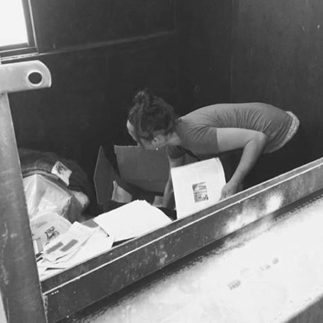
This wasn’t one of those “I found a cute couch on the side of the road” kind of dumpster diving situations. This was an every-single-day-I-live-for-this situation, where every day I wake up, write some articles, see my friends, and then visit my Home Base, the operative spot of my primary recreational activity, the adventure of my favorite game — and every day, I would change into yoga pants, long sleeves, and rain boots, pull back my hair and double-wrap it in a bun, and then climb over fences, grab metal handles to anchor myself as I climb, and then plunge feet-first into the dumpster, and that was when they let the games begin.

At first, diving awoke some kind of primal hunter-gatherer instinct in me. It still does every time. But at first, everything I found that was moderately useful, new, or interesting was a source of wonder and amazement (see my favorite mantra: “Who would throw this away?!”). But after a while I became a seasoned scavenger, and the game got methodical. We had unspoken rules. We had procedures.

Basic Dumpster Protocol

RULE #1: This is the single most important rule for hygiene that you must never, ever break if you want to maintain any separation of social constructs of Clean and Dirty, and if you want to avoid literally living in filth. As soon as you get back to your apartment, deposit the items from your haul in one corner away from all your other stuff. Do not touch them. Immediately go into the kitchen and wash your hands, including under your fingernails and all the way up to your elbows. Before entering your bedroom, strip down head to toe and take off everything you are wearing. Immediately deposit your clothes into the washing machine. Do not touch those clothes again. After touching those clothes, avoid touching your face or any other surfaces. Immediately go into the bathroom and take a shower, washing your body thoroughly, and put on a new set of clean clothes. Wash your hands again before and after sorting through the items from your haul in the isolated part of your room. When your Dumpster Clothes have completed washing, wash them again.

While diving:

—Avoid skin contact with liquids when possible. Wear long sleeves to avoid cuts and abrasions. You will probably encounter both anyway, but do your best.

—Grab a mid-tier shopping bag from the dumpster and separate your items into bags by category of filth as you collect them. Remember that whatever you grab, you’re gonna need to carry back with you to your apartment. Shopping carts are super helpful.

—Bringing hand sanitizer is a pro-tip, because your hands will always be sticky.

—It’s always, always good — not just for efficiency and expediency, but for safety — to have a spotter, or at least a partner in your Dive.

Don’t attract the attention of authority.

—Be shameless in your act of the Dive — do not be embarrassed by what you are doing. You’re cute. You’re eccentric. Always say “hi” to passers-by, who will usually apologize, laugh, and look confused when they throw a trash bag in the dumpster and it accidentally hits a person. Be conversational, a normal person going about their business.

—Nighttime is preferable for retail store or corporate dumpsters. University dumpsters are generally better during the day, but you want to lay low regardless.

—Avoid cops if at all possible. If you do encounter university cops, be normal, be friendly, and be honest about exactly what you are doing. It helps to start with, “Hey! Sorry, people are just throwing the craziest stuff away. You would not believe what I just found.” It helps sometimes if you mention the economic value of your haul and mention that “you could totally sell this stuff,” because for some reason capitalism legitimizes everything and we all have given each other a collective free pass for doing ridiculous and otherwise utterly degrading or horrible things, so long as we are doing them for money.

—If you ever encounter hostile cops or city law enforcement, do exactly what they say, apologize, and leave. Abandon your haul if necessary. If they accuse you of trespassing, say you misunderstood. What you’re doing is technically legal, but let’s be real — it looks sketchy.

Safety first, adventure second, money last.

Unspoken Rules of Dumpster Diving

1. Do not make a mess. Always leave the site cleaner than you found it.

2. Finders, keepers.

—If you find and do not need, think of your friends and your community. Whatever you find belongs to everyone, because Trash is communal property. If you find something and someone else needs it more than you do, it belongs to them. It is theirs. It is meant for them. That is just the way it is.

—“Finders, Keepers” applies in the fact that once you find something, it is yours to either keep, distribute, or discard. It is the assumed moral responsibility that if someone else would appreciate the item found more than you that it should belong to them.

—Items found in a mutual Haul should never be re-sold or traded to other divers or friends. Whatever you find, you must share. The objects found you, and they are yours simply by luck of discovery. Once you find it, is yours, and you have the ultimate say. But that is not a power to be abused. We do not adhere to the social mores of a normal economic system, as is made obvious by the fact that we are foraging through dumpsters.

3. Safety first.

“Finders, Keepers” being said, when dumpster diving with your comrades, spot each other, assist in buildering (climbing on top of and through urban structures), and always consider that the Haul (everything you gather) is communal, and ownership can always be sorted out later. The most important thing in the field is working together and looking out for each other’s safety.

Pro Tips

Things you should always take, because you will always need:

Shampoo, conditioner, body wash, soap. Laundry detergent. Dishwasher detergent. Cleaning supplies. Toiletries. School supplies (tape, empty notebooks, pens, printer paper, calculators). Household supplies (lightbulbs, batteries, phone chargers). Unopened food.

Things Good For Flipping:

Lamps, rugs, carpets, Ikea furniture, mirrors. Electronics. Household appliances. Fine jewelry or gift cards (any items of objective fixed retail value). Any duplicate factory-sealed retail items in extremely large quantities. Furniture.

The Three Levels of Trash Bags:

Gold: Full of valuable objects.

Mid-tier: Mostly paper, sometimes food, sometimes objects to be found.

Actual Trash: These are big black bags, which mean they are industrial trash. Actual Trash also applies to regular-looking bags that are just obviously full of food waste, wrappers, and other things that cannot be repurposed. Depending on the location of your Dive and depending on the time of year, it’s possible that you could have an even ratio of Bags vs. Bags of Actual Trash, or, in other circumstances, the dumpster could have a potentially tragic 80/20 ratio of bags to actual trash. Worse altogether is when people mix their disposables with their Actual Trash, but most people don’t do this. Most people organize their trash methodologically in a way. You learn to gauge a bag before you open it, and you learn to look for indicators of potential as soon as you open it to quickly determine whether or not it’s worth your time.

Fast-forward one month:

(Okay. I guess I’ll be honest. Fast forward two days.)
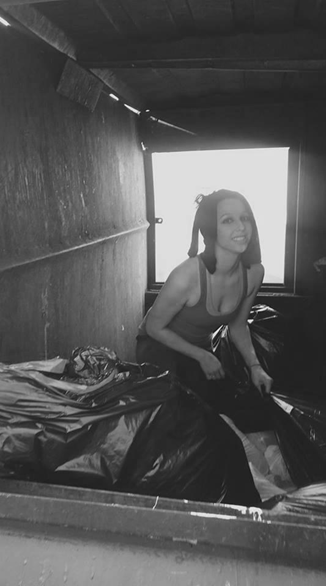
It is a burning-hot July. The smell permeates everything. The wonder is constant, the excess unfathomable. We, we being me and my life partner (my partner in love, my partner in crime, my partner and equal in all things, including especially dumpster diving, who was not only cool with my agenda, but extremely down, perhaps more or even as much as I was), are currently living in a four-bedroom apartment nearing the end of our lease. Our other three roommates have moved out for the summer, so we have three empty bedrooms and a massive living room, all of which are filled with Stuff.

Room One, Alicia’s Old Room, is the End of the Road, because her room has really bad vibes. Alicia’s Room is where we keep the shopping carts and bags full of all the stuff we don’t quite know what to do with, or that we want to keep but have no immediate use for.

Room Two is Grace’s Room: Grace’s Room is The Museum. Grace’s Room has a full bathroom and bed set-up — it is decorated like an ordinary room, except entirely with things we found in dumpsters. Her bathroom has bath mats, a shower curtain, towels, toiletries, toilet paper, hand soap, even make-up. Her bedroom has Egyptian cotton sheets and a plush Target bedspread, Tempur-Pedic pillows, sea-green curtains, atmospheric paintings, three dorm room lamps, and a pink shag carpet. Every drawer of her dresser and desk and every available surface is brimming over with Stuff. Books, Victoria’s Secret lotions, Vera Bradley wallets, Halloween costumes, prescription drugs, school supplies, TVs, printers, vacuums, herbal teas, coffee mugs, silk Express ties, boy band posters, and boxes of food. The Museum is the room of stuff we kind of want but don’t particularly need, stuff that we want to share. The Museum is where our friends can come over every day and go shopping for whatever they want, reaping the benefits of our adventures, creating our own sort of Sharing Economy.

Dominique’s Room is for The Essentials, or, as we put it, the things we’re trying to sell and/or things we really want to keep, things of value — either to us personally or to others financially. This room (though also outfitted with full bathroom decoration from dumpster goods), is a Secret Vault of cleaning supplies, bulk food products, expensive make-up, Haunted Dolls, speaker systems, X-Boxes, and tie-dye tapestries we could never, ever part with. It’s also full of the most bizarre items (Christmas trees, … stockpiles of glitter, Tupperware jars full of Googley eyes, the personal diaries of strangers, love letters between couples we never knew), that we love, but don’t necessarily want to look at all the time. I don’t know how to explain the themed flipbook Evan made Karen for their one-year anniversary, nor the pile of eleven unsubmitted Absentee Voter Ballots…. I would not know how to explain to someone why we have these things in our house. I would not know how to even explain it to myself.

All I knew was that we were living, and every day was a new conquest — every day a new adventure.

I rationalized dumpster diving as a practical thing, but if I’m honest, it was never a practical thing. Not really. Not once did I climb into a dumpster and think, “I will harvest items to sell for a living today.” No. That’s not the spirit of it. That’s not the way it is at all. It’s an excuse to unlock some kind of primal creative instinct. It’s a video game in real time. It’s dangerous, ridiculous, and the art of delusional degenerates. In a society of values with which I have almost nothing in common, what most see as delusional, I see as the most obviously sensible thing. What they see as deviant, I see as genuine. What they see as meaningless, I see as radical. What they see as a numb, mute procedure of operational behavior, I see as a blank canvas for a creative medium, the creative medium of living. What they see as degenerate, I see as noble. What they see as trash, I see as living objects. What they see as trash, I see as resource unutilized. What they see as trash, I see as promise — the promise of freedom, the promise of infinite potential, the promise that whatever you need can be found, whatever you want can be made, whatever you have can be given. What they see as trash, I see as proof of immortality, that nothing dies except the part of it that dies in you, that nothing is beyond redemption, everything is just hidden beneath piles and piles of rank-smelling garbage and empty beer bottles, and no one is willing to climb in the dumpster, but if you did, if you had that faith, just once (because, according to the laws of dumpster diving, if you want to find Something, you will), and if you stop believing in meaning as prescribed by society and start creating meaning in accordance with your desires, if you stop believing there is ever such a thing as Trash, and start realizing that every living moment is the Object You Desire, and if you don’t feel content with your things, it is you that are Trash, not your Things … and that we don’t need a concept of Trash, we cannot sustain a concept of Trash, if we are to look around us and remember what it means to use and touch a thing for what it is and that alone.

Dumpsters aren’t gross, not really. Human bodies are gross. Nature is gross. We are part of nature, and our trash is just the cosmic compost of our modern industrial world. Plastic polymer stretch-proof bags of cellophane egg shells and orange peels and crumpled theses drenched in coffee stains are just the crumpled compost of human beings. They contain imprints of us. They are not profane. They are profound. These are not pits of our excess, these are archives of our culture. These are sacred tombs that testify to the fact we live and are alive, to the fact we are doing something, we used something, we loved something, we are something, whatever that is.

We exist in these object-imprints more than we exist in any real-world form. We exist in these collective capsules, these communal projects of mutual disposal, mutual value, bought, exchanged, and then abandoned, the things we relegate to trash bags. We are the things we put in trash bags. We etch meaning everywhere we go, with everything we touch. When we throw it in a trash bag, tie it up, and set it free, we are relinquishing claim to that piece of Identity-Ownership self and giving it back to the world, back to the collective system of bureaucracies we implicitly trust to pick it up every Monday morning and make it go away, to make those parts of ourselves we once owned be owned no more, all the pieces freed from restrictive ownership to coagulate back together in their new respective forms: in this one thing, we are ownerless, in this one thing, we are absolved, in this one thing, we are made free, from the tyranny of Self and Things.

Trash is art. Trash is real. Trash is without apology. Trash does not contrive itself to look and sell shiny or pretty, it is just trash, it sits shamelessly in the white bags marked NOTHING, the red-strings tying up the white bags which scream “NOTHING OF VALUE GOES HERE” and they sit there, these bags, content in their Trashfulness, content to be Nothing Of Value, content to Never Be Owned Again.

I want to be like trash. I am, in a word, human garbage. I am a garbage human being. I am content to writhe in dumpsters, more content than men in meadows under awnings of singing trees, I am content among the garbage. I am content, I am alive, within the collective kaleidoscope artifacts of humanity. I feel wonder, I feel childlike awe crawling up my spine, pressing its thumbprint on my forehead and my sternum like a pulse, like the defibrillator of God, innervating my innate curiosity long flat-lined by the asphyxiating monotony of Input and Output, System and Unsystem, Good and Evil, Two Weeks ’Til Paycheck, Please Dial Nine, Please Drink Responsibly, Sign Below The Dotted Line, the hereditary mortgage of adulthood, of impermanence, of culture as an industry, of ubiquitous art to the point of no meaning, to the stifling humidity of cerebral Law and Order which presupposes the necessity of sanity and simultaneously extinguishes any flicker of wonder or free will.

I want to be like those white bags marked Never To Be Owned Again. I want to be the things I find in dumpsters. I want to be Technically Nothing. I want to be Everyone’s. I want to be No One’s. I want to be free.

We cherish the blood, sweat, and tears, but we forget about the trash of humanity. And humanity is trash, this much I know. Nature is trash. Nature is filth. Nature is an art museum of shock, awe, sheer disgust, and wonder. Nature is something you throw in the garbage.

And for all of our ideas, for every crown jewel of our civilization and culture, humanity is still no more than just one collective dumpster. And you can act like it’s dirty forever and a day, but you know you want to dive in.


Beasts of England: Language and Human Nature in Animal Farm

Alice Minium

George Orwell’s Animal Farm was published in 1945 after the end of World War Two. Orwell had previously fought in the Communist army, but his own personal beliefs were more complicated. In Animal Farm, he does not make those beliefs clear. He does, however, posit one thing about human beings in the context of history: whether fascists, dictators, or imperialist-capitalists, we are all enslaved to human nature.

Orwell believed this human nature was animalistic. Orwell’s fundamental principle, and the thesis of my paper, is Animal Farm is used to illustrate this fact. He believes humans are condemned to their instincts and the petty conflicts that have historically polarized us through all of time. We are not equipped to move past these political misunderstandings. Jeffrey Meyer, in “The Political Allegory of Animal Farm,” says Orwell saw human beings as “prisoners of history, inadequately equipped to deal with our own flaws.” Our flaws are a universal of human behavior, no matter what political ideologies we mask them in. Orwell does not advocate Communism, nor does he explicitly argue against it — rather, he seeks to lay bare the open structure of political systems themselves. He does this by showing us a ludicrous tale of animals conducting, overthrowing, and, gradually, regressing in “government.” It is no accident he uses animals to convey this. Orwell’s premise is, though we call ourselves human beings, our principles, morals, and behavior are no different. It is all the same thing with a different name — Christian or Muslim, fascist or capitalist, oligarchy or theocracy — our nature is the same, regardless of government.

The choice of animals for a fable on government is no accident as well. It is, after all, “civilization” and “enlightenment,” which we hail as the crown champion of Man, and it is these ideological superior states we aim to create with “revolution” or government. Orwell’s political animals not only underscore the tale’s purpose as a universal fable, but they emphasize the absurd condition and grotesquely violent “tactics” of the players in the story. The joke is that, with all our talk of “revolution,” we are really only brutes, animals playing dress-up, after all.

It is no accident those who preach are “ravens” — carrion crows encircling whoever they’re about to eat. It is also no accident those who govern are “pigs” — animals who, quite literally, roll around in their own excrement.

Orwell is not shy about using the features of these specific animals to symbolize specific kinds of people, as Christopher Hollis, in “Animal Farm is a Successful Animal Fable,” also notes. Pigs, for example, are smart and greedy; sheep are complacent and compliant; dogs are loyal and willing to overlook faults; and horses are the workers upon whose backs men carry their burdens.

Finally, and perhaps most significantly of all, Orwell conducts his puppet show illustration of a failed revolution with literal animals. The tale is not believable, nor particularly funny. It is somewhat disturbing. Rather than a portrait of animals or government, it is a portrait of ourselves as animals. We are revealed to ourselves as we truly are: uncivilized, animalistic, and unevolved. He shows us how the hymn “Beasts of England,” and the overly repetitive chanting, is the one thing to which the sheep are recurringly drawn (Animal Farm 13). It is our animal nature and simple mannerisms that hold up the illusions of our social institutions. As one of the literary critics we studied, Jacques Lacan said all of what we believe of ourselves and the structures of mind within which we function are just a mirror of our imagination. Our governments and religions are reflections of our subconscious needs and desires, as Freud reminds us,  which, also, are projections of ourselves. These reflections, which we believe to be real, propel our relationships and hijack our emotions. Orwell shows us these emotions are simple responses. These responses are not as complex as ideologies make them out to be — rather than our impetus being governed by ideology, all ideology is the didactic captive and puppet-toy of impetus. Our animal desires compel us in our politics, our choices, our economies, and our morals — “revolutionary” or not.

There is no “revolution,” according to Orwell, as the animals at the end of the story are in exactly as bad of a predicament as they were at the beginning. If anything, their predicament is worse and more complex.

There is a phase of regression undergone by the animals as they move from the first pig’s revelation in a dream and into their complete upheaval of society. The animals regress from intelligent and comprehensive to becoming slowly dulled and compliant. This is interesting because it shows how fear can dull the inquisitive mind of society and make people lax and dependent on their superiors.

Boxer the horse is a particularly significant choice. In his unwavering loyalty, dedication to the fatherland, and tireless work, Boxer represents the revolutionary working class. Orwell describes Boxer’s priorities by telling us, “His answer to every problem, every setback was ‘I will work harder!’ — which he had adopted as his personal motto” (Animal Farm 58). In this sense, Boxer is like the ever-laborious and loyal proletariat. Boxer as the working class is an even more ironic depiction if you consider Boxer is the prominent horse in the story, and horses have been considered beasts of burden throughout almost all of history — not unlike the working class. Yet it is Boxer, in the end, who is tricked and killed, but instead of resisting Boxer deems it to be his lot — or one could argue, he doesn’t even realize. This, too, is analogous to the struggle of the working class. As mentioned before, horses are literally the backs on which objects are carried, and the working class is literally the back upon which the burden of the government’s luxuries and enforcement is carried.

Maintaining the power structure was the pigs’ main focus. By taking the other animals’ rations and feeding themselves with them, they quite literally feed off the masses while starving them out. Brains can’t function without proper nutrition. It’s an intentional oppression of the lower classes to benefit and sustain the upper class, all the while convincing the lower class this starvation is actually for their benefit. Marxist literary theorists Adorno and Horkheimer would see this as an analogy for the culture industry, perhaps, and the massive parasitic machine of consumer greed which feeds off men’s minds and imagination in the modern age, all the while convincing us, as we are robbed, that we are being “entertained” (Adorno and Horkheimer 2188).

Animal Farm is entertaining, but its tone is two-dimensional — almost intentionally so, so as to underscore the device of parable it employs.

The narrator in Animal Farm is distant, detached, and unemotional. His matter-of-fact, detached tone only emphasizes the horror of the events he describes. He creates a flat, sinister effect, almost as if to say, “Why should this surprise you?” To say “they sang” in the same tone as “they ripped out their throats” is to say the reality of Animal Farm is happening right now, right next to you in day-to-day life, and you are not shocked.  It is not sensationalist in tone at all, exactly unlike the sweeping rhetorical tone of most thinkers or of the pig-philosophers in this book.

The reader observes an almost flat puppet show: rather than compelling one toward an objective, like most ideological texts or like an advertisement would, Animal Farm is, instead, a bleak retelling of what is occurring. It asks you to fill the character voids yourself, and, using a story form used to convey a moral or virtue, Animal Farm’s is noticeably absent.

This is perhaps most ironic of all. Orwell takes a realist device, stylistically reminiscent of Socialist Realist writing such as the Stalin-approved propaganda novel Cement. This device is usually used as a vehicle for ideology, moral instruction, or, more generally, propaganda. It is a form of storytelling used to say other things. Orwell, quite radically, took the realist device of ideology and propaganda and gave it back by using it as a fable on ideology and propaganda. He said, in essence, “Here’s your moral fable. The moral of this fable is about moral fables and how they work.”

The fact the tale is told of animate animals accentuates its deeper meaning as an obvious allegory. Like a fable or parable, from Aesop to the Grimm Brothers, it is clearly intended to be instructive and illustrative in message and tone. You think you’re going to read a beautiful fable, but you don’t. Animal Farm is, if anything, a parable. The parable is the timeless device of ideology. Yet it is ideology, perhaps most ironically, of which Animal Farm is absent. It is an empty device — making it all the more meaningful.

We must also note higher literacy is associated not with higher truth but with trickery. Orwell displays a distrust for intellectuals and their twisting of words. On page 63, Orwell shows how the mastery of language is associated with agency, as the narrator reminds us that, “Several of them would have protested if they could have found the right arguments.”

The more linguistic ability a creature has, the more powerful that creature is — in a vein of word-supremacy that would have resonated with deconstructionist and fellow doubter of words Jacques Derrida. Words retain power in and of themselves, in evidence to what Frederic Jameson, author of The Political Unconscious, would have called literature’s “ideology of form.” In this essence, words are functions of the overall social and political institutions they serve, or, as Jameson puts it, “The symbolic messages transmitted to us by the coexistence of various sign systems which are themselves traces or anticipations of modes of production” (1337). The connection between language and the “modes of production,” and/or the upholders of power, is evident in the fact the pigs, the most powerful of creatures, can read, while most others can’t. An animal’s capacity to communicate through language is directly proportional to the amount of political power it possesses in Animal Farm. Linguistic ability and cognitive capacity, are, in Orwell’s world, analogous to agency.

The simpler creatures, and those most affected by Napoleon’s policies, cannot read at all. Those who can, such as Squealer, who uses language and clever words to sow seeds of support for Napoleon’s administration, are using language as a weapon for manipulation and evil. Rather than using complex wording to elucidate the truth, complex wording is used to obscure it.

This makes Orwell’s choice to convey the tale in a simplistic tone all the more meaningful. Orwell is not trying to persuade us with vast, sweeping illusions of ideology nor rhetorical acrobatics. He is speaking as if we are the sheep — not because his meaning is overtly simple, but because the complexity of his meaning is most accurately conveyed through an intentionally simple tone. If this were a tract against or for communism, perhaps he would use lengthy adjectives and argument. Yet the characters are flat, the plot is linear, and the sentence structure is simple: this is a device for ideology intentionally without the ideology — it is a barren womb. It is the skeleton of propaganda made transparent and handed to us so we might say, “It is empty, don’t you see?”

Orwell’s book Animal Farm uses the story of the Russian Revolution to tell us about human nature in a way both political and timely, yet boldly historic in scope and unapologetic in its brashness. Orwell’s suspicion of intellectuals and complex ideologies as concealers of truth is doubly evident both in the tone in which he tells his tale and in his depiction of the power of the spoken word itself. Orwell took the narrative device of fable to write an analogy of government, but it is, more than anything else, an analogy of human nature — which Orwell believes is, at its core, not that exceptionally “human” after all. He uses animals to show us ourselves, and, in the end, he claims he cannot find much of a difference (121).

Works Cited

Adorno, Theodore W; Horkheimer, Max. “Dialectic of Enlightenment: The Culture Industry.” The Norton Anthology of Theory and Criticism. Ed. Vincent B. Leitch, New York: Norton, 2010. Print. 1110- 1127.

Derrida, Jacques. “The Exorbitant. A Question of Method.” The Norton Anthology of Theory and Criticism. Ed. Leitch, Vincent B. New York: Norton, 2010. Print. 1691-1697.

Hollis, Christopher. “Animal Farm is a Successful Animal Farm.” Ed. Terry O’Neill., Greenhaven, 1998. Web.

Jameson, Frederich. “The Political Unconscious: Narrative as a Socially Symbolic Act.” The Norton Anthology of Theory and Criticism. Ed. Vincent B. Leitch, New York: Norton, 2010. Print. 1822-1846.

Lacan, Jacques. “The Mirror Stage as Formative of the Function of the I as Revealed in Psychoanalytic Experience.” The Norton Anthology of Theory and Criticism. Ed. Leitch, Vincent B. New York: Norton, 2010. Print. 1163-1169.

Meyers, J. Orwell’s bestiary: “The Political Allegory of Animal Farm.” Studies in the Twentieth Century, 8, 65-84. 1971. Web.

Orwell, George. Animal Farm. New York: Harcourt Brace Jovanovich, 1946. Print.

The Eternal March of Capitalism as a Symptom of Humanity’s Collective Death Drive vs. Poetry & the Soul: Starring Walter Whitman and Allen Ginsberg

As told by Alice Minium

There are always those who dream.

That never changes across all of time.

The occupations of the dreamers change. The names of the nations change. The conflicts of the consciousness change. The rhythms of society change.

Throughout all of time, these sacred few, sit in public places and stare at things for no reason. They sit in windowsills. They laugh at things that aren’t funny. They write big letters on the window. They weep for humanity, without humanity knowing why.

They are here, always. They have never not been here. They will never not be. For they hold within themselves all the powerful emotive forces we could not bear to physically contain — they hold them not just for themselves, but for us all. They keep burning the candle of the soul, waking to feed it all hours of the night; a candle we would have long let the winds of time snuff out.

If it ever was to be snuffed out, that flame of the soul, the human spirit would be all but dead. We could not survive it.

Yet when the winds of time blow fierce like hurricane, we have come dangerously close.

Too often, we fear the keepers of the flame, for being so close with the fire. We do not trust them. They are weird, alien, we do not understand them. We do not like them. If they’re too loud, or too bold, we may even “put them down,” lest they wake the others who are sleeping.

Throughout history this remains unchanged.

America was a brand-new episode on a television series older than time. Its narrator was Walter. Walter Whitman, himself, was one of the first of our flame-keepers. He was a madman who sat naked in the wilderness. He was unashamed of the fire burning. He was loud. He was bold. He was controversial. He was unafraid.

Above all else, he was optimistic. He was optimistic, perhaps to a fault, about what America could, and should, be. America was kind. America was open. America was for everyone. America was a land where dreams came true.

One hundred years later came another flame-keeper, another narrator, called Allen Ginsberg. Like Whitman, Ginsberg was clinically insane according to the standards of his time. He, too, was a madman, scrawling poems on windowpanes.

Ginsberg’s narration was a different one. In Ginsberg’s America, these dreams had been dashed, desperately. Ginsberg’s America was wrecked and wrought with despair. It had been devoured by the materialism Whitman so feared. Ginsberg bore witness to the fruit of that materialism and was repulsed by it. He describes the capitalist-industrial complex. He believed its structural mentality was derelict to humanity’s soul, and that the soul could not be confined within buildings.

Whitman knew humanity’s soul could not be bound in books. Whitman knew we needed Nature, we needed each other, we needed the forests, we needed to stop and look at the stars, we needed to hug our mothers, we needed to admit we were wrong and a flower was a flower and enough was enough. Whitman knew this was a challenge for humanity. But Whitman believed it was a challenge we were up to. Whitman had faith. He had faith we could create this welcoming world.

Ginsberg bore testament to what it looks like when this doesn’t happen. Ginsberg personified the collective nausea compelling the youth of the ’50s to either excessively consume or violently expel themselves from society in absolute revulsion at what we had become. However, he heralds the same idealization of love, unity, acceptance, and the sanctity of the spirit — though his world looked different, the vision was the same.

These were dreams Walt Whitman and Allen Ginsberg shared — dreams both for America, their nation, and themselves. From Whitman’s world in 1850 to Ginsberg’s world in 1956, they shared the same ideal.

The specifics of how this ideal manifested were symptomatic of the climactic intercultural struggles of the transformative eras in which they lived. Each had a dream both emerging from and corresponding to the world around them.

Whitman lived in a time of great change. The American consciousness was severely affected by the abrupt transformation of the entire world due to the Industrial Revolution. This produced in people, such as Whitman, a kind of yearning to return to Nature and simpler ways. In a world now dominated by machines, Whitman reacts by being almost worshipful of Nature. “Tenderly will I use you, curling grass,” he remarks in Section 6:12 of Song of Myself, and he regards it playfully. That entire section is spent contemplating the grass, speculating over its nature as in line 8, “Perhaps it is a uniform hieroglyphic.” Whitman does not regard Nature as an inert object to be used for production; he regards it as very much alive. He engages with it directly. In Section 2:6-7, he doesn’t dream of technological progress, he dreams of the simplicity of Nature, the true America: “I will go to the bank by the wood and become undisguised and naked / I am mad for it to be in contact with me.” He sees Nature and simplicity are pivotal to life, pivotal to the actualization of that dream and fundamentally tied to the livelihood of the human spirit. Whitman’s attitude toward America and his own identity can be well-summarized by Section 25:53-58:

A morning-glory at my window satisfies me more than the metaphysics of books.

To behold the day-break!

The little light fades the immense and diaphanous shadows,

The air tastes good to my palate.

Hefts of the moving world at innocent gambols silently rising freshly exuding,

Scooting obliquely high and low.

Now let us contrast that with Ginsberg’s. In Part 2 of Howl, he beholds his own “day-break,” and it looks like this:

Robot apartments! invisible suburbs!

skeleton treasures! blind capitals! demonic industries!

spectral nations! invincible madhouses! …

monstrous bombs!

He is not being metaphorical when he speaks of monstrous bombs. What the Industrial Revolution did to Whitman’s world, the atom bomb had done to Ginsberg’s. The Industrial Revolution was surely when man began most resolutely to compartmentalize himself away from Nature, but the atom bomb was when that came to fruition.

The atom bomb was what was born of that horrific disunion with Nature, the contorted baby of man’s affair with his mistress Materialism, and that baby was violence and death. That baby was absolute, irreparable severance from Nature itself.

We had split the atom. We had literally rent the fabric of the universe apart. It had blown up in our faces.

We had not just raped and split Nature, we had split the natural order within our souls. We had dismantled the most fundamental and basic unit of the physical universe. This had done the same to our souls.

When you split the atom, the energy can be harnessed to create an explosion literally vaporizing every entity in sight into non-existence, else burning them into morphically deformed humans, hideous beyond recognition.

America did this to many people. America also did this to its own soul, and to the identity of an entire generation.

The soul was microwaved, malformed, dysmorphic. We had raped Nature like a hot dog left too long in the microwave so that it explodes entirely down the center and is not even recognizable as a hot dog at all.

The severance was so deep and so severe we had begun to think and behave like the machines we worshipped. We lived in robot apartments. In his cry to Carl Solomon, Ginsberg mourns the abuse and loss of the poor soul of man:

I’m with you in Rockland

where you bang on the catatonic piano the soul is innocent

and immortal it should never die ungodly in an armed

madhouse

I’m with you in Rockland

where fifty more shocks will never return your soul to its

body again from its pilgrimage to a cross in the void

“The soul is innocent and immortal.” Ginsberg, despite his despair, has not given up. He believes in the soul, a soul that cannot be defiled, cannot be severed, cannot die, and cannot be profaned. In his footnote to Howl, he cries again and again and again, “Holy! Holy! Holy! Holy! Holy!” He believes in this dream.

Ginsberg cries, again in his footnote:

The soul is holy! The skin is holy! The nose is holy!

Everything is holy!

A hundred years prior, Whitman cries, in Section 3: 19-21:

Knowing the perfect fitness and equanimity of things, while they discuss I am silent, and go bathe and admire myself.

Welcome is every organ and attribute of me, and of any man hearty and clean,

Not an inch nor a particle of an inch is vile, and none shall be less familiar than the rest.

Both prophets exalted the inherent purity of the body and being. While both lived among transformative times, and both heralded simplicity, despite the cries of suffering, even the robot apartments were worthy of love.

In his footnote again, Ginsberg says, “Holy the solitudes of skyscrapers and pavements!” Even the constructs of the modern city were holy.

Whitman, in 42:17-18; 26-27, exalts the holiness of the materialist thinkers he had mocked earlier in Section 3 (“the talkers…talking”), for even they are holy and the embodiment of all good things.

[those] … with dimes on the eyes walking

to feed the belly of the brain liberally spooning…

I am aware who they are, (and they are positively not worms or fleas,)

I acknowledge the duplicates of myself…

The images that constructed the landscape of the soul were different for Ginsberg and Whitman, as were the worlds in which they lived. Yet the Soul remains the same. The dream remains the same — that the Soul, and its actualization, America, is for everyone and contained within everyone, and it is pure, it is spiritual, it is so very much alive and cannot be severed by materialism. The soul itself is the flame they carry. They saw the beautiful reflection of that soul, even in a world that so desperately seemed to want to kill it. You cannot kill the soul, defile, rent, or remove it. It is our unity and our birthright. And that, above all, was America’s dream.

We were a culture in despair. We were bulimic. We wanted to eat the world, yet we wanted to be pure. We wanted to feel all the magical psychedelic dimensions of reality, yet we wanted stability. We wanted a New Thing, yet we ached for the Old. We ached. We ached to find a union of the two.

We stumbled drunk and disorderly across the nation with “blood in our shoes” (Howl, sec. 2), unsure of who, how, or where we were. For Ginsberg, and for many, it was better to have no idea what was going on than to see the chaos that had become the status quo. It was better to be ignorant and happy than to recognize the repulsive Moloch monster (Howl, sec. 2) of greed that was in itself our own reflection. As David Foster Wallace said (paraphrased), “That thing you fear in the darkness is you.”

Ginsberg still believed Whitman’s “America” was real. In his poem “Song,” he idealizes Love as the force which compels and inspires all, “yet we bear it wearily / No rest, without love. No sleep, without dreams.”

“America” was a concept that was in itself a dream. No dream can ever be entirely realized. Yet it is good to dream, nonetheless. We must dream. Whether or not America is the land “where dreams come true,” it is a land filled with dreamers, nonetheless.

Those dreamers are indispensable. Whitman articulated a dream. Ginsberg also articulated a dream and burst with the lack of fulfillment experienced with the American identity. A dream unfulfilled is despair.

The eternal march of capitalism is, perhaps, a symptom of humanity’s collective death drive. Or perhaps, like gasoline on a fire, it only compels the flame to burn brighter. It erupts into violent profusion of passion with the springing up of poets like Ginsberg, Kerouac, and Snyder.

Perhaps, as Whitman cried in the wilderness, we knew we were capable of more. Perhaps the violence of that lack will only emit more desire to fulfill it. Perhaps this unfulfillment will only compel us more fiercely toward immediate actualization of destiny. Perhaps this waking nightmare will awaken Whitman’s yelp of joy at what’s to come, and Ginsberg’s howl at what was not … and the sound we make today, in response, will compel itself perhaps to a guttural, reality-renting shriek — a shriek to shatter worlds and inspire poems and silence humming social structures that have yet enslaved the American mind for centuries.

The dream still exists. The dream does not die. The “America” is less of a nation and more of a conceptual dream. We get to decide who and what that is. Or perhaps, as our flame-carriers did, we reflect it. Perhaps, like Whitman and Ginsberg, we personify the collective voice of a people suffering. Perhaps we can perceive the spiritual temperature of our nation through our flame-keepers, our shamans, our poets.

So long as they exist, so long as they cry, even if it is not a song of hope, but a howl of pain, so long as they are saying something — the dream exists. So long as they are speaking, it is real. And that, above all, is the story without end, of eternal transmutation. That is the dream of the dreamers.

Citations

Ginsberg, Allen. Howl & Other Poems. Mansfield Center: Martino Publishing, 2015. Print.

Whitman, Walter. Song of Myself. Berkeley: Counterpoint Publishing, 2010. Print.

In Defense of Community College

Alice Minium

When you tell someone you go to community college, their face darkens a bit like they suspect of you Secretly Doing No Work and Having No Grand Plans. They awkwardly attempt to hide the judgment in their eyes with an averted gaze and a disinterested, “…Oh. I meant real college.” Little do they know, at their local community college is many a genius in disguise.

Yes, it is “lame” I still live at home. It is lame I go to a school with no football team and a school that actually has promotional TV commercials.

Do you know what’s more “lame” than that? Student loan debt, and bad grades. I don’t get to live in a dorm or have the “college experience,” but my experience has been profound nonetheless — and that experience has taught me many people, myself included, are not ready right away for the college experience, and that is perfectly okay. I don’t have crazy college weekends, but I have straight As and a safe place to come home to without distraction. I don’t have “that independence” of living on your own, but I have been able to have a job while in school to build up my savings. I don’t have to borrow money from my future self for each coming semester, or take out any loans at all, and that makes me feel secure. That makes me feel like I can study what I love and work in a field that excites me instead of absorbing the hereditary pressure to get a career, any career, marry rich, get a mortgage, stay out of debt. Those pressures are all very real and I’m not exempt from them, but I have been lucky enough to be in a situation where I can stave them off for a little while. That makes me feel gratitude, not shame.

Nobody has bumper stickers on their cars that say “Proud Parent of a Community College Student,” because the very words are synonymous with letdown. But my experience is that is definitely not so.

If anything, the majority of people I’ve met who go to community college (mostly who are older, that is) work much harder, and are much less entitled, than their four-year university counterparts.

Most of these people have full-time jobs and families, and they pursue schooling not as a diversion or as One Step Closer to Daddy’s Love but because they want to improve their lives. That genuine desire to learn commands respect not scorn.

Knowing these people has taught me:

1. To be thankful college was expected of me by my parents, cause it’s not by everyone.

2. The amount you work in life is not proportionate to the amount of reward you reap. In fact, it’s often the opposite — the most hardworking people are often in the worst situations.

3. You share more values with this myriad crew than with the predominately white suburban club of 20-somethings beginning university. You are more alike than you are different.

& 4. The world is big. Really big. Bigger than your hometown, bigger than your high school, bigger than your prospective field. It does not matter you check in all the boxes of Growing Up in exactly the right socially preordained order, it matters so much more that you make the most of what you have. You are fortunate, and you appreciate education so much more once you realize that fact. You value it — you choose it, instead of taking it for granted.

It is meaningful. It is your own.

I sit here filling out my Letter of Intent to Transfer to Christopher Newport University — the end of my stint with community college is now in sight, at long last. I am relieved to be moving on, yet I cannot say in entirety TNCC has done me wrong — they are as inefficient as the DMV on Planet Neptune, but they have taught me much and more (even the convenience and efficiency of university administration is an example of privilege — some places are designed to help you succeed, and some almost make you wonder the opposite). Though my crossing to the other side is still a year away, I am thrilled I am no longer stuck at TNCC.

Despite popular belief and our 11% graduation rate, a few of us students do get out. And let us have respect for the ones who haven’t “gotten out” yet — for we are waiting. All part of the plan, my friends. All part of the plan. We slither under the radar, ready to spring into full unanticipated glory of ourselves, and shame on you, naysayers, for not seeing it coming.

Two on Song of Myself: Discerning the Meaning of Meaningless Poems and Unentwining the Deadness from Being Alive

Alice Minium

Whitman probably would not have considered himself a teacher, let alone the guru of words and wisdom that the modern world has made him out to be.

In his own time, Whitman was, by all accounts, the simplest of men. He was not stuffy or pretentious, as we are when we sit in our classrooms debating the intellectual finer points of whether or not Whitman might have been gay.

He probably would have laughed had he known entire classrooms of students would spend hours dissecting the meaning of his punctuation and his reasons for ending a line. “Who was the 29th bather?!” we ask wretchedly, clawing at our eyes and throwing our hands to the sky in exasperation.

The funny thing is that Whitman probably didn’t even know.

Poetry is transmutation, an incarnation of abstraction into the tangible plane of mind and linear ideas, and poetry by its nature does not bend to our linear laws, nor is it defined by them. The laws serve poetry in conveying its purpose, and the way they fall and are constructed so delicately infers to us, like fingerprints, traces of the soul of the poem, but they are not in essence the poem itself- only fragments. A poem is not its words, symbols, punctuation breaks, or any other syntactical components. A poem is an energy above, within, and without all of that.

The poem is what you hear between the lines, that which can only be implied in words — that which speaks directly to the soul, like sacred wind chimes, an ancient siren cry of summoning to our inner self that knows more than world, “Wake up.” That is the part of us that receives poetry, if we are receiving it properly.

 Much like music, which is not simply heard, it is utterly felt and inspires raw physiological and spiritual reactions within us, and draws out emotion endlessly like water from a well. Have you ever heard a song from your childhood, and tried not to feel anything as you listen? It is impossible.

Though we live mostly in mind (thanks to modern life) and to a small extent within the body, most of who and what we are is completely and utterly Soul.

Soul masters all of that, and mind can say, “Feel nothing,” but the Soul will not obey, as it cannot be extracted from its other manifestations. Soul is inherent in all things, the thread which flows within and between all entities, and we cannot escape it, for we are Soul. All of the universe is Soul.

It is to our Souls that Whitman speaks most directly and profoundly. It is our Souls upon which he impresses an indentation of exotic and primal laughter, and it is our Souls to whom Whitman sings. He flirts with our souls, mesmerizes our souls, challenges our souls, calls our souls into our bodies with his words like fast magnets zapping consciousness into our molecules and presence into our nucleotides and irrefutable magic into our moments. It is the Soul within us we find so entranced by the words of Whitman.

Whitman would not have called himself a teacher, for he laughed at the Men of Mind peddling words and playing Jenga with interlocking thoughts and dreams and transmutations endlessly, day after day, forever entranced with analysis and forgetting to live. Whitman would have said that it is better to play in the grass than to read a hundred books, or better to sing a song of joy than to study for hours and master the algorithms of matter and math.

He had this very Christ-like notion of drinking from the raw tap of human experience, a very Taoist ideal of this very moment and all that it contains being the infinite sum total of all things.

Such a mentality is the “Stop” at the end of the telegram; such fullness needs no motion. Yet through motion, and the interplay of opposites, smoke curls, flowers bloom … and the universe comes to know itself.

Every expression, every action, every entity, every tangible and intangible thing are simply the universe laughing, playing with herself, stretching her arms out, writing a poem in a thousand different languages and via a thousand different mediums.

Such is the myriad dimension and delirium of the canvas of life. Its nature cannot be known in mute, fixed laws. It is not mechanistic, dead, or inert. It cannot be known by grammatical structure or the arrangement of words within poetry.

It cannot be dissected by taking apart all the components of a radio, hoping to find music, or disentangling from the thoracic cavity all the organs of the body, hoping to find life. You will find only machines and matter there.

Life cannot be mapped, cannot be defined, cannot be extracted, cannot be indirectly known. You must know it yourself. You must meet it for yourself. You must hear it yourself, drink from its well yourself, and play with it yourself. Life cannot be taught, you must touch it yourself.

It is not earned, or learned, or acquired, and Whitman would have laughed at any who claimed him as teacher of elite sacred spiritual arts. Whitman’s spiritual truth was knowable to every human, and to every nonhuman despite their category, already.

Whitman’s spiritual truth was Being Alive. Whitman was, above all, truly the teacher of that. We can eviscerate and analyze his poetry for years yearning to tap the meaning from its component parts, but that is not where his teaching lies, and that is not how we will know it.

“Have you felt so proud to get at the meaning of poems?/ Stop this day and night with me and you shall possess the origin of all poems” (section 2: line 18-19).

We have felt so proud of our meanings, but the joke is that there’s nothing to discover or extract from them that we don’t already have — there is nothing we can ever find whose origin is not the same as our very own.

“Stop with me, and you shall possess the origin of all poems.” Stop with me, and feel for yourself. Breathe for yourself. Touch for yourself. Drink for yourself. Taste it yourself.

Do you feel that? That is meaning. Do you hear that? That is the poem. And of that, above all, we can be our only teacher.

Two on Song of Myself: Stop Working and Look at a Flower

Alice Minium

I. Machines.

I do not envy the modern lifestyle. Working a repetitive, soul-sucking job where humans are required to behave like machines makes me feel dead inside. As Whitman alludes to many times, there is no insignificant job, and in any job I can use my imagination and share goodwill with all the world.

However, modern society will absolutely make you feel like a machine, if you let it. If you inside your little box-house long enough, staring at your picture-box, and eating things out of boxes, and arranging all your ideas into boxes inside boxes into boxes. You will forget that things without boxes can exist. Humans were not made to live life out of boxes, and boxes are not our natural state. It chokes you, for a reason. You feel constrained, for a reason. You feel tired, for a reason. You forget that you can unplug the box any time.

At least, I forget.

I forget, sometimes, that I am not a machine. Everything I do and say is so task-like, preprogrammed, and empty. I have to entirely unplug myself from social convention to, as Whitman says in Section 5, line 3, “loose the stop from [my] throat.” How dangerous is such an act. How deviant it is to wildly abandon the groupthink, without hesitation or apology. Every day I find myself straddling the juxtaposition of these two opposing principles, awkwardly balancing a medium between the two, so I can be free and yet stereotypically functional within the world. Deep within, or really not so deep at all, I yearn to be wildly free. Yet one cannot be wildly free and still be nondescript about it. How dangerous it is to unplug oneself entirely. How fundamentally disruptive to modern society.

Whitman’s teachings are fundamentally disruptive to modern society.

The modern way does not “ask the sky to come down to my good will,/Scattering it freely forever” (14:18-19) nor “tenderly…use…curling grass” (10:12). To embrace the sky is absurd. Society regards the sky as an inert ceiling, not a door. The curling grass exists for lawns and is meant to be mowed, of course.

Not according to Whitman. In a highly controversial move, Whitman tells us in Section 5, line 3, “Loafe with me on the grass.” To loafe means to just kind of hang out without any objective at all. When was the last time someone told you to just go hang out aimlessly? We are more familiar with the scolding, “Work harder,” than with someone telling us to do the complete opposite of work. Work less, says Whitman.

The feeling of Song of Myself is songlike, and slow. It is rhythmic and unhurried, like a long summer’s day spent loafing in the grass, celebrating your own existence for exactly no reason at all.

In the modern world, we are discouraged from doing anything for no reason at all. Everything must be productive in some way. Everything must be busy, and fast. All of my life is fast. Even my mind is fast. Even when the noise and stimuli stop, still my mind is chattering away like a sick seizing ape bouncing neurons around, deluded with the importance of objects, drunk on the toxicity of Normal and Daytime. Better to be an animal, as Whitman frames so beautifully in Section 32, lines 3-6:

They do not sweat and whine about their condition,

They do not lie awake in the dark and weep for their sins,

They do not make me sick discussing their duty to God,

Not one is dissatisfied with the mania of owning things.

We are erratic, thirsty, yet perpetually dehydrated beasts gone absolutely mad with the mania of owning things. Whitman makes an astounding proposition in Section 2, when he beautifully satirizes the fallibility of his own medium, poetry, which is revered and consumed by so many, who fuss over its mysteries, hoping to extract from it “the origin of all poems.” In line 20, he invites us, “Stop this day and night with me and you shall possess the origin of all poems.”

In other words, how do you get where you are going? Stop.

II. Stop.

Can you imagine the implications if we were all to suddenly, stop? If we put down our books, abandoned our work, and decided to wildly, recklessly play? How ever could society function if we all just looked at flowers? How on earth could we ever produce a commodifiable good?!

Perhaps, instead, a better question, is why is the production of commodifiable goods the ultimate goal of society? Is that really the best we can do? Is productivity and efficiency and material output really the prime potential of the oh-so-great and sentient homo sapiens?

Do we not call ourselves “enlightened?” Do we not call the era of rapid philosophical development the Enlightenment, out of which, we are taught, sprang the modern material era in which we now live? And if that is so, and modern man is, unlike his planetary cohabitants, enlightened in his world of materialism, then I ask you, where is that light?

I do not see it.

I see a world that is hungry and sick in its soul. I see a world of consumers and producers. I see a world of souls hammered into commodifiable goods and dissected to extract their most profitable components.

I see minds like televisions that have been on mute for years, and don’t even remember they are capable of song, so they purchase a laugh track for $9.99 to distract them from the SILENCE that is ABSENCE that we have not heard in so long that we are terrified. We hear the sound of our own breath, and ask in horror WHAT IS THAT MONSTER. We hear the music of the mind and it is alien. It is raw and real, alien and un-plastic, the same electric ahhh that hums through all of nature, innervating every membrane of dimension into sensation and form, and we cringe at it, because we do not know it.

We cringe at it because, like an animal kept in a cage its whole life, we neither understand nor desire to know the world beyond the cage. We are penitent, pitiful pets of some sadistic extradimensional creatures who feed on fear and hatred and by god we keep them well-fed. How disgusted we are by anything that lives outside the cage. How fearful we are of those beasts. How wild they are. How uncontained. How unenlightened. How vibrantly and violently the electricity of Being Alive pulses through them like electric shock even to the blazing profusion of a growl or a shriek? How uncivilized their UTTER ALIVENESS.

Look into the eyes of your cashier clerk or picture of success and tell me we are not dead.

Do you regularly, as in Section 1, line 1, “celebrate [your]self”? How often do you do that every day? Do you, as in Section 1, line 4, “loafe and invite [your] soul”? Have you invited your soul to be in attendance today? Would you even know its address?

Look into your own soul, and tell me, do you even recognize it? Or is it a formidable foreign land to you, once whose labyrinths you have yet never to wander? Have you met yourself? If you did, would you like her? Have you yet to meet a flower? Have you met the acid sky, the spray-paint grass, even the soft warm woodness of your desk? Have you met it for what it is, stopped to feel it and only it and do no other thing, felt and breathed its every scent and color with the unjudging eager attention of a lover (Section 3: 20-21, 24:48)? Have you even met your own body so? Or do we know these things only to be Things, as extensions to be utilized for production, as inert meat and matter, COMMODIFIABLE GOOD? Where does commodifiable good end and Realness begin? Is it the physical objects in closest proximity for which we most greedily perspire? Is it with our bodies? Is it with our minds? Are any of these things even ours anymore?

In Section 30: 1-3, Walter reminds us:

All truths wait in all things,

They neither hasten their own delivery nor resist it,

They do not need the obstetric forceps of the surgeon.

These questions Alice raises, and these precepts Walt proposes, are absurd and dangerous. Of course modern life is fulfilling. To hypothesize that it is not will create an error in the algorithm.

III. Play.

Let us dissect this hypothesis with the obstetric forceps of a surgeon and extract the cancer of fragmented meaning that so errantly has grown here. The cancer of inspiration can prove fatal to the organism, and is almost universally malignant to the capitalist-industrialist paradigm when left unchecked. Passion unbridled and a wild MOAN, an errant SHRIEK, an existential YAWN, a SITTING ON THE TABLE AT THE AIRPORT have been known to rapidly metastasize into the infectious WILD of a Being-Poem; and men will awaken to their own breath and love the taste, and they will laugh, and women will realize they are men, and men will realize they are cats, and children will giggle at the poem of this in the airport, and everyone will run around; and no one with a PriceTagNameTagVeryImportant will tell us to “stop,” and if they do, we will not hear them; or if we do, we won’t know how; because we have unstopped, and now unlive our lives in a single molecule of stretched-out simultaneous moment.

All of essence is available to us Forever And Ever Always Now in every flower and each breath (“All truths wait in all things,” says Section 30: Line 1), we need not wait. We need not painstakingly throttle life by the throat, choking it, dying to extract a droplet of Essence to haphazardly drip from its sponge-like skeleton for … we are so thirsty and the world is dead, and sick, and we meet ourselves at night in the blank white walls, and we meet the kiss of God in the sinews of our sweat within the grinding mechanical motion between Must and Pain; we feel Her So-Invasive Intimate Kiss, and it feels profane, it is so Everything, and I have stared at this screen for so long. My eyes burn, I stare and see nothing. My wild dendrites of yearning and yes are numb, and clipped, and freshly manicured for academic-industrial-workplace Exhaustion; drink this cup until you fulfill you unless you’ll drink it or die (or maybe you won’t, but Nobody’s lived to tell the tale). Is this not nonsense?

When the modus operandi of logical truth is actually nonsense, is absurdity not the only way to defy it? Is it not revolutionary to be absurd? Are Whitman’s truths not absurd by the standards of society?

“I exist as I am, that is enough/ If no other in the world be aware I sit content,” he declares in Section 20: line 25. Wait, what? What about all the things you need? What about all the things you have to do, all the modifications you need to make to your body, all the goals you need to accomplish, all the toys you need to buy? What about all the friends you need to impress, all the legitimacy you need to obtain through the recognition of other people? To say “I am enough,” is a counterculture act.

Please, the world will say, package up your aimless abstractions and deposit them in the Recycling for they are simply cluttering up productive space which could be occupied by an advert. You’re not good enough, be hungry, and purchase some accessories on your way out the door. Nobody has time for your abstractions, Alice. They are absurd, and you will be expelled from the belly of the capitalist organism like an acidic virus we must vomit up. You will destroy it from within.

Would such expulsion really be horrific? Is freedom from containment, in fact, the worst we fear? If that is why we are not wild, then, by all means, please expel me! If that is all we fear, why don’t we do the ridiculous things we always want, and sit on tables supposed to be chairs? Stop showing up? Check out completely? Look at a flower? Drop our tools? Forget our plans? Put down our phones and drink the sky? Would that really be so bad?

We live inside of paper plastic prop-up houses fabrications of fabrications of fabrications of fabrications of something that resembled a Real Thing once. Now it is “more convenient,” and dead, and made of Styrofoam. Mankind is dead, and our minds are made of Styrofoam. We don’t dislike it, because we don’t remember how. We are Styrofoam bubble-wrap brains that pop Reaction at pre-programmed synapse site. We simulate original emotion, but oh, it has been ages since we have felt a real thing. We numb the impossibly potent penetration of syringical injection of love and dying (events that command us to genuinely feel) with So Sorry Feed Me Baby Eat Me Like A Rich Food (consume another person). We have packaged even that into commodity.

In the crevices between the tectonics plates of moment, we feel the ache of dissonance on occasion. It grinds like Old, though we are Yet Young, and have forgotten. Ever since we picked up tools and found our “civilization,” we’ve forgotten how to delicately finger the velveteen skin of a single blade of baby grass. We have forgotten how to loafe. We have forgotten that we are happy; and that this is not a test, this is a game; that we are not mute, we are laughter; and all the world breathes with us in this music we need only to hit

play

play with me, stay with me, flowy lotus of nonprocedural juxtaposition of chaos and complexity utterly devoid of catechism drippingly infused with sex-sweet nectar of holographic need (only, now.).

Such is my prayer, my invitation, and such was Whitman’s.

The invitation begins, “Forget your plans.”

This invitation is to my own soul, my own soul only. This song is to you, my soul.

I might not tell everybody, but I will tell you. (19:17)

I am telling you, my soul. Hear my invitation, for I love you. I recognize your presence. I have not heard your voice in so long. I have told you my secrets. Now, I can do nothing but listen.

Fiction, Myth, or History?: The Role of Fantasy in the Mythos of Historical Science and the Collective Mind, as seen in Behn and Raleigh’s “New World”

Alice Minium

“If there be any thing that seems Romantick, I beseech your Lordship to consider, these Countries do, in all things, so far differ from ours, that they produce unconceivable Wonders…. What I have mention’d I have taken care shou’d be Truth, let the Critical Reader judge as he pleases….This is a true Story.” ~ Aphra Behn

Where does history end and myth begin? In the “New World” of Aphra Behn’s Oroonoko and Sir Walter Raleigh’s “The Discovery of Guinea,” both 16th– and 17th-century works, the lines between fact and fiction seem to blur. To the modern mind, the distinction is clear — a tale begins to break the laws of science, impossible events occur, human emotion colors the plot. To the ancient mind, however, the lines begin to blur. For where, but in myth, can man infuse the magic of history? How, but in prose, can one portray the turmoil of a battle, or the fervor of a victory, or the complicated stream of fluctuating experience that is human life, out of which all our social and historical constructs are formed? And, if history serves the role of documenting the past, would it not be inaccurate to portray that past as soulless, void, reductionist fact? Does not fact require a little bit of fiction to actually imitate life? Is life not always a constant intermingling of both, and through their profusion emerges experience, civilization, wars, passion, and art?

Every literary work is a history. Each account, every creation of an author’s mind, is a snapshot into her world — a very real world she experienced firsthand through the lens of socially constructed beliefs, values, and ideals about the world. Readers may drink in the nectar of literature’s structural and linguistic beauty, as these are also intrinsic goods in and of themselves, but within these constructions we may deduce and define an underlying framework of mind one might call the lens of the author. The lens of the author is the lens through which they write, interpret, create, and understand. The lens of the author is also a microcosm of the lens of society. Every work is a portrait of self. Every work is also a portrait of society — a miniature universe, a self-contained world.

The self, both ancient and modern, is full of dreams. Every mind construes sensory data in the context of ideological illusions and underlying meaning. Imagination is the web through which we connect seemingly meaningless dates, numbers, and images; imagination is how we infuse them with meaning, draw conclusions, and create constructs of reality. Without imagination, constructs of reality fall apart, for where, exactly, does one stop and the other begin? What of “Alice” is real, and what is imagined? What of “The New World” is real, and what is imagined? What of God is real, and what is imagined? What of “slavery” is real, and what is imagined? What of “gold” is real, and what is imagined?

In fact, from our modern perspective, much of Behn’s and Raleigh’s descriptions of the “New World” sound downright fictional. In Behn’s words, on page 52 of Oroonoko, “For ‘tis the nature of that Country to Rust and Eat up Iron, or any Metals, but Gold and Silver.”

Obviously the North American continents are not possessing of some absurd environmental conditions wherein all metals except those directly commodifiable to Europeans magically are rendered inert. Instead, perhaps, “Gold” is more of a concept than a truth — what Behn is saying is the nature of this land is rich, alien, and unlike any of the brute metals that have formed our past civilizations of old. Perhaps what this land possesses is entirely new, and the metals forging ancient wars and societies of Europe now stand as inferior to a newfound tool with which man may forge civilization — the “Gold” of a New World where feudalism did not apply, where social rules could experimentally be broken across the globe quite quietly, where new societies could be created both mythic and dystopian in theme. If the “New World” was anything, it was rich fodder for the imagination. If its soil had any magical properties, it was a fertile bed for every seed of the Enlightenment’s dreams.

These dreams are recurringly embodied in “Gold,” which implies both the lust for capital and commodity as well as the lust for ideological actualization. Every bidder of every schema saw the New World and wanted to cast their bet; every one of them saw their own “Gold.”

The Gold was extravagant, imaginative, and quite literally unbelievable. We know now that, when Raleigh describes tales of the land of El Dorado, he is describing a mythical world that most certainly did not exist, but to Raleigh, or to his reader, this world was as real as Washington, D.C.

His language is extravagant and his description mythical as he writes of it in pages 6-7 of his 1595 account to Queen Elizabeth, entitled “The Discovery of Guinea”:

All the vessels of his house, table, and kitchen, were of gold and silver, and the meanest of silver and copper for strength and hardness of metal. He had in his wardrobe hollow statues of gold which seemed giants, and the figures in proportion and bigness of all the beasts, birds, trees, and herbs, that the earth bringeth forth; and of all the fishes that the sea or waters of his kingdom breedeth. He had also ropes, budgets, chests, and troughs of gold and silver, heaps of billets of gold, that seemed wood marked out to burn. Finally, there was nothing in his country whereof he had not the counterfeit in gold. Yea, and they say, the Ingas had a garden of pleasure in an island near Puna,  which had all kinds of garden-herbs, flowers, and trees of gold and silver; an invention and magnificence till then never seen.

Raleigh’s “Gold” was everywhere. His description is enticing, idyllic, almost Eden-like. The New World was, to Behn, Raleigh, and in many ways the collective European mind in and of itself, the New Eden — it was a chance to start again. It was rich with visions and myth, and these were as formative to the societies thus created as were facts and figures, if not more so.

In fact, it is “Gold,” it is imagination, it is fiction, which fuels everything, which settled the New World, which inspired its authors, which defined its religions, which articulated its dreams. Without imagination, there would be no growth. Without myths and dreams, there could be no history. Without fiction, mankind stands mute, armed with dumb tools of logic and fact. Mythical thinking is not optional. It is older than old for a reason: because it contains the collective consciousness of man, within it are embedded our secrets, our desires, our dreams, our framework for knowing, our placement of self, our sexes, our governments, histories, and gods. Myth is the oldest kind of history, because only in imagination can be fully contained all that which is known to man.

Therefore, of course the New World does not cause bronze to rust, and there are no trees of gold that grow, but does it matter? The “New World” was not a geographical continent or series of islands these European authors describe. The “New World” was also a continent of the mind, an alien world of imagination, a creation of fiction itself and a means for projecting and understanding our desired dreams.

The New World was not this soil, but it was very much real. Stories may incarnate as fiction, but that does not mean they are not fact. History is not dead, and it is mute without imagination. Fact is inert without fiction; the soul of mankind is not contained in flesh and bone. Magic cannot be reduced to data. Art is the mother, not the servant of, her daughter, Science.

History and myth are inexplicably intertwined, for such is the nature of human experience — such is the wonderful mind of man to produce all the art in the world. We could argue for centuries about what it is “real,” whether this is fiction and that is fact. Such a question is cruel, dismissive, and sells the soul short of its birthright. Perhaps a better question is, does it matter? There is no “fact” or “fiction” alone. If we are to be human, we must have both.

Works Cited

 Brehn, Aphra. Oroonoko. New York: W.W. Norton & Company, 1997.Originally published 1688.

 Raleigh, Walter. “The Discovery of Guinea.” 1595.

The Indestructible Human Spirit: Poetry as Survival in Stalinist Terror

Alice Minium

The following from alumna and Redeeming Pandora founding contributor Alice Minium (Class of 2011) is an essay on Journey Into the Whirlwind by Eugenia Ginzburg.

The trait which marked Ginzburg for persecution and the trait which allowed her the resilience to endure it were ultimately the same quality. In a state of total terror, where no one is safe from scrutiny or unfounded punishment, everyone is in danger — but none more so than intellectuals. Terror is inherently a mechanism of absolute unilateral control, not just of government, but of even the individual’s worldview. Nothing has the ability to construct belief systems or alter perception more than literature and art. Ginzburg was a prominent figure in the intellectual and artistic community, and she carried that power. It was that which would ultimately make her dangerous in the eyes of Stalin, and that which would ultimately give her strength enough to survive.

Stalin understood economic control and political control were the same. He strove tirelessly to institute the powerful, unquestionable, complete implementation of socialism. This meant not only in government and economy, but even in the very words we speak to each other and the books we read. Only through conquering the mind and fully allowing socialism to permeate one’s worldview and underlying preconceptions could the true socialist society be born. The most critical battle was fought not with laws but with ideas. Anyone wielding the power to elucidate ideas was, in Stalin’s eyes, the most dangerous soldier of all.

Suspicion against the intelligentsia predates Stalin’s terror, though he most definitely extrapolated from these preconceptions and integrated them into his framework for how to best implement his objective of total control. In The Cultural Front, Sheila Fitzpatrick describes the Old Bolshevik distrust of the academic and artistic community. In those times, things were seen almost entirely through the archetypes of oppressor and oppressed, conspirator and ally, bourgeois and proletariat. Fitzpatrick describes this thinking as one of “binary opposition,” and she quotes Lenin’s famous question, “Kto kogo?” which translates as, “Who will beat who?” Such was the lens through which all social problems and political relationships were seen.

The Old Bolsheviks were suspicious of the intelligentsia because they considered them to be too elite and reminiscent of old bourgeois ways to be in favor of the people. Intellectuals, artists, writers, and thinkers were primary political players during this time, and they overthrew norms and set the framework for new ways of life. These people were, fundamentally, free-minded and unpredictable. Ultimately, as Fitzpatrick puts it, “The Bolshevik Party and the intelligentsia shared an idea of culture as something that (like revolution) an enlightened minority brought to the masses in order to uplift them.” Culture was where wars were won and lost. Culture was the axis upon which the fragile vane of power would shift.

Stalin understood this better than anyone, and the regulation of ideas and art was equally if not more important than his regulation of the economy. Not only must he reconstruct the system, he must recreate the man. He must recreate the very identity of self.

He set about to do so with the same rapid ferocity with which he laid down economic quotas and stringent laws so inflexible efficiency was the primary goal. It was always about the most effective way to totally and completely transform, produce, or control. He illustrated this ruthlessness with his implementation of collectivization, rapid industry-building, impossibly strict regulations, and zero tolerance for economic deviance. He fiercely worked toward realizing socialism by the reconstruction and rebuilding of the systems within Soviet Russia, striving to eliminate anything left of the “old ways,” or anything that might get in the way of absolutely realizing that goal.

Since all things economic are also political, and political weight is the locus for economic power, in order to truly regulate Russia into a socialist utopia once and for all, he had to regulate the political too. Thus, with that same iron fist of efficiency, he began to zealously eradicate the most dangerous of players in the political and social game — the thinkers.

Like tsarist rituals were ruthlessly exterminated, so were those who bore capacity to express and create original notions. The ability to produce new ideas was, to Stalin, also a relic of the oppressive past, and a danger to social order, for what new ideas need there be when we have already found the ultimate idea of socialism? We have no need for ideological critique anymore — that is a relic of times past.

The idea of culture as the tool of an enlightened minority was one Stalin shared with the Old Bolsheviks and intelligentsia, yet he interpreted this idea into policy in an entirely different way. Culture was where ideas were born, and since socialism was the one and only true idea, all of culture should be mandated and consolidated into the Stalinist sphere — all ideas must come through it, and they must not be born elsewhere. In order to embody the socialist goal of Stalinism, humans must operate as appendages of the state, or as elements belonging to and defined by the greater entity of the state, functioning and thinking and producing only for its benefit. There was no place for independent ideas here. Even if a citizen was driven by true party loyalty, and expressed ideas in alignment with the goals of the party, these people were inherently dangerous because of their ability to produce ideas at all. To erase the old ways, we must erase the very idea of the intellectual. Ginzburg, a poet and respected academic, had the misfortune of being exactly that.

The overzealousness of the Great Purges was not born out of cruelty, but out of an importance on efficiency. Everyone, especially high-ranking Party officials and members of the intelligentsia, were condemned without trial or even legitimate cause and thrust into horrifically inhumane conditions. Ginzburg herself was a prominently loyal Party member who was arrested for her former association with a man who wrote a book in accordance with socialist policy at the time, but then later, when policy changed, became treasonous taboo. She was accused of belonging to a terrorist organization that never even existed, and she was tortured, deprived of sleep and food, made to suffer inhumane sanitary conditions, and threatened with her very life if she did not sign her confession to the falsified charges. Ginzburg was outraged, insisting there must be some mistake. Her every human right was being violated, and what they were doing was illegal. This was a reaction shared by many — that such an absurd norm must be some dystopian dream, because it could not possibly make sense. What changed was the law was no longer an external entity of inflexible precepts for maintaining social order — the law was Stalin, and his law was carved out in fear. The cult-like worship of Stalin’s image and the concept of total and absolute control manifested through his Terror bore ironic similarity to the monarchies of old that based absolute authority in the divine right of kings. It had ironically become that which it had sought to replace.

In a 1990 essay in “The Soviet Mind,” Isaiah Berlin writes of the incredible survival of the Russian intelligentsia against all odds. Though his essay refers to the fall of the U.S.S.R., the beautiful truth of that survival remains the same whether it is 1991 or 1939. There is a resilience to the thinker, and an indestructible fluidity to the consciousness of the artist. To be a thinker, an artist, or a scientist, one is always observing, learning, perceiving each sensory experience to its absolute fullest. To an artist, your art is only refined by suffering, and your consciousness is only expanded. Ginzburg never stopped writing, speaking, or thinking in poetry, not ever. She made no universal assumptions about her purpose being defined by circumstance — since her hope is drawn from an internal fount, not an external one, she cannot be deprived of it, and she emerges not only with her identity intact, but also far stronger than she ever was before. Ginzburg survived because of the nature of who she was. As an intellectual, her animus was fueled by suffering. It was food for her art. Her intrinsic gift of perception and a creative mind, which she never ceased to use to their fullest, enabled her to continue living even in a world of the half-death. Even this suffering was food for her soul and enrichment of her experience, and they did not impair but empowered her gift of poetry. She never ceased doing what she did best, not for a minute, because she was an artist, and artists are by nature indestructible for the nature of their craft is lovingly shattering destruction and then intimately, meaningfully weaving each experience back together in a new way, to dissect an organism and carefully reconstruct it as mosaic so it is fundamentally the same yet utterly new, and we know it so much better in an entirely new way. It is not a skill. It is a way of experiencing life. Suffering creates artists. It does not kill them.

The thread of lifeblood to which Ginzburg clings consistently throughout the book is poetry. In times of peril it calms her, in times of despair it inspires her, and in times of bliss it exalts with her. Through everything she witnesses, poetry is her life’s ever-present companion. She reflects at one point her son had once asked her: “‘Mother, what’s the fiercest of all animals?’ Fool that I was!” she cries. “Why didn’t I tell him the ‘fiercest’ was man — of all animals the one to beware the most.”

Ginzburg becomes intimately acquainted with the cruelest, fiercest most profane side of animalistic man. Yet despite our bloodthirsty animal nature, Ginzburg herself exemplifies how very much we stand apart, and humans possess something brute beasts do not. We possess poetry. We possess spirit. Ginzburg, amidst moment of utter terror and suffering, reflects upon and shares with us a story by Saint-Exupery, quoting the words spoken by a pilot lost in a wild storm at sea: “I swear that no animal could have endured what I did.”

No animal did, and no animal ever could. It is easy to look at Stalinist Terror and see the brutish error of our ways and conclude we are animals in nature, but I feel like Journey proves the opposite. You can erase regimes. You can destroy literature. You can censor every word, laugh, movement, and thought. You can strip a human of food, of safety, of family, of dignity, of pleasure for pleasure’s sake, of even her very name itself. You can erase the idea of an intellectual. You can erase the creations of an artist. You can erase the entire memory of a people.

You cannot erase their soul.

Works Cited

Berlin, Isaiah. The Soviet Mind. Harrisonburg: Brookings, 1949. 115-131.

Fitzpatrick, Sheila. The Cultural Front: Power and Culture in Revolutionary Russia. New York: Cornell University, 1992. 1-4.

Ginzburg, Eugenia. Journey into the Whirlwind. Harcourt: Milan, 1967. 118, 358-9.

Shukman, Harold. Redefining Stalinism (Totalitarianism Movements and Political Religions). London: Routledge, 2003. 19-39.

The Lunatic, the Lover, and the Poet

Alice Minium

The Intervening Variable of Here and There

I write to you equipped with the story of a phenomenon of nature that I will share with you — it is a keyhole through which we may peer into the nature of the human psyche, the nature of our minds, the nature of art and aesthetics, the nature of reality, and the truth about transcending the ordinary limitations of human consciousness.  It is a story that has cyclically endured throughout history, from the era of Aristotle to the drastically different era in which we live today.  It is a truth indicative of human nature, and it bequeaths unto us an essential, largely untapped understanding of psychology.  It is a circumstance of nature that it is vital for you to know, so that you may fully understand and know yourself.  Understand the nature of your mind and why things are the way they are.  Allow your thought processes to flow as fluid, flexible, and unrestrained, and allow yourself to be enlightened — but don’t get too lost in yourself.  Don’t lose touch with the outside world.  Think too much and you might go crazy … or maybe you already were.  Maybe you know what it feels like.  Maybe it’s always lingering in the back of your mind, in that dark corner into which you shove all the ugly things you cannot let the world see.  You loathe the lurid black hole monster that has taken up residence in your brain like a tumor that is not a tumor, but a finger — a natural part of you from which you cannot escape.  You loathe that black hole monster.  But it is he who sweeps you up in his storm of intoxicating emotion that leaves beautiful, elegantly-crafted sonnets behind as the rubble.  It is his provocation that inspires the intricate sketches that fill your notebook.  You lose yourself in him, or perhaps you truly know yourself, or perhaps you truly know some things about life that people were just not supposed to know.  There is so much in your head, and it secretes as art.  Maybe creation is the only tactic you know to help you stay sane.  Creation is dangerously similar to destruction.

Creativity is dangerously similar to madness.

As the human race, one thing we are most classically ignorant about is ourselves — and what it means to be a human.  This is a topic on which most of us know very little.  The relationship between creative genius and psychological instability is obvious, but not completely understood by us at all.  We find ourselves in a chicken or the egg scenario.  Here I will explain both that the chicken and egg are of the same nature and exactly how they are related to one another.  I will be exploring many different theories upheld by many different individuals, but I will not present you with my own personal speculation as a means of hopefully convincing you this is true.  The case I present here will rely fully and completely on logical deductions and factual evidence, including over ten clinical studies conducted by highly educated, highly reputed psychological experts.  Ultimately, I encourage you to view the case I will present with objective, unpresuming eyes, and take from it what you will.  The verdict is yours, but I will lay the evidence before you, encourage you to trace the validity of my arguments, and I stand here fully confident that you will reach the same conclusion that I did myself.

Personally, I find any standard dictionary to be habitually ineffective at encompassing the full essence of a concept with its overly formal and unspecific definitions.  I have drawn upon a few other sources that will give us a more complete grasp of the meanings of the two essential words I would like to clearly define for you — the first is “creativity,” or, in other words, “creative genius.”  Dr. C. E. Shalley, author of the psychological journal article “Effects of Productive Goals, Creativity Goals, and Personal Discretion on Individual Creativity,” defined creativity as “comprised of three major components: the required ability or expertise in a particular field, the innate or intrinsic motivation towards further exploration and development, and the cognitive processes to conceive and synthesize novel ideas.”  Dr. Prentky, a fellow psychiatrist featured in the same psychiatric journal, elaborated by saying that “the main primary traits of creativity are fluency and flexibility of thinking, originality, redefinition, and elaboration.”  When he says “elaboration,” he is referring to the unconscious process of expanding, embellishing, and simultaneously extrapolating a minute detail, usually one of the repressed psyche.  There are many components to creativity, but these two definitions are an accurate basic skeleton on which we may rely.  I will expand more on its nature, its features, and its origins when I present my major points of argument.

The second term that it is essential we define is “madness.”  In this presentation, “madness” may be interchangeable with the term “psychological abnormalities” or “mental illness.”  These words can mean many different things, so I would like to define them for you as clearly as possible.  Dr. Caroline Koh from the National Institute of Education at the Nanyang Technological University in Singapore is an expert at research on this topic, and she conjured up a very accurate and efficient explanation of these terms: “Madness is commonly described as an altered, abnormal, deviant state of mind or consciousness.  The various forms of mental disorder are generally of two kinds. The first being the condition of neurosis, which describes the milder forms of mental disorders such as phobias, depressions, obsessions, compulsions and hypochondria.  The second type of aberrant mental condition, psychosis, includes severe forms of mental illnesses, whereby the patient loses contact with reality and shows irrational and irresponsible behavior.  Psychotic afflictions include delirium tremens, manic depressive disorder and schizophrenia.”  In this presentation, we will be dealing more with psychotic afflictions than neurotic afflictions.  However, both branches of psychological abnormalities are relevant and applicable to this case.

The relationship between creativity and psychopathology is tied together by artistic temperament, or, in other words, the moods, personality, and the way artists see the world.  The artistic temperament, or condition of the artist, is what determines the psychological risk.  You could call the artistic temperament the intervening variable of the relationship.  An intervening variable is a hypothetical internal state that is used to explain the relationship between observed variables when they do not appear to have a definite connection, but simultaneously have no existence apart.  In other words, we cannot say for sure whether creativity drives you crazy or if madness inspires you to be creative, but we can acknowledge the two are connected in a certain way based on the condition of the artistic temperament — if the artist is very mentally ill, she may also find herself bursting with creativity, or vice-versa, depending on other situational and circumstantial determinants in addition to her brain chemistry.  The concept of an intervening variable is difficult to understand at first — a few other examples are intelligence, motivation, and intention, if that helps you to grasp the concept any better.  Either way, the nature of this relationship will become clearer as we progress.

The correlation between madness and mental illness actually has a name: the Sylvia Plath effect.  Psychologist Dr. James C. Kaufman coined this term in 2001 to refer to the phenomenon that creative writers suffer disproportionately from severe mental illness — more so than other types of writers, and more so than any other types of people.  2001 is fairly recent, but Kaufman was not the first to acknowledge this pattern in human psychology.  Plutarch, Greek historian who lived from 46 to 120ad, described in his annals the Greek hero Archimedes from an intriguing perspective: “Archimedes was a combination of natural endowment, hard work, and divine inspiration — a personality which indulges in behavior which is distinctly unusual … in anyone else, we would be rather tempted to call it mad.”  A fellow Greek, the great Aristotle, seemed to agree with Plutarch, writing, thousands of years ago, that “No great genius has ever been without some divine madness.”  Almost two thousand years later, William Shakespeare echoes their tune: “The lunatic, the lover, and the poet are of imagination all compact.”

Enough with the quotations.  It is simply a fact that a remarkably great percentage of our favorite innovative artistic geniuses have been afflicted with dark psychological pain.  No expert on the topic will deny that.  But now let’s get to the important part — why?

The first point of argument I will make is that the thought processes of exceptional artists and the mentally ill are similar in their operations and appear to be of a similar origin.  I will prove this point by explaining  the ideas of translogical thinking, conceptual overinclusiveness, Janusian thought processes, and homospatial thought processes.  I will also touch on the influence of Dr. Albert Rothenberg, a psychiatrist who has published books on the topic and is considered an expert, and his colleague, Dr. Prentky.  Finally, I will elaborate on a neurological study conducted at Harvard University and the University of Toronto in September 2003 that gives us a concrete biological basis for the connection of creativity to mental illness by testing something called Latent Inhibition.  I will explain what Latent Inhibition is, how it works, and why it is incredibly significant to this case.

Dr. Prentky is one of many psychologists who has devoted his career to the understanding of this topic.  Like the others, he postulates that the creative and the mad operate the same way on a neurological level.  “Creativity and psychopathology share a similar origin,” he explains, “hence the biological link; that creative individuals and psychotics have some common personality traits and thinking reflecting a predisposition to psychosis.  One of them is vague, highly intuitive thought processes, and imprecise and inappropriate speech.”  Other common personality traits Prentky could have mentioned are peculiarity, introversion and an inclination to solitude, rejection of common cultural standards, a tolerance for irrationality, oft-disturbed moods, and the tendency to connect concepts in an unusual or unexpected manner.

Prentky declares that the most significant similarity between creatives and psychopaths is the loose, unrestricted boundaries of their thought processes.  In other words, their perception of the world is not restrained by the limitations of cultural prejudices that intellectually suppress most people in any given period of time.  You could say our creatives and psychopaths think “outside the box.”  This could be for many reasons.  Prominent among possible reasons is the fact that both of these people groups are comprised of individuals very different from their peers in very important ways.  Even if they manage to have healthy social relationships, they are still, always, unlike everybody else in their psychological tendencies and the way they think (or, brain chemistry).  When one feels like an outsider, one is not sucked up into the blindness afflicting everyone who has bought into the massive ruse.  Many “crazy” artists in the past have had ideas way beyond their time (for one example, Leonardo da Vinci), because, abstinent from the habitual worldviews and mindless conditioning of their neighbors, they were more in touch with their inner consciousnesses and were capable of perceiving truth and concocting ideas that others could not comprehend and would have, in no way, dreamed of.

A more technical and precise term for this unique cognitive process they have in common is the term “translogical thinking.”  Dr. Albert Rothenberg concluded from years of studies that this is definitely a psychological trait creatives and psychopaths share.  Translogical thinking, as you may have deduced from its name, is a type of conceptualizing in which thinking processes transcend the ordinary mode of logical thinking.  It involves two different thought processes, the first being the Janusian and the second being homospatial.

Janusian thinking is the process of combining paradoxical or antagonistic objects into a single entity.  The homospatial process is, in Rothenberg’s words, “the essence of a good metaphor.”  It involves superimposing or uniting multiple, discrete objects.  These two processes constitute the method of creative thinking.

Although the creative and the psychopathological share these significant traits, obviously, there are characteristics to distinguish them from one another, and they are important to note.  The fundamental difference between the creative and the mentally ill is the amount of control the individual has over his or her thought processes.  The creative thinker is deliberate with her thought processes and is capable of deftly managing them.  The psychotic thinker’s thought processes are sometimes inexplicably capricious, and she is incapable of controlling them; rather, they can easily overpower her at any time.

This might sound like a dramatic difference, and it is, but creatives and psychotics have more fundamental similarities than incompatibilities.  Perhaps the most compelling chunk of evidence for this argument is the 2003 Harvard-Toronto study involving Latent Inhibition.

Latent Inhibition is defined (by the Journal of Personality and Social Psychology) as an animal’s unconscious capacity to screen from conscious awareness stimuli previously experienced as irrelevant to its needs.  You are surrounded by a near-infinite amount of stimuli at all times, and there is no way you could consciously take notice of all of those things.  Toronto Psychology Professor Jordan Peterson says, “This means that creative individuals remain in contact with the extra information constantly streaming in from the environment.  The normal person classifies an object, and then forgets about it, even though that object is much more complex and interesting than he or she thinks.  The creative person, by contrast, is always open to new possibilities.”  The lower one’s LI is, the lower the ability to filter out irrelevant stimuli that interfere with focused thought processes.  Consequently, the study showed, the lower one’s LI is, the more exceptional cognitive flexibility he or she displays, which leads to creative achievement.  This study was groundbreaking, because, for the first time, the scientists were able to conclude that highly creatives and people suffering from psychotic illness both were characterized by very low levels of Latent Inhibition.  Instead of connecting thoughts by basic logic, translogical thinking comes into play, and their neurons transmit signals to several other neurons people would not normally associate with one another, and they interpret information a different way.

The low level of Latent Inhibition is a concept that explains so much about the relationship between creativity and psychological abnormalities.  Low LI can also be a characteristic of many forms of psychoses, including the early stages of schizophrenia.  As one’s LI decreases, one may become fixated on meaningless ideas that feel almost religiously important, and one starts to slip away from reality.

Harvard researcher Shelley Carson thinks this makes perfect sense.  “Scientists have wondered for a long time why madness and creativity seem linked.  Many of us hypothesize that Latent Inhibition may be positive when combined with high intelligence and good working memory, but negative otherwise.  It seems likely that low levels of Latent Inhibition and exceptional flexibility in thought could predispose to mental illness under some conditions and to creative accomplishments under others.”

Low LI could explain someone’s unique ability to discover something beautiful or spectacular within what most people consider unremarkable or potentially not even notice.  It explains the ability to perceive the world with intensified acuity, the ability to transcend the mental or psychological inhibitions of a culture or time, and the ability to interpret stimuli differently to extract unique abstractions from seemingly dissimilar concepts.

Pablo Picasso, the legendary Spanish artist from the early twentieth century, preferred to live amongst chaos rather than a clean, organized home environment.  He attested his reason to be that objects, when strewn about, appeared to have unusual visual relationships to each other.  Picasso considered this artistically stimulating, as he did not perceive his surroundings in a typical manner — a clock as a clock, or a shoe as a shoe, but instead, his brain interpreted the objects as they appeared to him at that time in color and form, not as objects purely related to the functionality of his everyday life.

One of his most well-known sculptures, Bull’s Head, was an arrangement of the seat and handlebars of a bicycle that Picasso envisioned as shaped like the head of a bull.  He was able to transcend his mind’s human instinct to interpret handlebars as “rods upon which you exert force in order to control the direction or maintain stability of a vehicle,” and uninhibited by that instinct he was able to see the essence of handlebars for what they were — elongated cylinders.  Out of their ordinary context, he equated them to the existence of other similar objects, such as a bull’s horns.  This example parallels the science behind a low Latent Inhibition and a high creative ability to see the world in an abnormal way.

Anne Sexton, a Pulitzer Prize-winning poet, practiced a similar albeit more abstract approach to transcending our natural instinct to overpass and not analyze stimuli that are not relevant for survival.  Dr. Mary Baures, a psychologist who personally spent time with Sexton, recalls her methodology.  “She taught us about images and metaphors.  They were more powerful when you found connections between unlike things — a fist and a fetus, eyelids and riding boots, a tongue and a fish, flies and small black shoes, a girl curled like a snail.  She showed us how to ‘image-monger’ by spewing out a torrent of metaphors in a process she called ‘storming the image.’  We would ‘unrepress’ by creating an unconscious for an object, like a can of Coke.  The more we ‘unrepressed,’ the more rapid our associations became.”

Creativity is fundamentally dependent on communication with the inner psyche, although it is usually not conscious unrepressing.  It brings you, in an artistic sense, to intelligence with your deepest, most unacknowledged, most primitive thoughts and feelings.  Abandoning thought-association patterns ingrained by your environment simplifies and, in a way, purifies the way you experience the essence of a thing.  Raw simplicity and awareness like this brings you back to the most basic, fundamental brain activity, to which every person can relate.  The catharsis of connecting with and unrepressing these deeply repressed elements is what might make one feel “moved” by a particularly effective specimen of art or music.

This is also the idea behind the form of expressive psychotherapy called art therapy, in which the emotionally damaged patient will draw, paint, sculpt, write, or compose his own creative art to begin to heal and indirectly address the patient’s deeply repressed psychological tensions.  Art therapy shows us that creative thought and emotional pain are deeply intertwined, which brings me to my second major argument.

Art and creativity require utterly consuming devotion and deeply personal contact with one’s primitive self (cravings, feelings, and emotions), which naturally puts one at the constant risk of walking the edge of sanity and insanity — because inner turmoils breed excellent, passionate art.

The twentieth-century poet John Berryman said it exceptionally well: “I do strongly feel that among the greatest pieces of luck for high achievement is ordeal. Certain great artists can make out without it, but mostly you need ordeal.  My idea is this: The artist is extremely lucky who is presented with the worst possible ordeal which will not actually kill him.  At that point, he’s in business.  Beethoven’s deafness, Goya’s deafness, Milton’s blindness, that kind of thing.  And I think that what happens in my poetic work in the future will probably largely depend not on my sitting calmly on my ass as I think, ‘Hmm, hmm, a long poem again?  Hmm,’ but on kinds of other things short of senile dementia.  At that point, I’m out, but short of that, I don’t know; I hope to be nearly crucified.”

This is a fact all creative individuals know very well.  Tragedy results in excellent creative output.  Even any amateur writer would admit that his writing is more poignant and powerful when he has been through an emotional disaster, or just had a bad day.  Anne Sexton said, “Poetry led me by the hand out of madness.”  Creativity is very healing for the mentally ill and is often a coping mechanism, but constant contact with one’s inner psyche and the total  immersion in one’s work that is characteristic of both the creative and the psychopathological when involved in projects, produces an increased chance for one to slip out of touch with reality and into disillusion.  Dr. Maureen Neihart elaborates, “Creativity involves a regression to more primitive mental processes, that to be creative requires a willingness to cross and recross the lines between rational and irrational thought.  Inspiration always requires regression and dipping into irrationality in order to access unconscious symbols and thought.”

By nature, individuals in artistically creative professions must be more sensitive, unlike scientists, who work with logic.  Art, on the other hand, is raw humanity.  Creative individuals are more susceptible to a greater spectrum of emotions and perceptions, which makes them more susceptible to all emotions, especially the violent ones, because they are the ones that fuel artistic inspiration.

Skill is one part talent and ninety-nine parts blood, sweat, and tears.  People who wholeheartedly devote their lives to creative endeavors might sacrifice just as much as people who devote their lives to Olympic sports.  With creative work, it’s not obvious when you over-exert yourself or drive yourself crazy from isolation, pressure, and immersion in the fantasy world you are forced to inhabit.  For child prodigies, or any adults who throw themselves into their work, it is easy to lose touch with the real world.  If you are straining yourself mentally, your risk for danger is even more glaring than that of the Olympic athletes.  If you damage yourself mentally, the consequences will be so much more detrimental.  It’s all the same thing, except in this instance, the game is inside your head.

I would now like to refute an alleged objection to my thesis: the argument that creativity is a product of logic, and mental illness, by definition, is characterized by a lack of rationality.

At first glance, this argument looks like a reputable objection — until you stop and think about it.  First of all, creativity does not come directly from logic.  Logic leads to practicality, and if creativity was based on logic, it would be a function of practicality, which is incompatible with its primary concern being not survival, but innovation and aesthetics.  Creativity is the ability to transcend the ordinary.  Also, in complete contradiction to this point, it could be said that artistic creativity, in a way, actually stems from illogic — it is characterized by a disconnect with reality, and its lack of concern for logical things and greater interest in creating beauty serves no survival purpose whatsoever, which supposedly goes against our evolutionary nature as humans, which makes it perfectly compatible with mental illness.

Or, if you want to approach it in a slightly less brash manner, you could refute the statement “creativity is a product of logic” with the already affirmed statement “creativity is a product of translogic.”  Therefore, even if mental illness does encompass irrationality, it also encompasses translogic, what is needed for creativity and what truly matters.  You have to look at it from a broader perspective.

Another objection to my thesis that has been raised by many is this: “Not all creative prodigies are crazy, so there is not necessarily a correlation between creativity and being crazy.”

I would like to respond to this objection with the results of a scientific study performed by a certain Dr. J. Eysenck in the 1980s.  After testing 21 males for a correlation between their level of creativity and their level of psychological abnormality, he found a mostly positive correlation, except not an exclusively positive correlation.  Dr. Eysenck concluded that creativity and psychosis have a greater probability of being connected, but not in all circumstances.

“Psychosis” is the condition of being psychotic, but “psychotism” is the ability to potentially develop psychosis under certain situations.  While psychosis and creativity were not always linked, psychotism and creativity absolutely were.  Eysenck’s final word was that creative individuals are naturally predisposed to insanity, but they are not necessarily insane.  Today this is known as “Eysenck’s P-factor.”

Obviously not all creative geniuses are mad, but that does not change the fact that a great percentage are, and the rest of them are at least genetically predisposed to it as a result of their exceptional creativity, whether it is active or not.  Famous Impressionist Salvador Dalí knew this indeed when he said, and I quote, “The only difference between me and a madman is I am not mad.”

There is no consistent pattern of which one induces the other.  Creativity and madness mutually reinforce each other, according to their natures as inherently related essences.  Now, we have established that the processing styles of creative and psychotic brains are methodically similar and similar in origin, as understood by conceptual overinclusiveness, translogical thinking, and the evidence of the Latent Inhibition effect.  We have also affirmed that the nature of art puts one in danger of intense emotional experiences, because that enhances art, so psychological vulnerability is and always will be an associated risk.  I have refuted the objection that creativity and madness are not related because creativity is logical and madness is illogic by firstly explaining that creativity is not a product of logic, and by secondly explaining that creativity does not require logic but translogic.  I also refuted the allegation that creativity and madness are not related because not all creative people are crazy, and not all crazy people are creative, so they cannot be intrinsically tied together.  I shared the results of a scientific study in which they determined that creativity and madness, if you suffer from one, make you highly likely to be predisposed to the other, and that all the creative are not necessarily actively psychotic, but all of the creative are psychotismic — capable of developing psychosis under the right given circumstances.  Therefore, the connection holds irrefutable and strong.

I would like to say I understand every aspect of this phenomenon, but the truth is, we actually only know so very little.  And if these creative geniuses, these exceptional and elite, are of a higher consciousness than us average humans — who are we to judge the estate of their psychological health?  We know so very little.  But at most, we can cherish what we have learned about art, about suffering, and about humanity itself.  And we can constantly strive to learn more.  Not everyone gets to be exceptional, and you will never be the most beautiful poet, the most talented pianist, the most up-and-coming graffiti artist, and for a moment, that kills you inside.  But, actually, maybe being a prodigy entails a whole lot more than I imagined.  Marcel Proust said, “Everything great in the world is created by neurotics.  They have composed our masterpieces, but we don’t consider what they have cost their creators in sleepless nights….”

The almost-prophetic whisper of the gifted novelist Janet Fitch reminds us, “Nobody becomes an artist unless they have to.”  Yet each one of us secretly yearns to venture out into the sea of darkness, to explore what it might contain…

Be an artist.  Fear no pain.

Bibliography

Barron, Frank. The Creative Personality: Akin to Madness, 1972.

de Manzano, O., et. al. “Thinking Outside a Less Intact Box: Thalamic Dopamine D2 Receptor Densities Are Negatively Related to Psychometric Creativity in Healthy Individuals.” PLoS, 2009.

Eysenck, H. J., Genius: The Natural History of Creativity. Cambridge: CUP, 1995.

Koh, Caroline. “Reviewing the Link between Creativity and Madness: A Postmodern Perspective.” National Institute of Education: Nanyang Technological University Singapore, 25 Sept. 2006. Web.

Marano, Hara Estroff. “Creativity and Mood: The Myth That Madness Heightens Creative Genius.” Psychology Today, 2007.

Neihart, Maureen. “Creativity, the Arts, and Madness.” Talentdevelop.com. Social and Emotional Development of Gifted Children, 1998. Web.

Prentky, R. A. “Creativity and Psychopathology — Gamboling at the seat of Madness,” in J. A. Glover, R. R. Ronning, and C. R. Reynolds, eds., Handbook of Creativity. New York: Plenum Press, 1989.

Richards R., et. al. “Creativity in Manic-depressives, Cyclothymes, Their Normal Relatives, and Control Subjects.” Journal of Abnormal Psychology, 1988.

Rothenberg, A. Creativity and Madness — New Findings and Old Stereotypes. Baltimore: The John Hopkins University Press, 1990.

Shalley, C. E. “Effects of Productive Goals, Creativity Goals, and Personal Discretion on Individual Creativity.” Journal of Applied Psychology, vol. 76, 1991.

Superhighway of the 20th Century

Alice Minium

The twentieth century is arguably the chronological home to more significant advancements by mankind than any era before it.  It was an era of evolution in every way — evolution of war, evolution of science, evolution of arts, evolution of medicine, evolution of consciousness, and evolution of technology.  When confronted with the question of which of these monumental advances was the most instrumental in the evolution of history — which of these discoveries is the one that will change the course of the history books — one is almost taken back at the enormity of the events to choose from.  However, when one removes oneself from his immediate mindset and looks at these events in light of the grand scheme of time, the answer is blatant and simple — the invention of the Internet.

The ease of communicating information affects everything, primarily the speed, agility, and encompassment of the development of modern thought.  If all the great minds of the present day can collaborate their ideas and work together to expand and elaborate on them with the instantaneous exchange of facts, research, data, theories, and evidence, progress will accelerate at lightning speed.  If open sharing and universal access to an infinitely vast library of intellectual property is a fact of life for everyone, and we all have access to everyone else’s ideas, new aspects of the universe, science, math, and invention will be discovered daily.  With this ability, the collective mind of the present day will reach a consciousness and complexity it never has before.  Technology will advance rapidly, and mankind will become universally more informed.  Free thinking is now an option for anyone, as a database comprised of billions of diverse opinions and taboo information are available at the click of a mouse.  Real-life activity also becomes sub-relevant to survival as opposed to the way that it was — you can watch movies, do your homework, shop for groceries, read the news, plan a vacation, listen to music, talk to your friends, pay your bills, and fulfill the duties of your job all without abandoning your couch.  The invention that makes all this possible has changed absolutely everything, including the direction of mankind itself.  With free sharing via the Internet, we are all connected.  Your mind is not completely your own.  Yet, simultaneously, more of the world belongs to you than has ever belonged to a generation before us.

In 1950, the first portable digital computer is invented.  In 1960, work on hypertext and the related sharing of war-related information via technology is deeply in progress in an operation called Project Xanadu.  In 1962, JCR Licklider fantasizes a global network of inter-connected computers, and he and his colleagues introduce ArpaNet — the prescursor to the Internet.  In 1971, Ray Tomlison makes the sending, receiving, and forwarding of data messages on ArpaNet a reality — he calls this exchange of information “e-mail.”  In 1973, Ethernet is developed at Xerox PARC technologies.  A “bulletin board”-like program for companies to exchange information is born in 1979 — it is available in most large corporate environments by 1982.  In 1984, Jim Thatcher develops the IBM screen reader and letters and names can now be translated into IP numbers and addresses.  In 1991, World Wide Web files become publicly available on the Internet.  In 1993, the Internet is declared free for anyone to use.  The first popular web browser, Mosaic, was released.  In 2011, it is estimated that there are approximately 2 billion people accessing the Internet at any given second.  From a Yahoo-attempted index in August 2007, it is estimated that there are currently 29.7 billion Web pages active on the Internet today.

There have been thousands of monumental events in the twentieth century, but pause and consider which ones truly changed your life.  The Internet transformed not only the extent of what we are capable of as the human race, but also the way we see the world as a whole, and the way our children will see the world.  The Internet changed everything.  One might argue that the Internet is not as significant as an invention that might demolish man’s existence, like the atomic bomb.  However, consider the wise words of modern-day physicist Richard Dawkins: “We humans are an extremely important manifestation of the replication bomb, because it is through us — through our brains, our symbolic culture and our technology — that the explosion may proceed to the next stage and reverberate through deep space.”  The Internet is our atomic bomb, and we don’t know where it’s taking us next.