Tag Archives: alex touchet

Augustinian Temperance in the Market System

J. Alex Touchet

Christians have struggled for centuries over wealth; while the Bible teaches Christians should be selfless and charitable to the poor, it also teaches those who follow God will be blessed. At first, these two themes may appear to be contradictory. How may one be materially blessed (Deuteronomy 8:18), but avoid pursuing “treasures on earth” (Matthew 6:19)? Further investigation reveals these two themes are not a dichotomy but work together to provide a biblical foundation for a market-based economy through the biblical definitions of private property and stewardship. This synthesis is revealed by Augustine’s “ordering of love” in the Christian life.

Past and contemporary theologians, preachers, and others have leaned from one extreme to the other regarding the appropriate biblical perspective on individual wealth. Prosperity gospel preachers such as Joel Osteen and others are renowned for straying to one far side of the aisle, spouting proclamations such as, “God wants us to prosper financially, to have plenty of money, to fulfill the destiny He has laid out for us.” Some are not so vague: “Georgia-based preacher Creflo Dollar shockingly assured his congregation: ‘I own two Rolls-Royces and didn’t pay a dime for them. Why? Because while I’m pursuing the Lord those cars are pursuing me.’”1 Those on the other side of the aisle might go as far as to proclaim the New Covenant has upended the Old Testament precepts of private property and trade and propose Jesus was essentially teaching a form of Communism, utilizing verses such as Acts 2:44-45 and James 5:1-6.

Augustine provides Christians with a solution to the apparent dichotomy between wealth and the Christian lifestyle. In his work On Christian Doctrine he presents the value of temperance in Christian living. Augustine explains how a Christian must objectively evaluate all things in his life and keep them in the proper hierarchy of importance:

…So that he neither loves what he ought not to love, nor fails to love what he ought to love, nor loves that more which ought to be loved less, nor loves that equally which ought to be loved either less or more, nor loves that less or more which ought to be loved equally.2

Accordingly, the Christian must love God before he loves material possessions. This understanding gives passages such as 1 Timothy 6:10 clarity: wealth does corrupt, but only when it is loved before God. If the Christian has properly ordered his loves, he is not required by his faith to abandon all individual belongings, though he should be aware of the danger of temptation. “Take care, and be on your guard against all covetousness, for one’s life does not consist in the abundance of his possessions” (Luke 12:15, English Standard Version).

The synthesis Augustine provides also sheds light on the biblical foundations for a free-market system. Even though the market system enables, and even encourages, the accumulation of wealth, it is not inherently unbiblical; the Christian knows it is God “who gives [him] power to get wealth, that He may confirm his covenant…” (Deuteronomy 8:18). Hugh G. M. Williamson points out, specifically in the Old Testament context, that “possessions are thus not held for one’s own benefit but for the service of the God who gives in order to do his will in the care and protection of those with less or no means to represent themselves in society.”3 With the addition of Adam Smith’s conceptualization of the market’s “invisible hand,” the market system becomes a place where Christians can contribute to the distribution of wealth among society through free trade. Private property and the market system are not inherently sinful conventions; rather, they are gifts from God.

References

1 Stephens, R. J. (2015). “Understanding the Prosperity Gospel.” Fides Et Historia, 47(2), 55-59.

2 St. Augustine. On Christian Doctrine (p. 18). Grand Rapids, MI: Christian Classics Ethereal Library.

3 Williamson, H. M. (2011). “A Christian view of wealth and possessions: an Old Testament perspective.” Ex Auditu, 271-19.

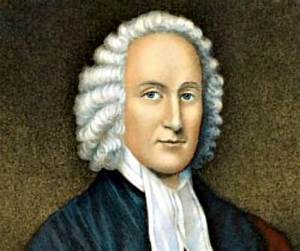
The Great Awakening: Jonathan Edwards’s Mastery of the Sermon

John Alex Touchet

The Great Awakening constituted an explosive revitalization of 18th-century Christianity and had a longstanding and formative impact on Protestantism in both North America and Protestant England. Like no religious awakening before it, The Great Awakening is described by the historian Sydney E. Ahlstrom as “Reformed in its foundations, Puritan in its outlook, fervently experiential in its faith, and tending, despite strong countervailing pressures, towards Arminianism, perfectionism, and activism” (470). The Great Awakening was not the definitive work of one individual by any means but rather was the result of many different figures such George Whitefield, Gilbert Tennent, and others. However, the source of this 18th-century revival can be traced primarily to the work of one man.

Historical Context

Jonathan Edwards is often pronounced the leading figure of the Great Awakening, and rightly so. Edwards spent much time defending Calvinism from Arminianism and releasing many works over the course of his adult life, but his most influential work in the realm of the Great Awakening was his sermons. The origin of his persuasive mastery of preaching and sermons comes into question: how did Edwards learn so effectively to capture and persuade a congregation to the point of the congregation being “extraordinarily melted … almost the whole assembly being in tears for a great part of the time” (Galli and Olsen)? What was it about this man that, even though “He scarcely gestured, or even moved; and he made no attempt, by the elegance of his style, or the beauty of his pictures, to gratify the taste, and fascinate the imagination,” he still managed to convey “eloquence … with overwhelming weight of argument, and with such intenseness of feeling … so that the solemn attention of the whole audience is riveted, from the beginning to the close” (Edwards, Rogers, and Dwight 232)? This paper shall attend to those things that made the sermons of Jonathan Edwards so great: 1) his rhetorical approach and 2) his use of tactile and truly sensational preaching.

Jonathan Edwards was born with a natural tendency for theology. He was enrolled at Yale shortly before turning 13 and eventually graduated as valedictorian. During his years at university, Edwards underwent a formative conversion experience that, in many ways, shaped the method by which he would approach the Bible and theology for the rest of his life. This conversion, and the theological revelations that followed, was the epiphany that sparked within Edwards the flame that would engulf British America and Protestant England in the years to follow.

After graduation, he apprenticed under his grandfather for two years and met his wife. Finally, Edwards became the sole pastor of the Northampton parish of Massachusetts church in 1729, succeeding his late grandfather Solomon Stoddard. He remained there until 1750, when his congregation severed ties with him over a dispute centered around the church’s policy on communion and regenerate/unregenerate members. It was during this intermediate period Edwards produced his most influential sermons that shaped the Great Awakening in America and England alike.

Mastery of the Sermon

Edwards was a very formal preacher, but he was far from conventional. Clint Heacock wrote of Edwards’s style, “During the course of his thirty-plus years of preaching, Edwards fully exploited the potential of the Puritan preaching form while never substantially departing from its tradition” (17). Edwards was not only a preacher but also an apologist and a rigorous intellectual. He had the “unique ability to reshape ideas inherited from abroad in light of the needs and interests of the American situation” (18). Even though Edwards held strictly to formal method and doctrine, he still managed to innovate and create some of the most influential and emotionally-engaging sermons in American history. His rhetorical mastery can be traced to two main sources: the Puritan preaching of his father and grandfather, and the rhetorical style of 16th-century philosopher Petrus Ramus.

Familial Influences

Young Edwards grew up listening to the sermons of his father and grandfather, both exemplifying what a preacher should do and be to Jonathan throughout his childhood. Timothy Edwards, his father, commonly used the basic “tripartite formula” in his sermons. This method utilized “Text, Doctrine, and Applications” as separate sections of the sermon, each divided internally with an enumerated structure. “These sermons demonstrate that Timothy Edwards made use of the more complex seventeenth-century Puritan preaching mode of multiple doctrines and many subheads” (Heacock 20), but at times he also employed the simplified 18th century method of a simple tripartite form, which consisted of a scriptural text, a doctrinal teaching, and a single application of the doctrine. These made up many of the sermons Jonathan Edwards experienced throughout his formative childhood years.

Later, Edwards became the associate pastor under his grandfather from 1726 to 1729 in Northampton, Connecticut. During this time, the tripartite Puritan method was further reinforced by Edwards’s grandfather. Like Timothy Edwards, Solomon Stoddard also used the more simplified 18th-century format but lowered the complexity of the doctrinal subheadings for the sake of a more basic approach. “… Stoddard discovered hidden rhetorical resources in the ‘plain style’ by insisting upon the evaluation of rhetoric in psychological terms that were more comprehensive and subtle than either the old logic or the new Reason” (21). Stoddard also exemplified the importance of the “rhetoric of terror” for young Edwards by example: “As a preparationist who held that God underwent a distinct process for preparing sinners for conversion, Stoddard believed the psychology of ‘fear was an important emotion for awakening the conscience of the slumbering sinner’” (21). This was further enforced to Edwards by the inculcation of the imagery of a sermon being used as an arrow used to pierce the heart of a sinner. During and after his time as associate pastor at Northampton, Edwards’s sermons acquired a more damning tone than his work previous to his associate pastorship, which until then had focused on the “pleasantness of religion” and the “beauty of God” (21). This influence becomes even more clear in sermons such as Edwards’s infamous “Sinners in the Hands of an Angry God.”

Philosophical Influences

Second on the list of Edwards’s formative rhetorical influences is the philosopher Petrus Ramus. It is important to note Ramus, who never attempted to discuss theological issues, dealt solely with the attempted reform of the contemporary arts curriculum of his time (Sellberg). Before Ramus, philosophers such as Cicero thought of rhetoric as a unified but multi-layered progression: invention, arrangement, style, delivery, and memory. Ramus decided this system had become obsolete after fading into vagueness and repetition. He decided to split the former quintuple-layered system into two segments, assigning style and delivery to the sphere of rhetoric, and invention and disposition to the sphere of logic; the fifth tenet of memory was discarded in favor of this new system. “Ramus’ comprehensive new development of logic and rhetoric gained lasting favour among Calvinist scholars and preachers alike and his humanism formed the philosophic backbone of much of Calvinist theology by the late sixteenth century” (Heacock 25-26).

In this system, the preacher’s first goal was to establish doctrinal propositions, followed by the secondary obligation to “rouse emotions and raise the affections.” “The Puritan plain sermon would ideally impress the hearers’ minds first with its logic, while also arousing their hearts to action by secondly appealing to rhetoric” (26). Through this method, Ramean thought was established as the first and foremost influence on Puritan preaching in the 16th and 17th centuries, preliminary to the Great Awakening. Because of the prevalence of Ramean thought in the academic sphere during the 18th century, Edwards likely experienced Ramus’s philosophy during his time at Yale. This placement in his formative educational years proved to be highly influential later in his work.

The typical Puritan sermon style Edwards inherited therefore focused on the presentation of a logical doctrine before the use of emotional rhetoric. This method in its purest form contrasted in some ways with Edwards’s personal beliefs about how religious affections directly motivate behavior. Edwards had argued in Freedom of the Will a truly free moral agent is free from persuasion and rationality: “This notion of liberty and moral agency frustrates every attempt to draw men to virtue by instruction — i.e. by persuasion, precept, or example” (Edwards 88). Because of this, only “appealing to the rationality of the sinner would surely be ineffective; one’s will or heart had to be moved first in order for the intellect to comprehend and respond” (Heacock 27).

Edwards’s Use of Metaphor and Tactile Imagery

Edwards’s use of the bodily senses in sermons as sensationally involving as his “Sinners in the Hands of an Angry God” is one of the most notable traits in his preaching and one of the causes for the emotional outpouring that occurred in Enfield, Connecticut in 1741. Stephen Williams, an eyewitness, wrote, “before the sermon was done there was a great moaning and crying went out through ye whole House…. ‘What shall I do to be saved,’ ‘Oh, I am going to Hell,’ ‘Oh, what shall I do for Christ,’ and so forth.” Edwards had to cease his preaching until the congregation stilled, after which the power of God was exhibited through the following conversions and “cheerfulness and pleasantness of their countenances” (Farley).

The mastery he displays in this sermon is notable because it embodies the skill with which Edwards approached every theological task during his life. The “hellfire and brimstone” stereotype of Edwards’s “Sinners in the Hands” does not act as a microcosm for Edwards’s focus in his subject matter, but the sermon does demonstrate the rhetorical and sensational skill he utilizes in his work as a general rule. As an example, this is an excerpt from “Sinners in the Hands of an Angry God”:

That the Reason why they are not fallen already, and don’t fall now, is only that God’s appointed Time is not come. For it is said, that when that due Time, or appointed Time comes, their Foot shall slide. Then they shall be left to fall as they are inclined by their own Weight. God won’t hold them up in these slippery Places any longer, but will let them go; and then, at that very Instant, they shall fall into Destruction; as he that stands in such slippery declining Ground on the Edge of a Pit that he can’t stand alone, when he is let go he immediately falls and is lost (4).

Edwin Cady summarizes the way in which Edwards appeals to the senses in the most basic but effective way possible: “The freshest imagery … communicates Edwards’s sense of the eerie suspension of the sinner upon almost nothing and intensifies it by adding a nightmarish feeling of his fatal weight” (69). Further, Edwards used complex metaphors to make a mental connection between God’s wrath and his own Enfield congregation.

The wrath of God is like great waters that are dammed for the present; they increase more and more, and rise higher and higher, till an outlet is given; and the longer the stream is stopped, the more rapid and mighty is its course, when once it is let loose … the waters are constantly rising, and waxing more and more mighty; and there is nothing but the mere pleasure of God, that holds the waters back, that … press hard to go forward. If God should only withdraw his hand from the flood-gate, it would immediately fly open, and the fiery floods of the fierceness and wrath of God, would rush forth with inconceivable fury… (Cady 66).

Cady mentions New Englanders were familiar with the water-powered mills that powered their communities, as well as the exciting dangers of floods and other water-based weather. Edwards takes the ideas in the heads of those in his congregation, raises the intensity, and brings his imagery to life within them. “Picture, idea, and emotion existed together in the minds of speaker and listeners; the work of artistic communication had been done” (66). Every metaphor and every image utilized by Edwards is done in a way that can be identified with and understood by his congregation. This form of powerful communication proved to be one of Edwards’s most essential tactics in his nurturing of the Great Awakening.

Assessment of Findings

It appears Edwards’s extensive training in the philosophical and theological realms at Yale did not merely result in an “intelligent student,” but one of the most prominent religious thinkers in American history. The methodology behind the Puritan sermon method and the theological grasp necessary to truly exploit such a system are far more complex than any summary on the “harshly judgmental nature” of “Sinners in the Hands of an Angry God” would indicate. All the sermons of Jonathan Edwards, not just “Sinners,” demonstrate his complete grasp of both the Puritan sermon method and Christian theology. Edwards was truly a master of the sermon and responsible as an agent of God’s sovereignty for the spark that would eventually engulf both British America and England as the Great Awakening.


References

Ahlstrom, S. A Religious History of the American People, New Haven and London, Yale University Press. 1972.

Cady, E. “The Artistry of Jonathan Edwards.” The New England Quarterly, 22 (1), 61-72. 1949.

Edwards, J. Freedom of the Will. 1754.

—. Religious Affections. London: Andrew Melrose. 1898.

—. (1797). “Sinners in the Hands of an Angry God. A Sermon Preached at Enfield, July 8th, 1741.” 1797.

Edwards, J., H. Rogers, S. Dwight. The Works of Jonathan Edwards, A.M. London: William Ball. 1834.

Farley, W. P. “Jonathan Edwards and the Great Awakening.” Enrichment Journal. 2002.

Galli, M., & T. Olsen. 131 Christians Everyone Should Know. Nashville, TN: Broadman & Holman. 2000.

Heacock, C. “Rhetorical Influences upon the Preaching of Jonathan Edwards.” Homiletic (Online)36 (2). 2001.

Sellberg, E. “Petrus Ramus.” E. N. Zalta, ed. The Stanford Encyclopedia of Philosophy Summer 2016 Edition.

Steele, T. J., & E. R. Delay. “Vertigo in History: The Threatening Tactility of ‘Sinners in the Hands.’” Early American Literature18 (3), 242-256. 1983.

Zakai, A. “The Conversion of Jonathan Edwards.” The Journal of Presbyterian History (Philadelphia, PA: 1997)76 (2), 127-138. 1998.

The Time Machine

Alex Touchet

H. G. Wells was one of the singular most formative authors in the genre of science fiction. Wells was among the first of authors to introduce the concept of a “time machine” to popular literature; he even coined the term. The Time Machine, written in 1895, stands apart from other novels of its time as one of the most innovative pieces of literature of its time. The novel’s importance does not come only from its scientific imagining, but the themes presented along with it. H. G. Wells offered his era much more than mere scientific dime novels.

The Time Machine introduced multiple dystopian ideas in a time where literature was often saturated with utopian themes. For example, people such as Edward Bellamy were writing novels such as Looking Backward: 2000–1887 and Equality in the 19th century: these books were very Marxist in nature and often focused on the proposed dangers of capitalism in society versus the success of socialist strategy. H. G. Wells did not take this route when writing his first novel. When his protagonist the Time Traveler travels forward into the future and encounters a strange society filled with shallow and complacent beings, it seems Wells is taking the utopian route. When night falls, however, the Time Traveler discovers the truth of the society he has landed in, and it is far from utopian.

Wells seemed to have some disregard for the utopian presentations of reality prevalent in other literature at the time. He did not write this story to have a happy ending. In fact, it seems rather tragic. The Time Traveler’s adventure does not bring him to a glistening society in which people live together in perfect community, bolstered by technology. Instead, he discovers a primeval food chain where a caricatured “upper class” is juxtaposed against nocturnal ape-like creatures that feast on their flesh. He travels to the literal end of the world, and instead of returning to his time to warn humanity of its impending fate, he disappears from his time. H.G. Wells was not writing to convey wishful fairytales, but to demonstrate what he believed to be the reality of human society. Many of his early works may be described as almost pessimistic (The Invisible Man, The War of the Worlds) in the same manner The Time Machine seems to be.

H.G. Wells was one of the greatest science fiction authors not only because of the revolutionary ideas he presented, but also because of the themes he channeled through his novels. His books were formative to the earliest era of science fiction, and his creation of the term “time machine” spawned countless stories revolving around the theme of time travel. Few authors would be able to say they were the creator of a common literary trope, but H.G. Wells is among the privileged who can.

Socialism’s Shortcomings

Alex Touchet

Socialism sounds like a utopia. Imagine a world in which no one goes hungry, everyone has accessible medical care, and college is free. Socialists dream of a world where everyone is provided for equally. For many middle class families, free medical care and food would be extremely beneficial. Socialism’s intent to divide wealth evenly sounds enticing, but how effective are its policies? Would a socialist country even participate in international trade? History does not confirm any of socialism’s wishful thinking. Past examples of socialist takeovers and economic implementation only disprove the effectiveness of socialism in the real world.

It is fair to say history has shown more instances in which socialism fails than in which it succeeds. Russia’s Red Terror during the early 20th century serves as a prime example for how easily a government that feels threatened by a percentage of its population can turn against it in order to preserve the longevity of socialism. Grigory Zinoviev describes the essence of the Soviet Union’s goal in imprisoning, torturing, and murdering scores of its own people: “To overcome our enemies we must have our own socialist militarism. We must carry along with us 90 million out of the 100 million of Soviet Russia’s population. As for the rest, we have nothing to say to them. They must be annihilated” (Winter 13).

Socialism is specifically defined as “a system or condition of society in which the means of production are owned and controlled by the state.” A state is defined as “1) a politically organized body of people usually occupying a definite territory, or 2) a government or politically organized society having a particular character.” Economy is “the structure or conditions of economic life in a country, area, or period; also: an economic system” (Merriam-Webster).

Socialism is an altruistic system. The goal of socialism is to equalize wealth distribution so the ninety-nine percent of people who have less can exist at the same level as the one percent of people who have the most. Socialism’s intent is, ideally speaking, a noble one; in the real world, however, well-intended goals do not always result in a functional system. The essential problem with socialism is not its intent is immoral, but it requires humans to interconnect in a way diametrically opposed to human nature. This truth alone implies such a system would, in the least, have many logistical problems.

This will be a critical analysis of socialism’s blatant failure in both past and present human society. Points pertaining to historical examples and economic theory will be used to explain why this is true. I will first show socialism’s inability to maintain an effective economy compared to an effective capitalist model. I will also explain the greatest ethical flaw of socialism: it requires the human race be altruistic. I will also address and refute arguments for past nations’ lack of relevancy to modern socialism. I will explain how the proposed solution to socialism’s problematic economy through quota implementation has failed before and cannot solve its need for a true market economy, and I will show how a socialist nation in a world of capitalism will never survive. In the end I will address the socialist solution for its unwieldy human populous and its occasional lack of Marxist zeal by demonstrating the past failure of the Bolshevik Takeover.

My first argument will demonstrate socialism’s failure in comparison to capitalism’s modern success. The socialist system fails because it intends to take the basic mechanism for modern capitalism, that of individual economic freedom, and replace it with the authority of the State. The capitalist approach to economic efficiency is, as Milton Friedman puts it, is “misleadingly simple.” His premise is two parties will not voluntarily participate in an exchange if they do not believe they will benefit from it. This basis for economic efficiency functions on more than just the individual level; it applies to all economics. Friedman extrapolates to explain how the principle of supply and demand occurring as a result of voluntary action between people serves to create an efficient system between millions of people which “enables [them] to cooperate peacefully in one phase of their life while each one goes about his own business in respect of everything else” (Friedman 13).

Friedman’s argument is socialism has no realistic substitute for this system of voluntary exchange. He demonstrates how even Russia, “the standard example of a large economy that is supposed to be organized by command” (9), is routinely infiltrated by many capitalist economic traits. Whether legally or illegally, voluntary cooperation between individuals supplants itself where, according to a Marxist model, the state should have unyielding control.

In the labor market individuals are seldom ordered to work at specific jobs; there is little actual direction of labor in this sense. Rather, wages are offered for various jobs, and individuals apply for them — much as in capitalist countries. Once hired, they may subsequently be fired or may leave for jobs they prefer. Numerous restrictions affect who may work where, and, of course, the laws prohibit anyone from setting up as an employer — although numerous clandestine workshops serve the extensive black market. Allocation of workers on a large scale primarily by compulsion is just not feasible; and neither, apparently, is complete suppression of private entrepreneurial activity (10).

My second argument will explain how taking incentives out of an economic system does not serve to equalize wealth, but to destroy the market’s functionality. Within a free market, workers function in accordance with the principle of supply and demand on multiple scales. To feed one’s family, one must attain a certain level of profit on a timely basis. For a company to remain competitive in the business scene, it must meet consumer demands for its stylized brands. For nations to be capable of making beneficial trade deals with other countries, they must first be capable of producing what those countries want. Incentive is a key element in all economic transactions, but socialism intends to function without it.

Mark Perry explains how socialism fails because it does not utilize three major incentive-based components. First, the system of price within the market functions “so flawlessly that most people don’t appreciate its importance.” The mechanism a simple price-tag symbolizes is a crucial element to a functional economy. The existence of a flexible price system broadcasts information about surplus or scarcity within the market and enables it to adapt to the ever-fluctuating economic landscape. Perry uses an example of oil restriction by the Organization of Petroleum Exporting Countries in the 1970s to exemplify how prices affect the market. Oil prices skyrocketed, and both buyers and distributors reacted accordingly. “Consumers … were forced to change their behavior dramatically. [They] reacted to the scarcity by driving less, carpooling more, taking public transportation, and buying smaller cars. Producers reacted to the higher price by increasing their efforts at exploration for more oil.”

Second, socialism lacks a coherent profit and loss system. This system is the mechanic used to gauge the general success of any business within the market. Businesses that do well receive profit while those that do not are met with harmful losses. This functions as a “disciplinary system” that effectively regulates the economy in a way that weeds out the ineffective business firms and rewards the efficient ones. Under a socialist system, however, “there is no efficient way to determine which programs should be expanded and which ones should be contracted or terminated” (Perry).

Third, socialism takes away the right to private property in favor of ownership by the state. An example of how the dissolution of private property is an issue is Britain’s 16th century “tragedy of the commons.” This refers to the occasion in Britain when villages publicly owned certain land for open grazing of cattle. Instead of creating an effective resource for public use, however, the grazing land quickly became overused and barren. The creation of a communal resource did not qualify as a first step to a Marxist utopia of economic equality; it was abused and exploited until it became literally worthless. Perry explains how publicly owned resources are not supported by individual incentives to inspire good stewardship. “While private property creates incentives for conservation and the responsible use of property, public property encourages irresponsibility and waste.” If everyone owns something, then no one owns it; and if no one owns it, then no one will take care of it. Therefore, “the failure of socialism around the world is a ‘tragedy of commons’ on a global scale.”

My third argument will explain the basis for socialism’s failure: it cannot function alongside flawed human nature. Socialism goes against the basic principles humans live by. Very few people can truthfully admit they care about the economic well-being of everyone other than themselves enough to dole out labor for their sake. That idea simply does not mesh with human nature. Socialism ignores this fact entirely. After all, the premise for socialism originated from the Marxist-Leninist belief the ideal world would exist in a state of global communism. People who uphold this principle must believe human nature is inherently altruistic; if they do not, their entire worldview falls apart. The lie of humanity’s altruistic nature is the only reason socialists today have been capable of forging such a large political following. For a functional economic model to exist, those involved in it must see humanity for what it is, not what they want it to be.

Some socialists suggest past examples of socialist experimentation are irrelevant to their proposed “modern model.” More specifically, the first argument is the failures of socialism’s failed implementation in countries such as Russia throughout history are irrelevant to what true socialism aims to achieve. Bertell Ollman states in an article supporting socialism’s vast modern potential, “Where there is little to share, socialism will have difficulty working, but where material abundance already exists and is simply badly distributed, socialism can flourish.” He argues past nations’ failed experimentation in socialism should be attributed to how those nations did not contain the necessary elements for socialism’s success. For socialism to work, he claims, it must have both democratic principles and a populous willing to cooperate with the state. His socialism is one based on individual choice, not just state-based control (ironically so, because socialism requires the dissolution of private property and identity). According to Ollman, even Marx believed countries needed certain material elements before they could successfully function, such as industrialization and an altruistic population.

The author makes some partially correct points, but assumes others that are fairly naïve (rather than progressive). While the fact of Russia’s lack of necessary components (cooperative populous) for an effective socialistic model is correct, the idea a society will one day reach such a level of collective ability to unite in total submission to a state-controlled economy is ludicrous. According to Ollman’s representation of socialism’s extensive list of mandatory components, a viable society would require a population willing to cooperate by both handing away its economic independence and learning to work for the incentive of the “greater good” rather than profit. This argument’s flaw lies not in false representations of history, but in how it assumes a human population is capable of surpassing that which faulted Russia or China. A whole country of people will never be able to transcend the divide between social classes to work together for the common good; it is not that no one wishes for such a reality, but that they do not have the capacity to enable it.

Again, the flaw in a socialist system lies in the problem of the human condition. Humans are imperfect, greedy, and capable of great evil. No individual can achieve in any respect a life devoid of selfishness. Socialism requires humanity to be truly autonomous in nature; since humans are not capable of autonomy, socialism is therefore incapable of functionality. Attempting to force socialism upon society is equivalent to forcing a square peg into a round hole: once it begins to fit, the hole itself has been dealt nearly irreparable damage. Essentially, the idea socialism will not function without the correct conditions is true; however, to believe those conditions are even remotely possible is contrary to human nature itself.

The second point I will refute is socialism’s attempts at reconciling the difficult nature of a population with their altruistic views by demonstrating the consequences of such action. Socialist groups in the past have tried to circumvent this difficulty of human nature by commandeering society to implement their system. Once the state is able to make socialism a reality, its citizens would ideally realize the new position is superior to the capitalist model. This is a hopeful, but false, proposition.

The Bolshevik party of 20th-century Russia tried to accomplish exactly this. The first free elections in Russian history occurred during the Constitutional Convention of 1917. The Bolsheviks held only one-fourth of the seats; ironically, they only represented a minority of the Russian people, even though “Bolshevik” was derived from the Russian word for “majority.” This serves to prove the “People’s Revolution” was never a collective uprising against the government; it was a political minority that felt it necessary to force economic revolution upon over an entire population. Instead of being met with the open arms of civilians hoping for a better, more efficient economic system, the Bolshevik revolutionaries were met with a civil war waged primarily by the White (anti-Bolshevik) Party that lasted five years and resulted in over three million officially documented deaths (Wheatcroft).

As I have explained, socialism is inherently detrimental to society no matter how attractive it may initially appear. Human nature is observably incompatible with the precepts of socialism, as can be derived from both modern and past examples of socialist systems. Sadly, political leaders and social rights activists today do not see this as reality. Whether their motivations are altruistic or not, we must remember the repercussions the institution of socialism can and will have on society. To avoid the possibility of dissolution of private property and a complete takeover by the State, citizens must actively vote against politicians who exhibit a socialist leaning. In the case of socialism’s introduction into society against the will of the populous, it is the moral obligation of the citizenry under such a government to fight against those oppressive policies, for they are not only protecting their right to property and individual identity, but also that of the following generation.

Works Cited

Friedman, Milton, and Rose D. Friedman. Free to Choose: A Personal Statement. New York: Harcourt Brace Jovanovich, 1980. Print.

Ollman, Bertell. “A Bird’s Eye View of Socialism.” A Bird’s Eye View of Socialism. N.p., n.d. Web. 20 Jan. 2015.

Perry, Mark J. “Why Socialism Failed.” FEE Freeman Article. Foundation for Economic Education, 31 May 1995. Web. 6 Dec. 2015.

Wheatcroft, Stephen G. “Victims of Stalinism and the Soviet Secret Police: The Comparability and Reliability of the Archival Data — Not the Last Word.” Europe-Asia Studies 51.2 (1999): 315-45. Web.

Winter, Russ. “The Hidden Suppressed History of Red Terror in Post-WWI Europe.” Winter Watch. 18 Feb. 2016. Web. 20 Feb. 2016.

1984‘s Dark Future

Alex Touchet

Published in 1949, George Orwell’s 1984 describes the futuristic and dystopian society of Oceania where the government maintains a totalitarian grip over the populous by way of omnipresent propaganda, ubiquitous surveillance, and a restrictive chokehold on any form of individualism.  The novel was published four years after the end of World War II, and was undeniably beyond its time.  Orwell comes across as practically prescient through his chilling depiction of totalitarian states that overwhelm the citizens who live within them.  It is logical to assume Orwell was, in the least, inspired by political and economic events taking place in and around Britain during the ’40s.

Thankfully, readers of Orwell do not have to rely upon conjecture to inform them of his novel’s original purpose; in fact, a letter Orwell sent in 1944 to a certain Noel Willmett detailed his personal stance on world politics at the time.  He focused specifically on his fear totalitarianism and “Fuhrer-worship” were consistently becoming more frequent throughout the world.  He also explained how he worried this rise of “emotional nationalism” and leader-worship could inevitably lead to major historical revisions.  He elaborated that “Hitler can say that the Jews started the war, and if he survives that will become official history.”  This theme is exemplified through 1984’s “Ministry of Truth,” the institution that essentially rewrites history so it accommodates whatever the government wishes to tell its naïve civilian population.  Orwell drove his point further with a numeric example he later utilized in his novel: “[Hitler] can’t say that two and two are five, because for the purposes of, say, ballistics they have to make four. But if the sort of world that I am afraid of arrives, a world of two or three great superstates which are unable to conquer one another, two and two could become five if the Fuhrer wished it.”  This serves as a more personalized precursor to 1984’s analysis of individuality oppression.

Orwell also explained how he believed society was already on a downward slope toward a more totalitarian outlook.  He detailed two major reasons for this decline in the general interest in democratic principles in British society.  The first reason he gave was based upon the growing tendency toward indifference for political individualism in the younger generation of his time.  “Do you realise, for instance, that no one in England under 26 now has a vote and that so far as one can see the great mass of people of that age don’t give a d*mn for this?”  He followed by saying a further problem with Britain’s social situation was how most of the intellectual community tended toward totalitarianism over individualistic values.  They would take Stalin, for example, over Hitler, disregarding the potential issues that would arise from such a decision.  “Most of them are perfectly ready for dictatorial methods, secret police, systematic falsification of history etc. so long as they feel that it is on ‘our’ side.”  Orwell connected this general disregard for the necessity for political protection of individuality with the argument Britain and the United States have not experienced totalitarianism yet, and therefore do not understand its ramifications.  It would be much easier to ignore the potential evils of policies such as public surveillance, Gestapo-like police, and the rewriting of history when they are all proposed in the name of homeland-defense or emotional nationalism.

An article by John Bennet describes how Orwell’s involvement in both the BBC and the Spanish Civil War shaped how he viewed the media.  The fact news reports of the war tended to bear little to no resemblance of the actual events to which they referred made Orwell very skeptical of the media’s overall validity.  Bennet also says Orwell partially based his “Ministry of Truth” off of BBC’s efforts during World War II.  “Orwell noted that the BBC put out false hate propaganda during World War II, and controlled history by censoring news about the genocidal Allied policy of leveling German cities by saturation bombing.”  This experience proved to be pivotal in how Orwell believed the control of the past to be integral to the control of the present and future.

Orwell’s many predictions were not restricted only to the 20th century; many of them are gradually becoming more obvious in modern society.  Even in the West, a fountainhead for individual political liberty, the things Orwell was so vigilant in warning the world about are becoming progressively more prevalent.  Bennet describes how even the seemingly far-reaching concept of what Orwell coined “newspeak” has already invaded western media.  “The corruption of language described in 1984 is widespread in the media today, with ‘newspeak’ terms such as democratic, socialist, fascist, war criminal, freedom fighter, racist and many other expressions being used in a deliberately deceptive, propagandistic way….”  Orwell understood the intrinsic reality of government and society so well his warnings apply in the modern day just as well as they did while Stalin was still alive.

George Orwell’s 1984 serves as a warning to all people concerned with the longevity of their individual rights and political freedom.  After over fifty years, his words still continue to impact how people view government and its potential evils.  His writings were undeniably affected by his own experiences in the fields of media and political conflict, and hold serious weight for people living in the modern world.  Certainly, George Orwell hoped people would heed his warnings and remain constantly aware of their social situation.  As Bennet said, “The price of liberty is eternal vigilance.”

Bibliography

Bennett, John. “Orwell’s 1984: Was Orwell Right?” The Journal for Historical Review 6.1 (1986). Web. 9 Dec. 2015. <www.ihr.org>.

Marshall, Colin. “George Orwell Explains in a Revealing 1944 Letter Why He’d Write 1984.” Open Culture. Ed. Dan Colman. 9 Jan. 2014. Web. 7 Dec. 2015.

A Review of The Fifth Wave

Alex Touchet

An ominous alien craft appears over earth.  It assaults Earth with a series of four waves of destruction.  The first is in the form of an electromagnetic pulse that shuts down every electronic device on the planet.  This initial attack results in the deaths of around half a million people.  As technology becomes obsolete, the aliens drop a large metal rod onto a geographic fault line, creating a gargantuan tsunami that wipes out coastal cities on every continent.  This wave’s death count is over three billion.  The third assault is a plague called the “blood plague” or the “fourth horseman.”  Its mortality rate is nearly one hundred percent, and it decimates around ninety-seven percent of the remaining human population.  The fourth wave is the activation of an alien consciousness inside select human beings that were “infected” in the mental invasion of 1995.  These humans, called “silencers,” proceed to hunt down remaining survivors with cold precision.

The story follows two survivors: Cassie is a girl searching for her lost brother, and Ben is a survivor training in what is said to be a resistance-oriented military.  Their story is closely entwined with Evan, a silencer who narrowly spares Cassie’s life for sentimental reasons he himself does not entirely grasp.  This disparity between characters is one sign of Rick Yancey’s literary mastery.  He doesn’t fall victim to the trope of the “strong young female surviving a post-apocalyptic world,” such as Suzanne Collins (The Hunger Games) or Veronica Roth (Divergent).  Yancey gives multiple differing perspectives that have an individual voice and personality.  Ben often uses militaristic language while narrating, while Cassie exhibits a more feminine personality unique to her character.  This dual-perspective approach is a tactic many authors avoid.  One of the only other stories where I have seen it flawlessly executed is Worm (a completed Web serial) written by Wildbow.

Rick Yancey succeeds so well with this novel because he openly approaches a genre often marred with a painful multitude of stereotypes and clichés and circumvents them.  He foresees how the story might become predictable and tosses in a plot twist.  He writes his characters not as mirror images of the over-used stereotypes of dystopian fiction, but as real (and blatantly flawed) people.  Cassie had romantic feelings for Ben before the Waves decimated the planet, and so when her brother pops up in Ben’s squad of trainees, the reader expects a clichéd romance to occur.  While this setup inherently seems a little too unrealistic to make sense, Yancey does not take the expected route of playing matchmaker with two broken survivors connected by preexisting relationships.  He sets up a controversial connection between Cassie and Evan the alien-boy before Cassie ever even reunites with Ben and her brother.  This sort of “always one step ahead” approach destroys the sense of familiarity readers often feel toward predictable stories and demands their attention.

One of the most complicated characters in the story is Evan.  He is a walking contradiction.  Silencers are the epitome of efficient destruction, so it makes little initial sense when Evan falls for a member of the race he was programmed to kill.  Even though he has the brain of a hostile alien, there is something about Cassie (and humans in general) that forces him to rethink his priorities.  He has fallen in love, which may not be too unique as a plot point by itself, but is not an event created merely to inspire emotional connections around a love-interest.  Instead, it is a doorway that opens up new possibilities and questions concerning the silencers and their role in humanity’s extinction.  It also demands the question: “Why does Cassie fall for him as well?”  Normally, in stories where a character’s world and family has been destroyed by a hostile invader, the protagonist feels imperatively obligated to seek some form of vengeance.  Forgiveness is often rejected for the sake of “justice,” or more appropriately, revenge.  Jean Valjean is possibly one of the only protagonists I have ever observed to willingly forgive an antagonist, regardless of their wrongs and choices.

Yancey, once again, crosses out another typical cliché and instead gives Cassie the ability to look past Evan’s nature.  When she first discovers the real Evan, she is torn between her love for him and mistrust for his kind.  However, she finally decides he is worth the risk. She is not blinded by his mere connection to the aliens; she sees him for who he really is and how he treats her.  She understands the weight his betrayal of his own race holds and reciprocates when she falls in love with him.  This mutual romance demonstrates what is at the core of Yancey’s novel.  In a broken world where the enemy’s final attempt at annihilating humanity is to tear apart their ability to trust each other, two individuals reach across the divide and hold onto one another.  This is the most powerful element of the novel, because it exemplifies one of the characteristic traits of humanity: its search for community and its thirst for connection.

Yancey plays a long and deliberate game with his characters while making sure they don’t conform to typical cliché guidelines.  Every little detail of the plot has been designed to fit into a larger, much more complicated plan.  Ben and Cassie’s little brother have been trained along with the rest of their barracks by soldiers to “kill aliens.”  They have become cold-blooded and efficient.  Mr. Yancey allows readers to begin to discover early on the military camp is not as it seems.  It becomes increasingly obvious the soldiers may not be true human soldiers, but the characters themselves are unaware and continue to make decisions that force them into worse situations.  This forces the reader to arrive at conclusions before the characters themselves, adding a new element of conscious discovery not present in most novels.  When the soldiers are revealed to be alien agents training children to hunt down and kill their own species, readers are practically screaming at the until-then oblivious protagonists.

While The 5th Wave is definitely not a reinvention of the genre, Yancey succeeds in multiple aspects of the story usually overlooked by most other authors.  He changes the protagonists often enough to provide more variety than a book such as The Hunger Games could ever accomplish.  He takes obvious (and expected) clichés, and then turns them on their head.  His mastery of his individual characters is evident with how well he handles their separate, broken identities.  He even approaches the primary question that plagues almost every alien invasion story ever: “Why do they want us dead if they don’t need anything we have?”  This is probably the main reason I liked the book so much.  It approaches elements of science fiction other authors seem to take for granted.  This novel is not the best teen science-fiction ever written, but it is definitely a favorite worth picking up.

Anarchy in V for Vendetta

Alex Touchet

The character V from the book V for Vendetta, written by Alan Moore, has become more than just a graphic novel character.  He has grown to be a symbol for freedom; he is the face of rebellion against tyranny.  The “hacktivist” group Anonymous has even adopted the Guy Fawkes mask as their icon.  The visage of the fictional terrorist has evolved beyond a mere picture; Moore’s creation has transcended the world of fiction and become an internationally recognized metaphor for individual rights, activism, and anarchy.  Sadly, many people wrongly associate the word “anarchy” with a mental picture that looks like a scene out of movies such as The Purge or Lord of the Flies.  These people visualize a nation ruled by lawlessness, disorder, and chaos.  This is a fairly shallow interpretation of the goals V intended to achieve in Moore’s dystopian England; in fact, those cinematic examples are not in any way an accurate representation of true anarchy.  What does anarchy really mean?  Does V qualify as an anarchist?  Are his actions in accordance with anarchist values?  Does V intend to institute an anarchist society after the fall of England’s totalitarian government?  This paper will evaluate all of these questions and attempt to provide an objective viewpoint through which the reader can effectively evaluate anarchy as presented in Moore’s novel.

The word “anarchy” is defined by the Oxford English Dictionary as the “absence of government and absolute freedom of the individual, regarded as a political ideal.”  The word’s roots come from the Greek word “anarkhia.”  The word stems from “anarkhos,” which effectively means “without a ruler.”  It is important to note this explicitly says without a ruler; it does not imply terms like “chaos” or “disorder.”  This correctly contradicts a common view of anarchism, which interprets the political view as promoting a land of “Do whatever you want.”  This should not be defined as anarchy; instead, it is an example of something called “omniarchy.”  An example of this view can be found in the movie The Dark Knight.  The Joker is often called an anarchist.  This is completely incorrect.  “Whereas anarchists want to do away with the coercive hierarchy of any person over any person, the Joker wishes to impose upon all a coercive hierarchy of each person over each person.  In a very literal sense, the Joker wants what Hobbes called the war of all against all, the entire breakdown of society, the reign of chaos” (Peak).

In reality, anarchy’s vendetta is to create a land of “Do whatever you want as long as it does not interfere with the natural rights of other individuals.”  A person who imposes himself as a hierarchical authority over another person is in violation of this basic concept.  The main goal of true anarchists is to create a society in which no individual is imposing himself over another.  Therefore, all anarchists must follow the rule of the nonaggression axiom.

This term essentially means any initiatory violence or violation of another human’s natural rights is prohibited.  However, except in the case of some anarchopacifists such as Leo Tolstoy, most anarchists do not prohibit retaliatory violence.  In the case of person A attempting to rape person B, if person B were to pull a gun on person A, he/she (the victim) would not be in violation of the nonaggression axiom.  It is important to note the retaliatory aggression must be equal to the initiatory aggression, because otherwise, the original victim would be imposing himself or herself upon the aggressor as a hierarchical authority and therefore be in violation of basic anarchist ideology.

Now that the exact meaning of true anarchy has been adequately defined, the next step in understanding it in context of Moore’s novel is to decide whether or not V is a true anarchist, or if he is just attempting to impose an anarchist society upon England.  For V to fit the anarchist prototype, he must meet the previously outlined qualifications.  The most important of these qualifications is his actions in relation to the nonaggression axiom.

For V to be a real anarchist, he must act without initiating a violation of other individuals’ rights.  Remember this does not include retaliatory action, just initiatory action.  It would be easy to claim since V is a terrorist, he immediately violates this precept.  The buildings or locations he destroys, in order, are the Larkhill Resettlement Camp, Parliament, Jordan Tower, and the Post Office Tower.  He generally destroys these buildings during times when he was unaware of any human occupation: for instance, the Parliament building has been unused for years, and most likely unoccupied at the hour at which it was blown up.  When he blows up the Resettlement Camp, it is not specified whether or not anyone is killed or injured, other than in the instance with the mustard gas.

The author of an article appropriately titled “Is V an Anarchist?” claims this terrorism in itself is not in violation of the nonaggression axiom because it does not qualify as theft.  “While the state claims ownership of [the buildings], we must remember that the state acquires all of its property through expropriation, through usurpation, through theft.  The state’s so-called ‘ownership’ over these buildings is, according to the theory of property we posit above, completely illegitimate.  The buildings are actually in a Lockean ‘state of nature,’ and since they are not properly owned by anyone, V’s destruction of them cannot properly be considered theft” (Peak).

The only recorded death via bombing is of the man named Etheridge.  It could be argued he is effectively a criminal because of his involvement with the state, but it is unknown whether or not any of his individual actions are immoral enough to merit death.  Remember retaliatory action should, in violence and/or severity, never surpass the initiatory actions that preceded it.  Since V could not have been aware of this specific man’s acts, his death is not justified in regard to the anarchist theory of retaliatory ethicality.  Would V, still unaware of the man’s acts, have been justified in killing Etheridge if he had indeed committed acts worthy of execution?  This is up for debate.  It is my personal opinion V is indeed guilty of murder in this case, even if unknowingly so, and therefore violates the nonaggression axiom.

Another problem with claiming V is a true anarchist is his treatment of the individuals who were involved with his imprisonment.  He systematically kills many of them in a form that resembles coldblooded murder.  While it is arguable the execution of many of these people is justified retaliation for their actions involving the prisoners at the Larkhill Camp, the novel does not specifically mention their exact actions against specific individuals and so makes it difficult to determine if they meet the non-pacifist anarchist qualifications for execution. 

A third example of V not upholding anarchist values can be seen in his treatment of Evey.  He does not allow her to leave his base of operations, effectively imprisoning her against her will.  This is an obvious violation of her individual rights.  More importantly, V subjects Evey to extensive physical and psychological torture, which, even as an attempt to open her mind, still qualifies as torture.  While V obviously believes his ends justify his means, his actions violate the nonaggression axiom and therefore remain unethical in nature.  It is safe to say V does not personally meet the requirements for a truly anarchist individual; however, this is not to say his intentions for dystopian English society are not anarchistic.

One of V’s most relevant quotations in relation to his intentions for society come from his public announcement during the prologue of Book Three: “For three days, your movements will not be watched….  Your conversations will not be listened to … and ‘Do as thou wilt’ shall be the whole of the law.  God bless you … and goodnight” (Moore 187).  It would be easy to take from this V’s motives are in line with those of the Joker’s, since he apparently wishes to create a state of disorder, confusion, and chaos.

However, V’s endgame is not to create chaos merely for the sake of an omniarchy; instead, he believes it is “a stage … society must go through … before anarchism can be realised” (Peak).  He specifically tells Evey on page 195, “This is not anarchy, Eve.  This is chaos” (Moore).  It is clear V understands the fundamentals of an anarchist society and is attempting to create such a society by teaching its citizens what happens without order.  He believes through this process England will realize the only true path to freedom is through voluntary order, which is an important part of anarchistic values.

In conclusion, V has been shown to violate anarchistic values and therefore does not qualify as a true, purely anarchistic individual.  While this is the case, it is still possible his intentions for a future England are really anarchistic.  This has been shown by his treatment of the general public in England and by his logic he presents to Evey when she confronts him about how he sent English society spiraling into chaos.  It is safe to say V does indeed intend to create a free anarchist society, even if he does not meet every qualification for such a society himself.  This can be quantified as a result of his own personal vendetta against the people who imprisoned and experimented upon him; his violation of anarchist principles stems not from a disregard of anarchy but from V’s own individual motives and prerogatives.  It would be appropriate to conclude V intends to create a truly anarchist society from the remains of the tyrannically-ruled English people; his real endgame is not only to have his vengeance but to free society from those who impose themselves upon it and its citizens.

Works Cited

“Anarchy.” Oxforddictionaries.com. Oxford English Dictionary. Web. 6 May 2011.

Moore, Alan, David Lloyd, Steve Whitaker, and Siobhan Dodds. V for Vendetta. New York: DC Comics, 2005.

Peak, Alex. “Is V an Anarchist?.” Alex Peak. Web. 6 Oct. 2014. <http://alexpeak.com/twr/vfv/anarchism/&gt;.

—. “The Joker is Not an Anarchist.” Alex Peak. Web. 8 Oct. 2014. <http://alexpeak.com/ww/2008/016.html&gt;.