“Play Me My Song”: Literary Influences on Genesis

Christopher Rush

“And I’ve finally found a place to call my own”: From Genesis to Revelation and Trespass

The early days of Genesis set the scene for this band’s unusual dual nature, in that they appear to mimic typical trends of Progressive Rock, yet they do it in their own unique way.  Just as many future band mates find each other at school (seemingly at some sort of art college, where like-minded aesthetics-driven individuals already predisposed toward non-traditional workforce occupations and hobbies tend to congregate), the core of Genesis (Peter Gabriel, Tony Banks, and Mike Rutherford, along with initial guitarist and driving force Anthony Phillips) met at Charterhouse School, what the British call a public school (what we call a private school).  The difference for Genesis, then, is they met at effectively a “posh” school for children of well-to -do British society, unlike many others (Jethro Tull, for example, formed from a core of grammar school students Ian Anderson, John Evan, and Jeffrey Hammond).  This imbricates with another initial difference for Genesis, in that they met each other while still minors, and most other Prog rock bands met each other when at a college or in their twenties.  Genesis’s music matures while the band members themselves are maturing into adulthood.

Another Prog rock distinction of Genesis, as their name implies, is their religious … “affinity” is too strong a word; perhaps “acceptance”? “tolerance”? (if we could dissociate it from its unfortunate connotations in our day).  Anthony Phillips says, “we weren’t particularly religious, we just liked the hymns and tunes.”  They certainly do present religious themes and allusions more positively and more frequently than most of their Prog compatriots, at least, and their debut album, From Genesis to Revelation, is a good example.  While it is still likely true (forty years on) that many Genesis fans are “Invisible Touch”-era fans, and may not know that Gabriel-era Genesis albums exist, it is just as likely that many Gabriel-era Genesis fans do not know From Genesis to Revelation even exists, especially as it technically belongs to their first manager Jonathan King and was not re-released in the anniversary Genesis box sets back in 2007.  While the album sounds very much like a juvenile outing, Peter Gabriel’s voice is a foreshadowing of greatness to come (much like the first time James Cagney appears on-screen in The Public Enemy, and one instantly recognizes what a real actor looks like).

The album is lyrically influenced by the Bible, as its name indicates as well as the general proto-concept-like nature of the album, telling a rough musical version of sweeping themes of the Bible (more or less – no verses or characters are quoted, really, but the general impression of Biblical allusion and influence is inescapable).  Phillips says the interlinking music to unify it as a concept album came from the hymns, especially J. Herbert Howell hymns, they all loved.  Giammetti says Gabriel’s reference to the “happiness machine” in “Am I Very Wrong?” comes from Bradbury’s Dandelion Wine, which fits with what we know of the band’s general love of literature, though no one seems to know who wrote the lyrics for that song specifically.

Giammetti reinforces their early love of science fiction during the focused writing of Trespass (as Genesis, fully committed to being professional musicians, moves to their third drummer, John Mayhew, before Phil Collins): “The only moments of distraction involved walks in the surrounding countryside and reading sci-fi novels and books on mythology (which would greatly influence their lyrics).”  Giammetti further says the album features “literary references to movements such as Surrealism and authors like J.R.R. Tolkien and Lewis Carroll (for the fairy tale themes) and William Blake (for the visionary aspect).”  It would be wonderful if he quoted the band members to verify this, but he does not.

More helpfully, though, Tony Banks says of his composition “White Mountain” that “Both Fang and another character in the lyrics, One Eye (already mentioned in ‘One-Eyed Hound’ [unreleased single in From Genesis to Revelation days]) come from the children’s book White Fang by Jack London.”

Even by this early stage in their development, Genesis is recognized as “one of the country’s ‘thinking’ bands,” says Michael Watts in a Melody Maker article from January 23, 1971.  Surely the lyrics are a significant factor in that assessment, and even if direct or obvious literary allusions were not replete, the atmosphere Genesis songs creates from their outset distinguishes them as a literary band.  Gabriel, describing them in that same Melody Maker article, says “I see the band as sad romantics, you see.”  Mike Barnard, temporary Genesis guitar player between Anthony Phillips and Steve Hackett, says he and Gabriel would “tour the Lake District” between tour gigs at this time.  Surely that is proof of the Romantic poets’ influence on fledgeling lyricist Peter Gabriel.

“Can you tell me where my country lies?”: Nursery Cryme, Foxtrot, Selling England By the Pound, and The Lamb Lies Down on Broadway

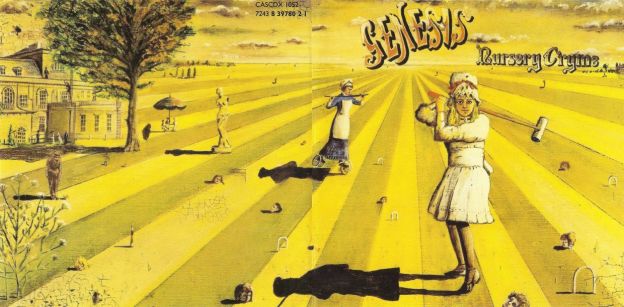
Genesis hits the jackpot with drummer number four, Phil Collins, and guitarist number three, Steve Hackett (not ignoring that Tony Banks and Mike Rutherford had been playing guitar on their albums from the beginning), and in the next few years create four unique, exquisite albums not just for Prog rock but for all music.  Nursery Cryme, especially because of the menacing cover art from Paul Whitehead, establishes a darkling Britishness and experimentation that definitely comes through in the music and lyrics.  Giammetti says “The Musical Box” is inspired by Oscar Wilde and Peter Gabriel’s Victorian mansion in which he grew up, with “Harold the Barrel” likewise displaying a Dickensian flair.”  Steve Hackett offers more specific literary influence for “Seven Stones,” confirming the eclectic reading habits of his new lead singer, saying, “Pete was interested in the ideas he had read in the I Ching, so the lyrics were influenced by The Book of Changes.”  Tony Banks corroborates Giammetti’s earlier generalization of the band being influenced by mythology for the final song on the album, “The Fountain of Salmacis”: “The lyrics are based on the myth of Salmacis and Hemaphroditus.”  Mike Barnes specifies this is the version in Ovid’s Metamorphoses, book four, and there is no reason to discredit this, considering their Charterhouse education and corroborated experience with mythology.

Foxtrot opens with what I have been telling students for years is Peter Gabriel’s reference to Keats’s great poem “On First Looking into Chapman’s Homer,” but Giammetti and Barnes both credit Tony Banks with writing the lyrics, influenced by Arthur C. Clarke’s Childhood’s End and the Marvel comics character The Watcher.  As deeply as that wounds my heart to learn, at least there is still a definite literary influence (and mild assuagement from the discovery that Genesis members read Marvel comics).

This album’s lighter fare, “Get ‘Em Out By Friday,” bears influence of science fiction, especially in the ending of “Genetic Control” requiring all people be no taller than four feet to enable smaller, more profitable government housing.  Gabriel says, “I tried to put some sort of Dickensian feel into this song,” which may at least tenuously count as literary influence here.

Many sources historical, literary, and religious influenced “Supper’s Ready,” Genesis’s great Prog epic (in the shorter category of single album-side epics such as “Tarkus” and “2112,” as opposed to entire concept albums such as A Passion Play and The Lamb).  Though Gabriel says the ending is a “mixture of Christian and Pagan symbolism,” I have no qualms tearing up every time I hear it in sound theological anticipation of a future historical truth when “the supper of the Mighty One” occurs, whether eggs are served or something else.

Of Selling England By the Pound Giammetti says “the usual references to mythology and literature are relegated to a marginal role (albeit still present) in favor of historical references and social comment,” which is certainly in keeping with other de rigueur Prog rock inspirations.  This dynamism from Genesis comes at a time, says Giammetti, when Prog rock is starting to lose its way: ELP’s Brain Salad Surgery he calls “passable,” Yes’s Tales from Topographic Oceans “heavy-going,” Rick Wakeman’s solo Six Wives of Henry VIII “indigestible,” and Jethro Tull’s A Passion Play “pretentious,” all of which “confirm that delusions of grandeur had hijacked the musical genre which seemed to be merely running its course and becoming increasingly unpalatable….”  Little wonder new sounds like Mike Oldfield’s Tubular Bells, the Mahavishnu Orchestra’s Birds of Fire, and Fripp & Eno’s No Pussyfooting being so popular, and Glam rock peaking at the time as well.

In contrast to all these, Giammetti has nothing but superlatives for this album, with which I agree.  Despite the contemporary satirical nature dominating the album, some literary influences and understandings affect the album, evidenced in Gabriel’s alliterative humor throughout the lyrics, surely influenced by his love of Spike Milligan and the Goon Show.  The most overt literary influence is in “The Cinema Show,” written by Tony and Mike, in which the romantic overtures of Juliet and Romeo (the literary influence here should be obvious) are followed by recollections of father Tiresias, inspired either by several classical authors or, as Giammetti says, T. S. Eliot’s The Waste Land.  Either is credible.

As a postscript to this album, Gabriel remembers the cover artist, Betty Swanwick, as “a little bit like Miss Marple or an[other] Agatha Christie character.”  Even if few literary allusions appear on the socio-critical album, it seems Gabriel was often seeing and interpreting his world through literary lenses.

The Lamb Lies Down on Broadway would take its own paper to unpack all of the literary and cultural references throughout Genesis’s double-album concept magnum opus.  Rutherford had proposed their concept album be based on The Little Prince, but Gabriel insisted on composing an almost all-new epic story, and as a twenty-four-year-old British public school grad, who better to tell the story of a Puerto Rican graffiti artist in New York City?  Says Gabriel, “The story is like The Pilgrim’s Progress but on the streets of New York.  So it’s a spiritual journey into the soul but there’s quite a tough world feeding the imagery.  One of the influences was a film called El Topo by Alejandro Jodorowsky.”  Steve Hackett agrees with the spiritual backdrop of this story, reminiscent of “Supper’s Ready,” in that there is “something about the lyric that owed a bit to Dostoevsky – the redemptive qualities of those journeys and sojourns.”  While Hackett sees positive spiritual messages in the album, he also recalls how the album and the subsequent tour, and the rest of the band agrees, was a miserable, destructive experience, foreshadowing Roger Waters’s single-mindedness of The Wall and its effect on Pink Floyd.

On a positive literary note, The Lamb surely displays Gabriel’s affinity for the Romantic poets, echoing Keats with “The Lamia” and Wordsworth in the opening line of “The Colony of Slippermen” with “I wandered lonely as a cloud.”

After Gabriel and Hackett departed Genesis, despite early hurts, all members of the band have since reunited both for concerts and interviews, and all of which have seemed more than cordial.  Though they all shifted away from Prog rock, their commitment to literary influences has continued.  For example, Hackett’s solo album Voyager has a song “Narnia,” surely based on the stories of C.S. Lewis.  Gabriel’s “Rhythm of the Heat” was based on his reading of Carl Jung’s Memories, Dreams, and Reflections, and “Mercy Street” is clearly a response to Anne Sexton’s poem “45 Mercy Street.”

“It’s only knock and know all, but I like it”

The members of Genesis were (and presumably still are) well read, and their engagement with fiction, poetry, religion, and philosophy (not to mention the images, environments, history and political ideas of their British world) has resonated throughout their unique careers, especially during their Progressive rock days.  Steve Hackett observes, rather poignantly, that this literary aspect of Genesis may have been a barrier to any major success during that time: “If you read the classics, that was a chance you’d enjoy what Genesis did.  The criticism was that it sounded like it had been looked up in books rather than it being a personal experience.”  If I may end with a Gabriel line from “Back in N.Y.C.” in The Lamb, “Ah, you say I must be crazy,” but that is a significant part of the reason why I love Prog-era Genesis: I have read the classics and the Romantic poets and sci-fi authors that inspired these fellows, and their music is, despite what those critics say, very much a personal experience.

Bibliography

Barnes, Mike. A New Day Yesterday: UK Progressive Rock & The 1970s. London: Omnibus Press, 2020.

Giammetti, Mario. Genesis 1967-1975: The Peter Gabriel Years. Kingmaker Publisher, 2020.

Weigel, David. The Show That Never Ends: The Rise and Fall of Progressive Rock. New York: Norton, 2017.
“And Everyday We’ll Turn Another Page”: Literary Influences on Early Jethro Tull

An Annotated Discography

Christopher Rush

Early Days, 1968-70: This Was, Stand Up, Benefit

Like many if not most mid-’60s British bands, Jethro Tull began in a musical admixture of upstart American blues and early rock, European classical heritage, jazz, skiffle, folk, and whatever one was supposed to do about the Beatles.  Also like most British bands of the era, Jethro Tull was not the first incarnation of the group nor did its personnel lineup stabilize until many years into fame (though “lineup stability” for Jethro Tull is a complicated notion).  Each of these first three albums featured different lineups, if not formally: John Evan and David Palmer may not have been “official” members on Benefit, but they contributed significantly (David Palmer also contributes in minor ways to the first two albums … I said it was complicated).

This Was is easy to call atypical Jethro Tull, looking backward at fifty years of output, but “typical” Jethro Tull is just as complicated an issue as who is in Jethro Tull.  It is clearly a heavily blues-inspired album, which is what Mick Abrahams wanted Jethro Tull to be, but it was not what Ian Anderson wanted, and history clearly shows who won that debate.  Many of the songs are effectively community property of the British blues scene at the time, many numbers are instrumentals, and Ian Anderson did not write the lyrics to many of the other songs, so identifying influences here is rather fruitless.

Stand Up sounds now like a transition from the mandatory blues origin to what established Tull was going to be, though that is also from the benefit, so to speak, of hindsight.  While some blues influences remain, notably on “A New Day Yesterday,” a song not-too-subtly comments on the band’s new direction, it is still an album of a band finding its footing, and many of the songs are about Anderson and the new group discovering that direction.  That is not to say it is autobiographical, but there is, still, very little literary influence on this not-quite-yet progressive rock album.  Glenn Cornick, fifty years later, indicates much of the album is autobiographical in a different way: “Half of Stand Up was about Ian’s family….”  One notable future live favorite song, “Bourée,” “was the first recording clearly to indicate Anderson’s interest in music from earlier historical periods,” which will be helpful for the band’s forthcoming musical and lyrical influences.

Benefit is another unusual album marked by growing pains: pressures of recording and touring now as a headline act instead of a supporting act, personnel burnout, and Anderson’s development as composer and lyricist.  Many fans seem to enjoy it more for the songs that are not technically on it: “Sweet Dream,” “17,” “The Witch’s Promise,” and “Teacher.”  Glenn Cormick says the autobiographical tendencies from Stand Up are still on Benefit.  Ian Anderson confirms this on songs such as “For Michael Collins, Jeffrey and Me” and “To Cry You a Song.”  Audiences seem to assume the non-autobiographical songs are the ones about Anderson (the future cover paintings on albums all featuring miscreants looking just like Anderson did not help that misconception throughout the ’70s.)  Other lyrics, such as in “Play in Time,” Anderson flat out reviles as jejune.  For our purposes, as fine as it is, Benefit does not live up to its name.

Concept Days, 1971-73: Aqualung, Thick as a Brick, A Passion Play

Aqualung is undoubtedly Tull’s “breakout” album, many fans’ favorite, and greatly misunderstood, either by fans or by Anderson himself.  Despite more personnel turnover, Tull begins the ’70s with a masterpiece, which may or may not be a concept album.  Side one, called “Aqualung” on the album, features an almost Chaucerian cavalcade of characters, if the Tabard Inn had been in the red light district.  More importantly, we finally have actual literary influence on the lyrics: Anderson paraphrases “a line from the introduction of Robert Burns’ [sic] poem ‘The Holy Fair,’” foreshadowing Anderson quoting Burns on Heavy Horses.  “Mother Goose” references the eponymous character and Long John Silver, but since Anderson admitted he had never read Stevenson and the no nursery rhyme characters appear in the song, it is likely just Anderson’s general awareness of things that inspired this song over direct literary influences.  (The newspaper album cover for Thick as a Brick has a reference to Silver, a parrot, and “Jim Lad,” so perhaps Anderson was recalling the Disney movie more than the novel itself.)

The second half, “My God,” is a fascinating half of an album as a Christian to listen to, but if Scott Nollen is correct, it does not help us here at all: “The material on the album’s second half resulted from Anderson’s personal observations about organized religion, not from any deliberate bookish study. … Anderson proves that he came to the same conclusion as did Freud and [Bertrand] Russell … without reading any of their famous works….”  That ends that.  Though this quest for the literary influences on Prog Rock may not be as fruitful as I had initially hoped, perhaps it will lead to a more worthwhile exploration in another course about the relationship between Prog Rock and religion.  This is also the first Tull album that suffers, in a sense, from the medium limitations of vinyl albums: “Lick Your Fingers Clean” was supposed to end the album but cut for time; now on the cd and digital releases, the song reshapes the album with a much more upbeat and self-effacing ending as opposed to the downcast “Wind-up.”

Thick as a Brick is Anderson’s response to those who considered Aqualung a concept album: here is a genuine Tull concept album, albeit a parody of the form, complete with newspaper and persona singing the song (considered at times two only because of the limitations of the medium – the liner notes treat the whole thing as one poem by Gerald Bostock), all as a satirical sendup of British education.  Barrie Barlow, who had played with Anderson and Evan in pre-Tull days replaces Clive Bunker on drums, either solidifying “classic Tull lineup pt. 1” until John Glascock replaces Jeffrey Hammond on bass for Too Old through Stormwatch.  Lyrically, TaaB is complex, perhaps too much so, but the album really is an impressive unity between the music and the lyrics, certainly more than any Tull album before and possibly since, depending on how one views Songs from the Wood.  More than Aqualung, TaaB fulfills the multi-movement suite typical of Prog Rock, and this is likely better understood today in disc and especially digital versions of the album that break the sections down into more accessible sections.

The song features a number of allusions to literary types, if we can consider comic book heroes such as Superman and Robin “literary,” and it references poets as a social class, though that does not give us much direct assistance.  Anderson/Bostock references Biggles, from the British childrens’ book series, though it may be a stretch to call that a literary influence, since it is possible Anderson is mentioning it the same way I might reference to TeleTubbies or Bluey, only as a kids’ pop culture thing I have vaguely heard about without any specific knowledge.  Likewise, a reference to the Boy Scout Manual cannot be considered for our purposes as an “influence.”  The album cover and newspaper are also rife with clever allusions to general knowledge, such as a “silent prayer” by Billy Graham to close the broadcast day of BBC2 and Alaister Crowley as a special guest on the program “Bible Stories,” though it is, again, hard to call these literary influences.  The song features brilliant lyrical moments, as Anderson often does, such as the “wise men” not knowing how it “feels” to be “thick as a brick,” cleverly combining wisdom, feelings, and intellect, but the search continues for major literary influences.

A Passion Play is a somewhat hastily salvaged album from terrible experiences in Switzerland following the success of TaaB.  Whereas Deep Purple turned their Swiss discomfort into the incomparable Machine Head, Tull scrapped most of their Swiss creativity until decades later for the rarities album Nightcap and the 40th anniversary box set of Passion Play.  Like TaaB, Passion Play is a Tull concept album, but unlike TaaB it takes itself seriously (excepting the beast fable smack in the middle), which is likely why critical response to this is less positive, despite its criticism of religion.  The album is intelligently structured, using classical epic ring composition or chiastic structure, as the songs mirror each other until the turning point of “The Hare that Lost its Spectacles.”  The album opens with dying heartbeat sounds and closes with reborn heartbeat sounds, mixing the classical epic chiasmus with the its namesake of a medieval passion play thematically.  Rolling Stone writer Stephen Holden recognized “a pop potpourri of Paradise Lost and Winnie the Pooh, among many other literary resources,” but that only returns us to what we are trying to avoid, merely recognizing literary similarities in the lyrics.  The song asks “how does it feel to be in the play?” but that does not prove Anderson is conjuring up his inner Jacques from As You Like It.  There is, though, at the end, the line “Flee the icy Lucifer.  Oh he’s an awful fellow!”  Aside from the Andersonian downplaying of the seriousness of perdition, if this is not a reference to Dante’s depiction of Lucifer trapped in ice in the Divine Comedy, I would be astounded, for who else conceives of Lucifer as icey?

Eclectic Days, 1974-76: War Child, Minstrel in the Gallery, Too Old…

War Child is an odd, eclectic album, sandwiched among four very unified albums, distinct from Passion Play in part due to the band’s poor reception of critics’ poor reception.  Even though the album is structurally distinct from Passion Play, it is thematically similar: songs discuss mortality, morality, femininity, masculinity, VD, tea, musical critics and other beasts, patriotism, and more.  Lyrics even allude to life’s “passion play,” as a couple of songs were salvaged and repurposed from the disastrous days before Passion Play, so it is a bit arbitrary to designate War Child into a new “era” of Tull albums.  The cover picture, central to many other Prog Rock bands and album meanings, here presents Anderson’s “jester” persona, which becomes a staple of albums and concerts for several years (“Back-Door Angels” has the lines “Think I’ll sit down and invent some fool / some Grand Court Jester” – most likely this is, at least in part, typical Andersonian religious criticism.  For someone who claims to be an atheist, he spends a lot of time writing, singing, and thinking about religion).  While featuring the first overt nods to his homeland of Scotland that will be more developed in Stormwatch, lyrically, on the whole, it is hard to discern any meaningful literary inspiration here.

Minstrel in the Gallery is an entry somewhere on that ambiguous Venn diagram of concept album, thematically unified album, frame story, or just Prog Rock-era multi-movement suite.  It also features the first overt reference to mythology in “Cold Wind to Valhalla.”  As discussed earlier, calling even overt references to mythology “literary influence” is a stretch, at least until we get to Genesis.  “This is based on old folklore,” says Anderson. “In Norse mythology Valhalla was a huge afterlife hall of the slain, overseen by the god Odin, to which Valkyries took warrior heroes when they died.”  So Anderson has a working knowledge of Norse myth, at least.  The rest of the songs are primarily fabrications of Anderson’s creativity.  We are well beyond his need for lyrical autobiography, and nothing else on the album can be considered literarily inspired.

Too Old to Rock’n’Roll… finally sees the arrival of John Glascock and the “classic” Tull lineup for many, or at least its final phase.  It is also a candidate for the aforementioned Venn diagram, as perhaps an obvious concept album, though no one seems to think of it that way, or perhaps a heavily unified album, but it was also originally intended to be a stage musical that somehow transformed into a comic strip illustrated by Dave Gibbons (of Watchmen fame) and a television special.  When Anderson sang “Nothing is Easy,” he was not kidding.  Much of the album is more Anderson observations of real life, teevee, and car racing, but side one ends with an acknowledgment of literary and musical influences.  Anderson says of “From a Dead Beat to an Old Greaser” “the two characters are archetypal social stereotypes from my formative years – the dead beat, in other words the kind of Jack Kerouac follower and imitator, … someone who is into jazz and poetry and whatever but is just fantisising [sic] and has become a bit of a down-and-out; and the old greaser who is the rock‘n’roller motorbike guy. … It’s a sort of Jethro Tull three-minute quickie Waiting for Godot.”  Though we may have to collate his reference to Beat Poets with the general references to Mother Goose and mythical characters, we will gladly take his mention of Beckett’s play as a direct literary influence.

Folk Days, 1977-79: Songs from the Wood, Heavy Horses, Stormwatch

The three final Tull albums of the ’70s are, in a sense, their own world, both in their musical style of “folk rock” as significantly distinct from the already-diverse Tull sounds before them, and as, for many, the apex of “classic Tull.”  Songs from the Wood can also be added to the Venn diagram: I have never heard or read about it being considered a concept album, but the album bears great unity in lyrics and music.  It is also delightfully optimistic, containing very little cynicism, satire, or even sorrow.  Anderson had moved to the countryside during the band’s long hiatus from touring after throat surgery, which clearly influenced the content of this album, but more importantly here, Tull’s new manager, Jo Lustig, gave “a gift to Ian Anderson of a 1973 book titled ‘Folklore, Myths and Legends of Britain,’ a collection of stories and essays about ancient superstitions, festivals, places, and creatures.”  Anderson says of this book,

When I read it it certainly gave me thoughts about the elements of characters and stories that played out in my songwriting for the Songs From the Wood [sic] album, which then carried on over to the Heavy Horses album, and even beyond that into the Stormwatch album.  It wasn’t the only reference I had, it was just something new for me to learn from.  Other than a smattering of knowledge from history lessons or hearsay I didn’t really have a definitive literary guide to that world until Jo gave me this book.

That book taught Anderson about Jack-in-the-Green, but other songs, such as “Cup of Wonder,” feature “a lot of historical and pagan references here, resulting from my delving into our history as an island nation, the forces of religion and primitive beliefs, and so on.”  Anderson, unfortunately, does not list the specific sources of those historical and pagan references.

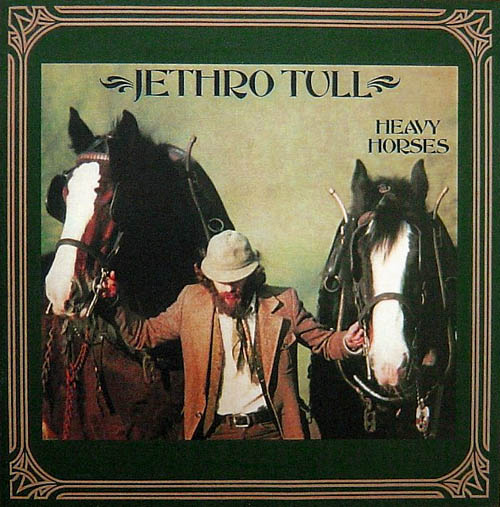
Heavy Horses is a very natural follow-up to Songs from the Wood (at its release Anderson referred to it as “Songs from the Wood, Part II, plus a little more Jethro Tull”), though it is also noticeably distinct.  Nollen distinguishes them: “Songs from the Wood can be situated primarily within an English Elizabethan influence, Heavy Horses borrows more from 18th-century Scottish music.”  It is also darker, with Stormwatch the darkest (and saddest) of the trilogy.  The eponymous track is a superlative return, in more concise form, to the multi-movement suite so characteristic of Prog Rock (a label, we should admit, Jethro Tull abjured), though it does embody the album’s darker tone, with the days of the plow horse dwindling with the advent of the tractor.  In fact, animal themes dominate the lyrics.  The bonus tracks on the 40th anniversary release show this could have been an excellent double album, as most of the associated recordings could fit the album perfectly, along with most of the bonus tracks from Songs from the Wood.  At least we have them now.

For our purposes, we also have a long-awaited jackpot of literary influences on Anderson’s lyrics.  “Moths,” says Anderson, “was actually inspired by the John Le Carré novel The Naive and Sentimental Lover.  I’m a big fan of John Le Carré’s work.”  “One Brown Mouse” was “very much inspired by the Robert Burns poem ‘To A Mouse.’”  While we should likely stop while we are clearly ahead, Anderson does speculate that “Heavy Horses” may also have had literary (if nonfiction) influences: “maybe I also had the Observer’s Book of Heavy Horses!”  The book is actually called The Observer’s Book of Horses & Ponies, so he is either recalling a forty-year-old memory in bits and pieces, or he is making it up unintentionally, but it does have just enough truth in it to seem authentic.  Similarly, bonus track “Horse-Hoeing Husbandry,” was written “as a paean to the original Jethro Tull, who in 1731 published a book called Horse-Hoeing Husbandry.”  Perhaps an oblique literary influence, but it is at least a Jethro Tull song, if long dormant, written in direct response to a book and its author.  Considering the band’s name was foisted upon them by an early agent and Anderson had no idea who he was at first, this track is a fine example of Anderson’s and the band’s growth, in part by willing to look backward as well as forward.

Stormwatch is the darkest of the trilogy, as we have said, both in the lyrics and in the real-life context of the album.  Not only did David Palmer’s father pass away, inspiring the album’s closing number “Elegy,” but John Glascock passed away during the tour promoting the album, upon which he appears very little due to his declining health.  His death cast a pall on the band, especially in the callous way Anderson broke the news to them, and things were never the same.  David Palmer, John Evan, and Barrie Barlow left the band, and the ’70s and “classic Tull” came to an end, with “Elegy” becoming a poignantly fitting finale to the era.  The album features mostly more mythology and Scottish rural history (“Orion,” “Dark Ages,” “Old Ghosts,” “Dun Ringill,” “Flying Dutchman”) as well as current Scottish social commentary (“North Sea Oil”), a prescient song of change (“Something’s On the Move”), a rare beautiful and uncynical Anderson song (“Home”), and the first two instrumental numbers on a Tull album since This Was (“Warm Sporran” and “Elegy”).  Lyrically, aside from the general mythology and history influencing the songs, and album candidate cut for time “Kelpie,” Stormwatch is not significantly influenced by literature.

Bibliography

Anderson, Ian. “He Brewed a Song of Love and Hatred (and of quite a few other things too …).” Interviewer Martin Webb. Minstrel in the Gallery: 40th Anniversary: La Grande Édition. Chrysalis, 2015.

—. “I’ll Sing You No Lullabye.” Interviewer Martin Webb. Heavy Horses: New Shoes Edition. Parlophone Records, 2018.

—. “Kitchen Prose and Gutter Rhymes.” Interviewer Martin Webb. Songs from the Wood: 40th Anniversary Edition: The Country Set. Parlophone Records, 2017.

—. “May You Find Sweet Inspiration….”  Too Old to Rock‘N’Roll: Too Young to Die! Chrysalis, 2015.

—. “To Cry You a Song.” Interviewer Martin Webb.  Benefit: The 50th Anniversary Enhanced Edition. Chrysalis, 2021.

Cornick, Glenn. “To Cry You a Song.” Interviewer Martin Webb.  Benefit: The 50th Anniversary Enhanced Edition. Chrysalis, 2021.

Nollen, Scott Allen. Jethro Tull: A History of the Band, 1968-2001. Jefferson, NC: McFarland, 2002.

Thick as a Brick: 40th Anniversary Set. Liner notes. Parlophone Records, 2012.

Webb, Martin. “And the Stormwatch Brews….” Stormwatch: The 40th Anniversary Force 10 Edition. Parlophone Records, 2019.—. “Let Me Bring You….” Songs from the Wood: 40th Anniversary Edition: The Country Set. Parlophone Records, 2017.

A Snowball’s Chance …

Christopher Rush

Page numbers are taken from the digital version of the Great Books of the Western World set, second edition.

Animal Farm has become such a well-known book, trying to conjure new, fresh insights about this story is challenging.  Even people who haven’t read it likely know that it is a cautionary tale of fascism as an anthropomorphic recreation of Lenin and Stalin and Trotsky and actual history, since by now its message and influence have become ubiquitous.  For this exploration, then, let us put the genuine horror and heartbreak of the Russian Revolution and Stalinist Russia aside, much as we set aside aspects of World War II when we want to enjoy Hogan’s Heroes or The Great Escape, and look at Animal Farm just as it is: a mostly funny story.  True, it does have a couple of very unfunny moments, particularly the confession scenes in which the dogs kill many of their fellow farm denizens. But aside from those brief moments, the rest of the story can be (with a fair amount of suspension of disbelief) a fairly good time.

The opening description of Mr. Jones and the state of the farm gives us a good reason to root for the animals: Mr. Jones is a drunkard who doesn’t always ensure the animals are protected and locked up (477) or even fed; the farm has piles of equipment, wood, building materials and all sorts of things scattered, dare we say, higgledy-piggledy around.  These animals have an almost respectable motivation for wanting autonomy.

Old Major’s address gives Orwell the chance to bring in most of the characters in an almost mock Homeric or Pope-like fashion, which is fun by itself, but Boxer’s introduction is especially intriguing.  In one sense, Boxer is the horse considered a noble, self-sacrificing character, perhaps the unsung hero of the story, but from the beginning Orwell gives us permission to think he is just a brainless goof (or a punchy ex-prize fighter?).  He is respected for being a workhorse, but we are told he is not very bright, so he is no shoe-in for the hero (if this story even has one).  Clover the mare, likewise, is presented humorously as the general mother of the farm, though she is no longer as spry as she used to be since she has lost her figure after having so many children, which also has affected her ability to remember.  When this description, particularly of her wounded vanity at having lost her looks from her children, is applied to a horse, it is quite humorous.  Moses the raven is not present, and it does not take a theology major to know whom he represents, and while Christian readers may feel they should be at least irritated by this character and Orwell’s presentation of religion, Moses doing no work and being the one who proclaims that the afterlife for hard-working animals is a place called Sugarcandy Mountain is so preposterous it is hard not to laugh, especially when we read how hard the pigs have to work to convince the others Sugarcandy Mountain does not exist (482).

Taken at face value, Old Major’s description of humans’ lack of utility is both accurate and ludicrously animal-centric.  Man “does not give milk” (though the astute reader will know this is not a completely and permanently accurate statement of all humanity – though it likely flies over the head of most seventh graders, who inexplicably seem to be the major audience of this novel in America), “he does not lay eggs” (which is true, but neither do most of the animals at that conference), “he is too weak to pull the plough” (but he would not have to invent the plough if he were strong enough without it), and “he cannot run fast enough to catch rabbits” (478).  This last condition of man’s inferiority is wonderfully irrelevant – is catching rabbits a hallmark of value among animals?

Certainly one of the undercurrents for this novel is the poor memory of the animals.  If we continue our premise of looking lightheartedly at the novel, we see Old Major has forgotten that he, as a pig, has likely contributed nothing substantial to the operation of the farm qua farm (and is guilty of the same four qualities with which he took issue with humans), and has forgotten that he used to be treated very nicely by Mr. Jones, even presented earlier in his life as a prized pig named Willingdon Beauty (477). He has also somehow gotten hefty in his old age, which likely indicates he has had access to plenty of food and has had to do very little work in response for quite some time.  Thus the novel sets out on the premise of the animals forgetting the past and not appreciating the present and continues on this theme throughout.

His closing words that most animals “are not allowed to reach their natural span” yet he is a lucky exception, since he has lived a long life and gotten many sows pregnant (this he remembers), and then dies peacefully in his sleep after a long, successful life is reminiscent of Swift at the end of “A Modest Proposal.”  Do as I say, not as I do – the great pig motto.  But this is then topped by “Beasts of England” sounding like a mix of “Clementine and La Cucaracha” (480) – that must be quite a tune as well.

As the animals acclimate to Animalism, the systematic philosophy Snowball and Napoleon turn Old Major’s dying dream into, the narrator is quite overtly on the side of the pigs, calling questions about the afterlife and the inevitability of the revolution “elementary remarks” (481), as if the pigs are presenting something so obviously helpful but the slow-witted animals cannot get on board, which is further evidenced by their inability to become meaningfully literate.  (Pigs becoming literate and learning how to write and read with their hooves is a fantastical element.)  Additionally, Mr. Jones is continually described as a bad person and an increasingly worse farmer.  He drinks excessively, mistreats and neglects the animals, and overreacts in anger when the hungry animals simply want the food they are supposed to have, since he should take care of these important aspects of his livelihood at the very least, if not out of Christian stewardship (482).  The book gives us many reasons to think the animal rebellion is a good thing.  “His men were idle and dishonest, the fields were full of weeds, the buildings wanted roofing, the hedges were neglected, and the animals were underfed” (482).  We should root for the animals just like the narrator does.

The rapid success of the initial rebellion and impressive defense during the farmer’s second attack are perhaps the most humorous scenes in the book.  The rebellion is successful because of its swift and surprising nature.  Despite their initial pseudo-bravado at whipping seemingly defenseless animals, when the animals offer even the most basic resistance, Mr. Jones and the farmhands skedaddle after “only a moment or two” (482).  Mrs. Jones’s silent reaction through the window, in her only moment in the novel while awake, is to pack up and flee not only the farm but her husband (483) – it is hard to envision this episode without “Yakety Sax” accompanying it.

The later defense of the farm from the humans’ perspective begins by showing us the humans’ increasing anger that the animals are succeeding at operating a farm without human leadership and that their own animals are starting to whistle and sing “Beasts of England” – to which the humans naturally respond by whipping and attacking the animals, again giving us reason to side with the animals (489).  We are also pleased that the animals are succeeding on their own initiative and industry.  The defense from the animals’ perspective on the farm begins with a casual remark that Snowball “had studied an old book of Julius Caesar’s campaigns which he had found in the farmhouse” (490).  Mr. Jones having a copy of Caesar is ludicrous enough, but picturing this pig pouring over Caesar’s Gallic Wars is just delightful.  While Orwell likely envisions this in English, the temptation to picture Snowball reading it in pig Latin is difficult to fight – certainly more difficult than the farmers prove to be.

The defense is a fine comic scene for two main reasons: the ease of the defense and the absence of significant death on either side.  With Caesar’s tactics firmly in place, the animals gull the farmers into a false sense of security and early success, only for the animals to attack in earnest.  That the humans forget they have sticks and a shotgun (for the most part) adds to the farcical atmosphere.  Of course, if they had brought more guns and used them, it would be difficult to pretend this was a comic story, but on the other hand the story would not have been written or have had such a lasting effect.

While it is sad that a sheep dies, it is not a sheep we know, which thus does not require much emotional response on our part – war is tough, and since the sheep have been presented as primarily mindless (and annoying) echoes for Napoleon’s ideas, losing only one sheep against armed men feels like an overwhelming victory.  This is abetted by the fact the human boy, who seemed dead and threatened to make Boxer feel bad, was just stunned and recovers.  The animals have done, in effect, nothing wrong, and no harm was done all around (491).

The fate of most of the main named characters could lend support to our admittedly tenuous premise of the book being a dark comedy.  Snowball, despite his initial ringleader status and his anti-human rhetoric (though, again, the book does not present this as necessarily a bad thing), starts to offer many positive and hopeful goals for the animals and their farm, giving the animals purpose and reasons to keep working hard to make the farm prosper for themselves and future generations (putting them in committees, no doubt for their own good, another rueful aside).  This is mostly seen in the windmill, of course, and the association of this major symbol with Don Quixote and his windmills is another comedic aspect of the book (though that may likely need to be explained to the junior high students reading it).  Snowball’s growing quarrels with Napoleon are presented as genuine disagreements, not a dissembling act, so the reader naturally starts to align with Snowball over Napoleon, the clear villain even in the comic interpretation here – though the animals, laughably, believe whichever pig they heard last (493-94).  Despite the failed assassination attempt on his life and subsequent successful assassination of his character, Snowball successfully flees Napoleon’s farm and lives a happier life.  This incongruity of the humans being mostly presented as evil or at least malicious and Snowball’s happier life among them and away from the farm is presented as a relief for the reader, and comedies, especially in the Shakespearean tradition, expect our heroes (and even the redeemed villains) to live to see another day after the final curtain or tableaux.

While Mollie the mare is not presented as a leader or hero, she is mainly a kind of low comic relief, fond of ribbons and sugar, symbols of her subservience to human oppression, and while the book gives us a growing sense of tension that something bad is going to happen to her, she, too, escapes the farm and returns to a life of sugar and ribbons – free from Napoleon (492).

The fate of Boxer will likely be a major stumbling block for many readers in thinking Animal Farm could be a comic tale, since he has a sad fate (517).  Admittedly, the scene of Boxer being tricked into the glue factory van and the sound of his desperate hoof clangs are hard to laugh at, and it is a scene of sorrow and mild horror – but we also know Boxer is not long for this world, anyway.  His simplemindedness and stalwartness are praised throughout the book, but he is also overly loyal to Napoleon, who is clearly the villain, and that he cannot see that is no mark in his favor.  In his most perplexing moment, Boxer, and even he should know the dogs are under Napoleon’s control, is attacked by the dogs then looks to Napoleon to see how he should respond to the dogs that have clearly just tried to assassinate him (504).  The desire to think of Boxer as a noble hero should be tempered by his devotion to the villain, even if it is done through ignorance (but a stubborn ignorance, since he willfully refuses to listen to anything said against Napoleon).  He does work himself to death for the farm, which is admirable, but since is also effectively done for anyway, from a dark comic perspective, by going to the knacker’s, at least his corpse will provide for others, which is more than could be said if he had just finished dying on the farm and became a burden by making the animals either have to dig a massive grave for him or leave his corpse out to rot.

Admittedly, the fate of several non-named characters, as acknowledged at the beginning of this examination, does yield a pair of frightening moments, both of them entailing the dogs viciously killing animals that confess to being rebellious and in league with Snowball after he is excommunicated from the farm (and eventually the scapegoat for all the ills that befall the farm).  It is hard to dismiss these scenes or find the potential humor in them, though it is interesting that the animals in the first scene are those that do admit they were rebellious and complaining and thus disruptive to the united efforts of the farm (504).  The book is tacit on why they make their confessions – likely we are to assume Napoleon or Squealer intimidated them behind the scenes into confessing publically, but the narration does not even hint at that, so it is somewhat possible the animals felt genuine guilt and are sacrificing themselves for the greater good.  And the first victims are pigs, which is surprising, considering Napoleon has no reason to demonstrate “equality” for guilt among “equal animals” at this point in the novel.  Still, the confessions result in a “pile of corpses,” which is difficult to laugh away.  Even trying to interpret Animal Farm as a “dark” comedy is strained by the pile of corpses, pervasive aroma of blood in the air, and the increasingly vicious dogs under Napoleon’s ever more hypocritical rule.  Trying to categorize Animal Farm as a Shakespearean “problem play” like Troilus and Cressida, for example, may be more credible in other circumstances.

Still, aside from these moments, the majority of the novel and the final scene may give us tenuous permission to look at Animal Farm comically (even Hogan’s Heroes has a few serious moments).  New animals come to the farm and make it a success in the intervening years before the denouement of the novel (518), even if it is a pale shadow of what was dreamed of at the beginning.  And while we know they are likely somewhat worse off living condition and food-wise, Orwell does allow for great dignity for the animals, since “they never lost, even for an instant, their sense of honour and privilege in being members of Animal Farm. They were still the only farm in the whole county—in all England!—owned and operated by animals” (520), and thus the book itself allows for a fairly happy (or at least content) ending even without the strain we have been placing on it.

We have alluded to Shakespearean comedy already, and one of the hallmarks of Shakespearean comedy is the occurrence of transformation.  The hypocrisy of the pigs embracing all of the rules initially deemed punishable by death can be a source of humor, particularly the great lamentation for Comrade Napoleon on his deathbed … only to find out it is just a hangover (512).  The pigs starting to walk on two legs and wearing clothes can similarly be viewed easily in a comic vein (especially if the reader accompanies these scenes with lighthearted incidental music).

The apex of the transformation in the final tableaux with the pigs fully becoming indistinguishable from the humans with whom they have just allied, and the farm returning to its original name, may be intended to be horrific, as all their sacrifice for autonomy has been undone, but it can also be darkly comic, as the very ringleaders of the rebellion who seemed quite sincere at breaking away from human influence have now become the very thing they initially despised, coupled with the fact the first thing these new allies do is start arguing over accusations of cheating at gambling.[1]  The reader may have genuine permission to picture the beleaguered but hopeful veterans staring through window at this final transmutation with an almost ’80s-sitcom ending shrug and laugh track explosion.

This is not to belittle the moment, of course, but if looking at Animal Farm not as a dire warning or fantastical cautionary tale, such a finale could be possible.  If we are willing, at least for a time, to set aside the genuine sorrow that George Orwell was writing about, and if we, a century later can acknowledge his purpose but indulge ourselves for a few moments, we can view this novel as a beast fable perhaps in the vein of Aesop or Fontaine, with a Shakespearean twist here and there.  In this light, with mostly happy(ish) endings for the characters, a sense of pride and continuing hope for many of the animals, and the villains becoming what they initially despise (and thus perhaps a more fitting punishment than outright death), it may be possible to enjoy Animal Farm as a comedy, if a dark comedy at best.


[1] When Pilkington and Napoleon both play the ace of spades, it is hard not to think of Harpo Marx’s never-ending supply of aces of spades in Animal Crackers, ironically enough.

The Hero is Rome

Christopher Rush

If Achilles is the hero of the Iliad, and Odysseus is the hero of the Odyssey, surely Aeneas is the hero of the Aeneid?  The poem bears his name, after all.  He dominates the focus of the narration, and for the rare moments when he is not center stage the characters who take over are usually discussing Aeneas.  Yet, do not be misled by such seemingly overwhelming arguments: the hero of the Aeneid is Rome.

The poem’s invocation and introduction set our focus on Rome: “I tell about war and the hero” (1.1) – Aeneas doesn’t even get top billing here, and while Mr. Day-Lewis’s translation says “hero,” Fagles, Fitzgerald, and others simply translate it “man.” Aeneas’ name is not mentioned until line 94 in Day-Lewis’s translation, even later in others.  Homer gives us Achilles’ name in line 1 of the Iliad and Odysseus’ name around line 21 of the Odyssey.  Virgil mentions some form of Rome and her people seven times in the first seven lines: “Lavinian shores,” “Italy,” “a city,” “Latium,” “the Latin race,” “royal line of Alba,” “the high walls of Rome” (1.2-7).  Virgil names Juno, Paris, Ganymede, Achilles, Athena, Ajax, Aeolus, and Jove before naming Aeneas.  (Juno and Aeolus even have a lengthy conversation before we hear the name of the “hero/man” about whom this poem purportedly is.)  When we first see the fleet of Trojan ships, Virgil says “their goal” is “Latium,” and they have been sailing for seven years all “to found the Roman race” (1.31, 33).  Their purpose is to found Rome and the Roman people.  If that is the fleet’s destiny, it is also Aeneas’ purpose, immediately subordinating him to the real hero, Rome itself, even before we see him, before he has a chance to say one word.

Before we meet the “hero” by name, we are introduced to the poem’s major antagonist, Juno.  Prior to and during that aforementioned conversation with Aeolus, Juno worries not about Aeneas but about “a single nation” (1.48), and her plan is not to eliminate Aeneas but to “[w]helm those ships and sink them!” (1.70)  The Trojans are undoubtedly afraid of Achilles; the suitors soon enough become afraid of Odysseus.  Juno can’t be bothered even to call Aeneas by name, referring to him as “the Trojan lord from Italy” (1.39) – and it is his Trojan heritage that bothers her the most, not the fact that Aeneas “the hero” is coming to Italy.  Even when Juno attempts to cajole Venus into marrying Aeneas to Dido, Venus knows “Juno aimed at basing the future Italian empire / On Africa” (4.107-08), not because she was afraid of Aeneas.  Juno does not want Rome to exist; Rome is the enemy of the poem’s antagonist, Juno.

The hero and his or her actions should matter, especially in an epic poem.  While Homer does not hide the fact Achilles’ decision to (temporarily) abnegate the war is partly due to Athena, the poem emphasizes Achilles makes a free choice, a choice that threatens his fate as well as drastically affecting the war and the characters entwined with it.  Odysseus, likewise aided by Athena and Hermes, makes choices that delay his destiny, which significantly affects his family and his native Ithaca, as well as his crew.  Homer gives us no assurance Odysseus will return home safely and complete his goal.  Virgil, on the other hand, wastes no time in assuring Venus (and us) that her “people’s / Destiny is not altered; you shall behold the promised / City walls of Lavinium, and exalt great-hearted Aeneas / Even to the starry skies.  I have not changed my mind,” he says through Jove (1.262-64).  Jove mentions Rome first, Aeneas’ fame second.  Even as a consolation to his mother, Aeneas is subordinate to the inexorable success of Rome, the true hero of the Aeneid.  This scene intentionally mirrors Thetis’ similar request to Zeus, of course, but Zeus’ response to Thetis is all about Achilles and his forthcoming glory, subordinate to nothing.

Aeneas’ “choices” are all in service of the establishment of Rome.  This is demonstrated by the “present” of the poem always focusing on Aeneas and the crew heading toward Italy.  The seven years of wandering between the fall of Troy and the arrival at Carthage are told by Aeneas as a lengthy flashback in books two and three, and while the story is engrossing and a highlight of the poem, because Aeneas is narrating it we are always aware these events are over and done with and have little to do with what the poem is truly about.  While this mirrors Odysseus’ recounting of his travels in the Odyssey, that does not mean Aeneas is the hero just because he tells stories and his mother intercedes for him with the Father of Olympus.  Even during his recital of the past, Aeneas mentions his fate several times, most notably when the ghost of Creusa speaks to him: “These happenings are part of the divine / Purpose. … For you, long exile is destined … Then you will reach Hesperia, when Lydian Tiber flows … There, your affairs will prosper; a kingdom, a royal bride / Await you” (2.784-91).  His wife tells him his fate is mapped out for him, and even though he does it with a heavy heart, Aeneas “chooses” to commence his destiny.  Even his several months of dallying with Dido and delaying his destiny are glossed over in rapid summary in book four, with the narration resuming in earnest as Mercury chides Aeneas for this delay – with a message from Juno that if Aeneas has abjured his destiny he should at least think of his son’s glory and “the inheritance which you own him – an Italian kingdom, the soil of Rome” (4.280).  Aeneas resumes his destiny because of his son’s future glory, which, too, centers on the founding of Rome.  Achilles the hero chooses to return to the Trojan War not for Neoptolemus’ glory; Odysseus the hero chooses to return to Ithaca not for Telemachus’ glory; Aeneas the eponymous character chooses to turn to Rome for Ascanius’s glory, which is the glory of Rome itself.

The turning point of the poem is undoubtedly Aeneas’ journey to the Underworld, where the Sibyl allows Aeneas to see his father, Anchises, one more time, and the poem transitions from a journey to the military campaign against Turnus.  Before this mostly unnecessary catabasis, the Sibyl tells Aeneas he will encounter wars and hardship soon but “be troubled no more about this” (6.87), for “the Trojans shall come / To power in Lavinium” (6.86-7) – yet another reminder their fate, Aeneas’ fate, is assured.  Aeneas meets this reminder of his fate almost indifferently: “Maiden, there’s nothing / New or unexpected to me in such trials you prophesy. / All of them I have forecast, worked out in my mind already” (6.106-07).  He has no need to worry about these wars; he knows he will win.  His destiny has been continually placed before him for years now.  He knows his victory means the establishment of Rome.  His father reinforces that unequivocally in his forecast of the future leaders of the forthcoming mighty Roman Empire for a significant portion of book six.  The reader should have no doubt by this point of the identity of the hero of this poem: it is not the title character.

Aeneas is, ultimately, a hero.  Hector, Diomedes, Menelaus, Patroclus, Sarpedon, Nestor, Ajax (and Ajax), Idomeneus, Glaucus, and many more brave warriors were undoubtedly heroes in the Trojan War as well.  Yet none of them are the hero of the Iliad.  Aeneas is a hero: he is sacrificial, a leader through almost-overwhelming difficulties, a wise dispenser of largesse at the games honoring Palinurus and his father in book five, a brave warrior against Turnus and Camilla, and a worthy husband of Lavinia.  He simply is not the hero of the Aeneid.  Rome is the hero of the Aeneid.

Happy the Man: A Definition of Aristotelian Happiness

Christopher Rush

Happiness in Aristotle’s day was as elusive an idea to define as it is for people today.  Aristotle surveys a variety of potential concepts early in Nicomachean Ethics: both commoners and nobles “identify living well and doing well with being happy” (1095a.19), but few could ascertain its true nature, as “some identify happiness with good fortune, though others identify it with virtue” (1099b.5-9), “some with practical wisdom, others with a kind of philosophic wisdom” (1998b.24).  The source of happiness is also unclear: people ask “whether happiness is to be acquired by learning or by habituation or some other sort of training, or comes in virtue of some divine providence or again by chance” (1099b.9-11).  Aristotle effectively eschews the discussion of the source of happiness, assenting to its potentially divine origin as the best gift from the gods (1099b.10-14), focusing instead on a thorough understanding of the nature of happiness.

As ever concerned with purpose, Aristotle begins his definition of happiness by declaring “[h]appiness, then, is something final and self-sufficient, and is the end of action” (1097b.21).  It is that final thought, the “end of action,” that is especially important.  For Aristotle, happiness “does not lie in amusement” (1176b.25-34), which is temporary and ofttimes accidental. Rather, “happiness is activity in accordance with virtue” (1177a.10-14), a virtue available only to certain kinds of people.

Young people are not truly happy (1100a.1-4), since they are too young to know how to live a life of consistent virtue.  On the other end of the spectrum, dead people are not happy either, since “happiness is an activity” (1100a.10-14), and dead people in Aristotle’s view are, at best, inactive.  Animals are likewise not capable of happiness, “for none of them is capable of sharing in such activity” (1099b.30-34), the “activity of soul in accordance with perfect virtue” (1102a.5).  Servants are also not capable of attaining Aristotelian happiness: they assuredly have souls and are neither young nor dead, and while they may be capable of virtue, according to Aristotle they lack the final necessary ingredient for authentic happiness: free time.  “And happiness is thought to depend on leisure; for we are busy that we may have leisure” (1177b.4-5).  He says further, “Happiness extends, then, just so far as contemplation does, and those to whom contemplation more fully belongs are more truly happy …. Happiness, therefore, must be some form of contemplation” (1178b.25-34).  Surely the servant class in Aristotle’s day did not have leisure time for contemplation.  (It is unlikely, however, that servants took much comfort from Aristotle’s later declaration that true happiness comes not from being materially prosperous but from possessing wisdom and virtue, cf. Politics, book 7, chapter 1.) Little wonder, then, that happiness’s source and nature were so inscrutable, since neither the young nor dead nor beast nor servant could be accurately deemed “happy.”

Where Shall Wisdom Be Found? Or in the Heart or in the Head?

Christopher Rush

At the climax of Job’s lamentation, just before his final self-defense, he gives a poetically moving discourse on wisdom, centering on two important questions: “where shall wisdom be found? And where is the place of understanding?” (Job 28:12) Along with its three companions knowledge, understanding, and discernment, wisdom’s location and purpose are frequent motifs throughout the book, discussed by Job’s three companions, Elihu, and God Himself (though this essay will focus only on the humans’ perspectives in the book).  Job’s friends’ comments on wisdom usually come in the context of upbraiding Job for his unrighteousness, yet they differ in emphases.  Elihu’s comments on wisdom come mainly in opposition to everything he has heard from the other four.  Job gets the final word (for our purposes), rethinking his own position on wisdom being not so unattainable after all.

Wisdom is nigh impossible to locate, says Job at first.  It is neither in “the land of the living” (28:13b) nor in the deep or the sea (28:14).  It is not where living creatures on the ground or the birds in the air can find it (28:21), and not even Abaddon and Death know anything beyond “a rumor of it” (22:22).  Even if man were to stumble accidentally upon it, he would “not know its worth” (28:12) because it is so rare and truly unique (cf. 28:15-19).  Wisdom does not reside in man’s purview, neither in his heart nor in his head: he can’t find it, doesn’t know its worth (likening it to a valuable jewel), and wouldn’t know what to do with it even if he did find it.

Job’s companions similarly address wisdom and where it could be found, yet they mostly disagree with Job on its source.  Zophar comes closest to agreeing with Job’s initial premise of wisdom’s elusiveness.  “Can you find out the deep things of God?  Can you find out the limit of the Almighty?  It is higher than heavens – what can you do?  Deeper than Sheol – what can you know?” (11:7) In fact, it is so elusive, “a stupid man will get understanding when a wild donkey’s colt is born a man!” (11:12) Eliphaz at first agrees with wisdom’s rarity, intimating wisdom is an individual experience: he has it because an indiscernible spirit in a stealthy voice whispered in his ear (4:12-16).  Yet wisdom can have a more accessible source simply through experiencing a long life: “Both the gray-haired and the aged are among us” (15:10), says Eliphaz, and since they are older than Job he can’t possibly have more wisdom than they have (15:9).  Bildad offers a similar source of wisdom, in the traditions and teachings passed down from one generation to the next.  Job should “consider what the fathers have searched out.… Will they not teach you and tell you and utter words out of their understanding?” (8:8, 10).  Elihu rejects these outright, saying “It is not the old who are wise nor the aged who understand what is right” (32:9).  Even more brazen, Elihu declares if any of them disagree with his counsel, despite his being the youngest of them all, he can be a source of wisdom for them (33:33)!

Wisdom’s purpose is another point of contention.  Job doesn’t initially see much practical use for it in this life or the next since it is so unlike anything else of human experience, and man is so mystified by it he thinks of it like a jewel, though rarer and more costly than any other precious gem (28:12-22).  Eliphaz especially proves Job right, likening wisdom to a physical adornment with spiritual significance.  Eliphaz says most men die without wisdom, and that lack of wisdom often brings about their destruction (4:14-5:7, esp. 4:21), as if wisdom were armor against mortality.  (This is one of the few statements with which Elihu agrees, cf. 36:12.)  Eliphaz says further that not even the angels have wisdom, so God doesn’t trust them (4:18, 15:15) – one of his more bizarre declarations, rivalled perhaps only when he says wisdom benefits the person who has it, but that doesn’t much matter to God in how He treats that person (22:2-4).  Job doesn’t have wisdom, says Eliphaz, because he doesn’t fear God (15:2-4); worse, Job thinks God’s wisdom is inscrutable (22:13-14), and if Job would only repent from his wickedness (i.e., receive God’s wisdom), he would be rewarded by God … but he can only conceive of these rewards in terms of material blessings or riches (22:21-26).

Can wisdom be found in the heart?  Certainly not in the hearts of the four men around Job.  Bildad gets so fed up with Job’s words he speaks out of anger, believing Job is calling them stupid (and by implication devoid of wisdom, 18:3b).  Zophar likewise admits he is speaking emotionally out of haste (thus likely not from calm, comported wisdom, 20:2-3).  Eliphaz thinks wisdom is of the heart, but a heart motivated by acquisitiveness.  Elihu ends his tirade by declaring God “does not regard any who are wise in [their own] heart” (37:24).

Job concludes more optimistically, however, by declaring God not only knows where to find wisdom but also what it actually is (28:23-27).  Wisdom is a proper attitude of fearing God, and understanding is a proper action of turning from evil (28:28).  It thus can be found in the heart, when one stops thinking of wisdom as a material treasure but instead as the proper emotional perspective of who God is and how we should feel in response (and who we are in relation to Him – wisdom’s location).  It can also be found in the head: when one understands who God is and thus knows the proper way to respond to that knowledge, one turns away from evil (toward a life time of serving God – wisdom’s purpose).  Wisdom’s companions knowledge, understanding, and discernment are all mental (and spiritual), after all.  The fear of God and the proper knowledge of Him lead to a life of proper action.  Knowing what a thing is, such as wisdom, makes finding that thing and knowing what to do with it much easier – an essential component Job and his companions mostly ignored throughout their conversation.

Four Stickmen

Christopher Rush

This article was written in early 2020, but it has remained mainly unpublished until now.

With the passing of Neil Peart earlier this year, I’ve been thinking lately about some of the drummers who have influenced me over the years, and of course Neil Peart is high on that list.  I should say, though, most of the influence of these drummers has occurred after my main drumming days – admittedly, it’s been quite some time since you could say I was a drummer.  Still, my affinity for music and drumming in particular has not diminished, but instead it has grown as I have gotten more mature (well, older, let’s say).

With my listening tendencies toward classic rock, naturally my influences have been skewed that way, and as naturally you could likewise think of some famous drummers that I have enjoyed: John Bonham, Ginger Baker, Phil Collins, Keith Moon, Ringo Starr, etc.  And then into the ’70s and ’80s with Roger Taylor, Stewart Copeland, and Larry Mullin, Jr.  That’s not too shabby a list for influences.  Perhaps if you kept thinking you’d toss out Mick Fleetwood and maybe Jeff Porcaro or go way back to Buddy Rich and Gene Krupa and Hal Blaine … and I couldn’t argue with that they are great drummers, but I’m not too sure how directly influential they have been on me (indirectly through the guys above, sure, but not directly).

The point here, however, is not to look at the more obvious names of great drummers.  Instead, I’d like to take a brief look at three, yea four, perhaps lesser-known drummers whom I have found to be pretty impressive and worth more recognition if not downright adulation in no particular order.  Enjoy.

Honorable Mention: Jim Keltner

Those in the know would likely be at least miffed at the mention of Jim Keltner as an underrated drummer, but this article is not directed to people who have a subscription to Classic Drummer Magazine.  All you would have to do to be impressed by the career and talent of Jim Keltner, without hearing a single beat from him, is to check out a list of artists who have wanted him on their albums or on their tours: George, John, and Ringo; Brian Wilson; Bob Dylan; Eric Clapton; Ry Cooder; Harry Nilsson; Crosby, Stills, Nash & Young; Joe Cocker; B.B. King; Bonnie Raitt; Dolly Parton … I could go on, but I think you get the idea.  (Please don’t read anything into me listing John, George, and Ringo before Brian.)  Jim Keltner is beloved for his rock steadiness, his stylistic diversity, and for his willingness to work.  Just for being the drummer on the Traveling Wilburyalbums should be enough to know his work better.  Perhaps he doesn’t have any “signature” song or album, since he is so fecund in his output.  For me, what is so impressive about Keltner can be seen in The Concert for Bangla Desh and Concert for George shows, both of which are available for home viewing.  When Keltner is playing with Ringo, especially, the synchronicity between them is astounding: stroke for stroke, crash for crash, they are mirror images of each other in precision.  He may not flashy like Moon or Peart, may they rest in peace, but boy, Jim Keltner is a mighty fine drummer.

Great Forgotten Drummer #1: Graeme Edge

I can see your incredulity already: “Graeme Edge of the Moody Blues?  Lesser known?  He’s in the Rock and Roll Hall of Fame!” you say.  True.  The Moody Blues finally got into the HoF a mere 25-some years after becoming eligible.  But this is not a HoF tirade.  Our focus here is praising Graeme Edge as a great drummer.  I suspect his greatness is overlooked because, like Jim Keltner and other great drummers, he doesn’t really “show off” like the greats you can mention – at least, not memorably.  Now, if you’ve seen any of their shows, especially in the late ’90s and early ’00s, Justin and John certainly gave Graeme a chance to entertain both behind and in front of his kit.  Still, Graeme Edge, like his band the Moody Blues, seems to be one of those drummers and bands you really enjoy while you’re listening to them, but you don’t necessarily think about afterward.  And while that is fine, I think they are painfully underappreciated.

Graeme Edge, like Neil Peart, spent a fair amount of time writing songs for his band.  Many of the spoken word poems in the early albums (admittedly, rather trippy, if you will, back in the late ’60s and early ’70s) can from Edge.  That doesn’t attest to his drumming, true, but it does attest to his ability to understand multiple aspects of songcraft and artistry, which makes his ability to hold the songs together rhythmically much more impressive.  He’s not just keeping the beat for the “real” musicians in the band.

Since the Moody Blues are such a diverse, bizarre band, especially during their first stretch, it is difficult to point to one song as “here, this is classic Graeme Edge,” but I’d direct you to their final song of that initial tenure, “I’m Just a Singer (In a Rock and Roll Band),” the last track on Seventh Sojourn (my favorite of that period).  You may object to calling it a classic Graeme Edge song, since his introduction is, perhaps, just an elaborate “click in” to the song, but if you watch the music video to it, you can see why Graeme Edge was and is a top-notch drummer.  Don’t be like the Hall of Fame and wait twenty-five extra years to recognize his worth.

Great Forgotten Drummer #2: Barrie “Barriemore” Barlowe

I said this was not intended to be a rant against the RnR HoF, so we will leave the nonsensical notion of Jethro Tull’s absence from that august body aside.  Barrie Barlowe was the drummer for Jethro Tull during what is often called their “classic years” or “classic lineup” of the ’70s, from Thick as a Brick to Stormwatch.  If you can stick around (so to speak) with Ian Anderson for an entire decade, that alone is a remarkable achievement.

It’s a tricky thing, though, the relationship of drummer and the band he or she is in: if the band “lets” you do your thing, the drummer can often flourish and be mightily impressive.  Keith Moon was fortunate enough to be in a band that let him do pretty much whatever he wanted to do whenever he wanted to do it (that may have also been an unfortunate thing for him as well, but that’s for another time).  Neil Peart was fortunate enough to find a pair of guys who were willing to let the drummer be as much a part of the musicality of the band as the guitar and bass (and synths, yes).  But the relationship is likely reciprocal also: Geddy and Alex likely wrote their parts around and with Neil, knowing he was going to contribute more than just timely fills and a steady backbeat.  So, Ian Anderson, despite his, shall we say, penchant for artistic control in his band, likely wrote many of Tull’s ’70s songs knowing he had a trustworthy drummer who could create diverse and sundry sounds and rhythms and moods for the drastically different styles of that period (we can talk about Martin Barre as an underrated guitar great another time).

Barrie Barlowe’s skills can be heard throughout those Tull albums, certainly.  Listen to them again focusing on what Barlowe is undergirding those tempo changes and sensations with.  For.  Something.  Yes, they were a stellar band playing as a unified band, I am not denying that.  But without a skilled drummer who could handle all those changes, Tull would not have been what it was.  Another great way to hear Barlowe’s skills as a drummer is on the recently released live concerts from those days, mainly available in the 40th anniversary special editions (though, sadly, many of them are apparently harder to get now than the crystalline tears of albino sea lions, so track them down now).  Barlowe’s creativity with rhythm and, I’d go so far as to say, storytelling with his solos may be even more impressive than John Bonham (in his solos) – and before you start picking up those stones to cast at me, please note Bonham himself considered Barrie Barlowe the greatest drummer England ever produced.  You can’t argue with him.

Great Forgotten Drummer #3: Ian Paice

Surely, you say, no one has forgotten Deep Purple’s only consistent member from its founding over fifty years ago (like Graeme Edge’s stable tenure with the Moody Blues – drummers tend to recognize good gigs when they get ’em).  And yes, Ian Paice has won gobs of awards as a drummer, and Deep Purple has finally been inducted into the HoF after a mere 25-year eligibility waiting game (I’m trying, really), but if you didn’t think of Ian Paice earlier when I initially asked you to name the great drummers, then he certainly needs to be credited here as a great drummer who should be on that top tier of the all-timers.

Speed is not essentially a characteristic of superior drumming – you’d think it would need to be, but it depends on the kind of music you and your band are trying to play.  More often than that, the mark of good drumming is usually just the ol’ fashioned steady tempo, fills and solos aside.  And yet, Ian Paice has both: that rock steadiness upon which Jim Keltner has built a more-than-decent career commingled with speed and flair and creativity (and durability – the man has had to cancel something like two shows in over fifty years, and those because of a heart attack).

Deep Purple has been different things over the years: pre-classic rock cover band, hard blues, orchestral, hard rock, boogie funk, and probably a few more styles – and Ian Paice has excelled in them all.  For half a century he has given hope to short, heavy set, match grip drummers the world over (and me).  Any Deep Purple album will showcase Paice’s skill, but you might as well start with Machine Head.  It’s the bees knees.

There you have it: four great drummers whose contributions to music and rhythm are worth getting to know.  You will not be disappointed.

A Funny Thing Happened on the Way to the Forum

Christopher Rush

I got a new job.  I wasn’t looking for a new job, mind.  It just sort of … happened.  You know how God works sometimes, in mysterious ways.  Literally while I and the 2018 seniors were trekking to and through the Roman Forum (the one in Rome, Italy), which is a mighty long but worthwhile day on the Europe Trip, God was orchestrating the next phase of my family’s life.  Technically I did not get a new job while I was on the way to the Forum, but as I said, the plan was in motion, and I couldn’t resist the linguistic opportunity.  In any event, that’s not the point of this brief article, and had I known Ms. Grant was going to write such a great article on her Europe experience, I might not have written this one, but I did want to share a few thoughts with you about my last visit to the Old World (at least, most likely, with Summit students).

This was my fourth senior trip, and while all have been memorable in many positive ways, this one was markedly distinct.  The first three, in 2005, 2006, and 2009, were all fairly similar as far as the basic sites and itinerary were concerned, with the sporadic difference in hotel or other small detail.  But even in their general similarities, they each had enjoyable distinctions. My wife was able to come with us in 2005, so of course that was a great experience to be able to share with her seeing all those sites with her for the first time.  Because the itinerary for the 2006 was so similar to 2005, having seen most of the sites already enabled me to be a better chaperone, since I didn’t feel as touristy.  That class meant a good deal to me, and it was also my first trip with Debbie Rodriguez, Grand Poohbah of Journeys of Faith (and, as Ms. Grant said, a tireless worker who really advocates for the best trip students can get, even if they don’t appreciate it at the time — grownups are like that, sometimes).  I was the only official SCA chaperone on that trip, sort of in charge, which is rarely a good idea, but it all went fairly well, give or take some mad dashes to trains in Pisa and the occasional game of “where is Mrs. Kilpatrick?”

2009 was (and still is) a very special class to me as well, and that trip was on the whole a very enjoyable one.  It started off very poorly, with one of the worst days of my life, standing around the Norfolk Airport, trying to negotiate among Debbie, the airline, accommodations in Rome, God, and the weather, all thanks to rain in New York and terror in the hearts of pilots along the Eastern Seaboard.  It was a rotten day.  The consolation prize for a delayed start to our trip was a few extra days in Paris, which is about as consoling as a free year’s supply of yoghurt for a lactose-intolerant person.  Additionally, I know the trip had some low moments, not the least of which was the loss of Bryan Earwood’s grandmother back home, requiring Bryan to leave the trip early, and the early pernicious onset of Hope Bane’s dysautonomia, but on the whole it was a positive experience and a trip I still remember fondly.  I got to take those seniors to some of my favorite parts of the tour, including Keats’s grave in the Non-Catholic Cemetery in Rome and Santa Croce in Florence, two experiences that made it such a good experience for me, at least.

And then there was the 2018 trip.  Nine years is a fairly long gap between trips, especially for someone who teaches the class upon which the field trip is based (but let’s not quibble).  Sure, there were other classes with whom I would have loved to go to Europe, and they know who they are so I need not mention them here, but for divers reasons, I did not go again until 2018.  The person I really have to thank is Mrs. Miers, who, and I don’t say this lightly but gratefully, listened closely to God’s direction and withdrew from the trip, enabling me to go with this group, a group with whom I know she would have really enjoyed going (and who would likely rather have had her along than me, but I don’t blame them, since having Mrs. Miers on the Europe Trip would have been fantastic).

Ms. Grant’s article addressed the most important aspect of this trip: God’s manifest providence throughout the entire enterprise.  Allow me to astound you with even more examples of how God was clearly and directly intervening on our behalf.  Before we even left the parking lot, God was making His presence felt.  We were under the impression not everyone was going to be able to fit on the bus on the ride up to D.C., requiring someone to drive at least one person to the airport, but when the bus arrived, it had enough seats for everyone, eliminating an entire unnecessary six-hour drive.  During the trip, we had a very early flight from Florence to Paris (I’m talking “we had to leave the hotel at 3am” early).  After we got through check-in, depositing most of our luggage, we found out the flight was delayed a couple of hours.  Now, the normal and fairly understandable human reaction at around 5am would be to get rather upset by this turn of events, especially when tired and hungry and grumpy.  And so we were.  But here’s where God’s providence interrupted: because of the delay, the Florence airport staff offered all of us a rather large breakfast array (for free).  Even if we had known about the flight change before leaving the hotel, we would have gotten the same amount of sleep (since most of the students slept during the unexpected delay just fine), but we still wouldn’t have gotten breakfast, since we still would have needed to leave the hotel before it served breakfast.  So the flight delay got us more sleep, a large, free breakfast, and less time in Paris — a big win all around, in my book.  Those are just two more examples of the dozens of times God was protecting and supporting us throughout the trip.  It wasn’t perfect, of course: we had rain in Normandy, a fair amount of sicknesses and injuries, a few brushes with miscommunication and strained relationships, some less-than-desirable meals, a few lost articles — but nothing serious, nothing terminal, nothing irreparable or irreplaceable.

As I said before, the basic itinerary in the first three trips was roughly the same, though with a few differences in country order.  The first was the most different, in that we went to Mainz to see the Gutenberg printing press and some nearby Reformation sites.  I wish we kept that on the tour.  Pisa was on the first few trips, but it was off by 2009, and that’s likely for the best.  As neat as it is to see the tower lean in person, what else is there to do there?  You could see the baptistery, which is nice, but it’s a lot of travel for not much reward, and it was, on the whole, a good choice to take it off the trip.  Go see it on your own time.  The other fairly major change in recent years has been the on-again/off-again nature of Venice.  I understand a lot of it has to do with flight costs, availability of the better tour guides, and availability of the better hotels (this is one of the reasons why going through Journeys of Faith is completely worth the cost, all the planning and details that are arranged for you), but for me, Venice is great to see, especially the Doge’s Palace.  It, too, is a bit out of the way, and to make the most of it you have to take the time to see Burano and Murano (not an unworthwhile thing to do in your life), so I fully understand why it has dropped off the typical itinerary probably for good, but if you get the chance, check it out, especially at night with the dueling chamber orchestras in Piazza San Marco (just don’t sit down or you’ll have to buy something quite expensive).

I’ve been saying for a while now, for the sake of money and time, it might be time to consider dropping Paris from the trip and focusing on Renaissance Italy and Reformation Germany.  This would relieve a significant amount of the cost, eliminate an entire nighttime travel or early flight like this year, and remove a tremendous amount of basic trip stress off of the students and chaperones.  I understand how easy it is for me to say this, having been to the Louvre four times, but for years I’ve thought it might be the solution we need to combat not only increasing safety concerns but the more palpable cost worries.  That is, however, until this year, when I got to see the recently-added Normandy sites.

I enjoyed the Bayeux Tapestry quite a bit, more so than the students, but that’s mainly because I’m a grown-up adult and they were children, and grown-ups often can appreciate important things better than children (can).  I’m pretty sure if I were seeing it at the end of a long day in a bit of a rainy haze as a teenager, I’d be sub-thrilled like most of them were.  But for me, the D-Day sites of Normandy were very special.  Clearly a great deal of my enthusiasm had to do with the simulation games my father and I have played over the years about D-Day and the Ardennes battles after it, and seeing the places where real history happened is a special thing.  It was memorable and important to see where so many sacrificed so much simply because it was the right thing to do.  I’m very glad this has been added to the trip, and I hope it stays for a long time, regardless of the transportation challenges involved.

The free days in Sienna and Rothenburg were pretty much perfect days.  The weather was great, for the most part, the prices were decent, the attitudes were good (for the most part), and the moments with various students and chaperones were the perfect moments of what, for me, are often the highlights of the trip: the quiet, special moments with people you care about, seeing new things on the other side of the world, experiencing places God has been working in for centuries before you and your country were born.  And I bought a cymbal.  You should hear it some time; it’s beautiful.

I didn’t get to do a lot of the things I was secretly hoping to do on this trip.  I had touted it as my Farewell Tour (even before becoming aware of what Jehovah Slyboots was doing behind my scenes), as I sort of suspected it would be the last chance to go, possibly forever, until maybe with one of my children in another decade, if the trip and/or Europe still existed at that point.  I had wanted to see Keats again, but the closest we got was a quick drive by the outside of the cemetery on the tour bus.  I had wanted to take the Class of 2018 to Santa Croce in Florence, but we had the least amount of free time in Florence of any of the trips I’d been on, and certainly not enough time to get across town (without maps), inside, and back to the dinner meeting spot.  To a lesser extent, I used to enjoy the Virgin Megastore in Paris, but apparently that shut down permanently a few years ago.  Nobody buys compact discs anymore except me, I suppose.  These were disappointments, but, at the risk of sounding disingenuous, I sloughed them off rather easily, thanks to the new and meaningful aspects of the trip.  The good far outweighed the momentary bad of the trip.  In closing, let me share with you just a few examples why.

I was able to experience the Class of 2018 seeing the Sistine Chapel ceiling for the first time.  That was very special.  I got to see some rather spot-on impersonations of quite a few people.  I got to see Pierre (not his real name) work like the dickens to find the right giraffe in a French McDonald’s.  (At least, I think it was France.  The trip tends to blur together after a while.)  I got to see Omaha Beach in Normandy.  I got to see the Piazza del Campo in Sienna.  I got to sit around Rothenburg with people I love getting some of the best, most challenging, most godly advice I’ve ever gotten in my life at a very perplexing time.  I got to go on a crazy taxi ride that made the French Connection seem tame, thanks to Doug Leake and our commando run to the game store, for which I am and will be forever grateful.  I got to talk with and get to know Ms. Grant better in two weeks than in the ten years of knowing her before this trip, as she said, which was a definite highlight.  I got to spend countless enjoyable moments with the Class of 2018 on what may likely be the best Europe Trip SCA has ever had.  What more could I have asked for?


Well, friends, I guess this is it.  I did not think twenty-eight was going to be our last issue, but as we’ve always said, He moves in mysterious ways.  Looking back at the last “next issue” previews in this light, however, you can see God was already making that path straight.  Funny ol’ thing, life.  My “summertime in the reflection pool” will now be reflecting on where God is taking us next (and whether we really need all this stuff we’ve accumulated in fifteen years here).  I’m truly excited about it all: being able to play wargames with my father face to face, quality family time with my mother, and perhaps even some gaming conventions with my brother (and teaching at Emmaus, indeed). But, of course, I am also rather sad about leaving the journal, all students past and present, and, not least, you, our faithful readers, behind.  At least we went out in style: 200 pages for our slam-bang finish!

We do have a lot of work ahead of us, getting the house ready and all that, but in the rare quiet moments I will try to read a few things, maybe play a few games with my family, perhaps prepare for the new classes I’ll be teaching in the fall.  I’ve been on a bit of a “modern classic” sci-fi kick lately, finally reading many of the books I probably should have read twenty years ago.  I suspect the advent of my high school twentieth reunion has spurred on that nostalgic shift in my reading habits of late.  I’ve now finally read Dirk Gently’s Holistic Detecgtive Agency and The Long Dark Teat-time of the Soul by Douglas Adams, Starship Titanic by Terry Jones (based on Douglas Adams’s computer game script), Good Omens by Terry Pratchett and Neil Gaiman, and Neverwhere by Neil Gaiman.  I didn’t enjoy them all quite as much as I thought I would, but perhaps if I had read them back in the day they would have been better for me in that part of my life.  Not that I’ve outgrown them, of course, and I’m sure if you read them you’ll probably enjoy them quite a bit yourself.  If so, I’d love to read your review on Goodreads.  Maybe we can be social media buddies on that site, keep up with what each of us is reading.  I’d enjoy that very much.

Currently I’m reading Orson Scott Card’s Pastwatch, and from there I’ll likely continue with Robert Jordan’s The Wheel of Time series (Path of Daggers is up next) and then, depending on how the summer is going, tackle the next Malazan Book of the Fallen by Stephen Erikson, Deadhouse Gates.  Not the most inviting titles, but that happens sometimes.  I’m also really enjoying these interactive fiction books by Dave Morris and Michael J. Ward.  I’ll continue with those as time permits, especially if I get more for my birthday.

Well.  We’ve stalled our final farewells long enough, I suppose.

Redeeming Pandora has always been about hope (and faith and love, but mostly hope).  These last few years have not always been easy, but knowing we had these opportunities to get together and talk about what is important (more or less) has been a very enjoyable part of my life, and I thank you very deeply for sharing in it.

I want to thank all our contributors for this final issue as well as all the students and others over the years who have made this house organ play so smoothly.  We even finally got my dad in here, at last.  I wish I had time to thank you all, but you know who you are and how much you mean to me, so there’s no need to go into all that here.  Suffice it to say, in the words of Lou Grant, “I treasure you people.”

And who knows … we came back once.  Perhaps we can do it again!

In the meanwhile, stop by any time and visit us!  Come take some books (and some Palor Toffs, please).  You’ll always be in our hearts.  Goodbye, friends!

And remember: just because you put syrup on something don’t make it pancakes.

So, what are you still doing here?  We’ve all got a great life to live given to us by a great God.  Let’s get out there and make the most of it, and, soon enough, as Brother Steve put it, “we’ll drink and dance with one hand free and have the world so easily, you know we’ll be a sight to see back in the high life again.”  I’ll see you again in a place where no shadows fall.  Farewell, my friends!  Excelsior!

Reflections on the Shifting of American Heritage

John Rush

I can still see my friend and neighbor calling to me as he is riding his bike down the street towards our houses.  Charlie is one year older than I am and so he was able to move to the “young adult” part of our local public library before I could.  As he pulls up in front of my house the bike is abandoned and falls to the ground as he shows me the books on World War II that he was able to check out.  I can’t tell you why this memory is still fresh in my mind over 50 years later.  Was I happy for him?  Was I envious? It might well have been as I have absolutely no memory of my first day using that part of the library the next year.

This branch of the public library was down the street from where I grew up.  It would be a part of my life from childhood through high school graduation. My interest in history was developed not only by the teachers I had but also finding and reading and enjoying books in the library that fostered that interest. The works of C. B. Colby come to my mind as the first to spark that interest.  The original Landmark series of books are still re-read at times with enjoyment and remain treasured by many people.

At the same time as this, my grandfather (who was the one to read to my siblings and me: Uncle Wiggly tales) introduced me to a set of books that led to an interest that I still have so many years later.  The author was F. W. Dixon (who never existed, he is a pseudonym used by various ghost writers over many years) and the series was the Hardy Boys. For many years, trips to the Muir’s Department store would result in purchasing the latest volume to be released, opening the book and being transported to Bayport and joining in the adventures of Frank and Joe Hardy and their friends and family.  Formulaic to be sure, reflective of the times certainly (for good and/or bad). But a joy to think of being a part of this fictional world.

And then I found other series (none of which were available in the library as these series were not considered to be “good” literature) that led to other worlds to be part of: Chip Hilton for sports, Rick Brandt for science, and Ken Holt as another mystery series.  These would lead to reading Sherlock Holmes and then the “golden age” of mystery writers: Agatha Christie, Margery Allingham, Dorothy Sayers, as well as a host of others.

A number of years ago I shared the 2 “lists of books to read before college” which I have kept since my high school days with an Emmaus student. He asked me what it was that made me enjoy reading so much and my answer was that reading can transport one to any time or place in the real world as well as any imaginary world that an author can dream up.

When I started high school I followed in the footsteps of my older siblings and started working at that branch of the public library down the street.  Access to an “unlimited” amount of books, hearing people talk about their favorite books and authors, and sampling as many of these books as possible contributed to the love of reading as well as a life-long career as a librarian.

So last summer when shifting books and magazines in the Emmaus library we moved the magazine American Heritage and seeing the hard-bound volumes which arrived six times a year with its “history for the non-professional,” my mind was flooded with memories of another time and place. Something the printed book can do unlike any other media.

A Double Dose of Schall, pt. 2

Fr. James V. Schall

“On Leisure and Culture: Why Human Things Exist and Why They Are ‘Unimportant’”

Originally published in Modern Age Fall 2004, vol. 46, no. 4

Let me begin by citing two passages that graphically underscore the themes I wish to consider here — the things of leisure and culture, of what is and its surprising origins. The first lines are from Gregory of Nazianzen, the great Eastern theologian:

What benefactor has enabled you to look out upon the beauty of the sky, the sun in its course, the circle of the moon, the countless number of stars, with the harmony and order that are theirs, like the music of a harp? Who has blessed you with rain, with the art of husbandry, with different kinds of food, with the arts, with houses, with laws, with states, with a life of humanity and culture, with friendship and the easy familiarity of kinship?1

The second is from the Dutch philosopher Johan Huizinga:

Real civilization cannot exist in the absence of a certain play-element, for civilization presupposes limitation and mastery of the self, the ability not to confuse its own tendencies with the ultimate and highest goal, but to understand that it is enclosed within certain bounds freely accepted. Civilization will, in a sense, always be played according to certain rules, and true civilization will always demand fair play. Fair play is nothing less than good faith expressed in play terms…. To be a sound culture-creating force this play-element must be pure.2

In each of these citations, we are admonished to do things that seem utterly useless, things not necessarily senseless, but still impractical.

Beholding the beauty of the sky or counting, as Gregory calls them, the “countless stars,” is really not good for much. No doubt, it can prod us to wonder why things are in this way, in this order, rather than in some other arrangement. It might even impel us to send up a few spaceships to have a look about. Yet, Gregory obviously thinks what we gain from this contemplation of the heavens is well worth our efforts. And what is this about civilization “always presupposing limitation and the mastery of self?” Surely Huizinga is being ironic?

Yet, the things of civilization are also mentioned — art, houses, harps, food, laws, and “the life of humanity and culture.” Gregory understands these latter things, except for the rain, have a human component. But we still should wonder why we are said to be “blessed” with such humanly-fashioned things, almost as if they were “intended” for us to bring forth. They obviously refer us to a source not ourselves. We realize, at least implicitly, we did not cause ourselves to be, to stand outside of nothingness. If cultural artifacts exist in some abundance, still they had to be brought forth by a being who had the capacity to create or develop them. But we did not give to ourselves this artistic or craft capacity to make or order things, any more than we created the beauty of the heavens or the countless stars.

In order that something higher might be achieved among us than just our essential being, we need to act. Rules and limitations, as Huizinga paradoxically tells us, therefore, need themselves to be discovered, formulated, and, more importantly, “freely accepted.” So our limitation and our freedom are not necessarily and always at loggerheads, as we are sometimes told. We need one for the other. Our freedom is directed to what is; we do not make or create either reality or our capacity of free will. To make a choice to have this thing is simultaneously to make a choice not to have that thing. We are only free to play the game if we agree to abide by its rules that limit us to play in the way the game is played. Otherwise, with no rules freely accepted, it is not a game and no one will play with us on any other terms. What the game is, its truth, limits our freedom to play it, that is, makes us free to play it because we accept the rules.

What is implied here is our human life in the universe reveals something of this same structure, of knowing what we are, of learning the measure or rules of our being, of freely accepting them in order that we might be what we are intended to be, human beings, not toads or gods. We seem, by being what we are, as Plato taught us, to be ordered to “play” or to participate in some transcendent game or design whose rules we do not ourselves fashion.3 Huizinga also observes civilization itself requires a sense of limit and self-mastery. We cannot play a game while changing its rules in the midst of the playing. We cannot create a human culture while changing the structure of what it is to be human. “Man does not make himself to be man,” as Aristotle told us. He is already man, not of his own making. This fact itself is cause, in our souls, of the most curious of self-reflection. What is the ground of our being if we are not? The very faculty by which we consider what we are is already present in us, almost as if to say we are meant to reflect on how we could ever come to exist since we did not cause the sorts of beings we are to come to be in the first place.

Why do things exist rather than not exist? If precisely “nothing,” in the most literal sense of the word, ever once, as it were, “existed,” no thing would still “exist.” Ex nihilo, nihil fit — a most basic of first principles of being. Why, among the vast diversity of things that do exist, are there also human things, clearly different from non-human things both above us and below us on the scale of being? Why does the existence of human things include the capacity to know the other things that are? Why can we only know ourselves by first knowing something that is not ourselves? And are these things that exist, human and non-human things, “important?” Important to whom? To what? For what?

We like to agree with Aristotle nothing is made “in vain,” especially ourselves. Yet, who or what might “need” us, or at least want us to be? Leisure and culture are the conditions and circumstances in which we try to respond to such questions. These are the things we do when all else is done. Our lives are not, and cannot be, exhausted in the necessary. Our being is not intended merely to keep us in existence as if just living were our highest good. We know the purpose of a doctor when we are sick, namely to restore us to health. But what if we are “healthy”? What are the activities of health that fill our days? Surely they do not consist merely in efforts to keep us alive. We would like to know the answers to questions about what is just because we would like to know, just because knowing itself is a delight.

At first sight at least, such sophisticated-sounding notions as leisure and culture seem relatively insignificant compared to making and acquiring the basic necessities of life — food, clothing, shelter, economics, the production of things, war, trade. We are incessantly being urged by our churches, by our voluntary agencies, by our media to concern ourselves with the needy and the poor of various sorts. We sometimes wonder if this latter concern is not in itself an escape from or avoidance of more fundamental questions. With so many things wrong or lacking in the world, in any case, why on earth, of all things, are we to be worried about “culture” and “leisure?”

Is not this leisure something we cannot “afford?” And “culture” comes from cultus, the notion the highest things arise from ritual worship of the gods. Could anything be more fanciful? This same accusation, of course, was that which used to be leveled at believers by Epicureans, Marxists, and sundry militant atheist positions. The concern for the highest things, it was charged with some urgency, deflected us from those things that must be done for the good of the world. Culture, religion, leisure, worship were luxuries we cannot afford. It is because of them, it was charged, that the more “basic” things were neglected.

Yet, there are those who suspect if we do not concern ourselves with things that are not “necessary,” not “important,” we will never really get to those things that are commonly thought to be necessary in a worldly sense. “Seek ye first the Kingdom of God, and all these things will be added unto you.” At first sight, such an admonition, even with its scriptural authority, seems absurd. It advocates the wrong priority. If we first produce “all these things” by ourselves, we then can worry about the highest things in good time. They might be nice, but we can get along fine without them. Surely we can only worry about the Kingdom of God after we have enough material things. Then we can waste time on such fanciful questions for which no one has any clear answers anyhow.

Nonetheless, Aristotle himself did tell us, in a famous passage, not to follow “those who advise us, being men, to think of human things, and, being mortal, of mortal things, but [we] must, so far as we can, make ourselves immortal, and strain every nerve to live in accordance with the best thing in us; for even if it be small in bulk, much more does it in power and worth surpass everything” (1177b31–78a2). Human things are political and economic things. While not to be neglected, they are not of highest importance. We must “strain” ourselves to seek the highest things. Aristotle clearly thinks we can miss knowing what is important by concentrating merely on what we are in this world and its mortal activities.

We cannot, however, forget that haunting passage in The Brothers Karamazov in which we are warned ultimately men would prefer bread to freedom. “For the mystery of man’s being,” we read in Dostoevsky, “is not only in living, but in what one lives for. Without a firm idea of what he lives for, man will not consent to live and will sooner destroy himself than remain on earth, even if there is bread all around him.” Such are indeed somber, yet also hopeful, words in these days of rapid population decline in Europe and in America, the effects of the culture of death. But these words remain apt commentary on the notion man does not live by bread alone, a remark addressed to, of all people, the Devil himself by Christ in the desert. The man who lives “by bread alone” is the man who lacks both culture and leisure.

To entitle, as I have, a book, On the Unseriousness of Human Affairs, leaves one open to certain obvious charges of denigrating the ordinary affairs of men, affairs most people take to be precisely “serious,” the ones on which they spend the most time. While both accepting the validity of the point being made, the first two reviews I saw of this book, both written fairly soon after September 11, 2001, mentioned in fact the paradox of a book suggesting human affairs were “unserious” over against the obvious dangers and perils of a new war and numerous signs of cultural decay. The book was written before September 11, though it was not actually brought out until December of 2001. In the meantime, I had written a number of hawkish analyses of the current war against “terrorism,” as it is called, the general outlines of which I approved. I likewise agree many signs exist of — again to use that pressing word — “serious” civil decay, signs from rapid loss of population in the West, to the disorders in the family, to the legal reversal of many former sins so that they become “rights.”

But, to put things in perspective, I had come across C. S. Lewis’s famous lecture “Learning in Wartime,” given at Oxford in October of 1939, in which he said

The war creates no absolutely new situation. It simply aggravates the permanent human situation so that we can no longer ignore it. Human life has always been lived on the edge of a precipice. Human culture has always had to exist under the shadow of something infinitely more important than itself. If men had postponed the search for knowledge until they were secure, the search would never have begun. We are mistaken when we compare war with “normal life.” Life has never been normal.4

From an eternal point of view, there seems to be little evidence fewer love God in wartime than in peacetime. In fact, Scripture itself seems to suggest, in many ways, times of prosperity and riches are more morally dangerous than times of want and poverty. Nothing suggests the poor of this world reach eternal life proportionally less frequently than the rich. The old monastic literature seemed to be more concerned about the souls of monks in times of peace than in times of trial. Our sociological surveys likewise tell us breakdowns in families, in society, in morality are much deeper in times of civilization and peace than in times of war when we are more likely to call upon the Lord, or at least see the need of some duty and honor.

But what about this notion of the “unseriousness of human affairs?” As I remind my friends, this title has a classical reference any cultivated person should immediately recognize. It comes from a passage in the Seventh Book of Plato’s Laws. The context is essential for us to understand. Plato does not think political and economic affairs are worth nothing. He grants them “a certain importance.” He is aware much of our time and energy are spent on them. But he asks of their relative importance not in light of themselves but in light of something more fascinating and absorbing. If we realize Plato tells us what is in fact “serious,” we will better understand what he means when he tells us our human affairs are “unserious.” What is serious, of course, is God.

In Plato there is nothing of the idea of “obligation” or “duty,” as we often think of our relation to God. Everything is rather a spontaneous reaction to the beholding of what is beautiful. The commandments themselves of course tell us to keep holy the Sabbath Day. They identify the Lord, our God. But revelation does not replace Plato’s main point here, rather it reinforces it. If we are admonished to keep holy the Sabbath or not to take the name of the Lord in vain, we are not to think obeying such admonitions is the essence of what revelation is telling us. We human beings are easily distracted, both to ourselves, and to our own affairs.

The first three commandments of the Decalogue point not to ourselves, but to God. And our relation to God, as Plato intimated, is one rather closer to play than to work. It is one of those things that are “for its own sake” and not for anything we might receive. Josef Pieper put it well in his classic book Leisure: The Basis of Culture: “And as it is written in the Scripture, God saw, when ‘he rested from all the works that He had made,’ that everything was good, very good (Genesis 1:31), just so the leisure of man includes within itself a celebratory, approving, lingering gaze of the inner eye on the reality of creation.”5 Not only does God delight in His creation, but His creation is to delight in what exists. Human sin, in this sense, might well be called the “disappointment of God” in the creatures not delighting both in God and in what He has made.

The point is we are to respond both to creation and to God not after the manner of need but of true delight. It is bound up with the very idea God is complete in Himself, that He need not create anything, that if anything besides God does exist, it does not change God. We exist then not out of a need God had for anything, as if He lacked something, but out of His superabundance. And if God alone is “serious,” it can only mean He does not lack anything including our praise or worship. Yet, this is why we exist. We are the creatures who exist to acknowledge in the universe the glory of God in itself, for its own sake. The completion of the universe in some sense includes this chance the free creature will recognize what is not himself, will recognize God and respond to Him simply because of what He is.

The difference between ourselves and Plato is largely due to the fact, with revelation, we have been given the proper way to express an appropriate worship of God. This is what the Mass is all about. It is that worship for its own sake because of the Incarnate God who offers this Sacrifice in our name, in our presence. Moreover, the word “serious” when applied to God does not imply a lack of delight and joy. It is in fact to be surrounded by music and song. But also it implies an accurate knowledge of God. Our worship has and must have an intellectual component. This is why the Church insists we recite the Creed each Sunday, the Creed which begins “Credo in unum Deum….” “I believe.”

The two words “leisure” and “culture” have curious meanings and origins. There is a famous discussion in Aristotle about health and the activities of health. He asks, in effect, what is the difference between what a doctor does and what a healthy man does? The point can be made indirectly. When a man is not healthy, he sees the doctor to help him become healthy. The doctor does not decide what it is to be healthy. But beginning from not being healthy, he decides how to restore us to health. Once we are restored to health, we have no desire or need to see the doctor, ever again. So the activity of the doctor has a natural limit or purpose, namely, what it is to be healthy, something the doctor does not constitute but only serves. If a doctor wonders about whether he should aid us in becoming healthy, he ceases to be ruled by the end of medicine and becomes a danger to all of us.

But once I am healthy, what do I do? What are the “activities” of health? We can only answer such a question by knowing what we are. The specialist in what to do once we are healthy is not the doctor. True, we can exercise, diet, brush our teeth daily in order to remain healthy, but these are not the activities of health. In short, all those activities or professions primarily geared to keeping us healthy or in being, worthy as they are, are not what we represent. I revert back to the word “strain” Aristotle used when he told us to use every faculty we had to know as much as we could about the highest things, about what is, even if it be little.

What is leisure about? Essentially, it is about knowing, and knowing the truth, “to know of what is that it is, and of what is not, that it is not,” to cite Plato. In an old Peanuts, we see Charlie on the mound. He is earnestly looking at Lucy wearing what looks like an oversized baseball cap. She tells him, “Does this look all right? I’ve got the ball under my cap. I’m pulling the old hidden ball trick!” As Lucy walks away, we see Charlie on the mound yelling at Lucy who has a frown on her face, “How are we going to start the game if you have the ball under your cap?” In the final scene, Lucy turns around angrily to shout back at Charlie, “Do I have to think of everything?”6 I suppose the proper answer to this exasperated question of Lucy is, “No, but you can think of anything.” This is precisely the Aristotelian definition of intellect: the capacity to know all things, to know what is. But it is not necessary that we think of everything, but we can, we have the capacity to do so. What we lack is time and opportunity — which just may be why we are given eternal life. “Thinking of everything,” especially the highest things, is precisely what we are about, even in this world.

But we are not just “thinking machines,” not just disembodied spirits. Every truth can have a reflection in our world, in this world within our own minds. We often forget there is a pleasure also in just knowing, for no other reason than that we want to know something, to know its truth. We are indeed the lowest of the spiritual beings; we have to know first by knowing through material things. But we do know this way. And our knowing of things not ourselves is part of the “redemption,” as it were, of those things that have no intelligence, and even more so of those that do. We want to know most of all other persons, other spiritual beings precisely in their inner souls. We have a suspicion we do not fully “exist” until we too are fully “known.”

Thus if our affairs are “unserious,” if God could do without us, how do we go about thinking of those dire threats against living improperly that seem to come from revelation itself? Indeed, they even come from Plato. God, if I might put it that way, seems to be in the situation of someone trying to enable or to encourage someone to enjoy the very best thing possible or even imaginable. But no matter what He does, the other person will not accept what is offered. And the only way the latter can have this gift is if he freely accepts it. Chesterton wrote in Orthodoxy,

…to a Christian existence is a story, which may end up in any way. In a thrilling novel (that purely Christian product) the hero is not eaten by cannibals; but it is essential to the existence of the thrill that he might be eaten by cannibals. The hero must (so to speak) be an eatable hero. So Christian morals have always said to the man, not that he would lose his soul, but that he must take care that he didn’t. In Christian morals, in short, it is wicked to call a man “damned”: but it is strictly religious and philosophic to call him damnable.7

However we construe it, and adventure it is, if we refuse the gift offered freely to us, we must live with that refusal. And in this case, God could not give us His life unless we freely chose it. There is no datur tertium, no way to accept what it is unwillingly.

Even our taking ourselves seriously is suffused with laughter. I once came across the following item in a book called Poor H. Allen Smith’s Almanac. John XXIII is reported to have said “it often happens that I wake at night and begin to think about a serious problem and decide I must tell the Pope about it. Then I wake up completely and remember that I am the Pope.”8 We would be in a terrible fix, I suspect, if our popes did not have some sense of the unseriousness of even their serious lives.

The subtitle of these reflections is “Why Human Things Exist and Why They Are ‘Unimportant.’” Human things exist but not of their own making. The cultural things of human making presuppose beings that did not make themselves. Human beings exist out of a superabundance of God who need not have created them. They are thus “unimportant” in comparison to their cause. But they are precisely human beings. This means they are beings with hands, passions, brains, and free wills. God deals with them according to what they are.

If I give a gift to someone I love, I do not want that gift to command or to coerce the elation of the receiver. Rather, I want the receiver really to delight in the gift and in the fact I gave it. Joy is the delight in having what we love. Our unimportance in one sense means we take a chance in our givings. We do not know what someone will make of our beautiful gift, and a part of ourselves. It means nothing to us, but disappointment, if we receive back an artificial or strained thanks. We want the thanks to be really from the freedom and the understanding, from the being of our love.

If we say we want to know certain things not for our sakes but “for their own sakes,” it means we can actually behold the existence and beauty of something, respond to it because we really know what it is. Paradoxically, in the background of this consideration is Augustine’s reminder we are made for God from the beginning and we cannot cease until we discover the rest for which we were intended. Yet, this is said not to depreciate or to minimize the beauty of the things that are not God.

Cultus and skole, culture and leisure mean we accomplish the highest purpose in creation not in necessity or in obligation, but in delight and in freedom. What we really want is what is given to us. God, for His own part, does not want our praise because He commands it. He wants it because we see what God is, is indeed lovely, worth our awe. What we create in our human way, in our leisure and culture, ought primarily to arise out of this initial realization. The world is only complete when finite beauty is the free response to divine beauty. Only God is “serious,” Plato told us. All else is “unserious.” But the seriousness that is God can only mean He prefers we love Him for His own sake, for the sake of His beauty, because we “see” it, delight in it, after the manner in which it is given to us, as a grace we can chose not to accept. Without this possibility of refusal, there would be no adventure, human or divine.

Endnotes

1 “Oratio 14, De Pauperum Amore, Roman Breviary, Second Reading, Monday, First Week of Lent.”

2 Homo Ludens: A Study of the Play-Element in Culture (Boston, 1955 [1930]), 211.

3 See James V. Schall, Far Too Easily Pleased: A Theology of Play, Contemplation, and Festivity (Los Angeles, 1976).

4 The Weight of Glory and Other Addresses (New York, 1980), 21–22.

5 South Bend, 1998 [1964], 133.

6 Charles Schulz, Don’t Be Sad, Flying Ace (New York, 1990).

7 Garden City, N. Y., 1959, 136.

8 Poor H. Allen Smith’s Almanac: A Comic Compendium Loaded with Wisdom & Laughter, Together with a Generous Lagniappe of Questionable Natural History, All Done Up in Style (Greenwich, Conn., 1965), 21.