Are Fossils Really an Indicator of the Origin of Species?

Matthew Nalls

Published on the 24th of November, 1859, the study entitled On the Origin of Species gave name to a growing movement known as “evolutionism.” Written by scientist Charles Robert Darwin, an English geologist and naturalist, the study revealed what was interpreted as reasons for the differing traits and characteristics in animals. Essentially, the study “proved” the origin of species, and the origins of the differences in species, came through the process of evolution. Charles Darwin utilized several key arguments during this study. One of these arguments revolved around paleontology and the study of fossils. Darwin boldly claims paleontology (the study of ancient life, whether such life be animal, plant, or bacterial) amply supports the theory of evolution. Darwin explains: “On the other hand, all the chief laws of paleontology plainly proclaim, as it seems to me, that species have been produced by ordinary generation: old forms having been supplanted by new and improved forms of life, produced by the laws of variation still acting around us, and preserved by Natural Selection.”

Darwin also goes on to state through paleontology “[w]e can understand how it is that all the forms of life, ancient and recent, make together one grand system: for all are connected by generation…. Why ancient and extinct forms often tend to fill up gaps between existing forms.” Through recent discoveries in the realm of paleontology, this assumption made by Darwin has become absurd.

In The Origin of Species, Darwin explains there are some difficulties with his theory regarding paleontology. Through Natural Selection, it is implied each species is connected to a parent species. Consequently, implied by this idea is the fact there must have been an innumerable mass of links between extinct, ancient, and living species, Darwin acknowledges this implied truth, stating, “So that the number of intermediate and transitional links, between all living and extinct species, must have been inconceivably great.” Unfortunately for Darwin, the major animal groups of the time appeared complete in what were the earliest fossil records known in the 1800s. This layer of fossil was known as the Cambrian, also known as the Silurian. The Cambrian left no room for his vast amount of “intermediate and transitional links.” To counter this, Darwin claims his transitional links may have existed in strata deeper below the Cambrian stratum. As the Cambrian stratum is the lowest known fossil level at the time, nothing deeper than it is known. Darwin’s claims have no evidence, yet also have no contrary evidence, either. Darwin interestingly admits that, as a result of no evidence supporting his claim, “the case at present must remain inexplicable; and may be truly urged as a valid argument against the views here entertained.”

Quickly covering his tracks after such an admission, Darwin argues both Pre-Cambrian fossils and Cambrian were broken apart through sedimentary forces, and attacks the imperfections in the geological records of the time. First, Darwin claims shells and bones, specifically in the ocean, are destroyed constantly as opposed to the view such fossils were safe under oceanic sediment. Second, Darwin undertakes an assault on the geological record, and the notion only a small part of the glove has been “geologically explored with care.” This is where Darwin’s arguments have become absurd in light of recent discovery. Regarding the destruction of Pre-Cambrian and Cambrian soft-bodies, Darwin argues:

No organism wholly soft can be preserved. Shells and bones will decay and disappear when left on the bottom of the sea, where sediment is not accumulating. I believe we are continually taking a most erroneous view, when we tacitly admit to ourselves that sediment is being deposited over nearly the whole bed of the sea, at a rate sufficiently quick to embed and preserve fossil remains…. The remains which do become embedded…will when the beds are upraised be dissolved. I suspect that but few of the very many animals which live on the beach between high and low watermark are preserved.

Albeit in Darwin’s time, the earliest known world was the Cambrian era, Pre-Cambrian discoveries have been made. Encyclopaedia Britannica records:

The earliest evidence for the advent of life includes Precambrian microfossils that resemble algae, cysts of flagellates, tubes interpreted to be the remains of filamentous organisms, and stromatolites (sheetlike mats precipitated by communities of microorganisms). In the late Precambrian, the first multicellular organisms evolved, and sexual division developed. By the end of the Precambrian, conditions were set for the explosion of life that took place at the start of the Phanerozoic Eon (Windley).

Such Pre-Cambrian discoveries disprove Darwin’s first notion soft-bodied organisms would be instantly destroyed during the Pre-Cambrian epoch, whether covered in sediment or not. Flagellates, algae, and the remains of tubes are all parts of soft body creatures. The same must be assumed for the Cambrian era as well.

Regarding his second notion of the geographical record, Darwin claims the record is not nearly as extensive as necessary. He claims, “Only a small portion of the surface of the earth has been geologically explored, and no part with sufficient care…the number of both specimens and of species, preserved in our museums, is absolutely nothing compared with the incalculable number of generations which must have passed away….” Interestingly, Darwin is technically right. There is a problem for him concerning the geographical record; however, the amount of fossils unearthed was never the problem. Scientists have discovered a point of massive increase in the amount of unearthed fossils at a point in the Cambrian strata. This increase is known as the “Cambrian explosion.”

The problem itself is the fact without any genealogical records or DNA, linking extinct species to others is impossible. On top of this, intermediate species are still missing even in the Cambrian strata. Although there has been a recorded explosion in fossils, little to none of these fossils provide a visual representation of the process of evolution or show a direct correlation between living and extinct creatures. David B. Kitts, the Head Curator of the Department of Geology at the Stoval Museum, explains, “Despite the bright promise that paleontology provides a means of ‘seeing’ evolution, it has presented some nasty difficulties for evolutionists, the most notorious of which is the presence of ‘gaps’ in the fossil record. Evolution requires intermediate forms between species and paleontology does not provide them…” (Journey, par. 2). N. Heribert Nilsson, an evolutionist and professor at Lund University in Sweden, adds:

My attempts to demonstrate evolution by an experiment carried on for more than 40 years have completely failed…. The fossil material is now so complete that it has been possible to construct new classes, and the lack of transitional series cannot be explained as being due to scarcity of material. The deficiencies are real, they will never be filled (Journey, par. 3).

From these findings, although Darwin is correct in the idea there is a problem with the geological record, he believes there is a problem for the wrong reason. This different problem has severely injured Darwin’s claims. With a Cambrian fossil explosion, yet no room left for intermediate fossils to be discovered in completed animal phyla, there is subsequently no room for Darwin’s notions either. Intermediate fossils would not conform to completed phyla, and none have yet to be discovered.

Based upon discoveries made after the publishing of Charles Darwin’s study The Origin of Species, it is clear Darwin’s fossils are not indicators of the origin of species. Contrary to the belief of Darwin, Pre-Cambrian fossils do exist, including soft-bodies. Darwin’s intermediate fossils are not present in this stratum. Contrary to his beliefs again, his intermediate fossils are not present in the Cambrian stratum either. Although there was a fossil explosion, Darwin’s intermediate fossils were not a part of the party. Paleontology, as explained previously by David B. Kitts, offers no evidence for evolutionists seeking answers from paleontology. Rather, paleontology illustrates the lack of evidence of evolution, through being unable to locate Darwin’s “M.I.A” intermediate fossils.

Works Cited

Sunderland, Luther. “Problems with The Fossil Record,” The Journey. 3 March 2015. Web.

Windley, Brian F. “Pre-Cambrian Time.” Encyclopaedia Britannica. 3 March 2015. Web.

No Morals No Hope No Purpose

Destiny Phillips Coats

A popular question amongst people and a topic of much debate is “would the world be better off without religion?” As a believer, one would immediately scream “no” in response. Personally I ask myself why couldn’t there only be one religion, Christianity? Unfortunately, mankind will never be in a position of agreement on “God or no God” until Christ’s return. So the question remains. Three very distinct reasons I believe the world needs religion (Christianity) are because without it, there would be no moral standard, no hope, and no purpose to life.

Society teaches everyone knows right from wrong. They credit this “sense” to one’s conscience — internal awareness of a moral standard in the mind concerning the quality of one’s motives. Our moral code is actually attributed to our craftsman making us in His image. God gave Adam all the keys necessary to be good, but he chose an absence of God that lead to his new nature of evil. Society believes mankind is good. We are beings that strive to do the right thing and want to achieve perfection. This could not be more wrong. This goes not only in direct opposition to Scripture but also with the patterns of humanity. A lie is classified as an untruth. The truth is classified as a part of reality. At a young age, man is instructed on how to be good yet they fall short and act bad without being instructed to do so. Children are not taught to lie, they are taught to be honest; however, they lie anyway. When babies are born they do not think of others. They are selfish. As toddlers learning to interact with other children, they must be told to share. Children will fight over a toy instead of taking turns. These are both examples of how even at the purest form of life, we know how to be selfish and dishonest. We are naturally inclined to evil.

The oldest manuscripts are the Dead Sea Scrolls — Scripture. Regardless of whether people accept Christianity or not, basic moral beliefs were developed out of Scripture. The Ten Commandments are found in Exodus 20:1-17. Six of these 10 commandments are still the main part of humanity’s moral code. The only ones not followed by all of humanity are those that talk specifically of loving/honoring God. This is due to mankind’s desire to deny the existence of something bigger than itself to which it “might” be accountable. Genesis 6:5 — “And GOD saw that the wickedness of man [was] great in the earth, and [that] every imagination of the thoughts of his heart [was] only evil continually.”

Hope is defined as desire accompanied by expectation of or belief in fulfillment. Mankind does not look to the future without having some type of understanding of hope or faith. Without God humanity would not have a concept of hope. Mankind is a finite being with finite understanding. Hope does not fit within the confines of “reality.” Hope is enacted when something is unsure. Hope is a desire for something to occur. Hope is not just a desire/wish, but also it is a trust put in something. Hope is an action. Hope is something one does. One hopes for something because of something else — faith. Without faith we cannot hope. These two things coincide. They are married to each other. Society continuously tries to separate them time and time again because they do not want to follow the path hope and faith truly take them on. One cannot hope without faith, and faith does not exist without hope. Everyone puts faith in something and hopes for something. To say they don’t is a lie that would contribute to the evil of humanity. Atheists believe in something. That belief is their faith. The reason they say they have no beliefs/faith is because believing in nothing is a depressing reality they do not want to come to grips with. Mankind will always deny a truth to conform to its own desires because of selfishness and pride.

Without morals, without hope, why live? When a creator creates a creature, he creates that thing with its own purpose. To fulfill purpose, creatures must know why they exist; therefore, they must interact with their creator. The idea creation is here at random intimates there is no purpose to it. It just happened. Without purpose, why should man care about himself, others, animals, or the environment? Chance is not a logical phenomenon, it has no rhyme or reason, it is random.  Order does not follow chaos.

Self-worth is obtained only when that being understands its value. Value is determined by the craftsman. If we are the craftsmanship of chance and chaos, then we have no value. We are a byproduct of randomness. There is nothing exciting about that. This is the reality of Atheism — a life without self-worth, hope, or purpose. Unfortunately Atheists lie to themselves when they say they believe in nothing. They actually believe in chance. Chance logically takes you to a place where self-worth does not exist. If one does not value himself, he cannot truly value others; therefore, valuing others does not truly exist. Atheists would probably deny every claim in this paper about how they feel and believe; I would agree with them. This would probably shock them. I do not believe there is such a thing as true Atheism. Atheists do not believe in God or spiritual being, the only thing left for them to believe in is science. Science is the observation of things that can be observed. Science does not provide hope, values, morals, or purpose, yet Atheists think they understand these things. They don’t. This is because they deny religion (Christianity). God has created us in His image. No matter how much we try to deny His imprint on us, we can’t. Therefore, we all hope, we all value something, we all believe/put faith in something. The difference between Atheists and religious people is Atheists deny someone besides themselves is in control because they do not want to be held accountable for their evil. Deep down they know their “good” will never outshine the evil in their hearts, and for that they wish not to be punished.

To live in a world without religion would be to live in a world of chaos and darkness. The heart of man is full of evil. Children are not taught to be selfish, lie, disobey, complain, and manipulate. They are born knowing how to do these things. Man foolishly claims he is good because he does not want to be accountable for his obvious evil nature.

Coming to the conclusion you are evil is not an easy thing to do, but we must if we are to find a way to fix it. People say “if it’s not broke, don’t fix it.” This phrase only applies to things that are unbroken. We are broken beings! Instead of denying this fact we need to look for a way out of our broken state. God gives us that way out.

Book after book we have read this year in some way has torn down Christianity. The authors of these books think they have done a sufficient job of destroying a religious practice with their logical truths that are in fact fallacies. These authors wrote in a time of much human discovery and advancement. By observing “man’s abilities” they concluded “logically” over time man was the pinnacle of creation and the supreme being. The multitude of sins listed in this paper goes back to the initial sin that started it all with Adam — pride. Adam and Eve ate of the fruit because they desired to become more like God. Feuerbach, Marx, Engels, Nietzsche, Darwin and others were so proud of the ability of the mind they denied the Creator that gave them the ability to reason, think, value, love, and have purpose. A world without religion is a sad one. One I wish to not be a part of but at the rate of society’s decline, I very well may be.

The World Without Religion

Emma Kenney

There is a constant battle between the ideology belonging to atheists and that belonging to Christians. Author Robin Daverman states:

Religion may have accounted for a lot of wars in the Middle Ages, but in the 20th century, the biggest source of human disasters is actually pseudo-science. The biggest military disaster is WWII, which was triggered by Nazi ideology. The Nazi ideology borrowed heavily from Darwin’s “natural selection” and the nascent environmentalism. There were films made about “superior race” eugenics, and how those who were born less than perfect should just go kill himself. The whole “lebensraum” (German for “Habitat”) was about environmental carrying capacity — for humans. Total fatality from WWII ranges from 50 million to 80 million.

Why then do so many people say that the world would be better off without religion, specifically Christianity?

Many people think being an atheist leaves you with no connection to religion, but that is inaccurate. Author and director of the Henry Jackson Society, Douglas Murray states, “atheists tend to imply that there isn’t much work to do after discarding God. On the contrary, after discarding God, all the work of establishing morals is still before you — just as after demonstrating mankind’s need for ethics, the work of proving a particular religion is true remains before you.”

A question long pondered is “where do morals even come from?” According to Friedrich Nietzsche’s On the Genealogy of Morals, morals come from the clash of opposing social strata. However, how is it society can have long standing concrete morals if the clashes of society are always changing? In theory, shouldn’t that produce vastly changing morals instead of ones that stand concrete? That is not to say everyone agrees with or even acknowledges the same morals. There will always be a dispute over morals, but that comes from humanity’s sin nature and their inward desire to do only what is beneficial to them.

If humanity does indeed have concrete and never-ending morals it would involve a Divine being having placed them within the framework of each individual human themselves. It is simply just not something humanity can claim to have done. This therefore means morals come from religion, so by default, if you took away the religion you would be taking away the sense of morals. Man is simply too sinful to claim he (or she) is capable of always being morally upright just because he feels like it. There will always be the desire to and the act of sin within every human that is and ever will be.

Religion has also contributed greatly to charity within society, leading many organizations and fighting for many rights. Author Jonathan Sarfati says:

Christianity has been at the forefront of other humanitarian causes, such as literacy, hospitals, orphanages and abolition of child labour. The biblical teaching that all humans come from “one man/blood” (Acts 17:26) is the best antidote to racism, and science is catching up. It’s notable that Wilberforce was also an advocate of animal welfare. (Beware the confusion of animal welfare with animal rights. The former seeks to treat animals humanely, while the latter purports to give animals, e.g. the great apes, the same rights as humans.)

Even today, conservative Christians still give far more support to charities than do other people, as noted by a recent book, Who Really Cares, by Prof. Arthur Brooks. The data were a total surprise to Brooks, who had a socially liberal background. It showed that:

“Religious Americans are more likely to give to every kind of cause and charity, including explicitly nonreligious charities. Religious people give more blood; religious people give more to homeless people on the street.”

Christianity has also contributed to the scientific world as well, contrary to popular belief. In fact, Christian science is significant enough to even be considered by some as the beginning of all other sciences. Without it, the modern science of today might not be the same. Sarfati states:

Science is another area where the conventional wisdom puts it at loggerheads with Christianity. However, historians of science have pointed out that modern science first flourished under a Christian worldview while it was stillborn in other cultures. This is due mainly to two biblical teachings: (1) man had dominion over creation (Genesis 1:26–28), so had a duty to investigate it without praying to the “water spirit” or “forest god” or the like. (2) God is a lawgiving God of order, not confusion (1 Corinthians 14:33). So the early scientists had faith that God’s upholding of His creation in an orderly way could be described in terms of “natural laws.”

Author Alex Williams talks about Christian scientists in the medieval era, bringing up the fact many of the scientists whose theories we still acknowledge today were in fact Christians. He says the following:

Alchemy and astrology were highly developed in China, Islamic regions, India and ancient Greece and Rome, but only in medieval Europe did these become the sciences of chemistry and astronomy. “It is the consensus among contemporary historians, philosophers and sociologists of science that real science arose only once: in Europe.” The leading scientific figures in the sixteenth and seventeenth centuries were overwhelmingly devout Christians who believed it their duty to comprehend God’s handiwork.

Science began in the Christian universities under the influence of the devout scholastics. Copernicus was described by the infamous A.D. White as “a simple minded scholar” who “discovered” that the Earth revolves around the sun. More fudging. Copernicus was an eminent Christian scholar who studied at the Christian universities of Cracow, Bologna, Padua and Ferrera. He was taught the fundamentals of celestial mechanics that led to his heliocentric model. A long series of scholastic developments, including the demolition of Aristotle’s view of mechanics, made way for the modern version (via “impetus theory”), and it was biblical reasoning that guided the process.

But what was the Christian difference? India, China, Persia, Greece and Rome all had venerable traditions of scholarship but why did only Christian Europe develop science? Stark’s answer is simple but profound — the Christian God was rational, responsive, dependable and omnipotent and the universe was his personal creation in which his divine nature was put on display for man’s benefit and instruction. Among the passages most commonly cited by medieval scholars was: “Thou has ordered all things in measure and number and weight.” Christians believed that science could be done and should be done.

A world without religion would have serious consequences. It is best put by Sarfati, who says the following:

It is no accident that the greatest mass murderers in history were the atheistic communists like Stalin, Mao and Pol Pot; and the thoroughly evolutionized Nazi Germany. It has also been noted that when people cease believing in the true God, they don’t believe in nothing, but believe in anything. So it is not surprising that absurd God-substitutes abound.

It is evident a world without Christianity would not be a pleasant place, but would instead be a place with no morals, less charity, and less science. Many principles and discoveries known today might not have been known for years upon years after they were discovered if it were not for the Christian scientists and thinkers who devoted so much time to researching the world their God made. This shows if you don’t believe in something, indeed, you will fall for anything.

Works Cited

Daverman, Robin. “Would the World Be Better If Everyone Was an Atheist?” Quora.com. N.p., 27 Jan. 2015. Web.

Murray, Douglas. “Would Human Life Be Sacred in an Atheist World?” The Spectator. N.p., 19  Apr. 2014. Web. 10 Mar. 2016.

Nietzsche, Friedrich, Walter Arnold Kaufmann, and Reginald John Hollingdale. On the Genealogy of Morals; Ecce Homo; Friedrich Nietzsche. New York: Vintage, 1967. Print.

Sarfati, Jonathan. “What Good Is Christianity?” CMI Mobile. N.p., n.d. Web. 10 Mar. 2016.

Williams, Alex. “The Biblical Origins of Science.” CMI Mobile. N.p., n.d. Web. 10 Mar. 2016.

Should Atheism Dominate the World?

Sydney Harris

Rationalism follows economic progress and everyone is already an atheist now.  Everyone on earth is an atheist toward the thousands of gods they don’t believe in.  At some point, they will realize that fantasy affords us nothing and that they believe in their preferred god for the same bad reason everyone else believes in theirs and their children believe in monsters or Santa.  God does nothing for us.  I’m speaking of the concept, not a person.  It explains nothing, it changes nothing, it fixes nothing, it builds nothing, but in its name we kill and destroy.  Human progress is toward a world of truth, reason, and a rejection of the exploitative nonsense called religion, gods with it.

I found this quotation on a debate Web site as to whether atheism will soon drive out religion.  This excerpt disturbed me along with the previous arguments we have discussed in our class.  The other arguments we have discussed are all atheistic views from authors like Darwin, Nietzsche, and others.  These views include the present argument they imply that says atheism will dominate, God is not a necessary and quite frankly an amateur thing ignorant and uneducated people believe in, and natural selection was and has been evident in society and we are better for it.  Arguments like this in my opinion are very idiotic and while I won’t judge these men for their warped ideas, I will establish my beliefs and the reason why I believe in not a god, but the only God.

The above quotation really stuck out to me because this person, along with many, many others probably, stated religion is nonsense and irrelevant in today’s society.  They also said everyone is an atheist, which, to me, is not true.  I cannot be an atheist to something that does not exist.  According to Google, an atheist is “a person who disbelieves or lacks belief in the existence of God or gods.”  So, to me, an atheist is someone who simply chooses to not believe in God.  I have a friend who is currently struggling with religion and knowing the truth and the lies.  She has always been aware of God and His existence, but because she had a close relationship with an atheist who passed on, she doesn’t want to accept the fact that person might be in eternal death.  So, she chooses not to believe in God, because to her and many people around the world, disbelief is always easier and less painful.  It’s exciting in some ways but becoming too vulnerable and getting hurt or finding out you were wrong is too scary for some.

The quoted author also says religion has changed nothing, progressed nothing, and has just as a whole done nothing to better society.  This is strange to me, and I guess it should be as this man has no credentials but I could understand his point better than the authors we have read.  This country was established as “one nation under God,” on perhaps not all Christian beliefs but religious morals and beliefs, which in my opinion was a huge progression from before.  Christianity has given so many people good morals and a good set of rules to live by and the religion in itself, through missions and outreach, it has helped so many people, local and international.  Most missionaries are Christian or come from a religious-based organization.  Similarly, many companies that have accomplished so many accolades were discovered and founded by Christians and religious people.

However, say we did live in a world founded and dominated by atheism.  Do we really think we would be living in the same country we live in today?  The answer is most likely “no” because although some atheists and agnostics live positive lifestyles and are for doing well to yourself and humanity, there are way more that use it as an excuse to act crazy.  Celebrities like Ke$ha and Miley Cyrus encourage people to let loose, party hard, and have no cares.  This is a very dangerous message to send our youth, and if we lived in a nation founded on like principles, to live the way you want and not care, who knows where we would be.

We must be careful as Christians to be strong  and represent the religion in a way pleasing to God. Oftentimes we say one thing and mean another or show something completely different.  I know, from experience, other countries would not survive in an atheistic world.  Countries like the Dominican Republic, Haiti, and others are and are becoming more corrupt and to be a believer there is a very sacred thing.  The Christians there are extremely cautious to be set apart in the way they dress speak and in everything they do.  Atheism and belief in other gods has caused countries like those to become focused on the wrong things with the wrong people in command.  Even the policeman and government cannot be trusted.  This will become America when we put ourselves and our wants before God.

I strongly believe we will not thrive in a world where it is pushed to live the way you want.  I know many people, Christian and non-Christian are itching to have a reason to not care and waste their lives.  I think if our world is surrounded by people who think our world popped out of nowhere and there is no point in living everyone would be sad. It is depressing to know your life is useless because once you die everything is over and dying is inevitable so what’s the point.  We must strive as believers to conquer Satan’s hold on the Earth and not let the wicked ways of the world turn our hearts from the love of God.

Work Cited

Anonymous survey.  http://www.debate.org/opinions/will-atheism-one-day-be-the-worlds-dominant-belief-system.

Atheism versus Christianity

Mark Erichsen

The following papers were written for the “Dangerous Books” elective, similar to the selections presented in issue seventeen.  The two main books read this quarter were On the Genealogy of Morals by Friedrich Nietzsche and selections from Charles Darwin’s On the Origin of Species, which we will continue into fourth quarter.

When one talks about religion and the creation of the world, two of the most common views brought up are Christianity and Atheism involved with Darwinism. Christianity is rooted in history (back to the B.C. era) with one of the most reliable sources in history, The Bible, while Atheism also arose in the B.C. era and became even more popular than it already was with the publishing of Charles Darwin’s On the Origin of Species. Christianity revolves around the belief of intelligent design and the governance of a one true deity; and Atheism is the belief in no such deity at all, with evolution being the basis for creation.

The question here is would the world be better off if Atheism dominated cultural and intellectual life? For further clarification of the question Atheism will be compared to a world dominated by Christianity and most comparisons made will refer to the population of the United States of America. As stated before Atheism is the belief in the absence of any ruling deity(-ies). One of Atheism’s biggest tenets is the belief in Darwinism, a view in which all life as we know it today evolved from a single, single-celled organism up to fully sentient humans. The problem with those who accept Atheism is they lack the belief in the Christian God, and along with the belief in the Christian God comes the understanding of intelligent design, morals, and a deeper understanding of Creation.

The biggest problem is the lack of morals. Those who do not identify as being affiliated with religion tend to make their own sets of morals or usually just fit in with whatever is popular. Of course there are Atheists who hold themselves to their own moral standard based off of personal experience and strive to live a good life by doing good works and treating others as themselves; but what it comes down to is an overall lack of morals in today’s culture. This is attributed to the lack of and adherence to religion in the United States. In 2014, a survey was conducted and about seventy percent of America’s population identified themselves as Christian. However this does not take into account the “annual Church attendees.” The sad thing is the percent of real, dedicated Christians that regularly attend Church and live a Godly lifestyle is far lower than seventy percent.

Many families and individuals identify as Christian but only go to Church twice a year: Christmas and Easter. Their actual adherence to Christian beliefs and values are subpar also. This percentage of fake Christians and the twenty percent “unaffiliated” group probably make up at least over half of America’s population. Along with this comes the destructive fundamentals of today’s culture. The basics of today’s culture include sleeping around as much as one wants (with little to no commitment), living life believing you have no consequences for your actions, and making you the center of your own universe. In the past five to six years these views have become more and more popular up to the point where our country’s government has been corrupted and is beginning to make all the wrong decisions.

This can only get worse and with the population shifting more and more to an Atheistic point of view, one can only imagine what might happen if the world was dominated by America’s culture (and where America’s future is headed). The world would not be better off if an Atheistic point of view dominated intellectual and cultural life. Once again, this can be attributed to the ever-present Atheistic belief in America. Now, if Christianity were the dominating religion in the world, let alone America, things would be much different. Despite seventy percent of Americans identifying themselves as Christian, Christianity is clearly not the dominated religion/belief.

Despite culture’s morals and values being completely different, more valuable works would be produced. Now there are plenty of books and movies made in this day and age that will surely stand the test of time, but if Christianity dominated, Christian thought would also dominate. For example, there would most likely be more apologists, and critical thinkers would be pumping out books left and right analyzing different religions and viewpoints. Overall, the arts would flourish.

Alongside this, America’s original and intended values would not be skewered and misinterpreted; they would be protected. After all, America was founded as a one true nation under God. The fundamentals of popular culture would look more along the lines of making it one’s goal to live and imitate a life Christ led. Paul, a mouthpiece of Christ and the greatest missionary who ever lived, says in Ephesians 4:1-3, “I therefore, a prisoner for the Lord, urge you to walk in a manner worthy of the calling to which you have been called, with all humility and gentleness, with patience, bearing with one another in love, eager to maintain the unity of the Spirit in the bond of peace.”

Christ instructs us to live a Godly life, and be the best examples of Him we can be. Peter, another mouthpiece of God, says in 2 Peter 3:17-18, “You therefore, beloved, knowing this beforehand, take care that you are not carried away with the error of lawless people and lost your own stability. But grow in the grace and knowledge of our Lord and Savior Jesus Christ. To him Be the glory both now and to the day of eternity. Amen.”

Christmas V: Christmastime is Family Time

Christopher Rush

Merry Christmas, friends!  Instead of our usual panoply, we are going to focus on something a little different this year.  One of the most important aspects of Christmastime is the quality togetherness with loved ones.  And near the top of enjoyable, high-quality family-and-friends experiences is enjoying fun boardgames together.  Recently, we went through an informal Hot 12 games countdown, inspired in part because many of you seem to still be living in the First Golden Ag of Boardgaming.  While that is fine in its way, and if games such as Monopoly, Chess, Scrabble, Uno, Sorry!, and Risk still bring you a modicum of happiness, that’s swell, really — but you are likely unaware an entirely new, fresh universe of boardgames has exploded within the last couple of decades.  We are currently in what has been aptly called The Second Golden Age of Boardgaming.  One of the positive aspects of the global interconnectedness of recent decades (spurred on, no doubt, in part by the Information Superhighway) is the migration of European-style games (often called “Eurogames”) to the United States.  Starting, by many accounts, with The Settlers of Catan, a new wave of game designs, game designers, and outright fun (the primary purpose of playing games, right?) has grown exponentially in our lifetime.  Hundreds of new boardgames are being made and published each year, some huge (Twilight Imperium III, for example), some tiny (such as Sushi Go!), some for two players (Fields of Arle), some for dozens of players simultaneously (Ultimate Werewolf).  Because it is a time for giving, we here at Redeeming Pandora humbly give you a small selection of the recent kinds of games that quite possibly surpass the original classic games.  (Feel free to buy these for your family as presents.)

Don’t get me wrong: I grew up on the old games as well.  We had many an enjoyable evening of Careers, Clue, Dutch Blitz variants, Trivial Pursuit, and many more.  With all due respect to those games, this new generation of games is mind-bogglingly superior in almost every way.  And, while we at Redeeming Pandora are often in favor of the classic instead of the recent (in virtually every other category of human experience, in fact), we are also in favor of being aware of the times, aware of what good things are happening in our own day, and boardgaming is certainly where it’s at today.

This list is partly inspired by the fellows over at The Dice Tower, an online forum for contemporary board game discussion.  Tom Vasel, a fellow Christian and former mathematics teacher, started his online game reviews over a decade ago, and it has since blossomed into a significant news/reviews/and more avenue for, especially, new and forthcoming board games.  While I don’t always agree with what they say over there (especially when they start talking nonsense about wargames), many times they provide helpful and enjoyable insights onto games, designers, and exciting new games on the horizon.  The Dice Tower fellows did a Top 10 list about a year and a half ago about “better” games than the classics.  Some of our suggestions are similar to theirs, some are rather different.  Richard Ham, former videogame designer, of Rahdo Runs Through, another online game reviewer, is very enjoyable and intelligent in his reviews and is highly recommended, also.

Remember: this is not meant to shame you for enjoying other things.  As I said, I’ve played and had some fun with these myself in the past.  Consider this more of an opportunity to learn about things you will likely enjoy even more than what you are doing now (or remember doing in your own childhood).  It’s time to move beyond Candy Land and Mouse Trap and enter the Realms of Gold of modern boardgaming.

Caveat: many of the games mentioned here will naturally overlap many of these categories.  For example, Marvel Dicemasters is clearly a dice game, a heavily thematic game, and can be played in teams cooperatively.  I have chosen (arbitrarily, as always) to list games, then, under the category that is more immediately identifiable for the game (according to my personal whim and fancy).

Cooperative Games

You probably didn’t know this kind of game existed, did you?  If you are one of those people who would like to play games but don’t like the competitive nature of them (perhaps because you have had bad experiences with poor winners, “rules lawyers,” and other unfortunate gaming situations), there is good news!  A lot of very enjoyable games in the last decade or so have been created called “cooperative games,” in which you and your fellow players are trying to work together to beat the game itself.  These may be the games for you.

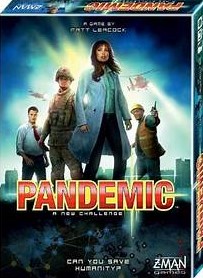
For many, the most enjoyable cooperative game out there today is Pandemic.  You and your fellow players are a team trying to cure four diseases trying to take over the world.  You have to work together to get the job done because if you don’t, the diseases will get out of control.  This game has a good amount of variability, which enables a good deal of replay value, which is definitely a plus for games as investments.  With different character roles and different setups each game, each time you play it is a new experience.  Even so, Pandemic has a number of expansions available to change the game in different ways.

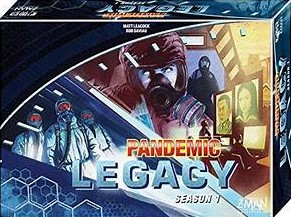
If you like grand stories, as I’m sure you do, once you have played a good deal of Pandemic, give Pandemic Legacy a try.  I’m told it tells an epic story over a number of games, in which the playing surface and the game itself change from gaming session to gaming session.

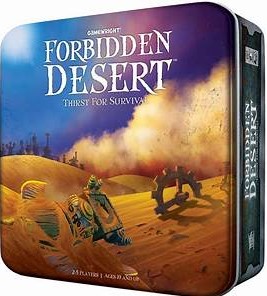
A very enjoyable cooperative game that also is a very good “gateway”

game (a good game to introduce people to boardgaming, especially if they aren’t familiar with modern boardgames) is Forbidden Desert.  You and your fellow players are a team of explorers (also with different roles/abilities like Pandemic, adding to the variability and replayability) trying to find pieces of Leonardo’s flying machine (sort of) before the desert swallows you up or you run out of water.  The difficulty can be adjusted for new, intermediate, or advanced players.  It’s also a short game, and while there is some tension in trying to “beat the clock” together, it’s a fun game providing a good deal of player interaction in a positive way, since you are all working together.  Because of this, it’s also a great game to play with kids (my six-year-old Julia can play pretty well as her own character).

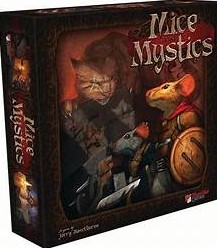
Another good cooperative game even more suited to a family gaming experience is Mice and Mystics.  This is a storytelling fantasy game in which the players are loyal heroes-turned-mice adventuring their way through the castle in an attempt to overcome the villains and bring peace back to the troubled realm.  It is a role-playing game fit for the whole family, with several expansions available to keep the fun and family togetherness going for a long time.

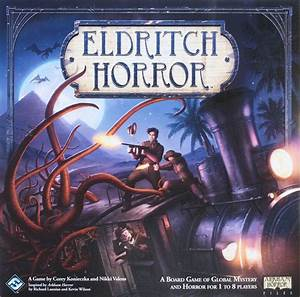
In stark contrast to Mice and Mystics is a definitely older-audience themed game, still with a great deal of  story-telling fun: Eldritch Horror.  Based on the macabre works and worlds of H.P. Lovecraft, Eldritch Horror is a story-telling, mystery-solving, globe-trotting adventure.  It works well as a solo game; it works well with up to 8 players.  As has been discussed here and elsewhere, I am no fan of horror.  I am quite sure I will never read any stories by H.P. Lovecraft.  However, I do enjoy this game.  The horror element is there in part, but it’s a minor part and can be easily glossed over.  It’s a dark mystery storytelling adventure.  This, too, has a number of expansions, so it has a tremendous amount of replayability.  You can be different characters each time, encounter different monsters each time, and investigate different supernatural mysteries and clues each game.  As many of you know, it’s a bit of a streamlining of an older, similar game Arkham Horror, which is another fine cooperative dark mystery in the Cthulhu universe.  I enjoy it, too, but it is longer and a bit scarier (it’s much closer in one town instead of traveling the world, so the menace is more palpable).

One of the most recent games on this list is also a cooperative storytelling adventure T.I.M.E. Stories.  I haven’t played it, but I’ve seen videos about it, and it’s like a grown-up cooperative “choose your own adventure” system.  The game system comes with one module called “The Asylum.”  Once you’ve played it, you know it all and probably won’t want to play it again.  But, more modules are out and more are on the way, so consider T.I.M.E. Stories more like a gaming system (like a Super Nintendo) and the modules are new game cartridges.  The modules out now are fairly dark like Eldritch Horror, but the ones scheduled to be released soon seem lighter.  It’s an intriguing system about managing time, solving mysteries, gathering clues, going back in time … it looks like Quantum Leap meets Groundhog Day meets Goosebumps.

Semi-cooperative Games

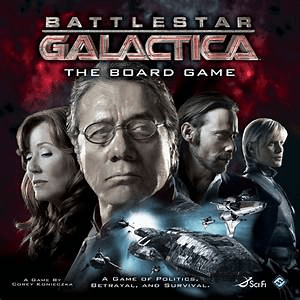
Now that you know about the exciting world of cooperative games (and, like this entire article, we’re only scratching the surface), for those who like an extra challenge, try a semi-cooperative game.  Often, games of this ilk have one or two of the players secretly working against the rest of the group — possibly for personal victory objectives or possibly because that person is working for the villains the rest of you are trying to avoid/conquer.  For me, the best among this group (not that I’ve played them all) is Battlestar Galactica.  As a fan of the show, the theme of this game is mostly what makes it such a fun game.  Even if you aren’t a fan of the show, the tenseness and rollercoaster nature of the game will give you a tremendously enjoyable gaming experience.  Part of the wildness of the game comes from the possibility one or two of the players may switch sides halfway in the game, whether they want to or not — and while that may sound frustrating, since you know that’s a possibility before you start, it’s simply another element of strategy you have to add to the game.  It’s good, tense fun.  It also has expansions to make replayability and playing through the whole series a possibility.

On the fantasy side, Shadows over Camelot is another semi-coop game in which most of you are loyal knights trying to salvage Camelot from the inexorable forces of darkness (Mordred, traitorous Lancelot, invading Picts, and more) … yet it’s possible one of those “loyal” knights is a dirty traitor, but if he or she is playing wisely, you may not know it until it’s too late.  It’s possible, certainly, to play without the traitor element: it’s a challenging enough game without that, so if you want to play a fun coop game set in Camelot with or without traitor tension, this is a very enjoyable, fast-paced game.

One game I’ll likely never play (in part because I don’t really like the theme) is the beloved and acclaimed Dead of Winter.  I’m told if you like The Walking Dead or other zombie-themed things (I don’t know why you would), you will enjoy this game.  It’s noted for its “crossroads” system, in which decisions are made and situations occur completely unique to every gaming experience that make each play different.  With different character roles, variable missions, and random personal goals each time, it’s got a lot of replay value.

Deckbuilding

One of the more interesting innovations in games lately is the “deckbuilding” game mechanism.  Hearkening back, in a way, to those CCGs of the ’90s, instead of building a whole deck and hoping you get the right cards eventually, deckbuilding games have you start out with a few basic cards and you get to decide what cards to add to the deck and build it yourself during the game.  For many of you, Dominion is the popular choice for this genre of games, and that’s fine.  It was among the first to make this newish mechanism popular and has been a beloved game for several years now, with many expansions and whatnot, but here are some that you may like as well (or more).

Paperback is especially interesting for those who like Scrabble.  It is a word-building game, but you are also using letters (as cards in your hand and in your deck) to make words that will allow you to get more letters in your deck to make longer, more interesting words and perhaps special words that will give you bonuses and such.  There is a competitive aspect to the game, like Scrabble, but unlike Scrabble you’ll never be stuck with a ZXCEEQF and nowhere to put it on the board.  If you don’t like the competitive aspect, Paperback comes with a cooperative element, in which you and your fellow players are trying to make words to beat the built-in time mechanism (in a sort of reverse Klondike fashion).  This is a great game.

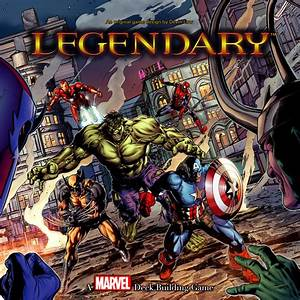
For fans of the Marvel universe, a very enjoyable deckbuilding (and also cooperative) game is Marvel Legendary.  You are SHIELD agents coordinating with powerful Marvel heroes to tackle the main villain and his henchmen.  It takes strategy, cooperation, and a smidgeon of luck, but it is a fun game.  The series has a large number of supplemental releases, so there’s a good chance many of your favorite Marvel heroes/villains are available or soon will be (though, they are slanted toward newer storylines and characters, so I’m a bit concerned some of my favorites from back in the day won’t get released, but that’s okay).  If you would prefer to play as the villains against the heroes, check out Marvel Legendary: Villains.

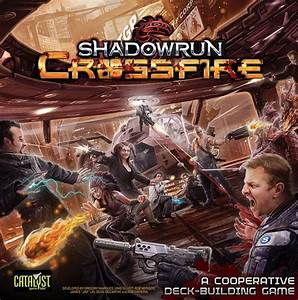
On the flipside, a much more difficult game that may even be more enjoyable as a single-player game (since it gets more difficult the more people who play), is Shadowrun: Crossfire.  This game is hard to win, but when you do, it’s a great feeling.  Better than that, though, is the game grows the more you play.  Unlike Dominion or Legendary, as fun as they are to play, once they’re over, they’re over.  You start from the beginning every time.  Shadowrun: Crossfire is like an RPG (which makes sense, since it’s based on an RPG universe), by this I mean if you win (or get a partial victory), your characters get experience points, and the more experience points you get you can add new abilities to your characters to change the game, often to make it easier.  This allows you to play more difficult missions and makes the game more enjoyable and more challenging.  I’m not usually a huge fan of challenging games, but I really enjoy this one.  It, too, is also a cooperative game.  Expansions are on the way for this one, too.

Dice Games

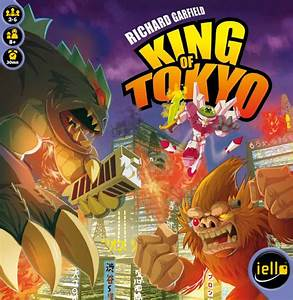
So you like rolling dice, huh?  Miss those ol’ days of Yahtzee and 10,000 and other dice rolling games?  If you like chucking dice, you may really enjoy King of Tokyo.  It is a fast game that plays up to 6 people, so it’s a great game for many reasons.  Each player takes the role of a classic/generic movie monster, each trying to become the King of Tokyo, either by being the most famous or, perhaps more enjoyably, the last monster standing.  Like Yahtzee, it’s a dice rolling game about matching dice combinations, but it also adds cards for variety that makes its replayability level rather high.  The Power Up expansion gives the different characters unique abilities, making it an even more enjoyable game again and again.  (There’s a King of New York and other expansions as well.)

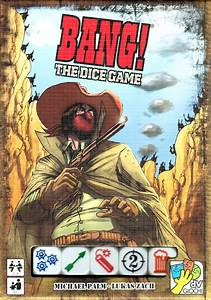
Another fun, fast dice game with a decent amount of theme tossed in is Bang!: The Dice Game.  Like King of Tokyo, you roll the dice a few times to decide which actions you are going to take that turn, balancing helping yourself with attacking the other players, all in the Ol’ West.  It’s an inexpensive, fast game that also has a good deal of replayability.  I’m told it works great with 5 players, so get the whole family together.

Roll for the Galaxy is a different kind of dice-rolling game.  Similar to some of the Civilization-building games discussed later, this game uses your dice to colonize worlds, ship goods, and develop technologies to advance your space-faring civilization.  Like Bang!: TDG, this is a reimplementation of a card game you may also enjoy if you prefer card games to dice games (called Race for the Galaxy).

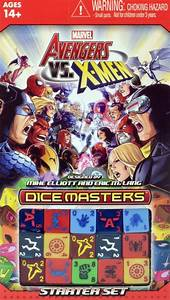
As with all the other games in this section, Marvel Dicemasters uses customized dice to simulate your favorite Marvel heroes battling against your favorite Marvel villains (and also other Marvel heroes, as is their wont).  This game is customizable, has a number of sets (all of which are fully compatible with the others), and also gives you the exciting fun of collecting.  The fun of CCGs back in the day, opening packs and hoping to get the cards you need, is here at a much cheaper level.  The starter sets are inexpensive and complete games by themselves, but the additional fun of getting new cards, new dice, and new characters is also available fairly inexpensively.  It’s a quick game, easy to learn, and great for Marvel fans who like rolling dice.  Also, the designing team have a DC line if you prefer DC characters, a Dungeons & Dragons line, and a Yu-Gi-Oh! line.  Something for (almost) everyone.

Party Games

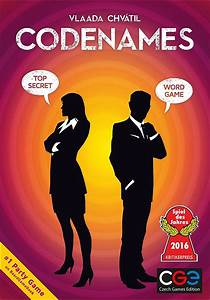
Don’t get me wrong: Apples to Apples is nice and still is holding on, and we even use it ourselves once in a while.  But it’s time on the whole to move on.  When you have a group over and want to play a game, give the new Codenames a try.  From the Web site CoolStuffInc.com (a good site from which to order these games, sometimes cheaper than Amazon): “The two rival spymasters know the secret identities of 25 agents.  Their teammates know the agents only by their Codenames.  The teams compete to see who can make contact with all of their agents first.  Spymasters give one-word clues that can point to multiple words on the board.  Their teammates try to guess words of the right color while avoiding those that belong to the opposing team.  And everyone wants to avoid the assassin.”

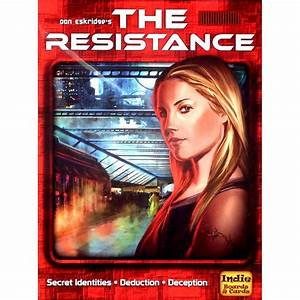
Another kind of team vs. team party game is The Resistance.  Whereas in Codenames you know who is on which side, you aren’t sure who is on your side in The Resistance.  Through deduction and guessing and luck, you attempt to find out on which team the other players are and who is not being as forthright as you.  A fun bluffing game with expansions available to make the game even more diverse and replayable.

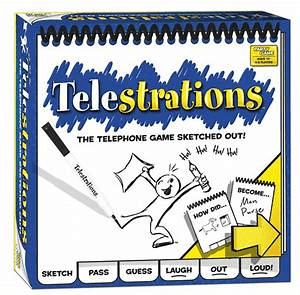
If you miss the fun of Pictionary and the like, perhaps you should give Telestrations a try.  It’s a bit like Pictionary mixed with Telephone, and a whole lot of fun and laughter throughout.  If you were frustrated by Pictionary and others of its ilk, give this a try, especially if you enjoy having fun with fun people.

If you like trivia games such as Trivial Pursuit, or at least want to like them but always seem to end up getting the ridiculously hard questions and the people you know you are far smarter than end up getting questions like “Are you on the Earth or the moon?” you will probably enjoy playing Wits & Wagers, especially the Family Edition.  You aren’t really supposed to know the answer, but if you think someone playing does have it (or is closer, since it’s basically guessing numbers and closest wins without going over, like The Price is Right), you can wager on that person’s guess and possibly get points for yourself.  It’s good fun for the family and/or group, doesn’t frustrate you nearly as much as other trivia games, and is not nearly as long as those as well.

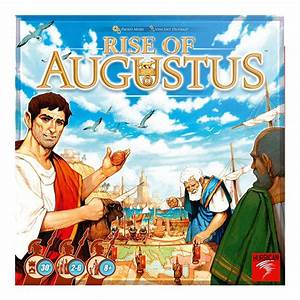
Another party game that works well as a family game is Rise of Augustus.  It’s basically Bingo, but it has just enough strategy sprinkled on top of it to make it fun for adults as well.  With teams, you can play this with a decent number of people, but for smaller groups it works even better.  It’s another fast game you’ll probably want to play more than once in a night.

Filler Games

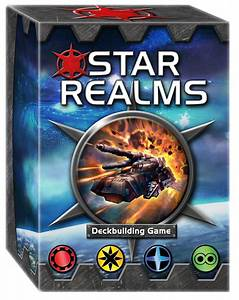
If you want to play a fun game and only have a few minutes, here are a few simple card games that will give you some fast fun.  Star Realms is a very popular deckbuilding game that, unlike the cooperative deckbuilders above, is just about blowing up the other player’s spacefleet.  It is very simple to learn, simple to play, but its simplicity is part of its streamlined fun.  It’s a whole lot of fun for under $15.

No Thanks! is a clever sort of hand-eliminating game (think Uno but with strategy and fun).  You don’t want cards because you get points for having cards and the lowest score wins.  Instead of taking cards you can spend a chip to pass … but soon you’ll run out of chips and you’ll possibly have to take cards worse than the ones you didn’t want earlier.  All of this clever strategy and hand management and such takes places in about twenty minutes.

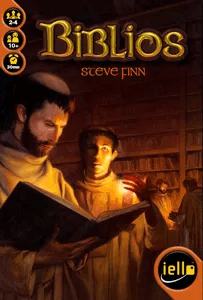
Biblios is an interesting themed game about competing medieval librarians trying to construct the most influential library of rare and sundry tomes.  You have to manage your gold and workforce well to dominate different categories that give different points — whoever has the most points wins, but you will all win because you’ve played a fun game in a short amount of time.  And then you’ll want to read The Name of the Rose, and then your life will be even more rich and full.

Civilization Games

The other end of the spectrum from filler games are epic civilization games, one of my favorite kind of game (being a fan, as you know, of epic poems and epic TV series).  Here are two faster-paced, simpler Civilization building games very accessible to new gamers – and two  incredibly lengthy games that tells a grandiose story over one full day of gaming (one of which happens to be my favorite board game).

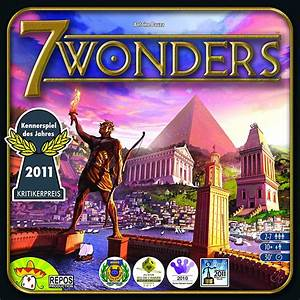
7 Wonders is a fast card drafting game (you decide which card you want to take, but you also have to ponder whether you want your opponents to get the cards you may pass on, too) in which you develop a civilization, build ancient Wonders of the world, and dominate.  It’s a great “gateway” game, plus it has a number of expansions that add replayability and freshness.  Even if you think the game is too simple, the Babel expansion will give it new life for you.

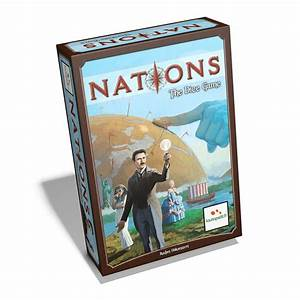
Nations the Dice Game is all about rolling dice to make your nation the dominant culture in the world from the ancient past to the modern day.  Similar to deckbuilders, you are using your simple initial dice to acquire better dice, which enable you to increase the strength of your military, increase your food production, increase your cultural-literary output, and build helpful wonders and recruit helpful leaders.  It’s actually much less complicated than I have made it sound, and it is a very fast game to understand and play.  You’ll likely have difficulty playing it only once.

For the space-civilization conquering itch, perhaps Twilight Imperium IV will suit you.  It’s a beloved game of interstellar conquest, exploration, diplomacy, and civilization building that certainly takes a decent amount of time to play, but the grand sweep of the gaming experience certainly pays off the time investment, especially if you like grand “space opera” tales (more on Star Wars later).

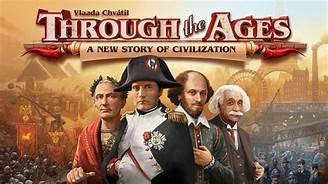
My favorite boardgame currently, possibly of all time (we’ll see) is undoubtedly Through the Ages.  It’s a beast of a game, not difficult to play but as I said you have to carve out a day of your life to play it (unless you want to play the Basic game, which would only take a couple hours, but why would you want to deprive yourself of such a wonderful experience?).  This game takes you on such an exciting, wonderful journey from Ancient times up to the Modern Age.  It’s a card game at heart, but it’s easy to forget that since the immersion in Civilization building is so rich.  You have to keep your people happy (an easy way to do that is through religion, which is a nice change from most Civ. games that treat religion as “mystical nonsense” only for underdeveloped simpletons), you have to feed your people, you have to develop science and art and culture … and it’s a total blast.  Like with all of these games, you have leaders that help you, Wonders to build, possibly a military to expand (but becoming an overly dominant military power brings you more problems than benefits), colonies to explore, treaties to make, calamities to avoid, all the while creating a deep, satisfying story of your empire, a story you will remember for a long time.  A 2nd edition is undergoing refinement while we speak, which is intriguing and also means the original is becoming more affordable by the minute.

“I Win!” Games (Racing and Area Control)

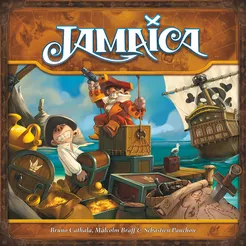
If you like the old race-around-the-board type games like Sorry! or Parcheesi and almost any other roll-and-move game from days gone by, perhaps a more enjoyable modern version you’d like even more is Jamaica.  A pirate-themed racing game, Jamaica gives you more choices than simple roll-and-move games, but your choices are limited somewhat so you have to think both short-term needs and long-term strategy (though “long term” is likely only about thirty minutes).  Once everyone knows what they are doing, it’s a fairly rapid game, which is thematically more enjoyable for a racing game.  It has a few layers of strategy even with your limited choices, but it is still accessible for kids, once they get the hang of it.

Camel Up is a recent award-winning game about racing camels. Stay with me, now.  You are trying to guess which camel will win the race and place your wagers accordingly (normally we at Redeeming Pandora would not enjoin our audience to gamble, but this is only a game, so have some vicarious fun).  As with all races, sometimes the camels will run the way you want them to, then suddenly a camel will sneak under it and jump into the lead and it’s suddenly anyone’s race.

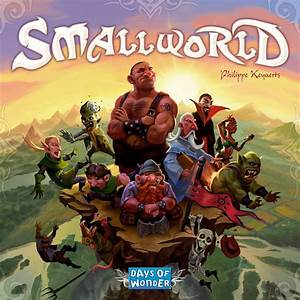
If you grew up on Risk and the first question that springs to your mind when someone mentions a board game is “So it’s like Risk?” (or “So it’s like Monopoly?”), the next three games may bring you back to those halcyon days of conquering the world, but now you might be able to have that sort of fun a tad bit faster.  And actually have fun this time.  Small World is a much-beloved goofy fantasy game basically all about area control (taking over spots on the board, which is effectively what Risk and Diplomacy were all about, when they weren’t busy destroying friendships and ruining families).  Your fantasy race starts somewhere on the board, tries to dominate as much territory as possible, then gets replaced by your next race of world conquerors — but watch your back, since that’s what everyone else is trying to do.

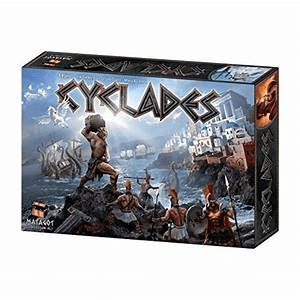
If you like ancient world games, Cyclades may be right up your alley. You have to appease different Greek gods to do different actions (Ares for war, Poseidon for movement, Athena for wisdom/schooling, Apollo for wealth, etc. — most of it makes a fair amount of thematic sense), but you are competing with the other players for the god’s favor.  Add the Titans expansion if you really want an Ancient-world Risk-like feel.

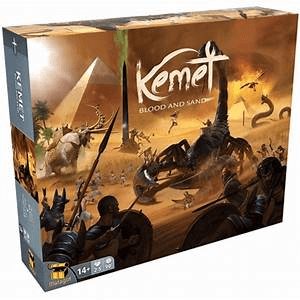
If Egypt is more to your liking than Greece, Kemet is probably the smash-em-up world-domination game for you.  This is initially a more straightforward Risk-in-Egypt game (but fast and fun), but it has enough other strategic layers to make it more than just a mindless crush-your-enemies game.  If you want to mix-and-match your Egyptian and Greek monsters for a mga-brawl, check out the C3K expansion that allows you to do just that.

Strategy Games

In one sense, most of these games are “strategic” (and hopefully by now you can see why games with strategy are more fun and more rewarding than purely deterministic games that dictate what you can do each turn and give you no real decisions or options), but I needed a generic category just to talk about some really fun games that don’t have much else in common other than being thought-provoking games of fun.

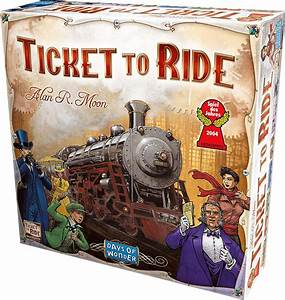
Ticket to Ride in its many incarnations are great “gateway” strategy games for you.  If you haven’t played any boardgames since Risk or Monopoly and you are a bit hesitant to try one of the deeper games, Ticket to Ride or Forbidden Desert or 7 Wonders or King of Tokyo would be excellent places to start.  Ticket to Ride is a simple set collection game in which you are collecting similar-colored train cards in order to turn them into railroad routes from one city to another.  Completed rail routes get you points.  It’s even simpler and more enjoyable than I’ve made it sound.  The basic Ticket to Ride features the USA, and the other incarnations feature the country in their title, so plenty of options, plenty of variety, plenty of replay value, and plenty of good times.

A sort of medium-weight strategy game, Mission: Red Planet combines a lot of different kinds of game mechanisms such as area control and hand management, so it’s a good introduction to other ways to play games beyond rolling a die and moving around a board.  You are racing the other players to Mars, but you need to do more than get there: sometimes you need to focus on stopping your opponents from sending their explorers.  It gives you lots of easily comprehensible options and is a fast, rich game.

Have you ever wanted to play Star Wars?  Here it is: Star Wars in a box … Imperial Assault.  One of you gets to play as the Alliance, one of you gets to play as the Empire.  True, one potential drawback to this is its modular nature, in that it doesn’t come with all your favorite characters and weapons and settings in the initial box.  You have to buy the Han Solo pack, the Chewbacca pack, the Boba Fett pack, et cetera, but you could always ask for them for Christmas as great stocking stuffers along with more packs of Dice Masters, so that takes care of that problem.  This is the highly accessible strategy game for Star Wars fans.

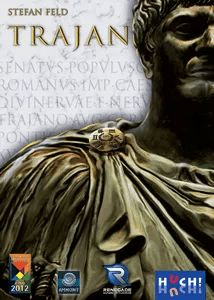
Deeper strategy is required for a very enjoyable game, Trajan.  You and your fellow players are competing consuls, vying for Emperor Trajan’s approval by improving various aspects of Rome: rebuilding the infrastructure, hobnobbing with senators, shipping goods to allies, leading armies in conquest of new territories, and more.  Using the centuries-old Mancala mechanism determines the actions you can take, but you also have the opportunity to create a string of bonus actions to get victory points all over the place.  It’s not really as complicated as I’ve made it out to be, but it is a deep, rich strategic game with many paths to victory and fun you’ll want to play it again and again.

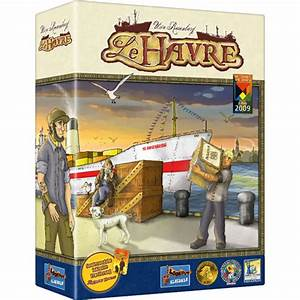
Le Havre is another deep strategic game about creating the most prosperous harbor by building ships, gathering goods, constructing special buildings, and, as always with designer Uwe Rosenberg’s games, feeding your people. A good deal of its depth consists in the fact you can only do one thing per turn.  You have one choice: acquire resources or use a special building.  And that’s what you do.  Sometimes you’ll have enough money to buy a building, too, but not often.  It’s an incredible brain-burning game that really helps you develop those strategic thinking skills you’ve wanted to develop.

Another unusual strategy game with an interesting theme is Rococo, in which players are competing dressmakers trying to get your gowns and suits on the most Parisian nobles attending Louis XV’s grand ball at the end of the game.  You have to manage your action cards very well to get the resources you need, make the dresses, put the dresses on the right people in the right places, and string together bonus points and bonus actions as much as you can.  It’s another enjoyable brain-burner (in a good way).

When you and your family is ready for something big, and you feel like getting into real historical simulations (I promised myself I wouldn’t put any wargames on this list), go all out with Here I Stand.  One player is Luther trying to get the Reformation going; another is Pope Leo trying to squelch the Reformation.  Another player is Henry VIII taking care of England (and trying to get a male heir); another is France, a fifth is Suleiman and the Ottomans, and a sixth player controls Charles V and the Habsburgs.  It’s a card-driven game, in that you have a hand of cards that could either be events for the board or points for actions, depending on which nationality you are.  It’s a big game, but it provides a great deal of historical immersion and tremendously fun gameplay.  Once you’ve mastered this (!), check out the sequel, The Virgin Queen, about, you guessed her, Elizabeth I.

Worker Placement Games

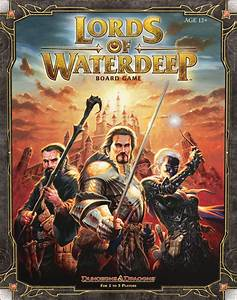
Another innovative game design of late is “worker placement” games.  Instead of moving lineally around a board, worker placement games have players place a certain number of workers (or rolled dice or what have you) on select portions of the game board that activate different game effects, such as gathering resources, advancing along information tracks, transporting goods from one place to another, or other game elements depending on what kind of game it is.  One very enjoyable “gateway” worker placement game is Lords of Waterdeep.  Don’t be fooled by the Dungeons & Dragons veneer, especially if you don’t like D&D: you are not really fighting monsters or casting spells.  Instead, you are competing councilmembers or lords of the town hiring different heroes to go on quests that make your city a better place.  You place your workers to hire different kinds of heroes, get money to hire them, get different quests that give you points (which translate into how well you have improved the town for the people), raise influence in the town, build new buildings that give you more options and faster/better resources, and much more.  Even people who don’t like D&D/fantasy will have a very good time playing this.  Once you’ve mastered it, get the expansion Scoundrels of Skullport to add more quests, more resources, more options, and more fun.

Another brain-burning strategic worker placement game from Uwe Rosenberg is Caverna, a fun, challenging game about Dwarf cave farmers conquering the wilderness and making their home a better place for their burgeoning family.  You have to feed your family as always, but you have many options of how to pursue victory: you can cut down the forest and make spaces for sheep pens, pig pens, and horse pastures, or, perhaps, farmland to feed your family.  Additionally, you can mine your cave for rubies or transform your cave into beautiful, useful rooms — many different kinds of rooms give different bonuses, different abilities, different reasons to play again and again. It’s a big, heavy box, but it comes with a whole lot of game that plays well for 2-7 players.

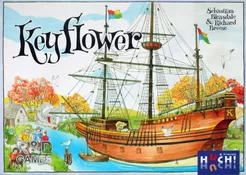
Finally, another diverse kind of worker placement game is the unique Keyflower.  This clever game simulates a small city building game and a worker placement idea with a twist: if you send your workers to another person’s spot, you’ll get those resources but effectively your worker is moving to their town and you just lost a worker.  You’ll get others later, but it’s an interesting variation.  On top of that, you also have to use your potential workforce as auction currency, deciding if you want new tiles to add to your city (which you’ll need to do to gain points to win) or immediate resource benefits or long-term worker options.  It’s a very clever game that doesn’t take a whole lot of time and does things differently but intuitively to combine for a unique, enjoyable thought-provoking package.

Whew.  Was that too much?  Go big and go home, that’s my motto.  I’m not telling you you have to go out and buy all these games (I don’t own nearly all of them myself) — remember, the point of this was to tell you there is another kind of revolution going on in our lifetime: a boardgaming revolution.  We are in what may be but the nascence of the 2nd Golden Age of Boardgaming.  And, believe me, this was not the tip of the iceberg.  This was the tip of the tip of the iceberg.  This barely scratches the surface of the hundreds and hundreds and hundreds of great games made in the last couple of decades.  If you like rolling dice, we’ve got fun dice games for you.  If you like card games, card games have been taken to a whole new level of fun.  Family games are no longer just silly, thoughtless roll-and-move games with no brains or strategy.  Games based on beloved books, television shows, or movies are no longer just the cheap, bland, superficial tenuous tie-in games of yesteryear.  This is an exciting time to be alive, especially if you enjoy having fun.

If you are reading this before Christmas, clearly any of these games would be an ideal present for one or more members of your family or friend-family.  If you are reading this after Christmas, here are some ideas for those gift cards you got in your stocking, or ideas to start the New Year off right: quality experiences with people you love.

Do you want to salvage Family Time?  Do you want something intelligent, social, interactive, inexpensive, sustaining, and worthwhile you can do together as a family or as friends (other than high-quality Bible studies)?  Of course you do.  Now that you and I have extirpated cynicism from our lives, it’s time to fill that hole with open-hearted generosity and heart-warming memories (and love, joy, peace, patience, kindness, goodness, faithfulness, gentleness, and self-control, of course).

Get one of these boardgames and salvage Christmastime and Family Time.

Unplug.

Declutter.

Relax.

Play.

Enjoy.

Laugh.

Love.

Live.

Merry Christmas!  See you in 2016!

2022 Editor’s Note

A few of these games are out of print and very hard to get, sadly. Many of them are on new editions – for those of you playing along at home, I updated many of the pictures from the original article in 2015 with the new versions, new covers, and new editions (especially Twilight Imperium IV, which was only 3rd edition back in the day). I also have played more of these games since then, such as TIME Stories, in case you are wondering. Sure, a lot of good games have come out since then, and many games that are even better than some of these, but these are still enjoyable (if you can track them down).

Loving Beyond What Is Seen

Kasamira Wojcik

Everyone wishes to be loved. Everyone wants people in their lives who will look at them and see someone they care about; who they will never mistreat or abandon. Everyone wants to be accepted, and sometimes people will go to great lengths in order for this to happen. The Bluest Eye tells the story of a little black girl named Pecola, whose deepest wish is to have blue eyes. The reason she wants blue eyes is because she thinks it will make her beautiful. She is considered ugly by all the people around her, and they make sure she knows it as well. Pecola believes this to be the reason people, her family included, mistreat and hate her so much. Toni Morrison, author of The Bluest Eye, explores the concepts and results of things like racism and hate and what they can do to someone, even to someone as small and innocent as a little girl who just wants to be loved.

This book takes place in 1941 during the Great Depression when racism is still at large and there are certain ideals and standards when it comes to beauty. In the words of Claudia, a nine-year-old little black girl, who is also one of the main characters, “Adults, older girls, shops, magazines, newspapers, window signs — all the world had agreed that a blue-eyed, yellow-haired, pink-skinned doll was what every girl child treasured.” The doll she was referring to was a white doll she received as a present. This doll, with the blue eyes, yellow hair, and pink skin was considered the standard of beauty whether people realized or not. Even black children had this view impressed upon them. So, according to those standards, both she and Pecola were considered ugly by the rest of society from the start. They were hated for their looks, Pecola especially because she was considered ugly even for a black girl.

It is very dangerous when someone is always told from when they were very young they are ugly. If that is the only thing they are ever told, then they will believe it, which often results in very destructive habits. This can be seen in the state of Pecola’s parents: “They lived there because they were poor and black, and they stayed there because they believed they were ugly. Although their poverty was traditional and stultifying, it was not unique. But their ugliness was unique. No one could have convinced them that they were not relentlessly and aggressively ugly.”

This is talking about the living conditions Pecola and her parents were in. They were poor, black, and lived in a run down, old house. Pecola’s parents believed the reason for this was because they were ugly. They were so dead-set in believing they were ugly because it was all they were ever told. Even if someone did try to convince them otherwise now, Pecola’s parents would never believe them.

This self hatred can lead to obsessions of other things such as physical beauty. This is what Pecola’s mother was obsessed with. “Along with the idea of romantic love, she was introduced to another — physical beauty. Probably the most destructive idea in the history of human thought. Both originated in envy, thrived in insecurity, and ended in disillusion.” This speaks truth about her relationship with physical beauty. Her obsession started with her greatly desiring to have physical beauty. It continued on with the insecurity she felt over how she viewed herself and how she believed others viewed her. It ended with her believing if she did certain things or treated people a certain way, she would gain physical beauty, even though this was not the case.

This self-degradation influenced by the treatment of others can also result in more serious outcomes: “They seemed to have taken all of their smoothly cultivated ignorance, their exquisitely learned self-hatred, their elaborately designed hopelessness and sucked it all up into a fiery cone of scorn that had burned for ages in the hollow of their minds — cooled — and spilled over lips of outrage, consuming whatever was in its path.”

One of the people this mainly refers to is Pecola’s father. He had so much self-loathing and hatred for others as a result of how he had been treated his entire life. He was a horrible person. His actions stemmed from all of those feelings he had pent up inside. He was a drunk, and he did terrible, unspeakable things to his daughter.

As for Pecola, she was a just a little girl who desperately wanted to be loved. “Here was an ugly little girl asking for beauty…. A little black girl who wanted to rise up out of the pit of her blackness and see the world with blue eyes.” She did not know what was wrong with her. She did not know why people would not love her. She thought it was because she was ugly, and so she wished to have blue eyes. She thought if she did, then people would see her differently, see her as beautiful and love her. In the end, Pecola lost her sanity over her desire to have blue eyes.

The wish to be loved is one of the strongest people will ever have. When people are not loved the way they ought to be, bad things like self-loathing and disillusionment can happen. People should never let things like looks or the color of someone’s skin get in the way of seeing a person as they truly are. If they do not, there is no telling to what lengths the other person will go to in order to be loved. It is one of the reasons people must go deeper and love beyond what is seen.

A Return to Prydain

Christopher Rush

As part of my quest in 2015 to read more enjoyable books, I finally returned to my favorite books of my youth, the Chronicles of Prydain by Lloyd Alexander.  These were the books that got me into fantasy, sooner than Tolkien, and so they have a special place in my heart.  These are probably still my favorite books of all time, and they are so good it would be insulting to say “they still hold up” – great art has nothing to do with temporal standards.  These reviews, as usual, were initial reactions off the top of my head when I first re-read them, so they aren’t a cohesive analysis of the books, though it’s possible that may be forthcoming sooner or later in one of these issues.  They are mostly spoiler free, though it’s hard not to mention a few important things here and there.  Please don’t take my word for how good they are, though: go read them for yourself.

The Book of Three ⭐⭐⭐⭐

For an introduction to a series, this book serves all the appropriate functions. Some find the similarities between this and The Lord of the Rings as a strong mark against The Book of Three and all of the Chronicles of Prydain, but that is as nonsensical as anything could possibly be. Alexander, like Tolkien, is intentionally dealing with mythic elements, things so old and common to the history of literature, naturally Alexander’s use of archetypes will be familiar to people who have read things that utilize similar mythic archetypes. Alexander, though, is not merely paraphrasing Tolkien or Welsh mythology or anything. He combines meaningful elements with wit, humor, and a breadth not necessarily better than Tolkien but distinct enough to warrant this series standing on its own. Taran is no Frodo; Gwydion is certainly no Aragorn. We have no idea truly what The Book of Three is, and that mystery is a wonderful component of this story.

Alexander does a great job of introducing us to our young, impetuous, headstrong hero and thrusting him rapidly into a believable adventure that grows sensibly chapter by chapter. Coincidences abound, sure, but that happens in high quality fantasy, award-winning fiction, and real life. Taran is brash and makes mistakes, for which he is upbraided by the wise Gwydion and impetuous Eilonwy, creating a valid young hero-in-training for this series of adventures. Eilonwy is an interesting Princess, and Fflewdur is a clever addition to this rag-tag group of adventuring companions. Gurgi is a great character, and it is impressive Alexander has his relationship with Taran grow as it does. Doli is certainly an un-Tolkien character as well as the entire depiction of Fair Folk or Dwarves.

The amount of menacing villains may seem heavy, especially in an introductory book, but Alexander does a fine job balancing the significance of all of them, giving Achren a very menacing premiere, Arawn a mysterious-yet-palpable presence, and the Horned King a fine spotlight as the major enemy, occasional as his appearances may be. The resolution of this adventure may feel somewhat forced, but a closer examination of it shows how distinct it is. Instead of the young hero getting to use the mighty magic weapon and saving the day in all unlikelihood, the actual well-trained, knowledgeable hero saves the day, while the impetuous youth suffers appropriately for doing what he had no business doing.

Alexander makes this a believable fantasy world, with real consequences for good and evil actions. He shows the importance of pursuing good even if it costly, and even heroes-in-training need to be polite to princesses. Sometimes the desire for adventure proves a poor desire. Reading this, though, is always the right choice.

The Black Cauldron ⭐⭐⭐⭐⭐

Perhaps the most remarkable aspect of this book is Alexander’s way of taking characters we know and love from a book that had some serious moments plus a fair amount of goofy, lighthearted moments with an overall upbeat feeling and placing those characters in the same world yet wholly opposite circumstances. The Book of Three does indeed have many sorrowful and disheartening moments, especially while Taran believes Gwydion is dead, but it is mostly an optimistic book with Eilonwy and Fflewdur keeping it rather lighthearted and the ending’s relief-filled optimism assures us the world is safe. Almost immediately in The Black Cauldron, though, a heavy pall seems to spread over our characters and their world. Despite a fairly rambunctious gathering of old friends and new (especially Smoit’s enthusiasm), Gwydion makes it clear this is not a time of celebrations: it is a time, rather, of desperation and self-sacrificial heroism.

Throughout the book, things get worse and worse for these people we love, despite their best efforts and their most selfless sacrifices. Alexander introduces an impressive collection of new characters, only to take them to heart-wrenching places and destinies: it is a non-stop pathos-filled adventure. Also impressive is the fact so much of this melancholy tale is a series of quiet moments of painful decisions: there is very little action present; we only hear about the action second-hand. Even the dramatic conclusion in which new characters, especially, are driven to extremes of character (in wholly believable ways) is predominantly quiet, punctuated as it is by rapid flashes of action.
It is a remarkably somber book, yet its pacing and atmosphere are as riveting as any tale of swashbuckling high adventure. We can totally see everything that is coming from far away, yet every aspect of it is fresh and surprising when it arrives. Alexander does so much new with what we assume will be familiar we are astounded again and again.

The impressive pacing is seen especially in Taran’s character: at the end of The Book of Three, we basically think we know where Taran’s character is going to go and how he is going to get there, yet each new novel in The Chronicles of Prydain smashes our assumptions into embarrassing smithereens, especially in The Black Cauldron. For the first time, Taran faces very personal foes, up close. His decisions throughout are terribly painful and deep, yet everything he does and says is wholly believable considering where we left him in TBoT and where he is now and what they are doing. It is all so gradual and realistic it is, frankly, stupendous and devoid of the typical “fantasy hero superlatives” that would have sprung up in lesser writers. Even the lessons Gwydion emphasizes for Taran at the end are necessary for Taran to learn, as he needs this wisdom spelled out for him (as we all do when young) — Taran doesn’t just magically acquire wisdom and generosity of spirit without learning them through painful, poignant lessons — and, by golly, the lessons of The Black Cauldron are truly painful and poignant. And also beautiful. 5 stars, no question about it.

The Castle of Llyr ⭐⭐⭐⭐

As Alexander’s masterful pacing continues, the middle of the epic gives us some much-needed comic relief after the somber intensity of The Black Cauldron. Some more time has passed, and the gossamer-strong relationship between Taran and Eilonwy takes center stage, but in such a clever way only Lloyd Alexander can deliver. It is time for Eilonwy to learn how to be a lady and a princess, something not even Dallben can teach her. This is not a welcome thought for Taran, as it means Eilonwy no longer being around and is a palpable reminder she is noble and thus likely not going to marry a foundling assistant pig keeper. While this book could have been an engaging story centered around Eilonwy’s time learning how to be a princess and a lady (and possibly Taran’s comic misadventures either spying on her or bidding his time elsewhere), Alexander postpones that sort of thing by placing Eilonwy in danger (with the return of an old enemy) and Taran desperately seeking to come to her rescue. Old friends and new characters come along for the ride, which is full of humorous scenes as well as heartbreaking moments and deeply moving experiences as well.

Part of the brilliance of this book comes from how well the development of Taran’s character is demonstrated. We’ve said before how well Alexander paces Taran’s development, and here just how far he has come (and how far he still has to go) is displayed against the new character Prince Rhun, a kind of comedic-antagonist foil for Taran. Rhun is suddenly a rival for Eilonwy’s hand (and heart), but Taran can’t simply dislike him as he somehow is given charge over Rhun’s wellbeing. Making it more frustrating for Taran is how congenial and gracious Rhun is (and oblivious) throughout their time together (in stark contrast to Ellidyr in The Black Cauldron). Rhun seems very much like Taran from The Book of Three, giving us insight, as I said, to how Taran is no longer what he once was. He also learns through more painful experiences (despite this being “the comedic episode” of the series) how far he has to go to become a full, generous man, learning even from inexperienced, bumpkin Rhun key lessons of maturity (and from other surprising sources as well). It’s another great book.

Taran Wanderer ⭐⭐⭐⭐⭐

This is a magisterial book. If it has any flaws, I certainly can’t find them, except that it ends. I would not mind if this book went on for another two or three hundred pages or so (but I like the Wheel of Time, so maybe it’s just me). I don’t want to spoil it too much here, but we should discuss a few of the unique aspects of this story. The choice of no Eilonwy in the book is an impressive one, even if we miss her a great deal. Her presence is always there, of course, since Taran is doing virtually everything he is doing in this book partly to become the kind of man of whom Eilonwy will approve. Meanwhile, Eilonwy is back in Mona learning how to be a proper lady and princess (and, presumably, a queen of some country some day) — so both of them need to do what they need to do. This reminds me a good deal of season 4 of Babylon 5, naturally, since it’s virtually identical to what happens there (except Delenn is far more in favor of these choices than Eilonwy). Clearly this is necessary for both characters, and the steady progression of Taran’s maturity is especially impressive (as it has been the entire series), more so because for the first time he is wholly on his own (no offense to loyal Gurgi, who is always by Taran’s side). Gwydion is also absent from this novel: Taran must make all his decisions alone; Gwydion is not here to rescue him this time.

Finally, though, Taran is ready for such a journey and such responsibilities. He is no longer motivated by seeking out adventure for its own sake: he must become a nobleman eligible for a princess’s hand in marriage. Unlike most quests of this ilk, in which the hero is not aware he is looking for himself, Alexander cuts out the frothy stuff and allows us to focus on the real intent of Taran’s quest: his heritage and his identity. Every episode of Taran’s quest is memorable in different ways. Even the ones that seem in hindsight obvious and stereotypical are worthwhile moments that shape Taran in important ways. More importantly, Alexander always directs us to relish in Taran’s intellectual and emotional growth through these experiences: some of them are positive, many of them are painful, and all of them are necessary. I’d love to tackle them all individually, but that will require too much time to do justice to them than allowed for here (and I don’t want to spoil any more than necessary).

Some old friends do return, though: Fflewddur and Llyan are back for a time, Kaw is back here and there, and even good ol’ Doli stops by for a brief adventure. We get to see King Smoit in a slightly happier venue for a time, which is nice, especially as he is one of the few noblemen Taran can learn from (in his quest to become/discover his nobility), even though Taran encounters difficulties wherever he goes. Even the witches of Morva are around for some telling scenes (though “telling” is the wrong word for them, certainly).

While these friends (and ever-present, ever-faithful Gurgi) are helpful for a time, the real heart of the story is Taran and his growth, and the new characters he meets. Again, to discuss them all here would be counter-productive and spoilery, but suffice it to say they are all great episodes (even the “obvious” ones). The closer Taran gets to his goal, the less he cares about it and starts to focus on the people of Prydain: there is more to this world than the adventures of a small band seemingly-single-grouped against Arawn Death-Lord — people are farming, weaving, smithing, and simply living. Another intriguing element is the pervasive element of roguishness: not everyone in Prydain is a “good” person. Just like we saw in book two, and Magg in book 3, some people in this world are just mean and selfish and don’t seem to care Arawn Death-Lord is out there trying to destroy everything and everyone — no, that’s just not enough; they need to steal, kill, and destroy (and spoil) as well. Oh well.

This is a great book, possibly the best of the series, but let’s not quibble over that — it’s best to think of the series as a whole, with each novel a necessary component of the entire saga. This one, though, with its many quiet, heartbreakingly wonderful moments, is a definite standout. We are all Taran in this one. He is showing us our lives, our joys, our heartaches. Don’t miss this series, especially this entry.

The High King ⭐⭐⭐⭐⭐

A masterful conclusion to a masterful series, all the naysayers who say this series is only for children and doesn’t stand up to grown-up readings and this and that should, in fact, be truly naysayers: say nothing, stop speaking, stop pretending they know about books and such. This holds up so well saying “it holds up” is an insult. It’s a good book. It begins rather close on the heels of Taran Wanderer, giving us the impression not much time has happened since Taran found the Mirror of Lunet, which is probably for the best. Time passes quickly in books four and five, so one has to pay attention while reading it (but that’s not a difficult chore). As with all the books in the series, the impetus for the plotline occurs almost immediately. Those of us who love our time in Prydain may wish for a slower beginning (but that’s what The Wheel of Time is for), time for Taran to acclimate to his new life of self-awareness, but that’s not how the series operates. It’s a possibility, and that’s what the characters have planned: a leisurely time of rejoicing while Eilonwy is visiting from Mona, with all the ol’ friends together again for a time. But, instead, we are immediately thrown into a dangerous turn of events: Arawn has wounded Gwydion and stolen Dyrnwyn, and if those weren’t bad enough, it’s only his opening gambit — Arawn is amassing all his vile armies for total destruction on the free peoples. It is time for the final battle. We knew it was going to happen (it often does in fantasy series like this), and the end is suddenly upon us.

Similar to other series, which is not a detraction, not all of our friends make it to the end: adding to the painful realism of this series, we have to say goodbye to characters we have come to know and love before the final pages, and while they are all sad and unexpected, and the last is the saddest of all, they are all far more meaningful and realistic than the losses in Deathly Hallows and The Hobbit and a lot of other books that just kill off characters to no purpose.

The pace is quick in this one, in stark contrast to the previous book, but all of that is intentional and well-plotted. The scope of this is likewise distinct from the last couple of books, ranging all over the world of Prydain even more than Taran Wanderer, especially in the rapidity with which we travel the world. It’s likely the pace of the story that makes it feel like a bigger scope than the others, in that while we don’t go to many new places (like we did for most of the middle three novels), we go to places we haven’t seen for several books, go to almost all the old familiar places quickly, gathering almost all our old friends together for a massive army to combat Arawn, and then it all explodes in our faces multiple times, brilliantly, painfully, and wonderfully. We do (finally) get to two new places: Caer Dathyl and Mount Doom. What our imaginations have filled in, especially from the first book (we assume Taran and Co. spent some time with Gwydion and High King Math after that book), has proven true: Taran and Co. have been to Caer Dathyl before, but now we finally get to see it ourselves in all its splendor. We also get to see Annuvin and meet Arawn himself in the slam-bang finish of the book.

Lloyd Alexander ties up effectively every thread, character, and idea from the entire series very well with this, the longest of the series (and I would have been just fine if it were even longer): even people and ideas from the first book we may have forgotten come back in a rich, satisfying conclusion. Even the idea of the long-lost arts of farming, smithing, and the magic treasures long-since plundered by Arawn is brought to a satisfying conclusion, far better than what we assumed or hoped would happen. I don’t want to spoil it any more here, except to reiterate how thoroughly and beautifully Mr. Alexander draws it all together. Not every single thing we’ve been wanting to know is answered, but even the manner of the “non-answer” is exactly the point (and this is true for multiple facets of the series and characters, and those who don’t get it are probably the same people who think this series doesn’t age well).

As heartbreakingly wonderful as the conclusion of the novel is, for multiple reasons, it’s quite possible Gwydion is wrong in his final words to Taran. Whether they get on one more ship like Sam years later or whatever it may be, I do not believe that was the last time the companions are together. We will all be together with them in the Summer Country for a long, long time.

Forever, in fact.

Euripides and the Elements of Greek Drama

Professor Gilbert Murray

Editor’s Note: The following is excerpted from Gilbert Murray’s Euripides and His Age, published in 1946 (2nd ed.) by Oxford University Press.  Despite Professor Murray’s occasional antagonism toward Christianity (especially a rather intendedly humorous ironic comment toward the beginning of this book about irrationality and religious sentiment), he was one of the finest classicists of the last century, and his work is highly recommended (again with the caveat of his periodically intrusive and irrelevant antagonism toward Christianity).  The excerpt is essentially the final portion of Murray’s work on Euripides, a very useful and enjoyable treatment of the components of classical Greek tragedy especially as done by perhaps the greatest of the time, Euripides.  He explains very knowledgably what the elements of classical drama are and why they were there (though, certainly, you should read the entire work).  Some typographical and spelling changes have been done for the benefit of our American audience.

At the very beginning of a play by Euripides we shall find something that seems deliberately calculated to offend us and destroy our interest: a Prologue.  It is a long speech with no action to speak of; and it tells us not only the present situation of the characters — which is rather dull — but also what is going to happen to them — which seems to us to spoil the rest of the play.  And the modern scholastic critic says in his heart, “Euripides had no sense of the stage.”

Now, since we know he had a very great sense of the stage and enormous experience also, let us try to see what value he found in this strange prologue.  First, no doubt it was a convenience.  There were no playbills to hand round, with lists of the dramatis personae.  Also, a Greek tragedy is always highly concentrated; it consists generally of what would be the fifth act of a modern tragedy, and does not spend its time on explanatory and introductory acts.  The prologue saved time here.  But why does it let out the secret of what is coming?  Why does it spoil the excitement beforehand?  Because, we must answer, there is no secret, and the poet does not aim at that sort of excitement.  A certain amount of plot-interest there certainly is: we are never told exactly what thing will happen but only what sort of thing; or we are told what will happen but not how it will happen.  But the enjoyment the poet aims at is not the enjoyment of reading a detective story for the first time; it is that of reading Hamlet or Paradise Lost for the second or fifth or tenth.  When Hippolytus or Oedipus first appears on the stage you know he is doomed; that knowledge gives an increased significance to everything he says or does; you see the shadow of disaster closing in behind him, and when the catastrophe comes it comes with the greater force because you were watching for it.

“At any rate,” the modern reader may persist, “the prologue is rather dull.  It does not arrest the attention, like, for instance, the opening scenes of Macbeth or Julius Caesar or Romeo and Juliet.”  No; it does not.  Shakespeare, one may suppose, had a somewhat noisy audience, all talking among themselves and not disposed to listen till their attention was captured by force.  The Greek audience was, as far as we can make out, sitting in a religions silence.  A prayer had been offered and incense burnt on the altar of Dionysus, and during such a ritual the rule enjoined silence.  It was not necessary for the Greek poet to capture his audience by a scene of bustle or excitement.  And this left him free to do two things, both eminently characteristic of Greek art.  He could make his atmosphere, and he could build up his drama from the ground.

Let us take the question of building first.  If you study a number of modern plays, you will probably find their main “effects” are produced in very different places, though especially of course at the fall of each curtain.  A good Greek play moves almost always in a curve of steadily increasing tension — increasing up to the last scene but one and then, as a rule, sinking into a note of solemn calm.  It often admits a quiet scene about the middle to let the play take breath; but it is very chary indeed of lifting and then dropping again, and never does so without definite reason.  In pursuance of this plan, Euripides likes to have his opening as low-toned, as still, as slow in movement as he can make it: its only tension is a feeling of foreboding or of mystery.  It is meant as a foundation to build upon, and every scene that follows will be higher, swifter, more intense.  A rush of excitement at the opening would jar, so to speak, the whole musical scheme.

And this quiet opening is especially used to produce the right state of mind in the audience — or, as our modern phrase puts it, to give the play its atmosphere.  Take almost any opening: the Suppliant Women, with its band of desolate mothers kneeling at an altar and holding the Queen prisoner while she speaks; the Andromache, the Heracles, the Children of Heracles almost the same — an altar and helpless people kneeling at it — kneeling and waiting; the Trojan Women with its dim-seen angry gods; the Hecuba with its ruined city walls and desolate plain and the ghost of the murdered Polydorus brooding over them; the Hippolytus with its sinister goddess, potent and inexorable, in the background throughout the whole play; the Iphigenia, with its solitary and exiled priestess waiting at the doors of her strange temple of death.  Most of the prologues have about them something supernatural; all of them something mysterious; and all of them are scenes of waiting, not acting — waiting till the atmosphere can slowly gain its full hold.  Regarded from this point of view I think every opening scene in Greek tragedy will be seen to have its significance and its value in the whole scheme of the play.  Certainly the prologue generally justifies itself in the acting.

And when the prologue is over and the action begins, we need not expect even then any rapid stir or bustle.  Dr. Johnson has told us a man who should read Richardson for the story might as well hang himself; the same fate might overtake none who sat at Greek tragedies expecting them to hurry at his bidding.  The swift rush will come, sure enough, swift and wild with almost intolerable passion; but it will not come anywhere near the first scenes.  We shall have a dialogue in longish speeches, each more or less balanced against its fellow, beautiful no doubt and perhaps moving, but slow as music is slow.  Or we shall have a lyrical scene, strophe exactly balanced against antistrophe, more beautiful but slower still in its movement, and often at first hearing a little difficult to follow.  Poetry is there and drama is there, and character and plot interest; but often they are unrolled before you not as things immediately happening, but as things to feel and reflect upon.  It is a bigger world than ours and every movement in it is slower and larger.

And when the poet wants to show us the heroine’s state of mind his method will be quite different from ours.  We should rack our brains to compose a “natural” dialogue in which her state of mind would appear, or we should make her best friend explain what she is like, or we should invent small incidents to throw light upon her.  And our language would all the time be carefully naturalistic; not a bit — or, if the poet within us rebels, hardly a bit — more dignified than the average of diction of afternoon tea.  The ancient poet has no artifice at all.  His heroine simply walks forward and explains her own feelings.  But she will come at some moment that seems just the right one; she will come to us through a cloud, as it were, of musical emotion from the Chorus, and her words when she speaks will be frankly the language of poetry.  They will be nonetheless sincere or exact for that.

When Phaedra in the Hippolytus has resolved to die rather than show her love, much less attempt to satisfy it, and yet has been so weakened by her long struggle she will not be able to resist much longer, she explains herself to the Chorus in a long speech:

O Women, dwellers in this portal seat

Of Pelops’ land, looking towards my Crete,

How oft, in other days than these, have I

Though night’s long hours thought of man’s misery

And how this life is wrecked!  And, to mine eyes,

Not in man’s knowledge, not in wisdom, lies

And know the right — for wit hath many a man —

But will not to the last end strive and serve.

For some grow too soon weary, and some swerve

To other paths, setting before the right

The diverse far-off image of Delight,

And many are delights beneath the sun.…

It is not the language any real woman ever spoke, and it is not meant to be.  But it is exactly the thought this woman may have thought and felt, transmuted into a special kind of high poetry.  And the women of the Chorus who are listening to it are like no kind of concrete earthly listeners; they are the sort of listeners suited to thoughts rather than words, and their own answer at the end comes not like a real comment but like a note of music.  When she finishes, defending her resolve to die rather than sin:

O’er all this earth

To every false man that hour comes space

When Time holds up a mirror to his face,

And marveling, girl-like, there he stares to see

How foul his heart. — Be it not so with me!

They answer:

Ah, God, how sweet is virtue and how wise,

And honor its due meed in all men’s eyes!

“A commonplace?”  “A not very original remark?”  There is no need for any original remark; what is needed is a note of harmony in words and thought, and that is what we are given.


At a later stage in the play we shall come on another fixed element in the tragedy: the Messenger’s Speech.  It was probably in the ritual.  [Murray discusses the root of Greek tragedy earlier in the book as deriving a great deal from religious rituals.]  It was expected in the play.  And it was — and is still on the stage — immensely dramatic and effective. … Now for the understanding of the speech itself, what is needed is to read it several times, to mark out exactly the stages of story told, and the gradual rising of emotion and excitement up to the highest point, which is, as usual, near the end but not at the end.  The end sinks back to something like calm.  It would take too long to analyze a particular Messenger’s Speech paragraph by paragraph, and the printed page cannot, of course, illustrate the constant varieties of tension, of pace and of emphasis that are needed.  But I find the following notes for the guidance of an actor opposite the Messenger’s Speech in an old copy of my Hippolytus.  Opposite the first lines comes, “Quiet, slow, simple.”  Then “quicker.”  “Big” (at “O Zeus … hated me”).  Then “Drop tension: story.”  “Pause: more interest.”  “Mystery.”  “Awe; rising excitement.”  “Excitement well controlled.”  “Steady excitement; steady; swifter.”  “Up: excitement rising.”  “Up; but still controlled.”  “Up; full steam; let it go.”  “Highest point.”  “Down to quiet.”  “Mystery.”  “Pause.”  “End steady: with emotion.”  These notes have, of course, no authority: as they stand they are due partly to my own conjecture, partly to observation of a remarkable performance.  But they have this interest about them.  They grow out of the essential nature of the speech and probably would, in their general tenor, be accepted by most students; and further, some very similar scheme would suit not only almost every Messenger’s Speech, but also, with the necessary modifications, almost very Greek tragedy as a whole.  The quiet beginning, the constant rise of tension through various moods and various changes of tone up to a climax; the carefully arranged drop from the climax to the steady close, without bathos and without any wrecking of the continuity.

But there is another point about Messengers that can be more easily illustrated.  Their entrance in Euripides is nearly always carefully prepared.  The point is of cardinal importance and needs some explanation.  In mere literature it is the words that matter; in dramatic literature it is partly the words, and partly the situation in which they are uttered.  A Messenger’s Speech ought not only to be a good story in itself, but it ought to be so prepared and led up to that before the speaker begins we are longing to hear what he has to say.  An instance of a Messenger’s Speech with no preparation is in Sophocles’ Oedipus the King.  (I do not at all suggest that preparation is needed; very likely the situation itself is enough.)  Oedipus has rushed into the house in a fury of despair, and the Messenger simply walks out of the house crying

O ye above this land in honor old

Exalted, what a tale shall ye be told,

What sights shall see and tears of horror shed….

Contrast with this the preparation in the Hippolytus (1153 ff.).  Hippolytus, cursed, and of course wrongfully cursed, by his father, Theseus, has gone forth to exile.  His friends and the women of the Chorus have been grieving for him: Theseus has refused to listen to any plea.  Then

Leader of the Chorus

Look yonder! … Surely from the Prince ’tis one

That cometh, full of haste and woe-begone.

We are all watching; a man in great haste enters.  Observe what he says:

Henchman

Ye women, whither shall I go to seek

King Theseus?  Is he in this dwelling?  Speak!

Our suspense deepens.  The Leader evidently has hesitated in her answer; she wants to ask a question. … But at this moment the door opens and she falls back:

Leader

Lo, where he cometh through the Castle Gate.

Through the gate comes Theseus, wrapped in gloom, evidently trying still to forget Hippolytus.  The Henchman crosses his path.

Henchman

O King, I bear thee tidings of dire weight

To thee, yea, and to every man, I ween,

From Athens to the marches of Trozen.

Will Theseus guess?  Will he see this is one of his son’s servants?  At any rate he shows no sign of so doing.

Theseus

What?  Some new stroke hath touched, unknown to me

The sister cities of my sovranty?

Henchman

Hippolytus is. … Nay, not dead; but stark

Outstretched, a hairsbreadth this side of the dark.

The forbidden name is spoken; there is evidently a moment of shock, but how will Theseus take the news?  Will he soften?

Theseus (as though unmoved)

How slain?  Was there some other man, whose wife

He had like mine defiled, who sought his life?

Stung by the taunt the Henchman answers boldly.

Henchman

His own wild team destroyed him, and the dire

Curse of thy lips. … The boon of the great Sire

Is granted thee, O King, and thy son slain.

Will Theseus turn in fury on the speaker?  Or will he even now soften?  Neither.

Theseus

Ye Gods! … And thou, Poseidon, not in vain

I called thee Father.  Thou hast heard my prayer.

The shock is heavy but he recovers his calm, and with it comes the horrible conviction his curse was just and the gods have struck dead a guilty man.

How did he die?  Speak on.  How closed the snare

Of Heaven to slay the shamer of my blood?

Then the Messenger begins his story.

Such preparations are regular in Euripides.  In the Electra, Orestes has gone forth to find King Aegisthus, and if possible slay him.  Electra is waiting in her hut, a drawn sword across her knees, sworn to die if Orestes fails.  How is the Messenger brought on?  First the Leader of the Chorus thinks she hears a noise in the distance; she is not sure. … Yes; a noise of fighting!  She calls Electra, who comes, the sword in her hand.  The noise increases; a cry; cheering.  Something has happened, but what?  The cheers sound like Argive voices.  “Aegisthus’s men!” cries Electra; “then let me die!”  The Chorus restrain her.  “There is no Messenger; Orestes would have sent a Messenger.”  “What, wait!” cries the Leader, holding her arm: and a man rushes in, shouting, “Victory!  Orestes has slain Aegisthus, and we are free” (747-773).

That seems enough, but even now Euripides has not extracted his full effect rom the situation.  Electra, steeped to the lips in fears and suspicions, recoils from the man.  “Who are you? … It is a plot!”  She must get the sword. … The Man bids her look at him again; he is her brother’s servant; she saw him with Orestes an hour ago.  She looks, remembers, and throws her arms round the man’s neck.  “Tell me again.  Tell me all that happened.”  And so the Messenger begins.

This art of preparation belongs, of course, to the modern stage as much or more as to the ancient.  So do the similar arts of making the right juncture between scenes, of arranging the contrasts and clashes, and especially of so ending each scene as to make the spectator look eagerly for the next move.  He must be given just enough notion of the future to whet his appetite; not enough to satisfy it.  These are general rules that apply to all good drama. … In ancient times they were more developed by Euripides than by his predecessors, but that is all we need say.


Prologue; Set Speech; Messenger.  There still remain two stumbling-blocks to a modern reader of Greek tragedies: the Deus ex Machina (or “God from the Machine”) and the Chorus.

About the appearance of the god we need say little.  We have seen above an epiphany of some Divine Being or a Resurrection of some dead Hero seems to have been an integral part of the old ritual and this has its natural place in tragedy.  His special duty is to bring the action to a quiet close and to ordain the ritual on which the tragedy is based — thus making the performance itself a fulfillment of the god’s command [as discussed earlier in the book].  The actual history of this epiphany is curious.  As far as our defective evidence allows us to draw conclusions we can make out that Aeschylus habitually used a divine epiphany, but he generally kept it for the last play of a trilogy; he often had a whole galaxy of gods, and, with some exceptions, his gods walked the floor of earth with the other actors. … Sophocles, moving toward a more “natural” and less ritual tragedy, used the divine epiphany comparatively little.  Euripides, somewhat curiously for one so hostile to the current mythology, intensified this ritual element in drama as he did all the others.  And he used it more and more as he grew older.  He evidently liked it for its own sake.

There is one view about the Deus ex Machina that needs a word of correction.  It comes chiefly from Horace’s Ars Poetica (cf. Plato Crat. 425 d.).  It takes the Deus as a device — and a very unskillful one — for somehow finishing a story that has got into a hopeless tangle.  The poet is supposed to have piled up ingenious complications and troubles until he cannot see any way out and has to cut the knot by the intervention of something miraculous — in this case, of a machine-made god.  Now devices of this sort — the sudden appearance of rich uncles, the discovery of new wills, or of infants changed at birth and the like — are more or less common weaknesses in romantic literature.  Hence it was natural Horace’s view about Euripides’ god should be uncritically accepted.  But as a matter of fact it is a mere mistake.  It never in any single case holds good — not even in the Orestes.  And there are some plays, like the Iphigenia in Tauris, in which, so far from the god coming to clear up a tangled plot, the plot has to be diverted at the last moment so as to provide an excuse for the god’s arrival.  Euripides evidently liked a supernatural ending, and when he had to do without a real god — as in the Medea and the Hecuba — he was apt to end with winged chariots and prophecies.  Can we in the least understand what he gained by it?

We must remember one or two things.  The epiphany was in the ritual.  It was no new invention in itself; the only new thing, apparently, was an improved piece of stage machinery enabling the god to appear more effectively.  Further, if we try to put ourselves into the minds of fifth-century Greeks, there was probably nothing absurd, nothing even unlikely, in supposing the visible appearance of a god in such an atmosphere as that of tragedy.  The heroes and heroines of tragedy were themselves almost divine; they were all figures in the great heroic saga and almost all of them — the evidence is clear — received actual worship.  If Orestes or Agamemnon is present on the stage, it is not surprising Apollo should appear to them.  It is, I think, chiefly due to the mistake of over-emphasizing the realism of Euripides that recent writers — myself at one time included — have been so much troubled over these divine epiphanies.

I suspect, also, we are troubled by a difference of convention about the way in which supernatural beings ought to speak.  We moderns like them to be abrupt, thunderous, wrapped in mystery.  We expect the style of ancient Hebrew or Norse poetry.  Probably a Greek would think both barbaric.  At any rate the Greek gods, both in Euripides and elsewhere, affect a specially smooth and fluent and lucid utterance.

And apart from the artistic convention there is a historical consideration we must never forget, though we are constantly tempted to do so.  A well-educated Athenian of the fifth century before Christ was, after all, not as securely lifted above what he called “primeval simplicity” as a similar man in Western Europe in the eighteenth or nineteenth century after. He was just beginning, with great daring and brilliance, to grasp at something like a philosophic or scientific view of the world; but his hold was very precarious and partial, and when it slipped he fell unsuspectingly into strange abysses.  A visible god in the theatre laid probably no more strain on his credulity than, say, a prophetic dream on ours.

However, the above considerations are only pleas in mitigation of sentence.  They tend to show the Deus ex Machina was not in itself ridiculous to the contemporaries of Euripides; we must go further and try to see why he liked it.  The best way is simply, with our antecedent prejudices removed, to read and re-read some of the best epiphany scenes; those, for instance, which close the Electra, the Hippolytus, the Rhesus or the Andromache.  We have already seen in the Electra how the poet can use his gods for delivering his essential moral judgment on the story; the condemnation of revenge, the pity for mankind, the opening up of a larger atmosphere in which the horror through which we have just passed falls into its due resting-place.  In the Hippolytus the sheer beauty of the Artemis scene speaks for itself and makes a marvelous ending.  Notably it attains an effect which could scarcely be reached in any other way, a strange poignant note amid the beauty, where mortal emotion breaks against the cliffs of immortal calm.  After many words of tenderness Artemis finishes (1437 ff.):

Farewell!  I may not watch man’s fleeting breath,

Nor stain mine eyes with the effluence of death.

And sure that terror now is very near. …

(The Goddess slowly rises and floats away.)

Hippolytus

Farewell!  Farewell, most blessèd!  Lift thee clear

Of soiling men.  Thou wilt not grieve in heaven

For our long love. … Father, thou art forgiven;

It was Her will; I am not wroth with thee. …

I have obeyed her all my days!

Of course the epiphany does not give what our jaded senses secretly demand, a strong “curtain.”  It gives the antique peaceful close.  The concrete men and women whom we have seen before us, striving and suffering, dissolve into the beautiful mist of legend; strife and passion and sharp cries sink away into the telling of old fables; then the fables themselves have their lines of consequence reaching out to touch the present world and the thing we are doing now; to make it the fulfillment of an ancient command or prophecy, to give it a meaning we had never realized; and thus we are awakened to the concrete theater and the audience and the life about us not with a shock but gradually, like one lying with his eyes half shut and thinking about a dream that has just gone.

I do not for a moment say the divine epiphany is the right, or even the best, way of ending any tragedy; I only plead if we use our imaginations we can find in it a very rare beauty and can understand why one of the greatest of the world’s dramatists held to it so firmly.


And lastly there is the Chorus, at once the strangest and the most beautiful of all these ancient and remote conventions.  If we can understand the Chorus we have got to the very heart of Greek tragedy.

The objections to the Chorus are plain to any infant.  These dozen homogeneous persons, old men or young women, eternally present and almost never doing anything, intruded on action that often demands the utmost privacy: their absurdity, on any plane of realism, is manifest.  We need waste no more words upon it.  Verisimilitude is simply thrown to the winds.  That is, no doubt, a great sacrifice, and fine artists do not as a rule incur a sacrifice without making sure of some compensating gain.  Let us try to find out what that gain was, or at least what the great Greek artists were aiming at.  And let us begin by forgetting the modern stage altogether and thinking ourselves back to the very origins of drama.

The word “chorus” mean “dance” or “dancing-ground.”  There were such dancing floors on Greek soil before ever the Greeks came there.  They have been found in prehistoric Crete and in the islands.  We hear in Homer of the “houses and dancing-grounds” of the Morning Star.  The dance was as old as mankind; only it was a kind of dance we have almost forgotten.  The ancient dance was not, like our ballets, rooted in sexual emotion.  It was religious: it was a form of prayer.  It consisted in the use of the whole body, every limb and every muscle, to express somehow that overflow of emotion for which a man has no words.  And primitive man had less command of words than we have.  When the men were away on the war-path, the women prayed for them with all their bodies.  They danced for the men’s safe return.  When the tribe’s land was parching for lack of rain the tribesmen danced for the rain to come.  The dance did not necessarily imply movement.  It might consist in simply maintaining the same rigid attitude, as when Moses held out his arms during the battle with the Amalekites or Ahure in the Egyptian story waited kneeling and fasting for Nefrekepta’s return.

Now if we consider what kind of emotion will specially call for this form of expression it is easy to see it will be the sort that tends quickly to get beyond words: religious emotions of all kinds, helpless desire, ineffectual regret and all feelings about the past.  When we think of the kind of ritual from which tragedy emerged, the lament for a dead god, we can see how well a dance was fitted, in primitive times, to express the emotions we call tragic.

This dance gradually grew into drama; how it did so is an old story.  Into the inarticulate mass of emotion and dumb show which is the Dance there comes some more articulate element.  There comes someone who relates, or definitely enacts, the actual death or “pathos” of the hero, while the Chorus goes on as before expressing emotion about it.  This emotion, it is easy to see, may be quite different from that felt by the Hero.  There is implied in the contemplation of any great deed this ultimate emotion, which is not as a rule felt by the actual doers of it, and is not, at its highest power, to be expressed by the ordinary language of dialogue.  The dramatist may make his characters express all they can properly feel; he may put into articulate dialogue all it will bear.  But there still remains some residue which no one on the stage can personally feel and which can only express itself as music or yearning of the body.  This residue finds its one instrument in the Chorus.

Imagine the death of some modern hero, of Lincoln or of Nelson, treated in the Greek form.  We should have first a Messenger bringing news of the battle of Trafalgar or the pistol-shot in the Washington theater.  The hero would be borne in dying; his friends would weep over him; we should hear his last words.  But there would always remain some essential emotion or reflection — sadness, triumph, pathos, thoughts of the future from which this man will be lacking or of the meaning of this death in human history: neither Lincoln nor Nelson can express this, nor without falsity any of their human companions.  In a novel the author can express it; in a modern play or a severely realistic novel it is generally not expressed except by a significant silence of some symbol.  For realistic work demands extreme quickness in its audience, and can only make its effect on imaginations already trained by romance and idealism.  On the Greek stage the Chorus will be there just for this purpose, to express in music and movement this ultimate emotion and, as Haigh puts it, to “shed a lyrical splendor over the whole.”  It will translate the particular act into something universal.  It will make a change in all it touches, increasing the elements of beauty and significance and leaving out or reducing the element of crude pain.  This is nothing extraordinary: it is the normal business of poetry, at least of great tragic poetry.  An actual bereavement is an experience consisting of almost nothing but crude pain; when it is translated into religion or poetry, into “Rachel weeping for her children,” or intro “Break, break, break,” it has somehow become a thing of beauty and even of comfort.

The important thing to observe is … a Greek tragedy normally proceeds in two planes or two worlds.  When the actors are on the stage we are following the deeds and fates of so many particular individuals, lovers, plotters, enemies, or whatever they are, at a particular point of time and space.  When the stage is empty and the Choral Odes begin, we have no longer the particular acts and places and persons but something universal and eternal.  The body, as it were, is gone and the essence remains.  We have the greatness of love, the vanity of revenge, the law of eternal retribution, or perhaps the eternal doubt whether in any sense the world is governed by righteousness.

Thus the talk about improbability with which we started falls into its proper insignificance.  The Chorus in Euripides is frequently blamed by modern scholars on the ground “it does not further the action,” its presence is “improbable,” or its odes “irrelevant.”  The answer is that none of these things constitutes the business of the Chorus; its business is something considerably higher and more important.

Of action and relevancy we will speak later.  They are both closely connected with the question of verisimilitude.  And as for verisimilitude, we simply do not think of it.  We are not imitating the outside of life.  We are expressing its soul, not depicting its body.  And if we did attempt verisimilitude we should find that in a Chorus it is simply unattainable.  In Nelson’s case a Chorus of Sailors would be every bit as improbable as a Chorus of Mermaids or Angels, and on the whole rather more strikingly so.  If we try to think of the most effective Choruses in modern tragedies, I do not think we shall hit on any bands of Strolling Players or Flower Girls or Church Choirs or other Choruses that aim at “naturalness”; we shall probably go straight to the Choruses of Spirits in Prometheus Unbound or those of The Ages and The Pities in Hardy’s Dynasts.  The Chorus belongs not to the plane of ordinary experience, where people are real and act and make apposite remarks, but to that higher world where, in Cornford’s words, “metaphor, as we call it, is the very stuff of life.”

With very few exceptions, Greek Choruses are composed of beings who are naturally the denizens or near neighbors of such a world.  Sometimes they are frankly supernatural, as in the Eumenides, or half supernatural, as in the Bacchae; sometimes they are human beings seen through the mist of a great emotion, like the weeping Rachaels of the Suppliant Women; the captives of the Trojan Women or the Iphigenia; the old men who dream drams in the Heracles.  Even if they start as common men or women, sooner or later they become transformed.

The problem of the Chorus to Euripides was not how to make it as little objectionable as possible; it was how to get the greatest and highest value out of it.  And that resolves itself largely into the problem of handling these two planes of action, using now the lower and now the upper, now keeping them separate, now mingling them, and at times letting one forcibly invade the other.  I cannot here go into details of the various effects obtained from the Chorus by Euripides; but I will take a few typical ones, selecting in each case scenes that have been loudly condemned by critics.

The first and most normal effect is to use the Chorus for “relief”; to bring in, as it were, the ideal world to heal the wounds of the real.  It is not, of course, “comic relief,” as indulged in so freely by the Elizabethans.  It is a transition from horror or pain to mere beauty or music, with hardly any change of tension.  I mean, if the pain has brought tears to your eyes, the beauty will be such as to keep them there, while of course changing their character.  It is this use of lyrics that enables the Greek playwright to treat freely scenes of horror and yet never lose the prevailing atmosphere of high beauty.  Look at the Salamis Chorus in the Trojan Women immediately following the child’s death; the lyrics between Oedipus and the Chorus when he has just entered with his bleeding eyes; or, in particular, the song sung by the Chorus in Hippolytus just after Phaedra has rushed off [stage].  We have had a scene of high tension and almost intolerable pain, and the Chorus, left alone, make certainly no relevant remark that would not be an absurd bathos.  They simply break out (732 ff.):

Could I take me to some cavern for mine hiding,

In the hill-tops, where the sun scarce hath trod,

Or a cloud make the home of mine abiding,

As a bird among the bird-droves of God. …

It is just the emotion that was in our own hearts; the cry for escape to some place, however sad, that is still beautiful: to the poplar grove by the Adriatic where his sisters weep for Phaethon; or, at last, as the song continues and grows bolder, to some place that has happiness as well as beauty; to that “strand of the Daughters of the Sunset.”

Where a sound of living waters never ceaseth

In God’s quiet garden by the sea,

And Earth, the ancient Life-giver, increaseth

Joy among the meadows, like a tree.

And the wish for escape brings an actual escape, on some wind of beauty, as it were, from the Chorus’s own world.  This is, on the whole, the most normal use of the Choric odes, though occasionally they may also be used for helping on the action.  For instance, in the ode immediately following that just quoted the Chorus gives a sort of prophetic or clairvoyant description of [Phaedra’s impending death].

But the Greek Chorus does not only sing its great odes on an empty stage; it also carries on, by the mouth of its Leader, a certain amount of ordinary dialogue with the actors.  Its work here is generally kept unobtrusive, neutral and low-toned.  When a traveler wants to ask his way; when the hero or heroine announces some resolve, or gives some direction, the Leader is there to make the necessary response.  But only within certain carefully guarded limits.  The Leader must never become a definite full-blooded character with strongly personal views.  He must never take really effective or violent action.  He never, I think, gives information which we do not already possess or expresses views which could seem paradoxical or original.  He is an echo, a sort of music in the air.  This comes out clearly in another fine scene of the Hippolytus, where Phaedra is listening at the door and the Leader of the Chorus listens with her, echoing and making more vibrant Phaedra’s own emotion (565-600).

At times, in these dialogue scenes, an effect is obtained by allowing the Chorus to turn for a moment into ordinary flesh and blood.  In the Iphigenia in Tauris (1055 ff.) the safe escape of Iphigenia and Orestes depends on the secrecy of the Chorus of Greek captives.  Iphigenia implores them to be silent, and, after a moment of hesitation, because of the danger, they consent.  Iphigenia, with one word of radiant gratitude, forgets all about them and leaves the stage to arrange things with her brother.  And the captives left alone watch a sea-bird winging its way towards Argos, whither Iphigenia is now going and they shall never go, and break into a beautiful home-sick song.  Similarly in the splendid finale of Aeschylus’ Prometheus the Daughters of Ocean, who have been mostly on the unearthly plane throughout the play, are suddenly warned to stand aside and leave Prometheus before his doom falls: in a rush of human passion they refuse to desert him and are hurled with him into Hell.

At other times the effect is reached by emphasizing just the other side, the unearthliness of the Chorus.  In the Heracles, for instance, when the tyrant Lycus is about to make some suppliants leave the protection of an altar by burning them — a kind of atrocity which just avoided the technical religious offence of violating sanctuary — the Chorus of old men tries for a moment to raise its hand against the tyrant’s soldiers.  It is like the figures of a dream trying to fight — “words and a hidden-featured thing seen in a dream of the night,” as the poet himself says, trying to battle against flesh and blood; a helpless visionary transient struggle which is beautiful for a moment but would be grotesque if it lasted.  Again, in the lost Antiope there is a scene where the tyrant is inveigled into a hut by murderers: he manages to dash out and appeals to the Chorus of old men for help.  But they are not really old men; they are only ancient echoes or voices of Justice, who speak his doom upon him, standing moveless while the slayers come.

These examples enable us to understand a still stronger effect of the same kind which occurs in the Medea and has, until very lately, been utterly condemned and misunderstood.  It is an effect rather reminding one of the Greek fable of a human wrong so terrible it shook the very Sun out of his course.  It is like the human cry in the Electra … which shook the eternal peace of the gods in heaven.  There is something delirious about it, an impossible invasion of the higher world by the lower, a shattering of unapproachable bars.

Medea has gone to murder her children inside the house.  The Chorus is left chanting its own, and our, anguish outside.  “Why do they not rush in and save the children?” asked the critics.  In the first place, because that is not the kind of action a Chorus can ever perform.  That needs flesh and blood.  “Well,” the critic continues, “if they cannot act effectively, why does Euripides put them in a position in which we instinctively clamor for effective action and they are absurd if they do not act?”  The answer to that is given in the play itself.  They do not rush in; there is no question of their rushing in: because the door is barred.  When Jason in the next scene tries to enter the house he has to use soldiers with crowbars.  The only action they can possibly perform is the sort that specially belongs to the Chorus, the action of baffled desire.

Medea is in the house; the Chorus is chanting its sublimated impersonal emotion about the Love that has turned to Hate in Medea, and its dread of things to come (1267 ff.):

For fierce are the smitings back of blood once shed

Where Love hath been: God’s wrath upon them that kill,

And an anguished Earth, and the wonder of the dead

Haunting as music stil. …

when a sudden cry is heard within.  The song breaks short, and one woman speaks:

Hark!  Did ye hear?  Heard ye the children’s cry?

Another

O miserable woman!  O abhorred!

Voice of a Child Within

What shall I do?  What is it?  Keep me fast

From Mother!

The Other Child

I know nothing.  Brother!  Oh

I think she means to kill us.

One of the Chorus

Let me go!

I will! – Help, help!  And save them at the last!

Child

Yes, in God’s name.  Help quickly or we die!

The Other Child

She has almost caught me now: she has a sword.

One sees the Women of the Chorus listening for the Children’s words; then they break, as it were, from the spell of their own supermortal atmosphere, and fling themselves on the barred door.  They beat in vain against the bars and the Children’s voices cry for help from the other side.

But the inrush of violent horror is only tolerated for a moment.  Even in the next words we are moving back to the realm of formal poetry:

Women Beating at the Door

Thou stone, thou thing of iron!  Wilt verily

Spill with thine hand that life, the vintage stored

Of thine own agony?

Others

A woman slew her babes in days of yore,

One, only one, from dawn to eventide. …

and in a moment we are away in a beautiful remote song about far-off children who have been slain in legend.  That death-cry is no longer a shriek heard in the next room.  It is the echo of many cries of children from the beginning of the world, children who are now at peace and whose ancient pain has become part mystery and part music.  Memory — that Memory who was mother of the Muses — has done her work upon it.


We see here the justification of the high formalism and convention of Greek tragedy.  It can touch without flinching any horror of tragic life, without failing in sincerity and without marring its normal atmosphere of beauty.  It brings things under the great magic of something which is hard to name, but which I have tried in these pages to indicate; something we can think of as eternity or the universal or perhaps even as Memory.  For Memory, used in this way, has a magical power.  As Bertrand Russell has finely put it in one of his Essays, “The Past does not change or strive.  Like Duncan in Macbeth, ‘After life’s fitful fever it sleeps well.’  What was eager and grasping, what was petty and transitory, has faded away.  The things that were beautiful and eternal shine out like stars in the night.”

This power of transfiguration belongs in varying degrees to all poetry, but it belongs in special force to Greek Tragedy; and Greek Tragedy attains it in part by all its high religious traditions and severities of form, but most fully by means of its strangest convention, the Chorus; the band of half-embodied emotions and memories, the lyric song and the dance expressing things beyond speech.  It is through this power that tragedy attains its peculiar quality of encouragement and triumph.  We must not forget that Aristotle, a judge whose dicta should seldom be dismissed without careful reflection, distinguishes tragedy from other forms of drama not as the form that represents human misery but as that which represents human goodness or nobleness.  If his MSS. are to be trusted he even goes so far as to say tragedy is “the representation of Eudaimonia,” or the higher kind of happiness.  Of course he fully recognizes the place of death and disaster in it, and he prefers the so-called “unhappy ending.”  The powers of evil and horror must be granted their full scope; it is only thus that we can triumph over them.  Only when they have worked their uttermost will do we realize there remains something in man’s soul which is forever beyond their grasp and has power in its own right to make life beautiful.  That is the great revelation, or the great illusion, of tragedy.

It is achieved, apparently, by a combination of two extremes; in matter of full facing of tragic facts, and in form a resolute transfiguration of them by poetry.  The weak artist shirks the truth by a feeble idealism; the prosaic artist fails to transfigure it.  Euripides seems to me to have gone further than any other writer in the attempt to combine in one unity these separate poles.  In this lies, for good or evil, his unique quality as a poet.  To many readers it seems his powers failed him; his mixture of real life and supernatural atmosphere, of wakeful thought and dreaming legend, remains a discord, a mere jar of over-wrought conventions and violent realism.  To others it is because of this very quality that he has earned the tremendous rank accorded him by Goethe, and in a more limited sense by Aristotle, and still stands out, as he stood over two thousand years ago, “even if faulty in various ways, at any rate clearly the most tragic of the poets.”

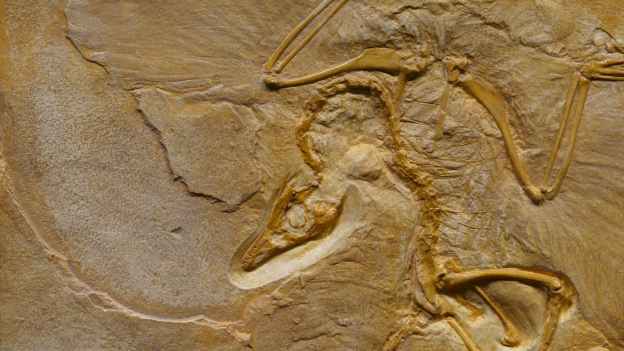
Not Separate, Not Sufficient

Katie Arthur

The word “holy” has been used throughout time to mean many different things, but I will be using it in a very specific sense that has very little to do with the halos around the apostles’ heads in those flat early paintings.  When we see the gold words pressed into the kind crinkly black leather, “The Holy Bible,” the word “holy” takes on two important implications.  Because it is holy, it is first separate.  It is on its own level high above all other teaching, in authority, trustworthiness, and power because it is not from human minds, but from the mind of God.  Second, it is sufficient.  Because it is the highest, most ideal form of teaching, it is necessarily the most comprehensive.  None other is needed.  God, being by nature perfect, would not create something incomplete if it needed to be complete.

In 17th-century Europe, the Renaissance was reintroducing a general appreciation for academia in the ancient manner, for classical ideals and thoughts.  Living among the upheaval of traditional thought patterns was John Milton, a Puritan, not a Catholic, and beyond that, not an Anglican.  He was a very independent man in his views on everything in life.  The Renaissance gave him leave to use his mind as he wished, and his Puritanism gave him leave to use his beliefs as he wished.

In this setting of classicism, of noble and high estimations of the intellectual mind of man, paired with his fierce independence, Milton goes into creating the greatest poetic work in the English language.  With the general intellectual interest shifting back to the classical period, naturally the literary structures of the Renaissance were also informed by the classical modes, and most specifically by the ancients’ mythology.  Guibbory points out because the themes and patterns of the ancients’ writings had been instilled in him since the beginning of his education, Milton must necessarily be influenced in the way he thinks and writes, even about Christianity, by this classical mythology.  I would argue, based on the personal freedom he exercised, and that freedom seen especially in his doctrine of Written Scripture, it is clear Milton did not consider the written Word of God to be “holy,” and this is the reason for his rampant use of the styles and themes from classical mythology in Paradise Lost.  For Milton, the Bible was not separate, for he used mythology and scripture together.  For Milton, neither was it sufficient, for he found he could not write about Ultimate Truths completely without the use of his classical mythology.

Milton wrote a giant treatise outlining all his beliefs on all things Christianity, and within it, we find he believed some things about the Scriptures that are key to understanding the way he wrote Paradise Lost.  He says in his De Doctrina Christiana the Scriptures are “divinely inspired” and “an ideal instrument for educating even unlearned readers in those matters which have most to do with salvation(Kerrigan 1296).  Milton says the written word is sufficient for salvation, but he goes on to say “we have, particularly under the gospel, a double scripture.  There is the external scripture of the written word and the internal scripture of the Holy Spirit which he, according to God’s promise, has engraved upon the hearts of the believers, and which is certainly not to be neglected.…  The pre-eminent and supreme authority, however, is the authority of the Spirit, which is internal, and the individual possession of each man.…  The external scripture, particularly the New Testament, has often been liable to corruption and is, in fact, corrupt.…  But no one can corrupt the Spirit which guides man to truth” (1300).

This brings up a valid concern in the mind of a careful reader who would like to believe Milton was trustworthy in his handling of the written Word.  If we take this idea to its fullest, albeit, most cynical, conclusions, this looks like an excuse for the Christian to interpret the written Word, and even further, to live his life, taking whatever licenses he desires, all with the assumption of the Holy Spirit working in him the internal scripture.  The only thing keeping him in line is the power of the Holy Spirit, about which Milton is strangely silent in De Doctrina Christiana.  He does not mention anything at all about the Spirit’s day-to-day work in the believer.  He only presents his thoughts on the Spirit’s nature.  It seems Milton believes in the Spirit’s presence and working in the Christian’s life, but decides not to deal with how or to what extent He works.  By ignoring it, Milton leaves himself free to simply live his life, again, however he chooses, assuming the Spirit is working somehow in it.

Peggy Samuels talks in her article “Dueling Erasers” about Milton’s view of the Holy Spirit and the reader of the Scriptures.  She says there is a triadic relationship among the reader, the text, and the Holy Spirit, and the text and the reader deal with each other in the reading process while the Holy Spirit works as mediator.  The reader, of course, comes to the text with his own set of preconceived ideas, simply because he has lived a life before setting these words before his eyes.  Those preconceived ideas that make up the mind of the reader will of course shape the meaning of the text as it enters his mind, but the text, too, shapes the reader, Samuels says, by discovering things in the reader’s mind he may have not known were there.  In this way, Samuels says Milton understood the Christian and the Scriptures to work together.  It sounds to me, even from Samuels’s kindly clarifying explanation, it is much more feasible for the mind of the reader to discover from the text what he himself chooses than for the text to force its way into the places of the reader’s mind he does not want it to go.  The text is static.  It is laid bare in all its vulnerable, unchanging meaning.  But the mind of the reader is actively defensive of meanings and beliefs it does not want exposed.  When this fear of exposure by the fixed moral standard of a written Scripture is paired with the security of an authorized individualism such as the Holy Spirit, it is understandably concerning Milton might be condoning a radical subjectivity in the life of the Christian.  Milton has once again given a blanket permission to the believer to read the Scripture however he chooses by affirming the text will do its powerful work to shape the believer, even though the reality of experience shows the text is simply not more powerful than its reader.

The question now becomes, can Milton take on his Paradise Lost project the way he does?  He is dealing with huge, important truths here, and based on his double scripture doctrine, it is concerning he may present Biblical truths untruly, and even more concerning as he comes at them with his classical mythological background.  In theory, it is feasible for him to combine mythology and scripture into one piece of writing and do it correctly.  In fact, many authors have done it with skill and success.  C.S. Lewis and J.R.R. Tolkien are prime examples.  They set the truths found in the Bible down as their template, and set out to make much of Biblical truth.  They understood with cheerful and freeing clarity that as the Ultimate Truth, the truth found in the Bible is at the top of the hierarchy, and the pagan myths flow from and are subservient to it.  As they get further and further away from the source, the myths contain lessening degrees of truth, but they still contain it, with the purpose of pointing back to the Ultimate Truth.  Thus, for example, Lewis came to love the dying and resurrecting god archetype from pagan mythology long before he knew Jesus as even a historical figure.  His discovery of Jesus as the origin of the archetype was that much sweeter, knowing the idea he loved for so long was a true and relatable human being in the same realm as himself.  The myth did not lose any of its excitement for turning out to be true, and the truth did not lose any of its weight for turning out to be a good story.  The myth simply served to make the heart love subjectively what the mind knew to be objectively true.  Michael Nelson says this when he says Christianity is simply the pagan myths fulfilled.  He quotes Lewis, saying, “Christianity [answers] two vital questions: ‘Where has religion reached it true maturity?  Where, if anywhere, have the hints of all Paganism been fulfilled?’” (628).

Mythology is useful and good when we use it as a pointer to the Ultimate Truth found in the Bible, and Guibbory makes the claim Milton does indeed use it this way.  He says Milton uses mythology traditions appropriately within the hierarchy of Christianity, knowing these pagan explanation stories in reality present a theology rivaling his own and being careful in how he uses them.  The allusions he makes to classical nature descriptions, for example, are very carefully chosen to never present anything opposing the Christian God’s supremacy, but only those which still allow him to be the Ultimate within the hierarchy, and which magnify Him as such, according to Guiborry (196-198).

This may be the way Milton appears to use mythology in Paradise Lost, but I would bring you once more to his De Doctrina Christiana description of the Scriptures.  Lewis and Tolkien begin with the assumption the written Word of God is at the top of the hierarchy, and, to a degree, simply allow mythology to come into subordination to it.  Milton does not start with the Word of God the way they do.  He begins with the Holy Spirit theoretically in each believer at the top of the hierarchy of truth and allows everything else to come into subordination to it, even the written Scripture.  Let’s return for a moment to the definition of “holy” we were looking at in the beginning.  The Scriptures Lewis and Tolkien held as their Ultimate were separate and sufficient — on a different level than every other writing because of a weightiness that comes from truth, and absolutely complete in the fullness of their truth.  Milton, though,  believed, although they were divinely inspired (which could mean “separate”), they have not been kept so because of the imperfect human hands that have preserved it (so it does not mean “separate”).  He believed, although they are an ideal instrument to illuminate salvation to humanity (which could mean “sufficient”), their authority lies only over salvation and does not extend into the rest of life (so it does not mean “sufficient”).  Therefore, he feels he needs to “justify the ways of God to men” (PL, line 26).  From the very beginning of Paradise Lost, his entire purpose for taking up this giant undertaking is bound up in his belief the written Scripture has not done enough to satisfactorily explain to mankind God’s actions.  This is where mythology comes in.  Since written Scripture, according to Milton, is simply a tool used to support the individual believer’s faith, guided by the Holy Spirit, and since mythology, like we’ve said, is a tool for pointing the believer to Truth, written Scripture and mythology play the same role in Milton’s writing.  They are both simply support for the Ultimate Truth found in the individual believer’s revelation from the Holy Spirit.  John Milton has just essentially said the Word of God and the word of Homer are on the same playing field.

This affects, then, the way we read Paradise Lost.  It calls into the question the degree to which we have made it such a significant cornerstone of English literature.  It mistakenly combines two separate literary traditions.  It should make us wonder whether we have been wrong to make it a cornerstone of Christian literature.  It is misleading to the Christian.  As we read the poem, each allusion he makes must be careful and prayerfully considered and lined up against the measure of the Scripture because we cannot be entirely sure Milton himself lined it up and measured.  It might be possible to read Paradise Lost and see it as simply another clever combination like Lewis’s or Tolkien’s.  Although the written Scriptures seem to be supported in Paradise Lost by the mythological literary tools, understanding from his De Doctrina Christiana he did not believe the written Scriptures to be holy forces us to come to the conclusion the mythology within the poem is not placed below the Scripture but beside.  Perhaps he took his notion of free will a little too far, and as a consequence, produced a massively beautiful, massively successful, massively mistaken contribution to literary tradition.

Works Cited

Guibbory, Achsah. Attitudes Towards Classical Mythology in Seventeenth-Century English Literature. Diss. University of California, 1970. Ann Arbor: UMI, 1975. Print.

Kerrigan, William, John Rumrich, and Stephen M. Fallon, eds. The Complete Poetry and Essential Prose of John Milton. New York: Random House. 2007. Print.

Nelson, Michael. “‘One Mythology among Many’: The Spiritual Odyssey of C. S. Lewis.” Virginia Quarterly Review: A National Journal of Literature and Discussion 72.4 (1996): 619-33. ProQuest. Web. 6 Oct. 2015.
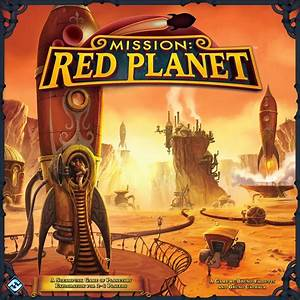
Samuels, Peggy. “Dueling Erasers: Milton and Scripture.” Studies in Philology 96.2 (1999): 180-203. ProQuest. Web. 4 Oct. 2015.