An Introduction to Moral Nihilism

Jared Emry

There are three major kinds of nihilism: moral nihilism, epistemological nihilism, and political nihilism. Political nihilism derives its root in the same way as the word annihilation. It is the idea “all social and political structures should be destroyed.” Epistemological nihilism is the idea “there is no truth.” Moral nihilism is the idea “there are no values.” These types of nihilism could be all accepted by a person, but any person could easily accept one type and reject the others. They may overlap in a person, but each type is discrete and unique from each other. The confusion of these terms needs to be eliminated before discussing any one individually (Joyce 1). Unfortunately, the term moral nihilism still is vague and slovenly to the point of being both useless and meaningless. For the sake of discussion the term will be defined as to refer to a collection of philosophies that claim there are no moral facts. It is also necessary to trace major moral nihilist thoughts and arguments behind them.

Fyodor Dostoyevsky, in his landmark book The Brothers Karamazov, has Ivan Karamazov state “if God is dead, then everything is permissible.” Many of those in the current skeptic and atheist communities would and do openly reject this dictum as it seemingly remains as either a pragmatic or a metaethic for the need of God; however, this rejection is an offhand dismissal. While Dostoyevsky is an Orthodox Christian and the text could be interpreted as a shameless strawman for atheistic metaethics, Atheism does not necessarily lead to moral nihilism, nor is that an accurate representation for the book (Joyce 2). The novel presents characters from all walks of life and their perspectives on existence. Ivan is the most tortured of them all and not due to his atheism. Ivan is brilliantly analytical and comes to the conclusion people only care about right and wrong insofar as there exist consequences, especially eternal ones. He desires to embrace goodness, but he can’t logically justify it. He gives up on love, happiness, and humanity. He cannot reconcile himself to his disbelief. He cannot reconcile morality with reality. It seems the only way to save values is to betray them. He is left mad and without redemption. His logic is never refuted; rather the disbelief is too much of a burden. It is not a claim atheism leads to moral nihilism for whatever reason. The consequences of the human psyche are irrelevant to the cold mathematics of nihilism. The sentiment here is mirrored by Camus in L’Homme Révolté and Sartre in Existentialism and Humanism. Dostoyevsky’s dictum may be popular in that god is Buddha’s trapdoor — the only exit by which humanity can escape from nihilism. On the other hand, it could be described without a theistic premise, in which the question is what the nature of moral permissibility actually is. This all presupposes the natural intuition of morality found in humans is something that should be doubted.

What justification do we have for moral skepticism? The common standard of justified belief in skepticism is if any contrary hypothesis cannot be ruled out, then that belief is not justified. The skeptic only has the burden of showing for a belief, there is a contrary hypothesis that cannot be ruled out. More specifically there are two basic issues in question that highlight a general cause for analysis of greater depth (Joyce). The first is the pervasiveness of moral disagreement. The second is ability of the sciences to explain moral beliefs in terms of biosocial terms without endorsing moral premises. If morality exists as a property, why is there a lack of moral uniformity across cultures and between individuals? Is active euthanasia moral? Is abortion moral? These are dichotomous and are prominent examples of moral disagreement.  Is there really direct and non-inferential access to the nature of morality if disagreement is so common? If moral belief can be described entirely outside of moral terms and described better, then why the need of such terms? It would seem the questions need answering.

Moral skepticism can also be reached by an argument of regress. Moral beliefs must be justified either inferentially or non-inferentially. A non-inferential argument may be easily dismissed with Occam’s Razor. It seems implausible moral judgments are valid without inference for known disagreements (Loeb 282). Furthermore, moral judgments are subject to framing effects, misleading emotions, and are the product of processes independent of truth. The other option is inferential justification, which may take three forms. First, a moral belief may be justified with no normative premises. The naturalists who make this claim must still rely on suppressed normative premises. Evolutionary biology, psychology, sociology, or general culture can explain moral beliefs, but do not inherently appeal to any moral fact. The naturalist argument relies on the suppressed premise all acts with features they deem immoral are morally wrong, but from what do they deem those features? It can still easily be denied due to prior moral assumptions (Bedke). Second, a moral belief may be justified with some non-moral normative premises. The idea here is theoretically all unbiased and rational people would make the same decisions if placed in the same circumstance and thus allege said beliefs are true. All factors required in such judgments are controversial. How are impartiality, rationality, and relevance decided? (Brandt) The differing theories for each factor would seem to point to suppressed moral premises. The third option is to justify moral beliefs with moral premises. The obvious flaw here is all moral premises are moral beliefs that must be justified. The most common denial would be such justifications must either be infinite or circular. Contamination of the premises with the conclusion gives little reason for the doubter to accept the premise. However, some have proposed a branching tree of premises that together form a coherent whole that can be internally proven. The suppressed premise here is coherency is a suitable replacement for truth. A system may be internally coherent but bears no reflection on externalities. Many internally coherent systems may conflict with each other, which gives rise to doubt concerning which internally coherent system is actually true. Additionally, social contexts are unable to justify moral belief as social contexts are corruptible and no solitary link can be made to affirm social context as truth. These are all the options by which moral beliefs may be justified, and the valid conclusion is there are no justifiable moral beliefs. This conclusion can only be avoided by tackling at least one of the premises covered here.

This skepticism can be taken further by asserting a hypothesis that cannot be ruled out. Moral nihilism is capable of explaining any moral beliefs exist the way they do accurately through evolutionary biology, psychology, sociology, or general culture. A coherent system that creates accurate predictions cannot refute nihilism either. One must rule out moral nihilism to be justified in any moral belief, yet not justified in the denial of moral nihilism. Justification of moral belief requires the denial of moral nihilism. It could be said the belief “genocide is wrong” requires the denial of this moral nihilism and until such time as this denial is justified “genocide is wrong” is an unjustifiable belief. “Genocide is wrong” isn’t a controversial moral belief and so it is plausible this extends to most other moral beliefs and controversies. How can nihilism be denied? A claim may be held against nihilism lacking meaning or internal coherency, yet it remains meaningful and coherent in light of all theories of language. Furthermore, common moral beliefs cannot justify this denial regardless of how obvious they may seem, for this denial is countered by simply pointing to the fact many people do reject moral beliefs and a seemingly coherent system does not speak to the external world. Additionally, all arguments pointing to moral nihilism as being incompatible with non-moral facts can be dismissed for crossing the is-ought barrier. Yet, people reject these conclusions without being able to refute them. The kneejerk reaction might to simply call this nihilism or this skepticism irrelevant. In fact, many people do accept forms of moral nihilism due to a lack of defensible moral theories. It seems relevant because people really do reasonably hold to this skepticism and it does directly confront the moral belief in question. To call it irrelevant is to simply dismiss these people and to not question an underlying belief without justifiable cause.

Moral skepticism and moral nihilism support each other adequately but are not necessarily reliant upon each other, especially due to the diverse nature of moral nihilism. While moral nihilism can be roughly defined as a rejection of values, especially moral values, the method or reason of rejection may vary. Moral nihilism includes all three major theses of moral-antirealism, yet possibly includes other meta-ethical theories. These are non-cognitivism, error theory, and non-objectivism. Non-cognitivism can be boiled down to the idea when people say a moral declaration, they do not intend to express moral truth. Instead of moral truth, people proclaim only their feelings in regard to an action or features associated with an action. Non-objectivism holds morals are constituted by thought alone, but this is not to be confused with subjectivism, as subjectivism is a mere type of non-objectivism. Nor should non-objectivism be confused with moral relativism, which may or may not be nihilist in nature depending on its presentation. However, non-objectivism’s status as moral nihilism is controversial on both sides of the aisle. Error theory is the traditional form of nihilism and perhaps the form that carries the most weight.
Error theory claims there are no objective values and denies it on a similar principle by which an atheist rejects god. Nihilism may be seen as a disjointed whole, against which all strands may need substantial arguments. Either moral judgments aim at telling truth, or they do not. If they do, all claims necessarily fail. If not, moral judgments are inherently separate from truth. However, perhaps it is better to look at traditional nihilism.

Error theory has its unique arguments that may supplement moral skepticism. The previously mentioned argument from disagreement can be expanded (Brink). If we start with the empirical observation many moral disagreements exist, then the demand of moral superiority must also be demanded of epistemological superiority — at least in regard to morality. Why do some cultures or individuals lack this epistemological access to moral knowledge? Many who try to answer find the reason for their claimed superior access may not like the answers they find. Furthermore, it would be more logical that the moral beliefs arose as a result of those answers and not the other way around (Mackie). A second argument stands more uniquely, rather than supplementary, to moral skepticism in the form of what is known as the argument from queerness. The idea here is morality, as a property, is unlike all other properties in universe and is therefore weird. Morality must be described as being observable in a way fundamentally different from all other properties. Morality requires a special faculty by which to operate, whereas all (or at least most) other properties are operated by normal faculties of observation. Morality requires a foreign method of knowing (Mackie).

The existence of moral nihilism, like all nihilism, rests in the negation of commonly accepted beliefs and axioms. It is as various in form as all the things it attempts to negate. It also stands as a brooding giant in philosophical discussions, as it demands attention and yields no ground. It purports what seems obvious to humanity stands on shaky ground. The proposition seems alien to us. If we cannot accept it and we cannot refute it, do we stand on mere faith? Are we to be mad like Ivan Karamazov in our inability to reconcile our human psyche to our reason? Richard Joyce proposes even if morality is a delusion, that delusion must be maintained. For now, however, can modern society cope with such a fundamental in question?

Bibliography

Ayer, A. J. Language, Truth, and Logic. N.p.: n.p., n.d. Print.

Bedke, Matthew S. “Might All Normativity Be Queer?” Australasian Journal of Philosophy 88.1 (2010): 41-58. Web.

Brandt, R. “The Definition of an ‘Ideal Observer’ in Ethics.” Philosophy and Phenomenological Research 15 (1954): 407-13.

Brink, David O. “Moral Realism and the Sceptical Arguments from Disagreement and Queerness.” Australasian Journal of Philosophy 62.2 (1984): 111-25. Web.

Joyce, Richard, and Simon Kirchin. A World Without Values: Essays on John Mackie’s Moral Error Theory. Dordrecht: Springer, 2010.

Joyce, Richard. “Nihilism.” International Encyclopedia of Ethics. 2013. Print.

Loeb, D. Moral Realism and the Argument from Disagreement. Vol. 90. N.p.: n.p., 1998. Print. Philosophical Studies.

Mackie, J. L. Ethics: Inventing Right and Wrong. Harmondsworth: Penguin, 1977.

Connections between Line-Drawn Symbols and Words

Lia Waugh Powell

Abstract

To determine whether word repetition or using semantically elaborated sentences is better for memorization, participants were randomly exposed to words presented in either of those two conditions. There was a total of 165 participants. The experiment was conducted online through the Online Psychological Laboratory. Participants were randomly assigned to hear 15 words used in either semantically elaborated sentences, or the words were repeated to them several times. There were line-drawn symbols also presented with each word as a visual aide. Upon completion of the experiment, participants were asked to retrieve as many words as possible through three tasks: free recall, cued recall, and recognition. The results of the experiment were measured using an independent samples t-test. There was no significant difference found in the free recall portion of the experiment between the two conditions. However, there was a significant difference discovered in the cued recall and recognition portion of the exam when comparing both conditions. These results support previous research regarding the importance of the relationship between elaboration and memorization.

Line-Drawn Symbols and Words

Background Research

Discovering new and efficient ways for children to learn has been of interest for both psychologists and educators for years. Learning how children’s brains process information is the key to understanding this task. One of the first important milestones in a child’s life is learning how to read. According to Lee (2016), as parents or educators begin to teach this skill, it is common to use children books that both incorporate a picture of something (an animal or an object) and a single word used to identify the picture below it. As the book is read to the child, the educator often points to the picture and repeats the words that identifies what the picture is. The goal of this exercise is to teach the child to memorize “sight words,” so they do not have to sound out a word, but rather can see it and recall what it says immediately. However, one may wonder what the most effective method to help others memorize words may be. There is the traditional method explained above, where a line-drawn symbol is shown and the word is repeated. Another method is to associate each line-drawn symbol with semantically-elaborated sentences. Semantically-elaborated sentences in this experiment are sentences that give the specified word meaning by linking it to an image or a related idea (Benson, 2003). But is there a difference in memory between those who memorize using word repetition and those who memorize using semantic elaboration? To further evaluate which method is more effective, this study will explore the differences between each technique.

Meltzer and colleagues (2015) conducted an experiment to gain more understanding of the relationship of perceptual short-term memory and semantic mechanisms that led to converting from short-term memory to long-term memory. The authors hypothesized short-term repetition of words under articulatory suppression would lead to higher levels of recalling sentences. Articulatory suppression is the effort to hinder memorization by giving a task to the participant. In this experiment, the task was to either tap fingers in between the words being presented to them, or to count backwards by three. Ultimately it was hypothesized there would be less forgetting when the words were presented in sentences, and the semantically-based sentences would allow encoding within long-term memory.

Twenty local university students participated in their study, with the average age of 21.9. Two tasks were required for the experiment. When the experiment began, the participants were alone in a room and used a computer to be presented audio sentences. The sentences presented to each student were either high in levels of semantic concreteness, or abstract. According to Meltzer and colleagues (2015), sentences high in levels of semantic concreteness contain rich pictorial imagery. In contrast, abstract sentences did not contain sensory information. The first task consisted of the students listening to sentences. After the sentences were heard, the students experienced a 14-second delay. During the delay the students were randomly assigned to either tap their fingers or count backwards by three. After the 14 seconds concluded, the students were asked to repeat the sentence verbatim. For the second task, the sentences were presented again, but the two main words (the subject and verb within the sentence) were visually shown to the students as retrieval cues. The students then had to try and repeat the sentences verbatim.

Upon completion of the experiment, the recall scores were averaged. Meltzer and colleagues (2015) reported they used a subject-wise repeated measure ANOVA to analyze the data. In both tasks, the hypothesis was supported. Auditory suppression seemed to allow enhanced recall of the sentences. Interestingly enough, the semantically concrete sentences as opposed to the abstract sentences indicated higher levels of encoding within long term memory for the participants. The authors concluded the concrete sentences were repeated more accurately than the abstract sentences.

Meltzer and colleagues (2015) offer great insight for this current study. Their findings strongly supported the importance of semantically-elaborated sentences and the commitment within long-term memory. However, one issue within their experiment was they used a within-subjects design. This poses a problem because the participants may have become tired after the first task was completed. Or, the students may have had the opportunity to perfect memorization skills if they caught onto the hypothesis. Thus, those situations could have interfered with the results. The current study attempts to better this experiment by eliminating the potential carry-over effects found in a within-subjects design.

An additional study conducted that augments this current experiment was led by Jesse and Johnson (2016), who aimed to understand if children used initial labeling and audiovisual alignment to learn words. The authors used 48 Dutch toddlers for their experiment that averaged at the age of 25 months. For this experiment six videos were shown to each toddler that had two moving creatures in them, but no speakers. The toddlers’ eyes were also monitored during the experiment to measure attentiveness. One creature was green, the other pink, and both had Dutch names of “Kag” and “Zeut.” Three speakers that participated in the experiment provided voice overs for the videos when they were presented to the children. The speakers were instructed to speak to the children, but not to use any words that could define which character was which (e.g., “Zeut is running,” “Kag is green”).

Both groups of children were exposed to a pre-experiment. The experimental group was shown the character and his name, consistent with the actual video in the experiment. In the control group, the creature was labeled a name in the pre-exposure inconsistent with what was shown in the following video. The authors hypothesized the experimental group of children should learn the creature better as opposed to the control group. Once the videos started, the children heard the speakers say phrases such as “Look at Kag, isn’t Kag cute?”

The results of Jesse and Johnson’s study supported their hypothesis. Using a two-sample independent t-test, it was evident the children in the experimental group not only looked longer at the television screen, but also they learned the novel words used during the experiment. These finding proposed the children in the experimental group used the information they learned in both the pre-exposure phase and the exposure phase to learn words and associate the characters (Jesse & Johnson, 2016). The authors concluded inter-sensory material related to word learning. This means through integrating audiovisual information and connecting words to a meaningful sentence, learning ability is enhanced.

Pertaining to this current study, Jesse and Johnson’s findings suggest purely audiovisual circumstances are enough for word learning. Their study also offers background information on how toddlers learn that may be applied to our current study. While the sample for this current experiment consists of college students and the authors’ toddlers, the authors’ study is relevant because we can do further research in seeing if the same concept applies to more developed brains. However it is a disadvantage that Jesse and Johnson’s research was focused on toddlers rather than a prolonged lifespan development. This current study can add additional findings for Jesse and Johnson’s study because it seeks to understand a larger age range and how the brain better commits words to memory. This is because the focus will be comparing the results of those who memorize better when presented words in semantically-elaborated sentences or through word repetition. While Jesse and Johnson’s study was primarily on word learning, we will elaborate on this with sight word memorization.

Another study relevant to this current one was conducted by Nilsen and Bourassa (2008), which also focused on word-learning performance for beginning readers. The authors were specifically interested in determining if word-learning was promoted using regular (concrete) words or irregular (abstract) words. A regular word was defined as a word that the letter sequence followed typical spelling sound-mapping, such as the word “dream.” In contrast, an irregular word did not follow the typical spelling sound-mapping, such as the word “thread.” In this case, an example of a regular/concrete word would be “elbow,” and an example of an irregular/abstract word would be “temper.” It was predicted the regular/concrete words enable easier recall for children due to their direct sensory reference. To elaborate, it is easier for a child to remember the word “elbow” because it is a body part most every person has. The word “temper,” however, is not easily retrievable because it does not have a direct sensory or visual reference.

In Nilsen and Bourassa’s (2008) study, the authors had a sample of twenty-seven kindergarten students and nineteen first-grade students. The study was conducted over four sessions. 40 words were put into a word bank then separated into four groups. The word groups were presented in several formats: concrete–regular, concrete–irregular, abstract–regular, and abstract–irregular. In each session, the students were presented with one of the word formats randomly assigned to them. Each word was written on an index card that was shown to the student. The authors then read the word to the students twice, and the students in turn repeated the word after the author once. At the end of the session, the students recalled the words they had learned. The students were scored on a scale of 0-10. A score of “0” indicated no words were correctly learned, whereas a score of “10” indicated a perfect word-learning score.

The results of this experiment supported Nilsen and Bourassa’s (2008) hypothesis. The authors used an analysis of variance to examine the outcomes. It was concluded the children had learned the words that had greater semantic-richness more efficiently than the words that were abstract. For the current study, this would support the hypothesis semantics have a large effect on word learning, as well as word memorization. While the authors’ study focused on word learning with children, this current study’s focus is word memorization within adults. However, the two are relational because understanding how children’s brains learn may also enable us to better understand how adults may memorize or learn better as well. This assumption can be entertained because while children are more adult-dependent learners, as they grow older they become more independent learners. This would mean there will be a time when learning is less dependent on the educator and more dependent on the learner. Understanding the beginning methods of how words are integrated into memory may in fact assist in developing more advanced memorization and learning techniques in the future.

Research Goal

The goal of the current study is to investigate if memorization is enhanced when presented with visual line-drawn symbols under two different conditions: word repetition or semantically-elaborated sentences. Previous research has shown the importance of semantics in memorization as well as offered understanding of children’s brain development and how they best learn words. However, this study will focus specifically under which circumstances provide optimal word memory recall for students. To do this, participants will be exposed to 15 line-drawn symbols associated with words in one of two conditions randomly assigned to them. The hypothesis for this study is the learner will be able to memorize the given words presented to them better when presented with sentences that have concrete words within them, rather than when the word is repeated to them. This will help the learner associate a target word with its line-drawn symbol for recall.

Method

Participants

There was a total of 165 (18% male, 82% female) participants from Old Dominion University’s Research Methods in Psychology course. The participants received extra credit for their involvement. Average age of the participants was 27.

Procedure and Materials

This study was conducted online through the Online Psychology Laboratory. It was estimated it should only take 8-10 minutes for the participants to complete the experiment. Upon the participant’s agreement to complete the study, the first task is to specify the participant’s age as well as gender. Then, 15 line-drawn symbols and words associated with them were presented in one of two conditions — either a semantically-elaborated sentence, or word repetition — to the participants. For example, in the word repetition condition, participants would see a line-drawn symbol of a square while they hear the word “Pillow, pillow, pillow.” In the semantically elaborated condition, the participants would see the square and hear “Pillow. The pillow sits on the couch. Pillow.” The condition was randomly assigned to each participant. After the participants were presented the line-drawn symbols and words, they engaged in the memory recall portion of the experiment. The free recall portion was immediately after the presentation of the line-drawn symbols and words. The participants had to document the amount of words they remembered and enter their answer (0 to 15). For the cued recall section, the 15 line-drawn symbols were again presented and the participant had to write down which word they believed was associated with the symbol. Lastly, in the recognition recall, the words given during the presentation were mixed with other random words. The random words used in this part of the study were of the same semantic class. As the words were shown to the participant, the participant had to distinguish which words actually were used to identify the line-drawn symbol throughout the study. The purpose of measuring word recall in three different ways was to portray the findings through various comparisons. Researchers can take the data to compare any of the two tasks, or all three, to understand in which ways memory performance excelled and in which condition.

Demographic items of interest were the participants’ age and their gender. There were two different conditions in which the words were heard. The first condition was word repetition, and the second condition was semantically elaborated sentences. The three memory recall trials were free recall, cued recall, and recognition.

Results

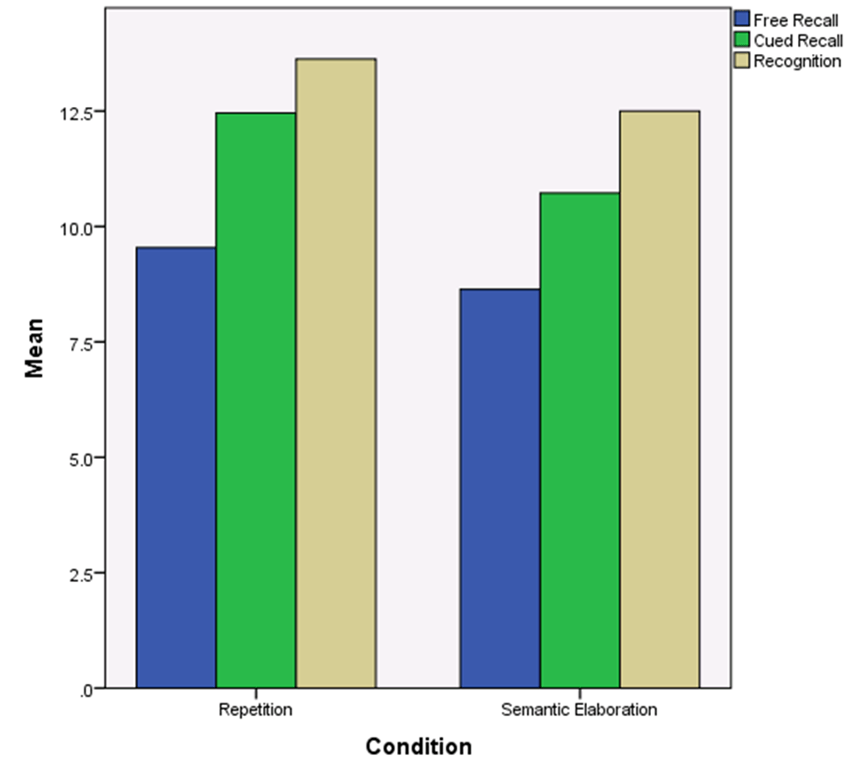
Data were analyzed using SPSS-PC version 22. An independent samples t-test was used to see if a difference in memory between participants who were exposed to word repetition and participants who were exposed to semantically elaborated sentence occurred. The results indicated no significant difference in memory between repetition (M=9.54, SD=3.43) and semantically elaborated sentences (M=8.64, SD=4.21) conditions when memory was measured using free recall, t(162)=1.471, p=0.143).  However, there was a significant difference in memory between repetition (M=12.46, SD=2.50) and semantic elaboration (M=10.72, SD=3.37) when memory was measured using cued recall, t(162) =3.621, p<0.001, and for memory between repetition (M=13.63, SD=1.54) and semantic elaboration (M=12.50, SD= 2.26) when memory was measured using recognition, t(162)=3.603, p<0.001. Based on these results, we can conclude our hypothesis was partially supported, as participants who memorized using word repetition recalled fewer words than participants who memorized using semantic elaboration when tested using cued recall or recognition measures, but not when they were tested using a free recall measure.

Discussion

As noted in the results section, a statistically significant difference was discovered between the results of the participants who participated in either the word repetition condition or the semantically elaborated condition. The results of this study partially support the hypothesis. Therefore, these results suggest the memory retention of words is best when given in a situation in which rich, concrete words are present. Making the word functional as opposed to merely repeating the word can help memorization. The results show what was anticipated: cued recall was the easiest for the participants. Free recall may have not had a significant difference due to the lack of stimuli, such as being presented with the line-drawn symbol in the cued recall portion of the experiment, to help with the retrieval process.

The results of this study are similar to those of Duyck (2003). In this study, participants were randomly assigned to one of three conditions. The three conditions were they were either given target words that were concrete, abstract, or non-words. The non-words were constructed to sound like real words. Once the experiment started, participants heard two words that consisted of one noun and one target word (either a concrete, abstract, or non-word). While the participants were being exposed to the words, they underwent articulatory suppression and repeated the word “the.” Upon the conclusion of the experiment, the participants then recorded the words they could recall.

Ultimately, Duyck (2003) found the participants who endured the articulatory suppression portion of the experiment still recalled a higher amount of words that were concrete. The non-words were recalled the least amount of times. Our studies are similar because both results support the connection between the richness of words used and memorization. While the participants in this particularly study did not undergo intentional articulatory suppression, experiencing articulatory suppression would undoubtedly cause a lapse in memory. However, although participants in Duyck’s study did recall less accurately in that condition, they still ultimately recalled more concrete words than the abstract and non-words. Therefore, Duyck’s study provides further support for our hypothesis.

Another study carried out by Madan (2014) looked into the connection between memory and high-manipulability words. The author hypothesized words were high in manipulability (i.e., words that signified objects that could be functionally interacted with) are easier to memorize than words with low-manipulability. Low manipulability words were described as words that represented nouns. Madan’s participants were undergraduate students. The participants were presented with eight word pairs, with each pair consisting of either two high-manipulability words, two low-manipulability words, or one of each presented in different sequences (HL, LH). As a distracter, in between presentation the participants had to answer simple arithmetic problems.

The results for Madan’s (2014) experiment supported his hypothesis. The words higher in manipulability were the easiest to recall for students. This was especially evident in the free recall portion of his experiment, which is different from the results from the current experiment. This is suspected because the free-recall portion of Madan’s experiment occurred after the cued-recall portion. In relation to this current experiment, Madan’s results support that automatic motor imagery influences memory. This is comparable to the results in the current study because the concept of semantically elaborated sentences improving memory is similar to high-manipulability words. In the semantic elaboration condition for the current experiment, the words were given context in the form of a sentence that related to the line-drawn symbol. Both encourage situations where relatedness is imperative, as well as elaboration.

While the hypothesis was supported for this experiment, there were several potential flaws in this experiment. One could be found in the sample of participants. Due to the sampling of college students, participants may have participated solely for the extra credit opportunity. In this case, data may be skewed due to disinterest in the study (Passer, 2014). The study may also have been performed quickly by the students without truly participating and putting forth the effort. The participants were also mostly female, which did not allow much diversity for gender within the study.

Another flaw is the experiment’s on-line nature. Because this experiment could be conducted from anywhere, environmental factors may take a toll on the participants (Passer, 2014). In some cases, if participants are at home they may have children or others around them that could cause a loss in concentration, which in turn would affect their memory ability. The participants also had the ability to read the background information of the experiment, which could allow the participants to understand the hypothesis. If the participants wanted to score well, they could easily have written down each word during the first phase of the experiment. This would result in a perfect score on the following three tests (free recall, cued recall, recognition), thus presenting false data. One final potential flaw was that although there was a relatively large sample of participants, only 70 of the 164 students were given the repetition condition. This means 93 students were in the semantically elaborated condition. This could explain why the average number of correct answers for the 70 students in the repetition condition was higher than those who were in the semantically elaborated condition.

In efforts to better this study in future cases, it may be beneficial to have participants come to a location where distractions can be eliminated. Monitoring the participants during the experiment would also be beneficial. If further studies are conducted, one may investigate getting a larger number of participants and having the conditions evenly distributed. However, maintaining the between-subjects design by only exposing the participant to one condition rather than both is critical to minimizing other confounds. This is because this particular experiment already contains three tests, and making the participant undergo each condition could result in fatigue or risk grasping what the hypothesis may be (Passer, 2014).

Because the hypothesis was supported in this study, further research on emerging programs that help children memorize words and learn to read more efficiently may be conducted. A new direction that may be explored could be creating experimental children’s books that specialize in teaching those who are between the ages of 1- to 3-years-old sight words. The books could use semantically elaborated sentences that focus on core words for children to know in order to effectively communicate with their caregivers. Because memorization of sight words is enhanced through these sentences, perhaps teaching toddlers these words could facilitate better learning skills — as well as discipline skills — as they age. Further studies may even evaluate the importance of learning sight words at an early age and the connection to the mastery of language in the later years of the child’s development.

This study’s hypothesis was supported by the data from the experiment.  The use of elaboration seems to be more effective with memory than repetition. Other research supports this hypothesis as well. Using these findings can be beneficial for many people including those in the teaching practice as well as parents. Further research may be done to enhance learning environments for developing children as well as for people of all ages.

References

Association Memory Test (n.d) Online Psychology Laboratory. Retrieved from http://opl.apa.org/Experiments/About/AboutAMT.aspx

Benson, E. (2003, July/August). Remembering right. Retrieved April 08, 2016, from http://www.apa.org/monitor/julaug03/remembering.aspx

Duyck, W. (2003). Verbal working memory is involved in associative word learning unless visual codes are available. Journal of Memory and Language,48(3), 527-541.

Jesse, A., & Johnson, E. K. (2016). Audiovisual alignment of co-speech gestures to speech supports word learning in 2-year-olds. Journal of Experimental Child Psychology, 145, 1-10.

Lee, B. Y. (2016). Facilitating Reading Habits and Creating Peer Culture in Shared Book Reading: An Exploratory Case Study in a Toddler Classroom. Early Childhood Education Journal.

Madan, C. R. (2014). Manipulability impairs association-memory: Revisiting effects of incidental motor processing on verbal paired-associates. Acta Psychologica, 149, 45-51.

Meltzer, J. A., Rose, N. S., Deschamps, T., Leigh, R. C., Panamsky, L., Silberberg, A., Madani, N. Links, K. A. (2015). Semantic and phonological contributions to short-term repetition and long-term cued sentence recall. Memory & Cognition, 44(2), 307-329.

Nilsen, E., & Bourassa, D. (2008). Word-learning performance in beginning readers. Canadian Journal of Experimental Psychology, 62,  110-116.

Passer, M. W. (2014). Research methods: Concepts and connections. New York, NY: Worth.

Figure 1. Mean number of words recalled in learning performance by the condition group.
 

Farewell to Darwin

Seraphim Hamilton

When I came to Summit ten years ago, I had just been “converted” to belief in evolution. In one sense, of course, all of us believe in evolution — it simply means life changes over time in predictable ways. What I came to believe in, however, was the Darwinian theory of evolution, namely, the idea all forms of life on this planet share a single common ancestor and the differences among these forms of life can be explained by random variation in an organism’s genome and higher rates of survival for those organisms that had acquired slight, beneficial variations. When I came to believe in evolution, I was an evangelical Christian. I didn’t know the Bible or theology very well, but I did believe in Jesus. At first, I saw no conflict between evolution and Christianity. After all, couldn’t God have created the world through evolutionary processes? Couldn’t Genesis 1 be an allegory, not unlike the parables of Jesus?

Since I didn’t see conflict between Christianity and evolution, I came to believe many people were turned off from Christianity because of the intellectual price of having to disagree with virtually the entire scientific community. Along with a natural desire to be right, this drove me to vigorously promote theistic evolution among my peers. Once everyone in my personal life was sick of hearing me talk about it, I started a YouTube channel (Kabane52) to promote evolution. Within a year, I had made over two hundred videos on the subject. It was my passion, as anyone who knew me at that time will remember.

Very soon, however, I began to realize evolution and Christianity were not as easily reconcilable as I thought. Not only that, I had found on the Internet all sorts of criticisms of Christianity. I had never considered the possibility I might be wrong about the Christian faith. Maybe evolution was true and Christianity wasn’t. Maybe the atheists were right. Such an idea terrified me, but multiple times, I came very near to atheism. In God’s providence, I soon discovered various Web sites and books devoted to demonstrating the historical believability of the claims of Jesus and the apostles about the Lord’s death and resurrection. If the resurrection was true, then Christianity must be true. I devoured Lee Strobel’s The Case for Christ and read a great many Internet articles about the subject. I began to debate the atheists with whom I had once made common cause against creationists. Christian apologetics became my new passion — but my questions about how to reconcile evolution with Christianity remained.

And they remained for years. Even after I had lost interest in evolution entirely, I still believed the evidence for it and against a global flood was very strong. I believed (and still believe) many popular creationist arguments against Darwinism were based on simple misunderstandings of the scientific data. So I stayed a theistic evolutionist. But time began to gnaw, and those questions kept coming back up. Here are three of the most serious issues that emerge in trying to reconcile Darwinian evolution and an ancient earth with Christianity.

First, there is the question of Scripture itself. Despite occasional claims to the contrary, the Church has always confessed the absolute inerrancy of the Bible, not only in doctrinal matters, but in historical details as well. St. Augustine, for example, says if he finds what looks to be a contradiction, he assumes he has either misunderstood the passage or there has been an error in copying one manuscript from another. St. Maximus the Confessor, one of the most influential theologians of the Eastern Church, goes so far to say the Bible expresses the truth of the eternal God as fully as text can express that truth. But the contemporary naturalistic account of origins doesn’t fit with what the Scriptures declare.

The most obvious conflict is between Genesis 1 and an ancient earth. Genesis 1 says God created the world in six evenings and mornings. With one or two exceptions, all commentators before Darwin took this passage historically. I tried to fit this passage with evolution in various ways. At first, I held a “day-age” view of Genesis 1. According to this view, the days described in Genesis 1 are not twenty-four hour days, but extended periods of time, comprising millions or billions of years. At a superficial level, this seems plausible. After all, the Hebrew word yom does occasionally mean “age” rather than “day.” In Genesis 1, however, this is an impossible reading. Each day is marked by an evening and a morning distinguished by periods of darkness and light. Moreover, the order of events in Genesis 1 do not follow the conventional scientific account of the world’s origins. For example, according to conventional science, birds appeared on the scenes long after land animals, having evolved from dinosaurs. Furthermore, the sun is created on the fourth day, after plants have been created. Conventional scientists, of course, say the sun existed before the Earth formed.

Some day-age interpreters attempt to argue the days are actually overlapping and the “creation” of the sun on the fourth day simply refers to it becoming visible after the dissolution of a permanent cloud-cover over the Earth. Frankly, such interpretations are so obviously strained it’s a wonder anyone can live with the cognitive dissonance. There’s no indication the days overlap, and that Israel’s work week is modeled on God’s proves definitively they do not. It would also be impossible to understand what constituted an evening and what constituted a morning on this view. So I had to abandon this view and try to find another.

The next view I took is a little-known reading of Genesis 1 known as the “Days of Proclamation” interpretation. According to this view, God’s own declaration of His intent to create occurs in six days, but the actual events of the creation occurred an indefinite time later. That is, it is a misunderstanding of the literary structure of Genesis 1 to see the actual events as transpiring within a single week. While this at first appeared to resolve the issues with the day-age interpretation, it soon became apparent to me this reading was fraught with even more problems. For one, it is clear in Exodus 20 the actual events of the creation took place within the creation week. The Lord does not simply say He “declared His intent to create” in six days before resting on the seventh. Instead, He states He actually created the heavens and the earth in six days and rested on the seventh. Additionally, it makes no sense to speak of a week of seven twenty-four hour days before the formation of the Earth within the framework of conventional science. This is because the days are marked as twenty-four hours in virtue of the Earth’s rotation. On the Days of Proclamation view, there was no such Earth to mark the days on the first day of the week!

The next view I took was a relatively new viewpoint, developed by evangelical biblical scholar John Walton. Walton’s view is ancient Near Eastern creation stories, including the story of Genesis, were not concerned so much with describing the material organization of the world. Instead, they were concerned with the ritual consecration of preexisting matter into a Temple. Walton notes in various ancient cultures, festivals for the dedication of the temple took six days, so the god would “rest” in the temple on the seventh day. He then reasons this is likely what is being described in Genesis 1. Out of the three explanations I have just listed, Walton’s is clearly the most defensible. Yet I realized even this view was massively problematic.

First, Walton’s strict distinction between material and ritual organization cannot be defended. Solomon’s Temple was built in seven years, clearly drawing on this pattern of seven for the construction of a temple.

Second, Walton’s view makes meaning ancillary to the actual world. For Walton, God creates the matter out of which the world develops ex nihilo and then allows it to develop according to the patterns he designed at the beginning of creation. However, it is not until God consecrates the world that created things are imbued with meaning. On the fourth day, we are told God made the heavenly lights in order to rule the day and the night and to mark festival times. This is why the Bible so frequently uses the symbols of heavenly lights to talk about political changes. Yet, this meaning is not artificial. God created the heavenly lights precisely to symbolize the rule of His Son over all things. Symbolism, then, is inherent in the world, not imposed onto it. This world is God’s world from top to bottom.

Third, and most problematically for Walton, the sequence of events in the speeches of Exodus 25-31 mitigate against his reading of Genesis 1. The tabernacle is a miniature world. Because of this, God dictates the instructions for the tabernacle in seven speeches, corresponding to the seven days of creation. Understanding these instructions can help us grasp the meaning of the creation days. We are told in Genesis 1 God created the “heavens and the earth” on the first day. The heavens refer to God’s throne room above the firmament, the earth refers to the matter God will organize in the six following days. If this interpretation is correct, then Walton must be wrong, because Genesis 1 describes the creation and organization of matter. In the first speech of the tabernacle instructions, all of the material for the building of the tabernacle is gathered together. In the six speeches that follow, this material is organized into a functioning sanctuary. Hence, Walton is incorrect. Genesis 1 refers to the creation of the material world.

Related to this idea is Meredith Kline’s “framework” view, that Genesis 1 is a literary framework designed to communicate the meaning of creation rather than to describe its history. In support of this contention, advocates of the framework view point to the literary correspondence of the first three days of creation with the second three. On the first day, God creates light, and on the fourth day, God creates heavenly lights. On the second day, He separates the skies from the oceans, and on the fifth day, God creates birds for the skies and fish for the oceans. On the third day, God creates grain plants and fruit trees, and on the sixth day, God creates man who will transform these plants into the sacramental foods: Bread, Oil, and Wine. The argument here, however, is a non-sequitur. I fully agree with the literary pattern I have just described. But this doesn’t mean the text isn’t historical! As I mentioned above, God is the God who created the world to reveal His truth. The meaning of the six days is contained in the historical creation itself, and the Holy Spirit inspired Moses to reveal this meaning in a rich literary structure.

As an analogy, consider the story of the resurrection of Jesus in John 20. According to John’s Gospel, Mary Magdalene looked inside the Tomb and saw two angels sitting on either side of the tombstone, and when she saw Jesus, she thought he was the Gardener. John doesn’t just tell us these things to give us brute facts. He is making a theological point. The order of the narrative of John follows the order of the furniture of the tabernacle, beginning with the Bronze Altar and Jesus identified as the sacrificial “lamb of God” and climaxing here, with the two angels in the Tomb corresponding to the two cherubim who carried God’s throne in the Holy of Holies. We are being told Jesus is the incarnate God who sat enthroned between two angels in the Temple. Likewise, we are told Mary thought Jesus was the Gardener because Jesus is, in fact, the Gardener. He is the true and Last Adam, the one who restores the Garden of Eden and glorifies it into a City. But neither of these theological truths mean the historical events didn’t occur! Mary really did think Jesus was a routine gardener, and there really were two angels inside the tomb. Because all history is God’s history, history itself contains theological meaning, and the biblical authors were inspired to reveal that meaning. This is why the Bible can teach us how to interpret the world and history.

These exegetical problems are true across the biblical text. A person who holds to conventional science cannot believe the Flood of Noah was global. Conventional geologists have supposedly refuted such an idea, and many Christian thinkers are trying to play catch-up. In order to reconcile conventional geology with the biblical text, I had to believe the Flood was local. The justification for this view was in the translation of the Hebrew word erets. This word is translated “earth” in Genesis 6-9, but it can be translated as “land.” Hence, it seems rather easy to make Noah’s Flood local. In reality, however, it is impossible. Not only does the text say “everything under the high heavens” was destroyed, its literary structure corresponds with Genesis 1, which no person doubts refers to the entire world. If one carefully studies the text, one will discover Genesis 7 actually reverses the creation week step by step, and it ends with the ark “floating on the face of the waters” just as the Spirit “hovered over the face of the waters.” Genesis 8, then, follows the creation days forward, starting with day one and ending with a Sabbath sacrifice offered by Noah. This literary structure reveals the meaning of the Flood story, but it also demonstrates decisively the Flood must be global.

On top of this, the long ages lived by the patriarchs of old contradict conventional scientific views of humanity. According to Genesis 5, before the Flood, it was normal to live to nearly 1,000 years old. In Genesis 11, those ages are cut in half, and then the Tower of Babel cuts these ages in half again. Since Peleg was named for the division of nations at Babel, we know the sudden shift in ages after Peleg corresponds with the Tower. After this, the ages gradually decline to present rates. Some have tried to limit the “problem” to Genesis 1-11, arguing there is a substantial difference in genre between Genesis 1-11 and the stories of Abraham, Jacob, and Joseph. In reality, however, if one rejects that which contradicts conventional science, then one continues to have problems in the patriarchal narratives. Abraham lives to 205 years old, and Jacob lives to 147! It is only with Joseph that ages begin to approach their present rates.

The basic conclusion is if one believes in the Bible, it is very difficult to agree with conventional science.

The problems, however, are not merely exegetical. They are theological. That is, they deal not just with the meanings of particular biblical texts, but with the structure of Christian theology itself. Christianity holds God created a world free of death and sin. Because all life comes only from God, in order for the creation to be free of death, it must be united with God. Man is the Image of God. That is, he reflects the glory and life of God into the world and the praises of the world back to God. The world was made as an infant world, but it was not made as a corrupt world. Man was supposed to grow in communion and relation with God and bring the creation up with him. Instead, Adam turned away from God, thereby cutting off the communication of life to the world. Hence, everything began to die, including man himself.

It is clear this poses a substantial challenge to the conventional account of Earth history. Evolution requires death to work. Certain individuals within populations must die selectively in order for beneficial genes to be passed on at higher rates. If there was no death for billions of years, nothing could have evolved at all. Furthermore, the fossil record is a record of dead things. If it was laid down before the creation of man, then death preceded the Fall. How does one explain death before the Fall if one believes in evolution and an ancient earth?

My first “solution” was simple: the death brought by Adam into the world was spiritual death, not bodily death. After all, salvation means for our soul to go to Heaven rather than for our bodies to. I soon discovered, however, this was a massive theological blunder. According to the Scriptures and the Christian faith, a human person is not just a soul. He is soul and body. This is why Jesus Christ was raised bodily from the dead. When He ascended into Heaven, He did not somehow abandon His human nature! Instead, by joining divinity with humanity, He made it possible for our whole persons to share in the life of God, body and soul alike. Thus, St. Paul speaks of our hope as the “redemption of our body” that will come at the return of Christ. Jesus speaks of us sharing in the “resurrection of life.” We shall have glorious bodies like His glorious body.

Death, then, must refer to bodily death.

The next solution was to try to argue the death described in Genesis 2-3 and Romans 5 was simply death for humans. The first humans would be apes to whom God gave souls, and they were promised immortality unless they sinned. This ignores, however, the fact Man is the Image of God. Because man is the Image of God, man reflects the life of God into the creation. The condition of man determines the condition of the world. This is why Paul says in Romans 8 the “creation waits with eager longing for the revelation of the children of God.” If man could live forever even while the world dissolved, why would it be any guarantee for the world that man will be raised from the dead? Paul’s argument only makes sense if man communicates the life of God to the world. If this is the case, however, then the curse of death pronounced on man necessarily includes the creation for the first time. Nothing died before man sinned. Nothing suffered before man sinned. Psalm 8 tells us man is the ruler of the cosmos. The hope of the cosmos is in man.

My final option was to argue man, indeed, is responsible for all the death and suffering in the world, even before his own existence. In order to argue this, I suggested Adam’s fall, in a sense, took place “outside of time.” When Christ returns, time will be transfigured into eternity, understood not as an endless sequence of moments, but understood instead as the instant reciprocation of all movements of love by one person to another. This is a technical theological point, but it has to do with the Trinity. God exists eternally, meaning not an infinite regress of sequential moments in the past, but the Son returns the love of the Father  as soon as the Father loves Him, and vice versa. Paul says in 1 Corinthians 15 God becomes “all in all” after the return of Christ. Everything becomes filled with Him, and this is the case with time itself. If this is the case, I reasoned, then it might be true the Fall does not stand in sequential relationship with death, but instead, stands “above it.” Adam’s mode of existence was different than ours and thus did not stand in the same relation with time. Unfortunately, this argument collapsed on account of its retrojection of eschatological time into the beginning. According to the Scriptures and Christian theology, God created the world to gradually grow up into His own fullness. This would be the case even apart from the Fall, since Adam and Eve were created naked: as spiritual babies. Eventually, they would become robed in glory just as God is robed in glory.

If this is the case, then, I could not argue Adam’s relation to time was the same as our own will be after the return of Christ. This would mean the world was in fact created mature, and our entrance into eternity is not only a feature of the world at its final stage. Since this is false, however, my account of Adam’s fall with respect to time must be incorrect.

One more set of theological problems emerged relatively late in my reflection on this issue. If one studies the cultures surrounding Israel, one will find they share many things in common with the worldview of the Old Testament. For example, all cultures surrounding Israel had temples and covenants. The temples often displayed profound similarities to Israel’s Temple in the Old Testament, including three sections referred to as a Courtyard, a Holy Place, and a Holy of Holies. The covenants made between nations and their kings read very much like the covenant between Yahweh and Israel recorded in the book of Deuteronomy. The difference, of course, was Israel was monotheistic while these pagan cultures were polytheistic and idolatrous.

The problem emerges as one considers how many conservative scholars interpret this pattern of similarities and differences. According to scholars like Wheaton professor James Hoffmeier, we need to see the Old Testament as a polemic against paganism. That is, God inspired the biblical authors to imitate the pagans in many things. The pagans were the first to offer sacrifices, the pagans were the first to build temples, the pagans were the first to make covenants. God is late to the party, as it were, and He imitates the forms of pagan culture. What this does, however, is render paganism to be the primary framework for human thought and religion. Paganism becomes primary, and the true pattern of religion and worship becomes secondary. This is a necessary way of viewing things if a person is a theistic evolutionist, because according to the conventional chronology of the ancient world, man began to build cities in 8000 BC, and Israel did not begin to exist until around 1700 BC with Abraham at the very earliest.

If one takes the Bible at its word, however, then the Tower of Babel occurred around 2000 BC, and Abraham was called only 200 years later. This necessarily means historians of the ancient world have incorrectly reconstructed ancient chronology. That is, they do not understand which people and events and cultures were contemporaneous with each other. A biblical view of history solves the problem described above, because we recognize Noah and his children knew the true God. There is much evidence people outside Israel continued to worship the true God, which I describe below. The similarities between Israel and pagan cultures is not because paganism came first. Instead, on a biblical framework, pagan religions are corrupted forms of the true religion given to Noah. Sacrifice began in Genesis 4, and Noah offered sacrifice. This is why people offer sacrifice not just in the Near East, but from ancient China to ancient America. Noah knew how to build a temple, and people across the world build temples with three parts: not just in Israel and its surrounding cultures, but as far away as Mesoamerica. Mesoamerican temples even display similarities with Egyptian and Near Eastern temples.

The only way, then, to vindicate the biblical view of human culture, where monotheism comes first and polytheism second, is to affirm a biblical and creationist view of history. As an evolutionist, I had no answer.

Thus, there was simply no solution at all to any of these problems. Theological problems were just as serious and insurmountable as exegetical problems. I was fully convinced of Christianity on other grounds, so I simply set the question aside, assuming there was an answer I had not yet discovered yet. I knew, however, I would have to deal with this eventually.

What first gave me real pause about the truth of conventional scientific theories as to origins was studying the theological writings of James B. Jordan. Jordan is not well-known, but I truly believe he is one of the greatest biblical scholars in the history of the church. Jordan understands the necessity of paying attention to all of the details in Scripture. Paul tells us not only is all Scripture is inspired by God, but also all Scripture is profitable for doctrine. Hence, every detail has theological meaning. What surprised me was Jordan was a young-earth creationist. Not only was he a creationist, but he affirms the importance of biblical chronology. The Bible, when it is carefully studied, actually gives us a complete chronology from the creation of the world to the coming of Jesus Christ.

Unfortunately, some Christians, even creationists, have stated there was no intent to provide such a chronology, and the genealogies of Genesis 5 and 11 might well have gaps. As Jordan pointed out, however, whether or not there are gaps in the generations, there are no gaps in the chronology, because the age of the father at the birth of his son is given. This makes it a chronological “lock.” But what struck me was how significant numbers theologically began to emerge when one took the chronology seriously. For example, exactly 3,000 years after the creation of the world, the Temple of Solomon was constructed. Exactly 1,000 years later, the Second Temple was destroyed in AD 70. The fall of the Second Temple marks the end of the Old Covenant, which began when God created Adam. The Old Covenant, in both its Noahic and Mosaic forms, was regulated by animal sacrifice, a central sanctuary, and distinctions between clean and unclean. When the Second Temple fell, this entire order ended, and the significance of this event is described in the symbolism of the book of Revelation, which mostly concerns this period. What is amazing is from the Creation to the fall of the Second Temple is precisely 4,000 years, or 100 generations. How could this be coincidence? God gave us this chronology so we can search out the meaning of history.

Even so, this discovery was nothing compared to what I found next. According to the Scriptures, Genesis 1-11 describe the history all humankind shares in common. If this is the case, one might expect all nations to have mythological traditions concerning this period of time. It had been my assumption this was not the case. It is widely known, however, Flood stories are one of the most pervasive features of mythological traditions. In a move of either ignorance or rank dishonesty, most contemporary biblical scholars explain the origin of the biblical flood story in terms of other flood stories circulating in the ancient Near East. For example, the Epic of Gilgamesh describes a global flood similar in many respects to the flood described in the Bible. Utnapishtim builds a boat, the gods flood the world, he sends a raven out near the end of the flood, and he offers sacrifice after he emerges from the ark. Noting these similarities, many biblical scholars say the story of Noah is derived from the story of Utnapishtim in the Epic of Gilgamesh.

If the Bible is telling a historical narrative, however, then one should expect other cultures to have memories of the global flood. There is a way to test which explanation is correct. If flood stories similar to the biblical story are distributed across the planet, then the best explanation is the flood is a historical event. It is common knowledge such stories are distributed across the planet, but the most common explanation is simply “floods happen everywhere.” What I discovered when I began to read the stories themselves, however, is this explanation is completely insufficient. If these many stories originated independently, then one should not expect detailed, particular similarities. But we find such similarities. For example, the Cree tribe of American Indians in Canada tell of a global flood, at the end of which the flood hero sent forth a raven and a wood pigeon, obviously similar to the story where Noah sends forth a raven and a dove. The Hawaiian tradition calls the flood hero “Nu’u” and describes how he offered a sacrifice to the gods after emerging from his ship, just as Noah did after emerging from the ark. The same is true of literally thousands of flood stories around the globe. The similarities are too specific and detailed to be the result of chance.

Recognizing this problem, some critics have attempted to explain the prevalence of flood stories around the globe by pointing to missionary influence. But this is clearly desperate. Some of the stories are far too paganized and corrupted to be the result of missionary influence, while still displaying similarities to the biblical story. One Mesoamerican flood story records some persons offered a sacrifice to the gods that displeased them, leading the gods to turn some people into monkeys. This is plainly a corrupted form of the original biblical story, but it is too corrupt to have been the result of hearing the story from missionaries. Furthermore, are we really to believe missionaries vigorously preached the story of the Flood across the globe, leading literally all cultures to tell stories of a global flood? This problem is intensified by the fact we know such stories were circulating before missionaries, even outside the ancient Near East. For example, we have an Old World Indian flood story from 700 BC, displaying many particular similarities to the biblical account.

Other difficulties abound. For example, across the Southeast United States, Indian tribes tell flood stories which feature, not a bird, but an otter emerging from the boat near the end of the flood. The otter descends to the bottom of the sea and brings forth land. This is true across hundreds of miles in the America Southeast. It is close enough to the biblical story to require some sort of genetic relationship, but explaining this relationship by missionary influence is impossible. In order for missionary influence to explain it, independent missions to many different Indian tribes would need to generate local variations on the narrative of the flood. Each of these tribes would then need to corrupt the story in the exact same way. This defies all probability. Much simpler is the explanation this particular “otter variant” of the flood story derives from a much earlier Native American account of the Flood that had changed the raven to an otter. As the tribes spread across the American Southeast, each carried this variant with them.

I was simply stunned at the force of this evidence. I had never truly grasped the weight of the argument from flood stories before. But there was even more to discover. I found this situation is true across the stories of Genesis 1-11. For example, the story of the Tower of Babel is remembered across the planet. Some Aboriginal Australian tribes, for example, tell of a story of a great tree which was blown over by a gust of wind, after which all nations were confused in languages and scattered across the planet. Native American tribes tell the same story, including the great gust of wind. Indeed, as one looks across the planet for stories of the origin of languages, one finds these two pervasive features: something tall, such as a tower or a tree, and something like a blast of wind. Interestingly, the blast of wind is not recorded in Scripture. Where, then, did it come from?

The Jewish historian Josephus independently transmits traditions about the biblical narrative not recorded in Scripture. He tells us one night, God sent a miraculous gust of wind that destroyed the Tower of Babel. When people awoke, they found they could no longer understand each other. We therefore discover not only do people groups remember the story of the Tower of Babel, but also the traditions they remember included additional historical information about the Tower not given to us in Scripture. The same is true of the creation of man: one Native American tribe remembers God made a woman from the dust of the ground, put her to sleep, and made a man from her side!

And the same is true of worship of the true God Himself. Winfried Corduan, in his book In the Beginning God: The Case for Original Monotheism, critiques the prevailing view of the origins of religion. Most anthropologists argue without evidence polytheism and animism precede monotheism. The evidence, however, indicates otherwise. When anthropologists study tribal cultures, they often find despite the practice of animism, the cultures transmit secret and highly guarded traditions of a creator God who is the supreme lord of the world and who once communicated with these tribal people. Sadly, they remember at one point he ceased communicating with them. Christian missionaries often find tribes have a prophecy of a day when missionaries will come and restore knowledge of the true God.

But it’s not just true in tribal cultures. When we study the ancient world, we find all ancient cultures originally worshiped the one true God. The original religion of ancient China focused on One God, whom they called Shang-Ti, the Emperor of Heaven. Shang-Ti was kind, loving, just, and merciful. This is significant, because pagan gods do not have these attributes. Pagan gods in many cultures are capricious and much more interested in themselves than they are in man. But this is almost never true for the high god in these cultures. When colonists arrived in the Americas, some of them found Algonquin tribes worshiped a person whom they called the “Great Spirit.” The Great Spirit loved mankind, commanded men to love one another, ordained one man and one woman marry for life, and had once send a flood to punish the world for its evil. Here is a story the Skokomish tribe of Washington state recites, as summarized by Mark Isaak, a critic of creationism:

The Great Spirit, angry with the wickedness of people and animals, decided to rid the earth of all but the good animals, one good man, and his family. At the Great Spirit’s direction, the man shot an arrow into a cloud, then another arrow into that arrow, and so on, making a rope of arrows from the cloud to the ground. The good animals and people climbed up. Bad animals and snakes started to climb up, but the man broke off the rope. Then the Great Spirit caused many days of rain, flooding up to the snow line of Takhoma (Mount Rainier). After all the bad people and animals were drowned, the Great Spirit stopped the rain, the waters slowly dropped, and the good people and animals climbed down. To this day there are no snakes on Takhoma.

Whenever we study tribal and cultural traditions, we find their own cultural memories correspond with the history described in Genesis 1-11. Genesis really does tell the true history of mankind, even though modern man has forgotten it.

Still, this left me with one issue, the most difficult of them all: namely, the scientific evidence. Contrary to the beliefs of some creationists, the case for evolution and an ancient earth is not stupid or worthless. Arguments for both deserve to be taken seriously. Even though I am a creationist today, I am still a critic of most creationist arguments, for the simple reason most creationist arguments are bad. It is very important for our credibility as Christians we be careful which arguments we use and which arguments we do not use. Consider one argument: evolution contradicts the second law of thermodynamics, because the second law of dynamics states “everything tends toward disorder.” This is problematic for a number of reasons. First of all, “disorder” is not being used in its colloquial sense, but in a technical sense meaning differences in temperature are exploited in order to accomplish motion, what physicists call “work.” Second, the law does not state everything tends toward disorder at the same rate. Instead, given the universe as a whole is a closed system (something which I do not accept), the order in the whole system will decrease. However, the distribution of energy in the universe changes constantly, so there can be localized increases in order.

Likewise, the concept the entire fossil record was laid down by the Flood of Noah is untenable. This does not explain the particular order of fossils we discover in the ground, especially for what paleontologists call Cenozoic, or Tertiary rocks. Paleontologists divide the Earth’s history into three periods, corresponding to three different layers of rock. There are Paleozoic, or Primary rocks. These contain fossils from the Precambrian and before. Above this are Mesozoic rocks, containing fossils from the Cambrian to the end of the Cretaceous, when the dinosaurs are understood to have gone extinct. Finally are Cenozoic, or Tertiary rocks, where we find mammals, most birds, and ourselves. The difficulty with the older creationist view that all of these rocks were laid down by the Flood is we only find humans at the top of the rock layers, and we find remnants of human civilization, which would be completely wiped out by a global Flood. Why do we only find humans at the top?

Two issues ought to be distinguished. First is the issue of evolution by means of mutation and natural selection. In contemporary science is a small movement of scientists following the “Intelligent Design” movement. These scientists do not necessarily reject common descent, but do believe life exhibits features of design. I found that, despite widespread criticism from mainstream scientists, many of these proponents of design make an excellent case. Michael Behe argues much cellular life exhibits evidence of “irreducible complexity.” That is, such life is composed of a great multitude of parts, but remove even one of those parts, the entire system ceases to function. Since natural selection operates by small, slight modifications, it is difficult to explain how such systems could have evolved directly.

Evolutionary scientists such as Ken Miller have noted ostensibly irreducibly complex systems such as the flagellum do have precursors, but those precursors did not operate as a flagellum. Miller cites the Type III Secretory System, which uses only ten parts of a forty-part flagellum. While it does not operate as a flagellum, it does function as a mechanism for injecting poison into other cells. Behe has responded in two ways. First, the evidence indicates the Type III Secretory System actually descends from the flagellum and not the other way around. Second, it is nigh impossible to explain how a system could move forward by natural selection if it changes function each time it acquires a new part. If selective pressure is refining a particular system, it is refining it with respect to a particular function. Miller’s argument, while sounding persuasive on the surface, has little depth. I found in actual debates with proponents of Intelligent Design, evolutionary scientists did not have as clear as an edge they claimed in the public square.

This still left the most significant scientific issue: the age of the earth. Sadly, many arguments for a young earth simply do not stand up to scrutiny, and are made by people with little to no familiarity with the scientific literature or the scientific evidence. We Christians need to have a better standard than this. We have no reason to fear. All truth is God’s truth. If we are rigorously committed to the truth, then we will find far better arguments than if we are not.

What I discovered, however, was a modern movement of a different kind of creationist scientist. These scientists are interested in doing science because they want to study God’s world in the light of what God has spoken in Scripture. Instead of being motivated by a desire to “refute evolution,” they were committed to formulating a coherent model that could describe the world in creationist terms, leading to productive insights. Furthermore, these scientists were critical of older creationist work which took a disrespectful, polemical tone against those who disagreed. Included in this group are scientists like Kurt Wise, Leonard Brand, and Todd Wood.

Kurt Wise, educated in paleontology at Harvard University, is one of the most creative thinkers in the modern creationist movement. He noted the sequence of plants in the fossil record was exactly what evolution would predict. Plants began at their shortest and least complex and gradually became taller and more complex. He noted, however, the order of plant fossils also described an order of plants that lived in the sea to plants that lived in the land. Asking whether any such ecological order was present in the modern world, he realized this order is exactly what one finds in “quaking bogs.” A quaking bog is a small, floating mat of plants that becomes thicker as one moves toward the center. In the center, one finds trees that actually grow on this mat and whose roots extend into the water. The roots, therefore, are not deep, but extend below the mat and expand outwards. Kurt Wise discovered the order of plants in the fossil record reveals before the Flood was a massive quaking bog the size of a continent, which Wise calls the “floating forest.” Indeed, the trees one finds in the fossil record are actually hollow, which made them lighter and more able to float on this large mat. While hollow trees are extinct today, other sorts of hollow plants have survived in quaking bogs. Furthermore, the well-known “fish-with-legs” fossils are found in this context. These appear to be, not evolutionary transitions, but animals that lived on the floating forest and were thus capable of walking around on the plant mat and swimming below its surface.

Scientists associated with the RATE project have also made substantial progress in understanding why radiometric dating methods tend to give old ages. Radiometric dating works by measuring the relative amounts of certain chemicals in rocks. “Radiometric decay” is one chemical gradually turning into another chemical over time. This occurs at a constant rate, so if one sees the relative amounts of the chemical in a rock, one should hypothetically be able to find when the rock formed. However, whenever radiometric decay occurs, helium is released into the rock. Helium is a leaky chemical, meaning it escapes the rock relatively quickly. A certain amount of radiometric decay will always generate a certain amount of helium. Hence, if all of this radiometric decay occurred millions of years ago, it should nearly all be gone. If it happened at a different rate a few thousand years ago, there should be a predictable amount of helium left in the rocks. What the scientists working on the RATE project did is to take these rocks and predict precisely how much helium should be left in them, given the creationist model. They published the predictions before receiving the results of the experiments, and then they sent the rocks to secular labs so secular scientists could do the experiments. The creationist prediction was confirmed with flying colors.

The same is true with respect to the decay of our magnetic field. Our magnetic field is decaying at a particular rate. Given the present rate of decay, the magnetic field would be prohibitively strong just 20,000 years ago. In order to deal with this conundrum, secular scientists have developed a “dynamo” theory of the magnetic field that allows for its strength to increase and decrease over time. Reversals of the polarities of the magnetic field, in this model, can only occur over a period of about a thousand years. Russell Humphreys, a creationist physicist, developed an alternative model for the magnetic field, based on a young age for the earth. According to Humphreys, the magnetic field is generated by the circulation of electrons in the mantle of the earth. Humphreys’s model allows for reversals of the field to occur in as little time as two weeks. When he developed the model in the 1980s, he predicted short-term reversals of the field would be observed. Only a few years later, his predictions were confirmed. Additionally, NASA published predictions about the rates of planetary magnetic fields given the dynamo model, which would then be measured by the Cassini-Huygens spaceprobe. Russell Humphreys published predictions based on his own model shortly afterwards. When the measurements were made, NASA’s predictions were falsified and Humphreys’s were confirmed.

I further discovered problems with older creationist models were not true of newer creationist models. Take the issue of the entire fossil record being laid down by the Flood. Contemporary creationists no longer believe this. Instead, they argue the Paleozoic layers were laid down before the Flood, largely on the third day of creation, the Mesozoic layers were laid down in the Flood, and the Cenozoic layers were laid down as the Earth rocked back from the geological upheaval of the Flood. This is evidenced by the fact many of the so-called transitional fossils are found in the Cenozoic. There is actually a good series of horse transitional fossils. However, creationist biologist Todd Wood has developed a model for extremely rapid diversification of animal and plant life after the Flood. According to Wood, God created all “kinds” (called a baramin in creationist literature) with natural potentialities for diversification. There are various “switches” in the animal that turn on and off certain features. God made life so it could develop and change, but the mechanism of this change is not primarily mutation and natural selection. Wood’s argument accounts for much of what we see in the late fossil record, and this newer model of the Flood solves many of the older problems with Flood geology.

None of this is to say creationist scientists have solved all of the problems with young-earth models. Not by a long shot. But it is to say the amount of progress made by traditional Christian scientists, given their small number and relative lack of funding, is impressive, and is very promising as to the ultimate profitability of a scientific model faithful to Scripture.

The paradigm shift I have experienced has been profound. While I most certainly believed in Jesus while I accepted evolution, accepting evolution prevented the full realization of a thoroughly Christian worldview. A fully Christian worldview accounts for beauty, and asserts the reason for the form of plants and animals is not simply survival value, but its aesthetic value. A fully Christian worldview does not make paganism primary. It asserts human history begins with true worship of the true God, and it begins again with the renewal of that worship under the Second-Father, Noah. Coming to accept creationism has led to a profound reconfiguration of my worldview, and happily, it has led to the dissolution of virtually all doubt about the truth of Christianity. The sun really shines, the birds really sing, God really loves me and Jesus truly rose to renew all things.

How glorious are thy works, O Lord. In Wisdom hast thou made them all.

“Jimmie has fancy plans!”: A Guide to Spring Break

Christopher Rush

Over the years we have suggested a number of high-quality things you can do and enjoy during summertime and Christmastime. but we have hitherto neglected to address the important Spring Break.  Part of the reason, I’m sure, is Spring Break tends to be shorter than those other breaks, and with its brevity comes a sense of panic, desperation, and obduracy — counterproductive to a mini-vacation, that’s for sure.  Perhaps these brief suggestions on high-quality fancy experiences tp enjoy during the brief-yet-important Spring Break can help propel you through the doldrums of fourth quarter and whet your appetite for Summer Break 2016!

  1. Watch Babylon 5 from the beginning (the only way to do it).
  2. Go to the park for a nice, relaxing picnic lunch.
  3. Play a fun board game or two, like those suggested in the last issue.
  4. Walk to the nearest ice cream store, eat a large multi-topping ice cream treat, then walk back home.
  5. Research and plan out your 2016 Yard Sale schedule.
  6. Call up the Encyclopedia Britannica people and negotiate for one of the remaining Great Books of the Western World sets they still have in one of their secret warehouses.
  7. Watch NewsRadio from the beginning and find out why Jimmie has fancy plans … and pants to match (it’s actually “Jimmy,” but you’ll soon find out why the switch).
  8. Start reading The Wheel of Time.  It’s never too late.
  9. Read the brand-new instant classic by the great Dr. MacLeod, The Suffering Servant of the Lord, on sale now from ECS Ministries (www.ecsministries.org).
  10. Watch Babylon 5 again.  You’ll be glad you did.

See, plenty of great things you can do in just one relaxing week of Spring Break.  Until next time, friends!  See you for our big 20th issue!

On the Same Playing Field: Milton’s Usage of Mythology and Similes in Paradise Lost

Katie Arthur

John Milton’s time was one during which the religious attitudes and atmospheres were in a constant shifting flux.  The Roman Catholic Church had been challenged, the newly-founded Anglicans were being put on trial for their inauthenticity, and each man had to decide for himself where he stood.  John Milton, true to his nature, decided to stand half-heartedly with the Puritans while faithfully maintaining every single one of his own personal beliefs and conforming to none of theirs with which he did not entirely agree.  He was stubborn in his own views, to the point he did not believe in the complete sacredness of the written Scriptures.  In his long treatise outlining all of his fundamental Christian beliefs, he describes what he understands to be a “double scripture.”  The written Scriptures are a valuable thing, but only insofar as they give instructions on salvation.  The rest of the content of the Bible, because it has been handed down from generation to generation of flawed mankind, is subject to flaw itself.  There is another, more authoritative scripture, though, he says manifested in the heart of the individual believer as the promised Holy Spirit.  He is the ultimate guide, again, for each individual believer, to real Truth, found in either the Bible, or merely divinely inspired.  Along with this rather demeaning position he gives to the written Scriptures, Milton also holds in rather abnormally high regard the ancient literature of his classical education.  He in a sense treats both the sacred literature of his deeply-rooted religious beliefs and the mythical tradition literature with the same veneration, using both simply as pointers to the Truth revealed to him by the Holy Spirit.  (See Austin Woolrych’s article).  Rebekah Waltzmann says in her dissertation very prettily,

for him, the Bible was the book of paramount importance but by no means the only one.  His love of literature took him far beyond the confines of religion, and the Bible is supplemented and enriched by the classics.  While the Bible contained spiritual truths, stories, poetry, and numerous examples that could be used within his work, Milton found within the myths an artistic and moral resonance that could provide him with elements the Bible could not (71).

As he is writing Paradise Lost, which is such a richly religious story, Milton supplements the truth found in the dull words of the Scripture with the beautiful language patterns of the mythical writers.  In particular, he uses the epic simile.  He speaks of biblical truths, for example, the Garden of Eden, in reference to mythological stories, for example, the field in which Proserpine is abducted by Pluto.  Similes used in the way Milton uses them in Paradise Lost are very particular to classical epic poetry, and he makes this allusion quite consciously and unapologetically.  The combination of his rather demeaning position on Scripture, and his blatant passion for pagan mythology gives us leave to wonder about his true opinion of the Scriptures.  He claims they are important, but in his day-to-day living and writing, the way he treats them will show us to what degree he truly values God’s Word (and beyond that, perhaps, God’s authority in his life).  I have chosen to focus on Milton’s epic similes, and, in particular, the comparison he draws between the Garden of Eden and Proserpine’s field of flowers.

First, it will be important to understand a little bit about the way a simile can function formally in a text, and the way Milton uses these formal functions in his poem.  Shane Gasbarra, in his doctorate dissertation for Yale University, says there are four things a simile can do.  First, it can add to what the reader sees, either explaining the narrative subject more fully, in words and images familiar to the reader, or by simply saying it again, giving a mental picture of the narrative subject to the reader, almost acting as a relieving break for the mind that has been at high attention as the author unfolds the narrative.  Second, the simile can be of a form called “multiple-correspondence.”  This is really a sub-purpose of the first, explanatory purpose, but a bit more significant, because in the multiple-correspondence simile, “each detail in the simile must answer some detail in the main narrative” (8).  Obscure nuances of the narrative can be brought out with ease and literary gracefulness by significant things within the simile.  On the other hand, there is the danger searching for one-for-one correspondence within a simple simile can be misleading, or trying to create a one-for-one correspondence can cause the simile to become strained and disgracefully pieced together.  C. A. Martindale, though, says we as readers of Milton are safe to treat all his similes as multiple-correspondence, and should assume any detail we draw out of his similes was intended to be drawn out of the narrative.  Third, a simile can also act as an antagonistic parallel, a contrasting comparison.  The simile can present opposing images to throw into greater relief the virtues of the narrative image.  Fourth, the simile can act as anticipation for events to come later on in the main narrative.  While one detail of the simile image parallels specifically with an image in the main narrative at the very moment of the simile’s presentation, another aspect of the simile may parallel something not yet presented in the main narrative.  The author can use the simile to slip in an almost subconscious suggestion to the reader of what is to come.  So Milton, when he writes his similes, draws on all his classical influences, but because he is John Milton, surpasses them in usage even as he depends on them for his content.  Martindale says some aspects of his similes are like Homer’s and in some aspects they are like Virgil’s, but in every case, he outdoes them.  The important question for us now, is, “why?”  Why does he go to such lengths, displaying his breadth of knowledge and writing capability?  Is it simply to show off, proving he could out-write even the best?  Milton was known to be uncommonly confident in his own superiority.  Or, is it to elevate by antagonism the subject and the characters he is treating in this deeply religious epic poem?

In order to answer that, we must first understand what Milton is drawing from, so we can compare his treatment in his simile to the original treatment.  Milton would have grown up studying all the classical authors: Ovid, Homer, Virgil, Hesiod, Claudian, etc.  The Proserpine simile from Paradise Lost alludes to a myth many of these authors recorded.  In Book IV, Milton is setting the scene for Adam and Eve to be introduced to the reader, painting an extensive picture of the lavish beauty of the Garden in which these two first perfect beings are to dwell, and he says the beauty of this Garden is greater than even that of Proserpine’s field of flowers.  Who was Proserpine?  Good question.  Claudian, in the 5th-century AD, wrote the most complete version of the story Milton would have been familiar with, in his De Raptu Proserpinae (The Rape of Proserpine).

The basic storyline starts with Pluto, the god of the lower regions, and he brings a complaint against Jove, his brother and authority, saying he deserves a wife.  Jove decides that is probably a fine idea, and chooses Ceres’s beautiful maiden daughter, Proserpine, for his brother.  Meanwhile, unaware of the plans made for her daughter, Ceres is fending off hoards of unfit suitors who are looking to win Proserpine’s hand in marriage, and, fed up with the whole process, Ceres hides Proserpine away in Sicily, in a beautiful castle where she will be away from her relentless pursuers.  But Venus, sent by Jove, comes to Proserpine’s castle, saying with sweet words of friendship, she should venture outside the castle every once in a while, her mother is being unfair to her keeping her shut up in the castle, and there is a lovely field of flowers just waiting for her to come and enjoy.  Proserpine is convinced.  She goes, and much to her dismay, finds the beautiful narcissus flower she has just picked was placed by Jove to lure her to the place where Pluto waits to snatch her away in a foggy cloud of violent fury.  Ceres finds an empty castle when she returns to greet her daughter, and in the attempt to find her, flies over the whole earth in despair, asking everywhere for her precious child, spreading her knowledge of agriculture to mankind as she goes.  She happily discovers after much searching Pluto has taken her to be his wife, but because Proserpine has unfortunately eaten the pomegranate he gave her, she is bound to him.  Ceres can take her up to the heavenly regions for part of the year, but she must remain with Pluto for the rest.  Traditionally, this is the explanation given for the changing of the seasons: Spring and Summer are when Proserpine is with her mother, and Ceres is happy and blessing the earth, and Winter and Fall are when she must return to Hades.

The first interesting thing we must note is the context in which Milton brings up this story.  Milton is talking in Book IV of Paradise Lost about the beauty of the Garden, and he brings in this allusion.  The Proserpine myth is not about the field where she picks flowers at all.  Claudian’s account does not mention anything about the field except it has flowers in it.  Of course, we can assume because Ceres found it a fit place to put her beloved daughter, it was beautiful, but Claudian does not dwell on that point the way Milton dwells on the beauty of his Garden.

… Not that fair field,

Of Enna, Where Proserpine gathering flowers,

Herself a fairer flower by gloomy Dis

Was gathered, which cost Ceres all that pain

To seek her through the world

… might with this Paradise

Of Eden strive (IV.268-275).

Milton uses this simile as explicit antagonism here.  He says Proserpine’s field was beautiful, of course, but it comes nowhere near to being as beautiful as the Garden of Eden.  It seems interesting he should pull out so obscure a detail from the myth to compare to his narrative, but as we look closer, we must give in to the brilliant piece of literary construction Milton creates here.  There are certainly more popular beautiful places in mythological tradition Milton could have chosen to compare to the Garden of Eden, but there is none that plays host to a story as similar to the rest of Milton’s Fall narrative as the story of Proserpine which plays itself out in “that fair field of Enna.”  While seemingly talking only about the beauty of the Garden, Milton lets his simile also do some anticipation here, subtly foreshadowing the entire narrative he is about to unfold.

Milton chooses Proserpine’s story because she herself is a representation of Eve, or more broadly, of mankind in general, whose innocence is taken by evil.  Proserpine allows us to understand more of Milton’s Eve because of both who she is and the situation in which she finds herself.  Proserpine is a child, innocent, but learning how to make decisions on her own.  Eve, we remember, is just newly created, and must learn how to make decisions on her own in keeping with the pleasure of her loving Creator.  Proserpine is the daughter of Ceres.  Eve is the daughter of God.  They are both supremely beautiful, which, in many minds, flawed logic aside, invites ideas of supreme virtue.  It must be pointed out, though, each one-to-one correspondence Milton creates here between the two women is a sort of diagonal parallel.  Each of Proserpine’s characteristics must be positioned in our minds slightly lower than Eve’s corresponding characteristics because Milton says explicitly the Garden of Eden, and naturally, the whole situation he is discussing in the narrative, is more impressive than that of Proserpine’s field.  Proserpine is the daughter of Ceres, but Eve is the daughter of the Lord God Almighty.  Proserpine was an innocent young lady, but Eve was created without flaw, the pinnacle of a perfect creation from the mind of a perfect Creator.

The situation each woman finds herself in is a sort of diagonal parallel as well.  The Garden and the Field are places of both beauty and of potential.  What does it matter, though, that the Garden and the Field are beautiful?  And beyond that, what does it matter that the Garden of Eden is more beautiful than Proserpine’s field?  The magnitude of the beauty snatched from Proserpine and Eve represents the magnitude of the beauty of peace and virtue they lose as well.  But interestingly, Claudian never says Proserpine’s field is a place of innocence.  He presents Proserpine’s field as a sort of neutral ground, full of potential, not necessarily off limits to her, but potentially exposed to danger.  As long as Persephone is without the influence or the presence of anything really corrupting, she is innocent in this place, free from guilt, and she can take full advantage of all the beauty around her with confidence and joy.  But as soon as there is something evil with her, the beauty is snatched from her.  Milton makes the same statement, showing the massive beauty Adam and Eve have access to, but always allowing them their free will, allowing their potential to be corrupted, even in this place of beauty.  But we will notice, like Proserpine, they maintain their innocence until something comes into the beautiful place from outside to corrupt them.

This diagonal parallel Milton sets up between his narrative and his simile is an encouraging indicator of his attitudes toward Scripture.  It cannot be denied that often, the written Scriptures are dull and dry in their verbiage.  Even C.S. Lewis, who of course, loved the Lord and venerated the Scriptures very highly said “it will not continue to give literary delight very long, except to those who go to it for something quite different.”  The Bible was not intended to be read as beautiful literature, but as Truth.  That Milton does not simply compare the Garden of Eden with Proserpine’s Field is significant.  If he had said “The Garden where the blesséd pair was found, was as beautiful as That fair field of Enna, Where Proserpine gathering flowers, etc.,” his language would assume the preexistence of the Field, setting the Field as the first and ultimate standard of beauty.  But he does not say that.  He says the Garden, the reality we find within the written Scriptures is more beautiful.  The myth here is simply a familiar supporting comparison for our minds’ understanding.  Milton does value the Scripture over the pagan texts.  He has looked to them for his source of Truth, and has let the rest of his learning fall into place underneath them.

Bibliography

Claudianus, Claudius. The rape of Proserpine, from Claudian. In three books. With the story of Sextus and Erichtho, from Lucan’s Pharsalia, Book 6. Trans. Jabez Hughes. London,  [1714]. Eighteenth Century Collections Online. Gale. James Madison University. 5 Dec. 2015.

Gasbarra, Shane Stuart. “Conceptions of Likeness in the Epic Similes of Homer, Virgil, Dante, and Milton.” DA9117619 Yale U, 1991. ProQuest. Web. 15 Nov. 2015.

Lewis, C. S. “Literary Impact Of The Authorized Version.” London Quarterly And Holborn Review 186. (1961): 100-108. ATLA Religion Database with ATLASerials. Web. 12 Dec. 2015.

Martindale, C. A. “Milton and the Homeric Simile.” Comparative Literature 33.3 (1981): 224-38. ProQuest. Web. 15 Nov. 2015.

Waltmann, Rebekah. “Don’t Take Orpheus without the Lyre: The Intricacies of using Pagan Myths for Christian Purposes in ‘the Divine Comedy’ and ‘Paradise Lost’.” 1510326 Liberty University, 2012. Ann Arbor: ProQuest. Web. 1 Dec. 2015.

Woolrych, Austin. “Milton’s Political Commitment: The Interplay of Puritan and Classical Ideals.” Wascana Review 9 (1974): 166-88. ProQuest. Web. 4 Oct. 2015.

Not a Man, pt. 3: Magnus Flyte

Elizabeth Knudsen

Magnus Flyte is the author of the New York Times  2012 bestseller The City of Dark Magic — and is a pseudonym for not just one, but two female authors: Christina Lynch and Meg Howrey.

Christina Lynch is  a novelist, television writer, journalist, book coach, and writing instructor. A former Milan correspondent for W and Women’s Wear Daily, she has written on staff for television shows such as The Dead Zone, Encore! Encore!, Unhappily Ever After and Wildfire. She is also a devoted educator and teaches television writing for UCLA Extension, how to revise your own writing for Antioch University LA, and composition at College of the Sequoias. She is a passionate advocate for higher pay and better working conditions for all adjunct instructors.

Meg Howrey was a dancer and actress who performed with the Joffrey, City Ballet of Los Angeles, and the Los Angeles Opera. In 2001, she won the Ovation Award for Best Featured Performance by an Actress for her role in the Broadway National Tour of Contact.

All books the two write together are written in the same style. They alternate chapters, relay style, and they do no rewriting until they finish the book. In the revision process there is a lot more discussion but there is no “this is my chapter and you can’t touch it.” By the end, they say they have trouble remembering who wrote what, and many paragraphs and even single sentences end up a combination of both writers.

But why did they choose to originally write under a male pen name? In an interview, they replied that pen names could arise from many things — a desire to escape gender stereotyping, anonymity, sheer whimsy. They had also heard men avoid books by women, so they decided to choose a male pseudonym to reach both genders. In a society where gender inequality is one of the most prominent pop culture issues, can it be true the concept of gender even affects what book one picks off the shelf?

In a survey by The Daily Mail, ninety percent of men’s fifty most-read books were written by men. Similarly, most books read by women were written by women. While most claimed they don’t go to the shelf specifically looking for an author of their own gender, both admitted they believed their gender would write a book more appealing to them. Another survey by The Guardian suggested the statistics show men are favored in the writing industry. In Britain, men are the subjects of nearly two times as many literary reviews as women. In America, the difference is even larger.

So while Lynch and Howley’s ruse was revealed rather quickly, it is safe to assume their motives for wanting to use a male pseudonym were justified. In a industry in which one’s livelihood depends on how the public likes what one does, and depending hugely on whether or not people know about it, it’s not a bad idea to try to appeal to the literary critics of the day. And it seems male authors have a step up on that score.

Although such imbalance does not exist everywhere in the literary world, it is disappointing to find anywhere. But studies do show several publishing outlets are paying more careful attention to what is being published and are attempting to ensure both men and women are equally represented in the writing industry.

Bibliography

Ball, Magdalena. “Interview with Christina Lynch and Meg Howrey (Magnus Flyte).” The Compulsive Reader (2013): 17 pars. Web. 3 Mar. 2016. <http://www.compulsivereader.com/2013/11/20/interview-with-christina-lynch-and-meg-howrey-magnus-flyte/&gt;.

Harding, Eleanor. “Why men prefer books written by male authors: Study reveals stark gender divide in our reading habits.” Daily Mail News. Daily Mail, 26 Nov. 2014. Web. 3 Mar. 2016. <http://www.dailymail.co.uk/news/article-2851186/Why-men-prefer-books-written-male-authors-Study-reveals-stark-gender-divide-reading-habits.html&gt;.

Howrey, Meg. “Meg Howrey.” The Los Angeles Review of Books. The Los Angeles Review of Books, 2016. Web. 3 Mar. 2016. <https://lareviewofbooks.org/contributor/meg-howrey&gt;.

Lynch, Christina. Christina Lynch. Ed. Christina Lynch. N.p., 2010. Web. 3 Mar. 2016. <http://www.christinalynchwriter.com&gt;.

Page, Benedicte. “Research shows male writers still dominate books world.” The Guardian. The Guardian, 4 Feb. 2011. Web. 3 Mar. 2016. <http://www.theguardian.com/books/2011/feb/04/research-male-writers-dominate-books-world&gt;.

Help! I Shot My Drinking Buddy!

Justin Benner

Thomas Hardy was born on June 2, 1840, in Dorset, England, where his father Thomas (1811–92) worked as a stonemason and local builder. His mother Jemima was well-read, and she educated Thomas until he went to his first school at Bock Hampton at eight years old. He attended Mr. Last’s Academy for Young Gentlemen in Dorchester. He learned Latin and showed academic potential. Hardy’s family was poor, and he couldn’t afford a university education. He became “homeschooled” and his formal education ended at the age of sixteen. This is when he became apprenticed to James Hicks, a local architect. Hardy trained as an architect in Dorchester before moving to London in 1862; there he enrolled as a student at King’s College London. Here he won awards from the Royal Institute of British Architects and the Architectural Association. He made the switch to poetry later, according to poets.org:

He trained as an architect and worked in London and Dorset for ten years. Hardy began his writing career as a novelist, publishing Desperate Remedies in 1871, and was soon successful enough to leave the field of architecture for writing. His novels Tess of the D’Urbervilles (1891) and Jude the Obscure (1895), which are considered literary classics today, received negative reviews upon publication and Hardy was criticized for being too pessimistic and preoccupied with sex.

Hardy wrote quite a few war poems based off of World War 1 and The Boer Wars. “The Boer Wars was the name given to the South African Wars from 1880-1881 and 1899-1902 that were fought between the British and the descendants of the Dutch settlers (Boers) in Africa” (spartacus-educational.org). One poem he wrote based of these two wars was “The Man He Killed.” This is a relatively short poem at only five 4-line stanzas. The meaning of the poem says much more. The first stanza reads:

Had he and I but met

By some old ancient inn,

We should have sat us down to wet

Right many a nipperkin!

He starts out by introducing two characters. We have no names, all we really have is they exist. As a whole this first stanza is pointing out a more appealing outcome than what we are most likely going to get. He is saying here if these two had simply met in a bar they could have been drinking buddies and had a blast. But we can see from the tone of this stanza this will not be the case.

But ranged as infantry,

And staring face to face,

I shot at him as he at me,

And killed him in his place.

Hardy immediately cuts to the chase in the second stanza and reveals what the relationship between these two men actually is. They are both in the infantry. They are in the lowest possible ranks of the infantry since they are staring the enemy in the face. This tactic of literal lines of battle was extraordinarily common at the time. It was, however, on the decline since the American Civil War saw the introduction of trench warfare. So we see these two men are on opposite sides of the battlefield staring at each other. Then in lines 3 and 4 we see Hardy shoots at the other man and kills him. It is interesting to note Hardy mentions the fact the other man also shot. He could have said “I shot and killed him,” but instead he says he shot and the other man shot, too. Either man could have won the engagement, but it is really a role of the die — a very accurate statement for the period seeing as the rifled or smooth-bore musket would have been the weapon of choice when he wrote the poem.

I shot him dead because —

Because he was my foe,

Just so: my foe of course he was;

That’s clear enough; although

In this stanza we begin to see Hardy have a mental crisis. It’s reasonable to believe he is asking himself questions like “why did I shoot?” or more specifically “why was he my foe?” You can see him questioning himself in the manner in which the 1st and 2nd lines are written. The dash separating a repetition of the word “because” shows Hardy is questioning his motivations. Even in lines 3 and 4 we see him reassuring himself that yes, he was a foe, of course he was. This is exactly how we sound when we’re reassuring ourselves of something.

He thought he’d ’list, perhaps,

Off-hand like — just as I —

Was out of work — had sold his traps —

No other reason why.

We see here instead of arguing over whether he was actually a foe, he is trying to humanize his enemy. He starts off by thinking maybe he enlisted just because he could. Then in the latter lines he argues this guy he shot enlisted because he had no job and had no money. All he is doing is listing the possibilities for why a dead guy enlisted.

Yes; quaint and curious war is!

You shoot a fellow down

You’d treat if met where any bar is,

Or help to half-a-crown.

He finishes off the poem by a drastic understatement. He describes killing another person as old-fashioned and curious. This is quite the statement for someone who took 3 stanzas to figure out why he killed someone and then why they were in the battle in the first place. To summarize the last three lines, he is basically saying in war you kill people that at a bar you would buy a drink and become friends with. This is the true irony of war. We can see historical examples of soldiers overcoming this “kill or be killed” instinct. One is Christmas Day in WW1 when there was a temporary ceasefire to have Christmas. Perhaps too often we see everyone around us as enemies.

Web Sites Referenced

To Be Heard One Must Speak

Kasamira Wojcik

Everyone wishes to be heard and recognized as their own distinct person. They also wish to have the freedom to be themselves without hindrance from anyone else. Zora Neale Hurston shows this desire in her book Their Eyes Were Watching God through her character Janie. Janie is a black woman with a very independent spirit who goes through her days looking for the right person to love and who will help bring out the real her. She has her ups and downs, at first finding one man she hopes will be that special person, but ends up not being the one. Later, she successfully finds the special person, but then after some time, has to see this person pass away. All of these trials, though, help to develop and cultivate her independent spirit and help her learn she has a voice of her own.

The first man Janie is with is Jody. He at first seems good and kind, but after a while, it becomes clear he wants to control Janie’s actions because it makes him feel more powerful and in control. As a result, Janie is never allowed to speak out, which is hard for her because she has so much to say. The following quotation helps give an idea of what Janie’s thoughts are like. “There is a basin in the mind where words float around on thought and thought on sound and sight. Then there is a depth of thought untouched by words, and deeper still a gulf of formless feelings untouched by thought.” This shows how deeply Janie thought, but all of it was suppressed by Jody, which hindered her from being who she truly was.

Another quotation that shows how Janie is forced to suppress herself is as follows: “she starched and ironed her face, forming it into just what people wanted to see.” She has to conceal who she is for the sake of others. She is, in reality, a vibrant person who feeks strongly about different things, but she is unable to show this. The main reason she suppresses these thoughts and feelings is because she wants to please Jody, even though he is only making her be silent for his own selfish reasons.

Over time, though, Jody’s suppression becomes too much and she slowly begins to break away from his oppressive hold. The beginnings of this process can be seen in the following quotation:

“Then one day she sat and watched the shadow of herself going about tending the store and prostrating itself before Jody, while all the time she herself sat under a shady tree with the wind blowing through her hair and her clothes. Somebody near about making summertime out of lonesomeness.”

Janie feels as though the shadow of herself is in the world with Jody, while in her mind she is somewhere else. In her mind, she is free in nature with the wind blowing in her hair; she is free to feel the way she wants to feel.

“She had an inside and an outside now and suddenly she knew how not to mix them.” This shows how Janie begins to recognize there are two separate Janies, the one she puts up for others and the real one she keeps hidden away. She is careful not to mix them or show the real her to others, especially not to Jody. This is still because she wishes to please him, not yet realizing why he is so insistent upon her keeping quiet and staying out of the way. She still thinks what he is having her do is for her own good and he does it  because he loves her.

But, in Jody’s case, all good things must come to an end. Janie eventually cannot take having herself cooped up and being unable to express herself. “She tore off the kerchief from her head and let down her plentiful hair. The weight, the length, the glory was there.” Janie’s hair is one of the main symbols in Hurston’s book. It represents the youth, beauty, and untamableness of Janie’s spirit. Janie’s hair is always long and beautiful no matter how old Janie grows. As a result, it makes her more attractive and Jody, therefore, has her put it up and keep it out of sight. He does this not only to keep other men’s eyes off of it because of his own jealousy, but also because it reminds him of his own aging and how Janie still seems young and beautiful. It makes him feel less powerful and in control. This quotation shows one of the first main breakaways Janie has from Jody’s control. It represents her letting herself out and being who she really is instead of keeping herself contained like Jody wants.

This final quotation shows where Janie stands by the end of the book. “Two things everybody’s got tuh do fuh theyselves. They got tuh go tuh God, and they got tuh find out about livin’ fuh theyselves.” It is mainly from the second man Janie is with she learns this lesson. His name is Tea Cake. Tea Cake does not try to suppress Janie at all. Instead, he encourages her to try new things, speak her mind, and do things the way she wants to do them. Tea Cake helps Janie learn how to live for herself and not let anyone control her like Jody had done.

No one should ever try to suppress who they really are, and oftentimes it is not even their own fault if they are doing it. Sometime it is their peers or others closer to them who convince them not to speak their minds. People always want a voice and what they fail to realize is if they want to be heard, then they need to speak out no matter what others are telling them. Janie did not realize this at first. She was still trying to figure out how life worked and where she fit into it. It was not until she found the right person who helped bring out her independent spirit that she really started to be herself. Sometimes, that is what it takes, just finding the right person to bring out someone’s voice so they can be heard for who they really are.

Works Cited

The Bluest Eye, Analysis of Major Characters. Sparknotes, n.d. Web. 29 Nov. 2015.

The Bluest Eye, Context. Sparknotes, n.d. Web. 29 Nov. 2015.

The Bluest Eye, Plot Overview. Sparknotes, n.d. Web. 29 Nov. 2015.

The Bluest Eye Quotes. Goodreads, n.d. Web. 6 Dec. 2015.

The Bluest Eye Race Quotes. Shmoop, n.d. Web. 29 Nov. 2015.

The Bluest Eye, Themes, Motifs, and Symbols. Sparknotes, n.d. Web. 29 Nov. 2015.

Morrison, Toni. The Bluest Eye. New York: First Vintage International, 1970. Print.

Overlooked Gems: The Beach Boys in Concert

Christopher Rush

Continuing our haphazardly ramshackle survey of ’70s-era Beach Boys albums, we come to the only official live album of the decade from America’s band.  The album also brings to a close the short-lived Blondie Chaplin/Ricky Fataar era (though they have since reappeared sporadically with the Boys), a dynamic and energetic maturing phase in the life of the Beach Boys, as we have said earlier.  Unlike frequent contemporary versions of concert compact discs that pretend to be authentic recreations of actual live concerts in their entirety (which is usually a hollow deception, either as a smash-up of multiple-evening recordings and/or excluding various tracks for either copyright purposes or future box-set money-grabbing “bonus track” release purposes … or worse), this album does not pretend to be a faithful recreation of a particular evening of the tour.  Instead, it unashamedly presents a fabricated selection of songs and performances garnered from a few evenings in a producer-decided album order.  Despite its artificiality, which is said scientifically and not critically, the album creates a very enjoyable tour through some of the then-contemporary sounds of the Boys and their early work done both authentically (as authentically as possible without Brian and the studio) and freshly reworked for a new time, style, and lineup.  Though the title and cover are terribly unappealing, the concert itself is a very enjoyable album.

The first three songs are a very interesting combination: two positive (at times languid) sailing songs (“Sail On, Sailor” and “The Trader”) from Holland surround the less-enthusiastic-about-sailing song “Sloop John B” from Pet Sounds.  This bizarre collocation of eras and attitudes somehow works very well, in part because of the enthusiasm evident throughout the live performances.  Another Pet Sounds tune, “You Still Believe in Me,” follows, perhaps an unknown track to those of us only familiar with the “greatest hits” of the Beach Boys.  Perhaps someday I will attempt to analyze Pet Sounds, but I know I am not capable of doing it justice, so don’t hold your breath for that one.  “You Still Believe in Me” should convince you to listen to it on your own anyway.  Following this is perhaps one of the Boys’ most known songs, “California Girls.”  This version is a fine example  of the freedom the Boys must have felt at this stage (whether away from some of the managerial constraints of the ’60s or what, I certainly have no authority to say): it is not a “faithful” rendition, as live versions rarely are, but it is close and lively and feels like a classic, even though at the time it was but six or seven years old (a long time in the life of the Beach Boys … perhaps even more bizarre when one considers The Beatles only released albums together for about seven years).

“Darlin’” from Wild Honey is next, a very up-tempo song for a band that doesn’t, when one looks attentively at their oeuvre, have a whole lot of what one could call “fast” songs.  The only So Tough song on the tour album is next, “Marcella,” but that’s not terribly surprising since it’s one of the few songs from that album that likely could be done well live on stage.  Though, some rumored version of the concert album yet unreleased (as far as I know, and remember I’m no Beach Boys expert) contains a few more So Tough songs … I would be very keen on getting a copy of that to hear more So Tough songs done live.

Another Pet Sounds favorite, “Caroline, No,” follows, as the manufactured album slows down a bit.  In tempo, yes, but not in beauty.  “Caroline, No” deserves its accolades.  It’s not just famous “because it’s on Pet Sounds.”  It helped make Pet Sounds Pet Sounds (if you can emphasize/pronounce that correctly in your head).  A couple of fine Holland tunes, the beautiful “Leaving This Town” and groovy “Funky Pretty,” sandwich the opening track of Smiley Smile, “Heroes and Villains.”  This version of “Heroes and Villains” (perhaps one of the most reworked, revised, reconstructed songs in the Beach Boys canon) is a prime example of the vibrancy of the time: you can tell the Boys had a lot of fun with this song on stage.  Their version of “Funky Pretty” does not quite match the enthusiasm of “Heroes and Villains,” but it become a good transition into “Let the Wind Blow,” another from Wild Honey.  Now, I’m a big fan of Wild Honey, but if I could only choose two songs from it of which I’d like to hear live renditions, I would not have picked “Let the Wind Blow.”  I would possibly have chosen “Darlin’,” but I’d probably prefer one of the more up-tempo songs such as “I Was Made to Love Her,” “Here Comes the Night,” or “How She Boogalooed It,” but that’s just me.  It’s a lovely song anyway.

Three classic Beach Boys numbers follow in very recognizable forms: “Help Me, Rhonda,” “Surfer Girl,” and “Wouldn’t It Be Nice.”  According to Mike Love in the liner notes in the album, one of the goals of the selection process for this album was to survey the dynamic history of the Beach Boys, and this panoply of even by then recognized standards surely succeeds.  Perhaps the real gem of the album follows this trilogy: the only authentic release of the Holland outtake, “We Got Love.”  Maybe it’s the enthusiasm of the live performance, but the vigor and vitality of this song (both in its quintessential Beach Boy Romanticist lyrics and Fataar-Chaplin-era musical groove) make us scratch our heads in wonder: why was this song deemed unworthy of inclusion on Holland?  Yes, Holland is one of the longest Beach Boys albums, but surely they could have squeezed five more minutes onto it? (proving to you how little I know about vinyl album manufacturing in the 1970s).

The final four songs on the album are certainly among the gold standard for Beach Boys tunes and a great way to end a concert: “Don’t Worry Baby,” about as beautiful as the Beach Boys get (which is saying quite a lot), though this live version has perhaps a bit of a harder edge than we are used to from the quietude of the studio version; “Surfin’ U.S.A.,” undoubtedly an unmistakable Beach Boys standard; “Good Vibrations,” a “mature Beach Boys” classic number (considered by many to be their most important number, and I’m not one to disagree), here it is done quite differently for the live performance than the technically-refined studio version (out of sheer necessity, I’m sure, even if Brian were with them) — this live version again exudes the atmosphere of performing joy the Boys were having.  The album ends with “Fun, Fun, Fun,” a classic, rollicking, enthusiastic way to round out the show.

Taken all in all, this album is a great compilation of their heritage with which they were coming to terms (in a world that had rapidly abandoned “the ’60s”) and maturing artistic freedom they were clearly enjoying in the early 1970s.  The only real downside to this live collection (aside from the cover and nondescript title) is it is not longer than it is.  I suspect the concerts of the era lasted even longer than the 78-some minutes presented here, and the only thing that could be better than this 20-track delight would be a 26+-track version.  But that’s just me being selfish, as usual.  If you are a casual Beach Boys fan, this is a great album to add to your collection and perhaps spur you on to enjoy the artistic direction the Boys had taken in the early years of the ’70s.  It is a fun, fine memorial to the end of the 2nd Age of the Beach Boys.

8 ½: Art as an Act of Love within Cinema’s Quintessential Künstlerroman

Julian Rhodes

It’s hard to think of an Italian director on the same level of fame and influence as Federico Fellini, and though a good number of modern filmgoers may not be familiar with him by name, it’s quite likely they’ve experienced him secondhand through the countless modern filmmakers he’s inspired. Elements of his style can be seen in the witty social commentary of Terry Gilliam, the surreal imagery of David Lynch, and the emotionally conflicted dialogue of Charlie Kaufman, while other films are just shameless exercises in homage, such as Kaufman’s own Synecdoche, New York, Woody Allen’s Stardust Memories, Paolo Sorrentino’s The Great Beauty — even that ending scene from Big Fish. And for good measure, I guess I should throw in that one short film Wes Anderson directed for Prada. Fact is, without this guy, we wouldn’t even have the word paparazzi, which comes from the character Paparazzo, a photographer from his 1960 classic La Dolce Vita, arguably the most well-remembered of his works. And while La Dolce Vita’s cinematic beauty and iconic status may have won it the rank of #39 on the BFI list for the top 50 greatest films of all time, 8 ½ surpasses it by miles, ranking within the top #10 on the same list.1 So, the question is … why? Why is 8 ½  considered to be such a great film — and, more specifically — why is it an important film for the film lovers of today’s audiences? The answer is simple. It is because 8 ½ remains to this day not only the definitive film about filmmaking but also quite possibly the definitive film about the life of the artist in general. Unfortunately, this is the kind of answer that only raises more questions, so let me explain exactly why I believe that to be true.

But before I move on to some of the film’s deeper themes, I have to take a moment to talk about exactly what kind of a film this is. In his 1947 film Bicycle Thieves, Fellini-contemporary Vittorio di Sica shows us the human condition through the struggle of a simple, innocent lower-class man driven to desperation. Fellini shows us the same kind of desperation, but in an entirely different environment, as he chooses instead to focus on the depravity of Italy’s lavish upper class. Here are the people who have everything the starving families of Bicycle Thieves lack, even to excess, and yet they’re entirely corrupted, left empty, searching for a sense of purpose and meaning that ultimately evades them. La Dolce Vita and 8 ½  both carry across these themes and ideas, but they do so in entirely different ways. La Dolce Vita is a stinging social commentary on celebrity lifestyle, a journey through seven days and seven nights of sin and debauchery. Not surprisingly, it happens to be the second saddest film I’ve ever seen — the saddest film I’ve ever seen being the aforementioned Synecdoche, New York, a story about a neurotic self-absorbed genius who begins an artistic project so grand and expensive it consumes his life entirely and physically and emotionally estranges him from everyone and everything he really cares about. Not coincidentally, this is also the exact same plot of 8 ½ . But going back to Fellini, I’d like to point out though 8 ½  and La Dolce Vita both produce entirely different feelings in the audience when each film ends, both films keep the same emotional tone for a majority of their respective narratives. Their endings really are the only thing that separate them into the genres of comedy and tragedy — whereas, on the whole, Fellini’s writing style floats in a balance between the two, so each film can reasonably be seen as a tragicomedy. Now 8 ½  is surprisingly funny, but note that with the amount of distressing dramatic content within the story, Fellini found it necessary to consistently remind people it was supposed to be funny, to the point where he had “ricordati che e un film comico” taped under the viewfinder of every camera: “remember that this is a comic film.”2 To pull something like this off — this interplay of painful realism with absurd humor — requires a series of emotional maneuvers of which only the most skilled writers are capable. Fellini is able do this by masking painful information beneath clever wordplay and snappy and detached delivery — which again, brings us back to Kaufman, who does this so often it you may as well consider it his trademark. The effect of this balance is though the entire film could be seen as one man’s psychological breakdown, the movie’s light tone and airy music keep you from being too worried about what you’re seeing on screen — except, of course, for those few moments when Fellini really wants you to be worried.

One of the first things you’ll notice with this movie is its use of bizarre imagery — even from the very first shot, it seems to be speaking its own kind of symbolic language. Fellini’s biographer Tullio Kezich writes at toward the middle of his life Fellini became fascinated by the writings of psychoanalyst Carl Jung and his respective theories on the subconscious — the director began to keep a dream journal and subsequently his films began to illustrate qualities of the oneiric.3 Oneiric film theory aims to interpret film in a way that emphasizes the parallels between the film and the dream, so the film can literally be seen as a dream shared by the artist and the audience — as French critic Roland Barthes beautifully points out, do we not walk out of the movie theater feeling almost as if we had just awoken from a long sleep?4 While it’s true not every film lends itself to this kind of psychoanalysis, many directors who view the medium in this way will deliberately work surreal elements in their movies as a means of guiding the audience to reconsider the film from this perspective, and many films are better enjoyed and understood when you watch the film as if it were a dream, the product of our collective subconscious. Films that operate on this idea can be found everywhere you look. such as Martin Scorsese’s After Hours, Stanley Kubrick’s The Shining, and pretty much everything by David Lynch — and yet when it comes down to it, all of these directors’ uses of surrealism can be traced straight back to Fellini.

The symbols we see in Fellini’s dream sequences are by no means arbitrarily chosen. In fact, the fears and desires symbolically present in the opening scene are carried throughout the rest of the film, and just as much can be said for the reappearing visual motifs. In the first sequence we see Guido trapped between the glass windows of a car, just as his dead father is shown to be trapped within the glass mausoleum within the second dream sequence; the steamy bath house also refers back to the steamy car from the same opening scene. When I first saw the film, I was amazed when I first saw the sheer magnitude of Guido’s film set — unaware I had actually seen it within the first three minutes of the movie! And it’s hard for anyone to miss the unsettling similarities between Guido’s harem fantasy and his childhood memory of the wine bath. Within the dream, the environment is understood as a manifestation of the character — how that character interprets his own reality, and what he or she sees as important. Yet with Fellini ensuring the lines between dream, reality, fantasy, and memory stay blurred, the audience is forced into a deeper level of involvement with what they’re presented with — you have to figure out what’s going on in any given scene.

At the center of 8 ½ , is of course, Guido — dreamer and director. Guido is interesting because he is at once likable and repulsive. The movie introduces him as someone beset with stress, surrounded on all sides by producers and actors who never cease to barrage him with questions, and we can immediately relate to his frustration. But just when we feel we like this guy, the movie suddenly begins to explore in depth every single one of his flaws — contemporary critic Alberto Moravia describes Guido as “obsessed by eroticism, a sadist, a masochist, a self-mythologizer, an adulterer, a clown, a liar and a cheat.”5 He is a charlatan, attempting to mount his magnum opus at a time when he is, as Roger Ebert writes, “artistically bankrupt,”6 perhaps not unlike Fellini before the film entered development. When Guido begins working on his film, it is a story about a nuclear apocalypse, about a rocket-ship and mankind’s evacuation of a dying world — and yet when we see the screen tests, all of the characters are simply mirror images of the key players in his own life. In choosing to make the film, he desires to do something important, something beautiful, something to be remembered, but as he retreats into himself further and further, his massive science-fiction epic eventually devolves into self-gratifying autobiography. Here is a man who hides behind his sunglasses because he is afraid of the world around him, afraid of women, afraid of vulnerability, afraid of being disappointed and afraid of being a disappointment. Thus Guido creates art as a means of controlling a reality beyond his control, processing reality through his artwork in the same way dreams process our reality in a way we can understand. But in doing this, he distorts reality and ultimately loses touch with it. Guido’s very character is constantly defined by lies and deception, but more damaging than any of the lies he feeds the other characters are the lies he feeds himself, to the point where even he, and therefore the audience, can no longer distinguish between reality and fabrication.

In the midst of his trials, Guido seeks for answers in his wife’s medium friend, Rosella. He is free, she tells him. Free to do what, though? Free to choose, perhaps? For certainly, the entire ending of the film seems to hinge on one climactic choice — where he crawls under the table at a press conference, pulls out a gun, and points it towards his head. A gunshot is heard, but we see nothing. And though there is some level of ambiguity, most are convinced this doesn’t imply he kills himself — no, the upbeat optimism of the film’s final images conflicts with that idea too strongly. According to Fellini analyst Frank Burke, what Guido shoots is not himself, but his ego.7 When we encounter Guido at the film’s beginning, he is making art for himself — not exposing his weaknesses, but to hide them — even though what Guido primarily desires is a relationship built on vulnerability without judgment. He craves true self-expression, but also true acceptance. What he discovers at the end is the love he was searching for, almost unconsciously, and when he puts his own pride and selfishness to death, he discovers a glorious afterlife where he is able to live in harmony with everyone he has wronged. The film’s ending then redefines art as a gift to others, a bridge to unite artist and audience — so that the artist is noblest when he is most honest. Art is no longer, then, a burden or a duty. Art is an act of love.

Endnotes

1 “The 50 Greatest Films of All Time.” Sight & Sound. British Film Institute, September 2012. Web. Retrieved on 24 September 2015.

2 Walter, Eugene. “Dinner with Fellini.” The Transatlantic Review, Autumn 1964. Print.

3 Kesich, Tullio. Federico Fellini: His Life and His Work. London: Faber & Faber, 2007. Print.

4 Barthes, Roland. “En sortant du cinéma.” Communications, 23. 1975. pp.104-107. Print.

5 Moravia, Alberto. L’Espresso. 14 February 1963. Print.

6 Ebert, Roger. “Fellini’s ,” Chicago Sun-Times, 7 May 1993.

7 Burke, Frank. “Modes of Narration and Spiritual Development in Fellini’s .” Literature Film Quarterly. 1986. 14:3. p. 164-170. Print.