My Parents Hate Me

Tim Seaton

My parents hate me. No, really — they do! They always tell me actions speak louder than words. Their actions are speaking pretty loudly right now! Need a computer for school? Buy it yourself. Got a problem with a teacher? Go talk to her. Want to go on the senior trip to Europe? Start saving now because that is a lot of money. Need a ride to practice? Go get a ride or you’re going to run laps for missing practice. Need a lunch because you forgot yours? Sorry, but it looks like you are going to be really hungry today.

Don’t they care about me? I am their only son after all. I’m supposed to be carrying on their legacy, but how can I do that when it seems like they are really trying to make things harder for me? I thought parents were supposed to be helpful, caring, and compassionate, protecting and providing for their kids. All the other parents are being nice and buying their kids iPhones, iPads, and computers. Why can’t they get me one? Obviously, it is hard being me.

I lost my jacket. It could’ve happened to anyone, but of course it happened to me. Actually, this was the 6th or 7th time this had happened. It was never lost for good until the last time. My parents left me jacketless for the whole winter. They said I could have a jacket when I bought a new one with my own money, which I eventually did. I finally got it when there was a big end of winter sale. Then there was that computer I needed for two classes at school. This wasn’t for gaming, it was for school. Needed. For school. It seemed reasonable to me they would buy me this computer. After all, this was mandatory for those classes. I’ll give you one guess about who bought that computer. With his own money. Me. Not my parents.

My parents have decided to make me pay for things other parents may not make their kids pay for. They are using words like “money management” and “stewardship.” Basically, stewardship is taking care of the resources we have. It is also using our money wisely. I guess it makes sense I would have to make money and spend it to learn about stewardship.  This is important to them because they have known people who have not spent their money wisely or taken care of their things. Therefore, they have not had money in times of need. They don’t want that to happen to me.  It will also help down the road when I am in my twenties and thirties. Some people don’t know how to manage their money, so they are not prepared to live independently. They have had to live with parents or friends. They should have experience saving and spending, so they can decide what to buy and what not to buy and understand how much things cost and how quickly money is used up.

To my parents, and yes, to me as well, this is related to stewardship. Stewardship is also important to God. The Bible shows stewardship in Genesis 2:15. “Then the Lord God took the man and put him in the Garden of Eden to work it and keep it.” Man had to manage the garden’s resources just like we have to do now with our resources. Stewardship is shown in this verse because man is having to grow food in the garden to live and so they are having to manage their resources.

Then there was my retainer. I broke it. It was only out of its case for four hours, but that was long enough. Snap went my retainer. I had to pay for this one as well, and let me tell you, it was expensive. $220 worth of expensive. Did I know it should always be in its case, especially when I was at work with a backpack full of heavy books?  Well … yes. Was I a little careless and irresponsible? Yes.

Turns out, everything has consequences. Sometimes they are small and sometimes they are big, but they are always there. My parents gave me a talk about responsibility. Part of responsibility is showing care over things and accepting consequences as they come. The consequences in this case were pretty obvious. Of course, not all consequences are financial. Sometimes it could be the loss of screen time or the ability to hang out with friends. The bigger goal is to help avoid the potential dramatic life changing consequences from poor decisions made later in life by helping me recognize consequences and learn to be responsible now.

My parents say responsibility is important, and I guess I can see it. Turns out, God agrees with my parents. He shows us He does in Romans 6:23. “For the wages of sin is death, but the gift of God is eternal life in Christ Jesus our Lord.” Sin has consequences for which we have to take responsibility. Thank goodness God stepped in for us and took the consequences of our sin on Himself.

Now, they are going to make me pay for my senior trip to Europe. It takes a long time to save up that much money! I started in sixth grade. My sister did too. She had to pay for all of her trip, so I know my parents are serious about me having to pay for all of mine. I love to see how much money I have earned over a pay period, but I already know it is earmarked for something else. Ugh.

Why would they make my sister and I do this? I guess they are just trying to help us learn how to plan ahead, organize, and work toward a goal. Later in life, I will have to know how to plan ahead. For example, if I want to take a nice vacation, I will need to have some money saved up to be able to take it. If a car breaks down unexpectedly or a relative dies, I need to be able to cover the expenses. When we are not aware of long term possibilities and haven’t planned for both known and unexpected needs, we won’t be prepared for them.

My parents also want us to set long term goals and practice working towards them. I’ve had odd jobs for several years, but this summer I had to get a real job to start earning toward the trip. This meant I had to take time to fill out an application, complete forms for underage labor and safety, and take almost all of my paychecks directly to the bank.

God must think my parents are right because He talks specifically about planning ahead. He says in Luke 14:28, “For which of you, desiring to build a tower, does not first sit down and count the cost, whether he has enough or not.” God must want us to be wise and be able to know how to plan ahead. Otherwise he wouldn’t give us this parable teaching us to plan ahead.

I really want a phone. All my friends have one, so why not me? I have promised to take care of it and offered to pay for it. I have begged for years to get a phone, but every time the answer is “no. You can get one when you get your driver’s license.”

Why can’t I get a phone? I know I don’t absolutely need one, but it sure would be convenient to have one! They just tell me I have to be patient. Instant gratification isn’t all that important and it isn’t really healthy either, because it gives an unrealistic view of real life. Patience is the opposite of demanding instant gratification and is the capacity to accept delay without anger. My parents seem to think having patience and waiting for good things will help me understand the real value of things. And so I wait.

God must really enjoy proving my parents right because he gave us Proverbs 14:29. The first part of this verse reads, “Whoever is patient has great understanding.” When we are patient, we will grow in understanding of the important things in life.

I worked hard this summer, sitting outdoors and sweating in the hot sun for a long time. I had to deal with grumpy people who didn’t care about the pool rules I was supposed to be enforcing. I didn’t get to do a lot of fun things with my friends. A lot of days, I didn’t even get to hang out with them because I was working. I didn’t get to go fishing with them. They got to have all the fun while I was working at a lousy pool. Why was I doing this? I have to pay for my senior trip. To do that, I have to have a job.

My parents insist I will enjoy it more if I pay for it. Unfortunately, I think they might be right. Many people think we value things more we earn ourselves or spend our own time to attain, rather than it just being given to us. Appreciation of the true value of things is important.

Appreciation has been described as the recognition and enjoyment of the good qualities. One verse I relate to this is Psalm 110:4. “Enter His gates with thanksgiving and His courts with praise. Give thanks to Him, bless His name.” Our appreciation for Him should grow daily as we see what new things He has in store for us. We should also be appreciative of what our parents do for us, even if we don’t think it was helpful at all.

So my mom didn’t bug me about writing this article. She reminded me a couple times, but that was it. Of course, this means tonight, the night before it is due, I have to stay up very, very late. Tomorrow, I will be really tired and probably grumpy. I have done this multiple times. I have neglected projects so my work hasn’t been my best. I haven’t studied for tests because I figured I already knew the information … but my grades said I didn’t. And my mom just sat by and let me fall flat on my face like this!

My parents think it’s a great idea to let me do my work … or not … and get the grade I earn. They are OK with teachers giving me a bad grade if that’s what I earned! They expect me to work with excellence, so when I get a bad grade and haven’t worked up to my potential, there are always unpleasant consequences.  They talk about learning from my mistakes. I should make a mistake once and hopefully never make it again.

God must really approve of my parents because He gave us another verse that agrees with them. Colossians 3:23 says, “Whatever you do, work at it with all your heart, as working for the Lord, not for human masters.” No matter what we do, we should try our best and do it for God’s glory, not our own. When we do excellent work, we are showing God we are going to do our best for Him.  When we don’t, the natural consequences are great learning tools.

Guess what happened when my teacher marked me as tardy but I didn’t think I was? I had to go talk to him on my own after school. And that time I didn’t get the grade I thought I deserved? I had to take it up with the teacher on my own.  And then there was the time I didn’t get to play in a game. They sent me off to go talk to my coach by myself.

My parents are making me take up my own problems with others. I always dread this and it feels incredibly hard to do. As I do it more and more, it gets easier and easier every time. My parents tell me this is building my independence. In real life, I will have difficult situations I have to deal with, so I should start practicing and learning now when my parents can still back me up.

One verse that points to practicing things is Philippians 4:9. “What you have learned and received and heard and seen in me — practice these things, and the God of peace will be with you.” This points out practicing things is good preparation for real life. My parents would say it is even better to practice when you have someone to back you up. Once again, God and my parents are in agreement.

So maybe my parents don’t hate me after all. Now I realize the reason my parents have been seemingly being mean to me was because they love me. What’s more important to them than an easy life and having the things I want is building a strong character that will prepare me for life and make me into a man who lives the way God wants me to live. It’s hard being me, but I wouldn’t have it any other way.

Music and the Brain

Emma Kenney

Music has been an important part of society for centuries. From the earliest human civilizations to today, music has been used to express emotion and keep record of both historical events and the way of life of a certain people or era. It is hard to deny music has an impact on human culture, but what impact does music have on the human brain?

Research conducted by the Massachusetts Institute of Technology answers the long posed question, “Does music impact its own section of the brain, or does it simply affect the portion of the brain involving speaking and responding to the speech of others?” Their studies shows while music causes multiple areas to react, it specifically causes one to react only associated with music, not with speech or other sounds within one’s environment. A report written by Anne Trafton on the matter explains:

The finding was enabled by a new method designed to identify neural populations from functional magnetic resonance imaging (fMRI) data. Using this method, the researchers identified six neural populations with different functions, including the music-selective population and another set of neurons that responds selectively to speech.

“The music result is notable because people had not been able to clearly see highly selective responses to music before,” says Sam Norman-Haignere, a postdoc at MIT’s McGovern Institute for Brain Research.

“Our findings are hard to reconcile with the idea that music piggybacks entirely on neural machinery that is optimized for other functions, because the neural responses we see are highly specific to music,” says Nancy Kanwisher, the Walter A. Rosenblith Professor of Cognitive Neuroscience at MIT and a member of MIT’s McGovern Institute for Brain Research.

According to an article published by the National Institute of Health, music can actually provide relief to those in physical pain: “Several well-controlled studies have found that listening to music can alleviate pain or reduce the need for pain medications. Other research suggests that music can benefit heart disease patients by reducing their blood pressure, heart rate and anxiety.” This can be partially linked to the calming effect music is able to produce.

This can be seen when you examine students who listen to classical music before tests. Studies have shown this specific type of music causes the brain to release neurons that encourage the human body to relax and the mind to combat anxiety and stress. Professional bassoon player Lawrence O’Donnell wrote an essay explaining the effects of this. His essay also describes how music is tied to recall. Students who listened to the same genre of music while studying and taking a test received higher marks than those who listened to one genre of music while studying and a different genre while taking the test. He goes on to explain this is tied mainly to the impact of music tempo, not to the style of music itself. O’Donnell states:

One simple way students can improve test scores is by listening to certain types of music such as Mozart’s Sonata for Two Pianos in D Major before taking a test. This type of music releases neurons in the brain which help the body to relax. The effectiveness of Mozart’s sonatas can be seen by the results from an IQ test performed on three groups of college students. The first group listened to a Mozart sonata before taking the test. The second group listened to a relaxation tape before their test. The third group did not listen to anything before the test. The first group had the highest score with an average of 119.

The second group ended up with an average of 111, and the third group had the lowest score with an average of 110.

William Balach, Kelly Bowman, and Lauri Mohler, all from Pennsylvania State University, studied the effects of music genre and tempo on memory retention. They had four groups learn vocabulary words using one of four instrumental pieces — slow classical, slow jazz, fast classical, and fast jazz. Each of the four groups was divided into smaller groups for the recall test. These sub groups used either the same (i.e., slow classical, slow classical) or different (i.e., slow jazz, fast classical) pieces when taking the recall test. The results did show a dependency on the music. Recall was better when the music was the same during learning and testing. These same researchers did another test which [sic] restricted the changes in the music to just tempo (i.e., slow to fast jazz) or just genre (i.e., slow jazz to slow classical). Surprisingly, the results showed that changing the genre had no effect on recall but changing the tempo decreased recall.

The effects of music on the brain as a whole become increasingly more complex and impressive when you take a closer look at how it works. It is common knowledge that when music, like sound, enters the brain it is processed by certain nerves; however, it is only recently we have stated to see how that process works for music specifically. The National Institute of Health states:

Scientists have long known that when music and other sounds enter the ear, they’re converted to electrical signals. The signals travel up the auditory nerve to the brain’s auditory cortex, which processes sound. From there, the brain’s responses to music become much more complex.

Over the past decade, new brain imaging techniques have shown that music activates many unexpected brain regions. It can turn on areas involved in emotion and memory. It can also activate the brain’s motor regions, which prepare for and coordinate physical movement.

Studies conducted by Dr. Petr Janata, a neuroscientist from the University of California Davis, show music especially has an impact on a portion of the brain called the medial prefrontal cortex. This portion of the brain has a role in both decision making and retaining memories. Dr. Janata used a process called functional magnetic resonance imaging, or fMRI, to examine the brain activity of certain individuals when they listened to music. Dr. Janata’s studies essentially showed the medial prefrontal cortex is capable of linking familiar music to the memories of an individual, especially those the individual finds important. In Dr. Janata’s words:

Dorsal regions of the MPFC (Brodmann area 8/9) were shown to respond parametrically to the degree of autobiographical salience experienced over the course of individual 30 s excerpts. Moreover, the dorsal MPFC also responded on a second, faster timescale corresponding to the signature movements of the musical excerpts through tonal space. These results suggest that the dorsal MPFC associates music and memories when we experience emotionally salient episodic memories that are triggered by familiar songs from our personal past. MPFC acted in concert with lateral prefrontal and posterior cortices both in terms of tonality tracking and overall responsiveness to familiar and autobiographically salient songs.

The effects of music on the medial prefrontal cortex can explain why those with Alzheimer’s are able to recognize music from their past even after other memories have been lost. Dr. Janata’s studies have shown this portion of the brain is one of the last to deteriorate, meaning the memories associated with this region, those revolving around music, will remain even after others have been forgotten.

Music has an even greater impact on the brains of those who play instruments. Dr. Gottfried Schlaug conducted research with Dr. Christian Gaser that shows the brains of professional musicians not only have thicker bundles of nerves connecting the right and left sides but have more grey matter as well. This is significant when one takes into account that the grey matter of the brain is responsible for muscle control and sensory perception; that is, it is responsible for functions such as self-control, speech, and decision making. Dr. Schlaug states:

In comparing these three groups (professional musicians, amateur musicians, and non-musicians), areas with a significant positive correlation between musician status and increase in gray matter volume were found in perirolandic regions including primary motor and somatosensory areas, premotor areas, anterior superior parietal areas, and in the inferior temporal gyrus bilaterally. A positive correlation means that the gray matter volume is highest in professional musicians, intermediate in amateur musicians, and lowest in non-musicians.

Dr. Schlaug has also researched whether music has an effect on the brains of children. His studies show music has as much of an effect on children as it does on adults. Children who took 15 months of music lessons experienced changes to the portion of the brain responsible for motor control and human rhythm. This tie between music and the brain could be key to improving the motor skills of those with conditions relating to a loss of movement. The children who took music lessons also had a greater ability to execute and control finger movement and multi-task. Dr. Schlaug states:

As part of an ongoing longitudinal study of the effects of music training on brain, behavioral, and cognitive development in young children — here we investigated structural brain changes in relation to behavioral changes in young children who received 15 months of instrumental musical training relative to a group of children who did not…. As predicted, Instrumental children showed greater behavioral improvements over the 15 months on the finger motor task and the melody/rhythmic tasks, but not on the nonmusical tasks. In addition, Instrumental children showed areas of greater relative voxel size change over the 15 months as compared to Controls in motor brain areas, such as the right precentral gyrus (motor hand area), and the corpus callosum (4th and 5th segment/midbody), as well as in a right primary auditory region (Heschl’s gyrus). These brain deformation differences are consistent with structural brain differences found between adult musicians and non-musicians in the precentral gyri, the corpus callosum, and auditory cortex…. These results are important from a functional perspective since these brain regions are known to be of critical importance in instrumental music performance and auditory processing. For example, the primary motor area plays a critical role in motor planning, execution, and control of bimanual sequential finger movements as well as motor learning.

A similar study was conducted by the Journal of Neuroscience. Their research shows on top of helping children with motor skills, playing an instrument can actually help improve a child’s ability to process information. This study followed at risk children as they participated in a music program. The behavior of these children improved greatly as they continued to be allowed to play music. This music program, called the Harmony Project, partnered with Dr. Nina Kraus to study the effects of music on the brains of the kids and whether learning an instrument actually helped with the ability to process and therefor understand human speech.

An NPR article written by Cory Turner describes the experiment of the two as follows:

Harmony Project is the brainchild of Margaret Martin, whose life path includes parenting two kids while homeless before earning a doctorate in public health. A few years ago, she noticed something remarkable about the kids who had gone through her program.

In other research, Kraus had noticed something about the brains of kids who come from poverty, like many in the Harmony Project. These children often hear fewer words by age 5 than other kids do.

“And that’s a problem,” Kraus says, because “in the absence of stimulation, the nervous system … hungry for stimulation … will make things up. So, in the absence of sound, what we saw is that there was just more random background activity, which you might think of as static.”

In addition to that “neural noise,” as Kraus calls it, ability to process sound — like telling the difference between someone saying ba and ga — requires microsecond precision in the brain. And many kids raised in poverty, Kraus says, simply have a harder time doing it; individual sounds can seem “blurry” to the brain.

Working with Harmony Project, Kraus randomly assigned several dozen kids from the program’s waitlist into two groups: those who would be studied after one year of music lessons and those who would be studied after two years.

And what she found was that in the two-year kids, the static didn’t go away. But their brains got better — more precise — at processing sound. In short: less blur.

It goes back to pitch, timing and timbre. Kraus argues that learning music improves the brain’s ability to process all three, which helps kids pick up language, too. Consonants and vowels become clearer, and the brain can make sense of them more quickly.

Studies conducted by John Hopkins Medicine show listening to music or playing an instrument has the same effect on the brain as working out has on the body. It can be extremely useful in delaying the aging process of the brain. JHM states:

If you want to firm up your body, head to the gym. If you want to exercise your brain, listen to music.

“There are few things that stimulate the brain the way music does,” says one Johns Hopkins otolaryngologist. “If you want to keep your brain engaged throughout the aging process, listening to or playing music is a great tool. It provides a total brain workout.”

“Music is structural, mathematical and architectural. It’s based on relationships between one note and the next. You may not be aware of it, but your brain has to do a lot of computing to make sense of it,” notes one otolaryngologist.

Listen to what your kids or grandkids listen to, experts suggest. Often we continue to listen to the same songs and genre of music that we did during our teens and 20s, and we generally avoid hearing anything that’s not from that era.

New music challenges the brain in a way that old music doesn’t. It might not feel pleasurable at first, but that unfamiliarity forces the brain to struggle to understand the new sound.

It is easy to see music has a large impact on the brain. It helps with things ranging from muscle control to memory retention to improved speech and self control. As scientists continue to make new discoveries involving music and the brain, we might one day unlock a whole new way of life revolving around the vast effects of music on the human brain.

Bibliography

Euston, David R., Aaron J. Gruber, and Bruce L. McNaughton. “The Role of Medial Prefrontal Cortex in Memory and Decision Making.” Neuron. Cell, 20 Dec. 2012. Web. 1 Sept. 2016.

Gaser, Christian, and Gottfried Schlaug. “Brain Structures Differ between Musicians and Non-Musicians.” JNeurosci. Society for Neuroscience, 08 Oct. 2003. Web. 1 Sept. 2016.

Hyde, Krista L., Jason Lerch, Andrea Norton, Marie Forgeard, Ellen Winner, Alan C. Evans, and Gottfried Schlaug. “The Effects of Musical Training on Structural Brain Development.” Annals of the New York Academy of Sciences 1169.1 (2009): 182-86. Web.

National Institute of Health. “Music Matters for Body and Mind — News in Health, January 2010.” U.S National Library of Medicine. U.S. National Library of Medicine, n.d. Web. 01 Sept. 2016.

O’Donnell, Laurence. “Music and the Brain.” Music and the Brain. N.p., n.d. Web. 01 Sept. 2016.

Petr Janata. “The Neural Architecture of Music-Evoked Autobiographical Memories.” Oxford Journals. Oxford, 24 Feb. 2009. Web. 01 Sept. 2016.

Robertson, Sally. “What Is Grey Matter?” News-Medical.net. N.p., 01 Nov. 2010. Web. 01 Sept. 2016.

Trafton, Anne. “Music in the Brain.” MIT News. Massachusetts Institute of Technology, 16 Dec. 2015. Web. 01 Sept. 2016.

Study Hard and Study Well

Destiny Phillips Coats

How many people would honestly say they are always excited to study? From my experience, I do not think many would say they are. For most people, studying is a pain, a hassle, and a boring-but-necessary  activity. If one desires to do well in school, or in a discipline, she must study. Numerous study tips and tricks have been developed over the years to make studying more enjoyable and easier for students. Schools find study tips and tricks so important most schools have implemented in their curricula a “Study Skills” class, purposed to teach students the proper and most helpful ways to study. As a student who has gone through this type of class, studying while listening to music was never proposed to me. Am I the inventor of this crazy study phenomenon? — no, probably not. However, I would love to share my personal experience and research with you, to possibly make future students’ study sessions a little more enjoyable.

Growing up in a home with four other very loud people, it is sometimes very hard to find a quiet place where I can dive into my books. Come do your chores! Where’s my shirt?! MOM! Stop that Tim! All these things and more are screamed outside my door at the most inconvenient of times — when I am studying. Times have definitely changed since I was in elementary with the constant advancement of technology. At 10 years old, all I could think about was getting a CD player for Christmas. Now seven-year-olds are begging their parents for phones, iPods, tablets, and computers. All this is to say, music is readily available to children of all ages through different formats. My favorite type of music growing up, surprisingly, was classical. I was a competitive dancer as a child who listened to classical music constantly in dance class. I eventually learned to love it! Classical music made hard dance classes more bearable because of the soothing tones of classical music. It took me a while to realize this genre of music could soothe and calm my mind during study sessions. Probably due to anger and frustration, I would close my door during my study sessions because of the crazy amounts of noise in my house. I would then turn on my radio to my favorite classical music station. When I studied, I found myself doing this on a regular basis. Pretty soon, I found it difficult to study without music. The music did three things for me: 1) calmed my mind to focus, 2) drowned out noise in the background, and 3) made studying more enjoyable.

In multiple ways people become distracted while doing a task. I like to classify distractions into three categories: auditory, verbal, and thought distractions.  From my own personal experience, I desire a quiet environment to eliminate auditory and thought distractions and a still environment to eliminate visual distractions. As I have talked and observed others’ productivity in different study environments, I have seen this to be true for them as well. Who desires a noisy or distracting background while they are studying? No one does. It has been scientifically proven we as humans are capable of multitasking, but no matter how hard we try, our full attention cannot be placed on more than one thing at a time. Our mind processes everything we hear and see no matter if we want it to or not. It is a natural involuntary brain function; therefore, in a study session it is important to keep the mind focused on as few things as possible. A way to drown out background noise like talking or the clicking of a keyboard is to play soft music through headphones.

Auditory distractions take our attention/focus away from a task because we hear things that do not pertain to what we are doing. I truly believe auditory distractions are the hardest distractions to cope with during a study session. Studying is a voluntary action. We as students must choose to study. Hearing, on the contrary, is an involuntary action. Humans do not have the ability to turn on and off the function of hearing. They can, however, put themselves in an environment where certain noises or verbiage is not used or encountered. Because hearing is something we cannot control, being in an environment where people are talking or making noise can cause students to lose focus during a session, causing them to waste huge amounts of time. For example, I have been in multiple situations where I was writing a paper and people were talking in the background. From their noise, I in turn lost my focus and typed words they were saying instead of my generated thoughts about my paper. In some cases, I have caught myself as this mistake occurred, but there have been times where I have not noticed until I was rereading my paper later. This is an example of how auditory distractions can be very detrimental in our productivity as students as we study, causing us to lose focus and waste time.

Because we are all different, we all are attracted to different things. Similarly, we all like different types of music. Studying to heavy metal probably will not get most people to their goal of memorizing 50 vocab words by the end of their two-hour study period. However, many genres of music could be great background to a productive study session. Within the many genres of music are tempos — fast and slow. Anyone’s favorite type of music can then become the background to a relaxing and enjoyable study session — but which one is the best?

Classical music can be basic in the number of instruments or very complex if played by a large orchestra. Listening to solo piano music relaxes the mind with its smooth rhythms and tones. Neither lyrics nor various sounding instruments are used, so it’s easy to focus on other things while hearing a soothing repetitive noise, like piano, in the background to a study session. This light music in the background would not be some students’ preferred silence, but for others it can be more soothing and easy to study to when their constantly-generated thoughts are the only things they can hear. In my personal experience, my mind constantly thinks about tons of random things no matter what topic I am trying to focus on. Classical music has helped me drown out my random thoughts and background noise, leaving me solely to focus my mind on what is in front of me. This version of a peaceful background has aided me in being the most productive during my study sessions. Some people might say classical is boring, it puts me to sleep, or I cannot sing along. These all might be true, but under different circumstances than purely listening to music, one can potentially find classical to be the most enjoyable and helpful while studying.

In the previous portions of this paper you have read about ways to minimize visual distractions by choosing a prime location to study in. Music as a study aid could be seen to contradict the entirety of my paper, but not if it is classical. Classical minimizes auditory and thought distractions by drowning out random noises around you, your thoughts, and the chatter of others near you.

Now to take a quick step outside the realm of music, the other component to calming the mind for a great study session is to have little-to-no movement surrounding the student. This is an example of limiting/expelling visual distractions. Unlike our ears, ours eyes give us two options: see or do not see. If your eyes are open, you will see everything within your sphere of vision. If your eyes are closed you see nothing. How many people study with their eyes closed? Not many, therefore the only option when studying is to keep them open. For me, kids walking or moving around a lot in a room is just as distracting as someone talking to her neighbor beside me in class or my mom on the phone at home. Like I mentioned earlier, the mind can only focus on one thing at a time completely. Movement is distracting, plain and simple. The question is why? Why is it so easy to be distracted while studying? Ultimately, I believe it is because studying at its core is boring. Studying is not something we want to do; it is something we have to (should) do. Anything outside of studying is distracting to us because it is what we would rather be doing. What can be done to avoid catching your attention on something else within your peripheral view? First things first, find a space that is typically slow in traffic. At school this is sometimes hard to do when you are typically assigned classes or pick a study hall open to other students. In a school environment or environment where people are around I recommend you sit in a seat in the front that faces a wall. Sitting behind other students puts them in your direct line of sight. If they finish their work, or have nothing to start with, them talking to their neighbor or fiddling with their things can be distracting to see as well as hear. Listening to music can drown out this noise and facing another direction where there will be little-to-no movement is the best way to avoid visual distractions.

What do you do if you are at home? A classic study area in most homes is the kitchen table. At my house my brothers and I all brought our homework to the kitchen table after school. Our mother would then join us to act as our stand-in teacher at home. This of course was great when her help was needed to complete a basic assignment. Now that I am older, listening to others get help from a teacher can be distracting while I am trying to work on my own materials. I have now graduated to studying in my room or wherever I choose. In my opinion you need to study in a room with the fewest possible distractions. For me this means I will study in my room, on the floor, with the door closed, facing the other side of my room. Why so specifically in that location, facing that direction? Once again, students need to minimize distraction. The best way to do this is to prepare for the worst. With a family of five who has no respect for personal space, I have learned to take many precautions when preparing to study. In my house, my room is the farthest away from a television. Growing up I was never allowed to watch TV in my room or during the school week. This tradition from my elementary years has stuck with me all the way to my last year of high school. It is extremely important not to study near a TV. If you are near a TV when you get frustrated or take little breaks, the temptation to turn on the TV is so close to you. Sometimes we tell ourselves we will take a five-minute break. If television gets involved, that five minutes turns into a 30-minute show or a two-hour movie we just could not turn away from. Do NOT tempt yourself. Put it as far away as possible and you will reap the benefits of that productive study session later.

I do not have the luxury of have a desk in my room to do work. This is primarily because my room is big enough for one small human like myself and that is about it. The next ideal location to study would be your bed, right? No! Because I am human and a student I love to sleep as much as possible. Throughout the school year I get about 7 hours of sleep per night. That is not enough; therefore, I am tired when I return home from an 8-hour school day. Going to my bed to study is just asking to be unproductive. All I can hear is my bed calling out to me asking me to sleep peacefully and get some rest. How do I avoid this temptation? I instead sit on the floor. Sitting on the floor gives me a lot of space to spread out my notes and textbooks while also keeping me awake. The floor is hard, similar to a chair and in direct opposition to a nice soft bed keeping my focus on the task at hand versus taking a nap.

As of this writing, I am now in my room, away from noise and on the floor, away from my bed. What else can I do to avoid visual distractions? Close the door and face the other direction! I of course would advise locking the door, but some parents do not allow locked doors, which is totally fine, so instead just face the other direction. By closing your door, you are establishing a closed area where it is solely you and your books. You will not be distracted visually by what is going on outside your door because you cannot see it! Stopping there is perfect for some. For me, however, I cannot look at the door. Looking at the door is another form of distraction and temptation. Looking at the door causes me to think about leaving and doing something else, thus I can be tempted to do just that — abandon my study session. So, I have to face the other way. This is a perfect example of calming your mind as best you can to get rid of as many visual distractions as possible to make for the most productive study session possible.
God’s intelligent design of man includes five senses: smell, taste, sight, touch, and hearing. Our senses allow us to interact with/experience things from the outside world. Because there are so many ways to interact outside of ourselves involuntarily visually and aurally, it is very easy to become distracted by things passing over our eyes and through our ears. Another way to be distracted is with our thoughts. God made us intellectual beings, giving us the ability to mentally walk through any situation. These abilities are dually a blessing and a curse when one is trying to study. Hearing random noises, seeing people having fun in front of you, or thinking about what we are doing later are all issues we come across as students trying to study. Do we wish all these distractions went away so we can accomplish our tasks? Of course, but we do not wish our sensory functions to disappear completely. Instead, we figure out ways to work around these distractions and best utilize our God-given abilities. By reading this paper, I hope you have possibly developed new ways to approach your study sessions to eliminate/minimize auditory, visual, and thought distraction as best you can so your future study sessions can be as best as humanly possible!

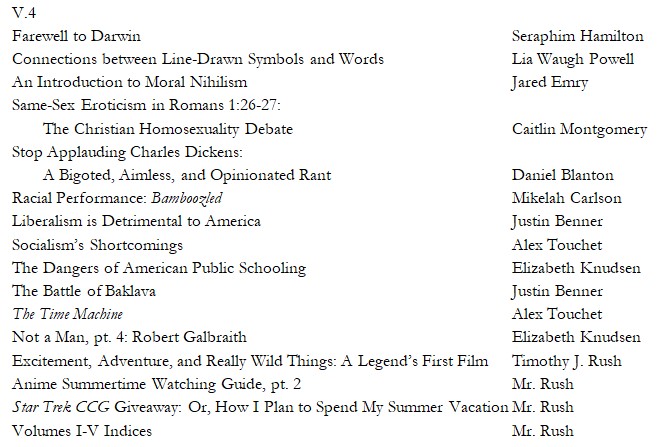
Star Trek CCG Giveaway: Or, How I Plan to Spend My Summer Vacation

Christopher Rush

While you are having a fun summer vacation watching top-notch anime series and movies, I am hoping I will be organizing my Star Trek CCG collection. Not that it is in total shambles, mind you.  Just because I haven’t played the game since Hanson was on the charts doesn’t mean my Star Trek CCG collection is in disrepair.  What I mean is ever since the summer of 2015 I’ve felt like taking inventory of what I have, what I don’t have, investigating what it may take to fill in some of those gaps, and, ideally, actually play the game again.  Despite popular opinion, I don’t really enjoy acquiring things just to have them: I do want to read the books I own, I do want to play the games I own, I do want to watch the digital video discs I own, et cetera.  I’m not big on just having objects in my home just for the purported joy of ownership.  It’s all God’s anyway, right?

I have no false hopes the electronic-bay will suddenly get giddy for my extras: “oh, you have 121 ‘Anaphasic Organism’s?  Here’s a bajillion dollars!”  I doubt I could get a ha’penny for all my “Anaphasic Organism”s, “Archer”s, “Phaser”s, et cetera put together.  I’m sure the world has no need for my commons.  Nor do I have any designs on selling my rares (no one ever believed the “I.K.C. Pagh” was “rare”).  I’m not trying to get back the, shall we say, hefty amount of money that was paid for this decent-sized collection (I admit wholeheartedly my parents paid for most of it).  I just want to know what I have.

Then I want to give most of it away.  Are you interested?

I can tell you now it’s all 1st-edition stuff, basically up to Deep Space Nine and a bit beyond.  It’s been awhile since I’ve really looked into the game, not counting a few dormancy-ending days last summer, so I’m not sure what I’m missing as far as what sets I have none of in the 1st edition.  I’m hoping my brother will be able to get a few boxes of packs or whatnot at GenCon this year, maybe even dabbling in 2nd edition, but we’ll see.  This past Christmas, my dad got us a box of Marvel Dice Masters booster packs, and Julia and Ethan and I had a good deal of fun opening them, seeing what cards and dice came in the packs, and then I had a swell time organizing it all, seeing what was missing, what we got … and all the fun of opening CCG packs back in the ’90s came back to me.

Coming from a long line of librarians, or a short line depending on your angle, organizing must be in my blood.  Like, possibly, most who grew up in the CCG age, I spent a lot more time organizing, bindering, listing, organizing, and deckmaking than I spent actually playing the game.  I’ve already told you the story of how I got the ultra-rare “Future Enterprise” card from a 97-cent discount pack from WaldenBooks my mom got me one summer afternoon, and how she got me the limited edition Kivas Fajo Collection as a pick-me-up after I broke my arm (it was only until later, when I grew up a bit, that I found out it is somewhat incongruous to spend a good deal of money for a gift to cheer up someone who just cost you a great deal of money on hospital bills as a consequence for doing what you shouldn’t have been doing in the first place — it must have been love).  But that’s part of the fun with CCGs, really: much like Wordsworth’s dual-view of poetry, CCGs are both the overflow of powerful emotions (buying the boosters and seeing what new cards are inside … or more likely what duplicates you got again) and those powerful emotions recollected in tranquility (the calm joys of sorting, organizing, and checking off your growing collection).  The only downside is the cost.

And storage.  I’m out of storage space.  Do you want to help?

Hey, if you come take my duplicates, we could maybe then starting playing the game together.  Everyone wins.  Give it a thought.  Let me know.  It’ll be fun.

P.S. — Are you interested in Decipher’s Middle Earth: The Wizards CCG?

P.P.S. — Even if you don’t want any anime or feel like starting your own hand-me-down Star Trek CCG collection, I hope you can come over for the summer gaming days.  That may be even more fun.

P.P.P.S. — In any event, we at Redeeming Pandora are very grateful for your loyal readership over the years through all 20 exciting issues.  I recently looked at issue 1 … man, we hit the ground running and we have been having a blast ever since.  I say “we,” even though most of the team has fluctuated over the years, but the willingness of the ol’ staff to continue contributing, as evidenced in this very issue, has been a genuine delight for me, especially seeing how they have grown and improved after their time with us.  Here’s to 20 more issues, faithful reader!

Enjoy your summer!

Remember: “wherever you go, whatever you do, whatever you say … say, say, say … say it with love!”

Anime Summertime Watching Guide, pt. 2

Christopher Rush

In addition to the fine recommendation my brother has just given you, I thought I would offer some of my own recommendations for some enjoyable, exciting, moving, and more or less important anime series of note from recent years.  In stark contrast to most of the things we recommend here at Redeeming Pandora, these present recommendations are more critically popular than you might expect from us — instead of the overlooked, the obscure, the forgotten, and the ignored, these are some of the most beloved and acclaimed series around.  Why, then, the need for such a list, you may wonder?  Fair enough query.  The thought occurs, while the anime circles out there in life are presently aware of these gems, you perhaps are not.  Maybe you’ve been under the impression “anime is just Japanese inappropriateness” or something along those lines.  As with all sorts of human endeavors, however, a few extreme examples should not besmirch an entire genre.  Just as Grand Theft Auto (for example) should not motivate us to generalize the entire videogame enterprise as horrible, a few of the more saucy anime series out there should not prevent us from enjoying and experiencing the better works the field has to offer.  (Either that, or you’ve realized by now all of my articles are worth reading, regardless of subject matter and thus “need” is replaced by “just for giggles” and that’s why you are reading this; for that I thank you.)  Here, then, in no particular order, are four series worth watching as you while away the summer waiting for the weather to get deliciously cooler and the skies to get beautifully grayer.

Attack on Titan

I admit at the first this is a violent show.  Its “Mature” rating is well-deserved.  It’s not as bloodily violent as, say, The Wild Bunch or Fight Club, which we’ve somehow gotten away with recommending at Redeeming Pandora, but its violence is intense and pervasive (if not, shall we say, “conventionally graphic”).  The series also is occasionally salty, but not nearly as salty as, say, Tim O’Brien’s important and heartily-recommended work The Things They Carried.  It would be fair to say, then, this series is recommended despite its violence and mild saltiness.

What, then, you wonder, makes it commendable?  I’m not usually a big “post-apocalyptic world” fan, and Attack on Titan is certainly a post-apocalyptic series.  Like many anime series, the main protagonists are youngish characters thrust into a chaotic world in which their worth and contributions must be proved and maintained.  Somewhat typically with such tales, the main protagonists lose their parents early on and must struggle to get by before they can grow and fend for themselves.  Here come the commendations.  What is less typical of such stories is Attack on Titan begins in a post-apocalyptic world that has more or less forgotten it is a post-apocalyptic world.  100 years ago, giant “titans” (10-50-feet tall neutered human-like beings) appeared seemingly out of nowhere and began devouring the human race.  Somehow, some of humanity survived long enough to build three huge concentric circular walls around the last vestiges of the race.  Humanity adjusts to its present condition, more or less, almost getting used to it, despite the elite cadre of military that periodically forays outside the walls, until one day a 200-foot titan appears and batters a hole in the outermost wall, allowing dozens of seemingly-mindless titans to resume the destruction of mankind.  Our heroes are caught in the middle, their lives are turned upside down, and suddenly they must live once again with the threat of the titans.

The majority of the 1-season (as of this writing) show follows our three heroes (Eren Yeager, his foster sister Mikasa Ackerman, and their buddy Armin Arlert) as they make their way to the Military to start taking an active role in the defense of mankind and eventually, hopefully, the reclamation of the planet from the mysterious titans.  Eren is a conflicted protagonist, and before too long, as is often the case, he has a special destiny integral to the survival of mankind.  Mikasa proves herself as an impressive killing machine, as the military uses impressive technology to fight the giant titans.  Armin, though initially suffering from self-confidence issues, soon enough proves himself as a brilliant strategist and scientific mind.  Along the way, we meet a number of supporting characters who get very interesting the more we get to know them.  The only problem with this, is, since most of them are front-line military against a nearly-invincible and relentless foe, the mortality rate among the supporting cast is high — you can’t get too attached to them, really.

I don’t recommend it for the violence, of course.  I recommend it because it is a tense show with a large number of exciting mysteries (where did these titans come from? why is Eren so special?) and twists and turns, combined with the sort of Battlestar Galactica-like “humanity banding together to fight off destruction, all the while exploring what it means to be human and moral and all that good stuff” that makes a show like this much more philosophically satisfying than others of its kind.   Sprinkled throughout are engaging battle scenes, heroic sacrifices, intriguing layers of politics and betrayal, poignant quiet moments, revealing flashbacks … and then, suddenly, your jaw will drop, your eyes will bulge, and everything you thought you knew about the series and its characters twists inside out.  And then it happens again.  And you’ll be hooked.

It is only one season, so far, but feel free to use it to motivate you to read the manga, since that is much further along in the overall storyline than the anime series is thus far (and, naturally, it’s richer in character moments, subplots, and other literary goodies not always translatable to a short television show).

Cowboy Bebop

Considered one of the all-time greats for good reasons, Cowboy Bebop is certainly a worthwhile viewing experience.  It, too, is occasionally mature, especially in the dialogue, but its overall presentation, fascinating characters, wholly believable world, philosophical explorations, and diverse musical score all overshadow the sporadic saltiness.  It is also a limited series, with only 26 episodes (plus one later mid-story movie), so it doesn’t take a lengthy commitment, but the complete series leaves you with such a positive impression, you are glad you watched it.

In a way, Cowboy Bebop is also a kind of post-apocalyptic series: after a nuclear accident, parts of Earth are uninhabitable, but fortunately we have discovered interstellar gate travel and have colonized and encountered other planets and so we are okay.  Sort of.  Corruption and basic human nature have followed us into outer space, and since space is a vast place, the major corporations and generally decent folk need bounty hunters (called “cowboys”) to help make the spaceways a better place for all.  Two such noble bounty hunters/cowboys aboard their ship Bebop are our heroes for the series: Spike Spiegel and Jet Black.  Along the way, they meet new friends, we learn about their old enemies, secrets are uncovered, choices are made, and things will never be the same.  And the series is only half over.

It is an impressively dynamic series: some episodes are very dramatic, some are poignant, some are adventurous and funny, some are nerve-wracking — all are high quality.  Even the episodes you like least are better than other shows you really like.  It’s a very layered show: you have to pay attention to the details, as moments and cameos in one episode will come back a couple episodes later.  This adds to the overall heft of the series as well as encourages you to watch it again and again.  Additionally, it’s a very rich world: the corporations, the supporting characters, the layers of past and present all imbricate in top-notch ways.  I know I’m starting to recapitulate generally high praise, but this series deserves all the accolades it has garnered and more.  I’m not saying it’s my most favorite series of all time (you know what that is already), but this is definitely a contender for anyone’s short list, anime or not.  You will enjoy this in deeper, more meaningful ways than just “yeah, I liked it.”  It gets you thinking about a whole lot of important ideas without coming off as didactic or belabored.  I realize this is awfully general, but I really don’t want to spoil too much of anything else, as it’s best enjoyed out of wonder without too many preconceptions or spoilers.  It will not disappoint you.

Fate/Zero

This yet-another 26-episode complete series is a prequel to another fairly enjoyable anime series Fate/Stay NightFate/Stay Night is a computer/videogame with multiple storylines and directions (as in, the story and characters can change depending on which “track” you choose to follow based on your actions and such).  The basic premise in both Fate series is every 60-some years, a Holy Grail (not necessarily the Holy Grail) appears on Earth to give one worthy mage and his/her Heroic Spirit companion a wish.  Before this can happen, several want-to-be-worthy mages each summon a Heroic Spirit (famous person from history) to beat the other competitors in a Street Fighter/Moral Kombat-like battle to the death.  Thus, this series, too, is a bit mature at times.  (The main and obvious villain of the series is horrifically villainous — you will immediately be rooting against him and his sheer evil.)

The first half of the series introduces the main combatants, their historical Heroic Spirit counterparts, their goals, their wishes, their conflicts, and a whole lot of other interesting notions (such as the families and mystical secret organizations involved in the centuries of these Grail Wars … secret cabals that make the Illuminati seem like the Boy Scouts of America).  The protagonist of the series, Emiya Kiritsugu, is very layered, as are almost all the characters.  My favorite duo is mage Waver Velvet and his companion Alexander the Great.  Their scenes are among the best of the series, which is saying a lot, considering how good the series is.

Since the mages have called upon Heroic Spirits (except the villain of the series has conjured up a truly heinous person of history), one of the intriguing themes of the series is honor in its many forms: how to achieve it, how it can be lost, can it be regained? and all that.  Our main protagonist, who has a checkered past at best, is aligned with King Arthur, as truly a noble historical figure as possible (though there’s a pretty big twist I don’t want to spoil for you here).  Their interactions are likewise engaging.  These heroes, being noble, often struggle with the need to eliminate each other during the grail contest, even though they know they are in effect servants of the grail until they win it and gain their deepest wish.

Since it’s a prequel to a story/series that was made years before, the ending is likely well-known and necessary.  I’m usually in favor of reading/seeing things in the order in which they were made and not their in-world chronological order (my thoughts on the proper order of The Chronicles of Narnia are well known), but I don’t know if watching Fate/Stay Night is better, especially since I experienced Fate/Zero first.  I certainly think it’s worth watching Fate/Stay Night as well, but it is very much a more typical “young teens are the heroes to save the world” sort of story, whereas Fate/Zero is definitely a grown-up series (the kids of the characters in Fate/Zero are most of the main characters in Fate/Stay Night, 20-years later instead of the usual 60).

Don’t let the “mages conjuring heroes of the past” put you off.  The only off-putting thing is the main villain, but he is so obviously heinous all the other characters rally around the rightness of getting rid of him.  Fate/Zero is a great story of nobility, sacrifice, redemption, heroism, and much more.

Fullmetal Alchemist/FMA: Brotherhood

Some may say I’ve saved the best for last, but that may be tainted by the fact Fullmetal Alchemist is much longer than the other series listed here, with 50-some episodes in the first series and 60-some in the “reboot-like” series Brotherhood.  The length of the series naturally lends itself to deep, thorough plots, well-rounded and beloved supporting characters, meaningful conflicts and resolutions, and all the things that make an adventure television series great.

Edward and Alphonse Elric lose their mom when they are still fairly young (you can see a trend among this series), but instead of accepting her mortality they use their alchemy skills to try to bring her back to life.  It does not go well.  Alphonse loses his body; Edward loses his arm and leg while attempting to save Alphonse’s soul, attaching it to a giant suit of armor.  Their childhood friend, Winry Rockbell, creates a new arm and leg for him.  (This is all the first minute of the first episode, so I’m not spoiling anything.)  Having survived such an experience, the brothers realize they need to improve their alchemy skills and find some way to get Alphonse’s body back.  Thus begins their journey.

As with all of these, a great deal of the enjoyment of the series comes in the diverse supporting cast, the ups and downs of their journey, and the growing menace of the behind-the-scenes puppet masters, as well as the philosophical quandaries the Elric brothers encounter along their journey.  Having violated one of the key laws of alchemy (don’t attempt human transformation), the Elric brothers begin on the outs, even as they subordinate themselves to the Military (yeah, I know, it seems to have a lot of similarities to Attack on Titan, but they are radically different stories) in an effort to gain access to more knowledge about alchemy, perhaps even tracking down the elusive Philosopher’s Stone.  Edward meets several other dubious alchemy users (sort of how Huck Finn meets other likeminded characters warning him against living this sort of life), and he is often tested in how he will live and use his powers: has he learned his lesson? is he committed to others? or is “accomplishing their goals” the only value worth embracing, regardless of who is affected?  It’s a very rich show.

Without giving too much away, I’ll comment on two engaging aspects of these series.  First, one of the main group of antagonists are named after the Seven Deadly Sins.  Though some characters in the two series represent different Sins (e.g., “Dave” is Pride in FMA but Envy in Brotherhood), they make for a very menacing and thought-provoking group of antagonists.  Second, unlike almost every American show, the heroic adults of both versions of the show recognize their need to help the Elric brothers since they are young boys and vocalize their responsibility as adults to help and lead the boys as trustworthy adults.  Instead of American shows that tell us children are smarter than their parents and other authority figures, Fullmetal Alchemist enjoins us as adults to live exemplary lives to lead the youth for the good of all considered, and children should allow the trustworthy adults in their lives to protect and care for them when it’s the right thing for them to do.

I definitely recommend watching the entirety of the original series first, even though soon enough the two series become drastically different.  The first Fullmetal Alchemist began before the manga wrapped up, and thus it started telling its own story about halfway through.  Fullmetal Alchemist: Brotherhood (as it’s known here in the U.S.) follows the manga more closely (so I’m told — I haven’t read it yet).  I agree with those who find the ending of Brotherhood more satisfactory than the ending of the original (even with the original’s post-series wrap-up movie The Conquerer of Shambhala), but the original’s story and the fate of many supporting characters is satisfying as well.  I’ll probably write a more detailed article about this idea next year, once you’ve had time this summer to watch both series.

There you have it.  Four high-quality anime series to lead you into what may be a fresh genre of television enjoyment and life improvement.  Have a good summer of watching great series!  (It’s a great way to avoid sunburns, at least.)