Category Archives: Theology

Where Shall Wisdom Be Found? Or in the Heart or in the Head?

Christopher Rush

At the climax of Job’s lamentation, just before his final self-defense, he gives a poetically moving discourse on wisdom, centering on two important questions: “where shall wisdom be found? And where is the place of understanding?” (Job 28:12) Along with its three companions knowledge, understanding, and discernment, wisdom’s location and purpose are frequent motifs throughout the book, discussed by Job’s three companions, Elihu, and God Himself (though this essay will focus only on the humans’ perspectives in the book).  Job’s friends’ comments on wisdom usually come in the context of upbraiding Job for his unrighteousness, yet they differ in emphases.  Elihu’s comments on wisdom come mainly in opposition to everything he has heard from the other four.  Job gets the final word (for our purposes), rethinking his own position on wisdom being not so unattainable after all.

Wisdom is nigh impossible to locate, says Job at first.  It is neither in “the land of the living” (28:13b) nor in the deep or the sea (28:14).  It is not where living creatures on the ground or the birds in the air can find it (28:21), and not even Abaddon and Death know anything beyond “a rumor of it” (22:22).  Even if man were to stumble accidentally upon it, he would “not know its worth” (28:12) because it is so rare and truly unique (cf. 28:15-19).  Wisdom does not reside in man’s purview, neither in his heart nor in his head: he can’t find it, doesn’t know its worth (likening it to a valuable jewel), and wouldn’t know what to do with it even if he did find it.

Job’s companions similarly address wisdom and where it could be found, yet they mostly disagree with Job on its source.  Zophar comes closest to agreeing with Job’s initial premise of wisdom’s elusiveness.  “Can you find out the deep things of God?  Can you find out the limit of the Almighty?  It is higher than heavens – what can you do?  Deeper than Sheol – what can you know?” (11:7) In fact, it is so elusive, “a stupid man will get understanding when a wild donkey’s colt is born a man!” (11:12) Eliphaz at first agrees with wisdom’s rarity, intimating wisdom is an individual experience: he has it because an indiscernible spirit in a stealthy voice whispered in his ear (4:12-16).  Yet wisdom can have a more accessible source simply through experiencing a long life: “Both the gray-haired and the aged are among us” (15:10), says Eliphaz, and since they are older than Job he can’t possibly have more wisdom than they have (15:9).  Bildad offers a similar source of wisdom, in the traditions and teachings passed down from one generation to the next.  Job should “consider what the fathers have searched out.… Will they not teach you and tell you and utter words out of their understanding?” (8:8, 10).  Elihu rejects these outright, saying “It is not the old who are wise nor the aged who understand what is right” (32:9).  Even more brazen, Elihu declares if any of them disagree with his counsel, despite his being the youngest of them all, he can be a source of wisdom for them (33:33)!

Wisdom’s purpose is another point of contention.  Job doesn’t initially see much practical use for it in this life or the next since it is so unlike anything else of human experience, and man is so mystified by it he thinks of it like a jewel, though rarer and more costly than any other precious gem (28:12-22).  Eliphaz especially proves Job right, likening wisdom to a physical adornment with spiritual significance.  Eliphaz says most men die without wisdom, and that lack of wisdom often brings about their destruction (4:14-5:7, esp. 4:21), as if wisdom were armor against mortality.  (This is one of the few statements with which Elihu agrees, cf. 36:12.)  Eliphaz says further that not even the angels have wisdom, so God doesn’t trust them (4:18, 15:15) – one of his more bizarre declarations, rivalled perhaps only when he says wisdom benefits the person who has it, but that doesn’t much matter to God in how He treats that person (22:2-4).  Job doesn’t have wisdom, says Eliphaz, because he doesn’t fear God (15:2-4); worse, Job thinks God’s wisdom is inscrutable (22:13-14), and if Job would only repent from his wickedness (i.e., receive God’s wisdom), he would be rewarded by God … but he can only conceive of these rewards in terms of material blessings or riches (22:21-26).

Can wisdom be found in the heart?  Certainly not in the hearts of the four men around Job.  Bildad gets so fed up with Job’s words he speaks out of anger, believing Job is calling them stupid (and by implication devoid of wisdom, 18:3b).  Zophar likewise admits he is speaking emotionally out of haste (thus likely not from calm, comported wisdom, 20:2-3).  Eliphaz thinks wisdom is of the heart, but a heart motivated by acquisitiveness.  Elihu ends his tirade by declaring God “does not regard any who are wise in [their own] heart” (37:24).

Job concludes more optimistically, however, by declaring God not only knows where to find wisdom but also what it actually is (28:23-27).  Wisdom is a proper attitude of fearing God, and understanding is a proper action of turning from evil (28:28).  It thus can be found in the heart, when one stops thinking of wisdom as a material treasure but instead as the proper emotional perspective of who God is and how we should feel in response (and who we are in relation to Him – wisdom’s location).  It can also be found in the head: when one understands who God is and thus knows the proper way to respond to that knowledge, one turns away from evil (toward a life time of serving God – wisdom’s purpose).  Wisdom’s companions knowledge, understanding, and discernment are all mental (and spiritual), after all.  The fear of God and the proper knowledge of Him lead to a life of proper action.  Knowing what a thing is, such as wisdom, makes finding that thing and knowing what to do with it much easier – an essential component Job and his companions mostly ignored throughout their conversation.

What’s in a Name?: The Semantics of ‘Ēl Theophoric Personal Names in Late Iron Age Israel

Caitlin Montgomery Hubler

YHWH, the traditional God of Judaism, has a name so holy that for millennia worshippers have dared not even to speak it. Special rituals surrounded the word both written and spoken. When Jewish scribes translated their Scriptures, the divine name would not be transcribed but would be replaced by the equivalent of “LORD.” The divine name was considered so holy as to be literally unpronounceable. To this day, in many religious circles it is considered highly offensive to speak the name of YHWH. While this current state of affairs is often taken as assurance of the inherent bond between YHWH and Israelite religion, recent scholarship has called this assumption into question. Various lines of evidence seem to point to the fact Israel once shared in the polytheism of its Ancient Near Eastern neighbors.1

Undoubtedly, there are portions of the Hebrew Bible that affirm a monotheistic understanding of God. Isaiah 45:18 proclaims, “I am the Lord, and there is no other.” In Deuteronomy 6:4, in the context of teaching the Israelites new commandments, Moses speaks, “Hear, O Israel: The Lord is our God, the Lord alone.” In these and other passages, YHWH is taken to be one and only divine being, certainly the only one worthy of worship. Yet there are other sections of the Bible that seem to offer a quite different portrait of Israelite theology. For example, later on in Deuteronomy, Moses sings of El Elyon, chief god in the Canaanite divine pantheon, giving underling god YHWH the people of Israel over which to rule.2 The Psalmist records a scene of YHWH sitting in a divine council among other gods.3 Multiple texts mention both YHWH and El but as separate figures.4 In general, these passages specifically affirming monotheism are typically dated later in Israel’s history, while the passages that seem to affirm polytheism have been dated earlier.5

Thus, in order to accurately trace the development of Israelite religion over time, we must recognize the diverse historical and theological contexts in which the various authors of the Hebrew Bible wrote. There are varying theologies in the Hebrew Bible affixed to different time periods in Israel’s history. It is through examination of such theologies and the historical circumstances in which they arose that we might begin to reconstruct the development of the religion over time. Because the Israelites were a relatively numerically insignificant people group in the Ancient Near East constantly being dominated by larger and more powerful nations, there were certain ideas about religion and divinity in the Ancient Near East that could not have helped but bleed into Israelite ideas about God. This is simply the milieu out of which Israel emerged. For instance, the idea of a divine pantheon permeated the Ancient Near Eastern religious landscape. The most powerful god in the pantheon was El: supreme god of Canaanite religion.6 El was conceived of as the father and chief of the divine pantheon. At least one scholar has suggested one stage in early Israelite theology, perhaps around the time of the exodus, included El as head of the pantheon directing YHWH, his warrior god based off of texts like the aforementioned Deuteronomy 32:8-9.7

But disparate biblical passages are not the only access the modern historian has to ancient Israelite piety. Almost all ancient Semitic names are theophoric: they convey information about the god worshipped by the bearer of that name. Often, these names are composed of a subject with a divine element (a form of YHWH or ‘ēl, for example) and a predicate (a verb denoting the god’s action). Scholars have thus been able to avail themselves of both biblical and epigraphic names in order to reconstruct the piety of ancient peoples. When carefully interpreted, theophoric names can be an important piece in a larger puzzle reconstructing ancient religion.

Perhaps the most significant ‘ēl name mentioned in the Bible is that of Israel itself. Though YHWH is the god traditionally associated with the people Israel, a closer look at the name’s meaning reveals a more complicated picture. The divine element present in “Israel” is ‘ēl, not YHWH. Though the etymology of the word is contentious, possible meanings include “May El Combat” and “El is just.”8 For this reason, combined with the aforementioned biblical passages that appear to refer to El as a deity distinct from YHWH, Mark Smith maintains the original God of Israel was, in fact, El.9 There would have been nothing preventing the adoption of a Yahwistic name, such as “yisra-yahweh,” or “yisra-yah.”10 In the absence of this, then, it is reasonable to assume Israel initially perceived El as head of the divine pantheon, and only later came to recognize YHWH as the one true God.

Indeed, non-Yahwistic names abound throughout the Hebrew Bible as well as in contemporaneous epigraphic data. The most abundant non-Yahwistic divine element is, as might be expected from Israel’s name, ‘ēl. However, ‘ēl names occur significantly more liberally during certain portions of Israel’s history, particularly prior to the time of David. Even within the biblical corpus, one is able to observe a shift around the time of David from predominantly ‘ēl names to YHWH names.11 This shift appears to be concurrent with the phenomenon of pantheon reduction in Israel.12 One is able to observe a general tendency within the Hebrew Bible wherein the worship of the whole pantheon of gods commonplace in the Ancient Near East dwindled down further and further until YHWH was the only acceptable recipient of Israelite worship.13 Dennis Pardee has located this major religious shift throughout the second half of the Iron Age.14

All of this is complicated by the fact much later in Israel’s history, after the exile, ‘ēl is clearly meant as the generic term for “god.” Independent scholar Ryan Thomas makes the point “there can be little doubt based on its prevalence in post-exilic Hebrew names that the theophoric ‘ēl was used as a designation for the national deity YHWH.”15 Scholars thus run into problems when making straightforward inferences about ancient Israelite piety solely based off the divine element ‘ēl in personal names. Thomas continues, stating “the meaning of the term ‘ēl is often ambiguous in personal names, since it can be used as a proper name, an appellative, or a reference to the personal god, ‘my god.’”16

Thus, at some point in the development of Israelite religion, the semantics of ‘ēl in personal names shifted. While it once referred to the Canaanite god El, father and chief of the divine pantheon, it eventually came to be used as a generic term for “god.” The question of precisely when, why, and how the semantics of ‘ēl shifted is of great interest for biblical scholars looking to reconstruct ancient Israelite religious history. For purposes of this paper, I wish to focus on the “when” question. What is the semantic meaning of the divine element ‘ēl in theophoric names at the time of the late Iron Age? Does ‘ēl refer to the high Canaanite god El, or does it function as a generic term for “god” such that, for the Israelites, it is essentially interchangeable with YHWH? Throughout this paper, I will argue theophoric personal ‘ēl names at the time of the late Iron Age are evidence of lingering fluid notions of divinity within Israel on a familial level.

Only fairly recently in biblical scholarship has it been considered ‘ēl in personal names may not be a title for YHWH. Jeaneane Fowler simply assumes in her 1988 study the both divine elements are semantically equivalent.17 Jeffrey Tigay has argued for the same in 1986.18 However, new research in the field of onomastics by Ryan Thomas does not allow for such a facile identification of these divine elements. My hope is through my presentation and interpretation of his research, what has up until this point been a comfortable consensus view within biblical scholarship will be problematized.

In the Ancient Near East, each theophoric name contains both a divine element, typically as subject, followed by a predicate. For example, the biblical name Abijah (‘abiyah) contains the YHWH divine element and means “YHWH is my father.” Scholars have long been in the practice of putting together collections of theophoric names in order to make comparisons between YHWH and other Ancient Near Eastern deities in the conception of ancient Israelite worshippers.

Recently, Ryan Thomas has combined the work of several earlier scholars to create a composite database of late Iron Age Hebrew personal names.19 Importantly, both biblical and epigraphic data are thus included in this set. Thomas points out methodological problems associated with the sole use of biblical names to reconstruct ancient Israelite religion. Uncertainty about the dating of particular texts as well as the possibility of later redaction present issues with a straightforward interpretation of personal names in biblical texts. Thomas reminds us, “In all likelihood, the names stem from disparate time periods and reflect different stages in the development of a mono-YHWHistic sensibility.”20 Another strength of Thomas’s collection is its exclusion of possibly inauthentic archaeological material.21

When Thomas compared the predicates of the personal names, he found half of all the names occur with predicates attested with either theophoric element (YHWH or ‘ēl). That is to say at least half of the time, YHWH and ‘ēl are essentially interchangeable in terms of the actions they perform or the descriptions afforded to them. Given this evidence alone, he says, “We could reasonably assume that YHWH was the regular proper name of the chief Israelite deity during the monarchic period and later, while El was an additional title reflecting the deity’s historical development from or conflation with Canaanite El.”22

While he acknowledges this evidence may be interpreted as an interchangeability of YHWH and El, thereby upholding the consensus view, a closer look at the data complicates this conclusion. More important than the similarities between the predicative elements are the differences. As it turns out, though half of the YHWH and ‘ēl personal names occur with predicates attested in both, this occurs with a relatively small number of predicates. The actual number of predicates able to be used with either YHWH or ‘ēl is rather low, at 21%. Many (58%) of the predicates are attested only with the YHWH theophoric, but few (20%) are attested only with an ‘ēl theophoric.23 Because of the fact 78% of the individual predicates are exclusive to either YHWH or ‘ēl, Thomas sees reason to believe their onomastic profiles were distinct to the extent they may have still been conceived of as separate deities.24

In fact, some predicates exclusive to YHWH and ‘ēl are found in multiple instances, increasing the likelihood these are part of distinctive onomastic profiles.25 Thus, there are predicates occurring abundantly with ‘yah that have no equivalent in ‘ēl, and vice versa. To make things more interesting, predicates unique to each name can be grouped into particular categories, allowing us to make generalizations about the conception of each deity’s character. For example, the predicates of YHWH names tend to be more closely associated with the following characteristics: strong and powerful, warrior-like, protective, and triumphant, immanent, beautiful, engaged in the birth process, acting as a witness and intercessor, with a need to advance his claims of lordship.26 In many ways, these predicates cohere with the image of YHWH as “warrior god who intervenes in favor of his people.”27 Predicates attested only with El names, on the other hand, emphasize general beneficence, transcendence and firmness, judgeship and authority, force behind the birth process, and his identity as a covenant partner.28 Likewise, this picture of El fits quite nicely with what we know of El as the powerful father of the divine pantheon: the elderly bearded figure who sits enthroned among the divine council.29

One seemingly important difference between YHWH and El deals with the kinship terminology specific to each. Throughout the Ancient Near East, kinship terms are used alongside divine elements in personal names as “divine epithets or appellatives.”30 Certain epithets, such as “paternal uncle” and “father-in-law,” are seen abundantly with ‘ēl but never with YHWH. In contrast, “brother” is attested at least 28 times with YHWH but never with ‘ēl.31 YHWH is, emphatically, “the divine brother,” in contrast to El whose profile is more “parental and ancestral.”32

Based off of these unique emphases, Thomas summarizes what he takes to be the overall difference between YHWH and El: “YHWH is implied to be more of an active, young, interventionist, and warrior deity, whose lordship must be asserted, whereas El is more transcendent, abstract, and secure in his authoritative position.”33 Thomas’s ultimate conclusion on this is we should consider the possibility YHWH and ‘ēl were actually just still separate deities throughout the monarchic period for both Israel and Judah.

There may also be distinctions made between YHWH and El in other late Iron Age epigraphic data. Kuntillet ‘Ajrud has revealed various inscriptions wherein El is praised. While it has generally been taken for granted that, in these cases, El is to be identified with YHWH, Mark Smith has pointed out this is not necessarily the case. It is equally possible El still referred to the high Canaanite god who is the father of the pantheon.34

The divine elements present in Israelite personal names are clearly of religious significance, but the question remains as to what level of religious significance they occupy. We must recall there are different levels of religion in the Ancient Near East: familial, local, and national. It is not necessarily the case all three of these will cohere, though neither is it necessary they will be incompatible.35 Albertz and Schmitt point to the curious absence of any official Israelite tradition in personal names. There are no references to those specific elements of the Hebrew narrative one might expect if one’s name was intended to express the official national religion: elements such as exodus, conquest, kingship, Sinai, Zion, or Bethel.36 “The primary traditions of official Israelite state and temple religion are thus almost entirely absent from both biblical and epigraphic names.” Nor do official cultic activities make appearances in the predicates.37 It is merely the divine element itself, whether YHWH or ‘ēl, that shows up in personal names.

This absence does not suggest a lack of familiarity or disagreement on the part of everyday Israelites with the official religious traditions of their polity. Though familial religion is distinct from state religion, this difference does not necessarily mean there is a conflict between them.38 It merely reinforces the separation of religious spheres of influence present in most Ancient Near Eastern societies more generally. Albertz uses the term “internal religious pluralism” to describe this phenomenon, which may be more helpful than “syncretism” in describing the ways in which social stratification can create divisions between family and state religion.39 As Dennis Pardee comments, “We may conclude that the proper names inform us of a different and broader pantheon in the popular religion perceivable in the proper names, as compared with the official religion of the Bible and of most of the extra-biblical inscriptions….”40 It is thus safe to conclude the religious experiences that resulted in names for children were “almost entirely independent of the official state and temple religion.”41

Rather than relying on the events of their polity’s collective past, Israelite families contained their own reservoirs of religious experience from which to draw when naming a child. Names were often influenced by the religious experiences of mothers during events surrounding the birth of a child. After giving birth, mothers were mandated to spend a given period of time separated from their families as a “cryptic reflection of the intimate encounter with the divine that has happened during birth.”42 It was during this time the mother would come up with a name for the child, often influenced by the religious experiences they had during their period of confinement after the birth. During the joyful reuniting of the mother and new baby with the rest of the family, there was a feast during which the father would have the chance to accept or reject the name chosen by the mother.

Thus, a very robust set of rituals surrounding pregnancy and birth abound in ancient Israel. Indeed, the event of childbirth was an incredibly important time in an Israelite woman’s life, believed to be a supernatural intervention of God.43 As a result, childbirth held incredibly significant events in the life of the entire family. This is substantiated by the large number of personal names that directly refer to the event of childbirth: a remarkable 25.9% of total ancient Israelite personal names contain some reference to birth within their predicates.44 The largest subgroup of these names is composed from the verb natan “to give,” such as ‘ēlnatan “‘ēl has given [the child]” and Netanyahu “YHWH has given [the child].”45

Thus, it is most reasonable to assume it is the religious piety of the family, especially the mother, that provides the impetus for the inclusion or exclusion of either the YHWH or ‘ēl divine element. The fact there exists such a robust onomasticon for ‘ēl, one able to be distinguished from YHWH, begs the question of interpretation. While it is theoretically possible this incongruence in onomastic profiles is merely an accident of historical discovery, and archeologists may one day unearth more epigraphic data to suggest YHWH and El were indeed conceived of more similarly, it is not likely this “incremental aggregation will dramatically alter the basic picture provided by the biblical record as well as the accumulation of inscriptional material over the last century.”46 At any rate, we must reconstruct history with the tools available to us today and be willing to revise them should contradictory evidence come to light.

A deeper understanding of the unique ways in which Ancient Near Easterners conceived of divinity in general is helpful in interpreting these results. I wholeheartedly agree with Thomas there are clearly distinct onomastic profiles associated with YHWH and El. However, I want to challenge the idea distinct onomastic profiles automatically necessitate two ontologically distinct gods. While this is a fairly typical assumption for those of us steeped in Western civilization to make, it is problematic when applied to Ancient Near Eastern religion. Benjamin Sommer helpfully elucidates: “For Ancient Near Eastern religions, gods could have multiple bodies and fluid selves. Greek religion assumed a basic resemblance between mortals and immortals in this respect, whereas Ancient Near Eastern religions posited a radical contrast between them.”47 Thus, worship of two differently named gods ought not be blindly taken as an expression of polytheism. In fact, Ancient Near Eastern ideas about gods are better described along a spectrum of fluidity vs. nonfluidity than one of polytheism vs. monotheism.48

Sommer points to two sorts of divine fluidity present in the Ancient Near East, the first of which is called “fragmentation.”49 Examples exist of multiple gods with a single name who “somehow are and are not the same deity.”50 In this sense, one might find different “iterations” of the same god at specific locales. This sort of divine fluidity is found among gods of the same name. A possible allusion to this concept is found in the epigraphic evidence at Kuntillet ‘Ajrud, which mentions “YHWH of Teman.”51 This may have been what the Deuteronomist was targeting in the Shma.52

However, for purposes of conflation of ‘ēl with YHWH, I am more interested in the second sort of fluidity Sommer outlines, involving “the overlap of identity between gods who are usually discrete selves.”53 He continues by describing several Akkadian texts that “describe one god as an aspect of another god,” and others that “refer to two gods as a single god even though the same texts also refer to each of these gods individually.”54 Even with gods of two different names, this occurs. One prominent example of this concept of fluidity is found in the Babylonian creation epic, the Enuma Elish. At one point in this poem, Anu, Ea, and Enlil, the three high gods of Mesopotamia, are all equated with young Marduk.55 However, perhaps a more instructive example for our purposes is found in this late-second-millennium hymn to the god Marduk:

Sin is your divinity, Anu your sovereignty

Dagan is your lordship, Enlil your kingship,

Adad is your might, wise Ea your perception,

Nabu, holder of the tablet stylus, is your skill,

Your leadership (in battle) is Ninurta, your might Nergal…56

Sommer suggests an “incipient monotheism”57 in this hymn: while it makes reference to gods other than Marduk, it reveals its writers have begun to conceive of the personalities of these other gods as extensions of Marduk rather than ontologically distinct beings. Given the rampant cultural diffusion in the Ancient Near East, it is thus reasonable to suppose even in their pre-exilic references to ‘ēl, ancient Israelites did not conceive of El as ontologically distinct from YHWH but as a manifestation of a particular grouping of YHWH’s qualities.58

Therefore, it is possible in drawing upon the older figure of El in the naming of their children, Israelites of the late Iron Age were actually making a statement about YHWH: mapping onto him characteristics that had, up until that point, been associated only with El. The ancient Israelites were no strangers to the fact El originally referred to the high Canaanite father of the divine pantheon. This would have been a deliberate move that would have expanded rather than constricted the repertoire of YHWH.

This is reasonable partly because it is precisely the move the biblical authors would eventually fully make in explaining Israel’s prior worship of El. The qualities that once belonged to El are mapped onto YHWH in new ways that reinforce the new understanding of YHWH’s transcendence and lordship over all. For example, the Psalmist equates YHWH with Elyon, an epithet hitherto used only of El.59 When Israel adopted YHWH as its chief god rather than El, it did not break whole cloth from previous worship traditions. Instead, as Smith states, “At a variety of sites, Yahweh was incorporated into the older figure El, who belonged to Israel’s original West Semitic religious heritage.”60 The title ‘ēl berit, “El of the covenant,” became a signifier for YHWH.61 When YHWH first reveals his name in Exodus 3, he does so while implying Israel’s ancestors had worshipped him under a different name.62

To make this statement is emphatically not to suggest YHWH and El were essentially interchangeable in the minds of ancient Israelites at the time of the late Iron Age. Again, there does not appear to be firm evidence denoting this phenomenon until after the exile. What I am instead proposing is an intermediate step between the Israelite familial worship of El as a fluid deity and the worship of YHWH as a non-fluid deity: one in which specific states of being and activities traditionally attributed to El are beginning to be thought of as expressions of YHWH’s power. Just as Adad is called the expression of Marduk’s might, so perhaps El had begun to be conceived of as the expression of YHWH’s transcendence.

There is precedent for such a fluid understanding of divinity within ancient Israel as well. Pardee comments:

Moreover, besides the name of the state deity Yahweh, there were several other acceptable divine names which could have been preferred names in one family or clan; these may even have been perceived as separate deities or hypostates — a situation comparable in some ways to the Christian trinity, which theologians have explained to acolytes as consisting of a three-fold expression of one (or the like), but which a significant number of Christians go on understanding simply as three.63

These words are rich with meaning, particularly as we seek to conceive of possible relationships between ancient Israelite worship and Christian theology. Though non-fluid understandings of the divine appear to be quite foreign to many of our contemporary western and Christian notions of divinity, there may be less of this distance than is typically supposed. The concept of the Trinity, that God is somehow both three-in-one and one-in-three, has become central to Christian identity. In Trinitarian theology, it is said each person both is God and yet is not identical to the other persons. To the post-Enlightenment western rationalist, this seems to be an insurmountable illogical denial of the logical property of commutative identity. However, this understanding of divine possibility may have fit especially well in the mind of an ancient Israelite.

One God with multiple personalities, each carrying out a distinct function, can be seen as a parallel to non-fluid ancient Israelite understandings of YHWH and El. It is beyond the scope of this paper to speculate as to whether these ancient notions of non-fluidity played any sort of causal historical role in the development of the Christian doctrine of the Trinity. All the same, we are able to look back on such notions and see definitive parallels in contemporary understandings of a Christian God who is, in some sense, fluid. That such echoes of fluidity persist in Christian theology helpfully collapses some of the distance between the late Iron Age Israelite worship and contemporary religious practice.

The process of pantheon reduction by which YHWH assumed his place as non-fluid Lord of the whole universe was a complex, centuries-long process in Israel. Studying this process, however, is more than mere intellectual gymnastics, and is of value to the Christian theologian. For some, the fact YHWH achieved his place in Israelite history through a slow, meandering process is a threat to YHWH’s power. However, there are other theological angles from which to view this historical development. When Ancient Israelites began to transfer worship to YHWH previously offered to El, they were making a statement that reflected their evolving knowledge of God that preserved the glorious process of an evolving awareness of the totality of God’s power. YHWH is not only the immanent advocate and brother, but is also the transcendent, immensely powerful Father, enjoying power over all of creation. That God is revealed incrementally to God’s people in ways they are able to perceive is a timeless principle of Christian theology, one we would do well to remember still today.

Endnotes

1 Smith, Mark. The Origins of Biblical Monotheism: Israel’s Polytheistic Background and the Ugaritic Texts. (Oxford: Oxford University Press, 2003), 10.

2 Deuteronomy 32:8-9. All biblical references are from The Holy Bible: New Revised Standard Version. 1989. Nashville: Thomas Nelson Publishers, 1989).

3 Psalm 82:1; 6-7.

4 Genesis 49:18; 24-25, Numbers 23-24.

5 Smith, The Origins of Biblical Monotheism, 10.

6 Ibid., 143.

7 Ibid.

8 Römer, Thomas. The Invention of God. (Cambridge: Harvard University Press, 2015), 73.

9 Smith, Mark. The Early History of God: Yahweh and Other Deities in Ancient Israel. (San Francisco: Harper & Row, 1987), 7.

10 Römer, 27-29. Yahwistic names most often occur with an abbreviation of YHWH as the divine element, such as “yah” or “yahu.”

11Breed, Brennan. “Where Does YHWH Come From?” Lecture in “Emergence of Yahwism.” (B614. Decatur, GA: Columbia Theological Seminary, September 19, 2017).

12 Seth Sanders, “When the Personal Became Political: An Onomastic Perspective on The Rise of Yahwism.” Hebrew Bible and Ancient Israel 4 (2015), 59.

13 Smith, The Origins of Biblical Monotheism, 144.

14 Pardee, Dennis. “An Evaluation of the Proper Names from Ebla from a West Semitic Perspective: Pantheon Distribution According to Genre,” in Eblaite Personal Names and Semitic Name-Giving: Papers of a Symposium in Rome July 15–17, 1985 (ed. A. Archi; Archivi Reali di Ebla: Studi, I; Rome: Missione Archaeologica Italiana in Siria, 1988), 119–151.

15 Thomas, Ryan. 2017. “Yahweh and El in Hebrew Personal Names: Identity or Difference?” Paper presented at the Annual Meeting of the Society of Biblical Literature. Boston, MA. November 19. http://www.religionofancientpalestine.com/?page_id=690. Accessed 12/10/2017.

16 Thomas.

17 Fowler, Jeaneane. Theophoric Personal Names in Ancient Hebrew. (Sheffield: Sheffield Academic Press, 1988), 30.

18 Tigay, Jeffrey H. You Shall Have No Other Gods: Israelite Religion in the Light of Hebrew Inscriptions. (Atlanta: Scholars Press: 1986).

19 Thomas’s database includes previous work from Albertz (2012), Fowler (1988), Zadok (1988), and Rechenmacher (2012).

20 Thomas.

21 In their essay “A Provenance Study of Hebrew Seals and Seal Impressions: A Statistical Analysis,” Andrew G. Vaughn and Carolyn Pillers-Dobler warn of the dangers of including material from unknown provenances in one’s research. There are “discernible differences in artifacts from known and unknown provenance and the findings suggest that there may be artifacts of unknown provenance that are not authentic.”

22 Thomas.

23 Ibid.

24 Ibid.

25 Ibid.

26 Ibid.

27 Römer, 47.

28 Thomas.

29 Smith, 136.

30 Thomas.

31 Ibid.

32 Ibid.

33 Ibid.

34 Smith, 141.

35 Albertz, Ranier. “Family Religion in Ancient Israel,” in Household and Family Religion in Antiquity, ed. John Bodel and Saul M. Olyan. (Oxford: Blackwell Publishing, 2008), 90.

36 Albertz & Schmitt, 262.

37 Ibid., 265.

38 Pardee, 144.

39 Albertz, 91.

40 Pardee, 133.

41 Ibid., 269.

42 Ibid., 287. The period of confinement for new mothers differed based upon the sex of the baby. While the birth of a boy required seven days of isolation, the birth of a girl required fourteen.

43 Ibid.,269.

44 Albertz & Schmitt, 277.

45 Ibid., 287.

46 Thomas.

47 Sommer, Benjamin. D. The Bodies of God and the World of Ancient Israel. (Cambridge: Cambridge University Press, 2009), 12.

48 Sommer, 30.

49 Ibid., 13.

50 Ibid. Here Sommer provides the main example of the goddess Ishtar. For example, “Ishtar or Arbela” and “Ishtar of Nineveh” are listed as separate deities on the same treaty, each with separate instructions that seem to presume some degree of distinction between them.

51 Römer, 163.

52 Römer, 202.  The insistence that YHWH is “one” is likely a reflection of the fact that though at one time distinct YHWHs were worshipped at different locales, now YHWH is only to be worshipped at one location. In other words, “there is only the YHWH of Jerusalem, but there is no YHWH of Samaria, YHWH of Teman, YHWH of Bethel, and so on.

53 Ibid., 16.

54 Ibid.

55 Ibid.

56 Ibid. In another late-second-millennium hymn, the god Ninurta is praised by reference to the multiple gods and goddesses that make up various parts of his body.

57 Ibid.

58 From this evidence alone, it might be interpreted YHWH is an expression of El’s qualities rather than the other way around. However, Israel is clearly on a historical trajectory toward the nonfluid and monotheistic worship of YHWH, reflected in the fact the majority of theophoric names are Yahwistic. Thus, I believe it makes more sense to suppose the qualities are being added to YHWH rather than El.

59 Psalm 83:18: “Let them know that you alone, whose name is the LORD (YHWH), are the Most High (Elyon) over all the earth.”

60 Smith, 140.

61 Ibid. See Judges 9:46, cf. 8:33; 9:4.

62 Exodus 3:15-16.

63 Pardee, 130.

Bibliography

Albertz, Ranier. “Family Religion in Ancient Israel,” in Household and Family Religion in Antiquity, ed. John Bodel and Saul M. Olyan. (Oxford: Blackwell Publishing, 2008).

Albertz, Ranier and Rüdiger Schmitt. Family and Household Religion in Ancient Israel and the Levant. (Winona Lake, IN: Eisenbrauns, 2012).

Breed, Brennan. “Where Does YHWH Come From?” Lecture in “Emergence of Yahwism.” (B614. Decatur, GA: Columbia Theological Seminary, September 19, 2017).

Fowler, Jeaneane D. Theophoric Personal Names in Ancient Hebrew: A Comparative Study. (Sheffield: JSOT Press, 1988).

“I Will Speak the Riddles of Ancient Times”: Archaeological and Historical Studies in Honor of Amihai Mazar on the Occasion of His Sixtieth Birthday, ed. A. M. Maeir and P. de Miroschedji. German. (Winona Lake, IN: Eisenbrauns, 2006).

New Seals and Inscriptions, Hebrew, Idumean, and Cuneiform, ed. Meir Lubetski. (Sheffield: Sheffield Phoenix Press, 2007).

Pardee, Dennis. “An Evaluation of the Proper Names from Ebla from a West Semitic Perspective: Pantheon Distribution According to Genre,” in Eblaite Personal Names and Semitic Name-Giving: Papers of a Symposium in Rome July 15–17, 1985 (ed. A. Archi; Archivi Reali di Ebla: Studi, I; Rome: Missione Archaeologica Italiana in Siria, 1988), 119–151.

Römer, Thomas. The Invention of God. (Cambrdge: Harvard University Press, 2015).

Sanders, Seth. “When the Personal Became Political: An Onomastic Perspective on The Rise of Yahwism.” Hebrew Bible and Ancient Israel 4 (2015): 78-105.

Smith, Mark. The Origins of Biblical Monotheism: Israel’s Polytheistic Background and the Ugaritic Texts. (Oxford: Oxford University Press, 2003).

Sommer, Benjamin D. The Bodies of God and the World of Ancient Israel. (Cambridge: Cambridge University Press, 2009).

Thomas, Ryan. “Yahweh and El in Hebrew Personal Names: Identity or Difference?” Society of Biblical Literature 2017 Annual Meeting.

Tigay, Jeffrey H. You Shall Have No Other Gods: Israelite Religion in the Light of Hebrew Inscriptions. (Atlanta: Scholars Press: 1986).

Zevit, Ziony. The Religions of Ancient Israel: A Synthesis of Parallactic Approaches. (London: Continuum, 2001).

Those Whom He Justified He Glorified: Paul’s Argument in Romans 1:17-3:31

Seraphim Hamilton

In contemporary evangelicalism, the writings of the Apostle Paul are conventionally interpreted in terms of a strictly forensic doctrine of justification. According to this reading, mankind has, in sinning, incurred the just wrath of God. The sins of mankind were counted (imputed to) as if they were Christ’s, and when one exercises faith in Christ, one’s sins are recognized as punished in his person and Christ’s active obedience is imputed to the account of the believer. Paul is understood to have taught this in speaking of “God’s righteousness” coming through “faith in Jesus Christ” by the means of “propitiation” (Romans 3:21-25). Yet, difficulties with this understanding emerge in a careful reflection on the entirety of the letter to the Romans and the Pauline corpus as a whole. If this is the central argument articulated by Paul in the letter to the Romans, certain portions of the letter seem to be falling off the edge of the main point. If the point of Romans 2 is that no person can fulfill the law before God, then why does Paul twice (2:13-14, 2:25-29) appear to set up a category of Gentiles who keep the law? Furthermore, how does this reading make sense of Paul’s own connection to Israel’s story? In what way did Paul believe the work of Jesus had fulfilled his messianic task?

It is the argument of this article that, instead of Paul teaching a purely forensic doctrine of justification apparently disconnected from Israel’s story, Paul teaches justification in and through divinization. For Paul, the fundamental problem which Israel was chosen and called to address was the problem of death. Adam, in seeking after that which was not God, lost the glory of God, the glory which gives life to the body. As such, man began to die. God called Israel, the light of nations, to solve this problem through her obedience to the Torah. Yet, Israel herself has been unfaithful, and Israel’s unfaithfulness has raised the question of the faithfulness of God through Israel. Jesus is understood to be simultaneously the personal embodiment of the people of Israel and the personal embodiment of Israel’s God.1 When he is faithful unto death, God declares him righteous precisely by raising him from the dead. An individual Christian is justified, or declared righteous, when that Christian shares in the faithfulness of Jesus the Messiah. Since Jesus is the personal embodiment of the God who is radiant with divine glory, sharing in his life by the Spirit restores the “glory of God” which had been lost by Adam, and thus solves the problem of death. Hence, Paul’s doctrine of justification is a doctrine of divinization, but it is not an abstract, de-historicized doctrine of divinization. Instead, it is rooted and grounded in Israel’s story and Israel’s Scriptures.

Paul’s argument begins in Romans 1, where Paul declares that the “righteousness of God” has been revealed in the gospel of Jesus. This phrase became important in Reformation theology, where it was understood to refer to a collection of merit which could be imputed to the believer. This is not, however, what the phrase means in the Old Testament. In texts like Isaiah 40-55, the “righteousness of God” is God’s own faithfulness to fulfill his covenant to Israel in a great act of salvation. In Isaiah 45:23, for example, “righteousness” is the foundation upon which God sends forth a word which will heal and redeem Israel from her exile. Importantly, this sense of “righteousness” appears in the contexts of passages which Paul quotes. In Romans 3:14-15, Paul quotes Isaiah 59:7-8, which goes onto describe how YHWH put on righteousness as a breastplate in order to ride forth and redeem Israel. Likewise, in Romans 3:20, Paul alludes to Psalm 143:2, and 143:1 speaks of God’s “righteousness” as the power by which God saves and redeems his people.

A proper reading of Romans 1, then, must be Israel-centric and covenant-centric. Paul is discussing the way in which God has been faithful to Israel in the messianic work of Jesus. The problem of Romans 1 is the universal extent of the sin of Adam. Paul writes that the nations “seeking to be wise, have become fools” and have “exchanged the glory of the immortal God for images.” These two phrases are important, because their Old Testament background illustrates the direction of Paul’s argument. Those who “sought to become wise” are Adam and Eve, who in Genesis 3:6 “saw that the tree was to be desired to make one wise.” The nations have recapitulated the sin of Adam. The latter phrase is an allusion to Psalm 106:20, where it is Israel who exchanged the glory of God for an ox. That Paul applies a text about Israel to the Gentiles anticipates an important turn in his argument: Israel, despite being called to address the problem in which the world was mired, is itself part of that problem.

That Paul describes the glory as that of “the immortal God” anticipates 2:7, where the person justified at the Last Judgment receives “glory, honor, and immortality.” The “glory” is that which animates the resurrected body, which is why Paul says that Christ was raised by the “glory of the Father” (6:7) and that glory will be “revealed in us” at the resurrection of the dead (8:18). The fundamental problem faced by human beings, then, is that, through idolatry, they have ceased to share in the divine glory, thereby forfeiting immortality. From this point, Paul looks toward the Final Judgment, where he declares that all men, Jews and Greeks alike, will be judged by their works. For many evangelicals, Paul here sets up an category which is impossible to fulfill. Since no person actually can fulfill the law, the argument goes, Paul will go on to declare that Christ has fulfilled it in our place and imputed that fulfillment to us. Yet, this is not the direction which Paul’s argument takes. Instead, in 2:13-14, Paul says that the “doers of the law will be justified” and gives an example of Gentiles who indeed fulfill the law. While it is common to see this as a reference to a “righteous pagan”, this is almost certainly not what Paul had in mind. Instead, he says that Gentiles do the law because it is “written on their heart.” This phrase is a quotation from Jeremiah 31:33, where it refers to the Torah written on the heart of each Israelite after the promised new exodus, so that Paul is referring to beneficiaries of the new covenant. Paul, through allusion, hints at the fact that there are Gentiles in whom Israel’s Torah is fulfilled. The same strategy appears in 2:25-29, where Paul speaks of those who are “physically foreskinned” but whose hearts are circumcised. This is a direct reference to Deuteronomy 30:1-6, where Moses promises that after Israel’s exile, God will circumcise the hearts of his people, so that they might obey the law, so that they might “live.”

It is important at this point to properly read both 2:17-24 and 3:1-8, since the former is very often underinterpreted and the latter is often ignored altogether. In Romans 2:17-24, Paul addresses the Jew who “relies on the law and boasts in God”, but then challenges him on whether he keeps the law himself. Usually, this is understood to refer to a Jew who boasts that he is better than the Gentiles just condemned by Paul, but this subtly misses the point. The argument of Paul’s interlocutor is not that he is better than the Gentiles, but that Israel, as the light of the world, is the solution to the problem. This is why he is referred to in 2:19 as a “guide to the blind, a light to those in darkness.” This line of thought forms the foundation of 3:1-8, where the question is why, if Israel has failed in her calling, God called Israel in the first place. Paul writes that Israel was “entrusted with the oracles of God.” Everywhere else in Paul, “entrusted” (1 Thessalonians 2:4, Galatians 2:7) refers to something given for the sake of blessing others. To say that Israel was entrusted with the oracles of God is to say that Israel’s Torah was the means by which they were to shine light on the nations, as in Deuteronomy 4:6-8.

In Romans 3:3, then, the “unfaithfulness” of Israel is not an abstract disobedience, but precisely unfaithfulness to Israel’s vocation. This raises the question of whether God, then, will remain faithful to the world through Israel, which is articulated in terms of the “righteousness of God.” Given, as argued above, that the righteousness of God refers to God’s own saving faithfulness to Israel and to the world through Israel, the question being raised is whether God is going to remain righteous in this sense even though Israel has been unfaithful to her side of the covenant. Understanding that both Israel’s faithfulness and God’s faithfulness is in question is essential for properly comprehending the contours of Paul’s own understanding of the work of Jesus as Messiah, which is shaped by Isaiah 59.

As noted above, Romans 3:14-15 is a quotation from Isaiah 59. Understanding the fuller context of Isaiah 59 illuminates the argument which Paul will make in 3:21-31. In Isaiah 59, the Lord looks upon Israel’s unfaithfulness, and it is this portion which Paul quotes in Romans 3:14-15. The Lord then puts on a breastplate of righteousness to himself to accomplish Israel’s task(59:17-18), puts his spirit on the remnant of Israel (59:21) and then gathers the nations to Zion (60:1-3). Given that Paul is discussing Israel’s election as light of the nations and Israel’s failure to carry out the vocation inherent in her election, that Paul quotes a portion of this text is highly significant. Furthermore, the argument of the letter ends with a quotation from Isaiah 59:20 (Romans 11:26-27), setting it apart as structurally important for the theology of the argument as a whole. We see, then, that in Isaiah 59, the Lord himself is faithful to Israel as God by fulfilling Israel’s calling himself.

These two realities form the undercurrent necessary for understanding the dense argument developed by Paul in 3:21-31. Paul writes that the “righteousness of God” is through the “faith of [or in] Jesus the Messiah” for “all who are faithful.” One of the sharpest debates in contemporary Pauline studies concerns the translation of “pistis Christou.” Traditionally, this phrase has been rendered in the objective, so that it translates “faith in Jesus Christ.” More recently, however, a number of scholars2 have proposed that it be translated in the subjective genitive, so that it is “the faithfulness of Jesus Christ.” The latter translation should be preferred for several reasons. First, in Romans 3:22, the phrase “for all who are faithful” becomes repetitive if pistis Christou is translated in the subjective: “faith in Jesus Christ for all who have faith.” On the other hand, if pistis Christou is rendered in the subjective, Paul is saying that the “faithfulness of Jesus Christ” is for the benefit of “all who are faithful.” Second, the subjective genitive fits the sense of “righteousness of God” argued above. It makes little sense to say that God’s covenant promises to save and redeem Israel have been fulfilled in the faith of an individual believer. Instead, it makes much more sense to say that Israel’s long story has come to its climax in the story of the faithful Messiah, who sums up Israel in himself.

Understanding that the phrase is to be translated “through the faithfulness of Jesus the Messiah”, we can see how 3:22 connects to 3:3-5. In 3:3-5, the righteousness of God was called into question by Israel’s unfaithfulness. Since God had promised to be faithful to the world through the obedience of Israel, Israel’s disobedience brings God’s promises into question. Consequently, both the faithfulness of God and the faithfulness of Israel are subject to dispute. For Paul to speak of the “faithfulness of Jesus Christ” as enacting the “righteousness of God” means that it is the faithfulness of the Messiah which answers both problems. As is appropriate, given Paul’s citation of Isaiah 59, the Messiah is understood as both Israel being faithful to God as Israel and God being faithful to Israel as God. This explains precisely why it is that a person is not justified by the works of the Torah. For Paul, Israel’s unfaithfulness to the Torah is answered by the Messiah’s faithfulness in going unto the death of the cross. As such, it is the faithfulness of the Messiah which is the quintessential act of obedience to the Torah. He is the one in whom Israel’s election is focused, so that the boundaries of the people of God are not marked out by food laws, sabbath, and circumcision, but by inhabiting the faithfulness of Jesus Christ, which is what it means to “establish the law” (3:31).

It is likewise because Christ is both the embodiment of God and the embodiment of Israel that the people of God are reconstituted around him as a people who share in the divine glory. This is why Paul immediately follows “the righteousness of God through the faithfulnes of Jesus Christ for all who are faithful” with noting the universality of deprivation of the glory of God. The human race forfeited the divine glory through idolatry, but conformance to the image of Christ by incorporation into his faithful death (and thus, resurrection) restores the glory which brings immortality. In fact, the word “image” is only used twice in the letter to the Romans. In 1:23, it refers to idolatrous images through which the glory of God is forfeited, whereas in 8:29, it refers to the “image of his Son” which leads a person in Christ to be “glorified” (8:30).

Understanding Paul’s line of thought in this fashion enables the various themes discussed in 3:21-31 to nest together, rather than being played against one another. The doctrine of justification is forensic, but its forensic nature is rethought around the way in which Jesus was justified. Jesus was pronounced “guilty” in being crucified, but God overturned that verdict precisely in glorifying His body. For a believer to be justified, then, means to share in His death and thereby share in the glory which raised Christ Jesus from the dead. Justification is neither exclusively forensic nor exclusively participatory. A full appreciation of Paul’s argument requires both to be understood together. Likewise, the unity of Jew and Gentile fits into this fabric. Israel was called and chosen to redeem the world through obedience to the Torah. Israel, however, had an uncircumcised heart just as the Gentiles did. As such, Israel’s election devolved onto the singular person of Jesus the Messiah, who sums up Israel in himself. Because the election of Abraham’s family fell onto a single person, what it means to be a descendant of Abraham is rethought around the experience of that one Jesus. The identity badge of the people of God is then not the “marks of circumcision” but instead, the “marks of Jesus” (Galatians 6:16).  Finally, when Paul is understood against the backdrop of his Scriptures, the biblical roots for the doctrine of divinization shine forth. The one who was the embodiment of Israel was also the embodiment of God, radiant with divine glory. Since the identity of Israel is mapped around this person, to be constituted as an heir of Israel “not according to the flesh, but according to the Spirit” means to share in the divine glory which animates the resurrected body. To be justified is to be glorified.

The Valiant Woman: Proverbs 31:10-31

Caitlin Montgomery Hubler

I. Translation and Notes

Who can find a valiant1 woman? Her value far exceeds jewels.

The heart of her husband trusts in her, and he does not lack gain2.

She brings him good and not evil all the days of her life.

She seeks wool and flax and works in delight with her hands.

She is like a ship of a far-away merchant; she brings her food.

She gets up while it is still night, and gives food3 to her household and a portion to her maidens.

She considers a field and buys it. With the fruit of her hands, she plants a vineyard.

She girds with the strength of her loins and strengthens her arms4.

She perceives that her business is good, her candle does not go out by night.

She sends her hands to the distaff, and her hands hold the spindle.

She reaches out her hands to the poor, and her hands reach forth to the needy.

She does not fear for her household when it snows, for all her household is clothed in scarlet.

She makes coverings for herself; her clothing is silk and purple.

Her husband is known at the city gates, taking his seat among the elders of the land.

She makes fine linen and sells, bundles, and delivers it to the merchant.

Strength and honor are her clothing, and she will laugh at the coming day.

She opens her mouth in wisdom and the law of kindness is on her tongue.

She looks after her household and does not eat the bread of idleness.

Her children arise and bless her, and her husband boasts about her:

“Many women have done valiantly, but you are above them all.”

Charm is deceitful, and beauty is fleeting, but a woman who fears the LORD?5

She shall be praised.

Give to her the fruit of your hands and let her works praise her at the gates.

II. Outline

A. Explanation of the woman’s value (v. 10-12)

1. Cannot be compared to earthly goods (v. 10)

2. Blesses her husband (v. 11-12)

B. List of woman’s activities (v. 13-22)

1. Provides food for family (v. 13-15)

2. Creates income for family (v. 16-19)

3. Charitable towards poor (v. 20)

4. Woman as resourceful seamstress (v. 21)

a. Makes clothes for family (v. 21)

b. Makes clothes for self (v. 22)

c. Husband is respected (v. 23)

d. Trades with merchants (v. 24)

C. Explanation how these activities inform the woman’s disposition (v. 25-27)

1. Prepared for the future (v. 25)

2. Mentor for others (v. 26)

3. Takes care of family (v. 27)

D. Praise for woman (v. 28-31)

1. Praise from children (v. 28)

2. Praise from husband (v. 28-29)

3. Praise from community (v. 30-31)

This poem begins with a strong exhortation of a valiant woman as elusive, rare, and extremely valuable. This theme is repeated at the end, where she is praised by her children, her husband, and her community. Most of the poem’s content, however, lies in the middle, in which the woman’s activities and her character are explored. After the initial exhortation, the poem discusses the woman’s manifold talents: providing food and clothes for her family, making profitable business decisions, acting generously towards the poor, etc. There is no obvious order to this list, but immediately following it are explanations of the woman’s character based off of such activities. Because of these skills, she has no fear for the future and is able to freely offer herself and her gifts to her family.

Thus, the flow of the text suggests there is a way in which the woman’s activities shape her so she can be in a place of freedom and self-giving love with respect to her family. Something about the nature of the activities in which she partakes makes her fit to be called a “valiant woman.” The above outline draws attention to this by drawing out the link between her activities and the place she occupies in her home as a result of having engaged in them.

III. Poetic Features

Proverbs 31:10-31 is one of several acrostic poems found in the Old Testament. Each of its verses begins with a letter of the Hebrew alphabet, beginning with א and ending with ת. Dr. Christine Yoder suggests this poem should therefore be taken as an exhaustive “A to Z description” of a valiant woman.6 This may explain why the woman’s activities did not appear to have an obvious order to them —perhaps the nature of the poetic form dictated the order of the content. The genre that best describes this acrostic is “heroic poetry.”7 Typically, heroic poetry describes the military exploits of an aristocratic male. However, Proverbs 31:10-31 shares several key structural elements with Hebrew heroic poetry. First, these poems directly relate actions done by the hero rather than focus on inner feelings of physical appearance.8 Secondly, they employ militaristic imagery. Besides the fact that חָ֫יִל is generally a militaristic term, the woman’s strength is referred to several times throughout the poem.9 Thirdly, the main character belongs to the upper class. The woman described is clearly of royal descent, evinced by her wearing of purple robes and fine linen.10 She enjoys command over maidservants and has enough resources to develop her own vineyard.11 Thus, the fact this genre is used to describe this woman makes an implicit statement about the value of typically understated “woman’s work” in the household and economy.

Another possible function of the acrostic would have been to make the poem easier to memorize for purposes of recitation. In fact, this is how the acrostic actually came to be used in Jewish communities. Every Shabbat, a husband would sing this poem to his wife as a part of the evening ritual.12 This tradition continues to the present day. Thus, Proverbs 31:10-31 can be understood as both encouragement to seek the archetypal godly wife and as a song of praise a husband uses to praise such a wife when one has been found.

IV. Literary Context

Proverbs 31 is a chapter of advice delivered to King Lemuel from his royal mother. Proverbs 31:1-9 outlines her warnings against “giving strength to women” and drinking wine.13 She further cautions him to defend those who are poor and needy.14 The opening of the chapter, therefore, forms the backdrop against which Proverbs 31:10-31 may be read: as practical advice related to the acquisition of a wife. Just as following his mother’s instruction to avoid drink and promiscuous women will preserve his identity as king, King Lemuel is encouraged to find a wife who will, by her character and valor, “match” his position as king.

Proverbs 31:10-31 also functions as a conclusion to the entire book of Proverbs, a book principally concerned with the acquisition of wisdom and the avoidance of folly. This conclusion forms an interesting contrast with the first nine chapters of Proverbs, which are devoted to explaining wisdom personified as a woman — referred to in scholarship as “Woman Wisdom.” Shared vocabulary and themes indicate the Valiant Woman in Proverbs 31 should be read alongside the profile of Woman Wisdom.15 I take the position of those who believe the two women “essentially coalesce.”16 Both women are rare, oversee young women, provide food, bestow honor on their companions, possess physical strength, extend their hands to the needy, laugh, and have identities associated with the “fear of the LORD.”17

That the Valiant Woman and Woman Wisdom both flank the content of the book of Proverbs draws attention to the differing ways in which each encourages wisdom to be accessed. In the beginning, a young son meets Woman Wisdom in the city streets. Now that the boy has grown, he encounters wisdom yet again —the difference being this time, he is her husband. The instruction he has gleaned throughout Proverbs put him in a new, more privileged position with respect to Wisdom and her benefits. King Lemuel’s mother wants to bring all this instruction to a practical closing: to encourage him to find a woman who embodies the Woman Wisdom. Perhaps it is her embodiment that will ensure a successful reign for King Lemuel.

At the same time, the quest for wisdom is necessarily ongoing. The structural composition of Proverbs as a whole is a testament to its content: at the end of a book of instruction to a young man who has grown into a King, there is yet more instruction about how to attain wisdom. Thus, the quest for wisdom is ongoing and cannot be exhausted even by the years spent in its pursuit.

V. Exegetical Focus

Proverbs 31:10-31 invites the reader to consider the rare reality of the human embodiment of Woman Wisdom: a valorous, capable woman whose diverse set of skills make her an irreplaceable, praiseworthy, and heroic unit in both family and society.

VI. Feminist Criticism

 Careful use of feminist criticism can yield further insight into possible interpretations of Proverbs 31:10-31. This form of post-analytical criticism, birthed in the 1970s following the women’s movement, takes seriously the reality biblical texts were written during patriarchal times and often without women in mind.18 In so doing, it attempts to counteract misogynistic interpretations of certain passages. Methodologically speaking, feminist criticism “moves women from the margins to the center of analysis in order to show alternatives to patriarchal and androcentric forms of thought and organization.”19 Proverbs 31:10-31 is unlike many biblical texts selected for feminist criticism in that this passage does in fact have a woman as its main character. Nevertheless, feminist criticism can still be of assistance by way of highlighting problematic ways various communities have received this poem.

Importantly, my approach differs from certain feminist biblical critics who believe the biblical text itself is in need of revision or rejection altogether.20 While there have been undoubtedly damaging interpretations of this and other passages that have greatly injured women, I do not see anything inherently misogynistic in this passage. In my particular application of feminist criticism to the poem of the Valiant Woman, then, I will examine how this text has been received in conservative evangelical communities in ways that have hurt women with the goal of redeeming the original message of the passage. When stripped of interpretive bias and examined in light of its own cultural context, I believe Proverbs 31:10-31 is good news for women.

Contemporary conservative evangelical communities tend to place a great deal of emphasis on Proverbs 31 in their women’s ministries. Entire programs are set forth in order to encourage the development of “Proverbs 31 women,” typically meant to help women discover the ways in which they can improve themselves as creative and resourceful homemakers, caring mothers, and doting wives. Men, on the other hand, look at the passage as a checklist of qualities any future wife must meet. The result is an unhealthy amount of pressure on women to fit a specific profile of success, dangerously forcing some to fit into an artificial mode that ignores or devalues other parts of their identity.

Undoubtedly, much of this has a basis in the actual text. The Valiant Woman of Proverbs 31 is certainly a wonderful homemaker, mother, and wife. But trouble arises when interpreters ignore the vast cultural gulf that exists between 5th-century B.C.E. Persia and 21st-century American suburbia and simply “cut-and-paste” meaning from one culture to another. As Old Testament scholar John Walton says, it is not enough for biblical interpreters to translate language — culture must be translated as well.21 This means taking seriously the world in which the author of Proverbs wrote and the fact his words were received and applied in that cultural location first.

The poem was most likely composed in the period after the Babylonian exile during which important shifts in social structure greatly affected the place of the home in the formation of Israelite religious and cultural identity.22 Because the “outward” signs of Israelite identity — the “great national centers of government and religion” — had collapsed, the home became the new, most important social and religious institution.23 In the absence of previous regulators, the home was the central place for economic activity, where goods were produced. In the 6th century B.C.E., the home played a similar role as does the marketplace in 21st-century America. Much like modern companies, these households were largely economic institutions in which every member worked to ensure the wellbeing of the entire unit. Members were not restricted to those related by blood and marriage, but rather included marginal people, whether they be slaves, servants, concubines, or day laborers.24 As a result, these households were “largely self-sufficient in the producing of shelter, food, and raw materials for clothing and pottery.”25 If there arose an excess in productivity, it would result in “cottage industries and a barter and even more expanded trade system by which needed products, such as food and pottery, but also luxury items could be obtained.”26

The Valiant Woman, then, symbolizes someone who has mastered the art of flourishing in what, in her context, was the primary sphere of influence. The problem, then, arises when the interpreter assumed the particular practices which made a woman חָ֫יִל the 6th century Persia B.C.E. are the same practices that make her worthy of that title today. Indeed, it is clear from even this cursory historical study such domestic skills symbolized something far different in the past than they do today. Contemporary 21st-century American society does not have a household-based economy but a market economy. As a result, influence in the marketplace is thus set as the ideal to measure one’s power and agency economically and often socially as well. For better or worse, household work is simply taken to mean something different in contemporary times because it plays a different role in the overall scheme of culture and identity making.

The Valiant Woman is essentially someone who takes initiative to do important things. “She is not a pampered lady cared for by servants but instead engages in her own acts of labor and industry.”27 Without translating culture, one might be at risk of saying the key message of the Valiant Woman is every woman ought to learn how to sew purple linen. However, when one is able to see the larger picture of the role this work played in ancient post-exilic Israel, the central idea becomes something much more culturally transcendent: to praise women who excel in roles of societal influence.

This widens rather than narrows the interpretive lens: certainly, stay-at-home moms with wonderful crafting skills could be considered Valiant Women today. However, interpreting culture as well as language allows for interpretations in which a CEO who has never cooked a day in her life can be equally praised for her status as a Valiant Woman. If one were to construct a modern-day portrait of a Valiant Woman based upon the same ethic of Proverbs 31, one might arrive at any number of different descriptions: “she directs her company without fear for the future, for she has carefully considered its budget,” “she teaches herself how to play guitar so she can entertain her friends,” or “she reads well into the night, for she wants to prepare well for her presentation.” Once that extra interpretive step is taken, this text is free to be what it is: a song of appreciation for the many ways in which women use their initiative and talents to better the world.

It bears repeating the main way in which this text has been used in Judaism is men singing the text to their wives in adoration on a regular basis. Throughout history, men have not used this passage as a checklist for wife-shopping, but as language to praise what their wives already do. It was never intended to be an impossible standard women must struggle to live up to generation after generation. Rather, it is an invitation for women to step back from their busy lives, relax, and allow themselves to be praised for the Valiant Women they are.

Endnotes

1 Although often translated as “virtuous,” חָ֫יִל carries a meaning more similar to “valiant” in the sense of strength or ability. Most often, this word refers in the Old Testament to the use of military force (Joshua 1:14 describes the “strong” warriors who will conquer Canaan, and Ezra 4:23 outlines when Reham and Shimshai compelled the Jews “by force” to stop rebuilding Jerusalem). However, the word can also connote wealth, as in Job 5:5 when a fool’s “wealth” is taken from him. Finally, the word can also carry moral implications (as in 1 Kings 1:52 where חָ֫יִל is used in contrast to רָעָ֥ה, or wickedness). While translation of this word as “virtuous” can mask several of these meanings, I believe the word “valiant” best encapsulates the several different meanings of חָ֫יִל.

2שָׁלָל  is another military term and refers specifically to plunder won as a result of a victory (cf. Judges 5:30, Joshua 8:27, 2 Samuel 12:30).

3 The BHS notes some propose the word for “food” to be an error. This word, טֶ֣רֶף, is only a slip of the quill away from ח‎ר‎ט, which means “load” rather than “food.” This may fit better with the sentence, as the woman gives tasks to her maidens directly afterward. If this were true, it would slightly alter the woman’s image from domestic caregiver to efficient business owner (even in her own home).

4 The LXX specifies it is εἰς ἔργον, “for work,” that the woman strengthens her arms.

5 In the LXX, συνετὴ, “wise,” is the reason given for the blessing of the woman. She is not praised because of her fear of the LORD, although she is encouraged to praise the fear of the LORD because of her wisdom. This is worthy of further investigation and could be suggestive of an increased emphasis on the woman as savvy business owner in the LXX as opposed to the MT.

6 Yoder, Christine. “Proverbs” in Women’s Bible Commentary: Third Edition, eds. Carol A. Newsom, Sharon H. Ringe, Jaqueline E. Lapsley (Louisville, KY: Westminster John Knox Press, 2012), 241.

7 Wolters, Al. The Song of the Valiant Woman: Studies in the Interpretation of Proverbs 31:10-31. (Waynesboro, GA: Paternoster Press, 2001), 11.

8 Wolters, 11.

9 Proverbs 31:17, 25

10 Wolters, 11.

11 Ibid.

12 Miller, John W. Proverbs. (Scottdale, PA: Herald Press, 2004), 298.

13 Proverbs 31:3-4

14 Proverbs 31:9

15 Yoder, 241.

16 Ibid.

17 Ibid.

18 Brayford, Susan. “Feminist Criticism” in Method Matters: Essays on the Interpretation of the Hebrew Bible in Honor of David L. Petersen, eds. Joel M. LeMon and Kent Harold Richards (Atlanta: SBL Press, 2009), 314.

19 Brayford, 313.

20 Brayford, 312.

21 Walton, John. The Lost World of Genesis One. (Downers Grove, IL: InterVarsity Press, 2009), 15.

22 Davis, Ellen F. Proverbs, Ecclesiastes, and the Song of Songs. (Louisville, KY: Westminster John Knox Press, 2000), 154.

23 Davis, 154.

24 Perdue, Leo G. Proverbs. (Louisville, KY: Westminster John Knox Press, 2000), 276.

25 Perdue, 276.

26 Ibid.

27 Ibid.

The Great Awakening: Jonathan Edwards’s Mastery of the Sermon

John Alex Touchet

The Great Awakening constituted an explosive revitalization of 18th-century Christianity and had a longstanding and formative impact on Protestantism in both North America and Protestant England. Like no religious awakening before it, The Great Awakening is described by the historian Sydney E. Ahlstrom as “Reformed in its foundations, Puritan in its outlook, fervently experiential in its faith, and tending, despite strong countervailing pressures, towards Arminianism, perfectionism, and activism” (470). The Great Awakening was not the definitive work of one individual by any means but rather was the result of many different figures such George Whitefield, Gilbert Tennent, and others. However, the source of this 18th-century revival can be traced primarily to the work of one man.

Historical Context

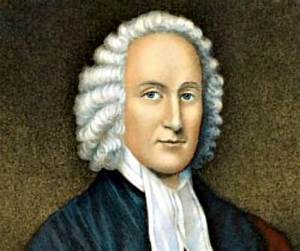
Jonathan Edwards is often pronounced the leading figure of the Great Awakening, and rightly so. Edwards spent much time defending Calvinism from Arminianism and releasing many works over the course of his adult life, but his most influential work in the realm of the Great Awakening was his sermons. The origin of his persuasive mastery of preaching and sermons comes into question: how did Edwards learn so effectively to capture and persuade a congregation to the point of the congregation being “extraordinarily melted … almost the whole assembly being in tears for a great part of the time” (Galli and Olsen)? What was it about this man that, even though “He scarcely gestured, or even moved; and he made no attempt, by the elegance of his style, or the beauty of his pictures, to gratify the taste, and fascinate the imagination,” he still managed to convey “eloquence … with overwhelming weight of argument, and with such intenseness of feeling … so that the solemn attention of the whole audience is riveted, from the beginning to the close” (Edwards, Rogers, and Dwight 232)? This paper shall attend to those things that made the sermons of Jonathan Edwards so great: 1) his rhetorical approach and 2) his use of tactile and truly sensational preaching.

Jonathan Edwards was born with a natural tendency for theology. He was enrolled at Yale shortly before turning 13 and eventually graduated as valedictorian. During his years at university, Edwards underwent a formative conversion experience that, in many ways, shaped the method by which he would approach the Bible and theology for the rest of his life. This conversion, and the theological revelations that followed, was the epiphany that sparked within Edwards the flame that would engulf British America and Protestant England in the years to follow.

After graduation, he apprenticed under his grandfather for two years and met his wife. Finally, Edwards became the sole pastor of the Northampton parish of Massachusetts church in 1729, succeeding his late grandfather Solomon Stoddard. He remained there until 1750, when his congregation severed ties with him over a dispute centered around the church’s policy on communion and regenerate/unregenerate members. It was during this intermediate period Edwards produced his most influential sermons that shaped the Great Awakening in America and England alike.

Mastery of the Sermon

Edwards was a very formal preacher, but he was far from conventional. Clint Heacock wrote of Edwards’s style, “During the course of his thirty-plus years of preaching, Edwards fully exploited the potential of the Puritan preaching form while never substantially departing from its tradition” (17). Edwards was not only a preacher but also an apologist and a rigorous intellectual. He had the “unique ability to reshape ideas inherited from abroad in light of the needs and interests of the American situation” (18). Even though Edwards held strictly to formal method and doctrine, he still managed to innovate and create some of the most influential and emotionally-engaging sermons in American history. His rhetorical mastery can be traced to two main sources: the Puritan preaching of his father and grandfather, and the rhetorical style of 16th-century philosopher Petrus Ramus.

Familial Influences

Young Edwards grew up listening to the sermons of his father and grandfather, both exemplifying what a preacher should do and be to Jonathan throughout his childhood. Timothy Edwards, his father, commonly used the basic “tripartite formula” in his sermons. This method utilized “Text, Doctrine, and Applications” as separate sections of the sermon, each divided internally with an enumerated structure. “These sermons demonstrate that Timothy Edwards made use of the more complex seventeenth-century Puritan preaching mode of multiple doctrines and many subheads” (Heacock 20), but at times he also employed the simplified 18th century method of a simple tripartite form, which consisted of a scriptural text, a doctrinal teaching, and a single application of the doctrine. These made up many of the sermons Jonathan Edwards experienced throughout his formative childhood years.

Later, Edwards became the associate pastor under his grandfather from 1726 to 1729 in Northampton, Connecticut. During this time, the tripartite Puritan method was further reinforced by Edwards’s grandfather. Like Timothy Edwards, Solomon Stoddard also used the more simplified 18th-century format but lowered the complexity of the doctrinal subheadings for the sake of a more basic approach. “… Stoddard discovered hidden rhetorical resources in the ‘plain style’ by insisting upon the evaluation of rhetoric in psychological terms that were more comprehensive and subtle than either the old logic or the new Reason” (21). Stoddard also exemplified the importance of the “rhetoric of terror” for young Edwards by example: “As a preparationist who held that God underwent a distinct process for preparing sinners for conversion, Stoddard believed the psychology of ‘fear was an important emotion for awakening the conscience of the slumbering sinner’” (21). This was further enforced to Edwards by the inculcation of the imagery of a sermon being used as an arrow used to pierce the heart of a sinner. During and after his time as associate pastor at Northampton, Edwards’s sermons acquired a more damning tone than his work previous to his associate pastorship, which until then had focused on the “pleasantness of religion” and the “beauty of God” (21). This influence becomes even more clear in sermons such as Edwards’s infamous “Sinners in the Hands of an Angry God.”

Philosophical Influences

Second on the list of Edwards’s formative rhetorical influences is the philosopher Petrus Ramus. It is important to note Ramus, who never attempted to discuss theological issues, dealt solely with the attempted reform of the contemporary arts curriculum of his time (Sellberg). Before Ramus, philosophers such as Cicero thought of rhetoric as a unified but multi-layered progression: invention, arrangement, style, delivery, and memory. Ramus decided this system had become obsolete after fading into vagueness and repetition. He decided to split the former quintuple-layered system into two segments, assigning style and delivery to the sphere of rhetoric, and invention and disposition to the sphere of logic; the fifth tenet of memory was discarded in favor of this new system. “Ramus’ comprehensive new development of logic and rhetoric gained lasting favour among Calvinist scholars and preachers alike and his humanism formed the philosophic backbone of much of Calvinist theology by the late sixteenth century” (Heacock 25-26).

In this system, the preacher’s first goal was to establish doctrinal propositions, followed by the secondary obligation to “rouse emotions and raise the affections.” “The Puritan plain sermon would ideally impress the hearers’ minds first with its logic, while also arousing their hearts to action by secondly appealing to rhetoric” (26). Through this method, Ramean thought was established as the first and foremost influence on Puritan preaching in the 16th and 17th centuries, preliminary to the Great Awakening. Because of the prevalence of Ramean thought in the academic sphere during the 18th century, Edwards likely experienced Ramus’s philosophy during his time at Yale. This placement in his formative educational years proved to be highly influential later in his work.

The typical Puritan sermon style Edwards inherited therefore focused on the presentation of a logical doctrine before the use of emotional rhetoric. This method in its purest form contrasted in some ways with Edwards’s personal beliefs about how religious affections directly motivate behavior. Edwards had argued in Freedom of the Will a truly free moral agent is free from persuasion and rationality: “This notion of liberty and moral agency frustrates every attempt to draw men to virtue by instruction — i.e. by persuasion, precept, or example” (Edwards 88). Because of this, only “appealing to the rationality of the sinner would surely be ineffective; one’s will or heart had to be moved first in order for the intellect to comprehend and respond” (Heacock 27).

Edwards’s Use of Metaphor and Tactile Imagery

Edwards’s use of the bodily senses in sermons as sensationally involving as his “Sinners in the Hands of an Angry God” is one of the most notable traits in his preaching and one of the causes for the emotional outpouring that occurred in Enfield, Connecticut in 1741. Stephen Williams, an eyewitness, wrote, “before the sermon was done there was a great moaning and crying went out through ye whole House…. ‘What shall I do to be saved,’ ‘Oh, I am going to Hell,’ ‘Oh, what shall I do for Christ,’ and so forth.” Edwards had to cease his preaching until the congregation stilled, after which the power of God was exhibited through the following conversions and “cheerfulness and pleasantness of their countenances” (Farley).

The mastery he displays in this sermon is notable because it embodies the skill with which Edwards approached every theological task during his life. The “hellfire and brimstone” stereotype of Edwards’s “Sinners in the Hands” does not act as a microcosm for Edwards’s focus in his subject matter, but the sermon does demonstrate the rhetorical and sensational skill he utilizes in his work as a general rule. As an example, this is an excerpt from “Sinners in the Hands of an Angry God”:

That the Reason why they are not fallen already, and don’t fall now, is only that God’s appointed Time is not come. For it is said, that when that due Time, or appointed Time comes, their Foot shall slide. Then they shall be left to fall as they are inclined by their own Weight. God won’t hold them up in these slippery Places any longer, but will let them go; and then, at that very Instant, they shall fall into Destruction; as he that stands in such slippery declining Ground on the Edge of a Pit that he can’t stand alone, when he is let go he immediately falls and is lost (4).

Edwin Cady summarizes the way in which Edwards appeals to the senses in the most basic but effective way possible: “The freshest imagery … communicates Edwards’s sense of the eerie suspension of the sinner upon almost nothing and intensifies it by adding a nightmarish feeling of his fatal weight” (69). Further, Edwards used complex metaphors to make a mental connection between God’s wrath and his own Enfield congregation.

The wrath of God is like great waters that are dammed for the present; they increase more and more, and rise higher and higher, till an outlet is given; and the longer the stream is stopped, the more rapid and mighty is its course, when once it is let loose … the waters are constantly rising, and waxing more and more mighty; and there is nothing but the mere pleasure of God, that holds the waters back, that … press hard to go forward. If God should only withdraw his hand from the flood-gate, it would immediately fly open, and the fiery floods of the fierceness and wrath of God, would rush forth with inconceivable fury… (Cady 66).

Cady mentions New Englanders were familiar with the water-powered mills that powered their communities, as well as the exciting dangers of floods and other water-based weather. Edwards takes the ideas in the heads of those in his congregation, raises the intensity, and brings his imagery to life within them. “Picture, idea, and emotion existed together in the minds of speaker and listeners; the work of artistic communication had been done” (66). Every metaphor and every image utilized by Edwards is done in a way that can be identified with and understood by his congregation. This form of powerful communication proved to be one of Edwards’s most essential tactics in his nurturing of the Great Awakening.

Assessment of Findings

It appears Edwards’s extensive training in the philosophical and theological realms at Yale did not merely result in an “intelligent student,” but one of the most prominent religious thinkers in American history. The methodology behind the Puritan sermon method and the theological grasp necessary to truly exploit such a system are far more complex than any summary on the “harshly judgmental nature” of “Sinners in the Hands of an Angry God” would indicate. All the sermons of Jonathan Edwards, not just “Sinners,” demonstrate his complete grasp of both the Puritan sermon method and Christian theology. Edwards was truly a master of the sermon and responsible as an agent of God’s sovereignty for the spark that would eventually engulf both British America and England as the Great Awakening.


References

Ahlstrom, S. A Religious History of the American People, New Haven and London, Yale University Press. 1972.

Cady, E. “The Artistry of Jonathan Edwards.” The New England Quarterly, 22 (1), 61-72. 1949.

Edwards, J. Freedom of the Will. 1754.

—. Religious Affections. London: Andrew Melrose. 1898.

—. (1797). “Sinners in the Hands of an Angry God. A Sermon Preached at Enfield, July 8th, 1741.” 1797.

Edwards, J., H. Rogers, S. Dwight. The Works of Jonathan Edwards, A.M. London: William Ball. 1834.

Farley, W. P. “Jonathan Edwards and the Great Awakening.” Enrichment Journal. 2002.

Galli, M., & T. Olsen. 131 Christians Everyone Should Know. Nashville, TN: Broadman & Holman. 2000.

Heacock, C. “Rhetorical Influences upon the Preaching of Jonathan Edwards.” Homiletic (Online)36 (2). 2001.

Sellberg, E. “Petrus Ramus.” E. N. Zalta, ed. The Stanford Encyclopedia of Philosophy Summer 2016 Edition.

Steele, T. J., & E. R. Delay. “Vertigo in History: The Threatening Tactility of ‘Sinners in the Hands.’” Early American Literature18 (3), 242-256. 1983.

Zakai, A. “The Conversion of Jonathan Edwards.” The Journal of Presbyterian History (Philadelphia, PA: 1997)76 (2), 127-138. 1998.

He is Real and He is Risen

Destiny Phillips Coats

Faith is an important part of everyday life whether one is an atheist, Buddhist, or Christian. All worldviews and religions are based on a premise or ideal. For that worldview or religion to hold true, humans want to see evidence; however, everything humans believe cannot be scientifically proven with evidence all the time. Nevertheless, we should always try to uncover the truths we can to be closer to the reason why we are here. As a Christian, this is extremely important. With the current vehement attack on religion by secularists around the world, Christians are constantly being questioned if their “Jesus” is real more and more often. It is vital believers of any religion can properly defend themselves against false truths and claims made against them by others. One aspect of Christianity all believers must defend is the case and point of Jesus Christ. The points brought up in the following paragraphs will prove the resolution of the Christian faith Jesus of Nazareth (called Christ) was executed by order of the Roman Governor (Pontius Pilate), was buried, then was resurrected and appeared in bodily form to His followers. There will be six points of proof confirming this resolution. The proofs are as follows: prove the authentication of the New Testament by including the date it was written and if the authors wrote from close experience about the events in which they wrote, prove Jesus was a real man who walked upon the earth, prove Jesus made the claim to be the promised Messiah, prove Jesus was crucified by Pontius Pilate for the crime of blasphemy brought on Him by the Jews, prove Jesus died by means of crucifixion, and prove Jesus resurrected. Not only believing these proofs but knowing it for oneself to be true can work wonders in his daily walk, the way he evangelizes, and again his personal relationship with Christ. For some, just to believe something is not enough. This essay presents reasoning and evidence why one should believe in the existence, death, and resurrection of Jesus Christ, our Lord and Savior.

To affirm this resolution, I would like to first prove the authentication of the New Testament.  In doing this, one would need to know the date the New Testament was written and if the authors wrote from close experience about the events in which they wrote. Jesus’ birth marks A.D. 0 on history’s timeline, so all His actions on the Earth would have been done in the first century; therefore, the New Testament would be the most accurate if also written in the first century. Good thing for Christians, it was. Per the book New Evidence That Demands a Verdict, the New Testament was written in “A.D. 50-100” (McDowell 38). It reads

John Ryland’s manuscript, found in A.D. 130, is located in the John Ryland’s Library of Manchester, England (oldest extant fragment of the New Testament). Because of its early date and location (Egypt), some distance from the traditional place of composition (Asia Minor), this portion of the Gospel of John tends to confirm the traditional date of the composition of the Gospel about the end of the 1st century (38).

All manuscripts we have today of ancient writings or documents are copies of copies; therefore, trying to disprove the validity of the New Testament with the argument it is not the original text is disqualified (Hamilton). In comparison to most ancient writings, the New Testament is easily considered the best attested in terms of the number of copies and the variety of documents available to sustain or contradict it (McDowell, New Evidence 38). For example, Homer’s Iliad was composed in 800 B.C., but the earliest copy found was in 400 B.C. and there are only 643 copies. That is a 400-year gap! The New Testament was composed between the years A.D. 50-100 and fragments were found in A.D. 114. Books were found in A.D. 200, most of the New Testament was discovered in A.D. 250, and finally the complete New Testament was revealed in A.D. 325. On top of that glorious information, there are 5,366 copies (38)! Knowing this, there is no reason why someone cannot believe or at least consider the authenticity of the New Testament. Also, there is proof the authors of the New Testament wrote from close encounters with the main character, Jesus. “The writers of the New Testament wrote as eyewitnesses or from firsthand information” (51). An example of this is Luke 1:1-3:

Inasmuch as many have undertaken to set in order a narrative of those things which have been fulfilled among us, just as those who from the beginning were eyewitnesses and ministers of the word delivered them to us, it seemed good to me also, having had perfect understanding of all things from the very first, to write to you and orderly account, most excellent Theophilus (51).

McDowell quotes F. F. Bruce, who said,

The earliest preachers of the gospel knew the value of…first-hand testimony, and appealed to it time and time again. “We are witnesses of these things,” was their constant and confident assertion. And it can have been by no means so easy as some writers seem to think to invent words and deeds of Jesus in those early years, when so many of His disciples were about, who could remember what had and had not happened.

And it was not only eyewitnesses that the early preachers had to reckon with; there were others less well disposed who were also conversant with the main facts of the ministry and death of Jesus. The disciples could not afford to risk inaccuracies (not to speak of willful manipulation of the facts), which could at once be exposed by those who would be only too glad to do so. On the contrary, on the strong points in the original apostolic preaching is the confident appeal to the knowledge of the hearers; they not only said, “We are witnesses of these things,” but also, “As you yourselves also know” (Acts 2:22). Had there been any tendency to depart from the facts in any material respect, the possible presence of hostile witnesses in the audience would have served as a further corrective (51-52).

Next, I will uncover evidence for why one should accept the facts Jesus of Nazareth truly walked upon the Earth. This argument tends to be easy to prove because so many secular sources outside of the Bible reference the man who Christians call Christ (Hamilton). The excerpt known as the “Testimonium of Josephus,” which comes out of book 18 of Josephus’ Jewish Antiquities is enough to prove this point. Josephus was a Jewish scholar captured by the Romans during the first Jewish revolt against Rome. He was made mediator and interpreter for the Romans during the remainder of the revolt. Two of his writings are The Jewish War and Jewish Antiquities. A portion of the “Testimonium of Josephus” reads, “Now there was about this time Jesus, a wise man, if it be lawful to call him a man, for he was a doer of wonderful works, a teacher of such men as receive the truth with pleasure. He drew over to him both many of the Jews, and many of the Gentiles. He was the Christ…” (McDowell, New Evidence 125). Other writers such as Cornelius Tacitus, Suetonius, and Thallus mention this man, Christ, in their writings. Tacitus, a Roman historian who lived from A.D. 55-120, wrote during the reign of Nero concerning Christ. “…the persons commonly called Christians, who were hated for their enormities. Christus, the founder of the name, was put to death by Pontius Pilate, procurator of Judea in the reign of Tiberius: but the pernicious superstition, repressed for a time, broke out again, not only through Judea, where the mischief originated, but through the city of Rome also” (120-121). Tacitus’ misspelling of Christ, “Christus,” was a common error made by pagan writers of the time (120).

The claim was made by Jesus that He was the promised Messiah. Claiming to be the Son of God or Messiah was considered blasphemy in the Jewish religious system and punishable by death, hence why Jesus was ultimately crucified. Jesus often referred back to the Old Testament prophecies about Himself when hinting to his followers about who He was. Luke 24: 27 reads, “And beginning with Moses and all the Prophets, he interpreted to them in all the Scriptures the things concerning himself.” Also, Luke 24:44 declares, “Then he said to them, ‘These are my words that I spoke to you while I was still with you, that everything written about me in the Law of Moses and the Prophets and the Psalms must be fulfilled’” (McDowell, Carpenter 97). McDowell says, “the Old Testament contains sixty major messianic prophecies and approximately 270 ramifications that were fulfilled in one person, Jesus Christ. It is helpful to look at all these predictions fulfilled in Christ as his ‘address.’ Let me explain. You have probably never realized the importance of your own name and address, yet these details set you apart from more than six billion other people who also inhabit this planet” (98). “Certainly God was writing an address in history that only his Messiah could fulfill. Approximately forty men have claimed to be the Jewish Messiah. But only one, Jesus Christ, appealed to fulfilled prophecy to substantiate his claims, and only his credentials back up those claims” (99).

Jesus was crucified by Pontius Pilate for the crime of blasphemy brought on Him by the Jews. The two main groups of Jewish leaders at the time were the Pharisees and Sadducees. On views concerning the Messiah, these two groups were not on the same page but came together when they had a common problem, Jesus Christ. They also had different purposes when it came to governing their Jews (Hamilton). The Pharisees believed the reason the Jews were under oppression by the Romans was because God would not send the promised Messiah until they were worthy enough.  In accomplishing their worthiness, the Pharisees used violent methods for the Jews to strive for purity amongst other people. Therefore, there was such hatred and strife between the Jews and Gentiles throughout history and the Bible. When Jesus came on the scene, He began to break down these barriers the Pharisees had set between the Jews and other people groups. Jesus ministered and dwelt amongst tax collectors, prostitutes, and criminals. In the eyes of the Pharisees, this was completely absurd and totally broke down all boundaries they had worked so hard to set between “God’s people” and others (Hamilton). The Sadducees, on the other hand, were more concerned with staying in good graces with their oppressors at the time, the Romans. The Romans did not care or were not concerned with who the Jews worshipped unless it conflicted with political rule. The promised Messiah did exactly that. The Messiah for the Jews was the one who the Jews believed was going to come and set them free from their oppressors. This in turn threatened the political rule of the Romans and threatened the well-being of the Jews under their rule. During Passover, Jesus rode into Jerusalem on a donkey as the Jews surrounded him and called Him “Messiah,” “Hosanna,” the “Christ.” These names carried meaning far more than we credit them with today, which is why the authorities felt threatened. This caused the Pharisees and Sadducees to come together to take down a common enemy (Hamilton). Book 18 of Josephus’ Jewish Antiquities reads, “He was the Christ, and when Pilate, at the suggestion of the principal men among us, had condemned him to the cross, those that loved him at the first did not forsake him; for he appeared to them alive again the third day; as the divine prophets had foretold these and named from him are not extinct at this day” (Hamilton).

With Josephus being a Jew himself, when he writes “us,” he is referencing other Jews (Hamilton). Cornelius Tacitus, a Roman historian who lived from A.D. 55-120, wrote during the reign of Nero concerning Christ,

But not all the relief that could come from man, not all the bounties that the prince could bestow, nor all the atonements which could be presented to the gods, availed to relieve Nero from the infamy of being believed to have ordered the conflagration, the fire of Rome. Hence to suppress the rumor, he falsely charged with the guilt, and punished with the most exquisite tortures, the persons commonly called Christians, who were hated for their enormities. Christus, the founder of the name, was put to death by Pontius Pilate, procurator of Judea in the reign of Tiberius: but the pernicious superstition, repressed for a time, broke out again, not only through Judea, where the mischief originated, but through the city of Rome also .

McDowell, New Evidence 120-121

Also, inspired by another Roman Historian Suetonius, McDowell writes, “Assuming Jesus was crucified in the early thirties, Suetonius, no friend of Christianity, places Christians in the imperial city less than twenty years later, and he reports that they were suffering and dying for their conviction that Jesus Christ had really lived, died, and risen from the dead” (122).

Proving the death of Christ is not something debated upon because of the gruesome medical analysis of a Roman crucifixion. The crucifixion process consisted of a flogging or scourging and then the nailing to the cross. Flogging or scourging was done while one was stripped of clothes. The person would be beaten with a leather whip that had pieces of broken bones and iron balls on the end of the whip before being hung on the cross. The victim subjected to the cross would be flogged within inches of his life. The Jews would only allow forty strikes from the whip to the victim. This confirms the account from the Gospels Jesus obtained thirty-nine strikes during his flogging. At this point in the process, the victim could easily die from blood loss or shock from the pain. In the case of Jesus, He did not. After this, the victim had to carry his cross to the venue where he would be hung. Once he reached the chosen spot, he was nailed to the cross near the top of his wrists and feet. The most common cause of death was suffocation. This was because the body weight of the victim was being pulled down by gravity making it hard to breathe. To exhale, the victim would have to push up from his feet, which caused excruciating pain. Eventually, the victim would give up and die. If it took too long for the person to die, the Roman guard would break the knees of the victim so he would suffocate faster (Gidley). This was not done with Jesus because He was already dead after six hours of being on the cross.  But to confirm His death, they pierced Him in the side of His abdomen with a spear. The Babylonian Talmud reads,

It has been taught: On the eye of Passover they hanged Yeshu. And an announcer went out, in front of him, for forty days (saying): “He is going to be stoned, because he practiced sorcery and enticed and led Israel astray. Anyone who knows anything in his favor, let him come and plead in his behalf.” But, not having found anything in his favor, they hanged him on the eye of Passover (King).

Another version of this says, “Yeshu of Nazarene.” “Yeshu” is Greek for “Jesus” and “Nazarene” makes further connection to Jesus Christ. Also the “hanged” is a reference to crucifixion. Luke 23:39 reads, “One of the criminals who were hanged railed at him, saying, ‘Are you not the Christ? Save yourself and us!’” (McDowell, New Evidence 123-124).

The final part to prove of the resolution concerning Jesus’ resurrection is the most difficult to prove, but nonetheless, it has been done. First off, a whole religion took off from this man Jesus who claimed to be the Messiah. The thing that made Jesus significantly different from all the other claimed Messiahs was His resurrection. The other twelve “Messiah Movements” before and after Him dissipated after their deaths, but Jesus’ movement took off because of His incredible death and resurrection. To discredit the resurrection, one would have to come up with an explanation for why the tomb came up empty. The tomb was empty because Christianity would not have been validated if the body had been in the tomb for people to see the disciples were lying; therefore, this “Jesus” would have been just another fake. The Talmud proclaims the disciples stole the body, but that can be easily disproved. When people die for faith, this means they genuinely believe what they believe is absolute truth. For the disciples to steal the body knowing Jesus was not resurrected but all end up dying for his sake would be idiotic (Hamilton). The appearances are also confirmation of how we know Jesus was raised from the dead. Jesus appears to the disciples, James (his step brother), the apostle Paul, and 500 witnesses (1 Corinthians 15:3-7). People try to disprove the appearances by saying they made it up or they had hallucinations (Hamilton). First of all, hallucinations are sourced from previous events or thoughts. If none of these people ever thought or considered a resurrection or a picture of the way his new body looked, how then could they give such vivid accounts and descriptions of how he looked? Also there is no way so many people who were not associated with each other could have had the same hallucination. Then there is the whole theory they made it up. This can be disproved with the fact Paul, who saw Jesus, was actually an enemy of Christians previous to his so-called “hallucination.” He persecuted them on a regular basis. But after his encounter with Christ, he became one of the greatest people of the faith and wrote the majority of the New Testament (Hamilton). As stated above, in the “Testimonium of Josephus” Josephus wrote, “For he appeared to them alive again the third day; as the divine prophets had foretold these and ten thousand other wonderful things concerning him” (McDowell, New Evidence 125).

As a Christian, writing this essay has not only increased my faith in what I believe to be true but also has given me the ability to witness to nonbelievers with a better knowledge of what it is I am striving to convince them. The evidence provided above is clear and adequately affirms the resolution Jesus of Nazareth (called Christ) was executed by order of the Roman Governor (Pontius Pilate), was buried, then was resurrected and appeared in bodily form to His followers.

Believers with questions of any faith should always desire or seek out truth for what they believe. If one is to travel upon this journey and comes out on the other end less convinced, he must consider his faith. Thankfully in my case, I gained a deeper understanding and love for the great attention God put into helping people who desire to know Christianity is valid.


Works Cited

Gidley, Robert. The Facts of Crucifixion. The Cross Reading. n.d. Web. 11 Dec. 2013.

Hamilton, Seraphim. Summit Christian Academy, Yorktown. 9, 11 Dec. 2013. Lecture.

King, Kevin. The Hanging of Yeshu. Rabbinic Literature. n.d. Web. 22 Jan. 2014.

McDowell, Josh. The New Evidence That Demands a Verdict. Nashville: Thomas Nelson, 1999. Print.

—. More Than a Carpenter. Carol Stream: Tyndale House, 1977. Print.

Review of Is Genesis History?

Seraphim Hamilton

The following review was published on Seraphim’s Web site Apologia Pro Ortho Doxa in late February 2017.

I went last night to see the special showing of the new creationist documentary Is Genesis History? The film represents a major improvement upon previous creationist documentaries because those interviewed represent intellectual honesty, creativity, and the best in modern creationism. Kurt Wise, Arthur Chadwick, and Todd Wood are all prominently featured. This makes the film an excellent introduction for those interested in the state of creationist scientific argument today. But even referring to this as a scientific “argument” somewhat misstates the nature of this work, because it is not principally about apologetics. Instead, it represents the classical Christian view of scholarship: faith seeking understanding. Beginning from a position of trust in the God who gave the Scriptures, these scientists seek to understand Earth history simply because of the joy of understanding the creation of the Almighty.

We are introduced to Steve Austin and Andrew Snelling’s fascinating work on the sedimentary record, showing that there are certain features of that record which imply rapid deposition on a worldwide scale. For example, major sedimentary layers in the Americas have counterparts not only across the American continent, but across all continents. This is very significant: instead of arguing, as older creationists unsuccessfully did, that the geologic column is simply a fiction, these scientists point to the very existence of a worldwide pattern in deposition as evidence that the deposition must substantially be the product of a worldwide catastrophe. Indeed, the fact that there is a geologic column is powerful evidence of a flood. Moreover, between sedimentary layers are “unconformities,” thought to represent hundreds of millions of years of “missing time” where there was no sedimentary deposition. Yet, the surfaces of the sedimentary rocks are relatively flat, which is difficult to account for if there were millions of years of weathering and erosion.

Dr. Kurt Wise, arguably the founder of the modern creationist movement, takes a look at fossils, suggesting that the order of fossils in the record are the result of a succession of ecological zones in the antediluvian world. The suggestion that a flood would deposit fossils in mixed heaps simply misunderstands how sedimentation works: floods bury animals basically in place. They don’t float around in the water for an extensive period of time before being buried from fossils from other areas. Since the original creation was created with zones in place, the antediluvian world had an intelligently organized ecosystem with different zones, instead of the modern ecological system, which represents the contingent events of post-flood dispersion and intrabaraminic diversification.

Dr. Todd Wood looks at the creationist view of the kind, or baramin, suggesting that the creationist “kind” is roughly on the level of the biological family, and that after the flood, there was rapid and significant diversification. He extends this to humankind, noting that statistical baraminology, which was developed before it was applied to humans and generally identifies the baramin along the lines of the family, generates a real distinction between humans and other apes, confirming a key creationist prediction. I wish the editors of the film included more material dealing with Wood’s arguments, because it is essential to note that the mechanism of diversification in the creationist model is not Darwinian, but epigenetic. God intentionally frontloaded information into all baramins giving them an intrinsic potential for diversity.

Finally, the film looks to the history of the Tower of Babel, interviewing Douglas Petrovich. It is here that I disagree with the arguments set forth. Dr. Petrovich is a defender of the conventional chronology of the ancient world, which is irreconcilable with the biblical chronology. His archaeological setting of Babel at Eridu cannot be sustained within a creationist framework, because the archaeological context is post-Stone Age. On the creationist model, Stone Age remains postdate the dispersion from Babel. The life of Abraham (archaeologically the late Chalcolithic) occurs merely centuries after the end of the Stone Age, and the traces of Stone Age culture in Genesis are significant — note the use of caves by Abraham and Lot’s home in a cave. These were used by early settlers after Babel until populations were sufficiently large to construct advanced cities — which is misinterpreted by modern anthropologists as the invention of agriculture and civilization. This means that the remains of Babel must predate the so-called Paleolithic, and will likely be conventionally dated anywhere from 200,000 B.C. to 1,000,000 B.C. depending on one’s view of Neanderthals and other hominids. These are undoubtedly human, but I think they represent small dispersions from Babel before the main dispersion. During the time when the majority of the human family lived together in the Near East, I suggest that they homogenized into H. Sapiens, as other families who had left beforehand, during the period of major intrabaraminic diversification, became H. Neanderthalensis, H. Erectus, H. Naledi, H. Floresiensis, and probably A. Sediba. Hence why these fossils generally predate the arrival of Sapiens. Local legends of a small, talking, clothed (speech and clothing are the biblical criteria for humanity) people on the island of Flores suggests that H. Floresiensis may have survived until about 200 years ago.

Anyway, this is to say that Petrovich simply cannot be correct.

Overall, I would highly recommend this film for an accurate, though somewhat dry, presentation of the state of creationist science today — but I would strongly recommend pursuing the writings of these scientists to gain a more comprehensive look.

Jesus, the Perfect Leadership Example

Tim Seaton

Jesus is our perfect leader we can rely on whenever we need Him. He came to the earth and died for us, then rose again just to save us. That was His mission and reason for being on the earth.  He was God’s son and He wants us to come to Heaven and believe in Him. He wants us to lead a life as close to what He lived as we can, even though nobody other than He ever was or will be perfect. He is the perfect example of a good leader because of what He accomplished and what He did while He was here on earth.

Leadership is when you are in a position to set the example for others or the ability to lead others. Leaders should have a selfless heart that is willing to put their needs after the needs of the people they are leading. Jordan French of BNB Shield said, “Leadership is serving the people that work for you by giving them the tools they need to succeed. Your workers should be looking forward to the customer and not backwards, over their shoulders, at you. It also means genuine praise for what goes well and leading by taking responsibility early and immediately if things go bad.” He is talking about the world’s version of a good leader, and he has some good points.  However, to find the very best example of a leader, we should look to Jesus as our example.  We have the opportunity to be able to influence people in a good way and show them the love and kindness of Jesus Christ He showed us before He was on earth, while He was on earth, and still today.

A good leader always has a mission or purpose in mind and is focused on accomplishing it.  Jesus is a great example of this. He was absolutely focused on His one mission: to save the world and nothing else. He exhibited many excellent leadership qualities during His time on earth.

One characteristic of excellent leadership is being humble. A good leader is never overly confident in his abilities. He encourages others to keep going when there are tough times, and he never boasts when he does better than everyone else. He doesn’t build himself up and tear others down to make him look better or to raise himself to glory. Instead, he lower himself to enable him to help others and show them the grace of God. Jesus demonstrates grace and humility by coming to the earth and dying for us in our place. Leaders, like Jesus, don’t build themselves in false ways. Instead, they do it through actions they perform and words they say.

Another leadership characteristic is being authoritative. When you assert power over others, it doesn’t have to be a dictatorship. It can be a time like Jesus’ where He ruled His followers not by fear, but by respect for Him and His teachings. One time, He turned money tables over that were in the temple because it was wrong to have them in there. Multiple times, He drove the demons out of people with His authority over the heavens and the earth. He demonstrated authority by doing these and many more things that showed his authority over humans and Satan.  Like Jesus, great leaders act with an understanding that they have authority.

Another example of Jesus being a leader is how He showed great self-restraint even when it was incredibly difficult because of His needs and desires. When He went into the wilderness, He was able to resist Satan by telling him scripture and not falling into the temptations any other man probably would have fallen into. While on the earth, He faced countless more tough things, yet He faced them all in perfection. While we might not be perfect like Jesus, our goal should be to try to show this same kind of self-restraint. Jesus was definitely a good leader. He taught others the ways they should live through His example. Demonstrating  the right thing to do is a characteristic of leadership. He showed self-restraint when He was tempted to do the wrong thing, choosing what was right. Showing this restraint is leadership because it is showing one can be trusted to make the right decisions when needed.

A fourth quality is His ability to connect with His followers and build strong relationships. He did this by talking to His disciples away from everybody else, and then talking to everyone else in sermons. He built relationships by interacting with anybody who wanted to hear the gospel and then explaining the gospel to them. Communicating with the people under you is a big part of being an effective leader people respect. Some great examples of connecting and with people is Jesus’ miracles. Some Jesus performed were feeding the 5,000 on the mountain, raising Lazarus from the dead, making the crippled walk again and the blind see. He told the disciples to fish off the other side of the boat where they had been fishing all day, and they caught more than their boats could hold. He healed people by just touching them. He calmed raging storms in the middle of the sea. But maybe the biggest miracle of all was raising Himself from the dead after three days. When He was about to leave the earth, He gave the disciples instructions for when He ascended to heaven, on which they followed through because He was their leader and friend and they respected Him. It shows how much of an impact Jesus really had on people throughout His time on earth, even though He was an enemy of the Romans. When the people saw He actually cared for him, he was immediately looked at and seen as a leader because of His relationship with them. He was able to influence people to follow him and to be more Christ-like by interacting and communicating with His followers.

Another characteristic of being a leader is serving others in whatever ways you can. As a leader, you cannot expect to be able to sit there and have them do all the work for you. Leaders should lead by example, not by telling people what to do. When you serve others, you are letting them know they are important to the cause they are helping. Jesus dedicated His entire life to being a servant to His followers. One passage that ties into being a leader and serving others is Luke 22:24-27: “A dispute also arose among them as to which of them was considered to be greatest. Jesus said to them, ‘The kings of the Gentiles lord it over them; and those who exercise authority over them call themselves benefactors. But you are not to be like that. Instead, the greatest among you should be like the youngest, and the one who rules like the one who serves. For who is greater, the one who is at the table or the one who serves? Is it not the one who is at the table? But I am among you as one who serves.’” Jesus lived out this truth. When you are a servant, you have the opportunity to see how a leader really can affect you. If you then rise to a leadership position, then you are able to use what you saw when you were a servant to being a leader.

Another characteristic of strong leaders is the ability to create teams and figure out how people work together. Jesus gathered the disciples as His followers. They left everything behind and became His faithful followers. People listened to Him and believed in Him in part due to His dedicated followers. He understood each disciple had strengths and weaknesses and was able to work with them anyway. As a leader, you need to be able to communicate well with people who are under you as well as those who are above you. If you don’t then your groups could be unbalanced and unhelpful to each other, and therefore, result in  an ineffective team. Jesus was great at this.  He chose good people who were willing to leave behind their lives and follow Him because of His ability to pull them together.  As a leader today, this same skill of being able to put together a good team is still of utmost importance.

Another important characteristic of an outstanding leader is the ability to share what you believe in and inspire others to believe in the same thing. When you can speak with clarity to other people you are leading, then they are going to trust you more and relate to you. He showed and inspired His disciples to follow His message. If you aren’t able to communicate and inspire, then people may not be willing to follow your lead.

A final characteristic of a leader Jesus demonstrated so perfectly is being able to realize a higher authority and recognizing who it is. Jesus prayed daily to God, even though in heaven they are equal. He did this out of respect to God. He also prayed to God on the cross when He was about to die asking God to spare Him, but He knew He had to go through with it if He was going to save humans. As a leader today, we need to be able to realize we have a higher authority in teachers, parents, and especially in God. If we recognize that, then we can finally realize we aren’t the ruler of the world, even when we think our ideas are better than what others have. In honoring a higher authority, we are saying we understand the value of leadership, authority, humility, and demonstrate we are willing to listen to others.

Following Jesus’ leadership skills can apply to us today even though many good leaders were around before we were alive. Jesus was alive 2,000 years ago, yet he still influences people today in a positive way. This supports the fact He was a good leader. If He could do this, then shouldn’t we strive to do the same? Jesus still has great influence in our world and would be considered a leader still, 2,000 years after He walked on the earth. This proves just how effective He was as a leader.

In conclusion, I want to make sure people are aware being a good leader, or a bad one, can affect people’s lives immensely. We have the ability to make purposeful decisions about how we will lead. If you choose to be a good one, then you will be able to know you have possibly helped lives turn for the better. Follow Jesus’ example of a good leader. When we are leading in this way, we are showing God’s love to everyone under us or above us and is learning from us how to be a good leader. We can be leaders anywhere we go at any time if we follow Jesus’ example.

Names of God

Destiny Phillips Coats

As a young believer I have been exposed to many names of God. I find myself learning new ones all the time. Very rarely, however, have I personally taken the time to study and understand the different names of God, their meaning, relevance, and know where they are in the Scriptures. In my relationship with the Lord, I am always in need of Him in different ways. God of course foresaw this need and named Himself in Scripture tons of different ways so I could see Him aiding me in all aspects of my life. I know I am not the only person who needs God to take on different roles dependent upon situations in this life. God is Comforter, Provider, Protector, Peace, Deliverer, Shepherd, Foundation, and Counselor. This paper will uncover the meaning, relevance, and references for these eight names of God applicable to all at any stage of life.

We as believers can find ourselves often calling out to God, “Lord I need you.” God in his omniscience put in Scripture His many names so we can see God fulfilling all roles we desire Him to fill in this life. Names of God also describe God’s persons as the Father, Son, and Holy Spirit. One of these many names is Comforter. The name Comforter is in direct reference to the Holy Spirit. The Holy Spirit was sent to indwell within believers after the ascension of Jesus once His mission was complete. “But the Comforter, [which is] the Holy Ghost, whom the Father will send in my name, he shall teach you all things, and bring all things to your remembrance, whatsoever I have said unto you” (John 14:26). In this Scripture, Jesus is speaking to His disciples concerning the Holy Spirit, the Comforter, who will be sent from the Father to aid them in remembering Christ’s teachings. Earlier in this chapter, Jesus is expressing to the disciples He will leave to prepare a place for them in Heaven. The disciples are disheartened by this and ask Jesus how they will know the way to Heaven without Him. He responds to them with John 14:26. Jesus is explaining to them they will not be left alone and to their own sinful nature because God the Father will send them the great Comforter to guide them and indwell among them in this life. This aspect of God is encouraging in those times when we feel like we have been left to our own devices. Thanks to the Holy Spirit within each of us, we are reminded by His presence and Scriptures like these that we are not alone. We are being comforted by the almighty God within us, the Holy Spirit, our Comforter.

“Look at the birds of the air, that they do not sow, nor reap nor gather into barns, and yet your heavenly Father feeds them. Are you not worth much more than they?” (Matthew 6:26). God the Father is a Provider. Every Christian can pinpoint a time in their life when they worried because they thought they would lack in something. Whether it be money, food, clothes, or knowledge there will be tons of times in our lives when we will think, “I do not have the tools to do this.” Coming to the realization sometimes we cannot always provide everything we need leaves us feeling anxious and worried about what will happen because of our lack. Thanks to the Scriptures, we can read Matthew 6:26 and many other passages and be reminded the same God who created everything with a purpose and feeds the birds every day, will also take care and provide for us. A bird is not a joint heir with Christ, yet the Father provides for it. This is an encouraging reminder no matter how big or small our needs are, the Father will always be our Provider.

When a person accepts Christ into their heart and becomes a Christian, she becomes in that moment a child of God and a coheir with Christ.

But when the fullness of time had come, God sent forth his Son, born of woman, born under the law, to redeem those who were under the law, so that we might receive adoption as sons. And because you are sons, God has sent the Spirit of his Son into our hearts, crying, “Abba! Father!” So you are no longer a slave, but a son, and if a son, then an heir through God.

Galatians 4:4-7

In an ideal family construct one of the father’s duties is to protect his children. This obligation on our natural father is adopted from our heavenly Father. Another role God the Father takes on is that of a Protector. In Ephesians 6:10-20 one can find listed the whole armor of God. This armor’s purpose, laid out in the chapter, is 1) to “be able to stand against the schemes of the devil” (Ephesians 6:11b) and 2) to “be able to withstand in the evil day, and having done all, to stand firm” (Ephesians 6:13b). God knows being a Christian in this world is not easy. He knows what it takes to defeat the enemy. He foresaw the difficulties we would face and the battles we would fight. God did not leave us to our own defenses; instead, as a Father who loves His children, He equipped us with tools to protect ourselves. God gave us a belt, breastplate, shoes, shield, helmet, and sword. He is our Father, our Protector.

In Judges 6:17 we find Gideon asking the Lord for a sign He indeed is speaking with God. Once it is confirmed to him he is speaking with the Lord, Gideon proclaims God to be “Jehovah Shalom,” which translates to “God is Peace.”

Then Gideon perceived that he was the angel of the Lord. And Gideon said, “Alas, O Lord God! For now I have seen the angel of the Lord face to face.” But the Lord said to him, “Peace be to you. Do not fear; you shall not die.” Then Gideon built an altar there to the Lord and called it, The Lord Is Peace. To this day it still stands at Ophrah, which belongs to the Abiezrites.

Judges 6:22-24

In the verses prior to those quoted above, Gideon is full of fear. The Lord in fact appears to Gideon while he is hiding from the Midianites. The Lord approaches Gideon calling him a “man of valor” (Judges 6:12). The Israelites during this time were being oppressed by the Midianites. A lot of God’s people were living in fear. When people are afraid, they often worry and are anxious. When we worry, it is hard to find rest. After the Lord appeared to Gideon, he built an altar and named it “Jehovah Shalom.” He proclaimed the Peace of God over an altar because he experienced peace in God’s presence during a time of trouble. God speaks all throughout Scripture of the peace we can find in Him. This is an example of God the Father being our Peace, but what about the Son? “Come to me, all who labor and are heavy laden, and I will give you rest. Take my yoke upon you, and learn from me, for I am gentle and lowly in heart, and you will find rest for your souls. For my yoke is easy, and my burden is light” (Matthew 11:28-30). Here Jesus is calling those who are worried, burdened, and anxious telling them they can find rest or peace in Him. God’s role as our Peace is found in both the Son and the Father.

Throughout the entirety of the Old Testament, readers see how God repeatedly delivered the Israelites from the hands of their oppressors. God delivered the Israelites out of Egypt. God gave the Israelites Judges to lead them in battle and delivered them from the hands of many other people groups. God sent His son, Jesus, to deliver all of mankind out of bondage from sin. In Psalm 18, David is proclaiming the glory of God by expressing Him as his deliverer. “I love you, O Lord, my strength. The Lord is my rock and my fortress and my deliverer, my God, my rock, in whom I take refuge, my shield, and the horn of my salvation, my stronghold. I call upon the Lord, who is worthy to be praised, and I am saved from my enemies” (Psalm 18:1-3). The Israelites saw God as their deliverer time and time again, yet they fell away from Him. They grumbled and complained when they felt He had forsaken them when in reality, they had forsaken Him. Despite their unfaithfulness, God in His mercy delivered them out of the hands of their enemies. God is the same God yesterday, today, and forever. He is and forever will be our Deliverer.

“Shepherd,” as defined by Dictionary.com, is “a person who herds, tends, and guards sheep; a person who protects, guides, or watches over a person or group of people.” Scripture proclaims God the Father and Son to be shepherds to believers. Psalm 95:7 proclaims God the Father to be our Shepherd who guides us. “For he is our God and we are the people of his pasture, and the sheep of his hand.” The study of God as a shepherd is not uncommon amongst believers. I personally have attended many Sunday school lessons learning about what a shepherd is and how God is the Great Shepherd. The love of God for all is expressed in the parable of the Lost Sheep taught by Jesus.

See that you do not despise one of these little ones. For I tell you that in heaven their angels always see the face of my Father who is in heaven. … What do you think? If a man has a hundred sheep, and one of them has gone astray, does he not leave the ninety-nine on the mountains and go in search of the one that went astray? And if he finds it, truly, I say to you, he rejoices over it more than over the ninety-nine that never went astray. So it is not the will of my Father who is in heaven that one of these little ones should perish.

Matthew 18:10, 12-14

This parable tells us God cares for all His sheep/believers. There are millions of Christians all around the world. God’s love for all is equal. He notices when one of us is left behind or falls astray. God does not only think of the majority when guiding us through life. God considers each and every one of His children at all times. God sees us get lost. God sees us fall back. God notices us each individually and He is searching for us, calling us back to Him. He loves us enough to go out of His way to bring us back to Him and under His protection. He is our Shepherd.

“Jesus, you’re my firm foundation. I know I can secure. Jesus, you’re my firm foundation. I put my hope in your Holy Word.” Many of us recognize these lyrics to “Firm Foundation” written by Don Moen. This song is rejoicing in Jesus’ role as our Foundation. Jesus tells a parable about a man who builds his home on sand and another who builds on a rock.

Everyone then who hears these words of mine and does them will be like a wise man who built his house on the rock. And the rain fell, and the floods came, and the winds blew and beat on that house, but it did not fall, because it had been founded on the rock. And everyone who hears these words of mine and does not do them will be like a foolish man who built his house on the sand. And the rain fell, and the floods came, and the winds blew and beat against that house, and it fell, and great was the fall of it.

Matthew 7:24-27

Jesus is telling us here those who build their lives upon His teachings will be wise, but those who do not are foolish. Jesus’ words are recorded in Scripture. Scripture is special revelation given to man from God. These teachings are to be the foundation of which we are to build our lives. Jesus is the center of our faith. Satan throws arrows at us. Trials and tribulation will come upon each and every one of us. No matter what comes our way, if our lives are built upon the teachings found in Scripture, we will not fall or be shaken. Jesus is our firm Foundation.

“For to us a child is born, to us a son is given; and the government shall be upon his shoulder, and his name shall be called Wonderful Counselor, Mighty God, Everlasting Father, Prince of Peace” (Isaiah 9:6). Here, Isaiah is prophesying about Christ. Isaiah calls Jesus a Wonderful Counselor, the last name of God to be discussed in this paper. During this period, the Israelites were being taken into captivity by the Assyrians. Isaiah was speaking of the character of the coming Messiah who would free God’s people from the chains of sin. The word “wonderful” here is to describe Jesus as awe encompassing. The meaning of the word has definitely been watered down since this time but the conclusion can still be drawn the Christ is indeed wonderful. The Messiah was going to be the everlasting King of Israel. A king is to be a counselor. In this time the king was the highest form of leadership. A “counselor,” defined by Dictionary.com, is “an advisor.” A counselor’s job is to give advice or impart wisdom among those who need it. Isaiah is proclaiming Christ to be an awe encompassing king who will provide great wisdom. Scripture is our guide to life on Earth. Within Scripture is wise counsel from the Lord through His role as the Father and Son. Scripture is our form of God’s “wonderful” counsel we are to reference for every situation life presents us with. If we seek God’s counsel in this life, we will be amazed at the richness of God’s wisdom that will be displayed in our lives. Jesus is our Wonderful Counselor.

Just like there is Scripture we can go to for every situation in life, there are also names of God that show us the ways He can fulfill all our needs. God the Father loved us so much He desires for all of us to be with Him at all times. If one believer goes astray, He will do all that is necessary to bring us back to Him. By shepherding us, God protects us from harm, delivers us from the pain of sin, and provides all of our needs. God gave us Scripture with His teachings upon which we are to build our lives. If we are founded in His teachings, we will uncover the wise counsel of the Lord that will give us peace when Satan tries to combat us with life’s trials. But no matter what we face, God sent the Holy Spirit to be with us, to comfort us every day until we join Him in all of His glory.

Same-Sex Eroticism in Romans 1:26-27: The Christian Homosexuality Debate

Caitlin Montgomery Hubler

It is true contemporary debates over homosexuality in many Christian denominations focus less on arguments over specific Biblical passages and more on an overall Scriptural narrative, church tradition, or the value of experience in determining normative ethical judgments. Nonetheless, it remains true debate in some circles over the applicability of certain Pauline texts continues as a central aspect in the discussion over the ethicality of homosexuality. It is an issue that has and continues to divide Christian denominations, churches, and families. Especially for Protestant traditions that pride themselves on Scriptural authority, a thorough exegesis of Biblical passages referring to same-sex eroticism is central to determining the scope of Paul’s claims.

Although multiple passages of interest exist on the topic, in this paper I will limit my comments to Romans 1:18-32. This is arguably the most cited passage of contemporary Christians who claim it to be a clear condemnation of homosexual acts that extends to the present day. See the passage below:

For this reason God gave them up to degrading passions. Their women exchanged natural intercourse for unnatural, and in the same way also the men, giving up natural intercourse with women, were consumed with passion for one another. Men committed shameless acts with men and received in their own persons the due penalty for their error (Romans 1:26-27, NRSV).

I have bolded the word “unnatural” because this Greek phrase “παρὰ  φύσιν” is key for the claim I wish to make in this paper. In contrast to those who would cite Romans 1:26-27 as a condemnation of homosexuality writ large applicable in contemporary Christianity, I will argue it is hermeneutically irresponsible to cite Paul as opposing homosexuality because he opposes same-sex eroticism on different grounds than do contemporary Christians (who cite the passage as a proof text of their own views) who oppose homosexuality. My goals are modest: I do not argue Paul would have been accepting, or even neutral, on the issue of homosexuality. What I will argue is simply to cite the verse as a proof text against homosexuality conceals the complex nature of Paul’s opposition to same-sex eroticism, which depends on elements of Jewish mythological narratives and Greco-Roman culture that many who cite the verses in this way would reject. In order to substantiate this claim, I will evaluate two different exegeses of the phrase “παρὰ  φύσιν” advanced by biblical scholars Dr. John Boswell and Dr. Richard Hays.

Boswell believes Paul’s talk of “nature” in Romans 1 is in reference to the specific, individual “natures” or “characters” of the Gentiles in question and the passage thus refers to heterosexuals engaged in same-sex eroticism as opposed to constitutional homosexuals. Hays counters this by arguing Paul links the Gentile idolatry and same-sex eroticism in such a way as to suggest both are rejections of God’s universal created order as represented in Genesis. Ultimately, I will agree with a third scholar, Dr. Dale Martin, who somewhat side-steps the exegetical question and takes up a hermeneutical one: stating Paul’s opposition to same-sex eroticism stems from entirely different considerations than modern-day Christian opposition to homosexuality. This is important for any hermeneutic of Romans 1 because of the ideological solidarity many Christians assume to have with Paul.

Some preliminary comments about the literary context of the passage in question are now in order. In order to understand how various scholars interpret Paul’s passage in Romans 1, a brief overview of the letter’s main themes and purpose for being written will be useful.

The Apostle Paul had not yet traveled to Rome at the time of his writing the Epistle to the Romans in 56-56 C.E. However, his growing influence in the Greco-Roman Christian world and reputation for counseling churches through ethnic and religious tensions lent him the authority to write this theological treatise to the Christians in Rome. Romans is the work of a developed theological mind, apparently written in response to tensions between Christian Jews and Christian Gentiles in Rome who were confused about how the coming of Jesus affected their relationship to the Mosaic law. Paul counsels the Romans that while the law had its purpose (namely, to reveal the universal human need for grace), the coming of Christ was a major turning point in salvific history. Now, salvation ought not to be understood as a result of meticulous keeping of the law, but as a free gift which comes through belief in Jesus Christ, the Messiah.

Naturally, since Paul had not yet been introduced to the Roman Christians, he had to first find some way of establishing common ground with them. After the formulaic epistolary greeting, Paul runs a clever argument in Romans 1-3 that begins with a condemnation of the Gentile pagans in Rome. Importantly, he apparently thought this condemnation of the pagans to be something that would establish good rapport with both Christian Jews and Christian Gentiles in Rome. Only later does he turn the tables and suggest the Roman Christians perhaps were not so holy themselves — what with all their stubborn insistence on strict adherence to the Mosaic Law and internal ethnic divisions. The purpose of Romans 1 is for Paul to use characteristically Pauline rhetorical strategies to liken his attitudes to those of the Romans, later using this to his advantage pastorally.

Dr. John Boswell argues in his book Christianity, Social Tolerance, and Homosexualityπαρὰ  φύσιν” ought to be understood in the context of how Paul uses the phrase throughout his other letters. Whereas we in 21st-century America tend to think of the natural/unnatural distinction in a way highly influenced by John Locke’s talk of “natural law,” in which “naturalness” and “goodness” are synonymous, Boswell indicates Paul did not have the same framework for these ideas (Boswell). One must be careful not to impose anachronistic categorizations on Paul, for whom “natural” was always to be understood as being possessed by someone or something — something individual (Boswell). Jews are Jews “by nature,” Gentiles are Gentiles “by nature” — but this sort of nature is one of personal character and not moral significance. Never did Paul discuss nature in the universal, abstract sense assumed in the modern West because of Lockean moral philosophy (Boswell).

For clues as to what meaning this term did hold for him, we might look to Romans 11:24, in which God is said to be acting “against nature” in His act of grafting the Gentiles into the olive tree (representing salvation). In this passage, “unnatural” certainly has the connotation of artificiality, in that Gentiles had not always shared the same position as Jews within God’s salvific plan. However, there is no suggestion this grafting, though unnatural, is morally degenerate. Far from it — it is presented as a loving act of God. Boswell summarizes the issue nicely: “‘Nature’ is not a moral force for Paul: men may be evil or good ‘by nature,’ depending on their own disposition” (Boswell).

Literary context is also important for Boswell in determining what Paul might have meant by the phrase “παρὰ  φύσιν.” Interestingly, the same-sex eroticism Paul discusses in verses 26 and 27 is linked to a general, hyperbolic sense of idolatry in verses 18-25. In fact, same-sex eroticism is described as a punishment for this idolatry as opposed to its cause. Paul describes how the Gentiles had the opportunity to recognize the one true God, since “ever since the creation of the world, his eternal power and divine nature … have been understood and seen throughout the things he has made” (Romans 1:20). Instead, they rejected monotheism and “exchanged the glory of the immortal God for images resembling a mortal human being or birds or four-footed animals or reptiles” (Romans 1:23). Boswell likens this as Paul stating the Gentiles’ rejection of their “true nature” in the same way later in the chapter he discusses the Gentiles who rejected their “true nature” as heterosexuals to engage in same-sex eroticism (Boswell).

The principle implication of this distinction is Paul was condemning heterosexuals engaging in same-sex eroticism, and thus made no comment whatsoever on truly homosexual persons. While some have criticized this view to impose anachronistic categories of orientation that would have been foreign to Paul, I do not think this is necessary for the success of Boswell’s argument (Hays 201). I argue not that Paul necessarily delineated between heterosexuality and homosexuality as orientations (for that depends, in part, of the popularity of myths like those of Aristophanes about the origins of same-sex desire, which is difficult to determine historically) (Hubbard 2). Rather, I contend his comments stem from a worldview that had very different ideas about same-sex eroticism than most people today: worldviews so different, in fact, that applying Paul’s comments about same-sex eroticism to modern notions of homosexuality as a biologically natural orientation is more closely eisegesis than exegesis.

However, Dr. Richard Hays looks doubtfully upon Boswell’s exegesis of “παρὰ  φύσιν,” claiming he dangerously confuses exegesis with hermeneutics. He believes Paul’s comments in Romans 1 are a clear condemnation of not only same-sex eroticism, but homosexuality writ large, and any suggestion otherwise is a wistful rejection of the “plain sense” of the text (Hays 196). The thrust of Hays’s argument is his insistence Paul’s condemnation of the pagan Gentiles’ same-sex eroticism is linked to their idolatry in such a way as to associate both with a rejection of God’s natural (morally right) created order. Whereas Boswell believes Paul could have just as easily chosen any other sin with which to rebuke the pagans, Hays maintains the mention of same-sex eroticism is key to Paul’s overall argument. As he states, “The passage is not merely a polemical denunciation of selected pagan vices, it is a diagnosis of the human condition” (Hays 200).

Hays believes in order to define “παρὰ  φύσιν,” one must be cognizant of the common trope of natural vs. unnatural in Greco-Roman moral philosophy. Indeed, although Paul certainly did not understand “natural law” in a strictly Lockean sense, it can be argued the conceptions he would have had from Greco-Roman moral philosophy are not as dissociated from morality as Boswell claims. Stoicism in particular provides a thorough framework for considering the “natural” (κατά φύσιν) vs. “unnatural” (παρὰ  φύσιν) distinction, in which “right moral action is closely identified with action κατά φύσιν” (Hays 192). While there were no equivalent words in Greek for “heterosexual” and “homosexual,” these phrases function with the same meaning. This is evidenced throughout the many Stoic texts cited by Hays that use the category to discuss the morally degenerate “unnatural” phenomenon of same-sex eroticism: most notably, Dio Chrysostom and Plutarch (Hays 192).

These same categories were adopted by Hellenistic Jewish philosophers, with whom Paul would likely have been even more familiar. Not only did they often associate actions “κατά φύσιν” and “παρὰ  φύσιν” with good and evil moral categories, but they did so on the basis of an appeal to Mosaic law. Both Josephus and Philo, Paul’s contemporaries, used “παρὰ  φύσιν” in this exact way (Hays 193). Thus, Hays would strongly contest Boswell’s assertion Paul refers to “nature” in a personalized, specific way to refer to the individual nature of the being in question. Instead, he would assert Paul is playing on categories of “natural” and “unnatural” present and recognized by his contemporaries as clear references to God’s original created order.

The language of “exchange” used in Romans 1:23, 25-26, therefore, carries great rhetorical power for Hays. It is what cements the link between same-sex eroticism and idolatry as both results of a rejection of God’s created order. Just as the pagan Gentiles “exchanged the truth of God for a lie,” also did their women “exchange natural intercourse for unnatural” (Romans 1:25-26). The idea is idolatry is a form of rejecting the order of creation — and this rejection of God as creator is the first major misstep that causes perversions in other areas of the created order as well. Thus, Hays believes Paul’s presumption must have been opposite-sex eroticism is the natural design for humankind.

A third scholar, Dr. Dale Martin, sees several problems with linking Paul’s discussion of idolatry and same-sex eroticism in such a way. Martin accuses Hays of lumping together idolatry and Adam’s fall through “Augustinian lenses,” which would equate the two, whereas Paul would not necessarily have done so (Martin 54). There is no evidence Paul considered Adam’s fall to be an act of idolatry in the same way as the idolatrous acts of the pagans are described in Romans 1 (Martin 52). In fact, Hays argues “Paul presupposes a Jewish mythological narrative about the origins of idolatry,” which would preclude it from occurring simultaneously with the fall (Martin 53). Here Martin cites various rabbinic sources attributing the origins of polytheism/idolatry to “Kenan, Enosh (son of Seth), or the people of Enosh’s generation” — well after the Fall (Martin 53).

Moreover, Martin sees Paul’s diatribe in Romans 1 as possessing another key element of these Jewish mythological narratives: namely, Jewish “decline of civilization” narratives that function in Greek, Roman, and Jewish circles as a means of explaining how Israel is “set apart” from the excessive immorality of the Gentiles (Martin 53). These stories trace Gentile immorality to some point in history at which they became polytheistic, rejecting the one true God and consequently venturing into sexual immorality and general moral corruption. Perhaps the most famous example of this in Judaism is in 1 Enoch, wherein the Genesis 6 account of the fall of the Watchers is expanded to account for Gentile immorality (Martin 53).

This is an attempt to refute Hays’s idea that in connecting idolatry and same-sex eroticism, Paul is implicitly claiming both are rejections of the created order resulting from Adam’s fall. Paul is operating within a different mythological narrative than the fall of man: the “decline of civilization” narrative regarding the origins of idolatry. Where Hays wants to conflate the two, Martin indicates their differences have important implications for any hermeneutic of Romans 1.

Additionally, when Paul makes allusions to the original created order elsewhere, such as later in Romans 5:12 when he speaks of the fall of Adam, he uses language from Genesis: “the fall,” “Adam,” “Eve,” and talking about general humanity as opposed to a specific group of people (Martin 52). Given this language is absent from Romans 1, and Paul would have likely seen idolatry as having origins separate from Adam’s fall, Martin believes nothing in Romans 1 is a gesture toward the created order. He thus believes interpretations of “παρὰ  φύσιν” like Hays’s hijack Paul’s conclusions while dismissing the premises of his arguments.

I find Martin’s arguments persuasive and believe they arise from an attitude toward Biblical hermeneutics that should be forwarded. The principle of examining the premises Paul uses for his argument and not merely taking his conclusions for granted is a noble one in Biblical scholarship. A responsible definition of Biblical authority ought to be one that honestly wrestles with the extent to which contextual and historical considerations come into play when taking moral judgments from ancient authors as authoritative. Far from a devaluation of Biblical authority, what this does is allow the Bible to be evaluated on its own terms. Only then can it be put into conversation with other forms of Christian revelation, namely, nature and experience.

Take for example another instance in Paul’s letters in which he makes a similar appeal to nature, 1 Corinthians 11:13-15: “Judge for yourselves: is it proper for a woman to pray to God with her head unveiled? Does not nature itself teach you that if a man wears long hair, it is degrading to him, but if a woman has long hair, it is her glory? For her hair is given to her for a covering” (1 Corinthians 11:13-15, NRSV).

Most contemporary Christians would reject Paul’s conclusions in this passage (a woman ought to either veil herself or cut off her hair, as per verse 6) because he begins with premises with which they would disagree. The sort of “nature” Paul discusses here may in fact be what he believes is the abstract, universal order of creation set by God in Genesis — but it is historically conditioned by strong views of male-female hierarchy in the ancient Greco-Roman world. Martin identifies within this hierarchy the “implicit devaluation of the feminine,” also a relevant factor when examining ancient attitudes toward same-sex eroticism (Martin 58).

In order to determine why Paul and his contemporaries might have seen same-sex eroticism as self-evidently “unnatural,” it is necessary to examine what role sexual orientation played in the opinions of the populace toward it. It is certain there were myths, like that of Aristophanes, which purported to explain homosexuality alongside heterosexuality as both naturally occurring phenomena. However, this was likely not the predominant view, and indeed, more influential philosophers rejected it (Loader 2). What can be constructed as historically probable is the attitude same-sex eroticism did not arise out of any biologically “natural” orientation, but was instead an extreme expression of heterosexual lust and/or gluttony. It is inordinate desire rather than disoriented desire (Boswell). Dio Chrysostom puts it this way:

The man whose appetite is insatiate in such things, when he finds there is no scarcity, no resistance, in this field, will have contempt for the easy conquest and scorn for a woman’s love, as a thing too readily given — in fact, too utterly feminine — and will turn his assault against the male quarters, eager to befoul the youth who will very soon be magistrates and judges and generals, believing that in them he will find a kind of pleasure difficult and hard to procure (Dio Chrysostom 7:151-52).

The naturalization of gendered hierarchy plays an unmistakable role in the attitudes of the ancients toward same-sex eroticism. For example, Plato agrees same-sex eroticism is “contrary to nature”: but on the grounds a man ought not be mounted “like cattle” (Moralia 751d). A similar justification is used in reference to exegesis of 1 Corinthians 6:9, in which the word “μαλακός,” literally meaning “soft.” is used in a derogatory way to refer to the submissive partner in same-sex male intercourse (Martin 44). In other words, it was the very parts of ancient Greco-Roman culture with which the modern world might most vehemently disagree that were the basis for common attitudes toward the ethicality of same-sex eroticism.

If a disruption of gendered hierarchy is also for Paul what makes same-sex eroticism unnatural, then any Christian who uses Romans 1 as a proof text against homosexuality must also adopt the ancient Greco-Roman ideas of gendered hierarchy in order to fully take Paul’s word as authoritative. In the same way a Christian might reject Paul’s instruction for women to be veiled on the basis of disagreeing with the principle that “nature itself” teaches it, so might a Christian reject Paul’s condemnation of same-sex eroticism on the basis he simply had no concept of homosexuality as a biologically natural orientation. The question also demands to be asked of what relevance is contemporary biological information that suggests homosexuality does contain a natural as well as an environmental component (Mondimore). If Paul operates under a biological paradigm no longer considered accurate, the effect this has on his ethical judgments which are based on such a paradigm is a serious question faced by those seeking to define Biblical authority in a responsible way.

If one is to be a responsible reader and interpreter of the Biblical text, one cannot evaluate Paul’s conclusions apart from the premises he uses to make his arguments. Because his opposition to same-sex eroticism is based on ancient Greco-Roman ideals of gendered hierarchy and an etiology of homosexuality with which modern biology would disagree, it is hermeneutically irresponsible to cite Paul as opposing homosexuality as distinct from merely same-sex eroticism. This is particularly the case if one believes, as Boswell and Martin both claim, “παρὰ  φύσιν” is Paul’s way of referring not to the created order in Genesis, but to the specific pagan Gentiles in question. Importantly, qualifying Paul’s comments in this way does not necessarily constitute a rejection of the authority of Paul: it is simply to recognize the limits of that authority. One might affirm he made authoritative conclusions based on the available information he had at the time while also affirming new information might alter our interpretation and/or application of his comments today.

Paul’s comments regarding same-sex eroticism in Romans 1 demand a response from contemporary Christian communities with a high view of Scripture. Just as they cannot be directly transplanted from the ancient Greco-Roman world that had no concept of a homosexual orientation, there are also problems with tossing them lightly aside as products of the past with no relevance to today. The work done by Biblical scholars balancing exegesis with hermeneutics is valid and necessary for this passage in particular. Debates over the ethicality of homosexuality will continue to rage within denominations and churches, but perhaps responsible Biblical scholarship can serve as a guiding light.

Works Cited

Boswell, John. “The Scriptures.” Christianity, Social Tolerance, and Homosexuality: Gay People in Western Europe from the Beginning of the Christian Era to the Fourteenth Century. Chicago and London: U of Chicago, 1980. Print.

Dio. Dio Chrysostom. Cambridge, MA: Harvard U, 1993. Print.

DeYoung, Kevin. What Does the Bible Really Teach about Homosexuality? Wheaton, IL: Crossway, 2015.

The Harper Collins Study Bible: New Revised Standard Version. General Editor: Harold W. Attridge. San Francisco, CA: HarperCollins Publisheres, 1989.

Hays, Richard B. “Relations natural and unnatural: a response to J Boswell’s exegesis of Rom 1.” Journal of Religious Ethics 14.1 (19860101): 184-.

Hubbard, Thomas K. Homosexuality In Greece and Rome : a Sourcebook of Basic Documents. Berkeley: University of California Press, 2003.

Loader, William. “Same-Sex Relationships: A 1st-Century Perspective.” Hervormde Teologiese Studies 70.1 (2014): 1-9. Academic Search Complete. Web. 30 Oct. 2015.

Martin, Dale B. Sex and the Single Savior: Gender and Sexuality In Biblical Interpretation. Louisville, Ky.:  Westminster John Knox Press, 2006.

Mondimore, Francis Mark. A Natural History of Homosexuality. Baltimore: Johns Hopkins University Press, 1996.

Plutarch, and Grēgorios N. Vernardakēs. Moralia. Lipsiae: B. G. Teubner, 1888.