Category Archives: Seasons & Holidays

White Christmas

Nicole Moore Sanborn

This year, I experienced my first white Christmas.  You may be thinking “Uh…where was she about eight years ago when we had all that snow and a white Christmas??”  I was in Georgia in about 70-degree weather visiting my grandparents and preparing for my leg surgery on the 27th in South Carolina.  Most of you know about this surgery, so I will not take time to explain.  If you’re interested in hearing the story, feel free to ask me about it later; I’m very open to talking about it.  Also, if you’re wondering where I was two years ago when it snowed Christmas Eve and the 26th, I do not count that, because it didn’t snow Christmas Day.

This year, it wasn’t about the gifts for me.  My family and I traveled to Washington state (it takes three flights to get there and nearly an entire day of travel) to visit my mom’s sister and mother, who we rarely see.  My mom’s brother and his family came up from Nevada to join the fun.  Older readers, remember the retreat story from a few years ago when Dan Hardesty told the spider cave story, and a guy named Keith was involved?  Yeah, that was my uncle.  True story.  I got to see my cousins (mom’s sister’s kids) that are near me in age for the first time in about two and a half years.  One of the guys is 21 or 22 (I’m not sure), the girl is 19, and the other guy just turned 16.  They’re just about the most awesome cousins I could ever ask for.  Well, the 22 year-old can be mean, but that comes with the territory.  Bond, the 19-year-old (yes, her name is Bond, like James Bond, just to clarify), and I enjoyed the time together, catching up and discussing how college is going.  Bond is a freshman at Baylor University this year.  Britt, the 16-year-old (yes, my cousins have interesting names), is very nice.  He and I had many good talks about life and learning from mistakes.  Through our time together, we discovered he and I are a lot alike in struggles we either have gone through or are currently struggling with.  He attempted to teach me how to play Brawl on the Wii, but I’m still very horrible at playing video games.  Now, on to stories about my visit.

The first day, I interned at my aunt’s office.  She is the CEO of an international Market Research and Innovation firm, called New Edge, the Brewery.  While there, I listened in on part of a conference call with Pepsi.  I was shown recent work the company had done with Coors Molson (yes, the beer company) and Milliken (a textile company now developing wound care products).  I learned many things while at her office, and it confirmed my career aspirations.  I want to go into Business Marketing, focusing on the innovation and research side of things.

I was taught how to play Settlers of Catan, a strategy game some of you might be familiar with.  It is very competitive and quite fun.  I won one of the games, which was surprising since I was not familiar with the game until my visit (since it is a strategy game).  Admittedly, my family helped me, so I did not win entirely using my own strategy.  We also played card games.  Aunt Pam, Bond, and I successfully completed nearly all of the Christmas shopping December 23-24.  The stores were crazy, but the three of us were surprisingly good at making quick stops at a variety of stores.  A couple of days before Christmas, it snowed.  I was thrilled, because this presented the possibility of experiencing my first white Christmas.  Christmas morning, not all of the snow had melted.  I decided to call it my first white Christmas, even if it did not officially snow that day.  However, as the morning progressed, it began snowing.  Bond, Britt, and I made a giant snowman, approximately 10-12 feet tall, and named him “Big Bob.”  He was the biggest snowman I have ever made.  Pictures are on Facebook.  Unfortunately, my family and I flew back to Virginia the 26th, so our visit was cut very short.  My aunt and uncle invited me to return over the summer and intern at my aunt’s office, as well as spend time with my cousins.

One of the best parts of Christmas was seeing all of my family.  My younger cousins, a guy who is 12 and two girls ages nine and eight, were also with us.  I was able to see my grandmother while in Washington, which was very nice.  She is 83 now, and since I do not get the opportunity to see her in person often, I cherish the moments I am able to spend with her.  My grandfather passed away when I was about two, so I never knew him.  Flying home was bittersweet, but more adventures were to come.

We arrived home the 26th at nighttime.  The 27th was spent doing laundry, working, and preparing for our next trip.  The morning of the 28th, my dad and I began another adventure.  We drove down to the area of Charleston, SC to visit my dad’s sister.  My cousin is 24, and she was on a different vacation, so I did not get to see her.  My aunt, uncle, dad, and I went on many adventures.  We arrived around dinnertime on the 28th.  The 29th, my dad, aunt, and I went to the USS Yorktown.  For those unfamiliar, the Yorktown is an aircraft carrier used in World War II and is now open to the public.  No other aircraft carrier in the country is open for the public to tour.  We explored the ship, and I concluded I would not want to live on a ship like that for any period of time.  While the ship is large, the bedrooms are like barracks, the restrooms are public, and the whole time you live on the ship you are confined without portholes.  Inside the ship was much information about the history of the USS Yorktown, as well as information about how the sailors lived.  At the site of the Yorktown, the USS Clamagore, a World War II submarine, and the USS Laffey, a much smaller World War II vessel, were also open for touring.  The submarine was tiny.  My dad and I had to bend down to get through all of the passageways, and living spaces were extremely cramped.  Approximately 30-40 men would live on one submarine for extended periods of time.  This forced good crew relations, as they lived right on top of each other.  The Laffey was slightly more spacious than the Clamagore, however it would still not be fun to live on during a war.

The same day, we traveled to Ft. Sumter, where the Civil War began.  Presently, the fort is basically just walls with nothing but cannons inside, but we saw pictures of what it looked like at the start of the war.  Being on the fort was a neat experience, since it was where the Civil War started, and because we studied the Civil War in detail in history class.

We also visited the Hunley, the first submarine to sink an enemy battleship.  The Hunley was a part of the Civil War.  Unfortunately, all three crews that embarked in the submarine died.  The submarine was tiny, and in order to get into it, the crew had to have a 20-inch waist to fit through the entrance hole.  In order to make the ship move, the crew had to sit on a bench and turn a crank continuously. It was a very early model of the submarine.  The Hunley was submerged in restoration water.

We also attended a local minor league ice hockey game.  The Stingrays, the local team, won 3-0.

Walking the downtown area and seeing the Charleston museum was on our list as well.  The downtown area was beautiful, especially walking the “Rainbow Row.”  The old painted houses were beautiful, and I recommend walking downtown if you’re ever in the greater Charleston area.

We also toured a plantation. Middleton Place was very beautiful.  The gardens are very well kept, and many plants were in bloom even though it was the end of December.  The plantation demonstrated what times were like before the Civil War.  During the war, Middleton Plantation was burned to the ground.  The Plantation almost survived the war, as it was burned in the last few months of fighting.  One of the three buildings was rebuilt by the family and is now a museum featuring furniture similar to that of the Middleton’s, family portraits, and memorabilia.  Middleton Place kept horses, water buffalo, sheep, chickens, goats, and hogs.  It was, unfortunately, a slave-owning plantation.

After visiting South Carolina, my dad and I traveled to North Georgia, near Atlanta, to visit his parents for a day.  The visit was short, as we needed to return home.  My grandpa is currently fighting an illness, and we wanted to visit him.  My grandparents were planning to stay at my aunt and uncle’s house the same time as us but were unable when my grandpa became ill.  He is receiving treatment as this article is written.  His illness is not fatal.  He has an auto-immune disorder.  Since he is a born-again Christian, if treatment is unsuccessful he will be in a better place.  I believe he will recover.  My dad and I began the return home less than 24 hours after we arrived, but the visit was worth the trip.

Over Thanksgiving, my parents and I stayed at Massanutten, a resort outside of Harrisonburg, Virginia, where James Madison University is located.  While staying in Massanutten, we drove a couple of hours to Luray Caverns.  The caverns are worth the visit if you have never been.  Another highlight included watching James Bond movies when we were exhausted.  My family also drove a few minutes to the hiking trails in the Shenandoah National Park.  We went on a couple of hikes and enjoyed the outdoors and scenery.  On Thanksgiving, we drove about an hour and a half to Charlottesville (where University of Virginia is located) and went out to dinner (we made a reservation earlier in the week).  One of my favorite memories of the trip happened on the way to Shenandoah National Park.  As soon as we entered the park (we were still in our vehicle), we saw a wild black bear.  The bear looked like a teenager due to his size.  He was eating and digging for food on the side of the road less than 100 yards from the park entrance!  My family and I stopped and watched him for a few minutes, and I have a video and pictures of him on my phone.  Our family vacation to Massanutten was very enjoyable and relaxing.

As a whole, my holiday experiences this year were amazing.  The time spent with my extended and immediate family was very worthwhile, and I will cherish the memories forever.  My first real White Christmas, fun with cousins, and wild bear sighting were all gifts from God, and I wouldn’t trade the memories for anything.

Christmas III: A Patrick Swayze Christmas (12/8 Time, A-flat Major)

Christopher Rush

Ten issues.  Where did the time go?  Three Christmas specials, two music series, and a partridge in a pair of trees later, we are still going strong yet willing to go out on top.  There is no tradition like a new tradition, and we were proud and glad to be a new tradition of yours for these three years.  Now we will all get to start some new traditions next year without Redeeming Pandora in our lives.  I’m not sure what those will be right now, but when the time comes, I’m sure we’ll all think of something.

Did we watch Santa Claus Conquers the Martians last year in Humanities? … Maybe.  Was I the only one still in my jim-jams Christmas morning last year? … Yes.  Did I feel bad about that? … No.

2012 has been another interesting year for us.  We got to visit Dubuque again, see the family and some old friends Neil, Dave, Weber, Nate, Jessica, and Jon.  That was comforting and enjoyable.  My niece was born, my son learned how to walk, my daughter is developing into a selfless young girl, and my wife is even closer to a Master’s degree.  Me?  Well … I finally played some wargames I’ve been carrying around for years.  Oh, and I read Othello for the first time, with the help of the Class of 2013, so that’s something.  I also finally read Giant-Size X-Men 1, if that means anything to you.  Summit saw the graduation of its largest senior class to date, all 27 of ’em … and I read every single senior thesis more than once.  That was about half of my year right there, but I was glad to do it.  More importantly, my wife and I celebrated our 10th wedding anniversary this past summer.  We went to The Melting Pot.  We went to the Outer Banks for our 5th anniversary.  At this rate, we’ll probably go to the living room for our 15th anniversary.  Let’s hope Domino’s will still have those yummy parmesan bread bites.

Last Christmas for us was probably the last of the great Christmases, at least in terms of all the family being together.  We might not have another Christmas like that for a while, but that’s okay … we had it last year.  This year promises to be good in its own way, and that’s what you have to do, really — take it one at a time.  I don’t want to sound selfish; obviously recent events have turned a lot of families’ Christmases upside down, and we know Christmas is often a rough time for many families for many reasons.  We are living in a fallen world, and Satan is regent over this world, even though Christ is risen and reigning.  We do hope you will still find some reason to be merry this Christmas.  The Light of the world is still shining.

One thing I don’t miss about Christmastime in the Midwest is driving in the snow.  Sure, we’ve had a few snow days here, and one or two of them have been legitimate, but snowfall here is nothing compared to Dubuque snowfall.  I’m all in favor of global warming, if it meant living in Dubuque without having to drive in the snow.  If global warming was a real thing that actually existed, of course.  I also don’t miss having to wetvac the basement all April long, which is another story for another time.  Of course, if we were in Dubuque, it might be possible we’d actually get to sing Christmas carols at church, so … we’ll see.

Christmas is starting to mean different things as I get older.  Obviously having children and no longer being part of the young generation are key factors in this metamorphosis.  Sleeping on December 24th is not the challenge it used to be, most likely because my bedtime is later than it was (though not as late as it was in college, for some reason — somehow, 9 o’clock went from “oh, it’s only 9? let’s start a movie” to “it’s already 9?”).  Now I’m part of the team getting the house ready for Christmas morning, moving presents and stockings and whatnot, instead of being the one imagining what the tree and couch will look like in the morning.  Exhaustion settles in much easier than it used to.  Though my lists are not any shorter than they used to be, there’s more difficulty in making them than there used to be.  That probably sounds more materialistic than I mean it to be, but it should indicate a waning sense of acquisitiveness as I get older.  Coupled with the fact our house is out of space, the desire for things just isn’t there like it used to be.

It’s interesting to look back at the old wish lists, see what moods and fancies I was in back in the day.  Not too surprisingly, my fancies go in phases (common among wargamers).  Some years I’m hankering for video games; some years, such as this year, I’m leaning more toward board and wargames.  We are still a few years away from playing a lot of family board games, but we believe in stocking up when the deals are right.  Coming from a family of gamers helps as well.  The majority of the list are the typical fare: music, MST3K box sets, graphic novels, the occasional book, a classic TV series perhaps.  Maybe a gift card or two.  Ideas, really — not things.  Experiences, ideas, opportunities for growth and improvement — these are the denizens of my wish lists.

Again, this is not to sound acquisitive.  The desire for intellectual and spiritual (and emotional) experiences are what I request for Christmas.  If that’s greedy, I suppose I’m greedy, then.  I don’t need any new things, of course, and I am the first to admit that.  I wouldn’t be disappointed if I didn’t get anything new this year.  I have plenty of unread books, unplayed games, unstudied albums, and unwatched series/movies to fill up a few lifetimes.  Toward that end, I have become more active in recent years about giving away things, especially books.  Part of the challenge of this, though, is deciding what to give to deserving others (especially alumni) and what to keep for my children.  Their interest isn’t high currently in books without pictures, but hopefully there’s time.  In the meantime, if you want anything, let me know.  I’ll see what I can do.  If you’d like to get together for some wargaming, we could definitely work on that as well.

Lord willing, my parents will be flying in for Christmas night this year, allowing most of us to gather again for Christmas dinner (though my brother will be missed).  One benefit of this is that we’ll be able to do Christmas morning two days in a row.  I, for one, plan on staying in my jim-jams for both mornings.  I will not feel bad about that.  Some traditions are worth holding on to.

It’s time to say “farewell” to our final Christmas issue of Redeeming Pandora.  Our first instinct might be to be sad to see such an entertaining and edifying part of our lives disappear, but that would be the wrong path to take.  As Theodor Giesel said, “Don’t cry because it’s over.  Smile because it happened.”  Now go keep the old traditions worth keeping.  And start a few new ones, while you’re at it.

Oh, let’s have a Patrick Swayze Christmas, one and all.

And this can be the haziest …

This can be the laziest …

This can be the Swayziest Christmas of them all!

A European Christmas

Elsa Lang Lively

Growing up in an American household, my views on Christmas and my memories associated with the holiday have stemmed from traditions such as hanging stockings, Christmas Eve services, opening presents, and family feasts.  Christmas is truly the happiest season of all, not just in America, but in many other countries as well.  Although European Christmas traditions can be quite similar to those of American ones, each country has its own traditions that make celebrating Christmas unique.  In order to find out more about how Christmas is celebrated in Europe, let’s examine the traditions of England, Norway, France, and Italy, shall we?

The first stop on our whirlwind European Christmas tour is jolly old England.  British Christmas traditions date back as far as the days of the British Druids, when they would keep holly, ivy, and mistletoe in their homes to bring peace.  The Christmas tree first became popularized in England when Prince Albert had one stand in the Royal Household in 1840.  Today, nearly every city and small town in England has its own Christmas tree standing in the city center to be admired by all its townspeople and visitors.  Since 1947, Norway has presented England with a large Christmas tree each year that stands in Trafalgar Square to commemorate Anglo-Norwegian cooperation in World War II.

The first British Christmas card was mailed in the 1840s, and the practice of wishing holiday tidings to loved ones quickly became a common practice.  Today, over a billion Christmas cards are sent across Great Britain, many of which are sent in order to aid charities.  For children, the best way to send a letter full of Christmas wishes to Father Christmas is by placing them in the back of the fireplace.  The draft then carries them up through the chimney and to the North Pole.

On Christmas Eve, many English enjoy caroling to their neighbors in groups, wishing them a happy Christmas.  Families hang their stockings over the fireplace in order to find goodies in them the next morning.  Children leave mince pies and wine out for Father Christmas, as well as a carrot for his reindeer.

On Christmas morning, presents are unwrapped and the Christmas Day feast is prepared.  A traditional British Christmas feast features a roast turkey, goose, or chicken with stuffing and roasted potatoes.  This is then followed with mince pies and Christmas pudding flaming with brandy.  “Figgy” pudding done right takes weeks to prepare, with occasional stirring by each family member (if you stir the pudding, you get to make a wish).  Some families also prepare a Christmas fruitcake made with marzipan, icing, and sugar frosting.  Many children enjoy breaking open their Christmas crackers during the feast, which are not, in fact, edible crackers at all, but brightly colored tubes that can contain riddles, toys, or other trinkets.

After the family feast, families all across England gather around the radio or television to hear the annual Queen’s Christmas Message.  Some families attend Christmas services at a local church.  The next day is known as Boxing Day, a holiday that first began in order to give deliverymen and other city employees who worked throughout the year a gift of money or food in a Christmas box.  These days, the holiday is more commonly celebrated by tipping milkmen, postmen, and other servicemen during the Christmas season.

Norwegians have their own unique Christmas traditions as well.  A Nordic Christmas is characterized by its celebration of light, as the winter months in Scandinavian countries are cold and dark, with the sun setting around three or four o’clock in the afternoon on a daily basis.  Holiday celebrations begin on December thirteenth with Santa Lucia day.  Santa Lucia, the “Queen of Lights,” was actually a Sicilian saint from the fourth century who helped persecuted Christians by guiding them through tunnels wearing a wreath with candles on her head.  She was eventually martyred for her faith and her aiding of the poor.  Historians are not exactly sure how Santa Lucia day came to be celebrated in Scandinavia, but some speculate the story of Santa Lucia was told to the Nordic peoples when missionaries from southern Europe spread the gospel to Scandinavians in order for the Scandinavians to have an idea of what true faith looked like.  Traditionally, Norwegian girls wear white robe-like dresses with a red sash and have a crown of either candles or electrical lights perched upon their heads as they deliver lussekattor, saffron buns, to those in their families and schools as well as to those in nursing homes and hospitals.

Norwegians also use mistletoe and Christmas trees like the British, a tradition that started with Norse pagans and remained alive even when Christianity spread across Scandinavia.  Christmas trees are kept simple, yet beautiful, decorated with only white lights and candles and a star on top of the tree.  During this time of year, Norwegians put candles on the graves of loved ones as well as a sign of remembrance and honor, where they are lit on Christmas Eve.

Each country has its own version of Santa Claus, and Norway is no exception.  The Norwegian version is called the Julenisse, which literally translates to “Christmas goblin or gnome.”  Although the Julenisse originally was a mischievous Christmas elf or forest gnome who watched over the farm and the animals, he has become more similar to the American Santa Claus over the years.  These days, he now possesses the ability to ride in a sleigh transported by reindeer and ask children if they’ve been good over the course of that year.  Children faithfully set out Christmas porridge on their doorsteps on Christmas Eve for the Julenisse.

On Christmas Eve, Norwegians attend a five o’clock Christmas service at church before starting a traditional Christmas feast with their families.  The feast usually consists of a roast goose or duck, pickled herring salad, and a plethora of desserts, including a julekake, a fruitcake, and a kransekaka, a marzipan tower.  The feast is then followed by the joining of hands to form a circle around the tree, where the entire family sings carols and walks around the tree while keeping formation.  Then, a knock at the door signifies the arrival of presents from the Julenisse, and gifts are opened while coffee and cakes are enjoyed.  After all the singing and unwrapping is finished, family members wish each other “God Jul!” before heading to bed.

Heading on down to France, Christmas begins with the shopping for items for the Christmas feast in the marchés de Noël.  These Christmas markets have beautifully displayed decorations for French homes as well as abundant amounts of fresh produce and seafood from various regions of France.  Because the French culture is largely centered around cuisine, the preparations for the révillion de Noël, the large Christmas feast, are essential to the French.  Depending on the region of France, this meal could include roast goose, turkey, foie gras, or oysters served with a vast array of local cheeses and good wine.  For dessert, the traditional Yule log cake, called la bûche de Noël, is served along with other treats.

Before the révillion de Noël, however, families attend midnight mass at a local church or cathedral.  No matter the size of the church, light shines throughout the building from multiple candles, representing the birth of the Light of the World.  Carols and hymns are sung, and the echoes of bells and organs can be heard throughout the city or village.  Usually young children do not attend the midnight mass but instead go to bed early after placing their shoes by the fireplace to receive candy and gifts from Père Noël the following morning.  Interestingly enough, a law was passed in 1962 stating all letters sent to Père Noël would be replied to with a postcard.  So when children send their Christmas lists to Père Noël from school, they know they will receive a response shortly.

Christmas trees, or sapins de Noël, are traditionally decorated with candy, fruit, nuts, and small toys either several days before Christmas or the night before.  Although Christianity is not as prevalent in France these days, many families still place une crèche, a manger, inside or outside of their homes to commemorate the birth of Jesus.  To many, this is their way of wishing “Joyeux Noël!” to all those passing by.

In France, holiday festivities do not end after Christmas Day or even New Year’s Day, but instead last up until the sixth of January, the day of Epiphany.  This holiday celebrates the visits of the Magi to the baby Jesus, when they presented him with their gifts.  On Epiphany, families celebrate by eating une galette des rois, a wafer king cake.  Inside the cake is une fêve, typically a small porcelain figure or a bean, which ends up in one person’s slice.  The one who finds la fêve in his or her piece of cake is declared king for a day and can choose his or her companion.

Venturing even more south, an Italian Christmas is celebrated starting in early December with La Festa di San Nicola, L’Immacolata Concezione, and La Festa di Santa Lucia.  Unlike the children of other European countries, Italian children are known to write letters of love and gratitude to their parents instead of to a Father Christmas or Santa Claus.  These letters are placed under their fathers’ plates and are read following the Christmas Eve meal.

Although some Italian families, primarily those living in the northern parts of Italy, put evergreen trees in their homes, many families’ primary decoration is a ceppo, a wooden frame shaped as a pyramid that holds a manger scene at the bottom and fruit, candy, and small gifts on the other higher shelves.  This pyramid is called a “Tree of Light” and is decorated on the sides with shiny paper and candles and topped with a star or small doll.

Italian Christmas Eve feasts differ depending on the region, although many families enjoy dishes of eels and other seafood along with a Milanese cake called panettone.  On Christmas Day, the pope gives his blessing to crowds gathering in Saint Peter’s Square.  Children enjoy going around neighborhoods singing traditional Christmas carols and wishing “Buon Natale!” to the elderly.

Interestingly enough, Italian children anxiously await an annual visit from la Befana, a kindly old witch who brings gifts to children on January sixth, the day of Epiphany.  Santa Claus does not seem to be as important in Italy.  According to legend, la Befana was asked for directions by both the Magi and the shepherds when they were on their way to visit the baby Jesus.  When they asked her to accompany them and see the baby for herself, she refused.  Later that night, she saw a great light in the heavens and wished she could have gone with them to visit Jesus.  She collected all the toys that belonged to her child who had died and tried to find Jesus in the stable.  Unfortunately, she was unable to locate the stable and was left wandering.  Each year, she brings toys to good Italian children and coal to the bad ones while roving the streets attempting to find baby Jesus.

These European Christmas traditions have truly stood the test of time, remaining a part of each country’s culture over hundreds of years.  As both Europeans and Americans alike have moved away from Christianity over the years as a whole, Christmas is a time of year that unites many people groups under the celebration of the birth of the true High King.  So wherever you are in the world, remember that Jesus is the reason for the season.  Merry Christmas!

Sources

http://french.about.com/cs/culture/a/christmas.htm

http://italian.about.com/library/weekly/aa120600f.htm

http://mylittlenorway.com/2009/12/julenisse-decorative-christmas-elves/

http://travel.usatoday.com/experts/story/2011-12-10/Rick-Steves-Christmas-in-Europe-lasts-more-than-a-day/51768578/1

http://www.ambafrance-us.org/spip.php?article557

http://www.californiamall.com/holidaytraditions/traditions-england.htm

http://www.santas.net/italianchristmas.htm

The Culinary Ride of Your Life

Audrey Livingstone

As the most wonderful time of the year comes upon us once again, I can’t help but be reminded of all of the wonderful memories I have of past Christmas holidays.  And most of those memories involve food.  I will be the first to say the most important thing to focus on during this wonderful holiday season is the birth of our Savior, but I would like to remind you Jesus Himself commands His people to feast!  Take, for instances, the feast of Tabernacles, ancient Jewish weddings (which included at least three days of eating, drinking, and dancing), Passover, and the coming Wedding Supper of the Lamb.  So many important events include feasts — why should Christmas be any different?

Now that I have established the importance of feasting, I would like to share some of my very favorite Christmas foods with you all.  Consider yourselves extremely privileged, because some of these recipes have never been seen by eyes not belonging to a Livingstone.  These dishes date back … well … quite a while.  As long as I can remember, my parents would cruelly deny me of food after a very small breakfast on Christmas Day.  In my wise old(er) age, I now understand why they did this.  At the time, however, I merely became cranky and would disappear to my room with my sister and fawn over our new presents until I was called back downstairs when dinner was ready.

Let me establish that large holiday meals are not only a time to enjoy amazing food but also the company of one’s family.  I am perhaps exaggerating the importance of Christmas food in my eyes for the purpose of this article (though not very much).  You may consider me a glutton right now, but I guarantee you after you finish this article and perhaps prepare some of these life-changing dishes, you will be thanking me profusely.  As such, I would like to say “you are welcome” in advance.  But enough dilly dallying — let’s get to the good stuff.

I suggest beginning this feast with a nice glass of sparkling grape juice, since no student reading this is old enough to drink alcohol.  But you can put it in a nice wine glass (that’s what I always do).  Next, have a piece of bread (or two).  I personally love Sister Schubert’s Yeast Rolls, but a nice French loaf is swell as well.  After this, you are adequately prepared for the real food.  Beef brisket braised in red wine, Palace Potatoes, macaroni and cheese (of the best variety), cornbread stuffing, and Granny Kathleen’s chocolate pie follows.

Beef brisket braised in red wine is the only way to eat beef brisket, in my humble opinion.  The Burgundy and Worcestershire sauces and tomato paste come together to form a sultry, rich, unique flavor that complements the tender brisket perfectly.  The smooth, creamy sauce and the textured meat taste absolutely magnificent together.  And, this sauce from the gods also goes perfectly with mashed potatoes if you have any of it left over.

Moving from the succulent brisket, we come to the Lady’s Cheesy Mac. This, my friend, is no ordinary macaroni and cheese.  It is mac and cheese on steroids.  Unlike most macaroni cooked on the stove, this is baked in the oven, which browns the cheese on top. This provides a delightful diversity of textures.  The crunchy top layer and the soft, melted inside are perfectly suited.  The cheddar cheese and the sour cream serve to make this classic dish especially creamy and smooth.

After this culinary delight, we come to Palace Potatoes.  This is quite possibly the best dish of them all.  Don’t be frightened by the ingredients.  Just because you can practically feel your arteries clogging as you savor its richness doesn’t mean you shouldn’t eat it.  I would advise you to view consumption of Palace Potatoes as an experience.  This may sound silly.  It isn’t.  This is serious stuff, Summiteers.  As you eat Palace Potatoes, you are transported to a rich and buttery paradise.  You may, in fact, find it difficult to stop eating them.  I know I do.  (Who says all good things have to come in moderation?  Not me.)  But stop you must in order to save room for cornbread stuffing and Granny Kathleen’s chocolate pie.

Cornbread stuffing may sound like an interesting choice for a Christmas Day feast.  I have never questioned it, because it is part of the Livingstone tradition.  I would ask you to do the same.  Cornbread stuffing has never been my favorite meal.  It’s a bit of an underdog compared to these other dishes.  However, I pay it its due respect because in the Livingstone home, stuffing is somewhat of a long-serving dish.  I can’t remember a holiday without it.  It’s fluffy and soft, which is nice.  And who doesn’t love cornbread?  But really, I view this as more of a speed bump.  It slows you down before the grand finale.  The grand finale, of course, being Granny Kathleen’s chocolate pie.

This, my friends, is one of the most prized Livingstone recipes ever to have existed.  And if my Granny Kathleen were still alive, she would probably hunt me down for publishing it.  However, I feel the need to share this with you.  This chocolate pie is no ordinary chocolate pie.  It is the champion, the MVP of them all, if you will.  This is why the recipe I include below calls for enough ingredients for two pies.  You simply will not be able to stop after one slice, and neither will your family and friends.  So, sit back, take a bite, and let your taste buds transport you to chocolaty bliss.  After all of these dishes, and only after all of them, are you permitted to terminate this feast of all feasts.  You may encounter obstacles; you may doubt your ability to persevere; you may feel as if you cannot make it through one more dish.  But you can, my friend, you can persevere.  And persevere you must.

Brisket of Beef Braised in Red Wine

Yield: 16 servings

Ingredients

  • (1) 4-5 lb. lean beef brisket
  • Seasoned salt
  • 4-5 medium onions, chopped
  • 3 garlic cloves, minced or pressed
  • 1 bottle (750ml) red Burgundy wine
  • 1 cup water
  • 3-4 Tbsp. tomato paste
  • 1 Tbsp. Worcestershire sauce
  • Salt and freshly ground pepper to taste

Directions

Preheat the oven to 500 degrees F.  Sprinkle the brisket generously with seasoned salt, and place it fat side up in a heavy roasting pan or kettle that can go into the oven.  Roast uncovered for 25 to 35 minutes or until browned.  Sprinkle the onions evenly over the top of the meat.  Stir together the garlic, Burgundy, water, tomato paste, and Worcestershire sauce.  Pour the liquid around the meat and cover the pan.  Lower the oven temperature to 325 degrees F. and continue cooking for 4 hours or longer until very tender.

Lift the meat from the liquid, and allow it to rest for 20 minutes before slicing.  Meanwhile, use a slotted spoon to transfer the onions to a blender or food mill, reserving all the pan juices.  Process to a smooth sauce, and add just enough of the reserved liquid to thin to the desired consistency.

To serve, carve the meat across the grain.  Arrange the slices on a warm platter, and spoon sauce over them to coat evenly.  Serve extra sauce on the side.

This recipe may be cooked several days in advance.  Cool the meat to room temperature, wrap, and refrigerate.  It may be sliced when cold, arranged in serving dish, and covered with sauce.  Reheat at 325 degrees F. for about 45 minutes or until hot.

Palace Potatoes

Yield: 8-10 servings

Ingredients

  • 8-10 large potatoes
  • 4-8 tablespoons of butter cut into pieces (DO NOT SUBSTITUE WITH MARGARINE)
  • Seasoned salt to taste
  • 2 cups of heavy cream

Directions

Boil the potatoes in water for 20 minutes or until almost done.  Drain, cool, then peel and cut them into ⅛th inch slices.  Preheat the oven to 350 degrees.  In a 13x9x2-inch baking dish, layer one-third of the potato slices, one-third of the butter, and a sprinkling of seasoned salt.  Repeat this two times.  Pour the heavy cream over top and bake for one hour or until the potatoes are tender and the top is golden brown.  Let your taste buds transport you to paradise.

The Lady’s Cheesy Mac

Yield: 6 to 8 servings

Total Time: 1 hour, 5 min

Prep: 10 min

Cook: 55 min

Ingredients

  • 4 cups cooked elbow macaroni, drained
  • 2 cups grated cheddar cheese
  • 3 eggs, beaten
  • ½ cup sour cream
  • 4 Tbsp. butter, cut into pieces
  • ½ teaspoon salt
  • 1 cup milk

Directions

Preheat the oven to 350 degrees F.

Once you have the macaroni cooked and drained, place in a large bowl and while still hot add the cheddar.  In a separate bowl, combine the remaining ingredients and add to the macaroni mixture.  Pour macaroni mixture into a casserole dish and bake for 30 to 45 minutes.  Top with additional cheese if desired.

Cornbread Stuffing

Ingredients

  • 1 stick of butter, melted
  • 1 cup dried onion
  • 1½ cup diced celery
  • 2 teaspoons of salt
  • 1½ teaspoons sage
  • 1 teaspoon of thyme
  • 1½ teaspoons of pepper

Cornbread mix

Directions

Preheat the oven to 350 degrees.  After cornbread mix has been mixed, sauté the butter, dried onion, diced celery, salt, sage, thyme, and pepper.  Add to the cornbread mix.  Bake for one hour and serve warm.

Granny Kathleen’s Homemade Chocolate Pie

Yield: 2 pies

Ingredients

  • 2 deep dish pie crusts, baked and cooled
  • 2 cups of sugar
  • 2 12-oz. cans of evaporated milk
  • 6 Tbsp. of cocoa
  • 6 tablespoons of all-purpose flour
  • 5 eggs
  • A dash of salt
  • 2 teaspoons of vanilla extract
  • ½ stick of butter

Directions

Sift cocoa, all-purpose flour, and salt.  Put in a large pot.  Add milk, eggs, butter, and vanilla to the dry ingredients.  Stir until the mixture is thick (this may take a little while).  Pour the chocolate mixture evenly into the two pie crusts.  Refrigerate.  Top with whipped cream and shaved chocolate.  Serve cold.

Homemade Whipped Cream

Yield: 2 pies worth

Ingredients

  • 1 pint of heavy whipping cream
  • 5 tablespoons of powdered sugar

Directions

Place bowl and beaters into the refrigerator or freezer until they are very cold.  Put one pint of heavy whipping cream into the bowl, and add the powdered sugar.  Start the beaters on a low setting, and begin to beat the mixture.  Every few minutes, move the beater up to a higher setting.  Do this until the beaters are on their highest setting and the mixture is completely whipped.  Distribute evenly over the pies.

Christmas in America: Roots and Traditions

Kaitlyn Thornton Abbott

In today’s society, we are surrounded by holiday cheer.  ABC Family hosts their “25 Days of Christmas” special, Christmas trees and lights go up, and once the peppermint mocha hits Starbucks, you know it’s Christmas time.  The holiday season, in my opinion, is the best time of year.  People seem to generally be in a more giving mood — after they move past Black Friday, that is.  But everyone seems to have a different idea of what exactly Christmas is or what it entails.  Every family has a different variation of traditions.  For example, in my family, we always go to the Christmas Eve service at my church and afterwards celebrate with my mother’s side of the family.  Christmas Day, we have our own little Christmas, and then go to dinner and celebrate with my dad’s side of the family.  But for us, as a nation, our traditions usually go hand-in-hand with our religion.  As previously stated, my family and I go to the Christmas Eve service our church offers.  But what are the origins of the holiday we’ve come to know as Christmas?

All around the world, Christians are celebrating the holiday surrounding Jesus’s birth.  Christianity celebrates Christmas on the foundation Christ was born of the virgin Mary.  Mary was living in Nazareth of Galilee and was engaged to be married to Joseph, a Jewish carpenter.  An angel visited her and explained to her she would conceive a son by the power of the Holy Spirit.  She would carry and give birth to this child, and she would name him Jesus.  At first Mary was afraid and troubled by the angel’s words.  Being a virgin, Mary questioned the angel, “How will this be?”  The angel explained the child would be God’s own Son and, therefore, “nothing is impossible with God.”  Humbled and in awe, Mary believed the angel of the Lord and rejoiced in God her Savior.  While Mary was still engaged to Joseph, she miraculously became pregnant through the Holy Spirit, as foretold to her by the angel.  When Mary told Joseph she was pregnant, he had every right to feel disgraced.  He knew the child was not his own, and Mary’s apparent unfaithfulness carried a grave social stigma.  Joseph not only had the right to divorce Mary; under Jewish law she could be put to death by stoning.  Although Joseph’s initial reaction was to break the engagement, the appropriate thing for a righteous man to do, he treated Mary with extreme kindness.  He did not want to cause her further shame, so he decided to act quietly.  But God sent an angel to Joseph in a dream to verify Mary’s story and reassure him his marriage to her was God’s will.  The angel explained the child within Mary was conceived by the Holy Spirit, His name would be Jesus, and He was the Messiah, God with us.  When Joseph woke from his dream, he willingly obeyed God and took Mary home to be his wife, in spite of the public humiliation he would face.  Perhaps this noble quality is one of the reasons God chose him to be the Messiah’s earthly father.  Joseph too must have wondered in awe as he remembered the words found in Isaiah 7:14, “Therefore the Lord himself will give you a sign: The virgin will be with child and will give birth to a son, and will call him Immanuel” (NIV).  At that time, Caesar Augustus decreed a census be taken, and every person in the entire Roman world had to go to his own town to register.  Joseph, being of the line of David, was required to go to Bethlehem to register with Mary.  While in Bethlehem, Mary gave birth to Jesus.  Probably due to the census, the inn was too crowded, and Mary gave birth in a crude stable.  She wrapped the baby in cloths and placed him in a manger.

Hanukkah is a Jewish holiday celebrated for eight days and nights.  It starts on the 25th of the Jewish month of Kislev, which coincides with late November-early December on the Gregorian calendar.

In Hebrew, the word “Hanukkah” means “dedication.”  The name reminds us this holiday commemorates the re-dedication of the Holy Temple in Jerusalem following the Jewish victory over the Syrian-Greeks in 165 B.C.  In 168 B.C. the Jewish Temple was seized by Syrian-Greek soldiers and dedicated to the worship of the god Zeus.  This upset the Jewish people, but many were afraid to fight back for fear of reprisals.  Then in 167 B.C. the Syrian-Greek emperor Antiochus made the observance of Judaism an offense punishable by death.  He also ordered all Jews to worship Greek gods.

Jewish resistance began in the village of Modi’in, near Jerusalem.  Greek soldiers forcibly gathered the Jewish villages and told them to bow down to an idol and then ate the flesh of a pig — both practices forbidden to Jews.  A Greek officer ordered Mattathias, a High Priest, to obey their demands, but Mattathias refused.  When another villager stepped forward and offered to cooperate on Mattathias’ behalf, the High Priest became outraged.  He drew his sword and killed the villager, then turned on the Greek officer and killed him, too.  His five sons and the other villagers then attacked the remaining soldiers, killing all of them.  Mattathias and his family went into hiding in the mountains, where other Jews wishing to fight against the Greeks joined them.  Eventually they succeeded in retaking their land from the Greeks.  These rebels became known as the Maccabees, or Hasmoneans.

Once the Maccabees had regained control, they returned to the Temple in Jerusalem.  By this time it had been spiritually defiled by being used for the worship of foreign gods and also by practices such as sacrificing swine.  Jewish troops were determined to purify the Temple by burning ritual oil in the Temple’s menorah for eight days.  But to their dismay, they discovered there was only one day’s worth of oil left in the Temple.  They lit the menorah anyway and to their surprise the small amount of oil lasted the full eight days.  This is the miracle of the Hanukkah oil celebrated every year when Jews light a special menorah known as a Hanukkiyah for eight days.  One candle is lit on the first night of Hanukkah, two on the second, and so on, until eight candles are lit.

Kwanzaa, a less celebrated holiday but nonetheless renown, is another major holiday celebrated around Christmas time.  The name “Kwanzaa” is derived from the phrase matunda ya kwanza, which means “first fruits” in Swahili.  Each family celebrates Kwanzaa in its own way, but celebrations often include songs and dances, African drums, storytelling, poetry reading, and a large traditional meal.  On each of the seven nights, the family gathers and a child lights one of the candles on the Kinara (candleholder), then one of the seven principles is discussed.  The principles, called the Nguzo Saba (“seven principles” in Swahili), are values of African culture that contribute to building and reinforcing community among African-Americans created by Dr. Maulana Karenga.  Kwanzaa also has seven basic symbols that represent values and concepts reflective of African culture.  An African feast, called a Karamu, is held on December 31.

The candle-lighting ceremony each evening provides the opportunity to gather and discuss the meaning of Kwanzaa.  The first night, the black candle in the center is lit, and the principle of umoja/unity is discussed.  Day 1: Unity/Umoja: to strive for and maintain unity in the family, community, nation, and race.  Day 2: Self-determination/Kujichagulia: to define ourselves, name ourselves, create for ourselves, and speak for ourselves.  Day 3: Collective Work and Responsibility/Ujima: to build and maintain our community together and make our brothers’ and sisters’ problems our problems and to solve them together.  Day 4: Cooperative Economics/Ujamaa: to build and maintain our own stores, shops, and other businesses and to profit from them together.  Day 5: Purpose/Nia: to make our collective vocation the building and developing of our community in order to restore our people to their traditional greatness.  Day 6: Creativity/Kuumba: to do always as much as we can, in the way we can, in order to leave our community more beautiful and beneficial than we inherited it.  Day 7: Faith/Imani: to believe with all our heart in our people, our parents, our teachers, our leaders, and the righteousness and victory of our struggle.

Many other traditions unique to a certain area in the world exist, but these three are the biggest players.  Other traditions we see in America find their roots throughout other cultures, though.  For example, Ireland, like most countries, has a number of Christmas traditions all its own.  Many of these customs have their root in the time when the Gaelic culture and religion of the country were being suppressed, and it is perhaps because of that they have survived into modern times.  The candle in the window is a prime example of this: the placing of a lighted candle in the window of a house on Christmas Eve is still practiced today.  It has a number of purposes, but primarily it was a symbol of welcome to Mary and Joseph as they travelled looking for shelter.  The candle also indicated a safe place for priests to perform mass; during Penal Times this was not allowed.  A further element of the tradition is the candle should be lit by the youngest member of the household and only be extinguished by a girl bearing the name “Mary.”

Christmas is a glorious holiday celebrated all around the world, although not necessarily under that name.  Christmas itself is not as much a holiday as it is a state of heart and mind.

Yuletide Recipes

Redeeming Pandora Family

Caramel Rolls

Put 18 frozen Rhodes dinner rolls in a buttered bunt pan.  Sprinkle ½ box dry butterscotch pudding mix (not instant pudding) over rolls.  Melt ½ c. butter with ½ c. brown sugar; pour over rolls (add nuts and raisins, if desired).  Cover with aluminum foil and then a towel.  Let set overnight in the oven.  Bake in the morning (after removing the towel, not the foil) at 350° for 30 minutes.  A cookie sheet under the pan to catch the caramel drippings might be a good idea.

Meringue Cookies

Beat 3 egg whites with 1 c. sugar until very stiff; add ½ tsp. of any flavoring (usually peppermint) and coloring; fold in 6 oz. small chocolate chips (minis).  Place on ungreased baking sheet lined with parchment paper.  Preheat oven to 375° — put it in oven, then turn it off and leave overnight without opening the door.

Almond Pinecones

  • 1¼ c. whole natural almonds
  • 18 oz. package cream cheese
  • ½ c. mayonnaise
  • 5 slices crisp bacon crumbled
  • 1 Tbsp. chopped green onion
  • ½ tsp. dill weed
  • ⅛ tsp. pepper

Spread almonds in single layer in shallow pan.  Bake at 300° for 15 minutes, stirring often, until almonds just begin to turn color.  Combine soft cream cheese and mayonnaise, mix well, add bacon, onion, dill weed, and pepper.  Mix well.  Cover, chill overnight.  Form cheese mixture into shapes of 2 pinecones on serving platter.  Press almonds at angle in rows.  Overlap rows until covered.  Garnish with artificial pine sprigs (1½ c.)

Cranberry Bread

Mix together:

  • 2 c. flour
  • 1 c. sugar
  • 1½ tsp. baking powder
  • ½ tsp. baking soda
  • ½ tsp. salt

Add, combining only until dry ingredients are moist:

  • 1 beaten egg
  • ½ c. orange juice
  • 2 Tbsp. melted shortening
  • 2 Tbsp. hot water

Fold in:

  • 1 c. whole cranberries
  • ½ c. chopped walnuts (optional)
  • grated orange rind (some)

Bake in greased and floured loaf pan for 70 minutes at 325°.

Medieval Gingerbread

  • 1 lb. honey
  • Bread crumbs (approximately one pound,
  • unseasoned, finely ground, not soft)
  • Ginger (up to 1 Tbsp.)
  • Cinnamon (up to 1 Tbsp.)
  • Ground white pepper (up to ½ tsp.)
  • Pinch of saffron (if desired)
  • Few drops of red food coloring (if desired)

Bring the honey to a boil and skim off any scum.  Keeping the pan over very low heat, add the spices, adjusting the quantities to suit your taste.  Add the food coloring if you want it red.  Then begin to slowly beat in the bread crumbs.  Add just enough bread to achieve a thick, stiff, well-blended mass.  Remove from the heat and turn the mixture onto a lightly greased (cooking spray works fine) square or rectangular baking sheet or shallow pan, ½- to 1-inch thick.  Take a rolling pin and spread the gingerbread evenly out into the pan.  Turn the pan over on wax paper or parchment paper, and tap gently until the gingerbread falls from the pan.  Turn the gingerbread over once again, then cut into 20 small squares to serve (or stars or diamonds).  Decorate with small candy (optional).

Maria’s Traditional Stollen (German Christmas Sweet Bread)

Makes 4 small loaves.

Needs 8 hours of fridge time — so do the first part the day before you eat it.

Day 1

4½ tsp. yeast (≈2 pkgs.), dissolved in large bowl with 1½ c. warm water

Add…

  • 1 cup sugar
  • 1 tsp. salt
  • 7 eggs
  • 1 egg yolk (save the white for glaze)
  • 1 c. melted butter
  • 2½ c. flour

Beat with electric mixer for 5-6 minutes.

Stir in (with spoon)…

  • 4½ c. flour
  • 1 c. slivered almonds
  • ½ c. raisins
  • 1 8-oz. container of mixed candied fruit (cherries, citron, etc.)
  • Grate finely a lemon (to get as much grated lemon peel as possible)
  • Very sticky — did not kneed — just mix thoroughly.
  • Let sit in bowl with tea towel over it to rise in warm place for 2 hours (if it doesn’t look like it rises much, that is okay).
  • Plop on sheets of saran wrap; wrap and place in a bowl.  Put into fridge overnight.

Day 2

  • Take out of fridge — let sit for an hour.
  • Divide in to 4.  Take one section at a time on floured counter.
  • Press in to oval with hands.
  • Melt ¼ butter.  Spread melted butter on the oval.
  • Fold one side of oval shape onto the other side, the long way.
  • Repeat process with other 3 ovals.
  • Place the 4 “folded over” ovals close together on greased (Pam) cookie sheet.
  • Take egg white from yesterday, mix with 1 Tbsp. of water.  Brush over tops.
  • Let rise for an hour.
  • Preheat oven to 380°.
  • Bake for 25 minutes.
  • Can lightly glaze with confectionary sugar mixed with milk.

The Best Cookies You Could Ever Possibly Imagine

Total Prep & Baking Time: 1 hour 30 minutes, plus 24 hours to chill the dough

Yield: 18-20 large cookies

  • 2 c. minus 2 Tbsp. cake flour
  • 1 2/3 cups bread flour
  • 1½ tsp. baking powder
  • 1¼ teaspoons baking soda
  • 1½ tsp. coarse salt
  • 2½ sticks (1¼ c.) unsalted butter, room temp.
  • 1¼ c. light brown sugar, packed
  • 1 c. plus 2 Tbsp. granulated sugar
  • 2 large eggs, room temperature
  • 2 tsp. pure vanilla extract
  • 1 1/3 lbs. bittersweet chocolate disks or fèves, at least 60% cacao content (regular chocolate chips are acceptable, but you will not get the gooey texture the fèves will provide)
  • sea salt or fleur de sel, for sprinkling

1. Sift together the cake flour, bread flour, baking soda, baking powder, and salt in a medium-sized bowl and set aside.

2. In the bowl of your mixer, cream together your butter and sugars until light and fluffy, about 3-5 minutes.  Add in the eggs, one at a time, until combined, scraping down the bowl as needed.  Add in the vanilla and mix.  Gradually add in the dry ingredients, until just moistened.  Fold in your chocolate until evenly added throughout the dough.  Press plastic wrap against the dough, making sure it is completely covered, and refrigerate between 24 and 72 hours (I left mine for 36 hours).

3. When you are ready to bake, bring the dough to room temperature so that you can scoop it out, and preheat your oven to 350°.  Line and/or grease your baking sheets.  Scoop your dough onto the sheets.  I used a #40 ice cream scoop, which is about the size of 2 Tbsp., but you can make them even larger, if you like.  Do not press the dough down — let it stay the way it is.  Sprinkle the cookies lightly with a bit of fleur de sel or sea salt.  Bake 10-12 minutes for smaller cookies (mine took about 11 minutes), or 18-20 minutes for larger cookies.

4. Allow the cookies to cool slightly on your baking sheet, then move them to another surface to cool completely.  You can enjoy these warm, room temperature, or cold.  Store in an air-tight container at room temperature for up to 3 days, or freeze for up to 2 months.

Grandma’s Cookie Recipe

  • 2 c. butter
  • 2 tsp. baking powder
  • 2 c. sugar
  • 2 tsp. baking soda
  • 2 c. brown sugar
  • 24 oz. chocolate chips
  • 4 eggs
  • 1 8-oz. Hershey bar, grated (freeze bar before grating)
  • 2 tsp. vanilla
  • 3 c. of chopped nuts
  • 5 c. blended oatmeal (measure and blend in blender to a fine powder)
  • 1 tsp. salt

Cream butter and both sugars.  Add eggs and vanilla.  Mix together with flour, oatmeal, salt, baking powder, and baking soda.  Add chips, chocolate, and nuts.  Roll into balls and place two inches apart on a cookie sheet.  Bake for 6 minutes at 375°.  Makes 112 cookies, but the recipe can be halved.

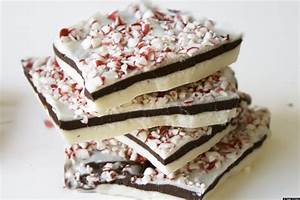
Peppermint Bark

  • 8 oz. white chocolate, chopped or chips
  • 4 red & white peppermint sticks, 6 inches long (King Leo sticks or Red Bird)
  • 2 drops peppermint oil or extract

Melt chocolate. 

Place the peppermint sticks in a heavy, zip-locked plastic bag and crush them finely.  There are many methods to choose from — find something hard like a rolling pin, and then take turns whacking and rolling the peppermints!  This can prove to be extremely beneficial, even pro-active, during the holidays.  When the peppermint sticks resemble the size of crushed ice, stop whacking.  When chocolate is melted, stir in peppermint oil.  Next stir in all but 2 tablespoons of the crushed peppermint pieces and spread mixture out, about ¼-inch thick, on a cookie sheet (lined with parchment paper or a non-stick baking mat).  It may not fill the pan completely.

Sprinkle the remaining peppermint pieces over the top.  Let sit at room temperature until hardened, about 2 hours, or refrigerate for 30 minutes to harden more quickly.

Once hardened completely, use your hands (or the trusty “whacker”) to break in to pieces.  Store in an airtight container for up to 2 weeks — if they last that long!

Cream Cheese Pumpkin Roll

Ingredients for cake part:

  • 3 eggs
  • 1 c. sugar
  • 2/3 cup canned pumpkin
  • ¾ c. flour
  • 1 tsp. baking soda
  • 1 tsp. cinnamon
  • 1 tsp. nutmeg

Preheat oven to 350°.  Set out all ingredients, including cream cheese filling, to bring to room temperature.  Mix all ingredients together and pour onto a greased cookie sheet.  If using a large cookie sheet or jelly roll pan, double all ingredients, including cream cheese filling.

Bake for 12-18 minutes (oven times vary; pan size/cake thickness will determine bake time).  Let cool until it is touchable but still very warm.  (The cooler the cake, the greater potential there is for cracking.)  Place a clean towel/cheesecloth on counter, then place wax paper over the towel.  Sprinkle powdered sugar over wax paper (to prevent sticking), and then dump the cake out onto the wax paper.  Using the wax paper and towel for support, say a prayer, and begin to gently roll your cake long side to long side, with wax paper rolled into it as well, until it has been rolled up.  Place the roll into the fridge for one hour or the freezer for 20-30 minutes to set it.  If it cracks, all is not lost!  Allowing it to set and cool will help it gel together, almost sealing itself back together.

While the roll is cooling, mix up the filling.

Ingredients for filling:

  • 8 oz. cream cheese
  • 1 c. powdered sugar
  • 4 Tbsp. butter (⅛ a stick)
  • 1 tsp. vanilla

Blend all ingredients until soft and smooth (don’t forget to double if cake ingredients were doubled!).  Unroll pumpkin roll slowly, and gently spread filling all over.  Reroll cake (making sure not to roll your wax paper back into the roll!).  Dusting the area with powdered sugar will help the cake not stick.  Wrap with wax paper and store in the fridge.  Foil is good for helping the roll hold its shape — add a holiday ribbon and you are ready to go!  (Remember, a roll with a crack or two still tastes the same!)  Slice and serve once filling has set and cake has chilled.  Enjoy!

Reindeer Munch (aka Christmas Crunch, Santa Surprise, Jingle Junk)

  • 1½ c. pretzels
  • 2 c. bite-sized square rice and/or corn cereal
  • 2 c. round toasted oat cereal
  • 1 c. peanuts, almonds, or mixed nuts
  • 10 oz. vanilla flavored candy coating (or use white chocolate)
  • 1 c. candy-coated pieces

Line a baking/cookie sheet with wax paper.  Make sure all dry items are bite-sized and mix everything but candy coating and candy pieces together and set aside.  Melt candy coating or white chocolate in a saucepan (or double boiler) over low heat.  Stir continuously until melted OR microwave coating for 1½ minutes, stirring every 30 seconds.

Quickly pour melted coating over cereal/nut mixture and toss to coat.  Add candy pieces and toss.  Pour mixture onto prepared baking sheet in an even layer.  Cool completely.  Break into pieces and store in an airtight container at room temperature.  There are many ways to vary this recipe and make it your own.  Add or omit any ingredient.  Have fun inventing and munching on your own creation of this Christmas time crunch!

Hot Cider

Mix in crock pot:

  • ½ gal. apple juice or apple cider
  • 1 qt. cranberry juice
  • ¼ c. lemon juice
  • ¾ c. orange juice
  • 1/3 c. brown sugar
  • 8 whole cloves
  • 2 cinnamon sticks

Let simmer until hot.

Thanks to Tracey Rush, Amy Rush, Teresa Foster, Maria Cochrane, Sara Gaus, and Marilyn Lane for the recipes!

A Few of My Favorite Christmas Things

Christopher Rush

This issue has sprinkled the occasional Christmas topic throughout, including a few gift ideas for people you love: Genesis albums, quality video games, and books you should get and enjoy (and one you shouldn’t).  We’ve looked at Shakespeare’s Christmas play and even explored other aspects of the Incarnation.  As we conclude this issue, we’d like to examine some of the delightful aspects that make this holiday season so enjoyable.  True, we all have far too many reasons to be sorrowful this time of the year, too many heartaches, and too many painful memories that will never go away — I, too, have had more than my share.  But Christmas is about Life: the gift of abundant life God gave freely to us, whom He loves, incarnate in a Bethlehem manger so long ago.  And we want to celebrate that life and the gift of living this holiday season.  Though it may not seem like the things below have much to do with this gift, believe me — they do.  On behalf of the Scholarly Journal staff, I wish you all a joy-filled Christmas season.

Christmas Tunes

We can all agree on the importance of singing at Christmas time: certainly the birth of baby Jesus was heralded with songs (Mary’s song, the angels’ song, and many more).  Singing the songs we sing only this time of year is an obvious tradition and a key aspect to the season and holiday feel, but are we enjoying the best of what’s available?  I hope so.

Christmas time does not officially begin until you hear Mannheim Steamroller’s “Deck the Halls.”  The entire Mannheim Steamroller Christmas is must-listening several times each season.  Their second Christmas-related release, A Fresh Aire Christmas, is also quite good; their successive albums are good though none of them reach the superlative brilliance of the first album.  Their live album, Mannheim Steamroller Christmas Live, is good, especially for the unsurpassable ending: the one-two combination of “God Rest Ye, Merry Gentlemen” and “Stille Nacht” is the best pairing of Christmas song versions of all time, and the finale of “Going to Another Place” is a great emotional experience, especially if enjoyed in the right setting.

Further essential listening is The Time-Life Treasury of Christmas (especially volume one; volume two is good, though not as good).  It has a great sampling of diverse artists and versions from days gone by.  The best are there: Bing Crosby’s “White Christmas” (of course), Dolly Parton’s “Medley: Winter Wonderland/Sleigh Ride” (a personal favorite), “Home for the Holidays” by Perry Como, “Feliz Navidad,” and Burl Ives’ quintessential “A Holly Jolly Christmas.”  The collection also has a fine selection of Roger Whittaker numbers, another “those were the days” voice of Christmases long ago when times were easier and life was simpler.  There isn’t much Julie Andrews, though her “Joy to the World” is on the second volume.  Admittedly, “Joy to the World” is not about Christ’s first advent and has nothing to do with Christmas, but neither does “The Hallelujah Chorus” or “My Favorite Things” from The Sound of Music, though many radio stations think it does (which makes the allusion of the title of this piece ironic, yes).  It might be interesting also to know that “Jingle Bells” is about Thanksgiving time, despite common usage and perception today.

Other important Christmas listening includes the Beach Boys tunes, especially “The Man with All the Toys” (Beach Boys’ harmony at its finest), “Merry Christmas, Baby,” and “Little Saint Nick” (all of which and more are available on their Ultimate Christmas release).  John Denver and the Muppets: A Christmas Together is good family fun, as with everything Muppet, pretty much (seriously, Muppet Babies — time to come out on dvd).  The Trans-Siberian Orchestra releases are fine, though not as mandatory as Mannheim Steamroller.  They have some fine songs, though their lyrical numbers are sometimes pretentious — their instrumental numbers are better, though you have to be ready for lots of electric guitar.  Christmas with the Chipmunks, volumes one and two are more family favorites (and another show that needs to be released on dvd) — definitely get the classic Chipmunks, not the recent releases, at least at first.

Boston Pops Christmas albums are important, the Arthur Fiedler and John Williams releases, like “Sleigh Ride.”  The Robert Shaw Chorale is standard listening, though perhaps in smaller increments than the Boston Pops.  The standards of Bing Crosby (beyond “White Christmas”), Nat King Cole, Perry Como, Sinatra, Mel Tormé, Doris Day, Rosemary Clooney, and the gang are certainly worth your time — especially if you want to add nostalgia and sentimentality to your holiday.  I’m probably alone on this one, but I think Judy Garland’s “Have Yourself a Merry Little Christmas” is the saddest Christmas song of all time.  There’s just something about her voice in it that does not make me believe we will all be together again next year and that we will be doing more muddling than merrying for a long time.

Probably the best compilations of the recent artists doing Christmas tunes of old and new (still no AC/DC Christmas album? still?) are the Very Special Christmas albums created to benefit Special Olympics.  The first album has a lot of good songs, including U2’s “Christmas (Baby Please Come Home)” and Run DMC’s “Christmas in Hollis,” but Christmas 3 has some of the best of the recent Christmas releases: “Christmastime” from The Smashing Pumpkins, Natalie Merchant’s bluesy “Children, Go Where I Send Thee,” Dave Matthews’s sweet “Christmas Song,” Tracy Chapman’s soulful “O Holy Night,” and probably the best new Christmas tune of the last century (yes, even better than “White Christmas”), Blues Traveler’s “Christmas.”  If you haven’t heard that, you need to go get it right now.  Finally, if you can also get ahold of “Do They Know It’s Christmas?” from Band Aid, do it.

Christmas Films and Episodes

I’ll just come out and say it: A Christmas Story is a stupid movie.  It’s not funny, it’s not clever, it’s not witty, it’s not insightful, it’s not charming.  Moving on.

Of course we have the standards: Miracle on 34th Street, The Bishop’s Wife, White Christmas, and Santa Claus Conquers the Martians (MST3K edition).  I’m not a huge fan of It’s a Wonderful Life, but I’m willing to watch it every other year or so.  My personal favorite used to be Die Hard, but now that I’ve matured it’s definitely The Lion in Winter, with Peter O’Toole and Katharine Hepburn.  I haven’t seen Holiday Inn yet, but maybe someday.  Mixed Nuts is a forgotten gem.  Love Actually is fairly good, though it has a generous dose of sauciness that certainly earns its R-rating.  The Liam Neeson and Colin Firth storylines are great; the Alan Rickman storyline is the most upset I’ve gotten at a movie probably ever.  Laurel and Hardy’s Babes in Toyland is probably the scariest Christmas movie ever.  Lethal Weapon is also technically a Christmas movie, using the same standards as the rest of these movies, none of which have anything to do with celebrating the birth of Jesus, which probably occurred in the springtime anyway.  The ’80s were big on goofy Christmas movies: Scrooged and National Lampoon’s Christmas Vacation, for examples.

I’m not as big a fan of The Muppet Christmas Carol as others, mainly because I prefer the Muppet movies in which the Muppets are themselves not literary characters.  Similarly, The Nightmare Before Christmas is not for everyone.  What truly is for everyone is A Charlie Brown Christmas, probably the only Christmas special that bothers to identify what Christmas is really about.  Mr. Magoo’s Christmas Carol is a good version of Dickens’s story.  The Christmas Toy can be very upsetting to young children, seeing their favorite toys “die,” but the resolution is a great relief.  The classic Rankin/Bass specials are hard to argue against: Rudolph the Red-Nosed Reindeer, Frosty the Snowman, The Little Drummer Boy, and The Year Without Santa ClausHow the Grinch Stole Christmas! is fine, too.  What the world really needs is the return to popularity of Will Vinton’s classic A Claymation Christmas Celebration.  Rex and Herb’s quest to find out the true meaning of wassail, with special appearances by the California Raisins, should never have gone out of style.

Most of our favorite television shows have Christmas specials that sort of make sense if viewed at Christmas time of out chronological sequence.  The best are, of course, the M*A*S*H episodes “Dear Dad” (season one), “Dear Sis” (season seven), and “Death Takes a Holiday” (season nine).  The Newsradio, Monk and Psych episodes are good, along with the X-Files’ “How the Ghosts Stole Christmas” in (season six).  The ’70s had a lot of Christmas episodes: from Mary Tyler Moore, The Bob Newhart Show, and Barney Miller, for examples.  These short episodes are nice ways to spend Christmas Eve, if you aren’t up for a long movie and need something to do before pretending to fall asleep (especially if your brother is playing Final Fantasy VI on the only video game system in the house).

Christmas Traditions

You don’t need me to tell you about your family Christmas traditions.  Growing up in a part of the country that has four seasons, an annual tradition back home was shoveling snow on a regular basis.  One slightly more enjoyable thing we started doing somewhere along the line was to start going to a movie (in the theater) on Christmas Eve.  When young, you don’t appreciate watching Perry Como or Andy Williams’s Christmas specials on TV as much as you should, so we started going to movies.  Usually the movies we saw had nothing to do with Christmas, and the theater was never too crowded.  When the snow got bad one Christmas, we stopped doing it — and, like all traditions that come to a sudden halt, it never really returned, until that one time in 2002, many years later when everything had changed and was to change some more.  After the movie we would come home and get to open one Christmas present — it took us too long to realize that the Christmas presents we opened on Christmas Eve were always ornaments for the tree.

Like most trees, ours bore an eclectic collection of Avon Nutcracker ornaments, miscellaneous Disney cartoon movie fuzzy ornaments (Oliver and Co., Cinderella, and Little Mermaid, mostly), as well as a few American Tail, Star Trek, and other Hallmark™-related decorations here and there.  Of course there were the hand-made public school ornaments, the photos-of-church-nativity-play ornaments, the nice and classy glass bulbs and figurines, and tinsel.  We weren’t big on lights, but my wife enjoys putting strings of lights on our tree now.  We used to have real trees, back in the day, and my wife and I had a real tree our first Christmas together, but when we moved to Virginia, it became simpler to have a plastic tree: fir trees have nothing really inherent to do with Christmas anyway, people — it’s just one of those things, no sense in fighting over it.  Our tree now is dominated by snowmen, miniature wooden sleds, lighthouse figurines, and the typical family-oriented ornaments.  Most of the ornaments near the bottom now are soft and unbreakable.

Another tradition, one that many of you probably already enjoy, is driving around town looking at lights on peoples’ homes and in their yards — it is a little cheaper than going to botanical gardens and arboreta that charge entrance fees, and it also gives you strong feelings of relief that at least you don’t live there and have to put all that stuff up and take it all down (and pay that electricity bill).  We haven’t  put many lights around our house lately, but there’s always a chance we will again.

One of the great ironies of the Christian life in contemporary America is that while we don’t often mind too much “going to church,” when Christmas day falls on a Sunday it is one of the most unbearable burdens this world affords (like having to do laundry or going to school on your birthday).  Thus, most likely, the birth of the “Christmas Eve service,” often advertised as a “candle light” service — which means that you pick up a cheap candle when you go in, wait through thirty-eight minutes of extra-special music and preaching, then the ushers come light the candles and you sing “Silent Night,” blow out your candle after eighty-five seconds, and then go home.  Strange the patterns we fall into.

Following this Christmas Eve service, for our family in recent years as well as some of yours, apparently, comes the other tradition of going out for Chinese food, since that is one of the few kinds of places open on Christmas Eve.  In recent years this tradition morphed into picking up Chinese food and bringing it home, still as a family, to then relax with hot cocoa, Chinese food, and a Christmas movie or series of Christmas episodes.  Accompanying this tradition in my new family is the annual “opening of the See’s® boxes,” the west-coast chocolatier that has recently worked its way to mall kiosks out east.  Not being a west-coast guy, I prefer chocolates (mostly milk chocolate-covered caramels) from Dubuque’s own Betty Jane Candies (Home of the Gremlins).  If you have never had any chocolate from Betty Jane Candies, you are missing out on some of the fine confectionary treats that help make life worth living during these troubled times.  Accompanying Betty Jane Candies in our house back in the day was the never-ending magical jar of M&M’s® that  never ran out, no matter how many times you would walk by and take out a handful or three of M&M’s®.  I miss that jar.

As intimated above, we always open our presents on Christmas morning (except for the ornament the night before).  I don’t have anything to say to or about the families that open their presents on Christmas Eve.  Nothing can be said to or for them, really.  True, my wife does enjoy opening Christmas cards from family and friends as they arrive — that is acceptable; if they have gift cards or other pecuniary treasurelets within, well, so be it.  Such is the price of filial devotion.  Back in the day, we opened our stockings first (my brother and I, that is — mainly to keep us occupied long enough for our parents to wake up and come down for presents; I never understood why they didn’t wake up as quickly and eagerly as we did, though I do now).  Our stockings were stuffed with various things and usually had one “major” present as well, which was nice.  My wife’s family always opened their stockings last, though they were usually filled with small, miscellaneous goodies like candies, toothbrushes, maybe a gift card, or other mostly consumable delights.  Now, we compromise.  We open our stockings last, but they also have at least one major present in or next to them, a win-win situation all around.  My family used to open all our presents simultaneously, finishing in a very short amount of time.  My wife’s family went around in a circle, one at a time, after reading the Christmas story and drinking cocoa and eating delicious bacon and caramel rolls.  We now do the same as they used to, as my wife has continued the tradition of Christmas breakfast.

How to Enjoy Christmas

The Scholarly Journal provides a variety of didactic and pragmatic articles for your edification.  As such, were you to copy your Christmas habits along the practices and events described above, you will undoubtedly enjoy a delightful, joy-filled Christmas.  Other ways to enjoy Christmas break include staying in your jim-jams as many days in a row as possible, never leaving the house; playing various high-quality video games for at least twelve hours a day (preferably in the Final Fantasy or ChronoTrigger families or other RPGs — no offense, Tanner); watching episode after episode of Mystery Science Theater 3000; listening to Mannheim Steamroller; emptying boxes upon boxes of Wheat Thins with Hickory Farms cheese balls; imbibing dozens of hot cocoa packets; popping endless bags of microwave popcorn with generous portions of parmesan cheese on top; and generally doing genuine leisure rightly with those you love.  There are the keys to enjoying Christmas.  From the Scholarly Journal to you, we wish you a merry Christmas and a happy new year.