Category Archives: TV & Movie Reviews

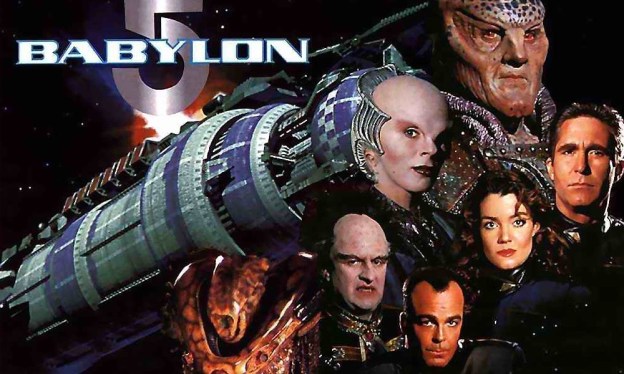
Babylon 5: The Rebirth of the Ancient Epic, pt. 2

Christopher Rush

Part Two: Babylon 5

Chapter Three — Characters

In the introduction to this thesis, I declared my purpose here is not to describe Babylon 5 as a Western epic in allegorical ways, as if the main characters must be precise representations of Achilles or Odysseus, or that its plot must be a war story or a journey tale.  Instead, I demonstrate Babylon 5 utilizes the foundational elements of the Western epic analyzed in part one to tell a new epic story with heroes that strive to gain a transcendent understanding of themselves and their universe.  Since the Odyssey is markedly different from the Iliad, while still being an equal epic, it is reasonable to allow for variation within the epic concept, in both characterization and story construction, as long as a connection to that foundation still exists.  The most significant element of the Western ancient epic genre, how the characters make choices to understand themselves and the nature of their reality, is also the most important element of Babylon 5.  Though most of the main title characters throughout the series are exemplary individuals and perform different functions on the station, the two human leads of the series, Commander Jeffrey Sinclair and Captain John Sheridan, demonstrate Babylon 5’s reinvention of the Western epic hero.  Just as the Homeric heroes are made more impressive by their counterparts, two key alien characters, Ambassador Londo Mollari and Ambassador G’Kar, exemplify the nature of Babylon 5’s complementary characters to its heroes.

Commander Jeffrey Sinclair
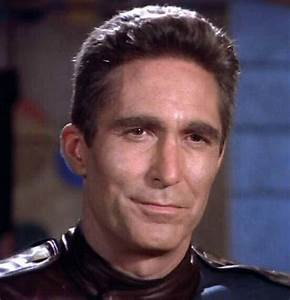
Jeffrey Sinclair is the first commander of the Babylon 5 station from its initialization in the Earth year 2256.  Season one begins after the station has been operational for two years.  Throughout the season, Sinclair expresses occasional surprise that he was chosen for such an important position, in charge of an interplanetary peacekeeping station housing the advisory council of representatives from the five dominant species in the galaxy.  Part of his surprise over his position comes from his comparative low military rank as only a commander in the military structure that owns and operates the station, Earthforce.  Other officers perhaps more qualified and higher in rank come to the station at times and express their disgust that Sinclair has such a prestigious command.  It is soon learned that Sinclair got the post because the alien race who helped build the station, the Minbari, until recently Earth’s main enemy, demand he get it.  Why they want him specifically is a significant first season plot thread.

Descended from fighter pilots, Sinclair is a warrior before he is a diplomat, even though he represents Earth on the Babylon 5 Advisory Council with the other four major races.  As the man in charge, Sinclair could easily be an Agamemnon-like character, letting his military background and ruling position go to his head, but series’ creator and co-executive producer J. Michael Straczynski dispels that connection: “the character of Sinclair is not a jingoistic military leader.  He’s a very thoughtful man” (Back to Babylon 5).  Unlike the group of warriors in the Iliad who are only loosely unified but mainly concerned with self-interests, the main crew of the Babylon 5 station is cooperative and cohesive (mostly).  Sinclair rarely has any need to coax or threaten his command staff members to do their jobs; the Earthforce military in which they serve is more dedicated than Agamemnon’s motley group of polis chieftains.  Instead, Sinclair spends most of his time during the pilot movie and first season growing into his diplomatic role and taking responsibility for his choices and his crew’s decisions, facing their consequences head on.  The episode “Eyes” intentionally deals with the ramifications of the choices Sinclair makes during the season prior to that episode.  He is clearly not an Agamemnon type, interested only in his personal gain.

The first season, aptly titled “Signs and Portents,” reintroduces the series beyond the pilot movie The Gathering, familiarizing the audience with the major characters and conflicts in the Babylon 5 universe, giving many of the command staff individualized episodes to flesh out their characters; the major plot arc of the series is foreshadowed as well.  The major mysteries and extended plot lines of the first season revolve primarily around Sinclair, however.  In addition to why the Minbari want him to command the station, his personal epic quest begins at the end of The Gathering.  Sinclair is missing a twenty-four hour period of his life from the conclusion of the recent Earth-Minbari war.  As the Minbari are about to overcome Earth’s final defenses at the infamous Battle of the Line, Sinclair watches his fellow pilots be destroyed until he decides to ram the lead Minbari ship with his own fighter.  On his attack pattern he blacks out and wakes up the next day, only to learn the Minbari have surrendered, minutes away from complete domination of Earth.  In the ten years since the war, Sinclair never discusses his experience with anyone until now.  At the end of the movie, a Minbari assassin declares to Sinclair “there is a hole in your mind.”  This, plus other incidents throughout the first season, motivates Sinclair to find out what happened to him.

Sinclair’s motivation, then, as an epic hero, is self-understanding.  Unlike Agamemnon whose self-knowledge is limited by material possessions, Sinclair’s ability to know himself is incomplete because he is missing part of his memory and thus a portion of his identity.  In this sense he is like Odysseus, and his warrior heritage and isolation from his society by the end of the season also make him like Achilles.  Furthering his connection to the epic heroes is his moral ambiguity; he manipulates and lies at times to achieve (in his estimation) some higher good — not simply to be deceitful or wicked.  In one sense he does this because he believes it is part of the nature of life:  “Everybody lies,” he declares.  “The innocent lie because they don’t want to be blamed for something they didn’t do.  And the guilty lie because they don’t have any other choice” (“And the Sky Full of Stars”).  The characters do not inhabit the same amoral universe as the Homeric heroes, since the Babylon 5 heroes all contend for transcendental values of service and good, regardless of their individual beliefs.  Sinclair’s background of three years of Jesuit training help enable his personal freedom to lie and manipulate for a greater good, such as saving life and solving crimes.  In “The War Prayer,” an episode about the burgeoning hate group Home Guard interested in eradicating the growing alien presence and influence on Earth, Sinclair declares he hates the hate groups, yet he is not above pretending to be like them in order to infiltrate and bring them down.  In the same episode, he threatens violence against Ambassador G’Kar so he will agree to his peace proposal with another race.  In “And the Sky Full of Stars,” Sinclair lies to his friend Ambassador Delenn (Mira Furlan) of the Minbari once he realizes she has been lying to him about his missing twenty-four hours.  In order to forestall a workers’ strike on the station in “By Any Means Necessary,” Sinclair manipulates a government representative into allowing him to use “any means necessary,” which to Sinclair means redistributing budget allocations, infuriating his own government superiors in the process.  His morality is flexible, in part because he does not fully know who he is and what his role in the universe is.  Once he fully understands himself and regains his missing hours, he fully commits to the steadfast unity of the epic hero character — but not until then.

In the epic tradition, Sinclair’s flexible morality is only part of his characterization: he is not just a liar trying to discover what happened to him during that missing day.  Sinclair, like Achilles for much of the Iliad, is internally lost.  His two closest friends both recognize this: Delenn though she sometimes deceives him, does so because she is actually watching him for her government, believing him to be a fulfillment of prophecy, and so she lies to protect him.  She gives him information at times and also keeps him ignorant of certain things for his own good, she believes, knowing that he will take any risk for his friends or for the right thing, because, she says, “[h]e’s looking for a purpose” (“A Voice in the Wilderness” part two).  Security Chief Michael Garibaldi (Jerry Doyle) arrives on the station with Sinclair and has known him for several years.  Garibaldi knows he must do well in this position or he will probably lose his military career because of several mistakes in his past, including alcoholism.  As Sinclair’s oldest friend, Garibaldi does not want to fail him or let Sinclair fail himself.  After Sinclair unnecessarily risks his own life for the third time, Garibaldi confronts his reckless behavior, suspecting it has something to do with Sinclair’s experience during the Earth-Minbari War and now having to work side-by-side with his former enemies.  Perhaps Sinclair is looking to find “something worth dying for because it’s easier than finding something worth living for” he tells his friend in the episode “Infection.”  Garibaldi wonders if that is the definition of being a hero, and in part he is correct.  Epic heroes need to find something worth living and dying for.  Achilles knows he must die if he is to be a hero in his culture and finds it is worth the price, committing the rest of his life to heroism and glory.  Odysseus, by rejecting life with Calypso to return to Penelope, rejects immortality for mortality, favoring humanity and death over an eternal static life.  Returning to his family, growing old and dying, in an ironic way, are worth living for to Odysseus because he values humanity with all its defects over all else.  Life itself becomes Odysseus’s purpose, just as it becomes Sinclair’s, after he knows who he is.

Though he learns what happened in his missing day before the end of the first season, Sinclair takes two more years to fully understand its consequences and his purpose.  This all occurs behind the scenes, since he is transferred off the station at the beginning of season two and sent to the Minbari as Earth’s ambassador.  Like Achilles, Sinclair is only able to learn what he needs to learn as an epic hero while he is separated from his society.  Toward the end of season three at the turning point of the series in the two-part “War Without End,” Sinclair returns to the station to resolve plot threads and his maturation as a full epic hero, finally knowing himself and his role in the universe.  He tells his friends “All my life, I’ve had doubts about who I am, where I belonged.  Now I’m like the arrow that springs from the bow.  No hesitation, no doubts.  The path is clear….  My whole life has been leading to this.”  His self-understanding is clear, and he is ready to perform the actions of a fully-realized epic hero now that he has learned what he must learn.  He knows that he will not return from this mission, but he does what he must because he is an epic hero, choosing to do what only he can do.  For Achilles and Odysseus, following their heroic impulse leads them to personal glory and the restoration of order.  Sinclair’s heroic impulse is different, since Babylon 5 refashions the Western epic into something new.  Sinclair’s heroic impulse and newfound self-awareness lead him not to the self-centered goals of the ancient epic heroes, but instead to sacrifice himself and leave his friends and society in order to save them all, transforming the epic hero into a more munificent, selfless character.  In this way, Sinclair salvages the better attributes of Hector from the Iliad, validating personal sacrifice in a new kind of community no longer defined only by battlefield victory.  Achilles returns to society because it is the only community he has, however much he may want to change it.  Odysseus restores his society because it is his home and family, clearly a self-interested goal.  Sinclair, however, saves his society by leaving it (what Hector could not do) because it is worth saving, not just because it exists; he values humanity and its continued existence more than his own life and place in it.  Through his sacrifice he achieves the eternal renown sought by the ancient epic heroes, but his motivation and method are quite different in Babylon 5’s refashioning of the Western epic genre.

Captain John Sheridan

Jeffrey Sinclair is not the only epic hero of Babylon 5.  He plays a pivotal role in the series, yet after the first season, the main character becomes Captain John Sheridan, Sinclair’s replacement on the station.  Like Odysseus, Sheridan is a traveler, coming to Babylon 5 after years exploring the outer edges of known space.  His quest is to learn the true nature of his universe in order to save it and remake it, which he does in an archetypal journey that follows Campbell’s path of the Western epic hero.

Departure

Sheridan’s call to adventure occurs at the beginning of season two, when he is transferred from his life as a deep-space explorer captaining his ship named, ironically, the Agamemnon.  Sheridan is also nothing like the Homeric Agamemnon.  Sheridan’s departure from the life he has known and enjoyed for so long signifies his gaining of freedom and distance required to better understand the society and universe the hero inhabits.  The station is the epicenter of the important activity in the series; while Sinclair must leave it to find himself, Sheridan must board it to understand reality and become an epic hero.  Though Sheridan goes through a realistic period during the first few episodes of season two in which he regrets his decision and questions his ability to be a diplomat and station manager, he soon realizes the value of the opportunities and unique life possible on this significant interstellar port.

The next phase of the epic journey, according to Campbell, the advent of supernatural aid in the form of a protective figure, comes from Vorlon Ambassador Kosh (voiced by Ardwight Chamberlain).  The Vorlons are an ancient race shrouded in so much mystery that they even hide their genuine appearance from other species, preferring to interact with others (which is quite rare) in encounter suits, masking their features and even true voices.  Kosh’s arrival on the station is the instigating plot of The Gathering.  Yet, during his first two years on the station, Kosh spends almost no time performing his ambassadorial functions; he is rarely seen during the first season except in mysterious, inscrutable circumstances.  It is not until Sheridan replaces Sinclair that Kosh becomes an active and involved character.  Keeping in line with his inscrutable nature, Kosh first appears to Sheridan as a protective figure through a telepathic dream while Sheridan is being held captive on an alien ship.  The vision motivates Sheridan to seek out Kosh’s assistance.  Kosh agrees to teach Sheridan about himself and, ultimately, to become an epic hero by understanding the nature of the universe — as Kosh puts it, “[t]o fight legends” (“Hunter, Prey”).  The legends Sheridan learns to fight are the misconceptions the Vorlons have been perpetuating about themselves as they manipulate other races over the centuries.  Kosh also prepares him to fight the legends of the Vorlons’ enemy race the Shadows, which, at the time Kosh becomes his supernatural aid, Sheridan does not even know exist.  He still has much to learn under Kosh’s tutelage.  All but one of Kosh’s lessons occurs off screen, but Sheridan becomes more adept at understanding the universe because of Kosh until events lead Sheridan to cross what Campbell calls the threshold of adventure.  As with Telemachus, epic heroes are not made in the classroom.

Sheridan’s crossing of the threshold is his encounter with Mr. Morden, the Shadows’ covert emissary (and spy) to Babylon 5.  Sheridan’s connection to Mr. Morden is complicated but crucial: Sheridan’s wife Anna (played primarily by Melissa Gilbert) supposedly died three years earlier when her science ship disappeared.  Morden, however, was on that ship, and he is still alive.  Sheridan engages in morally dubious behavior to investigate why Morden is alive but his wife is not.  Virtually every character enjoins Sheridan to release Morden for various reasons, including Ambassador Delenn and Kosh.  His choice whether to release the emissary of his enemies without finding out the truth about his wife is the end of his departure phase in what Campbell calls “the belly of the beast.”  Sheridan chooses to release Morden so the Shadows will not suspect their presence in known by the Vorlons and other races.  With this decision, made freely as a sacrificial hero, Sheridan’s self-understanding is changed.  Kosh and Delenn tell him more about the Shadows and the true conflict raging in the universe among the superior races, furthering his progress as an epic hero.  Cementing the change in his identity and his journey, Sheridan asks Kosh to change the nature of his instruction.  Instead of just fighting legends, he wants to know how to literally defeat the Shadows.  He is even willing personally to take the fight to their homeworld, Z’ha’dum (the same planet upon which his wife met her death and Morden did not).  Kosh warns him of the serious nature of his transformation and the possible occurrences if he continues on his epic path: “If you go to Z’ha’dum, you will die,” he explains.  Sheridan, with Achilles-like resolve and acceptance of his fate, is now sure of his role in the conflict: “Then I’ll die,” he replies.  “But I will not go down easily, and I will not go down alone” (“In the Shadow of Z’ha’dum”).  He fully crosses the threshold of his epic quest of cosmic understanding.

Initiation

Just as Odysseus’s initiation is what Campbell calls “a dream landscape of curiously fluid, ambiguous forms, where he must survive a succession of trials” (97), Sheridan’s journey is against the seemingly ambiguous mythical inhabitants of his universe, and like Odysseus, Sheridan needs more than physical strength to overcome millennia-old races engaged in a “war without end.”  Sheridan’s journey to understand the two sides of the conflict, the Vorlons and the Shadows, with the younger races caught in the middle, occupies most of season three.  His biggest trial is uniting the younger diverse alien races against the Shadows; he eventually succeeds, but the victory is costly — Kosh is killed.  Without his mentor, Sheridan turns to the next phase of his quest, Campbell’s Mother Goddess.  For Sheridan, this is Ambassador Delenn.  Babylon 5 continues its re-envisioning of the Western epic by changing the Mother Goddess into a romantic relationship for the hero.  The more Delenn and Sheridan work together to understand the universe and save the races in it, the more their romance grows until Sheridan’s next phase of his initiation, the confrontation with the Temptress.

Sheridan’s Temptress, in a typical Babylon 5 twist, is the unexpected return of his wife Anna, apparently back from the dead.  As the Temptress, Anna entices Sheridan to return with her to Z’ha’dum; there, she claims, he will complete his quest and learn the truth (though from the Shadows’ perspective).  Much like Circe the Temptress directs Odysseus to the Underworld to learn what he must, Anna directs Sheridan to the Underworld of the Babylon 5 universe, Z’ha’dum.  Sheridan’s journey to the underworld furthers his connection to the Western epic hero, but unlike Odysseus, Sheridan is actually killed as Kosh warned.  His willing descent is intentional by the series’ creator and episode writer Straczynski.  “The journey of John Sheridan is the classic hero’s journey.  The hero often ends up going into darkness, dying, being reborn, and coming back in a newer, better form” ( Introduction to “No Surrender, No Retreat”).  Straczynski clearly understands the path of ancient heroes according to Campbell, incorporating it into the major plot of the series, providing a helpful context from which to analyze the show as an intentional rebirth of the Western epic.

Odysseus’s “atonement with the father” phase of Campbell’s path brings him the wisdom and advice he needs to complete his restoration of his home and identity.  Sheridan, though, already knows who he is — he must learn the nature of the external reality and how to live in it.  Sheridan dies at the end of season three in his attempt to destroy Z’ha’dum, but when season four begins, he is apparently alive in an underground cave devoid of any context.  Here Sheridan meets Lorien (Wayne Alexander), the first sentient being in the universe.  Lorien considers the Vorlons and Shadows his “children,” since their races came after his and he essentially reared them.  In turn, the Shadows and Vorlons have been rearing the humans, Minbari, and other younger races, but have now lost their way.  Sheridan’s atonement is metaphorical — by meeting the ultimate father, Lorien, he can finally understand the nature of the universe, the conflict raging in it, and his purpose.  His sacrifice for this atonement includes not only his misconceptions about what he thought he knew of the universe including the war itself, but also his misconceptions about himself and his reason for being.  He must accept that he is dead.

Lorien explains Sheridan is dead, but because he has not yet accepted it, he is stranded in a Dante-like limbo state of the underworld.  Before Sheridan can resume his quest, he must accept his death and fully learn what epic heroes must learn.  Lorien’s words parallel Garibaldi’s advice to Sinclair three seasons earlier:

You can’t turn away from death simply because you’re afraid of what might happen without you.  That’s not enough!  You’re not embracing life, you’re fleeing death.  And so you’re caught in between, unable to go forward or backward.  Your friends need what you can be when you are no longer afraid.  When you know who you are and why you are, and what you want.  When you are no longer looking for reasons to live but can simply be (“Whatever Happened to Mr. Garibaldi?”).

Sheridan’s zealous, yet naïve, willingness to die in destroying the Shadows is not enough — knowing how to fight is only part of the epic hero’s nature.  Sheridan was unwilling to have Kosh teach him about himself, and his ignorance returns to him here at his death, but Lorien gives him a second chance.  Lorien’s advice to no longer be afraid of death is the opposite of Calypso’s offer of immortality, but the results are the same: Odysseus and Sheridan embrace life.  “It’s easy to find something worth dying for,” Lorien continues.  “Do you have anything worth living for?”  Sinclair needs two years of self-discovery before he can answer Garibaldi’s question; Sheridan, though, knowing himself, has an immediate response for Lorien.  “Delenn!” is his declaration as he yields to his death.  As Odysseus abandons immortality to regain Penelope, Sheridan embraces his mortality so he can return to his love Delenn and be the epic hero she needs him to be.  Living the human life, with its failings and brevity, is valuable to the epic hero and so it should be for us all, as Lorien’s caution that life should not be lived just to avoid death rings true for the epic heroes of Homer and Babylon 5 as well as the audiences of these stories.  Because death awaits us, life is valuable and should not be squandered; it must be lived wisely and well, with accurate self-knowledge and proper understanding of the universe.

After yielding to his death and accepting the nature of his reality, Sheridan is revived by Lorien, finally prepared to be the epic hero he must be.  He knows that his wife and past are truly gone, despite the Shadow’s machinations and deceptions, and he is prepared to embrace his new life with Delenn and win the Shadow war, now that he fully understands the nature of the conflict.

Return

Campbell refers to the onset of the completion of the hero’s journey as the “crossing of the return threshold” (37), in which “[m]any failures attest to the difficulties of this life-affirmative threshold” (218).  Despite returning from the dead, Sheridan experiences many failures as he nears the completion of his cosmic quest.  In his absence, the younger races disband again, and, worse, the Vorlons begin attacking them as well in an effort to eradicate all traces of the Shadows and their influence.  The young races have no chance of surviving a war against both the Vorlons and Shadows, let alone winning it militarily.  Sheridan eventually rallies the races again to renew the fight.

The penultimate sub-phase of the hero’s return, what Campbell calls the “Master of the Two Worlds” (37), applies to Sheridan as it does to Odysseus.  He not only has the knowledge to complete his quest, he has the understanding of life and death to do what is necessary to win the war.  Since his ultimate boon is knowledge not weaponry, and since his quest is philosophical and cosmic in nature, Sheridan’s conclusion to the war is also philosophical in nature.  Through Babylon 5’s reinvention of the epic, Sheridan finishes what Achilles started.  Having no desire, for a time, to follow his heroic impulse, Achilles returns (somewhat reluctantly) to his only mode of earning glory, having no power to eliminate the gods or change the culture of society in any substantial way.  Sheridan, however, ends the ultimate war by understanding it, sending the gods of his universe away.  In doing so he reinvents the hierarchy of the universe itself, and transforms the heroic impulse from glory and pleasure seeking into a clearer, more accurate philosophy, discussed in further detail below.

In completing his quest, Sheridan allows everyone to understand the nature of the conflict by showing them what the Vorlons and Shadows really are, bickering parents.  The Vorlons and Shadows want the younger races to choose which of them is correct in how they rear them, but the proper choice is not to choose at all.  Under their manipulation, no one could truly make any significant choices.  When Sheridan sends the Shadows and Vorlons away, all the people, not just the heroes, can make their own free choices.  Without guiding or manipulating races over them, the younger races have all the choices and all the responsibilities.  By conquering his enemies by understanding the nature of the universe and humanity’s place in it, Sheridan completes his journey and enjoys Campbell’s final sub-stage, the freedom to live, though with the freedom to face the consequences of his choices with responsibility.

As the major epic heroes of the Babylon 5 universe, Jeffrey Sinclair and John Sheridan depend heavily on the Western epic hero bases of Achilles and Odysseus, while also transforming the character type in new directions.  Like the Homeric heroes, Sinclair and Sheridan do not change much as characters.  Sinclair learns who he is and what his life’s purpose is, but this does not transform his sacrificial nature or his valuation of all life.  Sheridan learns the true nature of the universe, but he is still a stalwart leader and passionate defender of justice and right.  What these epic heroes learn, instead of changing them internally, refocuses their pre-existing natures into epic heroes with more defined purpose.  Babylon 5 transforms the Homeric epic hero by adding selflessness and sacrifice to the heroic impulse, yet it never strays too far from its most important foundation.  The fundamental message of the show, the importance of choice, is consistent with the Western ancient epic as embodied in their epic heroes.

Unchanging epic heroes, as discussed above, are complemented by important characters that provide contrasts to the natures of the heroes.  Hector and Telemachus provide notable juxtapositions for Achilles and Odysseus, highlighting the particular elements that make the heroes superlative in their poems.  Similarly, Babylon 5 surrounds its heroes with significant, developed counterparts to expand the universe and reflect the singular achievements of Sinclair and Sheridan.  Part of the series’ reinvention of the Western epic genre, however, is that, while traditional epic heroes are surrounded by static characters, the epic heroes of Babylon 5 are complemented by dynamic characters that grow and change over five seasons.  Centauri Ambassador Londo Mollari and Narn Ambassador G’Kar, the remaining two members of the Babylon 5 Advisory Council, demonstrate Babylon 5’s use of character development based on choices and their consequences made by these characters.

Ambassadors Londo Mollari and G’Kar
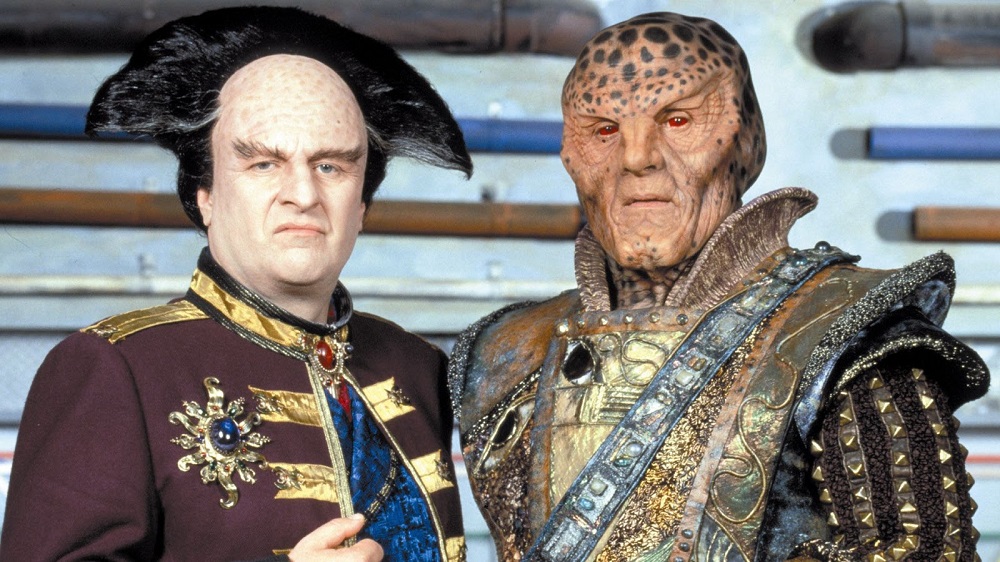
Much like Achilles has a comparative equal in Hector to add to his greatness, Sinclair and Sheridan are set against powerful representatives from other races.  As Ambassadors to Babylon 5, speaking for their peoples, Londo and G’Kar begin the series with great significance.  The Centauri Republic, however, have recently diminished in power and importance.  Londo spends most of the first season drinking and gambling, bordering on a buffoon.  In a poignant moment of the pilot movie, Londo laments that he is only there to grovel before the magnificent Earth Alliance, to try to attach his fading people to the humans’ destiny.  He yearns for the glory days of his once-proud and expansive Centauri Republic, which has now become a tourist attraction.

G’Kar of the Narn is more dominant at the beginning, often reveling in the fact his people have recently broken free from under Centauri rule, though by a devastating war.  G’Kar exerts sway over Londo early on, parading around the station with a single-minded pomposity.  The audience soon learns his behavior is a façade when he cautions Sinclair’s visiting girlfriend Catherine Sakai (played by Julia Nickson) that “[n]o one here is exactly what he appears,” not even him (“Mind War”).

G’Kar and Londo reveal who they truly are at the onset of the series by their responses to Mr. Morden’s question “what do you want?” in the first season episode “Signs and Portents.”  The Shadows are looking for new allies.  All pomposity aside, G’Kar’s response lucidly shows his anger: “What do I want?  The Centauri stripped my world.  I want justice!…  To suck the marrow from their bones and grind their skulls to powder.…  To tear down their cities, blacken their skies, sow their ground with salt.  To completely utterly, erase them.”  G’Kar has no dreams or ambitions beyond Centauri destruction.  As long as his people are safe, he does not care about anything else.  Such a narrow vision does not satisfy Morden or his Shadow superiors.

Londo’s response, however, is precisely what the Shadows are seeking:

I want my people to reclaim their rightful place in the galaxy.  I want to see the Centauri stretch forth their hand again and command the stars.  I want a rebirth of glory, a renaissance of power.  I want to stop running through my life like a man late for an appointment, afraid to look back or to look forward.  I want us to be what we used to be!  I want … I want it all back the way that it was.

Londo commits to “the good of his people” at any cost, even his self-respect, and by the end of season two, the Centauri re-conquer the Narn, and G’Kar is subordinate to Londo.

While most complementary characters of the Western epic make few choices but suffer the consequences of the heroes’ decisions, the complementary characters in the Babylon 5 universe face the effects of the heroes’ choices and eventually their own, but it takes time.  G’Kar, desperate for assistance against the Centauri re-occupation of his homeworld, does not fully accept the responsibility for his first season vitriol: “But what else could I do?  When you have been crushed beneath the wheel for as long as we have, revenge occupies your every waking thought.  When everything else had been taken from us, our hatred kept us alive” (“Acts of Sacrifice”).  He is unwilling to acknowledge his choice of anger and vengeance, separating himself from the heroic.  In the same episode, Londo laments the repercussions of his earlier actions.  “Suddenly, everyone is my friend.  Everyone wants something.  I wanted respect.  Instead, I have become a wishing well with legs.”  Though he acknowledges more of a connection between his choices and their consequences than G’Kar does by this point in season two, he is not at the heroic level of facing those consequences with responsibility.  They both, however, are being changed by their choices and soon realize this.

By the start of the third season, Londo better realizes the terrible consequences of his alignment with Morden and the Shadows and tries to sever those ties; he is still concerned solely with the good of his own people regardless of what happens to anyone else.  G’Kar, however, learns the importance of valuing all life, not just one’s own kind.  Assuming the form of G’Kar’s prophet in a vision, Kosh teaches him that he

cannot see the battle for what it is.  We are fighting to save one another.  We must realize we are not alone.  We rise and fall together.  And some of us must be sacrificed if all are to be saved.  Because if we fail in this, then none of us will be saved, and the Narn will be only a memory….  You have the opportunity, here and now, to choose.  To become something greater and nobler and more difficult than you have been before.  The universe does not offer such chances often, G’Kar (“Dust to Dust”).

G’Kar rises to the challenge of being better and different than he was, finally acknowledging the reality that people make choices and now he must start to accept the consequences with responsibility.  The nature of his choice, linking him to the heroic while also distinguishing him as a dynamic character, is to sacrifice for the good of others.  No longer does he care and act solely for his own people’s safety, like Londo does; instead he regards the epic valuation of life itself as something worth fully embracing, flaws and all, regardless of race or species.  Londo, though willing to sacrifice himself, is still limited by his narrow focus and value only of his own people.

G’Kar demonstrates his new understanding and sacrificial nature throughout the third season, most notably when he rallies the Narn on the station in support of Sheridan when they are attacked by Earth forces.  He also demonstrates how far he has changed as a character mid-way through the series when Delenn tells him in “Ship of Tears” they had to let the Shadows conquer the Narn homeworld so the Shadows would believe they were still working in secret.  G’Kar accepts the news with such equipoise Delenn is moved to tears.  He has “come a long way,” since she first met him, Delenn admits.  But he is not fully realized; someday he might be able to forgive her, he says, “but not today.”

By the end of the series, after making many more choices too numerous to discuss here, Londo finally accepts the consequences of his actions in the fifth season episode “The Very Long Night of Londo Mollari.”  In order to survive a heart attack brought on by years of hidden guilt, he finally faces G’Kar and apologizes for what he has done, for the first time in his life.  Even so, an apology does not clear him from his responsibility, and his years-long commitment to the good of his people at any cost catches up to him.  As he ponders his final moments of freedom, he tells G’Kar, “Isn’t it strange, G’Kar … when we first met, I had no power and all the choices I could ever want.  And now I have all the power I could ever want and no choices at all.  No choice at all.”  His comments fully illustrate how far his character progresses through the seasons.  From a drunken buffoon lamenting the loss of an empire to a hardened puppet emperor, Londo makes many choices and at last faces the consequences with responsibility, even though it leads to his destruction.  From first to last, Londo is motivated by one thing, the good of his people.  He goes to Babylon 5 for his people, he aligns himself with the Shadows for his people, and he sacrifices his freedom for the good of his people.  This single-mindedness connects him to the heroic by establishing his function as a suitable complement to the heroes Sinclair and Sheridan; yet, because he changes and develops as a character, he is a new element in the epic genre.

In his response to Londo, G’Kar similarly encapsulates his own character growth from the beginning of the series: his people can never forgive the Centauri nor the Centauri forgive the Narn for what they have done to each other, “but I can forgive you,” he says (“The Fall of Centauri Prime”).  From hated nemeses and pawns in each other’s plans for revenge, they progress to the point where Londo can ask for forgiveness and G’Kar can grant it.  More than just having a refocused purpose, they are new people.

While most Western epic complementary characters want to be epic heroes, most fail.  Londo and G’Kar, however, have no desire to be heroes; they connect Babylon 5 to the Western epic by providing foils for the heroes, and they distinguish the series from its epic foundation by expanding the possibilities of characterization within the genre.  Given the focused development of the series as an epic narrative, Babylon 5 shows the logical growth of its characters based on the choices they make and their consequences.

Chapter Four — Structure, Plot, and Theme

Having examined four of the central characters that create the story of Babylon 5, the well-defined structure, plot of historical significance, and theme of transcendent understanding remain to analyze the series as a refashioning of the Western epic genre.

Structure and Shape

Much of the reason characters such as G’Kar and Londo have cohesive developments and characters like Sheridan have significant personal journeys over multiple seasons comes from the planning done by Straczynski.  Before the series went into production, Straczynski established its overall content and direction.  Kurt Lancaster, in his work analyzing the series from the fans’ perspective, recounts Straczynski’s anecdote about the program’s origin:

In 1986, while taking a shower … [Straczynski] received a flash of inspiration for a new kind of science fiction series with a five-year arc.  Straczynski explains: “In the shower at the moment of this revelation, I dashed out and hurriedly scribbled down what would become the main thrust of the series before I could lose the thread of it…” (5).

As one of the executive producers and writer of ninety-two of its one hundred ten episodes, Straczynski maintained great control over the series, ensuring its connection to his original vision.

As noted above, the first season, “Signs and Portents,” is the exposition that introduces the universe, diverse inhabitants, and political and religious institutions that provide most of the conflicts in Babylon 5 throughout the remaining seasons.  Season two, “The Coming of Shadows,” is the rising action in which the characters discover forces beyond their current level of understanding are at work in the universe.  The complication comes in season three, “Point of No Return.”  The command staff of Babylon 5 separates from Earth, and Sheridan commits to his heroic path.  Season four, “No Surrender, No Retreat,” acts as the falling action, ending in the climax of the major plotlines developed in the previous seasons.  Season five, “The Wheel of Fire,” is what Straczynski calls the “denouement.  It shows the consequences of what the first four years [developed], now being brought down to human form” (Introduction to “The Wheel of Fire”).  With an intentional beginning, middle, and end, Babylon 5 distinguishes itself from typical television programming while aligning itself more to the literary realm.  Its structure furthers its connection to the Western epic genre in more ways than one.

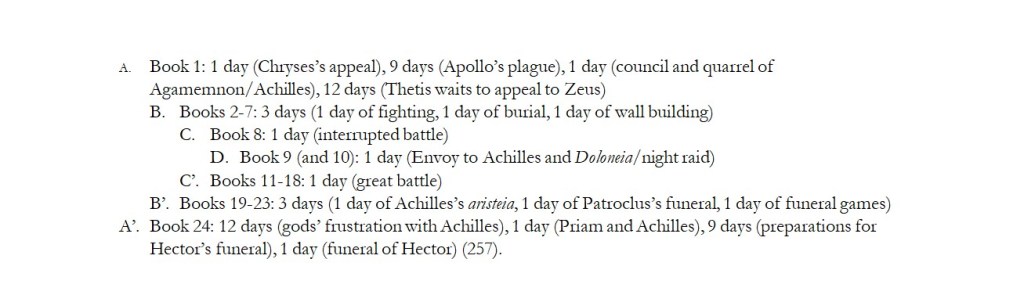
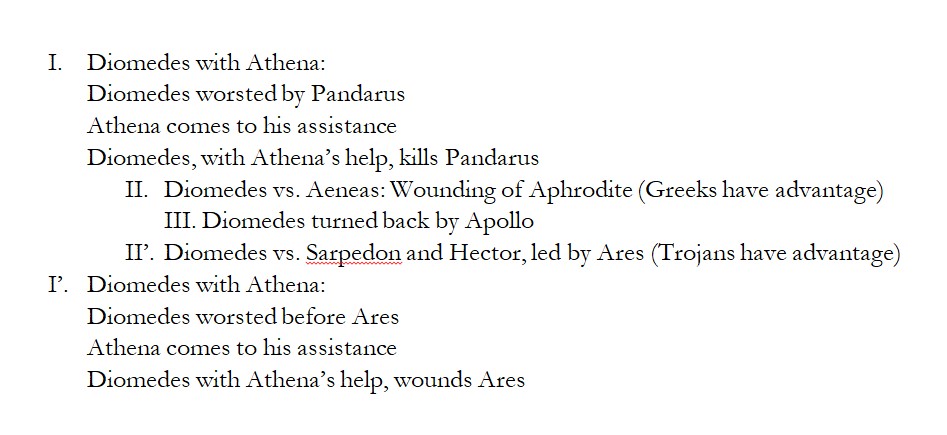
Like the ring composition that unites the episodes of the Iliad, Babylon 5 has a similar cohesion. The series begins with The Gathering as the final complement of the station’s crew and Advisory Council arrive.  Assemblies initiate many epics: the Iliad begins with a gathering of Achaean leaders; the Odyssey begins with a gathering of Ithacan elders.  Completing the ring structure, the series ends (excluding the epilogue “Sleeping in Light”) with a new command staff replacing the old, departing crew in “Objects at Rest.”  Each character fulfills his or her purpose on the station and moves on to new ventures.  The series begins with the completed construction of the station; the series ends with the destruction of the station in “Sleeping in Light.”  Ring composition is symbolic but cohesive, and Babylon 5 implements it well: one story ends while a new story begins.  In addition to classical ring composition, the series also incorporates other epic narrative structures.

In one sense, as indicated by the shape of the series and season titles, Babylon 5 has a typical plot arc, beginning with the pilot movie, climaxing with the two part “War Without End” in the middle season, and culminating in the final episode.  In another sense, as the ring composition indicates in the series’ ending marking a new beginning with a new crew as the old crew disbands to new opportunities, the series tells its story through what playwright Bertolt Brecht and other critics call “epic theater.”  Contrasted with Aristotelian or dramatic theater, epic theater for Brecht instructs the audience so they not only experience the story and understand the world but are moved to change it.  The characters in epic theater are shown in process and development, not as fixed.  Certainly this kind of “epic” diverges from the Western epic of unchanging heroes such as Achilles and Sinclair, but it accurately applies to characters such as Telemachus and Londo Mollari.  Dramatic theater moves the audience’s emotions, whereas epic theater demands decisions: Babylon 5 does both.  It moves the audience partly by the loss of several key characters, and it demands the audience decide on how to live, ideally as people with transcendent self-awareness.  By tackling pertinent issues of the time, such as the nature of parenting in “Believers” or the role of the citizen in a government that limits personal freedoms, Babylon 5 demands the attention and awareness of its audience, to both the series and reality itself.  It does this through Brecht’s epic theater narrative structure.  Perhaps the most significant element of this, as Lancaster emphasizes, is the development of the story itself as a process, just as the characters are in process.  Scenes and episodes “thematically progress toward an ending — but not in a rising climax …, but rather through the depiction of historical moments.  Straczynski shows the five-year history of Babylon 5 as a historical process” (16).  Lancaster comments further that the audience does not watch Babylon 5 to find out what is going to happen at the end, since the series spends a great deal of time telling the audience what will happen to the characters in prophetic episodes like “Babylon Squared,” “Point of No Return,” and “War Without End.”  The purpose, as its epic theater structure makes clear, is to find out how the series arrives at its destination, much like how Achilles’s anger will be resolved in the Iliad or how Odysseus will eliminate the suitors in the Odyssey — the audience does not wonder whether these events will happen.  The focus is on the course, not the finish, highlighted by the fact the characters still go on even as the series ends and the station is destroyed.  By emphasizing its progression as dictated by the choices and developments of its characters shown over the spans of entire episodes and seasons, Babylon 5 refashions the epic narrative structure, utilizing both traditional ring composition and modern epic theater techniques.

Plot of Historical Significance

In addition to the personal journeys of the series’ two main heroes for personal and cosmic understanding, Babylon 5 covers a vast scope of intergalactic events that profoundly affect the universe of the series, describing the rise and fall of empires and the effects of wars and their aftermaths.

The Narn race, as described above, begins the series having won a pyrrhic war of attrition against the Centauri Empire, enjoying freedom for the first time in one hundred years.  The Centauri, by contrast, are a waning people, no longer as expansive or powerful as they once were, now a tourist attraction, as Londo says.  By the end of the second season, these empires’ fortunes are reversed again, as the Centauri re-conquer the Narn and expand out into the galaxy.  Toward the beginning of the fourth season, the Narn are free once again and the Centauri descend into obscurity until the end of the series when the Narn exact final vengeance upon the Centauri, virtually destroying their civilization.  The Centauri turn away from the rest of the galaxy in self-imposed isolation and stagnate for twenty years until Londo and his allies are finally overthrown.  Though G’Kar learns the importance of sacrifice and understands the universe better, his people do not listen to his teaching, despite their efforts to make him a king and a prophet.  He leaves his people to their willful ignorance, for his sake and for theirs.  As Kosh predicts early in the first season, both the Narn and the Centauri are dying people, consumed by their short-sightedness and vengeful attitudes.  The didactic message is clear: those who focus only on their own interests and ambitions have no substantial future.

The human race, however, is predominantly on the rise throughout the series.  That is not to say the series posits humanity as flawless and superior. On the contrary, a strong faction of humanity acts egregiously for much of the series, eventually forcing the Babylon 5 crew to break away from Earth control in season three and motivating Sheridan to lead an armed liberation to Earth in season four.  On the whole, however, humanity is depicted as an improving, admirable people.  In the pilot movie, Londo claims he is on the station to try to attach his people to the humans’ rising destiny.  Delenn is also on the station to learn more about the human race and their potential.  One of the reasons humanity sets itself apart from the others is because mankind forms communities, a rare and admirable trait according to Delenn.  The Minbari are divided by social castes; the Centauri care only for appearances, power, and prestige; and the Narn are concerned only with freedom and revenge.  Only humanity seeks to bring diverse peoples together for mutual protection and understanding, and thus are the people with a destiny and a future, another clear lesson from the series.  The choices of a people, as well as individuals, bear great significance in Babylon 5, either to abet an empire’s downfall or to ensure a people’s rise to prominence.

Besides the rise and fall of peoples, the plot significance of Babylon 5 is depicted through many wars, despite its initial premise as a gathering of ambassadors to one location to end intergalactic hostility through peaceful diplomacy.  The Earth-Minbari war is the main progenitor of the “Babylon Project” that leads to the construction of the station, and its ramifications are still felt throughout the first season, especially in the character of Sinclair.  Approximately a decade before the Earth-Minbari war, many of the main characters’ fathers fight in the Dilgar War, the aftermath of which helps establish Earth’s interstellar prominence and the League of Non-aligned Worlds, the amalgamation of the other, less powerful races who have a collective voice on the Advisory Council.

Season one’s two-part “A Voice in the Wilderness” witnesses the Mars Rebellion, which is portended in previous episodes; earlier, the Mars Food Riots bring together many of the main characters so they know each other before reuniting during the course of the series.  Season two features the latest incarnation of the Narn/Centauri conflict as well as Earth’s growing military expansion onto other, minor worlds.  Season three concerns the present version of the millennia-old “war without end” between the Vorlons and the Shadows.  After the conclusion of that war, the fourth season proceeds to the Minbari Civil War and Sheridan’s War of Earth Liberation.

These wars do not happen for no reason; they all proceed from the freewill decisions made by the characters and how they face the consequences of their choices, as well as how they react to the free choices made by their enemies.  “The Deconstruction of Falling Stars,” the final episode of season four, shows a war between Earth and the Interstellar Alliance, the new diplomatic council Sheridan creates after the Shadow War; this war occurs five hundred years after the events of the series, but it is not the only future conflict foreshadowed in the waning episodes of the series.  Throughout the final season, which culminates in the climactic Centauri War, many characters presage a forthcoming Telepath War between the growing, powerful Psi Corps of telepaths on Earth and the non-telepathic populace.  Episodes such as “Rising Star” and “War Without End” indicate a coming war against the allies of the Shadows who resent losing to Sheridan, whose son will play a significant role in that battle.  Thus, the story of the station sees a great amount of militaristic action before, during, and after the five years of the series: it confronts the aftermath of earlier wars, engages in many wars, and sets up many future conflicts all because of choices characters make and how they understand their society and place in the universe.  The characters fight epic battles both cosmic and personal; they uncover, solve, and participate in assassinations, affect “the rise and fall of empires,” and learn the true nature of the universe.  Some sacrifice their wellbeing and freedom for the good of others and live to tell the tale like Odysseus; some sacrifice their lives like Achilles, though again, for the good of others, unlike Achilles.  Much of its significance comes, as well, from Babylon 5’s theme of transcendent understanding.

A Theme of Transcendent Understanding

Religion, as one means of attaining transcendent understanding, plays a crucial role in Babylon 5.  The Western epic displays religious elements, obviously, in the form of the Olympian gods and how the heroes relate to them, but Babylon 5 also explores a diversity of religious beliefs.  One of the earliest episodes, “The Parliament of Dreams,” showcases the dominant religious beliefs of the Centauri and Minbari.  The word “dreams” in the title is not derogatory, as if to say religious beliefs are insubstantial.  The episode, as well as the entire series, validates the beliefs of people without commenting on their accuracy or utility.  Instead of showing a dominant Earth belief in that episode, Sinclair gathers one person each from dozens of belief systems and introduces them all to the alien ambassadors, giving each equal worth and significance.  A Roman Catholic stands next to an atheist; a Muslim stands next to a Jewish man.  In the future, declares Babylon 5, mankind will still have a diversity of religious beliefs, and they are all valid beliefs to have.  Later, one form of Narn religious belief is shown in “By Any Means Necessary”; another race celebrates a powerful religious event in “Day of the Dead.”  Many races are polytheistic in the Babylon 5 universe, though some also believe in a “Great Maker” (cf. “Infection”).  The Centauri are both polytheistic and believe in the Great Maker.  Sinclair, mentioned above, has three years of Jesuit training.  Executive Officer Susan Ivanova (played by Claudia Christian) is a non-practicing Jew, but she eventually sits shiva for her deceased father in “TKO.”  Garibaldi, despite being raised Catholic, is an atheist for much of the series, believing only in what he can see, which accounts in part for his deep-seated antipathy toward telepaths.  G’Kar’s religious beliefs help his character development as noted above.  As the head of the religious caste of the Minbari, Delenn performs many religious ceremonies throughout the series, always valuing other peoples’ beliefs, especially “true believers” — anyone with a sincere faith.  She even forces Sheridan to take a break from strategizing against the Shadows to attend a gospel meeting in “And the Rock Cried Out, No Hiding Place.”  Sheridan spends time with the Dalai Lama in his youth.  Many missionaries from various races come to the station in season three; a group of human monks even take up residence onboard.

As a narrative component, religion is never portrayed as a negative or foolish thing, though sometimes belief systems come into conflict.  In “Confessions and Lamentations,” an entire race is wiped out by a plague, though they believe it is a divine punishment.  Possibly the most thought-provoking stand-alone episode of the series is the first season episode “Believers,” in which alien parents do not want Chief of Staff Dr. Stephen Franklin (Richard Biggs) to operate on their child, even though it is the only way to save his life.  More than a simple materialist doctor, Franklin is a Foundationalist, believing that all life is sacred, whether human or alien.  During the Earth-Minbari War, Franklin quits his government job when he is instructed to give his Minbari research over to the military.  Franklin contravenes the parents’ wishes and operates because “a child deserves a chance of life,” he says.  His fellow doctor confronts his apparent religious inconsistencies: “You don’t disapprove of superstition, if it’s your superstition….  Your god is medicine, and you can do no wrong in his service.”  Sinclair is not happy that Franklin countermands the parents’ wishes, but he appreciates Franklin’s concern for life.  Life itself, lived well, is an important element in the religious universe of Babylon 5.  It does not make judgments on which belief system is right; it simply shows religion as a possible, meaningful component of life and one valid way by which to understand reality.

More than the simple existence of supernatural beliefs, how the ancient heroes deal with the transcendent elements of reality around them, such as the Olympian gods and destiny, is a key theme of the poems that establish the Western epic genre.  The ways the heroes interact with the divine distinguish them from the other characters.  Achilles questions the gods and comes to understand his society and place in it better than those who simply acknowledge the gods and follow them without question.  Babylon 5 likewise features the conflict between mortals and immortals, but in its refashioning manner, the conflict becomes something else.  The deities of the Babylon 5 universe are not the various entities in which diverse races believe; instead, the real deities in this epic universe are known as the First Ones: Lorien, the Shadows, and the Vorlons.

As Sheridan discovers during his cosmic quest, the “gods” with whom the younger races interact in the Babylon 5 universe are loosely akin to the amoral deities of Achilles’s and Odysseus’s world, but instead of simply being personifications of ultra-powerful character types, the Shadows and Vorlons are personifications of philosophical ideologies, each represented by a question.  The Shadows, through their emissary Morden, ask the question “what do you want?”  The Vorlons, through their inquisitor Sebastian, ask “who are you?”  Lorien asks Sheridan the third important question, “why are you here?”  These questions not only represent the nature of the interaction between the mortals and deities in the epic of Babylon 5 as a philosophical conflict but also demonstrate the series’ emphasis on knowing oneself and the nature of the universe.  Only through understanding do the heroes accomplish their goals — just like the epic heroes of the Western tradition.  Babylon 5, as an epic, asks the important timeless questions of life and humanity.  Such metaphysical questions of identity and purpose cannot be explained by scientific inquiry and so are answerable only through other means such as literature and artistic works like this television series.  By asking the important questions of meaning, Babylon 5 urges its audience to find sufficient answers, just as its heroes find sufficient answers to accomplish their goals; through emphasizing the importance of choices and consequences in addition to asking such crucial transcendent questions of understanding, Babylon 5 unites itself to the Western epic.  Like with the various religions depicted during the series, Babylon 5 does not offer any easy answers to these questions.  It gives the responsibility of finding the answers to the audience.

As personified ideologies, the Vorlons are beings of order and light; they demonstrate this by appearing to most races as angels, though this is part of their manipulation.  When Sheridan finally confronts them in the climactic “Into the Fire,” their representative appears as a veiled woman in a block of ice.  The Vorlons are frozen.  They do not like change; they represent unchanging order.  The Shadows, in contrast, are agents of chaos and conflict; they live to serve evolution and constant progress.  Such is their message in that episode: serve evolution.  Constant change, progress through conflict is their ideology, made clear by Morden and others in “Z’ha’dum.”  Representing angels/light and shadows/dark, the symbolic interpretation of these races is informative.

Northrop Frye’s archetypal and mythological interpretation in Anatomy of Criticism presents the conflict of light and dark as “two contrasting worlds of total metaphorical identification, one desirable and the other undesirable” (139).  Babylon 5 in its characteristic way modifies Frye’s general archetype in that both the Shadows and the Vorlons, despite being overt metaphors, want to be the “desirable” metaphor.  They each want Sheridan and thus humanity at large to choose one of their options, their way of life: choose order or chaos, they demand.  The Western epic is driven by choice, but Achilles and Odysseus do not have a choice of which transcendent ideology to serve.

Babylon 5 is not about conforming to an intrinsic or extrinsic model of behavior — the best ideology is proper self-understanding.  Once one rightly understands oneself and the true nature of the universe, then one can live freely.  Sheridan combats his deities by asking them their own questions.  The Vorlons, though, do not know who they are, only that they believe in order.  Similarly, the Shadows do not know what they want, only that evolution must be served through chaotic conflict.  Because they cannot answer their own questions, Sheridan knows that their two options are not enough.  Instead of choosing between the order of the Vorlons and the chaos of the Shadows, Sheridan chooses not to choose.  Sheridan rejects both of them.  Without their allegiance the Vorlons have no purpose; without conflict, the Shadows are lost.  Lorien provides the solution: join the rest of the long-gone First Ones beyond the rim of the galaxy and let the younger races develop on their own.  Sheridan agrees and ends the cosmic conflict through transcendent understanding.  As an epic hero representing humanity itself, Sheridan interacts with his deities differently than Achilles and Odysseus deal with theirs.  Achilles and Odysseus want the freedom to transcend their cultural limitations and define their own fate, but that ultimately cannot happen.  Even by embracing life and restoring order to his home, Odysseus does what Zeus wants.  Sheridan and Babylon 5 take the Western epic in the direction its foundational heroes want to go but cannot.  By sending the gods away, mortal humans are free to live and rule the universe their own way.  Babylon 5 clearly emphasizes the importance of understanding oneself and the universe.  By understanding the nature of the conflict, Sheridan allows humanity to become what it needs to be without the external manipulation of the gods.  The epic series confronts transcendent reality and gives humanity the central place.  No longer are heroes and others subject to the whims of the gods as Achilles lamented.  Sheridan the epic hero empowers humanity with the knowledge of the nature of the universe, and so everyone has the ability to make their own choices with responsibility.  In one sense, we are all epic heroes now.  In order to live well, everyone should gain an accurate self-understanding and know their place in the universe.  We all have the responsibility to face the consequences of our actions.  This is the message of Babylon 5, the rebirth of the Western ancient epic genre.

Conclusion — The Importance of Choice

Having examined the four major elements of the Western epic genre, 1) a lengthy narrative with a defined structure and shape; 2) a developed central hero; 3) a plot of historical significance; and 4) a theme of transcendent understanding, as well as the texts of the epic poems, many of the series’ episodes, and critical secondary sources, this inquiry had endeavored to demonstrate that Babylon 5 not only utilizes the original elements of the Western epic but also refashions those elements in new ways.

Further research into this area should certainly be done.  Given more time and space, an exploration of each episode and its contributions to the series as a Western epic would provide further insight than this initial survey can supply.  More archetypal critics and theories, such as those of Northrop Frye and Carl Jung, could also provide pertinent interpretations of the series.  Further quotations from cast and crew members, especially creator J. Michael Straczynski, would supplement an analysis of the series.  Additionally, since Babylon 5 re-makes the epic genre, contrasting the series with other, non-Western or non-Homeric epics such as the Aeneid, Argonautica, or Kalevala, would only enhance an understanding of the value and literary merit of the series, thereby increasing the limited body of scholarship on science fiction, especially televised science fiction.  More work could be done from a literary perspective such as comparing the Aeneid as a written epic with Babylon 5 as a literary epic from predominantly a single author (unlike the oral narrative nature of the Homeric poems that this investigation has purposefully avoided).  Finally, since this thesis focuses on the pilot movie and five seasons of the series, further research could incorporate the additional telefilms, novels, comic books, and the spin-off series Crusade, all of which are considered canonical by the series’ creator.

The Homeric poems set the foundation not only for the epic genre but also Western Civilization’s literary heritage.  Babylon 5 transforms that foundation for a new medium of storytelling, serialized television.  The audience and method of narration are also different.  Yet, fundamentally, both the ancient epics and Babylon 5 have similar messages: life is meaningful and important because individuals matter and have choices, consequences, and responsibilities that help guide their lives.  Individuals have the ability to change their world — they are not just caught up in the impersonal forces of time and history.  Sheridan’s actions in “Into the Fire” clearly show this.  Humanity, even with its flaws, even with its brevity, is worth fighting and dying for. Life, regardless of species and gender, is valuable because of its brevity and because living well is challenging.  Because of this message, Babylon 5 is intrinsically worthwhile as a literary/televised work of art.  That it is a modern refashioning of the Western epic with the same message secures its place as a meaningful narrative on par with the ancient epic poems.

Odysseus’s key moment is not the destruction of the suitors or the reunion with his family; instead, his key moment is his renunciation of immortality proffered by Calypso.  Beye sees that renunciation as an acceptance of “human life over anything else. … Having affirmed human life over everything else, Odysseus is fully prepared for the suffering that Calypso has forecast.  It is part of living” (177).  Odysseus demonstrates clearly that normal, mortal, human life is more desirable than the amoral, changeless immortality of the gods, even with the concomitant pain, suffering, and eventual death.  “Odysseus represents a love of life so extreme that every experience of it, including suffering and finally death, is valuable and desirable,” continues Beye (178).  Odysseus chooses to return to mortal life, furthering the emphasis of the importance of choice.

Similarly, Sheridan’s key moment is his acceptance of his mortality so he can be more fully human, more fully alive by not being afraid of death.  By embracing life and love, acknowledging the fleeting nature of them both, Sheridan can truly be what he needs to be.  Certainly the series proclaims that message to its audience as well.  Life is valuable because it is brief — but it must be lived wisely.  Living simply not to die denies the importance and purpose of life, to live meaningfully, accepting the consequences for choices, sacrificing oneself for the wellbeing of others, daring to love and be loved.

Lorien makes this clear to Ivanova in “Into the Fire.”  As an immortal being, he is without love, joy, and companionship.  These traits are what the Vorlons and Shadows miss as well.  Since they are also virtually immortal, they have grown lonely and sad.  Mortality, Lorien explains to Ivanova, is a gift from the universe so mortal races can appreciate life and love.  He urges her to embrace the illusion of love’s immortality as only mortal humans can.  Love, experienced only by mortals such as Sheridan and Delenn, is worth living and dying for.

Delenn thoroughly understands the ephemeral, yet hopeful nature of life.  “All life is transitory.  A dream.  We all come together in the same place at the end of time.  If I don’t see you again here, I will see you in a little while, in the place where no shadows fall,” she tells Sheridan in “Confessions and Lamentations.”  Though she knows life is brief, it has the utmost value to her, which she makes clear at her ultimate testing point by Sebastian, the Vorlons’ inquisitor: “If I fall, another will take my place,” Delenn claims.  “This is my cause!  Life!  One life or a billion — it’s all the same!” (“Comes the Inquisitor”).  Because she recognizes the importance of all life and is willing to sacrifice hers “[n]ot for millions, not for glory, not for fame [but for] one person, in the dark, where no one will ever know or see,” she proves herself to be the right person “in the right place, at the right time,” says Sebastian.  Life is Delenn’s cause, as it is Odysseus’s, Sinclair’s, Sheridan’s, and the epic genre’s itself.  Like the epic heroes, Delenn is freely willing to sacrifice herself for the sake of life, a commitment she chooses to make.

The Iliad does not portray the Trojans as villains or the Achaeans as champions in any significant way.  Both races have flaws and admirable traits.  Though the text favors Achilles, Hector, too, is fully human, even as the enemy of the epic protagonist.  All life is valuable in the epic genre.  As G’Kar learns, it is similarly not just one race or one kind of life that is valuable in the Babylon 5 universe.  For the inauguration of the new Interstellar Alliance, G’Kar writes in his Declaration of Principles that “[w]hoever speaks for the Alliance does so with the understanding that it is the inalienable right of every sentient being to live free, to pursue their dreams” (“No Compromises”).  The hate groups on Earth and the station are obvious antagonists in the Babylon 5 universe because they do not appreciate life in its many forms.  As G’Kar’s principles make clear, sentient beings have the right to disagree with us, except when they act in opposition to life.  The Narn and the Centauri fade into isolation and obscurity because they are only concerned with their own selfish ambitions.  Humanity is on the rise in the universe because it values cooperation and peace with all races in the universe.

In his resignation speech at the close of season four, Sheridan emphasizes the significance of life and its connection to choices, encapsulating the epic genre itself:

Now, the time I spent on Babylon 5 I learned about choices and consequences and responsibility.  I learned that we all have choices, even when we don’t recognize them, and that those choices have consequences not just for ourselves, but for others.  And we must assume responsibility for those consequences.  I and my fellow officers had to choose between what we were told was right and what we believed was right.  And now I take full responsibility for those decisions (“Rising Star”).

The crew of Babylon 5 choose to do what they believe is right for the good of all life, not just themselves or their own kind.  Babylon 5 demonstrates the importance of choice not just from the characters, but for the audience, as life has meaning in part because of the choices real people make — not just characters in a television program.  Even though this life has pain and sorrow and is indeed transitory, the responsibility of choosing to live well is not unbearable.  Londo is told by prophetess Lady Morella (Majel Barrett) in “Point of No Return” that “there’s always choice.  We say there is no choice only to comfort ourselves with a decision we’ve already made.  If you understand that, there’s hope.”  Hope is why we should not fear or hesitate in accepting responsibility for choices or living life fully and well, despite the struggles and risk of pain involved.

It is little wonder that the only on-screen lesson Kosh teaches Sheridan is that beauty and hope exist, even in unexpected places and during the darkest times, even though we have to sacrifice and struggle to enjoy them (“There All the Honor Lies”).  We must choose to live well, to understand ourselves and our place in the universe, taking comfort from the fact that there is still beauty and hope in the world.  Ivanova echoes this idea in the waning moments of the series finale “Sleeping in Light”:

Babylon 5 was the last of the Babylon stations.  There would never be another.  It changed the future, and it changed us.  It taught us that we have to create the future, or others will do it for us.  It showed us that we have to care for one another, because if we don’t who will?  And that true strength sometimes comes from the most unlikely places.  Mostly, though, I think it gave us hope that there can always be new beginnings.  Even for people like us.

If we accept that all life is valuable, that our choices affect not only ourselves but those around us, and we are willing to face the consequences of those choices with responsibility, we need not fear living sacrificial lives for others.  That is what the Western epic intended, though the ancient poems and heroes are limited by amoral gods and the heroic impulse of self-satisfying glory.  Babylon 5 takes the ideal qualities of the epic and transforms the genre, becoming what Straczynski calls a series “about hope, to a large extent.  If you boil down the series to its very finest points, it says that one person can make a difference; one person can change the world.  You must choose to do so.  You must make the future or others will make it for you” (Back to Babylon 5).  Accurate self-knowledge and right understanding of the universe allow the ancient epic heroes to complete their quests.  Likewise, accurate self-knowledge and right understanding are the ultimate good in Babylon 5, not just for epic heroes, but for everyone.  With honest answers to the central questions of life such as “who are you,” “what do you want,” and “why are you here,” individuals and humanity as a whole has hope for itself and for the future.  With proper understanding of ourselves and our place in the universe, we can make choices that allow us to live wisely and well.  This is the lesson of Babylon 5 as a rebirth of the Western ancient epic genre.

Works Cited In Part Two

“Acts of Sacrifice.” Babylon 5: The Complete Second Season — The Coming of Shadows. Writ. J. Michael Straczynski. Dir. Jim Johnston. PTN Consortium. 22. Feb. 1995. DVD. Warner Brothers, 2003.

“And the Rock Cried Out, No Hiding Place.” Babylon 5: The Complete Third Season — Point of No Return. Writ. J. Michael Straczynski. Dir. David Eagle. PTN Consortium. 14. Oct. 1996. DVD. Warner Brothers, 2003.

“And the Sky Full of Stars.” Babylon 5: The Complete First Season — Signs and Portents. Writ. J. Michael Straczynski. Dir. Janet Greek. PTN Consortium. 16. Mar. 1994. DVD. Warner Brothers, 2002.

Babylon 5: The Gathering. Dir. Richard Compton. 1993. DVD. Babylon 5: The Movie Collection. Rattlesnake Production, 2004.

Back to Babylon 5. Behind-the-scenes feature. Babylon 5: The Complete First Season — Signs and Portents. DVD. Warner Home Video, 2002.

“Believers.” Babylon 5: The Complete First Season — Signs and Portents. Writ. David Gerrold. Dir. Richard Compton. PTN Consortium. 27. Apr. 1994. DVD. Warner Brothers, 2002.

Beye, Charles Rowan. Ancient Epic Poetry: Homer, Apollonius, Virgil with a Chapter on the Gilgamesh Poems. Wauconda: Bolchazy-Carducci Publishers, Inc., 2006.

Brecht, Bertolt. Brecht on Theatre: The Development of an Aesthetic. Trans. John Willet. New York: Hill and Wang, 1964.

“By Any Means Necessary.” Babylon 5: The Complete First Season — Signs and Portents. Writ. Kathryn Drennan. Dir. Jim Johnston. PTN Consortium. 11. May. 1994. DVD. Warner Brothers, 2002.

Campbell, Joseph. The Hero with a Thousand Faces. 2nd Edition. Bollingen Series XVII. Princeton: Princeton UP, 1968, 1949.

“Comes the Inquisitor.” Babylon 5: The Complete Second Season — The Coming of Shadows. Writ. J. Michael Straczynski. Dir. Mike Laurence Vejar. PTN Consortium. 25. Oct. 1995. DVD. Warner Brothers, 2003.

“Confessions and Lamentations.” Babylon 5: The Complete Second Season — The Coming of Shadows. Writ. J. Michael Straczynski. Dir. Kevin Cremin. PTN Consortium. 24. May. 1995. DVD. Warner Brothers, 2003.

“Day of the Dead.” Babylon 5: The Complete Fifth Season — The Wheel of Fire. Writ. Neil Gaiman. Dir. Doug Lefler. TNT. 11. Mar. 1998. DVD. Warner Brothers, 2004.

“Deconstruction of Falling Stars, The.” Babylon 5: The Complete Fourth Season — No Surrender, No Retreat. Writ. J. Michael Straczynski. Dir. Stephen Furst. PTN Consortium. 27. Oct. 1997. DVD. Warner Brothers, 2004.

“Dust to Dust.” Babylon 5: The Complete Third Season — Point of No Return. Writ. J. Michael Straczynski. Dir. David Eagle. PTN Consortium. 5. Feb. 1996. DVD. Warner Brothers, 2003.

“Eyes.” Babylon 5: The Complete First Season — Signs and Portents. Writ. Larry DiTillio. Dir. Jim Johnston. PTN Consortium. 13. July. 1994. DVD. Warner Brothers, 2002.

“Fall of Centauri Prime, The.” Babylon 5: The Complete Fifth Season — The Wheel of Fire. Writ. J. Michael Straczynski. Dir. Douglas Wise. TNT. 28. Oct. 1998. DVD. Warner Brothers, 2004.

Frye, Northrup. The Anatomy of Criticism. Princeton: Princeton UP, 1957.

Homer. The Iliad.  Trans. Richmond Lattimore.  Chicago: U Chicago P, 1951.

—. The Odyssey. Trans. Richmond Lattimore. New York: Harper and Row, 1967.

“Hunter, Prey.” Babylon 5: The Complete Second Season — The Coming of Shadows. Writ. J. Michael Straczynski. Dir. Menachem Binetski. PTN Consortium. 1. Mar. 1995. DVD. Warner Brothers, 2003.

“In the Shadow of Z’ha’dum.” Babylon 5: The Complete Second Season — The Coming of Shadows. Writ. J. Michael Straczynski. Dir. David Eagle. PTN Consortium. 10. May. 1995. DVD. Warner Brothers, 2003.

“Infection.” Babylon 5: The Complete First Season — Signs and Portents. Writ. J. Michael Straczynski. Dir. Richard Compton. PTN Consortium. 18. Feb. 1994. DVD. Warner Brothers, 2002.

“Into the Fire.” Babylon 5: The Complete Fourth Season — No Surrender, No Retreat. Writ. J. Michael Straczynski. Dir. Kevin Dobson. PTN Consortium. 3. Feb. 1997. DVD. Warner Brothers, 2004.

Introduction to “No Surrender, No Retreat. Behind-the-scenes feature. Babylon 5: The Complete Fourth Season — No Surrender, No Retreat. DVD. Warner Brothers Entertainment Inc., 2003.

Introduction to “The Wheel of Fire. Behind-the-scenes feature. Babylon 5: The Complete Fifth Season — The Wheel of Fire. DVD. Warner Brothers Entertainment, Inc., 2003.

Lancaster, Kurt. Interacting with Babylon 5. Austin: U Texas P, 2001.

“Mind War.” Babylon 5: The Complete First Season — Signs and Portents. Writ. J. Michael Straczynski. Dir. Bruce Seth Green. PTN Consortium. 2. Mar. 1994. DVD. Warner Brothers, 2002.

“No Compromises.” Babylon 5: The Complete Fifth Season — The Wheel of Fire. Writ. J. Michael Straczynski. Dir. Janet Greek. TNT. 21. Jan. 1998. DVD. Warner Brothers, 2004.

“No Surrender, No Retreat.” Babylon 5: The Complete Fourth Season — No Surrender, No Retreat. Writ. J. Michael Straczynski. Dir. Mike Vejar. PTN Consortium. 26. May. 1997. DVD. Warner Brothers, 2004.

“Objects at Rest.” Babylon 5: The Complete Fifth Season — The Wheel of Fire. Writ. J. Michael Straczynski. Dir. John Copeland. TNT. 18. Nov. 1998. DVD. Warner Brothers, 2004.

“Parliament of Dreams.” Babylon 5: The Complete First Season — Signs and Portents. Writ. J. Michael Straczynski. Dir. Jim Johnston. PTN Consortium. 23. Feb. 1994. DVD. Warner Brothers, 2002.

“Point of No Return.” Babylon 5: The Complete Third Season — Point of No Return. Writ. J. Michael Straczynski. Dir. Jim Johnston. PTN Consortium. 26. Feb. 1996. DVD. Warner Brothers, 2003.

“Rising Star.” Babylon 5: The Complete Fourth Season — No Surrender, No Retreat. Writ. J. Michael Straczynski. Dir. Tony Dow. PTN Consortium. 20. Oct. 1997. DVD. Warner Brothers, 2004.

“Ship of Tears.” Babylon 5: The Complete Third Season — Point of No Return. Writ. J. Michael Straczynski. Dir. Mike Vejar. PTN Consortium. 29. Apr. 1996. DVD. Warner Brothers, 2003.

“Signs and Portents.” Babylon 5: The Complete First Season — Signs and Portents. Writ. J. Michael Straczynski. Dir. Janet Greek. PTN Consortium. 18. May. 1994. DVD. Warner Brothers, 2002.

“Sleeping in Light.” Babylon 5: The Complete Fifth Season — The Wheel of Fire. Writ. J. Michael Straczynski. Dir. J. Michael Straczynski. TNT. 25. Nov. 1998. DVD. Warner Brothers, 2004.

“There All the Honor Lies.” Babylon 5: The Complete Second Season — The Coming of Shadows. Writ. Peter David. Dir. Mike Vejar. PTN Consortium. 26. Apr. 1995. DVD. Warner Brothers, 2003.

“TKO.” Babylon 5: The Complete First Season — Signs and Portents. Writ. Larry DiTillio. Dir. John Flynn. PTN Consortium. 25. May. 1994. DVD. Warner Brothers, 2002.

“Very Long Night of Londo Mollari, The.” Babylon 5: The Complete Fifth Season — The Wheel of Fire. Writ. J. Michael Straczynski. Dir. Kevin Dobson. TNT. 28. Jan. 1998. DVD. Warner Brothers, 2004.

“Voice in the Wilderness, A” Part One. Babylon 5: The Complete First Season — Signs and Portents. Writ. J. Michael Straczynski. Dir. Janet Greek. PTN Consortium. 27. July. 1994. DVD. Warner Brothers, 2002.

“Voice in the Wilderness, A” Part Two. Babylon 5: The Complete First Season — Signs and Portents. Writ. J. Michael Straczynski. Dir. Janet Greek. PTN Consortium. 3. Aug. 1994. DVD. Warner Brothers, 2002.

“War Prayer, The.” Babylon 5: The Complete First Season — Signs and Portents. Writ. D.C. Fontana. Dir. Richard Compton. PTN Consortium. 9. Mar. 1994. DVD. Warner Brothers, 2002.

“War Without End” Part One. Babylon 5: The Complete Third Season — Point of No Return. Writ. J. Michael Straczynski. Dir. Mike Vejar. PTN Consortium. 13. May. 1996. DVD. Warner Brothers, 2003.

“War Without End” Part Two. Babylon 5: The Complete Third Season — Point of No Return. Writ. J. Michael Straczynski. Dir. Mike Vejar. PTN Consortium. 20. May. 1996. DVD. Warner Brothers, 2003.

“Whatever Happened to Mr. Garibaldi?” Babylon 5: The Complete Fourth Season — No Surrender, No Retreat. Writ. J. Michael Straczynski. Dir. Kevin Dobson. PTN Consortium. 11. Nov. 1996. DVD. Warner Brothers, 2004.

“Z’ha’dum.” Babylon 5: The Complete Third Season — Point of No Return. Writ. J. Michael Straczynski. Dir. Adam Nimoy. PTN Consortium. 28. Oct. 1996. DVD. Warner Brothers, 2003.
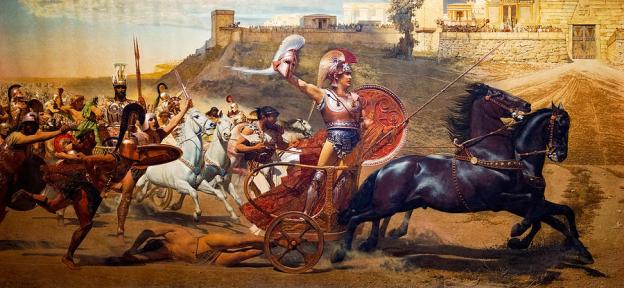
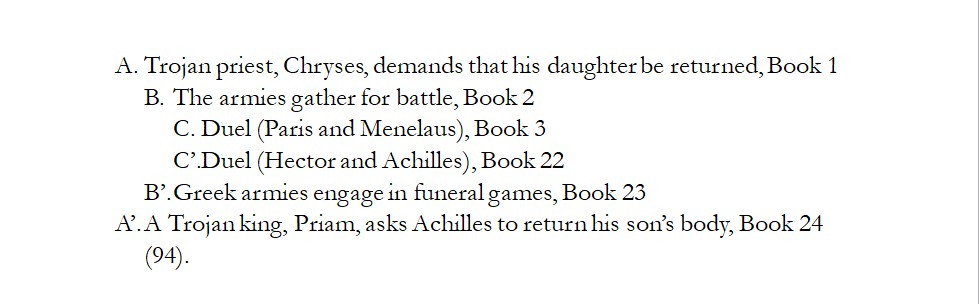
Babylon 5 – The Rebirth of the Western Ancient Epic, pt. 1

Christopher Rush

The following is the mildly-edited final document I wrote for my Master’s Thesis.  It has only been edited to keep the focus on the content, eliminating the extraneous elements required concerning the process of writing the work itself.  Part Two and the conclusion will be printed in the forthcoming issue.  (Unexpurgated copies are available on request for a small nominal stipend or honorarium, whichever you prefer.)

Introduction

The ancient epics of Greece are foundational to Western Civilization’s literary heritage.  From the poets collectively known as “Homer,” operating in an oral culture, come the Iliad and the Odyssey, two contrasting yet connected examples that set the standard for the Western epic.  After the exploits of Achilles and Odysseus, other stories and heroes come from a variety of cultures, crafted in new ways representing different values and ideals, each new epic and poet/author remaking and expanding the epic genre itself.  Peter Toohey, author of Reading Epic: An Introduction to the Ancient Narratives, declares the ancient world knew several different kinds of epics: mythological, miniature, chronicle, commentary, didactic, and comic are examples of the diverse sub-genres of the epic (2-6).  With such variety in authors, cultural background, purpose, and content, it is perhaps impossible to define “the epic” in any satisfactory manner that will account for so many differences.  Thus, in order to make this present examination manageable, I focus solely on the two epic poems of Greece, the Iliad and the Odyssey, as the pattern of the epic of Western Civilization refashioned by Babylon 5.

Before examining the texts of the Iliad, Odyssey, and Babylon 5, some initial, albeit broad, definitions of what constitutes the Western epic will help introduce the specific genre of narrative discussed throughout this paper.  Charles Rowan Beye, author of Ancient Epic Poetry, a work surveying the genre, provides a valuable historical perspective on the beginnings of the Western epic:

The term epic has come a long way from its origins as the Greek word epos, from the verb eipein, “to utter,” “to sing,” thus, the utterance of the song.  Over time, a professional guild of singers cooperated in the evolution of the Iliad and the Odyssey narratives as well as in a host of others now lost to us.  The Greeks understood the epic to be a genre of long narratives in dactylic hexameter telling stories that encompassed many peoples, many places with sufficient detail and dialogue to give depth, psychological complexity, and, most important, a historical context.  These epic poems contained their history, the history of peoples, the history of the world (284, emphasis in original).

Emphasizing the oral origin of the epic, Beye’s definition begins this understanding of epic as a sensory enterprise: epic was not originally a reading experience but an aural experience for the audience, which Babylon 5, as a television program, similarly provides, while adding a more precise visual component.  More significantly, Beye indicates the Western epic is a substantial work that contains “depth, psychological complexity, and … a historical context.”  To these essential components Toohey adds that it “concentrates either on the fortunes of a great hero or perhaps a great civilization and the interactions of this hero and his civilization with the gods” (1).  Thus the context of the Homeric epics concerns not only the human element of the heroes involved, but also humanity’s interaction with something transcendent: fate, destiny, the divine, and the importance of understanding oneself and one’s place in the universe.

These definitions, taken together, provide a meaningful conception of the major components of the Western epic: 1) a lengthy narrative with a definite structure and shape; 2) a defined central hero surrounded by and relating to other significant, defined characters; 3) a plot of historical significance for the characters and their world; and 4) a thematic element of how the characters come to a better, transcendent understanding of themselves, reality, and their connection to society.  The Iliad, Odyssey, and Babylon 5 all utilize these basic epic elements (and more).  My purpose, however, is not simply to highlight elements of Babylon 5 as if it is an allegory of the Homeric epics, such as declaring “this character is like Achilles,” or “these episodes resemble a journey like the Odyssey.”  The similarities presented are not allegorical but instead serve as examples of Babylon 5’s utilization and reinvention of the various components of the Western ancient epic genre.

In demonstrating the epic natures of the Iliad, Odyssey, and Babylon 5, this thesis utilizes formalist criticism and historical analysis.  Through these two analytical tools, I examine the texts of the poems and the episodes of Babylon 5, aided extensively by secondary sources.  The Homeric epics have a long history of analysis, though much has focused on their authorship and construction as oral narratives.  As that is extraneous to this present examination, I rely predominantly on the content-based historical analyses of the authors who helped define the epic above, Toohey and Beye.  Additionally, informing much of my understanding of the structure of epic poetry used throughout the first part of this paper are the narrative composition ideas from Cedric Whitman and the archetypal journey insights from Joseph Campbell.

Drawing upon extensive research (his single-spaced bibliography is twelve pages long), Toohey’s Reading Epic provides an introductory chapter about the general content and style of what constitutes the ancient epic, in addition to the aforementioned history of the epic as a literary genre.  Its pertinence and utility are apparent.  His emphasis on the heroic code, additionally, which contrasts Achilles and Odysseus as different kinds of heroes, provides several helpful insights for this investigation.  Toohey’s knowledge of and extensive research on the subject is clear throughout his work.

Beye’s Ancient Epic Poetry is even more beneficial for my particular focus on the constituent elements of the epic.  Offering a more recent work (2006) than Toohey’s (1992), Beye’s commentary provides several useful ideas about Achilles and Odysseus as epic heroes, in addition to the heroic code highlighted by Toohey.  Unlike Toohey’s simple bibliographic list, Beye offers a narrative history of Homeric and other ancient epic scholarship.  He discusses the aforementioned dominant topic of composition in the field of ancient epic scholarship, citing landmark critics Friedrich August Wolf, Milman Parry, and C.M. Bowra (among several others).  Beye laments the dearth of scholarship on the Argonautica and Gilgamesh, though his revised 2006 edition addresses some of the advancements made since his first edition in 1993.  His motivation in including commentary on the Argonautica and Gilgamesh, as rectifications of previously-ignored important works, mirrors the motivation of this present inquiry in analyzing Babylon 5 as a serious literary text in the media of televised science-fiction and contemporary epics.

Supplementing the major ideas of Toohey and Beye, the earlier Homeric scholarship of Cedric Whitman provides additional criticism.  His Homer and the Heroic Tradition supplies most of the ideas about the dominant structure of the ancient epic, though his focus is admittedly on the Iliad.  Like Toohey and Beye, Whitman is clearly fluent in Homeric scholarship.  His work is a frequently-cited landmark in the field, though I concentrate primarily on his poetic structure commentary here.  Further implementation of his work would only benefit any examination of the epic genre.

Joseph Campbell’s The Hero with a Thousand Faces is cited heavily concerning the archetypal epic journey used throughout the chapters on the Odyssey and Babylon 5.  Campbell’s theories are based in part on the archetypal criticism of Carl Jung, for whom the archetype was a fluid exploration of the “collective unconscious” of a people.  Jung’s notions about archetypes as processes are quite fitting not only for Campbell’s epic hero journey pattern but also for Babylon 5 as a whole, whose primary heroes embark on archetypal journeys.  Like Whitman, Campbell offers more insight into the epic genre than can be adequately incorporated here, so the focus is intentionally limited.

Other critics cited throughout this thesis such as noted scholars Gilbert Murray, Northrop Frye, and Peter J. Leithart of New Saint Andrews College supply additional helpful ideas, though not to the extent of Toohey, Beye, Whitman and Campbell.

Much of the research cited throughout this work comes from easily accessible sources to the lay reader (Beye makes a similar point in his annotated bibliography).  Secondary sources used to supplement the formalist analysis of the individual episodes of Babylon 5 come predominantly from recent interviews and bonus features on the dvd releases of the individual seasons of the series.  As the creator of the series, J. Michael Straczynski offers pertinent insight into the television show, its structure, and its message.  With the exception of rare, out of print magazine articles and Internet websites (such as “The Lurker’s Guide to Babylon 5,” which provides episode analyses, Straczynski’s commentary, and interaction with the series’ fans), few secondary sources exist analyzing Babylon 5 as a serious, significant literary artifact, which has in part inspired this investigation.  The recent interviews of the series’ creative team and cast, from the dvd releases, provide interesting (albeit biased) ideas for this thesis, supplementing analysis of the specific episodes themselves.  Other important reference works not cited below include David Bassom’s behind the scenes books such as Creating Babylon 5 and The A-Z of Babylon 5 and Jane Killick’s episode guides, one for each of the five seasons.  Their interviews with cast and crew members provide similar backgrounds to the show, but as they are not pertinent to Babylon 5 as a rebirth of the ancient epic, they are acknowledged here only in passing.  (Editor’s note: though the original bibliographic information came at the conclusion of the entire work, the works cited throughout part one will be listed at the close of this issue.)

While the Homeric poems themselves are unquestionably worthwhile for any literary analysis, and have been for thousands of years, some critics may question the serious value in attempting to elevate a television show to their status.  My thesis posits an affirmative response that it is.  Babylon 5 reforms the Homeric epic in style and content, and there is great value in analyzing and understanding it.  Babylon 5 gives witness that the influence of the Western ancient epic genre still exists, that the elements that created the ancient epic still resonate in new cultures, new settings, and new media.  Their similar hopeful messages of the importance of life given by the responsibility to live well and make wise choices apply to all cultures and all times.  The human condition, mankind’s struggle to find a place in the universe despite mortality, resonates as strongly in Homer’s epic past as it does in Babylon 5’s epic future.

Part one of this thesis examines the various contributions of the Iliad and Odyssey to my initial four-part definition of the ancient epic.  I do not spend time arguing about the identity of “Homer,” but rather accept the content of the poems as available to the lay reader today through translations.  The differences in transmission between an oral culture and the audio-visual medium of television are so apparent that they would distract from the content-driven emphasis of this present work.  Chapter one defines the epic elements specific to the Iliad, while chapter two focuses on the Odyssey.

Part two of this work analyzes Babylon 5, how it utilizes the foundational epic components listed above, as well as how it modifies those elements in the ever-changing (yet stable) epic form.  Babylon 5 is the major emphasis of this paper, as I seek to contribute to the nascent body of serious criticism on science fiction as a meaningful genre.  Part two, likewise, has two chapters.  Chapter three addresses the characters: first the two main epic heroes, Commander Jeffrey Sinclair and Captain John Sheridan; and second,  alien ambassadors Londo Mollari and G’Kar as different kinds of characters distinct from Babylon 5’s epic heroes.  Chapter four addresses the remaining three elements by which I define the Western ancient epic.  First are the series’ structure and shape and its plot of historical significance.  The grand scale of the program, combined with several layers of internal and external conflicts, makes the show very complicated but cohesive, much like the structured ancient poems.  Babylon 5’s dominant transcendent themes of accurate self-understanding and finding one’s place in the universe culminate this exploration of the series as a refashioning of the Western epic genre in a new medium.

Finally, the conclusion focuses on how the fundamental message of hope permeating Babylon 5 at once connects it to the human, mortal core of the Iliad and the Odyssey and also offers a relevant message for all audiences: that life is meaningful and worth fighting for, even with all its flaws and brevity.  Babylon 5, like the Homeric epics, engages the audience in the importance of making choices and facing the consequences of those choices with responsibility.  Only through accurate self-understanding and a proper knowledge of the nature of reality and one’s place in it can bring a right perspective on the importance and value of all life.  In this way Babylon 5 transcends its Western epic foundation and transforms the genre into what its original epic heroes wanted but were denied: the ability to shape one’s own life through free choices.

Part One: The Western Ancient Epic

Chapter One – The Iliad

Structure and Shape

The unifying narrative structure throughout the Iliad is a device interchangeably called “ring composition” by some critics and “chiastic arrangement” (after the Greek letter χ, the chi) by others.  The narrative that employs ring composition comes “full circle” in the sense that its end was sufficiently foreshadowed by the beginning of the tale, which essentially returns to the point at which it began.  The necessities of plot, even for an epic tale, demand progress and movement, so the nature of the return or completion is sometimes more symbolic than literal, but this does not detract from the efficacy of this narrative technique.  This pattern pervades the Iliad in each facet of its structure, from the overarching schema of the entire work to the order of scenes within individual books.

Peter Leithart provides the following diagram, which summarizes many of Cedric Whitman’s ideas about the arrangement of the Iliad:

According to Leithart’s diagram, the poem clearly ends in a similar place to where it began: a Trojan requesting a child from an Achaean.  The plot requires the particulars of each request to be different, but the formal structure of the poem is a unifying ring.  The cleverness of such a device allows the necessary progression of plot and character movement (even if only internally) while still providing the appearance of similarity in shape and content.  Such parallel events bring familiarity and the sense of completeness without the banality of exact repetition.  It is this creative structure that gives form to the Western epic genre.

Ring composition guides the progression of time in the Iliad in addition to the direction of its overall plot.  Whitman provides a similar diagram delineating the chronology of the poem.  The shape of these diagrams resembles an “x” or the Greek χ, hence the term “chiastic” structure.

Again, though the plot content is not precisely identical, the ring similarity concerning the chronological length of the mirrored episodes is remarkably consistent.  The length of the mirrored episodes in its written form does not need to be identical — such a limitation would unnecessarily hamper the poem.  The key is the mirrored/ring nature of the time as well as the plot itself, which Whitman sufficiently proves.

But ring composition does not just inform the overarching structure of the Iliad.  It can also be seen in smaller sections within the poem.  Book five, relating Diomedes’s mighty battle exploits while Achilles is away from combat, similarly depicts such a pattern in another diagram from Whitman:

Whitman further explains that book five, “[l]ike so many parts of the Homeric narrative, falls into four primary phases, each developed with smaller episodes, and these lie symmetrically on either side of the brief meeting of the hero with Apollo” (266).  That Diomedes’s key scene in the poem revolves around his interaction with one of his gods foreshadows here the key epic theme of interacting with some transcendent element of the universe, but since he confronts the gods with physical force and not transcendent understanding, he gains only a temporary (and ultimately inconsequential) victory.  This example, as Whitman says, is one of many throughout the poem and thus serves to illustrate clearly that the Iliad uses ring composition or chiastic structure from its overarching plot and time to its individual scenes or episodes.

Ring composition, then, is a fundamental component of what constitutes the Western ancient epic genre.  As the first example of this genre, the Iliad’s guiding structure and shape set the pattern for the narrative structure Western epics use to tell their tales, whether as a unifying device or simply in discrete episodes.  Regardless of whether the Iliad is a series of stitched-together, disparate tales from an oral composition heritage, the extant poem we have now called the Iliad, as demonstrated by Leithart and Whitman, employs such a narrative structure.  Now, the Iliad is a cohesive tale bound together through ring composition, the narrative base for the Western epic.  Each epic poem is different and contributes unique variations to the genre, and not all epics utilize ring composition to the extent the Iliad does.  Even so, the Iliad, the Odyssey, and Babylon 5, as examples of the Western epic genre, all employ this key narrative structure.

A Central Hero amid Others

Without question, the central hero of the Iliad is Western literature’s first and (perhaps) greatest hero: swift-footed Achilles.  Despite his lengthy disappearance in the middle of his poem, the Iliad is Achilles’s story, a story Richmond Lattimore considers a tragedy, which is an unusual thought, considering Achilles survives the Iliad, and his actions in slaying Hector portend the downfall of Troy.  Harold Bloom agrees with Lattimore adding that while Achilles “retains the foremost place, [he] cannot overcome the bitterness of his sense of his own mortality.  To be only half a god appears to be Homer’s implicit definition of what makes a hero tragic” (70).  Son of the human Peleus and the divine water nymph Thetis, Achilles believes at the outset of the Iliad he has inherited only the worst trait from his heritage: mortality.  The Homeric Achilles has no invulnerability, and he knows it only too well.

Achilles is continually reminded of his mortality throughout his poem, most notably when his dear friend and kinsman Patroclus is killed by Hector.  This sudden loss forces Achilles to seriously ponder his own mortality, especially since Patroclus was acting as Achilles’s proxy on the battlefield — even wearing Achilles’s armor — at Achilles’s insistence.  Two other essential scenes, Agamemnon’s envoy to Achilles in book nine and Priam’s plea for Hector’s corpse in book twenty-four, include appeals to Achilles’s mortal father to guide his actions.  The envoy and loss of Patroclus contribute to what Bloom calls “the bitterness of [Achilles’s] sense of his own mortality.”  By the time of the climactic confrontation with Priam, Achilles is no longer bitter over his mortality.  Achilles’s struggle with his mortality, his place and purpose in the universe, his relation to fate and the gods is a significant theme of the Iliad and will be addressed below.  Suffice it to say here, the majority of Achilles’s story is a tragedy because of his struggle with mortality and, though he makes peace with it (and Priam) by the end, he knows he will soon die.  Yet it is not only his pressing mortality that makes Achilles a tragic hero.

Achilles, as a hero and a mortal, makes free will choices and decisions (though without the ability to shape his destiny).  Achilles has a tragic flaw (which Lattimore considers noble), part pride, part occasional subservience to anger, and yet this flaw does not negate Achilles’s freedom to make choices.  These choices lead to disaster, culminating in the loss of Patroclus, and this, too, contributes to Achilles’s tragic nature.

Achilles, though, within the confines of the Iliad at least (if not the portentous nature of its tragedy), partly overcomes his own tragedy through the sheer greatness of his personality.  Superficially, Gilbert Murray sees him as “young, swift, tall, and beautiful” (206), and though his physical attributes help distinguish him from his fighting comrades (Odysseus’s shortness is frequently mentioned, for instance), there is certainly more to him than that.  Lattimore adds that Achilles “is a man of culture and intelligence; he knows how to respect heralds, how to entertain estranged friends.  He presides over [Patroclus’s funeral] games with extraordinary courtesy and tact.  He is not only a great fighter but a great gentleman” (49).  Perhaps, then, Achilles did inherit some positive mortal attributes.  Certainly the gods of the Iliad are not characterized by “extraordinary courtesy and tact,” even in their best moments.  Even Thetis herself seems only interested in effecting glory and a kind of justice for her son (though some might argue she is being a good mother, her willingness to sacrifice many of her son’s compatriots as attrition for her son’s justice exceeds proper motherly behavior).  True, Achilles is not always characterized by “extraordinary courtesy and tact,” but the battlefield is certainly not the place for that.  When Agamemnon arbitrarily steals from Achilles and disparages his honor in front of all his fighting peers, Achilles prepares to commit regicide.  Since Agamemnon unjustly sullies his honor in a culture that values honor so highly, Achilles may well be within his rights to kill him.  Athena intervenes — not because killing Agamemnon is wrong, but because patience will be more beneficial to Achilles later.  That he freely yields to Athena (if only for the promise of future gain) exemplifies both his ability to make choices and his heroic connection to the transcendent gods of his universe.  As Lattimore describes, Achilles’s “tragedy is an effect of free choice by a will that falls short of omniscience and is disturbed by anger … and his character can be invaded by the human emotions of grief, fear, … and, above all, anger” (47, 48).  His anger is thus an essential component of his character and his function as a tragic hero.

The poem wastes no time in bringing up Achilles’s anger: it is the first word in the Greek text.  The Iliad is the story of Achilles’s anger: what causes it, what happens because of it, and how it is satisfied and released.  His anger “is the anger of pride,” says Lattimore, “the necessary accompaniment of the warrior’s greatness” (48).  Because he is great, not only militarily, Achilles knows when his greatness is being challenged, which Agamemnon does.  His wounded pride kindles his anger and begins the epic.  Though he later treats Agamemnon’s envoy cordially, even greeting them enthusiastically, his response to their entreaties is “clouded” and he “acts uncertainly” Lattimore explains (48) because he is still angry.  Appealing to Achilles’s father and, hence, his mortality, does not help as his anger has not yet been satisfied.  He rejects their offers and their multifaceted avenues of restoration with Agamemnon.  After the death of Patroclus, Achilles transfers his anger from Agamemnon to Hector, transmuting it from a reaction to disgrace into a desire for vengeance, but not even killing Hector slates his anger.  It is not until Achilles reconciles with his own mortality that the final appeal to his father by Priam moves him to dissolve his anger and return Hector to his father.  Achilles’s anger — what Barry Powell specifies as “the destructive power of anger” (115) — as a unifying motif of the Iliad connects the poem’s ring composition with the nature of the epic hero.  The poem opens with a king breaking fellowship with a warrior and concludes with the warrior gaining restoration with not only the king but also the kingly father whose son he brutally murders in anger.  Achilles’s anger results in Patroclus’s death, but Achilles is not free from culpability because of an emotion.  It is Achilles’s choice to withdraw from battle and send Patroclus out in his stead.  That ability (and responsibility) to choose even in his anger also relates to the epic’s theme of the hero understanding his place in society and relationship with the gods, discussed below.

Lastly is Achilles’s motivation.  More than his anger, which primarily occurs as a reaction to circumstances, and his struggle to cope with his mortality, Achilles’s fundamental goal in the Iliad explains C.M. Bowra “is not ease, but glory, and glory makes exacting demands.  A man who is willing to give his life for it wins the respect of his fellows, and when he makes his last sacrifice, they honour him” (58).  By choosing to stay at Troy and ending his short-lived embargo on fighting, Achilles demonstrates that he is a man of action, a warrior, and desirous of his culture’s supreme good: battlefield glory.  Vengeance for Patroclus is only part of Achilles’s motivation to return.  He knows he can only fully regain his sullied honor by gaining it where it is earned, in combat.  He desires to reunite with his culture, as can be seen by his acting as judge and gift giver during Patroclus’s funeral games.  He wants to be a part of society, knowing it will soon kill him, since he desires eternal fame, which can only be won on the battlefield.  Toohey calls this yearning for glory the “heroic impulse” (9).  Though he would prefer to be immortal or at least change the impetuous gods, he realizes he cannot, so he willingly chooses to regain his status and personal glory through combat.  For want of glory he allows his comrades to die during his retreat.  For the restoration of his eternal glory he willingly chooses the path he knows will result in his own death.  Achilles cannot change the end of the heroic impulse in his culture; neither can Odysseus, who similarly follows the Homeric heroic impulse to the restoration of culture through combat.  The heroes of Babylon 5 do have the ability not only to change their universe but also the heroic impulse itself.  Achilles, unfortunately for him, is forced to resign himself to his mortality and the heroic impulse of his warrior culture, which he willingly embraces after all.

The greatness of Achilles as a hero and member of the warrior culture is depicted in juxtaposition with the other characters in the Iliad.  Both the Achaeans and Trojans are heroic, but not to the degree of Achilles, since it is his story.  His greatness is pronounced and heightened by the quality of those he overcomes, most notably Hector.

As the Trojan’s last, best hope, Hector provides the best test of Achilles’s greatness.  Lattimore explains that unlike Achilles, who willingly abnegates the community of warriors and the heroic impulse for a time, Hector “fights finely from a sense of duty and a respect for the opinions of others” (47).  The hero of Troy is caught up in the heroic ideal and heroic culture of combat and glory-winning, but unlike Achilles who tries not to be concerned with the opinions of others, Hector only lives and dies by others’ esteem.  That attachment to others is part of his subordination to Achilles and his doom.  Lattimore continues, “Some hidden weakness, not cowardice but perhaps the fear of being called a coward, prevents him from liquidating a war which he knows perfectly well is unjust.  This weakness, which is not remote from his boasting, nor from his valour, is what kills him” (47).  Achilles is not brought down in the Iliad by ignorance or weakness.  He chooses willingly what will eventually bring him down.  Hector, however, can live only as long as he is deemed valiant by those he defends.

A second major distinction between Achilles and Hector is found in Hector’s key scene of book six, in which Hector leaves the battlefield and returns behind the walls of Troy.  Hector, the general by necessity not nature, is normally more comfortable here at home with his parents, wife, and child, yet this farewell scene is fraught with impatience and unease.  Hector has not the time to socialize with his family, even though it is clear he would stay here if he could.  Hector sacrifices his happiness for his fundamental motivation of fulfilling his duty as the personified final defense of Troy.  Hector is more clearly associated with hearth and home than the battlefield, however, and his scenes in book six show this.  Certainly, as Bloom notes, “we cannot visualize Achilles living a day-to-day life in a city” (69).  As the embodiment of the life Achilles ultimately rejects, Hector is an essential counterpoint to the poem’s hero.  Hector is recognized and beloved in the city, i.e., culture, and is fit more for the Odyssey than the Iliad.  Since he is in Achilles’s poem, though, he is doomed from the start.  James Redfield furthers this representational conflict:  “The action of the Iliad is an enactment of the contradictions of the warrior’s role.  The warrior on behalf of culture must leave culture and enter nature.  In asserting the order of culture, he must deny himself a place in that order.  That others may be pure, he must become impure” (91).  Achilles, as untamed, uncivilized nature, is an unstoppable force on the battlefield.  Hector, since he acts contrary to his true character, has no chance of victory.  By itself, that gives no positive reflection on Achilles’s greatness — he is not impressive if his enemy has no chance to beat him.  What makes Hector a worthy adversary is his sacrificial character.  Hector’s sense of duty (even if driven by a fear of being considered a coward) overrides his desire for comfort, ease, and family living, much like Achilles’s desire for glory overrides his desire for long life and comfort.  Achilles meets his inward match in Hector.  Hector sacrifices his identity as a father and husband to be a general, assuming his society’s heroic impulse, though futilely.  Achilles may not enjoy the heroic impulse either, but he has no satisfactory alternative like Hector does.  Unfortunately for Hector, the society of the Iliad values the natural character over the character of culture.  Under prepared and overmatched, Hector cannot defeat Achilles.

By conquering his Trojan counterpart, Achilles asserts both his own status as the hero of the poem and his own attributes as the desirable heroic qualities, if not the qualities that simply succeed in this incarnation of the epic heroic impulse.  Achilles understands that by choosing to follow the heroic impulse again, even if he would prefer a different life, his fate is an imminent death.  He accepts it and faces the consequences of his decision (though others suffer the immediate consequences in the poem itself).  Hector, in his final moments with his family, likewise foresees the results of his choice to face Achilles.  Unlike Achilles, Hector does not embrace the doom of Troy he presages with his death, including the heartbreaking fate of his wife and child, and tries to avoid it, failing utterly.  Hampered by his need to be what others want him to be and his fear of disappointing them (and being considered a coward), Hector’s otherwise admirable self-sacrificial character comes to naught.  Despite his greatness, Hector is no match for who Achilles is and what he represents, ensuring Achilles’s place as the epic hero of the Iliad.

Plot of Historical Significance

Little needs to be said here, surely, about the plot of the Iliad.  Its chiastic/ring structure in the narrative construction, as well as its thematic cohesion through the rise and fall of Achilles’s anger, shows much of its content.  It is possible the lay reader is more familiar with what is not in the Iliad than what is in it.  The Iliad does not mention the Golden Apple and the judgment of Paris (except perhaps briefly at the beginning of book twenty-four), Tyndareus’s oath (Helen’s father) of Helen’s suitors to protect her if she is ever abducted, Agamemnon’s sacrifice of Iphigenia, Achilles’s vulnerable heel, or the wooden horse gambit used to end the war.

Essentially, the Iliad concerns only a few days of fighting highlighted by the deaths of Patroclus of the Achaeans and Hector of Troy, bookended by forty-six days (twenty-three and twenty-three) days of virtual inactivity.  This occurs in the tenth year of a siege by the Achaeans on Troy, following nine years of coastal plundering, most recently the area of Chryseia.  The perplexity (if not part of the beauty) of the Iliad is that its storyline does not fundamentally concern the Trojan War itself — it is more about the rise and fall of Achilles’s anger, and Achilles himself is not even terribly concerned with the war.  As he makes clear in book one to Agamemnon and those listening, he has no personal stake in the Trojan War other than surviving and gaining glory and plunder.  The cause behind the war, Paris’s abduction of Helen, is only briefly referenced.  As a tale of war, combat dominates the middle section of the poem through several duels and large-scale melee battles, especially during Achilles’s absence.  When he returns to the foreground, everything else becomes subordinate to the choices and actions of the dominant hero of the epic.

Even though he is the best warrior and the superlative hero of the poem, his own personal journey of choosing glory and accepting his fate is not as momentous a tale as the entirety of the Trojan War itself.  What gives the poem historical significance, then, comes from its ancillary components: its background of large-scale conflict, the internal significance to the characters’ personal attachment to the circumstances in which they find themselves, and the poem’s thematic element dealing with the transcendent.

Michael Wood, noted British archaeologist and author, proffers the notion whether or not the Homeric story is real, evidence exists for the possibility of “a” Trojan War, if not “the” Trojan War, and that this conflict between Achaea and Ilios seems to conclude the Bronze Age and the Mycenaean Empire.  More recent archaeology supports his ideas, thus his general conclusions about the aftereffects of an empire’s destruction will illuminate the historical significance of the Iliad’s background as a story of what happens/could happen when one people (try to) destroy another:

The central political organization collapses or breaks up; its central places (“capitals”) decline; public building and work ends; military organization fragments….  The traditional ruling elite, the upper class, disintegrates….  The centralised economy collapses….  There is widespread abandonment of settlements and ensuing depopulation (244).

Agamemnon’s merciless attitude (cf. book six) will not be satisfied after ten years with anything less than the destruction of Troy.  Since Wood’s summary of what happens to cultures after such destruction is relevant, the Iliad has great historical significance, regardless of the poem’s historical accuracy.  As a tale of the fall of a kingdom (through the destruction of Priam’s home and progeny), the Iliad concerns not only the mortality of the individual but of social institutions at large.  Additionally, every level of society present in the poem takes its events seriously: this is life and death in palpable form.

The fate of so many characters in the poem is tied to the fate of Troy: once Hector falls, Troy is essentially doomed and so are its inhabitants; Achilles’s choice to stay and kill Hector seals his personal destiny; Agamemnon (as attested to throughout the Odyssey) will have an unwelcome (and brief) return to Mycenae, despite his military victory.  The events of the Iliad are meaningful to all its characters, not the least of whom are the dozens of men whose rapid deaths are lamented in the several battle scenes of the poem.  As warriors, their lives are given extra significance by their battlefield glory.  The terse biographical sketches of so many warriors humanize the poem while simultaneously reminding the reader that the epic poem is fundamentally about humanity in all its facets — vengeance, love, strength, and sacrifice.  Mortality and its significance are ever-present in the Iliad.  Summarily, the disparate characters react to the grand tale of war in different ways, and each character contributes something different (even if only minutely) to the poem’s overall significance not only as a tale of war but also as a tale of individuals caught up in such a conflict, trying to understand themselves and their world.

A Theme of Transcendent Understanding

The final component of what constitutes the Western ancient epic genre is its thematic element of transcendent understanding.  More than just a long, well-structured tale with a mighty hero doing mighty things that transform a culture, the epic features the essential struggle of mankind trying to understand itself, its purpose, and how to interact with the immaterial forces at work in the universe such as fate, destiny, and the divine.  The Iliad focuses on how Achilles comes to understand himself, his culture, his fate, and his relation to the gods.  Some comments on the Homeric gods themselves will provide a context before examining Achilles’s struggle with the reality beyond the material world.

Few critics see much good within the gods of the Greek pantheon, at best viewing them as amplified humans full of pettiness and greed.  Because the sovereign deities of the Iliad universe are licentious, Beye declares they provide “no ideal to which mankind should strive” (57).  It is little wonder that Homeric heroes are forced to judge the importance of their lives by tangible standards such as public renown and the amount of booty plundered in war.  The gods do not genuinely care for the mortals who do virtually everything on behalf of them; not even Zeus, who supposedly operates throughout the poem for Achilles’s best interest and glory, truly cares for the people.  He regrets being forced to allow Sarpedon to die, but he is only “forced” because he esteems fate more than humanity.  Aphrodite saves Paris and Aeneas from death, more for her pleasure than because she truly loves them — even though Aeneas is her son.  The gods are a significant component of the epic, but their ultimate importance is limited as Powell states because they “are unconstrained by the seriousness of human life … [because] their immortality cheats them of the seriousness that attends human decisions and human behavior.  Our acts count because we are going to die, but the gods are free to be petty forever” (47).  Powell emphasizes again the importance of free choice as a mark of quality life — the heroes of the Iliad are responsible for their actions because the gods, according to Lattimore, “do not change human nature.  They manipulate [the characters], but they do not make them what they are.  The choices are human; and in the end, despite all divine interferences, the Iliad is a story of people” (55).  The significance of being a free mortal human manipulated by the gods is what Achilles struggles with throughout his poem.

As the central hero of the poem, Achilles’s struggle with his identity and culture is the most significant struggle of this kind.  Diomedes’s encounters with the gods affect him, but he soon disappears from the story.  Hector has the ability for a time to know himself and his future, but he does not accept what he sees and so is destroyed.  Redfield makes this point clear, that this transcendent ability is central to the Western epic genre:

It is a peculiarity of the epic that its heroes can, at certain moments, share the perspective of poet and audience and look down upon themselves….  Achilles tests the limits of the heroic; when he commits himself to the killing of Hector, he sees his own death also before him and accepts it.  He is thus an actor who both acts and knows his own actions as part of an unfolding pattern (89).

Achilles, Odysseus, and the characters of Babylon 5 thus have a unique ability as epic heroes: they can, when the time is right, see beyond their own situations and know where they fit in with their reality.  Epic heroes such as Achilles are aware that their actions are choices, that those choices have consequences, and that they must face those consequences with responsibility for having freely chosen to do what they do.  Not all characters in the Western epic are aware of themselves and their place in their culture — only heroes have that ability, what Lattimore calls prescience, to see beyond themselves.

In order to understand himself, his culture, and how he fits in, Achilles must first be separated from his culture, which occurs when he chooses to leave the battlefield after Agamemnon insults him in book one.  Because Agamemnon cares only for his material wealth and status, he has no chance of understanding his culture (he accepts it readily) or transcending it, and so he cannot be a true epic hero like Achilles.  Achilles is so upset with Agamemnon’s insult that he eschews the culture and heroic impulse that drove him to Troy nine long years ago.  As a warrior withdrawing from battle, notes Toohey, “Achilles begins to reject the heroic world; as a way of life … it is suddenly making demands upon him that he cannot tolerate” (124).  If the heroic impulse allows a leader who is only a leader because of material prosperity and not inner quality to steal property and besmirch honor in front of those who bestow such honor, Achilles will have no more of it, and so “he retreats from his society to take refuge in what is left, his individuality” (125), allowing him to slowly come to know his culture from an external vantage, and thus can become a full, unique epic hero.

When he learns of Patroclus’s death, and that he has tarried from the battlefield and his heroic culture too long, Achilles the epic hero gains his first moment of heroic prescience or transcendent understanding.  Achilles is aware that his response to the death of his friend (his freely made choice) will seal his fate at Troy in what Murray calls his “special supernatural knowledge that his revenge will be followed immediately by his death” (142).  As a hero, he is both bound by fate and a partial maker of his own destiny through his choices.  Having spent enough time away from the heroic culture, Achilles knows that it is flawed, but he accepts at last that it is the only way of life for him, but he now understands it, unlike the other mortals.  He never claims that the heroic impulse lifestyle is morally wrong or fundamentally uncharitable; he simply realizes that it is terribly costly, and, knowing the cost, chooses to return to the heroic world.

Achilles’s greatest militaristic achievement in the Iliad, the slaying of Hector, is bookended by his two heroic moments of heightened understanding.  During the action, he has not the time to think or philosophically observe — that is part of the tension of his function as an epic war hero; he can understand his actions and himself before and after what he chooses to do, but he also has to act.  Once he accepts his mortality and his fate by choosing to kill Hector he loses his transcendent understanding for a time (as evidenced by his mistreatment of Hector’s corpse) but regains it again at the close of the poem when Priam asks for the return of his son’s body.

Achilles’s confrontation with Priam is a remarkably different scene and tone compared to the beginning confrontation with Agamemnon, though it fulfills the ring composition structure of the poem.  Instead of the anger of book one, Achilles responds to the Trojan’s request with a silent, introspective gaze.  Priam appeals to Achilles’s father, reminding him again of his mortality, but Achilles has already accepted this.  Murray elucidates that this quiet deliberation again “enables Achilles to know his situation and no longer merely experience it.  What was baffling in its immediacy becomes lucid at a distance.  Achilles surveys and comprehends his world and himself” (87).  There is no longer any need for anger, since Achilles the epic hero finally understands his role in life and accepts his own mortality.  As he makes clear to Priam, he has even begun to understand the gods themselves, at least from his limited, mortal perspective.

Before returning Hector’s body, Achilles tells Priam a story of Zeus’s two jars, one of good and one of evil, which Zeus sprinkles out indiscriminately on humanity.  According to Achilles, humanity can get no grace, no direction, no hope from the gods.  His frustration is ironic, considering Zeus has been manipulating the events of the Iliad to help Achilles regain his glory.  Zeus refutes Achilles’s notion early in the Odyssey when he declares humanity blames the gods for their misfortunes when they actually receive what they deserve based on their free choices.  Achilles’s logic is flawed, but his final conclusion is correct: mankind is responsible for its actions, regardless of the gods.  He understands this as an epic hero.  He chooses to return Hector to Priam just as he chose to kill Hector earlier, even believing the heroic world is flawed and ruled by disinterested deities.  He cannot do anything to change it, since only he understands it, but he does what he can and returns Hector to his father, easing a fellow mortal’s suffering.

This is not to say Achilles is a completely changed person.  Epic heroes are essentially monolithic.  They learn the true nature of themselves, the universe, and mankind’s place in it, and they make decisions and face the consequences of their actions, but they are not inwardly transformed.  Achilles returns to his flawed heroic world because it is the only culture around — and he truly values it, even after he more fully understands it and mankind with all its faults.  Epic heroes do not always understand themselves or their universe — it is an attribute they must learn and develop — but when they face their most critical decisions, epic heroes distinguish themselves from their companions not only by their superior physical traits but also their superior mental awareness and transcendent understanding.

The Western epic explores the important questions of life, such as meaning, purpose, and destiny, and epic heroes grapple with these issues, sometimes with, sometimes against the gods of their universe.  The gods do what they do, but so do humans.  As mortals, humans have a limited time to live meaningfully, and heroes of the Western epic embody the importance of life lived well.  Mankind is responsible for his choices, and Achilles’s acceptance of that responsibility is part of what makes the Iliad a meaningful story about the worth of humanity, in part because of its ability to make choices and live well in what little time it has.

Chapter Two — The Odyssey

Structure and Shape

Unlike the Iliad, the Odyssey does not have the same over-arching ring composition or chiastic structure, though the most famous part of it — Odysseus’s magical journey — does have a loose chiastic arrangement in which each hostile episode is followed by an equally dangerous peaceful episode, all attempting to prevent Odysseus from returning home, according to Leithart (cf. 180-181).  This makes sense, as the Iliad is a grand war poem whose characters do not physically go anywhere and the Odyssey is Western literature’s archetypal journey story.  The Odyssey is a series of six quartets in the chapter/book arrangement in which the poem exists today.  Without belaboring the plot synopsis here, it is possible to define the structure of the epic with another diagram:

As a journey story whose theme is restoration from disorder to order, it makes sense the ring composition technique is not as applicable to the Odyssey.  If Odysseus ends where he begins, even in a symbolic way, then he has failed in his quest and his epic poem is a complete disappointment.  Even with little of the ring composition that dominates the Iliad, the Odyssey is a lengthy tale with a definite structure and shape.  It is a journey toward restoration of both Ithaca and its king’s family.

A Central Hero amid Others

In addition to its limited use of ring composition while incorporating a new narrative structure, the Odyssey’s hero also expands the nature of the Western epic begun by the Iliad.  Odysseus is the antithesis of Achilles.  Instead of the emotional hero who gains understanding and reconciliation, Lattimore explains that “Odysseus has strong passions, but his intelligence keeps them under control” (51).  Odysseus never acts out of uncertainty or confusion.  Throughout the Iliad Odysseus distinguishes himself from his compatriots.  He restores order when Agamemnon’s test of the troops backfires; he upbraids Achilles twice, privately and publically.  He is deemed responsible as a spy and warrior during the night raid, and he is trusted as the diplomat to return Chryseis to her father.  As a different kind of man, Odysseus takes the epic hero role in a new direction.

Odysseus, as a different kind of man, survives both the battlefield and the different obstacles on his supernatural journey back home.  By choosing mortality and war-won glory, Achilles’s peace at the end of the Iliad is tenuous at best, and since he is fit only for the battlefield, he would not survive the world Odysseus conquers.  Odysseus’s goal is to return home and restore his kingdom, and when he does, the reader is left with the sense that Odysseus’s line is secure in the person of Telemachus, his son.  In order to survive his return and complete his restoration, the new hero must use his cleverness and guile — Achilles-like brute strength will not defeat Sirens or a Cyclops.

Through his mental cleverness, Odysseus frees his men from the cave of the Cyclops.  Knowing brute strength would never enable them to remove the stone barrier keeping them captive, Odysseus tricks the Cyclops into both believing he is “nobody” so no consequences will come from his identity and also drinking too much wine so they can effect their escape.  Odysseus’s identity, which he frequently abandons during his journey, is the Odyssey’s key theme of dealing with the transcendent: self-knowledge in a world of transformative magic and death.  Similarly, Odysseus’s cleverness allows him to keep his men safe from the Sirens’ song.  While he allows himself to hear their beautiful song and is tempted to follow it, his cleverness ensures his security.  Strength cannot conquer the call of the Sirens; only a new kind of epic hero with wits to supplement prowess can survive the post-war challenges of the Odyssey.

As an epic hero, Odysseus is multifaceted, just as Achilles was more than just an angry warrior.  Not just a clever survivor, Odysseus is also a liar.  Beye translates this otherwise nefarious trait into a necessary element for Odysseus as a survivor in such a dangerous, complex world: “Never a straightforward person, he is cunning and always suspicious” (149).  Beye sees Odysseus’s liberal use of deception as his “greatest strength” (149).  In a world dominated by amoral deities, it is understandable that an epic hero is not bound by any inner or external compunction of morality.  “Everybody lies,” says Commander Sinclair of Babylon 5.  Odysseus rarely tells the truth because survival is key, not being “good.”  As a survivor of a different kind of battle (the voyage home), Odysseus expands the limits of the Western epic hero by using whatever resources he needs (such as cleverness and moral liberality) to overcome any situation in order to survive.  Like Achilles, Odysseus chooses to be the hero he must be in his circumstances.  Achilles must follow his heroic impulse back to the battlefield; Odysseus must follow his heroic impulse to complete his epic journey.  Odysseus’s journey is not only an important variation of the epic story but also a key aspect of his heroic nature.  Joseph Campbell’s delineation of the various paths of the archetypal hero journey in The Hero with a Thousand Faces demonstrates Odysseus’s epic path in three main stages: departure, initiation, and return.

Departure

The hero’s journey begins with his departure from what he knows, heeding what Campbell refers to as the “call to adventure” (36).  Odysseus and his companions heeded Agamemnon’s call to adventure ten years before, beginning the Trojan War.  Odysseus now heeds the call to return home.  As an epic poem, the Odyssey begins in medias res (in the middle of things), so Odysseus has already begun his return home when the poem begins.  The next phase of the departure is the advent of supernatural aide or “protective figure” (69).  Athena provides this function for Odysseus throughout both Homeric poems, most notably by transforming him into an unrecognizable old beggar upon his return to Ithaca so he can reconnoiter his situation secretly.

Even with divine assistance, Odysseus encounters many conflicts during his journey, especially while on his magical journey of fantastical creatures recounted in books nine through twelve (the section using ring composition).  It is during this phase of his journey that he has no divine help from Athena, allowing his true greatness as a new kind of epic hero, utilizing strength, cleverness, and deceit to shine.  The final element of the departure is the “belly of the beast” (69), which Campbell describes as a passage into “a form of self-annihilation” (91).  This is fitting, since meeting the Cyclops is Odysseus’s first test of preservation by non-physical means, and here Odysseus begins his thematic journey of self-understanding in his world through his ever-changing identity.  By calling himself “Nobody” or “No-man,” Odysseus further distinguishes himself from Achilles as an epic hero who outwits his opponents instead of simply out fighting them, simultaneously fulfilling Campbell’s “self-annihilation” by destroying or disguising his true identity throughout his journey.

Initiation

Few literary protagonists encounter stranger characters and trials than Odysseus does in his poem, especially during his return section, which Campbell calls “a dream landscape of curiously fluid, ambiguous forms” (97) and a “long and really perilous path” (109).  Odysseus, as a hero unlike Achilles, cannot solve his problems by accepting his fate and killing his foes.  Leithart considers Odysseus on his journey “a ‘man of twists and turns,’ who wears disguises and assumes false identities, who adapts himself and waits patiently for his opportunity to strike … [as] a man of cunning words” (150).  The battlefield never changes; Achilles only changes in his understanding of it.  Odysseus’s journey changes at every stop, and he must change and adapt too quickly during his initiation phase for transcendent self-understanding or prescience to do him any good.

The next sub-phase of the initiation according to Campbell is the confrontation with the Mother Goddess figure or the Temptress, and Circe fulfills both of these roles well.  Campbell describes the Goddess as “the paragon of all paragons of beauty, … the incarnation of the promise of perfection” (110, 111).  Circe beguiles Odysseus’s men, and Odysseus willingly beds her to restore his non-clever crew.  This is another example of Odysseus’s readiness to be and do whatever is necessary to achieve his amoral goal of returning home.  Despite his claims of love and faithfulness to his wife Penelope, Odysseus chooses to abandon physical fidelity to restore his family.  As the Temptress, Circe temporarily succeeds in delaying Odysseus for her pleasure, but he eventually resumes his return; Circe then acts as the Mother Goddess figure, directing Odysseus to the next source of guidance and information: Tiresias in Hades.

Odysseus’s encounter with Tiresias represents a metaphorical fulfillment of the next aspect of Campbell’s hero adventure, the “atonement with the father” (36-7).  It is metaphorical because Odysseus reunites and atones with his literal father at the end of the poem.  Here, Tiresias represents wisdom and lucidity, attributes clever and guileful Odysseus needs.  By making a sacrifice that appeases Tiresias, yielding to his nature and wisdom, Odysseus recognizes that he does not have everything alone he needs to complete his quest.  He will need Athena’s help later, and here he needs the advice and guidance of Tiresias to reach his destination and become a full, self-aware epic hero.

After the reconciliation with the father, Campbell recognizes the archetypal hero achieves a kind of apotheosis, a “divine state to which the human hero attains who has gone beyond the last terrors of ignorance” (151).  Odysseus travels into the Underworld, gains wisdom and advice from Tiresias, and safely navigates out.  He is about to lose his crew and possessions, but he surpasses the fears of ignorance and knows where to go and what to do, which is for him the last phase of the initiation, the “ultimate boon” (37). Odysseus will not be fully satisfied until his quest is complete, but he knows how to do it.

In an ironic way, Odysseus is offered the enjoyments of the ultimate boon without fully returning home.  After losing his crew and possessions, Odysseus encounters Calypso, another Temptress figure who succeeds in wooing Odysseus for seven years with the ultimate boon of a home and rest from his journey.  When his resolve to return home to his family overcomes his desire to be through with his journey, Odysseus again receives the supernatural aid of Athena, and he begins the final phase of his quest.

Return

Odysseus’s final phase begins when he receives what Campbell calls “the rescue from without” (37), which come in the forms of King Alcinous and the Phaecians.  This final stop before Ithaca completes the ring structure section of the Odyssey.  Odysseus arrives at Troy with nothing and leaves with the spoils of war; he arrives at Phaecia with even less (no army, not even clothes) and leaves with more treasures than he earns at Troy and, more important, a better understanding of himself and his limitations.

Completing the symmetry of the hero’s journey, Campbell refers to the “crossing of the return threshold” (37), adding that it is a brief time of reflection in which “[m]any failures attest to the difficulties of this life-affirmative threshold” (218).  Odysseus loses his crew, his Trojan plunder, and twenty years with his wife and child — Telemachus’s lifetime.  He uses his cunning, strength, and guile to succeed, even relying on supernatural and human aid to return home.  Yet his work is not done, for according to Campbell the “returning hero, to complete his adventure, must survive the impact of the world” (226).  For Odysseus, this is his confrontation with the suitors.

Having learned what he needs to learn as an epic hero, Odysseus is finally able to slough off all of his hidden identities and resume his place as husband of Penelope and ruler of Ithaca.  With his son’s assistance, Odysseus mercilessly eradicates the suitors and his disloyal servants.  He fulfills Campbell’s penultimate sub-phase of the return as the “Master of the Two Worlds” (37), as master both of his physical territory and family and master of his sense of self and place in the world.  With Athena’s intervention in eliminating any retribution from the suitors’ families, the knowledge that his son will be a worthy successor, and restoration with his wife and father, Odysseus completes his quest and ends his heroic journey with what Campbell calls the “freedom to live” (37).  He knows who he is and restores his kingdom, but he has not lost his guile.  Epic heroes do not change.  Odysseus, finally at home, will live fully content with his unchanging nature.

Like Achilles, Odysseus is surrounded by complementary characters who further distinguish his status as the epic hero of the poem.  In a tale of household restoration set against the backdrop of the heroic world, it is fitting to contrast Odysseus as a hero at the end of his quest with his son Telemachus the burgeoning hero.

Telemachus is a hero in miniature, and through him the poem demonstrates how Western ancient epic heroes are made.  Not every man in the ancient world is a hero, as this poem shows distinctly through the self-centered groups of Odysseus’s crewmates and Penelope’s suitors.  Growing up surrounded by women, servants, and un-heroic gluttons, Telemachus has no initiation into the life of the hero until he embarks on his own quest to find his father.  In doing so, he also seeks himself, his identity as a warrior’s son in a heroic world, for he cannot learn what it means to be an epic hero in his childhood company at home.  Beye points out that “Telemachus emerges from the perversion of human behavior that the suitors are enacting in his childhood home to encounter proper behavior at Pylos and Sparta” (183).  By literally leaving his home, he figuratively leaves behind childish things, including the immature lifestyle of indulgence and lasciviousness of the suitors.  Under the experienced tutelage of Menelaus at Sparta, Nestor at Pylos, and Nestor’s son Peisistratus who models what Telemachus should be, the son of an epic hero and warrior, continues Beye, Telemachus “becomes more aware of his heroic parentage, [and] he does achieve heroic stature himself” (155).

But epic heroes are not made in the classroom; Telemachus needs an opportunity to apply his newfound heroism, and reuniting with his father is not enough.  The destruction of the suitors is Telemachus’s passage to manhood and final preparation for the heroic life.  By the end of the poem, Telemachus puts his mother in her proper place, unites with his father, and rebukes the suitors before aiding his father in slaughtering them all as a warrior.  The Ithacan line is secure with a third generation epic hero.

Plot of Historical Significance

The historical significance of the Odyssey comes more from its thematic components than the direct plot itself: battling Cyclops and Sirens are not commonplace, and slaughtering suitors is not a typical method of restoring one’s home and family.  One key theme of the Odyssey with substantial ramifications today is its expression of social behavior.  The Iliad portends the causes and effects of the destruction of a city and civilization; the Odyssey exemplifies how people live together and restore civilization.

The demonstration of hospitality is the Odyssey’s main expression of proper social behavior.  Each member of the Ithacan royal family encounters the improper abuse and proper use of hospitality in many ways: the Cyclops’s dearth of hospitality results in the death of seven of Odysseus’s crewmen; Circe’s and Calypso’s surfeit of hospitality result in the wastage of several years during Odysseus’s quest to return home; the suitors’ abuse of Penelope’s hospitality is the major trial she must overcome in the poem and motivates Telemachus to begin his quest for maturity.  The Phaecians’ hospitality to Odysseus ensures his safe return to Ithaca.  Through their hospitality, Odysseus’s faithful servants distinguish themselves from those loyal to the suitors.  Because of her hospitality to him while he is disguised as a beggar, Odysseus gains hope that Penelope is still faithful to him.  Telemachus receives much hospitality from Nestor and Menelaus, and through their actions he becomes a proper hero in a proper society, a man who is kind and generous to strangers and others in need.  The Odyssey clearly emphasizes hospitality as a distinguishing aspect of proper society.  Those who abuse it, the suitors and Odysseus’s crew, are all punished, usually with death.  As a theme of society’s right conduct, the Odyssey’s message of the importance of hospitality is still significant today.  Choosing to be gracious and hospitable, especially to strangers and those in need, is an admirable quality worth emulating, and helps maintain a proper society.

A Theme of Transcendent Understanding

More than their historical value, proper hospitality and social conduct — how to live in society — are part of the Odyssey’s theme of transcendent understanding.  The poem from beginning to end is about restoring broken societies.  Ithaca at large is crumbling and must be mended; Ithaca’s ruling family also needs to be reunited.  This tension is continually compared to Agamemnon’s failed family and his son Orestes’s slaying of his own mother and her lover.  Orestes’s actions are praised throughout the Odyssey, and Telemachus is often enjoined to be like him if it becomes necessary.  Not only do the heroes of the poem require proper social conduct, but the gods do also.  Toohey claims “that Zeus does indeed desire a just world and that he will act through heroes such as Orestes and Odysseus … to establish this state” (46).  The restoration of proper social conduct, with correct hospitality as one crucial aspect of it, then, is mandated by Olympus.  Orestes is praised for avenging his father’s murder.  Odysseus is praised for eliminating the suitors because they abuse hospitality and proper social conduct.  Odysseus’s crew is justly killed because they transgress divine social boundaries by eating Helios’s cattle.  The greatest injustice in the Odyssey is the abuse of proper social conduct, which is punished by the gods through the free agency of mortal heroes.

Those who choose to obey and restore right social relationships are the epic heroes of the Odyssey, joining the poem to the Iliad.  Achilles separates himself from his peers in part because he hates Agamemnon’s abuse of hospitality when he takes something that was rightfully given to him by his peers; in one sense Achilles restores the proper social structure by his generosity to the combatants in Patroclus’s funeral games in book twenty-three and, most significantly, by returning Hector’s body to Priam at the end of the poem.  Achilles learns that his connection to the gods and his society is intertwined with proper social behavior, which he demonstrates by his actions.  Similarly, Odysseus and Telemachus learn the connection of the epic hero to society and the gods through proper social action.  Hospitality is a choice made by epic heroes because they understand the nature of their world better than non-heroic people; they know their choices have consequences for themselves and others, and only through proper human interaction can society be maintained.  Odysseus spends twenty years returning home after a great social injustice (Paris’s kidnapping of Helen); he is certainly motivated to choose to restore right social interaction, especially in his own home.

Choice is essential in the Odyssey.  Beye notes that “Athena gives Telemachus advice, but he acts upon it and gets the story moving” (151).  As a nascent epic hero, Telemachus quickly learns the importance of choices and facing their consequences.  Since he is a hero, separate from his fellows, his responsibility is greater, in part, because he, like all epic heroes, understands the universe and his place in it better than others.  As a man and future ruler of a kingdom, he learns to be generous and hospitable to those in need, not just because the gods prefer it, but because it is the proper way for society to interact, especially epic heroes who understand society better than non-heroes do.

Odysseus, as an epic hero, chooses to restore order and punish those who abuse proper social conduct.  He does this not only as an epic hero who knows the gods and the nature of the universe (clearly better than his crew does), but as a hero who, like his son, is on a quest for self-knowledge.  Achilles knows himself when he knows his place in the universe and chooses to stay and fight, spending most of his time willingly apart from society.  Odysseus, however, spends most of his poem trying to get back to society while eschewing his identity.  Beye says of Odysseus that he “is a man whose need to reinvent himself motivates his stoic determination to get home and resume the mantle of husband, father, squire as much as it does his notable artistry in creating new identities whenever he is asked who he is” (203).  Odysseus’s multiplicity of identities may be more ubiquitous in the Odyssey than lessons on hospitality.  He tells the Cyclops he is “No-man,” he is transformed into an old beggar by Athena; he creates a persona within that persona to test his servants.  He even creates false identities to test Penelope and his own father at the close of the poem despite the fact he has already secured his kingdom.  Clever, guileful Odysseus utilizes trickery and deception throughout to achieve his ends.

Twice, at crucial points in his journey, he is prevented from using his usual tactics, and both times Odysseus recovers his true identity and gains self-understanding.  The first is his encounter with Tiresias in the Underworld, when he must acknowledge he needs wisdom and advice beyond his own ability to succeed.  Odysseus’s second encounter with self-understanding is with the Phaecians, when he is directly asked the important question of identity, “who are you?”  Having just wept at a song of the Trojan War, Odysseus can no longer hide his identity.  Toohey comments that “[r]eliving the past forces him, first to disclose his identity, and second to emerge from the shell of self-pity, negativism, and self-interest caused by the loss of his fleet and his companions” (52).  Like with Tiresias, Odysseus gets the assistance and reward necessary to complete his return home, but only after he abjures his false identities and guile and reveals himself with complete honesty.  He already understands his universe of hospitality and proper social structure and enjoys mostly uninterrupted harmony with the gods on his journey.  Self-knowledge, and his acceptance of it, is Odysseus’s transcendent path to success.

In different but equally important ways, Achilles and Odysseus as epic heroes successfully embrace the Western epic’s theme of transcendent understanding: Achilles learns the true nature of his society, his gods, and his place in the universe; Odysseus learns and accepts his identity and self-awareness, choosing mortality over isolated immortality, with all of its (and his) shortcomings.  Epic heroes make choices, for good or bad, and face the consequences of those choices as representatives of all humanity, knowing that others do not have the transcendent heroic understanding to know what is necessary to live the full, heroic life.  The Western ancient epic asks important questions about life, the value of mankind, and proper understanding of reality.  These questions, like humanity itself, have not changed since the Homeric epic age.  They are still relevant today.  Babylon 5, the rebirth of the Western ancient epic for a contemporary audience, asks them again in a new way.

Works Cited In Part One

Beye, Charles Rowan. Ancient Epic Poetry: Homer, Apollonius, Virgil with a Chapter on the Gilgamesh Poems. Wauconda: Bolchazy-Carducci Publishers, Inc., 2006.

Bloom, Harold. Where Shall Wisdom be Found? New York: Riverhead, 2004.

Bowra, C.M. “Some Characteristics of Literary Epic.” Virgil: A Collection of Critical Essays. Twentieth Century Views. Ed. Steele Commager. Englewood Cliffs: Prentice Hall, Inc., 1966.

Campbell, Joseph. The Hero with a Thousand Faces. 2nd Edition. Bollingen Series XVII. Princeton: Princeton UP, 1968, 1949.

Homer. The Iliad.  Trans. Richmond Lattimore.  Chicago: U Chicago P, 1951.

—. The Odyssey. Trans. Richmond Lattimore. New York: Harper and Row, 1967.

Lattimore, Richmond. Introduction. The Iliad. By Homer. Trans. Richmond Lattimore. Chicago: U of Chicago P, 1951.

Leithart, Peter J. Heroes of the City of Man: A Christian Guide to Select Ancient Literature. Moscow: Canon Press, 1999.

Murray, Gilbert. The Rise of the Greek Epic. 4th ed. New York: OUP, 1960.

Powell, Barry B. Homer. Blackwell Introductions to the Classical World. Oxford: Blackwell Publishing, 2004.

Redfield, James M. “Nature and Culture in the Iliad: Purification.” Modern Critical Interpretations: The Iliad. Ed. Harold Bloom. New York: Chelsea House, 1987.

Toohey, Peter. Reading Epic: An Introduction to the Ancient Narratives. London: Routledge, 1992.

Whitman, Cedric H. Homer and the Heroic Tradition. New York: Norton, 1958.

Wood, Michael. In Search of the Trojan War. Updated Ed. Berkley: U California P, 1996, 1985.

Perception is Reality

Steven Lane

The following is a paper written by alumnus Steven Lane for a Film Studies/Faulkner course.

Perception is reality.  This colloquialism reminds people to be careful of their actions because what others see is often what becomes.  There are two works of art that confront this idea while endeavoring to answer a much more difficult question, what is truth?  Truth can be seen but the act of seeing and understanding are often not the same.  In As I Lay Dying and Courage Under Fire, characters deal with the hardship of understanding memories and more importantly truth.  These two works are stories, fabrications in order to relate events to a listening world.  For each story there are creators, gods amidst the tale.  Truth is debatable.  The works reveal the obscurity of truth and meddle with the existence of reality outside of truth.  Reality is a creation; each storyteller reveals a reality — their reality.

Each work must be understood alone before it can become a comparison.  There must be a standard set before analysis.  Therefore Courage Under Fire will allow the perception of truth and the manipulation of said truth to be explained.  After this explanation the work of William Faulkner will shed light upon the necessity of manipulation.  This manipulation happens haphazardly and honestly habitually, as seen in As I Lay Dying.

Courage Under Fire exemplifies storyteller’s lies.  The lies are not really important.  I mean it is relatively unimportant as to what happened or didn’t happen.  The truth in itself means very little, but revelation of that truth to the world impacts everyone.  Lt. Col. Serling seeks the answers because he feels he owes it, not to himself or any one person but to the idea of truth.  This story is different from the following example because it happened.  It is in the past.  Memory redefines truth.  Memory is a fourth dimension within a three-dimensional world.  There is a tangible axis system plotted in the x, y, and z directions.  This fourth dimension exists outside of that plot and revolves around a time contingent.  Memory would then be the unit of time.  This dimension is malleable and manipulation.  One can change the past acts by merely believing something other than actual events, actual truth.  The other belief then becomes memory; that memory becomes truth.  Mankind operates in this manipulation constantly.

In Courage Under Fire, Monfriez changes the past to cover up his actions.  He remembers Walden as a hero the first time.  When questioned again he remembers his own heroism.  Finally, on the tracks with an approaching train he remembers reality, the actual truth.  Those three manipulations are not important.  The importance lies in the ability to manipulate.  The perceptions propagated permanently permeate the film.  They twist the truth, the history, and the lives of those involved.  This ability inherently alters the film’s storyline.  Each storyteller brings something different to reality.  This ability to create seems to drive this godlike tendency to yearn for creative powers.  Since we can create we are drawn to it.  The perception might be completely diluted from actual events, but since we have chosen to view it in a particular way, the event is that particular way.  Memory allows for each storyteller to play god.  Why play god in a non-existent world?  Because we can.  It seems to me this innate sense, this ability to create without purpose, without knowledge of even creating occurs because we can.  There is no sense to lies.  Sure, some momentary gain or fleeting feeling of satisfaction from deception, but in the grandiose scheme of the universal existence of man, there is no sense.  The ability is the cause.

The ability to tell a story, to master a domain leads each character to tell their story. Serling seeks to tell the truth. Truth being defined as the actual occurrence of events recounted. He tells the general, “In order to honor a soldier like Karen Walden, we have to tell the truth, General, about what happened over there. The whole, hard…cold truth. And until we do that, we dishonor her and every soldier who died, who gave their life for their country” (IMDB). This truth drives Serling to sift through the lies and produce the closest retelling of the actual events. Whether or not he arrives at the truth is irrelevant because whatever he decides happened is recorded and becomes memory. That memory defines the time that passed and thus becomes reality.

Moving from the film to the novel might seem awkward but it really is not.  The issues are the same.  How can one discern reality from a webbing of lies and misreports?  There is no factual backing other than the narrators’ beliefs.  These understandings are reality because their perception is the only understanding of reality they have.

Faulkner’s As I Lay Dying has been analyzed and criticized yet a full understanding cannot be attained.  I would argue Faulkner did not comprehend his story’s complexities completely.  The primary purpose I propose for the work is much like the characters’ in Courage Under Fire; each character wishes to tell a story.  Whether the characters are conscious of their contribution to the canon Faulkner created is irrelevant.  William J. Handy wrote a piece on the story and said, “Similarly with each of the other characters — their existence as participants in a journey is generically different from their existence as living, experiencing beings” (437).  The characters are not aware of the story around them; if they were, then the narration would be useless because of the inherent nature of man; that is, they would lie and report differently than in the candid setting.

Each character is a member of the journey.  They are journeying to Jefferson but more importantly they journey to a sense of closure and the beginning of a new chapter in life.  The characters’ interpretations of actions and events evolving around them define them.  Vardaman is the prime example.  He is young and unable or unwilling to cope with his mother’s death.  The concept has never been explained or never understood, so Vardaman relates the passing to something he does understand.  “My mom is a fish” (84).  This confusion of death displaced on a fish illustrates the struggle to understand death.  Vardaman sees the caught fish and smells the potency of decaying flesh.  Both lie still and are non-living — not dead, just not living.  Vardaman then connects the two concepts and makes a logical leap: fish is non-living.  Mother is non-living.  Fish is mother.  He still does not understand death but tells the story in a manner that is relatable, a manner of translation, from confusion to understanding.

Vardaman’s reality is void of death; there only ceases to be.  He creates a story where animals and humans operate on the same plane.

Darl says that when we come to the water again I might see her and Dewey Dell says, She’s in the box; how could she have got out?  She got out through the holes I bored, into the water I said, and when we come to the water again I am going to see her.  My mother is not in the box.  My mother does not smell like that.  My mother is a fish (196).

Vardaman experiences life as a sensual being, seeing and feeling but rarely comprehending.  That comprehension is not necessary.  Vardaman understands within his world, his story, everything that happens.  Handy’s article talks about Darl’s communication and understanding the inner Darl, but this same idea could be applied to each character.  Vardaman seems simplistic in thought but not necessarily simple to understand.  Handy says, “Darl’s doing, his external acts, the part he plays in the unfolding of events, become more understandable in the light of our insight into the reality of his felt experience” (438). Reality is defined by the storyteller.  Darl’s story is vast in the work and easily overshadows the other voices.  Darl does not create reality.  Vardaman does not create it, either.  No one creates it, but Faulkner uses different voices and views to create a reality that exists.  Each narrator believes their reality is the true reality.  We believe every piece put together is the true reality.  There is no definite answer to this, only a puzzling perplexity.  Reality is personal.  Every understanding comes from within the mind.  Creativity then magnifies reality and twists its existence.

Creativity is one of the most remarkable human conditions.  Without the contingent of creativity, we are cursed to boredom, inextricably motioning robots destined for our pre-programmed solution.  Creativity allows people to realize reality is what they make of it.  One reality is independent of another.  Yes, we assume certain absolutes among the coalition of human beings, but there is empirically no data to factually support the truth of any one reality.  Perception lends itself useful in this category.  The point of view, the standing and viewing of an object, could be completely identical, but two people will see two separate things.  They can concur on a common definition of that being or item, but it will never be perfectly described for everyone because there is no perfect definition of something’s existence.  Creativity then renders itself perfectly required.  One must word something to appear to the masses as true universally where that is completely false.  It seems potentially controversial to state this, but I cannot find any evidence to the contrary.  There seems to be something un-seemingly eerie in the unreliability of the existence of truth.  Truth personally defined is just that, a personal decision based upon the inputs of human senses and outputs of understanding.  The truth of a songbird’s melody, beautiful as it may seem, is lost on the deaf ear.  This is not “cheating” the system, rather it understands the uniqueness of every person’s inexhaustible intelligence.  Momentary actions constantly redefine the world in which a person lives, and those definitions are not based upon a dictionary, a gathering of collected agreements and compromises of the weak minded, but rather upon the personal interpretation of man’s existence and the world in which he was blessed to live.

This creativity allows Vardaman to create a world in which his mother is a fish.  A barn is red and then red again but non-existent.  “The barn was still red, but it wasn’t a barn now” (Dying 223).  The barn burned to the ground almost with the livestock in it, and Vardaman knows who is responsible.  The truth is whatever is understood.  The judgment cannot be passed.  Darl started the fire to cremate his mother.  Vardaman saw.  Cash reminds the reader the realities of each individual are personal and cannot be judged as right or wrong.  “But I aint so sho that ere a man has the right to say what is crazy and what aint.  It’s like there was a fellow in every man that’s done a-past that sanity of the insanity, that watches the sane and the insane doings of that man with the same horror and the same astonishment” (238).  The personal experiences are based upon the perspective of the one telling the story.  Darl goes crazy in Vardaman’s story, but in Darl’s stories he is perfectly justified. F aulkner seems to argue reality’s reliance on interpretation justifies multiple views.  The story can never be completely from one person.  However, the story is never really complete.

The stories are all contingent upon time.  There is an understood timeline.  Rational humans inhabiting the earth generally work along this same timeline and have agreed to its existence and performance.  Time is an adverbial concept.  It disclaims those actions performed everyday providing a sense of surrounding and belonging.  “I ate.”  That simple sentence is understood but stands lonely in the vast eternity of life.  “I ate at noon.”  This small disclaimer now provides the reader with a sense of belonging; to further the reader’s understanding the author could say, “I ate at noon, yesterday, the fourth of July, 1994.”  Now the reader completely understands the setting as long as the reader participates in the commonly understood frame of reference that time holds (Cole).  If however that frame of reference is not set, then the reader cannot understand the placement in eternity. Faulkner addresses this phenomenon in The Sound and the Fury and Absalom, Absalom!  These works void the conventional sense of time recreating the frame of reference completely.  The storyteller becomes god by controlling time.  This idea seems prudent to expound upon.  God or a god-like entity outside of the constraints of humanity is the only one able to work outside of time.  Every rational being realizes the emptiness in a life without time.  Without an extinction of time there is no time.  Without death, the extinction of time, there is no life.  Thus, without time there is no life for those under the constraints of humanity.

The irrational being cannot understand this concept.  Benjy, from The Sound and the Fury, reflects this non-existence.  Faulkner created Benjy to act outside of the constraints of time.  The perspective on life is drastically different when there is no end of life threat.  The state of merely existing gives the storyteller a completely different view from a time-obsessed character such as Quentin.  Benjy tells his existence, his only story, through sensory feelings and views.  His perspective creates a reality outside of time.  This reality cannot be untrue but does not apply to rational beings, because they cannot truly understand the limitlessness of Benjy’s world.

Benjy relates everything to the understandable senses he feels.  He smells trees and thinks of Caddy.  The closing paragraph of his chapter reveals his thoughts perfectly.  It is as follows:

Then the dark came back, and he stood black in the door, and then the door turned black again.  Caddy held me and I could hear us all, and the darkness, and something I could smell.  And then I could see the windows, where the trees were buzzing.  Then the dark began to go in smooth, bright shapes, like it always does, even when Caddy says that I have been asleep (Sound 75).

Benjy relates the nighttime ritual not with a time but with darkness in the door.   The trees are buzzing outside his window; visual and audial references completely limit him to sensory understanding.  In Benjy’s reality there is no time.  Since there is no time, there is no death.  He cannot understand his mother’s death, because he does not understand time.

Benjy is the Vardaman of The Sound and the Fury.  Both boys are mentally incapable of comprehending death.  They relate death to what they can understand.  They take the truths from their realities and attempt to apply them to the realities of the rational reasoning world.  Their memories are defined realities, but their perspective does not lie.  It cannot lie, because it cannot know the truth.  Courage Under Fire lets the storytellers know the truth.  The only one uncertain is Rios.  He is critically injured and can only recall the fire.  He knows something happened, something horrific that should not have happened.  He cringes and dopes up at the thought of it.  He is the Benjy, the Vardaman, in the film.  These realities come from perspectives, but the perspective is insufficient for truth.  Serling cannot use the knowledge from Rios’s delusional groaning.

In film, the reality is not always created through memory or a specific character’s perspective.  The director is the true storyteller in the film; the actors are merely his mouthpiece.  In Apocalypse Now, Francis Coppola designs reality.  He comments throughout the film similarly to Faulkner’s works and Courage Under Fire.  The characters are not remembering a time or creating a reality per se, but rather are living in a created reality.  In this reality the insane seem sane.  Coppola creates a horror-filled reality.  Kurtz’s monologue to Willard explains part of this reality.  “It’s impossible for words to describe what is necessary to those who do not know what horror means.  Horror … horror has a face … and you must make a friend of horror” (IMDB).  This horror is the reality in which Kurtz lives.  His perspective on life has substantially been tainted by the horrors of war.  Thus the perspective that creates his reality is horror.

Absalom, Absalom! builds a story based upon perceptions.  Shreve tries to recreate the reality of the South but cannot.  He does not understand the setting.  The time, manner, and place are foreign so his perceptions from Quentin are his only source of knowledge.  When the two discuss Miss Rosa’s death, Shreve mistakenly calls her “Aunt Rosa,” which any southerner would align with a black woman, whereas the title “Miss” assumes a white southern lady.  From Quentin’s stories, Shreve attempts to piece together information, to create the reality in which Quentin lives.

All right all right all right. –that this old—this Aunt R—all right all right all right all right. –that hadn’t been out there, hadn’t set foot in the house even in forty-three years, yet who not only said there was somebody hidden in it but found somebody that would believe her, would drive that twelve miles out there in a buggy at midnight to see if she was right or not? (Absalom 183).

Quentin has revealed truth to Shreve for his interpretation.  There are truths and lies intermittently sprinkled throughout.  Shreve is left with a chaotic jumble to sort.  He tries to understand but cannot.  The perspectives are not the same.  Shreve will never be able to truly understand the southern aristocracy, just as Quentin will never be able to understand the southern flaw.  The perception has created two realities, Quentin’s and Shreve’s.  Both are based off the same information, but the foreknowledge each possess is vastly different.  Each has a separate reality then, because each has interpreted the same scene differently.

Later, Mr. Compson describes a scene to Quentin.  The actual scene is irrelevant; the importance comes in Quentin’s realization at the end.  “…he could see it; he might even have been there.  Then he thought No.  If I had been there I could not have seen it this plain” (198).  Quentin delights in the fabrication from his father.  The scene is more spectacular and more detailed than anyone could understand.  Mr. Compson’s memory created elements that did not exist.  They glorified or debased elements, which changes the truth.  But the truth isn’t necessary.  At least the true truth isn’t necessary.  The memory is truth.  Truth describes reality.  Reality is defined by the perception of the rational being in that moment.

I am the storyteller.  In this reality, this creation of critical analysis and understanding I rule.  Perception of events creates reality.  Those events are of little importance; their interpretation is much more valuable.  Faulkner gave me a commentary on time and the necessary knowledge to comprehend its importance.  He also explained knowledge is not king; rather, the person holding the knowledge, the truth, is king.  The ability to reason defines humans as rational beings, beings that are creators out of the sheer ability to create.  Memory proves this facet of fiction.  The god within the story chooses which elements to remember.  The storyteller extols a fleeting moment, while nothing really happened but that memory is now a past reality.  A past reality is truth.  This idea of time relates only to the rationally acting person.  If there is no element of time, then the fourth dimension can be ignored and events occur sporadically.  The randomness of senses reflects the world outside of reason, outside of time.

Vardaman perceives his mother is a fish.  She is a fish to him, because he cannot understand time and must relate his perceptions to his understanding of reality.  Benjy likewise cannot comprehend age or time and reflects his knowledge through sensory feelings.  Serling seeks the truth from a cast of people that has altered the truth, changing their memory, thus changing reality.  The characters give him truth, their truth.  He wants the real truth and is forced to dive into the past, to reveal the actual events.  His initial perceptions support the created reality.  He is outside of the event, outside of the timeline, and thus outside of the creation.  It is not his reality but theirs.  He forces a recounting of the tale where the focus shifts.  The truth is never confirmed.  No one actually knows what happened.  The reader and the viewer assume that the author or director have given them the insider’s view, a view of the creation.  There is no validation, however.  The stories are there; the perceptions from differing characters reveal alternating realities.  Perception is reality.

Works Cited

Cole, Peter. Radical Pragmatics. New York: Academic, 1981. Print.

Faulkner, William. Absalom, Absalom!: the Corrected Text. New York: Modern Library, 1993.

—. As I Lay Dying: the Corrected Text. New York: Modern Library, 2000.

—. The Sound and the Fury: the Corrected Text. New York: Vintage, 1990.

Handy, William J. “As I Lay Dying: Faulkner’s Inner Reporter.” JSTOR. The Kenyon Review, July-Aug. 1959. Web. 8 Dec. 2010.

IMDB. Apocalypse Now. Quotes. 8 Dec. 2010.

IMDB. Courage Under Fire. Quotes. 8 Dec. 2010.

Works Consulted

Ross, Stephen M. “‘Voice’ in Narrative Texts: The Example of As I Lay Dying.” JSTOR. PMLA, Mar. 1979. Web. 7 Dec. 2010.

Personal Discrepancies with Lost

Erik Lang

Murder, monsters, unity, and magic are all regularly seen on the exciting show Lost.  Every episode either ends on a maddening cliff hanger or a warm feeling of love and peace among all the stranded people on the island.  While Lost is intriguing and enjoyable to watch, there are many issues I have with the program.

A great deal of events or key things the show makes a point to center on are just not tied in well to the plot or just dropped all together.  When Desmond Hume is first seen on the show, he is working out in the first hatch, makes breakfast, and then injects himself with some sort of serum from a cabinet.  Again in the show, when Desmond runs away from the hatch and leaves the button-pushing to Locke and Shepherd, he grabs food and supplies, including the mysterious serum from the cabinet with a pneumatic injector.  What the serum is used for is completely unknown.  After continuing to watch Lost, no mention of this serum ever arose again.  There was one point where a pneumatic injector was used to treat Claire’s sickness, but the serum used for the treatment was not the same as Desmond’s.  The writers didn’t use the serum again or explain it for the rest of show, which I find annoying because they made such a point to film it and its use.

Michael’s son Walt was another writing error by the staff of Lost.  He was abducted by “the Others” after Michael, Sawyer, and Jin tried to find the shipping lanes after constructing a raft out of bamboo and plane parts.  While the abduction was occurring, “the Others” stated Walt was a special boy, and they had use for him.  Later in the plot after Michael went out into the island alone to look for Walt, he was captured by “the Others.”  They again told him his son Walt was a very special boy.  Michael and Walt left the island soon after that incident, and Walt and his father were gone from the story for a while.  Walt later resurfaced in a vision to John Locke and told him to finish his job.  Why did John Lock see Walt and not someone else?  For Locke to have seen the ghost of Boone would have made much more sense.  Lock was actually close to Boone, not so much Walt.  What was ever special about Walt in the beginning to merit abduction by “the Others”?  These are the kind of gaps in the writing of Lost that reflect the writers’ negligence.

Throughout the Lost series was a main recurring theme: everyone is equal, and we can all get along no matter what our backgrounds are.  Consider the evidence.  In the plane crash is an Iraqi Muslim soldier, an American doctor, an American murderer, a conman, a crippled man, and a Korean couple as the main characters.  As the show progressed, oftentimes the episodes would end playing slow inspiring music showing all of the characters looking out for each other, loving each other, living in harmony.  In and of itself, it’s not a bad message; in fact, the opposite: it’s an inspiring message.  What the writers of Lost were trying to do was show the pettiness of fighting over trifling things like race, background, or preferences.  In the end we’re all human.  The writers went too far when in the final episode of the final season they directly compared Eastern mysticism, Islam, and Christianity as equal.  Jack Shepherd was talking with his father in the back room of the church in front of a stained glass window.  On this window was a Christian cross, the Islamic crescent moon, the yin-yang, and the Star of David, among other religious symbols.  They finally reached the crux of their main point: all religions are the same, and all paths lead to heaven, their heaven being unity and fellowship in their own personal heaven where nothing goes wrong for them.  Christ said “I am the way, the truth and the life, and no one comes to the Father but through me.”  The Bible clearly says that Christianity is the only way to salvation, yet the writers of Lost ignore that.

What is the bright light that must be guarded from misuse by evil mankind?  No one ever knows.  In fact, Jacob doesn’t even know what the bright light is, what it is used for, why it exists, and why it must be protected.  Those same questions were asked enough by the characters themselves, but the customary responses were, “It doesn’t matter,” “We have to keep moving,” or “You’re not ready to know yet.”  Ignoring the question all together was also another response.  Did the writers just not want to explain it, or did they just not know what to make the light be without it being too absurd?  Another loose end in the Lost plot, I suppose.

My biggest issue with the plot of Lost was the portrayal of Jacob’s brother, also the Black Smoke Monster, as evil.  What has he done that’s so evil?  He’s killed people, yes, but only because he was provoked to do so out of necessity.  When Jacob and his brother were born, their mother was murdered by a woman on the island guarding this mysterious light in a cave.  She raised the boys as her own, but then Jacob’s brother discovered the truth about his origins and tried to go back across the sea to his homeland.  His mother’s murderer knocked him unconscious and destroyed his means of getting home.  All that Jacob’s brother wanted to do was go to his real home, be with his real mother (impossible now since the woman killed her, for no reason at all, and if so, left unexplained) and see the world.  Those were never bad things.

Jacob’s brother then killed his mother’s murderer and in turn was murdered by his own brother.  If anyone is evil it should be Jacob.  He was jealous of his brother because his fake mother loved him more than she did Jacob.  Jacob threw his brother into the bright light, which turned him into the Black Smoke Monster (another fact unexplained).  So, the main characters of Lost are being directed and ordered by Jacob, a man who killed his own brother out of a jealous rage because he avenged the death of their real mother and only wanted to go to his real home.

All in all, Lost is enjoyable, interesting, and a fun show to watch.  Six seasons of 45-minute episodes with only these discrepancies is not that bad of a review.  If you can’t stand dropped plot points then don’t watch it, because the end of the series will be a severe disappointment to you, and all the countless hours you’ve spent in watching it will seem like one big waste.

Simba, a Modern-Day Hamlet?

Emily Grant Privett

It known by nearly everyone that William Shakespeare is popular for his famous storylines and excellent characterization.  Over the past several decades, America has lost touch with Shakespeare’s British classics, all until Disney released its version of a modern day Hamlet: The Lion King.  Shakespeare’s story of responsibility and revenge was adapted by a children’s company, carrying the timeless story to a new generation.

The first and greatest similarity is that of Simba and Hamlet.  At a young age, both of our protagonists share a similar fate.  Similarly, the fathers of both Simba and Hamlet are killed.  Simba is born the son of a king.  He is undeniably born with a great deal of responsibility.  Simba loses his father early in his life, the years that he needs his guidance most.  Both deal with their share of troubles.  Also, both delayed their responsibility as much as possible.  Neither wanted to take responsibility for their royal heritage, and both in fact, ran away from their responsibilities for a short time.

Also, the father of Hamlet and Mufasa share a similar characterization.  The father of Hamlet once ruled Denmark.  His land was peaceful and prosperous.  Mufasa had a very similar rule.  Under him, the animal kingdom was happy.  There was peace.  The land was safe.  Simba enjoyed his early days in the Pride Lands.  He focused on his son and the responsibilities he would soon take on.  After each of them die, they both become a ghostlike spirit, haunting their sons.  They tell them to avenge their deaths and to take responsibility, overthrowing what their uncles had accomplished.  They serve as a reminder and an encourager.  Although neither tells their son exactly what action to take, they both strongly imply the responsibility their sons have.

The villains of the two stories also are directly related to each other.  Both Scar and the King, Claudius, play similar roles.  Both used the murder of their brother to usurp the throne of their respective kingdoms.  Scar and Claudius put on false faces, making them seem like much better people than they actually turn out to be.  They pretend to be friendly and caring.  Both enjoy the new life as king.  They celebrate the new power they recently acquired.  Claudius holds celebrations and parties to bring himself power.  Scar uses his recently gained power to take control of the Pride Lands.  He sends his army across them in order to have a grasp on all of the Pride Lands.  Both of the new kings abuse their new-found power, both leading their kingdoms to turmoil.  It is from this point that the characters begin to take different paths.  Scar maintains his evilness throughout the rest of the story.  Claudius, on the other hand, feels guilt for his actions.  Both, on the other hand, admit their wrongdoing.  Claudius, though, attempts to repent for his wrongdoing whereas Scar boasts in the way he overcame his rather naïve brother.  In the end, the two villains meet their end in the way that they killed their brothers.  Scar is thrown down into the ravine, to be trampled on by the hyenas.  Claudius is poisoned.

The characters of Nala and Ophelia are the only two that really differ.  Nala is adventurous and rather naughty.  She fights against Scar’s rule and doesn’t mind lying to find a little adventure with Simba.  Ophelia is very obedient and passive.  She does whatever her father instructs her to do.  She accepts whatever happens to her.  She even rejects the one she loves because her father instructed her to.

The characters of Rosencrantz and Guildenstern loosely relate to the characters of Timon and Pumbaa.  Although they aren’t a very similar comparison, they both prove to the protagonist that fun and happiness can be found.  They provide a relief from the main plot lines of the stories.  They both provide a relief from the responsibility that both Simba and Hamlet face.

William Shakespeare is one of the most influential writers of all time.  It is obvious that his writings have been utilized and respected throughout the ages.  Many of his stories are the basis for many stories today.  The Lion King is an obvious example of this.  The fact that Shakespeare’s stories have survived through so many generations proves that the writings of William Shakespeare aren’t going to disappear anytime soon.

Faramir Restored

Christopher Rush

In the “Book Reviews” section of our previous issue, I included some thoughts from Katharyn W. Crabbe on heroism in her article “The Quest as Legend: The Lord of the Rings,” taken from Harold Bloom’s Modern Critical Interpretations work on J.R.R. Tolkien’s masterpiece.  Reprinted below is the quotation in question:

The difference between Boromir and Faramir is an expression of the difference in what they have inherited from their Númenórean past….  It is not only knowledge of the past but reverence for it and understanding of it that set Faramir apart, and that knowledge, reverence, and understanding are his links to the golden age….  By exemplifying a hero who values the spiritual life of a culture as well as its physical life, Faramir links the Rohirrim to Aragorn, King of the Númenóreans.

I bring this up again because we are already coming up to the 10th anniversary of the release of Peter Jackson’s The Fellowship of the Ring.  Most of you grew up with these movies as commonplace childhood experiences; the rest of us, though, grew up wondering if a live-action version of these classic novels (or novel, depending on how literate you are in things Tolkien) would ever happen.  The trailers for The Fellowship of the Ring were an exciting promise, made even more encouraging with the declaration The Two Towers and The Return of the King would be coming out in the next two years.  Watching The Fellowship of the Ring was a great experience in the theater; we went knowing that some changes from the book were bound to occur — some were easier to live with (such as the time compression of events for the sake of film pacing, the absence of Tom Bombadil and the Barrow-wight) than others (Arwen — enough said).  Fortunately, despite a fair amount of substantial changes (the fate of Saruman, the absence of the scouring of the Shire), The Return of the King in 2003 brought the movie trilogy to an enjoyable and moving conclusion.  The real problem, though, came in 2002 with The Two Towers.

Peter Jackson’s decision to move some of the narrative elements from The Two Towers to occur simultaneously with events in The Return of the King was a good decision — he captures in film what Tolkien didn’t quite capture with the division of narrations in books three through five.  Still, the final sentences of The Two Towers are some of the most chilling and spine-tingling final sentences in all of literature.  The absence of the greatest use of onomatopoeia is not the real problem, however; the real problem is that Peter Jackson’s movie adaptation had each of the three main groups of characters make the opposite decision they made in Tolkien’s original plotline: the Ents reject Pippin and Merry’s request to join against Saruman; Théoden is an anti-Free Peoples bigot and the battle of Helm’s Deep is blown out of proportion; and Faramir absconds with Frodo, Sam, and the Ring to defend Osgiliath.  The bonus dvds from the four-disc extended edition supplied us with the directorial team’s reasoning behind these decisions: essentially, Peter Jackson thought his version was better than Tolkien’s.

Putting aside the other differences, the most hurtful change was the total destruction of Faramir.  Katharyn Crabbe made the point that Faramir was truly a hero because he knew his people’s past.  He “values the spiritual life of [his] culture as well as its physical life,” linking Faramir in a substantial way to both Aragorn the true king and the halcyon days of Númenor in the Second Age.  The original movie release of The Two Towers gave us no substantial reason for Faramir’s decision to take Frodo and Sam to Osgiliath; at least the extended dvd version supplied some fabricated backstory of the brotherly rivalry with Boromir for their father Denethor’s affections.  The brothers already had enough tension built in with their different valuations of their own cultural past; Jackson needn’t have brought in filial rivalry (a much less interesting motivation).  Faramir also is at least tacitly complicit with the Rangers’ beating of Gollum in the movie, a brutal attribute for one who originally was characterized by “knowledge, reverence, and understanding.”

We were told by the directorial staff that they made these changes to give the characters room to grow (as if the Ents would realistically change their minds just by seeing the destruction Isengard was perpetrating on the forests).  Faramir, though, the real Faramir, does not need to grow — certainly not in the stereotypical Hollywood character arc fashion.  He does not need to see the damage the Ring can do (and apparently does to Frodo after the brief repellence of the Orcs from Osgiliath).  Faramir has already arrived as a hero.  He is the model that Frodo needs to experience and from which to learn, not the other way around.  The danger from this type of Hollywood movie and television series is their message that children and youth are smarter than adults, and that adults need to change their behavior and values based on what the younger generations (or people groups) enjoy.  It’s not about Jesus’ exhortation to let the little ones come to Him — it’s about our culture’s kowtowing to ignorant youths with disposable income; youths need adults to model appropriate behavior and acculturate them into the traditional values of classical/Christian Western Civilization.  Just watch Happy Feet like an intelligent person for a clear example to what Peter Jackson’s total change of The Two Towers can lead.

Faramir knows his culture’s past, he knows the ways of Rangers and thus the natural world, and he knows the spiritual and physical values of the Free Peoples.  This is exactly what Frodo as a heretofore insular being needs to know.  This is why Faramir is a hero, why he can resist the lure of the Ring.  He does not need to be tested to make his character more interesting, nor does he need to fail for a time so his later apologetic reversal seems more dramatic.  The Lord of the Rings already has enough characters who go through growth, maturation, and decline — that’s the whole purpose of the Sam/Gollum/Frodo storyline!  Faramir is a source of stability, a reminder of what has been lost (and even abjured by Aragorn for a time), and a significant element of the ultimate restoration of Middle-earth.  Bringing Faramir down to the level of a typical movie/story character is an embarrassing and unnecessary change.  The directorial staff was wrong.  Faramir is not a better or more interesting character by having faults.  Overcoming sins is not better or a more rewarding story than not sinning in the first place.  A heroic character who does what is right all the time for the right reasons (with a believable context and backstory, unlike frothy, vanilla-flavored Christian fiction) is not boring — it is admirable and enjoyable.  Two words: Atticus Finch.

Changing The Lord of the Rings is akin to covering “With or Without You”: if you don’t know what you’re doing, you are in big trouble.  As mentioned above, if one can tolerate Arwen and the absence of the scouring of the Shire (and all the other unnecessary changes), Peter Jackson’s movies can be rather enjoyable — I doubt we will ever see another adaptation of this work in cinema.  As with other adaptations, such as Daniel Day-Lewis’s The Last of the Mohicans, it helps if you just consider it “a different version” of the story.  If you want “the real thing,” just read the book.  That way, you’ll get to know and help restore the real Faramir, the hero.

TRON

Emily Grant Privett

The once perfect creation of the God of this universe somewhat compares to the once perfect creation of Kevin Flynn, the central character of the Tron movie series.

Kevin Flynn created the world of Tron, a world in which everything is flawless.  It was entirely composed of what Flynn wanted it to be composed of, made from scratch, flawless.  Those residing in it were only those who Flynn designed to be in it.  When this world was first created, all who were in it adored their creator, Flynn.  He was the king of their universe, much like God is the King of our universe.  Flynn felt proud of his accomplishment.  He desired to create and control a perfect world.  Every night he would enter his creation and work more to complete his task.

Also much like the creation of this world, the world inside the Tron game became fallen.  His supposedly perfect creation had become less than perfect.  In order to help continue creating other aspects of this world, even while Flynn was away, he created CLU.  This creation was a replica of Flynn and worked alongside of him, supplementing the creator’s designs with other designs.  Quickly, because CLU spent so much time inside the world, and Flynn spent so much time outside of his creation, CLU gained an unexpected power, something that Flynn was unaware of.  His seemingly perfect creation, one that he had begun to grow very proud of, became corrupted.

The Frankenstein-like creation of Kevin Flynn compares to Satan, the cause of the universe’s corruption.  The world Flynn created changed into something it was never meant to become.  By the actions of this one being, the entire world was different.  It no longer had such a respect for Flynn but began to worship the replica of its creator, a deceiver.  CLU gained power, and eventually he was controlling all in that world, leaving the true creator Flynn with neither recognition nor respect.  The focus on its creator was lost.  Now everyone’s focus was fixed upon CLU, the “sinful” one.  He had his grasp on everyone in this world, using his own army working against the Users.

Having his hand on us, Satan is constantly trying to pull us away from our focus.  Obviously, many have been pulled away from their true and rightful view.  This was all because of the CLU-like figure in our universe.  Having once been good and eventually fallen away, Satan is of similar character to CLU.  He was once working on the side of the Creator.  As time went on, he fell away.  Living as the antithesis to the creator, Satan tugs at us “users” in order to pull us away from what we were brought in to do, often convincing us to follow his commands and not those of our maker.

Sam Flynn is the son of the fantasy world’s creator, Kevin Flynn.  This character enters the world long after it had been created.  When he entered the world, he had no idea what was going on.  In a way, he was in an infant stage of his existence in this fictional world.  As he begins to find his purpose in this world, he realizes that he is there to save his father from this world.  He entered this world to rescue those in the world from the evil of CLU.  It was his self-made duty to protect what his father had created and redeem it from the corruption of the man-made world.  This is seen when he takes Quorra, a discovery of his father, out of the world with him.  He protected her and saved her from the evilness of the creation.

Sam shares a connection between Christ.  Christ is the son of the creator.  He came into our world to redeem us for what we’ve done wrong.  Similar to this, Sam enters the world of Tron to save it from the corruption that it had experienced.  Christ entered this world as a baby, as Sam practically did, as he had to learn and adjust to the world around him.  Sam and Christ both entered their respective worlds in order to redeem the worlds from error.  They went in to help protect and save the creations of their fathers.  Christ overcame the destruction of Satan as Sam overcame the destruction of CLU.  Also, as Sam saved Quorra, a symbol of Christians, taking her out of the corrupted world, Christ saved us, saving a spot for us in heaven.

Quorra is another symbol for Christians.  She doesn’t fall away from the power of Kevin Flynn.  She feels protected around him, as all others of her kind were destroyed by CLU.  She finds it necessary to stay near him and serve him, as he is responsible for her existence.  Quorra leaves the world with Sam, the son of Flynn.

Her escape from this fictional world is similar to the death of us as Christians and entering heaven.  This is not to say that the “real world” in the Tron movie is flawless, or anywhere near perfect, but it is a valid comparison to what happens to us after death.  She is resaved by the son of the creator.  At the end of the movie, she follows him out of the corrupted fantasy world into another realm.  In a way, her world perished, and she had no part of it anymore.  She progressed into her afterlife, the heaven-comparable land.  One major difference though, is that the fantasy land in Tron is similar to the physical world in reality, as the physical land in the movie is comparable to the spiritual world of reality.

The creation of Flynn, Tron, was the hero of this self-created world.  He fought on the side of Flynn, until the power of CLU overcame him.  Created to protect this man-made creation, Tron “fights for the users,” protecting those inside this fantasyland.  As time passes on and Flynn loses his influence to CLU, Tron begins to follow CLU instead of the creator of this universe.  Throughout the second film, Tron follows the commands of CLU, paying no attention to the desires of Flynn.  The movie comes to a redemptive end when Tron finally discovers that he is fighting for evil.  He realizes that he is not acting in the way he was created to act.  Instead of following the one who stole his existence, only using him for evil, Tron follows the one he was intended to follow.  He “fought for the users,” overcoming the source of evil in that world.

The actions of Tron are similar to those of humans.  We constantly live under negative influence, the influence of our CLU-like tempter.  The power of Satan is irresistible for humans.  We are incessantly under his “spell,” as Tron was caught under the “spell” of CLU.  Through our walk, there will be times that we struggle and begin to follow our CLU-like tempter.  We often don’t realize the wrongness of our ways.  Tron, unlike Quorra, fell away from his creator.  He paid no attention to his purpose in that world and turned to the side of darkness.  This always happens to humans, as we are fallen.  Our view changes.  Unlike Tron, man does not often discover his true purpose.  Instead man does not find himself “fighting for the users” but dying to sin without looking for redemption.  Christians are symbolized by Tron while in the fantasyland, as we struggle and fall.  But outside of the world, we become Quorra, redeemed and saved by our Sam-like savior.

Another character similar to one in the Christ story is Zeus.  This character is one who acted once as a friend.  He worked alongside Flynn’s discoveries and wanted to help those that Flynn was trying to protect.  But as time progressed, Zeus fell and gave himself to the enemy.  He became a betrayer.  This man that once worked with Flynn turned against him, attempting to turn him in to CLU, the enemy.  Zeus even attempted to kill Flynn and thought that he had succeeded.

CLU gave Zeus an offer he couldn’t resist.  Because of this Zeus gave himself over to the bad guys.  The offer was that Zeus would receive control over the city for the exchange of Flynn, or the death of Flynn.  This is very similar to the exchange Judas gave for Christ.  They both were responsible for the exchange of a physical thing for the death of another.  Zeus, though, did not succeed in killing Flynn, accidentally letting him escape.  In turn, they both were responsible for or contributed to the death of those, at one time, they looked up to, Judas being more directly responsible for the death of Christ than Zeus for the death of Flynn.

From the Christ-like savior to the Judas-like tempter and betrayer, the world inside the movie Tron and reality carry many similarities.  The Christ story is easily comparable to the story within the movie.  The father of the creator came to save a corrupted world.  Inside it was a perfect world, now overcome with evil.  The story is the same.  Whether one would be willing to admit it or not, the similarities between the two stories are very noticeable.  It is evident that the Christ story of redemption and struggle was an impact on the writers of the second Tron film, Tron: Legacy.

Centennial: Their Story is Our Story

Christopher Rush

Introduction

The mini-series (perhaps more accurately “maxi-series”) reached its perfection with 1978-79’s mighty Centennial, the 12-part adaptation of James A. Michener’s novel of the same name.  Not as long as War and Remembrance, not as culturally shattering as Shōgun or Roots, Centennial is nonetheless everything that television mini-series adaptations/original stories could be.  This is its story.

Only the Rocks Live Forever

The mini-series opens with a panoramic shot of the mighty landscape of Colorado, and James Michener himself steps forward to introduce the story: in essence, the story of Centennial is a story of the land and its inhabitants – perhaps more the land itself, though its inhabitants are an integral and changing aspect of how the story is constructed.  The Platte River, the farmland, the open plains; trappers, settlers, farmers, cowboys, shepherds — the land and its people create this story of America.  Under Michener’s direction, the mini-series contracts the first three chapters on the formation of the land and the evolutionary progress of the animals into a brief visual effect and David Jannsen voiceover.  What will become northern Colorado is populated by the Arapaho, including a young boy named Lame Beaver (played, eventually, by the powerful Michael Ansara), who, raised by his uncle, learns, among other key lessons, that human life is frail and temporary: only the rocks live forever.  Lame Beaver makes a name for himself by stealing horses from a rival tribe and bringing them to the Arapaho for the first time.  With the new form of transportation, the Arapaho lifestyle is changed forever, as they join the plains horse culture.  Soon Lame Beaver and the audience are immersed in the pelt-trapping days of the mid-18th century through the French Canadian fur trapper/trader Pasquinel.

Pasquinel (played by Robert Conrad with what always appeared to me to be a believable French-Canadian accent — some may disagree, but that is their right as citizens of the world) is the main character of parts one and two of Centennial — though a trapper and trader, Pasquinel knows the land, the rivers, and the animals, which makes him in one sense the ideal inhabitant according to the novel.  Pasquinel embodies the simplicity of living off the land, not taking too much simply for profit but utilizing the cycles of life without disrupting the balance of nature (unless you count selling guns to various tribes), but he is no thoughtless tree hugger.  He sells guns to competing tribes to gain access to more pelts and safe travel.  After being wounded by the Pawnee, Pasquinel is robbed and assaulted by river pirates who take his pelts after months of work.  Returning to St. Louis (“San Looiee”), Pasquinel is forced to partner with Bavarian silversmith Herman Bockweiss (Raymond Burr without a wheelchair) as his financial backer.  With the Pawnee arrow permanently stuck in his back, Pasquinel furthers his ties to St. Louis by marrying Bockweiss’s daughter Lise (Sally Kellerman) — he does love her, in as limited a fashion as he is capable of, but he never hides the fact he is mostly interested in financial support for his fur trading life.

Back in the field, Pasquinel meets the naïve yet thoroughly honest (and, frankly, totally awesome) young Scotchman Alexander McKeag (the one and only Richard Chamberlain, king of the mini-series).  Rescuing him from his own nemeses the Pawnee, Pasquinel trains McKeag in the ways of the American fur trade, and they become life-long friends … of a sort.  Like all epic heroes, McKeag is soon wounded rather drastically, primarily because he doesn’t listen to Pasquinel during an Indian coup.  Pasquinel saves McKeag’s life and helps him regain his confidence, just in time for the major schism in their friendship to occur: her name is Clay Basket (Barbara Carrera); she is Lame Beaver’s daughter.

Clay Basket falls for shy, gentle McKeag, naturally; Lame Beaver, however, demands that she marry Pasquinel, ensuring both her financial security and the continual supply of guns to the Arapaho.  Lame Beaver settles his plans for his family before ending his life-long feud with the Pawnee — but not before he discovers gold in a nearby riverbed, though he doesn’t know its future significance; to him, it is a shiny malleable metal useful for making bullets to kill his enemy.  When McKeag and Pasquinel return the following season, Pasquinel marries Clay Basket and learns about the gold, believing she would know where her father found the gold.  McKeag, knowing his friend does not love her, recognizes the motivation behind Pasquinel’s actions, and their friendship starts to fray.

The Yellow Apron

Years pass and Clay Basket gives birth to Jacques and Marcel.  Pasquinel continues to spend time both in the field with McKeag and his Arapaho family as well as time in St. Louis with Lise.  McKeag does not approve, of course, but remains loyal as long as he can, in part because he cannot part from Clay Basket.  Jacques senses the tension, though he does not understand it.  Pasquinel, upon his return, foolishly determines to take his family to St. Louis; at an army fort, drunken soldiers deride Pasquinel and his half-breed family, resulting in a serious wounding of Jacques, who never forgives the White Man for what happens to him; later, Jacques is also wounded by a Native arrow, cementing his (and his brother’s) isolation from both worlds.  Pasquinel spends time with Lise, letting her know about his Arapaho family (though, being a wife, she had suspected so for a long time, just as Clay Basket does); McKeag tries to teach Jacques and Marcel how to trap in the meantime, though Jacques soon grows tired of his substitute father.  Eventually Jacques takes his frustration out on McKeag, stabbing him nearly to death.  McKeag retaliates briefly but he restrains himself; after all, Jacques is Clay Basket’s son, but he is also “twisted” with rage, and McKeag knows he can no longer stay.

Though Pasquinel salvages a temporarily successful family life with Clay Basket and the boys (and his future daughter), he soon becomes obsessed with discovering Lame Beaver’s gold strike.  Meanwhile, McKeag becomes an isolated mountain man, trapping alone and almost going mad from the lack of community.  Eventually he learns of a Rendezvous of mountain men (one of the many historically accurate events Michener includes throughout his grand saga) and decides to go, if only to see his former friend (and Clay Basket) again.

At the Rendezvous, McKeag releases some pent-up frustration, even wearing the Yellow Apron to show off a classic Highland dance — during which he reunites with Pasquinel, and they are able to set aside their differences and enjoy some time together as old friends.  One of the key traits of Centennial is that noble, generous people often have both a second chance at love and the time to amend past wrongs — not everyone does, but most of the “heroes” of the tale do, primarily because of their goodness.  By this time, Jacques (Jake) and Marcel (Mike) have grown up to be angry young men, though Jacques is far angrier than Marcel.  Jacques can shoot better than most white men, even with their muskets.  The reunion is short-lived, however, as the old arrow wound acts up and causes Pasquinel to pass out.  At Pasquinel’s request, McKeag cuts out the arrowhead, giving it to Jacques as a souvenir.  Pasquinel asks McKeag to join them, at least to see Clay Basket again (who is away, tending their young daughter Lucinda), but McKeag refuses.

Years later, McKeag makes his way to St. Louis and meets Lise and her daughter Lisette, telling Lise the truth about Pasquinel and his life.  Lise in turn convinces McKeag to follow his heart after all these years and confront Pasquinel and try to win Clay Basket for himself (though not out of selfishness to have her husband all to herself — it is too late for that).  McKeag does so, in part because Jacques and Marcel are no longer with their parents.  Pasquinel finally finds Lame Beaver’s gold, only to be mortally wounded by Arapaho warriors.  McKeag and Clay Basket come upon him in his final moments, and Pasquinel entrusts her to McKeag, knowing he will take far better care of her than he ever did.  Not knowing the gold is around them, McKeag leads Clay Basket and Lucinda away to a new life.

The Wagon and the Elephant

Part three sends the story in a new direction while (like Les Misérables) also rejoining the original storyline already in motion.  Parts 1-5 are a loosely unified story about Native Americans and other early inhabitants of the land (trappers, mountain men, and prospectors); parts 3-8 are also the extended story of Levi Zendt, a Mennonite runaway, and his industriousness helping turn the land from its rugged, natural beginnings to a bastion of civilization (with other sub-stories about the land and its inhabitants along the way).  Parts 9-11 resolve some of the other storylines already developed midway through the series, bringing the land into the 20th century.  Part 12 takes place a couple generations later, acting more as a dénouement than a direct resolution, eventually leading to the tale of Centennial being told., bringing the series full-circle (in a Roots-like way).

Levi Zendt (Gregory Harrison) is a young, hardworking, honest Mennonite growing up in Pennsylvania in the middle of the 19th century.  Despite the strenuous and strict lifestyle, Levi finds himself interested in young Rebecca who, unbeknownst to him, is also sought after by his elder brother.  Rebecca knows this, and being one of those girls, coquettes Levi in front of the orphanage, then, as girls of that ilk tend to do, shifts the blame upon Levi, whose reputation is ruined.  He is formally shunned by his family, except his intelligent mother who gives him money and the family horses, telling him to leave and start a new (real) life for himself.  He begins his new life by buying the eponymous wagon and then picking up Elly Zahm (Stephanie Zimbalist at the precipice of her Remington Steele fame), his friend at the orphanage who knew Rebecca was making up the story.  Together, they embark for the west, totally unprepared yet vital and enthusiastic.  Their first stop (after getting married) is St. Louis.  There, they join a group following the Oregon Trail with young and authoritative Captain Maxwell Mercy (Chad Everett) and his wife Lisette Pasquinel Mercy.  Also on the trip is naïve English author Oliver Seccombe (Timothy Dalton before his hardened James Bond days) trying to prove Native Americans derived from Welshmen.  This ragtag group is led by the thoroughly repugnant (both physically and morally) mountain man Sam Purchase (Donald Pleasance in one of his least pleasant roles, which is saying quite a bit for his storied career).  Without Levi’s knowledge, Purchase sells Levi’s family horses for cattle, ending Levi’s last tie with his old life (he’s sort of a mix of Marius and Aeneas, really).  Captain Mercy is on deployment to a frontier army fort (at which McKeag and his family live) in part to set up connections with the western tribes, hoping his wife can make emotional ties to Jake and Mike Pasquinel, now grown up terrors on the plains, since she is their half-sister (to the extreme).

After meeting McKeag, Clay Basket, and now-grown Lucinda, Levi and Elly continue west without the safety of Captain Mercy.  Soon into the trip, Purchase tries to rape Elly, though Seccombe and Levi prevent it (and then Seccombe prevents Levi from killing Purchas).  For Levi and Elly, this is the last straw, the eponymous “elephant” (something so big and devastating that it destroys all hopes for the future and ends their plans in failure).  Upon their forlorn return east, they team up with McKeag and his family to start a new settlement and trading post away from the army fort and closer to Clay Basket’s Arapaho home grounds, in part because Elly is now pregnant and she doesn’t want to head too far in their old wagon in her condition.  Before they can begin this new phase of their life, Elly is bitten by a rattlesnake and dies instantly.  Devastated, Levi leaves the McKeags and their trading post for McKeag’s old mountain man isolated fort, mourning for Elly and their unborn child.

For as Long as the Waters Flow and The Massacre

After what may or may not be an appropriate mourning period, Lucinda McKeag goes to console Levi in his isolation and grief.  Furthering Centennial’s trope of second-chances for love, Levi and Lucinda begin their romantic relationship shortly thereafter.  As that begins, the story adds another element: Hans Brumbaugh (Alex Karras) and his farming.  Brumbaugh does not begin as a farmer; in fact, he begins as a prospector who runs into Spade Larkin, another prospector looking for Lame Beaver’s gold.  Larkin pesters Lucinda too much about the gold, believing she would know where her grandfather’s gold came from, but she obviously doesn’t.  Without her help, Larkin and Brumbaugh find the vein but have an altercation resulting in Larkin’s death.  Brumbaugh feels guilty about Larkin’s accidental death, leaving the gold behind for a new life as a potato farmer, buying land from Clay Basket.

The major focus of parts four and five is the conclusion of the “Indian Problem.”  McKeag’s role in the story comes to a conclusion during Levi and Lucinda’s wedding.  Though she has spent time back in St. Louis developing her literacy (and fending off the romantic pursuit of young Mark Harmon), Lucinda has committed her heart to Levi.  Jake and Mike, taking a break from harassing settlers and farmers (though they believe they are defending their territory from interlopers, and they are probably right), come to see their mother and sister again.  Jake and McKeag even lay aside their life-long grudge for the sake of Lucinda’s happiness and the potential reconciliation of Indian and white settler.  During a revisit of the Highland reel that helped reunite him with Pasquinel, McKeag has a heart attack and dies in Clay Basket’s arms.  With him dies as well any real chance of formal unity between the Indian tribes and the westward-moving American settlers/army.  Major Mercy returns as well to further the negotiations.  Jake and Mike are willing to listen to him, knowing his integrity, and eventually some treaties are signed, granting the Arapaho and other nations certain lands “for as long as the waters flow.”  Levi, having taken over McKeag’s trading post and role as peacemaker, can only do so much to stem the tide of governmental deception concerning the Indian nations.  We all know that despite Mercy’s integrity and willingness to ensure his promises, it is only delaying the inevitable expansion of post-colonial America.  The burgeoning Civil War also marks the end of peaceful cooperation with the Indians.

“The Massacre” is probably the saddest episode of the entire series, bringing to a close all the major storylines and characters that began this saga as well as showing, in a remarkable degree of honesty, the lack of integrity and humanness of 19th-century American governmental and military policy and action.  Centennial really has only two major villains: Frank Skimmerhorn here in part five and Mervin Wendell in parts nine through eleven (three, if you count Wendell’s wife Maude), but Skimmerhorn (played frighteningly well by otherwise-nice guy Richard Crenna) is clearly the worst character in the entire saga.  With the army presence on the frontier decreased due to the Civil War back east, the Pasquinel brothers have been causing a great deal of disturbance.  Playing upon settlers’ excited passions, Skimmerhorn (who already has a preternatural hatred for all-things Indian based on things he experienced back in Minnesota) gathers a militia with official army support and leads a raid on the remnants of the Arapaho people, who by now have no weapons, no warriors, and virtually no horses.  Mark Harmon’s character, Captain McIntosh, returns as a member of Skimmerhorn’s army, though he refuses to join in on the massacre and is temporarily discharged.  The arrant perniciousness of Skimmerhorn is exemplified in his line “nits turn into lice,” when referring to two Arapaho infants being held by one of his acolytes.  The “soldier” assassinates the two infants, revolting young Private Clark who joins Captain McIntosh’s dissenters.  The massacre becomes public knowledge but as a victory against Indian aggression.  During McIntosh’s court martial, adjudicated by General Asher (Pernell Roberts sans stethoscope) who had earlier assisted Mercy’s negotiations with the tribes, Private Clark’s testimony about Skimmerhorn’s actions and comment about the baby Arapaho sway public sentiment against Skimmerhorn, and McIntosh is restored to honor (though he has, of course, forever lost Lucinda to Levi).  Despite the temporary backlash, Skimmerhorn rebounds back into popularity enough to gather a militia to lynch the Pasquinel brothers.  Stephen McHattie’s performance as Jacques (Jake) has been sterling for several episodes, but his performance at the end under Skimmerhorn’s abuse is stellar.  Once they learn of Jake’s death, Levi and Lucinda convince world-weary Mike to turn himself in to the “real authorities,” since only then can he get a “fair trial.”  He never gets one.  On the way to turning himself in, Mike is shot in the back by Skimmerhorn.  Mercy is so enraged by Skimmerhorn’s actions that he challenges him to a duel, willing to abandon his military career to end Skimmerhorn (even though it is essentially too late).  Skimmerhorn’s son John arrives in time to see Mercy beat him nearly to death — though Levi prevents him; sickened by his father’s behavior, John rejects him outright.  Skimmerhorn is banished from Colorado, the damage already done.  The Civil War ends, the army returns, the Indians are gone, and so are all the original characters and storylines from the beginning of the saga.  It is time for a new focus.

The Longhorns and The Shepherds

The new focus comes dramatically and starkly with episode six, “The Longhorns.”  Only a couple of the new stars of the series make brief appearances, and the focus shifts to the new diverse inhabitants of the land: this time, the cattlemen.  Oliver Seccombe returns, having failed as a writer, now giving cattle baron a try on behalf of the Earl Venneford estates of England.  Utilizing the Homestead Act in a rather shady way, Seccombe and the Venneford Ranch eventually overtake over six million acres — in part by claiming the right of contiguity: their cattle can also roam on land contiguous to their own.  Though Seccombe is still trying to be an amiable and honest business man, the pressures of his role and his own lack of experience in cattle ranching eventually overcome his integrity, though not for some time.

Hans Brumbaugh is one of the main opponents of the Venneford, but his antipathy is only touched on here in a brief confrontation with Seccombe.  The majority of the episode is turned over to a new set of characters led by Dennis Weaver as R.J. Poteet.  John Skimmerhorn returns to live down his father’s shame by doing good for the community by assisting Seccombe with a cattle drive from Texas up to Colorado, where the location of the series takes place, in what is now called Zendt’s Farm in the Colorado Territory.  Skimmherhorn gets the assistance of Poteet, the best trail boss in the business, as well as the typical rag-tag group of experienced cattlemen who know all the old jokes; the typical youngster who needs to settle a family debt and become a man, Jim Lloyd (soon played by William Atherton much less smarmy than he is in Die Hard one and two); and even the typical Mexican cook Nacho.  The drive features all the stock Western cattle-drive movie elements: Indian skirmishes, lack of water, internal conflict with the loner, Jim’s struggles coming of age on the drive, losing a few guys we’ve come to love from injury and sickness, and the eventual success of the trip.  Along the way are the occasional Natty Bumppo-like messages about the greatness and grandeur of the natural world, the open range, and how these days are never going to come again, due, ironically enough, because of the very things the cowboys are doing: establishing mega-ranches and centralized townships of power along the frontier, turning it from an untamed, natural wilderness into civilization itself — an irony the Poteet himself wistfully realizes and laments.  Though the episode has all the attributes of a stereotypical treatment of the “ol’ West,” it escapes the syrupy-sweetness of what it could have been and is rather an enjoyable episode, despite having almost no connection to the episodes and characters (and scenery) that have come before.  The characters, though typical, are real and engaging, the conflicts, though typical, are likewise believable, tense, and entertaining.  The message of the episode, as so often occurs throughout Centennial, is present without being heavy-handed, and we end up believing the cowboys and, despite the hardships, miss the days and freedom of the open range.

The ever-changing nature of the passage of time and life is furthered by the next episode, “The Shepherds,” which acts in part as a dénouement to “The Longhorns” as well as another transition to the next few episodes, as the saga of the land and its inhabitants takes on new guises and new conflicts.  Though it is called “The Shepherds,” it is more about the conflict of the land’s new inhabitants: homesteaders, farmers, shepherds, and cattlemen.  The land can only sustain so much, and the arrival of Messmore Garrett and his sheep is the last straw.  As Seccombe and secret agents of the Venneford start gobbling up farm land, Seccombe’s financiers force him to descend into hiring gunmen to drive off homesteaders and shepherds, despite the fact some of the men attacked and killed are former cowboys he hired to bring the cattle to the Venneford in the first place years ago.  Time passes rather quickly between episodes, sometimes confusingly so, but the theme of time passing does not affect our emotional attachment to the new characters, especially as they sometimes meet tragic ends at the hands of other characters we care about.  Adding an extra layer to Seccombe’s character is his romance to Charlotte Buckland (Lynn Redgrave), daughter of one of his visiting financiers.  Their romance continues Centennial’s theme of second chances for love, but we also have the sense that Seccombe is becoming a cattle baron version of Macbeth, despite his growing amour.

The uncontrollable passage of time is shown clearly in this episode during David Jannsen’s voiceover: Zendt’s Farm is now called Centennial, and the Colorado Territories is now a state in the union (called Colorado).  The Arapaho, like most Indian tribes, have been removed to reservations (in a great symbolic scene).  The lawless frontier days are no more, and this new structure and civilization is embodied in husky Sheriff Axel Dumire (Brian Keith in a role that won’t surprise you).  The range war is his major target, and though it reaches an unusual end with a unique amalgamation of the warring factions for a matter of vengeance, Dumire closes the episode by scolding the various warring parties: this battle is over, and time moves on; if one wants to live in a civilized town, one has to comport oneself in a civilized way.  It’s time to bury the dead and let life move on.

The Storm and The Crime

At this point of the series, the character role call has grown rather large, and it is time for both flashbacks of key events and a bit of a clearing out.  Calling “The Storm” another “Longhorns” dénouement would be partly correct, in that we see more of the Poteet cattle drive characters make a brief (and tragic) return, but the episode serves more as a continued transition to the character conflicts of the final episodes.  The timing of this episode is a bit confusing, in that Levi is visiting his Pennsylvania kinsman for the first time in decades, and that trip supposedly only takes a few weeks, but back in Centennial it appears a few months (or more) have passed (the spring of “The Shepherds” has been replaced by an early winter).  The recent theme of the inevitable passage of time is set in stark contrast to the unchanging (stagnation?) of Mennonite Pennsylvania.  Levi is able to finally reconcile with his family and tell Elly’s old friend about her death, but the entire trip is unsatisfactory for him — this is not his home; his home is in Centennial with Lucinda.

Oliver Seccombe’s financial troubles escalate throughout this episode, despite the efforts of Charlotte to encourage him and help him see his good qualities.  Though we completely believe Oliver’s love for the land and his sacrificial tactics to provide for Charlotte, we also know he has engaged in dubious practices to maintain the patina of prosperity for the Venneford backers in England.  The arrival of accountant Finlay Perkin (Clive Revill) furthers Seccombe’s concern, since British accountancy does not align with American-range bookkeeping.  The eponymous storm by the end of the episode destroys the crops, the cattle, and Oliver’s hopes.

Though the episode begins with some of the funnier moments in the series (especially in the later group of episodes), it does not end very humorously.  In addition to the destruction of Seccombe’s hopes and dreams, the storm brings the end of one major story and the beginning of the last story: after his return from his Pennsylvania visit, Levi makes some weighty and impressive (though theme-heavy) comments about man as an individual and his responsibility in the face of Time and History … only to be killed shortly thereafter in a railway accident, filmed in a heartbreakingly perfect way, for all of the irony involved.  Lucinda is still around for awhile, true, but the death of Levi really concludes all ties to the characters and struggles from the beginning of the saga: and appropriately enough, the episode ends with a brief flashback tribute to the characters that had come before, characters who cared more about the land than the people who inhabit it now seem to do.

The last character arc/story begun at the end of “The Storm” is further developed in “The Crime,” and that is the story of the Wendells, travelling actors (con artists more like) that have prior acquaintanceship with Sheriff Dumire.  Though they are struggling actors trying to be honest and make a living at first (or so it appears), their shady past catches up to them and Dumire impounds their earnings, leaving them penniless and homeless — until the gullible preacher comes by, rescues them, and soon falls for Maude Wendell, allowing them to pull the ol’ “badger game” on him, blackmailing him out of a home and steady income.  Soon the Wendells get cocky and careless and the badger game backfires, resulting in the death of a businessman by Maude — their son Philip, witness to the whole event, hides the body in an underground cave in the same area that houses Lame Beaver’s gold strike, though he doesn’t notice.  The Wendells take the businessman’s wealth, but they realize he can’t spend it for that would arouse Dumire’s suspicions.

The last of the old characters ends his story in “The Crime” as well, as Oliver Seccombe, saddened by the loss of the land more than the loss of his cattle empire, commits suicide on the range, leaving Charlotte alone.  She soon returns to England.  The Indians are gone.  The fur traders and mountain men are gone.  The pioneers are now industrialists and businessmen.  Nothing’s the same anymore.

The Winds of Fortune and The Winds of Death

With very little connection to the beginning of this saga, some might find these final episodes dull and irrelevant, but that would be a great disservice to what Michener’s entire purpose is: reminding us that time passes, things change, but the land remains, and we need to be wise stewards of it.

Charlotte returns from her England trip and soon falls for the older Jim Lloyd, though their romance, like all romances in this saga, goes through its initial hiccoughs.  By now Jim is essentially the last of the old cattle drive people; the shepherds have had their way, the cattle are almost no more, and even Brumbaugh and his new beet empire reach their zenith as he, too, has to adapt to new ways of living.  Homesteaders are likewise a thing of the past and the civilized land Dumire helped to establish is quickly becoming the modern world of the twentieth century.

The Wendells’ conflict with Dumire reaches an interesting plateau, as young Philip has to balance his admiration for the strong, noble lawman with his commitment and filial obligations to his shady parents.  Dumire never gives up his suspicions that the Wendells are connected to the mysterious disappearance of that businessman, but before he can prove anything, the previous unsolved mystery of the range war murders from “The Shepherds” comes back to destroy him.  With Dumire out of the way, the Wendells are free to spend their ill-gotten money, investing in land development and real estate — assuredly in ways opposed to Levi Zendt, McKeag, and Pasquinel.

As its name indicates, “The Winds of Death” brings a lot of these later conflicts and characters to a sad conclusion — such is the way of life.  The implication that the 20th century is the worst era of the history of the Platte lands is there for the audience to see, but Michener is always optimistic that we can learn from these mistakes and decisions and return to wise stewardship without expecting the land to do what it cannot do.  The horrible consequences of demanding too much from the land is displayed during the scariest scenes of the entire series at the close of this episode.  Despite warnings from quite old Hans Brumbaugh and almost as old Jim Lloyd, Earl and Alice Grebe buy dry prairie land from the Wendells and try to farm there.  Despite his guilt about his family’s past and his association with Dumire, Philip Wendell soon involves himself in the family business of shady real estate banditry, foreclosing on farmers during the crises of World War I and the Dust Bowl — almost making one yearn for the days of Seccombe and the Venneford, which by this time is much smaller than it used to be but has become its most successful in its new incarnation, thanks to industrious Jim and Charlotte Lloyd.  During the height of the Dust Bowl, and perhaps the scariest incidental music in the history of television, Alice Grebe goes insane, killing most of her family and is then killed by her husband who then commits suicide.  Shortly thereafter, unrelatedly, Jim Lloyd dies and we know the story is almost over.

The Scream of Eagles

By the late 1970s, Centennial, Colorado is barely recognizable from what it once was and now looks very much like a modern American city, still suffering from the Western travails of racial discrimination, opportunism, and the pressures of ecological remediation.  Philip Wendell (now played by Robert Vaughn) is, likewise, no longer recognizable from the morally impressionable young boy he was to the late-middle-aged entrepreneur he has become under his parents’ tutelage.  In contrast is Paul Garrett (David Janssen on screen, finally, after narrating 11 episodes), current owner of the Venneford Ranch and descendent, somehow, of most of the major characters in Centennial’s history: Messmore Garrett, Jim Lloyd, Levi Zendt, Pasquinel, Lame Beaver, and more.  Eventually, Garrett is persuaded to run against Wendell in the upcoming election for Commissioner of Resources, an office that will be responsible for managing the region’s economic growth and historic preservation: the ideologies clashing through the entire saga reach a clear climax.

Meanwhile, Sidney Endermann (Sharon Gless — Cagney, not Lacey)  and Lew Vernor (Andy Griffith) arrive to capture the history of Centennial, finding a valuable resource in Paul Garrett.  Their inquiries into the land and its inhabitants convince Garrett to run for office against Wendell, in part, because of his growing frustration with governmental treatment of, well, everyone and everything.  Instead of giving up or just complaining, Garrett can become part of the system and work effectively to bring about change and restoration: again, the optimistic message of Centennial is clear.  During their investigation, Vernor discovers the old cave that houses the corpse of the man Wendell’s mother murdered years ago, frightening Wendell.  He, in turn, does his best to smear Garrett during their competing campaigns, but it appears by the end (though never explained explicitly) that Garrett wins, furthering the optimism of the saga.  With the future looking bright, provided wisdom and ecological responsibility win out over unbridled acquisitiveness, Vernor and Endermann start writing the history of Centennial, bringing the saga full circle.

Their Story is Our Story

Perhaps you are wondering why I told you the whole story, and why, perhaps, you should bother watching the series now that you know what happens (or why, even, you should read the almost thousand-page novel).  Though it might not seem like it, I certainly did not tell you the entire story.  A saga like this has many more characters, plotlines, conflicts, and themes that can be adequately summarized here — even the main characters and storylines are much more interesting and enjoyable than the treatment given above.  The novel, especially, has a great deal more content than the mini-series has, particularly about the early prehistory of the land and Brumbaugh’s beet industry.  The differences between the versions are not terribly important, though Morgan Wendell is a better person in the book than in the mini-series.  It is a full, involving, quality story (in both versions), and it should be enjoyed be everyone simply because it is a great story: the characters are real, the history is true, and the ideas are engaging and relevant.  Finally available on dvd, though the people who wrote the summaries on the dvd cases sometimes sound like they haven’t seen the episodes, we can watch Centennial whenever we want.  Additionally, the retrospective bonus feature is an enjoyable look back with some of the major actors, sharing memories and interesting tidbits of filming this mega-masterpiece; it’s always nice to hear key actors in major roles talk appreciatively of their parts, their fellow actors (especially the kind things Robert Conrad and Barbara Carrera have to say about Richard Chamberlain), and the cultural significance of the work itself.  Essentially, though, you should read the novel and enjoy the mini-series for the same reason James A. Michener created the story in the first place.  As he says in his introductory monologue

I suppose my primary reason for writing the book Centennial was to ask us, you and me, if we’re aware of what’s happening right now to this land we love, this earth we depend upon for life.…  It’s a big story about the people who helped make this country what it is and the land that makes the people what they are.  And it’s a story about time, not just as a record but also a reminder: a reminder that during the few years allotted to each of us, we are the guardians of the earth.  We are at once the custodians of our heritage and the caretakers of our future.

Centennial is the great adventure of the American West, and this story, their story, is our story.  Its message is as true and relevant today as it was thirty years ago.  That is reason enough to read it, watch it, and treasure it again and again … for as long as the waters flow.

Whatever Happened to the Mini-series?

Christopher Rush

Prologue of Distinction

Where did that great genre of television the mini-series go?  In its heyday, the mini-series brought us some of the best moments, characters, and stories ever to hit the small screen.  From the mid-1970s to the mid-1980s, British and American studios created some of the most memorable programs television has ever produced, many of which are still far superior to the programming of regular episodic television popular today.

It would be helpful to narrow the subject of the argument at hand.  I am decrying the loss of the extended, multiple-part mini-series.  In doing so, I am discounting the presence of otherwise fine but comparatively short two-part broadcasts of what are essentially long made-for-TV movies – thus, respectable but limited productions such as 1996’s Gulliver’s Travels and 1998’s campy but decent Merlin are excluded from the conversation here.  Plenty of networks (too many) have created these 180-minute mega-movies in recent memory (10.5, for example), and they are not worth considering here.  Similarly, we can forget lengthy Bio-pics and serialized adaptations of Stephen King novels.  Stephen King fans may object, but they are not the grand, sweeping mini-series which we are currently exploring.  The kinds of series that fall in-between these broad categories (two-part super-sized movies and multiple-part sweeping epics) such as 5ive to Midnight and the recent remakes of Dune and The Prisoner as well as mini-series that became episodic TV series (V, Battlestar Galactica, The Starter Wife), while more expansive and developed than the two-part productions, still fail to capture the grandeur, impressive narrative, and sustainability of the mini-series of old.  Has the interest level in creating lengthy, quality productions truly soured on the American and British television audience and major networks?

True, Turner Network Television is trying to do its share, with Caesar, Nightmares and Dreamscapes, and Into the West, though they are not very long even for mini-series.  The BBC is doing its best as well, but most of its output lately has been simply remakes (how many Jane Austen and Charles Dickens adaptations does one need? seriously, another Brideshead Revisited?).  Another aspect that makes British mini-series somewhat difficult to assess is that so many of their regular series are only 6 or 8 episodes per season (or fewer), thus differentiating between a regular series and mini-series is challenging.  Even so, they are not the same.

We would be remiss to ignore the handful of lengthy mini-series produced of rather fine quality in the last decade or so: From the Earth to the Moon (1998), The 10th Kingdom (2000), Band of Brothers (2001), Taken (2002), Angels in America (2003), John Adams (2008), and, perhaps, not that any of us have seen them, The Pacific and Pillars of the Earth (2010).  Thus we have eight substantial mini-series in the last twenty years, since the “last of the mini-series” War and Remembrance in 1988-89, and five of them have come from HBO.  In Britain, aside from the Beatles Anthology documentary series, the definitive Pride and Prejudice adaptation in 1995, and the House of Cards trilogy in the early ’90s (though they, too, are still short), as mentioned above, nothing much has come out lately other than previously adapted novel remakes.  Where did the grand mini-series go?  Did War and Remembrance, truly, finish it off?

The Golden Age of British Mini-Series

Ignoring, as we’ve said, the recent trends of brief four-to-six-part BBC novelizations (though the Alec Guinness versions of the John Le Carré novels Tinker, Tailor, Soldier, Spy and Smiley’s People are certainly worth seeing when you’re older), let’s look at some of the better British mini-series from the glory days.  This is not intended to be all-inclusive, nor a complete treatise on the history of British mini-series, merely a brief exploration of some of the high points of the genre long ago.

The Golden Age of British mini-series began with The Six Wives of Henry VIII (1970), the multi-BAFTA winning series that focused on, as its name intimates, Henry VIII’s six wives (3 Catherines, 2 Annes, and 1 Jane Seymour – not of Dr. Quinn, Medicine Woman fame, of course), one per episode.  Relative unknown Australian actor Keith Mitchell got the role of Henry VIII, in part thanks to the patronage of his discoverer Laurence Olivier.  Part of the success of the series came from Mitchell’s ability to span forty years of Henry’s reign, from virile 18-year-old monarch to 56-year-old tyrant, bloated and diseased.  Though some critics panned its thematic portrayal of Henry as the lonely, misunderstood but reasonable man, the series established the BBC’s ability to create “ambitious and historically authentic costume drama,” according to David Pickering.  Real Dr. Who fans (and by that I mean fans of the original series incarnation) will recognize Patrick Troughton, the Second Doctor – possibly the best incarnation – in a supporting role.  The following year saw the successful sequel, Elizabeth R, winning 5 Emmys (not that that is our standard for quality here).  Its remarkable historical accuracy and high quality production values are evinced by eponymous actress Glenda Jackson, who shaved her head for authenticity’s sake instead of wearing a bald cap and wore 200 different dresses in six episodes.  With due respect to Helen Mirren and Jeremy Irons, the 1971 mini-series is far superior to the two-part 2005 version.

The next group of mini-series begins with the joint British-Italian Moses the Lawgiver (1974) starring Burt Lancaster and Irene Papas.  Despite the cast, the series has more or less faded into the forgotten past, unlike its unofficial sequel, 1977’s controversial Jesus of Nazareth.  Featuring the “who’s who” of the ’70s (at least the A- list, plus some “fading stars” of an earlier era), Franco Zeffirelli and Anthony Burgess’s version of the Gospels leave out quite a bit, add in a few things, and, of course, provoked the ire of Bob Jones III in Greenville, South Carolina (who, to be fair, probably should have seen it before he got upset).  It is certainly never acceptable to purposefully modify Biblical truth (it isn’t good to accidentally modify Biblical truth either, of course), but one thing Christianity has been very good at in the 20th and 21st centuries is over-reacting to situations without actually understanding the thing to which it is reacting – not a very impressive way to demonstrate a personal relation with the Logos Who is Agape to a moribund world.  In 1987, before most of you were alive, TV Guide called Jesus of Nazareth “the best miniseries of all time.”  I’m not so sure.  Some might be put-off by the fact the Monty Python troupe used the sets for Life of Brian the following year, but few people probably know that.  The final part of the trilogy, A.D., came out in 1985, featuring another collection of famous actors and actresses – one of the best aspects of these classic mini-series, back when the world actually had real, trained, quality actors and actresses (something sorely lacking today) – perhaps the rest of the A- list (admittedly subjective, and I’m open to correction).  Thematically, A.D. follows Jesus of Nazareth in that it primarily covers Acts and the lives of Peter and Paul.  It, too, was adapted by Anthony Burgess from one of his books.  Alternatively, A.D. is a companion piece to I, Claudius from a decade before, in that they both cover, in part, the reigns of Emperors Tiberius (by James Mason in his final role), Caligula, Claudius, and Nero, though, obviously, from different narrative perspectives.  Featuring music from Lalo Schifrin (of Mission: Impossible fame – the series, not the reboot movies), A.D., like its predecessors, leaves some Biblical elements out and adds subplots and characters in.  Ironically, A.D. won an Emmy for Best Film Editing, ironic because its original 12-hour version (about 9 without commercials) is still not available, only a 6-hour super-edited version is, though not on DVD I believe, and only from local Christian bookstores – if at all.

If pressed to make the ultimate list of all-time mini-series, a sort of “Mount Rushmore” of mini-series, without question I, Claudius would be on it.  Perhaps more impressive than compiling a cast-full of stars, much of I, Claudius’s cast became internationally known stars (though, admittedly, Britain knew most of them from previous work already).  Winning 3 BAFTAs (though not for Best Series) and 1 Emmy for Art Direction, I, Claudius covers, through the frame technique, the beginning of Augustus’s downfall with the death of Marcellus through the death of narrator Emperor Clau-clau-claudius.  For 1976, I, Claudius pulls few punches, and should probably be watched by more mature audiences (and not the video game industry’s definition of “mature”).   This excellent series features one of the greatest, most underappreciated actors of our day: Brian Blessed as Caesar Augustus.  No one does bombast like Brian Blessed, but his final scene is one of the finest, most sublime performances of its kind (don’t take my word for it – watch it yourself, when you are old enough).  Brian Blessed has recently-ish enjoyed a resurgence, thanks to Kenneth Branagh’s Shakespeare Troupe (not that he has ever been out of work).  Another treat is seeing John Rhys-Davies and Patrick Stewart, most beloved for their heroic roles, acting as very un-heroic characters here.  Siân Phillips and John Hurt are frighteningly believable in their roles as Livia and Caligula.  The sensationalism of the subject matter makes for sensationalistic television, which is why I suggest this one be watched later in one’s emotional/spiritual development, but it would still be difficult to under-praise this remarkable mini-series.  Oh, and Derek Jacobi as the eponymous character – need I say more?  Perhaps one final note: neither of the DVD releases is fully uncut and complete (which is odd, considering that is, in part, what DVDs are for), but the most recent release (with photographs of some actors on the cover) is even more edited time-wise than the older DVD set with the mosaic design.  Try to rent the older edition, and be patient for a Blu-ray completely unedited and restored version.

According to the BFI (British Film Institute) TV 100, I, Claudius is the 12th-most popular British program of all time (as of 2006), which is mighty impressive, considering the series aired thirty years before the poll occurred (though the British have longer memories than Americans do, especially when it comes to “all-time” lists – that Fawlty Towers is #1 and Doctor Who #3 only proves their national discernment ability).  What is even more impressive is that one mini-series ranks even higher at #10 – the definitive 1981 Brideshead Revisited.  Winning 7 of its 13 BAFTA nominations, 1 of its 11 Emmy nominations, 2 of its 3 Golden Globe nominations, and the Broadcasting Press Guild award for Best Drama Serial, most people would seem to agree with the very high quality of this mini-series.  Starring Jeremy Irons (nominated for a BAFTA, Emmy, and Golden Globe but won none) and Anthony Andrewes (who won a BAFTA, Golden Globe, and was nominated for an Emmy), who later starred in A.D. and Ivanhoe (as Ivanhoe), with a remarkable supporting cast of Simon Jones, Claire Bloom, Laurence Olivier (the Emmy winner), and John Gielgud (again, need I say more?), Brideshead Revisited is that rare amalgam of talent and patience – talent behind and in front of the screen, and patience from all parties concerned.  Not only did ITV allow itself to be convinced to expand the project from a six-hour serial to a forty-week shooting script that became the 11-part, 11-hour masterpiece, but more patience was needed as Jeremy Irons got the part in French Lieutenant’s Woman, necessitating a long shooting hiatus until Irons eventually had to work on both projects simultaneously.  Like the adaptation of Robert Graves’s I, Claudius and Claudius the God, this mini-series version of Evelyn Waugh’s novel demonstrates exactly what greatness can be accomplished transforming a worthy story from one narrative medium to another.

The end of Britain’s halcyon mini-series days came with 1984’s Jewel in the Crown (though some might argue for The Singing Detective in 1986, which I would be willing to concede if pressed).  Jewel in the Crown took a different tactic from most of the other mentioned mini-series: instead of relying on renowned actors and actresses, Jewel simply cast the right people for the right roles and let the magic happen (though, again, like with I, Claudius, British audiences would recognize more of the performers than we would though not as many from the Roman epic – most likely the only person you’d recognize is Art Malik, the villain from True Lies and James Bond supporter in The Living Daylights).  British audiences placed this series as their 22nd-favorite TV program of all time, which is especially noteworthy considering its cast of mostly unknowns.  Even so, it scored rather well in major awards season: 5 BAFTAs (of 15 nominations), an Emmy for Outstanding Limited Series (5 other nominations), the Golden Globe for Best Mini-Series (another nomination), an International Emmy, and two Television Critics Association awards (Outstanding Achievement in Drama and Program of the Year).  The series was its own “jewel in the crown” in the sense it culminated the early ’80s British renewed interest in its Raj past (highlighted by the films Gandhi in ’82 and A Passage to India in ’84).  The 14-episode series covers the four books of Paul Scott’s Raj Quartet and recently was re-issued for a 25th-anniversary DVD release.  For these mini-series classics, it is important to remember that no matter how advanced Blu-ray players and TV technology gets, only so much can be done with old film prints.  Jewel in the Crown, fortunately, does not need much advanced upscaling or improvements: they knew in 1984 what George Lucas forgot when he decided to make Star Wars Episode 1: The Phantom Menace – quality production comes from quality acting, writing, and set/costume decoration, not special effects and technological wizardry.  As World War II ceases and the Raj ends in India, symbolically enough Britain’s mini-series golden age comes to an end, to be replaced, as mentioned so often, mainly by short novelization serials.

Interlude of “Royalty”

One notable aspect of these great British mini-series is that most of the great series starred different main and supporting casts.  This is mostly true in America, though America’s golden age of mini-series were heralded with two “kings” of the mini-series.  By way of transition, a brief word should be said of Britain’s “prince” of the mini-series: Ian McShane.  McShane is perhaps best known to British audiences as Lovejoy, the roguish con artist and antique dealer in the early ’90s TV series Lovejoy (though it began in 1986 before a four-year hiatus, not uncommon in Britain).  McShane is probably best known to parts of America for his Golden Globe-winning turn as Al Swearengen in HBO’s Deadwood a few years ago.  Before his recent serialized popularity, McShane was a “prince” of mini-series, playing supporting roles in several of the best series back in the day: Roots, Jesus of Nazareth, Life of Shakespeare, Disraeli, Marco Polo, A.D., War and Remembrance, and this year’s The Pillars of the Earth, though finally as a star, but not nearly as big of a star as two giants of the genre during its former prime.

I wonder, too, if part of the problem of the defunct genre is that the “kings of the mini-series,” Peter Strauss and Richard Chamberlain, are now old.  Peter Strauss is sixty-three and Richard Chamberlain is, believe it or not ladies, seventy-six as of this writing.  Many of you may not think sixty-three is old, but, frankly, it is – at least for heartthrobs and leading roles in mini-series.  Neither of them have had much work lately, certainly not like they had back in their day.  Strauss starred in the highly-acclaimed mini-series Rich Man, Poor Man (1976), earning an Emmy nomination and a Golden Globe (and winning Spain’s version of an Emmy for Best Foreign Actor); he starred in the longer sequel Rich Man, Poor Man II the following season, an adaptation of Fitzgerald’s Tender is the Night in 1985, and Kane and Abel the same year, getting another Golden Globe nomination.  And, of course, Peter Strauss starred opposite the one and only Peter O’Toole in the superb Masada in 1981, getting another Emmy nomination (he had won before for the TV movie The Jericho Mile).  Rich Man, Poor Man was the first American broadcast of a regular serialized adaptation of a novel, and its success inaugurated the American golden age of mini-series, winning 4 of its 23 Emmy nominations and 4 of its 6 Golden Globe nominations.  Like I, Claudius, Masada is both a recreation of a real historical event and an adaptation of a novel (Ernest K. Gann’s The Antagonists).  Filmed on location at the actual ruins of the fortress in the Judean Desert, Masada got David Warner (another of the great underappreciated actors of our day) and composer Jerry Goldsmith Emmys.  With Barbara Carrera (who earlier stared in America’s nonpareil mini-series Centennial), Peter Strauss, and the majestic Peter O’Toole, ABC capitalized on the success of previous mini-series on other stations.

Richard Chamberlain (and if I have to explain who Richard Chamberlain is to you, you haven’t lived) was certainly the king of the late ’70s-early ’80s TV movies and mini-series.  Chamberlain played a starring role in 3 of America’s “Mt. Rushmore” of great mini-series: Centennial (1978-79), Shōgun (1980), and The Thorn Birds (1983, 1996).  Saving a discussion of Centennial for a later time (it needs its own article), let’s examine Shōgun and The Thorn Birds here.  Shōgun, based on James Clavell’s novel of the same name, is the only American mini-series to be filmed entirely in Japan.  The novel is rather frank, especially regarding various natural human processes from a Japanese perspective of decorum, and the mini-series presents a fair amount of that frankness, “breaking new ground” in American television (which isn’t necessarily a good thing, so again, a high amount of personal maturity is a good prerequisite for watching it and reading the book, but it is worth it, especially to see Chamberlain and the rest of the cast – Toshirō Mafune, John Rhys-Davies, with Michael Hordern and George Innes together again?  Unstoppable.).  Not only did Shōgun win 3 of its 3 Golden Globe nominations (including Best TV-series), 3 of its 14 Emmys (including Outstanding Limited Series), but also it won a Peabody Award – and that was back when winning a Peabody Award was difficult and meaningful.  Shōgun was so popular during its initial broadcast a notable decrease in restaurants and movie theaters was documented – so was a rise in interest in sushi and Japanese restaurants after the mini-series.  Aside from the technical achievements, Shōgun’s story is rich and complex, exactly what a great mini-series alone can provide: the struggle of one man alone in a foreign land, unrequited love, several varieties of religious conflict, the beauties of language and culture, epic warfare, political intrigue, and, oh yes, ninjas.  James Clavell’s six-volume Asian Saga (of which Shōgun is the third written but first chronologically) is a great example of the fine quality of writing written in the late 20th century, along with the work of James Michener and Leon Uris.  That these three authors are forgotten today, so close to their popular height, is a genuine shame on American culture.  The fourth-written novel in the series, Noble House, was made into a short mini-series in 1988 starring Pierce Brosnan, fresh off his career-making turn as Remington Steele, and John Rhys-Davies (as a different character than in Shōgun).  With great casts and writer, it is hard to go wrong, and Noble House and Shōgun do not.

In 1983, Richard Chamberlain starred in Colleen McCullough’s The Thorn Birds, Australia’s epic of unrequited love, a sort of Romeo and Juliet meets Great Expectations with a smidge of Gone With the Wind and lots of sheep tossed in the mix.  With another remarkable supporting cast (Christopher Plummer, John de Lancie, Barbara Stanwyck, Jean Simmons and more), The Thorn Birds tells the story of young Roman Catholic priest Ralph de Bricassart and even younger Meggie Cleary (played by the one and only Rachel Ward).  Few of these mini-series are comedies, certainly, but this one is more serious than most, at least it feels more serious, even though its scale is much smaller than others – the time frame it covers is actually longer than most others, strangely enough, but the small-scale focus on these characters makes the drama, the romance, and the heartache much more palpable and intimate.  Sometimes one wonders if these stellar actors are, frankly, decent people – sometimes these “behind the scenes” featurettes tell us things about the actors and their attitudes to their work that we’d rather not know.  Whether Richard Chamberlain is one of those actors is something I do not know, but I do know when the idea of making The Missing Years midquel came along in 1995, Richard Chamberlain was the only actor to reprise his role from the original mini-series.  One’s reaction to The Missing Years will entirely depend on one’s sense of sentimentality, in a good way.  The different cast, slight modification of the original telling, and the ending that has to fit back with the original story might put off some audiences; those that care truly about the characters and their struggles will appreciate more time with them (similar to how fans might react to the third Anne of Green Gables series).  In one positive sense, though, The Missing Years may have helped the “rebirth” of the mighty mini-series, at least in a diminished fashion, coming within that long decade gap of full, epic mini-series between War and Remembrance and From Here to the Moon.

The Golden Age of American Mini-Series

Saving, as we said, the best, Centennial, not for last but for another article entirely, we shall conclude with a brief look at the other great mini-series from America’s golden age so long ago.  Holocaust (1978) is an oddity: it won 4 Emmys including Outstanding Limited Series, starred Meryl Streep, Michael Moriarity, James Woods, David Warner, Ian Holm, and Vernon Dobtcheff (another of those character actors in just about everything, including Masada), but it is, obviously, about the Holocaust, and some consider its presentation wrong.  It tried to present the brutality of the events but in a limited fashion for a television audience.  NBC making money from advertising before and during the mini-series also adds to the distaste some have for it.  Elie Wiesel, not that he is the only authority on the subject, called it “untrue and offensive” in the New York Times.

It is time (if not past time) to discuss the event that started it all: Alex Haley’s Roots.  In January of 1977, by the eighth and final episode, approximately 80% of American homes had seen all or part of the mini-series, an unparalleled feat.  The final episode is the third-most watched episode of television of all time (not including sports events, which shouldn’t count anyway) behind the “Who Shot J.R.?” Dallas episode and, as you hopefully know, the series finale of M*A*S*H, “Goodbye, Farewell, and Amen.”  Roots won a Directors Guild Award, 9 Emmys including Outstanding Limited Series (and 28 more nominations!), a Golden Globe for Best TV-Series Drama, a Humanitas Prize, and a Peabody.  Pretty much everybody is in it, especially the “who’s who” of African-American actors and actresses, so listing the supporting cast would take too long.  LeVar Burton, perhaps the star of the series, is only in half of it, though no one seems to remember that.  It’s hard to add anything to the discussion about this monumental success.  Oddly enough, ABC was filled with trepidation over the series, airing it in eight consecutive days to prevent its interference with the forthcoming “sweeps week,” as well as disproportionately advertising the white cast and creating sympathetic white characters to ameliorate the mainstream ’70s audience.  Haley covered the rest of his book in the 1979 sequel Roots: The Next Generation, though “generation” is a generous term since the series covers approximately 80 years (Roots itself covers about 120).  By the end of the sequel, we actually see Alex Haley (portrayed by James Earl Jones) getting to the point of learning about his roots and his distant ancestor Kunta Kinte, bringing the two series full circle.  It wasn’t too difficult to get stars to appear in this mini-series, thanks to the overwhelming success of the original: Henry Fonda, Olivia de Havilland, Ossie Davis, Andy Griffith, Harry Morgan, and even Marlon Brando wanted to appear in this sequel.  It wasn’t nearly as “successful” as the original (only The Godfather Part II and The Empire Strikes Back were), though it did win another Outstanding Limited Series Emmy and a Supporting Actor Emmy for Brando.  About a decade later, a Christmas-like TV movie Roots: The Gift came out as another midquel between the second and third parts of the original miniseries, with LeVar Burton and Louis Gossett, Jr. reprising their roles.  It also became a kind of Star Trek gathering, with Avery Brooks, Kate Mulgrew, and Tim Russ playing supporting roles.  Though Alex Haley died in 1992, his last book (completed by David Stevens) Queen: The Story of an American Family came out in 1993, with another mini-series adaptation that same year starring a young Halle Berry.  With another star-studded cast (Danny Glover, Tim Daly, Martin Sheen, Ann-Margret), Queen concludes the Roots Saga with a different perspective, this time on the struggles of being a mixed-race woman before, during, and after the American Civil War.  Unquestionably, Roots is the best mini-series of the cycle (though The Next Generation is almost twice as long), but putting all four works together creates a remarkable and unparalleled epic of American life from an authentic African-American perspective.

Riding the crest of the historical drama begun by Roots and continued by Centennial, Masada, and Shōgun, 1985 saw the adaptation of John Jakes’s North and South (book one).  Starring Patrick Swayze in his prime with James Read (another greatly underappreciated actor of our day, though you might recognize him as the dad on Charmed), North and South continued the fine tradition of packing a lot of stars into nine hours or so of antebellum American life.  Part of the series’ success lies in the fact all but two of the twenty-some main cast came back for North and South: Book II the next year, continuing Jakes’s trilogy with the middle book taking place during the Civil War itself.  Nominated for many Emmys, Book One only won for Costuming.  The driving conflict through the story, somewhat typically, is the story of two friends, one from the North, one from the South, who are torn apart by the Civil War.  As trite as that may sound, books one and two are worth checking out for any Civil War buff or anyone who wants to see some of the last good American mini-series in its fading glory.  As with The Thorn Birds: The Missing Years, part of the failure of Heaven and Hell: North and South Book III came from its comparative lateness in production, not until 1993.  Patrick Swayze is not in it, for reasons made clear by reading the third book, though a few of the other main cast reprise their roles (which is good, since the third book takes place right after the second).  For some inexplicable reason, the addition of Billy Dee Williams and the great Peter O’Toole did not help the critical reception of this mini-series.  Perhaps the smaller budget and time frame (three parts instead of the six the first two parts each enjoyed) prevented the development and production that a quality mini-series needs.  Even so, as with all sequels and trilogies, one’s definition of “success” could be in the eye of the beholder.

In 1989, the mini-series effectively came to a close with two final but great events: Lonesome Dove and War and RemembranceLonesome Dove became immensely popular, despite being a Western, and morphed into a franchise in itself with sequel novels spawned by the success of the original mini-series, sequel mini-series, TV movies, and two brief TV series.  The original Lonesome Dove mini-series won a slew of awards (Larry McMurtry’s novel won the Pulitzer Prize in 1985), including a Writers Guild Award, a Western Heritage Award, 2 Golden Globes, a Television Critics Association Award, 7 of 19 Emmys, and more, though War and Remembrance won the Outstanding Limited Series Emmy that year.  Lonesome Dove is one of those rare genre works that appeals to both critic and lay audience.  I’m sure Robert Duvall and Tommy Lee Jones as the main actors didn’t hurt, made all the more impressive since they did all but one of their own stunts.  The sequels and additions add to the mythos of Lonesome Dove much like Roots’s additional chapters, but Lonesome Dove the original mini-series stands alone and appeals to just about anyone, even those who don’t necessarily like the Western genre.

In 1983, Herman Wouk’s nearly 1,000-page Winds of War became a 7-part mini-series.  Wouk, like Clavell and Michener, scrupulously researched his work (he recently presented the Library of Congress with digital copies of his 90-volume diary he’s kept since the 1930s) and so was rather verbose in his writing.  Dealing with the major events of 1939-1941, Winds of War features another all-star mini-series cast and on-location filming around the world.  In November, 1988, the last of the maxi-series began: War and Remembrance (Centennial and Jewel in the Crown are the other two major maxi-series of the great golden age of the mini-series, in descending time length), the conclusion of the WW2 story begun by Winds of War.

War and Remembrance is about 30-hours long; filming took almost all of 1986 and 1987.  The series has 2,070 scenes, 757 sets, 358 speaking parts, and over 41,000 extras in Europe and America combined.  Covering the rest of WW2, War and Remembrance, unlike Holocaust a decade earlier, filmed its Auschwitz scenes in the concentration camp itself, featuring actual Auschwitz-Birkenau survivors in those scenes.  As Schindler’s List was to do later, War and Remembrance broadcast many of its Holocaust scenes uninterrupted by commercial breaks, and its depiction of the Holocaust received great critical praise.  Some negatives were involved in the making of the program, however.  Though some of the actors remained the same, including Robert Mitchum in the lead role (despite being 71 years old by that time and too old for his character), many of the main characters were portrayed by different actors, adding some discontinuity to the series.  Mini-series veterans John Rhys-Davies and Ian McShane played supporting roles this time, and the cast (despite Mitchum’s age and the changes) was the last of the great ensemble casts of stars and renowned supporting actors, so the positives may outweigh the negatives for some audiences.

ABC gave two weeks of its broadcast schedule to the mini-series, surpassing the commitments needed for Roots and all other mini-series to date.  That was feasible at the time, considering in 1989 only ABC, CBS, and NBC were major networks.  After this mini-series, however, the cable revolution occurred, effectively ending any network’s ability (other than HBO later) to create and broadcast such mammoth programs.  Through no fault of its own (except perhaps its extremely monumental size, some considering it the “war that never ends”), War and Remembrance was the last of the mini-series.

Epilogue of Irony

Thus, the appetite for the mini-series genre may have indeed been glutted and surfeited by War and Remembrance’s extreme utilization of the format; additionally, as just noted, the nature of the television industry and networks (as well as sponsorship involvements) changed dramatically shortly after its broadcast.  It was to take almost an entire decade of television programming (with only short, comparatively minor productions in the meantime) before the mini-series as a successful genre was to return, thanks to HBO’s From the Earth to the Moon in 1998.  As noted earlier, however, only a few mini-series of any substance have been created in the same span of time that saw dozens of quality productions in the golden age in the late ’70s and early ’80s.  Has the American and British attention span been so utterly corrupted that it can’t even commit to lengthy, commitment-driven television programming, unless it is accompanied with HBO’s unspoken promise of graphic content possibilities?  The success of John Adams recently should belie that notion.  Even in the digital world, the epic genre is alive and well in various media: Michael Wood is still searching for myths and heroes, the Trojan War is still the subject of movies and novels, the small-screen has produced episodic series requiring the concentration of mini-series such as Lost and Babylon 5.

Perhaps the problem today is that the novels being written do not lend themselves to the majestic possibilities of the small-screen mini-series.  So many of the great series as we’ve seen are adaptations of great works from great authors, all of whom are gone: Evelyn Waugh, James Clavell, Leon Uris, James Michener, Robert Graves, Alex Haley (Herman Wouk is still alive as of this writing but 95).  Authors today seem to be writing for the potential of the big screen, not the small screen.  Perhaps it is the movie adaptation that has killed the mini-series, which is a sad irony, considering only the mini-series and not the movie can do justice to the work.  Perhaps if authors today wrote for the sake of telling a good story with meaningful characters and palpable conflicts and not for the potential movie rights and merchandising bonuses, the mini-series could return to its former greatness.