Category Archives: Reviews

The Unbeliever and the Christians

Albert Camus

Below is as complete a version as I could find of the fragmentary address by Camus to the Dominicans mentioned in the previous article as a “must-read” for Christians in the middle of the last century.  If it was so then, surely it must be even more so now.

Inasmuch as you have been so kind as to invite a man who does not share your convictions to come and answer the very general question that you are raising in these conversations, before telling you what I think unbelievers expect of Christians, I should like first to acknowledge your intellectual generosity by stating a few principles.

First, there is a lay pharisaism in which I shall strive not to indulge. To me a lay Pharisee is the person who pretends to believe that Christianity is an easy thing and asks of the Christian, on the basis of an external view of Christianity, more than he asks of himself. I believe indeed that the Christian has many obligations but that it is not up to the man who rejects them himself to recall their existence to anyone who has already accepted them. If there is anyone who can ask anything of the Christian, it is the Christian himself. The conclusion is that if I allowed myself at the end of this statement to demand of you certain duties, these could only be duties that it is essential to ask of any man today, whether he is or is not a Christian.

Secondly, I wish to declare also that, not feeling that I possess any absolute truth or message, I shall never start from the supposition that Christian truth is illusory, but merely from the fact that I could not accept it. As an illustration of this position, I am willing to confess this: Three years ago a controversy made me argue against one among you, and not the least formidable. The fever of those years, the painful memory of two or three friends assassinated had given me the courage to do so. Yet I can assure you that, despite some excessive expressions on the part of François Mauriac, I have not ceased meditating on what he said. At the end of this reflection — and in this way I give you my opinion as to the usefulness of the dialogue between believer and unbeliever — I have come to admit to myself, and now to admit publicly here, that for the fundamentals and on the precise point of our controversy François Mauriac got the better of me.

Having said that, it will be easier for me to state my third and last principle. It is simple and obvious. I shall not try to change anything that I think or anything that you think (insofar as I can judge of it) in order to reach a reconciliation that would be agreeable to all. On the contrary, what I feel like telling you today is that the world needs real dialogue, that falsehood is just as much the opposite of dialogue as silence, and that the only possible dialogue is the kind between people who remain what they are and speak their minds. This is tantamount to saying that the world of today needs Christians who remain Christians. The other day at the Sorbonne, speaking to a Marxist lecturer, a Catholic priest said in public that he too was anticlerical. Well, I don’t like priests that are anticlerical any more than philosophies that are ashamed of themselves. Hence I shall not, as far as I am concerned, try to pass myself off as a Christian in your presence. I share with you the same revulsion from evil. But I do not share your hope, and I continue to struggle against this universe in which children suffer and die.

And why shouldn’t I say here what I have written elsewhere? For a long time during those frightful years I waited for a great voice to speak up in Rome. I, an unbeliever? Precisely. For I knew that the spirit would be lost if it did not utter a cry of condemnation when faced with force. It seems that that voice did speak up. But I assure you that millions of men like me did not hear it and that at that time believers and unbelievers alike shared a solitude that continued to spread as the days went by and the executioners multiplied.

It has been explained to me since that the condemnation was indeed voiced. But that it was in the style of the encyclicals, which is not at all clear. The condemnation was voiced and it was not understood! Who could fail to feel where the true condemnation lies in this case and to see that this example by itself gives part of the reply, perhaps the whole reply, that you ask of me. What the world expects of Christians is that Christians should speak out, loud and clear, and that they should voice their condemnation in such a way that never a doubt, never the slightest doubt, could rise in the heart of the simplest man. That they should get away from abstraction and confront the blood-stained face history has taken on today. The grouping we need is a grouping of men resolved to speak out clearly and to pay up personally. When a Spanish bishop blesses political executions, he ceases to be a bishop or a Christian or even a man; he is a dog just like one who, backed by an ideology, orders that execution without doing the dirty work himself. We are still waiting, and I am waiting, for a grouping of all those who refuse to be dogs and are resolved to pay the price that must be paid so that man can be something more than a dog.

And now, what can Christians do for us?

To begin with, give up the empty quarrels, the first of which is the quarrel about pessimism. I believe, for instance, that M. Gabriel Marcel would be well advised to leave alone certain forms of thought that fascinate him and lead him astray. M. Marcel cannot call himself a democrat and at the same time ask for a prohibition of Sartre’s play. This is a position that is tiresome for everyone. What M. Marcel wants is to defend absolute values, such as modesty and man’s divine truth, when the things that should be defended are the few provisional values that will allow M. Marcel to continue fighting someday, and comfortably, for those absolute values.…

By what right could a Christian or Marxist accuse me, for example, of pessimism? I was not the one to invent the misery of the human being or the terrifying formulas of divine malediction. I was not the one to shout Nemo bonus or the damnation of unbaptized children. I was not the one who said that man was incapable of saving himself by his own means and that in the depths of his degradation his only hope was in the grace of God. And as for the famous Marxist optimism! No one has carried distrust of man further, and ultimately the economic fatalities of this universe seem more terrible than divine whims.

Christians and Communists will tell me that their optimism is based on a longer range, that it is superior to all the rest, and that God or history, according to the individual, is the satisfying end-product of their dialectic. I can indulge in the same reasoning. If Christianity is pessimistic as to man, it is optimistic as to human destiny. Well, I can say that, pessimistic as to human destiny, I am optimistic as to man. And not in the name of a humanism that always seemed to me to fall short, but in the name of an ignorance that tries to negate nothing.

This means that the words “pessimism” and “optimism” need to be clearly defined and that, until we can do so, we must pay attention to what unites us rather that to what separates us.

That, I believe, is all I had to say. We are faced with evil. And, as for me, I feel rather as Augustine did before becoming a Christian when he said: “I tried to find the source of evil and I got nowhere.” But it is also true that I, and a few others, know what must be done, if not to reduce evil, at least not to add to it. Perhaps we cannot prevent this world from being a world in which children are tortured. But we can reduce the number of tortured children. And if you don’t help us, who else in the world can help us do this?

Between the forces of terror and the forces of dialogue, a great unequal battle has begun. I have nothing but reasonable illusions as to the outcome of that battle. But I believe it must be fought, and I know that certain men at least have resolved to do so. I merely fear that they will occasionally feel somewhat alone, that they are in fact alone, and that after an interval of two thousand years we may see a sacrifice of Socrates repeated several times. The program for the future is either a permanent dialogue or the solemn and significant putting to death of any who have experienced dialogue. After having contributed my reply, the question that I ask Christians is this: “Will Socrates still be alone and is there nothing in him and in your doctrine that urges you to join us?”

It may be, I am well aware, that Christianity will answer negatively. Oh, not by your mouths, I am convinced. But it may be, and this is even more probable, that Christianity will insist on maintaining a compromise or else on giving its condemnations the obscure form of the encyclical. Possibly it will insist on losing once and for all the virtue of revolt and indignation that belonged to it long ago. In that case Christians will live and Christianity will die. In that case the others will in fact pay for the sacrifice. In any case such a future is not within my province to decide, despite all the hope and anguish it awakens in me. And what I know — which sometimes creates a deep longing in me — is that if Christians made up their minds to it, millions of voices — millions, I say — throughout the world would be added to the appeal of a handful of isolated individuals who, without any sort of affiliation, today intercede almost everywhere and ceaselessly for children and for men.

The Christian, the Saint, and the Rebel: Albert Camus

William Hamilton

This essay was published in a mid-’60s collection entitled Forms of Extremity in the Modern Novel, a bizarre little assembly of four essays of what passed as religious literary criticism in an age heavily influenced by Existentialism (if memory serves all of them quote Tillich as an authoritative and trustworthy voice).  The mid-century poohbah of religious literary criticism, Nathan A. Scott, Jr., served as the general editor and, naturally, wrote the first essay on Franz Kafka, which is mostly plot summaries.  His name is also featured throughout the “for further reading” section at the close of the book, surprising no one.  The second “essay,” by John Killinger (I haven’t heard of him, either), is a painful affair in which Mr. Killinger drenches Ernest Hemingway with unbridled adoration, exhorting us not to view Hemingway in terms of Biblical morality but in terms of his zeal for life, which excuses everything he ever said and did.  (For example, we are to honor Hemingway for taking his own life since he copied what his own father did in a kind of liturgical ritual of homage — yeah, as literary criticism goes, it was pretty awful.)  The final essay is an intriguing look at Graham Greene’s coarse Christianity, a gritty “real life” Christianity fit for the difficulties of the time when Christianity was considered a “safe yet irrelevant” idea.  The author, Raymond Chapman, does not quite make Greene sound like he speaks to us today (as we are in a drastically different cultural situation from 1965 in some ways, though strangely similar in others), but he did somehow make me more interested in reading Greene, which I didn’t think was possible.

The essay at hand was the best of the four, despite Mr. Hamilton’s pervasive apology for not writing actual literary criticism: it is rather an intellectual survey of ideas Camus wrestled with and how Christians should take a more meaningful engagement with them.  I haven’t read too much Camus either, and while this monograph does not necessarily make Camus jump to the top of my to-read list, Mr. Hamilton does offer some intriguing ideas on how Christians should and should not engage with the human world around us.  Tell me what you think.

Christians writing about literature have often been justly accused of offering moral homilies instead of authentic criticism.  Moral homilies are in disrepute among some Christians, but this is too bad, because we really are very confused morally, and need all the good homilies we can get.

This is by way of confessing that I am setting out deliberately to offer a moral homily based on some of the writing of Albert Camus, and underplaying, virtually ignoring, the usual functions of literary criticism.  This procedure may, in a curious sense, be faithful to Camus’ intent, for some have claimed — Sartre is one — that Camus’ fiction doesn’t really belong in the category of the novel at all, but rather stands in the tradition of the Voltairean moral tale.

I am further limiting myself by making use of a portion of Camus’ total work: my main interest will be in the novel The Plague (1947).  I shall also call upon some material from the “philosophical” work that serves as an interpretation of The PlagueThe Rebel (1951), and also from that moving and fragmentary address to some Dominican monks that appeared posthumously in Resistance, Rebellions, and Death under the title “The Unbeliever and Christians” (1948).

I do not wish to overstress the arbitrary character of my choice of material.  This material is, I am persuaded, the center of Camus’ work and stands as his most typical and in some ways most influential writing.  Concentration on this limited area means I will make no attempt to present Camus’ literary and moral development as a continuous story with a plot.  We perhaps need only recall that his earliest writing is influenced by the physical climate of his native North Africa and contains moving words of praise of nature’s healing power.  Camus breaks into European fame with his first novel, The Stranger, which led him to be loosely identified with the postwar existentialist movement.  The nonfiction book of essays from the same period that is useful in interpreting The Stranger is The Myth of Sisyphus.  It is a study of suicide and the meaning of absurdist existence.  The plays Caligula and The Misunderstanding belong in this period as well.

The next period is that with which I am here concerned, the period of The Plague, The Rebel, and the play The State of Siege.  Rebellion has replaced absurdity as the central ethical term, and Camus is well beyond his existentialist mood.  He tries to face candidly some of the baffling ethical problems of the postwar world.  It is this Camus that a whole generation of young men and women since the war has studied with care, and it is this morally sensitive Camus, rather than the novelist, surely, who was given the Nobel Prize in 1957.  His accidental death deprived us, to be sure, of an interesting stylistic experimenter, a good novelist, but not a great one.  But his death deprived us, unquestionably, of a lucid moral voice, a kind of conscience for many of us who had lost or forgotten what consciences we once had.

The postwar American reader, then, read Camus, and still reads him, for largely nonliterary reasons.  He reads him not so much for pleasure or delight, but for guidance.  The classical guides of family, church, and school have for the most part dwindled into vacuousness, and we must catch our moral guides on the run.  If a novelist happens to serve us, so be it; we will not be put off by the litterateurs who frown at our shamelessly American and moralistic use of literature.  For in our country today, it still is blessedly the case that not everyone wants to grow up voting for nice candidates, reading Time and discussing its improbable contents with friends at parties, throwing up in the morning before going to the office as the psychic price of being paid well for useless work.  The Plague by Camus has been, can be, and should be used to illuminate this fissure in the gray flannel curtain.

I am choosing this particular Camus material for some brief comment because in it he tells us most exactly what kinds of choices are possible for us in the kind of world we have stumbled into.  The Plague is a novel about the interaction between three types of life, three models: the Christian, the saint, and the rebel.  The author is least involved, interested, and accurate in his portrait of the Christian; he most identifies with the rebel, but there is a deep affection that he cannot help showing for the figure of the saint.  I wish to look at his portrait of the three characters, which are also portraits of three ways of life.

In The Plague, bubonic plagues has broken out in the North African town of Oran.  We can study what Camus takes to be the Christian response to this crisis in the first sermon of Father Paneloux, the learned Jesuit priest.  The sermon is a reasonably accurate portrayal of the orthodox Christian attitude to suffering and evil, with a strong overtone of the Deuteronomic view.  The plague is God’s deliberate judgment on the people, the priest declares, a judgment they have fully deserved because of their sin.

Dr. Rieux, the novel’s narrator and Camus’ spokesman for the virtues of rebellion, comments after the sermon that he does not take Paneloux’s remarks too seriously, as Christians are usually better than their words.  As the plague progresses, the priest comes to take a more active part in the fight against it, and he clearly moves to a practical understanding of the meaning of suffering at variance with his conventional sermon.

The crisis for the priest comes as he and Dr. Rieux witness together the death of a small child.  The agnostic doctor, in his weariness, blurts out that the child was innocent and could not be taken as a sinner being punished by God through the plague.  The priest is somewhat taken aback by the doctor’s head-on theological attack, and suggests that perhaps men should love what they cannot understand.  The doctor refuses this piety, declaring that he will never love a scheme in which children die horrible and premature deaths.  Again the priest attempts to Christianize Rieux’s rebellion, saying that as a doctor he is really working for man’s salvation.  But again Rieux refuses the priest’s importunity.  No, he says, man’s health is my goal; salvation is a big word I have never understood.

The two part amicably, but the author has clearly given the exhausted doctor the better of the exchange.  The priest has been directly attacked, even if graciously and gently, for his answer to the problem of suffering.

Rieux hates Paneloux’s assurance that the plague is God’s judgment.  In a later sermon, the priest has clearly been deeply influenced by his experience with the plague and especially by his encounter with Rieux.  The second sermon proposes, both in its tentative style and in content, a quite different solution to the problem of suffering from the early confident and conventional one.  This new solution is partly agnostic in tone; there are many things we know, and there are some things we do not know.  The suffering of sinners we can understand, but the suffering of children we cannot.  But, Paneloux says, do we give up our faith just because there are some hard parts to it?  The love of God is a hard love, and it requires utter surrender, all or nothing.  If we have no answer to the special problem of the child’s suffering, we can stand, the priest concludes, with our backs to the wall, disclaiming easy answers, and point to the suffering of the man on the cross.  Instead of an answer, which the frst sermon had offered, the priest now refuses to solve the problem and asks for submission to the mysterious will of God, whose ways are past finding out.

Father Paneloux is a rather wooden character in the novel, and his Christianity, both in the unsatisfactory first sermon, and in the more convincing second one, is a rather still affair.  Camus is really offended by it, even in its revised form.  The author’s relation to Christianity, dramatically worked out in the scene between Rieux and Paneloux, is spelled out in a most interesting way in the fragments from the address to the Dominicans I have already referred to.

Camus stands before the monks as an unbeliever and as a rebel.  But, he tells them, he does not accuse Christianity of falsehood or illusion; he simply states that he cannot accept it.  What he seems offended by is the unwillingness of Christians to enter into dialogue with unbelief.  It is not that they are wrong, apparently, but that they are timid and dishonest.  “What the world expects of Christians,” Camus says, “is that Christians should speak out, loud and clear” so that no one can possibly doubt that they are willing to take a stand, to pay up, and if necessary to get hurt.  Behind this indictment is, of course, the fact of the papal agreements with Nazism and Fascism in the earlier days of this century.

Combining these actual words of Camus with the protest of Dr. Rieux against Father Paneloux, we come up with a two-part indictment of the rebel against the Christian.  First, the Christian is accused, because of laziness or fear, of keeping silence on the momentous issues of justice and freedom.  Second, if he is not afraid, he is accused of explaining evil away, by positing some eternal harmony, and thus taking away the need to overcome present injustice.  Camus did a thesis on St. Augustine when at the university, and often refers to that other North African’s frustration in being unable to find the source of evil.  Camus admits that the source or explanation of evil cannot be found, and he very nearly says it ought not even be sought, for even the search preempts the actual mitigation of evil in the real world.  This is nicely put by Dr. Rieux when he remarks that he would rather cure than know, as if the search for understanding took away somehow the desire to cure.  This points to a deep irrationalist streak in Camus; it is perhaps Algerian rather than French.

He concludes his remarks to the Dominicans: we may not know how to explain evil, but we know what to do.  Perhaps we cannot so remake the world that children will never again be tortured, he says, but “we can reduce the number of tortured children.”  If Christians, he concludes rather bleakly, lose the virtues of rebellion and indignation that have in better times marked them, then, he says, Christians will live but authentic Christianity will die.  What does he want of the Christian?  Not a clearer intellectual strategy, but a sustained and powerful voice, interceding, along with others, for children and for men.

Camus’ view of Christianity is radically ethical, and Christian health is identified with speaking out, breaking silence, entering into the critical issues of the day on the side of the oppressed.  In securer times, we might charge him with a too narrow, not theological enough, understanding of Christianity, but today I think we probably should allow him his attack.  In the encounter between the Christian and the rebel, Camus raises two issues, or, more exactly, three: one, the problem of a just solution to the problem of suffering (the difference between the first and the second sermon of Father Paneloux); two, the silence of the church in the face of evil (the accusation in the 1948 speech); and three, the relation between one and two: if you explain evil successfully, won’t you give up the fight against it?  Here is a sophisticated, and by no means settled, indictment against Christianity.  Will not the Christian have to move much closer to the world of the rebel before any satisfactory answer can be given to any of these three issues?  Can a Christian movement toward the world of rebellion be justified, tolerated, even imagined?

In the novel, the foil to Dr. Rieux who really interests Camus is not Father Paneloux at all, but the curious, shadowy, and appealing figure of Tarrou, who works with the doctor in organizing the campaign to control the plague.  Tarrou does in fact represent Camus’ way of dealing with the religious problem.  He is the man who is not content merely with fighting, curing, rebelling.  He is more than the rebel who affirms his solidarity with the earth, and with the defeated.  What that “more” is, however, and just how the vision of Tarrou differs from that of Rieux, the author has not made wholly clear.

We can see what Camus wanted to do.  In The Rebel, we recall his approving citation of the famous cry of Van Gogh, that though he can do without God, he cannot do without something that is greater than he is, which he calls “the power to create.”  As we carefully read Rieux’s meditations after Tarrou’s death it becomes clear that when Tarrou describes himself as a saint without God, Camus does intend to assign to Tarrou something that goes beyond the world of the rebel.  The rebel is the man who is content with earth and human love.  Tarrou and the saints without God have aspired somehow beyond the rebel’s goal, but — having refused a conventional religious or mystical interpretation of that “somehow” — Tarrou doesn’t really shape up as radically different morally from Rieux himself.  After Tarrou’s death, Rieux meditates, and note the deliberate imprecision of the language: “But for those others who aspired beyond and above the human individual toward something they could not even imagine, there had been no answer.”  Camus’ saints are not fixed on God; the admirable fools like Paneloux cover that field quite adequately.  The secular saints like Tarrou, it is clear, know even less peace at the end of their lives than do those who have opted for human life and love.

So, it seems, the saint is the man who walks the way of the rebel, and a little bit more.  He is perhaps slightly more interested in understanding, in comprehension.  (“Comprehension” is the word Tarrou mysteriously used once to describe his moral code.)  But Tarrou’s search for understanding is not rejected by Rieux, as is the Christian’s search, which, we may recall, is severely attacked as a concealed escape from the task of fighting evil.  The irrelevance of Christian explanations of suffering is an unshakeable conviction of both Rieux and his creator.  But Tarrou’s search for understanding is apparently acceptable to Rieux, perhaps because it is so imprecise and inchoate.  Camus seems to intend to distinguish the moral worlds of Tarrou and Rieux.  Tarrou is a trifle more objective and passive; understanding, we might say, requires a readiness to receive, a passivity, that will always be irritating to the rebel.  The secular saint, committed to understanding the richness and color of a tragic life, is bound to seem to the rebel as indifferent to political realities, afraid, over-intellectualizing.  But beyond this, Camus never sharply distinguishes the two moral visions, perhaps because he is quite close to both men, and wants both of them to appear to bear a portion of the truth.

We will turn in a moment to the two very effective scenes between the doctor and Tarrou in which Camus dramatizes for us the tension and agreement between the rebel and the saint without God.  We should note first that there is no confrontation in the novel between the Christian and the secular saint.  This is a confrontation we will have to imagine for ourselves.  I think that the issue between the two, had Camus brought them together in the novel, would have been over the nature of man.  Can a man achieve purity in the midst of a radically impure world?  The saint, even the secular saint, is a saint precisely because he has to answer “yes” to that.  The Christian, with his acute sense of his own sin and thus the sin of all men, answers “no.”  It may be the Catholic “no” which says, in effect, “withdraw partly from the world, pray passionately for it, do some of its work, but live apart, and you may become perfectly obedient to God, and in that sense a saint.”  The Protestant “no” differs slightly.  There is no purity in the world, and no place outside the world where it can be achieved.  Therefore live fully in the world, praise God and love your neighbor there, and call upon the forgiveness of sins to heal your inescapable impurity.  In the tension between the Christian and the secular saint, this is the issue.  Camus has rejected God, but he has not rejected the possibility of sanctity; his view of man is more optimistic than either the Christian or the secular existentialist one.  He makes this very clear in his address to the Dominicans, where he says that while he is pessimistic as to human destiny, he is “optimistic as to man.”  And the novel is full of this duality – a hatred, disgust, rejection of the world, “the indifference of the sky,” along with a trust in ordinary men.  At the very close of the novel, this duality is most sharply focused.  As he looks back on the plague, and how men have dealt with it, Rieux finds much to admire in the various ways men coped with its ravages, and much to admire in men themselves, but, he adds, there is only suffering, a never-ending series of actual or moral plagues, and no peace, no final victory.

We should not linger longer on this encounter between the Christian and the secular saint.  I am convinced that the Christian must come to terms with Camus’ confidence in the possibility of sanctity in this world.  I think that the transformation of sanctity into work, the change the sixteenth century effected, leading to the once creative and now demonic conception of the sanctity of labor, is no longer an acceptable one, and that alongside doing, acting, shaping, working, the Protestant must somehow learn to wait, to receive, to play, to waste time without guilt, and, it may even be, to be pure and transparent to the God that lies beyond him and his purity.

In the first dialogue between Tarrou and Rieux, Tarrou seems to hover on the edge of things, smiling mysteriously, asking questions, knowing all, agreeing with whatever the doctor says.  There is no debate at all, only a kind of interview.  Rieux’s position is much the same as that displayed in his argument with the priest, referred to above.  If I believed in an omnipotent God, Rieux says, I would give up curing the sick, and leave that all to him — exactly as Father Paneloux rejected the doctor’s help when he fell ill with the plague.  Tarrou doesn’t argue with this rather unformed idea of Rieux, and is content to nod sagely when Rieux defines his role as that of fighting against creation as he finds it.  This means no successes, no victories.  And when Tarrou asks him who taught him all this, Rieux replies, “Suffering.”

Later in the novel, Rieux and Tarrou have another talk and in this Tarrou tells a long story about his own past.  In this story are a number of reflections of Camus’ own autobiography, especially at the point where Tarrou speaks about his fundamental decision, the one that has shaped his life, his decision never to kill, to be an innocent murderer.  At the beginning of The Rebel, the figure of the rebel is defined as one who has refused to kill.  Thus Tarrou, and not Rieux, stands for the rebel at this point.

If Tarrou is the innocent murderer, Rieux is the healer, and the distinction between the passive saint — defined by a refusal — and the active rebel-healer — defined by a fight against creation — again reappears, and may well be the only useful distinction that we can draw between the two men.  Indeed, it seems to be the case that the “rebel” of Camus’ nonfiction book is really both Rieux and Tarrou, and it might be ventured that rebellion as a general ethical category must be said to include the idea of secular sanctity.

In any case, Camus never really developed the idea of the ethical man as one who refuses to kill.  He did move toward a passionate repudiation of capital punishment, but never toward anything like a pacifist point of view.  We are tempted to ask: Is this refusal to kill an absolute ethical stand, from the sophisticated relativist?  What is the relation of the refusal-to-kill of Tarrou and The Rebel to Albert Schweitzer’s “reverence for life”?  What is its application to the contemporary problems of war, peace, and weapons?

This is a fundamental point in Camus’ definition of “the rebel,” to which both Tarrou and Rieux seem to contribute — the rebel has refused to kill, even to participate in those licensed forms of killing that modern life allows.  He has thus refused to make history, and is an exile for the stream of history-makers, or killers, or users of power.  If one refuses to make history, to kill, what is it that one does?  Not, we have already seen, go to God.  Why not?  Because, as Camus writes in The Rebel, “The toiling masses, worn out with suffering and death, are masses without God.  Our place is henceforth at their side, far from teachers, old and new.”  The rebel is a man without God because the victims of history, the defeated, the poor, the masses, are without God, and if the rebel is to stand beside them honestly and helpfully, he must also be without God.

This is an odd and fascinating point of view, and it raises for the Christian some quite fundamental questions about Christian ethics.  But we must move on.  We have tried to show that artistically the encounter between the rebel and the saint is quite successful in The Plague, but intellectually rather confused.  We began by setting the two moral images over against one another, and ended by confessing that no really important distinctions could be drawn between them.  And we wondered after all whether Camus himself did not intend that the rebel of the nonfiction essay should encompass the novel’s “rebel” as well as the novel’s “saint.”

One can apparently be both a rebel and a saint, though not, as we shall see, a Christian and a rebel.  We must draw together and fill out our portrait of the rebel in Camus’ thought.

In The Rebel Camus is not just setting forth rebellion as one particular style of life among others.  It is the fundamental ethical category.  Indeed, it defines man as man.  Rebellion is acceptance of the world, it is the fight against the suffering in the world, it is the fight against the suffering in the world, it is identification with the victims of that suffering.  The individual, rebelling, finds a community, a solidarity with others.  I rebel, Camus states, therefore we are.

We have already sketched out the encounter between the rebel and the Christian.  For the Christian today, this is an important encounter, and for this reason it is unfortunate that Camus is not at his best in portraying it.  In The Rebel, we ought to remind ourselves, the world of rebellion and the Christian world of grace are defined as mutually antagonistic.  Nietzsche is praised for attacking not merely a distorted or idolatrous God, but the God of love himself.  So, for Camus, once man questions God, he kills him.  Once man questions God, in other words, he departs at once from the Christian world of grace, and becomes a rebel.  Any man who questions God can only be a rebel; he cannot be a Christian: “…only two possible worlds can exist for the human mind: the sacred (or, to speak in Christian terms, the world of grace) and the world of rebellion.”  Camus knows a little about Catholic Christianity, and this is perhaps why he has borrowed its popular all-or-nothing apologetics (either despair or Christ; Christ was either madman or divine, etc., etc.,).  We saw this sort of thing in Paneloux’s sermons in a suaver form, and it makes a very bad argument.

The rebel, we recall, was afraid of the Christian’s claim to know, particularly at the point of the problem of suffering.  “A man can’t cure and know at the same time,” Rieux insisted.  We’d want to ask “Why not?” but we also need to admit that there are dozens of immoral and irresponsible solutions to the problem of suffering that purchase logical precision at the price of moral insensibleness and blindness.

If the rebel fears the Christian’s attempts to understand and know, he does not fear the saint’s longing for understanding, perhaps because there is very little content to that longing, beyond a generalized feeling that there may be more than earth and human love and solidarity with the victims.  Tarrou’s “beyond” is really just a restlessness and a seeking, and thus not too different from the restlessness of Rieux himself, who had sadly rejected both God and the secular substitutes.  So, the rebel says, when the Christian goes beyond earth and man, he tries to become God and he ignores man, or, if he manages to be interested in the victims, it is at the price of not obeying his principles.  Any Christian who is socially responsible is thus inconsistent.  But when the saints like Tarrou long for the secular “beyond,” Rieux can only wish them well, and he neither rejects nor misconstrues nor ignores.  For all of his interest in dialogue, Camus really never seemed to experience authentic Christian dialogue, except apparently with politically confused intellectuals like Marcel, and he apparently never really sought it out.  One is tempted to say that it is too bad Camus knew so little about Protestantism and so much about Catholicism.

Thus, the rebel is afraid of the idolatrous element in man, and avoids turning himself into a god, not by confessing a true God, but by leaving the realm of gods altogether as too perilous a moral adventure, and by confessing his desire to be merely a man alongside his neighbors on this earth.  Life on this earth will give plenty of “tears of impotence,” but the only way to live and die is to join yourself to the earth; the only way to be a man is to refuse to be a god, for Camus is convinced that a man who tries to believe in God cannot stop until he becomes that God.  Man’s mind, another Frenchman wrote, is a perpetual factory of idols, and this may have been part of what Camus meant.  Christians have known enough dehumanized Christians not to be utterly contemptuous of Camus’ harsh assurance.

The rebel, at least in his embodiment as Dr. Rieux, is perhaps a little too conscious of his own integrity, too unwilling to allow radically different moral visions to have their own validity.  Rieux is the most guilty of this self-righteousness here, Camus least so in his touching address to the Dominicans.  (I ought to record my conviction that the few pages of this address are really very close to necessary reading for any member of the younger generation today who wants to see what choosing Christianity entails.)  There is, further, a very interesting bourgeois strain in the rebel.  “The thing was to do your job as it should be done,” Rieux remarks.  Hard work, plus compassion for the victims, plus the utter absence of illusions or hope.  God and a promise of a successful future have both been abolished from the moral vision of the rebel, because both may blunt the edge of compassion.  Faith is abolished for the rebel; hope is quite absent.  But love remains: “rebellion cannot exist without a strange form of love.”

Rebellion, then, has to do with the most fundamental decisions that we can make.  It is about vocation, it is about politics and race.  Can it be chosen by those today who have as yet no moral image that contents them?  Can it be wedded to the image of the saint, the one who spends himself for others, quite oblivious of himself?  Where are the saints to be found today?  They are clearly not in the Temple or in the Academy.  Are they in the Street?  And how can the rebel become Christianized without falling into the insensitive, intellectualistic, irrelevant traps that Camus has set, sprung, and charted?  What would a Christian rebel look like, and how would it be possible for him to live with other Christians?  And with non-Christian rebels?  And saints?

This is the sort of moral homily that The Plague seems to elicit today.  It is the sort of serious, if nonliterary, question that many have already put to the book and to the author.  I do not for a minute suggest that the three-fold triptych of Christian-saint-rebel stands for the only available moral positions today.  As a matter of fact, in the novel itself there are at least two other forms of heroism, both of which receive a most sympathetic interpretation from Camus.  One is Grand’s loyal and self-effacing service to the cause of stopping the plague; and the other is the figure of the journalist Rambert, who had chosen happiness, and whom Rieux refused to condemn, even when Rambert was trying to escape illegally from the plague-ridden city.

We have many moral images claiming our attention today, and a few of them are more insistent, more fashionable, and potentially more successful than any of the three that the novel offers.  There is, today as always, the martyr.  He has some affinity with Tarrou and the idea of the secular saint, but necessary to the idea of martyrdom is the idea of death, giving one’s life.  Camus does not deal with martyrdom for though all the people in the city of the plague are risking death, they are not martyrs because they did not choose to stay but were compelled to stay by law.  Contemporary Christianity has little room for martyrdom, for it is not dangerous to be a Christian in our world.  But somehow even our banal world seems always to find a little room for the possibility of martyrdom, even though there is a literary tradition stemming from Dostoevsky that is profoundly suspicious of the moral health of any martyr.  In the civil rights movement, something like martyrdom is taking place, and there will be a good deal more of the young instructing their elders on these matters, one suspects.  The martyr needs the danger of death, and one of the reasons the act of martyrdom is so difficult and rare is that we live in a culture that thinks it has abolished both the danger and the fear of death.

The playboy is another moral image still holding on in the urban centers of America.  It has been popular even with antimoralistic Christians and clergymen, and especially with large groups of young men and women unable to transcend the moral styles of fraternity and sorority life.  The fall of the playboy as a way of life, which we are beginning to witness, is not due to the denunciations of the righteous or the religious.  These denunciations have been nearly as silly as playboyism itself.  It is primarily laughter at it and boredom with it that has begun to cause the decline of the power of playboyism, and the emergence of a few young men and women who have on their minds one or two other matters besides innocent seduction.  But the life of the sensualist will always have its appeal; it is encouraged by the structure and ideology of American higher education, and if a magazine editor doesn’t come along to provide its marching orders, someone else equally unqualified will.

Related to the saint, though in somewhat sharper focus than Tarrou and the saint without God of Camus, is a moral image that might be described as that of the fool or the jester.  Its mark is not that overpraised virtue, the sense of humor, though there is a good deal of laughter here.  Its mark is innocence.  The fool or jester is always in contrast to power and success, and his function, as in Lear, is to comment on the hollowness of what the conventional world values.  Man as the innocent one is to the fore here: the sucker, the fall guy.  There is a strain of this in the radical teaching of Jesus; this vision fascinated Dostoevsky, and his Prince Myshkin is a classical portrait of the type.  And Christians will always be fairly close to this position (which probably needs a better public relations campaign that it tends to get in our day), whenever they see that at times the world is mastered as well by waiting, receiving, suffering, getting hurt, as by action, politics, and shaping.

The fertile and fascinating power of Albert Camus will be reported on for a good many years by men of many interests.  The specific moral and religious line I have taken is admittedly an incomplete interpretation of the man and his work, and should not be taken as an adequate literary criticism at all.  But I believe that I have described a part of the author’s intent, and I know I have described the way a whole generation of open and restless young men and women have read, reread, and acted upon the life and work of Albert Camus.

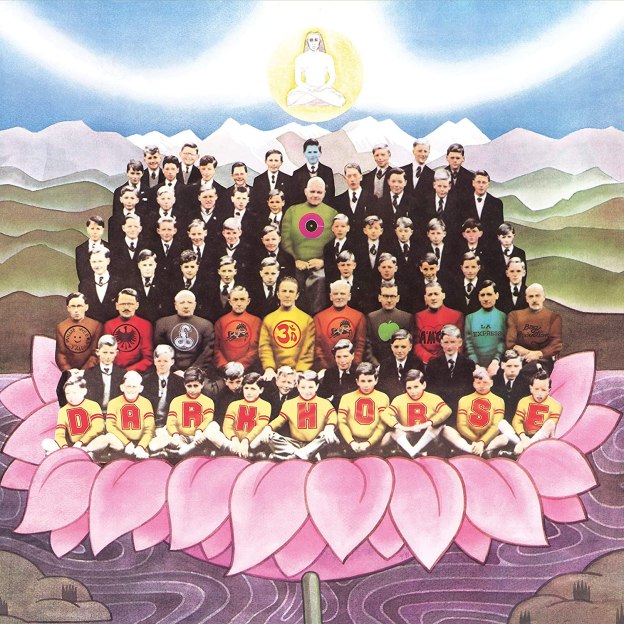
Overlooked Gems: Dark Horse

Christopher Rush

George Harrison is no saint.  Well, he may be one right now, but back in his day he was no saint.  He fooled around, basically drove his first wife away (into Eric Clapton’s arms), inserted a great deal of narcotics into his being, he could hold grudges … basically, he was human.  We all have faults; we are all sinful, even those of us who are redeemed.  I’m not excusing George Harrison’s improper life choices (I save that for myself); I’m simply saying our task is not to allow one’s failures prevent us from enjoying the positive things one has to offer.  I knew you weren’t thinking that, but the more I read about George, Brian, Paul, Mike, John, Carl, Ringo, Dennis and the rest, the more that notion is pressing upon me.  But that’s a personal problem, I know.  On with the musical analysis … advertisement.  Whatever.

For some reason, not too many people liked the album Dark Horse when it first came out, but I do not understand why.  A lot of rough things were going on for Mr. Harrison at the time: rough vocal health (as can be heard throughout the album, including the bonus tracks on the cd release), divorce from his wife Pattie, his second trip to India, a poorly received U.S. tour with his good buddy Ravi Shankar, the end of Apple Records and the beginning of Dark Horse Records (George’s personal music studio) — a mixed bag of life experiences during which to release an album, yet none of them strike me as valid for disregarding the album.  Some of those rough experiences come out in the first half, which is mostly sad (other than the first song, which is quickly rising up my all-time faves list), but the second half is ebullient and typically self-effacing George Harrison.  I like it, and so should you.

Side One

“Hari’s On Tour (Express)” is an excellent instrumental: it varies in tempo and melodic line, and thus it never lags or overstays its welcome, which is surprising for an almost five-minute instrumental.  It has patterns, one could almost say “movements” or “motifs,” and the listener soon feels confident he or she understands the flow of the song, but the pattern is so various even in its familiarity it is never dull.  This may sound like faint praise, but it is not meant as such: the slower portions are a smooth groove and the faster portions really cook with the multiple guitars, the brass, the drums; basically, it’s a fresh combination of jazz and rock that holds up to multiple back-to-back listenings.

The autobiographical portion of the album begins with an intriguing reflection by George about his rock-and-roll lifestyle in “Simply Shady.”  The laryngitis from which George suffers during much of this album improves the atmosphere of this song especially, as it all about the dangers of succumbing to the stereotypical concomitant famous lifestyle experiences (so, drugs and alcohol, yes), and the taxing nature of George’s lifestyle outside of his religious devotion undergirds the pathos of the song.  Perhaps the most intriguing aspect of this intriguing song is George’s reference to “Sexy Sadie,” John’s irritated response to the Maharishi and the Beatles’ first trip to India.  This is odd considering George just came back from a more positive trip to India coupled with the album’s overall enthusiasm for Indian philosophy and religion.  Aside from these intriguing points, the verses are impressively sharp intellectually, philosophically, and realistically.  George wrestles with the consequences of the last ten years of his life, he ponders the implications for the future, and he meditates on his place in the universe.  The honesty and introspection place this song among his most important.

The autobiography continues with “So Sad,” a heartbreaking account of George’s response to his failing marriage.  For some the pathos may be tempered by George’s part in the dissolution of their marriage, depending on which (auto-)biographical account one reads, but that would not be wholly fair, especially considering the authenticity of George’s remorse throughout the song (which is not to downplay the horrible and rotten things George did during their marriage both to himself and in violation of his wedding vows, but go see the first paragraph of his essay for further thoughts).  The human anguish in this song is remarkable in light of the “spiritual peace” sung about on all of George’s solo albums to this point.  I suspect the George Harrison experiencing the emotions of this song would attempt something violent if the slightly younger “chant the name of the Lord and you’ll be free” George Harrison told him to simply release all of his problems through a mantra.  Another standout aspect of this song is the, well, I was going to say “rhythm,” but that’s not quite it: the number of guitar strums in the guitar riff, really.  The music sequence feels incomplete, but upon further reflection, the keen listener realizes that complements the lyrics beautifully.  He is so sad, so alone, he is no longer complete, and the musical line supports that.  It is effectively jarring.

The pathos takes a markedly cynical turn with George’s revision of the Everly Brothers’ “Bye Bye, Love,” featuring not only an added comma in the title but also a radically different melodic line (now in a minor key) and rhythm to the lyrics as well as a personal set of verses about Pattie’s not-so-newfound relationship with George’s good buddy Eric Clapton.  The latter verses highlight the cynicism with more than a tinge of hypocrisy as well, considering the narrator of the song (presumably George himself, considering the pointed nature of the first verse) expresses vitriol for the infidelity of the human woman, despite his own infidelity as a significant component of the dissolution of their marriage, in truth.  In all, this version has admittedly a world-weariness about it the original lacks, but this mood fits the actual lyrics far better anyway, as further reflection on the now-bizarrely jaunty nature of the Everly Brothers’ version seems almost ludicrous in contrast to the more authentic George Harrison version (despite, perhaps, its asperity).

Side one ends with the perplexing song “Maya Love.”  It highlights George’s penchant for the slide guitar, which drives the most consistently up-tempo song on this side of the album.  Some experts tell us this was mainly an instrumental lick to which George felt compelled to add lyrics inexplicably (I think it would have been just fine to bookend this half of the album with instrumentals).  The paucity of lyrics, especially in contrast to the impressive diction in “Simply Shady,” “So Sad,” and even “Dark Horse” on side two, lends an air of verity to that claim.  Regardless, this song could be interpreted in a couple of ways depending on how one understands the relation of the two words of the title to the rest of the words in the song.  This sounds obvious, of course, but bear with me, please.  For a long while I took the song to be about “love for maya,” or “illusion” in Hinduism — and for Hinduism, everything material is an illusion.  So I interpreted this song as George’s exhortation for us not to the love the material world of getting and spending or, worse, getting and hoarding, a love from which he suffered as well.  While this somewhat facile approach to the song worked, even if the lyrics were slapdashedly attached to a Billy Preston-driven funk, it didn’t really make a lot of sense.  After further reflection abetted by a modicum of research, I’m leaning more toward an interpretation in which “maya love” is not the distracting, destructive love of maya itself but a broader warning against a particular kind of love, the illusory kind of love in general (not the love of illusions themselves).  The song in its brevity, then, sees the progress of the autobiography culminate in a sober recovery from cynicism to a wiser, more concerned-for-others cautionary tale about being wary of false love — it is everywhere, it pervades, it is even in us and affects us, but even its ubiquity feels transient, a notion driven by the musical accompaniment, which thus feels more connected to the song than may have been intended.

Side Two

As if the flipping of the record were a complete shift in mentality and outlook, side two begins with a joyous, energetic song that would be my favorite on the album were it not for “Hari’s On Tour.”  “Ding Dong, Ding Dong” is a perfect New Year’s song or for any time you are feeling like you need a fresh start in life.  It is difficult to overcome the interpretive assumption this is George’s way of putting the past behind him (again, not excusing his transgressions or indiscretions) thanks, in part, to some of the many slogans Sir Frank Crisp inscribed in the halls of his (their) estate, Friar Park.  Not just his marriage to Pattie is behind him, but also his days as a Beatle (made even more evident in the accompanying music video).  It would be many years before he would revisit those days in musical homage, and only rarely, such as after John’s death and not again until his final album in his lifetime, Cloud Nine.  It is hard to begrudge him a desire for a fresh start barely five years after the dissolution of his first band and a few weeks after the dissolution of his first marriage.

This all leads to the eponymous track of the album, his personal record company, and likely, as biographer Geoffrey Giuliano aptly used it, his life: “Dark Horse.”  Critics still seem off-put by the scratchy vocals of this song, recorded while George was slowly but surely succumbing to laryngitis after all the hullabaloo, and while I have never read it referred to as “Dark Hoarse,” it is that.  The bonus rehearsal track included on the recent cd release features a much cleaner vocal of the song though accompanied by a much sparser instrumental track (basically just George’s guitar).  This song fits George so well because … well, it fits so well.  That sounded rather tautological, I bet, but here’s one case in which a tautology is true: this is George Harrison.  We thought he was just the nice, quiet one … we were wrong, even though George didn’t say or do anything to legitimize our perception of him.  We were the ones who assumed we understood him simply because he wasn’t like Paul or John or Ringo.  Oops.

“Far East Man” initially strikes one as an atypical George Harrison song until one suddenly realizes “While My Guitar Gently Weeps” is unlike “Taxman” is unlike “Within You Without You” is unlike “All Things Must Pass” is unlike “Here Comes the Sun” and just as suddenly one is asking onerself, just what is “typical” George Harrison, anyway?  This song is dedicated to Frank Sinatra, but one gets the sensation that’s more in the musical style of the smooth groove than the lyrics, unless one knows Mr. Sinatra had interest in the Far East, which I do not.  The lyrics are not so enthusiastic as the last couple, pondering the political turmoil of the early ’70s, but the song continually reminds us George (and/or Frank) is going to hang in there and stay true to himself and do what can be done to make the world better.  The gloomy notion “God, it’s hellish at times” is immediately refuted with the optimistic “But I feel that a heaven’s in sight.”  Hang in there, Levine.  Perhaps 2017 wasn’t so kind to you as you had hoped, and perhaps the social-media-generated pseudo-horror has got you down.  Hang in there, Levine.  A heaven’s in sight.

For George, the heaven is immediately in sight as the album closes with the final song overtly-influenced by Hinduism published in his lifetime, “It is ‘He’ (Jai Sri Krishna).”  Now, I readily admit my All Things Must Pass interpretation was more wishful thinking than feasible, but I can’t do much with this one.  It’s all Hindu, all the time.  But it is really catchy.

Dark Horse is a great album, so don’t listen to the nonsense of those who think it isn’t.  It is at once a snapshot in time in the life of George Harrison and a collection of timeless songs, especially “Hari’s On Tour” and “Ding Dong, Ding Dong.”  With the bonus songs on the cd release, this is the best time to get into this overlooked gem.  Don’t let the Hinduism prevent you from enjoying a great album — you’re too good for that, and so is this album.  Put it on your Christmas list, stuff it in the stocking of someone you love, just go get this album and enjoy it.

“What about a Story?”: Winnie-the-Pooh as Literature for Adult Readers

Katie Arthur

One of the oddest things about Winnie-the-Pooh is that it is so embarrassingly funny.  I am a grown adult, and I laugh out loud in the middle of my university library and have to apologize to my neighbors because Mr. Milne knows exactly how to pull a guffaw out of my throat at exactly the wrong moments.  But, you ask, I thought it was a children’s story?  Is it the sort of funniness we could imagine children enjoying?  Is it below our mature threshold for thinking, adultish entertainment?  In my reading, no.  This is genuinely clever funniness for young and old, and the hilarity is a function of what narrative theorists call the implied reader.  In the 1960s, Wayne Booth initiated theory on the implied reader, saying the text itself constructs a sense of the audience it intends, assuming knowledge and giving knowledge according to what it wants the reader to be.  That ideal audience corresponds to nothing in the real world.  The real readers of the text may or may not be anything like the reader the text asks for, but the sense the real readers get of the implied reader nonetheless shapes the way we receive the text.  It is here that Winnie-the-Pooh is successful. 

Winnie-the-Pooh incites two kinds of implied readers.  It is a book either for older children to read for themselves or for adults to read out loud to younger children, and it works very well both ways.  There are three kinds of humor in this book: humor for both the adult readers and the children listeners to enjoy together, and two kinds of humor only the adult readers will enjoy: the first, a humor accessible only to the adult readers as a function of the printed text, which naturally the young children will not appreciate; and the second, a humor that allows the adult to enter into the funniness of a child’s world.  We will look at all three kinds of humor but dwell on the last for the longest because it is the reason I have to excuse myself from quiet places.

The humor made for both children and adults is the most easily explained.  These are instances of simple confusion and embarrassment, like most of the comical things we encounter in our lives.  In the fourth chapter, “In Which Eeyore Loses a Tail,” in order to find the tail, Owl suggests a reward be issued.  “‘Just a moment,’ said Pooh, holding up his paw.  ‘What do we do this — what you were saying?  You sneezed just as you were going to tell me.’  ‘I didn’t sneeze.’  ‘Yes, you did, Owl.’ . . . ‘What I said was, “First, Issue a Reward.”’  ‘You’re doing it again,’ said Pooh sadly” (50, 51).  This is purely delightful confusion between the sound of the word issue and the sound of a sneeze, and absolutely accessible to young and old minds.  In Chapter II, “In Which Pooh Goes Visiting,” Pooh finds himself stuck in Rabbit’s front door, which was constructed to allow Rabbits and hungry Pooh Bears through, but had forgotten to take into account not-hungry-anymore Pooh Bears (32).  People stuck places they should not be is just comical.  This too, is simply an embarrassing situation most children and adults can relate to and laugh about.  When Kanga and Roo come to the forest, and the animals have to decide what to do about these strange visitors, Piglet must, according to the plan, pretend to be baby Roo to trick Kanga into leaving. As Kanga, only fooled for a few moments about the difference between a baby pig and a baby kangaroo, gives Piglet a spluttering cold bath to continue the joke, both reader and listener can laugh at Kanga’s cleverness and Piglet’s sad and unheeded insistence he is not Roo and does not need to have this bath and take this medicine (106).

And then there is humor Mr. Milne threw in just for the reader, which the child listener would have no access to, unless he were an older child following along with the reading.  This is located in the clever misspellings of certain things in the text.  These animals are the toys of a young boy, so they do not naturally have a very large capacity for educated writing and reading, and yet, living in a forest, one finds the need for many things to be written.  So Owl, the wise one, finds himself doing most of the spelling work when Christopher Robin cannot be found, and the result is funny for the reader.  For example, on Eeyore’s birthday gift from Pooh, Owl writes “HIPY PAPY BTHUTHDTH THUTHDA BTHUTHDY.  Pooh looked on admiringly. ‘I’m just saying “A Happy Birthday,”’ said Owl carelessly.  ‘It’s a nice long one,’ said Pooh, very much impressed by it.  ‘Well, actually, of course, I’m saying “A Very Happy Birthday with love from Pooh.”  Naturally it takes a good deal of pencil to say a long thing like that’” (83).  Mr. Milne took the time to write out in the text the funny misspelling that would only be seen by the reader.  (Although, this might better fit into the first category.  As we are supposing this to be read out loud, the pronunciation of the misspelled birthday message could be a point over which listener laughs at reader, and we might actually need to create a new category.)  Another instance that is truly only for the reader is when Pooh brings Christopher Robin news of the flood waters in other parts of the forest, bringing with him a note he found in a bottle.  He calls it a “missage,” and Mr. Milne continues, for the enjoyment of the reader, to spell it missage even when he has finished reporting Pooh’s actual words (142).  And at Owl’s house are two signs which read: “PLES RING IF AN RNSER IS REQIRD” and “PLEZ CNOKE IF AN RNSR IS NOT REQID” (48).  These are intelligible signs and can be read out loud to a child without problem, and the misspellings are just a little treat for the reader.

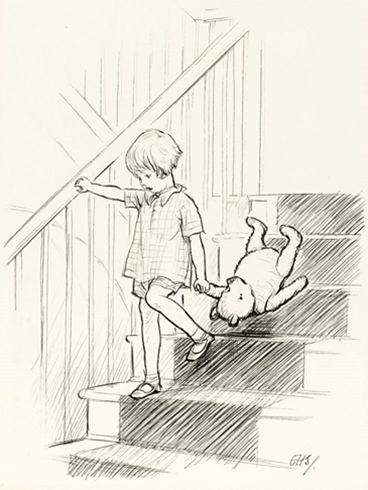
But the most interesting parts of the book for the adult reader are the places where Mr. Milne’s adult narrator speaks as if he were a child and allows the adult reader the joy of watching children think.  In the introduction and first chapter, our narrator sets up the book as a collection of stories about a little boy named Christopher Robin and his stuffed bear.  Really, Christopher Robin has told our narrator Winnie the Pooh has asked for some stories about himself, “because he is that sort of Bear” (4).  Christopher Robin is the explicit narratee here, the one receiving the story.  When Pooh needs a friend, “the first person he thought of was Christopher Robin” (9).  Christopher Robin here interrupts the story with a question about whether or not Pooh really meant him, and the narrator assures narratee Christopher he did.  We know, though, the story Christopher Robin and the listener Christopher Robin exist on different levels, one in the nursery listening to the story, and one in the Hundred Acre Wood being the story, and so they cannot be exactly the same.  But good storytelling encourages the listener to feel involved, so we can let him think Pooh meant him.  On page 10, Milne grants Christopher Robin permission to be called “you” by the narrator in a brief moment of dialogue.  Then on page 11, the story continues with Pooh and Christopher Robin, we assume.  But the Christopher Robin character is now called “you.”  Before, the listener Christopher Robin was “you.”  Now the character Christopher Robin is “you.”  In this tiny switch hangs a great deal of the success of the book, because in it the reader is invited to be Christopher Robin listening to his father.  As the narrator/narratee framework disappears with the disappearance of quotation marks surrounding the story and the reader receives the text in pure naked narration, the reader is addressed directly as “you.”  In this way, the adult implied reader is asked to put himself in the shoes of a child, to put on a child’s perspective and think like Christopher Robin.  The results are hilarious, and one of my favorite manifestations of this child-thinking is the time we are introduced to Piglet’s grandfather.

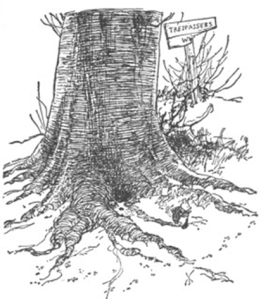
Piglet lives in a great beech-tree, and “next to his house was a piece of broken board which had: ‘TRESPASSERS W’ on it” and Piglet explains that it “was his grandfather’s name, and it had been in the family a long time” (34).  We the readers know, as the narrator intends for us to know, that Trespassers W is not short for Trespassers William, as Piglet says, but for Trespassers Will Be Shot.  If you are a child, though, trying to make sense of the world around him it makes perfect sense for a grandfather to be named Trespassers W.  The funniness here is a function of the particular adult implied reader who does have a pretty good sense of the world around him, but who has hung next to his adult sensibility a child sensibility and has let them clink around a little at odds with each other.  This clinking sounds like laughter.  So a story can begin, “once upon a time, a very long time ago now, about last Friday,” and it both makes sense and is laughably wrong, because the adult knows how a child can feel that last Friday was an eternity ago and also know it has really only been a few days since then (4).  And of course when you are a child trying to discover the North Pole, it makes perfect sense to look for a stick in the ground and preferably rather close to where you live, when you the adult knows it is actually a huge lonely snowy place very far away with no real poles at all (127).

To become an implied reader, to put oneself in the brains of someone else, is one of the greatest joys of reading narrative, and it is especially fun when the new brains are joyful and juvenile.

Works Cited and Related Reading

Booth, Wayne. The Rhetoric of Fiction. University of Chicago Press, 1961.

Iser, Wolfgang. The Implied Reader. Johns Hopkins UP, 1974.

Milne, A. A. Winnie-the-Pooh. E. P. Dutton & Co., 1961.

Prince, Gerald. “The Narratee Revisited.” Style, vol. 19, no. 3, 1985, pp. 299-303.

Hamlet and Ophelia

Emma Kenney

William Shakespeare has written many beloved plays that are still incredibly popular today. Perhaps one of his most well-known plays is Hamlet. This tale of duty and betrayal has been read by many, and Hamlet’s soliloquies are some of the most recited monologues and iconic scenes of all time.

Over the years there have been many versions of this play. It has been performed with famous actors such as David Tennant, and it has ben done as a movie. There have been television show episodes and books semi-based off of it. One book in particular, however, is based off it a bit more than others. Ophelia by Lisa Klein tells the story of Hamlet from the perspective of Ophelia. It is an interesting read from a point of view that is rarely shown or even thought about. However, the book does contain quite a few differences from the original play’s storyline, which show it to be something of a different nature than Shakespeare’s Hamlet.

The first big difference between the two stories is the fact Lisa Klein’s story shows Ophelia and Hamlet as children. The novel starts when Ophelia is roughly ten and hamlet is in his mid to late teen years. It shows Ophelia before she came to the castle and then as a child within the castle. Klein’s story talks of neglect Ophelia faces at the hand of her father and depicts her as a young tomboy who would much rather run around and roughhouse with the boys than sew or play music. It shows the reader how Ophelia became a lady in the queen’s court and how she rose and fell in her eyes. These are all topics Shakespeare’s original play doesn’t even touch on, as the focal point is not Ophelia but Hamlet.

In Hamlet, Hamlet doesn’t decide he loves Ophelia until after she is already dead, but in the story by Lisa Klein, Hamlet declares his love for her much sooner, although he does so in secret. In her story only Horatio knows of the declared love between the two and helps them to marry in secret. Hamlet declares his love for her many times in the book and chases after her soon after Ophelia turns fifteen or sixteen. He is able to finally woo her and they are often seen in the novel sneaking away to kiss or to do more saucy things. This is all very different from the original storyline where, as previously mentioned, there is no mention of Hamlet even remotely liking Ophelia until she is already dead.

Hamlet’s descent into madness is also much different in the original play. For starters, since it is about Hamlet himself you see way more of the descent than you do in Ophelia, and there is a much greater focus and emphasis placed on it than in Lisa Klein’s Ophelia. In the play we see even from the beginning he is not mentally well, and we get wonderful speeches such as the following:

To be, or not to be — that is the question: Whether ’tis nobler in the mind to suffer the slings and arrows of outrageous fortune or to take arms against a sea of troubles and by opposing end them. To die, to sleep — no more — and by a sleep to say we end the heartache, and the thousand natural shocks that flesh is heir to. ’Tis a consummation devoutly to be wished. To die, to sleep — to sleep — perchance to dream: ay, there’s the rub, for in that sleep of death what dreams may come when we have shuffled off this mortal coil, must give us pause. There’s the respect that makes calamity of so long life. For who would bear the whips and scorns of time, th’ oppressor’s wrong, the proud man’s contumely, the pangs of despised love, the law’s delay, the insolence of office, and the spurns that patient merit of th’ unworthy takes, when he himself might his quietus make with a bare bodkin? Who would fardels bear, to grunt and sweat under a weary life, but that the dread of something after death, the undiscovered country, from whose bourn no traveller returns, puzzles the will, and makes us rather bear those ills we have than fly to others that we know not of? Thus conscience does make cowards of us all, and thus the native hue of resolution is sicklied o’er with the pale cast of thought, and enterprise of great pitch and moment with this regard their currents turn awry and lose the name of action. — Soft you now, the fair Ophelia! — Nymph, in thy orisons be all my sins remembered.

While Hamlet still tries to convince his friends in the play he is merely pretending to be crazy, there are enough speeches and lines from him to show he is really not just pretending at all. The novel, however, is lacking some of these vital quotations and scenes. While one can definitely still tell Hamlet is crazy, the reader doesn’t get to see him fall into it slowly and surely. It is portrayed more along the lines of, “Oh my dad is dead? I guess I’m completely and totally mental now!”  It is quite unfortunate, as that character development is one of the things that makes Shakespeare’s play so wonderful.

One of the biggest differences between the novel and the play is the way Ophelia’s tale is ended. In the play she is depicted as going mad, and she falls from a tree in what is suspected to have been suicide. In the novel she does what Hamlet claims to do and fakes madness in attempt to protect herself. When this only draws more attention to her, she freaks out and starts trying to figure out how to escape the castle and all of Denmark. Finally, with the help Horatio and the queen she fakes her death and flees Denmark with basically only the clothes on her back and some money from the queen. She ends up at a convent where she spends the rest of her days as the “doctor” for the town. This takes up the entire second half of the novel (in what is considered to be, by many, one of the most boring and useless halves of a novel ever to be written in the English language). Also, while she is at the convent in the novel taking care of all the sick and crazy people, she ends up giving birth to Hamlet’s son, whom she names (drumroll please) Hamlet. This is something incredibly and drastically different between the novel and the play, as Shakespeare never wrote Hamlet to have an heir at all. Lisa Klein’s novel, however, takes some creative liberties, however, and writes one in.

Another difference between the play and the novel is theme and focus. The novel places emphasis upon “sexual awakening,” to the point of taking away from the plot, which is something the play never does. The focus is on Ophelia, who she is, and what she does, as well as on love, how it should make one act, and whether love is ever true at all. One important theme is how all of humanity is corrupted, specifically by lust, and how that lustful corruptness affects everyone. It also shows that if the king falls so will the kingdom, though the play shows this as well. The play talks about corruption like the novel, but in the play the focus of corruption is placed upon the desire for power, not upon lustful desires. It depicts most of the corruption in the story to come from character’s desires to rule and to be in charge or to be honored and recognized by all. The play focuses on Hamlet, his descent into madness, and the fall of Denmark instead of on Ophelia and what she does and thinks. The focus is never really placed upon love at all, because that’s just not what the original story is about, other than when Ophelia is trying to cure Hamlet’s insanity by loving him and bidding him to love her back.

It is incredibly easy to see how different these two are, and those differences are why Shakespeare’s beloved Hamlet has stood the test of time and Lisa Klein’s Ophelia has barely been heard of. Though Shakespeare brings them up in interesting ways, the themes of his play are important and relatable (we all deal with death and with corruption). Because of that his play will continue to stand the test of time, unlike those that warp and change these themes into something less than. The play is loved for its quality of writing and plot, and when one tries to change that too much it is better to have just invented a different story altogether. Ultimately, though, it is safe to say both these stories do share one thing: they show that at the end of the day we all have to choose. We most chose to deal with our grief — to run from it or to face it head on.

What Else Was Going On?

Christopher Rush

Hello, friends.  Twenty-five issues.  Where’d they go?  Twenty-five issues.  I don’t know.  I sit and I wonder sometimes where they’ve gone.  Appropriately enough, as of this writing, we are a few scant months away from my twentieth high school reunion, so those reflective thoughts have been and will continue to be quite prominent in my head.  But, hey, we  aren’t here to talk about me … well, we are, but let’s try to keep it positive.  As you already know, a significant portion of my summer was taken up with Beach Boys and Beatles material, at least the first half of the summer.  About mid-July, I hit the proverbial wall and found myself taking notes on the first time the Beatles heard Elvis songs and minutiae like that and it dawned upon me … I’m  preparing too much for this class.  I was doing Mark Lewisohn-level work, and I’m not ready to write the definitive work on the Beach Boys and the Beatles — I just wanted to teach a course about appreciating and understanding their music and the times.  Thus, after about eight intensive weeks, I just stopped, focused on other things, read different books, played some games, and relaxed quite a bit more.  (I also took a nonsensical on-line course about Graphic Novels in the Classroom to renew my teaching license, since higher education is all a scam, but I’d rather not talk about that now.)

As is our custom, here are some brief and most-likely unhelpful book reviews about most of the books I read from late spring up until the beginning of this current school year.  Shortly after I curtailed my Beach Boys/Beatles preparation, I realized I hadn’t read any Nero Wolfe books all summer and repaired that nonsense toot suite (and found myself on a bit of a mystery kick for a while).  Enjoy, friends.

Simple and Direct: A Rhetoric for Writers, Jacques Barzun

Rating: 2 out of 5.

I feel somewhat abashed giving a book by the superb Jacques Barzun only two stars, but according to the authoritative site Goodreads (or “goodreads” as it wants to be known on its own page), two stars equates to “it was okay,” and since Simple and Direct was okay, two stars it gets. I’m not really sure what the ultimate function of this book is: surely it’s not a textbook for classroom use, as entire hordes of young people posing as students collectively work through revising sentences with diction they’ve never heard (perhaps the original audience was familiar with his language, but none today); I certainly did not feel impelled to work through the exercises on paper — I was fine thinking through them while reading them. Toward the end Mr. Barzun gives us an extended survey of punctuation, but inscrutably he defines colons in contradistinction to his own usage throughout the book.

Not to harp on its deficiencies, but organization, another facet of writing upon which Mr. Barzun attempts to instruct us, is almost wholly useless in this work. True, it has distinct chapter headings covering divers aspects of writing, helpful enough, but beyond that … utter chaos. Mr. Barzun traipses merrily from sub-point to sub-point, devoid of meaningful connection or reference-work ease of finding/accessibility/utility. Mr. Barzun gives us wonderfully trenchant tips on diction, tone, style, revision … while you’re reading through the book. Aside from a virtually meaningless index, we have no realistic way of using this book as a reference tool for attacking individual writing errors.

So read it … once. Try to absorb as much as you can. Perhaps copy out the twenty basic rules for writing Mr. Barzun scatters throughout his pages for general guidelines of decent writing. Then … give it to someone else. I doubt you’re going to want to keep it for multiple uses.

Asking the Right Questions: A Guide to Critical Thinking, M. Neil Browne and Stuart M. Keeley

Rating: 0.5 out of 5.

Well … that was rubbish. Not only is this full of biases and horribly inappropriate “practice exercises” (many of which deal with various forms of human perversion), but also it is laboriously redundant and ultimately a gigantic waste of time. Basically, Biff Tannen will crash into a truckload of this book in Back to the Future, pt. 4. Several years ago, without reading it, I snagglepussed their list of “the right questions” for a class handout on critical thinking, supplementing the list with better context and purposes and kept telling myself I would read the whole book some time and find out how I can make that handout better. Now I know: I can eliminate their list of “the right questions” and make up my own questions and completely eliminate all trace of this product from my classroom.

For these “authors,” the two-fold purpose of “Critical Thinking” is a) to know for whom to vote and b) to know how to respond to advertisements. That is all. I’m not making this up; the book says that’s why we need “critical thinking.” Not for “how to become a worthwhile person,” not for “how to make the world around us a better place or the people around us better people,” not “to pursue truth and beauty and other affirming absolutes.” No, just to know the right candidate (and it takes about four pages into the book to find out what political party the “authors” think is right) and how to say no to all advertisements (as if we didn’t all know that by the age of 12 anyway). Yes, in the concluding fake final chapter reside some insincere “well, we’re all in this together, so be sure to use your critical thinking skills to help others out” stuff, but we can all be fairly certain someone’s grandfather who signed the paychecks way back in the 2nd edition days (back in the ’90s, when all smart people knew Islam had run its course) required this and now it’s just left over because it sounds all warm and sincere (or so they “think”).

Now, not much wrong exists with the actual “right questions” themselves, yet the need for entire chapter-like things explaining them does not exist at all. This could have worked much better without the “practice examples,” the nonsensical repetition, and everything but the final “why is this question important” box. One easy indicator of how much piffle suffuses this work is the fact the creators decided to highlight the important notices by both demarcating the essential points with thick grey borders flanking the significant paragraphs and beginning said paragraphs with the emboldened world “Attention.” One would suppose only one of these devices would be necessary to indicate the distinctively special nature of the material, but the authors chose both. And then they repeat themselves a lot. Thus, this would have been quite fine as a three-page pamphlet. Alas, the authors decided the route of horridly overpriced textbook instead of concise, useful pamphlet. Alas.

One could also mention the repletion of contradictions throughout: after redundantly explaining how important the “right question” under evaluation in each individual chapter is, the authors will often prepare you for the conclusion of the chapter (and the wretchedly off-putting practical examples) with “yes, but, sometimes it’s not like that, so do your best to make sure when the right time to ask this right question is right.”

One final concern about this (aside from the concern about their comments to the effect “emotions should never play a role in any decision”): the authors adamantly warn us against thinking in dichotomies. On the surface, of course, this sounds like good advice. Who can fault Pink Floyd for enjoining us against thinking in terms of “us and them”? The concern rests, though, in their outlandish declaration “never think in terms of right and wrong.” Because this is a dichotomy, it must be the wrong (irrational) way of making decisions and viewing the world. Everything that is good must have more than two options. And on and on. I’d say it’s rubbish, but that would be an insult to banana peels, cockroach husks, and last month’s Wheat Thins, and I don’t want to insult them.

Don’t waste your time. It’s a short work, but life’s too short for this work.

A Crown of Swords (The Wheel of Time #7), Robert Jordan

Rating: 4 out of 5.

While this follows the same pattern (if you’ll allow the expression) of the last couple of entries in this series, a good number of positive advancements occur (mostly toward the end, of course) in characterizations and overall storyline. One gets the impression this is “the rest” of Lord of Chaos, picking up right after it (unlike the earlier entries that often pick up a couple of months later). Either that, or we have advanced enough along in the story timeline we can expect the rest of the series is just going to be a continuous account of what is going on in “real time” (in a way). Back to the pattern: a lengthy dealing with the aftermath of the last entry’s climactic explosion, extended time with the Nynaeve/Elayne/Matt and Perrin sidequests, increasingly more menacing time with the Forsaken, a humorous look at what the White Tower is up to, decreasing time with the Aiel, and brief adventure with people we forgot were mentioned two novels ago but now suddenly give us the impression they are going to become B-list or even A-list stars of the series, and then another slam-bang finish in which Rand fights another Forsaken and conquers yet another territory. It may seem redundant, but it isn’t: the familiar weavings of the Pattern is obviously a fundamental aspect of this series, and by this time the basic format enables unforeseen and refreshing variety for us readers even within the expectations.

Halfway through the series, (and more words halfway through than A Song of Ice and Fire will be when it is finished sometime this century…? maybe?) we finally get some things we’ve been waiting for since basically the end of book one: Nynaeve finally gets her act together, Elayne and Egwene start getting their acts together, Rand gets some more of his act together, some good things actually happen to our heroes (for once), and bad things happen to the bad guys (sort of — they also gain more victories, but that’s fine). Is that spoiler-free enough for you?

Because so many positive things happen (though they don’t come pain-free, of course), some of the chapters in the final third of the book are among the most enjoyable of the series so far (and I’m pretty sure that’s not because it’s freshest in my memory): The First Cup, Mashiara (especially), Sealed to the Flame, Ta’veren … you read these and you think “finally, people are listening to our heroes! Let them get done what they need to get done!” It’s a very reaffirming feeling, and it’s not “unrealistic.”

It was a good book — maybe not as “fun” as The Dragon Reborn, but it was a very fast-moving book that felt like it was giving us things we’ve been wanting for a while and propelling us in a new direction (even if it will keep following the pattern). Yes, it has that ambiguous part in the middle with Queen Morgase that may be one thing or may be another, but I’m sure that will be worked through soon enough. Yes, it does have the Seanchan again, which is a) very frustrating (aren’t things bad enough with the Dark One and the Forsaken and the Black Ajah?), b) super impressive how Mr. Jordan would think to add that layer, and c) another big sign things are going to get even crazier in the books ahead (especially now we are in the second-half of the saga). But this was a good one, especially impressive after the major changes and excitement of that last entry — it’s just getting better and better. (And it’s better than ASoIaF … boom.)

Miss Lonelyhearts / The Day of the Locust, Nathanael West

Rating: 2 out of 5.

These really weren’t that good. They come across as the angry contributions of an intelligent man who doesn’t want any supernatural to exist, and because no supernatural exists (because he wants no supernatural to exist), he’s angry about how boring and meaningless life is but it’s God’s fault for not existing. Something like that. I admit it’s been a few months since I read Miss Lonelyhearts, which was the main reason I picked this up (the book not the time), but I was not favorably impressed. Clearly I’m wrong, since other people like it, and anger=greatness, but there it sits. Instead of dealing meaningfully with love and faith and human experiences, Miss Lonelyhearts just swaggers around grumbling and assuming and then just stops. It is Modernist, after all.

The Day of the Locust, likewise, gives us that same Modernist not caring attitude about how life really is, just glancing around at the bleakness and discontent and assuming this is how it always has been, always is, always will be, and God doesn’t exist and is to blame for not existing and how banal everything is, and it just stops. Nathanael West would have vilified Brian Wilson for portraying Southern California as a wonderful place of sunshine and happiness. But you know what? I’d rather listen to Brian Wilson than read more Nathanael West. Go on, tell me how wrong I am.

The World of Robert Jordan’s The Wheel of Time, Teresa Patterson

Rating: 3 out of 5.

I believe this was the first Wheel of Time book I owned, or close to it at any rate. I remember years ago leafing through it agog, thinking how could I ever possibly become familiar with all of these races and nationalities and conflicts … and then years later after finally reading books 1-7, most of it was easy reminders. Considering the clever viewpoint of the material, long before GRRM started doing basically the same thing (not this particular volume, but in general), the absence of the very things we want to know (the Creator, True Source, Age of Legends) may be disappointing, but there’s enough gathered tidbits to whet our appetites for the second half of the series (not that we needed more).

I know a few people have derided the artwork for the last twenty years or so, but considering the horrible conditions under which the artist was given to work by the publisher, I have no problem with it. My only wish concerning the art is I wish we had visuals accompanying the dress of the various military in the last few chapters especially. The descriptions are good, indeed, but visuals would abet those sections very well. The included visuals of our heroes don’t really match what they look like in my head as I’m reading, but that’s fine.

I’m glad I finally got to this book — it feels very strange having carried this around several moves cross-country and through major life changes (college, marriage, children), and now I’ve read it. Enough about me: obviously, this book is not for you if you haven’t read Wheel of Time books 1-7. You should really just read it when you’ve read them. But, if you have read them, you won’t get a whole lot of new information here, though the scant sections on the Forsaken, the Age of Legends, and a few things here and there are worthwhile (especially if you don’t pay cover price for it). It did help clarify a few things (like how Lews Therin is really “the Dragon,” not a Dragon reborn — he was the first Dragon, making Rand really the only “Dragon Reborn,” in the entire history of however many times the Wheel has turned, and how Artur Hawking was not a reborn Dragon himself just a good ruler hundreds of years after Lews Therin), and for that it was worthwhile for me. Plus a life marker reached. On the whole, satisfactory.

The Vindication of Tradition: The 1983 Jefferson Lecture in the Humanities, Jaroslav Pelikan

Rating: 4 out of 5.

Ah, it was nice to read intellectual discourse again (it had been a while, especially concerning nonfiction). I don’t mind name dropping, but I have Robert Duncan Culver’s copy (he parted with it willingly), replete with his own comments and asides, making it a nifty bonus-filled read for me (and whoever gets it after I shuffle off). As you likely know, Mr. Pelikan is pretty top notch about things, and his insights and enjoinments and adjurations make a good deal of sense throughout his four mostly connected lectures/essays. I wish it were longer, actually. He does a fine job contextualizing all sides of the Tradition issue, including the atheists who think it’s all rubbish, even pointing out how those who continue to follow Emerson’s call for rejecting tradition are guilty of following a tradition. It’s full of spectacular lines, none of which will be quoted here because it’s all the way upstairs and I’m down here. Track this down. It’s really good. Of course, if you are one of those Emersonians, you’ll probably not like it because it will point out how wrong you are, yet it will do so intelligently and respectfully — something you may not be used to from people who disagree with you and write things (post things) today.

And Four to Go, Rex Stout

Rating: 4 out of 5.

When you get to the end of summer and realize you haven’t read any Nero Wolfe all year yet, it’s way past time to get on that. This is another trim, clean, crisp group of Nero Wolfe adventures mostly though ancillarily pertaining to holidays. “Christmas Party” is a surprising revelation to what lengths Nero Wolfe will go to keep Archie Goodwin in his employ (and single). “Easter Parade” is a very clever mystery about ancient machines known as photographometers (I believe), fantastickal boxes of antiquity that were used to visually capture a moment of time without also letting you order pizza. This, too, has a surprising revelation concerning to what lengths Wolfe will go to acquiring rare orchids, including asking Archie to steal them!

“Fourth of July Picnic” is also bizarre, but not in a bad way — whenever Wolfe is out of the house the story feels unsettled. Wolfe is on deck to give a speech about the restaurant world and, of course, a murder is discovered during his speech. The problem is an eyewitness can testify no one went into the room of the murder except Archie and Wolfe! Another unique aspect of this mystery (though a bit of a theme for this collection) is motive for murder is almost a nonfactor in the crime solving. Archie and Wolfe spend almost no time on “why” the murder, just “who.” “Murder is No Joke” is another very clever mystery with an obvious set-up: a painfully obvious ruse to befuddle Wolfe at the very beginning, but soon that ruse takes on new twists and nothing is quite so obvious anymore.

Top notch collection. Strangely, as readers, we are torn between wanting to spend time with Archie and Wolfe and the rest but wanting short, concise stories we can inhale and enjoy quickly. This collection with four very short yet rich stories balances that tension perfectly: short, quick stories, but four instead of the usual three. “Satisfactory.”

Champagne for One, Rex Stout

Rating: 3 out of 5.

Another enjoyable Nero Wolfe adventure, once again Archie gets into some shenanigans and drags Wolfe into it against his will. While this sounds like Archie’s job description in general, this time Archie is present at the death of a young woman and believes it’s murder … even though everyone else at the event says it’s suicide, the cops believe it’s suicide, and no proof for murder seems to exist other than Archie’s instincts. For us, for Wolfe, for Fritz, this is enough. Of course that’s tough for Cramer to swallow, and even more difficult for the Police Commissioner to swallow, who has a surprising and secret offer to make to the brownstone residents! Fans of the Hutton/Chaykin series will recognize this as an early episode, and the show is rather faithful to this novel, leaving out only a few brief scenes that only confirm a few things for the detectives — but even with the familiarity from a faithful adaptation, the original story is neither stale nor dull. It almost drags a bit toward the middle as many Wolfe novels potentially do, but this one does not lag noticeably. One helpful aspect of the book is its more lucid expression of the connection between the instigator of the mess and the perpetrator of the mess, which was slightly glossed over in the episode. It’s still brief here, but combining both makes the entity of Champagne for One feel enjoyably complete.

Plot it Yourself, Rex Stout

Rating: 4 out of 5.

My wife and I listened to this during a long car trip years ago, so moments of it felt vaguely familiar, but I could not remember any of the important things. It’s nothing to brag about, considering it isn’t a very long novel, but I read this in one day; I say that not to brag but to emphasize how gripping it is, especially after the first shocking twist about 24% into the novel. It starts out rather dry, admittedly, and even Wolfe is bored by what is being offered him at the beginning, but once it kicks in it really moves and grips. This is chock full of twists and surprises and even shocking moments. The gang is all here: Cramer, Stebbins, Saul, Fred, Orrie, Fritz, even Dol Bonner and Sally Corbett. This may rank as among the best Wolfe stories, and that’s saying quite a bit, I think.

To Catch a Spy, Chris Scott

Rating: 3 out of 5.

This is two books in one, akin to Moby-Dick and Les Misérables, but whereas Moby-Dick is about 50-50 philosophical whaling guide/novel, To Catch a Spy is 75-25 philosophical inquiry/spy novel. Mr. Scott strikes you immediately as one who feels very strongly about knowing words and is compelled to impress you with them. He namedrops most of the Beatles/Beach Boys’ spiritual mentors early on, proliferates the book with antique literary references, and just generally makes the book difficult to read. I’m by no means a skilled, quality reader, so maybe it’s just me and my infacility with language and words and things. And stuffs and items. We are bombarded with several names and codenames at the beginning of the book, so much so one will have great difficulty remembering who is whom throughout, even perhaps until after the book is over, and while that is part of the spy atmosphere, it doesn’t make for an enjoyable reading experience of a spy atmosphere, for most of the book.

Much of this work, as I said, is a psychological treatment on the good ol’ spy game back in the glory days of the Cold War, when men were men and Bruce was Scarecrow and Pierce was Remington and life was good. Aside from all the horrible things that were going on at the time, of course. But the Spy Game was a Gentleman’s Game back in the day, when agents and double agents and triple agents all seemed to know each other and hang out at all the old familiar places. Or did they…

We are treated to the mentality of the different players in this game: what it’s like to investigate why an agent switches allegiances, what it’s like to be a high-level strategist who concocts plots and counterplots, what it’s like to be a Russian puppetmaster/tightrope walker standing in the gap between trust and betrayal, and what it’s like to be a tool-turned-tool user. Or are we…

Suddenly, all the psychological underpinnings are swept away and we are LeCarréd away into a breakneck spy catching thriller … but which spy are we catching? And which do we want to catch? The last few pages have a significant number of twists and countertwists jam-packed and slam-banged together, which may “salvage” the book for some who thought it would be more Ian Fleming-like than John LeCarré-ish. I found it rough going for awhile, but the ending “made up” for it (though I won’t be keeping it and reading it again in my life).

Whose Body?, Dorothy L. Sayers

Rating: 3 out of 5.

While it is likely this book suffers from the typical “first entry verbosity,” Ms. Sayers has deftly created a new kind of sleuth, though one that is eminently aware of his place in the history of British detectives. New readers to the series may be surprised (as I was) just how frequently Mr. Holmes’s name was mentioned. Christians that have been given the impression Ms. Sayers is a Christian author will similarly be surprised at the frequency of the, shall we say, “d-word” as used by our “hero,” yet Ms. Sayers never gives attentive readers the impression Lord Peter Whimsey is a Christian. Interestingly enough, it is his policeman chum Parker who is fond of reading Biblical commentaries.

The mystery itself is mildly intriguing, but as I said above as the first mystery novel by Ms. Sayers (as far as I know), we can easily ignore the unnecessarily lengthy bits in hopes she will hone her craft soon enough. This adventure does have one very compelling moment toward the end, however: our hero has willfully if impetuously put himself in the clutches of the fiendish murderer (primarily to ascertain if his heroic deductions are correct, we suppose), placidly allowing himself to be destroyed … until Whimsey’s hand grabs the villain’s in a “vice-like” grip, followed by one of the most intense tacit stare-downs in literature. All in all a fine beginning to the series, especially as one acclimated to Ms. Sayers’s style.

Clouds of Witness, Dorothy L. Sayers

Rating: 3 out of 5.

Surprisingly more tedious than the first Whimsey adventure, Clouds of Witness treads territory most series do not tread until much later: family misadventure (thus two surprises in one sentence). Having been introduced to the strengths and some failings of our new hero in the first entry (as is typical for new mystery series), our knowledge of Lord Peter and his policeman chum Parker is expanded by more encounters with the rest of the current Whimsey clan, as Peter’s stoically uninteresting brother is preposterously accused of murder, primarily (if unintentionally) by their own sister! And while this should make for a riveting and fresh perspective on our hero and his world, mostly what we learn is how right the ’70s punk rock scene was in vilifying British peerage (no offense to the truly noble nobles out there). The whole system, especially its self-satisfied legal system, is perfectly exemplified by George Whimsey, and we have an immediate and deep-seated understanding and respect for why Lord Peter only associates with that bunch when he has to.

While this case is distinct enough from the first, despite both being murder cases, the speed of the novel slows down tremendously with a preponderance of clues, lengthy dialectic engaged with those clues, immediate rejection of everything that was just bandied about by a new revelation at the commencement of a new chapter followed by a lengthy (and spurious) account of whereabouts and actions likewise immediately refuted at the dawn of the following chapter, supplemented with a bevy of new clues, surprising new witnesses, and lengthy discussions about them all. And while I acknowledge that is usually how most mystery novels go, this one goes on in “figuring out whodunnit and howdunnit” stage a trifle too long (possible six trifle’s worth). Not that this is bad, mind you, and Ms. Sayers does concoct some interesting twists, but readers should be aware we are not in the “concised” phase of the Whimsey canon yet (if indeed such a thing exists … I’ll keep you posted).

The Liberal Arts: A Student’s Guide, Gene C. Fant Jr.

Rating: 1.5 out of 5.

As the Dull Train plods into Dull Station, we close our uneventful ho-hum. Please exit lugubriously and be on your way.

I don’t want to sound harsh, but that’s basically this book. I was very interested in this series, but this was not the ideal place to start. Perhaps it’s me: maybe I’m at that point at which I don’t need yet another “initial student’s guide,” of which this certainly is one of. Not only is it very much a beginning guide (one hopes it’s not truly aimed at college students … junior high kids, maybe), it deceptively has virtually nothing to do with the Liberal Arts. I was hoping for an engaging overview and interaction with the classical Liberal Arts, somewhere around seven in number I believe, but this little-yet-overlong pamphlet does not truly engage with them. Mr. Fant, Jr. spends some time dabbling with Science and Language Arts and how they can be neat-o, and he does give some attention to God and Stuff like that and how Thinking and Work and Bible-thing-items can be beneficial to one’s thoughtlife, but none of that is really what anyone reading the title wants from what the title advertises. Typically, and especially disappointingly, it ends with a peevish and irritating lament of Mr. Fant, Jr.’s own personal educational background experiences, its ups and downs, its Liberal Artsiness and its Non-Liberal Artsiness, effectively albeit inadvertently confirming for us he really doesn’t have much of a grasp of what the Liberal Arts are (seems like it’s some cloud-like “thinking about what you read” pastime), and neither will you if you read this book. Surely better intro. guides for the actual Liberal Arts exist.

1000 Songs that Rock Your World: From Rock Classics to one-Hit Wonders, the Music That Lights Your Fire, Dave Thompson

Rating: 2 out of 5.

Let us try to disassociate the concept of “this book” with “the list of songs” concerning which “this book” purportedly exists. First, “this book.”

This book is pretty much shash. One gets the impression the photographs had been laid out meticulously, the categories of songs and song selections had been worked out over a good long week or so, and then with approximately four minutes remaining before sending the master proofs over to the printer, someone snapped his or her fingers and said, “hey, shouldn’t we say something about all the songs?” And four minutes later we had a slew of “This song really rocks even today,” and “A great song that makes your heart break … but does it?” and “Can feeling bad really feel so good?” and while those are not direct quotations, you’ve basically got a sufficient synopsis of the content of “this book.” I admit it does have a small mattering of historical surveys of famous musicians and songs and such, but none of the extended stories are worthwhile. Most of them end up with a “gotcha” attitude, as if we are the jerks for thinking this book was about to take something seriously for once (and we are, especially if you are late in the book and still thinking the people who made this book know anything or care anything about music).

The overall structure is likewise confusing: it begins with a treatment of presumably Mr. Thompson’s Top 5 of the 1000, but after that we are treated to topical surveys of the songs with no notion of what number the song is in the 1000 or why. We are given no explanation for why “Telephone Line” is 1000, “With or Without You” is not on the list, or even why “I’m Not in Love” is considered a good song (presumably because it took a long time to make in the studio). Perhaps the book is not primarily about the ranking and why, but it begins with the ranking, explains the top 5, gives us a few famous people’s “top 5”s, and gives us no real explanation of why the shift in treating the songs topically or why these songs “rock our world” and not others.

Sometimes this book has “in their own words” for the brief descriptions of the song, but most of those are along the effect of “yeah, we play that song a lot on our tours, and we didn’t know it was going to be a hit when we wrote it!” — nothing that adds to our understanding or appreciation of the song, really. Strangely, sometimes the song will feature purported direct quotations from the singer/band/writer without calling it “in their own words.” Punctuation errors, spelling errors, discontinuity between the song and the photo of an album by that band abound throughout … hasty, poorly edited, slapdash work, filled to the brim with utterly unhelpful words.

Now, “the list of songs.” We know going in it will be a uselessly subjective ranking, and the fact “Bus Stop” is supposedly the best song of all time proves from the very beginning this fellow need not be heeded about anything music-related. Unfortunately, as intimated above, he (or whatever typewriter-trained troupe of marmosets he had writing copy for the other 995 songs) persistently proves it for another 200+ pages. I have nothing against “Bus Stop,” but as the best song of all time? Tish and pish. “With or Without You” is not my favorite U2 song, either, but not even in the top 1000? But Garbage is? and Nick Cave and the Bad Seeds? And almost no Genesis, no Collective Soul, a whole lot of radio hits, almost no Beach Boys, and I could go on and on. I know, it’s all subjective. I had too much hope for objectivity with this. It has none. But most of us don’t when it comes to this sort of thing.

Sure, it has perhaps a handful of interesting tidbits from James Taylor and ELO and a few other things you’ll learn, and some of the posters from back in the day are historically interesting if not envy-inducing (you could have seen them and them and them! for $5!?!? sort of thing). But is the entire journey worth it? I don’t think so. But if you are interested in what the list is, send me an e-mail and I’ll send it to you. I’m still working through it, and while it has led me to some interesting songs I’ve never heard (of) before, which is a positive, it’s also proving I have not missed out on too much already either. Thus, it’s a mixed bag. I can recommend “this list” for comparison and thought-provoking discussion, but not “this book” for those purposes.

Armoured Onslaught: 8th August 1918 (Battle Book No. 25), Douglas Orgill 

Rating: 4 out of 5.

(Note: These next two books are from a fantastic yet criminally out of print series the Ballantine’s Illustrated History of the Violent Century. Don’t be put off by the title — the 20th century was rather violent and we need to understand it, Also, the “illustrations” are mostly historic photographs you can’t see anywhere else. If you ever see any book in these series buy it.)

This was a very enjoyable book. One might suspect that is simple praise considering how predisposed I admit I am toward this Ballantine series, but my predilection for this series works against potential poor entries in it. I say “potential” because I haven’t read one disappointing entry yet. I usually enjoy (so to speak) well-told stories about World War I, and this facet of the development of tank warfare was one facet I wasn’t so familiar with, as most of my WW1 reading has been broad whole-war surveys (plus Ms. Tuchman’s The Zimmerman Telegram). I appreciated Mr. Orgill’s treatment of the diverse attitudes to the tank coupled with his generous portrayal of the technical aspects of the tank’s development. It would be easy for lesser writers to be tendentious about the technical aspects or overwhelm the audience with specifications and minutiae, but Mr. Orgill does neither. His tone is inviting and educational and engaging even when explaining the data of the generations of tanks.

I found the reticence for the tank quite interesting, both from the Allied side and the Central Powers side. The general failure of Allied tanks at Cambrai due both to cool-headed Germans with tantamount anti-tank guns and the failure of the construction of early tanks could have easily been the end of tanks for decades if not longer  … but a very few visionaries saw the potential of the tank, even as the nature of WW1 itself demanded so much revision of “musket and pike”-era warfare strategy. Perhaps my favorite part was the line about how so few leaders understood just how different WW1 was from everything they were used to in war, especially the traditional cavalry. Gone were the days of outflanking your opponent with clever cavalry charges and scouting — with trench warfare, there were no flanks anymore. It is such a momentous notion in a few words: the world has changed significantly and fully. Technology is not a neutral thing. This was an enjoyable, educational book.

Japanese High Seas Fleet (Weapons Book No. 33), Richard Humble

Rating: 4 out of 5.

Surprising myself quite a bit, I may have enjoyed this book even more than the Ballantine book on tank warfare in World War 1. What’s so surprising about that is I had (and still have) virtually no interest in naval or air combat. I certainly don’t mean to offend anyone in the Navy or Air Force — I sincerely thank you for your service. For some inexplicable reason, conflict simulation games about naval or aircraft combat just do not interest me in any way. It’s not because I have had bad Battleship! experiences or anything like that. I have owned Midway and Luftwaffe and a few other games of their ilk, but none of them appealed to me. I say again I can’t explain it. I have no desire to play X-Wing or Armada or Wings of Glory.  Strangely enough, I had many enjoyable hours playing TIE Fighter and Wing Commander II back in the day — they did not spoil my appetite for the genre either.

For whatever reason(s), naval and air combat just don’t interest me … but this book was engaging, interesting, informative, well-written (even for a 28-year-old kid) and I plowed through it. I suspect part of my interest came from its Japanese-centric perspective (coming, I understand, from a European Caucasian’s research/analysis/synthesis framework) — you don’t get that too often, at least, I haven’t. Mr. Humble gave what appeared to me (and I less humbly consider myself a fairly attentive and sensitive reader to that sort of thing) a balanced and respectful treatment of the positive and negative aspects of the development of the Japanese navy from the beginning of the 20th century to the end of WW2, within the limitations of the series, of course.

Especially interesting was the seemingly universal problem of “Decision Makers in Charge” not listening to the wise counsel of actually knowledgeable, competent people, such as Yamamoto — why would high command not listen to him? Mr. Humble answers that question well, of course, but those of who feel like they are in similar situations are still boggled and bamboozled by it.

The only thing preventing me from giving this five stars is it ended too abruptly for me. I wish it had a few more pages (or even paragraphs) of conclusion — what lessons should be learned? what syntheses can we create from this history? Now, please don’t interpret that as “I can’t you do that for myself” … oh, I could. My point is I wish Mr. Humble had done it, because his writing and treatment of the subject was so riveting I wanted to know more from him based on all the reading and research and work he put into it and couldn’t necessarily say because of the limitations of the series design — the work just somewhat abruptly stops. I wanted a fuller, longer conclusion to the entire journey. If it had that, I would be willing to give this five stars, something I don’t give too often (keeper of the stars as I am). This was great. (I still don’t have any desire to play naval or air wargames, but I really liked this book.)

Docilitas: On Teaching and Being Taught, James V. Schall

Rating: 3 out of 5.

It pains me deeply to give something by the great Father Schall a mere three stars, but the presentation of this o’erhasty, slipshod, ramshackle of a haphazard collection knocks it down at least one star. If St. Augustine’s Press has an editorial staff, either this book was compiled while they were on a Department Retreat or they need to have a stern talking to (far be it from me to advocate anyone getting fired, but the editorial, proofreading, transcribing work here was atrocious).

The other sort of drawback of this collection, and it truly perplexes me to discuss any “drawback” with a collection of Father Schall, is how similar many of the entries are. I understand that is mainly the point, and I certainly don’t begrudge Father Schall for revisiting his favorite (and indeed worthwhile) themes in divers publications over the years, but to have so many so propinquitous in subject matter presented in a bemusingly “book-like” presentation feels like we are somehow being gulled. The occasional notion these discrete essays are now chapters in a cohesive (but not truly) book is also jarring at times.

But let’s get down to it. This is a collection of essays, however similar, of one of the great thinkers of our day, Father James V. Schall. Any chance we have to read some of this thoughts, to be refreshed by his decades’ worth of reading and reflection, to be reminded to read the things he has read, well, we are in for a good time. There’s not too much on “teaching,” per se, but there is a fair amount on “being taught,” and being taught by James Schall, even if, as he would be the first to admit, he is “merely” repeating the words of Plato, Augustine, Aquinas, Johnson, and Schultz, is as worthwhile an experience as this life affords.

Iron First Epic Collection: The Fury of Iron Fist, Chris Claremont, John Byrne, Larry Hama, Roy Thomas, et al.

Rating: 4 out of 5.

I wonder if Mr. Claremont’s contract back in the day had a “paid by the word” clause to it. But I kid Mr. Claremont: he saved the X-Men and we can all be grateful for his and Mr. Byrne’s tremendous run on that and New Mutants and many others. Even so, Mr. Claremont radically changes the nature of Iron Fist as a character. He begins as a very somber, almost mute character solely focused on his actions and motivations as a serious student of martial arts. Mr. Claremont takes all that away, giving us a very loquacious thinker and talker. Some will like that, some will not, especially as a good deal of it is reminiscent of early ’60s Stan Lee scripting (i.e., “let me say/think the actions you can see me doing with the accompanying pictures!”). But that doesn’t matter, since it all happened forty years ago.

What starts out as a tale of vengeance quickly turns into a tale of self-discovery: Danny Rand now has to live a “real” life away from the home he has known for most of his mature life, and along the way he gathers some allies and foes, and while all of that is the making of a pretty interesting series, when Mr. Claremont takes the reins, the initial creativity of villains and martial arts conflicts effectively goes out the window. He does an interesting job continuing some of the ideas of the early pre-Claremont stories, but the short-lived nature of the series once Iron Fist gets his own series also sees a few rather important storylines/conflicts disappear into thin air. Fortunately, some other big stories are wrapped-up in Marvel Team-Up issues included in this collection, but one wonders what could have been had Iron Fist’s own series continued.

Perhaps the most intriguing aspect of the series is Iron Fist’s complex and fresh relationships with Colleen Wing and Misty Knight. It’s best to read it for oneself in the series, but the complexities and directions Danny’s relationships take with these two Crime Investigation partners is the most impressive aspect of the different direction in which the Claremont-era goes.

It’s a mostly-complete set, as far as the early Iron Fist era goes (it could have had a few other Marvel anthology issues), but the total package, changes and flaws and limitations and all, is a very impressive, worthwhile package and a great deal. You get the first appearance of Sabretooth, early John Byrne drawings of the X-Men, some clever scripting and plot twists (some abandoned ideas and characters as well), and a fairly cohesive-ish story. This was an enjoyable collection on the whole.


Whew, that was a full summer, wasn’t it?  Though, truth be told, some of those were read before the summer began and after it ended.  Anyway, we hope you enjoyed our exciting and rather diverse 25th issue.  As always, it was great to hear from some old friends, and the work of the current students is none too shabby, either.  Here’s to twenty-five more issues!  Until next time, friends!  So long!

Summer in Paradise by the Reading Light

Christopher Rush

As you may recall, one of the major goals for the summer of 2017 was to read extensively in preparation for the current (as of this writing) elective Critical Listening, awkwardly subtitled “The Beach Boys, the Beatles, and Their Times.”  While that goal was partially achieved (not every work acquired during the summer was read in time for the course and some were intentionally postponed due to over-preparation), room for improvement persists.  Thousands of books have been written about the Beatles alone, and the complete library on the Beach Boys is not an unimpressive amount either, so I knew going in there would be neither time nor money enough for a complete preparation up to my standards.   Not even Mark Lewisohn has read every book about the Beatles, and that’s saying something.  Even so, it was an enjoyable summer of reading and listening and watching, and while you may be surprised at some of the missing volumes (I still haven’t gotten a copy of David Leaf’s essential Beach Boys and the California Myth, for example, since it is rather pricey on the secondhand market), feel free to send my way things you think I should have concerning these subjects.  What is covered here is the rather eclectic array of works I did have access and time to read before the overwhelming nature of the project reached its breaking point, after which is a list of the works I have waiting on the back burner for future exploration.

Dark Horse: The Life And Art Of George Harrison, by Geoffrey Giuliano

Rating: 4 out of 5.

Until I get the opportunity to read I, Me, Mine, this will serve as the major study on George Harrison’s life (in print) (perhaps Mr. Scorsese’s Living in the Material World will surpass either or both). Mr. Giuliano is a knowledgeable source, which at times provides helpful insights tempered by awkward self-effacing “I don’t want to offend anyone, but…” sorts of comments. His tone at other times is bemusingly insensitive, such as during the potentially life-ruining addictions to drugs seasons of George’s life. (Similarly, Mr. Giuliano presents himself as a devout Hindu, yet the tone during much of that portion covering George’s life at times lent me to believe Mr. G thought George was just playacting.) Still and all, this does a fine job of surveying the life and art of George Harrison, the highs, the lows, and the introspective in-between. One wonders why a third edition covering the final five years of George’s life hasn’t come out, though the hinted-at falling out between George and Mr. G could have had something to do with that.

Perhaps the highlight is the dearth of Beatles-era coverage; that time has been covered by others such as Mr. Lewisohn far better than a reporter of Mr. G’s divers interests no matter how passionate could provide — but Mr. G knows that’s not why we are reading his book anyway. We want to know about the earlier times (likely) and the post-Beatles times (more likely). And while I enjoyed the reading of it all, even if a good deal of it made me sad (such as the bizarre George/Pattie/Eric Clapton situation and the perennial drug addiction issues), some of the periods I was most interested in were glossed over or not included (the Traveling Wilburys and the end of George’s life — but that last isn’t something I can fault the book or its author for). Thus, it surveys it all, and gives a significant amount of time to George’s spiritual journey, but Mr. G tends to lean more heavily to the era in which his personal experiences overlap George’s, which isn’t surprising for a journalist to do, though it does make for some of the more awkward portions of the book.

Should you read this book? If you are a George Harrison fan, certainly. If you are a Beatles fan in general, yes. If you want to know more about the ’60s, Beatlemania, and the like, maybe. If not, I’m not too sure. It’s not what one would call a “general interest” sort of biography. It answers a few questions, but it also raises more indirectly (such as, if each of the Fab Four was eager to move on to new things, why was the breakup so acrimonious?), which isn’t quite as helpful as one would want in a “definitive” or at least “updated” biography. Yet I am glad I read it, giving me a provocative peek into the life and art of the Quiet Beatle.

The Gospel According to the Beatles, by Steve Turner

Rating: 4 out of 5.

Fortunately, this book is not what I thought its title implied: this is not a “hey, Christians, let’s look for Bibley-messages in Beatles tunes and sanitize them so we can enjoy them guilt-free!” book. That would be horribly distasteful, both for Christianity and the Beatles. Instead, Mr. Turner gives us a more honest survey of the spiritual journeys of the Beatles (though, let’s be honest, it’s approximately 84% about John, 15% about George, .6% about Paul, and .4% about Ringo) from recklessly secular existentialists to drug-catalyzed spiritualists and beyond. Mr. Turner, who we learn actually got to interview John and Yoko once, begins with a general but intriguing overview in the first chapter about the nature of the Beatles as evangelists of their own rapidly-evolving religion, especially once they started to acknowledge their role/opportunity as influential people, and ends with a refreshingly personal essay on his own lifetime with the Beatles that somehow evades tendentious piffle while simultaneously explaining his impressively respectful and erudite commentary on Christianity throughout the rest of the book: he believes it. And in that rest of the book we get a mostly fascinating perspective on the changing attitudes and beliefs of the Fab Four (though, again, mostly John).

I’m still a bit confused by Mr. Turner’s decision to begin the book with the “Jesus incident,” though I sort of can convince myself why he would, since it’s likely the most famous spiritual-related moment in the Beatles’ career — though, since the rest of the book is chronological, it’s odd to begin with the “turning point” of their lyrical and corporate career then jump back to their (mostly John’s) childhood religious experiences in the following chapter. Even so, Mr. Turner gives us a very researched account of the episode with trenchant commentary, including a rather chilling observation about if Al Benn of UPI hadn’t just so happened to turn his radio to local station WAQY’s broadcast while he was passing through at just the right moment to hear DJ Tommy Charles’s “ban the Beatles” ratings stunt, John Lennon may be alive today. What started as a fairly meaningless local stunt in Alabama (based on a months’-old magazine interview, no less) spiraled into an international brouhaha involving everyone from the KKK to David Noebel.

The rest of the book, as I said, is a chronological journey through the major spiritual moments of the Beatles’ collective and solo careers. John is perhaps the most interesting case after all, having had the most formal religious instruction/experiences as a young boy combined with the roughest childhood (father left, mother killed in a car accident when John was young). John goes through the most oscillating religious life of the group: early choir boy training to cynical rejection of spirituality mainly due to loss to famous musician with everything money can buy to searching for something immaterial beyond for meaning/purpose/et cetera to drugs as a gateway to cosmic oneness to Transcendental Meditation to cynical atheism to magic/spiritism/Buddhist-like panoply of Yoko to dalliance with Christianity to Give Peace a Chance. George doesn’t have many religious youth experiences, gets involved with drugs around the same time as John, gets involved with the Maharishi with the others, then gets involved with Krishna and more or less spends his life there off and on. Paul is the steady, materialistic, willing-to-dabble, Love is the Answer guy we all basically suspect he is. And Ringo is the mostly laid-back one who dabbles with his buddies but finally arrives at the efficacy of spirituality further down life’s long and winding road.

Throughout it all, Mr. Turner gives us what appears to be a well-balanced presentation of the ideas, events, catalysts, and reactions the Fab Four experienced through the good times and bad. Mr. Turner does not just give us the usual line “the Beatles got really good when they started taking drugs,” but instead he reminds us even the boys themselves understood not too long after their drug experiences drugs were not the goal of life, despite what Timothy Leary and Michael Hollingshead and others were preaching. Drugs may have “expanded their consciousness,” but drugs also damaged John, George, Paul, and Ringo in long-lasting ways. The Beatles’ best songs and attitudes during and after their “drug period” were not because of drug usage, and while Hinduism may have prompted their social involvement more than Christianity, the quest for truth remained strong in them all (more or less) — but not because of drugs.

This book does not attempt to tell the whole story of the Beatles. This book focuses on John’s, George’s, Paul’s, and Ringo’s spiritual lives before, during, and after their time as Beatles. At times the book feels like Mr. Turner’s attachment to the subject is about to interfere, but it never does so for more than a moment, even in the very personal conclusion chapter. I began the book with trepidation especially about its title, but this book was a challenging and encouraging treatment of one of the most important yet grossly neglected aspect of one of the 20th century’s most influential groups. I will likely be reading this again sometime soon.

Wouldn’t it Be Nice: Brian Wilson and the Making of the Beach Boys’ Pet Sounds, by Charles L. Granata, Tony Asher (Foreword)

Rating: 4 out of 5.

Though a bit hagiographic at times (no doubt precisely how I sound when speaking of Babylon 5), this was a very engaging story of the making of perhaps the best rock album of all time. Mr. Granata gives us a modicum of historical background prior to the album, with a smattering of post-Pet Sounds knowledge, mainly relating to Smile and Brian’s miraculous return to the land of “emotional stability” as Brian calls it — none of which is wholly new but all of it is presented well and concisely. For my purposes in reading this book, Mr. Granata’s sparse yet efficient history was an ideal compilation of pertinent episodes in the life of the Beach Boys beyond the main album under discussion, so I very much enjoyed that unsought aspect as well.

Some may say this enthusiastic (shall we say) presentation suffers from too much verve, though I certainly wouldn’t want to read a history of Pet Sounds from some one who didn’t like it very much. Some may say it suffers from too many technical details, though considering Mr. Granata’s background, such technical aspects (such as the nature of the recording equipment, the tonal/harmonic construction of the vocal arrangements, the psychological reasons why we respond to such celestial harmonies, the history of recording/printing/tracking/compression/digitization etc.) of the album is part of Mr. Granata’s main purpose in writing this book. The subtitle (the title itself is never addressed why Mr. Granata chose that track as the initial focus) clearly indicates this is about the making of the album, not just a “here’s why I love it so much” biography (though there is plenty of that, most of which is strings of unexplored/unsupported superlatives — I don’t disagree, I just would have preferred a tad more substance in this area).

Some may be confused, as I was, why Mr. Granata intentionally did not speak to Brian Wilson directly. He says it was a purposed choice, but that’s all — no explanation why he made that choice. Some may be confused, as I was again, why Mr. Granata intentionally gave us a revised edition in time for the 50th anniversary of the album … but then said nothing about the 50th anniversary tour beyond one brief reference by (I think) Tony Asher in the foreword! Why this book couldn’t have waited two more months for some words on the phenomenal 50th anniversary tour with Al Jardine, Blondie Chaplin, and more is very perplexing.

Be that as it may, it’s hard to disagree with Bruce Johnston, Carol Kaye, Tony Asher, and others when they say this may be the definitive (if concise) story of the great(est) album Pet Sounds. I’m not saying this book (or the tour) made me think PS is the most enjoyable Beach Boys album to pop in on a whim (even Brian says Friends is his favorite), but it will give you a great appreciation for it and its worthy claim to greatest of all time.

Meditations of Maharishi Mahesh Yogi, by Maharishi Mahesh Yogi

Rating: 2 out of 5.

I’ll give this to the Maharishi: he didn’t want life to be boring. No “stare at the wall and empty your mind” sort of path toward spiritual enlightenment for him (or for us). True, I don’t agree with most of what he says in these three treatises, but considering his theological/philosophical presuppositions, he is rather consistent throughout, if ambiguous about quite a few important details. It was enjoyable to spot some of the lines I must believe influenced some of the lyrics of the Beatles and Beach Boys (such as the “all this is that” line concerning the unity of all things in a spiritual way and the obvious “jai guru dev” benediction), and likewise it was satisfying in an intellectual capacity to read thoughts so influential in the world for some time, even though, as I said, I disagree almost wholly with them. Does anyone still believe Christianity, Hinduism, Islam, Buddhism, et al. believe and teach the same things? Possibly only the people with symbolically-constructed “coexist” or “tolerance” bumper stickers (people who don’t subscribe to any of the belief systems represented by those symbols, naturally). But that aside, the notion all wars, hostilities, aggression, crimes, and such like those are all the result of internal conflicts and wrong thinking is … facile? at best. I’m not denying some truth resides in the notion: clearly all hate and antagonism and acts of destruction are built at least in part upon the platform “I am better/more right/more important than you.” Yet the solution of all that being looking within to one’s personal divinity doesn’t seem to provide a proper answer: how can one’s internals be both the cause and the solution to one’s problems? I am rather ignorant about these things, of course, so I am not a trustworthy authority on Transcendental Meditation or the Maharishi or any of it, but those are a few of my initial reflections. Feel free to leave them where they are.

The Beatles, the Bible, and Bodega Bay: My Long and Winding Road, Ken Mansfield

Rating: 3 out of 5.

I’ve had this book probably since it first came out (2000), but as is often the way, I didn’t get around to reading it until the right time. It was pretty good, and I would like to give it another star, but Mr. Mansfield’s tendency toward puns especially about song titles got rather irritating. It’s his first book, so I trust he stopped doing that in his later books. This is the only memoir (perhaps the only book of any kind) officially accepted by the Beatles (and Yoko). Perhaps that is because it is so positive about everything and everyone (except Allan Klein), but since I am not an insider on any level like Mr. Mansfield was, I can’t say.

Structurally, Mr. Mansfield oscillates rapidly between Fab Four days and (mostly) mid-’90s beachside scenes, which takes a bit of getting used to, but it happens so frequently one gets used to it soon enough. Mr. Mansfield does not give us a straight chronological approach to his reflections, interspersed as they are with his contemporary spiritual communion moments, which is also a bit perplexing at first. Effectively, Mr. Mansfield is reflecting on a few major experiences he had with Capitol Records and the good fortune he had to be in the right place at the right time to become a trusted member of the Beatles’ inner circle (perhaps second or third tier/orbit) for about five years. Mr. Mansfield does discuss a few other post-breakup experiences with the lads and others of that time, mostly positive memories, though a few sad memories trickle in toward the end. Mr. Mansfield does allude to some personal bad experiences in his own life post-Beatles, but he doesn’t give us many details or descriptions, so we are left assuming the ’80s were a rough part of his life until he met the woman who soon became his (second?) wife. Similarly, many of his contemporary (mid-’90s) episodes along Bodega Bay come across as psalm-like wrestling with negative life experiences with little context (though he does identify two specifically: the death of a friend/young father and his (Mr. Mansfield’s) diagnosis of incurable cancer, but since that was 1995 and he is still with us in 2017, I guess he was cured after all). I don’t want to sound like I’m disappointed he didn’t share the dark moments of his life in more detail — the ambiguity works well enough.

Overall, I learned a few things from Mr. Mansfield’s perspective, especially his unique experience of what it was like for other Capitol artists (such as the Beach Boys) who suffered whenever a new Beatles album came out, or the animosity and serious backlash (including financial repercussions) when some radio stations felt snubbed by not getting “first crack” at a new Beatles single or album. I would have preferred more such experiences beyond the somewhat repetitive “the boys were great, everything was magical, I was so lucky” sort of talk that happens throughout the book. Still, quite a few of his favorite moments (an impromptu jam session with George/Clapton/Donovan here, a pub lunch with Paul there) make for enjoyable reading about moments you could never know about otherwise. Rough spots and all, I thought it was pretty good.

The New Sound, by Ira Peck

Rating: 2 out of 5.

Not to sound too much like Vanessa Huxtable, but this was “interesting” mainly for its historical perspective on the “new sound” of rock-and-roll, even though rock-and-roll had been around for over a decade by the time of this compilation. I did not realize this at first, but this is a Scholastic publication aimed at the youth, which now explains some of the tone and diction choices sprinkled throughout. There is one apparently famous (infamous) extended exploration of Phil Spector toward the end (by the other Tom Wolfe), which did seem at the time rather more antagonistic than it needed to be, especially considering this collection is intended to give helpful information — but I suppose the kids of the day were supposed to be antagonistic toward the millionaire youth instead of recognizing his unique contributions to music (whether you like them or not).
Maybe because this was written by a bunch of grown-ups for youth in the 1960s, back when kids didn’t know anything since they were kids and adults were the best because they were adults, but this doesn’t have a whole lot of helpful/meaningful/deep content. It would be one thing to be a light frothy gossip book, but it’s also a light frothy gossip book that talks down to its audience most of the time, and a light frothy gossip book that talks down to its audience most of the time by Scholastic no less, supposedly a bastion for intelligent works for the children.

I don’t want to sound like it’s all bad — it does have a few interesting “in the moment” perspectives on the “new California sound” of Jan and Dean and the … Beachboys? (The Beach Boys, as I’m fairly certain they’re usually called, despite this coming out in 1966 at the apex of their Golden Age, get only about three scattered mentions in various article things, never a serious — or as serious as this compilation gets — treatment or chapter all their own, which is particularly puzzling, especially since their “uncoolness” supposedly did not begin until the year after.)

There is one glaring aspect we can’t really ignore, and we should also keep in mind this is a product of its time, and that is the frequent mention of the … “brown sound.” This is the “sound” of Chuck Berry, Fats Domino, and Motown. Boy, those ’60s must have been everything people say they were, by golly. At least one article (sadly, an abbreviated treatment of a longer work that would be worth tracking down) by Jeremy Larner discusses the hypocrisy (though he doesn’t use that word) of the music business of the day, starting off by telling us how Nat King Cole was once beat up during the middle of a concert by the White Citizens Council in good ol’ Birmingham, Alabama in order to protect the good white folks from the Devil’s destruction by means of the “brown sound.” Nat King Cole. Let that sink in for a moment. Mr. Larner then goes on to tell us about how a lot of white singers sold a bunch of records by basically stealing them from black artists (now, to be fair, the Beach Boys did effectively lift Chuck Berry’s “Sweet Little Sixteen” and turn it into “Surfin’ USA,” but they did give Berry credit … after pressure, yes).

One other essay stood out positively, an engaging “Defense of Bob Dylan” by Henrietta Yurchenko. This stood out mainly because it was the most well-written and least tendentious in tone (slightly above Jeremy Larner’s, even). In the afterglow of Mr. Dylan’s Nobel prize, hearing about the contention in the mid-’60s about whether Bob Dylan fans are able to enjoy Pete Seeger and vice versa was very intriguing. Ms. Yurchenko offers a balancing act, in that the world of quality folk music can contain both Seeger and Dylan (no doubt a position taken for granted today).

The short mostly frosting “discussion” on the Beatles by future villain Arnold Arnofsky was nothing special, like most of this collection. It ends with a bizarre recollection by, of all people, James A. Michener, the man himself, and how he was once asked to spend a weekend of his life judging dozens of wannabe rock stars in a pre-American Idol talent contest. It was a fairly enjoyable recollection of what he learned and experienced as a complete novice in the world of rock-and-roll (surprising no one, I’m sure), but I suspect I found it enjoyable because of who it was and my history with him and his works — so you probably wouldn’t like it as much.

If you can track this down (I stumbled upon it Providentially in an Outer Banks thrift store) by some preternatural means, go for it … but only if you are a ’60s music buff to a more-than-advanced degree.

Brian Wilson (Icons of Pop Music), by Kirk Curnutt

Rating: 4 out of 5.

Perhaps the best thing I can say about this is I believe the author successfully accomplished what he attempted to do: this is a well-reasoned, well-supported examination of the lyrics, musical contributions, and legacy of Brian Wilson that presents and cuts through a good deal of the hoopla, both negative and sentimental. I’m no David Leaf or Mark Linnett so I can’t testify to the complete success of the project, but even with the occasional tone dips Mr. Curnutt surveys a wide variety of viewpoints on the major areas of discussion and draws very solid conclusions from them. The only drawback, just like Mr. Granata’s revised treatment of Pet Sounds, is it came out about six months too soon! He alludes to the forthcoming 50th Anniversary Reunion but alas can do no more than speculate — I wonder how that event would have figured in this work (well, probably not much, come to think of it).

As a focused non-fiction (instead of rambling fan-fiction) treatment of what Brian Wilson contributed (and didn’t) to the Beach Boys and the “California Sound” and more, this work mostly eschews the extremes, even making multiple references to the dangers of over-sentimentalizing Brian’s perceived frailty and thus should never be criticized. Thus Mr. Curnutt does not hagiographize nor does he cast aspersions — he even presents a good defense of Mike Love (something you don’t see in Brian-focused works).

I found every section very helpful: coming from 2012 his historical background navigates all the major biographies and works up to that point and provides what appear to be adept assessments of their weaknesses and strengths. His longer section on the lyrical world of Brian Wilson was very insightful, especially as it dealt with so much of the misinformed perceptions about Brian’s lyrics and how many of “his” lyrics are not just Mike’s but also Tony Asher’s, Gary Usher’s, Van Dyke Parks’s and more. Even a good number of the “autobiographical” songs we sometimes find too much in aren’t solely the work of Brian Wilson … and that’s not a bad thing, says Mr. Curnutt.

The longest section, about Brian’s musical distinctions, is very thorough and diverse, ranging from Brian’s ability to sculpt in the studio what he heard in his head (in a good way for Pet Sounds, not so good for Smile at times) to his oft-derided bass playing technique and what seems to be everything in between.

The final section on the “myth” of Brian Wilson is also engaging, though it does not treat on the 50th Anniversary, No Pier Pressure, or Pet Sounds 50 as we may want (perhaps a revised edition will come out eight months before Brian’s next major release). Mr. Curnutt, as I said, is not interested in rehashing (so to speak) painful memories, but he does address what needs to be addressed quickly and academically, and his conclusions are part of what makes this such an enjoyable read (apart from the very insightful and rare analysis of Brian’s actual contributions, the bulk of the book, and what really make this required reading for BB/BW fans): Brian Wilson is not “one thing” — he may seem like an abject figure today, a shell of his former self, but aren’t we all? Let’s see you weather what he has and come out better. (Mr. Curnutt doesn’t say it precisely that way.)

By “not just one thing” Mr. Curnutt means he is not just a “figure of melancholy” whose only greatness is in his sad songs and whose sense of humor is too simple/corny to make him “deep.” Some of the best insights in the book discuss our misguided attempts to contrast him with Bob Dylan, Paul Simon, Paul McCartney, and the other storied lyricists of his day, or how we misunderstood the Beach Boys because they weren’t “hip” like the Rolling Stones, when “hip” really means “vulgar and sassy.” Mr. Curnutt points to quite a few clever, sly lines in “golden age” Beach Boys lyrics that aren’t all that “tame” but not so blatant as what everyone else was doing. Why do we find fault with Brian Wilson’s sense of humor and think only his sad songs are “deep”? We are wrong to do this, says Mr. Curnutt, and by jingo, he’s right.

Perhaps Brian Wilson and the Beach Boys were “guilty” of idolizing “The Myth of Southern California,” an exotic paradise that may have existed in early ’60s America but surely is long-gone now (just like the sweetness of all of America and the world). But … what’s wrong with that? As Mike said, “everybody knows a little place like Kokomo (or pre-Summer of Love Southern California) so if you want to get away from it all go down to Kokomo.” What’s wrong with reveling in simplicity, earnestness, decency, and good timin’? Nothing. So read this book and re-evaluate Brian Wilson and the Beach Boys. (And Mike.)

The Beatles, God & the Bible, by Ray Comfort

Rating: 0.5 out of 5.

“So, you liked the Beatles, huh? Guess what! They’re in Hell, Hell, HELL!” That’s pretty much what this embarrassment is about. It’s embarrassing for the Beatles and people who like them, it’s embarrassing for God and people who believe in Him, and it’s embarrassing for the Bible and people who believe in that. The two most cited reference works from Pastor Comfort are Wikipedia and Playboy. Do you need to know any more? All of the “background” chapters truly read like some high school kid paraphrasing Wikipedia, except without the life, the interest, the zeal, and the meaningful context/accuracy. Those chapters are dreadful.

Then come the “critical commentary” chapters, basically Pastor Comfort (who will be glad to remind you he is the star of a television program syndicated around the world) blindly flailing with pinking shears around a religious-type comment or experience with the Beatles, jaggedly divesting it of any meaningful context. Following this treatment, Pastor Comfort begins his barrage: “clearly, real Christians don’t say or do things like this. Real Christians never fear, never worry, never sin. Real Christians never, EVER consider taking the Lord’s name in vain. Ever.” I’m not making that up. I may be contracting a few different commentary moments into two sentences, but he does make those sentiments clear throughout this work. “Real Christians” never sin; “real Christians” never worry; “real Christians” never are haunted or regretful of their former misdeeds.

For no explicable reason, Pastor Comfort spends an inordinate amount of time trying to convince us Mark David Chapman was not a Christian. Apparently it is difficult for some people to understand a man who admittedly sought out the Devil’s advice and listened to him and then murdered someone in cold blood is not a Christian. Most of the book is about John Lennon and Mark David Chapman, but it’s not any good. Pastor Comfort spends some time trying to convince us Paul McCartney does not believe in God, even though Paul McCartney has done a terrific job of that over the years on his own. Among the panoply of cringe-inducing moments, certainly high is Pastor Comfort’s treatment of Linda McCartney. I was going to identify some of it, but it’s too hateful and too nauseating. (Pastor Comfort wants us to believe getting an MBE helped make Linda’s death better for Sir Paul — and that’s not the worst part.)

Despite the fecund territory for Pastor Comfort to interact with George Harrison’s life and beliefs, he doesn’t really take a lot of time to interact with George, other than to hammer us heavily and repeatedly with the fact George couldn’t possibly be a Christian because he doesn’t worship the same way he does (well, there’s a tad more to it, but I thought a sly Stones reference, if you’ll allow, would make some of the hurt go away).

Wasn’t there another … Rango? Bingo? Banjo? Oh, yes. Ringo. Pastor Comfort barely has time to tell us a few things about Ringo in the final chapter, as if he doesn’t matter at all, and since he said the “d-word” and casually used God’s name in vain (though, since Jesus didn’t speak English, it’s possible “God” isn’t His “real name” anyway) Ringo can’t possibly be a Christian. Despite what Steve Turner has to say in his far-superior book The Gospel According to the Beatles, which I would far recommend above this pile of hooey any day of the week, according to Pastor Comfort Ringo Starr can’t possibly be saved, since he does not fit his checklist for “real Christianity.”

Did I mention Pastor Comfort has a checklist that delineates what “real Christianity” is? Oh, yes, he does. In the secret aftermath of his … whatever this was, Pastor Comfort gives us lengthy advice on how we as “real Christians” can avoid headaches and hardships in the Christian life (most of which entails buying and using the curriculum Pastor Comfort and his company have designed, surprising no one).

Please don’t read this. Please don’t buy it for your friends and family members who like the Beatles, God, and the Bible. This thing doesn’t really have anything to do with any of them.

The Nearest Faraway Place: Brian Wilson, the Beach Boys, and the Southern California Experience, by Timothy White

Rating: 4 out of 5.

This is a pretty full work, as most people already know. It’s not a quick biography of the people in the subtitle, since it takes over a hundred pages for Brian to be born. Context is king in this work: context of the Wilson family, context of the California experience, context of the cultural factors going on during the Beach Boys era (mostly the “golden age” era). I’m not sure it was intentional on his part, but Mr. White makes a stark contrast of the Beach Boys and the beach life — too much anger, too much pain, too much disappointment passed down from generation to generation; not only was Brian not made for these times, but the “Beach Boys” were not made for the “beach.” When they tried to break away (so to speak) from their early, false image, the fans, the record label, the Decision Makers wouldn’t let them. Somehow, their most creative and experimental era (’67-’73 or so) is their least popular, and from the mid-’70s on, they are stuck being a Greatest Hits band mostly against their will. The beach is all about freedom, fun, good times — and though the BB sing about these all the time, this life was effectively denied them (one generation to the next).

This is not precisely Mr. White’s viewpoint, but it seems to be there, underneath, and not too deeply. This is also not to say the Beach Boys never had any good times in their lives or that they didn’t enjoy making and playing the music, but Mr. White as so many other biographers do conveys the perpetual sense of pressure, disappointment, self-recrimination, artificial stimulation excess, psycho-physical-emotional breakdowns, and almost miraculous survival through it all. It’s truly miraculous Brian Wilson is still with us (as of this writing), having gone through no fewer than three life-shattering epochs, even one of which most of us could not handle let alone all three. And that does not even count the deaths of his brothers and the British Invasion, an event that seems in retrospect like a mere irritation in the lifespan of the Beach Boys.

As I said, all of those comments are undercurrents — none of that is White’s point or emphasis. His is an optimistic work, despite the generational heartache, especially as it reached its completion in 1994, shortly after Brian achieved his final and permanent freedom from “Dr.” Landy. If you want to know what “The California Experience” was like in the first two-thirds of the 20th century, this work will likely never be surpassed (surely no one will ever locate let alone read the Cali-centric tomes, pamphlets, magazines, and miscellany in the bibliography). This work (calling it a “book” seems a derogation) brings to vivid life what the subtitled individuals experienced in that time, doing so in an accurate and openhearted perspective that puts the pessimistic view of Nathanael West to shame. It’s not an easy read (and not just because of the sorrow), but if these subjects interest you, this is among the top-tier “must reads” of Beach Boys lore.

In His Own Write and A Spaniard in the Works, by John Lennon

Rating: 2 out of 5.

The back cover of this collection highlights several words from reviewers. One important word they all forgot to include is “tedious.” Before you get on your high horses about how sacrilegious it is to defame anything by John Winston Lennon, you should try reading it for yourself, which is likely something you haven’t done. It’s not very good. People are fond of saying John Lennon was fond of Lewis Carroll. This is not Lewis Carroll. This is an angry young man — and don’t get me wrong, he certainly has quite a few legitimate reasons to be angry — who has translated “boring and difficult childhood experiences” into “nothing anyone else says is true,” typing what could be clever stories and poems but with a remarkably irritating persistent commitment to adding and changing letters in words. Some of his letter, suffix, compound noun transcriptions are truly clever — but those are statistically ultra-rare ensconced as they are within non-rational uses of the ubiquitous trope. It’s such a pervasive device, Mr. Lennon truly sabotaged his own creativity. It’s just a hassle to read. And a book that is a hassle is not clever.

Some of the poems are treated better by Lennon, but it’s hard for them to stand out among the morass of petulant non-stories. By the time one gets to A Spaniard in the Works, John Lennon is truly angry at religion, society, and just about everything. Again, I’m not saying he’s not justified, but the petulance of the work contributes nothing worthwhile to the challenge of making religion, society, and humanity better — he’s just angry and basically throwing a sub-literate temper tantrum. Anyone who comes to these hoping for something resembling his lyrical work will be sorely disappointed. I’m not faulting Mr. Lennon for not doing in his prose what he did in his lyrics — I’m faulting him for being so childish about it. And I decry the publishers and pundits who laud it solely based on who constructed it — tsk, tsk, brownnosers.

Fifty Sides of the Beach Boys: The Songs That Tell Their Story, by Mark Dillon

Rating: 2 out of 5.

This is a good example, for me, of how the atmosphere around a book (how you learn about it, when you read it, those sorts of things) can significantly affect your reading of it. I wasn’t too keen on getting this book when I first saw it, a few other sources I had recommended it somewhat obliquely, I found a used copy cheap, and there it was. I know the subtitle should lead us to think it’s basically a history of the Beach Boys as a group, but the emphasis on the 50 songs also leads us to think it’s going to be about fifty of their most important/famous/best/whatever songs. I didn’t want yet another guy’s take on the story of the Beach Boys, but letting their songs tell the story, well, that notion won me over to getting it (plus the cheap copy on-line). But that’s not what this book is, sadly.

The author (and it is truly Mark Dillon telling the story of the Beach Boys, not the songs) tries to give us some half-hearted apology at the beginning about how he was limited in what songs he could include because all the people who responded to his pleas for personal insights and song experiences ended up slanted toward a few albums and some songs, missing some albums entirely (such as the great So Tough) and emphasizing Pet Sounds (and while it’s not bad to emphasize Pet Sounds, claiming to tell the Beach Boys story by skipping entire albums because of artificial limitations is nonsense). This leads to another of the misleading aspects of the book: it claims these famous and integral contributors to the BB story are reflecting on the songs. While Mr. Dillon does quote them for that particular song, their insights and reflections are sparse at best. Mr. Dillon’s version of the BB Story does most of the talking. This is not true for all 50 songs, but it is true for more than 40 of them. The insights from the people who were there are too thin, too short, too rare. Yes, Mike Love gives you some notions, and Blondie Chaplin gives you a new line or two, but it’s not nearly as much as the book wants you to think it is or how much you want it to be.

Concomitantly, Mr. Dillon gives us insights from a large number (I’d say “disproportionate”) of reflections from, well, fans. Fans that had/have their own bands in the 21st century, and some of them have even met Brian Wilson or other Beach Boys, but I don’t know them. I don’t know their bands. I don’t care about their fan responses to these songs. Once I graduated high school, I basically drew the line of my musical experiences: the bands now and before, no more. Surely I am missing out on much wonderful artistry in the 21st century, but having seen enough Grammy-award-related ads for today’s “musical artists,” I’m pretty sure the past is where it’s at. Feel free to send me a list of the great ones of today I am missing to disabuse me. (Disabuse, I say, not abuse.)

Returning to the focus at hand, I did not get this book to read profanity-laced adulations of the Beach Boys in meaningless, superlative terms, which is most of what we get from the “contemporary musicians/producers” upon which Mr. Dillon was dependent to construct this history. I don’t want to give you examples, because they are not worth recounting. I’m not saying I can come up with more lucid praise, but that’s why I’m not writing books about them (at least, not yet). The fan chapters offer nothing of value.

This book intentionally came out for the 50th anniversary of the Beach Boys, knowing full well they were going to get together and go on tour and put out a new album. So instead of waiting for that rather significant element of “their story,” the book came out before that and immediately became out of date and incomplete. That decision made no sense to me, even as a cash grab for the 50th anniversary. Why not wait until it has happened so you can speak about it?

If you haven’t read any general histories of the Beach Boys, and if you know about these musician-like people who saltily praise the (real) musicians the Beach Boys, this may be a fine book to read. I came to it too late in my journey through the story of the Beach Boys to appreciate it or find much worthwhile in it. It does have, as I said, three or four good chapters (such as Mike Kowalski, Mark Linnet, Billy Hinsche) with fresh and engaging insights (Mike Kowalski was the longest-termed drummer for the BB) about the history of one of the greatest bands of all times (with possibly the saddest story of all time). Thus, I don’t know if I can recommend it: the aspects that entice, the insights from those who were there, are too few to be worth spending very much money. The songs do not tell their story, here, unless “their story” is one of chart positions and sales figures. Many chapters are replete with nauseating Wikipedia-like lists of data, none of which give us valuable insights into what makes the Beach Boys “the Beach Boys.” It only tells us English listeners in the 1960s and ’70s were more intelligent than American listeners, something we already knew. This history does give us a good sense, though, the people who initially look like “heroes” to the Beach Boys often end up as “villains.” The book gives Mike a fairly decent shake, which is nice as well.

Is this the Beach Boys book for you? Not if you are looking for meaningful insight into the actual songs. That contrivance is a misleading scheme for what the book is: Mark Dillon’s version of the Beach Boys Story besprinkled with rarely insightful and mostly irrelevant commentary from people of whom you may or not have heard. I honestly do not know if this book is for you, but if you can get a cheap copy on Amazon or somewhere, go for it. If you want a free one, stop on by and I’ll give you mine. I’m done with it.

That’s what I got through this past summer (though I admit I had started the Harrison biography before the summer began).  Below is a mostly complete list of the books I have sitting down there waiting for me to get to as soon as I can.  I don’t include this to brag about my Beach Boys/Beatles literary collection, as it is quite pitiful in comparison to what is out there and I know I am missing some of the most important works out there as I’ve already said, but this is here mainly to give you some other ideas on the diverse reading opportunities should you be interested in knowing more about two of the most important bands in (rock) history.

The Beach Boys

The Beach Boys: The Definitive Diary of American’s Greatest Band on Stage and in the Studio, Keith Badman

The Beach Boys in Concert: The Ultimate History of America’s Band on Tour and On Stage, Jon Stebbins and Ian Rusten

I am Brian Wilson, Brian Wilson

Good Vibrations: My Life as a Beach Boy, Mike Love

Catch a Wave: The Rise, Fall, and Redemption of the Beach Boys’ Brian Wilson, Peter Ames Carlin

Back to the Beach: A Brian Wilson and The Beach Boys Reader, ed. Kingsley Abbott

Heroes and Villains: The True Story of the Beach Boys, Steven Gaines

The Beach Boys: America’s Band, Johnny Morgan

Beach Boys vs. Beatlemania: Rediscovering Sixties Music, G.A. DeForest

The Beatles

The Beatles, Hunter Davies

The Beatles and Philosophy: Nothing You Can Think that Can’t Be Thunk, Steven Baur and Michael Baur

The Lost Beatles Interviews, Geoffrey Giuliano

The British Invasion: The Music, The Times, The Era, Barry Miles

The Beatles Anthology, The Beatles and Derek Taylor

The Complete Beatles Songs: The Stories Behind Every Track Written by the Fab Four, Steve Turner

Tune In Vol. 1: The Beatles: All These Years, Mark Lewisohn

The Beatles Recording Sessions: The Official Story of the Abbey Road Years 1962-1970, Mark Lewisohn

The Beatles Day by Day: The Sixties as They Happened, Terry Burrows

John, Cynthia Lennon

Starting Over: The Making of John Lennon and Yoko Ono’s Double Fantasy, Ken Sharp

The Lives of John Lennon, Albert Goldman

Lennon: The Man, the Myth, the Music — The Definitive Life, Tim Riley

Paul McCartney: In His Own Words, ed. Paul Gambaccini

Fab: An Intimate Life of Paul McCartney, Howard Sounes

Paul McCartney: A Life, Peter Ames Carlin

Paul McCartney: Many Years from Now, Barry Miles

Man on the Run: Paul McCartney in the 1970s, Tom Doyle

George Harrison: Living in the Material World, Olivia Harrison and Mark Holborn

Ringo: With a Little Help, Michael Seth Starr

Who’s Your James Bond?

Destiny Phillips Coats

Who is James Bond? James Bond is a sixty-four-year-old British secret service agent, played by six different film actors since his birth in the first Ian Fleming novel of 1953. Because the James Bond character in the novels has been so memorable, the actors who have played this character have been so as well. Anyone who is a Bond fan probably has his own personal favorite “James Bond.” So again, the question is posed: Who is James Bond to you? Is he Sean Connery, George Lazenby, Roger Moore, Timothy Dalton, Pierce Brosnan, or Daniel Craig? This article will walk through which actors played in which movies, which novels those movies spun from, details about the contracts the actors had to sign to play the character, and who is arguably the most famous “James Bond” and why.

From my last set of research, I learned there were 39 novels and 26 films about James Bond’s many adventures. With my most recent research, I have learned there are 42 novels and 25 James Bond films. Because books can cover much more than a movie in greater detail, the films do not hit on every single escapade of Mr. Bond. A few of the films were also remakes of the same excursions as previous movies. All the movies are inspired by the films directly. Most are directly titled after the book they seek to visualize. In the case of Skyfall, there is no Fleming novel entitled Skyfall but many of the scenes and themes are redone from previous films. For example, Bond appearing dead and receiving an obituary is taken from the story You Only Live Twice.

The first actor to take to the screen as James Bond is Sean Connery. Connery’s first Bond film was Dr. No in 1962. He was born to a working-class family in 1930 in Edinburgh, Scotland. He joined the Royal Navy when he was just 16 years old. While in the navy, he got two tattoos. One reads “Mum and Dad” and the other “Scotland Forever.” A stomach ulcer cut his military service shorter than he intended. Upon moving back home, Connery took on many trades. To balance his work life, he took up bodybuilding as a hobby. This would be the bridge that would cross him into acting. Connery’s highlight of his bodybuilding career was his third-place achievement in the Mr. Universe competition in the year 1950. After this success, it took eight years of modeling, small theatrical parts, and work for him to land a supporting role in Another Time, Another Place with actress Lana Turner. This success got him to his first James Bond movie that would change his life forever. Sean Connery would go on to play in five more Bond films and 43 other movies. Connery is said to be one of the greatest actors of all time, earning an Academy Award, two BAFTA awards, three Golden Globes, and knighted Sir Thomas Sean Connery by Queen Elizabeth. Connery is a true testament of how hard work, determination, and humble beginnings can aid anyone in reaching one’s goals.

Five out of six actors who played 007 starred in more than one movie. The famed one-hit wonder who played Mr. Bond is George Lazenby. Lazenby is also the only Bond actor who is not of British Isle decent. Born in 1939 in Australia, Lazenby peaked in his acting career as James Bond at age 29 in the 1969 film On Her Majesty’s Secret Service. With no prior movie roles, Lazenby was a used car salesman who had a small screen career appearing on television commercials for Big Fry’s chocolate bars. Like Connery, George Lazenby had a pretty successful modeling career in London prior to his role as James Bond. When Lazenby heard the news of Connery’s departure from the film series, he did his best to earn the role as Mr. Bond. Buying a tux, Rolex, and getting a haircut like Connery before auditioning for the role all paid off for Mr. Lazenby. After the success of landing the role passed, things no longer looked up for him as Mr. Bond. George Lazenby did not get along with the directors of the film nor his co-stars. He accused Diana Rigg of eating garlic on purpose before their kissing scenes. After the film was released, he received nothing but bad press. He was called a mediocre replacement to the great Sean Connery. A quotation from an article on BBC America explains Lazenby’s departure from the Bond series in more detail:

Lazenby announced that, despite being offered a contract calling for him to perform additional Bond films, he was departing the role. Lazenby’s agent seemingly had convinced him that Bond wasn’t cool enough to survive into the sure-to-be even more swinging 1970s and that he was made for even bigger things. The Bond series producers, already fed up with Lazenby’s oversized sense of entitlement, were happy to see him go.

His prediction about the success of the series could not have been more wrong. After his negative publicity from the film, Lazenby struggled to find other roles.

The third actor to take to the silver screen the same amount of times as Sean Connery is Roger Moore. Moore, now 89, starred in his first bond film Live and Let Die in 1973 at the age of 46. Moore was born in England in 1927. His acting career started in the ’40s and ’50s during his appearances on Broadway. Like Connery, Moore quit school and began work at Publicity Picture Productions at age 15. He started there as an animation apprentice. This would seem like a dream job a young actor would do everything possible not to ruin. Unfortunately, Roger Moore got himself fired shortly after getting hired. Based on his looks, he landed a small role in his first film Caesar and Cleopatra in 1945. Based on his performance in this film, the director decided to enroll and fund him at the Royal Academy of Dramatic Arts. Like many young men living during this time, his career was cut short due to the military draft. At age 18 Moore was stationed in Germany for three years. There he married his first wife of four. After serving his time, he went back to London to continue his career as an actor. He landed a role on The World by the Tail, which made his acting career take off. He signed a contract with MGM for $250 a week but was cut short because of the lack of popularity his films had at MGM. He later signed with Warner Bros. With them he started acting as a television star on The Alaskans and The Saint, the series that landed him the role of James Bond.

Similar to George Lazenby, Timothy Dalton did not have an extremely successful Bond career. Dalton starred in two James Bond movies starting with The Living Daylights in 1987. Dalton, born in 1946 in Wales, was a Shakespearean actor who landed a role in The Lion in Winter in 1946. His role in sci-fi show Flash Gordon landed him his role as James Bond. At a young age, many thought Dalton would join the military and serve like his father. After seeing a performance of Shakespeare’s Macbeth at 16 years old, Dalton made a career of performing in theater. After much success as a young adult, Dalton was approached about succeeding Connery in the James Bond series at 22; however, he turned the offer down because of his young age and experience. Despite his initial “no,” he developed his talent to a place he thought was good enough for the Bond franchise and played 007 19 years later. His first Bond film was a success though the second was a flop, causing his five-film contract to fall by the wayside.

Mr. Pierce Brosnan, born in Ireland in 1953, assumed his role as James Bond in 1995. Brosnan played in four Bond films starting with GoldenEye. After a rough childhood in Ireland, Brosnan moved to London and joined a theater school. Studying there and landing several roles on London’s stage, he moved to Los Angeles, where he starred as the lead role in the detective series Remington Steele. He received an offer in 1986 to play Bond while in his contract with Remington Steele. Because he could not get out of it, his first opportunity as Mr. Bond passed him by. After the show ended, he finally landed a role as 007 after his success with American film projects in between. After his four successful films, he decided to pass the torch to the most recent Bond film star, Daniel Craig.

Finally, my personal favorite, Daniel Craig assumed the role of James Bond in 2006 in the film remake of David Niven’s spoof Casino Royale. Born in Chester, England in 1968, Craig moved to London at age 16 to join a performing arts school. His first performance in a film was The Power of One in 1992. His career took off after the miniseries Our Friends in the North. This contract landed Craig many more film opportunities that put his career on a linear path to stardom. After working with Stephen Spielberg on the film Munich, Craig landed his role in 2006 as 007. After performing in four successful Bond films, questions of his return to the series or a new Mr. Bond are still in the balance.

Most millennials would probably call Daniel Craig or Pierce Brosnan their “James Bond.” Does this mean the younger generations cannot truly appreciate the personality, style, and artistry the other four great film stars gave to Mr. Bond before these two?  No, of course not. It is simply a matter of opinion. The best part about this opinion question is, no matter who a person calls Mr. Bond, all six actors brought 007 to life in a way only Ian Fleming himself could have anticipated. They are in sync with how he claimed his novels would affect the spy entertainment category: “I am going to write the spy story to end all spy stories,” he said, and the James Bond novels and films have done just that.


Bibliography

“Daniel Craig.” Biography.com. A&E Networks Television, 2 Nov. 2015. Web. 11 Dec. 2016.

“The Official Website of Sir Sean Connery.” Sean Connery.com, 11 Dec. 2016. Web. 11 Dec. 2016.

“Order of James Bond Books.” OrderOfBooks.com. Order of Books, n.d. Web. 11 Dec. 2016.

“Pierce Brosnan.” Biography.com. A&E Networks Television, 2 Apr. 2014. Web. 11 Dec. 2016.

“Roger Moore.” Biography.com. A&E Networks Television, 4 Nov. 2015. Web. 11 Dec. 2016.

Rozen, Leah. “50 Years of James Bond: George Lazenby, One-Hit Wonder?.” BBC America. New Video Channel America, n.d. Web. 11 Dec. 2016.

“Timothy Dalton.” Biography.com. A&E Networks Television, 14 Oct. 2014. Web. 11 Dec. 2016.

The Origin of Bond

Destiny Phillips Coats

“Name’s Bond. James Bond,” is one of many famous quotations from Ian Fleming’s 1953 novel character James Bond or agent 007, a British secret intelligence agent. Ian Fleming was born on May 28, 1908 in London, England. Fleming’s book character has taken the entertainment world by storm over the last 64 years. Fleming’s exciting adventures of James Bond have inspired many other writers to develop exciting narratives about Mr. Bond that would also enthrall its audiences. EON Productions, a film production company, is known for producing films associated with James Bond and his many endeavors. Most of the world is familiar with these films, but not so much with the origins of Mr. James Bond found in the original novels by Ian Fleming. This essay seeks to inform readers of the origin and development of its beloved hero, Mr. 007.

To know where the character came from, we must uncover what inspired the author. Believe it or not, Ian Fleming himself and some of his friends were his inspiration for James Bond. Fleming served in the British Naval Intelligence Division during World War II, where he met many agents from his division and elsewhere that were involved in similar adventures as his character 007 would be. He chose this subtle name, Mr. James Bond, to contrast the exciting adventures he would have on his many missions. Fleming once said, “When I wrote the first one in 1953, I wanted Bond to be an extremely dull, uninteresting man to whom things happened; I wanted him to be a blunt instrument … when I was casting around for a name for my protagonist I thought by God, (James Bond) is the dullest name I ever heard.” Ian Fleming gave 007 many similar attributes and likes he himself had. For example, Mr. Bond’s love for gold and gambling were inherited from his author Mr. Fleming. Fleming used names of friends, acquaintances, and old lovers as names for supporting characters in his books. Fleming’s real life and friends played a big role in the making of the most famous secret agent story of all time. Fleming is quoted proclaiming the future success of Mr. Bond to one of his friends saying, “I am going to write the spy story to end all spy stories.” Whether they believed him then or not, it is obvious to us he spoke nothing but the truth.

Fleming wrote the first book, Casino Royale, while in Jamaica in 1952 with his pregnant fiancée. After two months of writing, Fleming asked his friend William Plomer to proof his story. Plomer enjoyed the manuscript. Fleming took his novel to Jonathan Cope who did not like the book very much. On the word of Fleming’s brother Peter, an accredited author, Fleming’s first novel was published in 1953 by Gildrose Publications under Mr. Cope. Jonathan Cope would then publish all of Fleming’s works as the years went on. Because of the success of his book, Fleming bought the publication company. Gildrose desired to have many authors pen stories of James Bond under a common name “Robert Markham,” but unfortunately the idea fell through. Fleming wrote ten James Bond novels and two short story compilations over 12 years.

Ian Fleming died of a heart attack in 1964 as a result of a drinking and smoking problem. Despite his death, Ian Fleming’s legacy lived on among other writers such as Christopher Wood and Kingsley Amis. In his honor, the publishing company was renamed Ian Fleming Publications in 1999. Gildrose honored Fleming’s wishes to not let the James Bond legacy die by handpicking authors to continue the serious up to the present time.

The next James Bond author was John Gardner. Gildrose Publication signed a contract with Mr. Gardner in 1981. He then wrote 16 James Bond novels, two of which became films made by EON Productions. His last Bond novel was published in 1996. Gildrose asked Raymond Benson, an American, to write the next series of Bond novels. Like Gardner, Benson was asked to bring James Bond into the modern era. He did this; however, he was criticized for Americanizing Mr. Bond. Despite criticism, he was praised for returning to Fleming’s original James Bond roots. He wrote his first novel, Zero Minus Ten, in 1997. Benson left Ian Fleming Publications in 2002 after three of his novels were made into films. The next three novelists chosen by Ian Fleming Publications contributed one novel each to the James Bond series. The most recent novelist, Anthony Horowitz, was tasked with creating the thirty-ninth James Bond novel. He used compilations of Fleming’s short stories for inspirations to create the most recent Bond book, Trigger Mortis, released in September 2015. As Ian Fleming Publications has maintained the written Bond series over the last 64 years, EON Productions took on the task of turning James Bond’s adventures on paper into a visual fantasy land for all to emjoy for decades.

Based on Fleming’s novels, James Bond was visually developed in his first film Dr. No in 1962 by EON Productions. Bond’s appearance according to the book and even more so in the movies are a fitted suit, gun, fancy car, and cool gadgets. Iconic images of James Bond include him in a suit with either a cigarette, gun, alcoholic beverage in hand, or a combination of the three. There have been eight actors who have played the character of James Bond on screen in a total of 25 movies and 1 spoof over the last 54 years. The first being Sean Connery, then David Niven, George Lazenby, Roger Moore, Timothy Dalton, Pierce Brosnan, and, most recently, Daniel Craig.  Four other men have been noted for portraying James Bond on the radio and in the first television episodes: Barry Nelson, Bob Holness, Christopher Cazenove, Michael Jayston, and Toby Stephens. Often the changing of an actor to the same character can anger and cause distaste for the series with the public. However, the love for James Bond has only grown over the years to the point his actors will be remembered and honored for all time.

Sean Connery, the first face of James Bond, is arguably the most famous 007 actor. In his first film, Dr. No in 1962, the classic James Bond theme music was played. This music was written by Monty Norman and performed by the John Barry Orchestra. Another essential of the Bond movies is a song played by a well-known artist during the title sequence of the production. The most recent song was Sam Smith’s “Writings on the Wall” in the 2015 bond film Spectre. These songs have become not only hits by the artists who sing them but also will forever be symbols of James Bond productions.

Classic James Bond items like his gun, car, and gadgets have changed over the course of Fleming’s writings in the ’50s and ’60s and the movie adaptations from the ’60s to the present. For example, a fan of the Bond novels in the ’50s, Geoffrey Boothroyd, suggested a change to Fleming of Bond’s weapon, the Beretta 418, because it was a “lady’s gun.”

In thanks, Fleming gave the MI6 Armorer in his novels the name Major Boothroyd and, in Dr. No, M introduces him to Bond as “the greatest small-arms expert in the world.” Bond also used a variety of rifles, including the Savage Model 99 in “For Your Eyes Only” and a Winchester .308 target rifle in “The Living Daylights.” Other handguns used by Bond in the Fleming books included the Colt Detective Special and a long-barreled Colt .45 Army Special (Daily News Dig).

Also Bond’s cars have ranged from Bentley to bus and BMW to Aston Martin.

Bond’s most famous car is the silver gray Aston Martin DB5, first seen in Goldfinger; it later featured in Thunderball, GoldenEye, Tomorrow Never Dies, Casino Royale and Skyfall. The films have used a number of different Aston Martins for filming and publicity, one of which was sold in January 2006 at an auction in the US for $2,090,000 to an unnamed European collector (Daily News Dig).

Interestingly, Fleming’s novels and first screenplays consisted of very few gadgets. The films developed by EON Productions are what we thank for the extensive and exciting briefings with Q Branch, Bond’s tech support from whom agent 007 receives his many trinkets that aid him in fighting crime and completing his missions. Thanks to the creativity of Ian Fleming, his fans, Ian Fleming Publications, and EON Productions, we have a series that has lived on for over 60 years and hopefully will continue for generations to come.

Novel after novel and movie after movie, James Bond has landed a place in the hearts of men, women, and children from 1953 to 2017. Over the course of these 64 years, James Bond has been developed by 7 authors, 12 actors, one publishing company, and one entertainment group. There are 42 James Bond books and 26 films. A new James Bond actor is being chosen as of this writing, along with the making of another action-packed film. Unlike many other series, James Bond is an entertaining work known for being adapted by many. Ian Fleming meant it when he said, “I am going to write the spy story to end all spy stories,” and we can all agree that this is exactly what he did.

Bibliography

Daily News Dig. “James Bond History — Discover The Secret Agent’s Origins And More.” Daily News Dig. Daily News Dig, 29 Nov. 2013. Web. 09 Oct. 2016.

Fandom. “James Bond Books.” James Bond Wiki. Wikia, n.d. Web. 09 Oct. 2016.

“James Bond — Ian Fleming.” Ian Fleming. Ian Fleming Publications, 2016. Web. 09 Oct. 2016.

“Who Played James Bond: A Complete History.” Who Played James Bond: A Complete History. 007 James, n.d. Web. 09 Oct. 2016.

On Sylvia Plath

Emma Kenney

Sylvia Plath was born in Boston, Massachusetts on October 27, 1932 to Otto Emil Plath and Aurelia Schober Plath. Her brother Warren was born roughly 3 years later in 1935. Plath grew up Winthrop, Massachusetts, located near Boston. Her father worked at Boston University in Boston until his health began to drastically decline leading to his death shortly after Plath’s eighth birthday. The man had thought he was dying of lung cancer, but he had actually died due to diabetes, something which could have been treated and managed with relative ease.

Shortly after the death of Otto Plath, Aurelia Plath moved Sylvia and Warren to Wellesley. This would be Plath’s home from the time she was ten until the time she left for college. After the move, Plath became an exceptional student, having all “A”s but especially excelling in her English courses. The girl’s first poem was published in The Boston Herald in 1941 after the death of Otto Plath when she was only eight. Plath eventually received a scholarship to an all-girls college called Smith College. The college was located relatively close to home, in Northampton, Massachusetts. She continued to write poetry during this stage of her life, though not much of it was published. Though Plath had the technical skill of a successful writer, she had yet to figure out what it was exactly she was trying to say. The stress of trying to maintain the exceptional grades she had gotten before college also affected the quality of the poems and stories Plath produced during these years of her life.

However, by 1953 Plath was well on the track to becoming a successful author. Her works were published in magazines and newspapers alike, such as The Christian Science Monitor and The Daily Hampshire Gazette. Eventually Plath’s writing earned her a guest editor position for a magazine in New York City over the summer. She stayed with a few other women at an all-women hotel in the city, which she wrote about in her novel The Bell Jar. That summer was incredibly difficult for the young woman, and it ultimately did her more harm than good. Plath had been hoping to be accepted into a writing program at Harvard and was devastated when she got the news she had been rejected. This, among other things, led to the woman being physically and mentally drained and eventually having a mental breakdown. Plath returned home in a much worse state than the one she had been in when she had left for New York City only a few months prior. She wrote she could barely sleep or write or even read, though her mother says one of the only things she did was read. Eventually, Plath decided to try to commit suicide. She left a note for her family telling them she was going for a walk, but in reality the girl took a glass of water and a bottle of sleeping pills into a crawl space in the house and attempted suicide. The young woman was found two days later still living but not in good health. She was admitted at McLean Hospital in Belmont where she was treated by Dr. Ruth Barnhouse Beuscher. Though it was hard, Plath would eventually recover and be in good enough shape to go back to Smith College for the spring semester.

Things began to look up after Plath returned to college. She met a man named Richard Sassoon, and the two eventually became lovers. Her grades were once again outstanding, despite everything she had experienced that past year. Plath reapplied for Harvard’s summer program, and this time the young woman was accepted into it. That summer she shared an apartment in Massachusetts with a woman named Nancy Hunter-Steiner, who was also in Harvard’s summer program. Plath returned to Smith College the following year, where she continued to excel. Her honors English thesis was superb, and after the woman graduated she received a scholarship to attend Cambridge in England the following year. Plath returned home for the summer and eventually ended things with Richard Sassoon, saying she preferred to see what kind of men England had to offer her.

Though Plath had been thrilled to be able to attend a university as highly renowned as Cambridge, the woman was in for a rude awakening when she arrived. Plath had not realized how hard it would be to be an American in the midst of British students. She spent her first few weeks in England simply sightseeing before she arrived at Cambridge for the school year. Her first disappointment was the fact her dorm was at the very back of the university. However, Plath soon fell in love with the campus and all it had to offer her. Plath soon realized the British education system was incredibly different from that of America and struggled to adjust to the new way of academics she was being forced to experience. Eventually the woman found a mentor and got used to the new system of college. She ultimately found she had an easier time at Cambridge than she did during all her years at Smith College in the United States. This caused Plath to decide to join something called the Amateur Dramatics Club, which was basically a small theater program for college kids at Cambridge. While she was participating in this club Plath received a small role as a clinically insane poet.

Eventually Sylvia Plath got back together with Richard Sassoon, who was staying in Paris at the time. The two spent their winter vacations together in Paris and other parts of Europe. However, shortly after Plath returned to Cambridge Sassoon wrote to her and requested they take a break in their relationship for a while. Plath soon fell into a horrible depression caused by this breakup and the fact she hated the harsh winter she was experiencing in England. On top of this depression, Plath was ill quite frequently that winter and even ended up with a splinter in her eye. Plath eventually decided to see a psychiatrist named Dr. Davy after it got to be too much for her to handle on her own. The young woman was furious at Sassoon for breaking up with her and was desperate to find someone who would love her at all.

After she left her appointment with Dr. Davy, Plath purchased a literary journal and read poems by a man named Ted Hughes. She quickly found out about a party being held for the poet at the Falcon Yard that night. Plath went to the party with a date, but she promptly ditched him and began looking for Ted. The two found each other, and Plath recited some of poems she had memorized only hours earlier. Hughes was impressed by this, and the two began dating soon after the party. Plath even went on spring break with him that year.

The next year Plath moved in with Hughes instead of staying on campus at Cambridge. Eventually, in 1956, the two married without informing Ted’s family. Plath continued to study at Cambridge until 1957 when the two decided to move to America. By this point, Hughes’s parents knew about the marriage, and Ted’s mother decided to have a party for the couple where the two made lots of new connections. They had both been continuously writing up to this point, and they both continued to do so after. They were given many new opportunities for people to read and experience their works.

Plath took a job teaching, but she found it so much harder than she had originally thought, and her depression began coming back again. She eventually quit her teaching job and went back to writing poetry, but things continued to get harder for her. Her health began to get bad again around Christmas, and she was bedridden for weeks. After that, she began fighting with Ted. It is rumored the man began beating her around this time period. Shortly after, the two had their first child named Frieda. Plath became pregnant again later, but that pregnancy resulted in a miscarriage. Plath got pregnant a third time and give birth to a son. Plath and Ted eventually divorced and Plath moved away with the children. She continued to write frequently throughout this time until her death.

On February 11, 1963, Sylvia Plath used a gas oven to kill herself, first making sure to seal off the door between her and her children and make sure her neighbors weren’t home. Her death was determined to have been a contemplated suicide, with too much detail and thought having gone into it for it to have been a spur of the moment choice. Plath’s depression plays heavily into her image today, and leaves her one of America’s most famous poets.

Bibliography

Beckmann, Leipzig Anja. “Sylvia Plath (1932-1963).” Sylvia Plath Homepage. N.p., n.d. Web. 12 Feb. 2017. <http://www.sylviaplath.de/&gt;.

Steinberg, Peter K. “Biography.” Sylvia Plath. N.p., Dec. 2007. Web. 09 Feb. 2017. <http://www.sylviaplath.info/biography.html&gt;.