Category Archives: Music Reviews

Elevate From the Norm: Rush’s Prog Rock

Christopher Rush

Finding My Way: Rush and Fly By Night

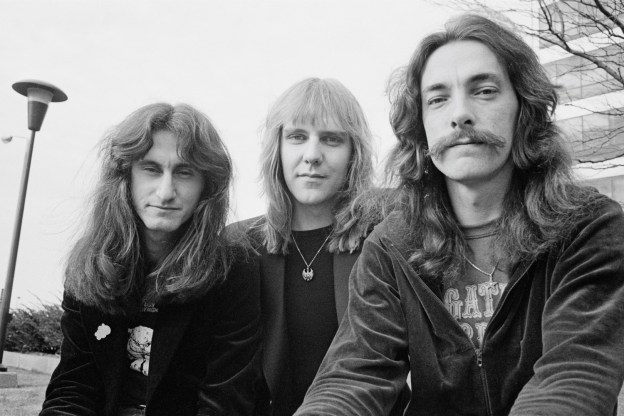
Like so many of the prog rockers we have been examining, Rush started out as a would-be rhythm-and-blues band, as evidenced by the beats and lyrics of their eponymous debut, and the bandmates met at school.  That is about where the similarities end.  Unlike the boys of Genesis, who mostly grew up in well-to-do families, Geddy Lee’s father spent time in a concentration camp and died when Geddy was twelve.  His grieving process prevented from listening to music for almost a year.  After that year, Geddy was introduced to Alex Lifeson, whose Yugoslavian parents likewise moved to Toronto after World War II.  Perhaps because Rush is a Canadian band and not English like everyone else in the main wave undoubtedly labeled as “prog rock,” many critics and historians of prog ignore them altogether.

To be fair, they are also a little younger than Tull, Genesis, and the others, and their debut did not occur until the main era of prog was just about over in 1974.  Growing up listening to rock music in the late ’60s, they certainly had great musical role models to emulate as a bassist and guitarist, and they had the benefit of also listening to early Tull, Yes, Genesis, and the popular Van der Graaf Generator.  So they are somewhat on the “outside” of the core of prog rock, if such a thing exists.  That is in part to the temperament and musical affinities of their first drummer, John Rutsey, who was the de facto leader of early Rush.

Besides getting a manager, Ray Danniels (the only manager they ever had), and the acquisition of arguably the greatest drummer in rock history (a subject for another time), perhaps the most influential event that propelled Rush’s career came from an unlikely source: “In 1971, the government of Ontario made a decision that would alter the history of progressive rock.  The Canadian province dropped the drinking age from twenty-one to eighteen.”

Rush’s eponymous album, the only release with drummer John Rutsey and Lee and Lifeson composing most of the lyrics, much like Tull’s debut This Was and Genesis’s double debut albums, is enjoyable likely more for nostalgic reasons (one hesitates to say “quaint”) as the beginning point of a band that was one drummer away from becoming a whole new entity.  It is enjoyable but rather middling R&B/rock, and possibly even “Working Man” would have been forgotten had the band not kept it alive on most tours over the next forty years.

Like Tull and the Moody Blues and others, after getting R&B and cover songs mostly out of their system, Rush became a unique musical entity: a heavy/progressive rock power trio with a social conscience and literate drummer.  Gene Simmons says of Peart in those early days: “Neil is a self-professed and/or otherwise reading hound.  He likes to read.  Yeah, after the show he goes back … reads.  Anthem by Ayn Rand, Foundation trilogy by Isaac Asimov, all that stuff.”

As appropriate as the first song, “Finding My Way,” was for Rush, Fly By Night’s opening song, “Anthem,” perfectly captures the new direction musically and lyrically of Rush 2.0.  Much has been said – too much – of Neil Peart’s disproportionately short-lived interest in the objectivism of Ayn Rand (certainly disproportionate to the lasting recrimination Rush suffered), but here Peart’s belief in the need for hardwork and perseverance (and general optimism in mankind, if not individually: “Live for yourself / There’s no one else more worth living for”) is unabashedly on display.

Also on display is the almost mid-’70s requisite homage to JRR Tolkien, with “Rivendell.”  If Led Zeppelin can unashamedly sing of Tolkien’s creation, certainly Rush should be able to as well.  But those two widely disparate sources of inspiration (Rand and Tolkien) are likely only to be found in the same place on a Rush album – the fans of both radically different worldviews rarely commingle anywhere else.  Bradley J. Bizer says Peart’s Tolkienian influence is also heard in Rush’s first prog-like mini-epic, “By-Tor and the Snow Dog,” but it may just be more a sign of Peart’s diverse reading of fantasy and other speculative fiction.  Peart admits being fascinated with Chariots of the Gods around that time as well.  Regardless, for our purposes, it has taken very little time to find direct literary influences on this prog rock band.

We Have Assumed Control: Caress of Steel and 2112

Caress of Steel may be more the black sheep of the Rush canon than Rush, oddly enough, though it does begin Rush’s rest-of-career-long relationship with cover artist Hugh Syme, another important component of prog rock music.  The first side is an eclectic mix of song styles and subject matter, from the humorous “I Think I’m Going Bald” (prog rock’s sense of humor is, like our present exploration of literary influence, another underexplored component of the genre), to the grand and personal histories of “Bastille Day” and “Lakeside Park” and the next progression in prog epics, “The Necromancer,” another song with clear influences from Tolkien.  The liner notes at the end of the lyrics for “Necromancer” include the Latin tag to Christopher Marlowe’s Doctor Faustus as well (admittedly somewhat hard to read in my CD version of the album).  Perhaps it is this diversity (what critics call “lack of unity”) that has led to the album’s general disfavor.

The second side of the album is the first of Rush’s three album-side-long prog epics, “The Fountain of Lamneth,” but unlike Genesis’s “Fountain of Salmacis,” this fountain is not based on any mythological or literary inspiration directly.  Birzer suggests the protagonist of the song sloughs of his conformity after drinking the draft from “the cask of ’43,” which the protagonist says “give[s] me back my wonder,” could be a reference to The Fountainhead, published in that year. At the end of the journey, which Birzer in his zeal likens to most journeys in “the western tradition of Homer, Virgil, Dante, and Tolkien,” Popoff says “the journey has not resolved itself, that now there are more questions than answers, that the birthing at the beginning merely put the hero into a cycle of perpetual motion.”  This interpretation would likely make more sense than Birzer’s desire to cast “Lamneth” in a more traditional light, since it foreshadows much of Rush’s seeming preference for the searching itself more than the resolution.

From hindsight, of course, “Lamneth” is easily overshadowed by what comes next, though it does us well to remember there would have been no 2112 without the early experimentations of “Necromancer” and “Lamneth.”  Lee and Lifeson both highlight how important it was for them to experiment with longer forms of composition, though Lee says in retrospect it was “kind of absurd. … And I think there are some beautiful moments, but a lot of it is ponderous and off the mark.”  Says Lifeson, “You smile and shake your head and you go, ‘What was I thinking?’”

2112 is many things to many people.  For Rush, it was a last-ditch effort to create the kind of music they wanted to create, flying in the face of the critical, financial, and touring disappointments from Caress of Steel.  For many critics, it was a justification of the disdain for the atypical music from the late-to-the-prog-party Canadian trio.  ’60s British counterculture insider Barry Miles was one of several vocal antagonists to Peart’s tribute to Rand.  As Weigel puts it, “he (Miles) had read up on Ayn Rand and was utterly offended that Rush had written a paean to her with 2112.”  For many (if not most) fans, the opening synthesized outer-space sounds of the Overture leading into the syncopated hits and the driving full intro are the very reason they love music.

Lee says, “2112 was part of a progression to us. … And we had this concept in our minds that we love progressive music, but we also love to rock.  We like The Who as much as we liked Genesis and Yes, and to us, The Who were still a progressive band even though they were more of a hard rock band. … We wanted to be the world’s most complicated thee-piece band.”  Lee continues in that section of Popoff’s work to describe their evolution beyond an R&B band and even beyond the by-then fairly static conception of prog rock, which they clearly loved, into the heavy rock band most evident by Counterparts.  Peart seems to have spent much of the next thirty years downplaying the significance of Randian philosophy on himself and his lyrics, and he certainly disavows the entire spectrum of political labels foisted upon him following 2112: “I like noble virtues, the difference between right and wrong.  I also don’t like people telling me what to do. … You have to make your own decisions if you want your ideals to come across. … I’m against socialism because again it stifles the individual.  It tries to wrap him up not letting him think for himself.”

Most see the story of 2112 influenced by Anthem, and Birzer adds Zamyatin’s We.  For Peart, the story of individuality and freedom triumphing over repressive government (especially religious oppression) is represented by what Popoff calls “the lurid red pentagram,” which “had nothing to do with Satan, representing instead the creativity-suffocating authorities of the tension-filled tale,” with the naked fellow representing man at his most basic, most needy, ready for something new.  2112’s ending is usually interpreted optimistically, which is fitting for how successful the band came following the album’s reception among the people who actually paid to listen to the album, the fans.

All the Same We Take Our Chances: A Farewell to Kings and Hemispheres

As the ’70s and prog rock were (semi-)officially ending, Rush took the lessons and successes of recent albums and, in a sense, doubled-down with effectively a double album spread out over a couple of years.  Continuing the pervasive Rush themes of anti-authoritarianism found in “Bastille Day,” “Anthem,” and many more (and after), the title track of A Farewell to Kings clears up any doubt listeners may have whether “2112” was about exchanging one oppressive government for another.  As good as the opening track is, and Rush was always good at setting the tone of their albums with the opening tracks, the real treat of the album is “Xanadu,” the longest non-side-length song in their canon except “Necromancer,” and it is undoubtedly a much better song than “Necromancer.”  This is not to say the source material, Coleridge’s “Kublai Khan” is better than Tolkien’s Lord of the Rings, of course; rather, the band has simply matured in all facets of their musical craft.

“Closer to the Heart,” fan-favorite and the closest Rush gets to a traditional pop-rock radio-friendly hit, echoes lyrics and sentiment from the opening track; “Cinderella Man,” another optimistic anthropological song from Lee, is based on the Frank Capra movie Mr. Deeds Goes to Town; and “Madrigal” is effectively Rush’s last “medieval prog rock” song, with their own twist.  The close of the album is, of course, the first half of Cygnus X-1, “The Voyage.”  The music of this half is likely more memorable than the lyrics, the opposite being true of book two kicking off Hemispheres.

Cygnus X-1 together is the longest Rush story except for Clockwork Angels, their grand finale, with the diverse four-part “Fear Trilogy” a close second.  As with the odd pairing of Rand and Tolkien on Fly By Night, Cygnus X-1 pairs Cervantes and Nietzsche.  The vehicle the traveler uses to embark his mission is the Rocinante, like Don Quixote’s steed; and the gods at war in book two are Apollo and Dionysus.  Birzer quotes Nietzsche’s Birth of Tragedy at length, as well as interviews from Peart indicating his affinity and lifelong commitment to a Nietzschean philosophy.  The conclusion of the epic is that logic and love must join together in a “perfect sphere” to unite both heart and mind (as well as god and man) in perfect balance.

The second half of the album (it is difficult for me to think of it as the “second side,” considering I first heard most Rush albums on compact disc) is another disparate collection of quintessential Rush: Peart autobiography in “Circumstances,” tongue-in-cheek political satire in “The Trees,” and virtuoso playing in the band’s first instrumental, “La Villa Strangiato.”  Surely most Rush fans wished the boys had indulged in more “exercises in self-indulgence,” as its subtitle jokingly calls it.

Everybody Got to Elevate From the Norm: Permanent Waves and Moving Pictures

If 2023 has taught us anything in the music world, it is that fans should “never say ‘never’”; a year that saw new releases from the Rolling Stones and Beatles should show us that even though Neil Peart is no longer with us and Rush officially disbanded five years ago, one should never give up hope.  I say that mainly for myself, as I was originally planning on opening this final section with “Now that the Rush corpus is completed” – but “never say ‘never.’”  With the Rush corpus (temporarily) completed, fans tend to categorize their output in different ways, often by year, by major sound style, or by subject matter.  Birzer, like most, posits Rush as its own entity, then collates the remaining ’70s albums together, most of the ’80s albums together except for Presto, joining it to Roll the Bones and Counterparts, leaves Test for Echo as its own era, and, understandably, unites the remaining Rush albums following Peart’s hiatus and personal rebirth into one final group.  Though it is not a matter worth much debate, I disagree mildly concerning the ’80s albums: I posit Permanent Waves and Moving Pictures should go with the earlier albums as the culmination of the band’s mainline prog era (as I did here for this paper), and Signals through Hold Your Fire is the band’s “second wave style” of prog, much like Tull’s folk trilogy is still prog rock but of a different kind than the more obvious concept albums from Thick as a Brick through Too Old.  I agree that these ’80s albums are united in their clever multi-layered album titles, but musically the first two seem different (maybe it is just the synthesizer that defines the era for me).  Rush’s Presto does feel like it is cut from a different cloth than the rest of the decade’s material, indeed.

Forgive me if this leans into hyperbole, but the opening of Permanent Waves is possibly the most invigorating opening to any rock album of all time.  The audience reaction in every live album since 1980 should be proof enough.  Though many paeans to the radio are at times tongue-in-cheek, like “The Spirit of Radio” here, Queen’s “Radio Ga Ga” for another example, at the heart of them is an unconquerable optimism despite the growing commercialism that is often noted for ending Prog rock and the “glory days” of the ’60-’70s music scene.  Peart ends this with a clever, if not wistful, updating of Simon and Garfunkel’s “The Sounds of Silence,” itself a critique of the growing commercialism of society and the music industry fifteen-some years earlier (from Peart’s perspective).

The album continues Peart’s lifelong agon with religion in “Freewill,” which also incorporates Peart’s readings of Jung.  Oddly, though not so odd considering Peart’s penchant for unusual pairings, the album follows this with “Jacob’s Ladder,” which is clearly an Old Testament allusion (which Peart surely knows).  Lyrically, the song is ambiguous enough to forestall outright antagonism to religion, but it does lean toward a more humanistic solution to wisdom-seeking.  Perhaps “Babel” would have been a better title, but Peart likely knew that “story” ended in confusion.

“Entre Nous” may be influenced by The Fountainhead, or perhaps Peart’s love of reading in general, as the second line “Each one’s life a novel” may imply.  One could have wished Peart had taken this open-minded approach to religious ideas (and people) more, but such is life.  “Different Strings” continues the same theme of “Entre Nous,” though it ends with Peart’s standby atheism: “All there really is: the two of us.”  “Natural Science” began life as a musical adaptation of “Sir Gawain and the Green Knight,” but Peart found it too out of place with the general theme of the album, and while that does not do this paper any good, it certainly served the album well to shift into the song’s eventual tripartite exploration of nature, science, and integrity.

Moving Pictures opens with perhaps Rush’s most beloved song, and another eventual encore staple that always brought cheers from the audience, in “Tom Sawyer,” whose literary influences should go without saying.  It is fitting for this song to be, if you will allow the expression, the real “anthem” for Rush, a band whose “mind is not for rent / To any god or government / Always hopeful yet discontent / [Who] knows changes aren’t permanent / But change is.”  Surely that encapsulates what Rush was about: literary-influenced individualism.

“Red Barchetta” was inspired “by a 1973 short story by Richard Foster” entitled “A Nice Morning Drive,” though Peart changed the type of car from the story.  Peart has discussed it in multiple interviews, even meeting the author toward the end of his (Peart’s) life.  “YYZ” is another masterful instrumental, and “Limelight” is another Peart autobiographical song, somewhat ironically making him and the band even more famous from the rousing success of this, perhaps their greatest album.  The song lyrically anticipates the next song, “The Camera Eye,” and reflects on the live album released after 2112, All the World’s a Stage and the Bard’s famous line from As You Like It.

Birzer describes “The Camera Eye” as “a John Dos Passosesque view of two cities, New York’s Manhattan and London,” which Peart mentions in bonus material on the 2112 blu-ray release.  It is certainly the last long song of Rush’s career (to date).  “Witch Hunt,” he says, was inspired by Clark’s The Ox-Bow Incident, which seems feasible enough.  “Vital Signs” is a preview of the more synthesizer/technological sounds coming in the heart of Rush’s ’80s output, which is likely why Birzer links Signals to these two albums.  Perhaps it is fitting to end our examination of Rush’s literary-influenced prog phase of their career with “Vital Signs,” as Peart says “Leave out the fiction.”  Coincidence, perhaps, but the band does shift into different directions, though they never stay away from Peart’s reading-inspired lyrics for long.

After quoting interviews in which Peart mentioned Dos Passos, Steinbeck, Hemingway, Dickens, Hardy, TS Eliot, and Frost, Birzer lists several other authors mentioned by Peart and others in interviews and other places throughout Rush’s career: Hawthorne, Melville, Henry James, Wilkie Collins, Wilde, Woolf, Sinclair Lewis, Dreiser, Cather, Edward Abbey, Fitzgerald, Lieber, CS Lewis, Pirsig, Stegner, Pynchon, Barth, Tom Robbins, and Kevin J. Anderson.  Surely this list is inexhaustive.  Though perhaps we could have wished he spent more time with authors before the nineteenth century, especially more Christian authors like Eliot and Lewis, Neil Peart, like Tony Banks and Peter Gabriel in Genesis, is a resplendent proof for our quest for literary influences on the lyrics of prog rock.  Surely much of the timeless quality of Rush’s output, much of what helped them to “elevate from the norm” of an already markedly intellectual musical genre, is Neil Peart’s adult lifetime of reading almost every genre from poetry to fiction to philosophy, a lifetime of reading reflected in his eye and in his lyrics.

Bibliography

Birzer, Bradley J. Neil Peart: Cultural Repercussions. WordFire Press, revised 2nd ed., 2022.

Popoff, Martin. Anthem: Rush in the ’70s. ECW Press, 2020.Weigel, David. The Show That Never Ends: The Rise and Fall of Progressive Rock. New York: Norton, 2017.
“Play Me My Song”: Literary Influences on Genesis

Christopher Rush

“And I’ve finally found a place to call my own”: From Genesis to Revelation and Trespass

The early days of Genesis set the scene for this band’s unusual dual nature, in that they appear to mimic typical trends of Progressive Rock, yet they do it in their own unique way.  Just as many future band mates find each other at school (seemingly at some sort of art college, where like-minded aesthetics-driven individuals already predisposed toward non-traditional workforce occupations and hobbies tend to congregate), the core of Genesis (Peter Gabriel, Tony Banks, and Mike Rutherford, along with initial guitarist and driving force Anthony Phillips) met at Charterhouse School, what the British call a public school (what we call a private school).  The difference for Genesis, then, is they met at effectively a “posh” school for children of well-to -do British society, unlike many others (Jethro Tull, for example, formed from a core of grammar school students Ian Anderson, John Evan, and Jeffrey Hammond).  This imbricates with another initial difference for Genesis, in that they met each other while still minors, and most other Prog rock bands met each other when at a college or in their twenties.  Genesis’s music matures while the band members themselves are maturing into adulthood.

Another Prog rock distinction of Genesis, as their name implies, is their religious … “affinity” is too strong a word; perhaps “acceptance”? “tolerance”? (if we could dissociate it from its unfortunate connotations in our day).  Anthony Phillips says, “we weren’t particularly religious, we just liked the hymns and tunes.”  They certainly do present religious themes and allusions more positively and more frequently than most of their Prog compatriots, at least, and their debut album, From Genesis to Revelation, is a good example.  While it is still likely true (forty years on) that many Genesis fans are “Invisible Touch”-era fans, and may not know that Gabriel-era Genesis albums exist, it is just as likely that many Gabriel-era Genesis fans do not know From Genesis to Revelation even exists, especially as it technically belongs to their first manager Jonathan King and was not re-released in the anniversary Genesis box sets back in 2007.  While the album sounds very much like a juvenile outing, Peter Gabriel’s voice is a foreshadowing of greatness to come (much like the first time James Cagney appears on-screen in The Public Enemy, and one instantly recognizes what a real actor looks like).

The album is lyrically influenced by the Bible, as its name indicates as well as the general proto-concept-like nature of the album, telling a rough musical version of sweeping themes of the Bible (more or less – no verses or characters are quoted, really, but the general impression of Biblical allusion and influence is inescapable).  Phillips says the interlinking music to unify it as a concept album came from the hymns, especially J. Herbert Howell hymns, they all loved.  Giammetti says Gabriel’s reference to the “happiness machine” in “Am I Very Wrong?” comes from Bradbury’s Dandelion Wine, which fits with what we know of the band’s general love of literature, though no one seems to know who wrote the lyrics for that song specifically.

Giammetti reinforces their early love of science fiction during the focused writing of Trespass (as Genesis, fully committed to being professional musicians, moves to their third drummer, John Mayhew, before Phil Collins): “The only moments of distraction involved walks in the surrounding countryside and reading sci-fi novels and books on mythology (which would greatly influence their lyrics).”  Giammetti further says the album features “literary references to movements such as Surrealism and authors like J.R.R. Tolkien and Lewis Carroll (for the fairy tale themes) and William Blake (for the visionary aspect).”  It would be wonderful if he quoted the band members to verify this, but he does not.

More helpfully, though, Tony Banks says of his composition “White Mountain” that “Both Fang and another character in the lyrics, One Eye (already mentioned in ‘One-Eyed Hound’ [unreleased single in From Genesis to Revelation days]) come from the children’s book White Fang by Jack London.”

Even by this early stage in their development, Genesis is recognized as “one of the country’s ‘thinking’ bands,” says Michael Watts in a Melody Maker article from January 23, 1971.  Surely the lyrics are a significant factor in that assessment, and even if direct or obvious literary allusions were not replete, the atmosphere Genesis songs creates from their outset distinguishes them as a literary band.  Gabriel, describing them in that same Melody Maker article, says “I see the band as sad romantics, you see.”  Mike Barnard, temporary Genesis guitar player between Anthony Phillips and Steve Hackett, says he and Gabriel would “tour the Lake District” between tour gigs at this time.  Surely that is proof of the Romantic poets’ influence on fledgeling lyricist Peter Gabriel.

“Can you tell me where my country lies?”: Nursery Cryme, Foxtrot, Selling England By the Pound, and The Lamb Lies Down on Broadway

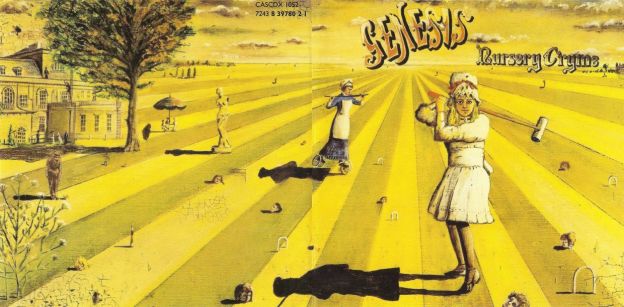
Genesis hits the jackpot with drummer number four, Phil Collins, and guitarist number three, Steve Hackett (not ignoring that Tony Banks and Mike Rutherford had been playing guitar on their albums from the beginning), and in the next few years create four unique, exquisite albums not just for Prog rock but for all music.  Nursery Cryme, especially because of the menacing cover art from Paul Whitehead, establishes a darkling Britishness and experimentation that definitely comes through in the music and lyrics.  Giammetti says “The Musical Box” is inspired by Oscar Wilde and Peter Gabriel’s Victorian mansion in which he grew up, with “Harold the Barrel” likewise displaying a Dickensian flair.”  Steve Hackett offers more specific literary influence for “Seven Stones,” confirming the eclectic reading habits of his new lead singer, saying, “Pete was interested in the ideas he had read in the I Ching, so the lyrics were influenced by The Book of Changes.”  Tony Banks corroborates Giammetti’s earlier generalization of the band being influenced by mythology for the final song on the album, “The Fountain of Salmacis”: “The lyrics are based on the myth of Salmacis and Hemaphroditus.”  Mike Barnes specifies this is the version in Ovid’s Metamorphoses, book four, and there is no reason to discredit this, considering their Charterhouse education and corroborated experience with mythology.

Foxtrot opens with what I have been telling students for years is Peter Gabriel’s reference to Keats’s great poem “On First Looking into Chapman’s Homer,” but Giammetti and Barnes both credit Tony Banks with writing the lyrics, influenced by Arthur C. Clarke’s Childhood’s End and the Marvel comics character The Watcher.  As deeply as that wounds my heart to learn, at least there is still a definite literary influence (and mild assuagement from the discovery that Genesis members read Marvel comics).

This album’s lighter fare, “Get ‘Em Out By Friday,” bears influence of science fiction, especially in the ending of “Genetic Control” requiring all people be no taller than four feet to enable smaller, more profitable government housing.  Gabriel says, “I tried to put some sort of Dickensian feel into this song,” which may at least tenuously count as literary influence here.

Many sources historical, literary, and religious influenced “Supper’s Ready,” Genesis’s great Prog epic (in the shorter category of single album-side epics such as “Tarkus” and “2112,” as opposed to entire concept albums such as A Passion Play and The Lamb).  Though Gabriel says the ending is a “mixture of Christian and Pagan symbolism,” I have no qualms tearing up every time I hear it in sound theological anticipation of a future historical truth when “the supper of the Mighty One” occurs, whether eggs are served or something else.

Of Selling England By the Pound Giammetti says “the usual references to mythology and literature are relegated to a marginal role (albeit still present) in favor of historical references and social comment,” which is certainly in keeping with other de rigueur Prog rock inspirations.  This dynamism from Genesis comes at a time, says Giammetti, when Prog rock is starting to lose its way: ELP’s Brain Salad Surgery he calls “passable,” Yes’s Tales from Topographic Oceans “heavy-going,” Rick Wakeman’s solo Six Wives of Henry VIII “indigestible,” and Jethro Tull’s A Passion Play “pretentious,” all of which “confirm that delusions of grandeur had hijacked the musical genre which seemed to be merely running its course and becoming increasingly unpalatable….”  Little wonder new sounds like Mike Oldfield’s Tubular Bells, the Mahavishnu Orchestra’s Birds of Fire, and Fripp & Eno’s No Pussyfooting being so popular, and Glam rock peaking at the time as well.

In contrast to all these, Giammetti has nothing but superlatives for this album, with which I agree.  Despite the contemporary satirical nature dominating the album, some literary influences and understandings affect the album, evidenced in Gabriel’s alliterative humor throughout the lyrics, surely influenced by his love of Spike Milligan and the Goon Show.  The most overt literary influence is in “The Cinema Show,” written by Tony and Mike, in which the romantic overtures of Juliet and Romeo (the literary influence here should be obvious) are followed by recollections of father Tiresias, inspired either by several classical authors or, as Giammetti says, T. S. Eliot’s The Waste Land.  Either is credible.

As a postscript to this album, Gabriel remembers the cover artist, Betty Swanwick, as “a little bit like Miss Marple or an[other] Agatha Christie character.”  Even if few literary allusions appear on the socio-critical album, it seems Gabriel was often seeing and interpreting his world through literary lenses.

The Lamb Lies Down on Broadway would take its own paper to unpack all of the literary and cultural references throughout Genesis’s double-album concept magnum opus.  Rutherford had proposed their concept album be based on The Little Prince, but Gabriel insisted on composing an almost all-new epic story, and as a twenty-four-year-old British public school grad, who better to tell the story of a Puerto Rican graffiti artist in New York City?  Says Gabriel, “The story is like The Pilgrim’s Progress but on the streets of New York.  So it’s a spiritual journey into the soul but there’s quite a tough world feeding the imagery.  One of the influences was a film called El Topo by Alejandro Jodorowsky.”  Steve Hackett agrees with the spiritual backdrop of this story, reminiscent of “Supper’s Ready,” in that there is “something about the lyric that owed a bit to Dostoevsky – the redemptive qualities of those journeys and sojourns.”  While Hackett sees positive spiritual messages in the album, he also recalls how the album and the subsequent tour, and the rest of the band agrees, was a miserable, destructive experience, foreshadowing Roger Waters’s single-mindedness of The Wall and its effect on Pink Floyd.

On a positive literary note, The Lamb surely displays Gabriel’s affinity for the Romantic poets, echoing Keats with “The Lamia” and Wordsworth in the opening line of “The Colony of Slippermen” with “I wandered lonely as a cloud.”

After Gabriel and Hackett departed Genesis, despite early hurts, all members of the band have since reunited both for concerts and interviews, and all of which have seemed more than cordial.  Though they all shifted away from Prog rock, their commitment to literary influences has continued.  For example, Hackett’s solo album Voyager has a song “Narnia,” surely based on the stories of C.S. Lewis.  Gabriel’s “Rhythm of the Heat” was based on his reading of Carl Jung’s Memories, Dreams, and Reflections, and “Mercy Street” is clearly a response to Anne Sexton’s poem “45 Mercy Street.”

“It’s only knock and know all, but I like it”

The members of Genesis were (and presumably still are) well read, and their engagement with fiction, poetry, religion, and philosophy (not to mention the images, environments, history and political ideas of their British world) has resonated throughout their unique careers, especially during their Progressive rock days.  Steve Hackett observes, rather poignantly, that this literary aspect of Genesis may have been a barrier to any major success during that time: “If you read the classics, that was a chance you’d enjoy what Genesis did.  The criticism was that it sounded like it had been looked up in books rather than it being a personal experience.”  If I may end with a Gabriel line from “Back in N.Y.C.” in The Lamb, “Ah, you say I must be crazy,” but that is a significant part of the reason why I love Prog-era Genesis: I have read the classics and the Romantic poets and sci-fi authors that inspired these fellows, and their music is, despite what those critics say, very much a personal experience.

Bibliography

Barnes, Mike. A New Day Yesterday: UK Progressive Rock & The 1970s. London: Omnibus Press, 2020.

Giammetti, Mario. Genesis 1967-1975: The Peter Gabriel Years. Kingmaker Publisher, 2020.

Weigel, David. The Show That Never Ends: The Rise and Fall of Progressive Rock. New York: Norton, 2017.

“And Everyday We’ll Turn Another Page”: Literary Influences on Early Jethro Tull

An Annotated Discography

Christopher Rush

Early Days, 1968-70: This Was, Stand Up, Benefit

Like many if not most mid-’60s British bands, Jethro Tull began in a musical admixture of upstart American blues and early rock, European classical heritage, jazz, skiffle, folk, and whatever one was supposed to do about the Beatles.  Also like most British bands of the era, Jethro Tull was not the first incarnation of the group nor did its personnel lineup stabilize until many years into fame (though “lineup stability” for Jethro Tull is a complicated notion).  Each of these first three albums featured different lineups, if not formally: John Evan and David Palmer may not have been “official” members on Benefit, but they contributed significantly (David Palmer also contributes in minor ways to the first two albums … I said it was complicated).

This Was is easy to call atypical Jethro Tull, looking backward at fifty years of output, but “typical” Jethro Tull is just as complicated an issue as who is in Jethro Tull.  It is clearly a heavily blues-inspired album, which is what Mick Abrahams wanted Jethro Tull to be, but it was not what Ian Anderson wanted, and history clearly shows who won that debate.  Many of the songs are effectively community property of the British blues scene at the time, many numbers are instrumentals, and Ian Anderson did not write the lyrics to many of the other songs, so identifying influences here is rather fruitless.

Stand Up sounds now like a transition from the mandatory blues origin to what established Tull was going to be, though that is also from the benefit, so to speak, of hindsight.  While some blues influences remain, notably on “A New Day Yesterday,” a song not-too-subtly comments on the band’s new direction, it is still an album of a band finding its footing, and many of the songs are about Anderson and the new group discovering that direction.  That is not to say it is autobiographical, but there is, still, very little literary influence on this not-quite-yet progressive rock album.  Glenn Cornick, fifty years later, indicates much of the album is autobiographical in a different way: “Half of Stand Up was about Ian’s family….”  One notable future live favorite song, “Bourée,” “was the first recording clearly to indicate Anderson’s interest in music from earlier historical periods,” which will be helpful for the band’s forthcoming musical and lyrical influences.

Benefit is another unusual album marked by growing pains: pressures of recording and touring now as a headline act instead of a supporting act, personnel burnout, and Anderson’s development as composer and lyricist.  Many fans seem to enjoy it more for the songs that are not technically on it: “Sweet Dream,” “17,” “The Witch’s Promise,” and “Teacher.”  Glenn Cormick says the autobiographical tendencies from Stand Up are still on Benefit.  Ian Anderson confirms this on songs such as “For Michael Collins, Jeffrey and Me” and “To Cry You a Song.”  Audiences seem to assume the non-autobiographical songs are the ones about Anderson (the future cover paintings on albums all featuring miscreants looking just like Anderson did not help that misconception throughout the ’70s.)  Other lyrics, such as in “Play in Time,” Anderson flat out reviles as jejune.  For our purposes, as fine as it is, Benefit does not live up to its name.

Concept Days, 1971-73: Aqualung, Thick as a Brick, A Passion Play

Aqualung is undoubtedly Tull’s “breakout” album, many fans’ favorite, and greatly misunderstood, either by fans or by Anderson himself.  Despite more personnel turnover, Tull begins the ’70s with a masterpiece, which may or may not be a concept album.  Side one, called “Aqualung” on the album, features an almost Chaucerian cavalcade of characters, if the Tabard Inn had been in the red light district.  More importantly, we finally have actual literary influence on the lyrics: Anderson paraphrases “a line from the introduction of Robert Burns’ [sic] poem ‘The Holy Fair,’” foreshadowing Anderson quoting Burns on Heavy Horses.  “Mother Goose” references the eponymous character and Long John Silver, but since Anderson admitted he had never read Stevenson and the no nursery rhyme characters appear in the song, it is likely just Anderson’s general awareness of things that inspired this song over direct literary influences.  (The newspaper album cover for Thick as a Brick has a reference to Silver, a parrot, and “Jim Lad,” so perhaps Anderson was recalling the Disney movie more than the novel itself.)

The second half, “My God,” is a fascinating half of an album as a Christian to listen to, but if Scott Nollen is correct, it does not help us here at all: “The material on the album’s second half resulted from Anderson’s personal observations about organized religion, not from any deliberate bookish study. … Anderson proves that he came to the same conclusion as did Freud and [Bertrand] Russell … without reading any of their famous works….”  That ends that.  Though this quest for the literary influences on Prog Rock may not be as fruitful as I had initially hoped, perhaps it will lead to a more worthwhile exploration in another course about the relationship between Prog Rock and religion.  This is also the first Tull album that suffers, in a sense, from the medium limitations of vinyl albums: “Lick Your Fingers Clean” was supposed to end the album but cut for time; now on the cd and digital releases, the song reshapes the album with a much more upbeat and self-effacing ending as opposed to the downcast “Wind-up.”

Thick as a Brick is Anderson’s response to those who considered Aqualung a concept album: here is a genuine Tull concept album, albeit a parody of the form, complete with newspaper and persona singing the song (considered at times two only because of the limitations of the medium – the liner notes treat the whole thing as one poem by Gerald Bostock), all as a satirical sendup of British education.  Barrie Barlow, who had played with Anderson and Evan in pre-Tull days replaces Clive Bunker on drums, either solidifying “classic Tull lineup pt. 1” until John Glascock replaces Jeffrey Hammond on bass for Too Old through Stormwatch.  Lyrically, TaaB is complex, perhaps too much so, but the album really is an impressive unity between the music and the lyrics, certainly more than any Tull album before and possibly since, depending on how one views Songs from the Wood.  More than Aqualung, TaaB fulfills the multi-movement suite typical of Prog Rock, and this is likely better understood today in disc and especially digital versions of the album that break the sections down into more accessible sections.

The song features a number of allusions to literary types, if we can consider comic book heroes such as Superman and Robin “literary,” and it references poets as a social class, though that does not give us much direct assistance.  Anderson/Bostock references Biggles, from the British childrens’ book series, though it may be a stretch to call that a literary influence, since it is possible Anderson is mentioning it the same way I might reference to TeleTubbies or Bluey, only as a kids’ pop culture thing I have vaguely heard about without any specific knowledge.  Likewise, a reference to the Boy Scout Manual cannot be considered for our purposes as an “influence.”  The album cover and newspaper are also rife with clever allusions to general knowledge, such as a “silent prayer” by Billy Graham to close the broadcast day of BBC2 and Alaister Crowley as a special guest on the program “Bible Stories,” though it is, again, hard to call these literary influences.  The song features brilliant lyrical moments, as Anderson often does, such as the “wise men” not knowing how it “feels” to be “thick as a brick,” cleverly combining wisdom, feelings, and intellect, but the search continues for major literary influences.

A Passion Play is a somewhat hastily salvaged album from terrible experiences in Switzerland following the success of TaaB.  Whereas Deep Purple turned their Swiss discomfort into the incomparable Machine Head, Tull scrapped most of their Swiss creativity until decades later for the rarities album Nightcap and the 40th anniversary box set of Passion Play.  Like TaaB, Passion Play is a Tull concept album, but unlike TaaB it takes itself seriously (excepting the beast fable smack in the middle), which is likely why critical response to this is less positive, despite its criticism of religion.  The album is intelligently structured, using classical epic ring composition or chiastic structure, as the songs mirror each other until the turning point of “The Hare that Lost its Spectacles.”  The album opens with dying heartbeat sounds and closes with reborn heartbeat sounds, mixing the classical epic chiasmus with the its namesake of a medieval passion play thematically.  Rolling Stone writer Stephen Holden recognized “a pop potpourri of Paradise Lost and Winnie the Pooh, among many other literary resources,” but that only returns us to what we are trying to avoid, merely recognizing literary similarities in the lyrics.  The song asks “how does it feel to be in the play?” but that does not prove Anderson is conjuring up his inner Jacques from As You Like It.  There is, though, at the end, the line “Flee the icy Lucifer.  Oh he’s an awful fellow!”  Aside from the Andersonian downplaying of the seriousness of perdition, if this is not a reference to Dante’s depiction of Lucifer trapped in ice in the Divine Comedy, I would be astounded, for who else conceives of Lucifer as icey?

Eclectic Days, 1974-76: War Child, Minstrel in the Gallery, Too Old…

War Child is an odd, eclectic album, sandwiched among four very unified albums, distinct from Passion Play in part due to the band’s poor reception of critics’ poor reception.  Even though the album is structurally distinct from Passion Play, it is thematically similar: songs discuss mortality, morality, femininity, masculinity, VD, tea, musical critics and other beasts, patriotism, and more.  Lyrics even allude to life’s “passion play,” as a couple of songs were salvaged and repurposed from the disastrous days before Passion Play, so it is a bit arbitrary to designate War Child into a new “era” of Tull albums.  The cover picture, central to many other Prog Rock bands and album meanings, here presents Anderson’s “jester” persona, which becomes a staple of albums and concerts for several years (“Back-Door Angels” has the lines “Think I’ll sit down and invent some fool / some Grand Court Jester” – most likely this is, at least in part, typical Andersonian religious criticism.  For someone who claims to be an atheist, he spends a lot of time writing, singing, and thinking about religion).  While featuring the first overt nods to his homeland of Scotland that will be more developed in Stormwatch, lyrically, on the whole, it is hard to discern any meaningful literary inspiration here.

Minstrel in the Gallery is an entry somewhere on that ambiguous Venn diagram of concept album, thematically unified album, frame story, or just Prog Rock-era multi-movement suite.  It also features the first overt reference to mythology in “Cold Wind to Valhalla.”  As discussed earlier, calling even overt references to mythology “literary influence” is a stretch, at least until we get to Genesis.  “This is based on old folklore,” says Anderson. “In Norse mythology Valhalla was a huge afterlife hall of the slain, overseen by the god Odin, to which Valkyries took warrior heroes when they died.”  So Anderson has a working knowledge of Norse myth, at least.  The rest of the songs are primarily fabrications of Anderson’s creativity.  We are well beyond his need for lyrical autobiography, and nothing else on the album can be considered literarily inspired.

Too Old to Rock’n’Roll… finally sees the arrival of John Glascock and the “classic” Tull lineup for many, or at least its final phase.  It is also a candidate for the aforementioned Venn diagram, as perhaps an obvious concept album, though no one seems to think of it that way, or perhaps a heavily unified album, but it was also originally intended to be a stage musical that somehow transformed into a comic strip illustrated by Dave Gibbons (of Watchmen fame) and a television special.  When Anderson sang “Nothing is Easy,” he was not kidding.  Much of the album is more Anderson observations of real life, teevee, and car racing, but side one ends with an acknowledgment of literary and musical influences.  Anderson says of “From a Dead Beat to an Old Greaser” “the two characters are archetypal social stereotypes from my formative years – the dead beat, in other words the kind of Jack Kerouac follower and imitator, … someone who is into jazz and poetry and whatever but is just fantisising [sic] and has become a bit of a down-and-out; and the old greaser who is the rock‘n’roller motorbike guy. … It’s a sort of Jethro Tull three-minute quickie Waiting for Godot.”  Though we may have to collate his reference to Beat Poets with the general references to Mother Goose and mythical characters, we will gladly take his mention of Beckett’s play as a direct literary influence.

Folk Days, 1977-79: Songs from the Wood, Heavy Horses, Stormwatch

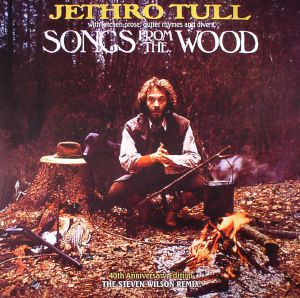
The three final Tull albums of the ’70s are, in a sense, their own world, both in their musical style of “folk rock” as significantly distinct from the already-diverse Tull sounds before them, and as, for many, the apex of “classic Tull.”  Songs from the Wood can also be added to the Venn diagram: I have never heard or read about it being considered a concept album, but the album bears great unity in lyrics and music.  It is also delightfully optimistic, containing very little cynicism, satire, or even sorrow.  Anderson had moved to the countryside during the band’s long hiatus from touring after throat surgery, which clearly influenced the content of this album, but more importantly here, Tull’s new manager, Jo Lustig, gave “a gift to Ian Anderson of a 1973 book titled ‘Folklore, Myths and Legends of Britain,’ a collection of stories and essays about ancient superstitions, festivals, places, and creatures.”  Anderson says of this book,

When I read it it certainly gave me thoughts about the elements of characters and stories that played out in my songwriting for the Songs From the Wood [sic] album, which then carried on over to the Heavy Horses album, and even beyond that into the Stormwatch album.  It wasn’t the only reference I had, it was just something new for me to learn from.  Other than a smattering of knowledge from history lessons or hearsay I didn’t really have a definitive literary guide to that world until Jo gave me this book.

That book taught Anderson about Jack-in-the-Green, but other songs, such as “Cup of Wonder,” feature “a lot of historical and pagan references here, resulting from my delving into our history as an island nation, the forces of religion and primitive beliefs, and so on.”  Anderson, unfortunately, does not list the specific sources of those historical and pagan references.

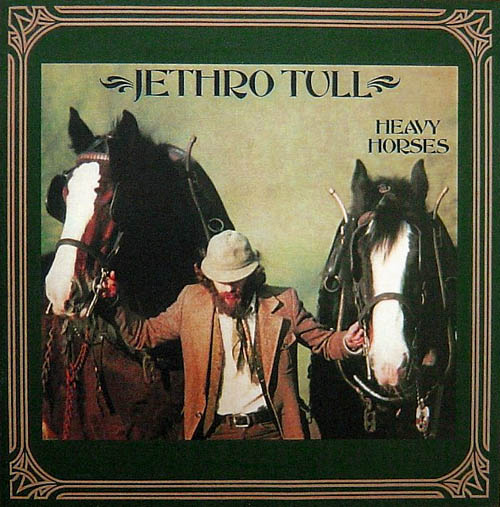
Heavy Horses is a very natural follow-up to Songs from the Wood (at its release Anderson referred to it as “Songs from the Wood, Part II, plus a little more Jethro Tull”), though it is also noticeably distinct.  Nollen distinguishes them: “Songs from the Wood can be situated primarily within an English Elizabethan influence, Heavy Horses borrows more from 18th-century Scottish music.”  It is also darker, with Stormwatch the darkest (and saddest) of the trilogy.  The eponymous track is a superlative return, in more concise form, to the multi-movement suite so characteristic of Prog Rock (a label, we should admit, Jethro Tull abjured), though it does embody the album’s darker tone, with the days of the plow horse dwindling with the advent of the tractor.  In fact, animal themes dominate the lyrics.  The bonus tracks on the 40th anniversary release show this could have been an excellent double album, as most of the associated recordings could fit the album perfectly, along with most of the bonus tracks from Songs from the Wood.  At least we have them now.

For our purposes, we also have a long-awaited jackpot of literary influences on Anderson’s lyrics.  “Moths,” says Anderson, “was actually inspired by the John Le Carré novel The Naive and Sentimental Lover.  I’m a big fan of John Le Carré’s work.”  “One Brown Mouse” was “very much inspired by the Robert Burns poem ‘To A Mouse.’”  While we should likely stop while we are clearly ahead, Anderson does speculate that “Heavy Horses” may also have had literary (if nonfiction) influences: “maybe I also had the Observer’s Book of Heavy Horses!”  The book is actually called The Observer’s Book of Horses & Ponies, so he is either recalling a forty-year-old memory in bits and pieces, or he is making it up unintentionally, but it does have just enough truth in it to seem authentic.  Similarly, bonus track “Horse-Hoeing Husbandry,” was written “as a paean to the original Jethro Tull, who in 1731 published a book called Horse-Hoeing Husbandry.”  Perhaps an oblique literary influence, but it is at least a Jethro Tull song, if long dormant, written in direct response to a book and its author.  Considering the band’s name was foisted upon them by an early agent and Anderson had no idea who he was at first, this track is a fine example of Anderson’s and the band’s growth, in part by willing to look backward as well as forward.

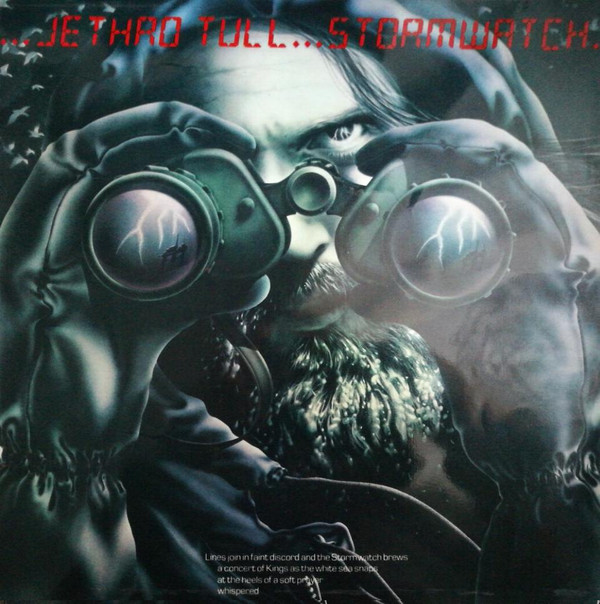
Stormwatch is the darkest of the trilogy, as we have said, both in the lyrics and in the real-life context of the album.  Not only did David Palmer’s father pass away, inspiring the album’s closing number “Elegy,” but John Glascock passed away during the tour promoting the album, upon which he appears very little due to his declining health.  His death cast a pall on the band, especially in the callous way Anderson broke the news to them, and things were never the same.  David Palmer, John Evan, and Barrie Barlow left the band, and the ’70s and “classic Tull” came to an end, with “Elegy” becoming a poignantly fitting finale to the era.  The album features mostly more mythology and Scottish rural history (“Orion,” “Dark Ages,” “Old Ghosts,” “Dun Ringill,” “Flying Dutchman”) as well as current Scottish social commentary (“North Sea Oil”), a prescient song of change (“Something’s On the Move”), a rare beautiful and uncynical Anderson song (“Home”), and the first two instrumental numbers on a Tull album since This Was (“Warm Sporran” and “Elegy”).  Lyrically, aside from the general mythology and history influencing the songs, and album candidate cut for time “Kelpie,” Stormwatch is not significantly influenced by literature.

Bibliography

Anderson, Ian. “He Brewed a Song of Love and Hatred (and of quite a few other things too …).” Interviewer Martin Webb. Minstrel in the Gallery: 40th Anniversary: La Grande Édition. Chrysalis, 2015.

—. “I’ll Sing You No Lullabye.” Interviewer Martin Webb. Heavy Horses: New Shoes Edition. Parlophone Records, 2018.

—. “Kitchen Prose and Gutter Rhymes.” Interviewer Martin Webb. Songs from the Wood: 40th Anniversary Edition: The Country Set. Parlophone Records, 2017.

—. “May You Find Sweet Inspiration….”  Too Old to Rock‘N’Roll: Too Young to Die! Chrysalis, 2015.

—. “To Cry You a Song.” Interviewer Martin Webb.  Benefit: The 50th Anniversary Enhanced Edition. Chrysalis, 2021.

Cornick, Glenn. “To Cry You a Song.” Interviewer Martin Webb.  Benefit: The 50th Anniversary Enhanced Edition. Chrysalis, 2021.

Nollen, Scott Allen. Jethro Tull: A History of the Band, 1968-2001. Jefferson, NC: McFarland, 2002.

Thick as a Brick: 40th Anniversary Set. Liner notes. Parlophone Records, 2012.

Webb, Martin. “And the Stormwatch Brews….” Stormwatch: The 40th Anniversary Force 10 Edition. Parlophone Records, 2019.—. “Let Me Bring You….” Songs from the Wood: 40th Anniversary Edition: The Country Set. Parlophone Records, 2017.

Four Stickmen

Christopher Rush

This article was written in early 2020, but it has remained mainly unpublished until now.

With the passing of Neil Peart earlier this year, I’ve been thinking lately about some of the drummers who have influenced me over the years, and of course Neil Peart is high on that list.  I should say, though, most of the influence of these drummers has occurred after my main drumming days – admittedly, it’s been quite some time since you could say I was a drummer.  Still, my affinity for music and drumming in particular has not diminished, but instead it has grown as I have gotten more mature (well, older, let’s say).

With my listening tendencies toward classic rock, naturally my influences have been skewed that way, and as naturally you could likewise think of some famous drummers that I have enjoyed: John Bonham, Ginger Baker, Phil Collins, Keith Moon, Ringo Starr, etc.  And then into the ’70s and ’80s with Roger Taylor, Stewart Copeland, and Larry Mullin, Jr.  That’s not too shabby a list for influences.  Perhaps if you kept thinking you’d toss out Mick Fleetwood and maybe Jeff Porcaro or go way back to Buddy Rich and Gene Krupa and Hal Blaine … and I couldn’t argue with that they are great drummers, but I’m not too sure how directly influential they have been on me (indirectly through the guys above, sure, but not directly).

The point here, however, is not to look at the more obvious names of great drummers.  Instead, I’d like to take a brief look at three, yea four, perhaps lesser-known drummers whom I have found to be pretty impressive and worth more recognition if not downright adulation in no particular order.  Enjoy.

Honorable Mention: Jim Keltner

Those in the know would likely be at least miffed at the mention of Jim Keltner as an underrated drummer, but this article is not directed to people who have a subscription to Classic Drummer Magazine.  All you would have to do to be impressed by the career and talent of Jim Keltner, without hearing a single beat from him, is to check out a list of artists who have wanted him on their albums or on their tours: George, John, and Ringo; Brian Wilson; Bob Dylan; Eric Clapton; Ry Cooder; Harry Nilsson; Crosby, Stills, Nash & Young; Joe Cocker; B.B. King; Bonnie Raitt; Dolly Parton … I could go on, but I think you get the idea.  (Please don’t read anything into me listing John, George, and Ringo before Brian.)  Jim Keltner is beloved for his rock steadiness, his stylistic diversity, and for his willingness to work.  Just for being the drummer on the Traveling Wilburyalbums should be enough to know his work better.  Perhaps he doesn’t have any “signature” song or album, since he is so fecund in his output.  For me, what is so impressive about Keltner can be seen in The Concert for Bangla Desh and Concert for George shows, both of which are available for home viewing.  When Keltner is playing with Ringo, especially, the synchronicity between them is astounding: stroke for stroke, crash for crash, they are mirror images of each other in precision.  He may not flashy like Moon or Peart, may they rest in peace, but boy, Jim Keltner is a mighty fine drummer.

Great Forgotten Drummer #1: Graeme Edge

I can see your incredulity already: “Graeme Edge of the Moody Blues?  Lesser known?  He’s in the Rock and Roll Hall of Fame!” you say.  True.  The Moody Blues finally got into the HoF a mere 25-some years after becoming eligible.  But this is not a HoF tirade.  Our focus here is praising Graeme Edge as a great drummer.  I suspect his greatness is overlooked because, like Jim Keltner and other great drummers, he doesn’t really “show off” like the greats you can mention – at least, not memorably.  Now, if you’ve seen any of their shows, especially in the late ’90s and early ’00s, Justin and John certainly gave Graeme a chance to entertain both behind and in front of his kit.  Still, Graeme Edge, like his band the Moody Blues, seems to be one of those drummers and bands you really enjoy while you’re listening to them, but you don’t necessarily think about afterward.  And while that is fine, I think they are painfully underappreciated.

Graeme Edge, like Neil Peart, spent a fair amount of time writing songs for his band.  Many of the spoken word poems in the early albums (admittedly, rather trippy, if you will, back in the late ’60s and early ’70s) can from Edge.  That doesn’t attest to his drumming, true, but it does attest to his ability to understand multiple aspects of songcraft and artistry, which makes his ability to hold the songs together rhythmically much more impressive.  He’s not just keeping the beat for the “real” musicians in the band.

Since the Moody Blues are such a diverse, bizarre band, especially during their first stretch, it is difficult to point to one song as “here, this is classic Graeme Edge,” but I’d direct you to their final song of that initial tenure, “I’m Just a Singer (In a Rock and Roll Band),” the last track on Seventh Sojourn (my favorite of that period).  You may object to calling it a classic Graeme Edge song, since his introduction is, perhaps, just an elaborate “click in” to the song, but if you watch the music video to it, you can see why Graeme Edge was and is a top-notch drummer.  Don’t be like the Hall of Fame and wait twenty-five extra years to recognize his worth.

Great Forgotten Drummer #2: Barrie “Barriemore” Barlowe

I said this was not intended to be a rant against the RnR HoF, so we will leave the nonsensical notion of Jethro Tull’s absence from that august body aside.  Barrie Barlowe was the drummer for Jethro Tull during what is often called their “classic years” or “classic lineup” of the ’70s, from Thick as a Brick to Stormwatch.  If you can stick around (so to speak) with Ian Anderson for an entire decade, that alone is a remarkable achievement.

It’s a tricky thing, though, the relationship of drummer and the band he or she is in: if the band “lets” you do your thing, the drummer can often flourish and be mightily impressive.  Keith Moon was fortunate enough to be in a band that let him do pretty much whatever he wanted to do whenever he wanted to do it (that may have also been an unfortunate thing for him as well, but that’s for another time).  Neil Peart was fortunate enough to find a pair of guys who were willing to let the drummer be as much a part of the musicality of the band as the guitar and bass (and synths, yes).  But the relationship is likely reciprocal also: Geddy and Alex likely wrote their parts around and with Neil, knowing he was going to contribute more than just timely fills and a steady backbeat.  So, Ian Anderson, despite his, shall we say, penchant for artistic control in his band, likely wrote many of Tull’s ’70s songs knowing he had a trustworthy drummer who could create diverse and sundry sounds and rhythms and moods for the drastically different styles of that period (we can talk about Martin Barre as an underrated guitar great another time).

Barrie Barlowe’s skills can be heard throughout those Tull albums, certainly.  Listen to them again focusing on what Barlowe is undergirding those tempo changes and sensations with.  For.  Something.  Yes, they were a stellar band playing as a unified band, I am not denying that.  But without a skilled drummer who could handle all those changes, Tull would not have been what it was.  Another great way to hear Barlowe’s skills as a drummer is on the recently released live concerts from those days, mainly available in the 40th anniversary special editions (though, sadly, many of them are apparently harder to get now than the crystalline tears of albino sea lions, so track them down now).  Barlowe’s creativity with rhythm and, I’d go so far as to say, storytelling with his solos may be even more impressive than John Bonham (in his solos) – and before you start picking up those stones to cast at me, please note Bonham himself considered Barrie Barlowe the greatest drummer England ever produced.  You can’t argue with him.

Great Forgotten Drummer #3: Ian Paice

Surely, you say, no one has forgotten Deep Purple’s only consistent member from its founding over fifty years ago (like Graeme Edge’s stable tenure with the Moody Blues – drummers tend to recognize good gigs when they get ’em).  And yes, Ian Paice has won gobs of awards as a drummer, and Deep Purple has finally been inducted into the HoF after a mere 25-year eligibility waiting game (I’m trying, really), but if you didn’t think of Ian Paice earlier when I initially asked you to name the great drummers, then he certainly needs to be credited here as a great drummer who should be on that top tier of the all-timers.

Speed is not essentially a characteristic of superior drumming – you’d think it would need to be, but it depends on the kind of music you and your band are trying to play.  More often than that, the mark of good drumming is usually just the ol’ fashioned steady tempo, fills and solos aside.  And yet, Ian Paice has both: that rock steadiness upon which Jim Keltner has built a more-than-decent career commingled with speed and flair and creativity (and durability – the man has had to cancel something like two shows in over fifty years, and those because of a heart attack).

Deep Purple has been different things over the years: pre-classic rock cover band, hard blues, orchestral, hard rock, boogie funk, and probably a few more styles – and Ian Paice has excelled in them all.  For half a century he has given hope to short, heavy set, match grip drummers the world over (and me).  Any Deep Purple album will showcase Paice’s skill, but you might as well start with Machine Head.  It’s the bees knees.

There you have it: four great drummers whose contributions to music and rhythm are worth getting to know.  You will not be disappointed.

Tull Trilogy, pt. 3: Stormwatch

Theodore Aloysius

And From the Farm to the Sea

Hello, friends.  As my excitable young penguin friend said just a bit ago, I am here to talk about the finale of the Tull Trilogy, Stormwatch.  It makes a good deal of sense for me to talk about this album being a polar bear and all.  What’s that?  Oh.  There’s a polar bear on the back cover of this album, don’t you know.  And since I’m a polar bear, well, it just stands to reason.  In fact, that polar bear was a college friend of my father’s, so this album has been special to me and mine for a while now.  He’s much nicer in real life than he looks on the cover, besides — he’s just doing that for publicity.  You know polar bears of that generation.

Admittedly, Stormwatch is noticeably rougher, tone- and lyric-wise, though it’s not overtly pessimistic.  With the failing health and eventual death of bassist John Glascock, what many fans consider the “golden era” of Tull came to a painful and sad end.  The band shortly frayed apart, but I don’t want to misrepresent what happened.  You can look that up on your modern human research machines, if you must.  It’s not a pleasant story.  Yet while the album that marks an ending and a new beginning for Tull has a sorrowful background and an occasional bitter edge to it, it’s a testament to a great band providing great music, giving us a bit of hope we, too, can overcome difficult circumstances and make a fresh start when we need to.  Odd how that became the theme of this final issue without any of us knowing it a few months ago.  He moves in mysterious ways, indeed.

“I flew for Heaven’s sake and let the angels take me home”

Unlike its predecessors in the trilogy (and, please keep in mind, only we, the audience, call it a “trilogy” – Ian Anderson likely doesn’t call it that, since he’s expressed his displeasure at the epithet “folk” many a time, but he has linked Songs and Horses before … I haven’t read much about it, since I’m a polar bear), Stormwatch does not appear to have an overarching introductory song such as “Songs from the Wood” or “Acres Wild.”  Instead, the album opens with “North Sea Oil,” which, perhaps you could say transitions us from the cover to the music itself, since my dad’s friend Wallace (the polar bear on the cover) is pictured as stomping on a nuclear power plant.  It’s a touch cynical, sure, the forthcoming devastation you humans are bringing to this world as you syphon all the oil out of the ground and then destroy the soil with nuclear waste, but the song isn’t really angry about it.  And neither am I.  We animals know these things are under control, even if you humans are doing your best to destroy all life on the planet without asking us if that’s okay, so we can enjoy the somewhat dark humor of this song.  “North Sea Oil” sets the mood well, and upon further reflection, it does introduce the main theme for the entire album: storms are on the horizon.  Here, these storms are avoidable, especially, if we listen to friend of the journal Hannah Elliott and her thesis, as you can read earlier in this very issue.

One might also surmise Stormwatch is mainly about the ocean, with the arctic cover and an opening song literally about the open sea followed by a song about the stars — and who better to use the stars than sailors?  But “Orion” is not really about navigating by the stars physically, even though it has the line “come guard the open spaces from the black horizon to the pillow where I lie.”  It’s about navigating the loneliness of life in the darkness of night, but we can possibly find some hope under (by?) the light of the stars.  This is an oddity for Jethro Tull (which, I admit, does not mean much, considering how diverse their musical output was over the years), in that the lyrics are rather hopeful for the first half of the song, especially in the chorus, but the music is bizarrely oppressive.  Perhaps it’s the steady march-like beat of the chorus.  The lyrics become increasingly despondent as the song progresses (and a bit saucy), but that’s Ian Anderson for you.  He pulled no punches, as you humans say.  The storms of life do not have to overwhelm us if we can keep looking up.  That may sound trite, but the song is anything but trite; it is hopeful in a dark and stormy world.

“Home” should certainly dispel notions Stormwatch is a thoroughly dark and bitter album.  It is grimmer than the first two entries in this trilogy, as we’ve all said a couple dozen times by now, but it still resounds at times with love and warmth and hope, and “Home” is one of those bright moments. It does recall our mind to the nautical theme (I was about to say “undercurrent”), with the idea of taking “a jumbo ride over seas grey, deep and wide,” and it does overtly speak to the storms of life (“All elements agree in sweet and stormy blend — midwife to winds that send me home”).  If we can weather those storms, there’s no place like home, as you kids say.  Even if you’ve been away for fifteen years, the call of home is a powerful thing.  It’s a most lovely (and appropriate) song.

Which is not to say “Dark Ages” is not a lovely song … but “lovely” is not the word for it.  It’s Tull, so it’s great, and reminiscent of the mini-epics of Heavy Horses, but it is more akin to “Minstrel in the Gallery.”  This is likely where this album gets its reputation: the “dark ages” of the title are not what we often call the medieval period but rather the dreary, inhuman way you humans treat each other.  Sure, sometimes we polar bears have trouble with seals and the occasional walrus (we tend to stay away from them), but you people really have problems with each other,  As is typical of Tull’s atypical songs, the outright gloomy lyrics are carried along by a hopeful march, akin to “Orion” but distinct enough, mainly because of the odd pairing of the melodic & rhythmic line and the lyrics.  The words “dark ages” are a challenge to say, let alone sing, mainly because of the “ar” in “dark,” which takes a long time to get out of your mouth for only one syllable.  Protracting that over a steady rhythm is something only Ian Anderson would think of doing.  It’s a cynical, angry song that takes the occasional jab at religion, which is what Anderson does at times, but the musicianship of the band elevates it past the gloom.

And to what enjoyable heights the band takes us!  “Warm Sporran” sounds like we are about to go watch a great football match (I suppose you Americans would call it “soccer,” though).  It has that military tattoo atmosphere as well, once it gets past the wholly-surprising funk groove at the beginning.  You may need to re-examine the band name on the album cover (surely you aren’t just streaming these songs without a physical copy of the album, cover, and liner notes? though, come to think of it, that would help cut down on landfill fodder … but, wait, no one would ever dispose of a Jethro Tull album) — you may doubt this song is by Jethro Tull for a few moments.  It may not be as lovely as “Home,” but it is a delightful, paw-tapping instrumental, the inverse of the ending to come on side two.

“So come all you lovers of the good life”

Side two opens with a rocking song about … chess? the speed of life? the inevitability of change? inexorable winter weather? all of these and more?  With Ian Anderson, it’s best to lean toward “all and more.”  He may be the closest thing to T.S. Eliot the musical world has gotten, and that’s saying something.  I do look forward to the 40th anniversary liner notes next year (as of this writing) — perhaps then we can understand just what this song is about.  But, knowing Ian Anderson, he’ll probably feign ignorance or forgetfulness or ambiguous “it is what you make of it” sort of piffle.  The chorus leads me to suppose underneath all the poetic rigmarole (I don’t say that critically) is a song about the storms of winter coming to drive away our happiness and such, and the cavalier narrator wants to keep living a carefree life in a sunnier, warmer clime.  This is completely understandable.  Winter has such a nasty habit of stopping activity … believe me, I should know.  I live with winter twelve months out of the year.

I wonder if Ian Anderson was listening to a lot of marches during the creative process of this album.  “Old Ghosts” is yet another march-like rhythm on the album, yet true to form, Tull upends our expectations for a march with Anderson’s almost languorous singing.  “Languorous” is not the word I want, but I can’t think of a word that encapsulates “dreamy,” “nostalgic,” and “hopeful” all together.  Perhaps it’s just my remastered version, but Anderson’s voice seems a gnat’s wing behind the instruments throughout the song, yet it works perfectly to evoke such a mystical experiences.  Maybe “hypothermic”?  Is this what hypothermia sounds like?  I wouldn’t know myself, being built for the cold, but I don’t want you to try and find out yourself through experience.  It’s another “sad lyrics/happy melody” Tull song, but as always the “warm mesh of sunlight sifting now from a cloudless sky” works its way through the general despondency to shine hope into the world of painful memories and failures, a world where efforts and loves don’t always prove futile.  That is what this journal has been about, after all.

I haven’t spent much time in the ancient hills and forts and mounts and mounds of the United Kingdom or the Republic of Ireland, though Christopher has), but Dun Ringill is certainly one of them, on the Isle of Skye in Scotland (haven’t played the game, yet, either — Isle of Skye, I mean, I don’t think there’s a Dun Ringill game).  This is a neat little song, with a mysterious musical part to evoke the ancient, powerful energies surrounding Dun Ringill and the ley lines of the isles, another common theme throughout these three albums (“We’ll wait in stone circles ’til the force comes through / lines joint in faint discord”), but the forces are a bit off kilter, since “the stormwatch brews.”  It is brewing “a concert of kings,” but the kings are the old gods of an old world: Poseidon, Zeus, Finn MacCool, and the storm kelpies (sadly, a great song “Kelpie” did not make it onto the album, but it has recently resurfaced in bonus track form), and more.  This is the strongest song on the album for the theme of the power of the mythic past, more so than “Old Ghosts” and the final song with lyrics, “Flying Dutchman.”

“Flying Dutchman” is the last epic of the Golden Era of Tull (for many fans — but, hey, some of their ’80s and ’90s work is really great, too, so don’t discount it outright), and true to form it’s a mix of many things: diverse but evocative musical lines, contrasting lyrics both melancholic and uplifting rife with Andersonian ironies and paradoxes, a showpiece for the musicianship of the band, and a plea to fans for making good choices with their lives, especially considering its brevity.  This perplexing song takes an almost universally negative symbol, the Flying Dutchman, and somehow makes us think it’s not so bad after all.  In fact, Anderson makes the Dutchman sound like the White Ships sailing out of the Grey Havens.  I’ve seen plenty of ships in my day: sailing ships, leisure ships, whale spotting ships (don’t ask), military craft, trawlers, junks, catamarans, surfaced submarines, and more, but I’ve never seen the Dutchman, and even with how appealing Anderson makes it sound here, I don’t want to.  The happy sounding chorus, the one enjoining us to embark on the Dutchman, reminds us life is short (as if we needed that reminder).  It’s even shorter for us polar bears, mind you, but we don’t complain nearly as much as you humans.  Remember this: the “good life” is not just about having food to eat (“on your supermarket run”) or having fun times (“your children playing in the sun”) — it’s more than material and temporary things.  “Life is real, life is earnest, / And the grave is not its goal,” said Tennyson.  And so, too, does Ian Anderson.  And me.  And Pandora.

Elegy for All

This underrated album ends with the beautiful but sorrowful “Elegy,” written by David Palmer about his recently deceased father.  It was not too long before the song also represented the loss of bassist John Glascock, who died shortly after the album was released during the accompanying tour.  For the fans, it also represents the end of ’70s Tull, a remarkable musical enterprise.  As I said before, with the death of Glascock, combined with other reasons, vastly underrated (but not by Anderson or Tull fans) drummer Barrie Barlow left the group, soon followed by the two keyboardists (seriously, what other band has been intelligent enough to feature two masterful keyboardists?) John Evans and David Palmer.  In its way, however, this ending, like all endings, was also a beginning, a new beginning for those who left and a new beginning for those who stayed and were joined by new musicians who took Jethro Tull in a new direction.

As George Harrison said, all things must pass, but in the meantime, live.  It’s a strange but beautiful thing, life.  Don’t forget to make the most of it.  Farewell, friends.

Critical Countdowns

Peter Runey, Dylan Fields, Noah Eskew, and Melissa Yeh

Peter Runey’s Critical Listening Top 10

1. “Nobody Loves You (When You’re Down and Out)” by John Lennon

2. “Come Together” by The Beatles

3. “A Hard Day’s Night” by The Beatles

4. “Get Back” (Live on the Rooftop) by The Beatles

5. “Don’t Let Me Down” by The Beatles

6. “Golden Slumbers/Carry That Weight” by The Beatles

7. “Good Vibrations” by the Beach Boys

8. “Band on the Run” by Paul McCartney(/Wings)

9. “The Long And Winding Road” by The Beatles

10. “Lucy In The Sky With Diamonds” by The Beatles

This was extremely difficult to boil down to the top ten, however these are my thought-through, most profound songs of the Critical Listening class this year. While many of these carry real-life meaning to me since they’re attached to a fond memory of mine, some of these I admire purely based on their musical and lyrical quality.

“Nobody Loves You (When You’re Down and Out)” — John Lennon creates one of the most uniquely-sounding songs I’ve heard from him, whether it be from his solo career or from the Beatles. He incorporates a string orchestra as well as trumpets/horns, all the while still retaining the same classic Lennon vibe from the Beatles so many loved. Lyrically, Lennon takes a creative approach to exposing the fact people tend to only show love when they want it in return (“I’ll scratch your back and you scratch mine”), as well as the fact often great people are only admired and recognized for their accomplishments when they’re “six feet in the ground.” Ironically, Lennon gained even more of a following of his ideas upon his assassination.

“Come Together” — Despite the fact Lennon is known to be involved with the use of psychedelics, few can say the Beatles’ music became any less unique when they began using. Lennon crafts an incredibly artistic song beginning with a deep bass masking whispers of “shoot me, shoot me,” most likely referring to heroine. At this point, John Lennon was becoming a figure in many a cultural and even political scene (as an influencer not a participant) and used the song as somewhat of an anthem for the freedom to use psychedelics. Despite its intentions, I find this song to be one of the most creative and catchy songs the Beatles ever produced.

“A Hard Day’s Night” — I could tell an incredibly long story of a memory attached to this song for me. Instead, I’ll just say this song became very relevant to me on one special night in the Shenandoah mountains.

“Get Back” (live on the rooftop) — This song mostly holds its meaning to me since it was the final song to be performed live by the Beatles. I found it amusing that their desire was to be dragged off the venue by police since the concert was considered to be an unannounced public interruption, however the concert ended with a mere “pull of the plug,” so to speak, from the local authorities. It’s not just a special song but also a special performance since it was the last time the four ever played together in public.

“Don’t Let Me Down” — There are a few reasons why I love this song. The first of these is this was also played at the final rooftop concert. Another reason is Paul and John both harmonize beautifully in this song, which makes John’s raw, heartfelt message of love to Yoko Ono that much more special.

“Golden Slumbers/Carry That Weight” — While these are technically two separate songs, the track was ordered so “Golden Slumbers” could carry seamlessly into “Carry That Weight” as part of a 6-part climactic medley in Abbey Road. I love “Golden Slumbers” because it begins simply with Paul and a piano playing a sheet of music he found on his grandfather’s piano with his own words put to it.

“Good Vibrations” — While this is the only Beach Boys song that made the list, it’s definitely one of the most enjoyable listens of the years. I appreciate the upbeat rhythm and lighthearted melody. The Beach Boys have mastered the art of crafting songs perfect for driving in a car with the windows down on a summer day, and this is certainly one of those.

“Band On The Run” — Paul branched out with this song. He begins to step out of his shell of his creativity since he no longer experiences the same pressures of being in the Beatles now that he was in control of his own solo career. On this track, Paul, in a way, mixes three songs into one, making a roller coaster of a song, but not to the point where it’s distracting to the listener. Paul’s musical brilliance really shines when somehow he pulls off a silky-smooth transition from the magnificent blare of brass and electric guitar instruments into an acoustic guitar/drum combination for the rest of the track.

“The Long And Winding Road” This is easily one of the most emotional song from the Beatles, aside from maybe “Blackbird.” Paul takes the listener on a journey down a long and winding road with this song but leaves the listener with little conclusion or sense of achievement. It’s inferred that the end can’t be reached, and it’s unattainable. Obviously, this is how Paul must’ve felt at some point in his life, and he depicts this season of life very effectively and eloquently.

“Lucy In The Sky With Diamonds” — This song is believed to be a reference to a drug known as LSD, which was likely being used by at least one of the band at the time. One thing I do appreciate about the times when the Beatles were under the effects of drug usage is their creative thinking tended to be much more outside the box, which resulted in unique tracks like “Lucy In the Sky.” The song doesn’t make much sense, lyrically, but to me it doesn’t have to in order to appreciate its special sound.

Dylan Fields’s Critical Listening Top 10

1. “A Hard Day’s Night” — Beatles

2. “Come Together” — Beatles

3. “Little Deuce Coupe” — Beach Boys

4. “Don’t Let Me Down” — Beatles

5. “Maybe I’m Amazed” — Paul McCartney

6. “Wouldn’t It Be Nice” — Beach Boys

7. “All Things Must Pass” — George Harrison

8. “Help Me Rhonda” — Beach Boys

9. “Pease Please Me” — Beatles

10. “The Monster Mash” (Live) — Beach Boys

This list was a whole lot harder to make than I anticipated it being. Many of these songs may not be my favorite for their musical aspects but the stories behind them. I will be explaining why each song is special to me throughout the course of this paper.

“A Hard Day’s Night” — This is the epitome of Critical Listening music for me. It may not be my favorite critical song musically but the story behind it makes it what it is to me. In the beginning of the year when Critical Listening was just starting, we had just heard this song and Pete and I were jamming to it non-stop. We literally had this album on repeat every time we were in the car. That being said one day I had the bright idea to go on a road trip/camping trip to the Shenandoah mountains with Pete and Pedro. The trip started off great: we were having a ton of fun and everything was going great. We arrived in the mountains and that’s where things started going wrong. There was a police car involved and we had to stay in an overpriced dirty motel instead of camping out. We got to camp out the second night and it was decently fine from then on out. So fast forward to the ride home, Pete throws on this song and it just made sense. That trip was “A Hard Day’s Night.” So every time I hear this song I think about this trip, the bad parts but mostly the good.

“Come Together” — This song has been one of my favorite Beatles songs since the start of the class. I love the intro of this song. I think the crazy thing about the beginning and throughout the song is John is saying “shoot me” and ends up getting shot and killed; he obviously want talking about guns in the song but it is still ironic. I am going to say this for a lot of these songs and I could probably say this for all of them but this was a song me and Pete loved to jam to in the car.

“Little Deuce Coupe” — I really don’t like this song musically, but the story behind it is what makes it one of my favorite Critical Listening songs. One of the first times we were listening to this song in first semester I think it was Pete that started singing the chorus obnoxiously at a super high pitch, then I would sing low, then Noah would go high with Pete. This turned into a thing we did. We would just sing “Little Deuce Coupe” as obnoxiously as we could. We did it everywhere, in the classroom, in the halls, in the parking lot, everywhere.

“Don’t Let Me Down” — My first memory of this song was the video of them playing on the roof around the time they were breaking up and all the people come out of their houses to watch. After we watched that in class I had it stuck in my head and I was jamming to it non-stop and apparently Pete did too because I was texting him one night and I said I was jamming out to the Beatles and he said he was, too, and I texted him “Don’t Let Me Down” was a banger and as I hit the send button I got a text from him saying basically the same thing. We always kinda joked about that.

“Maybe I’m Amazed” — My words while listing to this song for the first time were “Dang, I like this song … Oh, dang, I really like this song!” This song was one of those rare cases of love at first hearing of a song; most songs take me a couple times to listen to them to really like them. This one was not the case; I had this song stuck in my head for about a whole month after I listened to it one time. I remember jamming to this with Pete while going from thrift shop to thrift shop looking for pianos to cure our addiction to music.

“Wouldn’t it Be Nice” — Every time I hear this song I see Joanna and Sarah on stage at the Battle Cry talent show. This song makes me think of my class and all the memories we shared together. It’s crazy how music will do that to you.

“All Things Must Pass” — This has been my theme song for the past couple of weeks with so much changing. I am going from one huge part of my life to the rest of my life. This is the end of the beginning for me and I can really relate to this song right now. I loved high school and made so many memories here but like everything in life all things must pass, good things or bad they all will pass.

“Help Me Rhonda” — I don’t really have a story behind why I like this song, but this could easily be my favorite Beach Boys song. It’s just so free spirited and groovy and I dig that. This is in my top ten in any genre for jam out sessions in the car.

“Please Please Me” — This was my first song in Critical Listening I really liked. I listened to this song and the entire album a whole lot at the beginning of the class. I still really like this song and it brings me back to Noah, Pete, and me dancing all around room 103 all first semester.

“The Monster Mash” (Live) — I don’t like this song for its musical sense unless it’s around Halloween, but this song was a classic in the first semester of Critical Listening. Noah and I would sing this obnoxiously all the time and it was so much fun. I remember sitting in our second period study all just doing our math homework and singing “He did the mash … He did the monster mash! … It was a graveyard smash.” That song was just a lot of fun to me.

In conclusion, I loved this class and I’ve said it before but I’ll go ahead and put in in writing, this was my favorite and most beneficial class I ever took at Summit. Not to take anything away from the other classes or teachers, but this class had such an impact not only in my taste for music but it really did impact my life. It brought Noah, Pete, and me closer, and they are some of my best friends I have. It also made me open my eyes to music: I discovered so much more music and even made me want to get in the realm of creating music, which I was not successful in at all. It also played a huge roll in choosing my thesis topic because music was constantly on my mind during that time. Mr. Rush, thank you for offering this class and putting up with us even when I was rolling around on the cart or playing with the music stand; I truly appreciated this class.

Noah Eskew’s Favorite Five, yea Six Beatles Albums

What are the top 5 Beatles records? I would put that question in a top 5 list of unanswerable questions. However, I have determined my 6 favorite Beatles records based on the ratio of songs that left a memorable and positive impression on me over the total number of tracks on the LP. The one fault to this method is it doesn’t account for how much I enjoy a specific track; it instead simplifies it to: Did I like it? For example, I thoroughly appreciate the songs “I’ve Got a Feeling,” “For You Blue,” “Across the Universe,” and “Get Back,” which are all featured on Let It Be, but the rest of the album leaves much to be desired. The outcome of this process slightly surprised me (in regards to the resulting order), even though my previous general idea was almost precise.

#5 A Hard Day’s Night

With this album I found seven of the thirteen songs appealed to me. The title track begins with a special strum of a chord. To this day, few can identify what note is exactly being played. The lyrics are highly relatable to anybody who’s been hard at work. Plus, the guitar solo is swung in a manner that’ll make the guitar player and the average listener happy. In this song, the Beatles prove within the context of pop sensibility they can remain true to their musicianship. “I Should Have Known Better,” “If I Fell,” and “I’m Happy Just to Dance with You” also add to what is truly a solid start to this album. “Can’t Buy Me Love” is practically a Beatles staple. With a catchy chorus, and rather true lyrics in the verse, this hit did not disappoint. Lastly, my favorite song of the entire work is without question “You Can’t Do That.” With a jangly guitar intro, John’s impeccable attitude-filled vocals, and Ringo’s driving drum and cowbell groove, this song has placed itself among my favorites.

#4 Magical Mystery Tour

There are seven songs of the twelve on this compilation of which I am fond. The title track kicks off the record with a catchy repeatable chorus, and in between choruses we get a glimpse of the mysteriousness to be experienced in the following minutes of the LP. “Your Mother Should Know” is yet another classic involving Paul and the piano. The piano riff bounces along lightheartedly, while the lyrics are a fun alternative to some of the other strange styles during this period. The hits that have emerged from this compilation included such smashes as “Hello, Goodbye,” “I Am the Walrus,” “Strawberry Fields Forever,” and “All You Need is Love.” Part of the genius behind the Beatles’ discography is their ability to churn out the hits with fun and catchy choruses, but simultaneously the ability to entertain with more eerie sounding progressions as well.

#3 The Beatles (The White Album)

Out of the 30 tracks produced on this double album, I like listening to 18 of them. If I always had the time required, I would not skip any of the first 12 tracks (except maybe “Wild Honey Pie”). The first dozen on disc 1 could be an album by themselves. This, above all the other albums, shows the individual musical personality of each of the four Beatles. This is probably due to the fact the group did not spend much time together in the studio compared to previous sessions. Paul thrives on “Back in the USSR” (the driving rock ‘n’ roll tune), “Ob-La-Di, Ob-La-Da” (the happy and hopeful pop song), “Martha My Dear,” “Birthday,” and “Helter Skelter.” George offers some of my favorite Beatles numbers of all time such as “Savoy Truffle,” “While My Guitar Gently Weeps,” and “Piggies.” John ventures into interesting lyrical processes by incorporating the stories of other Beatle songs into the phrases of “Glass Onion.”

#2 Sgt. Pepper’s Lonely Hearts Club Band

Many magazines and other award-givers rank this work as the greatest album of all time. Combining the sounds of the psychedelic rock movement with those magical Beatle melodies, the Fab Four did indeed produce one of the most revolutionary records ever. Eight of the songs stick with me years after hearing them. Tracks one through five have the flow of a live performance. “Fixing a Hole,” “Getting Better,” and the reprise of the title tracks remain my favorites for their interesting lyrics, simple but solid guitar parts, and energy that really speaks to me.

#1 Tie Between: Revolver & Rubber Soul

Within these two records begins the change of the Beatles’ career. They move from the lovable mop-tops into the genius musicians that have pulled themselves out of live performances in order to further their art. They begin to incorporate eastern influences into their songs, but yet again don’t shy away from their rock ‘n’ roll identity. Each of these albums included 14 tracks, and each of the albums included 9 tracks that I love. “Nowhere Man,” “Think For Yourself,” “What Goes On,” and “I’m Looking Through You” are my favorites from Rubber Soul. “Taxman,” “I’m Only Sleeping,” “She Said She Said,” “Good Day Sunshine,” and “Got to Get You Into My Life” are my favorites from Revolver.

Melissa Yeh on “Band on the Run”

With the Wings album, Paul McCartney released “Band on the Run” in 1973.  The song has different interpretations based on history and listeners agree it is well composed and one of his most memorable.  The most popular and speculated-on theory from this song concerns the reflections and aftermath of the breakup the Beatles underwent from Paul McCartney’s perspective.  He confirms in an interview the song was influenced by one of the many long meetings where George Harrison remarks on the regrets of the events going on at the time.  “If I ever get out of here, thought of giving it all away, to a registered charity.”  For this phrase especially, he wishes they could have spent more time on the music, focusing on the good, and the wealth was not worth that happiness; instead it should have been devoted to charities.  The song then develops his freedom from the tension of the break-up and his ability to pursue what he wants to without being burdened by the obligations the band held over him.  When asked about if the song was in association to the break-up, Paul McCartney responds, “Sort of, yeah.  I think most bands are on the run.”  In another comment, one listener feels the song is not as much about the break-up as people think the song is.  In fact, it’s completely absurd and almost obsessive to relate everything back to the Beatles.  In another part of the song, articles and listeners have alluded to the line “and the jailer man and sailor Sam were searching everyone,” being connected to the incident in Sweden in 1972.  Paul McCartney and all of group Wings were arrested on drug charges.  Thus, the police were searching them at the time.  Later comments express McCartney’s plead for focus away from these types of charges and on what matters most, the music.  Overall, the song is about a prison escape and the shift from captivity to freedom.  “Stuck inside these four walls, sent inside forever,” describe the jailed prisoner, cut off from the outside world.  Again the prison is referred to in “if I ever get out of here.”  The explosion symbolizes the escape and again the band is running from police, “in the town they’re searching for us everywhere, but we never will be found.”

When talking about the instrumental in working with the theme of that escaped prisoner, the composition itself embodies the mood of the song.  Paul McCartney has been noted for his ability to combine multiple songs into one; here there are three distinct melodies. The first transitions into the second from verse one to two, beginning at, “if I ever get out of here.”  The tempo speeds up slightly and moves into a minor key through an instrumental break.  This represents a sense of sadness and regret in the tone of the song.  The third begins after the dramatic instrumental charge into the verse, “Well, the rain exploded with a mighty crash as we fell into the sun.”  The song modulates from A minor into C major, now with a new and happier tone from what it was before.  The movement of the song captures that feeling of relief and freedom.

What moved me to choose this song followed from the moment where as I was sitting in class, I heard the first chord and immediately decided I like this song.  Don’t get me wrong, I enjoyed the music in class, but none of the songs had caught my attention as quickly as this one.  While in the bus in Germany passing through the countryside, I remember going through a tunnel or under a bridge and right as the song changed from the second part into the third, the bus flew into the open again into the light with long fields surrounding us.  That moment McCartney creates of an explosion into freedom was more than what I can describe in words.  With that, this song will always tie me back to the memory with our class, driving past landscapes in Europe.

Bonus Track: Mr. Rush’s 5 Mandatory Beach Boys Non-canonical Albums for Real Fans

1967: Sunshine Tomorrow Wild Honey is one of my favorite BB albums, and this 2017 release of many WH outtakes, alternate versions, and unreleased live cuts, including the entire Lei’d in Hawaii album, make this essential.  As if that wasn’t enough, it has Smiley Smile outtakes and a beautiful a cappella version of my favorite BB song, “Surfer Girl.”  Don’t miss this.

Endless Harmony Soundtrack — This collection of rare cuts accompanying the biopic is a monumental gift.  You’ll get a fresh look at a band you think you know, a fresh look that will only reinforce your love for them.

Hawthorne, CA — Thanks to the success of Endless Harmony, Capitol Records continued to open the vaults of rare cuts, radio spots, demos, and more.  Just when you thought you heard it all, you learn you haven’t heard anything yet.  It’s disjointed at times, but it is more BB tracks, which is what we want.

Made in California 1962-2012 — This 6-cd panoply of the band’s career is pricey but worth it.  It has a lot of rare live tracks, alternate versions, and much forgotten work from Carl and Dennis.  If you’re a real fan, you need this mega-set.

Ultimate Christmas — Not only does this have the entire original Christmas Album, it collects all the tracks for the unreleased second Christmas album plus all the rare promos, singles, and other Christmas goodies.  It’s a must-have.

*2023 Editor Note: Be sure to get the original version of Ultimate Christmas! The recent streaming versions delete the best song on the collection, “Christmastime is Here Again.”

A Tull Trilogy, pt. 2: Heavy Horses

Stringfellow Bartholomew

From the Wood to the Farm

Hello!  I finally get to write my own article for the journal after all this time, and I’m really excited to talk to you about a fantastic album from Jethro Tull, Heavy Horses.  This is the second in the “folk rock trilogy” from Tull, as some have called it, but unlike most sequels, it does not suffer any let-down or disappointment.  In fact, many like it more than Songs from the Wood, which is a remarkable thing to say.  I’m not sure I like it more, but it is definitely growing on me, thanks to listening to it so much lately.  In this outing, Ian Anderson shifts his gaze from the mystical forests of bygone England to the hardworking farmers and their steads, along with the animals who, frankly, do most of the work.  Even though I’m a penguin, I can appreciate the skill and sacrifice of my fellow animals as they have made the world a better place, especially when working in conjunction with you humans.

Where the dance of ages is playing still

This first song gives me some shivers, which is difficult to do for a penguin.  I don’t spend a lot of time around cats, not too many of them where I live most of the time, but cats can be scary.  “…And the Mouse Police Never Sleeps” is also a bit scary because of the odd ending, but that’s mostly just Ian Anderson having some fun, and he knows better than most when he’s having fun and that he’s having fun and laughs at himself when he’s having fun (which is why it ends with his self-aware coughing).  It’s sort of an odd opener to this album, especially in contrast to Songs from the Wood, which gave a nice opener to the theme of that album.  I suppose “Mouse Police” sets the musical tone for the album, and it does get us out of the woods and into the farmhouse, but the metaphor distracts us initially until we have time to reflect on where this album is going.

While it may not be fair to continue the Songs from the Wood comparison going, it’s rather unavoidable, and thus “Acres Wild” seems to me like it would make a better opener for Heavy Horses, since it declaims the setting of this rural/hamlet/agricultural album much better than “Mouse Police” (you didn’t think penguins knew words like “declaims,” did you?).  It’s a very optimistic song, which is important, since this Tull Trilogy gets progressively pessimistic.  Songs is almost wholly optimistic, as we saw last issue.  Heavy Horses is rougher, grittier (certainly not musically, as it may be even more impressive musically, in many cases), and at times harder. Perhaps more melancholic than pessimistic, since many of these songs are rather ebullient, but there is a general tenor of regret for days gone by and the lost lifestyle of the hardworking agricola (though the animals do most of the work).  “Acres Wild” is a jaunty number full of zeal for living a full life, enjoining us to come “where the dance of ages is playing still / through far marches of acres wild,” but it also reminds us the world around us, before those far marches, is decaying and crumbling and a dim memory of what it once was.

Leave it to Ian Anderson to write a song about not singing a lullaby to his newborn son, but leave it to Ian Anderson to justify it because he has no desire to rear his son on false hopes and delusions about how life really is.  He wants to protect his son as much as possible (“There’s a lock on the window; there’s a chain on the door; / A big dog in the hall”), but he’s also open about the dangers of the world.  This is part of that growing edge in this Tull Trilogy of which we’ve been speaking, The dangers of the world require skills and preparation, but if know that, and treat each other with love, it’s possible to put your kids down for bed at night “safe and sound.”  Musically, this is the first of two mini-suites on the album, with multiple musical motifs.  Penguins like alliteration, what can I say.

“Moths” is another almost typical Tull juxtaposition of beautiful music and a warning of the brevity of life.  It ends optimistically, in its way, but it also presents the joy of life akin to a burning candle, and a too long life can be a bad thing.  That’s a strange thought, isn’t it?  Hard to trust lemmings and moths, I suppose.  Still, a beautiful song.  “Journeyman,” too, is a precise, hard-rocking song, bemoaning the difficult life of the hardworking city man.  Probably should be out living in nature, as the rest of the album enjoins us to do.  Be warned by this number, human people: city life is bad for your health; live in nature (but don’t mess it up for us while you do so).  Otherwise, you’ll be lonely and cold and sick and tired and hungry.  But I understand if the crisp, funky groove of the number overshadows the dire warning.  It’s hard not to smile and tap your toes to it and ignore the message.  Well, being a penguin myself, I don’t typically tap my toes, since I just waddle and rock back and forth.  I’m a bit like Ian Anderson that way.

And every day we’ll turn another page

The “B”-side of this album is possibly the third greatest B-side of all time, behind Foxtrot and Magical Mystery Tour.  These four better-than-solid songs are great listening.  “Rover” kicks it off with another solid musical gem.  Tull really was firing on all instrumental cylinders during this lineup, as delineated in the previous issue.  The diverse rhythms and crispness of the different instruments makes “Rover” a fun song, but the melody during “So slip the chain and I’m off again” elevates it to pretty great.  On one level it’s about a dog, right?  And I admit I don’t know much about dogs, since, again, I’m a penguin, but the later verses don’t sound completely like they’re about dogs to me (the last one may be about Gonzo), but it’s still rather jaunty and optimistic.  Maybe I was wrong about this album being more edgy than Songs from the Wood.

“Own Brown Mouse” could be the best song on this album, though sometimes the eponymous track wins out on that one.  But let’s not quibble: it’s not a competition – let’s just enjoy the fact we have multiple great songs on this album.  Here we have another Tullian juxtaposition of musical brilliance and a wistful song.  This wistfulness, though, is not dark or edgy.  It has a bit of sorrow to it, as the narrator and the brown mouse may be in a contest over who is the one in the real cage, but as always the uplifting music and Ian Anderson’s delivery comfort us more than concern us.  The only flaw of this song is it’s not longer.

The grand masterpiece of this album is truly sublime.  Reminiscent of the madrigal, which is perfect for the apex of a trilogy memorializing Merry Ol’ England, “Heavy Horses” is a multi-layered, multi-sectioned opera about the farm and the horses and the way things used to be.  A lot of animals featured in this album.  That’s only part of why it’s so good.  This tribute to the horses that have literally moved the earth of England makes us all yearn for a simple life of honest toil, living off the land, at one with nature.  I’m part of nature myself, and I tend to live off the ocean, but this song makes the rural life appealing even to me.  Part of that is surely the exquisite choral sections and musical brilliance, and the diverse sections keep our interest sustained throughout almost eight minutes of a song about horses and furrows.  Ian warns us the technological-driven world will soon disappoint us, and those of us with refulgent souls will soon yearn for the kind of life we have collectively abandoned.  (I’m not sure if I have a soul, being a penguin, but let’s stay focused here.)  So get back to the land, plant and harvest real food, become one with nature again.

In contradistinction to Songs from the Wood, this album ends not with the nighttime at the end of a hard day’s forestry but with the dawn of a new day.  “Weathercock” signals the kind of weather we’ll have as we start a new day working the land, or at least from what direction the wind is coming today, signaling as well the changing of the seasons.  The passage of time is a steady undercurrent of this album, as Ian Anderson bemoans the loss of anthropological-agricultural unity, but concurrently he reminds us each new day is a new opportunity for good: “Point the way to better days we can share with you,” ends the album.

So Heavy Horses is not so melancholy or cynical after all, as is often declaimed.  It is very aware of the brevity and ephemerality of life, much more so than Songs from the Wood, but that does not make it darker or edgier.  Perhaps it makes the album more Realistic, whereas Songs is more Romantic.  Nothing wrong with either.  They each have their season.  The winds of change that redirect the weathercock were certainly signaling changes for Jethro Tull as well, but that is a subject fit more for the finale of this trilogy, so I will leave that to my good buddy Theodore Aloysius to discuss in his exploration of Stormwatch.  Thanks for reading my analysis of Heavy Horses, everyone.  If you haven’t heard it lately (or at all), do yourself a tremendous boon and get it into your soul.  If the five-disc fortieth anniversary box set is a bit daunting, start with the regular album and work your way up to the goodie-filled, bonus-packed deluxe version.  You’ll be glad you did.  So long!

A Tull Trilogy, pt. 1: Songs from the Wood

Christopher Rush

I have been waiting for this literally all year.  On January 1st, 2018, thanks to the generosity of a few dear friends of mine, I was finally able to order the 40th anniversary edition of Songs from the Wood, one of my favorite Jethro Tull albums (not that I’ve heard them all yet, so let’s say “thus far”).  It’s distinct among Tull albums, especially in what we could call the 2nd phase of the band, what some would likely call the “classic” Tull era (from Aqualung in 1971 to Stormwatch in 1979), in that it is mostly optimistic and upbeat.  Ian Anderson has never struggled with finding satirical and almost cynical approaches to the various realms of life upon which his gaze and talents alight, but Songs from the Wood is both a musical shift and a lyrical shift toward invitation, reflection, and downright delight.  Since it is Ian Anderson, a few songs have a, shall we say, piquant bite to them, but it wouldn’t be Jethro Tull without a little spice.

As I said, I have been literally waiting all year for this edition to arrive.  And waiting.  Twice, our friends at the Mega-On-Line Shopping Site (you know which one I mean), sent me e-mails telling me in effect “we can’t find it, we’ll send it soon,” turning my 2-day shipping experience into a 10-week experience.  Now, before I sound (more) like a horribly self-centered 1st-world donkey, I’ll press on to say the delay was most likely Providential, forcing me to focus on the great deal of work I had to do for my recent Master’s License renewal course as well as all the annual excitement and commitment that goes into Thesis Season.  Sure enough, as I should have expected, the very afternoon I finished my final project for my on-line course, this magisterial 3-cd/2-dvd package arrived, unannounced and unexpected.  So now I have time to enjoy it, but not enough time for me to review the album as well I had wanted.  Ah well.  Let’s just get to it.

Side One

It’s not “folk rock,” let’s get that straight from the beginning.  That’s Bob Dylan with an electric harmonica.  This is Jethro Tull looking back at the diverse and mythical history of England and delighting in what it found in the nooks and crannies of rural ol’ England.  “Songs from the Wood” is such a cheerful, welcoming, medieval jester-like song, as is pretty clear from the harmonies, the intelligent and graceful lyrics (in the literal sense), and the diverse musical sounds.  Even when it picks up and starts rocking, reminding us this is a superlative group of talented musicians, we are well on our way to feeling much better, thanks to this album.

“Jack-in-the-Green” is basically Tom Bombadil.  There’s no way around it.  It is a complete Ian Anderson number, as he wrote the words (as usual) and he plays all the instruments on this song (it is known).  It starts out very fairy-in-the-woods-like, as most of them do on this album, but pretty soon the critical mind of Anderson turns from magical romp to contemporary critique: “will these changing times, motorways, powerlines” prevent humans from enjoying Nature how you want us to? he asks.  But before the potential despair can take root, so to speak, Anderson rejects it outright: “Well, I don’t think so.  I saw some grass grow through the pavements today.”  There is still hope for the restorative power of nature.

“Cup of Wonder” would likely be my favorite song on the album were it not for the final track of this side, to be addressed soon.  I don’t want to keep saying “it’s a tribute to the mystical heritage of rural English beliefs,” but it is, though tinged with a bit of Anderson’s slightly erroneous beliefs on Christian usurpation of pagan holidays.  For me, the music and, as is almost always the case with Tull, the vocal timbre of Anderson’s voice make a lyrically intelligent song a total aesthetic experience to be enjoyed again and again.  (Even if about ancient pagan holidays.)

We noted before this album, while mostly free of the harsh cynicism of early classic Tull like Aqualung and Passion Play, still has its piquant moments, and “Hunting Girl” is certainly spicy, being about an impromptu amorous romp between a noble lady and a regular common guy who knows he could get in a lot more trouble for their spontaneity than she ever could.  Still, the greatness of this song comes in the sheer greatness of the musicians in the band during this era: Martin Barre’s guitar brilliance, John Glascock’s bass, the dual keyboards of John Evans and David Palmer, and the vastly underrated drumming virtuosity of Barrie Barlow.  It was a golden lineup, and this album makes the most of it.

The first side of the album ends with my favorite of the album, “Ring Out, Solstice Bells” — it’s not a Christmas song, being about the winter solstice, and in fact, if Ian Anderson is to be believed, it’s sort of an anti-Christmas song, returning to that earlier notion of Anderson mistakenly thinking early Christianity foisted itself on a lot of pagan traditions and holidays, since “if you can’t beat them, join them,” as he says in the 40th edition liner notes.  Well, I disagree, and it’s such a musically wonderful song, I’ll just keep enjoying it, even if for the “wrong” reasons.

Side Two

Side two opens with another great Tull mini-opera, with sundry sections and atmospheres and evocations and beauty and fun and wonder.  It’s basically about the joys of an old-fashioned garden fête, such as the one a young Paul met a slightly less young John and the world was changed for the better.  Great things can happen when you stroll through a British park festival.  It does have a smidge of that “Hunting Green” sauciness, okay more than a smidge, but the musical motifs override the lyrical eyebrow-raising suggestions.  It’s a complex, impressive number.

“The Whistler” could also vie for my favorite of the album were it not for “Cup of Wonder” and “Solstice Bells.”  It starts out for mystical and menacing, but the chorus dives into as energetic and enthusiastic a rouser as one could ever ask for.  It will probably make you think of Gandalf if he were a bard, coming through town all mysterious and shady, then suddenly he spins around and smiles and a few fireworks shoot off and we’re all clapping and dancing and singing along.  Jolly good fun, this.

The only really sad song on this album, “Pibroch (Cap in Hand)” tells the tale of a man who has been far away from home, off doing his duty, only to find upon his return a strange man’s boots in the hallway.  He has returned, humble (cap in hand), ready to make amends to his wife, but she’s no longer his, apparently, and so he leaves without even seeing her.  But, as is often the case during this season of Tull, the musical length and diversity of the number, coupled with the aforementioned greatness of the musicians’ abilities, easily distract us from the sorrow of the lyrics.  Thanks to some mid-’70s mixing board magic, Martin Barre’s guitar somehow sounds like wailing bagpipes, and suddenly we are off on another mini-opera, whose hardness and strength perhaps give our poor fellow hope for a new day.

But that’s another story.  This collection of songs from the wood, having been brought to us by some dispenser of “kitchen prose and gutter rhymes” is ready to call it a day with “Fire at Midnight,” a quiet, encouraging tune that reminds us our love will be waiting for us when we return from a good day’s work.  We can sit by the fire, enjoy the comfort of a home filled with warmth and love, but we (as men, especially) must remember we still have an active role to play in creating an atmosphere of selfless and expressed love, expressed through words and actions in all rooms of the house, not just in the room where we find our slippers and pillow.

And so, Songs from the Wood draws to a gentle, cozy conclusion. It’s Jethro Tull, so it has its edgy moments, but here they are brief and winking.  It’s a positive, enjoyable album from a great band in its prime.  Get a copy, whether the expansive 40th anniversary edition or not, and enjoy it.  It will make you feel much better.

A Hard Day’s Write

Dylan Fields, Noah Eskew, and Peter Runey

The Beatles’ third album, A Hard Day’s Night, was a major stepping stone for the Beatles as they reached the American audience like they had never done before. Following the production of the movie the Beatles then produced the soundtrack album. The movie had an incredible effect on the film industry as well as the album, as it produced two number one singles, “A Hard Day’s Night” and “Can’t Buy Me Love.” Both singles reached number one in America and England. This album also showcased the writing ability of legendary songwriters John Lennon and Paul McCartney. Unlike their two previous albums, Please Please Me and With The Beatles, all thirteen songs on A Hard Day’s Night were written by John and Paul.

Ringo Starr, the drummer of the Beatles, accidentally made the name of the album, according to John Lennon in a magazine interview:

I was going home in the car and Dick Lester suggested the title A Hard Day’s Night from something Ringo had said. I had used it in In His Own Write, but it was an off-the-cuff remark by Ringo. You know, one of those malapropisms. A Ringoism where he had said it not to be funny, just said it. So Dick Lester said we are going to use that title, and the next morning I brought in the song. ’Cause there was a little competition between Paul and I as to who got the A-side, who got the hit singles.

This album musically strays away from the pop sounding cover songs the Beatles had previously produced. A Hard Day’s Night has more of a rock-n-roll feel to it. The album is predominately written by John, as he is the primary songwriter for nine of the thirteen tracks that on the album. Paul sings lead on the title, other than that John is the lead singer for the eight other songs he wrote. Paul McCartney wrote “And I Love Her,” “Can’t Buy Me Love,” and “Things We Said Today,” while Paul McCartney and John Lennon wrote “I’m Happy Just To Dace With You” together. Ringo Starr does not sing lead vocal on any songs on A Hard Day’s Night, which is one of three albums where he does not including Let It Be and Magical Mystery Tour.

The ideas behind the Sgt. Pepper’s Lonely Hearts Club Band album started with Paul McCartney in 1966.  Shortly after the Candlestick Park incident, some speculated the Beatles might not make music together again. This is probably due to George’s public display of disenchantment with being a “Beatle” and the circus life that came with it. But realistically speaking, all four of the guys had to be mentally and physically spent. They had just made their way through southern United States after John’s infamous comments on Jesus. And because of that and other sorts of chaos surrounding them, they at some points felt their lives were in danger. However, the band had too many contractual obligations to just quit making records. So Paul and John went on their respective sabbaticals. John filmed a movie and Paul went to France.

While Paul is in France, he begins to cook up new ideas for songs. The Beatles were always good listeners, and so Paul begins to draw more and more influence from American psychedelic music. The Warlocks (later the Grateful Dead) Jefferson Airplane, 13th Floor Elevators, and even The Peanut Butter Conspiracy were some of the bands that would influence the next Beatles sound. Paul liked the adventurous names these bands had, and thought maybe his band should do something fresh and maybe go by a different name. So within Paul’s mulling through band name ideas, he came up with the name Sgt. Pepper’s Lonely Hearts Club Band.

Hence, Paul’s idea for the concept of the album was to perform the album live as SPLHCB. But, this idea didn’t seem plausible to George and John, so things didn’t quite get that far. The concept of the album still feels like a live performance. The way the songs run together is very much like a concert.

Other elements of the album are affected by the band’s mentality to “go for broke” as George Martin puts it. They wanted to push the artistic envelope as much as possible. The Beatles wanted to take their time and create their greatest musical masterpiece, using all kinds of effects, instruments, and new sounds.

When talking about the aura surrounding SPLHCB, one must look at the album artwork. The idea was to have the scene of a funeral service for “The Beatles” and to erect a new persona, Sgt. Pepper’s Lonely Hearts Club Band. The figures on the album cover are representative of the guest list to such a funeral.

I would say the genius of this record lies in its duality. The songs fit together excellently as a concept, yet they still stand upright separately. Many of the songs on this album don’t require a concept to make sense, but they add a lot to the concept when in context. The lasting impact is also quite impressive, with many Web sites and magazines citing it as the greatest album of all time. It seems as if The Beatles accomplished their goal. Branching out farther than ever, they probably created their greatest (quality and impact) artistic accomplishment.

Abbey Road was first released on September 26, 1969, and was also the final Beatles album to be recorded but not their last to be released. Let It Be, though mainly recorded in January 1969, was finally released in May of ’70 alongside the film Let it Be. The recording process itself was completed on August 25, 1969, which was almost a month before John Lennon told the other Beatles he wanted to leave the band. His decision was made on September 12, just before the Plastic Ono Band performed at the Toronto Rock and Roll Revival festival, and he told the rest of the group at a meeting a week later.

Abbey Road was considered a rock album that incorporates other genres like blues, pop, and progressive rock. It also makes prominent use of the Moog synthesizer and the Leslie speaker. Side two contains a medley of song fragments edited together to form a single piece. An example of this would be “Golden Slumbers,” “Carry That Weight,” and “The End” (in that order), all of which continue straight into the next without interrupting or changing the sound as a whole very much. The album was recorded in a bit of a more enjoyable atmosphere than the Get Back/Let It Be sessions earlier in the year, but there were still plenty of disagreements within the band, mainly concerning Paul’s song “Maxwell’s Silver Hammer.” John had privately left the group by the time the album was released, and McCartney publicly quit the following year. A 16-minute medley of some short songs makes up the majority of side two, closing with the line “and in the end, the love you take is equal to the love you make.”

Following the somewhat live feeling of the Let It Be recordings, for Abbey Road, The Beatles returned to the North London studios to create carefully-crafted recordings with ambitious musical arrangements. Interestingly, 12 of the songs that appeared on the finished album were played during the filmed rehearsals and sessions for Let It Be back in January.

For the first time ever on a Beatles album, the front cover contained neither the group’s name nor the album title, just that iconic photograph taken on the street crossing near the entrance to the studios in London in ’69.

Abbey Road entered the British album chart at no.1 in October and stayed there for a total of seventeen of its 81 weeks on the chart. In the US, it spent eleven weeks at #1 during its initial chart stay of 83 weeks.

For the first time, both Billy Preston and George Martin recorded with the Beatles, both of whom played Hammond organs and harpsichord. They also joined the Beatles on a few “live” (in actuality they were private showings, some for films or television) performances.

It is commonly thought The Beatles knew Abbey Road would be their final album and wanted to present a fitting farewell to the world. However, the group members denied they intended to split after its completion, despite a realization their time together was drawing to a close. George Martin said the following concerning the topic of finishing the Beatles:

Nobody knew for sure that it was going to be the last album — but everybody felt it was. The Beatles had gone through so much and for such a long time. They’d been incarcerated with each other for nearly a decade, and I was surprised that they had lasted as long as they did. I wasn’t at all surprised that they’d split up because they all wanted to lead their own lives — and I did, too. It was a release for me as well.

Overlooked Gems: Dark Horse

Christopher Rush

George Harrison is no saint.  Well, he may be one right now, but back in his day he was no saint.  He fooled around, basically drove his first wife away (into Eric Clapton’s arms), inserted a great deal of narcotics into his being, he could hold grudges … basically, he was human.  We all have faults; we are all sinful, even those of us who are redeemed.  I’m not excusing George Harrison’s improper life choices (I save that for myself); I’m simply saying our task is not to allow one’s failures prevent us from enjoying the positive things one has to offer.  I knew you weren’t thinking that, but the more I read about George, Brian, Paul, Mike, John, Carl, Ringo, Dennis and the rest, the more that notion is pressing upon me.  But that’s a personal problem, I know.  On with the musical analysis … advertisement.  Whatever.

For some reason, not too many people liked the album Dark Horse when it first came out, but I do not understand why.  A lot of rough things were going on for Mr. Harrison at the time: rough vocal health (as can be heard throughout the album, including the bonus tracks on the cd release), divorce from his wife Pattie, his second trip to India, a poorly received U.S. tour with his good buddy Ravi Shankar, the end of Apple Records and the beginning of Dark Horse Records (George’s personal music studio) — a mixed bag of life experiences during which to release an album, yet none of them strike me as valid for disregarding the album.  Some of those rough experiences come out in the first half, which is mostly sad (other than the first song, which is quickly rising up my all-time faves list), but the second half is ebullient and typically self-effacing George Harrison.  I like it, and so should you.

Side One

“Hari’s On Tour (Express)” is an excellent instrumental: it varies in tempo and melodic line, and thus it never lags or overstays its welcome, which is surprising for an almost five-minute instrumental.  It has patterns, one could almost say “movements” or “motifs,” and the listener soon feels confident he or she understands the flow of the song, but the pattern is so various even in its familiarity it is never dull.  This may sound like faint praise, but it is not meant as such: the slower portions are a smooth groove and the faster portions really cook with the multiple guitars, the brass, the drums; basically, it’s a fresh combination of jazz and rock that holds up to multiple back-to-back listenings.

The autobiographical portion of the album begins with an intriguing reflection by George about his rock-and-roll lifestyle in “Simply Shady.”  The laryngitis from which George suffers during much of this album improves the atmosphere of this song especially, as it all about the dangers of succumbing to the stereotypical concomitant famous lifestyle experiences (so, drugs and alcohol, yes), and the taxing nature of George’s lifestyle outside of his religious devotion undergirds the pathos of the song.  Perhaps the most intriguing aspect of this intriguing song is George’s reference to “Sexy Sadie,” John’s irritated response to the Maharishi and the Beatles’ first trip to India.  This is odd considering George just came back from a more positive trip to India coupled with the album’s overall enthusiasm for Indian philosophy and religion.  Aside from these intriguing points, the verses are impressively sharp intellectually, philosophically, and realistically.  George wrestles with the consequences of the last ten years of his life, he ponders the implications for the future, and he meditates on his place in the universe.  The honesty and introspection place this song among his most important.

The autobiography continues with “So Sad,” a heartbreaking account of George’s response to his failing marriage.  For some the pathos may be tempered by George’s part in the dissolution of their marriage, depending on which (auto-)biographical account one reads, but that would not be wholly fair, especially considering the authenticity of George’s remorse throughout the song (which is not to downplay the horrible and rotten things George did during their marriage both to himself and in violation of his wedding vows, but go see the first paragraph of his essay for further thoughts).  The human anguish in this song is remarkable in light of the “spiritual peace” sung about on all of George’s solo albums to this point.  I suspect the George Harrison experiencing the emotions of this song would attempt something violent if the slightly younger “chant the name of the Lord and you’ll be free” George Harrison told him to simply release all of his problems through a mantra.  Another standout aspect of this song is the, well, I was going to say “rhythm,” but that’s not quite it: the number of guitar strums in the guitar riff, really.  The music sequence feels incomplete, but upon further reflection, the keen listener realizes that complements the lyrics beautifully.  He is so sad, so alone, he is no longer complete, and the musical line supports that.  It is effectively jarring.

The pathos takes a markedly cynical turn with George’s revision of the Everly Brothers’ “Bye Bye, Love,” featuring not only an added comma in the title but also a radically different melodic line (now in a minor key) and rhythm to the lyrics as well as a personal set of verses about Pattie’s not-so-newfound relationship with George’s good buddy Eric Clapton.  The latter verses highlight the cynicism with more than a tinge of hypocrisy as well, considering the narrator of the song (presumably George himself, considering the pointed nature of the first verse) expresses vitriol for the infidelity of the human woman, despite his own infidelity as a significant component of the dissolution of their marriage, in truth.  In all, this version has admittedly a world-weariness about it the original lacks, but this mood fits the actual lyrics far better anyway, as further reflection on the now-bizarrely jaunty nature of the Everly Brothers’ version seems almost ludicrous in contrast to the more authentic George Harrison version (despite, perhaps, its asperity).

Side one ends with the perplexing song “Maya Love.”  It highlights George’s penchant for the slide guitar, which drives the most consistently up-tempo song on this side of the album.  Some experts tell us this was mainly an instrumental lick to which George felt compelled to add lyrics inexplicably (I think it would have been just fine to bookend this half of the album with instrumentals).  The paucity of lyrics, especially in contrast to the impressive diction in “Simply Shady,” “So Sad,” and even “Dark Horse” on side two, lends an air of verity to that claim.  Regardless, this song could be interpreted in a couple of ways depending on how one understands the relation of the two words of the title to the rest of the words in the song.  This sounds obvious, of course, but bear with me, please.  For a long while I took the song to be about “love for maya,” or “illusion” in Hinduism — and for Hinduism, everything material is an illusion.  So I interpreted this song as George’s exhortation for us not to the love the material world of getting and spending or, worse, getting and hoarding, a love from which he suffered as well.  While this somewhat facile approach to the song worked, even if the lyrics were slapdashedly attached to a Billy Preston-driven funk, it didn’t really make a lot of sense.  After further reflection abetted by a modicum of research, I’m leaning more toward an interpretation in which “maya love” is not the distracting, destructive love of maya itself but a broader warning against a particular kind of love, the illusory kind of love in general (not the love of illusions themselves).  The song in its brevity, then, sees the progress of the autobiography culminate in a sober recovery from cynicism to a wiser, more concerned-for-others cautionary tale about being wary of false love — it is everywhere, it pervades, it is even in us and affects us, but even its ubiquity feels transient, a notion driven by the musical accompaniment, which thus feels more connected to the song than may have been intended.

Side Two

As if the flipping of the record were a complete shift in mentality and outlook, side two begins with a joyous, energetic song that would be my favorite on the album were it not for “Hari’s On Tour.”  “Ding Dong, Ding Dong” is a perfect New Year’s song or for any time you are feeling like you need a fresh start in life.  It is difficult to overcome the interpretive assumption this is George’s way of putting the past behind him (again, not excusing his transgressions or indiscretions) thanks, in part, to some of the many slogans Sir Frank Crisp inscribed in the halls of his (their) estate, Friar Park.  Not just his marriage to Pattie is behind him, but also his days as a Beatle (made even more evident in the accompanying music video).  It would be many years before he would revisit those days in musical homage, and only rarely, such as after John’s death and not again until his final album in his lifetime, Cloud Nine.  It is hard to begrudge him a desire for a fresh start barely five years after the dissolution of his first band and a few weeks after the dissolution of his first marriage.

This all leads to the eponymous track of the album, his personal record company, and likely, as biographer Geoffrey Giuliano aptly used it, his life: “Dark Horse.”  Critics still seem off-put by the scratchy vocals of this song, recorded while George was slowly but surely succumbing to laryngitis after all the hullabaloo, and while I have never read it referred to as “Dark Hoarse,” it is that.  The bonus rehearsal track included on the recent cd release features a much cleaner vocal of the song though accompanied by a much sparser instrumental track (basically just George’s guitar).  This song fits George so well because … well, it fits so well.  That sounded rather tautological, I bet, but here’s one case in which a tautology is true: this is George Harrison.  We thought he was just the nice, quiet one … we were wrong, even though George didn’t say or do anything to legitimize our perception of him.  We were the ones who assumed we understood him simply because he wasn’t like Paul or John or Ringo.  Oops.

“Far East Man” initially strikes one as an atypical George Harrison song until one suddenly realizes “While My Guitar Gently Weeps” is unlike “Taxman” is unlike “Within You Without You” is unlike “All Things Must Pass” is unlike “Here Comes the Sun” and just as suddenly one is asking onerself, just what is “typical” George Harrison, anyway?  This song is dedicated to Frank Sinatra, but one gets the sensation that’s more in the musical style of the smooth groove than the lyrics, unless one knows Mr. Sinatra had interest in the Far East, which I do not.  The lyrics are not so enthusiastic as the last couple, pondering the political turmoil of the early ’70s, but the song continually reminds us George (and/or Frank) is going to hang in there and stay true to himself and do what can be done to make the world better.  The gloomy notion “God, it’s hellish at times” is immediately refuted with the optimistic “But I feel that a heaven’s in sight.”  Hang in there, Levine.  Perhaps 2017 wasn’t so kind to you as you had hoped, and perhaps the social-media-generated pseudo-horror has got you down.  Hang in there, Levine.  A heaven’s in sight.

For George, the heaven is immediately in sight as the album closes with the final song overtly-influenced by Hinduism published in his lifetime, “It is ‘He’ (Jai Sri Krishna).”  Now, I readily admit my All Things Must Pass interpretation was more wishful thinking than feasible, but I can’t do much with this one.  It’s all Hindu, all the time.  But it is really catchy.

Dark Horse is a great album, so don’t listen to the nonsense of those who think it isn’t.  It is at once a snapshot in time in the life of George Harrison and a collection of timeless songs, especially “Hari’s On Tour” and “Ding Dong, Ding Dong.”  With the bonus songs on the cd release, this is the best time to get into this overlooked gem.  Don’t let the Hinduism prevent you from enjoying a great album — you’re too good for that, and so is this album.  Put it on your Christmas list, stuff it in the stocking of someone you love, just go get this album and enjoy it.