Category Archives: Game Reviews

Christmas VI: Home for the Holidays

Christopher Rush

Don’t get me wrong: I enjoy being a teacher.  But we all enjoy a break from the rigors of academic life once in a while, and since the end-of-the-calendar year holidays are especially enjoyable, spending them at home away is always the way to go, if it can happen.  Certainly we at Redeeming Pandora are grateful for and to the men and women in the armed services who spend the holidays (and months of the year and more) away from home, oftentimes in dangerous situations.  Being a teacher has never yielded challenges such as those, no matter how much we may rail against certain excursions into the backwaters (or floodwaters) of rural Chesapeake.  So I hope I have a proper perspective on the extremely blessed life I have lived, especially having usually been able to enjoy several weeks off each year during the holidays.  Sure, some years have been better than others, but we all experience that.

We’ve covered just about every subject by now in these holiday tradition articles, so it may be about time next year to revisit some old topics and see how life and things have changed over the years (when we began this enterprise, my wife and I had a four-month-old daughter — now we have a seven-year-old daughter and a five-year-old son, so some things have changed indeed).  For now, I’d like to wrap up 2016, a challenging year for a lot of people for a variety of reasons (some of them even real), with a few thoughts on one of my favorite holiday traditions: playing video games for hours and hours and hours and hours.

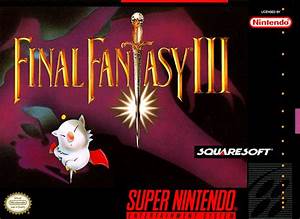
I believe I have mentioned once upon a time there was a decently-sized stretch of holiday vacations in which I played Illusion of Gaia to its completion on Christmas Eve.  The tradition started even before that with annual year-end plays of StarTropics.  Some of the best Christmas breaks, though, featured lengthy plays of my favorite video game of all time, Final Fantasy VI.  Some day soon I’d like to get back into that game, but first I have an obligation to my children to finish ChronoTrigger.  We started that a year ago, but things and time and such got away from us this summer, so I still have to finish that up.  In recent Christmas breaks, I’ve been playing more PS3 games, such as the Uncharted and God of War series (nothing says Christmas in this day and age like slaughtering Greek gods).  Some of the Batman Arkham series have also started to associate themselves with Christmastime.  Two main reasons explain this phenomenon: Christmastime is one of the few times of the year in which I have the freedom (and life energy) to play videogames; also, popular videogames get very inexpensive if you wait a year or two after their release, and thus make excellent stocking stuffers, and what would Christmas be without playing with your new toys/games?

Moments ago I mentioned I didn’t complete ChronoTrigger this past summer with my kids (I do most of the playing, they sit back and enjoy the story; it works out well for everyone, really).  This was because I got distracted by another trip down memory lane, which happens to be the main subject of this oddly-themed Christmas article: Final Fantasy XII.

FFXII is at worst my third-favorite game, behind FFVI and ChronoTrigger, and it has been making some ground on ChronoTrigger.  I admit I have not completed the entire game, though I have spent a fair amount of time playing it (over 130 hours, if the internal chronometer is to be believed), but I have played enough to get a good understanding of it.  I played it shortly after it first came out, a decade ago, but somehow life’s circumstances took me away before I could make it all the way to the end (I suspect our move from Virginia Beach had something to do with it).  For some time, I had a desire to get back into it, and this past summer I just decided to go for it.  And that’s mostly how I spent my summer vacation, and, hopefully, a fair amount of my Christmas vacation.

The Story

You know I wouldn’t spoil anything without warning you in advance, but one of the benefits of not knowing the ending myself is I can’t tell you about it, so I will focus on the basics.  FFXII takes place on the world of Ivalice, possibly the most fully-realized world in Final Fantasy history, in that it has a rich, noticeable history and a palpable present, with all nations and races full and developed and interactive.  Even the great FFVI suffers in this respect at times: you’ll show up in a new part of the world because the game wants to introduce a new character, not because this location has a meaningful connection to the places you’ve already been.  This is not so in FFXII: all races, all nations, all cities are aware of the others — they don’t always get along, of course, but the world is connected very cohesively.

Ivalice, like all worlds, has various nations, some of which prefer to have more international political power than others.  The Archadian Empire has fallen into unscrupulous hands, and it is starting to gobble up surrounding nations.  The Rozarrian Empire on the other side of the world is not terribly happy with that.  Caught in the middle of these two war-impending empires is the Resistance.  This is basically where our heroes come in.  Various survivors of previous wars and insurrections (and other economic considerations) have banded together to reclaim what was once theirs, to fight for the freedom of the people, and to make the world a safe place of justice and freedom once again.  The usual stuff of great stories.

What makes FFXII different, though, from the typical rebels vs. empire stories is both how unobtrusive this main storyline is to the playing of the game as well as the very engaging past of the world, as our heroes spend a good deal of their time learning about the past and its relics to understand present-day conflicts and solutions (it’s a great lesson for us today, as well).

I say the main storyline is unobtrusive, but I don’t mean it’s dull or short—only that you can enjoy playing this game for hours on end on enjoyable side-quests and level raising and whatnot and the game will not punish you for taking so long between plot points.  Yes, there are important plot points and cut scenes and “once you do this you can never go back to how it was” events that change the game, but the game gives you plenty of warning and opportunity to commit to them or come back later if you need to raise levels, upgrade weapons and armor, restock your provisions, or whatever.  You do need to advance the story some times to get access to the better equipment and spells and things, but by that point in the game, you’re ready and eager for it, anyway.

Magic is a key part of all Final Fantasy games, but one of the reasons I like FFVI so much is the significant magic vs. technology subplot.  It’s not just conjuring up dark spirits to tamper in God’s domain.  Similarly, FFXII takes the idea of magic and connects it to technology and supernatural forces, but one is never given the impression your spells are aligning you with the forces of darkness.  The more you learn about your world’s past, and the forces that have shaped it for good and ill, the more your understanding of the supernatural and magic grows (always a good thing).  The game doesn’t give you the impression the divine is just aliens you can control or conquer — in fact, the many characters of religious faith are presented in the best light as anyone in the game.

On the journey to gather allies, learn about the world, and attempt to stop a war before it destroys the world, our heroes find out some forces within the Archadian Empire are also working toward peace — but other forces are working to make the magic even more dangerous (thanks to technology), and we must take a more active role in the conflict for the slam-bang finish.  That’s where I am in the game: a few events away from the finish.  I’ll let you know how it goes (I hope).

The Characters

Once you get past a brief introductory scene that familiarizes you to the game mechanics and a bit of the backstory to the main conflicts involved, the game begins with our main character, Vaan, a refugee street urchin working odd jobs for a local merchant with big dreams of becoming a sky pirate (like a regular pirate, but on a flying airship).  He has a lot of anger inside because of the losses he has suffered at the hands of the Archadian Empire, but on the whole he is an optimistic, energetic young guy who wants to see the world, treat people well, and learn (though he’s not yet so mature he knows it’s impolite to ask a woman her age).  Even though Vaan has some significant connections to the major conflicts of the overarching story, he acts mostly as our advocate in the world, observing and learning, with little direct involvement in the present storyline itself (sort of like Nick Carroway in The Great Gatsby).

Vaan’s street urchin friend Penelo is the first other main character we meet once the present storyline begins, though she is the last to join the group.  She, too, has suffered because of the Archadian Empire, but she, too, tries to keep her spirits up even in these troubled times.  Part of the reason even the homeless are chipper at the start of the game is because the Empire hasn’t shown its true colors yet and material prosperity seems to be back again (odd how people are quick to ignore political morasses when personal economy seems healthy).  Regardless, Penelo vows to keep her eye on her good friend Vaan for his own good.  You’d think there’d be a bigger love interest story with these two, but there isn’t (and that’s not so bad).

The main story of our heroic rebels actually centers on Ashe (short for Ashelia), the young princess of our country Dalmasca who is leading the Resistance in disguise.  It is her role to travel through the world, learn about her heritage and connection to the magical forces at work in the world (in her effort to destroy all magic once and for all), and restore Dalmasca’s freedom from the Empire (with or without destroying the Empire in the process).  Her dominance in the ongoing storyline lends one to think of her as the main character instead of Vaan, but don’t let that bother you.  Instead, think of it as a clever element of the game to give all the main group members a significant amount of screen time.

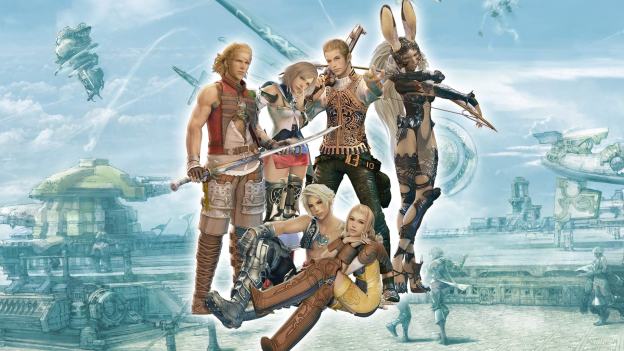
The brawn of the group is another loyal son of Dalmasca, Basch.  We actually meet him in the prologue scenario, in which it seems his loyalty is a sham, but that is cleared up within about twenty minutes of playing the game, so I’m not spoiling anything, really.  Plus, since he’s on the cover with all the other heroes, you know he’s got to be a good guy.  He, too, has strong connections to the Empire and the overarching stories.  Suffice it to say, despite his potential loyalty conflicts (I don’t want to spoil things for you, but let’s just say he has a brother who’s a high-ranking official for the Empire), he is a key member of the team, especially as his knowledge and experience guide the group during many side quests and even main plot events.  Plus, as I said, he’s really strong against non-magical monsters, so giving him a war hammer or heavy axe and letting him have at it is pretty fun to watch.

Rounding out our main group (a comparatively miniscule group of six heroes, contrasted to the cast of fourteen in FFVI), we have a pair of real-life sky pirates: Balthier and Fran.  Fran is a Viera (basically, a race of human-looking aliens … with bunny ears — but it looks far less silly than it sounds, believe me), and as such she has a strong connection to the magical elements of the world (called Mist), which makes her a strong magic user, though she’s also good with a bow.  Balthier and Fran are basically the Han and Chewie of the team, if that helps, and, like Han, Balthier thinks he is the leading man of the story, adding a rather humorous element to a number of cut scenes and character interactions (and a lot of people seem to believe him, since Vaan oftentimes takes a narrative backseat to the other characters on the team).  Balthier, too, has a strong connection to the Empire that causes him a good deal of pain, which he usually glosses over with charm and skillfully deflecting our attention to other things.  He wants us to think he’s only helping the Resistance for the potential reward Ashe will give him when she regains her throne, but there’s more to it than that (yes, it’s that old story, but it comes off with enough differences that it’s not just a banal Star Wars rip-off).  Fran, likewise, has outsider issues, being far from home and her race and having spent possibly too much time with the humans (“humes” in this game).  I know that, too, sounds awfully familiar, but the game presents her character conflicts in fresh ways, even with the archetypal aspects to it all.

Along the way, our heroes gain temporary allies, travel the world, gain levels, make friends, restore order, learn lessons, raise levels, buy items, locate runaway cockatrices, save the world (I assume) and so much more.  With a small cast of main characters this time, combined with the still-impressive cut screen (in-game movies) technology and voice acting, we really get to spend a good deal of time getting to know them, see them interact (which is usually the highlight of games and stories and such as this), and connect with them in multiple ways like any good characters from “literature.”  Just because these characters and their story are in a video game does not make them any less meaningful or engaging as Hamlet or Walter Lee Younger or Nora Helmer or Anna Karenina or any of the highbrow gang.  They are just as real, too.  You can scoff, sure; I can take it.  But if we live in a world that tells us people who transport a ball of air around a hardwood court or grass yard are heroes to be followed and emulated and lauded (and financially supported), I think it’s fair to say characters in a game with meaningful conflicts and needs and hopes and heartaches and dreams that resonate within us, characters with which we have a direct involvement through our decisions as game players, are just as real as literary heroes, historical heroes, and athletic heroes.  And I know I’m not the only one who thinks that way.  Plus, I’m a published author.  You can trust me.

The Distinctives

So what’s so special about FFXII?  How can you play for hours and hours without advancing the story (and have fun doing it, more than just the RPG-requisite level raising)?  Here are just a few of the many enjoyable aspects of FFXII that make for a great holiday (or summertime) vacation pastime.

The Gambit System — in most videogame role-playing games, you have to manually tell all your characters what to do during every encounter: you fight that monster, you cast that spell, you use that item, round after round after round.  FFXII does away with all that button pushing with the clever gambit system: dozens and dozens of context-sensitive commands you can “pre-program” for your characters to handle virtually all encounters without you having to tell them what to do every single time.  Once you get the hang of it, it becomes a real time and thumb saver.  You’ll be tinkering with and adjusting it throughout the game, plus you’ll be telling your characters what to do plenty, so there’s no loss of interactivity or feeling of control/guidance of these characters.  All that’s lost is the repetitive nonsense.

The Battle System — unlike most RPGs that feature random encounters with monsters to give you experience (to raise levels and attributes and whatnot) and money (to buy new armor, weapons, items, etc.), FFXII gives us the “open world” feeling of seeing where all the enemies are, just like you are there in the plains, on the mountain path, in the castle, or wherever you are — you can actually see where the enemies/monsters are in the world.  This makes so much more sense, and combined with the gambit system, you can have fun raising levels by running around the world, watching your heroes act and react naturally, all the while enjoying the fantastic musical score by Hitoshi Sakimoto (seriously, many of the themes of the soundtrack are gorgeous aural experiences).  Additionally, unlike the usual “you get 287 gold pieces for defeating those blue slimes” (as if monsters would carry human currency), FFXII eliminates that thematic discrepancy by having you pick up “loot” from the foes you defeat:, loot that makes sense: wolves drop pelts, for example; bats drop fangs; skeletons drop bones and iron swords they were carrying.  You, then, take the loot you pick up from your fallen foe (just like epic heroes) and sell it all back in towns for money, which you can use to buy what you need from other shops.  Plus, the game has bonuses for fighting similar kinds of monsters, developing “battle chains” that can result in better and better loot as you take the time to stay and fight and raise levels — the game rewards you in many ways for doing what the game effectively requires you to do, making the gameplay experience that much more enjoyable.  Plus plus, it makes a lot more thematic sense.

Crystals, Travel, and Non-linearity — as convenient as it used to be in older Final Fantasy games to be able to save your game practically anywhere in the world (other than in dungeons or in the middle of certain levels or areas except for special save spots), the hassle of having to buy cabins or tents or staying at inns sometimes meant a good deal of precious gold pieces going to that.  The save crystals in FFXII eliminate that problem (I know earlier entries in the series use similar objects, like FFX, but they make better sense in FFXII).  True, you don’t get some of the great nighttime dream sequences or cut scenes like in FFVI, but that’s a small price to pay for not having a price to pay.

Another convenience of certain save spot crystals in FFXII indeed are the orange transport crystals that allow you to instantaneously travel to various parts of the world you’ve been to before in the game, at the small cost of one teleport crystal.  These don’t cost very much gp, and soon enough in the game you’ll have acquired so many of them anyway through picking up loot from fallen monsters, rewards for special tasks you accomplish, and other events in the game you may likely go through the whole game without paying for a single transportation crystal.  As much as I love FFVI (and IV), so much of the first part of the game is a niggling feeling of “boy, when I get my airship, I’ll be able to go anywhere, do anything…” and suddenly you realize you are exactly like Vaan in FFXII, waiting for the freedom of travel.  The teleport crystals in FFXII eliminate that feeling of impatience and limitation almost immediately in the game (which is like, thirty minutes of game time, small potatoes considering how long you will be playing it).  You’d think you’d have Balthier and Fran’s airship early in the game when they join the party permanently, but events in the game damage the ship so you are on foot for most of the game.  This does require you to walk through large sections of the world until you get to the various teleport crystals, but this is more beneficial for you, since it gives you the opportunity to fight monsters, gain experience, gain loot, raise levels (all the nitty gritty of classic RPGs, though made more fun be all the developments enumerated above).

These teleport crystals are possibly the key enabler of freedom from the main story.  I mentioned earlier the story is fairly unobtrusive for most of the game, and this is true depending on how you play Final Fantasy XII.  With the teleport crystals, you can easily leave the main palace or dungeon or next key plot point before you enter it, transport yourself somewhere else in the world, and spend hours doing sidequests or level raising or whatever, then teleport back to where the game “wants” you to be without any of the AI characters any wiser or frustrated at your “dilatory” behavior.  That is true freedom you want in a game like this.

Growth — raising levels is considered by some jackanapes a “necessary evil” of RPGs: as the game progresses, the enemies get harder, you have to get stronger, faster, you need more hit points, more magic points, et cetera et cetera et cetera.  These same Tom Fool wastrels use unkind words to describe the process of raising levels, fighting monsters somewhat mindlessly for hours on end solely to gain experience and dosh to get your characters stronger and buy them better stuff.  I admit, for most RPGs, the process of gaining levels can be somewhat tedious, but as we have already indicated, that does not apply to FFXII.  The background music, the gambit system, the onscreen encounters all add up to the most enjoyable level-raising experiences in RPGs (surpassing even FFVI in this respect, yes).  But that’s not the point here.  The point here is in addition to all that, level raising in FFXII is more than just getting your characters to their programmed maximum attributes: similar to (but improved from) FFX’s “sphere grid” system, FFXII uses the “license board” to allow you to customize each character.  You decide what spells they learn, what weapons they can use, what armor they can use, and other customizable elements.  As indicated above, some characters are naturally better at some skills than others (Ashe and Fran, for example, are naturally better at spellcasting than Balthier and Basch, say, and it’s wise to give them some spell gambits, especially as their healing spells are more effective than, say, Vaan’s).  This licensing board system gives you great freedom (that word again) to customize the characters differently each time you play the game.  As I said, I like to give Basch a war hammer or battle axe and let him smash opponents.  Penelo is “supposed” to stay back and hurl spells or long-range weapons, but she’s a tough, fast kid, so I like to give her strong spears or poles to jump into the fray.  Balthier’s guns are strong, but I prefer to give him a katana or other ninja blades and give him accessories that allow him to strike multiple times per turn.  The game gives you far more options than these.

Side quests — the meat and potatoes of the game’s freedom and fun come from the side quests.  I told you there’s a point in the game in which you travel the world looking for runaway cockatrices.  That’s just one of literally dozens of optional side quests available throughout the game.  You can get a fishing rod and learn how to fish for as long as you want.  In addition, the more you engage with the characters (regular townspeople and the like), the more the game rewards you.  Even these people are realized characters who change and are aware of the main events of the story, and when you encounter them in seemingly throwaway moments, you will meet them again in another part of the world, and frankly, that’s awesome.  I don’t want to spoil too much of the rest of the game for you, but suffice it to say this game gives you plenty of reasons to play it for a long, long time.

Hold on, let me tell you perhaps the most clever side quest: the Hunts.  You have to join it early in the game as a required plot point, but after that early incident the rest is optional.  The Hunts are this terribly clever side quest that lasts the whole game in which various citizens of the world are having various problems (a huge snake is preventing a spice trader from importing his goods here, a young child’s pet turtle has somehow transmogrified into a giant snapping turtle of destruction there — you get the idea), and only you and your friends are up to the task of setting this fiasco right again.  It’s a great way to earn unique items (for some things, the only way to earn rare items), travel familiar territory for new purposes, and just have fun, as each hunt has different requirements and aspects to it (they aren’t just “go here and beat up this thing and come back for your reward”).

But it gets better.  Once you start making a name for yourself as a great hunter, you get to join the clan of fellow hunters, which enables you to get other nice treats, info on elite marks, and gives more cohesion to the world.  Later in the game, you get the chance to join a second, more elite Hunt Club, in which ultra-rare monsters appear only during these hunts throughout the world, enabling you to get more elite items.  Yes, sometimes these hunts can be devastating if you aren’t prepared or playing wisely (which may have happened to me a couple times this past summer), but that can be true of the main game as well.  This massive, complex but not complicated series of side quests is just one of the many clever ways this game presents a unified, believable world from beginning to (I assume) end.

The important thing about the many and varied side quests throughout FFXII is not that they are basically “necessary” to get the good stuff to win the game.  You can play through the main storyline just fine without any of these optional elements, and that will be a rich, rewarding experience all its own.  Yet, the greatness that is the side quests of FFXII lies also in how much they reward you playing them.  They give you great stuff, sure, but that alone would be meaningless if they weren’t as fun as they are.  I said before they make the supporting characters you meet somewhat incidentally come alive more meaningfully, and that point should not be ignored.  Without descending into sounding maudlin, the characters (main and supporting) and the side quests really make you want to spend time in this world.  Yes, the world has a lot of problems (impending war, gigantic monsters that want to destroy you, crumbling ruins of forgotten technology and civilizations, alien beings trying to pull the strings on the development of all races, the usual), but like the opening song to Deep Space Nine or Star Wars, you just get overwhelmed with the feeling of “yeah, I want to be here for a while.”  And the side quests especially allow you to do that in meaningful, enriching ways.

The Goods

No, it’s not “just a videogame.”  Like the great works of art and literature, Final Fantasy XII causes us to look within and around and make ourselves and our world better.  That’s what Christmas is partly about as well, isn’t it?

And, man, that musical score….

I’m very glad Christmas break is almost upon us again.  I really want to get back to Ivalice and play more Final Fantasy XII.  If you don’t have a PS2 (did I mention it is a PS2 game?), do not fear.  Just in time for its 11th anniversary, I hear a remastered version is coming in 2017 to the PS4 (you have one of those, right?), complete with an even better licensing/customizing experience.  If they keep the music and characters and story and other side quests in place yet improved with modern technology and whatnot, you will find this a fantastic experience.

Have a Merry Christmas 2016, everyone!  Even if you don’t get around to playing Final Fantasy XII, we at Redeeming Pandora hope it will be a refreshing, leisure-filled time of quality family experiences, meaningful spiritual reflection and growth, musical memories old and new, tasty treats and savory snacks, nostalgic films, games and fun and shopping and games, and many, many days of lounging around at home for the holidays (preferably in your jimjams all day long — that’s my plan).

See you in 2017!
Twilight Struggle

Matthew Nalls

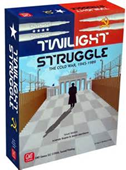
A work of true skill and inspiration, Twilight Struggle is a two-player board game that simulates the silent war between the two great superpowers of the United States of America and the Union of Soviet Socialist Republics. The illustrated board game incorporates events from the early stages of the Cold War to the later stages of the war during the course of the game in due chronological order.

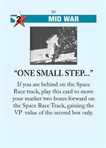
The game incorporates these events through action cards that are used to dictate the flow of the game. These cards can help or hinder each player, as some cards work toward the sole benefit of the USSR player, the US player, or both. Examples of such cards are “Allende,” “CIA Created,” and “‘One Small Step…”’ respectively. Allende, a Socialist physician, was popularly elected in the country of Chile to lead its first socialist government. When played, this card grants two “influence” to the USSR in the country of Chile on the map. Influence points determine control over the war and the regions on the board. Hence, the card is a USSR benefit card, as the card essentially gives USSR influence in the region. Likewise, “CIA Created” is a US-benefit card, as the card recounts the creation of the Central Intelligence Agency. This card allows the US to put one “influence” on the board, and see the opponent’s hand. This card works exclusively for the US, as the CIA was not a Russian organization. The converse would be considered for “Allende.”

Unlike these two kinds of cards, other cards benefit either player. On July 20th, 1969, Neil Armstrong became the first man to step foot on the moon. During this, he uttered the unforgettable phrase, “That’s one small step for man; one giant leap for mankind.” The “‘One Small Step…’” card signifies the work put in by NASA to catch up to Soviet technologies regarding the Space Race in order to land a man on the moon. This card allows the player to catch up two spaces in the Space Race part of the game. Therefore, it can benefit either player.

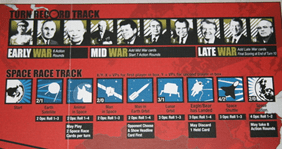
The Space Race is its own course made up of several achievements. These achievements include “Animals in Space,” “Man in Space,” “Lunar Orbit,” and ultimately “Space Station,” among several others. To move along this path, one must either discard a card or obtain a Space Race-specific card. These achievements benefit the player, as the majority give Victory Points to the first player to land upon them. These Victory Points ultimately decide the outcome of the game, as the first player to reach twenty Victory Points “wins” the Cold War. This is not as easy as it sounds. If the US player is at five Victory Points, and the USSR player earns five Victory Points, both players are not at five Victory Points. Rather, the USSR player has just reeled the US player back to zero Victory Points. This would be the same case even if the roles were switched.

Along with detailed and historically-accurate cards, Twilight Struggle also incorporates “initial influence.” For the US and the USSR, at the beginning of the game, both sides already boast influence in certain countries. This “initial influence” is a reflection of the power each side wielded in certain regions during the early stages of the actual Cold War. Furthermore, to preserve the chronological accuracy of the war, certain cards cannot be played until certain stages of the game. As Allende took power over Chile in 1973, his card is not available until the game progresses to the “Mid-War” stage of the game. Until such stage of the game, “Allende” and other “Mid-War” cards are not available for play. Similarly, “Late-War” cards are not available until the respective stage is met as well.

Regarding detail, historical and chronological accuracy, and incorporation of key events, Twilight Struggle sets high standards for other board games. Although not every part of the Cold War could be fit into the game, such is understandable and not unexpected. Twilight Struggle still provides a thorough retelling of the Cold War through the game-changing cards it does include.

As for the excitement and player enjoyment factors, I had the special privilege of playing renowned board game passionatus Mr. Rush in two exciting practice rounds. In both rounds, I opted to play the role of the USSR in their struggle against the “free” filthy capitalist pigs. The first practice round took time; however, this was understandable as it was necessary to become accustomed to the processes of the game. When grown accustomed, the game soon took off in a tense, back-and-forth exchange. Repeatedly, it became necessary for me to reel the US back to zero Victory Points during the round. The outcome of this round is not of importance.

The second practice round was one of emotions ranging from determination, excitement, disappointment, and disdain. At the tail end of the “Early-War” stage of the game, the US was boasting a significant lead in Victory Points. Fortunately for the USSR, I possessed a “scoring card” which would attribute numerous Victory Points to the USSR for domination in a region. During the beginning of the round, I strategically allocated certain amounts of growing influence in the South American region. With this scoring card in hand, I was prepared to return the war back to even terms. Unfortunately, a small-font, hidden, between-the-lines, tucked away rule prevented the USSR from a major comeback. This ultimately led to a miserably disappointing defeat, or so I thought. In blinding reality, my opponent ruthlessly cheated during our game, which was a key factor of this defeat. The “UN Intervention” card is a specialized card that can help either player. The card allows one to discard another card in his hand, and use the operation points from the card without triggering the event. My opponent misled me, and wrongly interpreted this respective card. Rather than nullifying a card in his own hand, he used “UN Intervention” to nullify a card I played that round, and mercilessly utilized its operation points. As a result of this, game-changing cards were nullified on several occasions, ultimately leading to the untimely demise of the USSR.

Nonetheless, upon the completion of our two enjoyable games, I had come to an appreciation for the game. Twilight Struggle boasts strategy, history, drama, and excitement all in one bundle. The game does not take hours to churn out an end result, nor does the game “zip by” before one realizes the game is actually completed. The game’s creators had the goal of enjoyment in mind, and they achieved this goal with marked skill and detail. My personal experience was so enjoyable I have taken up playing the game online with others across the globe on the website “Chantry.” I highly recommend this game for both casual and committed board game players, and especially for those looking for a fun and exciting, yet simple game.

Christmas V: Christmastime is Family Time

Christopher Rush

Merry Christmas, friends!  Instead of our usual panoply, we are going to focus on something a little different this year.  One of the most important aspects of Christmastime is the quality togetherness with loved ones.  And near the top of enjoyable, high-quality family-and-friends experiences is enjoying fun boardgames together.  Recently, we went through an informal Hot 12 games countdown, inspired in part because many of you seem to still be living in the First Golden Ag of Boardgaming.  While that is fine in its way, and if games such as Monopoly, Chess, Scrabble, Uno, Sorry!, and Risk still bring you a modicum of happiness, that’s swell, really — but you are likely unaware an entirely new, fresh universe of boardgames has exploded within the last couple of decades.  We are currently in what has been aptly called The Second Golden Age of Boardgaming.  One of the positive aspects of the global interconnectedness of recent decades (spurred on, no doubt, in part by the Information Superhighway) is the migration of European-style games (often called “Eurogames”) to the United States.  Starting, by many accounts, with The Settlers of Catan, a new wave of game designs, game designers, and outright fun (the primary purpose of playing games, right?) has grown exponentially in our lifetime.  Hundreds of new boardgames are being made and published each year, some huge (Twilight Imperium III, for example), some tiny (such as Sushi Go!), some for two players (Fields of Arle), some for dozens of players simultaneously (Ultimate Werewolf).  Because it is a time for giving, we here at Redeeming Pandora humbly give you a small selection of the recent kinds of games that quite possibly surpass the original classic games.  (Feel free to buy these for your family as presents.)

Don’t get me wrong: I grew up on the old games as well.  We had many an enjoyable evening of Careers, Clue, Dutch Blitz variants, Trivial Pursuit, and many more.  With all due respect to those games, this new generation of games is mind-bogglingly superior in almost every way.  And, while we at Redeeming Pandora are often in favor of the classic instead of the recent (in virtually every other category of human experience, in fact), we are also in favor of being aware of the times, aware of what good things are happening in our own day, and boardgaming is certainly where it’s at today.

This list is partly inspired by the fellows over at The Dice Tower, an online forum for contemporary board game discussion.  Tom Vasel, a fellow Christian and former mathematics teacher, started his online game reviews over a decade ago, and it has since blossomed into a significant news/reviews/and more avenue for, especially, new and forthcoming board games.  While I don’t always agree with what they say over there (especially when they start talking nonsense about wargames), many times they provide helpful and enjoyable insights onto games, designers, and exciting new games on the horizon.  The Dice Tower fellows did a Top 10 list about a year and a half ago about “better” games than the classics.  Some of our suggestions are similar to theirs, some are rather different.  Richard Ham, former videogame designer, of Rahdo Runs Through, another online game reviewer, is very enjoyable and intelligent in his reviews and is highly recommended, also.

Remember: this is not meant to shame you for enjoying other things.  As I said, I’ve played and had some fun with these myself in the past.  Consider this more of an opportunity to learn about things you will likely enjoy even more than what you are doing now (or remember doing in your own childhood).  It’s time to move beyond Candy Land and Mouse Trap and enter the Realms of Gold of modern boardgaming.

Caveat: many of the games mentioned here will naturally overlap many of these categories.  For example, Marvel Dicemasters is clearly a dice game, a heavily thematic game, and can be played in teams cooperatively.  I have chosen (arbitrarily, as always) to list games, then, under the category that is more immediately identifiable for the game (according to my personal whim and fancy).

Cooperative Games

You probably didn’t know this kind of game existed, did you?  If you are one of those people who would like to play games but don’t like the competitive nature of them (perhaps because you have had bad experiences with poor winners, “rules lawyers,” and other unfortunate gaming situations), there is good news!  A lot of very enjoyable games in the last decade or so have been created called “cooperative games,” in which you and your fellow players are trying to work together to beat the game itself.  These may be the games for you.

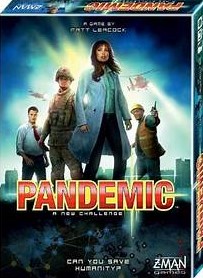
For many, the most enjoyable cooperative game out there today is Pandemic.  You and your fellow players are a team trying to cure four diseases trying to take over the world.  You have to work together to get the job done because if you don’t, the diseases will get out of control.  This game has a good amount of variability, which enables a good deal of replay value, which is definitely a plus for games as investments.  With different character roles and different setups each game, each time you play it is a new experience.  Even so, Pandemic has a number of expansions available to change the game in different ways.

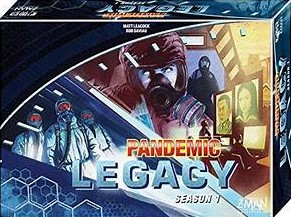
If you like grand stories, as I’m sure you do, once you have played a good deal of Pandemic, give Pandemic Legacy a try.  I’m told it tells an epic story over a number of games, in which the playing surface and the game itself change from gaming session to gaming session.

A very enjoyable cooperative game that also is a very good “gateway”

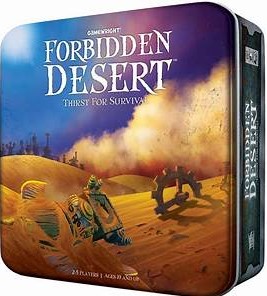
game (a good game to introduce people to boardgaming, especially if they aren’t familiar with modern boardgames) is Forbidden Desert.  You and your fellow players are a team of explorers (also with different roles/abilities like Pandemic, adding to the variability and replayability) trying to find pieces of Leonardo’s flying machine (sort of) before the desert swallows you up or you run out of water.  The difficulty can be adjusted for new, intermediate, or advanced players.  It’s also a short game, and while there is some tension in trying to “beat the clock” together, it’s a fun game providing a good deal of player interaction in a positive way, since you are all working together.  Because of this, it’s also a great game to play with kids (my six-year-old Julia can play pretty well as her own character).

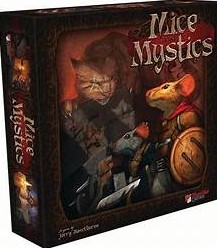
Another good cooperative game even more suited to a family gaming experience is Mice and Mystics.  This is a storytelling fantasy game in which the players are loyal heroes-turned-mice adventuring their way through the castle in an attempt to overcome the villains and bring peace back to the troubled realm.  It is a role-playing game fit for the whole family, with several expansions available to keep the fun and family togetherness going for a long time.

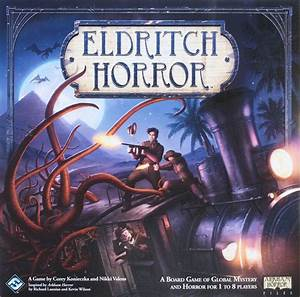
In stark contrast to Mice and Mystics is a definitely older-audience themed game, still with a great deal of  story-telling fun: Eldritch Horror.  Based on the macabre works and worlds of H.P. Lovecraft, Eldritch Horror is a story-telling, mystery-solving, globe-trotting adventure.  It works well as a solo game; it works well with up to 8 players.  As has been discussed here and elsewhere, I am no fan of horror.  I am quite sure I will never read any stories by H.P. Lovecraft.  However, I do enjoy this game.  The horror element is there in part, but it’s a minor part and can be easily glossed over.  It’s a dark mystery storytelling adventure.  This, too, has a number of expansions, so it has a tremendous amount of replayability.  You can be different characters each time, encounter different monsters each time, and investigate different supernatural mysteries and clues each game.  As many of you know, it’s a bit of a streamlining of an older, similar game Arkham Horror, which is another fine cooperative dark mystery in the Cthulhu universe.  I enjoy it, too, but it is longer and a bit scarier (it’s much closer in one town instead of traveling the world, so the menace is more palpable).

One of the most recent games on this list is also a cooperative storytelling adventure T.I.M.E. Stories.  I haven’t played it, but I’ve seen videos about it, and it’s like a grown-up cooperative “choose your own adventure” system.  The game system comes with one module called “The Asylum.”  Once you’ve played it, you know it all and probably won’t want to play it again.  But, more modules are out and more are on the way, so consider T.I.M.E. Stories more like a gaming system (like a Super Nintendo) and the modules are new game cartridges.  The modules out now are fairly dark like Eldritch Horror, but the ones scheduled to be released soon seem lighter.  It’s an intriguing system about managing time, solving mysteries, gathering clues, going back in time … it looks like Quantum Leap meets Groundhog Day meets Goosebumps.

Semi-cooperative Games

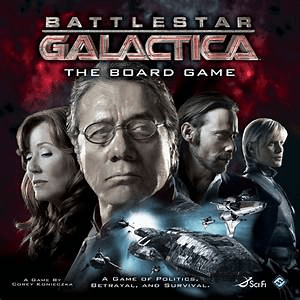
Now that you know about the exciting world of cooperative games (and, like this entire article, we’re only scratching the surface), for those who like an extra challenge, try a semi-cooperative game.  Often, games of this ilk have one or two of the players secretly working against the rest of the group — possibly for personal victory objectives or possibly because that person is working for the villains the rest of you are trying to avoid/conquer.  For me, the best among this group (not that I’ve played them all) is Battlestar Galactica.  As a fan of the show, the theme of this game is mostly what makes it such a fun game.  Even if you aren’t a fan of the show, the tenseness and rollercoaster nature of the game will give you a tremendously enjoyable gaming experience.  Part of the wildness of the game comes from the possibility one or two of the players may switch sides halfway in the game, whether they want to or not — and while that may sound frustrating, since you know that’s a possibility before you start, it’s simply another element of strategy you have to add to the game.  It’s good, tense fun.  It also has expansions to make replayability and playing through the whole series a possibility.

On the fantasy side, Shadows over Camelot is another semi-coop game in which most of you are loyal knights trying to salvage Camelot from the inexorable forces of darkness (Mordred, traitorous Lancelot, invading Picts, and more) … yet it’s possible one of those “loyal” knights is a dirty traitor, but if he or she is playing wisely, you may not know it until it’s too late.  It’s possible, certainly, to play without the traitor element: it’s a challenging enough game without that, so if you want to play a fun coop game set in Camelot with or without traitor tension, this is a very enjoyable, fast-paced game.

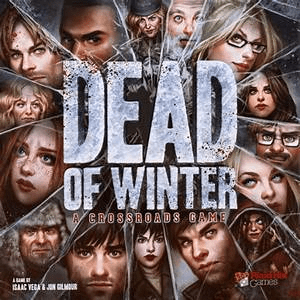
One game I’ll likely never play (in part because I don’t really like the theme) is the beloved and acclaimed Dead of Winter.  I’m told if you like The Walking Dead or other zombie-themed things (I don’t know why you would), you will enjoy this game.  It’s noted for its “crossroads” system, in which decisions are made and situations occur completely unique to every gaming experience that make each play different.  With different character roles, variable missions, and random personal goals each time, it’s got a lot of replay value.

Deckbuilding

One of the more interesting innovations in games lately is the “deckbuilding” game mechanism.  Hearkening back, in a way, to those CCGs of the ’90s, instead of building a whole deck and hoping you get the right cards eventually, deckbuilding games have you start out with a few basic cards and you get to decide what cards to add to the deck and build it yourself during the game.  For many of you, Dominion is the popular choice for this genre of games, and that’s fine.  It was among the first to make this newish mechanism popular and has been a beloved game for several years now, with many expansions and whatnot, but here are some that you may like as well (or more).

Paperback is especially interesting for those who like Scrabble.  It is a word-building game, but you are also using letters (as cards in your hand and in your deck) to make words that will allow you to get more letters in your deck to make longer, more interesting words and perhaps special words that will give you bonuses and such.  There is a competitive aspect to the game, like Scrabble, but unlike Scrabble you’ll never be stuck with a ZXCEEQF and nowhere to put it on the board.  If you don’t like the competitive aspect, Paperback comes with a cooperative element, in which you and your fellow players are trying to make words to beat the built-in time mechanism (in a sort of reverse Klondike fashion).  This is a great game.

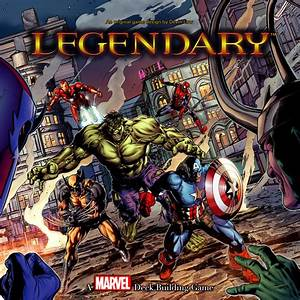
For fans of the Marvel universe, a very enjoyable deckbuilding (and also cooperative) game is Marvel Legendary.  You are SHIELD agents coordinating with powerful Marvel heroes to tackle the main villain and his henchmen.  It takes strategy, cooperation, and a smidgeon of luck, but it is a fun game.  The series has a large number of supplemental releases, so there’s a good chance many of your favorite Marvel heroes/villains are available or soon will be (though, they are slanted toward newer storylines and characters, so I’m a bit concerned some of my favorites from back in the day won’t get released, but that’s okay).  If you would prefer to play as the villains against the heroes, check out Marvel Legendary: Villains.

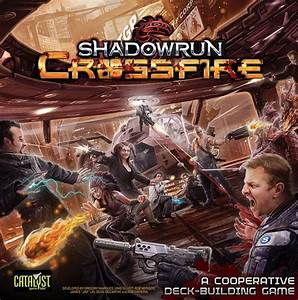
On the flipside, a much more difficult game that may even be more enjoyable as a single-player game (since it gets more difficult the more people who play), is Shadowrun: Crossfire.  This game is hard to win, but when you do, it’s a great feeling.  Better than that, though, is the game grows the more you play.  Unlike Dominion or Legendary, as fun as they are to play, once they’re over, they’re over.  You start from the beginning every time.  Shadowrun: Crossfire is like an RPG (which makes sense, since it’s based on an RPG universe), by this I mean if you win (or get a partial victory), your characters get experience points, and the more experience points you get you can add new abilities to your characters to change the game, often to make it easier.  This allows you to play more difficult missions and makes the game more enjoyable and more challenging.  I’m not usually a huge fan of challenging games, but I really enjoy this one.  It, too, is also a cooperative game.  Expansions are on the way for this one, too.

Dice Games

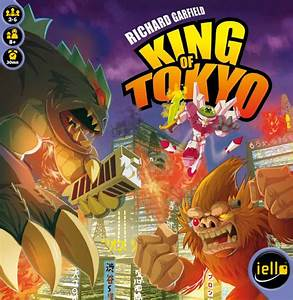
So you like rolling dice, huh?  Miss those ol’ days of Yahtzee and 10,000 and other dice rolling games?  If you like chucking dice, you may really enjoy King of Tokyo.  It is a fast game that plays up to 6 people, so it’s a great game for many reasons.  Each player takes the role of a classic/generic movie monster, each trying to become the King of Tokyo, either by being the most famous or, perhaps more enjoyably, the last monster standing.  Like Yahtzee, it’s a dice rolling game about matching dice combinations, but it also adds cards for variety that makes its replayability level rather high.  The Power Up expansion gives the different characters unique abilities, making it an even more enjoyable game again and again.  (There’s a King of New York and other expansions as well.)

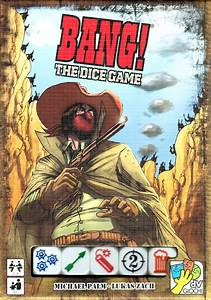
Another fun, fast dice game with a decent amount of theme tossed in is Bang!: The Dice Game.  Like King of Tokyo, you roll the dice a few times to decide which actions you are going to take that turn, balancing helping yourself with attacking the other players, all in the Ol’ West.  It’s an inexpensive, fast game that also has a good deal of replayability.  I’m told it works great with 5 players, so get the whole family together.

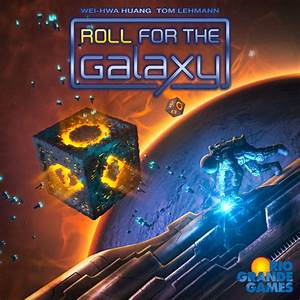
Roll for the Galaxy is a different kind of dice-rolling game.  Similar to some of the Civilization-building games discussed later, this game uses your dice to colonize worlds, ship goods, and develop technologies to advance your space-faring civilization.  Like Bang!: TDG, this is a reimplementation of a card game you may also enjoy if you prefer card games to dice games (called Race for the Galaxy).

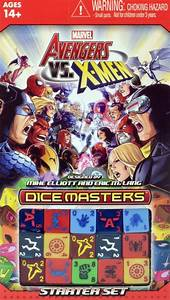
As with all the other games in this section, Marvel Dicemasters uses customized dice to simulate your favorite Marvel heroes battling against your favorite Marvel villains (and also other Marvel heroes, as is their wont).  This game is customizable, has a number of sets (all of which are fully compatible with the others), and also gives you the exciting fun of collecting.  The fun of CCGs back in the day, opening packs and hoping to get the cards you need, is here at a much cheaper level.  The starter sets are inexpensive and complete games by themselves, but the additional fun of getting new cards, new dice, and new characters is also available fairly inexpensively.  It’s a quick game, easy to learn, and great for Marvel fans who like rolling dice.  Also, the designing team have a DC line if you prefer DC characters, a Dungeons & Dragons line, and a Yu-Gi-Oh! line.  Something for (almost) everyone.

Party Games

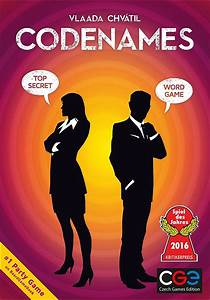
Don’t get me wrong: Apples to Apples is nice and still is holding on, and we even use it ourselves once in a while.  But it’s time on the whole to move on.  When you have a group over and want to play a game, give the new Codenames a try.  From the Web site CoolStuffInc.com (a good site from which to order these games, sometimes cheaper than Amazon): “The two rival spymasters know the secret identities of 25 agents.  Their teammates know the agents only by their Codenames.  The teams compete to see who can make contact with all of their agents first.  Spymasters give one-word clues that can point to multiple words on the board.  Their teammates try to guess words of the right color while avoiding those that belong to the opposing team.  And everyone wants to avoid the assassin.”

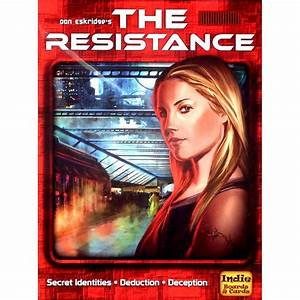
Another kind of team vs. team party game is The Resistance.  Whereas in Codenames you know who is on which side, you aren’t sure who is on your side in The Resistance.  Through deduction and guessing and luck, you attempt to find out on which team the other players are and who is not being as forthright as you.  A fun bluffing game with expansions available to make the game even more diverse and replayable.

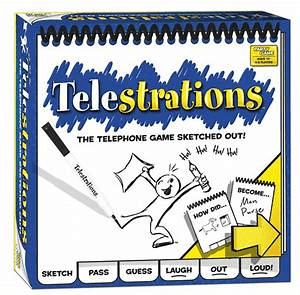
If you miss the fun of Pictionary and the like, perhaps you should give Telestrations a try.  It’s a bit like Pictionary mixed with Telephone, and a whole lot of fun and laughter throughout.  If you were frustrated by Pictionary and others of its ilk, give this a try, especially if you enjoy having fun with fun people.

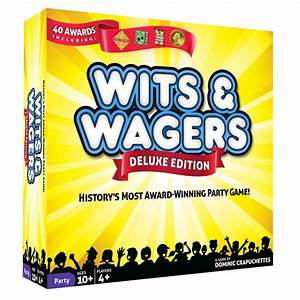
If you like trivia games such as Trivial Pursuit, or at least want to like them but always seem to end up getting the ridiculously hard questions and the people you know you are far smarter than end up getting questions like “Are you on the Earth or the moon?” you will probably enjoy playing Wits & Wagers, especially the Family Edition.  You aren’t really supposed to know the answer, but if you think someone playing does have it (or is closer, since it’s basically guessing numbers and closest wins without going over, like The Price is Right), you can wager on that person’s guess and possibly get points for yourself.  It’s good fun for the family and/or group, doesn’t frustrate you nearly as much as other trivia games, and is not nearly as long as those as well.

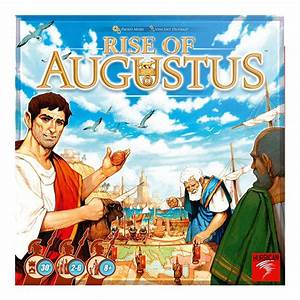
Another party game that works well as a family game is Rise of Augustus.  It’s basically Bingo, but it has just enough strategy sprinkled on top of it to make it fun for adults as well.  With teams, you can play this with a decent number of people, but for smaller groups it works even better.  It’s another fast game you’ll probably want to play more than once in a night.

Filler Games

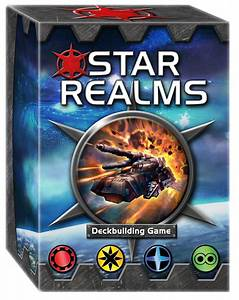
If you want to play a fun game and only have a few minutes, here are a few simple card games that will give you some fast fun.  Star Realms is a very popular deckbuilding game that, unlike the cooperative deckbuilders above, is just about blowing up the other player’s spacefleet.  It is very simple to learn, simple to play, but its simplicity is part of its streamlined fun.  It’s a whole lot of fun for under $15.

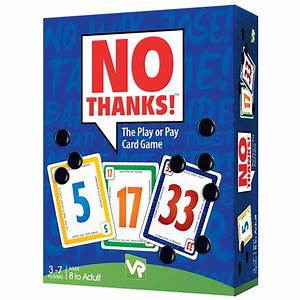
No Thanks! is a clever sort of hand-eliminating game (think Uno but with strategy and fun).  You don’t want cards because you get points for having cards and the lowest score wins.  Instead of taking cards you can spend a chip to pass … but soon you’ll run out of chips and you’ll possibly have to take cards worse than the ones you didn’t want earlier.  All of this clever strategy and hand management and such takes places in about twenty minutes.

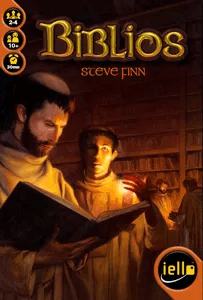
Biblios is an interesting themed game about competing medieval librarians trying to construct the most influential library of rare and sundry tomes.  You have to manage your gold and workforce well to dominate different categories that give different points — whoever has the most points wins, but you will all win because you’ve played a fun game in a short amount of time.  And then you’ll want to read The Name of the Rose, and then your life will be even more rich and full.

Civilization Games

The other end of the spectrum from filler games are epic civilization games, one of my favorite kind of game (being a fan, as you know, of epic poems and epic TV series).  Here are two faster-paced, simpler Civilization building games very accessible to new gamers – and two  incredibly lengthy games that tells a grandiose story over one full day of gaming (one of which happens to be my favorite board game).

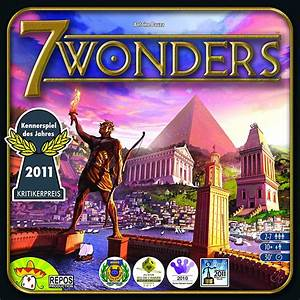
7 Wonders is a fast card drafting game (you decide which card you want to take, but you also have to ponder whether you want your opponents to get the cards you may pass on, too) in which you develop a civilization, build ancient Wonders of the world, and dominate.  It’s a great “gateway” game, plus it has a number of expansions that add replayability and freshness.  Even if you think the game is too simple, the Babel expansion will give it new life for you.

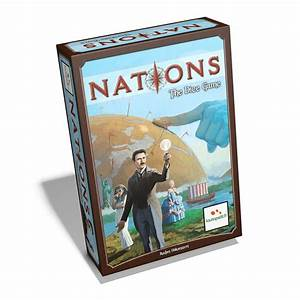
Nations the Dice Game is all about rolling dice to make your nation the dominant culture in the world from the ancient past to the modern day.  Similar to deckbuilders, you are using your simple initial dice to acquire better dice, which enable you to increase the strength of your military, increase your food production, increase your cultural-literary output, and build helpful wonders and recruit helpful leaders.  It’s actually much less complicated than I have made it sound, and it is a very fast game to understand and play.  You’ll likely have difficulty playing it only once.

For the space-civilization conquering itch, perhaps Twilight Imperium IV will suit you.  It’s a beloved game of interstellar conquest, exploration, diplomacy, and civilization building that certainly takes a decent amount of time to play, but the grand sweep of the gaming experience certainly pays off the time investment, especially if you like grand “space opera” tales (more on Star Wars later).

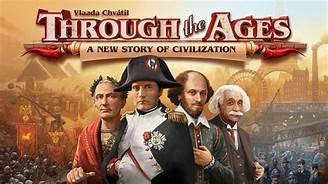
My favorite boardgame currently, possibly of all time (we’ll see) is undoubtedly Through the Ages.  It’s a beast of a game, not difficult to play but as I said you have to carve out a day of your life to play it (unless you want to play the Basic game, which would only take a couple hours, but why would you want to deprive yourself of such a wonderful experience?).  This game takes you on such an exciting, wonderful journey from Ancient times up to the Modern Age.  It’s a card game at heart, but it’s easy to forget that since the immersion in Civilization building is so rich.  You have to keep your people happy (an easy way to do that is through religion, which is a nice change from most Civ. games that treat religion as “mystical nonsense” only for underdeveloped simpletons), you have to feed your people, you have to develop science and art and culture … and it’s a total blast.  Like with all of these games, you have leaders that help you, Wonders to build, possibly a military to expand (but becoming an overly dominant military power brings you more problems than benefits), colonies to explore, treaties to make, calamities to avoid, all the while creating a deep, satisfying story of your empire, a story you will remember for a long time.  A 2nd edition is undergoing refinement while we speak, which is intriguing and also means the original is becoming more affordable by the minute.

“I Win!” Games (Racing and Area Control)

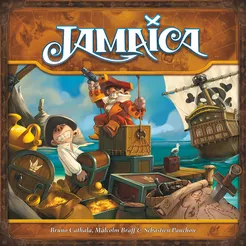
If you like the old race-around-the-board type games like Sorry! or Parcheesi and almost any other roll-and-move game from days gone by, perhaps a more enjoyable modern version you’d like even more is Jamaica.  A pirate-themed racing game, Jamaica gives you more choices than simple roll-and-move games, but your choices are limited somewhat so you have to think both short-term needs and long-term strategy (though “long term” is likely only about thirty minutes).  Once everyone knows what they are doing, it’s a fairly rapid game, which is thematically more enjoyable for a racing game.  It has a few layers of strategy even with your limited choices, but it is still accessible for kids, once they get the hang of it.

Camel Up is a recent award-winning game about racing camels. Stay with me, now.  You are trying to guess which camel will win the race and place your wagers accordingly (normally we at Redeeming Pandora would not enjoin our audience to gamble, but this is only a game, so have some vicarious fun).  As with all races, sometimes the camels will run the way you want them to, then suddenly a camel will sneak under it and jump into the lead and it’s suddenly anyone’s race.

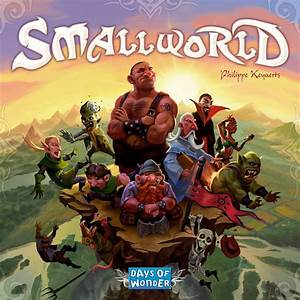
If you grew up on Risk and the first question that springs to your mind when someone mentions a board game is “So it’s like Risk?” (or “So it’s like Monopoly?”), the next three games may bring you back to those halcyon days of conquering the world, but now you might be able to have that sort of fun a tad bit faster.  And actually have fun this time.  Small World is a much-beloved goofy fantasy game basically all about area control (taking over spots on the board, which is effectively what Risk and Diplomacy were all about, when they weren’t busy destroying friendships and ruining families).  Your fantasy race starts somewhere on the board, tries to dominate as much territory as possible, then gets replaced by your next race of world conquerors — but watch your back, since that’s what everyone else is trying to do.

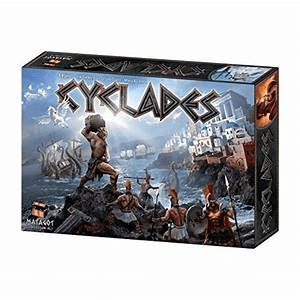
If you like ancient world games, Cyclades may be right up your alley. You have to appease different Greek gods to do different actions (Ares for war, Poseidon for movement, Athena for wisdom/schooling, Apollo for wealth, etc. — most of it makes a fair amount of thematic sense), but you are competing with the other players for the god’s favor.  Add the Titans expansion if you really want an Ancient-world Risk-like feel.

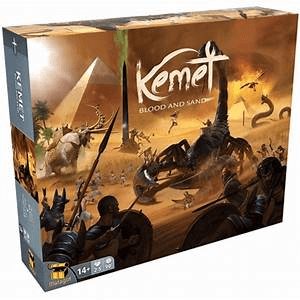
If Egypt is more to your liking than Greece, Kemet is probably the smash-em-up world-domination game for you.  This is initially a more straightforward Risk-in-Egypt game (but fast and fun), but it has enough other strategic layers to make it more than just a mindless crush-your-enemies game.  If you want to mix-and-match your Egyptian and Greek monsters for a mga-brawl, check out the C3K expansion that allows you to do just that.

Strategy Games

In one sense, most of these games are “strategic” (and hopefully by now you can see why games with strategy are more fun and more rewarding than purely deterministic games that dictate what you can do each turn and give you no real decisions or options), but I needed a generic category just to talk about some really fun games that don’t have much else in common other than being thought-provoking games of fun.

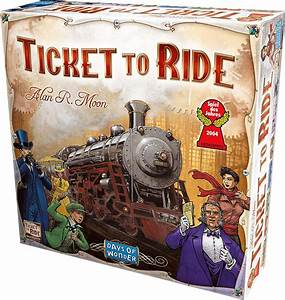
Ticket to Ride in its many incarnations are great “gateway” strategy games for you.  If you haven’t played any boardgames since Risk or Monopoly and you are a bit hesitant to try one of the deeper games, Ticket to Ride or Forbidden Desert or 7 Wonders or King of Tokyo would be excellent places to start.  Ticket to Ride is a simple set collection game in which you are collecting similar-colored train cards in order to turn them into railroad routes from one city to another.  Completed rail routes get you points.  It’s even simpler and more enjoyable than I’ve made it sound.  The basic Ticket to Ride features the USA, and the other incarnations feature the country in their title, so plenty of options, plenty of variety, plenty of replay value, and plenty of good times.

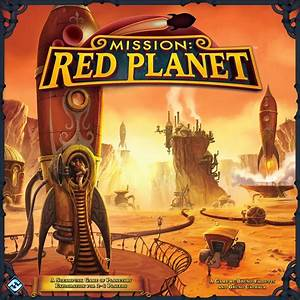
A sort of medium-weight strategy game, Mission: Red Planet combines a lot of different kinds of game mechanisms such as area control and hand management, so it’s a good introduction to other ways to play games beyond rolling a die and moving around a board.  You are racing the other players to Mars, but you need to do more than get there: sometimes you need to focus on stopping your opponents from sending their explorers.  It gives you lots of easily comprehensible options and is a fast, rich game.

Have you ever wanted to play Star Wars?  Here it is: Star Wars in a box … Imperial Assault.  One of you gets to play as the Alliance, one of you gets to play as the Empire.  True, one potential drawback to this is its modular nature, in that it doesn’t come with all your favorite characters and weapons and settings in the initial box.  You have to buy the Han Solo pack, the Chewbacca pack, the Boba Fett pack, et cetera, but you could always ask for them for Christmas as great stocking stuffers along with more packs of Dice Masters, so that takes care of that problem.  This is the highly accessible strategy game for Star Wars fans.

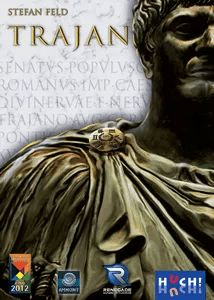
Deeper strategy is required for a very enjoyable game, Trajan.  You and your fellow players are competing consuls, vying for Emperor Trajan’s approval by improving various aspects of Rome: rebuilding the infrastructure, hobnobbing with senators, shipping goods to allies, leading armies in conquest of new territories, and more.  Using the centuries-old Mancala mechanism determines the actions you can take, but you also have the opportunity to create a string of bonus actions to get victory points all over the place.  It’s not really as complicated as I’ve made it out to be, but it is a deep, rich strategic game with many paths to victory and fun you’ll want to play it again and again.

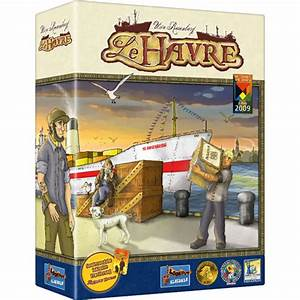
Le Havre is another deep strategic game about creating the most prosperous harbor by building ships, gathering goods, constructing special buildings, and, as always with designer Uwe Rosenberg’s games, feeding your people. A good deal of its depth consists in the fact you can only do one thing per turn.  You have one choice: acquire resources or use a special building.  And that’s what you do.  Sometimes you’ll have enough money to buy a building, too, but not often.  It’s an incredible brain-burning game that really helps you develop those strategic thinking skills you’ve wanted to develop.

Another unusual strategy game with an interesting theme is Rococo, in which players are competing dressmakers trying to get your gowns and suits on the most Parisian nobles attending Louis XV’s grand ball at the end of the game.  You have to manage your action cards very well to get the resources you need, make the dresses, put the dresses on the right people in the right places, and string together bonus points and bonus actions as much as you can.  It’s another enjoyable brain-burner (in a good way).

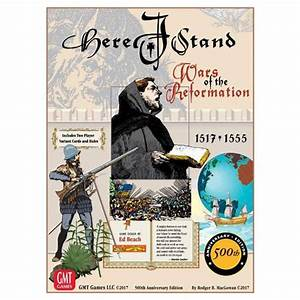
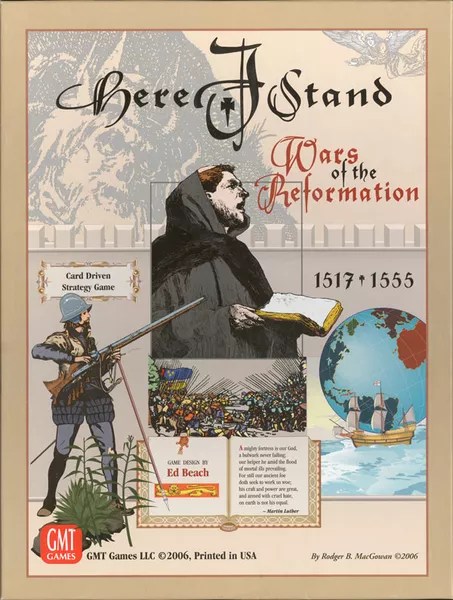
When you and your family is ready for something big, and you feel like getting into real historical simulations (I promised myself I wouldn’t put any wargames on this list), go all out with Here I Stand.  One player is Luther trying to get the Reformation going; another is Pope Leo trying to squelch the Reformation.  Another player is Henry VIII taking care of England (and trying to get a male heir); another is France, a fifth is Suleiman and the Ottomans, and a sixth player controls Charles V and the Habsburgs.  It’s a card-driven game, in that you have a hand of cards that could either be events for the board or points for actions, depending on which nationality you are.  It’s a big game, but it provides a great deal of historical immersion and tremendously fun gameplay.  Once you’ve mastered this (!), check out the sequel, The Virgin Queen, about, you guessed her, Elizabeth I.

Worker Placement Games

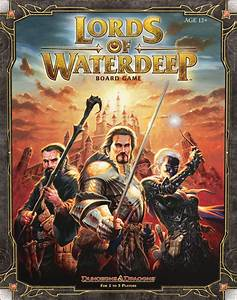
Another innovative game design of late is “worker placement” games.  Instead of moving lineally around a board, worker placement games have players place a certain number of workers (or rolled dice or what have you) on select portions of the game board that activate different game effects, such as gathering resources, advancing along information tracks, transporting goods from one place to another, or other game elements depending on what kind of game it is.  One very enjoyable “gateway” worker placement game is Lords of Waterdeep.  Don’t be fooled by the Dungeons & Dragons veneer, especially if you don’t like D&D: you are not really fighting monsters or casting spells.  Instead, you are competing councilmembers or lords of the town hiring different heroes to go on quests that make your city a better place.  You place your workers to hire different kinds of heroes, get money to hire them, get different quests that give you points (which translate into how well you have improved the town for the people), raise influence in the town, build new buildings that give you more options and faster/better resources, and much more.  Even people who don’t like D&D/fantasy will have a very good time playing this.  Once you’ve mastered it, get the expansion Scoundrels of Skullport to add more quests, more resources, more options, and more fun.

Another brain-burning strategic worker placement game from Uwe Rosenberg is Caverna, a fun, challenging game about Dwarf cave farmers conquering the wilderness and making their home a better place for their burgeoning family.  You have to feed your family as always, but you have many options of how to pursue victory: you can cut down the forest and make spaces for sheep pens, pig pens, and horse pastures, or, perhaps, farmland to feed your family.  Additionally, you can mine your cave for rubies or transform your cave into beautiful, useful rooms — many different kinds of rooms give different bonuses, different abilities, different reasons to play again and again. It’s a big, heavy box, but it comes with a whole lot of game that plays well for 2-7 players.

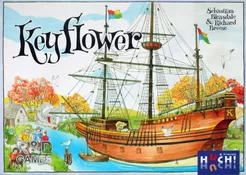
Finally, another diverse kind of worker placement game is the unique Keyflower.  This clever game simulates a small city building game and a worker placement idea with a twist: if you send your workers to another person’s spot, you’ll get those resources but effectively your worker is moving to their town and you just lost a worker.  You’ll get others later, but it’s an interesting variation.  On top of that, you also have to use your potential workforce as auction currency, deciding if you want new tiles to add to your city (which you’ll need to do to gain points to win) or immediate resource benefits or long-term worker options.  It’s a very clever game that doesn’t take a whole lot of time and does things differently but intuitively to combine for a unique, enjoyable thought-provoking package.

Whew.  Was that too much?  Go big and go home, that’s my motto.  I’m not telling you you have to go out and buy all these games (I don’t own nearly all of them myself) — remember, the point of this was to tell you there is another kind of revolution going on in our lifetime: a boardgaming revolution.  We are in what may be but the nascence of the 2nd Golden Age of Boardgaming.  And, believe me, this was not the tip of the iceberg.  This was the tip of the tip of the iceberg.  This barely scratches the surface of the hundreds and hundreds and hundreds of great games made in the last couple of decades.  If you like rolling dice, we’ve got fun dice games for you.  If you like card games, card games have been taken to a whole new level of fun.  Family games are no longer just silly, thoughtless roll-and-move games with no brains or strategy.  Games based on beloved books, television shows, or movies are no longer just the cheap, bland, superficial tenuous tie-in games of yesteryear.  This is an exciting time to be alive, especially if you enjoy having fun.

If you are reading this before Christmas, clearly any of these games would be an ideal present for one or more members of your family or friend-family.  If you are reading this after Christmas, here are some ideas for those gift cards you got in your stocking, or ideas to start the New Year off right: quality experiences with people you love.

Do you want to salvage Family Time?  Do you want something intelligent, social, interactive, inexpensive, sustaining, and worthwhile you can do together as a family or as friends (other than high-quality Bible studies)?  Of course you do.  Now that you and I have extirpated cynicism from our lives, it’s time to fill that hole with open-hearted generosity and heart-warming memories (and love, joy, peace, patience, kindness, goodness, faithfulness, gentleness, and self-control, of course).

Get one of these boardgames and salvage Christmastime and Family Time.

Unplug.

Declutter.

Relax.

Play.

Enjoy.

Laugh.

Love.

Live.

Merry Christmas!  See you in 2016!

2022 Editor’s Note

A few of these games are out of print and very hard to get, sadly. Many of them are on new editions – for those of you playing along at home, I updated many of the pictures from the original article in 2015 with the new versions, new covers, and new editions (especially Twilight Imperium IV, which was only 3rd edition back in the day). I also have played more of these games since then, such as TIME Stories, in case you are wondering. Sure, a lot of good games have come out since then, and many games that are even better than some of these, but these are still enjoyable (if you can track them down).

Indie Game Development

Jared Emry

Independent video games, or indie games, have started to receive more attention since about 2005.  Indie Gaming and Development has become a popular hobby for many people.  Some popular indie games include Uplink, Minecraft, and Amnesia.  Indie games are created by individuals or small teams and are therefore different from the typical game created by the larger companies.  Instead of hundreds or thousands of people working on a single project, there could only be a handful of people working on a game.  These individuals may work alone or gather a small team to build a game.  This is a guide to developing such a game.  There are three parts to a good game that must be observed: concept, aesthetic, and gameplay.  Indie games are partially unique by the fact anyone can create one, which creates a demand for guides such as this.  The concepts of this guide could very well guide the creation of any game and therefore the indies as well.

Indie games are often conceptually unique in the industry.  Uplink, for example, mimics a new operating system on your computer as you play the part of a freelance hacker.  PC Format called it, “A true original, paranoia has never been so much fun….”  In the game you have to upgrade your computer, get new software, and try to become an elite hacker.  The player roams the Internet (a fake in-game Internet) and hacks corporate and government systems in an effort to fulfill anonymous contracts for money.  The player can choose which side to be on as the story begins; will he help ARC create the virus known as Revelation, or will he help Arunmor make the counter-virus, Faith.  The player can even work for both corporations at the same time.  The game is done in the style of hacking seen in Hollywood and is truly unique.  Indie games must be conceptually unique.  This does not mean the game needs to be experimental, like Slave of God; the game merely needs to be original.  For example, Slave of God is an experimental game that relies on psychedelic textures and flashing lights to provide a unique gameplay and maybe a seizure.  Experimental games are usually radical departures from orthodox gaming.  Another example of an experimental game would be a game known as Roulette.  Roulette is a video game that consists of video segments of actors acting out a game of Russian Roulette.  The player takes part in the game of Russian Roulette against an actual video.  This game relies on the dark suspense of Russian Roulette, but without anyone being harmed in the process.  Vesper.5 is another experimental indie game that has become popular.  It tries to portray the concept of ritual.  The game is designed in such a way the player can only take one step a day through the game’s world.  The game takes a minimum of 100 days to complete, so it requires the game to be treated ritualistically to be completed.  What David Reimer once said is still true, “Reinventing the wheel is a trap.”  Trying to make the next Polybius may be a high and mighty goal, but changing the basis of something is no easy task.  Certainly experimental games can be successful and earn a cult following, however the wheel does not have to be reinvented for a good indie game to be created.  Being innovative is good, but don’t strain yourself trying to make something entirely new.  The concept is the broad view of the game: it contains the game’s world, mythologies, and the characters that inhabit it.  Don’t let the effort of forever trying to come up with something new under the sun stop you from creating a concept at all.  Work with what you know and then expand.  The indie game must be conceptually unique or original.  Start with the orthodox form of a typical game in the genre you want to work with.  If you are making a first-person shooter, then you might want to play Doom, Wolfenstien3D, or Quake; those games are the basis of the modern first-person shooter.  Use the form (but not necessarily using the same engine) used for those games.  The form is really just the basic flow of the game’s plot and how its story is typically told.  From this basis the story is woven.  The concept contains additions to the form and its originality.  The concept can range to just about anything.  Once you have started working with more orthodox concepts, the unorthodox will probably be easier.  The concept is just an idea that can be manifested into the game.  The better a developer is, the better concept he can use to symbolically portray the concept in the video game.

The second part is the aesthetic component of the game.  Some indie games like Amnesia have AAA-quality graphics, however this is not necessary.  The graphics need to match the game.  Amnesia’s AAA graphics were suited to the game, which is part of what made it so good.  Amnesia used light effects and foggy aesthetic touches to maximize the game’s suspense and horror.  The music it used fit the old castle with its creepy undertones and sound effects.  Amnesia could not have been done in 8-bit or 16-bit; it had to be done with a certain level of graphical (and audio quality) sophistication or else it would have lost the elements that made it so good.  Uplink’s menu-based system similarly relied mostly on just pictures that popped up when a button was clicked.  These graphics were equally stunning and fitting to the game, and the music made you feel like a hacker.  Uplink also relied on these aesthetic qualities for the game, but they were not the same graphics that Amnesia used.  Uplink’s concept would simply have not worked in an Amnesia aesthetic.  Similarly, all game concepts must be linked to an appropriate aesthetic.  If you want to make a sci-fi, you need sci-fi-looking stuff and sci-fi-sounding stuff because belief cannot be totally dismissed from the game.  The aesthetics must capture the belief of the player.  Capturing belief does not rely on the realism of the graphics but on consistencies.  An 8-bit sci-fi game would be unbelievable if the graphic for a sword was used instead of a ray gun; the same holds true for all types of graphics.  A sword simply is not a ray gun.  The belief can be captured by trading out the sword for a graphic of a gun.  It needs to be understood the graphics are a symbolic representation of the world of the game.  The game does not need to be as realistic as possible because the graphics are merely symbolic.  The game is not in the graphics; it is in the concept.  The aesthetics are the symbols used to portray the concept.  The game must use the aesthetics that best portray the concept.  The graphics should not be understood as simply one texture (or group of pixels) moving across another because a computer script simply moves it, but as a representation of a life with its own background and mythology.  The story told is real.  The aesthetic links the concept to the player.  The indie game, Space Funeral, uses a 16-bit graphic and a similarly situated soundtrack to create a disturbing yet comic aesthetic.  If Space Funeral had been in Amnesia’s or Uplink’s aesthetics, the game would be terrible.  Even though the story would be told, the concept would be lost.  The aesthetic qualities of the game must match the concept.  The aesthetics must always be polished and excellently done, but the quality (referring to resolution and type, not to the excellence of the graphics themselves) must match the game.  This area is also where the difference between indie games and typical games is most pronounced.  The major game publishers only cater to newer graphics.  8-bit, 16-bit, and other outdated graphics are not to be found on the popular new consoles (except in packaged classic games).  This methodology wrongly closes the door to different kinds of game play, however indie games provide a solution by providing new games with older graphics styles.

The third part is gameplay.  Gameplay needs to be good, or the game will be too frustrating, too repetitive, or too easy for anyone to care about.  If you want the concept of the game to be remembered by the players, then you need to make the gameplay suitable and memorable.  There are three kinds of players: players with skill, players with money, and players with time.  Each section of players can obviously overlap.  A good gameplay needs to target at least one of those groups, and a better gameplay maximizes the target range.  If the gameplay fails to reach any of those groups, then the game might still be able to get a cult following (which is pretty cool).  The gameplay must stay true to the concept and is always subservient to the concept in a good game.

There are two ways gameplay must be good.  First, the controls must be working at a very high standard.  If a player cannot control the avatar (the player’s representation in the game’s world), then the player cannot interact with the world properly and therefore cannot be immersed into the world; a disconnect is created.  A game is always a mental contest, either against another player or against a computer.  If the game does not provide a method for the mind of the player to effectively control the avatar, then the game does not provide a fair ground for the mental contest.  The player must compensate for the computer’s shortcomings in order to play against the computer.  It is possible to successfully compensate, but it detracts from the gameplay.  This kind of mistake in gameplay will rarely produce a cult following.  Another mistake in this first way gameplay must be good is grammar and spelling.  Spelling and grammar errors separate the player from the game because language is the gateway to reality (a topic for another time).  A game with bad grammar and spelling is at the very least unprofessional and shows bad quality or lack of interest between the developer and his game.  Luckily, this grammar rule is sometimes waved by the players for translations, especially hacked translations.  Glitches and bugs can often lead to a bad gameplay.  If the glitches or bugs are harmful to the players’ interactions in the world, these glitches and bugs negatively affect the gameplay.  However, there is an occasional glitch or bug that can actually help the game by providing something interesting for the players to examine and play with.  These glitches and bugs tend to be rare and cannot be purposefully programmed into the game.  Along with the glitches and bugs are the Easter Eggs  Easter Eggs are small details programmed into the game that reference something else iconic to pop-culture or to specific cult favorites; they are typically meant to be hard to find and are kind of like purposeful bugs in my opinion.  A few well-placed Easter Eggs are always nice.

The second half of the gameplay equation is more abstract and far more relative.  It is best described in examples because a set definition would be nearly impossible.  The best gameplay always temporarily absorbs the player into the game and immerses him in the events of the virtual world.  The way it is done is extremely hard to define.  The gameplay must here balance the flow of the game.  The pace of the game must be suited to the concept.  The leveling, upgrading, available currency, costs, monster difficulties, skills, and everything else in the game must be balanced.  This gives the game consistency, which allows the player to stay immersed by not providing anything too easy as to bore the player or too difficult for the player to complete.  Challenge must be in the game, but the game cannot be extremely frustrating or impossible as to keep the players away.  Goldilocks likes everything to be just right.  The game must entice the player with the wonder of what might lie behind the next corner or the next hill and urge the player onward through the game.  Without challenge, the secret behind the next corner is diminished of its potential wonder and sentimental worth.  The harder the challenge and the greater the risks, the greater the payoff is to the player.  The reward should always be suitable to the task.  What the gameplay looks like is extremely varied, from Unmanned (a game meant to follow the average day of the average person in the U.S. Army, from waking to sleeping) to Diablo (where the player runs around hacking and slashing stuff with a weapon).  Gameplay is also damaged by repetition. Final Fantasy would be stupid if the only enemies ever fought were slimes.  New elements throughout the game help make a game continue to be interesting and immersive.  The Elder Scrolls IV: Oblivion is a good example of great gameplay.  Oblivion is not an indie game, but the gameplay rules still apply.  The player controls the avatar through a vast world, making decisions and fighting monsters.  The gameplay is good in Oblivion because the controls are suitable, easy to learn, and effective.  The game is immersive and allows its aesthetics to be enjoyed through the gameplay.  As the player progresses through the game and levels up, the monsters also level up.  The strengthening of the monsters alongside the player makes sure battles don’t become boringly easy.  The battles are maintained at a challenge and risk is continually present.  On top of that, the game also adds more monsters as the player progresses allowing for new and more interesting battles.

The Legend of Zelda: Skyward Sword, another non-indie game, is a great example of a game with a skewed gameplay.  In Skyward Sword, the controls of the Nintendo Wii stopped the avatar from being fully controllable, which is bad because the avatar is supposed to be the player incarnate in the virtual world.  The avatar should be responsive just like someone’s real body.  On top of that unfortunate mistake, the game also featured a character that acted as a guide.  Unfortunately, the character appeared constantly and bluntly told the player what to do next. This forced break for help not only makes the pace of the game choppy, it destroys most of the challenge of having to figure the game out by itself.  As Sid Meier says, “A game is a series of interesting choices.”  If the player is told what to do, the challenge and joy of interacting with the world and learning its unique physics and laws become null.  The sense of adventure, exploration, and discovery are instantly killed.  The game kills the reason for playing the game.  The game also fails on adding more interesting developments throughout the game.  The tools are often tedious to use and can’t be easily used to influence the battles, which leaves the battles almost unchanging and dull.  The player’s avatar does not go through any significant changes to stimulate new and exciting gameplay.  Many of the items and their upgrades are cheap compared to the available currency, causing the game’s economy to be boring and allowing the character to upgrade fully early in the game, which leaves the player with less interest later in the game.  Even the unlockables sidequest common in Zelda games lacked good gameplay: Ocarina of Time had the golden skulltullas to collect, Twilight Princess had the Poe’s spirits, and Link’s Awakening had the secret seashells.  In those three games, the player had to struggle throughout the entirety of the game and look in unconventional places through the entire world for the unlockables sidequest.  This style of the sidequest promoted good gameplay by encouraging the players to think out of the box and look for them in unconventional spots.  The player would have to search for the entire length of the game, adding an extra layer of gameplay goodness for the entirety of the game.  It is also extremely difficult to achieve finishing those three sidequests because of the vast number and diversity of the items.  In addition, as the player found more of the items, a better reward would be unlocked.  Each reward was extremely valuable and very helpful to the player, promoting the player to want to try to get more of the items and thus promoting good gameplay.  Skyward Sword on the other hand fails in its unlockables quest.  The items are not scattered throughout the world but localized in a small portion of the map.  The only thing preventing the player from getting them all at once is the game only lets them appear once parts of the story are completed.  The collection of the items becomes more of a chore because the player must return to the area and look around for more.  Another way the unlockables quest became a chore is the player is forced to do chores to receive the item.  Yes, the hero must clean up a house, move pumpkins, and cheer some people up.  Instead of exploring the world, the player is forced through painful and often boring little tasks irrelevant to the game as a whole.  A few of the items are collected in the exploration way, but these few are insignificant in comparison.  The unlockables are also just as unimpressive and worthless, especially the final one.  Most of the rewards are simply more money, which is unnecessary because the world is already overflowing with it.  The final unlockable was a greatly increased wallet size, but by that time in the game the player has already bought everything he needs and the wallet can do nothing more than hold all of that extra money that is unneeded.  In Ocarina of Time, the few players who strive to get all the skulltullas are rewarded with an infinite source of money, something the player can at least put to use in the many minigames.  The difference in the excellence of the gameplay is often determined by things people might consider to be small details.  It is the details that determine the gameplay.  The gameplay ensures the aesthetics can be properly observed, experienced, and known.

The gameplay allows for the aesthetic to be properly known and the aesthetic allows for the concept to be known.  The video game is a link to the conscious.  It is a medium of ideas, just like reading a book.  It links the minds of the players to the developers, just like reading a book links the mind of the reader to the mind of the writer.  Indie games are different from the typical game made by one of the larger companies, though.  Indie games are made by one person or a handful of people.  Non-indie, typical, games can be made by up to a few thousand people.  Whereas the player of the typical game can only know the general worldview of the mass of developers, the indie gamer has a much more personal encounter.  The indie gamer is more likely to be able to see the art of the game because there is a more direct link between the artist and the gamer.  The video games aren’t worthless, as postulated by many parents who believe their child is wasting his life over video games.  Because the games are symbols of ideas, the games are real.  A game developer is just as much an artist as a painter or musician is.  He often has to work with other artists including painters (game art) and musicians (soundtrack), just as a playwright has to work with his crew.  The indie game developer will often have to both do the game art and soundtrack by himself or enlist help from others, but nevertheless he retains control over his game and shapes it in the form he desires.  The indie game developer is an artist.

A Return to Wargaming

Christopher Rush

When I was young, every time I walked through the mud room on the way out the backdoor to do some outdoor activity (basketball, tennis, or some epic war involving all the “guys” — what are apparently today called “action figures”), I noticed stacks on stacks of thin, black boxes piled on top of the filing cabinets.  I never knew what was in them growing up, but I did notice the one standing upright in the corner in front of the window had some strange German words on it: “Wacht am Rhein.”  I had a vague notion they were games in there, somehow, but they didn’t look like any games we were used to playing, certainly not from the side.  We did play a few of those games once in a while, particularly War of the Ring, and I did play some sports games, but most of them never got to the table.

Don’t get the misunderstanding we did not play board games when I was young.  It wasn’t all video games, you know.  We had regular game nights throughout my youth.  We regularly played Careers, Trivial Pursuit, Hail to the Chief, Scrabble, Pit, Clue, Pick-It, card games, and a whole lot of other games.  I even got them to play Dungeons & Dragons … once.  There was a Risk session … once.  That caused more frustration than happiness, perhaps because of our impatient youthfulness (and the imminence of MacGyver).  Perhaps that was a main factor none of those thin black games from the mud room ever made it to the table.

As you probably haven’t guessed by now, those stacks upon stacks of thin, black plastic games were my dad’s extensive SPI wargames collection (though our friends over at Simulations Publications, Inc. would prefer we call them “conflict simulations”).  This is probably the point of this reflection when I should say “if only I’d known then what I know now …” or words to that effect about regret, perhaps in a wistful voice.  But I’m not going to do that.  I have enough things I have done to regret without adding things I haven’t done to the list.  Besides, I don’t know if I would have been all that ready for them.  It wasn’t like I was totally ignorant of military history: I had seen 1776 and Gettysburg several times … but that was about it, so no real chance of recreating anything remotely historical existed.  (I’m still rather skeptical I’m all that ready for them now, as far as having a good grasp of the historical situations upon which the games/simulations are based.)  Additionally, looking back upon that time, sure there are some things here and there I would change if I were Sam Beckett, as most of us probably have, but it’s not like there is a big gaping hole of “missing family time” it would replace.  As I said, we had regular family game nights my entire life, so in that sense it would have been more of a lateral movement.

I grew up listening to and watching Jack Benny, Fibber McGee & Molly, Abbott and Costello, the Marx Brothers, Danny Kaye, Martin and Lewis, M*A*S*H, Star Trek, MST3K, Red Dwarf, and countless others (see our forthcoming final issue), playing board games with my family, basketball, baseball, soccer, tennis, golf, flag football (usually only for one season, true, but it still happened), youth symphony, Awana, and a lot more things that would shame any of today’s “I’m too busy” youth.  They have no idea what it’s truly like to be busy.  And I still had time for comic books and video games, somehow.  When CCGs came out, my brother and I got in on that, emphasizing the first “c” more than the “g,” but we did manage to play sometimes.  So I don’t have a lot of things to regret from back then in this way; I’d have difficulty choosing what to replace with wargames.  True, more time with Dad would have been nice, but he was never too busy when I wanted him to go out and play catch or take me to Comic World.  As I said, I probably wasn’t ready for wargames too much, so I don’t know if that would have helped.

The good news, really, is we are in a second golden age of boardgaming, and wargames are benefitting from that as well.  Many of the first generation of giants upon whose shoulders the rest of us stand are gone (H.G. Wells, obviously, Charles S. Roberts, Redmond A. Simonsen) or out of the biz (Jim Dunnigan), but many of that early generation are still churning out games (Mark Herman, Richard H. Berg, Don Greenwood, etc.) and not only are they still making quality manual war boardgames, they are continuing to expand and improve their game depth, designs, and mechanics (beyond the traditional hex-and-counter, we are seeing the surgence of card-driven games, point-to-point movement, impulse movement, “fog of war,” and more variations).  Instead of only Avalon Hill and SPI vying for the market, we have GMT Games, MMP, Victory Point Games, Worthington Games, Columbia Games, Clash of Arms Games, and more.  Also, just as we saw a few issues ago with comic books, modern shifts in marketplaces (such as eBay) are allowing a great deal of used products to get from unwanted homes to new homes, so the older games and companies (Victory Games, 3W, The Gamers, Game Research/Design, etc.) long out of print can reach new generations of fans.  Yard sales, too, provide hope and possibilities for rescuing old treasures.

Interest in military history is as high as ever, if not even increasing, as recent trends in actual military combat have triggered (if you’ll allow the expression) interest in COIN (counterinsurgency) and guerilla tactics and conflicts.  The Vietnam War (and its combatants) is finally becoming socially acceptable discussion material (thanks, in no small part, to Tim O’Brien).  Moviemakers and television studios will never tire of recreating historical conflicts, and the demands for accuracy are perhaps higher than ever (which, admittedly, tends to lend itself to graphic content more often than not).  This has also led to waves of revisionism as well, no doubt, but if Jared’s articles are even remotely true (and I suspect he is far more accurate than most want him to be), it would be better for all of us to appraise history more circumspectly, especially if we are driven by a desire to know the truth and not just postmodernly critique/lambaste former heroes for the sake of critique: truth can surely stand the scrutiny.

And few things are undergoing more scrutiny by intelligent people (actually intelligent people, not just self-serving degree holders) than military history.  Strategy & Tactics is still going strong.  Despite the doomsayers who prognosticate the end of the printed word, the wargaming tribe is recalcitrantly ignoring such trends, as several printed war history magazines (with or without accompanying games) are being published each year (World at War, Modern War, Against the Odds, etc.).  Concurrently, the wargaming tribe is also embracing modern technology — it’s not wholly constituted by sexagenarians who refuse to role anything not cube-shaped.  Check out BoardGameGeek.com.  That, along with ConSimWorld.com, is a major gathering point for wargamers to discuss (we can call it that), share videos, critique, assist, and further the hobby.  Most “grognards” (old-time “hardcore” wargamers, taken from the complaining Old Guard of Napoleon’s army) are generous enough to offer advice or strategy — or at least keep the hobby alive.  Additionally, Mark Herman, one of the near-original gang at SPI back in the day, recently published a Battle of the Bulge game for the iPad.  The company that put it out, Shenandoah Studios, was co-founded by another of the early SPI gang, Eric Lee Smith.  We should not be surprised wargamers are also on or around the cutting edge of technology.  Wells, Roberts, and Dunnigan were innovators, not followers.  I recently heard it said of Jim Dunnigan he has always been so far ahead of the curve it’s flat where he is (or words to that effect).  That was from, I believe, Ed Wimble, designer of several Napoleonic games.  I heard it on a podcast, one of the more respected podcast series about wargames, Guns, Dice, & Butter (if it wasn’t Ed Wimble, I apologize, but it was someone on an early podcast of GDB).  I’m not big into podcasts, but the wargaming tribe moves with the times — or, perhaps as more likely, the times move with the wargaming tribe.

They are a knowledgeable bunch.  Most of them are into wargames because they know about history, intimately, and are interested in working it out for themselves, checking out possible scenarios, historical what-ifs, and the like.  They are not into wargames because they want to pretend to be Adolf Hitler and wipe out non-Aryan Europe.  That sort of piffle can be left where it originated.  Just listen to a few early podcasts of Guns, Dice, & Butter.  Listen to Mark Herman or Ed Wimble or Nick Karp talk about history.  You’ll think you never heard anything about history before.  I’ve started to understand why my history-major librarian father has been into wargames for so long: they combine knowing things with fun.  That’s what the kids call a “no-lose situation.”

My dad no longer has his mighty collection.  He gave me the War of the Ring game and sold most of the rest of the collection years ago to help pay for my brother’s college education.  Again, let’s not lament anything — life’s too short.  The good news is somehow we have both returned to wargaming.  Not surprisingly, it was instigated by my dad a few years ago.  I can’t quite remember the order of events, but somewhere along the line on some visit back home we played, fittingly enough, Tactics II, the revised version of Tactics, the first board wargame.  It has a square grid, but all the basic components of wargaming are right there.  Shortly after that he ordered me a few other classic Avalon Hill games: Waterloo, D-Day, Battle of the Bulge, Gettysburg, and Midway.  We have even played Waterloo together.  Then, he gave me his remaining copies of Blue & Gray I and II, two classic SPI-quadrigames, four smaller games in one package all from one war or general idea (like four modern battles, four battles of the middle ages, things like that).  He recently got another copy of B&G I, and we have been playing them by e-mail for the last few months (part of the benefit of these earlier, simpler games is they are driven by what some disparagingly call “IGO-UGO” systems, but they lend themselves brilliantly to long-distance play).  Since we trust each other, we can be honest with what combat results happened, and then we can retreat each other’s pieces when necessary to the other person’s best advantage, just as if it was happening in person.  Now that he has gotten back into playing, and I have enjoyed getting into it as well, our collections are both increasing once again.  They will never match what once was, but in a way they will be even better, since now these collections will have been played.  So there is no need to lament what “might have been” – it’s happening now, probably better than it would have been.  I’m also getting my daughter started on wargaming as well.  True, we don’t play according to the written rules, but she is getting really good at punching out counters and shuffling cards.  It’s never too late or too soon to start wargaming.

As with most things I do at Summit, I founded the Strategic Gaming Club a few years ago primarily so I could play my games and have a good time.  Once in a while I do things for the benefit of the students, but usually it’s primarily for me.  The good part about that is, as a generous giver, I share and let whoever is willing to join me on these journeys come along for the ride.  Though we haven’t quite played as many of the classic wargames as I would have liked, I certainly have had a good time playing Diplomacy, Civilization (in the Michael Wood elective — I mean “Intro. to Archaeology”), and Settlers of Catan (I am not calling Settlers a wargame, so please don’t tell the BGG people I did) with the kids over the years.  I’m hoping, though, that next year’s Intro. to Historical Gaming (aka “Intro. to Wargaming”) elective will allow me the opportunity to play a lot more of these games, especially some of the new ones I have gotten recently (thanks, mainly, to my dad, who helped increase my gaming collection tremendously in 2012: Here I Stand, For the People, Fall of Rome, Hannibal: Rome vs. Carthage, Through the Ages, among others.  These are the games Julia and I have been “playing” together.  She’s also good at making up rules.).  EBay has also been helpful to me in the last few months, as I have been able to get many old and classic OOP games (not to forget my gracious wife’s willingness to let me get them as well).  I’m definitely planning on playing them (even more than I’m definitely planning on reading all the books in my house).  Having a class will make that plan come to fruition even sooner, I hope.  Of course, I’ll also need to be familiar with them before class starts so I can teach them and provide enjoyable learning/gaming experiences to the students as well.

I suppose this means I’ll need to spend much of the summer playing wargames and studying military history.  Shucks.

Pandora Redeemed

Christopher Rush

It’s Not About Vengeance…

Despite the sudden proliferation of “Pandora”-titled things this past year, none of them were the inspiration for the name of this scholarly journal.  Similarly, before the theme of the 2010-2011 was announced to us as being about “redemption,” the title for this scholarly journal was already “in the works,” as the kids say.  So though it may have appeared to be a combination of recent things, the name has its origin in older, far different sources.

The “Pandora” is, as you can probably suspect, the Pandora of classic Western mythology, especially out of Hesiod’s works (though you may have heard of her from other summary/anthology sources).  Since she opened the jar (it wasn’t a box, really) out of curiosity and not malice, as an individual she doesn’t need “redemption” in that sense, as if she had willfully done something wrong and needed internal restitution, even though some accounts of her tale make her out to be somewhat tawdry.  The history of Pandora, her story, and its variations is complicated — fortunately, though, the most genuine origin of the inspiration of the title does not really come from those literary sources (not directly).  The real source of both parts of the scholarly journal’s title is the video game series God of War (the main trilogy, not the miscellaneous sub-stories).  The God of War series is M-rated, for good reasons.  We are not urging you to go out and play them, especially if you are under seventeen, and even then not without parental (and conscience) consent.  There’s a lot of violence/gore, some unclothedness, and some intense scenes of ruthlessness — it’s definitely not for the faint of heart or young of spirit.  The point, then, here, is to look at the story and explain why it’s so good (despite the saucy parts), good enough to supply the title of this journal.

Ares Unleashed

The first God of War game is mostly a flashback frame story: it begins about five minutes before the game is over, with Kratos (the…hero) giving into despair, believing “the gods on Olympus have abandoned me.”  Throughout the game, various incidents and encounters trigger further flashbacks into Kratos’s history: once the proudest, strongest Spartan warrior, Kratos’s life was about to end at the hands (and hammer) of the Barbarian King.  Before the Barbarian King can finish him off, Kratos appeals to Ares: if Ares will help him destroy his enemies, Kratos will become Ares’s servant.  Ares responds by bestowing (after a fashion) the Blades of Chaos on Kratos, the weapons that allow for such rapid gameplay (much better than the button-mashing of street-fighting games).  Kratos serves Ares for years waging a war on all of Greece until the fateful night Kratos attacks a village of Athena worshippers.  Defying the village oracle, Kratos storms a hut and accidentally kills his own wife and daughter, whom he thought were far away.  He knows Ares is behind it: Ares intended to use the removal of this final connection to humanity to make Kratos into a heartless, machine-like warrior; instead, Kratos renounces his affiliation to Ares.  The oracle curses Kratos as the hut burns to the ground; the ashes of his family are bound to his body, turning him into the “Ghost of Sparta.”  For ten years, Kratos serves the other gods in hopes they will remove his nightmares and guilt.  They do not.  Poseidon asks Kratos to kill the Hydra and save his seas; this is when the player gets control over Kratos and the game begins.  After working through the first level and killing the Hydra (the first of only 3 bosses in the game), Kratos’s patience with the gods is at an end.  Athena asks him to do one last favor and the gods of Olympus will finally forgive him: kill Ares, who is now out of control and destroying Athens itself.  Kratos agrees, believing he will be able to avenge his family and finally be rid of his nightmares.

Kratos fights into, around, through, under, and above Athens for a good third of the game, sometimes aided by the gods and their magic/weapons (including an easy victory over Medusa).  After a mysterious encounter with a gravedigger, Kratos meets Athens’s oracle, who tells Kratos the key to destroying rampaging Ares is finding Pandora’s Box, which is strapped to the back of mighty Cronos in the Desert of Lost Souls.  Kratos wends through the desert, killing some Sirens along the way, and summons Cronos.  After three days of climbing up him, Kratos comes to Pandora’s Temple.  This is the majority of the game (at least it feels like it).  Kratos fights through the many levels and tests of the Temple, solving puzzles and slaying monsters all the while.  Once Kratos secures Pandora’s Box (a very large, intimidating box of fire), the player wonders how he is supposed to carry this all the way down Cronos and through the desert back to Athens.  Ares solves that problem by killing Kratos, sending him down to Hades, and capturing Pandora’s Box for himself.  Kratos struggles through Hades and is rescued by the mysterious gravedigger just in time to find he is too late to save the Athenian oracle.  With a little bit more Olympian help, Kratos confronts Ares for the last time.  Through physical and psychological battles, Kratos eventually conquers Ares…only to find the gods of Olympus forgive his blasphemy but will not take away his memories of his family, bringing us back to the beginning of the game.  Athena prevents Kratos from ending his life and gives him new blades as the replacement god of war.  Kratos takes his place on Olympus.

Fate Unravelled

Kratos has not done much better than Ares as the new god of war, and the gods of Olympus regret their decision.  Kratos has been leading his Spartans against Greece again; during an assault on Rhodes and its Colossus, Zeus tricks Kratos into sacrificing his divine powers, eventually killing him with the same sword that he used to end the War of the Titans so long ago.  In Hades a second time, Kratos meets Gaia and becomes a part of her plan to lead the Titans in revenge against Zeus.  In order to do so, he must turn back time and conquer the Sisters of Fate: Lakhesis, Atropos, and Clotho.  With Pegasus’s assistance, Kratos begins his next adventure.  With the aid of Titans (sometimes at their expense), Kratos finds the Island of Creation, wrangles the Steeds of Time, and wages a one-man campaign against the myths of Greece: Prometheus, Icarus, Theseus, Perseus, Euryale (Medusa’s sister, but you knew that already, right?), and even the Barbarian King again all get in Kratos’s way…oops. 

Kratos defeats Cerberus (after he finishes munching Jason) and filches the Golden Fleece out of his throat.  After defeating Icarus (and taking his wings), Kratos encounters Atlas and learns more of Zeus’s story and why the Titans are against him.  With his help, Kratos resumes his quest for the Sisters of Fate.  At the Palace of the Fates, Kratos does some dastardly deeds, kills the Kraken, and resurrects the Phoenix, who takes him, finally, to the Temple of the Fates.  After the most annoying bell-ringing sequence you’ll ever experience in your life, Kratos works his way to the Sisters of Fate, dispatching them in appropriate fashion.  Once Kratos controls the Loom of Fate, he returns to the moment of Zeus’s betrayal, igniting the final boss battle of the game.  During his multi-part confrontation with Zeus, Kratos learns from Athena that he is Zeus’s son!  Zeus did not want his own son to usurp him like he did his father Cronos.  This only motivates Kratos more.  Returning to the Loom, Kratos travels back to the War of the Titans and brings them back with him to the present, setting the stage for the final chapter.

Pandora Unchained

The finale of Kratos’s story (or is it…?) came out for PS3, ratcheting up the graphics, details, gameplay, and, unfortunately, the sauciness.  Some might be disappointed in that most of the “new” weapons in this game are just minor variations on the familiar blades; additionally, the story is much more vertical, in contrast to the widespread horizontal levels in the first two games (this is due, primarily, to the nature of the game being mainly an assault on Mt. Olympus, so it couldn’t be helped too much).  The game is also shorter than the first two, which made the initial PS3 release price a bit of a challenge (though that shouldn’t be a problem by now).  These niggles aside, it’s an impressive game.  The creative studio is different from the first two, so the design and story changes are quite noticeable; we might never know fully what the original ending would have looked like had David Jaffe and the original team finished the story themselves; even so, the story and ending provided by the God of War III we have is a great gaming and emotionally-moving experience.

Picking up right where God of War II left off, Kratos and the Titans assault Mt. Olympus.  The first twenty minutes of the game is as incredible a gaming experience (especially the Poseidon battle) comparable to the opening twenty minutes of Saving Private Ryan as any you’ll play (rivaling many individual scenes even of Final Fantasy VI, but not the entire game).  During the early conflict, the Titans cast off Kratos as a means to an end.  Having been completely betrayed by virtually the entire pantheon of Greek mythology, Kratos resolves to bring it all to an end.  His final journal is started by a resurrected Athena — though she has changed quite a bit from the being Kratos once knew (the similarities to the end of Assassin’s Creed II are eerie).  Along the way, Kratos returns to Hades, is tested by the Judges of the Underworld (Minos, Rhadamanthus, and Aeacus), climbs the Chain of Balance, and quenches the Flame of Olympus.  He also encounters (read “kills”) Peirithous, Hephaestus, Hermes, Hercules, Hades, Helios, Hera, Poseidon, Daedalus, Perses, and Cronos himself.  It’s pretty intense.  During the mostly-vertical journey, Kratos learns that the key to final victory is, once again, Pandora’s Box.  In order to get to it this time, he needs the help of a rather unlikely source…Pandora herself.

After each victory over a god of Olympus, Kratos makes the world worse: Hades’s death means the chaotic release of the souls in torment, Helios’s death darkens the sun, Hermes’s death results in a plague, Hera’s death is an end to plant life — it seems the game is about destruction, vengeance, and chaos…but it’s not.

Once Kratos breaks the Chain of Balance and raises Daedalus’s Labyrinth up to the heights of Mt. Olympus so Pandora can quell the fires of Olympus and open her Box, he realizes that the only way Pandora can “open” the Box is by her own death.  With Zeus looking on and taunting them both, Kratos decides at the end to prevent Pandora from killing herself — he won’t let another innocent girl die because of him.  Pandora, though, will not listen to him.  In a chaotic scene, Pandora sacrifices herself for the good of others and the Box is opened again.  This time, instead of giving Kratos the power to destroy a god, the Box is empty.  Enraged, he assaults Zeus again.  Gaia intervenes, resulting in her own death and seeming death of Zeus through Kratos impaling them with the Blade of Olympus.  Before Kratos can depart, though, the spirit of Zeus sends Kratos into his own psyche.  Feeling the weight of his life and crimes, Kratos sinks into despair again, only to be rescued by Pandora.  She saves him and leads us to one of the most touching moments in video game history, the reconciliation of Kratos and his family, as he finally forgives himself for what he did.  With this renewed self-awareness, Kratos frees himself from his past and can finally conquer Zeus once and for all.

…It’s About Hope

When it is all over, the mystical Athena returns for the contents of Pandora’s Box, refusing to believe Kratos that it was empty.  We now learn why Zeus betrayed Kratos in the first place and the true nature of Pandora’s Box.  Zeus sealed all the evils in the world in the Box; knowing it would be opened one day, Athena placed hope inside it as well before Zeus shut it.  When Kratos first opened it against Ares, the evils of the world infected not mankind but the Olympians.  Athena wants the hope back so she can rebuild the now-chaotic natural world and hold dominion over the mortals her way.  Kratos will not let this happen; he plunges the Blade of Olympus into himself one last time, releasing hope and its power back for all mankind.  Athena, enraged and disappointed, abandons Kratos as he fades away.  After the credits, a trail of blood intimates Kratos may still be alive.

The story is all about hope.  Hope is not for the weak, despite Kratos’s claim: hope, says Pandora, is what makes us strong, what makes us human; it is why we are here.  There is a monumental amount of truth in what she says.  Hope is one of the three key virtues according to 1 Corinthians 13:13.  True, love is more important, but that does not mean we should ignore genuine hope.  Hope is not a groundless, amorphous “gee, wouldn’t it be swell if…” emotion that flitters about willy-nilly.  “Hope is the thing with feathers.”  Hope is that ground upon which our faith is based, the assurance that God is Who He is, whether we see it (believe it) clearly in the moment or not.

“Babylon 5 was the last of the Babylon stations.  There would never be another.  It changed the future and it changed us.  It taught us that we have to create the future or others will do it for us.  It showed us that we have to care for one another, because if we don’t, who will?  And that true strength sometimes comes from the most unlikely places.  Mostly, though, I think it gave us hope, that there can always be new beginnings.  Even for people like us.”

God of War is about hope.  Redeeming Pandora is about hope, joining Pandora’s willing sacrifice to make hope a palpable part of who we are, how we think, how we live…and how we die.  Being a Christian — being human — is about…hope.

Final Fantasy VI

Christopher Rush

Those Were the Days

Final Fantasy VI is the best RPG (role-playing game) of all time.  This makes it the best video game of all time.  I understand the FPS, MMORPG, Sims, Mario, Link, and Kratos fans will disagree, but reality is what it is — no use arguing.  I enjoy Mario Bros., Legend of Zelda, and God of War games as much if not better than most people.  I enjoy the nonlinear form of Myst and SimTower.  I have spent hours of delight playing Return to Zork, The Oregon Trail, Number Munchers (most MECC games — those were the days), Where in the World is Carmen Sandiego? (where did you go Brøderbund?), Pac-Man, Ultima Underworld, Wing Commander II, Indiana Jones and the Fate of Atlantis, Galaga, Maniac Mansion, TIE Fighter, Conquests of the Longbow, King’s Quest V (Activision and Sierra…you are much missed), D/Generation, Heroes of Might and Magic, NCAA Football 2003, Tetris, NES Golf, BattleToads, Mega Man, Metroid, Double Dragon, and many more.  And you thought I just watched tv all day.  We barely even mentioned the golden arcade days.  Before that were memorable years of Texas Instrument games you’ve never heard of, many of which are superior to the games being made today.  Those were golden days, when the small bit size required compelling storylines and creative gameplay to make a game — not fancy graphics and nonsensical button-mashing combinations.  Though I have and still do enjoy these great games from days of old (and the occasional newer games such as the Assassin’s Creed and Uncharted series), the RPG is the superior game genre, and Final Fantasy VI is the best of them.

Declaring something “the best” is a bold move — one that lends itself readily to ridicule and contumely.  One could easily make an argument for the “milestones” of computer/video games as the best or most important: Pong, Space Invaders, Pitfall, Asteroids, Donkey Kong, Paperboy, Dragon Warrior, Street Fighter II, Mortal Kombat, Shadow of the Colossus, and Tomb Raider (to name a few).  Those games, while influential and important for the history and development of the gaming industry, are sometimes considered good mainly for sentimental reasons.  There’s nothing wrong with sentimentality, especially when given to the right things for the right reasons, but when considering the “best” video game ever, more than nostalgia and influence are important for such a declaration.  The best has to be intrinsically worthwhile and enjoyable.  Part of the problem is that sometimes people are limited to a platform or two: computer gamers often favor their computer platform over console games and platforms.  Nintendo users don’t talk to PlayStation users.  Neither of them associates with Xbox users.  This may have been more of an issue in the late ’90s and early ’00s.  Nor does this include any of the handheld consoles.  Personal experiences often inform (a nice way of saying “bias” or “taint”) our favorites: when Dragon Warrior came in the mail, my brother and I held it aloft and made a slow, majestic procession from the living room, down the stairs, and to the family room where the NES was.  Playing Dragon Warrior was a life-changing experience that helped solidify the superiority of RPGs: “A slime draws near!  Command?”  I have killed a few Metal Slimes in my day, I don’t mind telling you.  Dragon Warrior IV is indeed a classic worth playing, in part because it “breaks the mold” of traditional RPGs.  It was better on NES than the DS remake, but if you don’t have a working NES, you have to go with what you’ve got.  The Dragon Warrior (Dragon Quest in Japan) series is older and more popular than the Final Fantasy series in Japan, and Dragon Warrior solidified what turn-based RPGs would become (perhaps forever).  Dragon Quest VIII, recent release for PS2, has helped renew America’s interest in the Dragon Quest series and is worth checking out.  The differences in style takes some getting used to, but it is still an enjoyable game/series (and more humorous than the Final Fantasy series).  A few other enjoyable and worthwhile RPGs (and near-RPGs) include Lagoon, Breath of Fire, EarthBound, Secret of Mana, and Illusion of Gaia.  Each presents a different perspective on the RPG format, and they are all worth playing, for the spiritual questions they raise and the fun they are to play.

Returning to the issue at hand, a handful of games vying for “the best” spring readily to mind (in addition to the games already listed): Super Mario World, Super Mario Kart, Super Metroid, Legend of Zelda: A Link to the Past, Mega Man X, God of War, Assassin’s Creed.  Then there are the handful of ultra-elite games: GoldenEye 007, Final Fantasy IV, Final Fantasy VII, Final Fantasy XII, Super Mario 64, Chrono Trigger, and, of course, Legend of Zelda: Ocarina of Time.  Each of these deserves their own articles, tributes, and lifetimes of play.  I enjoy them all and have played them for years (though not FFVII so much).  Each can make a case for being the best of all time, and I welcome any such response.  As mentioned before, any attempt at making a declaration of “this is the best of its kind” is going to be rather arbitrary.  Unlike Tanner’s impressively thorough defense of Battlefield: Bad Company 2, this defense of Final Fantasy VI will be less detailed (I won’t list every weapon, piece of armor, spell, and item) with fewer categories.  Even so, though this is designed to be a defense of Final Fantasy VI as the best video game ever, if you are prompted to play the game for yourself or at least think about it and try any RPG for yourself, then this article will be a success.

III = VI

There are so many “final” fantasies because they all take place on different worlds.  The original Final Fantasy for NES was an Americanized version of the Japanese Final Fantasy.  As mentioned above, it drew heavily from Dragon Warrior/Quest and established much of the menu-based design of the series.  The Japanese Final Fantasy II did not come to America until the recent PlayStation, Game Boy Advance, and PlayStation Portable ports.  It added now-classic elements to the series such as Cid and chocobos.  Likewise, the Japanese Final Fantasy III was not available outside of Japan until the DS remake in 2006.  Like many DS remakes, it modifies some of the original elements (including the obvious 3D graphic renderings), adding side quests and other tidbits.  Final Fantasy IV came to America as Final Fantasy II on the SNES, which made for some confusion in the ’90s and ’00s, though most of that should be dispelled by now.  Some RPG fans claim FFIV is better than VI.  It has many elements in its favor: 5 characters in the party (sometimes 4, though 3 is more frequent in the later installations); the Active Time Battle system replaces the turn-based system, so players have to pay attention and act with more haste and decision; an impressive variety of locations, including an underground world and even trips to the moon; a diverse set of characters with set character classes, unlike most of the other early FF games.  FFIV is a very deep game, with impressive character conflicts and emotional (and believable) ebbs and flows throughout the game.  Attributes raise at set levels, unlike the DS remake, which adds the nonsensical Augments aspect (with some other unfortunate “tweaks” and the very fortunate Chrono Trigger-like “New Game Plus” feature).  The story is deep, the characters are real, and the developments that occur keep the game interesting throughout (especially the SNES version without the Augments nonsense).  Final Fantasy V stayed in Japan until the PlayStation and GBA ports in America.  It returns to the structure of FFIII with character class changes and tweaks the ATB system by adding the gauge feature, allowing the player to know which character’s turn is coming next.  Final Fantasy VI was released in America on the SNES as Final Fantasy III, which made the next American release, Final Fantasy VII on the new PlayStation console, give some of us youths at the time the feeling we had missed something — what we missed was not being Japanese.  I really think so.

Final Fantasy VII is considered by many to be the best in the FF series.  I’m not sure why, but I have some suspicions: being the first FF game on PlayStation’s cd platform allowed the introduction of 3D computer graphics and backgrounds (what Super Mario 64 did for the Mario franchise, but on an even more “advanced” scale); VII was the first FF game released in Europe; VII’s setting is a futuristic dystopian world, unlike the usual medieval (with airships) setting of I-V; it has one of the most (if not the most) shocking moments in video game history (but I don’t want to spoil it for you if you don’t know what I’m talking about — and if you don’t, welcome to video games).  VIII is similarly well-regarded, thanks to VII’s solidification of the PS1 and realistic character renderings, but it changes a number of the usual FF elements that not all players would enjoy (no MPs? really?).  IX returns the series to its roots with more comically-drawn characters, a medieval setting, and character class settings (VII and VIII have more character customizability, if you like that sort of thing).  Overall, IX is generally easier and more user-friendly than VII and VIII, and it is more of a nostalgic homage to Final Fantasy’s own roots (almost like a flashback episode of your favorite tv show).

The series entered the current millennium with X on the new PlayStation 2.  Ahh, FFX: we had such high hopes for you, and how did you repay us? a 3-character team and…blitzball.  Our very own Danny Bogert said it best when he said blitzball is like soccer plus calculus minus fun (I avoid quotations marks because I paraphrase from memory here).  The voice acting and cut-scenes are great and cinematic — but that’s not what the Final Fantasy series is built upon.  The graphics are impressive with the replacement of the pre-rendered backgrounds to full 3D areas.  The ATB system is replaced by the interesting Conditional Turn-Based system.  It’s possibly better than the ATB since it allows one to strategize without the time-pressure of the ATB and allows the player to make long-term character battle decisions, which is especially helpful in boss fights.  The old “bird’s-eye view” world map and town/dungeon maps are replaced by a fairly smooth, continuous, to scale world map, making the size of the world and your experience of it more realistic.  Perhaps the cleverest change to the series comes in the Sphere Grid, a predetermined network of upgrade nodules that allows the player to decide what improvements to give to each character when leveling up.  At times the Sphere Grid is a different and fun way to play a Final Fantasy game, since instead of predetermined levels of learning spells and gaining new techniques or attributes as in the early games, you, the player, get to decide how to develop each character.  This allows for great re-play potential, as you can change the characters away from their intended function (such as turning Yuna the spell caster into a strong fighter).  At times, though, one doesn’t want to strategize too much and just wants to raise levels the old fashioned, preprogrammed way, so one must be aware of that going into FFX (and … blitzball).  The story is great and complex: in effect you are accompanying your old friend on a pilgrimage so she can learn what she needs to sacrifice herself to stop the main adversary, Sin (it’s not what you think).  The diverse characters are good, but not as great as other characters in other games in the series, in part because one gets the feeling they are trying to be too diverse — try to picture Barney Miller occurring in the late ’90s on Lifetime.  X is the first in the series to get a direct sequel, X-2; while X-2 resolves some of the plot/character issues from the end of X, it is sort of a “Girls, we want you to play RPGs, so here is a game with 3 female characters who wear different dresses that help them raise levels and learn abilities” kind of game — I’m not saying it’s bad, just bit of a let down (as many sequels tend to be).  X-2 has multiple endings and options depending on the choices made during the game, which could be the only reason to play it more than once.  FFX showed us what the PS2 was capable of (just like FFVII did for the PS1), in time for God of War I and II to fulfill PS2’s potential and herald the PS3.

FFXI and XIV are MMORPGs, and thus are fit only for players that like that sort of thing; many consider XIV a big disappointment.  Considering they were released in Japan before released in America and Europe, new gamers had to contend with Japanese players that were already far more powerful and advanced.  I don’t understand why people would want to buy a game then continue to pay monthly fees to keep playing the game, especially when the world around you continues to advance whether you play it or not, forcing your commitment to be rather intense.

FFXII has an even stronger case to make than FFIV for the best game of all time (though VI still is superior).  XII takes the advancements of X on the PS2 to the platform’s pinnacle (though the first two God of War games may have done that as well, as mentioned above, depending on one’s perspective — perhaps they both do so, for their different genres).  XII, Stars Wars meets Ancient Rome, is a winning combination of standard FF elements and new developments that make it far more enjoyable than the differences in X.  The only drawback is the 3-character battle party, though some may dislike the fair amount of back-and-forth travel, especially when playing the many side quests available.  Magic points are now Mist points, which renew gradually as the characters move around.  Instead of getting gold from defeating enemies, conquered foes drop items for players to sell in shops, further expanding the layers and complexity (in a good way) of the game.  Random battle encounters are replaced by visible encounters on the world map (much like Chrono Trigger), to be avoided when desired (but you can’t raise levels without battling).  Again the battle structure is changed with the addition of “gambits,” programmable responses for each character to make battles more fluid (though this is an optional element; old-time gamers can still manually input each command).  Since most battles take place in the open world, there is no longer a transition to a battle screen, which means the classic “victory theme song” is only heard after major boss battles (not such a bad change).  Another change to character level raising is the addition of the license board — similar to the sphere grid of X, but more enjoyable (though the choices of who gets which Esper can be tricky).  Like X, each character can get every level-up attribute, provided you earn enough experience points.  The world of XII is vast and impressive, and the side-quests (especially the hunts) make it worth travelling over again and again.  Other changes, such as the quickenings, must be experienced to be understood and appreciated.  If one cannot get a hold of FFVI, FFXII is the way to go (though IV should be played as well).  It was worth the 5-year wait after X.

XIII brought Final Fantasy to the current generation platforms, including the Xbox 360, which was a big surprise to many of us.  I admit that I haven’t played it yet, so I can’t say too much about it.  I hear good things about it, and I hear not so good things about it.  It has apparently tinkered with the battle components yet again, with a new combination of AI support characters and a modified return to the ATB.  The character leveling system sounds like a modified sphere grid from X, with emphasis on crystals (one of the foundational elements to the series).  I am certainly willing to play it, especially now that the price has gone down considerably, but I am hesitant to think it rivals XII or VI.

Now that we have surveyed (in an admittedly superficial and cursory way nowhere near the extent to which the series deserves) the diverse and mostly wonderful worlds (as far as gaming enjoyment — you certainly wouldn’t want to live any of these places) of the Final Fantasy series, how could it be possible to single out one specific game among so many similar titles as the best video game ever, especially on a platform that stopped production before most of you whippersnappers were even born?  Let’s find out.  (And I mean “whippersnappers” in as nice a way as possible.)

Gameplay

The end of the fourth generation of video game consoles in the early ’90s was an important turning point in the history of electronic gaming.  In a way, the end of the 16-bit era was the end of the “golden age” (Nolan Bushnell might disagree).  Other than the N64, the cartridge era was over, and 3D renderings and polygons took center stage (which is ironic, considering Nintendo declared 1994 “The Year of the Cartridge”).  By April 1994, the NES had released all but its last game, the Entertainment Software Rating Board was created to change the nature of gaming advertising forever, and two of the best games of all time (one the best) had arrived: Super Metroid and Final Fantasy VI (to us it was III).

Though we ruled out “influence” as a factor in calling a video game “the best,” it is not hypocritical to emphasize Final Fantasy VI’s place in video game history to better understand its gameplay.  Super Metroid uses 24-bits instead of the usual 16, and Chrono Trigger in 1995 uses 32-bits.  That extra advantage is often overlooked when people rank them higher than FFVIVI maxes out the 16-bit system using the SNES Mode 7 graphics.  What that means is FFVI has an early 3D look to a lot of its graphics, such as the world map and airship flights.  The fight scenes are more active than FFIV, but obviously nothing like later installments on more advanced systems.  Gameplay aspects that help VI stand out are the four-person combat team, the unique special ability each character can implement during combat, the customization elements (relics and magicite), and the diversity of gameplay itself.

The four-person combat team is the ideal size for combat teams.  Though five in IV is nice, it does get cumbersome (and adds to the difficulty of the game, not to imply that VI is a cake walk).  Three-person combat teams are just silly.  This is most evident in X, with the open field combat world: the “realism” of the game is tainted if your 3-person team is wiped out by a berserk Malboro and eight characters just stand there watching while your game suddenly ends.  (Dragon Warrior/Quest IV doesn’t have this problem, as the other characters can jump in to replace the dead characters — very helpful.)  XII has 3-person combat teams, but the game is so fun it overrides that flaw (thanks, in part, to the quickenings, when those are finally mastered).  What makes the four-person combat team in VI so good is that before too long into the game, once all the characters are gathered, the player can decide who is in the group.  Various stages in the game require formation of multiple groups, and the player controls, at times, who is in each party.  Unlike the linear narrative demands of IV, the player eventually has control of 14 different characters to play with throughout the game.  Thus, the variety and number of characters are key aspects of what makes VI the best.  Each of these fourteen characters has a unique skill or ability that can be used in combat, either as a substitute for a regular attack or as a substitute for some other combat-related element (many times these special skills are more helpful than just regular attacks, but it depends on the character, setting, and position in the game — requiring some skill on the player’s part).

In addition to the usual four-fold equipment (right hand/weapon, left hand/shield, head/helmet, body/armor) that modifies character attributes and levels, VI gives most characters the ability to equip up to 2 relics: rare(ish) objects that give different abilities; some are character-specific, others are attribute bonuses.  Some of the better relics cast permanent spells on characters that save a great deal of time and MP during combat, especially later in the game.  What makes this so great is that these relics and their attribute bonuses are in addition to the generic attribute bonuses gained by regular level raising (before the expansive, yet limited nature of the sphere grid and license board systems).  Additionally, the Esper/magicite system is part of the magic casting/eidolon summoning foundation of Final Fantasy, but unlike most earlier and later incarnations in the series, the magicite system allows the 12 main characters (the 2 hidden characters, Gogo and Umaro, are not as controlled by the player as the main 12) to learn every spell.  After battles, characters gain both experience points for regular level/stat raising and ability points to learn spells from their equipped magicite/Esper.  Though only two characters are natural magic users, given enough patience (and ingenuity finding all the magicite), as just mentioned, each character can learn every spell — much more helpful than the static roles of earlier incarnations and the limitations enforced by the sphere grid and license board in X and XII.  This requires a willingness on the player’s part to fight a lot of battles, but such effort and time simply make the later stages of the game that much easier, since the characters’ stats and abilities are that much higher.  Magicite can also be used by every character to summon the Esper that created it, much better than the limitations in later installments as well, foreshadowing the increased role of summoners/Espers/eidolons in later games.

Regardless of its combat and equipage influences, the diversity of gameplay in FFVI cements its gameplay aspect as the best video game of all time.  Like most RPGs, FFVI has a good deal of linear gameplay, true, but as mentioned above VI provides different opportunities to divide the characters into different groups for small portions of the narrative.  Early in the game, the story divides the characters into three story paths (much like the narrative separation of the characters in Ivanhoe, only to re-gather them shortly thereafter for the next major plot point).  The player has the choice in what order he/she wants to play the various paths.  This helps the player get to know the large cast of characters in small groups while advancing the major story.  During the second half of the game, the player has many side-quests to play (or not to play) in order to re-gather the main characters (or not), find major equipment and magicite, raise levels, and other sundry activities.  There’s an auction house for rare items, a coliseum to face rare enemies and upgrade equipment, an airship to explore, and there’s even a kind of fishing event to decide the fate of a character (more pressure than the fishing mini-game in Ocarina of Time).  Certainly the most unusual gameplay aspect of FFVI is the signature event in the game: the opera scene, in which your undercover character has to sing the right lines of the libretto to advance the game and enjoy one of the most poignant scenes in gaming history.  The opera scene is usually everyone’s favorite part of the game (“It is a duel!”), even with the “limitations” of the 16-bit cartridge.  One does not need CGI cut-scenes to sing along with and treasure the genuine pathos of the “Aria di Mezzo Carattere,” unquestionably one of the greatest scenes of all time in the greatest video game of all time.

Setting

FFVI changed our perception of where RPGs can go.  Yes, earlier RPGs in other media went extraterrestrial, subterranean, and even subaqueous; there were historical military RPGs (wargames aren’t really RPGs), Western RPGs, and Superhero RPGs — but American RPG video games were mostly medieval fantasies, often dungeon crawling experiences.  VI breaks that mold.  While retaining the classic sword-and-sorcery RPG elements, FFVI occurs on a world (originally called simply the World of Balance) with a late 18th-century European cultural setting.  Opera, painting, steam technology, railroads, coal mining, and carrier pigeon communications are the order of the day — except in…the Empire.  Unlike most RPGs and fantasy games/stories that accept magic as a regular part of life, magic is a part of the ancient and mythic past when FFVI begins.

1,000 years before the opening credits (yes, it’s one of those stories — the better kind of stories, the in medias res kind), the War of the Magi started to destroy the world.  The Warring Triad (the Demon, the Fiend, and the Goddess) created the World of Balance (and mankind) but soon, fearing each other’s magical powers, started the war.  Their magical energy, amidst the chaos, transformed unwitting humans and animals into Espers, berserk magical beings.  Some humans were magic-infused without becoming Espers.  The parallels to Athena, Aphrodite, and Hera beginning the Trojan War are not accidental.  When the Triad realized what they were doing, they gave the Espers self-control and free will, then encased themselves in stone statues.  The Espers hid them away, keeping the statues in proper balance; magic using humans (Magi) faded into obscurity; and the Espers themselves fled to their own inaccessible realm.  Until…

982 years later, young Madeline stumbles into the Esper world somehow and is rescued by sensitive but masculine Maduin.  They fall in love, marry, and have a child.  2 years pass, and the seal between the worlds is transgressed again, this time by the power-hungry Gestahl, a soldier-scholar who seeks the secrets of the magic of legend.  The Espers banish Gestahl and his soldiers, but not before he captures some Espers; the child is also accidentally expelled, to be raised by Gestahl for his own purposes.  Over the next sixteen years, Gestahl, with access to ancient magic, creates his Empire on the mixture of science and Esper magic, called Magitek.  He is not satisfied, of course, and is desperate to return to the Land of Espers and gain more power.  Somehow, though, he keeps his true plans hidden from even his most trusted generals, except for his right-hand man, Kefka.  Like under most tyrannies, a rebellion forms…

The beginning of the modern world meets the ancient mythic and magical past in FFVI; in the World of Balance, the Fine Arts are as popular as steam and coal technology.  And then, suddenly, half-way through the game, a seal is broken, a continent rises from the sea, and the world is literally destroyed.  How could you not love a game like that?

Characters and Story

For anything to be “the best” of anything in this dark world and wide, it has to say something meaningful about, while trying to eschew banality, the human condition.  Fantasy and science fiction do this better than any other genres.  More so than the unique yet familiar gameplay, the characters are what make the game.  The setting is unique in gaming, the gameplay is unlike any other game, but the characters (and the story they tell) make it the best.  Without giving away too many (more) plot spoilers, we shall survey this large cast of memorable characters as briefly as possible.

Terra, the first character, is a soldier for the Empire tasked with acquiring a recently-found Esper.  It does not go well, and she finds herself thrown in with the underground rebellion known as the Returners.  While Terra is the central character of the overall story, FFVI does such a great job with the largest playable cast in FF history that we tend to forget it’s mostly her story.  Like many great heroes (Achilles, Ivanhoe), Terra disappears for a time, allowing other characters to lead the story along (coupled with the many times the player divides up the characters into little away teams).  She is mainly a magic user.  The next character is Locke, the Han Solo rogue-like treasure hunter with a tragic past who now works for the Returners mainly out of vengeance against the Empire.  He is an all-around character, though it’s easy to make him a very strong physical attacker.  His special “steal” ability is one way to get many rare and valuable items from monsters in battle.  Celes is an Imperial general in exile, rescued by Locke from imminent execution for a treasonous response to Gestahl’s poisoning of Doma Castle (it will make more sense when you play it).  She is a product of Magitek infusion, and her true loyalty is an issue throughout the game.  Celes is the main character in two emotional highlights of the game: the opera scene and the quiet events on Solitary Island.

Two of my favorite characters are the twin brothers Edgar and Sabin, princes of Figaro with no desire to rule.  Years before the game started, Edgar “lost” the coin toss that determined who would take over the Figaro kingdom from their ailing father.  Sabin’s victory enabled him to pursue his destiny as a martial arts expert, leaving Edgar the mechanic to rule Figaro (sort of).  Edgar’s tools, especially the drill and crossbow, are powerful and very fun to use.  Sabin, as can be guessed, is a dominating physical force and most likely a must for your final party at the end of the game (a tough decision in FFVI, since you have control over the characters so much, in contrast to the linear movement of FFIV, among others).  Sabin’s backstory is typical of Japan’s love of warrior monks, but it plays very well in the game.

Cyan, the loyal samurai retainer of the fallen kingdom of Doma, is typical of the “last survivor from the clan” character, while adding an Elizabethan nobility (and dialect) to the game.  FFVI contains a great deal of sacrifice and loss, but it only makes the main characters more heroic and enjoyable.  One possible exception to that is Shadow, the mysterious ninja who is sometimes available for your party and sometimes working for the Empire.  Depending on decisions the player makes in the game, Shadow may or may not be available in the latter half of the game.  Tip: when asked, always wait for him.  He is worth having around.  When you learn his backstory, and his connection to another member of the cast, you’ll be glad you waited for him — especially at the very end of the game.

Gau is a unique character in video game history (his type is watered down as an “energetic boy” in later FF installments).  As an abandoned, feral child, Gau grew up on the Veldt, the home ground of the monsters in the World of Balance.  The scenes of Cyan the Elizabethan samurai and Gau the feral hunter together are highlights of the game, both for humor and heartache.  Setzer is a gambler and owner of the only airship in the world (or is he?).  Setzer is like Gambit from the X-Men, in that his main fighting action is to throw playing cards at the monsters.  Also like Gambit, Setzer is a womanizing scoundrel (less heroic than Locke, at first).  His special technique is a slot machine that can either deal heavy damage to enemies or heal the characters, depending on the success of the player playing the slots.

Strago is a descendent of the Magi living in the secret magic-user town of Thamasa.  Strago can learn magic spells used against the party during combat, which help makes him a valuable magic user at various points in the game.  He is the grandfather of Relm, a young artist and precocious girl.  Her presence in the party later in the game will determine whether Strago will rejoin the cast after the tumultuous events midway through.  Relm can sketch various enemies that magically come to life during combat, being a descendant of magic users.  She is also connected to another character in the game, though I will leave that discovery to the attentive eye of dedicated gamers.  The final main character is Mog, a moogle who can speak English (unlike all the other moogles in the game).  He and Edgar are the only characters that can use the powerful lances in the game, which can make him a strong fighter.  Alternatively, his special dance technique alters the environments of battles and does context-appropriate forms of damage.  He is fun to have around, especially while building up levels of various characters, and it’s always enjoyable to watch his little dances.

Mog is necessary to have in the party to acquire one of the two secret characters, Umaro the yeti.  Mog can speak both languages, apparently, and will convince Umaro to join the party when they encounter him late in the game (though he is spotted and spoken of throughout the game).  Constantly in a berserk state, Umaro is a powerful fighter though uncontrollable by the player.  The other secret character is the most mysterious in the entire game: Gogo.  Gogo’s gender is unknown, his/her motivation for joining the cast in unclear, and his/her general purpose in life is vague.  All that is known is that Gogo is a master of mimicry, and his/her customizability allows the player to have Gogo mimic or use almost all the other characters’ special abilities.  This versatility makes Gogo helpful during specific points of the game, but the player can get along just fine without either secret character.  Completists who want to enjoy the entire gaming experience of the best video game of all time, however, will want to seek them out and recruit them.

The major villains of the story are worth mentioning in passing.  Much has been said of Emperor Gestahl already, who must never be trusted despite certain appearances.  The Cid of FFVI is the chief magitek/Esper researcher of the Empire, who experiences a change of heart (too late, as most heart changes are).  Like with many characters in this game, Cid’s fate is eventually placed in the player’s hands.  The story progresses in any event, but the right decision is to save his life.  Ultros, while not a major villain, is a recurring source of irritation mingled with comic relief.  General Leo is the typical warrior-with-a-conscience, the admirable man of honor caught between the trying circumstances of a tyrannical emperor and the duty of a soldier.  And then there’s Kefka.  Ahh, Kefka.  Kefka must be experienced to be understood — and even then, it’s hard to understand him.  Calling Kefka a nihilistic madman would be unkind to nihilistic madmen.  Nihilistic madmen don’t destroy the entire world.  Kefka does.  He’s not conflicted, or overcoming a troubled past — but he’s not pure, unadulterated evil either.  Kefka is unique in the history of villainy, and, as unpleasant as it might sound, helps make this game so good.

It might sound like the game has too many characters, like it could be confusing or hard to keep track of everyone.  It’s not.  A remarkable aspect of Final Fantasy VI is that even though it has the largest cast in the series, it presents its characters better than any other game in the Final Fantasy series.  The characters are extremely well-developed, even those who don’t appear very long and those who are mysterious (like Shadow).  Because of the diverse narrative and structural episodes, FFVI allows for plenty of time with each character in little groups (much like the development of G.I. Joe characters in pairs or trios).  You get to know these characters very well: their pasts, their frustrations, their failures, their motivations, and their desires for the future.  The great length of the game is as well-developed and moving as any novel, and the characters are a meaningful part of that story.

A fair amount of the basic story has already been intimated in the “setting” section above.  Like most Final Fantasy games, FFVI is basically a ragtag group of rebels struggling against a tyrannical empire (the Star Wars parallels are overt at times, unashamedly so, since Star Wars certainly didn’t invent that kind of story/conflict).  The admixture of the technological revolution with the reemergence of magic and the rediscovery of the Esper world provides a unique spin to the otherwise typical plot devices.  The diversity of characters, as indicated above, also makes the story far more interesting than most RPGs or action-adventure games: a ninja, moogle, yeti, mimic, feral child, forgotten mage, precocious artist, wanton gambler, treasure-hunter (thief), and more.  The story deals with all of these characters and their lives throughout the overarching freedom-fighter frame story.

It would be difficult to discuss even more of the story without giving away too many plot twists and surprises.  Perhaps a brief overview of the early sections of the game and the order in which the main characters are met would whet your appetite for further game play (if this article hasn’t already demonstrated the enjoyable greatness of this game).  The story begins with Terra and some Imperial soldiers marching on Narshe (the base camp of the Returns, though that’s unknown at the time) to gather a recently-discovered frozen Esper, as indicated earlier.  The failed assault leaves Terra unconscious and free of her Imperial control, though her identity is lost to her.  Locke the treasure hunter rescues her and vows to protect her (for reasons we discover later in the game), helping her join the Returners.  The two make their way to Figaro Castle and meet up with Edgar and eventually Sabin.  The group gets broken up shortly thereafter as Locke goes to investigate the Empire (where he rescues Celes), Sabin is carried away and meets up with Cyan and Gau (and Shadow, briefly), and eventually Terra meets Mog (though he doesn’t permanently join at this time).

Once the player navigates through the three diverse narrative paths, the characters re-gather at Narshe to defend it against an Imperial assault.  Following this defense, Terra leaves (in a very dramatic fashion that shan’t be spoiled here), and the main characters go looking for her.  At this time the Espers start to play a major role in the motivation and waking consciousness of the characters — no longer is the story about rebels against a material tyranny.  As the Returners become increasingly enmeshed in this magic-heavy world during their search for Terra, they require the use of an airship, which leads to the gulling of Setzer and the wonderful Opera House scene.  Mog eventually joins the party, and the characters make a startling discovery on their way to rescue more Espers and find Terra.  When Terra is eventually discovered, her connection to the Espers brings the two plotlines together rather compactly, and the player is soon leading a charge into the Empire itself, after the Espers make their presence felt rather dramatically.  After more deceit and subterfuge, an unusual away team meets up with the final main characters Relm and Strago (the two rare characters do not become playable until later in the game, as mentioned above).  Shortly after the party is all together, sudden and saddening losses occur just before what seems to be the final assault on Gestahl and the Empire.  And then, without warning, the world is destroyed.  And the game has only just begun.

Like Swords or Cold Iron

C.S. Lewis gave The Lord of the Rings the greatest praise any work can receive: “Here are beauties which pierce like swords or burn like cold iron.  Here is a book which will break your heart.”  Final Fantasy VI is such an experience.  In an age of short attention spans, a dearth of quality programming, and a pervasive malaise in the hearts of American youth, a return to the greatness of yesteryear and the best videogame of all time would provide an enormous boon to the world today — and we’re always on the lookout for enormous boons.  Some argue that RPGs are slow and boring — this is nonsense.  Admittedly, one has to enjoy the hours of level-raising requisite for success in an RPG.  “Grinding” is an unfortunate and unnecessarily derogative term for the gameplay needed for RPG progression.  Several solutions are readily apparent: commit a couple hours in an evening, or an entire Saturday afternoon, to primarily raising levels; turn the volume down; and pop in some classic albums to listen to while raising levels (saving one’s game frequently) — perhaps the oeuvre of Genesis during the Peter Gabriel era, or some deep cuts from Deep Purple, or the Led Zeppelin box set, or U2 or Pink Floyd or Queen or Rush or The Moody Blues — the possibilities are virtually endless.  Not only will you get to enjoy some quality music, but you will also get to enjoy playing the best video game of all time, raising your characters’ levels high enough to have them learn every spell and have enough HP and MP to survive the final exciting boss battle extraordinaire.

Final Fantasy VI has it all: customizability, opera, love, ninjas, magic, chocobos, moogles, heartbreak, apocalypse, and eucatastrophe.  Final Fantasy VI is a great story, far superior to even the better stories in recent games and series.  There’s no button mashing, even for Sabin’s combos; instead, strategy and flexibility.  It has no vulgarity, no excessive violence; instead, the fine arts — music, painting, dance, and writing.  It is expansive, challenging, and long.  Most importantly, it is funFinal Fantasy VI is enjoyable to play: the characters are worth knowing, the story is engaging and soul-moving, and the game is fun.  The game speaks truth about reality.  It brings light and warmth and joy into one’s soul.  ChronoTrigger, Ocarina of Time, Super Metroid — they are great games, and well worth playing, but Final Fantasy VI is the best video game of all time.  Play it.  Love it.  Enjoy it.

The Best First-Person Shooter Game

Tanner Rotering

All right folks, the question of the day is, “What is the best First-Person Shooter Game?”  What do you all have to say?  Is it Call of Duty Modern Warfare 2?  No, of course not!  How about the newest Medal of Honor game?  Not a chance.  Call of Duty Black Ops?  Nope, wrong again.  Perhaps much to your surprise, none of these are correct.  The best first-person shooter game out there is … Battlefield Bad Company 2!  All right, all right, now I understand that many of you gamers in the “audience” are audibly guffawing right now, avidly defending your favorite game with passionate, if not reasonable protests, but this really is a great game.  Admittedly there is no completely objective standard for determining the “best first-person shooter game,” but I would strongly advise you to consider the following arguments for why Bad Company 2 is one of the best, if not the best, first-person shooter games that you could possibly own.

So what makes Battlefield Bad Company 2 such a great first-person shooter game?  Essentially it all boils down to these 7 components of game-play: graphics, realism, weapons and vehicles, customizability, maps, role diversity, and variety in game mode.  These 7 components of Battlefield Bad Company 2 are so skillfully executed that they create a truly one-of-a-kind gaming experience.  Obviously there are other games which may surpass Battlefield Bad Company 2 in one or more of these areas, but I believe that none of these games blends all of these components together as successfully as Bad Company 2.

Let us begin with graphics.  Again, there is really no objective standard for judging these sorts of things, so you will just have to see for yourself … but here are a few key traits of Battlefield Bad Company 2’s graphics.  First of all, the graphics are realistic without being too gory.  You don’t see people’s heads or legs getting blown off like you do in other more “graphic” games.  Instead you simply see a small amount of red when someone is shot (though you will see the occasional soldier flying through the air after a huge explosion).  Another bonus is that the game doesn’t try to be so realistic that it just looks bizarre.  I’m sure that we’ve all seen a game like that before.  You know, the games which don’t have quite enough money to purchase quality software, the ones that make people look just realistic enough that you recognize how much of a failure the graphics really are, the ones that make everyone look like Frankenstein’s monster.

So now that we’ve established what the graphics are not (gory and mediocre) we can delve into what they are.  One exceptionally realistic aspect to the game’s graphics is the landscape.  Foliage is extremely realistic, and the shading is phenomenal.  In fact, you can hide in the shade in sunny maps in the same way that you would be able to in real life.  This is exceptionally helpful for the dedicated sniper who relies heavily upon stealth.  The water is exceptional also.  Buildings, vehicles, and weapons are also extremely realistic when it comes to graphics.

Next is realism.  This is perhaps one of the most impressive aspects to Battlefield Bad Company 2’s game play.  For starters (and this alone sets Bad Company 2 apart from the other contenders) is the fact that the game utilizes a completely destructible environment.  Not only can you knock down trees with your tanks, but you can shoot out holes in cement walls to give yourself a nice protected firing position.  What’s really impressive is that you will even be able to see the gridirons within the cement wall once you blow some of it away, but even this isn’t the best part.  Not only are the foliage and obstacles completely destructible, but so are the buildings themselves.  A player can do anything from knocking down the door, to blowing out a wall, to collapsing the entire building on all of the opponents inside.  Though you can destroy the environment, you can also just shoot through most walls too.  All of these features drastically enhance the strategy and the grandeur of the game.

There are a few more features to the game that enhance the realism of the battlefield experience.  The audio quality is one of these features.  Being able to hear what is going on around you in the combat-zone can be just as important as being able to see what is going on around you.  Whether it is the groan of a collapsing building, the rumble of an approaching tank, the clink of a grenade on the floor next to you, the approach of an enemy soldier, or the sound of your enemy’s knife impacting the wall just inches from your head, if you listen to the surroundings, you can be more adequately prepared for the approaching situation.  The key to the greatness of Battlefield Bad Company 2’s audio is two-fold.  First, the volume of a particular noise is dependent upon how close the source of that noise is to the player, and second, even the smallest actions from reloading your gun to walking through a bush emits an audible noise.

Another component to Battlefield Bad Company 2’s superb realism is the physics behind the trajectory of fired rounds.  In many games, a bullet will continue to fly at the same velocity and altitude across the entire map or until the bullet is stopped.  In Battlefield Bad Company 2, just like in real life, the rounds of tanks, hand-held weapons, etc. actually drop with time.  Thus if you are a sniper, you will have to aim slightly above your target in order to get a head-shot (depending, of course, on how far away the target is).  Also, when you fire a shotgun in real life, you don’t expect the rounds to suddenly stop and fall to the ground after 20 feet, but that’s what happens in many games like Call of Duty Black Ops.  In Battlefield Bad Company 2, however, the shotgun rounds will continue beyond a mere 20 feet even if the rounds aren’t as powerful as they were during the first 20 feet.  As my brother Thomas puts it, “Battlefield did shotguns right.”

The third aspect of Battlefield Bad Company 2 that makes it great are the vehicles and weapons.  Many first-person shooter games do not have any vehicles at all, but Bad Company 2 not only has small vehicles like Quad Bikes (a type of ATV) but also larger vehicles like HUMVs, M3A3-Bradley APCs, M1A2 Abrahm Tanks, T-90 Tanks, two types of boats, and even BMD3-AA Mobile Anti-Aircraft vehicles (a special type of tank that, according to anandtech.com, is equipped with “dual 23mm AA cannons” and a “30mm Grenade Machinegun”1 in addition to two machine guns).  What really sets Battlefield Bad Company 2 apart from many other first-person shooter games, however, is the use of aerial vehicles.  One can fly everything from UAV1 RC Scout choppers (equipped with a machine gun and a target designator capable of summoning an aerial strike), to AH64-Apache Attack Helicopters.  Many of these vehicles have the ability to transport several soldiers who can utilize additional mounted weapons or their own individual arsenals to support the driver/pilot.  These vehicles add an extremely critical component to game play.  Not only do they provide the opportunity to wreak havoc on the enemy through the use of superior firepower, but they also contribute to the formation of a unique class of soldier, the engineer.  The ability to attack from land, sea, or air drastically increases the number of ways to play the game.

The weapons are also extremely well designed.  Each weapon’s unique balance of damage, accuracy, and rate of fire gives it a unique edge in the battlefield.  Other more subtle characteristics of each individual weapon (such as clip size, recoil, and type of iron sights) also make each weapon unique.  In fact, the performance of each gun in general (as well as the way that each gun is maneuvered in the 1st-person view)  is arguably better than that of any other 1st-person video game.

The huge number and type of weapons themselves also improve Battlefield Bad Company 2.  The fire-arms include the AEK 97, the AN94, the 9A91, the UZI, the PKM, the XM8LMG, the M24, the GOL, the M9, the 870 MCS, the USAS12, the NS 2000, the S2OK, the M93R, the M1911, the VSS, the QBY88, the MG36, the M249, the PP 2000, the SCAR, the M416, the XM8, the F2000, the M 16, the XM8C, the UMP 45, the QJY88, the MG3, the SV98, the M95, the MP443, the M1A1, the SPAS12, the SPAS 15, the T194, the MP412, the SVU, the M60, the AKS74u, and the AUG.  If you could actually recognize every one of these guns, I am truly impressed, but even if you know anything at all about guns, you probably recognized names like the M 16, the SCAR, the M1911, the AUG, the UZI, the UMP 45, and some of the AK-47 variants.  The list includes various sniper rifles, automatic assault rifles, shotguns, machine-guns, hand-guns, automatic pistols, and a few other types of weapons.

While the guns are great, one can also use more specialized weapons like RPG7s, various types of rocket launchers including the M136 (which features an optical guidance feature), grenades, Anti-Tank Mines, a power tool (used for repairing friendly vehicles or dismantling enemy vehicles), ammo kits, motion sensors, defibrillators, health packs, mortar strikes, explosives (with a remote detonator), a knife, 40mm grenade launcher attachments … you get the idea.  Many of these special pieces of equipment, like the defibrillator (which enables you to revive fallen comrades), add entirely new potential strategies and entirely new opportunities for destroying the enemy forces.2

This brings us to the fourth key factor which makes Battlefield Bad Company 2 so awesome: customizability.  As was mentioned above, each soldier has a large variety of weapons to choose from.  Most of these weapons can be customized with various attachments and upgrades, while you can also customize your abilities and vehicles with upgrades as well.  Such attachments/upgrades include sights, silencers, precision barrels, lighter equipment, precision ammo, and the like.  Not only do these options provide variety and give one the opportunity to adapt one’s weapon to the situation at hand, but they also serve as rewards for skill and experience.  As one gain’s points from various online accomplishments, one unlocks different weapons, upgrades, and attachments.  The opportunity to “unlock” these options provides for a rewarding gaming experience as well as a competitive hierarchy that distinguishes the rank 50 veteran who has played every day of every week for the past year from the “n00b” who just got the game.  While it is true that other games like Call of Duty Modern Warfare 2 have arguably superior unlock systems with more options, at least in Battlefield you don’t have to exit the match to make your “custom class.”  The vast number of ways to get points also makes the unlock system  more exciting.  One can gain points for getting kills and kill-assists; for saving a team-mate; for avenging your teammate; for destroying vehicles; for getting double or triple kills; for healing, reviving, or resupplying your teammates; for receiving various pins such as M-COM defender pins, submachine gun efficiency pins, savior pins, nemesis pins, combat efficiency pins, and squad retaliation pins; for setting a charge on an M-COM station; for disarming a charge on an M-COM station; for destroying an M-COM station; and the list goes on and on.  You can also collect the dog tags of the players that you knife.  While it may not have the best customizability feature of all the first-person shooter games out there, it does have one of the best and this instantly sets it apart from  many of the lesser quality first-person shooters.

Fifth is “maps.”  The maps in the Battlefield Bad Company series are some of the best videogame maps out there.  Perhaps the key to their greatness is their size.  Each map is extremely large compared to those of games like Call of Duty Modern Warfare 2.  This size allows for many more potential strategies for achieving the desired objective (which varies depending on the game mode) and produces a much larger range of potential engagement situations per map.  For example, in an extremely small map that consists of one building, there is a very limited number of possible ways that you might engage your enemy, i.e. they might come through that door, shoot through that window, come around that corner, or jump off the roof.  In a map like this, game play becomes far too predictable and it becomes too much of a simple test of reaction time.  In larger maps, the number of possible “engagement situations” increases exponentially.  Now you must be prepared to engage the enemy in thousands of different battlefield situations depending on your position, the enemy’s position, your teammates’ positions, etc.  Thus the size of the maps is a key bonus for Battlefield Bad Company 2, but size isn’t the only thing that makes Battlefield Bad Company 2’s maps great.

The balance between urban and rural combat is also superb.  This balance provides opportunities for various different types of combat.  Urban environments produce more fast-paced, close-quarters combat while rural environments are often more prone to involve engagements at longer range.  The tactics involved in these different environments are also different, especially when buildings can be completely demolished.

The diversity of map types also helps to make Battlefield Bad Company 2 much more enjoyable.  The battlefield environments range from deserts to jungles, from islands to mountains, and from submarine bases to refineries.  Lighting also varies from map to map.  It is sunny in some maps and cloudy in others.  It is even night-time at one map, producing a whole new set of challenges.  There are also unique advantages for each team depending on the map (and the game mode).

Role diversity is also an integral aspect to warfare in Battlefield Bad Company 2.  Players can choose from a variety of “classes” between lives, each of which has a different set of weapons.  The four classes are assault, medic, engineer, and recon.  Each class performs a specialized task for the team, and when these classes work together, they can greatly enhance the teamwork capabilities within the match, simulating real warfare.  Each player has the ability to choose to “spawn” at the location of one of his squad-members.  Depending on which class each member of the squad chooses, the cooperative dynamic of that squad can shift dramatically.  If the squad includes a medic, that player can heal his fellow squad members (or anyone on his team for that matter) while another player, who is playing as an assault class soldier, can resupply the engineer in the squad with ammo so that the engineer can protect the squad from enemy vehicles.  All the while, the recon (or sniper) player can provide cover fire as well as the occasional mortar strike.  This is only one possible way to utilize the classes available in Battlefield Bad Company 2, and the possibilities are endless.  Because each player’s class is denoted by a unique symbol, teammates can easily spot imbalances in various areas of the battlefield and act accordingly.

And, last but not least, is the variety in game mode options.  While many first-person shooter games have a plethora of game mode options, Battlefield Bad Company 2 has some of the best.  One of the most unique game modes is “Rush.”  This game mode designates one team as attackers and the other team as defenders.  The defenders are tasked with defending the M-COM stations, while the attackers must destroy the M-COM stations.  The attackers are given a certain number of reinforcements to destroy each pair of M-COM stations and as soon as one pair is destroyed, a new segment of the map is made available until either the attacking team has destroyed all of the M-COM stations or the defending team has depleted all of the attacking team’s reinforcements.  Each side has its own set of challenges and advantages, and this type of game play keeps each game fresh with different opportunities for winning based on the unique strategies of each player.  “Rush,” along with the other game modes, provides the player with many variations of the online multiplayer experience such that it is virtually impossible to have the same battle twice.  Perhaps this strategic element is what makes Battlefield Bad Company 2 great.  The vast number of ways to approach the game, concerning each individual’s use of class, customization, vehicles, teamwork, strategy, etc. all provide countless ways to play the game.

There are so many good things that I could say about Battlefield Bad Company 2, but I simply do not have the time or the patience to tell you all of them.  In fact, just writing this paper is driving me mad, because every second that I spend telling you about how great a game it is, is another second that I wish that I could be playing it myself, right now.  So, instead of listening to me ramble on about my favorite video game, you should get out there and try it for yourself.

End Notes

1The AT Battlefield Bad Company 2 F.A.Q.  http://forums.anandtech.com/showthread.php?t=2020118.  Accessed November 17, 2010.

2YouTube: Battlefield Bad Company 2 Weapons, Gadgets, and Specializations Overlookhttp://www.youtube.com/watch?v=LR3yNYLIN-0.  Accessed November 17, 2010.