Category Archives: Book Reviews

The New 52

Christopher Rush

Hello, friends.  As you know by now, I tend to lean in favor of Marvel over DC, though I have certainly spent a fair amount of time in the DC Universe (not that there is such a thing as “the” DC Universe, of course) and began in the DC Universe (for a short time, at best) and don’t feel any need to declare one comic universe is somehow superior to another.  Though I’m not a “die-hard” DC fan, having never subscribed to a series for example, I would consider myself a decent DC fan of some long standing.  I own a number of DC issues and TPBs, I grew up watching (and recently owning) Super Friends, and Batman Returns was the first movie I saw twice in the theater.  I regularly read the Death of Superman 3-TPB storyline and have for a couple of decades.  I am thrilled beyond repair the Adam West and Burt Ward Batman series is finally available on DVD, and I hope with intense passion I will be receiving it for Christmas (though I’ll be fine if that doesn’t happen).  So I believe I may say with some DCU authority “The New 52” is a total humongous pile of nonsense.

Supporting that declaration I have actually read a fair amount of it — certainly not all 52 series, and not every single issue of even the major “flagship” series, but thanks to my semi-local library I have read a respectable amount of this palaver in the past year or so, and almost all of it has been a tremendous disappointment.  Yes, the Batman “Court of Owls” story had some fine points, and while I am willing to allow many of the series I haven’t experienced could be quite spectacular, what I have read of it so far has demonstrated The New 52 is a disorganized, purposeless shambles.

The “purpose” behind it, purportedly, is to give a new generation of readers the chance to jump aboard with a brand-wide re-launch (apparently the term “reboot” is verboten) without feeling burdened by ignorance of the last 70-some years of character development, plotlines, conflicts, and other interfering story elements.  One suspects the memo to the faithful readers of the last several decades went something along the lines of “Get Bent.”  If I had been a loyal fan over the decades, having weathered Crisis after Crisis after Crisis, origin rewrite after origin rewrite after retcon, I would probably feel a little betrayed.  Then again, it’s possible I might have thought, “Yeah, figures.”

Below I have included the reviews I wrote for my Goodreads.com account for each of the New 52 TPBs I read in the past year, in the order in which I read them.  In order to avoid plot spoilage, you won’t get too much of the stories, but I think they will be helpful enough to see the imbricating failures and even the infrequent successes.  The main theme that develops by the end of my to-date experience with The New 52 is, as you shall see, the apparent absence of a unified goal or creative guideline beyond “make it young and sassy.”  Despite the advertised “you don’t have to worry about the last 70 years of issues, supporting characters, and anything at all,” most of these series expect the reader to know a great deal about the DC Universe, its history, its supporting characters, and an almost ludicrous amount of arcane knowledge in direct violation of the stated goals of the re-launch.  Either that, or it’s all a lavish tribute to the Easter Egg, making the audience more irritated with a nagging feeling of “I’m missing something, aren’t I” more than “yeah, this is new and fresh!  Whoopee!” (or whatever the kids are saying these days).  I hope these don’t come off as cynical — especially as I am trying to extirpate that in my life quite intently — though I admit now many of them are filled with disappointment.  Anyhow, here’s my experience with The New 52.
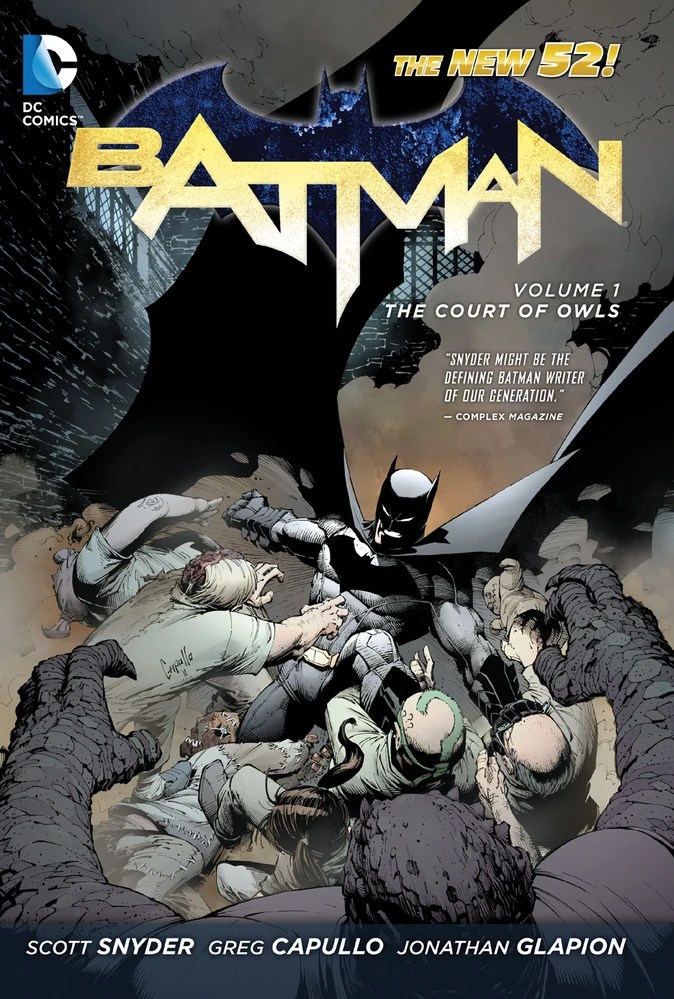

Batman, Vol. 1: The Court of Owls, Scott Snyder and Greg Capullo ⭐⭐⭐⭐ (read in late 2013, several months before I got to any other New 52 TPB, so enjoy the optimism while it lasts)

I thought I wouldn’t get a chance to read this until I found it on the shelf at a local library.  Unfortunately, this library doesn’t like to get volumes after 1, so this may be my only experience with the New(est) 52 Batman. Snyder impressed me fairly well with The Black Mirror, so I suspected going in this would be fairly good, but I’m glad I read this second, since I would have gone into TBM without as much enthusiasm. Not that this was bad, it just leaves you wanting more, since it’s not the complete story and little is resolved even in 7 issues. Positively, Snyder treats us to a reminder he knows of the Batman history and isn’t completely rewriting it with this relaunch (at least at first), and he even gives us some nice humorous moments (a refreshing change for me, since Black Mirror had about 0 lighthearted moments). Soon, though, Snyder starts making Batman his own, thanks to the freedoms of relaunching the character and his corner of the DCU. He doesn’t do it heavy-handedly (in these issues, at least), but he does it earnestly — so fans will have to experience that and react to it for themselves. He does create a sensible and fitting new nemesis for Batman, which is rather an impressive feat, considering the myriad nemeses Batman has accrued over the decades. The danger, though, as is so often the case, is the villain seems almost too powerful: how can Batman (and Snyder) overcome a cabal older than his great-grandfather, who own the city far more authoritatively than he does? I sense a Locutus “sleep” sort of resolution, but I may never know (I’m sure you all do by now, though). It probably has something to do with newly-coined too-good-to-be-true? Gotham shining knight Lincoln March. The artwork is impressive and increasingly gritty, especially as the story progresses from the safe, shiny, futuristic world Bruce Wayne wants Gotham to be to the dirt, ancient, downtrodden world Gotham really is. I was a little confused at the beginning since Bruce, Dick, Tim, Damian, and Lincoln all look exactly alike (minus height differences), but I got over it and allowed Snyder to tell his story (the first half of it, anyway). I’d like to know how it ends, but I don’t need anyone to tell me here. For those who like shiny, computer-generated comics and don’t mind the casual violence of contemporary comics, this is not too shabby a place to start. It’s not the Batman you may remember from the days of old, but that’s not necessarily a bad thing. If you like those days, as I do, you can probably go back to them without too much hassle. If you want something newish, check this out.
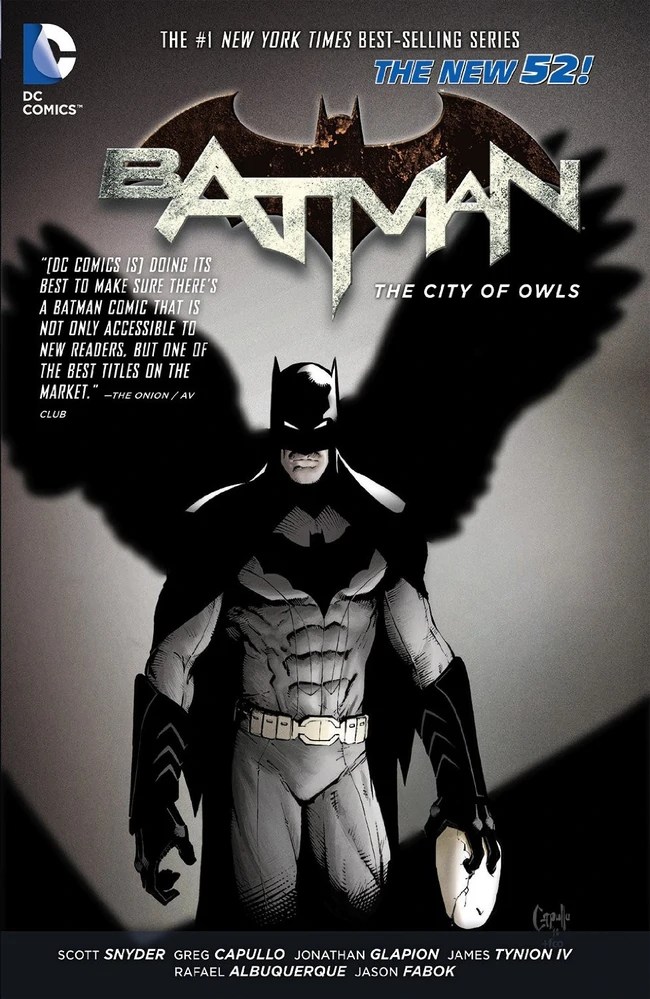
Batman, Vol. 2: The City of Owls, Scott Snyder and Greg Capullo ⭐⭐⭐ (read about 10 months after volume 1, admittedly, but the rest were read in short order after this)

Well, that was easy. Taking a lesson from “Best of Both Worlds, pt. 2,” Scott Snyder decides the best way to conquer a centuries’-old unstoppable secret force is to have it self-destruct, giving our hero nothing to do but wonder (and doubt), really. I suppose there wasn’t any other way to stop this threat, given the head-scratching notion of Batman being able to discover, rout, and extirpate a 200-year-old secret cabal in 36 hours, but be prepared to be a bit disappointed. That’s the trouble with stopping unstoppable foes. Supplementing the explosion-filled semi-conclusion to the Owls saga, we have some reprinted stories from Night of the Owls, the best being the Mr. Freeze story, wholly unrelated to the rest of the collection. We also have a “slice of Gotham life from the commoner’s view” story, which isn’t quite as bad as it could be, but we are also left wondering why our hero isn’t as nice as he could be to some of the downtrodden he supposedly loves. After all, one of the major themes of the Owls story and its epilogue (driven home by the end of the of Death of the Family storyline coming up in volume 3) is Bruce Wayne loves Gotham City — not just the idea of it or the sentimentality of saving something because it makes him feel powerful and accomplished, but he truly cares for the city, its people, and he wants to make it a better place. So why does he treat the people he is apparently doing all this for with such semi-disdain? We may never know. Or, we’ll find out two issues before DC launches the Newer 52 in a couple of years. Stay tuned.
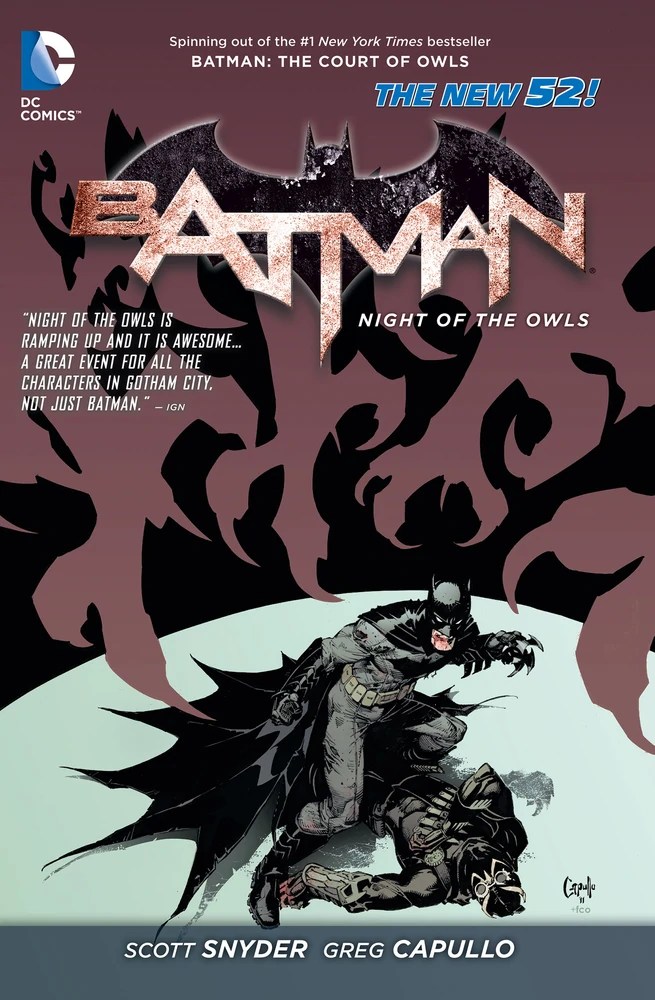
Batman: The Night of the Owls, Scott Snyder, et. al. ⭐⭐⭐

As the whole “Owls ruling Gotham” thing starts to wear thin, we are presented with one slam-bang night of bloody action as the almighty Owls let loose their centuries’-old Talons against all the powerful people of Gotham … only to fall to the inevitable, more or less. Apparently, the Owls want to secretly rule a city populated mostly by the world’s craziest psychopaths, corrupt politicians, and police officers, and eliminating all the decent, hardworking policy and decision makers who bring order and stability to the city will somehow make that a more enjoyable experience. On the surface, this is a touch confusing. Adding to the confusion, some of the early entries in this collection give us “flashbacks” into the history of Gotham and the Owls, though most of them go nowhere and don’t relate in any significant way to the present story. Additionally, as with many crossover collections, unless you are familiar with the characters/supporting stories going on in the other series, some of the issues will be confusing. This is exacerbated at times by this collection’s refusal to let you know what issue you are currently reading: some of the early stories tell us we are reading Nightwing or Birds of Prey, but most of them just start, giving us no cover artwork or series title/number (as if knowing what we are reading would somehow detract from the momentum or enjoyment of the story). Another detraction here is some of the failed emotional moments: if the girl is going to leave Hiroshima in a few months, why are we supposed to be emotionally moved by the bombing several years after she leaves? especially since the A-bomb bombed a city that made devastating bombs that bombed the USA. Instead of a pointed and poignant attack on America’s political decisions, we are given even more reasons to cheer on President Truman’s decision. Anywho.

Apparently the most effective way to defeat the almighty Talons is to get them to talk about their past, and as fast as you can say “Bob’s your uncle,” they will give up their quest to destroy you. The first issue with Jonah Hex is confusing and almost wholly unrelated to what is going on, but apparently the mention of the word “Owl” is enough to include it here. Some issues are out of order, which one supposes could have been better planned out by the development team, but sometimes “making sense” is a luxury comic makers just can’t afford. Still, this series does have some interesting moments, especially the Mr. Freeze story and the story about Alfred’s father. The “Gray-son” idea is also an intriguing notion, but we get no payoff with it here, since that thread is perhaps taken up in a different series. It’s worth reading if you are really into the New 52 or the Court of Owls thing, but be prepared for some confusing rabbit trails and a lot of tension that gets resolved rather quickly.
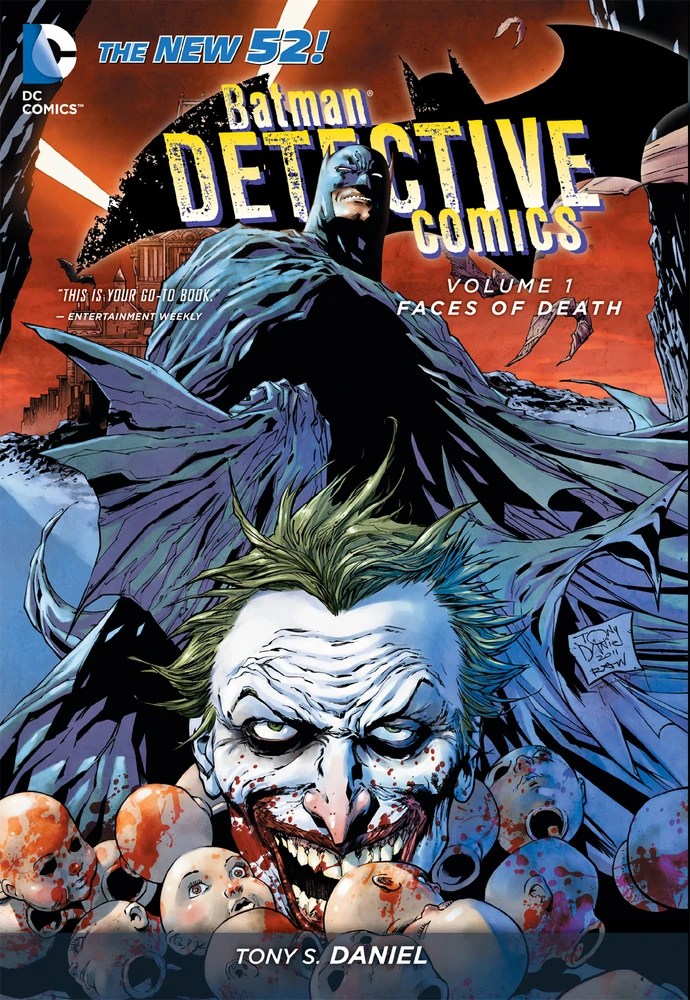
Detective Comics, Vol. 1: Faces of Death, Tony S. Daniel ⭐⭐

Somewhere along the way, “Batman” became an excuse for “excessive violence” and über-violence, perhaps because DC was jealous of Punisher MAX or something. I do not deny Batman (as an idea/world) has a dark side — as much as I enjoy the Adam West Batman, the “Dark Knight” aspect to the character is just as true. But that does not mean we need this much blood: removed faces, blown-out brains (Night of the Owls), etc. As Daniel even proves himself by the end of this collection, he can tell decent Batman stories without grotesque indulgences appealing only to the base visceral impulses of man. I’m sure many of you will disagree with me and my weak tummy — that’s fine. Part of my frustration with the violence in the Dollmaker story was the sheer absence of any meaningful payoff: it goes nowhere, delivers predictable moments of “detection” and suspense, and stops. The second group of stories is a little better, but it also either expects too much of us, or just assumes we know what is going on, or uses too much flashback with Batman knowing too much to be very believable — or possibly a combination of all of them. I know Daniel didn’t stay long on the series, but he did show a little bit of promise — it just doesn’t go anywhere meaningful here.
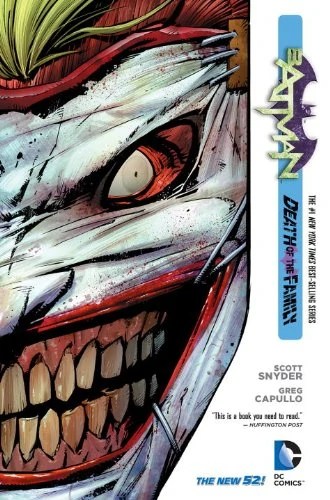
Batman, Vol. 3: Death of the Family, Scott Snyder and Greg Capullo  ⭐⭐⭐⭐

I am willing to give this 4 stars for a graphic novel, though I don’t agree with Goodreads’s “4 stars means ‘really liked it.’” I would probably give Joyce’s Ulysses 4 stars, but I don’t really like that. I would probably give Joan Miro 4 stars without liking what he does, either. It’s a goofy thing, art. Perhaps it’s being overly generous to call this “art,” especially with its preponderance toward unnecessary graphic violence at the beginning of the work (too much red-shirting at the beginning), but the challenge of creating a meaningful, fresh interaction between Joker and Batman certainly demands a high degree of difficulty after 70-some years of their “relationship,” but Mr. Snyder does a fine job, especially toward the end of the collection here, telling an edgy Joker/Batman story with genuine menace and an allegiance to Batman’s high ideals (his version of them, at least). The pacing is a bit off, mainly because of the misplacement of some of the supporting stories (the commitment to reprinting the issues in their published order is sweet, but for a collection such as this I’d be happier getting the bits and pieces in the proper overall story order, something the Night of Owls collection failed at quite impressively), but the ending of the story is quite well achieved. The Joker’s appraisal of many of his “colleagues,” especially the scene between him and Two-Face, is a welcome group of “character moments” (I don’t mean that in the patronizing way it always sounds when people say “good character moments”).

The final confrontation is not unexpected (I was expecting Joker to shout “MacGyveeerrr!” as he fell), but the actions of the supporting Family during that scene is a nice testament to their moral centers (despite DC’s frequent attempts — and Marvel’s — to make all “heroes” gray, morally ambiguous anti-heroes). I was a tad disappointed by the epilogue, everyone’s desire to be alone, though I suppose if they all re-gathered to talk it out it would have come across more like a Star Trek: The Next Generation wrap-up (or early ’90s Avengers or X-Men finale). That’s fine, provided they don’t believe the Joker. They don’t, do they? Bruce doesn’t, does he? Let’s hope not. If he does, what would he really be fighting for all this time? As Snyder tried to teach us with the Owls thing, Bruce Wayne truly does care for Gotham City. He wants it to be a good place to live. Similarly, Bruce Wayne must truly care about his family, dysfunctional and manufactured though they may be. They better believe that, too. If you don’t, I hazard to suspect you may be reading/enjoying Batman for the wrong reasons. Thank you, Mr. Snyder, for encouraging us to care about Batman for the right reasons.
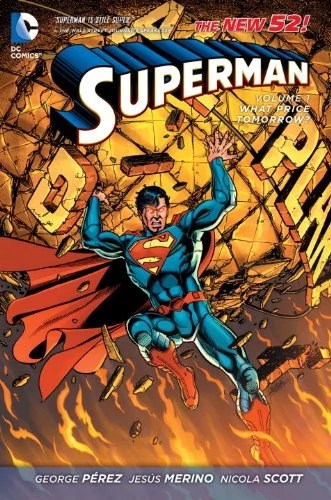
Superman, Vol. 1:  What Price Tomorrow?, George Pérez and Jesús Merino ⭐⭐

Fun — excitement — interesting — fresh — engaging — and other words that don’t apply to this volume. No offense intended to the great George Pérez and his lifetime of fine work, but this was just dull. We’ve seen this in most every science fiction show already, and if it was dull on Babylon 5, it was dull in the “New” 52. I guess the point of this relaunch was to shake it all up, make it all different, and by that they meant break up all the good relationships that took 60-some years to develop and frustrate all the loyal readers (because OLD = BAD and NEW = GOOD, and loyal readers = useless detritus and new readers = the best thing ever). The Daily Planet is gone, Perry and Lois and Clark are all separated, the Kents are dead, and no one likes Clark, really. In order to make the Superman world “fresh and relevant,” the Daily Planet has been sold to arch-villain Morgan Edge. Doing things the old-fashioned way (with honesty and integrity) are as buried as Jonathan and Martha, but only Perry seems to care (maybe Clark, too, but he spends so much time dazed and confused we don’t get to know this version of him much, other than he cares about the poor and displaced and his old apartment building doesn’t exist anymore). Also, for no explicable reason, Pérez has Superman narrate all his thoughts, but his thoughts are more like stage direction and ultra-obvious commentary, nothing truly insightful or worthwhile. Pérez seems stuck in the old days of having characters narrating all their motions. Oh well.

Like Alex Ross’s Justice, this volume has the potential gem of “what if Metropolis lost its faith in Superman?,” but like Justice it gets sidetracked with all its other things (though the other things here are far more confusing and old hat than Justice) and sort of abandons that idea by the end in very rapid and unbelievable “oh, sorry, Supes, we love you and always did” epilogue panels. This story just doesn’t know where it wants to go and takes a long, dull journey to prove it to everyone.
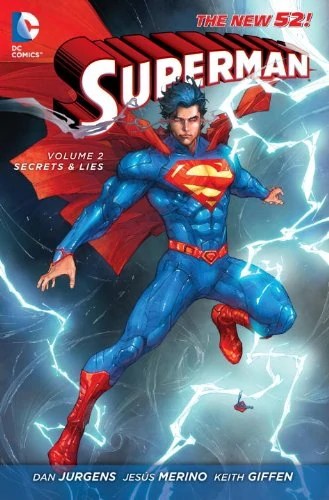
Superman, Vol. 2: Secrets and Lies, Dan Jurgens and Keith Giffen ⭐⭐

I like the Death of Superman story (not that Superman died, just the whole story, all three parts). I read it fairly regularly. I even like the Hunter/Prey followup. Zero Hour … meh. See, this is what I’m not quite getting about this New 52 thing. Why are we bringing back guys from 20-some years ago to contribute to something supposedly new and fresh for this present generation that thinks conversation is done with thumbs? I’m not saying Pérez and Jurgens don’t have it anymore, but if they do, they didn’t share it with Superman New 52. Part of the failure with this series is Jurgens continues Pérez’s “what if Metropolis thought of Superman the way Gotham thinks of Batman, like he is the problem?” But Superman is not Batman. Don’t try to transplant that sentiment over here — it doesn’t work. Maybe this is why Mr. Morrison’s All-Star Superman gets so much love, because it doesn’t try too hard to be a fresh Superman story. Secrets and Lies, here, is just dull.

Jurgens also feels the need to have Superman narrate his actions and obvious commentary. I don’t need that. Granted, I must admit, I rarely pay much attention to the artwork. No offense to the great pencillers and artists and colorists and the whole gang, I just usually read for the story and character development/moments/lah-de-dah. But even I notice what the characters are doing — I don’t need stage direction telling me “I must break free from these chains and now I will punch this villain!” I can see it. The whole Daemonite thing is also a letdown: stop giving us acerbic, witty villains who take nothing seriously. I can’t take Superman’s turmoil seriously if he is trying to escape from Stalag 13.

The “revelation of Superman’s secret identity” thing could have made for an interesting, drawn-out storyline, but it occurs as a backdrop to a nowhere-going combat between Superman and some girl who wants a locket and can’t be touched (but she can hold a locket) and gets wrapped up quickly and obviously. Then there’s another unstoppable alien who is wiping out people left and right and suddenly we’re on a lesser-quality episode of Step By Step and we find out his problems and feel sorry for him and say goodbye. Blah.

At the end of this volume I suppose we have switched to the annual (since the editorial team can’t be bothered to let us know what issue we are actually reading at the time), which is a total embarrassment, not only for the way Superman looks but also for the way women are drawn (literally — why are we still doing this, people?), and the whole Daemonite nonsense twaddle bushwa. It can’t really be this difficult to write Superman stories. It can’t. It’s been happening for 80 years. Why is The New 52 Superman so dreadful? Someone please help me understand this.
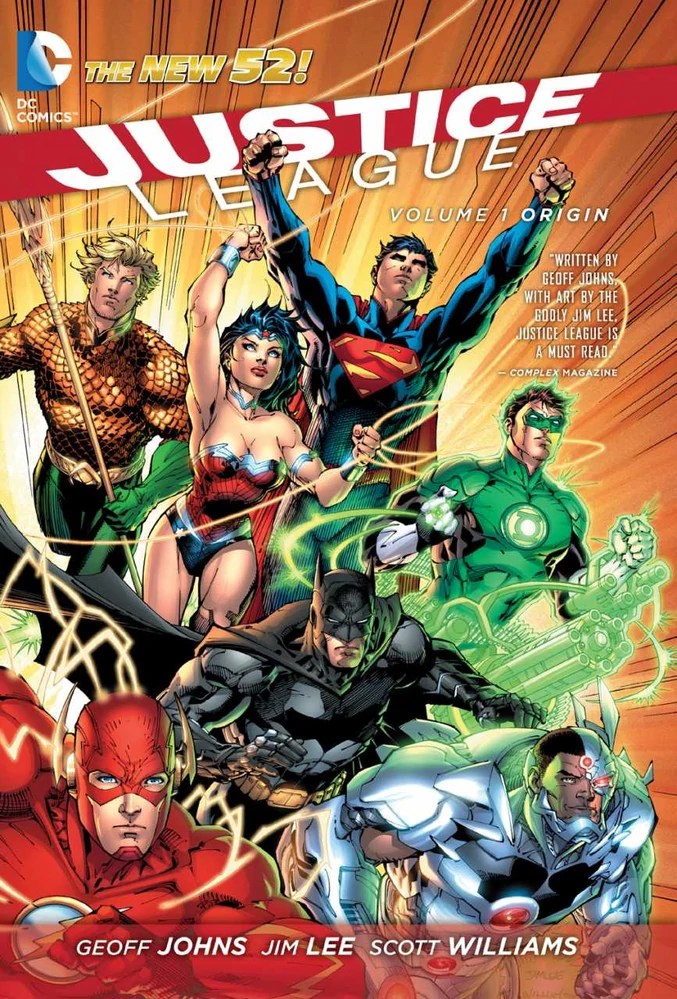
Justice League, Vol. 1: Origins, Geoff Johns and Jim Lee ⭐⭐

If the creative team got paid by amount of work done, Jim Lee earned about 18x more than Geoff Johns did. Apparently DC’s motto for New 52 was something to the effect of “Since Old People are Worthless!” Making all the superheroes young and brash may have sounded good on scratch paper, but it doesn’t read well on glossy paper. Fortunately, Johns gives us almost no dialogue to read, though most of what he gives is petulant ranting, petulant whining, and self-evident observations of actions and whatnot. Virtually none of these beings are heroes: they are almost all self-indulgent jerks, with the exception of the Flash and Batman. I suppose Cyborg isn’t much of a jerk, but I have no idea why he is popular enough to warrant being a first stringer instead of Green Arrow. The basic premise of this volume called “origin” is … hold on, I’ve got it … wait … no, I just had it. What was it? Oh, that’s right: look at giant, mostly meaningless and overly-complicated splash pages by Jim Lee. Perhaps it’s the “origin” of Jim Lee’s diminutive pencil collection. Saving the day, as I said, are Flash’s decency and Batman’s maturity. Almost wholly out of character with the rest of this mess is Batman sounding like the more mature Batman, not the “this is supposedly five years ago Batman.” But, we’ll take it.

Since all the old people (and authority figures in general) are presented as worthless idiots (in contrast to all the valuable idiots we all know and love), it’s odd the young “heroes” are doing their best to prove they aren’t worth knowing — most of the time they (including Superman) are trying to prove the people’s fear and mistrust of them are warranted. Except Batman. Ironic, especially since he does want their fear. It’s just mostly a mess. It moves fast, says very little, and gets the job done more or less, but it takes six issues. X-Men #1 does it in one. As usual, though, we are left wondering “what is the point of the New 52?” All this does is make the heroes young and jerky, all the while tossing things from the supposedly rejected canon at us like grapeshot (too much?). Is this “new” or just an admission “we aren’t nearly as creative as the old teams, so we are just going to do their stuff our way”? and for a new generation that values worthless “heroes”?

This could have been so much better.
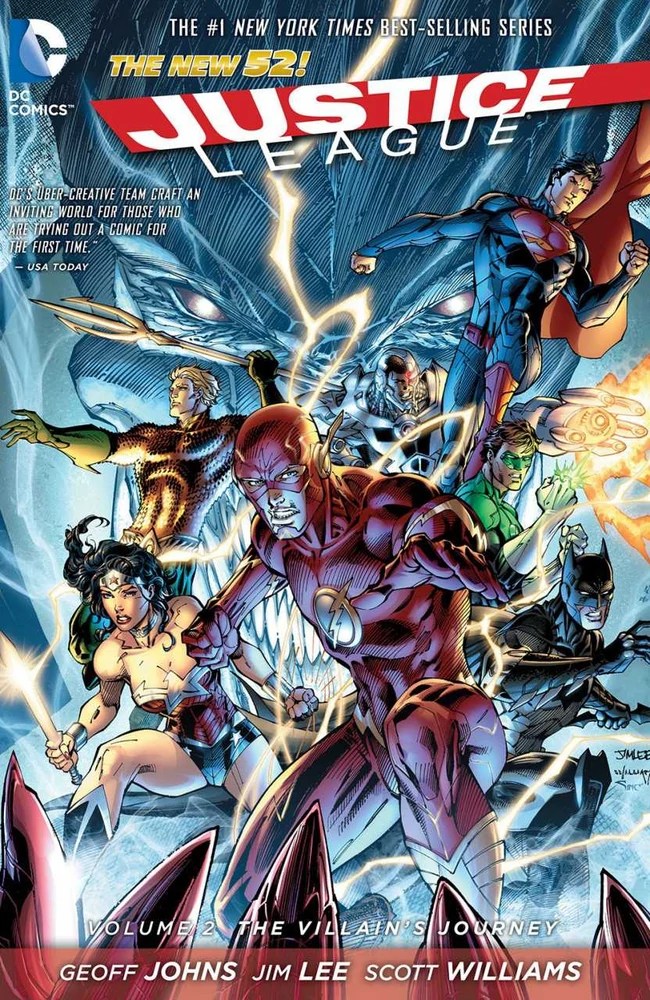
Justice League, Vol. 2: The Villain’s Journey, Geoff Johns and Jim Lee, et. al. ⭐⭐

2.5 stars, how’s that? We finally have the beginnings of a story, and Mr. Johns finally beginning to attempt to earn his paycheck. Yet, the main premise for this villain and his motivation is rather disgraceful: having given us a reason to care about these heroes from the regular guy perspective, instead of developing that line or character it is immediately shattered with a puff (or sniff, rather) of magic smoke. Johns attempts to prove he knows as much mythology as Joseph Campbell, but he certainly falls short, even shorter than JMS (who certainly knows his fair share of myths), and the failure makes the story that much thinner. Once again the series seems to be mainly a vehicle for Jim Lee splash pages. The dialogue is less insipid, which is surprising considering there’s more of it, but a few mildly enjoyable comments and asides do not make up for belabored plot resolution and pedantry. We are timeshifted back to the “present,” five years after the so-called origin series, and we haven’t missed anything except Steve and Diana breaking up (and our “villain,” who is treated more like a poor, misguided, product of his environment, not a responsible being who acted out of malicious volition, starting on his eponymous “journey”).

Finally Green Arrow shows up, but he is treated horribly by most of the JL — no doubt because they are jealous of him getting younger and slimmer (like the rest of them, since old, stocky people can’t be heroes in the New 52) — though Aquaman hints at something we are supposed to know about, as if they had an altercation in the past. But I thought the point of the New 52 was we aren’t supposed to care about the past or even be bothered by it: not only is the New 52 disregarding the Old 52’s past, it can’t even be bothered to cement a believable New 52’s past. Oh well.

In an continuing effort to make humanity seem wholly incompetent, the politicians in the New 52 universe are wholly embarrassing specimens (well, perhaps that part is realistic) and, even worse, military families are presented as over-reactionary crybabies. I seriously doubt Steve’s sister would blame WW for him disappearing, especially since he has been a top-line military soldier for years, even before the JL appeared. The military families I know would certainly not react that way. Fairly offensive characterization, really. There’s no way a 38-second clip of the JL fighting amongst themselves (plus a nonsensical talk-show interview) would suddenly turn worldwide opinion of the JL 180°. Everything is done too chaotically and suddenly (like Cyborg’s instantaneous acceptance of everything from last volume). Oh well.

Plot Convenience Playhouse will return in Volume 3 — a new Justice League, new villains, and certainly no resolution to the “why are we supposed to care about these mysterious beings and their inscrutable soliloquies into thin air?” epilogues. Green Lantern is gone (in a wholly unbelievable change of heart), Green Arrow is still who knows where, Martian Manhunter is a badguy (nonsense), and, well, I just really feel sorry for the people who not only had to wait 6 whole months to read these issues but also had to pay, what, $24-some dollars for the privilege of being let down? What a world.
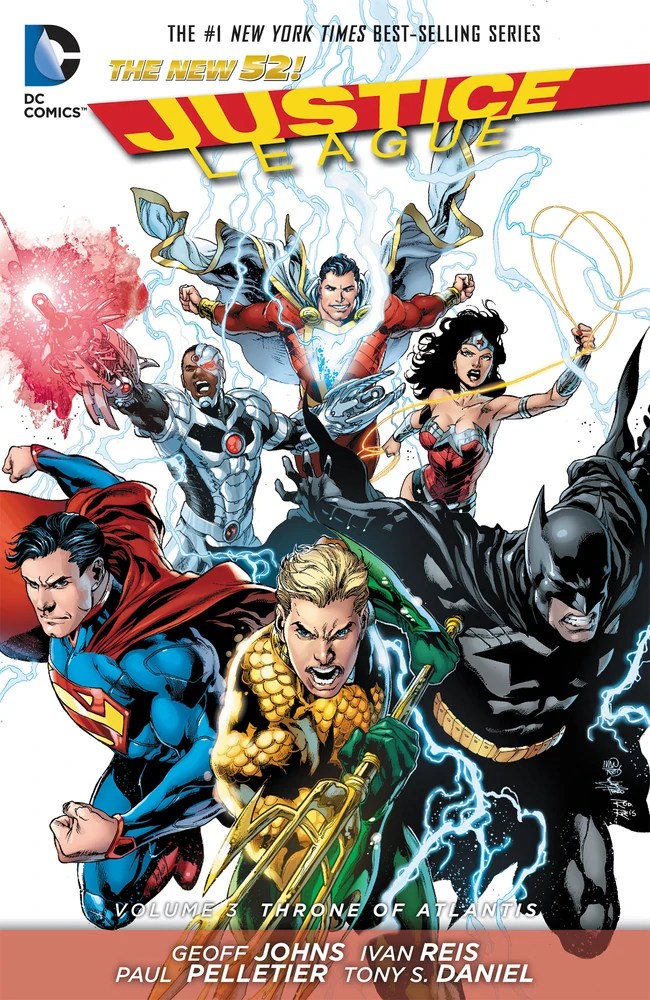
Justice League, Vol. 3: Throne of Atlantis, Geoff Johns and Ivan Reis ⭐⭐

Just when you think a cohesive story is about to occur, we are given a crossover without all the pieces, a villain that’s 12 years younger than he looks with his villain mask on, a surprise twist that gets ruined by the rest of the story, and further mistreatment of poor Steve Trevor. Once again we are expected to have read every other single New 52 issue along with this so we can understand the missing pieces and the rest of the new characters and who the mysterious villain behind other things is. It’s hard to sustain interest in this series, especially with the puerile writing of Mr. Johns. He continues to have characters narrate what we can see, as well as spell out things we have already figured out. There is one great moment toward the end, but Aquaman’s treatment of Vulko feels out of character. His entire resolution of the conflict is likewise nonsensical. Most of how the Justice League behaves during this is confusing: if Wonder Woman’s family were really attacking she’d side with Earth instead of finding a solution to save everyone? Doubtful. It’s another example of the confusion everyone is under with the New 52: do we ignore everything before this? do we assume everyone knows all the supporting characters and events? do we ignore the need for characterization because of the mysterious 5-year jump? Apparently the answer to all of them is “yes,” even though these questions contradict each other.

The two-part Cheetah story is a nice respite between forever-earth-changing four-to-six-parters, but it doesn’t quite work as a Justice League story, since it’s mostly a Wonder Woman story. The Cheetah’s ability to stop the Justice League singlehandedly is no testament to the strength and power of this disunited League. And it all ends with further mistreatment of poor Steve, who has done nothing except give and give and give. Perhaps Steve represents the audience: DC has taken everything away from you, acted like the first 75 years of character growth and storylines never happened, and is now charging you high prices for the pleasure of giving you poor work. DC Fans: you should expect better. That the best sources of praise the makers of the TPB can find are made-up Web Log sites that didn’t exist two years ago and won’t exist in two years should give you enough warning — this is not good enough.
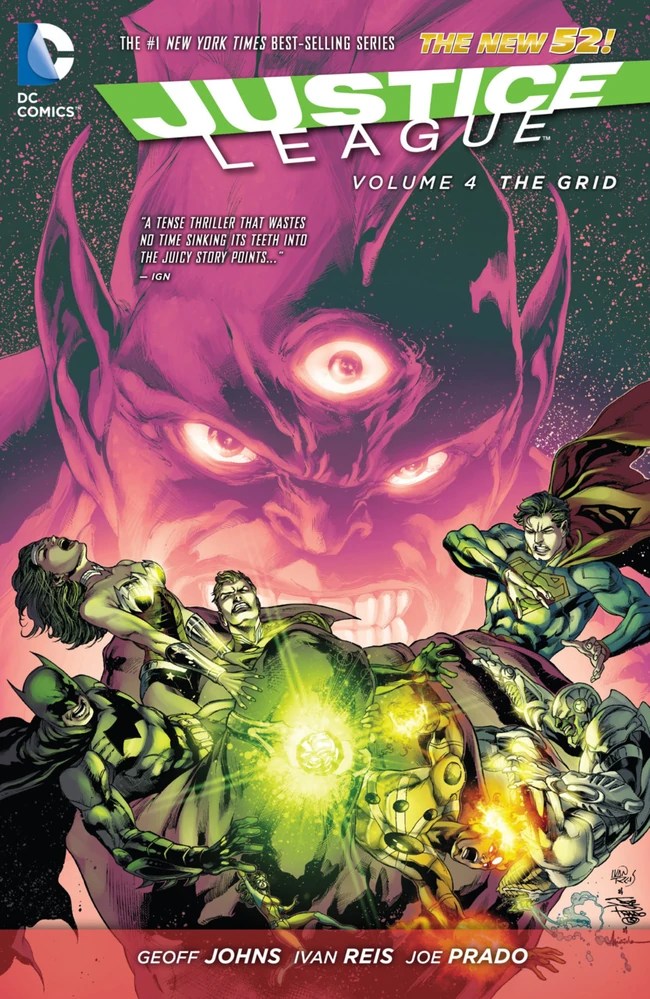
Justice League, Vol. 4: The Grid, Geoff Johns and Ivan Reis ⭐⭐

Now we know what “DC” stands for.

Should we give the audience a complete story? DC.

Should we include all the issues so they get their money’s worth? DC.

Should we tell people what they are missing from the skipped-over issues? DC.

Should we introduce the “bonus” material so the audience knows why it’s there? DC.

Should we explain the differences between the old and New 52 versions of the characters, especially the ones who are different genders? DC.

Should we charge less for this trade since it has fewer issues? DC.

Should we be consistent in what we sell in the TPBs within the same series? DC.

Should it matter to us if we tell stories that make sense and/or are any good? DC.

Should we be respectful to or honor readers who have been with us for decades? DC.

Should we try to give meaningful payoffs to the nonsensical super-secret characters we have been polluting all our issues with? DC.

Should we come up with a name that is impressive or should we go with “Crime Syndicate”? DC.

I guess Johnny from Time of the Apes grew up to take over the creative direction of DC. “Crime Syndicate” is really the best name we could come up with for the all-powerful, super-menacing döppelgangers the entire New 52 has been heading toward, huh? Why haven’t I heard about The Great DC New 52 Reader Revolt? Are you people just passively accepting this? Storylines rehashed, even from recent memory? Characterizations that make no sense? Plotlines that have more holes than a whiffle ball? Conflicts that exist for no reason other than to make large splash pages? Stop settling for sub-mediocre work, DC fans.  Maybe they “don’t care,” but you should care.
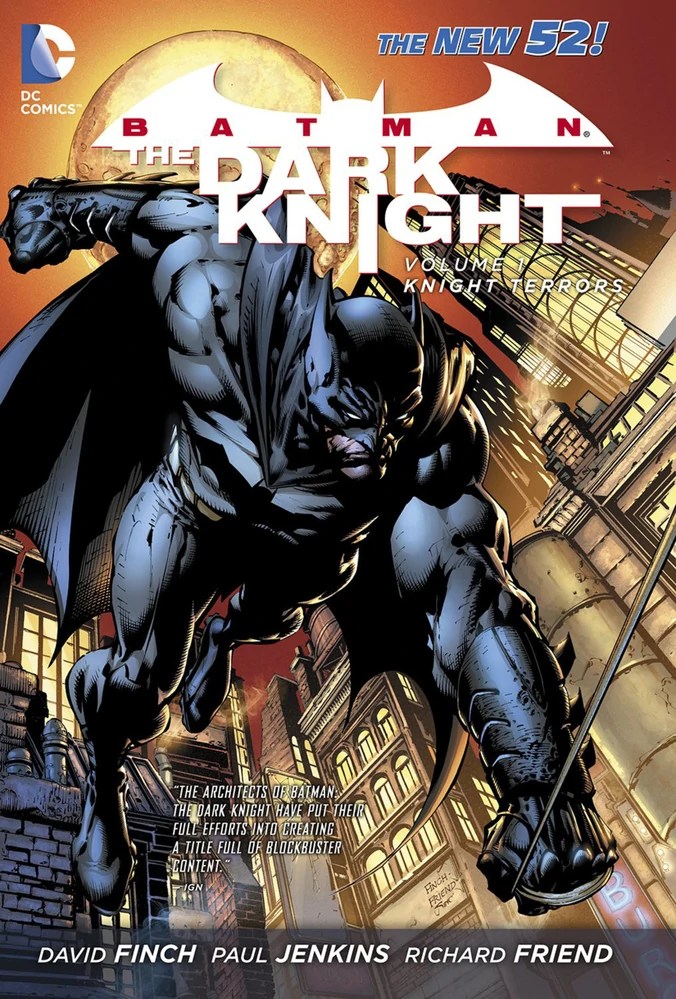
Batman: The Dark Knight, Vol. 1: Knight Terrors, David Finch and Paul Jenkins ⭐⭐⭐

This really should be 2.5 stars, but I’ve rounded up just because it was better (sort of) than most of those not-that-great Justice League collections. The artwork is both impressive and nauseous together: the impressive parts remind us of Neal Adams’s way of revitalizing series with real movement, fine detail, and believable action. The nauseous parts are the over-abundance of blood and gore. That truly is not impressive. The depiction of the female characters is also insulting to every human being, but I guess you can’t take the Image out of the artist.

The writing is likewise a confusing combination of rambling internal monologue and decent storytelling. Nothing is a surprise, but at least some of the character moments are good. But then again, just when one thinks things are going to run intelligently, along comes another “I’m going to take down Batman and Gordon!” I.A. guy …  I mean, honestly. Don’t these two have enough to worry about? Is writing for Batman truly that difficult we have to rehash this nonsense? Finch teases us with potentially enjoyable moments only to snatch them cruelly away, such as the potential enjoyment of seeing Batman and Flash together only to sidetrack the Flash immediately and send him away. This could have been better without the blood and violence — I know this is the “Dark” Knight, but subtlety and implied violence would work far better than showing it, especially so frequently. If offstage violence worked for Aeschylus and Sophocles, surely it could work for crafters of Batman tales. I acknowledge this review does not apparently mesh with 3 stars, but as it was on the whole better than most JL tales of the New 52, and the potential of storylines such as Gordon at the psychiatrist office and The White Rabbit (despite her embarrassing visual appearance), I’ll say “decent effort.” Faint praise all around, on me!
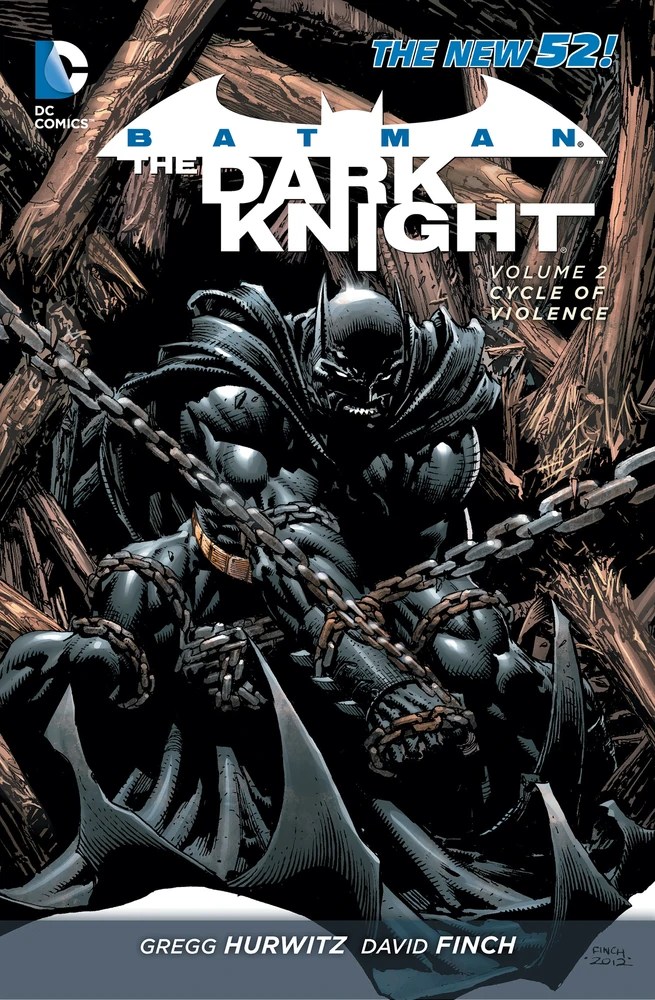
Batman: The Dark Knight, Vol. 2: Cycle of Violence, Gregg Hurwitz and David Finch ⭐⭐

Most of these 2 stars (which I feel even now is too many) are for moments of what is I suppose issue #0. In DC’s TPB commitment to hiding from you what issue you are actually reading at the time, I can only guess the final origin-like story at the close of this volume is issue #0. While that issue doesn’t tell us much we don’t know, as the continuing uncertainty over reason for The New 52’s existence provides an “origin” for Bruce Wayne — not Batman — we already knew. It’s nice to see the origin of Bruce Wayne on paper, I suppose, as well as the confrontation with Joe Chill (strangely reminiscent of Minority Report).

The majority of this collection is the overly-long Scarecrow story. Having just seen Scarecrow in the last TPB, his return is bizarre. I understand a new writer has taken over, though David Finch is still around to draw unnecessarily bloody fight scenes and other grotesqueries — but still, this is a wholly different Scarecrow from whom we just saw. Even in the dark world of the “Dark Knight,” this story is probably too dark. For some inexplicable reason, the library has labelled this “YA” — I’ll probably show them this is not in any way the case. The world is already dark enough, why must we keep adding to it with stories like this? Batman can be effective without this. I’m not saying we have to return to Adam West’s Batman, but even Neil Gaiman was regretful for the “24 Hours” issue of Sandman. While there are interesting moments in this story, such as Scarecrow’s reactions to the brave girl who stands up to him, the Light vs. Dark scene, and Bruce’s gratitude for Damian’s rescue, it’s overall just a barbaric appeal to the base and the visceral. We are given too few redeeming moments in this to make it worth owning or reading again (or for many even reading the first time).

It’s like the first TPB didn’t even happen — none of the storylines there are picked up here, none of those new characters return, and new ones are introduced here as if we should already be familiar with them! I can see the idea Hurwitz + Finch wanted to present, but it fails — as evidenced by the anticlimactic wrap-up to the story. It may not be my place to say, but I don’t consider this a respectful treatment of Batman and his world (as dark as it is and may “need” to be).
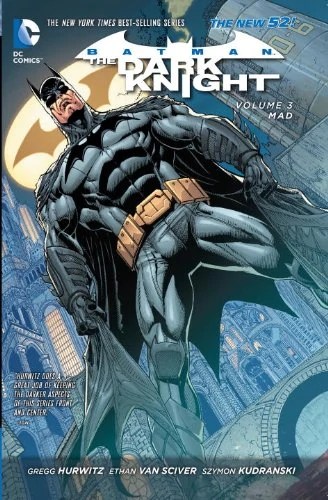
Batman: The Dark Knight, Vol. 3: Mad, Gregg Hurwitz and Ethan Van Sciver ⭐⭐

As with the previous TPB, most of these 2 stars are for the atypical issue, the annual. At least, I assume it is the annual at the close of the volume, since we are still not allowed to know what issue is which throughout the TPB, given instead an exciting repetition of cover issues two pages in a row (sadly, it’s not nearly as thrilling as I’ve just made it out to be). Hurwitz’s relaunching of the relaunch continues, with the second new version of the Mad Hatter in this storyline. Again Hurwitz tries to make Batman seem more of a “bad guy” than the supervillains are, since the new backstory of the Mad Hatter places all of his evil on experimental medication and societal rejection — he was a sweet, wonderful guy, really, so none of his badness is his fault. Bruce Wayne, however, chose to go to the darkness when his parents were killed. Pretty shoddy writing, overall.

Making it even more infuriating, Hurwitz takes the low road for pathos. Now we know why Hurwitz ignored the new characters from the previous writer — well, actually, no, we still have no idea why Hurwitz wants us to pretend none of those things happened (other than perhaps he realizes how fatuous most of them were) — but at least we know why he invented a new girlfriend for Bruce. Cheap. (Hurwitz’s writing, not the girl.)

The Mad Hatter story has plenty of holes (Gordon and Batman had identified the criminal organization before they instigated their plan — surely they would have announced that before the terror began). Hurwitz even rips off himself: the story opens with more kidnappings, just like the Scarecrow story did. And even though we have new artists, the violence and gore are far more graphic and “onstage” than they should be: less is more, people — implied violence is stronger than going through four red markers each issue (or whatever they are using to paint the blood on every panel these days). Three easily forgettable TPBs so far.

The only interesting story, as mentioned above, is the annual story: seeing three villains outsmart themselves with a clever and humorous payoff. This is much closer to a good Batman story. It really shouldn’t be this difficult to write well for Batman.

Batman and Robin, Vol. 1: Born to Kill, Peter J. Tomasi, Patrick Gleason ⭐⭐⭐

As with most of the New 52, this volume has a lot wrong with it, but it is better than most of the other Batman titles I’ve been reading lately, so by sheer novelty (or its rehashed version of novelty, at least) it deserves a slightly higher rating. Unlike the dialogue-sparse Geoff Johns volumes, the absence of dialogue in parts of this collection is aided by quality artwork and better dialogue when it occurs. True, some of it is stilted and obvious, but by the end it gets better.

Even with the violence, it is not as over-the-top as The Dark Knight, even with a killer in the title, and the tensions between Bruce and his son drive the issue more than violence. Nothing in the story is groundbreaking. We get a “secret” look at some of Bruce Wayne’s missing years, which to no one’s surprise comes back to break him. But this is another volume in which the success of the ending makes up for a fair amount of lackluster and obvious moments, and the better painting-like artwork and better writing make this a better Batman series than many of the others.
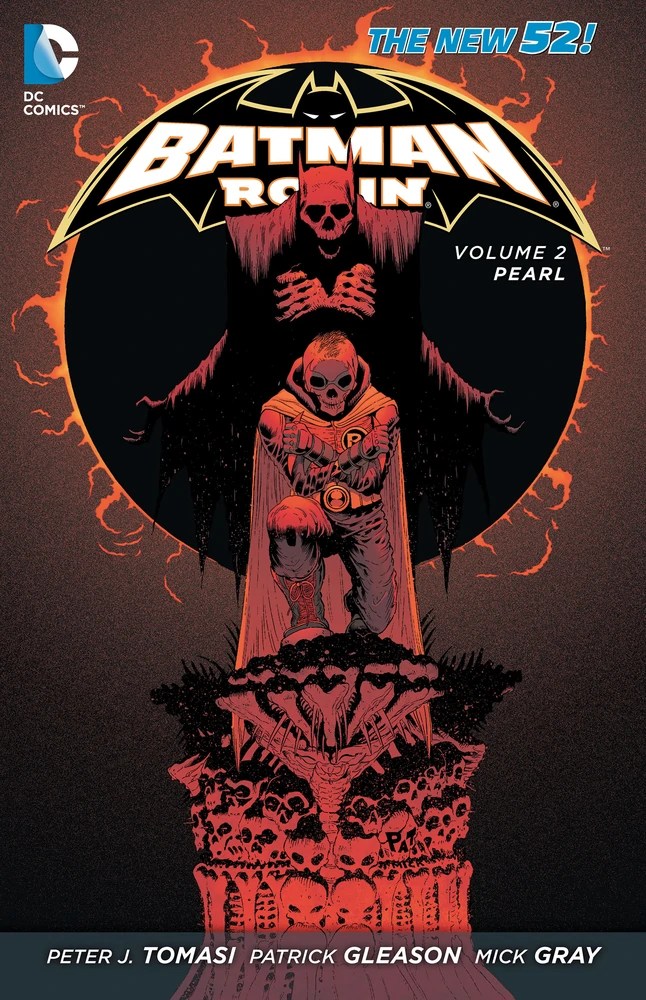
Batman and Robin, Vol. 2: Pearl, Peter J. Tomasi, Patrick Gleason, ⭐⭐

A bit of a letdown after the decent first volume — seems almost like the basic idea was fully played out in the first series and now they were getting a bit desperate. Zombies? That’s the best we could come up, zombies? Did I miss the “teenage vampires in love” crossover? As potentially great as the final moment of this collection could be, it comes out of nowhere and seems forced and majickally convenient. Also, the story just stops. Batman and Robin go home and we are left wondering, “wait, what about all that stuff you said you had to go do? Is this halftime?”

The first story in the collection has some very fine moments, especially with all the Robins together, but the basic premise for it is irritatingly tiresome: another “Batman is the real menace and we are all victims of him!” story, with a main nemesis whose origin is unclear, motivation is murky, and grief with Batman is unexplained. Feel free to tell me how he was back in issue #3XX of Detective Comics waaay back when — I picked up “The New 52” because I was promised I wouldn’t need to know all that stuff.

Stop trying to get us to feel sorry for the villains, Bat-writers. Stop giving us “will Batman lose his cool and finally kill?” stories. Do better at your overly-paid positions. And stop giving us cover art that has nothing to do with the content of the stories. This series promised more than it delivered here.
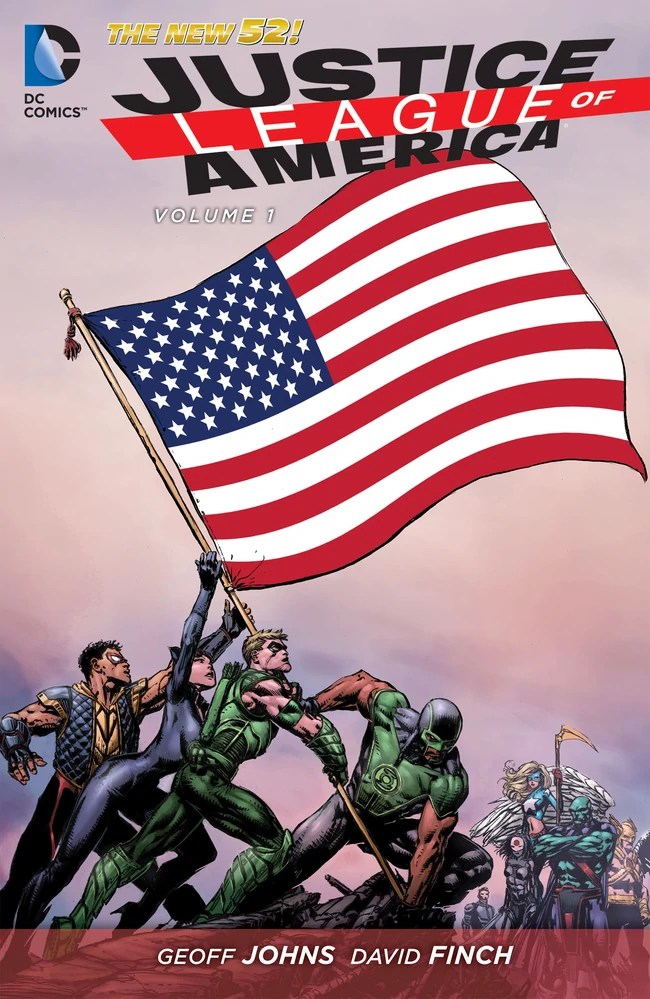
Justice League of America, Vol. 1: World’s Most Dangerous, Geoff Johns ⭐⭐

Someday, the intelligent among you must explain Geoff Johns’s popularity. In the New 52’s concerted effort to play foully with our affections and intellect, this ball of confusion exists. True, it would be nice if we knew what issues we were reading, where they occur in connection to other series, who these characters are, and other mundane trivia, but that would make too much sense. Why be helpful when you can be inscrutable? This started out with such promise, but it doesn’t take too long to devolve to the usual depths of sub-interesting New 52 shenanigans. On the off-chance the unstoppable superheroes go rogue (despite being okay for everyone for 5 mysterious years), the B-squad is gathered led by poor Steve Trevor and some stereotypical tough-as-nails-no-nonsense-I’ve-earned-it-of-no-substance-female-character. Somehow these unskilled, untrained ragtags will be able to take out the A-squad. If necessary.

Shockingly, “necessary” shows up almost immediately. But first, some “getting to know you” story with as many surprise twists as a candy cane. It could have been good, but as it’s all part of the Master Plan for The Trinity War, well, it doesn’t make much sense, especially to new readers who don’t know who these characters are (which seems counter to the basic premise of the “New” 52). Then we get a few pieces of the Trinity War, which won’t make a lot of sense if you are reading these series in the TPBs the way they are published. Finishing up seems to be a separate issue about Martian Manhunter, but apparently it was a B-story series in the first few issues (which you can’t learn simply by reading the collection as it is printed). This could have been better. But it’s not.
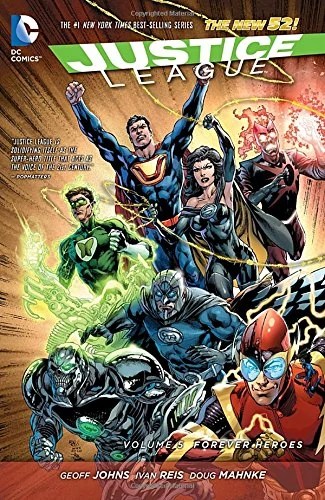
Justice League, Vol. 5: Forever Heroes, Geoff Johns ⭐⭐

I give this 2 stars because of the Metal Men. Without them toward the end of this collection, I’d probably give this 0 or negative 1 stars. This is quite possibly the worst Geoff Johns writing I’ve read yet, which is rather an impressive, if stomach churning, achievement for him. This is really abysmal. We totally get from panel 1 that these alternate-universe versions (or parallel-dimension versions, if you prefer) of the Justice League are villains — cold-hearted, ruthless villains. We completely understand that. However, to drive the point home, Johns gives us four mind-numbing and utterly extraneous issues to underscore this point. Nothing new is revealed in these “when they were young” issues we couldn’t have already filled in with our own imaginations. Oh my, the bad Superman (Ultraman) killed his parents! … So what? Oh my, the bad Batman (Owlman) killed his family including Bruce Wayne! … Why should we care? Even the “Creative Teams” got tired of giving backstories to these new villains, since Wonder Woman (or is it the other Lois Lane? they say both, which is probably just shoddy editing) and Firestorm don’t even get stories. I’m thankful for that, of course, but it’s just another exemplar of the sheer lack of meaningful direction in this New 52 universe. Oh, I’m sure they have their multi-year storylines all figured out and storyboarded and what not, but that doesn’t mean they are being executed with any amount of finesse or skill.

So you want to “shake up” the New 52 Universe, eh DC Masterminds, after an eternity of 24 issues? Howabout you hire writers who can write quality stories! with engaging dialogue! that are not insulting piles of rubbish such as this mess! Yes, the Metal Men are in it toward the end in what appears to be their own spin-off issue, and that was enjoyable because it was the Metal Men, but after that the insensible palaver returns.

Finally, Cyborg confronts Grid, his rogue, sentient computer self! And Cyborg has an EMP but does not use it! Surely the only reason rebuilt Cyborg even has a built-in EMP is to stop rogue, sentient computers! How ridiculous. Instead, Cyborg just tricks the Grid into feeling sorry for himself … and we know the feeling.

Consider, in final reflection, the masterful work given to us 20 years ago: The Age of Apocalypse. In that brilliant, effectively 4-month-contained storyline event, we have a compact, well-structured “alternate universe” look at the X-Universe totally believable and understandable even when given to us in its final moments. Yes, it had a couple issues of prequel stories, but they were additional things not main title issues. This masterpiece is 20 years old, and the supposedly “even better generation of creative writers” in the “young, hip New 52 Universe” can only give us this attempt at an interesting alternate universe cross-over. Forever Heroes? Forever Boring.

Detective Comics, Vol. 2: Scare Tactics, Tony S. Daniel and Ed Benes ⭐⭐

Not much to this rambling collection of sub-quality issues, really. The extra star is again for what I assume to be issue #0, since as with all New 52 TPBs, we are not allowed to know what issue we are reading at the time (too much information might clue us in to an awareness nothing important is happening). I’m not sure why this is called “Scare Tactics” — yes, the first issue is called that, but the collection contains longer storylines, though as I said none of them are really impressive. The longest story concerns a nonsensical excuse for drawing yucky melted bodies under the guise of time-travel and villainy, but while there is all the appearance of scientific credibility sprinkled throughout, most of the scientific application is “Batman pushes a button and majickal things happen.” It’s just a boring mess that ends abruptly without any closure.

Following this is a potentially interesting conflict between Black Mask and Mad Hatter, which likewise ends with the “majick plot-stopping button” being pressed and the story just ending. I suppose we should be grateful for that. The #0 issue flashback is the most interesting in the collection, despite its rather obvious ending. The epilogue between Bruce and Alfred is certainly the highlight, even if it is yet another version of the Batman mythos (the point of the New 52, I know).

The ending of this collection is a worthless series of Two-Face vignettes that are so poorly lit you’d think they were sponsored by the color “invisible.” It tries to make us interested by dangling a few lines of “the secrets of Two-Face’s moral struggles” out there, but nothing comes of it and instead we are given grotesque violence, banal dialogue, and no reason to care about any of it after all. Another disappointing collection of half-baked Batman and Co. ideas.
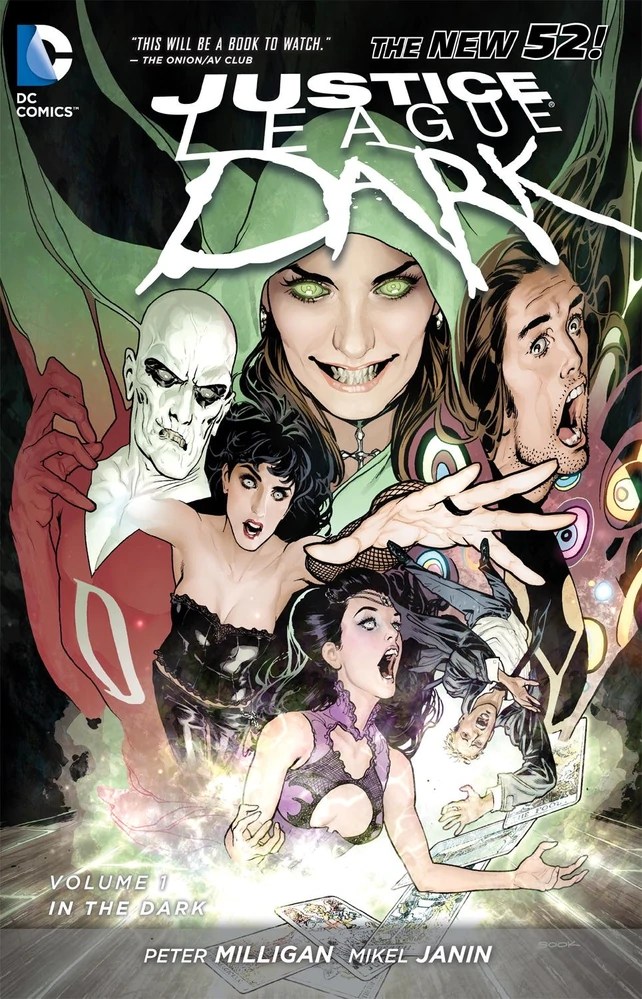
Justice League Dark, Vol. 1: In the Dark, Peter Milligan, Mikel Janin, ⭐

I solemnly promise I am not reading these hoping they will be bad. I’m not looking for a frustrating time. Nor can you really say I’m not giving these a fair shake: reading over a dozen New 52 volumes is quite generous, considering how unimpressive they are. Take this pail of hogwash, for example. Admittedly, beginning with a nominalization is poor writing, but there is no story here. Truly no story. Instead, we have a jumbled mess of pseudo-introduction stories masquerading as a typical “gathering of heroes for a new team” story — but get this! It’s “dark”! Apparently that makes it new and fresh, or at least it did in the minds of the people who gave this project the proverbial green light (no doubt a dark green light). Perhaps “dark” is New 52 talk for “draw lots of grotesque things and the people won’t know nothing meaningful is happening.” Even X-Files had generally good narrative reasons for its grotesqueries. This palaver has nothing substantial to tie its nonsense together. Panels happen in whirly-gig order, as if we are supposed to have some intuitive guide to discerning how this is supposed to be read. Oh, and apparently we are already supposed to know who these characters are, since we are never told who they are, even the ones who are possibly new, except Deadman. We are told his origin every issue.

This jumbled mess has some potentially interesting ideas, but none of them come to fruition and we are not given any reason to hope they will mature in future issues. Characters all basically look alike (which is not impressive), and most of the poses and outfits of the ladies are apparently designed to evoke ungentlemanly responses within the male readership. Characters show up, leave, wide gaping holes of what poses as a story rip through and no one bothers to explain why (not that we need moment-by-moment spoonfeeding, but an absence of meaningful continuity is not tantamount to “quality storytelling”).

Horrible things happen throughout these pages (children murdering one another, towns caving into madness), but none of these “heroes” care. Then we are to believe it was all a test to get this ragtag group of jerkweeds together. It’s impossible to empathize with any of these characters until John Constantine says he wants no part of this.

If this is the best this series has to offer, it’s hard to disagree.


If it makes you feel better, I have read very high-quality DC trades recently (especially the Knightfall trilogy).  One of my key goals for 2015 is to read fewer books but books I just know are going to be good.  I’ve read too much tripe lately, and I know it has all been volitional, but still I need to improve my literary diet.  In my vast munificence, I will likely give The New 52 more chances to disappoint me, but that does not necessarily mean you won’t enjoy them.  It’s likely it’s not as bad as I have made it sound.  Somebody out there must think these are worth making again and again, and since several of them are available for free from the library (perhaps the best part of that is you don’t have to feel obligated to keep them — you can’t actually give them back!), this is as good a time as any to try The New 52 (I don’t want that to sound like a threat, of course).  If not, fair enough.  In either event, I wish you and yours good reading.

More Important than “Practical”: An Appreciation of Henry Zylstra’s “What Is Fiction For?”

Christopher Rush

Not quite seventy years ago (sixty-six to the day of this printing, to be precise), Henry Zylstra, the late great Professor of English at Calvin College, published in The Banner another pithy, enjoyable essay entitled “What Is Fiction For?” collected in the posthumous tribute anthology Testament of Vision.  I intentionally did not read it until after finishing my address entitled “Art: The Imprint of God, The Signature of Man,” published last issue.  Most of that address was “informed” (as my colleagues say) by Frank E. Gaebelein’s work collected in The Christian, The Arts, and Truth: Regaining a Vision of Greatness.  (I’m not sure why my experience with these great Christian educators began with their posthumous collections — just one of those things, I suppose.)   I knew (perhaps more of a top-notch gut instinct) before reading any of Professor Zylstra’s work I would feel a strong compulsion to work most of it into my address, and since I knew I was running long on content already, I waited.  My suspicions it would be a challenging, worthwhile read saw fruition, and that compunction to share Professor Zylstra’s work has hoven into view again.  As this is a non-profit enterprise charging nothing, existing in part for educational purposes, I operate here on the belief it is not a violation of copyright laws to include the brief work in its entirety, since I’m basically making copies for students in my classes (more or less).  My goal here is to increase awareness of the quality and necessity of delighting in the work by Professor Henry Zylstra.  Surely that is acceptable to Eerdmans and the Zylstra Estate.  Here is “What Is Fiction For?”

On a day you come upon your boy reading a novel, and you say, “What — reading stories again?  You always have your head in those novels.  Why don’t you read something useful, something improving, something edifying?”

I understand you, I think.  I understand your concern when you say that you want him to read something useful.  You are yourself a working man.  You have a job to do and are called to do it.  You find that life is a practical affair.  Subduing the earth and having dominion over it did not come easily for Adam, does not come easily for you.  You honor the virtues of industry and thrift.  Now you come home, tired by the labor of your calloused hand, and you find your boy sunk in an easy chair with his head in a book.  It is all a little disturbing.  And such a book!  Fiction, of course.  Another novel.  Just a story.  I understand you.  If he must read, why can’t he read something useful?

Or something improving?  There too you are rightly concerned.  Your interest in the boy’s character is a real, almost an anxious, interest.  You have been busy with the nurture and discipline of it these many years.  You hoped he would be intelligent, but you could do without that.  You hoped he would be efficient, able to get things done.  But you could do without that also, that is, if he were not lazy.  Laziness would be something else.  It would be a fault in character.  And for his character you have an anxious concern.  For his Christian morality you have a deep-seated, heart-felt concern.  For this you have prayed, though you had not prayed for those other things.  So I understand you when you wish that your boy would read something improving, something that will count in his character.

Again, I understand you, I think, when you use that other word — edifying.  It is a good word, the word you use there: edifying has the idea of edifice in it, and it seems to me that the edifice behind your use of the word is a church.  Good.  You want the boy to read something constructive, something uplifting, especially in a spiritual, a religious sense.  The spiritual and religious come first with you.  You have a concern, consequently, for his devotional reading, for books that will assist him in worship, draw him nearer to God.  You have not missed that emphasis of the Bible: “Seek ye first the Kingdom … sell all that thou hast … if thine eye offend thee, pluck it out.”  You want him to have a care for this above all.  The spiritual, the religious, is first.  It stands higher with you than even the practical and the moral.  And it ought to.

So I understand why it is that you should be zealous for and even jealous of the religious and spiritual development, and thence for practical and moral concerns.  What I wonder at is that this should make for indifference to the artistic concern.  Something in your remark at least suggests that if only you could make fiction serve practical, or moral, or religious purposes you could honor it, but that since you cannot you wish your boy would read something useful, improving, or edifying.  You suspect that novels, when they are innocent, are trivial.  At best, you feel, they constitute mere entertainment.

I wonder at this because I know that you are not Catholic in your insistence on the primacy of the spiritual.  You do not cultivate the esoterically religious in isolation from life.  The saint in you is not developed at the expense of the man; it is indeed the man renewed who is the saint.  And it is that man, the religious man, if you will, who finds himself called upon to be moral, social, scientific, philosophical — yes, and artistic also.

When you come to think of it, you will perhaps acknowledge that the aesthetic, the artistic, although interdependent with them, has a claim upon you distinct in kind from the practical, the moral, or, in the narrower sense only now, the religious claim.  Then you will perhaps acknowledge also that the artistic need in you can be satisfied only by art and not by some other thing.  The practical, the moral, the scientific, and those other worlds, do not exhaust God’s reality as it is revealed in himself, in life, and in you.  There is the artistic world also.  You can look at a tree and reckon how useful it would be to build a house with.  You are then being practical about the tree.  You can look at a flower and discover that it consists of stem, stamen, petals, and the rest.  You are then being scientific about the flower.  But you can also look at a tree or a flower without a deliberate practical or scientific thought, see it as it is, and simply enjoy it.  You may call this mere entertainment if you want to.  But it is not trivial.  It is important.

Now, it is the artistic in him, the aesthetic, that your boy responds to when he finds that the novel he is reading is delightful.  It satisfies a need in himself, corresponds to a world and life, that is, a God’s reality, outside of himself, and pleases him.  Fiction makes this possible for him.  In a way, the novelist is doing what Adam did in Paradise.  I do not mean the pruning and the trimming.  I mean the naming of created things.  Words are poems really.  This name-giving is artistic work.  Adam was called to it.  The artist in you, in all of us, is called to at least the appreciation of it.  To see God’s reality in the real world and beyond it, to see the ideal in and behind the actual, and so to reproduce it that all may look and enjoy, that is what happens in fiction.  Art — the art of fiction also — is man’s acknowledgement and reflection of the divine beauty revealed in and beyond nature and life.  That is what fiction is for.  Its function is in its own aesthetic way, not in a deliberately practical, or moral, or esoterically religious way, to disclose God’s glory for God’s and man’s delight.

When you come to think of it, therefore, you will not so far want to deny your humanity, created and renewed in you, as not to give this world of art, of fiction it due.  It has a claim on you distinct from any other.  No practical bias, or moral anxiousness, or religious exclusiveness should lead you to neglect this world, or to belittle it.  That would be unbecoming to the confident Christian in you.

I see that you let the boy go on with his novel.  What I hope is that you read one too.  A good one, of course—there are so many bad ones.  And a real novel, I mean, not just a fable, or a parable, or an allegory, indirectly again doing practical, or moral, or religious work.  I hope that you get one for Christmas.  I hope you will read it, and not for mere entertainment, although a good novel is, of course, very entertaining.  I hope that you will read it also to discover God and life in it.  So that you may enjoy Him forever.

There you have it.  It’s an interesting sensation, let me tell you, discovering just about everything you think you have to say has already been said decades before you were born and said better than you can say it.  True, that can be said about most of us in the 21st century, but that does not mean we should give in to cynicism.  Instead, delight in rediscovering what the past has to offer, the beautiful and other important things not yet wholly forgotten.

Art, especially good fiction, as we have seen before and will again, is important — far more important than just the practical and useful things with which we can fill up our days and nights.  May this Christmas, as Professor Zylstra said, be filled with good art.

Work Cited

Zylstra, Henry. “What is Fiction For?” The Banner (17 Dec. 1948). Rpt. in Testament of Vision. Grand Rapids: Eerdmans, 1958. 45-47. Print.

The Freedom to Choose

Katie Arthur

One of the most exciting things about growing up, after Christmas and trips to Walmart, is learning about the way the world works, and so many things go into creating that excitement.  Parents tell you, “don’t touch the hot stove; you’ll get hurt.”  Granddad says, “bake flour and sugar and eggs together, and you’ll get cookies.”  Your backside says, “don’t yell at your sister, or I’ll get spanked again.”  Eventually, you come to understand patterns in the world, and you find there is a cause and effect tendency in the universe.  You come to expect certain things in certain situations, and you discover in those expectations, you have an exciting power over your circumstances.  You can plug “x” social tool into “y” social situation to invariably come up with “z” desired social outcome.  But there has been a questioning among the literary minds, a wondering about whether cause and effect is actually a valid way to understand the world.  They wonder whether we shouldn’t unlearn those patterns we grew up into, whether we shouldn’t toss our expectations for anything and everything, perhaps, out the window.  Absurdist literature is a great challenge to readers’ expectations, calling into question their means of knowing anything.  In their plays Waiting for Godot and The Importance of Being Earnest, Samuel Beckett and Oscar Wilde present a challenge to their audiences, asking them especially to examine their assumptions about the universality of words, by creating radically different meanings in different contexts, despite using the same words.

The primary underlying understanding when reading absurdist literature, the only universality granted by absurdists, is relativity.  Nothing can be assumed to be the same for separate people, times, situations, places, etc.  Although extreme relativism is accepted as a universal in the absurd, it cannot be understood to be a set down rule, a binding law governing all that happens in the world.  It is simply a coincidence.  Like a scientific theory, it is an observed pattern — or lack thereof, in this case — helping us understand the world and the limits of our understanding of the world.

When we happen upon them, Vladimir and Estragon are sitting there, “waiting for Godot,” not quite sure he will ever come, discussing a scattered montage of topics, progressing from suicide to taking off boots to painful suffering to buttoning one’s fly.  Vladimir ends the scene, saying concerning the maintenance of one’s fly, one should “Never neglect the little things of life” (Godot, Act I).  In other words, he is saying, the little things are too important to be overlooked, and in doing so, he makes an interesting word choice.  In my personal experience, “little” things are just … small.  He seems to be comparing buttoning his fly with a bigger, one might say, more important, weightier issue.  But that’s exactly the point.  That is my experience.  One might say that.  The problem for the absurdists is we can’t say anything about Vladimir’s experience.  We haven’t lived it.  To Vladimir, buttoning his fly is a valuable thing, despite being called “little,” despite my understanding of the word “little.”  He also does an interesting thing with the language style.  This is said in the style we often associate with proverbs, pithy sayings meant to be applicable to just about everything, everywhere, and in all times.  But, my experience is not the same as Vladimir’s.  The proverb works for him, but it does not work for me, which totally defeats the point of a proverb.  We can’t expect one proverb, Beckett’s work shows us, to apply to all times and places and people.  The proverb, as a literary device, has been subtly attacked and its readers and writers asked to reevaluate its use entirely, because Vladimir wants to button his fly and I don’t see the big deal about it.

Wilde also uses his play on the Significance of Being Sincere (wait…?) to ask his audience to reconsider their expectations of absolutes.  Algernon and his dear friend Jack are calmly discussing their complicated marriages over an afternoon snack, and, as they often do, things get a little tense.  Jack is annoyed with Algernon for continuing to calmly eat muffins, Jack’s muffins, when they are in such a terrible heap of trouble.  “I say it’s perfectly heartless your eating muffins at all, under the circumstances” (Earnest, Act II).  Jack then goes to eat a muffin, and Algernon retorts.

ALGERNON: But you have just said it was perfectly heatless to eat muffins.

JACK: I said it was perfectly heartless of you, under the circumstances.  That is a very different thing (Earnest, Act II).

Algernon sees an incongruity in Jack’s logic, as did I when I read this (although, I cannot speak for anyone else who reads this, as per absurdist suggestion).  It is heartless for Algernon to eat muffins.  It is not heartless for Jack to eat muffins.  They are in exactly the same situation.  The rules for eating are arbitrary.  There is no reason behind their existence, and that does not create any problems in the absurdist universe.  They are also performative to a degree.  It is heartless for Algernon to eat muffins because Jack says so.  This does not follow any of the social patterns we’ve learned as children.  There is no cause and effect here.  He simply says “so,” and it is “so.”  Words are used here to create arbitrary value.  Jack is free to say whatever he choses, to create whatever kind of values he choses, because he is using words: “I said it was perfectly heartless of you…” (Earnest, Act II, emphasis added).

Beckett’s fake proverb and Wilde’s arbitrary value assigning change the way we read absurdist drama.  We must now understand, language is versatile.  It can apply to many situations or only a few.  It is powerful to create and change the world.  It is itself only regulated by use, so must therefore change as its use is changed.  This is a freeing idea, they say.  With the versatility of language in mind, there is freedom to read without the need to expect universality.  We are free to simply be delighted by the author-creator’s (hopefully) clever uses of the language.  In speaking and writing, the absurdists claim there is freedom to discard the expected patterns, the rules that must regulate his creation (which are fairly arbitrary themselves).  Absurdist literature must be read as a challenge to discard patterns and accept the freedom of relativity.

Works Cited

Beckett, Samuel. Waiting For Godot: A Tragicomedy in Two Acts. The Norton Anthology of English Literature. 9th ed. Vol. 8. Eds. Jahan Ramazani and Jon Stallworthy.  New York: W.W. Norton & Co., 2012. Print.

Wilde, Oscar. The Importance of Being Earnest: A Trivial Comedy for Serious People. Project Gutenberg, 2006. Ebook.

Charles Dickens’s Work and Poverty

Michaela Seaton Romero

The Victorian era produced great authors, such as the Brontë sisters, William Thackeray, and George Eliot.  However, the most well-known Victorian author is Charles Dickens.  Dickens’s work was heavily influenced by the poverty he had experienced.

Charles Dickens was born in 1812, the second of eight children.  He had a rather idyllic childhood, and his parents were even able to pay for him to go to private schools.  He read constantly, burning through books such as Robinson Crusoe and The Arabian Nights.  This time came to an end, however, at the tender age of twelve, when poverty grabbed ahold of his family.  His father, who had been living beyond his means, was forced into debtor’s prison.  Dickens had to leave school, as he could no longer pay for it.  Instead, he worked ten hour days in a shoe blacking factory.  He and his older sister worked hard to support their mother and younger siblings, who had moved in with their father in prison, and pay off dad’s debts.

His life in the factory greatly influenced his future works.  He is quoted as saying “How I could be so easily cast away at such an age.”  This thought can be seen in many of his works, as he shows good people, children especially, who are caught in the grips of poverty and cannot escape.  He struggles with the idea those who could have helped, like the upper and middle classes, did nothing even for little children.  Dickens became interested in social reform and labor conditions.  As stated in the previous essay, factory conditions were poor, resulting in medical problems and death, and no doubt Dickens saw these happen at his work.

The sights young Dickens saw in the factory and around the deplorable conditions the poor lived in heavily influenced his fiction and other works.  The view middle and upper class Victorians held was poor folk were all criminals, but Charles Dickens’s books challenged this.

While working and living as a poor person, Dickens loved people who were poor, and he himself was desperately poor.  This poverty pushed him to succeed in later life.  Dickens knew he was a person, and there was no difference between him and middle class people, except their income.  Just because people were poor did not automatically make them criminals.

In Oliver Twist, Dickens confronts the realities of child labor and orphans.  Orphanages were rough places, often cold, disease-ridden, and brutal.  In one famous scene, Oliver Twist is chosen to ask their caregiver for more food.  For this, he is beaten.  In Great Expectations Dickens challenges the view people’s social status makes them who they are; rather, people’s characters define their worth.  Pip, the main character, is a poor boy whose mind is messed with by a manipulative old woman and her protégée.

A Christmas Carol shows the dire consequences of ignoring poverty and is probably his work that demonstrates poverty’s effects most clearly, especially poverty involving children.  Tiny Tim is a crippled child, whose father works for Scrooge.  Scrooge is told unless Tiny Tim gets help, he will die soon.  Children back then were imprisoned by the poverty they were experiencing, and most would never escape this life.

This could be representing Dickens himself in his earlier years of poverty.  In the A Christmas Carol Scrooge ends up helping Tiny Tim and his family, but Dickens knows not all children are so lucky.  Both Dickens and Tiny Tim were lucky to escape.  Dickens wanted the public to realize the awful life of children stuck in poverty, so, hopefully, they would become enraged and do something to change the conditions.

In A Christmas Carol, Tiny Tim’s father works for Scrooge.  He struggles to make enough money to feed all of his children and give them a good Christmas.  Although he never goes into debtor’s prison, he works for a man who makes his living putting others into debt, so he sees the drastic effects.  Dickens’s father went to debtor prison, and he uses his experiences to show why people did not want to go there.

Also in A Christmas Carol, Scrooge encounters two ragged street children.  One is Ignorance and the other Want.  The spirit tells him although both are dangerous, Ignorance is the more dangerous.  On his forehead is written “Doom.”  This symbolizes Dickens’s view on poverty: if the middle- and upper-class people never learn about the deplorable conditions poor folk live in, then they will never do anything to change it because they don’t know something is wrong.

Charles Dickens was the most well-known Victorian author, and his books were heavily influenced by the poverty he had experienced.  This poverty drove him to succeed in later life and also made him challenge the popular beliefs about the poor in his books.  Charles Dickens was heavily influenced by poverty, and in return, poverty is heavily featured in his works.

Bibliography

“Charles Dickens.” Wikipedia. 3 Dec. 2014. Web. 7 Dec. 2014. <http://en.wikipedia.org/wiki/Charles_Dickens&gt;.

“Charles Dickens Rolls in Grave Each Time Scroogey Ed Reformers Dismiss the Effects of Poverty.” Teacher Biz. 31 July 2013. Web. 7 Dec. 2014. <https://teacherbiz.wordpress.com/2013/07/31/charles-dickens-rolls-in-grave-each-time-scroogey-ed-reformers-dismiss-the-effects-of-poverty/&gt;.

Warren, Andrea. “Charles Dickens and the Street Children of London.” Teen Reads. The Book Report Network, 14 Dec. 2011. Web. 7 Dec. 2014. <http://www.teenreads.com/reviews/charles-dickens-and-the-street-children-of-london&gt;.

Shakespeare Suite: Romeo, Juliet, and Lear

Amber Richardson, Grace Livingstone Tyler, Schyler Kucera, and Elise Lang Mahan

Movement One: “Risks for Love in Romeo and Juliet,” Amber Richardson

Romeo and Juliet is the story of the forbidden love of Romeo Montague and Juliet Capulet.  Their love is forbidden because of the hatred between the Montagues and Capulets.  One major theme of this play is risk.  Risk is seen throughout the entire play and builds up most of the storyline to a story of unconditional love.

The first instance where risk is seen in Romeo and Juliet is when Romeo attends the Capulet masquerade in order to see Rosaline.  This is a risk because Romeo is a Montague and the Capulets hate the Montagues.  He is risking his well-being and his emotional state, since Rosaline did not return the feelings Romeo had for her.  The most obvious risk in this play is Romeo’s and Juliet’s love for each other.  Their love is practically forbidden because their families hate each other and would not approve of their actions.  In this they risk their families finding out and harming one another.

An earlier risk Romeo takes comes before he goes to the masquerade.  Romeo has a feeling the following fateful events will lead him to his undeniable death.  He ignores this feeling, though, and continues with plans.  This shows a risk because he has a feeling he will lose his life but continues anyway.

Romeo seems to be the person taking the most risks in this play, especially with his relationship with Juliet.  When Romeo tells the friar he wants to marry Juliet, the friar warns him of the fickleness of young love.  He worries about the fact one day he loves Rosaline and the next Juliet and marriage is a big step for someone who met their lover the night before.  Romeo, though, ignores this and insists he marries Juliet anyway.  Trying to marry Juliet is probably the biggest risk he takes for their relationship.  He has his life and the peace between their families at risk.  Disturbing the peace between their families could end in death for members of their families, since the Prince has already warned against their quarrels.  Disturbing the peace is something Romeo was successful at.  Romeo kills Tybalt, a Capulet, and he is banished from Verona by the Prince. This is a considerably graceful punishment because the Prince’s original punishment for disturbing the peace is death.

Juliet also takes risks as well.  A risk she takes is professing her love about Romeo to her nurse and using her a messenger for them.  The nurse could choose to tell her parents about their love, and Romeo and Juliet would get into trouble for this.  The Nurse is also risking her job by hiding this love.  She could lose her job if the Capulet parents find out she didn’t tell them and be accused of helping a Montague.  The friar could also lose his position as a friar if the Montagues find out he married Romeo and Juliet without the permission of their parents.  The biggest risk Juliet takes is when she hides in the coffin and is surrounded by other dead people.

The play gave a great example of unconditional love.  No matter what obstacles were thrown in their way, Romeo and Juliet found a way around them (until the tragic climax, of course).  Their love for each other was shown through the risks they took to be with each other.  From meeting each other in the middle of the night to risking their own lives, risk can be seen as the major theme of this play.

Movement Two: “Romeo, Juliet, and the Effects of Immaturity,” Grace Livingstone Tyler

In William Shakespeare’s most famous play, Romeo and Juliet, are two families feuding, the Capulets, to whom Juliet belongs, and the Montagues, to whom Romeo belongs.  Romeo is madly in love, or so he thinks, with a young lady named Rosaline, who does not reciprocate his feelings.  Benvolio, Romeo’s cousin, encourages Romeo to find another woman to love.  Romeo and Benvolio attend a ball at the Capulets’, because Benvolio wants Romeo to find someone else.  Romeo only agrees to attend because he knows Rosaline will be there.  Romeo is immediately captivated by a young woman who is not Rosaline: Juliet.  It is what we would call “love at first sight.”  They share a kiss, and later that night, Romeo sneaks into the Capulets’ orchard, and the two profess their love for each other, not caring their families are enemies or feuding.

Juliet’s family want her to marry a man named Paris, but Juliet does not love him.  Romeo and Juliet go behind their families’ backs and get married, only for Juliet to find out the next day she is to marry Paris in three days.  Romeo gets banished from the land for killing Tybalt, Juliet’s cousin, in a fight.  A plan is constructed to reunite the lovers.  Romeo is to return, and Juliet is to drink a potion that makes her appear dead.  Juliet will then be delivered to her family’s crypt, where the friar will reunite Romeo and Juliet.  However, the plan never gets to Romeo, and he only hears Juliet is dead.  Distraught and depressed, he kills himself over her “corpse.”  When Juliet awakes and sees her lover dead, she, too, kills herself.

The first glimpse of immaturity and its effects on the characters in the play is at the ball.  Romeo is so madly in love with this Rosaline he will do anything just to see her.  He agrees to go the ball to get his mind off her, knowing she will be there.  However, when he lays eyes on Juliet, he falls in love with her.  It takes him about two seconds to fall out of love with one girl and in love with another.  This shows a lack of emotional maturity.  Romeo is around sixteen, and he doesn’t even know Juliet.  He doesn’t even know her name, yet he is madly in love with her.  Really, all he knows about her is her beauty, and that is what he is in love with, at least for the time.  However, beauty is not something that can sustain a relationship or a marriage.  It takes so much more than that, and that is all Romeo knows.

The next time we see the issue of immaturity return is when Romeo and Juliet decide to get married.  Romeo is around sixteen and Juliet is not yet fourteen.  A thirteen-year-old girl and a sixteen-year-old boy running off behind their parents’ backs to get married because they’re “in love,” when they’ve known each other less than 24  hours, oozes immaturity.  You cannot be in love with someone you do not completely know.  You can be in love with the idea of them, but not them themselves.  There is no possible way Romeo or Juliet truly knew the other when they had only met less than 24 hours before the marriage.

The third and final time we see Romeo and Juliet act immaturely is when they both commit suicide over the idea of being alone.  When Romeo thinks Juliet is dead, he is so saddened by the idea of a life without her he thinks he cannot bear it, and he commits suicide.  When Juliet wakes up and sees Romeo has killed himself, she, like him, does not think life is worth living because she cannot bear the world without him, and she, too, kills herself.  The two “lovers” kill themselves over “love” when they have known each other maybe a week.  If Romeo can fall out of love with Rosaline and in love with Juliet in less than a minute, what’s to say he couldn’t fall out of love with Juliet and in love with another girl after Juliet was supposedly “off the table” because he thought she was dead?  Romeo makes an immature snap judgment to kill himself because his immaturity fails to let him see all the other things life has to offer.  He doesn’t think life will have anything to offer except Juliet.  Juliet is also extremely immature because she reacts the exact same way Romeo does.  Juliet is only thirteen, and she kills herself over “love.”   Most thirteen-year-olds honestly don’t fully understand love and all its implications, as evidenced by Juliet.

These two teens essentially lose their lives due to their closed mindset and immaturity.  They have absolutely no control over their emotions, they do not obey their parents, and they commit suicide at the thought of living without one another.  Had Romeo not been so immature he could’ve lived the rest of his life with Juliet, although it is highly unlikely their marriage would’ve even lasted because the two hardly knew each other.  The effects of their own lack of maturity are seen in their deaths.

Movement Three: “Marriage in the 16th Century Compared to the 21st Century,” Schyler Kucera

Marriage has greatly changed between the 16th century and the 21st century.  New Shorter Oxford Dictionary defines marriage in the 16th century as “Legally recognized personal union entered into by a man and a woman usu., with the intention of living together and having sexual relations, and entailing property and inheritance rights.”  Merriam-Webster defines marriage in the 21st century as “the state of being united to a person of the opposite sex as husband or wife in a consensual and contractual relationship recognized by law; the state of being united to a person of the same sex in a relationship like that of a traditional marriage.”

Couples in the 16th century did not marry each other out of love, and they were married young.  It was believed to be foolish to marry for love.  In the 16th century, one you would not choose whom you would marry.  Your friends and family sought out a good spouse for you.  It was done this way because they believed your friends and family were better set to look for whom you would be a good fit.  Because of this, they believed one would have a happier marriage.

People got married because they were ready to have children and run their own home.  Wives were property of their husbands and obeyed them because they were the head of the house.  In some cases, a husband would abuse their wives. Even if they had an unhappy marriage, the two would stay together. Divorce was not an option.

Same-sex marriage was banned.  Guys did not have intimate relations with other men, and women did not have intimate relations with other women (legally).  It was not accepted; those who did were cast out and shunned by the society.

Today, in the 21st century, couples are not getting married as young.  People want to get their lives together before they start a family.  Women are now allowed to do more in society, and their roles are not limited to just being a wife.  Because of that, women want to be successful and prove they can succeed without a man.

There are no more arranged marriages in the West; people marry whom they want.  Couples also marry for love instead of family or economic reasons.  Another big difference between the 21st century and the 16th century is interracial marriages.  People can marry between races and not be looked down upon by the entire community.

People marry whom they want.  However, divorce is also very common.  When a couple isn’t happy together anymore, they just get a divorce.  The biggest difference between then and now is same-sex marriage.  Today, same-sex marriage is accepted and several states have passed bills allowing same-sex marriages.

In Romeo and Juliet, Romeo is a Montague and Juliet is a Capulet.  Their families do not get along and Montagues and Capulets are not allowed to associate with each other.  Since both families are high in society, marriage for their children are arranged by their parents.  Wealthy children often would be married into other rich families.  One night however, Romeo and Juliet meet and fall in love.  Going against their families, society, and the rules, the two marry for love.

This play displays a mix between both past marriage customs and today’s marriage customs.  Examples of past marriage customs are the expectation of an arranged marriage, being married young, and the expectation for children to obey their parents.  The similarity to today’s customs include marrying for love, marrying whom one wants, and doing everything possible to be with that person.  The penalty for not following the customs, keeping secrets, and disobeying is their deaths.

Marriage has changed drastically over the years.  People have become more involved in doing what they want, marrying whom they want, and if things work out they work out, but if things don’t work out then divorce is an easy opt out.  Women also have more rights and opportunities today, which really affects the marriage structure.  Marriage customs between the two centuries are significantly different but are both seen in Romeo and Juliet.

Bibliography

Coontz, Stephanie. “Past, Present, Future of Marriage.” The Examiner. 25 Nov. 2005. Web. 9 Dec. 2014.

Ros, Maggi. “More Wedding Customs.” Life in Elizabethan England 62. 22 Mar. 2008. Web. 9 Dec. 2014.

Stritof, Sheri. “The Future of Marriage and Its Past.” About. 18 Nov. 2010. Web. 11 Dec. 2014.

Movement Four: “A Tragic Example in Shakespeare,” Elise Lang Mahan

Containing Kings and noblemen, deceit and rage, and war and love, King Lear is noted for tragic suffering and deception.  Regarded by many as “the best written tragedy,” King Lear is considered one of Shakespeare’s “supreme achievements.”  Shakespeare drafted King Lear between 1603 with the play’s first performance in 1607.  After the Restoration of the English monarchy, beginning in 1660, Shakespeare’s tragedy of the nominal King of Britain was revised.  This happened in such a way the play ended with a more appealing, happy event other than the one of suffering and death provided by Shakespeare himself.

The horrid ending portrayed in King Lear is not the only reason as to why the play was placed in the same category as other Tragedies.  For four specific elements explored in English class, this widely known play is considered a tragedy.

The first characteristic states there is primarily one hero; it is seen in King Lear Lear himself is this hero.  Tragedies typically have the kind of “tragically-flawed hero.”  For Lear, there are three noticeable observations allowing him to be considered one of these tragic heroes.  The Hero must have flaws, be a victim of others’ greed, and be the cause of the audience’s sympathy.  Lear, although a royal protagonist, is prideful, blind, and has the inability to cope.  These flaws are noticed in three separate examples in the play.

After deciding to generously divide his kingdom evenly between his three daughters, King Lear demands to be shown, by his daughters, how much, if at all, they love him.  This pride of seeking affection and love from others eventually leads to his downfall after the youngest daughter is unable to express, in words, her love and appreciation for her father.  It is because of his blindness the King disowns his youngest daughter and forces her to leave.  He is unable to see the false affection and praise the eldest daughters shower him with.

Along with pride and blindness, King Lear is unable to cope with his royalty.  He wants to possess the title of King but does not wish to have the responsibilities that come with it.  Because of this inability to use his authority wisely, the eldest daughters usurp that authority.

King Lear is a victim of the greed of his own daughters through their manipulative effect on him.  They manipulate Lear and, as a result, he goes insane and wanders in the heath during a terrible storm.  Despite these flaws and manipulations, the audience has slight sympathy for him knowing he was initially a generous and fair ruler by dividing his land into three sections for his daughters.  Because King Lear is a victim of others’ greed, he is still considered a hero and from his dramatic downfall, a tragic one.

A second element of a tragedy is the depiction of a troubled part in the hero’s life.  King Lear, being the established tragic hero, has noticeably troubling areas of his life.  For starters, Lear has “lost” all three of his daughters.  He disowns the youngest out of rage and then flees from the two elder daughters, knowing they are betraying him.  Lear is eventually captured and brought to Dover, where two armies, the French army fighting to save Lear and the English army trying to prevent that rescue, battle each other.  The French army, led by the youngest daughter, is defeated by the English, resulting in the recapturing of King Lear and his daughter.  With all this suffering, it is no surprise when Lear, the hero of the play, dies from grief at the passing of his faithful youngest daughter.

Relating to the suffering experienced by King Lear, the third element of the tragedy is the exceptional suffering.  Not only does the troubled King experience this pain, but so does the despairing nobleman Gloucester.  The quarrel between his two children, illegitimate son Edmund and legitimate son Edgar, is unbearable for the elder as Edmund tricks his father to think Edgar is trying to kill him.  After Edgar flees, Gloucester finds King Lear, who is in distress from his daughters.  Gloucester offers him help and assistance, but it isn’t to last as the two eldest daughters find this as treason.  The unlucky suffering comes to Gloucester when he is blinded and turned out to the countryside to wander alone.  All this pain is put to rest when Gloucester dies toward the end of the play.  With all this suffering, the tragedy is exceptional as there seems no end to it , and it even is included in the major scenes of the play.

As a final element of Shakespearean tragedy, chance or accidents are able to influence actions of the characters.  This is noticed after Edgar flees from his father and disguises himself to avoid the search party trying to locate and kill him.  It isn’t until after Gloucester is blinded and thrown to wander by himself that Edgar finds him alone.  Being the faithful son he is to his father, Edgar serves as the caretaker of Gloucester, leading him to the city, Dover.  Edgar allows this chance, reuniting with his blind father while disguised, to help Gloucester from committing suicide and by taking him to Dover where Lear is also.

There is far too much anguish and deceit among the characters for the play to be considered as anything but a tragedy.  Although the other eleven elements we learned of tragedy were not mentioned, enough examples from the play are given to persuade the reader King Lear belongs in the category of Shakespeare Tragedy.

Satan’s Illusions of Power and Grandeur

Nicole Moore Sanborn

In John Milton’s Paradise Lost, Book 1, Satan and his supporters wind up exiled from heaven, and Satan calls forth his troops. Some believe Satan wields true power in hell after his fall from heaven due to Satan’s empowering rhetoric, the seeming control the demons have over their current situation, and their appearance of having free will. However, due to multiple references made to God’s perfect plan, Satan’s inability to resist God, the defeat of demons, and the difference between free will and power, it is apparent Satan does not wield true power in hell after his fall. Strong cases can be argued for both sides. However, through subtleties in Milton’s writing and the nuances he leaves the reader with throughout Book 1, Milton demonstrates Satan’s power is merely illusory.

Throughout Book 1, both Milton and Satan allude to God’s plan for mankind, thereby demonstrating Satan’s power is merely illusory. These obvious declarations of God’s plan is the primary example proving Satan does not wield true power, as the supporting examples tie in to this. Milton announces his purpose in writing Paradise Lost is to “justify the ways of God to men” (26). Book 1, therefore, demonstrates the ways of God by throwing Satan and his followers out of heaven. While the simple declaration of justifying the ways of God to men does not prove Satan’s power is illusory, Milton uses this declaration to pave the way for more compelling examples. For example, Milton begins to justify God’s ways through declaring Satan and his followers were thrown from heaven because they “transgressed his will,” proving God has power over all (31). This example combined with Milton’s references of man eating the forbidden fruit and needing Christ’s redemption proves God especially has power over transgressors of his will. Satan does not have power over God, proven by God’s preparation and knowledge, as further evidenced where Milton states hell was a place “Eternal Justice had prepared for those rebellious” (70-71). The preparation of hell is a compelling statement illustrating Satan’s lack of power and foreknowledge. If Satan wielded true power, he would have been able to resist God throwing him from heaven. Furthermore, Milton notes paradise, or heaven, was lost to mankind “till one greater Man / Restore us” (3-4). By “greater Man,” Milton means Jesus Christ, the Son of God. Milton’s reference to the restoration of mankind proves God’s foresight over the whole situation, as this example works together with the later declarations of God’s divine power and foresight over Satan attempting to thwart him. The aforementioned qualities of God are juxtaposed to Satan’s lack of control and power.

Some could argue evidence for the argument of Satan wielding power lies in the powerful rhetoric of his speeches, where he gives the other demons hope. Other evidence from his speeches says otherwise, where Satan and Beelzebub recognize God’s power. When these references to God’s power by Satan and Beelzebub are analyzed in relation to God’s overarching plan for mankind, the idea of Satan’s power being illusory becomes evident.

Satan’s uses rhetoric in a fruitless attempt to perpetuate his illusion of power. His misconception of power partially stems from observations of the sheer number of his followers. In discussing the issue of being thrown from heaven, Satan remarks that he “brought along / Innumerable force of spirits armed / That durst dislike his reign, and me preferring” (100-102). Simply because Satan has followers does not mean he has power. Satan attempts to rally his troops by saying, “all is not lost” (106), later realizing the folly of his illusion.

The synthesis of Satan and Beelzebub’s rhetoric further contradicts the idea of Satan wielding true power. Beelzebub says to Satan that he “endangered Heav’ns perpetual King” (131), and Satan refers to God as the “Monarch in Heav’n” (638). Satan and Beelzebub both directly state God’s kingship. Satan’s use of the specific word “perpetual” must be noted here. Since Satan attempted to reign in heaven and failed, thereby only acquiring followers in heaven for a temporary time, his exile from heaven directly contrasts God’s perpetual kingship in heaven. The lines where Satan perpetuates his idea of power are contradictory not only to the truth, as God’s foresight and plan for mankind was proven above, but also contradict later lines where Satan admits God’s power and therefore questions his own. Due to his misapprehension of power, Satan underestimates God’s power. Satan notes God concealed his strength, which “tempted our attempt, and wrought our fall” (642). Here, Satan admits God has more power than him, a realization he doesn’t come to until his exile. Beelzebub also admits God is omnipotent, and his argument is none but the omnipotent could have foiled their plan to thwart heaven (273). God is portrayed as “all powerful,” realized by Satan when he admits God concealed his own strength, especially because Satan mentions (in agreement with Beelzebub) only an almighty power could have thwarted him from overtaking heaven. Clearly, God is almighty in this text, because, by Satan’s logic, if only an almighty power can thwart him, and Satan was thwarted and thrown from heaven into hell, the argument that follows is God is almighty. By Satan’s own logic, he destroys the idea of having power, though he believes in other passages that he has power. Deep down, Satan knows he does not have true power, but will fight God anyway.

Furthermore, Satan’s illusions of power and grandeur caused him to attempt to thwart God, and Milton’s writing demonstrates what a fruitless attempt that was. Beings of power can resist beings of other power, meaning if one truly has power, he should be able to fight someone else with power for at least a small amount of time. Satan could not resist God. Milton states Satan “trusted to have equaled the Most High” (40). This manifests a judgment of Satan through noting his illusions of grandeur of attaining equality with God. Milton declares Satan waged war against heaven “With vain attempt,” an outright statement Satan’s war against God was completely vain and produced no fruitful results (44). That is, produced no fruitful results to the end of Satan gaining equality with God and therefore power over heaven. His fruitless attempt was due to his illusion and “trust” of possessing equality with God. To prove further Satan’s attempt to overthrow God was fruitless, Milton states the “Almighty Power / Hurled headlong flaming” (44-45). Not only did Satan fail to thwart God, God saw this in advance and violently flung Satan from the sky. A few lines later, Satan and his cohorts “lay vanquished” (52). The term “vanquished” connotes an utter destruction of a foe, meaning God did not just win the battle but vanquished Satan. Not only this, but God subjected Satan to a place where there is “torture without end,” torture Satan has no power to change but can only make the most of through acting more evil (67). When Satan attempts to pick himself back up, he observes his number of followers to puff up his own hubris, as referenced earlier.

Satan cannot heal himself, and therefore does not have true power. A striking example of Satan’s illusion of power is after God throws him out of heaven Satan is disfigured. If Satan truly wielded power, he would have been able to heal his face and the lightning would not have altered his appearance. Clearly Satan could not heal himself, because Milton writes “but his face / Deep scars of thunder had intrenched” (600-601). Here, “intrenched” means furrowed. Though Satan still shone and could shape shift, as noted when he stretches himself out in length (609), Satan did not have the power to alter the deep scars God’s power left upon him. This fact also relates back to God’s foresight over the whole situation, because God prepared Christ to restore mankind to heaven and prepared a place for Satan and his followers in hell.

Some would equate free will with power and therefore make the argument that because Satan and his followers have free will, they have power. The question remaining is why God would give Satan and his followers free will without power. However, correlation is not causation here. Free will and power are different things. Satan had the will to fight God in heaven, but his exile proves he did not have power. The demons do have free will, evidenced in their ability to shape shift. Milton says the demons “transform / Oft to the image of a brute” (370-371). The references mentioned above where the demons reference God’s omnipotence must be taken into account. God, in his omnipotence, gave the demons free will and prepared a place in hell for them (70-71). But, God had foresight and prepared a redemption plan for the world (3-4) despite man’s disobedience. God has omnipotence; the demons only have free will. 

Despite the fact many demons listed in the catalogues of demons were undefeated, mankind and God were victorious over others, which proves Satan’s idea of power is false. God’s forces did not defeat many demons listed, and some will attempt to use this fact in favor of the argument of Satan wielding power. Among the undefeated demons are Moloch, Baalim and Ashtaroth (plural forms of the male and female gods, respectively), Astoreth, Bimmon, and Belial. While it seems an overwhelming number were not defeated in the text, in the beginning of Book 1 Milton foreshadows a future event involving the “Greater man” who will redeem mankind (3-4) not only from the forces of hell but also from these specific demons. Therefore, by foreshadowing early in Book 1, Milton demonstrates Satan’s power is illusory, despite the later references saying demons gained some power over mankind. Simply because a select few gain power over mankind does not mean Satan has true power over eternity. In favor of Satan’s power being merely illusory, Milton mentions major demons that were defeated by God’s forces. The text states Josiah drove Chemos to hell (418). Chemos was worshipped in Israel and caused lustful orgies. Another catalogue of demons include Osiris, Isis, and Orus, all worshipped in Egypt. The text says “Jehovah…who in one night…equaled with one stroke…all her bleating gods” (487-489). By “equaled” Milton means leveled. Although fewer demons are defeated than worshipped, due to Milton’s foreshadowing of the restoration of mankind and humans thwarting the demons (Josiah) as well as God (Jehovah), the text proves Satan’s power is merely illusory. If his power were real, the demons could not be vanquished and Satan would rule not only on earth but also in heaven.

Satan and his comrades are powerless when matched against God’s almighty power and plan. Although some believe Satan wields true power in hell after his fall from heaven, Satan’s “power” is merely illusory. Through the nuances obtained from reading Satan’s speeches, subtleties in Milton’s writing, and God’s continual display of power, it becomes clear Satan is powerless. Satan will attempt to fulfill his illusions of power and grandeur and attempt to thwart God’s plans, to no avail.

History of Science Fiction

Chris Glock

Science fiction has arguably existed since the first recorded fiction, while others believe it wasn’t later until 5th century BC.  “Why isn’t there a clear start to science fiction?” you might ask.  Well, because there is no easy way to say something is or isn’t science fiction, many of these older stories only include one or two parts relating to science fiction, but for some people that’s enough to classify the whole story as sci-fi.  The only common consensus seems to be the term “Science fiction” was an invention of the 20th century.

Since its creation, it has changed drastically, going through several eras and forms.  Today it’s one of the largest genres with many other stories from other genres having science fiction within them.  No two works are alike; some focus more on the science while others more on the stories resulting in a broad genre containing thousands of stories.

The first fictional story was the Sumerian The Epic of Gilgamesh.  While many agree it isn’t science fiction, it is however argued by a few well-known science fiction writers such as Lester Del Rey and  Pierre Versins to be the first science fiction novel based on its quest for immortality.  Other early works argued to be the first include the Hindu epic Ramayana (5th to 4th century BC) based on its inclusion of flying machines.  The Syrian-Greek “True History,” due to its many science fiction themes such as travel to outer space, encounters with alien life, interplanetary warfare, creatures as products of human technology, and worlds working by a set of alternate physical laws, also makes a case for the earliest science fiction work.

As many new scientific theories were being discovered, a new type of literature rose to popularity.  Due to the yearning to discover new scientific advances people begin fantasizing about the endless possibilities science had to offer in life.  Thomas More wrote Utopia about a society that had perfected their society technologically and politically.  This not only led to the utopia motif but also coined the word itself.

During the Age of Reason, many science fiction stories were released about space travel.  Johannes Kepler’s Somnium depicts a journey to the moon.  Both Carl Sagan and Isaac Asimov believe this is the first true science fiction story.  Shakespeare’s The Tempest, while not a science fiction story, creates a template for the mad-scientist archetype.

These trends continued to grow into the 19th century.  Most notably from this time was Marry Shelley’s Frankenstein, which features the mad-scientist archetype and popularized it as a sub-genre.  Jules Verne and H.G. Wells both wrote many novels in this genre considered classics.  H.G. Wells wrote novels like The Time Machine, in which he attempts to explain his views on society during his time.  Verne, however, wrote more fantastical adventure novels that sought to tell a story.  Journey to the Center of the Earth and Twenty Thousand Leagues Under the Sea are examples of his works.

The period of the 1940s through 1950s is referred to as the Golden Age.  During this time science fiction began to be taken as a more serious form of literature.  John W. Campbell became famed in the genre as an editor and publisher of science fiction magazines.  With his guidance, the focus shifted away from the technology to the characters, from hard to soft science fiction.  During this time, the space opera rose to popularity, which has nothing to do with opera itself but is a play on the term soap opera.  In the Golden age many stories began to contain deeper psychological focus with writers putting their own ideologies into the writing.

As the Golden Age slowly died off, “new wave” science fiction began to surface.  The ’60s and ’70s were full of experimentation in both style and content.  It focused even less on scientific accuracy than the previous Golden Age.  Writers also began to tackle more controversial topics like sexuality and political issues away from which writers had previously stayed.

Works Referenced

More, Thomas. Utopia. 1516. Print.

Shakespeare, Wlliam. The Tempest. 1610/11. Print.

Shelley, Mary. Frankenstein. London: Lackington, Hughes, Harding, Mavor & Jones, 1818. Print.

Verne, Jules. Twenty Thousand Leagues Under the Sea. Paris: Pierre-Jules Hetzel, 1870. Print.

Wells, Herbert G. The Time Machine. London: William Heinemann, 1895. Print.

—. The War of the Worlds. London: William Heinemann, 1898. Print.

Anarchy in V for Vendetta

Alex Touchet

The character V from the book V for Vendetta, written by Alan Moore, has become more than just a graphic novel character.  He has grown to be a symbol for freedom; he is the face of rebellion against tyranny.  The “hacktivist” group Anonymous has even adopted the Guy Fawkes mask as their icon.  The visage of the fictional terrorist has evolved beyond a mere picture; Moore’s creation has transcended the world of fiction and become an internationally recognized metaphor for individual rights, activism, and anarchy.  Sadly, many people wrongly associate the word “anarchy” with a mental picture that looks like a scene out of movies such as The Purge or Lord of the Flies.  These people visualize a nation ruled by lawlessness, disorder, and chaos.  This is a fairly shallow interpretation of the goals V intended to achieve in Moore’s dystopian England; in fact, those cinematic examples are not in any way an accurate representation of true anarchy.  What does anarchy really mean?  Does V qualify as an anarchist?  Are his actions in accordance with anarchist values?  Does V intend to institute an anarchist society after the fall of England’s totalitarian government?  This paper will evaluate all of these questions and attempt to provide an objective viewpoint through which the reader can effectively evaluate anarchy as presented in Moore’s novel.

The word “anarchy” is defined by the Oxford English Dictionary as the “absence of government and absolute freedom of the individual, regarded as a political ideal.”  The word’s roots come from the Greek word “anarkhia.”  The word stems from “anarkhos,” which effectively means “without a ruler.”  It is important to note this explicitly says without a ruler; it does not imply terms like “chaos” or “disorder.”  This correctly contradicts a common view of anarchism, which interprets the political view as promoting a land of “Do whatever you want.”  This should not be defined as anarchy; instead, it is an example of something called “omniarchy.”  An example of this view can be found in the movie The Dark Knight.  The Joker is often called an anarchist.  This is completely incorrect.  “Whereas anarchists want to do away with the coercive hierarchy of any person over any person, the Joker wishes to impose upon all a coercive hierarchy of each person over each person.  In a very literal sense, the Joker wants what Hobbes called the war of all against all, the entire breakdown of society, the reign of chaos” (Peak).

In reality, anarchy’s vendetta is to create a land of “Do whatever you want as long as it does not interfere with the natural rights of other individuals.”  A person who imposes himself as a hierarchical authority over another person is in violation of this basic concept.  The main goal of true anarchists is to create a society in which no individual is imposing himself over another.  Therefore, all anarchists must follow the rule of the nonaggression axiom.

This term essentially means any initiatory violence or violation of another human’s natural rights is prohibited.  However, except in the case of some anarchopacifists such as Leo Tolstoy, most anarchists do not prohibit retaliatory violence.  In the case of person A attempting to rape person B, if person B were to pull a gun on person A, he/she (the victim) would not be in violation of the nonaggression axiom.  It is important to note the retaliatory aggression must be equal to the initiatory aggression, because otherwise, the original victim would be imposing himself or herself upon the aggressor as a hierarchical authority and therefore be in violation of basic anarchist ideology.

Now that the exact meaning of true anarchy has been adequately defined, the next step in understanding it in context of Moore’s novel is to decide whether or not V is a true anarchist, or if he is just attempting to impose an anarchist society upon England.  For V to fit the anarchist prototype, he must meet the previously outlined qualifications.  The most important of these qualifications is his actions in relation to the nonaggression axiom.

For V to be a real anarchist, he must act without initiating a violation of other individuals’ rights.  Remember this does not include retaliatory action, just initiatory action.  It would be easy to claim since V is a terrorist, he immediately violates this precept.  The buildings or locations he destroys, in order, are the Larkhill Resettlement Camp, Parliament, Jordan Tower, and the Post Office Tower.  He generally destroys these buildings during times when he was unaware of any human occupation: for instance, the Parliament building has been unused for years, and most likely unoccupied at the hour at which it was blown up.  When he blows up the Resettlement Camp, it is not specified whether or not anyone is killed or injured, other than in the instance with the mustard gas.

The author of an article appropriately titled “Is V an Anarchist?” claims this terrorism in itself is not in violation of the nonaggression axiom because it does not qualify as theft.  “While the state claims ownership of [the buildings], we must remember that the state acquires all of its property through expropriation, through usurpation, through theft.  The state’s so-called ‘ownership’ over these buildings is, according to the theory of property we posit above, completely illegitimate.  The buildings are actually in a Lockean ‘state of nature,’ and since they are not properly owned by anyone, V’s destruction of them cannot properly be considered theft” (Peak).

The only recorded death via bombing is of the man named Etheridge.  It could be argued he is effectively a criminal because of his involvement with the state, but it is unknown whether or not any of his individual actions are immoral enough to merit death.  Remember retaliatory action should, in violence and/or severity, never surpass the initiatory actions that preceded it.  Since V could not have been aware of this specific man’s acts, his death is not justified in regard to the anarchist theory of retaliatory ethicality.  Would V, still unaware of the man’s acts, have been justified in killing Etheridge if he had indeed committed acts worthy of execution?  This is up for debate.  It is my personal opinion V is indeed guilty of murder in this case, even if unknowingly so, and therefore violates the nonaggression axiom.

Another problem with claiming V is a true anarchist is his treatment of the individuals who were involved with his imprisonment.  He systematically kills many of them in a form that resembles coldblooded murder.  While it is arguable the execution of many of these people is justified retaliation for their actions involving the prisoners at the Larkhill Camp, the novel does not specifically mention their exact actions against specific individuals and so makes it difficult to determine if they meet the non-pacifist anarchist qualifications for execution. 

A third example of V not upholding anarchist values can be seen in his treatment of Evey.  He does not allow her to leave his base of operations, effectively imprisoning her against her will.  This is an obvious violation of her individual rights.  More importantly, V subjects Evey to extensive physical and psychological torture, which, even as an attempt to open her mind, still qualifies as torture.  While V obviously believes his ends justify his means, his actions violate the nonaggression axiom and therefore remain unethical in nature.  It is safe to say V does not personally meet the requirements for a truly anarchist individual; however, this is not to say his intentions for dystopian English society are not anarchistic.

One of V’s most relevant quotations in relation to his intentions for society come from his public announcement during the prologue of Book Three: “For three days, your movements will not be watched….  Your conversations will not be listened to … and ‘Do as thou wilt’ shall be the whole of the law.  God bless you … and goodnight” (Moore 187).  It would be easy to take from this V’s motives are in line with those of the Joker’s, since he apparently wishes to create a state of disorder, confusion, and chaos.

However, V’s endgame is not to create chaos merely for the sake of an omniarchy; instead, he believes it is “a stage … society must go through … before anarchism can be realised” (Peak).  He specifically tells Evey on page 195, “This is not anarchy, Eve.  This is chaos” (Moore).  It is clear V understands the fundamentals of an anarchist society and is attempting to create such a society by teaching its citizens what happens without order.  He believes through this process England will realize the only true path to freedom is through voluntary order, which is an important part of anarchistic values.

In conclusion, V has been shown to violate anarchistic values and therefore does not qualify as a true, purely anarchistic individual.  While this is the case, it is still possible his intentions for a future England are really anarchistic.  This has been shown by his treatment of the general public in England and by his logic he presents to Evey when she confronts him about how he sent English society spiraling into chaos.  It is safe to say V does indeed intend to create a free anarchist society, even if he does not meet every qualification for such a society himself.  This can be quantified as a result of his own personal vendetta against the people who imprisoned and experimented upon him; his violation of anarchist principles stems not from a disregard of anarchy but from V’s own individual motives and prerogatives.  It would be appropriate to conclude V intends to create a truly anarchist society from the remains of the tyrannically-ruled English people; his real endgame is not only to have his vengeance but to free society from those who impose themselves upon it and its citizens.

Works Cited

“Anarchy.” Oxforddictionaries.com. Oxford English Dictionary. Web. 6 May 2011.

Moore, Alan, David Lloyd, Steve Whitaker, and Siobhan Dodds. V for Vendetta. New York: DC Comics, 2005.

Peak, Alex. “Is V an Anarchist?.” Alex Peak. Web. 6 Oct. 2014. <http://alexpeak.com/twr/vfv/anarchism/&gt;.

—. “The Joker is Not an Anarchist.” Alex Peak. Web. 8 Oct. 2014. <http://alexpeak.com/ww/2008/016.html&gt;.

V for Vendetta: A Synopsis

Dale Martin

Caveat Emptor: Several plot spoilers occur in the ensuing abbreviated synopsis.  It also contains rather mature content.  Read at your own risk.  Don’t let this spoil you for reading the real thing.  It’s even better.

V for Vendetta is a brilliant book written by Alan Moore.  The setting for the book is a post-nuclear war in the early nineties.  The book presents the reader with an ever-changing plot that ends in the perfect way for this type of book.  V for Vendetta is one of the greatest works of post-apocalyptic comics that has ever come from Britain.

The book starts with a woman who is not yet name getting dressed in rather provocative clothing.  She is listening to propaganda by the ruling government.  The government at this time is called Norsefire.  They have weeded out any potential resistance and have full control of the country.  Norsefire controls people through five branches.  The Eyes see everything that goes on in the city of London.  The Ears listen to all communication throughout the city.  The Nose and the Mouth regulate the air waves.  The Fingers are the enforcers of the other branches.  They truly do the work of the rest of the branches.  They all follow the leader who relies on “Fate,” a computer that tells him how to rule the country.  Another person is preparing to go out as well as the woman.  The woman walks out onto a street known for prostitutes.  She finds a man sitting there waiting and she proceeds to ask him if he wants to have sex.  Now the law at this time forbids prostitution and the punishment was death (and whatever the Fingers did to you before they killed you).  The woman unknowingly had asked one of the Fingers to comply with prostitution.  He proceeds to let her know her mistake and calls over his friends for some pre-judgment fun with the woman.  To the woman’s delight a man with a mask jumps and kills three of the Fingers and saves the woman.  She passes out during the excitement and awakes to the man standing near her, making sure she is all right.  He is still wearing the mask and welcomes her into his home.

The man calls himself V and is in the process of overthrowing the government.  He has started with the abduction of the main voice of the Mouth.  We learn this man once worked at a resettlement camp, which is equal to the Nazi German concentration camps.  We also find V was at one of these camps and was a victim of this man’s ill treatment of the residents at the camp.  We also discover a clue to V’s name: he was in a test room labeled number five in Roman numerals.  V begins to mentally torture the man by making him recall the past, and to culminate the torture he burns the man’s precious collection of dolls in front of his face.  Later we find the man is mentally unstable and is practically useless to the government.  The woman, who by now we know is named Evey, begs V to allow her to help in his work.  V unwillingly allows her to help him. She is to become a play toy to the bishop of the church in England.  She does this and is nearly raped, when she makes a move on the bishop and runs away.  Then comes V to the rescue and takes the bishop to another room to have a talk.  Just before this incident occurs the greatest quotation in the book is said concerning the bishop and his “midnight snacks.”  The butler to the bishop states “The unrighteousness may not have peace but the righteous can get a piece whenever they want too.”  Of course, this not true but this almost makes sense of what the bishop is doing.  He claims to be a teacher of God, yet does the things he wants.  Now the bishop’s punishment administered to him by V is death by a communion wafer poisoned with cyanide.  Evey is distraught to find she was an aide to a murder.  V states she wanted to help despite his warnings.  Evey has an argument with V that ends with V dumping her off on some random street.  She is picked up by a kind man who takes care of her for a while.  They have a relationship, but he was in some shady business and is killed.  Evey, angry at this outcome, attempts to murder the man who killed him.  She is stopped.

During V’s little vacation of sorts we find V has killed a woman who was ultimately the cause for his insanity.  As a result, her lover who works with the government, decides to hunt him down for this.  We also find V has killed every single person who worked at the resettlement camp that were previously thought to be accidents.  We then find Evey about to commit a murder but is stopped by a masked man.  Evey awakes in a jail cell charged with attempted murder, which is true except she is charged as an accomplice of V, which is false.  She is tortured and tortured until finally she would rather have death than to have life through a lie.  Then she is set free.  She finds out V had constructed this to free her from the confinement of happiness.  V, now having finished his theatrical performance of the destruction of the government, has set in place everything and begins to tell Evey things that seem random at the time but come together at the end.  We see the lover of the doctor previously killed has caught up to V and is high on LSD.  To his amazement he succeeds in mortally wounding V.  Now V passes the rights to Evey and asks of her to give him a Viking burial.  This consists of a train packed full of explosives.  The government, which is now in ruins tries to recover now knowing that V is dead, or so they thought, when they see another V continuing the legacy.  The new V in the process of the confusion saves another person and so the story begins again with a new V and a new student.

Hard vs. Soft Science Fiction

Chris Glock

Like most genres of literature, science fiction can be divided into sub-genres.  Of these sub-genres there is hard sci-fi and its opposite hard sci-fi.  Of these two genres there are many famous writers and works in each.  The line between the two is very grey with varying levels of hardness and softness as opposed to having just hard and just soft.

Science fiction is a fictitious genre that focuses on real and hypothetical science.  Usually science fiction takes place in the future, however there is a good number occurring in a modern setting and some even taking place in the past.  People often lump science fiction under the fantasy genre of which many sci-fi books could fall.

Hard science fiction had a focus on scientific fact or accuracy.  This definition however says nothing about the actual literary content of the book, which is why to many people it is not as alluring as soft science fiction.  Because of this hard sci-fi is sometimes scrutinized for putting scientific accuracy above all else.  People who aren’t fans of this sometimes see them as textbooks filled with knowledge rather than an entertaining story.

A great example of this hard science fiction is “Day Million” by Frederik Pohl.  This book tells the story of Don and Dora from the future, day one million to be precise.  While like all books it has a plot and main characters, they serve only to keep readers interested.  The book primarily talks about how different life is in the future.  Don is cybernetic and has a metal body, while Dora is some sort of modified human with gills and a tail.  At the end they both get married then never see each other again, this is because they both download the other’s personality into their minds so that they can see, hear, and feel, the other at any given moment.  That is the entirety of the plot; much more attention and detail goes into describing how this futuristic world functions.

Soft science fiction in contrast is any work of literature set in a fictitious scientific setting despite how inaccurate or realistic it is.  Many people prefer this, and for a good reason, too: without being held to the realism set by hard science fiction, the writers have easier times creating and interesting and captivating story for their audiences.  These books also tend to be better known as people who aren’t fans of the scientific side of them can still find the story fascinating.

A famous work of soft science fiction is H.G. Wells’s The Invisible Man.  It tells how a man named Griffin turns himself invisible; while conducting research, Griffin gets himself in trouble with the town.  He is then chased down and killed by everyone in the town.  This is soft science fiction because, while it does have scientific principles, it is used as a backdrop to the rest of the story.  The book doesn’t even mention how Griffin had become invisible except for it had been an accident during an experiment.

Bibliography

Blish, James B. “Surface tension.” N.p.: Gnome Press, 1957. Print.

Clarke, Arthur C. “Childhood’s End.” N.p.: Ballantine Books, 1953. Print.

Pohl, Frederick G. “Day Million.” Lanham: Scarecrow Press, Inc., 1979. N. pag. Web. 11 Oct. 2014. <http://www.sfcenter.ku.edu/Sci-Tech-Society/stored/day_million.pdf&gt;.

Wells, Herbert G. The Invisible Man. N.p.: C. Arthur Pearson, 1876. Print.