Category Archives: Book Reviews

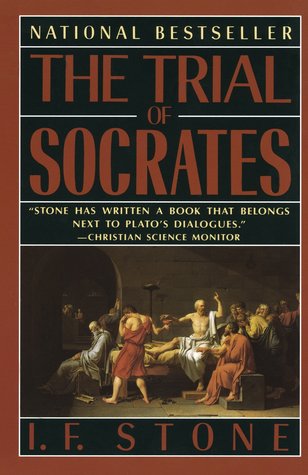
Review: The Trial of Socrates, I.F. Stone ⭐⭐

Christopher Rush

This book was a gnat’s wing away from being a good book, but Stone spoiled it for me with his pseudo-academical language and absence of an ending.  I applaud I.F. Stone’s ability and desire to learn Greek in his late 70s: that gives me great hope for my own linguistic aspirations … though I suspect Stone was able to do so because he spent the first 70-some years of his life working hard, making money, and making friends, all of which (mostly the first) allowed him to spend his twilight years learning Greek and writing this book.  Notice, however, this is not Irving Stone.  This is a different Stone — a journalist who wanted to learn Greek and know more about the trial of Socrates.  As admirable as that sounds, Stone comes off rather highhanded throughout, and from the beginning the ubiquity of words such as “Xenophontic” dispels any enthusiasm the reader had for the material.  Structurally, it is rather confusing, since several chapters do not really discuss what the title of the chapter is about until after that chapter is over and the reader has begun the next chapter.  Much of part 1 gives the reader the impression you are reading the same basic idea simply in different guises — but that could also be the frequency of “Platonic” and “Xenophontic.”  Stone has all the suavity and facility of a sophomore Classics major who, having read at least three semi-definitive works on Ancient Greece feels confident to name-drop the authorities and translators, as if his personal (admittedly limited) experiences give him permission to define and represent the entire field.  Stone says in the prefatory material of the book Socrates’ death was unjustified, but then Stone spends over a dozen chapters on why Socrates was an undemocratic, elitist snob who only ridiculed people and never defined the terms he supposedly wanted to define, yet the Athenians did the wrong thing (mainly because “he’s Socrates”).

By the last few chapters (including the discursive epilogue), the reader gathers the impression Stone would rather tell us things he has read about in the classical world than give any meaningful summation of his investigation into Socrates’ trial — again with all the authority of someone who, having last night watched Enter the Dragon for the first time, is suddenly an expert on Bruce Lee.  This book could have been so much better.  The reader will certainly learn a few things about the subject, but Stone’s language and style will not make the journey all that enjoyable.  You will be better off reading the works (even in translation) for yourself.

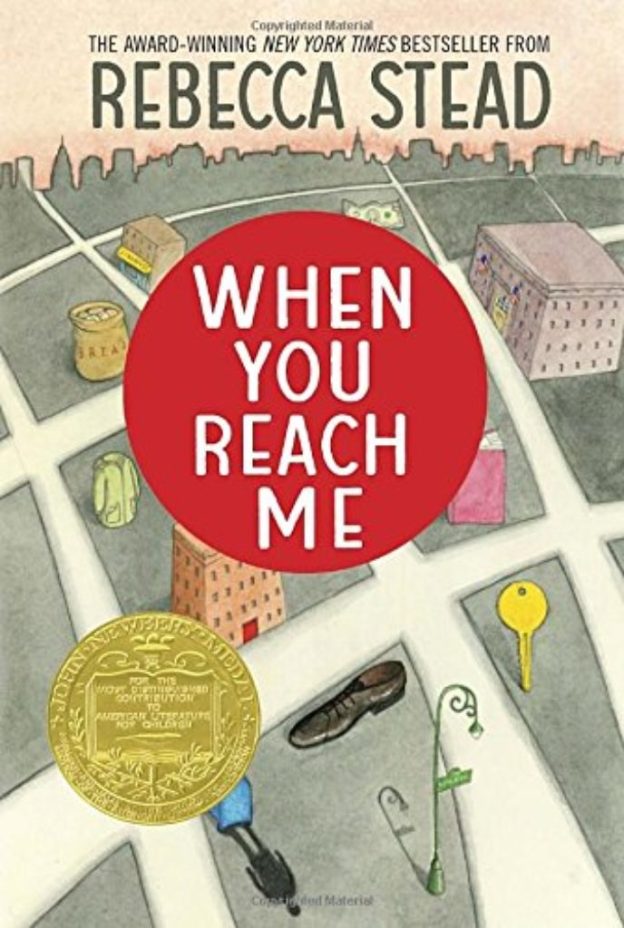
Review: When You Reach Me, Rebecca Stead ⭐⭐⭐

Christopher Rush

A 2.5-star book rounded up.  It’s not that great of a book, if I may speak openly, primarily in the tone and style and (for me) feel of the reading experience.  Admittedly, “feel” is highly subjective, but as I read the book I have the experience to discuss it.  I don’t doubt Author Stead grew up in the ’70s, nor do I doubt she grew up loving the works of Madeleine L’Engle.  Yet, this work feels like someone writing in the 2010s as if it were the 1970s — and it doesn’t work, no more so than any movie in the 2000s that tried to recreate an ’80s feel of a movie.  Similarly, the 1st-person narratorship falls flat and irritates; this does not sound like it is narrated by a teenage girl (or however old Miranda is as a supposed 6th grader), just like one of the main failings of the supposedly-great-but-really-overrated Catcher in the Rye.  I don’t doubt 6th graders 35 years ago were more intelligent, and I’m pretty sure I was more intelligent as a 6th grader than most 6th graders today, but the work comes off like it is trying too hard and instead drizzles with all the authenticity of Pat Boone covering AC/DC.  Or each and every single reboot of ’70s and ’80s pop culture done today (though Stead’s work is better than these horrible movie deconstructions, since Stead maintains a love for L’Engle not an outright rejection of her).

If, as Stead claims, A Wrinkle in Time is not supposed to dominate the story, that, too, is a failure.  The book is dominantly a love letter from Rebecca Stead to Madeleine L’Engle … and it would be fine if that was the intention: we certainly need more outright homages to important/quality works and authors of the past … but pretending it isn’t rings hollow and adds to the disappointing tenor of the work.  I admit freely I haven’t read A Wrinkle in Time, nor do I apologize or feel like I somehow missed out on something important in my childhood.  I was reading other important authors and having other important experiences, literary and otherwise.  Would having read A Wrinkle in Time make reading When You Reach Me a more enjoyable experience?  Perhaps, but it may also have made it more irritating.  I suppose if I read a book written today about how The Westing Game dominated someone’s life and thought and was about some mystery with undertones of Westing Game-likeness, I could potentially be enthused, but I suspect I would more likely be disappointed, with reactions such as “it’s not like that!” or “that wasn’t the most important part!” dominating my experience.  It’s a dangerous endeavor to share one’s childhood happinesses with others, especially later in life.  I suppose I should applaud Stead’s willingness to do it, but since so many clearly already do and have (especially the Newberry people, who bizarrely claimed this is “wholly original,” despite it being so dominated by A Wrinkle in Time — though I suppose it is too much to ask that today’s Newberry committee have ever read L’Engle either), I will just let the accolades come from others.

It does have some mildly clever things about it, yes.  The basic ideas are done well, and clearly Stead worked hard at making it a unified work with the foreshadowings and consistencies and little details here and there that probably wowed the people that really like this book.  Does anyone else feel sorry for Annemarie?  She really seems to get left out, both in the present and the distant dome-future.  The treatment of the supporting characters is a major factor in my disappointment with the book.  They come and go only to serve whatever temporary purposes Stead has in driving the main ideas in the book, though beyond time travel and I Love L’Engle, we aren’t really sure what the main ideas are, other than we applaud the commitment of that certain character to dedicate his life to right that wrong at such a high price (is that vague enough not to spoil anything for those who haven’t read it?).  That realization Miranda has is probably what pleases most audience members, and that was certainly a high mark of the book, but for me the casual dismissal of the supporting characters and supporting stories frustrates and disappoints — that and the pretentious (perhaps too harsh a term) chapter titles and teeny chapter lengths.

I would like to give this a higher mark, and perhaps if I read it again I could appreciate it more, and perhaps if I read more (any) L’Engle I would love it more. I’m willing to do that … just not right now.  Maybe some day.

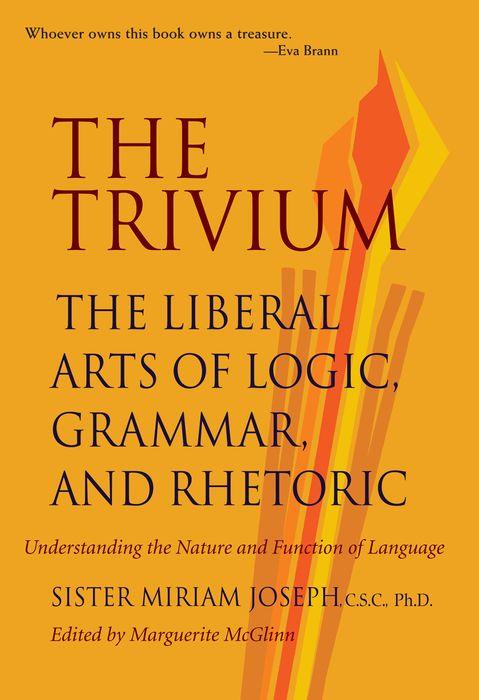
Review: The Trivium: The Liberal Arts of Logic, Grammar, and Rhetoric — Understanding the Nature and Function of Language, Sister Miriam Joseph, C.S.C. ⭐⭐⭐⭐

Christopher Rush

Readers may at first suspect of the three titles this book contains, it has almost nothing to do with the first (The Trivium), a scant bit to do with the second (The Liberal Arts of Logic, Grammar, and Rhetoric), and spends almost all of its time on the third (Understanding the Nature and Function of Language).  If such is the case, we are directed toward two possible conclusions: 1) Sister Joseph didn’t really know much about the Trivium after all; or 2) we didn’t really know much about the Trivium after all.  I shall lean toward option #2.  The Trivium really is about language — its nature, function, and connection to thought, worship, and reality.  Strangely enough, I’ve never read that in any other book purporting to be about the Trivium — have any of the modern reshapers of “classical education” read this book?  Many will no doubt find this book tedious because of its lengthy treatment of language.  Many will wonder “what about the subjects of the Trivium? where is her talk on what science classes we should have, what Bible curriculum, what novels to read, whether we should incorporate tablets into our education?” and thus prove they have wholly missed the point of the Trivium.  It is related to the Humanities, indeed, but it is not the Humanities.  The “Liberal Arts” of the Trivium are related to the other Liberal Arts, indeed, but they are not identical.

Who should read this book?  Anyone claiming to be involved in “classical education” or anyone who wants an education.  If you find it boring, guess what that tells us about you (your vocabulary, and your comprehension of reality).  Remember: “slow, difficult, yet important” books are not tantamount to “boring.”

I give this four out of five stars not for Sister Joseph’s work (though her diction is at times cumbersome, even for the time when she wrote it, and her insistence the first premise of a syllogism is the “minor premise” is perplexing) but for the editorial work and oftentimes tendentious footnotes by the editorial team involved in revamping this work.  If ever a work needed a glossary, this is it — but, sadly, no glossary is contained within.  It has an index, though that isn’t quite as helpful as it was likely intended to be.  Thus the presentation of the material sometimes detracts, yet the reader should persevere and read this wholly necessary work again and again — especially if one is paid to be involved with “classical education.”  (If such a one reads this work attentively, such a one will find out the “tools of learning” are, in fact, reading, writing, thinking, and speaking … who knew? … certainly not anyone whose sole knowledge of “classical education” comes from reading books by, well, no need to mention names at this point — but you know who they are.)

Review: Marvel Masterworks: X-Men Volume 7, Gerry Conway, et al. ⭐⭐⭐

Christopher Rush

I understand this comes at a very strange time in Marvel history, when the X-Men are moribund and not the powerhouse of today, and while the focus on Hank McCoy in his own title is wholly deserved, the creative team does no justice to his character or his story.  I grew up with Hank McCoy already in his furry form, so I was originally surprised when I learned he wasn’t always like that.  Now that I have finally read through the issues up to this point, I was disappointed in the actual transformation.  I know the Marvel Universe has a number of similarly-transformed characters (The Thing, especially), who no longer look the way they used to, and though the premise of McCoy transforming himself into a furry beast because of his research and whatnot is plausible, it just felt off.  Conway does a fine job with the transformation issue, and the pain of McCoy’s new life is depicted quite well throughout the issue with the off-putting atmosphere from the beginning until the end, so perhaps it is mostly the sadness for Hank that irritates.  Plus, if he is as smart as he supposedly is, surely he would have developed a counteragent before trying some magically-timed Cinderella-like potion on himself.

Steve Englehart truly does the greatest disservice to Hank through this series.  It’s bad enough the storyline is cancelled without any meaningful resolution (likely not Englehart’s fault, admittedly), but the characterization is rather wretched.  At first, we are willing to follow Englehart’s revision of Hank’s character, as his vocabulary and demeanor embrace the bestial identity of the new Hank McCoy … but a few issues later Hank has resumed his humanity and diction.  This is certainly a positive mark, in one sense, but the immediate abandonment of the character direction replaced with the early ’60s flippancy and dialogue in the dark days of the X-Men are grating, at best.  One gets the suspicion Englehart was itching to revisit the pirate ship episode if the series lasted any longer.  At least he doesn’t end every sentence with an exclamation mark, though he does feel the need to bring back old characters/villains just long enough to have them commit suicide by the end of each issue.  The other issues featuring Iceman, Polaris, and Havok are equally steps in the wrong direction, though on the whole we are willing to forgive the egregious disrespect the creative staffs display for their subjects, since we are just glad to spend some time with these characters again.

This collection definitely gets worse at it goes along, which is probably why the series was cancelled so soon, but it does have many fine moments and is rife with great possibilities … which never seemed to materialize, sadly.  What happens next to Hank and Linda and the Brand Corporation?  I wish I knew.  This collection does not tell us.  It’s worth reading, certainly, especially to fill in the missing gaps between the first demise of the X-Men and Giant-size X-Men #1, but it will not answer all your questions.

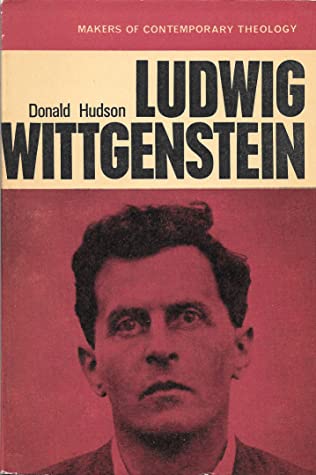
Review: Ludwig Wittgenstein: The Bearing of His Philosophy upon Religious Belief, Donald Hudson ⭐⭐⭐

Christopher Rush

As intriguing and potentially helpful as this booklet it, I’m not sure it really fulfills the promise of the subtitle.  Wittgenstein has no intention of connecting his philosophical output to religious thinking, though he seems fairly accepting of people who have it (which is awfully decent of him).  Wittgenstein is certainly a tricky fellow to grasp, especially since he spent the latter half of his output refuting the first half of his output.  Hudson provides a fairly helpful overview of major ideas, but a good deal of the end is spent somewhat hastily attempting to establish Wittgenstein as a “maker of modern theology,” since that is the series in which this booklet appears.  Hudson does present some ideas worth pondering, but their connection to Wittgenstein’s philosophy appear tenuous to me — though I am rather a tyro in the realm of Wittgenstein.  Hudson’s book could potentially serve the same function as a prose summary before a canto in the Inferno or book of Paradise Lost: read it first, get a grasp of the basic idea, read the chapter, then go back and read the summary to cement within yourself what it is you just read.  Similarly, Hudson could be read before one ventures into Wittgenstein’s work, then read the Tractatus and Philosophical Investigations, then read Hudson again.  Perhaps other introductions to Wittgenstein may be more helpful, but Hudson’s commitment to framing Wittgenstein within a religious/theological realm (even if it is against W’s wishes) is intriguing enough to engage in as a reader.  Track this installment (and the rest of the series) down and give it a try.

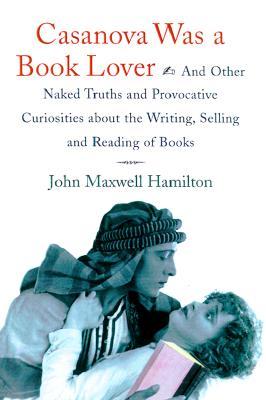
Review: Casanova Was a Book Lover: And Other Naked Truths and Provocative Curiosities About the Writing, Selling, and Reading of Books, John Hamilton ⭐

Christopher Rush

“N-a-k-e-d” is a strange way of spelling “boring.”  This book is really not interesting or provocative.  Hamilton spends a bizarre amount of time praising the Marquis de Sade as some sort of exemplar of humanity-literary behavior, followed by a preponderance of vitriol against religion and American presidents.  The attentive reader will also need a new hypocrisy meter after reading this, since it will overload and break somewhere around chapter 3.  Hamilton lambastes authors who use assisting teams, ghostwriters, and amanueses … all the while telling us how his graduate assistants (the goofy way college professors have of spelling “indentured servants”) gathered much (if not most) of the information retold within these pages while he was busy doing not his own research.  Hamilton lambastes boring and meaningless dedications in books … apparently forgetting the fact he has one in his own book.  In chapter seven, Hamilton feigns he is going to finally reveal the “most stolen books,” then backpedals with an excuse to the effect of “librarians don’t like to talk about it,” and finally pretends to give us a list of the most stolen books — but really are just representatives of types of books that probably get stolen a lot.  This book promises so much, yet despite an intriguing story-filled opening chapter, delivers mostly sub-interesting minutiae, vitriolic caterwauling, and a fecundity of dullness that even Thomas Shadwell might find lame.  Hamilton spends a chapter decrying the absence of negative reviews of books: here you go, sir.

Review: Education at the Crossroads, Jacques Maritain ⭐⭐⭐⭐⭐

Christopher Rush

This is a great book, though its beneficial audience is limited to educators, students, people who haven’t been educated, people who are being educated, people who should be educated, and people who need to be educated.  Thus, the audience is, well, everyone.  It’s one of those indispensable books, whose declarations about the sorry state of education and the ideal ways to ameliorate most problems are made even more frightening and sorrow-filling when the reader notices the book was written in 1943.  Education at the Crossroads is even more necessary than it was 70 years ago — something that can’t be said about too many education books.  It is dated only in fleeting moments, which adds to the tragedy of the intervening years: why didn’t anyone listen to him?

I wish I read this book 10 years ago, but there’s also the possibility I might not have been “ready” for it then, so better late than never, I suppose.  Maritain is correct about many things: the purpose of education, what schooling/education are not, the importance of understanding God and humanity for any education to work, and a slew of other things too numerous and adroitly explained by him that any brief treatment here will only perform injustice on the work and the author.  Not everyone will approve of his suggested curriculum and proposed age/school year alignment — in fact, most contemporary educationalists (the ones who get paid to make decisions and, like the characters in Peter Jackson’s version of The Two Towers, make only wrong decisions) will decry and rail and lament and ridicule (if they are willing to read a book that isn’t in e-format and doesn’t appear on any Common Core tests).  That’s one sure-fire way of knowing this is a book to read and incorporate into one’s soul.  It is not perfect, but it will help you understand reality better.

Two Odes Analyzed

Garrett Fields and Michaela Seaton Romero

“Ode to the West Wind” Analysis

Garrett Fields

The poem written by Percy Shelley, “Ode to the West Wind,” personifies the winds in the west.  It is seen as a powerful force that destroys but also preserves.  It kills the decaying and weak to make a path for the new.  It destroys the old and provides a new environment for the new.

In the first stanza, Shelley says the West Wind is “wild.”  It blows away the leaves that have died and started to rot.  It makes way for the springtime after the rough winter.  The wind takes the seeds off the trees and bushes and buries them in the soil so they can spring up into new life a few months later.  The seeds bloom into new life during the spring.  It destroys the old and starts a new fresh beginning in the spring.  This is why the west wind is described as both a destroyer then a creator, or a preserver.

In the next stanza, Shelley talks about the sky.  He talks about the effect of the winds on the clouds.  The winds break the clouds apart almost like the decaying leaves of a tree.  The clouds become rainclouds and look ominous over the earth.  The clouds are compared to the outspread hair covering the sky from the horizon to its zenith.  The craziness of the sky is compared to Maenad, worshipper of the Greek god of wine.  Shelley uses this comparison because Maenad worships the god in a sort of wild and crazy way, lifting her hair like tangled clouds.  These indicate an approaching storm.

The West Wind then becomes a funeral song.  It is being sung because the year is dying.  The dark night sky becomes a grave or a tomb where the clouds mold the tomb.  They will soon pour down rain.

In the third stanza, the West Wind blows across the Mediterranean Sea.  He describes it as a vast sleepy snake, which dreams of old civilizations rich in flowers and vegetation.  In the sea’s sleep, it sees “old palaces and towers,” which quiver when the wind blows.  The West Wind also affects the Atlantic Ocean.  The plants under the surface tremble at the sounds of the strong breezes.  They fear the power of the West Wind.

In stanza four, the West Wind becomes a more personal force.  Shelley said if he were one of the leaves, or the clouds or waves, he would be able to feel the power of the West Wind.  He said during his childhood he had the power and speed of the West Wind.  Shelley said he no longer has the strength and speed like he did in his childhood.  The burdens of life have dragged them down.  He is facing problems in his life, which have drained his strength.  He now looks to the West Wind for help.

In the last stanza, Shelley offers himself to the West Wind in the same way as the leaves, clouds, and waves do.  He wants the wind to be a musician, and he should be used as a lyre for this purpose.  The music could be gloomy but a sweet sound.  Then he compares himself to a burning fire with sparks and ashes.  He requests the West Wind blows his sparks and ashes among mankind.

Shelley ends his poem with the hope the West Wind will take his words across the world.  Winter is a symbol of death and decay, but spring brings new life and hope.  He portrays this poem as saying if there is despair and pain now, then hope and optimism are just around the corner.  If winter is here, spring isn’t far behind.

“Ode on a Grecian Urn” Analysis

Michaela Seaton

“Ode on a Grecian Urn” is a great example of Romantic poems.  It is a highly emotional poem addressing things not present.  Written by John Keats, “Ode on a Grecian Urn” utilizes moving language, sensations, and images to get its point across.  The main theme is constancy or eternity, the innocence that comes with not changing.

In the first line of the first stanza, he says “Thou still unravish’d bride of quietness” which literally means pure bride of quietness.  It isn’t actually talking about the marital vows of an urn, it is talking about how the urn is silent; she’s not an “adulterer” to quietness, literally meaning the urn was adopted by silence and slow time.  She keeps all her secrets, while still showing the story upon her.  The second line is similar in its message: “Thou foster child of silence and slow time.” Once again, Keats uses imagery to show how he sees the urn, as a perfect representation of stagnant time.

The next two lines, “Sylvan historian, who canst thus express/A flowery tale more sweetly than our rhyme:,” talk about the urn’s job as a historian.  Keats compares her job to his job as a poet.  She uses pictures to tell her tale, while he uses words and rhymes.  In his opinion, her way of telling the story is superior.

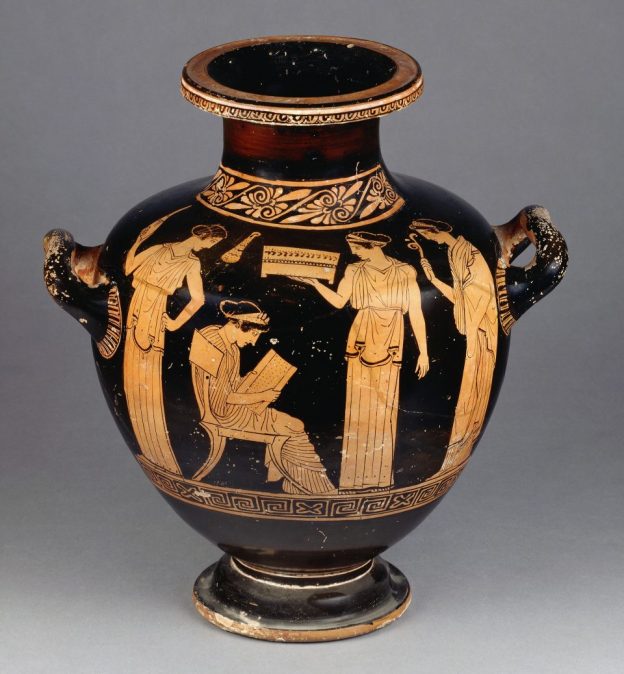
The next three lines are the first close look at the urn: “What leaf-fring’d legend haunts about thy shape / Of deities or mortals, or of both,? In Tempe or the dales of Arcady?”  This is talking about the actual artistic qualities of the urn.  Apparently, it is ringed with leaves, perhaps contains shapes of gods and men frolicking about in different areas of nature and life.

“What men or gods are these? What maidens loth? / What mad pursuit? What struggle to escape? / What pipes and timbrels? What wild ecstasy?”  These next three lines pose questions about the urn, asking what it is revealing about history, what stories is it telling.  Keats is telling the readers what is coming up.

Then comes the next stanza.  In the first two lines Keats says “Heard melodies are sweet, but those unheard / Are sweeter; therefore, ye soft pipes, play on;” In this stanza, it appears he has turned the urn so one of the scenes is showing, a scene with flutes.  When he says the unheard melodies are sweeter than the heard, he is probably talking about how with the scene pictured on the urn, the music and fun you imagine is happening is perfect, while in real life often expectations are not reality.  Those people on the urn are actually living, in his mind, but simply frozen in time.

Lines 3-4 say “Not to the sensual ear, but, more endear’d / Pipe to the spirit ditties of no tone.”  In these lines, Keats is ordering the pipes to play to his imagination, which ties in with the previous lines.  In his imagination, any scenario he creates will be perfect in his mind.  The melodies have no tunes in the real world, but in the imaginary world they are the perfect notes.

The next two lines say “Fair youth, beneath the trees, thou canst not leave / Thy song, nor ever can those trees be bare;”  In this, the youth is in an eternal spring beneath a tree that will never lose its leaves.  He is stuck in the same position, playing the same song but never being able to change.  For Keats, however, this is preferable.  The youth never has to experience the pain of passing time.

The next four lines say “Bold lover, never, never canst thou kiss / Though winning near the goal yet, do not grieve / She cannot fade, though thou hast not thy bliss / For ever wilt thou love, and she be fair!”  This scene seems to be referencing a young man chasing a maiden.  This is probably what Keats was talking about earlier, with “mad pursuit.”  In this scene, the man is ever chasing the maiden, but Keats tells him not to despair.  Keats knows because they are frozen in time on the urn, he will never stop chasing the girl, and the girl will never lose her beauty.  It’s much different in the world where time marches on.

The third stanza begins with “Ah, happy, happy boughs! That cannot shed / Your leaves, nor ever bid the spring adieu.”  Again, there is an almost Norman Rockwell feeling to the urn; it’s like what an ancient Greek version would look like.  The tree is stuck in perpetual spring.  Never will it lose its leaves.  Keats obviously thinks this is a good state to be in, never will the tree have to suffer through a winter.

“And, happy melodist, unwearied / For ever piping songs for ever new / More happy love! More happy, happy Love!” are the next three lines.  Once again, Keats is showing how happy he considers the scenes on the urn to be.  This melodist is playing a song that will never go out of style, with a pipe that will never break.  He is, and always will be, happy.  Keats envies him, and he calls for more happy love songs; he wants to feel what he imagines it would be like, a perfect happiness that never ends because time cannot touch it.

The next two lines state “For ever warm and still to be enjoy’d / For ever panting, and for ever young”.  This line seems to be talking about the birds and the bees.  Joy that man and woman can experience on the urn for ever and ever and never tires.  The next three lines also talk about this passion, but in the real world.  They say “All breathing human passion far above / That leaves a heart high sorrowful and cloy’d / A burning forehead, and a parching tongue.”  In this one, Keats seems to be saying the people in the world “above,” those who are looking down on this urn, they, too, experience passion, but it ends.  Once the deed is done, it is over, and on comes the regret.  A fever, a dry mouth, a muddled brain are left behind, a stark contrast to the moment of happiness.  To Keats, the people on the urn, the men or gods chasing the maidens, are still in the moment of happiness.  They aren’t regretting any decisions right now, and they never will because for them time does not exist.

This is where stanza four begins with the line “Who are these coming to the sacrifice?”  Keats has turned his attention off the scene of the lovers and onto one where a sacrifice is about to take place.  He wonders who is coming to watch it happen.  Lines 2-4 give a better picture of what is happening.  “To what green altar, O mysterious priest / Lead’st thou that heifer lowing at the skies / And all her silken flanks with garlands drest?”  He asks the priest where he is taking the bellowing cow, but the priest will never reach the green altar because they are all frozen in time.  The heifer is outfitted with flowers, so she is probably destined for the gods as a holy sacrifice.

The next three lines say “What little town by the river or sea shore / Or mountain built with peaceful citadel / Is emptied of this folk, this pious morn?”  The priest and cow have a following, a crowd coming with them to the altar.  Keats imagines what their little village would look like, desolate with all its people gone to worship their gods.  However, the town could be by a river, or a sea shore, or on a mountain; so the town is not pictured on the urn since we do not know what it looks like.

The last three lines state “And, little town, thy streets for evermore / Will silent be; and not a soul to tell / Why thou art desolate, can e’er return.”  In these, he address the sad state the town is left in for eternity.  It will be forever empty, its people will never return.  Although most of his words have been happy, yearning for a stop in time, these seem sad.  He feels sorry for the village, whose people are gone and never coming back.

In the fifth stanza, he begins with “O Attic shape! Fair attitude! with brede / Of marble men and maidens overwrought / With forest branches and the trodden weed.”  In these, he both praises and dismisses it. At first, he marvels at its shape and fairness.  But then he seems to think it too ornate, too fancy.  There are too many branches, the details are too well done, like it looks alive.  It almost sounds as if Keats is jealous of it, because the pictures it displays show what he cannot have: eternal happiness.

“Thou, silent form, dost tease us out of thought / As doth eternity: Cold Pastoral!” say the next two lines.  He seems to be accusing the urn of teasing him into thoughts about eternity, like one would tease a knot out of a ball of string.  Keats does not like what he is thinking about eternity.  The eternity shown on the urn is not the eternity that we live in.  There, there is constant happiness and joy, while we must suffer here.

The next three lines state “When old age shall this generation waste / Thou shalt remain, in midst of other woe / Than ours, a friend to man, to whom thou say’st”.  Keats imagines even after everyone in his generation has died, this urn will still be around.  The problems of the current generation will be no more, but the new generation will have different ones.  Even still, the urn will stay the same.  In fact, it gives the same advice to every generation.

The advice is in the last two lines of the poem, which say “Beauty is truth, truth beauty, — that is all / Ye know on earth, and all ye need to know.” He is not saying simple truth and beauty are the same.  He is saying beauty, what is the meaning to our lives, is the same as truth, which is the meaning for our being here.  These thoughts can be had while looking at the urn, thoughts of life, regrets, and eternity.  No matter what generation looks upon it, they are all going to see that, feel what Keats felt.  To him, you don’t need to know the truth of the history books, or the celebrities, or the medical magazines, you simply don’t need the truths that are passed down from generation to generation.

I enjoyed “Ode on a Grecian Urn.”  Although I certainly did not agree with its suggestion that we throw out the truths of the past, I do understand his longing to live in a moment in time that is always happy. Those happy people on the urn represent what I’ll never have until Heaven: eternal bliss.  But at least I am assured in my eternity; Keats is not so lucky.

Ode on a Grecian Urn” addresses much deeper issues than can be seen on first glance.  Questioning truth, examining eternity, and wondering about beauty are often not seen in poets of today.  Keats throws out what had been taught in previous generations and focuses on the one thing he believes to be constant: beauty.

Poverty of Charles Dickens in Great Expectations

Michaela Seaton Romero

Charles Dickens was an influential writer whose work was heavily influenced by the poverty he experienced and witnessed.  Great Expectations emphasizes this theme of poverty.  In many ways, the main character mirrors Dickens himself and his own struggle with poverty.

An orphan, the main character Pip lives with his abusive sister and her husband, the village blacksmith.  Over the course of the book Pip runs across escaped convicts, jilted old ladies, and cold-hearted beautiful women.  He goes from his marshy village of Kent to bustling London.  He goes from one of the poorest of the poor to rich and must acclimate to that society.

Dickens is similar to Pip in many ways.  Although he lived with his mother and father during his childhood, he spent part of his childhood in Kent, just like Pip.  They also lived in during the same time period, when the Industrial Revolution was taking place and there was great social upheaval.  He also moved to London, just like Pip, although he moved there earlier than Pip does in Great Expectations.  Likely he met many different type of folks in London that gave rise to characters like Joe and Estella.

Dickens, unlike many other famous people, found relative success during his lifetime, and he had to adjust to society as a person with money.  Pip also had to adjust to gentleman society, and there were strict rules to follow.  Climbing the social ladder required learning a whole new set of skills and expectations as Pip soon realizes as he studies to be a gentleman.  Dickens also would have experienced the disparity between the desperately poor and those who were well off, or at least moderately so.

Pip studies to be a blacksmith under Joe, but he feels himself too good for this after getting a taste of the genteel life with Estella and Miss Havisham.  Dickens also worked a job he did not feel put all his skills to use, at a blacking warehouse when his father was in debtor’s prison.  Eventually he is able to gain more education and raise his status and wealth, just like Pip does.

The entirety of the book is centered on social status and wealth, or lack of it.  Pip’s purpose in life is to gain recognition and marry a woman of higher status.  He doesn’t just care about money, he cares about where the money came from.  When he finds out his fortune is due to a convict he helped once, he is disgusted.

Dickens’s status also rose, and he was able to chronicle the trials and problems he experienced in the character of Pip.  Even though he became famous, Dickens’s poverty had a tremendous impact on his life, and this can be seen in Great Expectations.  Pip desires social improvement, but when he finally attains it, he finds himself still feeling empty; there are still the basic immorals and depravity he saw as a blacksmith’s apprentice.  Dickens is trying to say no matter how much money you have, it is moral improvement that makes a difference, not money.


Bibliography

Zhou, Linda. “About the Author: Charles Dickens.” Great Expectations. Web. 4 Mar. 2015. <http://greatexpectationsnovel.weebly.com/about-the-author.html&gt;.

The Fall and Rise of Great Detectives

Christopher Rush

Two of the greatest literary detectives are assuredly Rex Stout’s Nero Wolfe and Bob Kane’s Batman (or, Bruce Wayne, when hosting in his stately manor).  Both have very little in common beyond their basic commitment to right wrongs and bring perpetrators to justice, considering Wolfe will usually only bring justice when he is paid for it and rarely leaves his home and Batman prefers anonymity and patrolling the streets practically constantly.  Both do have a certain moral malleability, even with Batman’s commitment never to kill (something we are occasionally led to believe Wolfe has done in his youth, if for a certain kind of justice), but we are never far from the firm conviction these great detectives are valuable assets to the fight against crime — certainly never for very long, at least.  One significant thing they do have in common, as with most great literary detectives and epic heroes of other ilks, is their catabasis and anabasis, requisitely occurring because of their nemeses.  Of course, Batman has more arch-nemeses than the shore has sand, but no one has taken him to his nadir as one behemoth of a villain: Bane.  Nero Wolfe, having managed to offend and upset everyone from Serbian diplomats to the head of the Central Intelligence Agency, likewise, has no dearth of enemies—but no one has so altered and affected his life like the scourge of the underworld: Arnold Zeck.  Within recent memory, I have read the three collections of Batman’s epic encounter with Bane and its aftermath and the three novels detailing Wolfe’s brief but cataclysmic history with Zeck.  In an effort not to spoil too much of the mystery, action, adventure, plot, and (most important of all) great character moments, I include hear my brief reviews after I read them.  I refrained from spoiling too much in hopes you will pick them up and read them for yourself, if for nothing else than to have some great reading experiences.  We begin with the three Nero Wolfe adventures written by Rex Stout and conclude with the three recent-ish TPB collections of Batman’s fall and rise in the mighty Knightfall Saga, mostly written by Chuck Dixon.

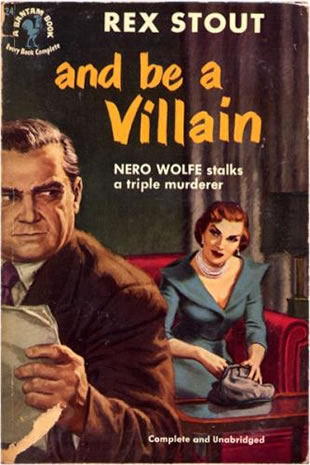
And Be a Villain ⭐⭐⭐

If I call this “another satisfactory addition” to the Nero Wolfe canon, you should realize that is no slight against this book.  It would be impractical to require each Wolfe novel to be an innovative, life-altering humdinger.  This is another enjoyable Wolfe story, which dallies with tedium at times but refrains from indulging too much (even more successfully than Too Many Women) and provides nice moments both of tension and humor.  We are treated to a surprising rare scene in this story: Wolfe gives Cramer all he knows before the murder is solved and asks him to effectively take over.  While this is a genuine offer, Wolfe returns to form by the end, effectively blackmailing the police to get what he wants (though, nicely, not at Cramer’s personal expense).  The mystery itself is a nicely complex puzzle: not only is it a “whodunnit,” but also it develops into a “was that the right victim?” investigation.  Most Wolfe fans probably remember it for the first Arnold Zeck story, who will apparently become Wolfe’s arch-nemesis, but I don’t know much about that at this point.  It does add a sense of tension to the story that feels a little off, like Psych’s Yin-Yang series (despite being a series about murder/mayhem, it’s usually much lighter than having an “arch-nemesis”) — but still, it adds some spice and freshness, even if it’s not something fans really clamored for.  And Be a Villain isn’t a knockout, but it has some engaging twists and turns and those moments we enjoy.

The Second Confession ⭐⭐⭐⭐

Though all Wolfe stories are different to some degree, this was clearly the most distinct in the canon thus far: Wolfe not only leaves his house (which he has done in other stories, to be sure), but his house is attacked by the mysterious person quickly becoming an arch-nemesis to Wolfe.  The pacing is much more rapid than most Wolfe books: we have a sense of urgency from the beginning that drives through the first half of the novel.  Even when the pace slows down around the ¾ mark, we still feel along with Wolfe and Archie things are not as “back to normal” as they may superficially appear.  Thus, for once, the slowing down section just before the rapid tortuous conclusion is a welcome relief.  Another unusual stylistic flavor in this entry is the almost episodic feel to the early chapters.  It is almost as if the chapters were serial entries in a magazine, or the classic serialized shorts from Columbia Pictures, each ending with a shocking, unexpected twist.  It almost “feels” like it is not Stout writing these chapters, but we are confident and assured this plot is in the hands of the master.  There is not as much humor in this one as many of the others lately have had, but there is a far more convincing romance between Archie and the female “lead” than in, say, “Before I Die.”  The lack of humor is not a problem, though, since the fast pace, the political undercurrent (which does not stay “under” for long), and the palpable tension distract us enough to make this atypical Wolfe adventure one of the best yet.

In the Best Families ⭐⭐⭐

I strongly suspect this is a unique book in the Wolfe series for many reasons, many of which will not be mentioned to avoid too much plot spoiling.  As one of those “wholly different” episodes, like the brownies episode of Barney Miller or “Dreams” in M*A*S*H, the feel is totally different and thus “off” for most of the book.  It starts off fairly typically, but it’s not long before the drastic changes happen quickly and in full force: Wolfe disappears, the orchids go to Hewitt, Fritz goes to Rusterman’s, and Archie gets his own office.  I certainly do not begrudge Rex Stout for doing something different — it is good to break out of a routine once in a while, no matter how salubrious the routine.  I’m glad he did it; I’m glad Wolfe had an arch-enemy after a fashion (most of their “relationship” being phone conversations); I’m glad it ended after three stories — too many more stories would have felt dragged on.  Still, the differences make this work, even in its necessity, less enjoyable than the “usual” stories.  Many no doubt love this even more because of its distinctions, and they are welcome to that affection.

For me, the irritation of this book is Archie’s true feelings about his housemates: once it seems like that 10-year-some phase of his life is over, Archie has mostly negative things to say about Fritz, Theodore, and Wolfe.  Being a romantic, sweet person, I naturally assume Archie and Fritz are friends: apparently they aren’t, even though Fritz cares for him.  It’s almost reminiscent of Huck and Jim’s relationship, with Fritz as the caretaker role more than friend.  Archie comes off as a pretty big jerk in this one, and one almost wants Cramer to actually beat him up when the situation arises.  Stout does a good job of getting us to feel the long passage of time without slowing the story down too much (far better than in Too Many Women), and though the story does drag a bit, it picks up with good alacrity toward the smashing conclusion.  It ends nicely, fittingly, and the suspense is well done.  It likely won’t make you think less of Archie, but be prepared for some harsh honesty from the characters in this one, understandably brought about by the harsh edginess of the situation.

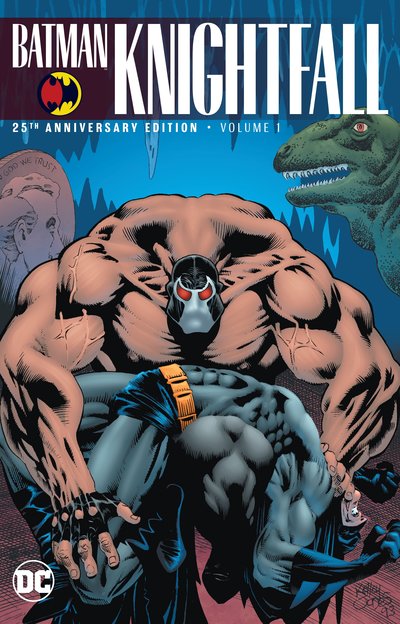
Knightfall, vol. 1 ⭐⭐⭐⭐

Finally, after all this time, it’s come out in a nice TPB, and I have read it.  Without all the preliminary prologue stuff, non-Batman readers might be a bit lost for a time, such as who Jean-Paul is, why Bruce is already beleaguered, when Bane fought Killer Croc, for examples, but it shouldn’t bother people too much.  Bane’s origin is dark, but he doesn’t do much except wait throughout the TPB, other than the entire Arkham thing and breaking Bruce Wayne’s back.  It’s not nearly as boring as that sounds, since he is a fairly intelligent villain, though the addiction to Venom diminishes him somewhat, since it’s not just about his personal strength and intellect.  Anyway, the inevitable backbreaking isn’t the climax of the story, which is more impressive than I thought it might be — the real story is the destruction of Batman, the idea, the symbol.  As Bane says toward the end, J-P as the new Dark Knight (emphasis on the Dark, not the Knight) does more to destroy Batman than he did, since he just broke Bruce Wayne: turning Batman into no better than the evil he conquers, Jean-Paul becomes perhaps a worse nemesis for Bruce Wayne than even Bane is, but we’ll see what happens in part two.  The pacing is an odd thing for a 19+ part series, depending on whether you add the non-numbered parts of the story: sometimes issues take place immediately after each other, sometimes days pass, but all of it is fairly rapid in the beginning, following Batman and Robin’s attempts to recapture the inmates from Arkham, though Batman doesn’t treat Robin all that well whether he is Bruce or Jean-Paul.  Even so, one doesn’t need to pay too much attention to the time factors, since the breakdown of Bruce Wayne is the central idea of volume one, and the creative teams do a fairly fine job with it.  The clash of ideas (the nature of good, for example) are highlighted at times, though they take a backseat to the action more often than not, but it’s still a good read that holds up after all these years.

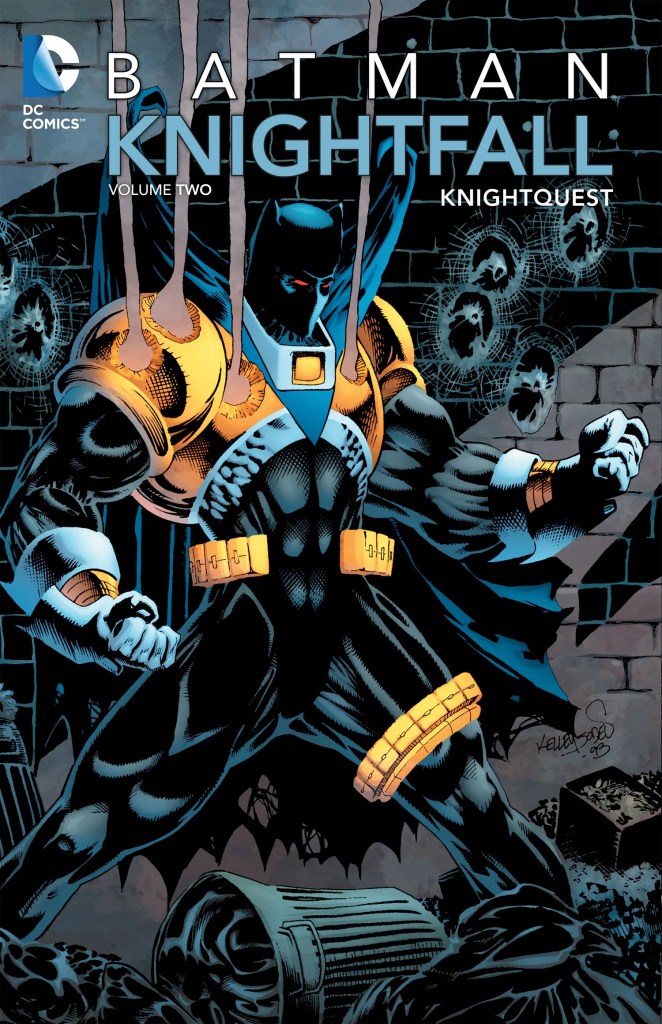
Knightfall, vol. 2: KnightQuest ⭐⭐⭐

This middle volume is a little bit of a letdown, though that isn’t too surprising, considering where it falls in the spectrum of the whole major arc.  The good news of this volume is it collects for the first time a lot of the issues involved in this period.  Fans of The Search may be disappointed, since it does not have any of those issues (and probably should), but by this point no one should be surprised this collection is missing them, and those who are interested in this storyline will find enough to be interested anyway.  Fans of the real Batman may not need this collection, though Azrael/Jean-Paul Valley fans will certainly be glad this collection exists, even if the stories aren’t all that meaningful for most of the collection.  It does have some highlights here and there, but it does take a fairly long time to build up any steam or interest, especially to the casual Batfan.  The only really interesting thing going on for most of the collection is J-P’s internal conflict: is he an Angel of Death, a heartless assassin like his father wanted him to be; or is he an Shadow Instrument of Good, a noble defender of the poor who has to take the grime of corruption upon himself?  This culminates in one of the darker issues of the collection — some may say “especially for 1993!” but dark is dark, regardless of what year it is published.  The other “highlight” of the collection is Gordon’s increasing despair with the new Batman.  It’s not enjoyable to see him realize he is now all alone, but his character moments are great in its way.  The culminating panel of Gordon destroying the Bat signal should have received a bigger space for such a drastic event.  Completists will most likely want to pursue the diasporic issues (lists of which are available elsewhere), if they don’t already have them, but those who are only interested in the major Knightfall Saga will be more than satisfied by this 20-year reunion collection.  It’s not as good as the first, but it was good to finally read what the KnightQuest was all about.

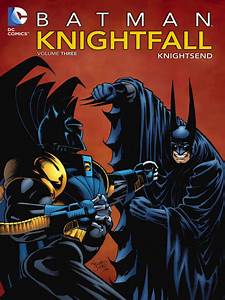
Knightfall Vol. 3: KnightsEnd ⭐⭐⭐⭐

Finally, I have completed this journey started almost 20 years ago.  I know the trades don’t include every single tie-in, and perhaps some day I’ll try to track those down, but I am quite satisfied (for the most part) with the way this story concludes.  The first half of the collection, KnightsEnd (or Knight’s End, perhaps) resolves the issue of Bruce Wayne vs. Jean-Paul Valley in an unexpected yet predictable way, as the basic story does what Keats says true art does: being both surprising and familiar at once, giving us the impression “but of course, it couldn’t have happened any other way,” which is about as close to calling this “literature” as anyone will likely get.  Some may be disappointed the climactic confrontation between Jean-Paul and Bruce does not end in the knock-down, drag-out fight we are expecting, but as Batman has always been about more than just fighting, a detective who thinks things through, performing the impossible with relative ease, the highly-symbolic conclusion is truly moving and fitting.  The only real problem with the end (as with the epilogue Prodigal storyline’s conclusion) is its abruptness.  We could have used another page or two (no need for more), at least of J-P walking away into the fading darkness as Bruce returns back to the dawn.

Similarly with Prodigal, the main point of contention between grown-up Dick Grayson and Bruce Wayne is they never talked it over, never discussed their rift and differences, never discussed Dick’s hurt over being apparently rejected in favor of Jean-Paul as the replacement Batman: here the authors recognize a key aspect of these characters, and instead of giving us a wonderful un-sappy heart-to-heart between these two veterans, we get a few panels of sort-of-obvious semi-platitudes, a different scene, and then a final resolution of implied “well, it’s all okay now.”  Had they given us a genuine dialogue of authentic resolution, this would definitely have been a 5-star review, missing tie-ins and all.  Do these stories have some goofy moments? some confusing references to pieces not missing?  Sure it does.  Most TPBs do.  Is the final page of the TPB an odd way to end a 1,900-some-page odyssey of identity, especially with Batman in shadow?  Indeed.  Could we benefit from learning what Bruce did while he was away, allowing Dick to don the cape and cowl for a time?  Sure.  But that’s not really what this is about.  In one sense, it’s about trust and the “idea” of “Batman.”

The pacing of KnightsEnd is quite impressive, even if the sensations it evokes are compressed as each issue is rapidly accessible in the TPB form instead of waiting a couple of weeks for the next installment.  Bruce Wayne, on his quest to recapture his mantle, goes to the world’s deadliest killer to re-hone his martial skills, getting metaphorically to the edge of killing while he literally gets to the edge of Gotham’s highest point, still unwilling to let go of his failures and fly free again.  The inevitable climax of Robin and Nightwing seeing Bruce “kill” someone (and the proper reveal of the truth) brings Bruce’s personal rehabilitation to a fitting conclusion, enabling his appropriate symbolic conclusion with Jean-Paul later.

Prodigal is a similar kind of story, with a surprising number of “light” moments between Dick and Tim running a mansion without Alfred.  That they are both youngish and enjoy (to an extent) going out and fighting crime brings for a few brief issues a vitality the usually-dark Batman-as-man-on-a-mission feel doesn’t give.  This doesn’t last, of course, as Dick starts to evaluate his life of (from his perspective) mostly failures, culminating in Bruce’s giving the mantle to Jean-Paul instead of him.  As stated above, the absence of a lengthy conversation between the two of them at the end was a real failure on the creative staff, but such is life.  Perhaps the saddest thing of the storyline is just as Dick starts to get the hang of things, just as he starts to find his place, poetically having defeated Two-Face alone, Bruce returns yet again to resume the cowl.  In the missing conversation, we are to assume Dick is mollified by Bruce considering him a son enough to resume his role as Nightwing and truly be content being his own man with his own superhero identity.  Fair enough.

Lastly, a word should be said for poor Commissioner Gordon.  What is he, the whipping boy of the DC Universe?  Can nothing go well for this defender of justice?  Here was another missed opportunity for a great conversation between secret-keeping heroes.  Dick knows Gordon knows he’s a different Batman; he could quite easily have said “I used to be Robin.  You can trust me.”  It’s all about trust, after all — why not bolster Gordon’s trust in him?  Ah, well.

All in all, it’s a satisfying conclusion to a full, good story.  If one is tempted to consider this corny and lacking in enjoyable violence, one should be tempted to step back and reflect about life, morality, and what is important.  The benefits of this experience outweigh the detriments, especially for the cost and convenience of these TPBs.


There you have it.  You can destroy their possessions, you can break them physically, but you cannot keep good detectives down.  It’s comforting to know some heroes will always be there to right wrongs and promote justice (even if doing it for money or while dressed as a bat).  If I haven’t made these stories sound all that appealing, please remember these reviews are intentionally light on the good stuff so as not to spoil your enjoyment of them when you get the chance to read these treasures.  Go out and get a copy of the fall and rise of these great detectives — you’ll be glad you did, especially if it entices you to read even more Nero Wolfe or Batman adventures.