Category Archives: Book Reviews

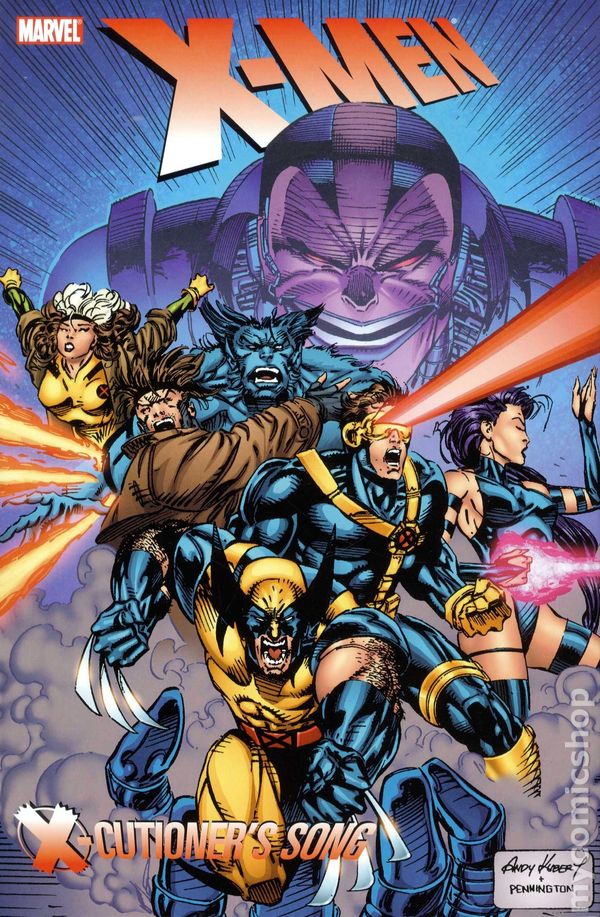
The Song Remains Supreme – A Reflection on X-Cutioner’s Song

Christopher Rush

It Was 1992…

Scott and Jean were not yet married (though she was still alive again).  Cable was still a mysterious figure.  We weren’t sure who Stryfe was.  The newly-launched X-Men and X-Force titles had not-yet participated in a major X-Titles crossover.  The New Mutants had recently become X-Force and were, in effect, part of the problem now.  Bishop had just arrived from the future, and we still didn’t know what he meant to the team.  We had so many questions, but we were certain that the future would be impressive — like the Edwardian Age, optimism abounded.  What came next did not disappoint (not the real fans).

X-Cutioner’s Song is an oft-overlooked great crossover in the history of the Children of the Atom.  Before Onslaught, the House of M, and Grant Morrison came along and changed everything (again and again), the revitalized X-Titles were hitting a new stride, despite the great talents of yesteryear (Chris Claremont, especially) no longer being a part of the process.  A simplicity still existed that seems lost today.  X-Cutioner’s Song, about to turn twenty years old, deserves a second look.  As is our wont, we won’t reveal all the plots, subplots, and exquisite details that abound throughout the series — you should read it for yourself, even if you don’t know the difference between Cyclops and Havok.

Part 1 — Uncanny X-Men 294: “Overture”
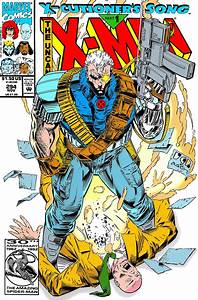
Though this will sound rather hyperbolic, Uncanny X-Men 294 is about as close to perfect as a comic book can get.  The better issues of comics, for me, fall in two categories: monumental (and believable) significant changes and laid-back, “day in the life” episodes — admittedly, two ends of a rather vast spectrum.  UXM 294 has both.  For most of the issue, we see various X-Teams going about their day: Scott and Jean are relaxing at Harry’s Hideaway; Bobby and Peter are shopping for groceries; Warren is on a date; Guido, Jamie, and Pietro are sitting down to watch Charles Xavier on television.  Bishop and Rogue are on perimeter detail, discussing previous occurrences (it’s always nice when the characters remember events from previous issues), and so are Ororo and Remy (two unlikely pairings), all surreptitiously guarding Xavier as he prepares to address the gathered crowd about unwarranted mutant bigotry.  As is often the case, these relaxed “day in the life” experiences are interrupted: Scott and Jean are attacked and kidnapped by Apocalypse’s Horseman and Stryfe (pretending to be Cable) shoots Xavier in front of everyone.  Just like that, the relaxing day becomes the beginning of a very good and vastly underrated cross-over: X-Cutioner’s Song.  The only thing that prevents this from being a full five-star great issue is the ambiguity of Scott and Jean’s kidnapping: one moment the roof is collapsing, the next we are told they have been spirited away — a minor confusion, but it is still confusing.  Other than that, the issue is remarkable for its brief character moments and its scenes of conflict and tension.

Part 2 — X-Factor 84: “Tough Love”
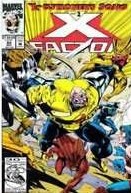
A great deal of the success of this issue is the unique pencil work of Jae Lee.  For the longest time, when first reading X-Factor back in ’92 when these issues came out, I could not tell why the artwork was so much edgier for the issues in this crossover than the issues before and after it; it was not until much later I realized (by looking at the credits, finally) the penciler, Jae Lee, did his only X-Factor work on the three issues of this event.  Though his exaggerations of muscles (Bishop’s especially) can get a bit extreme, his artwork for this issue is admirably suited to the story; his penciling of the characters and their taut emotions both in their concern for Xavier and their anger at having to fight their own, albeit temporarily rogue, friends and former understudies is fitting.  Equally fitting is Peter David’s writing.  He has admitted to being a character-driven writer, and this issue exemplifies that important attribute of better comics, even in the midst of a story-driven multi-part crossover.  Archangel’s moment of anger at Apocalypse, Strong Guy’s humor even in the most awkward moments, and Quicksilver’s lines throughout the issue are all great examples of Peter David’s skills.  Being the second part of a series is a challenging role to fill, and X-Factor 84 does a remarkable job keeping the pace and tension going after Uncanny X-Men 294.

Part 3 — X-Men 14: “Fingers on the Trigger”
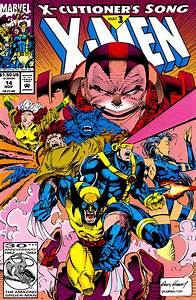
The cover of X-Men 14 is a bit misleading, considering Cyclops is in suspended animation during the issue, being transported by Mr. Sinister to the Mutant Liberation Front.  Additionally, this issue suffers (though only slightly) in that it has to be a joining episode of a multi-part story arc essentially acting as the set-up issue to the exciting second part of the battle between the X-Men/X-Factor unit and X-Force, completed next in X-Force 16.  Since it is a set-up issue, we have a lot of travelling panels, “here’s what we’re going to do next” conversations, and rapid oscillation among the various plot threads and teams involved.  That’s not necessarily a bad thing, for the overall story, but it does diminish the enjoyment of this particular issue qua issue; however, some of the brief character moments make this issue worthwhile and surprisingly enjoyable even for a transition issue.  Havok’s internal struggles over confronting and capturing X-Force are a great touch, elaborated on further in X-Force 16: he works for the government, but he is still a part of Xavier’s dream.  The discussion of said dream is also one of the better moments in this issue, as Wolverine (ever the cynical one) intimates it might be time to give up on the “dream” and realize it is all a “nightmare.”  Having to attack their former pupils (for attempting to assassinate their mentor, no less) certainly adds to the uncertainty of this time in the X-Teams’ existences and personal lives.

Part 4 — X-Force 16: “Jacklighting”
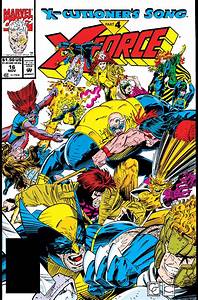
Underlying this crossover is Xavier’s dream: humans and mutants can live together in harmony, free of hatred and bigotry.  In the previous installment, Gambit and Wolverine speculated it was past time the X-Men realized the dream was illusory and the pragmatic realities of their day should make them realize the world is a “nightmare.”  The dream is tested in X-Force 16, as X-Factor and the Blue Team X-Men fight X-Force again.  Cannonball’s leadership is also tested again: he knows they are no match for the older, more experienced teams, and he even has to leave some wounded mates behind in their tactical retreat; eventually he surrenders, knowing full well Wolverine would kill them to get what he wanted.

The changing nature of the X-Universe is furthered in the issue by Bishop’s confrontation with Mr. Sinister.  Bishop’s lack of hesitation in pulling the trigger pleases Sinister, which is not a good sign for the Dream.  Wolverine, Bishop, Cable — they and their interactions all point to the changes in Xavier’s dream in the years ahead, climaxing (for now) in the events of the Second Coming event and its aftereffects.  The storyline of the X-Cutioner’s Song moves ahead with this issue: Sinister tells Val Cooper who is behind it all, Cable prepares to confront him, and Stryfe reveals himself to Cyclops and Jean Grey.  The final page of the issue, though, is the best part: once X-Force is in captivity, Havok asks in desperation, “What do we do now?”  He is clearly not just asking about how to save Xavier’s body — if the followers of Xavier’s Dream can’t even trust each other, how can the Dream survive outside of mutantkind?

Part 5 — Uncanny X-Men 295: “Familiar Refrain”
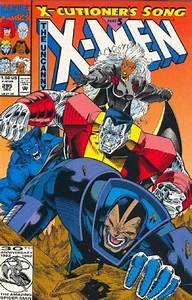
Part of the interesting nature of the X-Cutioner’s Song crossover is the relative newness of many characters we now take for granted, especially Bishop and Cable.  Cable had only been around for a couple of years; we still did not know if he was Cyclops’s son taken into the future (or if Stryfe was).  Before the traitor of the X-Men turned out to be Xavier (and later Bishop himself), Bishop was a mysterious young man from the future, like Cable, who didn’t yet fit in despite his commitment to them.  With those mysteries going on, Archangel’s unresolved anger over Apocalypse’s transformation of him from the Angel adds to the tension of seeking out Apocalypse’s help to rescue Xavier, the father of the X-Men as a whole.  Stryfe’s first encounter with Cyclops and Jean Grey in the previous installment of the crossover included him calling them his father and mother (in quotation marks), and now his revenge on them begins in earnest (though since his mother is Madelyne Pryor, not Jean Grey, his anger with her is misplaced) — all for the purpose of finding out why they treated him the way they did, sending him into the future (though it was actually Cable).  Even before The Adventures of Cyclops and Phoenix, the effects of that series shaped the direction of the X-Men for a time.  Though Stryfe does not become a major villain in the future of the X-Men, his existence is important here and now.  The issue is fairly strong, especially with all of its sub-plots.  The one irritating aspect of it is that suddenly Wolverine and Bishop have gone off to Department K, though we never knew they were going there.  Their unexpected run-in with Cable is a little forced, but the humor sprinkled in the issue, especially from Wolverine, helps alleviate the slightly jarring plot progression.

Part 6 — X-Factor 85: “Snikts and Bones”
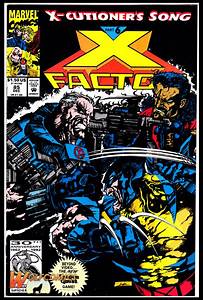
Though this issue is another “transition” episode between major points along the X-Cutioner’s Song plotline, Peter David’s emphasis on character moments make this a much more engaging transition than X-Men 14.  The unique (and dark) Jae Lee pencil work makes the melee combat scenes extra taught (especially Bishop’s muscles).  Cannonball’s decision to help the X-Teams in their investigation into the Mutant Liberation Front is a good one (for his maturation), though I would have liked to have seen a scene of him telling the rest of the imprisoned X-Force that he is going out on a work visa.  Wolverine is especially lucid in this issue, showing his open-mindedness in listening to Cable — which is also a good decision for his character, but it strikes as a little odd, especially with his “anti-Dream” talk earlier in the crossover.  Cyclops’s scene of impulsive frustration (though after hours of solitary incarceration) is a sign of his tough-as-nails personality in post-M-Day issues a decade after this storyline, but it seems a smidge out of place here.  His reaction to the realization he just optic blasted children and Jean is fitting with his character.  It is a good coupling with Stryfe’s scene with Jean in the previous installment, but the episodes are too brief, especially since the crossover is now half-over.  The most interesting scene is Archangel’s accidental decapitation of Kamikaze.  Archangel’s reaction is apropos; Boom Boom’s reaction is likewise apropos for her character, and the juxtaposition of her immaturity and his maturity is remarkable — especially after all of Archangel’s talk about wanting to assassinate Apocalypse.

Part 7 — X-Men 15: “The Camel’s Back”

This may be the weakest link in the chain of X-Cutioner’s Song.  It’s not that we expect non-stop action and major plot points throughout all twelve episodes in the crossover; the story is certainly allowed to transition from set piece to set piece with intervening respites.  What sets X-Men 15 apart from other linking issues, though, is that it lacks the good character moments that bolster the story-movements in those other episodes.  Though Colossus has a good moment pondering his brother’s recent actions, Strong Guy’s interruption does not improve the scene, even in a comedic way.  Similarly, Stryfe’s moment of humiliation for Scott and Jean in this issue is too bizarre to provide a good continuation of his vengeance scheme.  The dialogue throughout the issue suffers: Reaper is too casual at the beginning, Stryfe is too congenial with Zero, Beast is too easily angered with Moira, and Scott and Jean — despite being major motivations for the story — have again almost nothing to say.  The X-Teams get beat up in this issue: Boom Boom’s jaw is broken (perhaps fitting punishment for her juvenile reaction to Kamikaze’s death in the previous episode) and Rogue is temporarily blinded.  Stryfe’s quick dismantling of the Dark Riders begs the question — why would Apocalypse have such a weak team around him?  Havok again has to ask someone for advice on what to do next — before it was a sign of his deep emotional struggle with their plight; now he just looks indecisive and weak.  The story moves along a little bit, thanks to Stryfe and the dismantling of the Mutant Liberation Front, but little overall progress is made.

Part 8 — X-Force 17: “Sleeping with the Enemy”
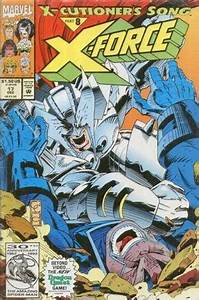
Part of the impressive and enjoyable aspect of this crossover is that the “big battles” come in a progressive series: the story presents the one about to happen as the real climactic battle, but when it’s over, we know the next one is going to be even more significant.  Such development does not happen as successfully in many crossovers.  The battle between Stryfe and Apocalypse seems like it should be bigger, even though it occurs at the beginning of the issue.  When it ends, we know that more important things are about to happen.  Finally, we hear from Cable about his history with Stryfe — that he doesn’t even know yet why they have the same face is part of the creative atmosphere of the time: here was an interesting mystery in the X-Universe that did not require major retcons or total multi-series changes (Disassembled, Civil War, Dark Siege, etc.).  The Stryfe/Apocalypse connection is also enjoyable, but a bit confusing if you are unfamiliar with their appearances/history.  Why Stryfe is glad the Dark Riders so quickly turn to him is odd, considering his disgust with them in the previous installment for being so weak — perhaps having weak acolytes is acceptable if they are your weak acolytes.  The comedic snippets in this issue are better than the attempts in X-Men 15: Wolverine’s struggle with Graymalkin’s anti-smoking programming is a highlight.  Other character moments help this issue succeed: Rahne’s talk with her former teammates, Siryn’s realization she was involved not with Madrox but one of his duplicates, and Cannonball’s confrontation with Havok reminds us he (Guthrie) is fit to lead after all (Havok again comes off as a bit weak and thoughtless).  Finally Scott and Jean get to do something again, though it’s only for a couple of panels.  Their relationship is presented well as something good in this issue — the later destruction of it will forever be a dark spot in Marvel’s history.  Archangel’s confrontation with Apocalypse at the close of the issue is a good reminder of their connection and just how integral Apocalypse was in the development of the X-Universe in the ’80s and beyond.

Part 9 — Uncanny X-Men 296: “Crescendo”

This issue does a fair amount with not much material, which is impressive considering the couple of flaws in it: the beginning is confusing, made more so by the incorrect footnote from Bob Harras on page one; when did Cyclops and Jean encounter the Dark Riders?; the missing footnote on page 22 (though the issue doesn’t have page numbers for some reason) — the references to years-ago back issues are more important than references to issues in the same crossover.  It’s also a bit confusing how the Dark Riders got to the moon so quickly from Egypt, after Stryfe just swayed them over in the previous episode.  Aside from those aspects, this issue does have some good moments.  The “story thus far” recap by Bishop, Cable, and Wolverine is interesting enough to prevent being tedious.  Cyclops and Jean’s kiss before they head into more danger is another great aspect of their good relationship in the good ol’ days, before more recent writers felt free to destroy one of the best things about the X-Men and Marvel Universe.  It’s about time Scott and Jean finally got to do something substantial for the first time since the beginning of the crossover (before they were captured by Caliban).  Stryfe’s reaction to their sacrificial response to his test is great, even though one could make the argument not enough time in the series has been given to him and them.  Some might prefer his realization to be in subconscious thought bubbles instead of editorial rectangles, but that is not as important as the event itself.  Stryfe is no longer certain Scott and Jean abandoned him…what has he left now?

Part 10 — X-Factor 86: “One of These Days…Pow!  Zoom!”

So late into a crossover, one might expect an issue to drag any potential momentum down — not so with this final David/Lee match-up.  This pair did great things with these three X-Factor issues, but Lee may steal the show here.  The best moments in this great issue are wordless images from Lee.  Few great authors would allow the images do all the narrating, even in comics — Peter David proves his greatness by letting Lee’s images tell everything we need, both in a comic scene and a heart-wrenching romantic scene.  The image progression of Scott and Jean running out of oxygen and turning to spend their last moments embracing is one of the best moments in Marvel’s history.  Later, the comic wordless scenes of Cable, Wolverine, and Bishop waiting for Graymalkin to recalibrate for the Moon are a great progression (especially Cable whittling a Domino statuette).  David does get some great character lines in, though: Havok gets some leadership skills back with his humor, Strong Guy’s comedic moment is far superior to the weak scene with Colossus a few issues before, and Cable’s “hour and a half” line is priceless.  Stryfe’s tearful confrontation of Cyclops and Jean is what the series (at least their section of it) has been waiting for — genuine emotion.  That Storm and Havok listen to Warren in letting Apocalypse finish saving Xavier from the techno-organic virus is a good testament not only to their good leadership skills but also Warren’s strength as a character and original X-Man.  This is a stupendous issue.

Part 11 — X-Men 16: “Conflicting Cathexes”

Admittedly, this issue suffers structurally, in that it is the final set-up piece before the grand finale of the crossover, so we shouldn’t be too harsh on it.  It does have some good character moments: Cannonball’s brief confrontation with Cable and Archangel’s lines to Bishop are great — “His life has been marked by pain and loss,” says Bishop of Apocalypse.  “And that’s an excuse, Bishop?  Which one of us hasn’t gone through the same?  You just don’t see us choosing to mark everyone else’s life with the same brand of hatred that’s inflicted on us,” replies Warren.  That sums up ’90s X-Men, pretty much.  By this point in their lives, all of the X-Men had gone through an awful lot of turmoil and heartbreak…but they were still there, fighting to protect a world that hated and feared them — even fighting against other mutants.  It was never about sheer force, which Bishop acknowledges.  That the beginning of the issue tries to reject that (in Wolverine) is part of why the issue is somewhat flawed.  Other smaller scenes and tidbits detract from the issue as well, but it does serve its overall purpose of drawing the various plot strands and character groups together for the final act.

Part 12 — X-Force 18: “Ghosts in the Machine”
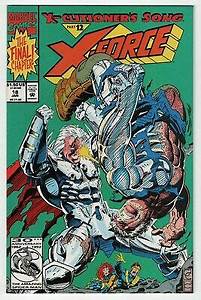
Sometimes the finale of a major crossover can be a giant letdown; sometimes the payoff is not worth the investment.  Neither of these is true of X-Force 18: this is a marvelous conclusion, bringing us fully (and finally) to the heart of what Stryfe and X-Cutioner’s Song have been about from the beginning — family (one could make the case for “love” as well).  In one sense, there was no “need” to bring in Apocalypse to the story at all.  Stryfe could have certainly shot Xavier with a regular plasma gun or something, not a techno-organic virus only Apocalypse could cure.  The reason he was brought in to the series seems to be the great scene of weakened Apocalypse and Archangel here: Warren declares (and possibly realizes for the first time) the true part of him that makes him himself was not altered by Apocalypse — he is not truly his son.  Havok’s weak moments throughout the series are forgotten in his personal confrontation with Stryfe: he finally voices his perspective at being a Summers but not Scott Summers, and he seems to begin to cope pretty well (for the time being — he’s one of the worst-treated characters in Marvel’s history).  Underlying this crossover is the question “who is Cable?”  Is Stryfe or Cable the son Cyclops had to send into the future?  Though this crossover was supposed to answer that question, it didn’t…which is much more satisfying as an ending, surprisingly enough.  That Scott starts to suspect that Cable is, to Jean’s surprise, is a great way to conclude the song.  Keeping the mystery alive (especially while delivering an emotionally moving conclusion) is far superior to answering the question and then having the writers retcon it all twelve years later (the current fashion).  Some may think Stryfe’s desire for togetherness is too sappy of a motivation — they are mistaken.  The epilogue, Stryfe’s “pox on all mutantkind,” is of course the release of the Legacy Virus.  That later writers of X-Books did not know what to do with it is not the fault of this storyline.  Sinister’s stoic response to being tricked by Stryfe is consistent with his equipoise throughout the series.  X-Cutioner’s Song is a story about family, about belonging, being together, and how (much) the Children of the Atom have to sacrifice in order to do that, even a little.  This is a great story that shows us the heart of many of these great characters.

Epilogue — Uncanny X-Men 297: “Up and Around
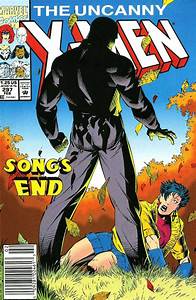
This is the best comic issue I have ever read.  As an epilogue to a great crossover, Uncanny X-Men 297 has the perfect mood: quiet.  Some might argue the issue needs Cyclops and Jean to reflect on what just happened to them: perhaps, but they already did that (albeit briefly) in X-Force 18.  Now is the time for the other refrains of the song to reach their codas.  Rogue and Gambit spend some time together as she recovers (on the roof) from her temporary blinding in the crossover, though in a way that finally allows Rogue to speak her mind about what she needs, her desire for Gambit, and her great disappointment (irately so) that they can’t be together: Gambit’s power is to charge up objects and throw them away — Rogue certainly doesn’t want that to happen to her; she’s a woman, not a thing.  After some hours of separation, Gambit finally returns and offers Rogue what he can, a blanket and some reassuring words — for now, his presence is enough.  The thread of Warren and Hank rebuilding Harry’s Hideaway is the greatest series of panels probably ever.  What’s great about it, as with the entire issue, is the genuineness of the emotions and dialogue.  Finally we get some reflection on where the original X-Men used to be, how things were in the old days before Hank and Warren turned blue (literally and figuratively).  It’s so easy to forget they started out as students, as kids, writing term papers and struggling with their personal issues before Magneto, Apocalypse, the Sentinels, and the M’Kraan Crystal changed everything (again and again).  Hank’s laughter and Warren’s reflection on his old attitude are superb.  Better still is Hank’s encouragement to Warren, especially after Warren’s own confession to Apocalypse the day before: he has struggled through his experiences (we all have), but he has come through them truly human and mature.  The final thread of the issue is Professor X’s moments with Jubilee, as he enjoys a few hours’ ability to walk again.  That he spends them with Jubilee is a great touch — the two ends of the good X-Universe spectrum.  The quiet scenes of his reflections on losing his mobility, gaining it again, and imminently losing it again are excellent character and narrative moments.  The final two pages are some of the most moving in X-Men history, rivaling the great Cyclops and Jean moments earlier in the crossover.  This issue shows us what Professor Xavier’s Dream is all about: it’s not about fighting evil mutants and bigoted humans; it’s about love.

Addendum – Stryfe’s Strike File
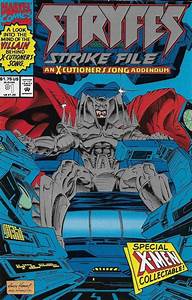
Being a completist, I had been searching for this comic since 1992.  I finally found it for 25 cents in 2010.  Shortly thereafter, I began finding it in every comic store I visited — strange how that happens.  The issue serves its purpose well, and the writing, though defamed by some, is aptly written as the writings of the deluded and maniacal Stryfe.  It’s challenging to view the X-world through the eyes of a recently-arrived crazy man.  The first appearance of Holocaust is here; more notable is Stryfe’s comment that he isn’t supposed to be in this timeline — two years before the Age of Apocalypse.  Similarly, Threnody’s first appearance is here, almost a year before she appears in X-Men 27.  Before Colossus becomes an Acolyte, Stryfe says it’s coming.  It’s odd to think of Bishop and Wolverine as lesser players than they think they are, especially considering Wolverine’s stratospheric popularity.  Too bad Stryfe could not see Scarlet Witch’s future destruction of the X-Universe a decade in the future.  His comments about Cannonball are perhaps the kindest things ever said about Sam Guthrie.  The frame story of Professor X reading through these files is a nice narrative device, but it’s more impressive that, despite his desire to know what Stryfe knew, he purges the files — the X-Men will face the future, together, without the perspective and machinations of madmen like Stryfe.

The Song Remains Supreme

The good news for you is we are living in an age in which Marvel has recommitted to releasing its classic crossovers and series in remastered hardcover and trade paperback sets (some at better prices than others if ordered on-line).  Instead of trying to track down the separate issues in the various comic book stores around town, you can simply wait a couple of months and order the future hardcover release scheduled to come out August 2011 (with both Uncanny X-Men 297 and Stryfe’s Strike Files, you lucky duck, you — no waiting eighteen years needed).  True, it might be more enjoyable to track down the issues and look at the advertisements for Aladdin the movie and Hook the SNES game, but if you are just interested in reading one of the better X-Men stories at a time before the crazy retconning and character destructions of the 2000s, getting a copy of X-Cutioner’s Song is the way to go.  It’s a great story with some of the best character moments in X-Men history.
Foundation and Marxism

E. J. Erichsen Tench

Isaac Asimov was an avowed secular humanist and a science fiction writer.  Since worldviews will always color and form books and other artistic works, it is possible to trace themes of Asimov’s humanism in the first of his major science fiction trilogy, Foundation.  Apart from the humanist strains, Asimov also worked in foundational elements of Marxism.  The purpose of this paper is to explore the strains of Marxism within Foundation and find the comparisons between Asimov and Marx in religious, socially materialistic, and fatalistic ways.

The main component of any worldview is the religious component.  The ideas of the metaphysical universe will color all the rest of the laws of the universe in Foundation.  In order to understand the worldview of Foundation and the worldview of Marxism, one must understand how Asimov and Marx portray and discuss religion.

In Foundation, religion is brought up as an older belief, one that a scientific Empire like Trantor does not believe in.  Religion is an explanation for what the inhabitants of Foundation cannot explain.  For the Foundation itself, located on Terminus, religion becomes a tool by which the Foundation peacefully maintains its defense; it becomes a crowbar by which the Foundation holds sway over less intelligent and advanced empires.  For the empires the Foundation deals with, such as Anacreon, religion contains all the technological knowledge they possess, entrapping the inhabitants within the technological mind frame the Foundation wants them to have, thus ensuring they cannot advance and threaten the somewhat defenseless Foundation.

This use of religion to dull down Anacreon’s desire to defeat the Foundation is similar to how Marxism views religion.  “Soviet premier Nikita Khrushchev said, ‘Communism has not changed its attitude of opposition to religion.  We are doing everything we can to eliminate the bewitching power of the opium of religion’” (Nobel 68).  As Doctor Nobel summarizes from the Marxist’s view of religion:

The idea of God, insists Lenin, encourages the working class… to drown its terrible economic plight in the “spiritual booze” of some mythical heaven….  Even a single sip of this intoxicant decreases the revolutionary fervor necessary to exterminate the oppressing class…, causing the working class to forfeit its only chance of creating a truly human heaven on earth: global communism.

(Nobel 65)

In Marxism, religion tones down the proletariat’s desire to revolt.  In Foundation, religion keeps Anacreon peacefully dependent upon the Foundation.  Anacreon is less willing to attack the Foundation because their entire way of life suddenly depends on the religious technologies and beliefs given to them.  The religion infiltrated in by the Foundation destroyed Anacreon’s desire to rise up, be free, and seek to conquer new areas.

With Foundation and Marxism’s denial of the supernatural and religious aspects of reality, the laws of the universe are merely materialistic and mathematically quantifiable substances.  This includes psychological history, economics, and sociology.  The very roots of the Foundation are based in psychohistory, an idea that the actions of massive groups of people can be mathematically predicted and quantified.  This allows Hari Seldon to predict the overall path of the Foundation and prepare its rulers in advance.  This materialistic idea of psychohistory reduces mankind to a robotic and mathematical system, where only masses count and human behavior can be reduced to externally-influenced behavior, excluding the free will of individuals.  With free will, the people would knock Seldon’s mathematical variables out of place.  “[Seldon] worked with mobs, populations of whole planets, and only blind mobs who do not possess any foreknowledge of the results of their actions….  Interference due to foresight would have knocked the Plan out of kilter” (Asimov 3:2).

This idea of predicting the behavior of the masses through materialistic laws is foundational to Marxism.  “Karl Marx says, ‘It is not the consciousness of men that determines their existence, but, on the contrary, their social existence determines their consciousness’” (Nobel 412).  Marx’s atheistic and materialistic worldview led to the belief that humans’ behavior could be materialistically governed and always worked on set laws.

Similarly, just as Seldon concentrates not on the individual but the masses, so — as Lenin says — “historical materialism made it possible for the first time to study with scientific accuracy the social conditions of the life of the masses and the changes in these conditions….  Marx drew attention and indicated the way to a scientific study of history as a simple process which, with all its immense variety and contradictions, is governed by definite laws.”

(Elkins)

This belief is necessary for Marxism.  Communism is attained when the masses revolt together; their revolt is predicated by economic conditions that act as external stimuli to impact how they behave.  For Seldon and Marxism, material forces are the causes by which humans act.  The forces that govern humans’ sociological acts are materialistic economic forces that lead to social evolution.

The idea of man bettering himself over time through materialistic forces governing his way is entrenched in Foundation.  The entire history of the Foundation is the story of its upward struggle for existence.  On a large scope throughout the trilogy,

Seldon’s Plan predicts the fall of the decadent First Galactic Empire (read Roman Empire), the rise of the Traders and Merchant Princes (read bourgeoisie and nationalism), the growth of the First Foundation (read postindustrial, bureaucratic-technological society), its interaction with the long hidden Second Foundation and the eventual creation of the Second Galactic Empire, a civilization based on “mental science” (read Asimov’s utopian vision?).

(Elkins)

On a smaller scale, the Foundation shows its own social evolution.  Within the social evolution in the first books, a major interplay between religion and economics takes place, much like Marx’s idea that economics propel history and erode away religion.

The Foundation’s original setup was for the preservation of materialistic human knowledge in Part 1, which moved next into preserving the Encyclopedia in Part 2.  Part 3 brought in the idea of preserving the Foundation itself and the setting up of the first mayor, Salvor Hardin.

Salvor Hardin parallels the dialectic struggle in Marxism.  While the Encyclopedists are content to focus on preserving the past and remaining entrenched in their present state, Hardin believes in progress and continual movement upward.  “Have you ever thought of working onward, extending their knowledge and improving upon it?  No!  You’re quite happy to stagnate.  The whole Galaxy is, and has been for space knows how long” (Asimov 2:3).  Hardin understands the dangers of remaining socially stagnate.

Hardin’s idea is to dull the rebellious idea of the Foundation’s threat through taking over their enemies with religion.  His emphasis on a peaceful takeover and the use of religion is partially contrary to Marxism.  Marx would argue Hardin’s belief that “violence is the last refuge of the incompetent” (Asimov 3:1) as a deficient means to socially progress.  The use of religion to dull down the social progression of opponents ties in with Marxism, as explained before.  Even though Hardin sees non-Marxist peace as the means to social progression, the religious days of the Foundation have an end and are replaced by the greater workings of economics, as Marxism teaches.

The Merchant Prince Hober Mallow, in Part 5, represents the rising social progression of the Foundation through the replacement of religious power with economic power.  Trading becomes the crowbar by which the Foundation maintains its weak defenses and impressive power of its enemies.  Much like the dialectic clash found in Marxism, the Foundation’s clash of religion and economics (Marxist thesis and anti-thesis) leads to the next stage of the Foundation’s social progression (the Marxist synthesis).

The last streams of Marxism found in Foundation involve the overall sense of historical fatalism.  “[Marx] writes, ‘Men make their own history, but they do not make it just as they please; they do not make it under circumstances chosen by themselves, but under circumstances directly encountered, given and transmitted from the past’” (Nobel 412).  This is exactly the case with the Foundation.  Hari Seldon has foretold the Foundation’s entire history through psychohistory, and now the masses will simply fulfill the materialistic equations Seldon deduced.  The Foundation does not make history as they please, but are already on a programmed plan created by Seldon.  “Circumstances directly encountered” have already been calculated by Seldon.

In Foundation and in Marxism, the individual and his choices do not matter in the long run.  No one can escape the plan Seldon has foretold.

Asimov’s characters are not tragic heroes.  They are nondescript pawns, unable to take their destiny into their own hands.  There is no fear or pity to evoke a tragic catharsis.  Instead there is complacency.  The Foundation Trilogy ends on a note of one-upmanship.  After all that has happened, history is still on its course and Hari Seldon wins again.

(Elkins)

In Marxism, no matter what happens, the world is predestined to socially evolve toward Communism.  Every action only furthers the gradual progression toward a global Communist world.

Isaac Asimov’s Foundation is riddled with and internally structured by the ideas of Marxism, whether or not Asimov was an avowed Marxist.  Religion is a means to subdue the social progression of Anacreon, just like religion in Marxism dulls the proletariat’s desire to revolt.  Social progression and the history of humankind can be materialistically calculated through psychohistory, just like in Marxism social progression is pushed forward through materialistic economic processes.  Foundation holds to a fatalistic structure that Seldon’s plan will be accomplished, no matter what, just as Marx holds to a fatalistic belief in the eventual victory of global communism.  In religious, socially materialistic, and fatalistic ways, Foundation is elementally similar to Marxism.

Bibliography

Asimov, Isaac. Foundation. Bantam Dell, 1951.

Elkins, Charles. “Science Fiction Studies, #8,Volume 3, Part 1, March 1976.” Web. 4 Dec. 2010. Web.

Noebel, David A. Understanding the Times. 2nd ed. Summit Press, 2006.

Simba, a Modern-Day Hamlet?

Emily Grant Privett

It known by nearly everyone that William Shakespeare is popular for his famous storylines and excellent characterization.  Over the past several decades, America has lost touch with Shakespeare’s British classics, all until Disney released its version of a modern day Hamlet: The Lion King.  Shakespeare’s story of responsibility and revenge was adapted by a children’s company, carrying the timeless story to a new generation.

The first and greatest similarity is that of Simba and Hamlet.  At a young age, both of our protagonists share a similar fate.  Similarly, the fathers of both Simba and Hamlet are killed.  Simba is born the son of a king.  He is undeniably born with a great deal of responsibility.  Simba loses his father early in his life, the years that he needs his guidance most.  Both deal with their share of troubles.  Also, both delayed their responsibility as much as possible.  Neither wanted to take responsibility for their royal heritage, and both in fact, ran away from their responsibilities for a short time.

Also, the father of Hamlet and Mufasa share a similar characterization.  The father of Hamlet once ruled Denmark.  His land was peaceful and prosperous.  Mufasa had a very similar rule.  Under him, the animal kingdom was happy.  There was peace.  The land was safe.  Simba enjoyed his early days in the Pride Lands.  He focused on his son and the responsibilities he would soon take on.  After each of them die, they both become a ghostlike spirit, haunting their sons.  They tell them to avenge their deaths and to take responsibility, overthrowing what their uncles had accomplished.  They serve as a reminder and an encourager.  Although neither tells their son exactly what action to take, they both strongly imply the responsibility their sons have.

The villains of the two stories also are directly related to each other.  Both Scar and the King, Claudius, play similar roles.  Both used the murder of their brother to usurp the throne of their respective kingdoms.  Scar and Claudius put on false faces, making them seem like much better people than they actually turn out to be.  They pretend to be friendly and caring.  Both enjoy the new life as king.  They celebrate the new power they recently acquired.  Claudius holds celebrations and parties to bring himself power.  Scar uses his recently gained power to take control of the Pride Lands.  He sends his army across them in order to have a grasp on all of the Pride Lands.  Both of the new kings abuse their new-found power, both leading their kingdoms to turmoil.  It is from this point that the characters begin to take different paths.  Scar maintains his evilness throughout the rest of the story.  Claudius, on the other hand, feels guilt for his actions.  Both, on the other hand, admit their wrongdoing.  Claudius, though, attempts to repent for his wrongdoing whereas Scar boasts in the way he overcame his rather naïve brother.  In the end, the two villains meet their end in the way that they killed their brothers.  Scar is thrown down into the ravine, to be trampled on by the hyenas.  Claudius is poisoned.

The characters of Nala and Ophelia are the only two that really differ.  Nala is adventurous and rather naughty.  She fights against Scar’s rule and doesn’t mind lying to find a little adventure with Simba.  Ophelia is very obedient and passive.  She does whatever her father instructs her to do.  She accepts whatever happens to her.  She even rejects the one she loves because her father instructed her to.

The characters of Rosencrantz and Guildenstern loosely relate to the characters of Timon and Pumbaa.  Although they aren’t a very similar comparison, they both prove to the protagonist that fun and happiness can be found.  They provide a relief from the main plot lines of the stories.  They both provide a relief from the responsibility that both Simba and Hamlet face.

William Shakespeare is one of the most influential writers of all time.  It is obvious that his writings have been utilized and respected throughout the ages.  Many of his stories are the basis for many stories today.  The Lion King is an obvious example of this.  The fact that Shakespeare’s stories have survived through so many generations proves that the writings of William Shakespeare aren’t going to disappear anytime soon.

Huckleberry Finn Commonplace

Tifani Wood Arthur

Throughout the book Adventures of Huckleberry Finn, slavery is a very pertinent topic.  The view of slavery is quite similar for all the people of the town.  This view also is a factor of the culture.  Huck seems to have a slightly different view of slaves but still accepts slavery as everyone else does.

The general attitude toward slavery is that it’s normal.  It is completely accepted, except by the slaves, of course, though the book doesn’t go into much detail about the slaves’ opinions.  Slaves are viewed as material possessions or property, not human beings.  Some slave owners may treat their slaves a little better than others, as seen with Miss Watson, but they still don’t see them as people.  Even Miss Watson who treats her slaves fairly well planned to secretly sell Jim, only for money, though she promised him she wouldn’t sell him.  Slavery is not only seen as accepted but also the right thing to do.  If someone had been found out they had a runaway slave, they would’ve been punished for doing something wrong, not helping someone be free.  This is evident when Huck encounters a group of men searching people for runaway slaves, forcing Huck to hide Jim and make up a story that he is with his sick family, causing the men to leave.

This view of accepting slavery and seeing it as a good thing reflects the culture a great deal.  This shows first of all, people in this culture saw slavery as a thing they had control over.  The people were power hungry, and slaves were one of the things they had complete control of.  They could sell them if they wanted, make them do whatever they told them to, and make them do all the work.  Owning slaves also showed a sign of wealth.  In that culture if you didn’t own slaves, you were looked down upon and seen as being poor.  Another thing slavery shows about the culture is laziness.  The slaves did everything that consisted of hard work while all the white folk lounged around.  Some white folk did work, but the slaves took on the more difficult tasks, still showing laziness on the white men’s part.

Huck Finn did have a similar opinion as the general view, but his opinion didn’t really change about slavery as a whole.  His view may have been influenced by the culture he was immersed in, and he saw slavery as a good, Biblical thing.  This is evident when he contemplates whether or not to rescue Jim.  In the end he does go to rescue Jim, but he feels that it is a sin as he does it.  He sees it as being morally wrong.  Though Huck Finn sees slavery as something good and accepts it, his view of the slaves does change throughout the book.  At the beginning his relationship with Jim is Huck playing pranks on Jim and that’s it.  As the story progresses, especially after Huck and Jim find each other on Jackson’s Island, Huck’s view begins to change.

As they travel down the river together, Huck slowly begins to see Jim as a person, not just property.  He begins to see similarities between white men and Jim, seeing that there’s not all that much of a difference.  Huck sees Jim has some sort of intelligence when they begin to talk about kings, and Jim talks about all he knows of King Solomon.  Huck also sees that Jim can love just as much as a white man can when Jim is mourning for his wife and children after he hears a noise that reminds him of his daughter in the woods.  Altogether, Huck begins to care for Jim.  Huck starts to feel bad when he plays jokes on Jim, as he wouldn’t have before.  This is shown when he sincerely apologizes for trying to trick Jim.  After Jim tells Huck that he is his only friend, Huck feels pity for him.  In a way Huck and Jim can relate to each other; this may be why Huck sees Jim differently than everyone else sees Jim.  Huck and Jim relate in the way that they are both fighting for freedom from different parts of society.  Huck is fighting for freedom from education and the things controlling him in society, to be on his own, living on his own terms.  Jim, on the other hand, is fighting for literal freedom from the bondage of being a slave, which is a big part of society.

Throughout Adventures of Huckleberry Finn, slavery is very much accepted and seen as the right thing to do.  Huck may just feel the same way as society, because he is immersed in the society.  If he hadn’t been immersed in the society, he may have a different view, considering that he is one of the only people that sees slaves as being more than property as shown with Jim.

Book Review: “On Fairy-Stories,” J. R. R. Tolkien. The Tolkien Reader. New York: Ballantine Books, 1966.

Christopher Rush

Content Summary and Author’s Perspective

J.R.R. Tolkien’s early essay “On Fairy-Stories” summarizes (in seventy pages) Tolkien’s conception of the nature of fairy-stories, their connection to myths, their audience, and their three main functions of recovery, escape, and consolation.  Fairy-stories, according to Tolkien, are not the safest of places, since they contain “beauty that is an enchantment, and an ever-present peril; both joy and sorrow as sharp as swords” (33).  Tolkien creates a unique definition of fairy-stories, furthering his distinction from lesser tellers of tales: “fairy-stories are not … about fairies or elves, but stories about Fairy, that is Faërie, the realm or state in which fairies have their being.…  Most good ‘fairy-stories’ are about the adventures of men in the Perilous Realm or upon its shadowy marches” (38).  Throughout the essay, which is an apologia sans remorse, Tolkien defends fairy-stories as if they are important literature, as valuable and life-relevant as the poems of Homer or the novels of Proust and Stendahl.

Early in the essay, Tolkien describes various elements of fairy-stories, as just mentioned, such as their danger and characters.  Tolkien also contrasts them with other kinds of stories for clarification: a genuine fairy-tale is always presented as “true,” never as a dream or with similar machinery (42).  Beast fables, like the Three Little Pigs or The Wind in the Willows, while good stories, are not fairy-tales (42-3) according to Tolkien.  Myths and fairy-tales are similar, but Tolkien ascribes to myths an element of divinity and worship in the tales that are lacking in fairy-tales (49-51).  Similarly, contrasting Joseph Campbell’s monomyth conception, Tolkien doesn’t compartmentalize fairy-tales by a standard pattern of events, but instead a “colouring, the atmosphere, the unclassifiable individual details of a story” (46) is what make a fairy-story what it is:

An essential power of Faërie is thus the power of making immediately effective by the will the visions of “fantasy.”  Not all are beautiful or even wholesome, not at any rate the fantasies of fallen Man.…  This aspect of “mythology” — sub-creation, rather than either representation or symbolic interpretation of the beauties and terrors of the world — is, I think, too little considered (49).

Tolkien denigrates the pervasive attitude that fairy-stories are the domain of children.  If a story has quality, it is a good story regardless of who is reading it and why.  The main reason most people think fairy-stories belong to children is because that is the only kind of story available to them in the nursery.  If young ones appreciate fairy-stories, it is because the stories are intrinsically good, not because they are fit only for children.  Similar to that is the notion of “suspension of disbelief” — if a story is told as “real,” like good fairy-stories need to be, according to Tolkien, audiences won’t need to suspend any belief or disbelief: “if [adults] really liked it (the fairy-story), for itself, they would not have to suspend disbelief: they would believe — in this sense” (61).  A fairy-story, if it is a good story regardless of its genre, is good enough for any reader regardless of age.  If it is a good story, it can be analyzed as well as appreciated.

The pattern of “recovery, escape, and consolation” is as close to Campbell’s monomyth as Tolkien gets.  “Recovery” assumes some conflict has beset the community of the story as well as “a re-gaining — regaining of a clear view.…  I might venture to say ‘seeing things as we are (or were) meant to see them’ — as things apart from ourselves” (77).  Escape “is one of the main functions of fairy-stories, and since I do not disapprove of them, it is plain that I do not accept the tone of scorn or pity with which ‘Escape’ is now often used.…  In what the misusers are fond of calling Real Life, Escape is evidently as a rule very practical, and may even be heroic” (79).  The consolation “of fairy-tales has another aspect than the imaginative satisfaction of ancient desires.  Far more important is the Consolation of the Happy Ending” (85), what Tolkien coined “eucatastrophe.”  The purpose of all this is, for Tolkien, to emphasize the importance of a happy ending, or eucatastrophe, after much believable and serious conflict: what makes a good fairy-story worthwhile is because real life has its own eucatastrophe, Jesus Christ.

Critical Response and Evaluation

“On Fairy-stories” is almost as important to studying Tolkien’s world as reading The Silmarillion and The Lord of the Rings.  It provides great insight to his thinking about the nature of stories, and why he wrote fantasy; it closely resembles fairy-story, especially since his definition of Faërie is beyond the silly supernatural creatures found in poorer-written stories.  Even though the essay never mentions hobbits or dwarves, and only briefly mentions elves and dragons, it is an important place to begin any examination of the world of Middle-earth.

Mentioned above, Tolkien gives a fair amount of freedom to what constitutes fairy-stories.  Joseph Campbell did give a fair amount of leeway in what is a hero, but his focus in The Hero with a Thousand Faces is on what the hero does, not who he is.  Tolkien’s fairy-stories follow the basic “recovery, escape, and consolation,” but they have more variety than mythic heroes according to Campbell, since the authors can change whatever else happens, and to what degree mythic, fantasy, and magical elements appear in the tales.

Tolkien’s conclusion, that mankind has had its universal eucatastrophe in the work of Jesus, overtly betrays his Christian perspective.  I wonder if Tolkien’s declaration in “On Fairy-stories” is in part responsible for so many critics (of diverse skill) finding Christian symbolism throughout The Lord of the Rings that really isn’t there.  It is possibly the best defense of the “happy ending,” in contrast to the last few decades of critics who posit tragedy and destruction as superior and “more real” than happiness and true love.

In addition to Tolkien’s interesting concept of the “eucatastrophe,” his general defense of the worth and value of fairy-stories and their like is very refreshing.  He does not apologize for enjoying this kind of narrative, nor does he try to make a case for it being as valuable as other kinds of literature; instead he just analyzes and summarizes as if he is clarifying the misconceptions of the confused.  Like C.S. Lewis, he enjoys what he enjoys and has no qualms about it, but when he tries to convince others to enjoy it, he reasons his arguments lucidly and respectfully to the opposition (unlike the critics who denigrate Tolkien and Lewis).

“On Fairy-stories” provides an important beginning for understanding Tolkien’s creative processes when reading The Silmarillion and The Lord of the Rings.  We can understand these tales through formalist criticism, but this essay gives a deeper perspective behind Tolkien’s motivation and intention.  The Silmarillion and The Lord of the Rings are not “fairy-tales” exactly, even by Tolkien’s definition of them, but they are close cousins, like the fantasy genre of which he speaks highly in this essay.  His eucatrastophe concept explains why, after much loss and suffering, The Return of the King has a “happy” ending, one that fulfills the expectations of the heroes and sees evil conquered: life is like that because of Jesus, according to Tolkien.  Non-Christian critics and audiences might disagree with him theologically, but it would be difficult to fault the coherence and believability of the trilogy because of external religious differences.  The trilogy’s end is not forced or through an unbelievable deus ex machina (it is a slight deus ex machine, but is consistent within the reality of Middle-earth), fulfilling Tolkien’s ideas of great stories (whether or not they are fairy-tales) found in this essay.

Book Review: “The Quest as Legend: The Lord of the Rings.” Modern Critical Interpretations – J.R.R. Tolkien: The Lord of the Rings, Katharyn W. Crabbe. ed. Harold Bloom. Philadelphia: Chelsea House, 2000.

Christopher Rush

Content Summary

Crabbe’s essay analyzes Tolkien’s Lord of the Rings from the perspective that its mythic/epic qualities can be accurately interpreted as a connection to the past.  Obviously, the concept of “myth” is greatly past-centered, and for Crabbe, the success of characters and themes in Lord of the Rings depends in part on how well those characters and themes adhere to the “legends” of the past.  Highlights of ideas presented by Crabbe include the nature of a hero, especially in the hero’s connection to the past; the nature of creation; and the natures of good and evil within the framework of Lord of the Rings, again related to how the “good” and the “evil” maintains its connection to and appreciation for the past.  Crabbe’s overall emphasis, though, under which she uses the aforementioned subtopics for support, is what the title of her essay implies: The Lord of the Rings is a quest story with semi-archetypal quest-like heroes, and the plotted quest of the novels and the character quests of the heroes are connected to the legends of Middle-earth’s past, especially how language distinguishes the “good” from the “evil.”  Crabbe apparently approaches her analysis simply as formalist textual criticism, observing the text itself and understanding it from the perspective mentioned above, focusing on the elements in their connection to Middle-earth’s past.  Though not strictly formalist, in that she does demonstrate an understanding of previous ages of Middle-earth’s history not strictly recounted within the text of The Lord of the Rings proper, her analyses do not extend beyond Middle-earth, except in the application of broad, universal concepts of myths, heroes, quests, legends, and the like.

Author’s Perspective and Purpose

Crabbe does not present any overt biases within this essay, other than her apparent affinity for Tolkien’s sub-created world.  By connecting The Lord of the Rings to “classical” things that matter (myths, heroes, quests), she places a fairly high importance on the story and text itself.  She treats it all seriously, unlike other Tolkien critics who only want to ridicule and denigrate Middle-earth and its inhabitants (especially in Bloom’s collection).  As mentioned above, Crabbe seems to apply only a formalist textual criticism; she does not describe heroes in how they treat or mistreat female characters as a feminist critic might do, nor does she draw parallels to real-life overtones or symbols, as a Christian critic or an eco-friendly critic might do.  She is concerned with what is presented in the text and how that text can be understood in its own relation to Middle-earth’s past.  I have never heard of Katharyn W. Crabbe outside of this essay (though that doesn’t necessarily mean anything), but the edition notes she “has been the Associate Dean of Undergraduate Studies at the State University College in Geneseo, New York” and has some other publishing credits, so she does have an academic and critical background and is not just a Tolkien “fan.”

Since Ms. Crabbe analyzes The Lord of the Rings from the perspective of language and its relation to quests, myths, and heroes, she probably has some background in linguistics, if not just on a personal-interest level: she does not use within the essay any technical terminology in linguistics or mythology, but that could just be her intention of allowing for a wide readership of her essay.  She does demonstrate quite well, though, through the essay a clear understanding of the unity of Tolkien’s work, and her ideas about language, mythic quests, and heroes are very lucid and helpful.  Her other points about the natures of heroes and how they relate to the past of Middle-earth are very well done.  She clearly connects her ideas about language and the (legendary) past and how they are important throughout The Lord of the Rings, both as distinguishing the races of characters broadly, as well as distinguishing elements in heroes and villains within those races finely.

Critical Response and Evaluation

Ms. Crabbe’s overall thesis of language as a unifier of peoples and past in Middle-earth is insightful, if not thoroughly helpful, though I do find many of her other insights very helpful.  Her thirty-page essay was one of the longest and most cohesive essays I have read recently.  Many other essays from, perhaps, more scholarly sources, seem to pad the length through digression or bald topic changes without much relevance to the guiding thesis; Ms. Crabbe’s essay, however, is unified throughout.  Her essay is well-written enough that the ideas most helpful, especially concerning the nature of heroes in The Lord of the Rings, are inherently meaningful and consistent even if separated from her thesis of language’s importance in the legendary past and culturally distinctive present in Middle-earth.

When reading The Lord of the Rings, it is possible (especially in the post-movie version era) to focus only the plot, as it is with any novel.  Crabbe’s essay helps remind us that Tolkien’s purpose is not just to spin an exciting yarn about days gone by, but that he was recalling an extended episode of a place that had a beginning, a middle, and an end, and so did its peoples.  Her idea, “the trustworthiness of traditional and intuitive knowledge is a part of the larger value of respect for the past,” is very helpful in seeing this.  Many other critics have noted Tolkien’s penchant for nature and opposition to technology (in fairly heavy-handed arguments), but Tolkien’s Middle-earth is not just a yearning for a return to Rousseauean/Wordsworthian Natural idolatry — it is, as Crabbe says, a world that values and respect its past.  The most successful, most internally unified heroes in The Lord of the Rings are those who are attuned to that past.  Another good example is her comments about Faramir: “The difference between Boromir and Faramir is an expression of the difference in what they have inherited from their Númenórean past….  It is not only knowledge of the past but reverence for it and understanding of it that set Faramir apart, and that knowledge, reverence, and understanding are his links to the golden age….  By exemplifying a hero who values the spiritual life of a culture as well as its physical life, Faramir links the Rohirrim to Aragorn, King of the Númenóreans.”  Aragorn is obviously one of the main heroes of the novel, but Faramir, according to Crabbe, has similar heroic qualities, in that he, too, understands and reveres his past.  This, more than his father’s love according to Peter Jackson’s movies, is what truly sets him above his brother Boromir, who, unfortunately, has a limited perspective concerning his people and his role in Middle-earth.

Katharyn Crabbe’s essay is a very useful examination of Tolkien’s The Lord of the Rings.  Even though she has a seemingly-narrow focus for her thesis, how language relates to people groups of Middle-earth and their connection to its legendary past, Crabbe has enough examples well-explicated that make it worth reading for a variety of purposes.  I found many of her insights useful to me almost despite her perspective of the role of language.  Her ideas on heroism and the mythical past of Middle-earth are helpful, even beyond the pair of specific quotations referenced above.  Though other essays I’ve read that describe the heroes of Lord of the Rings in more detail provide more ideas, the wide range of examples from Katharyn Crabbe distinguish her essay as useful to all Tolkien enthusiasts or critics, regardless of their linguistic backgrounds.

Book Review: Tolkien: New Critical Perspectives, eds. Neil D. Isaacs and Rose A. Zimbardo. Lexington: UP Kentucky, 1981.

Christopher Rush

Content Summary and Author’s Perspective

Isaacs and Zimbardo’s collection of Tolkien criticism, their second compilation since the completion of Tolkien’s Lord of the Rings, offers a variety of essays about diverse issues and themes of Tolkien’s trilogy.  Because of the variety and wealth of critical possibility in Tolkien’s Middle-earth, I will concentrate here on three of the more important and useful essays.  Since the essays were brief, I will summarize their content and discuss the author’s perspective together.  All three of these essays were recollected in the editors’ more recent Tolkien collection Understanding The Lord of the Rings: The Best of Tolkien Criticism from 2004, but the page references are to the 1981 collection.

Lionel Basney’s “Myth, History and Time in The Lord of the Rings” presents in twelve brief pages a look at three crucial though often neglected aspects to Tolkien’s Middle-earth.  Basney is quite literate concerning mythological structure, teleology, and social progression, which becomes clear quickly in his brief essay; however, Basney subsumes his knowledge for the less-educated reader well, allowing the lay reader (who, though, should be more than a passing Tolkien fan) to get a sort of beginning look at applying teleological analysis to Tolkien’s Middle-earth.  Basney is also conscious throughout that a design in the Middle-earth universe, with a consistent and coherent cosmogony, might lead certain readers to posit a Christian/Biblical worldview or design upon Middle-earth, but Basney cautions against such a reading.  To Basney, Tolkien has explicit, coherent design and natural progression from age to age and people to people but also a “causal vagueness” (16) that should warn readers away from reading too much into it as a work of God or divine providence.  (Certainly The Silmarillion is more explicit about the supernatural powers at work in and around Middle-earth, but that is beyond Basney’s focus; The Lord of the Rings is much less explicit or dependent on Tolkien’s “God” Eru/Ilúvatar or “angels” the Valar.)

Verlyn Flieger’s essay “Frodo and Aragorn: The Concept of the Hero” does what its title implies, in that it examines the two major (obvious) heroes of The Lord of the Rings, from both their characters and actions.  Flieger draws on medieval and fairy-tale criticism to distinguish these two heroes, implying more than declaring that Tolkien did the same when he created them.  Aragorn is the typical medieval and mythical hero, the lost/forgotten king on his quest to restore his throne and marry his princess.  Frodo is the typical fairy-tale hero, an unusual creature who becomes embroiled in gargantuan tasks but survives and succeeds through cunning, luck, and magic.  Flieger’s key insight, though, is noticing that Tolkien inverts the culmination of both of these heroes’ quests: Frodo, the fairy-tale hero, suffers the loss of his finger and estrangement from the world he once loved; Aragorn, the medieval/mythic warrior who travels through the underworld and reunites the nations against the evil one gains the more typical fairy-tale ending of the restored kingdom and happily-ever-after marriage to the princess.

Third is Patrick Grant’s essay “Tolkien: Archetype and Word.”  Obviously Grant uses archetypal criticism: “Frodo moves through a process equivalent to Jung’s individuation, which is charted by the main action of the book” (93).  Grant also looks to Jung when analyzing Gollum’s role as Frodo’s shadow.  Throughout Grant’s analysis, he finds Tolkien’s counterpoint of light and darkness symbolic of identity: “Saruman’s multicolor, like the facelessness of the riders, indicates a dissolution of identity.  White is whole; fragmented, it is also dissipated” (98-9).  Grant’s conclusion relates somewhat to the “Word” component of the title, finding, like Basney, design in the archetypes of the story: “Tolkien plainly indicates throughout The Lord of the Rings that on some profound level a traditional Providence is at work in the unfolding of events.  And in a world where men must die, where there are no havens, where the tragedy of exile is an enduring truth, the sense, never full, always intermittent, of a providential design, is also a glimpse of joy” (103); the archetypes and design lead through the darkness into a saving light.

Critical Response and Evaluation

It is not surprising that these three essays were reprinted in the editors’ “best of” collection, since they were the cream of the crop from 1981’s collection.  Basney’s essay has great potential, given his obvious understanding of the interpretive framework by which he analyzed The Lord of the Rings.  I would have appreciated a longer, more advanced analysis from him; as it was, the essay provides only a few useful ideas — very useful, definitely, but not as many as the title suggested before I read it.  I appreciate Basney’s underlying perspective that, despite the pervasive teleology of Tolkien’s world, Tolkien was not creating an allegory of the Biblical story of creation nor was the “God” of Tolkien’s sub-creation, Eru/Ilúvatar, causing everything to happen, but instead was allowing growth and choices.  Basney’s insights, few though they were, are helpful: “One of Middle-earth’s governing cosmic conditions is the growth of legend into history” (16).  Structural repetition is essential in demonstrating how heroes in The Lord of the Rings, especially Aragorn, are types of the heroes that came before them discussed in The Silmarillion.  Another of his good quotations, “It is through the transformation of certain myths into experience that the free peoples recognize each other, and their common destiny and enemy” (13), helps us understand the mythical foundation of The Lord of the Rings.

From what we know of Tolkien’s reading habits, Verlyn Flieger is almost undoubtedly correct, at least in her analysis, if not the implications that Tolkien consciously created two discrete heroes both necessary to the completion of his tale.  Perhaps he was not consciously utilizing a medieval and fairy-tale hero, but Flieger’s analysis fits well.  She is, after all, probably the leading voice in Tolkien criticism, especially concerning the History of Middle-Earth series.  One somewhat lengthy quotation from her is worth the entire essay, and worth more than most of the essays in the collection:

Aragorn’s is a true quest to win a kingdom and a princess.  Frodo’s is rather an anti-quest.  He goes not to win something but to throw something away.…  Aragorn’s is a journey from darkness into light, while Frodo’s is a journey from light into darkness — and out again.…  To Frodo come defeat and disillusionment — the stark, bitter ending typical of the Iliad, Beowulf, and Morte d’Arthur (42).

She develops those ideas very well.  Like Patrick Grant, she highlights the importance of Gollum, with his role in the story more psychological than physical even though he leads Frodo and Sam through Mordor.  He is what Frodo could become, and Frodo must fight the psychological battle against the call of the Ring as well as fending off his own devolution into another Gollum.

Grant seems to discuss his archetypal approach to the trilogy more than the “Word” component, but at other times “Word … is a primary archetype” (88) throughout Tolkien’s work, so it gets a bit confusing.  Other than that, Grant’s Jungian archetypal analysis is quite interesting — were one to focus more on the archetypes of Tolkien, one would definitely need to read more Jung, but Grant’s introduction here is helpful — elaborating more than Flieger on Gollum’s role in the book.  Frodo and Gollum are opposites, but Sam is the stalwart center.  Another opposite crucial to Grant’s Jungian approach is Galadriel and Shelob, a connection I had never thought of before.  In addition to the generalized opposites, Grant emphasizes that characters aren’t really either good or evil but have components of both, and, as Galadriel’s scene by the mirror and Frodo’s entire journey illustrate, must choose to be either good or evil.  His comments and viewpoint are different from how I’ve read the books before and are quite useful even to Tolkien fans who are not interested in psychological or archetypal criticism.

Twelfth Night

Emily Grant Privett

Twelfth Night is an example of Shakespearean “Saturnalian/Satyric” love comedy.  This play is a love comedy.  Comedies usually have aspects of love.  Often in these plays, two lovers must overcome some sort of obstacle; in the end, they often end happily with a marriage or two.  Saturnalia is when characters are released from inhibitions.  It is often based around a holiday.  Satyr is involved in a story that has darkness to it.  It often includes a theme of doomsday.  Also, it may involve foolery or folly.  Characters are often abused, physically or verbally.

Above all, Twelfth Night is an example of a love comedy.  One obvious reason for this is because it ends with marriages and an announcement of love to one another.  Olivia and Sebastian get married, even though Olivia is marrying someone she didn’t intend to.  Sebastian promises to love her and be true to her, and they marry, whether Olivia knows who Sebastian really is or not.  It also ends with Viola and Orsino realizing and expressing their true love for one another.  After this is done, they agree to get married.  These two marriages are followed by a third when Sir Toby Belch and Maria also decide to “tie the knot.”

It is also a comedy because Shakespeare involves several aspects in the play.  He uses twins to have mistaken identities.  Both Sebastian and Viola are mistaken to be someone else.  When Viola dresses up as Cesario, she has a very similar likeness to her twin brother Sebastian, later to be mistaken for Cesario.  Sebastian is confused with his twin sister, dressed as Cesario, when Olivia finds him and confesses her love for Cesario/Viola.  Shakespeare also uses Viola dressed as Cesario to serve as a go-between with the duke and Olivia causing a love triangle to erupt.  It includes romance in the fact that several marriages occur.  Shakespeare also involves several characters such as Sir Toby Belch, Sir Andrew Aguecheek, and Feste the Fool to provide slight comical interludes in the play.

Twelfth Night is an example of a Saturnalian love comedy because of the cross-dressing aspect.  Viola disguises herself as a man, Cesario.  The Saturnalian aspect comes into play here because she doesn’t act like herself.  She is free from inhibitions.  She doesn’t feel self-conscious about the way she acts.  She felt free to do as she wished with no hatred or distaste toward her.  Viola finds herself dressing up as a man after washing ashore after a shipwreck.  It is necessary that she makes a name for herself in this new strange land of Illyria, so she dresses up in men’s clothing to make her way in a man’s world.

This play is also an example of a Saturnalian love comedy because it is based around a holiday.  Saturnalia often is based around a holiday.  In this case it is based around Christmas.  The twelfth night is the last day of Christmas.  This is the day in which everything is revealed.  It is on the twelfth night of the Christmas holiday that Sebastian is recognized as Viola’s brother.  It is also the day that the true identity of Viola/Cesario is revealed.  The true feelings of both the duke and Viola are expressed, causing them to get married, alongside other characters in the play.

In addition to being a Saturnalian love comedy, Twelfth Night is also a Satyric love comedy.  This play involves several aspects of Satyr.  One example of this is the use of death.  The entire story begins when Sebastian and Viola are shipwrecked.  Both believe the other to be dead.  Viola, being the first to arrive on land safely, and thinking that her brother is dead, strives to make a new name for herself and dresses herself in men’s clothing.  Sebastian isn’t found for a number of days and eventually finds himself in Illyria, the same place his sister resides.  The entire play is centered on death in the way that both siblings thought that their sibling was dead.  There is an obvious sense of mortality throughout the play.

Twelfth Night is also considered a Satyric love comedy because it involves trickery, foolishness, and folly.  Malvolio is the sort of character that lives to spoil the fun of other people.  He enjoys revealing plans that were meant to be a secret.  Sir Toby and Maria then strive to take the joy Malvolio gets from this away from him.  They concoct a plan to write a false letter from “Olivia” expressing her love for Malvolio.  Malvolio’s character completely changes.  He does anything in his power that will attract Olivia and draw her attention, thinking that she loves him.  He is in pursuit of something that he believes is true but everyone else knows is false.  He acted as a fool, as Maria and Sir Toby acted in ways of folly.

Finally the play is a Satyric love comedy because it ends with the warning of doomsday.  Twelfth Night ends with a song by Feste.  This song discusses life.  He sings about how life progresses.  It talks about how things in life change and don’t make sense.  It is a reflection on the play that precedes it.  It discusses the wind and the rain and how some things matter but others will always remain the same.  It talks about the mortality of man and how everyone is going to grow up, and therefore, everyone will die.  Once again, the theme of coming death has weaved its way into the play.

Twelfth Night not only possesses the characteristics to be a love comedy, but it also involves the aspects of Saturnalia and Satyr.  The Saturnalian aspects come into play when Shakespeare weaves in the idea of the holiday and the ending of the Christmas celebration.  The Saturnalian aspects also include Viola’s dressing up as a man and being free from inhibitions and contempt.  Satyr is involved because Shakespeare uses many dark elements in his comedy.  The theme of death and doomsday is recurring.  There is also a use of foolery and trickery.  Because of these different aspects, Twelfth Night is considered a “Saturnalian/ Satyric” love comedy.

Twilight

Emily Grant Privett

People obsess over the little things.  One of which is Stephenie Meyer’s Twilight, later to be followed by New Moon, Eclipse, and Breaking Dawn.  Since the past few years, one cannot walk the street without hearing about this new vampire and werewolf phenomenon.  It is everywhere surrounded by mobs of teen girls and moms, with the occasional male thrown in here and there.  Why did a book of this genre find so much success?  What is its secret?  Why is there such a following?

When this book first came out, I knew practically nothing about it until I was forced to read it by a friend.  I eventually found myself sucked into the event, soon to be considered a wave of enthusiasm about this series.  Little did I know then what this seemingly simple story was about to become.

This is not to say demeaning things about the readers of these books as I too have been sucked into this pop culture phenomenon they call literature, but this is to stand as an argument to convince those from wasting their precious time with such frivolous activities.  This series may be addicting but is not worthy of your time.

Many young girls find comfort in this series because they find the main character relatable.  Yes, young Bella Swan is your seemingly average high school girl, crushing on the not-so-average high school teen or not teen.  She may be clumsy and quiet.  Bella moves to a new town where she feels to be an outcast.  She is a member of a broken family with her father living in Forks, Washington, and her mother and step-father residing in Jacksonville, Florida.  But if you think that you are a clumsy, clueless, helpless girl, living in a small, wet town surrounded by dangerous creatures and an oblivious police force, you have a sad life, my friend.

The world that our protagonist lives in is a complete and utter fairly tale, not in the sense of the world itself, but by the people, or should I say monsters that reside in it.  From nomadic vampires to werewolves and shape-shifters, this universe is entirely surreal.  The innocent townspeople survive “animal attacks” that really happened to be attacks from hungry vampires.  It is strange that these “hungry vampires” only exist in a few places in the world.  Never do we read about vampires attacking the people of  other states, such as Wyoming or Maine, but they all reside in places like Washington, Alaska, and Europe.

It is also strange that when Bella is told that half of her friends are beasts, she finds it so easy to believe.  After accidentally brushing her hand on Edward, and she feels his icy skin, she automatically starts to think that he is non-human.  If I went up to a friend and was like, “Hey, I don’t eat normal food, and my skin is always cold, and my eyes are weird,” the first thing that pops into her head is not going to be the fact that I’m a vampire.  It’s not even that he told her what he was.  She decided to Google his features and easily “discovered” what he was.  She had to believe what the Internet told her, because everyone always knows that the Internet NEVER lies.

Why are people so obsessed over Edward Cullen?  I’m not going to lie, I had a little obsession over him myself, but the more I think about it, I really can’t give a practical explanation why.  The first time we meet this Edward character he looks as if he is about to explode.  Of course she has to sit with him, and of course she thinks he’s a bit strange.  After missing for the next few days, he appears acting completely differently with different-colored eyes.  Upon further investigation, we discover that he is a complete creep.  He stares at her through her window at night by climbing up a tree outside of her room.  He can’t sit in the same room with her without staring at her.  He is completely obsessive over her existence, and this is all before she discovers what he truly is.  After she finds out he is a vampire, she is completely fine with his actions because she loves him.  I’m not sure about you, but someone who shows up everywhere, stares at me while I’m sleeping, and randomly disappears and reappears, doesn’t sound like a romantic to me.  She is willing to believe anything he tells her.  And like a child, she follows his every action.

Time after time, Edward willingly hurts Bella, knowing what kind of effect it will have on her.  He pulls himself away from her after previously forcing himself on her just a few chapters before.  Who would want to live in the footsteps of someone who would continuously hurt her time after time?  She spends all of her time thinking about this creature that is creepy and cold, no pun intended.  Other than his physical attractiveness, what is really attractive about the character of this being?  The reasons for liking him are few.

She spends the majority of her time around Edward and his vegetarian vampire “family”: Edward, a mind reader; Alice, one who can more or less see the future; Jasper, one who can tamper with emotions; Emmet, the strong one; Rosalie; Esme, the mother figure; and the father figure Carlisle, the doctor.  Stephanie Meyer has a sense of humor when she created this family.  She transcends all stereotypical vampire assumptions.  The vampires never sleep, as assumed about most vampires, but unlike fake vampires, these “real” ones have a crucifix in their home, and their father is a doctor, dealing with blood every day.  It no longer affects him and eventually hardly affects any of the other members of the family.  This family is a group of vegetarians.  Instead of living off of human blood, they survive solely on animal blood, as not to kill off the people.

Bella also finds herself living in the midst of werewolves.  When she’s not spending all of her times around bloodsuckers, she is living among the dogs.  The only beings she associates herself around willingly are non-human.  And of course, what kind of story is it without your classic species conflict?  Vampire against werewolf, and both against man.  Not only is this conflict between the two different beasts, but it also evolves into a love triangle.  Edward and Jacob are enemies fighting over the love of their lives, Bella.  Not only has this character found herself stuck in a relationship with a vampire but also with a werewolf.  Needless to say, the situation got hairy.  One attractive fact about this story is that Bella has two “kind of people” fighting for her with their unconditional love.  The fact that Edward and Jacob are willing to do anything to gain her favor is what interests many.

Alongside these two feuding groups of people, there are vampires that are only concerned about themselves and are human killers.  These are the “weird” vampires.  They aren’t “normal” in comparison to the Cullen family.  They go after Bella, and in order to keep them away, Edward kills James.  James is Victoria’s mate, and obviously when James is killed, Victoria has to come back with a vengeance — how else would there be a sequel?

It is strange that the somewhat stereotypical vampire is the one that we classify as strange or evil in these books.  When a vampire is willing to drink animal blood, work in a hospital, or not mind the smell of garlic, we are completely accepting.  But the instant a vampire appears, one that does what vampires are generally thought to do, we find them utterly revolting and unworthy of life.  Now, this is not to say that their actions are pardoned because of their lifestyle, but this is to say that it is interesting to think that these characters are naturally rejected because they are your usual sort of vampire.

Stephenie Meyer’s pop culture sensation has affected the lives of many and not necessarily in a good way.  A countless number of people have thriving obsessions over the characters, and in some cases, these obsessions have impacted their lives.  There is no real reason why this series has become popular, or at least should be popular.  The story is rather predictable and the characters are weak.  It is sad to see what modern “literature” has become, though not worthy of being called literature.  There is no good, logical reason why this series is so popular, other than its ability for others to somewhat relate to it but only in minor ways.  It is full of love triangles and the main character just floats aimlessly through.  So, having said all of this, there is no real point in wasting time reading this pop culture sensation.  There is no real reason for its popularity and success.

Book Review: Virgil: A Collection of Critical Essays, ed. Steel Commager. Twentieth Century Views.  Englewood: Prentice Hall, Inc., 1966.

Christopher Rush

Preface

Of the essays in the collection, I found eight to be useful to varying degrees in addition to Mr. Commager’s introduction.  I will briefly highlight the content of each of these eight essays as well as each author’s perspective together (as they are too short to treat well separately), and conclude with a critical evaluation of the essays.  Many of the essays are either abridgements from their original lengths or reductions of chapters from entire books by the authors.  Since I read only what was made available in the collections, I must refer to the essays by the titles given to them by the editor.

Content Summary and Author’s Perspective

Steele Commager’s brief introduction to the collection of essays, unlike Harold Bloom’s introductions to the Modern Critical Interpretations series, is not a précis of what the following essays concern (ironically, what I am doing now), but mostly a brief treatment of Aeneas as an epic hero, and how he through Virgil distinguished himself from Homer’s heroes.

C.M. Bowra’s essay “Some Characteristics of Literary Epic” does exactly what its title implies: he briefly discusses the nature of oral epic, its purposes and forms, and its heroes and representation of a heroic world.  He distinguishes briefly between Homer’s heroic world and Virgil’s heroic world, one key difference being Homer’s heroes live and die for their own glory, while Virgil’s heroes have a higher calling for a social ideal (61).  Bowra’s guiding perspective on the epic is the different purposes for the heroes: whether it be self-centered or others-centered.

C.S. Lewis’s essay “Virgil and the Subject of Secondary Epic” is extracted from his Preface to Paradise Lost.  While the extract does not make much sense by itself — atypical of the Twentieth Century Views series, since most chapters re-forged into short essays make sense as presented — Lewis’s chapter/essay offered some helpful ideas on Virgil’s presentation of the epic, as distinguished from earlier author-less epics.  His fuller discussion on the difference between “primary” and “secondary” epics, while quite trenchant, was not included in this selection, which is odd since it was Lewis’s main purpose in addressing Virgil in a work more devoted to Milton.  Fortunately, that difference is not relevant to our purposes here.

“Odysseus and Aeneas” by Theodore Haecker was a short (roughly the first eight essays in the collection were generally fewer than twelve pages long; the final four were much longer) contrast of the two heroes, though his insights treat Aeneas more than Odysseus.  He, like most of the authors of these early shorter essays, did not have any overt “perspective” in the sense of approaching the poem from psychology, archetypes, feminism, or the like, but instead was more formalist, addressing primarily what was in the poem, not external to it.  At least, that is the impression I got from the essay originally.

Wendell Clausen’s “An Interpretation of the Aeneid” acknowledges the prerequisite of knowing Homer before understanding Virgil: “any response to the Aeneid will depend in good part on an intimate knowledge of the Iliad and the Odyssey” (75).  Most critics of Virgil (that I’ve read recently) reference the connection of the two authors in what ways such knowledge suits their particular foci, but Clausen’s general admission seemed unique, not saying Virgil is a copy or modifier of Homer, but just the idea that the reader’s success with Virgil is in some way determined by the reader’s prior success with Homer.  After that, Clausen focuses mostly on the character of Aeneas, highlighting his burdens and the tragic circumstances he surmounts in his poem.  Clausen’s emphasis on the emotional states of Aeneas borders on psychological interpretation but does not give the reader any overt references to it.

Brooks Otis’s “The Odyssean Aeneid and the Iliadic Aeneid” begins the final third of essays much longer than the previous grouping.  Otis begins with a structural approach to the Aeneid, offering a kind of map with a two-fold purpose: first it lists the general content of each book of the poem in a brief three- or four-word phrase, labeling books one through six as “Odyssean” and books seven through twelve as “Iliadic”; second it draws (literally) connections from one book to another, indicating its mostly chiastic pattern — similar to Cedric H. Whitman’s structural diagram of the Iliad referenced by Peter Leithart in Heroes of the City of Man.  The rest of his essay elaborates on the pattern, how the first half (Aeneas’ Odyssey) is preparation for the “Iliadic Fulfillment” of his quest in the second half of the poem.

The title of Adam Parry’s essay “The Two Voices of Virgil’s Aeneid” is at times akin to J.R.R. Tolkien’s The Two Towers, in that the reader is not always sure to which voices/towers the author is specifically referring.  For Parry, sometimes the two voices are those of Aeneas and his rival Turnus; at times it is what Otis called the two halves of the poem, the Odyssean and Iliadic halves; at other points in the essay Parry seems to be referring to two different moods of the poem itself: the tragedy of Aeneas’ personal losses contrasted with the empowering hope for the future surety of the Roman Empire.  Regardless of the oft-times ambiguous title, the content of the essay provides a distinctive approach to Aeneas’ character in light of Virgil’s authorship and audience: sometimes Aeneas is a Roman version of Homer’s Greek Achilles and Odysseus, sometimes he is a model of his supposed successor Octavius-Augustus; Parry also suggests the possibility that Virgil temporarily casted Aeneas as Octavius’ enemy Mark Antony, when Aeneas entangles himself with Dido, Queen of Carthage (who becomes a type of Cleopatra, in that Egypt and Carthage are both enemies of Rome).  Parry spends much time analyzing Aeneas as a servant of History/Fate/Destiny; because he serves an “impersonal power,” he cannot be a hero (123) — an interesting conclusion.  For Parry, though, Aeneas is saved “as a man” because he is so unrelentingly self-sacrificial and suffers through so much for others.

Bernard M.W. Knox (who, along with Mortimer Adler, would undoubtedly be on the Mt. Rushmore of Influential 20th-century Classicists — using “classicist” as an encomium) contributed “The Serpent and the Flame: The Imagery of the Second Book of the Aeneid” to this collection.  While interesting and excellent, as Knox usually is, it was limited in focus, as its title makes clear.  Unlike other classicists, such as Gilbert Murray, Knox does not assume the reading audience is familiar with Greek and limits his use of it while thoroughly analyzing an intentionally narrow component of Virgil’s epic.

Finally, Viktor Pösch’s “Basic Themes” concludes the collection.  One of the major themes for Pösch is the sea, which for him is “an overture” to the other motifs in the poem (165).  Other themes (at times Pösch seems to use “theme,” “symbol,” and “metaphor” interchangeably, as I am, unfortunately, wont to do in my classroom) include love as the “motivating force in all that Aeneas does” (166), the Aeneid as a “poem of humanity” (173), and Aeneas’ journey to the underworld as a symbol of “a trial of the hero” (176), this last quite aligned with Joseph Campbell’s journey of the hero.

Critical Response and Evaluation

Though my elongated summary connotes some of my responses to the essays, some final evaluations are appropriate here.  On the whole, I have found the older Twentieth Century Views series of essays far superior to Harold Bloom’s Modern Critical Interpretations series.  That is not an attack on Professor Bloom, nor an overt diatribe against recent scholarship contrasted to earlier scholarship (I am a much younger, poorer, and unpublished scholar than those published in either series); it is merely a generalized reaction.  I prefer (and trust) the Twentieth Century Views series so much that I will purchase one whenever I can find one in a used book store, even if I have never read the author in question (such as Proust, though he is on my “someday soon” list).  The series also does not, in my acknowledged limited experience with it, include derisive or vituperative essays on the author or subject, unlike what Bloom’s Modern Critical Interpretations essays occasionally do.  Bloom’s series does offer great essays, certainly, especially the occasional erudite contributions by latter-twentieth-century scholars, so they are not entirely shoddy — I simply prefer the Twentieth Century Views series.

Commager’s introduction, as I mentioned before, aids in the superiority of the series, in that his introduction is a thoughtful contribution to the subject, unlike Bloom’s “introductions” which are synopses of the essays in the collection (I often find Harold Bloom a helpful albeit limited scholar, though in his own books).  Commager sets the tone of analytical appreciation for Virgil and his poems, giving insights I found helpful, such as his remark “… in the Aeneid, duty and inclination are constantly opposed” (11).

C.M. Bowra’s essay provided good generalized descriptions of epic poetry.  His precise comments help introduce the nature of epic poetry before focusing on epic heroes, more so than the typical high school definition of an epic poem as “a long, narrative poem usually focusing on one hero.”  Bowra’s essay emphasizes the differences in values of Homer’s epic and Virgil’s epic, an invaluable insight in the distinction of the heroes.

I knew about C.S. Lewis’s essay (unlike the other “essays” transplanted from their original sources) because I have read Preface to Paradise Lost.  As mentioned above, the extraction of this one chapter does not make too much sense, though I did find some useful comments from Lewis (not a third face with Adler and Knox, since Lewis was more of a medievalist than a classicist).  With the profundity of useful ideas from the other essays in this collection (and other sources), one needs not revisit Lewis’ book, even for his distinction between “primary” and “secondary” epics — unless one wants to read a good work about an even more important work, and thus gain a better understanding of Western Civilization.

A title like “Odysseus and Aeneas” offered great promise, in that comparatively so few of the critical works I’ve read had anything to say about the participants in the content of the Iliad, Odyssey, and Aeneid.  So many other critics want to talk about the poems’ origins or historicity or animal and nature symbology — which is wonderful, but not all there is.  Unfortunately, Haecker’s essay (at least the version presented in this collection) did not provide as much analysis as I had hoped.  I gleaned three tidbits from him — helpful tidbits, but brief tidbits: “How full of paradox, how dialectical is the inner life of Aeneas!  Does he in this resemble any of Homer’s heroes?” (70)  “Like all reticent men, he (Aeneas) can speak only the truth that is in him, and that only occasionally and darkly.  And again, like all reticent men, be they so from necessity or of their own free will, he makes no such brave figure as Achilles or Odysseus” (Ibid.).  And “the true leader is not he who makes himself leader, but he who is called and dedicated to that end by Fate” (74).  I appreciate Haecker’s perspective that Aeneas might be inferior in some ways to Odysseus and Achilles (unlike most other critics who usually see Aeneas as a better-rounded consummation of “the hero” Homer was trying to create), especially his stress on Aeneas as a “reticent hero” out of necessity — I just wished Haecker had more useful things to say (a thoroughly selfish comment, though it is a well-meant selfishness, unlike Achilles’).

Wendell Clausen’s “An Interpretation of the Aeneid” is similar to other essays in the collection in that he highlights the tragedy and suffering Aeneas endures — genuine loss, unlike Odysseus’ temporary abstinence from happiness and contentment or Achilles’ egotistic honor besmirchment (his loss of Patroclus is genuine, though Gilbert Murray cautions us against believing Achilles is completely selfless even in missing/feeling loss at the death of Patroclus).  Of the many helpful ideas from Clausen, two stand out: “Aeneas enters the poem wishing he were dead, the only epic hero to do so” (77); “Aeneas is more burdened by memory than any other ancient hero” (Ibid.).

Certainly Brooks Otis’s structural diagram of the Aeneid’s thematic and chiastic pattern is invaluable.  His explication of that pattern is similarly useful.  Even his summary of the poem is remarkable: “the Aeneid is … the story of death and rebirth by which unworthy love and destructive furor are overcome by the moral activity of a divinized and resurrected hero” (92) — a bit of archetypal criticism added to his structural criticism.  Like other critics, Otis notes Aeneas’ psychological component of his heroic character, though Otis always relates his ideas to the structure of the poem, in that it (Aeneas’ psychology) changes in connection with the structural plot changes: plot and character are intertwined.

I commented above on the elasticity, if not ambiguity, of Adam Parry’s title, “The Two Voices of Virgil’s Aeneid,” though the title was not as important to me as his other insights.  I especially enjoyed his connections to Virgil and Augustus — certainly that is a necessary component to accurately understanding and interpreting this epic poem.  His comparisons of Aeneas to Octavian/Augustus and Mark Antony are enlightening and unique, while completely plausible.  Similarly, his conclusion that Aeneas can’t truly be a “hero” because he is guided/forced/in the service of an impersonal power, but that he is a more complete “man” than the Homeric heroes, offers an interesting perspective.  Yet, Parry’s conclusions are odd, in that he maintains that Aeneas is a fuller man than either Achilles or Odysseus even though he does not have the free will that they have — Aeneas is the plaything of History, which he cannot escape: how does this make him more of a man?  For Parry, the answer is that Aeneas “is man himself; not man as the brilliant free agent of Homer’s world, but man of a later stage in civilization, man in a metropolitan and imperial world, man in a world where the state is supreme.  He cannot resist the forces of history, or even deny them; but he can be capable of human suffering, and this is where the personal voice asserts itself” (121-122).  Possibly: I need to keep pondering these conclusions until I can more readily agree with him.

Obviously I have great respect and admiration for Bernard Knox if I am willing to place him on the Mt. Rushmore of Classicists (along with Mortimer Adler after a fashion, certainly A.E. Housman, and possibly Gilbert Murray — Maynard Mack might be up there, especially if we changed the title to Influential Popularizers of Classics in the 20th century).  Even so, his narrow essay, while stunning in its thoroughness and wealth of knowledge, was mostly extraneous to my personal focus on the heroes of the poems.  He did make some indirectly useful comments on Menelaus and Agamemnon (calling them twins, which no other commentator highlighted — except Gilbert Murray, though also indirectly) as together a force of “merciless destruction” (127), and another interesting comparison of Pyrrhus (Achilles’ son?) to the serpents killing Laocoön as he kills Priam (136).

Victor Pösch’s “Basic Themes” was, like Knox’s essay, interesting, but mostly unsuited for my needs when researching for my Master’s thesis.  His themes quoted above were the themes I found most useful of the many he addressed.  In order to incorporate his dominant sea theme, though, I’d would have had to insert much of his argument, which on the whole is irrelevant to my thesis, so I couldn’t really do that.  However, if one simply wanted to improve one’s ability to understand (and potentially teach) such classical literature, then one of his almost superfluous comments is extraordinarily helpful: “The essence of a symbolic relationship is that the correspondence between the symbol and the thing symbolized is not precise, but flexible, opening up an infinite perspective” (166).  Certainly Pösch’s concise definition is extraordinarily helpful beyond the confines of this article.

As only one example of the many in the history of classical scholarship and inquiry into Virgil’s Aeneid, Commager’s Twentieth Century Views collection is a challenging introduction to one of the most important works in Western Civilization.  The Twentieth Century Views series as a whole is undoubtedly a worthwhile series to investigate, own, and enjoy forever, especially in light of the general and decided decline of scholarship (especially classical scholarship) today — despite the fact my postmodern Master’s professors encouraged me to ignore the older works in favor of the more recent writings on the subject.