Category Archives: Pop Culture

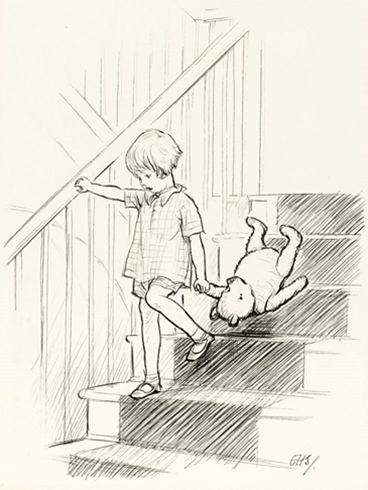
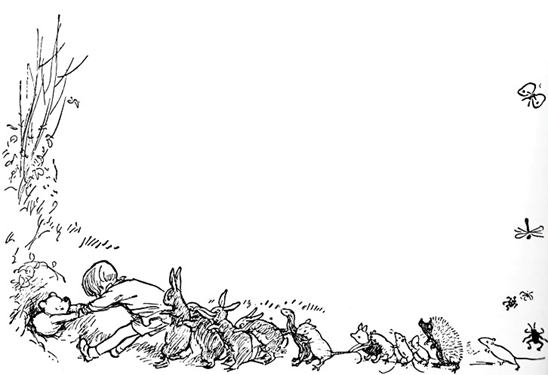
“What about a Story?”: Winnie-the-Pooh as Literature for Adult Readers

Katie Arthur

One of the oddest things about Winnie-the-Pooh is that it is so embarrassingly funny.  I am a grown adult, and I laugh out loud in the middle of my university library and have to apologize to my neighbors because Mr. Milne knows exactly how to pull a guffaw out of my throat at exactly the wrong moments.  But, you ask, I thought it was a children’s story?  Is it the sort of funniness we could imagine children enjoying?  Is it below our mature threshold for thinking, adultish entertainment?  In my reading, no.  This is genuinely clever funniness for young and old, and the hilarity is a function of what narrative theorists call the implied reader.  In the 1960s, Wayne Booth initiated theory on the implied reader, saying the text itself constructs a sense of the audience it intends, assuming knowledge and giving knowledge according to what it wants the reader to be.  That ideal audience corresponds to nothing in the real world.  The real readers of the text may or may not be anything like the reader the text asks for, but the sense the real readers get of the implied reader nonetheless shapes the way we receive the text.  It is here that Winnie-the-Pooh is successful. 

Winnie-the-Pooh incites two kinds of implied readers.  It is a book either for older children to read for themselves or for adults to read out loud to younger children, and it works very well both ways.  There are three kinds of humor in this book: humor for both the adult readers and the children listeners to enjoy together, and two kinds of humor only the adult readers will enjoy: the first, a humor accessible only to the adult readers as a function of the printed text, which naturally the young children will not appreciate; and the second, a humor that allows the adult to enter into the funniness of a child’s world.  We will look at all three kinds of humor but dwell on the last for the longest because it is the reason I have to excuse myself from quiet places.

The humor made for both children and adults is the most easily explained.  These are instances of simple confusion and embarrassment, like most of the comical things we encounter in our lives.  In the fourth chapter, “In Which Eeyore Loses a Tail,” in order to find the tail, Owl suggests a reward be issued.  “‘Just a moment,’ said Pooh, holding up his paw.  ‘What do we do this — what you were saying?  You sneezed just as you were going to tell me.’  ‘I didn’t sneeze.’  ‘Yes, you did, Owl.’ . . . ‘What I said was, “First, Issue a Reward.”’  ‘You’re doing it again,’ said Pooh sadly” (50, 51).  This is purely delightful confusion between the sound of the word issue and the sound of a sneeze, and absolutely accessible to young and old minds.  In Chapter II, “In Which Pooh Goes Visiting,” Pooh finds himself stuck in Rabbit’s front door, which was constructed to allow Rabbits and hungry Pooh Bears through, but had forgotten to take into account not-hungry-anymore Pooh Bears (32).  People stuck places they should not be is just comical.  This too, is simply an embarrassing situation most children and adults can relate to and laugh about.  When Kanga and Roo come to the forest, and the animals have to decide what to do about these strange visitors, Piglet must, according to the plan, pretend to be baby Roo to trick Kanga into leaving. As Kanga, only fooled for a few moments about the difference between a baby pig and a baby kangaroo, gives Piglet a spluttering cold bath to continue the joke, both reader and listener can laugh at Kanga’s cleverness and Piglet’s sad and unheeded insistence he is not Roo and does not need to have this bath and take this medicine (106).

And then there is humor Mr. Milne threw in just for the reader, which the child listener would have no access to, unless he were an older child following along with the reading.  This is located in the clever misspellings of certain things in the text.  These animals are the toys of a young boy, so they do not naturally have a very large capacity for educated writing and reading, and yet, living in a forest, one finds the need for many things to be written.  So Owl, the wise one, finds himself doing most of the spelling work when Christopher Robin cannot be found, and the result is funny for the reader.  For example, on Eeyore’s birthday gift from Pooh, Owl writes “HIPY PAPY BTHUTHDTH THUTHDA BTHUTHDY.  Pooh looked on admiringly. ‘I’m just saying “A Happy Birthday,”’ said Owl carelessly.  ‘It’s a nice long one,’ said Pooh, very much impressed by it.  ‘Well, actually, of course, I’m saying “A Very Happy Birthday with love from Pooh.”  Naturally it takes a good deal of pencil to say a long thing like that’” (83).  Mr. Milne took the time to write out in the text the funny misspelling that would only be seen by the reader.  (Although, this might better fit into the first category.  As we are supposing this to be read out loud, the pronunciation of the misspelled birthday message could be a point over which listener laughs at reader, and we might actually need to create a new category.)  Another instance that is truly only for the reader is when Pooh brings Christopher Robin news of the flood waters in other parts of the forest, bringing with him a note he found in a bottle.  He calls it a “missage,” and Mr. Milne continues, for the enjoyment of the reader, to spell it missage even when he has finished reporting Pooh’s actual words (142).  And at Owl’s house are two signs which read: “PLES RING IF AN RNSER IS REQIRD” and “PLEZ CNOKE IF AN RNSR IS NOT REQID” (48).  These are intelligible signs and can be read out loud to a child without problem, and the misspellings are just a little treat for the reader.

But the most interesting parts of the book for the adult reader are the places where Mr. Milne’s adult narrator speaks as if he were a child and allows the adult reader the joy of watching children think.  In the introduction and first chapter, our narrator sets up the book as a collection of stories about a little boy named Christopher Robin and his stuffed bear.  Really, Christopher Robin has told our narrator Winnie the Pooh has asked for some stories about himself, “because he is that sort of Bear” (4).  Christopher Robin is the explicit narratee here, the one receiving the story.  When Pooh needs a friend, “the first person he thought of was Christopher Robin” (9).  Christopher Robin here interrupts the story with a question about whether or not Pooh really meant him, and the narrator assures narratee Christopher he did.  We know, though, the story Christopher Robin and the listener Christopher Robin exist on different levels, one in the nursery listening to the story, and one in the Hundred Acre Wood being the story, and so they cannot be exactly the same.  But good storytelling encourages the listener to feel involved, so we can let him think Pooh meant him.  On page 10, Milne grants Christopher Robin permission to be called “you” by the narrator in a brief moment of dialogue.  Then on page 11, the story continues with Pooh and Christopher Robin, we assume.  But the Christopher Robin character is now called “you.”  Before, the listener Christopher Robin was “you.”  Now the character Christopher Robin is “you.”  In this tiny switch hangs a great deal of the success of the book, because in it the reader is invited to be Christopher Robin listening to his father.  As the narrator/narratee framework disappears with the disappearance of quotation marks surrounding the story and the reader receives the text in pure naked narration, the reader is addressed directly as “you.”  In this way, the adult implied reader is asked to put himself in the shoes of a child, to put on a child’s perspective and think like Christopher Robin.  The results are hilarious, and one of my favorite manifestations of this child-thinking is the time we are introduced to Piglet’s grandfather.

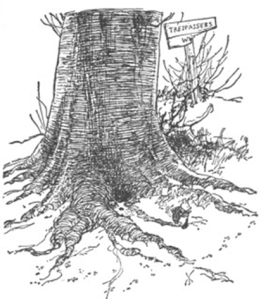
Piglet lives in a great beech-tree, and “next to his house was a piece of broken board which had: ‘TRESPASSERS W’ on it” and Piglet explains that it “was his grandfather’s name, and it had been in the family a long time” (34).  We the readers know, as the narrator intends for us to know, that Trespassers W is not short for Trespassers William, as Piglet says, but for Trespassers Will Be Shot.  If you are a child, though, trying to make sense of the world around him it makes perfect sense for a grandfather to be named Trespassers W.  The funniness here is a function of the particular adult implied reader who does have a pretty good sense of the world around him, but who has hung next to his adult sensibility a child sensibility and has let them clink around a little at odds with each other.  This clinking sounds like laughter.  So a story can begin, “once upon a time, a very long time ago now, about last Friday,” and it both makes sense and is laughably wrong, because the adult knows how a child can feel that last Friday was an eternity ago and also know it has really only been a few days since then (4).  And of course when you are a child trying to discover the North Pole, it makes perfect sense to look for a stick in the ground and preferably rather close to where you live, when you the adult knows it is actually a huge lonely snowy place very far away with no real poles at all (127).

To become an implied reader, to put oneself in the brains of someone else, is one of the greatest joys of reading narrative, and it is especially fun when the new brains are joyful and juvenile.

Works Cited and Related Reading

Booth, Wayne. The Rhetoric of Fiction. University of Chicago Press, 1961.

Iser, Wolfgang. The Implied Reader. Johns Hopkins UP, 1974.

Milne, A. A. Winnie-the-Pooh. E. P. Dutton & Co., 1961.

Prince, Gerald. “The Narratee Revisited.” Style, vol. 19, no. 3, 1985, pp. 299-303.

Hamlet and Ophelia

Emma Kenney

William Shakespeare has written many beloved plays that are still incredibly popular today. Perhaps one of his most well-known plays is Hamlet. This tale of duty and betrayal has been read by many, and Hamlet’s soliloquies are some of the most recited monologues and iconic scenes of all time.

Over the years there have been many versions of this play. It has been performed with famous actors such as David Tennant, and it has ben done as a movie. There have been television show episodes and books semi-based off of it. One book in particular, however, is based off it a bit more than others. Ophelia by Lisa Klein tells the story of Hamlet from the perspective of Ophelia. It is an interesting read from a point of view that is rarely shown or even thought about. However, the book does contain quite a few differences from the original play’s storyline, which show it to be something of a different nature than Shakespeare’s Hamlet.

The first big difference between the two stories is the fact Lisa Klein’s story shows Ophelia and Hamlet as children. The novel starts when Ophelia is roughly ten and hamlet is in his mid to late teen years. It shows Ophelia before she came to the castle and then as a child within the castle. Klein’s story talks of neglect Ophelia faces at the hand of her father and depicts her as a young tomboy who would much rather run around and roughhouse with the boys than sew or play music. It shows the reader how Ophelia became a lady in the queen’s court and how she rose and fell in her eyes. These are all topics Shakespeare’s original play doesn’t even touch on, as the focal point is not Ophelia but Hamlet.

In Hamlet, Hamlet doesn’t decide he loves Ophelia until after she is already dead, but in the story by Lisa Klein, Hamlet declares his love for her much sooner, although he does so in secret. In her story only Horatio knows of the declared love between the two and helps them to marry in secret. Hamlet declares his love for her many times in the book and chases after her soon after Ophelia turns fifteen or sixteen. He is able to finally woo her and they are often seen in the novel sneaking away to kiss or to do more saucy things. This is all very different from the original storyline where, as previously mentioned, there is no mention of Hamlet even remotely liking Ophelia until she is already dead.

Hamlet’s descent into madness is also much different in the original play. For starters, since it is about Hamlet himself you see way more of the descent than you do in Ophelia, and there is a much greater focus and emphasis placed on it than in Lisa Klein’s Ophelia. In the play we see even from the beginning he is not mentally well, and we get wonderful speeches such as the following:

To be, or not to be — that is the question: Whether ’tis nobler in the mind to suffer the slings and arrows of outrageous fortune or to take arms against a sea of troubles and by opposing end them. To die, to sleep — no more — and by a sleep to say we end the heartache, and the thousand natural shocks that flesh is heir to. ’Tis a consummation devoutly to be wished. To die, to sleep — to sleep — perchance to dream: ay, there’s the rub, for in that sleep of death what dreams may come when we have shuffled off this mortal coil, must give us pause. There’s the respect that makes calamity of so long life. For who would bear the whips and scorns of time, th’ oppressor’s wrong, the proud man’s contumely, the pangs of despised love, the law’s delay, the insolence of office, and the spurns that patient merit of th’ unworthy takes, when he himself might his quietus make with a bare bodkin? Who would fardels bear, to grunt and sweat under a weary life, but that the dread of something after death, the undiscovered country, from whose bourn no traveller returns, puzzles the will, and makes us rather bear those ills we have than fly to others that we know not of? Thus conscience does make cowards of us all, and thus the native hue of resolution is sicklied o’er with the pale cast of thought, and enterprise of great pitch and moment with this regard their currents turn awry and lose the name of action. — Soft you now, the fair Ophelia! — Nymph, in thy orisons be all my sins remembered.

While Hamlet still tries to convince his friends in the play he is merely pretending to be crazy, there are enough speeches and lines from him to show he is really not just pretending at all. The novel, however, is lacking some of these vital quotations and scenes. While one can definitely still tell Hamlet is crazy, the reader doesn’t get to see him fall into it slowly and surely. It is portrayed more along the lines of, “Oh my dad is dead? I guess I’m completely and totally mental now!”  It is quite unfortunate, as that character development is one of the things that makes Shakespeare’s play so wonderful.

One of the biggest differences between the novel and the play is the way Ophelia’s tale is ended. In the play she is depicted as going mad, and she falls from a tree in what is suspected to have been suicide. In the novel she does what Hamlet claims to do and fakes madness in attempt to protect herself. When this only draws more attention to her, she freaks out and starts trying to figure out how to escape the castle and all of Denmark. Finally, with the help Horatio and the queen she fakes her death and flees Denmark with basically only the clothes on her back and some money from the queen. She ends up at a convent where she spends the rest of her days as the “doctor” for the town. This takes up the entire second half of the novel (in what is considered to be, by many, one of the most boring and useless halves of a novel ever to be written in the English language). Also, while she is at the convent in the novel taking care of all the sick and crazy people, she ends up giving birth to Hamlet’s son, whom she names (drumroll please) Hamlet. This is something incredibly and drastically different between the novel and the play, as Shakespeare never wrote Hamlet to have an heir at all. Lisa Klein’s novel, however, takes some creative liberties, however, and writes one in.

Another difference between the play and the novel is theme and focus. The novel places emphasis upon “sexual awakening,” to the point of taking away from the plot, which is something the play never does. The focus is on Ophelia, who she is, and what she does, as well as on love, how it should make one act, and whether love is ever true at all. One important theme is how all of humanity is corrupted, specifically by lust, and how that lustful corruptness affects everyone. It also shows that if the king falls so will the kingdom, though the play shows this as well. The play talks about corruption like the novel, but in the play the focus of corruption is placed upon the desire for power, not upon lustful desires. It depicts most of the corruption in the story to come from character’s desires to rule and to be in charge or to be honored and recognized by all. The play focuses on Hamlet, his descent into madness, and the fall of Denmark instead of on Ophelia and what she does and thinks. The focus is never really placed upon love at all, because that’s just not what the original story is about, other than when Ophelia is trying to cure Hamlet’s insanity by loving him and bidding him to love her back.

It is incredibly easy to see how different these two are, and those differences are why Shakespeare’s beloved Hamlet has stood the test of time and Lisa Klein’s Ophelia has barely been heard of. Though Shakespeare brings them up in interesting ways, the themes of his play are important and relatable (we all deal with death and with corruption). Because of that his play will continue to stand the test of time, unlike those that warp and change these themes into something less than. The play is loved for its quality of writing and plot, and when one tries to change that too much it is better to have just invented a different story altogether. Ultimately, though, it is safe to say both these stories do share one thing: they show that at the end of the day we all have to choose. We most chose to deal with our grief — to run from it or to face it head on.

Behind the Scenes of Agatha Christie

Amanda Mericle

There were several great authors in the twentieth century, but Agatha Christie was one of the best and is still considered to be the bestselling novelist of all time. She is best known for her novels in the mystery genre, of which she wrote sixty-six and sold billions of copies around the world. She is even recognized as the Queen of Crime and is credited with creating the modern murder mystery. Agatha Christie has earned these honors through her wonderful writings, which were influenced by several different experiences. Some of these were her time spent at the hospital during the war, her exposure to archaeology through her husband, and her love for Sir Arthur Conan Doyle’s Sherlock Holmes.

Agatha Christie, then Agatha Miller, was born in 1890 to Frederick and Clara Miller. They were a middle-class family who lived in Torquay, Devon. The only uncommon aspect of Agatha’s upbringing was she did not attend boarding school, like her two older siblings, but was homeschooled by her father. Also, her love for books and writing was very evident at an early age. Christie taught herself to read at age five, began to write poems as a child, and even gained some knowledge of the French language through her governess, Marie.

However, at age eleven, Agatha’s family dynamic took a turn when her father died of a heart attack, probably induced by stressing over financial issues. Agatha and her mother grew much closer after this tragedy, and they left for her debutante season in Cairo where she met many young people at parties, which gave way to several marriage proposals. However, she did not accept any of the proposals but did begin seeing a man named Archie Christie in 1912. Two years later, after they had both experienced war, she on the Home Front in a Red Cross Hospital and he in France, they were married. However, because they were apart so much (Archie had to return to France two days after they were married), Agatha Christie remarked she felt their married life did not truly begin until 1918, when Archie was given a position at the War Office in London. They had one daughter, Rosalind, together but sadly their marriage was not meant to work out.

Archie’s affections grew stronger for a family friend named Nancy Neele, and he asked Agatha for a divorce. Christie was devastated and so overwhelmed that one night she got into her car and drove off. The police found her car deserted and organized a search party for her. Ten days later she was found at the Harrogate Spa Hotel under the name Theresa Neale. Many believed she suffered from amnesia, some believed it was a ploy she created to win Archie back, and others believed she used the circumstances to increase her popularity. While this did not help Agatha win Archie back, it did increase her popularity. Several of her earlier books were reprinted and sold out and her disappearance, with its similarity to detective fiction, made her a celebrity.

Agatha Christie started her detective writing career during World War I and debuted her first book, The Mysterious Affair at Styles, which starred her most recognized detective, Hercule Poirot. One of the reasons why Christie started writing detective novels was because of a bet made with her sister. She told Agatha she did not believe she could write a good detective story. The other reason was to relieve her from the dreary dispensing work she was now doing at the Hospital. In 1919, Agatha Christie caught the attention of a publisher from The Bodley Head, John Lane, who published The Mysterious Affair at Styles and contracted her to write five more books.

Following the war, Christie experimented with different types of mystery stories and developed characters such as Tommy and Tuppence and Miss Marple. By 1924, Christie had become irritated by her publisher’s unfair terms and turned to a new publishing company, William Collins and Sons (now HarperCollins). As Agatha Christie reached her mid-fifties, she became less prolific and enjoyed a slower-paced life than she was used to. After a very successful life and career, Agatha Christie died of natural causes on January 12, 1976.

Agatha Christie was influenced by many experiences and people in her life but one experience that heavily influenced her writing was her time spent working at the Red Cross Hospital. She worked at the local hospital as a nurse for two years and then was transferred to the hospital dispensary, where she worked for another two years. In order to be able to hand out drugs to patients, she needed to pass the Apothecary Hall exam. She spent large amounts of time being trained by chemists and pharmacists so she would not make a mistake and accidentally mix a poison into an ointment. As a result, Christie became well-versed in her knowledge of drugs, ointments, and poisons. Because she was immersed in the world of medicine and poisons, it is very reasonable that many of her victims met their deaths by means of poisoning. Agatha Christie wrote about a total of eighty-three poisonings in her novels.

During her time working as a nurse she also came in contact with several Belgian refugees because the district in which she lived had a flood of refugees fleeing Belgium after the German invasion. These refugees inspired her first detective, Hercule Poirot, who starred in many of her novels.

Another experience that influenced Agatha Christie was her time spent at archaeological dig sites. After her divorce from Archie, she went on the Orient Express and visited the ruins at Ur where she met her second husband, Max Mallowan, a prominent archaeologist. They married in 1930 and Christie accompanied Max on several of his expeditions. They began a rotation of summers at Ashfield, Christmas at Abney Hall, late autumn and spring on digs, and the rest of the year in London and their country home in Wallingford, Oxfordshire. On Max’s expeditions they visited Cairo, Damascus, and other places. However, Agatha did not just accompany Max on his expeditions. She helped out in many ways, such as cleaning artifacts with her face cream, which turned dirty, fragile antiques into well-preserved artifacts. In turn, her husband’s archaeological digs helped Christie with writing her novels. For example, Christie’s novel, Murder on the Orient Express, was inspired by a train ride she took on the way back from one of the dig sites when the train was stuck for twenty-four hours due to bad weather. Many other novels such as Murder in Mesopotamia, They Came to Baghdad, and Death on the Nile were inspired by the influences of the digs in places like Egypt and Mesopotamia. Some of the characters in her novels even resembled their friends from the dig site at Ur.

One person that influenced Agatha Christie’s detective novels greatly was Sir Arthur Conan Doyle and his famous detective Sherlock Holmes. She even admitted to following the Sherlock tradition, especially when it came to implementing an unconventional detective (Poirot). When she was trying to decide what the characteristics of her detective were going to be, she kept going back to Britain’s greatest detective, Sherlock Holmes. Agatha Christie knew she would never be able to perfectly portray him, so obviously she did try to create differences between Holmes and Poirot. However, early on in her career after a few novels she realized she had been influenced by Doyle’s novels more then she had meant. She remarked she was “writing in the Sherlock Holmes tradition — eccentric detective [Poirot], stooge assistant [Captain Hastings], with a Lestrade-type Scotland Yard detective, Inspector Japp” (Berlin).

Another great author that influenced Christie was Gaston le Roux. It was his novel, The Mystery of the Yellow Room, that initiated Agatha’s conversation with her sister, Madge, about writing a detective book. They had been discussing the book and Agatha described it as a well-thought out and baffling mystery. She then remarked to her sister she would like to write a detective novel. Even though her sister told her she should not write a detective story because they were so challenging, Christie was determined to do so.

It is a good thing that Agatha Christie was so determined to write novels in the detective genre, because many people would have been deprived of reading her wonderful mystery novels. She practically invented the typical mystery book scenario. A crime is committed, a detective is summoned to determine who did it, he investigates and interrogates, he gathers everyone around to display his conclusion, and finally the criminal does not protest but confesses and is taken away by the police. With her specific writing style, Christie won over millions of people and became one of the most prolific writers of all time, especially in regards to her detective fiction. It is no surprise then that she is known as “The Queen of Crime.”

Bibliography

“About Agatha Christie.” The World’s Best-Selling Novelist — Agatha Christie, The Home of Agatha Christie, Web. 14 Oct. 2017.

Acocella, Joan. “Queen of Crime.” The New Yorker. 25 Aug. 2017. Web. 14 Oct. 2017.

“Agatha Christie — The Influences on Her Writing.” http://www.christiemystery.co.uk. The Christie Mystery. Web. 14 Oct. 2017.

Berlin, Erika. “15 Influences on Agatha Christie’s Work.” Mental Floss. 15 Sept. 2015. Web. 14 Oct. 2017.

Ferro, Shaunacy. “How Archaeology Influenced Agatha Christie.” Mental Floss. 15 Dec. 2015. Web. 14 Oct. 2017.

Pinter’s Picture in The Dumb Waiter

Melissa Yeh

Playwright Harold Pinter’s 20th-century works still hold an important influence on modern pieces today.  Through his life, he developed his passion for literature and a unique style in his plays.  His use of pauses coined the terms Pinteresque and Pinter Pause, which communicate tension and oftentimes a menacing play behind the awkward silence.  The Dumb Waiter indicates the classic traits Pinter paints in each of his works and achieves a blend of comedy and seriousness in an absurd situation.

Through his talent in the various areas of poetry, acting, and directing, Harold Pinter best expressed himself through his plays.  He gained recognition for the style of dramas in the postwar revival of British theatre.  Born on October 10, 1930, Pinter experienced the affected society by war, while also developing his creativity.  In his biography published in the 1960s, the dramatist reveals the hundreds of poems and short prose pieces, written in monologue or dialogue form, and all composed before the age of twenty.  This led to his involvement in theater, establishing his passion as a playwright and eventually, as a director.  After, Pinter dedicated time and career to acting, focusing on roles in Shakespeare’s Hamlet and The Merchant of Venice, and then on to many other roles across a range of different genres.  Through this, he met Vivien Merchant, an actress at the time, and married her in 1956.  In the same year, Pinter wrote his first play, The Room, the first of his style he introduced to the world of theater.  He went on to write more, including The Birthday Party and The Caretaker.

Reaching the 1970s, Pinter moved on to experiment with screenplays and refine his own work in plays.  The height of his fame peaked in 1975, which also gave him attention, more likely unwanted, concerning an affair.  Lady Antonia Fraser was the subject of his drama, to which Pinter chose to be with while still married to Vivien Merchant.  He left his wife in 1978, leaving a bitter break and ending in Merchant’s death in 1980.  Merchant and Pinter’s son was also affected and estranged himself from Pinter.  Entering the 1980s, Harold Pinter then became more vocal in his political beliefs.  He joined groups and associated himself to a cause that advocated for the rejection and opposition of war.  While his earlier plays had underlying and subtle references to oppression and other issues, they were not the direct theme in the play.  Those written in the 1980s were political by obvious nature.  However, these plays were not quite well received but also not an extreme matter of negative review.  They simply lacked the praise and interest attained before in past works.

In the meantime, Pinter’s relationship with Lady Antonia Fraser grew in strength and how well they fit each other.  They completed each other in thought and speech; for example, during one dinner party, Harold was seen to be protesting and ranting, his wife regarded his ideas with a Chinese proverb, “If you sit by the river long enough, the bodies of your enemies come floating by,” to which Pinter responded, “Not good enough, I want to be the one who pushed them in.”  Pinter’s character was always reflected in his plays, and his thoughts are still seen in glimpses through his distinct tone as a playwright.  Through time, his audience began to identify the shape his pieces took.  Harold Pinter went on to receive the Nobel Prize for Literature in 2005; he passed away in 2008 and was remembered through the theater named after him in 2011: The Harold Pinter Theater.

During his career as a playwright, Harold Pinter achieved his technique and brand throughout the years.  From his style, the terms “Pinteresque” and “Pinter Pause” originate to describe elements within plays today.  The two are closely related in its reference to Pinter’s key use of silence; Pinteresque refers to the awkward silence pointing to a hidden menace lurking behind, while a Pinter Pause, which referred to a stop in the dialogue, creating tension and confusion.  The use of silence was a trademark element for Pinter, as it served to withhold motives and information.  This unspoken dialogue had an ominous feel and threat from one character to another or to both characters altogether.

Another notable feature of Pinter’s plays was the ending and meaning often left for interpretation to the audience.  Pinter gained recognition for the unknown allegorical or symbolic revelations, initially receiving negative critique.  In one interview, he states, “A character on stage who can present no convincing argument or information as to his past experience, his present behavior or his aspirations, nor give a comprehensive analysis of his motives, is as legitimate and as worthy of attention as one who, alarmingly, can do all these things.”  The constant uncertainty present in his plays took time for playgoers to understand and appreciate, something that came along much later into his career.  A factor evident in many of his pieces, Pinter would use betrayal as a frequent theme within his plots.  Many speculated it related to his affair with Lady Antonia Fraser and betrayal of his wife, Vivien Merchant; however, the emotion of regret behind it was always a mystery, as his plays did not expand as much on his personal reflection.  Yet in an interesting turn, Pinter had the ability to employ humor within his works.  The Dumb Waiter was well received for the comical banter while being set within a seemingly grim and serious background.  On the whole, Harold Pinter continued to work on his use of ambiguity behind meaning.  Even his main actors began to develop it in their portrayal of his plays: Ralph Richardson who acted in the play No Man’s Land remarked on the characters and the response of the viewers, saying, “We’re a mystery to ourselves and other people.”  Thus, Pinter was successful in demonstrating his use of silence and obscure meanings.

Published in 1957, The Dumb Waiter is one of Harold Pinter’s earlier plays, about two hit men in a hotel basement waiting for orders on their next task.  Ben sits on the bed reading over a newspaper, while Gus paces around the room.  It is all very minimal, from the amount of characters to the entire set only in one room for the whole time.  The play reflects many of the characteristics his works feature, even being one of the first few plays he had written.  Pinter himself spoke on the influence of Samuel Beckett, another dramatist at the time who had a similar style in his works to Pinter.  The Dumb Waiter especially found parallels to Beckett’s Waiting for Godot.  Both authors use the silence within a pause to convey a mysterious atmosphere filled with menace.  The use of pauses is most evident in the conversation between the two hit men; the plot builds to the reveal of Ben raising his gun at Gus in receiving the order to kill him.  In each chain of dialogue, the audience can recognize that Ben sees himself above Gus who constantly questions about the task they will receive and who they will have to kill.  When Ben refuses to answer these questions directly, he turns to throw off the question by redirecting Gus’s attention to another topic.  For instance, the conversation began in a casual manner about the room they waited in, but when Gus even suggested switching the conversation, Ben responded by alluding to a story he was reading in the paper.  This reoccurs the very next page, after their discourse on the article; Gus asks what time their contact, Wilson, will get in touch to which Ben does not even answer at all until Gus has to repeat it again.

The tension continues to grow each time this occurs. As for why these characters respond this way, the two have differing personalities and ideals surrounding their job they must carry out.  Ben not only sees himself as the one in charge but also is very evident and violent about it.  His speech reflects his thrown around anger, even at minor and unimportant matters.  At one point for not being able to light the gas to make tea, Ben explodes at Gus, yelling, “THE KETTLE YOU FOOL,” while putting his hands around his neck at arms length and shaking him back and forth.  On the other hand Gus is consistent in being inquisitive whether it is about the their next job or the reason why they do it.  His character also demonstrates more care for whom they have to kill and whether the person actually deserves to die or not.  Each time, Ben alludes to answering these questions in a condescending reply on something unrelated, mostly being the newspaper.

Yet while Pinter writes with such intimidating characters, he manages to bring comedy into the moments before the two men have to execute their next task.  Throughout the entire play, the banter between the two is as if a dysfunctional married couple was arguing every five minutes about the most mundane problems.  They transition from making the other prepare tea to why the toilet is no longer working.  When they discover messages being sent down from the dumbwaiter, they scramble to send anything back up regardless of the fact they have no idea why or of it would benefit anything concerning their job, much like their conversation being one-sided and almost useless as Ben will eventually betray Gus.  They also find a tube that limits the audience to find out what the authority figure is saying through Ben, who repeats the message to Gus, who repeats the message repeated by Ben.  The conversation often falls into an absurd foolishness to the advantage of comedy Pinter was trying to convey.

The Dumb Waiter is an excellent play as it is also an excellent play on words.  The two hit men, Ben and Gus, wait for their next order and stupidly clamber around with a dumbwaiter in a basement room.  Harold Pinter’s ability to effectively use silence in his plays is seen with Ben’s pause each time Gus asks a question he does not want to answer.  Overall, Pinter’s career in theater accomplished great feats, awarding him the Nobel Prize for literature, and leaving a legacy for future playwrights.

Works Cited

“Drama Analysis: The Dumb Waiter – Ink9GEnglishI.” Ink9English.

“Harold Pinter: the Most Original, Stylish and Enigmatic Writer in Post-War British Theatre.” The Telegraph, Telegraph Media Group, 25 Dec. 2008.

Kuska, Martina, et al. “By Harold Pinter and by Edward Albee a Soulpepper Theatre (Toronto) Production Study Guide.” THE NATIONAL ARTS CENTRE ENGLISH THEATRE PROGRAMMES FOR STUDENT AUDIENCES.

Pinter, Harold. The Caretaker and the Dumb Waiter: Two Plays by Harold Pinter. Grove Press, 1960.

What Makes Literature “Classic”?

Nathan Flowers

When broaching the topic of classical literature (specifically Classical American Literature), one must wonder “what makes literature classic”?  This is a difficult question to ask if one does not first know the definition of literature. According to Merriam Webster’s dictionary the most current definition of literature, (that is applicable to the subject at hand) is “writings in prose or verse; especially: writings having excellence of form or expression and expressing ideas of permanent or universal interest” (“Literature”).  Now that there is a firm standpoint on the concept of literature the next question one must ask is what makes this literature classic. Those questions my sound a little like this: “Is literature classic because it was popular?”, “Were all classical books once popular?”, “Does popular literature have anything to do with classical literature at all?”, “What is popular literature in the first place?” All of these questions have their places but the first that will be discussed here is “what is popular literature?”

To answer this question is not as simple as looking up the answer; first, one must look at a vast expanse of American literature and see which were popular and then determine what ties the all together as popular. Now obviously no one has enough time to search through all of the so-called “popular” American literature but there are other ways of finding such information. For example, the book A History of American Literature is a great overview of popular American literature in a small 800 or so pages. Within this book we can answer at least one of the many questions about popular and classic literature. Not all popular literature is or becomes classical. We can see very early on many popular stories from Native American tribes are not classical literature (Gray 7-15). In sixteen eight-two there was a book published called The Sovereignty and Goodness of God, Together With the Faithfulness of His Promises Displayed: Being a Narrative of the Captivity and Restauration of Mrs. Mary Rowlandson, which was immensely popular in the 1500s and 1600s. Most people have probably never heard about it, let alone call it a classic (Gray 50). With Shuddering Fall (1964) and A Garden of Earthly Delights (1967) were two very popular books in the last century but also have not been heard of by too many (Gray 624). So with that we can say without a doubt popular literature in American history does not always become considered classic. However, this does not entirely mean classical literature does not find a basis in popularity. This also does not tell us what it means for literature to be popular. On the definition of popular literature it is acceptable to say at least this: popular literature, at least in America, has had local or widespread influence and large appreciation from those within that influence.

With that said the question arises, what does popular literature have to do with literature becoming a “classic”? Now, we have many examples of classical literature so it would make sense to look at those and see if they became classics because of their popularity or for some other reason. For example, on the 16th of March, 1850 a book called The Scarlet Letter was released (Laston). It was an instant bestseller (Laston). Some would argue it sold so well not only due to the excellent storytelling of the book but also because it was one of the first (if not the first) American novels that dealt with issues like sexual immorality and other psychological issues that had not been acceptable or appropriate to be addressed so bluntly and therefore most likely engrossed readers.

The Grapes of Wrath was published on April 14, 1939 by a John Steinbeck (Lanzendorfer). The novel was critically acclaimed and a bestseller — some 430,000 copies had been printed by February 1940. This was most likely due to the relatability the readers would have had to the characters as the story was based around the Dust Bowl, which had occurred within the decade of the publishing of the book. This shows the author was thinking not only about the way to write the book but also the way to attract lots of attention using a common experience most had gone through within the recent past. This is undoubtedly why it was a bestseller and having won a Nobel Peace Prize for the book Steinbeck had assured his book would be remembered as one of the classics of American literature.

Lastly take a look at The Call of The Wild by Jack London. Written as a frontier story about the gold rush, The Call of the Wild was meant for the pulp market. Originally planned to be about 2,000 to 8,000 words long, it ended up being 32,000 words in length. It was first published in four installments in The Saturday Evening Post in 1903. In the same year, Jack London sold all rights to the story to Macmillan, which published it in book format. The first printing sold out in 24 hours and the book has never been out of print since that time (Lanzendorfer). This book was most likely immensely popular at that time because it was around the time people had finally settled down from the Klondike Gold rush of the 1890s. They would have returned to their family’s home and read a newspaper portraying the life many people had just been living. This most likely brought back memories from their time in the north, not to mention their attachment to their dogs, giving them a feeling of nostalgia and excitement. Moreover this novel/short story fit exactly with the mood of those returning to their homes and those who wanted to know what it was like to go to the gold rush. This novel shows the author’s understanding of the people’s mindset at the time and wonderful craftsmanship of the book itself.

Gathering what has been said, we can now make some statements. First is most if not all classics were at one time or another popular. Second, it can also be said the term “classic” also comes with a certain level of skill from the author.  This skill is that which allows the author to read the mindset of the majority of people at the time and use his/her skill in writing to create a masterpiece that has now been labeled as classic. Some authors of classics were undoubtedly not famous the moment they came out, and there are surely examples of famous works that did not receive appreciation until after the author’s death, but in those situations the book achieves classic status by being relatable to something the author could not predict or being enormously famous for some reason or other at a later date.

For example, Edgar Allan Poe: “The poster-boy of struggling writers. Poe is almost as famous for living and dying in poverty as he is for his stories, which have become classics in almost every way possible. Poe was able to publish frequently, but no one seemed to appreciate his work very much until well after he was found lying in a street in Baltimore” (Hope).

It is also good to mention Emily Dickenson who was similar to Poe:

Dickinson took obscurity to truly professional levels, mostly due to the fact that she never left her room. She published a handful of poems in her life, but after her death her family discovered how prolific she was. There were piles of poems, literally, which they published. Then people started to realize the recluse really had something to say. To the walls (Hope).

As can be seen, two very famous authors known for writing classics were not truly famous until after their deaths. This just goes to show that classic literature comes from people who can not only write well but have good taste for what is popular at the time or will be popular or got lucky, which is by far exceedingly uncommon but nonetheless just as qualifying.

Several things have been said and many things have been proven. The first is the definition of literature as a basis for further understanding; the second is popular literature does not always become classic and in fact most popular literature does not. Third, popular literature, at least in America, has been literature that had local or widespread influence and large appreciation from those within that influence. Some conclusions have been reached through some tedious if not well done logic.

Based on the fact most if not all American literature that became a classic was at one time famous we can say there is a direct correlation to a work becoming a classic and it being very popular, such that the popularity was one part of becoming classical. Also it has been said the classical works were very well done not only writing wise but also in a sense the authors could understand the mood and mindset of the general population and used it as a starting point for their literature. This does not mean they were dirty greed bags out for money and fame — some authors were quite poor. In fact, some just felt the need to write as a way to express themselves or due to some unknown urge to write.

It does mean, however, that the author was either very smart or very attentive or most likely both and undoubtedly very skilled in writing by either practice or natural skill. This leads to the conclusion classical literature is a piece of writing that became popular, was very well written by an author who could understand the mindset of the people of the time in order to attract such attention, and is now considered some of the best writing of American literature. With this information it is safe to say the topic of Classical American Literature can now be broached due to a thorough understanding of what makes the said literature classic.

Works Cited

“15 best North American novels of all time.” The Telegraph. Accessed 18 Oct. 2017.  http://www.telegraph.co.uk/culture/books/10605407/15-best-North-American-novels-of-all-time.html

Gray, Richard. A History of American Literature. Blackwell Publishing, 2004.

Hope, Daniel. “11 authors who became famous after they died.” Lit Reactor. Accessed 18 Oct. 2017. https://litreactor.com/columns/11-authors-who-became-famous-after-they-died.

Lanzendorfer, Joy. “10 Facts about The Call of The Wild.” Mental Floss. Accessed 18 Oct. 2017. http://mentalfloss.com/article/66813/10-facts-about-call-wild.

—. “11 Facts about The Grapes of Wrath.” Mental Floss. Accessed 18 Oct. 2017. http://mentalfloss.com/article/68038/11-facts-about-grapes-wrath.

Laston, Jennifer “Why The Scarlet Letter Was a Mixed Blessing for Its Author.” TIME. Accessed 17 Oct. 2017. http://time.com/3742240/scarlet-letter-hawthorne-history/.

“Literature.” Merriam-Webster. Accessed 9 Oct. 2017. https://www.merriam-webster.com/dictionary/literature.

Summer in Paradise by the Reading Light

Christopher Rush

As you may recall, one of the major goals for the summer of 2017 was to read extensively in preparation for the current (as of this writing) elective Critical Listening, awkwardly subtitled “The Beach Boys, the Beatles, and Their Times.”  While that goal was partially achieved (not every work acquired during the summer was read in time for the course and some were intentionally postponed due to over-preparation), room for improvement persists.  Thousands of books have been written about the Beatles alone, and the complete library on the Beach Boys is not an unimpressive amount either, so I knew going in there would be neither time nor money enough for a complete preparation up to my standards.   Not even Mark Lewisohn has read every book about the Beatles, and that’s saying something.  Even so, it was an enjoyable summer of reading and listening and watching, and while you may be surprised at some of the missing volumes (I still haven’t gotten a copy of David Leaf’s essential Beach Boys and the California Myth, for example, since it is rather pricey on the secondhand market), feel free to send my way things you think I should have concerning these subjects.  What is covered here is the rather eclectic array of works I did have access and time to read before the overwhelming nature of the project reached its breaking point, after which is a list of the works I have waiting on the back burner for future exploration.

Dark Horse: The Life And Art Of George Harrison, by Geoffrey Giuliano

Rating: 4 out of 5.

Until I get the opportunity to read I, Me, Mine, this will serve as the major study on George Harrison’s life (in print) (perhaps Mr. Scorsese’s Living in the Material World will surpass either or both). Mr. Giuliano is a knowledgeable source, which at times provides helpful insights tempered by awkward self-effacing “I don’t want to offend anyone, but…” sorts of comments. His tone at other times is bemusingly insensitive, such as during the potentially life-ruining addictions to drugs seasons of George’s life. (Similarly, Mr. Giuliano presents himself as a devout Hindu, yet the tone during much of that portion covering George’s life at times lent me to believe Mr. G thought George was just playacting.) Still and all, this does a fine job of surveying the life and art of George Harrison, the highs, the lows, and the introspective in-between. One wonders why a third edition covering the final five years of George’s life hasn’t come out, though the hinted-at falling out between George and Mr. G could have had something to do with that.

Perhaps the highlight is the dearth of Beatles-era coverage; that time has been covered by others such as Mr. Lewisohn far better than a reporter of Mr. G’s divers interests no matter how passionate could provide — but Mr. G knows that’s not why we are reading his book anyway. We want to know about the earlier times (likely) and the post-Beatles times (more likely). And while I enjoyed the reading of it all, even if a good deal of it made me sad (such as the bizarre George/Pattie/Eric Clapton situation and the perennial drug addiction issues), some of the periods I was most interested in were glossed over or not included (the Traveling Wilburys and the end of George’s life — but that last isn’t something I can fault the book or its author for). Thus, it surveys it all, and gives a significant amount of time to George’s spiritual journey, but Mr. G tends to lean more heavily to the era in which his personal experiences overlap George’s, which isn’t surprising for a journalist to do, though it does make for some of the more awkward portions of the book.

Should you read this book? If you are a George Harrison fan, certainly. If you are a Beatles fan in general, yes. If you want to know more about the ’60s, Beatlemania, and the like, maybe. If not, I’m not too sure. It’s not what one would call a “general interest” sort of biography. It answers a few questions, but it also raises more indirectly (such as, if each of the Fab Four was eager to move on to new things, why was the breakup so acrimonious?), which isn’t quite as helpful as one would want in a “definitive” or at least “updated” biography. Yet I am glad I read it, giving me a provocative peek into the life and art of the Quiet Beatle.

The Gospel According to the Beatles, by Steve Turner

Rating: 4 out of 5.

Fortunately, this book is not what I thought its title implied: this is not a “hey, Christians, let’s look for Bibley-messages in Beatles tunes and sanitize them so we can enjoy them guilt-free!” book. That would be horribly distasteful, both for Christianity and the Beatles. Instead, Mr. Turner gives us a more honest survey of the spiritual journeys of the Beatles (though, let’s be honest, it’s approximately 84% about John, 15% about George, .6% about Paul, and .4% about Ringo) from recklessly secular existentialists to drug-catalyzed spiritualists and beyond. Mr. Turner, who we learn actually got to interview John and Yoko once, begins with a general but intriguing overview in the first chapter about the nature of the Beatles as evangelists of their own rapidly-evolving religion, especially once they started to acknowledge their role/opportunity as influential people, and ends with a refreshingly personal essay on his own lifetime with the Beatles that somehow evades tendentious piffle while simultaneously explaining his impressively respectful and erudite commentary on Christianity throughout the rest of the book: he believes it. And in that rest of the book we get a mostly fascinating perspective on the changing attitudes and beliefs of the Fab Four (though, again, mostly John).

I’m still a bit confused by Mr. Turner’s decision to begin the book with the “Jesus incident,” though I sort of can convince myself why he would, since it’s likely the most famous spiritual-related moment in the Beatles’ career — though, since the rest of the book is chronological, it’s odd to begin with the “turning point” of their lyrical and corporate career then jump back to their (mostly John’s) childhood religious experiences in the following chapter. Even so, Mr. Turner gives us a very researched account of the episode with trenchant commentary, including a rather chilling observation about if Al Benn of UPI hadn’t just so happened to turn his radio to local station WAQY’s broadcast while he was passing through at just the right moment to hear DJ Tommy Charles’s “ban the Beatles” ratings stunt, John Lennon may be alive today. What started as a fairly meaningless local stunt in Alabama (based on a months’-old magazine interview, no less) spiraled into an international brouhaha involving everyone from the KKK to David Noebel.

The rest of the book, as I said, is a chronological journey through the major spiritual moments of the Beatles’ collective and solo careers. John is perhaps the most interesting case after all, having had the most formal religious instruction/experiences as a young boy combined with the roughest childhood (father left, mother killed in a car accident when John was young). John goes through the most oscillating religious life of the group: early choir boy training to cynical rejection of spirituality mainly due to loss to famous musician with everything money can buy to searching for something immaterial beyond for meaning/purpose/et cetera to drugs as a gateway to cosmic oneness to Transcendental Meditation to cynical atheism to magic/spiritism/Buddhist-like panoply of Yoko to dalliance with Christianity to Give Peace a Chance. George doesn’t have many religious youth experiences, gets involved with drugs around the same time as John, gets involved with the Maharishi with the others, then gets involved with Krishna and more or less spends his life there off and on. Paul is the steady, materialistic, willing-to-dabble, Love is the Answer guy we all basically suspect he is. And Ringo is the mostly laid-back one who dabbles with his buddies but finally arrives at the efficacy of spirituality further down life’s long and winding road.

Throughout it all, Mr. Turner gives us what appears to be a well-balanced presentation of the ideas, events, catalysts, and reactions the Fab Four experienced through the good times and bad. Mr. Turner does not just give us the usual line “the Beatles got really good when they started taking drugs,” but instead he reminds us even the boys themselves understood not too long after their drug experiences drugs were not the goal of life, despite what Timothy Leary and Michael Hollingshead and others were preaching. Drugs may have “expanded their consciousness,” but drugs also damaged John, George, Paul, and Ringo in long-lasting ways. The Beatles’ best songs and attitudes during and after their “drug period” were not because of drug usage, and while Hinduism may have prompted their social involvement more than Christianity, the quest for truth remained strong in them all (more or less) — but not because of drugs.

This book does not attempt to tell the whole story of the Beatles. This book focuses on John’s, George’s, Paul’s, and Ringo’s spiritual lives before, during, and after their time as Beatles. At times the book feels like Mr. Turner’s attachment to the subject is about to interfere, but it never does so for more than a moment, even in the very personal conclusion chapter. I began the book with trepidation especially about its title, but this book was a challenging and encouraging treatment of one of the most important yet grossly neglected aspect of one of the 20th century’s most influential groups. I will likely be reading this again sometime soon.

Wouldn’t it Be Nice: Brian Wilson and the Making of the Beach Boys’ Pet Sounds, by Charles L. Granata, Tony Asher (Foreword)

Rating: 4 out of 5.

Though a bit hagiographic at times (no doubt precisely how I sound when speaking of Babylon 5), this was a very engaging story of the making of perhaps the best rock album of all time. Mr. Granata gives us a modicum of historical background prior to the album, with a smattering of post-Pet Sounds knowledge, mainly relating to Smile and Brian’s miraculous return to the land of “emotional stability” as Brian calls it — none of which is wholly new but all of it is presented well and concisely. For my purposes in reading this book, Mr. Granata’s sparse yet efficient history was an ideal compilation of pertinent episodes in the life of the Beach Boys beyond the main album under discussion, so I very much enjoyed that unsought aspect as well.

Some may say this enthusiastic (shall we say) presentation suffers from too much verve, though I certainly wouldn’t want to read a history of Pet Sounds from some one who didn’t like it very much. Some may say it suffers from too many technical details, though considering Mr. Granata’s background, such technical aspects (such as the nature of the recording equipment, the tonal/harmonic construction of the vocal arrangements, the psychological reasons why we respond to such celestial harmonies, the history of recording/printing/tracking/compression/digitization etc.) of the album is part of Mr. Granata’s main purpose in writing this book. The subtitle (the title itself is never addressed why Mr. Granata chose that track as the initial focus) clearly indicates this is about the making of the album, not just a “here’s why I love it so much” biography (though there is plenty of that, most of which is strings of unexplored/unsupported superlatives — I don’t disagree, I just would have preferred a tad more substance in this area).

Some may be confused, as I was, why Mr. Granata intentionally did not speak to Brian Wilson directly. He says it was a purposed choice, but that’s all — no explanation why he made that choice. Some may be confused, as I was again, why Mr. Granata intentionally gave us a revised edition in time for the 50th anniversary of the album … but then said nothing about the 50th anniversary tour beyond one brief reference by (I think) Tony Asher in the foreword! Why this book couldn’t have waited two more months for some words on the phenomenal 50th anniversary tour with Al Jardine, Blondie Chaplin, and more is very perplexing.

Be that as it may, it’s hard to disagree with Bruce Johnston, Carol Kaye, Tony Asher, and others when they say this may be the definitive (if concise) story of the great(est) album Pet Sounds. I’m not saying this book (or the tour) made me think PS is the most enjoyable Beach Boys album to pop in on a whim (even Brian says Friends is his favorite), but it will give you a great appreciation for it and its worthy claim to greatest of all time.

Meditations of Maharishi Mahesh Yogi, by Maharishi Mahesh Yogi

Rating: 2 out of 5.

I’ll give this to the Maharishi: he didn’t want life to be boring. No “stare at the wall and empty your mind” sort of path toward spiritual enlightenment for him (or for us). True, I don’t agree with most of what he says in these three treatises, but considering his theological/philosophical presuppositions, he is rather consistent throughout, if ambiguous about quite a few important details. It was enjoyable to spot some of the lines I must believe influenced some of the lyrics of the Beatles and Beach Boys (such as the “all this is that” line concerning the unity of all things in a spiritual way and the obvious “jai guru dev” benediction), and likewise it was satisfying in an intellectual capacity to read thoughts so influential in the world for some time, even though, as I said, I disagree almost wholly with them. Does anyone still believe Christianity, Hinduism, Islam, Buddhism, et al. believe and teach the same things? Possibly only the people with symbolically-constructed “coexist” or “tolerance” bumper stickers (people who don’t subscribe to any of the belief systems represented by those symbols, naturally). But that aside, the notion all wars, hostilities, aggression, crimes, and such like those are all the result of internal conflicts and wrong thinking is … facile? at best. I’m not denying some truth resides in the notion: clearly all hate and antagonism and acts of destruction are built at least in part upon the platform “I am better/more right/more important than you.” Yet the solution of all that being looking within to one’s personal divinity doesn’t seem to provide a proper answer: how can one’s internals be both the cause and the solution to one’s problems? I am rather ignorant about these things, of course, so I am not a trustworthy authority on Transcendental Meditation or the Maharishi or any of it, but those are a few of my initial reflections. Feel free to leave them where they are.

The Beatles, the Bible, and Bodega Bay: My Long and Winding Road, Ken Mansfield

Rating: 3 out of 5.

I’ve had this book probably since it first came out (2000), but as is often the way, I didn’t get around to reading it until the right time. It was pretty good, and I would like to give it another star, but Mr. Mansfield’s tendency toward puns especially about song titles got rather irritating. It’s his first book, so I trust he stopped doing that in his later books. This is the only memoir (perhaps the only book of any kind) officially accepted by the Beatles (and Yoko). Perhaps that is because it is so positive about everything and everyone (except Allan Klein), but since I am not an insider on any level like Mr. Mansfield was, I can’t say.

Structurally, Mr. Mansfield oscillates rapidly between Fab Four days and (mostly) mid-’90s beachside scenes, which takes a bit of getting used to, but it happens so frequently one gets used to it soon enough. Mr. Mansfield does not give us a straight chronological approach to his reflections, interspersed as they are with his contemporary spiritual communion moments, which is also a bit perplexing at first. Effectively, Mr. Mansfield is reflecting on a few major experiences he had with Capitol Records and the good fortune he had to be in the right place at the right time to become a trusted member of the Beatles’ inner circle (perhaps second or third tier/orbit) for about five years. Mr. Mansfield does discuss a few other post-breakup experiences with the lads and others of that time, mostly positive memories, though a few sad memories trickle in toward the end. Mr. Mansfield does allude to some personal bad experiences in his own life post-Beatles, but he doesn’t give us many details or descriptions, so we are left assuming the ’80s were a rough part of his life until he met the woman who soon became his (second?) wife. Similarly, many of his contemporary (mid-’90s) episodes along Bodega Bay come across as psalm-like wrestling with negative life experiences with little context (though he does identify two specifically: the death of a friend/young father and his (Mr. Mansfield’s) diagnosis of incurable cancer, but since that was 1995 and he is still with us in 2017, I guess he was cured after all). I don’t want to sound like I’m disappointed he didn’t share the dark moments of his life in more detail — the ambiguity works well enough.

Overall, I learned a few things from Mr. Mansfield’s perspective, especially his unique experience of what it was like for other Capitol artists (such as the Beach Boys) who suffered whenever a new Beatles album came out, or the animosity and serious backlash (including financial repercussions) when some radio stations felt snubbed by not getting “first crack” at a new Beatles single or album. I would have preferred more such experiences beyond the somewhat repetitive “the boys were great, everything was magical, I was so lucky” sort of talk that happens throughout the book. Still, quite a few of his favorite moments (an impromptu jam session with George/Clapton/Donovan here, a pub lunch with Paul there) make for enjoyable reading about moments you could never know about otherwise. Rough spots and all, I thought it was pretty good.

The New Sound, by Ira Peck

Rating: 2 out of 5.

Not to sound too much like Vanessa Huxtable, but this was “interesting” mainly for its historical perspective on the “new sound” of rock-and-roll, even though rock-and-roll had been around for over a decade by the time of this compilation. I did not realize this at first, but this is a Scholastic publication aimed at the youth, which now explains some of the tone and diction choices sprinkled throughout. There is one apparently famous (infamous) extended exploration of Phil Spector toward the end (by the other Tom Wolfe), which did seem at the time rather more antagonistic than it needed to be, especially considering this collection is intended to give helpful information — but I suppose the kids of the day were supposed to be antagonistic toward the millionaire youth instead of recognizing his unique contributions to music (whether you like them or not).
Maybe because this was written by a bunch of grown-ups for youth in the 1960s, back when kids didn’t know anything since they were kids and adults were the best because they were adults, but this doesn’t have a whole lot of helpful/meaningful/deep content. It would be one thing to be a light frothy gossip book, but it’s also a light frothy gossip book that talks down to its audience most of the time, and a light frothy gossip book that talks down to its audience most of the time by Scholastic no less, supposedly a bastion for intelligent works for the children.

I don’t want to sound like it’s all bad — it does have a few interesting “in the moment” perspectives on the “new California sound” of Jan and Dean and the … Beachboys? (The Beach Boys, as I’m fairly certain they’re usually called, despite this coming out in 1966 at the apex of their Golden Age, get only about three scattered mentions in various article things, never a serious — or as serious as this compilation gets — treatment or chapter all their own, which is particularly puzzling, especially since their “uncoolness” supposedly did not begin until the year after.)

There is one glaring aspect we can’t really ignore, and we should also keep in mind this is a product of its time, and that is the frequent mention of the … “brown sound.” This is the “sound” of Chuck Berry, Fats Domino, and Motown. Boy, those ’60s must have been everything people say they were, by golly. At least one article (sadly, an abbreviated treatment of a longer work that would be worth tracking down) by Jeremy Larner discusses the hypocrisy (though he doesn’t use that word) of the music business of the day, starting off by telling us how Nat King Cole was once beat up during the middle of a concert by the White Citizens Council in good ol’ Birmingham, Alabama in order to protect the good white folks from the Devil’s destruction by means of the “brown sound.” Nat King Cole. Let that sink in for a moment. Mr. Larner then goes on to tell us about how a lot of white singers sold a bunch of records by basically stealing them from black artists (now, to be fair, the Beach Boys did effectively lift Chuck Berry’s “Sweet Little Sixteen” and turn it into “Surfin’ USA,” but they did give Berry credit … after pressure, yes).

One other essay stood out positively, an engaging “Defense of Bob Dylan” by Henrietta Yurchenko. This stood out mainly because it was the most well-written and least tendentious in tone (slightly above Jeremy Larner’s, even). In the afterglow of Mr. Dylan’s Nobel prize, hearing about the contention in the mid-’60s about whether Bob Dylan fans are able to enjoy Pete Seeger and vice versa was very intriguing. Ms. Yurchenko offers a balancing act, in that the world of quality folk music can contain both Seeger and Dylan (no doubt a position taken for granted today).

The short mostly frosting “discussion” on the Beatles by future villain Arnold Arnofsky was nothing special, like most of this collection. It ends with a bizarre recollection by, of all people, James A. Michener, the man himself, and how he was once asked to spend a weekend of his life judging dozens of wannabe rock stars in a pre-American Idol talent contest. It was a fairly enjoyable recollection of what he learned and experienced as a complete novice in the world of rock-and-roll (surprising no one, I’m sure), but I suspect I found it enjoyable because of who it was and my history with him and his works — so you probably wouldn’t like it as much.

If you can track this down (I stumbled upon it Providentially in an Outer Banks thrift store) by some preternatural means, go for it … but only if you are a ’60s music buff to a more-than-advanced degree.

Brian Wilson (Icons of Pop Music), by Kirk Curnutt

Rating: 4 out of 5.

Perhaps the best thing I can say about this is I believe the author successfully accomplished what he attempted to do: this is a well-reasoned, well-supported examination of the lyrics, musical contributions, and legacy of Brian Wilson that presents and cuts through a good deal of the hoopla, both negative and sentimental. I’m no David Leaf or Mark Linnett so I can’t testify to the complete success of the project, but even with the occasional tone dips Mr. Curnutt surveys a wide variety of viewpoints on the major areas of discussion and draws very solid conclusions from them. The only drawback, just like Mr. Granata’s revised treatment of Pet Sounds, is it came out about six months too soon! He alludes to the forthcoming 50th Anniversary Reunion but alas can do no more than speculate — I wonder how that event would have figured in this work (well, probably not much, come to think of it).

As a focused non-fiction (instead of rambling fan-fiction) treatment of what Brian Wilson contributed (and didn’t) to the Beach Boys and the “California Sound” and more, this work mostly eschews the extremes, even making multiple references to the dangers of over-sentimentalizing Brian’s perceived frailty and thus should never be criticized. Thus Mr. Curnutt does not hagiographize nor does he cast aspersions — he even presents a good defense of Mike Love (something you don’t see in Brian-focused works).

I found every section very helpful: coming from 2012 his historical background navigates all the major biographies and works up to that point and provides what appear to be adept assessments of their weaknesses and strengths. His longer section on the lyrical world of Brian Wilson was very insightful, especially as it dealt with so much of the misinformed perceptions about Brian’s lyrics and how many of “his” lyrics are not just Mike’s but also Tony Asher’s, Gary Usher’s, Van Dyke Parks’s and more. Even a good number of the “autobiographical” songs we sometimes find too much in aren’t solely the work of Brian Wilson … and that’s not a bad thing, says Mr. Curnutt.

The longest section, about Brian’s musical distinctions, is very thorough and diverse, ranging from Brian’s ability to sculpt in the studio what he heard in his head (in a good way for Pet Sounds, not so good for Smile at times) to his oft-derided bass playing technique and what seems to be everything in between.

The final section on the “myth” of Brian Wilson is also engaging, though it does not treat on the 50th Anniversary, No Pier Pressure, or Pet Sounds 50 as we may want (perhaps a revised edition will come out eight months before Brian’s next major release). Mr. Curnutt, as I said, is not interested in rehashing (so to speak) painful memories, but he does address what needs to be addressed quickly and academically, and his conclusions are part of what makes this such an enjoyable read (apart from the very insightful and rare analysis of Brian’s actual contributions, the bulk of the book, and what really make this required reading for BB/BW fans): Brian Wilson is not “one thing” — he may seem like an abject figure today, a shell of his former self, but aren’t we all? Let’s see you weather what he has and come out better. (Mr. Curnutt doesn’t say it precisely that way.)

By “not just one thing” Mr. Curnutt means he is not just a “figure of melancholy” whose only greatness is in his sad songs and whose sense of humor is too simple/corny to make him “deep.” Some of the best insights in the book discuss our misguided attempts to contrast him with Bob Dylan, Paul Simon, Paul McCartney, and the other storied lyricists of his day, or how we misunderstood the Beach Boys because they weren’t “hip” like the Rolling Stones, when “hip” really means “vulgar and sassy.” Mr. Curnutt points to quite a few clever, sly lines in “golden age” Beach Boys lyrics that aren’t all that “tame” but not so blatant as what everyone else was doing. Why do we find fault with Brian Wilson’s sense of humor and think only his sad songs are “deep”? We are wrong to do this, says Mr. Curnutt, and by jingo, he’s right.

Perhaps Brian Wilson and the Beach Boys were “guilty” of idolizing “The Myth of Southern California,” an exotic paradise that may have existed in early ’60s America but surely is long-gone now (just like the sweetness of all of America and the world). But … what’s wrong with that? As Mike said, “everybody knows a little place like Kokomo (or pre-Summer of Love Southern California) so if you want to get away from it all go down to Kokomo.” What’s wrong with reveling in simplicity, earnestness, decency, and good timin’? Nothing. So read this book and re-evaluate Brian Wilson and the Beach Boys. (And Mike.)

The Beatles, God & the Bible, by Ray Comfort

Rating: 0.5 out of 5.

“So, you liked the Beatles, huh? Guess what! They’re in Hell, Hell, HELL!” That’s pretty much what this embarrassment is about. It’s embarrassing for the Beatles and people who like them, it’s embarrassing for God and people who believe in Him, and it’s embarrassing for the Bible and people who believe in that. The two most cited reference works from Pastor Comfort are Wikipedia and Playboy. Do you need to know any more? All of the “background” chapters truly read like some high school kid paraphrasing Wikipedia, except without the life, the interest, the zeal, and the meaningful context/accuracy. Those chapters are dreadful.

Then come the “critical commentary” chapters, basically Pastor Comfort (who will be glad to remind you he is the star of a television program syndicated around the world) blindly flailing with pinking shears around a religious-type comment or experience with the Beatles, jaggedly divesting it of any meaningful context. Following this treatment, Pastor Comfort begins his barrage: “clearly, real Christians don’t say or do things like this. Real Christians never fear, never worry, never sin. Real Christians never, EVER consider taking the Lord’s name in vain. Ever.” I’m not making that up. I may be contracting a few different commentary moments into two sentences, but he does make those sentiments clear throughout this work. “Real Christians” never sin; “real Christians” never worry; “real Christians” never are haunted or regretful of their former misdeeds.

For no explicable reason, Pastor Comfort spends an inordinate amount of time trying to convince us Mark David Chapman was not a Christian. Apparently it is difficult for some people to understand a man who admittedly sought out the Devil’s advice and listened to him and then murdered someone in cold blood is not a Christian. Most of the book is about John Lennon and Mark David Chapman, but it’s not any good. Pastor Comfort spends some time trying to convince us Paul McCartney does not believe in God, even though Paul McCartney has done a terrific job of that over the years on his own. Among the panoply of cringe-inducing moments, certainly high is Pastor Comfort’s treatment of Linda McCartney. I was going to identify some of it, but it’s too hateful and too nauseating. (Pastor Comfort wants us to believe getting an MBE helped make Linda’s death better for Sir Paul — and that’s not the worst part.)

Despite the fecund territory for Pastor Comfort to interact with George Harrison’s life and beliefs, he doesn’t really take a lot of time to interact with George, other than to hammer us heavily and repeatedly with the fact George couldn’t possibly be a Christian because he doesn’t worship the same way he does (well, there’s a tad more to it, but I thought a sly Stones reference, if you’ll allow, would make some of the hurt go away).

Wasn’t there another … Rango? Bingo? Banjo? Oh, yes. Ringo. Pastor Comfort barely has time to tell us a few things about Ringo in the final chapter, as if he doesn’t matter at all, and since he said the “d-word” and casually used God’s name in vain (though, since Jesus didn’t speak English, it’s possible “God” isn’t His “real name” anyway) Ringo can’t possibly be a Christian. Despite what Steve Turner has to say in his far-superior book The Gospel According to the Beatles, which I would far recommend above this pile of hooey any day of the week, according to Pastor Comfort Ringo Starr can’t possibly be saved, since he does not fit his checklist for “real Christianity.”

Did I mention Pastor Comfort has a checklist that delineates what “real Christianity” is? Oh, yes, he does. In the secret aftermath of his … whatever this was, Pastor Comfort gives us lengthy advice on how we as “real Christians” can avoid headaches and hardships in the Christian life (most of which entails buying and using the curriculum Pastor Comfort and his company have designed, surprising no one).

Please don’t read this. Please don’t buy it for your friends and family members who like the Beatles, God, and the Bible. This thing doesn’t really have anything to do with any of them.

The Nearest Faraway Place: Brian Wilson, the Beach Boys, and the Southern California Experience, by Timothy White

Rating: 4 out of 5.

This is a pretty full work, as most people already know. It’s not a quick biography of the people in the subtitle, since it takes over a hundred pages for Brian to be born. Context is king in this work: context of the Wilson family, context of the California experience, context of the cultural factors going on during the Beach Boys era (mostly the “golden age” era). I’m not sure it was intentional on his part, but Mr. White makes a stark contrast of the Beach Boys and the beach life — too much anger, too much pain, too much disappointment passed down from generation to generation; not only was Brian not made for these times, but the “Beach Boys” were not made for the “beach.” When they tried to break away (so to speak) from their early, false image, the fans, the record label, the Decision Makers wouldn’t let them. Somehow, their most creative and experimental era (’67-’73 or so) is their least popular, and from the mid-’70s on, they are stuck being a Greatest Hits band mostly against their will. The beach is all about freedom, fun, good times — and though the BB sing about these all the time, this life was effectively denied them (one generation to the next).

This is not precisely Mr. White’s viewpoint, but it seems to be there, underneath, and not too deeply. This is also not to say the Beach Boys never had any good times in their lives or that they didn’t enjoy making and playing the music, but Mr. White as so many other biographers do conveys the perpetual sense of pressure, disappointment, self-recrimination, artificial stimulation excess, psycho-physical-emotional breakdowns, and almost miraculous survival through it all. It’s truly miraculous Brian Wilson is still with us (as of this writing), having gone through no fewer than three life-shattering epochs, even one of which most of us could not handle let alone all three. And that does not even count the deaths of his brothers and the British Invasion, an event that seems in retrospect like a mere irritation in the lifespan of the Beach Boys.

As I said, all of those comments are undercurrents — none of that is White’s point or emphasis. His is an optimistic work, despite the generational heartache, especially as it reached its completion in 1994, shortly after Brian achieved his final and permanent freedom from “Dr.” Landy. If you want to know what “The California Experience” was like in the first two-thirds of the 20th century, this work will likely never be surpassed (surely no one will ever locate let alone read the Cali-centric tomes, pamphlets, magazines, and miscellany in the bibliography). This work (calling it a “book” seems a derogation) brings to vivid life what the subtitled individuals experienced in that time, doing so in an accurate and openhearted perspective that puts the pessimistic view of Nathanael West to shame. It’s not an easy read (and not just because of the sorrow), but if these subjects interest you, this is among the top-tier “must reads” of Beach Boys lore.

In His Own Write and A Spaniard in the Works, by John Lennon

Rating: 2 out of 5.

The back cover of this collection highlights several words from reviewers. One important word they all forgot to include is “tedious.” Before you get on your high horses about how sacrilegious it is to defame anything by John Winston Lennon, you should try reading it for yourself, which is likely something you haven’t done. It’s not very good. People are fond of saying John Lennon was fond of Lewis Carroll. This is not Lewis Carroll. This is an angry young man — and don’t get me wrong, he certainly has quite a few legitimate reasons to be angry — who has translated “boring and difficult childhood experiences” into “nothing anyone else says is true,” typing what could be clever stories and poems but with a remarkably irritating persistent commitment to adding and changing letters in words. Some of his letter, suffix, compound noun transcriptions are truly clever — but those are statistically ultra-rare ensconced as they are within non-rational uses of the ubiquitous trope. It’s such a pervasive device, Mr. Lennon truly sabotaged his own creativity. It’s just a hassle to read. And a book that is a hassle is not clever.

Some of the poems are treated better by Lennon, but it’s hard for them to stand out among the morass of petulant non-stories. By the time one gets to A Spaniard in the Works, John Lennon is truly angry at religion, society, and just about everything. Again, I’m not saying he’s not justified, but the petulance of the work contributes nothing worthwhile to the challenge of making religion, society, and humanity better — he’s just angry and basically throwing a sub-literate temper tantrum. Anyone who comes to these hoping for something resembling his lyrical work will be sorely disappointed. I’m not faulting Mr. Lennon for not doing in his prose what he did in his lyrics — I’m faulting him for being so childish about it. And I decry the publishers and pundits who laud it solely based on who constructed it — tsk, tsk, brownnosers.

Fifty Sides of the Beach Boys: The Songs That Tell Their Story, by Mark Dillon

Rating: 2 out of 5.

This is a good example, for me, of how the atmosphere around a book (how you learn about it, when you read it, those sorts of things) can significantly affect your reading of it. I wasn’t too keen on getting this book when I first saw it, a few other sources I had recommended it somewhat obliquely, I found a used copy cheap, and there it was. I know the subtitle should lead us to think it’s basically a history of the Beach Boys as a group, but the emphasis on the 50 songs also leads us to think it’s going to be about fifty of their most important/famous/best/whatever songs. I didn’t want yet another guy’s take on the story of the Beach Boys, but letting their songs tell the story, well, that notion won me over to getting it (plus the cheap copy on-line). But that’s not what this book is, sadly.

The author (and it is truly Mark Dillon telling the story of the Beach Boys, not the songs) tries to give us some half-hearted apology at the beginning about how he was limited in what songs he could include because all the people who responded to his pleas for personal insights and song experiences ended up slanted toward a few albums and some songs, missing some albums entirely (such as the great So Tough) and emphasizing Pet Sounds (and while it’s not bad to emphasize Pet Sounds, claiming to tell the Beach Boys story by skipping entire albums because of artificial limitations is nonsense). This leads to another of the misleading aspects of the book: it claims these famous and integral contributors to the BB story are reflecting on the songs. While Mr. Dillon does quote them for that particular song, their insights and reflections are sparse at best. Mr. Dillon’s version of the BB Story does most of the talking. This is not true for all 50 songs, but it is true for more than 40 of them. The insights from the people who were there are too thin, too short, too rare. Yes, Mike Love gives you some notions, and Blondie Chaplin gives you a new line or two, but it’s not nearly as much as the book wants you to think it is or how much you want it to be.

Concomitantly, Mr. Dillon gives us insights from a large number (I’d say “disproportionate”) of reflections from, well, fans. Fans that had/have their own bands in the 21st century, and some of them have even met Brian Wilson or other Beach Boys, but I don’t know them. I don’t know their bands. I don’t care about their fan responses to these songs. Once I graduated high school, I basically drew the line of my musical experiences: the bands now and before, no more. Surely I am missing out on much wonderful artistry in the 21st century, but having seen enough Grammy-award-related ads for today’s “musical artists,” I’m pretty sure the past is where it’s at. Feel free to send me a list of the great ones of today I am missing to disabuse me. (Disabuse, I say, not abuse.)

Returning to the focus at hand, I did not get this book to read profanity-laced adulations of the Beach Boys in meaningless, superlative terms, which is most of what we get from the “contemporary musicians/producers” upon which Mr. Dillon was dependent to construct this history. I don’t want to give you examples, because they are not worth recounting. I’m not saying I can come up with more lucid praise, but that’s why I’m not writing books about them (at least, not yet). The fan chapters offer nothing of value.

This book intentionally came out for the 50th anniversary of the Beach Boys, knowing full well they were going to get together and go on tour and put out a new album. So instead of waiting for that rather significant element of “their story,” the book came out before that and immediately became out of date and incomplete. That decision made no sense to me, even as a cash grab for the 50th anniversary. Why not wait until it has happened so you can speak about it?

If you haven’t read any general histories of the Beach Boys, and if you know about these musician-like people who saltily praise the (real) musicians the Beach Boys, this may be a fine book to read. I came to it too late in my journey through the story of the Beach Boys to appreciate it or find much worthwhile in it. It does have, as I said, three or four good chapters (such as Mike Kowalski, Mark Linnet, Billy Hinsche) with fresh and engaging insights (Mike Kowalski was the longest-termed drummer for the BB) about the history of one of the greatest bands of all times (with possibly the saddest story of all time). Thus, I don’t know if I can recommend it: the aspects that entice, the insights from those who were there, are too few to be worth spending very much money. The songs do not tell their story, here, unless “their story” is one of chart positions and sales figures. Many chapters are replete with nauseating Wikipedia-like lists of data, none of which give us valuable insights into what makes the Beach Boys “the Beach Boys.” It only tells us English listeners in the 1960s and ’70s were more intelligent than American listeners, something we already knew. This history does give us a good sense, though, the people who initially look like “heroes” to the Beach Boys often end up as “villains.” The book gives Mike a fairly decent shake, which is nice as well.

Is this the Beach Boys book for you? Not if you are looking for meaningful insight into the actual songs. That contrivance is a misleading scheme for what the book is: Mark Dillon’s version of the Beach Boys Story besprinkled with rarely insightful and mostly irrelevant commentary from people of whom you may or not have heard. I honestly do not know if this book is for you, but if you can get a cheap copy on Amazon or somewhere, go for it. If you want a free one, stop on by and I’ll give you mine. I’m done with it.

That’s what I got through this past summer (though I admit I had started the Harrison biography before the summer began).  Below is a mostly complete list of the books I have sitting down there waiting for me to get to as soon as I can.  I don’t include this to brag about my Beach Boys/Beatles literary collection, as it is quite pitiful in comparison to what is out there and I know I am missing some of the most important works out there as I’ve already said, but this is here mainly to give you some other ideas on the diverse reading opportunities should you be interested in knowing more about two of the most important bands in (rock) history.

The Beach Boys

The Beach Boys: The Definitive Diary of American’s Greatest Band on Stage and in the Studio, Keith Badman

The Beach Boys in Concert: The Ultimate History of America’s Band on Tour and On Stage, Jon Stebbins and Ian Rusten

I am Brian Wilson, Brian Wilson

Good Vibrations: My Life as a Beach Boy, Mike Love

Catch a Wave: The Rise, Fall, and Redemption of the Beach Boys’ Brian Wilson, Peter Ames Carlin

Back to the Beach: A Brian Wilson and The Beach Boys Reader, ed. Kingsley Abbott

Heroes and Villains: The True Story of the Beach Boys, Steven Gaines

The Beach Boys: America’s Band, Johnny Morgan

Beach Boys vs. Beatlemania: Rediscovering Sixties Music, G.A. DeForest

The Beatles

The Beatles, Hunter Davies

The Beatles and Philosophy: Nothing You Can Think that Can’t Be Thunk, Steven Baur and Michael Baur

The Lost Beatles Interviews, Geoffrey Giuliano

The British Invasion: The Music, The Times, The Era, Barry Miles

The Beatles Anthology, The Beatles and Derek Taylor

The Complete Beatles Songs: The Stories Behind Every Track Written by the Fab Four, Steve Turner

Tune In Vol. 1: The Beatles: All These Years, Mark Lewisohn

The Beatles Recording Sessions: The Official Story of the Abbey Road Years 1962-1970, Mark Lewisohn

The Beatles Day by Day: The Sixties as They Happened, Terry Burrows

John, Cynthia Lennon

Starting Over: The Making of John Lennon and Yoko Ono’s Double Fantasy, Ken Sharp

The Lives of John Lennon, Albert Goldman

Lennon: The Man, the Myth, the Music — The Definitive Life, Tim Riley

Paul McCartney: In His Own Words, ed. Paul Gambaccini

Fab: An Intimate Life of Paul McCartney, Howard Sounes

Paul McCartney: A Life, Peter Ames Carlin

Paul McCartney: Many Years from Now, Barry Miles

Man on the Run: Paul McCartney in the 1970s, Tom Doyle

George Harrison: Living in the Material World, Olivia Harrison and Mark Holborn

Ringo: With a Little Help, Michael Seth Starr

Yellow Roses and Other Poems

Sarah Mertz Silva

Anxiety

Is everything okay?

Did I eat enough today?

I ate breakfast and lunch and it’s not dinner yet…

I’m okay, I think

Did I say something wrong?

Of course I didn’t, everything is fine

What did I do? What’s wrong with me?

I must be annoying them, I’m always annoying

Did I eat enough today?

I am annoying… That’s why they stopped talking to me

I’m not annoying.

I’m okay.

I’ll get over this.

What if this lasts forever?

Stop thinking

Stop thinking

Don’t forget about that thing three months from now

Who am I kidding I am annoying

Did they ever like me to begin with?

Maybe there’s something wrong with me

There’s nothing wrong with you, you’re fine

Did I eat enough today?

Remember what you did eleven months ago?

Stop thinking

Stop thinking

What did I do wrong?

Think

Think

Think

I hope they’re not mad at me.

Of course they’re not, you did nothing wrong.

I’m doing great, how are you?

I’ve never been happier.

I feel a little sad today.

Did I eat enough?

Did I do something wrong?

I’m always annoying.

Is everything okay?

(Untitled)

You are not

The fire that destroys

The forest

But

The remnants

That grow into new life

Over time.

(Untitled)

You are the spine

That holds me up.

My back has been

Hurting lately.

(Untitled)

I will never know why

She shined so much brighter

In your eyes

Than I did.

Her fire is dim and small.

She cannot shine on her own.

I’ve learned you cannot either.

Two matches

With no spark

Will never catch fire.

I am my own flame

I am vibrant and beautiful

Passionate and warm

But if you had held me

In your hands

Like you now hold her

I would burn out

In your cold abyss.

A fire cannot blaze

Without a spark.

Thank God you were not my match.

Yellow Roses (pt.1)

Sometimes I forget

To water my own flowers

In the midst of

Watering others.

I promise

There is a garden of yellow roses

Inside me.

Sometimes

I just need

To be reminded.

(pt. 2)

The yellow flowers

Inside

Have begun to wither.

I am withering

With them.

(pt. 3)

My petals are wilted,

My leaves have shriveled

But I will grow back.

It is simply not my season.

I promise that when

My stems sprout up from

The ground

And my yellow roses blossom

I will be far more beautiful

Than before.

Even in my wilted state

I will still be beautiful

Because I know that

Watered flowers

Thrive.

Change Within Change

Tim Phillips

The power to impact just by writing words

The willingness to speak and let your voice heard

Courageous to expose issues that he had saw

Out of humbleness for he knew he was still flawed

He dreamt of a city of love invincible from things of this earth

If he saw life today what would he think we thought had worth

He wrote on change and he sought it

We wanted success so we bought it

We stick with comfortability and how things have been

He stuck with himself and wrote from within

We wrote like England and didn’t seek a change

Then he came along and now free verse is here today

Not only did he uncover a new way of writing

He opened the door to the world and gave people a new way of fighting

People don’t want to listen to what you say, so write it

Never had the courage before, now try it

That door has been opened and no one can close it

Someone needed to be an example and he was the one who showed it

He came from nothing and no one knew who he was

He wrote a few poems and then he was all the buzz

But it wasn’t how much he wrote it was what he was saying

Lines few in number but they saw a multitude of what he was conveying

He showed us a message in a message and that’s what we are blessed with

He showed us free-verse and fought for equality and he was freely restless

He showed us change within change and boldly didn’t hide it

He left it out in the open and yet people still were too blind to find it

From 1819 to 1892 he fought till his last breath drifted away

And on March 30 in Camden, New Jersey, Walt Whitman rolled over freely, in his grave

The Eternal March of Capitalism as a Symptom of Humanity’s Collective Death Drive vs. Poetry & the Soul: Starring Walter Whitman and Allen Ginsberg

As told by Alice Minium

There are always those who dream.

That never changes across all of time.

The occupations of the dreamers change. The names of the nations change. The conflicts of the consciousness change. The rhythms of society change.

Throughout all of time, these sacred few, sit in public places and stare at things for no reason. They sit in windowsills. They laugh at things that aren’t funny. They write big letters on the window. They weep for humanity, without humanity knowing why.

They are here, always. They have never not been here. They will never not be. For they hold within themselves all the powerful emotive forces we could not bear to physically contain — they hold them not just for themselves, but for us all. They keep burning the candle of the soul, waking to feed it all hours of the night; a candle we would have long let the winds of time snuff out.

If it ever was to be snuffed out, that flame of the soul, the human spirit would be all but dead. We could not survive it.

Yet when the winds of time blow fierce like hurricane, we have come dangerously close.

Too often, we fear the keepers of the flame, for being so close with the fire. We do not trust them. They are weird, alien, we do not understand them. We do not like them. If they’re too loud, or too bold, we may even “put them down,” lest they wake the others who are sleeping.

Throughout history this remains unchanged.

America was a brand-new episode on a television series older than time. Its narrator was Walter. Walter Whitman, himself, was one of the first of our flame-keepers. He was a madman who sat naked in the wilderness. He was unashamed of the fire burning. He was loud. He was bold. He was controversial. He was unafraid.

Above all else, he was optimistic. He was optimistic, perhaps to a fault, about what America could, and should, be. America was kind. America was open. America was for everyone. America was a land where dreams came true.

One hundred years later came another flame-keeper, another narrator, called Allen Ginsberg. Like Whitman, Ginsberg was clinically insane according to the standards of his time. He, too, was a madman, scrawling poems on windowpanes.

Ginsberg’s narration was a different one. In Ginsberg’s America, these dreams had been dashed, desperately. Ginsberg’s America was wrecked and wrought with despair. It had been devoured by the materialism Whitman so feared. Ginsberg bore witness to the fruit of that materialism and was repulsed by it. He describes the capitalist-industrial complex. He believed its structural mentality was derelict to humanity’s soul, and that the soul could not be confined within buildings.

Whitman knew humanity’s soul could not be bound in books. Whitman knew we needed Nature, we needed each other, we needed the forests, we needed to stop and look at the stars, we needed to hug our mothers, we needed to admit we were wrong and a flower was a flower and enough was enough. Whitman knew this was a challenge for humanity. But Whitman believed it was a challenge we were up to. Whitman had faith. He had faith we could create this welcoming world.

Ginsberg bore testament to what it looks like when this doesn’t happen. Ginsberg personified the collective nausea compelling the youth of the ’50s to either excessively consume or violently expel themselves from society in absolute revulsion at what we had become. However, he heralds the same idealization of love, unity, acceptance, and the sanctity of the spirit — though his world looked different, the vision was the same.

These were dreams Walt Whitman and Allen Ginsberg shared — dreams both for America, their nation, and themselves. From Whitman’s world in 1850 to Ginsberg’s world in 1956, they shared the same ideal.

The specifics of how this ideal manifested were symptomatic of the climactic intercultural struggles of the transformative eras in which they lived. Each had a dream both emerging from and corresponding to the world around them.

Whitman lived in a time of great change. The American consciousness was severely affected by the abrupt transformation of the entire world due to the Industrial Revolution. This produced in people, such as Whitman, a kind of yearning to return to Nature and simpler ways. In a world now dominated by machines, Whitman reacts by being almost worshipful of Nature. “Tenderly will I use you, curling grass,” he remarks in Section 6:12 of Song of Myself, and he regards it playfully. That entire section is spent contemplating the grass, speculating over its nature as in line 8, “Perhaps it is a uniform hieroglyphic.” Whitman does not regard Nature as an inert object to be used for production; he regards it as very much alive. He engages with it directly. In Section 2:6-7, he doesn’t dream of technological progress, he dreams of the simplicity of Nature, the true America: “I will go to the bank by the wood and become undisguised and naked / I am mad for it to be in contact with me.” He sees Nature and simplicity are pivotal to life, pivotal to the actualization of that dream and fundamentally tied to the livelihood of the human spirit. Whitman’s attitude toward America and his own identity can be well-summarized by Section 25:53-58:

A morning-glory at my window satisfies me more than the metaphysics of books.

To behold the day-break!

The little light fades the immense and diaphanous shadows,

The air tastes good to my palate.

Hefts of the moving world at innocent gambols silently rising freshly exuding,

Scooting obliquely high and low.

Now let us contrast that with Ginsberg’s. In Part 2 of Howl, he beholds his own “day-break,” and it looks like this:

Robot apartments! invisible suburbs!

skeleton treasures! blind capitals! demonic industries!

spectral nations! invincible madhouses! …

monstrous bombs!

He is not being metaphorical when he speaks of monstrous bombs. What the Industrial Revolution did to Whitman’s world, the atom bomb had done to Ginsberg’s. The Industrial Revolution was surely when man began most resolutely to compartmentalize himself away from Nature, but the atom bomb was when that came to fruition.

The atom bomb was what was born of that horrific disunion with Nature, the contorted baby of man’s affair with his mistress Materialism, and that baby was violence and death. That baby was absolute, irreparable severance from Nature itself.

We had split the atom. We had literally rent the fabric of the universe apart. It had blown up in our faces.

We had not just raped and split Nature, we had split the natural order within our souls. We had dismantled the most fundamental and basic unit of the physical universe. This had done the same to our souls.

When you split the atom, the energy can be harnessed to create an explosion literally vaporizing every entity in sight into non-existence, else burning them into morphically deformed humans, hideous beyond recognition.

America did this to many people. America also did this to its own soul, and to the identity of an entire generation.

The soul was microwaved, malformed, dysmorphic. We had raped Nature like a hot dog left too long in the microwave so that it explodes entirely down the center and is not even recognizable as a hot dog at all.

The severance was so deep and so severe we had begun to think and behave like the machines we worshipped. We lived in robot apartments. In his cry to Carl Solomon, Ginsberg mourns the abuse and loss of the poor soul of man:

I’m with you in Rockland

where you bang on the catatonic piano the soul is innocent

and immortal it should never die ungodly in an armed

madhouse

I’m with you in Rockland

where fifty more shocks will never return your soul to its

body again from its pilgrimage to a cross in the void

“The soul is innocent and immortal.” Ginsberg, despite his despair, has not given up. He believes in the soul, a soul that cannot be defiled, cannot be severed, cannot die, and cannot be profaned. In his footnote to Howl, he cries again and again and again, “Holy! Holy! Holy! Holy! Holy!” He believes in this dream.

Ginsberg cries, again in his footnote:

The soul is holy! The skin is holy! The nose is holy!

Everything is holy!

A hundred years prior, Whitman cries, in Section 3: 19-21:

Knowing the perfect fitness and equanimity of things, while they discuss I am silent, and go bathe and admire myself.

Welcome is every organ and attribute of me, and of any man hearty and clean,

Not an inch nor a particle of an inch is vile, and none shall be less familiar than the rest.

Both prophets exalted the inherent purity of the body and being. While both lived among transformative times, and both heralded simplicity, despite the cries of suffering, even the robot apartments were worthy of love.

In his footnote again, Ginsberg says, “Holy the solitudes of skyscrapers and pavements!” Even the constructs of the modern city were holy.

Whitman, in 42:17-18; 26-27, exalts the holiness of the materialist thinkers he had mocked earlier in Section 3 (“the talkers…talking”), for even they are holy and the embodiment of all good things.

[those] … with dimes on the eyes walking

to feed the belly of the brain liberally spooning…

I am aware who they are, (and they are positively not worms or fleas,)

I acknowledge the duplicates of myself…

The images that constructed the landscape of the soul were different for Ginsberg and Whitman, as were the worlds in which they lived. Yet the Soul remains the same. The dream remains the same — that the Soul, and its actualization, America, is for everyone and contained within everyone, and it is pure, it is spiritual, it is so very much alive and cannot be severed by materialism. The soul itself is the flame they carry. They saw the beautiful reflection of that soul, even in a world that so desperately seemed to want to kill it. You cannot kill the soul, defile, rent, or remove it. It is our unity and our birthright. And that, above all, was America’s dream.

We were a culture in despair. We were bulimic. We wanted to eat the world, yet we wanted to be pure. We wanted to feel all the magical psychedelic dimensions of reality, yet we wanted stability. We wanted a New Thing, yet we ached for the Old. We ached. We ached to find a union of the two.

We stumbled drunk and disorderly across the nation with “blood in our shoes” (Howl, sec. 2), unsure of who, how, or where we were. For Ginsberg, and for many, it was better to have no idea what was going on than to see the chaos that had become the status quo. It was better to be ignorant and happy than to recognize the repulsive Moloch monster (Howl, sec. 2) of greed that was in itself our own reflection. As David Foster Wallace said (paraphrased), “That thing you fear in the darkness is you.”

Ginsberg still believed Whitman’s “America” was real. In his poem “Song,” he idealizes Love as the force which compels and inspires all, “yet we bear it wearily / No rest, without love. No sleep, without dreams.”

“America” was a concept that was in itself a dream. No dream can ever be entirely realized. Yet it is good to dream, nonetheless. We must dream. Whether or not America is the land “where dreams come true,” it is a land filled with dreamers, nonetheless.

Those dreamers are indispensable. Whitman articulated a dream. Ginsberg also articulated a dream and burst with the lack of fulfillment experienced with the American identity. A dream unfulfilled is despair.

The eternal march of capitalism is, perhaps, a symptom of humanity’s collective death drive. Or perhaps, like gasoline on a fire, it only compels the flame to burn brighter. It erupts into violent profusion of passion with the springing up of poets like Ginsberg, Kerouac, and Snyder.

Perhaps, as Whitman cried in the wilderness, we knew we were capable of more. Perhaps the violence of that lack will only emit more desire to fulfill it. Perhaps this unfulfillment will only compel us more fiercely toward immediate actualization of destiny. Perhaps this waking nightmare will awaken Whitman’s yelp of joy at what’s to come, and Ginsberg’s howl at what was not … and the sound we make today, in response, will compel itself perhaps to a guttural, reality-renting shriek — a shriek to shatter worlds and inspire poems and silence humming social structures that have yet enslaved the American mind for centuries.

The dream still exists. The dream does not die. The “America” is less of a nation and more of a conceptual dream. We get to decide who and what that is. Or perhaps, as our flame-carriers did, we reflect it. Perhaps, like Whitman and Ginsberg, we personify the collective voice of a people suffering. Perhaps we can perceive the spiritual temperature of our nation through our flame-keepers, our shamans, our poets.

So long as they exist, so long as they cry, even if it is not a song of hope, but a howl of pain, so long as they are saying something — the dream exists. So long as they are speaking, it is real. And that, above all, is the story without end, of eternal transmutation. That is the dream of the dreamers.

Citations

Ginsberg, Allen. Howl & Other Poems. Mansfield Center: Martino Publishing, 2015. Print.

Whitman, Walter. Song of Myself. Berkeley: Counterpoint Publishing, 2010. Print.

Fandom Culture is Beneficial to Today’s Youth

Doctors, magic, sports, rifles, zombies, vampires, action, drama, and romance. What do these things all have in common? They all have a tie to fandom culture, an ever-growing community on the Internet and around the world. With such a vast area to explore, it is unsurprising young people in our society are becoming interested and engrossing themselves in various sections of fandom culture. This has some people concerned as to where our society is going, with so many young people spending varied amounts of time in these cultures, especially on the Internet. It is for this reason I am going to tell you fandom culture is beneficial to the youths of today’s society.

Before I begin, the four essential definitions for my thesis are fandom, culture, beneficial, and youth. “Fandom,” as defined by the urban dictionary, is a community that surrounds a television show, movie, book, etc. Members of a fandom can include people such as artists, writers, cosplayers, poets, and casual members, and a fandom will typically have message boards, social media blogs, and public pages dedicated to that particular fandom. “Culture,” as defined by Merriam Webster, is the set of values, conventions, or social practices associated with a particular field, activity, or societal characteristic. In this case for my thesis, the culture refers to the values, conventions, and social practices associated with the activity of a fandom. “Beneficial” is defined by Merriam Webster as conducive to, or tending to assist, personal or social well-being. “Youth,” for my thesis, does not refer to a specific range such as teenagers, but instead refers to a rough age range spanning ages ten to twenty-two. This is a flexible definition, as many people still take part in fandom culture, even before or after this age range.

Fandom culture has been around for many hundreds of years, spanning back most notably in history to the Roman gladiators. Fans would flock to the Coliseum to watch their preferred fighter in battle, place bets, and follow them closely, much like people do with their favorite celebrities and athletes today. While the gladiatorial fights are much more rough and brutal than the majority of fandoms today, they did follow a similar trend of closely following an activity and therein forming a sort of community around the events of the Coliseum. Apart from saloons with gambling tables, theaters, and poetry, fandoms did not much advance until roughly the late 19th century with some revolutionizing inventions. During the late 1880s came the very first motion picture, and later in the 1920s came the invention of the television, both of which are a major part of fandom cultures today. Many people became hooked on television, and various shows were popping up starting around the 1940s to catch the attention of viewers and gain popularity and viewers in the process.

As television and movies grew in popularity, more people came together to discuss things within the variety of the new fandoms that had sprung up. Books, movies, video games, and many other forms of entertainment grew more complex and interesting such as with the additions of digital and artificial imagery in the late 1980s, and fandoms also grew enormously in size, though not always visibly seen. Around 1997 with the introduction of the Harry Potter series by J.K. Rowling, the fandom cultures of books, movies, comics, and games that had grown under the surface were brought to light. This in turn gave freshness and an openness to accept those who had loved and were coming to love even more of the fandoms that had been tucked to the side. People were beginning to be more accepting of the fandoms, such as Dungeons and Dragons, or Marvel and DC Comics. With the invention of the Internet, people started communicating with others who shared their interest in the fandom cultures more easily and speedily, which has led to the diversity that is fandom culture today, simply because of the new ease of accessing fandom cultures. This also brought in a growing acceptance of the fandom culture in mainstream media, book stores, and other outlets.

It is important to know about fandom culture in this day and age because of how encompassing it is for society in general. Many people have been a part of a fandom, even if they are not overly active participants, and fandom culture spreads over a wide variety of livelihoods, including business persons, secretaries, and many more. In addition, things such as television services like Netflix and Hulu and movies on demand have made accessing the fandoms of interest even easier than ever before. The Internet is full of fandom cultures that are continually growing, stores have picked up on the growing trend with their merchandise, and people express their interests openly.

With the rapid pace at which fandom culture is expanding, many people, especially parents, are concerned with how the time spent within a fandom is affecting their children or their friends. This revulsion against fandom culture has appeared in the movement to ban violent video games like Call of Duty, or other movements to ban fandom items out of the fear they have content parents deem inappropriate for their children. As people connect in to the variety of fandoms, it is important to know these connections are not necessarily detrimental to those who participate but rather something beneficial. It is also important to know because as fandom culture continually grows in society, we all must learn how to look at it appropriately and discern how it will affect our own contemporary lives, day in and day out. Since it has become a major force in society, and an enormous part of the Internet, we must know how to respond appropriately to fandom culture when faced by it.

I will confirm fandom culture is beneficial to the youths of today’s society because 1) it gives them a sense of community, as well as external interaction, and 2) it provides a sense of identity. I will also refute the counterarguments it is not beneficial because 1) there are arguments between the fandoms, 2) obsessions within any given fandom in  fandom culture creates a false reality the youths try to live in, and 3) participation in fandom culture is merely a coping mechanism for mental illness or a troubled/isolated home life.

My first argument supporting my thesis [Fandom Culture is Beneficial to the Youths of Today’s Society] is fandom culture gives a sense of community, as well as external interaction. This world is divided into all sorts of groups people fall into, based on changing preferences over time. Examples are those such as jocks and nerds, Republicans and Democrats, football teams, baseball teams, iPhone or Android, Adidas or Nike, Coke or Pepsi, and the list continues on ad nauseum. In the craziness of picking a side to stand on, especially with purchase choices or political choices, many young people can feel lost and insecure, unsure of where they should stand in life. This is especially true as they grow up and move on, leaving the security of their familiar homes to go to college or to work in a job.

Many of the sides are in competition for the attention of the youths as well, continually fighting for the upper hand to get themselves promoted while pushing their competitors under. Social groups are slightly different in that one has to be accepted into the social circle and then follow the “rules” of that circle. The social circles can be vicious and are most often the stumbling block of the youths, as kids try to fit in with one group or another. With each social choice comes a set of standards for the group, and some youths struggle with fitting in to these standards. That is where fandom culture gives another option for those who are seeking identity and belonging, yet do not, cannot, or prefer not to follow all the rules of a generic social circle defined mainly by age or an economic class. Like a community, a fandom culture also provides external interaction for the members to enjoy.

Much like football fans receive enjoyment from time invested in a mutual interest, fellowship, and fun with other football fans, so too do fandom culture members receive enjoyment with other members of their respective fandoms. They can find this enjoyment in multiple forms, such as board gaming nights at a local comic book shop, stores with the offered merchandise representing their fandom, online in the discussion rooms and pages dedicated to the fandoms, and with nearby conventions that provide interaction, more merchandise, and multiple chances to mingle with the other members of their own fandom and others. These conventions and stores provide some interaction outside of just a computer or television screen and allow for people to bond in person as well. The benefits from this external interaction tie in closely with the sense of community and keep the members from feeling isolated to just a singular method of interaction.

The point of fandom culture is, in essence, to have an outlet or means of people who are interested in mutual topics, television show, comic book series, or many other things, to gather together and discuss their respective fandoms among the members. This communal sense found in the culture can appear in many forms, which vary for each independent fandom. For a music fan, there are the concerts of their favorite bands, a television fan can visit panels at conventions, and a sports fan could go to any number of the games of their preferred sport that are going on across the country. But even something as simple as a podcast by their favorite YouTuber, can bring a means of community through an external outlet, wherein a listener doesn’t have to travel to another city or spend money on tickets to enjoy it. Each outlet allows for more interactions throughout the community and enables each of the members to communicate more directly with each other.

While these fandoms and their outlets can vary greatly from each individual section of fandom culture, the members have no specific rule set for the generic fandom. This means for each part of that fandom, no standards for entry exist, no specific requirements to follow, and no vicious cycle to try and please in order for fandom members to maintain their own status within the fandom. Whereas they might be shunned or rejected for liking something, such as comic books or a movie series in other social circles, they could find acceptance within a fandom of their interest. An example of this would be with many people, who are a part of the fandoms that had books to start with, and then were made into movies. While some people have only read the books, or seen the movies, some have accomplished both, and are willing to mediate and converse between both sides.

My second point confirming my thesis is fandom culture is beneficial because it provides a sense of identity. The interests and discussion of said interests of the individual fandoms give a sense of identity, in which people can come together over a mutual topic, without rejection or fear of not fitting in. This is very much akin to the “identification system” in high school, in which one can place one’s identity with a group, such as a jock, or even in the business world, where one’s job title is a part of one’s identity. People typically can benefit from the sense of identity they can find themselves in, whether it is in a church, a school body, a neighborhood community, or a friendly workplace, and fandom culture is another place where fellowship can quickly and easily occur. Some of the benefits are the ability to share ideas, feelings, hurts and comfort between colleagues who hold similar views or beliefs because of this identification within the group. Friendships can be formed over a similar interest, both on and offline, and people who are within fandom culture benefit from the added sense of identified community within fandoms. This continues to benefit each of the individuals while they are within fandom culture, and the other members as well.

While people are trying to find identification among several brands or social groups, fandom culture has given an extra option for an identity that doesn’t have to fall under a great burden of continual upkeep. With each part of fandom culture, people can keep a title of a fandom member, such as a “Whovian” for a Doctor Who fan, or a “Potterhead” for a Harry Potter fan, without heavy maintenance. As mentioned before, there is no set of rules for the members to follow, and allows for a part of that identification in the fandom to stay with that person for as long as they consider themselves as one. The identity helps the members to find a solid point of ground to stand on, even as others try to find stable identification on other things in society that are continually changing, or are requiring rigorous upkeep.

My first counterargument I will refute states fandoms are detrimental because there are arguments between the fandoms. Within fandoms, there are always people who won’t get along with one another, whether it’s over characters, storylines, or any other number of things pertaining to their fandom. But this is not a very common occurrence people will openly state within fandoms, and in truth, these arguments are not truly arguments but rather instead discussions over the topics at hand. Any of the “arguments,” such as over characters or plot lines, typically fall within the same fandom and do not affect other fandoms nearly as much, if at all. In fact, many of the fandoms have joined together with other fandoms to form a type of “super-fandom,” with members of these fandoms being a part of each individual fandom as well. An example of this would be the “SuperWhoLock” fandom, which has combined three television shows, Supernatural, Doctor Who, and BBC’s Sherlock, into a condensed form in which fans of all three shows can come together and share their ideas, artwork, poems, and more. However, if a rare argument should break out between two or more fandoms, it is usually small and does not concern but a few people who have started up the arguing.

This can also happen in other areas of life, such as the workplace over ideas, in sports over a team preference, and in political debates for choosing a presidential candidate that could best for the role. These arguments are due to a personal dislike or preference certain people have, and only a few will actually cause trouble because of that personal taste. This is an uncontrollable factor with fandoms, as well as with life, provided people cannot control the words or opinions of other people. However, the members within fandoms work diligently to try and keep any heated discussions down to a minimum or to diffuse the situation calmly. The vast majority of the fandom members have a heavy interest in keeping fandom culture a peaceful and safe place for people to meet and discuss topics, especially for those who are new to the fandom or those who have barely become members of that fandom.

In addition, the idea stating fandom arguments detracts from the benefits fandom culture does not seem to include that not everyone gets along with all people anyways.  People argue consistently over things such as card games, food preference, pets, and many other things that don’t even pertain to fandom culture. This kept in mind, it is almost guaranteed there will be those with arguments and distaste for some people who will transfer over in part over to fandom culture. This adds to the normalcy of fandom culture, as it does reflect how people act and how life really is. However, it still allows for expression of diversity both in experiences from the fandom members or their attitudes over certain topics.

The second counterargument against fandom culture being beneficial states obsessions with any given fandom in fandom culture create false realities the youths attempt to live in. Obsession is defined as a state in which someone thinks about someone or something constantly or frequently, especially in a way that is not normal (Merriam-Webster). The thought of an obsession with something creating a fake reality is a strange argument, considering a fictional world in and of itself, whether it is a book, movie, or comic series, creates a sort of “secondary reality” to begin with. We do not criticize authors for writing fictional works in other lands of their own creation, or a film director for spending lots of time working out every detail of a script of a fantasy film but instead embrace them as a part of their respective genres. The obsessions people claim to have, or claim others have, are most often not actually textbook obsessions, rather instead they are interests that only last for a few months, maybe more.

Admittedly, a true obsession, such as becoming overly attached to characters and creating continual habits to spend copious amounts of time and/or money with said characters, could be a destructive pattern to an individual’s lifestyle, and this thesis is not said to advocate abandoning a healthy lifestyle to partake in Netflix binge watching all day; however, many people do not form a true obsession over something in a short period of time, such as the time it takes to watch a few episodes of a show, or the runtime of a movie. People within fandom culture have the ability to come in and out of fandoms at will, can take or lose interest in them, and can leave at any time of their choosing, though many stick around for quite some time. This is not the definition of obsession, as written by Merriam-Webster, but instead leaning more toward a hobby or an interest one can partake in. Those people who do form obsessions in a destructive manner to their lifestyles are so few and far between they are statistical outliers and should not be included in as such a heavy factor to the whole of fandom culture.

The final counterargument I will refute is fandom culture is merely a coping mechanism for mental illnesses or an isolated or troubled life. While it is true fandom culture is an all-accepting medium for people from all walks of life, this does not mean fandoms create a coping mechanism to merely ignore the problem. Many people can and do come to fandoms with their problems, where they can speak freely about them with people who don’t know them personally. This does not mean the person who has these problems only uses other people within their fandoms as a coping structure as typically seen in a negative light but instead as support and positivity. People have expressed they cannot or would rather not go to someone in person, but instead have a medium in which they are not personally known and have no outside connection, such as the Internet. Fandom culture creates a place where they can put out their problems to the other members and receive positive feedback for their issues.

This does not mean a fandom creates a singular method of coping; rather, it offers people a neutral venue, with no bias for or against said individuals personally such as in a chat room, to give a second opinion about what they are feeling and how to help them. It is highly similar to seeing a therapist, however it is without the walls of a room, pressure to say or do something correctly, fear of saying something wrong or misleading, and the uncomfortable feeling of having someone press you for the answers to his questions. It also creates a more positive press with gentle encouragement from the neutral party to the individuals seeking help to find help in other ways outside of themselves as well. Fandom culture is a big community, and all of the members help each other because they want to make sure the enjoyment in the fandom is positive, and this is a way the fandom culture members can lift each other up and get others the help they need.

As I have shown, fandom culture is indeed beneficial to those members who participate within the parameters of the culture. This has been proved by showing the benefits from the sense of community and interactions and the sense of identity that belonging to a fandom culture offers to its members. Fandom culture has also been proved to be beneficial by disproving it is not merely a coping method for those with troubled lives, nor the arguments fandoms have between each other are destructive, nor the supposed obsessions with fandom culture create a secondary reality for people to live in. We can accept fandom culture as beneficial into society, not as something detrimental to our youth, and allow people to explore the culture to find out more about who they are as people in society without the hassle and pressure of a social group.