Category Archives: Pop Culture

Matching His- and Herstory Towels

Christopher Rush

My father, the librarian, has a degree in history.  I grew up playing historical board games with him, simulating various battles, but apparently not as often as he would have wished.  He sold his extensive collection to help my brother pay for his schooling, but recently we have resumed collecting and playing a number of the older and more recently published wargames, as much as his arthritic fingers and my schedule will allow.  He also never hesitated to get me books from any historian that caught my fancy, such as Tuchman, Ambrose, Catton, and even Toynbee.  My mother, the violist, was a concert musician, musical librarian, educator, and now master gardener, who made sure we went to orchestral concerts and learned a smattering of musical history.  Growing up I was also raised on classic comedy team movies (Marx Brothers, Abbott and Costello, Martin and Lewis, Hope and Crosby – how many nine-year-olds can say they received Animal Crackers on VHS for their birthday?) and music of the ’60s and ’70s, mainly the Beatles and Beach Boys.  The past has played a significant developmental role in my life, far more than current events, in understanding what is important and whence we came.

Growing up as a Christian in a Christian home, too, the Biblical past has also shaped my understanding of history, with the cross of Christ perhaps the most significant event of the past that still shapes and informs (or should) contemporary life and social direction.  For twenty-plus years as a classical, Christian educator, of course, it was impossible to get away from “His-Story” talk about God’s providential directing of history, which is one of those truths that seems to lose its impact after much repetition.  But it is still true, nonetheless.

History, then, is a product of divine guidance as well as the meaningful actions of free individuals (to an extent, not to get sidetracked in the tall grass of freedom of the will at this point).  I tend to side with the camp that individuals can play a role in shaping the directions of communities, even on a grand scale.  Surely some of that comes from my theological understanding; some of that comes from my affinity for Babylon 5, the greatest television show of all time, that, too, purports individuals matter, not just the vagaries of time or the whims of the impersonal force of “history.”  I do not give credence to the thought that if there had not been an Abraham Lincoln, “history” would have created one because of the exigencies and foment of the period.  The debate among these and other views of history is demonstrated in a very interesting episode of B5, “The Deconstruction of Falling Stars.”  About one hundred years after the main storyline, various historians in the episode debate whether the events that we have seen actually happened or whether the main cast actually was significant in them or not.  The last living crewmember of the events arrives to put them in their place.

A minor factor that has shaped my understanding of “history” in recent years has been the DC Heath Problems in European Civilization series, which collates contemporary and secondary writings about a person or event without much commentary.  The book that struck me the most (I have not read them all) was the issue on Cromwell.  The further in time away from Cromwell the historians’ writings got, the more favorable the attitude toward Cromwell became.  This is somewhat opposed to the biographies of G. Washington I have read – the further away from the Revolutionary period the biographies are, the more human, the more fallible Washington seems to get.  Not that I ever thought historians are perfect, of course, but it raised my awareness of the difficulty of writing good histories (“good” meaning some sort of combination of “true” and “engaging”).  Years ago I read AJP Taylor on World War Two, not one of his more famous works, I believe, and his summary of America’s involvement was something to the effect that Britain won the war and a few weeks afterward America showed up late and took all the credit.  That was not the perspective I got from Jack Benny and Fibber McGee.  History must be a tricky business.

The gospels tell the same events from different perspectives.  Do they “disagree”?  Can they disagree without contradicting each other?  They are all inspired, even in their distinctions.  Catton and Foote are not inspired, but they disagree, yet both are valuable.  The past is worth knowing not because it can teach us about ourselves or any other external reason but simply because it exists and is true and is intrinsically worth knowing.  I spent some time this summer trying to teach that to my son with some Marx Brothers and Bob Hope movies – we are off to a decent start.  It boggles my mind that Goodreads keeps asking me to rate books that came out this year, as if I have had time yet to get caught up on every Poul Anderson, Michael Moorcock, and C. J. Cherryh, how do I have time to read books that came out in my lifetime?  History is what God and the people He cares about have done, what they have made, and what they care about.  It is not all pleasurable, but it is worth knowing … we just have to keep Obi-wan’s caution in mind, “from a certain point of view.”

In the Me of the Beholder: Beauty as an Objective Reality

Christopher Rush

I am no expert on Catholic theology, but I suspect it is easier to solve a problem like Maria than it is to define “beauty” in any authoritative way.  Considering in the more than two thousand years since the classical world, no aesthetician, artist, philosopher, critic, or beleaguered junior high art teacher has been able to craft a widely-satisfying definition of beauty, it would be presumptuous to propose one here and now.  On the other hand, since the likes of Aristotle, Aquinas, Kant, Hegel, Spinoza, and William James have been unable to conquer this chimera, I will be in good company if I cannot do so either.  Instead of attempting to do what the great minds of history have not done, we shall focus instead on advocating beauty as an objective reality as opposed to a subjective one.

Though it is rare for artists and critics to agree on anything, most if not all agree that beauty exists.  The difficulty comes with the next step of rhetorical stasis theory: what kind of thing it is.  Is beauty subjective or objective?  The inability to come to agreement on the nature of beauty is a significant reason why little progress has ever been made in defining it.  This age-old question is perhaps most often answered by the commonplace “beauty is in the eye of the beholder,” which clearly posits beauty as a subjective concept: the reader, the listener, the viewer of whatever subject is presented for the audience has total authority to determine if the work in question should be considered beautiful, or, perhaps, even is beautiful.  The popularity of this saying does not make it, ipso facto, true and authoritative, of course, but it must be acknowledged, and not in my favor for this present argument, that no ready to hand aphorism for beauty’s objectivity exists.

Furthering the complexity of the issue of trying to categorize beauty and its unclear nature as either a subjective or an objective reality, many have suggested that beauty is entwined with truth and goodness, concepts that, at times, are nearly as tenuous to grasp.  Mortimer Adler, in the Syntopicon, summarizes the perplexities of this trio of imbricating ideas this way:

Truth, goodness, and beauty, singly and together, have been the focus of the age-old controversy concerning the absolute and the relative, the objective and the subjective, the universal and the individual. At certain times it has been thought that the distinction of true from false, good from evil, beautiful from ugly, has its basis and warranty in the very nature of things, and that a man’s judgment of these matters is measured for its soundness or accuracy by its conformity to fact. At other times the opposite position has been dominant. One meaning of the ancient saying that man is the measure of all things applies particularly to the true, good, and beautiful. Man measures truth, goodness, and beauty by the effect things have upon him, according to what they seem to him to be. What seems good to one man may seem evil to another. What seems ugly or false may also seem beautiful or true to different men or to the same man at different times.

While often grouped together as significant values, whether universal and transcendent or otherwise, beauty is often treated as fundamentally different from its fellows in this trio, as truth and goodness require much more important responses than beauty.  People tend to find it easier, generally speaking, to disregard a beautiful work if it doesn’t fit their fancy than it is to ignore right conduct (goodness) or truths about existence (again, generally speaking – we all know humanity is excellent at lying to itself and, as Paul says in 1 Corinthians, incapable of understanding spiritual truth).

For Christians, especially those who eschew the notion that man is the measure of all things, as Adler noted above, truth and goodness are not (or should not be) so inscrutable, but beauty remains elusive even for many of us.  If beauty should be collocated with truth and goodness, one might be inclined to consider it an absolute value and thus objective, but the dearth of Bible verses on beauty, especially in an aesthetic sense and related to the created artworks of man or even in elements of nature itself, tends to disincline many Christians from embracing beauty as easily as truth and goodness.  Jesus was, after all, the Truth and the Good Shepherd (cf. John 14:7, 10:11), but Isaiah points out He had “no beauty that we should desire him” (Isaiah 53:2, ESV).  If Jesus was not beautiful, why should we spend effort exploring what is?  This rather dextrous use of logic to pursue heavenly holiness and avoid worldly endeavors is a rather recent notion within the church, and it inspired Christian thinkers in the latter half of the twentieth century, such as Hans Rookmaaker and Francis Schaeffer, to encourage Christians to once again engage in the arts and delight in beauty wherever it could be found without guilt.

Returning to the seemingly subjective notion that beauty is in the eye of the beholder, closer examination of this saying reveals that the beholder is required to make a judgment.  The beholder has to perceive the object of beauty and decide that it is beautiful.  If the saying wanted to convey a passive acknowledgement of the truth of the beauty of the object being observed, it would be self-defeating by implying the object is innately beautiful and the observer’s role is simply to observe that it is beautiful, free of judgment.  As it stands, then, the saying advocates beauty as subjective, but in order for beauty to be subjective, the observer has to make a rational judgment to that end.

It is this aspect of perceiving beauty, rational judgment, that drives much of Roger Scruton’s analysis of beauty in Beauty: A Very Short Introduction.  “The judgement [sic, passim] of beauty, it emerges, is not merely a statement of preference.  It demands an act of attention. … Less important than the final verdict is the attempt to show what is right, fitting, worthwhile, attractive or expressive in the object: in other words, to identify the aspect of the thing that claims our attention.”  Scruton spends much of his book demonstrating that acknowledging beauty where it is seen is not merely a matter of taste, which would be wholly subjective.  Beauty can be found in various aspects of reality: nature itself; man’s attempts to systematize nature through well-kept gardens and aesthetically-pleasing architecture; works of fine art such as paintings, sculpture, poetry, music, and, perhaps, cinema; and even in everyday objects of fine craftsmanship that promote balance and order, two additional companions of beauty.

The discussion of nature being beautiful acts as an effective foundational argument for beauty’s objectivity.  In the appreciation of nature, says Scruton, “we are all equally engaged, and though we may differ in our judgements, we all agree in making them.  Nature, unlike art, has no history, and its beauties are available to every culture and at every time.  A faculty that is directed towards natural beauty therefore has a real chance of being common to all human beings, issuing judgements with a universal force.”  Scruton emphasizes the existence of nature as the main point here: since it exists apart from mankind as its usual observer, individual responses are not authoritative.  The claim “I don’t think Impressionist paintings are beautiful” warrants discussion in the subjective/objective debate here, but “I don’t think waterfalls are beautiful” is less tenable, in part because of that universal quality of nature Scruton mentions.  Nature is.  Disliking how reality is does not contribute anything for anyone, even the person hewing to that idea.  The person who says, “I do not enjoy reading Newton’s Mathematical Principles of Natural Philosophy” is worth debating; the person who says, “I am not a fan of gravity” may best be left alone, at least for a little while.  If nature is beautiful, beauty exists separate from our subjective responses to it.  Natural beauty existing in places people cannot see is troublesome to Kant: “how are we to explain why nature has scattered beauty abroad with so lavish a hand, even in the depth of the ocean where it can but seldom be reached by the eye of man – for which alone it is final?”  Christian aesthetes would likely respond that man is not the final eye for observing nature anyway, and the hand that scattered beauty abroad so lavishly belongs to the One who created it for His own good pleasure as well as out of love to share it with His creations.  In any event, if beauty exists where our eyes cannot observe it, beauty does not depend on our subjective responses after all.

Those who acknowledge nature as beautiful (or sublime) may even credit the universal quality of nature Scruton highlights, while still raising the objection that man-made realms of art can be legitimately received or designated subjectively.  Nature is one thing; those Impressionist paintings and laborious prose of scientists and theologians is another, as we have acknowledged above.  “You like Bach, she likes U2; you like Leonardo, he likes Mucha; she likes Jane Austen, you like Danielle Steele,” as Scruton puts it.  This returns us to the fundamental tenet of beauty’s subjectivity: personal taste, if not the only standard, is at least an acceptable standard for aesthetic judgment, and once that is averred, “beauty is in the eye of the beholder” soon gives way to “anything can be art,” and before one can say Milton Cross the barbarians are not only through the gates but also they are using The Adoration of the Lamb as a placemat under their chicken fried waffles.  Weak attempts at humorous hyperbole aside, Scruton seriously attempts to forestall such a decline into banality by presenting the other sources of beauty (cultivated nature in gardens and such, everyday objects of fine craftsmanship, and, perhaps most significantly, the fine arts) as objective beauty-realities just as nature is.  His defense of these areas often confront the question of subjectivity through the idea of purpose – not just the telos of these discrete human endeavors in isolation but also the purposeful implications for us as people in pursuing these endeavors the way we do – and that purpose never seems to be enough for mankind.

The drive to reshape nature into gardens, parks, manicured lawns surely speaks to a universal yearning for beauty and order, even if not everyone enjoys pulling weeds and gassing up the lawnmower.  Turning the wilderness around us into an orderly space for the kinds of flowers we prefer and a navigable path to the hot tub and charcoal grill does not deny the innate beauty of nature; rather, it demonstrates a desire to inhabit beauty and make the spaces in which we exist orderly and enjoyable.  “This attempt to match our surroundings to ourselves and ourselves to our surroundings is arguably a human universal,” Scruton says.  “And it suggests that the judgement of beauty is not just an optional addition to the repertoire of human judgements, but the unavoidable consequence of taking life seriously, and becoming truly conscious of our affairs.”  The purpose of gardens is not to show nature and entropy who’s boss; it is to increase beauty wherever we can.  Likewise we design buildings with flair and style, Bauhaus and Minimalism fads aside, because not only do we need space for our things and places to work but also we want to work in attractive places.  Few have faulted the exterior of the Sydney Opera House for being non-functional.  The skylines of Florence, Italy and Dubuque, Iowa may not normally be placed in propinquity like in this sentence, but both are marked by centuries-old architecture designed to delight as well as function, supplied mainly by buildings that exist for religious purposes, interestingly enough.  It is telling that for most of Western civilization, when lifespans were markedly short, architecture and furniture were marked by a commitment to beauty beyond utility and materials meant to last (marble and oak).  Today, with lifespans ever increasing, architecture is a hurried affair of bland rectangles and pressed-wood bookshelves.  Telling as well that the cars of the ’50s and ’60s are still beloved collector’s items, not for their gas mileage and cup holders, but for their fins and freshness and beautiful originality.  Some people, at least, still think beauty is worth the material and temporal cost.

The same can effectively be said for everyday use objects and their connection to beauty, especially as shown through function and order and enhanced by flair.  Scruton uses the example of setting the table for guests: “you will not simply dump down the plates and cutlery anyhow.  You will be motivated by a desire for things to look right – not just to yourself but also to your guests.”  Sometimes we engage in fellowship on paper plates and plasticware (often when s’mores and fireworks are on the agenda as well), but we also know that fine china exists to “get the job done” when the occasion is special and beauty enhances the experience.  Just like we do not wear a tuxedo everywhere we go, we do not use the fine china for every meal – but even the regular plates and glasses have a pattern and an etching because the necessity of utility is not enough (assuming one is not a single twenty-year-old thriving on mac-n-cheese and cola).

Of course, the main subject under investigation for beauty being subjective or objective is the world of the fine arts.  It is mainly in the realm of art that beauty and the beholder’s eye is called into question.  Many people who cannot stand the opera are quite willing to enjoy a sunset and those fireworks, as well as recognizing the value of setting a nice table for Thanksgiving, perhaps even willing to call those things beautiful (even if accompanied with “in their way”).  So it is to art we finally turn in our exploration of beauty as objective and not subjective.

Though much has been said about art, beauty, purpose, subjectivity, and objectivity for thousands of years, as noted at the outset no one has authoritatively put the full stop on the debate.  Without trying to sound like begging the question, we have summarized the argument for subjectivity in the apothegm “beauty is in the eye of the beholder,” which has transformed in practice into “anything can be art.”  The merits of subjectivity in art and thus beauty are mainly the appeal to personal freedom, which people enjoy “because it seems to emancipate people from the burden of culture, telling them that all those venerable masterpieces can be ignored with impunity, that TV soaps are ‘as good as’ Shakespeare and Radiohead the equal of Brahms, since nothing is better than anything and all claims to aesthetic value are void.”  It does not take long for this aesthetic relativism to expand into moral relativism and, in all sincerity, suddenly the world is not fit for man nor beast.  Even if people clamor to live that way, Christians, especially, should not sit idly by and allow that to happen (any more than we have since Modernism).

Instead, let us examine the consequences (yea, benefits) of art and beauty as objective.  In his forgotten yet still trenchant essay “The Trivialization of Outrage,” Roger Kimball thoroughly details the squeamish world of what passed for “modern art” at the close of the twentieth century.  Though he does admit beauty is “by no means an unambiguous term,” Kimball clearly demonstrates that so-called art that has rejected beauty and attempts only to shock and outrage is not art at all, just as philosophy that has rejected truth as a valid end or objective reality is no true philosophy.  “Art that loses touch with the resources of beauty is bound to be sterile,” says Kimball.  Art allied with beauty is the only path for art’s restoration as well as the restoration of our well being culturally: “The point is that, in its highest sense, beauty speaks with such great immediacy because it touches something deep within us.  Understood in this way, beauty is something that absorbs our attention and delivers us, if but momentarily, from the poverty and incompleteness of everyday life.”  It may almost be worth considering beauty as objective simply from a desperate sense of survival, but surely it is more than that: beauty does not just mean an escape from death, it enables and ennobles life itself.

Kimball’s injunction for art’s allegiance to beauty as an attention-arresting experience returns us to our earlier observation that absorbing beauty, whether found in nature or art or anything, is an intellectual process, even when purportedly in the eye of the beholder.  Returning as well to Scruton, he refrains from engaging with this key slogan of beauty’s subjectivity until his concluding chapter, and his summary response to that position

is simply this: everything I have said about the experience of beauty implies that it is rationally founded.  It challenges us to find meaning in its object, to make critical comparisons, and to examine our own lives and emotions in the light of what we find.  Art, nature, and the human form all invite us to place this experience in the centre [sic] of our lives.  If we do so, then it offers a place of refreshment of which we will never tire.  But to imagine that we can do this, and still be free to see beauty as nothing more than a subjective preference or a source of transient pleasure, is to misunderstand the depth to which reason and value penetrate our lives.

Beauty, clearly, is more than just personal taste.  It is a rational means of experience and interpreting reality itself, both in nature (God’s handiwork) and art (man’s handicraft), and because of that, it must be an objective reality, and our aesthetic judgments can only be meaningful in an allegiance to objective existence.

The issue of beauty’s subjectivity or objectivity might be related to C. S. Lewis’s argument for a transcendent moral reality in the broadcasts that became Mere Christianity.  Lewis argues it is fundamentally irrelevant that people disagree on what is right and wrong – the important issue is that people, by engaging in such debate even internally, thereby acknowledge right and wrong exist, and thus a meaningful standard for evaluation and distinction must also exist.  This is similar to Scruton’s point with judgments of beauty: we tend to get distracted by the particular things called beautiful or ugly (“we may differ in our judgements”), forgetting that even attributing this quality to something can only be done if it exists and if a meaningful standard for warranting that application exists.  As morality must exist within an objective standard else we would have no basis for calling one thing “good” and another “bad,” just so an objective standard for beauty must exist.  Otherwise anything could indeed be art, and the very terms “art” and “beauty” would have no meaning.  And while some “artists” today may be committed to that chaotic end, everyday delight in beautiful objects and man’s continued desires to “look good” and enhance function with flair continue to combat that appetite for destruction.

Let us delight, instead, in beauty’s objective existence, and that art is an accessible means of flourishing beauty in our lives.  As Hegel says, the aim of art

is placed in arousing and animating the slumbering emotions, inclinations, and passions; in filling the heart, in forcing the human being, whether cultured or uncultured, to feel the whole range of what man’s soul in its inmost and secret corners has power to experience and to create, and all that is able to move and to stir the human breast in its depths and in its manifold aspects and possibilities; to present as a delight to emotion and to perception all that the mind possesses of real and lofty in its thought and in the Idea – all the splendor of the noble, the eternal, and the true…

From the heart to the head and throughout the soul, all of this wonder and delight and joy (and more) comes to us from objective beauty.

Bibliography

Adler, Mortimer. “Beauty,” in Syntopicon, vol. 1. Edited by Mortimer J. Adler and Philip W. Goetz. Second Edition. Vol. 1. Great Books of the Western World. Chicago: Encyclopædia Britannica, 1990.

Hegel, Georg Wilhelm Friedrich. Introductory Lectures on Aesthetics. New York: Penguin Books, 1993. 1886.

Kant, Immanuel. Critique of Judgement. Edited by Mortimer J. Adler and Philip W. Goetz. Trans. James Creed. Second Edition. Volume 39. Great Books of the Western World. Chicago: Encyclopædia Britannica, 1990.

Kimball, Roger. “The Trivialization of Outrage.” In Experiments Against Reality. Chicago: Ivan R. Dee, 2000.

Scruton, Roger. Beauty: A Very Short Introduction. Oxford: Oxford University Press, 2011.

Elevate From the Norm: Rush’s Prog Rock

Christopher Rush

Finding My Way: Rush and Fly By Night

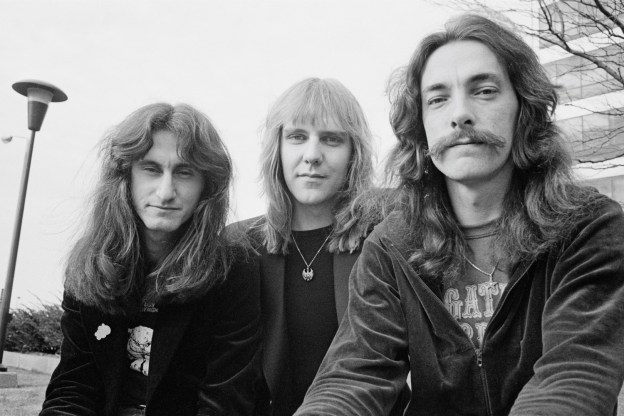
Like so many of the prog rockers we have been examining, Rush started out as a would-be rhythm-and-blues band, as evidenced by the beats and lyrics of their eponymous debut, and the bandmates met at school.  That is about where the similarities end.  Unlike the boys of Genesis, who mostly grew up in well-to-do families, Geddy Lee’s father spent time in a concentration camp and died when Geddy was twelve.  His grieving process prevented from listening to music for almost a year.  After that year, Geddy was introduced to Alex Lifeson, whose Yugoslavian parents likewise moved to Toronto after World War II.  Perhaps because Rush is a Canadian band and not English like everyone else in the main wave undoubtedly labeled as “prog rock,” many critics and historians of prog ignore them altogether.

To be fair, they are also a little younger than Tull, Genesis, and the others, and their debut did not occur until the main era of prog was just about over in 1974.  Growing up listening to rock music in the late ’60s, they certainly had great musical role models to emulate as a bassist and guitarist, and they had the benefit of also listening to early Tull, Yes, Genesis, and the popular Van der Graaf Generator.  So they are somewhat on the “outside” of the core of prog rock, if such a thing exists.  That is in part to the temperament and musical affinities of their first drummer, John Rutsey, who was the de facto leader of early Rush.

Besides getting a manager, Ray Danniels (the only manager they ever had), and the acquisition of arguably the greatest drummer in rock history (a subject for another time), perhaps the most influential event that propelled Rush’s career came from an unlikely source: “In 1971, the government of Ontario made a decision that would alter the history of progressive rock.  The Canadian province dropped the drinking age from twenty-one to eighteen.”

Rush’s eponymous album, the only release with drummer John Rutsey and Lee and Lifeson composing most of the lyrics, much like Tull’s debut This Was and Genesis’s double debut albums, is enjoyable likely more for nostalgic reasons (one hesitates to say “quaint”) as the beginning point of a band that was one drummer away from becoming a whole new entity.  It is enjoyable but rather middling R&B/rock, and possibly even “Working Man” would have been forgotten had the band not kept it alive on most tours over the next forty years.

Like Tull and the Moody Blues and others, after getting R&B and cover songs mostly out of their system, Rush became a unique musical entity: a heavy/progressive rock power trio with a social conscience and literate drummer.  Gene Simmons says of Peart in those early days: “Neil is a self-professed and/or otherwise reading hound.  He likes to read.  Yeah, after the show he goes back … reads.  Anthem by Ayn Rand, Foundation trilogy by Isaac Asimov, all that stuff.”

As appropriate as the first song, “Finding My Way,” was for Rush, Fly By Night’s opening song, “Anthem,” perfectly captures the new direction musically and lyrically of Rush 2.0.  Much has been said – too much – of Neil Peart’s disproportionately short-lived interest in the objectivism of Ayn Rand (certainly disproportionate to the lasting recrimination Rush suffered), but here Peart’s belief in the need for hardwork and perseverance (and general optimism in mankind, if not individually: “Live for yourself / There’s no one else more worth living for”) is unabashedly on display.

Also on display is the almost mid-’70s requisite homage to JRR Tolkien, with “Rivendell.”  If Led Zeppelin can unashamedly sing of Tolkien’s creation, certainly Rush should be able to as well.  But those two widely disparate sources of inspiration (Rand and Tolkien) are likely only to be found in the same place on a Rush album – the fans of both radically different worldviews rarely commingle anywhere else.  Bradley J. Bizer says Peart’s Tolkienian influence is also heard in Rush’s first prog-like mini-epic, “By-Tor and the Snow Dog,” but it may just be more a sign of Peart’s diverse reading of fantasy and other speculative fiction.  Peart admits being fascinated with Chariots of the Gods around that time as well.  Regardless, for our purposes, it has taken very little time to find direct literary influences on this prog rock band.

We Have Assumed Control: Caress of Steel and 2112

Caress of Steel may be more the black sheep of the Rush canon than Rush, oddly enough, though it does begin Rush’s rest-of-career-long relationship with cover artist Hugh Syme, another important component of prog rock music.  The first side is an eclectic mix of song styles and subject matter, from the humorous “I Think I’m Going Bald” (prog rock’s sense of humor is, like our present exploration of literary influence, another underexplored component of the genre), to the grand and personal histories of “Bastille Day” and “Lakeside Park” and the next progression in prog epics, “The Necromancer,” another song with clear influences from Tolkien.  The liner notes at the end of the lyrics for “Necromancer” include the Latin tag to Christopher Marlowe’s Doctor Faustus as well (admittedly somewhat hard to read in my CD version of the album).  Perhaps it is this diversity (what critics call “lack of unity”) that has led to the album’s general disfavor.

The second side of the album is the first of Rush’s three album-side-long prog epics, “The Fountain of Lamneth,” but unlike Genesis’s “Fountain of Salmacis,” this fountain is not based on any mythological or literary inspiration directly.  Birzer suggests the protagonist of the song sloughs of his conformity after drinking the draft from “the cask of ’43,” which the protagonist says “give[s] me back my wonder,” could be a reference to The Fountainhead, published in that year. At the end of the journey, which Birzer in his zeal likens to most journeys in “the western tradition of Homer, Virgil, Dante, and Tolkien,” Popoff says “the journey has not resolved itself, that now there are more questions than answers, that the birthing at the beginning merely put the hero into a cycle of perpetual motion.”  This interpretation would likely make more sense than Birzer’s desire to cast “Lamneth” in a more traditional light, since it foreshadows much of Rush’s seeming preference for the searching itself more than the resolution.

From hindsight, of course, “Lamneth” is easily overshadowed by what comes next, though it does us well to remember there would have been no 2112 without the early experimentations of “Necromancer” and “Lamneth.”  Lee and Lifeson both highlight how important it was for them to experiment with longer forms of composition, though Lee says in retrospect it was “kind of absurd. … And I think there are some beautiful moments, but a lot of it is ponderous and off the mark.”  Says Lifeson, “You smile and shake your head and you go, ‘What was I thinking?’”

2112 is many things to many people.  For Rush, it was a last-ditch effort to create the kind of music they wanted to create, flying in the face of the critical, financial, and touring disappointments from Caress of Steel.  For many critics, it was a justification of the disdain for the atypical music from the late-to-the-prog-party Canadian trio.  ’60s British counterculture insider Barry Miles was one of several vocal antagonists to Peart’s tribute to Rand.  As Weigel puts it, “he (Miles) had read up on Ayn Rand and was utterly offended that Rush had written a paean to her with 2112.”  For many (if not most) fans, the opening synthesized outer-space sounds of the Overture leading into the syncopated hits and the driving full intro are the very reason they love music.

Lee says, “2112 was part of a progression to us. … And we had this concept in our minds that we love progressive music, but we also love to rock.  We like The Who as much as we liked Genesis and Yes, and to us, The Who were still a progressive band even though they were more of a hard rock band. … We wanted to be the world’s most complicated thee-piece band.”  Lee continues in that section of Popoff’s work to describe their evolution beyond an R&B band and even beyond the by-then fairly static conception of prog rock, which they clearly loved, into the heavy rock band most evident by Counterparts.  Peart seems to have spent much of the next thirty years downplaying the significance of Randian philosophy on himself and his lyrics, and he certainly disavows the entire spectrum of political labels foisted upon him following 2112: “I like noble virtues, the difference between right and wrong.  I also don’t like people telling me what to do. … You have to make your own decisions if you want your ideals to come across. … I’m against socialism because again it stifles the individual.  It tries to wrap him up not letting him think for himself.”

Most see the story of 2112 influenced by Anthem, and Birzer adds Zamyatin’s We.  For Peart, the story of individuality and freedom triumphing over repressive government (especially religious oppression) is represented by what Popoff calls “the lurid red pentagram,” which “had nothing to do with Satan, representing instead the creativity-suffocating authorities of the tension-filled tale,” with the naked fellow representing man at his most basic, most needy, ready for something new.  2112’s ending is usually interpreted optimistically, which is fitting for how successful the band came following the album’s reception among the people who actually paid to listen to the album, the fans.

All the Same We Take Our Chances: A Farewell to Kings and Hemispheres

As the ’70s and prog rock were (semi-)officially ending, Rush took the lessons and successes of recent albums and, in a sense, doubled-down with effectively a double album spread out over a couple of years.  Continuing the pervasive Rush themes of anti-authoritarianism found in “Bastille Day,” “Anthem,” and many more (and after), the title track of A Farewell to Kings clears up any doubt listeners may have whether “2112” was about exchanging one oppressive government for another.  As good as the opening track is, and Rush was always good at setting the tone of their albums with the opening tracks, the real treat of the album is “Xanadu,” the longest non-side-length song in their canon except “Necromancer,” and it is undoubtedly a much better song than “Necromancer.”  This is not to say the source material, Coleridge’s “Kublai Khan” is better than Tolkien’s Lord of the Rings, of course; rather, the band has simply matured in all facets of their musical craft.

“Closer to the Heart,” fan-favorite and the closest Rush gets to a traditional pop-rock radio-friendly hit, echoes lyrics and sentiment from the opening track; “Cinderella Man,” another optimistic anthropological song from Lee, is based on the Frank Capra movie Mr. Deeds Goes to Town; and “Madrigal” is effectively Rush’s last “medieval prog rock” song, with their own twist.  The close of the album is, of course, the first half of Cygnus X-1, “The Voyage.”  The music of this half is likely more memorable than the lyrics, the opposite being true of book two kicking off Hemispheres.

Cygnus X-1 together is the longest Rush story except for Clockwork Angels, their grand finale, with the diverse four-part “Fear Trilogy” a close second.  As with the odd pairing of Rand and Tolkien on Fly By Night, Cygnus X-1 pairs Cervantes and Nietzsche.  The vehicle the traveler uses to embark his mission is the Rocinante, like Don Quixote’s steed; and the gods at war in book two are Apollo and Dionysus.  Birzer quotes Nietzsche’s Birth of Tragedy at length, as well as interviews from Peart indicating his affinity and lifelong commitment to a Nietzschean philosophy.  The conclusion of the epic is that logic and love must join together in a “perfect sphere” to unite both heart and mind (as well as god and man) in perfect balance.

The second half of the album (it is difficult for me to think of it as the “second side,” considering I first heard most Rush albums on compact disc) is another disparate collection of quintessential Rush: Peart autobiography in “Circumstances,” tongue-in-cheek political satire in “The Trees,” and virtuoso playing in the band’s first instrumental, “La Villa Strangiato.”  Surely most Rush fans wished the boys had indulged in more “exercises in self-indulgence,” as its subtitle jokingly calls it.

Everybody Got to Elevate From the Norm: Permanent Waves and Moving Pictures

If 2023 has taught us anything in the music world, it is that fans should “never say ‘never’”; a year that saw new releases from the Rolling Stones and Beatles should show us that even though Neil Peart is no longer with us and Rush officially disbanded five years ago, one should never give up hope.  I say that mainly for myself, as I was originally planning on opening this final section with “Now that the Rush corpus is completed” – but “never say ‘never.’”  With the Rush corpus (temporarily) completed, fans tend to categorize their output in different ways, often by year, by major sound style, or by subject matter.  Birzer, like most, posits Rush as its own entity, then collates the remaining ’70s albums together, most of the ’80s albums together except for Presto, joining it to Roll the Bones and Counterparts, leaves Test for Echo as its own era, and, understandably, unites the remaining Rush albums following Peart’s hiatus and personal rebirth into one final group.  Though it is not a matter worth much debate, I disagree mildly concerning the ’80s albums: I posit Permanent Waves and Moving Pictures should go with the earlier albums as the culmination of the band’s mainline prog era (as I did here for this paper), and Signals through Hold Your Fire is the band’s “second wave style” of prog, much like Tull’s folk trilogy is still prog rock but of a different kind than the more obvious concept albums from Thick as a Brick through Too Old.  I agree that these ’80s albums are united in their clever multi-layered album titles, but musically the first two seem different (maybe it is just the synthesizer that defines the era for me).  Rush’s Presto does feel like it is cut from a different cloth than the rest of the decade’s material, indeed.

Forgive me if this leans into hyperbole, but the opening of Permanent Waves is possibly the most invigorating opening to any rock album of all time.  The audience reaction in every live album since 1980 should be proof enough.  Though many paeans to the radio are at times tongue-in-cheek, like “The Spirit of Radio” here, Queen’s “Radio Ga Ga” for another example, at the heart of them is an unconquerable optimism despite the growing commercialism that is often noted for ending Prog rock and the “glory days” of the ’60-’70s music scene.  Peart ends this with a clever, if not wistful, updating of Simon and Garfunkel’s “The Sounds of Silence,” itself a critique of the growing commercialism of society and the music industry fifteen-some years earlier (from Peart’s perspective).

The album continues Peart’s lifelong agon with religion in “Freewill,” which also incorporates Peart’s readings of Jung.  Oddly, though not so odd considering Peart’s penchant for unusual pairings, the album follows this with “Jacob’s Ladder,” which is clearly an Old Testament allusion (which Peart surely knows).  Lyrically, the song is ambiguous enough to forestall outright antagonism to religion, but it does lean toward a more humanistic solution to wisdom-seeking.  Perhaps “Babel” would have been a better title, but Peart likely knew that “story” ended in confusion.

“Entre Nous” may be influenced by The Fountainhead, or perhaps Peart’s love of reading in general, as the second line “Each one’s life a novel” may imply.  One could have wished Peart had taken this open-minded approach to religious ideas (and people) more, but such is life.  “Different Strings” continues the same theme of “Entre Nous,” though it ends with Peart’s standby atheism: “All there really is: the two of us.”  “Natural Science” began life as a musical adaptation of “Sir Gawain and the Green Knight,” but Peart found it too out of place with the general theme of the album, and while that does not do this paper any good, it certainly served the album well to shift into the song’s eventual tripartite exploration of nature, science, and integrity.

Moving Pictures opens with perhaps Rush’s most beloved song, and another eventual encore staple that always brought cheers from the audience, in “Tom Sawyer,” whose literary influences should go without saying.  It is fitting for this song to be, if you will allow the expression, the real “anthem” for Rush, a band whose “mind is not for rent / To any god or government / Always hopeful yet discontent / [Who] knows changes aren’t permanent / But change is.”  Surely that encapsulates what Rush was about: literary-influenced individualism.

“Red Barchetta” was inspired “by a 1973 short story by Richard Foster” entitled “A Nice Morning Drive,” though Peart changed the type of car from the story.  Peart has discussed it in multiple interviews, even meeting the author toward the end of his (Peart’s) life.  “YYZ” is another masterful instrumental, and “Limelight” is another Peart autobiographical song, somewhat ironically making him and the band even more famous from the rousing success of this, perhaps their greatest album.  The song lyrically anticipates the next song, “The Camera Eye,” and reflects on the live album released after 2112, All the World’s a Stage and the Bard’s famous line from As You Like It.

Birzer describes “The Camera Eye” as “a John Dos Passosesque view of two cities, New York’s Manhattan and London,” which Peart mentions in bonus material on the 2112 blu-ray release.  It is certainly the last long song of Rush’s career (to date).  “Witch Hunt,” he says, was inspired by Clark’s The Ox-Bow Incident, which seems feasible enough.  “Vital Signs” is a preview of the more synthesizer/technological sounds coming in the heart of Rush’s ’80s output, which is likely why Birzer links Signals to these two albums.  Perhaps it is fitting to end our examination of Rush’s literary-influenced prog phase of their career with “Vital Signs,” as Peart says “Leave out the fiction.”  Coincidence, perhaps, but the band does shift into different directions, though they never stay away from Peart’s reading-inspired lyrics for long.

After quoting interviews in which Peart mentioned Dos Passos, Steinbeck, Hemingway, Dickens, Hardy, TS Eliot, and Frost, Birzer lists several other authors mentioned by Peart and others in interviews and other places throughout Rush’s career: Hawthorne, Melville, Henry James, Wilkie Collins, Wilde, Woolf, Sinclair Lewis, Dreiser, Cather, Edward Abbey, Fitzgerald, Lieber, CS Lewis, Pirsig, Stegner, Pynchon, Barth, Tom Robbins, and Kevin J. Anderson.  Surely this list is inexhaustive.  Though perhaps we could have wished he spent more time with authors before the nineteenth century, especially more Christian authors like Eliot and Lewis, Neil Peart, like Tony Banks and Peter Gabriel in Genesis, is a resplendent proof for our quest for literary influences on the lyrics of prog rock.  Surely much of the timeless quality of Rush’s output, much of what helped them to “elevate from the norm” of an already markedly intellectual musical genre, is Neil Peart’s adult lifetime of reading almost every genre from poetry to fiction to philosophy, a lifetime of reading reflected in his eye and in his lyrics.

Bibliography

Birzer, Bradley J. Neil Peart: Cultural Repercussions. WordFire Press, revised 2nd ed., 2022.

Popoff, Martin. Anthem: Rush in the ’70s. ECW Press, 2020.Weigel, David. The Show That Never Ends: The Rise and Fall of Progressive Rock. New York: Norton, 2017.

“Play Me My Song”: Literary Influences on Genesis

Christopher Rush

“And I’ve finally found a place to call my own”: From Genesis to Revelation and Trespass

The early days of Genesis set the scene for this band’s unusual dual nature, in that they appear to mimic typical trends of Progressive Rock, yet they do it in their own unique way.  Just as many future band mates find each other at school (seemingly at some sort of art college, where like-minded aesthetics-driven individuals already predisposed toward non-traditional workforce occupations and hobbies tend to congregate), the core of Genesis (Peter Gabriel, Tony Banks, and Mike Rutherford, along with initial guitarist and driving force Anthony Phillips) met at Charterhouse School, what the British call a public school (what we call a private school).  The difference for Genesis, then, is they met at effectively a “posh” school for children of well-to -do British society, unlike many others (Jethro Tull, for example, formed from a core of grammar school students Ian Anderson, John Evan, and Jeffrey Hammond).  This imbricates with another initial difference for Genesis, in that they met each other while still minors, and most other Prog rock bands met each other when at a college or in their twenties.  Genesis’s music matures while the band members themselves are maturing into adulthood.

Another Prog rock distinction of Genesis, as their name implies, is their religious … “affinity” is too strong a word; perhaps “acceptance”? “tolerance”? (if we could dissociate it from its unfortunate connotations in our day).  Anthony Phillips says, “we weren’t particularly religious, we just liked the hymns and tunes.”  They certainly do present religious themes and allusions more positively and more frequently than most of their Prog compatriots, at least, and their debut album, From Genesis to Revelation, is a good example.  While it is still likely true (forty years on) that many Genesis fans are “Invisible Touch”-era fans, and may not know that Gabriel-era Genesis albums exist, it is just as likely that many Gabriel-era Genesis fans do not know From Genesis to Revelation even exists, especially as it technically belongs to their first manager Jonathan King and was not re-released in the anniversary Genesis box sets back in 2007.  While the album sounds very much like a juvenile outing, Peter Gabriel’s voice is a foreshadowing of greatness to come (much like the first time James Cagney appears on-screen in The Public Enemy, and one instantly recognizes what a real actor looks like).

The album is lyrically influenced by the Bible, as its name indicates as well as the general proto-concept-like nature of the album, telling a rough musical version of sweeping themes of the Bible (more or less – no verses or characters are quoted, really, but the general impression of Biblical allusion and influence is inescapable).  Phillips says the interlinking music to unify it as a concept album came from the hymns, especially J. Herbert Howell hymns, they all loved.  Giammetti says Gabriel’s reference to the “happiness machine” in “Am I Very Wrong?” comes from Bradbury’s Dandelion Wine, which fits with what we know of the band’s general love of literature, though no one seems to know who wrote the lyrics for that song specifically.

Giammetti reinforces their early love of science fiction during the focused writing of Trespass (as Genesis, fully committed to being professional musicians, moves to their third drummer, John Mayhew, before Phil Collins): “The only moments of distraction involved walks in the surrounding countryside and reading sci-fi novels and books on mythology (which would greatly influence their lyrics).”  Giammetti further says the album features “literary references to movements such as Surrealism and authors like J.R.R. Tolkien and Lewis Carroll (for the fairy tale themes) and William Blake (for the visionary aspect).”  It would be wonderful if he quoted the band members to verify this, but he does not.

More helpfully, though, Tony Banks says of his composition “White Mountain” that “Both Fang and another character in the lyrics, One Eye (already mentioned in ‘One-Eyed Hound’ [unreleased single in From Genesis to Revelation days]) come from the children’s book White Fang by Jack London.”

Even by this early stage in their development, Genesis is recognized as “one of the country’s ‘thinking’ bands,” says Michael Watts in a Melody Maker article from January 23, 1971.  Surely the lyrics are a significant factor in that assessment, and even if direct or obvious literary allusions were not replete, the atmosphere Genesis songs creates from their outset distinguishes them as a literary band.  Gabriel, describing them in that same Melody Maker article, says “I see the band as sad romantics, you see.”  Mike Barnard, temporary Genesis guitar player between Anthony Phillips and Steve Hackett, says he and Gabriel would “tour the Lake District” between tour gigs at this time.  Surely that is proof of the Romantic poets’ influence on fledgeling lyricist Peter Gabriel.

“Can you tell me where my country lies?”: Nursery Cryme, Foxtrot, Selling England By the Pound, and The Lamb Lies Down on Broadway

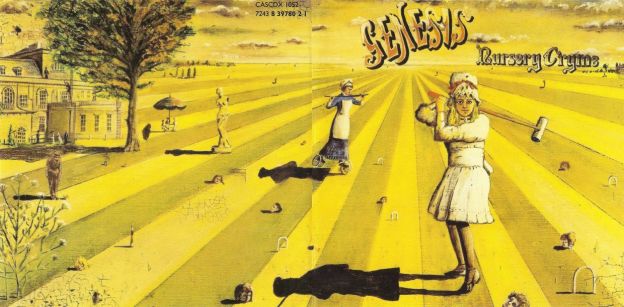
Genesis hits the jackpot with drummer number four, Phil Collins, and guitarist number three, Steve Hackett (not ignoring that Tony Banks and Mike Rutherford had been playing guitar on their albums from the beginning), and in the next few years create four unique, exquisite albums not just for Prog rock but for all music.  Nursery Cryme, especially because of the menacing cover art from Paul Whitehead, establishes a darkling Britishness and experimentation that definitely comes through in the music and lyrics.  Giammetti says “The Musical Box” is inspired by Oscar Wilde and Peter Gabriel’s Victorian mansion in which he grew up, with “Harold the Barrel” likewise displaying a Dickensian flair.”  Steve Hackett offers more specific literary influence for “Seven Stones,” confirming the eclectic reading habits of his new lead singer, saying, “Pete was interested in the ideas he had read in the I Ching, so the lyrics were influenced by The Book of Changes.”  Tony Banks corroborates Giammetti’s earlier generalization of the band being influenced by mythology for the final song on the album, “The Fountain of Salmacis”: “The lyrics are based on the myth of Salmacis and Hemaphroditus.”  Mike Barnes specifies this is the version in Ovid’s Metamorphoses, book four, and there is no reason to discredit this, considering their Charterhouse education and corroborated experience with mythology.

Foxtrot opens with what I have been telling students for years is Peter Gabriel’s reference to Keats’s great poem “On First Looking into Chapman’s Homer,” but Giammetti and Barnes both credit Tony Banks with writing the lyrics, influenced by Arthur C. Clarke’s Childhood’s End and the Marvel comics character The Watcher.  As deeply as that wounds my heart to learn, at least there is still a definite literary influence (and mild assuagement from the discovery that Genesis members read Marvel comics).

This album’s lighter fare, “Get ‘Em Out By Friday,” bears influence of science fiction, especially in the ending of “Genetic Control” requiring all people be no taller than four feet to enable smaller, more profitable government housing.  Gabriel says, “I tried to put some sort of Dickensian feel into this song,” which may at least tenuously count as literary influence here.

Many sources historical, literary, and religious influenced “Supper’s Ready,” Genesis’s great Prog epic (in the shorter category of single album-side epics such as “Tarkus” and “2112,” as opposed to entire concept albums such as A Passion Play and The Lamb).  Though Gabriel says the ending is a “mixture of Christian and Pagan symbolism,” I have no qualms tearing up every time I hear it in sound theological anticipation of a future historical truth when “the supper of the Mighty One” occurs, whether eggs are served or something else.

Of Selling England By the Pound Giammetti says “the usual references to mythology and literature are relegated to a marginal role (albeit still present) in favor of historical references and social comment,” which is certainly in keeping with other de rigueur Prog rock inspirations.  This dynamism from Genesis comes at a time, says Giammetti, when Prog rock is starting to lose its way: ELP’s Brain Salad Surgery he calls “passable,” Yes’s Tales from Topographic Oceans “heavy-going,” Rick Wakeman’s solo Six Wives of Henry VIII “indigestible,” and Jethro Tull’s A Passion Play “pretentious,” all of which “confirm that delusions of grandeur had hijacked the musical genre which seemed to be merely running its course and becoming increasingly unpalatable….”  Little wonder new sounds like Mike Oldfield’s Tubular Bells, the Mahavishnu Orchestra’s Birds of Fire, and Fripp & Eno’s No Pussyfooting being so popular, and Glam rock peaking at the time as well.

In contrast to all these, Giammetti has nothing but superlatives for this album, with which I agree.  Despite the contemporary satirical nature dominating the album, some literary influences and understandings affect the album, evidenced in Gabriel’s alliterative humor throughout the lyrics, surely influenced by his love of Spike Milligan and the Goon Show.  The most overt literary influence is in “The Cinema Show,” written by Tony and Mike, in which the romantic overtures of Juliet and Romeo (the literary influence here should be obvious) are followed by recollections of father Tiresias, inspired either by several classical authors or, as Giammetti says, T. S. Eliot’s The Waste Land.  Either is credible.

As a postscript to this album, Gabriel remembers the cover artist, Betty Swanwick, as “a little bit like Miss Marple or an[other] Agatha Christie character.”  Even if few literary allusions appear on the socio-critical album, it seems Gabriel was often seeing and interpreting his world through literary lenses.

The Lamb Lies Down on Broadway would take its own paper to unpack all of the literary and cultural references throughout Genesis’s double-album concept magnum opus.  Rutherford had proposed their concept album be based on The Little Prince, but Gabriel insisted on composing an almost all-new epic story, and as a twenty-four-year-old British public school grad, who better to tell the story of a Puerto Rican graffiti artist in New York City?  Says Gabriel, “The story is like The Pilgrim’s Progress but on the streets of New York.  So it’s a spiritual journey into the soul but there’s quite a tough world feeding the imagery.  One of the influences was a film called El Topo by Alejandro Jodorowsky.”  Steve Hackett agrees with the spiritual backdrop of this story, reminiscent of “Supper’s Ready,” in that there is “something about the lyric that owed a bit to Dostoevsky – the redemptive qualities of those journeys and sojourns.”  While Hackett sees positive spiritual messages in the album, he also recalls how the album and the subsequent tour, and the rest of the band agrees, was a miserable, destructive experience, foreshadowing Roger Waters’s single-mindedness of The Wall and its effect on Pink Floyd.

On a positive literary note, The Lamb surely displays Gabriel’s affinity for the Romantic poets, echoing Keats with “The Lamia” and Wordsworth in the opening line of “The Colony of Slippermen” with “I wandered lonely as a cloud.”

After Gabriel and Hackett departed Genesis, despite early hurts, all members of the band have since reunited both for concerts and interviews, and all of which have seemed more than cordial.  Though they all shifted away from Prog rock, their commitment to literary influences has continued.  For example, Hackett’s solo album Voyager has a song “Narnia,” surely based on the stories of C.S. Lewis.  Gabriel’s “Rhythm of the Heat” was based on his reading of Carl Jung’s Memories, Dreams, and Reflections, and “Mercy Street” is clearly a response to Anne Sexton’s poem “45 Mercy Street.”

“It’s only knock and know all, but I like it”

The members of Genesis were (and presumably still are) well read, and their engagement with fiction, poetry, religion, and philosophy (not to mention the images, environments, history and political ideas of their British world) has resonated throughout their unique careers, especially during their Progressive rock days.  Steve Hackett observes, rather poignantly, that this literary aspect of Genesis may have been a barrier to any major success during that time: “If you read the classics, that was a chance you’d enjoy what Genesis did.  The criticism was that it sounded like it had been looked up in books rather than it being a personal experience.”  If I may end with a Gabriel line from “Back in N.Y.C.” in The Lamb, “Ah, you say I must be crazy,” but that is a significant part of the reason why I love Prog-era Genesis: I have read the classics and the Romantic poets and sci-fi authors that inspired these fellows, and their music is, despite what those critics say, very much a personal experience.

Bibliography

Barnes, Mike. A New Day Yesterday: UK Progressive Rock & The 1970s. London: Omnibus Press, 2020.

Giammetti, Mario. Genesis 1967-1975: The Peter Gabriel Years. Kingmaker Publisher, 2020.

Weigel, David. The Show That Never Ends: The Rise and Fall of Progressive Rock. New York: Norton, 2017.

“And Everyday We’ll Turn Another Page”: Literary Influences on Early Jethro Tull

An Annotated Discography

Christopher Rush

Early Days, 1968-70: This Was, Stand Up, Benefit

Like many if not most mid-’60s British bands, Jethro Tull began in a musical admixture of upstart American blues and early rock, European classical heritage, jazz, skiffle, folk, and whatever one was supposed to do about the Beatles.  Also like most British bands of the era, Jethro Tull was not the first incarnation of the group nor did its personnel lineup stabilize until many years into fame (though “lineup stability” for Jethro Tull is a complicated notion).  Each of these first three albums featured different lineups, if not formally: John Evan and David Palmer may not have been “official” members on Benefit, but they contributed significantly (David Palmer also contributes in minor ways to the first two albums … I said it was complicated).

This Was is easy to call atypical Jethro Tull, looking backward at fifty years of output, but “typical” Jethro Tull is just as complicated an issue as who is in Jethro Tull.  It is clearly a heavily blues-inspired album, which is what Mick Abrahams wanted Jethro Tull to be, but it was not what Ian Anderson wanted, and history clearly shows who won that debate.  Many of the songs are effectively community property of the British blues scene at the time, many numbers are instrumentals, and Ian Anderson did not write the lyrics to many of the other songs, so identifying influences here is rather fruitless.

Stand Up sounds now like a transition from the mandatory blues origin to what established Tull was going to be, though that is also from the benefit, so to speak, of hindsight.  While some blues influences remain, notably on “A New Day Yesterday,” a song not-too-subtly comments on the band’s new direction, it is still an album of a band finding its footing, and many of the songs are about Anderson and the new group discovering that direction.  That is not to say it is autobiographical, but there is, still, very little literary influence on this not-quite-yet progressive rock album.  Glenn Cornick, fifty years later, indicates much of the album is autobiographical in a different way: “Half of Stand Up was about Ian’s family….”  One notable future live favorite song, “Bourée,” “was the first recording clearly to indicate Anderson’s interest in music from earlier historical periods,” which will be helpful for the band’s forthcoming musical and lyrical influences.

Benefit is another unusual album marked by growing pains: pressures of recording and touring now as a headline act instead of a supporting act, personnel burnout, and Anderson’s development as composer and lyricist.  Many fans seem to enjoy it more for the songs that are not technically on it: “Sweet Dream,” “17,” “The Witch’s Promise,” and “Teacher.”  Glenn Cormick says the autobiographical tendencies from Stand Up are still on Benefit.  Ian Anderson confirms this on songs such as “For Michael Collins, Jeffrey and Me” and “To Cry You a Song.”  Audiences seem to assume the non-autobiographical songs are the ones about Anderson (the future cover paintings on albums all featuring miscreants looking just like Anderson did not help that misconception throughout the ’70s.)  Other lyrics, such as in “Play in Time,” Anderson flat out reviles as jejune.  For our purposes, as fine as it is, Benefit does not live up to its name.

Concept Days, 1971-73: Aqualung, Thick as a Brick, A Passion Play

Aqualung is undoubtedly Tull’s “breakout” album, many fans’ favorite, and greatly misunderstood, either by fans or by Anderson himself.  Despite more personnel turnover, Tull begins the ’70s with a masterpiece, which may or may not be a concept album.  Side one, called “Aqualung” on the album, features an almost Chaucerian cavalcade of characters, if the Tabard Inn had been in the red light district.  More importantly, we finally have actual literary influence on the lyrics: Anderson paraphrases “a line from the introduction of Robert Burns’ [sic] poem ‘The Holy Fair,’” foreshadowing Anderson quoting Burns on Heavy Horses.  “Mother Goose” references the eponymous character and Long John Silver, but since Anderson admitted he had never read Stevenson and the no nursery rhyme characters appear in the song, it is likely just Anderson’s general awareness of things that inspired this song over direct literary influences.  (The newspaper album cover for Thick as a Brick has a reference to Silver, a parrot, and “Jim Lad,” so perhaps Anderson was recalling the Disney movie more than the novel itself.)

The second half, “My God,” is a fascinating half of an album as a Christian to listen to, but if Scott Nollen is correct, it does not help us here at all: “The material on the album’s second half resulted from Anderson’s personal observations about organized religion, not from any deliberate bookish study. … Anderson proves that he came to the same conclusion as did Freud and [Bertrand] Russell … without reading any of their famous works….”  That ends that.  Though this quest for the literary influences on Prog Rock may not be as fruitful as I had initially hoped, perhaps it will lead to a more worthwhile exploration in another course about the relationship between Prog Rock and religion.  This is also the first Tull album that suffers, in a sense, from the medium limitations of vinyl albums: “Lick Your Fingers Clean” was supposed to end the album but cut for time; now on the cd and digital releases, the song reshapes the album with a much more upbeat and self-effacing ending as opposed to the downcast “Wind-up.”

Thick as a Brick is Anderson’s response to those who considered Aqualung a concept album: here is a genuine Tull concept album, albeit a parody of the form, complete with newspaper and persona singing the song (considered at times two only because of the limitations of the medium – the liner notes treat the whole thing as one poem by Gerald Bostock), all as a satirical sendup of British education.  Barrie Barlow, who had played with Anderson and Evan in pre-Tull days replaces Clive Bunker on drums, either solidifying “classic Tull lineup pt. 1” until John Glascock replaces Jeffrey Hammond on bass for Too Old through Stormwatch.  Lyrically, TaaB is complex, perhaps too much so, but the album really is an impressive unity between the music and the lyrics, certainly more than any Tull album before and possibly since, depending on how one views Songs from the Wood.  More than Aqualung, TaaB fulfills the multi-movement suite typical of Prog Rock, and this is likely better understood today in disc and especially digital versions of the album that break the sections down into more accessible sections.

The song features a number of allusions to literary types, if we can consider comic book heroes such as Superman and Robin “literary,” and it references poets as a social class, though that does not give us much direct assistance.  Anderson/Bostock references Biggles, from the British childrens’ book series, though it may be a stretch to call that a literary influence, since it is possible Anderson is mentioning it the same way I might reference to TeleTubbies or Bluey, only as a kids’ pop culture thing I have vaguely heard about without any specific knowledge.  Likewise, a reference to the Boy Scout Manual cannot be considered for our purposes as an “influence.”  The album cover and newspaper are also rife with clever allusions to general knowledge, such as a “silent prayer” by Billy Graham to close the broadcast day of BBC2 and Alaister Crowley as a special guest on the program “Bible Stories,” though it is, again, hard to call these literary influences.  The song features brilliant lyrical moments, as Anderson often does, such as the “wise men” not knowing how it “feels” to be “thick as a brick,” cleverly combining wisdom, feelings, and intellect, but the search continues for major literary influences.

A Passion Play is a somewhat hastily salvaged album from terrible experiences in Switzerland following the success of TaaB.  Whereas Deep Purple turned their Swiss discomfort into the incomparable Machine Head, Tull scrapped most of their Swiss creativity until decades later for the rarities album Nightcap and the 40th anniversary box set of Passion Play.  Like TaaB, Passion Play is a Tull concept album, but unlike TaaB it takes itself seriously (excepting the beast fable smack in the middle), which is likely why critical response to this is less positive, despite its criticism of religion.  The album is intelligently structured, using classical epic ring composition or chiastic structure, as the songs mirror each other until the turning point of “The Hare that Lost its Spectacles.”  The album opens with dying heartbeat sounds and closes with reborn heartbeat sounds, mixing the classical epic chiasmus with the its namesake of a medieval passion play thematically.  Rolling Stone writer Stephen Holden recognized “a pop potpourri of Paradise Lost and Winnie the Pooh, among many other literary resources,” but that only returns us to what we are trying to avoid, merely recognizing literary similarities in the lyrics.  The song asks “how does it feel to be in the play?” but that does not prove Anderson is conjuring up his inner Jacques from As You Like It.  There is, though, at the end, the line “Flee the icy Lucifer.  Oh he’s an awful fellow!”  Aside from the Andersonian downplaying of the seriousness of perdition, if this is not a reference to Dante’s depiction of Lucifer trapped in ice in the Divine Comedy, I would be astounded, for who else conceives of Lucifer as icey?

Eclectic Days, 1974-76: War Child, Minstrel in the Gallery, Too Old…

War Child is an odd, eclectic album, sandwiched among four very unified albums, distinct from Passion Play in part due to the band’s poor reception of critics’ poor reception.  Even though the album is structurally distinct from Passion Play, it is thematically similar: songs discuss mortality, morality, femininity, masculinity, VD, tea, musical critics and other beasts, patriotism, and more.  Lyrics even allude to life’s “passion play,” as a couple of songs were salvaged and repurposed from the disastrous days before Passion Play, so it is a bit arbitrary to designate War Child into a new “era” of Tull albums.  The cover picture, central to many other Prog Rock bands and album meanings, here presents Anderson’s “jester” persona, which becomes a staple of albums and concerts for several years (“Back-Door Angels” has the lines “Think I’ll sit down and invent some fool / some Grand Court Jester” – most likely this is, at least in part, typical Andersonian religious criticism.  For someone who claims to be an atheist, he spends a lot of time writing, singing, and thinking about religion).  While featuring the first overt nods to his homeland of Scotland that will be more developed in Stormwatch, lyrically, on the whole, it is hard to discern any meaningful literary inspiration here.

Minstrel in the Gallery is an entry somewhere on that ambiguous Venn diagram of concept album, thematically unified album, frame story, or just Prog Rock-era multi-movement suite.  It also features the first overt reference to mythology in “Cold Wind to Valhalla.”  As discussed earlier, calling even overt references to mythology “literary influence” is a stretch, at least until we get to Genesis.  “This is based on old folklore,” says Anderson. “In Norse mythology Valhalla was a huge afterlife hall of the slain, overseen by the god Odin, to which Valkyries took warrior heroes when they died.”  So Anderson has a working knowledge of Norse myth, at least.  The rest of the songs are primarily fabrications of Anderson’s creativity.  We are well beyond his need for lyrical autobiography, and nothing else on the album can be considered literarily inspired.

Too Old to Rock’n’Roll… finally sees the arrival of John Glascock and the “classic” Tull lineup for many, or at least its final phase.  It is also a candidate for the aforementioned Venn diagram, as perhaps an obvious concept album, though no one seems to think of it that way, or perhaps a heavily unified album, but it was also originally intended to be a stage musical that somehow transformed into a comic strip illustrated by Dave Gibbons (of Watchmen fame) and a television special.  When Anderson sang “Nothing is Easy,” he was not kidding.  Much of the album is more Anderson observations of real life, teevee, and car racing, but side one ends with an acknowledgment of literary and musical influences.  Anderson says of “From a Dead Beat to an Old Greaser” “the two characters are archetypal social stereotypes from my formative years – the dead beat, in other words the kind of Jack Kerouac follower and imitator, … someone who is into jazz and poetry and whatever but is just fantisising [sic] and has become a bit of a down-and-out; and the old greaser who is the rock‘n’roller motorbike guy. … It’s a sort of Jethro Tull three-minute quickie Waiting for Godot.”  Though we may have to collate his reference to Beat Poets with the general references to Mother Goose and mythical characters, we will gladly take his mention of Beckett’s play as a direct literary influence.

Folk Days, 1977-79: Songs from the Wood, Heavy Horses, Stormwatch

The three final Tull albums of the ’70s are, in a sense, their own world, both in their musical style of “folk rock” as significantly distinct from the already-diverse Tull sounds before them, and as, for many, the apex of “classic Tull.”  Songs from the Wood can also be added to the Venn diagram: I have never heard or read about it being considered a concept album, but the album bears great unity in lyrics and music.  It is also delightfully optimistic, containing very little cynicism, satire, or even sorrow.  Anderson had moved to the countryside during the band’s long hiatus from touring after throat surgery, which clearly influenced the content of this album, but more importantly here, Tull’s new manager, Jo Lustig, gave “a gift to Ian Anderson of a 1973 book titled ‘Folklore, Myths and Legends of Britain,’ a collection of stories and essays about ancient superstitions, festivals, places, and creatures.”  Anderson says of this book,

When I read it it certainly gave me thoughts about the elements of characters and stories that played out in my songwriting for the Songs From the Wood [sic] album, which then carried on over to the Heavy Horses album, and even beyond that into the Stormwatch album.  It wasn’t the only reference I had, it was just something new for me to learn from.  Other than a smattering of knowledge from history lessons or hearsay I didn’t really have a definitive literary guide to that world until Jo gave me this book.

That book taught Anderson about Jack-in-the-Green, but other songs, such as “Cup of Wonder,” feature “a lot of historical and pagan references here, resulting from my delving into our history as an island nation, the forces of religion and primitive beliefs, and so on.”  Anderson, unfortunately, does not list the specific sources of those historical and pagan references.

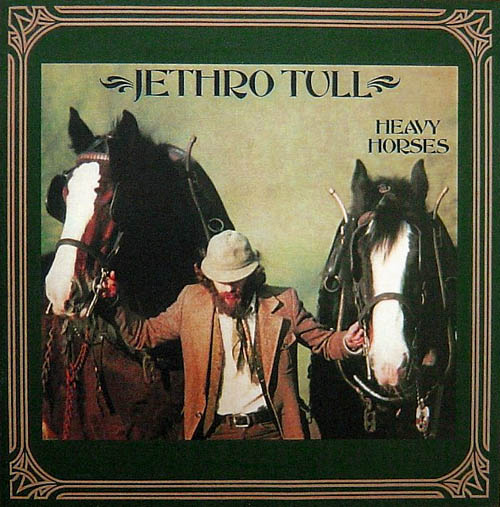
Heavy Horses is a very natural follow-up to Songs from the Wood (at its release Anderson referred to it as “Songs from the Wood, Part II, plus a little more Jethro Tull”), though it is also noticeably distinct.  Nollen distinguishes them: “Songs from the Wood can be situated primarily within an English Elizabethan influence, Heavy Horses borrows more from 18th-century Scottish music.”  It is also darker, with Stormwatch the darkest (and saddest) of the trilogy.  The eponymous track is a superlative return, in more concise form, to the multi-movement suite so characteristic of Prog Rock (a label, we should admit, Jethro Tull abjured), though it does embody the album’s darker tone, with the days of the plow horse dwindling with the advent of the tractor.  In fact, animal themes dominate the lyrics.  The bonus tracks on the 40th anniversary release show this could have been an excellent double album, as most of the associated recordings could fit the album perfectly, along with most of the bonus tracks from Songs from the Wood.  At least we have them now.

For our purposes, we also have a long-awaited jackpot of literary influences on Anderson’s lyrics.  “Moths,” says Anderson, “was actually inspired by the John Le Carré novel The Naive and Sentimental Lover.  I’m a big fan of John Le Carré’s work.”  “One Brown Mouse” was “very much inspired by the Robert Burns poem ‘To A Mouse.’”  While we should likely stop while we are clearly ahead, Anderson does speculate that “Heavy Horses” may also have had literary (if nonfiction) influences: “maybe I also had the Observer’s Book of Heavy Horses!”  The book is actually called The Observer’s Book of Horses & Ponies, so he is either recalling a forty-year-old memory in bits and pieces, or he is making it up unintentionally, but it does have just enough truth in it to seem authentic.  Similarly, bonus track “Horse-Hoeing Husbandry,” was written “as a paean to the original Jethro Tull, who in 1731 published a book called Horse-Hoeing Husbandry.”  Perhaps an oblique literary influence, but it is at least a Jethro Tull song, if long dormant, written in direct response to a book and its author.  Considering the band’s name was foisted upon them by an early agent and Anderson had no idea who he was at first, this track is a fine example of Anderson’s and the band’s growth, in part by willing to look backward as well as forward.

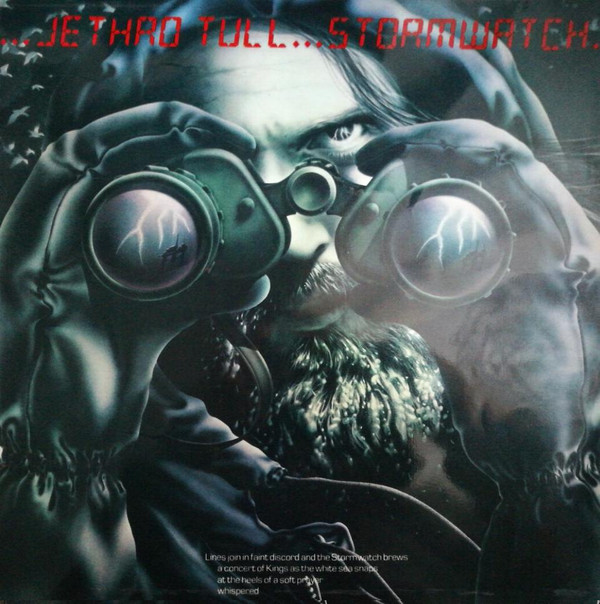
Stormwatch is the darkest of the trilogy, as we have said, both in the lyrics and in the real-life context of the album.  Not only did David Palmer’s father pass away, inspiring the album’s closing number “Elegy,” but John Glascock passed away during the tour promoting the album, upon which he appears very little due to his declining health.  His death cast a pall on the band, especially in the callous way Anderson broke the news to them, and things were never the same.  David Palmer, John Evan, and Barrie Barlow left the band, and the ’70s and “classic Tull” came to an end, with “Elegy” becoming a poignantly fitting finale to the era.  The album features mostly more mythology and Scottish rural history (“Orion,” “Dark Ages,” “Old Ghosts,” “Dun Ringill,” “Flying Dutchman”) as well as current Scottish social commentary (“North Sea Oil”), a prescient song of change (“Something’s On the Move”), a rare beautiful and uncynical Anderson song (“Home”), and the first two instrumental numbers on a Tull album since This Was (“Warm Sporran” and “Elegy”).  Lyrically, aside from the general mythology and history influencing the songs, and album candidate cut for time “Kelpie,” Stormwatch is not significantly influenced by literature.

Bibliography

Anderson, Ian. “He Brewed a Song of Love and Hatred (and of quite a few other things too …).” Interviewer Martin Webb. Minstrel in the Gallery: 40th Anniversary: La Grande Édition. Chrysalis, 2015.

—. “I’ll Sing You No Lullabye.” Interviewer Martin Webb. Heavy Horses: New Shoes Edition. Parlophone Records, 2018.

—. “Kitchen Prose and Gutter Rhymes.” Interviewer Martin Webb. Songs from the Wood: 40th Anniversary Edition: The Country Set. Parlophone Records, 2017.

—. “May You Find Sweet Inspiration….”  Too Old to Rock‘N’Roll: Too Young to Die! Chrysalis, 2015.

—. “To Cry You a Song.” Interviewer Martin Webb.  Benefit: The 50th Anniversary Enhanced Edition. Chrysalis, 2021.

Cornick, Glenn. “To Cry You a Song.” Interviewer Martin Webb.  Benefit: The 50th Anniversary Enhanced Edition. Chrysalis, 2021.

Nollen, Scott Allen. Jethro Tull: A History of the Band, 1968-2001. Jefferson, NC: McFarland, 2002.

Thick as a Brick: 40th Anniversary Set. Liner notes. Parlophone Records, 2012.

Webb, Martin. “And the Stormwatch Brews….” Stormwatch: The 40th Anniversary Force 10 Edition. Parlophone Records, 2019.—. “Let Me Bring You….” Songs from the Wood: 40th Anniversary Edition: The Country Set. Parlophone Records, 2017.

A Snowball’s Chance …

Christopher Rush

Page numbers are taken from the digital version of the Great Books of the Western World set, second edition.

Animal Farm has become such a well-known book, trying to conjure new, fresh insights about this story is challenging.  Even people who haven’t read it likely know that it is a cautionary tale of fascism as an anthropomorphic recreation of Lenin and Stalin and Trotsky and actual history, since by now its message and influence have become ubiquitous.  For this exploration, then, let us put the genuine horror and heartbreak of the Russian Revolution and Stalinist Russia aside, much as we set aside aspects of World War II when we want to enjoy Hogan’s Heroes or The Great Escape, and look at Animal Farm just as it is: a mostly funny story.  True, it does have a couple of very unfunny moments, particularly the confession scenes in which the dogs kill many of their fellow farm denizens. But aside from those brief moments, the rest of the story can be (with a fair amount of suspension of disbelief) a fairly good time.

The opening description of Mr. Jones and the state of the farm gives us a good reason to root for the animals: Mr. Jones is a drunkard who doesn’t always ensure the animals are protected and locked up (477) or even fed; the farm has piles of equipment, wood, building materials and all sorts of things scattered, dare we say, higgledy-piggledy around.  These animals have an almost respectable motivation for wanting autonomy.

Old Major’s address gives Orwell the chance to bring in most of the characters in an almost mock Homeric or Pope-like fashion, which is fun by itself, but Boxer’s introduction is especially intriguing.  In one sense, Boxer is the horse considered a noble, self-sacrificing character, perhaps the unsung hero of the story, but from the beginning Orwell gives us permission to think he is just a brainless goof (or a punchy ex-prize fighter?).  He is respected for being a workhorse, but we are told he is not very bright, so he is no shoe-in for the hero (if this story even has one).  Clover the mare, likewise, is presented humorously as the general mother of the farm, though she is no longer as spry as she used to be since she has lost her figure after having so many children, which also has affected her ability to remember.  When this description, particularly of her wounded vanity at having lost her looks from her children, is applied to a horse, it is quite humorous.  Moses the raven is not present, and it does not take a theology major to know whom he represents, and while Christian readers may feel they should be at least irritated by this character and Orwell’s presentation of religion, Moses doing no work and being the one who proclaims that the afterlife for hard-working animals is a place called Sugarcandy Mountain is so preposterous it is hard not to laugh, especially when we read how hard the pigs have to work to convince the others Sugarcandy Mountain does not exist (482).

Taken at face value, Old Major’s description of humans’ lack of utility is both accurate and ludicrously animal-centric.  Man “does not give milk” (though the astute reader will know this is not a completely and permanently accurate statement of all humanity – though it likely flies over the head of most seventh graders, who inexplicably seem to be the major audience of this novel in America), “he does not lay eggs” (which is true, but neither do most of the animals at that conference), “he is too weak to pull the plough” (but he would not have to invent the plough if he were strong enough without it), and “he cannot run fast enough to catch rabbits” (478).  This last condition of man’s inferiority is wonderfully irrelevant – is catching rabbits a hallmark of value among animals?

Certainly one of the undercurrents for this novel is the poor memory of the animals.  If we continue our premise of looking lightheartedly at the novel, we see Old Major has forgotten that he, as a pig, has likely contributed nothing substantial to the operation of the farm qua farm (and is guilty of the same four qualities with which he took issue with humans), and has forgotten that he used to be treated very nicely by Mr. Jones, even presented earlier in his life as a prized pig named Willingdon Beauty (477). He has also somehow gotten hefty in his old age, which likely indicates he has had access to plenty of food and has had to do very little work in response for quite some time.  Thus the novel sets out on the premise of the animals forgetting the past and not appreciating the present and continues on this theme throughout.

His closing words that most animals “are not allowed to reach their natural span” yet he is a lucky exception, since he has lived a long life and gotten many sows pregnant (this he remembers), and then dies peacefully in his sleep after a long, successful life is reminiscent of Swift at the end of “A Modest Proposal.”  Do as I say, not as I do – the great pig motto.  But this is then topped by “Beasts of England” sounding like a mix of “Clementine and La Cucaracha” (480) – that must be quite a tune as well.

As the animals acclimate to Animalism, the systematic philosophy Snowball and Napoleon turn Old Major’s dying dream into, the narrator is quite overtly on the side of the pigs, calling questions about the afterlife and the inevitability of the revolution “elementary remarks” (481), as if the pigs are presenting something so obviously helpful but the slow-witted animals cannot get on board, which is further evidenced by their inability to become meaningfully literate.  (Pigs becoming literate and learning how to write and read with their hooves is a fantastical element.)  Additionally, Mr. Jones is continually described as a bad person and an increasingly worse farmer.  He drinks excessively, mistreats and neglects the animals, and overreacts in anger when the hungry animals simply want the food they are supposed to have, since he should take care of these important aspects of his livelihood at the very least, if not out of Christian stewardship (482).  The book gives us many reasons to think the animal rebellion is a good thing.  “His men were idle and dishonest, the fields were full of weeds, the buildings wanted roofing, the hedges were neglected, and the animals were underfed” (482).  We should root for the animals just like the narrator does.

The rapid success of the initial rebellion and impressive defense during the farmer’s second attack are perhaps the most humorous scenes in the book.  The rebellion is successful because of its swift and surprising nature.  Despite their initial pseudo-bravado at whipping seemingly defenseless animals, when the animals offer even the most basic resistance, Mr. Jones and the farmhands skedaddle after “only a moment or two” (482).  Mrs. Jones’s silent reaction through the window, in her only moment in the novel while awake, is to pack up and flee not only the farm but her husband (483) – it is hard to envision this episode without “Yakety Sax” accompanying it.

The later defense of the farm from the humans’ perspective begins by showing us the humans’ increasing anger that the animals are succeeding at operating a farm without human leadership and that their own animals are starting to whistle and sing “Beasts of England” – to which the humans naturally respond by whipping and attacking the animals, again giving us reason to side with the animals (489).  We are also pleased that the animals are succeeding on their own initiative and industry.  The defense from the animals’ perspective on the farm begins with a casual remark that Snowball “had studied an old book of Julius Caesar’s campaigns which he had found in the farmhouse” (490).  Mr. Jones having a copy of Caesar is ludicrous enough, but picturing this pig pouring over Caesar’s Gallic Wars is just delightful.  While Orwell likely envisions this in English, the temptation to picture Snowball reading it in pig Latin is difficult to fight – certainly more difficult than the farmers prove to be.

The defense is a fine comic scene for two main reasons: the ease of the defense and the absence of significant death on either side.  With Caesar’s tactics firmly in place, the animals gull the farmers into a false sense of security and early success, only for the animals to attack in earnest.  That the humans forget they have sticks and a shotgun (for the most part) adds to the farcical atmosphere.  Of course, if they had brought more guns and used them, it would be difficult to pretend this was a comic story, but on the other hand the story would not have been written or have had such a lasting effect.

While it is sad that a sheep dies, it is not a sheep we know, which thus does not require much emotional response on our part – war is tough, and since the sheep have been presented as primarily mindless (and annoying) echoes for Napoleon’s ideas, losing only one sheep against armed men feels like an overwhelming victory.  This is abetted by the fact the human boy, who seemed dead and threatened to make Boxer feel bad, was just stunned and recovers.  The animals have done, in effect, nothing wrong, and no harm was done all around (491).

The fate of most of the main named characters could lend support to our admittedly tenuous premise of the book being a dark comedy.  Snowball, despite his initial ringleader status and his anti-human rhetoric (though, again, the book does not present this as necessarily a bad thing), starts to offer many positive and hopeful goals for the animals and their farm, giving the animals purpose and reasons to keep working hard to make the farm prosper for themselves and future generations (putting them in committees, no doubt for their own good, another rueful aside).  This is mostly seen in the windmill, of course, and the association of this major symbol with Don Quixote and his windmills is another comedic aspect of the book (though that may likely need to be explained to the junior high students reading it).  Snowball’s growing quarrels with Napoleon are presented as genuine disagreements, not a dissembling act, so the reader naturally starts to align with Snowball over Napoleon, the clear villain even in the comic interpretation here – though the animals, laughably, believe whichever pig they heard last (493-94).  Despite the failed assassination attempt on his life and subsequent successful assassination of his character, Snowball successfully flees Napoleon’s farm and lives a happier life.  This incongruity of the humans being mostly presented as evil or at least malicious and Snowball’s happier life among them and away from the farm is presented as a relief for the reader, and comedies, especially in the Shakespearean tradition, expect our heroes (and even the redeemed villains) to live to see another day after the final curtain or tableaux.

While Mollie the mare is not presented as a leader or hero, she is mainly a kind of low comic relief, fond of ribbons and sugar, symbols of her subservience to human oppression, and while the book gives us a growing sense of tension that something bad is going to happen to her, she, too, escapes the farm and returns to a life of sugar and ribbons – free from Napoleon (492).

The fate of Boxer will likely be a major stumbling block for many readers in thinking Animal Farm could be a comic tale, since he has a sad fate (517).  Admittedly, the scene of Boxer being tricked into the glue factory van and the sound of his desperate hoof clangs are hard to laugh at, and it is a scene of sorrow and mild horror – but we also know Boxer is not long for this world, anyway.  His simplemindedness and stalwartness are praised throughout the book, but he is also overly loyal to Napoleon, who is clearly the villain, and that he cannot see that is no mark in his favor.  In his most perplexing moment, Boxer, and even he should know the dogs are under Napoleon’s control, is attacked by the dogs then looks to Napoleon to see how he should respond to the dogs that have clearly just tried to assassinate him (504).  The desire to think of Boxer as a noble hero should be tempered by his devotion to the villain, even if it is done through ignorance (but a stubborn ignorance, since he willfully refuses to listen to anything said against Napoleon).  He does work himself to death for the farm, which is admirable, but since is also effectively done for anyway, from a dark comic perspective, by going to the knacker’s, at least his corpse will provide for others, which is more than could be said if he had just finished dying on the farm and became a burden by making the animals either have to dig a massive grave for him or leave his corpse out to rot.

Admittedly, the fate of several non-named characters, as acknowledged at the beginning of this examination, does yield a pair of frightening moments, both of them entailing the dogs viciously killing animals that confess to being rebellious and in league with Snowball after he is excommunicated from the farm (and eventually the scapegoat for all the ills that befall the farm).  It is hard to dismiss these scenes or find the potential humor in them, though it is interesting that the animals in the first scene are those that do admit they were rebellious and complaining and thus disruptive to the united efforts of the farm (504).  The book is tacit on why they make their confessions – likely we are to assume Napoleon or Squealer intimidated them behind the scenes into confessing publically, but the narration does not even hint at that, so it is somewhat possible the animals felt genuine guilt and are sacrificing themselves for the greater good.  And the first victims are pigs, which is surprising, considering Napoleon has no reason to demonstrate “equality” for guilt among “equal animals” at this point in the novel.  Still, the confessions result in a “pile of corpses,” which is difficult to laugh away.  Even trying to interpret Animal Farm as a “dark” comedy is strained by the pile of corpses, pervasive aroma of blood in the air, and the increasingly vicious dogs under Napoleon’s ever more hypocritical rule.  Trying to categorize Animal Farm as a Shakespearean “problem play” like Troilus and Cressida, for example, may be more credible in other circumstances.

Still, aside from these moments, the majority of the novel and the final scene may give us tenuous permission to look at Animal Farm comically (even Hogan’s Heroes has a few serious moments).  New animals come to the farm and make it a success in the intervening years before the denouement of the novel (518), even if it is a pale shadow of what was dreamed of at the beginning.  And while we know they are likely somewhat worse off living condition and food-wise, Orwell does allow for great dignity for the animals, since “they never lost, even for an instant, their sense of honour and privilege in being members of Animal Farm. They were still the only farm in the whole county—in all England!—owned and operated by animals” (520), and thus the book itself allows for a fairly happy (or at least content) ending even without the strain we have been placing on it.

We have alluded to Shakespearean comedy already, and one of the hallmarks of Shakespearean comedy is the occurrence of transformation.  The hypocrisy of the pigs embracing all of the rules initially deemed punishable by death can be a source of humor, particularly the great lamentation for Comrade Napoleon on his deathbed … only to find out it is just a hangover (512).  The pigs starting to walk on two legs and wearing clothes can similarly be viewed easily in a comic vein (especially if the reader accompanies these scenes with lighthearted incidental music).

The apex of the transformation in the final tableaux with the pigs fully becoming indistinguishable from the humans with whom they have just allied, and the farm returning to its original name, may be intended to be horrific, as all their sacrifice for autonomy has been undone, but it can also be darkly comic, as the very ringleaders of the rebellion who seemed quite sincere at breaking away from human influence have now become the very thing they initially despised, coupled with the fact the first thing these new allies do is start arguing over accusations of cheating at gambling.[1]  The reader may have genuine permission to picture the beleaguered but hopeful veterans staring through window at this final transmutation with an almost ’80s-sitcom ending shrug and laugh track explosion.

This is not to belittle the moment, of course, but if looking at Animal Farm not as a dire warning or fantastical cautionary tale, such a finale could be possible.  If we are willing, at least for a time, to set aside the genuine sorrow that George Orwell was writing about, and if we, a century later can acknowledge his purpose but indulge ourselves for a few moments, we can view this novel as a beast fable perhaps in the vein of Aesop or Fontaine, with a Shakespearean twist here and there.  In this light, with mostly happy(ish) endings for the characters, a sense of pride and continuing hope for many of the animals, and the villains becoming what they initially despise (and thus perhaps a more fitting punishment than outright death), it may be possible to enjoy Animal Farm as a comedy, if a dark comedy at best.


[1] When Pilkington and Napoleon both play the ace of spades, it is hard not to think of Harpo Marx’s never-ending supply of aces of spades in Animal Crackers, ironically enough.

Four Stickmen

Christopher Rush

This article was written in early 2020, but it has remained mainly unpublished until now.

With the passing of Neil Peart earlier this year, I’ve been thinking lately about some of the drummers who have influenced me over the years, and of course Neil Peart is high on that list.  I should say, though, most of the influence of these drummers has occurred after my main drumming days – admittedly, it’s been quite some time since you could say I was a drummer.  Still, my affinity for music and drumming in particular has not diminished, but instead it has grown as I have gotten more mature (well, older, let’s say).

With my listening tendencies toward classic rock, naturally my influences have been skewed that way, and as naturally you could likewise think of some famous drummers that I have enjoyed: John Bonham, Ginger Baker, Phil Collins, Keith Moon, Ringo Starr, etc.  And then into the ’70s and ’80s with Roger Taylor, Stewart Copeland, and Larry Mullin, Jr.  That’s not too shabby a list for influences.  Perhaps if you kept thinking you’d toss out Mick Fleetwood and maybe Jeff Porcaro or go way back to Buddy Rich and Gene Krupa and Hal Blaine … and I couldn’t argue with that they are great drummers, but I’m not too sure how directly influential they have been on me (indirectly through the guys above, sure, but not directly).

The point here, however, is not to look at the more obvious names of great drummers.  Instead, I’d like to take a brief look at three, yea four, perhaps lesser-known drummers whom I have found to be pretty impressive and worth more recognition if not downright adulation in no particular order.  Enjoy.

Honorable Mention: Jim Keltner

Those in the know would likely be at least miffed at the mention of Jim Keltner as an underrated drummer, but this article is not directed to people who have a subscription to Classic Drummer Magazine.  All you would have to do to be impressed by the career and talent of Jim Keltner, without hearing a single beat from him, is to check out a list of artists who have wanted him on their albums or on their tours: George, John, and Ringo; Brian Wilson; Bob Dylan; Eric Clapton; Ry Cooder; Harry Nilsson; Crosby, Stills, Nash & Young; Joe Cocker; B.B. King; Bonnie Raitt; Dolly Parton … I could go on, but I think you get the idea.  (Please don’t read anything into me listing John, George, and Ringo before Brian.)  Jim Keltner is beloved for his rock steadiness, his stylistic diversity, and for his willingness to work.  Just for being the drummer on the Traveling Wilburyalbums should be enough to know his work better.  Perhaps he doesn’t have any “signature” song or album, since he is so fecund in his output.  For me, what is so impressive about Keltner can be seen in The Concert for Bangla Desh and Concert for George shows, both of which are available for home viewing.  When Keltner is playing with Ringo, especially, the synchronicity between them is astounding: stroke for stroke, crash for crash, they are mirror images of each other in precision.  He may not flashy like Moon or Peart, may they rest in peace, but boy, Jim Keltner is a mighty fine drummer.

Great Forgotten Drummer #1: Graeme Edge

I can see your incredulity already: “Graeme Edge of the Moody Blues?  Lesser known?  He’s in the Rock and Roll Hall of Fame!” you say.  True.  The Moody Blues finally got into the HoF a mere 25-some years after becoming eligible.  But this is not a HoF tirade.  Our focus here is praising Graeme Edge as a great drummer.  I suspect his greatness is overlooked because, like Jim Keltner and other great drummers, he doesn’t really “show off” like the greats you can mention – at least, not memorably.  Now, if you’ve seen any of their shows, especially in the late ’90s and early ’00s, Justin and John certainly gave Graeme a chance to entertain both behind and in front of his kit.  Still, Graeme Edge, like his band the Moody Blues, seems to be one of those drummers and bands you really enjoy while you’re listening to them, but you don’t necessarily think about afterward.  And while that is fine, I think they are painfully underappreciated.

Graeme Edge, like Neil Peart, spent a fair amount of time writing songs for his band.  Many of the spoken word poems in the early albums (admittedly, rather trippy, if you will, back in the late ’60s and early ’70s) can from Edge.  That doesn’t attest to his drumming, true, but it does attest to his ability to understand multiple aspects of songcraft and artistry, which makes his ability to hold the songs together rhythmically much more impressive.  He’s not just keeping the beat for the “real” musicians in the band.

Since the Moody Blues are such a diverse, bizarre band, especially during their first stretch, it is difficult to point to one song as “here, this is classic Graeme Edge,” but I’d direct you to their final song of that initial tenure, “I’m Just a Singer (In a Rock and Roll Band),” the last track on Seventh Sojourn (my favorite of that period).  You may object to calling it a classic Graeme Edge song, since his introduction is, perhaps, just an elaborate “click in” to the song, but if you watch the music video to it, you can see why Graeme Edge was and is a top-notch drummer.  Don’t be like the Hall of Fame and wait twenty-five extra years to recognize his worth.

Great Forgotten Drummer #2: Barrie “Barriemore” Barlowe

I said this was not intended to be a rant against the RnR HoF, so we will leave the nonsensical notion of Jethro Tull’s absence from that august body aside.  Barrie Barlowe was the drummer for Jethro Tull during what is often called their “classic years” or “classic lineup” of the ’70s, from Thick as a Brick to Stormwatch.  If you can stick around (so to speak) with Ian Anderson for an entire decade, that alone is a remarkable achievement.

It’s a tricky thing, though, the relationship of drummer and the band he or she is in: if the band “lets” you do your thing, the drummer can often flourish and be mightily impressive.  Keith Moon was fortunate enough to be in a band that let him do pretty much whatever he wanted to do whenever he wanted to do it (that may have also been an unfortunate thing for him as well, but that’s for another time).  Neil Peart was fortunate enough to find a pair of guys who were willing to let the drummer be as much a part of the musicality of the band as the guitar and bass (and synths, yes).  But the relationship is likely reciprocal also: Geddy and Alex likely wrote their parts around and with Neil, knowing he was going to contribute more than just timely fills and a steady backbeat.  So, Ian Anderson, despite his, shall we say, penchant for artistic control in his band, likely wrote many of Tull’s ’70s songs knowing he had a trustworthy drummer who could create diverse and sundry sounds and rhythms and moods for the drastically different styles of that period (we can talk about Martin Barre as an underrated guitar great another time).

Barrie Barlowe’s skills can be heard throughout those Tull albums, certainly.  Listen to them again focusing on what Barlowe is undergirding those tempo changes and sensations with.  For.  Something.  Yes, they were a stellar band playing as a unified band, I am not denying that.  But without a skilled drummer who could handle all those changes, Tull would not have been what it was.  Another great way to hear Barlowe’s skills as a drummer is on the recently released live concerts from those days, mainly available in the 40th anniversary special editions (though, sadly, many of them are apparently harder to get now than the crystalline tears of albino sea lions, so track them down now).  Barlowe’s creativity with rhythm and, I’d go so far as to say, storytelling with his solos may be even more impressive than John Bonham (in his solos) – and before you start picking up those stones to cast at me, please note Bonham himself considered Barrie Barlowe the greatest drummer England ever produced.  You can’t argue with him.

Great Forgotten Drummer #3: Ian Paice

Surely, you say, no one has forgotten Deep Purple’s only consistent member from its founding over fifty years ago (like Graeme Edge’s stable tenure with the Moody Blues – drummers tend to recognize good gigs when they get ’em).  And yes, Ian Paice has won gobs of awards as a drummer, and Deep Purple has finally been inducted into the HoF after a mere 25-year eligibility waiting game (I’m trying, really), but if you didn’t think of Ian Paice earlier when I initially asked you to name the great drummers, then he certainly needs to be credited here as a great drummer who should be on that top tier of the all-timers.

Speed is not essentially a characteristic of superior drumming – you’d think it would need to be, but it depends on the kind of music you and your band are trying to play.  More often than that, the mark of good drumming is usually just the ol’ fashioned steady tempo, fills and solos aside.  And yet, Ian Paice has both: that rock steadiness upon which Jim Keltner has built a more-than-decent career commingled with speed and flair and creativity (and durability – the man has had to cancel something like two shows in over fifty years, and those because of a heart attack).

Deep Purple has been different things over the years: pre-classic rock cover band, hard blues, orchestral, hard rock, boogie funk, and probably a few more styles – and Ian Paice has excelled in them all.  For half a century he has given hope to short, heavy set, match grip drummers the world over (and me).  Any Deep Purple album will showcase Paice’s skill, but you might as well start with Machine Head.  It’s the bees knees.

There you have it: four great drummers whose contributions to music and rhythm are worth getting to know.  You will not be disappointed.

Reflections on the Shifting of American Heritage

John Rush

I can still see my friend and neighbor calling to me as he is riding his bike down the street towards our houses.  Charlie is one year older than I am and so he was able to move to the “young adult” part of our local public library before I could.  As he pulls up in front of my house the bike is abandoned and falls to the ground as he shows me the books on World War II that he was able to check out.  I can’t tell you why this memory is still fresh in my mind over 50 years later.  Was I happy for him?  Was I envious? It might well have been as I have absolutely no memory of my first day using that part of the library the next year.

This branch of the public library was down the street from where I grew up.  It would be a part of my life from childhood through high school graduation. My interest in history was developed not only by the teachers I had but also finding and reading and enjoying books in the library that fostered that interest. The works of C. B. Colby come to my mind as the first to spark that interest.  The original Landmark series of books are still re-read at times with enjoyment and remain treasured by many people.

At the same time as this, my grandfather (who was the one to read to my siblings and me: Uncle Wiggly tales) introduced me to a set of books that led to an interest that I still have so many years later.  The author was F. W. Dixon (who never existed, he is a pseudonym used by various ghost writers over many years) and the series was the Hardy Boys. For many years, trips to the Muir’s Department store would result in purchasing the latest volume to be released, opening the book and being transported to Bayport and joining in the adventures of Frank and Joe Hardy and their friends and family.  Formulaic to be sure, reflective of the times certainly (for good and/or bad). But a joy to think of being a part of this fictional world.

And then I found other series (none of which were available in the library as these series were not considered to be “good” literature) that led to other worlds to be part of: Chip Hilton for sports, Rick Brandt for science, and Ken Holt as another mystery series.  These would lead to reading Sherlock Holmes and then the “golden age” of mystery writers: Agatha Christie, Margery Allingham, Dorothy Sayers, as well as a host of others.

A number of years ago I shared the 2 “lists of books to read before college” which I have kept since my high school days with an Emmaus student. He asked me what it was that made me enjoy reading so much and my answer was that reading can transport one to any time or place in the real world as well as any imaginary world that an author can dream up.

When I started high school I followed in the footsteps of my older siblings and started working at that branch of the public library down the street.  Access to an “unlimited” amount of books, hearing people talk about their favorite books and authors, and sampling as many of these books as possible contributed to the love of reading as well as a life-long career as a librarian.

So last summer when shifting books and magazines in the Emmaus library we moved the magazine American Heritage and seeing the hard-bound volumes which arrived six times a year with its “history for the non-professional,” my mind was flooded with memories of another time and place. Something the printed book can do unlike any other media.

Tull Trilogy, pt. 3: Stormwatch

Theodore Aloysius

And From the Farm to the Sea

Hello, friends.  As my excitable young penguin friend said just a bit ago, I am here to talk about the finale of the Tull Trilogy, Stormwatch.  It makes a good deal of sense for me to talk about this album being a polar bear and all.  What’s that?  Oh.  There’s a polar bear on the back cover of this album, don’t you know.  And since I’m a polar bear, well, it just stands to reason.  In fact, that polar bear was a college friend of my father’s, so this album has been special to me and mine for a while now.  He’s much nicer in real life than he looks on the cover, besides — he’s just doing that for publicity.  You know polar bears of that generation.

Admittedly, Stormwatch is noticeably rougher, tone- and lyric-wise, though it’s not overtly pessimistic.  With the failing health and eventual death of bassist John Glascock, what many fans consider the “golden era” of Tull came to a painful and sad end.  The band shortly frayed apart, but I don’t want to misrepresent what happened.  You can look that up on your modern human research machines, if you must.  It’s not a pleasant story.  Yet while the album that marks an ending and a new beginning for Tull has a sorrowful background and an occasional bitter edge to it, it’s a testament to a great band providing great music, giving us a bit of hope we, too, can overcome difficult circumstances and make a fresh start when we need to.  Odd how that became the theme of this final issue without any of us knowing it a few months ago.  He moves in mysterious ways, indeed.

“I flew for Heaven’s sake and let the angels take me home”

Unlike its predecessors in the trilogy (and, please keep in mind, only we, the audience, call it a “trilogy” – Ian Anderson likely doesn’t call it that, since he’s expressed his displeasure at the epithet “folk” many a time, but he has linked Songs and Horses before … I haven’t read much about it, since I’m a polar bear), Stormwatch does not appear to have an overarching introductory song such as “Songs from the Wood” or “Acres Wild.”  Instead, the album opens with “North Sea Oil,” which, perhaps you could say transitions us from the cover to the music itself, since my dad’s friend Wallace (the polar bear on the cover) is pictured as stomping on a nuclear power plant.  It’s a touch cynical, sure, the forthcoming devastation you humans are bringing to this world as you syphon all the oil out of the ground and then destroy the soil with nuclear waste, but the song isn’t really angry about it.  And neither am I.  We animals know these things are under control, even if you humans are doing your best to destroy all life on the planet without asking us if that’s okay, so we can enjoy the somewhat dark humor of this song.  “North Sea Oil” sets the mood well, and upon further reflection, it does introduce the main theme for the entire album: storms are on the horizon.  Here, these storms are avoidable, especially, if we listen to friend of the journal Hannah Elliott and her thesis, as you can read earlier in this very issue.

One might also surmise Stormwatch is mainly about the ocean, with the arctic cover and an opening song literally about the open sea followed by a song about the stars — and who better to use the stars than sailors?  But “Orion” is not really about navigating by the stars physically, even though it has the line “come guard the open spaces from the black horizon to the pillow where I lie.”  It’s about navigating the loneliness of life in the darkness of night, but we can possibly find some hope under (by?) the light of the stars.  This is an oddity for Jethro Tull (which, I admit, does not mean much, considering how diverse their musical output was over the years), in that the lyrics are rather hopeful for the first half of the song, especially in the chorus, but the music is bizarrely oppressive.  Perhaps it’s the steady march-like beat of the chorus.  The lyrics become increasingly despondent as the song progresses (and a bit saucy), but that’s Ian Anderson for you.  He pulled no punches, as you humans say.  The storms of life do not have to overwhelm us if we can keep looking up.  That may sound trite, but the song is anything but trite; it is hopeful in a dark and stormy world.

“Home” should certainly dispel notions Stormwatch is a thoroughly dark and bitter album.  It is grimmer than the first two entries in this trilogy, as we’ve all said a couple dozen times by now, but it still resounds at times with love and warmth and hope, and “Home” is one of those bright moments. It does recall our mind to the nautical theme (I was about to say “undercurrent”), with the idea of taking “a jumbo ride over seas grey, deep and wide,” and it does overtly speak to the storms of life (“All elements agree in sweet and stormy blend — midwife to winds that send me home”).  If we can weather those storms, there’s no place like home, as you kids say.  Even if you’ve been away for fifteen years, the call of home is a powerful thing.  It’s a most lovely (and appropriate) song.

Which is not to say “Dark Ages” is not a lovely song … but “lovely” is not the word for it.  It’s Tull, so it’s great, and reminiscent of the mini-epics of Heavy Horses, but it is more akin to “Minstrel in the Gallery.”  This is likely where this album gets its reputation: the “dark ages” of the title are not what we often call the medieval period but rather the dreary, inhuman way you humans treat each other.  Sure, sometimes we polar bears have trouble with seals and the occasional walrus (we tend to stay away from them), but you people really have problems with each other,  As is typical of Tull’s atypical songs, the outright gloomy lyrics are carried along by a hopeful march, akin to “Orion” but distinct enough, mainly because of the odd pairing of the melodic & rhythmic line and the lyrics.  The words “dark ages” are a challenge to say, let alone sing, mainly because of the “ar” in “dark,” which takes a long time to get out of your mouth for only one syllable.  Protracting that over a steady rhythm is something only Ian Anderson would think of doing.  It’s a cynical, angry song that takes the occasional jab at religion, which is what Anderson does at times, but the musicianship of the band elevates it past the gloom.

And to what enjoyable heights the band takes us!  “Warm Sporran” sounds like we are about to go watch a great football match (I suppose you Americans would call it “soccer,” though).  It has that military tattoo atmosphere as well, once it gets past the wholly-surprising funk groove at the beginning.  You may need to re-examine the band name on the album cover (surely you aren’t just streaming these songs without a physical copy of the album, cover, and liner notes? though, come to think of it, that would help cut down on landfill fodder … but, wait, no one would ever dispose of a Jethro Tull album) — you may doubt this song is by Jethro Tull for a few moments.  It may not be as lovely as “Home,” but it is a delightful, paw-tapping instrumental, the inverse of the ending to come on side two.

“So come all you lovers of the good life”

Side two opens with a rocking song about … chess? the speed of life? the inevitability of change? inexorable winter weather? all of these and more?  With Ian Anderson, it’s best to lean toward “all and more.”  He may be the closest thing to T.S. Eliot the musical world has gotten, and that’s saying something.  I do look forward to the 40th anniversary liner notes next year (as of this writing) — perhaps then we can understand just what this song is about.  But, knowing Ian Anderson, he’ll probably feign ignorance or forgetfulness or ambiguous “it is what you make of it” sort of piffle.  The chorus leads me to suppose underneath all the poetic rigmarole (I don’t say that critically) is a song about the storms of winter coming to drive away our happiness and such, and the cavalier narrator wants to keep living a carefree life in a sunnier, warmer clime.  This is completely understandable.  Winter has such a nasty habit of stopping activity … believe me, I should know.  I live with winter twelve months out of the year.

I wonder if Ian Anderson was listening to a lot of marches during the creative process of this album.  “Old Ghosts” is yet another march-like rhythm on the album, yet true to form, Tull upends our expectations for a march with Anderson’s almost languorous singing.  “Languorous” is not the word I want, but I can’t think of a word that encapsulates “dreamy,” “nostalgic,” and “hopeful” all together.  Perhaps it’s just my remastered version, but Anderson’s voice seems a gnat’s wing behind the instruments throughout the song, yet it works perfectly to evoke such a mystical experiences.  Maybe “hypothermic”?  Is this what hypothermia sounds like?  I wouldn’t know myself, being built for the cold, but I don’t want you to try and find out yourself through experience.  It’s another “sad lyrics/happy melody” Tull song, but as always the “warm mesh of sunlight sifting now from a cloudless sky” works its way through the general despondency to shine hope into the world of painful memories and failures, a world where efforts and loves don’t always prove futile.  That is what this journal has been about, after all.

I haven’t spent much time in the ancient hills and forts and mounts and mounds of the United Kingdom or the Republic of Ireland, though Christopher has), but Dun Ringill is certainly one of them, on the Isle of Skye in Scotland (haven’t played the game, yet, either — Isle of Skye, I mean, I don’t think there’s a Dun Ringill game).  This is a neat little song, with a mysterious musical part to evoke the ancient, powerful energies surrounding Dun Ringill and the ley lines of the isles, another common theme throughout these three albums (“We’ll wait in stone circles ’til the force comes through / lines joint in faint discord”), but the forces are a bit off kilter, since “the stormwatch brews.”  It is brewing “a concert of kings,” but the kings are the old gods of an old world: Poseidon, Zeus, Finn MacCool, and the storm kelpies (sadly, a great song “Kelpie” did not make it onto the album, but it has recently resurfaced in bonus track form), and more.  This is the strongest song on the album for the theme of the power of the mythic past, more so than “Old Ghosts” and the final song with lyrics, “Flying Dutchman.”

“Flying Dutchman” is the last epic of the Golden Era of Tull (for many fans — but, hey, some of their ’80s and ’90s work is really great, too, so don’t discount it outright), and true to form it’s a mix of many things: diverse but evocative musical lines, contrasting lyrics both melancholic and uplifting rife with Andersonian ironies and paradoxes, a showpiece for the musicianship of the band, and a plea to fans for making good choices with their lives, especially considering its brevity.  This perplexing song takes an almost universally negative symbol, the Flying Dutchman, and somehow makes us think it’s not so bad after all.  In fact, Anderson makes the Dutchman sound like the White Ships sailing out of the Grey Havens.  I’ve seen plenty of ships in my day: sailing ships, leisure ships, whale spotting ships (don’t ask), military craft, trawlers, junks, catamarans, surfaced submarines, and more, but I’ve never seen the Dutchman, and even with how appealing Anderson makes it sound here, I don’t want to.  The happy sounding chorus, the one enjoining us to embark on the Dutchman, reminds us life is short (as if we needed that reminder).  It’s even shorter for us polar bears, mind you, but we don’t complain nearly as much as you humans.  Remember this: the “good life” is not just about having food to eat (“on your supermarket run”) or having fun times (“your children playing in the sun”) — it’s more than material and temporary things.  “Life is real, life is earnest, / And the grave is not its goal,” said Tennyson.  And so, too, does Ian Anderson.  And me.  And Pandora.

Elegy for All

This underrated album ends with the beautiful but sorrowful “Elegy,” written by David Palmer about his recently deceased father.  It was not too long before the song also represented the loss of bassist John Glascock, who died shortly after the album was released during the accompanying tour.  For the fans, it also represents the end of ’70s Tull, a remarkable musical enterprise.  As I said before, with the death of Glascock, combined with other reasons, vastly underrated (but not by Anderson or Tull fans) drummer Barrie Barlow left the group, soon followed by the two keyboardists (seriously, what other band has been intelligent enough to feature two masterful keyboardists?) John Evans and David Palmer.  In its way, however, this ending, like all endings, was also a beginning, a new beginning for those who left and a new beginning for those who stayed and were joined by new musicians who took Jethro Tull in a new direction.

As George Harrison said, all things must pass, but in the meantime, live.  It’s a strange but beautiful thing, life.  Don’t forget to make the most of it.  Farewell, friends.

Life and Death of Dennis Wilson

Emily McGovern and Golnar Beikzadeh

Dennis Wilson was a famous American musician, who co-founded the Beach Boys with his brothers Brian and Carl along with their cousin Mike Love and friend Al Jardine. Dennis, the second child, was born on December 4, 1944, in Inglewood, California to his parents Audree and Murry Wilson. Unfortunately, as children Dennis and his brothers experienced a great deal of abuse at the hands of their father. Dennis often described himself as the black sheep of the family and because of this he was subject to more abuse than his brothers. The Wilson family often had singalong sessions where they would gather and sing; although Dennis often refused to participate, these activities helped develop his love for music.

The Beach Boys were created in the 1960s. If it hadn’t been for Dennis’s mom forcing Brian to add Dennis to the band, he would have never joined. Dennis had a great deal of influence over the music. Most of their earlier songs were about surfing, even though he was the only surfer in the band at the time. The Beach Boys’ first single “Surfin’” released in 1961. Their first album is titled Surfin’ Safari.

In the late 1960s Brian struggled with drug abuse and psychological issues, which led him to withdraw from the group. Even when Dennis wasn’t in the band he was still writing music. Wilson also worked on non-Beach Boy projects. With Billy Preston, he co-wrote the popular song “You Are So Beautiful.” He released his own album in 1977 called Pacific Ocean Blue. It is a beautiful album with twelve songs. The run time is about 37 minutes long.

Dennis Wilson was married five times to three different women. He married his first wife, Carole Freedmen, in 1965. Together they had Jennifer, and Dennis also adopted Carole’s son, Scott. After just three short years of marriage, Dennis and Carole filed for divorce. Dennis started dating his next wife, Barbara Charren, a few months after divorcing Carole. After only one year together Dennis and Barbara decided to tie the knot on August 4th, 1970. Together Dennis and Barbara had two sons, whom they named Michael and Carl Wilson. It is thought some songs written by Dennis, such as “Sweet and Bitter” and “Out In the Country,” are about her. Just like his first, Dennis’s second marriage ended in divorce. On August 6, 1974, just over four years since their wedding, they separated.

For three years after his second marriage Dennis was a bachelor. The next woman legally bound to Dennis via holy matrimony was a lovely lady by the name of Karen Lamm. She and Dennis actually got married twice, the first wedding was on May 21st, 1976: this marriage lasted just over a year and ended on September 19th, 1977. Lamm and Wilson were separated for less than a year before getting remarried. Their second wedding date was July 28th, 1978 but unfortunately yet again, another one of Wilson’s marriages ended in divorce in June of 1980. Despite being married twice, Karen and Dennis did not have children together. The last person who ever married Wilson was Shawn Marie Love. Shawn Marie Love is the daughter of Mike Love, Dennis’s bandmate and cousin. When Dennis married Shawn he married his second cousin. If marrying a woman who was his bandmate’s daughter and his cousin wasn’t bad enough, she was also only seventeen at the time. There was a twenty-two year age difference between them. This marriage also caused tensions to rise greatly within the band. As you can imagine, Mike was not at all pleased with Dennis’s relationship with his daughter. Undeterred by the controversy sparked by their love, Dennis took Shawn as his wife on July 28th, 1983, the fifth anniversary of his second marriage with Lamm. Shawn and Dennis only got to spend exactly 5 months as husband and wife. On December 28th 1983, Dennis Wilson tragically drowned, leaving Shawn, his bride and cousin, as a widow.

One strange and little known controversy surrounding The Beach Boys is their connection with the cult leader and serial killer Charles Manson. The link between the two is Dennis Wilson. For a rather brief period of time in the summer of 1968, Charles Manson and Dennis Wilson were good friends. It all started on one summer afternoon as Dennis was driving down the streets of Hollywood. As he was cruising down the road he noticed two young ladies hitchhiking. He decided to pull over and give them a ride. Little did he know these two ladies were a part of the Manson “family” cult. On their car ride together, the females started up a conversation about their leader, which peaked Wilson’s interest. Dennis was so intrigued by what they were saying he decided to meet Manson. Dianne Lake, who was a member of Manson’s cult, writes about Dennis’s first encounter with Manson:

Dennis and Charlie hit it off right away, which is not surprising, given Charlie’s skills at ingratiating himself with strangers. Dennis, in no rush to leave, hung out for a while, smoked some pot with Charlie, and listened a bit to Charlie’s songs. It was obvious from the start that Dennis liked the girls and admired Charlie’s harem. We sat at Charlie’s feet and looked at him lovingly as he sang and played guitar. We made sure Dennis saw how much we idolized Charlie — we knew that was our job, without Charlie even having to tell us.

Dennis took such a liking to the “family” he even let them move into his house for a few weeks during that summer. At this point in his life, right after Dennis’s divorce, he needed a change, which was provided by the carefree lifestyle of the “family.” Dennis even brought Charlie, an aspiring musician, to the studio a few times. An early version of The Beach Boys song “Never Learn Not to Love” was written by Charles Manson. The original title was “Cease to Exist.” When the song was put on the Beach Boys album, the name was changed and credited only to Dennis; Manson was absolutely infuriated. He left a bullet on Dennis’s bed to scare him, and it worked. This put an end to the their friendship. Later in his life it is clear Dennis was not proud of having been friends with Manson. When Rolling Stone asked him about it in 1979, he said, “As long as I live, I’ll never talk about that.”

On that dreadful day of December 28, 1983, Dennis Wilson’s life came to a tragic end. Dennis for many decades had been abusing drugs and was an alcoholic. On the night of December 28, Wilson decided to go diving in the marina; after his jump into the water, nobody could find him. His friends tried to find his location but couldn’t succeed. They needed some professional help, so they raised the alarm. His body was found around 5:45am following that night. Tests discovered a very high level of alcohol in his dead body along with some dosage of cocaine. He was only 39 when he passed away. His body was cremated and scattered into the Pacific Ocean, one of the few non-naval officers to be awarded such a burial at sea.