Category Archives: Issue 27

Dumpster Diving in Dystopia

Alice Minium

I remember the smell of my apartment. It smelled like milk, mixed with old fall leaves, mixed with your uncle’s shed, mixed with an Aéropostale department store, mixed with … well, it smelled like garbage, honestly. It smelled like garbage because everything in my apartment was, actually, garbage. Not garbage like what your roommates leave in the kitchen and forget to take out for six days, but real, actual garbage. It was different, the smell of actual garbage, garbage from a Real Dumpster. It’s almost alluring, in a way, the smell. It gets my nervous system going like a drug. I love the smell. There is a very distinct smell to garbage juice.

My apartment was busy. It was a world of its own. Every square inch was a thrift-store museum exhibit to the obscene excesses of capitalism, as displayed both in the amount of useful things people decide are “trash,” and the amount of useless things I was convinced were not trash at all. We were running an adoption agency, rehoming and loving lost things that people had forgotten, abandoned, or failed to appreciate. It was a victory each time, like winning a game or hunting a boar; we were the good guys, we were the rescuers, we were the scavengers, we were derelicts, we were free.

My life was populated with objects containing moments from other people’s lives. A USB drive with a Word Document of a Christian boy’s coming out story, stacks of discarded birthday cards, notes from classes that people had poured months of their lives into documenting. I liked these things the most, the things people loved and used. They contained imprints of a person, imprints of a world, imprints of an entire life. I found them, these treasures, these fragments of people, in heaps of old beer bottles, and I dug them out and cherished them like sacred artifacts catalogued by a collector of the world’s most bizarre museum. I was in love with these artifacts. I was in love with these moments of these people’s lives. I was in love with the people who threw them away. I was in love with the act of finding it. I was in love with the objects themselves. Every time I found a thing, it was like free money — a free life hack. I took pride in using everything I found. I found joy and childlike wonder in the way I began to see all objects as having value, all objects as having potential, all objects as being alive. It is us that gives meaning to objects. It is us that gives objects their value. It is us that can sanctify or strip the value of any material thing.
Capitalism is very much an ongoing negotiation of what objects are worth. We act like there is scarcity, we act like there is not enough. Our scarcity mindsets restrict us from recognizing the infinite resources existing everywhere in space and time, not at all dictated by money, but only accessible through creative mindsets more obsequious than they are expedient most of the time. We do not live in a world of scarcity — we live in a world of abundant, unfathomably nauseating excess. There is more than enough to go around — way more. Exorbitantly more. It thrilled me, it disgusted me, to find this out about our world, to find this out about who we are as people. There is so much panic, so much frenzy, so much buying, and so much “trash.”

I abandoned the entire concept of “trash.” Nothing is trash, things just have different value at different times. The absence of need does not equate to the absence of value. The presence of value definitely does not equate to the presence of need. I abandoned my “need,” my need for anything, and I found my freedom waist-deep in the bottom of a rust-green industrial spaceship marked DUMPSTER.

I had everything I could ever want or dream — I hadn’t spent a dollar on literally anything in months — and I was free. I was utterly, inhumanly free. I was free in the kind of way that is radically, embarrassingly socially deviant, the kind of way that is Highly Frowned Upon. People looked at me with face-plate masks of politeness when I made social errors bragging about my conquests, (“I like your necklace.” “Thanks! I found it at a dumpster!”) things that sound amusing to me but that are the mark of an insane person to others. I don’t even think it was what I said, it was the eagerness and pride with which I said it. I was okay with their disgusted looks, their What-Is-This-Person smirks. I didn’t mind their disapproval. In a way, I actually relished it. I was forever forgetting what I considered to be liberating was to them a mark of degeneracy, poverty, and low moral principle. I was forgetting, and I didn’t care. I didn’t care at all, because my life was cool. It was organic. It was real, and my relationship with Things was no longer a transactional one — Things came to me when they willed it, I could summon them with intention, I could discover them by simply looking, I could appreciate them for what they were and not for what they cost me or for what they were worth in others’ eyes.

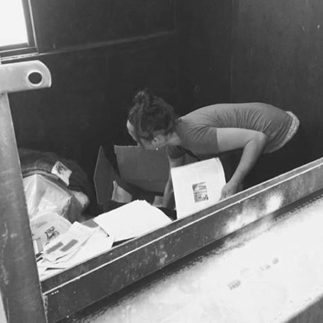
This wasn’t one of those “I found a cute couch on the side of the road” kind of dumpster diving situations. This was an every-single-day-I-live-for-this situation, where every day I wake up, write some articles, see my friends, and then visit my Home Base, the operative spot of my primary recreational activity, the adventure of my favorite game — and every day, I would change into yoga pants, long sleeves, and rain boots, pull back my hair and double-wrap it in a bun, and then climb over fences, grab metal handles to anchor myself as I climb, and then plunge feet-first into the dumpster, and that was when they let the games begin.

At first, diving awoke some kind of primal hunter-gatherer instinct in me. It still does every time. But at first, everything I found that was moderately useful, new, or interesting was a source of wonder and amazement (see my favorite mantra: “Who would throw this away?!”). But after a while I became a seasoned scavenger, and the game got methodical. We had unspoken rules. We had procedures.

Basic Dumpster Protocol

RULE #1: This is the single most important rule for hygiene that you must never, ever break if you want to maintain any separation of social constructs of Clean and Dirty, and if you want to avoid literally living in filth. As soon as you get back to your apartment, deposit the items from your haul in one corner away from all your other stuff. Do not touch them. Immediately go into the kitchen and wash your hands, including under your fingernails and all the way up to your elbows. Before entering your bedroom, strip down head to toe and take off everything you are wearing. Immediately deposit your clothes into the washing machine. Do not touch those clothes again. After touching those clothes, avoid touching your face or any other surfaces. Immediately go into the bathroom and take a shower, washing your body thoroughly, and put on a new set of clean clothes. Wash your hands again before and after sorting through the items from your haul in the isolated part of your room. When your Dumpster Clothes have completed washing, wash them again.

While diving:

—Avoid skin contact with liquids when possible. Wear long sleeves to avoid cuts and abrasions. You will probably encounter both anyway, but do your best.

—Grab a mid-tier shopping bag from the dumpster and separate your items into bags by category of filth as you collect them. Remember that whatever you grab, you’re gonna need to carry back with you to your apartment. Shopping carts are super helpful.

—Bringing hand sanitizer is a pro-tip, because your hands will always be sticky.

—It’s always, always good — not just for efficiency and expediency, but for safety — to have a spotter, or at least a partner in your Dive.

Don’t attract the attention of authority.

—Be shameless in your act of the Dive — do not be embarrassed by what you are doing. You’re cute. You’re eccentric. Always say “hi” to passers-by, who will usually apologize, laugh, and look confused when they throw a trash bag in the dumpster and it accidentally hits a person. Be conversational, a normal person going about their business.

—Nighttime is preferable for retail store or corporate dumpsters. University dumpsters are generally better during the day, but you want to lay low regardless.

—Avoid cops if at all possible. If you do encounter university cops, be normal, be friendly, and be honest about exactly what you are doing. It helps to start with, “Hey! Sorry, people are just throwing the craziest stuff away. You would not believe what I just found.” It helps sometimes if you mention the economic value of your haul and mention that “you could totally sell this stuff,” because for some reason capitalism legitimizes everything and we all have given each other a collective free pass for doing ridiculous and otherwise utterly degrading or horrible things, so long as we are doing them for money.

—If you ever encounter hostile cops or city law enforcement, do exactly what they say, apologize, and leave. Abandon your haul if necessary. If they accuse you of trespassing, say you misunderstood. What you’re doing is technically legal, but let’s be real — it looks sketchy.

Safety first, adventure second, money last.

Unspoken Rules of Dumpster Diving

1. Do not make a mess. Always leave the site cleaner than you found it.

2. Finders, keepers.

—If you find and do not need, think of your friends and your community. Whatever you find belongs to everyone, because Trash is communal property. If you find something and someone else needs it more than you do, it belongs to them. It is theirs. It is meant for them. That is just the way it is.

—“Finders, Keepers” applies in the fact that once you find something, it is yours to either keep, distribute, or discard. It is the assumed moral responsibility that if someone else would appreciate the item found more than you that it should belong to them.

—Items found in a mutual Haul should never be re-sold or traded to other divers or friends. Whatever you find, you must share. The objects found you, and they are yours simply by luck of discovery. Once you find it, is yours, and you have the ultimate say. But that is not a power to be abused. We do not adhere to the social mores of a normal economic system, as is made obvious by the fact that we are foraging through dumpsters.

3. Safety first.

“Finders, Keepers” being said, when dumpster diving with your comrades, spot each other, assist in buildering (climbing on top of and through urban structures), and always consider that the Haul (everything you gather) is communal, and ownership can always be sorted out later. The most important thing in the field is working together and looking out for each other’s safety.

Pro Tips

Things you should always take, because you will always need:

Shampoo, conditioner, body wash, soap. Laundry detergent. Dishwasher detergent. Cleaning supplies. Toiletries. School supplies (tape, empty notebooks, pens, printer paper, calculators). Household supplies (lightbulbs, batteries, phone chargers). Unopened food.

Things Good For Flipping:

Lamps, rugs, carpets, Ikea furniture, mirrors. Electronics. Household appliances. Fine jewelry or gift cards (any items of objective fixed retail value). Any duplicate factory-sealed retail items in extremely large quantities. Furniture.

The Three Levels of Trash Bags:

Gold: Full of valuable objects.

Mid-tier: Mostly paper, sometimes food, sometimes objects to be found.

Actual Trash: These are big black bags, which mean they are industrial trash. Actual Trash also applies to regular-looking bags that are just obviously full of food waste, wrappers, and other things that cannot be repurposed. Depending on the location of your Dive and depending on the time of year, it’s possible that you could have an even ratio of Bags vs. Bags of Actual Trash, or, in other circumstances, the dumpster could have a potentially tragic 80/20 ratio of bags to actual trash. Worse altogether is when people mix their disposables with their Actual Trash, but most people don’t do this. Most people organize their trash methodologically in a way. You learn to gauge a bag before you open it, and you learn to look for indicators of potential as soon as you open it to quickly determine whether or not it’s worth your time.

Fast-forward one month:

(Okay. I guess I’ll be honest. Fast forward two days.)
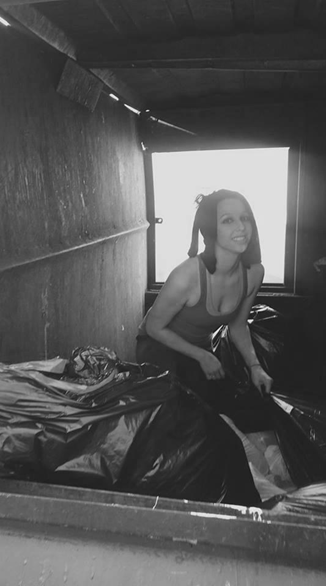
It is a burning-hot July. The smell permeates everything. The wonder is constant, the excess unfathomable. We, we being me and my life partner (my partner in love, my partner in crime, my partner and equal in all things, including especially dumpster diving, who was not only cool with my agenda, but extremely down, perhaps more or even as much as I was), are currently living in a four-bedroom apartment nearing the end of our lease. Our other three roommates have moved out for the summer, so we have three empty bedrooms and a massive living room, all of which are filled with Stuff.

Room One, Alicia’s Old Room, is the End of the Road, because her room has really bad vibes. Alicia’s Room is where we keep the shopping carts and bags full of all the stuff we don’t quite know what to do with, or that we want to keep but have no immediate use for.

Room Two is Grace’s Room: Grace’s Room is The Museum. Grace’s Room has a full bathroom and bed set-up — it is decorated like an ordinary room, except entirely with things we found in dumpsters. Her bathroom has bath mats, a shower curtain, towels, toiletries, toilet paper, hand soap, even make-up. Her bedroom has Egyptian cotton sheets and a plush Target bedspread, Tempur-Pedic pillows, sea-green curtains, atmospheric paintings, three dorm room lamps, and a pink shag carpet. Every drawer of her dresser and desk and every available surface is brimming over with Stuff. Books, Victoria’s Secret lotions, Vera Bradley wallets, Halloween costumes, prescription drugs, school supplies, TVs, printers, vacuums, herbal teas, coffee mugs, silk Express ties, boy band posters, and boxes of food. The Museum is the room of stuff we kind of want but don’t particularly need, stuff that we want to share. The Museum is where our friends can come over every day and go shopping for whatever they want, reaping the benefits of our adventures, creating our own sort of Sharing Economy.

Dominique’s Room is for The Essentials, or, as we put it, the things we’re trying to sell and/or things we really want to keep, things of value — either to us personally or to others financially. This room (though also outfitted with full bathroom decoration from dumpster goods), is a Secret Vault of cleaning supplies, bulk food products, expensive make-up, Haunted Dolls, speaker systems, X-Boxes, and tie-dye tapestries we could never, ever part with. It’s also full of the most bizarre items (Christmas trees, … stockpiles of glitter, Tupperware jars full of Googley eyes, the personal diaries of strangers, love letters between couples we never knew), that we love, but don’t necessarily want to look at all the time. I don’t know how to explain the themed flipbook Evan made Karen for their one-year anniversary, nor the pile of eleven unsubmitted Absentee Voter Ballots…. I would not know how to explain to someone why we have these things in our house. I would not know how to even explain it to myself.

All I knew was that we were living, and every day was a new conquest — every day a new adventure.

I rationalized dumpster diving as a practical thing, but if I’m honest, it was never a practical thing. Not really. Not once did I climb into a dumpster and think, “I will harvest items to sell for a living today.” No. That’s not the spirit of it. That’s not the way it is at all. It’s an excuse to unlock some kind of primal creative instinct. It’s a video game in real time. It’s dangerous, ridiculous, and the art of delusional degenerates. In a society of values with which I have almost nothing in common, what most see as delusional, I see as the most obviously sensible thing. What they see as deviant, I see as genuine. What they see as meaningless, I see as radical. What they see as a numb, mute procedure of operational behavior, I see as a blank canvas for a creative medium, the creative medium of living. What they see as degenerate, I see as noble. What they see as trash, I see as living objects. What they see as trash, I see as resource unutilized. What they see as trash, I see as promise — the promise of freedom, the promise of infinite potential, the promise that whatever you need can be found, whatever you want can be made, whatever you have can be given. What they see as trash, I see as proof of immortality, that nothing dies except the part of it that dies in you, that nothing is beyond redemption, everything is just hidden beneath piles and piles of rank-smelling garbage and empty beer bottles, and no one is willing to climb in the dumpster, but if you did, if you had that faith, just once (because, according to the laws of dumpster diving, if you want to find Something, you will), and if you stop believing in meaning as prescribed by society and start creating meaning in accordance with your desires, if you stop believing there is ever such a thing as Trash, and start realizing that every living moment is the Object You Desire, and if you don’t feel content with your things, it is you that are Trash, not your Things … and that we don’t need a concept of Trash, we cannot sustain a concept of Trash, if we are to look around us and remember what it means to use and touch a thing for what it is and that alone.

Dumpsters aren’t gross, not really. Human bodies are gross. Nature is gross. We are part of nature, and our trash is just the cosmic compost of our modern industrial world. Plastic polymer stretch-proof bags of cellophane egg shells and orange peels and crumpled theses drenched in coffee stains are just the crumpled compost of human beings. They contain imprints of us. They are not profane. They are profound. These are not pits of our excess, these are archives of our culture. These are sacred tombs that testify to the fact we live and are alive, to the fact we are doing something, we used something, we loved something, we are something, whatever that is.

We exist in these object-imprints more than we exist in any real-world form. We exist in these collective capsules, these communal projects of mutual disposal, mutual value, bought, exchanged, and then abandoned, the things we relegate to trash bags. We are the things we put in trash bags. We etch meaning everywhere we go, with everything we touch. When we throw it in a trash bag, tie it up, and set it free, we are relinquishing claim to that piece of Identity-Ownership self and giving it back to the world, back to the collective system of bureaucracies we implicitly trust to pick it up every Monday morning and make it go away, to make those parts of ourselves we once owned be owned no more, all the pieces freed from restrictive ownership to coagulate back together in their new respective forms: in this one thing, we are ownerless, in this one thing, we are absolved, in this one thing, we are made free, from the tyranny of Self and Things.

Trash is art. Trash is real. Trash is without apology. Trash does not contrive itself to look and sell shiny or pretty, it is just trash, it sits shamelessly in the white bags marked NOTHING, the red-strings tying up the white bags which scream “NOTHING OF VALUE GOES HERE” and they sit there, these bags, content in their Trashfulness, content to be Nothing Of Value, content to Never Be Owned Again.

I want to be like trash. I am, in a word, human garbage. I am a garbage human being. I am content to writhe in dumpsters, more content than men in meadows under awnings of singing trees, I am content among the garbage. I am content, I am alive, within the collective kaleidoscope artifacts of humanity. I feel wonder, I feel childlike awe crawling up my spine, pressing its thumbprint on my forehead and my sternum like a pulse, like the defibrillator of God, innervating my innate curiosity long flat-lined by the asphyxiating monotony of Input and Output, System and Unsystem, Good and Evil, Two Weeks ’Til Paycheck, Please Dial Nine, Please Drink Responsibly, Sign Below The Dotted Line, the hereditary mortgage of adulthood, of impermanence, of culture as an industry, of ubiquitous art to the point of no meaning, to the stifling humidity of cerebral Law and Order which presupposes the necessity of sanity and simultaneously extinguishes any flicker of wonder or free will.

I want to be like those white bags marked Never To Be Owned Again. I want to be the things I find in dumpsters. I want to be Technically Nothing. I want to be Everyone’s. I want to be No One’s. I want to be free.

We cherish the blood, sweat, and tears, but we forget about the trash of humanity. And humanity is trash, this much I know. Nature is trash. Nature is filth. Nature is an art museum of shock, awe, sheer disgust, and wonder. Nature is something you throw in the garbage.

And for all of our ideas, for every crown jewel of our civilization and culture, humanity is still no more than just one collective dumpster. And you can act like it’s dirty forever and a day, but you know you want to dive in.
Modern Era Love

J. R. Emry

Love as a dying anachronism. The human replaced in all musterable vigour through that descension into the post-human. The post-human concerns itself not with the likes of love, but instead with its daily, if not hourly, orgies; love as cannibalism of the other, the mutilation of the self, and the destruction of the person as phenomena. “Eros demoted from god to buffoon” (Gallagher 207). Yet, indeed, Eros upheld as the maxim of love, so that none other love may remain at all.

The production of the post-human by the removal of the heart; the making of the individual. The person as defined by the relation to the other. The individual as that which is demarcated from the other is set distant from the person. Individualization, an act of despair by which the self is systematically destroyed in pursuit of living suicide, if not suicide proper. The radical individual as the willful un-person. The leveling of person to the individual by equal measures as the removal of the second story from a house; a reduction away from higher orders (Stern). A leveling proceeding from the basis that a person is systematically taught to recognize significance from demarcation and by their own humanity see the similarity of human nature in others — thus to see insignificance in the self. In insignificance — despair! The person demarcates away humanity for significance; the removal of the heart to be without a chest (Lewis). From human to post-human, ever greater individualization sought by the increasing of category and selection to the infinite. No longer content to man or woman, the boundaries artificially blurred and the content within rendered meaningless. The phenomena of personal death, that is spiritual death, as result of the love of self, wherein that love is hatred.

In making the self a void of the person, the newfound individual inflicts mutilation by means of the laceration on some, if not all, aspects of their being. The infliction on the heart immediate by degree of laceration by even mere thought. The infliction on the mind immediate by degree of laceration. The psyche escapes from nothing. The infliction of the body by laceration of the flesh taken at any subsequent time. The so-called “sex change” as the culmination of three kinds of lacerations; the unmaking and destruction of the body to make in accord with the unmaking and destruction of the mind for reason of furthering the unmaking and destruction of the heart. To make what isn’t of what is. To make what shouldn’t of what should. Love of the self, wherein that love is hatred, defined by cruelty brutality against the self.

The sexual revolution having already taken root by the onset of the digital age finds amplification and completion of the pornographization of all culture. That what the hippies of the 1960s called “Free Love,” that polymorphic perversity, the idea therein that authoritarianism is the result of sexual repression thus that the subjugation of all to the sexual act even at the most base as a means to an end and the end contained in itself. The sexual revolution aims for dissonance and the disassociation of sex from all reality; the breakdown of the human spirit by means of the divorce of the body and the brain, reducing all to mere calculators and copulaters.  Feminism as the end of the female; setting forth the corrupted male as the ideal for both sexes. Homosexualism as the end of the relation; setting forth the dehumanized object as the ideal for both sexes. Once an act of creation, intercourse is reduced to an onanism, stagnant and infertile. As the most basic act of creation, reproduction is eroded, by necessity all acts of creation replaced by the fruitless. No longer will order be brought forth out of chaos. All the arts become impotent pornographies; bombastic in their obscenities. “They castrate and bid the geldings be fruitful” (Lewis 26). The fundamental goal of art changed from beauty to revolution; the malicious revolution against all existence. The distinction between the post-human and the mass murderer only differentiated by passivity. The inversion of the object with the subject as means of moral inversion necessitated by the creation of the individual from the death of the person. The dead abhor the living and so act as cannibals. In this way, the observance of feminism is absolutely equivalent to self-depersonalization; the integration of the former into society as equivalent to the leveling of all in society to inhuman states.  In this way, the support of homosexualism is absolutely equivalent to the support of pedophilia; the acceptance of the former the acceptance of the latter. This as the love of the other, wherein that love is hatred, defined by cruelty and brutality.

The post-human seeks the destruction of the human in others and the self. This destruction claimed as an act of love all the while blurring the heart between the body and mind until it dissipates. The mind for the disconnect of the presence by distraction, by amusement, by fun as an end to itself. The body by means of the gratification of the passions at the instant. All made digital for the heart is analog. Here, beyond good and evil, civilization is known to be dead. All events are proceeded by prophecy, herein the physical death shall follow this spiritual death. “You may suddenly understand it all someday — but only when you yourselves hear “hand behind your back there!” and step ashore on our Archipelago” (Solzhenitsyn 518).

Bibliography

Gallagher, M. (1989). Enemies of Eros: How the Sexual Revolution is Killing Family, Marriage, and Sex and What We Can Do about It. Chicago, IL: Bonus Books.

Lewis, C. S. (2013). The Abolition of Man. Exciting Classics.

Solzhenitsyn, A. I. (1978). The Gulag Archipelago Three: Katorga; Exile; Stalin is No More V-VII. New York: Harper & Row.

Stern, K. (1985). The Flight from Woman. New York: Paragon House.

“What about a Story?”: Winnie-the-Pooh as Literature for Adult Readers

Katie Arthur

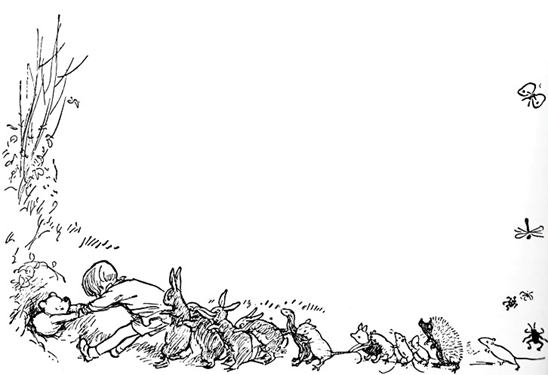
One of the oddest things about Winnie-the-Pooh is that it is so embarrassingly funny.  I am a grown adult, and I laugh out loud in the middle of my university library and have to apologize to my neighbors because Mr. Milne knows exactly how to pull a guffaw out of my throat at exactly the wrong moments.  But, you ask, I thought it was a children’s story?  Is it the sort of funniness we could imagine children enjoying?  Is it below our mature threshold for thinking, adultish entertainment?  In my reading, no.  This is genuinely clever funniness for young and old, and the hilarity is a function of what narrative theorists call the implied reader.  In the 1960s, Wayne Booth initiated theory on the implied reader, saying the text itself constructs a sense of the audience it intends, assuming knowledge and giving knowledge according to what it wants the reader to be.  That ideal audience corresponds to nothing in the real world.  The real readers of the text may or may not be anything like the reader the text asks for, but the sense the real readers get of the implied reader nonetheless shapes the way we receive the text.  It is here that Winnie-the-Pooh is successful. 

Winnie-the-Pooh incites two kinds of implied readers.  It is a book either for older children to read for themselves or for adults to read out loud to younger children, and it works very well both ways.  There are three kinds of humor in this book: humor for both the adult readers and the children listeners to enjoy together, and two kinds of humor only the adult readers will enjoy: the first, a humor accessible only to the adult readers as a function of the printed text, which naturally the young children will not appreciate; and the second, a humor that allows the adult to enter into the funniness of a child’s world.  We will look at all three kinds of humor but dwell on the last for the longest because it is the reason I have to excuse myself from quiet places.

The humor made for both children and adults is the most easily explained.  These are instances of simple confusion and embarrassment, like most of the comical things we encounter in our lives.  In the fourth chapter, “In Which Eeyore Loses a Tail,” in order to find the tail, Owl suggests a reward be issued.  “‘Just a moment,’ said Pooh, holding up his paw.  ‘What do we do this — what you were saying?  You sneezed just as you were going to tell me.’  ‘I didn’t sneeze.’  ‘Yes, you did, Owl.’ . . . ‘What I said was, “First, Issue a Reward.”’  ‘You’re doing it again,’ said Pooh sadly” (50, 51).  This is purely delightful confusion between the sound of the word issue and the sound of a sneeze, and absolutely accessible to young and old minds.  In Chapter II, “In Which Pooh Goes Visiting,” Pooh finds himself stuck in Rabbit’s front door, which was constructed to allow Rabbits and hungry Pooh Bears through, but had forgotten to take into account not-hungry-anymore Pooh Bears (32).  People stuck places they should not be is just comical.  This too, is simply an embarrassing situation most children and adults can relate to and laugh about.  When Kanga and Roo come to the forest, and the animals have to decide what to do about these strange visitors, Piglet must, according to the plan, pretend to be baby Roo to trick Kanga into leaving. As Kanga, only fooled for a few moments about the difference between a baby pig and a baby kangaroo, gives Piglet a spluttering cold bath to continue the joke, both reader and listener can laugh at Kanga’s cleverness and Piglet’s sad and unheeded insistence he is not Roo and does not need to have this bath and take this medicine (106).

And then there is humor Mr. Milne threw in just for the reader, which the child listener would have no access to, unless he were an older child following along with the reading.  This is located in the clever misspellings of certain things in the text.  These animals are the toys of a young boy, so they do not naturally have a very large capacity for educated writing and reading, and yet, living in a forest, one finds the need for many things to be written.  So Owl, the wise one, finds himself doing most of the spelling work when Christopher Robin cannot be found, and the result is funny for the reader.  For example, on Eeyore’s birthday gift from Pooh, Owl writes “HIPY PAPY BTHUTHDTH THUTHDA BTHUTHDY.  Pooh looked on admiringly. ‘I’m just saying “A Happy Birthday,”’ said Owl carelessly.  ‘It’s a nice long one,’ said Pooh, very much impressed by it.  ‘Well, actually, of course, I’m saying “A Very Happy Birthday with love from Pooh.”  Naturally it takes a good deal of pencil to say a long thing like that’” (83).  Mr. Milne took the time to write out in the text the funny misspelling that would only be seen by the reader.  (Although, this might better fit into the first category.  As we are supposing this to be read out loud, the pronunciation of the misspelled birthday message could be a point over which listener laughs at reader, and we might actually need to create a new category.)  Another instance that is truly only for the reader is when Pooh brings Christopher Robin news of the flood waters in other parts of the forest, bringing with him a note he found in a bottle.  He calls it a “missage,” and Mr. Milne continues, for the enjoyment of the reader, to spell it missage even when he has finished reporting Pooh’s actual words (142).  And at Owl’s house are two signs which read: “PLES RING IF AN RNSER IS REQIRD” and “PLEZ CNOKE IF AN RNSR IS NOT REQID” (48).  These are intelligible signs and can be read out loud to a child without problem, and the misspellings are just a little treat for the reader.

But the most interesting parts of the book for the adult reader are the places where Mr. Milne’s adult narrator speaks as if he were a child and allows the adult reader the joy of watching children think.  In the introduction and first chapter, our narrator sets up the book as a collection of stories about a little boy named Christopher Robin and his stuffed bear.  Really, Christopher Robin has told our narrator Winnie the Pooh has asked for some stories about himself, “because he is that sort of Bear” (4).  Christopher Robin is the explicit narratee here, the one receiving the story.  When Pooh needs a friend, “the first person he thought of was Christopher Robin” (9).  Christopher Robin here interrupts the story with a question about whether or not Pooh really meant him, and the narrator assures narratee Christopher he did.  We know, though, the story Christopher Robin and the listener Christopher Robin exist on different levels, one in the nursery listening to the story, and one in the Hundred Acre Wood being the story, and so they cannot be exactly the same.  But good storytelling encourages the listener to feel involved, so we can let him think Pooh meant him.  On page 10, Milne grants Christopher Robin permission to be called “you” by the narrator in a brief moment of dialogue.  Then on page 11, the story continues with Pooh and Christopher Robin, we assume.  But the Christopher Robin character is now called “you.”  Before, the listener Christopher Robin was “you.”  Now the character Christopher Robin is “you.”  In this tiny switch hangs a great deal of the success of the book, because in it the reader is invited to be Christopher Robin listening to his father.  As the narrator/narratee framework disappears with the disappearance of quotation marks surrounding the story and the reader receives the text in pure naked narration, the reader is addressed directly as “you.”  In this way, the adult implied reader is asked to put himself in the shoes of a child, to put on a child’s perspective and think like Christopher Robin.  The results are hilarious, and one of my favorite manifestations of this child-thinking is the time we are introduced to Piglet’s grandfather.

Piglet lives in a great beech-tree, and “next to his house was a piece of broken board which had: ‘TRESPASSERS W’ on it” and Piglet explains that it “was his grandfather’s name, and it had been in the family a long time” (34).  We the readers know, as the narrator intends for us to know, that Trespassers W is not short for Trespassers William, as Piglet says, but for Trespassers Will Be Shot.  If you are a child, though, trying to make sense of the world around him it makes perfect sense for a grandfather to be named Trespassers W.  The funniness here is a function of the particular adult implied reader who does have a pretty good sense of the world around him, but who has hung next to his adult sensibility a child sensibility and has let them clink around a little at odds with each other.  This clinking sounds like laughter.  So a story can begin, “once upon a time, a very long time ago now, about last Friday,” and it both makes sense and is laughably wrong, because the adult knows how a child can feel that last Friday was an eternity ago and also know it has really only been a few days since then (4).  And of course when you are a child trying to discover the North Pole, it makes perfect sense to look for a stick in the ground and preferably rather close to where you live, when you the adult knows it is actually a huge lonely snowy place very far away with no real poles at all (127).

To become an implied reader, to put oneself in the brains of someone else, is one of the greatest joys of reading narrative, and it is especially fun when the new brains are joyful and juvenile.

Works Cited and Related Reading

Booth, Wayne. The Rhetoric of Fiction. University of Chicago Press, 1961.

Iser, Wolfgang. The Implied Reader. Johns Hopkins UP, 1974.

Milne, A. A. Winnie-the-Pooh. E. P. Dutton & Co., 1961.

Prince, Gerald. “The Narratee Revisited.” Style, vol. 19, no. 3, 1985, pp. 299-303.

Forgotten Gems: Welcome to the Real World

Christopher Rush

An Album of Absolutes

In the midst of the glory days of the ’80s (the 1980s, not to be confused with the glory days of the 1380s, for example), Mr. Mister released their second album to much acclaim and well-deserved fanfare.  Not too many albums, for example, have two Billboard #1s in succession, but Welcome to the Real World achieved just that with “Kyrie” and “Broken Wings.”  Yes, it’s that album.  But as with virtually all of our “Forgotten Gem” albums, it behooves us to remember this album is far more than two or three pop hits and some other stuff.  Oh no.  This is a top notch album — not just “solid,” but top notch, especially when one sees the whole picture this album offers.  Of the first five songs, four could very well be valid opening songs for the album.  They are that peppy and grand in scope.  More importantly, this album conveys to us the importance of living by absolutes: right and wrong exist, there is a proper way to live life, and reality is objective.  What more could one want from an ’80s pop rock album?

Black/White

From the opening track, Mr. Mister tells us the world is a paradox of opposites: we are both weak and strong, we draw ourselves to each other and we push each other away.  We have passionate difficulty treating each other consistently.  This is the relativistic kerfuffle we create for ourselves.  Into this confusion comes the reminder life is not truly a relativistic spectrum: absolutes exist.  Change can occur, surely — growth is possible, and so are mistakes.  At the beginning of the album we aren’t sure what those absolutes are, but the tangible dichotomies of day and night and black and white propel us toward the path of delighting in absolutes.  And love is the path: because of love, we know there is right.  Love, as strange as it is experientially, is right.  Love changes us, and we change because of love.

Uniform of Youth

A second solid candidate for opening number, “Uniform of Youth” is definitely grumpier lyrically than “Black/White,” which is likely why it was not chosen as the first thing audiences heard on the LP.  It would make for a good starting track, though, because it presents that youthful petulance of discontent one experiences when not living freely under the absolutes of God’s reality.  Such discontentment with the way things are materially and superficially seem to lend themselves to flight (“I don’t know if I’ll stick around / I don’t know, I just might leave town”).

Considering the song in its present location as the second on the album, we can consider some time passing from the opening song.  The juvenile transient love has brought discontent and irritation, and yet it has also brought a growing understanding of the failings of life (“Nothing’s perfect anyway / No one said that the world was fair”).  Even though absolutes reign, we flawed and selfish beings can make a mess of things.  The hero of this saga takes some small comfort (in a rather rousing musical chorus) in his youth while adjusting to what life is supposedly requiring of him (“I’ll just do what I’ve got to do” … “I wear the uniform of youth and I hold on”).  He is starting to be more aware of the need for meaningful growth and change in his life, which must be initiated by genuine love (“All I want is someone to care”), not the ephemeral, self-serving (though naively quaint) love of “Black/White.”

Don’t Slow Down

Another peppy track that would work well musically for the opening number, though that would mess with our narrative progress through the album, “Don’t Slow Down” picks up the emotional momentum once again.  No longer content with fitting in and passively letting love and society determine what happens to him, our hero has come to terms with previous failures and is finally prepared to commit to the love in front of him (“I look into your eyes, I see the dream that I’ve been searching for / I’ll search no more”).  Unfortunately, despite his enthusiasm for commitment, his enthusiasm is overweening, as evidenced by the chorus: “So don’t slow down, the wheels are turnin’ / The fire’s burnin’ in us now / Don’t slow down, don’t lose the magic / We’ve come too far to turn back now.”  Assuming for the moment this is not a plea for premarital physical dalliances (which would be unlikely anyway, considering the album and people writing the songs), we can interpret this as an ardent plea for nothing more than a continuation of the present experiences of life and love.  Whatever happy feelings and camaraderie they are experiencing, he simply wants it to continue with the same verve in which it is currently occurring.  The immaturity persists, despite the progress: he is too content with the little maturity he has made to give himself fully to absolute love.

Run to Her

Despite his attempts to keep the momentum going, their relationship has slowed down after all, along with the speed of the album.  “Run to Her” is the only slow song on the album, but it is not the typical fluff of ’80s ballads (1380s ballads, let’s not get confused).  In a sense, this is a mirrored, almost dream-like version of the previous song.  Lyrically it is similar: he is still looking into her eyes, reflecting on how much he enjoys being in relationship with her.  Yet there is a significant difference here: he has come to realize time is not something you can outrun.  Time’s wingèd chariot never loses its race.  “Time, it passes much too fast / And time, I want to make it last” — clearly his priorities are starting to mature, though they are still hampered by too much connection to this world.  His love for her is no longer just about sustaining the enjoyment of the relationship regardless of circumstances or consequences — now, the importance of it has developed into the beginnings of mutual respect and worth (“The sun was shining brightly / As we talked into the night”) — finally a genuine relationship is building.  He is starting to understand the absolutes of life lived correctly … but he still has some work to do.

Into My Own Hands

Continuing our hypothesis of potential opening tracks, “Into My Own Hands” makes an excellent candidate following our interpretive framework: were this the opening number, we would be introduced to a young fellow full of salt and vinegar (I think that’s how the expression goes, at least in Canada), confronted with everything this album is about: the nature of the world (whether ’tis absolute or relativistic), one’s place in the world, the brevity of life, how to grow into maturity, and the rôle(s) of love and fellowship in life.  Protracting the hypothesis, we would be faced with a rather impressive philosophical album (which we are regardless of this track’s proper position): the desperation of the singing narrator reminds us how crucial the proper answers to these issues are.

But we must examine the song where it is, and as such the interpretation is just as engaging.  After the maturity of grasping the brevity of life and the importance of actually living it, our hero shows a painful resurgence of his impetuousness: he’s going to both “[t]ake this life into [his] own hands” and “[t]ake this world into [his] own hands.”  He has indeed learned some lessons and lost some lessons.  “How wrong could I be?” he asks.  Well, pretty wrong it turns out, if one takes the obvious interpretation to hand: he thinks he’s got to be ruler of his domain, king of his castle, master of his fate.  But perhaps it’s not so self-serving.  Perhaps he is simply looking around at life, seeing some things that need improving, and realizes he is a big boy, he can help make his world a better place.  He’ll “take [his] stand” for justice and truth and righting all wrongs.  That sounds good, doesn’t it?

Is it Love

And just like that, once the record is flipped over to side two, our hero is met with the consequences of trying to live life his way, regardless of his intentions.  Now, the song appears to lead us toward believing our hero is asking this question of his lady and/or the world around him he is trying to save/improve/ameliorate/whatever.  The fault is with you people out there, our hero is implying, ignoring the fact his self-serving attempt at making people better and “loving” her is instigating fear in her, not reciprocated love.  We know better, of course.  He is asking this question of others, that’s true, but he is asking because the voices in his head, the dreams he’s been having these last few songs, have been asking him this very question: do you really want genuine love? is that what you are after? is that a value you want your heart to pursue, to embody?  There’s only one source for Real Love.

Perhaps you are skeptical of such an interpretation, and I admit it is rather generous on my part, but I think this total view of this song, in relation to the flow of the whole album to date (especially when paying keen attention to those lyrics, the key phrases about absolutes and the real world most especially — and real love is truly an absolute), this interpretation fits rather well.  Because then comes the next song.

Kyrie

Ahhh … yes.  This is the track we’ve been waiting for.  Don’t get me wrong (as often happens) — I’ve already said this is a top notch album in toto (not that Richard Page was ever in Toto beyond contributing background vocals).  But this is unquestionably the greatest song on the album.  We haven’t made much mention of the musical aspects of this album, replete as it is with synthesized drums, Bowser palace-like riffs, orchestra hits, and a panoply of ’80s (1980s) technological gems.  But I defy you to find anywhere, anywhere I say, a more energizing, heart-pounding, soul-uplifting moment in music history than the truly awesome moment in the post-bridge modulation mostly acapella chorus when the guitars and drums kick back in.  As great as Beethoven, U2, and the rest of the gang are in breadth and scope, this moment has got to be the best of all time.  And now back to our story.

Our hero has finally experienced (and understood) his moment of transcendental connection with the Divine — not in a pantheistic sort of sense, though wind is the force reaching into his soul.  Finally the One True God has gotten ahold of our hero, and he realizes how much he needs God, God’s love, and God’s way of living life.  By trying to take the world into his own hands, by asking other people if they want love, these were just variations on blending in with his uniform of youth — just his entire life of running away from the black and white nature of the real world of absolutes, of the divine: he has been hiding his whole life, hiding away from what he has suspected all along, and now God “reaches in to where [he] cannot hide” any more.  But it is not just about baring his fears and failures, oh no.  God “sets [his] feet upon the road,” allowing him to finally live life correctly.  Now that he has matured through his experiences, he can honestly reflect on his life:

When I was young I thought of growing old, of what my life would mean to me

Would I have followed down my chosen road, or only wished what I could be

We have seen his thoughts and hopes for his life in the first six songs of the album, and we know (and now so does he) what he would have made of it all, since it is the same for all of us.

Regardless of whether I have interpreted the verses correctly (and I, as always, am likely off at least a smidge here and there), there is no denying the chorus, especially in the way the song is sung (and the fact the music video frequently features band members, mostly frontman Richard Page, pointing up toward Heaven at appropriate moments in the song):

Kyrie eleison down the road that I must travel

Kyrie eleison through the darkness of the night

Kyrie eleison where I’m going will you follow

Kyrie eleison on a highway in the light

Note well: that third line is not a question.  He is not asking if God will accompany him along his journey of faith.  It’s simply a syntactical inversion to allow the vocalization of the lyric more efficient (and keeping in more with the medieval feel, say circa 1380s, instigated by the Latin).  Our hero has arrived at the point of calling upon God for mercy.  He knows this life is the life he has been called to live, and whether things go easily (“highway in the light”) or not so easily (“darkness of the night”), he knows God will follow (accompany, enable, abide, strengthen) him to live this life to which he has been called.

And now that he has finally reconciled with God and been redeemed (and thus enabled to love correctly and live correctly), it is time to reconcile with his lady love and the world he was trying to reshape into his world.

Broken Wings

Admittedly a few words in verse one make what would otherwise be an impeccable progression through the story of this album a bit tricky, but I think a little bit of exegetical prestidigitation will do wonders for our purposes.  Taking the position our hero has reconciled with God and been born again, he initially is somewhat discombobulated why he can’t just magically repair the damage his earlier self-centeredness did to their relationship now that he has found God.  What he does know correctly, at least, is their relationship will completely end if he can’t make it clear to her how crucial it is for her to experience the same transcendent justification sung about in the previous song.  The “I need you so” bits are not just frothy romance (okay, lust) lines typical of the, yes, 1980s: more than that, he feels she is “The One” for him (we’ll put discussions about the Biblicality of such a concept on the back burner for now), but more importantly he desires her to come to the same saving relationship with the Merciful God to whom he has sung so recently.

The question remains, then, whose broken wings are being sung of so hauntingly in this number.  Option A: they are our hero’s former broken wings, no longer needed since he has been reborn and is traveling through life with the Lord of Mercy down the highway in the Light.  Thus the broken wings are a symbol of his hiding (the uniform of youth, his desire to take the world/his life/their love into his own hands), his failures to live life according to the absolute standards of Real Love and Mercy designed and instituted by God (the “take what was wrong / And make it right” aspect of verse two would then be metonymous for taking the broken wings and learning to fly again).  Now that he is giving them over to her, he is both demonstrating his personal restoration with God and His world and asking for her forgiveness of the wrong he has done her, and thus showing her how she, too, can find restoration (her broken wings will be replaced and she will be reborn) and new life.

Option B: they are her wings.  Much of the above interpretation would still hold.  The second verse’s lines “We can take what was wrong / And make it right” may sound like all their renewal and rebirth will be instigated by their human efforts (possibly through physical dalliances, as many would erroneously interpret this song), but it’s important to remember the accompanying musical video features our hero in a church with the light of God shining upon him when it gets to the climactic chorus lines “And when we hear the voices sing / The Book of Love will open up / And let us in.”  That’s the only way her broken wings can be repaired/replaced and she can be reborn.  Our hero knows it’s not about human efforts.  The voices that have prompted him to call out Kyrie eleison are now urging them both to put their faith and find their renewal in the Book of Love, and clearly from the entire context that is the Bible.  Living by the Word of God is how we “learn to fly again” and “learn to live so free.”  Where else is freedom but where the Spirit of the Lord is? (cf. 2 Corinthians 3:17).

Now that we understand the Biblical subtext of the song, we can easily see the end of verse two (“Baby it’s all I know / That you’re half of the flesh / And blood that makes me whole / I need you so”) is not just some far-fetched (19)80s power ballad palaver.  Nor is it heretical “Jesus’ blood is not enough to save me” nonsense.  It’s not “your” half of the flesh, but “you’re” half.  It may be a small grammatical point, but it’s worth noting.  It’s about her personhood, not her maidenhead.  What else is he referring to but the created order of things in God’s real world?  When Adam was made, was he complete?  Not according to the Word of God.  Adam was not complete until a part of his flesh was removed, reformed into something like him but different, and then returned to him.  And what was this but marriage itself?  And what is marriage but a symbol of our relationship with God?  You bet your boots he “needs [her] so,” just, contextually, as he needs the Lord of Mercy.  As do we all.

And now that he has reconciled with her (I think it’s safe to assume this conversation has a eucatastrophic ending with her personal redemption in Christ), our hero can focus (with her assistance, no doubt) on reconciling with the world he tried to take into his own hands.

Tangent Tears

A few moments ago, we (okay, I) made a mild disclaimer of a caveatish nature concerning potentially mildly loose interpretation of the lyrics.  Well here we are again.  Most likely this song is about a guy sad because his gal has broken up with him against his will and he’s really sad and crying a lot, possibly so hard his tears are barely touching his cheeks (and thus “tangent” to his face).  In all likelihood, the premise for this lyric was a catchy alliteration Richard Page and/or John Lang found neat-o, and they built a song around it.  But let’s return to our High Narrative view of the album and try something out together.

What if our hero, having reconciled with God and his sweet boo, returns his gaze to the world and finally sees it for what it is, not what he wants it to be … and what he sees is the world in its true, fallen condition.  The world is a mess and seeing it for what it is brings him to tears.  Let’s not stretch the point too finely, saying the line “Who’s playin’ on your team, he has a certain flair” is about Satan or anything like that.  But if we stretch it just a skosh, the second verse (“you made my heart go blind / You act so cold but you still look so fine”) could be about how tempting the world looks even when one understands it for what it is. Something like that.  He can’t reconcile the world by himself, of course, but that’s not his job.  Now that he sees the world for what it is, the only thing he can do is to help other people see what the world is really like.

Welcome to the Real World

With a proper understanding of God, nature, himself, love, truth, right, and wrong, our hero has finally arrived where he needs to be, where we all need to be, and now his mission is clear: tell us what reality is really like.  His tears are of pain because of the sin in the world, surely, and his tears of joy most likely come from his newfound life and faith and his sweet boo’s new life.  Possibly, some time has passed as well, and he and his wife are welcoming a new child into the world and they are starting off well by teaching their child what reality is really like.  I will accept either perspective.  A happy ending all around.

Our hero has learned the Real World is one of absolutes: right and wrong exist as clearly as black and white (and just as starkly different).  You don’t really have the authority to live life however you feel like.  There is a right way (and sundry wrong ways) to live the human life.  The Lord of Mercy is in charge, and it’s best to let Him put your feet on the path you should take in life, not try to reshape the world into your own image or desires (and definitely don’t try to reshape your love interest into your image of ideal love).  The world has many wondrous things to experience (using “the world” in just the diverse totality of human experience and God’s created order, not in the “this world has nothing for me” super-spiritual sense).  “There’s so much to learn,” indeed.

The sooner we learn the lessons of Welcome to the Real World (the album), the better off we will be.  The “chains that were choking [us]” of our sinful natures will soon be but a memory.  We will know real love.  We will know how to treat other people.  We will know what our life’s purpose is — directing everyone we meet to the Lord of Mercy.  And here you just thought this was just another pop rock album of the ’80s.  Good thing we’re here for you.

See you next issue, friends!

Kyrie Eleison!