Category Archives: Issue 26

Christmas 7: Ring Out, Solstice Bells

Christopher Rush

Hello, friends.  Here we are again: another Christmas, another New Year.  For some of you, 2017 was rough, and for that I am sorry.  For some of you, 2017 was a smashing good time, and for that I am happy for you.  Ours was pretty good — can’t really complain about it, certainly not with all the natural disasters and social unrest and political turmoil that made life difficult for so many people this year.  My wife got her Master’s degree, we have made significant improvements to our house, our kids stayed fairly healthy, we tried throughout the year to intentionally make good memories as a family, and that will continue to be an intentional plan going into 2018.  I hope you can spend a significant amount of time in 2018 similarly doing enjoyable things with people you love (for God’s glory, of course).

I think I’ve mentioned in the past as I get older I tend to go through the years in patterns: springtime seems to be my main wargaming season; videogames tend to come in the summer and Christmas break, when I actually have time to stay up and play them without work responsibilities; summer is also the time I tend to read the things I want to read for the same reason; autumn seems to be the time I return to Genesis and Rush albums for no reason I can intuit; and Christmastime is also the time of year I remember how much I enjoy Jethro Tull.  I suspect that has become a yearly thing because for several years there my sister-in-law and her husband got me a new-to-me Jethro Tull album for Christmas, so the band began to have a Christmastime connection with me.

When you get to the back page of this issue, you’ll notice we are going to begin a new series of album analyses on Tull’s folk rock trilogy, beginning with Songs from the Wood, if the Lord tarries.  I don’t want to get ahead of ourselves here, but in case you are wondering what that has to do with Christmas, if it’s been some time since you’ve heard the album, the first side ends with the song of the title in this very article, “Ring Out, Solstice Bells,” a great song about the beginning of winter and the festivals and good spirits and celebrations of life that occur at this time.  And since I’m sort of running out of ideas for Christmas-themed articles here, well, that seemed about as good as any for a title and a transition into a new series and a new year.  I thought about using the George Harrison line “ring out the old, ring in the new” already discussed in this issue, but I didn’t want to seem that desperate.

For the last few Christmas issues, as you may recall, we have included some shopping tips for games, and while I hope you enjoyed our recent recipe recalls from several issues ago (our first ever reprints), I don’t really want to recap the same game recommendations here.  Aside from the fact a fair number of the games we have recommended in the last couple of years have gone out of print and thus are rather difficult and/or expensive to track down, I’m not really a fan of straight repetition for its own sake.  Instead, here is a smattering of games I have acquired recently, games I have either played a bit lately or am looking forward to getting to the table as soon as I can.  Feel free to also use this list as an updated buying guide.

I have wanted to get my hands on Eminent Domain for a couple of years now (not to sound greedy or anything).  It has a lot of things going for it that I enjoy: it’s a deckbuilding game, it’s got a space theme (and you know I’m a fan of that), it’s small, and thanks to the expansion, which I also picked up at the same time, it has a lot of setup variability and replay value because it has more content in the game than you will see on any given play, so each playing experience is different (so they say).  I’m not a huge fan of the publishing company, Tasty Minstrel Games, but more so for niggling frustrations I’ve had with them than deep-seated and painful heartaches or anything like that, so for me to be eager and willing enough to get their game myself (instead of putting it on a Christmas list, say), tells you how much I’m looking forward to playing this one.

When 2017 began, I had two basic gaming goals: get a copy of Great Western Trail and get a Vital Lacerda game, a Portuguese designer of very thinking-heavy games.  Halfway through the year, I finally got ahold of GWT for my birthday, which made it even more special.  My wife and I played it a couple of times, and I got to play it a few more times with different alumni during summer gaming days, so for many reasons this game has become a personal favorite.  Like Eminent Domain, Great Western Trail has a few different gaming mechanisms involved, but it makes it all work together very well.  Much of the game is deckbuilding, in which your deck of cards is the herd you are driving from your ranch to Kansas City.  Additionally, you can control regions of the trail by adding buildings and thus making the trail longer, potentially.  You can also hire workers to make your trail-driving team more effective in different ways, either in acquiring better cattle, transporting them further and more lucratively, or improving your ability to make the trail itself more ideal to you and more difficult for the other players.  Like many top-notch games of today, it has variety in set-up and a multitude of gaming paths toward victory, making each game a new, rewarding experience.

As you many recall, I’m not a fan of horror in any way.  Edgar Allan Poe is pretty much my literary limit, and only in small, rare doses.  True, Abbott and Costello Meet Frankenstein is my third-favorite movie of all time, but that’s not “real” horror, anyway.  Arkham Horror is based on the H.P. Lovecraft world of scariness, which I will likely never read, but now that it is public domain, every  second game that comes out has some sort of Cthulhu topping.  The games from Fantasy Flight Game, though, stand out positively.  I’ve played the board game version of Arkham Horror, and that was good, though, like most people, for time and space reasons (so to speak), it has been replaced by the wider Eldritch Horror.  I am interested in getting the dice game version of this world, Elder Sign (I had the chance to get it this past summer but let it slip by in favor of a more family-friendly game because I’m swell like that), even though it may be rather similar to the others in the series.  Arkham Horror The Card Game is a bit different from them in that it is a card game, in the sense you are a character doing the investigation of the dark forces trying to break into our world.  Eldritch Horror certainly has a lot of decks of cards, but it does not have the same feel, since none of those cards are “yours,” and that personal element in the card game generates a different feel in the game, which I enjoy.  It is also one of the newfangled “living card games,” which is secret code for “endless money hole.”  The base game pictured above gets you four investigators, a slew of cards (equipment, abilities, weaknesses), and three missions connected by a story.  After that, you can buy new stories, new expansions, all with new cards, ways to upgrade your character, different kinds of adventures, making the world/experience grow and continue … but, yes, you have to buy them.  But, you’ve got them, and then you can play them again and again, perhaps as different characters, even after the “secrets” of the stories are over.  It’s fine.

Remember a few moments ago when I said I wanted to get a Vital Lacerda game in 2017?  Quest: completed.  Thanks to the semi-annual sale at Noble Knight Games, and some gut-wrenching trade-ins I made days before it, I was able to get a brand new copy of The Gallerist, an intriguing game about making the best art gallery in town.  I haven’t been able to get it to the table yet, but I’m hoping my wife and I will find some time during the upcoming break to get it to the table and play.  I suspect she will win.  Though, getting it to the table may be a bit difficult, considering what is quickly becoming one of my favorite games of all-time…

Gloomhaven is a huge game: hundreds of components, dozens of characters, dozens of missions: you may think it’s your typical fantasy dungeon crawl, but it is much more than that.  It allows different paths of adventure, your characters have different life quests, different abilities, different battle goals, all of which add up to a sprawling, unique gaming adventure.  It takes a lot of table space, takes a decent amount of time to set up and take down, but once you get into this fun world, you will not want to take it down anyway.  It is a permanent campaign game with stickers and choices, but that all adds to the enjoyment of the experience.  It may be difficult to get for a while, since it was a Kickstarter game, but it should be out sometime in 2018, and it is worth it.  I’m really enjoying it; it will stay on my table for a long time to come.

Whew.  Another year has flown by.  On behalf of all of us here at Redeeming Pandora, especially Theodore Aloysius, the Polar Bear of Christmas, and Stringfellow Bartholomew, the Penguin of Presents, our special guest editors for this issue, we thank you for joining us on another wild ride.  Here’s hoping 2018 is a year of joy, peace, patience, kindness, goodness, gentleness, self-control, faith, hope, and love for you and yours!  See you next time, friends!

Too Soon: We Hardly Knew Ye

Christopher Rush

I understand how usually we want our Christmas-themed issues to be light and fluffy like meringue cookies, but in addition to celebrating good times and Jesus’ birthday, at the end of a year we customarily look back on the lows as well as the highs of the year, taking inventory of what we gained and what we lost.  Before we proceed further, I should pause and admit this article has nothing to do with actual people and nothing to do with the year 2017 and thus nothing to do with genuine loss or sorrow, so you can relax.  This article is about characters that left television shows sooner than I wanted them to, either for real-life reasons such as contract disputes or new producers’ fancies, fake-life reasons such as ratings or storylines, or who knows what — and for the most part I don’t know the reasons involved here, so I won’t speculate or spend time arguing (much).  I understand kairotically this issue is a bit touchy, so to speak, but if it helps, without contradicting the previous sentence, I’m pretty sure none of the characters left these shows because the actors/actresses were fired for treating other real human being inappropriately, so you can relax about that as well.  Now that we are all relaxed, let’s begin.

Mark Brendanawicz, Parks and Recreation

You know those people who tell you, “Parks and Recreation is really good, you just have to get through the first season — it gets much better in season two”?  Turns out, they are correct.  Parks and Recreation has about as abysmal a first season as a show can have, but almost immediately it gets much better in season two.  I’m not saying it’s one of the best of all-time: it’s not terribly “safe” all the time, it does like to flaunt quite a bit of censored moments in a few episodes, and a fair number of its characters behave in ways shall we say contrary to Judeo-Christian values.  Despite that, and perhaps much of that was “necessary” to get the show made in the early 21st century, it has a fair amount of what we can blandly and vaguely call “heart,” and usually by the end of each episode we are smiling and happy these group of characters are smiling and happy themselves, often because fairly decent morals have won out after all (despite what was intimated moments ago).

Many of you will then likely disagree with this entry, since this character exists only during the easily forgettable era of the show.  However, the character had good potential especially as the show started to stretch and realize its own potential away from filling in the hole.  Just like in Futurama, as the expanded universe started to grow and the occasional repeating guest characters brought the town of Pawnee to life, Mark Brendanawicz could have grown and performed different functions as well, given the chance.  I understand how his character was basically written into a corner having effectively burned all his bridges with Leslie and Ann, the two main female characters, but it could have been interesting to see how they all rebounded from rebounding off each other.  His last few scenes at the end of the second season are just painful, and his character deserved better.  He began as the solid, intelligent character upon which our main character, Leslie Knope, could safely reach her enthusiastic dreams for a better life for her town.  He should not have ended up as he did, never mentioned again during the final five seasons of the show, even if the actor, Paul Schneider, was happy to move on to better things in his own life.

Chano Amanguale, Barney Miller

Almost identically to Mark Brendanawicz, Chano Amanguale, played by Gregory Sierra, disappeared from the ol’ 1-2 (New York City Police Department Squad Room #12) at the end of the second season of Barney Miller with no warning or explanation.  At least he is mentioned a couple of times in the next few seasons and gets paid a brief tribute in the show’s finale (along with other former cast members).  Chano was a very interesting character in a show wholly driven by interesting characters.  While some may find the show’s intentional panoply of ethnic diversity (and the concomitant ethnic humor of the 1970s) somewhat dated, I find it hard to believe people even today would be offended by what the show does and how it does it.  And Chano Amanguale, as an intelligent Puerto Rican officer with skill, humor, and verve, brought some of the best moments to the show in its first two seasons.  Like the other roles in the show, Chano had more going for him than “he’s the Puerto Rican character.”  His bilinguality, for example, brought scenes and an authenticity to the interactions with New York City life in the early 1970s that was lacking after his character left (as great as the show was).

Chano also gave us some weight to the show that was, admittedly, picked up in smaller amounts by other characters and episodes here and there, especially by Ron Glass’s character Ron Harris, but he did it first, especially showing us the human emotional cost of being a police officer.  If you are familiar with the series, you are likely aware of the specific show to which I am referring, the final episode of season 1, “The Hero,” in which Chano has to shoot a bank robber and, though he saves lives, feels guilt and sorrow for taking another life.  Aside from this depth, he also provided an enthusiastic personality not really replaced after his departure.  Don’t get me wrong, the show was great without him but not because of the loss of his character.  It may have been another case of the actor wanting to branch out and avoid becoming stuck in an admittedly intentional ethnic rut, but the show was not the same without him, and considering how impressively fresh the entire show is despite having virtually one set location for its entire run, Chano’s character could have brought something engaging for at least a few more seasons.

Dr. Zack Addy, Bones

For a show that impressively managed to mismanage virtually everything about itself, one of its most impressive mismanagements was the character Zack Addy, portrayed by Eric Millegan.  Depending on much you like that show, you could have chosen from several characters that just disappeared or were fired or got killed.  For no particular reason other than my whims and fancies at the time of this list compilation, I tried to avoid characters that got killed off by a show, which thus excluded pretty much everyone from Lost or NCIS or Battlestar Galactica.  I will admit here I have not finished off Bones — we stopped subscribing to cable somewhere around season eight or nine, so I haven’t seen the last few seasons.  I use the “stopped getting cable” excuse instead of the more accurate “they had run out of ideas for their characters and were just doing stupid things” (such as the totally original “Bones is on the run from a murder charge she didn’t commit” plotline) to try to be nice if you really like the show.  As I said, the show could go down for me as one of the great disappointments because it started off with so much and did so little with it.  Perhaps the last few seasons got back on track, and some day I’d like to find out for myself, but for the sake of this segment, I thought I’d be honest.

Zack was a young, brilliant doctor person with very limited social skills.  In a show populated mostly by nonstop talkers, his taciturnity was often quite welcome.  Many of the characters early on represented different abstract values: Booth was Justice (with a disappointingly insincere patina of Catholicism), Bones was Scientific Fact/Rationality, Angela was Heart/Compassion (right?), Hodgins was … I dunno, Proletariat Morality or something, except for the fact he was secretly wealthy, and Zack was Logic — cold, calculating, unemotional logic, sort of like how young Spock must have been when his mother wasn’t around.  And this logic led him to very bizarre places, especially at the end of his character tenure.

Zack leaves when he has reached a new plateau of both self-understanding and adherence to ratiocination, which is a horrible place for his character to stop.  Finally he starts to feel and engage with human beings as human beings and not just bits of datum, and even worse he departs when most of the rest of the characters think he is guilty of some heinous act when he is, plot twist, innocent.  And while we can be somewhat grateful this is finally resolved in the series finale almost a decade later (so I hear), taking a character to a whole new place and just dumping him, especially while leaving the other characters erroneously hurt by/angry with him, is a rotten thing to do for the character and the audience that has journeyed with him.

Walt, Lost

(I did say “pretty much everyone” from Lost.)  We kid Lost for doing about a dozen or so times exactly what Bones did with Zack, though usually much more fatally: whenever a character comes to some important life-changing decision or realization, about four seconds later that character is killed off.  Fine.  If you’ll allow the expression, we can live with that.  I’ve gone on record before (and I’m not trying to be one of those “go read everything else I’ve written” authors here) as saying Lost is a good show and its ending is fully in-line with what the show was about from its beginning, even with the multitude of plot holes, character-arc abandonments, nonsensical explanations or lack thereof, and the total package that was the entertaining rollercoaster ride called Lost, driven much more by the creativity and skills of Cuse and Lindelof than Abrams.  I felt the show did a fine job drawing its main storylines to satisfactory conclusions, for the most part, and while we could all come up with a separate list of a dozen characters who left the show too soon because they were killed off (which would be most of the cast), I arbitrarily tried to stay away from such cases.

Walt, however, is another situation entirely.  I have no sympathy for show creators who put children into their programs, first of all.  Let’s face it: Opie was sweet and swell and Ron Howard is great, but the Opie-centric episodes of The Andy Griffith Show are among the worst of the series.  The early “Nog + Jake getting in trouble” episodes of DS9, likewise.  The shows that are mainly family shows because of the kids (Leave it to Beaver, The Brady Bunch, etc.) don’t really count here, since that is their whole schtick: the kids try and fail and try and succeed and we all laugh and cry and laugh again as they grow and learn to laugh at love … again, or whatever.  The Cosby Show avoided this for the most part, though there are a couple episodes here and there that suffer from this (like Rudy and Vanessa locked in the basement).  But by this point in the history of television, Lost and its creators should have known Malcolm David Kelley was going to reach puberty and grow quickly as a human being before his character had time to grow and develop.  They should have known that.  And if you are going to create a show that covers only a few months of “show time” though it takes years of “real time” to make, you should be prepared for that eventuality from the get-go.

Walt was special, they told us.  Mysterious and wondrous things happened around him, possibly because of him.  He had some keen preternatural connection to the island.  For all we know, he may have been the reason they crashed on the island in the first place.  But we will never really know, will we?  In a show that literally was about time travel, they couldn’t have found some excuse to say something to the effect of “Walt stepped into the quantum accelerator and suddenly older, taller Walt stepped out”?  We should have been told why Walt was special.  I don’t need an explicit explication of why the island breeds infertility (which, I suppose is a redundant and contradictory sentence).  I don’t need to know what was the deal with Libby and her boat and this and that.  Sure, it would be nice, but Walt was special!  He altered reality.  His story and character deserved much better treatment.

Murphy Michaels and Bernice Foxe, Remington Steele

I’m not implying I don’t like Doris Roberts or her character Mildred Krebs — she is great, of course — but Remington Steele lured us in with an intriguing conflict that had no meaningful resolution.  Remington Stele began with a fantastic ’80s-only premise: a plucky detective agency is making its mark in the misogynistic world thanks to the masculine manly man Remington Steele being in charge … except he doesn’t exist and the real brains behind the enterprise is Laura Holt, a feminine lady woman person, who actually has brains as well as beauty, a concept not everyone in the 1980s (or 2010s) understood.  Laura Holt has some assistants: Murphy Michaels played by James Read and Bernice Foxe played by Janet DeMay.  Murphy is another licensed private investigator and is a fairly smart cookie in his own right, not just the muscle for Laura.  Bernice is a disappointingly typical ’80s secretary, and, frankly, I’m sort of tossing her in for appearances, thus undercutting the enlightened-sounding nature of recent sentences.  Mainly, this entry is about Murphy Michaels.

The aforementioned “intriguing conflict” at the onset of the series comes from the appearance of the breathtaking Pierce Brosnan, who immediately announces to the world he is the real Remington Steele, surprising everyone who works at the Remington Steele Detective Agency, especially Laura and Murphy, who both know Laura made him up (Bernice does not know this, which adds some humorous moments during the first season, but the loss of her character is not much of a loss overall, sad to say).

Pierce’s character is mysterious and possibly felonious.  Murphy, of course, mistrusts him from the beginning.  So does Laura, but she also finds him difficult to resist (as we all do, frankly, and still to this day), a conflict that is allowed to expand and contract and expand again over the next few seasons.  Sadly, we only get the intriguing conflict of Murphy vs. “Remington” for the first season, after which Murphy and Bernice are replaced by Mildred Krebs.  True, this simplifies the show and allows it to grow in new directions, but I still would have liked to have seen an actual resolution to the Murphy vs. Remington arc, as well as more interesting things for James Read during his time as Murphy Michaels, especially since he is supposed to be good at his job — he should not always be topped by the amateur.  I’m not suggesting a prequel, although that notion now that I think of it is mildly intriguing.  Nor am I suggesting in this instance the show could have been better had Murphy stayed around longer.  One season, had it been handled better and more intentionally, could have sufficed for an engaging and complete story for Murphy Michaels both in relation to Remington Steele and in his own right.

Lt. Col. Henry Blake and Dr. Trapper John McIntyre, M*A*S*H

Moments ago I mentioned I tried not to pick characters that got killed off, which is why I didn’t pick Tasha Yar from Star Trek: The Next Generation (which was as nonsensical a decision as an actor could make, leaving a show midway in its first season — at least Christopher Eccleston sticks out the whole season) or Jadzia Dax from Deep Space Nine (though, why she couldn’t have stayed for one more season is beyond me), or anyone from Farscape or NCIS or 24 or other shows that solve their problems by killing off characters (not that Farscape did that).  Similarly, it would have been wistfully childish or childishly wistful to include characters that leave a show because the actor who portrays that role dies in real life, such as Bill McNeal from Newsradio or Coach from Cheers or Nick Yemana from Barney Miller or even Mr. Hooper from Sesame Street.  Sure, it would have been nice if they had lived, but more so that their families could have them around than more episodes of fake television.  (I still feel bad my first reaction in late 2016 when hearing of the passing of Carrie Fisher was, “oh no, what about Episode 9?”)

Even so, you may think I am now cheating my own arbitrary selection standards by picking Henry Blake from M*A*S*H.  However, if you take the whole M*A*S*H experience together (by which I mean the book series, including those not by Richard Hooker or whatever his real name was), sprinkle in a possibly-canonical moment from The Carol Burnett Show, and you come to know Henry Blake was not killed after all.  This still does not lessen the impact of his final episode in the series for me, and I still will only watch it when we do whole-series run-throughs every few years.  Most of you will disagree with me, and that’s fine.

The point remains: Henry should have stuck around longer.  Again, that does not mean I don’t like Col. Potter or think Henry is “better” than Col. Potter.  Similarly, I’m not saying Trapper is “better” than B.J.  M*A*S*H did a fantastic job replacing characters with almost exact opposite personalities, which was brilliant for the life of the show and the wellbeing of the fans and their affections.  Admittedly, part of the reason I like Henry and Trapper is because I like the comedic nature of their era so much.  Most of my favorite M*A*S*H episodes come from their era because they are so funny, and still so after countless watchings.  That’s not a knock against the Potter/Hunnicutt/Winchester era — I am still impressed by what they did during the more dramatic tenor in the latter seasons, especially as the creative team intentionally did episodes similar in plotlines to early series episodes but instead of dealing with the ideas comically, they dealt with them seriously, focusing on more realistic implications and consequences.  That is great, and though I don’t dwell as much in seasons seven through eleven as I do one through six, I still enjoy those episodes.  Still and all, though, the early comedic era is what I prefer.

This is not to say my fondness for Henry and Trapper is solely dependent upon the tenor of their tenure: quite the contrary, in fact.  I think the best moments Henry has, for example, are those rare opportunities when McLean Stevenson gets to play him seriously and intelligently, such as when Henry tells Hawkeye the two rules he knows in “Sometimes You Hear the Bullet” or the strong leadership he exhibits briefly in scattered moments such as “Divided We Stand” and “O.R.” and “Aid Station.”  “Life with Father” is an almost-perfect Henry episode except for his brief outburst after his phone call to his wife.  Many of his best moments are in season three, indeed, and sadly, just as his character was finally getting some growth and development, he’s gone.

Similar is Trapper John McIntyre.  His best moments are in season three, and just when we are starting to see him get some much-deserved life and screen time, he’s gone.  Trapper shines in episodes such as “Kim,” “Check-up,” “Bulletin Board,” and “Radar’s Report.”  (Couple of season two episodes, come to think of it — why didn’t they build on that?)  I can understand why Wayne Rogers and McLean Stevenson would want to leave, especially Wayne Rogers: if you are promised you are going to co-star in a show about two main doctors and suddenly you are not just second fiddle but oftentimes more the page turner, and if you can make a lot more money as a financial investment expert without having to act in the difficult conditions on set during the making of the series, yeah, I would probably do what he did as well.  And I can empathize with McLean Stevenson also: if my character was not getting the chance to grow and behave intelligently enough, and I had the opportunity to move from third fiddle to star of my own show, I’d probably consider taking off for potentially greener pastures just as he did.

However, as a fan of the show, and a fan of those characters, I wish they had either stuck around longer to give us more episodes building upon their growth and development as rounded personalities, or at least gotten some better scenes.  At least Trapper could have had some more of the funny lines instead of Hawkeye all the time.   Though, if you ask me which episodes I’d change, I couldn’t really name them offhand.  I’d have to assess that on an episode-by-episode basis, which I will do for my forthcoming M*A*S*H book.

Speaking of which, as a bit of a related aside, I have often thought how different the show would have been had the main group of nurses featured throughout the first season stayed at the camp.  I understand there’s an element of realism in their departure, since M*A*S*H units tended to have much faster personnel turnover rates than the fictional 4077th did, and from a similar “hungry for fame” reason I can understand why Marcia Strassman would want to branch out.  And as above, I do not mean to imply I don’t like Bigelow or Kellye or Gage or Sheila or Baker or Jo Ann or Wilson — certainly not.  I have already intimated I really enjoy series that keep their extended universe of characters around and let them grow and thrive along with the main cast.  And while Hawkeye and the producers basically cut all ties with the first season nursing staff in “Ceasefire,” imagine how different the show would have been had Ginger, Nancy, Margie Cutler, Barbara, Dish, and Leslie stuck around for a while, preferably adding in the other nurses as well, possibly alternating episodes as different shifts much like the doctors did.  Again, I understand how that would have fundamentally changed the show, and I can’t really point to a lot of episodes specifically and declare “this would have been better with this group of nurses instead” … except for one.  As great as “The Nurses” is, had it been nurses we already knew, perhaps building that tension up over the season, man, that could have been even better — and you wouldn’t have needed to change one of Margaret’s great lines.  But I digress.  I’ll put it in my book.  This was supposed to be about Henry and Trapper.

The real heartbreak for me about Trapper and Henry, beyond the eternal wistful desire for more/better episodes for them, is the fact the show actually did this kind of character development from the beginning for Col. Potter and B.J.  With the notable exception of the episode “Hawkeye” (and discrete others, to be sure), season four to the end significantly backed away from Hawkeye’s character as the main character and allowed others to dominate episodes.  Sure, a good deal of this was Alan Alda doing more behind-the-scenes work, but if he was going to do that anyway, why couldn’t it have happened while enabling Henry and Trapper to grow?  Ah, well.  Again, I’m glad it happened so Col. Potter and B.J. could grow and thrive, truly I am.  I just think Henry and Trapper left the show too soon.

C’est la tee-vee.

I’m sure you have a drastically different list of characters and shows from which their departures were too soon.  I would have also appreciated Farrah Forke sticking around Wings longer, for example, or Thomas Hayden Church for that matter.  Or Monk’s first-season theme song.  I’d be glad to hear from you about other characters in other shows that may have benefitted from more episodes or at least better utilization of them while they were around.  That was basically Khandi Alexander’s reason for leaving Newsradio (as well as her character’s reason for leaving), and it’s difficult to disagree with her.  I did not include her here because I thought we had a good run with her character anyway, though I would not have minded more Catherine Duke around station WNYX.  Tell me some others, preferably from shows I’ve never seen — as difficult as it is to believe, I haven’t seen them all.

At this point, my idea for the next entry in this series is a bit of a twist, something like “not a moment too soon: characters that should have left earlier,” if I can find some way of doing it without sounding mean-spirited.  While that sounds like a total break from what the series is about, it’s my series and I can do what I want with it.  Not to sound mean-spirited.  Just let me grow and develop, unlike the characters discussed above.

The Unbeliever and the Christians

Albert Camus

Below is as complete a version as I could find of the fragmentary address by Camus to the Dominicans mentioned in the previous article as a “must-read” for Christians in the middle of the last century.  If it was so then, surely it must be even more so now.

Inasmuch as you have been so kind as to invite a man who does not share your convictions to come and answer the very general question that you are raising in these conversations, before telling you what I think unbelievers expect of Christians, I should like first to acknowledge your intellectual generosity by stating a few principles.

First, there is a lay pharisaism in which I shall strive not to indulge. To me a lay Pharisee is the person who pretends to believe that Christianity is an easy thing and asks of the Christian, on the basis of an external view of Christianity, more than he asks of himself. I believe indeed that the Christian has many obligations but that it is not up to the man who rejects them himself to recall their existence to anyone who has already accepted them. If there is anyone who can ask anything of the Christian, it is the Christian himself. The conclusion is that if I allowed myself at the end of this statement to demand of you certain duties, these could only be duties that it is essential to ask of any man today, whether he is or is not a Christian.

Secondly, I wish to declare also that, not feeling that I possess any absolute truth or message, I shall never start from the supposition that Christian truth is illusory, but merely from the fact that I could not accept it. As an illustration of this position, I am willing to confess this: Three years ago a controversy made me argue against one among you, and not the least formidable. The fever of those years, the painful memory of two or three friends assassinated had given me the courage to do so. Yet I can assure you that, despite some excessive expressions on the part of François Mauriac, I have not ceased meditating on what he said. At the end of this reflection — and in this way I give you my opinion as to the usefulness of the dialogue between believer and unbeliever — I have come to admit to myself, and now to admit publicly here, that for the fundamentals and on the precise point of our controversy François Mauriac got the better of me.

Having said that, it will be easier for me to state my third and last principle. It is simple and obvious. I shall not try to change anything that I think or anything that you think (insofar as I can judge of it) in order to reach a reconciliation that would be agreeable to all. On the contrary, what I feel like telling you today is that the world needs real dialogue, that falsehood is just as much the opposite of dialogue as silence, and that the only possible dialogue is the kind between people who remain what they are and speak their minds. This is tantamount to saying that the world of today needs Christians who remain Christians. The other day at the Sorbonne, speaking to a Marxist lecturer, a Catholic priest said in public that he too was anticlerical. Well, I don’t like priests that are anticlerical any more than philosophies that are ashamed of themselves. Hence I shall not, as far as I am concerned, try to pass myself off as a Christian in your presence. I share with you the same revulsion from evil. But I do not share your hope, and I continue to struggle against this universe in which children suffer and die.

And why shouldn’t I say here what I have written elsewhere? For a long time during those frightful years I waited for a great voice to speak up in Rome. I, an unbeliever? Precisely. For I knew that the spirit would be lost if it did not utter a cry of condemnation when faced with force. It seems that that voice did speak up. But I assure you that millions of men like me did not hear it and that at that time believers and unbelievers alike shared a solitude that continued to spread as the days went by and the executioners multiplied.

It has been explained to me since that the condemnation was indeed voiced. But that it was in the style of the encyclicals, which is not at all clear. The condemnation was voiced and it was not understood! Who could fail to feel where the true condemnation lies in this case and to see that this example by itself gives part of the reply, perhaps the whole reply, that you ask of me. What the world expects of Christians is that Christians should speak out, loud and clear, and that they should voice their condemnation in such a way that never a doubt, never the slightest doubt, could rise in the heart of the simplest man. That they should get away from abstraction and confront the blood-stained face history has taken on today. The grouping we need is a grouping of men resolved to speak out clearly and to pay up personally. When a Spanish bishop blesses political executions, he ceases to be a bishop or a Christian or even a man; he is a dog just like one who, backed by an ideology, orders that execution without doing the dirty work himself. We are still waiting, and I am waiting, for a grouping of all those who refuse to be dogs and are resolved to pay the price that must be paid so that man can be something more than a dog.

And now, what can Christians do for us?

To begin with, give up the empty quarrels, the first of which is the quarrel about pessimism. I believe, for instance, that M. Gabriel Marcel would be well advised to leave alone certain forms of thought that fascinate him and lead him astray. M. Marcel cannot call himself a democrat and at the same time ask for a prohibition of Sartre’s play. This is a position that is tiresome for everyone. What M. Marcel wants is to defend absolute values, such as modesty and man’s divine truth, when the things that should be defended are the few provisional values that will allow M. Marcel to continue fighting someday, and comfortably, for those absolute values.…

By what right could a Christian or Marxist accuse me, for example, of pessimism? I was not the one to invent the misery of the human being or the terrifying formulas of divine malediction. I was not the one to shout Nemo bonus or the damnation of unbaptized children. I was not the one who said that man was incapable of saving himself by his own means and that in the depths of his degradation his only hope was in the grace of God. And as for the famous Marxist optimism! No one has carried distrust of man further, and ultimately the economic fatalities of this universe seem more terrible than divine whims.

Christians and Communists will tell me that their optimism is based on a longer range, that it is superior to all the rest, and that God or history, according to the individual, is the satisfying end-product of their dialectic. I can indulge in the same reasoning. If Christianity is pessimistic as to man, it is optimistic as to human destiny. Well, I can say that, pessimistic as to human destiny, I am optimistic as to man. And not in the name of a humanism that always seemed to me to fall short, but in the name of an ignorance that tries to negate nothing.

This means that the words “pessimism” and “optimism” need to be clearly defined and that, until we can do so, we must pay attention to what unites us rather that to what separates us.

That, I believe, is all I had to say. We are faced with evil. And, as for me, I feel rather as Augustine did before becoming a Christian when he said: “I tried to find the source of evil and I got nowhere.” But it is also true that I, and a few others, know what must be done, if not to reduce evil, at least not to add to it. Perhaps we cannot prevent this world from being a world in which children are tortured. But we can reduce the number of tortured children. And if you don’t help us, who else in the world can help us do this?

Between the forces of terror and the forces of dialogue, a great unequal battle has begun. I have nothing but reasonable illusions as to the outcome of that battle. But I believe it must be fought, and I know that certain men at least have resolved to do so. I merely fear that they will occasionally feel somewhat alone, that they are in fact alone, and that after an interval of two thousand years we may see a sacrifice of Socrates repeated several times. The program for the future is either a permanent dialogue or the solemn and significant putting to death of any who have experienced dialogue. After having contributed my reply, the question that I ask Christians is this: “Will Socrates still be alone and is there nothing in him and in your doctrine that urges you to join us?”

It may be, I am well aware, that Christianity will answer negatively. Oh, not by your mouths, I am convinced. But it may be, and this is even more probable, that Christianity will insist on maintaining a compromise or else on giving its condemnations the obscure form of the encyclical. Possibly it will insist on losing once and for all the virtue of revolt and indignation that belonged to it long ago. In that case Christians will live and Christianity will die. In that case the others will in fact pay for the sacrifice. In any case such a future is not within my province to decide, despite all the hope and anguish it awakens in me. And what I know — which sometimes creates a deep longing in me — is that if Christians made up their minds to it, millions of voices — millions, I say — throughout the world would be added to the appeal of a handful of isolated individuals who, without any sort of affiliation, today intercede almost everywhere and ceaselessly for children and for men.

The Christian, the Saint, and the Rebel: Albert Camus

William Hamilton

This essay was published in a mid-’60s collection entitled Forms of Extremity in the Modern Novel, a bizarre little assembly of four essays of what passed as religious literary criticism in an age heavily influenced by Existentialism (if memory serves all of them quote Tillich as an authoritative and trustworthy voice).  The mid-century poohbah of religious literary criticism, Nathan A. Scott, Jr., served as the general editor and, naturally, wrote the first essay on Franz Kafka, which is mostly plot summaries.  His name is also featured throughout the “for further reading” section at the close of the book, surprising no one.  The second “essay,” by John Killinger (I haven’t heard of him, either), is a painful affair in which Mr. Killinger drenches Ernest Hemingway with unbridled adoration, exhorting us not to view Hemingway in terms of Biblical morality but in terms of his zeal for life, which excuses everything he ever said and did.  (For example, we are to honor Hemingway for taking his own life since he copied what his own father did in a kind of liturgical ritual of homage — yeah, as literary criticism goes, it was pretty awful.)  The final essay is an intriguing look at Graham Greene’s coarse Christianity, a gritty “real life” Christianity fit for the difficulties of the time when Christianity was considered a “safe yet irrelevant” idea.  The author, Raymond Chapman, does not quite make Greene sound like he speaks to us today (as we are in a drastically different cultural situation from 1965 in some ways, though strangely similar in others), but he did somehow make me more interested in reading Greene, which I didn’t think was possible.

The essay at hand was the best of the four, despite Mr. Hamilton’s pervasive apology for not writing actual literary criticism: it is rather an intellectual survey of ideas Camus wrestled with and how Christians should take a more meaningful engagement with them.  I haven’t read too much Camus either, and while this monograph does not necessarily make Camus jump to the top of my to-read list, Mr. Hamilton does offer some intriguing ideas on how Christians should and should not engage with the human world around us.  Tell me what you think.

Christians writing about literature have often been justly accused of offering moral homilies instead of authentic criticism.  Moral homilies are in disrepute among some Christians, but this is too bad, because we really are very confused morally, and need all the good homilies we can get.

This is by way of confessing that I am setting out deliberately to offer a moral homily based on some of the writing of Albert Camus, and underplaying, virtually ignoring, the usual functions of literary criticism.  This procedure may, in a curious sense, be faithful to Camus’ intent, for some have claimed — Sartre is one — that Camus’ fiction doesn’t really belong in the category of the novel at all, but rather stands in the tradition of the Voltairean moral tale.

I am further limiting myself by making use of a portion of Camus’ total work: my main interest will be in the novel The Plague (1947).  I shall also call upon some material from the “philosophical” work that serves as an interpretation of The PlagueThe Rebel (1951), and also from that moving and fragmentary address to some Dominican monks that appeared posthumously in Resistance, Rebellions, and Death under the title “The Unbeliever and Christians” (1948).

I do not wish to overstress the arbitrary character of my choice of material.  This material is, I am persuaded, the center of Camus’ work and stands as his most typical and in some ways most influential writing.  Concentration on this limited area means I will make no attempt to present Camus’ literary and moral development as a continuous story with a plot.  We perhaps need only recall that his earliest writing is influenced by the physical climate of his native North Africa and contains moving words of praise of nature’s healing power.  Camus breaks into European fame with his first novel, The Stranger, which led him to be loosely identified with the postwar existentialist movement.  The nonfiction book of essays from the same period that is useful in interpreting The Stranger is The Myth of Sisyphus.  It is a study of suicide and the meaning of absurdist existence.  The plays Caligula and The Misunderstanding belong in this period as well.

The next period is that with which I am here concerned, the period of The Plague, The Rebel, and the play The State of Siege.  Rebellion has replaced absurdity as the central ethical term, and Camus is well beyond his existentialist mood.  He tries to face candidly some of the baffling ethical problems of the postwar world.  It is this Camus that a whole generation of young men and women since the war has studied with care, and it is this morally sensitive Camus, rather than the novelist, surely, who was given the Nobel Prize in 1957.  His accidental death deprived us, to be sure, of an interesting stylistic experimenter, a good novelist, but not a great one.  But his death deprived us, unquestionably, of a lucid moral voice, a kind of conscience for many of us who had lost or forgotten what consciences we once had.

The postwar American reader, then, read Camus, and still reads him, for largely nonliterary reasons.  He reads him not so much for pleasure or delight, but for guidance.  The classical guides of family, church, and school have for the most part dwindled into vacuousness, and we must catch our moral guides on the run.  If a novelist happens to serve us, so be it; we will not be put off by the litterateurs who frown at our shamelessly American and moralistic use of literature.  For in our country today, it still is blessedly the case that not everyone wants to grow up voting for nice candidates, reading Time and discussing its improbable contents with friends at parties, throwing up in the morning before going to the office as the psychic price of being paid well for useless work.  The Plague by Camus has been, can be, and should be used to illuminate this fissure in the gray flannel curtain.

I am choosing this particular Camus material for some brief comment because in it he tells us most exactly what kinds of choices are possible for us in the kind of world we have stumbled into.  The Plague is a novel about the interaction between three types of life, three models: the Christian, the saint, and the rebel.  The author is least involved, interested, and accurate in his portrait of the Christian; he most identifies with the rebel, but there is a deep affection that he cannot help showing for the figure of the saint.  I wish to look at his portrait of the three characters, which are also portraits of three ways of life.

In The Plague, bubonic plagues has broken out in the North African town of Oran.  We can study what Camus takes to be the Christian response to this crisis in the first sermon of Father Paneloux, the learned Jesuit priest.  The sermon is a reasonably accurate portrayal of the orthodox Christian attitude to suffering and evil, with a strong overtone of the Deuteronomic view.  The plague is God’s deliberate judgment on the people, the priest declares, a judgment they have fully deserved because of their sin.

Dr. Rieux, the novel’s narrator and Camus’ spokesman for the virtues of rebellion, comments after the sermon that he does not take Paneloux’s remarks too seriously, as Christians are usually better than their words.  As the plague progresses, the priest comes to take a more active part in the fight against it, and he clearly moves to a practical understanding of the meaning of suffering at variance with his conventional sermon.

The crisis for the priest comes as he and Dr. Rieux witness together the death of a small child.  The agnostic doctor, in his weariness, blurts out that the child was innocent and could not be taken as a sinner being punished by God through the plague.  The priest is somewhat taken aback by the doctor’s head-on theological attack, and suggests that perhaps men should love what they cannot understand.  The doctor refuses this piety, declaring that he will never love a scheme in which children die horrible and premature deaths.  Again the priest attempts to Christianize Rieux’s rebellion, saying that as a doctor he is really working for man’s salvation.  But again Rieux refuses the priest’s importunity.  No, he says, man’s health is my goal; salvation is a big word I have never understood.

The two part amicably, but the author has clearly given the exhausted doctor the better of the exchange.  The priest has been directly attacked, even if graciously and gently, for his answer to the problem of suffering.

Rieux hates Paneloux’s assurance that the plague is God’s judgment.  In a later sermon, the priest has clearly been deeply influenced by his experience with the plague and especially by his encounter with Rieux.  The second sermon proposes, both in its tentative style and in content, a quite different solution to the problem of suffering from the early confident and conventional one.  This new solution is partly agnostic in tone; there are many things we know, and there are some things we do not know.  The suffering of sinners we can understand, but the suffering of children we cannot.  But, Paneloux says, do we give up our faith just because there are some hard parts to it?  The love of God is a hard love, and it requires utter surrender, all or nothing.  If we have no answer to the special problem of the child’s suffering, we can stand, the priest concludes, with our backs to the wall, disclaiming easy answers, and point to the suffering of the man on the cross.  Instead of an answer, which the frst sermon had offered, the priest now refuses to solve the problem and asks for submission to the mysterious will of God, whose ways are past finding out.

Father Paneloux is a rather wooden character in the novel, and his Christianity, both in the unsatisfactory first sermon, and in the more convincing second one, is a rather still affair.  Camus is really offended by it, even in its revised form.  The author’s relation to Christianity, dramatically worked out in the scene between Rieux and Paneloux, is spelled out in a most interesting way in the fragments from the address to the Dominicans I have already referred to.

Camus stands before the monks as an unbeliever and as a rebel.  But, he tells them, he does not accuse Christianity of falsehood or illusion; he simply states that he cannot accept it.  What he seems offended by is the unwillingness of Christians to enter into dialogue with unbelief.  It is not that they are wrong, apparently, but that they are timid and dishonest.  “What the world expects of Christians,” Camus says, “is that Christians should speak out, loud and clear” so that no one can possibly doubt that they are willing to take a stand, to pay up, and if necessary to get hurt.  Behind this indictment is, of course, the fact of the papal agreements with Nazism and Fascism in the earlier days of this century.

Combining these actual words of Camus with the protest of Dr. Rieux against Father Paneloux, we come up with a two-part indictment of the rebel against the Christian.  First, the Christian is accused, because of laziness or fear, of keeping silence on the momentous issues of justice and freedom.  Second, if he is not afraid, he is accused of explaining evil away, by positing some eternal harmony, and thus taking away the need to overcome present injustice.  Camus did a thesis on St. Augustine when at the university, and often refers to that other North African’s frustration in being unable to find the source of evil.  Camus admits that the source or explanation of evil cannot be found, and he very nearly says it ought not even be sought, for even the search preempts the actual mitigation of evil in the real world.  This is nicely put by Dr. Rieux when he remarks that he would rather cure than know, as if the search for understanding took away somehow the desire to cure.  This points to a deep irrationalist streak in Camus; it is perhaps Algerian rather than French.

He concludes his remarks to the Dominicans: we may not know how to explain evil, but we know what to do.  Perhaps we cannot so remake the world that children will never again be tortured, he says, but “we can reduce the number of tortured children.”  If Christians, he concludes rather bleakly, lose the virtues of rebellion and indignation that have in better times marked them, then, he says, Christians will live but authentic Christianity will die.  What does he want of the Christian?  Not a clearer intellectual strategy, but a sustained and powerful voice, interceding, along with others, for children and for men.

Camus’ view of Christianity is radically ethical, and Christian health is identified with speaking out, breaking silence, entering into the critical issues of the day on the side of the oppressed.  In securer times, we might charge him with a too narrow, not theological enough, understanding of Christianity, but today I think we probably should allow him his attack.  In the encounter between the Christian and the rebel, Camus raises two issues, or, more exactly, three: one, the problem of a just solution to the problem of suffering (the difference between the first and the second sermon of Father Paneloux); two, the silence of the church in the face of evil (the accusation in the 1948 speech); and three, the relation between one and two: if you explain evil successfully, won’t you give up the fight against it?  Here is a sophisticated, and by no means settled, indictment against Christianity.  Will not the Christian have to move much closer to the world of the rebel before any satisfactory answer can be given to any of these three issues?  Can a Christian movement toward the world of rebellion be justified, tolerated, even imagined?

In the novel, the foil to Dr. Rieux who really interests Camus is not Father Paneloux at all, but the curious, shadowy, and appealing figure of Tarrou, who works with the doctor in organizing the campaign to control the plague.  Tarrou does in fact represent Camus’ way of dealing with the religious problem.  He is the man who is not content merely with fighting, curing, rebelling.  He is more than the rebel who affirms his solidarity with the earth, and with the defeated.  What that “more” is, however, and just how the vision of Tarrou differs from that of Rieux, the author has not made wholly clear.

We can see what Camus wanted to do.  In The Rebel, we recall his approving citation of the famous cry of Van Gogh, that though he can do without God, he cannot do without something that is greater than he is, which he calls “the power to create.”  As we carefully read Rieux’s meditations after Tarrou’s death it becomes clear that when Tarrou describes himself as a saint without God, Camus does intend to assign to Tarrou something that goes beyond the world of the rebel.  The rebel is the man who is content with earth and human love.  Tarrou and the saints without God have aspired somehow beyond the rebel’s goal, but — having refused a conventional religious or mystical interpretation of that “somehow” — Tarrou doesn’t really shape up as radically different morally from Rieux himself.  After Tarrou’s death, Rieux meditates, and note the deliberate imprecision of the language: “But for those others who aspired beyond and above the human individual toward something they could not even imagine, there had been no answer.”  Camus’ saints are not fixed on God; the admirable fools like Paneloux cover that field quite adequately.  The secular saints like Tarrou, it is clear, know even less peace at the end of their lives than do those who have opted for human life and love.

So, it seems, the saint is the man who walks the way of the rebel, and a little bit more.  He is perhaps slightly more interested in understanding, in comprehension.  (“Comprehension” is the word Tarrou mysteriously used once to describe his moral code.)  But Tarrou’s search for understanding is not rejected by Rieux, as is the Christian’s search, which, we may recall, is severely attacked as a concealed escape from the task of fighting evil.  The irrelevance of Christian explanations of suffering is an unshakeable conviction of both Rieux and his creator.  But Tarrou’s search for understanding is apparently acceptable to Rieux, perhaps because it is so imprecise and inchoate.  Camus seems to intend to distinguish the moral worlds of Tarrou and Rieux.  Tarrou is a trifle more objective and passive; understanding, we might say, requires a readiness to receive, a passivity, that will always be irritating to the rebel.  The secular saint, committed to understanding the richness and color of a tragic life, is bound to seem to the rebel as indifferent to political realities, afraid, over-intellectualizing.  But beyond this, Camus never sharply distinguishes the two moral visions, perhaps because he is quite close to both men, and wants both of them to appear to bear a portion of the truth.

We will turn in a moment to the two very effective scenes between the doctor and Tarrou in which Camus dramatizes for us the tension and agreement between the rebel and the saint without God.  We should note first that there is no confrontation in the novel between the Christian and the secular saint.  This is a confrontation we will have to imagine for ourselves.  I think that the issue between the two, had Camus brought them together in the novel, would have been over the nature of man.  Can a man achieve purity in the midst of a radically impure world?  The saint, even the secular saint, is a saint precisely because he has to answer “yes” to that.  The Christian, with his acute sense of his own sin and thus the sin of all men, answers “no.”  It may be the Catholic “no” which says, in effect, “withdraw partly from the world, pray passionately for it, do some of its work, but live apart, and you may become perfectly obedient to God, and in that sense a saint.”  The Protestant “no” differs slightly.  There is no purity in the world, and no place outside the world where it can be achieved.  Therefore live fully in the world, praise God and love your neighbor there, and call upon the forgiveness of sins to heal your inescapable impurity.  In the tension between the Christian and the secular saint, this is the issue.  Camus has rejected God, but he has not rejected the possibility of sanctity; his view of man is more optimistic than either the Christian or the secular existentialist one.  He makes this very clear in his address to the Dominicans, where he says that while he is pessimistic as to human destiny, he is “optimistic as to man.”  And the novel is full of this duality – a hatred, disgust, rejection of the world, “the indifference of the sky,” along with a trust in ordinary men.  At the very close of the novel, this duality is most sharply focused.  As he looks back on the plague, and how men have dealt with it, Rieux finds much to admire in the various ways men coped with its ravages, and much to admire in men themselves, but, he adds, there is only suffering, a never-ending series of actual or moral plagues, and no peace, no final victory.

We should not linger longer on this encounter between the Christian and the secular saint.  I am convinced that the Christian must come to terms with Camus’ confidence in the possibility of sanctity in this world.  I think that the transformation of sanctity into work, the change the sixteenth century effected, leading to the once creative and now demonic conception of the sanctity of labor, is no longer an acceptable one, and that alongside doing, acting, shaping, working, the Protestant must somehow learn to wait, to receive, to play, to waste time without guilt, and, it may even be, to be pure and transparent to the God that lies beyond him and his purity.

In the first dialogue between Tarrou and Rieux, Tarrou seems to hover on the edge of things, smiling mysteriously, asking questions, knowing all, agreeing with whatever the doctor says.  There is no debate at all, only a kind of interview.  Rieux’s position is much the same as that displayed in his argument with the priest, referred to above.  If I believed in an omnipotent God, Rieux says, I would give up curing the sick, and leave that all to him — exactly as Father Paneloux rejected the doctor’s help when he fell ill with the plague.  Tarrou doesn’t argue with this rather unformed idea of Rieux, and is content to nod sagely when Rieux defines his role as that of fighting against creation as he finds it.  This means no successes, no victories.  And when Tarrou asks him who taught him all this, Rieux replies, “Suffering.”

Later in the novel, Rieux and Tarrou have another talk and in this Tarrou tells a long story about his own past.  In this story are a number of reflections of Camus’ own autobiography, especially at the point where Tarrou speaks about his fundamental decision, the one that has shaped his life, his decision never to kill, to be an innocent murderer.  At the beginning of The Rebel, the figure of the rebel is defined as one who has refused to kill.  Thus Tarrou, and not Rieux, stands for the rebel at this point.

If Tarrou is the innocent murderer, Rieux is the healer, and the distinction between the passive saint — defined by a refusal — and the active rebel-healer — defined by a fight against creation — again reappears, and may well be the only useful distinction that we can draw between the two men.  Indeed, it seems to be the case that the “rebel” of Camus’ nonfiction book is really both Rieux and Tarrou, and it might be ventured that rebellion as a general ethical category must be said to include the idea of secular sanctity.

In any case, Camus never really developed the idea of the ethical man as one who refuses to kill.  He did move toward a passionate repudiation of capital punishment, but never toward anything like a pacifist point of view.  We are tempted to ask: Is this refusal to kill an absolute ethical stand, from the sophisticated relativist?  What is the relation of the refusal-to-kill of Tarrou and The Rebel to Albert Schweitzer’s “reverence for life”?  What is its application to the contemporary problems of war, peace, and weapons?

This is a fundamental point in Camus’ definition of “the rebel,” to which both Tarrou and Rieux seem to contribute — the rebel has refused to kill, even to participate in those licensed forms of killing that modern life allows.  He has thus refused to make history, and is an exile for the stream of history-makers, or killers, or users of power.  If one refuses to make history, to kill, what is it that one does?  Not, we have already seen, go to God.  Why not?  Because, as Camus writes in The Rebel, “The toiling masses, worn out with suffering and death, are masses without God.  Our place is henceforth at their side, far from teachers, old and new.”  The rebel is a man without God because the victims of history, the defeated, the poor, the masses, are without God, and if the rebel is to stand beside them honestly and helpfully, he must also be without God.

This is an odd and fascinating point of view, and it raises for the Christian some quite fundamental questions about Christian ethics.  But we must move on.  We have tried to show that artistically the encounter between the rebel and the saint is quite successful in The Plague, but intellectually rather confused.  We began by setting the two moral images over against one another, and ended by confessing that no really important distinctions could be drawn between them.  And we wondered after all whether Camus himself did not intend that the rebel of the nonfiction essay should encompass the novel’s “rebel” as well as the novel’s “saint.”

One can apparently be both a rebel and a saint, though not, as we shall see, a Christian and a rebel.  We must draw together and fill out our portrait of the rebel in Camus’ thought.

In The Rebel Camus is not just setting forth rebellion as one particular style of life among others.  It is the fundamental ethical category.  Indeed, it defines man as man.  Rebellion is acceptance of the world, it is the fight against the suffering in the world, it is the fight against the suffering in the world, it is identification with the victims of that suffering.  The individual, rebelling, finds a community, a solidarity with others.  I rebel, Camus states, therefore we are.

We have already sketched out the encounter between the rebel and the Christian.  For the Christian today, this is an important encounter, and for this reason it is unfortunate that Camus is not at his best in portraying it.  In The Rebel, we ought to remind ourselves, the world of rebellion and the Christian world of grace are defined as mutually antagonistic.  Nietzsche is praised for attacking not merely a distorted or idolatrous God, but the God of love himself.  So, for Camus, once man questions God, he kills him.  Once man questions God, in other words, he departs at once from the Christian world of grace, and becomes a rebel.  Any man who questions God can only be a rebel; he cannot be a Christian: “…only two possible worlds can exist for the human mind: the sacred (or, to speak in Christian terms, the world of grace) and the world of rebellion.”  Camus knows a little about Catholic Christianity, and this is perhaps why he has borrowed its popular all-or-nothing apologetics (either despair or Christ; Christ was either madman or divine, etc., etc.,).  We saw this sort of thing in Paneloux’s sermons in a suaver form, and it makes a very bad argument.

The rebel, we recall, was afraid of the Christian’s claim to know, particularly at the point of the problem of suffering.  “A man can’t cure and know at the same time,” Rieux insisted.  We’d want to ask “Why not?” but we also need to admit that there are dozens of immoral and irresponsible solutions to the problem of suffering that purchase logical precision at the price of moral insensibleness and blindness.

If the rebel fears the Christian’s attempts to understand and know, he does not fear the saint’s longing for understanding, perhaps because there is very little content to that longing, beyond a generalized feeling that there may be more than earth and human love and solidarity with the victims.  Tarrou’s “beyond” is really just a restlessness and a seeking, and thus not too different from the restlessness of Rieux himself, who had sadly rejected both God and the secular substitutes.  So, the rebel says, when the Christian goes beyond earth and man, he tries to become God and he ignores man, or, if he manages to be interested in the victims, it is at the price of not obeying his principles.  Any Christian who is socially responsible is thus inconsistent.  But when the saints like Tarrou long for the secular “beyond,” Rieux can only wish them well, and he neither rejects nor misconstrues nor ignores.  For all of his interest in dialogue, Camus really never seemed to experience authentic Christian dialogue, except apparently with politically confused intellectuals like Marcel, and he apparently never really sought it out.  One is tempted to say that it is too bad Camus knew so little about Protestantism and so much about Catholicism.

Thus, the rebel is afraid of the idolatrous element in man, and avoids turning himself into a god, not by confessing a true God, but by leaving the realm of gods altogether as too perilous a moral adventure, and by confessing his desire to be merely a man alongside his neighbors on this earth.  Life on this earth will give plenty of “tears of impotence,” but the only way to live and die is to join yourself to the earth; the only way to be a man is to refuse to be a god, for Camus is convinced that a man who tries to believe in God cannot stop until he becomes that God.  Man’s mind, another Frenchman wrote, is a perpetual factory of idols, and this may have been part of what Camus meant.  Christians have known enough dehumanized Christians not to be utterly contemptuous of Camus’ harsh assurance.

The rebel, at least in his embodiment as Dr. Rieux, is perhaps a little too conscious of his own integrity, too unwilling to allow radically different moral visions to have their own validity.  Rieux is the most guilty of this self-righteousness here, Camus least so in his touching address to the Dominicans.  (I ought to record my conviction that the few pages of this address are really very close to necessary reading for any member of the younger generation today who wants to see what choosing Christianity entails.)  There is, further, a very interesting bourgeois strain in the rebel.  “The thing was to do your job as it should be done,” Rieux remarks.  Hard work, plus compassion for the victims, plus the utter absence of illusions or hope.  God and a promise of a successful future have both been abolished from the moral vision of the rebel, because both may blunt the edge of compassion.  Faith is abolished for the rebel; hope is quite absent.  But love remains: “rebellion cannot exist without a strange form of love.”

Rebellion, then, has to do with the most fundamental decisions that we can make.  It is about vocation, it is about politics and race.  Can it be chosen by those today who have as yet no moral image that contents them?  Can it be wedded to the image of the saint, the one who spends himself for others, quite oblivious of himself?  Where are the saints to be found today?  They are clearly not in the Temple or in the Academy.  Are they in the Street?  And how can the rebel become Christianized without falling into the insensitive, intellectualistic, irrelevant traps that Camus has set, sprung, and charted?  What would a Christian rebel look like, and how would it be possible for him to live with other Christians?  And with non-Christian rebels?  And saints?

This is the sort of moral homily that The Plague seems to elicit today.  It is the sort of serious, if nonliterary, question that many have already put to the book and to the author.  I do not for a minute suggest that the three-fold triptych of Christian-saint-rebel stands for the only available moral positions today.  As a matter of fact, in the novel itself there are at least two other forms of heroism, both of which receive a most sympathetic interpretation from Camus.  One is Grand’s loyal and self-effacing service to the cause of stopping the plague; and the other is the figure of the journalist Rambert, who had chosen happiness, and whom Rieux refused to condemn, even when Rambert was trying to escape illegally from the plague-ridden city.

We have many moral images claiming our attention today, and a few of them are more insistent, more fashionable, and potentially more successful than any of the three that the novel offers.  There is, today as always, the martyr.  He has some affinity with Tarrou and the idea of the secular saint, but necessary to the idea of martyrdom is the idea of death, giving one’s life.  Camus does not deal with martyrdom for though all the people in the city of the plague are risking death, they are not martyrs because they did not choose to stay but were compelled to stay by law.  Contemporary Christianity has little room for martyrdom, for it is not dangerous to be a Christian in our world.  But somehow even our banal world seems always to find a little room for the possibility of martyrdom, even though there is a literary tradition stemming from Dostoevsky that is profoundly suspicious of the moral health of any martyr.  In the civil rights movement, something like martyrdom is taking place, and there will be a good deal more of the young instructing their elders on these matters, one suspects.  The martyr needs the danger of death, and one of the reasons the act of martyrdom is so difficult and rare is that we live in a culture that thinks it has abolished both the danger and the fear of death.

The playboy is another moral image still holding on in the urban centers of America.  It has been popular even with antimoralistic Christians and clergymen, and especially with large groups of young men and women unable to transcend the moral styles of fraternity and sorority life.  The fall of the playboy as a way of life, which we are beginning to witness, is not due to the denunciations of the righteous or the religious.  These denunciations have been nearly as silly as playboyism itself.  It is primarily laughter at it and boredom with it that has begun to cause the decline of the power of playboyism, and the emergence of a few young men and women who have on their minds one or two other matters besides innocent seduction.  But the life of the sensualist will always have its appeal; it is encouraged by the structure and ideology of American higher education, and if a magazine editor doesn’t come along to provide its marching orders, someone else equally unqualified will.

Related to the saint, though in somewhat sharper focus than Tarrou and the saint without God of Camus, is a moral image that might be described as that of the fool or the jester.  Its mark is not that overpraised virtue, the sense of humor, though there is a good deal of laughter here.  Its mark is innocence.  The fool or jester is always in contrast to power and success, and his function, as in Lear, is to comment on the hollowness of what the conventional world values.  Man as the innocent one is to the fore here: the sucker, the fall guy.  There is a strain of this in the radical teaching of Jesus; this vision fascinated Dostoevsky, and his Prince Myshkin is a classical portrait of the type.  And Christians will always be fairly close to this position (which probably needs a better public relations campaign that it tends to get in our day), whenever they see that at times the world is mastered as well by waiting, receiving, suffering, getting hurt, as by action, politics, and shaping.

The fertile and fascinating power of Albert Camus will be reported on for a good many years by men of many interests.  The specific moral and religious line I have taken is admittedly an incomplete interpretation of the man and his work, and should not be taken as an adequate literary criticism at all.  But I believe that I have described a part of the author’s intent, and I know I have described the way a whole generation of open and restless young men and women have read, reread, and acted upon the life and work of Albert Camus.


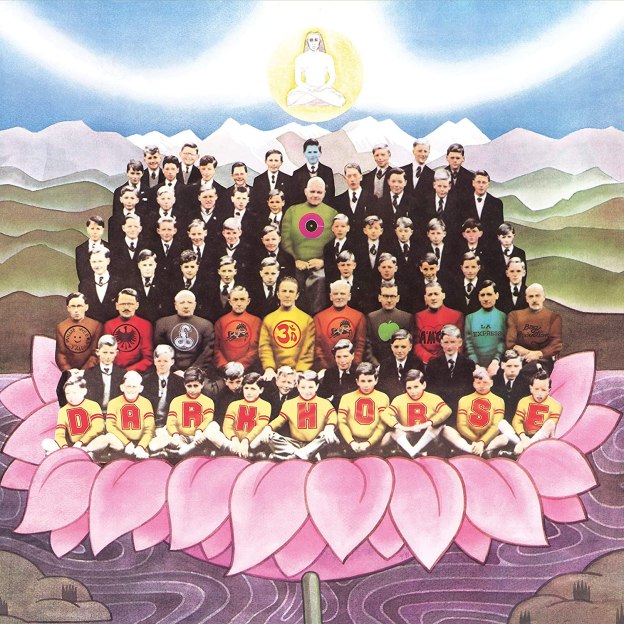
Overlooked Gems: Dark Horse

Christopher Rush

George Harrison is no saint.  Well, he may be one right now, but back in his day he was no saint.  He fooled around, basically drove his first wife away (into Eric Clapton’s arms), inserted a great deal of narcotics into his being, he could hold grudges … basically, he was human.  We all have faults; we are all sinful, even those of us who are redeemed.  I’m not excusing George Harrison’s improper life choices (I save that for myself); I’m simply saying our task is not to allow one’s failures prevent us from enjoying the positive things one has to offer.  I knew you weren’t thinking that, but the more I read about George, Brian, Paul, Mike, John, Carl, Ringo, Dennis and the rest, the more that notion is pressing upon me.  But that’s a personal problem, I know.  On with the musical analysis … advertisement.  Whatever.

For some reason, not too many people liked the album Dark Horse when it first came out, but I do not understand why.  A lot of rough things were going on for Mr. Harrison at the time: rough vocal health (as can be heard throughout the album, including the bonus tracks on the cd release), divorce from his wife Pattie, his second trip to India, a poorly received U.S. tour with his good buddy Ravi Shankar, the end of Apple Records and the beginning of Dark Horse Records (George’s personal music studio) — a mixed bag of life experiences during which to release an album, yet none of them strike me as valid for disregarding the album.  Some of those rough experiences come out in the first half, which is mostly sad (other than the first song, which is quickly rising up my all-time faves list), but the second half is ebullient and typically self-effacing George Harrison.  I like it, and so should you.

Side One

“Hari’s On Tour (Express)” is an excellent instrumental: it varies in tempo and melodic line, and thus it never lags or overstays its welcome, which is surprising for an almost five-minute instrumental.  It has patterns, one could almost say “movements” or “motifs,” and the listener soon feels confident he or she understands the flow of the song, but the pattern is so various even in its familiarity it is never dull.  This may sound like faint praise, but it is not meant as such: the slower portions are a smooth groove and the faster portions really cook with the multiple guitars, the brass, the drums; basically, it’s a fresh combination of jazz and rock that holds up to multiple back-to-back listenings.

The autobiographical portion of the album begins with an intriguing reflection by George about his rock-and-roll lifestyle in “Simply Shady.”  The laryngitis from which George suffers during much of this album improves the atmosphere of this song especially, as it all about the dangers of succumbing to the stereotypical concomitant famous lifestyle experiences (so, drugs and alcohol, yes), and the taxing nature of George’s lifestyle outside of his religious devotion undergirds the pathos of the song.  Perhaps the most intriguing aspect of this intriguing song is George’s reference to “Sexy Sadie,” John’s irritated response to the Maharishi and the Beatles’ first trip to India.  This is odd considering George just came back from a more positive trip to India coupled with the album’s overall enthusiasm for Indian philosophy and religion.  Aside from these intriguing points, the verses are impressively sharp intellectually, philosophically, and realistically.  George wrestles with the consequences of the last ten years of his life, he ponders the implications for the future, and he meditates on his place in the universe.  The honesty and introspection place this song among his most important.

The autobiography continues with “So Sad,” a heartbreaking account of George’s response to his failing marriage.  For some the pathos may be tempered by George’s part in the dissolution of their marriage, depending on which (auto-)biographical account one reads, but that would not be wholly fair, especially considering the authenticity of George’s remorse throughout the song (which is not to downplay the horrible and rotten things George did during their marriage both to himself and in violation of his wedding vows, but go see the first paragraph of his essay for further thoughts).  The human anguish in this song is remarkable in light of the “spiritual peace” sung about on all of George’s solo albums to this point.  I suspect the George Harrison experiencing the emotions of this song would attempt something violent if the slightly younger “chant the name of the Lord and you’ll be free” George Harrison told him to simply release all of his problems through a mantra.  Another standout aspect of this song is the, well, I was going to say “rhythm,” but that’s not quite it: the number of guitar strums in the guitar riff, really.  The music sequence feels incomplete, but upon further reflection, the keen listener realizes that complements the lyrics beautifully.  He is so sad, so alone, he is no longer complete, and the musical line supports that.  It is effectively jarring.

The pathos takes a markedly cynical turn with George’s revision of the Everly Brothers’ “Bye Bye, Love,” featuring not only an added comma in the title but also a radically different melodic line (now in a minor key) and rhythm to the lyrics as well as a personal set of verses about Pattie’s not-so-newfound relationship with George’s good buddy Eric Clapton.  The latter verses highlight the cynicism with more than a tinge of hypocrisy as well, considering the narrator of the song (presumably George himself, considering the pointed nature of the first verse) expresses vitriol for the infidelity of the human woman, despite his own infidelity as a significant component of the dissolution of their marriage, in truth.  In all, this version has admittedly a world-weariness about it the original lacks, but this mood fits the actual lyrics far better anyway, as further reflection on the now-bizarrely jaunty nature of the Everly Brothers’ version seems almost ludicrous in contrast to the more authentic George Harrison version (despite, perhaps, its asperity).

Side one ends with the perplexing song “Maya Love.”  It highlights George’s penchant for the slide guitar, which drives the most consistently up-tempo song on this side of the album.  Some experts tell us this was mainly an instrumental lick to which George felt compelled to add lyrics inexplicably (I think it would have been just fine to bookend this half of the album with instrumentals).  The paucity of lyrics, especially in contrast to the impressive diction in “Simply Shady,” “So Sad,” and even “Dark Horse” on side two, lends an air of verity to that claim.  Regardless, this song could be interpreted in a couple of ways depending on how one understands the relation of the two words of the title to the rest of the words in the song.  This sounds obvious, of course, but bear with me, please.  For a long while I took the song to be about “love for maya,” or “illusion” in Hinduism — and for Hinduism, everything material is an illusion.  So I interpreted this song as George’s exhortation for us not to the love the material world of getting and spending or, worse, getting and hoarding, a love from which he suffered as well.  While this somewhat facile approach to the song worked, even if the lyrics were slapdashedly attached to a Billy Preston-driven funk, it didn’t really make a lot of sense.  After further reflection abetted by a modicum of research, I’m leaning more toward an interpretation in which “maya love” is not the distracting, destructive love of maya itself but a broader warning against a particular kind of love, the illusory kind of love in general (not the love of illusions themselves).  The song in its brevity, then, sees the progress of the autobiography culminate in a sober recovery from cynicism to a wiser, more concerned-for-others cautionary tale about being wary of false love — it is everywhere, it pervades, it is even in us and affects us, but even its ubiquity feels transient, a notion driven by the musical accompaniment, which thus feels more connected to the song than may have been intended.

Side Two

As if the flipping of the record were a complete shift in mentality and outlook, side two begins with a joyous, energetic song that would be my favorite on the album were it not for “Hari’s On Tour.”  “Ding Dong, Ding Dong” is a perfect New Year’s song or for any time you are feeling like you need a fresh start in life.  It is difficult to overcome the interpretive assumption this is George’s way of putting the past behind him (again, not excusing his transgressions or indiscretions) thanks, in part, to some of the many slogans Sir Frank Crisp inscribed in the halls of his (their) estate, Friar Park.  Not just his marriage to Pattie is behind him, but also his days as a Beatle (made even more evident in the accompanying music video).  It would be many years before he would revisit those days in musical homage, and only rarely, such as after John’s death and not again until his final album in his lifetime, Cloud Nine.  It is hard to begrudge him a desire for a fresh start barely five years after the dissolution of his first band and a few weeks after the dissolution of his first marriage.

This all leads to the eponymous track of the album, his personal record company, and likely, as biographer Geoffrey Giuliano aptly used it, his life: “Dark Horse.”  Critics still seem off-put by the scratchy vocals of this song, recorded while George was slowly but surely succumbing to laryngitis after all the hullabaloo, and while I have never read it referred to as “Dark Hoarse,” it is that.  The bonus rehearsal track included on the recent cd release features a much cleaner vocal of the song though accompanied by a much sparser instrumental track (basically just George’s guitar).  This song fits George so well because … well, it fits so well.  That sounded rather tautological, I bet, but here’s one case in which a tautology is true: this is George Harrison.  We thought he was just the nice, quiet one … we were wrong, even though George didn’t say or do anything to legitimize our perception of him.  We were the ones who assumed we understood him simply because he wasn’t like Paul or John or Ringo.  Oops.

“Far East Man” initially strikes one as an atypical George Harrison song until one suddenly realizes “While My Guitar Gently Weeps” is unlike “Taxman” is unlike “Within You Without You” is unlike “All Things Must Pass” is unlike “Here Comes the Sun” and just as suddenly one is asking onerself, just what is “typical” George Harrison, anyway?  This song is dedicated to Frank Sinatra, but one gets the sensation that’s more in the musical style of the smooth groove than the lyrics, unless one knows Mr. Sinatra had interest in the Far East, which I do not.  The lyrics are not so enthusiastic as the last couple, pondering the political turmoil of the early ’70s, but the song continually reminds us George (and/or Frank) is going to hang in there and stay true to himself and do what can be done to make the world better.  The gloomy notion “God, it’s hellish at times” is immediately refuted with the optimistic “But I feel that a heaven’s in sight.”  Hang in there, Levine.  Perhaps 2017 wasn’t so kind to you as you had hoped, and perhaps the social-media-generated pseudo-horror has got you down.  Hang in there, Levine.  A heaven’s in sight.

For George, the heaven is immediately in sight as the album closes with the final song overtly-influenced by Hinduism published in his lifetime, “It is ‘He’ (Jai Sri Krishna).”  Now, I readily admit my All Things Must Pass interpretation was more wishful thinking than feasible, but I can’t do much with this one.  It’s all Hindu, all the time.  But it is really catchy.

Dark Horse is a great album, so don’t listen to the nonsense of those who think it isn’t.  It is at once a snapshot in time in the life of George Harrison and a collection of timeless songs, especially “Hari’s On Tour” and “Ding Dong, Ding Dong.”  With the bonus songs on the cd release, this is the best time to get into this overlooked gem.  Don’t let the Hinduism prevent you from enjoying a great album — you’re too good for that, and so is this album.  Put it on your Christmas list, stuff it in the stocking of someone you love, just go get this album and enjoy it.

Hamlet and Ophelia

Emma Kenney

William Shakespeare has written many beloved plays that are still incredibly popular today. Perhaps one of his most well-known plays is Hamlet. This tale of duty and betrayal has been read by many, and Hamlet’s soliloquies are some of the most recited monologues and iconic scenes of all time.

Over the years there have been many versions of this play. It has been performed with famous actors such as David Tennant, and it has ben done as a movie. There have been television show episodes and books semi-based off of it. One book in particular, however, is based off it a bit more than others. Ophelia by Lisa Klein tells the story of Hamlet from the perspective of Ophelia. It is an interesting read from a point of view that is rarely shown or even thought about. However, the book does contain quite a few differences from the original play’s storyline, which show it to be something of a different nature than Shakespeare’s Hamlet.

The first big difference between the two stories is the fact Lisa Klein’s story shows Ophelia and Hamlet as children. The novel starts when Ophelia is roughly ten and hamlet is in his mid to late teen years. It shows Ophelia before she came to the castle and then as a child within the castle. Klein’s story talks of neglect Ophelia faces at the hand of her father and depicts her as a young tomboy who would much rather run around and roughhouse with the boys than sew or play music. It shows the reader how Ophelia became a lady in the queen’s court and how she rose and fell in her eyes. These are all topics Shakespeare’s original play doesn’t even touch on, as the focal point is not Ophelia but Hamlet.

In Hamlet, Hamlet doesn’t decide he loves Ophelia until after she is already dead, but in the story by Lisa Klein, Hamlet declares his love for her much sooner, although he does so in secret. In her story only Horatio knows of the declared love between the two and helps them to marry in secret. Hamlet declares his love for her many times in the book and chases after her soon after Ophelia turns fifteen or sixteen. He is able to finally woo her and they are often seen in the novel sneaking away to kiss or to do more saucy things. This is all very different from the original storyline where, as previously mentioned, there is no mention of Hamlet even remotely liking Ophelia until she is already dead.

Hamlet’s descent into madness is also much different in the original play. For starters, since it is about Hamlet himself you see way more of the descent than you do in Ophelia, and there is a much greater focus and emphasis placed on it than in Lisa Klein’s Ophelia. In the play we see even from the beginning he is not mentally well, and we get wonderful speeches such as the following:

To be, or not to be — that is the question: Whether ’tis nobler in the mind to suffer the slings and arrows of outrageous fortune or to take arms against a sea of troubles and by opposing end them. To die, to sleep — no more — and by a sleep to say we end the heartache, and the thousand natural shocks that flesh is heir to. ’Tis a consummation devoutly to be wished. To die, to sleep — to sleep — perchance to dream: ay, there’s the rub, for in that sleep of death what dreams may come when we have shuffled off this mortal coil, must give us pause. There’s the respect that makes calamity of so long life. For who would bear the whips and scorns of time, th’ oppressor’s wrong, the proud man’s contumely, the pangs of despised love, the law’s delay, the insolence of office, and the spurns that patient merit of th’ unworthy takes, when he himself might his quietus make with a bare bodkin? Who would fardels bear, to grunt and sweat under a weary life, but that the dread of something after death, the undiscovered country, from whose bourn no traveller returns, puzzles the will, and makes us rather bear those ills we have than fly to others that we know not of? Thus conscience does make cowards of us all, and thus the native hue of resolution is sicklied o’er with the pale cast of thought, and enterprise of great pitch and moment with this regard their currents turn awry and lose the name of action. — Soft you now, the fair Ophelia! — Nymph, in thy orisons be all my sins remembered.

While Hamlet still tries to convince his friends in the play he is merely pretending to be crazy, there are enough speeches and lines from him to show he is really not just pretending at all. The novel, however, is lacking some of these vital quotations and scenes. While one can definitely still tell Hamlet is crazy, the reader doesn’t get to see him fall into it slowly and surely. It is portrayed more along the lines of, “Oh my dad is dead? I guess I’m completely and totally mental now!”  It is quite unfortunate, as that character development is one of the things that makes Shakespeare’s play so wonderful.

One of the biggest differences between the novel and the play is the way Ophelia’s tale is ended. In the play she is depicted as going mad, and she falls from a tree in what is suspected to have been suicide. In the novel she does what Hamlet claims to do and fakes madness in attempt to protect herself. When this only draws more attention to her, she freaks out and starts trying to figure out how to escape the castle and all of Denmark. Finally, with the help Horatio and the queen she fakes her death and flees Denmark with basically only the clothes on her back and some money from the queen. She ends up at a convent where she spends the rest of her days as the “doctor” for the town. This takes up the entire second half of the novel (in what is considered to be, by many, one of the most boring and useless halves of a novel ever to be written in the English language). Also, while she is at the convent in the novel taking care of all the sick and crazy people, she ends up giving birth to Hamlet’s son, whom she names (drumroll please) Hamlet. This is something incredibly and drastically different between the novel and the play, as Shakespeare never wrote Hamlet to have an heir at all. Lisa Klein’s novel, however, takes some creative liberties, however, and writes one in.

Another difference between the play and the novel is theme and focus. The novel places emphasis upon “sexual awakening,” to the point of taking away from the plot, which is something the play never does. The focus is on Ophelia, who she is, and what she does, as well as on love, how it should make one act, and whether love is ever true at all. One important theme is how all of humanity is corrupted, specifically by lust, and how that lustful corruptness affects everyone. It also shows that if the king falls so will the kingdom, though the play shows this as well. The play talks about corruption like the novel, but in the play the focus of corruption is placed upon the desire for power, not upon lustful desires. It depicts most of the corruption in the story to come from character’s desires to rule and to be in charge or to be honored and recognized by all. The play focuses on Hamlet, his descent into madness, and the fall of Denmark instead of on Ophelia and what she does and thinks. The focus is never really placed upon love at all, because that’s just not what the original story is about, other than when Ophelia is trying to cure Hamlet’s insanity by loving him and bidding him to love her back.

It is incredibly easy to see how different these two are, and those differences are why Shakespeare’s beloved Hamlet has stood the test of time and Lisa Klein’s Ophelia has barely been heard of. Though Shakespeare brings them up in interesting ways, the themes of his play are important and relatable (we all deal with death and with corruption). Because of that his play will continue to stand the test of time, unlike those that warp and change these themes into something less than. The play is loved for its quality of writing and plot, and when one tries to change that too much it is better to have just invented a different story altogether. Ultimately, though, it is safe to say both these stories do share one thing: they show that at the end of the day we all have to choose. We most chose to deal with our grief — to run from it or to face it head on.

Beasts of England: Language and Human Nature in Animal Farm

Alice Minium

George Orwell’s Animal Farm was published in 1945 after the end of World War Two. Orwell had previously fought in the Communist army, but his own personal beliefs were more complicated. In Animal Farm, he does not make those beliefs clear. He does, however, posit one thing about human beings in the context of history: whether fascists, dictators, or imperialist-capitalists, we are all enslaved to human nature.

Orwell believed this human nature was animalistic. Orwell’s fundamental principle, and the thesis of my paper, is Animal Farm is used to illustrate this fact. He believes humans are condemned to their instincts and the petty conflicts that have historically polarized us through all of time. We are not equipped to move past these political misunderstandings. Jeffrey Meyer, in “The Political Allegory of Animal Farm,” says Orwell saw human beings as “prisoners of history, inadequately equipped to deal with our own flaws.” Our flaws are a universal of human behavior, no matter what political ideologies we mask them in. Orwell does not advocate Communism, nor does he explicitly argue against it — rather, he seeks to lay bare the open structure of political systems themselves. He does this by showing us a ludicrous tale of animals conducting, overthrowing, and, gradually, regressing in “government.” It is no accident he uses animals to convey this. Orwell’s premise is, though we call ourselves human beings, our principles, morals, and behavior are no different. It is all the same thing with a different name — Christian or Muslim, fascist or capitalist, oligarchy or theocracy — our nature is the same, regardless of government.

The choice of animals for a fable on government is no accident as well. It is, after all, “civilization” and “enlightenment,” which we hail as the crown champion of Man, and it is these ideological superior states we aim to create with “revolution” or government. Orwell’s political animals not only underscore the tale’s purpose as a universal fable, but they emphasize the absurd condition and grotesquely violent “tactics” of the players in the story. The joke is that, with all our talk of “revolution,” we are really only brutes, animals playing dress-up, after all.

It is no accident those who preach are “ravens” — carrion crows encircling whoever they’re about to eat. It is also no accident those who govern are “pigs” — animals who, quite literally, roll around in their own excrement.

Orwell is not shy about using the features of these specific animals to symbolize specific kinds of people, as Christopher Hollis, in “Animal Farm is a Successful Animal Fable,” also notes. Pigs, for example, are smart and greedy; sheep are complacent and compliant; dogs are loyal and willing to overlook faults; and horses are the workers upon whose backs men carry their burdens.

Finally, and perhaps most significantly of all, Orwell conducts his puppet show illustration of a failed revolution with literal animals. The tale is not believable, nor particularly funny. It is somewhat disturbing. Rather than a portrait of animals or government, it is a portrait of ourselves as animals. We are revealed to ourselves as we truly are: uncivilized, animalistic, and unevolved. He shows us how the hymn “Beasts of England,” and the overly repetitive chanting, is the one thing to which the sheep are recurringly drawn (Animal Farm 13). It is our animal nature and simple mannerisms that hold up the illusions of our social institutions. As one of the literary critics we studied, Jacques Lacan said all of what we believe of ourselves and the structures of mind within which we function are just a mirror of our imagination. Our governments and religions are reflections of our subconscious needs and desires, as Freud reminds us,  which, also, are projections of ourselves. These reflections, which we believe to be real, propel our relationships and hijack our emotions. Orwell shows us these emotions are simple responses. These responses are not as complex as ideologies make them out to be — rather than our impetus being governed by ideology, all ideology is the didactic captive and puppet-toy of impetus. Our animal desires compel us in our politics, our choices, our economies, and our morals — “revolutionary” or not.

There is no “revolution,” according to Orwell, as the animals at the end of the story are in exactly as bad of a predicament as they were at the beginning. If anything, their predicament is worse and more complex.

There is a phase of regression undergone by the animals as they move from the first pig’s revelation in a dream and into their complete upheaval of society. The animals regress from intelligent and comprehensive to becoming slowly dulled and compliant. This is interesting because it shows how fear can dull the inquisitive mind of society and make people lax and dependent on their superiors.

Boxer the horse is a particularly significant choice. In his unwavering loyalty, dedication to the fatherland, and tireless work, Boxer represents the revolutionary working class. Orwell describes Boxer’s priorities by telling us, “His answer to every problem, every setback was ‘I will work harder!’ — which he had adopted as his personal motto” (Animal Farm 58). In this sense, Boxer is like the ever-laborious and loyal proletariat. Boxer as the working class is an even more ironic depiction if you consider Boxer is the prominent horse in the story, and horses have been considered beasts of burden throughout almost all of history — not unlike the working class. Yet it is Boxer, in the end, who is tricked and killed, but instead of resisting Boxer deems it to be his lot — or one could argue, he doesn’t even realize. This, too, is analogous to the struggle of the working class. As mentioned before, horses are literally the backs on which objects are carried, and the working class is literally the back upon which the burden of the government’s luxuries and enforcement is carried.

Maintaining the power structure was the pigs’ main focus. By taking the other animals’ rations and feeding themselves with them, they quite literally feed off the masses while starving them out. Brains can’t function without proper nutrition. It’s an intentional oppression of the lower classes to benefit and sustain the upper class, all the while convincing the lower class this starvation is actually for their benefit. Marxist literary theorists Adorno and Horkheimer would see this as an analogy for the culture industry, perhaps, and the massive parasitic machine of consumer greed which feeds off men’s minds and imagination in the modern age, all the while convincing us, as we are robbed, that we are being “entertained” (Adorno and Horkheimer 2188).

Animal Farm is entertaining, but its tone is two-dimensional — almost intentionally so, so as to underscore the device of parable it employs.

The narrator in Animal Farm is distant, detached, and unemotional. His matter-of-fact, detached tone only emphasizes the horror of the events he describes. He creates a flat, sinister effect, almost as if to say, “Why should this surprise you?” To say “they sang” in the same tone as “they ripped out their throats” is to say the reality of Animal Farm is happening right now, right next to you in day-to-day life, and you are not shocked.  It is not sensationalist in tone at all, exactly unlike the sweeping rhetorical tone of most thinkers or of the pig-philosophers in this book.

The reader observes an almost flat puppet show: rather than compelling one toward an objective, like most ideological texts or like an advertisement would, Animal Farm is, instead, a bleak retelling of what is occurring. It asks you to fill the character voids yourself, and, using a story form used to convey a moral or virtue, Animal Farm’s is noticeably absent.

This is perhaps most ironic of all. Orwell takes a realist device, stylistically reminiscent of Socialist Realist writing such as the Stalin-approved propaganda novel Cement. This device is usually used as a vehicle for ideology, moral instruction, or, more generally, propaganda. It is a form of storytelling used to say other things. Orwell, quite radically, took the realist device of ideology and propaganda and gave it back by using it as a fable on ideology and propaganda. He said, in essence, “Here’s your moral fable. The moral of this fable is about moral fables and how they work.”

The fact the tale is told of animate animals accentuates its deeper meaning as an obvious allegory. Like a fable or parable, from Aesop to the Grimm Brothers, it is clearly intended to be instructive and illustrative in message and tone. You think you’re going to read a beautiful fable, but you don’t. Animal Farm is, if anything, a parable. The parable is the timeless device of ideology. Yet it is ideology, perhaps most ironically, of which Animal Farm is absent. It is an empty device — making it all the more meaningful.

We must also note higher literacy is associated not with higher truth but with trickery. Orwell displays a distrust for intellectuals and their twisting of words. On page 63, Orwell shows how the mastery of language is associated with agency, as the narrator reminds us that, “Several of them would have protested if they could have found the right arguments.”

The more linguistic ability a creature has, the more powerful that creature is — in a vein of word-supremacy that would have resonated with deconstructionist and fellow doubter of words Jacques Derrida. Words retain power in and of themselves, in evidence to what Frederic Jameson, author of The Political Unconscious, would have called literature’s “ideology of form.” In this essence, words are functions of the overall social and political institutions they serve, or, as Jameson puts it, “The symbolic messages transmitted to us by the coexistence of various sign systems which are themselves traces or anticipations of modes of production” (1337). The connection between language and the “modes of production,” and/or the upholders of power, is evident in the fact the pigs, the most powerful of creatures, can read, while most others can’t. An animal’s capacity to communicate through language is directly proportional to the amount of political power it possesses in Animal Farm. Linguistic ability and cognitive capacity, are, in Orwell’s world, analogous to agency.

The simpler creatures, and those most affected by Napoleon’s policies, cannot read at all. Those who can, such as Squealer, who uses language and clever words to sow seeds of support for Napoleon’s administration, are using language as a weapon for manipulation and evil. Rather than using complex wording to elucidate the truth, complex wording is used to obscure it.

This makes Orwell’s choice to convey the tale in a simplistic tone all the more meaningful. Orwell is not trying to persuade us with vast, sweeping illusions of ideology nor rhetorical acrobatics. He is speaking as if we are the sheep — not because his meaning is overtly simple, but because the complexity of his meaning is most accurately conveyed through an intentionally simple tone. If this were a tract against or for communism, perhaps he would use lengthy adjectives and argument. Yet the characters are flat, the plot is linear, and the sentence structure is simple: this is a device for ideology intentionally without the ideology — it is a barren womb. It is the skeleton of propaganda made transparent and handed to us so we might say, “It is empty, don’t you see?”

Orwell’s book Animal Farm uses the story of the Russian Revolution to tell us about human nature in a way both political and timely, yet boldly historic in scope and unapologetic in its brashness. Orwell’s suspicion of intellectuals and complex ideologies as concealers of truth is doubly evident both in the tone in which he tells his tale and in his depiction of the power of the spoken word itself. Orwell took the narrative device of fable to write an analogy of government, but it is, more than anything else, an analogy of human nature — which Orwell believes is, at its core, not that exceptionally “human” after all. He uses animals to show us ourselves, and, in the end, he claims he cannot find much of a difference (121).

Works Cited

Adorno, Theodore W; Horkheimer, Max. “Dialectic of Enlightenment: The Culture Industry.” The Norton Anthology of Theory and Criticism. Ed. Vincent B. Leitch, New York: Norton, 2010. Print. 1110- 1127.

Derrida, Jacques. “The Exorbitant. A Question of Method.” The Norton Anthology of Theory and Criticism. Ed. Leitch, Vincent B. New York: Norton, 2010. Print. 1691-1697.

Hollis, Christopher. “Animal Farm is a Successful Animal Farm.” Ed. Terry O’Neill., Greenhaven, 1998. Web.

Jameson, Frederich. “The Political Unconscious: Narrative as a Socially Symbolic Act.” The Norton Anthology of Theory and Criticism. Ed. Vincent B. Leitch, New York: Norton, 2010. Print. 1822-1846.

Lacan, Jacques. “The Mirror Stage as Formative of the Function of the I as Revealed in Psychoanalytic Experience.” The Norton Anthology of Theory and Criticism. Ed. Leitch, Vincent B. New York: Norton, 2010. Print. 1163-1169.

Meyers, J. Orwell’s bestiary: “The Political Allegory of Animal Farm.” Studies in the Twentieth Century, 8, 65-84. 1971. Web.

Orwell, George. Animal Farm. New York: Harcourt Brace Jovanovich, 1946. Print.

The War on Terror: The Next Step

Kaitlyn Thornton Abbott

September 11, 2001: a day that goes down in infamy; a day that 2,977 Americans lost their lives. Across the globe, countries mourned with Americans; as a country, Americans found a solidarity they had not known before. Neighbors clung to one another, waiting anxiously to see what President George W. Bush would do in response. He, along with many other world leaders, pressured the Afghan government to convince the Taliban to hand over Osama bin Laden (U.S. military intelligence had confirmed he was responsible for coordinating the attacks on 9/11). When the Afghan leaders refused to cooperate, the United States invaded, with the blessing of the international community. Thus, the Global War on Terror was born. There have been several distinct eras of strategies, none of which have effectively worked to produce a long-term gain; so, the question remains: what other strategies have the U.S. military officials not tried, and of those, which direction should we pursue to retain American interests in the region and ultimately declare victory in the “War on Terror?”

Many ideas have come into play regarding the future policies of the war: privatizing the war, and a continuation of the Obama era strategy are common themes expressed from both sides of the political spectrum. Neither of these ideas are long-term conscious, and to assume so does a disservice to the United States and its allies. The steps the U.S. has to take are defining what it means to win; providing task, purpose, and direction to the ground troops; preventing the Taliban and other insurgencies from regaining and retaining key terrain, and ultimately retaining troops in country with no solidified “end date.”

In order to fully understand the concepts addressed in this paper, there are sub-concepts that must be defined and expounded on. Key terms addressed are: The War on Terror, Hearts and Minds Campaign, ROE (rules of engagement), COIN (counterinsurgency) operations, Operation Enduring Freedom, Operation Inherent Resolve, SOF (Special Operation Forces), and joint operations. The legal definition of the War on Terror (Legal, Inc. 2017) states,

The War on Terror is an international military campaign launched in 2001 with U.S. and U.K. invasion of Afghanistan in response to the attacks on New York and Washington of September 11, 2001. It is a global military, political, legal, and ideological struggle employed against organizations designated as terrorist and regimes that are accused of having relationships with these terrorists or presented as posing a threat to the U.S. and its allies.

This term was phased out of official use by the Obama administration, replacing it with Overseas Contingency Operation. However, it is still used in everyday sectors, such as the mainstream media and politicians. The U.S. Armed Forces still utilizes this phrasing in the context of the Army’s Global War on Terrorism Service Medal (Appendix A). Counterinsurgency (COIN) operations (Joint Publication 3-24 ) are “comprehensive civilian and military efforts taken to simultaneously defeat and contain insurgency and address its root causes.” The Hearts and Minds Campaign is an example of COIN operations; the main component of this campaign was humanitarian needs; the Pentagon gave approximately two billion dollars to ground commanders to spend on a myriad of humanitarian needs — essentially, buy the Afghan loyalty, hope it’s a long-term investment, and that the Taliban won’t buy it back (McCloskey, Tigas, Jones, 2015).

Rules of Engagement (ROEs) are a directive issued by a military authority specifying the circumstances and limitations under which forces will engage in combat with the enemy. Operation Enduring Freedom (OEF) was a U.S.-led coalition force with NATO allies that started October 21, 2001, and lasted until December 28, 2014; this was the official combat operation of the War on Terror in Afghanistan (CNN, 2026). Operation Inherent Resolve was formed on October 17, 2014, when the Department of Defense opted to “formally established Combined Joint Task Force — Operation Inherent Resolve (CJTF-OIR) in order to formalize ongoing military actions against the rising threat posed by ISIS in Iraq and Syria (inherentresolve, 2014). Special Operations Forces (SOF) are elite operatives in every branch of the U.S. military that has a specialized set of skills and who were key players used in training Afghan national forces. Joint operations, for the purpose of this paper, are tenets off which to plan and execute joint operations independently or in cooperation with our multinational partners, other US Government departments and agencies, and international and nongovernmental organizations (Joint Publication 3-24). There are key facets to this definition: there’s the national aspect of multi-branch operations (in which the Army, Air Force, Marines Corps, Navy, and Coast Guard perform operations in which assets are drawn from two or more branches); and multinational operations, which are operations where two or more countries are involved in military combat operations.

During the Bush Era (2001-2008), there was a pursuit of unilateralist foreign policy; the administration treated the individual nation-states as a regional “one size fits all” strategy. Iraq and Afghanistan are two distinct culturally significant entities; but then President Bush decided to connect them. To him, the strategy was simple: have a strong military front, destroy Saddam Hussein, destroy bin Laden, and the War on Terror will be over. The main tenets of his goals were simple: prevent another attack on American soil, capture and kill bin Laden, destroy al-Qaeda, and increase democratization of the Middle East as a whole (Katz). Whether or not he was successful is up to interpretation. The first phase of the operation, which was the initial military invasion of Iraq, was successful. U.S. forces quickly cleared the city and gained key territory in Iraq that led the U.S. to prematurely declare a “victory” in Iraq, without declaring a victory in the war. He was also successful in his endeavor to prevent another major terrorist attack on American soil. There have been attacks that ISIS has claimed but nothing to the extent of 9/11. Opponents of the Bush administration would argue he ultimately failed, and his strategy produced a worse environment for his successor to try to navigate (Katz). They argue he failed to capture bin Laden, his right hand, Ayman Al Zawahiri, and other key leaders in the al-Qaeda regime. This led to a follow on failure, which was not destroying all remnants of al-Qaeda. Because they were not destroyed, there was an increase both regionally and globally in signature al-Qaeda attacks. Bush also advocated for a strong democratic presence in the Middle East; instead of focusing in on the countries he had invaded, Bush opted for a regional strategy, which alienated some potential key players in the Global War on Terror, such as Morocco, Bahrain, Oman, Qatar, Yemen, Kuwait, Jordan, and Saudi Arabia (Katz).

President Bush’s successor, President Obama, had a much different view on how to proceed. He made a dramatic shift from the unilateral foreign policy ideals of the Bush administration and instead honed in on a multilateral foreign policy. He campaigned heavily on withdrawing troops and focusing on domestic issues without having to be concerned with being the world’s police. When Bush originally invaded Iraq, Obama was loudly critical of this move and frequently commented on the approach to the War on Terror as a whole. Obama pursued a strategy between 2011 and 2014 called “off shore balancing,” which can be boiled down to four main tenets: an emphasis on withdrawing all ground troops, national forces doing the heavy lifting of operations, increasing drone strikes, and pursuing a medium footprint approach (Hannah, 2017). Proponents of this strategy and the Obama administration would argue this was the most effective way to win the war. They argue there were fewer combat deaths under Obama’s direction, and fewer terrorist attacks as a whole. Those who oppose this strategy would argue Obama’s ROEs made it harder to be more of an effective fighting force on the ground; forcing commanders to not take the prudent risk that military doctrine advises they take (FM 6-0). One of the key failures Obama made was announcing an official withdrawal date of massive amounts of troops from the region. Due to this being a public, and therefore accessible, announcement, terrorist organizations did exactly what any military organization would do: they waited it out until heavy multitudes of American forces left, then attacked with full force. This led to Obama having to readjust his strategy, angering his supporters who expected him to follow through with his promise on withdrawal.

The Trump administration has already made some major shifts in the Obama-era policy. By nominating retired General “Maddog” Mattis, he employed one of the most well-respected men in the armed forces, and Mattis became the driving force behind the defense policies of the Trump Era. He has reduced the ROEs that Obama integrated. There are pros and cons to this, however. It does up the risk of collateral damage, but it also allows commanders who are actually on the ground with the fighting force to be able to make decisions that will ultimately move us toward American interests. Afghan national forces are still being utilized within their own country; Mattis has shifted towards a policy of “training based” operations for them, i.e., utilizing the SOF personnel to train the Afghans to the best of their ability, imparting skills and techniques to effectively combat the Taliban, and any other insurgent groups.

Another key tenet of the Trump strategy is addressing the Pakistan issue. Pakistan has long been known as the harbor state of many terrorist organizations. They have smuggled weapons and provided a safe haven for multiple groups, specifically al-Qaeda. How Trump plans on addressing this issue is still to be determined. Both he and his Secretary of Defense have been extremely tight-lipped on the steps they plan to employ from here on out; however, the influx of troops suggests a withdrawal is far from being a potential strategy (Hannah, 2017).

One potential strategy the Joint Chiefs have discussed is privatizing the war. For the context of this paper, “privatizing the war” will refer to utilizing private defense contractors to execute military missions, which has both pros and cons. Erik Prince, the founder of Blackwater Security, and former Navy Seal, is actively pushing the White House to turn the sole responsibility of the war over to private contractors. Both Secretary of Defense, Jim Mattis, and the current National Security Advisor to the President, retired Lieutenant General H.R. McMaster, have given the nod they are open to bringing the idea to the drawing table, but there has been no admission to what extent. The idea of privatizing the war intrigues strategists, but the cons of utilizing the private sector far outweigh the pros it could potentially have. For example, the Blackwater scandal of 2007 gives reason enough to be hesitant regarding utilizing private contractors as the main effort. In September 2007, several private security contractors fired into a crowd in Nisour Square, Baghdad, killing fourteen unarmed Iraqi civilians (Apuzzo, 2015). While the individuals convicted of the massacre unequivocally argued they were only shooting at insurgents who fired on them, the issue remains: they were convicted in the American criminal justice system, not the military justice system. Military individuals should be held to military standards, especially regarding illegal or unethical acts. Members of the Armed Forces are held to the Uniformed Code of Military Justice (UCMJ), which addresses illegal actions and recommended sentences. Another con associated with the idea of privatizing the war falls back to funding. For example, the military is required to be in whichever country the Pentagon requires. At the strategic level, the goals are established for regions, and commanders take those desired end states and implement them at the ground level. Contractors, on the other hand, don’t answer to the Pentagon. Contractors are exactly that: held by a contract, which is reliant on limited funds for each contract. Once the contract is up, there is no guarantee contractors would want to re-up the contract, and if there is another government shutdown, then there are no funds for those contracts to be paid. In the private sector, if individuals are not getting paid, there is no legal expectation for them to continue to work. The idea of utilizing private contractors provides no long-term commitment to the United States’ end states, which ultimately could do a disservice to the mission. Beyond the potential legal ramifications and unguaranteed funding, the moral questionability rises. As noted above, the Blackwater scandal brought new attention to collateral damage and civilian deaths in the region. In contrast, the U.S. Army had a similar scandal regarding the murder of innocent civilians in 2006 by three lower enlisted soldiers. Contrary to utilizing the U.S. criminal justice system, they were convicted of violating UCMJ; sentenced to life in Fort Leavenworth (the military’s prison), the main proponent of the crime ended up committing suicide (Ricks, 2012). There was heavy scrutiny placed upon the Army and its commanders after this; these soldiers’ higher ups were held culpable in the court of public opinion; their reputations were tarnished. In comparison, the Blackwater scandal left Erik Prince just as wealthy; reputation fully intact. The military, as the Rand Corporation notes, is a distinct entity:

the military is the sum of its experience. When the nation outsources its battles, the military gains nothing in return, no battle-seasoned soldiers, no lessons hard-learned. Many of the contractors who have served in Afghanistan over the past 16 years have been dedicated staff who have placed themselves at risk to serve their country. Nevertheless, at a systemic level, there are numerous unresolved issues associated with contractor performance in Afghanistan. Militaries are massive and often frustrating bureaucracies, but the full measure of their work is not easily replicated in the private sector (Zimmerman, 2017).

On the alternate side of the argument, there are pros associated with the argument: for one, it would be cheaper, Erik Prince claimed it would cost less than ten billion a year, whereas the Pentagon spends approximately forty billion a year on defense aspects. Business Insider reports, “A 2016 Brown University study says wars in Iraq and Afghanistan have cost US taxpayers nearly $5 trillion dollars and counting. And, as the Special Inspector General for Afghanistan Reconstruction has found repeatedly, much of that has been lost to waste, fraud and abuse” (Francis, 2017).

The argument could be made the private sector always outperforms the government: in cost-benefit analysis, in efficiency, and in quality of product. Capitalists would argue regardless of the subject, government is consistently the wrong answer. However, that argument fails to take into account the fact the military is a profession of arms. There is a copious amount of doctrine associated with the military, step-by-step instructions on how to conduct key tasks, and a certain level of bureaucracy, yes; all of those things are associated with the private sector as well — except the doctrine. Military doctrine is not a negative concept that carries the same connotation as regulation. Regulations limit what an entity is allowed to do, or in what scope they are allowed to act in; doctrine, on the other hand, is a guiding principle that gives guidance and direction to leaders — a starting point that everyone begins with, so there is no discrepancies in explanation of executing a mission. The Rand Corporation explains,

In military operations, soldiers utilize doctrine — prescriptions for how to fight particular types of operations — to guide operations. Doctrine is unifying; a way, as Harald Høibak has said, to have “the best team without having the best players.”

Good doctrine specifies a desired end state and is underpinned by a theory of victory. Military contracting is not run on the basis of doctrine, but rather on company policies and procedures (Zimmerman, 2017).

Another policy that could be pursued would be a continuation of the Obama-era policies, with a mixture of Trump’s reduced ROE’s and some shifts in the execution of the policy. The main problem with Obama’s “medium footprint” approach and “offshore balancing” was not a lack of funding or troops available; the issue arises with the declination of the ground troops ability to be soldiers. ROEs are not released for public knowledge. Certain levels of security clearances are required to be able to access that information, or, you must be deployed to receive that briefing. Within this plan, the ideal would be for the U.S. to obliterate all insurgencies to the point their only course of action for hope of individual survival is peace talks and a negotiated settlement between them and the elected government. The key difference with this strategy would be not addressing a definitive end time for combat operations in country. As noted above, that was one of Obama’s key failures, and the Taliban exploited what he made known to both ally and enemy. The biggest departure from the Obama-era strategy would be a monumental shift toward a regional-based strategy. The Trump administration has already initiated this shift; according to Secretary of Defense Jim Mattis,

While we continue to make gains against the terrorist enemy in Syria, Iraq and elsewhere, in Afghanistan we have faced a difficult 16 years … Beginning last month, and for the first time in this long fight, all six Afghan military corps are engaged in offensive operations … During these recent months, there have been fewer civilian casualties as a result of coalition operations, although regrettably, Taliban high-profile attacks on civilians continue to murder the innocent (Defense, 2017).

The idea of addressing the problem as a regional strategy has more pros than cons; addressing the issues of Pakistan and harboring terrorists is a major factory in this strategy; to convince Pakistan they are better off working with the U.S. forces rather than against would be a major foreign policy victory for the United States, something even Obama failed to do. The major issues with this policy is addressing the outlying factors with other players. Pakistan and India have an increasingly aggressive relationship; expecting them to both effectively work with the United States and, by extension, each other, is a tall order. Other factors to this strategy include troop increases; to be an effective fighting force regionally and providing the support that regional actors need, the number would, at the very least, be in the low five figures. This could be considered both a pro and a con; it would increase the spending of the DOD, but it is arguable increasing troops in the short term would allow us to be there for a lesser timeframe than originally proposed. Opponents of this strategy argue this strategy would increase civilian deaths, therefore increasing the terrorism aspect. Afghan nationals want security; they’ll sell it to the highest bidder. If the bidder happens to be the Taliban, then the Afghans will support them. The Taliban grows when they see U.S. forces as the enemy; the more civilians get killed and the more property gets damaged, the more the Taliban will be able to use to recruit young men and even women into their ranks.

The third potential strategy is to completely readjust how we see the war. The only other war the United States has fought that even remotely reflects the War on Terror is the Vietnam War. The Taliban, just like the Vietcong, are fighting an insurgent warfare with guerrilla tactics.  Ambushing American patrols, IEDs (Improvised Explosive Device), and being able to melt into the civilian population are key reasons they are both hard to find and kill.

The U.S. could take a step back from the current strategies and instead implement more special forces operations, focused solely on independent missions, (rather than vague end states established by the Pentagon) and training the Afghan nationals forces. In essence, this strategy would be guerilla warfare: fighting insurgencies with insurgent-type tactics. SFC Galer, an Army Special Forces soldier whose area of expertise is engineering, explains, “Special Forces used to have four sectors in Afghanistan; essentially, they would divide the country in fourths, and the commanding general of Afghanistan would attach us as he or she saw fit. We have a very special set of skills; utilizing the Special Forces to train Afghan National Army is a waste. Utilize Special Forces to train specialized groups to obtain the same goal with less people and do a better job of it.”

All of these potential strategies have merit; they also come with an exceptional amount of criticism. Most of that criticism comes from domestic political polarization and an inherent belief as to whether the United States should even have troops in the Middle East. There was bipartisan support when President Bush originally invaded; patriotism and nationalism soared due to the atrocities seen on September 11, 2001. The idea of revenge was tangible in America. Sixteen years later, 6,915 American lives lost, and the question remains: how much longer will our soldiers, marines, airmen, and sailors be deployed to fight this “War on Terror?” The answer is harsh, albeit simple: until the threat is no longer present. The United States is the greatest military power in the world; the Taliban has no technological capabilities that can touch our prowess in the air, land, or sea. The issue is not military readiness or capabilities; the issue is the United States has not effectively defined what American interests are in the region, which leaves room for the Pentagon to claim our end states have not been met. That is the first step to success.

Defining American interests is difficult; the first step is taking the vague concepts of “promoting democracy in the region” and “ending the Taliban, sister cells, and offshoot groups,” by giving them measurable end states that will be able to be checked off as the military executes the missions and successfully achieving the end states. For the vague concept of promoting democracy in the region: the United States has to define success. The Obama Era focused success as being a shift toward democratic values, promoting human rights such as education for girls or that nation becomes Westernized through infrastructure. The Trump administration is shifting the definition of success to being a regional success; focusing on the ground goals of the military, not built in a context of vague aspects even the generals at the Pentagon struggle to explain what that looks like beyond political talking points.

The Trump administration has already started defining the regional aspect by changing the strategy to “Southeast Asia Strategy.” This still fails to address the issue of who the key actors in that strategy are. Within the idea of a regional goal, the key players need to be Afghanistan, all the countries that border it (Pakistan, Iran, Turkmenistan, Uzbekistan, and Kyrgyzstan), and include India. Afghanistan (the citizens) are concerned with security. To be able to guarantee security for the Afghan people while ultimately moving toward the goal of reducing U.S. presence in the region, the diplomatic aspects of improving relations of Afghanistan with its neighbors must be a top priority for the United States. This falls into the follow-on steps of the recommended strategy.

The Taliban must be obliterated, and the neighboring states must be willing to work with Afghanistan and the United States to ensure no remnants remain. Pakistan cannot be allowed to continue harboring terrorists. Doing so completely undermines the United States and the region’s safety as a whole. President Trump, in August of 2017, addressed the Pakistan problem; the Taliban heard his words and released this statement, “It looks like the US still doesn’t want to put an end to its longest war. Instead of understanding the facts and realities, (Trump) still shows pride for his power and military forces.” They have vowed to continue their fight to remove American forces from the region.

Some would argue the Taliban simply want the war to end and for Americans to remove the troops in the region. Giving into this demand is a win-win: withdraw the troops, terrorist attacks stop. This argument is shortsighted and ignores the logistics of the war, and the second and third order follow on effects of withdrawing. For example, if the U.S. were to simply withdraw all troops from Afghanistan, the Afghan National Army (ANA) would have to pick up the slack; terrorism is like a bacteria: there has to be a certain environment for it to grow and thrive. If the United States leaves, that would create a vacuum of security. The Afghan forces are still ineffective against the Taliban; they struggle to coordinate the logistics of war: weapons, fuel, and ammunitions. Soldiers win battles; logistics wins wars. The lack of ability in the ANA to coordinate the key components needed to fight the Taliban will provide them the exact environment they need to thrive: the promise to the Afghan people they are the only effective ones who can provide security, provoking the anger of the Afghan people who feel abandoned by the United States.

The argument of simply withdrawing has no merit because the Taliban is fighting an inherently different war than the United States is: they are fighting an ideological war. This war is built upon a hatred for the West and everything it stands for. In contrast, the United States is fighting a cultural war, one focused on promoting democracy, protecting human rights, and removing those who pose a threat to those ideals. The U.S. is the international symbol for a strong, victorious Western culture, which is associated with Christianity (whether or not the U.S. has an official religion or is even a majority Christian). So, to continue to stay in power, the Taliban incites hatred of the West and Christian values by tapping into the base of moderate Muslim followers. This is their power: people. Retaining American troops in-country allows for us to continue to promote the Afghan government and provide assistance to the Afghan people. If the Afghan people do not grow to see the United States as the dictators, then the Taliban loses their momentum. The American forces need to start shifting into a view that is a support aspect of the Afghan National Army, not the ones doing the fighting for them. To be able to do this means utilizing key subject matter experts to continue teaching and training the forces, implementing more of a U.S. military style structure to the ANA, so they become an effective fighting force.

In continuation with this plan, American intelligence forces need to become more open with U.S. allies, which would reduce massive terror attacks in the Western world, not just the United States. The European world also need to work with the United States. Some major terrorist attacks since 2001 include, but are not limited to: Bali, 2002, over two hundred dead; Russia, 2002, one hundred seventy dead; Madrid, 2004, one hundred ninety-one dead; Brussels, 2014, four dead; France, 2015, seventeen dead (Graphics, 2015). The Trump administration has ultimately done the United States intelligence community a disservice by its flirtation with Russia; many U.S. allies have decided to keep their intelligence behind closed doors, in fear the United States would share classified information, whether intentionally or not. NATO needs to become more involved in the War on Terror, allocating more troops to be used where needed; promoting a global war on terror means we need to have global allies: not the U.S. fighting the war on behalf of the world. To be able to effectively continue to eradicate terrorism, we have to have the global and military support from allies, instead of simple words of unity and love after yet another major terror attack on Western soil. Europe has faced more terror attacks in the past three years than the U.S. has faced since 2001. Dimitris Avramopoulos, EU Commissioner for Migration, Home Affairs and Citizenship said, (Europol, 2017)

The recent terrorist attacks in Europe are a stark reminder of the need for all of us to work together more closely, and build on trust. Trust is the basis of effective cooperation. Fighting terrorism will remain at the top of our common political priorities for the time to come, not just in Europe but globally. For the safety of our citizens, and for the cohesion of our societies, we need to step up our information exchange and our cross-border cooperation at all levels.

Opponents of sharing intelligence outside of regional structures argue the European Union has thwarted  one hundred forty-two attacks in 2016. According to EuroPol,

In 2016, a total of 142 failed, foiled and completed attacks were reported by eight EU Member States. More than half (76) of them were reported by the United Kingdom. France reported 23 attacks, Italy 17, Spain 10, Greece 6, Germany 5, Belgium 4 and the Netherlands 1 attack. 142 victims died in terrorist attacks, and 379 were injured in the EU. Although there was a large number of terrorist attacks not connected with jihadism, the latter accounts for the most serious forms of terrorist activity as nearly all reported fatalities and most of the casualties were the result of jihadist terrorist attacks (Europol, 2017).

However, opponents of sharing intelligence with allies by citing the European Union disprove their own point: the EU is a regional structure that is only able to thwart the terrorist attacks it has by utilizing the member states within the organization and sharing intelligence. The EU does discover and prevent many terrorist attacks, and the ratio is impressive. The issue is the EU has still faced more terrorist attacks than the U.S. since 2014, and there is a growing trend (Appendix B). Since 2001, the U.S. has experienced less than twenty major terrorist attacks.

The final strategy component comes with the economic aspect of NATO and the U.N. supplying the funding to Afghanistan to be able to continue to fund its military operations and working with the country to improve its infrastructure that will go toward the Obama-era goal of “nation building.” However, the United States cannot be the ones to bear that burden anymore. Development of Afghanistan is important and should be something the global community strives for. The U.S. did not go to Afghanistan to nation build, nor should we be footing the bill for that process. The U.S. should measure success in Afghanistan when Afghanistan is a stable enough nation to be able to effectively manage its internal and external security, to include being able to eradicate and prevent terror bases from being established in its borders. When Afghanistan is secure in that manner, the U.S. will be able to start the withdrawal of its troops. Until that happens, there is no legitimate reason to remove our military forces in the region, except to bow to political pressure of bringing Americans home. Campaigns are built on the rhetoric as well as the rhetoric of national security. Instead of appealing to domestic pressure, the U.S. needs to focus on the goals it has in Afghanistan and actively work toward achieving them.

If the United States were to remove its troops in the region before tangible progress is being seen in Afghanistan, it would have severe implications on the perception of the United States and its military capabilities. The United States has influence in the region partially because we have so many troops stationed there. If the U.S. wishes to continue its influence on promoting democratic values and honest and fair elections, then the U.S. also needs to retain troops in Afghanistan until the nation has sufficient internal and external security. Another fallout of the U.S. pulling out of the country prematurely is the international perception, from both ally and enemy alike.

For example, in 1973, the U.S. pulled out of Indochina and as a result, there was significant backlash both domestically and abroad; friends feared the U.S. would not be willing to help defend them, and enemies saw it as military weakness and resolve (Katz). The perception created internationally if the U.S. were to withdrawal, would create an emboldened insurgency in the country, and within other heads of state who are not allies of the U.S.

Iran upping their nuclear game, even with the current Iran Nuclear Deal in place, presents an interesting foreign policy problem; countries who resent having American presence in the region would be encouraged to up the ante to pressure American forces to leave the remainder of the region as well, not just Afghanistan. Allies in both the Middle East and the Western world would hesitate before calling on the United States from that point on. Israel, our key ally in the region, is vital. If the U.S. decided to pull out early, we would lose the faith and confidence of the only democratic, capitalist nation in the region (Katz).

China and Russia both would have major geopolitical interests in the region if the United States were to leave the region. Russia has a messy history with Afghanistan (the Soviet-Afghan War of 1979) and is eager to gain world prominence again. China has actively contributed monetarily in the form of humanitarian projects and development assistance, and there are several reasons China has an interest in the country: geographically, it is located the crossroads of Central and South Asia, meaning its placement between India and Russia becomes of great importance militarily to China (Massey, 2016). Second, there is great economic value to Afghanistan; there is a vast amount of the country that remains undiscovered regarding natural resources; China wants to be at the forefront of that search. According to a U.S. report in 2010 (Massey, 2016),

Further untapped natural resources in Afghanistan are supposed to be worth $1 trillion. In particular, Afghanistan has been a source of the gemstone lapis lazulis, which generated roughly $125 million trade value in 2014. But the mining of the stone has led to a conflict in recent years between local security forces and the Taliban as they gained more control over the country. Mining has the potential to generate large amounts of revenue and growth for Afghanistan if the country could establish capacities to impose legal mining.

Currently, the rotations for the Middle East are considered deployments because of the combat related nature of the missions. There are several entitlements military members receive while being deployed to a combat zone. For example, all deployed soldiers, sailors, airmen, and marines receive their base pay, which is based on rank (Appendix C), Combat Zone Tax Exclusion (CZTE), Hostile Fire Pay (HFP), Hardship Duty Pay-Location (HDP-L), Basic Allowance for Housing (BAH), and Family Separation Allowance (FSA). For Afghanistan, this equals out to approximately an additional $100 per day, which excludes the base pay of rank and the cost of living quarters and sustenance. The Fiscal Year (FY) 2018 Overseas Contingency Operations budget is $64.6 billion, which is due to the nature of the jobs in the country and the pay those deployed are entitled to. Temporary Duty (TDY) in contrast, are shorter assignments done on a rotational basis into a specific country, while stationed in another, usually neighboring, country. For example, many units will be officially deployed to Qatar but perform rotational TDYs into Afghanistan. In 2014, the Pentagon attempted to reduce costs of the budget by reducing HFP in non-combatant countries, such as Qatar or Kuwait. Many service members got upset with this change in policy, so much so Congress intervened in the decision; those deployed in what is considered “non-combatant areas” will still receive HFP due to TDYs, but it will be less so than those stationed in Afghanistan. The Pentagon should continue this shift as the nature of the missions change and as the intent from the President and Joint Chiefs comes down to the ground level troops. As the strategy shifts more toward a regional and training based strategy, the pay allowances should be shifted toward non-combatant type pay, only done so when the rotations of TDYs enter into the imminent danger areas. This allows for the DOD to allocate more funds to the development of the training doctrine for the Afghan forces and allows for more trainers and training programs to be developed and implemented.

In essence, Afghanistan is a winnable war. It is a different war than we have ever fought, with a strategy that has been dwelt on for almost two decades; previous administrations have promised the idea of a regional strategy without actually delivering. Pakistan is a consistent problem; their troubled relationship with India causes more harm in the region than good. Pakistan is a major wild card in the War on Terror; they take money from the U.S. with one hand, and in the other provide a safe haven for terrorists. No longer can the U.S. afford to support Pakistan and still achieve the end states set out that ultimately result in a stronger, safer Afghanistan.

The War on Terrorism in Afghanistan is a foreign puzzle anomaly; there are so many aspects to consider, with many moving parts, both state and non-state actors who would be affected by any decision made. The United States can declare victory in Afghanistan and eventually remove troops from the country, but that cannot happen until Afghanistan is a stable nation, which cannot happen until the Taliban is eradicated, as well as sister cells and offshoot groups. Beyond the internal struggles Afghanistan faces, there are the external struggles from other sovereign states who all would love nothing more than to capitalize off the failures of the United States and Afghanistan.

Several strategies have been brought forth to the drawing board regarding the future of the strategy for Afghanistan. Privatizing the war has more negatives associated with it than it does positives, the biggest factor being the monetary aspect of contracts and the potential for a government shutdown; contractors will only work if they’re being paid. Obama’s medium footprint strategy failed to incorporate a regional strategy that utilized regional actors effectively. Reducing the ROEs does come with the potential for collateral damage, but utilizing the Army doctrine of Mission Command (FM 6-0), the Pentagon would provide the intent and commanders would implement it into the missions that meet that intent. The overall strategy the United States should pursue is defining our goals in a more tangible sense, preventing the Taliban from regaining control, preventing any further major terrorist attacks on the Western world, and ensuring Afghanistan becomes a stable nation; one who can defend itself from internal and external security struggles. These strategies can be broken down into further goals: by removing key leaders of insurgent groups and hold key terrain we’ve taken from their control. Once we have key terrain to operate in, we can start to crush new terror groups before they gain prominence in an area through providing security to the Afghan people, therefore removing a desire to turn to the Taliban for the desired security.

Bibliography

“2017 EU Terrorism Report: 142 failed, foiled and completed attacks, 1002 arrests and 142 victims died.” 2017. Europol. https://www.europol.europa.eu/newsroom/news/2017-eu-terrorism-report-142-failed-foiled-and-completed-attacks-1002-arrests-and-142-victims-died (November 21, 2017).

“2017 Iran Military Strength.” GlobalFirepower.com – World Military Strengths Detailed. https://www.globalfirepower.com/country-military-strength-detail.asp?country_id=iran (November 21, 2017).

Apuzzo, Matt. 2015. “Ex-Blackwater Guards Given Long Terms for Killing Iraqis.” The New York Times. https://www.nytimes.com/2015/04/14/us/ex-blackwater-guards-sentenced-to-prison-in-2007-killings-of-iraqi-civilians.html (November 21, 2017).

Developed by NCCM Thomas Goering USN (Retired). 2016. “NCCM Thomas Goering USN (Retired).” 2017 Military Pay Chart 2.1% (All Pay Grades). https://www.navycs.com/charts/2017-military-pay-chart.html (November 21, 2017).

“Effects of South Asia Strategy Already Being Felt, Mattis Tells Senate.” 2017. U.S. DEPARTMENT OF DEFENSE. https://www.defense.gov/News/Article/Article/1332699/effects-of-south-asia-strategy-already-being-felt-mattis-tells-senate/ (November 21, 2017).

Francis, David. 2017. “5 facts about the plans to privatize the war in Afghanistan.” Business Insider. http://www.businessinsider.com/privatizing-war-in-afghanistan-2017-8 (November 21, 2017).

Griffiths, James. 2017. “Trump calls for Pakistan, India to do more on Afghanistan.” CNN. http://www.cnn.com/2017/08/21/politics/trump-afghanistan-pakistan-india/index.html (November 21, 2017).

Hannah, John. 2017. “Afghan president says Trump war plan has better chance…” Foreign Policy. http://foreignpolicy.com/2017/09/01/trumps-afghan-strategy-could-actually-work/ (November 21, 2017).

“Home.” Operation Inherent Resolve. http://www.inherentresolve.mil/About-Us/ (November 21, 2017).

Joint Chiefs. Joint Publication 3-24. Joint Publication 3-24.

Katz, Mark N. “Assessing the Bush Strategy for Winning the ‘War on Terror.’” Middle East Policy Council. http://www.mepc.org/commentary/assessing-bush-strategy-winning-war-terror (November 21, 2017).

—. “Assessing the Obama Strategy toward the “War on Terror”.” Middle East Policy Council. http://www.mepc.org/commentary/assessing-obama-strategy-toward-war-terror (November 21, 2017).

—. “Implications of America Withdrawing from Iraq and Afghanistan.” Middle East Policy Council. http://www.mepc.org/commentary/implications-america-withdrawing-iraq-and-afghanistan (November 21, 2017).

Legal, Inc. US. “USLegal.” War on Terror Law and Legal Definition | USLegal, Inc. https://definitions.uslegal.com/w/war-on-terror/ (November 21, 2017).

Massey, A.M. 2016. “China’s interests in Afghanistan.” China Policy Institute: Analysis. https://cpianalysis.org/2016/09/05/chinas-interests-in-afghanistan (November 21, 2017).

McCloskey, Megan, Mike Tigas, and Ryann Jones. 2015. “U.S. Spent $2B on ‘Hearts and Minds’ in Afghanistan.” The Fiscal Times. http://www.thefiscaltimes.com/2015/05/15/US-Spent-2B-Hearts-and-Minds-Afghanistan (November 21, 2017).

“Military Deployment Pay – Entitlements While Deployed to Iraq, Afghanistan, HOA.” 2015. Military4Life. http://www.military4life.com/military-deployment-pay-entitlements-while-deployed-to-iraq-afghanistan-hoa/ (November 21, 2017).

“Operation Enduring Freedom Fast Facts.” 2016. CNN. http://www.cnn.com/2013/10/28/world/operation-enduring-freedom-fast-facts/index.html (November 21, 2017).

Ricks, Thomas E. 2012. “Back to ‘Black Hearts’: Why this book stands out so much as a study of the Army.” Foreign Policy. http://foreignpolicy.com/2012/06/20/back-to-black-hearts-why-this-book-stands-out-so-much-as-a-study-of-the-army/ (November 21, 2017).

SFC Galer, Joshua. Personal Communication. November, 2017.

“The National Military Strategic Plan for the War on Terrorism: An Assessment.” 2015. HOMELAND SECURITY AFFAIRS. https://www.hsaj.org/articles/170 (November 21, 2017).

“Timeline: Terror Attacks Linked to Islamists Since 9/11.” The Wall Street Journal. http://graphics.wsj.com/terror-timeline-since-911/ (November 21, 2017).

Zimmerman, S. Rebecca. “Is It a Good Idea to Privatize the War in Afghanistan?” RAND Corporation. https://www.rand.org/blog/2017/08/is-it-a-good-idea-to-privatize-the-war-in-afghanistan.html (November 21, 2017).

Appendix A

Appendix B

Appendix C

Machiavellian Leadership

Connor Burne

Machiavelli’s attitude toward human nature is rooted in realism. Machiavelli understands that it is in human nature to desire to reject authority. Humans are inherently free creatures and therefore any attempt to subjugate a human’s freedom is met with strong resistance. As a result of this, it is nearly impossible for a ruler to be loved by the people. The people will always harbor some negative sentiments toward their ruler, which at any time could be exploited to instigate an overthrow of the ruler. Because the ruler is loved, and not hated, the people are more likely to be willing to act upon their disapproval and rise against the ruler. They do not fear violent reprisals or truly any negative consequence from their treasonous actions. A beloved ruler will not be freed from the fear and risk of being overthrown.

Machiavelli claims the best balance of fear and love is to be loved by one’s subjects while feared by one’s peers/nobles. While the loving subjects may still hold things against their ruler, they will be unwilling to act without the support of their noble leaders. If the nobles are fearful of their ruler, they will endure that ruler, rather than attempt to remove the ruler. This is because a large conspiracy cannot be efficiently undertaken under the wary eye of a feared ruler. The majority of the nobles would become more concerned about their own wellbeing and maintaining their good standing with the ruler, the risks of attempting to overthrow the ruler would be far outweighed by the risks of being caught conspiring against a feared ruler.

In direct regard to human nature, Machiavelli’s fear over love strategy is simply easier to carry out. Because of a human’s natural tendency to reject authority, the people are predisposed to disliking their ruler. The ruler can fairly easily seize upon this dislike and use it as a basing ground for inspiring fear. It is easier for humans to grow fearful of what they dislike, than come to love what they dislike.  

Machiavelli does not mean the people should hate their ruler. The ideal Machiavellian ruler is feared only in a particular sense. The people should be afraid of the consequences of breaking the decrees of their ruler, but not generally fearful of the ruler. The ruler should not strive to be tyrannical or oppressive, but rather just. The fear should be concentrated on the swiftness, tenacity, and violence of action found within the ruler’s justice.

Those Whom He Justified He Glorified: Paul’s Argument in Romans 1:17-3:31

Seraphim Hamilton

In contemporary evangelicalism, the writings of the Apostle Paul are conventionally interpreted in terms of a strictly forensic doctrine of justification. According to this reading, mankind has, in sinning, incurred the just wrath of God. The sins of mankind were counted (imputed to) as if they were Christ’s, and when one exercises faith in Christ, one’s sins are recognized as punished in his person and Christ’s active obedience is imputed to the account of the believer. Paul is understood to have taught this in speaking of “God’s righteousness” coming through “faith in Jesus Christ” by the means of “propitiation” (Romans 3:21-25). Yet, difficulties with this understanding emerge in a careful reflection on the entirety of the letter to the Romans and the Pauline corpus as a whole. If this is the central argument articulated by Paul in the letter to the Romans, certain portions of the letter seem to be falling off the edge of the main point. If the point of Romans 2 is that no person can fulfill the law before God, then why does Paul twice (2:13-14, 2:25-29) appear to set up a category of Gentiles who keep the law? Furthermore, how does this reading make sense of Paul’s own connection to Israel’s story? In what way did Paul believe the work of Jesus had fulfilled his messianic task?

It is the argument of this article that, instead of Paul teaching a purely forensic doctrine of justification apparently disconnected from Israel’s story, Paul teaches justification in and through divinization. For Paul, the fundamental problem which Israel was chosen and called to address was the problem of death. Adam, in seeking after that which was not God, lost the glory of God, the glory which gives life to the body. As such, man began to die. God called Israel, the light of nations, to solve this problem through her obedience to the Torah. Yet, Israel herself has been unfaithful, and Israel’s unfaithfulness has raised the question of the faithfulness of God through Israel. Jesus is understood to be simultaneously the personal embodiment of the people of Israel and the personal embodiment of Israel’s God.1 When he is faithful unto death, God declares him righteous precisely by raising him from the dead. An individual Christian is justified, or declared righteous, when that Christian shares in the faithfulness of Jesus the Messiah. Since Jesus is the personal embodiment of the God who is radiant with divine glory, sharing in his life by the Spirit restores the “glory of God” which had been lost by Adam, and thus solves the problem of death. Hence, Paul’s doctrine of justification is a doctrine of divinization, but it is not an abstract, de-historicized doctrine of divinization. Instead, it is rooted and grounded in Israel’s story and Israel’s Scriptures.

Paul’s argument begins in Romans 1, where Paul declares that the “righteousness of God” has been revealed in the gospel of Jesus. This phrase became important in Reformation theology, where it was understood to refer to a collection of merit which could be imputed to the believer. This is not, however, what the phrase means in the Old Testament. In texts like Isaiah 40-55, the “righteousness of God” is God’s own faithfulness to fulfill his covenant to Israel in a great act of salvation. In Isaiah 45:23, for example, “righteousness” is the foundation upon which God sends forth a word which will heal and redeem Israel from her exile. Importantly, this sense of “righteousness” appears in the contexts of passages which Paul quotes. In Romans 3:14-15, Paul quotes Isaiah 59:7-8, which goes onto describe how YHWH put on righteousness as a breastplate in order to ride forth and redeem Israel. Likewise, in Romans 3:20, Paul alludes to Psalm 143:2, and 143:1 speaks of God’s “righteousness” as the power by which God saves and redeems his people.

A proper reading of Romans 1, then, must be Israel-centric and covenant-centric. Paul is discussing the way in which God has been faithful to Israel in the messianic work of Jesus. The problem of Romans 1 is the universal extent of the sin of Adam. Paul writes that the nations “seeking to be wise, have become fools” and have “exchanged the glory of the immortal God for images.” These two phrases are important, because their Old Testament background illustrates the direction of Paul’s argument. Those who “sought to become wise” are Adam and Eve, who in Genesis 3:6 “saw that the tree was to be desired to make one wise.” The nations have recapitulated the sin of Adam. The latter phrase is an allusion to Psalm 106:20, where it is Israel who exchanged the glory of God for an ox. That Paul applies a text about Israel to the Gentiles anticipates an important turn in his argument: Israel, despite being called to address the problem in which the world was mired, is itself part of that problem.

That Paul describes the glory as that of “the immortal God” anticipates 2:7, where the person justified at the Last Judgment receives “glory, honor, and immortality.” The “glory” is that which animates the resurrected body, which is why Paul says that Christ was raised by the “glory of the Father” (6:7) and that glory will be “revealed in us” at the resurrection of the dead (8:18). The fundamental problem faced by human beings, then, is that, through idolatry, they have ceased to share in the divine glory, thereby forfeiting immortality. From this point, Paul looks toward the Final Judgment, where he declares that all men, Jews and Greeks alike, will be judged by their works. For many evangelicals, Paul here sets up an category which is impossible to fulfill. Since no person actually can fulfill the law, the argument goes, Paul will go on to declare that Christ has fulfilled it in our place and imputed that fulfillment to us. Yet, this is not the direction which Paul’s argument takes. Instead, in 2:13-14, Paul says that the “doers of the law will be justified” and gives an example of Gentiles who indeed fulfill the law. While it is common to see this as a reference to a “righteous pagan”, this is almost certainly not what Paul had in mind. Instead, he says that Gentiles do the law because it is “written on their heart.” This phrase is a quotation from Jeremiah 31:33, where it refers to the Torah written on the heart of each Israelite after the promised new exodus, so that Paul is referring to beneficiaries of the new covenant. Paul, through allusion, hints at the fact that there are Gentiles in whom Israel’s Torah is fulfilled. The same strategy appears in 2:25-29, where Paul speaks of those who are “physically foreskinned” but whose hearts are circumcised. This is a direct reference to Deuteronomy 30:1-6, where Moses promises that after Israel’s exile, God will circumcise the hearts of his people, so that they might obey the law, so that they might “live.”

It is important at this point to properly read both 2:17-24 and 3:1-8, since the former is very often underinterpreted and the latter is often ignored altogether. In Romans 2:17-24, Paul addresses the Jew who “relies on the law and boasts in God”, but then challenges him on whether he keeps the law himself. Usually, this is understood to refer to a Jew who boasts that he is better than the Gentiles just condemned by Paul, but this subtly misses the point. The argument of Paul’s interlocutor is not that he is better than the Gentiles, but that Israel, as the light of the world, is the solution to the problem. This is why he is referred to in 2:19 as a “guide to the blind, a light to those in darkness.” This line of thought forms the foundation of 3:1-8, where the question is why, if Israel has failed in her calling, God called Israel in the first place. Paul writes that Israel was “entrusted with the oracles of God.” Everywhere else in Paul, “entrusted” (1 Thessalonians 2:4, Galatians 2:7) refers to something given for the sake of blessing others. To say that Israel was entrusted with the oracles of God is to say that Israel’s Torah was the means by which they were to shine light on the nations, as in Deuteronomy 4:6-8.

In Romans 3:3, then, the “unfaithfulness” of Israel is not an abstract disobedience, but precisely unfaithfulness to Israel’s vocation. This raises the question of whether God, then, will remain faithful to the world through Israel, which is articulated in terms of the “righteousness of God.” Given, as argued above, that the righteousness of God refers to God’s own saving faithfulness to Israel and to the world through Israel, the question being raised is whether God is going to remain righteous in this sense even though Israel has been unfaithful to her side of the covenant. Understanding that both Israel’s faithfulness and God’s faithfulness is in question is essential for properly comprehending the contours of Paul’s own understanding of the work of Jesus as Messiah, which is shaped by Isaiah 59.

As noted above, Romans 3:14-15 is a quotation from Isaiah 59. Understanding the fuller context of Isaiah 59 illuminates the argument which Paul will make in 3:21-31. In Isaiah 59, the Lord looks upon Israel’s unfaithfulness, and it is this portion which Paul quotes in Romans 3:14-15. The Lord then puts on a breastplate of righteousness to himself to accomplish Israel’s task(59:17-18), puts his spirit on the remnant of Israel (59:21) and then gathers the nations to Zion (60:1-3). Given that Paul is discussing Israel’s election as light of the nations and Israel’s failure to carry out the vocation inherent in her election, that Paul quotes a portion of this text is highly significant. Furthermore, the argument of the letter ends with a quotation from Isaiah 59:20 (Romans 11:26-27), setting it apart as structurally important for the theology of the argument as a whole. We see, then, that in Isaiah 59, the Lord himself is faithful to Israel as God by fulfilling Israel’s calling himself.

These two realities form the undercurrent necessary for understanding the dense argument developed by Paul in 3:21-31. Paul writes that the “righteousness of God” is through the “faith of [or in] Jesus the Messiah” for “all who are faithful.” One of the sharpest debates in contemporary Pauline studies concerns the translation of “pistis Christou.” Traditionally, this phrase has been rendered in the objective, so that it translates “faith in Jesus Christ.” More recently, however, a number of scholars2 have proposed that it be translated in the subjective genitive, so that it is “the faithfulness of Jesus Christ.” The latter translation should be preferred for several reasons. First, in Romans 3:22, the phrase “for all who are faithful” becomes repetitive if pistis Christou is translated in the subjective: “faith in Jesus Christ for all who have faith.” On the other hand, if pistis Christou is rendered in the subjective, Paul is saying that the “faithfulness of Jesus Christ” is for the benefit of “all who are faithful.” Second, the subjective genitive fits the sense of “righteousness of God” argued above. It makes little sense to say that God’s covenant promises to save and redeem Israel have been fulfilled in the faith of an individual believer. Instead, it makes much more sense to say that Israel’s long story has come to its climax in the story of the faithful Messiah, who sums up Israel in himself.

Understanding that the phrase is to be translated “through the faithfulness of Jesus the Messiah”, we can see how 3:22 connects to 3:3-5. In 3:3-5, the righteousness of God was called into question by Israel’s unfaithfulness. Since God had promised to be faithful to the world through the obedience of Israel, Israel’s disobedience brings God’s promises into question. Consequently, both the faithfulness of God and the faithfulness of Israel are subject to dispute. For Paul to speak of the “faithfulness of Jesus Christ” as enacting the “righteousness of God” means that it is the faithfulness of the Messiah which answers both problems. As is appropriate, given Paul’s citation of Isaiah 59, the Messiah is understood as both Israel being faithful to God as Israel and God being faithful to Israel as God. This explains precisely why it is that a person is not justified by the works of the Torah. For Paul, Israel’s unfaithfulness to the Torah is answered by the Messiah’s faithfulness in going unto the death of the cross. As such, it is the faithfulness of the Messiah which is the quintessential act of obedience to the Torah. He is the one in whom Israel’s election is focused, so that the boundaries of the people of God are not marked out by food laws, sabbath, and circumcision, but by inhabiting the faithfulness of Jesus Christ, which is what it means to “establish the law” (3:31).

It is likewise because Christ is both the embodiment of God and the embodiment of Israel that the people of God are reconstituted around him as a people who share in the divine glory. This is why Paul immediately follows “the righteousness of God through the faithfulnes of Jesus Christ for all who are faithful” with noting the universality of deprivation of the glory of God. The human race forfeited the divine glory through idolatry, but conformance to the image of Christ by incorporation into his faithful death (and thus, resurrection) restores the glory which brings immortality. In fact, the word “image” is only used twice in the letter to the Romans. In 1:23, it refers to idolatrous images through which the glory of God is forfeited, whereas in 8:29, it refers to the “image of his Son” which leads a person in Christ to be “glorified” (8:30).

Understanding Paul’s line of thought in this fashion enables the various themes discussed in 3:21-31 to nest together, rather than being played against one another. The doctrine of justification is forensic, but its forensic nature is rethought around the way in which Jesus was justified. Jesus was pronounced “guilty” in being crucified, but God overturned that verdict precisely in glorifying His body. For a believer to be justified, then, means to share in His death and thereby share in the glory which raised Christ Jesus from the dead. Justification is neither exclusively forensic nor exclusively participatory. A full appreciation of Paul’s argument requires both to be understood together. Likewise, the unity of Jew and Gentile fits into this fabric. Israel was called and chosen to redeem the world through obedience to the Torah. Israel, however, had an uncircumcised heart just as the Gentiles did. As such, Israel’s election devolved onto the singular person of Jesus the Messiah, who sums up Israel in himself. Because the election of Abraham’s family fell onto a single person, what it means to be a descendant of Abraham is rethought around the experience of that one Jesus. The identity badge of the people of God is then not the “marks of circumcision” but instead, the “marks of Jesus” (Galatians 6:16).  Finally, when Paul is understood against the backdrop of his Scriptures, the biblical roots for the doctrine of divinization shine forth. The one who was the embodiment of Israel was also the embodiment of God, radiant with divine glory. Since the identity of Israel is mapped around this person, to be constituted as an heir of Israel “not according to the flesh, but according to the Spirit” means to share in the divine glory which animates the resurrected body. To be justified is to be glorified.