Category Archives: Year 4

Women and the Great Depression

Daniel Coats

Barely anybody got out of the destructive effects of the Depression.  People lost their homes, became unemployed, lost their land and farms, and lots of people lost each other.  Women had the hard task of taking care of their families without any source of income and had competition for jobs.  Women had the hardship of competing against men for jobs.  Men had the upper hand just because they were male.  Eleanor Roosevelt’s It’s Up to the Women helped spark a new hope and strength in the hardworking women during the Great Depression.  Without women stepping up in the Great Depression, the United States may have never pulled through.

While men worked with a reduced income or didn’t work at all because no jobs were available, they walked the streets sometimes feeling defeated; when they got home, they felt like their families weren’t getting the best out of them.  Now, all of the men didn’t give up and quit, and they weren’t always down on themselves.  The point here is that usually women always had roles and were busy, unlike the men.  The women (or housewives) technically always have a full-time job, and that is taking care of the family, cleaning around the house, cooking, and even using what money they have wisely.  Women and men both have to be financially wise during hardships like the Great Depression.

Not all women were not married, though.  Some were widowed, divorced, and abandoned to take care of the whole family by themselves.  These women had to be twice as strong, sometimes having to find a job and take care of the family while others would shut themselves up and just eat practically a cracker a day to survive and keep their children alive.  Women had to overcome the stereotypes of what constituted “women’s work.”  In fact, they did, and, turns out, during the Depression the hiring rate of women went up to 25.4%, a rise since before the Depression was 24.3%.  That’s a staggering difference of two million jobs.  It’s even more surprising because it rose during the Depression, while men’s employment rates dropped significantly.

Throughout the Great Depression, women of different ages and races had different experiences.  For example, the black women had already been going through hard times having to work anyways, so some considered the Depression just affected white folks for a while until they had to fight for their own jobs, but white women became so desperate as to work in the fields with the black women.  The Mexican women didn’t fare too well, either.  33% of the Mexican population returned to Mexico, causing even more hardships and financial problems.  Also, men were more likely to get hired for the heavy construction jobs and agricultural work, while women were forced into sewing rooms and other places to do “women’s work.”  The minimum wage was set much lower for women.  The black and Mexican women on top of all this faced racial discrimination.

Women had it worse in almost everything.  New federal programs came around with welfare and aids, and usually they were centered on a household with a working husband and stay-at-home wife, at first.  Unfairly, lots of women who were widowed or single with kids did not fit the profile to receive benefits, but with the help of women not giving up and speaking up, things changed.  Such programs implied women only deserved benefits and certain financial aids if they had a relationship with a man.

Barely any women held high leadership spots in anything at this time, so when strikes and riots broke out for women’s rights, not much was being influenced.  The only major voice women had was Mrs. Roosevelt.  Eventually the few women leaders there were spoke out.  Secretary of Labor Frances Perkins, Ellen Sullivan Woodward, and Molly Dewson were the major factors that really took advantage of the fact Mrs. Roosevelt was in a high position.  They talked and planned with her and eventually got to oversee and add input for the social welfare initiatives and women relief projects.  Also, they really influenced the Democratic National Committee by pressing hard for an issue-related reformed agenda.  The Depression really impacted everyone negatively, but for the future, without the Great Depression, women might not be treated like they are now.

Few people escaped the devastating hit of the Depression.  Men, women, and children were all affected in different ways.  With the help of women, America rose out of the Depression and became a great nation again.  Women and their movement were somewhat under the radar, but they persevered and eventually through speaking up, and not just protesting, they got work done.  They didn’t riot and protest in the streets and then go home and just relax.  They went out and worked hard and got into the work force.  If there are any lessons to be learned here, the major one would be not to underestimate anyone and to have a purpose in everything you do and get it done.  Just as the Bible says, “Faith without actions is dead”; so is trying to make a change but not actually doing anything.

Bibliography

McElvaine, Robert S. The Great Depression: America 1929-1941. New York: Times Books, 1984. 38-39. Print.

“Timeline of the Great Depression.” PBS. WHRO, n.d. Web. 12 Oct. 2014.

Ware, Susan. Women and the Great Depression. The Gilder Lehrman Institute of American History, 2009. Web. 10 Dec. 2014.

The Battle for Stalingrad

Justin Benner

The battle for Stalingrad was a heavily decisive battle that took place from September of 1942 to January 31st, 1943.  This battle signifies arguably Russia’s best battle in all of WW2.  However it did come at a cost; that cost was 2 million civilian and military casualties.  This was one of the entire wars bloodiest conflicts.  In the battle, Soviet forces surrounded the entire German army under General Friedrich Paulus, emulating Hannibal’s encirclement and destruction of a Roman army under Aemilius Paulus in 216 B.C.  This city was crucial to both sides due to its strategic location and morale.  Stalingrad was a huge open door to Southern Russia.  The Russians intended to keep it, since it was a huge industrial and transportation hub, while the Germans saw it as a key launch point for future assaults and a heavy morale blow for the Russians, seeing as the city is named after a Soviet dictator.

“Stalingrad was to be assaulted; with oilfields remaining a priority…the sixth army under General Friederich von Paulus was assigned the task of taking the city” (Jordan and Wiest 115).  Lieutenant General Valisy Chuikov was in control of Stalingrad’s defense with the 62nd army.  He had the unfortunate luck of taking command of the 62nd three days before the attack commenced on September 14, 1942.  The battle went on for weeks, with little progress on the German side.  “By November, the 6th army had thrown six major attacks against Stalingrad’s defenders, who were by then confined along some 8km (5 miles) of the river bank around steelworks and armaments factories” (Bishop and McNab 94).  Conditions were described as hellish by soldiers.  One soldier’s diary reads, “When night arrives, on one of those howling bleeding nights, the dogs plunge into the Volga and swim desperately to gain the other bank.  Animals flee this hell; the hardest stones cannot bear it for long; only men endure.”  This only goes to show just how bad conditions were on the banks of the Volga that animals would swim to the other side to flee the barrage of artillery, bullets, and mortar shells.

“While the battle raged, the Soviet High Command prepared a counter offensive.  Operation Uranus deployed over 1.05 million Russian troops, seeking to encircle Stalingrad from north to south” (Jordan and Wiest 116).  It started along the northern front on November 19th, 1942 and started the next day on the southern front.  The forces met and fully encircled the besiegers on November 23rd.  Russia’s plan with this “besiege the besiegers” plan counted on the line not breaking and cutting off supplies to the Germans inside.  When the Germans figured out they were trapped in a Soviet death circle, General Field Marshal Erich von Manstein, commanding officer of the 11th army, which had been placed under the 6th army, felt the best course of action would be to draw the Soviets westwards away from Stalingrad to take the pressure off the 6th army and give General Paulus some time to organize a breakout.  This mission would be known as Operation Wintergewitter (Winter Storm).  However, due to bad weather and a lack of supplies to Paulus’s 6th army, the operation failed.  On January 31, 1943, General Paulus surrendered.

However, the 6th army was almost decimated after the surrender.  They had taken heavy casualties during the fight for Stalingrad, but they would take almost just as many from cold weather, starvation, and disease.  “More than half of the 300,000 men trapped in Stalingrad had been killed by the time of the surrender.  A fortunate few, some 35,000, had been evacuated by air, but the surviving 90,000 men were headed to Siberia on foot…only about 5,000 of the 6th army ever returned to Germany” (Bishop and McNab 95).

This paper was written using 2 different World War 2 history books: Atlas of World War II by David Jordan and Andrew Wiest, and Campaigns of World War II Day by Day by Chris Bishop and Chris McNab.  Atlas has a heavy bias toward the Allies.  That is to say, all Allied victories are made to sound superior or better than the Axis victories.  It does not go into much depth when it comes to timelines and day to day events; however, it does go into the background and strategy of the battle including the aftermath and what it will affect relating to other battles.  Campaigns does exactly as it says.  This book goes heavily into timeline description of day-to-day events and the logic behind them.  It has a neutral feel to it, as it doesn’t give an opinion or even a bias toward either side.  It quite simply shows the facts, whereas the Atlas seems to lean toward Allies’ victories more.

History of Science Fiction

Chris Glock

Science fiction has arguably existed since the first recorded fiction, while others believe it wasn’t later until 5th century BC.  “Why isn’t there a clear start to science fiction?” you might ask.  Well, because there is no easy way to say something is or isn’t science fiction, many of these older stories only include one or two parts relating to science fiction, but for some people that’s enough to classify the whole story as sci-fi.  The only common consensus seems to be the term “Science fiction” was an invention of the 20th century.

Since its creation, it has changed drastically, going through several eras and forms.  Today it’s one of the largest genres with many other stories from other genres having science fiction within them.  No two works are alike; some focus more on the science while others more on the stories resulting in a broad genre containing thousands of stories.

The first fictional story was the Sumerian The Epic of Gilgamesh.  While many agree it isn’t science fiction, it is however argued by a few well-known science fiction writers such as Lester Del Rey and  Pierre Versins to be the first science fiction novel based on its quest for immortality.  Other early works argued to be the first include the Hindu epic Ramayana (5th to 4th century BC) based on its inclusion of flying machines.  The Syrian-Greek “True History,” due to its many science fiction themes such as travel to outer space, encounters with alien life, interplanetary warfare, creatures as products of human technology, and worlds working by a set of alternate physical laws, also makes a case for the earliest science fiction work.

As many new scientific theories were being discovered, a new type of literature rose to popularity.  Due to the yearning to discover new scientific advances people begin fantasizing about the endless possibilities science had to offer in life.  Thomas More wrote Utopia about a society that had perfected their society technologically and politically.  This not only led to the utopia motif but also coined the word itself.

During the Age of Reason, many science fiction stories were released about space travel.  Johannes Kepler’s Somnium depicts a journey to the moon.  Both Carl Sagan and Isaac Asimov believe this is the first true science fiction story.  Shakespeare’s The Tempest, while not a science fiction story, creates a template for the mad-scientist archetype.

These trends continued to grow into the 19th century.  Most notably from this time was Marry Shelley’s Frankenstein, which features the mad-scientist archetype and popularized it as a sub-genre.  Jules Verne and H.G. Wells both wrote many novels in this genre considered classics.  H.G. Wells wrote novels like The Time Machine, in which he attempts to explain his views on society during his time.  Verne, however, wrote more fantastical adventure novels that sought to tell a story.  Journey to the Center of the Earth and Twenty Thousand Leagues Under the Sea are examples of his works.

The period of the 1940s through 1950s is referred to as the Golden Age.  During this time science fiction began to be taken as a more serious form of literature.  John W. Campbell became famed in the genre as an editor and publisher of science fiction magazines.  With his guidance, the focus shifted away from the technology to the characters, from hard to soft science fiction.  During this time, the space opera rose to popularity, which has nothing to do with opera itself but is a play on the term soap opera.  In the Golden age many stories began to contain deeper psychological focus with writers putting their own ideologies into the writing.

As the Golden Age slowly died off, “new wave” science fiction began to surface.  The ’60s and ’70s were full of experimentation in both style and content.  It focused even less on scientific accuracy than the previous Golden Age.  Writers also began to tackle more controversial topics like sexuality and political issues away from which writers had previously stayed.

Works Referenced

More, Thomas. Utopia. 1516. Print.

Shakespeare, Wlliam. The Tempest. 1610/11. Print.

Shelley, Mary. Frankenstein. London: Lackington, Hughes, Harding, Mavor & Jones, 1818. Print.

Verne, Jules. Twenty Thousand Leagues Under the Sea. Paris: Pierre-Jules Hetzel, 1870. Print.

Wells, Herbert G. The Time Machine. London: William Heinemann, 1895. Print.

—. The War of the Worlds. London: William Heinemann, 1898. Print.

Letting the Story Go: Why Disney’s Frozen is a Terrible Movie

Elizabeth Knudsen

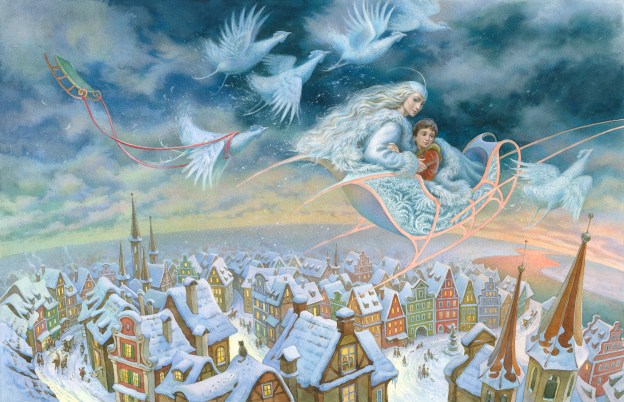
Before any court case is filed, there is a valid reason as to why the recent Disney blockbuster Frozen is in fact a film that could be classified as “bad.”  Although many fans are unaware of this, the beloved film is based off of a lesser-known folktale, following the style of most preceding Disney classics.  The title of this folktale is “The Snow Queen,” and it was written by Hans Christian Andersen.  At first one might think there’s no problem, but unfortunately, when the individual story and movie, respectively, are examined and compared, the inconsistencies are startling.  Three basic categories can be used to contrast the two.  These three categories are plot, characters, and morals or themes.

The original Frozen, Hans Christian Andersen’s folktale “The Snow Queen,” was actually written as a seven-part story.  These seven parts relate the adventures of a girl named Gerda, who goes on a journey to save her friend Kai, a boy.  The story begins with a brief backstory concerning a wicked hobgoblin — sometimes referred to as the Devil himself — who creates a mirror that shrinks everything beautiful in a thing and magnifies everything ugly.  The hobgoblin and his minions plot to take the mirror up to Heaven to make fools of God and the angels, but on the way up it slips from their grasps and shatters into billions of pieces.  These pieces, some no larger than a grain of sand, are blown all around the world; they make people’s hearts as frozen as blocks of ice and settle in their eyes, distorting their vision as the full mirror would.

Years after this event took place, the two main characters enter; Gerda and Kai.  The two are neighbors who share window boxes filled with roses and are as dear to one another as brother and sister.  Kai’s grandmother tells the two children stories of the Snow Queen and her “snow bees” (the snow flakes).

One winter, Kai sees the Snow Queen from his window, beckoning for him to come to her.  He backs away in fear.  Kai’s grandmother teaches the two children a hymn, two lines of which are repeated throughout the story.  The summer after Kai glimpses the Snow Queen, shards of the terrible mirror get into his eyes and heart.  As he and Gerda are at their window boxes, he becomes cruel and loves Gerda no more.  He destroys their window-box garden and instead gains an aptitude for math and physics and becomes fascinated by the only things that seem beautiful and perfect to him anymore: snowflakes.

One day after that, the Snow Queen comes to him in a disguise while he is playing in the town square.  She kisses him twice — first to numb the cold, second to make him forget all about his family and Gerda — but no more, because three kisses would kill him.  She takes Kai to her palace, near the North Pole.  While Kai is gone, the townspeople get the idea he drowned in a nearby river.  Gerda is heartbroken and refuses to believe it, so she goes to look for him.  The river tells her it did not drown her friend by refusing to take her new red shoes, and a rosebush tells her Kai is not among the dead, as it could see under the earth.  A sorceress who lives near the rosebush tries to keep Gerda with her, but Gerda flees.  A crow tells her Kai is at the princess’s palace, but the prince only looks like Kai.  The princess and the prince provide her with warm clothes and a beautiful coach to aid her on her journey.

On her way, however, Gerda is beset by robbers and taken prisoner.  She quickly befriends a little robber girl, whose pet doves tell her they saw the Snow Queen take Kai toward Lapland.  A reindeer captured from Lapland named Bae is freed by the little robber girl along with Gerda and the two ride to Lapland, making two stops.  One stop is at a Lapp woman’s house, the other at a Finn woman’s house, the latter tells Gerda she can save Kai because she is remarkably pure.

Once she reaches the Snow Queen’s castle, snowflakes try to stop her, but they are stopped by the angel shape her breath takes as she says the Lord’s Prayer.  Kai is alone inside the palace, trying to solve the Snow Queen’s puzzle to earn his freedom and a pair of skates.  He must spell the word “eternity” using ice shards she gave him.  Gerda runs to him and saves him with a kiss and her tears, which melt the shard or mirror in his heart and cause him to remember her, which causes Kai himself to burst into tears, removing the shards in his eyes.  The two are so overjoyed they dance together, and in their dance the ice shards are jostled to form the word “eternity,” gaining Kai his freedom.  The two then leave the Snow Queen’s kingdom with the help of Gerda’s friends, and they return home to find they have grown up, and it is summertime.

Although there are several characters in this story, the hero is clearly Gerda, and the villain is clearly the Snow Queen.  Kai could also be considered a main character, although he isn’t actually in the story that much.  Prominent themes are female strength — displayed in both the Snow Queen and Gerda —  as well as a true, realistic ending.  It is suggested true happiness is found through purity of heart and strength, which appear through childhood.

Turning to the movie Frozen, one has an entirely different storyline.  Elsa and Anna, two sisters, are princesses of a fictional realm called Arendelle.  Elsa has the ability to produce snow and ice and general winter at will but is not able to control it.  On the night of her coronation, the young queen loses control in front of her kingdom after being a shut-in for many years and flees to a distant mountain, after accidentally setting off an eternal winter across her kingdom.  Her younger sister Anna blames herself — she got mad because her sister did not sanction her marrying a Prince Hans of the Southern Isles — and goes after her, recruiting troubled Kristoff and his reindeer Sven along the way to help her.

On their way, they meet a living snowman named Olaf (who loves warm hugs), who leads them to the secret passageway to Elsa’s ice castle.  Elsa, while her kingdom is freezing and her sister is almost getting eaten by wolves, has transformed herself into an ice-wearing self-actualizer, when in fact she is still very much afraid of herself and of others.  Anna tries to tell her she will help Elsa work through anything, but Elsa loses control again after hearing she froze Arendelle, and her powers strike Anna in the heart; an act which is known to be nearly fatal.

With only the hope of an act of true love from Hans to save her, Kristoff, Sven, and Olaf rush Anna back to the castle.  However, Hans has been planning to take over Arendelle all along and leaves Anna to die while going to capture Elsa, claiming Anna had died already.  However, while Hans is off capturing Elsa, Olaf rescues Anna from freezing to death.  Anna realizes Kristoff is the one who truly loves her, and she loves him back, so she runs across the frozen river toward him, but as she is turning to ice she sees her escaped sister, kneeling broken-hearted on the ice after hearing Hans’s lie about Anna’s death.  Anna turns from her path to Kristoff and leaps in front of Hans’s sword just as he tries to kill Elsa, and she turns to ice.  Elsa is shocked and even more devastated and throws herself onto the ice statue that was once her sister and sobs as Kristoff draws near.

But then, a breath is seen, and the girls’ sisterly love is strong enough to bring Anna back.  Then Elsa realizes the key to controlling her powers and bringing back summer is love.  The movie ends with a hint Kristoff and Anna end up together, while Elsa hosts kingdom-wide ice skating parties in the palace courtyard whenever she feels like it.

As one can see, the main characters are quite different.  The “Snow Queen” is not the villain after all, instead she is a misunderstood sociopath.  Her sister Anna is the hero and is supported by Kristoff, Sven, and Olaf along the way.  Themes in the movie include sisterly love, female strength, and the importance of staying true to oneself.

It is pretty obvious the words “based on” meant something a lot looser than one might at first think.  The plots of the tales are completely different.  One story makes the Snow Queen a villain, the other doesn’t.  It would be a completely different ballgame if Disney had done something like the Broadway musical Wicked, where the story is told from the Wicked Witch of the West’s perspective, and thus one is given a different outlook on L. Frank Baum’s The Wizard of Oz.  But instead, Disney decided to take an idea — the idea of a queen who could control snow — and make it into something nothing like the original story.  And not only that, but they didn’t even try to present any fresh values in the movie.  All of them have been done before; sisterly love in Lilo and Stitch; feminine strength or “girls can fight, too” or “girls don’t need a man to save her” in Mulan and Brave; the importance of staying true to oneself in every single Disney classic except for The Little Mermaid.

What is most ironic, however, is the fact in the original folktale there was an even better storyline to suggest a girl doesn’t need a man to save her: Gerda saves Kai.  And over all, it would have be more beneficial in today’s culture for girls to hear strength and purity of character are what really count, not self-actualization and “letting it go.”  Girls are surrounded by the pressure to be yourself (while ending up being like everyone else) enough every day.  They didn’t need a Disney movie to confirm it.

In the end, Frozen still made millions in the box office, because it fed girls across the world what they wanted to hear, disguised in a catchy tune.  But that doesn’t make it a good movie.  In fact, it makes it a bad movie.  It doesn’t make people think; it entertains them for two and a half hours and then encourages them to be singing “Let it Go” for the rest of the day, because that’s the message Frozen represents.  No one should have to change (despite the fact change is a part of life), and people should just deal with others’ emotional and mental problems without trying to help them with it.  Love — whatever that means — is the answer to all of life’s problems.  Frozen versus “The Snow Queen” is just one example of the decline of book-to-movie adaptions.

Works Referenced

Andersen, Hans C. The Snow Queen. 2nd ed. Vol. 1. Denmark: n.p., 1844. N. pag. New Fairy Tales. Print.

Buck, Chris and Jennifer Lee, dir. Frozen. Writ. Chris Buck, Jennifer Lee, and Shane Morris. Walt Disney Studio Motion Pictures, 2013. DVD-ROM.

Art: The Imprint of God, The Signature of Man

Christopher Rush

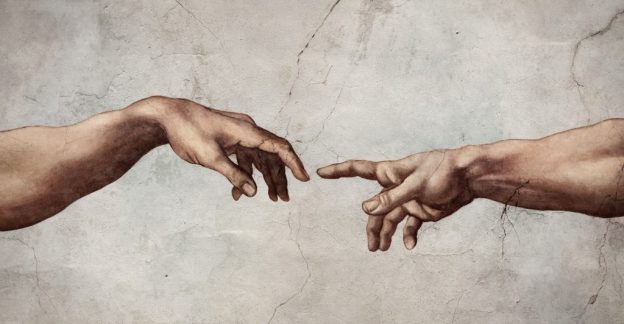
Father James V. Schall, one of the last great philosopher-theologians of our day, reminds us in his classic work On the Unseriousness of Human Affairs the universe is a work of art.  God did not create the universe out of need.  God never acts out of need.  He only acts out of desire.  As Love itself, God’s acts are always acts of love.  The universe, man, and all else God has made were made by love.  “The act of creation,” says Michelangelo in The Agony and the Ecstasy, “is an act of love.”  As an act of love, a creation of desire — the universe filled no need whatever; it exists solely to be itself, to be beautiful, to reflect its maker.  The universe and everything in it are works of art.  “God is the only serious thing,” says Father Schall.  We can relax about the rest.  Now that we are calm, we can begin.

Dorothy Sayers, in The Mind of the Maker, emphasizes the Bible displays God more frequently as a craftsman than a philosopher or thinker.  At the start, God is making things: speaking the universe into existence, fashioning man from dirt, reshaping the rib of man into a woman.  Ideas are substantiated by the linguistic power of Jehovah Elohim.  The things God makes reflect His glory, as Psalms 8 and 19 make clear.  John’s gospel highlights the incarnation of the Messiah as the incarnation of thought, of reason, of language: the Word made flesh.  When Paul in Ephesians calls man God’s “workmanship,” he uses the Greek word poiema: humanity is the poem of God, created to make more good poems.  If everything God has made are works of art, and those works of art glorify and reflect Him, the arts are indeed the imprint of God.

We, then, are God’s poem (some of us are epic poems, some of us are limericks, but still, all poems), and poems created in the image of the Great Poet.  Art is not of secondary importance.  Our purpose here is not to belittle our colleagues, but let us take a moment of contemporary appraisal: how many stories do we hear of orchestras, bands, choirs, art departments shutting down or sacrificed because of tight budgets? budgets that somehow are able to fund athletic teams or purchase the latest technological “necessity” for the classroom or pursue the latest international/competitive fad STEM?  True, we sometimes do hear of schools that can’t fund their sports teams, but those stories are far outnumbered by tales of the Humanities being sacrificed as ancillary or, worse, extraneous to a “real” education.  Now before the engineering majors among you walk out in disgust, I am not opposed to science, technology, engineering, and mathematics or even sports.  I am, though, wholly opposed to the diabolical belief they are superior to or more worthwhile or even more necessary than the Arts.

As poems created in the image of the Great Poet, we not only have a calling to support, delight, enjoy, and further the arts, we have an ontological imperative to do so.  We should all be scientifically astute; we should all be mathematically savvy.  We can all glorify God through the sciences, but science at its best can only tell us how.  The Humanities, the Arts, tell us why: poetry, prose, drama, painting, sculpture, music, dance, acting, architecture — these are the ways humanity understands why we are the way we are, what we can do about it, what works, what fails, how we should live, not just how mechanical effects happen from mechanical causes.

But art, you say, is messy.  Art is subjective.  Science is objective.  We are not here, remember, to posit the sciences against the arts.  This is not a competition.  The objection, though, of art’s messiness is still valid.  Mark Twain threatens us with bodily harm if we attempt to find a meaning or moral in Huck Finn.  Terry Gilliam’s film 12 Monkeys tells us even if we invented time travel, man’s pessimistic fate is inescapable.  Schoenberg’s twelve-tone row is a musical pattern of constant variation without resolution, atonality rejecting outmoded notions such as melody.  If this is art, how can I call this a human necessity?

Art is necessary for man as we are created in the image of the Creator — art was not necessary for God since He was complete in Himself, but man by his very created nature must imitate his creator: the poem must beget more stanzas.  So art for man is necessary — it is not ancillary to politics or economics or even world peace; it is more necessary than those endeavors, as important as they may be.  To be human is to be a work of art — art is a necessary component of the truly full human life.  Perhaps it is time, then, to define “art.”

Art is usually considered a subjective thing.  If we take the position art is subjective, no attempt at definition will get us anywhere.  Even if you don’t approve of my forthcoming definition, we must establish from the beginning one essential idea: not everything can be Art.  If “art” is a limitless category, no definitions will satisfy and “art” as a concept will be meaningless.  Art has boundaries, boundaries I admit that imbricate, and I hereby enumerate those boundaries with the following analytical definition: art is the confluence in sensory form of aesthetics, beauty, and truth.  When this ovation has died down, I shall continue.

By “sensory form” we quickly encompass the plastic arts, the visual arts, the fine arts (classic and contemporary), performance arts — all of ’em.  That is the easy part.  The more difficult part is now, as we say while “art” covers all these things, not every single painting, poem, movie, movement, song, or building is truly a work of art.  As Dr. Schaeffer explain in his classic work we read in 12th grade Bible How Should We Then Live?, some are more akin to “anti-art.”  Some poems, movies, songs (or, rather, collections of sounds or noises) are as he says “bare philosophical statements.”  Not everything can be Art.  A stick banging on a garbage can may be rhythmically intriguing, but it is not a song.  It is not music.  Art, as with everything else God is and does, has absolute, eternal unchanging standards that must be embraced and pursued.  That does not mean all songs must be happy or all movies overt thematically.  Ecclesiastes and Lamentations, Psalm 137 and many others belie the notion art must always be positive or sentimentally sweet.  The output of Robert Mapplethorpe is not art, though.  The songs of John Cage are not art.  Art, real art, pursues beauty and truth through genuine aesthetic standards.

Aesthetics have fallen out of favor in Christian circles.  How many great Christian American poets can you name since T.S. Eliot?  How many truly good Christian movies can you name from the last 50 years?  Before you say Facing the Giants or Fireproof at me, may I suggest you get a copy of The Agony and the Ecstasy starring Charlton Heston and Rex Harrison and a copy of Beckett starring Peter O’Toole and Richard Burton and see which are better movies as movies.  Aesthetics deal with how successfully form and function unite and how well a thing succeeds at being what it attempts to be (such as how well a poem functions as a poem, not a bad group of sentences sloppily chopped up into little lines pretending to be a poem, for example).  Aesthetics remind us a patronizingly obvious Biblical moral stuffed into a shoddily-acted, shoddily-written motion picture does not a good movie make – and it’s certainly not good art.  Christians have abandoned, largely, aesthetic standards in favor of comfortable, sickly-sweet sentimental moralizing in art, music, film and just about everything else, including its sermonizing.  (I am indebted to Frank Gaebelein’s The Christian, the Arts, and Truth for much of this.)

A picture of a fair-skinned Jesus smiling at a lamb is not automatically a good painting simply because of its theme.  A song does not automatically become good music simply because it crams as many attributes of God as it can into three minutes of repetitive chorus.  We need to be far more critical of our aesthetical responsibilities.  A Christian publishing label is not enough.  I don’t begrudge you your positive, encouraging music.  I do reject, however, the assumption a certain label or a certain band or a litany of Bible words somehow automatically means “good music” or “good art.”  They don’t.  Similarly, I don’t begrudge you enjoying a Janette Oke or Francine Rivers book, but you need to know far better authors are out there.  Don’t ever try to excuse your children reading bad books just because it seems Christiany — “at least they are reading” is one of the clearest signs of bad parenting.  You would never excuse your children eating cotton candy for every meal with “at least they are eating,” would you?  You and your children need a healthy intellectual diet as well as bodily diet.  Stop settling for overly-comfortable, enervating moralistic sentimentalizing.  I certainly don’t dislike sentimentality — I believe it is a much underrated component of the human experience, but good music — true artistic music — does not just evoke a chirpy smile and a momentary sense of relief.

Good music, like all good art, evokes thought, interaction, reflection; it challenges as well as enlivens; it demands we test it, it invites scrutiny.  It lives up to aesthetic standards of quality.  Enjoy good movies not only because they have a nice moral but also because they are good movies: engaging dialogue, believable and sincere characters, truthful events, the creation of “the illusion of an experience vivid enough to seem real.”  Enjoy good songs not only because they say true facts about Jesus but also because they are good songs: trenchant lyrics, beautiful melodies and harmonies, complementary rhythmic cadences.  Enjoy good books because they speak timeless truth about the human condition with vivid descriptions and well-drawn characters, regardless of culture of origin or year of publication.  Christians must regain an appreciation for and adherence to aesthetics in art, or the mediocre will overtake our hearts and debilitate our minds, and those are unacceptable for image bearers of Jehovah Elohim.

From aesthetics we move slightly to beauty.  In one of the best poems of all time, “Ode on a Grecian Urn,” John Keats, one of the best poets of all time, equates beauty and truth.  But as Frank Gaebelein points out, they aren’t exactly the same — related but not identical.

Beauty’s connection to the arts should be obvious, but the last century has seen a drastic rejection of something so basic, beginning in the painting world then continuing in the poetic world, even in the nascent field of motion pictures.  The Modernist period, with a capital “m,” from roughly 1905-1935 depending on who you talk to saw a concerted effort in the artistic world to reject the traditional standards of art and expression, substituting such outmoded bourgeois concepts as unity, objectivity, beauty, meaning, theism, and rationality for fragmentation, subjectivity, relativism, uncertainty, and non-reason.  The cubist paintings of Braque and Picasso, while aesthetically skillful to be sure, fail in their presentation of beauty.  They similarly fail in their presentation of truth, which will be addressed shortly.  As they, and so many of their contemporaries with them, fail to create or reflect beauty, their art is secondary at best, non-art at worst.

Roger Kimball, in his thought-provoking and stomach-churning essay “The Trivialization of Outrage,” describes the present day state of affairs in art, or what passes for art in such cultured places as the Metropolitan Museum of Art in New York and the Museum of Modern Art in Paris.  The nicest thing most of us would say about the pieces Kimball describes in his essay is “grotesque,” but the world around us clamors to call it “art,” and anyone who cannot see it as art is an uncultured backwater imbecile.  In defiance of the inheritors of those who reject traditional aesthetic standards, Kimball concludes art must have “an allegiance to beauty.”  If it doesn’t, the most horrific, nauseous object could have a claim to art.  Reject such a thought.

If art is not subjective, are we saying beauty is likewise not subjective?  We are.  Beauty is not in the eye of the beholder.  Beauty is an objective quality defined as all objective standards are in the person of the Great Poet, God Himself.  All great strands of human experience — truth, justice, love, marriage, art, beauty, purpose, meaning — all of these and more are objectively, absolutely, eternally defined by God’s very being.  Surely this is not a point of dispute for us.  But, you say, what does that really mean?  What is beauty?  Putting it simply, beauty is the sensory and/or spiritually pleasing unity among form, function, and truth.  While that may sound very similar to our understanding of aesthetics, we did mention earlier these categories imbricate.  Aesthetics deals with the unity of form and function and nature: beauty adds the pleasing responses to the audience’s senses and spirit.  Keats was mostly correct: beauty and truth are connected, though they are not precisely the same.  Beauty appeals to the senses as well as the spirit — and if perverted, it appeals to the appetite.  Truth appeals to reason and the correspondence to reality itself.  Aesthetics appeal to the will and sense of order.  Together, they appeal to the imago dei in humanity.  When man participates in the arts — whether by creating art or appreciating art — the imprint of God is translated into the signature of man.

We proceed to the third component of art: truth.  Truth’s connection to art is likewise multifaceted.  Accepting, as I’m sure we do, all truth is God’s truth, regardless of the personal faith of presenter of that truth, thanks to God’s grace upon whomever He wills to dispense it, Frank Gaebelein highlights truth’s connection to art in four ways: durability, unity, integrity, and inevitability.  First, truth is durable: it is unchangeable adamant, as Theodore Roethke calls it in his moving poem “The Adamant” — “Truth is never undone,” he says.  We easily associate this part of truth in art with the classics: Homer, Shakespeare, Dante and the gang, Rembrandt, Michelangelo, Bach, and Bono have stood the test of time.  They aren’t classics because they are old; they are classics because their durability, their timelessness, is proven by their enduring truths.  (Perhaps that seems circular, but we’ll let it slide for now.)  The Iliad and Beethoven’s Ninth Symphony may not be as overtly Christian as Handel’s Messiah and the Sistine Chapel ceiling, but their truths are undeniable and durable.  Don’t be so enamored with the new you forget the great heritage of the arts.  Likewise, don’t be so devoted to the classics you have no awareness of what is artistically good and true today.  After all, Homer and Shakespeare were pop culture once upon a time.

Second, says Gaebelein, truth in art has unity.  Unity, similar to aesthetics, is the congruence of form and structure — and why shouldn’t these hallmarks overlap?  Unity requires order, a task given to man even before his fall.  Gaebelein says, “In the arts, the concept or idea is given definite form; it is embodied in sound, color, or words; in wood or stone, in action or movement, as in drama or ballet.  But embodiment requires unity and order, a body cannot function effectively in a state of disorganization” (89).  Does this not remind us of Christ?  The Word made flesh?  Writers embody ideas in words; musicians embody truth in sounds; visual artists embody truth in color or motion or whatever — you bet your boots truth has unity, and products without this clearly are not worthy of being called “art.”

Third, truth in art has integrity; more than unity, truthful art has a wholeness.  The work must be internally consistent: “integrity demands,” says Gaebelein, “that everything contrived merely for the sake of effect and not organically related to the purpose of the work must be ruled out” (91).  True art does not have to tell the whole story from Genesis to Revelation, but it must be united and tell its story fully.  Ambiguity and uncertainty are fine, but they can’t be the whole point.  Reality has mystery, but it’s not an inscrutable puzzle.  The conclusion need not be happy, the song does not need to end in a major key (let us not forget the artistic value of temporary dissonance), the hero does not have to survive, but true art either provides a meaningful resolution to the problems it poses or enables the attentive audience to provide it properly.  If it exists solely to shock, such as the work of Robert Mapplethorpe, or solely to declare “the universe makes no sense!” like some works by Marcel Duchamp, it fails in its connection to this truth.  Art can be shocking, if the audience needs to be awakened from its complacency, but genuine art does more than shock, just as genuine satire does more than ridicule: it goes the next step and explains “here’s what to do about this surprising thing that, if you had been paying attention all along like you should have been, would not have been so shocking after all.”

Last is the aspect of inevitability.  True art, says Keats, feels “almost a remembrance,” as if viewing a picture or reading a poem even for the first time gives one a sense “this is how it ought to be” (92).  But Gaebelein cautions us this sense may not come immediately, especially with the best art, especially if we are used to an intellectual diet of mediocrity.  The best art demands long, patient attention, revisiting, and reflection.  The best art, as we’ve said, can stand such scrutiny. and after we have done so, we will join the artist and say “yes, this is how it should be.”  Real art has what J.B. Phillips calls “the Ring of Truth” (93).  Truth is the correspondence of reality.  God is Ultimate Reality, and thus the closer a work of art gets to that reality, the truer it is — the better it is as art.

Does this mean science fiction with its non-existent spaceships and time travel, fantasy with its elves and dragons, a painting of a blue tree — these can’t be art because they aren’t “real”?  Of course these can be art.  The “reality” we are speaking of is what the philosophers call “verisimilitude,” the appearance of being true.  Much of the best science fiction addresses truths about humanity in far better ways than much generic fiction, so it’s not just a question of mimicking reality, any more than we would call Elizabethan literature false because people don’t speak that way now.  A world of difference exists between a painting of a blue tree, a genuine representation of the artist’s creative expression, and a deliberate misrepresentation of reality by Jackson Pollock in an attempt to willfully reject the obvious order to reality.

While art is free to have its lesser classics (not everyone can be Shakespeare or Michelangelo), the crafters who overtly reject at least one of these principles should be understood for what they are: bad artists.  At best.  At worst, non-artists.  Intention is a major factor in that distinction.  To be truly in the discussion of art, the work and its crafter must pursue or embrace all three components.  Art is a necessary human endeavor uniting aesthetic standards to the absolute values of beauty and truth.

Aesthetics without beauty, says Kimball, “degenerates into a kind of fetish or idol,” a mere mental exercise devoid of any real meaning.  Beauty without aesthetic standards or truth is formless and void, likewise nothing resembling art.  Truth without aesthetics or beauty sounds a lot like the clanging gongs and clattering cymbals of 1 Corinthians 13 — which, strangely enough, can be heard on most radio and television stations with great regularity today.

But what if these disagree, you ask?  God created the universe and said it was good, yes?  So if the universe is a work of art, why are cockroaches so ugly?  Surely we aren’t saying we have to consider cockroaches beautiful?  The ocean is home to many ugly, ugly fish.  One person is moved to tears by a sunset, another by a Chopin concerto, another is only moved by Larry, Moe, and Curly.  Don’t personal preferences play a role in what we consider beautiful?  Some English majors love The Catcher in the Rye; some, rightly, think it is overrated piffle.

As time is running out, let us cut to the chase.  These arguments, while worth exploring another time, are fundamentally missing the point.  Beauty is not skin deep.  “Good” is not up for grabs.  We have no more authority to define beauty based on our personal preferences or tastes any more than we have the authority to define truth based on our personal preferences or tastes.  Perhaps we don’t have to call cockroaches beautiful in the same way we don’t have to call every square inch of the Sistine Chapel beautiful.  Perhaps we need to step back and take in the whole.

Dorothea Lange’s photographs of Depression Era poverty, surely those are art.  Elie Wiesel’s Night, capturing the horror of his Holocaust experience, surely is art.  I tell you what.  Yes, they are.  Without leaning into the relativism we have been avoiding all night, beauty is more than just prettiness.  Truth is more than just fact.  Aesthetics are more than “things I like.”  Homer never mentions Jesus, and yet his work conveys truth about the futility of seeking one’s own glory at the expense of others and the beauty of sacrificing oneself for loved ones far better than most sermons you or I will ever hear.  Art is necessary for the full, rich human life.

For centuries, critics have been waging a war whether art is a mirror or a lamp: a reflection of the times or a guide to where humanity should go (or is already going).  For Christians, the choice is clear: without trying to sound like a fence rider, good art is indeed both.  Art reflects mankind truthfully, as he is and as he was and as he should and will be.  Art points man back to where he came from and where he belongs.  Art points man back to the Creator.  Art is the imprint of God.  Art done properly is the signature of man, displaying the image of God within.  Through the arts man leaves his best testimony to the future of humanity what he has learned from his past and his present.  Through the arts man best worships and imitates God Himself.  As Gaebelein sums up, “we cannot downgrade the arts as side issues to the serious business of life and service as some Christians do” — a seriousness we take too seriously, as Father Schall so wonderfully reminds us.  Returning to Gaebelein: “When we make and enjoy the arts, in faithful stewardship and integrity, they can reflect something of God’s own beauty and glory.  Through them we can celebrate and glorify the God ‘in whom we live, and move, and have our being’” (97).

Works Cited

Gaebelein, Frank E. The Christian The Arts, And Truth: Regaining The Vision Of Greatness. Portland: Multnomah Press. 1985. Print. All works cited except those listed here were mentioned by Gaebelein in his work and thus taken from him.

Kimball, Roger. “The Trivialization of Outrage.” Experiments Against Reality: The Fate of Culture in the Postmodern Age. Chicago: Ivan R. Dee. 2000. Print.

Schall, Father James V. On the Unseriousness of Human Affairs: Teaching, Writing, Playing, Believing, Lecturing, Philosophizing, Singing, Dancing. Wilmington: ISI Books. 2001. Print.

King Arthur’s Success and Fall

Jessica Gromley Bain

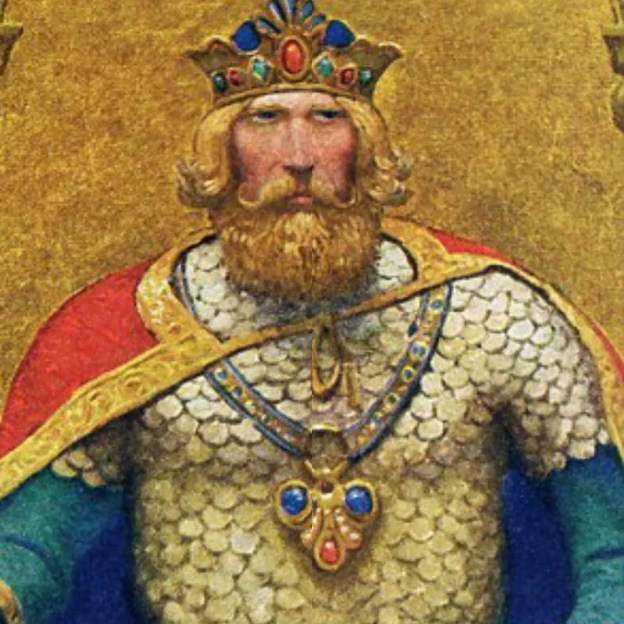
King Arthur is a legendary British King found in folklore and mythological literature.  He is looked at as the greatest king of his time.  He ruled over a large portion of Europe (England, Wales, Ireland, Scotland, and other smaller places not mentioned), and his kingdom was called Camelot.  The kingdom was raised, assembled, and remained powerful as long as Arthur lived.  However, his enemies rose against him, and, after being wounded in battle, Arthur died and in a fit of war the kingdom fell.

The values Arthur’s knights stood for lied in chivalry, loyalty, honorability, and trust.  At the end of “The Wedding of King Arthur,” Arthur set the laws for the knights of the Round Table for each of his knights to follow, and every knight swore to abide by those laws.  “They swore to never use violence without good purpose, never to fall to murder or treason.  They swore on their honor to be merciful when mercy was asked and to protect damsels, ladies, gentlewomen and widows, to enforce their rights and never enforce lust on them.  And they promised never to fight in an unjust cause or to fight for personal gain.  All the knights of the Round Table took this oath.  And every year at the high feast of Pentecost they renewed the oath.”

This code was one of the major factors in the success of Arthur and his knights.  They worked together to achieve a common goal of peace and liberty. They renewed their oath every year to keep their union strong.

Another factor in the success of Arthur’s kingdom was Arthur hand-picked his knights.  He often took into consideration the advice of close friends (as in “The Death of Merlin,” when Arthur asks Sir Pellinore for his help in identifying a selection of honorable knights to fill the empty chairs at the Round Table after having suffered eight losses in battle).  However, the ultimate decision lied with the king.  He chose no knight he did not trust whole-heartedly.

One other point that could potentially be argued is Arthur’s knights followed God.  It is known they believed in God, because it is said in Sir Thomas Malory’s “Merlin” the sword in the stone appeared from Heaven, and all were amazed and eager to see who would pull the sword from the stone.  If they did not believe at all, they would have ignored the sign and continued fighting over who should rule. On this note, if the sword was in fact from God, this suggests that Arthur was specifically chosen by God to be king of England.  The sword said “Whoso pulleth out this sword of this stone and anvil is rightwise king of all England” and Arthur was the only one able to pull the sword from the stone and therefore he was the rightful king as demonstrated by God.  It is also known the people of the time were Catholic, because Thomas Malory’s “Merlin” mentions several times the characters participated in holy services (“So when all the masses were done”; “On New Year’s Day, when holy service was over”; “And when matins and first Mass was over”).  However, this is not exactly substantial evidence as to whether Arthur and his knights conducted their affairs according to the explicit orders of God.  In fact, whether they were true followers of God is questionable, since they not only consorted with but also took the advice of Merlin the Magician, who was among some peoples referred to as the “Devil’s son.”

Arthur’s success was due largely to the trust and unity between the knights.  This unity was the result of their common oath and Arthur having chosen each personally.  It is true Arthur made no man a knight who he did not fully believe he could trust.

What would be his fall, however, was the fact he did not always put his trust in the correct people.  His most trusted friend had sexual relations with Arthur’s wife, which is a prime example of Arthur’s rather poor taste in friends.  Merlin even told him, “Guinevere will be unfaithful to you with your dearest and most trusted friend—” but Arthur did not listen.  Despite Merlin’s explicit warning, Arthur chose to marry Lady Guinevere and walked right into inevitable heartbreak.  In his defense, Guinevere is said to have been exceedingly beautiful; but that changes little in the final result.  He also chose to trust his son, Mordred, another poor choice.  Granted, Mordred was Arthur’s son, so the mistake is understandable.  Arthur’s end comes in Sir Thomas Malory’s Le Morte d’Arthur.  Due to Arthur’s choice to place his trust in the wrong people, he finds himself in battle with Lancelot, because Guinevere’s infidelity has led to her sentence to be burned at the stake.  During the course of this short battle, Arthur’s nephews, Gareth and Gaheris, are killed by Lancelot, unable to defend themselves as they were both unarmed.  Encouraged by Gareth and Gaheris’s brother, Gwaine, to take revenge, Arthur declares war on Lancelot and thus the foundation of the knights is broken up as each knight must choose a side.  On top of all this, while Arthur is off fighting Lancelot, Mordred takes the crown for himself.  Upon hearing of this Arthur must return to Camelot, where in a great battle Mordred mortally wounds Arthur.  With no leader and no strong military to protect it, Camelot falls.  Thus Arthur and his knights fail due to Arthur’s choice to put his trust in the wrong people.  He was a great king who made his kingdom great and prosperous, but it was this one flaw which caused him to fail.

Bibliography

Lawrence-Mathers, Anne. The History of Merlin the Magician. Yale University, Yale University Publications, 2012.

Malory, Sir Thomas. King Arthur and his Knights. Oxford, Oxford University Press, 1975.

—. Le Morte d’Arthur. Great Britain, Aldine Press, 1976.

Steinbeck, John. The Acts of King Arthur and his Noble Knights. United States of America, Farrar, Staus, and Giroux, 1993.

An Exploration of Genesis 17-22

Seraphim Hamilton

Genesis 17-22 is set against the backdrop of the Flood. Abram has just fallen, by “listening to the voice of his wife” (compare Genesis 3:17) and broken the covenant. This is part of a pattern in the Bible where the covenant is made and immediately broken. It happens to Adam in Genesis 2-3, it happens to Abraham in Genesis 15-16, it happens to Israel in Exodus 20-32, and it happens to David in 2 Samuel 7-12. Following the breaking of a covenant, God renews the covenant through death and resurrection. In the story of the Flood, the solution was the “cutting off” of all flesh so that the world might be reborn. In Abraham’s case, the solution is the “cutting off” of his flesh in circumcision, which symbolizes death and resurrection. There are many ways we know this, but one way to understand it is by connecting circumcision with Passover.

In Exodus 4:22-23, the Lord comes to Moses in the night and attempts to kill his firstborn son. The boy is immediately circumcised and the blood made visible to the Lord on his leg. This is a type of the next time that the Lord comes to strike down firstborn sons, and only those with blood on the doorposts are saved. Meredith Kline points out that the word “pasah” (from where we get “Pascha”) is actually a parody of an Egyptian word “psah” referring to sacramental tomb temples. The houses of Israel are their tombs, and the Glory of God “covers over” the doors so that when the sun rises, the people of Israel rise from the dead.

So we know that circumcision is about death and resurrection. We know that it is associated with the Flood, which is about the rebirth of creation. And this story continues with the account of the destruction of Sodom and Gomorrah. In order to precisely understand how the two are parallel, it is essential to understand that water and fire are twin symbols in the Bible. For example, in Daniel 7, a throne of fire proceeds from the throne of God. The Garden of Eden corresponded to the Holy Place of the Tabernacle in the middle of the holy mountain. At the very top of the holy mountain was a fountain that flowed into Eden- presumably with a throne, eventually to be occupied by the Last Adam. In Revelation 22, we see Daniel’s vision again, except this time, it is not fire, but water that proceeds from the throne of God.

That is why in the account of the fall of Sodom and Gomorrah, we are told that fire “rained from heaven.” Symbolically, this is the glory of God which falls from Heaven and wipes out the wicked. Furthermore, the Flood itself was associated with the exodus. Israel passes through divided waters and comes to the holy mountain, while God redivides the primeval waters and brings Noah to the holy mountain. These types coalesce in the story of Sodom and Gomorrah. When the two witnesses come to inspect the city, the people wish to abuse them. Lot (who by this point, was a judge in the city) abhors such violence, but wants to toss his daughters to be abused by the mob instead. We will see what this eventually leads to. As he leaves the city, he bakes unleavened bread- an obvious type of the exodus.

Fire is raining from heaven, and unleavened bread is cooked as Lot flees the city. But here’s the interesting part: Lot is told to flee to the mountain. While most translations render this in the plural, there is no justification for this in the text. After making his exodus, Lot was supposed to join Abraham at the holy mountain. But he’s prideful. He had chosen the land which was “well watered like the garden of the Lord” and now that land was desolate, just as Eden was “because it had not yet rained” (Genesis 2:4). Instead of fleeing to the holy mountain, Lot flees under the Earth — the opposite of the holy mountain. As mountains symbolize exaltation and new life, caves symbolize death.

Echoes to the flood story abound. Noah was exalted by the waters to the holy mountain, planted a vineyard (a New Eden) and drank Wine in Sabbath Rest. While most people tend to read Noah’s “drunkenness” as sin, the word need only mean that Noah enjoyed a couple glasses of Wine and relaxed. He had been exalted. All flesh had been given to him. And the symbol of Sabbath and exaltation is Wine. The sin in Genesis 9 is when Ham seized his father’s robe of authority, just as Adam had seized God’s authority in Genesis 3. Returning to the story of Lot, Lot is now under the Earth instead of on a mountain peak. And his daughters give him Wine to drink. But this isn’t the Wine of Sabbath, it is the Wine of anti-Sabbath. And his daughters abuse him- just as he had tossed them to be abused.

Eye for eye, tooth for tooth.

It’s a sad note for the story of Lot to end on, but we haven’t finished the story of the holy mountain. The destruction of Sodom and Gomorrah has more to do with Abraham than it has to do with Lot. Abraham is the one who had fallen, and the “cutting off” of all flesh in the Flood falls on Abraham in circumcision. But circumcision is merely a sign of the death and resurrection, it is not the substance of death and resurrection. The story of Genesis 17-22 comes to its climax in Genesis 22. God had protected Sarah from Satan’s attempt to prevent the birth of Isaac in Genesis 20. And now the Seed of Promise had arrived.

And where do we find ourselves? The holy mountain, and God wants an ascension (typically translated burnt) offering. When Noah arrived at the holy mountain after the Flood, Noah provided an ascension offering of all creation. Now Abraham is to do the same. He brings his seed, Isaac, to the top of the mountain, and offers him to God- except that Isaac is replaced by a ram. Isaac symbolically dies and rises from the dead. And that is why it is in Genesis 22 that God renews the covenant at last. Covenant renewals come by death and resurrection. David’s covenant was renewed when he lost the kingdom to Absalom and later had it restored to him. Israel’s covenant was renewed when Moses went into the “cleft of a rock” (remember, symbolizing death) and emerged with a glowing face. Abraham’s covenant is renewed when Isaac dies and rises from the dead. This calls is back to the story of the Flood. In Genesis 8, when Noah had been saved from the Flood and arrived on the holy mountain, he offered ascensions to make peace between God and Creation. Isaac fulfills the sacrifice of Noah.

Let’s draw a few more implications from this. First, the story of Genesis 18-22 clarifies and explores the meaning of circumcision. Circumcision was given after Abram broke the covenant, but it also signifies the seed that is coming from Abraham’s own body. The message is thus, when we read the whole story carefully and with attention to detail, that God will “raise up” (resurrect) Abraham’s seed after him and in that way renew the covenant. Circumcision is a profound type of Christ, and the circumcision of the heart is when the shape of the cross is cut into the Christian heart by suffering.

Second, it is a ram who replaces Isaac. In the system of offerings set forth in Leviticus, the ram is the animal used in the trespass offering. One “trespasses” against God when one seizes duties that are not one’s own. A typical punishment for such seizures are leprosy. When Adam trespassed, he was cursed with “garments of skin”, which, while protecting Adam from the full force of the divine glory, nevertheless is associated with leprosy in Leviticus 13-14, as the whole shape of Leviticus 11-15 follows the curses of Genesis 3. When Uzziah attempts to seize priesthood in the Lord’s Temple, priesthood reserved only for the Levites, he is struck leprous. And when Miriam attempts to rise up against Moses as prophet of the Lord, she is struck leprous.

Adam’s sin was a trespass, and a trespass incurs the curse of leprosy (associated with death). The trespass offering is a ram, associating it with Genesis 22. The seed of Abraham was to be offered to God, but God took a ram instead. The incredible thing is that all of these themes meet in Isaiah 53. Isaiah says that the Servant of the Lord became leprous for the sake of His People. He says that the Servant gave himself as a “trespass offering.” Now God has found the true Seed of Abraham, and the true Seed of Abraham is offered to God, bringing creation to its final rebirth, and finally bringing peace between God and mankind, as Noah’s ascensions had typified in Genesis 8.

Aggression and Mortality vs. Immortality

Nicole Moore Sanborn

Renaissance writers often employ the same theme, simultaneously demonstrating their own unique style and flair. Popular Renaissance themes include love, beauty, and immortality of verse. Although Spenser and Shakespeare write about the same theme of immortality of verse, Shakespeare utilizes animal imagery and a more aggressive tone in his “Sonnet 19”, whereas Spenser utilizes dialogue and a happier tone in his “Sonnet 75”. The varying aforementioned aspects, specific words, and imagery of each sonnet join together to create coherent ideas and reveal the overall themes.

In the first line of each sonnet, the speaker reveals the tone. Although the same theme is employed, the tones are disparate from one another, as Shakespeare is aggressive while Spenser is happy. Shakespeare begins with “Devouring Time,” (19.1) whereas Spenser begins with “One day” (75.1). Devouring is a very strong term. In this case, devouring has a negative connotation, as it is followed by time, as time causes destruction. This means Time is personified here, indicated immediately by the fact that it is capitalized and it is devouring, an aggressive action. The capitalization suggests Time is a name, and nonliving things cannot act or devour. Spenser’s “One day” (75.1) implies a story, as many romances and fairy tales begin with those two words. Spenser’s sonnet reveals a more positive tone in the first two words, as fairy tales are considered to have happy endings and Spenser’s sonnet begins in the same manner as a fairy tale. These tones hold true for the remainder of each sonnet.

Although the first two words of each sonnet successfully and intentionally reveal the respective tones of the poems, these words accomplish different things in revealing the theme. The first two words of Shakespeare’s “Sonnet 19” reveal the theme of the sonnet, while the first two words of Spenser’s “Sonnet 75” do not. Shakespeare’s “Devouring Time” (19.1) relates strongly to revealing the theme of immortality of verse. Immortality is the ultimate defeater of time, because immortality lasts forever. Therefore, immortality deceases when time deceases, because the ending of time marks the ending of forever. Although Shakespeare does not fully engage in the theme of immortality of verse in line one, he begins to imply it, whereas the first two words of Spenser’s sonnet imply a story is about to be told and therefore do not relate as strongly to the overall theme. “One day” (75.1) does indeed relate to time, but relates to mortality rather than immortality, as the words refer to one day in mortal human history. Rather, the first two words are a set up for the rest of the sonnet, where the theme is revealed later. Spenser’s first two words set the foundation for the dialogue in the rest of his poem.

Shakespeare uses animal imagery with three specific examples: a lion, a tiger, and the phoenix. These examples lead up to the turn of the sonnet and to the speaker’s confrontation of time (19.8).  As each animal used is a fierce and majestic creature, the specific examples are important to the overall meaning and in providing more evidence for the sonnet’s aggressive tone. The speaker tells time to “blunt the lion’s paws” (19.1) and “pluck” teeth from the “fierce” tiger (19.3). Lions and tigers are both powerful animals, and any human attempting to blunt a lion’s paws or pluck the tiger’s teeth will be mauled in the process, thereby separating time as a transcendent power. Time devours these fierce animals that humans can hardly tame. Shakespeare tells time to “burn the long-lived phoenix” (19.4), which is a reference to the legend that every 500 years the phoenix burst into flames and death, where from the ashes a new baby phoenix would emerge. An aggressive tone and the personification of time are also demonstrated here; as Time burns, which is a verb. The specific examples used mean and demonstrate that time is intently and aggressively devouring and destroying fierce animals on the earth. Personification of Time is also demonstrated here because the imagery declares the physical action of time, as demonstrated through the speaker’s use of aggressive words. Specific examples used here, therefore, are carefully and artfully chosen to relate to the aggressive tone and ideal of the sonnet.

The speaker in Shakespeare’s poem tells time to do whatever it would like “to the wide world and all her fading sweets” (19.7), which sets him up for the turn in his sonnet and the change in argument. At the turn, the speaker expresses the thought that time can do whatever, except for one thing. Forbidding Time to commit one “heinous” crime (19.8), the turn of the sonnet occurs and the theme is revealed. The specific examples and animal imagery used demonstrate clearly the actions of Time, however Time is not tied into writing and verse specifically until later in the poem. The speaker commands Time not to touch his love. “O carve not with thy hours” (19.9) commands time not to touch his lover like it ages the phoenix, preparing the reader for the final line, which explicitly states the theme of immortality of verse. The final line states directly that love shall “ever live young” (19.14) in his verse, implying immortality. He implies immortality through use of “ever” (19.14) meaning forever. These words also specifically defy time, as she shall forever be young in his verse, thereby bringing all of the examples of what time will devour and conquer into fruition through this counterexample. The counterexample also becomes the main theme of the sonnet and brings the reader resolution.

Spenser tells a story in his sonnet rather than directly confronting and personifying time before he reveals his theme. In the first quatrain of Spenser’s “Sonnet 75”, the speaker writes his lover’s name on the sand at the beach twice, but the tide washes it away both times. In story format, these occurrences set up the author’s theme of immortality of verse, revealed more clearly in the first quatrain than in Shakespeare’s “Sonnet 19”. Though Shakespeare’s sonnet is clearly about time, time has not yet been related to writing or verse. However, Spenser automatically reveals the theme of immortality of writing and verse because he writes his lover’s name on the sand. Writing on sand is far from immortal as sand shifts and waves crash over the beach, erasing what was once there. Beaches change by the minute and hour, and the beach will hardly look the same after one day. Later in the sonnet, the lover calls the speaker a “vayne man” (75.5) and proceeds to note that just like her name on the sand, “I my selve shall lyke to this decay” (75.7), meaning she will also decay and will not last forever. Here, the speaker immortalizes mortal things purposefully, to prepare the reader for the idea of verse being immortal. That being said, the second quatrain sets up immortality of verse in a different way, by noting the mortality of earthly things such as sand and humanity.

Another interesting aspect of Spenser using the image of writing a name on sand is that it involves sea imagery. In other sonnets by Shakespeare and other authors, sea imagery is used; however it is used more steadfastly as the authors and speakers in the poems allude to steadfastness of a lighthouse or of a strong ship as opposed to gentle sand and writing being washed away. Spenser’s different use of sea imagery sets his theme up well, as it demonstrates that not everything involving the sea and the ocean is steadfast. He essentially uses sand as a counterpoint to the reveal his point that although sand does not last forever, his poetry will.

In the second half of the third quatrain in Spenser’s sonnet, the speaker more directly reveals the theme of the sonnet: immortality of verse. The speaker says, “My verse your vertues rare shall eternalize” (75.11), stating he will write about her not only in the sand but also in his verse. In the couplet ending the sonnet, the speaker mentions that death will swallow up the world, but their love shall live through his verse. The speaker is extremely direct here and states the theme directly, there is no speculation as to what he is saying. The theme is resolved here, as the speaker writes in a non-permanent way, is reminded of mortality, and then directly states that his verse shall live and their love shall live in it, or, his verse shall be eternal after the world is subdued. The idea is that the sonnet will be passed down among generations, thereby immortalizing it.

The turn of Spenser’s sonnet occurs at the beginning of the third quatrain. The turn also takes place when the speaker of the poem engages in dialogue in response to the mistress. The turn begins to direct the reader to the sonnet’s theme, as highlighted earlier. The speaker presents the turn of the poem, as he begins with “Not so” (75.9), indicating a contradiction of belief. The speaker contradicts the mistress’s speech of decay to reveal the theme when he declares she “shall live by fame” (75.10) within his verse in an immortal manner. Though the final line of the sonnet gives resolution to the theme of the poem, the theme begins to flesh out in the third quatrain right after the turn, in the quoted line above. Next, the idea of her living in his verse is directly stated “My verse your vertues rare shall eternize” (75.11), contradicting the earlier decay she mentions in line seven. Spenser’s “examples” and means to reveal the tone and theme of his sonnet is dialogue as opposed to specific animal examples, making it such that Spenser employs his theme in a different manner than Shakespeare.

Shakespeare begins his turn with “But” (19.8). In this line, the speaker directly challenges time and begins his command, indicated by the colon at the end of the line. The use of the colon is very important to the sonnet, as it indicates to the reader that the command to time will be explicitly stated in the next few lines. Beginning in line nine, Shakespeare reveals the theme of immorality of verse more clearly, yet without dialogue. In the rest of the sonnet, Shakespeare acknowledges the ability of time to devour even the fiercest of creatures as well as tarnish the whole “wide world” (19.7), thereby personifying time. The theme is not explicitly stated until line fourteen of the sonnet, where Shakespeare writes, “My love shall in my verse ever live young.” (19.14). Commanding time to leave his lover alone, the speaker hints that he will write about her through using the words “antique pen” (19.10), making a direct reference to writing. Shakespeare’s sonnet differs from Spenser’s sonnet, therefore, in that Shakespeare does not use dialogue but specific examples and in that Shakespeare waits until the very end of the poem to definitely resolve the poem and explicitly state theme of immortality of verse. Both sonnets provide resolution at the end.

Spenser and Shakespeare present two extremely interesting examples of utilizing different means to go about revealing the same theme. Shakespeare uses aggression and fiercely aggressive animals, while Spenser uses dialogue and a happier tone. Both “Sonnet 19” and “Sonnet 75” provide resolution at the end, and both authors use the turn of their sonnet to transition from specific examples or dialogue to a more direct statement of the theme. Fortunately for the reader, both authors resolve the theme of their sonnets. Both brilliant authors, Spenser and Shakespeare are extremely successful at employing the same theme through completely different attitudes, examples, and lenses, and are therefore two brilliant authors among Renaissance writers.

The Social Side of Poverty and Literature in the Industrial Revolution

Michaela Seaton Romero

Poverty played a major part in Industrial Revolution in British life, as many of the people were poor.  Poverty affected many different aspects of their lives, social, medical, and intellectually.  Being such a hard time to live in, there were people who were inspired by the poverty as it affected their lives.

In Victorian England, 80% of the people were considered working class, at least 25% living below the poverty line.  To become middle class, you had to have at least one servant.  Very few were upper class, and they were also the most literate.  Most everyone was affected by poverty in some way or another.  Factories were the bane of the poor folk.

By the 1800s, factories were the main employer of the poor.  Factory life was appalling.  Often, children worked in such places, and they suffered for it.  Children’s growth was stunted by being forced to stand in one place for hours on end, deprived of sunlight and exercise.  In 1833, P. Gaskell wrote The Manufacturing Population of England.  He described the horrible conditions the workers suffered from as a result of their jobs, like bowed legs, flat feet, curved spines, muscle loss, and other such deformities. 

In the 1800s about 53% of the population was literate, a drastic increase from the 1500s when only 6% was literate.  In a large part, the Gutenberg press helped this happen.  By being able to produce literature much more quickly than before, more people learned to read.  Even still, the poor people had the lowest reading percentage.

Most of the literate people were in the middle or upper class, as the poor people did not have time to go to school, instead working between 48- and 70-hour weeks.  If a person was poor, but literate, he was very unusual.  Usually, the literate person was a male and had been to only some school, going in and out as life allowed.  They probably could not write much, perhaps just their name.  There just wasn’t incentive to learn to read; there was incentive to work and stay out of debtor’s prison.

Until 1870, Britain did not take care of the people’s education; that was the job of the churches and families themselves.  Parents had to pay fees for their children to go to school, and often poor families simply couldn’t pay it.  To the middle or upper class, the fees were minimal, but oftentimes the poorest family couldn’t even put food on the table, so paying for schooling was out of the question, as was buying literature.

Even though literacy was low among the poor, literature still affected their lives through music.  Music and songs were often sung by poor people at any event; even if only a street organ was being played, a whole flock of people might be seen dancing about him.  Poor people had very little free time, working from dawn to dusk, but plays were a popular pastime.  It was cheap, and for a little bit you could squeeze into a gallery seat to see a play.  Seating in the gallery was loud, bad smelling, and crowded, but it still exposed people to literature of the period.

Not only did literature affect poor people, poverty affected literature.  One major author who shows this is Charles Dickens.  He himself worked in a boot blacking factory, and his father had been thrown into debtor’s prison.  He also saw others being horribly treated in workhouses.  Those horrors still haunted him, and his books showed this, such as in Oliver Twist.  Oliver Twist was born into a workhouse, unwanted and unloved.

Literature in the written form was not very common among the poor.  The middle and upper classes were the most literate.  Even still, literature was in people’s lives, through songs and the theatre.  It cannot be said literature never impacted the poor people, nor can it be said poverty never affected literature.  Poverty and literature both fed off each other.

Bibliography

“Biography.” Charles Dickens. Web. 9 Oct. 2014. <http://www.shmoop.com/charles-dickens/childhood.html>.

“British Literature.” Wikipedia. Web. 9 Oct. 2014. <http://en.wikipedia.org/wiki/British_literature>.

C. Allen, Robert. “Progress and Poverty in Early Modern Europe.” Nuffield College, 1 Jan. 2004. Web. 9 Oct. 2014. <http://www.nuff.ox.ac.uk/users/allen/povprog3NEW.pdf>.

“Charles Dickens as Social Commentator and Critic.” The Victorian Web. Web. 9 Oct. 2014. <http://www.victorianweb.org/authors/dickens/diniejko.html>.

“The Condition of the Working Class in England.” Wikipedia. Web. 9 Oct. 2014. <http://en.wikipedia.org/wiki/The_Condition_of_the_Working_Class_in_England&gt;.

Del Col, Laura. “The Physical Deterioration of the Textile Workers.” The Life of the Industrial Worker in Nineteenth-Century England. Web. 9 Oct. 2014. <http://www.victorianweb.org/history/workers2.html>.

“England Music.” England. Web. 9 Oct. 2014. <http://www.englandforever.org/england-music.php#.VDaSP2BX-uY&gt;.

“Entertainment.” Learning Georgians. Web. 9 Oct. 2014. <http://www.bl.uk/learning/histcitizen/georgians/entertainment/entertainments.html>.

Lambert, Tim. “Daily Life in 19th Century England.” Web. 7 Oct. 2014. <http://www.localhistories.org/19thcent.html&gt;.

Anarchy in V for Vendetta

Alex Touchet

The character V from the book V for Vendetta, written by Alan Moore, has become more than just a graphic novel character.  He has grown to be a symbol for freedom; he is the face of rebellion against tyranny.  The “hacktivist” group Anonymous has even adopted the Guy Fawkes mask as their icon.  The visage of the fictional terrorist has evolved beyond a mere picture; Moore’s creation has transcended the world of fiction and become an internationally recognized metaphor for individual rights, activism, and anarchy.  Sadly, many people wrongly associate the word “anarchy” with a mental picture that looks like a scene out of movies such as The Purge or Lord of the Flies.  These people visualize a nation ruled by lawlessness, disorder, and chaos.  This is a fairly shallow interpretation of the goals V intended to achieve in Moore’s dystopian England; in fact, those cinematic examples are not in any way an accurate representation of true anarchy.  What does anarchy really mean?  Does V qualify as an anarchist?  Are his actions in accordance with anarchist values?  Does V intend to institute an anarchist society after the fall of England’s totalitarian government?  This paper will evaluate all of these questions and attempt to provide an objective viewpoint through which the reader can effectively evaluate anarchy as presented in Moore’s novel.

The word “anarchy” is defined by the Oxford English Dictionary as the “absence of government and absolute freedom of the individual, regarded as a political ideal.”  The word’s roots come from the Greek word “anarkhia.”  The word stems from “anarkhos,” which effectively means “without a ruler.”  It is important to note this explicitly says without a ruler; it does not imply terms like “chaos” or “disorder.”  This correctly contradicts a common view of anarchism, which interprets the political view as promoting a land of “Do whatever you want.”  This should not be defined as anarchy; instead, it is an example of something called “omniarchy.”  An example of this view can be found in the movie The Dark Knight.  The Joker is often called an anarchist.  This is completely incorrect.  “Whereas anarchists want to do away with the coercive hierarchy of any person over any person, the Joker wishes to impose upon all a coercive hierarchy of each person over each person.  In a very literal sense, the Joker wants what Hobbes called the war of all against all, the entire breakdown of society, the reign of chaos” (Peak).

In reality, anarchy’s vendetta is to create a land of “Do whatever you want as long as it does not interfere with the natural rights of other individuals.”  A person who imposes himself as a hierarchical authority over another person is in violation of this basic concept.  The main goal of true anarchists is to create a society in which no individual is imposing himself over another.  Therefore, all anarchists must follow the rule of the nonaggression axiom.

This term essentially means any initiatory violence or violation of another human’s natural rights is prohibited.  However, except in the case of some anarchopacifists such as Leo Tolstoy, most anarchists do not prohibit retaliatory violence.  In the case of person A attempting to rape person B, if person B were to pull a gun on person A, he/she (the victim) would not be in violation of the nonaggression axiom.  It is important to note the retaliatory aggression must be equal to the initiatory aggression, because otherwise, the original victim would be imposing himself or herself upon the aggressor as a hierarchical authority and therefore be in violation of basic anarchist ideology.

Now that the exact meaning of true anarchy has been adequately defined, the next step in understanding it in context of Moore’s novel is to decide whether or not V is a true anarchist, or if he is just attempting to impose an anarchist society upon England.  For V to fit the anarchist prototype, he must meet the previously outlined qualifications.  The most important of these qualifications is his actions in relation to the nonaggression axiom.

For V to be a real anarchist, he must act without initiating a violation of other individuals’ rights.  Remember this does not include retaliatory action, just initiatory action.  It would be easy to claim since V is a terrorist, he immediately violates this precept.  The buildings or locations he destroys, in order, are the Larkhill Resettlement Camp, Parliament, Jordan Tower, and the Post Office Tower.  He generally destroys these buildings during times when he was unaware of any human occupation: for instance, the Parliament building has been unused for years, and most likely unoccupied at the hour at which it was blown up.  When he blows up the Resettlement Camp, it is not specified whether or not anyone is killed or injured, other than in the instance with the mustard gas.

The author of an article appropriately titled “Is V an Anarchist?” claims this terrorism in itself is not in violation of the nonaggression axiom because it does not qualify as theft.  “While the state claims ownership of [the buildings], we must remember that the state acquires all of its property through expropriation, through usurpation, through theft.  The state’s so-called ‘ownership’ over these buildings is, according to the theory of property we posit above, completely illegitimate.  The buildings are actually in a Lockean ‘state of nature,’ and since they are not properly owned by anyone, V’s destruction of them cannot properly be considered theft” (Peak).

The only recorded death via bombing is of the man named Etheridge.  It could be argued he is effectively a criminal because of his involvement with the state, but it is unknown whether or not any of his individual actions are immoral enough to merit death.  Remember retaliatory action should, in violence and/or severity, never surpass the initiatory actions that preceded it.  Since V could not have been aware of this specific man’s acts, his death is not justified in regard to the anarchist theory of retaliatory ethicality.  Would V, still unaware of the man’s acts, have been justified in killing Etheridge if he had indeed committed acts worthy of execution?  This is up for debate.  It is my personal opinion V is indeed guilty of murder in this case, even if unknowingly so, and therefore violates the nonaggression axiom.

Another problem with claiming V is a true anarchist is his treatment of the individuals who were involved with his imprisonment.  He systematically kills many of them in a form that resembles coldblooded murder.  While it is arguable the execution of many of these people is justified retaliation for their actions involving the prisoners at the Larkhill Camp, the novel does not specifically mention their exact actions against specific individuals and so makes it difficult to determine if they meet the non-pacifist anarchist qualifications for execution. 

A third example of V not upholding anarchist values can be seen in his treatment of Evey.  He does not allow her to leave his base of operations, effectively imprisoning her against her will.  This is an obvious violation of her individual rights.  More importantly, V subjects Evey to extensive physical and psychological torture, which, even as an attempt to open her mind, still qualifies as torture.  While V obviously believes his ends justify his means, his actions violate the nonaggression axiom and therefore remain unethical in nature.  It is safe to say V does not personally meet the requirements for a truly anarchist individual; however, this is not to say his intentions for dystopian English society are not anarchistic.

One of V’s most relevant quotations in relation to his intentions for society come from his public announcement during the prologue of Book Three: “For three days, your movements will not be watched….  Your conversations will not be listened to … and ‘Do as thou wilt’ shall be the whole of the law.  God bless you … and goodnight” (Moore 187).  It would be easy to take from this V’s motives are in line with those of the Joker’s, since he apparently wishes to create a state of disorder, confusion, and chaos.

However, V’s endgame is not to create chaos merely for the sake of an omniarchy; instead, he believes it is “a stage … society must go through … before anarchism can be realised” (Peak).  He specifically tells Evey on page 195, “This is not anarchy, Eve.  This is chaos” (Moore).  It is clear V understands the fundamentals of an anarchist society and is attempting to create such a society by teaching its citizens what happens without order.  He believes through this process England will realize the only true path to freedom is through voluntary order, which is an important part of anarchistic values.

In conclusion, V has been shown to violate anarchistic values and therefore does not qualify as a true, purely anarchistic individual.  While this is the case, it is still possible his intentions for a future England are really anarchistic.  This has been shown by his treatment of the general public in England and by his logic he presents to Evey when she confronts him about how he sent English society spiraling into chaos.  It is safe to say V does indeed intend to create a free anarchist society, even if he does not meet every qualification for such a society himself.  This can be quantified as a result of his own personal vendetta against the people who imprisoned and experimented upon him; his violation of anarchist principles stems not from a disregard of anarchy but from V’s own individual motives and prerogatives.  It would be appropriate to conclude V intends to create a truly anarchist society from the remains of the tyrannically-ruled English people; his real endgame is not only to have his vengeance but to free society from those who impose themselves upon it and its citizens.

Works Cited

“Anarchy.” Oxforddictionaries.com. Oxford English Dictionary. Web. 6 May 2011.

Moore, Alan, David Lloyd, Steve Whitaker, and Siobhan Dodds. V for Vendetta. New York: DC Comics, 2005.

Peak, Alex. “Is V an Anarchist?.” Alex Peak. Web. 6 Oct. 2014. <http://alexpeak.com/twr/vfv/anarchism/&gt;.

—. “The Joker is Not an Anarchist.” Alex Peak. Web. 8 Oct. 2014. <http://alexpeak.com/ww/2008/016.html&gt;.