
Category Archives: Issue 14

Satan’s Illusions of Power and Grandeur

Nicole Moore Sanborn

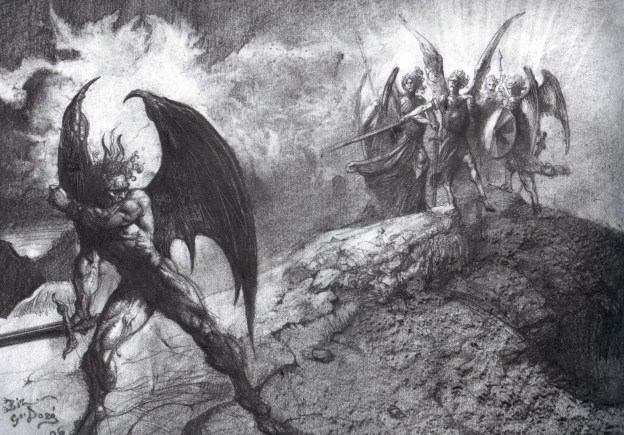
In John Milton’s Paradise Lost, Book 1, Satan and his supporters wind up exiled from heaven, and Satan calls forth his troops. Some believe Satan wields true power in hell after his fall from heaven due to Satan’s empowering rhetoric, the seeming control the demons have over their current situation, and their appearance of having free will. However, due to multiple references made to God’s perfect plan, Satan’s inability to resist God, the defeat of demons, and the difference between free will and power, it is apparent Satan does not wield true power in hell after his fall. Strong cases can be argued for both sides. However, through subtleties in Milton’s writing and the nuances he leaves the reader with throughout Book 1, Milton demonstrates Satan’s power is merely illusory.

Throughout Book 1, both Milton and Satan allude to God’s plan for mankind, thereby demonstrating Satan’s power is merely illusory. These obvious declarations of God’s plan is the primary example proving Satan does not wield true power, as the supporting examples tie in to this. Milton announces his purpose in writing Paradise Lost is to “justify the ways of God to men” (26). Book 1, therefore, demonstrates the ways of God by throwing Satan and his followers out of heaven. While the simple declaration of justifying the ways of God to men does not prove Satan’s power is illusory, Milton uses this declaration to pave the way for more compelling examples. For example, Milton begins to justify God’s ways through declaring Satan and his followers were thrown from heaven because they “transgressed his will,” proving God has power over all (31). This example combined with Milton’s references of man eating the forbidden fruit and needing Christ’s redemption proves God especially has power over transgressors of his will. Satan does not have power over God, proven by God’s preparation and knowledge, as further evidenced where Milton states hell was a place “Eternal Justice had prepared for those rebellious” (70-71). The preparation of hell is a compelling statement illustrating Satan’s lack of power and foreknowledge. If Satan wielded true power, he would have been able to resist God throwing him from heaven. Furthermore, Milton notes paradise, or heaven, was lost to mankind “till one greater Man / Restore us” (3-4). By “greater Man,” Milton means Jesus Christ, the Son of God. Milton’s reference to the restoration of mankind proves God’s foresight over the whole situation, as this example works together with the later declarations of God’s divine power and foresight over Satan attempting to thwart him. The aforementioned qualities of God are juxtaposed to Satan’s lack of control and power.

Some could argue evidence for the argument of Satan wielding power lies in the powerful rhetoric of his speeches, where he gives the other demons hope. Other evidence from his speeches says otherwise, where Satan and Beelzebub recognize God’s power. When these references to God’s power by Satan and Beelzebub are analyzed in relation to God’s overarching plan for mankind, the idea of Satan’s power being illusory becomes evident.

Satan’s uses rhetoric in a fruitless attempt to perpetuate his illusion of power. His misconception of power partially stems from observations of the sheer number of his followers. In discussing the issue of being thrown from heaven, Satan remarks that he “brought along / Innumerable force of spirits armed / That durst dislike his reign, and me preferring” (100-102). Simply because Satan has followers does not mean he has power. Satan attempts to rally his troops by saying, “all is not lost” (106), later realizing the folly of his illusion.

The synthesis of Satan and Beelzebub’s rhetoric further contradicts the idea of Satan wielding true power. Beelzebub says to Satan that he “endangered Heav’ns perpetual King” (131), and Satan refers to God as the “Monarch in Heav’n” (638). Satan and Beelzebub both directly state God’s kingship. Satan’s use of the specific word “perpetual” must be noted here. Since Satan attempted to reign in heaven and failed, thereby only acquiring followers in heaven for a temporary time, his exile from heaven directly contrasts God’s perpetual kingship in heaven. The lines where Satan perpetuates his idea of power are contradictory not only to the truth, as God’s foresight and plan for mankind was proven above, but also contradict later lines where Satan admits God’s power and therefore questions his own. Due to his misapprehension of power, Satan underestimates God’s power. Satan notes God concealed his strength, which “tempted our attempt, and wrought our fall” (642). Here, Satan admits God has more power than him, a realization he doesn’t come to until his exile. Beelzebub also admits God is omnipotent, and his argument is none but the omnipotent could have foiled their plan to thwart heaven (273). God is portrayed as “all powerful,” realized by Satan when he admits God concealed his own strength, especially because Satan mentions (in agreement with Beelzebub) only an almighty power could have thwarted him from overtaking heaven. Clearly, God is almighty in this text, because, by Satan’s logic, if only an almighty power can thwart him, and Satan was thwarted and thrown from heaven into hell, the argument that follows is God is almighty. By Satan’s own logic, he destroys the idea of having power, though he believes in other passages that he has power. Deep down, Satan knows he does not have true power, but will fight God anyway.

Furthermore, Satan’s illusions of power and grandeur caused him to attempt to thwart God, and Milton’s writing demonstrates what a fruitless attempt that was. Beings of power can resist beings of other power, meaning if one truly has power, he should be able to fight someone else with power for at least a small amount of time. Satan could not resist God. Milton states Satan “trusted to have equaled the Most High” (40). This manifests a judgment of Satan through noting his illusions of grandeur of attaining equality with God. Milton declares Satan waged war against heaven “With vain attempt,” an outright statement Satan’s war against God was completely vain and produced no fruitful results (44). That is, produced no fruitful results to the end of Satan gaining equality with God and therefore power over heaven. His fruitless attempt was due to his illusion and “trust” of possessing equality with God. To prove further Satan’s attempt to overthrow God was fruitless, Milton states the “Almighty Power / Hurled headlong flaming” (44-45). Not only did Satan fail to thwart God, God saw this in advance and violently flung Satan from the sky. A few lines later, Satan and his cohorts “lay vanquished” (52). The term “vanquished” connotes an utter destruction of a foe, meaning God did not just win the battle but vanquished Satan. Not only this, but God subjected Satan to a place where there is “torture without end,” torture Satan has no power to change but can only make the most of through acting more evil (67). When Satan attempts to pick himself back up, he observes his number of followers to puff up his own hubris, as referenced earlier.

Satan cannot heal himself, and therefore does not have true power. A striking example of Satan’s illusion of power is after God throws him out of heaven Satan is disfigured. If Satan truly wielded power, he would have been able to heal his face and the lightning would not have altered his appearance. Clearly Satan could not heal himself, because Milton writes “but his face / Deep scars of thunder had intrenched” (600-601). Here, “intrenched” means furrowed. Though Satan still shone and could shape shift, as noted when he stretches himself out in length (609), Satan did not have the power to alter the deep scars God’s power left upon him. This fact also relates back to God’s foresight over the whole situation, because God prepared Christ to restore mankind to heaven and prepared a place for Satan and his followers in hell.

Some would equate free will with power and therefore make the argument that because Satan and his followers have free will, they have power. The question remaining is why God would give Satan and his followers free will without power. However, correlation is not causation here. Free will and power are different things. Satan had the will to fight God in heaven, but his exile proves he did not have power. The demons do have free will, evidenced in their ability to shape shift. Milton says the demons “transform / Oft to the image of a brute” (370-371). The references mentioned above where the demons reference God’s omnipotence must be taken into account. God, in his omnipotence, gave the demons free will and prepared a place in hell for them (70-71). But, God had foresight and prepared a redemption plan for the world (3-4) despite man’s disobedience. God has omnipotence; the demons only have free will. 

Despite the fact many demons listed in the catalogues of demons were undefeated, mankind and God were victorious over others, which proves Satan’s idea of power is false. God’s forces did not defeat many demons listed, and some will attempt to use this fact in favor of the argument of Satan wielding power. Among the undefeated demons are Moloch, Baalim and Ashtaroth (plural forms of the male and female gods, respectively), Astoreth, Bimmon, and Belial. While it seems an overwhelming number were not defeated in the text, in the beginning of Book 1 Milton foreshadows a future event involving the “Greater man” who will redeem mankind (3-4) not only from the forces of hell but also from these specific demons. Therefore, by foreshadowing early in Book 1, Milton demonstrates Satan’s power is illusory, despite the later references saying demons gained some power over mankind. Simply because a select few gain power over mankind does not mean Satan has true power over eternity. In favor of Satan’s power being merely illusory, Milton mentions major demons that were defeated by God’s forces. The text states Josiah drove Chemos to hell (418). Chemos was worshipped in Israel and caused lustful orgies. Another catalogue of demons include Osiris, Isis, and Orus, all worshipped in Egypt. The text says “Jehovah…who in one night…equaled with one stroke…all her bleating gods” (487-489). By “equaled” Milton means leveled. Although fewer demons are defeated than worshipped, due to Milton’s foreshadowing of the restoration of mankind and humans thwarting the demons (Josiah) as well as God (Jehovah), the text proves Satan’s power is merely illusory. If his power were real, the demons could not be vanquished and Satan would rule not only on earth but also in heaven.

Satan and his comrades are powerless when matched against God’s almighty power and plan. Although some believe Satan wields true power in hell after his fall from heaven, Satan’s “power” is merely illusory. Through the nuances obtained from reading Satan’s speeches, subtleties in Milton’s writing, and God’s continual display of power, it becomes clear Satan is powerless. Satan will attempt to fulfill his illusions of power and grandeur and attempt to thwart God’s plans, to no avail.
Women and the Great Depression

Daniel Coats

Barely anybody got out of the destructive effects of the Depression.  People lost their homes, became unemployed, lost their land and farms, and lots of people lost each other.  Women had the hard task of taking care of their families without any source of income and had competition for jobs.  Women had the hardship of competing against men for jobs.  Men had the upper hand just because they were male.  Eleanor Roosevelt’s It’s Up to the Women helped spark a new hope and strength in the hardworking women during the Great Depression.  Without women stepping up in the Great Depression, the United States may have never pulled through.

While men worked with a reduced income or didn’t work at all because no jobs were available, they walked the streets sometimes feeling defeated; when they got home, they felt like their families weren’t getting the best out of them.  Now, all of the men didn’t give up and quit, and they weren’t always down on themselves.  The point here is that usually women always had roles and were busy, unlike the men.  The women (or housewives) technically always have a full-time job, and that is taking care of the family, cleaning around the house, cooking, and even using what money they have wisely.  Women and men both have to be financially wise during hardships like the Great Depression.

Not all women were not married, though.  Some were widowed, divorced, and abandoned to take care of the whole family by themselves.  These women had to be twice as strong, sometimes having to find a job and take care of the family while others would shut themselves up and just eat practically a cracker a day to survive and keep their children alive.  Women had to overcome the stereotypes of what constituted “women’s work.”  In fact, they did, and, turns out, during the Depression the hiring rate of women went up to 25.4%, a rise since before the Depression was 24.3%.  That’s a staggering difference of two million jobs.  It’s even more surprising because it rose during the Depression, while men’s employment rates dropped significantly.

Throughout the Great Depression, women of different ages and races had different experiences.  For example, the black women had already been going through hard times having to work anyways, so some considered the Depression just affected white folks for a while until they had to fight for their own jobs, but white women became so desperate as to work in the fields with the black women.  The Mexican women didn’t fare too well, either.  33% of the Mexican population returned to Mexico, causing even more hardships and financial problems.  Also, men were more likely to get hired for the heavy construction jobs and agricultural work, while women were forced into sewing rooms and other places to do “women’s work.”  The minimum wage was set much lower for women.  The black and Mexican women on top of all this faced racial discrimination.

Women had it worse in almost everything.  New federal programs came around with welfare and aids, and usually they were centered on a household with a working husband and stay-at-home wife, at first.  Unfairly, lots of women who were widowed or single with kids did not fit the profile to receive benefits, but with the help of women not giving up and speaking up, things changed.  Such programs implied women only deserved benefits and certain financial aids if they had a relationship with a man.

Barely any women held high leadership spots in anything at this time, so when strikes and riots broke out for women’s rights, not much was being influenced.  The only major voice women had was Mrs. Roosevelt.  Eventually the few women leaders there were spoke out.  Secretary of Labor Frances Perkins, Ellen Sullivan Woodward, and Molly Dewson were the major factors that really took advantage of the fact Mrs. Roosevelt was in a high position.  They talked and planned with her and eventually got to oversee and add input for the social welfare initiatives and women relief projects.  Also, they really influenced the Democratic National Committee by pressing hard for an issue-related reformed agenda.  The Depression really impacted everyone negatively, but for the future, without the Great Depression, women might not be treated like they are now.

Few people escaped the devastating hit of the Depression.  Men, women, and children were all affected in different ways.  With the help of women, America rose out of the Depression and became a great nation again.  Women and their movement were somewhat under the radar, but they persevered and eventually through speaking up, and not just protesting, they got work done.  They didn’t riot and protest in the streets and then go home and just relax.  They went out and worked hard and got into the work force.  If there are any lessons to be learned here, the major one would be not to underestimate anyone and to have a purpose in everything you do and get it done.  Just as the Bible says, “Faith without actions is dead”; so is trying to make a change but not actually doing anything.

Bibliography

McElvaine, Robert S. The Great Depression: America 1929-1941. New York: Times Books, 1984. 38-39. Print.

“Timeline of the Great Depression.” PBS. WHRO, n.d. Web. 12 Oct. 2014.

Ware, Susan. Women and the Great Depression. The Gilder Lehrman Institute of American History, 2009. Web. 10 Dec. 2014.

The Battle for Stalingrad

Justin Benner

The battle for Stalingrad was a heavily decisive battle that took place from September of 1942 to January 31st, 1943.  This battle signifies arguably Russia’s best battle in all of WW2.  However it did come at a cost; that cost was 2 million civilian and military casualties.  This was one of the entire wars bloodiest conflicts.  In the battle, Soviet forces surrounded the entire German army under General Friedrich Paulus, emulating Hannibal’s encirclement and destruction of a Roman army under Aemilius Paulus in 216 B.C.  This city was crucial to both sides due to its strategic location and morale.  Stalingrad was a huge open door to Southern Russia.  The Russians intended to keep it, since it was a huge industrial and transportation hub, while the Germans saw it as a key launch point for future assaults and a heavy morale blow for the Russians, seeing as the city is named after a Soviet dictator.

“Stalingrad was to be assaulted; with oilfields remaining a priority…the sixth army under General Friederich von Paulus was assigned the task of taking the city” (Jordan and Wiest 115).  Lieutenant General Valisy Chuikov was in control of Stalingrad’s defense with the 62nd army.  He had the unfortunate luck of taking command of the 62nd three days before the attack commenced on September 14, 1942.  The battle went on for weeks, with little progress on the German side.  “By November, the 6th army had thrown six major attacks against Stalingrad’s defenders, who were by then confined along some 8km (5 miles) of the river bank around steelworks and armaments factories” (Bishop and McNab 94).  Conditions were described as hellish by soldiers.  One soldier’s diary reads, “When night arrives, on one of those howling bleeding nights, the dogs plunge into the Volga and swim desperately to gain the other bank.  Animals flee this hell; the hardest stones cannot bear it for long; only men endure.”  This only goes to show just how bad conditions were on the banks of the Volga that animals would swim to the other side to flee the barrage of artillery, bullets, and mortar shells.

“While the battle raged, the Soviet High Command prepared a counter offensive.  Operation Uranus deployed over 1.05 million Russian troops, seeking to encircle Stalingrad from north to south” (Jordan and Wiest 116).  It started along the northern front on November 19th, 1942 and started the next day on the southern front.  The forces met and fully encircled the besiegers on November 23rd.  Russia’s plan with this “besiege the besiegers” plan counted on the line not breaking and cutting off supplies to the Germans inside.  When the Germans figured out they were trapped in a Soviet death circle, General Field Marshal Erich von Manstein, commanding officer of the 11th army, which had been placed under the 6th army, felt the best course of action would be to draw the Soviets westwards away from Stalingrad to take the pressure off the 6th army and give General Paulus some time to organize a breakout.  This mission would be known as Operation Wintergewitter (Winter Storm).  However, due to bad weather and a lack of supplies to Paulus’s 6th army, the operation failed.  On January 31, 1943, General Paulus surrendered.

However, the 6th army was almost decimated after the surrender.  They had taken heavy casualties during the fight for Stalingrad, but they would take almost just as many from cold weather, starvation, and disease.  “More than half of the 300,000 men trapped in Stalingrad had been killed by the time of the surrender.  A fortunate few, some 35,000, had been evacuated by air, but the surviving 90,000 men were headed to Siberia on foot…only about 5,000 of the 6th army ever returned to Germany” (Bishop and McNab 95).

This paper was written using 2 different World War 2 history books: Atlas of World War II by David Jordan and Andrew Wiest, and Campaigns of World War II Day by Day by Chris Bishop and Chris McNab.  Atlas has a heavy bias toward the Allies.  That is to say, all Allied victories are made to sound superior or better than the Axis victories.  It does not go into much depth when it comes to timelines and day to day events; however, it does go into the background and strategy of the battle including the aftermath and what it will affect relating to other battles.  Campaigns does exactly as it says.  This book goes heavily into timeline description of day-to-day events and the logic behind them.  It has a neutral feel to it, as it doesn’t give an opinion or even a bias toward either side.  It quite simply shows the facts, whereas the Atlas seems to lean toward Allies’ victories more.

History of Science Fiction

Chris Glock

Science fiction has arguably existed since the first recorded fiction, while others believe it wasn’t later until 5th century BC.  “Why isn’t there a clear start to science fiction?” you might ask.  Well, because there is no easy way to say something is or isn’t science fiction, many of these older stories only include one or two parts relating to science fiction, but for some people that’s enough to classify the whole story as sci-fi.  The only common consensus seems to be the term “Science fiction” was an invention of the 20th century.

Since its creation, it has changed drastically, going through several eras and forms.  Today it’s one of the largest genres with many other stories from other genres having science fiction within them.  No two works are alike; some focus more on the science while others more on the stories resulting in a broad genre containing thousands of stories.

The first fictional story was the Sumerian The Epic of Gilgamesh.  While many agree it isn’t science fiction, it is however argued by a few well-known science fiction writers such as Lester Del Rey and  Pierre Versins to be the first science fiction novel based on its quest for immortality.  Other early works argued to be the first include the Hindu epic Ramayana (5th to 4th century BC) based on its inclusion of flying machines.  The Syrian-Greek “True History,” due to its many science fiction themes such as travel to outer space, encounters with alien life, interplanetary warfare, creatures as products of human technology, and worlds working by a set of alternate physical laws, also makes a case for the earliest science fiction work.

As many new scientific theories were being discovered, a new type of literature rose to popularity.  Due to the yearning to discover new scientific advances people begin fantasizing about the endless possibilities science had to offer in life.  Thomas More wrote Utopia about a society that had perfected their society technologically and politically.  This not only led to the utopia motif but also coined the word itself.

During the Age of Reason, many science fiction stories were released about space travel.  Johannes Kepler’s Somnium depicts a journey to the moon.  Both Carl Sagan and Isaac Asimov believe this is the first true science fiction story.  Shakespeare’s The Tempest, while not a science fiction story, creates a template for the mad-scientist archetype.

These trends continued to grow into the 19th century.  Most notably from this time was Marry Shelley’s Frankenstein, which features the mad-scientist archetype and popularized it as a sub-genre.  Jules Verne and H.G. Wells both wrote many novels in this genre considered classics.  H.G. Wells wrote novels like The Time Machine, in which he attempts to explain his views on society during his time.  Verne, however, wrote more fantastical adventure novels that sought to tell a story.  Journey to the Center of the Earth and Twenty Thousand Leagues Under the Sea are examples of his works.

The period of the 1940s through 1950s is referred to as the Golden Age.  During this time science fiction began to be taken as a more serious form of literature.  John W. Campbell became famed in the genre as an editor and publisher of science fiction magazines.  With his guidance, the focus shifted away from the technology to the characters, from hard to soft science fiction.  During this time, the space opera rose to popularity, which has nothing to do with opera itself but is a play on the term soap opera.  In the Golden age many stories began to contain deeper psychological focus with writers putting their own ideologies into the writing.

As the Golden Age slowly died off, “new wave” science fiction began to surface.  The ’60s and ’70s were full of experimentation in both style and content.  It focused even less on scientific accuracy than the previous Golden Age.  Writers also began to tackle more controversial topics like sexuality and political issues away from which writers had previously stayed.

Works Referenced

More, Thomas. Utopia. 1516. Print.

Shakespeare, Wlliam. The Tempest. 1610/11. Print.

Shelley, Mary. Frankenstein. London: Lackington, Hughes, Harding, Mavor & Jones, 1818. Print.

Verne, Jules. Twenty Thousand Leagues Under the Sea. Paris: Pierre-Jules Hetzel, 1870. Print.

Wells, Herbert G. The Time Machine. London: William Heinemann, 1895. Print.

—. The War of the Worlds. London: William Heinemann, 1898. Print.

Letting the Story Go: Why Disney’s Frozen is a Terrible Movie

Elizabeth Knudsen

Before any court case is filed, there is a valid reason as to why the recent Disney blockbuster Frozen is in fact a film that could be classified as “bad.”  Although many fans are unaware of this, the beloved film is based off of a lesser-known folktale, following the style of most preceding Disney classics.  The title of this folktale is “The Snow Queen,” and it was written by Hans Christian Andersen.  At first one might think there’s no problem, but unfortunately, when the individual story and movie, respectively, are examined and compared, the inconsistencies are startling.  Three basic categories can be used to contrast the two.  These three categories are plot, characters, and morals or themes.

The original Frozen, Hans Christian Andersen’s folktale “The Snow Queen,” was actually written as a seven-part story.  These seven parts relate the adventures of a girl named Gerda, who goes on a journey to save her friend Kai, a boy.  The story begins with a brief backstory concerning a wicked hobgoblin — sometimes referred to as the Devil himself — who creates a mirror that shrinks everything beautiful in a thing and magnifies everything ugly.  The hobgoblin and his minions plot to take the mirror up to Heaven to make fools of God and the angels, but on the way up it slips from their grasps and shatters into billions of pieces.  These pieces, some no larger than a grain of sand, are blown all around the world; they make people’s hearts as frozen as blocks of ice and settle in their eyes, distorting their vision as the full mirror would.

Years after this event took place, the two main characters enter; Gerda and Kai.  The two are neighbors who share window boxes filled with roses and are as dear to one another as brother and sister.  Kai’s grandmother tells the two children stories of the Snow Queen and her “snow bees” (the snow flakes).

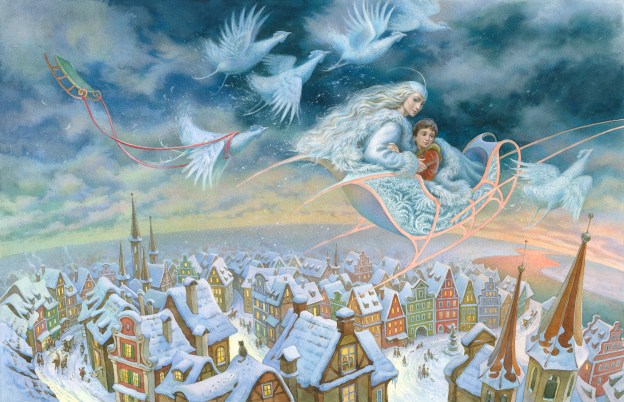
One winter, Kai sees the Snow Queen from his window, beckoning for him to come to her.  He backs away in fear.  Kai’s grandmother teaches the two children a hymn, two lines of which are repeated throughout the story.  The summer after Kai glimpses the Snow Queen, shards of the terrible mirror get into his eyes and heart.  As he and Gerda are at their window boxes, he becomes cruel and loves Gerda no more.  He destroys their window-box garden and instead gains an aptitude for math and physics and becomes fascinated by the only things that seem beautiful and perfect to him anymore: snowflakes.

One day after that, the Snow Queen comes to him in a disguise while he is playing in the town square.  She kisses him twice — first to numb the cold, second to make him forget all about his family and Gerda — but no more, because three kisses would kill him.  She takes Kai to her palace, near the North Pole.  While Kai is gone, the townspeople get the idea he drowned in a nearby river.  Gerda is heartbroken and refuses to believe it, so she goes to look for him.  The river tells her it did not drown her friend by refusing to take her new red shoes, and a rosebush tells her Kai is not among the dead, as it could see under the earth.  A sorceress who lives near the rosebush tries to keep Gerda with her, but Gerda flees.  A crow tells her Kai is at the princess’s palace, but the prince only looks like Kai.  The princess and the prince provide her with warm clothes and a beautiful coach to aid her on her journey.

On her way, however, Gerda is beset by robbers and taken prisoner.  She quickly befriends a little robber girl, whose pet doves tell her they saw the Snow Queen take Kai toward Lapland.  A reindeer captured from Lapland named Bae is freed by the little robber girl along with Gerda and the two ride to Lapland, making two stops.  One stop is at a Lapp woman’s house, the other at a Finn woman’s house, the latter tells Gerda she can save Kai because she is remarkably pure.

Once she reaches the Snow Queen’s castle, snowflakes try to stop her, but they are stopped by the angel shape her breath takes as she says the Lord’s Prayer.  Kai is alone inside the palace, trying to solve the Snow Queen’s puzzle to earn his freedom and a pair of skates.  He must spell the word “eternity” using ice shards she gave him.  Gerda runs to him and saves him with a kiss and her tears, which melt the shard or mirror in his heart and cause him to remember her, which causes Kai himself to burst into tears, removing the shards in his eyes.  The two are so overjoyed they dance together, and in their dance the ice shards are jostled to form the word “eternity,” gaining Kai his freedom.  The two then leave the Snow Queen’s kingdom with the help of Gerda’s friends, and they return home to find they have grown up, and it is summertime.

Although there are several characters in this story, the hero is clearly Gerda, and the villain is clearly the Snow Queen.  Kai could also be considered a main character, although he isn’t actually in the story that much.  Prominent themes are female strength — displayed in both the Snow Queen and Gerda —  as well as a true, realistic ending.  It is suggested true happiness is found through purity of heart and strength, which appear through childhood.

Turning to the movie Frozen, one has an entirely different storyline.  Elsa and Anna, two sisters, are princesses of a fictional realm called Arendelle.  Elsa has the ability to produce snow and ice and general winter at will but is not able to control it.  On the night of her coronation, the young queen loses control in front of her kingdom after being a shut-in for many years and flees to a distant mountain, after accidentally setting off an eternal winter across her kingdom.  Her younger sister Anna blames herself — she got mad because her sister did not sanction her marrying a Prince Hans of the Southern Isles — and goes after her, recruiting troubled Kristoff and his reindeer Sven along the way to help her.

On their way, they meet a living snowman named Olaf (who loves warm hugs), who leads them to the secret passageway to Elsa’s ice castle.  Elsa, while her kingdom is freezing and her sister is almost getting eaten by wolves, has transformed herself into an ice-wearing self-actualizer, when in fact she is still very much afraid of herself and of others.  Anna tries to tell her she will help Elsa work through anything, but Elsa loses control again after hearing she froze Arendelle, and her powers strike Anna in the heart; an act which is known to be nearly fatal.

With only the hope of an act of true love from Hans to save her, Kristoff, Sven, and Olaf rush Anna back to the castle.  However, Hans has been planning to take over Arendelle all along and leaves Anna to die while going to capture Elsa, claiming Anna had died already.  However, while Hans is off capturing Elsa, Olaf rescues Anna from freezing to death.  Anna realizes Kristoff is the one who truly loves her, and she loves him back, so she runs across the frozen river toward him, but as she is turning to ice she sees her escaped sister, kneeling broken-hearted on the ice after hearing Hans’s lie about Anna’s death.  Anna turns from her path to Kristoff and leaps in front of Hans’s sword just as he tries to kill Elsa, and she turns to ice.  Elsa is shocked and even more devastated and throws herself onto the ice statue that was once her sister and sobs as Kristoff draws near.

But then, a breath is seen, and the girls’ sisterly love is strong enough to bring Anna back.  Then Elsa realizes the key to controlling her powers and bringing back summer is love.  The movie ends with a hint Kristoff and Anna end up together, while Elsa hosts kingdom-wide ice skating parties in the palace courtyard whenever she feels like it.

As one can see, the main characters are quite different.  The “Snow Queen” is not the villain after all, instead she is a misunderstood sociopath.  Her sister Anna is the hero and is supported by Kristoff, Sven, and Olaf along the way.  Themes in the movie include sisterly love, female strength, and the importance of staying true to oneself.

It is pretty obvious the words “based on” meant something a lot looser than one might at first think.  The plots of the tales are completely different.  One story makes the Snow Queen a villain, the other doesn’t.  It would be a completely different ballgame if Disney had done something like the Broadway musical Wicked, where the story is told from the Wicked Witch of the West’s perspective, and thus one is given a different outlook on L. Frank Baum’s The Wizard of Oz.  But instead, Disney decided to take an idea — the idea of a queen who could control snow — and make it into something nothing like the original story.  And not only that, but they didn’t even try to present any fresh values in the movie.  All of them have been done before; sisterly love in Lilo and Stitch; feminine strength or “girls can fight, too” or “girls don’t need a man to save her” in Mulan and Brave; the importance of staying true to oneself in every single Disney classic except for The Little Mermaid.

What is most ironic, however, is the fact in the original folktale there was an even better storyline to suggest a girl doesn’t need a man to save her: Gerda saves Kai.  And over all, it would have be more beneficial in today’s culture for girls to hear strength and purity of character are what really count, not self-actualization and “letting it go.”  Girls are surrounded by the pressure to be yourself (while ending up being like everyone else) enough every day.  They didn’t need a Disney movie to confirm it.

In the end, Frozen still made millions in the box office, because it fed girls across the world what they wanted to hear, disguised in a catchy tune.  But that doesn’t make it a good movie.  In fact, it makes it a bad movie.  It doesn’t make people think; it entertains them for two and a half hours and then encourages them to be singing “Let it Go” for the rest of the day, because that’s the message Frozen represents.  No one should have to change (despite the fact change is a part of life), and people should just deal with others’ emotional and mental problems without trying to help them with it.  Love — whatever that means — is the answer to all of life’s problems.  Frozen versus “The Snow Queen” is just one example of the decline of book-to-movie adaptions.

Works Referenced

Andersen, Hans C. The Snow Queen. 2nd ed. Vol. 1. Denmark: n.p., 1844. N. pag. New Fairy Tales. Print.

Buck, Chris and Jennifer Lee, dir. Frozen. Writ. Chris Buck, Jennifer Lee, and Shane Morris. Walt Disney Studio Motion Pictures, 2013. DVD-ROM.