Category Archives: Issue 13

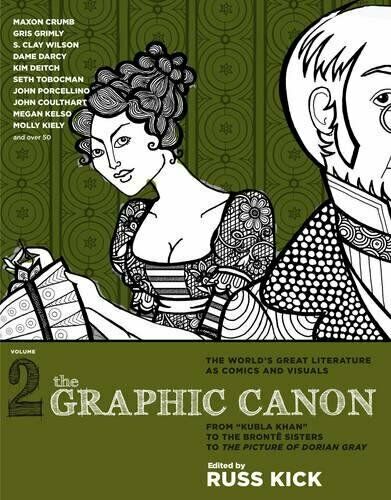
Review: The Graphic Canon, Vol. 2: From “Kubla Khan” to the Brontë Sisters to The Picture of Dorian Gray, ed. Russ Kick ⭐⭐

Christopher Rush

This volume was better than volume 1, but one has to say that with the same tone as one says “having a temperature of 104 is better than having a temperature of 106.”  Some of the artwork is great — this is a fine showcase of a number of up-and-coming artists who may make it big for all the right reasons.  Some of the “artwork,” though, is just sloppy mediocre pseudo-art pretentiously demanding we call it “art” just because it says so (even though Mrs. Wilson’s 3rd-grade class could draw better than this).  In what purports to be a collection of the “World’s” best work during the 18th-19th centuries, we are led to believe “the world” is mostly the UK and the USA, with only a dozen or so selections from other countries, including one that is essentially pornography (Venus in Furs), but Kick assumes we are enlightened enough to consider masochism is actually fine literature.  Some artists do treat the source material with great respect.  Others, like Hunt Emerson, don’t.  If I said Kick gives too much space to Nietzsche, Darwin, Ludlow, Carroll, and Blake, would that betray my biases? or his?  Nat Turner, who killed people solely because of their race, we are told is a hero — killing people on the basis of their race is a quality of a hero? in the 21st century? or ever?  I dunno.

Kick, as usually, exerts himself to the point of apoplexy trying to get us to believe each selection is astounding and each artist is a genius: if the work doesn’t speak for itself, no amount of cheerleading (i.e., grandstanding) is going to make it canonical.  At other times, Kick makes us wonder if he even read the work in question: Huck Finn respects Jim as a human being early in the novel?  Not really, no.  Perhaps Kick’s penchant for postmodern criticism has hindered his understanding of the actual works.  Some inclusions just make us scratch our heads in bemusement, wondering why entire short tales are in here simply to show off one panel of artwork from Kick’s heroes — especially since Kick includes other works about selections without the relevant prose (such as the lengthy litany of Alice in Wonderland adaptations).  If the purpose of this is to encourage readers to go out and read the real thing, I fear it fails.  If the purpose is to show off the contemporary panoply of artists, it may succeed both to tell us whom to admire and whom to avoid.  Reading this is mostly a chore — it has some bright spots, but they are few and far between.
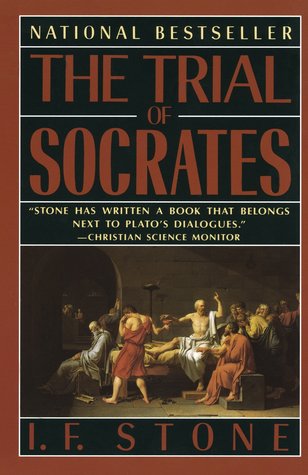
Review: The Trial of Socrates, I.F. Stone ⭐⭐

Christopher Rush

This book was a gnat’s wing away from being a good book, but Stone spoiled it for me with his pseudo-academical language and absence of an ending.  I applaud I.F. Stone’s ability and desire to learn Greek in his late 70s: that gives me great hope for my own linguistic aspirations … though I suspect Stone was able to do so because he spent the first 70-some years of his life working hard, making money, and making friends, all of which (mostly the first) allowed him to spend his twilight years learning Greek and writing this book.  Notice, however, this is not Irving Stone.  This is a different Stone — a journalist who wanted to learn Greek and know more about the trial of Socrates.  As admirable as that sounds, Stone comes off rather highhanded throughout, and from the beginning the ubiquity of words such as “Xenophontic” dispels any enthusiasm the reader had for the material.  Structurally, it is rather confusing, since several chapters do not really discuss what the title of the chapter is about until after that chapter is over and the reader has begun the next chapter.  Much of part 1 gives the reader the impression you are reading the same basic idea simply in different guises — but that could also be the frequency of “Platonic” and “Xenophontic.”  Stone has all the suavity and facility of a sophomore Classics major who, having read at least three semi-definitive works on Ancient Greece feels confident to name-drop the authorities and translators, as if his personal (admittedly limited) experiences give him permission to define and represent the entire field.  Stone says in the prefatory material of the book Socrates’ death was unjustified, but then Stone spends over a dozen chapters on why Socrates was an undemocratic, elitist snob who only ridiculed people and never defined the terms he supposedly wanted to define, yet the Athenians did the wrong thing (mainly because “he’s Socrates”).

By the last few chapters (including the discursive epilogue), the reader gathers the impression Stone would rather tell us things he has read about in the classical world than give any meaningful summation of his investigation into Socrates’ trial — again with all the authority of someone who, having last night watched Enter the Dragon for the first time, is suddenly an expert on Bruce Lee.  This book could have been so much better.  The reader will certainly learn a few things about the subject, but Stone’s language and style will not make the journey all that enjoyable.  You will be better off reading the works (even in translation) for yourself.

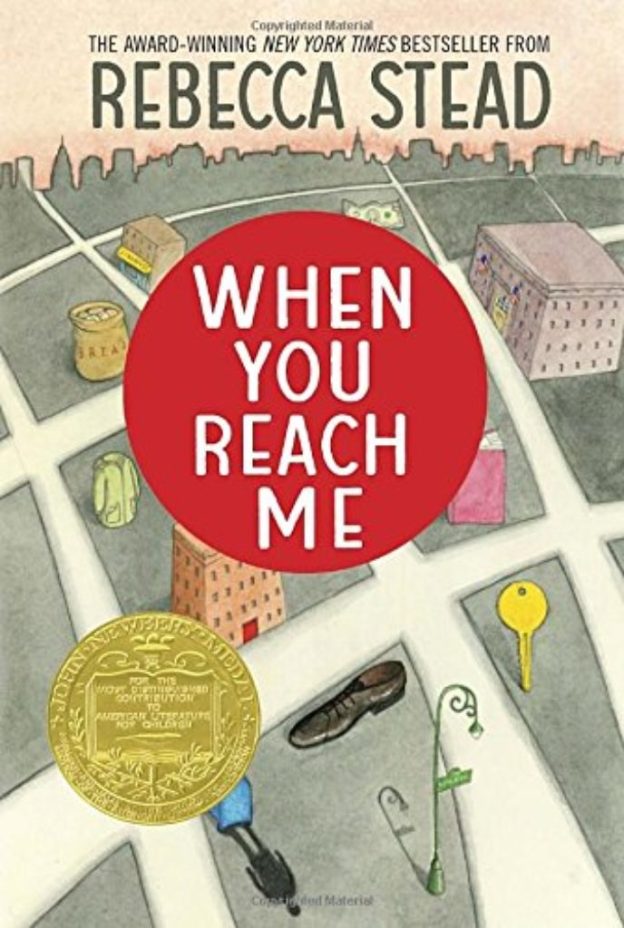
Review: When You Reach Me, Rebecca Stead ⭐⭐⭐

Christopher Rush

A 2.5-star book rounded up.  It’s not that great of a book, if I may speak openly, primarily in the tone and style and (for me) feel of the reading experience.  Admittedly, “feel” is highly subjective, but as I read the book I have the experience to discuss it.  I don’t doubt Author Stead grew up in the ’70s, nor do I doubt she grew up loving the works of Madeleine L’Engle.  Yet, this work feels like someone writing in the 2010s as if it were the 1970s — and it doesn’t work, no more so than any movie in the 2000s that tried to recreate an ’80s feel of a movie.  Similarly, the 1st-person narratorship falls flat and irritates; this does not sound like it is narrated by a teenage girl (or however old Miranda is as a supposed 6th grader), just like one of the main failings of the supposedly-great-but-really-overrated Catcher in the Rye.  I don’t doubt 6th graders 35 years ago were more intelligent, and I’m pretty sure I was more intelligent as a 6th grader than most 6th graders today, but the work comes off like it is trying too hard and instead drizzles with all the authenticity of Pat Boone covering AC/DC.  Or each and every single reboot of ’70s and ’80s pop culture done today (though Stead’s work is better than these horrible movie deconstructions, since Stead maintains a love for L’Engle not an outright rejection of her).

If, as Stead claims, A Wrinkle in Time is not supposed to dominate the story, that, too, is a failure.  The book is dominantly a love letter from Rebecca Stead to Madeleine L’Engle … and it would be fine if that was the intention: we certainly need more outright homages to important/quality works and authors of the past … but pretending it isn’t rings hollow and adds to the disappointing tenor of the work.  I admit freely I haven’t read A Wrinkle in Time, nor do I apologize or feel like I somehow missed out on something important in my childhood.  I was reading other important authors and having other important experiences, literary and otherwise.  Would having read A Wrinkle in Time make reading When You Reach Me a more enjoyable experience?  Perhaps, but it may also have made it more irritating.  I suppose if I read a book written today about how The Westing Game dominated someone’s life and thought and was about some mystery with undertones of Westing Game-likeness, I could potentially be enthused, but I suspect I would more likely be disappointed, with reactions such as “it’s not like that!” or “that wasn’t the most important part!” dominating my experience.  It’s a dangerous endeavor to share one’s childhood happinesses with others, especially later in life.  I suppose I should applaud Stead’s willingness to do it, but since so many clearly already do and have (especially the Newberry people, who bizarrely claimed this is “wholly original,” despite it being so dominated by A Wrinkle in Time — though I suppose it is too much to ask that today’s Newberry committee have ever read L’Engle either), I will just let the accolades come from others.

It does have some mildly clever things about it, yes.  The basic ideas are done well, and clearly Stead worked hard at making it a unified work with the foreshadowings and consistencies and little details here and there that probably wowed the people that really like this book.  Does anyone else feel sorry for Annemarie?  She really seems to get left out, both in the present and the distant dome-future.  The treatment of the supporting characters is a major factor in my disappointment with the book.  They come and go only to serve whatever temporary purposes Stead has in driving the main ideas in the book, though beyond time travel and I Love L’Engle, we aren’t really sure what the main ideas are, other than we applaud the commitment of that certain character to dedicate his life to right that wrong at such a high price (is that vague enough not to spoil anything for those who haven’t read it?).  That realization Miranda has is probably what pleases most audience members, and that was certainly a high mark of the book, but for me the casual dismissal of the supporting characters and supporting stories frustrates and disappoints — that and the pretentious (perhaps too harsh a term) chapter titles and teeny chapter lengths.

I would like to give this a higher mark, and perhaps if I read it again I could appreciate it more, and perhaps if I read more (any) L’Engle I would love it more. I’m willing to do that … just not right now.  Maybe some day.

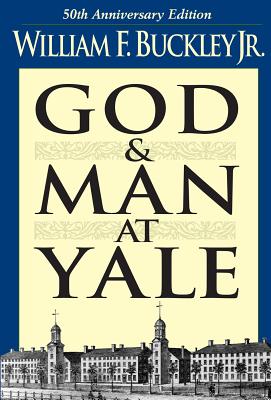
Review: God and Man at Yale, William F. Buckley, Jr. ⭐⭐⭐⭐

Christopher Rush

Even more frightening (and pertinent) that it is now more close to the 65th anniversary of this work, unsurprisingly Buckley’s book is necessary, enlightening, and apropos.  Buckley’s introduction to the 25th anniversary reveals his growth as a critic, thinker, and writer (the writing is much better than the book itself, which should not be surprising, considering he doubled his life experience and honed his writing output in the meantime).  It is more enjoyable to read than the book, but the book itself should be read, if for nothing more than the reminder, especially to collegians today, the only thing colleges want from their alumni is their money.  What will perhaps come as an “I should have seen that coming” notice to us all is the litany of colleges, especially akin to the league of ivy-covered universities, during the ’50s that eschewed private enterprise and the free market in favor of government intervention and control (often called “socialism”) in economics courses.  Thus, all the decision makers in government who went to college since the 1950s have been weaned on Keynesian economics — no wonder we are in the state we are in today: all of them think they are doing the right thing.

Buckley’s discussion on the inefficacy of religion on Yale’s campus is thoroughly disheartening, especially considering the Decision Makers’ decision to prevent Buckley from giving his cautionary speech to the alumni under the abused, hypocritical claim of “academic freedom.”  Buckley’s trenchant discussion of both the passive (and sometimes overt) destruction of religion on campus, and the mythical trope “academic freedom” are likewise necessary reading, especially since the atmosphere at more colleges are even worse than they were when he first wrote this book.  We certainly are in a bizarre academic world when ideas like Intelligent Design are blackballed from the very public schools that claim to espouse “academic freedom.”

I especially enjoyed Buckley’s refutation of the notion Yale (and thus all, especially private, educational enterprises) must present all ideas in an unbiased way to the students and thus allow the students to weigh and decide for themselves what is true (or worthwhile or pragmatic or whatever) — as if the classroom is suppose to be an intellectual buffet.  Indeed, this is not the case: classrooms and teachers/professors, especially at private institutions, wholly have the obligation to stand for something — to proclaim what is true and encourage the students to believe what is true.  Certainly this does not mean they should avoid the thinkers and ideas contrary to what they believe, nor must they only discuss them superficially or derogatorily, but such inferior ideas should be refuted in the classroom.  Anything less is not an education.  That Buckley and his friends are not popular today should be enough reason for you to read this book.

Review: Unlikely Warrior: Memoirs of a Vietnam Combat Medic, C. Michael Dingman ⭐⭐⭐⭐

Christopher Rush

This is a good book.  Full disclosure: it was written by my father-in-law.  Still, it is a fine book worth reading, especially if you are a fan of a) autobiographies, b) spiritual journeys, c) books about Vietnam experiences, d) fine real-life stories, or e) books edited by me.  Mostly my editing work consisted of adding the letter “s” to the word “corps” and adding commas between independent clauses joined by coordinating conjunctions.  This is not a shattering tell-all about ’70s government or military intrigue, though you will get an honest, authentic first-person account of a young man struggling to understand life, religion, war, politics, and how he fit into all of it as a man of love and peace in what seemed to be the least appropriate place for him: the battlefields of Vietnam.  You will enjoy the honesty, the style, and the action, and you will feel the frustration, the sorrow, and the loss right along with him.  Get this book and read it.  Then get 10 more for each of your friends.  You’ll be glad you did.

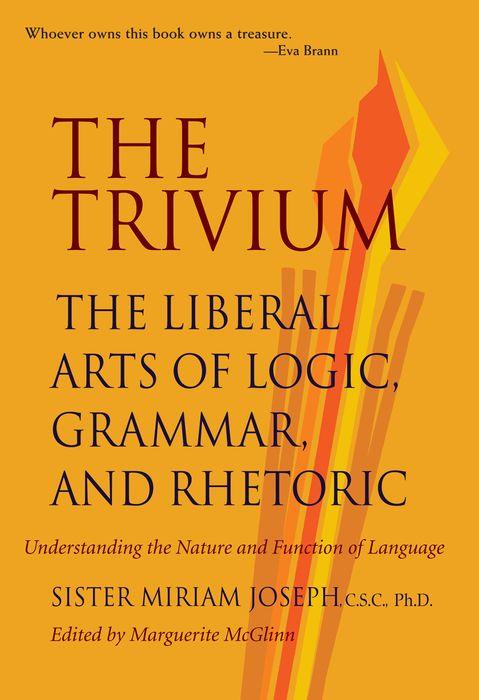
Review: The Trivium: The Liberal Arts of Logic, Grammar, and Rhetoric — Understanding the Nature and Function of Language, Sister Miriam Joseph, C.S.C. ⭐⭐⭐⭐

Christopher Rush

Readers may at first suspect of the three titles this book contains, it has almost nothing to do with the first (The Trivium), a scant bit to do with the second (The Liberal Arts of Logic, Grammar, and Rhetoric), and spends almost all of its time on the third (Understanding the Nature and Function of Language).  If such is the case, we are directed toward two possible conclusions: 1) Sister Joseph didn’t really know much about the Trivium after all; or 2) we didn’t really know much about the Trivium after all.  I shall lean toward option #2.  The Trivium really is about language — its nature, function, and connection to thought, worship, and reality.  Strangely enough, I’ve never read that in any other book purporting to be about the Trivium — have any of the modern reshapers of “classical education” read this book?  Many will no doubt find this book tedious because of its lengthy treatment of language.  Many will wonder “what about the subjects of the Trivium? where is her talk on what science classes we should have, what Bible curriculum, what novels to read, whether we should incorporate tablets into our education?” and thus prove they have wholly missed the point of the Trivium.  It is related to the Humanities, indeed, but it is not the Humanities.  The “Liberal Arts” of the Trivium are related to the other Liberal Arts, indeed, but they are not identical.

Who should read this book?  Anyone claiming to be involved in “classical education” or anyone who wants an education.  If you find it boring, guess what that tells us about you (your vocabulary, and your comprehension of reality).  Remember: “slow, difficult, yet important” books are not tantamount to “boring.”

I give this four out of five stars not for Sister Joseph’s work (though her diction is at times cumbersome, even for the time when she wrote it, and her insistence the first premise of a syllogism is the “minor premise” is perplexing) but for the editorial work and oftentimes tendentious footnotes by the editorial team involved in revamping this work.  If ever a work needed a glossary, this is it — but, sadly, no glossary is contained within.  It has an index, though that isn’t quite as helpful as it was likely intended to be.  Thus the presentation of the material sometimes detracts, yet the reader should persevere and read this wholly necessary work again and again — especially if one is paid to be involved with “classical education.”  (If such a one reads this work attentively, such a one will find out the “tools of learning” are, in fact, reading, writing, thinking, and speaking … who knew? … certainly not anyone whose sole knowledge of “classical education” comes from reading books by, well, no need to mention names at this point — but you know who they are.)

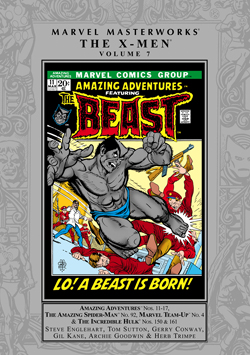
Review: Marvel Masterworks: X-Men Volume 7, Gerry Conway, et al. ⭐⭐⭐

Christopher Rush

I understand this comes at a very strange time in Marvel history, when the X-Men are moribund and not the powerhouse of today, and while the focus on Hank McCoy in his own title is wholly deserved, the creative team does no justice to his character or his story.  I grew up with Hank McCoy already in his furry form, so I was originally surprised when I learned he wasn’t always like that.  Now that I have finally read through the issues up to this point, I was disappointed in the actual transformation.  I know the Marvel Universe has a number of similarly-transformed characters (The Thing, especially), who no longer look the way they used to, and though the premise of McCoy transforming himself into a furry beast because of his research and whatnot is plausible, it just felt off.  Conway does a fine job with the transformation issue, and the pain of McCoy’s new life is depicted quite well throughout the issue with the off-putting atmosphere from the beginning until the end, so perhaps it is mostly the sadness for Hank that irritates.  Plus, if he is as smart as he supposedly is, surely he would have developed a counteragent before trying some magically-timed Cinderella-like potion on himself.

Steve Englehart truly does the greatest disservice to Hank through this series.  It’s bad enough the storyline is cancelled without any meaningful resolution (likely not Englehart’s fault, admittedly), but the characterization is rather wretched.  At first, we are willing to follow Englehart’s revision of Hank’s character, as his vocabulary and demeanor embrace the bestial identity of the new Hank McCoy … but a few issues later Hank has resumed his humanity and diction.  This is certainly a positive mark, in one sense, but the immediate abandonment of the character direction replaced with the early ’60s flippancy and dialogue in the dark days of the X-Men are grating, at best.  One gets the suspicion Englehart was itching to revisit the pirate ship episode if the series lasted any longer.  At least he doesn’t end every sentence with an exclamation mark, though he does feel the need to bring back old characters/villains just long enough to have them commit suicide by the end of each issue.  The other issues featuring Iceman, Polaris, and Havok are equally steps in the wrong direction, though on the whole we are willing to forgive the egregious disrespect the creative staffs display for their subjects, since we are just glad to spend some time with these characters again.

This collection definitely gets worse at it goes along, which is probably why the series was cancelled so soon, but it does have many fine moments and is rife with great possibilities … which never seemed to materialize, sadly.  What happens next to Hank and Linda and the Brand Corporation?  I wish I knew.  This collection does not tell us.  It’s worth reading, certainly, especially to fill in the missing gaps between the first demise of the X-Men and Giant-size X-Men #1, but it will not answer all your questions.

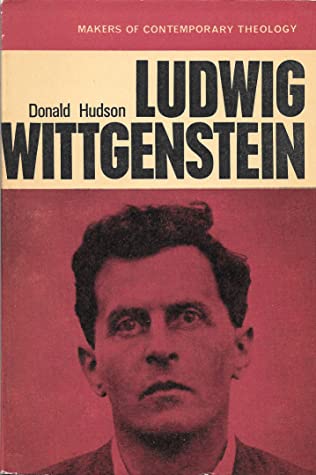
Review: Ludwig Wittgenstein: The Bearing of His Philosophy upon Religious Belief, Donald Hudson ⭐⭐⭐

Christopher Rush

As intriguing and potentially helpful as this booklet it, I’m not sure it really fulfills the promise of the subtitle.  Wittgenstein has no intention of connecting his philosophical output to religious thinking, though he seems fairly accepting of people who have it (which is awfully decent of him).  Wittgenstein is certainly a tricky fellow to grasp, especially since he spent the latter half of his output refuting the first half of his output.  Hudson provides a fairly helpful overview of major ideas, but a good deal of the end is spent somewhat hastily attempting to establish Wittgenstein as a “maker of modern theology,” since that is the series in which this booklet appears.  Hudson does present some ideas worth pondering, but their connection to Wittgenstein’s philosophy appear tenuous to me — though I am rather a tyro in the realm of Wittgenstein.  Hudson’s book could potentially serve the same function as a prose summary before a canto in the Inferno or book of Paradise Lost: read it first, get a grasp of the basic idea, read the chapter, then go back and read the summary to cement within yourself what it is you just read.  Similarly, Hudson could be read before one ventures into Wittgenstein’s work, then read the Tractatus and Philosophical Investigations, then read Hudson again.  Perhaps other introductions to Wittgenstein may be more helpful, but Hudson’s commitment to framing Wittgenstein within a religious/theological realm (even if it is against W’s wishes) is intriguing enough to engage in as a reader.  Track this installment (and the rest of the series) down and give it a try.

Review: Casanova Was a Book Lover: And Other Naked Truths and Provocative Curiosities About the Writing, Selling, and Reading of Books, John Hamilton ⭐

Christopher Rush

“N-a-k-e-d” is a strange way of spelling “boring.”  This book is really not interesting or provocative.  Hamilton spends a bizarre amount of time praising the Marquis de Sade as some sort of exemplar of humanity-literary behavior, followed by a preponderance of vitriol against religion and American presidents.  The attentive reader will also need a new hypocrisy meter after reading this, since it will overload and break somewhere around chapter 3.  Hamilton lambastes authors who use assisting teams, ghostwriters, and amanueses … all the while telling us how his graduate assistants (the goofy way college professors have of spelling “indentured servants”) gathered much (if not most) of the information retold within these pages while he was busy doing not his own research.  Hamilton lambastes boring and meaningless dedications in books … apparently forgetting the fact he has one in his own book.  In chapter seven, Hamilton feigns he is going to finally reveal the “most stolen books,” then backpedals with an excuse to the effect of “librarians don’t like to talk about it,” and finally pretends to give us a list of the most stolen books — but really are just representatives of types of books that probably get stolen a lot.  This book promises so much, yet despite an intriguing story-filled opening chapter, delivers mostly sub-interesting minutiae, vitriolic caterwauling, and a fecundity of dullness that even Thomas Shadwell might find lame.  Hamilton spends a chapter decrying the absence of negative reviews of books: here you go, sir.

Review: Education at the Crossroads, Jacques Maritain ⭐⭐⭐⭐⭐

Christopher Rush

This is a great book, though its beneficial audience is limited to educators, students, people who haven’t been educated, people who are being educated, people who should be educated, and people who need to be educated.  Thus, the audience is, well, everyone.  It’s one of those indispensable books, whose declarations about the sorry state of education and the ideal ways to ameliorate most problems are made even more frightening and sorrow-filling when the reader notices the book was written in 1943.  Education at the Crossroads is even more necessary than it was 70 years ago — something that can’t be said about too many education books.  It is dated only in fleeting moments, which adds to the tragedy of the intervening years: why didn’t anyone listen to him?

I wish I read this book 10 years ago, but there’s also the possibility I might not have been “ready” for it then, so better late than never, I suppose.  Maritain is correct about many things: the purpose of education, what schooling/education are not, the importance of understanding God and humanity for any education to work, and a slew of other things too numerous and adroitly explained by him that any brief treatment here will only perform injustice on the work and the author.  Not everyone will approve of his suggested curriculum and proposed age/school year alignment — in fact, most contemporary educationalists (the ones who get paid to make decisions and, like the characters in Peter Jackson’s version of The Two Towers, make only wrong decisions) will decry and rail and lament and ridicule (if they are willing to read a book that isn’t in e-format and doesn’t appear on any Common Core tests).  That’s one sure-fire way of knowing this is a book to read and incorporate into one’s soul.  It is not perfect, but it will help you understand reality better.