
Category Archives: Issue 9

Some Light Summer Reading

Christopher Rush

Well, here we are again.  A third volume of Redeeming Pandora.  And they said it wouldn’t last.  In this final year of the journal, we thought we’d go all out and make these final four issues as memorable as possible.  We’ll hear from some old friends, tie up some loose ends, and keep bringing you eye-opening and heart-warming articles for the rest of our journey together.  Here, just in case you were interested, are some of the works I read and reviewed this past summer.  I hope you enjoyed the absence of required summer reading this year.  I know I did.

Marvel Masterworks: The X-Men, Vol. 3, Roy Thomas and Werner Roth

Roy Thomas starts off his tenure as writer of the X-Men by showing off his knowledge of Marvel history — this could have been a good thing, had he done something interesting with forgotten characters or former X-Men villains.  However, he just sort of parades meaningless moments and characters who should have been forgotten and doesn’t do anything spectacular with them.  Yes, he does create the Banshee, but he makes him a confusingly-motivated ancient man and needs several tries before he can do something with him.  A great deal of the issues in this collection feature a dead-end plot thread of Jean leaving the team to attend Metro College (enrolling during the summer, for no reason).  It’s a dead end because Jean usually finds the time to join them on their missions anyway.  Despite initially feeling relief she is no longer a fighter, she apparently takes the time to sew new uniforms for everyone and rejoins them anyway.  All supporting plot threads that could have been interesting, such as Ted Roberts, Jean’s classmate who suspects the teens are the X-Men, are inexplicably dropped without any resolution.  Thomas even brings the Mimic back as a teammate of the X-Men — at Xavier’s request! — but this goes nowhere, despite some good character moments, since after a few issues Thomas has the Mimic lose his powers again.  It’s worth reading because it is classic X-Men, and Thomas does manage to get a few good character moments in there (he finally gets the Scott/Jean romance going after a while), but it’s not the best storytelling done in the X-Universe.  I read the individual issues, by the way, not the collection named in the title (it’s just easier to call it that for your ease).

Batman: The Killing Joke, Alan Moore and Brian Bolland

This is not for the faint of heart.  Its reputation is well-deserved, even if Alan Moore himself has distanced himself from his work (as is his wont, apparently).  Bolland’s artwork abets the grim story in unnerving ways, even without the remastered work in the recent deluxe treatment.  The work does not let up in its grotesquery, so don’t read this if you are planning on going to sleep soon.  We may never know if this is the real origin of the Joker, which would be all for the best, but it makes frighteningly good sense.  It’s short enough to be read in one sitting, which would be the way to go (if you are mature enough to read this).  You don’t want to linger, even though it will linger with you for a while.  It’s fast-paced, even with the pervasive mix of flashbacks and present-day action, and keeps you gripped, probably more so than any other Batman tale.  It’s the Dark Knight at his darkest.

Batman: Knightfall, Vol. 1, Chuck Dixon

Finally, after all this time, it’s come out in a nice TPB and I have read it.  Without all the preliminary prologue stuff, non-Batman readers might be a bit lost for a time, such as who Jean Paul is, why Bruce is already beleaguered, when Bane fought Killer Croc, for examples, but it shouldn’t bother people too much.  Bane’s origin is dark, but he doesn’t do much except wait throughout the TPB, other than the entire Arkham thing and breaking Bruce Wayne’s back.  It’s not nearly as boring as that sounds, since he is a fairly intelligent villain, though the addiction to Venom diminishes him somewhat, since it’s not just about his personal strength and intellect.  Anyway, the inevitable backbreaking isn’t the climax of the story, which is more impressive than I thought it might be — the real story is the destruction of Batman, the idea, the symbol.  As Bane says toward the end, JP as the new Dark Knight (emphasis on the Dark, not the Knight) does more to destroy Batman than he did, since he just broke Bruce Wayne: turning Batman into no better than the evil he conquers, Jean Paul becomes perhaps a worse nemesis for Bruce Wayne than even Bane is, but we’ll see what happens in part two.  The pacing is an odd thing for a 19+-part series, depending on whether you add the non-numbered parts of the story: sometimes issues take place immediately after each other, sometimes days pass, but all of it is fairly rapid in the beginning, following Batman and Robin’s attempts to recapture the inmates from Arkham, though Batman doesn’t treat Robin all that well whether he is Bruce or Jean Paul.  Even so, one doesn’t need to pay too much attention to the time factors, since the breakdown of Bruce Wayne is the central idea of volume one, and the creative teams do a fairly fine job with it.  The clash of ideas (the nature of good, for example) are highlighted at times, though they take a backseat to the action more often than not, but it’s still a good read that holds up after all these years.

Marvel Masterworks: The X-Men, Vol. 4, Roy Thomas
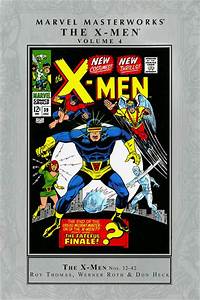
Unfortunately, Roy Thomas proves himself not very capable of delivering very good stories with these issues.  He tries his hand at a major storyline (for the time) with the mysterious Factor Three story, an extended conflict of a mysterious group whose only redeeming value is the introduction of Banshee.  Somewhere along the line, Thomas drops the whole “Jean is away at Metro College” thing with no explanation at all, another example of this creative team’s inability to sustain much.  At times, Thomas proves he is capable of delivering quite interesting character moments, notably giving Jean a personality for the first time in the series since issue 1.  Not only that, but we have the beginning of Jean’s telepathic skills as well, just in time for the startling conclusion in the final issue of this collection: the death of Professor Xavier.  The Factor Three main story has some potentially good points, like the “trial” of the X-Men by former foes, but as mentioned above, Thomas never brings the good ideas to successful conclusions.  Too often, especially by the end of this collection, Thomas breaks out an inane deus ex machina to finish off the story, often saying the villain was an alien from outer space, destroying all personal interest in the conflicts.  This collection also has some of the worst X-Men issues perhaps of all time: the combat with Spider-Man in #35, the Mekano issue in #36, the battle with Frankenstein’s monster in #40 (you read that right), and the utterly inane Grotesk battle in #s 41-42 resulting in the death of Xavier.  You know a comic issue is bad when you are longing for the days of El Tigre, the Locust, or even the pirate ship.  The new uniforms do nothing for the series other than give Thomas an excuse to stereotype Jean again (despite turning around and giving her one of the best scenes in #42 she’s had since the beginning, as mentioned above).  One would think it impossible to make a bad issue starring Spider-Man and the X-Men, but Thomas and Co. somehow managed to do it.  All the auguries point to the need for a new creative direction.  It is starting to become clear why the X-Men were cancelled.

The Great Hunt (Wheel of Time #2), Robert Jordan

Say what you will about Jordan’s style, he eventually gets around to telling an interest-holding story.  Not to say the beginning is boring, since he is creating a rather large world, increasing the cast and conflicts first introduced in The Eye of the World, while adding more layers of time’s repetition as he goes.  It’d been a few years since I read TEotW, so I was a bit concerned getting back to the saga whether I would remember enough to make it worthwhile, since starting over would take a fair amount of time; I read some online summaries to refresh my memory, which wasn’t quite as thorough as I thought it was.  This was helpful, but Jordan does a pretty good job of reminding his audience of the things worth remembering early on in the first part of The Great Hunt.  This was very nice of him, no doubt because his original audience would be reading them a year or two apart as well.  There’s a great thickness in these volumes, which makes one think a lot happens, but not much really does in this volume — that’s not a bad thing, though, since he knew he was creating a massive saga occurring essentially at the end of time, just before the Last Battle.  He doesn’t have years and years to cover, so a lot of detail happens.  Some readers might be put off by this, but if they are, one wonders why they are reading this series in the first place.  Jordan didn’t hide the fact he was intentionally recreating a combination of Tolkien, Arthurian Romances, and just about everything else.  Knowing that helps enjoy his overt use of myth and archetype — he’s not really trying to say anything new, so readers who get frustrated and say, “oh, that’s just like when that happens in…” are missing the whole point.  It’s a slow-building story, but again that’s because it is part 2 of 12/14 — if Jordan just threw every race, every item, every conflict, every character at us all at once, it would be a jumbled mess and not enjoyable.  This book was enjoyable, ever more so once I got used again to his style/diction.  True, a few threads are left unresolved, again because it is part of a series, but the story is somewhat self-contained even if one hasn’t finished reading TEotW the day before starting this.  It has enough twists, turns, and developments to make it an enjoyable read for those willing to take the time to read it.

Fables: The Deluxe Edition, Vol. 5, Bill Willingham

Focusing on characters generally on the periphery to date, the three storylines collected in this edition are rather enjoyable, especially if one has wandered away from the Fables Universe for a while (perhaps mostly waiting, as I am, for the deluxe hardcover editions).  Either the language is much more palatable for most of this book or it’s much less noticeable (hopefully the first), which adds to its enjoyment.  Time is a sort of tricky thing here, since the first two storylines (the first focusing on Jack, the second on Boy Blue) occur somewhat simultaneously with each other and the previous storyline of Snow and her cubs (seen only briefly here toward the very end of the third storyline collected here).  The “rest of the universe” attempt is rather bold — it really didn’t work for Battlestar Galactica, but somehow Willingham pulls it off, perhaps aided by the general familiarity we have with the characters (though that never helps too much with Willingham).  It’s nice to see Beauty and the Beast coming into their own, even though it has taken five years (not that we can really tell unless paying close attention).  The characters are starting to grow up, which is odd considering it has been hundreds of years since they have been in this plight — perhaps recent events have shaken them out of their comfortable torpor.  The third storyline is another clever addition to the Fables Universe, bringing in the Arabian Fables, having been earlier bridged with the return of Mowgli, in a nice touch.  It’s a clever story with an ending that works a lot better than the Roy Thomas/Gary Friedrich era of X-Men in the “that’s what you thought” vein.  The Adversary is revealed, but that doesn’t help anyone much, allegiances are tested, but as with most endings to the deluxe editions, a kind of peace settles in by the end, ready for the next big thing.  Nicely done, this.

Justine (The Alexandria Quartet #1), Lawrence Durrell

Durrell has created an interesting approach to fashioning literature (or at least, followed Joyce and Woolf the way they wanted to be followed): part dream, part memory, part compulsion.  It returns to itself quite well, though it doesn’t really lean toward repeated readings, since most readers probably will want to continue on with the series.  Just review the beginning again once you’ve gotten to the end and it will be even more impressive.  It starts out slowly, sectionally, as if it wants you to take your time in reading it, but that doesn’t help remember it much by the time you get further into the book.  Remembering all the characters can also be a bit tricky: Pombal, Pursewarden, Clea, Capodistria, Scobie, Nessim, Memnijian, etc., etc.  There’s a large supporting cast, but it’s almost as if you don’t have to pay too much attention, since the focus (when it starts to focus) becomes on the bizarre “love” quadrangle of the main characters (the love is not a real factor in the book, since Durrell is creating a story about human interactions/relationships that are driven by just about everything except love).  Durrell’s vocabulary and diction are enticing for much of the book, but stylistically interest comes in waves, receding and gathering.  The small sections can work to one’s benefit this way, if the reader perseveres through the middle where Durrell seems to be focusing more on his style than on the content.  I understand style was probably his main focus anyway, but it’s almost a bit too thick in the middle.  Durrell manages to maintain the style through the entire novel, but he eases up the intensity by the end, making it almost detached (a different kind of detached, since detachment is a key thematic and stylistic marker for the entire book, especially its characters).  It wasn’t as gripping as the critics I’ve read make it sound, but that was probably just me.  I’m willing to give the rest a try, sooner or later.

Star Wars: The Empire Strikes Back, Donald F. Glut

It was interesting finally reading this book.  It was much closer to the movie than the first novel, so it was difficult to find too many differences.  Some stand out, though: Yoda is a swift-moving blue creature in the book, one notable difference; Leia and Han’s farewell was also different — instead of the iconic “I know,” we have a different exchange, not nearly as memorable.  A few of Lando’s lines are different as well, but not too many different scenes exist — on the whole it is, as I said, interesting but not terribly impressive.  I’m not sure why a book was made, beyond the usual pecuniary reasons, I suppose.  But still, it is classic Star Wars, at a time when the Expanded Universe could fit on one very small shelf, and thus it is worth reading for that reason.  The uncertainty of the characters and their destinies are there, and much more “authentic” than in Splinter of the Mind’s Eye.  The characterization of Darth Vader is still slightly discrepant, so his comments and motivation for finding Luke are different and intriguing.  I still say it would make more sense to say TESB occurs 6 months after ANH, and RotJ takes place 3 years later, unlike what is “officially” recognized.  It still doesn’t make sense why 1) Han would wait 3 years to settle his debts with Jabba, 2) Ben would wait 3 years to tell Luke to seek out more Jedi training, 3) Darth Vader would take so long to track down Luke, as experienced as he is in the Force, and 4) the Rebels are only just now setting up shop on Hoth (where have they been in the meantime, why did they need to leave?) at the beginning of the book.  If it were only 6 months between the destruction of the Death Star and this, all of that would make a bit more sense.  And it would be more conceivable how Luke could become so much stronger in the Force in a few years between Empire and Return, how they could start to infiltrate Jabba’s palace, and how they could get so far on the Death Star without any mention of it in Empire. But that’s just me. It wasn’t a great book, but it was nice to go back to that time in the Star Wars Universe.  Things were so much simpler then.

The Complete Wargames Handbook: How to Play, Design, and Find Them, James Dunnigan

This was a pretty good read, though I was hoping it would be better.  The subtitle is somewhat misleading: yes, Mr. Dunnigan spends some time talking about how to play, design, and find wargames, but most of the book is him telling us about himself, his work, and the history of wargames (from his perspective).  I would have preferred much more time on what the subtitle says, especially playing and designing them, but since Mr. D indicates multiple times only a small select few are smart enough to really understand the math (and thus the essence of the games), he doesn’t really deign to tell us too much more than that.  Perhaps he wants us to go back and get all the back issues of S&T and Moves, which will really explain the things he doesn’t want to go into as much.  Since he got into wargames because he wanted to analyze history and learn more information, Mr. D takes the position this is really the best reason to get into wargaming — yes, he does emphasize (once in a while) the importance of “fun” (since they are “games”), but it’s not nearly as important to him (and thus, real wargamers) as the historical inquiry and conflict simulation (since that’s the more “proper” term than “wargame”).

Mr. D’s tone throughout, unfortunately, displays this “I’m really smart, most of you aren’t” attitude.  When telling us the history of wargames, he gives a backhanded mention of Avalon Hill, doesn’t name Charles S. Roberts at all, then let’s us now he and SPI saved the wargaming industry single-handedly for a decade, until he wanted to move on to bigger and better things, primarily his writing career.  Hopefully his other books are better written, but this had a fair amount of typographical errors (perhaps the big need for a revised edition, 10 years later, prevented time for proofreading).  In the appendices, Mr. D gives a decent list of other wargaming companies (as of 1992), and even almost gives some respect to AH, but it’s a little late in coming.  The computer wargames section, though, does not hold up well.  It isn’t even very interesting from a historical perspective, which is rather ironic considering the whole purpose of the book.

I fondly remember the ol’ 386 days and signing on to play games online (well, starting the dialing process, having a sandwich, reading a Michener novel, and then finish signing on and starting to play), but it wasn’t as great as Mr. D makes it out to be (which is not being said from rose-colored contemporary days, since I don’t play computer games today).  Obviously, at the time, it seemed incredible, but since he also says the computers were inferior to the strategic capabilities of manual wargames, it’s a rather weird section, almost as if he needs to validate his career choices in shifting to computer games, or at least promoting them.  The book is good, though, and he is helpful at times, even if he does repeat himself quite a bit (in the same paragraph, many times) and does talk down at the reader too much (especially for someone who didn’t really want to get into gaming, left it after an admittedly fecund decade, and moved on, sort of). He does give some helpful ideas in playing and designing (though not nearly as much as I had hoped), and it was worth reading, especially for people starting out in (manual) wargames, if any such person exists.

Marvel Masterworks: The X-Men, Vol. 5, Roy Thomas
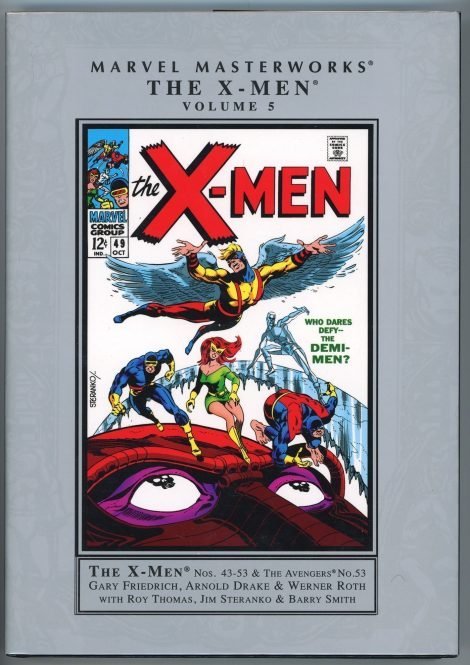
Again, I only read the X-Men issues separately, not the other issues included in this oop collection.  This really shows why the series was cancelled after another year or so — the quality just was not there.  Certainly some exceptions exist in this group, thanks solely to the art of Jim Steranko for a couple of issues, and the introduction of Lorna Dane is a great idea, but it’s an idea that doesn’t go anywhere here.  Instead, this run is full of ideas that seemed good at the time but ultimately failed: it picks up with the funeral of Xavier, and the letters pages at the time are adamant in the complete, irreversible nature of Xavier’s death (obviously we know how that turned out); this is followed up with the break-up of the team, by the FBI of all people, as if they have some sort of jurisdiction over the team.  This is typical of the issues here: potentially fine ideas hampered by illogicalities, inanities, and failed execution.  Had the X-Men volunteered to split up, giving the creative team a chance to highlight different characters in a short series, that could have been great — instead, it contradicts decisions already made, goes nowhere, and provides some of the worst stories in the history of the X-Men.  Magneto is brought back, supposedly killed off, and brought back again a couple issues later, with henchman Mesmero we’ve never seen before but is apparently Magneto’s life-long acolyte.  Juggernaut is brought back for what almost was a confrontation of Marko’s human side and the loss of his step-brother, but this, too, goes nowhere, and the issue devolves into a meaningless battle and an inane deus ex machina ending.  This run suffers from a lack of continuity, coming most likely from the great turnover in writers, artists, and decision makers.  We see again a fight with the Avengers begun for no reason and ending simply because the issue has run out of panels.  It does have some nice moments, oddly enough from Toad, but they are overshadowed by the general shoddy work.  Jim Steranko’s work does a good deal to stave off ennui with the series, though once his contributions end, the series immediately plummets to slipshod work again, as if no one was paying attention to the possibilities of quality work.  The last X-Men issue features a humdrum battle with Blastaar (who spends most of the issue facing away from the audience) and some of the worst treatment of Jean in the entire series (with Bobby even joking they never should have allowed women to start voting).  The series is sadly and definitely on its last legs here in its initial run.

Reading for Redemption: Practical Christian Criticism, Christian R. Davis

For most of this fortunately short (but not quite short enough) book, Mr. Davis’s title is more true than he probably intended.  Most of his interpretations in the body of chapters exhibit “reading for” redemption, indeed, almost to the point of “reading in” (as in “reading redemption into the work”).  He stretches his case rather thin for some books (especially Lord of the Rings and Harry Potter), and some works he twists out of shape to make fit his pattern (e.g., Ivanhoe).  His standards for popularity are also rather bizarre — drawing upon some arcane source of publishing statistics to identify historically popular novels (Tale of Two Cities, Uncle Tom’s Cabin) to see if his particular formula for successful redemptive works fit the past, with varying degrees of success (but since he is doing all of the quantifying, things work or don’t work mainly by his say so).  The postmodern/postcolonial works chapter strikes hollow throughout — he is reading for his formula, not for what is there, judging the works by the presence or lack of his criterion.  Likewise, the chapter on lyric poetry stretches his ideas rather thinly, which he himself admits, but an admission does not excuse poor treatment of the subject.

Perhaps the most frustrating aspect of this work is he either expects you, the reader, to be familiar with the works already, or he just doesn’t care if he tells you the ending or reveals the major surprises.  Beware: check the table of contents; if you want to read one of the books mentioned without having it spoiled, he will spoil it for you.  He rattles off almost all the major plot/character points for each book.  It’s one big spoiler alert.  Additionally, his diction throughout reminds one of a term paper — perhaps this is his Masters thesis modified into a short nonfiction of semi-criticism.  This does not make the work more enjoyable, however; nor do his noncommittal diction and tone (the tone is all “I suggest” this and “please consider” that, though he doesn’t use those specific words too often).  I don’t say this to be too disparaging, since he is trying to do something fairly important: returning literary criticism to an important focus, connecting it to what matters in “real life,” too.  Mr. Davis does have a fairly good grasp of many topics, as evidenced by his philosophical overviews in the introduction and conclusion.  In fact, the introduction, conclusion, and afterword are the best parts of the book.  It’s too bad he didn’t just take that sort of tone and approach for his literary explorations in the middle chapters; the book would have been much better.

His survey of Christian criticism in the afterward is again biased by his criteria of successful criticism, and it does seem a very abbreviated survey of Christian criticism, but it’s probably more exposure these other works would get without it, so it’s a fairly nice inclusion.  Overall, he does have some good ideas I was glad to read, and his major idea of the necessity of all three parts (creation, fall, redemption) to be a truly real/successful work of literature is a good idea to embrace, but his own application of the theory is a lot of what I try to teach my high school students not to do: mostly plot telling and forcing his theory into the works he addresses.  Were this book a sandwich, the bread would be far more digestible than the filling.

Jack Kirby’s Fourth World Omnibus, Vol. 1, Jack Kirby and Vince Colletta

Wowzers.  It takes Kirby a little while to get going, until we realize it is all part of the plan and remember Kirby is the King for good reasons.  Mark Evanier gives us some interesting insight into “the plan,” though, in the afterward: Kirby was planning on giving these new series away shortly after getting them started, ever desiring to create anew.  That doesn’t initially sound like a great plan for a new universe with a structured major story arc, but Kirby had a way of making things work, even if no one else around him could understand what he was doing.  It is somewhat discouraging to learn this “Fourth World Omnibus” does not have the great finale Kirby planned, once he was committed to telling the story himself (at least Babylon 5 got to tell its tale; Lost as well).  What is it about editors, owners, decision makers, and their near-total inability to make the right decision, to use wisely the great talent under them?  Pope Julius II tells Michelangelo, “Paint that ceiling.”  DC tells Kirby, “No, you can’t finish your mighty epic.”  Sci-Fi channel tells Farscape, “Sorry, you can’t have one more season to finish your story.”  Honestly.  I suppose it makes sense, though, that the really creative people have the basic sense not to go into top business executive levels and stay down at the creative people level.  This is a great place to start, since Kirby makes it all new from issue 1 — you don’t really need a familiarity with the DC universe to know who is who or what is what: Kirby makes it all up as he goes.  Despite the lack of a specific plan, the King tells some interesting tales.  Sure, there’s the Kirbyesque over-the-top dialogue (but, for a story about a world coming and taking over the world, and New Gods usurping the Old Gods, some over-the-top dialogue is necessary), and there’s the seemingly requisite ’70s racism (meet Flippa Dippa, the African-American Newsboy who always wears scuba gear, and Vykin the Black, the Black New God), but they don’t spoil the entire enterprise.  It’s quite a ride, and it’s only beginning.

Han Solo at Stars’ End, Brian K. Daley

To really enjoy this, one must try to remember what life was like before the Expanded Universe was large and complicated.  I said that earlier for Empire Strikes Back, but it is still true for Brian Daley’s early Han Solo trilogy.  Daley’s Han Solo doesn’t sound too much like “our” Han Solo.  Like many people who write sci-fi, he doesn’t quite capture the feel, the characters, the universe, and instead makes the characters talk like they would had they been living in the ’70s.  This is frustrating and disappointing at times, but if the reader can just acknowledge it and not let it be so much of a distraction, one can appreciate the effort much more.  Similarly, it’s not much of a “Star Wars” book, since it has nothing to do with the Force, the Empire, the Rebellion/Republic, or anything beyond the names “Han Solo,” “Chew-bacca,” and “Milennium Falcon.”  Yes, Daley has set himself up for that, creating a kind of backstory for Han before he had personally encountered any of those things, so those familiar elements would of necessity be lacking … but that doesn’t make the enjoyment of it any more palpable.  By the end, though, it becomes a mildly enjoyable generic science fiction adventure.  The final act is decent and even generates some suspense and interest in the ancillary characters Daley has created.  It’s not the greatest, but again the circumstances under which it was written were completely unlike today, so sentimentality wins out again here.  It’s nice to have it read after carrying it around for 20-some years.

Batman: A Death in the Family, Jim Starlin, Jim Aparo, and Mike DeCarlo

It’s hard to imagine how this story could have gone any other way.  As part of DC’s “you decide” campaign to get the audience more involved in the creative process (which rarely ends up as successfully as you want it to be, since, if the fans were really the creative ones, they’d be doing the actual creating themselves), audiences were allowed to call in to vote on the fate of Jason Todd, Robin 2.  By a much smaller percentage than I would have thought, the people chose death for Jason Todd.  He didn’t seem to be that likable of a character, and he is partly responsible for his own death, but it was still a fairly significant deal to have him killed, even in a universe that kills off and resurrects characters seemingly constantly.  Yes, they did eventually bring him back as a villain, but it took several years.  Jason Todd can be seen again in the pages of Red Hood and the Outlaws.  Jim Starlin does a good job in making even the usually unlikable Todd meet a heartbreaking end, in circumstances making his death much more tragic.  With a four-issue storyline, the reader might expect a thorough conclusion, especially since the introduction and development of the story is well detailed.  The story, however, just stops.  My initial reaction was frustration, since I had put the time into reading the entire arc: I wanted a good resolution, even knowing in advance what the outcome was going to be.

After thinking it over for a time, I realized Starlin did exactly what needed to be done: the Joker/Batman saga never stops.  Battles are fought and finished; the war rages on forever.  There was no need to “wrap up” the death of Jason Todd, since it would not be something from which Batman could just accept and move on.  It remains with him to this day.  In this way, Starlin and Co. have crafted a realistic story that resonates with everyone, even if they are not comic book fans.  Death is a meaningful, consequential part of life.  It’s not something that can be wrapped up in a few panels or pages.  The original audience may have delighted at the possibility of eliminating an irritating character and reveled in contributing to the direction of Batman’s life, but the creative team turned it into a showcase of the best parts of Batman as a hero: sacrificial, caring, grieved by loss and failure, tormented by his commitment not to kill and sink to the level of Joker and others like him.  From a distance, this might seem like a “typical” Batman story (Batman vs. Joker, Joker gets away), but it is far from that.  It’s a moving story that shows us the heart of Bruce Wayne, why he wears the cowl, and the sacrifices he makes to be a real hero.  This book is not to be missed.

Think: The Life of the Mind and the Love of God, John Piper

You know a John Piper book is bad when fans of John Piper don’t think it’s very good.  Such is the case with this book.  At the beginning, Piper names a few other books written about how Christians are to love the Lord with their minds.  Read those instead.  Read J.P. Moreland’s and James Sire’s books.  This is not a good book.  It is written poorly, and though he does say things that are true, none of them are significant revelations necessary for the reading of this book.  Do every 3 paragraphs need a new heading?  No.  John Piper thinks every 2-3 paragraphs need a heading.  I can’t explain why.  In his impatience to spout all of his repetitive comments, Piper can’t even follow his own train of thought.  He says he is going to return to his 1 Corinthians passage at the end of the next chapter; two pages into the next chapter, he is back to it, saying the same thing about it he has been saying for the last three chapters.  The book is quite redundant.  Piper tries to do something “different” by focusing on a Biblical defense of loving God with the intellect, or at least he says that’s what this is about.  It ends up being mostly a “thinking is good for Christians after all” apologetic, harping on a couple of already self-explanatory passages.  He doesn’t reveal anything new on the subject, and the notion a substantial portion of genuine Christianity doesn’t think Christians should use their brains is fatuous … isn’t it?  Do real Christians still doubt Jesus wasn’t telling a joke when He said “love God with your mind”?  If so, as I said, read Moreland and Sire to find out why Jesus wasn’t telling a joke.  If you want a better “life of the mind” book, alternatively, read Father James V. Schall’s books, especially The Life of the Mind.  It’s a far more Christian book than this intellectual abysm.

That was fun.  You’re probably wondering, “But Mr. Rush, those had almost nothing to do with your advertised summer reading goals.  What happened?”  Good question.  We watched a lot of Magnum, P.I. this summer.  Many of the books on my list are still by my bedside, waiting patiently.  For some series, such as Timothy Zahn’s Star Wars trilogy and Chris Claremont’s graphic novels, I decided to read the works ahead of them, in part because of my delight in doing things in order and because I hadn’t read them yet either.  I got pretty close to finishing up the first run of X-Men before Chris Claremont came along and salvaged it.  I was hoping to read more New Mutants, though I spent that time doing other fun things, such as preparing for 11th Grade Bible, delighting in some Emmaus Bible College Online courses from iTunes University.

This list probably looks like I spent a lot of time reading this summer, but it doesn’t take too long to read those comics.  You are probably also wondering why I read all those Batman books, since I’m a confessed bigger fan of Marvel — it’s nice to keep some mystery in our relationship after all these years, nice to know I can still surprise you.  I did read a few other things, such as The Hunger Games, and I finally finished Y: The Last Man, and I made some progress on the ol’ Syntopicon and continued my “read through the Bible in a year” plan … but it really wasn’t that much of a reading summer.  At least, it didn’t feel like it.  Unlike many summers gone by, I didn’t spend too much time playing video games, either.  So what did we do this summer?  Julia and I engaged on a perpetual non-stop game of Candy Land, for one thing.  We all took quite a few family walks around the neighborhood, delighted in yard saling (saleing?), grilling on the grill, and accomplishing a good deal more leisure than we got to last summer.  On the whole, it was a pretty good summer.  I’m not bragging; I know many of you had summers far less enjoyable, filled with strenuous work and disappointing situations (or worse) — I’ve had summers like that, too.  Hang in there, kids — they won’t all be rough.  Remember: God won’t leave you in the rough seasons any longer than necessary for your well being and His glory.

We hope you have enjoyed this issue of Redeeming Pandora.  Only three more to go!  Don’t be sad about that, though.  Treasure the good times.  We certainly do.

Up next: our 10th Issue Extravaganza!  See you next time, Faithful Readers!

On the Value and Benefit of Bilingualism

Audrey Livingstone

In an increasingly globalized world, one would easily conclude that knowing more than one language is incredibly useful.  However, there are those who remain under the somewhat dated assumption the difficulties of educating children and/or young adults in a second language outweigh the benefits of achieving and using fluency.  Recent medical research and studies prove this incorrect.  The value and benefits of bilingualism are great, and the demand for bilingualism is growing with the rise in the globalized nature of the work world.

Before exploring bilingualism’s benefits, there are a few minor worries and misconceptions concerning it worth addressing.  Firstly, many parents believe rearing bilingual children causes delayed language development.  Secondly, parents assume learning two languages at once causes language confusion.  There is no scientific evidence either of these things is true.  Annick De Houwer states, “There is no scientific evidence to date that hearing two or more languages leads to delays or disorders in language acquisition.”

Children who take longer to begin speaking and mix both languages in speech are not linguistically confused or delayed.  On the contrary, they are showing mastery of their languages through what is called code-switching (the ability to switch from one language to another in conversation).  And what is often perceived as linguistic delay is merely a child taking longer than average to begin speaking fluently and develop in either one or both languages.  True language delay refers only to significant difficulties with linguistic development.

So, with these most common objections dismissed scientifically, identification and exploration of the value and benefits of bilingualism can begin.  Recent scientific studies have shown being bilingual not only improves cognitive functions related to language but also other areas of the brain.  Bilingualism literally makes you smarter.  For example, studies conducted among a group of monolingual and bilingual young children have proven bilingual children have stronger, more developed executive functions.  The executive function is a “command system that directs the attention processes that we use for planning, solving problems and performing various other mentally demanding tasks.”  So, a more developed executive function allows for better multi-tasking, a stronger ability to ignore distractions, and the like.

In addition, bilingualism makes for someone who is more aware of their surroundings.  Usually, someone who is raised to be bilingual speaks one language with one parent and the second with the other parent.  This requires a constant back-and-forth of two languages in everyday life, which in turn requires more awareness of small changes in one’s immediate environment.  Now, this effect is lessened with those who are not necessarily raised to be bilingual, who may have learned a second language in middle school or high school years.  In that case, said individual is most likely limited to speaking his or her second language for a very small amount of time every day, which generally lessens cognitive effects of bilingualism across the board.

Another extremely important advantage bilinguals possess is the delay of the onset of dementia and Alzheimer’s.  Dr. Ellen Bialystok summarizes this in the following manner: “It is rather like a reserve tank in a car.  When you run out of fuel, you can keep going for longer because there is a bit more in the safety tank.”  Adults who remain bilingual have greater cognitive “reserve,” which is what staves off degenerative mental conditions.  The mind remains stronger and more aware later in life for bilinguals.

Bilingualism also opens the door for greater cultural awareness, which is definitely an asset in this day and age.  Bilingual (and multilingual) Americans have the ability to strengthen the nation’s international competitiveness.  This extends to areas such as the economy, politics, and education.  Reaching across different cultural and language barriers is crucial for any nation, but especially America, since the amount of immigrants increases year by year (especially Spanish-speaking immigrants).  The United States would benefit tremendously from young adults entering the work world who speak more than one language.  This cultural awareness not only benefits America and its international standing and relations but also the individuals themselves.  Cultivating knowledge and appreciation of other countries, their language, and their culture makes for a more all-around aware and intellectual individual.

Aside from cognitive and work benefits, bilingualism can have profound personal effects as well.  I have experienced this myself.  I began studying French almost three and a half years ago during my freshmen year of high school.  During my second year, I began to cultivate a deep interest in the language and culture about halfway through my second year of taking the class.  This interest grew throughout the next year, and since then has provided me with many amazing opportunities and new friends and relationships I never would have acquired had I not begun studying French.

My most recent experience concerning French was the Virginia Governor’s French Academy, of which I took part in this past summer for three weeks.  It was an extensive, competitive, and intimidating application process, but the benefits far outweigh that small imposition.  This Academy consisted of sixty Virginian high school students, all ages sixteen and seventeen.  For three weeks, we all spoke nothing but French — quite a daunting task for those who only spent about forty-five minutes daily in a classroom speaking basic French.  However, it ended up being one of the best experiences of my entire life thus far.  I had so much fun and made countless new friends who share my interests and passions.

It was incredible to see a group of young people come together and cultivate their interest for the French language, lifestyle, and culture.  Over the course of the three weeks, we took five classes: Contemporary France (modern politics and current events), Belgian History and Culture, Québécois History and Culture, Arabic Language and Culture, and French Phonetics and Linguistics.  All of these courses were conducted in French and expanded on our knowledge of international issues, goings on and such.  My cultural awareness was cultivated during my time at the Academy and that has impacted me greatly since then.

I believe many Americans live in a sort of bubble.  Even if America is the most powerful and successful country on the planet, that does not give us the right to be ignorant concerning other nations and cultures.  Up until learning my second language, I didn’t care to know anything on an international scale.  I live in America.  I am an American.  Why did I need to know anything about, say, European or Asian countries, cultures, etc.?   It didn’t make sense to me until my intellect and passions began to change.

This was partly due to a missions trip I took part in to Québec, Canada.  I was able to efficiently communicate with a Francophone community, which I not only thoroughly enjoyed because I love the French language, but also because I was able to use that in a godly way.  Reaching out to the people of Québec through missions was only really possible and effective because of my French.  I am able to now enjoy it not only on an emotional and intellectual level, but on a spiritual level as well.  Imagine how much more effective missions work would be if more Americans could reach across language barriers more so than we can right now!

In fact, imagine how much more effective you as an individual could be if you were more cultured.  The initial challenge of learning a second language is such a small imposition compared to its benefits.  If you took interest in another language, a real interest in it, learned it well and did something with it later in life, I believe you would be very pleasantly surprised.  Whether that involves working for the government, the schooling system, in the missions field, etc., I firmly believe everyone would greatly benefit from bilingualism on an intellectual, societal, and personal level.

Bibliography

“Benefits of Being Bilingual.” http://www.cal.org/earlylang/benefits/benefits_of_being_bilingual.html.

“Benefits of Being Bilingual: Two Languages May Delay Alzheimer’s Disease.” http://www.huffingtonpost.ca/2012/04/02/benefits-of-being-bilingual_n_1396671.html.

“The Bilingual Advantage.” http://www.nytimes.com/2011/05/31/science/31conversation.html.

“Bilinguals in the United States.” http://www.psychologytoday.com/blog/life-bilingual/201205/bilinguals-in-the-united-states.

“Raising Bilingual Children: Common Parental Concerns and Current Research.” http://webdev.cal.org/development/resources/digest/digest_pdfs/RaiseBilingChildi.pdf.

“Why Bilinguals Are Smarter.” http://www.nytimes.com/2012/03/18/opinion/sunday/the-benefits-of-bilingualism.html?_r=1&.

New Ending

Kaitlyn Thornton Abbott

I wish I had been born back when the world was simple.  I wish I had born back when the world was still beautiful.  I wish I had been born in the early-mid-1900s.  The times of our grandparents were better times, and it would do our generation well to return to that mindset.  The world of today’s American society and culture is fruitful, full of blessings we can achieve at the press of a button.  But it can’t be denied a negative connotation has come with it.  Philip Wylie summed it up rather well when he said, “Material blessings, when they go beyond the category of a need, are weirdly fruitful of a headache.”  Back in the early-mid-1900s, the mindset of the culture was different.  Every day and age has its own mindset, it’s true.  But the times of our grandparents were better times, and it would do our generation well to go back to that mindset.  Families spent time together, Sundays were the day of rest, kids were healthier, and there were standards.  I want you to take a step back from our perspective and look at this with a third-person point of view.

Answer me this: Is it really better of our generation to become antisocial toward our families and lock ourselves in our rooms with our iPods, computers, and cell phones?  Is it truly a better idea to spend all of Sunday freaking out over that paper that’s due first period Monday morning, or to spend that day doing chores ALL DAY?

We live in better times, so you say.  But is it really better if our generation has to deal with childhood obesity because every little boy out there is stuck inside all day playing Call of Duty: Black Ops?  And lastly, is it truly better if there are no standards in relationships or personal worth?

Cell phones, iPods, laptops: what every kid wants for Christmas.  Why?  So they can be in CONSTANT contact with their friends and because EVERYONE else has one.  But all of those have negative aspects that aren’t publicized but are rather well-known by the parents of almost any teenager.  If someone has a phone, a laptop, or an iPod, there’s no reason to get out of bed and do anything with your family.  This makes kids these days at times socially inept, because all of their social skills are based off of typed words, seen visually instead of having to deal with face to face communication in 80% of their lives, not counting school, according to The Simple Life: Applications Of Living Well by Amy Dacyzyn, the best-selling author of a newspaper dedicated to living without the distractions of today.  If we were to take a time machine and go back to the mid-1900s, we’d be shocked at how they lived.  Dads went to work, and the work day ended at 5 o’clock, on the dot.  They came home to a hot, HOME COOKED (i.e., not fast food) meal, awaiting them, and the family all sat down and ate together.

Geoff Asslet posted this conversation in his blog:

Someone asked the other day, “What was your favorite ‘fast food’ when you were growing up?”  “We didn’t have fast food when I was growing up,” I informed him.  “All the food was slow.”  “C’mon, seriously….  Where did you eat?”  “It was a place called ‘home,’” I explained.  “Mum cooked every day and when Dad got home from work, we sat down together at the dining room table, and if I didn’t like what she put on my plate, I was allowed to sit there until I did like it.”  By this time, the boy was laughing so hard I was afraid he was going to suffer serious internal damage, so I didn’t tell him the part about how I had to have permission to leave the table.

Before dinner, the kids would walk to their friends’ houses, sometimes a couple blocks away, playing outside, riding bikes, playing on the playground and such, using their imagination.  Nowadays, you don’t ever see that; all the imagination takes place inside a video game with 3D graphics and effects.  Dads are working late hours into the night; moms are busy taking kids to soccer practice and ballet lessons and carpooling a bunch of other kids.  Kids are up late hours into the night working on that paper they procrastinated on.  Experts all agree spending quality family time together is ESSENTIAL to a child’s emotional, physical, and mental maturity.  So if we keep heading in the direction we’re heading in, the future could very possibly consist of emotionally unstable, weak, stupid people.  Oh wait….  (Go to Wal-Mart, you’ll see my point.)

Sundays were the day of rest back then.  Families spent time together going to church, hanging up the laundry in the back yard on clothes pins; the kids went out and played before having to come home and go to bed so they could be well rested for school the next day.  Parents didn’t do much except relax before the upcoming week, except for making dinner, that is.  Now, Sundays are the catch-up day, rushing to finish any papers, practice, and football days.  The Merriam-Webster online dictionary defines resting as “to refrain from labor or exertion.”  Does that sound like any of your Sundays?  Or are yours, as well as mine, characterized by homework and chores?

Kids were so much healthier.  As I stated earlier in my first point, kids played outside; they had to WALK or RIDE BIKES to a friend’s house.  That in and of itself is more exercise than most kids in today’s society get.  People, mainly teenagers, are so “busy” they don’t have the time to exercise.  I’m sorry but that’s a load of crud.  They don’t have the time to exercise, because the time they could be doing that is spent on Facebook, video games, or TV.  Back in the day, there was no obesity not medically related.  Kids were outside soaking up the Vitamin D and being ACTIVE.  Childhood obesity was unheard of, unless you had a medical disorder.  They also didn’t have all of the processed junk we have now.  McDonald’s hamburger and fries, a Wendy’s Baconator, which I, for one, love, and Chick-fil-A: all of which have preservatives, salt, fat, and grease in them — lots and lots of it.

We figure into today’s life in the fast lane having fast food seems like a blessing.  And at times, when you’re pressed for time, it is.  But it’s also what kids have come to expect and crave, and it’s leading to a lot of weight problems in our generation.  People were not just physically healthier but mentally as well.  Since they didn’t have the same tools we do, they had to apply their brains a lot more than what’s required today (cough, calculators, iPads, etc.).  We have calculators and computers to do all the thinking for us; we don’t have to.  When my great grandfather was alive, he could go to the store and do a percentage in the store.  Who do you know who can do that today?  Not very many people, I’d say.

1950: people had standards.  In his blog about his childhood growing up in the states, Geoff Asslet comments also about how girls present themselves these days.  I mean, let’s think about it.  Homecoming dresses, for one, make me embarrassed to see girls wearing them — and even things people wear every day?  It’s just ridiculous to see girls giving away their bodies to complete strangers.  And relationships.  For goodness’s sake, what happened to VALUES?!  More teenagers nowadays I know are sexually active than would’ve even been accepted back then!  Yet society promotes promiscuity.  You know it’s culturally mainstream when there’s a Facebook “like” for it.

1950s: Guy comes to the door and asks father’s permission to date his daughter.

1980s: Guy’s at the door and girl just leaves with him.

2000s: Guy calls, “Hey, I’m here.”

2010s: Guy texts girl, “I’m here.”

I mean can you just say WOW?!  How much have the standards of respect changed?

I just want to leave you with this thought: Is it truly better of our generation to be socially inept and inadequately prepared for life after high school because we’re too dependent on technology?  Maria Robinson once said, “Nobody can go back and start a new beginning, but anyone can start today and make a new ending.”  That’s what we need to do now: not try to eradicate what we’ve been blessed with, but use to our advantage instead of wasting our lives on it.

The Origin of the Civil War

Jared Emry

Many historians of today make the absurd claim the Civil War was about the institution of slavery.  However, they are wrong.  The true reasons behind the illegal war concerned fiscal policies and the very concepts of the original American Revolution.  The issue of slavery was only to cover for the illegal and immoral economic reasons that were really the center of the war.  The war was a war for Freedom and the preservation of the rights of Nations and People.

Firstly, the South may have fired the first shot, but they did not start the war.  After the succession, each State had reaffirmed their positions as free nations(note they had not ceased to be sovereign States prior to the Civil War).  Upon throwing off the tyrannical General Government, the Southern States formed a New Union (which was called the Confederacy) under the original principles of the Revolution.  Upon the succession, the Union troops in the South’s territory were stationed illegally on another State’s soil.  When Lincoln refused to withdraw his troops from Southern land, he committed an act of war.  The South responded with a show of force by firing on Fort Sumter.  It would be no different if France told the European Union France was succeeding from the Union and all EU troops and officials must get off French territory.  If the EU refused to get out, France would have the right to use lethal force to remove the EU.  The South’s secession was entirely legal in the same way.  The General Government (and Lincoln) were committing an illegal act in attempting to force the Southern Nations to stay in the Union through force.  Secession was a right ensured to the states by the Constitution and reaffirmed by the Kentucky Resolve of 1798.  The Kentucky Resolve was penned by Thomas Jefferson and goes as follows:

Resolved, that the several States composing the United States of America, are not united on the principles of unlimited submission to their General Government; but by compact under the style and title of a Constitution for the United States and of amendments thereto, they constituted a General Government for special purposes, delegated to that government certain definite powers, reserving each state to itself, the residuary mass of right to their own self Government; and that whensoever the General Government assumes undelegated powers, its acts are unauthoritative, void, and of no force: That to this compact each state acceded as a State, and is an integral party, its co-States forming as to itself, the other party:  That the government created by the compact was not made the exclusive or final judge of the extent of the powers delegated to itself; since that would have made its discretion, and not the Constitution, the measure of its powers; but that as in all cases of compact among parties having no common Judge, each party has an right to judge for itself as well of infractions as of the mode and measure of redress.

As can be seen by the Kentucky Resolve, the General Government was a union, or alliance, of Sovereign Nations designed to give the several Republics more leverage in international diplomacy and to settle disputes between the Nations in peaceful manners.  Each State of the Union had the right to decide for itself whether or not the General Government had infringed upon the delegated powers.  Prior to the Civil War, each State had the ability to nullify anything the General Government did if the State decided the General Government had overstepped their bounds.

The Southern secession was entirely legal, but was the war about slavery?  No.  The war had nothing to do with slavery and was not caused even by fears surrounding slavery.  The majority of the North hated blacks and the only reason why they would care about getting rid of slavery would be to deport them and create an all-white nation.  Indiana, Illinois, and Oregon even amended their State’s constitutions to make it illegal for blacks to immigrate to those States.  General Ulysses S. Grant even stated, “If the war was about slavery, I would have joined the South.”  That statement is probably the most ironic quotation from the war.  If the war really was about slavery, like how it is often thought to be, then the only general in the Union who wasn’t afraid of General Lee would have joined the South, and the war would probably have been won by the South.  Likewise, since the war wasn’t about slavery, the South lost.  Also, Charles Dickens, an extremely famous author and a supporter of abolition said,

I take the facts of the American slave quarrel to stand thus.  Slavery has in reality nothing to do with it….  Every reasonable person may know, if willing, that the North hates the Negro, and that it was convenient to make a pretense that sympathy with him was the cause of the war; it hated the abolitionists and derided them uphill and down dale.

The cause of the war obviously could not be based on slavery, because the war itself was entirely unnecessary if it was merely over freeing the slaves.  Only six percent of free Southerners even owned slaves.  And not all slave owners were Caucasian; there were some very wealthy African Americans who owned hundreds of slaves themselves.  That shows slavery had more to do with economics than race.  If the war really was entirely about white supremacy, then such wealthy African Americans would not be allowed to reach such a high social standing.  Would the remaining ninety-four percent of the free population fight and die for something that had no personal economical value to them?  The slaves could have been freed peacefully, yet Lincoln and his fellow party members decided to wage a war instead.  But maybe the war wasn’t about slavery and thus comes the need for the war.

The South could, consistently with honor, and probably would, long before this time, and without a conflict, have surrendered their slavery to the demand of the constitution (if that had been pressed upon them), and to the moral senti­ment of the world; while they could not with honor, or at least certainly would not, surrender anything to a confessedly unconstitutional demand, especially when coining from mere demagogues, who were so openly unprincipled as to profess the greatest moral abhorrence of slavery, and at time same time, for the sake of office, swear to support it., by swearing to support a constitution which they declared to be its bulwark….  You, and others like you have done more, according to your abilities, to prevent the peaceful abolition of slavery, than any other men in the nation; for while honest men were explaining the true character of the constitution, as an instrument giving freedom to all, you were continually denying it, and doing your utmost (and far more than any avowed pro slavery man could do) to defeat their efforts.  And it now appears that all this was done by you in violation of your own conviction of truth.

The truth remains it was the North who were guilty of prolonging slavery for personal gain.  Lincoln and his fellow party members were guilty of supporting slavery more than the slaveholders.  Lincoln used slavery as nothing more than as a scapegoat for his actions.  Since California had joined the Union, an imbalance had appeared in the Congress between the Southern States and the Northern States.  This imbalance was in favor of the North’s politics and directly resulted in the Morrill Tariff.  Tariffs are always economically destroying to agricultural societies.  The Morrill Tariff caused the South to pay eighty percent of the Union’s taxes and forced it to buy primarily from Northern industry.  The resulting effect on the South was a more limited market for selling their products and the available markets would be almost unprofitable to the Southerners.  The high price for selling resulted in destroying any incentive for freeing slaves because paying wages would mean no profit from any of the South’s agriculture.  The Northern States took advantage of their Congressional monopoly and spent most of the money from the tariffs on the South to their exclusive advantage.  The South realized they were being taxed without proper representation, so they legally withdrew from the Union.  When the source of the North’s spending money had stopped paying, the North could no longer maintain its spending and went into debt.  The North initiated the War of Northern Aggression.

The only reason slavery ever became an issue was Abraham Lincoln needed to use it for foreign propaganda to keep Great Britain out of the war.  Abraham Lincoln was like many of his Northern brethren by being a white supremacist.  The philosopher behind the American abolitionist movement, Lysander Spooner, said to Senator Charles Sumner in 1864,

Upon yourself, and others like you, professed friends of freedom, who, instead of promulgating what you believed to be the truth, have, for selfish purposes, denied it, and thus conceded to the slaveholders the benefit of an argument to which they had no claim, — upon your heads, more even, if possible, than upon the slaveholders themselves, (who have acted only in accordance with their associations, interests, and avowed principles as slaveholders) rests the blood of this horrible, unnecessary, and therefore guilty, war.

Note Mr. Spooner blames the war on Northern heads and says the war was one hundred percent uncalled for.  Regardless, there was not sufficient support in the North for a war on slavery.  The war wasn’t over slavery, and thus the moral support the North had for the war also falls to Hell.  Disregarding what Lincoln falsely postulated, the North had no legal basis for the war.  The war also lacked a moral support because it had nothing to do with freeing anyone.

Still some might say regardless of these arguments Lincoln still preserved the Union and that justifies the war.  As if preserving the Union was actually a moral!  The cause for preserving the Union is entirely legal, having absolutely nothing to do with morality.  Beyond that, he actually did the exact opposite of saving the Union, at least if one refers to the original Union designed by the Founding Fathers.  In his war, Lincoln tore up and disregarded the Constitution that binds the government under the governed.  Lincoln also changed the very foundations of the Republic in another very fundamental way.  Lincoln caused the voluntary Union of the several States to no longer be voluntary.  At this point, the country became a militaristic despotism forcing States to become slaves to an abusive relationship with the General Government.  By declaring war on the secessionist states, Lincoln showed the world the Union was no longer voluntary, but the States would be forced at gunpoint to stay in the Union regardless of the infractions against the Great Compact the General Government could, did, and would inflict.  It is no different than if one’s employer forced one to follow his or her work contract at gunpoint regardless of whether or not the employer was breaking his side of the contract.  Lysander Spooner stated,

Abraham Lincoln did not cause the death of so many people from a mere love of slaughter, but only to bring about a state of consent that could not otherwise be secured for the government he had undertaken to administer.  When a government has once reduced its people to a state of consent (that is, of submission to its will) it can put them to a much better use than to kill them; for it can then plunder them, enslave them, and use them as tools for plundering and enslaving others.  And these are the uses to which most governments, our own among the rest, do put their people, whenever they have once reduced them to a state of consent to its will….  The idea that, although government should rest on the consent of the governed, yet so much force may nevertheless be employed as may be necessary to produce that consent, embodies everything that was ever exhibited in the shape of usurpation and tyranny in any country on earth.  It has cost this country a million of lives, and the loss of everything that resembles political liberty.  It can have no place except as a part of a system of absolute military despotism.  And it means nothing else either in this country, or in any other.  There is no half-way house between a government depending wholly on voluntary support, and one depending wholly on military compulsion….  Such is the state of things now in this country, and in every other in which government does not depend wholly upon voluntary support.  There never was and there never will be, a more gross, self-evident, and inexcusable violation of the principle that government should rest on the consent of the governed, than was the late war, as carried on by the North.  There never was, and there never will be, a more palpable case of purely military despotism than is the government we now have.

And there is the true cause of the American Civil War.  It has the same cause as almost every other war in the history of mankind.  The origin of the Civil War was lust for power.  Lincoln wanted to seize absolute power.  This can be clearly seen as the only and most obvious cause of the war.  The only excuses ever given by the Lincolnite cultists are merely lame excuses based off of a small group of Lincoln’s speeches that ignore Lincoln’s behaviors before and during the war.  Lincoln was not the herald of liberty so often claimed by mainstream historians; he was a tyrant on par with Hitler and Stalin, because he had no qualms on waging total war on the people who he claimed were “his own citizens.”  Also, the Constitution blatantly called such a war an act of treason under Article 3, Section 3, if Lincoln were right about his idea of preserving the Union.  He fought a war on the sole purpose of forcing government and enslaving the population.

…And the government, so called, becomes their tool, their servile, slavish, villainous tool, to extort it from the labor of the enslaved people both of the North and the South.  It is to be extorted by every form of direct, and indirect, and unequal taxation.  Not only the nominal debt and interest — enormous as the latter was — are to be paid in full; but these holders of the debt are to be paid still further — and perhaps doubly, triply, or quadruply paid….  In short, the industrial and commercial slavery of the great body of the people, North and South, black and white, is the price….

If viewed this way, the slaves never were freed.  The entire population of America was enslaved to the holders of the debt.  The South was pillaged, raped, and plundered.  Human Rights were trampled on, and crimes against humanity committed.  The South still has not recovered from the war and is a dying nation.  General Sherman killed one out of every four male civilians of working age and permanently maimed another half, leaving a mere twenty-five percent remnant.  Beyond that, the soldiers destroyed everything and looted the valuables.  Sherman’s men went so far as to dig up graves for valuables.  The already war-weakened regions were economically destroyed and remain in poverty.  The Union fought to fill its banks even at the costs of hundreds of thousands of lives and centuries of poverty for millions.

The origins of the American Civil war are obvious and largely ignored.  Firstly, the United States Federal Government had become tyrannical.  Lincoln was a power hungry tyrant bent on enslaving all the people of America in a militaristic despotism that continues to exist to this day.  Secondly, the war was fought over the principles of the original Revolution and those principles were forever lost in a sick twist of fate.  The fundamentals of the Union were forsaken, the Constitution’s authority lost forever, and the Republic descended into an empire.  The emancipation of the slaves came at the price of enslaving entire nations and a million deaths.  The once free peoples of America became property to be profited from.  The moral reason behind the preservation of the Union as a reason for war is unreal, because the preservation of the Union is not a moral.  It is instead a legal argument warped by ignorance.  The legal reason behind the preservation of the Union is also lacking on a dilemma: either the secession was legal, which would mean the Union had no legal right to wage a war against the South, or it was illegal which means the North waging the war would have been high treason against the Constitution.  And finally, the war was never about the peculiar institution of slavery, and thus had no moral basis either.  The North could have had the entire population of slaves freed in an entirely peaceful manner, but chose not to.  The North was to be blamed for war and the blood of the millions who died in the war is on their hands.  The war was started by the North out of the sickest and most perverted form of greed.

References

The Constitution of the United States of America.

Dickens, Charles. “Letter to W.F. De Cerjat.” 1 Oct. 1850. The Letters of Charles Dickens. Vol. 6. Oxford: Oxford UP, 1988. 183-84.

Jefferson, Thomas. “Section One of the Kentucky Resolve of 1798.” The Kentucky Resolve of 1798. 10 Nov. 1798.

Spooner, Lysander. “Letter to Senator Charles Sumner.” 1864.

—. “No Consent.” December 1873.

—. “No Treason: The Constitution of No Authority.” 1870.

Dance? What? Dance: A Description

Nicole Moore Sanborn

Dance has been common to the world for the entire history of mankind.  Song and dance are mentioned in the Bible as well.  Merriam-Webster’s definition of dance is “to move the body and feet in rhythm, ordinarily to music.”  Many different forms of dance are in existence.  Since there are so many forms, I will only list a few.  One of the most well-known forms of dance is ballet, which will be elaborated upon later in this article.  Other forms include aerial, African, Afro-Caribbean, Azerbaijani, Brazilian, belly-dancing, break dancing, hip-hop, contemporary, lyrical, tap, jazz, improvisation, folk, western, ballroom, and modern.  Other cultural styles include various forms of Chinese and Japanese dance, African and Native American dance (particular to various tribes and regions), as well as Latin American dances.  Many of the aforementioned ballroom dances are Latin American styles.

Perhaps the most well-known form of dance is ballet.  Ballet is considered the basic building-block of most other styles of dance.  Ballet is defined as “a classical style of expressive dancing based on precise conventional steps with gestures and movements of grace and fluidity,” and “a theatrical representation of a story or theme performed to music by ballet dancers.”  Before the 16th century, ballet emerged as a distinctive form or style of dance in Italy.  The first ballet as we think of it today (combining movement, music, a set, and special effects) was presented in France in 1581.  This ballet, presented at Catherine de Medici’s court was organized by the violinist Balthasar de Beaujoyeux and was entitled Le Ballet comique de la Reine (“Ballet”).  This translates as “the comic ballet of the queen” (Google).  Beaujoyeaux’s ballet was the first ballet de cour, the ancestor of modern ballet.  Major development of ballet in France did not begin until the 17th century.  In about 1610, simple entrees were extended and joined together to form scenes (called divertissements), which eventually culminated into a grand ballet.  Louis XIV was a major contributor to the development of ballet in France.  He founded the Royal Ballet Academy in 1661, the Royal Music Academy in 1669 (which later became the Paris Opera), and the first National Ballet School in 1672.  In modern times, the majority of ballet dancers are girls, but, at the schools Louis XIV founded (at the beginning of their existence), all parts were performed by male dancers, where boys in wigs and masks took on female roles.  The Triumph of Love was the first ballet using trained women, performed in 1681.  In 1708 in France, the first ballet was commissioned for public performance.  Until then, all ballets were performed as court spectacles (“Ballet”).

After this, ballet developed as a separate art form, while the court ballet kept its historic traditions.  As choreographic notation came into being, mythological themes were explored.  Movements in ballet became more elevated and less horizontal with the increased influence of the Italian school of ballet.  The five classic positions of the feet were established at this time by Pierre Beauchamps.  These five classic positions form the base for the dancer’s stance and movement.  The costumes were also developed further to allow freedom of movement.  Originally, the costumes were cumbersome with decoration, long skirts, and high heels (for both men and women).  Marie Camargo, a virtuoso dancer, introduced a new style of costume to women by shortening her skirt to mid-calf and wearing tights, as well as what were to be the first ballet slippers (heelless shoes).  Marie Salle, the first female choreographer, Camargo’s rival, was the first dancer to wear a filmy, Grecian-style costume.  This style of costume was made popular two centuries later by Isadora Duncan.  Jean Georges Noverre was a revolutionary 18th-century developer of ballet.  He wanted ballet to tell a story, aided by music, décor, and dance, and wanted the performer to interpret his role through the dance, as well as through his own body and facial expression.  He simplified the costume and abolished the mask.  Technical innovation in dance movement increased after further modification of the ballet costume, because after the costume was modified, it was easier to move and therefore easier to develop movements.

In 1820 in Milan, Carlo Blasis began to set the technique of ballet as we know it today, with its stress on the turned-out leg.  The turned-out leg allowed (and allows) a variety of movements, extensions, and perspectives to emerge not previously developed.  The production of La Sylpide in 1832 began the Romantic period of ballet.  This period ushered in a new era of choreography emphasizing beauty as well as the virtuosity of the prima ballerina.  In this production, the filmy, calf-length costume, later to become the standard for classical ballet, was worn.  Ballet was consistent with the literature and art of the Romantic Movement, and concerned the conflicts of reality and illusion, flesh and spirit.  Mythological themes were replaced with love stories and fairy tales.  Dancing on the toes came into favor about the same time.  By the end of the 17th century, the blocked toe (pointe shoe) had appeared, and the tutu came into use.  For those not familiar, the tutu is a very short, buoyant skirt that completely frees the legs, allowing for more movement.  At this time, the male dancer functioned as the partner to support the ballerina, who was the central focus of the dance.

In Russia, it wasn’t until after 1875 that the renaissance in Romantic ballet began.  In 1738, the Russian Imperial School of Ballet was founded.  During the early 1800s, the Imperial Theater housed over 40 ballet productions staged by Charles Didelot, the celebrated Swedish ballet master.  Another instructor, Marius Petipa, rigorously trained his students, indicating in his choreography the direction of intensified Romantic drama the art was to take.  He contributed many of the classic ballets still considered as the greatest expressions of ballet, including some of the more well-known ones like Don Quixote and The Sleeping Beauty.  With Lev Ivanov, Petipa created Swan Lake, probably the most famous ballet of all time.  In 1909, the celebrated Russian Sergei Diaghilev traveled to Paris with his company.  This company dominated the world of dance for 20 years, as it displayed the creative talents of many famous choreographers and dancers of the time.  After Diaghilev’s death in 1929, offshoots were formed, keeping the Diaghilev tradition alive in the 1930s and later merged with another famous company.  To the present day, Russian dancing, especially the Russian ballet, has been maintained at the highest level of excellence.  The two foremost Russian companies, ranked among the finest in the world, are Moscow’s Bolshoi Ballet and the Kirov Ballet (which has been called the St. Petersburg Maryinsky Ballet since 1991).

While Italian and Russian ballets are the dominant styles, British and American ballets are also present.  In England, around 1918, Enrico Checchetti set down his own method of training with Cyril Beaumont.  Cecchetti’s style is still in practice, and he taught many great dancers including Pavlova, Nijinsky, Massine, and Danilova.  The Cecchetti Society was founded in 1922 to preserve and protect Cecchetti’s system and style of dance.  In 1930, the Ballet Club, which is the first permanent ballet school and company in England, was founded by Marie Rambert.  Valois established what is now called the Royal Ballet, once called the Sadler’s Wells Ballet.  This company has drawn international attention to the work of many famous choreographers.  Rudolf Nureyev (whose attention was drawn to the Royal Ballet) was instrumental in changing the traditional supportive role of the male dancer into a far more significant, dynamic, and athletic place in the realm of ballet.  He was both a choreographer and dancer.  Since then, many other contemporary choreographers have given male dancers a more flamboyant showcase, rather than just supporting the ladies and prima ballerinas.

In the United States, the American Ballet company was formed in 1934.  This company established the first major school of ballet in the country and developed the talents of many notable American dancers.  This took place under the direction of George Balanchine as its chief choreographer.  Balanchine enormously influenced the creation and development of an American ballet style as parent company to the New York City Ballet, which was founded in 1948.  The New York City Ballet company is one of the world’s outstanding companies.  The other major American company is the American Ballet Theater (ABT), which was founded in 1939 as an offshoot of Mordkin Ballet.  The ABT and NYC Ballet have earned international reputations of a high order through numerous tours.  Two other American companies of note include the Joffrey Ballet (founded in 1956) and the Dance Theater of Harlem (founded in 1970).  Though there are many active regional ballet companies throughout the United States, including some Christian ballet companies (“Ballet”), the United States does not typically produce the world’s top ballerinas.

On a different note, some believe dance is simply a fun, easy way to express emotion and stay in shape.  However, dance is extremely difficult on the body.  Dancing takes perseverance and dedication, because most of the techniques are difficult to master.  While these techniques are difficult to master and the art takes hours upon hours of dedication to become excellent at it, dance is still worthwhile to take.  Not only does it allow for enjoyment not found in other styles of art or in sports, but it is a good stress reliever.  Although extremely difficult on the body, my experience with dance is it frees your anxieties.  For many, including myself, dance is a stress reliever.  While dancing, your form and technique may be perfect, but if there is no passion, the performance is boring.  Dancing requires some sort of passion.  Dance is a stress reliever because, due to the passion it requires, you can exude all of your energy and emotion through dancing.  Once the techniques are mastered, dancers can allow the music to flow through them.  As the music flows through them, they feel a kind of freedom.

On the dance floor, nothing can touch you.  It’s just you, the music, and the dance floor.  Dance allows a type of expression that cannot be found in other forms of art.  Dance allows for the overflow of emotion in subtle and grand movements.  When dancing, after I’ve finally nailed a combination, my emotion overflows into my movements, and all of my emotions come out.  Personally, I’ve tried a few different styles of dance.  Each style is unique and difficult in its own way, although some basic techniques of ballet carry over into other styles.  Though some discredit ballet and other artistic styles such as gymnastics or ice skating and declare them not to be sports, I disagree.  Though they fit into the category of artistic sports, they are still sports.  My experience with dance has grown me as a person.  It has aided in the development of perseverance, dedication, and passion in my life.  Dance has served as an outlet when I am stressed.  Dance clears my mind.

Dance is an art form very difficult to master, and all of the prima ballerinas and principal company dancers have spent years in training.  Most professional dancers begin at an early age and take dance their whole life so they can become professionals.  The realm of professional dance brings lots of pressure to look perfect and dance perfectly all the time, but those who become professionals love dance so much this doesn’t make them shy away from the art.  As a whole, the art form is one where I can express myself and is the reason I enjoy it so much.

I hope our journey through the development of ballet has left you with an appreciation for the art of dance.  I also hope you will delight yourself in attending a ballet or any type of dance performance (I do not mean strip clubs and pole dancing, however), sometime in your life.  As you observe, consider the dedication and discipline necessary to put on a performance, and therefore appreciate the dancer.  Appreciate the art, the instructors, and the performers.  It will be worth your time and money to observe people who are good at what they do.  Bottom line: I hope this article leaves you with a better understanding and appreciation of dance.  Fellow dancers can agree with me on this: dance is very rewarding, both emotionally and physically.  Dance is a lovely art form, and its various styles have much to offer.

Works Cited

“Ballet.” Columbia Electronic Encyclopedia. Columbia University Press, 2007.  Accessed through http://www.encyclopedia2.thefreedictionary.com/ballet. Web. 8 Oct 2012.

Google Translate, French to English. http://www.google.com/translate. N.p. N.d. Web. 8 Oct 2012.

Merriam-Webster. New World Dictionary of the American Language. Ed. David Guralnik. William Collins and World Publishing Co., Inc.

All other material without a source listed is based on my personal experiences and observations.

A Look at the “Happiest” Countries in the World

Elsa Lang Lively

For the third consecutive year, Norway was announced to be the happiest country in the world, according to Forbes’s “The World’s Happiest (and Saddest) Countries” list.  This list is based off of The 2011 Legatum Prosperity Index, which determines the happiest countries according to eight factors they claim contribute to a country’s overall happiness: economy, entrepreneurship, governance, education, health, safety, personal freedom, and social capital.  With all these ingredients for a happy and prosperous nation taken into account, the top five countries were listed to be Norway, Denmark, Australia, New Zealand, and Sweden.  The common factor among the recurring top countries over the past few years was the fact they were Scandinavian countries.  What makes these Nordic countries so happy, and is their happiness truly greater than other countries around the world?

Truth be told, I was not entirely shocked when I first saw Norway was ranked number one on Forbes’s list.  The reason for this is because I have grown up in a family with strong ancestral ties to “the old country,” which refers to not one but two countries, Sweden and Norway.  Some of my earliest childhood memories have been centered around Scandinavian smorgasbords, traditional Swedish Christmas carols, and immigration stories from my grandfather, who has managed to trace our ancestry back to the 1500s.  Not only this, but my grandparents are genuinely happy people.  I do not think I have ever seen either one of them become angry or distraught during any of our multiple visits to Wisconsin.  All this taken into account, my perception of Scandinavia and Scandinavian people has largely been shaped by my grandparents, including their traditions and stories.

Therefore, when I first saw Norway was ranked the happiest country in the world, my initial reaction was mere amusement. After all, what other country can eat the smelliest fish and cheese in the world and still sing and polka dance about it?  After researching the matter on the 2011 Legatum Prosperity Index, I discovered several things.  Firstly, Norway has the highest social capital in the world.  This basically means Norwegians have high levels of trust and societal interaction among other Norwegian citizens.  According to this Index, 74 percent of Norwegians say other Norwegians can be trusted, which is the highest rate of national trust in the world.  Not only this, but 43 percent of Norwegians had donated money to charities within the month prior to the survey, and 38 percent had participated in volunteer work.  Some other statistics revealed Norway to have the second-highest ranking safety and security, the third highest for personal freedom and economy, fourth for health and education, eighth for entrepreneurship and opportunity, and twelfth for governance.  All these statistics combined have given Norway bragging rights for being the happiest country in the world.

Despite all these facts and survey results, the question must be asked: What determines the overall happiness of a country?  If you were to ask an American who delights in hunting on the weekends, he or she would probably say happiness is determined in his or her opinion by the right to own and use guns.  If you were to ask a small, self-sustaining village in central Africa that faces problems such as famine and sickness, the members of this community would probably answer happiness is derived from a satisfying dinner and their family’s health.  Therefore, happiness is dependent upon the values an individual or a community holds in priority.

Since this is the case, it could also be argued the religion a country or community holds to be true overall can influence its happiness.  For instance, women living in countries where women are believed to be inferior to men might say they are not happy because of their community’s societal expectations on women.  Perhaps one Muslim woman in Saudi Arabia may feel oppressed and therefore discontent because she must wear a burqua every day, while another Muslim woman may feel happy because she is bringing honor to Allah through her submission and modesty.  So in this case, happiness depends upon an individual’s outlook on life in accordance with society’s perceptions of what is correct and good.  Either way, Saudi Arabia did not make the happiest countries in the world list at all.

From a Christian perspective, on the other hand, happiness comes as a result of pursuing a personal relationship with God.  Psalm 144:15 says, “Happy are the people whose God is the Lord!” (NKJV).  Depending on the translation of this verse, “happy” is used interchangeably with “blessed.”  The Beatitudes in Matthew 5 say,

Blessed are the poor in spirit, for theirs is the kingdom of heaven.  Blessed are those who mourn, for they shall be comforted.  Blessed are the meek, for they shall inherit the earth.  Blessed are those who hunger and thirst for righteousness, for they shall be satisfied.  Blessed are the merciful, for they shall receive mercy.  Blessed are the pure in heart, for they shall see God.  Blessed are the peacemakers, for they shall be called sons of God.  Blessed are those who are persecuted for righteousness’ sake, for theirs is the kingdom of heaven.  Blessed are you when others revile you and persecute you and utter all kinds of evil against you falsely on my account.  Rejoice and be glad, for your reward is great in Heaven, for so they persecuted the prophets who were before you.

Those considered blessed in this passage are those who display Christ-likeness through their actions and glorify Him through their faith in Him.  From this perspective, then, can a country truly be considered happy if it is an overwhelmingly godless country?  This is where determining true happiness becomes dependent upon its definition.  The world, as well as the Legatum Prosperity Index, seems to define happiness by economic factors and societal structure, while the Biblical perspective of happiness depends upon a relationship with Christ as Lord and Savior.

As previously mentioned, my family’s Scandinavian heritage runs thick in our veins.  Therefore, as a result, Norway was a guaranteed stop during our Lang European Tour of 2009 after my dad retired from the Air Force.  We spent time visiting my dad’s extended family outside of Oslo for the better part of a day, after soaking up the Nordic beauty of the valleys and fjords.  What I remember most about this visit was our cousins talked about God as if He had no effect on the humanity of this generation.  To them, Christianity and reliance on God is a thing of the past, with faith no longer needed because humans can support themselves and determine what is best for the rest of humanity.  As disheartening as it was to hear their views on religion and faith, the reality is the majority of Norwegians share the same set of beliefs.  In fact, Norway has the sixth-lowest religious attendance in the world, with only thirteen percent of Norwegians attending a religious service of some kind.  In May of 2012, the Norwegian parliament voted unanimously to abolish the national church, formerly known as the Lutheran Church of Norway.

Another thing I remember vividly from our stay in Norway was when we had decided to visit a stave church in one of the valleys in southern Norway.  Stave churches date back as early as the twelfth century and were once prominent places of protestant worship across Scandinavia.  Due to fires and building collapse, however, hundreds of these stave churches cease to exist today.  The majority of those still standing can be found primarily in Norway.  In this particular stave church we visited, a young Norwegian woman had been assigned to our family as a tour guide, and she proceeded to tell us the history of the church throughout the years.

I will never forget going up into the attic of the church, where there were statues of pagan Norse gods carved into the supporting beams of the church’s structure.  Our tour guide explained the Christians who had originally built the church carved likenesses of gods such as Thor, Loki, and Odin into the woodwork as tribute to their pagan past, just in case Christianity turned out not to be true.  They did not have complete faith in God and wanted a back-up plan of paying tribute to the old pagan gods if God ended up not existing after all.  I found this to be incredibly appalling and unnerving.  After all, it appeared as if idol worship would have been a part of each church service held in that stave church because of the church’s foundation that was lacking in faith.

In response to my views on the church’s lack of faith I shared with the tour guide, she said this type of a back-up plan is still very much a part of Norway’s religious cultural mindset today.  She said many Norwegians identify themselves as being members of a Lutheran church, but few of them actually attend church or lead lifestyles that reflect the Christian faith.  She included herself in this broad statement as well.  In her opinion, religion is a nice way of paying tribute to her nation’s history, but she did not see the need to actually have a personal relationship with Christ or see the need to demonstrate Christian values through her lifestyle.

So what does this say about Norway’s overall happiness in relation to a Biblical perspective?  Psalm 144:15 intimates it is not possible to experience authentic happiness apart from a personal relationship with God.  This demonstrates how happiness defined by the world does not match our view of happiness according to the Bible.  Therefore, keep this in mind next time you see the latest Forbes issue containing a “Happiest Countries in the World” article displayed on the magazine stand at your local grocery store.  Do not develop an attitude of discontent because the world tells you another country contains the secret to happiness.  Instead, be aware of a need for Christ to attain true happiness.

Works Cited

“The 2011 Legatum Prosperity Index.” http://www.prosperity.com.

“Norway Abolishes National Church.” http://www.patheos.com.

“The World’s Happiest (And Saddest) Countries.” http://www.forbes.com.

Abortion

Kaitlyn Thornton Abbott

If the question of what you thought about slavery arose, your initial response would be, “It was, and still is, wrong.”  But consider this: Slaves were only property, not humans.  They weren’t a life, merely things; no conscience, no life, no breath.  A slave was an “it.”  They had no voice in court — they were used and seen as nothing.  The masters, or, if you will, the ones who had the choice, were important.  They were the ones who mattered.

Abominable thought process, yes?  Now, listen to today’s argument: It’s my body, it’s not a human, and it’s not a life.  It has no voice.  They don’t have a voice in court; and women have the right to do what they want with their bodies, or property.

What difference do you see between the white man’s 1800s perspective and today’s perspective?  The issues may be very different — in theory.  Realistically, though, they’re the exact same.  Back then, slaves were not seen as humans; neither are fetuses.  They aren’t humans, they don’t have a voice in court, and they belong to their “owners.”  They are allowed to be killed, and no one is stopping it.

If you were appalled at the thought process of Southerners, then you were very right in reacting that way.  It was appalling: Man, God’s glorious creation, was being treated worse than a dog.  They were being abused, mutilated, and thrown away like trash.  Now, ask yourselves this question: How are the aborted fetuses any different than those slaves?

The answer to that question is simple: they aren’t.  Let’s take a look at what the Bible has to say about the subject.  Psalm 51:5-6 says, “Surely I was sinful at birth, sinful from the time my mother conceived me.  Yet you desired faithfulness even in the womb; you taught me wisdom in that secret place” (NIV).  What David is pointing out here is we are the same — we have the exact same identity from the moment we are conceived; we are sinful beings.  He’s also pointing out God desires relationships with the unborn children as well.  The Merriam Webster online dictionary defines relationship as “a state of affairs existing between people having relations or dealings.”  Key word: people.  Merriam Webster also defines people, or, persons, as human beings.

Now, let me guess.  You’re thinking the verse from Psalms is an Old Testament verse, and therefore doesn’t apply to today because it’s not under the New Covenant.  Well, you’re wrong.  Luke 1:41 states, “When Elizabeth heard Mary’s greeting, the baby leaped in her womb, and Elizabeth was filled with the Holy Spirit” (NIV).  Relevance?  Hold on, hold on.  I’m getting there.  Luke 18:15 says, “People were also bringing babies to Jesus for him to place his hands on them.  When the disciples saw this, they rebuked them” (NIV).  The interesting thing here is the same word in Greek for “child” is βρέφος, meaning “infant.”  Kind of interesting how babies and children are translated into the same word.  The point is no matter whether they’ve been born or they’re still in the womb, they’re still considered children, who have a life.

One of the greatest commandments is “Do not murder.”  Even if you don’t believe the Biblical reasoning, it’s one of our laws as a nation, which you can’t deny.  And granted, to murder someone, he or she must be alive.  The scientific evidence is quite overwhelming.

At the moment when a human sperm penetrates a human ovum, or egg, generally in the upper portion of the Fallopian tube, a new entity comes into existence.  “Zygote” is the name of the first cell formed at conception, the earliest developmental stage of the human embryo, followed by the “Morula” and “Blastocyst” stages.  The zygote is composed of human DNA and other human molecules, so its nature is undeniably human and not some other species.  The new human zygote has a genetic composition absolutely unique to itself, different from any other human who has ever existed, including that of his or her mother (thus disproving the claim what is involved in abortion is merely “a woman and her body”).  This DNA includes a complete “design,” guiding not only early development but also even hereditary attributes that will appear in childhood and adulthood, from hair and eye color to personality traits.

It’s also blatantly evident the earliest human embryo is biologically alive.  It fulfills the four criteria needed to establish biological life: metabolism, growth, reaction to stimuli, and reproduction.

Another question that frequently arises: is the human zygote merely a new kind of cell, or is it a human organism, a human being?  Scientists define an organism as “a complex structure of interdependent elements constituted to carry on the activities of life by separately-functioning but mutually dependent organs.”  The human zygote meets this definition easily.  Once formed, it initiates a complex sequence of events to ready itself for continued development and growth.

The zygote acts immediately and decisively to initiate a program of development that will, unless uninterrupted by accident, disease, or external causes, proceed seamlessly through formation of the definitive body, birth, childhood, adolescence, maturity, and aging, ending with death.  This coordinated behavior is the very definition of an organism.  In contrast, while a mere collection of human cells may carry on the activities of cellular life, it will not exhibit coordinated interactions directed toward a higher level of organization.

The science speaks for itself: at the moment of conception, a new entity comes into existence that is distinctly human, alive, and an individual person — a living, and fully human, being.

Some of the most influential pro-choice activists have dug their own grave on this subject too.  For example, pro-choice feminist Naomi Wolfe argued in her article in 1996 the abortion-rights community should acknowledge the “fetus, in its full humanity” and abortion causes “a real death.”  Another example is Kate Michelman, long-time president of NARAL Pro-Choice America, who said “technology has clearly helped to define how people think about a fetus as a full, breathing human being.”

Many pro-choice people will throw out arguments, regardless of the scientific evidence.  For example, “It’s unfair to bring a child into a world where they’re not wanted.”  No.  Just stop.  That is by far the stupidest argument ever to cross someone’s lips.  Every child is wanted by someone — thousands of couples can’t conceive a child on their own and can’t afford the medical procedures to get pregnant.  And on the adoption note: every hospital, police department, and fire houses fall under the Safe Haven statutes.  These statutes ensure any child left there will become a ward of the state; no mother is ever required to raise a child on her own.

Oh, and my favorite, “if abortion is made illegal, tens of thousands of women will die from back alley abortions.”  Please.  Decades before its legalization, 90 percent of abortions were done by physicians in their offices.  Even then, tens of thousands of women weren’t dying from illegal abortions.  What people fail to realize, is that yes, women did die from back alley abortions, and yes, the procedures nowadays are a million times better than an old coat hanger; but, women still die today from abortions.

“Abortion is a safe medical procedure — safer than full-term pregnancy and childbirth.”  Although the chances of a woman’s safe abortion are now greater, the number of suffering women is also greater because of the huge increase in abortions.  Even if abortion were safer for the mother than childbirth, it would still remain fatal for the innocent child.  Abortion can produce many serious medical problems, such as breast cancer, and tears in the reproductive system that prevent a woman from getting pregnant again in the future.

Something people don’t realize is the statistics on abortion complications and risks are often understated due to the inadequate means of gathering data.  The true risks of abortion are rarely explained to women by those who perform abortions, a good majority of whom are in it for the money.

And what about the hard cases, like rape or incest?  What is the difference between the child conceived by rape (which is extremely rare) and the child who was a planned baby?  Nothing.  Absolutely nothing.  The child’s worth is not lessened because of the circumstances; as I have already proved, a child is a living human being at the moment of conception.  The child can’t be blamed for simply existing!  We all believe we have a destiny of some sort to fulfill, and that’s right.  God had a plan laid out for us since before we were born: “Yet you brought me out of the womb; you made me trust in you, even at my mother’s breast.  From birth I was cast on you; from my mother’s womb you have been my God” (Psalm 22:9-10).

Now, I am strongly pro-choice … in the sense it’s your choice to have unprotected sex.  If you consider yourself adult enough to be sexually active, then you need to be adult enough to handle the consequences.  Having an abortion isn’t a consequence, it’s a quick fix.  Life is a beautiful gift we have been given by the Creator of the universe.  He created each “cluster of cells” that is a human being.  Our own Declaration gives us the right to it: “life, liberty, and the pursuit of happiness.”  How dare we take anyone’s rights away from him or her?  And on top of that, how dare we institute the God complexity into our society?  What gives us the right to determine who should or shouldn’t live?  All children conceived have a glorious path for their lives, and it’s not up to us to decide whether or not they should walk that path.  We aren’t God, and we need to stop acting like it.

Bibliography

Kliff, Sarah. “Remember Roe!” Newsweek. 16 April 2010. http://www.news-week.com/2010/04/15/remember-roe.html.

Medline Plus. “Fetal Development.” 15 March 2011. http://www.nlm.nih.gov/medline-plus/ency/article/002398.htm.

Wolf, Naomi. “Our Bodies, Our Souls.” The New Republic. 16 October 1995, 26-35.

http://www.Biblegateway.com.

http://www.meriamwebsteronlinedictionary.com.

Women and the Olympics: A Survey

Nicole Moore Sanborn

Citius, Altius, Fortius.”  The Olympic motto translates as “Swifter, Higher, Stronger.”  The famed Olympic Games have a creed to supplement the motto.  The Olympic Creed states, “The most important thing in the Olympic Games is not to win but to take part, just as the most important thing in life is not the triumph, but the struggle.  The essential thing is not to have conquered, but to have fought well.”  Many countries embody this Olympic creed.  Some countries bring less than ten athletes to the Olympic Games.  In the 2012 Summer Olympics, 104 of the 205 countries participating brought ten or fewer athletes.  The Summer Olympics features over 35 sports, but many countries only participate in one or two (Olympic).  Why discuss the Olympics?  The Olympics not only feature the best athletes in the world but also bring our world together in a sense of camaraderie.  In 2012, the women of the world took the spotlight.

One major milestone was achieved at this year’s Olympic Games: for the first time, Brunei, Qatar, and Saudi Arabia sent female athletes to the Olympics.  Qatar went one step further.  Not only did Qatar send a woman to the Olympics for the first time, but female sharp-shooter Bahiya al-Hamad carried the flag during the opening ceremony.  For women in the Middle East, this is a milestone that took a while to achieve.  The traditions and beliefs of the Middle East have kept women from participating in the Olympics for years.  The reality that Saudi Arabia sent a woman to the 2012 Games is particularly interesting.  Saudi Arabia bans athletics in most girls’ schools and often prohibits women’s athletic events.  If a woman participates in athletics, she is publicly disgraced (Pillow).

The struggle for women participating in the Olympics has not only been an issue for Middle Eastern countries.  Women as a present force participating in the Olympics in any country did not become a reality until fairly recently.  The Middle Eastern countries held on to their traditions longer than other countries, however.  The Olympics originated in Ancient Greece, where men participated naked in the games.  In the late 19th century, the Olympics were revived by Pierre Fredy, Baron de Coubertin.  Fredy did not condone the participation of women in the competitions, most likely in observance of the traditions held in Ancient Greece.  The Olympics were brought back in Athens in 1896, without the participation of women.  Four years later, in Paris, however, the International Olympics Committee allowed women to compete.  Female participation in the Olympic Games was small and scarce, and women were only allowed to compete in sports considered “light.”  In 1912, one Olympic official resigned due to the “indecency” of the females participating in the swimming and diving competitions.  The First World War actually opened the door for women to participate in more Olympic sports.  Since the world war required women to be hired for jobs previously limited to men, women gained more civil and employment rights.  Women used this reality to insist upon greater participation in athletics.  This request was made possible in the 1928 Amsterdam Olympics.  Unfortunately, women’s participation in the 1928 games was considered a burden because many fainted in the 800-meter race in track.  The women’s 800-meter was canceled for the next 32 years.  However, in the 1932 Olympic Games held in Los Angeles, women began to prove themselves.  United States of America’s Babe Didrikson won two gold medals, one in javelin and the other in 80-meter hurdles.  She also won the silver for the triple jump.  United States of America’s Dorothy Poynton Hill won two gold and two silver medals in the 1932 and 1936 Games for diving.  The 1948 London Olympic Games brought female sports into the spotlight.  Dutch sprinter Fanny Blanker-Koen won the gold in the 100-, 200-, and 400-meter sprints, as well as in the 80-meter hurdles.  Blanker-Koen was the first woman in history to receive four medals (Alshabrawi).

Political and social developments took place regarding women in the Olympics following the Second World War.  Not only did Blanker-Koen make history, but the Soviet Union sent its first female athletic team to the 1952 Games.  Its members won many gold medals, and Soviet women dominated track, field, and gymnastics competitions for decades.  It wasn’t until 1984 women were allowed to participate in the marathon, and, in that same year, Moroccan sprinter Nawal El Moutawakel won the 400-meter track race, becoming the first Muslim Arab woman to win a medal.  The 1992 Barcelona Olympics allowed women to participate in all games, including Judo.  Women were only allowed to compete in all Olympic sports twenty years ago, the equivalent of only five Summer Olympic Games (Alshabrawi).

A more recent battle the United States of America women have been winning is the battle between the USA and the Jamaicans in track and field, particularly in the sprinting area.  The Jamaicans and Americans usually go head-to-head when it comes to sprinting.  In the 2012 games, the American women prevailed against the Jamaicans, while the American men were once again defeated.  In the 400-meters, the Jamaican women were bumped all the way down to 5th place.  Sanya Richards-Ross of USA won the gold, DeeDee Trotter of the USA won the bronze, and Britain won the silver.  Bianca Knight, Allyson Felix, Carmelita Jeter, Jeneba Tarmoh, Tianna Madison, and Lauryn Williams of the USA set the Olympic and world record for the 4×100-meter race, beating the Jamaican team by .59 seconds for the gold.  Carmelita Jeter won the silver in the women’s 100-meters, while the Jamaicans won the gold and bronze.  Tianna Madison and Allyson Felix finished 4th and 5th, respectively.  Allyson Felix of the USA took the gold in the women’s 200-meters, Shelly-Ann Fraser-Pryce of Jamaica received the silver, and Carmelita Jeter won the bronze, beating Jamaican Veronica Campbell-Brown by .24 seconds.  USA’s women’s 4×400-meter relay won the gold and beat the Jamaicans (who received the bronze) by 4.08 seconds.  Overall, the women of the United States succeeded in prevailing over the Jamaican giants in the sprinting department of the Games (ESPN).

Ah, gymnastics.  The sport the United States of America, China, Romania, and Russia dominate.  This year, Virginia Beach, Virginia’s very own Gabby Douglas received gold in the women’s individual all-around.  The silver and bronze medals were taken away by two Russians, and USA’s Allie Raisman received fourth.  In women’s vault, the gold was taken by a Romanian, while America’s McKayla Maroney took the silver.  A Russian took the bronze.  In women’s beam, Allie Raisman acquired the bronze, while two Chinese women received silver and gold.  America’s “Fab Five,” consisting of Gabby Douglas, Allie Raisman, McKayla Maroney, Kyla Ross, and Jordan Wieber, received the gold medal for the women’s team competition, whereas Russia received the silver and Romania received the bronze.  Allie Raisman got the gold medal for women’s floor exercise, beating out a Romanian (silver) and a Russian (bronze).  The “Fab Five” had an incredible Olympics, beating out the other world powers in gymnastics (ESPN).

This year, the primary foci in the swimming department included whether Phelps would win the most medals of any Olympian in history, whether Lochte would meet expectations, and how phenomenal the women would do, particularly up-and-comers Missy Franklin and Rebecca Soni (ESPN).  Not only did USA’s women dominate gymnastics and track and field, they did some serious damage in the swimming department.  Rebecca Soni received gold in the 200m breaststroke.  Caitlin Leverenz won the bronze in the 200m individual medley.  USA’s team for the 4x200m freestyle relay won the gold.  This team featured 16-year-old Missy Franklin, as well as Dana Vollmer, Allison Schmitt, Alyssa Anderson, Lauren Perdue, and Shannon Vreeland.  Australia and America tend to go head-to-head in swimming, and America pulled out ahead of the Aussies for the gold, leaving Australia the silver.  Allison Schmitt won the silver in the women’s 400m freestyle.  The US team received bronze in the 4x100m freestyle, featuring Franklin and Schmitt, as well as Lia Neal, Amanda Weir, Natalie Coughlin, and Jessica Hardy.  Franklin, Schmitt, Soni, Hardy, and Vollmer, as well as Rachel Bootsma, Claire Donahue, and Breeja Larson, won the gold in the 4x100m medley relay.  Vollmer pulled out with gold in the 100m butterfly, while Franklin won the gold in the 100m backstroke.  Schmitt received gold in the 200m freestyle, and Elizabeth Beisel took away the silver in the 400m individual medley.  Missy Franklin and Elizabeth Beisel won the gold and bronze (respectively) in the 200m backstroke.  Rebecca Soni received silver in the 100m breaststroke.  Katie Ledecky won gold in the 800m freestyle, and Haley Anderson took silver in the 10km freestyle.  As a whole, USA’s women swimmers did a phenomenal job in the 2012 Games.

Volleyball is another US dominated sport at the Olympics.  The US won the silver in women’s indoor, a close second to Brazil.  Perhaps slightly more popular is beach volleyball.  The dynamic duo Misty May-Treanor and Kerri Walsh-Jennings had a goal to not lose one set.  In volleyball, sets make up matches.  Not only did these women defeat their opponents in all of their matches, they also prevailed in every single set but one.  Misty and Kerri took away the gold, as expected.  The battle for gold and silver was interesting.  Two US teams battled in the finals: Misty May-Treanor and Kerri Walsh-Jennings battled Jennifer Kessy and April Ross.  Kessy and Ross received silver.  Brazil prevailed against China for the bronze, after both teams were defeated by the US powerhouses (ESPN).

Watching the men and the women is very different in beach volleyball.  Both teams possess the skills necessary to win; however, it is much more enjoyable to watch the women.  Misty and Kerri show elation, nervousness, sorrow, and camaraderie while playing every set and every match.  When the camera zooms in on their faces during a break, they are encouraging each other and smiling, even if the match isn’t quite going their way.  On the contrary, Philip Dalhausser and Todd Rogers appear either concentrated or bored during their matches.  Encouragement is not obvious between this team, nor is emotion in facial expressions present.  This makes for a less interesting experience for the observer.  The women are filmed and run during prime time television, more-so than the men as well.

At the 2012 Olympic Games, the entire buzz was about the women.  In 2012, the women are embodied the Olympic motto “Citius, Altius, Fortius.”  As the USA women get swifter, rise higher, and grow stronger, the men seem to be fading into the background.  The controversy over the Middle Eastern countries sending their first women to the Olympics forces women to be front and center.  The United States of America placed their focus on the women, possibly in response to this controversy.  Our country’s women certainly rose to the occasion.  The Middle Eastern countries that sent women who did not medal still embodied the Olympic creed of participating and giving the Games one’s all, the most important thing being the struggle.  In 2012, the women of Qatar, Brunei, and Saudi Arabia overcame the massive cultural struggle of not being permitted to participate.  Whether these women will be able to participate in the future is another matter.  However, in 2012, the women certainly rose to the occasion and put on a glorious show for the world.  What will the 2016 Summer Olympics bring?

Works Cited

Alshabrawi, Mutaz. “Women’s Participation in the Olympics…an Ambitious Dream Comes True.” http://www.twocircles.net. N.p. 6 Aug. 2008. Web. 18 Sept. 2012.

Pillow, Andrew. “Muslim Women Participation in 2012 London Olympics is the Start, Not the Goal.” http://www.bleacherreport.com. N.p. 27 July 2012. Web. 18 Sept. 2012.

http://www.espn.go.com/olympics. N.p. N.d. Web. 18 Sept. 2012.

http://www.olympic-2012-london.co.uk. N.p. N.d. Web. 18 Sept. 2012.

Twelve Reasons the Church Deserves to Lose the Children

Christopher Rush

Whatever Happened to Good Ol’ Meat-and-Potatoes Christianity?

A little over a decade ago in his book Kingdom Education, Dr. Glen Schultz quoted Barna Group research indicating something like 88% of kids growing up “in the church” leave it shortly after high school graduation (for several reasons, not just college experiences).  In 2011, the Barna Group summarized five years of research with six reasons the youth are leaving the church: 1) the church is too overprotective, 2) their church presents Christianity as something shallow or irrelevant, 3) the church comes off as antagonistic to science, 4) the church communicates issues of sexuality poorly, 5) the church is too xenophobic and exclusive, and 6) the church seems unfriendly to those who doubt (some wording has been paraphrased).

Later last year, the Barna Group supplemented that research with five “myths” people erroneously believe why the youth are fleeing the church: 1) people lose their faith when they leave high school, 2) dropping out of church is a natural part of one’s spiritual journey, 3) college experiences are a key factor in leaving the church, 4) young Christians are becoming increasingly Biblically illiterate, and 5) young people will return to the church as always happens.

That list is not entirely helpful, since the Barna report elaborates on those ideas more specifically beyond what our present focus is here (readers are certainly encouraged to check out both of those articles), and not every point is relevant to our present inquiry.  Some of these ideas are pertinent here, though, and since the following article was conceived before I read the Barna reports, it is somewhat comforting to be supported by such a reputable source (though “comforting” is perhaps an inappropriate term for such a distressing subject).

Our focus here is not just about why young adults/near-adults leave the church, though that is part of it.  The Barna research concludes the church is somewhat to blame, but it is perhaps too lenient (perhaps because the main thrust of both articles is to get you to buy, and maybe read, the latest books by the president of Barna Group) and too narrow in its focus.  Our purpose here is to broaden our vision beyond polls and standardized surveys.  Some may consider this article a petty rant about personal grievances, a tirade against things I don’t particularly like.  Admittedly, some of the initial items in the list may seem somewhat petulant, but that was not my intention in including them (the latter items should be overtly significant issues, at least).  I consider them all valid contentions in an overall effort to encourage the church to examine itself and its practices.  It’s time we are open to the possibility the church is (at least in part) responsible for the mass exodus of young parishioners.  Perhaps the church deserves to lose the children.

1. Quiet Time

Admittedly, this is not a corporate church issue, but it can possibly be one part of the overall problem (why kids willfully reject the church and Christianity).  As an aspect of Christian experience, the “quiet time” has undergone a diverse life of favor and disfavor.  Is it Biblically supported?  Some would look to Jesus’ example of leaving the disciples early in the morning to pray fervently for protracted periods of time as the basis for the “quiet time.”  Others seem just to declare it to be an important, almost necessary, component of daily Christian life, based on nothing more than a fabricated aura of spirituality surrounding an atypical human act.  The problems with basing one’s conception of the value of the “quiet time” on Jesus’ behavior are twofold: 1) we don’t have Scriptural evidence Jesus did this on a daily basis, 2) the verses usually indicate Jesus went away to pray for a long period of time.  I have never heard those insisting on the “quiet time” call it a long period of time.  Instead, those who advocate the “quiet time” make it a simple, brief, self-serving activity.  It is never advertised as a half-hour or longer activity; most make it out to be a 10-minute activity necessary for one’s daily wellbeing or authenticity as a Christian.  Jesus didn’t get away by Himself to make Himself feel better for praying to His father.  “Quiet time” advocates tell you it is for your own good, that it will refresh you and give you energy for the day, like it is some sort of spiritual caffeine supplement.  See the self-contradicting irony: it is both a necessary ritualistic component to authentic spiritual maturity as well as a convenient, unobtrusive make-yourself-feel-better/pick-me-up/start-the-day-off-right little treat.  10-minute “quiet time” devotionals are all about checking off Bible reading from a daily checklist, enabling the quiet timer to feel good about himself without having done anything substantial.  True, reading the Bible can benefit people even without their will, but reading the Bible a few minutes a day just to do it is not genuine spiritual maturity.  Advertising spiritual growth as a convenient, fit-it-into-your-schedule supplement certainly does not give an accurate view of the Christian life to the kids.  Why maintain an allegiance to a faith that requires nothing more than 10 minutes of your day?  The “quiet time” is not real.  Christianity is not about making you feel better.

[Editor’s note: the above paragraph was written before this year’s Retreat.  Mrs. Lane’s enjoining to spend 45-plus minutes of quiet, solitary Bible reading and meditation, with actual interaction with the meaning and implications of lengthy Bible passages is clearly different from what most people advertise the “quiet time” to be.  By all means, spend a great deal of time regularly praying and studying and meditating on the Word of God free from distractions.]

2. Altar Calls

Part of the danger of altar calls is the notion of “Seeker Churches.”  What part of Romans 3:11 is unclear to people who administrate the functions and operations of local churches?  As will be addressed later, evangelism is not a corporate church function.  The church gathers to glorify God and grow mature.  Messages designed to communicate the importance of becoming born again, directed primarily to the unregenerate visitors who may or may not be present in the (for lack of a less accurate word) audience cannot be the sole presentation from the pulpit/stage.

Not that I am denying the importance of people learning for the first time the importance of regeneration — let’s not be ridiculous.  Likewise, let’s not be ridiculous by looking to Acts 2:41 as some sort of permission to do this.  I’m not denying the Spirit can convict and seal 3,000 souls today, but Peter is not addressing a church meeting, either.  He is speaking to an audience of all unsaved people (except for the 10 other Apostles).  Paul and Peter both rail against churches spending too long on basic doctrine without moving on to more advanced spiritual substance (1 Corinthians 3:1, 1 Peter 2:2).  I don’t understand why churches think ending each message every week with a “now that you’ve finally been convinced of the truth of the gospel thanks to this one message and the peppy music you heard, come up and prove how you are now saved” call to the audience is a sign of genuine conversion or rededication.  Shouldn’t actual discussions between those who are spiritually mature and those who are apparently coming to Christ occur before any public display is made?  How do we know it is genuine conversion and not just an emotional response to the many emotionally-driven elements of the contemporary church service?  I am not outright denying the possibility anyone could ever “get saved” in a church service, especially in light of Acts 2:41 as we have just referenced, but we should also acknowledge the Bible makes it clear genuine conversion is known by the fruit in the life of the person now saved and being saved, and that takes some time.  The problem is the pressure altar calls make on people to react immediately the way the church people want them to react, and despite the many times Jesus encourages those hearing Him on the Sermon on the Mount to “do their business with God the Father” in secret, altar calls demand an immediate, public display of nascent righteousness.  It is often difficult to accept the validity of these — and I have been to two Promise Keepers conventions.  Certainly baptisms are to be public displays of justification, but altar calls are not “come up and get baptized,” but rather “come up and get saved” most of the time.

Concerning the altar calls that aren’t justification related, I am frequently confused by these as well.  Admittedly I am personally averse to situations of embarrassment.  Not that those who heed the call are concerned about looking embarrassed, especially if they are actually being moved by the Spirit to seek immediate counsel, but just as churches should never do an “open mike response session,” enjoining spontaneous public displays of repentance, rededication, or just plain outbursts of catharsis could hardly be what Paul had in mind when he wrote on the importance of structured worship meetings done decently and in order (1 Corinthians 14:26-40).

Altar calls are not doing things “decently and in order.”  Children who grow up in the church and never experience something those around them consider worth going up to the altar may feel their experience of Christianity is inferior, and thus maybe they aren’t “doing it right.”  Instead of pressuring people to respond in such an emotionally-charged way and have these dramatic experiences, perhaps churches should encourage those so moved to seek out one of the multiple leaders of the church for authentic discussion and verification, and then the church can be notified in an orderly manner about the great ways the Spirit is moving in the lives of those in the local body.  Everyone is benefitted/edified that way, which is partly why the Church exists in the first place, and the kids are not awkwardly pressured to leave their seats week after week (before they leave their seat for good).

3. Kids on Stage

Similarly, some churches seem to take a perverse pleasure in embarrassing the children of their congregation.  I’m not just talking about the annual, painful to anyone whose child is not on the stage at the moment (and even to some whose are), Christmas Pageant (which may or may not be Biblically accurate), though that is part of the problem.  I’m talking about the entire practice of bringing the children on stage to sing some songs, do some skits, or whatever other nonsensical reason old people give for wanting to make young people cry.  Sure, some kids have real talent at an early age.  Let them be the ones who sing for the grownups.  Let the gifted actors do the plays (written by actual, professional playwrights, please — never any skits).  Don’t make all the kids in the nursery or children’s care wing come up and “sing” for us.  Most aren’t really singing, not well.  Most are shouting.  Others are not paying any attention.  Some are scared out of their minds.  Some are crying.  Are the adults doing anything to soothe these poor children?  No.  No, the grownups who have been given charge of the wellbeing of these children by God are sitting far away, laughing at their misfortune.  Perhaps the parents think the kids will not remember these experiences, since they are just kids.  Take it from me, kids remember these embarrassing and painful situations.  If you don’t want kids to leave your church when they grow up, stop putting them in embarrassing and painful situations.  Stop doing stupid things in general.

4. Gym Night

I have enjoyed some quality Gym Nights over the years, don’t get me wrong.  The problem is not with gym nights ontologically — the problem is akin to some of the reasons the Barna Group found in their surveys over the years: if “Christianity” is solely about fun, without any doctrinal substance, the church is not a relevant or important aspect of life.  Clearly this is not true: Christianity and corporate church life are integral (i.e., necessary) for life to be done correctly.  Churches, then, need to stop advertising it as a meaningless garden party.  It’s one thing to appeal to the “video game crowd,” but another to appeal so much the experience is nothing distinct from their normal video game habits.  Churches would do well to remember the old adage: “what you win them with is what you win them to.”  If Gym Night has an equal balance of athletic/hobby activities and authentic worship/devotional/purposive sanctification activities, keep the Gym Nights coming.  If, however, as seems to be the case too often today, Gym Night is nothing more than a “hey, we do those things, too” open house with no Biblical message or teaching involved, shut it down.  Christianity does not need to be “cool.”  The kids are choking to death on “cool” in the unregenerate world.  Christianity needs to offer the Word of Life.  As the Barna Group found, the kids have nothing substantial upon which to ground their ephemeral faith.  Give them authentic experiences and sound, doctrinal content.  If our message of the cross is not a stumbling block, it’s not an accurate message.  Don’t water down the gospel just so you have enough bodies for Scavenger Photo Hunt Night.

5. Small Groups

As with Gym Nights, the problem is not “small groups qua small groups.”  The danger is the growing dependence on small groups as a substitute for corporate worship church meetings.  If a church is so large it needs to advertise small groups as the way to get to know people and build relationships instead of at corporate meetings, it’s probably time to break off and form a new local church or two.

Small groups can serve very useful functions in the development and maturity of the individual Christian and the church body as a whole, but not if it is just “Gym Night for Adults.”  I’ve been to planning meetings and informational sessions in which the whole point of starting some men’s small groups was to give men an opportunity for a social club and pretend it was somehow authentic Proverbs 27:17 in action.  Concerning the recent trend of sermon-based small groups … blerg.  I acknowledge my personal experience of Christianity is quite distinct from most people’s experience.  Sermon-based small groups aren’t my idea of a useful time, but for some perhaps it is — so I don’t want to just tear them down wholly.

Small groups need to be purposed for spiritual growth and maturity.  I’m obviously not saying grownups aren’t allowed to have fun as Christians, nor am I saying every moment of small group time has to be super-spiritual and ultra-sanctified.  Fellowship is a necessary component of Christian/church life, clearly, but if we proclaim the point of corporate church life is solely to sing a few songs together and hear a topical sermon in the same room together, and maybe taking the Lord’s Supper once a quarter (if time permits), our conception of church life has become woefully distorted.  If the adults can’t model healthy, genuine mature Christian community for the kids, it’s no wonder they feel no need to continue with church life once they become adults.

6. Worship Leaders

Again, I’m not here to excoriate the entire group of this newly-created entity called the “worship leader.”  I know a few members of this group, and they are not in question here.  Clearly we are in a bit of a crisis of terminology, symptomatic of the larger epistemological crisis of why the kids are fleeing the church.  Frequently we will hear speakers remind us “worship is not just singing,” but in our programs (I’m sorry, “bulletins”) we look down and see “Worship Leader” for the name of the person who leads the band (excuse me, “worship team”).  If we want the kids to know and worship accurately, we should probably start using terms correctly, especially in the literature we hand out to everyone who comes into the church (pardon me, “church building”).

I’ve visited local churches in which the worship leader spent nearly all of the time with his eyes closed, engaged in some secret business to which none of us were privy.  I certainly don’t begrudge a Christian from worshipping and experiencing God privately, but if a person is supposed to be a leader of other people, even for only 20-some minutes a week, it’s not too much to ask that the person keep an eye on the people he is supposed to be leading.

You can always tell the worship leaders who spend a great deal of time listening to live albums of their favorite Dove Award-winning professional bands, since they try to recreate the mood and audience reactions immediately and on nearly every song, even if the congregation in front of them is wholly unprepared for it.  Then they will tell us to spend a few minutes with the Lord individually, right where we are.  This may sound like a good idea, but aren’t we gathered for corporate worship?  Why are we supposed to do individual things in a corporate church meeting?  Can we not effectively worship God solitarily at home, or does your musical accompaniment make it more authentic?

Similarly, you can also tell the worship leaders who are really frustrated preachers.  During the super-spiritual quiet part of the song, the worship leader will go off on a ten-minute mini-sermon, usually motivated by his frustrations with the congregation and why they aren’t spiritual enough.  Worship leaders: stop talking.  The kids wisely do not connect “being talked down to” with “worthwhile Christianity.”  Stop being part of the problem.  Stop telling us to “make this our prayer this morning.”  It’s not a prayer, it’s a song.  Why are you telling us we sound great? and why are you demanding we sing louder?  You aren’t the judge of our worship; we aren’t singing to you.  And you can stop going to the a cappella bridge every time and stop singing, telling us to do all the singing for you.  Leading by abstention isn’t really leading.  Oh, and worship leaders: the words to the song are being projected up on the screen.  You don’t have to keep telling us what words are coming next.

7. Accompanied/Extemporaneous Prayers

It’s quite possible the most annoying things worship leaders do is accompany prayers, whether from themselves or someone else (like the preacher).  Are we supposed to be listening to the words being prayed over us (or at us, depending on the temperament of the person doing the praying) or the music being played?  Stop with the sensory overload.  First you rail against the kids’ constant digital music obsession (while you tell them to go have a quiet time), and then you put music to the prayers, as if they must be more palatable or entertaining for the congregation.  Let’s try to avoid hypocrisy if we want the kids to remain active within our ranks.

The more time I spend in Virginia, the more I tend to agree with C.S. Lewis concerning the value of traditional, planned-out prayers, such as are found in the Book of Common Prayer.  Extemporaneous prayers are not, as everything under scrutiny in this article, naturally and wholly repugnant, especially when occurring in a Breaking of Bread service, but the practice of it needs improvement.  An emotive background score is not going to salvage a theologically spurious and structurally disorganized prayer.  Rambling is one of the things Jesus specifically warned against concerning prayers: don’t use too many words like those who want to be noticed, He said.  If you are going to pray, great — I’m certainly not discouraging prayer; just try to be accurate and coherent.  Especially if you know you are going to be leading an official leading prayer in the forthcoming service: there is nothing unspiritual about planning your prayer out in advance.  Certainly we in the congregation benefit more from orderly, planned out sermons; why do we think prayers have to be spontaneous in order to be spiritual?  A good planned-out prayer can be quite beneficial, perhaps even more so than a heartfelt, impromptu “thank you, Father, for dying on the cross for us, and as the preacher comes to give us Your word, Lord, we ask that your Son be with us during this meeting.”  Poor doctrine, no matter how heartfelt, is not really beneficial or spiritual.  Not that I’m disagreeing with the Bible, which clearly says the Spirit helps translate our oft-times feeble and erroneous prayer, but why not do our part and pray accurately and preparedly when we have the chance?  As mentioned above, chaotic disorganization is not appealing to adults; it certainly isn’t appealing to the youth struggling to overcome their own internal near-adulthood chaos.

8. Contemporary Christian Music

Little needs be said here, surely.  Churches should really stop treating the singing of hymns like some sort of special treat or palliative to the older generations, as if they need to be coddled or appeased once in a while.  You certainly don’t need me to tell you the depth of theological content in songs of the church has steadily decreased over time to its current abysmal state of emotive shash.  While that is an unabashed generalization, it is more accurate than not in most cases.  Perhaps your experience is different.  Send me the address and meeting times of your local church.  The blatant rejection of the worship-musical output of the history of the church connects to the next point.

9. Rejection/Ignorance of Church History

I suggest to you kids would not leave the church so quickly if they 1) knew God accurately and 2) knew the church accurately.  Assuming these kids who leave the church are actually born again Christians (not to open up a whole other can of worms), if they knew God increasingly more accurately, why would they possibly walk away from Life itself?  And if they knew what the church was, its history, its musical history, its theological and doctrinal history, its heroes and shapers and martyrs, would they really be so quick to walk away from a history that truly belonged to them in substantial ways, both emotional and intellectual? if they truly considered themselves members of an integrated Body?  Doubtful.

It’s bad enough preachers throw down volumes of systematic theology as some sort of anathema to genuine Bible study, but to keep the congregation ignorant of the life history of the organic organization to which they are declared a vital part (either unintentionally or willfully) is inexcusable.  Even if it is a supplementary “Sunday School” class on Church History, or a small group that meets to read and discuss key works of theologians or missionaries or martyrs of the faith throughout history, do something to make the kids and the older people aware of the history of this thing called the church.  Too many Christians go around thinking the church exists solely for them and their particular weekly needs.  The church is far older and more important than that.  I’m not saying every local church has to have a lending library, but each church should make awareness of the history of the church (the one Body of Christ) a priority.  Clearly this cannot happen in “seeker-friendly churches” designed mostly for evangelistic outreach.  Apparently the purpose of those sorts of groups is to “get people into Heaven.”  However … that’s not what the Body of Christ is about.

10. Governing Structure

This may seem out of place, since it isn’t an aspect of in-service church experience, but it is quite possibly an important aspect of church life whose impact is generally ignored.  Related to the significant issue of mega-churches, if the local church is not enabling and encouraging the regular use of each member’s spiritual gifts, given to them by the Holy Spirit Himself, the church is not functioning properly.

How this relates to governing structure and the children fleeing the church may seem tenuous, but it is connected.  As boggling to the mind as it may seem, despite the clear governing structure indicated throughout the New Testament (especially the Pastoral Epistles), a significant number of churches have, for all intents and purposes, one person at the top called the “head pastor.”  Where is this position in the New Testament?  That’s right: nowhere.  The church is not a feudal organization.  Perhaps the head pastor talks about how great the board of elders is, but if he is the man doing all the teaching virtually every week, things are not right.

Added to this confusion, American churches in the 21st century seem to be in the habit of advertising for new pastors and leaders across the country.  What does this tell the kids in the congregation?  There is no future for you here, basically.  If we want new help, if we have positions (new or old) to fill, we will find them from the national marketplace, not from within.  In total contrast to Paul’s direction for the governance and promulgation of church leaders, solely through one generation discipling the next, churches would rather steal from one another.  So the kids see no future in the church.  If anyone else in the congregation has the gift of preaching, he certainly can’t use it here, since the head pastor is responsible for 40-some sermons a year.  And we wonder why the average length of the pastorate in America today is about 18 months.  Maybe if churches operated more Biblically, with a multitude of teachers and preachers under the governance of elders, supported by a multiplicity of deacons, the leaders wouldn’t get burned out so quickly, kids would see value in staying loyal to the local church (since the local church is actually loyal to its members), and the church would more likely be growing spiritually and not just numerically.

11. Topical Messages

Topical messages have their time and place: holidays, kairotic moments, seasons of that sort.  However, if the kids get nothing but topical sermons week after week, year after year, we should not be surprised the kids walk away from the church.  A steady diet of topical messages gives the kids the impression the Bible is a disjointed, unconnected encyclopedia.  Spiritual maturity does not come from an ignorance of the Bible as a connected whole.  Advertising the annual “preaching through a whole book of the Bible!” as if it is a rare delicacy is not terribly impressive, especially since the “preaching through a whole book of the Bible” means the preacher covers multiple chapters in one sermon while talking about only a couple of verses.  This is not a rigorous commitment to the Apostles’ teaching.  Without a commitment to systematic, expository preaching, the church is not going to grow spiritually.

Perhaps you will think that is too bold a claim to make.  The New Testament, however, disagrees: read Hebrews 5:11-6:2 and 1 Corinthians 3:1-3 as key examples of the importance of maturing from basic principles of the faith to maturity.  Maturity — genuine knowledge, in fact — comes from understanding truth, reality itself, in terms of relationships (see The Idea of a University by Cardinal Newman).  Knowing the flow of the Bible, God’s providential work through history, does not come from a few verses here and a few verses there.  Jesus’ extensive knowledge of the Old Testament did not come from a topical survey of some pertinent messianic prophetic passages.  To consider Paul’s use of the OT as a topical approach is to misunderstand him completely.  Viewing Hebrews as nothing more than a pastiche of unrelated verses or concepts is bad hermeneutics (to put it nicely).  Topical messages cannot be the only approach to Bible preaching.  The congregation may enjoy topical sermons more, preachers may enjoy giving them more (since they are easier to prepare — and by “prepare” I mean “download from some other pastor’s website”), but I’m quite certain the Bible actually condemns giving messages to people just so they will feel better.  Something about ear tickling, as I recall.

For you pastors out there who will respond “I don’t have time to prepare expository messages each week,” I refer you to the previous reason kids leave the church.  The reason you don’t have time to do your job accurately is 1) being an elder has become a salaried position (this could have been addressed earlier, but it is such a mind-blowing notion to me I don’t have the heart to talk about it at length), and 2) you are trying to do too much.  Follow the Pastoral Epistles and develop multiple teachers and preachers capable of effectively dividing the Word of Truth to the people.  If multiple teachers and preachers are on the rotation, including all of the elders, all of you will have time to prepare systematic expository messages.  Everyone wins.  And more importantly, the church operates correctly, the children grow and will more likely find no reason to leave the church; most importantly, God will be more glorified through it all.

12. Matthew 28:19-20 vs. Acts 2:42

Finally we have the crux of the issue, at least as far as I see it.  The Barna Group and others view this issue differently, and that’s fine — I’m not saying I’m more right than they are.  The point of this overview was to present other potential reasons why the kids don’t stay in the church after they grow up.  The absence of doctrinal truth is most likely the main reason — since the church has not given them an accurate understanding of who God is, what the church is, who they are in Christ, the purpose of life, and all the rest of the key answers to existence available only through God’s revelation, we shouldn’t be surprised they don’t stick around for more of the same.  The main issue, as I see it, then, is on what fundamental principle or idea the local church functions: Matthew 28:19-20 (the so-called “Great Commission”) or Acts 2:42.

Some of you are already antagonistic, since I had the audacity to call the revered “Great Commission” “so-called.”  Others of you will say something akin to “the church has had a long history dating back to Genesis 12 and YHWH’s covenantal promise to Abram, and though Matthew 28 occurs before Pentecost it is still part of the lengthy outworking of God’s single-yet-multifaceted plan to return mankind to the Tree of Life and full relationship with Him.”  Obviously.  I’m not denigrating either the importance of Matthew 28:19-20 or the validity of its connection to Acts 2:42 (and their origin in Genesis 12 and even Genesis 1-2).  What I am saying here is in the practical operations of local churches in America in the 20th-21st centuries, noticeable differences exist between churches grounded upon Matthew 28:19-20 and those grounded upon Acts 2:42, and the churches driven by Acts 2:42 seem (to me, at least, and feel free to rebut) more Biblically authentic.

In Matthew 28:19-20 Jesus is talking directly to the Apostles.  As you know, the debate is whether Jesus’ words to them also apply to the people who later become disciples of Christ after Pentecost.  The Apostles are unique to the church, which sounds painfully obvious, but many people tend to forget that simple truth.  Few Christians seem to grab hold of the several diverse commands Jesus gave His followers before His crucifixion, though many are quite eager to glom on to Jeremiah 29:11, since it makes them feel so good.  What is it about Matthew 28?

The parallel passages have significant contributions to the notion of going into all the world and making disciples.  Luke 24:48 says “You are witnesses of these things.”  Part of the reason Jesus sends the Apostles out to the world is they actually saw Jesus, His sufferings, and His resurrection.  We are not witnesses of any of those things.  Mark 16, most of which is somewhat suspect, adds quite unusual aspects to the effects of evangelism according to the Great Commission: “in My name they will cast out demons; they will speak in new tongues; they will pick up serpents by their hands and if they drink any deadly poison, it will not hurt them; they will lay their hands on the sick, and they will recover” (Mark 16:17-18).  If these things are supposed to accompany evangelism as prescribed by the Great Commission, not too many people in North America have been recipients of the Great Commission.  John 20:23 adds Jesus saying “If you forgive the sins of any, they are forgiven them; if you withhold forgiveness for any, it is withheld.”  Do non-apostles have the same authority?  Effectively, by claiming the Great Commission for all Christians, one is claiming every Christian has the ability to pick up snakes and drink poison with impunity, forgive the sins of everyone or not at their own discretion, and every Christian actually witnessed the life, death, and resurrection of Jesus.

We can’t just take one version of the Great Commission and not the others, can we?  Some would say we could, arguing since the Matthew account is outside, and Mark, Luke, and John are inside, the different gospels aren’t really talking about the same particular event, in that Jesus was spending His post-resurrection forty days with the Apostles talking about many important things.  But since they are so similar, can these different versions really be talking about different sendings?  How many times is Jesus commissioning His disciples?  Especially since they are to wait around until Pentecost, it doesn’t make much sense to say Jesus is really giving them different commissions.  Acts 1 also emphasizes the people who receive the “Great Commission” are eyewitnesses to Him: “you will be My witnesses in Jerusalem and in all Judea and Samaria, and to the end of the earth” (verse 8).  Once the hundreds of people listed in 1 Corinthians 15 and everyone else who actually saw Jesus were dead, clearly no one else who took up the mantle of the Great Commission could be following it literally.

The New Testament emphasis on evangelism is actually more on personal lifestyle than actual departure from one’s location.  Paul says some evangelists are given as gifts to the church, but others are given different gifts, so not everyone has the “gift of evangelism.”  The Great Commission is not the same thing as 1 Peter 3:15’s “ready defense,” and Peter is certainly addressing members of the church.  Paul’s oft-used Romans 10 passage about the importance of evangelists going out into the world also includes the oft-overlooked reminder these people are sent out by the church, in that most people are actually staying behind in a supportive role.

All of this to say I’m still a bit skeptical the Great Commission is literally for every Christian to follow, since only a limited number were actual witnesses to the content to be spread by the recipients of the Great Commission, and the New Testament epistles emphasize personal lifestyle evangelism more than actual packing up and going somewhere else for most Christians.  Evangelism is not a corporate church function, since it exists as an entity for the growth and maturity of itself.  “Now,” as Bill Cosby said, “I told you that story to tell you this one.”

Churches built on the “Great Commission” seem to be essentially the kinds of churches described throughout this article: their main focus is not on the actual Christians within the congregation but everyone else in the community.  Their definition of success as a church is increased attendance.  Of course I’m not saying it’s bad for churches to grow or care about people not on the attendance roster.  I would be ecstatic if everyone in the world became an authentic Christian.  But success for the Body of Christ is not solely numerical growth, especially if numerical growth is based solely on statistics of numbers of people who walk in the door, with no knowledge of whether these people are actually Christians or not.  Success for the church is identical to success for the individual Christian: conformity to Christlikeness.  This is spiritual growth, not just numerical growth.  Transfer from the Kingdom of Darkness into the Kingdom of Light (justification) is crucial, obviously — but purpose does not cease there.  If it did, the church would not exist at all: Christ would just call us home immediately upon regeneration, and the sealing work of the Holy Spirit would not occur.

In contrast are churches built on Acts 2:42: “And they devoted themselves to the Apostles’ teaching, fellowship, to the breaking of bread, and to prayer.”  Here we have the conduct of the original church in clear, concise language.  These are the activities of the church.  The rest of the New Testament corroborates this so evidently it needs no elaboration here.  Churches built on Acts 2:42 exist for the spiritual growth of the Body of Christ.  Obviously visitors are encouraged and welcome — it’s not like non-Christians are banned from coming through the doors — but sermons are not directed at them.  Acts 2:42 churches value evangelism, they send out and support missionaries, and they equip and encourage those in the congregation to be prepared with a ready defense for the hope found within them.  They regularly celebrate communion and strangely enough never run out of things to say about Jesus and what He has done.  They know personal lifestyle evangelism is far more effective in reaching lost souls than altar calls — perhaps they got that from Jesus’ example in the gospels.  They are governed by a plurality of elders, supported by a plurality of deacons, and disciple the successive generations in the intellectual content of the faith, the history of the church, and the use of their spiritual gifts.  Instead of trying to make church fun for the kids, giving them nothing substantial upon which to base their faith as they grow, churches founded on Acts 2:42 focus on the Head of the church as the source, reason for, and purpose of life itself.

Meat and Potatoes

The purpose of this monograph was not to rant against the things American Christianity enjoys which I personally dislike, though it may have seemed like that.  I didn’t say much at all about a great number of things that irritate me, which I admit is probably small comfort.  Likewise, my intent was not to set up a straw man argument, making Matthew 28 churches all bad and Acts 2:42 churches all good, and while I admit it could be interpreted that way, it would be dishonest to reject the position outright: the distinctions are real.  I have seen them in many churches across the country.  Churches are geared either for those who aren’t there yet (Matthew 28) or those who are (Acts 2:42).

Matthew 28 churches, despite their claim they exist to make disciples, rarely do that very thing.  In an effort to always be appealing and entertaining, they rarely go beyond the elemental things (if spiritual matters are ever discussed at all).  God’s wrath and justice are never mentioned, and the kids must always have a good time (especially at Trunk-or-Treat).  Missions trips are often undertaken, surely … but hardly ever (if even then) are they advertised for the sake of those who haven’t heard the gospel.  They are something to make you, the Christian, feel better about yourself, as if missions trips exist solely to make you feel like a better Christian, to get out of your comfort zone, and check off the “short-term missions trip” from your Pillars of Christianity checklist, like reading through the Bible in a year, going to that super-spiritual youth retreat every summer, and, of course, making sure all of your radio presets are set to music both positive and encouraging.  Matthew 28 churches are eager to declare the time for Bible study is over: now’s the time for action.  Since the emphasis is always on going away to feel better about yourself, it is bemusing they are irritated the children actually heed that message.  It is quite possible these churches deserve to lose the children.

Acts 2:42 churches, whose reason for existing is not just to get larger numerically so they can afford to hire more staff but instead abet spiritually maturation of the Christians within the congregation, are more likely to retain the kids as they grow older, since they aren’t trying too hard to be fun and relevant.  Instead of fun and games, these churches provide truth and life.  That’s what the kids want.  That’s what the kids need.  That’s the Christianity we all need.

Pass me the meat and potatoes, please.  The children and I are hungry, and we wouldn’t mind staying for dinner.

References

Barna Group. “Five Myths about Young Adult Church Dropouts.” 19 September 2012.

—. “Six Reasons Young Christians Leave Church.” 18 September 2012.

Schultz, Dr. Glen. Kingdom Education: God’s Plan for Educating Future Generations. 2nd ed. Nashville: LifeWay Press, 2003. 1998.

A History of the Most Delicious Fast Food Restaurant to Grace America: An In-Depth Look at Chick-fil-A

Audrey Livingstone

For years, Chick-fil-A has been one of the most popular fast food restaurants in the United States — especially in the South.  It was formerly an exclusively southern fast food chain but has recently begun expanding into the West Coast and has experienced great success there as well.  Part of Chick-fil-A’s general appeal is its uniqueness.  It sells only chicken, is a Christian-based company (and as such, remains closed on Sundays), and is open about its affiliation with certain political/religious associations, which has recently brought the chain as a whole into the media’s bright and critical spotlight.  But how did Chick-fil-A become the corporate giant it is today?  Where and how did it begin?  Who began it?  How has it grown?  How has it affected the community?  What obstacles has it encountered?

The corporation has very humble beginnings.  Truett Cathy, its founder, was born on March 4, 1921 in Eatonton, Georgia.  Three years later, his family moved to the city of Atlanta.  As a young boy, and into his teen years, Cathy displayed his business savvy and entrepreneurial potential through a series of activities and jobs.  He ran small drink stands, sold magazines, and worked for the town’s newspaper company, selling subscriptions to The Atlanta Journal.  Soon after, following his high school graduation, he was drafted into the army, where he worked until his discharge in ’45.

Almost immediately following his return home, Cathy and his brother Ben opened their own restaurant in ’46.  The Dwarf Grill, later named The Dwarf House, opened its first location at 461 South Central Avenue in Hapesville, Georgia.  Unfortunately, Ben died in a tragic plane accident two years after the restaurant’s opening; Cathy continued the business himself.  A couple of years later, he married Jeannette McNeil, who was extremely supportive of his work in the restaurant business and encouraged him to continue in it.  So all Chick-fil-A lovers should be extremely thankful that this woman came into his life, because it was at The Dwarf House that Cathy began experimenting with what is now Chick-fil-A’s most famous meal item: the delectable, mouth-watering, boneless chicken fillet Chick-fil-A sandwich.  However, The Dwarf House’s beginnings were very humble — the first day, sales were less than $60.

The experience Cathy gained at his first restaurant set the tone for the current operation of Chick-fil-A.  For example, The Dwarf House was only open six days a week — Monday through Saturday.  This does point to his religious background, but he says that he “never intended to make a big issue out of being closed on Sunday.”  He also focused on word of mouth for business rather than excessive advertising.  As business began to grow, Cathy opened the restaurant’s second location in Forest Park.  Not long after the opening, however, a fire destroyed it, forcing Cathy to make a rather important decision.  In ’97, he said, “I faced some tough questions.  Do I take a giant step back to just one restaurant, which would mean having to lay off employees?  Do I incur more debt and rebuild the restaurant as it was?  Or is it time for something new?  I was convinced it was time for something new.”  And so the ideology of the fast food chain of Chick-fil-A was born.

After a mildly unsuccessful opening of his first fast food restaurant, Cathy decided to return to his first restaurant idea.  He began to work more diligently with the idea of the chicken sandwich at this time.  He started serving fried chicken breasts on buns and progressively perfected the frying and seasoning processes.  He also made the addition of the pickle to the sandwich, which remains a Chick-fil-A staple to date.  As they began to outsell burgers, Cathy gave these chicken sandwiches an official name: the Chick-fil-A sandwich.

Before Chick-fil-A became a chain, Cathy made the decision to sell his sandwich at other restaurants.  But because he soon became nervous that another restaurant would steal his idea and use it as its own, he formed the restaurant chain in ’67.  The first Chick-fil-A chain store opened in the Greenbrier Mall in Atlanta and was massively successful, because it was one of the first restaurants to establish itself inside of a mall.  It was a sort of revolutionary idea at the time, bringing food to shoppers.  And so, as malls began to grow in popularity, so did Chick-fil-A.  The end of 1967 saw seven restaurants throughout Georgia and the Carolinas.  Cathy developed four major aspects of the company’s business philosophy at this point:

(1) the company would grow not by selling franchises, but by forming joint ventures with independent operators

(2) they would operate exclusively out of shopping malls

(3) financing would come not through debt, but primarily from the company’s own profits

(4) people would be the primary focus of Chick-fil-A.

These have all remained core ideas, save the second, because restaurants became extremely popular in shopping malls after several years, and Cathy wanted to expand.  The first tenet, concerning individual operators, is what is most unique among them all.  When a new franchise is created, Chick-fil-A searches for an individual operator to run that specific location.  This operator only has to invest $5,000 of his or her own money into the franchise, which is quite a small sum compared to the total cost of building and advertising it.  Said operator is then trained for six weeks, during which time period he or she is paid, and is then guaranteed an annual salary of $30,000, in addition to gaining half of the franchise’s net profit after fifteen percent is given over to the corporation.

As if this wasn’t enough incentive to work for Chick-fil-A, there’s more.  There is an annual business meeting for which all operators (and their spouses) are flown to a certain location for one week — all expenses are paid.  Even just working as an employee, or a Team Member, has many perks, the biggest of which are having Sundays off and being eligible for a $1,000 scholarship for working twenty-hour work weeks as a student.

Though Chick-Fil-A experienced explosive growth throughout the ’70s, 1982 was a difficult year for the corporation.  Due to economic issues, Cathy decided not to take his salary that year.  He wanted instead to have enough money to give all of the chain’s team members their paychecks without lowering their wages.  After calling a meeting of the restaurant’s board members, they soon created a purpose statement, which reads, “To glorify God by being a faithful steward of all that is entrusted to us; To have a positive influence on all who come in contact with Chick-fil-A.”  All of the board members were and are Christians and seek to incorporate their religious beliefs into their everyday lives, including decisions regarding Chick-fil-A.

While this religious dedication is admirable and appreciated by Christians all around the states, it has also caused a few publicity problems for the company.  Most recently in 2012, an interview surfaced in which Chick-fil-A revealed it supported a company against gay marriage.  The store, and Dan Cathy (Truett Cathy’s son and current head of the corporation), were both immediately thrown into the spotlight for their monetary donations to such companies.  Though Chick-fil-A was pounded by the media, it also received much support from its more conservative customers.  In fact, on August 1st, massive quantities of its supporters turned up to show they still backed the company and all it stood for.

Even though the controversy has only recently come into the spotlight, the interview that caused it actually took place in 2009, and WinShape, a charitable branch of Chick-fil-A who did all of the donating, gave over $1.7 million to different anti-gay marriage groups in 2009.  These groups include Marriage & Legacy Fund, Fellowship of Christian Athletes, National Christian Foundation, Focus on the Family, Eagle Forum, Exodus International, and Family Research Council.  In 2010, it donated over $2 million to the above-mentioned groups and more.  Chick-fil-A has never been shy about its religious foundation, but due to all of the recent commotion, there are rumors it will stop donating to anti-gay marriage groups.

One of the company’s real estate directors said, “The WinShape Foundations is now taking a much closer look at the organizations it considers helping, and in that process will remain true to its stated philosophy of not supporting organizations with political agendas.”  In addition to this, sexual orientation was included in their anti-discrimination clause quite recently.  With all of this, Chick-fil-A hopes to restore its good standing regarding the media.

All of this being said, Chick-fil-A is certainly not only one of the best tasting fast food restaurants around but also a company which holds a lot of integrity and uses sound, Biblical values as its foundation.  Through the years, Truett and Dan Cathy handled all of the obstacles that came their way — the burning down of the restaurant, economic difficulties concerning the growth of the franchise, political troubles — in a graceful manner true to the religious values they claim to possess.  So don’t worry about getting obese for eating Chick-fil-A all the time — grab some of their delicious noms and just consider it your Christian duty!

Web Sites Researched

http://abcnews.go.com/blogs/politics/2012/09/chick-fil-a-re-evaluates-funding-for-anti-gay-marriage-groups/

http://www.businessinsider.com/the-most-popular-fast-food-restaurants-in-america-2012-7?op=1

http://www.chick-fil-a.com/Company/Bio-Page/Truett

http://www.chick-fil-a.com/Company/Highlights-Fact-Sheets

http://www.fundinguniverse.com/company-histories/chick-fil-a-inc-history/

http://www.ticketcity.com/bowl-game-tickets/chick-fil-a-bowl-tickets/chick-fil-a-bowl-history.html