Category Archives: Year 2

The Role of Law in Relation to Society

Elsa Lang Lively

The following essay is an unexpurgated analytical response to Frédéric Bastiat’s The Law, an assignment for Honors Introduction to Humanities: Things That Matter.

The concepts of the law and government are those that can easily go unquestioned by the citizens that abide by them.  Both the purpose of the law and the role of government, however, are very important concepts that should not be overlooked or ignored by society.  Understanding them allows for an enlightened society that is in-tune to their own natural rights and liberties that should be protected by the government.

Bastiat defines the law as being “the collective organization of the individual right to lawful defense.”  God endows all humans with natural rights, including the rights to defend their persons, liberties, and property.  Law is a necessary part of society, guaranteeing every man’s right to personal protection and safety.  Not only this, but the law is also justice.  The law, at its best state, is an obstacle to injustice, ensuring the protection of man’s natural rights.

If the law is abused or neglected, straying from its original goal and purpose, then society will eventually find itself in an unintelligent, rebellious, and unresolved state.  One of the main ideas that Bastiat discusses extensively is the popular idea of socialism.  He believes that socialism is the result of an abused legislative branch of government.  In a socialist society, the government attempts to lawfully enforce the collection of wages in order to provide for the “common good.”  Bastiat refers to this practice as plunder, despite the seemingly philanthropic nature behind the deed.  He states that, “the law has been perverted by the influence of two entirely different causes: stupid greed and false philanthropy.”  Plunder is a result of a corrupt view on the nature of law in  government.  Legislators, being aware of this, have disguised this as legal plunder — that which is legally acceptable in a society.

One of the key ideas that the French government prides itself on is the concept of fraternity, or helping the needs of one’s fellow neighbor.  Although this seems like a noble idea to be upheld, the question can be asked: Is forced fraternity even authentic fraternity at all?  This refers back to one of Bastiat’s original reasons for the perversion of law — false philanthropy.

Socialists often argue that there needs to be some type of morality, outside of justice, that government should be imposing on the people, as mankind as a whole is driven be greed, vice, and the desire to follow evil.  Therefore, they believe that legislators should act as God, and prevent the people from harming themselves and each other.  The problem with this mindset, however, is that by forcing people to abide by the will of seemingly “wise” legislators, they will inevitably lose the desire to formulate their own opinions and attempt to acquire intelligence.  If a government controls more and more rights of the people than necessary, then people will undoubtedly begin to lose a desire to seek truth, use reasoning and logic, and think for themselves.  Although happiness, peace, and morality are abstract concepts, these traits are often observed in countries where the government interferes the least with private affairs.  Happiness and protection of rights are certainly noble goals for a government to abide by.

The other cause of the perversion of law is stupid greed, not just by the legislators and government officials, but also by the governed people themselves.  It is true that those who attempt to derive new laws usually put their own needs ahead of the needs of the people.  For instance, back in 1849, when The Law was written, the French legislative system was largely self-seeking, ignoring the desires of the citizens stricken by poverty and even those of women.  The response of the poor citizens would be to rebel against the laws that the legislators would make, and attempt to tweak them to suit their own needs and wants.  Mankind is by nature, imperfect and sinful, but if the law is confined to only protecting the natural rights of the people, and nothing more, then this prevents the greed and selfishness of men from twisting the purpose of government to suit their own sinful desires.

Law is not only the lawful protector of natural rights, but it is also the protector of liberty.  Bastiat writes that liberty is the union of all liberties, including the liberty of conscience, education, press, and trade.  Not only this, but liberty is also the destruction of all despotism, absolute power and authority, and the restricting of the law to only its rational sphere of organizing the right of the individual to lawful self-defense of punishing injustice.  Since liberty seeks to keep the power of the government in check, the law cannot possibly attempt to widen the scope of government to obtain more power over the people’s personal rights.  This would be a contradiction of both the law and liberty, as the law is a result of liberty and liberty is a result of the law.

Bastiat claims that socialism limits the liberties of the people and socialists fear all liberties.  In an ideal socialist society, citizens would rely on each other and become unified by everyone working together to provide for his neighbor’s well-being.  By doing this, society begins to limit its scope of world-wide awareness.  Society becomes blind to the positive or negative examples of how other countries are run, and the people become so narrow-minded that they forsake the opportunity to grow from the observance of other societies.

If liberties such as education, labor, and trade were taken over by the government, then the quality of all these liberties would in turn decrease as well, since one government cannot possibly expect to effectively regulate personal liberties that could be much better maintained by the individual.  The quality of education, for example, would most assuredly become more focused on the indoctrinating of the government’s agenda than the studies that could allow a student to think for himself.  The problem of having government-run “liberties” is that these liberties become depreciated, and the sense of liberty is lost altogether.

Bastiat’s ideas on the subjects of law and liberty were not just appropriate for the society and time period that they were originally intended for, but they also can and should be considered in today’s society as well.  In modern American society, the majority of political problems arise from the debate over the extent of the government’s power.  Like in Bastiat’s day, socialism is a very popular form of government today.  Already in America, the education system is government-run, and socialized health care is a definite possibility as well.  Although on the surface, these examples of nationally-enforced systems seem like the best way to keep Americans educated and healthy, the problem is that these accumulating powers of the government can eventually lead to an abuse of power.

The socialists’ idea of government is one that would follow the same cycle of taxation and limitation of people’s personal rights, no matter the time period.  This does not take into account, however, that society cannot be suppressed in the same fashion for too long — society evolves with the changing times.  What may seem to suit the needs of Americans today may not suit them in twenty or fifty years.  Once a nation adopts a socialized form of government, it is very difficult to return to a capitalistic form of society.

Bastiat used America as the best example of a government that had its powers limited by the people and the use of government at a state level.  As these powers that were originally granted to the states are being given over to the national government, it is only logical to begin to question how much longer America can be seen as a model country for a society that protects the liberties of the people.

The best way to implement Bastiat’s ideas in today’s society would be to restore more national powers back to the states, allowing for a more efficient system of education and other liberties.  Granted, liberties concerning national defense should still be regulated by the national government, as the American constitution specifically references a national military.  For the most part, however, Americans would be wise to appeal to their respective statesmen and national representatives, making their desire for a national government with strictly limited powers known.

Once society begins to have a grasp on the roles of both law and government, society will have more of an opportunity to freely exercise liberties that are protected by the state.  This will allow Americans of all ages to feel more confident in their governing powers, knowing that their best interests are being kept in mind.  Eventually, this will lead to national unity, not by forcing the will of one on another, but by the understanding and knowledge that comes from being a well-informed citizen who is bold enough to question the role of the law.

Forgotten Gems: October

Christopher Rush

“Is U2 still relevant?”  Child, please.

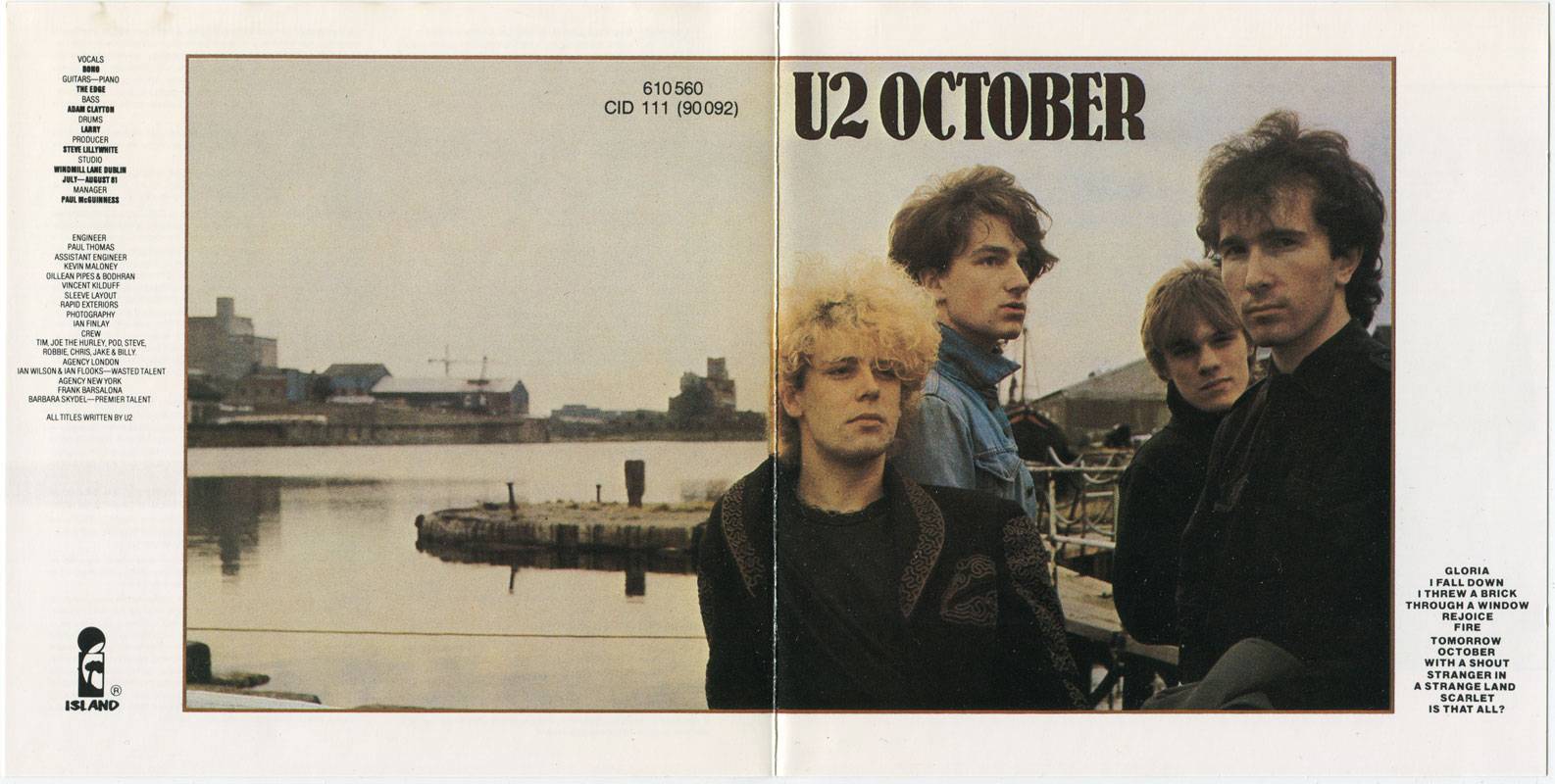
People are the worst.  People today actually ask if U2 is still relevant.  Based on their three most recent albums alone, it’s quite possible they are more relevant today than ever!  Nothing in their output has become outmoded — nothing is dated (other than their hairstyles from the ’80s — but whose hasn’t?).  Aung San Suu Kyi has been released from prison, but that doesn’t mean their campaign is yesterday’s news and tomorrow’s discount bin.  U2 is one of the few bands with both real staying power and their original lineup still intact after over 30 years of work.  Even though it’s possible they may actually be underrated as a whole, and all of their albums deserve continual presence before us, and even though we have just declared their most recent albums as key proof they are still relevant (more so than the question deserves), we should return to their second album, October, for a great example of how they have been relevant since the beginning, in part as well since it foreshadows many of the religious themes and concepts they have maintained throughout their career yet emphasized more overtly in their recent work.

“Gloria”

Few songs since the Enlightenment open an album with a more exultant, joyous mood than “Gloria” opens October.  Some perhaps decry October because of the brevity and apparent simplicity of its lyrics.  This is in part more understandable than most give the band credit, considering the adverse conditions under which the album was created (documentation of which is widely available and need not be rehashed here).  As we have mentioned throughout the musical analytical career of Redeeming Pandora, “brevity and simplicity” are never deterrents to quality.  More often, they are assets (if not integral components) to quality.  Often the lyrics that seem “simple” are stylistically unadorned because they communicate the powerful passion the lyricist is laying bare for all to experience.  (Admittedly, an overwhelming number of songs that look simple and sound simple are, in fact, simple, especially if accompanied by synthesized sounds, but this does not apply to “Gloria” or October … or ever in U2, really.)

“Gloria” is a straightforward mild lamentation of a man admitting before God and us despite his best efforts under his own mortal power he cannot succeed in life in any substantial way apart from God.  Nothing he says apart from God is worth uttering or hearing, nothing he owns is worth owning unless it is used for the glory of God.  Can anyone find anything wrong with these lyrics?  Neither can I.  I’m sure we know the Latin portion of the song, Gloria in te Domine / Gloria exultate” roughly translates into English as “Glory in you, Lord / Glory, exalt Him,” such that we are commanded to exalt God.  Can one disagree?  After the Adam Clayton slap bass solo, the rousing outro is among the best conclusions of any song anyone has ever done.  The joyous mood and musical zeal combined with the command to exalt God is certainly rare, especially in what some call Christian musical circles.  More often today one is given the impression the only time we are to be joyous is when thinking about what God has done or what we are allowed to enjoy or receive (either now or later), but hardly ever when singing about one’s responsibility or command to exalt God.  U2 certainly sets a far more encouraging, positive tone than popular music provides today.

“I Fall Down”

As this article no doubt already intimates, I am incredulous when people cast (erroneous) aspersions upon U2 (an inanely “in” thing to do these days).  Some of the unwarranted backlash against October, especially, appears to come in response to this second song, primarily because such people never take the appropriate time and energy to actually understand not only the actual content of the lyrics but actually also the actual meaning of said lyrics.  These are the people who assume “faster is better,” and if something cannot be grasped in fifteen-second intervals (or even more tersely), such a concept is not worth grasping at all.  History will of a certain categorize these people properly, but we should be observant, intelligent, and courageous enough presently to categorize them in our own day for who and what they are as well: people to whom no serious attention need ever be paid (the 21st-century equivalent of Alexander Pope’s “dunces”).

“I Fall Down” is a much more complex and relevant song than most people, as just indicated, credit it — and its relevance is unfortunately only increasing in potency, as the new Dunces continue to have their way in social, intellectual, political, academic, and aesthetic life.  It is not just a raucous lament of one’s inability to actually ambulate to any specific or otherwise location without inevitably and unintentionally plunging into a prostrate position.  Indeed, it is a plaintive appeal for solidity of identity and purpose.  The parallels to Paul Simon’s “Diamonds on the Soles of Her Shoes” are uncanny (even more so since again no conscious awareness of them was present at the time both albums were selected for this investigation).  Julie, the female protagonist of the song, expresses her dissatisfaction with life and her lack of enjoyable progress, pictured well by her acknowledged lack of connection with the natural world.  This acknowledgement is made evident in a sort of flashback from her love John, who has apparently found her in some sort of stupor (it is unclear whether Julie has committed suicide or is just unresponsive — even in the nascence of their career, it is highly doubtful U2 would write about a suicide, especially on such an optimistic and otherwise joyful album).  John comes to realize through the stark confrontation with Julie’s condition and self-assessment he, too, is not living a life worth living and is making no significant progress — not because life itself is intrinsically meaningless, but because he has heretofore attempted to live life solely in selfish terms, even while in a relationship with Julie.  John, too, realizes life must be lived in community and for the benefit of others: when we live life for ourselves, we “fall down” and break ourselves in the attempt to live selfishly.  We should be others minded: waking up when others wake up, falling down when others fall down, and living co-mutually.  When seen accurately, the lyrics and musical progression of the song cannot be seriously faulted.

“I Threw a Brick Through a Window”

Continuing the theme of the importance of human connectivity and interactivity, “I Threw a Brick Through a Window” is far from what many consider the typical late ’70s-early ’80s Irish music scene dominated by punk rock such as from Bob Geldof’s The Boomtown Rats.  It is not about rioting (though Larry Mullen Jr.’s drumming can evoke that somewhat), it is not about civil unrest or destruction of private property – it is about the need to escape isolation, escape individualism, and escape self-centeredness.  The narrator has come to a self-realization all he has been doing (most likely for his entire life to this point) is talking to himself, and thus has not heard a word anyone else has said.  This metaphorical representation of self-centeredness is just as appropriate today as it was when first offered at the onset of the Big ’80s.  Similarly, all his effort, all his walking, has been for naught — his movement he mistook for progress, as so many do; he was so absorbed by self he walked into a window, mistaking it for a mirror (as we sometimes do, preferring to use it to see what we want to see, ourselves, instead of what we should be seeing — God’s creation).  When he realizes the mirror is actually a window, he realizes, too, he has been “going nowhere.”

The sparse music of this song adds to its ethereal qualities — the whole thing is mildly reminiscent of Plato’s allegory of the cave in its evocation of sparseness.  This sparseness is most evident in the lyrical bridge paralleling Jesus’s words to His disciples so often: “No one is blinder than he who will not see.”  Now that he has eyes, he can see his predicament and his need for escape from his isolation and for community.  This is a lesson we all need to learn, and the sooner we realize we are responsibility for not being able to “see” the truth of ourselves and our station, the sooner we can begin to live and rejoice.

“Rejoice”

Tempering the possible interpretation individuality is insignificant and only likeminded community is the path to salvation, Bono reminds us sometimes we all serve by standing and waiting.  In a world that is tumbling down, and would-be heroes have delusions of grandeur (and some may have divine callings for worldwide significance and change, we should not doubt), the task for universal suffrage or world peace or cessation of hunger is too much for most of us to handle.  Likewise, in the abundance of community, the individual and his responsibility to worship God and be who God has called him or her to be can easily be subsumed in the “good intentions” of collectivism.  What is our response when the weight of the times confounds our activity and speech, when we don’t know what to do or say?  The proper response comes from three of the best lines in the album: “I can’t change the world / But I can change the world in me / If I rejoice.”  Sometimes it’s not about changing the external world but rather properly aligning our experience of it (not to indulge in too much subjectivity, mind you) — and the best way to do this is, of course, to rejoice.  We don’t rejoice in the state of the world, obviously, and certainly not in our inability to solve its problems as if embracing chaos and diabolical anarchy were an underappreciated value.  No, we rejoice in who God is, what He has done, what He will do, that He is in control, and who we are in Him.  Authentic leisure indeed.

“Fire”

Continuing the lyrical motif of “falling” (the blending of ideas and lyrics on this album is remarkably insistent — I wonder sometimes if October would have been a lesser album had Bono’s lyrics not been stolen … not to imply God orchestrated a theft or anything … sheer speculation on my part), Bono brings the ideas of accurate self-awareness, inward conversion, and worship to a climax with the seemingly ambiguous “Fire.”  The pervasive “fire” is an internal yearning, an irrepressible drive pursue this new life of worship and community while all around him the once-familiar universe tumbles into temporary disorder (while actually realigning properly for the first time in his experience of it).  It truly is an unforgettable fire, which U2 elaborates on later in the album of that name (though it is supplemented with the band’s mid-’80s infatuation with American music and experience).  I suspect if we took the time and energy to remember that fire we first experienced at our conversions Christianity and life would not seem so dull so frequently.  It is a stunning end to the first half of the album, supported again by a sparse musical accompaniment appropriate for the intellectual engagement with the words but jarring to our complacent standards of what pop music should be.  October as a whole is an unrelenting rejection of soulless musical and lyrical contrivances without descending into the inanities and banalities of the avant-garde (understood accurately in its derogatory sense).

“Tomorrow”

What was originally side two of the album begins with a much more somber mood.  Bono has recounted several times without being aware of it at the time he was composing a song about his mother’s funeral.  Melancholy and uncertainty dominate much of the song, both lyrically and musically.  The Irish Uilleann pipes add a pathos to the song’s opening, setting the mood brilliantly.  Eventually the uncertainty and unfamiliarity with the sorrow, the events of the funeral, the acclimation to loss are replaced by a growing dependency on God and a renewed strength and certainty.  Ironically, this comes through questions not answers.  “Who broke the window” (perhaps an indirect reference to “I Threw a Brick”?), “who broke down the door? / Who tore the curtain and who was He for?”  The sudden transfer from seemingly mundane earthly concerns to the allusive-laden tearing of the curtain grabs the singer’s attention as it does ours.  He knows who tore the curtain and how that act of destruction was the greatest act of restoration.  It was the same God-Man who “healed the wounds” and “heals the scars.”

The asking of these questions leads not to vocalized answers, as intimated above, but a renewed comprehension of pre-existing understanding, leading to a growing enthusiastic expression of faith in God (a rekindling of the fire of conversion) coupled with a need for personal volitional action: opening the door (since Jesus stands outside knocking) “To the Lamb of God / To the love of He who made / The light to see / He’s coming back, He’s coming back / I believe it / Jesus coming.”  If anyone doubted the intent of the album, or U2’s ontology as a “Christian band,” surely this song ends all doubt.  Bono knows his mother is not coming back, but he knows Jesus is coming back — and he will be there with his mother again in some imminent tomorrow.  Amen.

“October”

The eponymous track is, seemingly, the least representative of the album’s theme and temperament.  Even so, it is a fitting transition from “Tomorrow” to “With a Shout,” though it’s possible it would have worked even better before “Tomorrow,” keeping the slower, somber music sections together (but it still works well here, as I said, once the feel of the second half of the album becomes more apparent).  The song allows Dave Evans to take a break from his guitar and play the piano in what is certainly an atypical rock song.  The piano solo is evocative of the barrenness of October, especially one experienced in Ireland or Iowa or other adjacent lots in the celestial neighborhood.  As such, it is hard to describe in plainer terms: it is beautiful in a haunting way, but it does not try to be too beautiful, since it attempts (and attains) a sterility and timelessness reflecting the almost pessimistic lyrics.  Initial listenings most likely lead one to suppose the “you” in the final line of the song is addressed to October itself, but taking the album as a whole (supplemented by knowledge of live performances), most likely the “you” is not an autumnal apostrophe but a worshipful address to God.  True, October goes on while kingdoms rise and kingdoms fall, but so does God — it is not “Dover Beach,” and though the singer is apathetic toward the bareness of the trees, it is not out of pessimism and a lament about the absence of love in the world: Bono knows the trees will be reclothed in multifarious leaves again.  Thus the song is actually quite representative of the album, predominantly in its sparse yet entrancing musical accompaniment and its atmosphere of despair and disillusionment redeemed at the close to one of worship and stability and the promise of future restoration.

“With a Shout (Jerusalem)”

“With a Shout (Jerusalem)” is an energetic complement to the interrogatory methods of renewed worship in “Tomorrow.”  The second half of the album shows us to be a call-and-response mode, abetted by the disputatio-like lyrical elements of many of its songs.  Having already found sufficient answers to the previous questions, Bono turns to the future with “where do we go from here?” with the only reasonable response considering the direction of the album: “To the side of a hill” where “blood was spilt” for the salvation of mankind — Jerusalem.  The fire of worship has been rekindled to the point where not only is he now shouting about it, but also he wants to “go to the foot of the Messiah / To the foot of He who made me see / To the side of a hill where we were still / We were filled with our love.”  Do we yearn for that?

“Stranger in a Strange Land”

Having made it to Jerusalem, the complementary tone and mood diminishes to contemporary disappointment combined with an odd disquiet.  The title is likewise ambiguous: is the man to whom Bono is referring and singing the stranger? most likely not, since Bono is the one taking pictures, getting on a bus, sleeping on a floor, and writing a letter to a missed loved one — usually not the sort of activities one does in one’s own town or community, especially when joined with the plaintive “I wish you were here” chorus.  The presence of the soldier likewise gives us the impression we are in a territory used to hostilities — most likely the Holy Land.  It’s not the place now he thought it would be: it’s a strange land full of strangers and streets that are longer than they appear, alluding to the atmosphere of insecurity; even the natives appear to be strangers in a strange land.  Most likely the guy about whom Bono is singing is correct: Bono is the one who should run — he doesn’t quite belong here, even with his rekindled fire of worship.  It’s not the time, yet.  Perhaps it could be applied to us a wayfaring Christians, but I’m not sure that would do credit to the song, even if the sentiment is similar.  It’s a mysterious song, indeed.

“Scarlet”

One’s first impression of the song is it should be called “rejoice,” since that is the total of its lyrical output.  On further reflection, however, such over-simplicity is beneath U2 even at this early stage in their career.  Calling it “Scarlet” adds a momentous weight to the song: we rejoice because our scarlet sins are now turned white as snow.  The music helps make this possibly the best song on the album, up there with “Horizons” and “Pretty Donna” — surpassing them, in fact.  Delight in it forever.

“Is That All?”

The Edge wakes us from our reverie with a borrowing of the guitar riff from “Cry” (the original composer of the song is allowed to do that).  Setting the stage thematically for War, U2 starts the transformation from their languorous worship album to their discontented social awareness album.  Bono is not angry at God, but he’s not happy with Him either.  What else is there?  The questioning album finds time for one more question (repeated several times): “Is that all?”  The real intent of the song and the question comes in the single time Bono elaborates: “Is that all You want from me?”  Since he is angry, but not angry with God, Bono relates his growing discontent with the world: having seen the dilapidated condition of the Holy Land, he is still rejoicing in who God is, but the fire inside is now vivifying his social awareness — this can’t be all God wants from him.  He must be here to do more.

No, It’s Not All

So is U2.  10 albums later (and counting), U2 has continued to be relevant and pertinent and a Christian band for better than most who have claimed those descriptions.  Perhaps the lyrics and music of October are not as mature and rich as All That You Can’t Leave Behind, How to Dismantle an Atomic Bomb, or No Line on the Horizon (or even The Joshua Tree), but U2 made their second, most pressure-filled album a worship album, willing to alienate their new audience at the nascence of their career, overcoming difficulties few other artists have had to endure deserves far more attention and respect than it has received.  Even in their perhaps unpolished state, the songs of October are as truly worshipful as any others in the history of music and Christianity.  October is a forgotten gem and deserves our musical and spiritual attention.

The Struggles of Japan and the Need for Strategic Missions

David Lane

A couple years ago if you would have asked me about Japan, I would have probably said something about sushi, samurai, and crazy anime.  Japan is one of the most industrialized and technologically advanced nations in the world.  They have one of the largest cities in the world, some of the coolest cars in the world, and it appears as though they manufacture a good 25% of America’s gadgets.  So before actually traveling to Japan, I thought they were doing pretty well for themselves.  Why would they need us?  Behind the big buildings, the advanced technology, and the innovative mindset of the Japanese exists a culture of hopelessness.  The Japanese culture and traditions have trapped the people in a cage of shame and fear.  The people of Japan are hungry for hope and longing for a Savior but are clueless a way out, besides death, actually exists.  A need for missions in Japan exists that can unleash them from the binds their culture has on them.  Unfortunately, because of their culture, they are one of the hardest groups of people to minister to.  Thousands of missionaries have given up in Japan and left feeling like nothing can be accomplished.  It is for this reason Christians must evangelize Japan strategically.

Animism is the root of the problem in Japan.  It teaches everything is connected to the spiritual, and our duties as humans are to direct, manipulate, and reign over the spiritual realm.  Animism has combined with Shinto and Buddhism to construct one, sort of, ultimate religious practice.

Shinto is the belief rocks, trees, the sun, wind, etc. are all gods.  I visited a shrine in Japan and at this shrine were hundreds of stands lining the streets at which you could purchase any sort of souvenir or gift.  The thing that struck me the most was you could literally buy gods.  They were about one dollar and a multitude of designs you could purchase, and each design was actually a god.  People would buy these for good luck, out of respect, or even out of a sense of duty.  Shinto is a religion practiced because of tradition.  The Japanese people partake in the religion purely out of routine.  They go to the temples, pay a couple hundred yen, and then go get drunk.  It is a routine so engrained in their minds they do not even consider an alternative.  A lot of Japanese people do not even believe in a god at all, but they still practice religious routines out of respect for their ancestors.

Buddhism is the belief one should do no evil, should pursue good, and should cleanse one’s mind.  This, of course, can be taken in many different ways as people define for themselves what doing good means and what cleansing the mind takes.  Japan’s religion is, at its deepest level, a tradition with no outside commitment to faith or any sort of adherence to a universal law.

Another practice Japan is known for is the veneration of the dead.  Japan does in fact put a huge emphasis on respecting the dead, because they believe at death one enters into a spiritual realm.  The dead need to be respected on earth because if they are not, then they will be uncomfortable and not blessed in their new life.  They believe respecting your ancestors is incredibly important, because you are in a sense providing for their well-being.  If you go to Japan, you will undoubtedly see some gravesites that look almost like little, extremely expensive castles.  Japanese people believe putting the body in a comfortable and nice condition is important to the success of the ancestor in the next life.  In fact, the Japanese put such a focus on respecting the dead, during the recent tsunami, when there were still live people trapped under debris, the rescue workers were prioritizing dead bodies over live people.  It is imperative to them their family’s bodies be respectfully buried.

Family has a huge impact on the Japanese.  One of the worst things you can do in Japan is to bring shame or dishonor to your family because your ancestral line is so important it runs your life.  The Japanese people are motivated by fear.  They fear something they could do would bring shame to their family, so they work in order to prevent that.  This is also why the Japanese culture is so reserved, and they are not as individualistic as Americans.  For example, while taking the bus or train in Japan no one will talk at all, and if they do, it is an extremely quiet whisper.  The Japanese do not want to set themselves apart from each other at all.  They want to fit in so they can prevent even the slightest chance of shame.  Japan has one of the highest suicide rates in the world because teenagers are put under so much pressure by this code of honor.  Students have to pass one test in high school that, if passed, allows them to go to college and get a good job, or if failed, dooms them to farming or some job lacking in prosperity.  Every year students commit suicide because there is so much pressure on them to pass one test.  I was on a train while in Japan, and it stopped in the middle of nowhere.  There was no train station near where we were, so I asked my friend Rob, a missionary in Japan, what was going on.  He said we stopped most likely because someone had jumped in front of the train to commit suicide and that it was not an unusual thing.  The shame that engulfs the students and people of Japan is overbearing, and they search for a way out.

The Japanese family is generally different from the typical American family.  Usually in America, we find someone we love and want to have a relationship with, and we marry them.  In Japan, marriage is more of a tradition/obligation.  I am not saying all Japanese couples are not happy and do not love each other, but rather there is a multitude of Japanese families who marry for reasons other than love.  Family life in Japan is different all around.  The father of the household in no way acts as the leader.  He is detached from the rest of the family and usually spends all his time working or getting drunk.  The mother runs the household, and the kids study all the time.  Families in Japan work only because it would be dishonorable for them not to work.

Japan’s religious and cultural cages inhibit their ability to understand and react to the gospel.  The idea of one God who rules over us is not only completely absurd to them, but also is unattractive.  Their belief in Animism allows them to manipulate the spiritual world.  The Japanese do not understand the concept of one God being the ruler over us.  To them it does not make sense we would not control the gods.  Animism, Shinto, and Buddhism have completely brainwashed them, and they are unaware a different truth exists.  Shame and fear drive their culture, so it is nearly impossible to get them to stand out from the crowd and accept a new way of life.  They are so possessed and entangled by their culture they fear any sort of change because of the possibility it could bring shame to their family.  Family life in Japan is another key aspect that makes Christianity so hard to spread.  With the father, usually, wanting nothing to do with the rest of the family, a lack of leadership and drive exists.  Leadership does not exist, so they become complacent with their current status or merely don’t know their current status is not the way things should be.  For these reasons, Japan has become one of the hardest places to be a missionary to.  Japan has the highest rate of failed missionaries (missionaries who give up after only a couple years of being there) in the world.  The Japanese feel pain: they feel suffering, and they feel hopeless.  They need a way out but simply do not know one exists and are too fearful to really listen to an alternative.  That is why missions in Japan must be centered around building relationships.

If there is one major thing I have learned over my two trips to Japan, it is missions is a strategy.  You have to know the people group and the culture and figure out how you can engage them in a way meaningful to them.  For example, in Japan a large majority of the people have a desire to learn English, because it will help them with their future in business and American relations.  Seeing this desire, Rob Taylor started an English camp for kids in elementary school.  The Japanese are also very interested in American culture, and they love it when Americans visit. For this reason, Rob invites us over to help with the English camp as an incentive to come.  For Japanese kids to actually get to talk and interact with Americans is a big deal, so they are more inclined to show up and become engaged in the material.  This allows for us to begin building relationships with the kids, whose parents then become interested in why a group of twelve Americans would come all the way to Japan just to teach English.  So the English camp is step one of the strategy; then comes step two: Awana Camp.  The goal of the English camp is to grab the attention of the kids and parents and show them the environment in which their kids are is healthy, fun, and meaningful.  Once they see this we invite them to Awana Camp at which the Bible is taught and the gospel is shared.  This strategy then allows Rob to build relationships from his new “crop” of Japanese people, and he then begins to invite them to his church and different events he plans centered around the gospel.  The key to all of these strategies is building relationships.  Everything Rob does focuses on building a relationship and establishing credibility with the Japanese.  He brings us to Japan in order to plant a seed he can then water and turn into something more.  Relational ministry is the only way to reach the Japanese people.  In America, a large amount of people get saved at altar calls, from hearing a motivational and emotional speaker, or even simply growing up in a Christian family.  None of these can work in Japan.  To a 15-year-old kid in Japan, an altar call would be like standing up for execution, that is if there were any way you could get a Christian speaker to speak in front of Japanese people in the first place.  When ministering to a culture in which shame is the worst of all things, how can you get them to stand out from the crowd completely and essentially change their ideology and mindset as a whole?  It is imperative to build relationships.  It is the only way you can affectively reach the Japanese people groups and should be the only way to minister to anyone in the world.

Japan, just like thousands of other places in the world, is desperate for hope.  They have a desire to break away from the sad and limited culture they live in, but they are so bound by the chains of shame and fear they are blind to the truth.  A way out does exist, and God is working in Japan, but it requires more than just prayer and sending them Bibles, although those are extremely important.  It requires the church to engage in strategic missions and to build relationships just as Christ built relationships with His disciples.

TBH

Lia Waugh Powell

Without a doubt, Facebook has impacted the lives of thousands upon thousands of people throughout the world.  Through Facebook we are able to connect with family members we haven’t seen for a while, meet long distant family members, share photographs with each other, create and organize events, and share what we are thinking with our friends.  All of those things have changed society; being able to communicate with people has never been easier.  However, people have found a way to make Facebook an unpleasant experience, and this article’s purpose is not to rant but to logically explain and dissect the purposes of people who do such things and offer a way for the people to fix the issues.

1.) Let’s start with the most annoying (in my personal opinion) example of one of Facebook’s annoyances: TBH, LBR.  For those who don’t have a Facebook account, TBH stands for “To be Honest” and LBR stands for “Let’s be Real.”  The essential purpose of this is for people to “like” a person’s status who has posted “TBH” or “LBR” and the person will write on the liker’s wall about what he/she thinks about that person.  It may seem like a fun idea, but it is never used the way it should be.  On average on my newsfeed (I did the math), 1 out of every 9 statuses is TBH or LBR, mostly from the same people, over and over again.  And every response to the TBH post can be summed up as this: “TBH (or LBR), you are really pretty.  We don’t talk that much but I wish we did, we should hang out some time, hit me up.”  This is annoying for numerous reasons.  One reason is because the writers do not really mean what they say.  If they truly missed that person, they would catch up with them, send them a message, text/call the person.  They would not write on their Facebook wall because the person liked their status.  Secondly, as mentioned earlier, these statuses are written by the same people almost every single time, and in response the same people like the status every time.  This harbinger could very well be because of a low self-esteem issue and should not be taken lightly.  Your self worth is not found through how many people like your status and how many people value your opinion.  The people who like your status only want to be told they are pretty and are missed.  Those people should not have to seek out attention through a social media website.  They should put more effort into their friends and family.  If you are a “TBH” liker, please know you do not have to be told constantly you are pretty and likeable.  Focus on other positive areas of your life.  Go out and help other people, because blessing other people will truly fill that void where you feel you are worthless.  You are God’s child; you are by no means worthless, but if you are constantly searching for affection through other people who do not truly care about you, you will continue to feel empty and will never reach the satisfaction you desire.  Your continual liking of TBH statuses proves this point; if it’s the third time you have liked the status and you still do not feel good about yourself, then you must know something is wrong.

2.) Another annoyance found on Facebook are those who upload pictures of themselves every day, and also those who change their profile picture at minimum once a week.  We all do in fact know what you look like.  I am not saying this out of acrimony, out of jealousy, or out of anything negative.  It is just a simple annoying factor of Facebook.  It not only gives off the aura of vanity, but also it seems as if the person is seeking attention.  Every person is unique and beautiful; if you believe you are more beautiful than someone else, you should check your heart, because that is not the humble heart Jesus teaches and calls us to have.  If the person is changing his profile picture constantly because he feels he is not beautiful and cannot find a good picture of himself, that is also wrong.  You should love how God created you, because you were made in His image.  And a Facebook profile picture or a new photo album does not determine your popularity status, and if it does I would suggest you change your group of friends.  Nobody should feel there is a standard to live up to in order to keep his or her friends.  Friends should love you for who you are, not what you look like.  In addition to that, “Charm is deceitful and beauty is passing, but a woman who fears the Lord, she shall be praised” (Proverbs 31:30).  That is the character trait all people, not just women, should seek out, fearing God and honoring Him through your life — not seeking acceptance from other people and “likes” on a profile picture or status.

3.) Additionally, Facebook is not a showcase for when you are having relational problems.  It is already hard to accept when someone dates another person for two days and professes his or her love for the other on Facebook posts … daily.  There is nothing wrong with public displays of affection; they are in a sense sweet.  However, when the pair has only been dating for two days and throw around the word “love,” it honestly should upset people.  The modern idea of love is already corrupted, so when it is consistently abused further, it is disappointing, especially when the couple breaks up every three weeks.  You can always tell a couple is dysfunctional when it is obvious they are fighting because their Facebook status states, “ugh, I’m so upset.  I honestly can’t do this anymore.”  Nobody needs to know you and your significant other are fighting.  If you feel you are mature enough to handle a relationship — a true relationship — you need to act like it.  Relationships should not consist of constant public fights, and you should certainly not break up biweekly.  If that is the state of your relationship, you need to get out.  Relationships should be based on purity, friendship, and love.  God should always be first in your relationships, through prayer and accountability of one another.  In this day and age relationships have been transformed into two people who like each other, and consist of impure morals and unrealistic feelings.  Love is not a feeling; it is not butterflies in your stomachs: it’s a day-to-day choice the person you tell “I love you” to is your treasure.  Biblically, you are called to encourage and stay committed to that person regardless if he/she drives you insane.  “Love is patient; love is kind.  It does not envy, it does not boast, it is not proud.  It does not dishonor others, it is not self-seeking, it is not easily angered, it keeps no record of wrongs.  Love does not delight in evil but rejoices with the truth.  It always protects, always trusts, always hopes, and always perseveres” (1 Corinthians 13:4-7).  Therefore, switching your relationship status on Facebook to “in a relationship” to “it’s complicated” to “single” religiously is completely and utterly immature.  You should not be in a relationship.  Instead, strengthen your relationship with God.  Too often people have this preconception they need a significant other.  Yes, God calls us to have relationships with other people.  Men and women do in fact complete each other.  But that does not mean you always need to be in a relationship.  Nine times out of ten, you have something more important to be focusing on (such as deepening your relationship with Christ).  When God is the center of your life and after much prayer, if you feel God has called you to be in a relationship, then go about it in a righteous manner.  Respect your partner, encourage, love, and help him/her keep his/her eyes on God as well.  If you cannot commit to those things, you should not be in a relationship.

4.) Joining Facebook groups and liking a page will not cure world hunger, cancer, make a guy/girl like you, make you seem more interesting, give you more friends, or help you find a missing child.  Though all of those things might sound good, none will happen.  If you would truly like to help world hunger causes or other troubling issues, plenty of websites exists for you to donate to.  Get educated on the topic and go out and make a difference in this world.  I promise you hands-on experience is better and far more rewarding than liking a Facebook page or group.

5.) Let’s get one thing straight: no person cares if your turnips on Farmville are ready to be harvested.  And no, I do not want to be your neighbor on Farmville, either.  There is NO purpose to Farmville.  My news feed should not subsist of the thousands of notifications of your accomplishments on Farmville, Café World, or Mafia Worlds.  Maybe they are a way for you to relax and unwind, and maybe you think it is fun, but I do understand why people get caught up in them.  Please know there is an option for you not to publish everything onto your Facebook.

6.) Dear Mr. Ushman A’shd Umaya: I do not know you; I do not know how you found me, and though your profile picture of a Disney character is tantalizing, no, I do not want to be your friend.  That situation should suffice enough to annoy anyone.

7.) If you have updated your status more than three times within the past hour, please stop.  Facebook statuses are meant to share your thoughts (particularly interesting, funny, or encouraging ones).  I do not want to know if you are currently reading a book or are standing in line at Food Lion.  Pertaining to this subject, Facebook should not be used as a personal journal.  The world should not know if you are in a fight with your mom, if you just kissed a guy/girl; it should not be used for you to brag about how amazing you think you are, and it should not be used for you to write depressing statuses all the time.  There are so many good things in life, why should you waste time being depressed and sharing your depressed thoughts with others?  Talk to your friends in private if you are having issues, but try to spend your time encouraging other people rather than bringing them down.  When you bless other people, it is like instantaneous medicine for your soul.  “If you have a problem face it, do not Facebook it.”  Gossiping on the Web also should not occur (gossiping at all should not occur).  As of November 3rd, Google expanded its searching realm, and your comments can be found on the Web if someone looks up your name now.  Arguing on Facebook should not occur, either.  It is juvenile and annoying to those who read the dispute (albeit it can be quite entertaining).  Your life issues should, once again, not clash on-line.  Confront the other person in an appropriate and private manner about the offense and move on with life.

In conclusion, your personal life should not be displayed for all to see through Facebook.  Most of these annoyances are based on that issue.  Confront your issues in mature manners and develop and establish social skills from the Bible.  God’s Word contains all the resources and wisdom you need to know to get through life, along with the people He has put in your life.  Facebook is not a journal, nor is it a healthy way for a person to seek attention.  A Facebook “like” should not and will not be as fulfilling as developing a genuine relationship with Christ and other people.

The Arab Spring and America

Connor Shanley

The times in which we live are becoming more and more unpredictable and uncertain.  The world in which we live is changing rapidly, every day events are taking place around the world we don’t even know about.  These events are changing the world in which we live.  Recently there’s been a very strange thing happening in the Middle East; it has been popularly called the “Arab Spring.”  The Arab Spring refers to the recent increase in protest and civil disputes throughout the Middle East.  The Arabs are now trying to overthrow the oppressive regimes.  In many countries this would seem to be a good thing for the church and for Christians.  In some counties where these protests are occurring, the regimes have been oppressive to the Christian community.  In many cases, though, once the government is overthrown the chaos the protest and riots had will often be continued on to the Church.  This is why the Arab Spring is something the United States should be watching very closely.

The first country to start this Arab spring was started in Tunisia, on December 18, 2010; protest began in Tunisia to show public disapproval of government corruption.  The protests at first were going peacefully, but then various uprisings throughout the country resulted in over 1,000 deaths.  The protests only grew after that, though, and president and prime minister of Tunisia both stepped down from office.  The protests are still on going; the protesters still want to see major government reform.  Tunisia was the start of the Arab Spring, but it is definitely not the most well-known country with current civil unrest.  The country most noted for really being the start of the Arab Spring is Egypt.

On January 25, 2011, Egypt took after Tunisia’s example and started its protests and demonstrations.  Egyptians were sick of their government and their president Hosni Mubarak.  The protests in Egypt often grew violent; in one protest in Cairo, 846 people were killed and 6,000 were injured.  One seemingly good thing coming out of the protests though was Christians and Muslims were uniting to have their voices heard.  A sight seen very often during the protests was Christians forming protective barriers around Muslims during their 5 o’clock prayers.  Likewise, Muslim violence against Christians subsided for a time.  On February 11, Mubarak stepped down from office.  It was taken as a great moral victory for the protesters.  The success of the protest was not just felt in Egypt but in other Arab nations as they decided to follow Egypt and Tunisia.  Protest started to break out all over the Middle East; four days after Mubarak stepped down, Libyan rebel forces began a Civil War.

The aftermath in Egypt, though, was not all freedom and equality.  The government was now gone, and political chaos was taking over.  Violent protests were still going on, and at night people described Cairo as a war zone.  Much of the violence, however, was directed toward Christians.  Prior to the protests, the Christians in Egypt were already being persecuted, partially helped by the government, but the government did keep some peace.  Now that police can no longer enforce curfew, mobs of Muslim extremists are burning down churches and killing civilians.

Now many accounts of massacres of Christians throughout the Middle East exist.  Countries like Syria, Lebanon, and Algeria are having massive protests against the government, but because the police are so distracted by these protests they can’t protect the Christians.  The Christians are being overwhelmed; at first many thought this Arab spring would be a good thing for the unification of Muslim and Christian communities.  The Arab Spring has just sparked more anti-Christian violence.  Many believe the rise in violence is only reserved to some parts of the protest.  They believe as a whole, though, the Arab Spring will still be good for the unification of Christian and Muslim communities; they believe over all the Arab Spring is very good thing.

Many members of the media portray the Arab Spring as a good change.  The Arab Spring shows the Middle East is becoming more democratic.  The media on the left see it as the Middle East somewhat conforming to our way through wanting the common people to have a say in political matters.  There is a very dark side behind the Arab Spring, however: the rise in persecution.  Christians know behind these protests are people wanting to overthrow a regime not because it is not democratic but because the regime isn’t Muslim enough.

The problem now brewing in the Middle East is two types of protesters being seen; one type is the kind the leftist media love.  These protesters are the genuine young who want the right to vote and who want to put an end to their tyrannical government.  Then there is the other type, usually the older ones, who look to overthrow their government because their government has been too friendly to the West.  These protesters are angry their government is trying to impress America.  It is now a proven fact these protest leaders are members of terrorist organizations.  It taints the whole idea these protests are just all about freedom, and all this political unrest has become the perfect time for terrorists to try to get as much power as possible.

The Arab Spring, which at first looked to be a positive step forward, is now a dangerous threat to America.  The terrorists we are fighting every day are looking to take advantage of the political unrest.  The uncertainty of the outcome of the Arab Spring is endless; America could manage to gain many allies out of this.  For example, Libya (at least for a short time) should be on our side given we supported the rebels’ side.  Still, even Libya could turn on us, and now because of all the recent uprisings more weapons are in the Middle East than any agency can keep track of.  Most of these guns are just floating around the region with no one to keep track or regulate distribution of them.  Many of these weapons have already ended up in the hands of mobs that persecute Christians; those same people are the ones who will support the terrorists.

In conclusion, America must keep a very watchful eye on all this civil unrest.  If America uses the Arab Spring to its advantage, it could help stabilize the Middle East for years to come, but if America is not watchful, the wrong people may take control, and America could have a growing list of enemies.

Personal Observations and Contradictions of Islam

Erik Lang

Islam is one of the fastest growing religions worldwide.  Muslims are settling in every country of the world, some of these countries actively enforcing Muslim customs and laws.  This is unsettling.  Islam is a destructive religion passionately fueled by messages of hate against non-Muslims.  America is fighting wars against terrorism that believes in Islam.  Islam is dangerous, but even more importantly, it is completely wrong.

Islam is an adapted and corrupt version of Christianity.  Let’s examine the facts: Muhammad was born at 570AD.  This was during a period when Christianity was spreading like wildfire.  Evangelists spreading the Gospel witnessed to areas where Muhammad lived.  Muhammad even acknowledged hearing Christian missionaries in his youth.  The Gospel begins with an angel appearing to the Virgin Mary telling her she will have a son.  The angel’s name was Gabriel.  No other angels are associated with the Gospel.  When Muhammad heard the Gospel, he liked many qualities of it.  He incorporated those qualities into his own religion, like alms to the poor, loving each other, etc.  The angel who appeared to Muhammad in the cave was the angel Gabriel.  Could it be Muhammad heard the account of Christ and took elements of it, such as the appearing of the angel Gabriel, and used them to create his own religion that best suited his needs?  Absolutely.

The concept of Allah has been around since ancient Sumerian days.  Muhammad did not create Allah.  He, again, took ideas from other religions and forged them into Islam.  The symbol of Islam is the crescent moon.  The moon has actually been the primary belief of all Arab peoples forever.  The title of the moon god for the ancient Arabs was “the deity,” or in Arabic Al-Ilah.  The epicenter of the worship of the pagan moon god was in Mecca.  The shrine in Mecca was actually a home to 360 other gods but was completely dedicated to Al-IlahAl-Ilah was the beginning of the myth of Islam.  Muhammad took a well known and practiced religion of the Middle East and borrowed the pagan moon god Al-Ilah, or now Allah, and substituted him as the one and only true god.  Conveniently for all new converts to Islam, their pilgrimage was to Mecca, a holy site already well-known to all Arabs thanks to the moon god.  It would be easier for a population to place their beliefs in something they were already familiar with (a moon god) and have easier access to (Mecca).  It’s really just a religious game of mix and match.  Muhammad declaring Allah was the only god is laughable, since the moon god had brothers and daughters in Arab tradition, all of which were deities.

Islam is famous for Muhammad being the last of the prophets sent to complete Allah’s work (again, convenient).  Muslims also teach Jesus Christ was a prophet sent by Muhammad, yet nothing more.  Muslims believe Christ to be a great man and wise.  If they truly believe in the teachings of Christ as the words of Allah, then they must also believe Christ’s claim He is the Son of God.  Here is where Muslims refuse to acknowledge the facts.  Jesus Christ came and fulfilled prophecies.  Here Islam takes part of Christianity again and accepts only the parts they think are worthy or fit their standards better.

Islam teaches abstinence from any alcoholic beverages.  Wine or beer or any other fermented drink is to not be consumed by any good Muslim.  Muhammad even says drinking and drunkenness is an abomination, Satan’s handiwork.  If one were to read through the Qur’an further, though, he would find verses describing the Islamic Paradise.  Paradise for the Muslim is reserved for the righteous, and the rivers are overflowing with wine.  These rivers are described by Muhammad as “a joy to those who drink.”  Other verses state “their (the righteous) thirst will be slaked with Pure Wine sealed.”  For the good Muslim to live a life shunning alcohol, why would he engorge himself with the brew in Paradise?  Muhammad is basically saying abstain from drinking so you may drink in Paradise.

One of the biggest debates raging between the world and Muslims, even among Muslims themselves, is the issue of the Jihad, or holy war.  The Qur’an specifically states several times in order to be a good Muslim and true follower of Allah, one must take up the sword and slay all infidels who will not convert to Islam.  The majority of Muslims agree with the Qur’an on this topic, although most do not actively participate in Jihads against infidels.  The other group of Muslims believes the jihad is a spiritual warfare against the world and within oneself.  Their interpretation of the Qur’an is wrong, strictly speaking.  Muhammad clearly meant for his followers to kill all those who were not of the Muslim faith.  They are fitting religion to meet their needs.  This group of Islamists tries to live civilly with the rest of the world in order to avoid further bloodshed.  Their non-willingness to follow their Muslim brethren drives the orthodox Muslim group to anger.  This issue results many times over in conflicts and civil wars between Muslim countries.  This whole issue is counter-productive to the attractiveness of their own religion.  One side continues to uphold the Qur’an and murder infidels while the other side twists the Qur’an to fit their needs and only angers the true believers of Islam to kill them as well.  This is absurd.

One obvious issue with Islam is it was completely made up by Muhammad so he could order others around.  This is a bold statement, but I believe it’s completely valid.  Muhammad was a nobody.  Then the next day, he is the “chosen prophet” of Allah, appeared to by the angel Gabriel.  Muhammad’s special revelation occurred in a cave secluded from his home town.  Gabriel appeared to Muhammad and gave him his divine purpose from Allah.  Muhammad claimed to have consistent contact with angels and Allah; none of these encounters can be verified by any other sources.  An entire religion based upon the passionate appeals by one man is enough to persuade an entire region of people toward Islam.  Muhammad never had any witnesses to verify his claims of divine interventions.  There was never any proof.  In short, an entire race of people including the millions of others they have deceived follow the teachings of a man who lied about his revelations.

After the birth of Islam, all believing Muslims immediately conquered the surrounding lands under the orders of Muhammad.  Muhammad now had an entire people subjugated by holding the key to Allah.  They had to do his bidding or risk the wrath of Allah.  Muhammad’s home of Medina was under the control of pagan idolaters who had ostracized Muhammad, and he wanted revenge.  Muhammad rousted his new disciples and told them all who do not believe in Allah and worship idols are enemies of Islam and must die under the sword.  His first conquest was his hometown, Medina.  Muhammad continued to use his armies to conquer most of the Middle East until he died and his campaign was continued by other prominent Muslim leaders.  Islam was a get rich quick scheme and a useful tool for brainwashing populations into doing his will.

What can we as countries do against such reckless hate?  Better yet, how should we as Christians respond to their attacks?  Through our faith, our first response should always be out of love.  They need salvation just as much as we needed it.  However, God did say there are times for war and times for peace.  Many of these Muslims do not listen to reason or even listen period.  It is against these types of people our physical struggle is against.  Diplomacy can only take one so far when a guy with an AK-47 is trying to murder him.  This is where the government steps in, and we are required to use force against the Muslims.  Force is acceptable to use when all other options are exhausted.

Islam is riddled with gaps of reasoning and inconsistencies.  The only reason why so many believe it is because the first Muslims already worshipped the same thing as Allah.  Muhammad simply organized them all and pointed them in the direction he wanted.  Muhammad’s religion of Islam was conceived by a greedy man who took parts of religions he liked and combined them all to make his own cocktail of deceit.  There were no witnesses for his revelations.  All he ever said about his divine appearances were lies.  If you examine the pure facts and look at the evidence through an unbiased eye, you can obviously see the flaws of Islam and the ill intentions behind its creation.

Yuletide Recipes

Redeeming Pandora Family

Caramel Rolls

Put 18 frozen Rhodes dinner rolls in a buttered bunt pan.  Sprinkle ½ box dry butterscotch pudding mix (not instant pudding) over rolls.  Melt ½ c. butter with ½ c. brown sugar; pour over rolls (add nuts and raisins, if desired).  Cover with aluminum foil and then a towel.  Let set overnight in the oven.  Bake in the morning (after removing the towel, not the foil) at 350° for 30 minutes.  A cookie sheet under the pan to catch the caramel drippings might be a good idea.

Meringue Cookies

Beat 3 egg whites with 1 c. sugar until very stiff; add ½ tsp. of any flavoring (usually peppermint) and coloring; fold in 6 oz. small chocolate chips (minis).  Place on ungreased baking sheet lined with parchment paper.  Preheat oven to 375° — put it in oven, then turn it off and leave overnight without opening the door.

Almond Pinecones

  • 1¼ c. whole natural almonds
  • 18 oz. package cream cheese
  • ½ c. mayonnaise
  • 5 slices crisp bacon crumbled
  • 1 Tbsp. chopped green onion
  • ½ tsp. dill weed
  • ⅛ tsp. pepper

Spread almonds in single layer in shallow pan.  Bake at 300° for 15 minutes, stirring often, until almonds just begin to turn color.  Combine soft cream cheese and mayonnaise, mix well, add bacon, onion, dill weed, and pepper.  Mix well.  Cover, chill overnight.  Form cheese mixture into shapes of 2 pinecones on serving platter.  Press almonds at angle in rows.  Overlap rows until covered.  Garnish with artificial pine sprigs (1½ c.)

Cranberry Bread

Mix together:

  • 2 c. flour
  • 1 c. sugar
  • 1½ tsp. baking powder
  • ½ tsp. baking soda
  • ½ tsp. salt

Add, combining only until dry ingredients are moist:

  • 1 beaten egg
  • ½ c. orange juice
  • 2 Tbsp. melted shortening
  • 2 Tbsp. hot water

Fold in:

  • 1 c. whole cranberries
  • ½ c. chopped walnuts (optional)
  • grated orange rind (some)

Bake in greased and floured loaf pan for 70 minutes at 325°.

Medieval Gingerbread

  • 1 lb. honey
  • Bread crumbs (approximately one pound,
  • unseasoned, finely ground, not soft)
  • Ginger (up to 1 Tbsp.)
  • Cinnamon (up to 1 Tbsp.)
  • Ground white pepper (up to ½ tsp.)
  • Pinch of saffron (if desired)
  • Few drops of red food coloring (if desired)

Bring the honey to a boil and skim off any scum.  Keeping the pan over very low heat, add the spices, adjusting the quantities to suit your taste.  Add the food coloring if you want it red.  Then begin to slowly beat in the bread crumbs.  Add just enough bread to achieve a thick, stiff, well-blended mass.  Remove from the heat and turn the mixture onto a lightly greased (cooking spray works fine) square or rectangular baking sheet or shallow pan, ½- to 1-inch thick.  Take a rolling pin and spread the gingerbread evenly out into the pan.  Turn the pan over on wax paper or parchment paper, and tap gently until the gingerbread falls from the pan.  Turn the gingerbread over once again, then cut into 20 small squares to serve (or stars or diamonds).  Decorate with small candy (optional).

Maria’s Traditional Stollen (German Christmas Sweet Bread)

Makes 4 small loaves.

Needs 8 hours of fridge time — so do the first part the day before you eat it.

Day 1

4½ tsp. yeast (≈2 pkgs.), dissolved in large bowl with 1½ c. warm water

Add…

  • 1 cup sugar
  • 1 tsp. salt
  • 7 eggs
  • 1 egg yolk (save the white for glaze)
  • 1 c. melted butter
  • 2½ c. flour

Beat with electric mixer for 5-6 minutes.

Stir in (with spoon)…

  • 4½ c. flour
  • 1 c. slivered almonds
  • ½ c. raisins
  • 1 8-oz. container of mixed candied fruit (cherries, citron, etc.)
  • Grate finely a lemon (to get as much grated lemon peel as possible)
  • Very sticky — did not kneed — just mix thoroughly.
  • Let sit in bowl with tea towel over it to rise in warm place for 2 hours (if it doesn’t look like it rises much, that is okay).
  • Plop on sheets of saran wrap; wrap and place in a bowl.  Put into fridge overnight.

Day 2

  • Take out of fridge — let sit for an hour.
  • Divide in to 4.  Take one section at a time on floured counter.
  • Press in to oval with hands.
  • Melt ¼ butter.  Spread melted butter on the oval.
  • Fold one side of oval shape onto the other side, the long way.
  • Repeat process with other 3 ovals.
  • Place the 4 “folded over” ovals close together on greased (Pam) cookie sheet.
  • Take egg white from yesterday, mix with 1 Tbsp. of water.  Brush over tops.
  • Let rise for an hour.
  • Preheat oven to 380°.
  • Bake for 25 minutes.
  • Can lightly glaze with confectionary sugar mixed with milk.

The Best Cookies You Could Ever Possibly Imagine

Total Prep & Baking Time: 1 hour 30 minutes, plus 24 hours to chill the dough

Yield: 18-20 large cookies

  • 2 c. minus 2 Tbsp. cake flour
  • 1 2/3 cups bread flour
  • 1½ tsp. baking powder
  • 1¼ teaspoons baking soda
  • 1½ tsp. coarse salt
  • 2½ sticks (1¼ c.) unsalted butter, room temp.
  • 1¼ c. light brown sugar, packed
  • 1 c. plus 2 Tbsp. granulated sugar
  • 2 large eggs, room temperature
  • 2 tsp. pure vanilla extract
  • 1 1/3 lbs. bittersweet chocolate disks or fèves, at least 60% cacao content (regular chocolate chips are acceptable, but you will not get the gooey texture the fèves will provide)
  • sea salt or fleur de sel, for sprinkling

1. Sift together the cake flour, bread flour, baking soda, baking powder, and salt in a medium-sized bowl and set aside.

2. In the bowl of your mixer, cream together your butter and sugars until light and fluffy, about 3-5 minutes.  Add in the eggs, one at a time, until combined, scraping down the bowl as needed.  Add in the vanilla and mix.  Gradually add in the dry ingredients, until just moistened.  Fold in your chocolate until evenly added throughout the dough.  Press plastic wrap against the dough, making sure it is completely covered, and refrigerate between 24 and 72 hours (I left mine for 36 hours).

3. When you are ready to bake, bring the dough to room temperature so that you can scoop it out, and preheat your oven to 350°.  Line and/or grease your baking sheets.  Scoop your dough onto the sheets.  I used a #40 ice cream scoop, which is about the size of 2 Tbsp., but you can make them even larger, if you like.  Do not press the dough down — let it stay the way it is.  Sprinkle the cookies lightly with a bit of fleur de sel or sea salt.  Bake 10-12 minutes for smaller cookies (mine took about 11 minutes), or 18-20 minutes for larger cookies.

4. Allow the cookies to cool slightly on your baking sheet, then move them to another surface to cool completely.  You can enjoy these warm, room temperature, or cold.  Store in an air-tight container at room temperature for up to 3 days, or freeze for up to 2 months.

Grandma’s Cookie Recipe

  • 2 c. butter
  • 2 tsp. baking powder
  • 2 c. sugar
  • 2 tsp. baking soda
  • 2 c. brown sugar
  • 24 oz. chocolate chips
  • 4 eggs
  • 1 8-oz. Hershey bar, grated (freeze bar before grating)
  • 2 tsp. vanilla
  • 3 c. of chopped nuts
  • 5 c. blended oatmeal (measure and blend in blender to a fine powder)
  • 1 tsp. salt

Cream butter and both sugars.  Add eggs and vanilla.  Mix together with flour, oatmeal, salt, baking powder, and baking soda.  Add chips, chocolate, and nuts.  Roll into balls and place two inches apart on a cookie sheet.  Bake for 6 minutes at 375°.  Makes 112 cookies, but the recipe can be halved.

Peppermint Bark

  • 8 oz. white chocolate, chopped or chips
  • 4 red & white peppermint sticks, 6 inches long (King Leo sticks or Red Bird)
  • 2 drops peppermint oil or extract

Melt chocolate. 

Place the peppermint sticks in a heavy, zip-locked plastic bag and crush them finely.  There are many methods to choose from — find something hard like a rolling pin, and then take turns whacking and rolling the peppermints!  This can prove to be extremely beneficial, even pro-active, during the holidays.  When the peppermint sticks resemble the size of crushed ice, stop whacking.  When chocolate is melted, stir in peppermint oil.  Next stir in all but 2 tablespoons of the crushed peppermint pieces and spread mixture out, about ¼-inch thick, on a cookie sheet (lined with parchment paper or a non-stick baking mat).  It may not fill the pan completely.

Sprinkle the remaining peppermint pieces over the top.  Let sit at room temperature until hardened, about 2 hours, or refrigerate for 30 minutes to harden more quickly.

Once hardened completely, use your hands (or the trusty “whacker”) to break in to pieces.  Store in an airtight container for up to 2 weeks — if they last that long!

Cream Cheese Pumpkin Roll

Ingredients for cake part:

  • 3 eggs
  • 1 c. sugar
  • 2/3 cup canned pumpkin
  • ¾ c. flour
  • 1 tsp. baking soda
  • 1 tsp. cinnamon
  • 1 tsp. nutmeg

Preheat oven to 350°.  Set out all ingredients, including cream cheese filling, to bring to room temperature.  Mix all ingredients together and pour onto a greased cookie sheet.  If using a large cookie sheet or jelly roll pan, double all ingredients, including cream cheese filling.

Bake for 12-18 minutes (oven times vary; pan size/cake thickness will determine bake time).  Let cool until it is touchable but still very warm.  (The cooler the cake, the greater potential there is for cracking.)  Place a clean towel/cheesecloth on counter, then place wax paper over the towel.  Sprinkle powdered sugar over wax paper (to prevent sticking), and then dump the cake out onto the wax paper.  Using the wax paper and towel for support, say a prayer, and begin to gently roll your cake long side to long side, with wax paper rolled into it as well, until it has been rolled up.  Place the roll into the fridge for one hour or the freezer for 20-30 minutes to set it.  If it cracks, all is not lost!  Allowing it to set and cool will help it gel together, almost sealing itself back together.

While the roll is cooling, mix up the filling.

Ingredients for filling:

  • 8 oz. cream cheese
  • 1 c. powdered sugar
  • 4 Tbsp. butter (⅛ a stick)
  • 1 tsp. vanilla

Blend all ingredients until soft and smooth (don’t forget to double if cake ingredients were doubled!).  Unroll pumpkin roll slowly, and gently spread filling all over.  Reroll cake (making sure not to roll your wax paper back into the roll!).  Dusting the area with powdered sugar will help the cake not stick.  Wrap with wax paper and store in the fridge.  Foil is good for helping the roll hold its shape — add a holiday ribbon and you are ready to go!  (Remember, a roll with a crack or two still tastes the same!)  Slice and serve once filling has set and cake has chilled.  Enjoy!

Reindeer Munch (aka Christmas Crunch, Santa Surprise, Jingle Junk)

  • 1½ c. pretzels
  • 2 c. bite-sized square rice and/or corn cereal
  • 2 c. round toasted oat cereal
  • 1 c. peanuts, almonds, or mixed nuts
  • 10 oz. vanilla flavored candy coating (or use white chocolate)
  • 1 c. candy-coated pieces

Line a baking/cookie sheet with wax paper.  Make sure all dry items are bite-sized and mix everything but candy coating and candy pieces together and set aside.  Melt candy coating or white chocolate in a saucepan (or double boiler) over low heat.  Stir continuously until melted OR microwave coating for 1½ minutes, stirring every 30 seconds.

Quickly pour melted coating over cereal/nut mixture and toss to coat.  Add candy pieces and toss.  Pour mixture onto prepared baking sheet in an even layer.  Cool completely.  Break into pieces and store in an airtight container at room temperature.  There are many ways to vary this recipe and make it your own.  Add or omit any ingredient.  Have fun inventing and munching on your own creation of this Christmas time crunch!

Hot Cider

Mix in crock pot:

  • ½ gal. apple juice or apple cider
  • 1 qt. cranberry juice
  • ¼ c. lemon juice
  • ¾ c. orange juice
  • 1/3 c. brown sugar
  • 8 whole cloves
  • 2 cinnamon sticks

Let simmer until hot.

Thanks to Tracey Rush, Amy Rush, Teresa Foster, Maria Cochrane, Sara Gaus, and Marilyn Lane for the recipes!

On the Value of No-Shave November

Mackenzie Carlson Howard

This past November, I took upon myself a challenge.  More like a test, I should say.  It was a journey toward greater self-knowing, an adventure to lands far outside my comfort zone.  It was a trial to prove to myself, and others, that the importance of physical appearance is far less substantial than that of internal character.  It was the magnificent challenge that is No-Shave November.

I’ve always wanted to participate in this seemingly males-only event.  Females do, of course, occasionally hold similar special events, like No-Makeup Monday and Fasting Friday.  However, while No-Shave November often seems to enhance the physical appeal of the participating males, these female-oriented events seem only to be detrimental to the appearance of the partaking ladies and the general well-being of those around them.

Perhaps it is because males have been created to be more adventurous and self-confident than their female counterparts that this phenomenon occurs.  Almost no sane female would deign to participate in No-Makeup March or Sweets September.  Although, in every female’s heart, the idea of participating in one of these events is enticing, the reality of what would happen to her physical appearance (and, therefore, self-worth) is enough to keep them confined to single days of insanity.

And let me say, before continuing on any further, that this description does not fit every female.  There exist, occasionally, those brave souls who face the world with a bare and natural face, and who eat sweets on Saturdays, and on Mondays, Thursdays, and Fridays, too.  If you are one of those rare women, stop reading this now and congratulate yourself with a chocolate bar.  However, as a female myself and as an observer of humanity for 17 long years, I feel this general observation of the female sex is accurate.

Thus, while some extraordinary women have progressed far enough in their journeys toward self-confidence they would have no problem participating in these events, most of us haven’t.  And that is why No-Makeup March and Sweets September do not exist.

Males, on the other hand, seem to find their worth in actions more than in physical appearance.  To be the starting point guard on the varsity basketball team or to score an 800 on the SAT mathematics section is to be worthwhile.  To work out and have the biggest calves among all the guys or to get a Saab for a birthday is to be worthwhile, to a guy.  Therefore, No-Shave November seems almost like a friendly competition for males, not an awkward day of insecurity like similar female extravaganzas.  The male who is able to grow the best beard is, at least in some sense, “cooler” than the others.  (Unless, of course, that particular male was born sporting a beard.)

I may be totally wrong about the male sex.  After all, I am only a spectator.  17 years of being a female is barely enough time to begin to understand the opposite sex.  Again, though, I am basing my assertions on generally accepted notions.  If you are a male who particularly cares about matching your shoes to the color of your shirt, stop reading this now and buy a pair of black shoes (they go with pretty much everything).

All that to say, No-Shave November isn’t really for females.  The idea and motivation behind this event seem to originate in male culture and is socially looked down (or quizzically) upon in regard to female participation.  However, like I said before, I have always been interested in partaking in this event but could not muster up the courage to do so until this past November.  I figured there is no better time than senior year to try something crazy.  Of course, my goal was not to grow a beard.  This feat, except in rare cases, is impossible for the female sex.  Instead, my goal was to not shave my legs.

This challenge promised to be particularly difficult for me because, as a female of strong, hardy European stock, my hair grows incredibly fast.  Thus, I find it necessary to shave at least every other day, if not every day.  To go a whole month without shaving, therefore, would be to grow a winter coat on my legs.  And although this new outerwear may be useful, especially when considering the approaching winter months, an entire month without the razor would be just crazy.  So, my goal was to go as long as possible sans le rasoir.  A dear friend of mine set the minimum at 10 days, which, even though barely a week and a half, looked like eternity to me.  However, I had announced to my friends and family my razor-less plans and was determined to accomplish my goal.

I made it 11 days.  My European stock proved to be hardier than even I expected, and my “winter coat” was almost fully grown by then.  I couldn’t take it anymore.  I shall spare you the gruesome details, but I must say that even some of the guys were impressed with the amount of leg hair I had.  “Comparable to the fur on a grizzly bear,” one honest male stated.

And although my No-Shave November stint lasted only 11 days, its effects have stayed with me.  My goal in this endeavor was to prove to myself that physical appearance does not determine worth.  As a female, in high school, with a gorgeous sister only two years my junior, I have always struggled with that notion.  No-Shave November was a chance to understand what it means to be judged by character and not complexion.  I must admit it started out as a crazy idea during some summer afternoon siesta.  As time went on, though, and as my hair grew longer, my motivation for doing this experiment turned into a challenge toward furthering self-confidence.  Interestingly enough, despite my furry legs, my friends stayed my friends, and my family still let me eat with them.  I was not deemed “worthless” or of lower value because of my unshorn legs.

Although it seems silly, I think many females do base their self-value on petty things like nicely-shaven legs.  The world tells women that to be “worthwhile” is to wear fashionable clothes, weigh less than a koala, and wake up with perfectly-curled hair.  However, we are reminded in 1 Samuel 16:7 that “man looks at the outward appearance, but the Lord looks at the heart.”  As fallen human beings, our first instinct is to judge based on physical appearance.  Yet, as Christians, created by God and saved through His grace, it is important to realize we are not of this world and therefore should not live by the world’s standards.  The world is concerned only with the physical, but God cares about character.  Is it not more important to please the Creator than other creations?  Although the concept is simple, most females (and even most males) struggle with realizing this idea.  I know I do.  Only when we step out of our comfort zone, be it through No-Shave November or not, do we realize that value is based upon character.  And so, though it was short-lived, No-Shave November impacted my view of values and worth in a way that nothing else in my 17 years of life has.

Forgotten Gems: Hints Allegations and Things Left Unsaid

Christopher Rush

Hints Allegations and Things Left Unsaid

When this project was first conceived and the list of worthy albums first compiled, I did not consciously associate the albums by any criterion other than my personal desire for them to regain more public consciousness.  On further reflection, however, I realized the first three albums are connected in other ways as well: Graceland and Lean Into It both address various musical forms/situations in bayou country, and Collective Soul’s debut album took its name from “You Can Call Me Al” on Graceland.  Thus, it is fitting to bring them all to your attention in this issue.

Collective Soul is one of the few ’90s bands with any staying power.  This most likely is due to their skill and intellect.  Let’s be honest: Collective Soul’s music is beautiful and their lyrics are true — if any other requirement is needed for a band to be great and worth knowing/enjoying again and again, I don’t know of it.  Certainly all of Collective Soul’s oeuvre could be considered “forgotten gems,” and possibly their self-titled second album has fallen further in public esteem, but Hints Allegations and Things Left Unsaid should be the beginning place of anyone’s newfound appreciation for one of the few great bands today.

Ye— oop, wait for it … Yeah!

“Shine” is arguably Collective Soul’s biggest hit.  Supposedly it was to be their one hit, making them simply another one-hit wonder from the ’90s.  Six number one songs later, Collective Soul is still around.  “Shine” was my first experience of Collective Soul, hearing it on the radio (which is exactly what they wanted, I must admit).  It was one of those songs Neyens and I made our own for a while, going to/from band practice, singing along with the chorus (at least the “yeah”s) whenever it came on over the radio (he was always the one doing the driving, of course — perhaps that’s where my affinity for singing in the car along with the radio/cd arose, bolstered later by the gang’s penchant for Eve 6’s “Inside Out”).

The song itself is straightforward enough: like most contributions to the Collective Soul oeuvre, it’s about love.  God created the universe by and out of love, not logic or mathematics.  Collective Soul recognizes this far better than most bands publishing under “Christian” labels.  The repeated request “Heaven let your light shine down” is true and right and something we should all desire, just as we should all actively pursue the ameliorative effects of Heaven’s light as the final lines enjoin.  It’s a great song all around.

Lyrical Genius at Play

I don’t want to step on any toes (especially my father’s) by intimating Ed Roland is in the same conversation of musical geniuses as Brian Wilson, but his lyrical ability is quite adroit, especially as evidenced in this song.  “Goodnight, Good Guy” asks very sincere questions from the perspective of genuine faith.  It would take quoting the entire lyrics to begin to capture the depths of the song, but for a good sampling peruse the second verse:

I’ll break the bread of a new day and wonder

If faith would carry me along

But days are longer as my heart gets weaker and

I can only stay so strong

Well, I’ll just sit here like a wounded soul

Who’s finding difficult to just let go

Let it go

Pretty powerful stuff, especially when supported by the laid-back musical offerings of the band.  It’s a great optimistic song despite (because of?) the questions it asks and the adherence to the divine protection of the Lord.  It’s certainly a great song that deserves far more appreciation and recognition than it has heretofore gotten from most music lovers.

A Great Use of Time

“Laid-back” is probably the best description of the entire album, despite the more famous zest from songs such as “Shine” and “Breathe.”  Nowhere is that better captured in a rock-n-roll form than “Wasting Time,” almost a misnomer of a song, since it is one of the most catchy, enjoyable, repeat-worthy songs one will ever listen to in one’s lifetime.  The mellow introduction breaks out all the Latin Percussion instruments most dabblers in percussion own.  Added to that comes more pensive, soulful lyrics from Ed Roland that, despite their potential to weigh down in despondency, avoid such a miasma by the song’s (and album’s) ever-present embrace of optimism: “Well something’s going wrong inside of you / Burdens bearing down and seeping through / Well, I don’t wanna bleed anymore for you / Oh and I don’t wanna breathe any hatred too.”  The second verse ends with probably my favorite line in the entire Collective Soul oeuvre: “And I don’t want to cling to our ‘used to be’s.”  From that great line about, truly, putting off the old self and putting on the new (and now), the song ratchets up the tempo and vocal emphasis with a sincere and loving (in a “tough love” sort of way) enjoinder to all who are unwilling to cast their cares on the Lord and cling to them desperately for comfort to “take your heart, just take your soul / Just get yourself on out of here / Just take your hurt, just take your pain / Just get yourself on out of here,” because clinging to past hurts and failures is simply “wasting time.”  It’s time to pick up the pieces (all right) and move on.  All of this beauty in under three and one-half minutes.  It’s definitely an album worth listening to from beginning to end, again and again.

No Tears Needed

The same theme continues in “Sister Don’t Cry,” though it’s a much more comforting kind of song.  The music transforms into more of a funk groove, though only slightly, as the synthesized Hammond organ-like sounds propel the song through its sundry sections.  The simple chorus belies the simplicity of its messages: as with “Wasting Time,” genuine life must be lived now; with salvation reigning over us now; we must put aside all the pain we’ve been through (as much as possible) and don’t cry anymore.  Life is a communal journal of relationships and co-mutual restoration through shared sorrows and joys.  Be not afraid of it; cry when it’s time to cry, but (as we learned so well in Twelfth Night) when it’s time to stop crying, stop crying and live again.

Higher and Higher

Most of the selections on Hints Allegations and Things Left Unsaid are unified songs, making “Love Lifted Me” the most disparate song on the album with three distinct sections.  The first and third sections (the verses and the bridge) are among the most strident moments on the album (certainly “Scream” is the harshest).  This makes the up-tempo dolce middle section (the chorus) seem out of place, at least at first.  With enough repetition, the song leaves one with the impression it all works well together, like another crunchy nutty candy shell and a gooey, nougat-centered treat.  It is a variation on “Amazing Grace,” perhaps, but that theme is true enough to hold up under countless reinventions (lazy contemporary adaptations simply attaching a new “praise chorus” to the old lyrics notwithstanding, a despicable practice worthy of excoriation which Roland masterfully avoids): “Once, I was down and couldn’t see / Then love lifted me. / Yeah, love; it was love / Oh I believe, that love lifted me.”  True indeed.

Brevity is the Soul of Life

Continuing the pervasive “laid-back” style of the album, “In a Moment” is another impressive display of Ed Roland’s lyrical creativity.  Behold the second verse: “Well, it’s a shame our world / Responds to life / As a puzzle in disguise / I wish our course / Would lead us towards / The peace and loving kind.”  The first three lines are excellent (forgiving the overly-informal “well”).  The secular atheist world around us does indeed consider the world to be a puzzle needing decoding (or deconstructing), but too much of life is inexplicable by scientific means alone as if the real source/truth of life is disguised to us in our present inferior material evolutionary state.  Certainly as Christians we know the proper solutions to these confusions, and Roland sings of them quite lucidly: “We’ll never walk hand in hand / Until we let old wounds mend / And we’ll never sing songs as one/ Until we find love.”  The entire album is really an interconnected whole; each song leads into the next and builds upon what has come before.  Some of the unfounded negativity against the album is the seemingly simplistic lyric content: “In a moment, it could happen / We could wake up and be laughin’ / In a moment, it could happen / We could forgive and be happy.”  The truth, especially the truth of the gospel, is linguistically straightforward and simple — and the atheistic world around us is too infatuated with “hard work” to accept this.  It’s merely the practical application of the simple truth that is complicated and difficult.  Fortunately, though, Collective Soul has already given us the answer: love lifts us while Heaven’s light shines down on us.  The redemptive power of Eternal Love only takes a moment to change our lives to enjoy the abundant life we have not just in the life to come but now as well.

Speaking of The Abundant Life…

With the exception of U2 (which is akin to any fantasy discussion beginning with the requisite “with the exception of Tolkien”), no one composes songs about eternity better than Collective Soul does (though Steve Winwood and Three Dog Night come close).  “Heaven’s Already Here” is a great example of Collective Soul’s ability to capture what abiding in Christ is about — true, it’s not just about the life to come, but as Jesus makes clear in John 10:10, eternity is not a “yet forthcoming” thing anyway.  We are in eternity right now (the notion there are two eternities, one that ended when the universe and Time were created and another that will commence when the events of Revelation occur, is, I think we can all agree, preposterous).  The Holy Spirit is within us now — we are, in one very real sense, in Heaven now: at the least, Heaven is in us now.  For the first few years of listening to this album and this song, I completely misunderstood what Ed Roland was trying to get us to realize.  I thought it was some sort of Cosmic Humanist/Transcendentalist malarkey about the “divine essence of monistic spiritual divinity is within so all we must do is seek there to be in harmony with the metaphysical energy of existence,” which made me quite sad for a while — here was an artistically skillful band with many lyrically moving and cogent points, but smack dab in the middle of the album was this song potentially discrediting their other fantastic works.  Finally, though, after taking a pretty decent Sunday school course on “the abundant life,” I was not only reawakened to the truths of John 10:10, but I was also awakened to the Christian verity of this song.  Roland is not urging us to commune with the “occult relation between man and the vegetable” as Emerson enjoins us to do in “Nature.”  Rather, Roland is reminding us of another simple truth Jesus revealed to us so long ago: “Who could bring me Heaven / When Heaven’s already here?”  The brief lyric of the entire song is worth reading through (note the exquisiteness of the second verse — Roland often seems to peak lyrically in the second verse):

v1

Wake up to a new morning

Got my babe by my side

Now I won’t yield to new warnings

’Cause I got my piece of mind.

chorus

Who could bring me Heaven

When Heaven’s already here?

Who could bring me Heaven

When Heaven’s already here?

v2

No more living in darkness

Now that love lights my way

I don’t need any new changes

To make me love today

chorus x2

Combined with the music, this is as about as perfect a song as anyone has ever or could ever compose.  But just when you think the album couldn’t possibly get any better…

Beautiful, More Like

“Pretty Donna” is admittedly not a rock song, but one would be hard-pressed to find a song on a rock album more beautiful than this (Genesis’s “Horizons” comes close from Foxtrot, but I think “Pretty Donna” surpasses it — but only just).  If you are looking for something sublime for a wedding, look no further.  It’s one of those songs that must be experienced to be understood, so listen to it as soon as you can.  Again and again for the rest of your life.

The Trilogy

“Reach,” “Breathe,” and “Scream” have always seemed to me to be a thematic trilogy, increasing in volume, tempo, and temper.  “Reach” is another great example of early Collective Soul’s simple, laid-back style, providing more thoughtful lyrics from the creative mind of Ed Roland: “Should I thirst for meanin’? / Can I beg you for some water? / Should I fight your battles? / Or can I rest upon your shoulders?”  Verse two: “Should I beg for mercy? / Can I be the one you treasure? / Should I question knowledge / Or can I have all of your answers? / Hope I’m able to find love today / Or can I ask you just to light my way?”  Without trying to sound redundant, it’s a great song.  Those listeners who require more “oomph” in their songs might disapprove of the mellow nature of this delightful song, but Beauty needs not apologize to anyone, especially to those whose aesthetic tastes are in need of refinement (or vivification).

“Breathe” brings back a little bit of the groove from “Sister Don’t Cry,” but neither of these early songs is nearly as funky as selections on later albums in Collective Soul’s career.  The lyrics of this ditty are true but most likely the weakest on the album (something has to be).  Continuing the thematic importance of love, love is now a seed and a tune: cultivate it and it will grow, and others will join in on the tune.  Additionally, love is to be the air we breathe (though this may have the weakest lyrics of the album, this song is far better than Michael W. Smith’s semi-recently popular “Breathe” with barely-similar content).  If we breathe love, even in little increments, certainly that will be contagious (in a good way) and help make society what it should become.

“Scream” may be the weakest song on the album (in terms of being the least desirable to listen to again), but only because it is the hardest-pounding song on an album that is mostly, as we keep saying, laid-back and mellow.  It doesn’t seem to fit too much (akin to “Bullet the Blue Sky”’s jarring position on The Joshua Tree), but in other ways it is a natural culmination of the recent lyric progression.  Though later songs in the Collective Soul canon (especially from Blender) are louder and more driving, the song ties elements of trying to understand life’s questions and answers from “Reach” and needing more room to breathe from “Breathe” to an angry, irritated desire for resolution, bringing the trilogy to a full (and dynamic) conclusion.  Even though the beat may perturb, Ed Roland does manage to squeeze in some thoughtful lines: “I don’t want to be some puppet on a string / I don’t want to learn from things you can’t explain / And I don’t want to have your views on everything,” quite similar to W.H. Auden’s point in “The Unknown Citizen.”  In the third verse, Roland gets his most cosmically irritated: “Well God is great and God is good / But God you’ll never be.”  True, but Roland’s motivation for saying this is unclear, unless he is now confronting pseudo-Christian hypocrisy of the time or perhaps just general atheistic destructive and malfeasant attitudes and actions to what life should really be about: “I don’t want to be your hospitality / I don’t want to live with false reality / See I’m the one obsessed with truth and honesty / I just want to scream.”  Most likely we all feel that way (increasingly so) in this dark world and wide as it continues careering away (increasingly so) from Biblical truth toward the morass of diabolical relativism, pragmatism, and Brave New Worldism.

A Double Ending

With all of his ire and energy purgated in the cathartic “Scream,” Roland begins to draw this pristine album to a close with the first of the album’s double-ending songs (another connection to Graceland).  I consider it a double ending because either “Burning Bridges” here or the final song, “All,” could serve equally well as the album’s final musical and lyrical offering.  The music here is self-explanatorily beautiful and needs no further comment.  The sentiment behind the song some obdurate-centered people may find more maudlin than sweet, but the opinions of those people never need be considered.  Sentimentality is painfully underrated today.  The chorus is especially ideal: “So I’ll lift you up and hold you near / I’ll warm your heart and calm your fears / See I don’t want to lose this love I found / So I’ll burn my bridges, burn them down.”  The title might make one presuppose “burning bridges” is a negative thing, since it is so often thought of as a drastic, anti-social event.  Here, though, Roland upends our limited perceptions and connotations by presenting “burning bridges” positively: don’t “keep your options open,” people, he says.  Commit.  John Adams knew it, Ed Roland knows it, God knows it, we should all know it and embrace it.  Commitment.  Love is a commitment, not a fleeting feeling.  The singer hurts when he is not with the one he loves — so do we all.  He is willing to change himself to conform to what love requires of him — so should we all.  It is a great song — so say we all.

As with so much of this album, the thoughts of one song blend into the next, and that is true for its double conclusion.  The solidarity and commitment embraced in “Burning Bridges” continues throughout “All,” especially as evidenced in the chorus: “Yeah, all is all I can give you / All is all I can do / All is all I wish for when I’m with you.”  The pervasive laid-back tempo is present again here, as well.  The quality of musical accompaniment is a dominant factor in Collective Soul for most of its canon (the electronic-driven Blender is a main exception, but it, too, has some very gentle music at times).  Their unique admixture of energy, gentleness, melody, harmony, and intelligent lyrics has dominated the album, and perhaps it reaches an emotional zenith with the bridge of this final song: “Well, I’ll push the clouds away so you can have sunshine / And I’ll give you anything that your heart desires.”  With everything else from Collective Soul, it must be heard to truly be understood and appreciated.  Fortunately, the time taken to listen to their often under forty-minute albums is time wisely and well spent.  You won’t regret it, no matter how many times you do so.

A Double Ending Yields a Double Beginning

By his own admission, most of this debut album was the work of Ed Roland.  Though the band restructured the arrangements and performances somewhat for their early touring, and not all of the band members noted on the album may have actually contributed as much as the liner notes intimate, it is certainly fair to say Hints Allegations and Things Left Unsaid is the nascence of Collective Soul’s career.  Though the band may consider their self-titled 1995 release their genuine debut album (as a band), and though later sounds and instrumentation of their later work (especially in their electronic phase) are in noticeable ways distinct from this album’s sounds, enough similarities continue and (perhaps inchoately so) tendencies that later return in more mature forms are still extant and evident here: the predominance of one-word-entitled songs, most songs ranging between 3 and 4 minutes in length, Biblical Christian themes and ideas underpinning most lyrics, the impressive mixture of intelligent lyrics and beautiful melodic and harmonic lines, and the cohesion of the entire album as a unified whole more than the sum of its parts.  Similar to Genesis’s From Genesis to Revelation and Trespass (as we saw last year), Collective Soul truly does begin at Hints Allegations and Things Left Unsaid.  It is truly an enjoyable album from beginning to end, one worth experiencing again and again forever.

Reflections on the Church of Jesus Christ of Latter-Day Saints (Mormonism)

Caitlin Montgomery Hubler

Most people have Mormon friends or have been in the church themselves, and I think what is widely perceived is The Church of Jesus Christ of Latter-Day Saints is just another denomination of Christianity.  After all, Jesus is in the name of their church, how could they not be?  First, I’ll go through the fundamental differences between orthodox Christianity and Mormonism.  However, the main reason I am writing this is because I believe Mormonism, on a purely evidential basis, to be false.  I believe the Book of Mormon was not divinely inspired, and Joseph Smith was a false prophet.  I hope no one will take offense to that without first reading why I have this position.

My first point is Mormonism is fundamentally different from Christianity.  Merely because the Mormon church’s official name is “The Church of Jesus Christ of Latter-Day Saints” does not make it Christian.  It is a religion’s beliefs that are its foundation — not its name.  In fact, Mormonism differs from Christianity in two very central issues to each doctrine: 1) How are we saved/what happens after we die?  and 2) Who is Jesus?

How are we saved/what happens after we die?

Mormonism’s answer: Depending on the life one lives, there are 4 different possibilities for what happens after you die.  The best you can hope for is to become a god yourself, but that only happens if you have been completely cleansed of sin and lived a life full of good works.

There are three main kingdoms of Heaven according to LDS doctrine:

1. The Celestial kingdom is for those who accepted Jesus, received the necessary ordinances (such as baptism), and followed the commandments.  This level is divided — and the upper half consists of the people who will become gods themselves because of the greatness of their works.

2. The Terrestrial kingdom is for those who lived good lives but did not accept Jesus in their lifetimes.

3. Lastly, the Telestial kingdom is for those who did not accept Jesus nor live good lives.

The only people who go to Hell are the really wicked people — we’re talking like a Cain or a Judas here.  Hell, called “outer darkness,” is really not an option for most of humanity.

Take this excerpt from an article on the LDS doctrine of salvation (reformatted for simplicity’s sake here, all emphases in original source):

Salvation, according to Mormonism, can mean many things.  LDS doctrinal authority Bruce R. McConkie, for many years one of the 12 “apostles” of the Mormon Church, taught that there are three distinct categories of salvation.  In his highly respected book, Mormon Doctrine, McConkie wrote:

1. Unconditional or general salvation, that which comes by grace alone without obedience to gospel law, consists in the mere fact of being resurrected.  In this sense salvation is synonymous with immortality; … [this] salvation eventually will come to all mankind, excepting only the sons of perdition …

But this is not the salvation of righteousness, the salvation which the saints seek.  Those who gain only this general or unconditional salvation will still be judged according to their works and receive their places in a terrestrial or a telestial kingdom.  They will, therefore, be damned; their eternal progression will be cut short; they will not fill the full measure of their creation, but in eternity will be ministering servants to more worthy persons.

2. Conditional or individual salvation, that which comes by grace coupled with gospel obedience, consists in receiving an inheritance in the celestial kingdom of God.  This kind of salvation follows faith, repentance, baptism, receipt of the Holy Ghost, and continued righteousness to the end of one’s mortal probation. (D. & C. 20:29; 2 Ne. 9:23-24.) … [D. & C. = Doctrine & Covenants, one of the books considered to be Mormon Scripture; 2 Ne. = 2 Nephi, one of the books contained in the Book of Mormon.]

Even those in the celestial kingdom, however, who do not go on to exaltation, will have immortality only and not eternal life.  Along with those of the telestial and terrestrial worlds they will be “ministering servants, to minister for those who are worthy of a far more, and an exceeding, and an eternal weight of glory.”  They will live “separately and singly” in an unmarried state “without exaltation, in their saved condition, to all eternity” (D. & C. 132:16-17).

3. Salvation in its true and full meaning is synonymous with exaltation or eternal life and consists in gaining an inheritance in the highest of the three heavens within the celestial kingdom.  With few exceptions this is the salvation of which the scriptures speak.  It is the salvation which the saints seek.  It is of this which the Lord says, “There is no gift greater than the gift of salvation” (D. & C. 6:13).  This full salvation is obtained in and through the continuation of the family unit in eternity, and those who obtain it are gods (D. & C. 131:1-4; 132).  (Article by Dave Johnson, “The Mormon View of Salvation.”)

Christianity’s answer: There are only two possibilities for the afterlife: Heaven or Hell.  The only way to get to Heaven is through faith in Jesus Christ.  “Salvation” and “eternal life” have the same meaning because there is only one Heaven.  “Whoever believes in Him [Jesus] is not condemned, but whoever does not believe stands condemned already because he has not believed in the name of God’s one and only begotten Son” (John 3:18).  “Whoever believes in the Son has eternal life, but whoever rejects the Son will not see life, for God’s wrath remains on him” (John 3:36).

These verses make it very clear that unless one has faith in Christ as the one who made it possible to be right with God, he will not enter Heaven — in fact, he will be eternally condemned to Hell.  This stands opposite to Mormon teaching, which states that even if one does not accept Christ he can still avoid Hell and even go to Heaven, if only the telestial or terrestrial kingdoms.

There is also a faith versus good works issue here.  Christians believe we are saved by grace through faith: “For it is by grace you have been saved, through faith — and this not from yourselves, it is the gift of God, so that no one can boast” (Ephesians 2:8).  It is clear from the passages from Mormon doctrine above that in order to receive full and individual salvation, much more than faith is required.  This idea one can ascend to godhood through a combination of good works and baptism is central to the next point of disagreement between Mormons and Christians — the person of Jesus Christ.

Who is Jesus?

Mormonism’s answer: There was no true virgin birth — Jesus is the human child of Mary and God the Father.  “The birth of the Saviour was as natural as are the births of our children; it was the result of natural action.  He partook of flesh and blood — was begotten of his Father, as we were of our fathers,” (Journal of Discourses, vol. 8, p. 115).  “Christ was begotten by an Immortal Father in the same way that mortal men are begotten by mortal fathers” (Mormon Doctrine, Bruce McConkie, p. 547).

To support their view of Jesus being the physically conceived son of God, Mormons appeal to John 3:16, which states Jesus is the “only begotten.”  The Greek word used there is monogenes, which means “unique” or “one of a kind.”  It does not mean “procreated,” but emphasizes “uniqueness.”

Mormons also appeal to Colossians 1:15, which calls Christ the “Firstborn over all creation.”  The Greek word for firstborn is prototokos, meaning “first in rank, preeminent one.”  It carries the idea of positional supremacy.  Christ is the firstborn in the sense He is preeminent over all creation.  Also, Jesus was born in Jerusalem (Book of Mormon, Alma 7:9, 10) and is of the Tribe of Benjamin.

Jesus is not eternally God — He started out as a human, and through His good works, ascended into godhood, or attained the state of exaltation.  He is the physical first-born spirit child of God the Father, who was also once a mere human.

Central to Mormon doctrine is the idea God the Father, God the Son, and God the Holy Spirit are not just three persons but three different Gods altogether, therefore claiming the Christian doctrine of the “three-in-one” trinity as heretical.  “It is the first principle of the Gospel to know for a certainty the character of God. … He was once a man like us; … God himself, the Father of us all, dwelt on an earth, the same as Jesus Christ himself did” (Teachings of the Prophet Joseph Smith, p. 345-46, emphasis added).  Also, Jesus practiced polygamy (Journal of Discourses, vol. 4, p. 259).

There was nothing special about Jesus (as in, He was not divine to begin with) other than that He did enough good works to ascend into godhood.

Christianity’s answer: Jesus was born of the virgin Mary (Isaiah 7:14, Matthew 1:23).  “According to the Bible, Jesus was born in Bethlehem, of the Davidic, kingly line of Judah (Matthew 2:1, Hebrews 7:14).  Jesus is the Lion of the Tribe of Judah (Revelation 5:5).  Jesus is a descendant of David, a Bethlehemite (Matthew 1:6, 1 Samuel 16:1).  Several other verses refer to Jesus as ‘Son of David’ (Matthew 15:22, 21:9; Mark 10:47).  The line of King was through the Tribe of Judah and not Benjamin (Genesis 49:9-10)” (Christian Apologetics & Research Industry).

Jesus was born in Bethlehem and is of the Tribe of David.  Jesus is God incarnate.  “Jesus Christ is the same yesterday, and today, and forever” (Hebrews 13:8).  “In the beginning was the Word, and the Word was with God, and the Word was God … All things were made by him … He was in the world, and the world was made by him, and the world knew him not …  And the Word was made flesh, and dwelt among us” (John 1:1, 3, 10, 14).  “I [Jesus] and my Father are one” (John 10:30).  “For there are three that bear record in heaven, the Father, the Word, and the Holy Ghost: and these three are one” (1 John 5:7, emphases added).  The last verse also supports the doctrine of the trinity that Mormons reject.  Lastly, according to the Bible, Jesus was not married and did not have wives.

It can be seen the Book of Mormon and the Bible contradict on central issues.  It is for this reason Mormons must accept the Bible only as far as it is translated correctly — “We believe the Bible to be the word of God as far as it is translated correctly…” (8th Article of Faith of the Mormon Church).  These differences are at the core of each religion — issues such as the nature of God, Jesus, the Holy Spirit, and the afterlife are doctrinal essentials.

It is interesting that for most of Mormon history, their church refused to be equated with the mainstream Christian church: “And he said unto me: Behold there are save two churches only; the one is the church of the Lamb of God, and the other is the church of the devil; wherefore, whoso belongeth not to the church of the Lamb of God belongeth to that great church which is the mother of abominations; and she is the whore of all the earth” (1 Nephi 14:10).  “My object in going to inquire of the Lord was to know which of all the sects was right, that I might know which to join.…  I was answered that I must join none of them, for they were all wrong; … their creeds were an abomination in his sight” (Pearl of Great Price, “Joseph Smith — History” 1:18, 19).  However, it makes sense for Mormons to insist nowadays they are Christians.  It is easier to obtain converts if those converts from Christian denominations are unsuspecting of the true nature of Mormonism.

It is clear that since Mormonism and Christianity differ on the most significant and foundational ideas of their respective faiths they cannot be one and the same.  In fact, either one is true and the other is false, or they are both false.  If Mormonism is true, then Biblical Christianity is a lie, but if Biblical Christianity is true, then Mormonism is a lie.

Now, once it is understood that Mormonism and Christianity cannot both be true, the real task of showing Mormonism false begins.  Note that if Mormonism is false, that has no effect on the truth of Christianity.

Mormons are part of The Church of Jesus Christ of Latter-Day Saints, meaning they believe in another prophet of God — a man named Joseph Smith.  A man living in the early 19th century in Palmyra, New York, he claims to have received a revelation from God written on golden plates.  It is his translation of these plates that we know today as the Book of Mormon.

Joseph Smith’s background, trustworthiness, and character must be examined in order to support the truth or falsehood of his famous claims.  The first question needing to be addressed with regard to Mormonism is “Did Joseph Smith stand to gain by making this all up?”  Of course, even if he did, that in itself is not nearly enough to disprove Mormonism — but it is just one piece of circumstantial evidence which can be used in this argument.

There are usually three main motives detectives look for when building a case against someone: sexual lust, financial gain, and power.  If someone stood to gain one or more of those by committing whatever crime, the case against him strengthens.  Did Joseph Smith stand to gain any of these three?  The answer is yes — he stood to gain in all three of these areas.

1) Sexual lust: Joseph Smith gained through justifying his polygamy.  He had 30 wives, many of whom were underage — but if he could prove polygamy was a holy practice condoned by God, there would be no problem.

[I]f any man espouse a virgin, and desire to espouse another, and the first give her consent, and if he espouse the second, and they are virgins, and have vowed to no other man, then is he justified; he cannot commit adultery for they are given unto him; for he cannot commit adultery with that that belongeth unto him and to no one else.  And if he have ten virgins given unto him by this law, he cannot commit adultery, for they belong to him, and they are given unto him; therefore is he justified.  For they are given unto him to multiply and replenish the earth, according to my commandment (Doctrine & Covenants 132:61-62, emphases added).

Note Smith justifies polygamy in so far as it helps reproduce more spirit-children for God.  However, take this quotation from historian Todd Compton, a faithful LDS member himself:

In the group of Smith’s well-documented wives, eleven (33 percent) were 14 to 20 years old when they married him.  Nine wives (27 percent) were twenty-one to thirty years old.  Eight wives (24 percent) were in Smith’s own peer group, ages thirty-one to forty.  In the group aged forty-one to fifty, there is a substantial drop off: two wives, or 6 percent, and three (9 percent) in the group aged fifty-one to sixty….  The teenage representation is the largest, though the twenty-year and thirty-year groups are comparable, which contradicts the Mormon folk-wisdom that sees the beginnings of polygamy were an attempt to care for older, unattached women.  These data suggest that sexual attraction was an important part of the motivation for Smith’s polygamy… (emphasis added).

One of Joseph Smith’s own followers pointed out that Smith may have had an ulterior motive for including the doctrine of polygamy in his translation of the golden plates.

2) Financial gain: Joseph Smith also gained financially from sharing about his revelation with God in the Book of Mormon.  He claimed God told him to start a bank that, as is shown in the quotation below, would be the best there ever was.

Warren Parrish, who had been an officer in the bank and had apostatized from the Church, made this statement: “I have listened to him [i.e., Smith] with feelings of no ordinary kind, when he declared that the audible voice of God, instructed him to establish a banking/anti-banking institution, who like Aaron’s rod shall swallow up all other banks (the Bank of Monroe excepted) and grow and flourish and spread from the rivers to the ends of the earth, and survive when all others should be laid in ruins” (Painesville Republican, February 22, 1838, qtd.  in Conflict at Kirtland, p. 297, cited from Mormon Shadow or Reality? p. 531).

The fate of that institution is worth noting: “ … The bank failed.  This affected Joseph’s status.  People who were convinced that Joseph had intended a swindle at the outset attacked him verbally and threatened him physically.  This disruption forced Joseph to leave the city frequently….  In April 1837 Joseph went into hiding without seeing Emma [his wife] before he left” (Mormon Enigma, p. 62).

3) Power: Joseph Smith claimed to be the singular spokesperson for God Himself — talk about influence!  His followers of that time called him “King of the Kingdom of God.”  He also ran in the 1844 Presidential race but died before the race was over.  (It is also noteworthy that he predicted America would fall within a couple of years of around 1843, and that didn’t happen.)

There certainly stood much to be gained if Joseph Smith created the Book of Mormon himself.  Again, even if he had a motive, that fact alone does not prove Mormonism false.  However, this is just the beginning of the case against the Church of Jesus Christ of Latter-Day Saints.  To better understand the Mormon faith, we must next examine the environment in which it arose.

Joseph Smith was born in Vermont in 1805 but at the age of about 10 moved to the city of Palmyra, New York, around which Mormonism originated.  It is significant that this is one of the areas most affected by the 2nd Great Awakening, which began in 1800 but really took off in 1820.  This awakening was a time of spiritual revival in which church membership soared.  Heightened emotion was no doubt a part of this, and it gave rise to many new religious groups.  The problem with this was people who had made decisions to convert out of mere emotion did not make for long-lasting converts, and the church seemed more interested in short-term revival than long-term discipleship.  There was little guidance for these new converts after the revivals, and this is perhaps what led to so many new groups being created.  Some of these new churches were the Seventh-day Adventists from which we have the Jehovah’s Witnesses, the Evangelical Christian Church of Canada, Christian Church of Disciples of Christ, and, of course, Mormonism.

These new churches, like Mormonism, hold beliefs that seem similar at first, but when truly examined have fundamental differences.  Many, like the Jehovah’s Witnesses, claimed to be the “restoration of Christianity” and the “one true church.”  All of these spin-offs on Christianity emerged around the same time, around the same place, in response to and as a result of the 2nd Great Awakening.  Certainly, this does not necessarily prove Mormonism false; at this point perhaps only a hint of suspicion is warranted.

Now we have to look at the character of Joseph Smith.  Was he the humble, uneducated, virtuous and sincere man Mormonism depends on him to be?  Was he inexperienced in treasure digging, making the discovery of the golden plates more miraculous?  If he was a man of great moral standing, this would make the divine inspiration of the Book of Mormon more believable.  However, the evidence points in the opposite direction — that which causes more doubt to be cast on the validity of the Mormon scriptures.

The first point needing to be established is that Joseph Smith was by no means aimless — he worked as a local treasure digger near Palmyra, and even assisted others with finding treasure.  Smith operated using a “seer stone,” a magical stone he claimed to use to find treasure.  He claimed to see ghosts and spirits, as well as jewels through it, and learned its use from a local magician.

Once, two men hired Smith to find treasure for them — Josiah Stole and Isaac Hale (whose daughter Emma soon became Smith’s wife).  He never found the treasure he had been hired to find, and his employers eventually became tired of waiting.  We see from this quotation not only did he not accomplish the task of finding treasure, but he was arrested for fraud:

In late 1825 a wealthy Pennsylvania farmer named Josiah Stowell (sometimes spelled Stoal) came 150 miles to hire Smith because of Smith’s reputation.  Smith was hired to help Stowell locate a supposed old Spanish silver mine on Stowell’s farm.  During this time two significant things happened.  First, Smith met his future wife, Emma Hale, and in later interviews her father explained how he didn’t like Joseph Smith when he first met him because Smith was a money-digger, and Mr. Hale didn’t want any criminals marrying his daughter!  Perhaps even more damaging, however, was the fact that Smith was tried and convicted in court in March 1826 for “glass-looking.”  The charge had been brought up by Stowell’s nephew, who saw through the con that his uncle didn’t.  Mormon historians now acknowledge that this trial happened and that Smith was convicted on this charge….  [Of significance] are the affidavits and statements made by a number of Smith’s neighbors in Palmyra, about Smith’s lifestyle in the 1820’s.  Several neighbors have stated that Joseph Smiths Senior and Junior were both money-diggers, and that Jr. (i.e., the Mormon founder) was particularly good at it and was the head of a group of money-diggers (History of the Church, vol. 1, chapter 2, emphases added).

Peter Ingersoll (family neighbor and friend of Joseph Smith) Affidavit, Palmyra, Wayne County. N. Y. Dec. 2, 1833 (emphases added):

In the month of August, 1827, I was hired by Joseph Smith, Jr. to go to Pennsylvania, to move his wife’s household furniture up to Manchester, where his wife then was.  When we arrived at Mr. Hale’s, in Harmony, PA. from which place he had taken his wife, a scene presented itself, truly affecting.  His father-in-law (Mr. Hale) addressed Joseph, in a flood of tears: “You have stolen my daughter and married her.  I had much rather have followed her to her grave.  You spend your time in digging for money — pretend to see in a stone, and thus try to deceive people.”  Joseph wept, and acknowledged he could not see in a stone now, nor never could; and that his former pretensions in that respect, were all false.  He then promised to give up his old habits of digging for money and looking into stones.

Smith admits all his accounts from the seer stone were false.  That will become very significant once we discuss how he translated the golden plates into the Book of Mormon.

A closing quotation summarizes Smith’s character: “We have not only testimony impeaching the moral characters of the Smith family, but we show by the witnesses, that they told contradictory stories, from time to time, in relation to their finding the plates, and other circumstances attending it, which go clearly to show that none of them had the fear of God before their eyes, but were moved and instigated by the devil” (Mormonism Unveiled, p. 232).

It is clear from these quotations from the Mormons’ own church history as well as eyewitness accounts that Joseph Smith was less than virtuous.  He was arrested while doing what he claimed to do to find the Book of Mormon.  Smith was still involved in fraud when he was making discoveries about the golden plates.  Which is more likely: that he was a true prophet of God, or a charlatan?

Now for the important discussion of how the golden plates were translated.  While many paintings and pictures in Mormon visitor centers depict a prayerful Smith concentrating on the plates, many eyewitnesses admit Smith used only his seer stone and a hat for this translation.  Take this excerpt from Mormonism Research Ministry’s article, “A Seer Stone and a Hat: ‘Translating’ the Book of Mormon” (slightly reformatted for our purposes here):

“In his Comprehensive History of the Church (CHC), LDS historian and Seventy Brigham H. Roberts quotes Martin Harris, one of the three witnesses whose name is found in every edition of the Book of Mormon since its original edition.  Harris said that the seer stone Smith possessed was a ‘chocolate-colored, somewhat egg-shaped stone which the Prophet found while digging a well in company with his brother Hyrum.’  Harris went on to say it was by using this stone that ‘Joseph was able to translate the characters engraved on the plates’ (CHC 1:129).

“Martin Harris was one of the scribes Joseph Smith used to record the writing on the plates.  This enabled him to give a first-hand account of how Smith performed this translation.  Harris noted, ‘By aid of the Seer Stone, sentences would appear and were read by the Prophet and written by Martin, and when finished he would say “written”; and if correctly written, the sentence would disappear and another appear in its place; but if not written correctly it remained until corrected, so that the translation was just as it was engraved on the plates, precisely in the language then used’ (CHC 1:29).

“Harris’s description concurs with that of David Whitmer, another one of the three witnesses whose testimony appears at the front of the Book of Mormon.  Whitmer details exactly how the stone produced the English interpretation.  On page 12 of his book An Address to All Believers in Christ, Whitmer wrote,

I will now give you a description of the manner in which the Book of Mormon was translated.  Joseph Smith would put the seer stone into a hat, and put his face in the hat, drawing it closely around his face to exclude the light; and in the darkness the spiritual light would shine.  A piece of something resembling parchment would appear, and under it was the interpretation in English.  Brother Joseph would read off the English to Oliver Cowdery, who was his principal scribe, and when it was written down and repeated to brother Joseph to see if it was correct, then it would disappear, and another character with the interpretation would appear.  Thus the Book of Mormon was translated by the gift and power of God, and not by any power of man.

Robert N. Hullinger, in his book Joseph Smith’s Response to Skepticism, cites a personal interview….  [He writes,] ‘Smith’s wife Emma supported Harris’s and Whitmer’s versions of the story in recalling that her husband buried his face in his hat while she was serving as his scribe.’”

We see the plates were simply not used in the translation process whatsoever.  In fact, Smith refused to let anyone see the plates and even hid them in the woods for safe keeping.  He relied entirely on the “revelation from God” he received through the seer stone.  Remember that he previously admitted he could never see through the stone and hence he himself invalidates the Book of Mormon’s claim to divinity!

Another point is the way Smith described the golden plates would have made them over 200 pounds.  According to Joseph Smith, the Book of Mormon was “engraven on plates which had the appearance of gold, each plate was six inches wide and eight inches long and not quite so thick as common tin….  The volume was something near six inches in thickness…” (Joseph Smith, Times and Seasons, 3:9, March 1, 1842, 707).  “[T]his mass of gold plates, as they were not so compactly pressed as boxed tin, would have weighed nearly 200 lbs.” (John Hyde, Mormonism, Its Leaders).  This casts more doubt on the supposed fact of him carrying them while running from captors through the woods toward his house.

The plates were secreted about three miles from home…Joseph, on coming to them, took them from their secret place, and wrapping them in his linen frock, placed them under his arm and started for home….  After proceeding a short distance, he thought it would be more safe to leave the road and go through the woods.  Traveling some distance after he left the road, he came to a large windfall, and as he was jumping over a log, a man sprang up from behind it, and gave him a heavy blow with a gun.  Joseph turned around and knocked him down, then ran at the top of his speed.  About half a mile further he was attacked again in the same manner as before; he knocked this man down in like manner as the former, and ran on again; and before he reached home he was assaulted the third time.  In striking the last one he dislocated his thumb, which, however, he did not notice until he came within sight of the house, when he threw himself down in the corner of the fence in order to recover his breath.  As soon as he was able, he arose and came to the house (Lucy Mack Smith, mother of Joseph Smith, in Biographical Sketches of Joseph Smith the Prophet, 1853, p. 104-105; reprinted by Bookcraft Publishers in 1956 under the title History of Joseph Smith by His Mother, p. 107-108).

Mormon apologists maintain that critics’ calculations are wrong, that the plates were truly only 50-60 pounds.  Even if this is true, it is still highly unlikely that anyone could run 3 miles with 50-pound golden plates while escaping from and assaulting various attackers, as well as dislocating his thumb on the way.

Certainly, if Joseph Smith is telling the truth here, God could have performed a miracle and given Smith the strength to carry these plates.  This piece of evidence cannot be laid out on its own, only on top of other pieces, to establish the unlikelihood of Smith being able to carry these plates without divine intervention.  The reason I add this piece of evidence is not to say it was impossible for Smith to have carried these plates, but to say without the divine access Smith claimed to be connected with, (and indeed my task is to prove that divine access less and less likely) it would have been physically impossible for him to carry these plates.

However, I’m afraid this is only the beginning of the troubles with the inconsistencies in the Book of Mormon.  There are three main eye-witnesses mentioned in every copy of the Book of Mormon: Oliver Cauldry, David Whitmer, and Martin Harris.  Credible eyewitnesses add believability, so it is important to examine these witnesses and their real relationship to Mormonism.  History has proved these witnesses unreliable: first, Oliver Cauldry was later excommunicated from the LDS church because of the fact he publicly renounced the faith.  He even described Smith as “a leader of scoundrels of the deepest degree.”  This does not sound like a very faithful eyewitness!  David Whitmer was also later excommunicated from the LDS church — he claimed to see the golden plates “through the eye of faith,” yet kept changing his story.  Martin Harris was perhaps the most faithful of the three, as he was technically excommunicated, but it was never official.  The point is these three weren’t exactly the loyal witnesses the LDS church paints them to be.

After realizing his witnesses weren’t really going to do him any good, Joseph Smith grouped 8 other people to show them the plates and have them sign saying they had seen them.  All 8 of these people were either Joseph Smith’s or David Whitmer’s close relatives.  The five from Whitmer’s family eventually were excommunicated, and it turns out the only witnesses who stayed faithful were Joseph Smith’s father and two brothers.  Though it is true these three never recanted their testimony, “in 1838 a former Mormon leader, Stephen Burnett, claimed Martin Harris had told him that ‘the eight witnesses never saw [the plates] & hesitated to sign that instrument for that reason, but were persuaded to do it’” (“Facts On The Book Of Mormon Witnesses”).

If we are serious with ourselves when we look at the evidence, there are no credible testimonies that affirm the Book of Mormon as a divine book, or even that the golden plates existed.

Another instance worth noting was during the translation process when Martin Harris asked permission to take some pages home to show his skeptical wife Lucy.  Eventually, this was allowed, and the pages were never returned.  It is widely believed Martin’s wife burned them.  The reasoning behind this is if God was the source of the translation, re-translating the plates word-for-word for the 116 pages that were stolen would be an easy feat.  Joseph Smith was very distraught upon hearing the news about the pages, but then reports another revelation from God.

He was told that he should not retranslate those lost pages because Satan’s cunning plan was to have evil men alter the words in the original translation and wait until Joseph retranslated those pages.  The evil men would then produce the original lost 116 pages with the alterations to prove that Joseph was a fraud.  God, of course, knew of Satan’s eventual plan and had Nephi make two sets of plates that cover essentially the same material but written a little differently.  Joseph was instructed to now translate from the smaller, abridged plates of Nephi, instead of from the larger plates of Nephi that he had translated from earlier.  This way the same basic information that should be included in the Book of Mormon was there, but it would not be expected to match exactly the original lost 116 pages that were first translated by Joseph (Mormonthink.com, “The Lost 116 Pages of the Book of Mormon”).

If this is true, then God, foreseeing that the 116 pages of the Book of Mormon would be stolen, told the ancient prophet Nephi (500-400bc we’re talking) to make two copies of the same plates of information (one with many details and one vaguer).  If not, then Joseph Smith simply had to re-fabricate the story and didn’t include as many details the second time because he was afraid if the lost pages were somehow recovered and he had misremembered its details, he would be called out as a false prophet.  Ask yourself: with the new knowledge of Joseph Smith’s character, and lack of any credible witnesses to attest to his work, which is more likely?

However, there is still more evidence proving the incredulous nature of the Book of Mormon.  Perhaps it will be helpful to begin with a swift summarization of the events recorded in it.  The Book of Mormon is an account of Jesus visiting and interacting with two fighting groups of Native Americans, the Lamanites and the Nephites.  A more detailed account follows:

[The Book of Mormon] tells the story of a man named Lehi, his family, and several others as they are led by God from Jerusalem shortly before the fall of that city to the Babylonians in 586BC.  The book describes their journey across the Arabian peninsula, and then to the promised land, the Americas, by ship.  These books recount the group’s dealings from approximately 600BC to about 130BC, during which time the community grew and split into two main groups, which are called the Nephites and the Lamanites, that frequently warred with each other…  The book of 3 Nephi is of particular importance within the Book of Mormon because it contains an account of a visit by Jesus from heaven to the Americas sometime after his resurrection and ascension.  The text says that during this American visit, he repeated much of the same doctrine and instruction given in the Gospels of the Bible and he established an enlightened, peaceful society which endured for several generations, but which eventually broke into warring factions again…  The book of Mormon is an account of the events during Mormon’s [a prophet-historian and narrator of the entire Book of Mormon] life…  The Book of Moroni [the final book] then details the final destruction of the Nephites and the idolatrous state of the remaining society.  It mentions a few spiritual insights and some important doctrinal teachings, then closes with Moroni’s testimony and an invitation to pray to God for a confirmation of the truthfulness of the account” (Book of Mormon Chronology Chart).

The first point to make about the translation Joseph Smith completed is it is in the formal King James Version style.  For the time period in which he lived, many terms used in 17th-century England were obsolete, appearing nonsensical to 19th-century American readers!  It would have made much more sense for God, being all-powerful, to give Smith a vernacular translation so people could understand it.  For example, 2 Nephi 13:18-23, uses terminology for women’s jewelry very specific to the culture in which the King James Version was written: “In that day the Lord will take away the bravery of their tinkling ornaments, and cauls, and round tires like the moon; the chains and the bracelets, and the mufflers; the bonnets, and the ornaments of the legs, and the headbands, and the tablets, and the ear-rings; the rings, and nose jewels; the changeable suits of apparel, and the mantles, and the wimples, and the crisping-pins; the glasses, and the fine linen, and hoods, and the veils.”  By the time the Book of Mormon is even supposedly given to Smith, these terms were largely obsolete and nonsensical to his audience.  This was taken directly from the King James Bible, without modification.

Secondly, the Book of Mormon contains pages upon pages of exact quotations from the Old Testament — it is not a complete, original document.  2 Nephi 12-24 is literally Isaiah 2-14.  13 chapters of straight verbatim prophecy from Isaiah is copied, and that’s just one instance of this!  That’s quite a quotation!  In addition, the scribal errors later found to be contained in the KJV were transferred into the Book of Mormon.  It is literally a word-for-word copy in many areas.  Again, if this were divinely inspired text, it would be no problem for God to prevent those small errors from entering the Book of Mormon.

In addition, there are a number of passages within the King James Version of the Bible which we know now are really just late additions to the text — with the more ancient manuscripts we find, we see these additions were not present in the earliest writings and are able to be corrected.  One such passage is Matthew 6:9-13, also known as the Lord’s Prayer: “Our Father which art in heaven, hallowed be Thy name.  Thy kingdom come.  Thy will be done on earth, as it is in Heaven.  Give us this day our daily bread.  And forgive us our debts, as we forgive our debtors.  And lead us not into temptation, but deliver us from evil: for Thine is the kingdom, and the power, and the glory, forever.  Amen.”  We now know this last line, “For Thine is the kingdom, and the power and the glory, forever,” is a late addition to the text — it was not originally part of the inspired Scripture.

This is why modern translators such as those of the NIV and NASB versions have either removed the line altogether or marked it out as not having belonged to the earliest and most trustworthy manuscripts.  However, when Joseph Smith quotes the Lord’s Prayer in 3 Nephi 13:9-13, this passage is kept!  If God was guiding the translation process, it does not make sense for Him to have left those passages uncorrected.

Another example of this is in the use of Mark 16:16-18 (from the KJV) found in Mormon 9:23-24: “He that believeth and is baptized shall be saved; but he that believeth not shall be damned.  And these signs shall follow them that believe; in my name shall they cast out devils; they shall speak with new tongues; they shall take up serpents; and if they drink any deadly thing, it shall not hurt them; they shall lay hands on the sick, and they shall recover.”  This, too, is a late addition to the text, and now we see it was not originally part of the divine scriptures.  Yet Smith still quotes it verbatim in the Book of Mormon!  Smith is lifting entire passages out of the KJV and placing them in the Book of Mormon, including those passages which did not even exist originally!  Surely if God were guiding the process of translation, He would correct the error out of the newly-inspired text.  However, the evidence is just not there for the Book of Mormon.

These examples are just a couple of what are called the “textual anachronisms” in the Book of Mormon, meaning “the state or condition of being chronologically out of place.”  From a point of view which rejects the divine authority of the Book of Mormon, these essentially are times when Joseph Smith forgot he was supposed to be translating records of events which happened 2,000 years before his time and inserted details or events that would not become known until hundreds of years later.  Perhaps the textual anachronism most threatening to the LDS doctrine is its quotation of Jesus hundreds of years before He lived or the New Testament hundreds of years before it was written.  For example, take John 10 when Jesus uses the analogy for Him and His followers of a shepherd and His sheep, saying “there shall be one flock and one shepherd” in verse 16.  This is found also in 1 Nephi 13:41, where supposedly Jesus states, “for there is one God and one shepherd over all the earth.”  Remember 1 Nephi was supposed to have been written around 588bc.  Besides the fact the Nephi quotation is clearly a paraphrase of the New Testament gospel not written until hundreds of years later, it also quotes Jesus — who wasn’t alive and wouldn’t have been alive for hundreds of years.

In addition, the Book of Mormon quotes other passages from the New Testament before it was written.  For example, the phrase “Jesus is the same yesterday, today, and forever,” found in Hebrews 13:8, is seen in many verses in the Book of Mormon.  Here are two examples (emphases added): “And I would exhort you, my beloved brethren, that ye remember that he is the same yesterday, today, and forever” (Moroni 10:19).  “For he is the same yesterday, today, and forever; and the way is prepared for all men from the foundation of the world, if it so be that they repent and come unto him” (1 Nephi 10:18).  This same phrase is also used in 2 Nephi 23:27, Alma 31:17, and Mormon 9:9.

The Book of Mormon quotes not only the gospels before they were written, but it also quotes New Testament letters: “For this corruptible must put on incorruption, and this mortal must put on immortality,” found in 1 Corinthians 15:33.  Note that this is a very unique phrase; however, Smith inserts it into the mouths of various Book of Mormon characters centuries before it was first written from Paul to the Corinthian church.  Here are three examples (emphases added): “Even this mortal shall put on immortality, and this corruption shall put on incorruption, and shall be brought to stand before the bar of God” (Mosiah 16:10).  “Behold, I say unto you, that there is no resurrection — or, I would say, in other words, that this mortal does not put on immortality, this corruption does not put on incorruption — until after the coming of Christ” (Alma 40:2).  “Therefore, all things shall be restored to their proper order, everything to its natural frame — mortality raised to immortality, corruption to incorruption” (Alma 41:4).

Another such example is a saying from Jesus that we find instead later in Paul’s letter to the Corinthians.  “For whoso eateth and drinketh my flesh and blood unworthily eateth and drinketh damnation to his soul” (3 Nephi 18:29).  This passage is strikingly similar to 1 Corinthians 11:29, “For he that eateth and drinketh unworthily, eateth and drinketh damnation to himself” (emphasis added).

Another anachronism is found when Jesus appears to be quoting Peter’s sermon at the Day of Pentecost in 3 Nephi 20:23-26:

Behold, I am he of whom Moses spake, saying: A prophet shall the Lord your God raise up unto you of your brethren, like unto me; him shall ye hear in all things whatsoever he shall say unto you.  And it shall come to pass that every soul who will not hear that prophet shall be cut off from among the people.  Verily I say unto you, yea, and all the prophets from Samuel and those that follow after, as many as have spoken, have testified of me.  And behold, ye are the children of the prophets; and ye are of the house of Israel; and ye are of the covenant which the Father made with your fathers, saying unto Abraham: And in thy seed shall all the kindreds of the earth be blessed.  The Father having raised me up unto you first, and sent me to bless you in turning away every one of you from his iniquities; and this because ye are the children of the covenant.

This seems to be directly quoting Peter from the Day of Pentecost, Acts 3:22-25:

For Moses truly said unto the fathers, A prophet shall the Lord your God raise up unto you of your brethren, like unto me; him shall ye hear in all things whatsoever he shall say unto you.  And it shall come to pass, that every soul, which will not hear that prophet, shall be destroyed from among the people.  Yea, and all the prophets from Samuel and those that follow after, as many as have spoken, have likewise foretold of these days.  Ye are the children of the prophets, and of the covenant which God made with our fathers, saying unto Abraham, And in thy seed shall all the kindreds of the earth be blessed.

Often the writers of the New Testament will quote or paraphrase something from the Old Testament in their writings.  Another problem with the Book of Mormon is that instead of quoting or paraphrasing from the Old Testament, it takes the New Testament paraphrase of the Old Testament.  This is a problem because the events in the Book of Mormon were supposed to have taken place before the New Testament was written.  It is a giveaway of sorts.  For example, let’s examine this quotation from the Book of Mormon: “A prophet shall the Lord your God raise up unto you, like unto me; him shall ye hear in all things whatsoever he shall say unto you” (1 Nephi 22:20).  That sounds an awful lot like Deuteronomy 18:18: “And God told Moses: ‘I will raise them up a Prophet from among their brethren, like unto thee, and will put my words in his mouth; and he shall speak unto them all that I shall command him.’”  However, Joseph Smith is not quoting this passage from the Old Testament; he is quoting its paraphrase in Acts 3:22, which states, “A prophet shall the Lord your God raise up unto you of your brethren, like unto me; him shall ye hear in all things whatsoever he shall say unto you.”  This passage is nearly identical to the one found in the Book of Mormon.  How could Smith have had access to the New Testament paraphrases of the Old Testament when the New Testament would not have been written for at least another 500 years?  This simply doesn’t add up.

In addition, the writers of the New Testament repeatedly mention the message of the gospel was a mystery until the incarnation of Christ.  It did not become fully understandable, fully clear, or fully known, until that point.  We see that in Paul’s letter to the Ephesians 3:2-5 (emphasis added): “If ye have heard of the dispensation of the grace of God which is given me to you: How that by revelation He made known unto me the mystery; (as I wrote afore in few words, whereby, when ye read, ye may understand my knowledge in the mystery of Christ) which in other ages was not made known unto the sons of men, as it is now revealed unto His holy apostles and prophets by the Spirit.”  There is clearly this idea that in other ages before the incarnation of Christ, salvation could not be fully understood.  This idea is repeated in Colossians 1:26, 1 Peter 1:1-12, and Romans 16:25-26.

However, Joseph Smith disregards this.  The characters in the Book of Mormon reveal the gospel exactly how the New Testament writers reveal it, whereas the New Testament writers state that before their time all the specifics on salvation were a mystery.  He reveals this out of sequence — about 570 years prior to the coming of Christ.

There are also several conceptual anachronisms present in the Book of Mormon chronology, discrepancies between the Bible and the Book of Mormon as to when certain concepts were introduced.  For example, the church is described far before it was actually founded.  Matthew 16:18 states the church is something yet to come, not already present: “And I tell you that you are Peter, and on this rock I will build my church, and the gates of Hades will not overcome it” (emphasis added).  This is Jesus talking, and note He indicates the building of His church as a future act.  The church is not something already existing prior to the incarnation.  In Acts 2:47 this idea is repeated.  In contrast, the Book of Mormon claims the church was founded around 147bc.  “And they were called the church of God, or the church of Christ, from that time forward.  And it came to pass that whosoever was baptized by the power and authority of God was added to his church” (Mosiah 18:17, emphasis added).  The time of this writing, around 147bc, clearly precedes Jesus’ own words about the timing of the founding of the church.

Additionally, discrepancy occur as to when followers of Christ were first called “Christians.”  As Acts 11:26 states, “And when he found him, he brought him to Antioch.  So for a whole year Barnabas and Saul met with the church and taught great numbers of people.  The disciples were called Christians first at Antioch” (emphasis added).  Again, Smith has a different idea.  “And those who did belong to the church were faithful; yea, all those who were true believers in Christ took upon them, gladly, the name of Christ, or Christians as they were called, because of their belief in Christ who should come” (Alma 46:15, emphasis added).  At least as early as when the events in this book supposedly took place, 73bc, Smith is stating Christians had their name.

A third difference is the timing of the bestowing of the Holy Spirit.  “I am going to send you what My Father has promised; but stay in the city until you have been clothed with power from on high” (Luke 24:49).  The Bible teaches the Holy Spirit was not received by anyone until the day of Pentecost (in the New Testament era).  Jesus promises it right before His ascension, but it is not actually bestowed until that day.  The coming of the Holy Spirit is described in Acts 2:1-4: “When the day of Pentecost came, they were all together in one place.  Suddenly a sound like the blowing of a violent wind came from heaven and filled the whole house where they were sitting.  They saw what seemed to be tongues of fire that separated and came to rest on each of them.  All of them were filled with the Holy Spirit and began to speak in other tongues as the Spirit enabled them” (emphasis added).

However, Smith writes in 2 Nephi 31:12-13, “And also, the voice of the Son came unto me, saying: He that is baptized in my name, to him will the Father give the Holy Ghost, like unto me; wherefore, follow me, and do the things which ye have seen me do.  Wherefore, my beloved brethren, I know that if ye shall follow the Son, with full purpose of heart, acting no hypocrisy and no deception before God, but with real intent, repenting of your sins, witnessing unto the Father that ye are willing to take upon you the name of Christ, by baptism — yea, by following your Lord and your Savior down into the water, according to his word, behold, then shall ye receive the Holy Ghost; yea, then cometh the baptism of fire and of the Holy Ghost; and then can ye speak with the tongue of angels, and shout praises unto the Holy One of Israel” (emphases added).  The Book of Mormon describes the bestowing of the Holy Spirit as early as 545bc — this is centuries before the Bible describes it as being bestowed.

There are not only literary and conceptual anachronisms, but also physical or cultural anachronisms found in the Book of Mormon.  Certain details were included in the Book of Mormon describing various physical items or parts of culture in 5th-century bc America we know to be false.  Remember that in writing the Book of Mormon, Smith is claiming to chronicle the history of the American continent.  If his claims are true, then we should find what we know about items available in 5th-century bc America lines up with how he describes it.

From the perspective of paleontology, Smith’s claims do not add up.  The first anachronism of this type worth discussing is the Book of Mormon’s repeated mentioning of horses — we see this in many verses: “Behold, he is feeding thy horses.  Now the king had commanded his servants, previous to the time of the watering of their flocks, that they should prepare his horses and chariots, and conduct him forth to the land of Nephi” (Alma 18:9, emphases added).  “And it came to pass in the seventeenth year, in the latter end of the year, the proclamation of Lachoneus had gone forth throughout all the face of the land, and they had taken their horses, and their chariots, and their cattle, and all their flocks, and their herds, and their grain, and all their substance” (3 Nephi 3:22, emphasis added).  The allusion to horses is also made in Alma 18:12 and throughout Alma 26.  Horses are clearly something Smith supposes to be commonplace in 5th-century bc America.  We know from history horses were in fact present on the North American continent at some point, however they had long gone extinct before this time period, by about 8,000bc.  In fact, horses did not reappear on the North American continent until they were imported by the Spaniards in the 15th and 16th centuries.

Ether 1:19 is another verse mentioning not only horses but elephants as well, which were not present in 5th-century bc America either: “And they also had horses, and asses, and there were elephants and cureloms and cumoms; all of which were useful unto man, and more especially the elephants and cureloms and cumoms” (emphases added).  We know creatures such as mastodons and mammoths lived in primordial, very ancient times (they also vanished by about 8,000bc), but again, they would be extinct long before this civilization supposedly took place.  Such is the case with the Book of Mormon’s mentioning of cows, goats, and pigs.  “[The house of Emer had] also all manner of cattle, of oxen, and cows, and of sheep, and of swine, and of goats, and also many other kinds of animals which were useful for the food of man” (Ether 9:18, emphases added).  “And it came to pass that we did find upon the land of promise, as we journeyed in the wilderness, that there were beasts in the forests of every kind, both the cow and the ox, and the ass and the horse, and the goat and the wild goat, and all manner of wild animals, which were for the use of men” (1 Nephi 18:25, emphases added).  Smith is implying these cows, goats, and pigs were domesticated by the people of North America.  However, there is simply no evidence of any of these animals even being present on the North American continent at this time.  Not until Europeans bring them over in the 15th and 16th centuries do we see evidence of their existence, much too lengthy a gap for the Book of Mormon to be considered historically accurate.

In addition to these animals, we also have food being described here in the Americas long before it was ever harvested.  For example, barley and wheat are described as present throughout the Book of Mormon.  We know barley and wheat are not native to North America, and they, too, are only introduced after the Europeans brought them after Columbus.

However, the most alarming physical anachronism found in the Book of Mormon is its description of weapons used by its characters.  For example, chariots are often mentioned either as an everyday method of transportation or a war-time vehicle.  “The king had commanded his servants, previous to the time of the watering of their flocks, that they should prepare his horses and chariots, and conduct him forth to the land of Nephi….  Now when king Lamoni heard that Ammon was preparing his horses and his chariots he was more astonished, because of the faithfulness of Ammon” (Alma 18:9-10, emphases added).  The fact is simply no evidence exists for the use of any wheeled vehicle at this time in the history of the American continent.  The wheel is completely unknown to pre-Columbian cultures.  We do not see its use in any other culture of this time; even the Incan culture then reflected a similar lack of wheeled vehicles.

The insertion of the use of metal swords into the Book of Mormon narrative is another physical or cultural anachronism found.  “And I, Nephi, did take the sword of Laban, and after the manner of it did make many swords, lest by any means the people who were now called Lamanites should come upon us and destroy us” (2 Nephi 5:14, emphases added).  “And again, they have brought swords, the hilts thereof have perished, and the blades thereof were cankered with rust” (Mosiah 8:11, emphases added).  Again, there is a clear lack of evidence when it comes to the use of metal swords in the time period these events supposedly took place.  There is no evidence these people even had the ability to create swords in the first place.  On the other hand, ample evidence supports  the use of other weapons: wooden clubs, stone weapons, even wooden swords — however, the description of swords in the Book of Mormon describes them as rusting, meaning they were supposedly metal swords.  Historical evidence shows this as merely a false, unsupported claim.

At the famous Mormon temple in Utah, in the films shown throughout the temple center, it seems the Mormons themselves have to admit to this anachronism.  These films depict events from the Book of Mormon, and during battle scenes only wooden weapons are depicted.  It is interesting even the Mormons themselves see this allusion to metal swords to be an anachronism and choose to simply remove them from the original narrative and insert the use of a more reasonable weapon into their films.

In addition to weapons are other chronological problems in the Book of Mormon.  Other inventions are supposedly being often used before they were even created.  Metal-based exchange systems are one such invention.  The idea a monetary exchange system took in place in 5th-century bc America using precious metals is seen throughout Alma 11, yet the same problem occurs in this claim of Smith’s: there is no archeological or historical evidence to suggest this metal-based exchange system existed in this time period.  The most common exchange system in Meso-America (around Central America) at this time was that of cocoa beans, but we have no evidence for any culture using metal-based exchange systems at this time.

The use of silk is another anachronism in many Book of Mormon verses: “And it came to pass in the eighth year of the reign of the judges, that the people of the church began to wax proud, because of their exceeding riches, and their fine silks, and their fine-twined linen” (Alma 4:6, emphasis added).  “And they did have silks, and fine-twined linen; and they did work all manner of cloth, that they might clothe themselves from their nakedness” (Ether 10:24, emphasis added).  Allusions to silk are also found in 1 Nephi 13, Alma 1:29, and Ether 9:17.  Silk was certainly common to Joseph Smith in his time, but it did not arrive in the Americas until the 15th and 16th centuries with the Europeans.

The Book of Mormon also includes a wealth of references to the use of compasses.  “And it came to pass that as my father arose in the morning, and went forth to the tent door, to his great astonishment he beheld upon the ground a round ball of curious workmanship; and it was of fine brass.  And within the ball were two spindles; and the one pointed the way whither we should go into the wilderness” (1 Nephi 16:10).  “And now, my son, I have somewhat to say concerning the thing which our fathers call a ball, or director — or our fathers called it Liahona, which is, being interpreted, a compass; and the Lord prepared it” (Alma 37:38, emphasis added).  Remember the invention of the compass doesn’t occur until in China around 1100ad.  In addition, no remains of this device supposedly in existence in 5th-century bc America have been found: another cultural anachronism building the case the Book of Mormon is historically and archeologically incorrect.

Smith’s description of windows also presents a problem in the Book of Mormon’s chronology.  “And the Lord said unto the brother of Jared: What will ye that I should do that ye may have light in your vessels?  For behold, ye cannot have windows, for they will be dashed in pieces; neither shall ye take fire with you, for ye shall not go by the light of fire” (Ether 2:22-23).  Note Smith is putting forth the idea a type of window that could be “dashed into pieces” as the text reads (apparently meaning a modern window with glass panes) was extant at the time of the Jeredites.  According to the Book of Mormon itself, the Jeredites supposedly came out of the Towel of Babel — many hundreds of years before the first invention of such windows in 11th-century Germany.  To be fair, glass in the form of beads was certainly present even in ancient Egyptian times.  However, saying there existed glass windows capable of being “dashed into pieces” in this time period is an unfounded claim as far as history goes.

Smith also uses yet another form of anachronism in the Book of Mormon: he employs words that did not exist at the time the events supposedly took place.  For example, the word “Bible” was not used until centuries after the characters in the Book of Mormon supposedly lived; however, it seems to be commonplace in the narrative: “And because my words shall hiss forth — many of the Gentiles shall say: A Bible!  A Bible!  We have got a Bible, and there cannot be any more Bible … Thou fool, that shall say: A Bible, we have got a Bible, and we need no more Bible.  Have ye obtained a Bible save it were by the Jews?” (2 Nephi 29:3, 6).  In these two verses the word “Bible” is used 8 times.  This is a problem because the Greek word biblos is not used as the title for the Christian canon of Scripture until the 5th-century ad, ranging from centuries to a millennium later.

The use of the word “Christ” or “Messiah” also presents a chronological problem for the Book of Mormon.  We have these characters from the Book of Mormon using the term centuries before the term was used, and centuries before the Greek word Christos, transliterated to the word “Christ,” had its origin.  “And now, my sons, remember, remember that it is upon the rock of our Redeemer, who is Christ, the Son of God, that ye must build your foundation” (Helaman 5:12).  This term is being used here about 545 years before the term “Christ” is coined.

Smith’s use of the word “synagogue” is also premature.  He uses this term in Alma 16:13: “And Alma and Amulek went forth preaching repentance to the people in their temples, and in their sanctuaries, and also in their synagogues, which were built after the manner of the Jews” (emphasis added).  Scholars now know the synagogue did not exist in the way we know it today before the destruction of the temple and the Babylonian captivity.  This concept would have been nonsense to Jews before that time, and therefore nonsense to all of these Book of Mormon characters Alma is supposedly speaking to, including himself.

Finally, Smith also puts the French word “adieu” into the mouths of the Book of Mormon characters.  “And I, Jacob, saw that I must soon go down to my grave; wherefore, I said unto my son Enos: Take these plates … and to the reader I bid farewell, hoping that many of my brethren may read my words.  Brethren, adieu” (Jacob 7:27, emphasis added).  This word is being used hundreds of years before the creation of the French term — Jacob would not even know the meaning of this word, yet Smith inserts it into his language as if the term were commonplace.

Even some names of the Book of Mormon characters are names not in use until long after these characters supposedly lived.  For example, the name “Isabel” in Alma 39:3: “And this is not all, my son.  Thou didst do that which was grievous unto me; for thou didst forsake the ministry, and did go over into the land of Siron among the borders of the Lamanites, after the harlot Isabel” (emphasis added).  This name does not come into use until the later Middle Ages in French and Germany — quite a jump from 5th-century bc North America.  This name would not be known to anyone nor used by anyone before that time.

Another kind of anachronism the Book of Mormon deals with is events, often describing in the past tense events which have actually not yet occurred if the narrative is in the time period it claims to be.  The most notable example of this is the coming, death, and resurrection of Christ.  These events, which did not even occur until centuries after the Book of Mormon was supposedly written, are described as already having happened by the Book of Mormon characters:

And now, I would ask of you, my beloved brethren, wherein the Lamb of God did fulfill all righteousness in being baptized by water?  Know ye not that he was holy?  But notwithstanding he being holy, he showeth unto the children of men that, according to the flesh he humbleth himself before the Father, and witnesseth unto the Father that he would be obedient unto him in keeping his commandments.  Wherefore, after he was baptized with water the Holy Ghost descended upon him in the form of a dove (2 Nephi 31:6-8, emphases added).

“I glory in plainness; I glory in truth; I glory in my Jesus, for he hath redeemed my soul from hell” (2 Nephi 33:6, emphasis added).

Notice all the past-tense verbs in the above passages.  Again, 2 Nephi is supposed to have been written 5 or 6 centuries before Christ, much before these events even took place.  If the Book of Mormon’s chronology is correct, Nephi would not have stated Christ’s redemption as already having taken place since we know for a fact it does not happen until centuries later.  He easily could have instead said, “for he will redeem my soul from hell,” but that is not what Smith translates him as saying.  What he does insert we know to be an anachronism, further building up the case against Mormonism.

Keep in mind through all of this that although these events, concepts, or items were foreign to what we know of 5th-century bc North America, they would have been commonplace notions to Joseph Smith in the time he was writing the Book of Mormon.  Smith had access to the New Testament writings and lived after the incarnation of Christ.  He would not have had to think twice if horses or pigs existed in his time period.  Terms such as “Christ” and “adieu” were not unusual, but commonplace terms with which he would have been familiar.  Having said this, let’s examine again which option is more likely: that Joseph Smith was a true prophet of God who recorded true events which coincidentally do not line up with anything else we find in history, or that while making up his own story he occasionally forgot certain events, concepts, or ideas available to him were not available to the characters in the time period he was supposed to be chronicling?

At this point, the case for the divinity of the Book of Mormon is not promising.  However, still more evidence remains to be put forth before a final verdict is reached.  As has been shown, the Book of Mormon contains a lengthy set of anachronisms: many events, concepts, or items are claimed to be present in a time and place the rest of history rejects.  These anachronisms are all internal evidences proving the Book of Mormon as not divinely inspired.  I would venture to say that even if we did not have these inconsistencies within the Book of Mormon itself, sufficient external evidence exists to support its falsehood as well.

The Book of Mormon bears a striking resemblance to another work written about 5 years before the Book of Mormon was published called The View of the Hebrews.  Written by a man named Ethan Smith (no relationship to Joseph), the book’s main thesis argues the Native Americans were descended from the Hebrews.  In several ways, this literary work seems to parallel the Book of Mormon.  As examples, both use extensive quotations from Isaiah; both describe the future gathering of Israel and reuniting of the tribes; both describe a migration with a religious motive of the Native Americans and their breaking into two groups, the civilized and the uncivilized; both argue the Native Americans were descended from the Hebrews; both describe the Native American government moving from a monarchy to a republic; and both describe the spreading of the gospel in North America.

The fact there is a work this similar to the Book of Mormon, which preceded the Book of Mormon, and would have been prominent around the time Joseph Smith wrote the Book of Mormon, should concern us.  In fact, all those parallels were pointed out by Mormon apologist B. H. Roberts, who himself began to doubt the validity of the Mormon scriptures after discovering the similarities.  Doesn’t it seem more likely Joseph Smith merely stole Ethan Smith’s story and added a divine twist to it than that he was actually recording true events ironically similar to another book circulating at the time?

But setting even that aside, if we really wanted to look for some way to validate the truth claims of the Book of Mormon, there is one simple way.  Remember that the Book of Mormon is said to be deeply rooted in the history of the American continent.  Like the Bible, it claims to be the true recorded history of a vast population — a civilization that built buildings, engaged in commerce, waged wars, developed a complex culture, and so on.  We see archeologists have been able to verify many of the details of the Bible from their research.  If the Book of Mormon is claiming to be divine Scripture just as the Bible does, we must submit both to the same methods of examination.  An easy way for the Mormon to prove his case reasonably is simply to point out some piece of archeological evidence proving the historical account of the Book of Mormon.  Can the Mormon provide us with even this as an evidential basis for his beliefs?  No; there has never been an archeological discovery confirming a specific detail of the Book of Mormon.  If the events recorded in it actually took place, we should undoubtedly find something indicating that.  But not a single coin, not a single weapon, not a single wheel, not a single skeleton has been found.  Given the vast history recorded in the Book of Mormon, isn’t it reasonable to expect to find thousands of such artifacts?  Of all the cities talked about, shouldn’t we find foundations of ruined cities?  But we have found nothing of the sort.

During the same period of time when archeologists have made hundreds of discoveries about the Bible which confirm its reliability and accuracy, not one has been made to verify the Book of Mormon.  The typical Bible contains a number of detailed maps of the Holy Land, showing where certain events took place.  These events are archeologically verified.  Such is not the case with the Book of Mormon — no single map depicting any events exists because no geography can be found to match the Book of Mormon.  Even the best Mormon scholars can only produce rough sketches or diagrams of the geography described, and these sketches lack archeological support as well.

Two trustworthy institutions, the National Geographic Society and the Smithsonian, refuse to conclude there is any archeological evidence supporting the Book of Mormon.  The National Geographic Society, in a 1998 letter to the Institute for Religious Research, stated, “Archaeologists and other scholars have long probed the hemisphere’s past and the society does not know of anything found so far that has substantiated the Book of Mormon.”  During the early 1980s, rumors were circulating within the LDS church it was being used by the Smithsonian to guide their research.  Once this report reached the ears of one of the Smithsonian directors in 1996, a letter was sent to the church clearing up this misconception, along with a list of reasons why the Smithsonian considered the narrative of the Book of Mormon “historically unlikely.”

At this point we have to go back again and examine where we stand in light of the evidence that has been offered.  Along the way, while new pieces of evidence were being introduced, we stopped occasionally to consider in light of the building evidence which case was more reasonable: the divine inspiration of the Book of Mormon or lack thereof.  Now we have come to a point where we need to do that again.  Can we really say Mormonism has an evidential basis to its faith in light of what has been offered?  Or is it more likely Mormonism is a complex lie invented by Joseph Smith for his sexual, monetary, and influential gain, in which Smith does a poor job of lining up the narrative of his story with historical fact and known archeological and geographical evidence, borrowing the content of his narrative from writers before him?

If we were to stop here, I think we have a pretty solid case.  But there is one more crucial piece of evidence.  If one is at all on the fence at this point, this is likely the point after which the case can be closed.  Indeed if we knew no other piece of evidence but this, it is a strong indicator by itself the book of Mormon is not divinely inspired.

Joseph Smith is known to have translated another ancient text — the Book of Abraham.  The only difference between this and his translation of the Book of Mormon is we actually have the original papyri from which Smith translated the Book of Abraham.  We may not have the original plates for the Book of Mormon, but by examining how effectively and truthfully Smith translated the Book of Abraham, we are able to examine his methods of translation in this way as well.  When those originals were discovered, they were found to be nothing at all like what Smith had translated them to be.  There is not a single parallel.  Smith translated the Book of Abraham from Egyptian hieroglyphics from his claimed divine inspiration.  It is important to know during the time in which Smith lived, 19th-century America, these hieroglyphics were undecipherable.  He was free to tell the story of the Book of Abraham any way he wanted since no one else would be able to check his work.  However, today we do have that capability, and we see no parallels between the original and Smith’s translation.  This says a lot about Joseph as a prophet and exposes him for what he is.  If we’re looking for a test that examines the ability of Smith to translate ancient texts effectively, the Book of Abraham is that test — and he fails that test miserably.  Even if one could somehow justify all the other evidence presented thus far, it simply cannot be reconciled with the Book of Abraham.

This, I would say, is the final nail in the coffin for the divine inspiration of the Book of Mormon, and therefore the truth claims for Mormonism as a whole.  Now we have to ask ourselves this question one last time: which is more likely?

Mormonism arose in an environment prime for spinoffs of Christianity as a result of a historical happenstance, not divine influence.  It shouldn’t surprise us something like this would emerge.  We know Joseph Smith stood to gain by founding this new religion of Mormonism.  We know Smith had a past of fraudulent activity, in which he was still involved while making important discoveries about the golden plates.  We know Smith fraudulently utilized his childhood knowledge of using a seer stone to convince others he was translating ancient texts.  We know Smith dictated the Book of Mormon while falsely claiming he was translating an ancient text because of its wealth of anachronisms.  We know the Book of Mormon contains no archeologically verifiable information.  Lastly, we know Smith was ultimately exposed as a fraudulent author of a text he claimed was Scripture from God, the Book of Abraham.  In light of this, it can be reasonably concluded Mormonism is a lie, and Joseph Smith is a false prophet.

I know this will sound terribly harsh to anyone who is a Mormon, but my point in writing this is certainly not to bash Mormons in any way for their beliefs.  Neither would I advocate fellow Christians using these arguments to intentionally bash the beliefs of Mormons for the sake of appearing intellectually superior — as 1 Peter 3:15 states, we are to defend our faith with gentleness and respect.  However, I sincerely believe Mormonism to be false, from the basis of looking at the evidence.  I believe it is my duty as a Christian to “not be tossed back and forth by the waves, and blown here and there by every wind of teaching and by the cunning and craftiness of men in their deceitful scheming,” and to encourage others to do the same.  If Mormonism is false, then the 13,824,854 Mormons in the world are believing a false gospel, indeed, “which is really no gospel at all,” according to Galatians 1:7.

I would like to emphasize it is from a purely evidential standpoint I believe Mormonism to be false.  Undoubtedly there are many kind, generous Mormons in the world, but there are also many kind, generous atheists, Buddhists, Muslims, you name it — and surely many unpleasant Christians as well!  It is the beliefs and evidential basis of a religion that make it true or false, not the character of its followers — and Mormonism simply does not pass the test or critical examination.

However, I know many Mormons do not in fact see the need to even examine their faith from an evidential standpoint — instead, they believe all that is necessary is a “burning in the bosom,” a mere feeling given by God Mormonism is the one true religion, the one correct lens through which to view reality.  In fact, here is an excerpt from an actual message sent to me by a missionary from the Church of Jesus Christ of Latter-Day Saints during a discussion:

I encourage you to read at least the first 26 verses [of the history of Joseph Smith] and then ponder the good things he did that follow the invitations God has given us to ask and knock when we need things.  Finally, when you feel it is appropriate, honestly ask God if this account is true or how He feels about it and what He wants you to learn from it.  That’s what I did, and I can logically see good fruits of the restored Gospel (as explained in Matthew) as well as have felt a confirming peace and conviction of truth through God’s Spirit on multiple occasions.

So, is a feeling of a conviction of truth good enough?  This idea would assume God, the author of reason, wants us to abandon reason so we are able to believe in Him — which on its face doesn’t make sense.  Neither does this claim make sense when weighed against the Bible, specifically the book of Acts.  In Acts 1:3 Jesus appeared to the apostles after His resurrection and “showed Himself to these men and gave many convincing proofs that He was alive.”  In addition, we see it was Paul’s routine to reason with the people to whom he witnessed.  Acts 17:2-3 states, “He reasoned with them from the Scriptures, explaining and proving that the Christ had to suffer and rise from the dead.”  Because of this, as recorded in Acts 17:4, “Some of the Jews were persuaded and joined Paul and Silas.”  God intends us to use the reasoning skills He has given us to examine everything — and the Bible is clear He is not offended when we use these skills to examine our own faith.

We know we must use reasoning and evidence to be able to “provide an answer to everyone who asks us the reason for the hope that we have,” as 1 Peter 3:15 commands, and that reason must be grounded in evidence, not emotion, as seen throughout Acts.  I invite you to consider this and other evidence for yourself and make your own decision regarding which worldview is the most reasonable.  As the famous astronomer Galileo, a Christian, stated, “I do not feel obliged to believe that the same God who has endowed us with sense, reason, and intellect has intended us to forgo their use.”