Category Archives: Year 1

Huckleberry Finn Commonplace

Tifani Wood Arthur

Throughout the book Adventures of Huckleberry Finn, slavery is a very pertinent topic.  The view of slavery is quite similar for all the people of the town.  This view also is a factor of the culture.  Huck seems to have a slightly different view of slaves but still accepts slavery as everyone else does.

The general attitude toward slavery is that it’s normal.  It is completely accepted, except by the slaves, of course, though the book doesn’t go into much detail about the slaves’ opinions.  Slaves are viewed as material possessions or property, not human beings.  Some slave owners may treat their slaves a little better than others, as seen with Miss Watson, but they still don’t see them as people.  Even Miss Watson who treats her slaves fairly well planned to secretly sell Jim, only for money, though she promised him she wouldn’t sell him.  Slavery is not only seen as accepted but also the right thing to do.  If someone had been found out they had a runaway slave, they would’ve been punished for doing something wrong, not helping someone be free.  This is evident when Huck encounters a group of men searching people for runaway slaves, forcing Huck to hide Jim and make up a story that he is with his sick family, causing the men to leave.

This view of accepting slavery and seeing it as a good thing reflects the culture a great deal.  This shows first of all, people in this culture saw slavery as a thing they had control over.  The people were power hungry, and slaves were one of the things they had complete control of.  They could sell them if they wanted, make them do whatever they told them to, and make them do all the work.  Owning slaves also showed a sign of wealth.  In that culture if you didn’t own slaves, you were looked down upon and seen as being poor.  Another thing slavery shows about the culture is laziness.  The slaves did everything that consisted of hard work while all the white folk lounged around.  Some white folk did work, but the slaves took on the more difficult tasks, still showing laziness on the white men’s part.

Huck Finn did have a similar opinion as the general view, but his opinion didn’t really change about slavery as a whole.  His view may have been influenced by the culture he was immersed in, and he saw slavery as a good, Biblical thing.  This is evident when he contemplates whether or not to rescue Jim.  In the end he does go to rescue Jim, but he feels that it is a sin as he does it.  He sees it as being morally wrong.  Though Huck Finn sees slavery as something good and accepts it, his view of the slaves does change throughout the book.  At the beginning his relationship with Jim is Huck playing pranks on Jim and that’s it.  As the story progresses, especially after Huck and Jim find each other on Jackson’s Island, Huck’s view begins to change.

As they travel down the river together, Huck slowly begins to see Jim as a person, not just property.  He begins to see similarities between white men and Jim, seeing that there’s not all that much of a difference.  Huck sees Jim has some sort of intelligence when they begin to talk about kings, and Jim talks about all he knows of King Solomon.  Huck also sees that Jim can love just as much as a white man can when Jim is mourning for his wife and children after he hears a noise that reminds him of his daughter in the woods.  Altogether, Huck begins to care for Jim.  Huck starts to feel bad when he plays jokes on Jim, as he wouldn’t have before.  This is shown when he sincerely apologizes for trying to trick Jim.  After Jim tells Huck that he is his only friend, Huck feels pity for him.  In a way Huck and Jim can relate to each other; this may be why Huck sees Jim differently than everyone else sees Jim.  Huck and Jim relate in the way that they are both fighting for freedom from different parts of society.  Huck is fighting for freedom from education and the things controlling him in society, to be on his own, living on his own terms.  Jim, on the other hand, is fighting for literal freedom from the bondage of being a slave, which is a big part of society.

Throughout Adventures of Huckleberry Finn, slavery is very much accepted and seen as the right thing to do.  Huck may just feel the same way as society, because he is immersed in the society.  If he hadn’t been immersed in the society, he may have a different view, considering that he is one of the only people that sees slaves as being more than property as shown with Jim.

Counterpoint: Scripture Alone – A Biblically Supported Truth

Tanner Rotering

The doctrine of Sola Scriptura or “Scripture Alone” is one of the most controversial subject matters between the Catholic/Eastern Orthodox Church and the Protestant Church.  Because the source from which one derives truth is the foundation of one’s belief system, the positions which these churches hold to concerning this issue determine their positions on countless other doctrines as well.  Thus, a correct understanding of the sufficiency of the Holy Scriptures is vitally important to every Christian, and, as a result, I feel it necessary to address the doctrine after the grossly inaccurate representation of the issue by my well-intentioned colleague, Mr. Hamilton.

Before delving into the heart of the issue, it would be beneficial to clear up a few things concerning the history of the doctrine of Sola Scriptura.  First of all, Martin Luther did not contrive the doctrine of Sola Scriptura as justification for his separation from the Roman Catholic Church as if he needed an excuse for his actions.  Instead, his belief in the principles of Sola Scriptura was actually one of the reasons why he was separated from the church in the first place.  He had realized the importance of relying solely upon God’s Word for truth long before he was separated from the Roman Catholic Church.  In addition, he did not choose to separate himself from the Roman Catholic Church, but instead he was forced out of it.  Luther actually wanted to reform the Roman Catholic Church from the inside, but he was not given the opportunity to do so, being excommunicated by the pope.  So instead of developing the doctrine of Sola Scriptura in order to justify himself for his separation from the Roman Catholic Church, his adherence to it was one reason why he was excommunicated by the Roman Catholic Church in the first place.

Next, the doctrine of Sola Scriptura is in no way “repulsive” to the scriptures.  The scriptures clearly testify to their own authority.  Let us start with the Old Testament’s authenticity as the inspired word of God.  By the time of Jesus, the Old Testament had already been firmly established and accepted by the Jews as divine authority.  Michael J. Vlach, a Ph.D. in systematic theology, says in “How Did the Old Testament Become the Old Testament?” the following about the books of the Old Testament:

There are twenty-four books in the Hebrew canon.  These twenty-four books correspond exactly to the books in the English Protestant Bibles that numbers thirty-nine.  The difference is in the enumeration of the books.  (For example, the Hebrew Bible does not divide Samuel into 1 and 2 Samuel.  The same goes for the Kings.)

By the time of Jesus, all of the books of the Old Testament had already been compiled and agreed upon by the Jews.  They consisted of the very same books in our Bible today.  There are various reasons why we can know that they are all authoritative.  First of all, Jesus himself refers to the Law of Moses, the Prophets, and the Psalms, which in turn correspond to the three divisions which the Jews divided the scriptures into: the Law, the Prophets, and the Writings (Vlach).  In Luke 24:44 Jesus says, “This is what I told you while I was still with you: Everything must be fulfilled that is written about me in the Law of Moses, the Prophets, and the Psalms.”  Luke 11:49-51 is another instance where Jesus’ words indicate that the Jewish compilation of the Holy Scriptures was complete.  Jesus says,

Because of this, God in his wisdom said, “I will send them prophets and apostles, some of whom they will kill and others they will persecute.”  Therefore this generation will be held responsible for the blood of all the prophets that has been shed since the beginning of the world, from the blood of Abel to the blood of Zechariah, who was killed between the altar and the sanctuary.  Yes, I tell you, this generation will be held responsible for it all.

Note that the murder of Abel and the murder of Zechariah are the first and the last murders recorded in the Old Testament, recorded in the first and last books of the Jewish Old Testament, Genesis and Chronicles (see Genesis 4:8 and 2 Chronicles 24:20-22) (Keller 134).  In addition, in John 5:39-40 Jesus says, “You study the Scriptures diligently because you think that in them you have eternal life.  These are the very Scriptures that testify about me, yet you refuse to come to me to have life.”

If Jesus knew that the Jews’ compilation of the Old Testament was faulty in some way, he likely would have told them so, but instead of telling them that their compilation was faulty, he tells them that the scriptures they study are the very scriptures that testify to him.  If they were not divinely inspired would Jesus have said that they testify to him?  Jesus does not refer to any errors in the Jews’ compilation in Matthew 5:17-18 when he declares,

Do not think that I have come to abolish the Law or the Prophets; I have not come to abolish them but to fulfill them. For truly I tell you, until heaven and earth disappear, not the smallest letter, not the least stroke of a pen, will by any means disappear from the Law until everything is accomplished.

Not only is the Jewish Old Testament referenced as a whole, but, as Brian R. Keller says in his book Bible: God’s Inspired, Inerrant Word, “All the books of the Old Testament canon are in some way quoted or alluded to in the New Testament except for the books of Esther, Ecclesiastes, and Song of Songs” (137).

It is also evident from Scripture that the 39 books of the Old Testament we use today are the infallible word of God.  In 2 Peter 2:20-21 Simon Peter makes this very clear: “Above all, you must understand that no prophecy of Scripture came about by the prophet’s own interpretation of things.  For prophecy never had its origin in the human will, but prophets, though human, spoke from God as they were carried along by the Holy Spirit.”

The Old Testament (and the Bible as a whole for that matter) is not simply the writings of men.  Scripture is inspired.  Or as Paul says in 2 Timothy 3:16, “All Scripture is God-breathed….”  Paul also confirms the divine origin of the Old Testament in Romans 3:2, when he says, “What advantage, then, is there in being a Jew, or what value is there in circumcision?  Much in every way!  First of all, the Jews have been entrusted with the very words of God.”  Thus, it is evident from Scripture that we not only possess the appropriate compilation of the Old Testament books, but that they are also God’s word.

The 27 books of the New Testament as appear in the Protestant Bible are also the appropriate canonical books to be regarded as Holy Scripture.  They are not canonical because the Church declared them to be canonical.  God’s word does not rely upon the “Church Fathers” or anyone else to establish the truth of the Bible.  While it is true that the Church recognized the 27 books of the New Testament to be canonical, the church did not impart any authority to scripture nor did it gain any authority by recognizing it as scripture.  In fact, while we may look to the early Church Fathers for confirmation of what we believe, we should not look to them as anything greater than what they are: mere men.

So how can we be assured that the 27 books of the Bible are God’s word?  To start, the canon was based on the teaching of the apostles.  The apostles were those closest to Jesus, and they were promised the Holy Spirit.  In John 14:26, Jesus tells his apostles, “But the Advocate, the Holy Spirit, whom the Father will send in my name, will teach you all things and will remind you of everything I have said to you.”  Later in John 16:12-15, Jesus tells them,

 I have much more to say to you, more than you can now bear. But when he, the Spirit of truth, comes, he will guide you into all the truth. He will not speak on his own; he will speak only what he hears, and he will tell you what is yet to come. He will glorify me because it is from me that he will receive what he will make known to you.  All that belongs to the Father is mine. That is why I said the Spirit will receive from me what he will make known to you.

The letters of Paul, though not one of the twelve, also can be taken as Holy Scripture as 2 Peter 3:15 and 16 indicates.

Bear in mind that our Lord’s patience means salvation, just as our dear brother Paul also wrote you with the wisdom that God gave him.  He writes the same way in all his letters, speaking in them of these matters.  His letters contain some things that are hard to understand, which ignorant and unstable people distort, as they do the other Scriptures, to their own destruction.

Richard L. Gurgel in This We Believe notes that “Peter’s fascinating reference reveals that already while Peter was alive the letters of Paul were gathered and recognized as inspired portions of Holy Scripture.”  David Kuske in Biblical Interpretation: The Only Right Way notes that “[t]he apostles often reminded believers that their words were the spirit’s words” and “[t]he apostles indicated that the words they spoke were, therefore, on par with the Old Testament Scriptures.”

In 1 Corinthians 2:12-13 Paul states, “What we have received is not the spirit of the world, but the Spirit who is from God, so that we may understand what God has freely given us.  This is what we speak, not in words taught us by human wisdom but in words taught by the Spirit, explaining spiritual realities with Spirit-taught words.”  Perhaps even more emphatic is 1 Thessalonians 2:13: “And we also thank God continually because, when you received the word of God, which you heard from us, you accepted it not as a human word, but as it actually is, the word of God, which is indeed at work in you who believe.”

Gurgel also says the following about the New Testament canon.

The books of the New Testament come from the first generation of Christians- those who lived at the time of Jesus.  Our faith is founded on the teaching of the apostles themselves.  The long life of the apostle John also helps verify the list of books in the New Testament canon.  John lived to about A.D. 100 and was a reliable witness to the authenticity of any letters that claimed to be inspired apostolic writings.

There were doubts about the authenticity of some of the New Testament books during the time of the early church, specifically Hebrews, James, Peter, 2 John, 3 John, Jude, and Revelation.  These books (along with those of the Old Testament books whose canonicity has been questioned) are referred to as the antilegomena, while those that were well established as canon were called homolegoumena.  The antilegomena were doubted usually either because of their content or their authorship (Kuske 33).  These doubts were put to rest by 300 a.d.

While the position of the early church concerning these antilegomena confirms the canonicity of these books, once again, this does not mean that the early church has any divine authority.  The early church simply lived closer to the times of the apostles; they were better able to verify the authenticity of the scriptures.  This does not mean that they created the canon, simply that they recognized it and were instrumental in sharing it with future generations.  This is a critical distinction.  Keller points out, “The chosen apostles of our Lord Jesus Christ either wrote or approved every book of the New Testament canon” (141).  Apostolicity is still the historical guiding factor because, as the Bible says, the apostles were divinely inspired.  Therefore, the Bible’s canonicity is still rooted in the Bible.

Yet, there is an even more crucial way in which we as Christians recognize the true canon of scripture.  Because the truly canonical books are truth from God, they are self-evident.  As the “Statement on Scripture,” in Doctrinal Statements of the WELS puts it, “The Canon, that is, the collection of books which is the authority for the Church, is not the creation of the Church.  Rather, the Canon has, by a quiet historical process which took place in the worship life of the Church, imposed itself upon the Church by virtue of its own divine authority.”  This statement seems like a very bold thing to say.  The books of the Bible proved themselves to be canonical?  While the church councils publically recognized the canonicity of the New Testament, the Bible had been showing itself to be canonical.

Hebrews 4:12 supports this idea, demonstrating the power of God’s word.  “For the word of God is alive and active.  Sharper than any double-edged sword, it penetrates even to dividing soul and spirit, joints and marrow; it judges the thoughts and attitudes of the heart.”

The authority of the Bible is demonstrated by the Bible itself.  The books themselves illustrate the reliability with which they can be accepted as God’s Word.  Romans 10:17 testifies to the power of God’s Word, saying, “Consequently, faith comes from hearing the message, and the message is heard through the word about Christ.”  Jeremiah 23:29 says, “‘Is not my word like fire,’ declares the LORD, ‘and like a hammer that breaks a rock in pieces?’”  1 Peter 1:23 shows us that it is by God’s Word that we are born again: “For you have been born again, not of perishable seed, but of imperishable, through the living and enduring word of God.”  Romans 1:16-17 confirms this idea as well:

For I am not ashamed of the gospel, because it is the power of God that brings salvation to everyone who believes: first to the Jew, then to the Gentile.  For in the gospel the righteousness of God is revealed — a righteousness that is by faith from first to last, just as it is written: “The righteous will live by faith.”

Thus it is evident that both the Old and New Testaments of the Protestant Bible are both canonical and divinely inspired.  Because the Bible is divinely inspired, it is one hundred percent true.  In John 17:17, Jesus prays to the Father “Sanctify them by the truth; your word is truth.”  Proverbs 30:5 says, “Every word of God is flawless; he is a shield to those who take refuge in him.”  Numbers 23:19 says, “God is not human, that he should lie, not a human being, that he should change his mind.  Does he speak and then not act?  Does he promise and not fulfill?”  Furthermore, this canonicity and divine inspiration is evident from the Bible itself.  This is essentially to say that not only is the Bible completely authoritative, but also it is completely authoritative of its own merit; the word of God does not need any external authority to establish its authenticity.  The Holy Scriptures verify their own authority.

The Word of God is infallible, but is it possible that any other source has equal or greater authority?  The answer from the Bible is a resounding “NO!”  How could anything be as or more authoritative than God’s Word?  Isaiah 8:20 illustrates the insufficiency of any other source.  “Consult God’s instruction and the testimony of warning.  If anyone does not speak according to this word, they have no light of dawn.”  The Bereans of the New Testament recognized this fact.  Acts 17:11 says, “Now the Berean Jews were of more noble character than those in Thessalonica, for they received the message with great eagerness and examined the Scriptures every day to see if what Paul said was true.”  The Scriptures are completely sufficient as well.  We know that it is sufficient because it contains all that we need to know concerning salvation.  As Keller points out, “John 20:31 explains why we have the words of Scripture.”  John 20:30-31 say, “Jesus performed many other signs in the presence of his disciples, which are not recorded in this book.  But these are written that you may believe that Jesus is the Messiah, the Son of God, and that by believing you may have life in his name.”  As shown previously in Romans 10:17 and Romans 1:16-17, faith comes from hearing the gospel.  The Scriptures are the only source we possess where we can read God’s Word, therefore only Scripture ought to be looked to for doctrinal truth.

Keller makes this point blatantly clear.

No one has the right to add to God’s Word.  No one has the right to subtract from God’s Word.  No one has the right to change the meaning of God’s Word in any way.  That is the case for every pastor, teacher, or layperson.  That is the case for the pope too.  It is wrong to add human ideas or traditions to the Bible and consider them God’s Word.  It is wrong to try to brush certain teachings of Scripture under the rug because they are not very popular today.

Keller then goes on to point out two more key verses concerning this idea.  Deuteronomy 4:2 says, “Do not add to what I command you and do not subtract from it, but keep the commands of the Lord your God that I give you.”  Galatians 1:8 says, “But even if we or an angel from heaven should preach a gospel other than the one we preached to you, let them be under God’s curse!”

Now we come to the issue of “tradition.”  Mr. Hamilton does well to make the distinction between the tradition of God and the tradition of men.  On that point I most heartily agree with him.  Our interpretations of what those traditions are and what their implications are for us are the real points of contention.  The “apostolic traditions” referred to in Mr. Hamilton’s two key support passages, 2 Thessalonians 2:15 and I Corinthians 11:2, are simply the gospel teachings.  As R. C. H. Lenski says concerning Second Thessalonians 2:15’s use of the Greek word for “tradition,”

The use of paradoseis does not contain something rabbinic, for this term is used in the Gospels and also by Paul in Gal. 1:14 and Col. 2:8 to denote Jewish and human “traditions.”  Here and in 3:6 and in I Cor. 11:2 the word = the gospel teachings, “truth” (v. 13), “the truth” (v. 10, 12), the plural to indicate the different parts of the gospel truth.  The word itself points only to transmission: the things given or handed over from teacher to pupil.  Romanists have appropriated it and refer it to teachings handed down in the church and not recorded in the Scriptures; but this late Romanish use has nothing to do with Paul’s use.  In I Cor. 11:2 Paul also has the corresponding verb (443).

 The NIV translation makes this point more clear.  It reads, “So then, brothers and sisters, stand firm and hold fast to the teachings we passed on to you, whether by word of mouth or by letter.”  The written teachings passed on to the Thessalonians (i.e. the letters) are Holy Scripture, and the teachings delivered by the word of mouth most definitely were in agreement with their letters.  Thus these passages in no way refute the weight with which Christians recognize the Holy Scriptures as having.  Even if one was to claim the possibility that some additional teachings were issued by the apostles’ word of mouth besides that which is recorded in scripture, there is no way that we can know what these doctrines are since they were not recorded.  If they had been recorded and shown to be authentic, they would have been recognized as scripture, but the early church recognized no such writings as divinely inspired except that which they included in the canon.  Some may claim that they were passed on by oral tradition and recorded later, but there is no way to verify the accuracy/authenticity of these oral transmissions.  Therefore, we must still adhere to Sola Scriptura.

Let me again clarify.  I am not denying that the traditions (i.e. the teachings) of the apostles were not divinely inspired.  No, in fact, I agree that the teachings of the apostles were divinely inspired.  As demonstrated earlier in this article when discussing the criteria of Apostolicism for canonicity, the Holy Spirit spoke through the apostles.  What I am saying is that the apostles taught the same gospel both in their letters and in their word of mouth, and that we only have access to the written teachings of the apostles (the Bible).  The doctrine of Sola Scriptura does not deny that there is truth that is not recorded in the Bible (like in some of the Apostles’ oral dissertations); it only says that Scripture is the only inerrant, authoritative, doctrinally foundational source of truth that we have access to, and that it is completely sufficient.

Whenever discussing the doctrine of Sola Scriptura another point of contention that almost invariably arises is the authority of the Church.  What type of authority does the church have and what type does it not?  Is the decree of the visible church infallible?  If so, which visible church is infallible?  What are the powers and responsibilities given to the Church?  All of these are relevant questions when addressing the relationship between the church and scripture.

Let us review the distinction between the visible and invisible church.  The invisible church is comprised of all believers, while the visible church is comprised of all who confess to be believers.  The term “invisible church” refers to what we generally think of as the Church.  The invisible church is “a chosen people, a royal priesthood, a holy nation, God’s special possession” (1 Peter 2:9).  It is comprised of the “family of believers” (Galatians 6:10).  It is Christ’s body (Ephesians 1:23) and “God’s household” (1 Timothy 3:15).  Galatians 3:26-27 says, “So in Christ Jesus you are all children of God through faith, for all of you who were baptized into Christ have clothed yourselves with Christ.”  Romans 11:20 clearly shows you must have faith to be in the invisible Church.  Ephesians 4:3-6 puts special emphasis on the unity of this invisible church: “Make every effort to keep the unity of the Spirit through the bond of peace.  There is one body and one Spirit, just as you were called to one hope when you were called; one Lord, one faith, one baptism;  one God and Father of all, who is over all and through all and in all.

“Why do we call all believers in Christ the invisible church?” you may wonder.  We call it invisible because man, unlike God, cannot judge the heart.  No one can definitively ascertain whether anyone else is a believer or not.  While it is true that all faith should invariably lead to good works or “fruit” as the Bible tells us, this still does not mean man has the ability to judge who is saved and who is not.  Luke 17:20-21 says, “Once, on being asked by the Pharisees when the kingdom of God would come, Jesus replied, ‘The coming of the kingdom of God is not something that can be observed, nor will people say, “Here it is,” or “There it is,” because the kingdom of God is in your midst.’”  Note that an alternate translation for “is in your midst” for this passage is “is within you.”  The reason we call the body of all believers the invisible church is simple.  Edward W.A. Koehler in A Summary of Christian Doctrine says, “Because faith, by which men become members of the Church, is invisible to human eyes, therefore the Church itself is invisible to man” (239).

It is important to mark the distinction between the invisible church and the visible church.  Koehler says, “Briefly stated: The invisible Church is the total number of those who HAVE true faith in their hearts; the visible Church is the total number of those who PROFESS the faith.  The invisible Church is hidden in the visible church.”  Koehler also notes,

The faith, by which men are members of the Church, is itself invisible (Luke 17:20.21) but it manifests itself in various ways.  All true believers will confess their faith; “with the heart man believeth unto righteousness, and with the mouth confession is made unto salvation” (Rom. 10:10); (Matt. 10:32).  They will also prove their faith by a godly life, letting their light shine before men, that they may see their good works and glorify their Father in heaven (Matt. 5:16).  They will nurse their spiritual life by making diligent use of the means of grace; “he that is of God heareth God’s Word” (John 8:47); (1 Cor. 11:26).  Thus by their confession of faith, by their godly life, by their attendance upon public worship the believers become recognizable to others; these things are the outward evidence of their invisible faith.…  The total number of those people whom we must regard, on the basis of their confession in word and deed, as Christians, constitute the visible Church (244, 245).

There are many organizations which form the visible church, which we refer to as churches or sometimes as denominations.  While we refer to these as churches, many of these are not true churches since they do not teach only true biblical doctrines.  As James F. Korthals writes in his article “The visible church” in the January 2009 issue of Forward In Christ, “A true visible church is one that not only knows the truth but also proclaims the truth of God’s Word in its entirety.”  It is important to recognize, however, that this does not mean that no one within one of these heterodox visible churches is a member of the invisible church.  Nor does it mean that everyone within a true visible church is a member of the invisible church.  Koehler summarizes this relationship between the visible and invisible church very poignantly.

The invisible Church is the only saving Church.  Since faith in the vicarious atonement of Christ is the only thing that saves (John 3:16), and since the Church embraces all those who have this faith, it is apparent that membership in this Church saves.  Whoever rejects the faith, by which one is a member of this Church, cannot find salvation in any other religion.  It is not true that every one is saved in his own fashion, no matter what his faith may be.  Christ says: “I am the way, the truth, and the life; no man cometh unto the Father, but by Me” (John 14:6).  However, no visible church body, or denomination, may claim that it is the only saving church, as the Romish Church does.…  According to the Bible teaching “no salvation outside of the Church” applies to the invisible Church alone (241).

It is evident that the visible church can be further subdivided into true and false (or orthodox and heterodox) churches as well.  In addition, the New Testament warns us of false teachers and deceivers.

Considering what we know about the visible and the invisible church, what can we say about the authority of the church?  As Mr. Hamilton points out, 1 Timothy 3:15 says, “if I am delayed, you will know how people ought to conduct themselves in God’s household, which is the church of the living God, the pillar and foundation of the truth.”  Does it then follow that “the Orthodox Catholic Church” can “define the revealed truth”?  Of course not!  First, we must ask ourselves whether “church” here means the visible or the invisible church.  It is clear that we could not consider heretics and false teachers to be part of the pillar and ground of truth, therefore we must assume that the church being referred to is the invisible church, the body of believers, the body of Christ.  While it is true that these true believers are part of the visible church, they are not the only ones within the visible church, and therefore the visible church as a whole is not the pillar and ground of truth.  R. C. H. Lenski says the following about the meaning of the Greek concerning the word “household” in 1 Timothy 3:15.  “Οἶκοs = ἐκκλησία = not the family in a house but the ‘assembly,’ the church members themselves.  They are this ‘house,’ which is called ‘house’ because God dwells in them.  This is one of the many beautiful expressions for the unio mystica, in this case it is collective with the reference to the church” (606).  Thus this is not a reference to any church body but rather the church as the body of believers.  It is not “the Orthodox Catholic Church” that is the pillar and foundation of truth, but rather all believers.

Next we must consider what it means that the church is the pillar and foundation of the truth.  It does not mean that the church is given the authority to establish what God’s word means in some form of divinely ordained privilege to give life and meaning to the scriptures.  The Church has no authority over Scripture; rather the Scriptures are the guide for the Church.  Each and every member of the church is able to understand and believe in Scripture because of the Holy Spirit’s work in his or her heart.  First Corinthians 2:13-16 says,

This is what we speak, not in words taught us by human wisdom but in words taught by the Spirit, explaining spiritual realities with Spirit-taught words.  The person without the Spirit does not accept the things that come from the Spirit of God but considers them foolishness, and cannot understand them because they are discerned only through the Spirit.  The person with the Spirit makes judgments about all things, but such a person is not subject to merely human judgments, for, “Who has known the mind of the Lord so as to instruct him?”  But we have the mind of Christ.

Likewise, in John 8:47, Jesus says, “Whoever belongs to God hears what God says.  The reason you do not hear is that you do not belong to God.”  The gospel is that truth of which the church is the pillar and foundation, and we find that gospel in the Scriptures.  Lenski says,

 The gospel = “the truth.”  As ἀλήθεια, “reality,” this truth exists independently and is dependent on no pillar, foundation, or other kind of support.  Every reality, and above all this eternal one, is simply there, and that is all.  Yet this Gospel truth which God sent into the world is not just there to be there, i.e., in existence; it is to save men, and thus men it has saved, the living God’s church, bear it as a pillar, yea as a foundation bears its superstructure.  The church thus bears God’s saving truth for all the world.

Because believers are able to believe and understand God’s word through the work of the Holy Spirit, they have the responsibility to study, apply, guard, and spread this news.  In this sense they are the pillar and foundation of the truth.  The Church has no authority to establish the meaning of the Scriptures; it simply has the ability to correctly interpret them, but only because of the Holy Spirit.  It has the authority to teach, but only that which is rooted in Scripture because God’s word is the ultimate authority.

The Church has no authority to teach anything except that found in scripture.  1 Timothy 6:3-4a says, “If anyone teaches otherwise and does not agree to the sound instruction of our Lord Jesus Christ and to godly teaching, they are conceited and understand nothing.”  The Church has no authority to claim anything but what the Bible teaches.  Everything else would be such “traditions of men” (cf. Matthew 15:1-9).  Jeremiah 23:30-32 says,

“Therefore,” declares the Lord, “I am against the prophets who steal from one another words supposedly from me.  Yes,” declares the Lord, “I am against the prophets who wag their own tongues and yet declare, ‘The Lord declares.’  Indeed, I am against those who prophesy false dreams,” declares the Lord.  “They tell them and lead my people astray with their reckless lies, yet I did not send or appoint them.  They do not benefit these people in the least,” declares the Lord.

No one, not even church leaders such as pastors or priests have the authority to teach anything except what is found in Scripture.  These leaders derive their authority only from Scripture.  They have no authority of their own (Koehler 254).

In fact, there is no such thing as the “Apostolic Priesthood.”  Koehler notes that “[t]he keys of the Kingdom were not given to Peter alone (Matt. 16:19), but to the Church (Matt. 18:18).  Peter never claimed primacy or lordship over the Church for himself (1 Peter 5:3); he calls himself just “an apostle” “also an elder” like the others (1 Pet. 1:1; 5:1)” (254, 255).  It is interesting to note that Mr. Hamilton makes reference to Matthew 18:18 as a proof passage showing that Jesus gave the keys to the Apostles, but if you read the chapter in context, it does not specify “the twelve” nor does it use any other terminology that would imply that this is being addressed only to the twelve apostles.  Instead, verse 1 only refers to the disciples which could include anyone who was following Jesus (which included more than just the twelve apostles).  Koehler says,

A comparison of [Matt. 16:19] with Matt.18:18 clearly shows that the power to bind and to loose is given to the church or the local congregation.…  In the case of the incestuous person at Corinth, action was taken by the congregation (1Cor. 5; 2 Cor. 2:6-10).  Although hypocrites within the congregation externally participate in the exercise of this power, they do not share in the right of possessing it, since it properly belongs to those only who have received the Holy Ghost (John 20:22-23), and who by faith are the royal priesthood (1 Pet. 2:9) (255-256).

Mr. Hamilton uses Acts 1:20 as a support passage for the “Apostolic Priesthood” as if the passage somehow supports the continual selection of successors for the Apostles.  It is evident from the context of the passage, however, that this passage is referring only to the replacement of Judas.  Peter himself notes that “the Holy Spirit spoke long ago through David concerning Judas” and not about every apostle.  The fact that this reference is referring only to the replacement of Judas is made even more abundantly clear in verses 21-22 where Paul notes the purpose/criteria of this replacement: “Therefore it is necessary to choose one of the men who have been with us the whole time the Lord Jesus was living among us, beginning from John’s baptism to the time when Jesus was taken up from us.  For one of these must become a witness with us of his resurrection.”  In addition to the fact that nowhere in Scripture is a continual replacement or succession of the Apostles ever mentioned, no one would be able to meet the criteria of being a witness to Jesus’ resurrection as was the case in Judas’ replacement for very long.

Finally, Titus 1:5 is even less of an appropriate support passage than Acts 1:20.  That elders were to be appointed does not mean that these elders were successors of the apostles or that they were infallible.  Koehler notes, “The prophets and apostles are infallible teachers of the Church, because they spake under the inspiration of God (Eph. 2:20; 2 Peter 1:21; 1 Corinthian 2:13)” (255).  Our religious leaders, on the other hand are not.

I would like to bring up one final point concerning the alleged “Apostolic Priesthood.”  Though Mr. Hamilton does not present this specific argument, many will claim that Matthew 16:18 supports such an “Apostolic Priesthood” because of Jesus’ words, “And I tell you that you are Peter, and on this rock I will build my church.”  The “rock” which Jesus states that he will build his church on is not Peter.  The word for Peter used in the Greek is Petros, while the word used for the rock upon which Christ will build his church is petra.  Despite what the Catholic Church may have believed the Greek to have indicated, two distinct words are used in this passage, and the rock upon which Jesus said he would build His church is actually the confession made by Peter in verse 16: “Simon Peter answered, ‘You are the Messiah, the Son of the living God.’”  Thus the theory of the “Apostolic Priesthood” can hardly be considered scriptural and we must again conclude that the only authority for Christian doctrine is Scripture.

Some will claim that this concept of the sufficiency of Scripture is a relatively new idea that began with the Reformation.  In reality, however, even the early Church Fathers recognized this foundational principle of the Christian faith.  Gregory L. Jackson, in Catholic/ Lutheran/ Protestant: A Doctrinal Comparison of the Three Christian Confessions, provides several quotations from the early Church Fathers.  He says, “The tactic of arguing for the insufficiency of Scripture (and therefore the necessity of another source, whether it be the book of Mormon or Mary Baker Eddy’s Science and Health) is old rather than new, and countered long ago.”  He provides the following excerpt from the writings of Irenaeus.

When they are proved wrong from the Scriptures, they turn and accuse the Scriptures themselves, as if they were not correct and were without authority, both because they speak now one way, now another, and also because the truth cannot be found from Scripture by those who do not know the traditions; for (so they say) the truth was not given through the epistles, but through the living voice, etc.

Jackson also provides a quotation from St. Augustine:

If you believe the report about Christ, see whether this is a proper witness; consider what disaster you are headed for.  You reject the Scriptures which are confirmed and commended by such great authority; you perform no miracles, and if you performed any, we would shun even those in your case according to the Lord’s instruction Mt. 24:24.  He wanted absolutely nothing to be believed against the confirmed authority of the Scriptures, etc.

Some will claim, in spite of such quotations, that the early Church Fathers actually promoted the Orthodox/Catholic idea of Apostolic Tradition.  While it is true that the early Church Fathers did adhere to a form of Apostolic Tradition, it is very different from the form advocated by the Orthodox and the Catholic theologians.  The “Apostolic Tradition” was simply the teachings found in Scripture.  Thus the “Apostolic Tradition” of the early church was actually in support of the sufficiency of Scripture.  Irenaeus said: “We have learned from none others the plan of our salvation, than from those through whom the gospel has come down to us, which they did at one time proclaim in public, and, at a later period, by the will of God, handed down to us in the Scriptures, to be the ground and pillar of our faith.”

William Webster explains the truth of the matter:

The word tradition simply means teaching.  Irenaeus and Tertullian state emphatically that all the teachings of the Bishops that was given orally was rooted in Scripture and could be proven from the written Scriptures.  Both men give the actual doctrinal content of the Apostolic Tradition that was orally preached in the churches.  From this, it can be seen clearly that all their doctrine was derived from Scripture.  There was no doctrine in what they refer to as Apostolic Tradition that is not found in Scripture.  In other words, the Apostolic Tradition defined by Irenaeus and Tertullian is simply the teaching of Scripture.

Webster also quotes Church historian Ellen Flessman-van Leer from Tradition and Scripture in the Early Church.

For Tertullian, Scripture is the only means for refuting or validating a doctrine as regards its content… For Irenaeus, the Church doctrine is certainly never purely traditional; on the contrary, the thought that there could be some truth, transmitted exclusively viva voce (orally), is a Gnostic line of thought… If Irenaeus wants to prove the truth of a doctrine materially, he turns to Scripture, because therein the teaching of the apostles is objectively accessible.

There are many other quotations from by the Church Fathers affirming the fact that the early church relied solely upon the authority of the Holy Scriptures.  St. Athanasius said, “The holy and inspired Scriptures are fully sufficient for the proclamation of the truth.”  St. Gregory of Nyssa affirmed the importance of every doctrine being in compliance with Scripture when he says, “Let the inspired Scriptures then be our umpire, and the vote of truth will be given to those whose dogmas are found to agree with the Divine words.”  He also said “we are not entitled to such license, namely, of affirming whatever we please.  For we make Sacred Scripture the rule and the norm of every doctrine.  Upon that we are obliged to fix our eyes, and we approve only whatever can be brought into harmony with the intent of these writings.”

St. Augustine of Hippo is also in agreement with the doctrine of Sola Scriptura saying,

Let them show their church if they can, not by the speeches and mumblings of the Africans, not by the councils of their bishops, not by the writings of any of their champions, not by fraudulent signs and wonders, because we have been prepared and made cautious also against these things by the Word of the Lord; but [let them show their church] by a command of the Law, by the predictions of the prophets, by songs from the Psalms, by the words of the Shepherd Himself, by the preaching and labors of the evangelists; that is, by all the canonical authorities of the sacred books.

St. Cyril of Jerusalem declared,

For concerning the divine and holy mysteries of the Faith, not even a casual statement must be delivered without the Holy Scriptures; nor must we be drawn aside by mere plausibility and artifices of speech.  Even to me, who tell you these things, give not absolute credence, unless you receive the proof of the things which I announce from the Divine Scriptures.  For this salvation which we believe depends not on ingenious reasoning, but on demonstration of the Holy Scriptures.

St. John Chrysostom said, “Regarding the things I say, I should supply even the proofs, so I will not seem to rely on my own opinions, but rather, prove them with Scripture, so that the matter will remain certain and steadfast,” and also, “They say that we are to understand the things concerning Paradise not as they are written but in a different way.  But when Scripture wants to teach us something like that, it interprets itself and does not permit the hearer to err.  I therefore beg and entreat that we close our eyes to all things and follow the canon of Holy Scripture exactly.”

St. Basil is yet another early Church Father who confirmed the doctrine of Sola Scriptura.  He also makes the place of the “traditions of the fathers” clear saying, “We are not content simply because this is the tradition of the Fathers.  What is important is that the Fathers followed the meaning of the Scripture.”  The fact that only doctrines from scripture ought to be taught is also made clear in this quotation from St. Basil.

What is the mark of a faithful soul?  To be in these dispositions of full acceptance on the authority of the words of Scripture, not venturing to reject anything nor making additions.  For, if “all that is not of faith is sin” as the Apostle says, and “faith cometh by hearing and hearing by the Word of God,” everything outside Holy Scripture, not being of faith, is sin (all quotations in this section taken from Angelfire).

Though the testimony of the early Church Fathers should not be considered as divinely inspired or authoritative, the fact that they recognized that the Scriptures ought to be recognized as the only authoritative source of Christian doctrine is supportive of the fact that the doctrine of Sola Scripture has been around since the earliest years of the church even if the doctrine was not referred to as “Sola Scriptura.”  After all, it is clearly supported by the Bible.

The emphasis on the doctrinal principles of “Scripture Alone,” though largely neglected by the Catholic Church, soon blossomed in mainstream Christianity with the advent of the Reformers.  The fact that Sola Scriptura was neglected by the majority of professing Christians during the height of Catholicism, however, in no way reduces the authority of the doctrine.  Jesus said in Matthew 24:24, “For false messiahs and false prophets will appear and perform great signs and wonders to deceive, if possible, even the elect.”  We can be assured, however, that the gates of Hell will never prevail over the church.  Matthew 16:18 says, “And I tell you that you are Peter, and on this rock I will build my church, and the gates of Hades will not overcome it.”  Some will say that because the gates of Hell will not overcome the church, Protestants cannot hope to justify their beliefs, drawing attention to the extended period of time between the early church and the Protestant Reformation.  In other words, these people construct an argument that follows the general logic chain “because there can never be a time when the church is nonexistent, and because the protestant church was nonexistent during the Middle Ages, the Protestant church cannot be the true church.”  There are several major flaws in this line of argumentation, however.

First of all, there is a fundamental misunderstanding of the two usages of the word “church.”  There is both the visible church and the invisible church, as discussed previously.  Therefore, despite the fact that there may have not been an orthodox visible church during the Middle Ages, it is not then true that the invisible church was therefore nonexistent during this time period as well.  Even if not a single completely correctly teaching visible church existed during the Middle Ages, this does not mean that believers were not present.  Romans 11:1-6 presents an outstanding example of a time when, despite what the situation appeared to be, God had preserved a remnant.

I ask then: Did God reject his people?  By no means!  I am an Israelite myself, a descendant of Abraham, from the tribe of Benjamin.  God did not reject his people, whom he foreknew.  Don’t you know what Scripture says in the passage about Elijah — how he appealed to God against Israel: “Lord, they have killed your prophets and torn down your altars; I am the only one left, and they are trying to kill me”?  And what was God’s answer to him?  “I have reserved for myself seven thousand who have not bowed the knee to Baal.”  So too, at the present time there is a remnant chosen by grace.  And if by grace, then it cannot be based on works; if it were, grace would no longer be grace.

Secondly, we know from Matthew 16:18 that the gates of Hell will not overcome the church, and thus that the invisible church will always exist, but scripture does not say that there will always be perfect doctrinal understanding within this body of believers.  Thus, even if there were periods of time where no believers accepted doctrines like Sola Scriptura, that does not then necessitate that Sola Scriptura is a false doctrine.  Because it is possible to be a believer but not believe in Sola Scriptura, this doctrine may have not been held by anyone during the Middle Ages, but this does not mean that there were not any believers during this time.  Thus the truth that the gates of Hell will never overcome the church is still compatible with the doctrine of Sola Scriptura.

Some also argue Sola Scriptura is self-contradictory because it is not found in the Bible.  While it is true that the Bible does not say the words “Scripture Alone,” it is clearly a biblical principle as illustrated above, and thus not self-contradictory.  Just as Christians believe that there is one God in three (and only three) persons even though the Bible does not say the word “Trinity” or “there are only three persons in the Trinity” because such a doctrine is scripturally supported, so we also believe that there is only one source of God’s Word we can use for doctrinal truth.

In conclusion, because the Holy Scripture (the canonical sixty-six books of the Protestant Bible) is God’s word, and because God’s Word is inerrant, the Holy Scripture is one hundred percent accurate.  In addition, because the Holy Scripture is the only divinely-inspired source God has given to us, we must rely solely on the scripture for doctrinal issues.  This doctrine is clearly supported by the scriptures themselves.  The church is only authoritative insofar as its teachings are based upon scripture.  If they are not in congruence with scripture, they are nothing.  Thus, Christians ought to affirm the doctrine of Sola Scriptura in order to avoid the many snares and pitfalls the world sets up against us.  It should be a comfort to Christians to know the Bible is completely sufficient, and we have all that is necessary for salvation.  Let us never forget the significance of the words of Psalm 119:105: “Thy word is a lamp unto my feet, and a light unto my path” (KJV).

Works Cited

The Ancient Fathers on “Sola Scriptura.” Angelfire. 06 Mar. 2011. Internet.

BibleGateway.com. 20, 26, 27 Feb. 2011. Internet. Note: Unless taken from a quotation or otherwise indicated, all scripture references were taken from the NIV found at BibleGateway.com.

Berkley , Warren E. “2 Thessalonians 2:15 — Stand Fast & Hold the Traditions.” Interactive Bible Home Page. July 1996. 27 Feb. 2011. Internet.

Gurgel, Richard L. This We Believe: Questions and Answers. Milwaukee: Northwestern, 2006.

Jackson, Gregory Lee. Catholic, Lutheran, Protestant: a Doctrinal Comparison of Three Christian Confessions. St. Louis, MO: Martin Chemnitz, 1993.

Keller, Brian R. Bible: God’s Inspired, Inerrant Word. Milwaukee: Northwestern, 2003.

Kiecker, James G. “Fading Power.” Editorial. Forward In Christ. Oct. 1994. Wisconsin Evangelical Lutheran Synod (WELS): Northwestern. 27 Feb. 2011. Internet.

Koehler, Edward W. A. A Summary of Christian Doctrine; a Popular Presentation of the Teachings of the Bible. St. Louis: Concordia, 1971.

Korthals, James F. “The Visible Church.” Editorial. Forward in Christ. Jan. 2009. Wisconsin Evangelical Lutheran Synod (WELS): Northwestern. 26 Feb. 2011. Internet.

Kuske, David P. Biblical Interpretation: the Only Right Way. Milwaukee: Northwestern, 1995.

Lenski, R. C. H. The Interpretation of St. Paul’s Epistles to the Colossians, to the Thessalonians, to Timothy, to Titus, and to Philemon. Minneapolis: Augsburg, 1961.

Vlach, Michael J. “How Did the Old Testament Become the Old Testament?” TheologicalStudies.org. 20 Feb. 2011. Internet.

Webster, William. “Sola Scriptura and the Early Church — What Did the Early Church Believe about the Authority of Scripture?” Christian Answers® Network™. 06 Mar. 2011. Internet.

Point: Tradition

Seraphim Hamilton

In Martin Luther’s break from the Papal Church, he was forced to develop a doctrine that allowed him to legitimately break from the institutional church.  This doctrine, known as Sola Scriptura, is hailed by many today as divine truth.  In short, Sola Scriptura suggests that Scripture is the supreme witness of divine truth, to be held above the Church’s tradition.  In a more extreme variation, Sola Scriptura is the doctrine that only the Scripture reveals divine truth, with all other church tradition being worthless.

Both of these doctrines are repulsive to the Scripture itself.  Denying the Tradition of the Church does not exalt the Scripture any more than denying God the Son exalts God the Father.  In supporting their doctrine, Protestants often appeal to the Lord’s words in Mark 7:8, where Christ rebukes the Pharisees, saying, “You leave the commandment of God and hold to the tradition of men.”  And likewise, in Matthew 15:3, Jesus asks the Pharisees, “Why do you break the commandment of God for the sake of your tradition?”  From these passages, it can seem to the lay reader that the Bible speaks forcefully against tradition.  However, one must take into account the whole of Scripture.

St. Paul writes in 2 Thessalonians 2:15, “Stand firm and hold to the traditions that you were taught by us, either by our spoken word or by our letter.”  And likewise, in 1 Corinthians 11:2, it is written, “Now I commend you because you remember me in everything and maintain the traditions even as I delivered them to you.”  Yet, St. Paul also writes in Colossians 2:8, “See to it that no one takes you captive by philosophy and empty deceit, according to human tradition….”

What does one make of these seemingly contradictory passages?  The answer is to simply look at the qualifiers attached to tradition.  When the Lord speaks negatively of tradition in the Gospel, He does so against the Pharisaic tradition, the tradition of men, which had corrupted the word of God.  However, it is simply illogical to then infer that there is no divinely inspired tradition.  The Gospel of Thomas is a false and heretical “scripture.”  It does not follow, however, that the Bible is not divinely inspired.  Likewise, there are traditions that corrupt the word of God.  However, there are also traditions that are the word of God.  When St. Paul speaks of human tradition, he is clearly speaking of the former kind.  Again, we see that there is no statement that all tradition is uninspired, only the “human traditions.”

On the contrary, we saw in 2 Thessalonians 2:15 a clear portrait of the status of Tradition.  St. Paul wrote that Christians are to keep the Apostolic Traditions, contained in their writings and in their spoken preaching.  Hence, St. Paul implies that not all of the apostolic faith is contained within their writings.  The Apostolic Writings later became known as the New Testament.  The teaching of the Apostles that was not written in Scripture is known colloquially as “tradition.”  More properly, however, Tradition is the entire deposit of faith, made up of the written Scriptures as well as the rest of apostolic teaching.  Christians are to maintain the tradition of the Church as delivered by the Apostles as steadfastly as they maintain Scripture.  Neither is supreme over the other, because both are divinely inspired.  To say that one is superior is like saying that St. Mark’s Gospel is more inspired than St. Matthew’s.

The final authority on the interpretation of Scripture is not the individual reader.  Rather, it is the visible, united body of Christ, the Orthodox Catholic Church.  It is written in 1 Timothy 3:15, “If I delay, you may know how one ought to behave in the household of God, which is the church of the living God, the pillar and ground of truth.”  It is then the Church of God that is the pillar and ground of divinely revealed truth.  It is the Church that is to guard and define the revealed truth.  Christ endowed his authority to the Church with the keys of the Apostolic priesthood, which He promised to give in Matthew 18:18, where the Lord says to the Apostles, “If he refuses to listen to them, tell it to the church.  And if he refuses to listen even to the church, let him be to you as a Gentile and a tax collector.  Truly, I say to you, whatever you bind on earth shall be bound in heaven, and whatever you loose on earth shall be loosed in heaven.”

Christ endowed the Church with the divine authority to render judgment on men and justified this authority by endowing the Apostles with the keys to bind and loose.  Lest the Church lose its authority, the Apostles endowed the grace of the priesthood upon others, as it is written in Acts 1:20, “For it is written in the Book of Psalms, ‘May his camp become desolate, and let there be no one to dwell in it’ and ‘Let another take his bishopric.’”  And likewise in Titus 1:5, it is written, “This is why I left you in Crete, so that you might put what remained into order, and appoint priests in every town as I directed you.”

For 40 years the Church existed without a complete New Testament.  How then could the New Testament be a requirement for the existence of the Church?  The New Testament did not build the Church.  God built the New Testament through His Church.  The New Testament is recognized Scripture only because the Church has decreed it so.  In the synods of Rome and Carthage, the Church ratified the canon of the New Testament as containing 27 books.  Hence, for a Protestant to use the Bible is in itself a subtle acknowledgement of the authority of this Church, and hence, a refutation of Sola Scriptura!

Sola Scriptura is in itself a tradition of men.  Protestants must abandon this corrupt tradition and get in line with the Word of God.

Faramir Restored

Christopher Rush

In the “Book Reviews” section of our previous issue, I included some thoughts from Katharyn W. Crabbe on heroism in her article “The Quest as Legend: The Lord of the Rings,” taken from Harold Bloom’s Modern Critical Interpretations work on J.R.R. Tolkien’s masterpiece.  Reprinted below is the quotation in question:

The difference between Boromir and Faramir is an expression of the difference in what they have inherited from their Númenórean past….  It is not only knowledge of the past but reverence for it and understanding of it that set Faramir apart, and that knowledge, reverence, and understanding are his links to the golden age….  By exemplifying a hero who values the spiritual life of a culture as well as its physical life, Faramir links the Rohirrim to Aragorn, King of the Númenóreans.

I bring this up again because we are already coming up to the 10th anniversary of the release of Peter Jackson’s The Fellowship of the Ring.  Most of you grew up with these movies as commonplace childhood experiences; the rest of us, though, grew up wondering if a live-action version of these classic novels (or novel, depending on how literate you are in things Tolkien) would ever happen.  The trailers for The Fellowship of the Ring were an exciting promise, made even more encouraging with the declaration The Two Towers and The Return of the King would be coming out in the next two years.  Watching The Fellowship of the Ring was a great experience in the theater; we went knowing that some changes from the book were bound to occur — some were easier to live with (such as the time compression of events for the sake of film pacing, the absence of Tom Bombadil and the Barrow-wight) than others (Arwen — enough said).  Fortunately, despite a fair amount of substantial changes (the fate of Saruman, the absence of the scouring of the Shire), The Return of the King in 2003 brought the movie trilogy to an enjoyable and moving conclusion.  The real problem, though, came in 2002 with The Two Towers.

Peter Jackson’s decision to move some of the narrative elements from The Two Towers to occur simultaneously with events in The Return of the King was a good decision — he captures in film what Tolkien didn’t quite capture with the division of narrations in books three through five.  Still, the final sentences of The Two Towers are some of the most chilling and spine-tingling final sentences in all of literature.  The absence of the greatest use of onomatopoeia is not the real problem, however; the real problem is that Peter Jackson’s movie adaptation had each of the three main groups of characters make the opposite decision they made in Tolkien’s original plotline: the Ents reject Pippin and Merry’s request to join against Saruman; Théoden is an anti-Free Peoples bigot and the battle of Helm’s Deep is blown out of proportion; and Faramir absconds with Frodo, Sam, and the Ring to defend Osgiliath.  The bonus dvds from the four-disc extended edition supplied us with the directorial team’s reasoning behind these decisions: essentially, Peter Jackson thought his version was better than Tolkien’s.

Putting aside the other differences, the most hurtful change was the total destruction of Faramir.  Katharyn Crabbe made the point that Faramir was truly a hero because he knew his people’s past.  He “values the spiritual life of [his] culture as well as its physical life,” linking Faramir in a substantial way to both Aragorn the true king and the halcyon days of Númenor in the Second Age.  The original movie release of The Two Towers gave us no substantial reason for Faramir’s decision to take Frodo and Sam to Osgiliath; at least the extended dvd version supplied some fabricated backstory of the brotherly rivalry with Boromir for their father Denethor’s affections.  The brothers already had enough tension built in with their different valuations of their own cultural past; Jackson needn’t have brought in filial rivalry (a much less interesting motivation).  Faramir also is at least tacitly complicit with the Rangers’ beating of Gollum in the movie, a brutal attribute for one who originally was characterized by “knowledge, reverence, and understanding.”

We were told by the directorial staff that they made these changes to give the characters room to grow (as if the Ents would realistically change their minds just by seeing the destruction Isengard was perpetrating on the forests).  Faramir, though, the real Faramir, does not need to grow — certainly not in the stereotypical Hollywood character arc fashion.  He does not need to see the damage the Ring can do (and apparently does to Frodo after the brief repellence of the Orcs from Osgiliath).  Faramir has already arrived as a hero.  He is the model that Frodo needs to experience and from which to learn, not the other way around.  The danger from this type of Hollywood movie and television series is their message that children and youth are smarter than adults, and that adults need to change their behavior and values based on what the younger generations (or people groups) enjoy.  It’s not about Jesus’ exhortation to let the little ones come to Him — it’s about our culture’s kowtowing to ignorant youths with disposable income; youths need adults to model appropriate behavior and acculturate them into the traditional values of classical/Christian Western Civilization.  Just watch Happy Feet like an intelligent person for a clear example to what Peter Jackson’s total change of The Two Towers can lead.

Faramir knows his culture’s past, he knows the ways of Rangers and thus the natural world, and he knows the spiritual and physical values of the Free Peoples.  This is exactly what Frodo as a heretofore insular being needs to know.  This is why Faramir is a hero, why he can resist the lure of the Ring.  He does not need to be tested to make his character more interesting, nor does he need to fail for a time so his later apologetic reversal seems more dramatic.  The Lord of the Rings already has enough characters who go through growth, maturation, and decline — that’s the whole purpose of the Sam/Gollum/Frodo storyline!  Faramir is a source of stability, a reminder of what has been lost (and even abjured by Aragorn for a time), and a significant element of the ultimate restoration of Middle-earth.  Bringing Faramir down to the level of a typical movie/story character is an embarrassing and unnecessary change.  The directorial staff was wrong.  Faramir is not a better or more interesting character by having faults.  Overcoming sins is not better or a more rewarding story than not sinning in the first place.  A heroic character who does what is right all the time for the right reasons (with a believable context and backstory, unlike frothy, vanilla-flavored Christian fiction) is not boring — it is admirable and enjoyable.  Two words: Atticus Finch.

Changing The Lord of the Rings is akin to covering “With or Without You”: if you don’t know what you’re doing, you are in big trouble.  As mentioned above, if one can tolerate Arwen and the absence of the scouring of the Shire (and all the other unnecessary changes), Peter Jackson’s movies can be rather enjoyable — I doubt we will ever see another adaptation of this work in cinema.  As with other adaptations, such as Daniel Day-Lewis’s The Last of the Mohicans, it helps if you just consider it “a different version” of the story.  If you want “the real thing,” just read the book.  That way, you’ll get to know and help restore the real Faramir, the hero.

Generation Next is Absolutely Filthy

Alice Minium

Fire burns you.  Germs make you sick.  Explosions decimate cities.  A sunset inspires you.  Hugs satisfy you.  Ice paralyzes your nerve endings.  Love can make you vomit with its impact.  Bright colors stimulate you.  Monsters can devour you to raw shreds with their bare teeth.  Lack of oxygen makes you dizzy.  Roller coasters accelerate your heartbeat.  Head injuries impair your cognitive function.  Herbal tea calms you.  An alien invasion would probably blow your mind and your perception of reality to smithereens.

Can music do the same?

On September 26, 2010, for the first time I experienced the music of the future.  I had experienced no change in oxygen level.  I had not transcended time and space.  There were no monsters or hugs or anesthesia.  I didn’t have a head injury, and I was not dropping in a downstairs elevator at overwhelming speed.  But I might as well have been, because I was the music.  The bass line attacked a keyboard of cerebral activity.  I rode the drop like a spaceship expedition.  It rattled me like a seizure.  It made violent, disgusting love to my brain.  They call the genre dubstep, and I was addicted overnight.  (Specimen mentioned: Bassnectar, West Coast Lo Fi Remix.)

In that moment (is it still called a moment if it’s outside of time?) my understanding of music changed forever.  Music became an experience for me, not the accompaniment to an experience.  It became a destination, not a stop along the way.

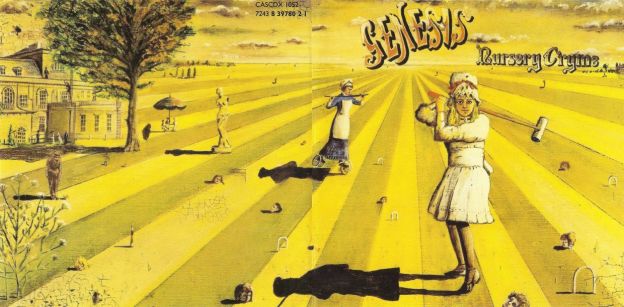
When our parents were in college, they would hang out and listen to records the way we hang out and watch movies.  Instead of compilations of various songs, many artists produced concept albums.  If you don’t know what a concept album is, first of all, I’m sorry to hear that.  (Editor’s Note: if you don’t know what a concept album is, why didn’t you read the articles about Genesis in the previous or current issue?)  Concept albums are albums unified by a theme, journey, or message.  The album was an experience.  Why are The Wall and Abbey Road still household names over thirty years later?  They embodied the cultural perspective of their generation.  Music changed.  People identified and loved this new music because it had become a simulation of what they were thinking and feeling — the overwhelming passion of being in an angry riot, the serenity of a divine intervention, the magic of a psychedelic trip.  You did not have to actually experience these things to feel them.  The music re-created the life experience, and this is the underlying concept of music like dubstep.

One might argue that such music must be the result of our generation’s collective post-postmodern crisis, or one might say that we are taking the art of music to a new level.  Music is constantly evolving as culture evolves, and the tremendous psychological generation gap of Generation Next is greater than it has ever been.  Unlike our parents and grandparents, we were born into the Information Age.  The television might have been on when you were born.  You have been bombarded with media — advertisements telling you what you want, meaningless shows paralyzing your imagination, political blogs, corporate brainwashing, search engines, and social networking sites.  Technology is progressing so rapidly that, thanks to the ease of transmitting information, our psyches are a melting pot of conflicting worldviews.  We are turning into machines that have forgotten how to create.  We don’t know why we want what we want, and we don’t know why we think what we think.  We are overwhelmed.  We are a hodge-podge of fragments of useless information.  Cheap, processed imitations of aspects of thousands of original cultures make up our environment, but your dinner or your sofa is just a copy of a copy of a copy of a copy of something that once, long ago, was something real.  We are the Generation Next, and they call us the Echo Boomers.  We are the presidents, lawyers, teachers, parents, and business executives of the future.  We can instantaneously travel the globe, but we don’t know what we are, and we are living as the echoes of our parents.

We don’t have to be.  We can re-program the world with the one thing that is ours — technology.  The genre of dubstep is a brand-new phenomenon, just being born and rapidly developing.  People hear the synthesizers and computer-like sounds and write it off as electronic or techno music, but those genres were just its predecessors.  An excellent dubstep song is everything, and, with technology, it makes everything a part of the music.  Type into YouTube™ the name of any song and add the words “dubstep remix.”  Unless the song is underground or unpopular, there was somebody who got bored and turned it into dubstep.  Somebody has taken pre-existing information and warped it to express a different idea with the original media.

Dubstep songs imitate a distortion of reality.  The popularity of its catharsis is spreading worldwide.  With time, the genre will evolve, but it is the music of the future, whether you like it or not.  Aesthetic standards are changing, technology is growing, and our minds are more of an angry mosaic than they ever have been.  As products of the Information Age, we are using the one thing that is our own (technology) to actually do something with the leftover philosophies of those before us.  We warp them into a raw adventure that is a twisted mosaic of everything our ancestors have known.  We are creating the future and encoding the worldviews of our children.  Now prepare to free your mind; it’s time to let the bass drop.

Romans 9

Seraphim Hamilton

The centerpiece of Reformed argumentation is their interpretation of Romans 9.  They read Romans 9 as a discussion of unconditional predestination unto salvation.  However, Orthodox theologian David Bentley Hart notes that according to the plain reading of the text, and according to the Greek Fathers, Romans 9 has very little to do with individual election unto salvation at all.  Rather, it has to do with the separation and ultimate reconciliation of Israel and the Church (77).

Let us therefore look closely at the ninth chapter of St. Paul’s Letter to the Romans that we may see and understand what it really teaches.  St. Paul begins in verses one through five by identifying his own love for Israel, and that they are honored with the Old Testament Scriptures and prophecies, that they are honored in that the Messiah Himself — God incarnate — comes from their people.

They have been chosen as the covenant people, St. Paul says, and that is their honor.  The question that he deals with, then, is, “how in the world can Jesus be the Messiah if His own people reject Him?”  St. Paul begins his answer in verses six and seven.  He states, “For not all who are descended from Israel belong to Israel, and not all are children of Abraham because they are his offspring, but ‘Through Isaac shall your offspring be named.’”

We therefore see the point that Paul is making.  Those who believe not in Jesus as Messiah are not truly part of Israel.  To prove that not all who are descended from Abraham are under the covenant, St. Paul points to the first child of Abraham who was not under the covenant — Ishmael.  Therefore, because not all children of Abraham in the beginning were necessarily under the covenant, the same can be true of the modern fleshly descendants of Abraham.  St. Paul seals this argument in verse eight.  He writes, “This means that it is not the children of the flesh who are the children of God, but the children of the promise are counted as offspring.”  Thus, we see that covenant status is not dependent on fleshly inheritance.

St. Paul continues his argument in verses nine through thirteen, key passages in Reformed theology.  He writes, “For this is what the promise said: ‘About this time next year I will return and Sarah shall have a son.’  And not only so, but also when Rebecca had conceived children by one man, our forefather Isaac, though they were not yet born and had done nothing either good or bad — in order that God’s purpose of election might continue, not because of works but because of his call — she was told, ‘The older will serve the younger.’  As it is written, ‘Jacob I loved, but Esau I hated.’”

What does St. Paul mean by this?  Is he talking about election unto salvation?  We see that he is not.  First of all, when St. Paul quotes Malachi 1:2-3 in saying that “Jacob I loved, Esau I hated,” it is not talking about lack of divine love.  Rather, the Old Testament is using hyperbolic covenant terms.  Douglas Moo writes to this effect, “The verbs ‘love’ and ‘hate’ in Malachi are covenantal terms. They do not express God’s emotions…but his actions….  We might paraphrase, ‘Jacob I have chosen, but Esau I have rejected’” (58).

We see something very important in St. Paul’s quotation of the prophet.  If one examines the immediate context of Malachi 1:2-3, one sees that the prophet is not speaking of Jacob and Esau as individuals.  Rather, he is using them as symbols for the nations which they bore — Israel and Edom.  Thus, St. Paul is speaking of the covenant election of corporate bodies for the purposes of God’s plan — not individual people unto salvation.  Furthermore, we see later in the book of Genesis that Esau is reconciled to his brother Jacob and forgiven.  Because we know that at least one Edomite (Esau) was saved, we know that St. Paul is not speaking about election unto salvation.  Edwards states likewise, “In the present context Paul is not discussing the eternal salvation of individuals, but God’s purposeful choices in history from Abraham to Christ” (231-2).  Witherington concurs, writing, “The discussion of election in chs. 9-11 is a discussion of corporate election, in the midst of which there are individual rejection by some and selection for historical purposes of others” (246).

In Romans 9:15, St. Paul quotes Exodus 33 in proving the justice of God, where God says that He will have mercy on whom He will have mercy.  While Calvinists have viewed this as explaining God’s lack of mercy for some, this does not fit with what God is actually saying in Exodus 33.  If one reads Exodus 33, God is actually discussing the abundance of His mercy, and that He will have mercy on people even if Moses would rather He not do so.  That is to say, St. Paul is demonstrating that God is free to have mercy on the Gentiles if He so wishes, despite the protests of the Jews.

In Romans 9:17, St. Paul draws our minds back to God’s dealings with Pharaoh in the book of Exodus.  He therefore concludes in verse eighteen that God is free to harden whomever He will.  This is a difficult passage, and we must therefore undertake a study of hardening in the Bible.  St. Paul right now is giving us an example of someone not part of God’s covenant people.  We note that, first, Pharaoh hardened his own heart first in Exodus 8:15, 32, and 9:34.  This is why St. Paul says in Romans 1:22-25 that, “Claiming to be wise, they became fools, and exchanged the glory of the immortal God for images resembling mortal man and birds and animals and reptiles.  Therefore God gave them up in the lusts of their hearts to impurity, to the dishonoring of their bodies among themselves, because they exchanged the truth about God for a lie and worshiped and served the creature rather than the Creator, who is blessed forever!  Amen.”

We see that God turned them over to their own sin in response to their continuous rebellion against Him.  The cause and effect is that the people rebel against God, and God says “Thy will be done” and turns them over.  This is precisely the relationship described between God and Pharaoh in the book of Exodus.

One must always remember the subject of Romans 9 is explaining the relationship of fleshly Israel to God in the present time.  They are not presently under the divine covenant, because they have rejected Christ.  St. Paul gives an example of one who was not in a covenant with God, paralleling the Jews who reject Christ.  We see that God has now turned fleshly Israel over to their own darkness and unbelief, for St. Paul writes in Romans 11:7-8, “What then?  Israel failed to obtain what it was seeking.  The elect obtained it, but the rest were hardened, as it is written, ‘God gave them a spirit of stupor, eyes that would not see and ears that would not hear, down to this very day.’”

Israel has been hardened due to their unbelief.  If Reformed theology were true and this hardening refers to predestination unto reprobation, it is not going to be reversed.  On the contrary, St. Paul later says in Romans 11:26 that all Israel will be saved!  With that said, turn your eyes back to Romans 9 for a moment.  The chapter discusses God’s purposes in corporate elections.  He elects corporate bodies according to His own will and wisdom in order to bring about salvation for the maximum number of people.  Why, then, has God not elected fleshly Israel?  Why has He now elected the body of the Church?  St. Paul answers this question in Romans 11:11, saying, “So I ask, did they stumble in order that they might fall?  By no means!  Rather through their trespass salvation has come to the Gentiles, so as to make Israel jealous.”

Yet, God still desires salvation for Israel, and thus their jealousy will ultimately lead to salvation, as it is written in Romans 11:26 and in the Prophet Zechariah.  The prophet writes in Zechariah 12:10, “And I will pour out on the house of David and the inhabitants of Jerusalem a spirit of grace and pleas for mercy, so that, when they look on me, on him whom they have pierced, they shall mourn for him, as one mourns for an only child, and weep bitterly over him, as one weeps over a firstborn.”  Thus, God has wisely elected the Church in this present day that salvation may flow to the Gentiles, making Israel jealous, leading to Israel’s rejoining of the olive tree.  How great is the wisdom of God!

In Romans 9:19-21, St. Paul analogizes God to a potter, molding things into whatever He wishes.  St. Paul is alluding to a passage from the Prophet Jeremiah, where the Lord says through the prophet, “O house of Israel, can I not do with you as this potter has done? declares the Lord.  Behold, like the clay in the potter’s hand, so are you in my hand, O house of Israel.”  As we can see, this is still dealing with corporate groups, rather than specific individuals.

Some Protestant translations translate Romans 9:22 as saying, “What if God, desiring to show his wrath and to make known his power, has endured with much patience vessels of wrath prepared for destruction.”  However, Witherington notes in his commentary on Romans that 9:22 can be translated, “Although God desired to show his wrath and to make known his power, He endured with much patience vessels of wrath prepared for destruction” (257).

This makes much more sense with verse twenty-three, which says, “in order to make known the riches of his glory for vessels of mercy, which he has prepared beforehand for glory.”  That is, God endured the unfaithfulness of Old Israel in order to bring about salvation within the New Covenant Church.

How does one deal with the vessels of wrath prepared for destruction?  This is not an example of God unconditionally predestining individuals to reprobation.  Actually, the vessels of wrath are preparing themselves for destruction.  According to Witherington, “Paul uses two different verbs when talking about the vessels of mercy and vessels of wrath….  Katertismena, used of the vessels of wrath, is a perfect passive participle.  Proetoimasen, used of the vessels of mercy, is an aorist active indicative.  This change cannot be accidental, and it suggests that Paul means that the vessels of wrath are ripe or fit for destruction.  Indeed, one could follow the translation of John Chrysostom here and understand it in the middle voice: “‘have made themselves fit for’ destruction” (258).

With this point made, St. Paul’s quotation of Jeremiah makes perfect sense.  Jeremiah is discussing God’s relationship to the house of Israel, those descended from Jacob according to the flesh.  He has a right to do with them what He wishes.  Then St. Paul explains that God endured the wickedness of the people of Israel as long as He did because it enabled Him to make known His mercy within the New Covenant Church, composed of both Jews and Gentiles.

We have seen thus far two very important things.  First, St. Paul is not speaking about salvation.  Second, St. Paul is not speaking about individuals, but covenant groups.  With these things proven, St. Paul’s argument is this: God’s covenant was never with a fleshly body.  Rather, he elected covenant nations according to His own wisdom and purpose.  Who can question the will and wisdom of God?   He has a right to mold His covenant people into whatever He wishes.  He has never broken His promise to true Israel, for true Israel is now all who are faithful to Jesus the Messiah, that is, the people of the Church.  God has elected the Church rather than fleshly Israel in order to save Gentiles, and eventually to bring salvation full circle so that all Israel may be saved as well.  Gentiles are now a part of true covenant Israel, and hence St. Paul quotes the prophet in verse twenty-five, saying “As indeed he says in Hosea, ‘Those who were not my people I will call my people, and her who was not beloved I will call beloved.’”

Works Cited

Edwards, James. Romans: New International Bible Commentary. Peabody: Hendrickson, 1991.

Hart, David Bentley. The Story of Christianity. London: Quercus Books, 2007.

Moo, Douglas. Romans. Zondervan Illustrated Bible Backgrounds Commentary, Vol. 3: Romans to Philemon. Clinton E. Arnold, Gen. Ed. Grand Rapids: Zondervan, 2002.

Witherington, Ben. A Socio-Rhetorical Commentary on Paul’s Letter to the Romans. Grand Rapids: Eerdmans, 2004.

Play Me My Song — Nursery Cryme: Gabriel’s Genesis Retrospective, pt. 3

Christopher Rush

The Classic Lineup, The Classic Albums

By 1971, Genesis had secured its now-classic five-person lineup: Peter Gabriel, Tony Banks, Mike Rutherford, Phil Collins, and Steve Hackett.  Over the next five years, Genesis would release five albums (four studio albums and one live album) and establish itself as the dominant progressive rock band of all time.  The band mates had honed their musical talents both within the studio and in early live performances, and the arrival of more-skilled musicians (Collins and Hackett) as well as new instruments and technical recording proficiencies all allowed the band to finally create the diverse and unique sounds and songs it had desired to do since its inception.

The first of the five classic lineup albums, Nursery Cryme, is still considered by some the culmination of the band’s maturation process, with its next album, Foxtrot, the real first fruits of its developmental stage.  Such a view does not give Nursery Cryme its just appraisal as a quality album in its own right.  Admittedly, the album does build upon the musical ideas hinted at in their earlier work, and as we found out recently with the previously unreleased demo material finally available in the box sets, many of the songs on this album had definite origins in the band’s earlier musical stages with Anthony Phillips.  Even so, to consider Nursery Cryme only as another development on the way to Foxtrot as the ultimate goal misses the point of the album: it has different songs that are not trying to do what Foxtrot and later albums offer.  It is a worthy and enjoyable album by itself, and it begins with one of the best (and most bizarrely creative) Genesis songs in their entire canon.

“The Musical Box”

The story behind this Victorian fairy story/epic song is included in the liner notes and depicted on the Paul Whitehead cover:

While Henry Hamilton-Smythe minor (8) was playing croquet with Cynthia Jane De Blaise-William (9), sweet-smiling Cynthia raised her mallet high and gracefully removed Henry’s head.  Two weeks later, in Henry’s nursery, she discovered his treasured musical box.  Eagerly she opened it and as “Old King Cole” began to play a small spirit-figure appeared.  Henry had returned — but not for long, for as he stood in the room his body began aging rapidly, leaving a child’s mind inside.  A lifetime’s desires surged through him.  Unfortunately the attempt to persuade Cynthia Jane to fulfill his romantic desire, led his nurse to the nursery to investigate the noise.  Instinctively Nanny hurled the musical box at the bearded child, destroying both.

The song takes place, fortunately, at the climactic moment of the scene described above.  Henry is hovering, apparently, etherealized around or in the nursery, caught between this life and the next — similarly, he is caught between his lust for Cynthia and a bourgeoning apathy toward existence itself (“It hardly seems to matter now” repeated throughout the song).  The opening strums recall us to the idyllic timbres of Trespass, but the audience has not long to wait before the maturity of the band and its aesthetic development shifts our focus away from the simplicity of the earlier album’s tonality to the wider range of sound and emotion, especially by the musical break and pounding section after “And I want / And I feel / And I know / And I touch / The wall” at the end of the opening ethereal section.

Cynthia discovers the musical box, and incorporeal Henry urges her on to open it.  The story in the liner notes (and Peter Gabriel’s introduction of the song in certain live performances) indicates that Henry returns to life with his eight-year-old mind, though his body begins to age rapidly when “Old King Cole” is played.  The supernatural is, as is obvious by now, a key element of Genesis’s lyrics.  Briefly, Henry indicates that the good news of a future afterlife Paradise (“a kingdom beyond the skies” — very Cosette-like) is all a lie.  Instead, he is “lost within this half-world,” neither fully dead nor fully alive, but he is initially unburdened by that (“It hardly seems to matter now”).  The confusing aspect of the lyrics (aside from the entire supernatural events themselves) is that Henry seems to know before his resurrection that his time is short; perhaps that is why he is so insistent that he and Cynthia (despite her age) consummate their relationship — despite the fact as well that she willfully killed him with a croquet mallet two weeks before.  If he knows his time is short, how does he know that, especially since his mind is still that of an eight-year-old?  Despite (or perhaps because of) his prescience, Henry’s lust overpowers his ethereal apathy like the poetic contributions of Andrew Marvell and Robert Herrick: “Just a little bit / Just a little bit more time / Time left to live out my life.”  The remaining time Henry has he wants to spend (in a manner of speaking) with Cynthia.  She opens the box, “Old King Cole” rings out, and Henry is embodied (and embearded) and starts to age physically.

After the pounding musical interlude, the first example of the band’s musical maturity, rapidly-aged Henry confronts the apparently motionless Cynthia (her reactions and attitudes are never mentioned during the song, since it is all from Henry’s point of view).  This half of the song demonstrates undoubtedly Genesis’s maturity as a band that combined provocative lyrics (admittedly sometimes abstrusely) with impressively skillful and aesthetically engaging instrumentality.  Now an old man with an eight-year-old mind, Henry voices his lust for the first (and last) time.  The tension and paradox of his love/lust comes out clearly: “She’s a lady, she’s got time. / Brush back your hair, and let me get to know your face.”  At first respectfully and Victorianly distant, Henry quickly shifts into Marvell-mode: “She’s a lady, she is mine!”  If Cynthia were a lady, even at nine-years-old, she probably would not have assassinated Henry with a croquet mallet in the first place.  If she were a lady, in the second place, she would not “belong” to Henry, young or old.  His lust is winning out: “Brush back your hair, and let me get to know your flesh” — an uncomfortable thought from an eight-year-old, especially toward a nine-year-old, made even more awkward by Peter Gabriel’s mask and movements during the live renditions of the song.  Fortunately, Genesis is in no way condoning such an attitude or behavior, since Henry ultimately receives his just reward.  We should remember, too, that Cynthia did slaughter Henry as well, and he still loves her, which makes the song thoroughly bizarre but archetypically Genesis, in the Gabriel era.

Soon Henry’s unslaked lust (as is often the case) turns into anger, though still tinged by a hint of apathy: “I’ve been waiting here for so long / And all this time has passed me by / It doesn’t seem to matter now” — apathy, or at least willingness to forgive the heretofore unrequited aspect of his lust, if only Cynthia will requite him now…which she won’t.  “You stand there with your fixed expression / Casting doubt on all I have to say.”  Now Henry’s anger and lust are full-boil and inseparable: “Why don’t you touch me, touch me / Why don’t you touch me, touch me, touch me / Touch me now, now, now, now, now / Now, now, now, now, now, now, now, now, now / Now, now, now, now, now, now!”  They are all there — listen carefully.  The nurse comes in, flings the music box at the wrinkled Henry, and both are destroyed.  “The Musical Box” signals quite well the maturity of Genesis as a prog rock band with finely- (and finally-) honed lyrical and musical talent to support the epic narrative visions that launched the band five years earlier.

“For Absent Friends”

In stark contrast to the William Blake-like bizarre maturity of “The Musical Box” (though no one does William Blake-like bizarreness like early Rush), “For Absent Friends” highlights the band’s softer and sweeter side.  The only thing discordant about this song is the delayed resolution at the very end, as Phil Collins’s first vocal contribution ends before the return of the dominant tonal chords provided by Hackett and Rutherford.  The song has a very folksong feel to it, but the impressive part is that it does not remind one of Trespass — it is its own song while thoroughly Genesis material.  Though the song is about a Sunday evening, it has all the atmosphere of a Saturday afternoon, or perhaps a Saturday late-morning, after one sleeps in with nothing much to do that day, perhaps having Welsh rabbit for lunch while still in one’s jim-jams.  The song concerns an elderly couple who misses and prays for those loved ones who are no longer present in their lives, and while the song has the slow pacing to match their slow gait, it also reflects a time of youth and late-morning sunshine.  Sometimes Genesis songs produce that antithetical feeling.  The lyrics are straightforward, certainly among the most translucent lyrics in the band’s Gabriel-era canon, and thus need no detailed discussion here.  Listen to the song with the words in front of you and enjoy a quiet, too-brief moment.  Though, part of its charm is that it is so short, since if it went on longer it would spoil the mood.  Sit back and enjoy the just-right song evoking both ends of life’s spectrum.

“The Return of the Giant Hogweed”

Nursery Cryme is a loosely-unified concept album in that most of the songs are nursery rhyme-like songs (the overt use of “Old King Cole” is evidence of that) dealing with children, myths, and Romance- and Victorian-atmospheric tunes; some of the songs are even loosely connected to each other.  “The Musical Box” is a Victorian fairytale (of a sort), and “Giant Hogweed” is an apocalyptic vision begun by a Victorian explorer.  Rooted, if you will, in the actual Heracleum mantegazzianum, the phototoxic hogweed plant that originates fairly close to where the eponymous version comes from, “Giant Hogweed” is another epic song beginning in medias res with the Giant Hogweed plants already waging their militaristic campaign.

The obvious connection is to “The Knife” from Trespass (and “The Battle of Epping Forest” in Selling England By the Pound), though “The Knife” is a lot more politically-minded and serious in tone.  That may sound strange, especially since the end of “The Knife” is a tyrant’s conquering of a police force (admittedly an unfortunate thing) and the end of “Giant Hogweed” sees the end of humankind altogether, overcome by rampaging mutant personified human-killer plants.

Musically, “Giant Hogweed” demonstrates Genesis’s ability to tell a story with its musical diversity as well as its lyrical maturity.  The speedy rhythms of the present scenes of the hogweed battle complement the frenetic chaos of the story.  The past tense backstory verses change the musical pace well, mirroring the sounds with the words as the moods change frequently.  In this diversity, the progression from “The Knife” is clear: instead of just post-production vocal manipulation, “Giant Hogweed” changes musical aspects as well as Gabriel’s vocal offerings.  The band is more mature, using their instruments as contributions of the overall song and its message.  Though it uses gimmicks aplenty (especially in Gabriel’s on-stage personae), the band has more to offer than simply gimmicks.

The backstory of the Victorian explorer in the Russian hills finding and transplanting the Giant Hogweed comes in agitated music-box-like verses.  The melody is pleasant like a music box melody should be, but the lyrics and the pace (as if a child were cranking the music box gears too quickly) betray the simplicity of the tune with the danger of the invincible plants.  The hubris of the Victorian “fashionable country gentlemen” who valued exotic botany over safety results in the gentlemen getting their due.  The parallel to the destructive nature of Victorian Imperialism is there, but I wouldn’t press the connection too firmly.  The effects of nineteenth-century imperialism, one could say, resulted in the world-wide destructions of World War I, but I doubt WWI is what Genesis had in mind as a parallel to the genocidal victory of the Giant Hogweed.  The characterization of the Hogweed itself (or themselves) by Gabriel and the other vocal contributors is a further oddity in this lyrical story, especially in the final stanza.  The line “Human bodies soon will know our anger,” were one to just read it without hearing or knowing the tune, might direct the reader to suppose Gabriel’s voice is loud and full of such anger, yet the contrary is true.  The Hogweed sings this line with a music box-like mellifluousness, betraying the aggressive nature of the campaign.  Instead, it is the voice of the humans in the chorus-like sections of the song that Gabriel sings with a hardened edge to his timbre.  The humans exclaim, “Stamp them out / We must destroy them” and “Strike by night / They are defenseless.”  Though both sides are guilty and both sides angry, Gabriel vocalizes the human race as the oppressors and the Giant Hogweed as the self-protecting and righteous combatants (“Mighty Hogweed is avenged”).

In the end, the Hogweed is victorious, but we are never told why it is the “return” of the Giant Hogweed.  The Hogweed bide their time over the years, seeking to avenge their uprooting from their Russian home, but that’s not a “return”; in contrast, once the attack has begun, the humans decide they must “[w]aste no time.”  The impatient reactors to the long-meditated counter-insurgency lose to the royal beast who never forgot what was done to him long ago by the Victorian explorer, and humanity pays the price.  The final musical sounds utilize this call-back to earlier times, with a kind of classical- or baroque-style ending and repeated final chord — definite growth from the Trespass days only months before.

“Seven Stones”

Like “For Absent Friends,” “Seven Stones” presents a soft ballad-like break between musically harder and more driving numbers, almost to the extent the album goes back-and-forth demonstrating Genesis’s developed soft/ballad and hard/mythic narrative facets.  It is possible that “Seven Stones” is the best song on the album that shows their musical and lyrical cohesion, though the time periods the lyrics and musical sounds indicate I believe are different — I am open to correction, of course.  Listening to this song is very much like listening to a Victorian sea shanty about times gone by, connecting it in a roundabout way to the overall theme of the album.  In contrast to the Victorian (perhaps even Edwardian) atmosphere, the lyrics are similar to a Romantic poem.  The opening line, “I heard an old man tell his tale,” reminds us of the opening of Percy Shelley’s poem “Ozymandias” — in both instances, it is not the narrator’s tale that the reader proceeds to read, it is layered by the narrator recalling what he heard from another source (akin to Thomas More’s Utopia, as well).  From this Romantic allusion of multi-layered narration, “Seven Stones” progresses to a parallel of Coleridge’s “Rime of the Ancient Mariner” set within an Irish heather or Scottish highland “seventh son, seventh stone” magical fairy-tale background.

The first tale the old man tells is of a “Tinker, alone within a storm,” who is “losing hope” and “clears the leaves beneath a tree” under which he discovers the eponymous seven stones.  We are not told if the tinker takes these stones with him or if he leaves them, only that he later finds a friend in the seventh house he seeks out: apparently the stones (either magically or placebo-like) gave him hope to press on and his friend relieves him from the dangers of the storm — he was not as alone as he thought he was.  The shift from this story to the next is the most ambiguous line in the entire album: “And the changes of no consequence will pick up the reigns from nowhere” — superior to the ambiguous lines from the From Genesis to Revelation days, this line is a Coleridgean/Blakean bizarreness that seems to fit quite well.  The tinker’s change from hopeless isolation to befriended succor is certainly not of “no consequence,” so what the inconsequential changes are we are not told (perhaps because of their very inconsequential nature) — but then they take up the reigns from nowhere, as if what we thought were inconsequential then become the most consequential because they are now in control (holding the reigns — perhaps of destiny or Nature itself, perhaps by the power of the seven stones themselves).

The second story is the definite “Rime of the Ancient Mariner” parallel: sailors are imperiled on the sea about to strike a rock (though this did not happen in Coleridge’s poem) until a gull flies by and the Captain is moved by an unknown force to change course (similar to the supernatural effect the albatross and its slaying has in Coleridge’s poem, but it is admittedly distinct and thus a parallel, not an exact copy).  Whatever the inconsequential changes are in this story, they likewise take the reins from nowhere.

At this point, the old man takes a break (as evidenced both by the lyrics and the vocal change in Gabriel’s sound) and we learn some surprising things about this old narrator and his ambiguously supernatural tales from yet another narrator layer, this time an angelic-like omniscient chorus: “Despair that tires the world brings the old man laughter, / The laughter of the world only grieves him, believe him, / The old man’s guide is chance.”  It is difficult to accept why we should believe the stories of someone so contrary to the fabric of reality, who laughs at what brings most of us despair, who grieves at what brings most of us happiness and relief, and who is ultimately guided not by an absolute standard of morality or destiny but by that most fickle of masters: chance.  Perhaps, though, that is the point.  The things that we laugh at are truly trivial and inconsequential.  The things that we are afraid of should be what we laugh about (the seriousness of human affairs, for example?).  If chance is the reliable guide, does chance have a connection to the seven stones and the natural/supernatural influence of the gull?  If the old man believes in chance and human action and not divine structure, perhaps the stones had no intrinsic power after all, and superstition alone led the tinker to safety; similarly, the Captain who turned his boat to safety, instead of rationally asking why the gull was there, intuitively changed course because of chance.

The old man’s third tale (or second, if the tinker and sailors are two parts of the first tale) features the old man himself and gives further support for his Romantic philosophy couched in a Victorian/Edwardian song.  A farmer, who is apparently a very bad farmer, since he “knows not when to sow,” which is an essential skill for farming, approaches the old man for assistance rather desperately, since he is “clutching money in his hand.”  The old man shrugs, smiles, takes the money, and leaves “the farmer wild.”  Not much (if anything) should be read into the fact the old man with a Romantic/cavalier attitude steals money from a farmer, a man who works closely with the land and thus nature, which a Romantic should value — especially since the farmer is not very good at knowing the land.  With the old man’s thievery, the changes of no consequence pick up the reigns from nowhere, and soon the song comes to a close.  Nothing more is learned about the old man, the ethereal chorus, or the original narrator who is listening to the old man’s tales.

“Harold the Barrel”

Another Phil Collins cymbal roll heralds (I apologize) the shift from the “slow, melodic Genesis” to the “quirky, eclectic sounds and stories Genesis.”  “Harold the Barrel” is certainly one of their quirkier songs in the Gabriel era.  The song is a send-up of inane news reporting about topics of “local interest,” which, if relevant in 1971 England, is certainly relevant to today’s even crazier “news”-saturated, media-driven culture.  Like with most “news” stories, the veracity of the content is questionable at best.  Genesis does a trenchant job of clouding the issues, obscuring the perspectives, and rejecting any satisfactory conclusion to the episode.

Harold’s “mouse-brown overcoat” tells us that he is himself mousy, and thus weak and ineffective.  The next tidbit we learn is he is a father of three and has done something disgusting, apparently cutting off his own toes and serving “them all for tea,” though we are not told if they are served to his sons or if the entire thing is just community gossip, since Harold is a “well-known Bognor restaurant owner,” which means no one knows him at all.  The community soon revolts against him, and the train he took early this morning to escape will not take him far.  That Harold “hasn’t got a leg to stand on” is a remarkable line of Gabriel’s developed dark humor and lyrical skill: not only has Harold supposedly cut off his toes, he has no leg, either.

Before too long we infer that the information of Harold catching a train to escape early that morning is not true (either that he didn’t take a train at all, or just that he took a train not to escape but to get to the town hall where Harold is actually standing out on a ledge, perhaps ready to jump and end it all in a “Richard Cory”-like fashion except jumping from a ledge, not shooting himself with a gun, of course).  The reporter on the scene describes the gathering crowd at the town hall as “a restless crowd of angry people” — so restless that the city council has “to tighten up security.”  Why are they so angry?  Are the rumors about his teatime snack accurate?  It is never mentioned again, nor does the rest of the song give any tacit credence to such a tale.  Genesis could be ridiculing not only the nature of news reporting but also the mob mentality of onlookers — with no facts to ground their emotions upon, anger becomes the easiest communal response.

Even the Lord Mayor gives no leniency to Harold: “Man of suspicion,” he calls Harold, “you can’t last long, / when the British Public is on our side.”  What are the sides?  What is the issue?  Poor Harold is standing on a ledge, obviously discontent over something, and not only is the mindless citizenry against him for no apparent (or rational) reason, but also the elected officials are against him.  Mob mentality is king, here, since the Mayor himself appeals to general consensus: if the Public believes this ledge-hanger is guilty of something despicable, he must be, regardless of who he is, what he has done, or why he is even there.  Their communal antipathy increases in appetite, as they chant menacingly that “he can’t last long” (they clearly don’t want him to) and that supposedly this mindless mass earlier indicated that Harold couldn’t be trusted, “his brother was just the same.”  Why bring his brother into this?  Of course no one earlier voiced any concern about Harold; certainly we should place no credence in their filial associative gossip.

The sweetest moment of the song is the brief interlude from Harold’s perspective, as he looks out over the enraged citizenry and imagines where he would like to be instead: “If I was many miles from here, / I’d be sailing in an open boat on the sea / Instead I’m on this window ledge, / With the whole world below.”  The music accompanying this brief reverie is very enjoyable, especially as it is a break from the frantic cymbal-splashing highlights of the mob mentality and gossip-laced reporting.

Another shift occurs as the mob takes on a patina of Good Samaritan behavior: Mr. Plod (most likely the Lord Mayor, no doubt a pertinent name for his character and approach to his work and life in general) tells Harold “We can help you,” which the drones in the crowd repeat.  “We’re all your friends / if you come on down and talk to us son,” he continues.  Harold and we know this is a hollow lie.  “You must be joking,” is Harold’s appropriate and impassioned response.  “Take a running jump!”

The Samaritan shift in attitude seems to increase, as the crowd, once glad that Harold was out there ready to jump, is now concerned that he is getting weaker, so much so that they send for his mother, which does not help at all (it is difficult to ascertain if the crowd brings in his mother to further his decision to jump or not, since it is highly doubtful they knew anything accurate about the family anyway).  Were it not for the fact Harold’s mother is called Mrs. Barrel, the title calling Harold “the” Barrel might indicate that he is nothing more than a receptacle for other’s emotions, plans, and manipulations (this still may be the case, since, even if Harold’s last name is actually Barrel, the title calling him “the” Barrel may just highlight his prior nature up to the point he steps on to the ledge).  Mrs. Barrel gives Harold very poor reasons to come back inside: if his father were alive, he’d be upset with Harold’s actions; and his shirt is all dirty and thus he is embarrassing her, especially since a man from the BBC is there to capture his disgraceful appearance on film.  Meanwhile, the crowd resorts to content-less social acceptability: “just can’t jump” they say over and over.  Why not?  Because it’s not what people do, apparently.  No one is concerned for Harold, no one bothers to inquire why he is there at all.  Mr. Plod and his chorus repeat their earlier pleas to Harold that since they are friends, he should just come down and talk to them, which Harold rejects as before.  And suddenly, the song is over.  The music does not tell us if Harold jumped or returned inside.  Like all “news” stories of today, the result is irrelevant.  The connection to our lives and why it should matter to us is ignored completely.  The motivation behind Harold’s actions is never sought.  The song ends; the “news” cycle continues on to something else.

“Harlequin”

I have posited that Nursery Cryme is a loose concept album, primarily in the moods of the diverse songs generated, as well as the (admittedly thin at times) lyrical connection to nursery tales of myths, magic, and medieval wonderments.  “Harlequin” furthers the tonal mood aspect of the album, especially since Gabriel’s vocal work on this song is dominantly falsetto.  This song feels like a Harlequin is singing it; it also evokes a pinwheel being blown by the breeze — this song is a pinwheel, and all the simplicity of youth and pre-Econ class joy we once had.  (Not that Economics class is bad, just that it usually occurs at the end of our high school days when we are about to fully embark upon maturity and college, and the days of playing in the dirt with action figures and pinwheels are mostly lost to us.)  Little needs to be said here about this song; it is too lovely to dissect.  In closing, though, it is a very hopeful song, as clearly indicated by the final chorus.  The words and music paint a very enjoyable (and again almost unfortunately brief) aural painting.

“The Fountain of Salmacis”

A final Collins cymbal roll brings the final song of this Wonder Book-like collection of tales and fancies.  The story of Hermaphroditus and Salmacis is even older than Ovid, but his version in Metamorphoses is probably the best known.  The liner notes recap the story for those less literate consumers of prog rock:

Hermaphrodite: a flower containing both male and female organs; a person or animal of both sexes.  The child Hermaphroditus was the son of Hermes and Aphrodite, the result of a secret love affair.  For this reason he was entrusted to the nymphs of the isolated Mount Ida, who allowed him to grow up as a wild creature of the woods.  After his encounter with the water-nymph Salmacis, he laid a curse upon the water.  According to fable, all persons who bathed in the water became hermaphrodites.

Little needs to be said as well about the lyrical content, since it is mostly a straight re-telling of the story, without the complex narrative layering of “Seven Stones” or limited narrative focus of “The Musical Box.”  This song, though, fits well with them and completes this diverse but connected album.  The variations in musical texture at various narrative points in the song are reminiscent of and superior to similar attempts from Trespass, and as has been said so often about this album, the music helps tell the story very well.  The most interesting (and unique) aspect of this song could also be its most frustrating for some: at the end of most verses, either Salmacis or Hermaphroditus says something cogent about her or his feelings or reactions in first person, and usually the omniscient narrator of the song makes a similar comment in third person — at the same time.  This overlapping of words/perspectives is challenging to comprehend the first time or two through the song (especially if one listens without the words in front of him), but it is a unique element that adds to the fast-paced confusion and immediacy of the events in the confrontation of Salmacis and Hermaphroditus.  After setting the blissful scene at the beginning of the song, the rapid action of Salmacis waking up, falling for Hermaphroditus, and their conjunction (against Hermaphroditus’ will) needs a confused, perplexing cacophony to express the moment accurately — and this overlapping of narrative presentation succeeds in that unusual task (concerning such unusual characters).  As an aside, Hermaphroditus’ line, “Away from me cold-blooded woman / Your thirst is not mine” is a sharp indicator of Gabriel’s mature lyricism, combining the emotion of a moment with the irony of the situation, as Hermaphroditus was there to slake his physical thirst for water, but the waken Salmacis has a different kind of thirst when seeing Hermaphroditus.

With Hermaphroditus’ curse, the music winds down to its initial calmness, as the two (and a half) beings descend to their eternal condition: “Both had given everything they had. / A lover’s dream had been fulfilled at last, / Forever still beneath the lake.”  The musical conclusion is similar to the ends of other songs on this album, though the sounds are in line with the tenor of this particular song and the somber mood at the end of the lyrics.  In another sense, the final musical exchange fits with the album as a whole in that the diverse presentation of tones, stories, and emotional energies climaxes with the lovers’ (after a fashion) embrace and resolution — everyone is worn out and almost resigned by the end, including the musicians.  It is time for peace.  The album is a triumph, both for Genesis and for the progression of music itself, but the impressive creativity and emotional energy from everyone has been exhausted, and so it is not so much a victory that is being celebrated (not even for Salmacis) as it is a cathartic completion with the understanding that now even more will be expected and even more must be done (similar to John Adams’s “It’s done! … It’s done,” at the end of 1776).

“Some Creature Has Been Stirred”

I have said throughout that those who see Nursery Cryme as the last of the developmental albums before the heyday of Genesis’s Gabriel era are missing the point.  That is not to say that with this album Genesis peaks and remains static for the next four albums or so, nor is it an implication that the Collins era (or even the short-lived Ray Wilson era) is ultimately inferior — they are all different entities, with different emphases and different highlights (and lowlights).  I suspect that most who argue for Foxtrot’s superiority to Nursery Cryme base their argument solely on personal enjoyment: they like listening to Foxtrot more, probably because of “Watcher of the Skies” and “Supper’s Ready.”  I have already admitted that I enjoy Foxtrot more than I enjoy Nursery Cryme, but that is not because I think it is a better album — they are similar, yes, in several ways obvious to even a cursory appraisal, but they are different albums, and the band members display their lyrical and musical skill extremely well on both.  Let us not let the mighty penumbra of “Supper’s Ready” take away from our appreciation and enjoyment of “The Musical Box” and “The Fountain of Salmacis.”  Neither should we let the perfection of “Horizons” diminish our capacity to revel in “For Absent Friends” and “Harlequin.”  Nursery Cryme is the beginning of the great golden age of Genesis in the Peter Gabriel era, and it should be listened to and enjoyed because of its own merit.

How to Interpret the Constitution

Tanner Rotering

Essentially, there are two prominent ideologies on how to interpret the Constitution.  One such ideology is called “Strict Constructionism.”  This technique for Constitutional “interpretation” is based on the idea that the Constitution should be “interpreted” based on what the Constitution actually says and on what the founders intended those words to actually mean.  (Though the strict definition does not actually include the considerations of the original intent of the Founding Fathers, the term “Strict Constructionism” is often used to include this “originalism.”)  The second method of interpretation for the Constitution is based on the idea that the Constitution is a “Living Constitution.”  Proponents of this view state that the Constitution should be interpreted based on the needs and ideas of the day since the Constitution was simply an embodiment of certain principles to be applied.  Of these two views, the ideology of “Strict Constructionism” is the only theory that is legally sound and beneficial to the United States of America.

The purpose of a constitution is to establish certain rules and principles for a civilization and for its government.  These rules are intended to establish a certain foundation upon which a nation is to be built and run.  This foundation is intended to preserve order and to protect the rights of citizens.  If these rules and principles are able to be “interpreted” differently than how they were originally written or intended, like the proponents of the “Living Constitution” claim they are, then there is essentially no purpose to having a set of rules in the first place.  But because there obviously was a purpose of having a definitive set of rules in the Constitution, we can conclude that they were not intended to be loosely interpreted in various ways.

If the Constitution was intended to merely be an embodiment of certain principles to follow, why would it be so specific in how those principles were to be carried out?  Clearly the Constitution was intended not only to promote certain ideals, but also to propose a specific way in which to implement such ideals in order to optimally achieve them.  If government officials think that they can achieve such ideals differently, good for them, but they have no authority to implement these alternative techniques without the Constitution.

The fact that the Constitution does list a specific procedure for altering itself further discounts the claims of the Living Constitutionalists.  That procedure is the amendment process.  If the Constitution was intended to be altered through interpretations by Supreme Court Justices, then the Constitution would say so, but because the Constitution specifically lists only one such process (the amendment process), we must assume this is the only intended way to change the Constitution.

The Supreme Court should not be considered the ultimate authority on “interpreting” the Constitution, as if the Constitution was not clear in its intent.  Instead, the Supreme Court should be considered the ultimate authority on applying the Constitution, as in deciding how the clearly written rules of the Constitution are to be applied to specific situations.  This distinction could be considered a trivial point, but it is key to expressing what exactly the purpose of the Constitution is: a binding contract.  Binding contracts are not intended to be “interpreted” based off of changing conditions, but rather they are intended to be definite and unchanging unless a legally sound mutual agreement is made to dissolve the contract.  In politics, this technique is the constitutional amendment.

In addition to being legally unsound, the idea of a Living Constitution is also a potentially catastrophic philosophy for the well-being of the United States.  If the Constitution could be changed (because that is essentially what is happening when the Supreme Court misinterprets it) simply based upon the judgment of nine individuals, then our “democratic republic” would actually be an oligarchy.  In fact, our nation has already experienced many such instances in which these nine individuals have made decisions that completely ignore the intended meaning of the Constitution.  Because the idea of a Living Constitution has gone largely unchallenged in the political arena, there is a risk that this trend will continue, leaving the possibility of further unlawful alterations of the Constitution.

With this risk of what is essentially a Constitutional violation comes the risk that many of the rights protected within the Constitution will also be violated.  If the Constitution has no binding authority over the officials of the United States of America, then these officials could essentially do whatever they want.  Already laws have been made that restrict the right to bear arms within certain cities like San Francisco because officials have “interpreted” the Second Amendment not to mean that each individual has the right to own a gun.  That is clearly not an accurate interpretation of the Second Amendment which says, “A well regulated Militia, being necessary to the security of a free State, the right of the people to keep and bear Arms, shall not be infringed.”  The decision that one cannot own a gun in San Francisco clearly was one based on the philosophy of a living Constitution since a strict literal interpretation based on what the intent of the Constitution is would not lead to such a decision.  The Second Amendment says that the right of the people to keep and bear arms shall not be infringed.  Under governments where gun rights are restricted, it is much easier for the government to oppress the people or for a military coup to occur since the citizens have no access to weaponry.  This was a major concern for the American colonies due to the recent oppression by the British government.  Thus, a violation of our Second Amendment rights further weakens our ability to protect ourselves.  But under the “Living Constitution” view, these concerns are supposedly no longer applicable since that “could never happen in America!”  Why not?  The natural trend for a government to try to take more and more power should be proof enough that this threat is possible in America as well.  After all, power corrupts.  Clearly, the “Living Constitution” is a dangerous philosophy due to its potential to lead to the violation of citizens’ rights and not just the right to bear arms.

Whenever there is any question concerning the meaning of the Constitution, the most probable intended meaning should be used since the meaning of a work is best known by the author himself.  Thus, when in doubt, Supreme Court Judges should look to the Founding Fathers.  Though there was some disagreement about the meaning of the Constitution even amongst the Founding Fathers, the meaning of most of the Constitution was well understood, and for the parts that weren’t, the Supreme Court should refer to the general consensus among the Founding Fathers concerning what that specific passage means, if available.  If the meaning is still not clear after all of this, then the Supreme Court should then use its own judgment based upon what it thinks would be the most just decision.  Only after the intentions of the Founding Fathers are considered should the Supreme Court ever use its own opinions since the Constitution is a set of principles which ultimately drew their meaning and origin from the men who gave them life.

Clearly, the Constitution should be applied through “Strict Constructionism,” since this is the most legally sound way to do so, and because without this method the rights of American citizens are at risk.

Works Referenced

“Constitution for the United States of America.” Constitution.org. 10 and 12 May 2010. Internet.

Linder, Douglas. “Theories of Constitutional Interpretation.” Exploring Constitutional Law. 10 and 12 May 2010. Internet.

“Strict Constructionism.” AllExperts. About, Inc. 12 May 2010. Internet.

“Strict Constructionism.” Wikipedia: The Free Encyclopedia. Wikimedia Foundation. 10 and 12 May 2010. Internet.

“The United States Constitution.” U.S. Constitution Online. 10 and 12 May 2010. Internet.

TRON

Emily Grant Privett

The once perfect creation of the God of this universe somewhat compares to the once perfect creation of Kevin Flynn, the central character of the Tron movie series.

Kevin Flynn created the world of Tron, a world in which everything is flawless.  It was entirely composed of what Flynn wanted it to be composed of, made from scratch, flawless.  Those residing in it were only those who Flynn designed to be in it.  When this world was first created, all who were in it adored their creator, Flynn.  He was the king of their universe, much like God is the King of our universe.  Flynn felt proud of his accomplishment.  He desired to create and control a perfect world.  Every night he would enter his creation and work more to complete his task.

Also much like the creation of this world, the world inside the Tron game became fallen.  His supposedly perfect creation had become less than perfect.  In order to help continue creating other aspects of this world, even while Flynn was away, he created CLU.  This creation was a replica of Flynn and worked alongside of him, supplementing the creator’s designs with other designs.  Quickly, because CLU spent so much time inside the world, and Flynn spent so much time outside of his creation, CLU gained an unexpected power, something that Flynn was unaware of.  His seemingly perfect creation, one that he had begun to grow very proud of, became corrupted.

The Frankenstein-like creation of Kevin Flynn compares to Satan, the cause of the universe’s corruption.  The world Flynn created changed into something it was never meant to become.  By the actions of this one being, the entire world was different.  It no longer had such a respect for Flynn but began to worship the replica of its creator, a deceiver.  CLU gained power, and eventually he was controlling all in that world, leaving the true creator Flynn with neither recognition nor respect.  The focus on its creator was lost.  Now everyone’s focus was fixed upon CLU, the “sinful” one.  He had his grasp on everyone in this world, using his own army working against the Users.

Having his hand on us, Satan is constantly trying to pull us away from our focus.  Obviously, many have been pulled away from their true and rightful view.  This was all because of the CLU-like figure in our universe.  Having once been good and eventually fallen away, Satan is of similar character to CLU.  He was once working on the side of the Creator.  As time went on, he fell away.  Living as the antithesis to the creator, Satan tugs at us “users” in order to pull us away from what we were brought in to do, often convincing us to follow his commands and not those of our maker.

Sam Flynn is the son of the fantasy world’s creator, Kevin Flynn.  This character enters the world long after it had been created.  When he entered the world, he had no idea what was going on.  In a way, he was in an infant stage of his existence in this fictional world.  As he begins to find his purpose in this world, he realizes that he is there to save his father from this world.  He entered this world to rescue those in the world from the evil of CLU.  It was his self-made duty to protect what his father had created and redeem it from the corruption of the man-made world.  This is seen when he takes Quorra, a discovery of his father, out of the world with him.  He protected her and saved her from the evilness of the creation.

Sam shares a connection between Christ.  Christ is the son of the creator.  He came into our world to redeem us for what we’ve done wrong.  Similar to this, Sam enters the world of Tron to save it from the corruption that it had experienced.  Christ entered this world as a baby, as Sam practically did, as he had to learn and adjust to the world around him.  Sam and Christ both entered their respective worlds in order to redeem the worlds from error.  They went in to help protect and save the creations of their fathers.  Christ overcame the destruction of Satan as Sam overcame the destruction of CLU.  Also, as Sam saved Quorra, a symbol of Christians, taking her out of the corrupted world, Christ saved us, saving a spot for us in heaven.

Quorra is another symbol for Christians.  She doesn’t fall away from the power of Kevin Flynn.  She feels protected around him, as all others of her kind were destroyed by CLU.  She finds it necessary to stay near him and serve him, as he is responsible for her existence.  Quorra leaves the world with Sam, the son of Flynn.

Her escape from this fictional world is similar to the death of us as Christians and entering heaven.  This is not to say that the “real world” in the Tron movie is flawless, or anywhere near perfect, but it is a valid comparison to what happens to us after death.  She is resaved by the son of the creator.  At the end of the movie, she follows him out of the corrupted fantasy world into another realm.  In a way, her world perished, and she had no part of it anymore.  She progressed into her afterlife, the heaven-comparable land.  One major difference though, is that the fantasy land in Tron is similar to the physical world in reality, as the physical land in the movie is comparable to the spiritual world of reality.

The creation of Flynn, Tron, was the hero of this self-created world.  He fought on the side of Flynn, until the power of CLU overcame him.  Created to protect this man-made creation, Tron “fights for the users,” protecting those inside this fantasyland.  As time passes on and Flynn loses his influence to CLU, Tron begins to follow CLU instead of the creator of this universe.  Throughout the second film, Tron follows the commands of CLU, paying no attention to the desires of Flynn.  The movie comes to a redemptive end when Tron finally discovers that he is fighting for evil.  He realizes that he is not acting in the way he was created to act.  Instead of following the one who stole his existence, only using him for evil, Tron follows the one he was intended to follow.  He “fought for the users,” overcoming the source of evil in that world.

The actions of Tron are similar to those of humans.  We constantly live under negative influence, the influence of our CLU-like tempter.  The power of Satan is irresistible for humans.  We are incessantly under his “spell,” as Tron was caught under the “spell” of CLU.  Through our walk, there will be times that we struggle and begin to follow our CLU-like tempter.  We often don’t realize the wrongness of our ways.  Tron, unlike Quorra, fell away from his creator.  He paid no attention to his purpose in that world and turned to the side of darkness.  This always happens to humans, as we are fallen.  Our view changes.  Unlike Tron, man does not often discover his true purpose.  Instead man does not find himself “fighting for the users” but dying to sin without looking for redemption.  Christians are symbolized by Tron while in the fantasyland, as we struggle and fall.  But outside of the world, we become Quorra, redeemed and saved by our Sam-like savior.

Another character similar to one in the Christ story is Zeus.  This character is one who acted once as a friend.  He worked alongside Flynn’s discoveries and wanted to help those that Flynn was trying to protect.  But as time progressed, Zeus fell and gave himself to the enemy.  He became a betrayer.  This man that once worked with Flynn turned against him, attempting to turn him in to CLU, the enemy.  Zeus even attempted to kill Flynn and thought that he had succeeded.

CLU gave Zeus an offer he couldn’t resist.  Because of this Zeus gave himself over to the bad guys.  The offer was that Zeus would receive control over the city for the exchange of Flynn, or the death of Flynn.  This is very similar to the exchange Judas gave for Christ.  They both were responsible for the exchange of a physical thing for the death of another.  Zeus, though, did not succeed in killing Flynn, accidentally letting him escape.  In turn, they both were responsible for or contributed to the death of those, at one time, they looked up to, Judas being more directly responsible for the death of Christ than Zeus for the death of Flynn.

From the Christ-like savior to the Judas-like tempter and betrayer, the world inside the movie Tron and reality carry many similarities.  The Christ story is easily comparable to the story within the movie.  The father of the creator came to save a corrupted world.  Inside it was a perfect world, now overcome with evil.  The story is the same.  Whether one would be willing to admit it or not, the similarities between the two stories are very noticeable.  It is evident that the Christ story of redemption and struggle was an impact on the writers of the second Tron film, Tron: Legacy.

A Moment of Perspective: Happiness

Alice Minium

Her skin was sickly gray like that of a corpse, but I knew that once upon a time it had been porcelain white.  Her eyes were a dim, muddied steel color, with cataracts of pessimism from the world she had seen.  I knew that, once upon a time, those eyes had been vividly blue.  Her hair was a metallic orange, but I knew that it had once been a vibrant and flaming red.  She wore a floral print jumper and an oversized cowboy vest that did not match.  Her fingernails were caked with dirt and her knuckles were deathly pale and chapped.  She was frail and slight in form, but she was shoveling food like a WWE Superstar.  Every few bites she would pause with awkward anxiety before the fork met her lips, as if she were embarrassed to accept the nourishment, but her animal hunger was more pressing than her human pride.

Her name was Amy, and I remember her photograph vividly.  She might as well just be a photograph, for all I know of her.  In the documentary that I sometimes imagine my life to be, Amy was a still frame.  During the summer I spent in Philadelphia working with the homeless, she was distinctive in the sea of faces.  Her image was the one ingrained permanently into my mind.

It was free spaghetti night when I met her.  The evening itself was unusual.  As I looked around the room, I saw everyone shoveling their food like Amy.  People reeked of garbage.  People glared at one another with hostility, because trust had always been synonymous with betrayal.  People did not make casual conversation with their neighbors.  People had tired eyes and prematurely wrinkled skin.  People did not smile.  Seeing these people, I realized that, being raised in middle-class suburbia, I did not know the true meaning of poverty.  As I looked around the room, the face of poverty stared back at me, mangled, gruesome, and bold in its ugliness.  I saw the face of poverty, and it was shame.

I was drawn to Amy because in some way I saw myself.  Minus the rough wear of the streets, I knew she could have been about my age.  All I could think was, this could have been me without a home, car, money, family, and love.  This could have been me.  This could have been me.  I decided to undress my fear.

“Hi, what’s your name?” I smiled generously and without pretense.

“I’m Amy,” she croaked.  She met my eyes cautiously.

“Hi Amy, I’m Alice.  I think you have really pretty hair.”

The still-frame moment struck when Amy smiled.  I literally felt a rush of warmth wash over me that awoke my inner humanity like the awakening rays of the mid-summer sun.  People smile all the time, but rarely do they glow with the elation of a small child and the inner peace of an angel when they do.  Rarely does a smile express joy.  I knew from the newborn light behind her eyes that I had just made Amy’s day worthwhile.  I knew that nobody had told Amy she was pretty in a long, long time.  I knew she did not feel pretty on most days.  I knew that she had needed that compliment as badly as she had needed that free spaghetti, and maybe a little bit more.  I swear her eyes glistened a more vibrant blue as serenity filled them like tears.

“Thank you.”

I will always remember that fleeting yet infinite moment.  Through an encounter that would have been meaningless in any other time or place, Amy and I tapped into a connection.  She was my equal, and we shared the cosmic, unbreakable bond that all humans share but scarcely acknowledge.  We were one and the same.  I gave her kindness, because kindness was all I had to give, and I had seen by her smile that that was enough.  One kind word that cost me nothing had borne enough fruit to feed someone’s hungry soul.  “All you need is love” has become a cliché, but I was struck dumb by the truth that simple acts of love are enough to make a difference.  I could not give Amy the life she deserved, but I could give her a moment of happiness by treating her like a person again.

After that night, I started smiling at strangers all the time.  Everywhere I went in Philadelphia, I made eye contact with as many harried, frantic people that I could, and I smiled with warmth behind my eyes.  I told the cashier to have a wonderful day.  I waited to hold the door for the rugged-looking man.  I loved to walk around the city simply to smile at lonely-looking people as they walked by.  I knew there was grief, exhaustion, despair, and unimaginable pain in the hearts of the people I passed on the sidewalk.  I had always been too wrapped up in myself to consider what the man who works the hot dog stand might be feeling that day.  When I stopped to meet that man’s eyes, I felt what he was feeling.  When I shared light with my smile, I felt myself make his day a little bit brighter.  The more I smiled, the more I wanted to, and joy, compassion, and goodwill blossomed within my heart.  That joy, compassion, and goodwill enriched my understanding of what it is to be human and what it is every human needs — that which I so often take for granted: kindness and love.  I gave food, clothes, handwritten letters, and hours of service work to the homeless that summer, but I feel like I gave them the most with my smile.

What Amy taught me was remarkable.  Without her calm yet childlike joy in that moment we shared, I would not have the wisdom and perspective I do today.  I still always smile at strangers.  It is almost laughable how years are wasted and billions are spent collaborating to discover the magical equation that will finally bring us world peace.  Imagine what the world would be if we were to smile at everyone we meet.  Imagine what the world would be if we saw every stranger as equally human, our brothers and sisters who feel as alone as we do on this crowded planet.  Imagine if we said, “Thank you.”  Imagine if we told somebody that they were beautiful every day.  It is embarrassing to the human race that our timeless problem of pain has such an obvious solution — smile at every stranger, and love a little more.