
Category Archives: Issue 4

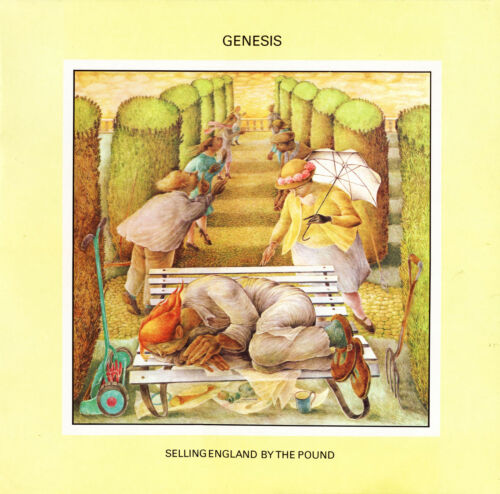
You Play the Hobbyhorse, I’ll Play the Fool — Selling England By the Pound: Gabriel’s Genesis Retrospective, pt. 5

Christopher Rush

Those Eggs are Now Scrambled

Fresh from the success of the greatness of “Supper’s Ready” and Foxtrot, Genesis was poised to create their most successful album (according to certain systems of measurement) with the nonpareil Selling England By the Pound: at once a culmination of the pastoral motifs and ideas as far back as Trespass and a full maturation of the band’s musical abilities.  I have admitted already Selling England By the Pound is my favorite Genesis album; hopefully that does not hamper your desire to listen to it or any other Genesis albums.  Some of the nostalgia factor may be in evidence here, not only in the compositions by the band, but also in the universal recognition of the quality of the album, since this is the last typical Gabriel-era Genesis album, considering the unusual nature of his last effort, The Lamb Lies Down on Broadway.  Though it seems they did not know at the time this was to be their last such classic album, enough heart and soul are poured into every song on this album to make their lack of prescience irrelevant.  Much more politically satirical than they’ve been before, Selling England By the Pound is truly Genesis at its best.

“Dancing with the Moonlit Knight”

Though this is the last “typical” Gabriel-Genesis album (by which I mean the last album driven by epic narrative songs of radio-unfriendly length), it begins differently than all the others: with the voice of Peter Gabriel, a capella, singing/calling “‘Can you tell me where my country lies?’ / said the unifaun to his true love’s eyes.”  From the first we are brought into a midsummer-night’s dream-like world of political satire, mythical beasts, and economic uncertainty.  “‘It lies with me!’ cried the Queen of Maybe /— for her merchandise, he traded in his prize.”  England is resting with the Queen of Maybe, uncertain where it is going, perhaps forgotten what it is and has been.  The Wordsworthian assault on trading one’s prize for the merchandise of Maybe echoes the poet’s searing line “We have given our hearts away — a sordid boon” too much to be ignored (except by those Gabriel is satirizing).  Despite the Elizabethan/idyllic music that begins to accompany Gabriel here, before the end of the first stanza of the album we are confronted with a pessimism even sadder (despite its much smaller scope) than the overpowering sorrow of “Watcher of the Skies” — perhaps because the music is so simple and soft the pathos is even more palpable.  Sic transit exordium.

Immediately the scene shifts to another Genesis prototypical British scene: “‘Paper late!’ cried a voice in the crowd. / ‘Old man dies!’  The note he left was signed / ‘Old Father Thames’ — it seems he’s drowned; / selling England by the pound.”  Newsies hawk their papes, youth and age continue their cycles, the water flows, and England fades into the twilight — if nothing is done to stop the acceptance of life just existing, sacrificing the important, the beautiful, on the altars of productivity, technology, and utility.  It’s not right to make money off stories of people in unfortunate circumstances — by doing so, we are selling our own dignity.  A culture with too much license start to consider themselves “Citizens of Hope and Glory,” and as “Time goes by” they think “it’s ‘the time of your life.’”  This sort of overly-simplistic thinking meets with appropriate caution: “Easy now, sit you down. / Chewing through your Wimpy dreams, / they eat without a sound; / digesting England by the pound.”  Life is not about having enough to get by, enough to enjoy for the day — enough food for today cannot be the standard for “the time of your life,” in part because it is too self-centered a perspective to be genuinely good.  The “Wimpy dreams” is an allusion both to the Wimpy fast-food chain in the United Kingdom as well as the George Wimpey housing company for dream homes.

The change of tune at this point makes for a good bridge between the early musical motifs and the clangorous (but in a good way) chorus to come.  In this bridge, Gabriel expresses the conflicting (and both erroneous) perspectives on what makes “the time of your life.”  “Young man says ‘you are what you eat’ — eat well. / Old man says ‘you are what you wear’ — wear well.”  Again the point is made that immaturity believes the only thing important in life is to enjoy the physical sensations of the moment; if bodily desires are satiated, nothing else is important for life is transitory and ephemeral — so says invincible youth.  Old age, conversely, believes the good life is about one’s status in society, evidenced a great deal by one’s appearance, particularly by the name-brand apparel one wears.  The mediating voice neither rejects nor approbates either point: instead, Gabriel simply enjoins the audience to do both: eat well and wear well — neither is “the right answer,” but neither are they bad advice as component parts of “the time of your life” as it truly is in relation to others and the well-being of society as a whole.  Beyond intake and appearance, a more crucial factor is knowing who you are or “what you are,” not placing as much importance on what others think or say, “bursting your belt that is your homemade sham.”

The chorus is a rousing return to the multi-layered aspect of this opening song, back to the metaphorical characters framing the counter-point of typical British life: “The Captain leads his dance right on through the night — join the dance… / Follow on!  Till the Grail sun sets in the mold. / Follow on!  Till the Grail is cold. / Dancing out with the Moonlit Knight, / Knights of the Green Shield stamp and shout.”  Britannia, the Moonlit Knight takes us on a cosmic turn to the past and present of merry old England.  The Green Shield stamp is a subtle allusion to the Green Shield Trading Stamp Company designed to encourage consumerism by enabling the purchase of gifts through the stamp system (a kind of precursor to the credit card rewards programs so popular today).

Speaking of credit cards, after the fast-paced musical interlude, Gabriel uses a different voice for the slightly menacing carnival-barker bridge: “There’s a fat old lady outside the saloon; / laying out the credit cards she plays Fortune. / The deck is uneven right from the start; / and all of their hands are playing a part.”  The juxtaposition of tarot cards and credit cards is even more applicable today than it was forty years ago, as we are ever-increasingly saturated with the farcical notions of credit.  The best credit score is actually 0, since it means you don’t owe anyone anything and thus are not a servant to the lender.  Perhaps the sub-zero prime mortgage crisis could have been averted had more people heeded Genesis’s warning that Fortune is not based on credit any more than a crystal ball can tell your future: the deck of credit cards is uneven, not in your favor.  Paying with money that does not exist is not a sign of wealth — it is a sign of folly.  The multiple meanings of “hands” after that is another example of Gabriel’s fully-mature lyrical skill.  In few words he has brought several layers of meaning through his symbols.

From that mystical scene we return to the chorus, blending, like a merry-go-round, clanging band music and medieval/pastoral animal imagery: “You play the hobbyhorse, / I’ll play the fool.  We’ll tease the bull / ringing round and loud, loud and round.”  The album is now a game, lightening the mood while subverting our attention away from the political and social satire that will undoubtedly continue.  “Follow on!  With a twist of the world we go. / Follow on!  Till the gold is cold. / Dancing out with the Moonlit Knight, / Knights of the Green Shield stamp and shout.”  Intentionally our views of the world will be twisted and the gold will cool (so much currency talk in this song) and no more coinage to go in the pay slots.  The music then mirrors this predicted winding down; after another rousing and different musical break, the momentum fades and decrescendos into another musical box-like cadence, like stars twinkling out in the ending night.

“I Know What I Like (In Your Wardrobe)”

The fading guitar sprinkles meld into Tony Banks’s Mellotron hum imitating a lawnmower.  “I Know What I Like” is Genesis’s first commercial single success, essentially the only one of Gabriel’s career as their front man.  Though Phil Collins’s turn in the years ahead would see the band’s shift to a more radio- and commercial-friendly incarnation with many single hits, “I Know What I Like” helped form the nascence of that forthcoming mutation, so those who “blame” Genesis’s transformation on Phil Collins ignore the earlier evidences of that progression.  This song remained popular in the band’s live concert repertoire, eventually becoming the framework to the enjoyable lengthy medley of tunes from the Gabriel and early Collins years later in the band’s career.

Like so many others in their early canon, this song is a frame story.  The lawn mower lies down for a lunchtime nap, recalling the conversations he overhears both during his lunch break and, most likely, throughout his workday as a whole.  The song is based on the cover painting The Dream by Betty Swanwick (the band had her add the lawn mower machine to it; it was not in the original version of the painting).

The chorus, preceded by the utilitarian motto of the lawn mower “Keep them mowing blades sharp…” is the most recognizable couplet to the passive Genesis fan from the Gabriel era: “I know what I like, and I like what I know; / getting better in your wardrobe, stepping one beyond your show.”  It’s a rather occluded couplet: why the lawn mower knows what it is in the wardrobe of the people whose lawns he mows is never explained.  If he’s spending so much time observing their outfits, can he really be that good of a lawn mower, ever distracted by his customers’ speech and apparel?  Being unfamiliar with colloquial British expressions, I am incapable of sussing out what “stepping one beyond your show” truly means; I suspect it has something to do with the ever-increasing appearance of affluence of the members in the neighborhood, but I am completely open to correction.

Further in the lawn mower’s lunchtime reflections, he recalls segments of a previous phone conversation with Mr. Farmer: “Listen, son, you’re wasting time; there’s a future for you / in the fire escape trade.  Come up to town!”  That the lawn mower overhears so many different snippets of conversation throughout his workday indicates he is a popular lawn mower (despite the contradictions indicated above).  This is further demonstrated by the phone call asking him to make a better life for himself in what is suggested to be a more lucrative, and thus better, position in what only the British would call “the fire escape trade.”  Despite the seeming advantages in such a movement, the anonymous lawn mower rejects such an offer, after recalling an even older memory of advice he had received in his youth: “Gambling only pays when you’re winning.”  Though he may consider himself “a failure,” and should logically jump at the chance for a better job, he considers the fire escape trade a gamble that will not pay off, so he resigns himself to his present position.  His life as a lawn mower will forever be recognized, failure or not, by the way he walks.  The unusual Eastern beat and melody fades out of this unusual, quirky song slightly reminiscent of “Harold the Barrel” but much more humorous and lighthearted.

“Firth of Fifth”

A play on the common name of the River Forth in Scotland (the “Firth of Forth”), “Firth of Fifth” is about as quintessential “Genesis sound” as any one of their numbers in the Gabriel era gets.  Here, the full maturity of the band’s musical skills is in evidence from the downbeat.  Tony Banks’s introduction surpasses even “Watcher of the Skies” in proficiency and downright impressiveness.  The mixture of 2/4, 13/16, and 15/16 time signatures reminds us piano dilettantes what the instrument is capable of in expert hands.  Additionally, Steve Hackett’s guitar work and Peter Gabriel’s flute work complement the complex and driving melodic lines throughout all nine minutes of this mighty piece.

Lyrically, the song has not aged as well as others in the Gabriel era, but it is better than most seem to recall.  It is a return to the over-ambiguous lyrics of the very early days, admittedly, but it still has enough coherent connotations to make its mythical subtext enjoyable and believable.  Deeper assessment of the words discovers that it can be read as a mixture of Psalm 23, Isaiah 53, and John 10 (with a sprinkling of Romans 1): the people of the world are sheep, who, despite the obvious signs and demarcations in place from the foundations of the universe, refuse to travel the path to freedom.  The sheep are overcome by many dangers in nature and myth (Sirens, Neptune), until the great Shepherd returns to save them fully.  The most coherent aspects of the lyrics are the beginning and end of the words, true.  The middle sections are rather opaque and should probably be taken as furtive aspects of the impressive (if not rationally comprehensible) creative accomplishments of the Shepherd Himself.  As a whole, this song can be one of the most enjoyable of Genesis’s entire output, despite the elusive lyrics at times — their progressive rock skills musically overpower any confusion about the words.  The words that do make sense are Biblically sound and encouraging, despite the seemingly pessimistic final couplet: “The sands of time were eroded by / The river of constant change.”  Consider it another grouping of words going more for the aural effect than the rational cohesion of their denotative meaning, especially with the rest of the song.  By themselves, they are akin to the apocalyptic language of “Watcher of the Sky,” but almost don’t seem to fit fully in this song, which may account in part why Banks doesn’t consider this lyric with much fondness.  They are still comparatively young lads at the apex of their initial popularity, after all, and the song, as mentioned above, as a whole is great.

“More Fool Me”

The second Genesis song led by Phil Collins (the first, as you recall, was “For Absent Friends” from Nursery Cryme), “More Fool Me” is the sparsest number on the album with only Collins’s vocals and Mike Rutherford’s acoustic guitar.  It is a highly enjoyable change of pace on the album (not that the other songs aren’t enjoyable), especially coming before the lengthy British satire “The Battle of Epping Forest.”  It is a relaxing, folk-like ballad about an optimistic young man who, with a self-effacing humor, believes that everything with his girlfriend who has just walked out on him will end up all right.  It’s probably the quietest of the quiet Gabriel-era songs, especially at the beginning.  It needs no further comment: listen and enjoy.

“The Battle of Epping Forest”

“Taken from a news story concerning two rival gangs fighting over East-End Protection rights,” according to the liner notes, “Epping Forest” is a mixture of “Giant Hogweed” and “Harold the Barrel,” with the medieval-modern British satirical tone pervasive throughout the present album.  The album as a whole oscillates between border-line cynicism and tongue-in-cheek optimism.  “Epping Forest” leans more toward the latter, until the climax of the song.  The song is overtly self-explanatory, even for social criticism.  It certainly doesn’t need the extensive footnoting that T.S. Eliot or even Jonathan Swift requires.  It’s a lengthy song and some may justifiably conjecture that it is too lengthy — a lot of words are sung by Gabriel in these almost twelve minutes.  The quirkiness of the song allows Gabriel to use a variety of personas during the different combat scenes, as well as the neighborhood episodes.  The comedic tensions of gangs fighting to “protect” the poor, with the multiple meanings of “protection” throughout the song, are among the highlights of the lengthy number.  The diverse musical motifs and tempos also provide good variety, without which the song would become tedious (some may say “even more tedious,” but that’s unnecessarily harsh).

The various scenes display the album’s blending of modern and antique England.  The “Robin Hood” scene is the cleverest lyrically; the Reverend looking for used furniture following the “Beautiful Chest” sign leads to near Benny Hill-like comedy, though Gabriel rescues it (to a degree) from sheer objectification.  The musical breaks during the different vocal sections are further signs of the band’s musical skill.  Were “Epping Forest” not on the same album as “Firth of Fifth” and “Cinema Show,” it would probably have achieved more notoriety.  The ending is a lyrical pyrrhic victory matched by the music: the story is unsure who wins the fight (since both sides essentially wipe each other out), and the ambiguous and uncertain melodic irresolution demonstrates that well.  This is one of the better unities of the lyrics and music during the song; it isn’t always so appropriately blended.  Altogether, it’s a clever song that occasionally (and only then briefly) suffers from the weight of its own vast and sundry intentions.

“After the Ordeal”

I do not understand why Tony Banks and Peter Gabriel were against including this song on the album; I can understand why Steve Hackett would eventually quit, since the other band mates seemed to consider his compositions (such as this one) so poor.  Did they forget about “Horizons”?  This is a great song, doubly so since it is a completely believable transition from the end of “Epping Forest” to “Cinema Show.”  Without this, the transition would be fine, but with it, the album has another lyric-free achievement celebrating their musical greatness.  Gabriel even gets some keen moments of flute solo work in.  Regardless of the band’s derisive assessment of it, “After the Ordeal” is an enjoyable, cathartic musical number.

“The Cinema Show”

With a harpsichord-like introduction recalling to mind strains of “The Musical Box,” Genesis begins the last (and arguably best) of its Gabriel-era epic numbers.  The sweet, dulcet tones supporting the gentle lyrics at the start of the song may even surpass the beginning of “Supper’s Ready” (nothing surpasses its ending, of course).  The satire here is devoid of cynicism, which is a bit of a relief after the lengthy “Epping Forest.”  The clever multi-layered diction is here in full, and the names of the characters evoke both Shakespeare and e.e. cummings: Juliet and Romeo are prototypical Britishers.  Gabriel’s impressive but all-too rare synesthesia ability returns as well: “Home from work our Juliet / Clears her morning meal. / She dabs her skin with pretty smells / Concealing to appeal.”  Gabriel couples both his sensory word play (skin is usually about touch, but here it’s about the source of her perfume) with his clever paradoxes as seen with the battle to preserve peace in “Epping Forest” (“concealing to appeal,” certainly one of the most intelligent lines in all of Gabriel’s tenure with the band).  “‘I will make my bed,’ / She said, but turned to go. / Can she be late for her Cinema show? / Cinema show?”  Juliet, despite being a lovely, typical girl (in no derogatory way), has enough procrastination in her to make her even more appealing.  Who wouldn’t want to hang with a girl more concerned with enjoying genuine leisure than incessant cleanliness, willing to put the bed making off until after a movie?

The Romeo of “Cinema Show” is like Shakespeare’s Romeo, once he has seen Juliet at the Capulet party at the end of act 1.  This song, in fact, could easily be a musical version of an understood scene between acts one and two, with modern accoutrement.  The contrast of Juliet waiting to make her bed (as in, put the sheets back in order) because she’ll just get back in it by herself after the movie, with Romeo’s desire to make his bed with Juliet (as in, have Juliet in it, too), is yet another great example of Gabriel’s subtle lyrical skill (though Banks and Rutherford wrote the song, admittedly).  Describing Romeo as a “weekend millionaire” is a trenchant commentary on the dating scene.  Yes, Juliet is a part of it with her “concealing to appeal” perfume, but we have no reason to believe she is looking to spend her post-motion-picture evening with anyone or anywhere but her yet-to-be-made bed.  Gabriel’s final observatory question, “Can he fail, armed with his chocolate surprise?” is a fitting end to the gentle send-up of this aspect of contemporary British life (a scene still relevant today, even in America, much more so than “Epping Forest”).  How could a typical lothario possibly not succeed by offering a woman chocolates, a completely original idea!

The music picks up speed and motion, and Gabriel changes the scope of the exploration of modern love (in Elizabethan garb — or the other way around, if you prefer).  From Shakespeare we travel further back to Ovid.  Much has been said of the influence of T.S. Eliot’s The Waste Land — no doubt Banks and Rutherford (and the others) read it in school growing up in 1950s-60s England, in addition to the classics they must have read in public school, perhaps good old Charterhouse School, where Genesis was formed.  Even so, the lyrics are not intended to be as obfuscatory as Modern Eliot was.  Ovid’s Tiresias is helpful enough to understand the gist of what Gabriel is saying.  (If you have not read either The Waste Land or Metamorphoses, you should do so after finishing this journal.)

Father Tiresias, we are told by all sources, spent time as both a man and a woman: “‘I have crossed between the poles, for me there’s no mystery.’”  For this experiential perspective on the differences between the genders he lost his eyesight, according to some.  What is not so clear in this song, we are told by some critical sources, is the meaning of Tiresias’ encoded language next.  “Once a man, like the sea I raged. / Once a woman, like the earth I gave. / And there is in fact more earth than sea.”  At first hearing it may seem Tiresias is commenting on the sheer population difference between men and women in the world: women outnumber men on the earth.  (Not even Tiresias would literally think the globe consisted of more land than sea, would he?)  However, the meaning, we are told, is something different: “there is in fact more earth than sea” means that women enjoy making love more than men do, on a physical level at least.  If that’s true (the right interpretation of Tiresias’ words, not necessarily the authenticity of the interpretation), the fact Juliet is not interested in any physical conclusion to the cinema date with Romeo who is very much looking forward to such an encounter, makes the tale full of humorous and unexpected twists and turns.

The other great aspect of this final epic number from Gabriel’s tenure as Genesis’s front man and flautist begins at the seven-minute mark.  The final four instrumental minutes of the number begin with one of Banks’s finest melodic/solo lines.  Without trying to sound too effusive, the line is soaring, evocative, and uplifting.  The rhythm section soon buttresses Banks’s work with a catchy, driving, syncopated support.  Eventually, the motif works its way through enough variations to everyone’s satisfaction, winding down as so many of Genesis’s lengthy numbers do, returning from its 7/8 beat to its original 4/4 time.  The melodic line returns to a variation of “Dancing with the Moonlit Knight,” bookending the album brilliantly and blending into the final epilogue number.  Since “Aisle of Plenty” was not played on tour, the live concert version of “Cinema Show” received a new, self-contained ending, just as good in its own way.

“Aisle of Plenty”

As a reprise of “Moonlit Knight,” “Aisle of Plenty” is clearly a coda for Selling England By the Pound, uniting the album as one of the best concept albums of the progressive rock genre.  In fewer than one hundred seconds, Gabriel demonstrates his uncanny lyrical ability to pun and satirize in rapid fashion.  It’s doubtful Tess is the Queen of Maybe, thus making the connection to the first song musical and thematic, not directly lyrical/character-driven.  The idea of being lost away from home is clearly a thematic premise throughout the album.

“‘I don’t belong here,’ said old Tessa out loud. / ‘Easy, love, there’s the Safe Way Home.’ / — thankful for her Fine Fair discount, Tess Co-operates / Still alone in o-hell-o / — see the deadly nightshade grow.”  Gabriel sings of three different grocery store chains (Safeway, Fine Fair, and Tesco) as well as the large Co-op (The Co-operative Group) that dominates British retail life.  Though Safeway and Fine Fare do not exist anymore, Tesco is the second-largest profitable grocery chain in the world (after Wal-Mart).  I can attest to the reasonable prices and fine quality of their goods (the last time I had some shepherd’s pie from Tesco, it was quite tasty and filling and cost only 69p, VAT).  The title of the song is another example of Gabriel’s multi-layered diction, though this time the pun is more overt.  The “sceptered isle” of England, having traded in its prize for the merchandise of the Queen of Maybe has become the grocery store “aisle” of cloying affluence.  The seeming pessimism is furthered by the final lines, “Still alone in o-hell-o / — see the deadly nightshade grow.”  The nightshade, kin to the essential foodstuffs of British living (potatoes, tomatoes, and eggplants), is the poisonous member of that family, which is slowly and maliciously taking over (somewhat reminiscent of “Giant Hogweed” two albums before).  Also, the nightshade could be another double-meaning reference, in that Tess, satisfied that she has her goods and safety, closes the nightshade on her window to the dangers and economic/social factors in turmoil outside.  If Tess represents mainstream England (and what is more “mainstream” than commercial grocery store chains), it has clearly not learned its lesson.  At the dawn of a new day, the hawkers return in full force:

ENGLISH RIBS OF BEEF CUT DOWN TO 47p LB

PEEK FREANS FAMILY ASSORTED FROM 17 ½p  to 12p

FAIRY LIQUID GIANT — SLASHED FROM 20p TO 17 ½p

TABLE JELLYS AT 4p EACH

ANCHOR BUTTER DOWN TO 11p FOR A ½LB

BIRD’S EYE DAIRY CREAM SPONGE ON OFFER THIS WEEK.

Peek Freans was a biscuit and related-confectionary brand, now subsumed under United Biscuits and Kraft Foods.  Fairy Liquid is a Procter & Gamble washing-up liquid now genericized (like Xerox and Kleenex) to mean any liquid washing-up product in the United Kingdom.  Anchor is a New Zealand dairy company popular in the United Kingdom (and other places).  Bird’s Eye is the international frozen foods magnate, of course (though I’m not sure what a “dairy cream sponge” is).

“It’s Scrambled Eggs”

“It’s Scrambled Eggs” are the final words from the liner notes.  We must go on living, but we can’t be solely concerned about the price of living in our own little communities, as if our own material needs are the only causes worth investigating and fighting for.  Selling England By the Pound does not offer many direct solutions to any of these problems, but it does give us strong reminders of the dangers of living only for ourselves.  The music of the album is among the best of Genesis’s career; the lyrics likewise display the great skill (for the most part) of the band’s mature output.  Collectively, the album is a phenomenal work.

With this album, Genesis clearly eradicates any doubts about their greatness not only as a progressive rock band but as musicians and writers at large.  The unity of the album is stupendous, maintaining and morphing its satirical needs brilliantly throughout a variety of subjects.  As the last of the typical Gabriel-era albums, Selling England By the Pound proves that by abandoning the limiting restraints of their initial management, Genesis could incorporate myth, satire, literature, and imagination into something astounding.  Though they may have burned up their reserve of epic music, scrambling all their lengthy creativity eggs, it was well worth it.  With a combination of pungent social satire, classical allusions, and pervasive self-effacement (“You play the Hobbyhorse, I’ll play the Fool”; “More fool me”), Selling England By the Pound is as close to a perfect album as any can get, and it is undoubtedly worth listening to and enjoying again and again.
Jehovah’s Witnesses

Seraphim Hamilton

I am by nature an argumentative person.  I love a good debate.  By debate, I mean debate, not fighting.  Fighting is yelling insults at each other masked as “arguments.”  A debate is a rational gunfight where logic and evidence are the guns.  Because of my nature, I invited missionaries from the Jehovah’s Witnesses over to talk to them about their faith.  For those unfamiliar with the Witnesses, their basic beliefs are:

1. God is one person, the Father.

2. Jesus Christ is the Son of God because he is the first creation of “Jehovah God.”

3. The divine name “Jehovah” [it’s really YHWH] is the proper name of God that should be used.

4. Jesus Christ was the Messiah sent by Jehovah, who was crucified on a torture stake, not a cross, providing for the salvation of mankind.

5. On the third day, Jehovah disintegrated Jesus’ body and raised Him to “spirit life.”  In other words, the resurrection was not a bodily resurrection, but Jesus was simply a spirit.

6. The 144,000 are a group of Jehovah’s Witnesses selected from eternity past by Jehovah to rule with Christ in the Heavenly Kingdom forever.

7. Other Jehovah’s Witnesses who have attained some level of salvation will live on an earthly kingdom.

8. Damnation is annihilation of the soul; there is no conscious suffering.

9. The Day of the Lord is imminent, where the world will be judged and the damned annihilated.

In addition, JWs use a special translation of 66 books of the Bible called the “New World Translation,” which has been translated specifically to support JW doctrines and to mask orthodox Christian doctrine.

Well, here’s how the argument went.  During the first meeting, we simply went over our present beliefs and they gave me a small book entitled “What Does the Bible Really Teach?”  This book is intended to prove that the Bible teaches JW doctrine.  I read the book for the next meeting, and we delved into what I really wanted to discuss: the deity of Our Lord and Savior Jesus Christ.  As expected, they took me to Colossians 1:15, which says “He is the image of the invisible God, the firstborn of all creation.”

According to JWs, this passage demonstrates that Jesus was the first creation of God the Father, thus “firstborn.”  In response, I pointed them to three things:

1. In the Hebrew Scriptures, The Prophet King David is called the “firstborn,” though we know that he was actually the youngest son.  This implies that “firstborn” is simply a title denoting the heir to the kingdom.

2. An ancient Jewish rabbi named Benchai refers to YHWH God as “firstborn.”  If firstborn really denoted that the figure in question was created, how could an Orthodox Jew use this title of the LORD Himself?

3. The Greek word used for “firstborn” here is prototokos.  If Paul wished to convey the idea of “first-created,” the much clearer Greek word would be protoktizos.

So, what was the JW response?  Move to another verse: “Well, in the Book of John, Jesus even says that Jehovah God is greater than he is!”  John 14:28: You heard me say to you, “I am going away, and I will come to you.”  If you loved me, you would have rejoiced, because I am going to the Father, for the Father is greater than I.  “As we can see,” the Witnesses stated, “the Father and the Son are not the same.  And, on top of that, Jesus Christ proclaims that Jehovah God is greater than he is!”

In their argument I could see two clear misunderstandings of the orthodox doctrine of the Trinity.  “First of all,” I told them, “no Trinitarian argues that the Father and the Son are identical.  They are two distinct persons, as the Holy Spirit is a distinct person from the Father and Son.  The Trinity is one in essence, but it is not one in personhood.  Secondly, while the Son is functionally subordinate to God the Father, this does not refute His ontological equality with God the Father.  When Christ states that the Father is greater than He is, He is speaking of His functional relationship with the Father.”

Most Witnesses don’t understand what the doctrine of the Trinity actually is.  They tend to picture it as the modalistic heresy, which teaches that God is one person who simply manifests in three forms.  First proposed by the ancient priest Sabellius, it was condemned by the Church but has enjoyed recent revivals among certain sects of Pentecostals.  I could see that they were confused.  “Well, we really don’t see evidence from the Bible that Jesus Christ is equal with Jehovah God.”

I wanted to talk with them about their use of the divine name, and then I wanted to give them biblical support for Christ’s deity.  “In that New World Translation that you use, the name ‘Jehovah’ is used several places in the New Testament.  Why is that, considering that in no place in the original Greek New Testament is the divine name actually used?  The New Testament authors simply used ‘The Lord.’”

“The New Testament did use the divine name originally.  It was removed by biased translators.”

I asked them which manuscripts of the New Testament used the divine name.  “Considering that we have over 5,000 Greek manuscripts of the New Testament, and none of them use the divine name, how could you say that?”  They told me that several manuscripts had the divine name.  “No, that is simply not true.  The tetragrammaton [the Hebrew divine name YHWH] is nowhere used in the Greek New Testament,” I replied.  “I have a book upstairs by Bruce Metzger and Bart Ehrman called The Text of the New Testament, which deals in detail with the manuscripts of the New Testament.  Would you like me to get it and show you?”  They assured me that this was not necessary.

“Well, even though there may be no manuscript evidence of the divine name, it was clearly removed by biased copyists.”

“That’s untenable for two reasons.  First, there are many streams of textual tradition from a geographically diverse area, and none use the divine name.  The systematic conspiracy to destroy the divine name would have to spread across thousands of miles and be perfectly coordinated.  For a conspiracy of that magnitude to leave no evidence is impossible.  Second, even in the pre-Christian Greek Septuagint translation of the Old Testament, the divine name is replaced with ‘The Lord.’  This is because by ancient Jews and ancient Christians, the divine name was regarded as so holy that it was not usually written down.”

They decided to try a different tactic.  “Look at the Gospel of John,” they said.  John 17:25-26: O righteous Father, even though the world does not know you, I know you, and these know that you have sent me.  I made known to them your name, and I will continue to make it known, that the love with which you have loved me may be in them, and I in them.  “As we can see, Jesus states that he made known the name of Jehovah to the people.”

I responded, “That’s not what He says at all.  First, if Jesus was talking about the divine name, why is there no place in the Gospels where Christ actually uses that divine name?  Second, it is clear from the context that He is speaking of making the general knowledge of God the Father accessible to the people.”

Silence again.  I changed the subject.  “Let’s talk about the biblical evidence for the deity of Christ.”  They had to leave soon, but I wanted to give them two verses of Scripture that demonstrated that Christ was God.  “Well, first, let’s go to the book of Hebrews.  In heaven we can see a conversation between the Father and the Son.  The author quotes passages of the Hebrew Scriptures where the Father is speaking.  Hebrews 1:5: For to which of the angels did God ever say, ‘You are my Son, today I have begotten you’?  Or again, ‘I will be to him a father, and he shall be to me a son’?  As we can see, in this context, the Greek theos clearly refers to God, not merely a lesser angelic being.  The important thing in this chapter is when God the Father tells the Son: (Hebrews 1:8) But of the Son he says, ‘Your throne, O God, is forever and ever, the scepter of uprightness is the scepter of your kingdom.’  The same Greek word, as we can see, is used in the immediate context to refer to both God the Father and the Son.  The Father even addresses the Son as ‘God’ and speaks of His eternal reign.”

“Well,” the Witnesses replied, “Jesus Christ can be spoken of as ‘a god’ meaning that he is a very powerful being, but not as ‘Almighty God,’ because there is only one ‘Almighty God.’”

I could see that they still did not understand the doctrine of the Trinity.  “But you see,” I said, “I completely agree that there is only one Almighty.  In fact, the ancient creeds of the Orthodox Church use that precise terminology [I refer to the Athanasian creed].  The persons of the Trinity are one God in essence.  Secondly, this cannot refer to a lesser god because the author uses the precise same Greek term in the same immediate context to refer to both God the Father and God the Son.”

There were a few moments of silence, so, to break the awkwardness, I asked to move to the next verse.  They agreed.  I took them to the Book of Revelation: “Let’s look at the beginning of John’s Apocalypse.  The Apostle writes of God (it is unclear whether this is the Father or Son speaking): (Revelation 1:8) ‘I am the Alpha and the Omega,’ says the Lord God, ‘who is and who was and who is to come, the Almighty.’”

The Witnesses agreed that this was clearly a reference to God.  I then took them to the end of the Apocalypse.  Revelation 22:12-13: Behold, I am coming soon, bringing my recompense with me, to repay everyone for what he has done.  I am the Alpha and the Omega, the first and the last, the beginning and the end.  “As we can see, the Apostle is actually using a framing device.  He opens the Apocalypse with a declaration from God that He is the Alpha and the Omega, and ends it with a declaration from the Lord Jesus Christ that He is the Alpha and the Omega.  We know that Revelation 22 has Jesus speaking because the speaker says ‘Behold, I am coming soon.’  There are three options.  One, there could be two Alphas and Omegas.  We know from the Bible that this is false.”  They agreed.  “Two, there could be two gods.  We know from the Bible that this is false.”  They agreed again.  “Or three, there could be one Alpha and Omega who exists in three persons.”

They were silent for a few seconds.  Slowly, they answered, “Well, we agree that in verse twelve, Jesus is speaking, but in verse thirteen the speaker changes to Jehovah God.”  I asked them how they came to that conclusion.  They replied that they knew from the rest of the Bible that Jehovah is not the same as Jesus, so that is the only logical conclusion.  I didn’t have time to reply, because they had to get to a meeting, so we said farewell and agreed to meet again in a few weeks.

Our next meeting only had one of them there.  We dove right into the discussion.  I had brought along a book called Putting Jesus in His Place, which is a systematic case by two New Testament scholars for the deity of Jesus.  I opened first to 1 Peter 3:14-15:…Have no fear of them, nor be troubled, but in your hearts regard Christ the Lord as holy….  “Let’s compare this passage of scripture to a passage from the Prophet Isaiah: (8:12-13) Do not call conspiracy all that this people calls conspiracy, and do not fear what they fear, nor be in dread.  But the LORD of hosts, him you shall regard as holy.  Let him be your fear, and let him be your dread.”  While these passages look somewhat different in English, the original Greek New Testament and the Greek Septuagint language is almost identical:

1 Peter 3: ton de phobon auton me phobethete mede tarachthete kurion de ton christon hagiasate

Isaiah 8: ton de phobon autou ou me phobethete oude me tarachthete kurion auton hagiasate

I showed him the Greek text.  “As we can see, Peter almost directly quotes the Prophet Isaiah, merely replacing YHWH with ‘Christ the Lord’ indicating that the Lord God and the Lord Christ are equal.”

The Witness responded, “Well, Peter is simply making the same point as Isaiah is.”  I asked him what that point was.  “Well, it’s to serve the Lord God.”

“Exactly!” I exclaimed.  “And that only works if the Lord Christ is God in flesh.”  He changed the subject.  I’m not sure what he was about to get at, but he began saying,

“Well, because Jesus used to be a man…”

“Wait.  Did you say, ‘used to be’?”

“Well, yes,” the Witness replied.  “He is now only a spirit, because as the Bible says, it is sown a natural body, it is raised a spiritual body.”

I knew the exact verse he was talking about from arguments with secularists over Paul’s doctrine of the resurrection.  “Let’s go to 1 Corinthians 15 then.  The Apostle Paul states: (1 Corinthians 15:44) ‘It is sown a natural body; it is raised a spiritual body. If there is a natural body, there is also a spiritual body.’  However, the Greek here for spiritual is pneumatikos. The suffix tikos indicates that Paul is talking about spiritual in orientation, not substance.  That is, it is a glorified, supernatural body, not an incorporeal spirit.  Paul uses the same Greek word in Galatians 6:1: ‘Brothers, if anyone is caught in any transgression, you who are spiritual should restore him in a spirit of gentleness.  Keep watch on yourself, lest you too be tempted.’  Paul here mentions ‘spiritual people’ here, who are to counsel the others.  He obviously is referring to Christians in their local churches, not incorporeal spirits.  He means Christians who are filled with the Spirit of God.  This is what pneumatikos means.  It has nothing to do with the substance of the body.”

“But,” the Witness countered, “Paul says in 1 Corinthians 15:50 ‘I tell you this, brothers: flesh and blood cannot inherit the kingdom of God.’”

“Well, Paul is using an ancient Semitic idiom here.  ‘Flesh and blood’ is an idiom that does not refer to physicality, but to corruption.  This is why Jesus says that He is made up of flesh and bone in the Gospel of John.  Paul is simply saying that corruption cannot enter the kingdom of God.”

I then asked him to turn to 1 Timothy 2:5.  We turned there: “For there is one God, and there is one mediator between God and men, the man Christ Jesus.”  I explained, “The Apostle Paul states that the figure that presently mediates between God and men is in fact a man.  He uses the present tense, which demonstrates that Jesus Christ is in fact still a man.”

The Witness changed the subject.  He asked me to turn to 1 John 4:8 and read that passage: Anyone who does not love does not know God, because God is love.  “Now, your parents love you.  Would they want you to be confused?”  Not sure where he was going with this, I answered that they would certainly not.  “So why would God require one to do all this deep study to come to a true understanding of His Word?”

“Well, my answer is twofold,” I responded.  “First, God has not left us alone but has sent the Spirit of Truth into the Orthodox Church’s tradition so that it may guide us to the correct interpretation of Holy Scripture.  Second, it would actually be much more confusing if you are right.  The Bible clearly states that the Word was God.  It clearly states that the present mediator between God and man is a man.  It clearly states that Jesus rose from the dead in a body of flesh and bone.  If none of these things are actually true, it seems to require a lot more mental gymnastics for your interpretation of the Bible than it does for mine.”

The Witness answered, “I don’t really see that at all.”  In response, I told the story of Jewish Orthodox Christian Fr. James Bernstein.

“Young James had come to believe that Jesus was God’s Messiah, but he was not sure whether the New Testament taught His deity.  He wanted to see if the New Testament was clear enough that the New World Translation could not even mask it.  Thus, he purchased a New World Translation Bible and read the entire New Testament.  After reading it for himself, he concluded that even the NWT clearly taught the deity of Christ.  This is but one example of a man coming to the deity of Christ by himself without picking up over a hundred books on the subject.”

Silence again.  “Let’s talk more about the deity of Jesus,” I said.  He agreed to discuss it some more.  I brought out Philippians 2:5-11: Have this mind among yourselves, which is yours in Christ Jesus, who, though he was in the nature of God, did not count equality with God a thing to be grasped, but made himself nothing, taking the form of a servant, being born in the likeness of men.  And being found in human form, he humbled himself by becoming obedient to the point of death, even death on a cross.  Therefore God has highly exalted him and bestowed on him the name that is above every name, so that at the name of Jesus every knee should bow, in heaven and on earth and under the earth, and every tongue confess that Jesus Christ is Lord, to the glory of God the Father.

“Now, the Greek word for nature here is morphe.  Daniel Wallace, a highly regarded scholar of the Greek language, states that this is one of the strongest ways to express Christ’s deity.  Morphe refers to internal attributes and characteristics, and Paul says that Jesus possesses the internal attributes and characteristics of deity.”

“But,” the Witness countered, “how can Jesus be the same as God the Father if God the Father exalts him?”

“The first thing we must understand, as I’ve mentioned, is that God the Father and God the Son are distinct persons in one being, and therefore can communicate with each other and exalt each other.  Second, as Richard Bauckham explains [I had the book in front of me]: ‘The verb does not indicate that God has exalted Jesus to a higher status than he had previously occupied (whether in pre-existence or in mortal life), but that God has exalted him to a higher status than that of anyone or anything else, i.e., to the pre-eminent position in the whole cosmos.’  Basically, God the Father is eternally exalting the Son to the pre-eminent position in the universe, just as the Father eternally begets God the Son and eternally spirates the Holy Spirit.”

Our time was up; the JW had to get to a meeting.  We shook hands and he politely informed me that we are at a stalemate and that unless we come to an agreement, there is no real point in discussing this further.  He asked me to call him back if we ever came to agreement on this issue.  I understood his point here and accepted.  We bade farewell, probably for the last time.

Thus, folks, that is my experience with JW missionaries. I hope you’ve learned something from it.

Superhighway of the 20th Century

Alice Minium

The twentieth century is arguably the chronological home to more significant advancements by mankind than any era before it.  It was an era of evolution in every way — evolution of war, evolution of science, evolution of arts, evolution of medicine, evolution of consciousness, and evolution of technology.  When confronted with the question of which of these monumental advances was the most instrumental in the evolution of history — which of these discoveries is the one that will change the course of the history books — one is almost taken back at the enormity of the events to choose from.  However, when one removes oneself from his immediate mindset and looks at these events in light of the grand scheme of time, the answer is blatant and simple — the invention of the Internet.

The ease of communicating information affects everything, primarily the speed, agility, and encompassment of the development of modern thought.  If all the great minds of the present day can collaborate their ideas and work together to expand and elaborate on them with the instantaneous exchange of facts, research, data, theories, and evidence, progress will accelerate at lightning speed.  If open sharing and universal access to an infinitely vast library of intellectual property is a fact of life for everyone, and we all have access to everyone else’s ideas, new aspects of the universe, science, math, and invention will be discovered daily.  With this ability, the collective mind of the present day will reach a consciousness and complexity it never has before.  Technology will advance rapidly, and mankind will become universally more informed.  Free thinking is now an option for anyone, as a database comprised of billions of diverse opinions and taboo information are available at the click of a mouse.  Real-life activity also becomes sub-relevant to survival as opposed to the way that it was — you can watch movies, do your homework, shop for groceries, read the news, plan a vacation, listen to music, talk to your friends, pay your bills, and fulfill the duties of your job all without abandoning your couch.  The invention that makes all this possible has changed absolutely everything, including the direction of mankind itself.  With free sharing via the Internet, we are all connected.  Your mind is not completely your own.  Yet, simultaneously, more of the world belongs to you than has ever belonged to a generation before us.

In 1950, the first portable digital computer is invented.  In 1960, work on hypertext and the related sharing of war-related information via technology is deeply in progress in an operation called Project Xanadu.  In 1962, JCR Licklider fantasizes a global network of inter-connected computers, and he and his colleagues introduce ArpaNet — the prescursor to the Internet.  In 1971, Ray Tomlison makes the sending, receiving, and forwarding of data messages on ArpaNet a reality — he calls this exchange of information “e-mail.”  In 1973, Ethernet is developed at Xerox PARC technologies.  A “bulletin board”-like program for companies to exchange information is born in 1979 — it is available in most large corporate environments by 1982.  In 1984, Jim Thatcher develops the IBM screen reader and letters and names can now be translated into IP numbers and addresses.  In 1991, World Wide Web files become publicly available on the Internet.  In 1993, the Internet is declared free for anyone to use.  The first popular web browser, Mosaic, was released.  In 2011, it is estimated that there are approximately 2 billion people accessing the Internet at any given second.  From a Yahoo-attempted index in August 2007, it is estimated that there are currently 29.7 billion Web pages active on the Internet today.

There have been thousands of monumental events in the twentieth century, but pause and consider which ones truly changed your life.  The Internet transformed not only the extent of what we are capable of as the human race, but also the way we see the world as a whole, and the way our children will see the world.  The Internet changed everything.  One might argue that the Internet is not as significant as an invention that might demolish man’s existence, like the atomic bomb.  However, consider the wise words of modern-day physicist Richard Dawkins: “We humans are an extremely important manifestation of the replication bomb, because it is through us — through our brains, our symbolic culture and our technology — that the explosion may proceed to the next stage and reverberate through deep space.”  The Internet is our atomic bomb, and we don’t know where it’s taking us next.

Necessary Precautions

Tanner Rotering

Airsoft, which is the recreational use of imitation firearms capable of firing plastic BBs, is a rapidly growing pastime in the United States.  Ranging from target practice to organized war gaming, the many uses of airsoft paraphernalia are highly appealing to those looking for an exciting way to incorporate the great outdoors, strategy, athleticism, friends, and, of course, guns into one glorious activity.  Yet there are very real dangers associated with this sport that are important to be aware of, even if you do not intend to play airsoft.  Airsoft is an extremely enjoyable activity and a wonderful way to spend time with friends, but if you are not willing to take the necessary precautions to ensure others’ and your own safety, then you don’t deserve to use an airsoft gun.  Without a proper understanding of the dangers of even holding an airsoft gun, you risk your safety, the safety of those around you, your freedom, and even your life.

The first precaution necessary when playing airsoft is avoiding the obvious risk of bodily damage to the participants.  Airsoft guns are capable of firing BBs at very high speeds often ranging anywhere from one hundred to five hundred feet per second depending on the power of the gun and the mass of the BB used.  While being shot by one of these BBs will not inflict any serious bodily harm, they can leave a pretty serious welt in some cases, occasionally even breaking the skin.  If you get shot in the eye, however, it’s a whole different story.  Being shot in the eye by an airsoft gun can lead to anything from temporary damage or eye surgery to permanent blindness, but even if you are fortunate enough to endure such an injury without any permanent effects it will still hurt like crazy!  Despite what one is inclined to think about the odds of such an injury, there are countless instances around the country of such accidents, but at the same time, there is an extremely easy and extremely effective way of avoiding them: wear your eye protection.  Eye protection options range from impact resistant glasses, to high strength goggles, to paintball masks.  Personally, I would strongly dissuade the use of any eye protection that does not completely wrap around the eyes in such a way that blocks BBs from coming in at any angle.  Also make sure that your eye protection is strong enough to withstand countless impacts from a very high-powered gun.  If your eye protection isn’t strong enough to withstand anything you might possibly encounter on the battlefield or shooting range, even if you are not being shot at, then do not shoot at all.  Also remember that ricocheting BBs can be just as dangerous as BBs shot directly at you.  You just don’t want to take any chances.

Though it is important to remember to always wear eye protection, it is just as important that you ensure that everyone remotely near where you are firing is also wearing the appropriate eye protection.  Whenever you play airsoft, you are responsible not only for your own protection, but also for that of everyone around you.  Imagine the guilt that you would have if you blinded your friend for life.  It simply is not worth the risk of so drastically reducing the quality of life for your friend for the rest of his life simply because of the inconvenience of making sure that he wears his eye protection, not to mention the fact that you could have to pay the medical bills.  Sure, you might look a little paranoid and your friend might even get mad at you for asking him to take these precautions, but any true friend would recognize that this short term inconvenience far outweighs the long term implications of the potential alternative.  Again, if the necessary precautions are not being taken, don’t play.  Too many times I have seen people wearing eye protection for ninety percent of the time, but taking it off just because they are only watching the conclusion of a match.  Until all guns have come to a cease fire and are put on safety as well as are pointing away from any human target, it is imperative that all eye protection remains on.

The second necessary precaution when playing airsoft is avoiding the risk of bodily damage to the public and of physical damage to property.  Always be careful of where you play airsoft.  For example, don’t shoot your airsoft gun in a place where there will be people who do not have the proper protection on even if they are not participating in the fun.  Just because they aren’t smart enough to go out and join you doesn’t mean they don’t have value as a human being.  In addition, if someone does happen to wander too near to your airsoft activities, make sure that you take the time to inform them of the situation and of the need for eye protection.  In addition to ensuring the safety of the public, it is also important to ensure the safety of the surrounding property.  Generally, it’s not a good idea to play airsoft around automobiles since the paint and windows can easily be chipped or cracked.  Also, don’t shoot in the direction of housing in order to avoid denting the siding, cracking windows, or chipping wood.  Finally, make sure that if you are having an airsoft battle, your opponents don’t have to risk damaging personal property if they are to have a chance at hitting you.

Finally, the third necessary precaution, and perhaps the most important, is ensuring that you are abiding by all federal, state, and local laws and regulations regarding the sale, possession, and discharge of airsoft guns.  If nothing else, you should at least be aware of these two federal laws since they will be applied universally no matter where you are in the United States.  First is the law mandating that you must be 18 years or older in order to purchase an airsoft gun (though you do not have to be 18 to legally use an airsoft gun).  Thus, if you are not yet 18, make sure that you get your parents to purchase any airsoft gun you want.  The second law that you should know is extremely important and is perhaps the most important thing that you could possibly learn from this article.  Whenever you purchase an airsoft gun it should always come with a blaze orange tip attached to it.  As you may or may not be aware, this orange tip is often the only distinguishing factor that makes it recognizable as an airsoft gun and not a real gun!  Federal law states that “No person shall manufacture, enter into commerce, ship, transport, or receive any toy, look-alike, or imitation firearm (‘device’) covered by this part as set forth in Sec. 1150.1 of this part unless such device contains, or has affixed to it, one of the markings set forth in Sec. 1150.3 of this part, or unless this prohibition has been waived by Sec. 1150.4 of this part.”  This particular law goes on to specify the specific markings (of which one is required) as either, one, “A blaze orange…solid plug permanently affixed to the muzzle end of the barrel as an integral part of the entire device and recessed no more than 6 millimeters from the muzzle end of the barrel,” two, “A blaze orange…marking permanently affixed to the exterior surface of the barrel, covering the circumference of the barrel from the muzzle end for a depth of at least 6 millimeters,” three, “Construction of the device entirely of transparent or translucent materials which permits unmistakable observation of the device’s complete contents,” or four, “Coloration of the entire exterior surface of the device in white, bright red, bright orange, bright yellow, bright green, bright blue, bright pink, or bright purple, either singly or as the predominant color in combination with other colors in any pattern” (note that the law does specify a very specific “blaze orange” color in the full text for the first two distinguishable features).  Though it is difficult to find a definitive answer on whether it is lawful to remove the orange marking on the end of airsoft guns after the purchase, I would strongly advise against it for several reasons.  First of all, the phrase “permanently affixed to the muzzle end of the barrel as an integral part of the entire device” leads one to believe that the marking is intended to be permanent and not to be removed.  Though this does not definitively state that it cannot be removed after purchase (as this law is about the commerce regarding such imitation firearms), it could also be argued that if you intend on transporting your airsoft gun, then the appropriate marking should remain intact.

In addition to the legal reasons why you should leave the orange marking on your gun intact, it should also be common sense.  Because airsoft guns are often so incredibly realistic looking, to take off the orange tip would be to remove the gun’s ability to be distinguished from a real firearm.  If people in your community see you brandishing a gun that they believe to be real, it is highly likely that they will be highly distressed and potentially even call the police.  Also, in many instances, when the police encounter an individual with what appears to be a genuine firearm, they simply do not have the time to carefully inspect it to determine its authenticity.  In many cases, out of concern for their own lives or out of concern for the lives of others, police have been forced to shoot and even kill individuals who were brandishing airsoft guns because they were not able to distinguish it from a real weapon.  Often the police have to make split-second decisions in these sorts of things, so it is important that you leave your orange tip on your airsoft gun at all times, even if it will make you a little more visible during an airsoft match.  After all, most of us would rather be seen and shot by an airsoft BB than by a real bullet.

There are also various state laws worth researching if you plan on “airsofting” locally.  Though you hopefully won’t have to deal with the implications of these laws specifically, ehow.com also references a few interesting local laws on the subject.

Virginia does not require a permit to buy or carry airsoft guns either.  If they are misused, however, state law considers airsoft guns the same as firearms.  Using an airsoft gun in a robbery or other crime is a Class 1 misdemeanor, punishable by a year in jail and a $2,500 fine — the same as with a real gun.  Criminal use of a gun, including airsoft, on or within 1,000 feet of a school is a Class 6 felony; the penalty may range from one to five years in prison.  State law also specifically absolves police officers of civil liability if they shoot in defense of self or others — even if the suspect’s gun is airsoft.

Though I am not sure if this is federal, state, or local law, it is also illegal to brandish or use your airsoft gun in any public place.  No matter where you play, however, always ensure that you know the laws beforehand.

Before concluding I believe that it would be appropriate to tell a short story about a personal experience of mine concerning wise airsoft gun usage.  Just a short time ago, I felt like performing a few minor adjustments on my very own airsoft gun.  It being a nice day outside, I, like many times before, decided to do a little target practice next to the woods adjacent to my church.  After receiving permission from my pastor and his wife, who were actually at the church at the time, I proceeded to begin the process of adjusting my scope.  To my great satisfaction, I was able to successfully place the cross-hairs almost precisely where the BBs were going.  Thinking it wise to test my gun out at a longer range, I began to slowly position myself farther and farther back from the woods, which I was shooting into, and closer and closer toward victory Boulevard (from which my church is only about 75 yards).  About thirty minutes later I was in the process of taking off my scope, when lo and behold — [Wheeeeeeeeeee-Whoooooooooo] — along comes not one, not two, not even three, but FOUR police cars!  As I slowly turned around, my heart sinking, it began to dawn on me that, yes, they were indeed coming for me.

As the police stepped out of their vehicles and fanned out toward me, I began thinking about what they might say.  After all, I wasn’t breaking any laws, was I?  No, I don’t believe I was breaking any laws, but, as it turns out, a woman driving by on Victory Boulevard had called in some Hooligan with a gun about to shoot up a local church.  What a thought; and yet, she didn’t know any better than to think I was holding a real fully automatic assault rifle.  I did have the orange tip on my gun, but the woman driving by was likely not able to see it easily from the distance and the speed at which she was driving by; though even if she had seen the orange tip, she might not have recognized that it indicated that my gun was not a real firearm.  This just goes to show that you have to be extremely careful where and how you use your airsoft gun.  Many people do not realize the difference between a real gun and an airsoft gun, especially if there is not an orange tip attached.  I count myself very blessed, however, first, because I was not actually holding the gun when the police showed up (since that would have increased their need for caution and potentially escalated the tension and possibility of me being shot), and second, because I had my orange tip firmly attached to the end of my barrel.  For, what do you know, one of the officers informed me that the reason he was able to identify it as an airsoft gun was by the orange tip.  For all I know that little piece of brightly colored plastic could have saved my life.

Needless to say, everything turned out all right.  I wasn’t arrested, though the police did write down some of my information; I apologized to the police and to the woman who called me in for my lack of wisdom and for causing all that trouble, and my pastor and his wife decided to allow me to continue to reside in their house.  I will say, however, that I plan on being much more careful where I decide to shoot my airsoft gun from now on.  I hadn’t technically done anything illegal, but deciding to use my gun so close to a heavily traveled roadway definitely was not a very wise decision.  I also felt really awful for causing so much trouble for the police department that had to dispatch officers to what, as they may have thought, could have been a serious firefight.  Also, as one of the officers told me, if they had got into an accident responding to the call, things could have gotten much more serious.

So what you can you learn from all of this?  First of all, always be mindful of the physical safety of those you play airsoft with as well as yourself, by always wearing your eye protection.  Second, be wary of those around you who are not necessarily going to involved in the airsofting, but who could be put in harm’s way, as well as the personal property you could potentially damage and have to pay for.  Third, always be informed of and abide by all federal, state, and local laws concerning airsoft guns.  Finally, don’t just think about what is legal; think about what is wise.

Bibliography

“Airsoft Gun Laws and Safety: Find Airsoft (air Guns, Air Soft) Information.” Accident and Injury Center — Accidents and Injuries. Web. 16 May 2011. Web.

“Airsoft Guns Vs Paintball — Differences and Regulations.” Federal Firearms Laws. 07 June 2009. Web. 16 May 2011. Web.

Custodio, Philip. “Laws Regarding Airsoft Guns in VA | EHow.com.” EHow | How to Videos, Articles & More — Trusted Advice for the Curious Life | EHow.com. Web. 16 May 2011. Web.

“US Airsoft Law — Airsoft Forum.” AirsoftForum.com — Airsoft Forum and Military Simulations. 31 Mar. 2004. Web. 16 May 2011. Web.