
Theodore Aloysius
And From the Farm to the Sea
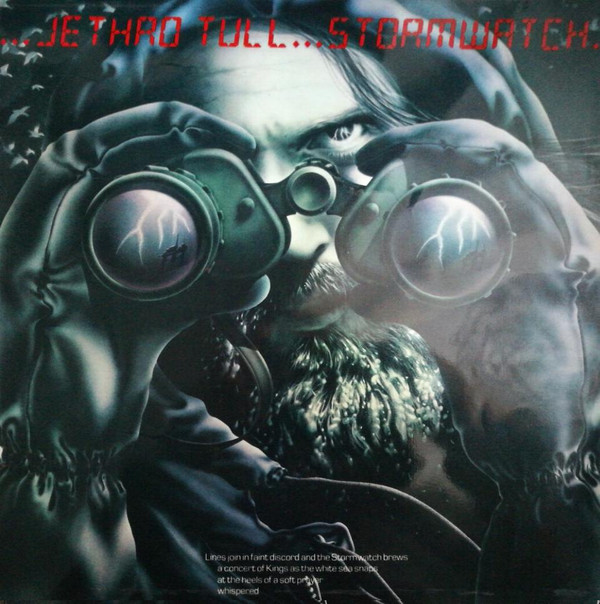
Hello, friends. As my excitable young penguin friend said just a bit ago, I am here to talk about the finale of the Tull Trilogy, Stormwatch. It makes a good deal of sense for me to talk about this album being a polar bear and all. What’s that? Oh. There’s a polar bear on the back cover of this album, don’t you know. And since I’m a polar bear, well, it just stands to reason. In fact, that polar bear was a college friend of my father’s, so this album has been special to me and mine for a while now. He’s much nicer in real life than he looks on the cover, besides — he’s just doing that for publicity. You know polar bears of that generation.
Admittedly, Stormwatch is noticeably rougher, tone- and lyric-wise, though it’s not overtly pessimistic. With the failing health and eventual death of bassist John Glascock, what many fans consider the “golden era” of Tull came to a painful and sad end. The band shortly frayed apart, but I don’t want to misrepresent what happened. You can look that up on your modern human research machines, if you must. It’s not a pleasant story. Yet while the album that marks an ending and a new beginning for Tull has a sorrowful background and an occasional bitter edge to it, it’s a testament to a great band providing great music, giving us a bit of hope we, too, can overcome difficult circumstances and make a fresh start when we need to. Odd how that became the theme of this final issue without any of us knowing it a few months ago. He moves in mysterious ways, indeed.
“I flew for Heaven’s sake and let the angels take me home”
Unlike its predecessors in the trilogy (and, please keep in mind, only we, the audience, call it a “trilogy” – Ian Anderson likely doesn’t call it that, since he’s expressed his displeasure at the epithet “folk” many a time, but he has linked Songs and Horses before … I haven’t read much about it, since I’m a polar bear), Stormwatch does not appear to have an overarching introductory song such as “Songs from the Wood” or “Acres Wild.” Instead, the album opens with “North Sea Oil,” which, perhaps you could say transitions us from the cover to the music itself, since my dad’s friend Wallace (the polar bear on the cover) is pictured as stomping on a nuclear power plant. It’s a touch cynical, sure, the forthcoming devastation you humans are bringing to this world as you syphon all the oil out of the ground and then destroy the soil with nuclear waste, but the song isn’t really angry about it. And neither am I. We animals know these things are under control, even if you humans are doing your best to destroy all life on the planet without asking us if that’s okay, so we can enjoy the somewhat dark humor of this song. “North Sea Oil” sets the mood well, and upon further reflection, it does introduce the main theme for the entire album: storms are on the horizon. Here, these storms are avoidable, especially, if we listen to friend of the journal Hannah Elliott and her thesis, as you can read earlier in this very issue.
One might also surmise Stormwatch is mainly about the ocean, with the arctic cover and an opening song literally about the open sea followed by a song about the stars — and who better to use the stars than sailors? But “Orion” is not really about navigating by the stars physically, even though it has the line “come guard the open spaces from the black horizon to the pillow where I lie.” It’s about navigating the loneliness of life in the darkness of night, but we can possibly find some hope under (by?) the light of the stars. This is an oddity for Jethro Tull (which, I admit, does not mean much, considering how diverse their musical output was over the years), in that the lyrics are rather hopeful for the first half of the song, especially in the chorus, but the music is bizarrely oppressive. Perhaps it’s the steady march-like beat of the chorus. The lyrics become increasingly despondent as the song progresses (and a bit saucy), but that’s Ian Anderson for you. He pulled no punches, as you humans say. The storms of life do not have to overwhelm us if we can keep looking up. That may sound trite, but the song is anything but trite; it is hopeful in a dark and stormy world.
“Home” should certainly dispel notions Stormwatch is a thoroughly dark and bitter album. It is grimmer than the first two entries in this trilogy, as we’ve all said a couple dozen times by now, but it still resounds at times with love and warmth and hope, and “Home” is one of those bright moments. It does recall our mind to the nautical theme (I was about to say “undercurrent”), with the idea of taking “a jumbo ride over seas grey, deep and wide,” and it does overtly speak to the storms of life (“All elements agree in sweet and stormy blend — midwife to winds that send me home”). If we can weather those storms, there’s no place like home, as you kids say. Even if you’ve been away for fifteen years, the call of home is a powerful thing. It’s a most lovely (and appropriate) song.
Which is not to say “Dark Ages” is not a lovely song … but “lovely” is not the word for it. It’s Tull, so it’s great, and reminiscent of the mini-epics of Heavy Horses, but it is more akin to “Minstrel in the Gallery.” This is likely where this album gets its reputation: the “dark ages” of the title are not what we often call the medieval period but rather the dreary, inhuman way you humans treat each other. Sure, sometimes we polar bears have trouble with seals and the occasional walrus (we tend to stay away from them), but you people really have problems with each other, As is typical of Tull’s atypical songs, the outright gloomy lyrics are carried along by a hopeful march, akin to “Orion” but distinct enough, mainly because of the odd pairing of the melodic & rhythmic line and the lyrics. The words “dark ages” are a challenge to say, let alone sing, mainly because of the “ar” in “dark,” which takes a long time to get out of your mouth for only one syllable. Protracting that over a steady rhythm is something only Ian Anderson would think of doing. It’s a cynical, angry song that takes the occasional jab at religion, which is what Anderson does at times, but the musicianship of the band elevates it past the gloom.
And to what enjoyable heights the band takes us! “Warm Sporran” sounds like we are about to go watch a great football match (I suppose you Americans would call it “soccer,” though). It has that military tattoo atmosphere as well, once it gets past the wholly-surprising funk groove at the beginning. You may need to re-examine the band name on the album cover (surely you aren’t just streaming these songs without a physical copy of the album, cover, and liner notes? though, come to think of it, that would help cut down on landfill fodder … but, wait, no one would ever dispose of a Jethro Tull album) — you may doubt this song is by Jethro Tull for a few moments. It may not be as lovely as “Home,” but it is a delightful, paw-tapping instrumental, the inverse of the ending to come on side two.
“So come all you lovers of the good life”
Side two opens with a rocking song about … chess? the speed of life? the inevitability of change? inexorable winter weather? all of these and more? With Ian Anderson, it’s best to lean toward “all and more.” He may be the closest thing to T.S. Eliot the musical world has gotten, and that’s saying something. I do look forward to the 40th anniversary liner notes next year (as of this writing) — perhaps then we can understand just what this song is about. But, knowing Ian Anderson, he’ll probably feign ignorance or forgetfulness or ambiguous “it is what you make of it” sort of piffle. The chorus leads me to suppose underneath all the poetic rigmarole (I don’t say that critically) is a song about the storms of winter coming to drive away our happiness and such, and the cavalier narrator wants to keep living a carefree life in a sunnier, warmer clime. This is completely understandable. Winter has such a nasty habit of stopping activity … believe me, I should know. I live with winter twelve months out of the year.
I wonder if Ian Anderson was listening to a lot of marches during the creative process of this album. “Old Ghosts” is yet another march-like rhythm on the album, yet true to form, Tull upends our expectations for a march with Anderson’s almost languorous singing. “Languorous” is not the word I want, but I can’t think of a word that encapsulates “dreamy,” “nostalgic,” and “hopeful” all together. Perhaps it’s just my remastered version, but Anderson’s voice seems a gnat’s wing behind the instruments throughout the song, yet it works perfectly to evoke such a mystical experiences. Maybe “hypothermic”? Is this what hypothermia sounds like? I wouldn’t know myself, being built for the cold, but I don’t want you to try and find out yourself through experience. It’s another “sad lyrics/happy melody” Tull song, but as always the “warm mesh of sunlight sifting now from a cloudless sky” works its way through the general despondency to shine hope into the world of painful memories and failures, a world where efforts and loves don’t always prove futile. That is what this journal has been about, after all.
I haven’t spent much time in the ancient hills and forts and mounts and mounds of the United Kingdom or the Republic of Ireland, though Christopher has), but Dun Ringill is certainly one of them, on the Isle of Skye in Scotland (haven’t played the game, yet, either — Isle of Skye, I mean, I don’t think there’s a Dun Ringill game). This is a neat little song, with a mysterious musical part to evoke the ancient, powerful energies surrounding Dun Ringill and the ley lines of the isles, another common theme throughout these three albums (“We’ll wait in stone circles ’til the force comes through / lines joint in faint discord”), but the forces are a bit off kilter, since “the stormwatch brews.” It is brewing “a concert of kings,” but the kings are the old gods of an old world: Poseidon, Zeus, Finn MacCool, and the storm kelpies (sadly, a great song “Kelpie” did not make it onto the album, but it has recently resurfaced in bonus track form), and more. This is the strongest song on the album for the theme of the power of the mythic past, more so than “Old Ghosts” and the final song with lyrics, “Flying Dutchman.”
“Flying Dutchman” is the last epic of the Golden Era of Tull (for many fans — but, hey, some of their ’80s and ’90s work is really great, too, so don’t discount it outright), and true to form it’s a mix of many things: diverse but evocative musical lines, contrasting lyrics both melancholic and uplifting rife with Andersonian ironies and paradoxes, a showpiece for the musicianship of the band, and a plea to fans for making good choices with their lives, especially considering its brevity. This perplexing song takes an almost universally negative symbol, the Flying Dutchman, and somehow makes us think it’s not so bad after all. In fact, Anderson makes the Dutchman sound like the White Ships sailing out of the Grey Havens. I’ve seen plenty of ships in my day: sailing ships, leisure ships, whale spotting ships (don’t ask), military craft, trawlers, junks, catamarans, surfaced submarines, and more, but I’ve never seen the Dutchman, and even with how appealing Anderson makes it sound here, I don’t want to. The happy sounding chorus, the one enjoining us to embark on the Dutchman, reminds us life is short (as if we needed that reminder). It’s even shorter for us polar bears, mind you, but we don’t complain nearly as much as you humans. Remember this: the “good life” is not just about having food to eat (“on your supermarket run”) or having fun times (“your children playing in the sun”) — it’s more than material and temporary things. “Life is real, life is earnest, / And the grave is not its goal,” said Tennyson. And so, too, does Ian Anderson. And me. And Pandora.
Elegy for All
This underrated album ends with the beautiful but sorrowful “Elegy,” written by David Palmer about his recently deceased father. It was not too long before the song also represented the loss of bassist John Glascock, who died shortly after the album was released during the accompanying tour. For the fans, it also represents the end of ’70s Tull, a remarkable musical enterprise. As I said before, with the death of Glascock, combined with other reasons, vastly underrated (but not by Anderson or Tull fans) drummer Barrie Barlow left the group, soon followed by the two keyboardists (seriously, what other band has been intelligent enough to feature two masterful keyboardists?) John Evans and David Palmer. In its way, however, this ending, like all endings, was also a beginning, a new beginning for those who left and a new beginning for those who stayed and were joined by new musicians who took Jethro Tull in a new direction.
As George Harrison said, all things must pass, but in the meantime, live. It’s a strange but beautiful thing, life. Don’t forget to make the most of it. Farewell, friends.

 Redeeming Pandora