
Stringfellow Bartholomew
From the Wood to the Farm
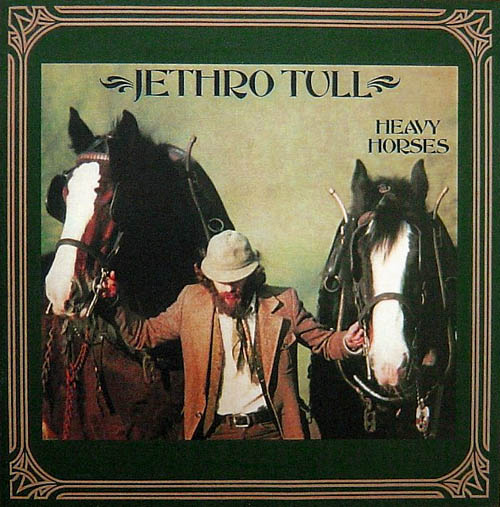
Hello! I finally get to write my own article for the journal after all this time, and I’m really excited to talk to you about a fantastic album from Jethro Tull, Heavy Horses. This is the second in the “folk rock trilogy” from Tull, as some have called it, but unlike most sequels, it does not suffer any let-down or disappointment. In fact, many like it more than Songs from the Wood, which is a remarkable thing to say. I’m not sure I like it more, but it is definitely growing on me, thanks to listening to it so much lately. In this outing, Ian Anderson shifts his gaze from the mystical forests of bygone England to the hardworking farmers and their steads, along with the animals who, frankly, do most of the work. Even though I’m a penguin, I can appreciate the skill and sacrifice of my fellow animals as they have made the world a better place, especially when working in conjunction with you humans.
Where the dance of ages is playing still
This first song gives me some shivers, which is difficult to do for a penguin. I don’t spend a lot of time around cats, not too many of them where I live most of the time, but cats can be scary. “…And the Mouse Police Never Sleeps” is also a bit scary because of the odd ending, but that’s mostly just Ian Anderson having some fun, and he knows better than most when he’s having fun and that he’s having fun and laughs at himself when he’s having fun (which is why it ends with his self-aware coughing). It’s sort of an odd opener to this album, especially in contrast to Songs from the Wood, which gave a nice opener to the theme of that album. I suppose “Mouse Police” sets the musical tone for the album, and it does get us out of the woods and into the farmhouse, but the metaphor distracts us initially until we have time to reflect on where this album is going.
While it may not be fair to continue the Songs from the Wood comparison going, it’s rather unavoidable, and thus “Acres Wild” seems to me like it would make a better opener for Heavy Horses, since it declaims the setting of this rural/hamlet/agricultural album much better than “Mouse Police” (you didn’t think penguins knew words like “declaims,” did you?). It’s a very optimistic song, which is important, since this Tull Trilogy gets progressively pessimistic. Songs is almost wholly optimistic, as we saw last issue. Heavy Horses is rougher, grittier (certainly not musically, as it may be even more impressive musically, in many cases), and at times harder. Perhaps more melancholic than pessimistic, since many of these songs are rather ebullient, but there is a general tenor of regret for days gone by and the lost lifestyle of the hardworking agricola (though the animals do most of the work). “Acres Wild” is a jaunty number full of zeal for living a full life, enjoining us to come “where the dance of ages is playing still / through far marches of acres wild,” but it also reminds us the world around us, before those far marches, is decaying and crumbling and a dim memory of what it once was.
Leave it to Ian Anderson to write a song about not singing a lullaby to his newborn son, but leave it to Ian Anderson to justify it because he has no desire to rear his son on false hopes and delusions about how life really is. He wants to protect his son as much as possible (“There’s a lock on the window; there’s a chain on the door; / A big dog in the hall”), but he’s also open about the dangers of the world. This is part of that growing edge in this Tull Trilogy of which we’ve been speaking, The dangers of the world require skills and preparation, but if know that, and treat each other with love, it’s possible to put your kids down for bed at night “safe and sound.” Musically, this is the first of two mini-suites on the album, with multiple musical motifs. Penguins like alliteration, what can I say.
“Moths” is another almost typical Tull juxtaposition of beautiful music and a warning of the brevity of life. It ends optimistically, in its way, but it also presents the joy of life akin to a burning candle, and a too long life can be a bad thing. That’s a strange thought, isn’t it? Hard to trust lemmings and moths, I suppose. Still, a beautiful song. “Journeyman,” too, is a precise, hard-rocking song, bemoaning the difficult life of the hardworking city man. Probably should be out living in nature, as the rest of the album enjoins us to do. Be warned by this number, human people: city life is bad for your health; live in nature (but don’t mess it up for us while you do so). Otherwise, you’ll be lonely and cold and sick and tired and hungry. But I understand if the crisp, funky groove of the number overshadows the dire warning. It’s hard not to smile and tap your toes to it and ignore the message. Well, being a penguin myself, I don’t typically tap my toes, since I just waddle and rock back and forth. I’m a bit like Ian Anderson that way.
And every day we’ll turn another page
The “B”-side of this album is possibly the third greatest B-side of all time, behind Foxtrot and Magical Mystery Tour. These four better-than-solid songs are great listening. “Rover” kicks it off with another solid musical gem. Tull really was firing on all instrumental cylinders during this lineup, as delineated in the previous issue. The diverse rhythms and crispness of the different instruments makes “Rover” a fun song, but the melody during “So slip the chain and I’m off again” elevates it to pretty great. On one level it’s about a dog, right? And I admit I don’t know much about dogs, since, again, I’m a penguin, but the later verses don’t sound completely like they’re about dogs to me (the last one may be about Gonzo), but it’s still rather jaunty and optimistic. Maybe I was wrong about this album being more edgy than Songs from the Wood.
“Own Brown Mouse” could be the best song on this album, though sometimes the eponymous track wins out on that one. But let’s not quibble: it’s not a competition – let’s just enjoy the fact we have multiple great songs on this album. Here we have another Tullian juxtaposition of musical brilliance and a wistful song. This wistfulness, though, is not dark or edgy. It has a bit of sorrow to it, as the narrator and the brown mouse may be in a contest over who is the one in the real cage, but as always the uplifting music and Ian Anderson’s delivery comfort us more than concern us. The only flaw of this song is it’s not longer.
The grand masterpiece of this album is truly sublime. Reminiscent of the madrigal, which is perfect for the apex of a trilogy memorializing Merry Ol’ England, “Heavy Horses” is a multi-layered, multi-sectioned opera about the farm and the horses and the way things used to be. A lot of animals featured in this album. That’s only part of why it’s so good. This tribute to the horses that have literally moved the earth of England makes us all yearn for a simple life of honest toil, living off the land, at one with nature. I’m part of nature myself, and I tend to live off the ocean, but this song makes the rural life appealing even to me. Part of that is surely the exquisite choral sections and musical brilliance, and the diverse sections keep our interest sustained throughout almost eight minutes of a song about horses and furrows. Ian warns us the technological-driven world will soon disappoint us, and those of us with refulgent souls will soon yearn for the kind of life we have collectively abandoned. (I’m not sure if I have a soul, being a penguin, but let’s stay focused here.) So get back to the land, plant and harvest real food, become one with nature again.
In contradistinction to Songs from the Wood, this album ends not with the nighttime at the end of a hard day’s forestry but with the dawn of a new day. “Weathercock” signals the kind of weather we’ll have as we start a new day working the land, or at least from what direction the wind is coming today, signaling as well the changing of the seasons. The passage of time is a steady undercurrent of this album, as Ian Anderson bemoans the loss of anthropological-agricultural unity, but concurrently he reminds us each new day is a new opportunity for good: “Point the way to better days we can share with you,” ends the album.
So Heavy Horses is not so melancholy or cynical after all, as is often declaimed. It is very aware of the brevity and ephemerality of life, much more so than Songs from the Wood, but that does not make it darker or edgier. Perhaps it makes the album more Realistic, whereas Songs is more Romantic. Nothing wrong with either. They each have their season. The winds of change that redirect the weathercock were certainly signaling changes for Jethro Tull as well, but that is a subject fit more for the finale of this trilogy, so I will leave that to my good buddy Theodore Aloysius to discuss in his exploration of Stormwatch. Thanks for reading my analysis of Heavy Horses, everyone. If you haven’t heard it lately (or at all), do yourself a tremendous boon and get it into your soul. If the five-disc fortieth anniversary box set is a bit daunting, start with the regular album and work your way up to the goodie-filled, bonus-packed deluxe version. You’ll be glad you did. So long!

 Redeeming Pandora