
Dylan Fields, Noah Eskew, and Peter Runey
The Beatles’ third album, A Hard Day’s Night, was a major stepping stone for the Beatles as they reached the American audience like they had never done before. Following the production of the movie the Beatles then produced the soundtrack album. The movie had an incredible effect on the film industry as well as the album, as it produced two number one singles, “A Hard Day’s Night” and “Can’t Buy Me Love.” Both singles reached number one in America and England. This album also showcased the writing ability of legendary songwriters John Lennon and Paul McCartney. Unlike their two previous albums, Please Please Me and With The Beatles, all thirteen songs on A Hard Day’s Night were written by John and Paul.
Ringo Starr, the drummer of the Beatles, accidentally made the name of the album, according to John Lennon in a magazine interview:
I was going home in the car and Dick Lester suggested the title A Hard Day’s Night from something Ringo had said. I had used it in In His Own Write, but it was an off-the-cuff remark by Ringo. You know, one of those malapropisms. A Ringoism where he had said it not to be funny, just said it. So Dick Lester said we are going to use that title, and the next morning I brought in the song. ’Cause there was a little competition between Paul and I as to who got the A-side, who got the hit singles.
This album musically strays away from the pop sounding cover songs the Beatles had previously produced. A Hard Day’s Night has more of a rock-n-roll feel to it. The album is predominately written by John, as he is the primary songwriter for nine of the thirteen tracks that on the album. Paul sings lead on the title, other than that John is the lead singer for the eight other songs he wrote. Paul McCartney wrote “And I Love Her,” “Can’t Buy Me Love,” and “Things We Said Today,” while Paul McCartney and John Lennon wrote “I’m Happy Just To Dace With You” together. Ringo Starr does not sing lead vocal on any songs on A Hard Day’s Night, which is one of three albums where he does not including Let It Be and Magical Mystery Tour.
The ideas behind the Sgt. Pepper’s Lonely Hearts Club Band album started with Paul McCartney in 1966. Shortly after the Candlestick Park incident, some speculated the Beatles might not make music together again. This is probably due to George’s public display of disenchantment with being a “Beatle” and the circus life that came with it. But realistically speaking, all four of the guys had to be mentally and physically spent. They had just made their way through southern United States after John’s infamous comments on Jesus. And because of that and other sorts of chaos surrounding them, they at some points felt their lives were in danger. However, the band had too many contractual obligations to just quit making records. So Paul and John went on their respective sabbaticals. John filmed a movie and Paul went to France.
While Paul is in France, he begins to cook up new ideas for songs. The Beatles were always good listeners, and so Paul begins to draw more and more influence from American psychedelic music. The Warlocks (later the Grateful Dead) Jefferson Airplane, 13th Floor Elevators, and even The Peanut Butter Conspiracy were some of the bands that would influence the next Beatles sound. Paul liked the adventurous names these bands had, and thought maybe his band should do something fresh and maybe go by a different name. So within Paul’s mulling through band name ideas, he came up with the name Sgt. Pepper’s Lonely Hearts Club Band.
Hence, Paul’s idea for the concept of the album was to perform the album live as SPLHCB. But, this idea didn’t seem plausible to George and John, so things didn’t quite get that far. The concept of the album still feels like a live performance. The way the songs run together is very much like a concert.
Other elements of the album are affected by the band’s mentality to “go for broke” as George Martin puts it. They wanted to push the artistic envelope as much as possible. The Beatles wanted to take their time and create their greatest musical masterpiece, using all kinds of effects, instruments, and new sounds.
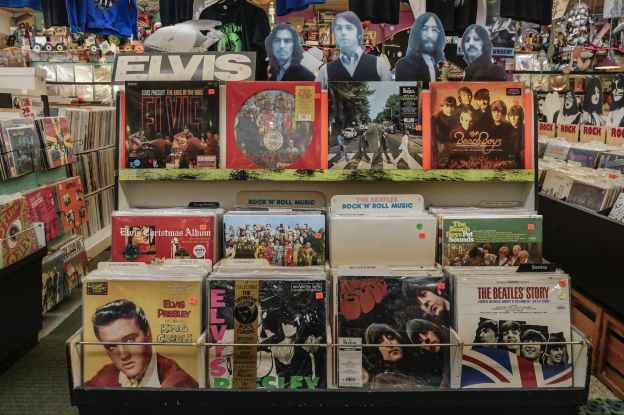
When talking about the aura surrounding SPLHCB, one must look at the album artwork. The idea was to have the scene of a funeral service for “The Beatles” and to erect a new persona, Sgt. Pepper’s Lonely Hearts Club Band. The figures on the album cover are representative of the guest list to such a funeral.
I would say the genius of this record lies in its duality. The songs fit together excellently as a concept, yet they still stand upright separately. Many of the songs on this album don’t require a concept to make sense, but they add a lot to the concept when in context. The lasting impact is also quite impressive, with many Web sites and magazines citing it as the greatest album of all time. It seems as if The Beatles accomplished their goal. Branching out farther than ever, they probably created their greatest (quality and impact) artistic accomplishment.
Abbey Road was first released on September 26, 1969, and was also the final Beatles album to be recorded but not their last to be released. Let It Be, though mainly recorded in January 1969, was finally released in May of ’70 alongside the film Let it Be. The recording process itself was completed on August 25, 1969, which was almost a month before John Lennon told the other Beatles he wanted to leave the band. His decision was made on September 12, just before the Plastic Ono Band performed at the Toronto Rock and Roll Revival festival, and he told the rest of the group at a meeting a week later.
Abbey Road was considered a rock album that incorporates other genres like blues, pop, and progressive rock. It also makes prominent use of the Moog synthesizer and the Leslie speaker. Side two contains a medley of song fragments edited together to form a single piece. An example of this would be “Golden Slumbers,” “Carry That Weight,” and “The End” (in that order), all of which continue straight into the next without interrupting or changing the sound as a whole very much. The album was recorded in a bit of a more enjoyable atmosphere than the Get Back/Let It Be sessions earlier in the year, but there were still plenty of disagreements within the band, mainly concerning Paul’s song “Maxwell’s Silver Hammer.” John had privately left the group by the time the album was released, and McCartney publicly quit the following year. A 16-minute medley of some short songs makes up the majority of side two, closing with the line “and in the end, the love you take is equal to the love you make.”
Following the somewhat live feeling of the Let It Be recordings, for Abbey Road, The Beatles returned to the North London studios to create carefully-crafted recordings with ambitious musical arrangements. Interestingly, 12 of the songs that appeared on the finished album were played during the filmed rehearsals and sessions for Let It Be back in January.
For the first time ever on a Beatles album, the front cover contained neither the group’s name nor the album title, just that iconic photograph taken on the street crossing near the entrance to the studios in London in ’69.
Abbey Road entered the British album chart at no.1 in October and stayed there for a total of seventeen of its 81 weeks on the chart. In the US, it spent eleven weeks at #1 during its initial chart stay of 83 weeks.
For the first time, both Billy Preston and George Martin recorded with the Beatles, both of whom played Hammond organs and harpsichord. They also joined the Beatles on a few “live” (in actuality they were private showings, some for films or television) performances.
It is commonly thought The Beatles knew Abbey Road would be their final album and wanted to present a fitting farewell to the world. However, the group members denied they intended to split after its completion, despite a realization their time together was drawing to a close. George Martin said the following concerning the topic of finishing the Beatles:
Nobody knew for sure that it was going to be the last album — but everybody felt it was. The Beatles had gone through so much and for such a long time. They’d been incarcerated with each other for nearly a decade, and I was surprised that they had lasted as long as they did. I wasn’t at all surprised that they’d split up because they all wanted to lead their own lives — and I did, too. It was a release for me as well.
 Redeeming Pandora