
Christopher Rush
I prefer to think of myself as someone who has an accurate grasp of what is important in life. That is not to say I always prioritize life’s opportunities correctly: I don’t know any other languages, I haven’t memorized the Bible, I don’t know how to fix … things. Yet, in the variegated realms of what we used to call “pop culture,” I think I’m fairly well traveled. While today it is becoming de rigueur to brandish the appellations “geek” or “nerd,” as if we have survived the great Name-calling Wars of 1989 and those terms are now badges of honor, I posit they are hollow terms, and, more importantly, they are not for me.
From the outset, I would like to forestall any connections with other cultural situations in which certain terms have been, shall we say, appropriated or re-appropriated or the like. This is not meant to be a variation on that social situation. Rather, I’m just going to say things at you, as is my wont, about a topic that has no meaningful connection to real history, real people, or real life. And this topic is innately such.
Long-time readers of the journal will remember I have spent what we could generously call a healthy amount of time playing video games, watching science-fiction television, playing roles in games, reading science fiction and fantasy literature (I mean, “literature” or whatever), and sundry similar activities. I’ve opened more packs of Marvel Universe Cards (especially the best set, series three from 1992) than you’ll ever see in your lifetime even if you live to a hundred and three. I’ve paused through more commercial breaks recording episodes of Star Trek (the first four series) than you will ever see in your lifetime even if you live to three hundred and one. You couldn’t push majick “skip ad” buttons in my day. We had to use our hands. It was like a baby toy, yes. I’ve stood in line for over an hour to get Orson Scott Card’s autograph … not on Ender’s Game, no siree. Too obvious. I went with the first two books of his I read: How to Write Science Fiction and Fantasy and Hart’s Hope. If you haven’t read Hart’s Hope, get it today and read it today (but it’s not for the faint of heart, let me warn you now).
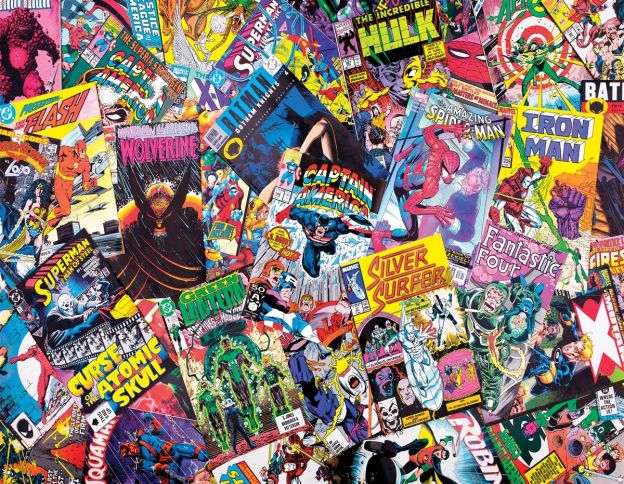
I used to subscribe to a few comic book series: Captain America, The Avengers, The Fantastic Four, The Uncanny X-Men, The X-Men, and Generation X. I would bag them and board them and label them and catalog them. I’ve spent hours of Saturdays (months of Saturdays) arranging notebooks full of The Lord of the Rings: The Collectible Card Game cards, tearing 3”x5” notecards in half to mark places in what you would call baseball card storage sheets for missing cards. I’ve printed off dozens of walkthroughs for computer games you’ve never even heard of but I’m completely sure are far superior to any of the “app” games these kids are into today. I’ve written down more 32-digit save game codes in my teenage years than you’ll get trophies of (I’m not quite sure where that last one was going). You kids today with your spawn points and your automatic save spots and your hula-hoops … you don’t know what struggle is. Talk to me after you’ve tried BattleToads. Yeah, and I’ve torn out and filed more sections of Nintendo Power than, well, you get the idea.
But I’m not a geek. And I’m not a nerd.
I don’t dress up and go to conventions. My brother does that and he’s great at it, but that’s not my scene. Maybe one day I’ll get to a convention before Jonathan Frakes turns 80, though there’s a better chance my family will get to some sort of boardgaming convention first. We will not be dressing up as our favorite boardgame characters, though. Some people do, you know. Come to think of it, my dad and I did used to go to a few baseball card shows back in the day.
I have recently taken up painting tabletop boardgame figures, as some of you know. I’m not any good at it, but it is an enjoyable hobby, another thing my brother has known and practiced for thirty-some years. I’ve taken most of the winter season off from this hobby, since the weather isn’t conducive for priming (something you need to do outside if you don’t have an airbrush), plus we needed the table for holiday meals, and thesis season really cuts into one’s free time, and you know how it goes. Once we get back from Spring Break, I’ll get back into it. I’ll then be ready to take the next step and start assembling some tabletop miniature figures, assuming the weather hasn’t dried up the paint and glue hibernating in the garage all winter. I have a decent-sized box full of Warhammer™ Space Marines waiting for me to build. That does not mean I’m keen to start playing Warhammer™, but if you’re up for it, I suppose we could work something out. I’d like to get a starter set or two of the Batman Miniatures Game, and maybe a few Age of Sigmar things. But I have no grand plans for making terrain and turning the garage into a warehouse for miniatures and such. Not yet.
But let’s get to the heart of the matter. I’m not a geek or a nerd. Back in the day, they were terms of insult for people who liked the sort of things I liked: comic books, video games, RPGs (the non-lethal kind), sci-fi and fantasy, and the rest of it. Superman and Batman were almost 50 by the time I came onto the scene. The Fantastic Four and Avengers and X-Men were pushing 30. Star Trek had been a cult classic for almost twenty years. Dungeons and Dragons was over a decade old and had weathered the well-intentioned pharisaical backlash of the sorts of people you can imagine engaged in that well-intentioned-yet-pharisaical backlash. And yet, “we” were the enemy. Avalon Hill and GenCon and even Atari had been around for some time, yet we were the outcasts. The International Business Machine and Texas Instruments and Macintosh were quickly becoming staples of schools and households, yet we got laughed at and picked on and, well, I never got beat up, but I’m sure some of my generation did. I never watched Freaks and Geeks or Drumline … why would I? I lived it. I don’t need to see someone’s vision of what it may have been like, even if they went through it, too. That’s one of the reasons I have no pressing need to see Stranger Things. I was there, kids.
But I don’t want to misrepresent why I’m neither a geek nor a nerd, and I suspect I have already mislead you, especially with that last paragraph. Excuse the multiple negatives, but I don’t consider myself those things not because I got called mean names by the hooligans I went to school with back in the day. I’m not rejecting those names because they conjure up painful memories and hurt feelings and tears into my pillow after school. I didn’t really go through that. Sure, I was ridiculed and laughed at once in a while, and I’ve experienced my share (if such a thing has “shares,” fair or otherwise) of mockery for the things I enjoyed (but that was mostly for my last name, especially as we were in the exciting finale of the Cold War era). But it never scarred me or hampered me or anything like that. And I don’t say that lightly, as I know those sorts of playground cruelties did cause some damage to people I knew long ago. I’m not a geek or a nerd because, in truth, those words are nothing. They are empty. Hollow. They don’t exist.
I like RPGs and comic books and sci-fi and fantasy because they are intrinsically worthwhile endeavors. They are high-quality ways to get into one of the most important, most fundamental aspect of who we are as human beings, especially as imago dei human beings: they are stories. They feature engaging characters and thrilling conflicts and thought-provoking themes and exciting storylines. These are the best tools to fire our imaginations and invigorate our understandings of actual reality. RPGs and comic books and sci-fi and fantasy aren’t merely escapes from the “real world” — they are perhaps the best way to help us understand ourselves and the world (outside of the Bible, of course), better even than mathematics and physics and the natural sciences. They do a fine job telling us what and how, but the Humanities, stories, art, they tell us why. You can’t get that from kicking a ball around the grass or throwing a ball through a hoop. No offense, sports. But you are less real than rolling dice to see how much damage a magic missile does to the hobgoblin four feet away from my 12th-level half-elf warrior-rogue.
Sports don’t tell us stories — sure, lots of writers create stories around what happens in a season or a game or whatever, and the biographies of athletes can be very riveting and truly inspiring. But sports are competitive, telling you or your team you aren’t as good as that person or that team over there because you didn’t score enough points and thus all your efforts for the past four months have been a total waste. (I understand there are ancillary benefits such as health and spending time with friends and hand-eye-coordination and sportsmanship and leadership and all that, sure, pretty much all of which can be done by joining the orchestra or playing board games instead, but that aside, I know what you’re going to say about how great sports are, but my point here is competition.)
Competition is a virulent disease, and real life abhors it. The gospel has nothing to do with competition. RPGs and comic books and sci-fi and fantasy have “competition,” but none of it is truly real human beings pitted against other human beings (often in dangerous activities that somehow make you “healthy”) in danger of “losing.” If you “lose” in an RPG, you can go back a bit and try again. For some reason, sports referees don’t let you do that. Even when board games require competition, you still are using your imagination, developing your strategic and tactical thinking skills, spending time with friends, honing your “sportsmanship” by having fun with your friends — and though games can sometimes come down to “stop him from achieving that goal,” that won’t be a good experience for the people involved and it will likely not happen again. Unlike most sports, that usually come down to “stop that person from doing that” in every game, often by knocking the guy down or embarrassing her by tricking her in front of her family and friends in the stands (like strikeouts in soft/baseball). There’s no “I hope they fail” in the Realms of Gold, something sports depends and thrives on.
RPGs and comic books and sci-fi and fantasy and board games invite people in, enable you to create and think and engage, ennoble you to translate the ideas you encountered on a spaceship or in a dungeon to treat the real people you know and haven’t met yet better, to make the world a better place because you know good exists and evil exists and you can be a force for good. Stories make us not just better people but also more human. Even with Matthew 11 in mind, Jesus knew the power of stories and told quite a lot of them — not just to further confuse those who didn’t get it, but also to further engage those who got it.
And they still do that today.
I suspect, and this is only lightly and uncritically, the people who are going around proudly brandishing “I’m a _________ Geek!” or “I’m a __________ Nerd!” (say, “I’m a Harry Potter Geek!” or “I’m a Star Wars Nerd!” or whatever) are only doing so because, as I intimated quite some time ago, the Wheel has turned, as it always does, and now the kids who used to bully have come to realize the things they cared about weren’t (past tense) all that great and the things we care about are (present tense), so possibly they are trying to act like they were one of us all along or this is how they apologize. And since they don’t remember our names, only the names they called us, they have revived those terms now as badges of cool (or whatever the kids are calling it these days). I could be wrong. It’s been known to happen.
Surely that would only cover the people my age and a bit older. As for the kids, well, they’ve grown up in a world of marketing and pseudo-awareness of these hobbies*, and the People Who Love Money have been telling them for a while it’s cool to be a geek or a nerd (since the bullies of yesteryear are the advertising firm owners and marketing strategists and CEOs and CPAs of today — funny how that works out). So, naturally, since it wasn’t their generation’s fight, the terms mean nothing negative to them. And that’s fine. They have their own battles to fight.
So, I’m not a geek, and I’m not a nerd. I just know what’s important in life.
Being human.
Especially a human being in the image of God.
When “real life” does its best to siphon all hope and happiness out of us, RPGs and comic books and sci-fi and fantasy and boardgames give us hope.
And that, faithful friends, is what Redeeming Pandora is all about.
See you next issue!
*The false awareness of these Realms of Gold is quintessentially demonstrated by the reboot movies and series of the last couple of decades. With the exception of Battlestar Galactica, complete misunderstanding and downright rejection of the original source material in terms of theme, message, and purpose dominate the “reboot” world today: the G.I. Joe and Transformers movies of late epitomize that utter rejection of the original source material. And before you counter with “weren’t they just advertisements for the toys?” allow me to forestall your query with the riposte “even if they were, their quality of storytelling, engaging characters, and high-quality moral didacticism far outshine any pecuniary concerns, and thus their value transcends both the kind of dumbed-down programming for children today as well as the adulterated revisions of these worlds by today’s “creative” teams.† (For a great example of how inestimably superior the shows we had back in the day are to the schlock kids have been force-fed for years, go watch Fraggle Rock and then any Nick, Jr. or Disney XD show today. You’ll never watch contemporary programming again.) And before you double-counter with the idea “you can’t technically have a pre-emptive riposte,” I’ll just nod and say “yes, that’s true.”
†“But wait, aren’t the people making some of the modern-day versions of things, like the Marvel movies and such, people who grew up on the very same RPGs, comics, books and whatnot you did? What if these new versions and those who proudly proclaim ‘I’m a geek!’ and ‘I’m a nerd!’ are the people who enjoyed them when they were young and suffered the verbal slings and arrows of those bullies just like you did?” you may ask. To which I can only say, mildly hubristically and mildly self-effacingly, “maybe they are, but if they are the ones changing everything for ‘today’s audience,’ they clearly did not understand those things for what they were. Perhaps I understood and appreciated them better because I could filter them through absolute moral standards from God and His Word.”
Now, if these same people of my generation suffered the verbal assaults of “geek” and “nerd” and have now in their older years translated those terms into those “badges of honor” of which we earlier spoke, well, then, to each his own.
Live and let live.

 Redeeming Pandora