
Christopher Rush
As you may recall from our first issue this volume-year, a scant five months ago, I mentioned a few entries from Ballantine’s Illustrated History of World War II, an engaging series that soon outgrew WW2 and expanded out to the rest of the violent century (up until the early 1970s when that shift in publishing focus occurred). You’ve read enough from us over the issues why we study history and simulate history through analog simulations and such, so I need not apologialize for that here. Thus, let’s just present a few more reviews of the books I managed to squeeze in as the months of 2017 turned in to the months of 2018 (and, like you, even though this year is rapidly approaching 25% over, I needed to look at the computer’s calendar to be reminded which year we currently are in).
The Raiders: Desert Strike Force (Campaign #2), Arthur Swinson

Another very good entry from the old Ballantine’s Illustrated series, The Raiders focuses on the American version of the North African Campaign. I’m a bit surprised this was the second in the Campaign Series, considering the first was Afrika Korps from the German perspective, why they would do the same subject matter back-to-back, but since this theater is so interesting, with such a magnetic personality on the German side, and such rare (since the American Revolution, really) tactics on the Allied side (with, as we learn from this book, if we didn’t know from the movie or television show, similarly magnetic personalities), it certainly provides enough for two entries. (‘’m guessing; I haven’t read the first one yet.) This gives an engaging history of the Long Range Desert Group, though it changes direction after the first chapter (we are introduced to a small group who seem to be the stars of the show, but then chapter two gives us a new cast of characters for the rest of the book). It almost reads like fiction at times: surely these heroic escapades, harrowingly near-misses, dramatic adventures, and et cetera could not have happened in real life? But according to Arthur Swinson, they did, and who are we to doubt the Ballantine’s Illustrated History of World War 2?
Patton (War Leader #1), Charles Whiting
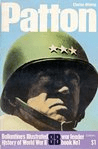
As great as the Ballantine’s Illustrated series of series is, this entry may have been a bit better had it come out later, when the series transmographied into History of the Violent Century. Then, we could have read more about Pre-WW2 Patton, which, while possibly not as interesting to most, is the less-trodden ground about this controversial figure. Most of this book is likely rather familiar to Patton fans, of which I am not one (not to be read in a critical way), but I suspect it was written to communicate to the non-fans, anyway. We get a brief pre-WW2 sketch in the introductory chapter, but it doesn’t give us much. The majority of the book gives us Patton in WW2, the highlights, the lowlights, the mistakes, and the triumphs. Through it all, Mr. Whiting reminds us of Patton’s irascible personality, which at once enabled him to accomplish what his allies could/would not as well as brought about his own demise. I had forgotten what a tragic, senseless death Patton suffered, getting paralyzed in a jeep crash a few months after WW2 and dying a few days later. Mr. Whiting gives us some interesting summations at the end, as well as some thoughtful commentary throughout, but his penchant for reminding us of Patton’s personality combined with the lack of WW2 information (again, I understand the premise of the series) prevent me from giving it four stars. I realize after typing that sentence how ironical that is, but it was not intended. (Or was it…)
Stalingrad: The Turning Point (Battle #3), Geoffrey Jukes
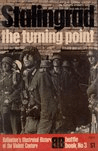
Mr. Jukes does a fair job presenting the exciting nature of this battle, though his tone throughout does not help the work. It’s not that he makes jokes and whatnot, but his attitude toward some of the leaders and their decisions involved, especially on the German side, is at times a bit too antagonistic on the ad hominem level. I’m not saying they were wonderful people, since I have no knowledge of their characters, but Mr. Jukes is at times too dismissive and at other times derogatory, if even in a subtle way. I’ve made too much of a deal about it, but it was there. Similarly, despite the subtitle’s intimation how important this battle was, Mr. Jukes’s conclusionary paragraphs sound like nothing that happened in the battle mattered after all, effectively dismissing not only the military significance of the events but also the human cost of the defense of Stalingrad itself — not the best way to end this book, I thought, which is sad, considering how great the rest of the series for the most part has been.
On the positive side, as I mentioned, he does a fine job of bringing the ebb and flow of the battle (series of battles, really) to life in a dramatic fashion, from the Russian personalities involved to the heroic and sacrificial stands of the Russian soldiers, and from the perspectives of the beleaguered German military leaders who didn’t want to do what Hitler made them do to the cocksure German soldiers who somehow, perhaps one could say Providentially, became the hunted and not the hunters. This would make a great movie, especially if it were four or more hours long and really presented this battle well. I think I’ll check out some other accounts of this key battle and possibly try to get my copy of The Stalingrad Campaign to the gaming table.
Hitler (War Leader #3), Alan Wykes
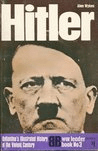
It’s got to be a difficult task writing an engaging biography about one of humanity’s worst, and Mr. Wykes proves how difficult it is to quantify “evil” in a world that rejects absolute moral standards. Mr. Wykes takes the foundational position Adolf Hitler had syphilis, and that is supposed to explain effectively everything, in combination with his patriotic ire at the German surrender in World War 1 admixed with his learned hatred for all-things Jewish. His long-standing untreated syphilis was responsible for Hitler’s ravings, his megalomania, his obduracy, and his maniacal military decisions especially from Stalingrad to the end. Mr. Wykes never comes out and says it directly, but the reader gets the vague impression we (as humanity in general) are supposed to be thankful for Adolf’s disease and the pseudo-medical people around him who mis-treated him.
What are we expecting when we read a biography of such a person? That may be as of much importance as learning about the person him- or herself. It’s doubtful we are looking for validation of our collective animosity — there haven’t been too many people who have been fundamentally mistreated by history without the opportunity for proper scholarship restoration these days, and certainly history has not been too unkind to Hitler. I was looking for insight on what, if anything, made him good at his job — how did this guy rally a nation around him, or at least a powerful coterie of people around him who then in turned snatched a country away from someone else and took it in such a horrible direction? I didn’t get a lot of that from Mr. Wykes, since his overall focus was Hitler as a military leader during World War 2. We get a little bit about the pre-war events, though we are usually directed to the more thorough biographies for that, and I don’t have the stomach for that just now. For instance, I’m still wondering why, if so many of his high-ranking generals and whatnot hated him and hated what he was doing to Germany, why they didn’t just take out a gun and shoot him and sacrifice themselves to the retribution of the SS or whomever? Mr. Wykes does not explore that, but that could be because it is all speculation and not their biography.
What interesting tidbits I did get about Hitler’s generalship early in the war were intriguing, and from this section perhaps comes the strongest intimations of how grateful we should be for his disease, assuming Mr. Wykes’s wholly-physical explanation for Hitler’s “evil” or “mania” is correct, with which I’m not in full agreement. We are told Hitler brought about such a successful blitzkrieg because he, unlike the generalship he “inherited,” shall we say, and the generalship in complacent England and France and everywhere else in western Europe, did not think in terms of WW1 combat. This perplexity is compounded by the radical change in warfare during World War 1 itself, not only the different way it was fought with trenches and mustard gas as the usual motifs, but also the introduction toward the end of armored tanks and their revolution in warfare again should have led the allies to realize no one would think of warfare in Napoleonic terms again. Mr. Wykes does treat briefly on the Treaty of Versailles and how foolhardy it was, which may be the explanation: the “good guys” assumed they had so permanently beaten Germany down surely no “civilized” world would have started a war again. And that is generally, what our textbooks tell us, the western world mentality during the ’20s after all.
Hitler, strangely enough, learned from WW1, saw what worked, assumed his enemies had grown flabby and content with their “heroic” emasculation of Germany, and used their tactics against them and basically bullied them into retreat and panic for years. Had Hitler not reneged on his treaty with Russia and squandered so many troops on the Eastern Front, WW2 would likely have gone quite differently. [Editor’s note: since originally writing this, I’ve read of quite a number of instances in which “that one fatal decision” sealed the fate of Germany and WW2 and the world — it’s a popular theme for WW2 historians.]
And it is here that Mr. Wykes’s explanation of Hitler’s flaws seem like wishful thinking: the syphilis exacerbated Hitler’s jealousy of his military advisers and field commanders (a jealousy begun by his own mediocre performance in WW1 and the love of his life wooed away by higher-ranking officers or something like that) caused him to ignore their sound advice at times; similarly, the disease made him require total control over the armies, even preventing army commanders from ordering reinforcements and other immediate-concern military decisions one would suppose an army commander actually on the front lines should be able to make without having to request permission from the head of the country hundreds of miles away.
For many reasons such as these, all of them effectively centering on Hitler’s ego and his sickness, we are left with the impression Hitler had an uncanny ability to understand warfare and his enemies better than almost anyone else alive at the time, but his own personality and his disease brought about his own destruction and Germany’s as well … and in the end we are supposed to feel like we caught a lucky break. I’m not fully convinced by all this, but the only way to understand the issue more is to do more research, and as I intimated above, it’s such a distasteful topic I don’t know if I can do that anytime soon.
D-Day: Spearhead of Invasion (Battle #1), R.W. Thompson
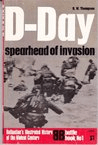
Despite the potential downfalls inherent in being a first in a series, D-Day by Thompson presents itself as a rather developed introduction to the series and a concise overview of perhaps the world’s busiest day ever. One may prepare to be a bit overwhelmed by the data involved (regiment information and the like, mainly), considering the sheer volume of manpower involved in this event, but even in the paragraphs that start to amass loads of numbers, Thompson contextualizes them fairly well and hurries the reader along quickly to more human elements (not to say the numbers of soldiers and their groupings were not “human”).
One enjoyable aspect for me was Thompson’s emphasis early on concerning the attitudes of the Allies involved, especially the air forces. I can understand their perspective: if they, as heavy bombers, especially, were doing such damage to the Axis powers especially in their infrastructure, why bother with such a massive infantry assault? It’s easy for us today to generalize the “highlights” of WW2 and other major historical events, and just assume everyone was like-minded, but Thompson does a good job of bringing to life early on the diverse mindsets going into the battle from both sides (or, all sides, considering the less-than-chummy attitudes of Americans not named Eisenhower to Montgomery and other British generals). The section on Rommel was especially intriguing, as Thompson paints Rommel as a noble, intelligent military mind, and as later entries in the series do, we are lead to feel miraculous intervention alone brought the ending of WW2 how it occurred (despite the occasional comments from Thompson to the effect of a fatalistic approach to an Allied victory).
Thompson brings some aspects of the actual battle to life in a very engaging, first-person in-the-action sort of way. The chapter on the eastern British paratroopers assaults, especially, was very riveting. It was one chapter I wish had more detail but in a positive way, which is an ideal compliment for this series: its best entries make you want to seek out more expansive versions of the subject matter, and while D-Day is as massive a day as humanity has ever seen, this book encourages you to learn even more about it.
Their Finest Hour: The Story of the Battle of Britain, 1940, Edward Bishop
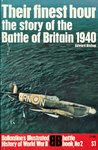
I’ve said before I don’t have any internal compunction toward interest in naval or aviation battles. I don’t like to play naval or aviation wargames, though I have seen Crimson Tide and Memphis Belle and a few other movies about them (not anytime recently, I must say). Thus even though I really enjoyed the Ballantine book about the development of Japan’s naval armada (much to my own surprise), I did not go into this book with a lot of zeal. I was interested in the “Battle of Britain” as a historical occurrence, but not as an air battle (if that makes sense). Like a few of you out there, I sort of intuitively assumed the “battle” was not just one afternoon, since I sort of collated “the blitz” in with it (from my scant knowledge of C.S. Lewis and the evacuations and such), but I did not know the “battle” was about four-to-five months long, depending on your range. I still am not sure why it is not a “campaign,” but I would be fine if the only reason is because of the alliterative effect of its current nomenclature.
I thought Mr. Bishop did a fine job balancing the technical aspects of the battle with bringing the event to life in an engaging narrative. Perhaps part of my apathy toward naval battles is the tendency for some technical-minded authors to go overboard (so to speak) with the data: tonnage, identification insignia, and a whole lot of other numbers I will not guess at to stop embarrassing myself about military matters. Mr. Bishop does a fine job, as I said, of telling us the technical matters in small amounts, just enough to make us feel like we know what kinds of planes were involved but not so much we are stuck in a technical manual. Just when you start to forget what the abbreviations for the planes are, he’ll give you the full word/model again, and you’ll feel confident again.
As an early entry in the series, it’s possible the early kinks of a new venture could be present. In this case, Mr. Bishop switches into full Union Jack mode by the end, and while I enjoyed the length of the conclusion (something I have indicated I missed in later entries in the series), Mr. Bishop gets about as close to singing “God Save the Queen” as I have ever read in a book about England. Though, to be honest, most of the books about England I have read were by satirists (Douglas Adams, Spike Milligan, John Cleese, and the gang). Still, I don’t say this as a criticism. It was a fairly rousing, patriotic ending, and that’s actually refreshing. It’s hard not to get caught up in the enthusiasm of how “the few” saved England, and how the resolute British citizen bit their thumb in Germany’s direction and went back to work each morning after sleeping in the subway. It’s easy to look back at history with a dispassionate “of course that’s what happened,” but Mr. Bishop evokes the fear, the sorrow, the uncertainty, the relief, and the joy of the Battle of Britain.
 Redeeming Pandora