
Christopher Rush
George Harrison is no saint. Well, he may be one right now, but back in his day he was no saint. He fooled around, basically drove his first wife away (into Eric Clapton’s arms), inserted a great deal of narcotics into his being, he could hold grudges … basically, he was human. We all have faults; we are all sinful, even those of us who are redeemed. I’m not excusing George Harrison’s improper life choices (I save that for myself); I’m simply saying our task is not to allow one’s failures prevent us from enjoying the positive things one has to offer. I knew you weren’t thinking that, but the more I read about George, Brian, Paul, Mike, John, Carl, Ringo, Dennis and the rest, the more that notion is pressing upon me. But that’s a personal problem, I know. On with the musical analysis … advertisement. Whatever.
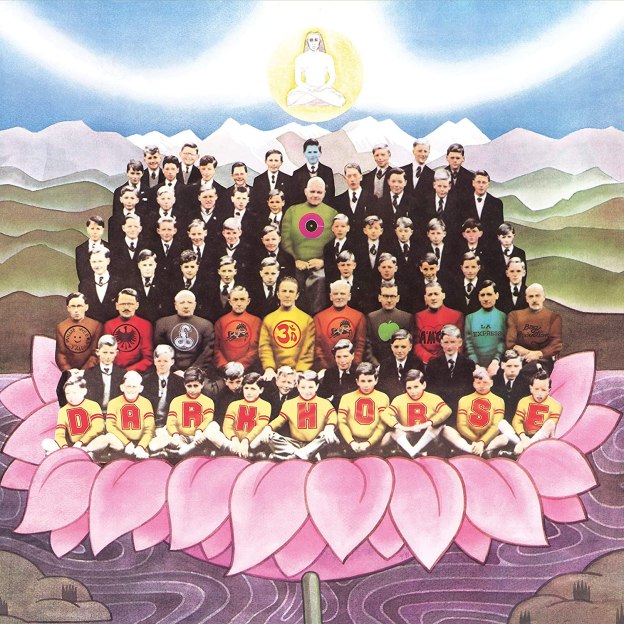
For some reason, not too many people liked the album Dark Horse when it first came out, but I do not understand why. A lot of rough things were going on for Mr. Harrison at the time: rough vocal health (as can be heard throughout the album, including the bonus tracks on the cd release), divorce from his wife Pattie, his second trip to India, a poorly received U.S. tour with his good buddy Ravi Shankar, the end of Apple Records and the beginning of Dark Horse Records (George’s personal music studio) — a mixed bag of life experiences during which to release an album, yet none of them strike me as valid for disregarding the album. Some of those rough experiences come out in the first half, which is mostly sad (other than the first song, which is quickly rising up my all-time faves list), but the second half is ebullient and typically self-effacing George Harrison. I like it, and so should you.
Side One
“Hari’s On Tour (Express)” is an excellent instrumental: it varies in tempo and melodic line, and thus it never lags or overstays its welcome, which is surprising for an almost five-minute instrumental. It has patterns, one could almost say “movements” or “motifs,” and the listener soon feels confident he or she understands the flow of the song, but the pattern is so various even in its familiarity it is never dull. This may sound like faint praise, but it is not meant as such: the slower portions are a smooth groove and the faster portions really cook with the multiple guitars, the brass, the drums; basically, it’s a fresh combination of jazz and rock that holds up to multiple back-to-back listenings.
The autobiographical portion of the album begins with an intriguing reflection by George about his rock-and-roll lifestyle in “Simply Shady.” The laryngitis from which George suffers during much of this album improves the atmosphere of this song especially, as it all about the dangers of succumbing to the stereotypical concomitant famous lifestyle experiences (so, drugs and alcohol, yes), and the taxing nature of George’s lifestyle outside of his religious devotion undergirds the pathos of the song. Perhaps the most intriguing aspect of this intriguing song is George’s reference to “Sexy Sadie,” John’s irritated response to the Maharishi and the Beatles’ first trip to India. This is odd considering George just came back from a more positive trip to India coupled with the album’s overall enthusiasm for Indian philosophy and religion. Aside from these intriguing points, the verses are impressively sharp intellectually, philosophically, and realistically. George wrestles with the consequences of the last ten years of his life, he ponders the implications for the future, and he meditates on his place in the universe. The honesty and introspection place this song among his most important.
The autobiography continues with “So Sad,” a heartbreaking account of George’s response to his failing marriage. For some the pathos may be tempered by George’s part in the dissolution of their marriage, depending on which (auto-)biographical account one reads, but that would not be wholly fair, especially considering the authenticity of George’s remorse throughout the song (which is not to downplay the horrible and rotten things George did during their marriage both to himself and in violation of his wedding vows, but go see the first paragraph of his essay for further thoughts). The human anguish in this song is remarkable in light of the “spiritual peace” sung about on all of George’s solo albums to this point. I suspect the George Harrison experiencing the emotions of this song would attempt something violent if the slightly younger “chant the name of the Lord and you’ll be free” George Harrison told him to simply release all of his problems through a mantra. Another standout aspect of this song is the, well, I was going to say “rhythm,” but that’s not quite it: the number of guitar strums in the guitar riff, really. The music sequence feels incomplete, but upon further reflection, the keen listener realizes that complements the lyrics beautifully. He is so sad, so alone, he is no longer complete, and the musical line supports that. It is effectively jarring.
The pathos takes a markedly cynical turn with George’s revision of the Everly Brothers’ “Bye Bye, Love,” featuring not only an added comma in the title but also a radically different melodic line (now in a minor key) and rhythm to the lyrics as well as a personal set of verses about Pattie’s not-so-newfound relationship with George’s good buddy Eric Clapton. The latter verses highlight the cynicism with more than a tinge of hypocrisy as well, considering the narrator of the song (presumably George himself, considering the pointed nature of the first verse) expresses vitriol for the infidelity of the human woman, despite his own infidelity as a significant component of the dissolution of their marriage, in truth. In all, this version has admittedly a world-weariness about it the original lacks, but this mood fits the actual lyrics far better anyway, as further reflection on the now-bizarrely jaunty nature of the Everly Brothers’ version seems almost ludicrous in contrast to the more authentic George Harrison version (despite, perhaps, its asperity).
Side one ends with the perplexing song “Maya Love.” It highlights George’s penchant for the slide guitar, which drives the most consistently up-tempo song on this side of the album. Some experts tell us this was mainly an instrumental lick to which George felt compelled to add lyrics inexplicably (I think it would have been just fine to bookend this half of the album with instrumentals). The paucity of lyrics, especially in contrast to the impressive diction in “Simply Shady,” “So Sad,” and even “Dark Horse” on side two, lends an air of verity to that claim. Regardless, this song could be interpreted in a couple of ways depending on how one understands the relation of the two words of the title to the rest of the words in the song. This sounds obvious, of course, but bear with me, please. For a long while I took the song to be about “love for maya,” or “illusion” in Hinduism — and for Hinduism, everything material is an illusion. So I interpreted this song as George’s exhortation for us not to the love the material world of getting and spending or, worse, getting and hoarding, a love from which he suffered as well. While this somewhat facile approach to the song worked, even if the lyrics were slapdashedly attached to a Billy Preston-driven funk, it didn’t really make a lot of sense. After further reflection abetted by a modicum of research, I’m leaning more toward an interpretation in which “maya love” is not the distracting, destructive love of maya itself but a broader warning against a particular kind of love, the illusory kind of love in general (not the love of illusions themselves). The song in its brevity, then, sees the progress of the autobiography culminate in a sober recovery from cynicism to a wiser, more concerned-for-others cautionary tale about being wary of false love — it is everywhere, it pervades, it is even in us and affects us, but even its ubiquity feels transient, a notion driven by the musical accompaniment, which thus feels more connected to the song than may have been intended.
Side Two
As if the flipping of the record were a complete shift in mentality and outlook, side two begins with a joyous, energetic song that would be my favorite on the album were it not for “Hari’s On Tour.” “Ding Dong, Ding Dong” is a perfect New Year’s song or for any time you are feeling like you need a fresh start in life. It is difficult to overcome the interpretive assumption this is George’s way of putting the past behind him (again, not excusing his transgressions or indiscretions) thanks, in part, to some of the many slogans Sir Frank Crisp inscribed in the halls of his (their) estate, Friar Park. Not just his marriage to Pattie is behind him, but also his days as a Beatle (made even more evident in the accompanying music video). It would be many years before he would revisit those days in musical homage, and only rarely, such as after John’s death and not again until his final album in his lifetime, Cloud Nine. It is hard to begrudge him a desire for a fresh start barely five years after the dissolution of his first band and a few weeks after the dissolution of his first marriage.
This all leads to the eponymous track of the album, his personal record company, and likely, as biographer Geoffrey Giuliano aptly used it, his life: “Dark Horse.” Critics still seem off-put by the scratchy vocals of this song, recorded while George was slowly but surely succumbing to laryngitis after all the hullabaloo, and while I have never read it referred to as “Dark Hoarse,” it is that. The bonus rehearsal track included on the recent cd release features a much cleaner vocal of the song though accompanied by a much sparser instrumental track (basically just George’s guitar). This song fits George so well because … well, it fits so well. That sounded rather tautological, I bet, but here’s one case in which a tautology is true: this is George Harrison. We thought he was just the nice, quiet one … we were wrong, even though George didn’t say or do anything to legitimize our perception of him. We were the ones who assumed we understood him simply because he wasn’t like Paul or John or Ringo. Oops.
“Far East Man” initially strikes one as an atypical George Harrison song until one suddenly realizes “While My Guitar Gently Weeps” is unlike “Taxman” is unlike “Within You Without You” is unlike “All Things Must Pass” is unlike “Here Comes the Sun” and just as suddenly one is asking onerself, just what is “typical” George Harrison, anyway? This song is dedicated to Frank Sinatra, but one gets the sensation that’s more in the musical style of the smooth groove than the lyrics, unless one knows Mr. Sinatra had interest in the Far East, which I do not. The lyrics are not so enthusiastic as the last couple, pondering the political turmoil of the early ’70s, but the song continually reminds us George (and/or Frank) is going to hang in there and stay true to himself and do what can be done to make the world better. The gloomy notion “God, it’s hellish at times” is immediately refuted with the optimistic “But I feel that a heaven’s in sight.” Hang in there, Levine. Perhaps 2017 wasn’t so kind to you as you had hoped, and perhaps the social-media-generated pseudo-horror has got you down. Hang in there, Levine. A heaven’s in sight.
For George, the heaven is immediately in sight as the album closes with the final song overtly-influenced by Hinduism published in his lifetime, “It is ‘He’ (Jai Sri Krishna).” Now, I readily admit my All Things Must Pass interpretation was more wishful thinking than feasible, but I can’t do much with this one. It’s all Hindu, all the time. But it is really catchy.
Dark Horse is a great album, so don’t listen to the nonsense of those who think it isn’t. It is at once a snapshot in time in the life of George Harrison and a collection of timeless songs, especially “Hari’s On Tour” and “Ding Dong, Ding Dong.” With the bonus songs on the cd release, this is the best time to get into this overlooked gem. Don’t let the Hinduism prevent you from enjoying a great album — you’re too good for that, and so is this album. Put it on your Christmas list, stuff it in the stocking of someone you love, just go get this album and enjoy it.
 Redeeming Pandora