One of the oddest things about Winnie-the-Pooh is that it is so embarrassingly funny. I am a grown adult, and I laugh out loud in the middle of my university library and have to apologize to my neighbors because Mr. Milne knows exactly how to pull a guffaw out of my throat at exactly the wrong moments. But, you ask, I thought it was a children’s story? Is it the sort of funniness we could imagine children enjoying? Is it below our mature threshold for thinking, adultish entertainment? In my reading, no. This is genuinely clever funniness for young and old, and the hilarity is a function of what narrative theorists call the implied reader. In the 1960s, Wayne Booth initiated theory on the implied reader, saying the text itself constructs a sense of the audience it intends, assuming knowledge and giving knowledge according to what it wants the reader to be. That ideal audience corresponds to nothing in the real world. The real readers of the text may or may not be anything like the reader the text asks for, but the sense the real readers get of the implied reader nonetheless shapes the way we receive the text. It is here that Winnie-the-Pooh is successful.
Winnie-the-Pooh incites two kinds of implied readers. It is a book either for older children to read for themselves or for adults to read out loud to younger children, and it works very well both ways. There are three kinds of humor in this book: humor for both the adult readers and the children listeners to enjoy together, and two kinds of humor only the adult readers will enjoy: the first, a humor accessible only to the adult readers as a function of the printed text, which naturally the young children will not appreciate; and the second, a humor that allows the adult to enter into the funniness of a child’s world. We will look at all three kinds of humor but dwell on the last for the longest because it is the reason I have to excuse myself from quiet places.
The humor made for both children and adults is the most easily explained. These are instances of simple confusion and embarrassment, like most of the comical things we encounter in our lives. In the fourth chapter, “In Which Eeyore Loses a Tail,” in order to find the tail, Owl suggests a reward be issued. “‘Just a moment,’ said Pooh, holding up his paw. ‘What do we do this — what you were saying? You sneezed just as you were going to tell me.’ ‘I didn’t sneeze.’ ‘Yes, you did, Owl.’ . . . ‘What I said was, “First, Issue a Reward.”’ ‘You’re doing it again,’ said Pooh sadly” (50, 51). This is purely delightful confusion between the sound of the word issue and the sound of a sneeze, and absolutely accessible to young and old minds. In Chapter II, “In Which Pooh Goes Visiting,” Pooh finds himself stuck in Rabbit’s front door, which was constructed to allow Rabbits and hungry Pooh Bears through, but had forgotten to take into account not-hungry-anymore Pooh Bears (32). People stuck places they should not be is just comical. This too, is simply an embarrassing situation most children and adults can relate to and laugh about. When Kanga and Roo come to the forest, and the animals have to decide what to do about these strange visitors, Piglet must, according to the plan, pretend to be baby Roo to trick Kanga into leaving. As Kanga, only fooled for a few moments about the difference between a baby pig and a baby kangaroo, gives Piglet a spluttering cold bath to continue the joke, both reader and listener can laugh at Kanga’s cleverness and Piglet’s sad and unheeded insistence he is not Roo and does not need to have this bath and take this medicine (106).
And then there is humor Mr. Milne threw in just for the reader, which the child listener would have no access to, unless he were an older child following along with the reading. This is located in the clever misspellings of certain things in the text. These animals are the toys of a young boy, so they do not naturally have a very large capacity for educated writing and reading, and yet, living in a forest, one finds the need for many things to be written. So Owl, the wise one, finds himself doing most of the spelling work when Christopher Robin cannot be found, and the result is funny for the reader. For example, on Eeyore’s birthday gift from Pooh, Owl writes “HIPY PAPY BTHUTHDTH THUTHDA BTHUTHDY. Pooh looked on admiringly. ‘I’m just saying “A Happy Birthday,”’ said Owl carelessly. ‘It’s a nice long one,’ said Pooh, very much impressed by it. ‘Well, actually, of course, I’m saying “A Very Happy Birthday with love from Pooh.” Naturally it takes a good deal of pencil to say a long thing like that’” (83). Mr. Milne took the time to write out in the text the funny misspelling that would only be seen by the reader. (Although, this might better fit into the first category. As we are supposing this to be read out loud, the pronunciation of the misspelled birthday message could be a point over which listener laughs at reader, and we might actually need to create a new category.) Another instance that is truly only for the reader is when Pooh brings Christopher Robin news of the flood waters in other parts of the forest, bringing with him a note he found in a bottle. He calls it a “missage,” and Mr. Milne continues, for the enjoyment of the reader, to spell it missage even when he has finished reporting Pooh’s actual words (142). And at Owl’s house are two signs which read: “PLES RING IF AN RNSER IS REQIRD” and “PLEZ CNOKE IF AN RNSR IS NOT REQID” (48). These are intelligible signs and can be read out loud to a child without problem, and the misspellings are just a little treat for the reader.
But the most interesting parts of the book for the adult reader are the places where Mr. Milne’s adult narrator speaks as if he were a child and allows the adult reader the joy of watching children think. In the introduction and first chapter, our narrator sets up the book as a collection of stories about a little boy named Christopher Robin and his stuffed bear. Really, Christopher Robin has told our narrator Winnie the Pooh has asked for some stories about himself, “because he is that sort of Bear” (4). Christopher Robin is the explicit narratee here, the one receiving the story. When Pooh needs a friend, “the first person he thought of was Christopher Robin” (9). Christopher Robin here interrupts the story with a question about whether or not Pooh really meant him, and the narrator assures narratee Christopher he did. We know, though, the story Christopher Robin and the listener Christopher Robin exist on different levels, one in the nursery listening to the story, and one in the Hundred Acre Wood being the story, and so they cannot be exactly the same. But good storytelling encourages the listener to feel involved, so we can let him think Pooh meant him. On page 10, Milne grants Christopher Robin permission to be called “you” by the narrator in a brief moment of dialogue. Then on page 11, the story continues with Pooh and Christopher Robin, we assume. But the Christopher Robin character is now called “you.” Before, the listener Christopher Robin was “you.” Now the character Christopher Robin is “you.” In this tiny switch hangs a great deal of the success of the book, because in it the reader is invited to be Christopher Robin listening to his father. As the narrator/narratee framework disappears with the disappearance of quotation marks surrounding the story and the reader receives the text in pure naked narration, the reader is addressed directly as “you.” In this way, the adult implied reader is asked to put himself in the shoes of a child, to put on a child’s perspective and think like Christopher Robin. The results are hilarious, and one of my favorite manifestations of this child-thinking is the time we are introduced to Piglet’s grandfather.
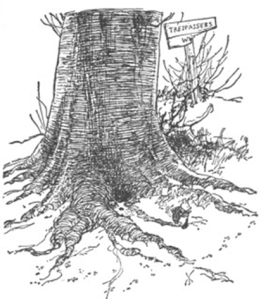
Piglet lives in a great beech-tree, and “next to his house was a piece of broken board which had: ‘TRESPASSERS W’ on it” and Piglet explains that it “was his grandfather’s name, and it had been in the family a long time” (34). We the readers know, as the narrator intends for us to know, that Trespassers W is not short for Trespassers William, as Piglet says, but for Trespassers Will Be Shot. If you are a child, though, trying to make sense of the world around him it makes perfect sense for a grandfather to be named Trespassers W. The funniness here is a function of the particular adult implied reader who does have a pretty good sense of the world around him, but who has hung next to his adult sensibility a child sensibility and has let them clink around a little at odds with each other. This clinking sounds like laughter. So a story can begin, “once upon a time, a very long time ago now, about last Friday,” and it both makes sense and is laughably wrong, because the adult knows how a child can feel that last Friday was an eternity ago and also know it has really only been a few days since then (4). And of course when you are a child trying to discover the North Pole, it makes perfect sense to look for a stick in the ground and preferably rather close to where you live, when you the adult knows it is actually a huge lonely snowy place very far away with no real poles at all (127).
To become an implied reader, to put oneself in the brains of someone else, is one of the greatest joys of reading narrative, and it is especially fun when the new brains are joyful and juvenile.
Works Cited and Related Reading
Booth, Wayne. The Rhetoric of Fiction. University of Chicago Press, 1961.
Iser, Wolfgang. The Implied Reader. Johns Hopkins UP, 1974.
Milne, A. A. Winnie-the-Pooh. E. P. Dutton & Co., 1961.
Prince, Gerald. “The Narratee Revisited.” Style, vol. 19, no. 3, 1985, pp. 299-303.
William Shakespeare has written many beloved plays that are still incredibly popular today. Perhaps one of his most well-known plays is Hamlet. This tale of duty and betrayal has been read by many, and Hamlet’s soliloquies are some of the most recited monologues and iconic scenes of all time.
Over the years there have been many versions of this play. It has been performed with famous actors such as David Tennant, and it has ben done as a movie. There have been television show episodes and books semi-based off of it. One book in particular, however, is based off it a bit more than others. Ophelia by Lisa Klein tells the story of Hamlet from the perspective of Ophelia. It is an interesting read from a point of view that is rarely shown or even thought about. However, the book does contain quite a few differences from the original play’s storyline, which show it to be something of a different nature than Shakespeare’s Hamlet.
The first big difference between the two stories is the fact Lisa Klein’s story shows Ophelia and Hamlet as children. The novel starts when Ophelia is roughly ten and hamlet is in his mid to late teen years. It shows Ophelia before she came to the castle and then as a child within the castle. Klein’s story talks of neglect Ophelia faces at the hand of her father and depicts her as a young tomboy who would much rather run around and roughhouse with the boys than sew or play music. It shows the reader how Ophelia became a lady in the queen’s court and how she rose and fell in her eyes. These are all topics Shakespeare’s original play doesn’t even touch on, as the focal point is not Ophelia but Hamlet.
In Hamlet, Hamlet doesn’t decide he loves Ophelia until after she is already dead, but in the story by Lisa Klein, Hamlet declares his love for her much sooner, although he does so in secret. In her story only Horatio knows of the declared love between the two and helps them to marry in secret. Hamlet declares his love for her many times in the book and chases after her soon after Ophelia turns fifteen or sixteen. He is able to finally woo her and they are often seen in the novel sneaking away to kiss or to do more saucy things. This is all very different from the original storyline where, as previously mentioned, there is no mention of Hamlet even remotely liking Ophelia until she is already dead.
Hamlet’s descent into madness is also much different in the original play. For starters, since it is about Hamlet himself you see way more of the descent than you do in Ophelia, and there is a much greater focus and emphasis placed on it than in Lisa Klein’s Ophelia. In the play we see even from the beginning he is not mentally well, and we get wonderful speeches such as the following:
To be, or not to be — that is the question: Whether ’tis nobler in the mind to suffer the slings and arrows of outrageous fortune or to take arms against a sea of troubles and by opposing end them. To die, to sleep — no more — and by a sleep to say we end the heartache, and the thousand natural shocks that flesh is heir to. ’Tis a consummation devoutly to be wished. To die, to sleep — to sleep — perchance to dream: ay, there’s the rub, for in that sleep of death what dreams may come when we have shuffled off this mortal coil, must give us pause. There’s the respect that makes calamity of so long life. For who would bear the whips and scorns of time, th’ oppressor’s wrong, the proud man’s contumely, the pangs of despised love, the law’s delay, the insolence of office, and the spurns that patient merit of th’ unworthy takes, when he himself might his quietus make with a bare bodkin? Who would fardels bear, to grunt and sweat under a weary life, but that the dread of something after death, the undiscovered country, from whose bourn no traveller returns, puzzles the will, and makes us rather bear those ills we have than fly to others that we know not of? Thus conscience does make cowards of us all, and thus the native hue of resolution is sicklied o’er with the pale cast of thought, and enterprise of great pitch and moment with this regard their currents turn awry and lose the name of action. — Soft you now, the fair Ophelia! — Nymph, in thy orisons be all my sins remembered.
While Hamlet still tries to convince his friends in the play he is merely pretending to be crazy, there are enough speeches and lines from him to show he is really not just pretending at all. The novel, however, is lacking some of these vital quotations and scenes. While one can definitely still tell Hamlet is crazy, the reader doesn’t get to see him fall into it slowly and surely. It is portrayed more along the lines of, “Oh my dad is dead? I guess I’m completely and totally mental now!” It is quite unfortunate, as that character development is one of the things that makes Shakespeare’s play so wonderful.
One of the biggest differences between the novel and the play is the way Ophelia’s tale is ended. In the play she is depicted as going mad, and she falls from a tree in what is suspected to have been suicide. In the novel she does what Hamlet claims to do and fakes madness in attempt to protect herself. When this only draws more attention to her, she freaks out and starts trying to figure out how to escape the castle and all of Denmark. Finally, with the help Horatio and the queen she fakes her death and flees Denmark with basically only the clothes on her back and some money from the queen. She ends up at a convent where she spends the rest of her days as the “doctor” for the town. This takes up the entire second half of the novel (in what is considered to be, by many, one of the most boring and useless halves of a novel ever to be written in the English language). Also, while she is at the convent in the novel taking care of all the sick and crazy people, she ends up giving birth to Hamlet’s son, whom she names (drumroll please) Hamlet. This is something incredibly and drastically different between the novel and the play, as Shakespeare never wrote Hamlet to have an heir at all. Lisa Klein’s novel, however, takes some creative liberties, however, and writes one in.
Another difference between the play and the novel is theme and focus. The novel places emphasis upon “sexual awakening,” to the point of taking away from the plot, which is something the play never does. The focus is on Ophelia, who she is, and what she does, as well as on love, how it should make one act, and whether love is ever true at all. One important theme is how all of humanity is corrupted, specifically by lust, and how that lustful corruptness affects everyone. It also shows that if the king falls so will the kingdom, though the play shows this as well. The play talks about corruption like the novel, but in the play the focus of corruption is placed upon the desire for power, not upon lustful desires. It depicts most of the corruption in the story to come from character’s desires to rule and to be in charge or to be honored and recognized by all. The play focuses on Hamlet, his descent into madness, and the fall of Denmark instead of on Ophelia and what she does and thinks. The focus is never really placed upon love at all, because that’s just not what the original story is about, other than when Ophelia is trying to cure Hamlet’s insanity by loving him and bidding him to love her back.
It is incredibly easy to see how different these two are, and those differences are why Shakespeare’s beloved Hamlet has stood the test of time and Lisa Klein’s Ophelia has barely been heard of. Though Shakespeare brings them up in interesting ways, the themes of his play are important and relatable (we all deal with death and with corruption). Because of that his play will continue to stand the test of time, unlike those that warp and change these themes into something less than. The play is loved for its quality of writing and plot, and when one tries to change that too much it is better to have just invented a different story altogether. Ultimately, though, it is safe to say both these stories do share one thing: they show that at the end of the day we all have to choose. We most chose to deal with our grief — to run from it or to face it head on.
George Orwell’s Animal Farm was published in 1945 after the end of World War Two. Orwell had previously fought in the Communist army, but his own personal beliefs were more complicated. In Animal Farm, he does not make those beliefs clear. He does, however, posit one thing about human beings in the context of history: whether fascists, dictators, or imperialist-capitalists, we are all enslaved to human nature.
Orwell believed this human nature was animalistic. Orwell’s fundamental principle, and the thesis of my paper, is Animal Farm is used to illustrate this fact. He believes humans are condemned to their instincts and the petty conflicts that have historically polarized us through all of time. We are not equipped to move past these political misunderstandings. Jeffrey Meyer, in “The Political Allegory of Animal Farm,” says Orwell saw human beings as “prisoners of history, inadequately equipped to deal with our own flaws.” Our flaws are a universal of human behavior, no matter what political ideologies we mask them in. Orwell does not advocate Communism, nor does he explicitly argue against it — rather, he seeks to lay bare the open structure of political systems themselves. He does this by showing us a ludicrous tale of animals conducting, overthrowing, and, gradually, regressing in “government.” It is no accident he uses animals to convey this. Orwell’s premise is, though we call ourselves human beings, our principles, morals, and behavior are no different. It is all the same thing with a different name — Christian or Muslim, fascist or capitalist, oligarchy or theocracy — our nature is the same, regardless of government.
The choice of animals for a fable on government is no accident as well. It is, after all, “civilization” and “enlightenment,” which we hail as the crown champion of Man, and it is these ideological superior states we aim to create with “revolution” or government. Orwell’s political animals not only underscore the tale’s purpose as a universal fable, but they emphasize the absurd condition and grotesquely violent “tactics” of the players in the story. The joke is that, with all our talk of “revolution,” we are really only brutes, animals playing dress-up, after all.
It is no accident those who preach are “ravens” — carrion crows encircling whoever they’re about to eat. It is also no accident those who govern are “pigs” — animals who, quite literally, roll around in their own excrement.
Orwell is not shy about using the features of these specific animals to symbolize specific kinds of people, as Christopher Hollis, in “Animal Farm is a Successful Animal Fable,” also notes. Pigs, for example, are smart and greedy; sheep are complacent and compliant; dogs are loyal and willing to overlook faults; and horses are the workers upon whose backs men carry their burdens.
Finally, and perhaps most significantly of all, Orwell conducts his puppet show illustration of a failed revolution with literal animals. The tale is not believable, nor particularly funny. It is somewhat disturbing. Rather than a portrait of animals or government, it is a portrait of ourselves as animals. We are revealed to ourselves as we truly are: uncivilized, animalistic, and unevolved. He shows us how the hymn “Beasts of England,” and the overly repetitive chanting, is the one thing to which the sheep are recurringly drawn (Animal Farm 13). It is our animal nature and simple mannerisms that hold up the illusions of our social institutions. As one of the literary critics we studied, Jacques Lacan said all of what we believe of ourselves and the structures of mind within which we function are just a mirror of our imagination. Our governments and religions are reflections of our subconscious needs and desires, as Freud reminds us, which, also, are projections of ourselves. These reflections, which we believe to be real, propel our relationships and hijack our emotions. Orwell shows us these emotions are simple responses. These responses are not as complex as ideologies make them out to be — rather than our impetus being governed by ideology, all ideology is the didactic captive and puppet-toy of impetus. Our animal desires compel us in our politics, our choices, our economies, and our morals — “revolutionary” or not.
There is no “revolution,” according to Orwell, as the animals at the end of the story are in exactly as bad of a predicament as they were at the beginning. If anything, their predicament is worse and more complex.
There is a phase of regression undergone by the animals as they move from the first pig’s revelation in a dream and into their complete upheaval of society. The animals regress from intelligent and comprehensive to becoming slowly dulled and compliant. This is interesting because it shows how fear can dull the inquisitive mind of society and make people lax and dependent on their superiors.
Boxer the horse is a particularly significant choice. In his unwavering loyalty, dedication to the fatherland, and tireless work, Boxer represents the revolutionary working class. Orwell describes Boxer’s priorities by telling us, “His answer to every problem, every setback was ‘I will work harder!’ — which he had adopted as his personal motto” (Animal Farm 58). In this sense, Boxer is like the ever-laborious and loyal proletariat. Boxer as the working class is an even more ironic depiction if you consider Boxer is the prominent horse in the story, and horses have been considered beasts of burden throughout almost all of history — not unlike the working class. Yet it is Boxer, in the end, who is tricked and killed, but instead of resisting Boxer deems it to be his lot — or one could argue, he doesn’t even realize. This, too, is analogous to the struggle of the working class. As mentioned before, horses are literally the backs on which objects are carried, and the working class is literally the back upon which the burden of the government’s luxuries and enforcement is carried.
Maintaining the power structure was the pigs’ main focus. By taking the other animals’ rations and feeding themselves with them, they quite literally feed off the masses while starving them out. Brains can’t function without proper nutrition. It’s an intentional oppression of the lower classes to benefit and sustain the upper class, all the while convincing the lower class this starvation is actually for their benefit. Marxist literary theorists Adorno and Horkheimer would see this as an analogy for the culture industry, perhaps, and the massive parasitic machine of consumer greed which feeds off men’s minds and imagination in the modern age, all the while convincing us, as we are robbed, that we are being “entertained” (Adorno and Horkheimer 2188).
Animal Farm is entertaining, but its tone is two-dimensional — almost intentionally so, so as to underscore the device of parable it employs.
The narrator in Animal Farm is distant, detached, and unemotional. His matter-of-fact, detached tone only emphasizes the horror of the events he describes. He creates a flat, sinister effect, almost as if to say, “Why should this surprise you?” To say “they sang” in the same tone as “they ripped out their throats” is to say the reality of Animal Farm is happening right now, right next to you in day-to-day life, and you are not shocked. It is not sensationalist in tone at all, exactly unlike the sweeping rhetorical tone of most thinkers or of the pig-philosophers in this book.
The reader observes an almost flat puppet show: rather than compelling one toward an objective, like most ideological texts or like an advertisement would, Animal Farm is, instead, a bleak retelling of what is occurring. It asks you to fill the character voids yourself, and, using a story form used to convey a moral or virtue, Animal Farm’s is noticeably absent.
This is perhaps most ironic of all. Orwell takes a realist device, stylistically reminiscent of Socialist Realist writing such as the Stalin-approved propaganda novel Cement. This device is usually used as a vehicle for ideology, moral instruction, or, more generally, propaganda. It is a form of storytelling used to say other things. Orwell, quite radically, took the realist device of ideology and propaganda and gave it back by using it as a fable on ideology and propaganda. He said, in essence, “Here’s your moral fable. The moral of this fable is about moral fables and how they work.”
The fact the tale is told of animate animals accentuates its deeper meaning as an obvious allegory. Like a fable or parable, from Aesop to the Grimm Brothers, it is clearly intended to be instructive and illustrative in message and tone. You think you’re going to read a beautiful fable, but you don’t. Animal Farm is, if anything, a parable. The parable is the timeless device of ideology. Yet it is ideology, perhaps most ironically, of which Animal Farm is absent. It is an empty device — making it all the more meaningful.
We must also note higher literacy is associated not with higher truth but with trickery. Orwell displays a distrust for intellectuals and their twisting of words. On page 63, Orwell shows how the mastery of language is associated with agency, as the narrator reminds us that, “Several of them would have protested if they could have found the right arguments.”
The more linguistic ability a creature has, the more powerful that creature is — in a vein of word-supremacy that would have resonated with deconstructionist and fellow doubter of words Jacques Derrida. Words retain power in and of themselves, in evidence to what Frederic Jameson, author of The Political Unconscious, would have called literature’s “ideology of form.” In this essence, words are functions of the overall social and political institutions they serve, or, as Jameson puts it, “The symbolic messages transmitted to us by the coexistence of various sign systems which are themselves traces or anticipations of modes of production” (1337). The connection between language and the “modes of production,” and/or the upholders of power, is evident in the fact the pigs, the most powerful of creatures, can read, while most others can’t. An animal’s capacity to communicate through language is directly proportional to the amount of political power it possesses in Animal Farm. Linguistic ability and cognitive capacity, are, in Orwell’s world, analogous to agency.
The simpler creatures, and those most affected by Napoleon’s policies, cannot read at all. Those who can, such as Squealer, who uses language and clever words to sow seeds of support for Napoleon’s administration, are using language as a weapon for manipulation and evil. Rather than using complex wording to elucidate the truth, complex wording is used to obscure it.
This makes Orwell’s choice to convey the tale in a simplistic tone all the more meaningful. Orwell is not trying to persuade us with vast, sweeping illusions of ideology nor rhetorical acrobatics. He is speaking as if we are the sheep — not because his meaning is overtly simple, but because the complexity of his meaning is most accurately conveyed through an intentionally simple tone. If this were a tract against or for communism, perhaps he would use lengthy adjectives and argument. Yet the characters are flat, the plot is linear, and the sentence structure is simple: this is a device for ideology intentionally without the ideology — it is a barren womb. It is the skeleton of propaganda made transparent and handed to us so we might say, “It is empty, don’t you see?”
Orwell’s book Animal Farm uses the story of the Russian Revolution to tell us about human nature in a way both political and timely, yet boldly historic in scope and unapologetic in its brashness. Orwell’s suspicion of intellectuals and complex ideologies as concealers of truth is doubly evident both in the tone in which he tells his tale and in his depiction of the power of the spoken word itself. Orwell took the narrative device of fable to write an analogy of government, but it is, more than anything else, an analogy of human nature — which Orwell believes is, at its core, not that exceptionally “human” after all. He uses animals to show us ourselves, and, in the end, he claims he cannot find much of a difference (121).
Works Cited
Adorno, Theodore W; Horkheimer, Max. “Dialectic of Enlightenment: The Culture Industry.” The Norton Anthology of Theory and Criticism. Ed. Vincent B. Leitch, New York: Norton, 2010. Print. 1110- 1127.
Derrida, Jacques. “The Exorbitant. A Question of Method.” The Norton Anthology of Theory and Criticism. Ed. Leitch, Vincent B. New York: Norton, 2010. Print. 1691-1697.
Hollis, Christopher. “Animal Farm is a Successful Animal Farm.” Ed. Terry O’Neill., Greenhaven, 1998. Web.
Jameson, Frederich. “The Political Unconscious: Narrative as a Socially Symbolic Act.” The Norton Anthology of Theory and Criticism. Ed. Vincent B. Leitch, New York: Norton, 2010. Print. 1822-1846.
Lacan, Jacques. “The Mirror Stage as Formative of the Function of the I as Revealed in Psychoanalytic Experience.” The Norton Anthology of Theory and Criticism. Ed. Leitch, Vincent B. New York: Norton, 2010. Print. 1163-1169.
Meyers, J. Orwell’s bestiary: “The Political Allegory of Animal Farm.” Studies in the Twentieth Century, 8, 65-84. 1971. Web.
September 11, 2001: a day that goes down in infamy; a day that 2,977 Americans lost their lives. Across the globe, countries mourned with Americans; as a country, Americans found a solidarity they had not known before. Neighbors clung to one another, waiting anxiously to see what President George W. Bush would do in response. He, along with many other world leaders, pressured the Afghan government to convince the Taliban to hand over Osama bin Laden (U.S. military intelligence had confirmed he was responsible for coordinating the attacks on 9/11). When the Afghan leaders refused to cooperate, the United States invaded, with the blessing of the international community. Thus, the Global War on Terror was born. There have been several distinct eras of strategies, none of which have effectively worked to produce a long-term gain; so, the question remains: what other strategies have the U.S. military officials not tried, and of those, which direction should we pursue to retain American interests in the region and ultimately declare victory in the “War on Terror?”
Many ideas have come into play regarding the future policies of the war: privatizing the war, and a continuation of the Obama era strategy are common themes expressed from both sides of the political spectrum. Neither of these ideas are long-term conscious, and to assume so does a disservice to the United States and its allies. The steps the U.S. has to take are defining what it means to win; providing task, purpose, and direction to the ground troops; preventing the Taliban and other insurgencies from regaining and retaining key terrain, and ultimately retaining troops in country with no solidified “end date.”
In order to fully understand the concepts addressed in this paper, there are sub-concepts that must be defined and expounded on. Key terms addressed are: The War on Terror, Hearts and Minds Campaign, ROE (rules of engagement), COIN (counterinsurgency) operations, Operation Enduring Freedom, Operation Inherent Resolve, SOF (Special Operation Forces), and joint operations. The legal definition of the War on Terror (Legal, Inc. 2017) states,
The War on Terror is an international military campaign launched in 2001 with U.S. and U.K. invasion of Afghanistan in response to the attacks on New York and Washington of September 11, 2001. It is a global military, political, legal, and ideological struggle employed against organizations designated as terrorist and regimes that are accused of having relationships with these terrorists or presented as posing a threat to the U.S. and its allies.
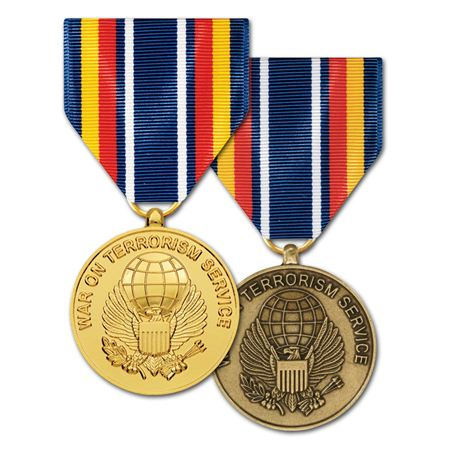
This term was phased out of official use by the Obama administration, replacing it with Overseas Contingency Operation. However, it is still used in everyday sectors, such as the mainstream media and politicians. The U.S. Armed Forces still utilizes this phrasing in the context of the Army’s Global War on Terrorism Service Medal (Appendix A). Counterinsurgency (COIN) operations (Joint Publication 3-24 ) are “comprehensive civilian and military efforts taken to simultaneously defeat and contain insurgency and address its root causes.” The Hearts and Minds Campaign is an example of COIN operations; the main component of this campaign was humanitarian needs; the Pentagon gave approximately two billion dollars to ground commanders to spend on a myriad of humanitarian needs — essentially, buy the Afghan loyalty, hope it’s a long-term investment, and that the Taliban won’t buy it back (McCloskey, Tigas, Jones, 2015).
Rules of Engagement (ROEs) are a directive issued by a military authority specifying the circumstances and limitations under which forces will engage in combat with the enemy. Operation Enduring Freedom (OEF) was a U.S.-led coalition force with NATO allies that started October 21, 2001, and lasted until December 28, 2014; this was the official combat operation of the War on Terror in Afghanistan (CNN, 2026). Operation Inherent Resolve was formed on October 17, 2014, when the Department of Defense opted to “formally established Combined Joint Task Force — Operation Inherent Resolve (CJTF-OIR) in order to formalize ongoing military actions against the rising threat posed by ISIS in Iraq and Syria (inherentresolve, 2014). Special Operations Forces (SOF) are elite operatives in every branch of the U.S. military that has a specialized set of skills and who were key players used in training Afghan national forces. Joint operations, for the purpose of this paper, are tenets off which to plan and execute joint operations independently or in cooperation with our multinational partners, other US Government departments and agencies, and international and nongovernmental organizations (Joint Publication 3-24). There are key facets to this definition: there’s the national aspect of multi-branch operations (in which the Army, Air Force, Marines Corps, Navy, and Coast Guard perform operations in which assets are drawn from two or more branches); and multinational operations, which are operations where two or more countries are involved in military combat operations.
During the Bush Era (2001-2008), there was a pursuit of unilateralist foreign policy; the administration treated the individual nation-states as a regional “one size fits all” strategy. Iraq and Afghanistan are two distinct culturally significant entities; but then President Bush decided to connect them. To him, the strategy was simple: have a strong military front, destroy Saddam Hussein, destroy bin Laden, and the War on Terror will be over. The main tenets of his goals were simple: prevent another attack on American soil, capture and kill bin Laden, destroy al-Qaeda, and increase democratization of the Middle East as a whole (Katz). Whether or not he was successful is up to interpretation. The first phase of the operation, which was the initial military invasion of Iraq, was successful. U.S. forces quickly cleared the city and gained key territory in Iraq that led the U.S. to prematurely declare a “victory” in Iraq, without declaring a victory in the war. He was also successful in his endeavor to prevent another major terrorist attack on American soil. There have been attacks that ISIS has claimed but nothing to the extent of 9/11. Opponents of the Bush administration would argue he ultimately failed, and his strategy produced a worse environment for his successor to try to navigate (Katz). They argue he failed to capture bin Laden, his right hand, Ayman Al Zawahiri, and other key leaders in the al-Qaeda regime. This led to a follow on failure, which was not destroying all remnants of al-Qaeda. Because they were not destroyed, there was an increase both regionally and globally in signature al-Qaeda attacks. Bush also advocated for a strong democratic presence in the Middle East; instead of focusing in on the countries he had invaded, Bush opted for a regional strategy, which alienated some potential key players in the Global War on Terror, such as Morocco, Bahrain, Oman, Qatar, Yemen, Kuwait, Jordan, and Saudi Arabia (Katz).
President Bush’s successor, President Obama, had a much different view on how to proceed. He made a dramatic shift from the unilateral foreign policy ideals of the Bush administration and instead honed in on a multilateral foreign policy. He campaigned heavily on withdrawing troops and focusing on domestic issues without having to be concerned with being the world’s police. When Bush originally invaded Iraq, Obama was loudly critical of this move and frequently commented on the approach to the War on Terror as a whole. Obama pursued a strategy between 2011 and 2014 called “off shore balancing,” which can be boiled down to four main tenets: an emphasis on withdrawing all ground troops, national forces doing the heavy lifting of operations, increasing drone strikes, and pursuing a medium footprint approach (Hannah, 2017). Proponents of this strategy and the Obama administration would argue this was the most effective way to win the war. They argue there were fewer combat deaths under Obama’s direction, and fewer terrorist attacks as a whole. Those who oppose this strategy would argue Obama’s ROEs made it harder to be more of an effective fighting force on the ground; forcing commanders to not take the prudent risk that military doctrine advises they take (FM 6-0). One of the key failures Obama made was announcing an official withdrawal date of massive amounts of troops from the region. Due to this being a public, and therefore accessible, announcement, terrorist organizations did exactly what any military organization would do: they waited it out until heavy multitudes of American forces left, then attacked with full force. This led to Obama having to readjust his strategy, angering his supporters who expected him to follow through with his promise on withdrawal.
The Trump administration has already made some major shifts in the Obama-era policy. By nominating retired General “Maddog” Mattis, he employed one of the most well-respected men in the armed forces, and Mattis became the driving force behind the defense policies of the Trump Era. He has reduced the ROEs that Obama integrated. There are pros and cons to this, however. It does up the risk of collateral damage, but it also allows commanders who are actually on the ground with the fighting force to be able to make decisions that will ultimately move us toward American interests. Afghan national forces are still being utilized within their own country; Mattis has shifted towards a policy of “training based” operations for them, i.e., utilizing the SOF personnel to train the Afghans to the best of their ability, imparting skills and techniques to effectively combat the Taliban, and any other insurgent groups.
Another key tenet of the Trump strategy is addressing the Pakistan issue. Pakistan has long been known as the harbor state of many terrorist organizations. They have smuggled weapons and provided a safe haven for multiple groups, specifically al-Qaeda. How Trump plans on addressing this issue is still to be determined. Both he and his Secretary of Defense have been extremely tight-lipped on the steps they plan to employ from here on out; however, the influx of troops suggests a withdrawal is far from being a potential strategy (Hannah, 2017).
One potential strategy the Joint Chiefs have discussed is privatizing the war. For the context of this paper, “privatizing the war” will refer to utilizing private defense contractors to execute military missions, which has both pros and cons. Erik Prince, the founder of Blackwater Security, and former Navy Seal, is actively pushing the White House to turn the sole responsibility of the war over to private contractors. Both Secretary of Defense, Jim Mattis, and the current National Security Advisor to the President, retired Lieutenant General H.R. McMaster, have given the nod they are open to bringing the idea to the drawing table, but there has been no admission to what extent. The idea of privatizing the war intrigues strategists, but the cons of utilizing the private sector far outweigh the pros it could potentially have. For example, the Blackwater scandal of 2007 gives reason enough to be hesitant regarding utilizing private contractors as the main effort. In September 2007, several private security contractors fired into a crowd in Nisour Square, Baghdad, killing fourteen unarmed Iraqi civilians (Apuzzo, 2015). While the individuals convicted of the massacre unequivocally argued they were only shooting at insurgents who fired on them, the issue remains: they were convicted in the American criminal justice system, not the military justice system. Military individuals should be held to military standards, especially regarding illegal or unethical acts. Members of the Armed Forces are held to the Uniformed Code of Military Justice (UCMJ), which addresses illegal actions and recommended sentences. Another con associated with the idea of privatizing the war falls back to funding. For example, the military is required to be in whichever country the Pentagon requires. At the strategic level, the goals are established for regions, and commanders take those desired end states and implement them at the ground level. Contractors, on the other hand, don’t answer to the Pentagon. Contractors are exactly that: held by a contract, which is reliant on limited funds for each contract. Once the contract is up, there is no guarantee contractors would want to re-up the contract, and if there is another government shutdown, then there are no funds for those contracts to be paid. In the private sector, if individuals are not getting paid, there is no legal expectation for them to continue to work. The idea of utilizing private contractors provides no long-term commitment to the United States’ end states, which ultimately could do a disservice to the mission. Beyond the potential legal ramifications and unguaranteed funding, the moral questionability rises. As noted above, the Blackwater scandal brought new attention to collateral damage and civilian deaths in the region. In contrast, the U.S. Army had a similar scandal regarding the murder of innocent civilians in 2006 by three lower enlisted soldiers. Contrary to utilizing the U.S. criminal justice system, they were convicted of violating UCMJ; sentenced to life in Fort Leavenworth (the military’s prison), the main proponent of the crime ended up committing suicide (Ricks, 2012). There was heavy scrutiny placed upon the Army and its commanders after this; these soldiers’ higher ups were held culpable in the court of public opinion; their reputations were tarnished. In comparison, the Blackwater scandal left Erik Prince just as wealthy; reputation fully intact. The military, as the Rand Corporation notes, is a distinct entity:
the military is the sum of its experience. When the nation outsources its battles, the military gains nothing in return, no battle-seasoned soldiers, no lessons hard-learned. Many of the contractors who have served in Afghanistan over the past 16 years have been dedicated staff who have placed themselves at risk to serve their country. Nevertheless, at a systemic level, there are numerous unresolved issues associated with contractor performance in Afghanistan. Militaries are massive and often frustrating bureaucracies, but the full measure of their work is not easily replicated in the private sector (Zimmerman, 2017).
On the alternate side of the argument, there are pros associated with the argument: for one, it would be cheaper, Erik Prince claimed it would cost less than ten billion a year, whereas the Pentagon spends approximately forty billion a year on defense aspects. Business Insider reports, “A 2016 Brown University study says wars in Iraq and Afghanistan have cost US taxpayers nearly $5 trillion dollars and counting. And, as the Special Inspector General for Afghanistan Reconstruction has found repeatedly, much of that has been lost to waste, fraud and abuse” (Francis, 2017).
The argument could be made the private sector always outperforms the government: in cost-benefit analysis, in efficiency, and in quality of product. Capitalists would argue regardless of the subject, government is consistently the wrong answer. However, that argument fails to take into account the fact the military is a profession of arms. There is a copious amount of doctrine associated with the military, step-by-step instructions on how to conduct key tasks, and a certain level of bureaucracy, yes; all of those things are associated with the private sector as well — except the doctrine. Military doctrine is not a negative concept that carries the same connotation as regulation. Regulations limit what an entity is allowed to do, or in what scope they are allowed to act in; doctrine, on the other hand, is a guiding principle that gives guidance and direction to leaders — a starting point that everyone begins with, so there is no discrepancies in explanation of executing a mission. The Rand Corporation explains,
In military operations, soldiers utilize doctrine — prescriptions for how to fight particular types of operations — to guide operations. Doctrine is unifying; a way, as Harald Høibak has said, to have “the best team without having the best players.”
Good doctrine specifies a desired end state and is underpinned by a theory of victory. Military contracting is not run on the basis of doctrine, but rather on company policies and procedures (Zimmerman, 2017).
Another policy that could be pursued would be a continuation of the Obama-era policies, with a mixture of Trump’s reduced ROE’s and some shifts in the execution of the policy. The main problem with Obama’s “medium footprint” approach and “offshore balancing” was not a lack of funding or troops available; the issue arises with the declination of the ground troops ability to be soldiers. ROEs are not released for public knowledge. Certain levels of security clearances are required to be able to access that information, or, you must be deployed to receive that briefing. Within this plan, the ideal would be for the U.S. to obliterate all insurgencies to the point their only course of action for hope of individual survival is peace talks and a negotiated settlement between them and the elected government. The key difference with this strategy would be not addressing a definitive end time for combat operations in country. As noted above, that was one of Obama’s key failures, and the Taliban exploited what he made known to both ally and enemy. The biggest departure from the Obama-era strategy would be a monumental shift toward a regional-based strategy. The Trump administration has already initiated this shift; according to Secretary of Defense Jim Mattis,
While we continue to make gains against the terrorist enemy in Syria, Iraq and elsewhere, in Afghanistan we have faced a difficult 16 years … Beginning last month, and for the first time in this long fight, all six Afghan military corps are engaged in offensive operations … During these recent months, there have been fewer civilian casualties as a result of coalition operations, although regrettably, Taliban high-profile attacks on civilians continue to murder the innocent (Defense, 2017).
The idea of addressing the problem as a regional strategy has more pros than cons; addressing the issues of Pakistan and harboring terrorists is a major factory in this strategy; to convince Pakistan they are better off working with the U.S. forces rather than against would be a major foreign policy victory for the United States, something even Obama failed to do. The major issues with this policy is addressing the outlying factors with other players. Pakistan and India have an increasingly aggressive relationship; expecting them to both effectively work with the United States and, by extension, each other, is a tall order. Other factors to this strategy include troop increases; to be an effective fighting force regionally and providing the support that regional actors need, the number would, at the very least, be in the low five figures. This could be considered both a pro and a con; it would increase the spending of the DOD, but it is arguable increasing troops in the short term would allow us to be there for a lesser timeframe than originally proposed. Opponents of this strategy argue this strategy would increase civilian deaths, therefore increasing the terrorism aspect. Afghan nationals want security; they’ll sell it to the highest bidder. If the bidder happens to be the Taliban, then the Afghans will support them. The Taliban grows when they see U.S. forces as the enemy; the more civilians get killed and the more property gets damaged, the more the Taliban will be able to use to recruit young men and even women into their ranks.
The third potential strategy is to completely readjust how we see the war. The only other war the United States has fought that even remotely reflects the War on Terror is the Vietnam War. The Taliban, just like the Vietcong, are fighting an insurgent warfare with guerrilla tactics. Ambushing American patrols, IEDs (Improvised Explosive Device), and being able to melt into the civilian population are key reasons they are both hard to find and kill.
The U.S. could take a step back from the current strategies and instead implement more special forces operations, focused solely on independent missions, (rather than vague end states established by the Pentagon) and training the Afghan nationals forces. In essence, this strategy would be guerilla warfare: fighting insurgencies with insurgent-type tactics. SFC Galer, an Army Special Forces soldier whose area of expertise is engineering, explains, “Special Forces used to have four sectors in Afghanistan; essentially, they would divide the country in fourths, and the commanding general of Afghanistan would attach us as he or she saw fit. We have a very special set of skills; utilizing the Special Forces to train Afghan National Army is a waste. Utilize Special Forces to train specialized groups to obtain the same goal with less people and do a better job of it.”
All of these potential strategies have merit; they also come with an exceptional amount of criticism. Most of that criticism comes from domestic political polarization and an inherent belief as to whether the United States should even have troops in the Middle East. There was bipartisan support when President Bush originally invaded; patriotism and nationalism soared due to the atrocities seen on September 11, 2001. The idea of revenge was tangible in America. Sixteen years later, 6,915 American lives lost, and the question remains: how much longer will our soldiers, marines, airmen, and sailors be deployed to fight this “War on Terror?” The answer is harsh, albeit simple: until the threat is no longer present. The United States is the greatest military power in the world; the Taliban has no technological capabilities that can touch our prowess in the air, land, or sea. The issue is not military readiness or capabilities; the issue is the United States has not effectively defined what American interests are in the region, which leaves room for the Pentagon to claim our end states have not been met. That is the first step to success.
Defining American interests is difficult; the first step is taking the vague concepts of “promoting democracy in the region” and “ending the Taliban, sister cells, and offshoot groups,” by giving them measurable end states that will be able to be checked off as the military executes the missions and successfully achieving the end states. For the vague concept of promoting democracy in the region: the United States has to define success. The Obama Era focused success as being a shift toward democratic values, promoting human rights such as education for girls or that nation becomes Westernized through infrastructure. The Trump administration is shifting the definition of success to being a regional success; focusing on the ground goals of the military, not built in a context of vague aspects even the generals at the Pentagon struggle to explain what that looks like beyond political talking points.
The Trump administration has already started defining the regional aspect by changing the strategy to “Southeast Asia Strategy.” This still fails to address the issue of who the key actors in that strategy are. Within the idea of a regional goal, the key players need to be Afghanistan, all the countries that border it (Pakistan, Iran, Turkmenistan, Uzbekistan, and Kyrgyzstan), and include India. Afghanistan (the citizens) are concerned with security. To be able to guarantee security for the Afghan people while ultimately moving toward the goal of reducing U.S. presence in the region, the diplomatic aspects of improving relations of Afghanistan with its neighbors must be a top priority for the United States. This falls into the follow-on steps of the recommended strategy.
The Taliban must be obliterated, and the neighboring states must be willing to work with Afghanistan and the United States to ensure no remnants remain. Pakistan cannot be allowed to continue harboring terrorists. Doing so completely undermines the United States and the region’s safety as a whole. President Trump, in August of 2017, addressed the Pakistan problem; the Taliban heard his words and released this statement, “It looks like the US still doesn’t want to put an end to its longest war. Instead of understanding the facts and realities, (Trump) still shows pride for his power and military forces.” They have vowed to continue their fight to remove American forces from the region.
Some would argue the Taliban simply want the war to end and for Americans to remove the troops in the region. Giving into this demand is a win-win: withdraw the troops, terrorist attacks stop. This argument is shortsighted and ignores the logistics of the war, and the second and third order follow on effects of withdrawing. For example, if the U.S. were to simply withdraw all troops from Afghanistan, the Afghan National Army (ANA) would have to pick up the slack; terrorism is like a bacteria: there has to be a certain environment for it to grow and thrive. If the United States leaves, that would create a vacuum of security. The Afghan forces are still ineffective against the Taliban; they struggle to coordinate the logistics of war: weapons, fuel, and ammunitions. Soldiers win battles; logistics wins wars. The lack of ability in the ANA to coordinate the key components needed to fight the Taliban will provide them the exact environment they need to thrive: the promise to the Afghan people they are the only effective ones who can provide security, provoking the anger of the Afghan people who feel abandoned by the United States.
The argument of simply withdrawing has no merit because the Taliban is fighting an inherently different war than the United States is: they are fighting an ideological war. This war is built upon a hatred for the West and everything it stands for. In contrast, the United States is fighting a cultural war, one focused on promoting democracy, protecting human rights, and removing those who pose a threat to those ideals. The U.S. is the international symbol for a strong, victorious Western culture, which is associated with Christianity (whether or not the U.S. has an official religion or is even a majority Christian). So, to continue to stay in power, the Taliban incites hatred of the West and Christian values by tapping into the base of moderate Muslim followers. This is their power: people. Retaining American troops in-country allows for us to continue to promote the Afghan government and provide assistance to the Afghan people. If the Afghan people do not grow to see the United States as the dictators, then the Taliban loses their momentum. The American forces need to start shifting into a view that is a support aspect of the Afghan National Army, not the ones doing the fighting for them. To be able to do this means utilizing key subject matter experts to continue teaching and training the forces, implementing more of a U.S. military style structure to the ANA, so they become an effective fighting force.
In continuation with this plan, American intelligence forces need to become more open with U.S. allies, which would reduce massive terror attacks in the Western world, not just the United States. The European world also need to work with the United States. Some major terrorist attacks since 2001 include, but are not limited to: Bali, 2002, over two hundred dead; Russia, 2002, one hundred seventy dead; Madrid, 2004, one hundred ninety-one dead; Brussels, 2014, four dead; France, 2015, seventeen dead (Graphics, 2015). The Trump administration has ultimately done the United States intelligence community a disservice by its flirtation with Russia; many U.S. allies have decided to keep their intelligence behind closed doors, in fear the United States would share classified information, whether intentionally or not. NATO needs to become more involved in the War on Terror, allocating more troops to be used where needed; promoting a global war on terror means we need to have global allies: not the U.S. fighting the war on behalf of the world. To be able to effectively continue to eradicate terrorism, we have to have the global and military support from allies, instead of simple words of unity and love after yet another major terror attack on Western soil. Europe has faced more terror attacks in the past three years than the U.S. has faced since 2001. Dimitris Avramopoulos, EU Commissioner for Migration, Home Affairs and Citizenship said, (Europol, 2017)
The recent terrorist attacks in Europe are a stark reminder of the need for all of us to work together more closely, and build on trust. Trust is the basis of effective cooperation. Fighting terrorism will remain at the top of our common political priorities for the time to come, not just in Europe but globally. For the safety of our citizens, and for the cohesion of our societies, we need to step up our information exchange and our cross-border cooperation at all levels.
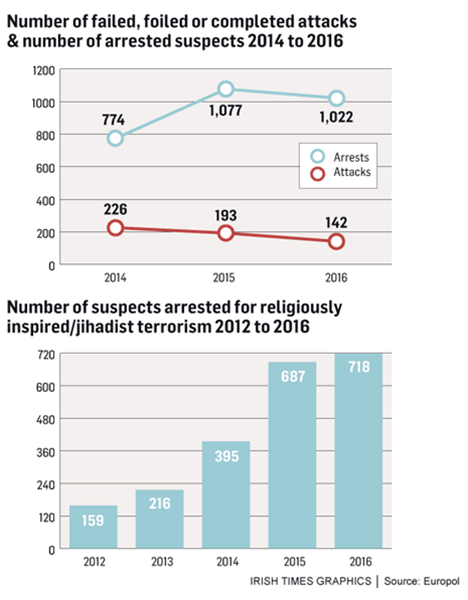
Opponents of sharing intelligence outside of regional structures argue the European Union has thwarted one hundred forty-two attacks in 2016. According to EuroPol,
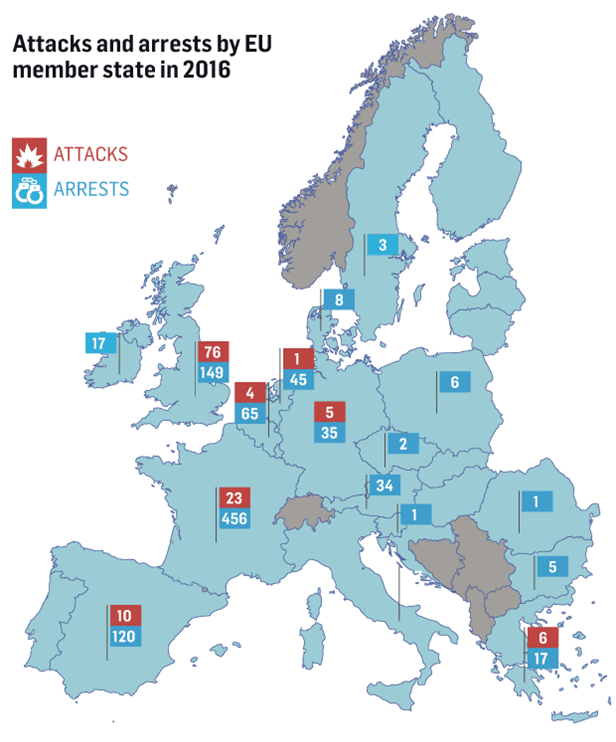
In 2016, a total of 142 failed, foiled and completed attacks were reported by eight EU Member States. More than half (76) of them were reported by the United Kingdom. France reported 23 attacks, Italy 17, Spain 10, Greece 6, Germany 5, Belgium 4 and the Netherlands 1 attack. 142 victims died in terrorist attacks, and 379 were injured in the EU. Although there was a large number of terrorist attacks not connected with jihadism, the latter accounts for the most serious forms of terrorist activity as nearly all reported fatalities and most of the casualties were the result of jihadist terrorist attacks (Europol, 2017).
However, opponents of sharing intelligence with allies by citing the European Union disprove their own point: the EU is a regional structure that is only able to thwart the terrorist attacks it has by utilizing the member states within the organization and sharing intelligence. The EU does discover and prevent many terrorist attacks, and the ratio is impressive. The issue is the EU has still faced more terrorist attacks than the U.S. since 2014, and there is a growing trend (Appendix B). Since 2001, the U.S. has experienced less than twenty major terrorist attacks.
The final strategy component comes with the economic aspect of NATO and the U.N. supplying the funding to Afghanistan to be able to continue to fund its military operations and working with the country to improve its infrastructure that will go toward the Obama-era goal of “nation building.” However, the United States cannot be the ones to bear that burden anymore. Development of Afghanistan is important and should be something the global community strives for. The U.S. did not go to Afghanistan to nation build, nor should we be footing the bill for that process. The U.S. should measure success in Afghanistan when Afghanistan is a stable enough nation to be able to effectively manage its internal and external security, to include being able to eradicate and prevent terror bases from being established in its borders. When Afghanistan is secure in that manner, the U.S. will be able to start the withdrawal of its troops. Until that happens, there is no legitimate reason to remove our military forces in the region, except to bow to political pressure of bringing Americans home. Campaigns are built on the rhetoric as well as the rhetoric of national security. Instead of appealing to domestic pressure, the U.S. needs to focus on the goals it has in Afghanistan and actively work toward achieving them.
If the United States were to remove its troops in the region before tangible progress is being seen in Afghanistan, it would have severe implications on the perception of the United States and its military capabilities. The United States has influence in the region partially because we have so many troops stationed there. If the U.S. wishes to continue its influence on promoting democratic values and honest and fair elections, then the U.S. also needs to retain troops in Afghanistan until the nation has sufficient internal and external security. Another fallout of the U.S. pulling out of the country prematurely is the international perception, from both ally and enemy alike.
For example, in 1973, the U.S. pulled out of Indochina and as a result, there was significant backlash both domestically and abroad; friends feared the U.S. would not be willing to help defend them, and enemies saw it as military weakness and resolve (Katz). The perception created internationally if the U.S. were to withdrawal, would create an emboldened insurgency in the country, and within other heads of state who are not allies of the U.S.
Iran upping their nuclear game, even with the current Iran Nuclear Deal in place, presents an interesting foreign policy problem; countries who resent having American presence in the region would be encouraged to up the ante to pressure American forces to leave the remainder of the region as well, not just Afghanistan. Allies in both the Middle East and the Western world would hesitate before calling on the United States from that point on. Israel, our key ally in the region, is vital. If the U.S. decided to pull out early, we would lose the faith and confidence of the only democratic, capitalist nation in the region (Katz).
China and Russia both would have major geopolitical interests in the region if the United States were to leave the region. Russia has a messy history with Afghanistan (the Soviet-Afghan War of 1979) and is eager to gain world prominence again. China has actively contributed monetarily in the form of humanitarian projects and development assistance, and there are several reasons China has an interest in the country: geographically, it is located the crossroads of Central and South Asia, meaning its placement between India and Russia becomes of great importance militarily to China (Massey, 2016). Second, there is great economic value to Afghanistan; there is a vast amount of the country that remains undiscovered regarding natural resources; China wants to be at the forefront of that search. According to a U.S. report in 2010 (Massey, 2016),
Further untapped natural resources in Afghanistan are supposed to be worth $1 trillion. In particular, Afghanistan has been a source of the gemstone lapis lazulis, which generated roughly $125 million trade value in 2014. But the mining of the stone has led to a conflict in recent years between local security forces and the Taliban as they gained more control over the country. Mining has the potential to generate large amounts of revenue and growth for Afghanistan if the country could establish capacities to impose legal mining.
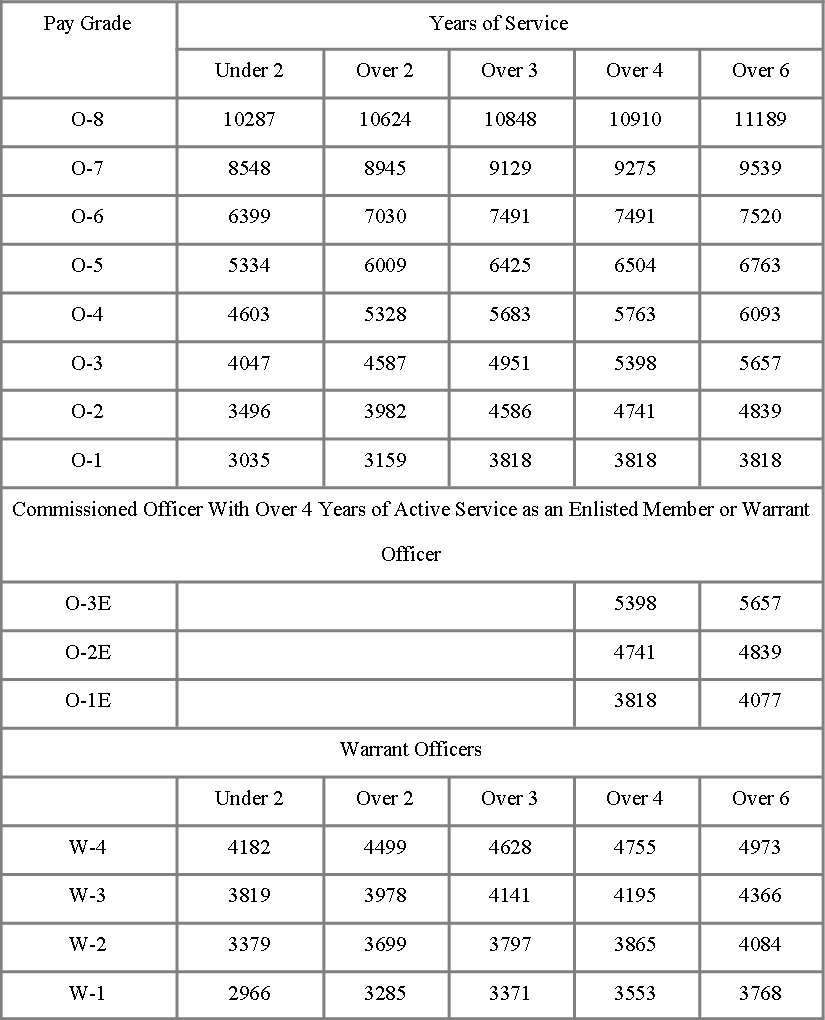
Currently, the rotations for the Middle East are considered deployments because of the combat related nature of the missions. There are several entitlements military members receive while being deployed to a combat zone. For example, all deployed soldiers, sailors, airmen, and marines receive their base pay, which is based on rank (Appendix C), Combat Zone Tax Exclusion (CZTE), Hostile Fire Pay (HFP), Hardship Duty Pay-Location (HDP-L), Basic Allowance for Housing (BAH), and Family Separation Allowance (FSA). For Afghanistan, this equals out to approximately an additional $100 per day, which excludes the base pay of rank and the cost of living quarters and sustenance. The Fiscal Year (FY) 2018 Overseas Contingency Operations budget is $64.6 billion, which is due to the nature of the jobs in the country and the pay those deployed are entitled to. Temporary Duty (TDY) in contrast, are shorter assignments done on a rotational basis into a specific country, while stationed in another, usually neighboring, country. For example, many units will be officially deployed to Qatar but perform rotational TDYs into Afghanistan. In 2014, the Pentagon attempted to reduce costs of the budget by reducing HFP in non-combatant countries, such as Qatar or Kuwait. Many service members got upset with this change in policy, so much so Congress intervened in the decision; those deployed in what is considered “non-combatant areas” will still receive HFP due to TDYs, but it will be less so than those stationed in Afghanistan. The Pentagon should continue this shift as the nature of the missions change and as the intent from the President and Joint Chiefs comes down to the ground level troops. As the strategy shifts more toward a regional and training based strategy, the pay allowances should be shifted toward non-combatant type pay, only done so when the rotations of TDYs enter into the imminent danger areas. This allows for the DOD to allocate more funds to the development of the training doctrine for the Afghan forces and allows for more trainers and training programs to be developed and implemented.
In essence, Afghanistan is a winnable war. It is a different war than we have ever fought, with a strategy that has been dwelt on for almost two decades; previous administrations have promised the idea of a regional strategy without actually delivering. Pakistan is a consistent problem; their troubled relationship with India causes more harm in the region than good. Pakistan is a major wild card in the War on Terror; they take money from the U.S. with one hand, and in the other provide a safe haven for terrorists. No longer can the U.S. afford to support Pakistan and still achieve the end states set out that ultimately result in a stronger, safer Afghanistan.
The War on Terrorism in Afghanistan is a foreign puzzle anomaly; there are so many aspects to consider, with many moving parts, both state and non-state actors who would be affected by any decision made. The United States can declare victory in Afghanistan and eventually remove troops from the country, but that cannot happen until Afghanistan is a stable nation, which cannot happen until the Taliban is eradicated, as well as sister cells and offshoot groups. Beyond the internal struggles Afghanistan faces, there are the external struggles from other sovereign states who all would love nothing more than to capitalize off the failures of the United States and Afghanistan.
Several strategies have been brought forth to the drawing board regarding the future of the strategy for Afghanistan. Privatizing the war has more negatives associated with it than it does positives, the biggest factor being the monetary aspect of contracts and the potential for a government shutdown; contractors will only work if they’re being paid. Obama’s medium footprint strategy failed to incorporate a regional strategy that utilized regional actors effectively. Reducing the ROEs does come with the potential for collateral damage, but utilizing the Army doctrine of Mission Command (FM 6-0), the Pentagon would provide the intent and commanders would implement it into the missions that meet that intent. The overall strategy the United States should pursue is defining our goals in a more tangible sense, preventing the Taliban from regaining control, preventing any further major terrorist attacks on the Western world, and ensuring Afghanistan becomes a stable nation; one who can defend itself from internal and external security struggles. These strategies can be broken down into further goals: by removing key leaders of insurgent groups and hold key terrain we’ve taken from their control. Once we have key terrain to operate in, we can start to crush new terror groups before they gain prominence in an area through providing security to the Afghan people, therefore removing a desire to turn to the Taliban for the desired security.
SFC Galer, Joshua. Personal Communication. November, 2017.
“The National Military Strategic Plan for the War on Terrorism: An Assessment.” 2015. HOMELAND SECURITY AFFAIRS. https://www.hsaj.org/articles/170 (November 21, 2017).
Machiavelli’s attitude toward human nature is rooted in realism. Machiavelli understands that it is in human nature to desire to reject authority. Humans are inherently free creatures and therefore any attempt to subjugate a human’s freedom is met with strong resistance. As a result of this, it is nearly impossible for a ruler to be loved by the people. The people will always harbor some negative sentiments toward their ruler, which at any time could be exploited to instigate an overthrow of the ruler. Because the ruler is loved, and not hated, the people are more likely to be willing to act upon their disapproval and rise against the ruler. They do not fear violent reprisals or truly any negative consequence from their treasonous actions. A beloved ruler will not be freed from the fear and risk of being overthrown.
Machiavelli claims the best balance of fear and love is to be loved by one’s subjects while feared by one’s peers/nobles. While the loving subjects may still hold things against their ruler, they will be unwilling to act without the support of their noble leaders. If the nobles are fearful of their ruler, they will endure that ruler, rather than attempt to remove the ruler. This is because a large conspiracy cannot be efficiently undertaken under the wary eye of a feared ruler. The majority of the nobles would become more concerned about their own wellbeing and maintaining their good standing with the ruler, the risks of attempting to overthrow the ruler would be far outweighed by the risks of being caught conspiring against a feared ruler.
In direct regard to human nature, Machiavelli’s fear over love strategy is simply easier to carry out. Because of a human’s natural tendency to reject authority, the people are predisposed to disliking their ruler. The ruler can fairly easily seize upon this dislike and use it as a basing ground for inspiring fear. It is easier for humans to grow fearful of what they dislike, than come to love what they dislike.
Machiavelli does not mean the people should hate their ruler. The ideal Machiavellian ruler is feared only in a particular sense. The people should be afraid of the consequences of breaking the decrees of their ruler, but not generally fearful of the ruler. The ruler should not strive to be tyrannical or oppressive, but rather just. The fear should be concentrated on the swiftness, tenacity, and violence of action found within the ruler’s justice.




 Redeeming Pandora