
Amanda Mericle
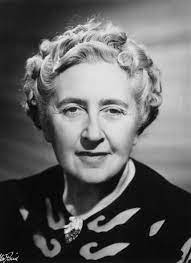
There were several great authors in the twentieth century, but Agatha Christie was one of the best and is still considered to be the bestselling novelist of all time. She is best known for her novels in the mystery genre, of which she wrote sixty-six and sold billions of copies around the world. She is even recognized as the Queen of Crime and is credited with creating the modern murder mystery. Agatha Christie has earned these honors through her wonderful writings, which were influenced by several different experiences. Some of these were her time spent at the hospital during the war, her exposure to archaeology through her husband, and her love for Sir Arthur Conan Doyle’s Sherlock Holmes.
Agatha Christie, then Agatha Miller, was born in 1890 to Frederick and Clara Miller. They were a middle-class family who lived in Torquay, Devon. The only uncommon aspect of Agatha’s upbringing was she did not attend boarding school, like her two older siblings, but was homeschooled by her father. Also, her love for books and writing was very evident at an early age. Christie taught herself to read at age five, began to write poems as a child, and even gained some knowledge of the French language through her governess, Marie.
However, at age eleven, Agatha’s family dynamic took a turn when her father died of a heart attack, probably induced by stressing over financial issues. Agatha and her mother grew much closer after this tragedy, and they left for her debutante season in Cairo where she met many young people at parties, which gave way to several marriage proposals. However, she did not accept any of the proposals but did begin seeing a man named Archie Christie in 1912. Two years later, after they had both experienced war, she on the Home Front in a Red Cross Hospital and he in France, they were married. However, because they were apart so much (Archie had to return to France two days after they were married), Agatha Christie remarked she felt their married life did not truly begin until 1918, when Archie was given a position at the War Office in London. They had one daughter, Rosalind, together but sadly their marriage was not meant to work out.
Archie’s affections grew stronger for a family friend named Nancy Neele, and he asked Agatha for a divorce. Christie was devastated and so overwhelmed that one night she got into her car and drove off. The police found her car deserted and organized a search party for her. Ten days later she was found at the Harrogate Spa Hotel under the name Theresa Neale. Many believed she suffered from amnesia, some believed it was a ploy she created to win Archie back, and others believed she used the circumstances to increase her popularity. While this did not help Agatha win Archie back, it did increase her popularity. Several of her earlier books were reprinted and sold out and her disappearance, with its similarity to detective fiction, made her a celebrity.
Agatha Christie started her detective writing career during World War I and debuted her first book, The Mysterious Affair at Styles, which starred her most recognized detective, Hercule Poirot. One of the reasons why Christie started writing detective novels was because of a bet made with her sister. She told Agatha she did not believe she could write a good detective story. The other reason was to relieve her from the dreary dispensing work she was now doing at the Hospital. In 1919, Agatha Christie caught the attention of a publisher from The Bodley Head, John Lane, who published The Mysterious Affair at Styles and contracted her to write five more books.
Following the war, Christie experimented with different types of mystery stories and developed characters such as Tommy and Tuppence and Miss Marple. By 1924, Christie had become irritated by her publisher’s unfair terms and turned to a new publishing company, William Collins and Sons (now HarperCollins). As Agatha Christie reached her mid-fifties, she became less prolific and enjoyed a slower-paced life than she was used to. After a very successful life and career, Agatha Christie died of natural causes on January 12, 1976.
Agatha Christie was influenced by many experiences and people in her life but one experience that heavily influenced her writing was her time spent working at the Red Cross Hospital. She worked at the local hospital as a nurse for two years and then was transferred to the hospital dispensary, where she worked for another two years. In order to be able to hand out drugs to patients, she needed to pass the Apothecary Hall exam. She spent large amounts of time being trained by chemists and pharmacists so she would not make a mistake and accidentally mix a poison into an ointment. As a result, Christie became well-versed in her knowledge of drugs, ointments, and poisons. Because she was immersed in the world of medicine and poisons, it is very reasonable that many of her victims met their deaths by means of poisoning. Agatha Christie wrote about a total of eighty-three poisonings in her novels.
During her time working as a nurse she also came in contact with several Belgian refugees because the district in which she lived had a flood of refugees fleeing Belgium after the German invasion. These refugees inspired her first detective, Hercule Poirot, who starred in many of her novels.
Another experience that influenced Agatha Christie was her time spent at archaeological dig sites. After her divorce from Archie, she went on the Orient Express and visited the ruins at Ur where she met her second husband, Max Mallowan, a prominent archaeologist. They married in 1930 and Christie accompanied Max on several of his expeditions. They began a rotation of summers at Ashfield, Christmas at Abney Hall, late autumn and spring on digs, and the rest of the year in London and their country home in Wallingford, Oxfordshire. On Max’s expeditions they visited Cairo, Damascus, and other places. However, Agatha did not just accompany Max on his expeditions. She helped out in many ways, such as cleaning artifacts with her face cream, which turned dirty, fragile antiques into well-preserved artifacts. In turn, her husband’s archaeological digs helped Christie with writing her novels. For example, Christie’s novel, Murder on the Orient Express, was inspired by a train ride she took on the way back from one of the dig sites when the train was stuck for twenty-four hours due to bad weather. Many other novels such as Murder in Mesopotamia, They Came to Baghdad, and Death on the Nile were inspired by the influences of the digs in places like Egypt and Mesopotamia. Some of the characters in her novels even resembled their friends from the dig site at Ur.
One person that influenced Agatha Christie’s detective novels greatly was Sir Arthur Conan Doyle and his famous detective Sherlock Holmes. She even admitted to following the Sherlock tradition, especially when it came to implementing an unconventional detective (Poirot). When she was trying to decide what the characteristics of her detective were going to be, she kept going back to Britain’s greatest detective, Sherlock Holmes. Agatha Christie knew she would never be able to perfectly portray him, so obviously she did try to create differences between Holmes and Poirot. However, early on in her career after a few novels she realized she had been influenced by Doyle’s novels more then she had meant. She remarked she was “writing in the Sherlock Holmes tradition — eccentric detective [Poirot], stooge assistant [Captain Hastings], with a Lestrade-type Scotland Yard detective, Inspector Japp” (Berlin).
Another great author that influenced Christie was Gaston le Roux. It was his novel, The Mystery of the Yellow Room, that initiated Agatha’s conversation with her sister, Madge, about writing a detective book. They had been discussing the book and Agatha described it as a well-thought out and baffling mystery. She then remarked to her sister she would like to write a detective novel. Even though her sister told her she should not write a detective story because they were so challenging, Christie was determined to do so.
It is a good thing that Agatha Christie was so determined to write novels in the detective genre, because many people would have been deprived of reading her wonderful mystery novels. She practically invented the typical mystery book scenario. A crime is committed, a detective is summoned to determine who did it, he investigates and interrogates, he gathers everyone around to display his conclusion, and finally the criminal does not protest but confesses and is taken away by the police. With her specific writing style, Christie won over millions of people and became one of the most prolific writers of all time, especially in regards to her detective fiction. It is no surprise then that she is known as “The Queen of Crime.”
Bibliography
“About Agatha Christie.” The World’s Best-Selling Novelist — Agatha Christie, The Home of Agatha Christie, Web. 14 Oct. 2017.
Acocella, Joan. “Queen of Crime.” The New Yorker. 25 Aug. 2017. Web. 14 Oct. 2017.
“Agatha Christie — The Influences on Her Writing.” http://www.christiemystery.co.uk. The Christie Mystery. Web. 14 Oct. 2017.
Berlin, Erika. “15 Influences on Agatha Christie’s Work.” Mental Floss. 15 Sept. 2015. Web. 14 Oct. 2017.
Ferro, Shaunacy. “How Archaeology Influenced Agatha Christie.” Mental Floss. 15 Dec. 2015. Web. 14 Oct. 2017.
 Redeeming Pandora